



The Emerging Changes in the
Wealth Management Spectrum
          in India
           Presented by :
      Vyas Rai Nagpal, BA LLB
Transformation of the Industry
 The Wealth Management industry in India is a
 prime example of the success of free competition
 in the country

 With a GDP growth rate hovering around the 9%
 mark and a strong future outlook, India’s growth
 story is making it an increasingly attractive market
 for wealth management firms. This trend is
 expected to continue, with India estimated to
 become the third largest global economy by
 2030. (Source: Cognizant Reports)
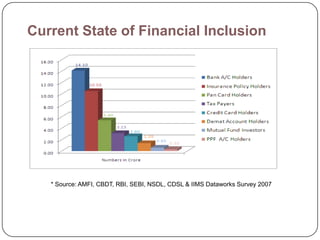
Current State of Financial Inclusion


   * Source: AMFI, CBDT, RBI, SEBI, NSDL, CDSL & IIMS Dataworks Survey 2007
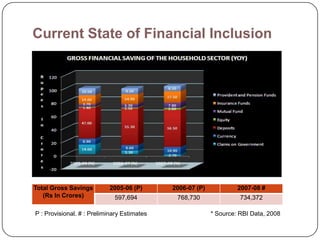
Current State of Financial Inclusion


Total Gross Savings        2005-06 (P)       2006-07 (P)            2007-08 #
   (Rs In Crores)            597,694          768,730                734,372

P : Provisional. # : Preliminary Estimates                 * Source: RBI Data, 2008
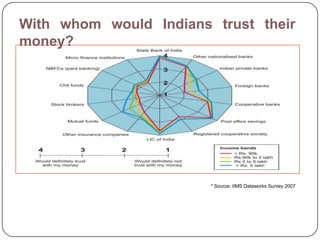
With whom would Indians trust their
money?


                        * Source: IIMS Dataworks Survey 2007
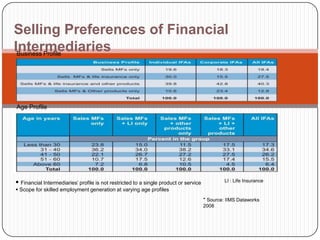
Selling Preferences of Financial
Intermediaries
 Business Profile


Age Profile


 Financial Intermediaries’ profile is not restricted to a single product or service            LI : Life Insurance
 Scope for skilled employment generation at varying age profiles
                                                                                       * Source: IIMS Dataworks
                                                                                       2008
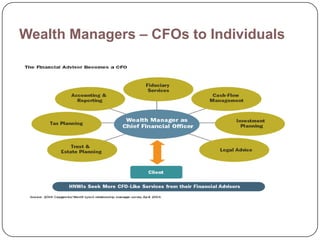
Wealth Managers – CFOs to Individuals
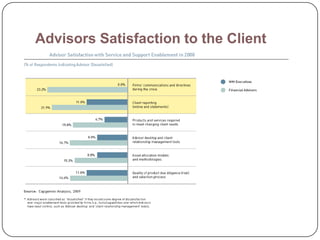
Advisors Satisfaction to the Client
Size and Growth of WM Industry


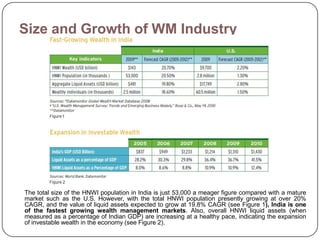
The total size of the HNWI population in India is just 53,000 a meager figure compared with a mature
market such as the U.S. However, with the total HNWI population presently growing at over 20%
CAGR, and the value of liquid assets expected to grow at 19.8% CAGR (see Figure 1), India is one
of the fastest growing wealth management markets. Also, overall HNWI liquid assets (when
measured as a percentage of Indian GDP) are increasing at a healthy pace, indicating the expansion
of investable wealth in the economy (see Figure 2).
WM Objectives and Channel Preferences


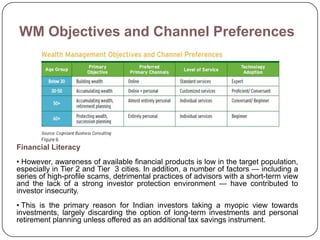
Financial Literacy
• However, awareness of available financial products is low in the target population,
especially in Tier 2 and Tier 3 cities. In addition, a number of factors — including a
series of high-profile scams, detrimental practices of advisors with a short-term view
and the lack of a strong investor protection environment — have contributed to
investor insecurity.
• This is the primary reason for Indian investors taking a myopic view towards
investments, largely discarding the option of long-term investments and personal
retirement planning unless offered as an additional tax savings instrument.
WM- Organized & Un-Organized Sectors


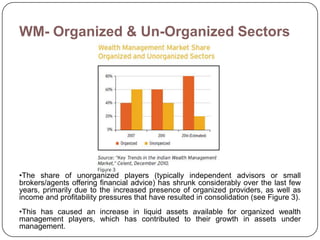
•The share of unorganized players (typically independent advisors or small
brokers/agents offering financial advice) has shrunk considerably over the last few
years, primarily due to the increased presence of organized providers, as well as
income and profitability pressures that have resulted in consolidation (see Figure 3).
•This has caused an increase in liquid assets available for organized wealth
management players, which has contributed to their growth in assets under
management.
Current Primary Focus of WM Firms
 Qualified advisors will be the best brand
 ambassadors for new firms seeking to gain a
 competitive edge against established players
 Investor education programs could deliver
 information pertaining to various asset classes
 and the associated risks, fee structures and
 benefits of each.
 Establishing trust is a vital component for any
 successful brand-building exercise in India.
Strategies Opted by WM Firms
 Invest in brand building to build trust


 Invest   in advisor technology            to   improve
  productivity and advisor retention.

 Offer a 360-degree view

 Shifting to a profit-sharing model (where the
  advisor’s fees are based on the overall
  performance of the portfolio) would help mitigate
  issues to some extent.
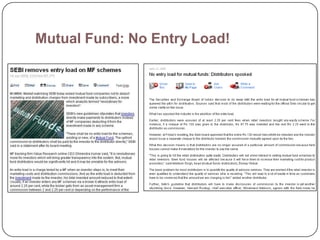
Mutual Fund: No Entry Load!
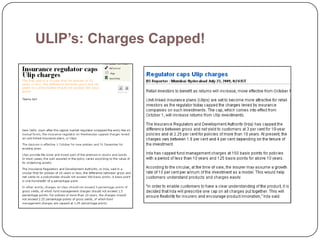
ULIP’s: Charges Capped!
What is an IFA?
Questions Clients Ask - 1

 ―I’ve just received an offer for a new job. Can
 you tell me if this salary structure is in my best
 interests?‖
Ponder…
    1. Is this asked of by every distributor? And if
      not, why?
The Answer Is Trust
    ―Integrity is what you are when no one is looking.‖
Questions Clients Ask - 2
 ―Which is the best Mutual Fund to invest in?‖
 ―Do I need insurance?‖
 ―Shall I sell this property now?‖
Competency Is Essential…
     ―Knowledge is the only instrument of production
     that is not subject to diminishing returns.‖ --- J M
     Clark
…Without Complacency
 ―It’s what you learn after you know it all that
 counts.‖ --- John Wooden, college basketball
 coach
Financial Architect!
 Understand needs, arrive at a budget
 Make the drawings, get okay, convert to blueprint
 Build the house
Opportunities of No Entry Load Rule
 Relationship becomes more advice and customer
    centric than transaction based
   Will open doors for Wealth Management
   Good advice will be appreciated and hence rewarded
   Customer service will be the key
   Knowledge is a must, hence certification becomes
    important
   Those who work in client's interest will be rewarded
Immediate Issues
 Difficulty in putting a value to your service & advice
 Building the right business model
 Maintaining brokerage structure may be difficult and
  cumbersome and bulky
 Technology – Online platforms with direct investments
 Immediate cash-flow concerns
Need for Qualified Advisors !
 The Current Indian Financial Advisory Market is
 looking for Brand building through its ―Qualified
 Advisors‖ as Brand Ambassadors

 Qualified Advisors shall develop trust with the clients
 on a better footings

 IFA’s require a qualification to equip themselves with
 the required skill set and knowledge to call
 themselves as ―Qualified Advisors‖
New Certification’s / Degree’s for the
“Qualified Advisors”
 American Academy of Financial Management TM’s was founded in 1996,
  its professional development programs are Executive Certification
  Programs that are designed to ensure ―PRACTICAL WORKPLACE
  RELEVANCE‖

 The American Academy of Financial Management         TM  is a worldwide
  Board of Standards and financial professional organization, with
  members in 150+ countries offering our exclusive certified designations,
  charters, and masters certification to candidates who meet the high
  standards.

 AFMTM now has representative offices in the US World Trade Center
  N.O. Center, Hong Kong, Beijing, India, Dubai, Kuwait, Latin America
  and South America, Singapore, The Caribbean, Europe, and more.
  Moreover, AAFM™ is a candidate for recognition from the United
  Nations.

 AAFMTM mandates consent to high standards of professional conduct,
  and AAFM activities are International in nature and scope. As seen in
  the Wall Street Journal, CNN, Financial Times, The Hindu National, The
  El Norte Latin America, The Arab Times, and The Beijing Times.
Certification / Designations
 Some of the AAFM Certifications are:


  CWM - Chartered Wealth Manager
  Certification™
  RFS - Registered Financial Specialist™
  RBA - Registered Business Analyst™
  MFP - Master Financial Professional™

 Many other Certifications they have to offer to the
  Industry …………………………………………….
CWM - Chartered Wealth Manager
Certification™
   Wealth Management is one of the fastest growing
    disciplines of the banking sector. The CWM
    focuses on developing relationship management,
    sales, communication and core financial planning
    skills to equip Wealth Management Professionals
    with graduate education.
   The AAFM CWM Program is a Federally
    Copyrighted Program founded in the United
    States with Wall Street Sector Trademarks owned
    by AAFM.
RFS - Registered Financial Specialist™
 Covering financial planning, asset management,
 investment advising, and insurance topics, the
 RFS is the fundamental graduate qualification on
 AAFM's Banking and Investment Management
 program.
RBA - Registered Business Analyst™
 A strategic MBA refresher with an intensive
 coverage on innovative and high-powered
 graduate level finance, business analysis, and
 leadership topics.

 Designed for the busy executive or upcoming
 management graduate. Includes focus          on
 competitive intelligence and benchmarking.
MFP - Master Financial Professional™
 Available via accreditation legal recognition agreements and
  articulations. Complete a degree from an AACSB and ACBSP double
  accredited programs with concentration in finance, and then become
  immediately eligible for MFP.

 The MFP Path is the first Graduate credential that is awarded for
  completing a 4 year program or graduate program from an
  accredited institution.

 The MFP establishes the fundamental global standards required for
  the Financial Professional in today's business environment.

 It recognizes concentrations in finance, economics, investments,
  asset and portfolio management, ethics, regulatory issues, tax, and
  accounting. It is also available as a conversion program.
Certification / Designations Launched
   In India
 Recent launch in India is CWM - Chartered Wealth
 Manager Certification™
 CWM has 2 Levels of Examination
   Level 1: Foundation Course
   Level 2: Awarded with CWM

 Course Duration: 3- 6 Months

 Globally Recognized : The Certification will directly
 be awarded by American Academy of Financial
 ManagementTM, USA
Other Certifications of AAFMTM
 CAM ™ Chartered Asset Manager - AAFM ® Charter
 AFA ™ Accredited Financial Analyst - Financial Analyst
    Designate
   CPM ™ Chartered Portfolio Manager - AAFM ® Charter
   CRA ™ Chartered Risk Analyst - IBS Charter & AAFM®
    Charter
   CTEP ™ Chartered Trust and Estate Planner - AAFM ®
    Charter
   CMA ™ Chartered Market Analyst ™ - Financial Analyst
    Designate - AAFM® Charter and Designation
   CCA ™ Chartered Compliance Analyst - AAFM® Charter
   CAMC ™ Certified Anti-Money Laundering Consultant -
    AAFM® Charter
   CAPA ™ Certified Asset Protection Analyst - AAFM® Charter
   CEC Certified E-Commerce Consultant - - AAFM® Charter
   MPM™ Master Project Manager – Legal Analyst - AAFM®
Thank you for bearing with Me :
 )
In case of any suggestion / questions please feel free to contact me
   at:

vyasrainagpal@gmail.com or 9711797800

The emerging changes in the wealth management spectrum

  • 1.
    The Emerging Changesin the Wealth Management Spectrum in India Presented by : Vyas Rai Nagpal, BA LLB
  • 2.
    Transformation of theIndustry  The Wealth Management industry in India is a prime example of the success of free competition in the country  With a GDP growth rate hovering around the 9% mark and a strong future outlook, India’s growth story is making it an increasingly attractive market for wealth management firms. This trend is expected to continue, with India estimated to become the third largest global economy by 2030. (Source: Cognizant Reports)
  • 3.
    Current State ofFinancial Inclusion * Source: AMFI, CBDT, RBI, SEBI, NSDL, CDSL & IIMS Dataworks Survey 2007
  • 4.
    Current State ofFinancial Inclusion Total Gross Savings 2005-06 (P) 2006-07 (P) 2007-08 # (Rs In Crores) 597,694 768,730 734,372 P : Provisional. # : Preliminary Estimates * Source: RBI Data, 2008
  • 5.
    With whom wouldIndians trust their money? * Source: IIMS Dataworks Survey 2007
  • 6.
    Selling Preferences ofFinancial Intermediaries Business Profile Age Profile  Financial Intermediaries’ profile is not restricted to a single product or service LI : Life Insurance  Scope for skilled employment generation at varying age profiles * Source: IIMS Dataworks 2008
  • 7.
    Wealth Managers –CFOs to Individuals
  • 8.
  • 9.
    Size and Growthof WM Industry The total size of the HNWI population in India is just 53,000 a meager figure compared with a mature market such as the U.S. However, with the total HNWI population presently growing at over 20% CAGR, and the value of liquid assets expected to grow at 19.8% CAGR (see Figure 1), India is one of the fastest growing wealth management markets. Also, overall HNWI liquid assets (when measured as a percentage of Indian GDP) are increasing at a healthy pace, indicating the expansion of investable wealth in the economy (see Figure 2).
  • 10.
    WM Objectives andChannel Preferences Financial Literacy • However, awareness of available financial products is low in the target population, especially in Tier 2 and Tier 3 cities. In addition, a number of factors — including a series of high-profile scams, detrimental practices of advisors with a short-term view and the lack of a strong investor protection environment — have contributed to investor insecurity. • This is the primary reason for Indian investors taking a myopic view towards investments, largely discarding the option of long-term investments and personal retirement planning unless offered as an additional tax savings instrument.
  • 11.
    WM- Organized &Un-Organized Sectors •The share of unorganized players (typically independent advisors or small brokers/agents offering financial advice) has shrunk considerably over the last few years, primarily due to the increased presence of organized providers, as well as income and profitability pressures that have resulted in consolidation (see Figure 3). •This has caused an increase in liquid assets available for organized wealth management players, which has contributed to their growth in assets under management.
  • 13.
    Current Primary Focusof WM Firms  Qualified advisors will be the best brand ambassadors for new firms seeking to gain a competitive edge against established players  Investor education programs could deliver information pertaining to various asset classes and the associated risks, fee structures and benefits of each.  Establishing trust is a vital component for any successful brand-building exercise in India.
  • 14.
    Strategies Opted byWM Firms  Invest in brand building to build trust  Invest in advisor technology to improve productivity and advisor retention.  Offer a 360-degree view  Shifting to a profit-sharing model (where the advisor’s fees are based on the overall performance of the portfolio) would help mitigate issues to some extent.
  • 15.
    Mutual Fund: NoEntry Load!
  • 16.
  • 17.
  • 18.
    Questions Clients Ask- 1  ―I’ve just received an offer for a new job. Can you tell me if this salary structure is in my best interests?‖
  • 19.
    Ponder… 1. Is this asked of by every distributor? And if not, why?
  • 20.
    The Answer IsTrust ―Integrity is what you are when no one is looking.‖
  • 21.
    Questions Clients Ask- 2  ―Which is the best Mutual Fund to invest in?‖  ―Do I need insurance?‖  ―Shall I sell this property now?‖
  • 22.
    Competency Is Essential…  ―Knowledge is the only instrument of production that is not subject to diminishing returns.‖ --- J M Clark
  • 23.
    …Without Complacency  ―It’swhat you learn after you know it all that counts.‖ --- John Wooden, college basketball coach
  • 24.
    Financial Architect!  Understandneeds, arrive at a budget  Make the drawings, get okay, convert to blueprint  Build the house
  • 25.
    Opportunities of NoEntry Load Rule  Relationship becomes more advice and customer centric than transaction based  Will open doors for Wealth Management  Good advice will be appreciated and hence rewarded  Customer service will be the key  Knowledge is a must, hence certification becomes important  Those who work in client's interest will be rewarded
  • 26.
    Immediate Issues  Difficultyin putting a value to your service & advice  Building the right business model  Maintaining brokerage structure may be difficult and cumbersome and bulky  Technology – Online platforms with direct investments  Immediate cash-flow concerns
  • 27.
    Need for QualifiedAdvisors !  The Current Indian Financial Advisory Market is looking for Brand building through its ―Qualified Advisors‖ as Brand Ambassadors  Qualified Advisors shall develop trust with the clients on a better footings  IFA’s require a qualification to equip themselves with the required skill set and knowledge to call themselves as ―Qualified Advisors‖
  • 28.
    New Certification’s /Degree’s for the “Qualified Advisors”  American Academy of Financial Management TM’s was founded in 1996, its professional development programs are Executive Certification Programs that are designed to ensure ―PRACTICAL WORKPLACE RELEVANCE‖  The American Academy of Financial Management TM is a worldwide Board of Standards and financial professional organization, with members in 150+ countries offering our exclusive certified designations, charters, and masters certification to candidates who meet the high standards.  AFMTM now has representative offices in the US World Trade Center N.O. Center, Hong Kong, Beijing, India, Dubai, Kuwait, Latin America and South America, Singapore, The Caribbean, Europe, and more. Moreover, AAFM™ is a candidate for recognition from the United Nations.  AAFMTM mandates consent to high standards of professional conduct, and AAFM activities are International in nature and scope. As seen in the Wall Street Journal, CNN, Financial Times, The Hindu National, The El Norte Latin America, The Arab Times, and The Beijing Times.
  • 29.
    Certification / Designations Some of the AAFM Certifications are: CWM - Chartered Wealth Manager Certification™ RFS - Registered Financial Specialist™ RBA - Registered Business Analyst™ MFP - Master Financial Professional™  Many other Certifications they have to offer to the Industry …………………………………………….
  • 30.
    CWM - CharteredWealth Manager Certification™  Wealth Management is one of the fastest growing disciplines of the banking sector. The CWM focuses on developing relationship management, sales, communication and core financial planning skills to equip Wealth Management Professionals with graduate education.  The AAFM CWM Program is a Federally Copyrighted Program founded in the United States with Wall Street Sector Trademarks owned by AAFM.
  • 31.
    RFS - RegisteredFinancial Specialist™  Covering financial planning, asset management, investment advising, and insurance topics, the RFS is the fundamental graduate qualification on AAFM's Banking and Investment Management program.
  • 32.
    RBA - RegisteredBusiness Analyst™  A strategic MBA refresher with an intensive coverage on innovative and high-powered graduate level finance, business analysis, and leadership topics.  Designed for the busy executive or upcoming management graduate. Includes focus on competitive intelligence and benchmarking.
  • 33.
    MFP - MasterFinancial Professional™  Available via accreditation legal recognition agreements and articulations. Complete a degree from an AACSB and ACBSP double accredited programs with concentration in finance, and then become immediately eligible for MFP.  The MFP Path is the first Graduate credential that is awarded for completing a 4 year program or graduate program from an accredited institution.  The MFP establishes the fundamental global standards required for the Financial Professional in today's business environment.  It recognizes concentrations in finance, economics, investments, asset and portfolio management, ethics, regulatory issues, tax, and accounting. It is also available as a conversion program.
  • 34.
    Certification / DesignationsLaunched In India  Recent launch in India is CWM - Chartered Wealth Manager Certification™  CWM has 2 Levels of Examination  Level 1: Foundation Course  Level 2: Awarded with CWM  Course Duration: 3- 6 Months  Globally Recognized : The Certification will directly be awarded by American Academy of Financial ManagementTM, USA
  • 35.
    Other Certifications ofAAFMTM  CAM ™ Chartered Asset Manager - AAFM ® Charter  AFA ™ Accredited Financial Analyst - Financial Analyst Designate  CPM ™ Chartered Portfolio Manager - AAFM ® Charter  CRA ™ Chartered Risk Analyst - IBS Charter & AAFM® Charter  CTEP ™ Chartered Trust and Estate Planner - AAFM ® Charter  CMA ™ Chartered Market Analyst ™ - Financial Analyst Designate - AAFM® Charter and Designation  CCA ™ Chartered Compliance Analyst - AAFM® Charter  CAMC ™ Certified Anti-Money Laundering Consultant - AAFM® Charter  CAPA ™ Certified Asset Protection Analyst - AAFM® Charter  CEC Certified E-Commerce Consultant - - AAFM® Charter  MPM™ Master Project Manager – Legal Analyst - AAFM®
  • 36.
    Thank you forbearing with Me : ) In case of any suggestion / questions please feel free to contact me at: vyasrainagpal@gmail.com or 9711797800

Editor's Notes

  • #21 Talk about importance of service & how to build trust with clients
  • #23 Talk about CFP and importance of certification
  • #24 Knowledge upgradation – how it should be a continuous process.
  • #25 What does a financial planner do?? Discuss about financial planning.