IDEALISM (Plato and Immanuel Kant)
• Reality is internal to our minds
• The ideas that make up reality have already existed so
that when we know something, it means we have
reached our conscious understanding of these ideas.
• Reality is equivalent to mind, spirit or consciousness and
ideas are the highest type of reality
In the school setting …
• The school is the repository of eternal truth
• Focuses on most important subjects that cultivate abstract
thinking(Philosophy, Theology and mathematics)
• Believes in the use of Socratic method
• Teachers should lead exemplary lives and be models to
students
• Technology should be the means rather than the end in
transmitting knowledge
REALISM (Aristotle)
• Stands in contrast to idealism
• Reality is fundamentally mental or spiritual in nature.
• Physical world exists regardless of human observation or
thought
• The purpose of education is to teach students about the
world in which they live
Realist teachers…
• Teachers should be equipped with a wide repertoire of
methods
• To bring students’ ideas about the world into reality
• Deductive, inductive, and scientific methods are reliable
means to discover knowledge
• Non-academic activities interfere with the school’s purpose as
center of academic excellence
• Technology as an aid in learning
PRAGMATISM (Charles Sanders Peirce, William James, john
Dewey)
• Emphasizes practical consequences of beliefs, theories and actions as
the measure of the truth and value.
• If something works, then it is true.
• Education is a preparation for life
• The function of education is to enhance human potentials
• Students should be encouraged to do researches and apply them to
the solution of a problem
Pragmatist teachers…
• Education is an experimental process
• Learners should learn how to make difficult decisions by considering the
consequence of their actions
• Education should focus on real-life problems
• Students should learn the process of problem-solving rather than being
passive learners
• Believe in collaborative learning
• Interdisciplinary education is better than departmentalized curriculum
• Believe in taking risk
• Believe that communication technology provides opportunities to share
ideas
PERENNIALISM (Robert Hutchins)
• The primary purpose of education is to bring students in
contact with the truth by cultivating their intellect
• Propose the study of religion to encourage ethical
behavior
• Students should read great books to develop
understanding of human knowledge
Perennialist teachers…
• Teachers are the intellectual mentors and models for their
students
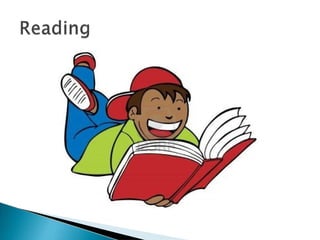
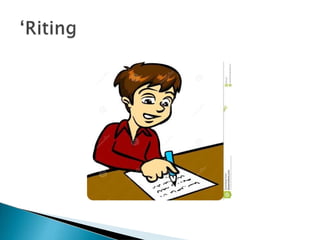
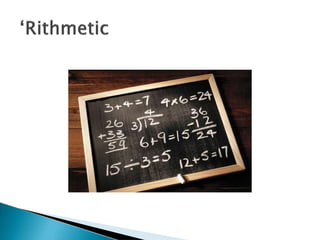
• Reading, writing, math, and research should be developed
starting elementary to prepare for lifelong learning
• Subjects with human concern like history, literature, drama,
and arts should be included in the secondary curriculum
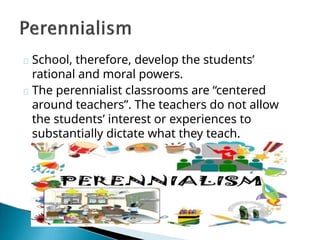
School, therefore, develop the students’
rational and moral powers.
The perennialist classrooms are “centered
around teachers”. The teachers do not allow
the students’ interest or experiences to
substantially dictate what they teach.
ESSENTIALISM (William Bagley)
• Teacher-centered philosophy that adheres to the belief
that the basic skills of literacy should be developed in
schools
• Favors subject-matter curriculum which should be
sequentially arranged starting from low order to more
complex higher order level
Essentialist teachers…
• Have authority to discipline students
• Should have mastery of the knowledge and skills they teach
• Believe in the use of deductive method of teaching
• Believe that students should learn the “essentials”.
• Believe that only when students have mastered the required
competency can they be promoted to the higher level
• Test scores are the bases for evaluating students’ progress
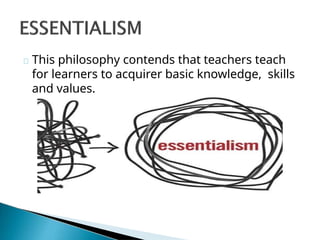
This philosophy contends that teachers teach
for learners to acquirer basic knowledge, skills
and values.
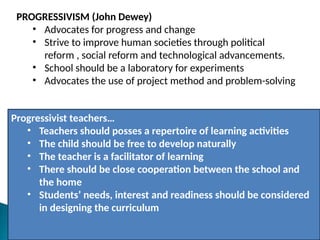
PROGRESSIVISM (John Dewey)
• Advocates for progress and change
• Strive to improve human societies through political
reform , social reform and technological advancements.
• School should be a laboratory for experiments
• Advocates the use of project method and problem-solving
Progressivist teachers…
• Teachers should posses a repertoire of learning activities
• The child should be free to develop naturally
• The teacher is a facilitator of learning
• There should be close cooperation between the school and
the home
• Students’ needs, interest and readiness should be considered
in designing the curriculum
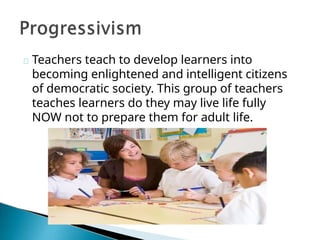
Teachers teach to develop learners into
becoming enlightened and intelligent citizens
of democratic society. This group of teachers
teaches learners do they may live life fully
NOW not to prepare them for adult life.
SOCIAL RECONSTRUCTIONISM (George Counts)
• More socially-oriented progressivist
• School should work to solve social, political and economic
problems and eventually create a new society
• People are responsible for their social conditions
Social Reconstructionist teachers…
• Believe that the school is the ideal place to alleviate social
problems
• Promote the use of project method and problem-solving
method in teaching
• Research is an effective means of solving problems of society
• Intellectual, emotional, and personal needs of the students
should be considered in the learning process
• Teachers must model democratic principles
EXISTENTIALISM (Soren Kierkegaard)
• The purpose of education is to help students find
meaning and directions in their lives
• We are what we choose to be
Existentialist teachers…
• The purpose of education is to awaken our consciousness
about our freedom to choose and to create our own self-
awareness
• Students should participate in dialogue about the meaning of
life
• Creativity, self-awareness and self-responsibility should be
developed in the students
• Open classrooms maximize freedom of choice
• Believe in self-directed instruction
• Students should decide what they want to learn and when to
learn it
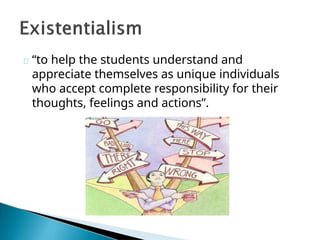
“to help the students understand and
appreciate themselves as unique individuals
who accept complete responsibility for their
thoughts, feelings and actions”.
means the task entrusted to you
“once a teacher, forever a student”
You are expected to contribute to the
betterment of this world in your own unique
way.
To teach is to influence every child entrusted
in your care to become better and happier.
To teach is to help the child become more
human
THANK YOU

PHILOSOPHY.................................

  • 3.
    IDEALISM (Plato andImmanuel Kant) • Reality is internal to our minds • The ideas that make up reality have already existed so that when we know something, it means we have reached our conscious understanding of these ideas. • Reality is equivalent to mind, spirit or consciousness and ideas are the highest type of reality In the school setting … • The school is the repository of eternal truth • Focuses on most important subjects that cultivate abstract thinking(Philosophy, Theology and mathematics) • Believes in the use of Socratic method • Teachers should lead exemplary lives and be models to students • Technology should be the means rather than the end in transmitting knowledge
  • 5.
    REALISM (Aristotle) • Standsin contrast to idealism • Reality is fundamentally mental or spiritual in nature. • Physical world exists regardless of human observation or thought • The purpose of education is to teach students about the world in which they live Realist teachers… • Teachers should be equipped with a wide repertoire of methods • To bring students’ ideas about the world into reality • Deductive, inductive, and scientific methods are reliable means to discover knowledge • Non-academic activities interfere with the school’s purpose as center of academic excellence • Technology as an aid in learning
  • 6.
    PRAGMATISM (Charles SandersPeirce, William James, john Dewey) • Emphasizes practical consequences of beliefs, theories and actions as the measure of the truth and value. • If something works, then it is true. • Education is a preparation for life • The function of education is to enhance human potentials • Students should be encouraged to do researches and apply them to the solution of a problem Pragmatist teachers… • Education is an experimental process • Learners should learn how to make difficult decisions by considering the consequence of their actions • Education should focus on real-life problems • Students should learn the process of problem-solving rather than being passive learners • Believe in collaborative learning • Interdisciplinary education is better than departmentalized curriculum • Believe in taking risk • Believe that communication technology provides opportunities to share ideas
  • 7.
    PERENNIALISM (Robert Hutchins) •The primary purpose of education is to bring students in contact with the truth by cultivating their intellect • Propose the study of religion to encourage ethical behavior • Students should read great books to develop understanding of human knowledge Perennialist teachers… • Teachers are the intellectual mentors and models for their students • Reading, writing, math, and research should be developed starting elementary to prepare for lifelong learning • Subjects with human concern like history, literature, drama, and arts should be included in the secondary curriculum
  • 8.
    School, therefore, developthe students’ rational and moral powers. The perennialist classrooms are “centered around teachers”. The teachers do not allow the students’ interest or experiences to substantially dictate what they teach.
  • 9.
    ESSENTIALISM (William Bagley) •Teacher-centered philosophy that adheres to the belief that the basic skills of literacy should be developed in schools • Favors subject-matter curriculum which should be sequentially arranged starting from low order to more complex higher order level Essentialist teachers… • Have authority to discipline students • Should have mastery of the knowledge and skills they teach • Believe in the use of deductive method of teaching • Believe that students should learn the “essentials”. • Believe that only when students have mastered the required competency can they be promoted to the higher level • Test scores are the bases for evaluating students’ progress
  • 10.
    This philosophy contendsthat teachers teach for learners to acquirer basic knowledge, skills and values.
  • 16.
    PROGRESSIVISM (John Dewey) •Advocates for progress and change • Strive to improve human societies through political reform , social reform and technological advancements. • School should be a laboratory for experiments • Advocates the use of project method and problem-solving Progressivist teachers… • Teachers should posses a repertoire of learning activities • The child should be free to develop naturally • The teacher is a facilitator of learning • There should be close cooperation between the school and the home • Students’ needs, interest and readiness should be considered in designing the curriculum
  • 18.
    Teachers teach todevelop learners into becoming enlightened and intelligent citizens of democratic society. This group of teachers teaches learners do they may live life fully NOW not to prepare them for adult life.
  • 19.
    SOCIAL RECONSTRUCTIONISM (GeorgeCounts) • More socially-oriented progressivist • School should work to solve social, political and economic problems and eventually create a new society • People are responsible for their social conditions Social Reconstructionist teachers… • Believe that the school is the ideal place to alleviate social problems • Promote the use of project method and problem-solving method in teaching • Research is an effective means of solving problems of society • Intellectual, emotional, and personal needs of the students should be considered in the learning process • Teachers must model democratic principles
  • 20.
    EXISTENTIALISM (Soren Kierkegaard) •The purpose of education is to help students find meaning and directions in their lives • We are what we choose to be Existentialist teachers… • The purpose of education is to awaken our consciousness about our freedom to choose and to create our own self- awareness • Students should participate in dialogue about the meaning of life • Creativity, self-awareness and self-responsibility should be developed in the students • Open classrooms maximize freedom of choice • Believe in self-directed instruction • Students should decide what they want to learn and when to learn it
  • 21.
    “to help thestudents understand and appreciate themselves as unique individuals who accept complete responsibility for their thoughts, feelings and actions”.
  • 23.
    means the taskentrusted to you “once a teacher, forever a student”
  • 24.
    You are expectedto contribute to the betterment of this world in your own unique way. To teach is to influence every child entrusted in your care to become better and happier.
  • 25.
    To teach isto help the child become more human
  • 26.