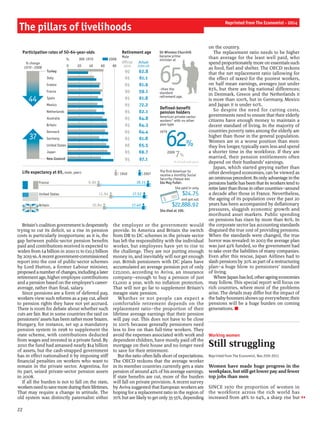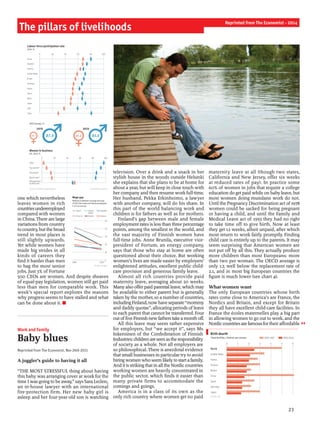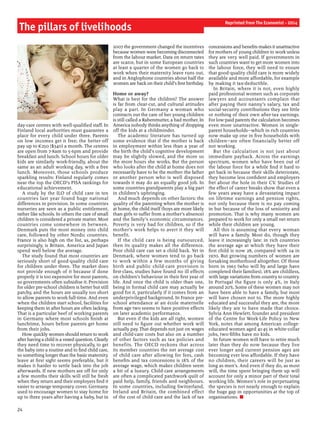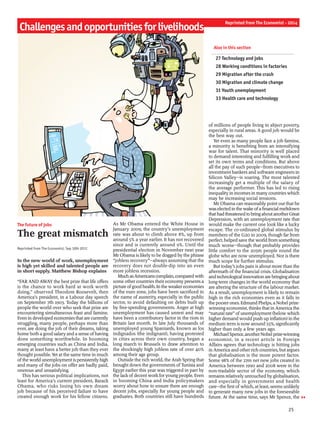
Reprinted from The Economist in 2014
S PECIA L EDI TI ON
SECURI NG LIVE LIHO ODS
Long-term living standards
Crises and their impact
Technology and jobs
Pensions
Migration and climate change
In this issue:
3 The future of securing livelihoods:
Policies, strategies and tools for better
lives today and tomorrow
Livelihoods: The big picture
4 The future of jobs
The onrushing wave
7 The world economy
For richer, for poorer
9 Poverty
Not always with us
11 The world economy
A game of catch-up
The pillars of livelihoods
14 Innovation pessimism
Has the ideas machine broken down?
17 Asian welfare states
New cradles to graves
20 Pensions
Falling short
22 Working women
Still struggling
23 Work and family
Baby blues
Challenges and opportunities for livelihoods
25 The future of jobs
The great mismatch
27 Technology and jobs
Coming to an office near you
28 Working conditions in factories
When the jobs inspector calls
29 Migration after the crash
Moving out, on and back
30 Migration and climate change
A new (under) class of travellers
31 Youth unemployment
Generation jobless
33 Health care and technology
Fantastic Voyage
Reprinted from The Economist - 2014
Contents
For more information about
“The future of livelihoods” please go to
www.VisionariesUnbound.com
Reprinted from The Economist in 2014
SP ECIAL E D ITION
SECU RING LIVELIH O ODS
Long-term living standards
Crises and their impact
Technology and jobs
Pensions
Migration and climate change
In this issue:
Asprivateandpublicplayersatalllevelsexamine
our progress in moving people out of poverty, the
time is right to explore if and how livelihoods have
improved.Whatfactorsreallydeterminelivelihoods?
Whichissueswillmostaffectthemoverthenext20
to 30 years as economic growth shifts from West
to East, amid increasing global interdependence?
And how can rising living standards across the
globe be ensured and sustained?
Livelihoods are constantly at risk. Local
and global crises, demographic shifts, climate
change, new technologies and other challenges
impactlivelihoodsinmanyways.Thesechallenges
vary dramatically across countries, cultures and
communities. Their impacts’ complexity demands
that relevant stakeholders from the public and
private sectors, universities, nonprofits and the
public join forces in a holistic way to design future
strategies for securing sustainable livelihoods.
The recent financial and economic crisis, for
example, affected livelihoods in a variety of ways
andtriggeredmoreinequalityandunemployment.
Inequality further worsens the situation of people
whoalreadystrugglebecauseitdisproportionately
reduces their opportunities to make a living, and
erodes their ability to cope with economic shocks.
Asforunemployment,youth,inparticular,struggle
tofindjobsandtoearnresourcestopayfortheirlives’
core needs. Paradoxically, in parallel, firms in many
industries and countries struggle to find the talent
theyneed,andfaceskillshortagesandmismatches.
Thisissparkingnewemployerpracticesandthinking
abouttheprivatesector’sroleinskillsdevelopment.
Atthesametime,manylacktheentrepreneurialskills
that can help spark job creation. Major changes are
thereforerequiredthroughouteducationsystems,from
pre-kindergartentocollegetoworkforcetraining,and
will be crucial for the future of livelihoods.
Demographic shifts due to medical progress
andfertility-ratefluctuationsalsoposesignificant
challengestosocieties.Pensions,forexample,need
toberethought,particularlyinwealthiercountries,
where people now live long after retirement, and
some less prosperous countries need to harness
theirstill-growingworking-agepopulationtodrive
economicgrowth.Withthisbackdrop,creatingjob
opportunities for those who enter the workforce
is essential. At the same time, social protection
systems,includinghealthinsuranceandretirement
programs, are weak or nonexistent in low-income
countries.Theseneedtobestrengthened,particularly
for those whose livelihoods are at risk.
Climate change is also increasingly affecting
livelihoods. Extreme weather events, such as
floods and hurricanes, occur more often and
with increased intensity. These events take lives;
destroy crops, homes and roads; create health
hazards and trigger mass migration. They also
take a heavy toll on the sustainability of insurance
systems. Longer term, biodiversity loss and rising
sealevelsmaysignificantlyreduceglobaleconomic
growthanddeeplytransformourlivingconditions.
Interestingly, climate change represents both a
threat and an opportunity for livelihoods. Many
sectors are joining forces to build sustainable
economies and climate-resilient infrastructures.
Tofacesuchchallenges,technologyoffersahost
ofopportunitiesandsolutionsforfuturelivelihoods.
Better access to and improved information and
communication technologies, nanotechnology
and biotechnology, as well as “green innovation”,
are but a few advances that could materially help
livelihoods. Technology already helps prevent
moreenvironmentaldegradationanddamagefrom
natural disasters, playing a critical role in social
areas, such as health. Over time technology will
foster conditions for better and more-sustainable
livelihoods.Itremainsunclear,nonetheless,whether
technological trends will create or destroy jobs in
thefuture,andthedebateoverwhetherinnovation
is slowing down or speeding up continues.
Global security represents a very different
livelihood challenge. Since the end of the Cold
War, the world has not experienced a major global
conflict. Nevertheless, security concerns are
mounting across the world, and these concerns
affectlivelihoods.Localsafetyissuesalsoweighon
livelihooddevelopmentpossibilities.Violenceand
crime are prevalent in many urban areas. Conflicts
within societies, as evidenced by protests during
the Arab Spring in the Middle East and elsewhere,
are both a symptom and a trigger of livelihood
disruption.Cyber-crimealsoaffectsthesecurityof
financialandintellectualassets.Finally,cyber-war
risks raise the spectre of new security threats to
critical infrastructures and lives.
Confronting the many challenges of future
livelihoods and imagining opportunities for them
is a massive, complex undertaking. Livelihood
debates and solutions draw from many different
policy areas and a vast number of stakeholders.
So, by extension, when changes or reforms are
required, strong resistance often follows. All too
often, policy-makers are biased by short-term
and personal vested interests, rather than long-
term societal goals. Forging consensus and quick,
coordinatedactionamongnationalgovernmentsin
suchurgentareasasglobalwarming,international
financial regulation and cyber-crime remains,
unfortunately, particularly challenging.
This special edition of The Economist, with the
theme“SecuringLivelihoods”,featuresinformative
andprovocativearticlesfromrecenteditionsofthe
magazine.Itbringsinsightsintothetrendsconcerning
global livelihoods, and asks provocative questions
aboutsomeofthe“pillars”thatshapethem,suchas
technology,demographics,jobs,pensions,poverty,
inequalityandclimatechange.Theselectedarticles
alsohelpidentifyfuturechallengesandopportunities,
suchasmaintainingsocialprotections—forexample,
pensions, coping with escalating health costs in
ageing societies, creating sustainable jobs and
responding to climate change.
Thesearticlesdonotcoverallanglesoflivelihoods
and the challenges and opportunities that shape
theirsustainability.Butwehopethispublicationwill
sparkdebateamongparticipantsbroughttogether
by the OECD Development Centre, the Economist
Intelligence Unit and the Rockefeller Foundation
attheFoundation’sBellagioCenterinAugust2014.
Exploringkeytrendsandstrategiesaffectingthe
future of livelihoods, and examining the complex
interdependencies of the many factors that shape
livelihoodsinasystematicwaywillundoubtedlyprove
challenging.Identifyingpotentialfuturescenarios
with stories of systems and their interactions
demands creativity, imagination, optimism and
innovation. We hope the conversation and post-
meetingpublicationswillinformandinspireglobal,
nationalandlocaldebateaboutthestrategiesand
policies that can secure and improve livelihoods
today and in the coming decades.
Togetherwehopetoprovidestrategicguidance
topublicandprivateorganisations,andthepublic,
on how to address the coming challenges and
to leverage opportunities to improve livelihoods
across the globe. n
The future of securing livelihoods:
Policies, strategies and tools for better lives today and tomorrow
Robert Garris
Managing Director
Bellagio Programs
The Rockefeller Foundation
From the conveners
Mario Pezzini
Director of the Development Centre
OECD
3
Previoustechnologicalinnovationhasalways
delivered more long-run employment, not
less. But things can change
IN 1930, when the world was “suffering…
from a bad attack of economic pessimism”,
John Maynard Keynes wrote a broadly
optimistic essay, “Economic Possibilities for
our Grandchildren”. It imagined a middle
way between revolution and stagnation that
would leave the said grandchildren a great
deal richer than their grandparents. But the
path was not without dangers.
One of the worries Keynes admitted was a
“new disease”: “technological unemployment…
due to our discovery ofmeans ofeconomising
the use of labour outrunning the pace at
which we can find new uses for labour.” His
readers might not have heard of the problem,
he suggested—but they were certain to hear a
lot more about it in the years to come.
For the most part, they did not. Nowadays,
the majority of economists confidently wave
such worriesaway. By raisingproductivity, they
argue, any automation which economises on
the use of labour will increase incomes. That
will generate demand for new products and
services, which will in turn create new jobs
for displaced workers. To think otherwise has
meant being tarred a Luddite—the name taken
by 19th-century textile workers who smashed
the machines taking their jobs.
For much ofthe 20th century, those arguing
that technology brought ever more jobs and
prosperity looked to have the better of the
debate. Real incomesin Britainscarcelydoubled
between the beginning of the common era
and 1570. They then tripled from 1570 to 1875.
And they more than tripled from 1875 to 1975.
Industrialisation did not end up eliminatingthe
need for human workers. On the contrary, it
created employment opportunitiessufficientto
soakupthe20thcentury’sexplodingpopulation.
Keynes’s vision ofeveryone in the 2030s being
a lot richer is largely achieved. His belief they
would work just 15 hours or so a week has
not come to pass.
When the sleeper wakes
Yetsome nowfearthata newera ofautomation
enabled by ever more powerful and capable
computers could work out differently. They
start from the observation that, across the rich
world, all is far from well in the world ofwork.
The essence ofwhat they see as a workcrisis is
that in rich countries the wages of the typical
worker, adjusted for cost ofliving, are stagnant.
In America the real wage has hardly budged
over the past four decades. Even in places like
Britain and Germany, where employment is
touching new highs, wages have been flat for
a decade. Recent research suggests that this is
because substituting capital for labour through
automation is increasingly attractive; as a result
owners of capital have captured ever more of
the world’s income since the 1980s, while the
share going to labour has fallen.	
Atthesametime, eveninrelativelyegalitarian
places like Sweden, inequality among the
employed has risen sharply, with the share
going to the highest earners soaring. For
those not in the elite, argues David Graeber,
an anthropologist at the London School of
Economics, much of modern labour consists
of stultifying “bullshit jobs”—low- and mid-
level screen-sittingthat serves simply to occupy
workers for whom the economy no longer
has much use. Keeping them employed, Mr
Graeber argues, is not an economic choice;
it is something the ruling class does to keep
control over the lives of others.
Be thatas it may, drudgery maysoon enough
give way to frank unemployment. There is
already a long-term trend towards lower levels
of employment in some rich countries. The
proportion of American adults participating
in the labour force recently hit its lowest
level since 1978, and although some of that
is due to the effects of ageing, some is not.
In a recent speech that was modelled in part
on Keynes’s “Possibilities”, Larry Summers, a
former American treasury secretary, looked at
employment trends among American men
between 25 and 54. In the 1960s only one in
20 of those men was not working. According
to Mr Summers’s extrapolations, in ten years
the number could be one in seven.
This is one indication, Mr Summers says,
that technical change is increasingly taking
the form of “capital that effectively substitutes
for labour”. There may be a lot more for such
capital to do in the near future. A 2013 paper
by Carl Benedikt Frey and Michael Osborne,
of the University of Oxford, argued that jobs
are at high risk of being automated in 47% of
the occupational categories into which workis
customarily sorted. That includes accountancy,
legal work, technical writing and a lot of other
white-collar occupations.
Answering the question of whether such
automation could lead to prolonged pain for
workers means taking a close look at past
experience, theory and technological trends.
The picture suggested by this evidence is a
complex one. It is also more worrying than
many economists and politicians have been
prepared to admit.
The lathe of heaven
Economists take the relationship between
innovation and higher living standards for
granted in part because they believe history
justifies such a view. Industrialisation clearly
led to enormous rises in incomes and living
standards over the long run. Yet the road to
riches was rockier than is often appreciated.
In 1500 an estimated 75% of the British
labour force toiled in agriculture. By 1800
that figure had fallen to 35%. When the shift
to manufacturing got under way during the
18th century it was overwhelmingly done at
small scale, either within the home or in a
small workshop; employment in a large factory
Livelihoods: The big picture
The future of jobs
The onrushing wave
Reprinted from The Economist, Jan 18th 2014
4
Also in this section
7 The world economy
9 Poverty
11 The world economy
Reprinted from The Economist - 2014
Livelihoods: The big picture
was a rarity. By the end of the 19th century
huge plants in massive industrial cities were
the norm. The great shift was made possible
by automation and steam engines.
Industrial firms combined human labour
with big, expensive capital equipment. To
maximise the output ofthat costly machinery,
factory owners reorganised the processes of
production. Workers were given one or a few
repetitive tasks, often making components of
finished products rather than whole pieces.
Bosses imposed a tight schedule and strict
worker discipline to keep up the productive
pace. The Industrial Revolution was not simply
a matter of replacing muscle with steam; it
was a matter of reshaping jobs themselves
into the sort of precisely defined components
that steam-driven machinery needed—cogs in
a factory system.
Thewayoldjobsweredonechanged;newjobs
were created. JoelMokyr,an economichistorian
at Northwestern University in Illinois, argues
that the more intricate machines, techniques
and supply chains of the period all required
careful tending. The workers who provided
that care were well rewarded. As research by
Lawrence Katz, of Harvard University, and
Robert Margo, of Boston University, shows,
employment in manufacturing “hollowed
out”. As employment grew for highly skilled
workers and unskilled workers, craft workers
lost out.Thiswasthe lossto which the Luddites,
understandablyifnoteffectively,tookexception.
With the low-skilled workers far more
numerous, at least to begin with, the lot of
the average worker during the early part of
this great industrial and social upheaval was
not a happy one. As Mr Mokyr notes, “life did
not improve all that much between 1750 and
1850.” For 60 years, from 1770 to 1830, growth
in British wages, adjusted for inflation, was
imperceptible because productivity growth
was restricted to a few industries. Not until the
late 19th century, when the gains had spread
across the whole economy, did wages at last
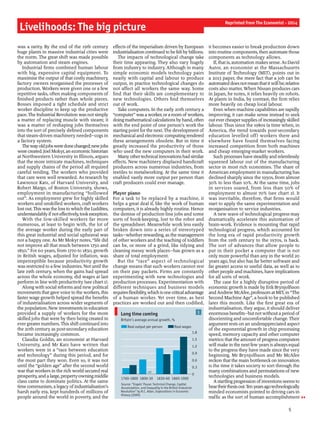
perform in line with productivity (see chart 1).
Along with social reforms and new political
movements that gave voice to the workers, this
faster wage growth helped spread the benefits
of industrialisation across wider segments of
the population. New investments in education
provided a supply of workers for the more
skilled jobs that were by then being created in
ever greater numbers. This shift continued into
the 20th century as post-secondary education
became increasingly common.
Claudia Goldin, an economist at Harvard
University, and Mr Katz have written that
workers were in a “race between education
and technology” during this period, and for
the most part they won. Even so, it was not
until the “golden age” after the second world
warthat workers in the rich world secured real
prosperity,anda large, property-owningmiddle
class came to dominate politics. At the same
time communism,a legacyofindustrialisation’s
harsh early era, kept hundreds of millions of
people around the world in poverty, and the
effects ofthe imperialism driven by European
industrialisation continued to be feltbybillions.
The impacts of technological change take
their time appearing. They also vary hugely
from industry to industry. Although in many
simple economic models technology pairs
neatly with capital and labour to produce
output, in practice technological changes do
not affect all workers the same way. Some
find that their skills are complementary to
new technologies. Others find themselves
out of work.
Take computers. In the early 20th century a
“computer”wasaworker, ora room ofworkers,
doingmathematical calculationsby hand, often
with the end point of one person’s work the
starting point for the next. The development of
mechanical and electronic computingrendered
these arrangements obsolete. But in time it
greatly increased the productivity of those
who used the new computers in their work.
Manyothertechnicalinnovationshadsimilar
effects. New machinery displaced handicraft
producers across numerous industries, from
textiles to metalworking. At the same time it
enabled vastly more output per person than
craft producers could ever manage.
Player piano
For a task to be replaced by a machine, it
helps a great deal if, like the work of human
computers, it is already highly routine. Hence
the demise of production-line jobs and some
sorts of book-keeping, lost to the robot and
the spreadsheet. Meanwhile work less easily
broken down into a series of stereotyped
tasks—whether rewarding, as the management
of other workers and the teaching of toddlers
can be, or more of a grind, like tidying and
cleaning messy work places—has grown as a
share of total employment.
But the “race” aspect of technological
change means that such workers cannot rest
on their pay packets. Firms are constantly
experimenting with new technologies and
production processes. Experimentation with
different techniques and business models
requiresflexibility,whichisonecriticaladvantage
of a human worker. Yet over time, as best
practices are worked out and then codified,
it becomes easier to break production down
into routine components, then automate those
components as technology allows.
If, that is, automation makes sense. As David
Autor, an economist at the Massachusetts
Institute of Technology (MIT), points out in
a 2013 paper, the mere fact that a job can be
automated doesnotmeanthatitwillbe;relative
costs also matter. When Nissan produces cars
in Japan, he notes, it relies heavily on robots.
At plants in India, by contrast, the firm relies
more heavily on cheap local labour.
Even when machine capabilities are rapidly
improving, it can make sense instead to seek
out evercheapersupplies ofincreasinglyskilled
labour. Thus since the 1980s (a time when, in
America, the trend towards post-secondary
education levelled off) workers there and
elsewhere have found themselves facing
increased competition from both machines
and cheap emerging-market workers.
Such processes have steadilyand relentlessly
squeezed labour out of the manufacturing
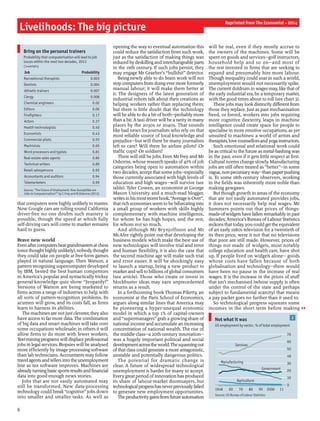
sector in most rich economies. The share of
American employment in manufacturing has
declined sharply since the 1950s, from almost
30% to less than 10%. At the same time, jobs
in services soared, from less than 50% of
employment to almost 70% (see chart 2). It
was inevitable, therefore, that firms would
start to apply the same experimentation and
reorganisation to service industries.
A new wave of technological progress may
dramatically accelerate this automation of
brain-work. Evidence is mounting that rapid
technological progress, which accounted for
the long era of rapid productivity growth
from the 19th century to the 1970s, is back.
The sort of advances that allow people to
put in their pocket a computer that is not
only more powerful than any in the world 20
years ago, but also has far better software and
far greater access to useful data, as well as to
other people and machines, have implications
for all sorts of work.
The case for a highly disruptive period of
economic growth is made by ErikBrynjolfsson
andAndrewMcAfee, professorsatMIT, in “The
Second Machine Age”, a bookto be published
later this month. Like the first great era of
industrialisation, they argue, it should deliver
enormousbenefits—butnotwithouta period of
disorienting and uncomfortable change. Their
argument rests on an underappreciated aspect
of the exponential growth in chip processing
speed, memory capacity and other computer
metrics: thatthe amount ofprogress computers
will make in the next few years is always equal
to the progress they have made since the very
beginning. Mr Brynjolfsson and Mr McAfee
reckon that the main bottleneckon innovation
is the time it takes society to sort through the
many combinations and permutations ofnew
technologies and business models.
Astartlingprogression ofinventionsseemsto
beartheirthesisout.Tenyearsagotechnologically
minded economists pointed to driving cars in
traffic as the sort of human accomplishment
5
Reprinted from The Economist - 2014
1Long time coming
Source: “Engels’ Pause: Technical Change, Capital
Accumulation, and Inequality in the British Industrial
Revolution” by R.C. Allen, Explorations in Economic
History (2009)
Britain’s average annual growth, %
0
0.3
0.6
0.9
1.2
1.5
1.8
1760-1800 1800-30 1830-60 1860-1900
Real output per person Real wages
nil
Livelihoods: The big picture
that computers were highly unlikely to master.
Now Google cars are rolling round California
driver-free no one doubts such mastery is
possible, though the speed at which fully
self-driving cars will come to market remains
hard to guess.
Brave new world
Evenaftercomputersbeatgrandmastersatchess
(once thought highlyunlikely), nobodythought
they could take on people at free-form games
played in natural language. Then Watson, a
pattern-recognising supercomputer developed
by IBM, bested the best human competitors
in America’s popular and syntactically tricksy
general-knowledge quiz show “Jeopardy!”
Versions of Watson are being marketed to
firms across a range of industries to help with
all sorts of pattern-recognition problems. Its
acumen will grow, and its costs fall, as firms
learn to harness its abilities.
The machines are not just cleverer, they also
have access to far more data. The combination
of big data and smart machines will take over
some occupations wholesale; in others it will
allow firms to do more with fewer workers.
Text-miningprogramswill displace professional
jobs in legal services. Biopsies will be analysed
more efficiently by image-processing software
than lab technicians. Accountants may follow
travelagentsandtellersintotheunemployment
line as tax software improves. Machines are
alreadyturningbasicsportsresultsand financial
data into good-enough news stories.
Jobs that are not easily automated may
still be transformed. New data-processing
technology could break“cognitive” jobs down
into smaller and smaller tasks. As well as
opening the way to eventual automation this
could reduce the satisfaction from such work,
just as the satisfaction of making things was
reduced by deskillingand interchangeable parts
in the 19th century. If such jobs persist, they
may engage Mr Graeber’s “bullshit” detector.
Being newly able to do brain work will not
stop computers from doing ever more formerly
manual labour; it will make them better at
it. The designers of the latest generation of
industrial robots talk about their creations as
helping workers rather than replacing them;
but there is little doubt that the technology
will be able to do a bit ofboth—probably more
than a bit. Ataxi driver will be a rarity in many
places by the 2030s or 2040s. That sounds
like bad news for journalists who rely on that
most reliable source of local knowledge and
prejudice—but will there be many journalists
left to care? Will there be airline pilots? Or
traffic cops? Or soldiers?
There will still be jobs. Even Mr Frey and Mr
Osborne, whose research speaks of 47% of job
categories being open to automation within
two decades, accept that some jobs—especially
those currently associated with high levels of
education and high wages—will survive (see
table). Tyler Cowen, an economist at George
Mason University and a much-read blogger,
writesinhismostrecentbook,“AverageisOver”,
that rich economies seem to be bifurcating into
a small group of workers with skills highly
complementary with machine intelligence,
for whom he has high hopes, and the rest,
for whom not so much.
And although Mr Brynjolfsson and Mr
McAfee rightly point out that developing the
business models which make the best use of
new technologies will involve trial and error
and human flexibility, it is also the case that
the second machine age will make such trial
and error easier. It will be shockingly easy
to launch a startup, bring a new product to
market and sell to billions ofglobal consumers
(see article). Those who create or invest in
blockbuster ideas may earn unprecedented
returns as a result.
In a forthcoming book Thomas Piketty, an
economist at the Paris School of Economics,
argues along similar lines that America may
be pioneering a hyper-unequal economic
model in which a top 1% of capital-owners
and “supermanagers” grab a growing share of
national income and accumulate an increasing
concentration of national wealth. The rise of
the middle-class—a 20th-century innovation—
was a hugely important political and social
developmentacrosstheworld.Thesqueezingout
ofthat class could generate a more antagonistic,
unstable and potentially dangerous politics.
The potential for dramatic change is
clear. A future of widespread technological
unemployment is harder for many to accept.
Every great period ofinnovation has produced
its share of labour-market doomsayers, but
technologicalprogresshasneverpreviouslyfailed
to generate new employment opportunities.
Theproductivitygainsfromfutureautomation
will be real, even if they mostly accrue to
the owners of the machines. Some will be
spent on goods and services—golf instructors,
household help and so on—and most of
the rest invested in firms that are seeking to
expand and presumably hire more labour.
Though inequality could soar in such a world,
unemployment would not necessarily spike.
The current doldrum in wages may, like that of
the early industrial era, be a temporary matter,
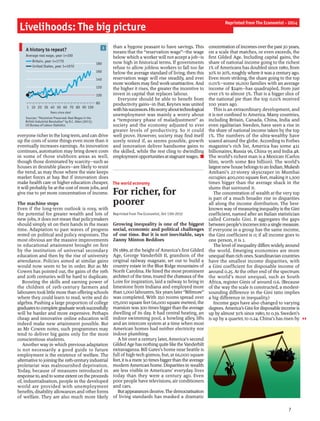
with the good times about to roll (see chart 3).
These jobs may lookdistinctly different from
those they replace. Just as past mechanisation
freed, or forced, workers into jobs requiring
more cognitive dexterity, leaps in machine
intelligence could create space for people to
specialise in more emotive occupations, as yet
unsuited to machines: a world of artists and
therapists, love counsellorsandyoga instructors.
Such emotional and relational work could
be as critical to the future as metal-bashingwas
in the past, even if it gets little respect at first.
Cultural norms change slowly. Manufacturing
jobs are still often treated as “better”—in some
vague, non-pecuniaryway—than paper-pushing
is. To some 18th-century observers, working
in the fields was inherently more noble than
making gewgaws.
But though growth in areas ofthe economy
that are not easily automated provides jobs,
it does not necessarily help real wages. Mr
Summers points out that prices of things-
made-of-widgets have fallen remarkably in past
decades; America’s Bureau ofLabour Statistics
reckons that today you could get the equivalent
of an early 1980s television for a twentieth of
its then price, were it not that no televisions
that poor are still made. However, prices of
things not made of widgets, most notably
college education and health care, have shot
up. If people lived on widgets alone— goods
whose costs have fallen because of both
globalisation and technology—there would
have been no pause in the increase of real
wages. It is the increase in the prices of stuff
that isn’t mechanised (whose supply is often
under the control of the state and perhaps
subject to fundamental scarcity) that means
a pay packet goes no further than it used to.
So technological progress squeezes some
incomes in the short term before making
6
Reprinted from The Economist - 2014
2Not what it was
Source: US Bureau of Labour Statistics
US employment by sector, % of total employment
0
10
20
30
40
50
60
70
1948 60 70 80 90 2000 11
Agriculture
Manufacturing
Government
Services
?Bring on the personal trainers
Source: “The Future of Employment: How Susceptible are
Jobs to Computerisation?” by C.Frey and M.Osborne (2013)
Probability that computerisation will lead to job
losses within the next two decades, 2013
(1=certain)
Job Probability
Recreational therapists 0.003
Dentists 0.004
Athletic trainers 0.007
Clergy 0.008
Chemical engineers 0.02
Editors 0.06
Firefighters 0.17
Actors 0.37
Health technologists 0.40
Economists 0.43
Commercial pilots 0.55
Machinists 0.65
Word processors and typists 0.81
Real estate sales agents 0.86
Technical writers 0.89
Retail salespersons 0.92
Accountants and auditors 0.94
Telemarketers 0.99
everyone richer in the longterm, and can drive
up the costs of some things even more than it
eventually increases earnings. As innovation
continues, automation may bring down costs
in some of those stubborn areas as well,
though those dominated by scarcity—such as
houses in desirable places—are likely to resist
the trend, as may those where the state keeps
market forces at bay. But if innovation does
make health care or higher education cheaper,
it will probably be at the cost ofmore jobs, and
give rise to yet more concentration of income.
The machine stops
Even if the long-term outlook is rosy, with
the potential for greater wealth and lots of
new jobs, it does not mean that policymakers
should simply sit on their hands in the mean
time. Adaptation to past waves of progress
rested on political and policy responses. The
most obvious are the massive improvements
in educational attainment brought on first
by the institution of universal secondary
education and then by the rise of university
attendance. Policies aimed at similar gains
would now seem to be in order. But as Mr
Cowen has pointed out, the gains of the 19th
and 20th centuries will be hard to duplicate.
Boosting the skills and earning power of
the children of 19th-century farmers and
labourers tooklittle more than offering schools
where they could learn to read, write and do
algebra. Pushing a large proportion of college
graduatestocompletegraduateworksuccessfully
will be harder and more expensive. Perhaps
cheap and innovative online education will
indeed make new attainment possible. But
as Mr Cowen notes, such programmes may
tend to deliver big gains only for the most
conscientious students.
Another way in which previous adaptation
is not necessarily a good guide to future
employment is the existence of welfare. The
alternative to joiningthe 19th-century industrial
proletariat was malnourished deprivation.
Today, because of measures introduced in
responseto,andtosome extentonthe proceeds
of, industrialisation, people in the developed
world are provided with unemployment
benefits, disability allowances and other forms
of welfare. They are also much more likely
than a bygone peasant to have savings. This
means that the “reservation wage”—the wage
below which a worker will not accept a job—is
now high in historical terms. If governments
refuse to allow jobless workers to fall too far
below the average standard of living, then this
reservation wage will rise steadily, and ever
more workers may find workunattractive. And
the higher it rises, the greater the incentive to
invest in capital that replaces labour.
Everyone should be able to benefit from
productivity gains—in that, Keynes was united
withhissuccessors.Hisworryabouttechnological
unemployment was mainly a worry about
a “temporary phase of maladjustment” as
society and the economy adjusted to ever
greater levels of productivity. So it could
well prove. However, society may find itself
sorely tested if, as seems possible, growth
and innovation deliver handsome gains to
the skilled, while the rest cling to dwindling
employmentopportunitiesatstagnantwages. n
The world economy
For richer, for
poorer
Reprinted from The Economist, Oct 13th 2012
Growing inequality is one of the biggest
social, economic and political challenges
of our time. But it is not inevitable, says
Zanny Minton Beddoes
IN 1889, at the height ofAmerica’s first Gilded
Age, George Vanderbilt II, grandson of the
original railway magnate, set out to build a
country estate in the Blue Ridge mountains of
North Carolina. He hired the most prominent
architect ofthe time, toured the chateaux ofthe
Loire for inspiration, laid a railway to bring in
limestone from Indiana and employed more
than 1,000 labourers. Sixyears later “Biltmore”
was completed. With 250 rooms spread over
175,000 square feet (16,000 square metres), the
mansion was 300 timesbiggerthan the average
dwelling of its day. It had central heating, an
indoor swimming pool, a bowling alley, lifts
and an intercom system at a time when most
American homes had neither electricity nor
indoor plumbing.
A bit over a century later, America’s second
GildedAge has nothingquite like theVanderbilt
extravaganza. Bill Gates’s home near Seattle is
full of high-tech gizmos, but, at 66,000 square
feet, it isa mere 30 timesbiggerthan the average
modern American home. Disparities in wealth
are less visible in Americans’ everyday lives
today than they were a century ago. Even
poor people have televisions, air conditioners
and cars.
Butappearancesdeceive.Thedemocratisation
of living standards has masked a dramatic
concentration ofincomesoverthe past30years,
on a scale that matches, or even exceeds, the
first Gilded Age. Including capital gains, the
share of national income going to the richest
1% ofAmericans has doubled since 1980, from
10% to 20%, roughlywhere itwasa centuryago.
Even more striking, the share going to the top
0.01%—some 16,000 families with an average
income of $24m—has quadrupled, from just
over 1% to almost 5%. That is a bigger slice of
the national pie than the top 0.01% received
100 years ago.
This is an extraordinary development, and
it is not confined to America. Many countries,
including Britain, Canada, China, India and
even egalitarian Sweden, have seen a rise in
the share of national income taken by the top
1%. The numbers of the ultra-wealthy have
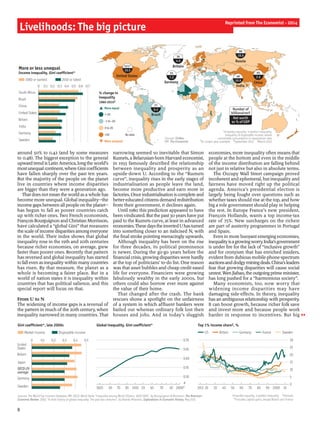
soared around the globe. According to Forbes
magazine’s rich list, America has some 421
billionaires, Russia 96, China 95 and India 48.
The world’s richest man is a Mexican (Carlos
Slim, worth some $69 billion). The world’s
largestnewhousebelongstoan Indian.Mukesh
Ambani’s 27-storey skyscraper in Mumbai
occupies 400,000 square feet, making it 1,300
times bigger than the average shack in the
slums that surround it.
The concentration of wealth at the very top
is part of a much broader rise in disparities
all along the income distribution. The best-
known way ofmeasuringinequality isthe Gini
coefficient, named after an Italian statistician
called Corrado Gini. It aggregates the gaps
betweenpeople’sincomesintoasinglemeasure.
If everyone in a group has the same income,
the Gini coefficient is 0; if all income goes to
one person, it is 1.
The level ofinequality differswidelyaround
the world. Emerging economies are more
unequalthan rich ones.Scandinavian countries
have the smallest income disparities, with
a Gini coefficient for disposable income of
around 0.25. At the other end of the spectrum
the world’s most unequal, such as South
Africa, register Ginis of around 0.6. (Because
of the way the scale is constructed, a modest-
sounding difference in the Gini ratio implies
a big difference in inequality.)
Income gaps have also changed to varying
degrees.America’sGini fordisposableincome is
up by almost 30% since 1980, to 0.39. Sweden’s
is up by a quarter, to 0.24. China’s has risen by
Livelihoods: The big picture
7
Reprinted from The Economist - 2014
3A history to repeat?
Sources: “Pessimism Preserved: Real Wages in the
British Industrial Revolution” by R.C. Allen (2013);
US Bureau of Labour Statistics
Average real wage, year 1=100
Years since start
80
100
120
140
160
180
1 10 20 30 40 50 60 70 80 90 100
Britain, year 1=1770
United States, year 1=1970
Livelihoods: The big picture
around 50% to 0.42 (and by some measures
to 0.48). The biggest exception to the general
upward trend is LatinAmerica, longthe world’s
mostunequalcontinent,whereGinicoefficients
have fallen sharply over the past ten years.
But the majority of the people on the planet
live in countries where income disparities
are bigger than they were a generation ago.
Thatdoesnotmeantheworldasawhole has
become more unequal. Global inequality—the
income gapsbetween all people on the planet—
has begun to fall as poorer countries catch
up with richer ones. Two French economists,
FrançoisBourguignonand ChristianMorrisson,
have calculated a “global Gini” that measures
thescale ofincome disparitiesamongeveryone
in the world. Their index shows that global
inequality rose in the 19th and 20th centuries
because richer economies, on average, grew
faster than poorer ones. Recently that pattern
has reversed and global inequality has started
to fall evenasinequalitywithin manycountries
has risen. By that measure, the planet as a
whole is becoming a fairer place. But in a
world of nation states it is inequality within
countries that has political salience, and this
special report will focus on that.
From U to N
The widening of income gaps is a reversal of
the pattern in much ofthe 20th century, when
inequality narrowed in many countries. That
narrowing seemed so inevitable that Simon
Kuznets, a Belarusian-born Harvard economist,
in 1955 famously described the relationship
between inequality and prosperity as an
upside-down U. According to the “Kuznets
curve”, inequality rises in the early stages of
industrialisation as people leave the land,
become more productive and earn more in
factories. Once industrialisation iscompleteand
better-educated citizens demand redistribution
from their government, it declines again.
Until 1980 this prediction appeared to have
been vindicated. But the past 30 years have put
paid to the Kuznets curve, at least in advanced
economies.ThesedaystheinvertedUhasturned
into something closer to an italicised N, with
the final stroke pointing menacingly upwards.
Although inequality has been on the rise
for three decades, its political prominence
is newer. During the go-go years before the
financial crisis, growing disparities were hardly
at the top of politicians’ to-do list. One reason
was that asset bubbles and cheap credit eased
life for everyone. Financiers were growing
fabulously wealthy in the early 2000s, but
others could also borrow ever more against
the value of their home.
That changed after the crash. The bank
rescues shone a spotlight on the unfairness
of a system in which affluent bankers were
bailed out whereas ordinary folk lost their
houses and jobs. And in today’s sluggish
economies, more inequality often means that
people at the bottom and even in the middle
of the income distribution are falling behind
not just in relative but also in absolute terms.
The Occupy Wall Street campaign proved
incoherent and ephemeral, but inequality and
fairness have moved right up the political
agenda. America’s presidential election is
largely being fought over questions such as
whether taxes should rise at the top, and how
big a role government should play in helping
the rest. In Europe France’s new president,
François Hollande, wants a top income-tax
rate of 75%. New surcharges on the richest
are part of austerity programmes in Portugal
and Spain.
Even in more buoyant emerging economies,
inequalityisagrowingworry.India’sgovernment
is under fire for the lack of “inclusive growth”
and for cronyism that has enriched insiders,
evident from dubious mobile-phone-spectrum
auctionsanddodgyminingdeals.China’sleaders
fear that growing disparities will cause social
unrest.Wen Jiabao,the outgoingprime minister,
has long pushed for a “harmonious society”.
Many economists, too, now worry that
widening income disparities may have
damaging side-effects. In theory, inequality
hasan ambiguous relationship with prosperity.
It can boost growth, because richer folk save
and invest more and because people work
harder in response to incentives. But big
8
Reprinted from The Economist - 2014
% change in
inequality
1980-2010†
-1 to -20
0 to 20
>20 No data
<-20
More equal
More unequal
0 0.1 0.2 0.3 0.4 0.5 0.6 0.7
Brazil
China
United States
Britain
India
Germany
South Africa
Sweden
1980 or earliest 2010 or latest
More or less unequal
Income inequality, Gini coefficient*
Sources: Forbes;
IMF; The Economist
*0=perfect equality, 1=perfect inequality,
inequality of disposable income; where
unavailable consumption or expenditure data
†Or closest year available ‡September 2012 §March 2012
Russia
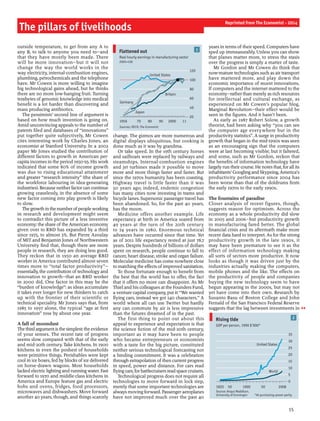
18.6
96
India
10.9
48
China
2.6
95
Germany
7.2
55
Britain
4.0
36
United States
10.5
421‡
Brazil
6.2
37
Net worth
as % of GDP
Number of
billionaires§
Disposable incomeMarket income
Gini coefficient*, late 2000s
0.50
0.55
0.60
0.65
0.70
1820 50 70 90 1910 29 50 70 92 2008†
Global inequality, Gini coefficient*
0
10
20
25
15
5
30
1913 20 30 40 50 60 70 80 90 2000 10
US SwedenFranceBritain Germany
Top 1% income share‡, %
Sources: The World Top Incomes Database; IMF; OECD; World Bank; “Inequality among World Citizens: 1820-1992", by Bourguignon & Morrisson, The American
Economic Review, 2002; "A short history of global inequality: The past two centuries”, by Branko Milanovic, Explorations in Economic History, May 2011 ‡Includes capital gains, except Britain and France
*0=perfect equality, 1=perfect inequality †Estimate
0 0.1 0.2 0.3 0.4 0.5
United
States
Britain
Japan
Sweden
Germany
OECD-29
average
income gaps can also be inefficient, because
they can bar talented poor people from access
to education or feed resentment that results in
growth-destroying populist policies.
The mainstream consensus has long been
that a growing economy raises all boats, to
much better effect than incentive-dulling
redistribution. Robert Lucas, a Nobel prize-
winner, epitomised the orthodoxy when
he wrote in 2003 that “of the tendencies
that are harmful to sound economics, the
most seductive and…poisonous is to focus
on questions of distribution.”
But now the economics establishment has
become concerned about who gets what.
Research by economists at the IMF suggests
that income inequality slows growth, causes
financialcrisesandweakensdemand.Inarecent
report the Asian Development Bank argued
that if emerging Asia’s income distribution
had not worsened over the past 20 years, the
region’s rapid growth would have lifted an
extra 240m people out of extreme poverty.
More controversial studies purport to link
widening income gaps with all manner of
ills, from obesity to suicide.
The widening gaps within many countries
are beginning to worry even the plutocrats.
A survey for the World Economic Forum
meeting at Davos pointed to inequality as the
most pressing problem of the coming decade
(alongside fiscal imbalances). In all sections of
society, there is growing agreement that the
world is becoming more unequal, and that
today’s disparities and their likely trajectory
are dangerous.
Not so fast
That is too simplistic. Inequality, as measured
by Gini coefficients, is simply a snapshot of
outcomes. It does not tell you why those gaps
have opened up or what the trend is over
time. And like any snapshot, the picture can
be misleading. Income gaps can arise for good
reasons (such as when people are rewarded
for productive work) or for bad ones (if poorer
children do not get the same opportunities as
richer ones). Equally, inequality of outcomes
might be acceptable if the gaps are between
young people and older folk, so may shrink
over time. But in societies without this sort
of mobility a high Gini is troubling.
Some societies are more concerned about
equality of opportunity, others more about
equality of outcome. Europeans tend to be
more egalitarian, believing that in a fair society
there should be no bigincome gaps.Americans
and Chinese put more emphasis on equality
of opportunity. Provided people can move up
the social ladder, they believe a society with
wide income gaps can still be fair. Whatever
people’s preferences, static measures ofincome
gaps tell only half the story.
Despitethelackofnuance,today’sdebateover
inequality will have important consequences.
The unstable history ofLatin America, longthe
continentwiththebiggestincome gaps,suggests
that countries run by entrenched wealthy elites
do notdoverywell.Yetthe 20th century’sfocus
on redistribution brought its own problems.
Too often high-tax welfare states turned out to
be inefficient and unsustainable. Government
cures for inequality have sometimes been
worse than the disease itself.
This special report will explore how 21st-
centurycapitalismshouldrespondtothepresent
challenge; it will examine the recent history
of both inequality and social mobility; and it
will offer four contemporary case studies: the
United States, emerging Asia, Latin America
and Sweden. Based on this evidence it will
make three arguments. First, although the
modern global economy is leading to wider
gaps between the more and the less educated,
a big driver of today’s income distributions
is government policy. Second, a lot of today’s
inequality is inefficient, particularly in the
most unequal countries. It reflects market and
government failures that also reduce growth.
And where this is happening, bigger income
gaps themselves are likely to reduce both social
mobility and future prosperity.
Third, there is a reform agenda to reduce
income disparities that makes sense whatever
your attitude towards fairness. It is not about
higher taxes and more handouts. Both in rich
and emerging economies, it is about attacking
cronyism and investingin the young.You could
call it a “True Progressivism”. n
Poverty
Not always with us
Reprinted from The Economist, Jun 1st 2013
The world has an astonishing chance to
take a billion people out ofextreme poverty
by 2030
IN SEPTEMBER 2000 the heads of 147
governments pledged that they would halve
the proportion ofpeople on the Earth living in
the direst poverty by 2015, using the poverty
rate in 1990 as a baseline. It was the first of
a litany of worthy aims enshrined in the
United Nations “millennium development
goals” (MDGs). Many of these aims—such as
cutting maternal mortality by three quarters
and child mortality by two thirds—have not
been met. But the goal of halving poverty has
been. Indeed, it was achieved five years early.
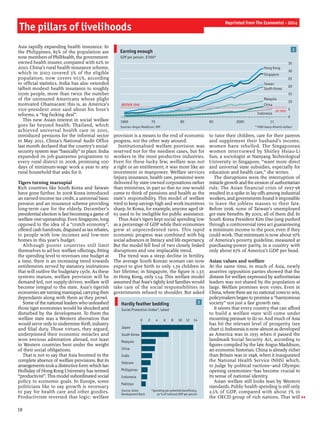
In 1990, 43% ofthe population ofdeveloping
countries lived in extreme poverty (then
defined as subsisting on $1 a day); the absolute
number was 1.9 billion people. By 2000 the
proportion was down to a third. By 2010 it was
21% (or 1.2 billion; the poverty line was then
$1.25, the average of the 15 poorest countries’
own poverty lines in 2005 prices, adjusted for
differences in purchasing power). The global
poverty rate had been cut in half in 20 years.
That raised an obvious question. If extreme
povertycouldbehalvedinthepasttwodecades,
why should the other half not be got rid of
in the next two? If 21% was possible in 2010,
why not 1% in 2030?
Whynotindeed?InAprilatapressconference
during the spring meeting ofthe international
financial institutions in Washington, DC, the
president of the World Bank, Jim Yong Kim,
scrawled the figure “2030” on a sheet of
paper, held it up and announced, “This is it.
This is the global target to end poverty.” He
was echoing Barack Obama who, in February,
promised that “the United States will join with
our allies to eradicate such extreme poverty
in the next two decades.”
This week, that target takes its first step
towards formal endorsement as an aim of
policy round the world. The leaders of Britain,
Indonesia and Liberia are due to recommend
to the UN a list of post-2015 MDGs. It will be
headed by a promise to end extreme poverty
by 2030.
There is a lot of debate about what exactly
counts as poverty and how best to measure
it. But by any measure, the eradication of
$1.25-a-day poverty would be an astonishing
achievement. Throughout history, dire poverty
has been a basic condition of the mass of
mankind.ThomasMalthus, a British clergyman
who foundedthescience ofdemography,wrote
in 1798 that it was impossible for people to
“feel no anxiety about providing the means of
subsistence forthemselves and [their] families”
and that “no possible form of society could
prevent the almost constant action of misery
upon a great part of mankind.” For most
countries, poverty was not even a problem;
it was a plain, unchangeable fact.
To eradicate extreme poverty would also
be remarkable given the number of occasions
Livelihoods: The big picture
9
Reprinted from The Economist - 2014
1Hooray!
Source: Laurence Chandy, Natasha Ledlie and
Veronika Penciakova
Global poverty rate, %
0
10
20
30
40
50
1990 95 2000 05 10 15 20 25 30
Range based on best
and worst scenarios
Baseline scenario
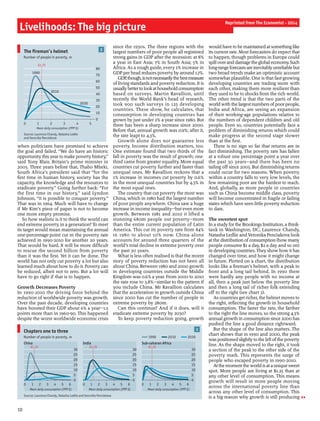
since the 1930s. The three regions with the
largest numbers of poor people all registered
strong gains in GDP after the recession: at 8%
a year in East Asia; 7% in South Asia; 5% in
Africa. As a rough guide, every 1% increase in
GDP per head reduces poverty by around 1.7%.
GDP,though,isnotnecessarilythebestmeasure
of living standards and poverty reduction. It is
usuallybettertolookathouseholdconsumption
based on surveys. Martin Ravallion, until
recently the World Bank’s head of research,
took 900 such surveys in 125 developing
countries. These show, he calculates, that
consumption in developing countries has
grown by just under 2% a year since 1980. But
there has been a sharp increase since 2000.
Before that, annual growth was 0.9%; after it,
the rate leapt to 4.3%.
Growth alone does not guarantee less
poverty. Income distribution matters, too.
One estimate found that two thirds of the
fall in poverty was the result of growth; one-
third came from greater equality. More equal
countries cut poverty further and faster than
unequal ones. Mr Ravallion reckons that a
1% increase in incomes cut poverty by 0.6%
in the most unequal countries but by 4.3% in
the most equal ones.
The country that cut poverty the most was
China, which in 1980 had the largest number
of poor people anywhere. China saw a huge
increase in income inequality—but even more
growth. Between 1981 and 2010 it lifted a
stunning 680m people out poverty—more
than the entire current population of Latin
America. This cut its poverty rate from 84%
in 1980 to about 10% now. China alone
accounts for around three quarters of the
world’s total decline in extreme poverty over
the past 30 years.
What is less often realised is that the recent
story of poverty reduction has not been all
about China. Between 1980 and 2000 growth
in developing countries outside the Middle
Kingdom was 0.6% a year. From 2000 to 2010
the rate rose to 3.8%—similar to the pattern if
you include China. Mr Ravallion calculates
that the acceleration in growth outside China
since 2000 has cut the number of people in
extreme poverty by 280m.
Can this continue? And if it does, will it
eradicate extreme poverty by 2030?
To keep poverty reduction going, growth
would have to be maintained atsomethinglike
its current rate. Most forecasters do expect that
to happen, though problems in Europe could
spill overand damagethe global economy.Such
long-rangeforecastsareinevitablyunreliablebut
two broad trends make an optimistic account
somewhat plausible. One is that fast-growing
developing countries are trading more with
each other, making them more resilient than
they used to be to shocks from the rich world.
The other trend is that the two parts of the
world with the largest numbers ofpoorpeople,
India and Africa, are seeing an expansion
of their working-age populations relative to
the numbers of dependent children and old
people. Even so, countries potentially face a
problem of diminishing returns which could
make progress at the second stage slower
than at the first.
There is no sign so far that returns are in
fact diminishing. The poverty rate has fallen
at a robust one percentage point a year over
the past 30 years—and there has been no
tailing off since 2005. But diminishing returns
could occur for two reasons. When poverty
within a country falls to very low levels, the
few remaining poor are the hardest to reach.
And, globally, as more people in countries
such as China become middle class, poverty
will become concentrated in fragile or failing
states which have seen little poverty reduction
to date.
The sweetest spot
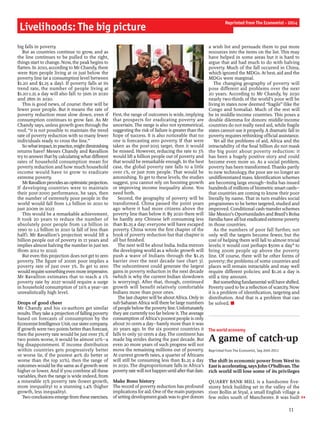
In a study forthe Brookings Institution, a think-
tank in Washington, DC, Laurence Chandy,
Natasha Ledlie and Veronika Penciakova look
at the distribution ofconsumption (how many
people consume $1 a day, $2 a day and so on)
in developing countries. They show how it has
changed over time, and how it might change
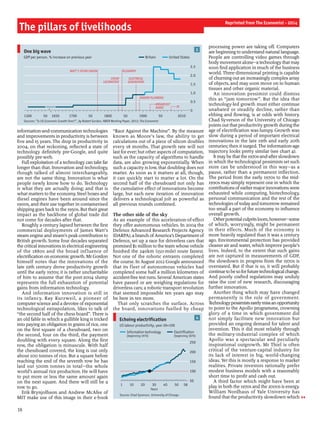
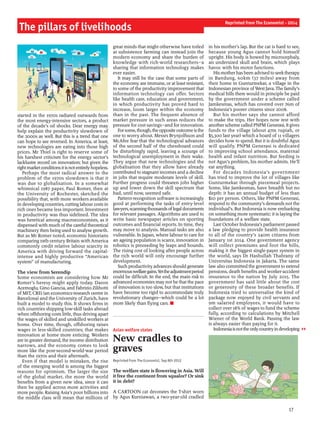
in future. Plotted on a chart, the distribution
looks like a fireman’s helmet, with a peak in
front and a long tail behind. In 1990 there
were hardly any people with no income at
all, then a peak just below the poverty line
and then a long tail of richer folk extending
off to the right (see chart 2).
As countries get richer, the helmet moves to
the right, reflecting the growth in household
consumption. The faster the rate, the farther
to the right the line moves, so the strong 4.3%
annual growth in consumption since 2000 has
pushed the line a good distance rightward.
But the shape of the line also matters. The
chart shows that in 1990 and 2000, the peak
was positioned slightlyto the left ofthe poverty
line. As the shape moved to the right, it took
a section of the peak to the other side of the
poverty mark. This represents the surge of
people who escaped poverty in 1990-2010.
Atthe momenttheworld isatauniquesweet
spot. More people are living at $1.25 than at
any other level of consumption. This means
growth will result in more people moving
across the international poverty line than
across any other level of consumption. This
is a big reason why growth is still producing
when politicians have promised to achieve
the goal and failed. “We do have an historic
opportunity this yearto make poverty history,”
said Tony Blair, Britain’s prime minister in
2005. Three years before that, Thabo Mbeki,
South Africa’s president said that “for the
first time in human history, society has the
capacity, the knowledge and the resources to
eradicate poverty.” Going further back: “For
the first time in our history,” said Lyndon
Johnson, “it is possible to conquer poverty.”
That was in 1964. Much will have to change
if Mr Kim’s piece of paper is not to become
one more empty promise.
So how realistic is it to think the world can
end extreme poverty in a generation? To meet
its target would mean maintaining the annual
one-percentage-point cut in the poverty rate
achieved in 1990-2010 for another 20 years.
That would be hard. It will be more difficult
to rescue the second billion from poverty
than it was the first. Yet it can be done. The
world has not only cut poverty a lot but also
learned much about how to do it. Poverty can
be reduced, albeit not to zero. But a lot will
have to go right if that is to happen.
Growth Decreases Poverty
In 1990-2010 the driving force behind the
reduction of worldwide poverty was growth.
Over the past decade, developing countries
have boosted their GDP about 6% a year—1.5
points more than in 1960-90. This happened
despite the worst worldwide economic crisis
Livelihoods: The big picture
10
Reprinted from The Economist - 2014
2000
2020
2The fireman’s helmet
Source: Laurence Chandy, Natasha Ledlie
and Veronika Penciakova
Number of people in poverty, m
0
10
20
30
40
50
60
70
80
0 1 2 3 4 5
1990
2010
2030
$1.25
Mean daily consumption (PPP $)
3Chapters one to three
Number of people in poverty, m
Source: Laurence Chandy, Natasha Ledlie and Veronika Penciakova
China India Sub-saharan Africa
1990 2010 2030
0
5
10
15
20
25
30
0 1 2 3 4 5 6
$1.25
0
5
10
15
20
25
30
0 1 2 3 4 5 6
$1.25
0
5
10
15
20
25
30
0 1 2 3 4 5 6
$1.25
Mean daily consumption (PPP $) Mean daily consumption (PPP $) Mean daily consumption (PPP $)
big falls in poverty.
But as countries continue to grow, and as
the line continues to be pulled to the right,
things start to change. Now, the peakbegins to
flatten. In 2010, according to Mr Chandy, there
were 85m people living at or just below the
poverty line (at a consumption level between
$1.20 and $1.25 a day). If poverty falls at its
trend rate, the number of people living at
$1.20-1.25 a day will also fall: to 56m in 2020
and 28m in 2030.
This is good news, of course: there will be
fewer poor people. But it means the rate of
poverty reduction must slow down, even if
consumption continues to grow fast. As Mr
Chandy says, unless growth goes through the
roof, “it is not possible to maintain the trend
rate of poverty reduction with so many fewer
individuals ready to cross the line.”
Sowhatimpact,inpractice,mightdiminishing
returns have? Messrs Chandy and Ravallion
try to answerthat by calculatingwhat different
rates of household consumption mean for
poverty reduction and how much household
income would have to grow to eradicate
extreme poverty.
MrRavallionprovidesanoptimisticprojection.
If developing countries were to maintain
their post-2000 performance, he says, then
the number of extremely poor people in the
world would fall from 1.2 billion in 2010 to
just 200m in 2027.
This would be a remarkable achievement.
It took 20 years to reduce the number of
absolutely poor people from 1.9 billion in
1990 to 1.2 billion in 2010 (a fall of less than
half). Mr Ravallion’s projection would lift a
billion people out of poverty in 17 years and
implies almost halving the number in just ten
(from 2012 to 2022).
But even this projection does not get to zero
poverty. The figure of 200m poor implies a
poverty rate of just over 3%. To get to zero
wouldrequiresomethingevenmoreimpressive.
Mr Ravallion estimates that to reach a 1%
poverty rate by 2027 would require a surge
in household consumption of 7.6% a year—an
unrealistically high level.
Drops of good cheer
Mr Chandy and his co-authors get similar
results.They take a projection offallingpoverty
based on forecasts of consumption by the
EconomistIntelligenceUnit, oursistercompany.
Ifgrowth were two points better than forecast,
then the poverty rate would be just over 3%; if
two points worse, it would be almost 10%—a
big disappointment. If income distribution
within countries gets progressively better
or worse (ie, if the poorest 40% do better or
worse than the top 10%), then the range of
outcomeswould be the same as ifgrowth were
higher or lower. And if you combine all these
variables, then the range is wide indeed, from
a miserable 15% poverty rate (lower growth,
more inequality) to a stunning 1.4% (higher
growth, less inequality).
Two conclusionsemerge fromthese exercises.
First, the range of outcomes is wide, implying
that prospects for eradicating poverty are
uncertain. The range is also not symmetrical,
suggesting the risk of failure is greater than the
hope of success. It is also noticeable that no
one is forecasting zero poverty. If that were
taken as the post-2015 target, then it would
be missed. However, reducing the rate to 3%
would lift a billion people out of poverty and
that would be remarkable enough. In the best
case, the global poverty rate falls to a little
over 1%, or just 70m people. That would be
astonishing. To get to these levels, the studies
suggest, you cannot rely on boosting growth
or improving income inequality alone. You
need both.
Second, the geography of poverty will be
transformed. China passed the point years
ago where it had more citizens above the
poverty line than below it. By 2020 there will
be hardly any Chinese left consuming less
than $1.25 a day: everyone will have escaped
poverty. China wrote the first chapter of the
book of poverty reduction but that chapter is
all but finished.
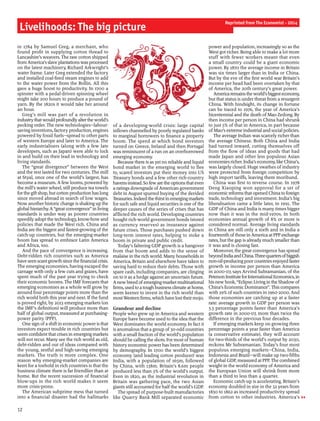
The next will be about India. India mirrors
the developing world as a whole: growth will
push a wave of Indians through the $1.25
barrier over the next decade (see chart 3).
The subcontinent could generate the largest
gains in poverty reduction in the next decade
(which is why the current Indian slowdown
is worrying). After that, though, continued
growth will benefit relatively comfortable
Indians more than poor ones.
The last chapterwill be aboutAfrica. Only in
sub-Saharan Africa will there be large numbers
ofpeoplebelowthe povertyline.Unfortunately
they are currently too far below it. The average
consumption ofAfrica’s poorest people is only
about 70 cents a day—barely more than it was
20 years ago. In the six poorest countries it
falls to only 50 cents a day. The continent has
made big strides during the past decade. But
even 20 more years of such progress will not
move the remaining millions out of poverty.
At current growth rates, a quarter of Africans
will still be consuming less than $1.25 a day
in 2030. The disproportionate falls in Africa’s
povertyratewillnothappenuntilafterthatdate.
Make Bono history
The record of poverty reduction has profound
implications foraid. One ofthe main purposes
ofsettingdevelopmentgoalswasto give donors
a wish list and persuade them to put more
resources into the items on the list. This may
have helped in some areas but it is hard to
argue that aid had much to do with halving
poverty. Much of the fall occurred in China,
which ignored the MDGs. At best, aid and the
MDGs were marginal.
The changing geography of poverty will
pose different aid problems over the next
20 years. According to Mr Chandy, by 2030
nearly two-thirds of the world’s poor will be
living in states now deemed “fragile” (like the
Congo and Somalia). Much of the rest will
be in middle-income countries. This poses a
double dilemma for donors: middle-income
countries do not really need aid, while fragile
states cannot use it properly. A dramatic fall in
poverty requires rethinking official assistance.
Yet all the problems of aid, Africa and the
intractability of the final billion do not mask
the big point about poverty reduction: it
has been a hugely positive story and could
become even more so. As a social problem,
poverty has been transformed. Thanks partly
to new technology, the poor are no longer an
undifferentiated mass. Identification schemes
are becoming large enough—India has issued
hundreds ofmillions ofbiometricsmart cards—
that countries are coming to know their poor
literally by name. That in turn enables social
programmes to be better targeted, studied and
improved. Conditional cash-transfer schemes
like Mexico’s Oportunidades and Brazil’s Bolsa
Família have all but eradicated extreme poverty
in those countries.
As the numbers of poor fall further, not
only will the targets become fewer, but the
cost of helping them will fall to almost trivial
levels; it would cost perhaps $50m a day* to
bring 200m people up above the poverty
line. Of course, there will be other forms of
poverty; the problems of some countries and
places will remain intractable and may well
require different policies; and $1.26 a day is
still a tiny amount.
Butsomethingfundamentalwillhaveshifted.
Poverty used to be a reflection ofscarcity. Now
it is a problem of identification, targeting and
distribution. And that is a problem that can
be solved. n
The world economy
A game of catch-up
Reprinted from The Economist, Sep 24th 2011
The shift in economic power from West to
Eastis accelerating, says John O’Sullivan.The
rich world will lose some of its privileges
QUARRY BANK MILL is a handsome five-
storey brick building set in the valley of the
river Bollin at Styal, a small English village a
few miles south of Manchester. It was built
Livelihoods: The big picture
11
Reprinted from The Economist - 2014
in 1784 by Samuel Greg, a merchant, who
found profit in supplying cotton thread to
Lancashire’s weavers. The raw cotton shipped
fromAmerica’sslave plantationswasprocessed
on the latest machinery, Richard Arkwright’s
water frame. Later Greg extended the factory
and installed coal-fired steam engines to add
to the water power from the Bollin. All this
gave a huge boost to productivity. In 1700 a
spinster with a pedal-driven spinning wheel
might take 200 hours to produce a pound of
yarn. By the 1820s it would take her around
an hour.
Greg’s mill was part of a revolution in
industrythatwouldprofoundlyaltertheworld’s
pecking order. The new technologies—labour-
saving inventions, factory production, engines
powered by fossil fuels—spread to other parts
of western Europe and later to America. The
early industrialisers (along with a few late
developers, such as Japan) were able to lock
in and build on their lead in technology and
living standards.
The “great divergence” between the West
and the rest lasted for two centuries. The mill
at Styal, once one of the world’s largest, has
become a museum. A few looms, powered by
the mill’s water wheel, still produce tea towels
forthe giftshop, but cotton production has long
since moved abroad in search of low wages.
Now another historic change is shaking up the
global hierarchy.A“great convergence” in living
standards is under way as poorer countries
speedily adopt the technology, know-how and
policies that made the West rich. China and
India are the biggest and fastest-growing ofthe
catch-up countries, but the emerging-market
boom has spread to embrace Latin America
and Africa, too.
And the pace of convergence is increasing.
Debt-ridden rich countries such as America
haveseenscantgrowthsincethe financial crisis.
The emerging economies, having escaped the
carnage with only a few cuts and grazes, have
spent much of the past year trying to check
their economic booms. The IMF forecasts that
emerging economies as a whole will grow by
around four percentage points more than the
rich world both this year and next. If the fund
is proved right, by 2013 emerging markets (on
the IMF’s definition) will produce more than
halfofglobal output, measured at purchasing-
power parity (PPP).
One sign ofa shift in economic power is that
investors expect trouble in rich countries but
seem confident that crises in emerging markets
will not recur. Many see the rich world as old,
debt-ridden and out of ideas compared with
the young, zestful and high-saving emerging
markets. The truth is more complex. One
reason why emerging-market companies are
keen for a toehold in rich countries is that the
business climate there is far friendlier than at
home. But the recent succession of financial
blow-ups in the rich world makes it seem
more crisis-prone.
The American subprime mess that turned
into a financial disaster had the hallmarks
of a developing-world crisis: large capital
inflows channelled by poorly regulated banks
to marginal borrowers to finance a property
boom. The speed at which bond investors
turned on Greece, Ireland and then Portugal
was reminiscent ofa run on an overborrowed
emerging economy.
Because there is as yet no reliable and liquid
bond market in the emerging world to flee
to, scared investors put their money into US
Treasury bonds and a few other rich-country
havensinstead.So fewarethe optionsthateven
a ratings downgrade ofAmerican government
debt in August spurred buying of the derided
Treasuries. Indeedthethirstinemergingmarkets
for such safe and liquid securities is one ofthe
deeper causes of the series of crises that has
afflicted the rich world. Developing countries
bought rich-world government bonds (stored
as currency reserves) as insurance against
future crises. Those purchases pushed down
long-term interest rates, helping to stoke a
boom in private and public credit.
Today’s faltering GDP growth is a hangover
from that boom and adds to the sense of
malaise in the rich world. Many households in
America, Britain and elsewhere have taken to
saving hard to reduce their debts. Those with
spare cash, including companies, are clinging
on to it as a hedge against an uncertain future.
Anewbreed ofemerging-market multinational
firms, used to a tough business climate at home,
seem keener to invest in the rich world than
mostWestern firms,which have losttheirmojo.
Grandeur and decline
People who grew up in America and western
Europe have become used to the idea that the
West dominates the world economy. In fact it
is anomalous that a group of 30-odd countries
with a small fraction ofthe world’s population
should be callingthe shots. For most ofhuman
history economic power has been determined
by demography. In 1700 the world’s biggest
economy (and leading cotton producer) was
India, with a population of 165m, followed
by China, with 138m. Britain’s 8.6m people
produced less than 3% of the world’s output.
Even in 1820, as the industrial revolution in
Britain was gathering pace, the two Asian
giants still accounted for halfthe world’s GDP.
The spread of purpose-built manufactories
like Quarry Bank Mill separated economic
power and population, increasingly so as the
West got richer. Being able to make a lot more
stuff with fewer workers meant that even
a small country could be a giant economic
power. By 1870 the average income in Britain
was six times larger than in India or China.
But by the eve of the first world war Britain’s
income per head had been overtaken by that
of America, the 20th century’s great power.
Americaremainstheworld’sbiggesteconomy,
but that status is under threat from a resurgent
China. With hindsight, its change in fortune
can be traced to 1976, the year of America’s
bicentennial and the death ofMao Zedong. By
then income per person in China had shrunk
to just 5% of that in America, in part because
ofMao’s extreme industrial and social policies.
The average Indian was scarcely richer than
the average Chinese. Both China and India
had turned inward, cutting themselves off
from the flow of ideas and goods that had
made Japan and other less populous Asian
economies richer. India’s economy, like China’s,
was largely closed. Huge swathes of industry
were protected from foreign competition by
high import tariffs, leaving them moribund.
China was first to reverse course. In 1978
Deng Xiaoping won approval for a set of
economic reformsthat opened China to foreign
trade, technology and investment. India’s big
liberalisation came a little later, in 1991. The
GDP of China and India is many times bigger
now than it was in the mid-1970s. In both
economies annual growth of 8% or more is
considered normal. Average living standards
in China are still only a sixth and in India a
fourteenth ofthose inAmerica at PPPexchange
rates, but the gap is already much smaller than
it was and is closing fast.
Moreover, the great convergence has spread
beyondIndiaandChina.Three-quartersofbiggish
non-oil-producingpoorcountriesenjoyed faster
growth in income per person than America
in 2000-07, says Arvind Subramanian, of the
PetersonInstituteforInternationalEconomics,in
his newbook, “Eclipse: Livingin the Shadow of
China’s Economic Dominance”. This compares
with 29% ofsuch countries in 1960-2000. And
those economies are catching up at a faster
rate: average growth in GDP per person was
3.3 percentage points faster than America’s
growth rate in 2000-07, more than twice the
difference in the previous four decades.
If emerging markets keep on growing three
percentage points a year faster than America
(a conservative estimate), they will account
for two-thirds of the world’s output by 2030,
reckons Mr Subramanian. Today’s four most
populous emerging markets—China, India,
Indonesia and Brazil—will make up two-fifths
ofglobal GDP, measured at PPP. The combined
weight in the world economy ofAmerica and
the European Union will shrink from more
than a third to less than a quarter.
Economic catch-up is accelerating. Britain’s
economy doubled in size in the 32 years from
1830 to 1862 as increased productivity spread
from cotton to other industries. America’s
Livelihoods: The big picture
12
Reprinted from The Economist - 2014
GDP doubled in only 17 years as it overtook
Britain in the 1870s. The economies of China
and India have doubled within a decade.
This is cause for optimism. An Indian with
a basic college education has access to world-
class goods that his parents (who might have
saved for decades for a sputtering scooter)
could only have dreamed of buying. The
recent leap in incomes is visible in Chinese
cities, where the cars are new but the bicycles
look ancient, and in the futuristic skyline of
Shanghai’s financial district.
China is still a fairly poor country but, by
dint of its large population, it is already the
world’s second-largest economy measured in
current dollars. It may overtake America as the
world’s leading economy within a decade (see
box), a prospect that has given rise to many
concerns in that country. More generally, there
are worries about what the ascendancy of
emerging markets would mean for jobs, pay
and borrowing costs in the rich world.
The first worry is about direct competition
for things that are in more or less fixed supply:
geopolitical supremacy, the world’s oil and
raw materials, the status and perks that come
with being the issuer ofa trusted international
currency.Formostpeople,mostofthetime,their
country’s ranking in terms ofmilitary power is
not a big issue. The emerging world’s hunger
for natural resources, on the other hand, has
made rich-world consumers palpably worse
off by pushing up the prices of oil and other
commodities.The yuan’s increased use beyond
China’s borders is a (still distant) threat to the
dollar’s central role in trade and international
finance,butifthe dollarwere eventuallyshoved
aside, it would make Americans poorer and
raise the cost of their borrowing.
A second set of anxieties relates to job
security and pay. Ever stronger trade links
between rich and would-be rich countries
will mean a reshuffle in the division oflabour
around the world, creating new jobs and
destroying or displacing existing ones. Low-
skilled manufacturing and middle-skilled
service jobs that can be delivered electronically
have been outsourced to cheaper suppliers in
China, India and elsewhere (indeed, China is
now rich enough to be vulnerable to losing
jobs to Vietnam and Indonesia). The threat
of outsourcing puts downward pressure on
pay, though most American studies suggest
that trade accounts for only a small part of
the increase in wage inequality.
A third concern, which is at odds with the
first two, is that the emerging markets are
prone to crises that can cause a still-fragile
world economy to stumble. Sluggish GDP
growth in the rich world means developing
countries have to fall backon internal spending,
which in the past they have not managed
well. It raises the risks of the overspending,
excessive credit and inflation that have spurred
past emerging-market crises. Even if crises
are avoided, emerging markets are prone to
sudden slowdowns as they become richer
and the trick of shifting underemployed rural
Livelihoods: The big picture
13
migrants to urban jobs becomes harder to
repeat. The rapid growth rates of the recent
past are unlikely to be sustained.
Status anxiety
Few forecasters expect America to be a poorer
place in ten or 20 years’ time than it is now.
The present may be grim, but eventually the
hangover from the financial crisis will fade and
unemployment will fall. What rich Western
countries face is a relative economic decline,
not an absolute fall in average living standards
(though a few of their citizens may become
worse off). That matters politically, because
most people measure their well-being by how
they are doing in relation to others rather than
by their absolute level of income.
The effect ofthe loss oftop-dogstatus on the
well-being ofthe average American is unlikely
to be trivial. Britain felt similar angst at the
beginning of the 20th century, noting the rise
of Germany, a military rival. It seemed stuck
with old industries, such as textiles and iron,
whereas Germany had advanced into fields
such as electricals and chemicals. That Britain
was still well off in absolute terms was scant
consolation. The national mood contrasted
starkly with the triumphalism of the mid-
19th century, says Nicholas Crafts ofWarwick
University. A wave of protectionist sentiment
challenged the free-trade consensus that had
prevailed since 1846. It was seen off, but not
before it had split the Tory party, which lost
the 1906 election to the Liberals.
No country, or group of countries, stays
on top forever. History and economic theory
suggest that sooner or later others will catch
up. But this special report will caution against
relying on linear extrapolation from recent
growth rates. Instead, it will suggest that the
transferofeconomic powerfrom rich countries
to emerging markets is likely to take longer
than generally expected. Rich countries will
be cursed indeed if they cannot put on an
occasional growth spurt. China, for its part,
will be lucky to avoid a bad stumble in the
next decade or two. Emerging-market crises
have been too quickly forgotten, which only
makes them more likely to recur.
Education and social security will have to
adapt to a world in which jobs continue to be
created and displaced at a rapid rate. The cost
of oil and other commodities will continue
to rise faster than prices in general, shifting
the terms of trade in favour of resource-rich
countries and away from big consumers such
as America. The yuan will eventually become
an international currency and rival to the
dollar. The longer that takes, the less pressure
America will feel to control its public finances
and the likelier it is that the dollar’s eclipse
will be abrupt and messy.
The force ofeconomic convergence depends
on the income gap between developing and
developed countries. Going from poor to less
poor is the easy part. The trickier bit is making
the jump from middle-income to reasonably
rich. Can China and others manage it? n
Reprinted from The Economist - 2014
0 20 40 60 80 100
Official foreign-exchange reserves, Q2 2011
Rich world
$3.2trn
Emerging world
$6.5trn
Breakdown by currency
Allocated reserves, Q2 2011, %
$ ¥¤ £ Other
1.8
1.1
1.3
2.0
10.68.0
4.9
5.8
4.3
6.8
4.6
3.9
3.1
5.5
2.2
4.7
0.6
Population
2010, bn
Canada
0.03
United States
0.31
Mexico
0.11
Brazil
0.20
Britain
0.06
Japan
0.13
India
1.23
China
1.34
Russia
0.14
Sub-Saharan
Africa
0.80
CIS*
0.14
Central &
E. Europe
0.18
Euro area
0.33
Indonesia
0.24
Australia
0.02
Middle East
& N. Africa
0.42
Latin America
& Caribbean
0.28
GDP growth, 2001-11, %
2011 forecast
0
1
5
10
GDP per person, 2010, PPP $'000
RICH WORLDEMERGING WORLD
>4035-4010-165-10<5 30-35
*Commonwealth of
Independent States
Sources: IMF; UN; The Economist
Innovation pessimism
Has the ideas machine broken down?
Reprinted from The Economist, Jan 12th 2013
Theideathatinnovationandnewtechnology
have stopped driving growth is getting
increasing attention. But it is not well
founded
BOOM times are back in Silicon Valley.
Office parks along Highway 101 are once
again adorned with the insignia of hopeful
start-ups. Rents are soaring, as is the demand
for fancy vacation homes in resort towns
like Lake Tahoe, a sign of fortunes being
amassed. The Bay Area was the birthplace of
the semiconductor industry and the computer
and internet companies that have grown up
in its wake. Its wizards provided many of the
marvels that make the world feel futuristic,
from touch-screen phones to the instantaneous
searching of great libraries to the power to
pilot a drone thousands of miles away. The
revival in its business activity since 2010
suggests progress is motoring on.
So it may come as a surprise that some
in Silicon Valley think the place is stagnant,
and that the rate of innovation has been
slackening for decades. Peter Thiel, a founder
of PayPal, an internet payment company, and
the first outside investor in Facebook, a social
network, says that innovation in America is
“somewhere between dire straits and dead”.
Engineers in all sorts of areas share similar
feelings of disappointment. And a small but
growing group of economists reckon the
economic impact of the innovations of today
may pale in comparison with those ofthe past.
Some suspect that the rich world’s economic
doldrums may be rooted in a long-term
technological stasis. In a 2011 e-book Tyler
Cowen, an economist at George Mason
University, argued that the financial crisis
was masking a deeper and more disturbing
“Great Stagnation”. It was this which explained
why growth in rich-world real incomes and
employment had longbeen slowingand, since
2000, had hardly risen at all (see chart 1). The
various motors of20th-century growth—some
technological,somenot—hadplayedthemselves
out, and new technologies were not going
to have the same invigorating effect on the
economies of the future. For all its flat-screen
dazzle and high-bandwidth pizzazz, it seemed
the world had run out of ideas.
Glide path
Theargumentthattheworldisonatechnological
plateau runs along three lines. The first comes
from growth statistics. Economists divide
growth into two different types, “extensive”
and “intensive”. Extensive growth is a matter
of adding more and/or better labour, capital
and resources. These are the sort of gains
that countries saw from adding women to
the labour force in greater numbers and
increasing workers’ education. And, as Mr
Cowen notes, this sort of growth is subject
to diminishing returns: the first addition will
be used where it can do most good, the tenth
where it can do the tenth-most good, and so
on. If this were the only sort of growth there
was, it would end up leaving incomes just
above the subsistence level.
Intensive growth ispoweredbythe discovery
of ever better ways to use workers and
resources. This is the sort of growth that
allows continuous improvement in incomes
and welfare, and enables an economy to grow
even as its population decreases. Economists
label the all-purpose improvement factor
responsible for such growth “technology”—
though it includes things like better laws and
regulations as well as technical advance—and
measure it using a technique called “growth
accounting”. In this accounting, “technology”
is the bit left over after calculating the effect
on GDP of things like labour, capital and
education. And at the moment, in the rich
world, it looks like there is less of it about.
Emerging markets still manage fast growth,
and should be able to do so for some time,
because theyare catchingup with technologies
already used elsewhere. The rich world has
no such engine to pull it along, and it shows.
This is hardly unusual. For most of human
history, growth in output and overall economic
welfare has been slow and halting. Over the
past two centuries, first in Britain, Europe and
America, then elsewhere, it took off. In the
19th century growth in output per person—a
useful general measure of an economy’s
productivity, and a good guide to growth
in incomes—accelerated steadily in Britain.
By 1906 it was more than 1% a year. By the
middle of the 20th century, real output per
person in America was growing at a scorching
2.5% a year, a pace at which productivity and
incomes double once a generation (see chart 2).
More than a century of increasingly powerful
and sophisticated machines were obviously
a part of that story, as was the rising amount
of fossil-fuel energy available to drive them.
But in the 1970s America’s growth in real
output per person dropped from its post-
second-world-war peak of over 3% a year to
just over 2% a year. In the 2000s it tumbled
below 1%. Output per worker per hour shows
a similar pattern, according to Robert Gordon,
an economist at Northwestern University: it
is pretty good for most of the 20th century,
then slumps in the 1970s. It bounced back
between 1996 and 2004, but since 2004 the
annual rate has fallen to 1.33%, which is as
low as it was from 1972 to 1996. Mr Gordon
muses that the past two centuries ofeconomic
growth might actually amount to just “one
big wave” of dramatic change rather than a
new era of uninterrupted progress, and that
the world is returning to a regime in which
growth is mostly of the extensive sort (see
chart 3).
MrGordon sees itas possible thatthere were
only a few truly fundamental innovations—
the ability to use power on a large scale,
to keep houses comfortable regardless of
The pillars of livelihoods
14
Reprinted from The Economist - 2014
Also in this section
	
17 Asian welfare states
20 Pensions
22 Working women
23 Work and family
The pillars of livelihoods
outside temperature, to get from any A to
any B, to talk to anyone you need to—and
that they have mostly been made. There
will be more innovation—but it will not
change the way the world works in the
way electricity, internal-combustion engines,
plumbing, petrochemicals and the telephone
have. Mr Cowen is more willing to imagine
big technological gains ahead, but he thinks
there are no more low-hanging fruit. Turning
terabytes of genomic knowledge into medical
benefit is a lot harder than discovering and
mass producing antibiotics.
The pessimists’ second line of argument is
based on how much invention is going on.
Amid unconvincing appeals to the number of
patents filed and databases of “innovations”
put together quite subjectively, Mr Cowen
cites interesting work by Charles Jones, an
economist at Stanford University. In a 2002
paper Mr Jones studied the contribution of
different factors to growth in American per-
capita incomes in the period 1950-93. His work
indicated that some 80% of income growth
was due to rising educational attainment
and greater “research intensity” (the share of
the workforce labouring in idea-generating
industries). Because neither factor can continue
growing ceaselessly, in the absence of some
new factor coming into play growth is likely
to slow.
The growth inthe numberofpeopleworking
in research and development might seem
to contradict this picture of a less inventive
economy: the share ofthe American economy
given over to R&D has expanded by a third
since 1975, to almost 3%. But Pierre Azoulay
of MIT and Benjamin Jones of Northwestern
University find that, though there are more
people in research, they are doing less good.
They reckon that in 1950 an average R&D
worker in America contributed almost seven
times more to “total factor productivity”—
essentially, the contribution oftechnology and
innovation to growth—that an R&D worker
in 2000 did. One factor in this may be the
“burden of knowledge”: as ideas accumulate
it takes ever longer for new thinkers to catch
up with the frontier of their scientific or
technical speciality. Mr Jones says that, from
1985 to 1997 alone, the typical “age at first
innovation” rose by about one year.
A fall of moondust
Thethirdargumentisthesimplest:the evidence
of your senses. The recent rate of progress
seems slow compared with that of the early
and mid-20th century. Take kitchens. In 1900
kitchens in even the poshest of households
were primitive things. Perishables were kept
cool in ice boxes, fed by blocks ofice delivered
on horse-drawn wagons. Most households
lacked electric lighting and running water. Fast
forward to 1970 and middle-class kitchens in
America and Europe feature gas and electric
hobs and ovens, fridges, food processors,
microwaves and dishwashers. Move forward
another 40 years, though, and things scarcely
change. The gizmos are more numerous and
digital displays ubiquitous, but cooking is
done much as it was by grandma.
Or take speed. In the 19th century horses
and sailboats were replaced by railways and
steamships. Internal-combustion engines
and jet turbines made it possible to move
more and more things faster and faster. But
since the 1970s humanity has been coasting.
Highway travel is little faster than it was
50 years ago; indeed, endemic congestion
has many cities now investing in trams and
bicycle lanes. Supersonic passenger travel has
been abandoned. So, for the past 40 years,
has the moon.
Medicine offers another example. Life
expectancy at birth in America soared from
49 years at the turn of the 20th century
to 74 years in 1980. Enormous technical
advances have occurred since that time. Yet
as of 2011 life expectancy rested at just 78.7
years. Despite hundreds of billions of dollars
spent on research, people continue to fall to
cancer, heart disease, stroke and organ failure.
Molecular medicine has come nowhere close
to matching the effects ofimproved sanitation.
To those fortunate enough to benefit from
the best that the world has to offer, the fact
that it offers no more can disappoint. As Mr
Thiel and his colleagues at the Founders Fund,
a venture-capital company, put it: “We wanted
flying cars, instead we got 140 characters.” A
world where all can use Twitter but hardly
any can commute by air is less impressive
than the futures dreamed of in the past.
The first thing to point out about this
appeal to experience and expectation is that
the science fiction of the mid-20th century,
important as it may have been to people
who became entrepreneurs or economists
with a taste for the big picture, constituted
neither serious technological forecasting nor
a binding commitment. It was a celebration
through extrapolation ofthen current progress
in speed, power and distance. For cars read
flyingcars; forbattlecruisers read space cruisers.
Technological progress does not require all
technologies to move forward in lock step,
merely that some important technologies are
always moving forward. Passenger aeroplanes
have not improved much over the past 40
years in terms oftheir speed. Computers have
sped up immeasurably. Unless you can show
that planes matter more, to stress the stasis
over the progress is simply a matter of taste.
Mr Gordon and Mr Cowen do think that
now-mature technologies such as air transport
have mattered more, and play down the
economic importance of recent innovations.
If computers and the internet mattered to the
economy—rather than merely as rich resources
for intellectual and cultural exchange, as
experienced on Mr Cowen’s popular blog,
Marginal Revolution—their effect would be
seen in the figures. And it hasn’t been.
As early as 1987 Robert Solow, a growth
theorist, had been asking why “you can see
the computer age everywhere but in the
productivity statistics”. A surge in productivity
growth that began in the mid-1990s was seen
as an encouraging sign that the computers
were at last becoming visible; but it faltered,
and some, such as Mr Gordon, reckon that
the benefits of information technology have
largely run their course. He notes that, forall its
inhabitants’ Googlingand Skypeing, America’s
productivity performance since 2004 has
been worse than that of the doldrums from
the early 1970s to the early 1990s.
The fountains of paradise
Closer analysis of recent figures, though,
suggests reason for optimism. Across the
economy as a whole productivity did slow
in 2005 and 2006—but productivity growth
in manufacturing fared better. The global
financial crisis and its aftermath make more
recent data hard to interpret. As for the strong
productivity growth in the late 1990s, it
may have been premature to see it as the
effect of information technology making
all sorts of sectors more productive. It now
looks as though it was driven just by the
industries actually making the computers,
mobile phones and the like. The effects on
the productivity of people and companies
buying the new technology seem to have
begun appearing in the 2000s, but may not
yet have come into their own. Research by
Susanto Basu of Boston College and John
Fernald of the San Francisco Federal Reserve
suggests that the lag between investments in
15
Reprinted from The Economist - 2014
1Flattened out
Sources: OECD; The Economist
Real hourly earnings in manufacturing sector
2005=100
20
40
60
80
100
120
1956 70 80 90 2000 11
United States
Britain
Japan
Germany
2Rising tide
Source: Angus Maddison,
University of Groningen *At purchasing-power parity
GDP per person, 1990 $’000*
0
5
10
15
20
25
30
35
1820 50 1900 50 2008
World
United States
“Race Against the Machine”. By the measure
known as Moore’s law, the ability to get
calculations out of a piece of silicon doubles
every 18 months. That growth rate will not
last for ever; but other aspects ofcomputation,
such as the capacity of algorithms to handle
data, are also growing exponentially. When
such a capacity is low, that doubling does not
matter. As soon as it matters at all, though,
it can quickly start to matter a lot. On the
second half of the chessboard not only has
the cumulative effect of innovations become
large, but each new iteration of innovation
delivers a technological jolt as powerful as
all previous rounds combined.
The other side of the sky
As an example of this acceleration-of-effect
they offer autonomous vehicles. In 2004 the
Defence Advanced Research Projects Agency
(DARPA), a branch ofAmerica’s Department of
Defence, set up a race for driverless cars that
promised $1 million to the team whose vehicle
finished the 240km (150-mile) route fastest.
Not one of the robotic entrants completed
the course. In August 2012 Google announced
that its fleet of autonomous vehicles had
completed some half a million kilometres of
accident-free test runs. Several American states
have passed or are weighing regulations for
driverless cars; a robotic-transport revolution
that seemed impossible ten years ago may
be here in ten more.
That only scratches the surface. Across
the board, innovations fuelled by cheap
processing power are taking off. Computers
are beginning to understand natural language.
People are controlling video games through
body movement alone—a technology that may
soon find application in much ofthe business
world. Three-dimensional printing is capable
of churning out an increasingly complex array
of objects, and may soon move on to human
tissues and other organic material.
An innovation pessimist could dismiss
this as “jam tomorrow”. But the idea that
technology-led growth must either continue
unabated or steadily decline, rather than
ebbing and flowing, is at odds with history.
Chad Syverson of the University of Chicago
points out that productivity growth during the
age of electrification was lumpy. Growth was
slow during a period of important electrical
innovations in the late 19th and early 20th
centuries; then it surged. The information-age
trajectory looks pretty similar (see chart 4).
It may be that the 1970s-and-afterslowdown
in which the technological pessimists set such
store can be understood in this way—as a
pause, rather than a permanent inflection.
The period from the early 1970s to the mid-
1990s may simply represent one in which the
contributions ofearliermajorinnovationswere
exhausted while computing, biotechnology,
personal communication and the rest of the
technologies oftoday and tomorrow remained
too small a part of the economy to influence
overall growth.
Otherpotentialculpritsloom,however—some
of which, worryingly, might be permanent
in their effects. Much of the economy is
more heavily regulated than it was a century
ago. Environmental protection has provided
cleaner air and water, which improve people’s
lives. Indeed, to the extent that such gains
are not captured in measurements of GDP,
the slowdown in progress from the 1970s is
overstated. But if that is so, it will probably
continuetobesoforfuturetechnologicalchange.
And poorly crafted regulations may unduly
raise the cost of new research, discouraging
further innovation.
Another thing which may have changed
permanently is the role of government.
Technologypessimistsrarelymissanopportunity
to point to the Apollo programme, crowning
glory of a time in which government did
not simply facilitate new innovation but
provided an ongoing demand for talent and
invention. This it did most reliably through
the military-industrial complex of which
Apollo was a spectacular and peculiarly
inspirational outgrowth. Mr Thiel is often
critical of the venture-capital industry for
its lack of interest in big, world-changing
ideas. Yet this is mostly a response to market
realities. Private investors rationally prefer
modest business models with a reasonably
short time to profit and cash out.
A third factor which might have been at
play in both the 1970s and the 2000s is energy.
William Nordhaus of Yale University has
found that the productivity slowdown which
The pillars of livelihoods
16
information-and-communication technologies
and improvements in productivity is between
five and 15 years. The drop in productivity in
2004, on that reckoning, reflected a state of
technology definitely pre-Google, and quite
possibly pre-web.
Full exploitation ofa technology can take far
longer than that. Innovation and technology,
though talked of almost interchangeably,
are not the same thing. Innovation is what
people newly know how to do. Technology
is what they are actually doing; and that is
what matters to the economy. Steel boxes and
diesel engines have been around since the
1900s, and their use together in containerised
shipping goes backto the 1950s. But their great
impact as the backbone of global trade did
not come for decades after that.
Roughly a century lapsed between the first
commercial deployments of James Watt’s
steam engine and steam’s peakcontribution to
British growth. Some four decades separated
the critical innovations in electrical engineering
of the 1880s and the broad influence of
electrification on economic growth. MrGordon
himself notes that the innovations of the
late 19th century drove productivity growth
until the early 1970s; it is rather uncharitable
of him to assume that the post-2004 slump
represents the full exhaustion of potential
gains from information technology.
And information innovation is still in
its infancy. Ray Kurzweil, a pioneer of
computerscience and a devotee ofexponential
technological extrapolation, likes to talk of
“the second half of the chess board”. There is
an old fable in which a gullible king is tricked
into paying an obligation in grains of rice, one
on the first square of a chessboard, two on
the second, four on the third, the payment
doubling with every square. Along the first
row, the obligation is minuscule. With half
the chessboard covered, the king is out only
about 100 tonnes of rice. But a square before
reaching the end of the seventh row he has
laid out 500m tonnes in total—the whole
world’s annual rice production. He will have
to put more or less the same amount again
on the next square. And there will still be a
row to go.
Erik Brynjolfsson and Andrew McAfee of
MIT make use of this image in their e-book
Reprinted from The Economist - 2014
3One big wave
Sources: “Is US Economic Growth Over?”, by Robert Gordon, NBER Working Paper, 2012; The Economist
GDP per person, % increase on previous year
WATT'S STEAM ENGINE
STEAM
LOCOMOTIVE
TELEGRAPH
INDOOR PLUMBING
BROADCAST
RADIO PC
0
0.5
1.0
1.5
2.0
2.5
1300 50 1650 1700 50 1800 50 1900 50 2010
ELECTRICAL
GENERATORS
Britain United States
4Echoing electrification
Source: Chad Syverson, University of Chicago
US labour productivity, year 26=100
Years
50
100
150
200
250
1 10 20 30 40 50 58
Information technology
(beginning 1970)
Electrification
(beginning 1870)
17
started in the 1970s radiated outwards from
the most energy-intensive sectors, a product
of the decade’s oil shocks. Dear energy may
help explain the productivity slowdown of
the 2000s as well. But this is a trend that one
can hope to see reversed. In America, at least,
new technologies are eating into those high
prices. Mr Thiel is right to reserve some of
his harshest criticism for the energy sector’s
lacklustre record on innovation; but given the
rightmarketconditionsitisnotentirelyhopeless.
Perhaps the most radical answer to the
problem of the 1970s slowdown is that it
was due to globalisation. In a somewhat
whimsical 1987 paper, Paul Romer, then at
the University of Rochester, sketched the
possibility that, with more workers available
in developing countries, cutting labour costs in
rich ones became less important. Investment
in productivity was thus sidelined. The idea
was heretical among macroeconomists, as it
dispensed with much ofthe careful theoretical
machinery then being used to analyse growth.
But as Mr Romer noted, economic historians
comparing 19th-century Britain with America
commonly credit relative labour scarcity in
America with driving forward the capital-
intense and highly productive “American
system” of manufacturing.
The view from Serendip
Some economists are considering how Mr
Romer’s heresy might apply today. Daron
Acemoglu, Gino Gancia, and Fabrizio Zilibotti
ofMIT, CREi (an economics-research centre in
Barcelona) and the University of Zurich, have
built a model to study this. It shows firms in
rich countries shipping low-skill tasks abroad
when offshoring costs little, thus driving apart
the wages of skilled and unskilled workers at
home. Over time, though, offshoring raises
wages in less-skilled countries; that makes
innovation at home more enticing. Workers
are in greater demand, the income distribution
narrows, and the economy comes to look
more like the post-second-world-war period
than the 1970s and their aftermath.
Even if that model is mistaken, the rise
of the emerging world is among the biggest
reasons for optimism. The larger the size
of the global market, the more the world
benefits from a given new idea, since it can
then be applied across more activities and
more people. Raising Asia’s poor billions into
the middle class will mean that millions of
great minds that might otherwise have toiled
at subsistence farming can instead join the
modern economy and share the burden of
knowledge with rich-world researchers—a
sharing that information technology makes
ever easier.
It may still be the case that some parts of
the economy are immune, or at least resistant,
to some ofthe productivity improvement that
information technology can offer. Sectors
like health care, education and government,
in which productivity has proved hard to
increase, loom larger within the economy
than in the past. The frequent absence of
market pressure in such areas reduces the
pressure for cost savings—and for innovation.
Forsome,though,theoppositeoutcomeisthe
one to worry about. Messrs Brynjolfsson and
McAfee fear that the technological advances
of the second half of the chessboard could
be disturbingly rapid, leaving a scourge of
technological unemployment in their wake.
They argue that new technologies and the
globalisation that they allow have already
contributed to stagnant incomes and a decline
in jobs that require moderate levels of skill.
Further progress could threaten jobs higher
up and lower down the skill spectrum that
had, until now, seemed safe.
Pattern-recognition software is increasingly
good at performing the tasks of entry-level
lawyers,scanningthousandsoflegaldocuments
for relevant passages. Algorithms are used to
write basic newspaper articles on sporting
outcomes and financial reports. In time, they
may move to analysis. Manual tasks are also
vulnerable. In Japan, where labour to care for
an ageing population is scarce, innovation in
robotics is proceeding by leaps and bounds.
The rising cost of looking after people across
the rich world will only encourage further
development.
Such productivity advances should generate
enormouswelfaregains.Yettheadjustmentperiod
could be difficult. In the end, the main risk to
advanced economies may not be that the pace
of innovation is too slow, but that institutions
have become too rigid to accommodate truly
revolutionary changes—which could be a lot
more likely than flying cars. n
Asian welfare states
New cradles to
graves
Reprinted from The Economist, Sep 8th 2012
The welfare state is flowering in Asia. Will
it free the continent from squalor? Or sink
it in debt?
A CARTOON cat decorates the T-shirt worn
by Agus Kurniawan, a two-year-old cradled
in his mother’s lap. But the cat is hard to see,
because young Agus cannot hold himself
upright. His body is bowed by microcephaly,
an undersized skull and brain, which plays
havoc with his motor functions.
His motherhasbeen advised to seektherapy
in Bandung, 60km (37 miles) away from
their home in Gunturmekar, a village in the
Indonesian province ofWest Java. The family’s
medical bills there would in principle be paid
by the government under a scheme called
Jamkesmas, which has covered over 76m of
Indonesia’s poorer citizens since 2008.
But his mother says she cannot afford
to make the trips. Her hopes now rest with
anotherscheme called PNPM Generasi. It gives
funds to the village (about 47m rupiah, or
$5,300 last year) which a board of 11 villagers
decides how to spend. But it is doubtful Agus
will qualify. PNPM Generasi is dedicated
to improving school attendance, maternal
health and infant nutrition. But feeding is
not Agus’s problem, his mother admits. He’ll
eat anything.
For decades Indonesia’s government
has tried to improve the lot of villages like
Gunturmekar through piecemeal projects.
Some, like Jamkesmas, have breadth but no
depth: it has an annual budget of less than
$10 per person. Others, like PNPM Generasi,
respond to the community’s demands not the
individual’s. But Indonesia is now embarking
on something more systematic: it is laying the
foundations of a welfare state.
Last October Indonesia’s parliament passed
a law pledging to provide health insurance
to all of the country’s 240m citizens from
January 1st 2014. One government agency
will collect premiums and foot the bills,
making it the biggest single-payer system in
the world, says Dr Hasbullah Thabrany of
Universitas Indonesia in Jakarta. The same
law also committed the government to extend
pensions, death benefits and worker-accident
insurance to the nation by July 2015. The
government has said little about the cost
or generosity of these broader benefits. If
Indonesia tried to universalise the kind of
package now enjoyed by civil servants and
9m salaried employees, it would have to
collect over 18% of wages to fund the scheme
fully, according to calculations by Mitchell
Wiener of the World Bank. Passing the law
is always easier than paying for it.
Indonesiaisnottheonlycountryindeveloping
The pillars of livelihoods
Reprinted from The Economist - 2014
18
Asia rapidly expanding health insurance. In
the Philippines, 85% of the population are
now members ofPhilHealth, the government-
owned health insurer, compared with 62% in
2010. China’s rural health-insurance scheme,
which in 2003 covered 3% of the eligible
population, now covers 97.5%, according
to official statistics. India has also extended
(albeit modest) health insurance to roughly
110m people, more than twice the number
of the uninsured Americans whose plight
motivated Obamacare; this is, as America’s
vice-president once said about his boss’s
reforms, a “big fucking deal”.
This new Asian interest in social welfare
goes far beyond health. Thailand, which
achieved universal health care in 2001,
introduced pensions for the informal sector
in May 2011. China’s National Audit Office
last month declared that the country’s social-
security system was “basically” in place. India
expanded its job-guarantee programme to
every rural district in 2008, promising 100
days of minimum-wage work a year to any
rural household that asks for it.
Tigers turning marsupial
Rich countries like South Korea and Taiwan
have gone further. In 2008 Korea introduced
an earned-income tax credit, a universal basic
pension and an insurance scheme providing
long-term care for the elderly. December’s
presidential election is fast becominga game of
welfare one-upmanship. Even Singapore, long
opposed to the idea of a “crutch economy”,
offered cash handouts, disguised as tax rebates,
to people with low incomes and low-rent
homes in this year’s budget.
Although poorer countries still limit
themselves to ad hoc welfare offerings, fitting
the spending level to revenues one budget at
a time, there is an increasing trend towards
entitlements served by statutory institutions
that will outlive the budgetary cycle. As these
systems mature, welfare provision will be
demand-led, not supply-driven; welfare will
become integral to the state. Asia’s tigerish
economiesare turningmarsupial, carryingtheir
dependants along with them as they prowl.
Some ofthe national leaderswho unleashed
those tiger economies would be shocked and
disturbed by the development. To them the
welfare state was a Western aberration that
would serve only to undermine thrift, industry
and filial duty. Those virtues, they argued,
underpinned their economic miracles and
won envious admiration abroad, not least
in Western countries bent under the weight
of their social obligations.
That is not to say that Asia boomed in the
complete absence ofwelfare provisions. But its
arrangementstooka distinctive form which Ian
Holliday of Hong Kong University has termed
“productivist”. This model subordinated social
policy to economic goals. In Europe, some
politicians like to say growth is necessary
to pay for health care and other goodies.
Productivism reversed that logic: welfare
provision is a means to the end of economic
progress, not the other way around.
Institutionalised welfare provision was
reserved not for the neediest cases, but for
workers in the most productive industries.
Even for these lucky few, welfare was not
a right or an entitlement; it was more like an
investment in manpower. Welfare services
(injury insurance, health care, pensions) were
delivered by state-owned corporations rather
than ministries, in part so that no one would
come to think of pensions and health as the
state’s responsibility. This model of welfare
tried to keep savings high and workincentives
sharp. In Korea, for example, anyone aged 18-
65 used to be ineligible for public assistance.
Thus Asia’s tigers kept social spending low
as a percentage of GDP while their economies
grew at unprecedented rates. This rapid
economic progress was combined with big
social advances in literacy and life expectancy.
But the model fell foul of two closely linked
disruptions and one implacable trend.
The trend was a steep decline in fertility.
The average South Korean woman can now
expect to give birth to only 1.39 children in
her lifetime; in Singapore, the figure is 1.37;
in Hong Kong, only 1.14. This welfare model
assumed that Asia’s tightly knit families would
take care of the social responsibilities its
governments refused to shoulder. But asked
to tutor their children, care for their parents
and supplement their husband’s income,
women have rebelled. The Singaporean
women interviewed by Shirley Hsiao-Li
Sun, a sociologist at Nanyang Technological
University in Singapore, “want more direct
and universal state subsidies, especially for
education and health care,” she writes.
The disruptions were the interruption of
miracle growthandthe erosion ofauthoritarian
rule. The Asian financial crisis of 1997-98
resulted in a spike in lay-offs among industrial
workers, and governments found it impossible
to leave the jobless masses to their fate.
Before 1998, none of Taiwan’s unemployed
got state benefits. By 2001, all of them did. In
South Korea President Kim Dae-jung pushed
through a controversial 1999 act guaranteeing
a minimum income to the poor, even if they
could work. That minimum is now about 97%
of America’s poverty guideline, measured at
purchasing-power parity, in a country with
only about 67% of America’s GDP per head.
Asian values and welfare
At the same time, in much of Asia, newly
assertive opposition parties showed that the
distaste for welfare expressed by authoritarian
leaders was not shared by the population at
large. Welfare promises won votes. Even in
China,wherethereare no nationalvotestowin,
policymakersbegan to promise a “harmonious
society” not just a fast growth rate.
It seems that every country that can afford
to build a welfare state will come under
mounting pressure to do so. And much ofAsia
has hit the relevant level of prosperity (see
chart 1). Indonesia is now almost as developed
as America was in 1935 when it passed the
landmark Social Security Act, according to
figures compiled by the late Angus Maddison,
an economic historian. China is already richer
than Britain was in 1948, when it inaugurated
the National Health Service (NHS) which,
to judge by political ructions—and Olympic
opening ceremonies—has become crucial to
its sense of national identity.
Asian welfare still looks lean by Western
standards. Public health spending is still only
2.5% of GDP, compared with about 7% in
the OECD group of rich nations. That will
The pillars of livelihoods
Reprinted from The Economist - 2014
1
Earning enough
Sources: Angus Maddison; IMF
GDP per person, $’000*
*1990 Geary-Khamis dollars
0
5
10
15
20
25
30
35
1960 70 80 90 2000 11
Indonesia
South Korea
Taiwan
Hong Kong
Malaysia
China
Singapore
BRITAIN 1948
US 1935
2
Hardly feather bedding
Source: Asian
Development Bank
Social Protection Index*, latest
*Spending per potential beneficiary,
as % of national GDP per person
0 42 86 12 1410
Japan
South Korea
Malaysia
China
India
Vietnam
Philippines
Indonesia
Pakistan
19
change as Asia ages, but high co-payments (in
South Korea), low payments to hospitals (in
Thailand) and sparse facilities (in Indonesia
and elsewhere) have also contained costs.
The results of the region’s welfare-state-
building are neatly summarised by the Asian
DevelopmentBank’sSocialProtectionIndex(see
chart 2). It divides a country’s social spending
by the number of potential beneficiaries and
expresses the result as a percentage of the
country’s GDP per head. If Japan’s social-
security spending were divided in this way,
each beneficiary would receive about 13% of
the country’s GDP per head. For South Korea,
even after two decades of democracy, that
figure is only 7.1%
Asian countries have tended to spread
their spending thin. South Korea’s means-
tested basic pension covers about 70% of
the elderly but pays only 5% of the average
wage, according to Randall Jones ofthe OECD.
Indonesia’s Jamkesmas scheme purports to
cover everyone in the bottom 30%. But in
reality, about 80% of cardholders do not
know what they are entitled to, and some,
like Agus’s mother, could not make it to a
hospital even if they did.
The paucity ofAsia’s coverage partly reflects
distinctive problems. One is informal workers,
who remain a big share of the labour force
by rich-world standards even in relatively
prosperous countries, where they include
everyone from day labourers to self-employed
lawyers. When Thailand tried to enroll people
who were neither poor nor employed by big
firms in a voluntary health-insurance scheme
in the 1990s, the sick tended to join but the
healthy stayed away, leaving a large share
of the population uncovered. In 2001 the
government decided it was cheaper to pay
for their coverage itself, demanding only a
30-baht co-payment per visit to the doctor.
Just as contributions are hard to collect, so
beneficiaries are often hard to identify. Many
Asian programmes are intended only for the
poor, but they can be hard to distinguish from
everyone else. Over half of the Indonesians
who now hold the free Jamkesmas health-
insurance card do not belong to the bottom
30% for whom such cards are intended, says
Matthew Wai-Poi of the World Bank. With
the bank’s help, the government has drawn
up a new list ofthe indigent, based on proxies
for poverty (dirt floors, unprotected wells,
shared toilets without drains, and so on) that
are easier to verify and harder to manipulate.
That said, in other countries people have been
known to hide their motorbike and borrow
the neighbours’ kids to seem more deserving
than they are.
At least Jamkesmas attempts to target
the poor. One of Indonesia’s biggest fiscal
giveaways subsidises motor fuel regardless
of who uses it, and thus mostly ends up with
the car-owning rich. Last year those subsidies
cost the government nine times what health
care did.
The third problem is the sheer size of some
countries and their range of living standards.
Enforcing national welfare standards in a
country like China, India or Indonesia is more
akin to establishing common standards, not
in a single country like Germany or Greece,
but in the European Union as a whole—not
something that has advanced noticeably far
in 50 years.
Second-mover advantage
Under the current system migrant workers in
China worry that their pension entitlements
will not follow them if they move from one
province to another. The owner ofthe Fukang
Market store in a village outside Beijing is
originally from Shanxi province, 500km away.
He and his wife have not joined the local
pension scheme, worried that if, say, their
store were torn down, they would have to
move—but their pension would not follow.
However, as latecomers to the welfare state,
Asian countries also have certain advantages.
They can learn from the West’s mistakes,
and they can leapfrog some of its obsolete
practices.
The starkest lesson they can learn is fiscal.
Bambang Widianto, the head of Indonesia’s
task-force against poverty, confesses to being
scared by the example of Greece. Unlike
Singapore, where citizens are required to
contribute to a provident fund from which
their pensions will be drawn, the pensions
Indonesia has promised to offer to the nation
in 2015 will be partly on a “defined benefit”
basis, under which a person’s pension may
not necessarily match his contributions. The
government thus has crucial decisions to
make about the size of the benefits and the
distribution of the burden. Unfortunately,
Mr Widianto says, “no one is doing those
calculations right now.”
Statutory retirement ages tend to be low in
developing Asia: averaging 59 for men and
58 for women, according to the OECD. In
Thailand, people can withdraw their pension
fund at 55 and many workers are required
to retire at 60. Thai women can expect to
live for 27 years after retirement, the OECD
calculates; Sri Lankan women for almost 35
years. Fortunately, the fiscal problems implicit
in such longevity can be headed off before
the new schemes mature. As M. Ramesh of
the Hong Kong Institute of Education points
out, South Korea cut the benefits offered by
its national pension scheme, introduced in
1988, before anyone had made the 20 years
of contributions required to qualify for it.
New technological possibilities should
make Asia’s schemes cheaper to run than the
West’s old ones. Britain’s NHS spent almost
ten years and £6.4 billion trying to get its
records digitised before abandoning the effort
last year. India’s new health-care scheme for
the poor aims to be cashless and paperless
from the start, using swipeable smart cards
to make payments and convey information.
In Pakistan over 140,000 poor people have
received cash transfers over the phone under
the Benazir Income Support Programme.
Some Asian countries will increasingly
stake out the welfare frontier. The region has
already set some records. Singapore must be
the only capitalist society to house more than
80% of its population in public housing. South
Korea beats the world in college enrolment (it
has more students than 18- to 23-year-olds).
Beyond catch-up
But Asian countries will also face new
challenges—oratleastold challengesaccelerated
(see chart 3). Singapore, South Korea and
Hong Kong are ageing faster than any other
countries. By 2040 they will have fewer than
two people of working age to support every
person aged 65 or more. They will have to
pioneer ways to lighten that burden and keep
the elderly active. In the West, the welfare
state rescued the elderly from indigence.
In the East, it will have to spare them from
indolence.
South Korea already subsidises the
employment of the elderly. It is now also
beginning to socialise the burden of caring
for them. In 2008 it introduced insurance for
long-term geriatric care. Needy cases are given
a score out of 100 for decrepitude, based on
whether they can brush their teeth, remember
their birth date, and so on. If their score is
bad enough, they may get help from the state
with daily tasks like bathing or housework.
The pillars of livelihoods
Reprinted from The Economist - 2014
3
Fast track to an old problem
Source: UN Population Division
Workers per retiree*, forecasts
*15-64-year-olds per
65+ year-old
0
1
2
3
4
5
6
7
2015 25 35 45 55 60
Singapore
South Korea
Hong Kong
Germany
Italy
Japan
20
Singapore is helping people to flog their
homes rather than to tidy them. It is offering
S$20,000 ($16,000) to over-54-year-olds ifthey
sell their flat, save the proceeds and move
into one of the small studios the government
is building.
By 2030 Asia (excluding Japan) will account
for over half of the world’s elderly and about
halfofthe globalburden ofnon-communicable
diseases, like cancer and diabetes. If Asia’s
welfare provision continues to widen and
deepen, the region will host most ofthe world’s
pensioners and patients. Asia may no longer
boast a distinctive welfare model. But by the
timeAgus’s motherretires, the world ofwelfare
will have become increasingly Asian. n
Pensions
Falling short
Reprinted from The Economist, Apr 7th 2011
People in rich countries are living longer.
Without big reforms they will not be able
to retire in comfort, says Philip Coggan
WHEN GERTRUDE JANEWAY died in 2003,
she was still getting a monthly cheque for
$70 from the Veterans Administration—for a
military pension earned by her late husband,
John, on the Union side of the American civil
war that ended in 1865. The pair had married
in 1927, when he was 81 and she was 18.
The amount may have been modest but the
entitlementspanned three centuries, illustrating
just how long pension commitments can last.
A pension promise can be easy to make
but expensive to keep. The employers who
promised higher pensions in the past knew
they would not be in their posts when the bill
became due. That made it tempting for them
to offer higher pensions rather than better
pay. Over the past 15 years the economics of
the deal have become clear, initially in the
private sector, where pensions (and health-
care costs after retirement) were central to
the bankruptcy of General Motors and many
other firms.
There are big national differences, but in
mostdeveloped countriesthebulkofretirement
income (around 60%, according to the OECD)
comes from the state. Most countries offer
some kind of basic safety net for those who
have no other income. In addition to this, they
may have a social-insurance scheme to which
workers and employers contribute. Despite
the insurance label, these are essentially pay-
as-you-go (PAYG) systems in which benefits
are paid out of current taxes.
Insome countriesworkersalso have pension
rights that are linked to their employment,
whether it is in the public or the private sector.
Such schemes can be funded (as in America,
Britain and the Netherlands) or unfunded
(as in much of Europe). In some cases the
state has required such schemes to cover all
employees. Australia, for instance, has turned
itself into the world’s fourth-largest market for
fund management by setting up a compulsory
national pension scheme for its 22m people.
On top of that, people accumulate savings
(sometimes called pensions and sometimes
not) that they expect to draw on during their
declining years.
The four challenges
Pension provision is higgledy-piggledy and
often complex, but most rich countries are
having to deal with four main underlying
problems. This special report will analyse
these in detail and suggest ways of tackling
them. The first is that people are living longer,
but they are retiring earlier than they were 40
years ago. A higher proportion of their lives
is thus spent in retirement. Second, the large
generation of baby-boomers (in America,
those born between 1946 and 1964) is now
retiring. But the following generations are
smaller, leaving the children of the boomers
with a huge cost burden.
Third, some employees have been promised
pensions linked to their salaries, known as
defined-benefit (DB) schemes. In the 1980s
and 1990s the true cost of these promises
was hidden by a long bull market in equities.
But the past dismal decade for stockmarkets
depleted those funds and left employers
on the hook for the shortfall. Private-sector
employers have largely stopped making
such promises to new employees; the public
sector is beginning to face the same issues,
particularly in Britain and America.
Fourth, private-sector employers are now
providing pensions in which the payouts are
linked to the investment performance of the
funds concerned. These defined-contribution
(DC) schemes transfer nearly all the risk to
the employees. In theory, they can provide
an adequate retirement income as long as
enough money is paid in, but employees and
employers are contributingtoo little. Both sorts
of funded schemes, DB and DC, essentially
face the same problem. “The aggregate amount
of pension savings is inadequate,” says Roger
Urwin of Towers Watson, a consultancy.
Estimating the cost of pension provision
has proved enormously difficult. People have
consistently lived longer than the actuaries
have expected. In 1956 a 60-year-old woman
retiring from a job in Britain’s National Health
Service had a life expectancy of just under
20 years; by 2010 she could expect to live for
another 32 years.
Paying a pension for longer is much more
expensive, particularly if the payout is linked
to inflation. The Economist asked MetLife,
an insurance company, to calculate what a
couple in America would have to spend on
an annuity paying out the maximum level of
Social Security benefit (the state pension) at
age 66: $4,692 a month now and rising in line
with inflation. The answer is almost $1.2m.
Politicians tend to underestimate the cost
of financing PAYG systems. It is tempting to
look simply at the ratio of cash benefits to
contributions, rather than allowing for the
value of the promises being made to future
pensioners. But even on a cash basis, pension
finances are deteriorating. In 2010 America’s
Social Security system ran a cash deficit for
the first time since 1983 as more money was
paid out in benefits than was collected in
contributions. This happened about six years
earlier than expected, thanks to unusually
high unemployment.
The immediate cash cost is only part of
the problem; the longer-term calculation also
involves the value offuture pension promises.
In bearing that burden, the key figure is the
ratio of workers to pensioners, known as
The pillars of livelihoods
Reprinted from The Economist - 2014
the support (or dependency) ratio. This is
deteriorating steadily in all rich countries
(see chart). As a result, the tax burden is set
to rise, at a time when many countries are
still struggling to cope with the fiscal deficits
left over from the financial crisis.
Pensions paid through a funded scheme do
not necessarily work better. Many American
states and cities have been underfunding the
pension schemes for their employees for
years, gambling on the stockmarkets to bail
them out. That gamble has failed, and now
taxpayers are expected to come to the rescue.
Either taxes must rise or benefits must be cut.
A cut by another name
The most obvious “cut” is for people to
work longer so that pensions are paid over a
smaller proportion of their lifetime. In many
countries reform attempts have accordingly
concentratedonraisingtheminimumretirement
age or increasing the number of years for
which an employee has to contribute before
qualifying for full benefits. In France a move
to raise the minimum retirement age to 62
was accompanied by a phased increase in the
minimum level of contributions from 40.5 to
41.5 years, a change that was duly attacked
by left-wing commentators as being unfair
to unemployed workers, part-timers and
students entering the job market late. Italy
has gone one stage further: from 2015 on,
future changes in the retirement age will be
indexed to the rise in life expectancy.
Sweden, Germany and Japan already
have an automatic balancing system to deal
with deteriorating pension finances, largely
by making the inflation-linking of benefits
less generous. The Netherlands, which has
the best-funded (and widely admired) DB
pension system in the world, also limits
inflation-linking, but delivers pensions that
are very close to average earnings. Research
by Towers Watson shows that it has a higher
ratio of pension assets to GDP than any other
country—and it benefits from economies of
scale, with pension provision dominated by
the giant ABP and PGGM funds. However,
contributionsare highandthe rulesonsolvency
are extremely strict, requiring liabilities to be
more than 100% funded.
Pension promises involve a transfer from
one generation to another, even when one of
those generations is too young to vote. That
is true even when schemes are funded, and
the money invested in equities and bonds;
future workers will have to generate the
income needed to pay the dividends on those
shares and the interest on that debt.
That is turning pensions into a battleground,
pittingyoungagainst old and taxpayers against
pensioners. The fiscal crisis has exacerbated
the fight. Pension promises made by the
government (either to all citizens or to public-
sector workers) do not show up in the debt-
to-GDP ratios that are used to analyse state
finances. Adding them in makes the position
look even more alarming. On conservative
accountingassumptions,the combined pension
deficits of the American states are equal to a
quarter of the gross federal debt.
The problem is particularly acute at the level
of America’s states because so many of them
have balanced-budget amendments. When
pension shortfalls require higher contributions,
the money must be found from somewhere:
higher taxes, less spending on other services or
higher contributions from workers (amounting
to a pay cut). A further difficulty is that pension
rights have been deemed to be legally (and in
some cases constitutionally) protected—though
some Republican governors have tried to cut
unions’ bargaining rights.
The key figure is the ratio of workers to
pensioners, known as the support ratio. This
is deteriorating steadily in all rich countries
Private-sector workers may be aggrieved at
having to fund the generous pensions of their
public-sector counterparts through their taxes.
But unions are strongest in the public sector
and will fight hard. Nobody seriously disputes
that employees should keep the pension rights
they have accrued so far, although they may
receive the benefits later; the battle is over
whether employees should be allowed to
keep accruing the same perks in the future.
21
The pillars of livelihoods
Reprinted from The Economist - 2014
Total pension assets, 13 major pension markets, 2010
Number of people
over 65 in the OECD
% of GDPUnited States
58% ($15.3trn)
other major markets
42% ($11.2trn)
1970
2050*
85m
350m
Sources: J.P. Morgan; Guinness World Records; Human Mortality Database;
OECD; US Social Security Administration;Towers Watson
= $26.5trn
Life expectan
Japan
Britain
Australia
Netherlands
Germany
France
64
101
103
134
14
5
3.47
2.28
1.26
1.03
0.47
0.13
$trn, selected countries
The most siblings to reach pension age,7sons and12daughters born to Eugene and Alice Theriault
in Canada between 1920 and 1941.
They were all claiming a government
pension in 2007, with their ages ranging
from 66 to 87.
19
F
M
N
B
D
U
N
Participation
44
37
% change
1970 - 2008
Support ratio:
Participation rate:
The number of people of
working age compared with
the number of people beyond
retirement age.
Defined benefit:
A pension linked to the employee's
salary where the risk falls on the
employer.
The proportion of the
population that is in the
labour force.
$
Defined contribution:
A pension dependent on the amount
contributed, and the investment
performance, where the risk falls
mainly on the employee.
$
Key terms
1970
2050*
2010
Support ratios
*Forecast
2.3
4.4
6.5
Australia
2.5
8.6
10.5
Mexico
4.0
2.1
Netherlands
2.4
4.6
6.0
New Zealand
1.2
2.6
8.6
Japan
3.0
5.1
Italy
1.5
2.6
4.6
United States
5.3
2.3
Denmark
3.2
9.8
Turkey
10.2
5.1
3.4
Greece
1.6
5.6
3.7
Spain
1.5
3.5
1.9
France
4.2
2.4
Britain
3.6
4.3
3.5
4.6
1.6
3.0
Germany
4.1
5.3
Franc
Unite
Britai
22
Britain’s coalition government is desperately
trying to cut its deficit, so a rise in pension
costs is particularly inopportune; as it is, the
gap between public-sector pension benefits
paid and contributions received is expected to
widen from £4 billion in 2010-11 to £10.3 billion
by 2015-16.Arecent government-commissioned
report into the cost of public-sector schemes
by Lord Hutton, a former Labour minister,
proposeda numberofchanges, includinga later
retirement age, higher employee contributions
and a pension based on the employee’s career-
average, rather than final, salary.
Since pensions are a form of deferred pay,
workers view such reforms as a pay cut, albeit
to pension rights they have not yet accrued.
There is room for debate about whether such
cuts are fair. But in some countries the raid on
pensioners’ assets hasbeen rathermore brazen.
Hungary, for instance, set up a mandatory
pension system in 1998 to supplement the
state scheme, with contributions deducted
from wages and invested in a private fund. By
2010 the fund had amassed nearly $14 billion
of assets, but the cash-strapped government
has in effect nationalised it by imposing stiff
financial penalties on workers who want to
remain in the private sector. Argentina, for
its part, seized private-sector pension assets
in 2008.
If all the burden is not to fall on the state,
workersneedtosavemoreduringtheirlifetimes.
That may require a change in attitude. The
old system was distinctly paternalist: either
the employer or the government would
provide. In America and Britain the switch
from DB to DC schemes in the private sector
has left the responsibility with the individual
worker, but employees have yet to rise to
the challenge. They are not putting enough
money in, and inevitably will not get enough
out. British pensioners with DC plans have
accumulated an average pension pot of only
£27,000, according to Aviva, an insurance
company—enough to buy a pension of just
£2,000 a year, with no inflation protection.
That will not go far to supplement Britain’s
meagre state pension.
Whether or not people can expect a
comfortable retirement depends on the
replacement ratio—the proportion of their
lifetime average earnings that their pension
will pay out. This does not have to be close
to 100% because generally pensioners need
less to live on than full-time workers. They
avoid the expenses associated with work and
dependent children, have mostly paid off the
mortgage on their house and no longer need
to save for their retirement.
But the ratio often falls short ofexpectations.
The OECD reckons that the average worker
in its member countries currently gets a state
pension ofaround 42% ofhis average earnings.
If state benefits are cut, more of the burden
will fall on private provision. A recent survey
by Aviva suggested that European workers are
hoping for a replacement ratio in the region of
70% but are likely to get only 35-55%, depending
on the country.
The replacement ratio needs to be higher
than average for the least well paid, who
spend proportionately more on essentials such
as food, fuel and shelter. The OECD reckons
that the net replacement ratio (allowing for
the effect of taxes) for the poorest workers,
on half mean earnings, averages just under
83%, but there are big national differences;
in Denmark, Greece and the Netherlands it
is more than 100%, but in Germany, Mexico
and Japan it is under 60%.
So despite the need for cutting costs,
governments need to ensure that their elderly
citizens have enough money to maintain a
decent standard of living. In the majority of
countries poverty rates among the elderly are
higher than those in the general population.
Women are in a worse position than men:
they live longer, typically earn less and spend
a shorter time in the workforce. If they are
married, their pension entitlements often
depend on their husbands’ earnings.
Japan, which started greying earlier than
other developed economies, can be viewed as
an ominousprecedent. Itsonlyadvantage inthe
pensionsbattle hasbeenthatitsworkerstendto
retirelaterthanthoseinothercountries—around
a decade after those in France. Nevertheless,
the ageing of its population over the past 20
years has been accompanied by deflationary
pressures, sluggish economic growth and
moribund asset markets. Public spending
on pensions has risen by more than 80%. In
the corporate sector lax accounting standards
disguised the true cost of providing pensions.
When the standards were changed, the true
horror was revealed: in 2003 the average plan
was just 42% funded, so the government had
to take over the liabilities of many companies.
Even after this rescue, Japan Airlines had to
slash pensions by 30% as part ofa restructuring
plan—a huge blow to pensioners’ standard
of living.
Where Japan hasled, otherageingeconomies
may follow. This special report will focus on
rich countries, where most of the problems
arise. The details may differ but the impact of
the baby-boomers shows up everywhere; their
pensions will be a huge burden on coming
generations. n
Working women
Still struggling
Reprinted from The Economist, Nov 25th 2011
Women have made huge progress in the
workplace, but still get lowerpay and fewer
top jobs than men
SINCE 1970 the proportion of women in
the workforce across the rich world has
increased from 48% to 64%, a sharp rise but
The pillars of livelihoods
Reprinted from The Economist - 2014
Defined-benefit
pension holders
American private-sector
workers* with no other
plan type
1979
2009
*% of total with plans
Life expectancy at 65, male, years
Sir Winston Churchill
became prime
minister at
65
62%
7%
–then the
standard
retirement age.
The first American to
receive a monthly Social
Security cheque was
Ida May Fuller.
She paid in only
$24.75
and got out
$22,888.92
She died at 100.
$
11.94 17.52
9.90
10.84 17.40
18.15
0 20 40 60 80
Turkey
Italy
Greece
France
Spain
Mexico
Netherlands
Australia
Britain
Denmark
Germany
United States
Japan
New Zealand
1970 2008
Participation rates of 50-64-year-olds
%
44
37
Retirement age
Male
Actual
2004-09
Official
2010
% change
1970 - 2008
62.8
61.1
61.9
59.1
61.8
72.2
62.1
64.8
64.3
64.4
61.8
65.5
69.7
67.1
60
65
65
60
65
65
65
65
65
65
65
66
65
65
land
n
France
United States
Britain
1940 2007
23
one which nevertheless
leaves women in rich
countriesunderemployed
compared with women
in China. There are large
variations from country
to country, but the broad
trend in most places is
still slightly upwards.
Yet while women have
made big strides in all
kinds of careers they
find it harder than men
to bag the most senior
jobs. Just 3% of Fortune
500 CEOs are women. And despite sheaves
of equal-pay legislation, women still get paid
less than men for comparable work. This
week’s special report explores the reasons
why progress seems to have stalled and what
can be done about it. n
Work and family
Baby blues
Reprinted from The Economist, Nov 26th 2011
A juggler’s guide to having it all
“THE MOST STRESSFUL thing about having
this baby was arranging cover at work for the
time I was going to be away,” says Sara Leclerc,
an in-house lawyer with an international
fire-protection firm. Her new baby girl is
asleep and her four-year-old son is watching
television. Over a drink and a snack in her
stylish house in the woods outside Helsinki
she explains that she plans to be at home for
about a year, but will keep in close touch with
her company and then resume work full-time.
Her husband, Pekka Erkinheimo, a lawyer
with another company, will do his share. In
this part of the world balancing work and
children is for fathers as well as for mothers.
Finland’s gap between male and female
employment rates is less than three percentage
points, among the smallest in the world, and
the vast majority of Finnish women have
full-time jobs. Anne Brunila, executive vice-
president of Fortum, an energy company,
says that those who stay at home are often
questioned about their choice. But working
women’s lives are made easier by employers’
enlightened attitudes, excellent public child-
care provision and generous family leave.
Almost all rich countries provide paid
maternity leave, averaging about 20 weeks.
Manyalso offerpaid parental leave, which may
be available to either parent but is generally
taken by the mother, so a number ofcountries,
includingFinland, nowhaveseparate “mommy
and daddy quotas”, allocating periods ofleave
to each parent that cannot be transferred. Four
outoffive Finnish newfatherstakea month off.
All this leave may seem rather expensive
for employers, but “we accept it”, says Ms
Inkeroinen of the Confederation of Finnish
Industries:childrenareseenastheresponsibility
of society as a whole. Not all employers are
so philosophical. There is anecdotal evidence
that small businesses in particular try to avoid
hiringwomenwhoseem likelytostarta family.
And it isstrikingthat in all the Nordic countries
working women are heavily concentrated in
the public sector, which finds it easier than
many private firms to accommodate the
comings and goings.
America is in a class of its own as the
only rich country where women get no paid
maternity leave at all (though two states,
California and New Jersey, offer six weeks
at reduced rates of pay). In practice some
60% of women in jobs that require a college
education do get paid while on baby leave, but
most women doing mundane work do not.
Until the Pregnancy Discrimination act of1978
women could be sacked for being pregnant
or having a child, and until the Family and
Medical Leave act of 1993 they had no right
to take time off to give birth. Now at least
they get 12 weeks, albeit unpaid, after which
most return to work fairly promptly. Finding
child care is entirely up to the parents. It may
seem surprising that American women are
not put off by all this. They actually produce
more children than most Europeans: more
than two per woman. The OECD average is
only 1.7, well below the replacement rate of
2.1, and in most big European countries the
figure is much lower (see chart 4).
What women want
The only European countries whose birth
rates come close to America’s are France, the
Nordics and Britain, and except for Britain
they all have excellent child-care facilities. In
France the écoles maternelles play a big part
in allowing women to go out to work, and the
Nordiccountriesare famousfortheir affordable
The pillars of livelihoods
Reprinted from The Economist - 2014
Birth dearth
Source: UN
Total fertility, children per woman
4
0 1 2 3 4 5 6
World
United States
France
Finland
Britain
China
Spain
Germany
Japan
1950-1955 2005-2010
Wage gap
Difference between average earnings
of full-time male and female employees
% of male earnings0 20 40 60 80 100
0 20 40 60 80 100
Sweden
Finland
United States
Britain
Germany
France
Spain
Brazil
Japan
Italy
China
India
Sources: ILO; OECD; Catalyst Research
Labour-force participation rate
2010, % OECD average, %
1970 2010
Women in business
US, 2010, %
Management/
professional
Board seats*
Executives*
Top earners*
CEOs*
87.948.1 83.064.0
0
10
20
30
40
50
1980 2010†
*Fortune 500 companies †Or latest available
France
Japan Sweden
Britain
United
States
Finland
Wage gap
Difference between average earnings
of full-time male and female employees
% of male earnings40 60 80 100
0 20 40 60 80 100
Sources: ILO; OECD; Catalyst Research
rate
OECD average, %
1970 2010
Women in business
US, 2010, %
Management/
professional
Board seats*
Executives*
Top earners*
CEOs*
87.948.1 83.064.0
0
10
20
30
40
50
1980 2010†
*Fortune 500 companies †Or latest available
France
Japan Sweden
Britain
United
States
Finland
Wage gap
Difference between average earnings
of full-time male and female employees
% of male earnings
0 20 40 60 80 100
CD; Catalyst Research
e, %
0 2010
n business
87.9 83.064.0
0
10
20
30
40
50
1980 2010†
*Fortune 500 companies †Or latest available
France
Japan Sweden
Britain
United
States
Finland
24
day-care centres with well-qualified staff. In
Finland local authorities must guarantee a
place for every child under three. Parents
on low incomes get it free; the better-off
pay up to €250 ($340) a month. The centres
are open from 7-8am to 5-6pm and provide
breakfast and lunch. School hours for older
kids are similarly work-friendly, about the
same as an adult working day, with a free
lunch. Moreover, those schools produce
sparkling results: Finland regularly comes
near the top the OECD’s PISA rankings for
educational achievement.
A study by the ILO of child care in ten
countries last year found huge national
differences in provision. In some countries
nurseries are seen as a public entitlement,
rather like schools. In others the care of small
children is considered a private matter. Most
countries come somewhere in between.
Denmark puts the most money into child
care, followed by other Nordic countries.
France is also high on the list, as, perhaps
surprisingly, is Britain. America and Japan
spend well below the average.
The study found that most countries are
seriously short of good-quality child care
for children under three. The market does
not provide enough of it because if done
properly it is too expensive for most parents,
so governments often subsidise it. Provision
for older pre-school children is better but still
patchy, and the hours are usually too short
to allow parents to work full-time. And even
when the children start school, facilities for
keeping them in after hours are often lacking.
That is a particular beef of working parents
in Germany where most schools finish at
lunchtime, hours before parents get home
from their jobs.
How quickly women should return to work
after havinga child is a vexed question. Clearly
they need time to recover physically, to get
the baby into a routine and to find child care,
so something longer than the basic maternity
leave at first sight seems preferable, but it
makes it harder to settle back into the job
afterwards. If new mothers are off for only
a few months their skills will still be fresh
when they return and their employers find it
easier to arrange temporary cover. Germany
used to encourage women to stay home for
up to three years after having a baby, but in
2007 the government changed the incentives
because women were becoming disconnected
from the labour market. Data on return rates
are scarce, but in some European countries
at least a quarter of the women go back to
work when their maternity leave runs out,
and in Anglophone countries about half the
women are back on their child’s first birthday.
Home or away?
What is best for the children? The answer
is far from clear-cut, and cultural attitudes
play a part. In Germany a woman who
contracts out the care of her young children
is still called a Rabenmutter, a bad mother. In
America nobody thinks anything of dropping
off the kids at a childminder.
The academic literature has turned up
some evidence that if the mother is back
in employment within less than a year of
the birth the child’s cognitive development
may be slightly slowed, and the more so
the more hours she works. But the person
who looks after the child at home does not
necessarily have to be the mother: the father
or another person who is well disposed
towards it may do an equally good job. In
some countries grandparents play a big part
in children’s upbringing.
And much depends on other factors: the
quality of the parenting when the mother is
at home, the child itself (boys are more likely
than girls to suffer from a mother’s absence)
and the family’s economic circumstances.
Poverty is very bad for children, so if the
mother’s work helps to avert it they will
benefit.
If the child care is being outsourced,
then its quality makes all the difference.
Poor child care can set a child back. Yet in
Denmark, where women tend to go back
to work within a few months of giving
birth and public child-care provision is
first-class, studies have found no ill effects
on children’s behaviour in their first year of
life. And once the child is older than one,
being in formal child care may actually be
good for it, particularly if it comes from an
underprivileged background. In France pre-
school attendance at an école maternelle
from age two seems to have positive effects
on later academic performance.
But even if the kids are all right, women
still need to figure out whether work will
actually pay. That depends not just on wages
and child-care costs but also on a number
of other factors such as tax policies and
benefits. The OECD reckons that across
its member countries the net average cost
of child care after allowing for fees, cash
benefits and tax concessions is 18% of the
average wage, which makes children seem
a bit of a luxury. Child-care arrangements
are often a complicated patchwork quilt of
paid help, family, friends and neighbours.
In some countries, including Switzerland,
Ireland and Britain, the combined effect
of the cost of child care and the lack of tax
concessions and benefits makes it unattractive
for mothers of young children to work unless
they are very well paid. If governments in
such countries want to get more women into
the labour force, they will need to ensure
that good-quality child care is more widely
available and more affordable, for example
by making it tax-deductible.
In Britain, where it is not, even highly
paid professional women such as corporate
lawyers and accountants complain that
after paying their nanny’s salary, tax and
social-security contributions they see little
or nothing of their own after-tax earnings.
For low-paid parents the calculation becomes
even more unattractive. Women in single-
parent households—which in rich countries
now make up one in five households with
children—are often financially better off
not working.
But the calculation is not just about
immediate payback. Across the earnings
spectrum, women who have been out of
the labour force for a while find it hard to
get back in because their skills deteriorate,
they become less confident and employers
fret about the hole in their CV. Studies of
the effect of career breaks show that even a
few years away have a devastating impact
on lifetime earnings and pension rights,
not only because there is no pay coming
in but because of the loss of seniority and
promotion. That is why many women are
prepared to work for only a small net return
while their children are young.
All this is assuming that every woman
will have a family. Most do, though they
leave it increasingly late: in rich countries
the average age at which they have their
first child is now 28, compared with 24 in
1970. But growing numbers of women are
forsaking motherhood altogether. Of those
born in 1965 (who will by and large have
completed their families), 18% are childless,
with large variations from country to country.
In Portugal the figure is only 4%, in Italy
around 20%. Some of these women may not
have been able to have a family, but most
will have chosen not to. The more highly
educated and successful they are, the more
likely they are to have made that choice.
Sylvia Ann Hewlett, founder and president
of the Centre for Work-Life Policy in New
York, notes that among American college-
educated women aged 41-45 in white-collar
jobs, two-fifths have no kids.
In future women will have to retire much
later than they do now because they live
ever longer and current pension ages are
becoming ever less affordable. If they have
no children, their careers will be just as
long as men’s. And even if they do, as most
will, the time spent bringing them up will
account for only a minor part of their total
working life. Women’s role in perpetuating
the species is not nearly enough to explain
the huge gap in opportunities at the top of
organisations. n
The pillars of livelihoods
Reprinted from The Economist - 2014
25
In the new world of work, unemployment
is high yet skilled and talented people are
in short supply. Matthew Bishop explains
“FAR AND AWAY the best prize that life offers
is the chance to work hard at work worth
doing,” observed Theodore Roosevelt, then
America’s president, in a Labour day speech
on September 7th 1903. Today the billions of
people the world over who seek that prize are
encountering simultaneous feast and famine.
Even in developed economiesthatare currently
struggling, many people, perhaps more than
ever, are doing the job of their dreams, taking
home both a good salaryand a sense ofhaving
done something worthwhile. In booming
emerging countries such as China and India,
many at least have a better job than they ever
thought possible. Yet at the same time in much
oftheworldunemploymentispersistentlyhigh
and many of the jobs on offer are badly paid,
onerous and unsatisfying.
This has serious political implications, not
least for America’s current president, Barack
Obama, who risks losing his own dream
job because of his perceived failure to have
created enough work for his fellow citizens.
As Mr Obama entered the White House in
January 2009, the country’s unemployment
rate was about to climb above 8%, up from
around 5% a year earlier. It has not recovered
since and is currently around 9%. Until the
presidential election in November next year
Mr Obama is likely to be dogged by the phrase
“jobless recovery”—always assuming that the
recovery does not double-dip into an even
more jobless recession.
MuchasAmericanscomplain,comparedwith
some other countries their economy presents a
picture ofgood health. Intheweakereconomies
of the euro zone, jobs have been sacrificed in
the name of austerity, especially in the public
sector, to avoid defaulting on debts built up
by free-spending governments. Anger at high
unemployment has caused unrest and may
have been a contributory factor in the riots in
Britain last month. In late July thousands of
unemployed young Spaniards, known as los
indignados (the indignant), having protested
in cities across their own country, began a
long march to Brussels to draw attention to
the shockingly high jobless rate of over 40%
among their age group.
Outside the rich world, the Arab Spring that
brought down the governments ofTunisia and
Egypt earlier this year was triggered in part by
the lackofdecent workforyoung people. Even
in booming China and India policymakers
worry about how to ensure there are enough
decent jobs, especially for young people and
graduates. Both countries still have hundreds
of millions of people living in abject poverty,
especially in rural areas. A good job would be
the best way out.	
Yet even as many people face a job famine,
a minority is benefiting from an intensifying
war for talent. That minority is well placed
to demand interesting and fulfilling work and
set its own terms and conditions. But above
all the pay of such people—from executives to
investment bankers and software engineers in
Silicon Valley—is soaring. The most talented
increasingly get a multiple of the salary of
the average performer. This has led to rising
inequality in incomes in many countrieswhich
may be increasing social tensions.
Mr Obama can reasonably point out that he
waselectedinthewakeofafinancialmeltdown
thathadthreatenedtobringaboutanotherGreat
Depression, with an unemployment rate that
would make the current one look like a lucky
escape. The co-ordinated global stimulus by
members of the G20 in 2009, though far from
perfect, helped save the world from something
much worse—though that probably provides
little comfort to the 205m people round the
globe who are now unemployed. Nor is there
much scope for further stimulus.
But today’s jobs pain is about more than the
aftermath of the financial crisis. Globalisation
andtechnologicalinnovationarebringingabout
long-term changes in the world economy that
are altering the structure ofthe labour market.
As a result, unemployment is likely to remain
high in the rich economies even as it falls in
the poorerones. Edmund Phelps, a Nobel prize-
winning economist, thinks that in America the
“natural rate” ofunemployment (below which
higherdemand would push up inflation) in the
medium term is now around 7.5%, significantly
higher than only a few years ago.
MichaelSpence,anotherNobelprize-winning
economist, in a recent article in Foreign
Affairs agrees that technology is hitting jobs
in America and other rich countries, but argues
that globalisation is the more potent factor.
Some 98% of the 27m net new jobs created in
America between 1990 and 2008 were in the
non-tradable sector of the economy, which
remains relatively untouched by globalisation,
and especially in government and health
care—the first ofwhich, at least, seems unlikely
to generate many new jobs in the foreseeable
future. At the same time, says Mr Spence, the
Challengesandopportunitiesforlivelihoods
Reprinted from The Economist - 2014
The future of jobs
The great mismatch
Reprinted from The Economist, Sep 10th 2011
Also in this section
27 Technology and jobs
28 Working conditions in factories
29 Migration after the crash
30 Migration and climate change
31 Youth unemployment
33 Health care and technology
26
mix of jobs available to Americans in the
tradable sector (including manufacturing) that
serves global markets is shifting rapidly, with
a growing share of the positions suitable only
for skilled and educated people.
Fear of continuing high unemployment
also made a bestseller of Tyler Cowen’s book,
“The Great Stagnation: How America Ate All
the Low-Hanging Fruit of Modern History,
Got Sick, and Will (Eventually) Feel Better”. It
arguesthat formuch ofits historyAmerica (and
to some extent other rich countries) enjoyed
the benefits of free land, lots of immigrant
labour and powerful new technologies. But
over the past 40 years these advantages have
faded and America has found itself on a
technological plateau, he says. To the obvious
question about the internet, he retorts that the
web has provided lots of utility for users but
much less in the way of profits—and relatively
few new jobs.
Lowering this new natural rate of
unemployment will require structural reforms,
suchaschangingeducationtoensurethatpeople
enter work equipped with the sort of skills
firms are willing to fight over, adjusting the tax
system and modernisingthe welfare safety net,
and more broadly creatinga climate conducive
to entrepreneurship and innovation. None of
these reforms is easy, and all will take time to
produce results, but governments around the
world should press ahead with them.
The changes now underway will pose huge
challenges not only to governments but also to
employers and individual workers. Yet they
also have the potential to create many new
jobs and substantial new wealth.
To understand why these changes are so
exciting for some people and so scary for
others, a good place to start is the oConomy
section on the website ofoDesk, one ofseveral
booming online marketplaces for freelance
workers. In July some 250,000 firms paid some
1.3m registered contractors who ply their trade
there for over 1.8m hours ofwork, nearly twice
as many as a year earlier.
ODesk, founded in Silicon Valley in 2003, is
a “game-changer”, says Gary Swart, its chief
executive. His marketplace takes outsourcing,
widely adopted by big business over the past
decade, to the level of the individual worker.
According to Mr Swart, this “labour as a
service” suits both employers, who can have
workers on tap wheneverthey need them, and
employees, who can earn money without the
hassle of working for a big company, or even
of leaving home.
It is still small, but oDesk shows how
globalisation and innovation in information
technology, the two big trends that have been
underwayforsometime,are movingtheworld
nearer to a single market for labour. Much of
the work on oDesk comes from firms in rich
economies and goes to people in developing
countries, above all the Philippines and India.
Gettinga job done through oDeskcan bringthe
cost down to as little as 10% of the usual rate.
So the movement of work abroad in search
of lower labour costs is no longer confined to
manufacturing but now also includes white-
collar jobs, from computer programming to
copywriting and back-office legal tasks. That
is likely to have a big impact on pay rates
everywhere.
Who ate my job?
This is causing alarm among middle-grade
white-collar workers in the rich world, who
saw what happened to manufacturing jobs
in their economies. But workers in emerging
markets who have those sorts of skills and
qualifications are delighted. “I’m making in a
week on oDesk what I made in a month as
a schoolteacher, and I get to spend far more
time with my family,” says Ayesha Sadaf
Kamal, a freelance copywriter in Islamabad.
Conversely, Janet Vetter, who used to have a
full-time job as a copywriter for a magazine
in New York, lost her job and now moves
between part-time and freelance work. “I
feel isolated as a freelancer and have had no
health insurance since the start of the year;
it’s too expensive,” she says.
It is tempting to think of the globalisation
of the labour market as a zero-sum game in
which Mrs Kamal in Pakistan is benefiting at
the direct expense of Ms Vetter in America.
But economists point out that such calculations
suffer from the “lump of labour fallacy”—the
beliefthat there is only a fixed amount ofwork
to go round. A better explanation, they say,
is the theory of comparative advantage, one
of the least controversial ideas in economics,
whichsuggeststhatfreemarketsmaketheworld
better off because everyone can concentrate
on doing what they are best at.
A global labour market will not make every
individual in the world better off: there will
be losers as well as winners
All the same, a global labour market will not
make every individual in the world better off:
there will be losers as well as winners, and
they may put up stiff resistance to change
if the losses prove too painful. For instance,
total global GDP could double ifall barriers to
the free movement of labour were removed,
argues Michael Clemens in a recent paper,
“Economicsand Emigration:Trillion-DollarBills
on the Sidewalk?”.Yet the political implications
of such mass migration make it improbable
that governments, especially in rich countries,
would unconditionally open their doors.
Compared with previous bursts of global
integration and technological upheaval, the
Challengesandopportunitiesforlivelihoods
Reprinted from The Economist - 2014
Total labour-force
participation rate, 2011, %
Youth unemployment
Aged 15-24, %
Global employment, bn
All 2011 data are forecasts *Commonwealth of Independent States †Surveys conducted in 129 countries and areas ‡2008 §Includes franchise employees
Global workforce†, 2009-10, %
Unemployed 7 Employed full-time 40
Self-employed full-time 31
Employed part-time,
do not want
full-time 10
Employed part-time,
want full-time 12
Biggest employers, 2010
Number of employees, m
Unemployment rate
2010 or latest, %
No
data
0.0-
3.9
4.0-
7.9
8.0-
11.9
12.0-
15.9
16+
US Department
of Defence
Hon Hai
Precision
Industry
China Post
Group
Indian
Railways
National Health
Service
(England)
State Grid
Corporation
of China
China National
Petroleum
Corporation
McDonald’s§WalmartChinese Army‡
3.2
2.3 2.1
1.7 1.7 1.6 1.4 1.4
0.9 0.8
Sources: IMF; ILO; Gallup; Fortune; EIU; The Economist
Working
the figures
WORLD
TOTAL
South Africa Spain Ireland Italy France Britain United States Brazil Germany Japan
45.5
50.5
18.2
41.7
8.9
27.9
20.4
27.8
19.6
23.3
14.3
19.5
10.6
18.4 21.2
16.1
11.1 10.1 7.7 9.3
20102007
72.6
EAST ASIA61.7
SOUTH ASIA
50.7
MIDDLE EAST
51.8
NORTH AFRICA
71.0
SUB-SAHARAN
AFRICA
65.9
LATIN AMERICA &
CARIBBEAN
0.0
60.2
DEVELOPED ECONOMIES
& EUROPEAN UNION
59.6
CENTRAL/SOUTH-EASTERN
EUROPE & CIS*
65.1
69.3
SOUTH-EAST
ASIA & PACIFIC
2.3
1991 2001 2011
2.7 3.1
Global employment-
to-population ratio
% 1991
62.3
61.2
2011
27
changes now taking place in the labour market
may produce an unusually large number of
losers, partly because they have coincided
with a particularly deep recession and partly
because they are happening exceptionally fast.
The priority for policymakers must be to keep
the number of losers as small as possible. n
Technology and jobs
Coming to an office
near you
Reprinted from The Economist, Jan 18th 2014
Theeffectoftoday’stechnologyontomorrow’s
jobs will be immense—and no country is
ready for it
INNOVATION, the elixir of progress, has
always cost people their jobs. In the Industrial
Revolution artisan weavers were swept aside
bythe mechanical loom. Overthe past 30 years
the digital revolution has displaced many ofthe
mid-skill jobs that underpinned 20th-century
middle-class life. Typists, ticket agents, bank
tellers and many production-line jobs have
been dispensed with, just as the weavers were.
For those, including this newspaper, who
believe that technological progress has made
the world a better place, such churn is a natural
part of rising prosperity. Although innovation
kills some jobs, it creates new and better ones,
as a more productive society becomes richer
and its wealthier inhabitants demand more
goods and services. A hundred years ago one
in three American workers was employed on
a farm. Today less than 2% ofthem produce far
more food. The millions freed from the land
were not consigned to joblessness, but found
better-paid work as the economy grew more
sophisticated. Today the pool of secretaries
has shrunk, but there are ever more computer
programmers and web designers.
Remember Ironbridge
Optimism remains the right starting-point, but
forworkersthe dislocatingeffects oftechnology
may make themselves evident faster than its
benefits (see article). Even if new jobs and
wonderful products emerge, in the short term
income gaps will widen, causing huge social
dislocation and perhaps even changingpolitics.
Technology’s impact will feel like a tornado,
hitting the rich world first, but eventually
sweeping through poorer countries too. No
government is prepared for it.
Why be worried? It is partly just a matter of
history repeating itself. In the early part of the
Industrial Revolution the rewards ofincreasing
productivitywent disproportionatelyto capital;
later on, labour reaped most of the benefits.
The pattern today is similar. The prosperity
unleashed by the digital revolution has gone
overwhelmingly to the owners of capital and
the highest-skilled workers. Overthe past three
decades, labour’s share of output has shrunk
globally from 64% to 59%. Meanwhile, the
share ofincome goingto the top 1% in America
has risen from around 9% in the 1970s to 22%
today. Unemployment is at alarming levels
in much of the rich world, and not just for
cyclical reasons. In 2000, 65% of working-
age Americans were in work; since then the
proportion has fallen, during good years as
well as bad, to the current level of 59%.
Worse, it seems likely that this wave of
technological disruption to the job market has
only just started. From driverless cars to clever
household gadgets (see article), innovations
that already exist could destroy swathes of
jobs that have hitherto been untouched. The
publicsectoris one obvioustarget: it has proved
singularly resistant to tech-driven reinvention.
But the step change in what computers can do
will have a powerful effect on middle-class
jobs in the private sector too.
Until now the jobs most vulnerable to
machines were those that involved routine,
repetitive tasks. But thanks to the exponential
rise in processing power and the ubiquity of
digitised information (“big data”), computers
are increasingly able to perform complicated
tasks more cheaplyand effectivelythan people.
Clever industrial robots can quickly “learn” a
set of human actions. Services may be even
more vulnerable. Computers can already detect
intruders in a closed-circuit camera picture
more reliablythan a human can. By comparing
reams of financial or biometric data, they can
often diagnose fraud or illness more accurately
than any number of accountants or doctors.
One recent study by academics at Oxford
University suggests that 47% of today’s jobs
could be automated in the next two decades.
At the same time, the digital revolution is
transforming the process of innovation itself,
as our special report explains. Thanks to off-
the-shelf code from the internet and platforms
that host services (such as Amazon’s cloud
computing), provide distribution (Apple’s app
store) and offer marketing (Facebook), the
number ofdigital startups has exploded. Just as
computer-games designers invented a product
that humanity never knew it needed but now
cannotdowithout,sothese firmswill no doubt
dream up new goods and services to employ
millions. But for now they are singularly light
on workers.When Instagram, a popular photo-
sharing site, was sold to Facebook for about
$1 billion in 2012, it had 30m customers and
employed 13 people. Kodak, which filed for
bankruptcy a few months earlier, employed
145,000 people in its heyday.
The problem is one of timing as much as
anything. Google now employs 46,000 people.
But it takes years for new industries to grow,
whereas the disruption a startup causes to
incumbents is felt sooner. Airbnb may turn
homeownerswithspareroomsintoentrepreneurs,
but it poses a direct threat to the lower end of
the hotel business—a massive employer.
No time to be timid
If this analysis is halfway correct, the social
effectswillbehuge.Manyofthejobsmostatrisk
are lower down the ladder (logistics, haulage),
whereas the skills that are least vulnerable to
automation (creativity, managerial expertise)
tend to be higher up, so median wages are
likely to remain stagnant for some time and
income gaps are likely to widen.
Anger about rising inequality is bound to
grow, but politicians will find it hard to address
the problem. Shunning progress would be as
futile now as the Luddites’ protests against
mechanised looms were in the 1810s, because
any country that tried to stop would be left
behind by competitors eager to embrace new
technology. The freedom to raise taxes on
the rich to punitive levels will be similarly
constrained by the mobility of capital and
highly skilled labour.
The main way in which governments can
help their people through this dislocation is
through education systems. One ofthe reasons
for the improvement in workers’ fortunes in
the latter part of the Industrial Revolution
was because schools were built to educate
them—a dramatic change at the time. Now
those schools themselves need to be changed,
to foster the creativity that humans will need
to set them apart from computers. There
should be less rote-learning and more critical
thinking. Technology itself will help, whether
throughMOOCs(massive open online courses)
or even video games that simulate the skills
needed for work.
The definition of “a state education” may
also change. Far more money should be spent
on pre-schooling, since the cognitive abilities
and social skills that children learn in their first
few years define much oftheir future potential.
And adults will need continuous education.
State education may well involve a year of
study to be taken later in life, perhaps in stages.
Yet however well people are taught, their
abilities will remain unequal, and in a world
which is increasingly polarised economically,
many will find their job prospects dimmed
and wages squeezed. The best way of helping
them is not, as many on the left seem to think,
to push up minimum wages. Jacking up the
floor too far would accelerate the shift from
human workers to computers. Better to top up
low wages with public money so that anyone
Challengesandopportunitiesforlivelihoods
Reprinted from The Economist - 2014
Challengesandopportunitiesforlivelihoods
Reprinted from The Economist - 2014
who works hasa reasonable income, through a
bold expansion ofthe tax credits that countries
such as America and Britain use.
Innovation has brought great benefits to
humanity. Nobody in their right mind would
want to return to the world of handloom
weavers. But the benefits of technological
progress are unevenly distributed, especially
in the early stages of each new wave, and it
is up to governments to spread them. In the
19th century it took the threat of revolution
to bring about progressive reforms. Today’s
governments would do well to start making
the changes needed before their people get
angry. n
Working conditions in factories
When the jobs
inspector calls
Reprinted from The Economist, Mar 31st 2012
Do campaigns for “ethical supply chains”
help workers?
“DEATH to Apple executives,” a protester
shouted after a recent performance of “The
Agony and Ecstasy of Steve Jobs”, a popular
off-Broadway play. Apple executives must
have been delighted when Mike Daisey, the
playwright and star, recently retracted his
nastiest allegations about the mistreatment of
workers making Apple’s products in China.
Apparently, he did not meet a worker poisoned
by exposure to chemicals, or child workers at
the factory gate. With its share price soaring as
the latest iPad storms the market, Apple might
be tempted to forget about the fuss over its
labour practices. But that would be a mistake.
Any big company that makes things in
poor countries faces scrutiny of its supply
chain. Campaigners against harsh working
conditions (and unions back home that hate
competition from low-wage countries) will
pounce on any hint of scandal. Horrified
headlines can tarnish a brand. Companies
need to pay heed.
Wages for factory workers in China have
been soaring at double-digit rates for years,
for reasons that have little if anything to do
with Western activists and a lot to do with
productivity improvements. But some workers
are abused, as even Apple admits. In February
it invited the Fair Labour Association (FLA),
a prominent non-governmental organisation
(NGO), to lookat the factories it uses in China,
including those of Foxconn, which assembles
iPhones and iPads for Apple and is owned by
Hon Hai,aTaiwanese.The FLAreport, expected
soon, is unlikely to give Apple a clean bill of
health. Auret van Heerden, the organisation’s
boss, gripes that although conditions in the
factories are better than he expected, there
are “tons of issues”.
Inthe past20yearswhathasbecome known
as the “ethical supply chain” movement has
targeted brands such as Nike, Gap and Coca-
Cola. But its army ofactivists, some in business
themselves,aregrapplingwithgrowingevidence
that appointing an outside body to audit and
set standards, as Apple has done, is not going
as well as it should. Apple could turn into a
test case of how to improve things.
Not a bad Apple
Tim Cook, Apple’s boss, this week visited a
new Foxconn factory in central China which
employs 120,000 people. He has insisted
that Apple is doing a lot to improve working
conditions. But he also echoes the concerns of
critics. “We think the use of underage labour
is abhorrent. It’s extremely rare in our supply
chain, but our top priority is to eliminate it
totally,” he declared.
After a bad press in the early 1990s, Nike is
now one ofthe loudestadvocates ofimproving
working conditions. In 1992 it established a
code of conduct for suppliers. (Apple did not
get around to that until 2005.) In 1996 Nike
helped create theApparel Industry Partnership,
which drew up a code ofconduct for factories,
and in 1999 evolved into the FLA.
Having a code of conduct and being part of
an industry initiative on workers’ rights has
become standard practice for multinationals.
But there are big differences in the toughness of
codes, how rigorously compliance is monitored
and how remedial action is taken.
Factory audits also vary. Nike first published
the overall results of its monitoring in 2000,
but did not list details of all the factories in its
supply chain until 2006. (Apple did not publish
details of its supply chain until this year.)
When Nike opened up it was a conscious
effort to challenge industry norms. Clothing
and shoe firms tookit for granted that revealing
which factories they used would put them at
a competitive disadvantage. But Nike reckoned
the downside was negligible and the lack
of transparency hindered the monitoring
process, says Hannah Jones, the firm’s head
of corporate social responsibility. Secrecy led
to some factories that worked for a variety of
companies undergoing multiple audits. Other
factories escaped entirely.
Another challenge is preventing corruption,
says Alan Hassenfeld, a former boss ofHasbro
who is now the driving force behind the
International Council ofToy Industries’ code,
called ICTI Care. Factory managers sometimes
bribe auditors. Some firms use fake books
showing shorter hours and higher pay. Some
workers collaborate in these violations more
willingly than is assumed. Many migrants, for
example, want to work long hours to save as
much money as possible in a short time—and
then go home.
NGOs can be both a help and a hindrance,
reckons Mr Hassenfeld. Some only campaign.
Others workwith firms to help put things right.
Some do both. Campaigning NGOs can put
pressure on a firm to do better, but they rarely
support it when expelling a factory from its
supply chain, which also hurts workers, says
Mr Hassenfeld. “One of the things we need
to do is be tougher with repeat offenders, to
make an example of them,” he adds.
“Governments are not pulling their
weight,” complains Aron Cramer of BSR, an
NGO. He thinks there has been “too much
outsourcing of enforcement to the private
sector”. Individual firms may find enforcement
difficult. Governments may do better, but few
governments of emerging markets like to be
bossed around.
“Nobody thinks this process is perfect, but
we have made progress,” says Mr Hassenfeld.
Mr Cramer agrees. At least for firms at the top
ofthe supply chain, “the old problems offorced
labour and child labour are largely gone,” he
says. The worstabusestend to be further down
the supply chain, and in particular sectors,
such as agriculture and mining. Nonetheless,
there remains much to do even among first-tier
suppliers on things like excessive hours and
inadequate pay, says Mr Cramer.
Richard Locke ofthe Massachusetts Institute
ofTechnology has taken a detailed lookat how
things really work. He persuaded four global
firms regarded as leaders in ethical supply
chains (Nike, Coca-Cola, HP and PVH, a big
American producer of clothing) to let him
analyse six years of data from their factory
audits, starting in 2005. His research, to be
published this year in a book, “Promoting
Labour Rights in a Global Economy”, drew
four conclusions.
First, codes of conduct, compliance
programmes and audits “[do] not deliver
sustained improvements in labour conditions
over time,” he says. Rather, these things help
gather information that highlights the problem
without remedying it. At HP, for example, only
seven of the 276 factories in its supply chain
fully complied with its code of conduct at the
last audit. At the factories he visited, Mr Locke
typically found that many suppliers serving
global brands drift in and out of compliance.
Down the chain
Second, investing time and money in helping
28
29
Challengesandopportunitiesforlivelihoods
Reprinted from The Economist - 2014
factoriesimprovetheirmanagerialandtechnical
capabilitiesdidproducesomebenefitinimproved
working conditions. But his third conclusion
found that for significant and sustained
improvement to take place, the relationship
between a company and its suppliers needed
to change too. The relationship had to become
more collaborative. In particular, gains from
changes in the production process needed
to be shared.
Mr Locke’s fourth conclusion poses the
toughest challenge. For firms trying to improve
working conditions the fault may well be
in their own business model. Just-in-time
manufacturing has made supply chains leaner.
Slimmer inventory cuts costs and allows firms
to move more quickly. As products’ life-cycles
shorten, this is a crucial competitive edge. But
a last-minute design change or the launch of
a new product can mean suppliers having to
pull out all the stops to keep up—or face a stiff
financial penalty.
Timberland,abootmakerandvocalsupporter
ofethical working practices, admitted as much
in 2007 in a company report, notingthat “some
of our procedures were making it difficult for
factories to control working hours”, including
developing a huge number of new styles
and the simultaneous launch of many new
products. Nike has since said much the same.
As part of his research, Mr Locke visited an
inkjet-printer factory in Malaysia which, at its
historic peak in 2007, produced 1m products
a month for HP. The factory, which made
six to eight models a year with an average
lifespan ofless than nine months, experienced
extreme demand volatility—with the result
that it sometimes had to increase monthly
output by 250%, then cut it again. This forces
suppliers to ask their workers to put in vast
amounts ofovertime.Apple’s product launches
presumably produce similar surges.
Nike’s Ms Jones says her company has
taken this to heart by trying to incorporate
the need to protect workers into the design
of its production process. She is now jointly
accountable for enforcing the code of conduct
with the head of the supply chain, a change
which she says has removed an “us-versus-
them problem”. Members of Nike’s 140-strong
corporate social responsibility team are now
involved in all branches of the supply chain.
The firm is thinking harder about how it
schedules product launches. And it espouses
a philosophy of continuous improvement by
delegating more responsibility to workers.
This will only work if they are treated well,
says Ms Jones.
Apple’s sales continue to boom despite all
the stories about the working conditions ofthe
people who make iPads and iPhones. So how
seriously should firms take these issues? Nike
claims its approach means that good labour
and environmental practicesboostprofits—even
without taking into account any reputational
benefits they may deliver. Productivity is
rising and the turnover of workers is down,
which saves money recruiting and training
replacements. With hindsight, the criticism
seems to have been good for Nike. Could the
same be true for Apple? n
Migration after the crash
Moving out, on and
back
Reprinted from The Economist, Aug 27th 2011
Migration after the global economic crisis
is different, but still continuing
LISA RAKOCZY arrived in north London in
the mid-2000s from Krakow to study English,
hoping to support herself by working as a
cleaner. All went well—until the crash and
ensuing economic crisis hit her previously
prosperous clients. Competition for jobs
became fiercer as middle-class families started
to spend less on household help. For a while,
she eked out enough to pay for her language
course by cleaning lavatories in railway
stations. Later, her sister, a teacher in Poland,
helped her to make ends meet. But by the
end of last year, Ms Rakoczy had tired of the
trials ofan immigrant’s life and headed home.
A typical case, you might think. Indeed, in
the wake of the crash, many immigrants have
gone back. Just as predictably, many would-be
emigrants have stayed at home, eitherbecause
moving abroad no longer seems worth the
effort or because immigration rules in many
countries have become more restrictive.
Yet at the airport, Ms Rakoczy may have
crossed a young Briton bound for Shanghai,
a Chinese computer programmer moving to
Canada or a Portuguese worker on his way to
oil-rich Norway. The recession has not stopped
all migration, but rather led to new patterns
and different destinations. Never before—or
at least not in recent history—has the map of
global migration been at the same time so
varied and so changeable.
Liberalisation of travel after the end of the
cold war, the West’s economic boom of the
2000s and rapid growth ofemerging markets—
all of these contributed to a new surge of
migration until the onset ofthe economic crisis.
But as unemployment has risen, governments
have grown more sensitive to arguments that
immigration can be a drain on public services
and damage the job prospects of the native
population.
Take Britain, where the government has
introduced a “migration cap” for workers
coming from outside the European Union.
David Cameron, the prime minister, has said
that the aim is to cut unskilled immigration. A
“pointssystem” is meantto identify immigrants
who will be most useful to the economy. In
addition, the student visa regime is to be
tightened. (Only the churlish would point
out that both he and Nick Clegg, his coalition
partner, were themselves beneficiaries oftime
spent abroad before studying.)
Britain may be going further than other
countries, but it is by no means alone. Young
east European democracies such as Poland
are piloting schemes to restrict the numbers
of incomers. The Danish government has
recently reintroduced limited border controls
in defiance ofthe European Union’s Schengen
agreement, which permits passport-free
travel between 23 of the 27 EU countries. The
government claims this measure was needed
to combat crime and smuggling, though many
suspect that it is really about pandering to the
anti-immigration Danish People’s Party, on
which it relies for support.
Spain, Denmarkand Japan are amongthose
countries giving a new meaning to the phrase
“pay as you go”: they compensate workers
who agree to return to their country of origin.
The effect of such measures seems limited.
Up to April 2010, only 11,400 immigrants in
Spain had taken up the offer. This summer, the
government in Madrid reintroduced controls
on Romanian immigrants. And France has
Hitting the buffers
Source: OECD
Inflows of permanent immigrants
% change on a year earlier, 2009
50 40 30 20 10 0 10 20+–
Britain
Russia
Australia
United States
Canada
Sweden
France
Germany
Denmark
Switzerland
Spain
South Korea
Japan
Ireland
Challengesandopportunitiesforlivelihoods
Reprinted from The Economist - 2014
sought to deport Romanian gypsies.
Other governments, more squeamish
about targeting distinct ethnic minorities or
social groups, have tried to revive the “buffer
theory”—that migrants return home when the
economy contracts, freeing jobs for the native
population and providing what some call a
“conjunctural shock absorber”. To boost this
effect, Australia has cut the number of skilled
worker visas that it offers. Malaysia more or
less stopped issuing work permits in 2009.
Yet the “buffertheory” seems to be based on
weakempirical foundations. A recent study by
Policy Network, a think-tank, concluded that
trends in unemployment and income have
only a modest impact on net immigration.
Using data from the past three recessions in
Britain,theyreckonthatimmigration fallswhen
unemployment rises—but only for a limited
period, after which it picks up again, often
before there is any clear improvement in the
economy. Similarly, the number of returning
immigrants goes up only temporarily, when
those who always intended to return do so.
Still, the general picture now is of less
migration. The OECD, an international think-
tank, says that migration into its member
countries dropped by 7% in 2009. Recent
national data suggest that migration will have
fallen further in 2010. Dig deeper, however,
and the position gets more complicated.
Ireland was particularly attractive during its
banking and building boom. But in 2009 its
net migration was negative. Ireland now has
its highest outward migration since 1989.
Australia is also a magnet for young
Chinese, the largest group of immigrants in
2010. Sweden, too, is proving increasingly
popular. Meanwhile, Greece, plagued by an
unattractive combination of fiscal problems,
austerity and unemployment, has seen a new
wave of emigration, notably to America and
Canada. As for Spain, modestly prosperous
Britons and Germans no longer see the Costa
del Sunshine as their ideal retirement resort.
“Circular” migration, in which people come
and go between destinations, is on the rise,
as is “on-migration”, where a migrant moves
first from China to Canada, say, and then on
to America. OECD researchers reckon that at
least 19% of migrants who arrived in America
at the turn ofthe millennium had left for other
destinations five years later. On-migration is
also common among migrants from Africa
and Asia. Europeans, for their part, tend to
live abroad for only a limited time.
“The notion that migration is a one-way
movement of permanent settlement is
outdated. Most ofit is temporary—and it’s time
the debate about immigration recognised this
reality,” argues Philippe Legrain, an analyst of
immigration and the author of “Aftershock”,
a recent book analysing economic changes in
the wake of the financial crash.
Some countries are starting to recognise
this. While sounding tough, politicians are
tweaking earlier decisions intended to restrict
immigration. Germany, which has long
insisted that it is not an “immigrant country”,
has nonetheless quietly increased the number
of skilled migrants it allows in. Sweden has
liberalised its work-permit system.
An even more intriguing development is
thatAmerica and China have begun to reverse
roles. America has always been the greatest
immigration magnet ofall. But strictersecurity
measures to thwart terrorist attacks and the
severity ofits recession have changed this. Both
legal and illegal immigration have tumbled,
with the greatest decrease among Mexican
illegal immigrants (only partly due to stricter
border controls, as potential immigrants can
now also find better jobs at home).
Go East
At the more educated end of the market,
foreign-born college graduates are increasingly
likely to leave America after gaining skills and
qualifications. Some of this may be cyclical:
they may return when the economy picks
up. Yet in the current climate, travellers have
a good chance of meeting an Asian-born
graduate from an American college who is
moving somewhere else to work.
Even as America’s allure is fading, China is
becoming a destination of choice for many
youngworkers. Accordingto Chinese statistics,
last year Shanghai had 143,000 foreigners
with residents’ visas. That does not count the
many thousands of Westerners believed to
be there on tourism visas, or the illegals from
elsewhere in Asia. South Koreans (121,000)
top the list of expatriates resident in China,
followed by Americans (71,000) and Japanese
(66,000). Teaching English is the commonest
job for Westerners, but there are also many,
usually young, entrepreneurs opening shops,
bars and restaurants.
The boom in China and the country’s
activities in Africa have also encouraged more
Africans to consider seeking their fortune in
the Middle Kingdom. Some 100,000 are settled
in Guangzhou. But African immigrants are not
the only ones who wind up in this bustling
city in southern China. One recent academic
study identified five different residential zones
ofimmigrant populations. African traders and
Koreans, for instance, live in crowded districts.
French and Indian workers congregate in high-
rise buildings. Successful immigrants from
the Middle East and west Africa cluster in a
large white-collar estate with private gardens.
The world maybe witnessingthe beginnings
ofa bigtrekEast. Students have started to move
to South Korea and Japan. “Many international
students remain in their host country,” says
Madeleine Sumption, a researcher at the
Migration Policy Institute in Washington,
DC. She expects this trend to fuel growth in
migration between Asian countries.
Far from disappearing in the wake of the
crash, Ms Sumption says, migration is still
“a sensible long-term investment for many
people.” Although hard times may change
migrants’ destinations, they do not sap the
will to move in search of a better life. This
is good news: migrants did not contribute to
the economic crisis, and they may yet help to
overcome it. n
Migration and climate change
A new (under) class
of travellers
Reprinted from The Economist, Jun 25th 2009
Victims of a warming world may be caught
in a bureaucratic limbo unless things are
done to ease—and better still, pre-empt—
their travails
THE airstrip at Lokichoggio, in the scorched
wastes of north Kenya, was once ground zero
for food aid. During Sudan’s civil war, flights
from here kept millions of people alive. The
warehouses are quieter now, but NGOs keep a
toehold, in case war restarts—and to deal with
what pundits call the “permanent emergency”
of “environmentally induced” migration.
Take the local Turkana people. Their
numbers have surged in recent decades, and
will double again before 2040. But as the area
gets hotter and drier, it has less water, grazing
and firewood. The drought cycle in northern
Kenya has gone from once every eight years
to every three years and may contract further.
That means no recovery time for the Turkana
and their livestock; the result is an increasingly
frantic drift from one dry place to another.
A local crisis with local causes? Only
partly. Scientists think it is part of a global
phenomenon: people across the world on the
move asa result ofenvironmental degradation.
Just how many are moving, or about to move,
is maddeningly unclear.
The International Organisation for
Migration thinks there will be 200m climate-
change migrants by 2050, when the world’s
population is set to peak at 9 billion. Others
put the total at 700m.
These startling numbers may conjure up
a picture of huge, desperate masses, trekking
long distances and if necessary overrunning
border defences because their homelands
have dried up or been submerged. But at least
initially, the situation in Kenya and other parts
30
31
Challengesandopportunitiesforlivelihoods
Reprinted from The Economist - 2014
of east Africa is likely to be more typical: an
already poor population whose perpetual
search for adequate pasture and shelter grows
harder and harder. In such conditions, local
disputes—even relatively petty ones between
clans and extended families—can easily
worsen, and become embroiled in broader
religious or political fights. And that in turn
makes it harder for everybody in the area
to survive, and more desperate to find new
places to live, even if they are not far away.
A new report—“In Search ofShelter”—by the
United Nations University, the charity CARE
and Columbia University in NewYorklists the
eco-migration “hot spots”: dry bits of Africa;
river systems in Asia; the interior and coast of
Mexico and the Caribbean; and low islands
in the Indian and Pacific Oceans.
A one-metre rise in sea levels could displace
24m people along the Ganges, Brahmaputra,
Irrawaddy, Salween, Mekong, Yangtze and
Yellow rivers—which together support a
quarter of humanity. A two-metre rise could
uproot 14m people on the Mekong alone and
swamp much of its farmland. Meanwhile, the
melting of the Himalayan glacier will cause
floodsand erosion upstream, boostingthe price
of rice and other staples. And many regional
conflicts could be exacerbated.
The scale of the likely population shift
raises big questions. Will climate-change
migrants be recognised? The classic definition
of refugees—tossed between states by war or
tyranny—is outdated. Eco-migrants will be
paperless paupers, whose multiple woes are
hard to disentangle.
Poverty campaigners want a revised legal
regime to protect the new migrants. However,
this looks tricky. America resists calling them
“environmental refugees”: the word “refugee”
implies guarantees that cannot realistically
be given to the coming torrent of migrants.
As American diplomats quietly admit, their
rich country is still reeling from Hurricane
Katrina in 2005, which killed 1,800 people and
displaced hundreds of thousands.
Can the United Nations High Commissioner
for Refugees (UNHCR) expand to cope with
eco-migrants? It has already struggled to
widen its remit to include the internally
displaced (26m at the end of 2008) as well as
strictly-defined refugees (10m, excluding the
Palestinians who come underanotheragency).
A tenfold surge in the numbers within its orbit
would push the agency out of control, says
James Milner, a professor at Ottawa’s Carleton
University. Meanwhile some aid workers see
signs of a competition between institutions to
take ownership of the eco-migration issue,
perhaps by oversimplifying it.
Charles Ehrhart of CARE thinks UNHCR
will remain central, but wonders how it
or anybody can now distinguish between
“forced” and “voluntary” migration. He says
climate change may cut agricultural output
by half in lowland Africa by 2020. “In such
a context, does migration constitute a choice
or a necessity?”
Migrants’ rights may be easy to assert for
islanders whose homes are drowned—but
hard in the case of big, messy movements
across Africa and Asia. Most of the displaced
will drift to the next-most-liveable place, as
the poor do anyway.
“Many states are already overwhelmed by
internally displaced populations,” says Mr
Ehrhart. “Will they be able to support even
more people on the move? If not, whose
duty is it to make up the difference?”. At
the least, the gap between carbon usage
and climate change’s effects portends angry
North-South rows.
Meles Zenawi, who as Ethiopia’s prime
minister will speak for Africa at several global
gatherings this year, predicts that some parts
of the continent will become uninhabitable
and “those who did the damage will have to
pay.” At the December summit on climate
change in Copenhagen, he hopes that Africa
will “aggressively” demand compensation
for environmental damage as well as help
with migrants and the mitigation of climate
change: in his view a demand of $40 billion
would be reasonable.
Many agree that more research is needed
to pinpoint the reasons why migrants pick
up sticks. People concur that climate change
fuels conflict in Darfur, but nobody knows
how big a factor it is. Drought helped jihadist
fighters seize bits of south Somalia, but was it
the main reason?
Gloom abounds. James Lovelock, an
environmental guru, posits a collapse in
human population, in part related to migration,
with a few “lifeboat” regions surviving. Then
there is the pace ofsocial change. The number
of “megacities”—with populations in the tens
of millions—may grow to several hundred
by the middle of the 21st century. Most are
poorly planned.
Would a migrant from a collapsed city
receive aid? “We’ve not experienced anything
of this kind, where whole regions, whole
countries, may well become unviable,” says
Jeffrey Sachs, head of Columbia University’s
Earth Institute.
No wonder strategists see vast new security
risks, and a big expansion in the world’s
“ungoverned spaces”. But much can be done
before the exodus turns biblical. InWestAfrica
subsistence farming is badly irrigated. Improve
that, throw in some seeds and fertiliser, scrap
tariffs, build warehouses and roads, and the
region may beat the worst of climate change.
Geographers at UN Habitat, a city-planning
agency, say conurbations must adapt to the
needs of climate-change migrants. “You can’t
just stockpile people,” says Alex de Sherbinin
ofColumbiaUniversity.The pressure istangible
in Addis Ababa, which already has teeming
slums. The price of teff, a staple, has surged
after a famine that is still pushing people to
the city. Mr Meles is not alone in his wrath. n
Youth unemployment
Generation jobless
Reprinted from The Economist, Apr 27th 2013
Aroundtheworldalmost300m15-to24-year-
olds are not working. What has caused this
epidemic of joblessness? And what can
abate it?
HELDERPEREIRAisayoungmanwith nowork
and few prospects: a 21-year-old who failed
to graduate from high school and lost his job
on a building site four months ago. With his
savings about to run out, he has come to his
local employment centre in the Paris suburb of
Sevran to sign on for benefits and to get help
finding something to do. He’ll get the cash.
Workis another matter.Youth unemployment
in Sevran is over 40%.
A continent away in Athlone, a gritty Cape
Town suburb, Nokhona, a young South
African mother of two, lacks a “matric” or
high-school qualification, and has been out of
work since October 2010, when her contract
as a cleaner in a coffee shop expired. She
hopes for a job as a maid, and has sought
help from DreamWorker, a charity that tries to
place young jobseekers in work. A counsellor
helps Nokhona brush up her interview skills.
But the jobless rate among young black South
Africans is probably around 55%.
Official figures assembled by the
International Labour Organisation say that
1
Idle hands
Sources: OECD; World
Bank; The Economist
*15-24 year olds not in education
†Regions exclude OECD countries
‡Not in education or training
Youth unemployment and inactivity*
By region†, 2012 or latest, m
0 20 40 60 80 100
South Asia
East Asia & Pacific
Sub-Saharan Africa
Middle East &
north Africa
OECD‡
Latin America
Europe & Central Asia
31.1
18.4
21.6
40.6
15.2
23.2
24.4
% of total
youth
population
Unemployed Inactive
75m youngpeople are unemployed, or6% ofall
15- to 24-year-olds. But goingbyyouth inactivity,
which includes all those who are neither in
work nor education, things look even worse.
The OECD, an intergovernmental think-tank,
counts 26m young people in the rich world
as “NEETS”: not in employment, education
or training. A World Bank database compiled
fromhouseholdsshowsmorethan260myoung
people in developing economies are similarly
“inactive”. The Economist calculates that, all
told, almost 290m are neither working nor
studying: almosta quarterofthe planet’syouth
(see chart one).
Ifthe figures did not include young women
in countries where they are rarely part of the
workforce, the rate would be lower; South
Asian women account for over a quarter of
the world’s inactive youth, though in much of
the rich world young women are doing better
in the labour force than men.
On the other hand, many ofthe “employed”
young have only informal and intermittent
jobs. In rich countries more than a third, on
average, are on temporary contracts which
make it hard to gain skills. In poorer ones,
accordingto theWorld Bank, a fifth are unpaid
family labourers or work in the informal
economy. All in all, nearly half of the world’s
young people are either outside the formal
economy or contributing less productively
than they could.
Young people have long had a raw deal
in the labour market. Two things make the
problem more pressing now. The financial
crisis and its aftermath had an unusually big
effect on them. Many employers sack the
newest hires first, so a recession raises youth
joblessness disproportionately. In Greece and
Spain over a sixth of the young population
are without a job (see chart two). The number
of young people out of work in the OECD is
almost a third higher than in 2007.	
Second, the emerging economies that have
the largest and fastest-growing populations of
young people also have the worst-run labour
markets. Almost half of the world’s young
people live in South Asia, the Middle East and
Africa. They also have the highest share of
Challengesandopportunitiesforlivelihoods
Reprinted from The Economist - 2014
young people out of work or in the informal
sector. The population of 15- to 24-year-olds in
Africa is expected to rise by more than a third,
to 275m, by 2025.
In rich countries with generous welfare
states this imposes a heavy burden on
taxpayers. One estimate suggests that, in 2011,
the economic loss from disengaged young
people in Europe amounted to $153 billion, or
more than 1% of GDP. And failure to employ
the young not only lowers growth today. It
also threatens it tomorrow.
A clutch ofacademic papers, based mainly
on American statistics, shows that people
who begin their careers without work are
likely to have lower wages and greater odds
of future joblessness than those who don’t. A
wage penalty ofup to 20%, lasting for around
20 years, is common. The scarring seems to
worsen fast with the length ofjoblessness and
is handed down to the next generation, too.
The overall ageing of the population might
blunt this effect by increasing demand for
labour. But Japan’s youth joblessness, which
surged after its financial crisis in the early
1990s, has stayed high despite a fast fall in the
overall workforce. A large class of hikikomori
live with their parents, rarely leaving home
and withdrawn from the workforce.
Economistsknowmuch lessabout“scarring”
in poor countries. A big study by Richard
Freeman of Harvard University and Wei
Chi and Hongbin Li of Tsinghua University
suggested any impact ofjoblessness on young
Chinese earnings disappears after three years.
But studies elsewhere have reported more
troubling results. An analysis of the labour
market a decade after Indonesia’s financial
crisis in 1997 suggested that young people
who lost their jobs then were less likely to be
in the workforce, and if they were, to have
only informal jobs. A study of Argentina and
Brazil found that young people who joined
the labour force during a recession fared
systematically worse as adults.
The damage may be less in dynamic
economiesand greatest in stagnant oneswhere
unemployment comes in longbouts—as in the
swathe ofcountriesaround the Mediterranean.
Spain, France, Italy and Greece have some
of the highest youth joblessness in the rich
world. Morocco, Egypt and other north African
and Middle Eastern countries have among the
worst rates in the emerging world. Though
they are at different stages of development,
these countries all suffer disproportionately
from employment’s main curses: low growth,
clogged labour markets and a mismatch
between education and work.
Low growth isthe most obvious ofthe three.
Joblessness in southern Europe has surged as
economies have shrunk. South Africa’s high
jobless rate is stoked by the fact that it is now
one of Africa’s slowest-growing economies.
But rigid labour markets probably matter even
more. Countries that let business cartels curb
competition; with high taxes on labour and
high minimum wages; and where regulations
make it hard to fire people, are bad places for
the young jobless. In India big factories and
firms face around 200 state and federal laws
governing work and pay. South Africa has
notably strict laws on firing. Despite a few
recent reforms, it is hard to fire older workers
in southern European countries (youngjobless,
often living with parents whose livelihoods
would be threatened, are wary of reform).
North Africa and the Middle East suffer from a
bloated and over-regulated publicsector, heavy
taxes on labour and high minimum wages.
Where are the skilled ones?
Economists are now emphasising a third
problem: the mismatch between the skills
that young people offer and the ones that
employees need. Employers are awash
with applications—but complain that they
cannot find candidates with the right abilities.
McKinsey, a consultancy, reports that only 43%
of the employers in the nine countries that it
has studied in depth (America, Brazil, Britain,
Germany, India, Mexico, Morocco, Saudi
Arabia and Turkey) think that they can find
enough skilled entry-level workers. Middle-
sized firms (between 50 and 500 workers)
have an average of 13 entry-level jobs empty.
The most obvious reason for the mismatch
is poor basic education. In most advanced
economies (whether growing or shrinking)
the jobless rate for people with less than a
secondary-school education is twice as high
as for those with university degrees. But two
more subtle reasons deserve attention, too.
Countries with the lowest youth jobless
rates have a close relationship between
education and work. Germany has a long
tradition of high-quality vocational education
and apprenticeships, which in recent years
have helped it reduce youth unemployment
32
3
A blighted generation
Sources: OECD; The Economist
Youths not in employment, education or training
(NEETs), % of population aged 15-24 years
0 10 20 30 40
Turkey
Greece
Italy
Spain
Ireland
Britain
United States
Euro area
France
Japan
Germany
Sweden
3,621.1
283.3
1,287.8
852.9
88.6
1,201.2
6,116.2
4,895.5
910.8
1,163.2
731.3
91.4
NEETs, ’000, Q1 2012Q1 2007 Q1 2012
2
Turning grey
Sources: Eurostat; The Economist
Youth unemployment, including those in education
and training, as % of population aged 15-24 years
2000 02 04 06 08 10 12 13
0
5
10
15
20
25
GermanyGreece
Spain
France
Britain United States
despite only modest growth. Countries with
high youth unemployment are short of such
links. In France few high-school leavers have
any real experience of work. In north Africa
universities focus on preparing their students
to fill civil-service jobs even as companies
complain about the shortage oftechnical skills.
The unemployment rate in Morocco is five
times as high for graduates as it is for people
with only a primary education. The legacy
of apartheid means that young black South
Africans often live and go to school many miles
from where there are jobs.
Companies used to try to bridge that gap
themselves by investing in training; today they
do so less. Peter Capelli, of Wharton business
school, argues that companies regard filling a
job merely like buyinga spare part: you expect
it to fit. In 1979, he notes, young workers in
large American firms received an average of
two and half weeks of training a year. In 1991
only 17% reported receivingany training during
the previous year. By 2011 only 21% reported
gaining any during the past five. Accenture, a
consultancy, says that only 21% of the 1,000
American workers they surveyed gained new
skills from company-provided training over
the past five years.
Mismatchandtraininggapsmayexplainwhy
over the past five years youth unemployment
in flexible economies like America and Britain
has risen more than in previous recessions
and stayed high. Britain, which has one of
the world’s most flexible labour markets, has
around 1m NEETs. More than twice as many
young Britons (11.5% of the labour force) are
unemployed as young Germans (3.9%) (see
chart three). Some blame the minimum wage,
but Britain also has a long-standing prejudice
against practical education. In 2009 only about
8% of English employers trained apprentices
compared with up to four times that number
in the best continental European countries. 29%
of British employers say work experience is
“critical” but the share of British children who
get a shot at it has been falling for the past
15 years. Only 7% of pupils say they had any
mentoring from a local employer and only
19% had visited one.
A more entrepreneurial British economy
may have worsened the problem. The share
of private-sector employees at big firms (with
250 or more workers) fell from 50% to 40% in
1998-2000. The share at micro-businesses (4
and fewer) rose from 11% to 22%. Small firms
are less likely to provide apprenticeships or
work experience.
Many countries are now trying to bridge
the gap between education and work by
upgrading vocational schools, encouraging
standard schools to form closer relations
with local companies, and embracing
apprenticeships. In 2010 South Korea created
a network of vocational “meister” schools—
from the German for “master craftsman”—to
reduce the country’s shortage of machine
operators and plumbers. The government
pays the students’ room and board as well
as their tuition. It also refers to them as “young
meisters” in order to counteract the country’s
obsession with academic laurels. In Britain
some further-education collegesare embracing
the principle that the best way to learn is to
do: North Hertfordshire College has launched
a business venture with Fit4less, a low-cost
gym. Bluegrass College in KentuckyandToyota
have created a replica of a car factory, where
workers and students go to classes together.
But it is not enough simply to embrace the
German model oftrainingandapprenticeships:
you need to update it. Some policymakers
want to transform unemployment systems
from safety nets into spring boards, providing
retraining and job placement. The Nordic
countries have been to the fore in this,
introducing “youth guarantees”—personalised
plans to provide every young person with
training or a job. When Germany liberalised
its labour market in 2003-05 it also created
new ways ofgetting people backinto jobs. For
example, to make someone who has been out
of work for a long stretch more employable,
the state will pay a big chunk of his wages
for the first two years of a new job.
Practicality constrains poorer countries’
ability to implement such active labour-
market policies. The well-to-do Nordic
countries found that they could hardly cope
with the surge in unemployment after the
crisis, despite spending up to 2% of GDP on
training. Countries like Spain and Italy, with
millions of unemployed people, could not
hope to follow suit in a time of boom let
alone one of austerity. Culture matters, too.
Britain’s Labourgovernment raised the number
of apprenticeships but diluted their quality in
order to keep unemployment figures down.
The coalition government has tried to improve
quality—butsome firms have merely relabelled
existingtrainingprogrammes in orderto obtain
taxpayers’ money.
A deeper worry is that business is going
through a particularly dramatic period of
creative destruction. New technology is
unleashing a storm of“disruptive innovation”
which is forcing firms to rethink their
operations from the ground up. Companies
are constantly redesigning work—for example
they are separating routine tasks (which can
be automated or contracted out) from skilled
jobs. They are also constantly redesigning
themselves by “upsizing”, “downsizing” and
“contracting out”. The life expectancy of
companies is declining, as is the job tenure
of chief executives. Policymakers are finding
it more difficult to adapt their labour-market
institutions quickly enough.
However, some firms are taking more
interest. IBM has sponsored a school in New
York. McDonald’s has an ambitious new
training scheme. India’s IT giant, Infosys,
plans to train 45,000 new employees a year,
including 14,000 at a time at its main campus
in Mysore. Americana Group, a regional food
and restaurant company with headquarters in
Kuwait, allowstraineesto spend up to halftheir
time at work and the rest in college.
In addition, technology is also providing
solutions as well as exacerbating problems.
It is greatly reducing the historically high cost
of vocational education. “Serious games”
can provide young people with a chance to
gain “virtual” experience at minimum cost:
McDonalds uses competitive video games to
teach people how to use the till and interact
with customers, for example. Mozilla, the
creator ofthe Firefoxweb browser, has created
an “open badges” initiative that allows people
to gain recognition for programming skills.
Technology is also making it easier to take
work to people who live in work-deprived
areas or who are shut out of the market by
cartels. Amazon’s Mechanical Turk, an internet
marketplace, enablescompaniesto hireworkers
to perform simple tasks such as identifying
people in photographs. They can take part
from anywhere.
It is hard to be optimistic about a problem
that is blighting the lives of so many people.
But it is perhapstime to be a bit less pessimistic.
Policymakers know what to do to diminish the
problem—ignite growth, break down cartels
and build bridges between education and
work. New technology gives them powerful
tools too. Countries that make the investments
and choices needed to grapple with their
unemployed youth could see some dramatic
improvement ahead. n
Health care and technology
Fantastic Voyage
Reprinted from The Economist, Apr 16th 2009
Technology is making health care more
portable, precise and personal
HALF a century ago, in a film called “Fantastic
Voyage”, a tiny Raquel Welch and her team
were sent into a dying patient’s body in a
nano-submarine to save his life. Technology
has still not advanced quite that far, but today’s
sophisticated devices and diagnostics are
getting ever closer.
At the university hospital in the German
city of Aachen, near the border with Belgium
and the Netherlands, complex heart surgery
that would once have required a lengthy and
costly hospital stay has been turned into a
routine procedure. Harald Kühl, a professor
ofcardiology at the hospital, says that patients
who have been given heart-valve replacements
in the morning are now usually back on their
feet the same evening and discharged the
next day.
The main operatingroom inAachen is larger
than normal and crammed full of advanced
imaging technologies. In collaboration with
Philips,a Dutch electronicsgiant,the researchers
have fused together X-ray, ultrasound and
Challengesandopportunitiesforlivelihoods
Reprinted from The Economist - 2014
33
magnetic-resonance scanners that provide
detailed images ofpeople’s innards in real time.
Thatallowsthem to perform precise operations
using techniques that leave virtually no scars.
Even less invasive is “natural orifice” surgery. In
America a woman’s gallbladder was recently
removed by surgical and optical tools that
entered her body through her vagina.
Robotics is also making surgery more
precise. Futurists at the Stanford Research
Institute in California have developed robots
that are used to perform remote surgery on
wounded soldiers nearthe battlefield. DaVinci
robots are now regularly used to carry out
delicate operations, such as those for prostate
cancer. These are large machines, but robots
are getting smaller. Lord Darzi, a British health
minister and professor at Imperial College,
thinks the next wave will be micro-sized, with
tiny motors that can roam around the body
and deliver radio waves to kill tumours. In a
decade, he says, nano-robots will operate at
the molecular scale.
But high-tech applications are no longer
automatically seen as a good thing. The
proliferation of machinery such as fancy
scanners, once applauded, is now criticised asa
main cause of runaway health costs. National
healthsystems, private insurersand otherswho
hold the purse strings increasingly demand that
innovation be linked clearly to economic value
and improved health outcomes. Paul Yock of
Stanford’s bio-design programme says that
innovators must now start with the medical
need rather than inventing nifty kit and then
searching for an application.
The advances in genomics and information
and communications technologies discussed
earlier in this report matter because
they are enabling other fields—including
nanotechnology, robotics, molecular
diagnostics and micro-fluidics—that had
previously made slow progress in health care
to advance much more rapidly.
Taken as a whole, all this has meant a big
shift in care away from a centralised model
that puts the physician at its core to a smarter,
more decentralised approach centred on the
patient. This shift also opens up new ways
of coping with the huge problems of ageing
populations and surges in chronic ailments
such as diabetes and heart disease. The result
will be a more portable, precise and personal
way to deliver health care.
Traditionally, most important diagnostic
tests have been done on big, expensive
machines in central laboratories. Usually the
patient gives a sample one day and then has
to return another day to see the doctor and
discuss the results.
This is inconvenient enough for patients in
the rich world, saysMrGates, but in developing
countries it is often unfeasible. Patients there
typically lose a day’s work as they walk to
distant medical clinics and cannot afford to
lose another day to return for the results.
The doctors’ dilemma is that there is no
quick and reliable test for certain diseases,
such as malaria, so in sub-Saharan Africa
malaria medicine is automatically dispensed
to children displaying malaria-like symptoms.
But retrospective studies have shown that
many of those children did not, in fact, have
the disease. The lack of a quick test therefore
means that precious antimalarial drugs are
wasted and other illnesses may go untreated.
You can take it with you
Fortunately, portable and rapid diagnostictools
are on the way, says Gary Cohen of Becton,
Dickinson (BD), anAmerican diagnostics giant.
His firm believes that a new type ofdiagnostic
toolkit is emerging, thanks to the fusion of
genomics, proteomics (which analyses specific
proteins) and information technologies. The
impact ofsuch “point ofcare” diagnostics will
be as big as that of mobile phones, extending
the reach of modern medicine to places that
are underserved or unserved today.
Big companies like GE, BD and Philips
are investing heavily in this area, but some
surprising advances are coming from start-
ups too. One firm has produced a cheap
testing kit that can be thrown away after
use. Diagnostics for All, started by students
at MIT and Harvard, has developed a range
ofdiagnostic tests that are printed on ordinary
paper. The key is the use of micro-fluidics
technology to direct the sample (say, a drop
of blood) through tiny grooved channels to
various chambers. Chemicals then react with
the sample, providing rapid diagnostic results.
Ustar Biotechnologies, a Chinese start-up,
has developed a cheap and portable diagnostic
kit that it is marketingwith BioHelix, a Boston-
based firm. QiminYou, its inventorand Ustar’s
founder, graduated in North America and
worked for Western multinationals for many
years. His proposals for cheap diagnostic
technologies were turned down by firms
unwillingto undermine theirexistingproducts,
so he left to set up his own firm in China.
“We’ve got the technology, and nobody
can compete with us on cost,” he declares,
forecasting a great future for such devices in
rich and poor countries alike. Robert Harrison,
head ofthe Clinton Global Initiative, a charity
started by Bill Clinton, agrees. His organisation
has encountered many similar firms from
developing countries now researching,
designing and manufacturing medical
technology locally, which helps to ensure that
solutions are best suited to local conditions.
A guided missile
More established rivals are not standing
still. Stephen Oesterle, chief medical officer
of Medtronic, a large medical-devices firm,
argues that the miracle cures promised by
biotechnology will depend on much more
targeted drug delivery. Old-fashioned pills
were swallowed and absorbed through the
gut, but that does not work for biotech drugs
because stomach acid would wipe them out.
His firm is investing in implanted pumps,
precision devices and other clever ways of
putting medicine where it is meant to go.
Philips has developed a way for drugs
to be encapsulated in bubbles made of
biodegradable polymers that can be delivered
to a tumour like a guided missile. Selecta
BioSciences, an American firm, is testing
biodegradable nanoparticles, a technology
developed by MIT’s Dr Langer that it hopes
to use to target lymph nodes.
Another new way of targeting drugs
involves the use of a specially designed
silicon chip that is able to store and release
drugs on demand. When a remote wireless
signal is sent, a tiny electrical current zaps
the chip to release the desired quantity of the
drug. The first generation of such chips, made
by MicroCHIPS, an American firm, tackles
diabetes. It will go to clinical trials this year
and is expected to be commercialised in four
years. Future applications will include chips
that monitor patients at home for signs of a
heart attackor hypoglycaemia and can release
Challengesandopportunitiesforlivelihoods
Reprinted from The Economist - 2014
34
Challengesandopportunitiesforlivelihoods
Reprinted from The Economist - 2014
35
the appropriate life-saving drugs. John Santini,
the boss of MicroCHIPS, believes that over
the next decade devices will increasingly
interact with the body and communicate
medical data directly to portable devices or
EHRs, thus helping patients to manage their
own chronic diseases.
For several decades now, visionaries
have tried to shift the medical model from
expensive hospital interventions for sick
people to cheaper preventive care in the
home. They have promoted ideas ranging
from kiosks for long-distance medical
consultations to smart toilets that tell your
doctor about the blood-sugar levels in your
urine. Most of these ideas have failed.
James Sweeney is one of the few
entrepreneurs to have achieved commercial
success, not once but half a dozen times, with
businesses selling personal medical devices.
His current firm, America’s IntelliDOT, makes
small wireless devices used for medical
monitoring.
He says the biggest difficulty he has had to
confront is not the limits of technology but
the unwillingness of insurance companies
and health systems to reward innovators
for products that keep patients at home,
where monitoring and care can be provided
more easily and cheaply than at the doctor’s
surgery. But even this grizzled veteran thinks
the tipping point for personalised medical
devices has arrived, for three reasons.
First, thanks to much-improved
technologies for remote communications,
“telemedicine” is at last taking off. Second,
thanks to cheap and ubiquitous consumer
electronics, medical devices in the home are at
last moving beyond clunky medical monitors
and creepy lavatories. Third, cheap sensors
and smart phones are allowing a shift to
“body computing”.
Two different kinds of telemedicine are
being tried out in Britain. In three locations
in England the NHS is now running one of
the largest trials of “telecare”, which aims
to monitor and offer remote medical care
to the elderly in their homes. The Scottish
Centre for Tele-Health has set up video
kiosks offering medical consultations in
remote areas to minimise the need for travel
to distant hospitals. A trial concluded last
month using video equipment made by Cisco,
an American technology firm, found that
doctors and patients considered this high-tech
version of care to be as effective as personal
consultations.
Coming to a village green near you
The Mayo Clinic, another American
hospital chain offering integrated care,
is also running a number of trials. Kaiser
Permanente already offers remote medical
consultations to its patients in Hawaii, and
conducts dermatological examinations this
way in California. India’s Apollo hospitals
regularly use remote video links to connect
specialists with distant facilities. And Aravind
Eye Hospitals, another pioneering Indian
chain, has set up many remote eye-care
kiosks in villages.
The sophisticated equipment in Aravind’s
kiosks is run by well-trained local women,
not expensive and elusive doctors. Once an
eye test is completed, the patient and all his
digitised data are linked by internet video to
a physician at the main hospital who decides
whether the patient just needs spectacles
(made on the spot) or has to go to the hospital.
Christofer Tomazou of Imperial College,
a pioneer in this field, argues that devices
and diagnostics could transform chronic
care if they can leave behind their baggage
of “clunky electronics and Big Brother
monitoring methods”.
Dr Oesterle of Medtronics, a market leader
in fields such as remote monitoring ofpatients
with pacemakers, says that cheap “consumer-
grade” electronics now make it possible to
produce such devices as disposable insulin
pumps, which his firm plans to start selling
soon. As more such devices win consumer
acceptance, care will get both cheaper and
better. His firm might become a provider of
services as well as hardware.
For his part, Dr Tomazou believes the future
belongs not to medical devices enhanced by
consumer electronics but to ubiquitous and
user-friendly devices like personal digital
assistants and mobile phones. These are “very
useful for hiding medical monitoring” and for
displaying data in ways that enable patients
to act on that information. Qualcomm, which
makes wireless-communications equipment,
thinks a good way to do this is to integrate
advanced sensors and short-range wireless
networks (known as “femtocells”) to create
“home health hubs”.
On April 2nd Intel announced a $250m
joint venture with GE to market a range of
snazzy internet-connected devices that allow
doctors to monitor patients at home. The
company also helped organise a consortium
of companies, known as the Continua Health
Alliance, that has produced standards on
“interoperability” and communications for
such products.
Tim Brown of Ideo, a design consultancy,
goes further, arguing that in future “medical
devices for the home will simply disappear
into our built environment, our consumer
products, our clothing or even our bodies.”
Philips has already developed bedsheets
with metal strands woven into them to
allow a patient’s heart to be monitored as
he sleeps. Dozens of firms, from clothing
and shoe manufacturers to consumer-
electronics firms, are developing other such
“body-computing” tools, both for health
applications and for sports.
Devices that will be deployed inside the
body are just around the corner. Proteus
Biomedical, a Californian firm, has developed
a tiny computer chip that can be put inside a
normal pharmaceutical pill. This “smart pill”
sends an electrical signal when, for example,
it is swallowed by a patient. The message
is read and stored by electronic equipment
inside a small bandage worn by the patient.
That information can be downloaded from
time to time, or beamed wirelessly to a device
in the home that e-mails the patient’s doctor.
The point is to monitor the patient’s health
and ensure compliance with drug regimens.
This matters, because studies have shown
that patients often fail to take medication
as instructed, sometimes with fatal results.
The first clinical trial will be of smart pills
for tuberculosis. Proteus Biomedical’s
boss, Andrew Thompson, sees scope for
applications to tackle counterfeiting and even
interactions between drugs.
Wait for the catch
Like all things that sound too good to be true,
these technologies have a catch. The torrent
of medical data that will be generated by all
these smart devices will need to be analysed.
Software can help by sending summaries
and alerts, but Kaiser Permanente’s Yan
Chow thinks “technology is running ahead
of our capacity to absorb it.” For instance,
will doctors be legally obliged to act on
that information? Still, he is an enthusiast.
Moments later he is gushing about a devious
software program designed for the Nintendo
Wii, a popular videogaming system, that has
proved highly effective in getting recalcitrant
children to stickto physical-therapy regimens.
The bigger concern is that technology
can never be a substitute for personal
responsibility. As Mr Gates points out,
“bathroom scales have been around a long
time and obesity is still on the rise.” Yet there is
no denying that the medical technologies now
rapidly moving towards commercialisation
have the potential to empower patients and
give them the tools and data needed to take
charge of their own health. This is already
beginning to happen. n
4Ready for take-off
Source: Forrester Research
Sales of US personal medical-monitoring
devices and related services, $bn
2004 06 08 10 12 14 16 18 20
0
10
20
30
40
50
60
70
Services
Devices
F O R E C A S T
For more information about
“The future of livelihoods”, please go to
www.VisionariesUnbound.com
Supported by

The Economist: Securing Livelihoods Special Edition

  • 1.
    Reprinted from TheEconomist in 2014 S PECIA L EDI TI ON SECURI NG LIVE LIHO ODS Long-term living standards Crises and their impact Technology and jobs Pensions Migration and climate change In this issue:
  • 2.
    3 The futureof securing livelihoods: Policies, strategies and tools for better lives today and tomorrow Livelihoods: The big picture 4 The future of jobs The onrushing wave 7 The world economy For richer, for poorer 9 Poverty Not always with us 11 The world economy A game of catch-up The pillars of livelihoods 14 Innovation pessimism Has the ideas machine broken down? 17 Asian welfare states New cradles to graves 20 Pensions Falling short 22 Working women Still struggling 23 Work and family Baby blues Challenges and opportunities for livelihoods 25 The future of jobs The great mismatch 27 Technology and jobs Coming to an office near you 28 Working conditions in factories When the jobs inspector calls 29 Migration after the crash Moving out, on and back 30 Migration and climate change A new (under) class of travellers 31 Youth unemployment Generation jobless 33 Health care and technology Fantastic Voyage Reprinted from The Economist - 2014 Contents For more information about “The future of livelihoods” please go to www.VisionariesUnbound.com Reprinted from The Economist in 2014 SP ECIAL E D ITION SECU RING LIVELIH O ODS Long-term living standards Crises and their impact Technology and jobs Pensions Migration and climate change In this issue:
  • 3.
    Asprivateandpublicplayersatalllevelsexamine our progress inmoving people out of poverty, the time is right to explore if and how livelihoods have improved.Whatfactorsreallydeterminelivelihoods? Whichissueswillmostaffectthemoverthenext20 to 30 years as economic growth shifts from West to East, amid increasing global interdependence? And how can rising living standards across the globe be ensured and sustained? Livelihoods are constantly at risk. Local and global crises, demographic shifts, climate change, new technologies and other challenges impactlivelihoodsinmanyways.Thesechallenges vary dramatically across countries, cultures and communities. Their impacts’ complexity demands that relevant stakeholders from the public and private sectors, universities, nonprofits and the public join forces in a holistic way to design future strategies for securing sustainable livelihoods. The recent financial and economic crisis, for example, affected livelihoods in a variety of ways andtriggeredmoreinequalityandunemployment. Inequality further worsens the situation of people whoalreadystrugglebecauseitdisproportionately reduces their opportunities to make a living, and erodes their ability to cope with economic shocks. Asforunemployment,youth,inparticular,struggle tofindjobsandtoearnresourcestopayfortheirlives’ core needs. Paradoxically, in parallel, firms in many industries and countries struggle to find the talent theyneed,andfaceskillshortagesandmismatches. Thisissparkingnewemployerpracticesandthinking abouttheprivatesector’sroleinskillsdevelopment. Atthesametime,manylacktheentrepreneurialskills that can help spark job creation. Major changes are thereforerequiredthroughouteducationsystems,from pre-kindergartentocollegetoworkforcetraining,and will be crucial for the future of livelihoods. Demographic shifts due to medical progress andfertility-ratefluctuationsalsoposesignificant challengestosocieties.Pensions,forexample,need toberethought,particularlyinwealthiercountries, where people now live long after retirement, and some less prosperous countries need to harness theirstill-growingworking-agepopulationtodrive economicgrowth.Withthisbackdrop,creatingjob opportunities for those who enter the workforce is essential. At the same time, social protection systems,includinghealthinsuranceandretirement programs, are weak or nonexistent in low-income countries.Theseneedtobestrengthened,particularly for those whose livelihoods are at risk. Climate change is also increasingly affecting livelihoods. Extreme weather events, such as floods and hurricanes, occur more often and with increased intensity. These events take lives; destroy crops, homes and roads; create health hazards and trigger mass migration. They also take a heavy toll on the sustainability of insurance systems. Longer term, biodiversity loss and rising sealevelsmaysignificantlyreduceglobaleconomic growthanddeeplytransformourlivingconditions. Interestingly, climate change represents both a threat and an opportunity for livelihoods. Many sectors are joining forces to build sustainable economies and climate-resilient infrastructures. Tofacesuchchallenges,technologyoffersahost ofopportunitiesandsolutionsforfuturelivelihoods. Better access to and improved information and communication technologies, nanotechnology and biotechnology, as well as “green innovation”, are but a few advances that could materially help livelihoods. Technology already helps prevent moreenvironmentaldegradationanddamagefrom natural disasters, playing a critical role in social areas, such as health. Over time technology will foster conditions for better and more-sustainable livelihoods.Itremainsunclear,nonetheless,whether technological trends will create or destroy jobs in thefuture,andthedebateoverwhetherinnovation is slowing down or speeding up continues. Global security represents a very different livelihood challenge. Since the end of the Cold War, the world has not experienced a major global conflict. Nevertheless, security concerns are mounting across the world, and these concerns affectlivelihoods.Localsafetyissuesalsoweighon livelihooddevelopmentpossibilities.Violenceand crime are prevalent in many urban areas. Conflicts within societies, as evidenced by protests during the Arab Spring in the Middle East and elsewhere, are both a symptom and a trigger of livelihood disruption.Cyber-crimealsoaffectsthesecurityof financialandintellectualassets.Finally,cyber-war risks raise the spectre of new security threats to critical infrastructures and lives. Confronting the many challenges of future livelihoods and imagining opportunities for them is a massive, complex undertaking. Livelihood debates and solutions draw from many different policy areas and a vast number of stakeholders. So, by extension, when changes or reforms are required, strong resistance often follows. All too often, policy-makers are biased by short-term and personal vested interests, rather than long- term societal goals. Forging consensus and quick, coordinatedactionamongnationalgovernmentsin suchurgentareasasglobalwarming,international financial regulation and cyber-crime remains, unfortunately, particularly challenging. This special edition of The Economist, with the theme“SecuringLivelihoods”,featuresinformative andprovocativearticlesfromrecenteditionsofthe magazine.Itbringsinsightsintothetrendsconcerning global livelihoods, and asks provocative questions aboutsomeofthe“pillars”thatshapethem,suchas technology,demographics,jobs,pensions,poverty, inequalityandclimatechange.Theselectedarticles alsohelpidentifyfuturechallengesandopportunities, suchasmaintainingsocialprotections—forexample, pensions, coping with escalating health costs in ageing societies, creating sustainable jobs and responding to climate change. Thesearticlesdonotcoverallanglesoflivelihoods and the challenges and opportunities that shape theirsustainability.Butwehopethispublicationwill sparkdebateamongparticipantsbroughttogether by the OECD Development Centre, the Economist Intelligence Unit and the Rockefeller Foundation attheFoundation’sBellagioCenterinAugust2014. Exploringkeytrendsandstrategiesaffectingthe future of livelihoods, and examining the complex interdependencies of the many factors that shape livelihoodsinasystematicwaywillundoubtedlyprove challenging.Identifyingpotentialfuturescenarios with stories of systems and their interactions demands creativity, imagination, optimism and innovation. We hope the conversation and post- meetingpublicationswillinformandinspireglobal, nationalandlocaldebateaboutthestrategiesand policies that can secure and improve livelihoods today and in the coming decades. Togetherwehopetoprovidestrategicguidance topublicandprivateorganisations,andthepublic, on how to address the coming challenges and to leverage opportunities to improve livelihoods across the globe. n The future of securing livelihoods: Policies, strategies and tools for better lives today and tomorrow Robert Garris Managing Director Bellagio Programs The Rockefeller Foundation From the conveners Mario Pezzini Director of the Development Centre OECD 3
  • 4.
    Previoustechnologicalinnovationhasalways delivered more long-runemployment, not less. But things can change IN 1930, when the world was “suffering… from a bad attack of economic pessimism”, John Maynard Keynes wrote a broadly optimistic essay, “Economic Possibilities for our Grandchildren”. It imagined a middle way between revolution and stagnation that would leave the said grandchildren a great deal richer than their grandparents. But the path was not without dangers. One of the worries Keynes admitted was a “new disease”: “technological unemployment… due to our discovery ofmeans ofeconomising the use of labour outrunning the pace at which we can find new uses for labour.” His readers might not have heard of the problem, he suggested—but they were certain to hear a lot more about it in the years to come. For the most part, they did not. Nowadays, the majority of economists confidently wave such worriesaway. By raisingproductivity, they argue, any automation which economises on the use of labour will increase incomes. That will generate demand for new products and services, which will in turn create new jobs for displaced workers. To think otherwise has meant being tarred a Luddite—the name taken by 19th-century textile workers who smashed the machines taking their jobs. For much ofthe 20th century, those arguing that technology brought ever more jobs and prosperity looked to have the better of the debate. Real incomesin Britainscarcelydoubled between the beginning of the common era and 1570. They then tripled from 1570 to 1875. And they more than tripled from 1875 to 1975. Industrialisation did not end up eliminatingthe need for human workers. On the contrary, it created employment opportunitiessufficientto soakupthe20thcentury’sexplodingpopulation. Keynes’s vision ofeveryone in the 2030s being a lot richer is largely achieved. His belief they would work just 15 hours or so a week has not come to pass. When the sleeper wakes Yetsome nowfearthata newera ofautomation enabled by ever more powerful and capable computers could work out differently. They start from the observation that, across the rich world, all is far from well in the world ofwork. The essence ofwhat they see as a workcrisis is that in rich countries the wages of the typical worker, adjusted for cost ofliving, are stagnant. In America the real wage has hardly budged over the past four decades. Even in places like Britain and Germany, where employment is touching new highs, wages have been flat for a decade. Recent research suggests that this is because substituting capital for labour through automation is increasingly attractive; as a result owners of capital have captured ever more of the world’s income since the 1980s, while the share going to labour has fallen. Atthesametime, eveninrelativelyegalitarian places like Sweden, inequality among the employed has risen sharply, with the share going to the highest earners soaring. For those not in the elite, argues David Graeber, an anthropologist at the London School of Economics, much of modern labour consists of stultifying “bullshit jobs”—low- and mid- level screen-sittingthat serves simply to occupy workers for whom the economy no longer has much use. Keeping them employed, Mr Graeber argues, is not an economic choice; it is something the ruling class does to keep control over the lives of others. Be thatas it may, drudgery maysoon enough give way to frank unemployment. There is already a long-term trend towards lower levels of employment in some rich countries. The proportion of American adults participating in the labour force recently hit its lowest level since 1978, and although some of that is due to the effects of ageing, some is not. In a recent speech that was modelled in part on Keynes’s “Possibilities”, Larry Summers, a former American treasury secretary, looked at employment trends among American men between 25 and 54. In the 1960s only one in 20 of those men was not working. According to Mr Summers’s extrapolations, in ten years the number could be one in seven. This is one indication, Mr Summers says, that technical change is increasingly taking the form of “capital that effectively substitutes for labour”. There may be a lot more for such capital to do in the near future. A 2013 paper by Carl Benedikt Frey and Michael Osborne, of the University of Oxford, argued that jobs are at high risk of being automated in 47% of the occupational categories into which workis customarily sorted. That includes accountancy, legal work, technical writing and a lot of other white-collar occupations. Answering the question of whether such automation could lead to prolonged pain for workers means taking a close look at past experience, theory and technological trends. The picture suggested by this evidence is a complex one. It is also more worrying than many economists and politicians have been prepared to admit. The lathe of heaven Economists take the relationship between innovation and higher living standards for granted in part because they believe history justifies such a view. Industrialisation clearly led to enormous rises in incomes and living standards over the long run. Yet the road to riches was rockier than is often appreciated. In 1500 an estimated 75% of the British labour force toiled in agriculture. By 1800 that figure had fallen to 35%. When the shift to manufacturing got under way during the 18th century it was overwhelmingly done at small scale, either within the home or in a small workshop; employment in a large factory Livelihoods: The big picture The future of jobs The onrushing wave Reprinted from The Economist, Jan 18th 2014 4 Also in this section 7 The world economy 9 Poverty 11 The world economy Reprinted from The Economist - 2014
  • 5.
    Livelihoods: The bigpicture was a rarity. By the end of the 19th century huge plants in massive industrial cities were the norm. The great shift was made possible by automation and steam engines. Industrial firms combined human labour with big, expensive capital equipment. To maximise the output ofthat costly machinery, factory owners reorganised the processes of production. Workers were given one or a few repetitive tasks, often making components of finished products rather than whole pieces. Bosses imposed a tight schedule and strict worker discipline to keep up the productive pace. The Industrial Revolution was not simply a matter of replacing muscle with steam; it was a matter of reshaping jobs themselves into the sort of precisely defined components that steam-driven machinery needed—cogs in a factory system. Thewayoldjobsweredonechanged;newjobs were created. JoelMokyr,an economichistorian at Northwestern University in Illinois, argues that the more intricate machines, techniques and supply chains of the period all required careful tending. The workers who provided that care were well rewarded. As research by Lawrence Katz, of Harvard University, and Robert Margo, of Boston University, shows, employment in manufacturing “hollowed out”. As employment grew for highly skilled workers and unskilled workers, craft workers lost out.Thiswasthe lossto which the Luddites, understandablyifnoteffectively,tookexception. With the low-skilled workers far more numerous, at least to begin with, the lot of the average worker during the early part of this great industrial and social upheaval was not a happy one. As Mr Mokyr notes, “life did not improve all that much between 1750 and 1850.” For 60 years, from 1770 to 1830, growth in British wages, adjusted for inflation, was imperceptible because productivity growth was restricted to a few industries. Not until the late 19th century, when the gains had spread across the whole economy, did wages at last perform in line with productivity (see chart 1). Along with social reforms and new political movements that gave voice to the workers, this faster wage growth helped spread the benefits of industrialisation across wider segments of the population. New investments in education provided a supply of workers for the more skilled jobs that were by then being created in ever greater numbers. This shift continued into the 20th century as post-secondary education became increasingly common. Claudia Goldin, an economist at Harvard University, and Mr Katz have written that workers were in a “race between education and technology” during this period, and for the most part they won. Even so, it was not until the “golden age” after the second world warthat workers in the rich world secured real prosperity,anda large, property-owningmiddle class came to dominate politics. At the same time communism,a legacyofindustrialisation’s harsh early era, kept hundreds of millions of people around the world in poverty, and the effects ofthe imperialism driven by European industrialisation continued to be feltbybillions. The impacts of technological change take their time appearing. They also vary hugely from industry to industry. Although in many simple economic models technology pairs neatly with capital and labour to produce output, in practice technological changes do not affect all workers the same way. Some find that their skills are complementary to new technologies. Others find themselves out of work. Take computers. In the early 20th century a “computer”wasaworker, ora room ofworkers, doingmathematical calculationsby hand, often with the end point of one person’s work the starting point for the next. The development of mechanical and electronic computingrendered these arrangements obsolete. But in time it greatly increased the productivity of those who used the new computers in their work. Manyothertechnicalinnovationshadsimilar effects. New machinery displaced handicraft producers across numerous industries, from textiles to metalworking. At the same time it enabled vastly more output per person than craft producers could ever manage. Player piano For a task to be replaced by a machine, it helps a great deal if, like the work of human computers, it is already highly routine. Hence the demise of production-line jobs and some sorts of book-keeping, lost to the robot and the spreadsheet. Meanwhile work less easily broken down into a series of stereotyped tasks—whether rewarding, as the management of other workers and the teaching of toddlers can be, or more of a grind, like tidying and cleaning messy work places—has grown as a share of total employment. But the “race” aspect of technological change means that such workers cannot rest on their pay packets. Firms are constantly experimenting with new technologies and production processes. Experimentation with different techniques and business models requiresflexibility,whichisonecriticaladvantage of a human worker. Yet over time, as best practices are worked out and then codified, it becomes easier to break production down into routine components, then automate those components as technology allows. If, that is, automation makes sense. As David Autor, an economist at the Massachusetts Institute of Technology (MIT), points out in a 2013 paper, the mere fact that a job can be automated doesnotmeanthatitwillbe;relative costs also matter. When Nissan produces cars in Japan, he notes, it relies heavily on robots. At plants in India, by contrast, the firm relies more heavily on cheap local labour. Even when machine capabilities are rapidly improving, it can make sense instead to seek out evercheapersupplies ofincreasinglyskilled labour. Thus since the 1980s (a time when, in America, the trend towards post-secondary education levelled off) workers there and elsewhere have found themselves facing increased competition from both machines and cheap emerging-market workers. Such processes have steadilyand relentlessly squeezed labour out of the manufacturing sector in most rich economies. The share of American employment in manufacturing has declined sharply since the 1950s, from almost 30% to less than 10%. At the same time, jobs in services soared, from less than 50% of employment to almost 70% (see chart 2). It was inevitable, therefore, that firms would start to apply the same experimentation and reorganisation to service industries. A new wave of technological progress may dramatically accelerate this automation of brain-work. Evidence is mounting that rapid technological progress, which accounted for the long era of rapid productivity growth from the 19th century to the 1970s, is back. The sort of advances that allow people to put in their pocket a computer that is not only more powerful than any in the world 20 years ago, but also has far better software and far greater access to useful data, as well as to other people and machines, have implications for all sorts of work. The case for a highly disruptive period of economic growth is made by ErikBrynjolfsson andAndrewMcAfee, professorsatMIT, in “The Second Machine Age”, a bookto be published later this month. Like the first great era of industrialisation, they argue, it should deliver enormousbenefits—butnotwithouta period of disorienting and uncomfortable change. Their argument rests on an underappreciated aspect of the exponential growth in chip processing speed, memory capacity and other computer metrics: thatthe amount ofprogress computers will make in the next few years is always equal to the progress they have made since the very beginning. Mr Brynjolfsson and Mr McAfee reckon that the main bottleneckon innovation is the time it takes society to sort through the many combinations and permutations ofnew technologies and business models. Astartlingprogression ofinventionsseemsto beartheirthesisout.Tenyearsagotechnologically minded economists pointed to driving cars in traffic as the sort of human accomplishment 5 Reprinted from The Economist - 2014 1Long time coming Source: “Engels’ Pause: Technical Change, Capital Accumulation, and Inequality in the British Industrial Revolution” by R.C. Allen, Explorations in Economic History (2009) Britain’s average annual growth, % 0 0.3 0.6 0.9 1.2 1.5 1.8 1760-1800 1800-30 1830-60 1860-1900 Real output per person Real wages nil
  • 6.
    Livelihoods: The bigpicture that computers were highly unlikely to master. Now Google cars are rolling round California driver-free no one doubts such mastery is possible, though the speed at which fully self-driving cars will come to market remains hard to guess. Brave new world Evenaftercomputersbeatgrandmastersatchess (once thought highlyunlikely), nobodythought they could take on people at free-form games played in natural language. Then Watson, a pattern-recognising supercomputer developed by IBM, bested the best human competitors in America’s popular and syntactically tricksy general-knowledge quiz show “Jeopardy!” Versions of Watson are being marketed to firms across a range of industries to help with all sorts of pattern-recognition problems. Its acumen will grow, and its costs fall, as firms learn to harness its abilities. The machines are not just cleverer, they also have access to far more data. The combination of big data and smart machines will take over some occupations wholesale; in others it will allow firms to do more with fewer workers. Text-miningprogramswill displace professional jobs in legal services. Biopsies will be analysed more efficiently by image-processing software than lab technicians. Accountants may follow travelagentsandtellersintotheunemployment line as tax software improves. Machines are alreadyturningbasicsportsresultsand financial data into good-enough news stories. Jobs that are not easily automated may still be transformed. New data-processing technology could break“cognitive” jobs down into smaller and smaller tasks. As well as opening the way to eventual automation this could reduce the satisfaction from such work, just as the satisfaction of making things was reduced by deskillingand interchangeable parts in the 19th century. If such jobs persist, they may engage Mr Graeber’s “bullshit” detector. Being newly able to do brain work will not stop computers from doing ever more formerly manual labour; it will make them better at it. The designers of the latest generation of industrial robots talk about their creations as helping workers rather than replacing them; but there is little doubt that the technology will be able to do a bit ofboth—probably more than a bit. Ataxi driver will be a rarity in many places by the 2030s or 2040s. That sounds like bad news for journalists who rely on that most reliable source of local knowledge and prejudice—but will there be many journalists left to care? Will there be airline pilots? Or traffic cops? Or soldiers? There will still be jobs. Even Mr Frey and Mr Osborne, whose research speaks of 47% of job categories being open to automation within two decades, accept that some jobs—especially those currently associated with high levels of education and high wages—will survive (see table). Tyler Cowen, an economist at George Mason University and a much-read blogger, writesinhismostrecentbook,“AverageisOver”, that rich economies seem to be bifurcating into a small group of workers with skills highly complementary with machine intelligence, for whom he has high hopes, and the rest, for whom not so much. And although Mr Brynjolfsson and Mr McAfee rightly point out that developing the business models which make the best use of new technologies will involve trial and error and human flexibility, it is also the case that the second machine age will make such trial and error easier. It will be shockingly easy to launch a startup, bring a new product to market and sell to billions ofglobal consumers (see article). Those who create or invest in blockbuster ideas may earn unprecedented returns as a result. In a forthcoming book Thomas Piketty, an economist at the Paris School of Economics, argues along similar lines that America may be pioneering a hyper-unequal economic model in which a top 1% of capital-owners and “supermanagers” grab a growing share of national income and accumulate an increasing concentration of national wealth. The rise of the middle-class—a 20th-century innovation— was a hugely important political and social developmentacrosstheworld.Thesqueezingout ofthat class could generate a more antagonistic, unstable and potentially dangerous politics. The potential for dramatic change is clear. A future of widespread technological unemployment is harder for many to accept. Every great period ofinnovation has produced its share of labour-market doomsayers, but technologicalprogresshasneverpreviouslyfailed to generate new employment opportunities. Theproductivitygainsfromfutureautomation will be real, even if they mostly accrue to the owners of the machines. Some will be spent on goods and services—golf instructors, household help and so on—and most of the rest invested in firms that are seeking to expand and presumably hire more labour. Though inequality could soar in such a world, unemployment would not necessarily spike. The current doldrum in wages may, like that of the early industrial era, be a temporary matter, with the good times about to roll (see chart 3). These jobs may lookdistinctly different from those they replace. Just as past mechanisation freed, or forced, workers into jobs requiring more cognitive dexterity, leaps in machine intelligence could create space for people to specialise in more emotive occupations, as yet unsuited to machines: a world of artists and therapists, love counsellorsandyoga instructors. Such emotional and relational work could be as critical to the future as metal-bashingwas in the past, even if it gets little respect at first. Cultural norms change slowly. Manufacturing jobs are still often treated as “better”—in some vague, non-pecuniaryway—than paper-pushing is. To some 18th-century observers, working in the fields was inherently more noble than making gewgaws. But though growth in areas ofthe economy that are not easily automated provides jobs, it does not necessarily help real wages. Mr Summers points out that prices of things- made-of-widgets have fallen remarkably in past decades; America’s Bureau ofLabour Statistics reckons that today you could get the equivalent of an early 1980s television for a twentieth of its then price, were it not that no televisions that poor are still made. However, prices of things not made of widgets, most notably college education and health care, have shot up. If people lived on widgets alone— goods whose costs have fallen because of both globalisation and technology—there would have been no pause in the increase of real wages. It is the increase in the prices of stuff that isn’t mechanised (whose supply is often under the control of the state and perhaps subject to fundamental scarcity) that means a pay packet goes no further than it used to. So technological progress squeezes some incomes in the short term before making 6 Reprinted from The Economist - 2014 2Not what it was Source: US Bureau of Labour Statistics US employment by sector, % of total employment 0 10 20 30 40 50 60 70 1948 60 70 80 90 2000 11 Agriculture Manufacturing Government Services ?Bring on the personal trainers Source: “The Future of Employment: How Susceptible are Jobs to Computerisation?” by C.Frey and M.Osborne (2013) Probability that computerisation will lead to job losses within the next two decades, 2013 (1=certain) Job Probability Recreational therapists 0.003 Dentists 0.004 Athletic trainers 0.007 Clergy 0.008 Chemical engineers 0.02 Editors 0.06 Firefighters 0.17 Actors 0.37 Health technologists 0.40 Economists 0.43 Commercial pilots 0.55 Machinists 0.65 Word processors and typists 0.81 Real estate sales agents 0.86 Technical writers 0.89 Retail salespersons 0.92 Accountants and auditors 0.94 Telemarketers 0.99
  • 7.
    everyone richer inthe longterm, and can drive up the costs of some things even more than it eventually increases earnings. As innovation continues, automation may bring down costs in some of those stubborn areas as well, though those dominated by scarcity—such as houses in desirable places—are likely to resist the trend, as may those where the state keeps market forces at bay. But if innovation does make health care or higher education cheaper, it will probably be at the cost ofmore jobs, and give rise to yet more concentration of income. The machine stops Even if the long-term outlook is rosy, with the potential for greater wealth and lots of new jobs, it does not mean that policymakers should simply sit on their hands in the mean time. Adaptation to past waves of progress rested on political and policy responses. The most obvious are the massive improvements in educational attainment brought on first by the institution of universal secondary education and then by the rise of university attendance. Policies aimed at similar gains would now seem to be in order. But as Mr Cowen has pointed out, the gains of the 19th and 20th centuries will be hard to duplicate. Boosting the skills and earning power of the children of 19th-century farmers and labourers tooklittle more than offering schools where they could learn to read, write and do algebra. Pushing a large proportion of college graduatestocompletegraduateworksuccessfully will be harder and more expensive. Perhaps cheap and innovative online education will indeed make new attainment possible. But as Mr Cowen notes, such programmes may tend to deliver big gains only for the most conscientious students. Another way in which previous adaptation is not necessarily a good guide to future employment is the existence of welfare. The alternative to joiningthe 19th-century industrial proletariat was malnourished deprivation. Today, because of measures introduced in responseto,andtosome extentonthe proceeds of, industrialisation, people in the developed world are provided with unemployment benefits, disability allowances and other forms of welfare. They are also much more likely than a bygone peasant to have savings. This means that the “reservation wage”—the wage below which a worker will not accept a job—is now high in historical terms. If governments refuse to allow jobless workers to fall too far below the average standard of living, then this reservation wage will rise steadily, and ever more workers may find workunattractive. And the higher it rises, the greater the incentive to invest in capital that replaces labour. Everyone should be able to benefit from productivity gains—in that, Keynes was united withhissuccessors.Hisworryabouttechnological unemployment was mainly a worry about a “temporary phase of maladjustment” as society and the economy adjusted to ever greater levels of productivity. So it could well prove. However, society may find itself sorely tested if, as seems possible, growth and innovation deliver handsome gains to the skilled, while the rest cling to dwindling employmentopportunitiesatstagnantwages. n The world economy For richer, for poorer Reprinted from The Economist, Oct 13th 2012 Growing inequality is one of the biggest social, economic and political challenges of our time. But it is not inevitable, says Zanny Minton Beddoes IN 1889, at the height ofAmerica’s first Gilded Age, George Vanderbilt II, grandson of the original railway magnate, set out to build a country estate in the Blue Ridge mountains of North Carolina. He hired the most prominent architect ofthe time, toured the chateaux ofthe Loire for inspiration, laid a railway to bring in limestone from Indiana and employed more than 1,000 labourers. Sixyears later “Biltmore” was completed. With 250 rooms spread over 175,000 square feet (16,000 square metres), the mansion was 300 timesbiggerthan the average dwelling of its day. It had central heating, an indoor swimming pool, a bowling alley, lifts and an intercom system at a time when most American homes had neither electricity nor indoor plumbing. A bit over a century later, America’s second GildedAge has nothingquite like theVanderbilt extravaganza. Bill Gates’s home near Seattle is full of high-tech gizmos, but, at 66,000 square feet, it isa mere 30 timesbiggerthan the average modern American home. Disparities in wealth are less visible in Americans’ everyday lives today than they were a century ago. Even poor people have televisions, air conditioners and cars. Butappearancesdeceive.Thedemocratisation of living standards has masked a dramatic concentration ofincomesoverthe past30years, on a scale that matches, or even exceeds, the first Gilded Age. Including capital gains, the share of national income going to the richest 1% ofAmericans has doubled since 1980, from 10% to 20%, roughlywhere itwasa centuryago. Even more striking, the share going to the top 0.01%—some 16,000 families with an average income of $24m—has quadrupled, from just over 1% to almost 5%. That is a bigger slice of the national pie than the top 0.01% received 100 years ago. This is an extraordinary development, and it is not confined to America. Many countries, including Britain, Canada, China, India and even egalitarian Sweden, have seen a rise in the share of national income taken by the top 1%. The numbers of the ultra-wealthy have soared around the globe. According to Forbes magazine’s rich list, America has some 421 billionaires, Russia 96, China 95 and India 48. The world’s richest man is a Mexican (Carlos Slim, worth some $69 billion). The world’s largestnewhousebelongstoan Indian.Mukesh Ambani’s 27-storey skyscraper in Mumbai occupies 400,000 square feet, making it 1,300 times bigger than the average shack in the slums that surround it. The concentration of wealth at the very top is part of a much broader rise in disparities all along the income distribution. The best- known way ofmeasuringinequality isthe Gini coefficient, named after an Italian statistician called Corrado Gini. It aggregates the gaps betweenpeople’sincomesintoasinglemeasure. If everyone in a group has the same income, the Gini coefficient is 0; if all income goes to one person, it is 1. The level ofinequality differswidelyaround the world. Emerging economies are more unequalthan rich ones.Scandinavian countries have the smallest income disparities, with a Gini coefficient for disposable income of around 0.25. At the other end of the spectrum the world’s most unequal, such as South Africa, register Ginis of around 0.6. (Because of the way the scale is constructed, a modest- sounding difference in the Gini ratio implies a big difference in inequality.) Income gaps have also changed to varying degrees.America’sGini fordisposableincome is up by almost 30% since 1980, to 0.39. Sweden’s is up by a quarter, to 0.24. China’s has risen by Livelihoods: The big picture 7 Reprinted from The Economist - 2014 3A history to repeat? Sources: “Pessimism Preserved: Real Wages in the British Industrial Revolution” by R.C. Allen (2013); US Bureau of Labour Statistics Average real wage, year 1=100 Years since start 80 100 120 140 160 180 1 10 20 30 40 50 60 70 80 90 100 Britain, year 1=1770 United States, year 1=1970
  • 8.
    Livelihoods: The bigpicture around 50% to 0.42 (and by some measures to 0.48). The biggest exception to the general upward trend is LatinAmerica, longthe world’s mostunequalcontinent,whereGinicoefficients have fallen sharply over the past ten years. But the majority of the people on the planet live in countries where income disparities are bigger than they were a generation ago. Thatdoesnotmeantheworldasawhole has become more unequal. Global inequality—the income gapsbetween all people on the planet— has begun to fall as poorer countries catch up with richer ones. Two French economists, FrançoisBourguignonand ChristianMorrisson, have calculated a “global Gini” that measures thescale ofincome disparitiesamongeveryone in the world. Their index shows that global inequality rose in the 19th and 20th centuries because richer economies, on average, grew faster than poorer ones. Recently that pattern has reversed and global inequality has started to fall evenasinequalitywithin manycountries has risen. By that measure, the planet as a whole is becoming a fairer place. But in a world of nation states it is inequality within countries that has political salience, and this special report will focus on that. From U to N The widening of income gaps is a reversal of the pattern in much ofthe 20th century, when inequality narrowed in many countries. That narrowing seemed so inevitable that Simon Kuznets, a Belarusian-born Harvard economist, in 1955 famously described the relationship between inequality and prosperity as an upside-down U. According to the “Kuznets curve”, inequality rises in the early stages of industrialisation as people leave the land, become more productive and earn more in factories. Once industrialisation iscompleteand better-educated citizens demand redistribution from their government, it declines again. Until 1980 this prediction appeared to have been vindicated. But the past 30 years have put paid to the Kuznets curve, at least in advanced economies.ThesedaystheinvertedUhasturned into something closer to an italicised N, with the final stroke pointing menacingly upwards. Although inequality has been on the rise for three decades, its political prominence is newer. During the go-go years before the financial crisis, growing disparities were hardly at the top of politicians’ to-do list. One reason was that asset bubbles and cheap credit eased life for everyone. Financiers were growing fabulously wealthy in the early 2000s, but others could also borrow ever more against the value of their home. That changed after the crash. The bank rescues shone a spotlight on the unfairness of a system in which affluent bankers were bailed out whereas ordinary folk lost their houses and jobs. And in today’s sluggish economies, more inequality often means that people at the bottom and even in the middle of the income distribution are falling behind not just in relative but also in absolute terms. The Occupy Wall Street campaign proved incoherent and ephemeral, but inequality and fairness have moved right up the political agenda. America’s presidential election is largely being fought over questions such as whether taxes should rise at the top, and how big a role government should play in helping the rest. In Europe France’s new president, François Hollande, wants a top income-tax rate of 75%. New surcharges on the richest are part of austerity programmes in Portugal and Spain. Even in more buoyant emerging economies, inequalityisagrowingworry.India’sgovernment is under fire for the lack of “inclusive growth” and for cronyism that has enriched insiders, evident from dubious mobile-phone-spectrum auctionsanddodgyminingdeals.China’sleaders fear that growing disparities will cause social unrest.Wen Jiabao,the outgoingprime minister, has long pushed for a “harmonious society”. Many economists, too, now worry that widening income disparities may have damaging side-effects. In theory, inequality hasan ambiguous relationship with prosperity. It can boost growth, because richer folk save and invest more and because people work harder in response to incentives. But big 8 Reprinted from The Economist - 2014 % change in inequality 1980-2010† -1 to -20 0 to 20 >20 No data <-20 More equal More unequal 0 0.1 0.2 0.3 0.4 0.5 0.6 0.7 Brazil China United States Britain India Germany South Africa Sweden 1980 or earliest 2010 or latest More or less unequal Income inequality, Gini coefficient* Sources: Forbes; IMF; The Economist *0=perfect equality, 1=perfect inequality, inequality of disposable income; where unavailable consumption or expenditure data †Or closest year available ‡September 2012 §March 2012 Russia 18.6 96 India 10.9 48 China 2.6 95 Germany 7.2 55 Britain 4.0 36 United States 10.5 421‡ Brazil 6.2 37 Net worth as % of GDP Number of billionaires§ Disposable incomeMarket income Gini coefficient*, late 2000s 0.50 0.55 0.60 0.65 0.70 1820 50 70 90 1910 29 50 70 92 2008† Global inequality, Gini coefficient* 0 10 20 25 15 5 30 1913 20 30 40 50 60 70 80 90 2000 10 US SwedenFranceBritain Germany Top 1% income share‡, % Sources: The World Top Incomes Database; IMF; OECD; World Bank; “Inequality among World Citizens: 1820-1992", by Bourguignon & Morrisson, The American Economic Review, 2002; "A short history of global inequality: The past two centuries”, by Branko Milanovic, Explorations in Economic History, May 2011 ‡Includes capital gains, except Britain and France *0=perfect equality, 1=perfect inequality †Estimate 0 0.1 0.2 0.3 0.4 0.5 United States Britain Japan Sweden Germany OECD-29 average
  • 9.
    income gaps canalso be inefficient, because they can bar talented poor people from access to education or feed resentment that results in growth-destroying populist policies. The mainstream consensus has long been that a growing economy raises all boats, to much better effect than incentive-dulling redistribution. Robert Lucas, a Nobel prize- winner, epitomised the orthodoxy when he wrote in 2003 that “of the tendencies that are harmful to sound economics, the most seductive and…poisonous is to focus on questions of distribution.” But now the economics establishment has become concerned about who gets what. Research by economists at the IMF suggests that income inequality slows growth, causes financialcrisesandweakensdemand.Inarecent report the Asian Development Bank argued that if emerging Asia’s income distribution had not worsened over the past 20 years, the region’s rapid growth would have lifted an extra 240m people out of extreme poverty. More controversial studies purport to link widening income gaps with all manner of ills, from obesity to suicide. The widening gaps within many countries are beginning to worry even the plutocrats. A survey for the World Economic Forum meeting at Davos pointed to inequality as the most pressing problem of the coming decade (alongside fiscal imbalances). In all sections of society, there is growing agreement that the world is becoming more unequal, and that today’s disparities and their likely trajectory are dangerous. Not so fast That is too simplistic. Inequality, as measured by Gini coefficients, is simply a snapshot of outcomes. It does not tell you why those gaps have opened up or what the trend is over time. And like any snapshot, the picture can be misleading. Income gaps can arise for good reasons (such as when people are rewarded for productive work) or for bad ones (if poorer children do not get the same opportunities as richer ones). Equally, inequality of outcomes might be acceptable if the gaps are between young people and older folk, so may shrink over time. But in societies without this sort of mobility a high Gini is troubling. Some societies are more concerned about equality of opportunity, others more about equality of outcome. Europeans tend to be more egalitarian, believing that in a fair society there should be no bigincome gaps.Americans and Chinese put more emphasis on equality of opportunity. Provided people can move up the social ladder, they believe a society with wide income gaps can still be fair. Whatever people’s preferences, static measures ofincome gaps tell only half the story. Despitethelackofnuance,today’sdebateover inequality will have important consequences. The unstable history ofLatin America, longthe continentwiththebiggestincome gaps,suggests that countries run by entrenched wealthy elites do notdoverywell.Yetthe 20th century’sfocus on redistribution brought its own problems. Too often high-tax welfare states turned out to be inefficient and unsustainable. Government cures for inequality have sometimes been worse than the disease itself. This special report will explore how 21st- centurycapitalismshouldrespondtothepresent challenge; it will examine the recent history of both inequality and social mobility; and it will offer four contemporary case studies: the United States, emerging Asia, Latin America and Sweden. Based on this evidence it will make three arguments. First, although the modern global economy is leading to wider gaps between the more and the less educated, a big driver of today’s income distributions is government policy. Second, a lot of today’s inequality is inefficient, particularly in the most unequal countries. It reflects market and government failures that also reduce growth. And where this is happening, bigger income gaps themselves are likely to reduce both social mobility and future prosperity. Third, there is a reform agenda to reduce income disparities that makes sense whatever your attitude towards fairness. It is not about higher taxes and more handouts. Both in rich and emerging economies, it is about attacking cronyism and investingin the young.You could call it a “True Progressivism”. n Poverty Not always with us Reprinted from The Economist, Jun 1st 2013 The world has an astonishing chance to take a billion people out ofextreme poverty by 2030 IN SEPTEMBER 2000 the heads of 147 governments pledged that they would halve the proportion ofpeople on the Earth living in the direst poverty by 2015, using the poverty rate in 1990 as a baseline. It was the first of a litany of worthy aims enshrined in the United Nations “millennium development goals” (MDGs). Many of these aims—such as cutting maternal mortality by three quarters and child mortality by two thirds—have not been met. But the goal of halving poverty has been. Indeed, it was achieved five years early. In 1990, 43% ofthe population ofdeveloping countries lived in extreme poverty (then defined as subsisting on $1 a day); the absolute number was 1.9 billion people. By 2000 the proportion was down to a third. By 2010 it was 21% (or 1.2 billion; the poverty line was then $1.25, the average of the 15 poorest countries’ own poverty lines in 2005 prices, adjusted for differences in purchasing power). The global poverty rate had been cut in half in 20 years. That raised an obvious question. If extreme povertycouldbehalvedinthepasttwodecades, why should the other half not be got rid of in the next two? If 21% was possible in 2010, why not 1% in 2030? Whynotindeed?InAprilatapressconference during the spring meeting ofthe international financial institutions in Washington, DC, the president of the World Bank, Jim Yong Kim, scrawled the figure “2030” on a sheet of paper, held it up and announced, “This is it. This is the global target to end poverty.” He was echoing Barack Obama who, in February, promised that “the United States will join with our allies to eradicate such extreme poverty in the next two decades.” This week, that target takes its first step towards formal endorsement as an aim of policy round the world. The leaders of Britain, Indonesia and Liberia are due to recommend to the UN a list of post-2015 MDGs. It will be headed by a promise to end extreme poverty by 2030. There is a lot of debate about what exactly counts as poverty and how best to measure it. But by any measure, the eradication of $1.25-a-day poverty would be an astonishing achievement. Throughout history, dire poverty has been a basic condition of the mass of mankind.ThomasMalthus, a British clergyman who foundedthescience ofdemography,wrote in 1798 that it was impossible for people to “feel no anxiety about providing the means of subsistence forthemselves and [their] families” and that “no possible form of society could prevent the almost constant action of misery upon a great part of mankind.” For most countries, poverty was not even a problem; it was a plain, unchangeable fact. To eradicate extreme poverty would also be remarkable given the number of occasions Livelihoods: The big picture 9 Reprinted from The Economist - 2014 1Hooray! Source: Laurence Chandy, Natasha Ledlie and Veronika Penciakova Global poverty rate, % 0 10 20 30 40 50 1990 95 2000 05 10 15 20 25 30 Range based on best and worst scenarios Baseline scenario
  • 10.
    since the 1930s.The three regions with the largest numbers of poor people all registered strong gains in GDP after the recession: at 8% a year in East Asia; 7% in South Asia; 5% in Africa. As a rough guide, every 1% increase in GDP per head reduces poverty by around 1.7%. GDP,though,isnotnecessarilythebestmeasure of living standards and poverty reduction. It is usuallybettertolookathouseholdconsumption based on surveys. Martin Ravallion, until recently the World Bank’s head of research, took 900 such surveys in 125 developing countries. These show, he calculates, that consumption in developing countries has grown by just under 2% a year since 1980. But there has been a sharp increase since 2000. Before that, annual growth was 0.9%; after it, the rate leapt to 4.3%. Growth alone does not guarantee less poverty. Income distribution matters, too. One estimate found that two thirds of the fall in poverty was the result of growth; one- third came from greater equality. More equal countries cut poverty further and faster than unequal ones. Mr Ravallion reckons that a 1% increase in incomes cut poverty by 0.6% in the most unequal countries but by 4.3% in the most equal ones. The country that cut poverty the most was China, which in 1980 had the largest number of poor people anywhere. China saw a huge increase in income inequality—but even more growth. Between 1981 and 2010 it lifted a stunning 680m people out poverty—more than the entire current population of Latin America. This cut its poverty rate from 84% in 1980 to about 10% now. China alone accounts for around three quarters of the world’s total decline in extreme poverty over the past 30 years. What is less often realised is that the recent story of poverty reduction has not been all about China. Between 1980 and 2000 growth in developing countries outside the Middle Kingdom was 0.6% a year. From 2000 to 2010 the rate rose to 3.8%—similar to the pattern if you include China. Mr Ravallion calculates that the acceleration in growth outside China since 2000 has cut the number of people in extreme poverty by 280m. Can this continue? And if it does, will it eradicate extreme poverty by 2030? To keep poverty reduction going, growth would have to be maintained atsomethinglike its current rate. Most forecasters do expect that to happen, though problems in Europe could spill overand damagethe global economy.Such long-rangeforecastsareinevitablyunreliablebut two broad trends make an optimistic account somewhat plausible. One is that fast-growing developing countries are trading more with each other, making them more resilient than they used to be to shocks from the rich world. The other trend is that the two parts of the world with the largest numbers ofpoorpeople, India and Africa, are seeing an expansion of their working-age populations relative to the numbers of dependent children and old people. Even so, countries potentially face a problem of diminishing returns which could make progress at the second stage slower than at the first. There is no sign so far that returns are in fact diminishing. The poverty rate has fallen at a robust one percentage point a year over the past 30 years—and there has been no tailing off since 2005. But diminishing returns could occur for two reasons. When poverty within a country falls to very low levels, the few remaining poor are the hardest to reach. And, globally, as more people in countries such as China become middle class, poverty will become concentrated in fragile or failing states which have seen little poverty reduction to date. The sweetest spot In a study forthe Brookings Institution, a think- tank in Washington, DC, Laurence Chandy, Natasha Ledlie and Veronika Penciakova look at the distribution ofconsumption (how many people consume $1 a day, $2 a day and so on) in developing countries. They show how it has changed over time, and how it might change in future. Plotted on a chart, the distribution looks like a fireman’s helmet, with a peak in front and a long tail behind. In 1990 there were hardly any people with no income at all, then a peak just below the poverty line and then a long tail of richer folk extending off to the right (see chart 2). As countries get richer, the helmet moves to the right, reflecting the growth in household consumption. The faster the rate, the farther to the right the line moves, so the strong 4.3% annual growth in consumption since 2000 has pushed the line a good distance rightward. But the shape of the line also matters. The chart shows that in 1990 and 2000, the peak was positioned slightlyto the left ofthe poverty line. As the shape moved to the right, it took a section of the peak to the other side of the poverty mark. This represents the surge of people who escaped poverty in 1990-2010. Atthe momenttheworld isatauniquesweet spot. More people are living at $1.25 than at any other level of consumption. This means growth will result in more people moving across the international poverty line than across any other level of consumption. This is a big reason why growth is still producing when politicians have promised to achieve the goal and failed. “We do have an historic opportunity this yearto make poverty history,” said Tony Blair, Britain’s prime minister in 2005. Three years before that, Thabo Mbeki, South Africa’s president said that “for the first time in human history, society has the capacity, the knowledge and the resources to eradicate poverty.” Going further back: “For the first time in our history,” said Lyndon Johnson, “it is possible to conquer poverty.” That was in 1964. Much will have to change if Mr Kim’s piece of paper is not to become one more empty promise. So how realistic is it to think the world can end extreme poverty in a generation? To meet its target would mean maintaining the annual one-percentage-point cut in the poverty rate achieved in 1990-2010 for another 20 years. That would be hard. It will be more difficult to rescue the second billion from poverty than it was the first. Yet it can be done. The world has not only cut poverty a lot but also learned much about how to do it. Poverty can be reduced, albeit not to zero. But a lot will have to go right if that is to happen. Growth Decreases Poverty In 1990-2010 the driving force behind the reduction of worldwide poverty was growth. Over the past decade, developing countries have boosted their GDP about 6% a year—1.5 points more than in 1960-90. This happened despite the worst worldwide economic crisis Livelihoods: The big picture 10 Reprinted from The Economist - 2014 2000 2020 2The fireman’s helmet Source: Laurence Chandy, Natasha Ledlie and Veronika Penciakova Number of people in poverty, m 0 10 20 30 40 50 60 70 80 0 1 2 3 4 5 1990 2010 2030 $1.25 Mean daily consumption (PPP $) 3Chapters one to three Number of people in poverty, m Source: Laurence Chandy, Natasha Ledlie and Veronika Penciakova China India Sub-saharan Africa 1990 2010 2030 0 5 10 15 20 25 30 0 1 2 3 4 5 6 $1.25 0 5 10 15 20 25 30 0 1 2 3 4 5 6 $1.25 0 5 10 15 20 25 30 0 1 2 3 4 5 6 $1.25 Mean daily consumption (PPP $) Mean daily consumption (PPP $) Mean daily consumption (PPP $)
  • 11.
    big falls inpoverty. But as countries continue to grow, and as the line continues to be pulled to the right, things start to change. Now, the peakbegins to flatten. In 2010, according to Mr Chandy, there were 85m people living at or just below the poverty line (at a consumption level between $1.20 and $1.25 a day). If poverty falls at its trend rate, the number of people living at $1.20-1.25 a day will also fall: to 56m in 2020 and 28m in 2030. This is good news, of course: there will be fewer poor people. But it means the rate of poverty reduction must slow down, even if consumption continues to grow fast. As Mr Chandy says, unless growth goes through the roof, “it is not possible to maintain the trend rate of poverty reduction with so many fewer individuals ready to cross the line.” Sowhatimpact,inpractice,mightdiminishing returns have? Messrs Chandy and Ravallion try to answerthat by calculatingwhat different rates of household consumption mean for poverty reduction and how much household income would have to grow to eradicate extreme poverty. MrRavallionprovidesanoptimisticprojection. If developing countries were to maintain their post-2000 performance, he says, then the number of extremely poor people in the world would fall from 1.2 billion in 2010 to just 200m in 2027. This would be a remarkable achievement. It took 20 years to reduce the number of absolutely poor people from 1.9 billion in 1990 to 1.2 billion in 2010 (a fall of less than half). Mr Ravallion’s projection would lift a billion people out of poverty in 17 years and implies almost halving the number in just ten (from 2012 to 2022). But even this projection does not get to zero poverty. The figure of 200m poor implies a poverty rate of just over 3%. To get to zero wouldrequiresomethingevenmoreimpressive. Mr Ravallion estimates that to reach a 1% poverty rate by 2027 would require a surge in household consumption of 7.6% a year—an unrealistically high level. Drops of good cheer Mr Chandy and his co-authors get similar results.They take a projection offallingpoverty based on forecasts of consumption by the EconomistIntelligenceUnit, oursistercompany. Ifgrowth were two points better than forecast, then the poverty rate would be just over 3%; if two points worse, it would be almost 10%—a big disappointment. If income distribution within countries gets progressively better or worse (ie, if the poorest 40% do better or worse than the top 10%), then the range of outcomeswould be the same as ifgrowth were higher or lower. And if you combine all these variables, then the range is wide indeed, from a miserable 15% poverty rate (lower growth, more inequality) to a stunning 1.4% (higher growth, less inequality). Two conclusionsemerge fromthese exercises. First, the range of outcomes is wide, implying that prospects for eradicating poverty are uncertain. The range is also not symmetrical, suggesting the risk of failure is greater than the hope of success. It is also noticeable that no one is forecasting zero poverty. If that were taken as the post-2015 target, then it would be missed. However, reducing the rate to 3% would lift a billion people out of poverty and that would be remarkable enough. In the best case, the global poverty rate falls to a little over 1%, or just 70m people. That would be astonishing. To get to these levels, the studies suggest, you cannot rely on boosting growth or improving income inequality alone. You need both. Second, the geography of poverty will be transformed. China passed the point years ago where it had more citizens above the poverty line than below it. By 2020 there will be hardly any Chinese left consuming less than $1.25 a day: everyone will have escaped poverty. China wrote the first chapter of the book of poverty reduction but that chapter is all but finished. The next will be about India. India mirrors the developing world as a whole: growth will push a wave of Indians through the $1.25 barrier over the next decade (see chart 3). The subcontinent could generate the largest gains in poverty reduction in the next decade (which is why the current Indian slowdown is worrying). After that, though, continued growth will benefit relatively comfortable Indians more than poor ones. The last chapterwill be aboutAfrica. Only in sub-Saharan Africa will there be large numbers ofpeoplebelowthe povertyline.Unfortunately they are currently too far below it. The average consumption ofAfrica’s poorest people is only about 70 cents a day—barely more than it was 20 years ago. In the six poorest countries it falls to only 50 cents a day. The continent has made big strides during the past decade. But even 20 more years of such progress will not move the remaining millions out of poverty. At current growth rates, a quarter of Africans will still be consuming less than $1.25 a day in 2030. The disproportionate falls in Africa’s povertyratewillnothappenuntilafterthatdate. Make Bono history The record of poverty reduction has profound implications foraid. One ofthe main purposes ofsettingdevelopmentgoalswasto give donors a wish list and persuade them to put more resources into the items on the list. This may have helped in some areas but it is hard to argue that aid had much to do with halving poverty. Much of the fall occurred in China, which ignored the MDGs. At best, aid and the MDGs were marginal. The changing geography of poverty will pose different aid problems over the next 20 years. According to Mr Chandy, by 2030 nearly two-thirds of the world’s poor will be living in states now deemed “fragile” (like the Congo and Somalia). Much of the rest will be in middle-income countries. This poses a double dilemma for donors: middle-income countries do not really need aid, while fragile states cannot use it properly. A dramatic fall in poverty requires rethinking official assistance. Yet all the problems of aid, Africa and the intractability of the final billion do not mask the big point about poverty reduction: it has been a hugely positive story and could become even more so. As a social problem, poverty has been transformed. Thanks partly to new technology, the poor are no longer an undifferentiated mass. Identification schemes are becoming large enough—India has issued hundreds ofmillions ofbiometricsmart cards— that countries are coming to know their poor literally by name. That in turn enables social programmes to be better targeted, studied and improved. Conditional cash-transfer schemes like Mexico’s Oportunidades and Brazil’s Bolsa Família have all but eradicated extreme poverty in those countries. As the numbers of poor fall further, not only will the targets become fewer, but the cost of helping them will fall to almost trivial levels; it would cost perhaps $50m a day* to bring 200m people up above the poverty line. Of course, there will be other forms of poverty; the problems of some countries and places will remain intractable and may well require different policies; and $1.26 a day is still a tiny amount. Butsomethingfundamentalwillhaveshifted. Poverty used to be a reflection ofscarcity. Now it is a problem of identification, targeting and distribution. And that is a problem that can be solved. n The world economy A game of catch-up Reprinted from The Economist, Sep 24th 2011 The shift in economic power from West to Eastis accelerating, says John O’Sullivan.The rich world will lose some of its privileges QUARRY BANK MILL is a handsome five- storey brick building set in the valley of the river Bollin at Styal, a small English village a few miles south of Manchester. It was built Livelihoods: The big picture 11 Reprinted from The Economist - 2014
  • 12.
    in 1784 bySamuel Greg, a merchant, who found profit in supplying cotton thread to Lancashire’s weavers. The raw cotton shipped fromAmerica’sslave plantationswasprocessed on the latest machinery, Richard Arkwright’s water frame. Later Greg extended the factory and installed coal-fired steam engines to add to the water power from the Bollin. All this gave a huge boost to productivity. In 1700 a spinster with a pedal-driven spinning wheel might take 200 hours to produce a pound of yarn. By the 1820s it would take her around an hour. Greg’s mill was part of a revolution in industrythatwouldprofoundlyaltertheworld’s pecking order. The new technologies—labour- saving inventions, factory production, engines powered by fossil fuels—spread to other parts of western Europe and later to America. The early industrialisers (along with a few late developers, such as Japan) were able to lock in and build on their lead in technology and living standards. The “great divergence” between the West and the rest lasted for two centuries. The mill at Styal, once one of the world’s largest, has become a museum. A few looms, powered by the mill’s water wheel, still produce tea towels forthe giftshop, but cotton production has long since moved abroad in search of low wages. Now another historic change is shaking up the global hierarchy.A“great convergence” in living standards is under way as poorer countries speedily adopt the technology, know-how and policies that made the West rich. China and India are the biggest and fastest-growing ofthe catch-up countries, but the emerging-market boom has spread to embrace Latin America and Africa, too. And the pace of convergence is increasing. Debt-ridden rich countries such as America haveseenscantgrowthsincethe financial crisis. The emerging economies, having escaped the carnage with only a few cuts and grazes, have spent much of the past year trying to check their economic booms. The IMF forecasts that emerging economies as a whole will grow by around four percentage points more than the rich world both this year and next. If the fund is proved right, by 2013 emerging markets (on the IMF’s definition) will produce more than halfofglobal output, measured at purchasing- power parity (PPP). One sign ofa shift in economic power is that investors expect trouble in rich countries but seem confident that crises in emerging markets will not recur. Many see the rich world as old, debt-ridden and out of ideas compared with the young, zestful and high-saving emerging markets. The truth is more complex. One reason why emerging-market companies are keen for a toehold in rich countries is that the business climate there is far friendlier than at home. But the recent succession of financial blow-ups in the rich world makes it seem more crisis-prone. The American subprime mess that turned into a financial disaster had the hallmarks of a developing-world crisis: large capital inflows channelled by poorly regulated banks to marginal borrowers to finance a property boom. The speed at which bond investors turned on Greece, Ireland and then Portugal was reminiscent ofa run on an overborrowed emerging economy. Because there is as yet no reliable and liquid bond market in the emerging world to flee to, scared investors put their money into US Treasury bonds and a few other rich-country havensinstead.So fewarethe optionsthateven a ratings downgrade ofAmerican government debt in August spurred buying of the derided Treasuries. Indeedthethirstinemergingmarkets for such safe and liquid securities is one ofthe deeper causes of the series of crises that has afflicted the rich world. Developing countries bought rich-world government bonds (stored as currency reserves) as insurance against future crises. Those purchases pushed down long-term interest rates, helping to stoke a boom in private and public credit. Today’s faltering GDP growth is a hangover from that boom and adds to the sense of malaise in the rich world. Many households in America, Britain and elsewhere have taken to saving hard to reduce their debts. Those with spare cash, including companies, are clinging on to it as a hedge against an uncertain future. Anewbreed ofemerging-market multinational firms, used to a tough business climate at home, seem keener to invest in the rich world than mostWestern firms,which have losttheirmojo. Grandeur and decline People who grew up in America and western Europe have become used to the idea that the West dominates the world economy. In fact it is anomalous that a group of 30-odd countries with a small fraction ofthe world’s population should be callingthe shots. For most ofhuman history economic power has been determined by demography. In 1700 the world’s biggest economy (and leading cotton producer) was India, with a population of 165m, followed by China, with 138m. Britain’s 8.6m people produced less than 3% of the world’s output. Even in 1820, as the industrial revolution in Britain was gathering pace, the two Asian giants still accounted for halfthe world’s GDP. The spread of purpose-built manufactories like Quarry Bank Mill separated economic power and population, increasingly so as the West got richer. Being able to make a lot more stuff with fewer workers meant that even a small country could be a giant economic power. By 1870 the average income in Britain was six times larger than in India or China. But by the eve of the first world war Britain’s income per head had been overtaken by that of America, the 20th century’s great power. Americaremainstheworld’sbiggesteconomy, but that status is under threat from a resurgent China. With hindsight, its change in fortune can be traced to 1976, the year of America’s bicentennial and the death ofMao Zedong. By then income per person in China had shrunk to just 5% of that in America, in part because ofMao’s extreme industrial and social policies. The average Indian was scarcely richer than the average Chinese. Both China and India had turned inward, cutting themselves off from the flow of ideas and goods that had made Japan and other less populous Asian economies richer. India’s economy, like China’s, was largely closed. Huge swathes of industry were protected from foreign competition by high import tariffs, leaving them moribund. China was first to reverse course. In 1978 Deng Xiaoping won approval for a set of economic reformsthat opened China to foreign trade, technology and investment. India’s big liberalisation came a little later, in 1991. The GDP of China and India is many times bigger now than it was in the mid-1970s. In both economies annual growth of 8% or more is considered normal. Average living standards in China are still only a sixth and in India a fourteenth ofthose inAmerica at PPPexchange rates, but the gap is already much smaller than it was and is closing fast. Moreover, the great convergence has spread beyondIndiaandChina.Three-quartersofbiggish non-oil-producingpoorcountriesenjoyed faster growth in income per person than America in 2000-07, says Arvind Subramanian, of the PetersonInstituteforInternationalEconomics,in his newbook, “Eclipse: Livingin the Shadow of China’s Economic Dominance”. This compares with 29% ofsuch countries in 1960-2000. And those economies are catching up at a faster rate: average growth in GDP per person was 3.3 percentage points faster than America’s growth rate in 2000-07, more than twice the difference in the previous four decades. If emerging markets keep on growing three percentage points a year faster than America (a conservative estimate), they will account for two-thirds of the world’s output by 2030, reckons Mr Subramanian. Today’s four most populous emerging markets—China, India, Indonesia and Brazil—will make up two-fifths ofglobal GDP, measured at PPP. The combined weight in the world economy ofAmerica and the European Union will shrink from more than a third to less than a quarter. Economic catch-up is accelerating. Britain’s economy doubled in size in the 32 years from 1830 to 1862 as increased productivity spread from cotton to other industries. America’s Livelihoods: The big picture 12 Reprinted from The Economist - 2014
  • 13.
    GDP doubled inonly 17 years as it overtook Britain in the 1870s. The economies of China and India have doubled within a decade. This is cause for optimism. An Indian with a basic college education has access to world- class goods that his parents (who might have saved for decades for a sputtering scooter) could only have dreamed of buying. The recent leap in incomes is visible in Chinese cities, where the cars are new but the bicycles look ancient, and in the futuristic skyline of Shanghai’s financial district. China is still a fairly poor country but, by dint of its large population, it is already the world’s second-largest economy measured in current dollars. It may overtake America as the world’s leading economy within a decade (see box), a prospect that has given rise to many concerns in that country. More generally, there are worries about what the ascendancy of emerging markets would mean for jobs, pay and borrowing costs in the rich world. The first worry is about direct competition for things that are in more or less fixed supply: geopolitical supremacy, the world’s oil and raw materials, the status and perks that come with being the issuer ofa trusted international currency.Formostpeople,mostofthetime,their country’s ranking in terms ofmilitary power is not a big issue. The emerging world’s hunger for natural resources, on the other hand, has made rich-world consumers palpably worse off by pushing up the prices of oil and other commodities.The yuan’s increased use beyond China’s borders is a (still distant) threat to the dollar’s central role in trade and international finance,butifthe dollarwere eventuallyshoved aside, it would make Americans poorer and raise the cost of their borrowing. A second set of anxieties relates to job security and pay. Ever stronger trade links between rich and would-be rich countries will mean a reshuffle in the division oflabour around the world, creating new jobs and destroying or displacing existing ones. Low- skilled manufacturing and middle-skilled service jobs that can be delivered electronically have been outsourced to cheaper suppliers in China, India and elsewhere (indeed, China is now rich enough to be vulnerable to losing jobs to Vietnam and Indonesia). The threat of outsourcing puts downward pressure on pay, though most American studies suggest that trade accounts for only a small part of the increase in wage inequality. A third concern, which is at odds with the first two, is that the emerging markets are prone to crises that can cause a still-fragile world economy to stumble. Sluggish GDP growth in the rich world means developing countries have to fall backon internal spending, which in the past they have not managed well. It raises the risks of the overspending, excessive credit and inflation that have spurred past emerging-market crises. Even if crises are avoided, emerging markets are prone to sudden slowdowns as they become richer and the trick of shifting underemployed rural Livelihoods: The big picture 13 migrants to urban jobs becomes harder to repeat. The rapid growth rates of the recent past are unlikely to be sustained. Status anxiety Few forecasters expect America to be a poorer place in ten or 20 years’ time than it is now. The present may be grim, but eventually the hangover from the financial crisis will fade and unemployment will fall. What rich Western countries face is a relative economic decline, not an absolute fall in average living standards (though a few of their citizens may become worse off). That matters politically, because most people measure their well-being by how they are doing in relation to others rather than by their absolute level of income. The effect ofthe loss oftop-dogstatus on the well-being ofthe average American is unlikely to be trivial. Britain felt similar angst at the beginning of the 20th century, noting the rise of Germany, a military rival. It seemed stuck with old industries, such as textiles and iron, whereas Germany had advanced into fields such as electricals and chemicals. That Britain was still well off in absolute terms was scant consolation. The national mood contrasted starkly with the triumphalism of the mid- 19th century, says Nicholas Crafts ofWarwick University. A wave of protectionist sentiment challenged the free-trade consensus that had prevailed since 1846. It was seen off, but not before it had split the Tory party, which lost the 1906 election to the Liberals. No country, or group of countries, stays on top forever. History and economic theory suggest that sooner or later others will catch up. But this special report will caution against relying on linear extrapolation from recent growth rates. Instead, it will suggest that the transferofeconomic powerfrom rich countries to emerging markets is likely to take longer than generally expected. Rich countries will be cursed indeed if they cannot put on an occasional growth spurt. China, for its part, will be lucky to avoid a bad stumble in the next decade or two. Emerging-market crises have been too quickly forgotten, which only makes them more likely to recur. Education and social security will have to adapt to a world in which jobs continue to be created and displaced at a rapid rate. The cost of oil and other commodities will continue to rise faster than prices in general, shifting the terms of trade in favour of resource-rich countries and away from big consumers such as America. The yuan will eventually become an international currency and rival to the dollar. The longer that takes, the less pressure America will feel to control its public finances and the likelier it is that the dollar’s eclipse will be abrupt and messy. The force ofeconomic convergence depends on the income gap between developing and developed countries. Going from poor to less poor is the easy part. The trickier bit is making the jump from middle-income to reasonably rich. Can China and others manage it? n Reprinted from The Economist - 2014 0 20 40 60 80 100 Official foreign-exchange reserves, Q2 2011 Rich world $3.2trn Emerging world $6.5trn Breakdown by currency Allocated reserves, Q2 2011, % $ ¥¤ £ Other 1.8 1.1 1.3 2.0 10.68.0 4.9 5.8 4.3 6.8 4.6 3.9 3.1 5.5 2.2 4.7 0.6 Population 2010, bn Canada 0.03 United States 0.31 Mexico 0.11 Brazil 0.20 Britain 0.06 Japan 0.13 India 1.23 China 1.34 Russia 0.14 Sub-Saharan Africa 0.80 CIS* 0.14 Central & E. Europe 0.18 Euro area 0.33 Indonesia 0.24 Australia 0.02 Middle East & N. Africa 0.42 Latin America & Caribbean 0.28 GDP growth, 2001-11, % 2011 forecast 0 1 5 10 GDP per person, 2010, PPP $'000 RICH WORLDEMERGING WORLD >4035-4010-165-10<5 30-35 *Commonwealth of Independent States Sources: IMF; UN; The Economist
  • 14.
    Innovation pessimism Has theideas machine broken down? Reprinted from The Economist, Jan 12th 2013 Theideathatinnovationandnewtechnology have stopped driving growth is getting increasing attention. But it is not well founded BOOM times are back in Silicon Valley. Office parks along Highway 101 are once again adorned with the insignia of hopeful start-ups. Rents are soaring, as is the demand for fancy vacation homes in resort towns like Lake Tahoe, a sign of fortunes being amassed. The Bay Area was the birthplace of the semiconductor industry and the computer and internet companies that have grown up in its wake. Its wizards provided many of the marvels that make the world feel futuristic, from touch-screen phones to the instantaneous searching of great libraries to the power to pilot a drone thousands of miles away. The revival in its business activity since 2010 suggests progress is motoring on. So it may come as a surprise that some in Silicon Valley think the place is stagnant, and that the rate of innovation has been slackening for decades. Peter Thiel, a founder of PayPal, an internet payment company, and the first outside investor in Facebook, a social network, says that innovation in America is “somewhere between dire straits and dead”. Engineers in all sorts of areas share similar feelings of disappointment. And a small but growing group of economists reckon the economic impact of the innovations of today may pale in comparison with those ofthe past. Some suspect that the rich world’s economic doldrums may be rooted in a long-term technological stasis. In a 2011 e-book Tyler Cowen, an economist at George Mason University, argued that the financial crisis was masking a deeper and more disturbing “Great Stagnation”. It was this which explained why growth in rich-world real incomes and employment had longbeen slowingand, since 2000, had hardly risen at all (see chart 1). The various motors of20th-century growth—some technological,somenot—hadplayedthemselves out, and new technologies were not going to have the same invigorating effect on the economies of the future. For all its flat-screen dazzle and high-bandwidth pizzazz, it seemed the world had run out of ideas. Glide path Theargumentthattheworldisonatechnological plateau runs along three lines. The first comes from growth statistics. Economists divide growth into two different types, “extensive” and “intensive”. Extensive growth is a matter of adding more and/or better labour, capital and resources. These are the sort of gains that countries saw from adding women to the labour force in greater numbers and increasing workers’ education. And, as Mr Cowen notes, this sort of growth is subject to diminishing returns: the first addition will be used where it can do most good, the tenth where it can do the tenth-most good, and so on. If this were the only sort of growth there was, it would end up leaving incomes just above the subsistence level. Intensive growth ispoweredbythe discovery of ever better ways to use workers and resources. This is the sort of growth that allows continuous improvement in incomes and welfare, and enables an economy to grow even as its population decreases. Economists label the all-purpose improvement factor responsible for such growth “technology”— though it includes things like better laws and regulations as well as technical advance—and measure it using a technique called “growth accounting”. In this accounting, “technology” is the bit left over after calculating the effect on GDP of things like labour, capital and education. And at the moment, in the rich world, it looks like there is less of it about. Emerging markets still manage fast growth, and should be able to do so for some time, because theyare catchingup with technologies already used elsewhere. The rich world has no such engine to pull it along, and it shows. This is hardly unusual. For most of human history, growth in output and overall economic welfare has been slow and halting. Over the past two centuries, first in Britain, Europe and America, then elsewhere, it took off. In the 19th century growth in output per person—a useful general measure of an economy’s productivity, and a good guide to growth in incomes—accelerated steadily in Britain. By 1906 it was more than 1% a year. By the middle of the 20th century, real output per person in America was growing at a scorching 2.5% a year, a pace at which productivity and incomes double once a generation (see chart 2). More than a century of increasingly powerful and sophisticated machines were obviously a part of that story, as was the rising amount of fossil-fuel energy available to drive them. But in the 1970s America’s growth in real output per person dropped from its post- second-world-war peak of over 3% a year to just over 2% a year. In the 2000s it tumbled below 1%. Output per worker per hour shows a similar pattern, according to Robert Gordon, an economist at Northwestern University: it is pretty good for most of the 20th century, then slumps in the 1970s. It bounced back between 1996 and 2004, but since 2004 the annual rate has fallen to 1.33%, which is as low as it was from 1972 to 1996. Mr Gordon muses that the past two centuries ofeconomic growth might actually amount to just “one big wave” of dramatic change rather than a new era of uninterrupted progress, and that the world is returning to a regime in which growth is mostly of the extensive sort (see chart 3). MrGordon sees itas possible thatthere were only a few truly fundamental innovations— the ability to use power on a large scale, to keep houses comfortable regardless of The pillars of livelihoods 14 Reprinted from The Economist - 2014 Also in this section 17 Asian welfare states 20 Pensions 22 Working women 23 Work and family
  • 15.
    The pillars oflivelihoods outside temperature, to get from any A to any B, to talk to anyone you need to—and that they have mostly been made. There will be more innovation—but it will not change the way the world works in the way electricity, internal-combustion engines, plumbing, petrochemicals and the telephone have. Mr Cowen is more willing to imagine big technological gains ahead, but he thinks there are no more low-hanging fruit. Turning terabytes of genomic knowledge into medical benefit is a lot harder than discovering and mass producing antibiotics. The pessimists’ second line of argument is based on how much invention is going on. Amid unconvincing appeals to the number of patents filed and databases of “innovations” put together quite subjectively, Mr Cowen cites interesting work by Charles Jones, an economist at Stanford University. In a 2002 paper Mr Jones studied the contribution of different factors to growth in American per- capita incomes in the period 1950-93. His work indicated that some 80% of income growth was due to rising educational attainment and greater “research intensity” (the share of the workforce labouring in idea-generating industries). Because neither factor can continue growing ceaselessly, in the absence of some new factor coming into play growth is likely to slow. The growth inthe numberofpeopleworking in research and development might seem to contradict this picture of a less inventive economy: the share ofthe American economy given over to R&D has expanded by a third since 1975, to almost 3%. But Pierre Azoulay of MIT and Benjamin Jones of Northwestern University find that, though there are more people in research, they are doing less good. They reckon that in 1950 an average R&D worker in America contributed almost seven times more to “total factor productivity”— essentially, the contribution oftechnology and innovation to growth—that an R&D worker in 2000 did. One factor in this may be the “burden of knowledge”: as ideas accumulate it takes ever longer for new thinkers to catch up with the frontier of their scientific or technical speciality. Mr Jones says that, from 1985 to 1997 alone, the typical “age at first innovation” rose by about one year. A fall of moondust Thethirdargumentisthesimplest:the evidence of your senses. The recent rate of progress seems slow compared with that of the early and mid-20th century. Take kitchens. In 1900 kitchens in even the poshest of households were primitive things. Perishables were kept cool in ice boxes, fed by blocks ofice delivered on horse-drawn wagons. Most households lacked electric lighting and running water. Fast forward to 1970 and middle-class kitchens in America and Europe feature gas and electric hobs and ovens, fridges, food processors, microwaves and dishwashers. Move forward another 40 years, though, and things scarcely change. The gizmos are more numerous and digital displays ubiquitous, but cooking is done much as it was by grandma. Or take speed. In the 19th century horses and sailboats were replaced by railways and steamships. Internal-combustion engines and jet turbines made it possible to move more and more things faster and faster. But since the 1970s humanity has been coasting. Highway travel is little faster than it was 50 years ago; indeed, endemic congestion has many cities now investing in trams and bicycle lanes. Supersonic passenger travel has been abandoned. So, for the past 40 years, has the moon. Medicine offers another example. Life expectancy at birth in America soared from 49 years at the turn of the 20th century to 74 years in 1980. Enormous technical advances have occurred since that time. Yet as of 2011 life expectancy rested at just 78.7 years. Despite hundreds of billions of dollars spent on research, people continue to fall to cancer, heart disease, stroke and organ failure. Molecular medicine has come nowhere close to matching the effects ofimproved sanitation. To those fortunate enough to benefit from the best that the world has to offer, the fact that it offers no more can disappoint. As Mr Thiel and his colleagues at the Founders Fund, a venture-capital company, put it: “We wanted flying cars, instead we got 140 characters.” A world where all can use Twitter but hardly any can commute by air is less impressive than the futures dreamed of in the past. The first thing to point out about this appeal to experience and expectation is that the science fiction of the mid-20th century, important as it may have been to people who became entrepreneurs or economists with a taste for the big picture, constituted neither serious technological forecasting nor a binding commitment. It was a celebration through extrapolation ofthen current progress in speed, power and distance. For cars read flyingcars; forbattlecruisers read space cruisers. Technological progress does not require all technologies to move forward in lock step, merely that some important technologies are always moving forward. Passenger aeroplanes have not improved much over the past 40 years in terms oftheir speed. Computers have sped up immeasurably. Unless you can show that planes matter more, to stress the stasis over the progress is simply a matter of taste. Mr Gordon and Mr Cowen do think that now-mature technologies such as air transport have mattered more, and play down the economic importance of recent innovations. If computers and the internet mattered to the economy—rather than merely as rich resources for intellectual and cultural exchange, as experienced on Mr Cowen’s popular blog, Marginal Revolution—their effect would be seen in the figures. And it hasn’t been. As early as 1987 Robert Solow, a growth theorist, had been asking why “you can see the computer age everywhere but in the productivity statistics”. A surge in productivity growth that began in the mid-1990s was seen as an encouraging sign that the computers were at last becoming visible; but it faltered, and some, such as Mr Gordon, reckon that the benefits of information technology have largely run their course. He notes that, forall its inhabitants’ Googlingand Skypeing, America’s productivity performance since 2004 has been worse than that of the doldrums from the early 1970s to the early 1990s. The fountains of paradise Closer analysis of recent figures, though, suggests reason for optimism. Across the economy as a whole productivity did slow in 2005 and 2006—but productivity growth in manufacturing fared better. The global financial crisis and its aftermath make more recent data hard to interpret. As for the strong productivity growth in the late 1990s, it may have been premature to see it as the effect of information technology making all sorts of sectors more productive. It now looks as though it was driven just by the industries actually making the computers, mobile phones and the like. The effects on the productivity of people and companies buying the new technology seem to have begun appearing in the 2000s, but may not yet have come into their own. Research by Susanto Basu of Boston College and John Fernald of the San Francisco Federal Reserve suggests that the lag between investments in 15 Reprinted from The Economist - 2014 1Flattened out Sources: OECD; The Economist Real hourly earnings in manufacturing sector 2005=100 20 40 60 80 100 120 1956 70 80 90 2000 11 United States Britain Japan Germany 2Rising tide Source: Angus Maddison, University of Groningen *At purchasing-power parity GDP per person, 1990 $’000* 0 5 10 15 20 25 30 35 1820 50 1900 50 2008 World United States
  • 16.
    “Race Against theMachine”. By the measure known as Moore’s law, the ability to get calculations out of a piece of silicon doubles every 18 months. That growth rate will not last for ever; but other aspects ofcomputation, such as the capacity of algorithms to handle data, are also growing exponentially. When such a capacity is low, that doubling does not matter. As soon as it matters at all, though, it can quickly start to matter a lot. On the second half of the chessboard not only has the cumulative effect of innovations become large, but each new iteration of innovation delivers a technological jolt as powerful as all previous rounds combined. The other side of the sky As an example of this acceleration-of-effect they offer autonomous vehicles. In 2004 the Defence Advanced Research Projects Agency (DARPA), a branch ofAmerica’s Department of Defence, set up a race for driverless cars that promised $1 million to the team whose vehicle finished the 240km (150-mile) route fastest. Not one of the robotic entrants completed the course. In August 2012 Google announced that its fleet of autonomous vehicles had completed some half a million kilometres of accident-free test runs. Several American states have passed or are weighing regulations for driverless cars; a robotic-transport revolution that seemed impossible ten years ago may be here in ten more. That only scratches the surface. Across the board, innovations fuelled by cheap processing power are taking off. Computers are beginning to understand natural language. People are controlling video games through body movement alone—a technology that may soon find application in much ofthe business world. Three-dimensional printing is capable of churning out an increasingly complex array of objects, and may soon move on to human tissues and other organic material. An innovation pessimist could dismiss this as “jam tomorrow”. But the idea that technology-led growth must either continue unabated or steadily decline, rather than ebbing and flowing, is at odds with history. Chad Syverson of the University of Chicago points out that productivity growth during the age of electrification was lumpy. Growth was slow during a period of important electrical innovations in the late 19th and early 20th centuries; then it surged. The information-age trajectory looks pretty similar (see chart 4). It may be that the 1970s-and-afterslowdown in which the technological pessimists set such store can be understood in this way—as a pause, rather than a permanent inflection. The period from the early 1970s to the mid- 1990s may simply represent one in which the contributions ofearliermajorinnovationswere exhausted while computing, biotechnology, personal communication and the rest of the technologies oftoday and tomorrow remained too small a part of the economy to influence overall growth. Otherpotentialculpritsloom,however—some of which, worryingly, might be permanent in their effects. Much of the economy is more heavily regulated than it was a century ago. Environmental protection has provided cleaner air and water, which improve people’s lives. Indeed, to the extent that such gains are not captured in measurements of GDP, the slowdown in progress from the 1970s is overstated. But if that is so, it will probably continuetobesoforfuturetechnologicalchange. And poorly crafted regulations may unduly raise the cost of new research, discouraging further innovation. Another thing which may have changed permanently is the role of government. Technologypessimistsrarelymissanopportunity to point to the Apollo programme, crowning glory of a time in which government did not simply facilitate new innovation but provided an ongoing demand for talent and invention. This it did most reliably through the military-industrial complex of which Apollo was a spectacular and peculiarly inspirational outgrowth. Mr Thiel is often critical of the venture-capital industry for its lack of interest in big, world-changing ideas. Yet this is mostly a response to market realities. Private investors rationally prefer modest business models with a reasonably short time to profit and cash out. A third factor which might have been at play in both the 1970s and the 2000s is energy. William Nordhaus of Yale University has found that the productivity slowdown which The pillars of livelihoods 16 information-and-communication technologies and improvements in productivity is between five and 15 years. The drop in productivity in 2004, on that reckoning, reflected a state of technology definitely pre-Google, and quite possibly pre-web. Full exploitation ofa technology can take far longer than that. Innovation and technology, though talked of almost interchangeably, are not the same thing. Innovation is what people newly know how to do. Technology is what they are actually doing; and that is what matters to the economy. Steel boxes and diesel engines have been around since the 1900s, and their use together in containerised shipping goes backto the 1950s. But their great impact as the backbone of global trade did not come for decades after that. Roughly a century lapsed between the first commercial deployments of James Watt’s steam engine and steam’s peakcontribution to British growth. Some four decades separated the critical innovations in electrical engineering of the 1880s and the broad influence of electrification on economic growth. MrGordon himself notes that the innovations of the late 19th century drove productivity growth until the early 1970s; it is rather uncharitable of him to assume that the post-2004 slump represents the full exhaustion of potential gains from information technology. And information innovation is still in its infancy. Ray Kurzweil, a pioneer of computerscience and a devotee ofexponential technological extrapolation, likes to talk of “the second half of the chess board”. There is an old fable in which a gullible king is tricked into paying an obligation in grains of rice, one on the first square of a chessboard, two on the second, four on the third, the payment doubling with every square. Along the first row, the obligation is minuscule. With half the chessboard covered, the king is out only about 100 tonnes of rice. But a square before reaching the end of the seventh row he has laid out 500m tonnes in total—the whole world’s annual rice production. He will have to put more or less the same amount again on the next square. And there will still be a row to go. Erik Brynjolfsson and Andrew McAfee of MIT make use of this image in their e-book Reprinted from The Economist - 2014 3One big wave Sources: “Is US Economic Growth Over?”, by Robert Gordon, NBER Working Paper, 2012; The Economist GDP per person, % increase on previous year WATT'S STEAM ENGINE STEAM LOCOMOTIVE TELEGRAPH INDOOR PLUMBING BROADCAST RADIO PC 0 0.5 1.0 1.5 2.0 2.5 1300 50 1650 1700 50 1800 50 1900 50 2010 ELECTRICAL GENERATORS Britain United States 4Echoing electrification Source: Chad Syverson, University of Chicago US labour productivity, year 26=100 Years 50 100 150 200 250 1 10 20 30 40 50 58 Information technology (beginning 1970) Electrification (beginning 1870)
  • 17.
    17 started in the1970s radiated outwards from the most energy-intensive sectors, a product of the decade’s oil shocks. Dear energy may help explain the productivity slowdown of the 2000s as well. But this is a trend that one can hope to see reversed. In America, at least, new technologies are eating into those high prices. Mr Thiel is right to reserve some of his harshest criticism for the energy sector’s lacklustre record on innovation; but given the rightmarketconditionsitisnotentirelyhopeless. Perhaps the most radical answer to the problem of the 1970s slowdown is that it was due to globalisation. In a somewhat whimsical 1987 paper, Paul Romer, then at the University of Rochester, sketched the possibility that, with more workers available in developing countries, cutting labour costs in rich ones became less important. Investment in productivity was thus sidelined. The idea was heretical among macroeconomists, as it dispensed with much ofthe careful theoretical machinery then being used to analyse growth. But as Mr Romer noted, economic historians comparing 19th-century Britain with America commonly credit relative labour scarcity in America with driving forward the capital- intense and highly productive “American system” of manufacturing. The view from Serendip Some economists are considering how Mr Romer’s heresy might apply today. Daron Acemoglu, Gino Gancia, and Fabrizio Zilibotti ofMIT, CREi (an economics-research centre in Barcelona) and the University of Zurich, have built a model to study this. It shows firms in rich countries shipping low-skill tasks abroad when offshoring costs little, thus driving apart the wages of skilled and unskilled workers at home. Over time, though, offshoring raises wages in less-skilled countries; that makes innovation at home more enticing. Workers are in greater demand, the income distribution narrows, and the economy comes to look more like the post-second-world-war period than the 1970s and their aftermath. Even if that model is mistaken, the rise of the emerging world is among the biggest reasons for optimism. The larger the size of the global market, the more the world benefits from a given new idea, since it can then be applied across more activities and more people. Raising Asia’s poor billions into the middle class will mean that millions of great minds that might otherwise have toiled at subsistence farming can instead join the modern economy and share the burden of knowledge with rich-world researchers—a sharing that information technology makes ever easier. It may still be the case that some parts of the economy are immune, or at least resistant, to some ofthe productivity improvement that information technology can offer. Sectors like health care, education and government, in which productivity has proved hard to increase, loom larger within the economy than in the past. The frequent absence of market pressure in such areas reduces the pressure for cost savings—and for innovation. Forsome,though,theoppositeoutcomeisthe one to worry about. Messrs Brynjolfsson and McAfee fear that the technological advances of the second half of the chessboard could be disturbingly rapid, leaving a scourge of technological unemployment in their wake. They argue that new technologies and the globalisation that they allow have already contributed to stagnant incomes and a decline in jobs that require moderate levels of skill. Further progress could threaten jobs higher up and lower down the skill spectrum that had, until now, seemed safe. Pattern-recognition software is increasingly good at performing the tasks of entry-level lawyers,scanningthousandsoflegaldocuments for relevant passages. Algorithms are used to write basic newspaper articles on sporting outcomes and financial reports. In time, they may move to analysis. Manual tasks are also vulnerable. In Japan, where labour to care for an ageing population is scarce, innovation in robotics is proceeding by leaps and bounds. The rising cost of looking after people across the rich world will only encourage further development. Such productivity advances should generate enormouswelfaregains.Yettheadjustmentperiod could be difficult. In the end, the main risk to advanced economies may not be that the pace of innovation is too slow, but that institutions have become too rigid to accommodate truly revolutionary changes—which could be a lot more likely than flying cars. n Asian welfare states New cradles to graves Reprinted from The Economist, Sep 8th 2012 The welfare state is flowering in Asia. Will it free the continent from squalor? Or sink it in debt? A CARTOON cat decorates the T-shirt worn by Agus Kurniawan, a two-year-old cradled in his mother’s lap. But the cat is hard to see, because young Agus cannot hold himself upright. His body is bowed by microcephaly, an undersized skull and brain, which plays havoc with his motor functions. His motherhasbeen advised to seektherapy in Bandung, 60km (37 miles) away from their home in Gunturmekar, a village in the Indonesian province ofWest Java. The family’s medical bills there would in principle be paid by the government under a scheme called Jamkesmas, which has covered over 76m of Indonesia’s poorer citizens since 2008. But his mother says she cannot afford to make the trips. Her hopes now rest with anotherscheme called PNPM Generasi. It gives funds to the village (about 47m rupiah, or $5,300 last year) which a board of 11 villagers decides how to spend. But it is doubtful Agus will qualify. PNPM Generasi is dedicated to improving school attendance, maternal health and infant nutrition. But feeding is not Agus’s problem, his mother admits. He’ll eat anything. For decades Indonesia’s government has tried to improve the lot of villages like Gunturmekar through piecemeal projects. Some, like Jamkesmas, have breadth but no depth: it has an annual budget of less than $10 per person. Others, like PNPM Generasi, respond to the community’s demands not the individual’s. But Indonesia is now embarking on something more systematic: it is laying the foundations of a welfare state. Last October Indonesia’s parliament passed a law pledging to provide health insurance to all of the country’s 240m citizens from January 1st 2014. One government agency will collect premiums and foot the bills, making it the biggest single-payer system in the world, says Dr Hasbullah Thabrany of Universitas Indonesia in Jakarta. The same law also committed the government to extend pensions, death benefits and worker-accident insurance to the nation by July 2015. The government has said little about the cost or generosity of these broader benefits. If Indonesia tried to universalise the kind of package now enjoyed by civil servants and 9m salaried employees, it would have to collect over 18% of wages to fund the scheme fully, according to calculations by Mitchell Wiener of the World Bank. Passing the law is always easier than paying for it. Indonesiaisnottheonlycountryindeveloping The pillars of livelihoods Reprinted from The Economist - 2014
  • 18.
    18 Asia rapidly expandinghealth insurance. In the Philippines, 85% of the population are now members ofPhilHealth, the government- owned health insurer, compared with 62% in 2010. China’s rural health-insurance scheme, which in 2003 covered 3% of the eligible population, now covers 97.5%, according to official statistics. India has also extended (albeit modest) health insurance to roughly 110m people, more than twice the number of the uninsured Americans whose plight motivated Obamacare; this is, as America’s vice-president once said about his boss’s reforms, a “big fucking deal”. This new Asian interest in social welfare goes far beyond health. Thailand, which achieved universal health care in 2001, introduced pensions for the informal sector in May 2011. China’s National Audit Office last month declared that the country’s social- security system was “basically” in place. India expanded its job-guarantee programme to every rural district in 2008, promising 100 days of minimum-wage work a year to any rural household that asks for it. Tigers turning marsupial Rich countries like South Korea and Taiwan have gone further. In 2008 Korea introduced an earned-income tax credit, a universal basic pension and an insurance scheme providing long-term care for the elderly. December’s presidential election is fast becominga game of welfare one-upmanship. Even Singapore, long opposed to the idea of a “crutch economy”, offered cash handouts, disguised as tax rebates, to people with low incomes and low-rent homes in this year’s budget. Although poorer countries still limit themselves to ad hoc welfare offerings, fitting the spending level to revenues one budget at a time, there is an increasing trend towards entitlements served by statutory institutions that will outlive the budgetary cycle. As these systems mature, welfare provision will be demand-led, not supply-driven; welfare will become integral to the state. Asia’s tigerish economiesare turningmarsupial, carryingtheir dependants along with them as they prowl. Some ofthe national leaderswho unleashed those tiger economies would be shocked and disturbed by the development. To them the welfare state was a Western aberration that would serve only to undermine thrift, industry and filial duty. Those virtues, they argued, underpinned their economic miracles and won envious admiration abroad, not least in Western countries bent under the weight of their social obligations. That is not to say that Asia boomed in the complete absence ofwelfare provisions. But its arrangementstooka distinctive form which Ian Holliday of Hong Kong University has termed “productivist”. This model subordinated social policy to economic goals. In Europe, some politicians like to say growth is necessary to pay for health care and other goodies. Productivism reversed that logic: welfare provision is a means to the end of economic progress, not the other way around. Institutionalised welfare provision was reserved not for the neediest cases, but for workers in the most productive industries. Even for these lucky few, welfare was not a right or an entitlement; it was more like an investment in manpower. Welfare services (injury insurance, health care, pensions) were delivered by state-owned corporations rather than ministries, in part so that no one would come to think of pensions and health as the state’s responsibility. This model of welfare tried to keep savings high and workincentives sharp. In Korea, for example, anyone aged 18- 65 used to be ineligible for public assistance. Thus Asia’s tigers kept social spending low as a percentage of GDP while their economies grew at unprecedented rates. This rapid economic progress was combined with big social advances in literacy and life expectancy. But the model fell foul of two closely linked disruptions and one implacable trend. The trend was a steep decline in fertility. The average South Korean woman can now expect to give birth to only 1.39 children in her lifetime; in Singapore, the figure is 1.37; in Hong Kong, only 1.14. This welfare model assumed that Asia’s tightly knit families would take care of the social responsibilities its governments refused to shoulder. But asked to tutor their children, care for their parents and supplement their husband’s income, women have rebelled. The Singaporean women interviewed by Shirley Hsiao-Li Sun, a sociologist at Nanyang Technological University in Singapore, “want more direct and universal state subsidies, especially for education and health care,” she writes. The disruptions were the interruption of miracle growthandthe erosion ofauthoritarian rule. The Asian financial crisis of 1997-98 resulted in a spike in lay-offs among industrial workers, and governments found it impossible to leave the jobless masses to their fate. Before 1998, none of Taiwan’s unemployed got state benefits. By 2001, all of them did. In South Korea President Kim Dae-jung pushed through a controversial 1999 act guaranteeing a minimum income to the poor, even if they could work. That minimum is now about 97% of America’s poverty guideline, measured at purchasing-power parity, in a country with only about 67% of America’s GDP per head. Asian values and welfare At the same time, in much of Asia, newly assertive opposition parties showed that the distaste for welfare expressed by authoritarian leaders was not shared by the population at large. Welfare promises won votes. Even in China,wherethereare no nationalvotestowin, policymakersbegan to promise a “harmonious society” not just a fast growth rate. It seems that every country that can afford to build a welfare state will come under mounting pressure to do so. And much ofAsia has hit the relevant level of prosperity (see chart 1). Indonesia is now almost as developed as America was in 1935 when it passed the landmark Social Security Act, according to figures compiled by the late Angus Maddison, an economic historian. China is already richer than Britain was in 1948, when it inaugurated the National Health Service (NHS) which, to judge by political ructions—and Olympic opening ceremonies—has become crucial to its sense of national identity. Asian welfare still looks lean by Western standards. Public health spending is still only 2.5% of GDP, compared with about 7% in the OECD group of rich nations. That will The pillars of livelihoods Reprinted from The Economist - 2014 1 Earning enough Sources: Angus Maddison; IMF GDP per person, $’000* *1990 Geary-Khamis dollars 0 5 10 15 20 25 30 35 1960 70 80 90 2000 11 Indonesia South Korea Taiwan Hong Kong Malaysia China Singapore BRITAIN 1948 US 1935 2 Hardly feather bedding Source: Asian Development Bank Social Protection Index*, latest *Spending per potential beneficiary, as % of national GDP per person 0 42 86 12 1410 Japan South Korea Malaysia China India Vietnam Philippines Indonesia Pakistan
  • 19.
    19 change as Asiaages, but high co-payments (in South Korea), low payments to hospitals (in Thailand) and sparse facilities (in Indonesia and elsewhere) have also contained costs. The results of the region’s welfare-state- building are neatly summarised by the Asian DevelopmentBank’sSocialProtectionIndex(see chart 2). It divides a country’s social spending by the number of potential beneficiaries and expresses the result as a percentage of the country’s GDP per head. If Japan’s social- security spending were divided in this way, each beneficiary would receive about 13% of the country’s GDP per head. For South Korea, even after two decades of democracy, that figure is only 7.1% Asian countries have tended to spread their spending thin. South Korea’s means- tested basic pension covers about 70% of the elderly but pays only 5% of the average wage, according to Randall Jones ofthe OECD. Indonesia’s Jamkesmas scheme purports to cover everyone in the bottom 30%. But in reality, about 80% of cardholders do not know what they are entitled to, and some, like Agus’s mother, could not make it to a hospital even if they did. The paucity ofAsia’s coverage partly reflects distinctive problems. One is informal workers, who remain a big share of the labour force by rich-world standards even in relatively prosperous countries, where they include everyone from day labourers to self-employed lawyers. When Thailand tried to enroll people who were neither poor nor employed by big firms in a voluntary health-insurance scheme in the 1990s, the sick tended to join but the healthy stayed away, leaving a large share of the population uncovered. In 2001 the government decided it was cheaper to pay for their coverage itself, demanding only a 30-baht co-payment per visit to the doctor. Just as contributions are hard to collect, so beneficiaries are often hard to identify. Many Asian programmes are intended only for the poor, but they can be hard to distinguish from everyone else. Over half of the Indonesians who now hold the free Jamkesmas health- insurance card do not belong to the bottom 30% for whom such cards are intended, says Matthew Wai-Poi of the World Bank. With the bank’s help, the government has drawn up a new list ofthe indigent, based on proxies for poverty (dirt floors, unprotected wells, shared toilets without drains, and so on) that are easier to verify and harder to manipulate. That said, in other countries people have been known to hide their motorbike and borrow the neighbours’ kids to seem more deserving than they are. At least Jamkesmas attempts to target the poor. One of Indonesia’s biggest fiscal giveaways subsidises motor fuel regardless of who uses it, and thus mostly ends up with the car-owning rich. Last year those subsidies cost the government nine times what health care did. The third problem is the sheer size of some countries and their range of living standards. Enforcing national welfare standards in a country like China, India or Indonesia is more akin to establishing common standards, not in a single country like Germany or Greece, but in the European Union as a whole—not something that has advanced noticeably far in 50 years. Second-mover advantage Under the current system migrant workers in China worry that their pension entitlements will not follow them if they move from one province to another. The owner ofthe Fukang Market store in a village outside Beijing is originally from Shanxi province, 500km away. He and his wife have not joined the local pension scheme, worried that if, say, their store were torn down, they would have to move—but their pension would not follow. However, as latecomers to the welfare state, Asian countries also have certain advantages. They can learn from the West’s mistakes, and they can leapfrog some of its obsolete practices. The starkest lesson they can learn is fiscal. Bambang Widianto, the head of Indonesia’s task-force against poverty, confesses to being scared by the example of Greece. Unlike Singapore, where citizens are required to contribute to a provident fund from which their pensions will be drawn, the pensions Indonesia has promised to offer to the nation in 2015 will be partly on a “defined benefit” basis, under which a person’s pension may not necessarily match his contributions. The government thus has crucial decisions to make about the size of the benefits and the distribution of the burden. Unfortunately, Mr Widianto says, “no one is doing those calculations right now.” Statutory retirement ages tend to be low in developing Asia: averaging 59 for men and 58 for women, according to the OECD. In Thailand, people can withdraw their pension fund at 55 and many workers are required to retire at 60. Thai women can expect to live for 27 years after retirement, the OECD calculates; Sri Lankan women for almost 35 years. Fortunately, the fiscal problems implicit in such longevity can be headed off before the new schemes mature. As M. Ramesh of the Hong Kong Institute of Education points out, South Korea cut the benefits offered by its national pension scheme, introduced in 1988, before anyone had made the 20 years of contributions required to qualify for it. New technological possibilities should make Asia’s schemes cheaper to run than the West’s old ones. Britain’s NHS spent almost ten years and £6.4 billion trying to get its records digitised before abandoning the effort last year. India’s new health-care scheme for the poor aims to be cashless and paperless from the start, using swipeable smart cards to make payments and convey information. In Pakistan over 140,000 poor people have received cash transfers over the phone under the Benazir Income Support Programme. Some Asian countries will increasingly stake out the welfare frontier. The region has already set some records. Singapore must be the only capitalist society to house more than 80% of its population in public housing. South Korea beats the world in college enrolment (it has more students than 18- to 23-year-olds). Beyond catch-up But Asian countries will also face new challenges—oratleastold challengesaccelerated (see chart 3). Singapore, South Korea and Hong Kong are ageing faster than any other countries. By 2040 they will have fewer than two people of working age to support every person aged 65 or more. They will have to pioneer ways to lighten that burden and keep the elderly active. In the West, the welfare state rescued the elderly from indigence. In the East, it will have to spare them from indolence. South Korea already subsidises the employment of the elderly. It is now also beginning to socialise the burden of caring for them. In 2008 it introduced insurance for long-term geriatric care. Needy cases are given a score out of 100 for decrepitude, based on whether they can brush their teeth, remember their birth date, and so on. If their score is bad enough, they may get help from the state with daily tasks like bathing or housework. The pillars of livelihoods Reprinted from The Economist - 2014 3 Fast track to an old problem Source: UN Population Division Workers per retiree*, forecasts *15-64-year-olds per 65+ year-old 0 1 2 3 4 5 6 7 2015 25 35 45 55 60 Singapore South Korea Hong Kong Germany Italy Japan
  • 20.
    20 Singapore is helpingpeople to flog their homes rather than to tidy them. It is offering S$20,000 ($16,000) to over-54-year-olds ifthey sell their flat, save the proceeds and move into one of the small studios the government is building. By 2030 Asia (excluding Japan) will account for over half of the world’s elderly and about halfofthe globalburden ofnon-communicable diseases, like cancer and diabetes. If Asia’s welfare provision continues to widen and deepen, the region will host most ofthe world’s pensioners and patients. Asia may no longer boast a distinctive welfare model. But by the timeAgus’s motherretires, the world ofwelfare will have become increasingly Asian. n Pensions Falling short Reprinted from The Economist, Apr 7th 2011 People in rich countries are living longer. Without big reforms they will not be able to retire in comfort, says Philip Coggan WHEN GERTRUDE JANEWAY died in 2003, she was still getting a monthly cheque for $70 from the Veterans Administration—for a military pension earned by her late husband, John, on the Union side of the American civil war that ended in 1865. The pair had married in 1927, when he was 81 and she was 18. The amount may have been modest but the entitlementspanned three centuries, illustrating just how long pension commitments can last. A pension promise can be easy to make but expensive to keep. The employers who promised higher pensions in the past knew they would not be in their posts when the bill became due. That made it tempting for them to offer higher pensions rather than better pay. Over the past 15 years the economics of the deal have become clear, initially in the private sector, where pensions (and health- care costs after retirement) were central to the bankruptcy of General Motors and many other firms. There are big national differences, but in mostdeveloped countriesthebulkofretirement income (around 60%, according to the OECD) comes from the state. Most countries offer some kind of basic safety net for those who have no other income. In addition to this, they may have a social-insurance scheme to which workers and employers contribute. Despite the insurance label, these are essentially pay- as-you-go (PAYG) systems in which benefits are paid out of current taxes. Insome countriesworkersalso have pension rights that are linked to their employment, whether it is in the public or the private sector. Such schemes can be funded (as in America, Britain and the Netherlands) or unfunded (as in much of Europe). In some cases the state has required such schemes to cover all employees. Australia, for instance, has turned itself into the world’s fourth-largest market for fund management by setting up a compulsory national pension scheme for its 22m people. On top of that, people accumulate savings (sometimes called pensions and sometimes not) that they expect to draw on during their declining years. The four challenges Pension provision is higgledy-piggledy and often complex, but most rich countries are having to deal with four main underlying problems. This special report will analyse these in detail and suggest ways of tackling them. The first is that people are living longer, but they are retiring earlier than they were 40 years ago. A higher proportion of their lives is thus spent in retirement. Second, the large generation of baby-boomers (in America, those born between 1946 and 1964) is now retiring. But the following generations are smaller, leaving the children of the boomers with a huge cost burden. Third, some employees have been promised pensions linked to their salaries, known as defined-benefit (DB) schemes. In the 1980s and 1990s the true cost of these promises was hidden by a long bull market in equities. But the past dismal decade for stockmarkets depleted those funds and left employers on the hook for the shortfall. Private-sector employers have largely stopped making such promises to new employees; the public sector is beginning to face the same issues, particularly in Britain and America. Fourth, private-sector employers are now providing pensions in which the payouts are linked to the investment performance of the funds concerned. These defined-contribution (DC) schemes transfer nearly all the risk to the employees. In theory, they can provide an adequate retirement income as long as enough money is paid in, but employees and employers are contributingtoo little. Both sorts of funded schemes, DB and DC, essentially face the same problem. “The aggregate amount of pension savings is inadequate,” says Roger Urwin of Towers Watson, a consultancy. Estimating the cost of pension provision has proved enormously difficult. People have consistently lived longer than the actuaries have expected. In 1956 a 60-year-old woman retiring from a job in Britain’s National Health Service had a life expectancy of just under 20 years; by 2010 she could expect to live for another 32 years. Paying a pension for longer is much more expensive, particularly if the payout is linked to inflation. The Economist asked MetLife, an insurance company, to calculate what a couple in America would have to spend on an annuity paying out the maximum level of Social Security benefit (the state pension) at age 66: $4,692 a month now and rising in line with inflation. The answer is almost $1.2m. Politicians tend to underestimate the cost of financing PAYG systems. It is tempting to look simply at the ratio of cash benefits to contributions, rather than allowing for the value of the promises being made to future pensioners. But even on a cash basis, pension finances are deteriorating. In 2010 America’s Social Security system ran a cash deficit for the first time since 1983 as more money was paid out in benefits than was collected in contributions. This happened about six years earlier than expected, thanks to unusually high unemployment. The immediate cash cost is only part of the problem; the longer-term calculation also involves the value offuture pension promises. In bearing that burden, the key figure is the ratio of workers to pensioners, known as The pillars of livelihoods Reprinted from The Economist - 2014
  • 21.
    the support (ordependency) ratio. This is deteriorating steadily in all rich countries (see chart). As a result, the tax burden is set to rise, at a time when many countries are still struggling to cope with the fiscal deficits left over from the financial crisis. Pensions paid through a funded scheme do not necessarily work better. Many American states and cities have been underfunding the pension schemes for their employees for years, gambling on the stockmarkets to bail them out. That gamble has failed, and now taxpayers are expected to come to the rescue. Either taxes must rise or benefits must be cut. A cut by another name The most obvious “cut” is for people to work longer so that pensions are paid over a smaller proportion of their lifetime. In many countries reform attempts have accordingly concentratedonraisingtheminimumretirement age or increasing the number of years for which an employee has to contribute before qualifying for full benefits. In France a move to raise the minimum retirement age to 62 was accompanied by a phased increase in the minimum level of contributions from 40.5 to 41.5 years, a change that was duly attacked by left-wing commentators as being unfair to unemployed workers, part-timers and students entering the job market late. Italy has gone one stage further: from 2015 on, future changes in the retirement age will be indexed to the rise in life expectancy. Sweden, Germany and Japan already have an automatic balancing system to deal with deteriorating pension finances, largely by making the inflation-linking of benefits less generous. The Netherlands, which has the best-funded (and widely admired) DB pension system in the world, also limits inflation-linking, but delivers pensions that are very close to average earnings. Research by Towers Watson shows that it has a higher ratio of pension assets to GDP than any other country—and it benefits from economies of scale, with pension provision dominated by the giant ABP and PGGM funds. However, contributionsare highandthe rulesonsolvency are extremely strict, requiring liabilities to be more than 100% funded. Pension promises involve a transfer from one generation to another, even when one of those generations is too young to vote. That is true even when schemes are funded, and the money invested in equities and bonds; future workers will have to generate the income needed to pay the dividends on those shares and the interest on that debt. That is turning pensions into a battleground, pittingyoungagainst old and taxpayers against pensioners. The fiscal crisis has exacerbated the fight. Pension promises made by the government (either to all citizens or to public- sector workers) do not show up in the debt- to-GDP ratios that are used to analyse state finances. Adding them in makes the position look even more alarming. On conservative accountingassumptions,the combined pension deficits of the American states are equal to a quarter of the gross federal debt. The problem is particularly acute at the level of America’s states because so many of them have balanced-budget amendments. When pension shortfalls require higher contributions, the money must be found from somewhere: higher taxes, less spending on other services or higher contributions from workers (amounting to a pay cut). A further difficulty is that pension rights have been deemed to be legally (and in some cases constitutionally) protected—though some Republican governors have tried to cut unions’ bargaining rights. The key figure is the ratio of workers to pensioners, known as the support ratio. This is deteriorating steadily in all rich countries Private-sector workers may be aggrieved at having to fund the generous pensions of their public-sector counterparts through their taxes. But unions are strongest in the public sector and will fight hard. Nobody seriously disputes that employees should keep the pension rights they have accrued so far, although they may receive the benefits later; the battle is over whether employees should be allowed to keep accruing the same perks in the future. 21 The pillars of livelihoods Reprinted from The Economist - 2014 Total pension assets, 13 major pension markets, 2010 Number of people over 65 in the OECD % of GDPUnited States 58% ($15.3trn) other major markets 42% ($11.2trn) 1970 2050* 85m 350m Sources: J.P. Morgan; Guinness World Records; Human Mortality Database; OECD; US Social Security Administration;Towers Watson = $26.5trn Life expectan Japan Britain Australia Netherlands Germany France 64 101 103 134 14 5 3.47 2.28 1.26 1.03 0.47 0.13 $trn, selected countries The most siblings to reach pension age,7sons and12daughters born to Eugene and Alice Theriault in Canada between 1920 and 1941. They were all claiming a government pension in 2007, with their ages ranging from 66 to 87. 19 F M N B D U N Participation 44 37 % change 1970 - 2008 Support ratio: Participation rate: The number of people of working age compared with the number of people beyond retirement age. Defined benefit: A pension linked to the employee's salary where the risk falls on the employer. The proportion of the population that is in the labour force. $ Defined contribution: A pension dependent on the amount contributed, and the investment performance, where the risk falls mainly on the employee. $ Key terms 1970 2050* 2010 Support ratios *Forecast 2.3 4.4 6.5 Australia 2.5 8.6 10.5 Mexico 4.0 2.1 Netherlands 2.4 4.6 6.0 New Zealand 1.2 2.6 8.6 Japan 3.0 5.1 Italy 1.5 2.6 4.6 United States 5.3 2.3 Denmark 3.2 9.8 Turkey 10.2 5.1 3.4 Greece 1.6 5.6 3.7 Spain 1.5 3.5 1.9 France 4.2 2.4 Britain 3.6 4.3 3.5 4.6 1.6 3.0 Germany 4.1 5.3 Franc Unite Britai
  • 22.
    22 Britain’s coalition governmentis desperately trying to cut its deficit, so a rise in pension costs is particularly inopportune; as it is, the gap between public-sector pension benefits paid and contributions received is expected to widen from £4 billion in 2010-11 to £10.3 billion by 2015-16.Arecent government-commissioned report into the cost of public-sector schemes by Lord Hutton, a former Labour minister, proposeda numberofchanges, includinga later retirement age, higher employee contributions and a pension based on the employee’s career- average, rather than final, salary. Since pensions are a form of deferred pay, workers view such reforms as a pay cut, albeit to pension rights they have not yet accrued. There is room for debate about whether such cuts are fair. But in some countries the raid on pensioners’ assets hasbeen rathermore brazen. Hungary, for instance, set up a mandatory pension system in 1998 to supplement the state scheme, with contributions deducted from wages and invested in a private fund. By 2010 the fund had amassed nearly $14 billion of assets, but the cash-strapped government has in effect nationalised it by imposing stiff financial penalties on workers who want to remain in the private sector. Argentina, for its part, seized private-sector pension assets in 2008. If all the burden is not to fall on the state, workersneedtosavemoreduringtheirlifetimes. That may require a change in attitude. The old system was distinctly paternalist: either the employer or the government would provide. In America and Britain the switch from DB to DC schemes in the private sector has left the responsibility with the individual worker, but employees have yet to rise to the challenge. They are not putting enough money in, and inevitably will not get enough out. British pensioners with DC plans have accumulated an average pension pot of only £27,000, according to Aviva, an insurance company—enough to buy a pension of just £2,000 a year, with no inflation protection. That will not go far to supplement Britain’s meagre state pension. Whether or not people can expect a comfortable retirement depends on the replacement ratio—the proportion of their lifetime average earnings that their pension will pay out. This does not have to be close to 100% because generally pensioners need less to live on than full-time workers. They avoid the expenses associated with work and dependent children, have mostly paid off the mortgage on their house and no longer need to save for their retirement. But the ratio often falls short ofexpectations. The OECD reckons that the average worker in its member countries currently gets a state pension ofaround 42% ofhis average earnings. If state benefits are cut, more of the burden will fall on private provision. A recent survey by Aviva suggested that European workers are hoping for a replacement ratio in the region of 70% but are likely to get only 35-55%, depending on the country. The replacement ratio needs to be higher than average for the least well paid, who spend proportionately more on essentials such as food, fuel and shelter. The OECD reckons that the net replacement ratio (allowing for the effect of taxes) for the poorest workers, on half mean earnings, averages just under 83%, but there are big national differences; in Denmark, Greece and the Netherlands it is more than 100%, but in Germany, Mexico and Japan it is under 60%. So despite the need for cutting costs, governments need to ensure that their elderly citizens have enough money to maintain a decent standard of living. In the majority of countries poverty rates among the elderly are higher than those in the general population. Women are in a worse position than men: they live longer, typically earn less and spend a shorter time in the workforce. If they are married, their pension entitlements often depend on their husbands’ earnings. Japan, which started greying earlier than other developed economies, can be viewed as an ominousprecedent. Itsonlyadvantage inthe pensionsbattle hasbeenthatitsworkerstendto retirelaterthanthoseinothercountries—around a decade after those in France. Nevertheless, the ageing of its population over the past 20 years has been accompanied by deflationary pressures, sluggish economic growth and moribund asset markets. Public spending on pensions has risen by more than 80%. In the corporate sector lax accounting standards disguised the true cost of providing pensions. When the standards were changed, the true horror was revealed: in 2003 the average plan was just 42% funded, so the government had to take over the liabilities of many companies. Even after this rescue, Japan Airlines had to slash pensions by 30% as part ofa restructuring plan—a huge blow to pensioners’ standard of living. Where Japan hasled, otherageingeconomies may follow. This special report will focus on rich countries, where most of the problems arise. The details may differ but the impact of the baby-boomers shows up everywhere; their pensions will be a huge burden on coming generations. n Working women Still struggling Reprinted from The Economist, Nov 25th 2011 Women have made huge progress in the workplace, but still get lowerpay and fewer top jobs than men SINCE 1970 the proportion of women in the workforce across the rich world has increased from 48% to 64%, a sharp rise but The pillars of livelihoods Reprinted from The Economist - 2014 Defined-benefit pension holders American private-sector workers* with no other plan type 1979 2009 *% of total with plans Life expectancy at 65, male, years Sir Winston Churchill became prime minister at 65 62% 7% –then the standard retirement age. The first American to receive a monthly Social Security cheque was Ida May Fuller. She paid in only $24.75 and got out $22,888.92 She died at 100. $ 11.94 17.52 9.90 10.84 17.40 18.15 0 20 40 60 80 Turkey Italy Greece France Spain Mexico Netherlands Australia Britain Denmark Germany United States Japan New Zealand 1970 2008 Participation rates of 50-64-year-olds % 44 37 Retirement age Male Actual 2004-09 Official 2010 % change 1970 - 2008 62.8 61.1 61.9 59.1 61.8 72.2 62.1 64.8 64.3 64.4 61.8 65.5 69.7 67.1 60 65 65 60 65 65 65 65 65 65 65 66 65 65 land n France United States Britain 1940 2007
  • 23.
    23 one which nevertheless leaveswomen in rich countriesunderemployed compared with women in China. There are large variations from country to country, but the broad trend in most places is still slightly upwards. Yet while women have made big strides in all kinds of careers they find it harder than men to bag the most senior jobs. Just 3% of Fortune 500 CEOs are women. And despite sheaves of equal-pay legislation, women still get paid less than men for comparable work. This week’s special report explores the reasons why progress seems to have stalled and what can be done about it. n Work and family Baby blues Reprinted from The Economist, Nov 26th 2011 A juggler’s guide to having it all “THE MOST STRESSFUL thing about having this baby was arranging cover at work for the time I was going to be away,” says Sara Leclerc, an in-house lawyer with an international fire-protection firm. Her new baby girl is asleep and her four-year-old son is watching television. Over a drink and a snack in her stylish house in the woods outside Helsinki she explains that she plans to be at home for about a year, but will keep in close touch with her company and then resume work full-time. Her husband, Pekka Erkinheimo, a lawyer with another company, will do his share. In this part of the world balancing work and children is for fathers as well as for mothers. Finland’s gap between male and female employment rates is less than three percentage points, among the smallest in the world, and the vast majority of Finnish women have full-time jobs. Anne Brunila, executive vice- president of Fortum, an energy company, says that those who stay at home are often questioned about their choice. But working women’s lives are made easier by employers’ enlightened attitudes, excellent public child- care provision and generous family leave. Almost all rich countries provide paid maternity leave, averaging about 20 weeks. Manyalso offerpaid parental leave, which may be available to either parent but is generally taken by the mother, so a number ofcountries, includingFinland, nowhaveseparate “mommy and daddy quotas”, allocating periods ofleave to each parent that cannot be transferred. Four outoffive Finnish newfatherstakea month off. All this leave may seem rather expensive for employers, but “we accept it”, says Ms Inkeroinen of the Confederation of Finnish Industries:childrenareseenastheresponsibility of society as a whole. Not all employers are so philosophical. There is anecdotal evidence that small businesses in particular try to avoid hiringwomenwhoseem likelytostarta family. And it isstrikingthat in all the Nordic countries working women are heavily concentrated in the public sector, which finds it easier than many private firms to accommodate the comings and goings. America is in a class of its own as the only rich country where women get no paid maternity leave at all (though two states, California and New Jersey, offer six weeks at reduced rates of pay). In practice some 60% of women in jobs that require a college education do get paid while on baby leave, but most women doing mundane work do not. Until the Pregnancy Discrimination act of1978 women could be sacked for being pregnant or having a child, and until the Family and Medical Leave act of 1993 they had no right to take time off to give birth. Now at least they get 12 weeks, albeit unpaid, after which most return to work fairly promptly. Finding child care is entirely up to the parents. It may seem surprising that American women are not put off by all this. They actually produce more children than most Europeans: more than two per woman. The OECD average is only 1.7, well below the replacement rate of 2.1, and in most big European countries the figure is much lower (see chart 4). What women want The only European countries whose birth rates come close to America’s are France, the Nordics and Britain, and except for Britain they all have excellent child-care facilities. In France the écoles maternelles play a big part in allowing women to go out to work, and the Nordiccountriesare famousfortheir affordable The pillars of livelihoods Reprinted from The Economist - 2014 Birth dearth Source: UN Total fertility, children per woman 4 0 1 2 3 4 5 6 World United States France Finland Britain China Spain Germany Japan 1950-1955 2005-2010 Wage gap Difference between average earnings of full-time male and female employees % of male earnings0 20 40 60 80 100 0 20 40 60 80 100 Sweden Finland United States Britain Germany France Spain Brazil Japan Italy China India Sources: ILO; OECD; Catalyst Research Labour-force participation rate 2010, % OECD average, % 1970 2010 Women in business US, 2010, % Management/ professional Board seats* Executives* Top earners* CEOs* 87.948.1 83.064.0 0 10 20 30 40 50 1980 2010† *Fortune 500 companies †Or latest available France Japan Sweden Britain United States Finland Wage gap Difference between average earnings of full-time male and female employees % of male earnings40 60 80 100 0 20 40 60 80 100 Sources: ILO; OECD; Catalyst Research rate OECD average, % 1970 2010 Women in business US, 2010, % Management/ professional Board seats* Executives* Top earners* CEOs* 87.948.1 83.064.0 0 10 20 30 40 50 1980 2010† *Fortune 500 companies †Or latest available France Japan Sweden Britain United States Finland Wage gap Difference between average earnings of full-time male and female employees % of male earnings 0 20 40 60 80 100 CD; Catalyst Research e, % 0 2010 n business 87.9 83.064.0 0 10 20 30 40 50 1980 2010† *Fortune 500 companies †Or latest available France Japan Sweden Britain United States Finland
  • 24.
    24 day-care centres withwell-qualified staff. In Finland local authorities must guarantee a place for every child under three. Parents on low incomes get it free; the better-off pay up to €250 ($340) a month. The centres are open from 7-8am to 5-6pm and provide breakfast and lunch. School hours for older kids are similarly work-friendly, about the same as an adult working day, with a free lunch. Moreover, those schools produce sparkling results: Finland regularly comes near the top the OECD’s PISA rankings for educational achievement. A study by the ILO of child care in ten countries last year found huge national differences in provision. In some countries nurseries are seen as a public entitlement, rather like schools. In others the care of small children is considered a private matter. Most countries come somewhere in between. Denmark puts the most money into child care, followed by other Nordic countries. France is also high on the list, as, perhaps surprisingly, is Britain. America and Japan spend well below the average. The study found that most countries are seriously short of good-quality child care for children under three. The market does not provide enough of it because if done properly it is too expensive for most parents, so governments often subsidise it. Provision for older pre-school children is better but still patchy, and the hours are usually too short to allow parents to work full-time. And even when the children start school, facilities for keeping them in after hours are often lacking. That is a particular beef of working parents in Germany where most schools finish at lunchtime, hours before parents get home from their jobs. How quickly women should return to work after havinga child is a vexed question. Clearly they need time to recover physically, to get the baby into a routine and to find child care, so something longer than the basic maternity leave at first sight seems preferable, but it makes it harder to settle back into the job afterwards. If new mothers are off for only a few months their skills will still be fresh when they return and their employers find it easier to arrange temporary cover. Germany used to encourage women to stay home for up to three years after having a baby, but in 2007 the government changed the incentives because women were becoming disconnected from the labour market. Data on return rates are scarce, but in some European countries at least a quarter of the women go back to work when their maternity leave runs out, and in Anglophone countries about half the women are back on their child’s first birthday. Home or away? What is best for the children? The answer is far from clear-cut, and cultural attitudes play a part. In Germany a woman who contracts out the care of her young children is still called a Rabenmutter, a bad mother. In America nobody thinks anything of dropping off the kids at a childminder. The academic literature has turned up some evidence that if the mother is back in employment within less than a year of the birth the child’s cognitive development may be slightly slowed, and the more so the more hours she works. But the person who looks after the child at home does not necessarily have to be the mother: the father or another person who is well disposed towards it may do an equally good job. In some countries grandparents play a big part in children’s upbringing. And much depends on other factors: the quality of the parenting when the mother is at home, the child itself (boys are more likely than girls to suffer from a mother’s absence) and the family’s economic circumstances. Poverty is very bad for children, so if the mother’s work helps to avert it they will benefit. If the child care is being outsourced, then its quality makes all the difference. Poor child care can set a child back. Yet in Denmark, where women tend to go back to work within a few months of giving birth and public child-care provision is first-class, studies have found no ill effects on children’s behaviour in their first year of life. And once the child is older than one, being in formal child care may actually be good for it, particularly if it comes from an underprivileged background. In France pre- school attendance at an école maternelle from age two seems to have positive effects on later academic performance. But even if the kids are all right, women still need to figure out whether work will actually pay. That depends not just on wages and child-care costs but also on a number of other factors such as tax policies and benefits. The OECD reckons that across its member countries the net average cost of child care after allowing for fees, cash benefits and tax concessions is 18% of the average wage, which makes children seem a bit of a luxury. Child-care arrangements are often a complicated patchwork quilt of paid help, family, friends and neighbours. In some countries, including Switzerland, Ireland and Britain, the combined effect of the cost of child care and the lack of tax concessions and benefits makes it unattractive for mothers of young children to work unless they are very well paid. If governments in such countries want to get more women into the labour force, they will need to ensure that good-quality child care is more widely available and more affordable, for example by making it tax-deductible. In Britain, where it is not, even highly paid professional women such as corporate lawyers and accountants complain that after paying their nanny’s salary, tax and social-security contributions they see little or nothing of their own after-tax earnings. For low-paid parents the calculation becomes even more unattractive. Women in single- parent households—which in rich countries now make up one in five households with children—are often financially better off not working. But the calculation is not just about immediate payback. Across the earnings spectrum, women who have been out of the labour force for a while find it hard to get back in because their skills deteriorate, they become less confident and employers fret about the hole in their CV. Studies of the effect of career breaks show that even a few years away have a devastating impact on lifetime earnings and pension rights, not only because there is no pay coming in but because of the loss of seniority and promotion. That is why many women are prepared to work for only a small net return while their children are young. All this is assuming that every woman will have a family. Most do, though they leave it increasingly late: in rich countries the average age at which they have their first child is now 28, compared with 24 in 1970. But growing numbers of women are forsaking motherhood altogether. Of those born in 1965 (who will by and large have completed their families), 18% are childless, with large variations from country to country. In Portugal the figure is only 4%, in Italy around 20%. Some of these women may not have been able to have a family, but most will have chosen not to. The more highly educated and successful they are, the more likely they are to have made that choice. Sylvia Ann Hewlett, founder and president of the Centre for Work-Life Policy in New York, notes that among American college- educated women aged 41-45 in white-collar jobs, two-fifths have no kids. In future women will have to retire much later than they do now because they live ever longer and current pension ages are becoming ever less affordable. If they have no children, their careers will be just as long as men’s. And even if they do, as most will, the time spent bringing them up will account for only a minor part of their total working life. Women’s role in perpetuating the species is not nearly enough to explain the huge gap in opportunities at the top of organisations. n The pillars of livelihoods Reprinted from The Economist - 2014
  • 25.
    25 In the newworld of work, unemployment is high yet skilled and talented people are in short supply. Matthew Bishop explains “FAR AND AWAY the best prize that life offers is the chance to work hard at work worth doing,” observed Theodore Roosevelt, then America’s president, in a Labour day speech on September 7th 1903. Today the billions of people the world over who seek that prize are encountering simultaneous feast and famine. Even in developed economiesthatare currently struggling, many people, perhaps more than ever, are doing the job of their dreams, taking home both a good salaryand a sense ofhaving done something worthwhile. In booming emerging countries such as China and India, many at least have a better job than they ever thought possible. Yet at the same time in much oftheworldunemploymentispersistentlyhigh and many of the jobs on offer are badly paid, onerous and unsatisfying. This has serious political implications, not least for America’s current president, Barack Obama, who risks losing his own dream job because of his perceived failure to have created enough work for his fellow citizens. As Mr Obama entered the White House in January 2009, the country’s unemployment rate was about to climb above 8%, up from around 5% a year earlier. It has not recovered since and is currently around 9%. Until the presidential election in November next year Mr Obama is likely to be dogged by the phrase “jobless recovery”—always assuming that the recovery does not double-dip into an even more jobless recession. MuchasAmericanscomplain,comparedwith some other countries their economy presents a picture ofgood health. Intheweakereconomies of the euro zone, jobs have been sacrificed in the name of austerity, especially in the public sector, to avoid defaulting on debts built up by free-spending governments. Anger at high unemployment has caused unrest and may have been a contributory factor in the riots in Britain last month. In late July thousands of unemployed young Spaniards, known as los indignados (the indignant), having protested in cities across their own country, began a long march to Brussels to draw attention to the shockingly high jobless rate of over 40% among their age group. Outside the rich world, the Arab Spring that brought down the governments ofTunisia and Egypt earlier this year was triggered in part by the lackofdecent workforyoung people. Even in booming China and India policymakers worry about how to ensure there are enough decent jobs, especially for young people and graduates. Both countries still have hundreds of millions of people living in abject poverty, especially in rural areas. A good job would be the best way out. Yet even as many people face a job famine, a minority is benefiting from an intensifying war for talent. That minority is well placed to demand interesting and fulfilling work and set its own terms and conditions. But above all the pay of such people—from executives to investment bankers and software engineers in Silicon Valley—is soaring. The most talented increasingly get a multiple of the salary of the average performer. This has led to rising inequality in incomes in many countrieswhich may be increasing social tensions. Mr Obama can reasonably point out that he waselectedinthewakeofafinancialmeltdown thathadthreatenedtobringaboutanotherGreat Depression, with an unemployment rate that would make the current one look like a lucky escape. The co-ordinated global stimulus by members of the G20 in 2009, though far from perfect, helped save the world from something much worse—though that probably provides little comfort to the 205m people round the globe who are now unemployed. Nor is there much scope for further stimulus. But today’s jobs pain is about more than the aftermath of the financial crisis. Globalisation andtechnologicalinnovationarebringingabout long-term changes in the world economy that are altering the structure ofthe labour market. As a result, unemployment is likely to remain high in the rich economies even as it falls in the poorerones. Edmund Phelps, a Nobel prize- winning economist, thinks that in America the “natural rate” ofunemployment (below which higherdemand would push up inflation) in the medium term is now around 7.5%, significantly higher than only a few years ago. MichaelSpence,anotherNobelprize-winning economist, in a recent article in Foreign Affairs agrees that technology is hitting jobs in America and other rich countries, but argues that globalisation is the more potent factor. Some 98% of the 27m net new jobs created in America between 1990 and 2008 were in the non-tradable sector of the economy, which remains relatively untouched by globalisation, and especially in government and health care—the first ofwhich, at least, seems unlikely to generate many new jobs in the foreseeable future. At the same time, says Mr Spence, the Challengesandopportunitiesforlivelihoods Reprinted from The Economist - 2014 The future of jobs The great mismatch Reprinted from The Economist, Sep 10th 2011 Also in this section 27 Technology and jobs 28 Working conditions in factories 29 Migration after the crash 30 Migration and climate change 31 Youth unemployment 33 Health care and technology
  • 26.
    26 mix of jobsavailable to Americans in the tradable sector (including manufacturing) that serves global markets is shifting rapidly, with a growing share of the positions suitable only for skilled and educated people. Fear of continuing high unemployment also made a bestseller of Tyler Cowen’s book, “The Great Stagnation: How America Ate All the Low-Hanging Fruit of Modern History, Got Sick, and Will (Eventually) Feel Better”. It arguesthat formuch ofits historyAmerica (and to some extent other rich countries) enjoyed the benefits of free land, lots of immigrant labour and powerful new technologies. But over the past 40 years these advantages have faded and America has found itself on a technological plateau, he says. To the obvious question about the internet, he retorts that the web has provided lots of utility for users but much less in the way of profits—and relatively few new jobs. Lowering this new natural rate of unemployment will require structural reforms, suchaschangingeducationtoensurethatpeople enter work equipped with the sort of skills firms are willing to fight over, adjusting the tax system and modernisingthe welfare safety net, and more broadly creatinga climate conducive to entrepreneurship and innovation. None of these reforms is easy, and all will take time to produce results, but governments around the world should press ahead with them. The changes now underway will pose huge challenges not only to governments but also to employers and individual workers. Yet they also have the potential to create many new jobs and substantial new wealth. To understand why these changes are so exciting for some people and so scary for others, a good place to start is the oConomy section on the website ofoDesk, one ofseveral booming online marketplaces for freelance workers. In July some 250,000 firms paid some 1.3m registered contractors who ply their trade there for over 1.8m hours ofwork, nearly twice as many as a year earlier. ODesk, founded in Silicon Valley in 2003, is a “game-changer”, says Gary Swart, its chief executive. His marketplace takes outsourcing, widely adopted by big business over the past decade, to the level of the individual worker. According to Mr Swart, this “labour as a service” suits both employers, who can have workers on tap wheneverthey need them, and employees, who can earn money without the hassle of working for a big company, or even of leaving home. It is still small, but oDesk shows how globalisation and innovation in information technology, the two big trends that have been underwayforsometime,are movingtheworld nearer to a single market for labour. Much of the work on oDesk comes from firms in rich economies and goes to people in developing countries, above all the Philippines and India. Gettinga job done through oDeskcan bringthe cost down to as little as 10% of the usual rate. So the movement of work abroad in search of lower labour costs is no longer confined to manufacturing but now also includes white- collar jobs, from computer programming to copywriting and back-office legal tasks. That is likely to have a big impact on pay rates everywhere. Who ate my job? This is causing alarm among middle-grade white-collar workers in the rich world, who saw what happened to manufacturing jobs in their economies. But workers in emerging markets who have those sorts of skills and qualifications are delighted. “I’m making in a week on oDesk what I made in a month as a schoolteacher, and I get to spend far more time with my family,” says Ayesha Sadaf Kamal, a freelance copywriter in Islamabad. Conversely, Janet Vetter, who used to have a full-time job as a copywriter for a magazine in New York, lost her job and now moves between part-time and freelance work. “I feel isolated as a freelancer and have had no health insurance since the start of the year; it’s too expensive,” she says. It is tempting to think of the globalisation of the labour market as a zero-sum game in which Mrs Kamal in Pakistan is benefiting at the direct expense of Ms Vetter in America. But economists point out that such calculations suffer from the “lump of labour fallacy”—the beliefthat there is only a fixed amount ofwork to go round. A better explanation, they say, is the theory of comparative advantage, one of the least controversial ideas in economics, whichsuggeststhatfreemarketsmaketheworld better off because everyone can concentrate on doing what they are best at. A global labour market will not make every individual in the world better off: there will be losers as well as winners All the same, a global labour market will not make every individual in the world better off: there will be losers as well as winners, and they may put up stiff resistance to change if the losses prove too painful. For instance, total global GDP could double ifall barriers to the free movement of labour were removed, argues Michael Clemens in a recent paper, “Economicsand Emigration:Trillion-DollarBills on the Sidewalk?”.Yet the political implications of such mass migration make it improbable that governments, especially in rich countries, would unconditionally open their doors. Compared with previous bursts of global integration and technological upheaval, the Challengesandopportunitiesforlivelihoods Reprinted from The Economist - 2014 Total labour-force participation rate, 2011, % Youth unemployment Aged 15-24, % Global employment, bn All 2011 data are forecasts *Commonwealth of Independent States †Surveys conducted in 129 countries and areas ‡2008 §Includes franchise employees Global workforce†, 2009-10, % Unemployed 7 Employed full-time 40 Self-employed full-time 31 Employed part-time, do not want full-time 10 Employed part-time, want full-time 12 Biggest employers, 2010 Number of employees, m Unemployment rate 2010 or latest, % No data 0.0- 3.9 4.0- 7.9 8.0- 11.9 12.0- 15.9 16+ US Department of Defence Hon Hai Precision Industry China Post Group Indian Railways National Health Service (England) State Grid Corporation of China China National Petroleum Corporation McDonald’s§WalmartChinese Army‡ 3.2 2.3 2.1 1.7 1.7 1.6 1.4 1.4 0.9 0.8 Sources: IMF; ILO; Gallup; Fortune; EIU; The Economist Working the figures WORLD TOTAL South Africa Spain Ireland Italy France Britain United States Brazil Germany Japan 45.5 50.5 18.2 41.7 8.9 27.9 20.4 27.8 19.6 23.3 14.3 19.5 10.6 18.4 21.2 16.1 11.1 10.1 7.7 9.3 20102007 72.6 EAST ASIA61.7 SOUTH ASIA 50.7 MIDDLE EAST 51.8 NORTH AFRICA 71.0 SUB-SAHARAN AFRICA 65.9 LATIN AMERICA & CARIBBEAN 0.0 60.2 DEVELOPED ECONOMIES & EUROPEAN UNION 59.6 CENTRAL/SOUTH-EASTERN EUROPE & CIS* 65.1 69.3 SOUTH-EAST ASIA & PACIFIC 2.3 1991 2001 2011 2.7 3.1 Global employment- to-population ratio % 1991 62.3 61.2 2011
  • 27.
    27 changes now takingplace in the labour market may produce an unusually large number of losers, partly because they have coincided with a particularly deep recession and partly because they are happening exceptionally fast. The priority for policymakers must be to keep the number of losers as small as possible. n Technology and jobs Coming to an office near you Reprinted from The Economist, Jan 18th 2014 Theeffectoftoday’stechnologyontomorrow’s jobs will be immense—and no country is ready for it INNOVATION, the elixir of progress, has always cost people their jobs. In the Industrial Revolution artisan weavers were swept aside bythe mechanical loom. Overthe past 30 years the digital revolution has displaced many ofthe mid-skill jobs that underpinned 20th-century middle-class life. Typists, ticket agents, bank tellers and many production-line jobs have been dispensed with, just as the weavers were. For those, including this newspaper, who believe that technological progress has made the world a better place, such churn is a natural part of rising prosperity. Although innovation kills some jobs, it creates new and better ones, as a more productive society becomes richer and its wealthier inhabitants demand more goods and services. A hundred years ago one in three American workers was employed on a farm. Today less than 2% ofthem produce far more food. The millions freed from the land were not consigned to joblessness, but found better-paid work as the economy grew more sophisticated. Today the pool of secretaries has shrunk, but there are ever more computer programmers and web designers. Remember Ironbridge Optimism remains the right starting-point, but forworkersthe dislocatingeffects oftechnology may make themselves evident faster than its benefits (see article). Even if new jobs and wonderful products emerge, in the short term income gaps will widen, causing huge social dislocation and perhaps even changingpolitics. Technology’s impact will feel like a tornado, hitting the rich world first, but eventually sweeping through poorer countries too. No government is prepared for it. Why be worried? It is partly just a matter of history repeating itself. In the early part of the Industrial Revolution the rewards ofincreasing productivitywent disproportionatelyto capital; later on, labour reaped most of the benefits. The pattern today is similar. The prosperity unleashed by the digital revolution has gone overwhelmingly to the owners of capital and the highest-skilled workers. Overthe past three decades, labour’s share of output has shrunk globally from 64% to 59%. Meanwhile, the share ofincome goingto the top 1% in America has risen from around 9% in the 1970s to 22% today. Unemployment is at alarming levels in much of the rich world, and not just for cyclical reasons. In 2000, 65% of working- age Americans were in work; since then the proportion has fallen, during good years as well as bad, to the current level of 59%. Worse, it seems likely that this wave of technological disruption to the job market has only just started. From driverless cars to clever household gadgets (see article), innovations that already exist could destroy swathes of jobs that have hitherto been untouched. The publicsectoris one obvioustarget: it has proved singularly resistant to tech-driven reinvention. But the step change in what computers can do will have a powerful effect on middle-class jobs in the private sector too. Until now the jobs most vulnerable to machines were those that involved routine, repetitive tasks. But thanks to the exponential rise in processing power and the ubiquity of digitised information (“big data”), computers are increasingly able to perform complicated tasks more cheaplyand effectivelythan people. Clever industrial robots can quickly “learn” a set of human actions. Services may be even more vulnerable. Computers can already detect intruders in a closed-circuit camera picture more reliablythan a human can. By comparing reams of financial or biometric data, they can often diagnose fraud or illness more accurately than any number of accountants or doctors. One recent study by academics at Oxford University suggests that 47% of today’s jobs could be automated in the next two decades. At the same time, the digital revolution is transforming the process of innovation itself, as our special report explains. Thanks to off- the-shelf code from the internet and platforms that host services (such as Amazon’s cloud computing), provide distribution (Apple’s app store) and offer marketing (Facebook), the number ofdigital startups has exploded. Just as computer-games designers invented a product that humanity never knew it needed but now cannotdowithout,sothese firmswill no doubt dream up new goods and services to employ millions. But for now they are singularly light on workers.When Instagram, a popular photo- sharing site, was sold to Facebook for about $1 billion in 2012, it had 30m customers and employed 13 people. Kodak, which filed for bankruptcy a few months earlier, employed 145,000 people in its heyday. The problem is one of timing as much as anything. Google now employs 46,000 people. But it takes years for new industries to grow, whereas the disruption a startup causes to incumbents is felt sooner. Airbnb may turn homeownerswithspareroomsintoentrepreneurs, but it poses a direct threat to the lower end of the hotel business—a massive employer. No time to be timid If this analysis is halfway correct, the social effectswillbehuge.Manyofthejobsmostatrisk are lower down the ladder (logistics, haulage), whereas the skills that are least vulnerable to automation (creativity, managerial expertise) tend to be higher up, so median wages are likely to remain stagnant for some time and income gaps are likely to widen. Anger about rising inequality is bound to grow, but politicians will find it hard to address the problem. Shunning progress would be as futile now as the Luddites’ protests against mechanised looms were in the 1810s, because any country that tried to stop would be left behind by competitors eager to embrace new technology. The freedom to raise taxes on the rich to punitive levels will be similarly constrained by the mobility of capital and highly skilled labour. The main way in which governments can help their people through this dislocation is through education systems. One ofthe reasons for the improvement in workers’ fortunes in the latter part of the Industrial Revolution was because schools were built to educate them—a dramatic change at the time. Now those schools themselves need to be changed, to foster the creativity that humans will need to set them apart from computers. There should be less rote-learning and more critical thinking. Technology itself will help, whether throughMOOCs(massive open online courses) or even video games that simulate the skills needed for work. The definition of “a state education” may also change. Far more money should be spent on pre-schooling, since the cognitive abilities and social skills that children learn in their first few years define much oftheir future potential. And adults will need continuous education. State education may well involve a year of study to be taken later in life, perhaps in stages. Yet however well people are taught, their abilities will remain unequal, and in a world which is increasingly polarised economically, many will find their job prospects dimmed and wages squeezed. The best way of helping them is not, as many on the left seem to think, to push up minimum wages. Jacking up the floor too far would accelerate the shift from human workers to computers. Better to top up low wages with public money so that anyone Challengesandopportunitiesforlivelihoods Reprinted from The Economist - 2014
  • 28.
    Challengesandopportunitiesforlivelihoods Reprinted from TheEconomist - 2014 who works hasa reasonable income, through a bold expansion ofthe tax credits that countries such as America and Britain use. Innovation has brought great benefits to humanity. Nobody in their right mind would want to return to the world of handloom weavers. But the benefits of technological progress are unevenly distributed, especially in the early stages of each new wave, and it is up to governments to spread them. In the 19th century it took the threat of revolution to bring about progressive reforms. Today’s governments would do well to start making the changes needed before their people get angry. n Working conditions in factories When the jobs inspector calls Reprinted from The Economist, Mar 31st 2012 Do campaigns for “ethical supply chains” help workers? “DEATH to Apple executives,” a protester shouted after a recent performance of “The Agony and Ecstasy of Steve Jobs”, a popular off-Broadway play. Apple executives must have been delighted when Mike Daisey, the playwright and star, recently retracted his nastiest allegations about the mistreatment of workers making Apple’s products in China. Apparently, he did not meet a worker poisoned by exposure to chemicals, or child workers at the factory gate. With its share price soaring as the latest iPad storms the market, Apple might be tempted to forget about the fuss over its labour practices. But that would be a mistake. Any big company that makes things in poor countries faces scrutiny of its supply chain. Campaigners against harsh working conditions (and unions back home that hate competition from low-wage countries) will pounce on any hint of scandal. Horrified headlines can tarnish a brand. Companies need to pay heed. Wages for factory workers in China have been soaring at double-digit rates for years, for reasons that have little if anything to do with Western activists and a lot to do with productivity improvements. But some workers are abused, as even Apple admits. In February it invited the Fair Labour Association (FLA), a prominent non-governmental organisation (NGO), to lookat the factories it uses in China, including those of Foxconn, which assembles iPhones and iPads for Apple and is owned by Hon Hai,aTaiwanese.The FLAreport, expected soon, is unlikely to give Apple a clean bill of health. Auret van Heerden, the organisation’s boss, gripes that although conditions in the factories are better than he expected, there are “tons of issues”. Inthe past20yearswhathasbecome known as the “ethical supply chain” movement has targeted brands such as Nike, Gap and Coca- Cola. But its army ofactivists, some in business themselves,aregrapplingwithgrowingevidence that appointing an outside body to audit and set standards, as Apple has done, is not going as well as it should. Apple could turn into a test case of how to improve things. Not a bad Apple Tim Cook, Apple’s boss, this week visited a new Foxconn factory in central China which employs 120,000 people. He has insisted that Apple is doing a lot to improve working conditions. But he also echoes the concerns of critics. “We think the use of underage labour is abhorrent. It’s extremely rare in our supply chain, but our top priority is to eliminate it totally,” he declared. After a bad press in the early 1990s, Nike is now one ofthe loudestadvocates ofimproving working conditions. In 1992 it established a code of conduct for suppliers. (Apple did not get around to that until 2005.) In 1996 Nike helped create theApparel Industry Partnership, which drew up a code ofconduct for factories, and in 1999 evolved into the FLA. Having a code of conduct and being part of an industry initiative on workers’ rights has become standard practice for multinationals. But there are big differences in the toughness of codes, how rigorously compliance is monitored and how remedial action is taken. Factory audits also vary. Nike first published the overall results of its monitoring in 2000, but did not list details of all the factories in its supply chain until 2006. (Apple did not publish details of its supply chain until this year.) When Nike opened up it was a conscious effort to challenge industry norms. Clothing and shoe firms tookit for granted that revealing which factories they used would put them at a competitive disadvantage. But Nike reckoned the downside was negligible and the lack of transparency hindered the monitoring process, says Hannah Jones, the firm’s head of corporate social responsibility. Secrecy led to some factories that worked for a variety of companies undergoing multiple audits. Other factories escaped entirely. Another challenge is preventing corruption, says Alan Hassenfeld, a former boss ofHasbro who is now the driving force behind the International Council ofToy Industries’ code, called ICTI Care. Factory managers sometimes bribe auditors. Some firms use fake books showing shorter hours and higher pay. Some workers collaborate in these violations more willingly than is assumed. Many migrants, for example, want to work long hours to save as much money as possible in a short time—and then go home. NGOs can be both a help and a hindrance, reckons Mr Hassenfeld. Some only campaign. Others workwith firms to help put things right. Some do both. Campaigning NGOs can put pressure on a firm to do better, but they rarely support it when expelling a factory from its supply chain, which also hurts workers, says Mr Hassenfeld. “One of the things we need to do is be tougher with repeat offenders, to make an example of them,” he adds. “Governments are not pulling their weight,” complains Aron Cramer of BSR, an NGO. He thinks there has been “too much outsourcing of enforcement to the private sector”. Individual firms may find enforcement difficult. Governments may do better, but few governments of emerging markets like to be bossed around. “Nobody thinks this process is perfect, but we have made progress,” says Mr Hassenfeld. Mr Cramer agrees. At least for firms at the top ofthe supply chain, “the old problems offorced labour and child labour are largely gone,” he says. The worstabusestend to be further down the supply chain, and in particular sectors, such as agriculture and mining. Nonetheless, there remains much to do even among first-tier suppliers on things like excessive hours and inadequate pay, says Mr Cramer. Richard Locke ofthe Massachusetts Institute ofTechnology has taken a detailed lookat how things really work. He persuaded four global firms regarded as leaders in ethical supply chains (Nike, Coca-Cola, HP and PVH, a big American producer of clothing) to let him analyse six years of data from their factory audits, starting in 2005. His research, to be published this year in a book, “Promoting Labour Rights in a Global Economy”, drew four conclusions. First, codes of conduct, compliance programmes and audits “[do] not deliver sustained improvements in labour conditions over time,” he says. Rather, these things help gather information that highlights the problem without remedying it. At HP, for example, only seven of the 276 factories in its supply chain fully complied with its code of conduct at the last audit. At the factories he visited, Mr Locke typically found that many suppliers serving global brands drift in and out of compliance. Down the chain Second, investing time and money in helping 28
  • 29.
    29 Challengesandopportunitiesforlivelihoods Reprinted from TheEconomist - 2014 factoriesimprovetheirmanagerialandtechnical capabilitiesdidproducesomebenefitinimproved working conditions. But his third conclusion found that for significant and sustained improvement to take place, the relationship between a company and its suppliers needed to change too. The relationship had to become more collaborative. In particular, gains from changes in the production process needed to be shared. Mr Locke’s fourth conclusion poses the toughest challenge. For firms trying to improve working conditions the fault may well be in their own business model. Just-in-time manufacturing has made supply chains leaner. Slimmer inventory cuts costs and allows firms to move more quickly. As products’ life-cycles shorten, this is a crucial competitive edge. But a last-minute design change or the launch of a new product can mean suppliers having to pull out all the stops to keep up—or face a stiff financial penalty. Timberland,abootmakerandvocalsupporter ofethical working practices, admitted as much in 2007 in a company report, notingthat “some of our procedures were making it difficult for factories to control working hours”, including developing a huge number of new styles and the simultaneous launch of many new products. Nike has since said much the same. As part of his research, Mr Locke visited an inkjet-printer factory in Malaysia which, at its historic peak in 2007, produced 1m products a month for HP. The factory, which made six to eight models a year with an average lifespan ofless than nine months, experienced extreme demand volatility—with the result that it sometimes had to increase monthly output by 250%, then cut it again. This forces suppliers to ask their workers to put in vast amounts ofovertime.Apple’s product launches presumably produce similar surges. Nike’s Ms Jones says her company has taken this to heart by trying to incorporate the need to protect workers into the design of its production process. She is now jointly accountable for enforcing the code of conduct with the head of the supply chain, a change which she says has removed an “us-versus- them problem”. Members of Nike’s 140-strong corporate social responsibility team are now involved in all branches of the supply chain. The firm is thinking harder about how it schedules product launches. And it espouses a philosophy of continuous improvement by delegating more responsibility to workers. This will only work if they are treated well, says Ms Jones. Apple’s sales continue to boom despite all the stories about the working conditions ofthe people who make iPads and iPhones. So how seriously should firms take these issues? Nike claims its approach means that good labour and environmental practicesboostprofits—even without taking into account any reputational benefits they may deliver. Productivity is rising and the turnover of workers is down, which saves money recruiting and training replacements. With hindsight, the criticism seems to have been good for Nike. Could the same be true for Apple? n Migration after the crash Moving out, on and back Reprinted from The Economist, Aug 27th 2011 Migration after the global economic crisis is different, but still continuing LISA RAKOCZY arrived in north London in the mid-2000s from Krakow to study English, hoping to support herself by working as a cleaner. All went well—until the crash and ensuing economic crisis hit her previously prosperous clients. Competition for jobs became fiercer as middle-class families started to spend less on household help. For a while, she eked out enough to pay for her language course by cleaning lavatories in railway stations. Later, her sister, a teacher in Poland, helped her to make ends meet. But by the end of last year, Ms Rakoczy had tired of the trials ofan immigrant’s life and headed home. A typical case, you might think. Indeed, in the wake of the crash, many immigrants have gone back. Just as predictably, many would-be emigrants have stayed at home, eitherbecause moving abroad no longer seems worth the effort or because immigration rules in many countries have become more restrictive. Yet at the airport, Ms Rakoczy may have crossed a young Briton bound for Shanghai, a Chinese computer programmer moving to Canada or a Portuguese worker on his way to oil-rich Norway. The recession has not stopped all migration, but rather led to new patterns and different destinations. Never before—or at least not in recent history—has the map of global migration been at the same time so varied and so changeable. Liberalisation of travel after the end of the cold war, the West’s economic boom of the 2000s and rapid growth ofemerging markets— all of these contributed to a new surge of migration until the onset ofthe economic crisis. But as unemployment has risen, governments have grown more sensitive to arguments that immigration can be a drain on public services and damage the job prospects of the native population. Take Britain, where the government has introduced a “migration cap” for workers coming from outside the European Union. David Cameron, the prime minister, has said that the aim is to cut unskilled immigration. A “pointssystem” is meantto identify immigrants who will be most useful to the economy. In addition, the student visa regime is to be tightened. (Only the churlish would point out that both he and Nick Clegg, his coalition partner, were themselves beneficiaries oftime spent abroad before studying.) Britain may be going further than other countries, but it is by no means alone. Young east European democracies such as Poland are piloting schemes to restrict the numbers of incomers. The Danish government has recently reintroduced limited border controls in defiance ofthe European Union’s Schengen agreement, which permits passport-free travel between 23 of the 27 EU countries. The government claims this measure was needed to combat crime and smuggling, though many suspect that it is really about pandering to the anti-immigration Danish People’s Party, on which it relies for support. Spain, Denmarkand Japan are amongthose countries giving a new meaning to the phrase “pay as you go”: they compensate workers who agree to return to their country of origin. The effect of such measures seems limited. Up to April 2010, only 11,400 immigrants in Spain had taken up the offer. This summer, the government in Madrid reintroduced controls on Romanian immigrants. And France has Hitting the buffers Source: OECD Inflows of permanent immigrants % change on a year earlier, 2009 50 40 30 20 10 0 10 20+– Britain Russia Australia United States Canada Sweden France Germany Denmark Switzerland Spain South Korea Japan Ireland
  • 30.
    Challengesandopportunitiesforlivelihoods Reprinted from TheEconomist - 2014 sought to deport Romanian gypsies. Other governments, more squeamish about targeting distinct ethnic minorities or social groups, have tried to revive the “buffer theory”—that migrants return home when the economy contracts, freeing jobs for the native population and providing what some call a “conjunctural shock absorber”. To boost this effect, Australia has cut the number of skilled worker visas that it offers. Malaysia more or less stopped issuing work permits in 2009. Yet the “buffertheory” seems to be based on weakempirical foundations. A recent study by Policy Network, a think-tank, concluded that trends in unemployment and income have only a modest impact on net immigration. Using data from the past three recessions in Britain,theyreckonthatimmigration fallswhen unemployment rises—but only for a limited period, after which it picks up again, often before there is any clear improvement in the economy. Similarly, the number of returning immigrants goes up only temporarily, when those who always intended to return do so. Still, the general picture now is of less migration. The OECD, an international think- tank, says that migration into its member countries dropped by 7% in 2009. Recent national data suggest that migration will have fallen further in 2010. Dig deeper, however, and the position gets more complicated. Ireland was particularly attractive during its banking and building boom. But in 2009 its net migration was negative. Ireland now has its highest outward migration since 1989. Australia is also a magnet for young Chinese, the largest group of immigrants in 2010. Sweden, too, is proving increasingly popular. Meanwhile, Greece, plagued by an unattractive combination of fiscal problems, austerity and unemployment, has seen a new wave of emigration, notably to America and Canada. As for Spain, modestly prosperous Britons and Germans no longer see the Costa del Sunshine as their ideal retirement resort. “Circular” migration, in which people come and go between destinations, is on the rise, as is “on-migration”, where a migrant moves first from China to Canada, say, and then on to America. OECD researchers reckon that at least 19% of migrants who arrived in America at the turn ofthe millennium had left for other destinations five years later. On-migration is also common among migrants from Africa and Asia. Europeans, for their part, tend to live abroad for only a limited time. “The notion that migration is a one-way movement of permanent settlement is outdated. Most ofit is temporary—and it’s time the debate about immigration recognised this reality,” argues Philippe Legrain, an analyst of immigration and the author of “Aftershock”, a recent book analysing economic changes in the wake of the financial crash. Some countries are starting to recognise this. While sounding tough, politicians are tweaking earlier decisions intended to restrict immigration. Germany, which has long insisted that it is not an “immigrant country”, has nonetheless quietly increased the number of skilled migrants it allows in. Sweden has liberalised its work-permit system. An even more intriguing development is thatAmerica and China have begun to reverse roles. America has always been the greatest immigration magnet ofall. But strictersecurity measures to thwart terrorist attacks and the severity ofits recession have changed this. Both legal and illegal immigration have tumbled, with the greatest decrease among Mexican illegal immigrants (only partly due to stricter border controls, as potential immigrants can now also find better jobs at home). Go East At the more educated end of the market, foreign-born college graduates are increasingly likely to leave America after gaining skills and qualifications. Some of this may be cyclical: they may return when the economy picks up. Yet in the current climate, travellers have a good chance of meeting an Asian-born graduate from an American college who is moving somewhere else to work. Even as America’s allure is fading, China is becoming a destination of choice for many youngworkers. Accordingto Chinese statistics, last year Shanghai had 143,000 foreigners with residents’ visas. That does not count the many thousands of Westerners believed to be there on tourism visas, or the illegals from elsewhere in Asia. South Koreans (121,000) top the list of expatriates resident in China, followed by Americans (71,000) and Japanese (66,000). Teaching English is the commonest job for Westerners, but there are also many, usually young, entrepreneurs opening shops, bars and restaurants. The boom in China and the country’s activities in Africa have also encouraged more Africans to consider seeking their fortune in the Middle Kingdom. Some 100,000 are settled in Guangzhou. But African immigrants are not the only ones who wind up in this bustling city in southern China. One recent academic study identified five different residential zones ofimmigrant populations. African traders and Koreans, for instance, live in crowded districts. French and Indian workers congregate in high- rise buildings. Successful immigrants from the Middle East and west Africa cluster in a large white-collar estate with private gardens. The world maybe witnessingthe beginnings ofa bigtrekEast. Students have started to move to South Korea and Japan. “Many international students remain in their host country,” says Madeleine Sumption, a researcher at the Migration Policy Institute in Washington, DC. She expects this trend to fuel growth in migration between Asian countries. Far from disappearing in the wake of the crash, Ms Sumption says, migration is still “a sensible long-term investment for many people.” Although hard times may change migrants’ destinations, they do not sap the will to move in search of a better life. This is good news: migrants did not contribute to the economic crisis, and they may yet help to overcome it. n Migration and climate change A new (under) class of travellers Reprinted from The Economist, Jun 25th 2009 Victims of a warming world may be caught in a bureaucratic limbo unless things are done to ease—and better still, pre-empt— their travails THE airstrip at Lokichoggio, in the scorched wastes of north Kenya, was once ground zero for food aid. During Sudan’s civil war, flights from here kept millions of people alive. The warehouses are quieter now, but NGOs keep a toehold, in case war restarts—and to deal with what pundits call the “permanent emergency” of “environmentally induced” migration. Take the local Turkana people. Their numbers have surged in recent decades, and will double again before 2040. But as the area gets hotter and drier, it has less water, grazing and firewood. The drought cycle in northern Kenya has gone from once every eight years to every three years and may contract further. That means no recovery time for the Turkana and their livestock; the result is an increasingly frantic drift from one dry place to another. A local crisis with local causes? Only partly. Scientists think it is part of a global phenomenon: people across the world on the move asa result ofenvironmental degradation. Just how many are moving, or about to move, is maddeningly unclear. The International Organisation for Migration thinks there will be 200m climate- change migrants by 2050, when the world’s population is set to peak at 9 billion. Others put the total at 700m. These startling numbers may conjure up a picture of huge, desperate masses, trekking long distances and if necessary overrunning border defences because their homelands have dried up or been submerged. But at least initially, the situation in Kenya and other parts 30
  • 31.
    31 Challengesandopportunitiesforlivelihoods Reprinted from TheEconomist - 2014 of east Africa is likely to be more typical: an already poor population whose perpetual search for adequate pasture and shelter grows harder and harder. In such conditions, local disputes—even relatively petty ones between clans and extended families—can easily worsen, and become embroiled in broader religious or political fights. And that in turn makes it harder for everybody in the area to survive, and more desperate to find new places to live, even if they are not far away. A new report—“In Search ofShelter”—by the United Nations University, the charity CARE and Columbia University in NewYorklists the eco-migration “hot spots”: dry bits of Africa; river systems in Asia; the interior and coast of Mexico and the Caribbean; and low islands in the Indian and Pacific Oceans. A one-metre rise in sea levels could displace 24m people along the Ganges, Brahmaputra, Irrawaddy, Salween, Mekong, Yangtze and Yellow rivers—which together support a quarter of humanity. A two-metre rise could uproot 14m people on the Mekong alone and swamp much of its farmland. Meanwhile, the melting of the Himalayan glacier will cause floodsand erosion upstream, boostingthe price of rice and other staples. And many regional conflicts could be exacerbated. The scale of the likely population shift raises big questions. Will climate-change migrants be recognised? The classic definition of refugees—tossed between states by war or tyranny—is outdated. Eco-migrants will be paperless paupers, whose multiple woes are hard to disentangle. Poverty campaigners want a revised legal regime to protect the new migrants. However, this looks tricky. America resists calling them “environmental refugees”: the word “refugee” implies guarantees that cannot realistically be given to the coming torrent of migrants. As American diplomats quietly admit, their rich country is still reeling from Hurricane Katrina in 2005, which killed 1,800 people and displaced hundreds of thousands. Can the United Nations High Commissioner for Refugees (UNHCR) expand to cope with eco-migrants? It has already struggled to widen its remit to include the internally displaced (26m at the end of 2008) as well as strictly-defined refugees (10m, excluding the Palestinians who come underanotheragency). A tenfold surge in the numbers within its orbit would push the agency out of control, says James Milner, a professor at Ottawa’s Carleton University. Meanwhile some aid workers see signs of a competition between institutions to take ownership of the eco-migration issue, perhaps by oversimplifying it. Charles Ehrhart of CARE thinks UNHCR will remain central, but wonders how it or anybody can now distinguish between “forced” and “voluntary” migration. He says climate change may cut agricultural output by half in lowland Africa by 2020. “In such a context, does migration constitute a choice or a necessity?” Migrants’ rights may be easy to assert for islanders whose homes are drowned—but hard in the case of big, messy movements across Africa and Asia. Most of the displaced will drift to the next-most-liveable place, as the poor do anyway. “Many states are already overwhelmed by internally displaced populations,” says Mr Ehrhart. “Will they be able to support even more people on the move? If not, whose duty is it to make up the difference?”. At the least, the gap between carbon usage and climate change’s effects portends angry North-South rows. Meles Zenawi, who as Ethiopia’s prime minister will speak for Africa at several global gatherings this year, predicts that some parts of the continent will become uninhabitable and “those who did the damage will have to pay.” At the December summit on climate change in Copenhagen, he hopes that Africa will “aggressively” demand compensation for environmental damage as well as help with migrants and the mitigation of climate change: in his view a demand of $40 billion would be reasonable. Many agree that more research is needed to pinpoint the reasons why migrants pick up sticks. People concur that climate change fuels conflict in Darfur, but nobody knows how big a factor it is. Drought helped jihadist fighters seize bits of south Somalia, but was it the main reason? Gloom abounds. James Lovelock, an environmental guru, posits a collapse in human population, in part related to migration, with a few “lifeboat” regions surviving. Then there is the pace ofsocial change. The number of “megacities”—with populations in the tens of millions—may grow to several hundred by the middle of the 21st century. Most are poorly planned. Would a migrant from a collapsed city receive aid? “We’ve not experienced anything of this kind, where whole regions, whole countries, may well become unviable,” says Jeffrey Sachs, head of Columbia University’s Earth Institute. No wonder strategists see vast new security risks, and a big expansion in the world’s “ungoverned spaces”. But much can be done before the exodus turns biblical. InWestAfrica subsistence farming is badly irrigated. Improve that, throw in some seeds and fertiliser, scrap tariffs, build warehouses and roads, and the region may beat the worst of climate change. Geographers at UN Habitat, a city-planning agency, say conurbations must adapt to the needs of climate-change migrants. “You can’t just stockpile people,” says Alex de Sherbinin ofColumbiaUniversity.The pressure istangible in Addis Ababa, which already has teeming slums. The price of teff, a staple, has surged after a famine that is still pushing people to the city. Mr Meles is not alone in his wrath. n Youth unemployment Generation jobless Reprinted from The Economist, Apr 27th 2013 Aroundtheworldalmost300m15-to24-year- olds are not working. What has caused this epidemic of joblessness? And what can abate it? HELDERPEREIRAisayoungmanwith nowork and few prospects: a 21-year-old who failed to graduate from high school and lost his job on a building site four months ago. With his savings about to run out, he has come to his local employment centre in the Paris suburb of Sevran to sign on for benefits and to get help finding something to do. He’ll get the cash. Workis another matter.Youth unemployment in Sevran is over 40%. A continent away in Athlone, a gritty Cape Town suburb, Nokhona, a young South African mother of two, lacks a “matric” or high-school qualification, and has been out of work since October 2010, when her contract as a cleaner in a coffee shop expired. She hopes for a job as a maid, and has sought help from DreamWorker, a charity that tries to place young jobseekers in work. A counsellor helps Nokhona brush up her interview skills. But the jobless rate among young black South Africans is probably around 55%. Official figures assembled by the International Labour Organisation say that 1 Idle hands Sources: OECD; World Bank; The Economist *15-24 year olds not in education †Regions exclude OECD countries ‡Not in education or training Youth unemployment and inactivity* By region†, 2012 or latest, m 0 20 40 60 80 100 South Asia East Asia & Pacific Sub-Saharan Africa Middle East & north Africa OECD‡ Latin America Europe & Central Asia 31.1 18.4 21.6 40.6 15.2 23.2 24.4 % of total youth population Unemployed Inactive
  • 32.
    75m youngpeople areunemployed, or6% ofall 15- to 24-year-olds. But goingbyyouth inactivity, which includes all those who are neither in work nor education, things look even worse. The OECD, an intergovernmental think-tank, counts 26m young people in the rich world as “NEETS”: not in employment, education or training. A World Bank database compiled fromhouseholdsshowsmorethan260myoung people in developing economies are similarly “inactive”. The Economist calculates that, all told, almost 290m are neither working nor studying: almosta quarterofthe planet’syouth (see chart one). Ifthe figures did not include young women in countries where they are rarely part of the workforce, the rate would be lower; South Asian women account for over a quarter of the world’s inactive youth, though in much of the rich world young women are doing better in the labour force than men. On the other hand, many ofthe “employed” young have only informal and intermittent jobs. In rich countries more than a third, on average, are on temporary contracts which make it hard to gain skills. In poorer ones, accordingto theWorld Bank, a fifth are unpaid family labourers or work in the informal economy. All in all, nearly half of the world’s young people are either outside the formal economy or contributing less productively than they could. Young people have long had a raw deal in the labour market. Two things make the problem more pressing now. The financial crisis and its aftermath had an unusually big effect on them. Many employers sack the newest hires first, so a recession raises youth joblessness disproportionately. In Greece and Spain over a sixth of the young population are without a job (see chart two). The number of young people out of work in the OECD is almost a third higher than in 2007. Second, the emerging economies that have the largest and fastest-growing populations of young people also have the worst-run labour markets. Almost half of the world’s young people live in South Asia, the Middle East and Africa. They also have the highest share of Challengesandopportunitiesforlivelihoods Reprinted from The Economist - 2014 young people out of work or in the informal sector. The population of 15- to 24-year-olds in Africa is expected to rise by more than a third, to 275m, by 2025. In rich countries with generous welfare states this imposes a heavy burden on taxpayers. One estimate suggests that, in 2011, the economic loss from disengaged young people in Europe amounted to $153 billion, or more than 1% of GDP. And failure to employ the young not only lowers growth today. It also threatens it tomorrow. A clutch ofacademic papers, based mainly on American statistics, shows that people who begin their careers without work are likely to have lower wages and greater odds of future joblessness than those who don’t. A wage penalty ofup to 20%, lasting for around 20 years, is common. The scarring seems to worsen fast with the length ofjoblessness and is handed down to the next generation, too. The overall ageing of the population might blunt this effect by increasing demand for labour. But Japan’s youth joblessness, which surged after its financial crisis in the early 1990s, has stayed high despite a fast fall in the overall workforce. A large class of hikikomori live with their parents, rarely leaving home and withdrawn from the workforce. Economistsknowmuch lessabout“scarring” in poor countries. A big study by Richard Freeman of Harvard University and Wei Chi and Hongbin Li of Tsinghua University suggested any impact ofjoblessness on young Chinese earnings disappears after three years. But studies elsewhere have reported more troubling results. An analysis of the labour market a decade after Indonesia’s financial crisis in 1997 suggested that young people who lost their jobs then were less likely to be in the workforce, and if they were, to have only informal jobs. A study of Argentina and Brazil found that young people who joined the labour force during a recession fared systematically worse as adults. The damage may be less in dynamic economiesand greatest in stagnant oneswhere unemployment comes in longbouts—as in the swathe ofcountriesaround the Mediterranean. Spain, France, Italy and Greece have some of the highest youth joblessness in the rich world. Morocco, Egypt and other north African and Middle Eastern countries have among the worst rates in the emerging world. Though they are at different stages of development, these countries all suffer disproportionately from employment’s main curses: low growth, clogged labour markets and a mismatch between education and work. Low growth isthe most obvious ofthe three. Joblessness in southern Europe has surged as economies have shrunk. South Africa’s high jobless rate is stoked by the fact that it is now one of Africa’s slowest-growing economies. But rigid labour markets probably matter even more. Countries that let business cartels curb competition; with high taxes on labour and high minimum wages; and where regulations make it hard to fire people, are bad places for the young jobless. In India big factories and firms face around 200 state and federal laws governing work and pay. South Africa has notably strict laws on firing. Despite a few recent reforms, it is hard to fire older workers in southern European countries (youngjobless, often living with parents whose livelihoods would be threatened, are wary of reform). North Africa and the Middle East suffer from a bloated and over-regulated publicsector, heavy taxes on labour and high minimum wages. Where are the skilled ones? Economists are now emphasising a third problem: the mismatch between the skills that young people offer and the ones that employees need. Employers are awash with applications—but complain that they cannot find candidates with the right abilities. McKinsey, a consultancy, reports that only 43% of the employers in the nine countries that it has studied in depth (America, Brazil, Britain, Germany, India, Mexico, Morocco, Saudi Arabia and Turkey) think that they can find enough skilled entry-level workers. Middle- sized firms (between 50 and 500 workers) have an average of 13 entry-level jobs empty. The most obvious reason for the mismatch is poor basic education. In most advanced economies (whether growing or shrinking) the jobless rate for people with less than a secondary-school education is twice as high as for those with university degrees. But two more subtle reasons deserve attention, too. Countries with the lowest youth jobless rates have a close relationship between education and work. Germany has a long tradition of high-quality vocational education and apprenticeships, which in recent years have helped it reduce youth unemployment 32 3 A blighted generation Sources: OECD; The Economist Youths not in employment, education or training (NEETs), % of population aged 15-24 years 0 10 20 30 40 Turkey Greece Italy Spain Ireland Britain United States Euro area France Japan Germany Sweden 3,621.1 283.3 1,287.8 852.9 88.6 1,201.2 6,116.2 4,895.5 910.8 1,163.2 731.3 91.4 NEETs, ’000, Q1 2012Q1 2007 Q1 2012 2 Turning grey Sources: Eurostat; The Economist Youth unemployment, including those in education and training, as % of population aged 15-24 years 2000 02 04 06 08 10 12 13 0 5 10 15 20 25 GermanyGreece Spain France Britain United States
  • 33.
    despite only modestgrowth. Countries with high youth unemployment are short of such links. In France few high-school leavers have any real experience of work. In north Africa universities focus on preparing their students to fill civil-service jobs even as companies complain about the shortage oftechnical skills. The unemployment rate in Morocco is five times as high for graduates as it is for people with only a primary education. The legacy of apartheid means that young black South Africans often live and go to school many miles from where there are jobs. Companies used to try to bridge that gap themselves by investing in training; today they do so less. Peter Capelli, of Wharton business school, argues that companies regard filling a job merely like buyinga spare part: you expect it to fit. In 1979, he notes, young workers in large American firms received an average of two and half weeks of training a year. In 1991 only 17% reported receivingany training during the previous year. By 2011 only 21% reported gaining any during the past five. Accenture, a consultancy, says that only 21% of the 1,000 American workers they surveyed gained new skills from company-provided training over the past five years. Mismatchandtraininggapsmayexplainwhy over the past five years youth unemployment in flexible economies like America and Britain has risen more than in previous recessions and stayed high. Britain, which has one of the world’s most flexible labour markets, has around 1m NEETs. More than twice as many young Britons (11.5% of the labour force) are unemployed as young Germans (3.9%) (see chart three). Some blame the minimum wage, but Britain also has a long-standing prejudice against practical education. In 2009 only about 8% of English employers trained apprentices compared with up to four times that number in the best continental European countries. 29% of British employers say work experience is “critical” but the share of British children who get a shot at it has been falling for the past 15 years. Only 7% of pupils say they had any mentoring from a local employer and only 19% had visited one. A more entrepreneurial British economy may have worsened the problem. The share of private-sector employees at big firms (with 250 or more workers) fell from 50% to 40% in 1998-2000. The share at micro-businesses (4 and fewer) rose from 11% to 22%. Small firms are less likely to provide apprenticeships or work experience. Many countries are now trying to bridge the gap between education and work by upgrading vocational schools, encouraging standard schools to form closer relations with local companies, and embracing apprenticeships. In 2010 South Korea created a network of vocational “meister” schools— from the German for “master craftsman”—to reduce the country’s shortage of machine operators and plumbers. The government pays the students’ room and board as well as their tuition. It also refers to them as “young meisters” in order to counteract the country’s obsession with academic laurels. In Britain some further-education collegesare embracing the principle that the best way to learn is to do: North Hertfordshire College has launched a business venture with Fit4less, a low-cost gym. Bluegrass College in KentuckyandToyota have created a replica of a car factory, where workers and students go to classes together. But it is not enough simply to embrace the German model oftrainingandapprenticeships: you need to update it. Some policymakers want to transform unemployment systems from safety nets into spring boards, providing retraining and job placement. The Nordic countries have been to the fore in this, introducing “youth guarantees”—personalised plans to provide every young person with training or a job. When Germany liberalised its labour market in 2003-05 it also created new ways ofgetting people backinto jobs. For example, to make someone who has been out of work for a long stretch more employable, the state will pay a big chunk of his wages for the first two years of a new job. Practicality constrains poorer countries’ ability to implement such active labour- market policies. The well-to-do Nordic countries found that they could hardly cope with the surge in unemployment after the crisis, despite spending up to 2% of GDP on training. Countries like Spain and Italy, with millions of unemployed people, could not hope to follow suit in a time of boom let alone one of austerity. Culture matters, too. Britain’s Labourgovernment raised the number of apprenticeships but diluted their quality in order to keep unemployment figures down. The coalition government has tried to improve quality—butsome firms have merely relabelled existingtrainingprogrammes in orderto obtain taxpayers’ money. A deeper worry is that business is going through a particularly dramatic period of creative destruction. New technology is unleashing a storm of“disruptive innovation” which is forcing firms to rethink their operations from the ground up. Companies are constantly redesigning work—for example they are separating routine tasks (which can be automated or contracted out) from skilled jobs. They are also constantly redesigning themselves by “upsizing”, “downsizing” and “contracting out”. The life expectancy of companies is declining, as is the job tenure of chief executives. Policymakers are finding it more difficult to adapt their labour-market institutions quickly enough. However, some firms are taking more interest. IBM has sponsored a school in New York. McDonald’s has an ambitious new training scheme. India’s IT giant, Infosys, plans to train 45,000 new employees a year, including 14,000 at a time at its main campus in Mysore. Americana Group, a regional food and restaurant company with headquarters in Kuwait, allowstraineesto spend up to halftheir time at work and the rest in college. In addition, technology is also providing solutions as well as exacerbating problems. It is greatly reducing the historically high cost of vocational education. “Serious games” can provide young people with a chance to gain “virtual” experience at minimum cost: McDonalds uses competitive video games to teach people how to use the till and interact with customers, for example. Mozilla, the creator ofthe Firefoxweb browser, has created an “open badges” initiative that allows people to gain recognition for programming skills. Technology is also making it easier to take work to people who live in work-deprived areas or who are shut out of the market by cartels. Amazon’s Mechanical Turk, an internet marketplace, enablescompaniesto hireworkers to perform simple tasks such as identifying people in photographs. They can take part from anywhere. It is hard to be optimistic about a problem that is blighting the lives of so many people. But it is perhapstime to be a bit less pessimistic. Policymakers know what to do to diminish the problem—ignite growth, break down cartels and build bridges between education and work. New technology gives them powerful tools too. Countries that make the investments and choices needed to grapple with their unemployed youth could see some dramatic improvement ahead. n Health care and technology Fantastic Voyage Reprinted from The Economist, Apr 16th 2009 Technology is making health care more portable, precise and personal HALF a century ago, in a film called “Fantastic Voyage”, a tiny Raquel Welch and her team were sent into a dying patient’s body in a nano-submarine to save his life. Technology has still not advanced quite that far, but today’s sophisticated devices and diagnostics are getting ever closer. At the university hospital in the German city of Aachen, near the border with Belgium and the Netherlands, complex heart surgery that would once have required a lengthy and costly hospital stay has been turned into a routine procedure. Harald Kühl, a professor ofcardiology at the hospital, says that patients who have been given heart-valve replacements in the morning are now usually back on their feet the same evening and discharged the next day. The main operatingroom inAachen is larger than normal and crammed full of advanced imaging technologies. In collaboration with Philips,a Dutch electronicsgiant,the researchers have fused together X-ray, ultrasound and Challengesandopportunitiesforlivelihoods Reprinted from The Economist - 2014 33
  • 34.
    magnetic-resonance scanners thatprovide detailed images ofpeople’s innards in real time. Thatallowsthem to perform precise operations using techniques that leave virtually no scars. Even less invasive is “natural orifice” surgery. In America a woman’s gallbladder was recently removed by surgical and optical tools that entered her body through her vagina. Robotics is also making surgery more precise. Futurists at the Stanford Research Institute in California have developed robots that are used to perform remote surgery on wounded soldiers nearthe battlefield. DaVinci robots are now regularly used to carry out delicate operations, such as those for prostate cancer. These are large machines, but robots are getting smaller. Lord Darzi, a British health minister and professor at Imperial College, thinks the next wave will be micro-sized, with tiny motors that can roam around the body and deliver radio waves to kill tumours. In a decade, he says, nano-robots will operate at the molecular scale. But high-tech applications are no longer automatically seen as a good thing. The proliferation of machinery such as fancy scanners, once applauded, is now criticised asa main cause of runaway health costs. National healthsystems, private insurersand otherswho hold the purse strings increasingly demand that innovation be linked clearly to economic value and improved health outcomes. Paul Yock of Stanford’s bio-design programme says that innovators must now start with the medical need rather than inventing nifty kit and then searching for an application. The advances in genomics and information and communications technologies discussed earlier in this report matter because they are enabling other fields—including nanotechnology, robotics, molecular diagnostics and micro-fluidics—that had previously made slow progress in health care to advance much more rapidly. Taken as a whole, all this has meant a big shift in care away from a centralised model that puts the physician at its core to a smarter, more decentralised approach centred on the patient. This shift also opens up new ways of coping with the huge problems of ageing populations and surges in chronic ailments such as diabetes and heart disease. The result will be a more portable, precise and personal way to deliver health care. Traditionally, most important diagnostic tests have been done on big, expensive machines in central laboratories. Usually the patient gives a sample one day and then has to return another day to see the doctor and discuss the results. This is inconvenient enough for patients in the rich world, saysMrGates, but in developing countries it is often unfeasible. Patients there typically lose a day’s work as they walk to distant medical clinics and cannot afford to lose another day to return for the results. The doctors’ dilemma is that there is no quick and reliable test for certain diseases, such as malaria, so in sub-Saharan Africa malaria medicine is automatically dispensed to children displaying malaria-like symptoms. But retrospective studies have shown that many of those children did not, in fact, have the disease. The lack of a quick test therefore means that precious antimalarial drugs are wasted and other illnesses may go untreated. You can take it with you Fortunately, portable and rapid diagnostictools are on the way, says Gary Cohen of Becton, Dickinson (BD), anAmerican diagnostics giant. His firm believes that a new type ofdiagnostic toolkit is emerging, thanks to the fusion of genomics, proteomics (which analyses specific proteins) and information technologies. The impact ofsuch “point ofcare” diagnostics will be as big as that of mobile phones, extending the reach of modern medicine to places that are underserved or unserved today. Big companies like GE, BD and Philips are investing heavily in this area, but some surprising advances are coming from start- ups too. One firm has produced a cheap testing kit that can be thrown away after use. Diagnostics for All, started by students at MIT and Harvard, has developed a range ofdiagnostic tests that are printed on ordinary paper. The key is the use of micro-fluidics technology to direct the sample (say, a drop of blood) through tiny grooved channels to various chambers. Chemicals then react with the sample, providing rapid diagnostic results. Ustar Biotechnologies, a Chinese start-up, has developed a cheap and portable diagnostic kit that it is marketingwith BioHelix, a Boston- based firm. QiminYou, its inventorand Ustar’s founder, graduated in North America and worked for Western multinationals for many years. His proposals for cheap diagnostic technologies were turned down by firms unwillingto undermine theirexistingproducts, so he left to set up his own firm in China. “We’ve got the technology, and nobody can compete with us on cost,” he declares, forecasting a great future for such devices in rich and poor countries alike. Robert Harrison, head ofthe Clinton Global Initiative, a charity started by Bill Clinton, agrees. His organisation has encountered many similar firms from developing countries now researching, designing and manufacturing medical technology locally, which helps to ensure that solutions are best suited to local conditions. A guided missile More established rivals are not standing still. Stephen Oesterle, chief medical officer of Medtronic, a large medical-devices firm, argues that the miracle cures promised by biotechnology will depend on much more targeted drug delivery. Old-fashioned pills were swallowed and absorbed through the gut, but that does not work for biotech drugs because stomach acid would wipe them out. His firm is investing in implanted pumps, precision devices and other clever ways of putting medicine where it is meant to go. Philips has developed a way for drugs to be encapsulated in bubbles made of biodegradable polymers that can be delivered to a tumour like a guided missile. Selecta BioSciences, an American firm, is testing biodegradable nanoparticles, a technology developed by MIT’s Dr Langer that it hopes to use to target lymph nodes. Another new way of targeting drugs involves the use of a specially designed silicon chip that is able to store and release drugs on demand. When a remote wireless signal is sent, a tiny electrical current zaps the chip to release the desired quantity of the drug. The first generation of such chips, made by MicroCHIPS, an American firm, tackles diabetes. It will go to clinical trials this year and is expected to be commercialised in four years. Future applications will include chips that monitor patients at home for signs of a heart attackor hypoglycaemia and can release Challengesandopportunitiesforlivelihoods Reprinted from The Economist - 2014 34
  • 35.
    Challengesandopportunitiesforlivelihoods Reprinted from TheEconomist - 2014 35 the appropriate life-saving drugs. John Santini, the boss of MicroCHIPS, believes that over the next decade devices will increasingly interact with the body and communicate medical data directly to portable devices or EHRs, thus helping patients to manage their own chronic diseases. For several decades now, visionaries have tried to shift the medical model from expensive hospital interventions for sick people to cheaper preventive care in the home. They have promoted ideas ranging from kiosks for long-distance medical consultations to smart toilets that tell your doctor about the blood-sugar levels in your urine. Most of these ideas have failed. James Sweeney is one of the few entrepreneurs to have achieved commercial success, not once but half a dozen times, with businesses selling personal medical devices. His current firm, America’s IntelliDOT, makes small wireless devices used for medical monitoring. He says the biggest difficulty he has had to confront is not the limits of technology but the unwillingness of insurance companies and health systems to reward innovators for products that keep patients at home, where monitoring and care can be provided more easily and cheaply than at the doctor’s surgery. But even this grizzled veteran thinks the tipping point for personalised medical devices has arrived, for three reasons. First, thanks to much-improved technologies for remote communications, “telemedicine” is at last taking off. Second, thanks to cheap and ubiquitous consumer electronics, medical devices in the home are at last moving beyond clunky medical monitors and creepy lavatories. Third, cheap sensors and smart phones are allowing a shift to “body computing”. Two different kinds of telemedicine are being tried out in Britain. In three locations in England the NHS is now running one of the largest trials of “telecare”, which aims to monitor and offer remote medical care to the elderly in their homes. The Scottish Centre for Tele-Health has set up video kiosks offering medical consultations in remote areas to minimise the need for travel to distant hospitals. A trial concluded last month using video equipment made by Cisco, an American technology firm, found that doctors and patients considered this high-tech version of care to be as effective as personal consultations. Coming to a village green near you The Mayo Clinic, another American hospital chain offering integrated care, is also running a number of trials. Kaiser Permanente already offers remote medical consultations to its patients in Hawaii, and conducts dermatological examinations this way in California. India’s Apollo hospitals regularly use remote video links to connect specialists with distant facilities. And Aravind Eye Hospitals, another pioneering Indian chain, has set up many remote eye-care kiosks in villages. The sophisticated equipment in Aravind’s kiosks is run by well-trained local women, not expensive and elusive doctors. Once an eye test is completed, the patient and all his digitised data are linked by internet video to a physician at the main hospital who decides whether the patient just needs spectacles (made on the spot) or has to go to the hospital. Christofer Tomazou of Imperial College, a pioneer in this field, argues that devices and diagnostics could transform chronic care if they can leave behind their baggage of “clunky electronics and Big Brother monitoring methods”. Dr Oesterle of Medtronics, a market leader in fields such as remote monitoring ofpatients with pacemakers, says that cheap “consumer- grade” electronics now make it possible to produce such devices as disposable insulin pumps, which his firm plans to start selling soon. As more such devices win consumer acceptance, care will get both cheaper and better. His firm might become a provider of services as well as hardware. For his part, Dr Tomazou believes the future belongs not to medical devices enhanced by consumer electronics but to ubiquitous and user-friendly devices like personal digital assistants and mobile phones. These are “very useful for hiding medical monitoring” and for displaying data in ways that enable patients to act on that information. Qualcomm, which makes wireless-communications equipment, thinks a good way to do this is to integrate advanced sensors and short-range wireless networks (known as “femtocells”) to create “home health hubs”. On April 2nd Intel announced a $250m joint venture with GE to market a range of snazzy internet-connected devices that allow doctors to monitor patients at home. The company also helped organise a consortium of companies, known as the Continua Health Alliance, that has produced standards on “interoperability” and communications for such products. Tim Brown of Ideo, a design consultancy, goes further, arguing that in future “medical devices for the home will simply disappear into our built environment, our consumer products, our clothing or even our bodies.” Philips has already developed bedsheets with metal strands woven into them to allow a patient’s heart to be monitored as he sleeps. Dozens of firms, from clothing and shoe manufacturers to consumer- electronics firms, are developing other such “body-computing” tools, both for health applications and for sports. Devices that will be deployed inside the body are just around the corner. Proteus Biomedical, a Californian firm, has developed a tiny computer chip that can be put inside a normal pharmaceutical pill. This “smart pill” sends an electrical signal when, for example, it is swallowed by a patient. The message is read and stored by electronic equipment inside a small bandage worn by the patient. That information can be downloaded from time to time, or beamed wirelessly to a device in the home that e-mails the patient’s doctor. The point is to monitor the patient’s health and ensure compliance with drug regimens. This matters, because studies have shown that patients often fail to take medication as instructed, sometimes with fatal results. The first clinical trial will be of smart pills for tuberculosis. Proteus Biomedical’s boss, Andrew Thompson, sees scope for applications to tackle counterfeiting and even interactions between drugs. Wait for the catch Like all things that sound too good to be true, these technologies have a catch. The torrent of medical data that will be generated by all these smart devices will need to be analysed. Software can help by sending summaries and alerts, but Kaiser Permanente’s Yan Chow thinks “technology is running ahead of our capacity to absorb it.” For instance, will doctors be legally obliged to act on that information? Still, he is an enthusiast. Moments later he is gushing about a devious software program designed for the Nintendo Wii, a popular videogaming system, that has proved highly effective in getting recalcitrant children to stickto physical-therapy regimens. The bigger concern is that technology can never be a substitute for personal responsibility. As Mr Gates points out, “bathroom scales have been around a long time and obesity is still on the rise.” Yet there is no denying that the medical technologies now rapidly moving towards commercialisation have the potential to empower patients and give them the tools and data needed to take charge of their own health. This is already beginning to happen. n 4Ready for take-off Source: Forrester Research Sales of US personal medical-monitoring devices and related services, $bn 2004 06 08 10 12 14 16 18 20 0 10 20 30 40 50 60 70 Services Devices F O R E C A S T
  • 36.
    For more informationabout “The future of livelihoods”, please go to www.VisionariesUnbound.com Supported by