I N S I G H T R E P O R T
In partnership with Marsh McLennan, SK Group and Zurich Insurance Group
The Global Risks
Report 2021
16th Edition
The Global Risks
Report 2021
16th Edition
Strategic Partners
Marsh McLennan
SK Group
Zurich Insurance Group
Academic Advisers
National University of Singapore
Oxford Martin School, University of Oxford
Wharton Risk Management and Decision Processes Center, University of Pennsylvania
The Global Risks Report 2021, 16th
Edition,
is published by the World Economic Forum.
The information in this report, or on which
this report is based, has been obtained
from sources that the authors believe
to be reliable and accurate. However, it
has not been independently verified and
no representation or warranty, express
or implied, is made as to the accuracy
or completeness of any information
obtained from third parties. In addition,
the statements in this report may provide
current expectations of future events based
on certain assumptions and include any
statement that does not directly relate to
a historical fact or a current fact. These
statements involve known and unknown
risks, uncertainties and other factors
which are not exhaustive. The companies
contributing to this report operate in a
continually changing environment and
new risks emerge continually. Readers
are cautioned not to place undue reliance
on these statements. The companies
contributing to this report undertake no
obligation to publicly revise or update any
statements, whether as a result of new
information, future events or otherwise and
they shall in no event be liable for any loss
or damage arising in connection with the
use of the information in this report.
World Economic Forum®
Cover artwork: Patrik Svensson
© 2021 – All rights reserved.
All rights reserved. No part of this
publication may be reproduced, stored
in a retrieval system, or transmitted, in
any form or by any means, electronic,
mechanical, photocopying, or otherwise
without the prior permission of the
World Economic Forum.
ISBN: 978-2-940631-24-7
The report and an interactive data platform
are available at http://wef.ch/risks2021
The Global Risks Report 2021 4
Contents
Preface
By Klaus Schwab and
Saadia Zahidi	 5
Executive
Summary	 7
Global Risks
Perception Survey
2020 Results	 10
Hindsight: Reflections
on Responses to
COVID-19	 72
Postscript: Foresight
on Frontier Risks	84
Appendices
Appendix A: Descriptions
of Global Risks 2021	86
Appendix B: Global Risks
Perception Survey and
Methodology	 90
Acknowledgements	 94
CHAPTER 1
Global Risks 2021:
Fractured Future	 15
CHAPTER 2
Error 404: Barriers to
Digital Inclusivity	 29
CHAPTER 3
Pandemials: Youth
in an Age of Lost
Opportunity	 39
CHAPTER 4
Middle Power Morass:
Navigating Global
Divides	 52
CHAPTER 5
Imperfect Markets: A
Disorderly Industrial
Shakeout	 62
The Global Risks Report 2021 5
Preface
In 2006, the Global Risks Report sounded the alarm
on pandemics and other health-related risks. That
year, the report warned that a “lethal flu, its spread
facilitated by global travel patterns and uncontained
by insufficient warning mechanisms, would present
an acute threat.” Impacts would include “severe
impairment of travel, tourism and other service
industries, as well as manufacturing and retail supply
chains” while “global trade, investor risk appetites
and consumption demand” could see longer-term
harms. A year later, the report presented a pandemic
scenario that illustrated, among other effects, the
amplifying role of “infodemics” in exacerbating
the core risk. Subsequent editions have stressed
the need for global collaboration in the face of
antimicrobial resistance (8th
edition, 2013), the Ebola
crisis (11th
edition, 2016), biological threats (14th
edition, 2019), and overstretched health systems (15th
edition, 2020), among other topics.
In 2020, the risk of a global pandemic became reality.
As governments, businesses and societies survey
the damage inflicted over the last year, strengthening
strategic foresight is now more important than
ever. With the world more attuned to risk, there is
an opportunity to leverage attention and find more
effective ways to identify and communicate risk to
decision-makers.
It is in this context that we publish the 16th
edition of
the World Economic Forum’s Global Risks Report.
Our analysis centres on the risks and consequences
of widening inequalities and societal fragmentation. In
some cases, disparities in health outcomes, technology,
or workforce opportunities are the direct result of the
dynamics the pandemic created. In others, already-
present societal divisions have widened, straining weak
safety nets and economic structures beyond capacity.
Whether the gaps can be narrowed will depend on the
actions taken in the wake of COVID-19 to rebuild with a
view towards an inclusive and accessible future. Inaction
on economic inequalities and societal divisiveness may
further stall action on climate change—still an existential
threat to humanity.
Growing societal fragmentation—manifested
through persistent and emerging risks to human
health, rising unemployment, widening digital
divides, and youth disillusionment—can have severe
consequences in an era of compounded economic,
environmental, geopolitical and technological risks.
The gap between the “haves” and “have-nots”
will widen further if technology access and ability
remain disparate. The world’s youth have faced
exceptional pressures in the past decade and are
particularly vulnerable to missing out altogether on
the opportunities of the next.
For business, the economic, technological and
reputational pressures of the present moment risk
a disorderly shakeout, threatening to create a large
cohort of workers and companies that are left behind
in the markets of the future. Governments, too,
must balance between managing the pandemic and
economic contraction, while at the same time creating
new opportunities that are fundamental to social
cohesion and the viability of their populations. Most
critically, if environmental considerations—the top
long-term risks once again—are not confronted in the
short term, environmental degradation will intersect
with societal fragmentation to bring about dramatic
consequences. If managed poorly, these disruptions
will hamper the ability of policy-makers and other
leaders to act on different areas of risk.
Klaus Schwab, Founder and Executive Chairman
Saadia Zahidi, Managing Director
The Global Risks Report 2021 6
The foundation of the report continues to be our
annual Global Risks Perception Survey, completed by
over 650 members of the World Economic Forum’s
diverse leadership communities. In addition, the long-
standing and deeply committed Global Risks Advisory
Board shapes the direction of this report from its
earliest stages, and provides insight throughout the
writing process. Over the last year, we have also
expanded our efforts around risk and resilience
for decision-makers and for the broader global
community. A new Global Future Council on Frontier
Risks capitalizes on its diverse and forward-looking
membership to inject fresh thinking into efforts to
understand and mitigate future risks and to amplify
weak signals of coming disruptions in the decades
ahead. Their ideas are featured in the postscript on
Frontier Risks. A new Chief Risk Officers community
brings together leaders in this role in the private sector
and major institutions to share methods and views to
collectively enhance capability.
We are ever grateful to our long-standing partners in
the report’s development, Marsh McLennan and Zurich
Insurance Group. We welcomed a new partner this
year, SK Group, to whom we owe a debt of gratitude
for the valuable inputs provided. We are also grateful
to our academic partners: the National University of
Singapore, the Oxford Martin School at the University
of Oxford, and the Wharton Risk Management and
Decision Processes Center at the University of
Pennsylvania. Insights from a wide set of experts from
the public and private sectors can also be found in
these pages.
Complementing the Global Risks Practice, the World
Economic Forum hosts major platforms dedicated
to action on building a new economy and society,
mobilizing for the climate, managing and disseminating
Fourth Industrial Revolution technologies, shaping
industry transformations, and enhancing global
and regional cooperation. These platforms, and the
leaders, networks and organizations they host, apply
the findings of this report in their efforts to tackle the
world’s greatest challenges—managing risks, building
resilience and leveraging new opportunities. Such an
integrated approach has never been more critical than
at present, as the world moves beyond managing the
pandemic to resetting our current systems and building
back better economies and societies with people and
the planet at the centre of our efforts.
The Global Risks Report 2021 7
Executive Summary
The immediate human and economic cost of COVID-19
is severe. It threatens to scale back years of progress
on reducing poverty and inequality and to further
weaken social cohesion and global cooperation. Job
losses, a widening digital divide, disrupted social
interactions, and abrupt shifts in markets could lead
to dire consequences and lost opportunities for large
parts of the global population. The ramifications—in
the form of social unrest, political fragmentation and
geopolitical tensions—will shape the effectiveness of our
responses to the other key threats of the next decade:
cyberattacks, weapons of mass destruction and, most
notably, climate change.
In the Global Risks Report 2021, we share the results
of the latest Global Risks Perception Survey (GRPS),
followed by analysis of growing social, economic and
industrial divisions, their interconnections, and their
implications on our ability to resolve major global risks
requiring societal cohesion and global cooperation.
We conclude the report with proposals for enhancing
resilience, drawing from the lessons of the pandemic
as well as historical risk analysis. The key findings of
the survey and the analysis are included below.
Global risks perceptions
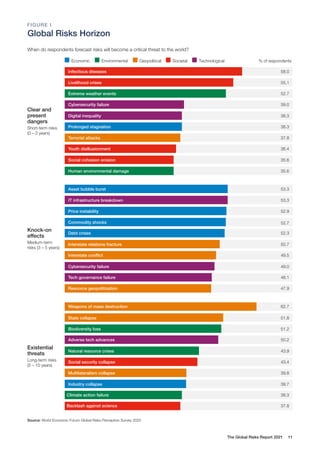
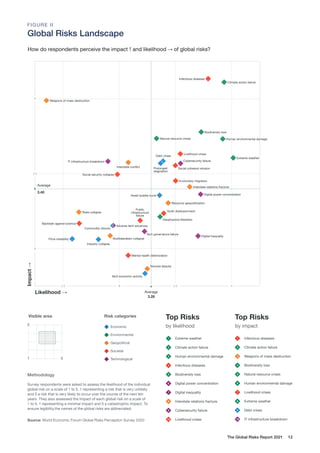
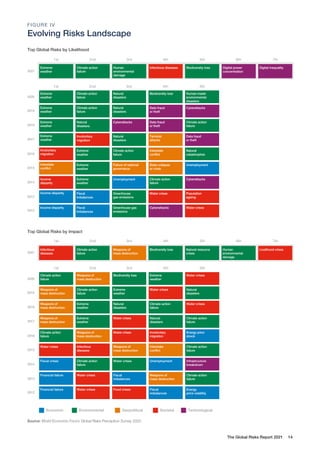
Among the highest likelihood risks of the next ten
years are extreme weather, climate action failure
and human-led environmental damage; as well as
digital power concentration, digital inequality and
cybersecurity failure. Among the highest impact risks
of the next decade, infectious diseases are in the
top spot, followed by climate action failure and other
environmental risks; as well as weapons of mass
destruction, livelihood crises, debt crises and
IT infrastructure breakdown.
When it comes to the time-horizon within which these risks
will become a critical threat to the world, the most imminent
threats – those that are most likely in the next two years
– include employment and livelihood crises, widespread
youth disillusionment, digital inequality, economic
stagnation, human-made environmental damage,
erosion of societal cohesion, and terrorist attacks.
Economic risks feature prominently in the 3-5 year
timeframe, including asset bubbles, price instability,
commodity shocks and debt crises; followed by
geopolitical risks, including interstate relations and
conflict, and resource geopolitization. In the 5-10
year horizon, environmental risks such as biodiversity
loss, natural resource crises and climate action failure
dominate; alongside weapons of mass destruction,
adverse effects of technology and collapse of states or
multilateral institutions.
Economic fragility and societal
divisions are set to increase
Underlying disparities in healthcare, education,
financial stability and technology have led the crisis
to disproportionately impact certain groups and
countries. Not only has COVID-19 caused more than
two million deaths at the time of writing, but the
economic and long-term health impacts will continue
to have devastating consequences. The pandemic’s
economic shockwave—working hours equivalent
to 495 million jobs were lost in the second quarter
of 2020 alone—will immediately increase inequality,
but so can an uneven recovery. Only 28 economies
are expected to have grown in 2020. Nearly 60%
of respondents to the GRPS identified “infectious
diseases” and “livelihood crises” as the top short-term
threats to the world. Loss of lives and livelihoods will
increase the risk of “social cohesion erosion”, also a
critical short-term threat identified in the GRPS.
Growing digital divides and
technology adoption pose concerns
COVID-19 has accelerated the Fourth Industrial
Revolution, expanding the digitalization of human
The Global Risks Report 2021 8
REUTERS/ISMAIL
interaction, e-commerce, online education and remote
work. These shifts will transform society long after
the pandemic and promise huge benefits—the ability
to telework and rapid vaccine development are two
examples—but they also risk exacerbating and creating
inequalities. Respondents to the GRPS rated “digital
inequality” as a critical short-term threat.
A widening digital gap can worsen societal fractures
and undermine prospects for an inclusive recovery.
Progress towards digital inclusivity is threatened by
growing digital dependency, rapidly accelerating
automation, information suppression and manipulation,
gaps in technology regulation and gaps in technology
skills and capabilities.
A doubly disrupted generation of
youth is emerging in an age of lost
opportunity
While the digital leap forward unlocked opportunities
for some youth, many are now entering the workforce
in an employment ice age. Young adults worldwide
are experiencing their second major global crisis in a
decade. Already exposed to environmental degradation,
the consequences of the financial crisis, rising inequality,
and disruption from industrial transformation, this
generation faces serious challenges to their education,
economic prospects and mental health.
According to the GRPS, the risk of “youth
disillusionment” is being largely neglected by the global
community, but it will become a critical threat to the
world in the short term. Hard-fought societal wins
could be obliterated if the current generation lacks
adequate pathways to future opportunities—and loses
faith in today’s economic and political institutions.
Climate continues to be a looming
risk as global cooperation weakens
Climate change—to which no one is immune—continues
to be a catastrophic risk. Although lockdowns worldwide
caused global emissions to fall in the first half of 2020,
evidence from the 2008–2009 Financial Crisis warns
that emissions could bounce back. A shift towards
greener economies cannot be delayed until the shocks
of the pandemic subside. “Climate action failure” is the
most impactful and second most likely long-term risk
identified in the GRPS.
Responses to the pandemic have caused new domestic
and geopolitical tensions that threaten stability. Digital
division and a future “lost generation” are likely to test
social cohesion from within borders—exacerbating
geopolitical fragmentation and global economic
fragility. With stalemates and flashpoints increasing in
frequency, GRPS respondents rated “state collapse” and
“multilateralism collapse” as critical long-term threats.
The Global Risks Report 2021 9
Middle powers—influential states that together
represent a greater share of the global economy
than the US and China combined—often champion
multilateral cooperation in trade, diplomacy, climate,
security and, most recently, global health. However,
if geopolitical tensions persist, middle powers will
struggle to facilitate a global recovery—at a time
when international coordination is essential—and
reinforce resilience against future crises. GRPS
respondents signal a challenging geopolitical outlook
marked by “interstate relations fracture”, “interstate
conflict” and “resource geopolitization”—all
forecasted as critical threats to the world in three
to five years.
A polarized industrial
landscape may emerge in the
post-pandemic economy
As economies emerge from the shock and stimulus
of COVID-19, businesses face a shakeout. Existing
trends have been given fresh momentum by the crisis:
nationally focused agendas to stem economic losses,
technological transformation and changes in societal
structure—including consumer behaviors, the nature
of work and the role of technology both at work and
at home. The business risks emanating from these
trends have been amplified by the crisis and include
stagnation in advanced economies and lost potential
in emerging and developing markets, the collapse
of small businesses, widening the gaps between
major and minor companies and reducing market
dynamism, and exacerbation of inequality; making it
harder to achieve long-term sustainable development.
With governments still deliberating how to pivot away
from emergency to recovery, and with companies
anticipating a changed business landscape, there are
opportunities to invest in smart, clean and inclusive
growth that will improve productivity and delivery of
sustainable agendas.
Better pathways are available to
manage risks and enhance resilience
Despite some remarkable examples of determination,
cooperation and innovation, most countries have
struggled with aspects of crisis management during
the global pandemic. While it is early to draw definitive
lessons, this edition of the Global Risks Report reflects
on global preparedness by looking at four key areas of
the response to COVID-19: institutional authority, risk
financing, information collection and sharing,
and equipment and vaccines. It then looks to national-
level responses—acknowledging the varied starting
points for individual countries—and draws lessons
from five domains: government decision-making,
public communication, health system capabilities,
lockdown management and financial assistance to
the vulnerable.
However, if lessons from this crisis only inform
decision-makers how to better prepare for the next
pandemic—rather than enhancing risk processes,
capabilities and culture—the world will be again
planning for the last crisis rather than anticipating
the next. The response to COVID-19 offers four
governance opportunities to strengthen the overall
resilience of countries, businesses and the international
community: (1) formulating analytical frameworks
that take a holistic and systems-based view of risk
impacts; (2) investing in high-profile “risk champions”
to encourage national leadership and international
co-operation; (3) improving risk communications and
combating misinformation; and (4) exploring new forms
of public-private partnership on risk preparedness.
10
The Global Risks Report 2021
Global Risks
Perception
Survey 2020
Results
REUTERS/GAILLARD
Economic Environmental Geopolitical Societal Technological
Infectious diseases 58.0
Livelihood crises 55.1
Extreme weather events 52.7
Cybersecurity failure 39.0
Digital inequality 38.3
Prolonged stagnation 38.3
Terrorist attacks 37.8
Youth disillusionment 36.4
Social cohesion erosion 35.6
Human environmental damage 35.6
Asset bubble burst 53.3
IT infrastructure breakdown 53.3
Price instability 52.9
Commodity shocks 52.7
Debt crises 52.3
Interstate relations fracture 50.7
Interstate conflict 49.5
Cybersecurity failure 49.0
Tech governance failure 48.1
Resource geopolitization 47.9
Weapons of mass destruction 62.7
State collapse 51.8
Biodiversity loss 51.2
Adverse tech advances 50.2
Natural resource crises 43.9
Social security collapse 43.4
Multilateralism collapse 39.8
Industry collapse 39.7
Climate action failure 38.3
Backlash against science 37.8
Clear and
present
dangers
Short-term risks
(0 – 2 years)
Knock-on
effects
Medium-term
risks (3 – 5 years)
Existential
threats
Long-term risks
(5 – 10 years)
FIGURE I
Global Risks Horizon
When do respondents forecast risks will become a critical threat to the world?
% of respondents
Source: World Economic Forum Global Risks Perception Survey 2020
The Global Risks Report 2021 11
FIGURE I
Global Risks Horizon
Source: World Economic Forum Global Risks Perception Survey 2020
The Global Risks Report 2021 12
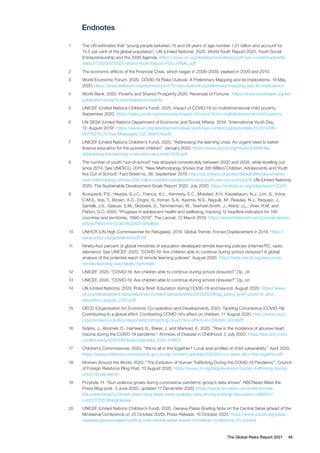
The Global Risks Landscape 2021
How do survey respondents perceive the impact ↑ and likelihood → of global risks?
Source: World Economic Forum Global Risks Perception Survey 2020
Visible area
1
1
1 5
5
5
1
1
1
5
5
5
Methodology
Survey respondents were asked to assess the likelihood of the individual
global risk on a scale of 1 to 5, 1 representing a risk that is very unlikely to
happen and 5 a risk that is very likely to occur over the course of the next ten
years. They also assessed the impact of each global risk on a scale of 1 to 5,
1 representing a minimal impact and 5 a catastrophic impact. To ensure
legibility, the names of the global risks are abbreviated.
Risk categories
Economic
Environmental
Geopolitical
Societal
Technological
2.5
2.5
2.5 3
3
3 3.5
3.5
3.5 4
4
4
Likelihood →
3
3
3
3.5
3.5
3.5
4
4
4
Impact
→
Average
3.28
Average
3.40
Climate action failure
Infectious diseases
Infectious diseases
Infectious diseases
Human environmental damage
Extreme weather
Extreme weather
Extreme weather
Biodiversity loss
Biodiversity loss
Biodiversity loss
Livelihood crises
Livelihood crises
Livelihood crises
Cybersecurity failure
Digital power concentration
Natural resource crises
Social cohesion erosion
Interstate relations fracture
Debt crises
Involuntary migration
Prolonged
stagnation
Digital inequality
Digital inequality
Digital inequality
Resource geopolitization
Asset bubble burst
Asset bubble burst
Asset bubble burst
Interstate conflict
Interstate conflict
Interstate conflict
Youth disillusionment
Geophysical disasters
Social security collapse
IT infrastructure breakdown
Public
infrastructure
failure
Tech governance failure
Weapons of mass destruction
Terrorist attacks
Terrorist attacks
Terrorist attacks
Commodity shocks
Commodity shocks
Commodity shocks
Adverse tech
Adverse tech advances
advances
Adverse tech advances
Illicit economic activity
Mental health deterioration
Multilateralism collapse
Industry collapse
Industry collapse
Industry collapse
State collapse
State collapse
State collapse
Backlash against science
Price instability
Price instability
Price instability
The Global Risks Landscape 2021
How do survey respondents perceive the impact ↑ and likelihood → of global risks?
Source: World Economic Forum Global Risks Perception Survey 2020
Visible area
1
1
1 5
5
5
1
1
1
5
5
5
Methodology
Survey respondents were asked to assess the likelihood of the individual
global risk on a scale of 1 to 5, 1 representing a risk that is very unlikely to
happen and 5 a risk that is very likely to occur over the course of the next ten
years. They also assessed the impact of each global risk on a scale of 1 to 5,
1 representing a minimal impact and 5 a catastrophic impact. To ensure
legibility, the names of the global risks are abbreviated.
Risk categories
Economic
Environmental
Geopolitical
Societal
Technological
2.5
2.5
2.5 3
3
3 3.5
3.5
3.5 4
4
4
Likelihood →
3
3
3
3.5
3.5
3.5
4
4
4
Impact
→
Average
3.28
Average
3.40
Climate action failure
Infectious diseases
Infectious diseases
Infectious diseases
Human environmental damage
Extreme weather
Extreme weather
Extreme weather
Biodiversity loss
Biodiversity loss
Biodiversity loss
Livelihood crises
Livelihood crises
Livelihood crises
Cybersecurity failure
Digital power concentration
Natural resource crises
Social cohesion erosion
Interstate relations fracture
Debt crises
Involuntary migration
Prolonged
stagnation
Digital inequality
Digital inequality
Digital inequality
Resource geopolitization
Asset bubble burst
Asset bubble burst
Asset bubble burst
Interstate conflict
Interstate conflict
Interstate conflict
Youth disillusionment
Geophysical disasters
Social security collapse
IT infrastructure breakdown
Public
infrastructure
failure
Tech governance failure
Weapons of mass destruction
Terrorist attacks
Terrorist attacks
Terrorist attacks
Commodity shocks
Commodity shocks
Commodity shocks
Adverse tech
Adverse tech advances
advances
Adverse tech advances
Illicit economic activity
Mental health deterioration
Multilateralism collapse
Industry collapse
Industry collapse
Industry collapse
State collapse
State collapse
State collapse
Backlash against science
Price instability
Price instability
Price instability
pe 2021
e impact ↑ and likelihood → of global risks?
eption Survey 2020
sked to assess the likelihood of the individual
5, 1 representing a risk that is very unlikely to
ery likely to occur over the course of the next ten
he impact of each global risk on a scale of 1 to 5,
pact and 5 a catastrophic impact. To ensure
lobal risks are abbreviated.
Risk categories
Economic
Environmental
Geopolitical
Societal
Technological
3.5
3.5
3.5 4
4
4
Average
3.28
Climate action failure
Infectious diseases
Infectious diseases
Infectious diseases
Human environmental damage
Extreme weather
Extreme weather
Extreme weather
Biodiversity loss
Biodiversity loss
Biodiversity loss
Livelihood crises
Livelihood crises
Livelihood crises
Cybersecurity failure
Digital power concentration
Natural resource crises
Social cohesion erosion
Interstate relations fracture
Debt crises
Involuntary migration
Prolonged
stagnation
Digital inequality
Digital inequality
Digital inequality
Resource geopolitization
Asset bubble burst
Asset bubble burst
Asset bubble burst
e conflict
e conflict
e conflict
Youth disillusionment
Geophysical disasters
Public
infrastructure
failure
Tech governance failure
Terrorist attacks
Terrorist attacks
Terrorist attacks
tech
tech advances
advances
tech advances
mic activity
mic activity
mic activity
Mental health deterioration
sm collapse
sm collapse
sm collapse
Methodology
Survey respondents were asked to assess the likelihood of the individual
global risk on a scale of 1 to 5, 1 representing a risk that is very unlikely
and 5 a risk that is very likely to occur over the course of the next ten
years. They also assessed the impact of each global risk on a scale of
1 to 5, 1 representing a minimal impact and 5 a catastrophic impact. To
ensure legibility,the names of the global risks are abbreviated.
How do respondents perceive the impact and likelihood of global risks?
Top Risks
by impact
Infectious diseases
Climate action failure
Weapons of mass destruction
Biodiversity loss
Natural resource crises
Human environmental damage
Livelihood crises
Extreme weather
Debt crises
IT infrastructure breakdown
Source: World Economic Forum
Global Risks Perception Survey 2020
Top Risks
by likelihood
1
2
3
4
5
6
7
8
9
10
Source: World Economic Forum
Global Risks Perception Survey 2020
Extreme weather
Climate action failure
Human environmental damage
Infectious diseases
Biodiversity loss
Digital power concentration
Digital inequality
Interstate relations fracture
Cybersecurity failure
Livelihood crises
FIGURE II
Global Risks Landscape
Source: World Economic Forum Global Risks Perception Survey 2020
The Global Risks Report 2021 13
FIGURE III
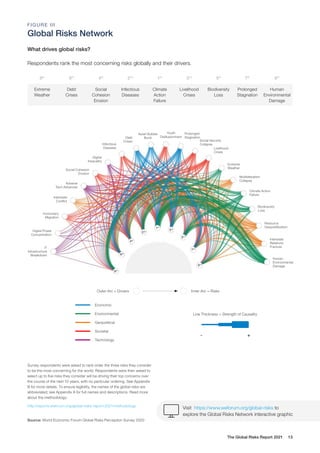
Global Risks Network
Visit https://www.weforum.org/global-risks to
explore the Global Risks Network interactive graphic
What drives global risks?
Respondents rank the most concerning risks globally and their drivers.
8th
6th
4th
2nd
1st
3rd
5th
7th
9th
Extreme
Weather
Debt
Crises
Social
Cohesion
Erosion
Infectious
Diseases
Climate
Action
Failure
Livelihood
Crises
Biodiversity
Loss
Prolonged
Stagnation
Human
Environmental
Damage
Survey respondents were asked to rank order the three risks they consider
to be the most concerning for the world. Respondents were then asked to
select up to five risks they consider will be driving their top concerns over
the course of the next 10 years, with no particular ordering. See Appendix
B for more details. To ensure legibility, the names of the global risks are
abbreviated; see Appendix A for full names and descriptions. Read more
about the methodology:
http://reports.weforum.org/global-risks-report-2021/methodology
Outer Arc = Drivers Inner Arc = Risks
Economic
IT
Infrastructure
Breakdown
Digital Power
Concentration
Involuntary
Migration
Interstate
Conflict
Adverse
Tech Advances
Social Cohesion
Erosion
Digital
Inequality
Infectious
Diseases
Debt
Crises
Asset Bubble
Burst
Youth
Disillusionment
Prolonged
Stagnation
Social Security
Collapse
Livelihood
Crises
Extreme
Weather
Multilateralism
Collapse
Climate Action
Failure
Biodiversity
Loss
Resource
Geopolitilization
Interstate
Relations
Fracture
Human
Environmental
Damage
Environmental
Geopolitical
Societal
Technology
Line Thickness = Strength of Causality
- +
8th
6th
4th
2nd
1st
3rd
5th
7th
9th
The Global Risks Report 2021 14
1st 2nd 3rd 4th 5th
1st 2nd 3rd 4th 5th
6th 7th
1st 2nd 3rd 4th 5th 6th 7th
Top Global Risks by Likelihood
Top Global Risks by Impact
Economic Environmental Geopolitical Societal Technological
FIGURE IV
Evolving Risks Landscape
Income disparity Greenhouse
gas emissions
Water crises Population
ageing
Income
disparity
Unemployment Climate action
failure
Cyberattacks
Extreme
weather
Interstate
conflict
Failure of national
governance
State collapse
or crisis
Unemployment
Extreme
weather
Extreme
weather
Natural
disasters
Terrorist
attacks
Data fraud
or theft
Involuntary
migration
Income disparity Fiscal
imbalances
Cyberattacks Water crises
Greenhouse gas
emissions
Involuntary
migration
Interstate
conflict
Natural
catastrophes
Extreme
weather
Climate action
failure
Extreme
weather
Cyberattacks Data fraud
or theft
Natural
disasters
Climate action
failure
Extreme
weather
Natural
disasters
Data fraud
or theft
Cyberattacks
Climate action
failure
2013
2014
2015
2017
2012
2016
2018
2019
2020
Extreme
weather
Natural
disasters
Biodiversity loss Human-made
environmental
disasters
Climate action
failure
2021
Extreme
weather
Human
environmental
damage
Infectious diseases
Climate action
failure
Biodiversity loss Digital power
concentration
Digital inequality
2021
Infectious
diseases
Weapons of
mass destruction
Biodiversity loss
Climate action
failure
Natural resource
crises
Livelihood crises
Human
environmental
damage
Fiscal
imbalances
1st 2nd 3rd 4th 5th
2013
2014
2015
2017
2012
2016
2018
2019
2020
Climate action
failure
Extreme
weather
Water crises Natural
disasters
Weapons of
mass destruction
Financial failure Water crises Food crises Energy
price volatility
Fiscal
imbalances
Weapons of
mass destruction
Extreme
weather
Water crises
Natural
disasters
Climate action
failure
Weapons of
mass destruction
Extreme
weather
Water crises Natural
disasters
Climate action
failure
Energy price
shock
Water crises Involuntary
migration
Weapons of
mass destruction
Climate action
failure
Fiscal crises Infrastructure
breakdown
Water crises Unemployment
Climate action
failure
Water crises Infectious
diseases
Weapons of
mass destruction
Interstate
conflict
Climate action
failure
Financial failure Water crises Weapons of
mass destruction
Fiscal
imbalances
Climate action
failure
Extreme
weather
Water crises
Weapons of
mass destruction
Biodiversity loss
Climate action
failure
Source: World Economic Forum Global Risks Perception Survey 2020
FIGURE IV
Evolving Risks Landscape
15
The Global Risks Report 2021
Global Risks
2021: Fractured
Future
CHAPTER 1
REUTERS/CABEZAS
The Global Risks Report 2021 16
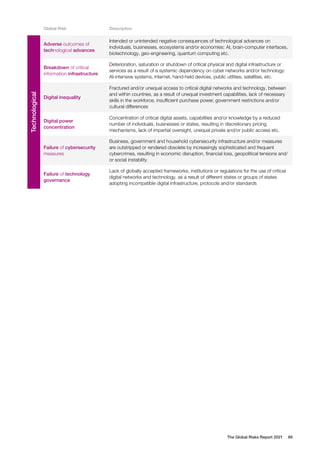
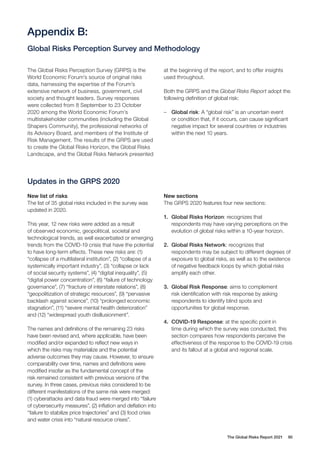
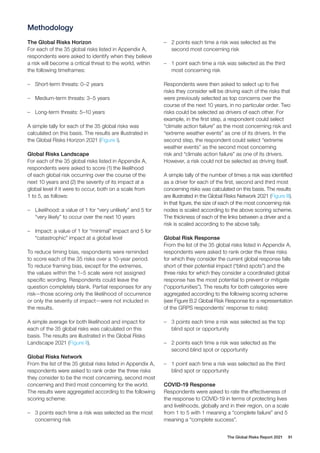
The immediate human and economic
costs of COVID-19 are severe. They
threaten to scale back years of progress
on reducing global poverty and inequality
and further damage social cohesion and
global cooperation, which were already
weakening before the virus struck.
New barriers to individual and collective
advancement will likely result from the
pandemic as the world faces the sudden
disruption of social interactions, a widening
digital divide, abrupt shifts in markets and
consumer behaviour, loss of education and
jobs, and challenges to democracy and
international relations. “Digital inequality”,
“youth disillusionment” and “social
cohesion erosion”—newly included in the
Global Risks Perception Survey (GRPS)—
were all identified by respondents as critical
short-term threats.
A digital leap forward—disrupting industry,
education, labour markets, and the
balance of power between nations—
risks widening the gap between the
technological “haves” and “have-nots”.
All generations and groups have been
affected by the crisis: older populations
are the most vulnerable to the pandemic
itself, and youth face new barriers to
social mobility, strains on mental health,
uncertain economic prospects and the
continued degradation of the planet.
Climate change—to which no one is
immune, nor can the world vaccinate
against it—continues to be catastrophic:
“climate action failure” is the most
impactful and second most likely long-
term risk identified in the GRPS.
Billions of people worldwide are at
heightened risk of missing out on future
economic opportunities, and the benefits
of a resilient global community. According
to the GRPS, “livelihood crises” will be a
critical threat over the next two years, and
their impact is likely to continue throughout
the decade.
The crisis has also challenged national
policy-making and international relations
in ways that threaten lasting impacts.
Institutions and policies to support
international coordination were already in
decline, and responses to the pandemic
have caused new geopolitical tensions. With
new stalemates and flashpoints in view,
GRPS respondents rated “state collapse”
and “multilateralism collapse” as critical
threats over the next five to ten years.
Despite these challenges, there is also
space for building resilience. In this
chapter, we close with a reflection on
how governments, businesses and
societies can begin to take steps for better
preparedness in the face of perpetual
global risk (see Box 1.1).
Damage and disparity
The effects of COVID-19, along with
some aspects of the policy response,
however necessary, have left societies
and economies damaged, widened
existing disparities within communities
and between nations, disproportionately
harmed certain sectors and societal
groups, and complicated the pathway for
the world to achieve the United Nations
Sustainable Development Goals by 2030.
Economic shockwave
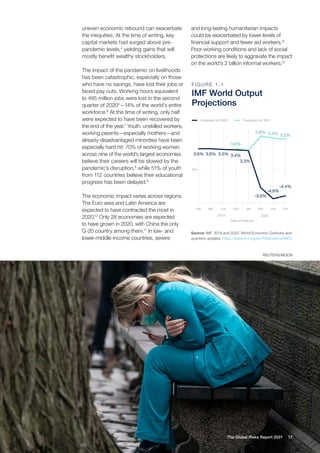
The global economy has now sunk to its
deepest crisis in peacetime. World output
is expected to have shrunk by 4.4% in
2020 (see Figure 1.1).1
In comparison, the
2008–2009 Financial Crisis caused the
world economy to contract by 0.1%. Data
for the third quarter of 2020 hinted that
recovery was underway, but the impact
of surging infections in the fourth quarter
remains to be measured: many countries
were registering more daily cases than they
had in the second quarter, when the G20
economies contracted at an annualized
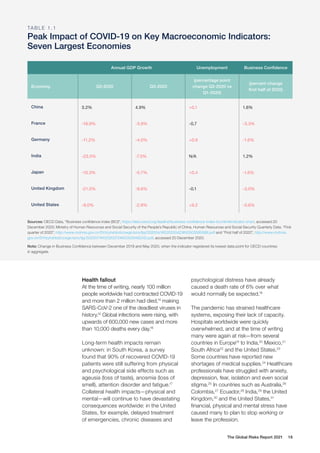
rate (see Table 1.1 for data on the seven
largest economies).2
The economic
contraction is expected to increase
inequality in many countries;3
but an
Structural fissures
exacerbated by the crisis
threaten to make the
recovery deeply uneven
17
The Global Risks Report 2021
uneven economic rebound can exacerbate
the inequities. At the time of writing, key
capital markets had surged above pre-
pandemic levels,4
yielding gains that will
mostly benefit wealthy stockholders.
The impact of the pandemic on livelihoods
has been catastrophic, especially on those
who have no savings, have lost their jobs or
faced pay cuts. Working hours equivalent
to 495 million jobs were lost in the second
quarter of 20205
—14% of the world’s entire
workforce.6
At the time of writing, only half
were expected to have been recovered by
the end of the year.7
Youth, unskilled workers,
working parents—especially mothers—and
already-disadvantaged minorities have been
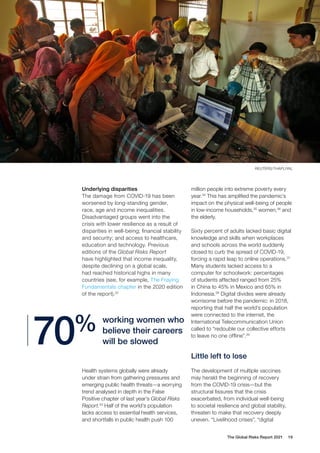
especially hard hit: 70% of working women
across nine of the world’s largest economies
believe their careers will be slowed by the
pandemic’s disruption,8
while 51% of youth
from 112 countries believe their educational
progress has been delayed.9
The economic impact varies across regions.
The Euro area and Latin America are
expected to have contracted the most in
2020.10
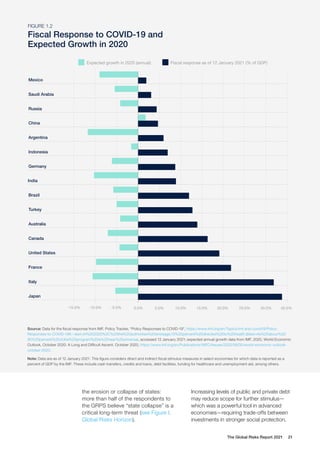
Only 28 economies are expected
to have grown in 2020, with China the only
G-20 country among them.11
In low- and
lower-middle-income countries, severe
F I G U R E 1 . 1
IMF World Output
Projections
Forecasts for 2020
Jan
0%
Apr Jun Oct Jan Apr Jun
2020
Date of forecast
2019
Oct
Forecasts for 2021
3.6% 3.6% 3.5% 3.4%
3.6%
5.8% 5.4% 5.2%
3.3%
-3.0%
-4.9%
-4.4%
and long-lasting humanitarian impacts
could be exacerbated by lower levels of
financial support and fewer aid workers.12
Poor working conditions and lack of social
protections are likely to aggravate the impact
on the world’s 2 billion informal workers.13
Source: IMF. 2019 and 2020. World Economic Outlooks and
quarterly updates. https://www.imf.org/en/Publications/WEO
REUTERS/MOON
The Global Risks Report 2021 18
Health fallout
At the time of writing, nearly 100 million
people worldwide had contracted COVID-19
and more than 2 million had died,14
making
SARS-CoV-2 one of the deadliest viruses in
history.15
Global infections were rising, with
upwards of 600,000 new cases and more
than 10,000 deaths every day.16
Long-term health impacts remain
unknown: in South Korea, a survey
found that 90% of recovered COVID-19
patients were still suffering from physical
and psychological side effects such as
ageusia (loss of taste), anosmia (loss of
smell), attention disorder and fatigue.17
Collateral health impacts—physical and
mental—will continue to have devastating
consequences worldwide: in the United
States, for example, delayed treatment
of emergencies, chronic diseases and
psychological distress have already
caused a death rate of 6% over what
would normally be expected.18
The pandemic has strained healthcare
systems, exposing their lack of capacity.
Hospitals worldwide were quickly
overwhelmed, and at the time of writing
many were again at risk—from several
countries in Europe19
to India,20
Mexico,21
South Africa22
and the United States.23
Some countries have reported new
shortages of medical supplies.24
Healthcare
professionals have struggled with anxiety,
depression, fear, isolation and even social
stigma.25
In countries such as Australia,26
Colombia,27
Ecuador,28
India,29
the United
Kingdom,30
and the United States,31
financial, physical and mental stress have
caused many to plan to stop working or
leave the profession.
TA B L E 1 . 1
Peak Impact of COVID-19 on Key Macroeconomic Indicators:
Seven Largest Economies
Annual GDP Growth Unemployment Business Confidence
Economy Q2-2020 Q3-2020
(percentage point
change Q2-2020 vs
Q1-2020)
(percent change
first half of 2020)
China 3.2% 4.9% +0.1 1.6%
France -18.9% -3.9% -0.7 -3.3%
Germany -11.2% -4.0% +0.6 -1.6%
India -23.5% -7.5% N/A 1.2%
Japan -10.3% -5.7% +0.4 -1.6%
United Kingdom -21.5% -9.6% -0.1 -3.0%
United States -9.0% -2.9% +9.2 -0.6%
Sources: OECD Data, “Business confidence index (BCI)”, https://data.oecd.org/leadind/business-confidence-index-bci.htm#indicator-chart, accessed 20
December 2020; Ministry of Human Resources and Social Security of the People’s Republic of China, Human Resources and Social Security Quarterly Data, “First
quarter of 2020”, http://www.mohrss.gov.cn/SYrlzyhshbzb/zwgk/szrs/tjsj/202004/W020200423600503595588.pdf and “First half of 2020”, http://www.mohrss.
gov.cn/SYrlzyhshbzb/zwgk/szrs/tjsj/202007/W020200724600005492242.pdf, accessed 20 December 2020.
Note: Change in Business Confidence between December 2019 and May 2020, when the indicator registered its lowest data point for OECD countries
in aggregate.
The Global Risks Report 2021 19
Underlying disparities
The damage from COVID-19 has been
worsened by long-standing gender,
race, age and income inequalities.
Disadvantaged groups went into the
crisis with lower resilience as a result of
disparities in well-being; financial stability
and security; and access to healthcare,
education and technology. Previous
editions of the Global Risks Report
have highlighted that income inequality,
despite declining on a global scale,
had reached historical highs in many
countries (see, for example, The Fraying
Fundamentals chapter in the 2020 edition
of the report).32
million people into extreme poverty every
year.34
This has amplified the pandemic’s
impact on the physical well-being of people
in low-income households,35
women,36
and
the elderly.
Sixty percent of adults lacked basic digital
knowledge and skills when workplaces
and schools across the world suddenly
closed to curb the spread of COVID-19,
forcing a rapid leap to online operations.37
Many students lacked access to a
computer for schoolwork: percentages
of students affected ranged from 25%
in China to 45% in Mexico and 65% in
Indonesia.38
Digital divides were already
worrisome before the pandemic: in 2018,
reporting that half the world’s population
were connected to the internet, the
International Telecommunication Union
called to “redouble our collective efforts
to leave no one offline”.39
Little left to lose
The development of multiple vaccines
may herald the beginning of recovery
from the COVID-19 crisis—but the
structural fissures that the crisis
exacerbated, from individual well-being
to societal resilience and global stability,
threaten to make that recovery deeply
uneven. “Livelihood crises”, “digital
Health systems globally were already
under strain from gathering pressures and
emerging public health threats—a worrying
trend analysed in depth in the False
Positive chapter of last year’s Global Risks
Report.33
Half of the world’s population
lacks access to essential health services,
and shortfalls in public health push 100
working women who
believe their careers
will be slowed
70%
REUTERS/THAPLIYAL
The Global Risks Report 2021 20
inequality”, “youth disillusionment” and
“social cohesion erosion” all show up in
the GRPS as critical global threats for the
next two years.
Narrowing pathways
Across developed and developing
economies alike, the number of people
without access to quality and affordable
healthcare, education or digital tools is
at risk of increasing. Billions of people
face narrowing pathways to future
well-being.
In the short term, equitable and effective
vaccine distribution is at risk from
protectionist tendencies and geopolitical
tensions—just as these tendencies and
tensions put essential medical supplies
at risk when the pandemic started (see
Hindsight). In the longer term, inequitable
access to quality healthcare will persist as
a result of continued stress on healthcare
systems globally. Health capacity in
some European countries has already
suffered from prolonged austerity
measures.40
In Sub-Saharan Africa, 20%
of people over 60—the highest-risk age
group—are at least three hours away
from the nearest health facility.41
Such
obstacles have complicated the response
to the pandemic. Looking ahead, failing
to close public health gaps will exacerbate
existing vulnerabilities and risk further
humanitarian and economic damage.
Barriers to education and technology—
long-proven channels for economic
advancement—have grown higher;
especially for youth (see Chapter
3, Pandemials). Education systems
worldwide are set to undergo a
challenging structural transformation
underpinned by widespread adoption
of online learning. This shift can
potentially reduce costs and expand
access,42
but students and workers
who lack the digital tools, online
access and knowledge to participate
are at risk of being excluded (see
Chapter 2, Error 404).43
“Digital
inequality”—ranked as the fifth most
concerning short-term threat to the
world—is increasing within and between
countries. The growing gap between
the technological “haves” and “have-
nots”—amid pressures on public and
private finances that could limit critical
investments in digital education—will
impede individual economic mobility.
Physical mobility—another channel for
economic advancement—is at risk too.
Domestically, the digital leap forward
can allow businesses to reduce costs by
relocating them away from city centres,
but workers in hands-on industries or
without the means or flexibility to move
to new production centres could be
stranded. Internationally, restrictions on
movement brought in during the pandemic
may be slow to ease given geopolitical
tensions, jeopardizing opportunities for the
world’s 250 million migrant workers and
their dependents.44
Global remittances are
expected to decrease by more than 14%
by 2021.45
Societal fragmentation
As public health gaps, digital
inequality, educational disparities and
unemployment—risks that result from
a complex combination of existing
inequalities and the impact of the
pandemic—affect vulnerable groups
the most, they may further fray social
cohesion. Unsurprisingly, “social
cohesion erosion” and “livelihood
crises” are among the highest-likelihood
and highest-impact long-term risks in
the GRPS (see Figure II, Global Risks
Landscape). Too many people have
little left to lose.
The global recession is now expected to
force as many as 150 million more people
into extreme poverty, increasing the total
to 9.4% of the world’s population—it
was expected to fall to 8% by the end
of 2020.46
This setback in the global
development agenda will heighten
vulnerability to future shocks and threaten
Public health gaps, digital
inequality, educational
disparities and unemployment
may fray social cohesion
The Global Risks Report 2021 21
FIGURE 1.2
Fiscal Response to COVID-19 and
Expected Growth in 2020
Mexico
Expected growth in 2020 (annual)
Saudi Arabia
Russia
China
Argentina
Indonesia
Germany
India
Brazil
Turkey
Australia
Canada
United States
France
Italy
Japan
Fiscal response as of 12 January 2021 (% of GDP)
-15.0% -10.0% -5.0% 0.0% 5.0% 10.0% 15.0% 20.0% 25.0% 30.0% 35.0%
Source: Data for the fiscal response from IMF, Policy Tracker, “Policy Responses to COVID-19”, https://www.imf.org/en/Topics/imf-and-covid19/Policy-
Responses-to-COVID-19#:~:text=In%202020%2C%20the%20authorities%20envisage,15%20percent%20directed%20to%20health.&text=As%20about%20
90%20percent%20of,the%20program%20is%20near%20universal, accessed 12 January 2021; expected annual growth data from IMF, 2020, World Economic
Outlook, October 2020: A Long and Difficult Ascent. October 2020, https://www.imf.org/en/Publications/WEO/Issues/2020/09/30/world-economic-outlook-
october-2020.
Note: Data are as of 12 January 2021. This figure considers direct and indirect fiscal stimulus measures in select economies for which data is reported as a
percent of GDP by the IMF. These include cash transfers, credits and loans, debt facilities, funding for healthcare and unemployment aid, among others.
the erosion or collapse of states:
more than half of the respondents to
the GRPS believe “state collapse” is a
critical long-term threat (see Figure I,
Global Risks Horizon).
Increasing levels of public and private debt
may reduce scope for further stimulus—
which was a powerful tool in advanced
economies—requiring trade-offs between
investments in stronger social protection,
The Global Risks Report 2021 22
reskilling and upskilling of disadvantaged
workers, preparing youth for a drastically
changed labour market, and economic
transformation towards greener energy and
infrastructure (see Chapter 5, Imperfect
Markets). Respondents to the GRPS
believe mismanaging these trade-offs
will compound the risks of “debt crises”,
“social security collapse”, “digital inequality”
and “youth disillusionment”; triggering
“livelihood crises” globally (see Figure III,
Global Risk Network).
Developed and developing countries with
weak public finances face a harder road
to recovery: according to the International
Monetary Fund (IMF), seven low-income
countries are in debt distress, with another
28 at high risk.47
Even where fiscal stimulus
has been substantial (see Figure 1.2), it
is not clear whether it will lead to a more
equitable recovery.
Divisiveness had been increasing before
the pandemic in many countries—as
analysed in the Fraying Fundamentals
chapter of last year’s Global Risks
Report48
—with growing perceptions of
economic and political systems being
rigged and unrepresentative. While
social distancing measures temporarily
interrupted popular protests in 2020, they
have resumed in countries ranging from
Belarus to France, Germany, Russia, Sudan
and the United States.49
Systemic issues that sparked protests in
2020 include corruption, racial inequality
and police brutality.50
In some countries,
perceptions that COVID-19 responses
were inadequate or too stringent have
aggravated public discontent.51
Young
people have increasingly voiced discontent
over climate, economic, political and
social injustices they believe have
been caused by older generations (see
Chapter 3, Pandemials). Loss of plurality,
erosion of diverse representation in
positions of power, financial hardship
and intergenerational frictions—which will
continue worsening if profound inequalities
are unaddressed—risk exacerbating
societal divisiveness and severely
weakening communities’ resilience.
Heightened instability
Domestic political challenges, growing
fragmentation in many societies and
geopolitical tensions left the world woefully
underprepared for a crisis of the magnitude
of COVID-19 and amplified its impacts (see
Hindsight). Flashpoints that are likely to
hamper national and international stability
would deteriorate multilateral capacity to
respond to future global shocks.
Further polarization generated by the
outcome of the US elections may
create domestic obstacles for the new
administration, hindering financial, political,
technical and international cooperation
commitments on global issues such
as climate change, digital governance,
free trade and international security. The
formalization of Brexit, rising euro-scepticism
and damage from subsequent waves of
COVID-19 may weaken support among
EU members for a coordinated green
recovery and threaten the European Union’s
consolidation as a balancing third power.
Increasing tensions between China and
India—with the former expanding its
regional economic interests through the
recently signed Regional Comprehensive
Economic Partnership (RCEP)—could
weaken regional and global trade and
growth.52
In Africa, worsening employment
and investment trends threaten the
anticipated benefits of the delayed African
Continental Free Trade Agreement
(AfCFTA),53
which could catalyse civil unrest
and aggravate humanitarian crises.54
Regional alliances are likely to form out
of economic expediency and tightening
Citizens now know the power political
leaders can wield when the challenge
demands it
The Global Risks Report 2021 23
relations with superpowers, but the
changing relationship between them is
creating uncertainty for other nations
around international rules and norms—
from cybersecurity and 5G technology
to climate action, natural resources and
trade (see Chapter 4, Middle Power
Morass). Public health is becoming
a new frontier for geopolitical rivalry.
Vaccine diplomacy and conflicts over
other critical supplies are likely to create
further tensions and require complex
negotiations, impeding international
coordination and the effectiveness of
the multilateral system to address global
concerns (see Hindsight).
No vaccine for environmental
degradation
Without societal cohesion and
stable international platforms,
future transboundary crises will have
greater impacts. The GRPS draws
attention to blind spots in collective
responses to a range of risks—such
as “debt crises”, “mental health
deterioration”, “tech governance failure”
and “youth disillusionment” (see Appendix
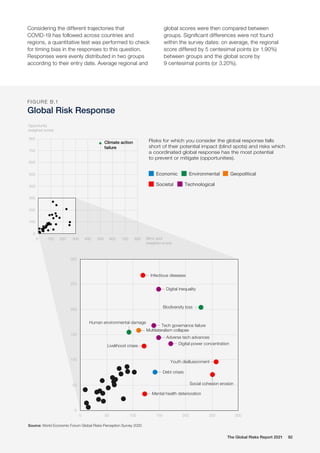
B, Figure B.1 Global Risk Response)—but
foremost among these blind spots
are “climate action failure” and
“biodiversity loss”.
Last year, for the first time in 15 years
of the GRPS, the five most likely long-
term risks were environmental—
analysed in last year’s Global Risks
Report chapters A Decade Left and
Save the Axolotl. The World Economic
Forum’s COVID-19 Risks Outlook,
published in May 2020,55
analysed how
the crisis could stall progress on climate
action. This year, GRPS respondents
ranked environmental risks as four of
the top five by likelihood—“infectious
diseases” is fourth.
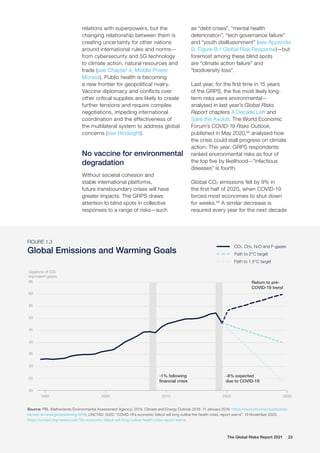
Global CO2 emissions fell by 9% in
the first half of 2020, when COVID-19
forced most economies to shut down
for weeks.56
A similar decrease is
required every year for the next decade
CO2, CH4, N2O and F-gases
-1% following
financial crisis
-8% expected
due to COVID-19
Return to pre-
COVID-19 trend
55
65
60
50
45
40
35
30
25
20
1990 2000 2010 2020 2030
FIGURE 1.3
Global Emissions and Warming Goals Path to 2°C target
Path to 1.5°C target
Gigatons of CO2
equivalent gases
Source: PBL (Netherlands Environmental Assessment Agency). 2019. Climate and Energy Outlook 2019. 11 January 2019. https://www.pbl.nl/en/publicaties/
klimaat-en-energieverkenning-2019; UNCTAD. 2020. “COVID-19’s economic fallout will long outlive the health crisis, report warns”. 19 November 2020.
https://unctad.org/news/covid-19s-economic-fallout-will-long-outlive-health-crisis-report-warns
24
The Global Risks Report 2021
to maintain progress towards limiting
global warming to 1.5°C (see Figure 1.3)
and avoid the worst effects of climate
change.57
However, emissions bounced
back after the 2008–2009 Financial
Crisis.58
Collective efforts are needed to
prevent a repeat as economies emerge
from the pandemic. Growth and emissions
must be decoupled and transition risks
managed in an urgent evolution to a low-
carbon economy. At present, only four
of the world’s largest economies have
assembled recovery packages that will
produce a net environmental benefit.59
The delayed UN Climate Change
Conference COP26 in November
2021 will be a pivotal moment for the
world’s largest emitters to commit to
more aggressive national targets and
agree on rules for carbon trading—
specifically Article 6 of the Paris
Agreement60
—that can accelerate
investments in the transition to a low-
carbon global economy. The UN
Biodiversity Conference COP15 and UN
Convention to Combat Desertification
COP15 must likewise raise ambitions
for species protection and sustainable
land management. Failure to act would
inevitably lead to catastrophic physical
impacts and severe economic harm that
would require costly policy responses.
A synergetic recovery
The speed and scale of policy responses to
the pandemic have shown what is possible
(see Box 1.1): citizens now know the power
political leaders can wield when they are
convinced that the challenge demands it.
Many citizens who feel they have nothing
left to lose will demand equally swift
responses to deeply felt concerns. For
some, climate change requires immediate
action; others will prioritize jobs to ensure
the most vulnerable have food, shelter and
incomes; yet others will demand greater
effort to harness and govern technology.
As with COVID-19, climate change
impacts are likely to play out
disproportionately across countries,
exacerbated by long-existing inequalities.
There is only a short window to redress
these disparities. A shift towards
greener production and consumption
cannot be delayed until economies are
revived. Governments—individually and
in coordination—need to catalyse a
transformation that amalgamates investment
in green and inclusive economic recovery,
with short-term measures to bridge gaps in
health, education, employment prospects
and social safety nets. A fractured future
can be avoided by bridging these gaps and
enabling opportunities for everyone.
REUTERS/CZIBORRA
The Global Risks Report 2021 25
While global risks outlined in this report are dire, lessons
from COVID-19 offer an opportunity for mitigation (see
Hindsight). Global risks—pandemics among them—
crystallize differently, but cross-cutting capabilities
and systemic approaches to strengthen the overall
resilience of countries, businesses and the international
community are possible. The response to COVID-19 so
far offers at least four governance opportunities.
Frameworks
Formulating detailed analytical frameworks that take
a holistic and systems-based view of risk impacts will
help to surface potential dependencies at a fitting
moment, spill-over consequences, vulnerabilities
and blind spots. This is critical in environmental risk
mitigation, for example, where interventions such
as developing climate-resistant crop varieties could
impact food system resilience. Multilateral institutions,
public-private arrangements and civil society all have
a role in facilitating such systemic outlooks. Holistic
analysis provides a foundation for stress-testing
assumptions; identifying and comparing the trade-
offs required by different mitigation proposals and
examining responsive capabilities against emerging
crises and forward-looking scenarios.
Risk champions
Investing in high-profile “risk champions” who can
bring together different stakeholders to spur innovation
in risk analysis, financing and response capabilities,
and improve relationships between scientific experts
and political leaders.1
The 2nd
edition of the Global
Risks Report proposed the concept of a “National
Risk Officer” with a remit to enhance resilience by
improving the decision-making culture. Risk champions
should be positioned before the frenzy of the next
crisis—whatever it proves to be—yet, even with risk
champions in place, the importance of leadership
attention to risk at the highest levels in business and
government is by no means lessened.
Communication
Improving the clarity and consistency of risk
communications and combating misinformation. Most
crises require all-of-society responses—and there
is enormous goodwill and energy to leverage—but
confusion and frustration can undermine efforts to
build trust and align responsibilities between the public
sector, private sector, communities and households.
There is huge scope to enhance self-organized
resilience at the community and national levels. For
example, more can be done to understand—and
therefore tackle—biases at the individual level regarding
spread of misinformation.2
Better coordination among
private sector technology companies and government
can help to alert users to misinformation.3
Public-private partnerships
Exploring new forms of public-private partnership
on risk preparedness in technology, logistics and
manufacturing. The pandemic has shown that
innovation can be sparked when governments
engage the private sector to respond to large-scale
challenges—if risks and rewards are shared fairly
and appropriate governance is in place. Vaccine
deployment will be a test case in resiliency: while it
will raise new challenges, partnerships could prove
effective in meeting demand for glass vials, managing
cold-chain logistics, recording doses given, and even
countering vaccine hesitancy. The COVID-19 crisis
also highlighted the need for greater coordination on
financing to improve resilience and expedite recovery,
from pre-emptive investment and contingency budgets
to insurance pools with government backstops.4
The
lesson for crisis management is that details matter and
need to be addressed collaboratively.5
Footnotes
1	 Smith-Bingham, R., Wittenberg, A. and Kaniewski, D. 2020. “Building national resilience: Aligning mindsets, capabilities and investments”. Marsh &
McLennan Advantage. April 2020. https://www.mmc.com/content/dam/mmc-web/insights/publications/2020/april/Building--National--Resilience-
-Report_web.pdf
2	 Cheng, Y. and Y. Luo. 2020. “The presumed influence of digital misinformation: examining US public’s support for governmental restrictions
versus corrective action in the COVID-19 pandemic”. Online Information Review. 2 December 2020. https://www.emerald.com/insight/content/
doi/10.1108/OIR-08-2020-0386/full/html
3	 See, e.g., Hutchinson, A. 2020. “Twitter Adds New Labels on Potentially Harmful COVID-19 Misinformation in Tweets”. Social Media Today.
11 May 2020. https://www.socialmediatoday.com/news/twitter-adds-new-labels-on-potentially-harmful-covid-19-misinformation-in-t/577714/
4	 OECD (Organisation for Economic Co-operation and Development). 2020. “Responding to the COVID-19 and pandemic protection gap in
insurance”. Updated 9 September 2020. https://www.oecd.org/coronavirus/policy-responses/responding-to-the-covid-19-and-pandemic-
protection-gap-in-insurance-35e74736/
5	 Further opportunities for strengthening preparedness and resilience in the post-COVID world are explored in a collection of essays authored by the
World Economic Forum’s Global Risks Advisory Board, published in May 2020. See World Economic Forum. 2020. Challenges and Opportunities
in the Post-COVID-19 World. May 2020. http://www3.weforum.org/docs/WEF_Challenges_and_Opportunities_Post_COVID_19.pdf
BOX 1.1
Future Preparedness for Global Risks
The Global Risks Report 2021 26
Endnotes
1	 IMF (International Monetary Fund). 2020. World Economic Outlook, October 2020: A Long and Difficult Ascent.
October 2020. https://www.imf.org/en/Publications/WEO/Issues/2020/09/30/world-economic-outlook-
october-2020
2	 OECD Data. “Quarterly GDP – Total, Percent change same period, previous year”. https://data.oecd.org/gdp/
quarterly-gdp.htm, accessed 14 December 2020.
3	 Cugat, G. and Narita, F. 2020. “How COVID-19 Will Increase Inequality in Emerging Markets and Developing
Economies”. IMFBlog. 29 October 2020. https://blogs.imf.org/2020/10/29/how-covid-19-will-increase-
inequality-in-emerging-markets-and-developing-economies/#:~:text=The%20crisis%20now%20puts%20
much,gap%20between%20rich%20and%20poor.&text=COVID%2D19%20is%20expected%20to,on%20
vulnerable%20workers%20and%20women
4	 Bloomberg. “Markets — Stocks, Overview”. https://www.bloomberg.com/markets/stocks, accessed
20 December 2020.
5	 ILO (International Labour Organization). 2020. ILO Monitor: COVID-19 and the world of work. Sixth edition.
Updated estimates and analysis. September 2020. https://www.ilo.org/wcmsp5/groups/public/@dgreports/@
dcomm/documents/briefingnote/wcms_755910.pdf
6	 World Bank Open Data. “Labor force, total – World”. https://data.worldbank.org/indicator/SL.TLF.TOTL.IN,
accessed 14 December 2020.
7	 ILO. 2020. ILO Monitor. Op. cit.
8	 Deloitte. 2020. Understanding the pandemic’s impact on working women: How employers can act now to
prevent a setback in achieving gender parity in the workplace. https://www2.deloitte.com/ch/en/pages/about-
deloitte/articles/understanding-the-pandemics-impact-on-working-women.html
9	 ILO (International Labour Organization). 2020. Youth and COVID-19: Impacts on Jobs, Education, Rights and
Mental Well-Being. Survey Report 2020. 11 August 2020. https://www.ilo.org/global/topics/youth-employment/
publications/WCMS_753026/lang--en/index.htm
10	 IMF Data Mapper. “Real GDP growth – Annual percent change”. https://www.imf.org/external/datamapper/
NGDP_RPCH@WEO/WEOWORLD, accessed 14 December 2020.
11	 IMF. 2020. Op. cit.
12	 FAO (Food and Agriculture Organization of the United Nations). Anticipating the impacts of COVID-19 in
humanitarian and food crisis contexts. April 2020. http://www.fao.org/3/ca8464en/CA8464EN.pdf
13	 ILO. ILO Monitor. 2020. Op. cit.
14	 JHU (Johns Hopkins University). COVID-19 Dashboard by the Center for Systems Science and Engineering
(CSSE). “Cumulative Cases” and "Cumulative Deaths”. https://coronavirus.jhu.edu/map.html, accessed
12 January 2021.
15	 LePan, N. 2020. “Visualizing the History of Pandemics.” Visual Capitalist. 14 March 2020. https://www.
visualcapitalist.com/history-of-pandemics-deadliest/; Rosenwald, M. 2020. “History’s deadliest pandemics,
from ancient Rome to modern America”. The Washington Post. 7 April 2020. https://www.washingtonpost.com/
graphics/2020/local/retropolis/coronavirus-deadliest-pandemics/
16	 JHU (Johns Hopkins University). COVID-19 Dashboard by the Center for Systems Science and Engineering
(CSSE). “Daily Cases” and "Daily Deaths”. https://coronavirus.jhu.edu/map.html, accessed 12 January 2021.
17	 Cha, S. 2020. “Nine in ten recovered COVID-19 patients experience side-effects – study”. Reuters.
29 September 2020. https://in.reuters.com/article/health-coronavirus-southkorea-study/nine-in-ten-recovered-
covid-19-patients-experience-side-effects-study-idINKBN26K1GC
18	 Woolf, S.H, Chapman, D.A., Sabo, R.T., Weinberger, D.M. and Hill, L. 2020. “Excess Deaths From COVID-19
and Other Causes, March-April 2020”. JAMA 324 (5): 510–13. 1 July 2020. https://jamanetwork.com/journals/
jama/fullarticle/2768086#jld200072t1
19	 DW (Deutsche Welle). 2020. “Coronavirus digest: French hospitals transfer critically ill COVID-19 patients to
Germany”. DW News. 7 November 2020. https://www.dw.com/en/coronavirus-digest-french-hospitals-transfer-
critically-ill-covid-19-patients-to-germany/a-55526279
20	 Ali, S.I. 2020. “All Covid beds in top 7 private hospitals of Jaipur are full”. The Times of India. 6 November 2020.
https://timesofindia.indiatimes.com/city/jaipur/seven-among-citys-top-pvt-hospitals-have-all-beds-for-covid-
patients/articleshow/79070294.cms
21	 Gobierno de la Ciudad de México. “Capacity in general care beds in Covid-19 Hospitals”. https://hospitales.
covid19.cdmx.gob.mx/public/hospitales/EstatusHospitales.xhtml?tamizajeRealizado=true, accessed
14 December 2020.
The Global Risks Report 2021 27
22	 DW (Deutsche Welle). 2021. “South Africa: Hospitals inundated in COVID-19 surge”. DW News. 7 January 2021.
https://www.dw.com/en/south-africa-hospitals-inundated-in-covid-19-surge/av-56164469
23	 McDonnell Nieto del Rio, G., Romero, S. and Baker, M. 2020. “Hospitals Are Reeling Under a 46 Percent Spike
in Covid-19 Patients”. The New York Times. 27 November 2020. https://www.nytimes.com/2020/10/27/us/
coronavirus-hospitals-capacity.html
24	 Hufford, A. 2020. “Face Masks Are Again in Short Supply as Covid-19 Cases Surge”. The Wall Street Journal.
4 November 2020. https://www.wsj.com/articles/face-masks-are-again-in-short-supply-as-covid-19-cases-
surge-11604499588
25	 Cabarkapa, S., Nadjidai, S.E., Murgier, J. and Ng, C.H. 2020. “The psychological impact of COVID-19 and
other viral epidemics on frontline healthcare workers and ways to address it: A rapid systematic review.” Brain,
Behavior, & Immunity – Health 8: 100144. 17 September 2020. https://doi.org/10.1016/j.bbih.2020.100144
26	 Hales, L. 2020. “Doctors quitting because of COVID-19: survey”. The Medical Republic. 8 October 2020.
https://medicalrepublic.com.au/doctors-quitting-because-of-covid-19-survey/35419
27	 Infobae. 2020. “Renuncia masiva de médicos en hospital de la Amazonía de Colombia.” 20 April 2020. https://
www.infobae.com/america/agencias/2020/04/20/renuncia-masiva-de-medicos-en-hospital-de-la-amazonia-
de-colombia/
28	 Ortega, G. 2020. “Médicos de Ecuador afirman ‘sentirse desprotegidos’ frente a la pandemia”. France24.
6 September 2020. https://www.france24.com/es/20200905-ecuador-renuncia-masiva-profesionales-salud
29	 Wallen, J. 2020. “More than 80 per cent of newly qualified doctors in Indian state quit after Covid-19 wage
cuts”. The Telegraph. 2 September 2020. https://www.telegraph.co.uk/global-health/science-and-disease/80-
percent-newly-qualified-doctors-indian-state-quit-covid-19/
30	 Rimmer, A. 2020. “Covid-19: Doctors may quit without proper post-pandemic support, defence body warns”.
BMJ. 21 June 2020. https://www.bmj.com/content/369/bmj.m2476
31	 Abelson, R. 2020. “Doctors Are Calling It Quits Under Stress of the Pandemic”. The New York Times.
25 November 2020. https://www.nytimes.com/2020/11/15/health/Covid-doctors-nurses-quitting.
html?auth=login-email&login=email
32	 World Economic Forum, in partnership with Marsh & McLennan Companies and Zurich Insurance Group. 2020.
The Global Risks Report 2020. Insight Report. Chapter 2 The Fraying Fundamentals. Geneva: World Economic
Forum. January 2020. http://reports.weforum.org/global-risks-report-2020/the-fraying-fundamentals/
33	 World Economic Forum, in partnership with Marsh & McLennan Companies and Zurich Insurance Group. 2020.
The Global Risks Report 2020. Insight Report. Chapter 6 False Positive. Geneva: World Economic Forum.
January 2020. http://reports.weforum.org/global-risks-report-2020/false-positive/
34	 WHO (World Health Organization). 2020. “World Bank and WHO: Half the world lacks access to essential
health services, 100 million still pushed into extreme poverty because of health expenses”. News Release.
13 December 2017. https://www.who.int/news/item/13-12-2017-world-bank-and-who-half-the-world-lacks-
access-to-essential-health-services-100-million-still-pushed-into-extreme-poverty-because-of-health-expenses
35	Ibid.
36	 Cousins, S. 2020. “COVID-19 has 'devastating' effect on women and girls”. The Lancet 396 (10247): P301–02.
1 August 2020. https://www.thelancet.com/journals/lancet/article/PIIS0140-6736(20)31679-2/fulltext
37	 OECD (Organisation for Economic Cooperation and Development). 2019. The Future of Work: OECD
Employment Outlook 2019. April 2019. https://www.oecd.org/employment/Employment-Outlook-2019-
Highlight-EN.pdf
38	 OECD (Organization for Economic Cooperation and Development). 2020. “Learning remotely when schools
close: How well are students and schools prepared? Insights from PISA”. OECD Policy Responses to
Coronavirus (COVID-19). 3 April 2020. https://www.oecd.org/coronavirus/policy-responses/learning-remotely-
when-schools-close-how-well-are-students-and-schools-prepared-insights-from-pisa-3bfda1f7/#figure-d1e74
39	 ITU (International Telecommunication Union). 2018. “New ITU statistics show more than half the world is now
using the Internet”. ITU News. 6 December 2018. https://news.itu.int/itu-statistics-leaving-no-one-offline/
40	 Groves, E. 2020. “Austerity casts shadow on pandemic”. Official Monetary and Financial Institutions Forum.
22 April 2020. https://www.omfif.org/2020/04/austerity-casts-shadow-on-pandemic/
41	 Geldsetzer, P., Reinmuth, M., Ouma, P.O., Lautenbach, S., Okiro, E.A., Bärnighausen, T. and Zipf, A. 2020.
“Mapping physical access to health care for older adults in sub-Saharan Africa and implications for the
COVID-19 response: a cross-sectional analysis”. The Lancet Healthy Longevity 1 (1): E32–E42. 1 October 2020.
https://www.thelancet.com/journals/lanhl/article/PIIS2666-7568(20)30010-6/fulltext
42	 Deming, D. J., Goldin, C., Katz, L. F. and Yuchtman, N. 2015. “Can Online Learning Bend the Higher
Education Cost Curve?” American Economic Review 105 (5): 496–501. May 2015. https://www.aeaweb.org/
articles?id=10.1257/aer.p20151024
The Global Risks Report 2021 28
43	 Hemelt, S. W. and Stange, K. M. 2020. “Why the move to online instruction won’t reduce college costs”.
Brookings Institution. 28 July 2020. https://www.brookings.edu/blog/brown-center-chalkboard/2020/07/28/
why-the-move-to-online-instruction-wont-reduce-college-costs/
44	 Vera, F. and Adler, V. 2020. Inmigrando: Fortalecer Ciudades Destino. Inter-American Development Bank (IDB).
March 2020. https://publications.iadb.org/publications/spanish/document/Inmigrando_Fortalecer_ciudades_
destino_Tomo_1.pdf
45	 World Bank. 2020. “COVID-19: Remittance Flows to Shrink 14% by 2021”. Press Release. 29 October 2020.
https://www.worldbank.org/en/news/press-release/2020/10/29/covid-19-remittance-flows-to-shrink-14-by-2021
46	 World Bank. 2020. “COVID-19 to Add as Many as 150 Million Extreme Poor by 2021”. Press Release. 7 October
2020. https://www.worldbank.org/en/news/press-release/2020/10/07/covid-19-to-add-as-many-as-150-
million-extreme-poor-by-2021#:~:text=The%20COVID%2D19%20pandemic%20is,severity%20of%20the%20
economic%20contraction.
47	 IMF (International Monetary Fund). “List of LIC DSAs for PRGT-Eligible Countries. As of November 25, 2020”.
https://www.imf.org/external/Pubs/ft/dsa/DSAlist.pdf, accessed 14 December 2020.
48	 World Economic Forum, in partnership with Marsh & McLennan Companies and Zurich Insurance Group. 2020.
The Global Risks Report 2020. Insight Report. Chapter 2 The Fraying Fundamentals. Op. cit.
49	 Carnegie Endowment for International Peace. “Global Protest Tracker”. https://carnegieendowment.org/
publications/interactive/protest-tracker, accessed 9 December 2020.
50	Ibid.
51	Ibid.
52	 Petri, P. and Plummer, M. 2020. “East Asia Decouples from the United States: Trade War, COVID-19, and East
Asia’s New Trade Blocs”. Pearson Institute for International Economics WP 20-9. June 2020. https://www.piie.
com/system/files/documents/wp20-9.pdf
53	 Foreign direct investment into Sub-Saharan Africa has followed a downward trajectory since 2012, and
unemployment in the region has increased steadily since 2008. See World Bank Open Data. “Foreign direct
investment, net inflows (BoP, current US$) - Sub-Saharan Africa”, https://data.worldbank.org/indicator/BX.KLT.
DINV.CD.WD?end=2019&locations=ZG&start=1992 and “Unemployment, total (% of total labor force) (modeled
ILO estimate) - Sub-Saharan Africa”, https://data.worldbank.org/indicator/SL.UEM.TOTL.ZS?locations=ZG-1W,
both accessed 14 December 2020.
54	 Collier, P., Elliott, V.L., Hegre, H., Hoeffler, A., Reynal-Querol, M. and Sambanis, N. 2003. “Breaking the Conflict
Trap: Civil War and Development Policy. A World Bank policy research report”. Washington, DC: World Bank
and Oxford University Press. https://openknowledge.worldbank.org/handle/10986/13938
55	 World Economic Forum. 2020. COVID-19 Risks Outlook: A Preliminary Mapping and its Implications. https://
www.weforum.org/reports/covid-19-risks-outlook-a-preliminary-mapping-and-its-implications
56	 Liu, Z., Ciais, P., Deng, Z., Lei, R., Davis, S.J., Feng, S., Zheng, B., Cui, D., Dou, X., Zhu, B., Guo, R., Ke, P.,
Sun, T., Lu, C. He, P., Wang, Y., Yue, X., Wang, Y., Lei, Y., Zhou, H., Cai, Z., Wu, Y. Guo, R., Han, T., Xue, J.,
Boucher, P., Boucher, E., Chevallier, F., Tanaka, K., Wei, Y., Zhong, H., Kang, C., Zhang, N., Chen, B., Xi, F., Liu,
M., Bréon, F.-M., Lu, Y., Zhang, Q., Guan, D., Gong, P., Kammen, D.M., He, K. and H.J. Schellnhuber. 2020.
“Near-real-time monitoring of global CO2 emissions reveals the effects of the COVID-19 pandemic”. Nature
Communications 11: 5172 (2020). 14 October 2020. https://www.nature.com/articles/s41467-020-18922-
7#citeas
57	 PBL (Netherlands Environmental Assessment Agency). 2019. Climate and Energy Outlook 2019. 11 January
2019. https://www.pbl.nl/en/publicaties/klimaat-en-energieverkenning-2019; UNCTAD (United Nations
Conference on Trade and Development). 2020. “COVID-19’s economic fallout will long outlive the health crisis,
report warns”. 19 November 2020. https://unctad.org/news/covid-19s-economic-fallout-will-long-outlive-health-
crisis-report-warns
58	 Storrow, B. 2020. “5 Ways the Economic Upheaval of Coronavirus May Impact CO2 Emissions”. Scientific
American. 6 April 2020. https://www.scientificamerican.com/article/5-ways-the-economic-upheaval-of-
coronavirus-may-impact-co2-emissions/
59	 Vivid Economics. 2020. Greenness of Stimulus Index. An assessment of COVID-19 stimulus by G20 countries
and other major economies in relation to climate action and biodiversity goals. https://www.vivideconomics.
com/casestudy/greenness-for-stimulus-index/, accessed 14 December 2020.
60	 UNFCCC (United Nations Framework Convention on Climate Change). 2015. Paris Agreement to the United
Nations Framework Convention on Climate Change, 12 December 2015. https://unfccc.int/files/meetings/paris_
nov_2015/application/pdf/paris_agreement_english_.pdf
29
The Global Risks Report 2021
Error 404:
Barriers
to Digital
Inclusivity
CHAPTER 2
REUTERS/BLAKE
The Global Risks Report 2021 30
COVID-19 has accelerated and broadened
the Fourth Industrial Revolution with the rapid
expansion of e-commerce, online education,
digital health and remote work. These shifts
will continue to dramatically transform human
interactions and livelihoods long after the
pandemic is behind us. This change can
provide huge benefits to societies—the
response to COVID-19 is full of examples,
from the ability to telework to the rapid
development of a vaccine.1
However, these
developments also risk exacerbating and
creating inequalities. Respondents to the
Global Risks Perception Survey (GRPS) rated
“digital inequality” both as a critical threat to
the world over the next two years and the
seventh most likely long-term risk.
predict the risk of recidivism.4
In the private
sector, more businesses are turning to
algorithmic management to track employee
productivity.5
Automating these decisions
deepens biases when they depend on
black-box algorithms developed using
skewed historical data sets.6
The risks from automating bias are
exacerbated by the amount of data now
generated—predicted to nearly quadruple
by 2025.7
The sheer volume of data
drives down the cost and ease of using
algorithms for malicious or manipulative
purposes. Individuals and non-state groups
have access to algorithms that can spread
dangerous content with unprecedented
efficiency, speed and reach. Malicious
actors are also becoming more capable
of launching misinformation campaigns
on a national and global scale—and
because individuals and small groups
are difficult to track and prosecute, it is
harder for authorities to stop the spread of
misinformation. The number of countries
experiencing organized social media
manipulation campaigns increased by
150% between 2017 and 2019.8
Accessibility and regulatory gaps
“Digital gaps”—the differential ability to
access data and digital technologies—are
widening between and within countries.
Internet usage ranges from more than 87%
of the population in high-income countries
to less than 17% in low-income countries
(see Figure 2.1).9
Within countries, access
to digital resources is stratified by socio-
economic status—even in high-income
countries. In the United Kingdom, vulnerable
households have been forced to choose
between sustenance and connectivity
during the pandemic.10
Fissures in digital equality are exacerbated
by political and geopolitical incentives.
Some governments shut down internet
access to control the flow of information
and public discourse within and outside
their borders,11
or specifically to exclude
foreign-based platforms.12
The United
Nations has called for “all governments to
immediately end any and all blanket internet
and telecommunication shutdowns.”13
Still,
23% of countries ban or censor news,14
which limits their citizens’ access to critical
digital resources.
A widening digital gap
can undermine an
inclusive recovery
Individuals differ more and more in their
digital autonomy and opportunities to earn a
livelihood in the digital markets of tomorrow.2
This widening digital gap can further weaken
societal cohesion, already fraying in many
countries, and undermine prospects for an
inclusive recovery. Progress towards digital
inclusivity is threatened by growing digital
dependency and automation, information
suppression and manipulation, and gaps in
regulation and capabilities.
Digital division
Digital division comes in many guises, from
automated bias that can be manipulated to
gaps in accessibility and capacity.
Automating bias and manipulation
Decisions historically made by humans—
diagnosing health issues, choosing
investments, assessing educational
achievement and resolving legal
disputes—are increasingly being made
by sophisticated algorithms that apply
machine learning to large data sets.3
In the US criminal justice system, for
example, algorithms are being used to
FIGURE 2.1
Internet Users,
Select Countries
Bahrain 99.7%
99.7%
99.5%
99.1%
98.0%
98.0%
96.2%
95.7%
95.0%
94.5%
61.8%
60.0%
57.3%
51.1%
47.7%
43.0%
36.5%
22.6%
17.1%
12.9%
Qatar
Kuwait
United Arab Emirates
Denmark
Norway
South Korea
Saudi Arabia
Brunei Darussalam
Sweden
Cuba
Peru
Egypt
Mongolia
Indonesia
Philippines
Côte d’Ivoire
Kenya
Pakistan
Bangladesh
% of population, 2019
The Global Risks Report 2021 31
In countries where stark interventions are not
a threat, government inaction has created
risks to citizens. While nearly four-fifths of
countries have implemented regulations
on e-commerce and data protection,15
government responses continue to be
outpaced by the speed of digitalization.16
Governments need to narrow the regulatory
gap widened by new digital resources and
technology’s growing influence over human
interactions—or risk digital public goods
concentrating in private actors.
Capacities trailing digitalization
Automation was already reshaping labour
markets, but the pandemic spurred an
economic crisis and a digital leap that
shrank budgets and time frames needed
to upskill and reskill workers. The World
Economic Forum’s Future of Jobs report
estimates that automation may displace 85
million jobs in only five years.17
In developed and emerging economies
alike, the rapid shift to remote working is
expected to yield long-term productivity
gains,18
but it risks creating new gaps
between knowledge workers and those
in hands-on sectors who cannot work
remotely and may lack the digital skills and
tools to find other employment in areas
such as manufacturing, retail, and some
Source: World Bank Open Data. “Individuals using the Internet (% of population).” https://data.worldbank.org/indicator/
IT.NET.USER.ZS?most_recent_value_desc=true, accessed 15 December 2020.
32
The Global Risks Report 2021
fields of healthcare. The rapid digitalization
of human interactions and the workplace
has also expanded the suite of essential
digital skills—including communication,
cyber safety and information processing19
—
beyond what was previously considered
internet savvy.
and where livelihoods were hit hard by
the COVID-19 crisis21
—will likely need
to prioritize keeping their existing job or
quickly finding new employment over
dedicating time and money to training.
Disconnected societies
Societies are becoming more
disconnected. Populations find themselves
increasingly polarized and bombarded
with misinformation, and the widening gap
in digital ability risks the emergence of a
digital underclass. A regulatory backlash
to combat this outcome risks further
disconnecting societies.
Polarization and misinformation
A pervasive reliance on complex algorithms
that exacerbate inequalities can damage
individual well-being and amplify societal
fractures. Automated assessments of
criminal sentences may worsen results
for vulnerable groups.22
Within artificial
intelligence (AI)-powered organizations,
“code ceilings” (which dictate opportunities
based on a business optimization
function) may limit career opportunities for
workers managed by algorithms.23
And in
health—as analysed in depth in previous
increase in data
generated by 2025
4×:
Such expansion requires significant
investment in upskilling and reskilling.
However, public spending and policy-
making capacity to reduce the digital
skills gap will be limited after COVID-19—
especially in low- and middle-income
countries (see Chapter 1, Global Risks
2021). Employers facing loss of revenues
or the risk of bankruptcy (see Chapter 5,
Imperfect Markets) may also have limited
capacity to offer financial support to
employees. Vulnerable workers—especially
in the informal sector, where 60% of the
world’s workforce finds employment,20
REUTERS/RUVIC
The Global Risks Report 2021 33
editions of the Global Risks Report (see,
for example, Chapter 6, False Positive, in
the 15th
edition of that report)24
—skewed
databases could lead AI to misdiagnose
or mistreat patients. If left undetected or
unaddressed, algorithmic discrimination—
and the resulting societal divisiveness—
could worsen exponentially as stronger
computing capabilities boost the speed
and reach of algorithms.25
Widespread falsehoods and conspiracy
theories hinder civic debate and consensus
on critical political, public health and
environmental issues. “Infodemics”
surrounding COVID-19, for example,
have impeded efforts to stem the
physical damage from the disease—
false information that ingesting highly
concentrated alcohol kills SARS-CoV-2
caused over 700 deaths and nearly 6,000
hospitalizations in Iran.26
Misinformation
could endanger a global recovery that
hinges on the widespread vaccination.
As one European diplomat commented,
“disinformation will continue. Vaccination
seems to be the next battleground.”27
More
broadly, disinformation and misinformation
campaigns can erode community trust in
science, threaten governability and tear
the social fabric. According to the GRPS,
“backlash against science” will heighten
the risks of “climate action failure” and
“infectious diseases” over the next decade
(see Figure III, Global Risks Network).
Misinformation is increasingly threatening
civil liberties and democracy.28
“Post-truth”
politics29
—from deliberate manipulation
campaigns to the unmitigated spread of
conspiracy theories and fake news—are
“amplifying hate speech; heightening
the risk of conflict, violence and human
rights violations; and threatening long-
term prospects for advancing democracy”
as the World Health Organization has
warned.30
Yet blunt government attempts to
combat misinformation can exacerbate the
problem. Internet restrictions, for example,
risk excluding whole societies from the
global information economy, while more
invasive control could infringe civil liberties.
Digital underclass of workers
Widening gaps in digital literacy risk
creating a digital underclass.31
Workers
excluded from digital resources will miss the
educational and employment opportunities
constantly created by the global digital
economy: the World Economic Forum’s
Future of Jobs Report estimates that, by
2025, 97 million new jobs may emerge from
the division of labour between humans and
machines.32
The digital exclusion of billions
of workers worldwide increases the risk of
“livelihood crises” and is likely to exacerbate
“social cohesion erosion”—two of the
highest likelihood and highest impact risks
of the next 10 years, according to the GRPS
(see Figure II, Global Risks Landscape).
User disenfranchisement and
governance challenges
At a time when a growing number of human
activities are going digital, individuals and
institutions face a heightened risk of losing
their digital autonomy.
Power is becoming more concentrated
in markets such as online retail, online
payments and communication services (see
Chapter Chapter 5, Imperfect Markets).33
“Digital power concentration”—the sixth
most likely long-term risk according to
GRPS respondents—could confine political
and societal discourse to a limited number
of platforms that have the capability of
filtering information and further reducing the
already limited agency of individuals and
organizations over how their data are used.34
Stretched budgets will limit consumers’
options as they choose digital services and
providers that best suit their new needs.
Lack of competition between providers
by way of offering stricter data privacy
policies could prevent users from gaining
more control over how their data are
collected, used and monetized.35
Users
and consumers could also lose the power
to negotiate or revoke the use and storage
of data they have already shared, willingly
Reliance on algorithms that
exacerbate inequalities can
damage well-being and
amplify societal fractures
The Global Risks Report 2021 34
or unwillingly.36
As social identities become
more defined by online identities, users
will be increasingly at risk of exposure to
targeted political manipulation, invasion
of privacy, cybercrime, financial loss, and
psychological or physical harm.37
Regulatory techlash
Governments across the world are
ramping up protection for consumers and
increasing regulatory pressures on digital
markets in response to the potentially
deleterious societal impacts of digital
dependency and influence.
The European Union signalled, in its
draft Digital Markets Act,38
that it would
be clamping down on anti-competitive
behaviours.39
In the United States, a
congressional report on the risk of
monopolization in digital markets also
portends growing pressures on tech
companies.40
Meanwhile, regulations are
tightening around providers’ responsibility
for illegal activities on their platforms—
such as the spread of misinformation and
malicious content. A regulatory “techlash”
could confront major tech companies with
large fines—up to 10% of global revenues
in Europe—along with more governmental
control and the possibility of breaking
them up.
Stronger government intervention in digital
markets can empower consumers and
users by fostering more competition and
regulating anti-competitive practices, but
breaking up major platforms can also
reduce services overall. Without platform
Regulatory “techlash”
risks internet restriction,
information censorship and
cut communications
REUTERS/RELLANDINI
The Global Risks Report 2021 35
benefits, smaller companies may not be
able to reach less profitable markets,
which would widen digital inequality. In
more authoritarian contexts, a distinct
threat remains that governments will
attempt to take over major platforms and
service providers—thus consolidating their
power to restrict internet access, censor
information and cut communications.
Pathways to future economic and societal
gains under these conditions would be
severely imperilled.
Updates required
The context, fairness and governance—
not algorithms, AI or machines by
default—underpinning the digital leap
will determine whether the use and
adoption of new technologies advances
individual and societal well-being or
widens the gap between the technological
“haves” and “have-nots”. Already,
of digital technologies that safeguard user
data, entitle online information accuracy
and reward innovation.
Basic education and lifelong learning
can increase digital literacy and play
a critical role in closing digital divides.
Increasing access to digital content is
not enough. As AI, machine learning
and biotechnology evolve, new users
need to think critically about the supply
and consumption of digital content. The
World Economic Forum’s Future of Jobs
Report shows that, already, the digital
leap has propelled worker appetite for
online learning and training on digital skills
such as data analysis, computer science
and information technology.44
Employers
have also risen to the challenge—during
the second quarter of 2020, employer
provision of online learning opportunities
increased fivefold.45
Similar opportunities
exist in leveraging digital services
to overcome existing and emerging
inequalities in health accessibility,
affordability and quality (see Chapter 1,
Global Risks 2021). Throughout the
pandemic, telemedicine in many countries
has allowed patients to continue their
treatment while minimizing the risk of
COVID-19 transmission.46
Digital tools will benefit workers and
employers alike—two-thirds of employers
expect to see a return on their investment
in upskilling and reskilling within one
year,47
while enhanced healthcare reduces
business risks such as safety, continuity
and reputation48
—but so will more
inclusive technology. More companies are
working with civil society on the design
and governance of technology and digital
services. By integrating marginalized
and vulnerable groups into technology
development—including those of different
ethnicities and genders—companies are
reducing bias and promoting access to
emerging technologies.49
The business
case for such collaborations is that
they help to make technology more
user-centric and easier to adopt.
COVID-19 contact-tracing apps have
already shown how open-source
approaches and monitoring mechanisms
can work even with proprietary code,
helping to make technologies more
inclusive and representative.50
jobs that may be automated in
five years
85 million:
“collaborative intelligence” has been found
to yield lasting productivity gains for both
humans and technology, while automation
for the sake of reducing workforces yields
only temporary improvements.41
Ensuring
a smooth digital transition and mitigating
the risks to social cohesion from digital
divides will require managing innovation
without stifling it—for example, insisting
on security and privacy by design in the
development of new technologies and
digital services.42
Impact studies could
improve understanding of the implications
of new technologies for societies and
human rights.43
Such approaches would
require building public sector capabilities
to assess the benefits and risks from
an accelerated digitalization of social
interactions; and to improve the regulation
The Global Risks Report 2021 36
Endnotes
1	 The COVID-19 High Performance Computing Consortium. Projects. https://covid19-hpc-consortium.org/
projects, accessed 15 December 2020.
2	 World Economic Forum. 2020. Markets of Tomorrow: Pathways to a New Economy. Insight Report.
October 2020. http://www3.weforum.org/docs/WEF_Markets_of_Tomorrow_2020.pdf
3	 World Economic Forum. 2020. Quantum Computing. Dynamic Briefing. December 2020. https://intelligence.
weforum.org/topics/a1G0X000006OGsDUAW?tab=publications
4	 Lee, N. T., Resnick, P. and Barton, G. 2019. “Algorithmic bias detection and mitigation: Best practices and
policies to reduce consumer harms”. Brookings Institution. 22 May 2019. https://www.brookings.edu/research/
algorithmic-bias-detection-and-mitigation-best-practices-and-policies-to-reduce-consumer-harms/
5	 Walsh, M. 2019. “When Algorithms Make Managers Worse”. Harvard Business Review. 8 May 2019. https://hbr.
org/2019/05/when-algorithms-make-managers-worse
6	 Kwan, N. 2018. “The Hidden Dangers in Algorithmic Decision Making”. Towards Data Science Inc. 1 December
2018. https://towardsdatascience.com/the-hidden-dangers-in-algorithmic-decision-making-27722d716a49
7	 Reinsel, D., Gantz, J. and Rydning, J. 2020. “The Digitization of the World: From Edge to Core”. IDC White
Paper. Framingham: International Data Corporation. November 2018 (data refreshed May 2020). https://www.
seagate.com/files/www-content/our-story/trends/files/dataage-idc-report-final.pdf
8	 Bradshaw, S. and Howard, P.N. 2019. The Global Disinformation Order: 2019 Global Inventory of Organised
Social Media Manipulation. Oxford Internet Institute. Oxford: University of Oxford. 2019. https://comprop.oii.
ox.ac.uk/wp-content/uploads/sites/93/2019/09/CyberTroop-Report19.pdf
9	 World Bank Open Data. “Individuals using the Internet (% of population)”. https://data.worldbank.org/indicator/
IT.NET.USER.ZS?most_recent_value_desc=true, accessed 15 December 2020.
10	 Kelly, A. 2020. “Digital divide ‘isolates and endangers’ millions of UK’s poorest”. The Guardian. 28 April 2020.
https://www.theguardian.com/world/2020/apr/28/digital-divide-isolates-and-endangers-millions-of-uk-poorest
11	 Makhovsky, A. and Balmforth, T. 2020. “Internet blackout in Belarus leaves protesters in the dark”. Reuters.
11 August 2020. https://www.reuters.com/article/us-belarus-election-internet-idUSKCN2571Q4; Rainsford, S.
2019. “Russia internet: Law introducing new controls comes into force”. BBC News. 1 November 2019. https://
www.bbc.com/news/world-europe-50259597
12	 Muggah, R. and Rohozinski, R. 2020. “Trump’s TikTok and WeChat Bans Could Shatter the Global Internet”.
Foreign Policy. 14 August 2020. https://foreignpolicy.com/2020/08/14/trump-bans-tiktok-wechat-open-internet/
13	 UN OHCHR (United Nations Office of the High Commissioner for Human Rights). “Press briefing
note on Ethiopia”. 27 March 2020. https://www.ohchr.org/en/NewsEvents/Pages/DisplayNews.
aspx?NewsID=25751&LangID=E
14	 Bischoff, P. 2020. “Internet Censorship 2020: A Global Map of Internet Restrictions”. Comparitech Limited.
15 January 2020. https://www.comparitech.com/blog/vpn-privacy/internet-censorship-map/
15	 UNCTAD (United Nations Conference on Trade and Development). 2020. Cybercrime Legislation Worldwide.
2 April 2020. https://unctad.org/page/cybercrime-legislation-worldwide
16	 Marchant, G. 2011. The Growing Gap Between Emerging Technologies and the Law. Heidelberg: Springer.
28 April 2011. https://link.springer.com/chapter/10.1007%2F978-94-007-1356-7_2
17	 World Economic Forum. 2020. The Future of Jobs Report 2020. October 2020. http://www3.weforum.org/
docs/WEF_Future_of_Jobs_2020.pdf
18	 OECD (Organisation for Economic Co-operation and Development). 2020. Productivity gains from teleworking in
the post COVID-19 era: How can public policies make it happen? 7 September 2020. https://read.oecd-ilibrary.
org/view/?ref=135_135250-u15liwp4jd&title=Productivity-gains-from-teleworking-in-the-post-COVID-19-era
19	 GOV.UK, Department for Education. 2019. Guidance: Essential digital skills framework. 23 April 2019. https://
www.gov.uk/government/publications/essential-digital-skills-framework/essential-digital-skills-framework
20	 ILO (International Labour Organization). 2018. Women and Men in the Informal Economy: A Statistical Picture.
Third edition. https://www.ilo.org/wcmsp5/groups/public/---dgreports/---dcomm/documents/publication/
wcms_626831.pdf
21	 ILO (International Labour Organization). 2020. Impact of the COVID-19 crisis on loss of jobs and hours among
domestic workers. 15 June 2020. https://www.ilo.org/wcmsp5/groups/public/---ed_protect/---protrav/---travail/
documents/publication/wcms_747961.pdf
ILO (International Labour Organization). 2020. COVID-19 crisis and the informal economy. ILO Brief.
May 2020. https://www.ilo.org/wcmsp5/groups/public/@ed_protect/@protrav/@travail/documents/briefingnote/
wcms_743623.pdf
22	 Angwin, J., Larson, J. Mattu, S. and Kirchner, L. 2016. Machine Bias. New York: ProPublica. 23 May 2016.
https://www.propublica.org/article/machine-bias-risk-assessments-in-criminal-sentencing
The Global Risks Report 2021 37
23	 Walsh, M. 2020. “Algorithms Are Making Economic Inequality Worse”. Harvard Business Review. 22 October
2020. https://hbr.org/2020/10/algorithms-are-making-economic-inequality-worse
24	 World Economic Forum, in partnership with Marsh & McLennan Companies and Zurich Insurance Group. 2020.
The Global Risks Report 2020. Insight Report. Chapter 6 False Positive. January 2020. http://reports.weforum.
org/global-risks-report-2020/false-positive/
25	 World Economic Forum. 2020. Quantum Computing. Op. cit.
26	 Al Jazeera. 2020 “Iran: Over 700 dead after drinking alcohol to cure coronavirus”. Al Jazeera Media Network.
27 April 2020. https://www.aljazeera.com/news/2020/04/27/iran-over-700-dead-after-drinking-alcohol-to-cure-
coronavirus/
27	 Jourová, V. 2020. “Response to disinformation around COVID-19: Remarks by Vice-President Věra Jourová at
the Read-out of the College meeting”. Brussels: European Commission. 10 June 2020. https://ec.europa.eu/
commission/presscorner/detail/en/SPEECH_20_1033
28	 Howard, P. 2020. Lie Machines: How to Save Democracy from Troll Armies, Deceitful Robots, Junk News
Operations, and Political Operatives. New Haven: Yale University Press. 19 May 2020. https://liemachines.org/
29	 Oxford Dictionaries. 2016. “Word of the Year 2016”. Oxford Languages. https://languages.oup.com/word-of-
the-year/2016/
30	 WHO (World Health Organization). 2020. “Managing the COVID-19 infodemic: Promoting healthy behaviours
and mitigating the harm from misinformation and disinformation”. Joint statement by WHO, UN, UNICEF, UNDP,
UNESCO, UNAIDS, ITU, UN Global Pulse and IFRC. 23 September 2020. https://www.who.int/news/item/23-
09-2020-managing-the-covid-19-infodemic-promoting-healthy-behaviours-and-mitigating-the-harm-from-
misinformation-and-disinformation
31	 McKinsey Global Institute. 2020. What 800 executives envision for the postpandemic workforce. 23 September
2020. https://www.mckinsey.com/featured-insights/future-of-work/what-800-executives-envision-for-the-
postpandemic-workforce; Walsh, M. 2020. “Algorithms Are Making Economic Inequality Worse”. Harvard
Business Review. 22 October 2020. https://hbr.org/2020/10/algorithms-are-making-economic-inequality-worse
32	 World Economic Forum. 2020. The Future of Jobs Report 2020. Op. cit.
33	 European Commission. “Platform-to-business trading practices”. https://ec.europa.eu/digital-single-market/
en/business-business-trading-practices, accessed 15 December 2020; U.S. House of Representatives
Judiciary Committee, Subcommittee on Antitrust, Commercial and Administrative Law of the United States
House of Representatives. 2020. Investigation of Competition in Digital Markets. Majority Staff Report and
Recommendations. Washington, DC: United States House of Representatives. 2020. https://judiciary.house.
gov/uploadedfiles/competition_in_digital_markets.pdf
34	 The Economist. 2020. “Social media’s struggle with self-censorship”. 22 October 2020. https://www.economist.
com/briefing/2020/10/22/social-medias-struggle-with-self-censorship?utm_campaign=the-economist-this-
week&utm_medium=newsletter&utm_source=salesforce-marketing-cloud
35	 Pavel, V, 2019. “We don’t want to sell our data, we want data rights!” Privacy International. 6 February 2019.
https://privacyinternational.org/news-analysis/2683/we-dont-want-sell-our-data-we-want-data-rights; World
Economic Forum. 2020. Redesigning Data Privacy: Reimagining Notice & Consent for human-technology
interaction. Insight Paper. July 2020. http://www3.weforum.org/docs/WEF_Redesigning_Data_Privacy_
Report_2020.pdf
36	 World Economic Forum. 2020. Redesigning Data Privacy. Op. cit.
37	 Scott, J. and Spaniel, D. 2019. Your Life, Repackaged and Resold: The Deep Web Exploitation of Health Sector
Breach Victims. ArtOfTheHak. 2019.
38	 European Commission. 2020. “Digital Markets Act: Ensuring fair and open digital markets”. Press Release.
15 December 2020. https://ec.europa.eu/commission/presscorner/detail/en/QANDA_20_2349
39	 Espinoza, J. 2020. “EU warns that it may break up Big Tech companies”. The Financial Times. 15 December
2020. https://www.ft.com/content/15bf2e24-284f-4819-89ff-2520676e29ed
40	 U.S. House of Representatives Judiciary Committee, Subcommittee on Antitrust, Commercial and
Administrative Law of the United States House of Representatives. 2020. Op. cit.
41	 Wilson, H.J. and Daugherty, P.R. 2018. “Collaborative Intelligence: Humans and AI Are Joining Forces”. Harvard
Business Review. July-August 2018. https://hbr.org/2018/07/collaborative-intelligence-humans-and-ai-are-
joining-forces
42	 World Economic Forum. 2020. “Incentivizing Responsible and Secure Innovation. A framework for investors
and entrepreneurs”. White Paper. June 2020. http://www3.weforum.org/docs/WEF_Incentivizing_Secure_and_
Responsible_Innovation_A_framework_for_investors_and_entrepreneurs_2020.pdf
43	 Mulder, K.F. 2013. “Impact of New Technologies: How to Assess the Intended and Unintended Effects of
New Technologies?” In Handbook of Sustainable Engineering, Kauffman, J. and Lee, K.M. (eds). Dordrecht:
Springer. 2013. https://link.springer.com/referenceworkentry/10.1007%2F978-1-4020-8939-8_35
The Global Risks Report 2021 38
44	 World Economic Forum. 2020. The Future of Jobs Report 2020. Op. cit.
45	 World Economic Forum. 2020. The Future of Jobs Report 2020. Op. cit.
46	 Monaghesh, E., and Hajizadeh, A. 2020. “The role of telehealth during COVID-19 outbreak: a systematic
review based on current evidence.” BMC Public Health 20 (1193). 1 August 2020. https://bmcpublichealth.
biomedcentral.com/articles/10.1186/s12889-020-09301-4
47	 Monaghesh and Hajizadeh. 2020. Op. cit.
48	 Mercer Marsh Benefits. 2020. Health on Demand – Global Report. February 2020. New York: Marsh &
McLennan Companies. https://www.mercer.com/content/dam/mercer/attachments/private/gl-2020-health-on-
demand-global-report-28-jan-mercer.pdf
49	 World Economic Forum. 2019. “Civil Society in the Fourth Industrial Revolution: Preparation and Response”.
White Paper. January 2019. http://www3.weforum.org/docs/WEF_Civil_Society_in_the_Fourth_Industrial_
Revolution_Response_and_Innovation.pdf
50	 GitHub. “Repository for the German Corona Warn App“. https://github.com/corona-warn-app, accessed
15 December 2020.
39
The Global Risks Report 2021
Pandemials:
Youth in an
Age of Lost
Opportunity
CHAPTER 3
REUTERS/BLAKE
The Global Risks Report 2021 40
Young adults (ages 15–24) around the
world are experiencing their second
major global crisis within a decade:1
they
entered youth in the throes of the financial
crisis,2
and are now exiting at the outset
of a pandemic not seen in generations.
They will face serious challenges to their
education, economic prospects and
mental health.
The outlook for this generation
had already been diminished by
environmental degradation, rising
inequality (of many types - gender,
intergenerational, economic and ethnic),
varying degrees of violence, and social
disruption from the tech-enabled
industrial transformation. While the digital
leap forward (see Chapter 2, Error 404)
unlocked opportunities for some youth,
many are now entering the workforce in
an employment ice age.
In May 2020, the World Economic Forum’s
COVID-19 Risks Outlook warned of a “next
lost generation”.3
According to the Global
Risks Perception Survey (GRPS), “youth
disillusionment” is a top neglected risk
that will become a critical threat to the
world over the next two years (see Figure II,
Global Risks Landscape). For younger
respondents to the GRPS—the World
Economic Forum’s Global Shapers—
“youth disillusionment” is also a top blind
spot (see Box 3.1). Hard-fought societal
wins could be obliterated if the current
generation lacks adequate pathways to
educational and job opportunities.
A scarred generation
Today’s youth already bear the scars of
a decade-long financial crisis, an
outdated education system, and an
entrenched climate crisis, as well as
violence in many places.
Growing disparities
Global fiscal policies following the
Great Recession led to unequal prosperity
gains across societies and generations.
Large-scale financial stimulus packages
were insufficient for younger generations to
regain their footing, and austerity measures
hampered investment in education,
narrowing an important channel of mobility.
As a result, many young people have lingered
in precarious service jobs that are vulnerable
to major shocks. Pre-COVID, children and
youths accounted for two-thirds of the global
poor.4
COVID-19 has severely worsened
this situation.5
While the share of youth
is expected to increase across Africa—
where the median age currently stands at
just 19.7 years—and Oceania, Europe and
South-East Asia will see declines in their
youth populations by 2050,6
adding to the
demographic challenges of unemployment
and ageing in those regions.
BOX 3.1
Risks Landscape 2021: The Global Shapers’ Perspective
The Global Shapers Community is the World
Economic Forum’s network of young people driving
dialogue, action and change. Their responses to
the GRPS show higher aversion to risks than the
multistakeholder sample (see Figure 3.1). There are
some similarities, however: Global Shapers also rate
climate-related risks as the most likely and most
impactful long-term risks and “youth disillusionment”
as a top global blind spot.
The Shapers’ perceptions of critical threats to the
world show a telling pattern. They see personal
risks as immediate threats, macro risks in the
medium term and fundamental geopolitical risks in
the long term.
Top risks by horizon
	
– Short term (0–2 years): “mental health deterioration”,
“livelihood crises” and “infectious diseases”
	
– Medium term (3–5 years): “IT infrastructure
breakdown”, “resource geopolitization”, “price
instability”, and “asset bubble burst”
	
– Long term (5–10 years): “weapons of mass
destruction”, “multilateralism collapse” and
“state collapse”
Top blind spots
	
– “Climate action failure”, “mental health deterioration”
and “youth disillusionment”
REUTERS/AZIZ
41
The Global Risks Report 2021
Regional inequalities persist beyond
fundamental economics; these disparities
are visible in access to education, health
systems, social security and protection
from violence and conflict. Pre-pandemic,
almost 44% of girls and 34% of boys
from the poorest strata of society did not
complete primary school.7
In recent years,
gains in youth retention rates have slowed.8
Health has also deteriorated for youth:
non-communicable diseases—which carry
long-term health risks through adulthood
and older age—grew starkly among
adolescents, and more young people are
facing the effects of overburdened health
systems in their countries.9
Violence compounds these structural
challenges. Decade-long conflicts
hampered youth prospects in Central Asia,
Latin America, the Middle East and West
and Central Africa. As a result, a record
number of children and youths are now
among the world’s refugees.10
In advanced
economies, youths are beleaguered by
threats of gun violence, domestic terrorism
and deep-running societal frictions that
could escalate to more violence.
Youth disenfranchisement has been
amplified by disappointment at the slow
economic recovery from the 2008–2009
Financial Crisis, frustration at ostensibly
corrupt and ineffective elites, and socio-
economic fault lines that have exposed
deep-rooted injustices. This discontent has
been evidenced by the growing number of
youth-led movements that have erupted in
the past decade—among them the Arab
Spring, global climate strikes, and civil
rights movements seeking more social and
racial equality.
Fragile education systems
The year 2020 saw unprecedented
challenges to the global education
system. During the first wave of pandemic
lockdowns, 80% of students globally
were out of school, as traditional
classroom teaching was rendered
mute. Despite worldwide adaptation
for remote teaching via television, radio
and internet,11
there were stark regional
differences in capacity;12
at least 30%
of the global student population lacked
School closures aggravated
youth inequalities between
and within societies
The Global Risks Report 2021 42
the technology to participate in digital
and broadcast learning.13
While adaptive
measures allowed schools to re-open
eventually, many challenges remained
throughout subsequent waves of
COVID-19 because of ineffective or slow
government responses.
School closures aggravated youth
inequalities between and within societies
because young women and those of
disadvantaged socio-economic statues
were hit hardest. Students in high-
income households potentially benefited
from more targeted and individualized
learning arrangements,14
but resource-
strapped youth struggled to participate in
educational opportunities in the absence
of digital connectivity, adult support or
adequate space to study at home.15
For
others, border closings complicated
educational mobility.
expected to increase, from Latin America
to East Asia and Africa23
—previous
health crises suggest that some of these
girls might be prevented from returning
to school.24
Globally, COVID-19 and its
“shadow pandemic” on girls and young
women risk reversing 25 years’ worth
of global gains in girls’ education,25
exposing girls to a higher chance of
underage marriage.26
Employment turmoil
Although many economies recovered
from the 2008–2009 Financial Crisis,
those hit hardest by the Great Recession
never did fully. As a result, youth
unemployment has risen globally since
2008.27
National policies still fail to lift up
youth in many cases. Weak structural
transformations have largely failed to
reduce stubbornly high, systemic youth
unemployment, particularly in the Middle
East and North Africa.28
The increase of unbound job schemes
originating from the “gig” economy,
unpaid or low-paid internships and
continued high numbers of youth in the
informal market have spurred young
workers to jump between low-paid
short-term jobs. At the same time, labour
market distortions narrowed employment
opportunities for young adults: a deficit
of employment opportunities for highly
educated youth in some sectors, and a
“skills crisis” in others.29
Policy responses to COVID-19 further
exacerbated the marginalization of
young workers. The global economy
plummeted in the second quarter of
2020 (see Chapter 1, Global Risks 2021),
disproportionately affecting the incomes
of young adults. In many economies,
they were the first to lose their jobs to
lockdowns. Many young adults work in the
sectors hardest hit by the pandemic (see
Table 3.1)—such as the service industry
and manufacturing—often on part-time
or temporary contracts with limited job
protection.30
The informal sector, where
almost 80% of the world’s young workers
are employed, was particularly impacted.31
Altogether, the number of young people
who are not in employment, education or
training (NEET), already at 21% in early
2020, is likely to rise in the coming year.32
youth lacking technology to participate
in digital and broadcast learning
30%:
Home schooling and home working
increased household stress and the
incidence of violence against young
adults.16
In areas where school provides
access to food and a safe space, school
closures put students at higher risk of
child labour, recruitment by organised
crime,17
human trafficking,18
and gun
violence.19
In the Sahel region in Africa—
where schools were already under threat
of violence—COVID-19 forced safe schools
to close, leading to an increase in physical
violations against children and recruitment
into fighting.20
School closings have had devastating
consequences on young women.
Gender-based violence has increased
globally during the pandemic,21
and
rapes rose in advanced and developing
countries alike.22
Teenage pregnancies are
The Global Risks Report 2021 43
Economic sector Impact of crisis
on economic output
Share in global youth
unemployment (%)
TABLE 3.1
Global Estimates of Youth Employment in
Hard-Hit COVID-19 Sectors
Wholesale and retail; repair of motor vehicles
and motorcyles
Manufacturing
High
High
High
High
Medium-high
Medium-high
Medium
Medium
Medium
Medium-low
Low
Low
Low
Low
13.8
17.5
3.8
6.6
4.9
6.6
0.7
1.1
7.7
28.9
0.5
2
2.7
3.1
Real estate
Accommodation and food services
Transport, storage and communication
Arts, entertainment and recreation,
and other services
Mining and quarrying
Financial and insurance services
Construction
Agriculture, forestry and fishing
Utilities
Public administration and defence; compulsory
social security
Human health and social work activities
Education
Young adults’ employment prospects
were being challenged by automation,33
as well as by disruption from the Fourth
Industrial Revolution,34
before interrupted
education opportunities and job losses set
them further behind. Youth unemployment
may increase across regions,35
given that
more sectoral restructuring and shifting
consumer habits (see Chapter 5, Imperfect
Markets) are expected to trigger mass
layoffs.36
Low-wage jobs—which could
provide a safety net for young workers
starting their careers—are also projected
to decrease.37
Source: ILO. 2020. ILO Monitor: COVID-19 and the world of work. Fourth edition. 27 May 2020. International Labour
Organization. p. 2. https://www.ilo.org/wcmsp5/groups/public/---dgreports/---dcomm/documents/briefingnote/
wcms_745963.pdf
Note: Impact ratings are based on the ILO’s assessment of real-time and financial data (see the second edition of the ILO
Monitor, released on 7 April 2020), ILOSTAT baseline data on sectoral distribution of employment (ISIC Rev. 4) and ILO
Harmonized Microdata.
REUTERS/KURNIAWAN
The Global Risks Report 2021 44
Turbulent paths
“Pandemials” are at risk of becoming the
double lost generation of the 21st
century.
Lack of opportunities for future economic,
societal and political participation could
have long-lasting global consequences.
A narrowing pathway for youth
Lockdowns may cause an education loss
of at least one semester,38
which, like
absenteeism, could affect future academic
performance,39
increase dropout rates and
induce riskier health behaviours.40
This
could make it harder for students at the
secondary and tertiary levels to acquire the
necessary skills to pursue further education
or vocational training, or even to secure
entry-level jobs. And such further education
or training is even more important for “jobs
of the future”.41
Youth from low-income
households are at risk of missing out on
education altogether if they are sent to
work rather than back to school.42
Young women face the risk of being kept
out of school for household or agricultural
work,43
not being able to finish their
secondary education, or not being able
to return to work after leaving during the
pandemic for caregiving responsibilities;44
young men could face increased financial
pressure in societies where they are the
sole financial contributor of the household.
A widening of educational, socio-economic
and gender inequalities can be expected.
The 2008–2009 Financial Crisis has shown
the persistence of youth unemployment—
young adults have continuously struggled
to integrate into and align their skills with
a grim job market. This struggle can leave
long-lasting marks on their livelihoods. As
the world starts to recover from COVID-19,
young adults are likely to face such
challenges again, this time amplified by the
world’s digital leap forward (see Chapter 2,
Error 404). Entry-level jobs today require
more skills than they did a decade ago,45
and, at the same time, there are fewer
available because of automation.46
The consequences of rapidly changing
markets (see Chapter 5, Imperfect Markets)
make youth more vulnerable to unstable
contracts, career instability and limited
promotion prospects. This can lead to
a higher risk that they will miss out on
social safety benefits, job protection and
“Pandemials” are at risk
of becoming the double
lost generation of the
21st
century
REUTERS/CHITRAKAR
The Global Risks Report 2021 45
re-skilling opportunities. More importantly,
a stunted employment outlook complicates
young people’s ability to consolidate
economic capital and social mobility. Young
students are expected to face increased
debt burdens as student loans continue
to reach record levels,47
and graduates
entering the workforce in an economic
crisis are more likely to earn less than their
peers.48
For young workers, one month
being unemployed at age 18–20 can cause
a permanent income loss of 2% in the
future.49
In economies where informal work
is predominant—mostly because of high
shares of agricultural and services industry
professions—lack of social protection
increases youth’s risk of sliding into poverty
quickly. Malnutrition and poorer health are
immediate effects of such a slide, but the
consequences of youth entering into poverty
would also cascade to their children.50
Fear, anger and backlash
Young people have become more and more
vocal in the past decade, in the streets and
in cyberspace. Their concern and proactivity
with key issues such as economic hardship,
persisting intergenerational inequality, failure
in governance and rampant corruption is
inspiring;51
but they have also expressed
anger, disappointment and pessimism.52
The multitude of youth protests embody
an increased sentiment of betrayal by the
generation in power over insufficient action
on social and climate justice, political
change and corruption.53
COVID-19
has added a new criticality to youth
disillusionment with their dire economic
outlook, missed educational opportunities
and disapproval of government emergency
response.54
These confrontations and the
associated potential disruptions could
become constant if the underlying causes
are left unaddressed.
Limited economic and educational
prospects are likely to exacerbate youth
frustrations. The compounding trends
of lower intergenerational mobility and
widening socio-economic inequalities,
exacerbated by the COVID-19 crisis, have
markedly deteriorated youth’s mental health.
Loneliness and anxiety among youth in
developed economies had already been
described as an “epidemic”,55
but since the
start of the coronavirus pandemic, mental
health has deteriorated for 80% of children
and young people across the globe.56
Such discontent risks exploitation by
reactionary actors. Organised crime,57
extremist groups,58
and recruiters into
armed conflicts59
could prey on a more
vulnerable youth cohort with diminished
job opportunities in developing countries.60
Prolonged lockdown loneliness and job
loss stresses61
—resulting in higher rates of
depression, anxiety,62
and post-traumatic
stress disorder (PTSD)63
—could make
youths more susceptible to alluring but
divisive ideas in developed economies.64
More radical youth movements could lead
to heightened inter-generational tensions
and deepen societal fragmentation along
new fault lines. “Social cohesion erosion”
compounded by “youth disillusionment”—
critical short-term threats to the world in
the GRPS—would challenge fragile national
institutions or even destabilize political and
economic systems altogether.
At the same time, dire prospects for
economic and social mobility will likely
force more young workers to migrate
abroad in search of better opportunities—
youth whose mental health
deteriorated during the pandemic
80%:
The Global Risks Report 2021 46
adding to the current 31 million youth
migrants across the world.65
This would
induce the real brain drain of the 21st
century. However, young migrant workers
could see such opportunities diminished
if stricter migration policies implemented
during the pandemic are slow to relax or
become permanent in receiving countries
(see Chapter 4, Middle Power Morass).
Passing the baton
The pandemic has exposed youth’s
vulnerability to widespread economic and
societal shocks. Political and economic
systems will need to adapt globally to
directly address youth’s needs and
minimize the risk of a lost generation.
Investment in improving education sectors
and in upskilling and reskilling, ensuring
adequate social protection schemes,
closing the gender gap and addressing
mental health scars should be at the centre
of the recovery process.
New ways of learning have the potential
to be more inclusive, adaptive and
comprehensive, enabling students
to develop 21st
century skills such as
creativity, innovation and advanced
inter-personal skills. However, it is more
critical than ever for the public and the
private sector to invest jointly in ensuring
connectivity for all youth. Given the fast-
changing nature of the job market, more
investment is also needed in vocational
and on-the-job training. Investment
in educational technology must be
accompanied by adaptations of the
physical educational infrastructure so
schools can continue to offer in-person
services while harnessing the potential
of the Fourth Industrial Revolution. To
be successful, schools must maintain
their critical role in providing nutrition and
physical and psychological health services,
and in acting as safe havens for at-risk
children and adolescents.
The current crisis has also revealed
and exacerbated gender inequalities in
education and work. Recognizing this gap
is the first step in closing it. Schools and
employers need to adopt measures to
close the gender gap, such as adopting
flexible and remote work, ensuring that
young women can return to school or
the workplace after lengthy absences
for caregiving, and implementing
support programmes for victims of
gender-based violence.
The mental and physical health situations
of youths need to be addressed from
the outset of economic and societal
recovery to minimize the yet-unknown
long-term effects of the pandemic and its
consequences. The digital leap forward
and emerging digital tools can increase
youth accessibility to support measures
and reduce the stigmatization of mental
health issues originating from these
chaotic and uncertain times.66
Beyond these short-term investments,
more needs to be done in the long run.
Young people are demanding more
egalitarian, equitable and sustainable
societies, yet they continue to face
unnecessary barriers and blocked
pathways. Channels must be strengthened
to enable youth to make their voices heard
in all levels of government, on company
boards and in multilateral organizations—
which will in turn foster an intergenerational
transfer of experience, knowledge and
skills; serve as a bridge builder against
societal frictions; and decrease youth
frustrations. Youth must be guaranteed a
say in the global recovery. Failure to ensure
youth a seat at the table risks entire societal
and economic systems being rejected by
this generation.
Those in power must steward a global
effort to open pathways for youth to acquire
the necessary tools, skills and rights for a
more sustainable post-pandemic world.
Dire prospects will force
young workers to search for
better opportunities abroad
The Global Risks Landscape 2021: Shapers
How do Global Shapers' perceptions compare to multistakeholders' ?
Likelihood →
Impact
→
Likelihood →
Impact
→
Likelihood →
Impact
→
Likelihood →
Impact
→
Likelihood →
Impact
→
3
3.
.5
5
4
4
3
2
2.
.5
5 3
3 3
3.
.5
5 4
4
3
3.
.5
5
4
4
3
2
2.
.5
5 3
3 3
3.
.5
5 4
4
3
3.
.5
5
4
4
3
2
2.
.5
5 3
3 3
3.
.5
5 4
4
3
3.
.5
5
4
4
3
2
2.
.5
5 3
3 3
3.
.5
5 4
4
3
3.
.5
5
4
4
3
2
2.
.5
5 3
3 3
3.
.5
5 4
4
Debt crises
D
De
eb
bt
t c
cr
ri
is
se
es
s
P
Pr
ro
ol
lo
on
ng
ge
ed
d s
st
ta
ag
gn
na
at
ti
io
on
n
A
As
ss
se
et
t b
bu
ub
bb
bl
le
e b
bu
ur
rs
st
t
Illicit economic activity
I
Il
ll
li
ic
ci
it
t e
ec
co
on
no
om
mi
ic
c a
ac
ct
ti
iv
vi
it
ty
y
P
Pr
ri
ic
ce
e i
in
ns
st
ta
ab
bi
il
li
it
ty
y
Industry collapse
I
In
nd
du
us
st
tr
ry
y c
co
ol
ll
la
ap
ps
se
e
Economic
E
Ex
xt
tr
re
em
me
e w
we
ea
at
th
he
er
r
Human environ-
mental damage
Biodiversity loss
Climate action failure
Natural resource crises
E
Ex
xt
tr
re
em
me
e w
we
ea
at
th
he
er
r
Human environ-
mental damage
Biodiversity loss
Climate action failure
Natural resource crises
Geophysical disasters
G
Ge
eo
op
ph
hy
ys
si
ic
ca
al
l d
di
is
sa
as
st
te
er
rs
s
Environmental
Interstate conflict
Resource
geopolitization
Interstate
relations
fracture
State collapse
S
St
ta
at
te
e c
co
ol
ll
la
ap
ps
se
e
Weapons of mass destruction
W
We
ea
ap
po
on
ns
s o
of
f m
ma
as
ss
s d
de
es
st
tr
ru
uc
ct
ti
io
on
n
Multilateralism collapse
M
Mu
ul
lt
ti
il
la
at
te
er
ra
al
li
is
sm
m c
co
ol
ll
la
ap
ps
se
e
Terrorist attacks
T
Te
er
rr
ro
or
ri
is
st
t a
at
tt
ta
ac
ck
ks
s
Geopolitical Infectious diseases
I
In
nf
fe
ec
ct
ti
io
ou
us
s d
di
is
se
ea
as
se
es
s
Involuntary migration
Social cohesion erosion
L
Li
iv
ve
el
li
ih
ho
oo
od
d c
cr
ri
is
se
es
s
Youth disillusionment
Y
Yo
ou
ut
th
h d
di
is
si
il
ll
lu
us
si
io
on
nm
me
en
nt
t
Social security collapse
S
So
oc
ci
ia
al
l s
se
ec
cu
ur
ri
it
ty
y c
co
ol
ll
la
ap
ps
se
e
Public infrastructure failure
P
Pu
ub
bl
li
ic
c i
in
nf
fr
ra
as
st
tr
ru
uc
ct
tu
ur
re
e f
fa
ai
il
lu
ur
re
e
B
Ba
ac
ck
kl
la
as
sh
h a
ag
ga
ai
in
ns
st
t s
sc
ci
ie
en
nc
ce
e
Societal
Digital power concentration
D
Di
ig
gi
it
ta
al
l p
po
ow
we
er
r c
co
on
nc
ce
en
nt
tr
ra
at
ti
io
on
n
Digital inequality
D
Di
ig
gi
it
ta
al
l i
in
ne
eq
qu
ua
al
li
it
ty
y
Cybersecurity failure
C
Cy
yb
be
er
rs
se
ec
cu
ur
ri
it
ty
y f
fa
ai
il
lu
ur
re
e
Tech governance failure
T
Te
ec
ch
h g
go
ov
ve
er
rn
na
an
nc
ce
e f
fa
ai
il
lu
ur
re
e
Adverse tech
Adverse tech advances
Adverse tech a
ad
dv
va
an
nc
ce
es
s
IT infrastructure
breakdown
Technological
1
1 5
5
5
Symbol legend
Visible area
Multistakeholder Shapers
We applied the same completion thresholds to survey responses from the
Global Shapers as to the multi-stakeholder sample (see Appendix B: Global
Risks Perception Survey and Methodology). We received 110 responses for
Part 1 “Assessment of Global Risks”.
Source: World Economic Forum Global Risks Perception Survey 2020
The Global Shapers Community is the World Economic Forum’s
network of young people driving dialogue, action and change.
M
Me
en
nt
ta
al
l h
he
ea
al
lt
th
h
d
de
et
te
er
ri
io
or
ra
at
ti
io
on
n
Commodity
shocks
The Global Risks Report 2021 47
FIGURE 3.1
Risks Landscape 2021: The Global Shapers’ Perspective
The Global Risks Report 2021 48
Endnotes
1	 The UN estimates that “young people between 15 and 24 years of age number 1,21 billion and account for
15.5 per cent of the global population”. UN (United Nations). 2020. World Youth Report 2020: Youth Social
Entrepreneurship and the 2030 Agenda. https://www.un.org/development/desa/youth/wp-content/uploads/
sites/21/2020/07/2020-World-Youth-Report-FULL-FINAL.pdf
2	 The economic effects of the Financial Crisis, which began in 2008–2009, peaked in 2009 and 2010.
3	 World Economic Forum. 2020. COVID-19 Risks Outlook: A Preliminary Mapping and its Implications. 19 May
2020. https://www.weforum.org/reports/covid-19-risks-outlook-a-preliminary-mapping-and-its-implications
4	 World Bank. 2020. Poverty and Shared Prosperity 2020: Reversals of Fortune. https://www.worldbank.org/en/
publication/poverty-and-shared-prosperity
5	 UNICEF (United Nations Children’s Fund). 2020. Impact of COVID-19 on multidimensional child poverty.
September 2020. https://data.unicef.org/resources/impact-of-covid-19-on-multidimensional-child-poverty/
6	 UN DESA (United Nations Department of Economic and Social Affairs). 2019. “International Youth Day,
12. August 2019”. https://www.un.org/development/desa/youth/wp-content/uploads/sites/21/2019/08/
WYP2019_10-Key-Messages_GZ_8AUG19.pdf
7	 UNICEF (United Nations Children’s Fund). 2020. “Addressing the learning crisis: An urgent need to better
finance education for the poorest children”. January 2020. https://www.unicef.org/media/63896/file/
Addressing-the-learning-crisis-advocacy-brief-2020.pdf
8	 The number of youth “out-of-school” has dropped considerably between 2000 and 2008, while levelling out
since 2014. See UNESCO. 2019. “New Methodology Shows that 285 Million Children, Adolescents and Youth
Are Out of School”. Fact Sheet no. 56. September 2019. http://uis.unesco.org/sites/default/files/documents/
new-methodology-shows-258-million-children-adolescents-and-youth-are-out-school.pdf; UN (United Nations).
2020. The Sustainable Development Goals Report 2020. July 2020. https://unstats.un.org/sdgs/report/2020/
9	 Azzopardi, P.S., Hearps, S.J.C., Francis, K.L., Kennedy, E.C., Mokdad, A.H. Kassebaum, N.J., Lim, S., Irvine,
C.M.S., Vos, T., Brown, A.D., Dogra, S., Kinner, S.A., Kaoma, N.S., Naguib, M., Reavley, N.J., Requejo, J.,
Santelli, J.S., Sawyer, S.M., Skirbekk, V., Temmerman, M., Tewhaiti-Smith, J., Ward, J.L., Viner, R.M. and
Patton, G.C. 2020. “Progress in adolescent health and wellbeing: tracking 12 headline indicators for 195
countries and territories, 1990–2016”. The Lancet. 12 March 2019. https://www.thelancet.com/journals/lancet/
article/PIIS0140-6736(18)32427-9/fulltext
10	 UNHCR (UN High Commissioner for Refugees). 2019. Global Trends: Forced Displacement in 2019. https://
www.unhcr.org/globaltrends2019/
11	 Ninety-four percent of global ministries of education developed remote learning policies (internet/PC, radio,
television). See UNICEF. 2020. “COVID-19: Are children able to continue during school closures? A global
analysis of the potential reach of remote learning policies”. August 2020. https://data.unicef.org/resources/
remote-learning-reachability-factsheet/
12	 UNICEF. 2020. “COVID-19: Are children able to continue during school closures?” Op. cit.
13	 UNICEF. 2020. “COVID-19: Are children able to continue during school closures?” Op. cit.
14	 UN (United Nations). 2020. Policy Brief: Education during COVID-19 and beyond. August 2020. https://www.
un.org/development/desa/dspd/wp-content/uploads/sites/22/2020/08/sg_policy_brief_covid-19_and_
education_august_2020.pdf
15	 OECD (Organisation for Economic Co-operation and Development). 2020. Tackling Coronavirus (COVID-19):
Contributing to a global effort: Combatting COVID-19’s effect on children. 11 August 2020. http://www.oecd.
org/coronavirus/policy-responses/combatting-covid-19-s-effect-on-children-2e1f3b2f/
16	 Sidpra, J., Abomeli, D., Hameed, B., Baker, J. and Mankad, K. 2020. “Rise in the incidence of abusive head
trauma during the COIVD-19 pandemic”. Archives of Disease in Childhood. 2 July 2020. https://adc.bmj.com/
content/early/2020/06/30/archdischild-2020-319872
17	 Children’s Commissioner. 2020. “We’re all in this together? Local area profiles of child vulnerability”. April 2020.
https://www.childrenscommissioner.gov.uk/wp-content/uploads/2020/04/cco-were-all-in-this-together.pdf
18	 Women Around the World. 2020. “The Evolution of Human Trafficking During the COVID-19 Pandemic”. Council
of Foreign Relations Blog Post. 13 August 2020. https://www.cfr.org/blog/evolution-human-trafficking-during-
covid-19-pandemic
19	 Przybyla, H. “Gun violence grows during coronavirus pandemic group’s data shows”. NBCNews Meet the
Press Blog post. 3 June 2020, updated 17 December 2020. https://www.nbcnews.com/politics/meet-
the-press/blog/%20meet-press-blog-latest-news-analysis-data-driving-political-discussion-n988541/
ncrd1223551#blogHeader
20	 UNICEF (United Nations Children’s Fund). 2020. Geneva Palais Briefing Note on the Central Sahel (ahead of the
Ministerial Conference on 20 October 2020). Press Release. 16 October 2020. https://www.unicef.org/press-
releases/geneva-palais-briefing-note-central-sahel-ahead-ministerial-conference-20-october
The Global Risks Report 2021 49
21	 Dellinger, H. 2020. “Outreach program created in response to increase in sexual violence during COVID-19”.
Houston Chronicle. 18 September 2020. https://www.houstonchronicle.com/coronavirus/article/outreach-
program-sexual-violence-texas-pandemic-15576549.php; McCain, N. 2020. “‘Surge’ in gender-based violence
during lockdown Level 3, says Ramaphosa”. News24. 13 June 2020. https://www.news24.com/news24/
southafrica/news/surge-in-gender-based-voilence-during-lockdown-level-3-says-ramaphosa-20200613
22	 Guensberg, C. and Dauda, M. 2020. “COVID Fuels Surge in Sexual Violence, Child Marriage”. VOA News.
11 October 2020. https://www.voanews.com/africa/covid-fuels-surge-sexual-violence-child-marriage; Power, J.
2020. “Covid-19: Reports of rape and child sex abuse rise sharply during pandemic”. The Irish Times.
20 July 2020. https://www.irishtimes.com/news/social-affairs/covid-19-reports-of-rape-and-child-sex-abuse-
rise-sharply-during-pandemic-1.4308307
23	 Bhalla, N. 2020. “Futures destroyed: COVID-19 unleashes ‘shadow pandemics’ on Africa’s girls. Thomson
Reuters Foundation News. 20 August 2020. https://news.trust.org/item/20200820135640-yl2ii/; Craft, L. 2020.
“Fears coronavirus lockdown could reverse trends and drive a teen pregnancy boom in Japan”. CBSNews.
19 August 2020. https://www.cbsnews.com/news/fears-pandemic-could-reverse-trend-and-drive-teen-
pregnancy-boom-in-japan/; Murray, C. and Moloney, A. 2020. “Pandemic brings growing risk of pregnancy,
abuse to Latin American girls”. Thomson Reuters Foundation News. 31 July 2020. https://news.trust.org/
item/20200731085720-uhjwk/
24	 Bagnetto, L.A. 2020. “Pregnant girls barred from school and a right to education”. Radio France International.
29 March 2020. https://www.rfi.fr/en/africa/20150329-sierra-leone-pregnant-girls-barred-school-human-rights-
education-ebola-education
25	 UNESCO (United Nations Educational, Scientific and Cultural Organization). 2020. Gender Report: A new
generation: 25 years of efforts for gender equality in education. https://unesdoc.unesco.org/ark:/48223/
pf0000374514
26	 Grant, H. 2020. “Why Covid school closures are making girls marry early”. The Guardian. 7 September 2020.
https://www.theguardian.com/global-development/2020/sep/07/why-covid-school-closures-are-making-girls-
marry-early; Save the Children. 2020. “COVID-19 places half a million more girls at risk of child marriage in
2020”. 2 October 2020. https://savethechildren.ch/en/2020/10/02/covid-19-places-half-a-million-more-girls-at-
risk-of-child-marriage-in-2020/
27	 World Bank Open Data. “Unemployment, youth total (% of total labour force ages 15-24) (modelled ILO
estimate)”. https://data.worldbank.org/indicator/SL.UEM.1524.ZS, accessed 1 December 2020.
28	 Te Velde, D.W. 2018. “Africa 10 years after the global financial crisis: what we’ve learned”. Overseas
Development Institute (ODI) Blog Post. 11 September 2018. https://www.odi.org/blogs/10680-africa-10-years-
after-global-financial-crisis-what-we-ve-learned
29	 IBM. 2019. “The enterprise guide to closing the skills gap: Strategies for building and maintaining a skilled
workforce”. Research Insights. https://www.ibm.com/downloads/cas/EPYMNBJA
30	 Kochar, R. 2020. “Hispanic women, immigrants, young adults, those with less education hit hardest
by COVID-19 job losses”. Pew Research Center. 9 June 2020. https://www.pewresearch.org/fact-
tank/2020/06/09/hispanic-women-immigrants-young-adults-those-with-less-education-hit-hardest-by-covid-
19-job-losses/
31	 ILO (International Labour Organization). 2020. ILO Monitor: COVID-19 and the world of work. Fourth edition.
27 May 2020. https://www.ilo.org/wcmsp5/groups/public/---dgreports/---dcomm/documents/briefingnote/
wcms_745963.pdf; ILO (International Labour Organization). 2020. ILO brief: COVID-19 crisis and the informal
economy: Immediate responses and policy challenges. May 2020. https://www.ilo.org/wcmsp5/groups/public/-
--ed_protect/---protrav/---travail/documents/briefingnote/wcms_743623.pdf
32	 ILO (International Labour Organization). 2020. “Global Employment Trends for Youth 2020: Youth exclusion from
jobs and training on the rise”. ILO News. 9 March 2020. https://www.ilo.org/global/about-the-ilo/newsroom/
news/WCMS_737053/lang--en/index.htm
33	 ILO (International Labour Organization). 2020. Global Employment Trends for Youth 2020: Technology and
the future of jobs. March 2020. https://www.ilo.org/wcmsp5/groups/public/---dgreports/---dcomm/---publ/
documents/publication/wcms_737648.pdf
34	 World Economic Forum. 2019. Schools of the Future: Defining New Models of Education for the Fourth
Industrial Revolution. January 2020. http://www3.weforum.org/docs/WEF_Schools_of_the_Future_
Report_2019.pdf
35	 ECLAC and ILO (Economic Commission for Latin America and the Caribbean and International Labour
Organization). 2020. “Employment trends in an unprecedented crisis: policy challenges”. Employment Situation
in Latin America and the Caribbean, No. 23. United Nations. November 2020. https://www.ilo.org/wcmsp5/
groups/public/---americas/---ro-lima/---sro-santiago/documents/publication/wcms_760452.pdf; ILO and
ADB (International Labour Organization and Asian Development Bank). 2020. “Tackling the COVID-19 youth
employment crisis in Asia and the Pacific”. https://www.ilo.org/wcmsp5/groups/public/---asia/---ro-bangkok/
documents/publication/wcms_753369.pdf
The Global Risks Report 2021 50
36	 Borden, T., Akhtar, A., Hadden, J. and Bose, D. 2020. “The coronavirus outbreak has triggered unprecedented
mass layoffs and furloughs. Here are the major companies that have announced they are downsizing their
workforces”. Business Insider. 8 October 2020. https://www.businessinsider.com/coronavirus-layoffs-
furloughs-hospitality-service-travel-unemployment-2020?r=US&IR=T
37	 Autor, D. and Reynolds, E. 2020. “The Nature of Work after the COVID Crisis: Too Few Low-Wage Jobs”.
The Hamilton Project. https://www.hamiltonproject.org/assets/files/AutorReynolds_LO_FINAL.pdf
38	 Azavedo, J.P., Hasan, A., Geven, K., Goldemberg, D. and Iqbal, S.A. 2020. “Learning losses due to COVID19
could add up to $10 trillion”. World Bank Blogs. 10 September 2020. https://blogs.worldbank.org/education/
learning-losses-due-covid19-could-add-10-trillion
39	 Center for Research in Education and Social Policy. 2018. “Chronic absenteeism and its impact on
achievement”. University of Delaware. #P18-002.5. June 2018. https://www.cresp.udel.edu/wp-content/
uploads/2018/07/P18-002.5_final.pdf
40	 Deaton, D.K., Brener, N. and Kann, L.N. 2008. “Associations of Health Risk Behaviors With School
Absenteeism. Does Having Permission for the Absence Make a Difference?” Journal of School Health 78 (4):
223–29. 12 March 2008. https://doi.org/10.1111/j.1746-1561.2008.00290.x
41	 World Economic Forum. 2019. Op. cit.
42	 Save the Children. 2020. “COVID-19: Most marginalised children will bear the brunt of unprecedent school
closures around the world”. Press Release. 24 March 2020. https://reliefweb.int/report/world/covid-19-most-
marginalised-children-will-bear-brunt-unprecedented-school-closures
43	 Grant. 2020. Op. cit.
44	 Connley. C. 2020. “1 in 4 women are considering downshifting their careers or leaving the workforce due
to the coronavirus.” CNBC make it. 30 September 2020, updated 1 October 2020. https://www.cnbc.
com/2020/09/30/1-in-4-women-are-thinking-about-altering-their-careers-due-to-covid-19.html; McKinsey &
Company. 2020. Women in the Workplace 2020. Lean In. https://womenintheworkplace.com/
45	 World Economic Forum. 2019. Op. cit.
46	 World Economic Forum. 2019. Op. cit.
47	 Friedman, Z. 2020. “Student Loan Debt Statistics In 2020: A Record $1.6 Trillion”. Forbes. 3 February 2020.
https://www.forbes.com/sites/zackfriedman/2020/02/03/student-loan-debt-statistics/?sh=58498ebf281f
48	 Cribb, J., Hood. A. and Joyce, R. 2017. “Entering the labour market in a weak economy: scarring and
insurance”. IFS Working Paper W17/27, Institute for Fiscal Studies. https://www.ifs.org.uk/publications/10180
49	 De Fraja, G., Lemos and S. Rockey, J. 2017. “The Wounds That Do Not Heal. The Life-time Scar of Youth
Unemployment”. Centre for Economic Policy Research. February 2017. https://cepr.org/active/publications/
discussion_papers/dp.php?dpno=11852
50	 ILO and UNICEF (International Labour Organization and United Nations Children’s Fund). 2020. “Towards
universal social protection for children: Achieving SDG 1.3”. ILO-UNICEF Joint Report on Social Protection
for Children. 6 February 2019. https://www.unicef.org/media/49401/file/Towards%20universal%20social%20
protection%20for%20children.pdf
51	 World Economic Forum, in partnership with Marsh & McLennan Companies and Zurich Insurance Group.
The Global Risks Report 2020. Insight Report. January 2020. https://www.weforum.org/reports/the-global-
risks-report-2020
52	 Groundtruth. COVID-19 Barometer: Assessing the impact of the first 8 weeks of the coronavirus crisis on
the lives of young people across Kenya. Shujaaz Inc. July 2020. https://www.shujaazinc.com/wp-content/
uploads/2020/06/Shujaaz-Inc-29.05-GroundTruth-COVID-19-Barometer-V0211.pdf
53	 Briceño, F. 2020. “Peru president’s ouster sparks wave of youth-led protests”. AP News. 14 November 2020.
https://apnews.com/article/legislature-latin-america-peru-8cbcff13a172f187fe37d7e6d68f9782; Lerner, S. 2019.
“Young people feel betrayed by adults over the climate crisis. Today, they’re going on strike”. The Intercept_.
15 March 2019. https://theintercept.com/2019/03/15/youth-climate-strike/; Letters. 2020. “Climate crisis and a
betrayed generation”. The Guardian. 1 March 2019. https://www.theguardian.com/environment/2019/mar/01/
youth-climate-change-strikers-open-letter-to-world-leaders
54	 Dhungana, S. 2020. “Youth-led protests against the government’s handling of Covid-19 spread to major cities”.
The Kathmandu Post. 12 June 2020. https://kathmandupost.com/national/2020/06/12/youth-led-protests-
against-the-government-s-handling-of-covid-19-spread-to-major-cities; Jangrew, C. 2020. “Thai student
protesters in the time of COVID-19: New generation, new forms of resistance online”. Coconet. 17 June 2020.
https://www.apc.org/en/news/thai-student-protesters-time-covid-19-new-generation-new-forms-resistance-
online; Wang, Y. and Hernández, J.C. 2020. “Coronavirus Crisis Awakens a Sleeping Giant: China’s Youth”. The
New York Times. 28 March 2020. https://www.nytimes.com/2020/03/28/world/asia/coronavirus-china-youth.html
55	 Ducharme, J. 2020. COVID-19 Is Making America’s Loneliness Epidemic Even Worse. Time. 8 May 2020.
https://time.com/5833681/loneliness-covid-19/
The Global Risks Report 2021 51
56	 Jefferies, P. and Ungar, M. 2020. “Social anxiety in young people: A prevalence study in seven countries”. PLOS
One 15 (9): e0239133. https://journals.plos.org/plosone/article?id=10.1371/journal.pone.0239133; YoungMinds.
2020. Coronavirus: Impact on Young People with Mental Health Needs. COVID-19 summer 2020 survey.
https://youngminds.org.uk/about-us/reports/coronavirus-impact-on-young-people-with-mental-health-needs/
57	 Adams, R. 2020. “Children could be recruited by gangs during lockdown, report says”. The Guardian.
25 April 2020. https://www.theguardian.com/society/2020/apr/25/children-could-be-recruited-by-gangs-
during-lockdown-report-says
58	 Tony Blair Institute for Global Change. 2020. “Snapshot: How extremist groups are responding to Covid-19”.
6 May 2020. https://institute.global/policy/snapshot-how-extremist-groups-are-responding-covid-19-6-
may-2020
59	 Taylor, L. 2020. “How Colombia’s armed groups are exploiting COVID-19 to recruit children”. The New
Humanitarian. 10 September 2020. https://www.thenewhumanitarian.org/news-feature/2020/09/10/Colombia-
conflict-armed-groups-child-recruitment
60	 Wilson, M. 2020. “13 potential long-term effects the coronavirus pandemic could have on mental health”.
Business Insider. 8 June 2020. https://www.businessinsider.com/potential-mental-health-effects-of-
coronavirus-pandemic-2020-6?r=US&IR=T#young-adults-who-lost-their-jobs-may-also-feel-more-isolated-12
61	Ibid.
62	 Loades, M.E., Chatburn, E., Higson-Sweeney, N., Reynolds, S., Shafran, R., Brigden, A., Linney, C. McManus,
M.N., Borwick, C. and Crawley, E. 2020. “Rapid Systematic Review: The Impact of Social Isolation and
Loneliness on the Mental Health of Children and Adolescents in the Context of COVID-19”. Journal of the
American Academy of Child & Adolescent Psychiatry 59 (11): 1218–39.e3. 2 June 2020. https://www.jaacap.
org/article/S0890-8567(20)30337-3/fulltext
63	 Liang, L., Ren, H., Cao, R., Hu, Y., Qin, Z., Li, C. and Mei, S. 2020. “The Effect of COVID-19 on Youth Mental
Health”. Psychiatric Quarterly 91 (3): 841–52. https://doi.org/10.1007/s11126-020-09744-3
64	 Hertz, N. 2020. “Why loneliness fuels populism”. Financial Times. 25 September 2020. https://www.ft.com/
content/ffadb189-5661-40c3-b142-43f91cf38bdf
65	 UN DESA (United Nations Department of Economic and Social Affairs). 2019. International Migration.
“International migrant stock 2019”. https://www.un.org/en/development/desa/population/migration/data/
estimates2/estimates19.asp, accessed 1 December 2020.
66	 Hariharan, K. and Cernigoi, A. 2020. Digital tools for mental health. Marsh & McLennan. https://www.mmc.
com/content/dam/mmc-web/insights/publications/2020/december/Digital-Tools-for-Mental-Health-Report--
Final.pdf
52
The Global Risks Report 2021
REUTERS/ALVARADO
Middle
Power
Morass
Navigating
Global Divides
CHAPTER 4
The Global Risks Report 2021 53
Middle powers—states that lack
superpower status but still play influential
roles in international relations1
—have
the potential to forge a more stable,
sustainable and cooperative balance of
power, individually or in some collective
constellation. While each government
has individual interests and governance
structures, as well as opponents and allies
that drive its behaviour on the international
stage, middle powers are often the
champions of multilateral cooperation in
areas of trade, diplomacy, security and,
most recently, global health. Comprised of
both advanced and emerging economies,
this set of nations represents a far greater
share of global GDP than the United States
and China combined.2
However, if current trends persist, middle
powers will struggle to reinforce resilience
against crises at a time when global
coordination is most needed.3
Global Risks
Perception Survey (GRPS) respondents
reflect this ominous outlook: “interstate
relations fracture”, “interstate conflict” and
“resource geopolitization” are all forecasted
to become critical threats to the world in
the medium term (see Figure I, Global Risks
Horizon). In a destructive feedback loop,
without middle power influence, geopolitical
fragmentation and economic fragility will
increase further, disruption will become
more likely and progress on shared goals
will lag.
Torn at the seams
The COVID-19 crisis has revealed the weak
nodes and tenuous ties threading through
the international system. Key trends point
to a further weakening of multilateralism
underpinned by common norms. Intensified
US-China competition, more aggressive use
of subversive tools of geopolitical influence
and growing nationalism are fuelling the
shift from a rules-based to a power-based
global order.4
While these dynamics affect
all states, their damaging impact on middle
powers is particularly harmful because of
the role these countries can—and often
do—play in bolstering global cooperation in
the face of shared challenges.
Ossifying economic and
digital bipolarity
COVID-19 has entrenched state power
and intensified rivalry between the
United States and China.5
The new US
administration may attempt to identify
areas of cooperation with China, such as
climate change and fighting the pandemic,
but in the longer term, “collective leverage”
against China from the United States
and its closest allies is likely to deepen
competition.6
China has fortified its
economic interests in the Asia-Pacific
region, recently formalizing the Regional
Comprehensive Economic Partnership
with 15 Asia-Pacific nations.7
The United
States and China also both seek superiority
in the digital realm by restricting technology
flows and platforms, restructuring supply
chains and favouring domestic investment.8
Each power will likely continue to expand
its zones of influence, and in many
cases this will happen outside traditional
international forums.9
Subversive influences
Misinformation, cyberattacks, targeted
strikes and resource grabs are on the
rise. The pandemic has shown how
governments can wield conspiracy
theories as geopolitical weapons
by making accusations about other
states.10
The next decade is likely
to see more frequent and impactful
dissemination of disinformation on
issues of geopolitical importance such
as elections, humanitarian crises, public
health, security and cultural issues (see
Chapter 2, Error 404).11
States and non-
state actors alike will likely engage in more
dangerous cyberattacks,12
and these
attacks will become more sophisticated.
Targeted strikes—through drones or
other technologies—will become more
ubiquitous.13
A warming planet will create
new geographic realities, like shipping
lanes in the Arctic, which could stoke
Middle powers have the
potential to forge a more
stable, sustainable and
cooperative world
The Global Risks Report 2021 54
resource competition. These concerns will
continue to create a difficult global trade
and business environment, adding to the
risk of anaemic global economic growth.
Although all countries must defend against
these power plays, middle powers are
targeted more aggressively than smaller
states (see Figure 4.1), yet many lack the
defensive resources of the superpowers.14
With lagging technological and military
capabilities, middle powers will need to
allocate a larger proportion of their national
budgets to defence or develop stronger
alliances to maintain a minimum level of
protection against attack.
Growing nationalism
The economic downturn is accelerating
a greater pivot inward for many
governments as they seek to maintain
fragile domestic political and social
stability. GPRS respondents rank
“livelihood crises” and “prolonged
stagnation” as top short-term risks, and
economic concerns figure in four out
of the top five medium-term risks (see
Figure I: Global Risks Horizon). These
economic pressures and concomitant
deepening nationalism could result in
middle power governments being
unwilling or unable to contribute to
global risk mitigation.
United States
United Kingdom
India
Germany
South Korea
Australia
Ukraine
China
Iran
Saudi Arabia
Japan
Canada
France
Israel
Pakistan
Russia
Hong Kong SAR
Viet Nam
Turkey
North Korea
FIGURE 4.1
Significant Cyberattacks 2006-2020
(Total Number)
Source: Specops Software. “The countries experiencing the most ‘significant’ cyber-attacks.” 9 July. 2020.
https://specopssoft.com/blog/countries-experiencing-significant-cyber-attacks/, using data from the Center for Strategic
and International Studies (CSIS), https://csis-website-prod.s3.amazonaws.com/s3fs-pub-
lic/201106_Significant_Cyber_Events_List.pdf.
156
47
23
21
18
16
16
15
15
15
13
12
11
11
9
8
7
6
6
5
Source: Specops Software. “The countries experiencing the most ‘significant’ cyber-attacks.” 9 July 2020. https://
specopssoft.com/blog/countries-experiencing-significant-cyber-attacks/, using data from the Center for Strategic
and International Studies (CSIS), https://csis-website-prod.s3.amazonaws.com/s3fs-public/201106_Significant_
Cyber_Events_List.pdf
REUTERS/KYUNG-HOON
55
The Global Risks Report 2021
In many countries, regardless of
governance approach, nationalistic
impulses have paralleled the pandemic-
induced centralization of power.15
Policy
decisions taken in 2020 may persist
beyond the pandemic, enabling some
governments to use repressive measures
to control restive populations and allowing
leaders with autocratic tendencies to
pursue broader, longer-term agendas.
“Political entrepreneurs” could seek to
leverage growing nationalism to move
governments away from globalization and
cooperation.16
Restrictions on migration
that were imposed during the pandemic
may not be quickly eased.17
Stifled influence and
weakened world order
The drivers outlined above, while universal,
will reinforce specific challenges to middle
power influence. In advanced middle
power economies, widening defence
and technology gaps are hindering
leadership potential on critical transnational
issues. Large, emerging markets are
similarly hamstrung, with the ravages of
COVID-19 further increasing vulnerability
to superpower influence. The risks facing
these countries could translate to more
global conflict and a weaker system in
which to mediate it.
Caught in the middle
Middle powers are uniquely positioned to
offer alternative pathways for the world on
trade, security and technology. However,
growing capability gaps may force a
choice between two rival blocs rather than
allowing the middle powers to develop
a diverse network of mutually beneficial
agreements. For example, either the
European Union (EU) (which accounts for
India projected to become the world’s
most populated country
2027:
The Global Risks Report 2021 56
nearly a third of global merchandise trade)18
or India (which is projected to become
the world’s most populated country in
2027)19
could provide a counterbalance
in the evolving geopolitical order in areas
such as manufacturing and trade, but they
will struggle to stand apart in digital and
defence realms.20
Growing competition between the United
States and China may also hinder other
regional powers that might otherwise wish
to pursue a balancing strategy. Middle
Eastern governments could be thrust into
a tug of war, with renewed US diplomacy
efforts juxtaposed against increased Chinese
economic initiatives in the region.21
In Latin
America and Africa, China’s deepening
economic ties could potentially rival historic
security-based alliances and cultural
connections with the United States.22
Forced to choose sides, governments
may face economic or diplomatic
consequences, as proxy disputes play out
in control over economic or geographic
resources. The deepening of geopolitical
fault lines and the lack of viable middle
power alternatives make it harder for
countries to cultivate connective tissue with
a diverse set of partner countries based on
mutual values and maximizing efficiencies.
Instead, networks will become thick in
some directions and non-existent in others.
The COVID-19 crisis has amplified this
dynamic, as digital interactions represent
a “huge loss in efficiency for diplomacy”
compared with face-to-face discussions.23
With some alliances weakening, diplomatic
relationships will become more unstable at
points where superpower tectonic plates
meet or withdraw.
At the same time, without superpower
referees or middle power enforcement,
global norms may no longer govern
state behaviour. Some governments will
thus see the solidification of rival blocs
Diplomatic relationships
will become more
unstable at points where
superpower tectonic plates
meet or withdraw
REUTERS/FEDOSENKO
The Global Risks Report 2021 57
as an opportunity to engage in regional
posturing, which will have destabilizing
effects.24
Across societies, domestic
discord and economic crises will increase
the risk of autocracy, with corresponding
censorship, surveillance, restriction of
movement and abrogation of rights.25
Economic crises will also amplify the
challenges for middle powers as they
navigate geopolitical competition. ASEAN
countries, for example, had offered a
potential new manufacturing base as the
United States and China decouple, but the
pandemic has left these countries strapped
for cash to invest in the necessary
infrastructure and productive capacity.26
Economic fallout is pushing many countries
to debt distress (see Chapter 1, Global
Risks 2021). While G20 countries are
supporting debt restructure for poorer
nations,27
larger economies too may be
at risk of default in the longer term;28
this
would leave them further stranded—and
unable to exercise leadership—on the
global stage.
or access to important innovations, middle
powers will struggle to define solutions
to the world’s problems. In the long term,
GRPS respondents forecasted “weapons of
mass destruction” and “state collapse” as
the two top critical threats: in the absence of
strong institutions or clear rules, clashes—
such as those in Nagorno-Karabakh or
the Galwan Valley—may more frequently
flare into full-fledged interstate conflicts,30
which is particularly worrisome where
unresolved tensions among nuclear powers
are concerned. These conflicts may lead
to state collapse, with weakened middle
powers less willing or less able to step in to
find a peaceful solution.
From alliances to
partnerships
No individual country, regardless of
governance approach, will be perfectly
equipped to address the mounting societal,
economic and environmental risks the
world faces. In this geopolitical context, it
is critical that middle powers can exercise
leadership to reinforce global resilience.
While many institutions of the post–World
War II architecture have weakened over
the last two decades, gaps remain in the
international space for leaders to fill with
innovative collaborations. At the same
time, middle powers represent the first and
best hope for reforming and repositioning
flagging international institutions.
Issue-based plurilateral arrangements
offer one opportunity. Where transnational
challenges lack successful global
governance structures, such as regulation
of cyberspace and digital information
flows, middle powers could lead inclusive
partnerships to earn back trust where
it has declined. Ad hoc and informal
arrangements around shared goals—
such as COVID-19 vaccines, digital and
cybersecurity partnerships, and climate
change mitigation and adaptation—can
contribute to resilience between states by
increasing interactions among members
of the networks. Such arrangements are
already emerging: for example, France
and Germany’s Alliance for Multilateralism
addresses issues such as disinformation,
misinformation and gender equality.31
The
Arctic Council is a forum for cooperation
Multilateral meltdown
Middle power weaknesses will be
reinforced in weakened institutions,
which may translate to more uncertainty
and lagging progress on shared global
challenges such as climate change,
health, poverty reduction and technology
governance. In the absence of strong
regulating institutions, the Arctic and space
represent new realms for potential conflict
as the superpowers and middle powers
alike compete to extract resources and
secure strategic advantage.29
If the global superpowers continue to
accumulate economic, military and
technological power in a zero-sum
playing field, some middle powers could
increasingly fall behind. Without cooperation
number of Asia-Pacific
economies in the
Regional Comprehensive
Economic Partnership
15:
58
The Global Risks Report 2021
that could potentially take on more
regulatory functions as climate crises
increasingly impact the region.32
Most
recently, the Access to COVID-19 Tools
Accelerator (ACT-Accelerator), a global
collaboration effort designed to accelerate
development, production and equitable
access to tests, treatments and vaccines,
has been called the “biggest multilateral
effort since the Paris climate agreement.”33
Such “thematic diplomacy” could also
contribute to the reform of existing
institutions.34
What UN Secretary-
General António Guterres has called “a
surplus of multilateral challenges and a
deficit of multilateral solutions”35
could,
in fact, be an opportunity to reform
international architecture by refocusing
priorities on long-term crises, ensuring
productive use of stakeholder time and
resources, and preventing collateral
damage.36
Middle powers have a unique
role to play: championing inclusivity,
increasing predictability of funding,
channelling resources towards multilateral
initiatives, and insisting on adherence to
international norms that are increasingly
flouted will all provide critical support to a
weakening system.37
Opportunities also lie with innovative
collaborations between state and non-state
actors. For example, partnerships involving
the private sector and academia delivered
the fastest vaccine development process to
date. Canada, Germany, Italy, Sweden, and
the United Kingdom have pledged nearly
US$1 billion to a financing mechanism that
will support 92 low- and middle-income
countries to access a vaccine.38
And many
middle power governments are partnering
with sub-national entities and investors
on initiatives to tackle climate change.39
Green investment plans could offer a
resilience win-win for public and private
actors to adapt to and mitigate the impacts
of climate change, still the greatest threat
facing the world in the decades to come.
Middle powers represent
the first and best hope for
reforming and repositioning
flagging international
institutions
REUTERS/THOMAS
The Global Risks Report 2021 59
Endnotes
1	 See, e.g., Chapnick, A.1999. “The Middle Power”. Canadian Foreign Policy. 7 (2): 73–82. https://www.
tandfonline.com/doi/abs/10.1080/11926422.1999.9673212; Holbraad, C. 1984. Middle Powers in International
Politics. London: Macmillan, pp. 57–67; Morgenthau, H. 1965. Politics Among Nations: The Struggle for Power
and Peace. New York: Alfred A. Knopf.
2	 World Bank Open Data. “GDP (current US$)”. https://data.worldbank.org/indicator/NY.GDP.MKTP.CD, accessed
1 December 2020.
3	 Jones, B. 2020. “Can Middle Powers Lead the World Out of the Pandemic?” Foreign Affairs. 18 June 2020.
https://www.foreignaffairs.com/articles/france/2020-06-18/can-middle-powers-lead-world-out-pandemic;
Lemahieu, H. 2020. “Middle Powers Will Determine the Future of the Asian Order”. The Lowy Institute.
29 February 2020. https://www.lowyinstitute.org/publications/middle-powers-will-determine-future-asian-
order; Nagy, S.R. 2020. “It’s Time for Middle Powers to Step In”. The Japan Times. 16 July 2020. https://www.
japantimes.co.jp/opinion/2020/07/16/commentary/japan-commentary/time-middle-powers-step/
4	 Lemahieu. 2020. Op. cit.
5	 Bradsher, K. 2020. “With Covid-19 Under Control, China’s Economy Surges Ahead”. The New York Times.
18 October 2020. https://www.nytimes.com/2020/10/18/business/china-economy-covid.html; Eyck Freymann,
F. and Stebbing, J. 2020. “China Is Winning the Vaccine Race”. Foreign Affairs. 5 November 2020. https://www.
foreignaffairs.com/articles/united-states/2020-11-05/china-winning-vaccine-race; Gan, N. 2020. “Coronavirus
has created a rift between the US and China that may take a generation to heal”. CNN World. 9 May 2020.
https://edition.cnn.com/2020/05/08/asia/us-china-relations-nationalism-intl-hnk/index.html; Glaser, B. 2020.
“US-China Competition”. The Lowy Institute. April 2020. https://interactives.lowyinstitute.org/features/covid19/
issues/us-china/
6	 Brunnstrom, D. and Pamuk, H. 2020. “China unlikely to find Biden a soft touch”. Reuters. 7 November
2020. https://www.reuters.com/article/usa-election-china-biden/china-unlikely-to-find-biden-a-soft-touch-
idUSL8N2HL0BU; Wang, V. 2020. “Chinese State Media Reacts to Biden Victory with Cautious Optimism”.
The New York Times. 7 November 2020. https://www.nytimes.com/2020/11/07/world/asia/china-biden-media-
reaction.html; Ying, F. 2020. “Cooperative Competition Is Possible Between China and the U.S.” The New York
Times. 24 November 2020. https://www.nytimes.com/2020/11/24/opinion/china-us-biden.html
7	 Bradsher, K. and Swanson, A. 2020. “China-Led Trade Pact Is Signed, in Challenge to U.S.” The New York
Times. 15 November 2020. https://www.nytimes.com/2020/11/15/business/china-trade-rcep.html; Mitchell,
T. 2020. “Asean trade deal emerging from the shadows”. Financial Times. 15 December 2020. https://www.
ft.com/content/114e654f-5f05-444d-b478-e98a7d377da8
8	 Allison, G. 2019. “Is China Beating the U.S. to AI Supremacy?” The National Interest. 22 December 2019.
https://nationalinterest.org/feature/china-beating-america-ai-supremacy-106861; Muggah, R. and Rohozinski,
R. 2020. “Trump’s TikTok and WeChat Bans Could Shatter the Global Internet”. Foreign Policy. 14 August 2020.
https://foreignpolicy.com/2020/08/14/trump-bans-tiktok-wechat-open-internet/; Segal, A. 2020. “The Coming
Tech Cold War With China”. Foreign Affairs. 9 September 2020. https://www.foreignaffairs.com/articles/
north-america/2020-09-09/coming-tech-cold-war-china; Yan, X. 2020. “Bipolar Rivalry in the Early Digital
Age”. The Chinese Journal of International Politics 13 (3): 313–41. 8 June 2020. https://academic.oup.com/cjip/
article/13/3/313/5854839
9	 Jones, B. 2020. “How US-China tensions could hamper development efforts”. World Economic Forum
Global Agenda. 16 September 2020. https://www.weforum.org/agenda/2020/09/us-china-tensions-hamper-
development-efforts/
10	 Edel C. and Rapp-Hooper, M. 2020. “The 5 Ways U.S.-China Competition Is Hardening”. Foreign Policy.
18 May 2020. https://foreignpolicy.com/2020/05/18/united-states-competition-coronavirus-pandemic-
tensions/; Gan. 2020. Op. cit.; Kassam, N. 2020. “Misinformation, Truth, and Trust”. The Lowy Institute. April
2020. https://interactives.lowyinstitute.org/features/covid19/issues/truth/
11	 See The Computation Propaganda Project. 2020. “Covid-19 News and Information from State-Backed Outlets
Targeting French, German and Spanish-Speaking Social Media Users: Understanding Chinese, Iranian, Russian
and Turkish Outlets”. COMPROP DATA MEMO 2020.4. 29 June 2020. https://comprop.oii.ox.ac.uk/wp-content/
uploads/sites/93/2020/06/Covid-19-Misinfo-Targeting-French-German-and-Spanish-Social-Media-Users-
Final.pdf for a discussion of “infodemic”; also implicated is election interference and fomenting public anger.
See also Mitchell, A., Jurkowitz, M., Oliphant, J.B. and Shearer, E. 2020. “Three Months In, Many Americans
See Exaggeration, Conspiracy Theories and Partisanship in COVID-19 News”. Pew Research Center. 29 June
2020. https://www.journalism.org/2020/06/29/three-months-in-many-americans-see-exaggeration-conspiracy-
theories-and-partisanship-in-covid-19-news/
12	 Reuters Staff. 2020. “Mass rallies and police data leaks in Belarus keep pressure on Lukashenko”.
20 September 2020. https://www.reuters.com/article/us-belarus-election/hackers-leak-personal-data-of-
1000-belarusian-police-on-weekend-of-protests-idUSKCN26B09X; Sanger, D.E. and N. Perlroth, 2020. “More
Hacking Attacks Found as Officials Warn of ‘Grave Risk’ to U.S. Government”. 17 Dec. 2020. The New York
Times. https://www.nytimes.com/2020/12/17/us/politics/russia-cyber-hack-trump.html; Yan. 2020. Op. cit.
The Global Risks Report 2021 60
13	 Frew, J. 2020. “In the Frame: UK media coverage of drone targeted killing”. January 2020. Drone Wars UK.
https://dronewars.net/wp-content/uploads/2020/01/InTheFrame-Web.pdf; Ley Best, K., Schmid, J., Tierney,
Sl, Awan, J., Beyene, N.M., Holliday, M.A., Khan, R. and Lee, K. 2020. How to Analyze the Cyber Threat from
Drones. 2020. Rand Corporation. https://www.rand.org/content/dam/rand/pubs/research_reports/RR2900/
RR2972/RAND_RR2972.pdf
14	 Austin, G. “Middle Power and Cyber-Enabled Warfare: The Imperative of Collective Security”. The Diplomat.
2 February 2016. https://thediplomat.com/2016/02/middle-powers-and-cyber-enabled-warfare-the-imperative-
of-collective-security/; Forrester, N. 2020. “New report reveals countries most targeted by ‘significant’ cyber-
attacks”. EU Security Brief. 13 July 2020. https://securitybrief.eu/story/new-report-reveals-countries-most-
targeted-by-significant-cyber-attacks
15	 Brown, F.Z., Brechenmacher, S. and Carothers, T. 2020. “How Will the Coronavirus Reshape Democracy and
Governance Globally?” Carnegie Endowment for International Peace. 6 April 2020. https://carnegieendowment.
org/2020/04/06/how-will-coronavirus-reshape-democracy-and-governance-globally-pub-81470
16	 Nye, J.S. Jr. 2020. “Post-Pandemic Geopolitics”. Project Syndicate. 6 October 2020. https://www.
project-syndicate.org/commentary/five-scenarios-for-international-order-in-2030-by-joseph-s-nye-2020-
10?barrier=accesspaylog
17	 Piccoli, L., Dzankic, J., Perret, A., Ruedin, D., Jacob-Owens, T. and Bernasconi, L. 2020. International Travel
Restrictions in Response to the COVID-19 Outbreak. nccr – on the move and GLOBALCIT. https://tabsoft.
co/3fxs9d0
18	 WTO OMC Data. Metadata. https://data.wto.org/?idSavedQuery=c283c388-1051-4cc9-be62-80cec3396923,
accessed 1 December 2020.
19	 United Nations. 2020. Population. https://www.un.org/en/sections/issues-depth/population/, accessed
1 December 2020.
20	 Barker, T. 2020. “Europe Can’t Win the Tech War It Just Started”. Foreign Policy. 16 January 2020. https://
foreignpolicy.com/2020/01/16/europe-technology-sovereignty-von-der-leyen/; Borrell, J. 2020. “China,
the United States and us”. European Union External Action Service. 31 July 2020. https://eeas.europa.eu/
headquarters/headquarters-homepage/83644/china-united-states-and-us_en; Palit, A. 2018. “Indian trade
is stuck in non-alignment”. Financial Express. 23 August 2018. https://www.financialexpress.com/opinion/
indian-trade-is-stuck-in-non-alignment/1288878/; Strategic Comments. 2020. “India’s non-alignment in the
telecommunications sector”. 24 August 2020. https://www.tandfonline.com/doi/full/10.1080/13567888.2020.18
14071; Wintour, P. 2020. “Dawn of Asian century puts pressure on EU to choose sides, says top diplomat”. The
Guardian. 25 May 2020. https://www.theguardian.com/world/2020/may/25/asian-century-marks-end-of-us-
led-global-system-warns-eu-chief
21	 Wu, W. 2020. “US-China relations: Middle East countries under pressure to take sides against Bejiing: former
Chinese envoy”. South China Morning Post. 21 August 2020. https://www.scmp.com/news/china/diplomacy/
article/3098367/us-china-relations-middle-east-countries-under-pressure-take
22	 Ghafar, A.A. and Jacobs, A.L. 2020. “China in the Mediterranean: Implications of expanding Sino-North Africa
relations”. July 2020. Brookings. https://www.brookings.edu/research/china-in-the-mediterranean-implications-
of-expanding-sino-north-africa-relations/; Piccone, T. 2020. “China and Latin America: A pragmatic embrace”.
Brookings. July 2020. https://www.brookings.edu/research/china-and-latin-america-a-pragmatic-embrace/
23	 Gzero Media. 2020. “Guterres on virtual UNGA: ‘Huge loss in efficiency’ for diplomacy”. 17 September 2020.
https://www.gzeromedia.com/guterres-on-virtual-unga-huge-loss-in-efficiency-for-diplomacy
24	 North, A. 2020. “Turkey’s disruptive Caucasus power play risks regional war”. Nikkei Asia. 15 October 2020.
https://asia.nikkei.com/Opinion/Turkey-s-disruptive-Caucasus-power-play-risks-regional-war; Petkova, M.
2020. “What has Russia gained from five years of fighting in Syria?” Al Jazeera. 1 October 2020. https://www.
aljazeera.com/features/2020/10/1/what-has-russia-gained-from-five-years-of-fighting-in-syria
25	 Brown, F.Z., Brechenmacher, S. and Carothers, T. 2020. “How Will the Coronavirus Reshape Democracy and
Governance Globally?” Carnegie Endowment for International Peace. 6 April 2020. https://carnegieendowment.
org/2020/04/06/how-will-coronavirus-reshape-democracy-and-governance-globally-pub-81470
26	 Darmawan, A.R. 2020. “The China-US Rivalry and the Pandemic: Challenges to ASEAN Neutrality”. AsiaGlobal
Online. 27 August 2020. https://www.asiaglobalonline.hku.hk/china-us-rivalry-and-pandemic-challenges-
asean-neutrality; Stromseth, J. 2020. “Don’t Make Us Choose: Southeast Asia in the throes of US-China
rivalry”. Foreign Policy at Brookings. October 2019. https://www.brookings.edu/wp-content/uploads/2019/10/
FP_20191009_dont_make_us_choose.pdf
27	 Thomas, L., Kajimoto, T. and Shalal, A. 2020. “G20 strikes historic debt pact to help poorer states hit by
COVID”. Reuters. 13 November 2020. https://www.reuters.com/article/us-g20-debt/g20-strikes-historic-debt-
pact-to-help-poorer-states-hit-by-covid-idUSKBN27T1R8
28	 Lee, Y.N. 2020. “Coronavirus could cause more countries to default on their debt, economist says”. CNBC.
15 April 2020. https://www.cnbc.com/2020/04/15/coronavirus-more-countries-could-default-on-debt-
economist-says.html
The Global Risks Report 2021 61
29	 Council on Foreign Relations. 2020. “The Emerging Arctic: A CFR InfoGuide Presentation”. https://www.
cfr.org/emerging-arctic/#!/emerging-arctic. Nucera, G.G. 2019. “International Geopolitics and Space
Regulation”. Planetary Science. 23 May 2019. https://oxfordre.com/planetaryscience/view/10.1093/
acrefore/9780190647926.001.0001/acrefore-9780190647926-e-40
30	 Gall, C. 2020. “Roots of War: When Armenia Talked Tough, Azerbaijan Took Action”. 27 October 2020. The
New York Times. https://www.nytimes.com/2020/10/27/world/europe/armenia-azerbaijan-nagorno-karabakh.
html; Smith, J. 2020. “The Galwan Killings are the Nail in the Coffin for China and India’s Relationship”. 26 June
2020. Foreign Policy. https://foreignpolicy.com/2020/06/26/galwan-border-china-india-war-conflict/; See also
Al Jazeera. 2020. “Eritrea, Tigray and Ethiopia’s brewing civil war”. 8 November 2020. https://www.aljazeera.
com/news/2020/11/8/fears-on-eritreas-secret-role-in-ethiopias-brewing-civil-war; Dahir, A.L. 2020. “Morocco
Launches Military Operation in Western Sahara Buffer Zone”. The New York Times. 13 November 2020. https://
www.nytimes.com/2020/11/13/world/middleeast/morocco-military-operation-western-sahara.html
31	 Alliance for Multilateralism. 2020. https://multilateralism.org/
32	 Council on Foreign Relations. 2020. Op. cit.
33	 Berkley, S. 2020. “Gavi COVAX AMC: a shot in the arm for international cooperation”. GAVI. 6 November 2020.
https://www.gavi.org/vaccineswork/gavi-covax-amc-shot-arm-international-cooperation
34	 Bennis, A. 2020. “Middle Power Diplomacy: From State to Thematic Diplomacy”. Global Policy Journal.
6 April 2020. https://www.globalpolicyjournal.com/blog/06/04/2020/middle-power-diplomacy-state-thematic-
diplomacy
35	 United Nations. 2020. “Inclusive, Networked Multilateralism Vital for Better World Governance, Says Secretary-
General, at General Assembly’s Seventy-Fifth Anniversary Meeting”. Press Release. 21 September 2020.
https://www.un.org/press/en/2020/sgsm20264.doc.htm
36	 Compare Group of Thirty. 2020. “Reviving and Restructuring the Corporate Sector Post-Covid: Designing
Public Policy Interventions.” December 2020. https://group30.org/images/uploads/publications/G30_Reviving_
and_Restructuring_the_Corporate_Sector_Post_Covid.pdf (arguing for policy interventions for the corporate
sector based on three core principles).
37	 Benner, T. 2020. “Competitive Cooperation: How to Think About Strengthening Multilateralism”. Global Public
Policy Institute. 28 October 2020. https://www.gppi.net/2020/10/28/competitive-cooperation-how-to-think-
about-strengthening-multilateralism
38	 Gavi. 2020. “Countries pledge nearly US$ 1 billion to support equitable access to COVID-19 vaccines”.
6 October 2020. https://www.gavi.org/news/media-room/countries-pledge-nearly-us-1-billion-support-
equitable-access-covid-19-vaccines
39	 Aylor, B., Datta, B., DeFauw, M. Gilbert, M. Knizek, C. and McAdoo, M. 2020. “Designing Resilience into Global
Supply Chains”. BCG Publications. 3 August 2020. https://www.bcg.com/publications/2020/resilience-in-
global-supply-chains; The Economist. 2020. “Who runs the world?” 18 June 2020. https://www.economist.
com/special-report/2020/06/18/who-runs-the-world
Imperfect
Markets: A
Disorderly
Industrial
Shakeout
CHAPTER 5
62
The Global Risks Report 2021
REUTERS/GEBERT
Emerging from the shock and government
stimulus of COVID-19, a volatile shakeout
threatens the global business landscape.
Protectionism, technological transformation
and social unrest—among other trends—
have been disrupting economic activity for
some years, but the pandemic has given
them fresh momentum.
As they seek to shrug off the effects of the
pandemic, business ecosystems in many
countries are facing the risks of sclerotic,
regressive torpor or accelerated creative
destruction. Indecisive or misguided
leadership has the potential to exacerbate
these trends, causing ripples through the
global economy and locking in catastrophic
outcomes. Indeed, a disorderly shakeout
would precipitate economic stagnation in
advanced economies and lost potential in
emerging and developing markets, greater
bifurcation between major and minor
companies and the collapse of millions of
small businesses, and more inequality and
attrition of long-term global sustainable
development imperatives.
With governments still deliberating how
best to pivot away from the current
emergency footing that they have created
beneath much of the world’s economy and
workforce, and with companies anticipating
a much-changed business landscape in the
future, avoiding these potential outcomes
is critical to maintaining the long-term
sustainability and resilience of businesses.
A disruptive trilemma
New challenges to doing business are likely
to emerge from three key sources: national
agendas, technology that is running riot,
and heightened public scrutiny.
Nationally focused agendas
The pandemic has strengthened the
mandate of states to safeguard national
economic well-being. Both survival and
recovery are critical, and pressure is
mounting to ensure both aspects in a
post-pandemic world while at the same
time keeping a firm eye on national security.
How governments manage the challenge of
stemming the losses arising from COVID-19
while prioritizing future-oriented stimulus
packages will shape the risks that individual
companies face.
Micro, small and medium-sized enterprises
(MSMEs) have been hardest hit by
COVID-19. They are often collectively the
largest employers in a country: in China,
for example, they generate around 80%
of employment. An estimated 18% of
companies in China went bust between
February and May.1
In the United States,
20% of firms with fewer than 500 employees
63
The Global Risks Report 2021
REUTERS/NOBLE
closed permanently between March and
August.2
Many that survived the initial
lockdowns remain dependent on state
support—the result of continuing restrictions
and decreased consumer confidence.
Minority- and women-owned firms
have also been disproportionately
affected, because many are in the food
services, retail and accommodation
sectors. Women-owned businesses
have been more affected regardless of
geography or market type (see Figure
5.1).3
Women and minorities were already
under-represented in entrepreneurship, and
poorly planned withdrawal of state support
risks setting back efforts to build more
inclusive local economies.4
In those countries that are starting to
emerge from the immediate emergency,
governments are experiencing a tension
between committing immediate fiscal
support for vulnerable businesses and the
livelihoods they sustain while at the same
time addressing pre-COVID structural
shortcomings, maintaining financial stability
and pressure on reserves and currency,
and ensuring growth in the long term to
enable a sustainable economic recovery.5
MSMEs should be encouraged to make
strategic investments for their efficient
future operation, such as providing
support for finding alternative markets
and conditional grants, accessing support
for training and redeployment, and for
digitalization and specific programs for
Amplified protectionism may increase
costs and uncertainty in the business
environment
South Asia
45%
34%
29%
39%
22%
27%
18%
25%
17%
16%
23%
30%
43%
51%
Male-owned
Sub-Saharan Africa
Latin America
Middle East
Europe
North America
Asia and Oceania
FIGURE 5.1
Gender Gap in Business
Closure Rates
Female-owned businesses surveyed (8,200) vs male-owned businesses surveyed (13,237)
Female-owned
Source: Goldstein, M., Gonzalez Martinez, P., Papineni, S. and Wimpey, J. 2020. “The Global State of Small Business during
COVID-19: Gender Inequalities”. World Bank Blogs. 8 September 2020. https://blogs.worldbank.org/developmenttalk/global-
state-small-business-during-covid-19-gender-inequalities
The Global Risks Report 2021 64
start-ups.6
Without this nudge, businesses
might suffer future paralysis or collapse
under debt obligations. Reports already
predict defaults on a significant proportion
of public and private loans in Brazil,7
India,8
and the United Kingdom.9
Global Risks
Perception Survey (GRPS) respondents
echo these concerns: “asset bubble burst”
and “debt crises” appear as critical threats
in the medium term.
Similarly, while a low-interest high-stimulus
context is allowing many businesses to
weather the global pandemic, when in
the recovery phase, sustaining large,
non-performing “zombie” firms risks
starving other businesses of potential
talent and capital and drags down long-
term economic productivity.10
Managing
ballooning public debt, particularly in
advanced economies, depends on these
fragile productivity gains.
Under such circumstances, lessons from
the 2008–2009 Financial Crisis suggest
that large companies benefiting from this
corporate welfare while still rewarding
executives and shareholders will likely
suffer political and social backlash post-
crisis, and they will also have to confront
future regulatory responses.11
Separately, the global business
environment may become costlier and
more uncertain as a result of amplified
protectionist trends, as some states
increasingly turn inwards in a bid to
strengthen self-sufficiency and protect
domestic jobs (see Chapter 4, Middle
Power Morass). In some economies,
companies operating in industries critical
to national resilience may face proposals
for expropriation, nationalization or an
increased government stake;12
in other
sectors, firms may be encouraged or
coerced to onshore supply chains and
bring back jobs.13
Smaller businesses
may suffer a wave of restructuring and
potential bankruptcies as they grapple with
increased operational and investment costs
to realign supply chains at a time when
they are already experiencing lower profit
margins and depleted reserves due to the
recent economic slump.
Workforce constraints have also emerged
as a pertinent issue in many countries.
More restrictive migration policies and
general economic hardships from a
combination of COVID-19 fallout dovetailing
with deepening protectionism are making it
harder for companies to attract and retain
foreign talent.14
Inevitably, as the national security agenda
and geopolitical tensions intensify, some
global companies also face greater
challenges in accessing foreign markets.15
Bans of communication apps and a new
wave of sanctions issued by the two
largest economies—the United States and
China—underline the consequences of
protectionism.16
As geopolitical concerns
deepen with respect to data privacy, the
5G race and under-regulated merger and
acquisition (M&A) activity, large businesses
will need to contend with continued political
interference regarding ownership, ethical
concerns, investment strategies and
intellectual property rights.17
If growth is not realized, a return to austerity
may look attractive to governments.
But this would limit progress on crucial
development agendas such as investment
in the transition to net zero carbon
emissions and resilience to climate and
digital threats, as well as rebuilding social
security systems laid bare by COVID-19.
Alternatively, against a backdrop of
more dirigiste policy-making during the
pandemic, some political leaders may be
emboldened to pick winners—to decide
which businesses will survive and which
will not—for political reasons rather than
to enable a more sustainable future
economy. Propping up poorly performing
businesses leaves national accounts and
citizens with little opportunity to recapture
any benefit from bailing out private
enterprise, especially in the context of
globally inconsistent corporate tax regimes.
approximate share of MSMEs that
closed in China and the US
20%:
The Global Risks Report 2021 65
Technology run riot
COVID-19 lockdowns have accelerated
the digital-physical hybridization enabled
by the Fourth Industrial Revolution
(see Chapter 2, Error 404).18
Almost
overnight, businesses worldwide have
faced the need to strengthen their digital
presence to survive and adapt, even in
heavily regulated industries. Years of
digital transformation plans have been
implemented within weeks.19
For the technology giants, this has been a
major opportunity. Demand grew rapidly
for services ranging from e-commerce
and remote working technologies to
online gaming and streaming. In early
January 2021, the world’s five biggest
tech companies represented 23% of the
S&P 500 by market capitalization, a 4.6%
increase from late January 2020.20
As other sectors struggle, the big
technology players will likely emerge
from the pandemic with stronger, more
diverse revenue streams and enhanced
investment power. Barriers to entry in the
digital marketplace are likely to increase
at an even faster pace—even before the
pandemic, the amount of computing
power for a leading artificial intelligence
system was doubling every two months,
an increase of 300,000 times since 2012.21
Implications also flow to smaller firms in
the form of higher costs and control of
critical data and digital infrastructure22
—
and even to financial stability for emerging
and developing markets.23
The recovery
will also give fresh impetus to large
technology companies’ acquisition of
start-ups,24
as well as their expansion into
other sectors25
—such as retail, healthcare,
transportation and logistics.26
It is not yet clear whether governments
and society will tolerate the growing
dominance of a small number of big
players—with revenues larger than that
of most countries—that are able to
ward off legal challenges and expand
their influence across industries and
government agendas.27
Indeed, in the
medium term, respondents to the GRPS
rank “tech governance failure” as a top
critical risk. Policy-makers also now have
more incentives for increasing scrutiny,
with growing concerns about antitrust
issues, digital harms, disinformation,
and foreign ownership implications for
national security and data privacy.28
They
could opt for tougher regulation—or even
attempt to break up these companies—in
Businesses will need to
manage social license risks
and shareholder desire for
quarterly growth
The Global Risks Report 2021 66
REUTERS/KUMAR
a bid to improve oversight and strengthen
competition, aiming to benefit innovation
and consumers. Geopolitical schisms
could make for different playing fields in
different parts of the world (see Chapter
4, Middle Power Morass). Businesses
may need to prepare for panic in financial
markets and altered sales reach, as well as
identify alternative service providers—if they
exist—in the short-term disruption following
government intervention.29
Heightened public scrutiny
COVID-19 has laid bare systemic
inequalities in economies of all wealth
levels.30
Consumers and employees are
now scrutinizing corporate values more
intensely. Societies have become more
sceptical about the relationship between
business and governments, especially
regarding the probity of contracting
and outsourcing.31
Though immediate
employment challenges dominate public
attention, businesses must anticipate and
respond to these bottom-up societal risks.
That business has a positive impact on
wider society is a belief questioned by
an increasing number of people.32
In one
survey, only a third of respondents believed
that business does a good job of partnering
with non-governmental organizations
(NGOs) or government.33
Although
immediate employment challenges may
temporarily shift public attention away from
unethical business practices, bribery and
corruption are likely to continue worrying
citizens in many economies.34
Advanced
economies are seeing more litigation against
companies on topics including climate
risk.35
Many countries have seen significant
popular protests against corporations.36
Beyond its impact on employment,
COVID-19 has exposed how social fabrics
have been widely weakened by structural
inequalities. Activists are spotlighting
businesses that are perceived to have
been exploitative during the pandemic—
share of the five biggest tech firms in
the S&P 500
23%:
67
The Global Risks Report 2021
REUTERS/PINCA
Businesses that reflect
societal values can
strengthen societal trust
and reduce inequality
for example, re-contracting workers who
were essential during lockdowns as gig
workers with minimum to no benefits
or health insurance coverage.37
In the
coming years, attention will likely pass
to firms that have rapidly automated
processes and operations at the expense
of their workers.38
Acknowledging
sectoral differences, businesses will also
have to consider implications of new
workplace practices for maintaining client
relationships, fewer choices in some parts
of the business, and unequal impacts on
junior versus senior staff.
Against this backdrop, new partnerships
can be forged. Under the right governance
frameworks, especially in the realm of
data privacy, big tech can work with
governments to strengthen resilience,
enhance efficiencies and deliver new
targeted services such as accessible
finance products for disadvantaged
groups (see Chapter 1, Global Risks 2021).
Technology-based services can help to
create new business ecosystems and level
up opportunities, closing digital divides.
Large companies can help smaller ones
in their value chain to set sustainability
objectives, formulate standards and
measure progress.40
The transformation of businesses and
industries requires agile and distributed
workforces, hybrid working options, and
comprehensive reskilling and upskilling
of employees.41
Companies will need
to rethink their physical space and
organizational design as they transition
employees into new roles and navigate
the opportunities of automation and
digitalization—without reinforcing
the systemic inequalities laid bare by
COVID-19.
These opportunities can help deliver
on the promise of multistakeholder
capitalism—facilitating a shared and
sustained value creation that strengthens
a company’s long-term prosperity.
Businesses that reflect societal values,
with clarity of purpose not merely empty
rhetoric, can support a broad-based
and sustainable economic recovery and
growth, as well as the strengthening of
societal trust and reduction of inequality.
Such outcomes are critical for meeting
current and future crises.
A creative recovery
Companies that misjudge their actions
and investments in the face of these shifts,
and that fail to appreciate the scale of the
rethinking required, face uncertainties
amid shocks. But those emerging from the
COVID-19 crisis with their resilience tested
can embrace a huge opportunity to fast-
track progress to a better normal.
The dire economic impacts of COVID-19,
combined with historically low interest
rates and the social costs of austerity,
have spurred governments to make
unprecedented economic interventions.
As they shift emphasis from economic
stability to the goal of building back better,
there is scope to catalyse an inclusive
and green recovery that delivers broad
societal benefits, meeting the imperatives
of the Paris Agreement and the 2030
Agenda for Sustainable Development.39
While this form of recovery may require
the next wave of fiscal support to be more
conditional than the support that has been
seen to date, it also behoves businesses
in all sectors and of all sizes to ensure
that sustainability is a core pillar of their
recovery and new positioning.
The Global Risks Report 2021 68
1	 Zhang, X. 2020. “Survey: China’s small and medium-sized enterprises rebounded after the COVID-19
lockdown, but economic problems linger”. IFPRI Blog Research Post. International Food Policy Research
Institute (IFPRI). 22 October 2020. https://www.ifpri.org/blog/survey-chinas-small-and-medium-sized-
enterprises-rebounded-after-covid-19-lockdown-economic
2	 The Economist. 2020. “How small businesses have dealt with the crisis”. 23 July 2020. https://www.economist.
com/business/2020/07/23/how-small-businesses-have-dealt-with-the-crisis
3	 Africa Gender Innovation Lab, World Bank. 2020. “COVID-19 Pandemic Through a Gender Lens”. Africa
Knowledge in Time Policy Brief 1 (2). https://openknowledge.worldbank.org/bitstream/handle/10986/34016/
COVID-19-Pandemic-Through-a-Gender-Lens.pdf?sequence=4&isAllowed=y; Liu, S. and Parilla, J. 2020.
“Businesses owned by women and minorities have grown. Will COVID-19 undo that?” Brookings Metro’s
COVID-19 Analysis. 14 April 2020. https://www.brookings.edu/research/businesses-owned-by-women-and-
minorities-have-grown-will-covid-19-undo-that/
4	 OECD (Organisation for Economic Co-operation and Development). 2019. OECD SME and Entrepreneurship
Outlook 2019. Policy Highlights. https://www.oecd.org/industry/smes/SME-Outlook-Highlights-FINAL.pdf
5	 Baldwin, R. and Weder di Mauro, B. 2020. Mitigating the COVID Economic Crisis: Act Fast and Do Whatever
It Takes. London: CEPR Press. https://voxeu.org/content/mitigating-covid-economic-crisis-act-fast-and-do-
whatever-it-takes; IMF (International Monetary Fund). 2020. Fiscal Monitor – Policies for the Recovery. October
2020. https://www.imf.org/en/Publications/FM/Issues/2020/09/30/october-2020-fiscal-monitor; Steel, I. and
Harris, T. 2020. “Covid-19 economic recovery: fiscal stimulus choices for lower-income countries.” ODI. October
2020. https://www.odi.org/sites/odi.org.uk/files/resource-documents/fiscalstimulus_covid_final.pdf
6	 OECD (Organisation for Economic Co-operation and Development). 2020. “Coronavirus (COVID-19): SME policy
responses”. Updated 15 July 2020. https://www.oecd.org/coronavirus/policy-responses/coronavirus-covid-19-
sme-policy-responses-04440101/#section-d1e9755
7	 Moody’s. 2020. “Moody’s: Coronavírus recoloca economias em patamares mais baixos, orientadas por risco
de ativos em 2020 e nos próximos anos”. Research Announcement. 22 September 2020; https://www.moodys.
com/research/Moodys-Coronavirus-resets-economies-at-lower-base-driving-asset-risk--PBC_1245733
8	 Joh, A., Anand, N. and Potkin, F. 2020. “Coronavirus brings Asia’s booming online lending sector to a juddering
halt”. Reuters. 2 June 2020. https://www.reuters.com/article/us-health-coronavirus-asia-lending-analy/
coronavirus-brings-asias-booming-online-lending-sector-to-juddering-halt-idUSKBN23A04F
9	 Inman, P. 2020. “Only state investment can revive Britain’s zombie economy”. The Guardian. 24 October 2020.
https://www.theguardian.com/business/2020/oct/24/only-state-investment-can-revive-britains-zombie-economy
10	 Banerjee, R. and Hofmann, B. 2018. “The rise of zombie firms: causes and consequences”. BIS Quarterly
Review. September 2018. https://www.bis.org/publ/qtrpdf/r_qt1809g.htm; The Economist. 2020. “The
corporate undead: Why COVID-19 will make killing zombie firms off harder”. 26 September 2020. https://www.
economist.com/finance-and-economics/2020/09/26/why-covid-19-will-make-killing-zombie-firms-off-harder
11	 Bostock, B. 2020. “Denmark and Poland are refusing to bail out companies registered in offshore tax havens”.
Business Insider. 20 April 2020. https://www.businessinsider.com/coronavirus-companies-tax-havens-banned-
denmark-poland-bailout-2020-4?r=US&IR=T; Irwin, N. 2020. “How Bailout Backlash and Moral Hazard Outrage
Could Endanger the Economy”. The New York Times. 4 May 2020. https://www.nytimes.com/2020/05/04/
upshot/bailout-backlash-moral-hazard.html
12	 Denning, L. 2019. “De Blasio’s ConEd Threat Is a Sign of What’s to Come”. Bloomberg Opinion. 23 July 2019.
https://www.bloomberg.com/opinion/articles/2019-07-23/de-blasio-s-coned-takeover-threat-is-a-sign-of-what-
s-to-come; British Medical Journal. 2020. “Is it time to nationalise the drug industry?” 4 March 2020. https://
www.bmj.com/company/newsroom/is-it-time-to-nationalise-the-drug-industry/
13	 The Economist Intelligence Unit. 2020. “EIU Global Outlook: Siding with the US or with China?” 23 October
2020. https://www.eiu.com/n/eiu-global-outlook-siding-with-the-us-or-with-china/
14	 Iwamoto, K. 2020. “Local jobs or global talent? Singapore faces COVID-era conundrum”. Nikkei Asia.
3 November 2020. https://asia.nikkei.com/Spotlight/Asia-Insight/Local-jobs-or-global-talent-Singapore-faces-
COVID-era-conundrum
15	 Economist Intelligence Unit. 2020. Turning inwards: what Asia’s self-sufficiency drive means for businesses and
investors”. https://www.eiu.com/n/campaigns/turning-inwards/
16	 Bloomberg News. 2020. “India TikTok Ban Threatens China’s Rise as Global Tech Power”. 30 June 2020.
https://www.bloomberg.com/news/articles/2020-06-30/india-s-app-ban-threatens-china-s-rise-as-a-
global-tech-power; European Council. 2020. “Russia: Council renews economic sanctions over Ukrainian
crisis for six more months”. Press Release. 29 June 2020. https://www.consilium.europa.eu/en/press/press-
releases/2020/06/29/russia-council-renews-economic-sanctions-over-ukrainian-crisis-for-six-more-months/;
Fairman, C. 2020. “The Summer of the Ban”. Council on Foreign Relations Blog Post. 21 September 2020.
https://www.cfr.org/blog/summer-ban; Salmon, F. 2020. “The corporate victims of U.S.-China tensions”.
Endnotes
The Global Risks Report 2021 69
Axios. 6 August 2020. https://www.axios.com/corporations-china-us-tiktok-05dda237-0ab1-4d9d-a496-
856387a13138.html; Verma, P. and Fassilhi, F. 2020. “U.S. Imposes Sanctions on Iran’s Oil Sector”. The New
York Times. 26 October 2020, updated 30 November 2020. https://www.nytimes.com/2020/10/26/world/
middleeast/trump-sanctions-iran-oil.html; Wong, C.H. 2020. “China to Sanction U.S. Weapons Makers Over
Taiwan Sales”. The Wall Street Journal. 27 October 2020. https://www.wsj.com/articles/china-to-sanction-u-s-
weapons-makers-over-taiwan-sales-11603708713
17	 Financial Times. “‘The party is pushing back’: why Beijing reined in Jack Ma and Ant”. 5 November 2020.
https://www.ft.com/content/3d2f174d-aa73-44fc-8c90-45c2a554e97b; Schneider-Petsinger, M., Wang, J., Jie,
Y. and Crabtree, J. 2019. “US–China Strategic Competition: The Quest for Global Technological Leadership”.
Asia -Pacific Programme and the US and the Americas Programme. Research Paper. Chatham House. https://
www.chathamhouse.org/sites/default/files/CHHJ7480-US-China-Competition-RP-WEB.pdf
18	 Davis, N. 2016. “What is the fourth industrial revolution?” World Economic Forum. 19 January 2016. https://
www.weforum.org/agenda/2016/01/what-is-the-fourth-industrial-revolution/
19	 Oertli, K. 2020. “How digital innovations helped banks adapt during COVID-19”. World Economic Forum. 20
August 2020. https://www.weforum.org/agenda/2020/08/how-digital-innovations-helped-banks-adapt-during-
covid-19/
20	 Financial Times. 2020. “Prospering in the pandemic: the top 100 companies”. 19 June 2020. https://www.
ft.com/content/844ed28c-8074-4856-bde0-20f3bf4cd8f0; Levy, A. and Konish, L. 2020. “The five biggest tech
companies now make up 17.5% of the S&P 500 — here’s how to protect yourself”. CNBC. 28 January 2020.
https://www.cnbc.com/2020/01/28/sp-500-dominated-by-apple-microsoft-alphabet-amazon-facebook.html;
Siblis Research. “U.S. Stock Market Sector Weightings” database. https://siblisresearch.com/data/sp-500-
sector-weightings/, accessed 1 December 2020; Yahoo Finance. 2021. https://finance.yahoo.com/, accessed
5 January 2021; S&P Global. 2021. https://www.spglobal.com/spdji/en/indices/equity/sp-500/#data, accessed
5 January 2021.
21	 Amodei, D. and Hernandez, D. 2018. “AI and Compute”. OpenAI. 16 May 2018, correction 7 November 2019.
https://openai.com/blog/ai-and-compute/
22	 OECD (Organisation for Economic Co-operation and Development). 2020. Digital Disruption in Banking and its
Impact on Competition. http://www.oecd.org/daf/competition/digital-disruption-in-financial-markets.htm
23	 FSB (Financial Stability Board). 2020. “BigTech Firms in Finance in Emerging Market and Developing Economies
– Market developments and potential financial stability implications”. 12 October 2020. https://www.fsb.org/
wp-content/uploads/P121020-1.pdf
24	 Loten, A. 2020. “Large Tech Companies Prepare for Acquisition Spree”. The Wall Street Journal. 21 May 2020.
https://www.wsj.com/articles/large-tech-companies-prepare-for-acquisition-spree-11590053401
25	 Leonard, M. 2020. “RBC: Amazon Logistics’ planned 2020 growth exceeds previous 3 years combined”.
Supply Chain Dive Brief. 21 September 2020. https://www.supplychaindive.com/news/rbc-amazon-logistics-
delivery-stations-growth/585565/
26	 Covarrubias, M., Gutiérrez, G. and Philippon, T. 2019. “From Good to Bad Concentration? US Industries over
the Past 30 Years”. NBER Macroeconomics Annual 2019. National Bureau of Economic Research. https://www.
journals.uchicago.edu/doi/abs/10.1086/707169
27	 Treverton, G.F. and Esfandiari, P. 2020. “Viewing tech giants as a geopolitical force”. The Hill. 31 January 2020.
https://thehill.com/opinion/technology/480823-viewing-tech-giants-as-a-geopolitical-force
28	 European Commission. 2020. “Shaping Europe’s digital future: The Digital Services Act package”. 22 June
2020, updated 16 December 2020. https://ec.europa.eu/digital-single-market/en/digital-services-act-package;
European Parliament and European Council. 2016. General Data Protection Regulation. 27 April 2016. https://
eur-lex.europa.eu/legal-content/EN/TXT/PDF/?uri=CELEX:32016R0679; Financial Times. 2020. “EU targets Big
Tech with ‘hit list’ facing tougher rules”. 11 October 2020. https://www.ft.com/content/c8c5d5dc-cb99-4b1f-
a8dd-5957b57a7783; Financial Times. 2020. “US antitrust case accuses Google of strangling competition”.
20 October 2020. https://www.ft.com/content/f8b2def2-0cb0-4a2d-941d-b965f6037dbb; GOV.UK. U.K.
Competition and Markets Authority, Consumer Protection Guidance. Last update 16 December 2020. https://
www.gov.uk/topic/competition/consumer-protection; Department of Justice. 2020. United States of America
vs. Google LLC. Filed 20 October 2020. https://www.justice.gov/opa/press-release/file/1328941/download; U.S.
House of Representatives Judiciary Committee, Subcommittee on Antitrust, Commercial and Administrative
Law of the United States House of Representatives. 2020. Investigation of Competition in Digital Markets.
Majority Staff Report and Recommendations. Washington, DC: United States House of Representatives. 2020.
https://judiciary.house.gov/uploadedfiles/competition_in_digital_markets.pdf; McDonald J. 2020. “China steps
up pressure on Alibaba with anti-monopoly probe”. AP News. 24 December 2020. https://apnews.com/article/
china-7f61ed3c62a53e4e3552bfaf06994b33
29	 The Guardian. 2020. “Yes, the tech giants are big – in truth, probably too big to break up”. 2 August 2020.
https://www.theguardian.com/business/2020/aug/02/tech-giants-too-big-break-up-panic-markets-facebook
30	 Lall, S. and Wahba, S. 2020. “No Urban Myth: Building Inclusive and Sustainable Cities in the Pandemic
Recovery”. World Bank. 18 June 2020. https://www.worldbank.org/en/news/immersive-story/2020/06/18/no-
urban-myth-building-inclusive-and-sustainable-cities-in-the-pandemic-recovery
The Global Risks Report 2021 70
31	 Griffin, S. 2020. “Covid-19: NHS England should manage test and trace system, says Independent SAGE”.
BMJ 271: m4330. 9 November 2020. https://www.bmj.com/content/371/bmj.m4330; Haydar, N. 2020. “Manus
Island detention centre contracts did not show value for money, audit office finds”. ABC Live Blog post. 28 May
2020. https://www.abc.net.au/news/2020-05-28/home-affairs-paladin-manus-island-audit-review/12297076
32	 Deloitte. 2019. The Deloitte Global Millennial Survey 2019. https://www2.deloitte.com/content/dam/Deloitte/
global/Documents/About-Deloitte/deloitte-2019-millennial-survey.pdf
33	 Edelman. 2020. 2020 Edelman Trust Barometer. https://www.edelman.com/trustbarometer
34	 Transparency International. 2020. Corruption Perception Index 2019. https://www.transparency.org/files/
content/pages/2019_CPI_Report_EN.pdf
35	 Columbia Law School, Sabin Center for Climate Change Law. U.S. Climate Change Litigation database. http://
climatecasechart.com/, accessed 15 December 2020.
36	 Physical protest and digital movements, in a year of lockdowns, have occurred in reaction to corporate actions
such as Extinction Rebellion’s actions in a range of cities targeting companies— from producers to financers—
involved in the fossil fuel industry. See Reuters. 2020. “Climate activists spray ‘fake oil’ onto Barclays HQ in
London’s Canary Wharf”. https://www.reuters.com/article/us-climate-change-britain-barclays-idUSKBN22J10P.
Another example is the boycott calls for Disney’s filming of Mulan in Xinjiang Province, China. See Qin, A. and
Wong, E. 2020. “Why Calls to Boycott ‘Mulan’ Over Concerns About China Are Growing”. The New York Times.
8 September 2020, updated 24 September 2020. https://www.nytimes.com/2020/09/08/world/asia/china-
mulan-xinjiang.html
37	 Sonnemaker, T. 2020. “15 organizers behind worker movements at Amazon, Google, Uber, Kickstarter,
and other tech companies say the industry has reached an inflection point and that things aren’t going
back to the way they were before (UBER, AMZN, GOOG, GOOGL)”. Business Insider. 21 July 2020. https://
www.businessinsider.com/amazon-google-uber-kickstarter-tech-workers-labor-organizing-movement-
protests-2020-7
38	 World Economic Forum. 2020. The Future of Jobs Report 2020. October 2020. http://www3.weforum.org/
docs/WEF_Future_of_Jobs_2020.pdf
39	 Andrijevic, M. and Rogelj, J. 2020. “How the global coronavirus stimulus could put Paris Agreement on
track”. Carbon Brief blog guest post. 15 October 2020. https://www.carbonbrief.org/guest-post-how-the-
global-coronavirus-stimulus-could-put-paris-agreement-on-track; Mazzucato, M. 2020. “Capitalism After the
Pandemic: Getting the Recovery Right”. Foreign Affairs. November/December 2020. https://www.foreignaffairs.
com/articles/united-states/2020-10-02/capitalism-after-covid-19-pandemic
40	 Financial Times. 2020. “Big business is no longer the planet’s biggest problem”. 30 September 2020. https://
www.ft.com/content/936b4ab0-ac10-4860-a84f-02bfaa694b25
41	 World Economic Forum and Mercer. 2020. “Resetting the Future of Work Agenda: Disruption and Renewal in a
Post-COVID World”. White Paper. October 2020. http://www3.weforum.org/docs/WEF_NES_Resetting_FOW_
Agenda_2020.pdf
The Global Risks Report 2021 71
72
The Global Risks Report 2021
REUTERS/KYUNG-HOON
Hindsight:
Reflections on
Responses to
COVID-19
The Global Risks Report 2021 73
COVID-19 has revealed key lessons about
how the global community responds to
crisis. Despite some remarkable examples
of determination, cooperation and
innovation, most countries struggled with at
least some aspects of crisis management—
and the world has not yet come together
to mitigate the fallout. While it is too early to
draw definitive lessons, this chapter distils
some early observations across different
response areas.
If the lessons drawn from this crisis inform
decision-makers only how to better
prepare for the next pandemic—rather than
enhancing the processes, capabilities, and
culture for galvanizing effort around other
major concerns—the world will have fallen
into the familiar risk management trap
of planning for the last crisis rather than
anticipating the next (see Box 6.1).
Global cooperation
In a connected world, an outbreak
anywhere is a risk everywhere—and, on
average, a new infectious disease emerges
in humans every four months, with 75%
of these new diseases coming from
animals.1
This section takes stock of global
preparedness by looking at four key areas
of the COVID-19 response: institutional
The Global Risks Report has frequently discussed the risk
of pandemics to health and livelihoods. The 2020 edition
flagged how health systems across the world were generally
stretched; the 2018 and 2019 editions highlighted biological
threats and antimicrobial resistance; and the 2016 edition
stressed that the Ebola crisis would “not be the last serious
epidemic” and that “public health outbreaks are likely to
become ever more complex and challenging”.
The report has also explored aspects of managing risk and
building resilience to crises: the 2018 and 2019 editions,
for example, looked at the impacts of complexity and
cognitive bias on risk assessment and response. The
experience of COVID-19 so far offers an opportunity to
update our understanding.
authority, risk financing, information
collection and sharing, and equipment
and vaccines.
Institutional authority
Response to risks like a pandemic requires
effective global cooperation, information
sharing and coordination. The H1N1 and
Ebola outbreaks in the 2010s highlighted
the need to strengthen the World Health
Organization (WHO)’s competencies,2
yet
some areas of weakness have intensified.
The WHO lacks independent investigative
powers and also lacks the ability to sanction
non-compliant member states (by design
and charter); its authority has been further
challenged in recent years by nationalist
behaviours in many countries. Throughout
the crisis, the WHO’s advice at times
competed with that of several governments.
This conflict reiterated the challenges
that, at times of urgency, the multilateral
system faces to function in a way that is
commensurate to the scale of global crises.
Beyond the WHO, other international
actors struggled to mount a coordinated
response to the global health, societal
and economic crisis. For example, the
United Nations Security Council was
slow in reaching a resolution to support
the Secretary-General’s call for a global
ceasefire.3
The G7 and the G20, hampered
by domestic and bilateral political issues,
also failed to mount a collective response
commensurate with the scale of the
impacts, although they had been able to do
this in previous crises.4
This was seen in an
initial failure to increase available resources
for international finance organizations and
to suspend debt repayments.5
Risk financing
The WHO’s annual budget—US$2.4
billion6
—is far outweighed by the economic
and development costs of the pandemic
so far. In the early stages of the pandemic,
delivery of supplementary crisis funding
proved to be a slow process. It took two
months to meet an initial funding goal
of US$675 million.7
International finance
organizations were faster to mobilize to
help low- and middle-income nations
prepare healthcare services and support
households during lockdowns. However,
here too greater preparedness is needed:8
although funding was available in March or
B OX 6 .1
Pandemics and Crisis Response in
the Global Risks Report Series
The Global Risks Report 2021 74
April when pre-determined triggers were in
place, in the absence of those triggers relief
took longer to disburse (see Figure 6.1).
Based on the dire economic and
development consequences of the
pandemic thus far and experience from
previous infectious diseases, the benefits
from investing more in preparedness
globally would have been a valuable
investment especially if also coupled with
the enhancement of health systems. This
will continue to be the case and is true
across different types of disasters.9
Information collection and sharing
Early response efforts were hampered by
the lack of robust data-sharing systems
that would enable large-scale and near-
FIGURE 6.1
Approved International Finance Institute
Financing by Month
80
60
40
20
0
February
0.0
2.7
28.5
74.5
37.5
29.0
7.9
23.1
2.9
March April May June July August September October
US$, billions
Source: Segal, S., Henderson, J. and Gerstel, D. 2020. CSIS Economics Program, data from a collection of international
finance institutions press releases. 24 November 2020, https://www.csis.org/analysis/international-financial-institutions-covid-
19-funding-rebounds-september-remains-below
real-time analysis on information such as
testing and infection rates, fatality numbers,
personal mobility, and viral genome
sequences.10
Although such systems
were rapidly developed, they were often
restricted by a lack of open data standards.
Collaboration between the private and
public sectors did work well in some
cases. For example, in March 2020, the
World Economic Forum launched the
COVID Action Platform and communicated
weekly updates from governments, the
World Health Organization, and vaccine
manufacturers with more than 1,800
executives and leaders. The platform has
helped channel the supply of essential
equipment through the Pandemic Supply
Chain Network.
Technology companies also provided
mobility data that helped authorities
understand the potential spread and
better target responses.11
Scientists
sequenced and shared more than 32,000
viral genomes, enabling researchers to
trace more quickly the origin of outbreaks
Early response efforts were
hampered by the lack of
robust data-sharing systems
The Global Risks Report 2021 75
and laying the foundation for more robust
pandemic surveillance in the future.12
Information on the relative success of
medical treatment options was rapidly
disseminated by medical professionals
and pharmaceutical companies, improving
outcomes across the world.
FIGURE 6.2
Export Controls on Medical Supplies and Medicines
Exports of medical supplies and medicines: 92 jurisdictions are reported executing a total of 215 export
controls since the beginning of 2020 (last updated 16 October 2020)
January
Measures
February March April May-Oct
Equipment and vaccines
Early competition to secure personal
protective equipment (PPE) and medical
supplies made it harder to optimize their
development and distribution. Governments
requisitioned masks that had been ordered
by foreign buyers, and, in some cases,
stock was reportedly sold to higher bidders
on airport runways.13
As of October 2020,
more than 90 jurisdictions had implemented
export controls (see Figure 6.2).14
On a
more positive note, innovative public-private
partnerships emerged as supply chains
were rapidly reconfigured to meet demand.15
Vaccine development progressed rapidly
through collaboration among private
companies and universities facilitated by
government funding, although it is still
unclear how concerns about intellectual
Source: World Bank. “COVID-19 Trade Policy Database: Food and Medical Products.” Brief. https://www.worldbank.org/en/topic/trade/brief/coronavirus-covid-
19-trade-policy-database-food-and-medical-products
As vaccine rollouts begin,
rapid dissemination of
challenges and best
practices will be key
for success
REUTERS/FLYNN
76
The Global Risks Report 2021
property rights, pricing and procurement
will be handled.16
Initiatives to deploy
vaccines equitably to low- and middle-
income countries, such as the G20’s
COVID-19 Tools Accelerator, have been
hampered by funding and distribution
challenges. More than 180 countries
have signed up to take part in the WHO’s
COVAX initiative to facilitate lower-cost
bulk purchases of vaccines. However,
low- and middle-income countries may
receive only a small fraction of their
doses for frontline workers until advanced
economies have achieved a vaccine
coverage of 20%.17
Other implementation challenges
for vaccine programmes still require
resolution—for example, distribution (cold
chain requirements, global glass vial
availability and supply logistics for low-
density areas) and application (defining
priority groups, recording doses given and
countering vaccine hesitancy). As vaccine
rollouts begin, rapid dissemination of
challenges and best practices will be key
for successful iteration across economies.
National-level responses
National-level responses have varied
given different starting points: income
level, health system maturity, geographic
and demographic characteristics, culture
and type of political regime. Nonetheless,
early lessons can be drawn in five
areas: governmental decision-making,
public communication, health system
capabilities, lockdown management, and
financial assistance to the vulnerable.
These areas are interdependent: a weak
performance in one area has spill-over
effects elsewhere.
Governmental decision-making
In the early days, with imperfect and
evolving information, all governments
understandably struggled to balance
health security with economic impact
and community sentiment.18
However,
some countries subsequently proved
more able than others to formulate
clear strategies and adapt them as new
information became available.19
Countries
that already had a pandemic high on
their risk registers could appreciate the
different dimensions of the risk, the key
considerations and mitigation options,
and the evidence needed to inform
decisions. While some were able to
put the lessons from stress tests and
table-top exercises into practice, others
failed to apply previously developed
response strategies.20
Some also failed
to appreciate lessons learned in other
countries once the pandemic had
begun, losing valuable time to build
The Global Risks Report 2021 77
capacity, understand vulnerabilities and
develop contingencies.21
This lack of
understanding grew more complicated as
strains mutated and emerged with higher
levels of transmissibility.22
Separately, concern has also grown about
the scope and duration of new emergency
powers and the consolidation of a less-
consultative mode of leadership.23
In some
countries, the side-lining of key public
servants, soured relationships among
government actors, and the failure to heed
expert advisory body recommendations
have exacerbated challenges to a
successful response.24
FIGURE 6.3
Expected GDP Decline versus Cumulative
Deaths, as of 30 November 2020
-15
5
0
Cumulative deaths/100k population
GDP impact, % national GDP, 2020
10 15
-10
0
5
-5
Bangladesh
LAC EAP EO NA MENA SSA
SA
Egypt
China
Viet Nam
Pakistan
Indonesia
S. Korea
Nigeria Ireland
US
Sweden
Switzerland
Netherlands
South Africa
Canada
Greece
India
UAE
Qatar
Japan
New Zealand
Australia
Germany
Denmark
Finland
Singapore
Brazil
Chile
Colombia
Mexico
UK
Italy
France
Agentina
Spain
Peru
Belgium
Communication with populations
Governments that most successfully
sustained popular confidence in 2020
were typified by regular and consistent
public reporting, transparency about the
limits of knowledge at any given time, and
visible alignment between politicians and
experts in areas such as epidemiology and
behavioural science.25
Behaviour tended
to be more chaotic where governmental
messaging lacked clarity, measures
seemed discriminatory, national and local
leaders espoused different agendas, and
competing narratives sowed doubt26
—
exacerbated by misinformation on social
media (see Chapter 2, Error 404).27
Source: Johns Hopkins University & Medicine. “Mortality Analyses.” Coronavirus Resource Center. https://coronavirus.jhu.edu/
data/mortality (accessed on 1 December 2020); International Monetary Fund. “Real GDP growth”. Oct. 2020. https://www.imf.
org/external/datamapper/NGDP_RPCH@WEO/OEMDC/ADVEC/WEOWORLD/SRB (accessed on 1 December 2020); World
Bank. “World Bank Country and Lending Groups”. 2020. https://datahelpdesk.worldbank.org/knowledgebase/articles/906519-
world-bank-country-and-lending-groups (accessed on 1 December 2020)
Note: EAP = East Asia and the Pacific; EO = Europe; LAC = Latin America and the Caribbean; MENA = Middle East and North
Africa; NA = North America; SA = South Asia; SSA = Sub-Saharan Africa.
The Global Risks Report 2021 78
Health system capabilities
Many countries made extraordinary efforts
to expand health system capacity in the
first wave of the pandemic—for example,
by delaying elective care, reallocating
medical professionals, and building whole
new temporary hospitals. However, in
addition to PPE shortcomings discussed
above, health systems also often
overlooked the challenge of controlling
infections in high-impact facilities such
as care homes, where age and poor
health gave rise to high numbers of
deaths (see Figure 6.3). In many cases,
there was also insufficient forethought
paid to chronic exhaustion among health
system personnel, as subsequent waves
of the pandemic coincided with the need
to attend to other conditions that had
worsened during lockdowns28
—e.g. for
the 41% of adults in the United States who
delayed or avoided medical care.29
Health
workers have already begun leaving
the profession (see Chapter 1, Global
Risks 2021). Mental health issues across
populations—including anxiety, depression
and post-traumatic stress—are also set
to increase (see Chapter 1, Global Risks
2021 and Chapter 3, Pandemials).
individuals often worked well in
advanced economies, with public-private
collaboration ensuring delivery of food
supplies. However, disruption of schooling
and workplaces caused a wide range of
impacts in countries of all income levels
(see Chapter 3, Pandemials),33
including
an exacerbation of digital divides (see
Chapter 2, Error 404). Box 6.2 compares
the characteristics of lockdown responses
across regions.
After the gradual opening up of
economies caused cases to rise again,
many governments were reluctant to
revert to extended nationwide lockdowns,
instead trying short (two-to four-week)
“circuit breakers” or more nuanced local
restrictions (such as curfews, hospitality
closures, bans on inter-household mixing,
and travel constraints).34
The timing
and conditions for the deployment of
these measures, and their prospects
of success in controlling the spread
of the virus, generated fraught policy
discussions, and mixed outcomes
resulted in some governments returning
to more restrictive national approaches.35
Financial assistance for individuals
Lockdown measures caused a
sharp downturn in economic output,
endangering jobs and businesses.
Wealthier countries sought to define
and deliver relief packages (see
Chapter 1, Global Risks 2021) for the
most-affected groups and supported
employers in their efforts to retain
employees.36
However, the phasing
out of support will leave many
businesses with difficult employment
decisions (see Chapter 5, Imperfect
Markets). Rapidly rising unemployment
in the second half of 2020 began to put
additional pressure on other welfare
system provisions and exacerbated
mental health challenges. Developing
economies with limited public finances
often faced the difficult choice between
lockdowns with no or little financial
assistance for those who lost their
livelihoods and keeping their economies
open at the risk of rapid spread of the
virus and overwhelmed health systems.
In many economies, informal markets
also complicated the distribution of
financial assistance.
adults in the US who delayed or
avoided medical care
41%:
Many countries struggled with testing,
tracking and contact tracing,30
even
though these were seen as critical to
keeping outbreaks under control and
economies open.31
Such systems were
often slow to identify where infections
were spreading: from international travel,
meat packing facilities, large social
gatherings, or accommodation for
migrant construction workers.32
Lockdown management
National lockdowns had some successes:
for example, the shielding of vulnerable
The Global Risks Report 2021 79
Responding to COVID-19 :
Regional Characteristics
Perceived effectiveness of regional and
global COVID-19 response in the GRPS
1 = COMPLETE FAILURE, 5 = COMPLETE SUCCESS
Box 6.2
Countries in Central and Latin America implemented some of the world’s most stringent travel
controls and lockdowns, with the virus arriving later than in other areas. However, cultural
resistance in some countries, a high degree of employment informality, limited social protection
mechanisms and decades of health system underfunding resulted in lower levels of compliance,
stretched health systems and high mortality rates.
Central and Latin America Regional: 2.99 Global: 2.40
Experience with infectious diseases meant health professionals and political leaders in Africa were
on high alert and coordinating as soon as the region’s first cases were reported. Relatively swift
policy responses to limit spread and the benefits of a younger age profile compensated for health
system weaknesses and kept mortality rates lower than they might have been in the initial wave,
although infection and mortality rates were rising at the time of publication.
Sub-Saharan Africa Regional: 3.07 Global: 2.51
Remembering the SARS epidemic, many countries in East Asia moved quickly, implementing a
combination of travel bans, lockdowns and extensive testing with contact tracing, quickly targeting
fresh outbreaks. High degrees of compliance, comfort with technology, cultural norms of collective
responsibility and familiarity with mask-wearing helped public health measures “bend the curve”.
With continuous upgrading of public health strategies, many countries are now looking to ease
measures such as travel bans.
Taking advantage of their geography, many Pacific islands remain relatively unscathed as a result of
the early closure of borders. More-advanced island economies, such as Australia and New
Zealand, were able to implement and sustain strict lockdowns to contain periodic outbreaks.
East Asia and the Pacific
In the highly interconnected economies of Europe, a combination of sovereign priorities, regional
autonomy or devolved powers, and sensitivity to the rights of individuals complicated the national
implementation of public health measures and international collaboration. Pressure to re-establish
normalcy over the summer of 2020 precipitated a new wave of cases in autumn. Governments
proved reluctant to re-impose national lockdowns.
Europe Regional: 2.99 Global: 2.40
Regional: 3.52 Global: 2.37
In the Middle East and North Africa, capacities and responses varied greatly but relatively young
populations may have spared the region from higher death tolls; however, data in some locations
are uncertain. Some nations with advanced medical systems and regimes able to enforce
lockdowns and other social restrictions along with border controls have managed successive
waves of infections. Other, poorer nations, and those that are fragile and in conflict situations,
however, are suffering exacerbated economic and humanitarian challenges.
Middle East and North Africa Regional: 2.68 Global: 2.46
The Global Risks Report 2021 80
North America, particularly the United States, saw similar challenges to Europe regarding national
versus local priorities and individual freedoms. High levels of political divisiveness amplified
disinformation and eroded public trust. On the other hand, financial and manufacturing capabilities
were rapidly harnessed to build medical supply capacity and begin vaccine development.
Regional: 2.00 Global: 2.51
North America
Note: Please see Appendix B for a more detailed description of the methodology.
Some South Asian countries locked down early to try to avoid overwhelming their healthcare
systems. The health results were mixed and the impacts on livelihoods were severe, with the
underprivileged most affected. A staged unlocking of social and economic activity aimed to
mitigate these effects. Other countries had less restrictive policy programmes, and most were
challenged by limited governmental capacity and willingness to respond.
South Asia Regional: 2.86 Global: 2.72
REUTERS/MARCELINO
Note: Please see Appendix B for a more detailed description of the methodology.
The Global Risks Report 2021 81
Endnotes
1	 McDermott, J. and Grace, D. 2012. “Agriculture-associated disease: Adapting agriculture to improve human
health”. In Reshaping agriculture for nutrition and health, Fan, S. and Pandya-Lorch, R. (eds). Washington,
DC: International Food Policy Research Institute (IFPRI). http://ebrary.ifpri.org/cdm/ref/collection/p15738coll2/
id/126825
2	 Hoffman, S. J., and Silverberg, S. L. 2018. “Delays in Global Disease Outbreak Responses: Lessons from H1N1,
Ebola, and Zika”. American Journal of Public Health 108 (3): 329–33. March 2019. https://www.ncbi.nlm.nih.
gov/pmc/articles/PMC5803810/; Kruck, A., Opperman, K., Spencer, A. and Kamradt-Scott, A. 2017. “What
Went Wrong? The World Health Organization from Swine Flu to Ebola”. Political Mistakes and Policy Failures in
International Relations (October): 193–215. 9 October 2017. https://europepmc.org/article/pmc/pmc7122988
3	 UN Security Council. 2020. “Security Council Underlines Support for Secretary-General’s Global Ceasefire
Appeal, Fight against COVID-19, Unanimously Adopting Resolution 2532 (2020)”. Press Release. 1 July 2020.
https://www.un.org/press/en/2020/sc14238.doc.htm
4	 Bernes, T. “COVID-19: The Failure of G20”. Council on Foreign Relations. https://www.cfr.org/sites/default/files/
pdf/COVID-19%20The%20Failure%20of%20G20.pdf
5	 Stewart, P. 2020. “When the System Fails: COVID-19 and the Costs of Global Dysfunction”. Foreign Affairs. July/
August 2020. https://www.foreignaffairs.com/articles/world/2020-06-09/when-system-fails
6	 WHO (World Health Organization). 2019. Programme budget 2020–2021. https://www.who.int/about/finances-
accountability/budget/WHOPB-PRP-19.pdf?ua=1
7	 Buranyi, S. “The WHO v coronavirus: why it can’t handle the pandemic”. The Guardian. 10 April 2020. https://
www.theguardian.com/news/2020/apr/10/world-health-organization-who-v-coronavirus-why-it-cant-handle-
pandemic
8	 Hill, R., Patel, D., Yang, Y. and Gascoigne, J. 2020. “Funding covid-19 response: Tracking global humanitarian
and development flows to meet crisis needs”. Centre for Disaster Prevention, COVID-19 Blog Series.
25 June 2020. https://www.disasterprotection.org/latest-news/funding-covid-19-response-tracking-global-
humanitarian-and-development-flows-to-meet-crisis-needs
9	 Commission on a Global Health Risk Framework for the Future, National Academy of Medicine. 2016. The
Neglected Dimension of Global Security: A Framework to Counter Infectious Disease Crises. Washington, DC:
National Academies Press. https://www.ncbi.nlm.nih.gov/books/NBK368391/; Stutzman, H., Micah, A.E. and
Dieleman, J.L. 2020. “Funding Pandemic Preparedness: A Global Public Good”. Think GlobalHealth. 23 April
2020. http://www.thinkglobalhealth.org/article/funding-pandemic-preparedness-global-public-good; Kaniewski,
D. 2020. “The Value of Disaster Planning Outweighs Its Cost — Sixfold.” Brink. 19 November 2020. https://
www.brinknews.com/the-value-of-disaster-planning-outweighs-its-cost-sixfold/
10	 Cosgriff, C.V., Ebner, D.K. and Celi, L.A. 2020. “Data sharing in the era of COVID-19”. The Lancet - Digital
Health: Correspondence 2 (5): E224. 1 May 2020. https://www.thelancet.com/journals/landig/article/PIIS2589-
7500(20)30082-0/fulltext
11	 Oliver Wyman. The COVID-19 Pandemic Navigator. https://pandemicnavigator.oliverwyman.com/, accessed 12
January 2021.
12	 Watson, C. May 2020. “How countries are using genomics to help avoid a second coronavirus wave”. Nature.
27 May 2020. https://www.nature.com/articles/d41586-020-01573-5
13	 Lister, T., Shukla, S. and Bobille, F. 2020. “Coronavirus sparks a ‘war for masks’ as accusations fly”. CNN.
3 April 2020. https://edition.cnn.com/2020/04/03/europe/coronavirus-masks-war-intl/index.html
14	 World Bank. 2020. “COVID-19 Trade Policy Database: Food and Medical Products”. Brief. 4 May 2020, updated
16 October 2020. https://www.worldbank.org/en/topic/trade/brief/coronavirus-covid-19-trade-policy-database-
food-and-medical-products
15	 Miller, N. 2020. “How factories change production to quickly fight coronavirus”. BBC Worklife. 13 April 2020.
https://www.bbc.com/worklife/article/20200413-how-factories-change-production-to-quickly-fight-coronavirus
16	 Financial Times. 2020. “Poorer countries join WHO call for virus patents to be shared”. 29 May 2020. https://
www.ft.com/content/b964cfb2-5f2e-4cb7-b9ad-535481495eaa
17	 WHO (World Health Organization). 2020. “Fair allocation mechanism for COVID-19 vaccines through the COVAX
Facility. Final working version”. 9 September 2020. https://www.who.int/publications/m/item/fair-allocation-
mechanism-for-covid-19-vaccines-through-the-covax-facility
18	 Pisano, G.P., Sadun, R. and Zaninin, M. 2020. “Lessons from Italy’s Response to Coronavirus”. Harvard
Business Review. 27 March 2020. https://hbr.org/2020/03/lessons-from-italys-response-to-coronavirus
The Global Risks Report 2021 82
19	 The combination of agile governance and digital capabilities in South Korea and Taiwan, China, minimized both
health and economic impacts in those locations. See, e.g., Manatan, M. 2020. “Agile Governance Crushing
COVID-19: Taiwan and South Korea”. The Diplomat. 22 May 2020. https://thediplomat.com/2020/05/agile-
governance-crushing-covid-19-taiwan-and-south-korea/
20	 Maxmen, A. and Tollefson, J. 2020. “Two decades of pandemic war games failed to account for Donald Trump”.
Nature. 4 August 2020. https://www.nature.com/articles/d41586-020-02277-6; Pegg, D. 2020. “What was
Exercise Cygnus and what did it find?” The Guardian. 7 May 2020. https://www.theguardian.com/world/2020/
may/07/what-was-exercise-cygnus-and-what-did-it-find; Shin, H. 2020. “South Korea’s emergency exercise in
December facilitated coronavirus testing, containment”. Reuters. 30 March 2020. https://www.reuters.com/
article/us-health-coronavirus-southkorea-drills-idUSKBN21H0BQ
21	 Joassart-Marcelli, P. 2020. “The Pandemic Exposes Dangers of the Informal Economy: And It Is Not Just
Developing Countries That Are in Trouble”. Foreign Affairs. 18 May 2020. https://www.foreignaffairs.com/
articles/united-states/2020-05-18/pandemic-exposes-dangers-informal-economy; Taylor, A. 2020. “As covid-19
cases surge, global study paints grim picture for elder-care homes”. The Washington Post. 16 October 2020.
https://www.washingtonpost.com/world/2020/10/15/long-term-elder-care-coronavirus-nursing-homes-
research-lessons/
22	 Financial Times. 2020. “UK warns of threat from new Covid-19 variant”. 15 December 2020. https://www.
ft.com/content/015e7e84-c526-4166-ab17-5af8d689cdac; TimesLive. 2020. “Got questions about the new
Covid-19 variant? Health department has lots of answers”. 19 December 2020. https://www.timeslive.co.za/
news/south-africa/2020-12-19-got-questions-about-the-new-covid-19-variant-health-department-has-the-
answers/. For a global overview of genome mutations of the novel coronavirus, see Nextstrain team. Genomic
epidemiology of novel coronavirus – Global subsampling. https://nextstrain.org/ncov/global. See also WHO
(World Health Organization). 2020. “SARS-CoV-2 mink-associated variant strain – Denmark”. Disease Outbreak
News. 6 November 2020. https://www.who.int/csr/don/06-november-2020-mink-associated-sars-cov2-
denmark/en/
23	 Extending this observation, according to Freedom House, the condition of democracy and human rights has
grown worse in 80 countries since the beginning of the coronavirus outbreak. See Freedom House. 2020.
“NEW REPORT: Democracy under Lockdown – The Impact of COVID-19 on Global Freedom”. Press Release.
2 October 2020. https://freedomhouse.org/article/new-report-democracy-under-lockdown-impact-covid-19-
global-freedom
24	 The Economist. 2020. “Across the world central governments face local covid-19 revolts”. 12 October 2020.
https://www.economist.com/international/2020/10/12/across-the-world-central-governments-face-local-covid-
19-revolts; Select Subcommittee on the Coronavirus Crisis. 2020. “Select Subcommittee Analysis Shows
Pattern Of Political Interference By The Trump Administration In Coronavirus Response”. Press Release.
2 October 2020. https://coronavirus.house.gov/news/press-releases/select-subcommittee-analysis-shows-
pattern-political-interference-trump
25	 Edelman. 2020. “2020 Edelman Trust Barometer Spring Update: Trust and the Covid-19 Pandemic”. 5 May
2020. https://www.edelman.com/research/trust-2020-spring-update
26	 OECD (Organisation for Economic Co-operation and Development). 2020. “Transparency, communication and
trust: The role of public communication in responding to the wave of disinformation about the new Coronavirus”.
OECD Policy Responses to Coronavirus (COVID-19). 3 July 2020. https://www.oecd.org/coronavirus/policy-
responses/transparency-communication-and-trust-bef7ad6e/
27	 Cinelli, M., Quattrociocchi, W., Galeazzi, A., Valensise, C.M., Brugnoli, E., Schmidt, A.L., Zola, P., Zollo, F. and
Scala, A. 2020. “The COVID-19 social media infodemic”. Nature Scientific Reports 10: 16598 (2020).
6 October 2020. https://www.nature.com/articles/s41598-020-73510-5; WHO (World Health Organization).
2020. “Immunizing the public against misinformation”. 25 August 2020. https://www.who.int/news-room/
feature-stories/detail/immunizing-the-public-against-misinformation
28	 Gerada, C. and Walker, C. 2020. “Covid fatigue is taking an enormous toll on healthcare workers”. BMJ. 4 May
2020. https://blogs.bmj.com/bmj/2020/05/04/covid-fatigue-is-taking-an-enormous-toll-on-healthcare-workers/
29	 Czeisler, M.E., Marynak, K., Clarke, K.E.N., Salah, Z., Shakya, I., Thierry, J.M., Ali, N. McMillan, H., Wiley, J.F.,
Weaver, M.D., Czeisler, C.A., Rajaratnam, S.M.W. and Howard, M.E. 2020. “Delay or Avoidance of Medical Care
Because of COVID-19–Related Concerns — United States, June 2020”. CDC – Morbidity and Mortality Weekly
Report (MMWR) 19 (36): 1250–57. 11 September 2020. https://www.cdc.gov/mmwr/volumes/69/wr/pdfs/
mm6936a4-H.pdf
30	 OECD (Organisation for Economic Co-operation and Development). 2020. “Testing for COVID-19: A way to lift
confinement restrictions”. OECD Policy Responses to Coronavirus (COVID-19). 4 May 2020. https://www.oecd.
org/coronavirus/policy-responses/testing-for-covid-19-a-way-to-lift-confinement-restrictions-89756248/#figure-
d1e1240
31	 ILO (International Labour Organization). 2020. ILO Monitor: COVID-19 and the world of work. Fourth edition.
27 May 2020. https://www.ilo.org/wcmsp5/groups/public/---dgreports/---dcomm/documents/briefingnote/
wcms_745963.pdf
The Global Risks Report 2021 83
32	 Aschwanden, C. 2020. “How ‘Superspreading’ Events Drive Most COVID-19 Spread”. Scientific American.
23 June 2020. https://www.scientificamerican.com/article/how-superspreading-events-drive-most-covid-19-
spread1/
33	 Azevedo, J. P., Hasan, A., Goldemberg, D., Iqbal, S. A., Geven, K., “Simulating the Potential Impacts of
COVID-19 School Closures on Schooling and Learning Outcomes: A Set of Global Estimates”. Working Paper
No. 9284. Washington, DC: World Bank. https://openknowledge.worldbank.org/handle/10986/33945
34	 Mahese, E. 2020. “Covid-19: How does local lockdown work, and is it effective?” BMJ 2020; 370: m2679.
3 July 2020. https://www.bmj.com/content/370/bmj.m2679
35	 Hale, T., Angrist, N., Cameron-Blake, E. Hallas, L., Kira, B., Majumdar, S., Petherick, A., Phillips, T., Tatlow, H.
and Webster. S. 2020. “Variation in government responses to COVID-19”. Blavatnik School of Government
(BSG) Working Paper Series, BSG-WP-2020/032, Version 8.0. 22 October 2020. https://www.bsg.ox.ac.uk/
sites/default/files/2020-10/BSG-WP-2020-032-v8.pdf
36	 Retention schemes were in place to support about 50 million jobs in OECD nations by May 2020. See OECD
(Organisation for Economic Co-operation and Development). 2020. “Job retention schemes during the
COVID-19 lockdown and beyond”. OECD Policy Responses to Coronavirus (COVID-19). 12 October 2020.
http://www.oecd.org/coronavirus/policy-responses/job-retention-schemes-during-the-covid-19-lockdown-and-
beyond-0853ba1d/
84
The Global Risks Report 2021
FORESIGHT
ON FRONTIER
RISKS
In collaboration with the Global Future Council on Frontier Risks
POSTSCRIPT
COVID-19 has demonstrated the rapid and cascading
impacts of a global catastrophic risk manifested.
Pandemics—as well as climate change, debt crises,
cyberattacks and others—are high-likelihood, high-impact
risks on which we focus our attention each year in the
Global Risks Report.
We expand our analysis this year to ask high-level risk
experts about potential shocks that are less well known but
would have huge impacts if manifested. The purpose of this
non-exhaustive list is to encourage more expansive thinking
about the universe of risk possibilities in the next decade.
The goal is to better enable preparation, rather than
paralysis, as well as resilience in the face of crisis. The list
below sets out some of the potential frontier risks that are
on the minds of risks analysts.
85
The Global Risks Report 2021
* The views in this section represent those of the Global Future Council
on Frontier Risks and not of the World Economic Forum or its partners.
Accidental war
An inter-state skirmish escalates to war as governments fail to control action
in the absence of accurate information. Weakened multilateralism leads to
failure to contain.
Anarchic
uprising
Young activists, fed up with corruption, inequality and suffering,
mobilize against elites. AI-powered social media is exploited to spread
disinformation, fomenting social chaos.
Brain-machine
interface exploited
Companies, governments or individuals utilize burgeoning “mind-reading”
technology to extract data from individuals for commercial or repressive
purposes.
Collapse of an
established democracy
A democracy turns authoritarian through the progressive hollowing out of
the body of law. A legal rather than a violent coup erodes the system, with
knock-on effects on other democratic systems.
Geomagnetic
disruption
A rapid reversal of the Earth’s geomagnetic poles generates destabilizing
consequences for the biosphere and human activity.
Gene editing for
human enhancement
Governments begin classified genetic engineering programmes. A class of
people is born with genetic capabilities better suited for space, Arctic, or
deep-sea survival, setting off a genetic arms race between geopolitical rivals
with undetermined ethical consequences.
Neurochemical
control
Malicious use of pharmaceutical neurochemicals aims to control
adversaries. Governments begin to use these drugs for non-lethal
law enforcement.
Permafrost melt releases
ancient microorganisms
A warming planet leads to permafrost melt in the Arctic. An ancient virus,
unknown in modern science, is released into the air, soil, and water systems.
Deployment of small-scale
nuclear weapons
New technology allows for proliferation of low-yield warheads, blurring
deterrence frameworks and leading to global nuclear war.
REUTERS/CHITRAKAR 86
The Global Risks Report 2021
Appendices
The Global Risks Report 2021 87
Appendix A:
Descriptions of Global Risks 2021
Global Risks
A “global risk” is defined as an uncertain event or
condition that, if it occurs, can cause significant
negative impact for several countries or industries
within the next 10 years.
Global Risk Description
Economic
Asset bubble burst in
large economies
Prices for housing, investment funds, shares and other assets in a large economy
increasingly disconnected from the real economy
Collapse of a systemically
important industry
Collapse of a systemically important global industry or firm with an impact on the
global economy, financial markets and/or society
Debt crises in large
economies
Corporate and/or public finances overwhelmed by debt accumulation and/or debt
servicing in large economies, resulting in mass bankruptcies, defaults, insolvency,
liquidity crises or sovereign debt crises
Failure to stabilize price
trajectories
Inability to control an unmanageable increase (inflation) or decrease (deflation) in the
general price level of goods and services
Proliferation of illicit
economic activity
Global proliferation of informal and/or illegal activities that undermine economic
advancement and growth: counterfeiting, illicit financial flows, illicit trade, tax evasion,
human trafficking, organized crime etc.
Prolonged economic
stagnation
Near-zero or slow global growth lasting for many years
Severe commodity
shocks
Abrupt shocks to the supply and demand of systemically important commodities at
a global scale that strain corporate, public and/or household budgets: chemicals,
emissions, energy, foods, metals, minerals etc.
Environmental
Biodiversity loss and
ecosystem collapse
Irreversible consequences for the environment, humankind, and economic activity,
and a permanent destruction of natural capital, as a result of species extinction and/
or reduction
Climate action failure
Failure of governments and businesses to enforce, enact or invest in effective
climate-change adaptation and mitigation measures, preserve ecosystems, protect
populations and transition to a carbon-neutral economy
Extreme weather events
Loss of human life, damage to ecosystems, destruction of property and/or financial
loss at a global scale as a result of extreme weather events: cold fronts, fires, floods,
heat waves, windstorms etc.
Human-made
environmental damage
Loss of human life, financial loss and/or damage to ecosystems as a result of human
activity and/or failure to co-exist with animal ecosystems: deregulation of protected
areas, industrial accidents, oil spills, radioactive contamination, wildlife trade etc.
Major geophysical
disasters
Loss of human life, financial loss and/or damage to ecosystems as a result of
geophysical disasters: earthquakes, landslides, geomagnetic storms, tsunamis,
volcanic activity etc.
Natural resource crises
Chemical, food, mineral, water or other natural resource crises at a global scale as a
result of human overexploitation and/or mismanagement of critical natural resources
To ensure legibility, the names of the global risks have
been abbreviated in the figures. The portion of the full
name used in the abbreviation is in bold.
The Global Risks Report 2021 88
Global Risk Description
Geopolitical
Collapse of a multilateral
institution
Dissolution of a global multilateral institution established to resolve economic,
environmental, geopolitical and/or humanitarian crises with regional or global
implications: border disputes, environmental commitments, migration crises, health
emergencies, trade disputes etc.
Fracture of interstate
relations
Economic, political and/or technological rivalries between geopolitical powers,
resulting in a fracture of bilateral relations and/or growing tensions
Geopolitization of
strategic resources
Concentration, exploitation and/or mobility restriction by a state, of goods, knowledge,
services or technology critical to human development with the intent of gaining
geopolitical advantage
Interstate conflict
Belligerent bilateral or multilateral conflict between states with global consequences:
biological, chemical, cyber and/or physical attacks, military interventions, proxy wars etc.
State collapse
Collapse of a state with global geopolitical importance as a result of internal
conflict, breakdown of rule of law, erosion of institutions, military coup, regional
and global instability
Terrorist attacks
Large-scale, scattered or isolated terrorist attacks carried out by individuals or non-
state groups with ideological, political or religious goals, resulting in loss of life, severe
injury and/or material damage
Weapons of mass
destruction
Deployment of biological, chemical, cyber, nuclear and radiological weapons, resulting
in loss of life, destruction and/or international crises
Societal
Collapse or lack of social
security systems
Non-existence or widespread bankruptcy of social security systems and/or erosion
of social security benefits: disability, elderly, family, injury, maternity, medical care,
sickness, survivor, unemployment etc.
Employment and
livelihood crises
Structural deterioration of work prospects and/or standards for the working-age
population: unemployment, underemployment, lower wages, fragile contracts, erosion
of worker rights etc.
Erosion of social
cohesion
Loss of social capital and a fracture of social networks negatively impacting social
stability, individual well-being and economic productivity, as a result of persistent
public anger, distrust, divisiveness, lack of empathy, marginalization of minorities,
political polarization etc.
Failure of public
infrastructure
Unequitable and/or insufficient public infrastructure and services as a result of
mismanaged urban sprawl, poor planning and/or under-investment, negatively
impacting economic advancement, education, housing, public health, social inclusion
and the environment
Infectious diseases
Massive and rapid spread of viruses, parasites, fungi or bacteria that cause an
uncontrolled contagion of infectious diseases, resulting in an epidemic or pandemic
with loss of life and economic disruption
Large-scale involuntary
migration
Large-scale involuntary migration induced by climate change, discrimination, lack of
economic advancement opportunities, persecution, natural or human-made disasters,
violent conflict, etc.
Pervasive backlash
against science
Censure, denial and/or scepticism towards scientific evidence and the scientific
community at a global scale, resulting in a regression or stalling of progress on climate
action, human health and/or technological innovation
Severe mental health
deterioration
Pervasiveness of mental health ailments and/or disorders globally and across multiple
demographics, negatively impacting well-being, social cohesion and productivity:
anxiety, dementia, depression, loneliness, stress etc.
Widespread youth
disillusionment
Youth disengagement and lack of confidence and/or loss of trust with existing
economic, political and social structures at a global scale, negatively impacting social
stability, individual well-being and economic productivity
The Global Risks Report 2021 89
Global Risk Description
Technological
Adverse outcomes of
technological advances
Intended or unintended negative consequences of technological advances on
individuals, businesses, ecosystems and/or economies: AI, brain-computer interfaces,
biotechnology, geo-engineering, quantum computing etc.
Breakdown of critical
information infrastructure
Deterioration, saturation or shutdown of critical physical and digital infrastructure or
services as a result of a systemic dependency on cyber networks and/or technology:
AI-intensive systems, internet, hand-held devices, public utilities, satellites, etc.
Digital inequality
Fractured and/or unequal access to critical digital networks and technology, between
and within countries, as a result of unequal investment capabilities, lack of necessary
skills in the workforce, insufficient purchase power, government restrictions and/or
cultural differences
Digital power
concentration
Concentration of critical digital assets, capabilities and/or knowledge by a reduced
number of individuals, businesses or states, resulting in discretionary pricing
mechanisms, lack of impartial oversight, unequal private and/or public access etc.
Failure of cybersecurity
measures
Business, government and household cybersecurity infrastructure and/or measures
are outstripped or rendered obsolete by increasingly sophisticated and frequent
cybercrimes, resulting in economic disruption, financial loss, geopolitical tensions and/
or social instability
Failure of technology
governance
Lack of globally accepted frameworks, institutions or regulations for the use of critical
digital networks and technology, as a result of different states or groups of states
adopting incompatible digital infrastructure, protocols and/or standards
The Global Risks Report 2021 90
Appendix B:
Global Risks Perception Survey and Methodology
The Global Risks Perception Survey (GRPS) is the
World Economic Forum’s source of original risks
data, harnessing the expertise of the Forum’s
extensive network of business, government, civil
society and thought leaders. Survey responses
were collected from 8 September to 23 October
2020 among the World Economic Forum’s
multistakeholder communities (including the Global
Shapers Community), the professional networks of
its Advisory Board, and members of the Institute of
Risk Management. The results of the GRPS are used
to create the Global Risks Horizon, the Global Risks
Landscape, and the Global Risks Network presented
at the beginning of the report, and to offer insights
used throughout.
Both the GRPS and the Global Risks Report adopt the
following definition of global risk:
	
– Global risk: A “global risk” is an uncertain event
or condition that, if it occurs, can cause significant
negative impact for several countries or industries
within the next 10 years.
Updates in the GRPS 2020
New list of risks
The list of 35 global risks included in the survey was
updated in 2020.
This year, 12 new risks were added as a result
of observed economic, geopolitical, societal and
technological trends, as well exacerbated or emerging
trends from the COVID-19 crisis that have the potential
to have long-term effects. These new risks are: (1)
“collapse of a multilateral institution”, (2) “collapse of a
systemically important industry”, (3) “collapse or lack
of social security systems”, (4) “digital inequality”, (5)
“digital power concentration”, (6) “failure of technology
governance”, (7) “fracture of interstate relations”, (8)
“geopolitization of strategic resources”, (9) “pervasive
backlash against science”, (10) “prolonged economic
stagnation”, (11) “severe mental health deterioration”
and (12) “widespread youth disillusionment”.
The names and definitions of the remaining 23 risks
have been revised and, where applicable, have been
modified and/or expanded to reflect new ways in
which the risks may materialize and the potential
adverse outcomes they may cause. However, to ensure
comparability over time, names and definitions were
modified insofar as the fundamental concept of the
risk remained consistent with previous versions of the
survey. In three cases, previous risks considered to be
different manifestations of the same risk were merged:
(1) cyberattacks and data fraud were merged into “failure
of cybersecurity measures”, (2) inflation and deflation into
“failure to stabilize price trajectories” and (3) food crisis
and water crisis into “natural resource crises”.
New sections
The GRPS 2020 features four new sections:
1.	 Global Risks Horizon: recognizes that
respondents may have varying perceptions on the
evolution of global risks within a 10-year horizon.
2.	 Global Risks Network: recognizes that
respondents may be subject to different degrees of
exposure to global risks, as well as to the existence
of negative feedback loops by which global risks
amplify each other.
3.	 Global Risk Response: aims to complement
risk identification with risk response by asking
respondents to identify blind spots and
opportunities for global response.
4.	 COVID-19 Response: at the specific point in
time during which the survey was conducted, this
section compares how respondents perceive the
effectiveness of the response to the COVID-19 crisis
and its fallout at a global and regional scale.
The Global Risks Report 2021 91
Methodology
The Global Risks Horizon
For each of the 35 global risks listed in Appendix A,
respondents were asked to identify when they believe
a risk will become a critical threat to the world, within
the following timeframes:
	
– Short-term threats: 0–2 years
	
– Medium-term threats: 3–5 years
	
– Long-term threats: 5–10 years
A simple tally for each of the 35 global risks was
calculated on this basis. The results are illustrated in
the Global Risks Horizon 2021 (Figure I).
Global Risks Landscape
For each of the 35 global risks listed in Appendix A,
respondents were asked to score (1) the likelihood
of each global risk occurring over the course of the
next 10 years and (2) the severity of its impact at a
global level if it were to occur, both on a scale from
1 to 5, as follows:
	
– Likelihood: a value of 1 for “very unlikely” and 5 for
“very likely” to occur over the next 10 years
	
– Impact: a value of 1 for “minimal” impact and 5 for
“catastrophic” impact at a global level
To reduce timing bias, respondents were reminded
to score each of the 35 risks over a 10-year period.
To reduce framing bias, except for the extremes,
the values within the 1–5 scale were not assigned
specific wording. Respondents could leave the
question completely blank. Partial responses for any
risk—those scoring only the likelihood of occurrence
or only the severity of impact—were not included in
the results.
A simple average for both likelihood and impact for
each of the 35 global risks was calculated on this
basis. The results are illustrated in the Global Risks
Landscape 2021 (Figure II).
Global Risks Network
From the list of the 35 global risks listed in Appendix A,
respondents were asked to rank order the three risks
they consider to be the most concerning, second most
concerning and third most concerning for the world.
The results were aggregated according to the following
scoring scheme:
	
– 3 points each time a risk was selected as the most
concerning risk
	
– 2 points each time a risk was selected as the
second most concerning risk
	
– 1 point each time a risk was selected as the third
most concerning risk
Respondents were then asked to select up to five
risks they consider will be driving each of the risks that
were previously selected as top concerns over the
course of the next 10 years, in no particular order. Two
risks could be selected as drivers of each other. For
example, in the first step, a respondent could select
“climate action failure” as the most concerning risk and
“extreme weather events” as one of its drivers. In the
second step, the respondent could select “extreme
weather events” as the second most concerning
risk and “climate action failure” as one of its drivers.
However, a risk could not be selected as driving itself.
A simple tally of the number of times a risk was identified
as a driver for each of the first, second and third most
concerning risks was calculated on this basis. The results
are illustrated in the Global Risks Network 2021 (Figure III).
In that figure, the size of each of the most concerning risk
nodes is scaled according to the above scoring scheme.
The thickness of each of the links between a driver and a
risk is scaled according to the above tally.
Global Risk Response
From the list of the 35 global risks listed in Appendix A,
respondents were asked to rank order the three risks
for which they consider the current global response falls
short of their potential impact (“blind spots”) and the
three risks for which they consider a coordinated global
response has the most potential to prevent or mitigate
(“opportunities”). The results for both categories were
aggregated according to the following scoring scheme
(see Figure B.2 Global Risk Response for a representation
of the GRPS respondents’ response to risks):
	
– 3 points each time a risk was selected as the top
blind spot or opportunity
	
– 2 points each time a risk was selected as the
second blind spot or opportunity
	
– 1 point each time a risk was selected as the third
blind spot or opportunity
COVID-19 Response
Respondents were asked to rate the effectiveness of
the response to COVID-19 in terms of protecting lives
and livelihoods, globally and in their region, on a scale
from 1 to 5 with 1 meaning a “complete failure” and 5
meaning a “complete success”.
Risks for which you consider the global response falls
short of their potential impact (blind spots) and risks which
a coordinated global response has the most potential
to prevent or mitigate (opportunities).
FIGURE B.1
Global Risk Response
800
700
600
500
400
300
200
100
300
250
200
150
100
50
0
0
0
0 50 100 150 200 250 300
100 200 300 400 500 600 700 800
Climate action
failure
Economic Environmental Geopolitical
Societal Technological
Adverse tech advances
Biodiversity loss
Multilateralism collapse
Debt crises
Digital inequality
Digital power concentration
Livelihood crises
Social cohesion erosion
Tech governance failure
Human environmental damage
Infectious diseases
Mental health deterioration
Youth disillusionment
Opportunity
(weighed score)
Blind spot
(weighed score)
Source: World Economic Forum Global Risks Perception Survey 2020
The Global Risks Report 2021 92
Considering the different trajectories that
COVID-19 has followed across countries and
regions, a quantitative test was performed to check
for timing bias in the responses to this question.
Responses were evenly distributed in two groups
according to their entry date. Average regional and
global scores were then compared between
groups. Significant differences were not found
within the survey dates: on average, the regional
score differed by 5 centesimal points (or 1.90%)
between groups and the global score by
9 centesimal points (or 3.20%).
FIGURE B.1
Global Risk Response
The Global Risks Report 2021 93
Completion thresholds
We received 841 total responses to the GRPS to which we
applied an overall standard deviation check and specific
completion thresholds for each section of the survey:
	
– Part 1.1 - Impact and Likelihood of Global Risks:
664 respondents scored the impact and likelihood
of at least one risk. Empty or partial responses
for any risk—those scoring only the likelihood of
occurrence or only the impact—were dismissed. 0
responses yielded a standard deviation of zero.
	
– Part 1.2 - Assessment of Global Risks: Horizon:
647 respondents placed at least one risk within
a possible timeframe. Empty responses were
dismissed. Four responses that yielded a standard
deviation of zero (assigning numbers to the three
possible timeframes) were dismissed. The remaining
643 responses were used to compute the results.
	
– Part 2 - Global Risk Drivers: 631 respondents
ranked at least one concerning risk and assigned
at least one driver. Three responses that contain
the same risk in multiple ranks were dismissed.
The remaining 628 responses were used to
compute the results.
	
– Part 3 - Global Risk Response: 623 respondents
identified at least one blind spot or opportunity.
Empty responses were dismissed.
Blind spots: Six responses that contain the same
risk in multiple ranks were dismissed. The remaining
617 responses were used to compute the results.
Opportunities: Six responses that contain the same
risk in multiple ranks were dismissed. The remaining
617 responses were used to compute the results.
	
– Part 4 - COVID-19 Response: 626 respondents
scored at least one level of response, either global
or regional. Empty responses were dismissed.
	
– Sample distribution: the 664 respondents
from Part 1.1 were used to calculate the sample
distribution by place of residence, gender, age and
area of expertise.
Figure B.2 presents some key descriptive statistics and
information about the profiles of the respondents.
>70
3.8%
Gender Expertise Organization type
Region
Age distribution
60–69
17.1%
50–59
40–49
28.5%
30–39
18.5%
<30
2.2%
Male
73.3%
Sub-Saharan Africa
6.9%
Latin America
and the Caribbean
7.1%
Europe
46.1% East Asia
and the Pacific
8.96%
Middle East and
North Africa
4.2%
Eurasia
2.0%
South Asia
4.5%
Other
2.9%
29.9%
Female
23.8%
Economics
26.2%
Geopolitics
14.1%
Technology
17.1%
Other
21.6%
North America
16.7%
International
organizations
9.6%
NGO
12.3%
Business
39%
Government
16.1%
Academia
18.1%
Other
4.2%
Environment
7.8%
Society
13.0%
Source: World Economic Forum Global Risks Perception Survey 2020
FIGURE B.2
Survey Sample Composition
The Global Risks Report 2021 94
Acknowledgements
REUTERS/ SEZER
The Global Risks Report 2021 95
Contributors
Emilio Granados Franco
Head of Global Risks and Geopolitical Agenda
Melinda Kuritzky
Lead, Global Risks and Geopolitical Agenda
Richard Lukacs
Specialist, Global Risks and Geopolitical Agenda
Saadia Zahidi
Managing Director, World Economic Forum
At the World Economic Forum, a debt of gratitude
is owed to Professor Klaus Schwab (Founder and
Executive Chairman) and Børge Brende (President),
under whose guidance this report has been produced.
This report has relied heavily on the dedication and
expertise of the World Economic Forum Platform for
Shaping the Future of the New Economy and Society
as well as other members of the Global Risks Report
2021 team: Aylin Elci, Jordynn McKnight, Marie Sophie
Müller, Giovanni Salvi and Yann Zopf.
*****
We would like to thank our Strategic Partners,
Marsh McLennan, SK Group, and Zurich Insurance
Group, and particularly Daniel Glaser (President
and Chief Executive Officer, Marsh McLennan),
Chey Tae-won (Chairman & CEO, SK Group) and
Mario Greco (Chief Executive Officer, Zurich Insurance
Group). Thanks also to Carolina Klint (Managing
Director, Risk Management Leader Continental
Europe, Marsh), Lee Hyunghee (President, Social
Value Committee, SK Group) and Peter Giger (Group
Chief Risk Officer, Zurich Insurance Group).
Special gratitude is due to Keyjoon Kwon (Vice President of
the Social Value Committee, SK Group), Guillaume Barthe-
Dejean (Director, Chairman’s Office), John Scott (Head
of Sustainability Risks, Zurich Insurance Group), Richard
Smith-Bingham (Executive Director, Marsh McLennan
Advantage) and Graeme Riddell (Research Manager,
Marsh McLennan Advantage) for their contributions
throughout the planning and drafting of the report.
We are also grateful to our three Academic Advisers:
the National University of Singapore, the Oxford Martin
School at the University of Oxford and the Wharton
Risk Management and Decision Processes Center at
the University of Pennsylvania.
The report has greatly benefited from the insight
and expertise of the members of the Global Risks
Report Advisory Board: Rolf Alter (Hertie School of
Governance), Julie Bishop (Australian National University),
Sharan Burrow (International Trade Union Confederation),
Winnie Byanyima (UNAIDS), Marie-Valentine Florin
(International Risk Governance Center), Al Gore
(Generation Investment Management), Lee Hyunghee
(President, Social Value Committee, SK Group), Carolyn
Kousky (Wharton Risk Management and Decision
Processes Center), Julian Laird (Oxford Martin School),
Pascal Lamy (Jacques Delors Institute), Robert Muggah
(Igarapé Institute), Moisés Naím (Carnegie Endowment
for International Peace), Carlos Afonso Nobre (University
of São Paulo), Naomi Oreskes (Harvard University),
Jonathan Ostry (International Monetary Fund), Carol
Ouko-Misiko (Institute of Risk Management), Eduardo
Pedrosa (Pacific Economic Cooperation Council), Kok
Kwang Phoon (National University of Singapore), Daniel
Ralph (Cambridge Centre for Risks Studies), Samir
Saran (Observer Research Foundation), John Scott
(Zurich Insurance Group), Richard Smith-Bingham
(Marsh McLennan), Effy Vayena (Swiss Federal Institute
of Technology Zurich), Charlotte Warakaulle (CERN),
Beatrice Weder di Mauro (Centre for Economic Policy
Research), Ngaire Woods (University of Oxford) and
Alexandra Zapata (New America).
*****
We are grateful to the following individuals from
our Strategic Partners, Academic Advisers, and
Risk Communities.
Marsh McLennan: Kate Bravery, Missy DeAngelis,
Jason Groves, Qi Hang Chen, Bruce Hamory,
Kavitha Hariharan, Anne Hetterich, Ben Hoster, Daniel
Kaniewski, Stephen Kay, Jessica Koh, Amy Laverock,
Ruth Lux, Deborah O’Neill, Viet Hoang Phan, Tom
Quigley, Xavier Ruaux, Reid Sawyer, Stephen Szaraz
and Jeff Youssef.
Zurich Insurance Group: Paige Adams, Lori Bailey,
Francis Bouchard, Ines Bourbon, Laura Castellano,
Anette Dahl-Hiscott, Lillian Labbat, Wen Lin, Sean
McAllister, Jessica McLellan, Guy Miller, Eugenie
Molyneux, Pavel Osipyants, Rebecca Pihlapuro,
Marc Radice, Gregory Renand, Angel Serna,
Peter Trinder and Alessio Vinci.
SK Group: Okkyung Han, Dongsoo Kang, Ilbum Kim,
and Yongseop Yum.
The Global Risks Report 2021 96
National University of Singapore: Tan Eng Chye and
Ho Teck Hua.
Oxford Martin School: Charles Godfray.
Wharton: Howard Kunreuther.
Global Future Council on Frontier Risks: Eric
Parrado (Inter-American Development Bank, Council
Co-Chair), Ngaire Woods (University of Oxford,
Council Co-Chair), Clarissa Rios Rojas (University
of Cambridge, Council Fellow), Deborah Ashby
(Imperial College London), Elhadj As Sy (Kofi Annan
Foundation), Nayef Al-Rodhan (University of Oxford),
Nita A. Farahany (Duke University), Khalfan Belhoul
(Dubai Future Foundation), Pascale Fung (Hong Kong
University of Science and Technology), Alexander
Gabuev (Carnegie Moscow Center), Florence Gaub
(EU Institute for Security Studies), Sergei Guriev
(Sciences Po), Orit Halpern (Concordia University),
Maha Hosain Aziz (New York University), Meng Ke
(Tsinghua University), Keyjoon Kwon (SK Group),
Vishal Lall (Hewlett Packard Enterprise), Patricia Lerner
(Greenpeace International), Grainia Long (Belfast City
Council), Liu Meng (UN Global Compact), Amrita
Narlikar (German Institute for Global and Area Studies),
Maria Soledad Nuñez Mendez (UCOM University),
Jake Okechukwu Effoduh (Global Shaper), Peter Piot
(London School of Hygiene and Tropical Medicine),
John Scott (Zurich Insurance Group), Richard Smith-
Bingham (Marsh McLennan), Timothy Snyder (Yale
University), Tatiana Valovaya (United Nations Geneva),
Gail Whiteman (Lancaster University Management
School) and Michele Wucker (Gray Rhino & Company).
Chief Risk Officers Community: Christian Bluhm
(UBS AG), Dzhangir Dzahngirov (Sberbank), Sebastian
Fritz-Morgenthal (Bain & Company Inc.), Peter Giger
(Zurich Insurance Group), Bahare Heywood (Clifford
Chance LLP), Aaron Karczmer (PayPal), Alfred Kibe
(Mastercard), Cindy Levy (McKinsey & Company),
Giselle Lim (Takeda Pharmaceutical Company),
Nikhil Madgavkar (Mahindra Group), Domingo
Mirón (Accenture), Jody Myers (The Western Union
Company), Deepak Padaki (Infosys Limited), Tad
Roselund (Boston Consulting Group), Taalib Shah
(Barclays), Richard Smith-Bingham (Marsh McLennan),
Matthew Snyder (Centene Corporation), Susan Yasher
(Deloitte Touche Tohmatsu Limited) and Yong Seop
Yum (SK Group).
*****
Thanks also go to the participants in our Virtual
Global Risks Workshop on 9 September 2020:
Alison Bewick (Nestlé), Sebastian Brack (Kofi Annan
Foundation), Maya Horowitz (Check Point Software
Technologies, Ltd.), Joachim Isaacson (United
Kingdom Armed Forces), Keyjoon Kwon (SK Group),
Hichem Khadhraoui (Geneva Call), Chiara Pallanch
(World Food Programme), John Scott (Zurich
Insurance Group), Lutfey Siddiqi (London School of
Economics and Political Science), Richard Smith-
Bingham (Marsh McLennan), Michael Sparrow (World
Climate Research Programme), Jacob van der Blij
(GAVI), Marcy Vigoda (United Nations Office for the
Coordination of Humanitarian Affairs), Lisa Walker
(Ecosphere), Gail Whiteman (University of Exeter
Business School), Susan Wilding (CIVICUS: World
Alliance for Citizen Participation), Carolyn Williams
(Institute of Risk Management) and Wenjian Zhang
(World Meteorological Organisation).
We would like to thank all our colleagues from
the following Platforms, Centres and Groups
for helping to distribute the survey: Centre for
Geopolitical and Regional Affairs, Platform for
Global Public Goods, Platform for the New Economy
and Society, Global Programming Group, Strategic
Partners Team, Technology Pioneers Community,
and Global Shapers Community.
In addition to those mentioned above, we extend our
thanks to the following individuals for their time and
help: Wadia Ait Hamza, Christopher Alessi, Sakshi
Bhatnagar, Sophie Brown, Arnaud Colin, Roberto
Crotti, Attilio di Battista, Beatrice Di Caro, Mirek Dušek,
Jaci Eisenberg, Genesis Elhussein, Beren Evans, Ariel
Kastner, Akanksha Khatri, David Knowles, Patrice
Kreidi, John Letzing, Gayle Markovitz, Adrian Monck,
Eoin Ó Cathasaigh, Nicholai Ozan, Valerie Peyre, Nadia
Raquillet, Katja Rouru, Kirsten Salyer, Miriam Schive,
Paul Smyke, Vesselina Stefanova Ratcheva, Kata
Nagyné Szonyi, Henry Taylor, Pim Valdre and Carida
Zafiropoulou-Guignard.
Design and Production: Thank you to all those
involved in the design and production of this year’s
report. At the World Economic Forum: Javier Gesto,
Floris Landi, Jordynn McKnight, Liam Ó Cathasaigh
and Jean-Philippe Stanway. And our external
collaborators: Robert Gale, Travis Hensgen and Moritz
Stefaner (data visualization); Hope Steele (editing);
Patrik Svensson (artwork); and Andrew Wright (writing
and editing).
We thank SalesForce (Natalia Latimer, Vice President
of Executive Engagement), Tableau (Neal Myrick, Vice
President of Social Impact) and Lovelytics for the
design of the Global Risks Network.
World Economic Forum
91–93 route de la Capite
CH-1223 Cologny/Geneva
Switzerland
Tel.: 	+41 (0) 22 869 1212
Fax: +41 (0) 22 786 2744
contact@weforum.org
www.weforum.org
The World Economic Forum,
committed to improving
the state of the world, is the
International Organization for
Public-Private Cooperation.
The Forum engages the
foremost political, business
and other leaders of society
to shape global, regional
and industry agendas.

8 wef the global_risks_report_2021

  • 1.
    I N SI G H T R E P O R T In partnership with Marsh McLennan, SK Group and Zurich Insurance Group The Global Risks Report 2021 16th Edition
  • 2.
    The Global Risks Report2021 16th Edition Strategic Partners Marsh McLennan SK Group Zurich Insurance Group Academic Advisers National University of Singapore Oxford Martin School, University of Oxford Wharton Risk Management and Decision Processes Center, University of Pennsylvania
  • 3.
    The Global RisksReport 2021, 16th Edition, is published by the World Economic Forum. The information in this report, or on which this report is based, has been obtained from sources that the authors believe to be reliable and accurate. However, it has not been independently verified and no representation or warranty, express or implied, is made as to the accuracy or completeness of any information obtained from third parties. In addition, the statements in this report may provide current expectations of future events based on certain assumptions and include any statement that does not directly relate to a historical fact or a current fact. These statements involve known and unknown risks, uncertainties and other factors which are not exhaustive. The companies contributing to this report operate in a continually changing environment and new risks emerge continually. Readers are cautioned not to place undue reliance on these statements. The companies contributing to this report undertake no obligation to publicly revise or update any statements, whether as a result of new information, future events or otherwise and they shall in no event be liable for any loss or damage arising in connection with the use of the information in this report. World Economic Forum® Cover artwork: Patrik Svensson © 2021 – All rights reserved. All rights reserved. No part of this publication may be reproduced, stored in a retrieval system, or transmitted, in any form or by any means, electronic, mechanical, photocopying, or otherwise without the prior permission of the World Economic Forum. ISBN: 978-2-940631-24-7 The report and an interactive data platform are available at http://wef.ch/risks2021
  • 4.
    The Global RisksReport 2021 4 Contents Preface By Klaus Schwab and Saadia Zahidi 5 Executive Summary 7 Global Risks Perception Survey 2020 Results 10 Hindsight: Reflections on Responses to COVID-19 72 Postscript: Foresight on Frontier Risks 84 Appendices Appendix A: Descriptions of Global Risks 2021 86 Appendix B: Global Risks Perception Survey and Methodology 90 Acknowledgements 94 CHAPTER 1 Global Risks 2021: Fractured Future 15 CHAPTER 2 Error 404: Barriers to Digital Inclusivity 29 CHAPTER 3 Pandemials: Youth in an Age of Lost Opportunity 39 CHAPTER 4 Middle Power Morass: Navigating Global Divides 52 CHAPTER 5 Imperfect Markets: A Disorderly Industrial Shakeout 62
  • 5.
    The Global RisksReport 2021 5 Preface In 2006, the Global Risks Report sounded the alarm on pandemics and other health-related risks. That year, the report warned that a “lethal flu, its spread facilitated by global travel patterns and uncontained by insufficient warning mechanisms, would present an acute threat.” Impacts would include “severe impairment of travel, tourism and other service industries, as well as manufacturing and retail supply chains” while “global trade, investor risk appetites and consumption demand” could see longer-term harms. A year later, the report presented a pandemic scenario that illustrated, among other effects, the amplifying role of “infodemics” in exacerbating the core risk. Subsequent editions have stressed the need for global collaboration in the face of antimicrobial resistance (8th edition, 2013), the Ebola crisis (11th edition, 2016), biological threats (14th edition, 2019), and overstretched health systems (15th edition, 2020), among other topics. In 2020, the risk of a global pandemic became reality. As governments, businesses and societies survey the damage inflicted over the last year, strengthening strategic foresight is now more important than ever. With the world more attuned to risk, there is an opportunity to leverage attention and find more effective ways to identify and communicate risk to decision-makers. It is in this context that we publish the 16th edition of the World Economic Forum’s Global Risks Report. Our analysis centres on the risks and consequences of widening inequalities and societal fragmentation. In some cases, disparities in health outcomes, technology, or workforce opportunities are the direct result of the dynamics the pandemic created. In others, already- present societal divisions have widened, straining weak safety nets and economic structures beyond capacity. Whether the gaps can be narrowed will depend on the actions taken in the wake of COVID-19 to rebuild with a view towards an inclusive and accessible future. Inaction on economic inequalities and societal divisiveness may further stall action on climate change—still an existential threat to humanity. Growing societal fragmentation—manifested through persistent and emerging risks to human health, rising unemployment, widening digital divides, and youth disillusionment—can have severe consequences in an era of compounded economic, environmental, geopolitical and technological risks. The gap between the “haves” and “have-nots” will widen further if technology access and ability remain disparate. The world’s youth have faced exceptional pressures in the past decade and are particularly vulnerable to missing out altogether on the opportunities of the next. For business, the economic, technological and reputational pressures of the present moment risk a disorderly shakeout, threatening to create a large cohort of workers and companies that are left behind in the markets of the future. Governments, too, must balance between managing the pandemic and economic contraction, while at the same time creating new opportunities that are fundamental to social cohesion and the viability of their populations. Most critically, if environmental considerations—the top long-term risks once again—are not confronted in the short term, environmental degradation will intersect with societal fragmentation to bring about dramatic consequences. If managed poorly, these disruptions will hamper the ability of policy-makers and other leaders to act on different areas of risk. Klaus Schwab, Founder and Executive Chairman Saadia Zahidi, Managing Director
  • 6.
    The Global RisksReport 2021 6 The foundation of the report continues to be our annual Global Risks Perception Survey, completed by over 650 members of the World Economic Forum’s diverse leadership communities. In addition, the long- standing and deeply committed Global Risks Advisory Board shapes the direction of this report from its earliest stages, and provides insight throughout the writing process. Over the last year, we have also expanded our efforts around risk and resilience for decision-makers and for the broader global community. A new Global Future Council on Frontier Risks capitalizes on its diverse and forward-looking membership to inject fresh thinking into efforts to understand and mitigate future risks and to amplify weak signals of coming disruptions in the decades ahead. Their ideas are featured in the postscript on Frontier Risks. A new Chief Risk Officers community brings together leaders in this role in the private sector and major institutions to share methods and views to collectively enhance capability. We are ever grateful to our long-standing partners in the report’s development, Marsh McLennan and Zurich Insurance Group. We welcomed a new partner this year, SK Group, to whom we owe a debt of gratitude for the valuable inputs provided. We are also grateful to our academic partners: the National University of Singapore, the Oxford Martin School at the University of Oxford, and the Wharton Risk Management and Decision Processes Center at the University of Pennsylvania. Insights from a wide set of experts from the public and private sectors can also be found in these pages. Complementing the Global Risks Practice, the World Economic Forum hosts major platforms dedicated to action on building a new economy and society, mobilizing for the climate, managing and disseminating Fourth Industrial Revolution technologies, shaping industry transformations, and enhancing global and regional cooperation. These platforms, and the leaders, networks and organizations they host, apply the findings of this report in their efforts to tackle the world’s greatest challenges—managing risks, building resilience and leveraging new opportunities. Such an integrated approach has never been more critical than at present, as the world moves beyond managing the pandemic to resetting our current systems and building back better economies and societies with people and the planet at the centre of our efforts.
  • 7.
    The Global RisksReport 2021 7 Executive Summary The immediate human and economic cost of COVID-19 is severe. It threatens to scale back years of progress on reducing poverty and inequality and to further weaken social cohesion and global cooperation. Job losses, a widening digital divide, disrupted social interactions, and abrupt shifts in markets could lead to dire consequences and lost opportunities for large parts of the global population. The ramifications—in the form of social unrest, political fragmentation and geopolitical tensions—will shape the effectiveness of our responses to the other key threats of the next decade: cyberattacks, weapons of mass destruction and, most notably, climate change. In the Global Risks Report 2021, we share the results of the latest Global Risks Perception Survey (GRPS), followed by analysis of growing social, economic and industrial divisions, their interconnections, and their implications on our ability to resolve major global risks requiring societal cohesion and global cooperation. We conclude the report with proposals for enhancing resilience, drawing from the lessons of the pandemic as well as historical risk analysis. The key findings of the survey and the analysis are included below. Global risks perceptions Among the highest likelihood risks of the next ten years are extreme weather, climate action failure and human-led environmental damage; as well as digital power concentration, digital inequality and cybersecurity failure. Among the highest impact risks of the next decade, infectious diseases are in the top spot, followed by climate action failure and other environmental risks; as well as weapons of mass destruction, livelihood crises, debt crises and IT infrastructure breakdown. When it comes to the time-horizon within which these risks will become a critical threat to the world, the most imminent threats – those that are most likely in the next two years – include employment and livelihood crises, widespread youth disillusionment, digital inequality, economic stagnation, human-made environmental damage, erosion of societal cohesion, and terrorist attacks. Economic risks feature prominently in the 3-5 year timeframe, including asset bubbles, price instability, commodity shocks and debt crises; followed by geopolitical risks, including interstate relations and conflict, and resource geopolitization. In the 5-10 year horizon, environmental risks such as biodiversity loss, natural resource crises and climate action failure dominate; alongside weapons of mass destruction, adverse effects of technology and collapse of states or multilateral institutions. Economic fragility and societal divisions are set to increase Underlying disparities in healthcare, education, financial stability and technology have led the crisis to disproportionately impact certain groups and countries. Not only has COVID-19 caused more than two million deaths at the time of writing, but the economic and long-term health impacts will continue to have devastating consequences. The pandemic’s economic shockwave—working hours equivalent to 495 million jobs were lost in the second quarter of 2020 alone—will immediately increase inequality, but so can an uneven recovery. Only 28 economies are expected to have grown in 2020. Nearly 60% of respondents to the GRPS identified “infectious diseases” and “livelihood crises” as the top short-term threats to the world. Loss of lives and livelihoods will increase the risk of “social cohesion erosion”, also a critical short-term threat identified in the GRPS. Growing digital divides and technology adoption pose concerns COVID-19 has accelerated the Fourth Industrial Revolution, expanding the digitalization of human
  • 8.
    The Global RisksReport 2021 8 REUTERS/ISMAIL interaction, e-commerce, online education and remote work. These shifts will transform society long after the pandemic and promise huge benefits—the ability to telework and rapid vaccine development are two examples—but they also risk exacerbating and creating inequalities. Respondents to the GRPS rated “digital inequality” as a critical short-term threat. A widening digital gap can worsen societal fractures and undermine prospects for an inclusive recovery. Progress towards digital inclusivity is threatened by growing digital dependency, rapidly accelerating automation, information suppression and manipulation, gaps in technology regulation and gaps in technology skills and capabilities. A doubly disrupted generation of youth is emerging in an age of lost opportunity While the digital leap forward unlocked opportunities for some youth, many are now entering the workforce in an employment ice age. Young adults worldwide are experiencing their second major global crisis in a decade. Already exposed to environmental degradation, the consequences of the financial crisis, rising inequality, and disruption from industrial transformation, this generation faces serious challenges to their education, economic prospects and mental health. According to the GRPS, the risk of “youth disillusionment” is being largely neglected by the global community, but it will become a critical threat to the world in the short term. Hard-fought societal wins could be obliterated if the current generation lacks adequate pathways to future opportunities—and loses faith in today’s economic and political institutions. Climate continues to be a looming risk as global cooperation weakens Climate change—to which no one is immune—continues to be a catastrophic risk. Although lockdowns worldwide caused global emissions to fall in the first half of 2020, evidence from the 2008–2009 Financial Crisis warns that emissions could bounce back. A shift towards greener economies cannot be delayed until the shocks of the pandemic subside. “Climate action failure” is the most impactful and second most likely long-term risk identified in the GRPS. Responses to the pandemic have caused new domestic and geopolitical tensions that threaten stability. Digital division and a future “lost generation” are likely to test social cohesion from within borders—exacerbating geopolitical fragmentation and global economic fragility. With stalemates and flashpoints increasing in frequency, GRPS respondents rated “state collapse” and “multilateralism collapse” as critical long-term threats.
  • 9.
    The Global RisksReport 2021 9 Middle powers—influential states that together represent a greater share of the global economy than the US and China combined—often champion multilateral cooperation in trade, diplomacy, climate, security and, most recently, global health. However, if geopolitical tensions persist, middle powers will struggle to facilitate a global recovery—at a time when international coordination is essential—and reinforce resilience against future crises. GRPS respondents signal a challenging geopolitical outlook marked by “interstate relations fracture”, “interstate conflict” and “resource geopolitization”—all forecasted as critical threats to the world in three to five years. A polarized industrial landscape may emerge in the post-pandemic economy As economies emerge from the shock and stimulus of COVID-19, businesses face a shakeout. Existing trends have been given fresh momentum by the crisis: nationally focused agendas to stem economic losses, technological transformation and changes in societal structure—including consumer behaviors, the nature of work and the role of technology both at work and at home. The business risks emanating from these trends have been amplified by the crisis and include stagnation in advanced economies and lost potential in emerging and developing markets, the collapse of small businesses, widening the gaps between major and minor companies and reducing market dynamism, and exacerbation of inequality; making it harder to achieve long-term sustainable development. With governments still deliberating how to pivot away from emergency to recovery, and with companies anticipating a changed business landscape, there are opportunities to invest in smart, clean and inclusive growth that will improve productivity and delivery of sustainable agendas. Better pathways are available to manage risks and enhance resilience Despite some remarkable examples of determination, cooperation and innovation, most countries have struggled with aspects of crisis management during the global pandemic. While it is early to draw definitive lessons, this edition of the Global Risks Report reflects on global preparedness by looking at four key areas of the response to COVID-19: institutional authority, risk financing, information collection and sharing, and equipment and vaccines. It then looks to national- level responses—acknowledging the varied starting points for individual countries—and draws lessons from five domains: government decision-making, public communication, health system capabilities, lockdown management and financial assistance to the vulnerable. However, if lessons from this crisis only inform decision-makers how to better prepare for the next pandemic—rather than enhancing risk processes, capabilities and culture—the world will be again planning for the last crisis rather than anticipating the next. The response to COVID-19 offers four governance opportunities to strengthen the overall resilience of countries, businesses and the international community: (1) formulating analytical frameworks that take a holistic and systems-based view of risk impacts; (2) investing in high-profile “risk champions” to encourage national leadership and international co-operation; (3) improving risk communications and combating misinformation; and (4) exploring new forms of public-private partnership on risk preparedness.
  • 10.
    10 The Global RisksReport 2021 Global Risks Perception Survey 2020 Results REUTERS/GAILLARD
  • 11.
    Economic Environmental GeopoliticalSocietal Technological Infectious diseases 58.0 Livelihood crises 55.1 Extreme weather events 52.7 Cybersecurity failure 39.0 Digital inequality 38.3 Prolonged stagnation 38.3 Terrorist attacks 37.8 Youth disillusionment 36.4 Social cohesion erosion 35.6 Human environmental damage 35.6 Asset bubble burst 53.3 IT infrastructure breakdown 53.3 Price instability 52.9 Commodity shocks 52.7 Debt crises 52.3 Interstate relations fracture 50.7 Interstate conflict 49.5 Cybersecurity failure 49.0 Tech governance failure 48.1 Resource geopolitization 47.9 Weapons of mass destruction 62.7 State collapse 51.8 Biodiversity loss 51.2 Adverse tech advances 50.2 Natural resource crises 43.9 Social security collapse 43.4 Multilateralism collapse 39.8 Industry collapse 39.7 Climate action failure 38.3 Backlash against science 37.8 Clear and present dangers Short-term risks (0 – 2 years) Knock-on effects Medium-term risks (3 – 5 years) Existential threats Long-term risks (5 – 10 years) FIGURE I Global Risks Horizon When do respondents forecast risks will become a critical threat to the world? % of respondents Source: World Economic Forum Global Risks Perception Survey 2020 The Global Risks Report 2021 11 FIGURE I Global Risks Horizon
  • 12.
    Source: World EconomicForum Global Risks Perception Survey 2020 The Global Risks Report 2021 12 The Global Risks Landscape 2021 How do survey respondents perceive the impact ↑ and likelihood → of global risks? Source: World Economic Forum Global Risks Perception Survey 2020 Visible area 1 1 1 5 5 5 1 1 1 5 5 5 Methodology Survey respondents were asked to assess the likelihood of the individual global risk on a scale of 1 to 5, 1 representing a risk that is very unlikely to happen and 5 a risk that is very likely to occur over the course of the next ten years. They also assessed the impact of each global risk on a scale of 1 to 5, 1 representing a minimal impact and 5 a catastrophic impact. To ensure legibility, the names of the global risks are abbreviated. Risk categories Economic Environmental Geopolitical Societal Technological 2.5 2.5 2.5 3 3 3 3.5 3.5 3.5 4 4 4 Likelihood → 3 3 3 3.5 3.5 3.5 4 4 4 Impact → Average 3.28 Average 3.40 Climate action failure Climate action failure Climate action failure Infectious diseases Infectious diseases Infectious diseases Human environmental damage Human environmental damage Human environmental damage Extreme weather Extreme weather Extreme weather Biodiversity loss Biodiversity loss Biodiversity loss Livelihood crises Livelihood crises Livelihood crises Cybersecurity failure Cybersecurity failure Cybersecurity failure Digital power concentration Digital power concentration Digital power concentration Natural resource crises Natural resource crises Natural resource crises Social cohesion erosion Social cohesion erosion Social cohesion erosion Interstate relations fracture Interstate relations fracture Interstate relations fracture Debt crises Involuntary migration Involuntary migration Involuntary migration Prolonged stagnation Digital inequality Digital inequality Digital inequality Resource geopolitization Resource geopolitization Resource geopolitization Asset bubble burst Asset bubble burst Asset bubble burst Interstate conflict Interstate conflict Interstate conflict Youth disillusionment Youth disillusionment Youth disillusionment Geophysical disasters Geophysical disasters Geophysical disasters Social security collapse Social security collapse Social security collapse IT infrastructure breakdown IT infrastructure breakdown IT infrastructure breakdown Public infrastructure failure Tech governance failure Tech governance failure Tech governance failure Weapons of mass destruction Weapons of mass destruction Weapons of mass destruction Terrorist attacks Terrorist attacks Terrorist attacks Commodity shocks Commodity shocks Commodity shocks Adverse tech Adverse tech advances advances Adverse tech advances Illicit economic activity Illicit economic activity Illicit economic activity Mental health deterioration Mental health deterioration Mental health deterioration Multilateralism collapse Multilateralism collapse Multilateralism collapse Industry collapse Industry collapse Industry collapse State collapse State collapse State collapse Backlash against science Backlash against science Backlash against science Price instability Price instability Price instability The Global Risks Landscape 2021 How do survey respondents perceive the impact ↑ and likelihood → of global risks? Source: World Economic Forum Global Risks Perception Survey 2020 Visible area 1 1 1 5 5 5 1 1 1 5 5 5 Methodology Survey respondents were asked to assess the likelihood of the individual global risk on a scale of 1 to 5, 1 representing a risk that is very unlikely to happen and 5 a risk that is very likely to occur over the course of the next ten years. They also assessed the impact of each global risk on a scale of 1 to 5, 1 representing a minimal impact and 5 a catastrophic impact. To ensure legibility, the names of the global risks are abbreviated. Risk categories Economic Environmental Geopolitical Societal Technological 2.5 2.5 2.5 3 3 3 3.5 3.5 3.5 4 4 4 Likelihood → 3 3 3 3.5 3.5 3.5 4 4 4 Impact → Average 3.28 Average 3.40 Climate action failure Climate action failure Climate action failure Infectious diseases Infectious diseases Infectious diseases Human environmental damage Human environmental damage Human environmental damage Extreme weather Extreme weather Extreme weather Biodiversity loss Biodiversity loss Biodiversity loss Livelihood crises Livelihood crises Livelihood crises Cybersecurity failure Cybersecurity failure Cybersecurity failure Digital power concentration Digital power concentration Digital power concentration Natural resource crises Natural resource crises Natural resource crises Social cohesion erosion Social cohesion erosion Social cohesion erosion Interstate relations fracture Interstate relations fracture Interstate relations fracture Debt crises Involuntary migration Involuntary migration Involuntary migration Prolonged stagnation Digital inequality Digital inequality Digital inequality Resource geopolitization Resource geopolitization Resource geopolitization Asset bubble burst Asset bubble burst Asset bubble burst Interstate conflict Interstate conflict Interstate conflict Youth disillusionment Youth disillusionment Youth disillusionment Geophysical disasters Geophysical disasters Geophysical disasters Social security collapse Social security collapse Social security collapse IT infrastructure breakdown IT infrastructure breakdown IT infrastructure breakdown Public infrastructure failure Tech governance failure Tech governance failure Tech governance failure Weapons of mass destruction Weapons of mass destruction Weapons of mass destruction Terrorist attacks Terrorist attacks Terrorist attacks Commodity shocks Commodity shocks Commodity shocks Adverse tech Adverse tech advances advances Adverse tech advances Illicit economic activity Illicit economic activity Illicit economic activity Mental health deterioration Mental health deterioration Mental health deterioration Multilateralism collapse Multilateralism collapse Multilateralism collapse Industry collapse Industry collapse Industry collapse State collapse State collapse State collapse Backlash against science Backlash against science Backlash against science Price instability Price instability Price instability pe 2021 e impact ↑ and likelihood → of global risks? eption Survey 2020 sked to assess the likelihood of the individual 5, 1 representing a risk that is very unlikely to ery likely to occur over the course of the next ten he impact of each global risk on a scale of 1 to 5, pact and 5 a catastrophic impact. To ensure lobal risks are abbreviated. Risk categories Economic Environmental Geopolitical Societal Technological 3.5 3.5 3.5 4 4 4 Average 3.28 Climate action failure Climate action failure Climate action failure Infectious diseases Infectious diseases Infectious diseases Human environmental damage Human environmental damage Human environmental damage Extreme weather Extreme weather Extreme weather Biodiversity loss Biodiversity loss Biodiversity loss Livelihood crises Livelihood crises Livelihood crises Cybersecurity failure Cybersecurity failure Cybersecurity failure Digital power concentration Digital power concentration Digital power concentration Natural resource crises Natural resource crises Natural resource crises Social cohesion erosion Social cohesion erosion Social cohesion erosion Interstate relations fracture Interstate relations fracture Interstate relations fracture Debt crises Involuntary migration Involuntary migration Involuntary migration Prolonged stagnation Digital inequality Digital inequality Digital inequality Resource geopolitization Resource geopolitization Resource geopolitization Asset bubble burst Asset bubble burst Asset bubble burst e conflict e conflict e conflict Youth disillusionment Youth disillusionment Youth disillusionment Geophysical disasters Geophysical disasters Geophysical disasters Public infrastructure failure Tech governance failure Tech governance failure Tech governance failure Terrorist attacks Terrorist attacks Terrorist attacks tech tech advances advances tech advances mic activity mic activity mic activity Mental health deterioration Mental health deterioration Mental health deterioration sm collapse sm collapse sm collapse Methodology Survey respondents were asked to assess the likelihood of the individual global risk on a scale of 1 to 5, 1 representing a risk that is very unlikely and 5 a risk that is very likely to occur over the course of the next ten years. They also assessed the impact of each global risk on a scale of 1 to 5, 1 representing a minimal impact and 5 a catastrophic impact. To ensure legibility,the names of the global risks are abbreviated. How do respondents perceive the impact and likelihood of global risks? Top Risks by impact Infectious diseases Climate action failure Weapons of mass destruction Biodiversity loss Natural resource crises Human environmental damage Livelihood crises Extreme weather Debt crises IT infrastructure breakdown Source: World Economic Forum Global Risks Perception Survey 2020 Top Risks by likelihood 1 2 3 4 5 6 7 8 9 10 Source: World Economic Forum Global Risks Perception Survey 2020 Extreme weather Climate action failure Human environmental damage Infectious diseases Biodiversity loss Digital power concentration Digital inequality Interstate relations fracture Cybersecurity failure Livelihood crises FIGURE II Global Risks Landscape
  • 13.
    Source: World EconomicForum Global Risks Perception Survey 2020 The Global Risks Report 2021 13 FIGURE III Global Risks Network Visit https://www.weforum.org/global-risks to explore the Global Risks Network interactive graphic What drives global risks? Respondents rank the most concerning risks globally and their drivers. 8th 6th 4th 2nd 1st 3rd 5th 7th 9th Extreme Weather Debt Crises Social Cohesion Erosion Infectious Diseases Climate Action Failure Livelihood Crises Biodiversity Loss Prolonged Stagnation Human Environmental Damage Survey respondents were asked to rank order the three risks they consider to be the most concerning for the world. Respondents were then asked to select up to five risks they consider will be driving their top concerns over the course of the next 10 years, with no particular ordering. See Appendix B for more details. To ensure legibility, the names of the global risks are abbreviated; see Appendix A for full names and descriptions. Read more about the methodology: http://reports.weforum.org/global-risks-report-2021/methodology Outer Arc = Drivers Inner Arc = Risks Economic IT Infrastructure Breakdown Digital Power Concentration Involuntary Migration Interstate Conflict Adverse Tech Advances Social Cohesion Erosion Digital Inequality Infectious Diseases Debt Crises Asset Bubble Burst Youth Disillusionment Prolonged Stagnation Social Security Collapse Livelihood Crises Extreme Weather Multilateralism Collapse Climate Action Failure Biodiversity Loss Resource Geopolitilization Interstate Relations Fracture Human Environmental Damage Environmental Geopolitical Societal Technology Line Thickness = Strength of Causality - + 8th 6th 4th 2nd 1st 3rd 5th 7th 9th
  • 14.
    The Global RisksReport 2021 14 1st 2nd 3rd 4th 5th 1st 2nd 3rd 4th 5th 6th 7th 1st 2nd 3rd 4th 5th 6th 7th Top Global Risks by Likelihood Top Global Risks by Impact Economic Environmental Geopolitical Societal Technological FIGURE IV Evolving Risks Landscape Income disparity Greenhouse gas emissions Water crises Population ageing Income disparity Unemployment Climate action failure Cyberattacks Extreme weather Interstate conflict Failure of national governance State collapse or crisis Unemployment Extreme weather Extreme weather Natural disasters Terrorist attacks Data fraud or theft Involuntary migration Income disparity Fiscal imbalances Cyberattacks Water crises Greenhouse gas emissions Involuntary migration Interstate conflict Natural catastrophes Extreme weather Climate action failure Extreme weather Cyberattacks Data fraud or theft Natural disasters Climate action failure Extreme weather Natural disasters Data fraud or theft Cyberattacks Climate action failure 2013 2014 2015 2017 2012 2016 2018 2019 2020 Extreme weather Natural disasters Biodiversity loss Human-made environmental disasters Climate action failure 2021 Extreme weather Human environmental damage Infectious diseases Climate action failure Biodiversity loss Digital power concentration Digital inequality 2021 Infectious diseases Weapons of mass destruction Biodiversity loss Climate action failure Natural resource crises Livelihood crises Human environmental damage Fiscal imbalances 1st 2nd 3rd 4th 5th 2013 2014 2015 2017 2012 2016 2018 2019 2020 Climate action failure Extreme weather Water crises Natural disasters Weapons of mass destruction Financial failure Water crises Food crises Energy price volatility Fiscal imbalances Weapons of mass destruction Extreme weather Water crises Natural disasters Climate action failure Weapons of mass destruction Extreme weather Water crises Natural disasters Climate action failure Energy price shock Water crises Involuntary migration Weapons of mass destruction Climate action failure Fiscal crises Infrastructure breakdown Water crises Unemployment Climate action failure Water crises Infectious diseases Weapons of mass destruction Interstate conflict Climate action failure Financial failure Water crises Weapons of mass destruction Fiscal imbalances Climate action failure Extreme weather Water crises Weapons of mass destruction Biodiversity loss Climate action failure Source: World Economic Forum Global Risks Perception Survey 2020 FIGURE IV Evolving Risks Landscape
  • 15.
    15 The Global RisksReport 2021 Global Risks 2021: Fractured Future CHAPTER 1 REUTERS/CABEZAS
  • 16.
    The Global RisksReport 2021 16 The immediate human and economic costs of COVID-19 are severe. They threaten to scale back years of progress on reducing global poverty and inequality and further damage social cohesion and global cooperation, which were already weakening before the virus struck. New barriers to individual and collective advancement will likely result from the pandemic as the world faces the sudden disruption of social interactions, a widening digital divide, abrupt shifts in markets and consumer behaviour, loss of education and jobs, and challenges to democracy and international relations. “Digital inequality”, “youth disillusionment” and “social cohesion erosion”—newly included in the Global Risks Perception Survey (GRPS)— were all identified by respondents as critical short-term threats. A digital leap forward—disrupting industry, education, labour markets, and the balance of power between nations— risks widening the gap between the technological “haves” and “have-nots”. All generations and groups have been affected by the crisis: older populations are the most vulnerable to the pandemic itself, and youth face new barriers to social mobility, strains on mental health, uncertain economic prospects and the continued degradation of the planet. Climate change—to which no one is immune, nor can the world vaccinate against it—continues to be catastrophic: “climate action failure” is the most impactful and second most likely long- term risk identified in the GRPS. Billions of people worldwide are at heightened risk of missing out on future economic opportunities, and the benefits of a resilient global community. According to the GRPS, “livelihood crises” will be a critical threat over the next two years, and their impact is likely to continue throughout the decade. The crisis has also challenged national policy-making and international relations in ways that threaten lasting impacts. Institutions and policies to support international coordination were already in decline, and responses to the pandemic have caused new geopolitical tensions. With new stalemates and flashpoints in view, GRPS respondents rated “state collapse” and “multilateralism collapse” as critical threats over the next five to ten years. Despite these challenges, there is also space for building resilience. In this chapter, we close with a reflection on how governments, businesses and societies can begin to take steps for better preparedness in the face of perpetual global risk (see Box 1.1). Damage and disparity The effects of COVID-19, along with some aspects of the policy response, however necessary, have left societies and economies damaged, widened existing disparities within communities and between nations, disproportionately harmed certain sectors and societal groups, and complicated the pathway for the world to achieve the United Nations Sustainable Development Goals by 2030. Economic shockwave The global economy has now sunk to its deepest crisis in peacetime. World output is expected to have shrunk by 4.4% in 2020 (see Figure 1.1).1 In comparison, the 2008–2009 Financial Crisis caused the world economy to contract by 0.1%. Data for the third quarter of 2020 hinted that recovery was underway, but the impact of surging infections in the fourth quarter remains to be measured: many countries were registering more daily cases than they had in the second quarter, when the G20 economies contracted at an annualized rate (see Table 1.1 for data on the seven largest economies).2 The economic contraction is expected to increase inequality in many countries;3 but an Structural fissures exacerbated by the crisis threaten to make the recovery deeply uneven
  • 17.
    17 The Global RisksReport 2021 uneven economic rebound can exacerbate the inequities. At the time of writing, key capital markets had surged above pre- pandemic levels,4 yielding gains that will mostly benefit wealthy stockholders. The impact of the pandemic on livelihoods has been catastrophic, especially on those who have no savings, have lost their jobs or faced pay cuts. Working hours equivalent to 495 million jobs were lost in the second quarter of 20205 —14% of the world’s entire workforce.6 At the time of writing, only half were expected to have been recovered by the end of the year.7 Youth, unskilled workers, working parents—especially mothers—and already-disadvantaged minorities have been especially hard hit: 70% of working women across nine of the world’s largest economies believe their careers will be slowed by the pandemic’s disruption,8 while 51% of youth from 112 countries believe their educational progress has been delayed.9 The economic impact varies across regions. The Euro area and Latin America are expected to have contracted the most in 2020.10 Only 28 economies are expected to have grown in 2020, with China the only G-20 country among them.11 In low- and lower-middle-income countries, severe F I G U R E 1 . 1 IMF World Output Projections Forecasts for 2020 Jan 0% Apr Jun Oct Jan Apr Jun 2020 Date of forecast 2019 Oct Forecasts for 2021 3.6% 3.6% 3.5% 3.4% 3.6% 5.8% 5.4% 5.2% 3.3% -3.0% -4.9% -4.4% and long-lasting humanitarian impacts could be exacerbated by lower levels of financial support and fewer aid workers.12 Poor working conditions and lack of social protections are likely to aggravate the impact on the world’s 2 billion informal workers.13 Source: IMF. 2019 and 2020. World Economic Outlooks and quarterly updates. https://www.imf.org/en/Publications/WEO REUTERS/MOON
  • 18.
    The Global RisksReport 2021 18 Health fallout At the time of writing, nearly 100 million people worldwide had contracted COVID-19 and more than 2 million had died,14 making SARS-CoV-2 one of the deadliest viruses in history.15 Global infections were rising, with upwards of 600,000 new cases and more than 10,000 deaths every day.16 Long-term health impacts remain unknown: in South Korea, a survey found that 90% of recovered COVID-19 patients were still suffering from physical and psychological side effects such as ageusia (loss of taste), anosmia (loss of smell), attention disorder and fatigue.17 Collateral health impacts—physical and mental—will continue to have devastating consequences worldwide: in the United States, for example, delayed treatment of emergencies, chronic diseases and psychological distress have already caused a death rate of 6% over what would normally be expected.18 The pandemic has strained healthcare systems, exposing their lack of capacity. Hospitals worldwide were quickly overwhelmed, and at the time of writing many were again at risk—from several countries in Europe19 to India,20 Mexico,21 South Africa22 and the United States.23 Some countries have reported new shortages of medical supplies.24 Healthcare professionals have struggled with anxiety, depression, fear, isolation and even social stigma.25 In countries such as Australia,26 Colombia,27 Ecuador,28 India,29 the United Kingdom,30 and the United States,31 financial, physical and mental stress have caused many to plan to stop working or leave the profession. TA B L E 1 . 1 Peak Impact of COVID-19 on Key Macroeconomic Indicators: Seven Largest Economies Annual GDP Growth Unemployment Business Confidence Economy Q2-2020 Q3-2020 (percentage point change Q2-2020 vs Q1-2020) (percent change first half of 2020) China 3.2% 4.9% +0.1 1.6% France -18.9% -3.9% -0.7 -3.3% Germany -11.2% -4.0% +0.6 -1.6% India -23.5% -7.5% N/A 1.2% Japan -10.3% -5.7% +0.4 -1.6% United Kingdom -21.5% -9.6% -0.1 -3.0% United States -9.0% -2.9% +9.2 -0.6% Sources: OECD Data, “Business confidence index (BCI)”, https://data.oecd.org/leadind/business-confidence-index-bci.htm#indicator-chart, accessed 20 December 2020; Ministry of Human Resources and Social Security of the People’s Republic of China, Human Resources and Social Security Quarterly Data, “First quarter of 2020”, http://www.mohrss.gov.cn/SYrlzyhshbzb/zwgk/szrs/tjsj/202004/W020200423600503595588.pdf and “First half of 2020”, http://www.mohrss. gov.cn/SYrlzyhshbzb/zwgk/szrs/tjsj/202007/W020200724600005492242.pdf, accessed 20 December 2020. Note: Change in Business Confidence between December 2019 and May 2020, when the indicator registered its lowest data point for OECD countries in aggregate.
  • 19.
    The Global RisksReport 2021 19 Underlying disparities The damage from COVID-19 has been worsened by long-standing gender, race, age and income inequalities. Disadvantaged groups went into the crisis with lower resilience as a result of disparities in well-being; financial stability and security; and access to healthcare, education and technology. Previous editions of the Global Risks Report have highlighted that income inequality, despite declining on a global scale, had reached historical highs in many countries (see, for example, The Fraying Fundamentals chapter in the 2020 edition of the report).32 million people into extreme poverty every year.34 This has amplified the pandemic’s impact on the physical well-being of people in low-income households,35 women,36 and the elderly. Sixty percent of adults lacked basic digital knowledge and skills when workplaces and schools across the world suddenly closed to curb the spread of COVID-19, forcing a rapid leap to online operations.37 Many students lacked access to a computer for schoolwork: percentages of students affected ranged from 25% in China to 45% in Mexico and 65% in Indonesia.38 Digital divides were already worrisome before the pandemic: in 2018, reporting that half the world’s population were connected to the internet, the International Telecommunication Union called to “redouble our collective efforts to leave no one offline”.39 Little left to lose The development of multiple vaccines may herald the beginning of recovery from the COVID-19 crisis—but the structural fissures that the crisis exacerbated, from individual well-being to societal resilience and global stability, threaten to make that recovery deeply uneven. “Livelihood crises”, “digital Health systems globally were already under strain from gathering pressures and emerging public health threats—a worrying trend analysed in depth in the False Positive chapter of last year’s Global Risks Report.33 Half of the world’s population lacks access to essential health services, and shortfalls in public health push 100 working women who believe their careers will be slowed 70% REUTERS/THAPLIYAL
  • 20.
    The Global RisksReport 2021 20 inequality”, “youth disillusionment” and “social cohesion erosion” all show up in the GRPS as critical global threats for the next two years. Narrowing pathways Across developed and developing economies alike, the number of people without access to quality and affordable healthcare, education or digital tools is at risk of increasing. Billions of people face narrowing pathways to future well-being. In the short term, equitable and effective vaccine distribution is at risk from protectionist tendencies and geopolitical tensions—just as these tendencies and tensions put essential medical supplies at risk when the pandemic started (see Hindsight). In the longer term, inequitable access to quality healthcare will persist as a result of continued stress on healthcare systems globally. Health capacity in some European countries has already suffered from prolonged austerity measures.40 In Sub-Saharan Africa, 20% of people over 60—the highest-risk age group—are at least three hours away from the nearest health facility.41 Such obstacles have complicated the response to the pandemic. Looking ahead, failing to close public health gaps will exacerbate existing vulnerabilities and risk further humanitarian and economic damage. Barriers to education and technology— long-proven channels for economic advancement—have grown higher; especially for youth (see Chapter 3, Pandemials). Education systems worldwide are set to undergo a challenging structural transformation underpinned by widespread adoption of online learning. This shift can potentially reduce costs and expand access,42 but students and workers who lack the digital tools, online access and knowledge to participate are at risk of being excluded (see Chapter 2, Error 404).43 “Digital inequality”—ranked as the fifth most concerning short-term threat to the world—is increasing within and between countries. The growing gap between the technological “haves” and “have- nots”—amid pressures on public and private finances that could limit critical investments in digital education—will impede individual economic mobility. Physical mobility—another channel for economic advancement—is at risk too. Domestically, the digital leap forward can allow businesses to reduce costs by relocating them away from city centres, but workers in hands-on industries or without the means or flexibility to move to new production centres could be stranded. Internationally, restrictions on movement brought in during the pandemic may be slow to ease given geopolitical tensions, jeopardizing opportunities for the world’s 250 million migrant workers and their dependents.44 Global remittances are expected to decrease by more than 14% by 2021.45 Societal fragmentation As public health gaps, digital inequality, educational disparities and unemployment—risks that result from a complex combination of existing inequalities and the impact of the pandemic—affect vulnerable groups the most, they may further fray social cohesion. Unsurprisingly, “social cohesion erosion” and “livelihood crises” are among the highest-likelihood and highest-impact long-term risks in the GRPS (see Figure II, Global Risks Landscape). Too many people have little left to lose. The global recession is now expected to force as many as 150 million more people into extreme poverty, increasing the total to 9.4% of the world’s population—it was expected to fall to 8% by the end of 2020.46 This setback in the global development agenda will heighten vulnerability to future shocks and threaten Public health gaps, digital inequality, educational disparities and unemployment may fray social cohesion
  • 21.
    The Global RisksReport 2021 21 FIGURE 1.2 Fiscal Response to COVID-19 and Expected Growth in 2020 Mexico Expected growth in 2020 (annual) Saudi Arabia Russia China Argentina Indonesia Germany India Brazil Turkey Australia Canada United States France Italy Japan Fiscal response as of 12 January 2021 (% of GDP) -15.0% -10.0% -5.0% 0.0% 5.0% 10.0% 15.0% 20.0% 25.0% 30.0% 35.0% Source: Data for the fiscal response from IMF, Policy Tracker, “Policy Responses to COVID-19”, https://www.imf.org/en/Topics/imf-and-covid19/Policy- Responses-to-COVID-19#:~:text=In%202020%2C%20the%20authorities%20envisage,15%20percent%20directed%20to%20health.&text=As%20about%20 90%20percent%20of,the%20program%20is%20near%20universal, accessed 12 January 2021; expected annual growth data from IMF, 2020, World Economic Outlook, October 2020: A Long and Difficult Ascent. October 2020, https://www.imf.org/en/Publications/WEO/Issues/2020/09/30/world-economic-outlook- october-2020. Note: Data are as of 12 January 2021. This figure considers direct and indirect fiscal stimulus measures in select economies for which data is reported as a percent of GDP by the IMF. These include cash transfers, credits and loans, debt facilities, funding for healthcare and unemployment aid, among others. the erosion or collapse of states: more than half of the respondents to the GRPS believe “state collapse” is a critical long-term threat (see Figure I, Global Risks Horizon). Increasing levels of public and private debt may reduce scope for further stimulus— which was a powerful tool in advanced economies—requiring trade-offs between investments in stronger social protection,
  • 22.
    The Global RisksReport 2021 22 reskilling and upskilling of disadvantaged workers, preparing youth for a drastically changed labour market, and economic transformation towards greener energy and infrastructure (see Chapter 5, Imperfect Markets). Respondents to the GRPS believe mismanaging these trade-offs will compound the risks of “debt crises”, “social security collapse”, “digital inequality” and “youth disillusionment”; triggering “livelihood crises” globally (see Figure III, Global Risk Network). Developed and developing countries with weak public finances face a harder road to recovery: according to the International Monetary Fund (IMF), seven low-income countries are in debt distress, with another 28 at high risk.47 Even where fiscal stimulus has been substantial (see Figure 1.2), it is not clear whether it will lead to a more equitable recovery. Divisiveness had been increasing before the pandemic in many countries—as analysed in the Fraying Fundamentals chapter of last year’s Global Risks Report48 —with growing perceptions of economic and political systems being rigged and unrepresentative. While social distancing measures temporarily interrupted popular protests in 2020, they have resumed in countries ranging from Belarus to France, Germany, Russia, Sudan and the United States.49 Systemic issues that sparked protests in 2020 include corruption, racial inequality and police brutality.50 In some countries, perceptions that COVID-19 responses were inadequate or too stringent have aggravated public discontent.51 Young people have increasingly voiced discontent over climate, economic, political and social injustices they believe have been caused by older generations (see Chapter 3, Pandemials). Loss of plurality, erosion of diverse representation in positions of power, financial hardship and intergenerational frictions—which will continue worsening if profound inequalities are unaddressed—risk exacerbating societal divisiveness and severely weakening communities’ resilience. Heightened instability Domestic political challenges, growing fragmentation in many societies and geopolitical tensions left the world woefully underprepared for a crisis of the magnitude of COVID-19 and amplified its impacts (see Hindsight). Flashpoints that are likely to hamper national and international stability would deteriorate multilateral capacity to respond to future global shocks. Further polarization generated by the outcome of the US elections may create domestic obstacles for the new administration, hindering financial, political, technical and international cooperation commitments on global issues such as climate change, digital governance, free trade and international security. The formalization of Brexit, rising euro-scepticism and damage from subsequent waves of COVID-19 may weaken support among EU members for a coordinated green recovery and threaten the European Union’s consolidation as a balancing third power. Increasing tensions between China and India—with the former expanding its regional economic interests through the recently signed Regional Comprehensive Economic Partnership (RCEP)—could weaken regional and global trade and growth.52 In Africa, worsening employment and investment trends threaten the anticipated benefits of the delayed African Continental Free Trade Agreement (AfCFTA),53 which could catalyse civil unrest and aggravate humanitarian crises.54 Regional alliances are likely to form out of economic expediency and tightening Citizens now know the power political leaders can wield when the challenge demands it
  • 23.
    The Global RisksReport 2021 23 relations with superpowers, but the changing relationship between them is creating uncertainty for other nations around international rules and norms— from cybersecurity and 5G technology to climate action, natural resources and trade (see Chapter 4, Middle Power Morass). Public health is becoming a new frontier for geopolitical rivalry. Vaccine diplomacy and conflicts over other critical supplies are likely to create further tensions and require complex negotiations, impeding international coordination and the effectiveness of the multilateral system to address global concerns (see Hindsight). No vaccine for environmental degradation Without societal cohesion and stable international platforms, future transboundary crises will have greater impacts. The GRPS draws attention to blind spots in collective responses to a range of risks—such as “debt crises”, “mental health deterioration”, “tech governance failure” and “youth disillusionment” (see Appendix B, Figure B.1 Global Risk Response)—but foremost among these blind spots are “climate action failure” and “biodiversity loss”. Last year, for the first time in 15 years of the GRPS, the five most likely long- term risks were environmental— analysed in last year’s Global Risks Report chapters A Decade Left and Save the Axolotl. The World Economic Forum’s COVID-19 Risks Outlook, published in May 2020,55 analysed how the crisis could stall progress on climate action. This year, GRPS respondents ranked environmental risks as four of the top five by likelihood—“infectious diseases” is fourth. Global CO2 emissions fell by 9% in the first half of 2020, when COVID-19 forced most economies to shut down for weeks.56 A similar decrease is required every year for the next decade CO2, CH4, N2O and F-gases -1% following financial crisis -8% expected due to COVID-19 Return to pre- COVID-19 trend 55 65 60 50 45 40 35 30 25 20 1990 2000 2010 2020 2030 FIGURE 1.3 Global Emissions and Warming Goals Path to 2°C target Path to 1.5°C target Gigatons of CO2 equivalent gases Source: PBL (Netherlands Environmental Assessment Agency). 2019. Climate and Energy Outlook 2019. 11 January 2019. https://www.pbl.nl/en/publicaties/ klimaat-en-energieverkenning-2019; UNCTAD. 2020. “COVID-19’s economic fallout will long outlive the health crisis, report warns”. 19 November 2020. https://unctad.org/news/covid-19s-economic-fallout-will-long-outlive-health-crisis-report-warns
  • 24.
    24 The Global RisksReport 2021 to maintain progress towards limiting global warming to 1.5°C (see Figure 1.3) and avoid the worst effects of climate change.57 However, emissions bounced back after the 2008–2009 Financial Crisis.58 Collective efforts are needed to prevent a repeat as economies emerge from the pandemic. Growth and emissions must be decoupled and transition risks managed in an urgent evolution to a low- carbon economy. At present, only four of the world’s largest economies have assembled recovery packages that will produce a net environmental benefit.59 The delayed UN Climate Change Conference COP26 in November 2021 will be a pivotal moment for the world’s largest emitters to commit to more aggressive national targets and agree on rules for carbon trading— specifically Article 6 of the Paris Agreement60 —that can accelerate investments in the transition to a low- carbon global economy. The UN Biodiversity Conference COP15 and UN Convention to Combat Desertification COP15 must likewise raise ambitions for species protection and sustainable land management. Failure to act would inevitably lead to catastrophic physical impacts and severe economic harm that would require costly policy responses. A synergetic recovery The speed and scale of policy responses to the pandemic have shown what is possible (see Box 1.1): citizens now know the power political leaders can wield when they are convinced that the challenge demands it. Many citizens who feel they have nothing left to lose will demand equally swift responses to deeply felt concerns. For some, climate change requires immediate action; others will prioritize jobs to ensure the most vulnerable have food, shelter and incomes; yet others will demand greater effort to harness and govern technology. As with COVID-19, climate change impacts are likely to play out disproportionately across countries, exacerbated by long-existing inequalities. There is only a short window to redress these disparities. A shift towards greener production and consumption cannot be delayed until economies are revived. Governments—individually and in coordination—need to catalyse a transformation that amalgamates investment in green and inclusive economic recovery, with short-term measures to bridge gaps in health, education, employment prospects and social safety nets. A fractured future can be avoided by bridging these gaps and enabling opportunities for everyone. REUTERS/CZIBORRA
  • 25.
    The Global RisksReport 2021 25 While global risks outlined in this report are dire, lessons from COVID-19 offer an opportunity for mitigation (see Hindsight). Global risks—pandemics among them— crystallize differently, but cross-cutting capabilities and systemic approaches to strengthen the overall resilience of countries, businesses and the international community are possible. The response to COVID-19 so far offers at least four governance opportunities. Frameworks Formulating detailed analytical frameworks that take a holistic and systems-based view of risk impacts will help to surface potential dependencies at a fitting moment, spill-over consequences, vulnerabilities and blind spots. This is critical in environmental risk mitigation, for example, where interventions such as developing climate-resistant crop varieties could impact food system resilience. Multilateral institutions, public-private arrangements and civil society all have a role in facilitating such systemic outlooks. Holistic analysis provides a foundation for stress-testing assumptions; identifying and comparing the trade- offs required by different mitigation proposals and examining responsive capabilities against emerging crises and forward-looking scenarios. Risk champions Investing in high-profile “risk champions” who can bring together different stakeholders to spur innovation in risk analysis, financing and response capabilities, and improve relationships between scientific experts and political leaders.1 The 2nd edition of the Global Risks Report proposed the concept of a “National Risk Officer” with a remit to enhance resilience by improving the decision-making culture. Risk champions should be positioned before the frenzy of the next crisis—whatever it proves to be—yet, even with risk champions in place, the importance of leadership attention to risk at the highest levels in business and government is by no means lessened. Communication Improving the clarity and consistency of risk communications and combating misinformation. Most crises require all-of-society responses—and there is enormous goodwill and energy to leverage—but confusion and frustration can undermine efforts to build trust and align responsibilities between the public sector, private sector, communities and households. There is huge scope to enhance self-organized resilience at the community and national levels. For example, more can be done to understand—and therefore tackle—biases at the individual level regarding spread of misinformation.2 Better coordination among private sector technology companies and government can help to alert users to misinformation.3 Public-private partnerships Exploring new forms of public-private partnership on risk preparedness in technology, logistics and manufacturing. The pandemic has shown that innovation can be sparked when governments engage the private sector to respond to large-scale challenges—if risks and rewards are shared fairly and appropriate governance is in place. Vaccine deployment will be a test case in resiliency: while it will raise new challenges, partnerships could prove effective in meeting demand for glass vials, managing cold-chain logistics, recording doses given, and even countering vaccine hesitancy. The COVID-19 crisis also highlighted the need for greater coordination on financing to improve resilience and expedite recovery, from pre-emptive investment and contingency budgets to insurance pools with government backstops.4 The lesson for crisis management is that details matter and need to be addressed collaboratively.5 Footnotes 1 Smith-Bingham, R., Wittenberg, A. and Kaniewski, D. 2020. “Building national resilience: Aligning mindsets, capabilities and investments”. Marsh & McLennan Advantage. April 2020. https://www.mmc.com/content/dam/mmc-web/insights/publications/2020/april/Building--National--Resilience- -Report_web.pdf 2 Cheng, Y. and Y. Luo. 2020. “The presumed influence of digital misinformation: examining US public’s support for governmental restrictions versus corrective action in the COVID-19 pandemic”. Online Information Review. 2 December 2020. https://www.emerald.com/insight/content/ doi/10.1108/OIR-08-2020-0386/full/html 3 See, e.g., Hutchinson, A. 2020. “Twitter Adds New Labels on Potentially Harmful COVID-19 Misinformation in Tweets”. Social Media Today. 11 May 2020. https://www.socialmediatoday.com/news/twitter-adds-new-labels-on-potentially-harmful-covid-19-misinformation-in-t/577714/ 4 OECD (Organisation for Economic Co-operation and Development). 2020. “Responding to the COVID-19 and pandemic protection gap in insurance”. Updated 9 September 2020. https://www.oecd.org/coronavirus/policy-responses/responding-to-the-covid-19-and-pandemic- protection-gap-in-insurance-35e74736/ 5 Further opportunities for strengthening preparedness and resilience in the post-COVID world are explored in a collection of essays authored by the World Economic Forum’s Global Risks Advisory Board, published in May 2020. See World Economic Forum. 2020. Challenges and Opportunities in the Post-COVID-19 World. May 2020. http://www3.weforum.org/docs/WEF_Challenges_and_Opportunities_Post_COVID_19.pdf BOX 1.1 Future Preparedness for Global Risks
  • 26.
    The Global RisksReport 2021 26 Endnotes 1 IMF (International Monetary Fund). 2020. World Economic Outlook, October 2020: A Long and Difficult Ascent. October 2020. https://www.imf.org/en/Publications/WEO/Issues/2020/09/30/world-economic-outlook- october-2020 2 OECD Data. “Quarterly GDP – Total, Percent change same period, previous year”. https://data.oecd.org/gdp/ quarterly-gdp.htm, accessed 14 December 2020. 3 Cugat, G. and Narita, F. 2020. “How COVID-19 Will Increase Inequality in Emerging Markets and Developing Economies”. IMFBlog. 29 October 2020. https://blogs.imf.org/2020/10/29/how-covid-19-will-increase- inequality-in-emerging-markets-and-developing-economies/#:~:text=The%20crisis%20now%20puts%20 much,gap%20between%20rich%20and%20poor.&text=COVID%2D19%20is%20expected%20to,on%20 vulnerable%20workers%20and%20women 4 Bloomberg. “Markets — Stocks, Overview”. https://www.bloomberg.com/markets/stocks, accessed 20 December 2020. 5 ILO (International Labour Organization). 2020. ILO Monitor: COVID-19 and the world of work. Sixth edition. Updated estimates and analysis. September 2020. https://www.ilo.org/wcmsp5/groups/public/@dgreports/@ dcomm/documents/briefingnote/wcms_755910.pdf 6 World Bank Open Data. “Labor force, total – World”. https://data.worldbank.org/indicator/SL.TLF.TOTL.IN, accessed 14 December 2020. 7 ILO. 2020. ILO Monitor. Op. cit. 8 Deloitte. 2020. Understanding the pandemic’s impact on working women: How employers can act now to prevent a setback in achieving gender parity in the workplace. https://www2.deloitte.com/ch/en/pages/about- deloitte/articles/understanding-the-pandemics-impact-on-working-women.html 9 ILO (International Labour Organization). 2020. Youth and COVID-19: Impacts on Jobs, Education, Rights and Mental Well-Being. Survey Report 2020. 11 August 2020. https://www.ilo.org/global/topics/youth-employment/ publications/WCMS_753026/lang--en/index.htm 10 IMF Data Mapper. “Real GDP growth – Annual percent change”. https://www.imf.org/external/datamapper/ NGDP_RPCH@WEO/WEOWORLD, accessed 14 December 2020. 11 IMF. 2020. Op. cit. 12 FAO (Food and Agriculture Organization of the United Nations). Anticipating the impacts of COVID-19 in humanitarian and food crisis contexts. April 2020. http://www.fao.org/3/ca8464en/CA8464EN.pdf 13 ILO. ILO Monitor. 2020. Op. cit. 14 JHU (Johns Hopkins University). COVID-19 Dashboard by the Center for Systems Science and Engineering (CSSE). “Cumulative Cases” and "Cumulative Deaths”. https://coronavirus.jhu.edu/map.html, accessed 12 January 2021. 15 LePan, N. 2020. “Visualizing the History of Pandemics.” Visual Capitalist. 14 March 2020. https://www. visualcapitalist.com/history-of-pandemics-deadliest/; Rosenwald, M. 2020. “History’s deadliest pandemics, from ancient Rome to modern America”. The Washington Post. 7 April 2020. https://www.washingtonpost.com/ graphics/2020/local/retropolis/coronavirus-deadliest-pandemics/ 16 JHU (Johns Hopkins University). COVID-19 Dashboard by the Center for Systems Science and Engineering (CSSE). “Daily Cases” and "Daily Deaths”. https://coronavirus.jhu.edu/map.html, accessed 12 January 2021. 17 Cha, S. 2020. “Nine in ten recovered COVID-19 patients experience side-effects – study”. Reuters. 29 September 2020. https://in.reuters.com/article/health-coronavirus-southkorea-study/nine-in-ten-recovered- covid-19-patients-experience-side-effects-study-idINKBN26K1GC 18 Woolf, S.H, Chapman, D.A., Sabo, R.T., Weinberger, D.M. and Hill, L. 2020. “Excess Deaths From COVID-19 and Other Causes, March-April 2020”. JAMA 324 (5): 510–13. 1 July 2020. https://jamanetwork.com/journals/ jama/fullarticle/2768086#jld200072t1 19 DW (Deutsche Welle). 2020. “Coronavirus digest: French hospitals transfer critically ill COVID-19 patients to Germany”. DW News. 7 November 2020. https://www.dw.com/en/coronavirus-digest-french-hospitals-transfer- critically-ill-covid-19-patients-to-germany/a-55526279 20 Ali, S.I. 2020. “All Covid beds in top 7 private hospitals of Jaipur are full”. The Times of India. 6 November 2020. https://timesofindia.indiatimes.com/city/jaipur/seven-among-citys-top-pvt-hospitals-have-all-beds-for-covid- patients/articleshow/79070294.cms 21 Gobierno de la Ciudad de México. “Capacity in general care beds in Covid-19 Hospitals”. https://hospitales. covid19.cdmx.gob.mx/public/hospitales/EstatusHospitales.xhtml?tamizajeRealizado=true, accessed 14 December 2020.
  • 27.
    The Global RisksReport 2021 27 22 DW (Deutsche Welle). 2021. “South Africa: Hospitals inundated in COVID-19 surge”. DW News. 7 January 2021. https://www.dw.com/en/south-africa-hospitals-inundated-in-covid-19-surge/av-56164469 23 McDonnell Nieto del Rio, G., Romero, S. and Baker, M. 2020. “Hospitals Are Reeling Under a 46 Percent Spike in Covid-19 Patients”. The New York Times. 27 November 2020. https://www.nytimes.com/2020/10/27/us/ coronavirus-hospitals-capacity.html 24 Hufford, A. 2020. “Face Masks Are Again in Short Supply as Covid-19 Cases Surge”. The Wall Street Journal. 4 November 2020. https://www.wsj.com/articles/face-masks-are-again-in-short-supply-as-covid-19-cases- surge-11604499588 25 Cabarkapa, S., Nadjidai, S.E., Murgier, J. and Ng, C.H. 2020. “The psychological impact of COVID-19 and other viral epidemics on frontline healthcare workers and ways to address it: A rapid systematic review.” Brain, Behavior, & Immunity – Health 8: 100144. 17 September 2020. https://doi.org/10.1016/j.bbih.2020.100144 26 Hales, L. 2020. “Doctors quitting because of COVID-19: survey”. The Medical Republic. 8 October 2020. https://medicalrepublic.com.au/doctors-quitting-because-of-covid-19-survey/35419 27 Infobae. 2020. “Renuncia masiva de médicos en hospital de la Amazonía de Colombia.” 20 April 2020. https:// www.infobae.com/america/agencias/2020/04/20/renuncia-masiva-de-medicos-en-hospital-de-la-amazonia- de-colombia/ 28 Ortega, G. 2020. “Médicos de Ecuador afirman ‘sentirse desprotegidos’ frente a la pandemia”. France24. 6 September 2020. https://www.france24.com/es/20200905-ecuador-renuncia-masiva-profesionales-salud 29 Wallen, J. 2020. “More than 80 per cent of newly qualified doctors in Indian state quit after Covid-19 wage cuts”. The Telegraph. 2 September 2020. https://www.telegraph.co.uk/global-health/science-and-disease/80- percent-newly-qualified-doctors-indian-state-quit-covid-19/ 30 Rimmer, A. 2020. “Covid-19: Doctors may quit without proper post-pandemic support, defence body warns”. BMJ. 21 June 2020. https://www.bmj.com/content/369/bmj.m2476 31 Abelson, R. 2020. “Doctors Are Calling It Quits Under Stress of the Pandemic”. The New York Times. 25 November 2020. https://www.nytimes.com/2020/11/15/health/Covid-doctors-nurses-quitting. html?auth=login-email&login=email 32 World Economic Forum, in partnership with Marsh & McLennan Companies and Zurich Insurance Group. 2020. The Global Risks Report 2020. Insight Report. Chapter 2 The Fraying Fundamentals. Geneva: World Economic Forum. January 2020. http://reports.weforum.org/global-risks-report-2020/the-fraying-fundamentals/ 33 World Economic Forum, in partnership with Marsh & McLennan Companies and Zurich Insurance Group. 2020. The Global Risks Report 2020. Insight Report. Chapter 6 False Positive. Geneva: World Economic Forum. January 2020. http://reports.weforum.org/global-risks-report-2020/false-positive/ 34 WHO (World Health Organization). 2020. “World Bank and WHO: Half the world lacks access to essential health services, 100 million still pushed into extreme poverty because of health expenses”. News Release. 13 December 2017. https://www.who.int/news/item/13-12-2017-world-bank-and-who-half-the-world-lacks- access-to-essential-health-services-100-million-still-pushed-into-extreme-poverty-because-of-health-expenses 35 Ibid. 36 Cousins, S. 2020. “COVID-19 has 'devastating' effect on women and girls”. The Lancet 396 (10247): P301–02. 1 August 2020. https://www.thelancet.com/journals/lancet/article/PIIS0140-6736(20)31679-2/fulltext 37 OECD (Organisation for Economic Cooperation and Development). 2019. The Future of Work: OECD Employment Outlook 2019. April 2019. https://www.oecd.org/employment/Employment-Outlook-2019- Highlight-EN.pdf 38 OECD (Organization for Economic Cooperation and Development). 2020. “Learning remotely when schools close: How well are students and schools prepared? Insights from PISA”. OECD Policy Responses to Coronavirus (COVID-19). 3 April 2020. https://www.oecd.org/coronavirus/policy-responses/learning-remotely- when-schools-close-how-well-are-students-and-schools-prepared-insights-from-pisa-3bfda1f7/#figure-d1e74 39 ITU (International Telecommunication Union). 2018. “New ITU statistics show more than half the world is now using the Internet”. ITU News. 6 December 2018. https://news.itu.int/itu-statistics-leaving-no-one-offline/ 40 Groves, E. 2020. “Austerity casts shadow on pandemic”. Official Monetary and Financial Institutions Forum. 22 April 2020. https://www.omfif.org/2020/04/austerity-casts-shadow-on-pandemic/ 41 Geldsetzer, P., Reinmuth, M., Ouma, P.O., Lautenbach, S., Okiro, E.A., Bärnighausen, T. and Zipf, A. 2020. “Mapping physical access to health care for older adults in sub-Saharan Africa and implications for the COVID-19 response: a cross-sectional analysis”. The Lancet Healthy Longevity 1 (1): E32–E42. 1 October 2020. https://www.thelancet.com/journals/lanhl/article/PIIS2666-7568(20)30010-6/fulltext 42 Deming, D. J., Goldin, C., Katz, L. F. and Yuchtman, N. 2015. “Can Online Learning Bend the Higher Education Cost Curve?” American Economic Review 105 (5): 496–501. May 2015. https://www.aeaweb.org/ articles?id=10.1257/aer.p20151024
  • 28.
    The Global RisksReport 2021 28 43 Hemelt, S. W. and Stange, K. M. 2020. “Why the move to online instruction won’t reduce college costs”. Brookings Institution. 28 July 2020. https://www.brookings.edu/blog/brown-center-chalkboard/2020/07/28/ why-the-move-to-online-instruction-wont-reduce-college-costs/ 44 Vera, F. and Adler, V. 2020. Inmigrando: Fortalecer Ciudades Destino. Inter-American Development Bank (IDB). March 2020. https://publications.iadb.org/publications/spanish/document/Inmigrando_Fortalecer_ciudades_ destino_Tomo_1.pdf 45 World Bank. 2020. “COVID-19: Remittance Flows to Shrink 14% by 2021”. Press Release. 29 October 2020. https://www.worldbank.org/en/news/press-release/2020/10/29/covid-19-remittance-flows-to-shrink-14-by-2021 46 World Bank. 2020. “COVID-19 to Add as Many as 150 Million Extreme Poor by 2021”. Press Release. 7 October 2020. https://www.worldbank.org/en/news/press-release/2020/10/07/covid-19-to-add-as-many-as-150- million-extreme-poor-by-2021#:~:text=The%20COVID%2D19%20pandemic%20is,severity%20of%20the%20 economic%20contraction. 47 IMF (International Monetary Fund). “List of LIC DSAs for PRGT-Eligible Countries. As of November 25, 2020”. https://www.imf.org/external/Pubs/ft/dsa/DSAlist.pdf, accessed 14 December 2020. 48 World Economic Forum, in partnership with Marsh & McLennan Companies and Zurich Insurance Group. 2020. The Global Risks Report 2020. Insight Report. Chapter 2 The Fraying Fundamentals. Op. cit. 49 Carnegie Endowment for International Peace. “Global Protest Tracker”. https://carnegieendowment.org/ publications/interactive/protest-tracker, accessed 9 December 2020. 50 Ibid. 51 Ibid. 52 Petri, P. and Plummer, M. 2020. “East Asia Decouples from the United States: Trade War, COVID-19, and East Asia’s New Trade Blocs”. Pearson Institute for International Economics WP 20-9. June 2020. https://www.piie. com/system/files/documents/wp20-9.pdf 53 Foreign direct investment into Sub-Saharan Africa has followed a downward trajectory since 2012, and unemployment in the region has increased steadily since 2008. See World Bank Open Data. “Foreign direct investment, net inflows (BoP, current US$) - Sub-Saharan Africa”, https://data.worldbank.org/indicator/BX.KLT. DINV.CD.WD?end=2019&locations=ZG&start=1992 and “Unemployment, total (% of total labor force) (modeled ILO estimate) - Sub-Saharan Africa”, https://data.worldbank.org/indicator/SL.UEM.TOTL.ZS?locations=ZG-1W, both accessed 14 December 2020. 54 Collier, P., Elliott, V.L., Hegre, H., Hoeffler, A., Reynal-Querol, M. and Sambanis, N. 2003. “Breaking the Conflict Trap: Civil War and Development Policy. A World Bank policy research report”. Washington, DC: World Bank and Oxford University Press. https://openknowledge.worldbank.org/handle/10986/13938 55 World Economic Forum. 2020. COVID-19 Risks Outlook: A Preliminary Mapping and its Implications. https:// www.weforum.org/reports/covid-19-risks-outlook-a-preliminary-mapping-and-its-implications 56 Liu, Z., Ciais, P., Deng, Z., Lei, R., Davis, S.J., Feng, S., Zheng, B., Cui, D., Dou, X., Zhu, B., Guo, R., Ke, P., Sun, T., Lu, C. He, P., Wang, Y., Yue, X., Wang, Y., Lei, Y., Zhou, H., Cai, Z., Wu, Y. Guo, R., Han, T., Xue, J., Boucher, P., Boucher, E., Chevallier, F., Tanaka, K., Wei, Y., Zhong, H., Kang, C., Zhang, N., Chen, B., Xi, F., Liu, M., Bréon, F.-M., Lu, Y., Zhang, Q., Guan, D., Gong, P., Kammen, D.M., He, K. and H.J. Schellnhuber. 2020. “Near-real-time monitoring of global CO2 emissions reveals the effects of the COVID-19 pandemic”. Nature Communications 11: 5172 (2020). 14 October 2020. https://www.nature.com/articles/s41467-020-18922- 7#citeas 57 PBL (Netherlands Environmental Assessment Agency). 2019. Climate and Energy Outlook 2019. 11 January 2019. https://www.pbl.nl/en/publicaties/klimaat-en-energieverkenning-2019; UNCTAD (United Nations Conference on Trade and Development). 2020. “COVID-19’s economic fallout will long outlive the health crisis, report warns”. 19 November 2020. https://unctad.org/news/covid-19s-economic-fallout-will-long-outlive-health- crisis-report-warns 58 Storrow, B. 2020. “5 Ways the Economic Upheaval of Coronavirus May Impact CO2 Emissions”. Scientific American. 6 April 2020. https://www.scientificamerican.com/article/5-ways-the-economic-upheaval-of- coronavirus-may-impact-co2-emissions/ 59 Vivid Economics. 2020. Greenness of Stimulus Index. An assessment of COVID-19 stimulus by G20 countries and other major economies in relation to climate action and biodiversity goals. https://www.vivideconomics. com/casestudy/greenness-for-stimulus-index/, accessed 14 December 2020. 60 UNFCCC (United Nations Framework Convention on Climate Change). 2015. Paris Agreement to the United Nations Framework Convention on Climate Change, 12 December 2015. https://unfccc.int/files/meetings/paris_ nov_2015/application/pdf/paris_agreement_english_.pdf
  • 29.
    29 The Global RisksReport 2021 Error 404: Barriers to Digital Inclusivity CHAPTER 2 REUTERS/BLAKE
  • 30.
    The Global RisksReport 2021 30 COVID-19 has accelerated and broadened the Fourth Industrial Revolution with the rapid expansion of e-commerce, online education, digital health and remote work. These shifts will continue to dramatically transform human interactions and livelihoods long after the pandemic is behind us. This change can provide huge benefits to societies—the response to COVID-19 is full of examples, from the ability to telework to the rapid development of a vaccine.1 However, these developments also risk exacerbating and creating inequalities. Respondents to the Global Risks Perception Survey (GRPS) rated “digital inequality” both as a critical threat to the world over the next two years and the seventh most likely long-term risk. predict the risk of recidivism.4 In the private sector, more businesses are turning to algorithmic management to track employee productivity.5 Automating these decisions deepens biases when they depend on black-box algorithms developed using skewed historical data sets.6 The risks from automating bias are exacerbated by the amount of data now generated—predicted to nearly quadruple by 2025.7 The sheer volume of data drives down the cost and ease of using algorithms for malicious or manipulative purposes. Individuals and non-state groups have access to algorithms that can spread dangerous content with unprecedented efficiency, speed and reach. Malicious actors are also becoming more capable of launching misinformation campaigns on a national and global scale—and because individuals and small groups are difficult to track and prosecute, it is harder for authorities to stop the spread of misinformation. The number of countries experiencing organized social media manipulation campaigns increased by 150% between 2017 and 2019.8 Accessibility and regulatory gaps “Digital gaps”—the differential ability to access data and digital technologies—are widening between and within countries. Internet usage ranges from more than 87% of the population in high-income countries to less than 17% in low-income countries (see Figure 2.1).9 Within countries, access to digital resources is stratified by socio- economic status—even in high-income countries. In the United Kingdom, vulnerable households have been forced to choose between sustenance and connectivity during the pandemic.10 Fissures in digital equality are exacerbated by political and geopolitical incentives. Some governments shut down internet access to control the flow of information and public discourse within and outside their borders,11 or specifically to exclude foreign-based platforms.12 The United Nations has called for “all governments to immediately end any and all blanket internet and telecommunication shutdowns.”13 Still, 23% of countries ban or censor news,14 which limits their citizens’ access to critical digital resources. A widening digital gap can undermine an inclusive recovery Individuals differ more and more in their digital autonomy and opportunities to earn a livelihood in the digital markets of tomorrow.2 This widening digital gap can further weaken societal cohesion, already fraying in many countries, and undermine prospects for an inclusive recovery. Progress towards digital inclusivity is threatened by growing digital dependency and automation, information suppression and manipulation, and gaps in regulation and capabilities. Digital division Digital division comes in many guises, from automated bias that can be manipulated to gaps in accessibility and capacity. Automating bias and manipulation Decisions historically made by humans— diagnosing health issues, choosing investments, assessing educational achievement and resolving legal disputes—are increasingly being made by sophisticated algorithms that apply machine learning to large data sets.3 In the US criminal justice system, for example, algorithms are being used to
  • 31.
    FIGURE 2.1 Internet Users, SelectCountries Bahrain 99.7% 99.7% 99.5% 99.1% 98.0% 98.0% 96.2% 95.7% 95.0% 94.5% 61.8% 60.0% 57.3% 51.1% 47.7% 43.0% 36.5% 22.6% 17.1% 12.9% Qatar Kuwait United Arab Emirates Denmark Norway South Korea Saudi Arabia Brunei Darussalam Sweden Cuba Peru Egypt Mongolia Indonesia Philippines Côte d’Ivoire Kenya Pakistan Bangladesh % of population, 2019 The Global Risks Report 2021 31 In countries where stark interventions are not a threat, government inaction has created risks to citizens. While nearly four-fifths of countries have implemented regulations on e-commerce and data protection,15 government responses continue to be outpaced by the speed of digitalization.16 Governments need to narrow the regulatory gap widened by new digital resources and technology’s growing influence over human interactions—or risk digital public goods concentrating in private actors. Capacities trailing digitalization Automation was already reshaping labour markets, but the pandemic spurred an economic crisis and a digital leap that shrank budgets and time frames needed to upskill and reskill workers. The World Economic Forum’s Future of Jobs report estimates that automation may displace 85 million jobs in only five years.17 In developed and emerging economies alike, the rapid shift to remote working is expected to yield long-term productivity gains,18 but it risks creating new gaps between knowledge workers and those in hands-on sectors who cannot work remotely and may lack the digital skills and tools to find other employment in areas such as manufacturing, retail, and some Source: World Bank Open Data. “Individuals using the Internet (% of population).” https://data.worldbank.org/indicator/ IT.NET.USER.ZS?most_recent_value_desc=true, accessed 15 December 2020.
  • 32.
    32 The Global RisksReport 2021 fields of healthcare. The rapid digitalization of human interactions and the workplace has also expanded the suite of essential digital skills—including communication, cyber safety and information processing19 — beyond what was previously considered internet savvy. and where livelihoods were hit hard by the COVID-19 crisis21 —will likely need to prioritize keeping their existing job or quickly finding new employment over dedicating time and money to training. Disconnected societies Societies are becoming more disconnected. Populations find themselves increasingly polarized and bombarded with misinformation, and the widening gap in digital ability risks the emergence of a digital underclass. A regulatory backlash to combat this outcome risks further disconnecting societies. Polarization and misinformation A pervasive reliance on complex algorithms that exacerbate inequalities can damage individual well-being and amplify societal fractures. Automated assessments of criminal sentences may worsen results for vulnerable groups.22 Within artificial intelligence (AI)-powered organizations, “code ceilings” (which dictate opportunities based on a business optimization function) may limit career opportunities for workers managed by algorithms.23 And in health—as analysed in depth in previous increase in data generated by 2025 4×: Such expansion requires significant investment in upskilling and reskilling. However, public spending and policy- making capacity to reduce the digital skills gap will be limited after COVID-19— especially in low- and middle-income countries (see Chapter 1, Global Risks 2021). Employers facing loss of revenues or the risk of bankruptcy (see Chapter 5, Imperfect Markets) may also have limited capacity to offer financial support to employees. Vulnerable workers—especially in the informal sector, where 60% of the world’s workforce finds employment,20 REUTERS/RUVIC
  • 33.
    The Global RisksReport 2021 33 editions of the Global Risks Report (see, for example, Chapter 6, False Positive, in the 15th edition of that report)24 —skewed databases could lead AI to misdiagnose or mistreat patients. If left undetected or unaddressed, algorithmic discrimination— and the resulting societal divisiveness— could worsen exponentially as stronger computing capabilities boost the speed and reach of algorithms.25 Widespread falsehoods and conspiracy theories hinder civic debate and consensus on critical political, public health and environmental issues. “Infodemics” surrounding COVID-19, for example, have impeded efforts to stem the physical damage from the disease— false information that ingesting highly concentrated alcohol kills SARS-CoV-2 caused over 700 deaths and nearly 6,000 hospitalizations in Iran.26 Misinformation could endanger a global recovery that hinges on the widespread vaccination. As one European diplomat commented, “disinformation will continue. Vaccination seems to be the next battleground.”27 More broadly, disinformation and misinformation campaigns can erode community trust in science, threaten governability and tear the social fabric. According to the GRPS, “backlash against science” will heighten the risks of “climate action failure” and “infectious diseases” over the next decade (see Figure III, Global Risks Network). Misinformation is increasingly threatening civil liberties and democracy.28 “Post-truth” politics29 —from deliberate manipulation campaigns to the unmitigated spread of conspiracy theories and fake news—are “amplifying hate speech; heightening the risk of conflict, violence and human rights violations; and threatening long- term prospects for advancing democracy” as the World Health Organization has warned.30 Yet blunt government attempts to combat misinformation can exacerbate the problem. Internet restrictions, for example, risk excluding whole societies from the global information economy, while more invasive control could infringe civil liberties. Digital underclass of workers Widening gaps in digital literacy risk creating a digital underclass.31 Workers excluded from digital resources will miss the educational and employment opportunities constantly created by the global digital economy: the World Economic Forum’s Future of Jobs Report estimates that, by 2025, 97 million new jobs may emerge from the division of labour between humans and machines.32 The digital exclusion of billions of workers worldwide increases the risk of “livelihood crises” and is likely to exacerbate “social cohesion erosion”—two of the highest likelihood and highest impact risks of the next 10 years, according to the GRPS (see Figure II, Global Risks Landscape). User disenfranchisement and governance challenges At a time when a growing number of human activities are going digital, individuals and institutions face a heightened risk of losing their digital autonomy. Power is becoming more concentrated in markets such as online retail, online payments and communication services (see Chapter Chapter 5, Imperfect Markets).33 “Digital power concentration”—the sixth most likely long-term risk according to GRPS respondents—could confine political and societal discourse to a limited number of platforms that have the capability of filtering information and further reducing the already limited agency of individuals and organizations over how their data are used.34 Stretched budgets will limit consumers’ options as they choose digital services and providers that best suit their new needs. Lack of competition between providers by way of offering stricter data privacy policies could prevent users from gaining more control over how their data are collected, used and monetized.35 Users and consumers could also lose the power to negotiate or revoke the use and storage of data they have already shared, willingly Reliance on algorithms that exacerbate inequalities can damage well-being and amplify societal fractures
  • 34.
    The Global RisksReport 2021 34 or unwillingly.36 As social identities become more defined by online identities, users will be increasingly at risk of exposure to targeted political manipulation, invasion of privacy, cybercrime, financial loss, and psychological or physical harm.37 Regulatory techlash Governments across the world are ramping up protection for consumers and increasing regulatory pressures on digital markets in response to the potentially deleterious societal impacts of digital dependency and influence. The European Union signalled, in its draft Digital Markets Act,38 that it would be clamping down on anti-competitive behaviours.39 In the United States, a congressional report on the risk of monopolization in digital markets also portends growing pressures on tech companies.40 Meanwhile, regulations are tightening around providers’ responsibility for illegal activities on their platforms— such as the spread of misinformation and malicious content. A regulatory “techlash” could confront major tech companies with large fines—up to 10% of global revenues in Europe—along with more governmental control and the possibility of breaking them up. Stronger government intervention in digital markets can empower consumers and users by fostering more competition and regulating anti-competitive practices, but breaking up major platforms can also reduce services overall. Without platform Regulatory “techlash” risks internet restriction, information censorship and cut communications REUTERS/RELLANDINI
  • 35.
    The Global RisksReport 2021 35 benefits, smaller companies may not be able to reach less profitable markets, which would widen digital inequality. In more authoritarian contexts, a distinct threat remains that governments will attempt to take over major platforms and service providers—thus consolidating their power to restrict internet access, censor information and cut communications. Pathways to future economic and societal gains under these conditions would be severely imperilled. Updates required The context, fairness and governance— not algorithms, AI or machines by default—underpinning the digital leap will determine whether the use and adoption of new technologies advances individual and societal well-being or widens the gap between the technological “haves” and “have-nots”. Already, of digital technologies that safeguard user data, entitle online information accuracy and reward innovation. Basic education and lifelong learning can increase digital literacy and play a critical role in closing digital divides. Increasing access to digital content is not enough. As AI, machine learning and biotechnology evolve, new users need to think critically about the supply and consumption of digital content. The World Economic Forum’s Future of Jobs Report shows that, already, the digital leap has propelled worker appetite for online learning and training on digital skills such as data analysis, computer science and information technology.44 Employers have also risen to the challenge—during the second quarter of 2020, employer provision of online learning opportunities increased fivefold.45 Similar opportunities exist in leveraging digital services to overcome existing and emerging inequalities in health accessibility, affordability and quality (see Chapter 1, Global Risks 2021). Throughout the pandemic, telemedicine in many countries has allowed patients to continue their treatment while minimizing the risk of COVID-19 transmission.46 Digital tools will benefit workers and employers alike—two-thirds of employers expect to see a return on their investment in upskilling and reskilling within one year,47 while enhanced healthcare reduces business risks such as safety, continuity and reputation48 —but so will more inclusive technology. More companies are working with civil society on the design and governance of technology and digital services. By integrating marginalized and vulnerable groups into technology development—including those of different ethnicities and genders—companies are reducing bias and promoting access to emerging technologies.49 The business case for such collaborations is that they help to make technology more user-centric and easier to adopt. COVID-19 contact-tracing apps have already shown how open-source approaches and monitoring mechanisms can work even with proprietary code, helping to make technologies more inclusive and representative.50 jobs that may be automated in five years 85 million: “collaborative intelligence” has been found to yield lasting productivity gains for both humans and technology, while automation for the sake of reducing workforces yields only temporary improvements.41 Ensuring a smooth digital transition and mitigating the risks to social cohesion from digital divides will require managing innovation without stifling it—for example, insisting on security and privacy by design in the development of new technologies and digital services.42 Impact studies could improve understanding of the implications of new technologies for societies and human rights.43 Such approaches would require building public sector capabilities to assess the benefits and risks from an accelerated digitalization of social interactions; and to improve the regulation
  • 36.
    The Global RisksReport 2021 36 Endnotes 1 The COVID-19 High Performance Computing Consortium. Projects. https://covid19-hpc-consortium.org/ projects, accessed 15 December 2020. 2 World Economic Forum. 2020. Markets of Tomorrow: Pathways to a New Economy. Insight Report. October 2020. http://www3.weforum.org/docs/WEF_Markets_of_Tomorrow_2020.pdf 3 World Economic Forum. 2020. Quantum Computing. Dynamic Briefing. December 2020. https://intelligence. weforum.org/topics/a1G0X000006OGsDUAW?tab=publications 4 Lee, N. T., Resnick, P. and Barton, G. 2019. “Algorithmic bias detection and mitigation: Best practices and policies to reduce consumer harms”. Brookings Institution. 22 May 2019. https://www.brookings.edu/research/ algorithmic-bias-detection-and-mitigation-best-practices-and-policies-to-reduce-consumer-harms/ 5 Walsh, M. 2019. “When Algorithms Make Managers Worse”. Harvard Business Review. 8 May 2019. https://hbr. org/2019/05/when-algorithms-make-managers-worse 6 Kwan, N. 2018. “The Hidden Dangers in Algorithmic Decision Making”. Towards Data Science Inc. 1 December 2018. https://towardsdatascience.com/the-hidden-dangers-in-algorithmic-decision-making-27722d716a49 7 Reinsel, D., Gantz, J. and Rydning, J. 2020. “The Digitization of the World: From Edge to Core”. IDC White Paper. Framingham: International Data Corporation. November 2018 (data refreshed May 2020). https://www. seagate.com/files/www-content/our-story/trends/files/dataage-idc-report-final.pdf 8 Bradshaw, S. and Howard, P.N. 2019. The Global Disinformation Order: 2019 Global Inventory of Organised Social Media Manipulation. Oxford Internet Institute. Oxford: University of Oxford. 2019. https://comprop.oii. ox.ac.uk/wp-content/uploads/sites/93/2019/09/CyberTroop-Report19.pdf 9 World Bank Open Data. “Individuals using the Internet (% of population)”. https://data.worldbank.org/indicator/ IT.NET.USER.ZS?most_recent_value_desc=true, accessed 15 December 2020. 10 Kelly, A. 2020. “Digital divide ‘isolates and endangers’ millions of UK’s poorest”. The Guardian. 28 April 2020. https://www.theguardian.com/world/2020/apr/28/digital-divide-isolates-and-endangers-millions-of-uk-poorest 11 Makhovsky, A. and Balmforth, T. 2020. “Internet blackout in Belarus leaves protesters in the dark”. Reuters. 11 August 2020. https://www.reuters.com/article/us-belarus-election-internet-idUSKCN2571Q4; Rainsford, S. 2019. “Russia internet: Law introducing new controls comes into force”. BBC News. 1 November 2019. https:// www.bbc.com/news/world-europe-50259597 12 Muggah, R. and Rohozinski, R. 2020. “Trump’s TikTok and WeChat Bans Could Shatter the Global Internet”. Foreign Policy. 14 August 2020. https://foreignpolicy.com/2020/08/14/trump-bans-tiktok-wechat-open-internet/ 13 UN OHCHR (United Nations Office of the High Commissioner for Human Rights). “Press briefing note on Ethiopia”. 27 March 2020. https://www.ohchr.org/en/NewsEvents/Pages/DisplayNews. aspx?NewsID=25751&LangID=E 14 Bischoff, P. 2020. “Internet Censorship 2020: A Global Map of Internet Restrictions”. Comparitech Limited. 15 January 2020. https://www.comparitech.com/blog/vpn-privacy/internet-censorship-map/ 15 UNCTAD (United Nations Conference on Trade and Development). 2020. Cybercrime Legislation Worldwide. 2 April 2020. https://unctad.org/page/cybercrime-legislation-worldwide 16 Marchant, G. 2011. The Growing Gap Between Emerging Technologies and the Law. Heidelberg: Springer. 28 April 2011. https://link.springer.com/chapter/10.1007%2F978-94-007-1356-7_2 17 World Economic Forum. 2020. The Future of Jobs Report 2020. October 2020. http://www3.weforum.org/ docs/WEF_Future_of_Jobs_2020.pdf 18 OECD (Organisation for Economic Co-operation and Development). 2020. Productivity gains from teleworking in the post COVID-19 era: How can public policies make it happen? 7 September 2020. https://read.oecd-ilibrary. org/view/?ref=135_135250-u15liwp4jd&title=Productivity-gains-from-teleworking-in-the-post-COVID-19-era 19 GOV.UK, Department for Education. 2019. Guidance: Essential digital skills framework. 23 April 2019. https:// www.gov.uk/government/publications/essential-digital-skills-framework/essential-digital-skills-framework 20 ILO (International Labour Organization). 2018. Women and Men in the Informal Economy: A Statistical Picture. Third edition. https://www.ilo.org/wcmsp5/groups/public/---dgreports/---dcomm/documents/publication/ wcms_626831.pdf 21 ILO (International Labour Organization). 2020. Impact of the COVID-19 crisis on loss of jobs and hours among domestic workers. 15 June 2020. https://www.ilo.org/wcmsp5/groups/public/---ed_protect/---protrav/---travail/ documents/publication/wcms_747961.pdf ILO (International Labour Organization). 2020. COVID-19 crisis and the informal economy. ILO Brief. May 2020. https://www.ilo.org/wcmsp5/groups/public/@ed_protect/@protrav/@travail/documents/briefingnote/ wcms_743623.pdf 22 Angwin, J., Larson, J. Mattu, S. and Kirchner, L. 2016. Machine Bias. New York: ProPublica. 23 May 2016. https://www.propublica.org/article/machine-bias-risk-assessments-in-criminal-sentencing
  • 37.
    The Global RisksReport 2021 37 23 Walsh, M. 2020. “Algorithms Are Making Economic Inequality Worse”. Harvard Business Review. 22 October 2020. https://hbr.org/2020/10/algorithms-are-making-economic-inequality-worse 24 World Economic Forum, in partnership with Marsh & McLennan Companies and Zurich Insurance Group. 2020. The Global Risks Report 2020. Insight Report. Chapter 6 False Positive. January 2020. http://reports.weforum. org/global-risks-report-2020/false-positive/ 25 World Economic Forum. 2020. Quantum Computing. Op. cit. 26 Al Jazeera. 2020 “Iran: Over 700 dead after drinking alcohol to cure coronavirus”. Al Jazeera Media Network. 27 April 2020. https://www.aljazeera.com/news/2020/04/27/iran-over-700-dead-after-drinking-alcohol-to-cure- coronavirus/ 27 Jourová, V. 2020. “Response to disinformation around COVID-19: Remarks by Vice-President Věra Jourová at the Read-out of the College meeting”. Brussels: European Commission. 10 June 2020. https://ec.europa.eu/ commission/presscorner/detail/en/SPEECH_20_1033 28 Howard, P. 2020. Lie Machines: How to Save Democracy from Troll Armies, Deceitful Robots, Junk News Operations, and Political Operatives. New Haven: Yale University Press. 19 May 2020. https://liemachines.org/ 29 Oxford Dictionaries. 2016. “Word of the Year 2016”. Oxford Languages. https://languages.oup.com/word-of- the-year/2016/ 30 WHO (World Health Organization). 2020. “Managing the COVID-19 infodemic: Promoting healthy behaviours and mitigating the harm from misinformation and disinformation”. Joint statement by WHO, UN, UNICEF, UNDP, UNESCO, UNAIDS, ITU, UN Global Pulse and IFRC. 23 September 2020. https://www.who.int/news/item/23- 09-2020-managing-the-covid-19-infodemic-promoting-healthy-behaviours-and-mitigating-the-harm-from- misinformation-and-disinformation 31 McKinsey Global Institute. 2020. What 800 executives envision for the postpandemic workforce. 23 September 2020. https://www.mckinsey.com/featured-insights/future-of-work/what-800-executives-envision-for-the- postpandemic-workforce; Walsh, M. 2020. “Algorithms Are Making Economic Inequality Worse”. Harvard Business Review. 22 October 2020. https://hbr.org/2020/10/algorithms-are-making-economic-inequality-worse 32 World Economic Forum. 2020. The Future of Jobs Report 2020. Op. cit. 33 European Commission. “Platform-to-business trading practices”. https://ec.europa.eu/digital-single-market/ en/business-business-trading-practices, accessed 15 December 2020; U.S. House of Representatives Judiciary Committee, Subcommittee on Antitrust, Commercial and Administrative Law of the United States House of Representatives. 2020. Investigation of Competition in Digital Markets. Majority Staff Report and Recommendations. Washington, DC: United States House of Representatives. 2020. https://judiciary.house. gov/uploadedfiles/competition_in_digital_markets.pdf 34 The Economist. 2020. “Social media’s struggle with self-censorship”. 22 October 2020. https://www.economist. com/briefing/2020/10/22/social-medias-struggle-with-self-censorship?utm_campaign=the-economist-this- week&utm_medium=newsletter&utm_source=salesforce-marketing-cloud 35 Pavel, V, 2019. “We don’t want to sell our data, we want data rights!” Privacy International. 6 February 2019. https://privacyinternational.org/news-analysis/2683/we-dont-want-sell-our-data-we-want-data-rights; World Economic Forum. 2020. Redesigning Data Privacy: Reimagining Notice & Consent for human-technology interaction. Insight Paper. July 2020. http://www3.weforum.org/docs/WEF_Redesigning_Data_Privacy_ Report_2020.pdf 36 World Economic Forum. 2020. Redesigning Data Privacy. Op. cit. 37 Scott, J. and Spaniel, D. 2019. Your Life, Repackaged and Resold: The Deep Web Exploitation of Health Sector Breach Victims. ArtOfTheHak. 2019. 38 European Commission. 2020. “Digital Markets Act: Ensuring fair and open digital markets”. Press Release. 15 December 2020. https://ec.europa.eu/commission/presscorner/detail/en/QANDA_20_2349 39 Espinoza, J. 2020. “EU warns that it may break up Big Tech companies”. The Financial Times. 15 December 2020. https://www.ft.com/content/15bf2e24-284f-4819-89ff-2520676e29ed 40 U.S. House of Representatives Judiciary Committee, Subcommittee on Antitrust, Commercial and Administrative Law of the United States House of Representatives. 2020. Op. cit. 41 Wilson, H.J. and Daugherty, P.R. 2018. “Collaborative Intelligence: Humans and AI Are Joining Forces”. Harvard Business Review. July-August 2018. https://hbr.org/2018/07/collaborative-intelligence-humans-and-ai-are- joining-forces 42 World Economic Forum. 2020. “Incentivizing Responsible and Secure Innovation. A framework for investors and entrepreneurs”. White Paper. June 2020. http://www3.weforum.org/docs/WEF_Incentivizing_Secure_and_ Responsible_Innovation_A_framework_for_investors_and_entrepreneurs_2020.pdf 43 Mulder, K.F. 2013. “Impact of New Technologies: How to Assess the Intended and Unintended Effects of New Technologies?” In Handbook of Sustainable Engineering, Kauffman, J. and Lee, K.M. (eds). Dordrecht: Springer. 2013. https://link.springer.com/referenceworkentry/10.1007%2F978-1-4020-8939-8_35
  • 38.
    The Global RisksReport 2021 38 44 World Economic Forum. 2020. The Future of Jobs Report 2020. Op. cit. 45 World Economic Forum. 2020. The Future of Jobs Report 2020. Op. cit. 46 Monaghesh, E., and Hajizadeh, A. 2020. “The role of telehealth during COVID-19 outbreak: a systematic review based on current evidence.” BMC Public Health 20 (1193). 1 August 2020. https://bmcpublichealth. biomedcentral.com/articles/10.1186/s12889-020-09301-4 47 Monaghesh and Hajizadeh. 2020. Op. cit. 48 Mercer Marsh Benefits. 2020. Health on Demand – Global Report. February 2020. New York: Marsh & McLennan Companies. https://www.mercer.com/content/dam/mercer/attachments/private/gl-2020-health-on- demand-global-report-28-jan-mercer.pdf 49 World Economic Forum. 2019. “Civil Society in the Fourth Industrial Revolution: Preparation and Response”. White Paper. January 2019. http://www3.weforum.org/docs/WEF_Civil_Society_in_the_Fourth_Industrial_ Revolution_Response_and_Innovation.pdf 50 GitHub. “Repository for the German Corona Warn App“. https://github.com/corona-warn-app, accessed 15 December 2020.
  • 39.
    39 The Global RisksReport 2021 Pandemials: Youth in an Age of Lost Opportunity CHAPTER 3 REUTERS/BLAKE
  • 40.
    The Global RisksReport 2021 40 Young adults (ages 15–24) around the world are experiencing their second major global crisis within a decade:1 they entered youth in the throes of the financial crisis,2 and are now exiting at the outset of a pandemic not seen in generations. They will face serious challenges to their education, economic prospects and mental health. The outlook for this generation had already been diminished by environmental degradation, rising inequality (of many types - gender, intergenerational, economic and ethnic), varying degrees of violence, and social disruption from the tech-enabled industrial transformation. While the digital leap forward (see Chapter 2, Error 404) unlocked opportunities for some youth, many are now entering the workforce in an employment ice age. In May 2020, the World Economic Forum’s COVID-19 Risks Outlook warned of a “next lost generation”.3 According to the Global Risks Perception Survey (GRPS), “youth disillusionment” is a top neglected risk that will become a critical threat to the world over the next two years (see Figure II, Global Risks Landscape). For younger respondents to the GRPS—the World Economic Forum’s Global Shapers— “youth disillusionment” is also a top blind spot (see Box 3.1). Hard-fought societal wins could be obliterated if the current generation lacks adequate pathways to educational and job opportunities. A scarred generation Today’s youth already bear the scars of a decade-long financial crisis, an outdated education system, and an entrenched climate crisis, as well as violence in many places. Growing disparities Global fiscal policies following the Great Recession led to unequal prosperity gains across societies and generations. Large-scale financial stimulus packages were insufficient for younger generations to regain their footing, and austerity measures hampered investment in education, narrowing an important channel of mobility. As a result, many young people have lingered in precarious service jobs that are vulnerable to major shocks. Pre-COVID, children and youths accounted for two-thirds of the global poor.4 COVID-19 has severely worsened this situation.5 While the share of youth is expected to increase across Africa— where the median age currently stands at just 19.7 years—and Oceania, Europe and South-East Asia will see declines in their youth populations by 2050,6 adding to the demographic challenges of unemployment and ageing in those regions. BOX 3.1 Risks Landscape 2021: The Global Shapers’ Perspective The Global Shapers Community is the World Economic Forum’s network of young people driving dialogue, action and change. Their responses to the GRPS show higher aversion to risks than the multistakeholder sample (see Figure 3.1). There are some similarities, however: Global Shapers also rate climate-related risks as the most likely and most impactful long-term risks and “youth disillusionment” as a top global blind spot. The Shapers’ perceptions of critical threats to the world show a telling pattern. They see personal risks as immediate threats, macro risks in the medium term and fundamental geopolitical risks in the long term. Top risks by horizon – Short term (0–2 years): “mental health deterioration”, “livelihood crises” and “infectious diseases” – Medium term (3–5 years): “IT infrastructure breakdown”, “resource geopolitization”, “price instability”, and “asset bubble burst” – Long term (5–10 years): “weapons of mass destruction”, “multilateralism collapse” and “state collapse” Top blind spots – “Climate action failure”, “mental health deterioration” and “youth disillusionment”
  • 41.
    REUTERS/AZIZ 41 The Global RisksReport 2021 Regional inequalities persist beyond fundamental economics; these disparities are visible in access to education, health systems, social security and protection from violence and conflict. Pre-pandemic, almost 44% of girls and 34% of boys from the poorest strata of society did not complete primary school.7 In recent years, gains in youth retention rates have slowed.8 Health has also deteriorated for youth: non-communicable diseases—which carry long-term health risks through adulthood and older age—grew starkly among adolescents, and more young people are facing the effects of overburdened health systems in their countries.9 Violence compounds these structural challenges. Decade-long conflicts hampered youth prospects in Central Asia, Latin America, the Middle East and West and Central Africa. As a result, a record number of children and youths are now among the world’s refugees.10 In advanced economies, youths are beleaguered by threats of gun violence, domestic terrorism and deep-running societal frictions that could escalate to more violence. Youth disenfranchisement has been amplified by disappointment at the slow economic recovery from the 2008–2009 Financial Crisis, frustration at ostensibly corrupt and ineffective elites, and socio- economic fault lines that have exposed deep-rooted injustices. This discontent has been evidenced by the growing number of youth-led movements that have erupted in the past decade—among them the Arab Spring, global climate strikes, and civil rights movements seeking more social and racial equality. Fragile education systems The year 2020 saw unprecedented challenges to the global education system. During the first wave of pandemic lockdowns, 80% of students globally were out of school, as traditional classroom teaching was rendered mute. Despite worldwide adaptation for remote teaching via television, radio and internet,11 there were stark regional differences in capacity;12 at least 30% of the global student population lacked School closures aggravated youth inequalities between and within societies
  • 42.
    The Global RisksReport 2021 42 the technology to participate in digital and broadcast learning.13 While adaptive measures allowed schools to re-open eventually, many challenges remained throughout subsequent waves of COVID-19 because of ineffective or slow government responses. School closures aggravated youth inequalities between and within societies because young women and those of disadvantaged socio-economic statues were hit hardest. Students in high- income households potentially benefited from more targeted and individualized learning arrangements,14 but resource- strapped youth struggled to participate in educational opportunities in the absence of digital connectivity, adult support or adequate space to study at home.15 For others, border closings complicated educational mobility. expected to increase, from Latin America to East Asia and Africa23 —previous health crises suggest that some of these girls might be prevented from returning to school.24 Globally, COVID-19 and its “shadow pandemic” on girls and young women risk reversing 25 years’ worth of global gains in girls’ education,25 exposing girls to a higher chance of underage marriage.26 Employment turmoil Although many economies recovered from the 2008–2009 Financial Crisis, those hit hardest by the Great Recession never did fully. As a result, youth unemployment has risen globally since 2008.27 National policies still fail to lift up youth in many cases. Weak structural transformations have largely failed to reduce stubbornly high, systemic youth unemployment, particularly in the Middle East and North Africa.28 The increase of unbound job schemes originating from the “gig” economy, unpaid or low-paid internships and continued high numbers of youth in the informal market have spurred young workers to jump between low-paid short-term jobs. At the same time, labour market distortions narrowed employment opportunities for young adults: a deficit of employment opportunities for highly educated youth in some sectors, and a “skills crisis” in others.29 Policy responses to COVID-19 further exacerbated the marginalization of young workers. The global economy plummeted in the second quarter of 2020 (see Chapter 1, Global Risks 2021), disproportionately affecting the incomes of young adults. In many economies, they were the first to lose their jobs to lockdowns. Many young adults work in the sectors hardest hit by the pandemic (see Table 3.1)—such as the service industry and manufacturing—often on part-time or temporary contracts with limited job protection.30 The informal sector, where almost 80% of the world’s young workers are employed, was particularly impacted.31 Altogether, the number of young people who are not in employment, education or training (NEET), already at 21% in early 2020, is likely to rise in the coming year.32 youth lacking technology to participate in digital and broadcast learning 30%: Home schooling and home working increased household stress and the incidence of violence against young adults.16 In areas where school provides access to food and a safe space, school closures put students at higher risk of child labour, recruitment by organised crime,17 human trafficking,18 and gun violence.19 In the Sahel region in Africa— where schools were already under threat of violence—COVID-19 forced safe schools to close, leading to an increase in physical violations against children and recruitment into fighting.20 School closings have had devastating consequences on young women. Gender-based violence has increased globally during the pandemic,21 and rapes rose in advanced and developing countries alike.22 Teenage pregnancies are
  • 43.
    The Global RisksReport 2021 43 Economic sector Impact of crisis on economic output Share in global youth unemployment (%) TABLE 3.1 Global Estimates of Youth Employment in Hard-Hit COVID-19 Sectors Wholesale and retail; repair of motor vehicles and motorcyles Manufacturing High High High High Medium-high Medium-high Medium Medium Medium Medium-low Low Low Low Low 13.8 17.5 3.8 6.6 4.9 6.6 0.7 1.1 7.7 28.9 0.5 2 2.7 3.1 Real estate Accommodation and food services Transport, storage and communication Arts, entertainment and recreation, and other services Mining and quarrying Financial and insurance services Construction Agriculture, forestry and fishing Utilities Public administration and defence; compulsory social security Human health and social work activities Education Young adults’ employment prospects were being challenged by automation,33 as well as by disruption from the Fourth Industrial Revolution,34 before interrupted education opportunities and job losses set them further behind. Youth unemployment may increase across regions,35 given that more sectoral restructuring and shifting consumer habits (see Chapter 5, Imperfect Markets) are expected to trigger mass layoffs.36 Low-wage jobs—which could provide a safety net for young workers starting their careers—are also projected to decrease.37 Source: ILO. 2020. ILO Monitor: COVID-19 and the world of work. Fourth edition. 27 May 2020. International Labour Organization. p. 2. https://www.ilo.org/wcmsp5/groups/public/---dgreports/---dcomm/documents/briefingnote/ wcms_745963.pdf Note: Impact ratings are based on the ILO’s assessment of real-time and financial data (see the second edition of the ILO Monitor, released on 7 April 2020), ILOSTAT baseline data on sectoral distribution of employment (ISIC Rev. 4) and ILO Harmonized Microdata.
  • 44.
    REUTERS/KURNIAWAN The Global RisksReport 2021 44 Turbulent paths “Pandemials” are at risk of becoming the double lost generation of the 21st century. Lack of opportunities for future economic, societal and political participation could have long-lasting global consequences. A narrowing pathway for youth Lockdowns may cause an education loss of at least one semester,38 which, like absenteeism, could affect future academic performance,39 increase dropout rates and induce riskier health behaviours.40 This could make it harder for students at the secondary and tertiary levels to acquire the necessary skills to pursue further education or vocational training, or even to secure entry-level jobs. And such further education or training is even more important for “jobs of the future”.41 Youth from low-income households are at risk of missing out on education altogether if they are sent to work rather than back to school.42 Young women face the risk of being kept out of school for household or agricultural work,43 not being able to finish their secondary education, or not being able to return to work after leaving during the pandemic for caregiving responsibilities;44 young men could face increased financial pressure in societies where they are the sole financial contributor of the household. A widening of educational, socio-economic and gender inequalities can be expected. The 2008–2009 Financial Crisis has shown the persistence of youth unemployment— young adults have continuously struggled to integrate into and align their skills with a grim job market. This struggle can leave long-lasting marks on their livelihoods. As the world starts to recover from COVID-19, young adults are likely to face such challenges again, this time amplified by the world’s digital leap forward (see Chapter 2, Error 404). Entry-level jobs today require more skills than they did a decade ago,45 and, at the same time, there are fewer available because of automation.46 The consequences of rapidly changing markets (see Chapter 5, Imperfect Markets) make youth more vulnerable to unstable contracts, career instability and limited promotion prospects. This can lead to a higher risk that they will miss out on social safety benefits, job protection and “Pandemials” are at risk of becoming the double lost generation of the 21st century
  • 45.
    REUTERS/CHITRAKAR The Global RisksReport 2021 45 re-skilling opportunities. More importantly, a stunted employment outlook complicates young people’s ability to consolidate economic capital and social mobility. Young students are expected to face increased debt burdens as student loans continue to reach record levels,47 and graduates entering the workforce in an economic crisis are more likely to earn less than their peers.48 For young workers, one month being unemployed at age 18–20 can cause a permanent income loss of 2% in the future.49 In economies where informal work is predominant—mostly because of high shares of agricultural and services industry professions—lack of social protection increases youth’s risk of sliding into poverty quickly. Malnutrition and poorer health are immediate effects of such a slide, but the consequences of youth entering into poverty would also cascade to their children.50 Fear, anger and backlash Young people have become more and more vocal in the past decade, in the streets and in cyberspace. Their concern and proactivity with key issues such as economic hardship, persisting intergenerational inequality, failure in governance and rampant corruption is inspiring;51 but they have also expressed anger, disappointment and pessimism.52 The multitude of youth protests embody an increased sentiment of betrayal by the generation in power over insufficient action on social and climate justice, political change and corruption.53 COVID-19 has added a new criticality to youth disillusionment with their dire economic outlook, missed educational opportunities and disapproval of government emergency response.54 These confrontations and the associated potential disruptions could become constant if the underlying causes are left unaddressed. Limited economic and educational prospects are likely to exacerbate youth frustrations. The compounding trends of lower intergenerational mobility and widening socio-economic inequalities, exacerbated by the COVID-19 crisis, have markedly deteriorated youth’s mental health. Loneliness and anxiety among youth in developed economies had already been described as an “epidemic”,55 but since the start of the coronavirus pandemic, mental health has deteriorated for 80% of children and young people across the globe.56 Such discontent risks exploitation by reactionary actors. Organised crime,57 extremist groups,58 and recruiters into armed conflicts59 could prey on a more vulnerable youth cohort with diminished job opportunities in developing countries.60 Prolonged lockdown loneliness and job loss stresses61 —resulting in higher rates of depression, anxiety,62 and post-traumatic stress disorder (PTSD)63 —could make youths more susceptible to alluring but divisive ideas in developed economies.64 More radical youth movements could lead to heightened inter-generational tensions and deepen societal fragmentation along new fault lines. “Social cohesion erosion” compounded by “youth disillusionment”— critical short-term threats to the world in the GRPS—would challenge fragile national institutions or even destabilize political and economic systems altogether. At the same time, dire prospects for economic and social mobility will likely force more young workers to migrate abroad in search of better opportunities— youth whose mental health deteriorated during the pandemic 80%:
  • 46.
    The Global RisksReport 2021 46 adding to the current 31 million youth migrants across the world.65 This would induce the real brain drain of the 21st century. However, young migrant workers could see such opportunities diminished if stricter migration policies implemented during the pandemic are slow to relax or become permanent in receiving countries (see Chapter 4, Middle Power Morass). Passing the baton The pandemic has exposed youth’s vulnerability to widespread economic and societal shocks. Political and economic systems will need to adapt globally to directly address youth’s needs and minimize the risk of a lost generation. Investment in improving education sectors and in upskilling and reskilling, ensuring adequate social protection schemes, closing the gender gap and addressing mental health scars should be at the centre of the recovery process. New ways of learning have the potential to be more inclusive, adaptive and comprehensive, enabling students to develop 21st century skills such as creativity, innovation and advanced inter-personal skills. However, it is more critical than ever for the public and the private sector to invest jointly in ensuring connectivity for all youth. Given the fast- changing nature of the job market, more investment is also needed in vocational and on-the-job training. Investment in educational technology must be accompanied by adaptations of the physical educational infrastructure so schools can continue to offer in-person services while harnessing the potential of the Fourth Industrial Revolution. To be successful, schools must maintain their critical role in providing nutrition and physical and psychological health services, and in acting as safe havens for at-risk children and adolescents. The current crisis has also revealed and exacerbated gender inequalities in education and work. Recognizing this gap is the first step in closing it. Schools and employers need to adopt measures to close the gender gap, such as adopting flexible and remote work, ensuring that young women can return to school or the workplace after lengthy absences for caregiving, and implementing support programmes for victims of gender-based violence. The mental and physical health situations of youths need to be addressed from the outset of economic and societal recovery to minimize the yet-unknown long-term effects of the pandemic and its consequences. The digital leap forward and emerging digital tools can increase youth accessibility to support measures and reduce the stigmatization of mental health issues originating from these chaotic and uncertain times.66 Beyond these short-term investments, more needs to be done in the long run. Young people are demanding more egalitarian, equitable and sustainable societies, yet they continue to face unnecessary barriers and blocked pathways. Channels must be strengthened to enable youth to make their voices heard in all levels of government, on company boards and in multilateral organizations— which will in turn foster an intergenerational transfer of experience, knowledge and skills; serve as a bridge builder against societal frictions; and decrease youth frustrations. Youth must be guaranteed a say in the global recovery. Failure to ensure youth a seat at the table risks entire societal and economic systems being rejected by this generation. Those in power must steward a global effort to open pathways for youth to acquire the necessary tools, skills and rights for a more sustainable post-pandemic world. Dire prospects will force young workers to search for better opportunities abroad
  • 47.
    The Global RisksLandscape 2021: Shapers How do Global Shapers' perceptions compare to multistakeholders' ? Likelihood → Impact → Likelihood → Impact → Likelihood → Impact → Likelihood → Impact → Likelihood → Impact → 3 3. .5 5 4 4 3 2 2. .5 5 3 3 3 3. .5 5 4 4 3 3. .5 5 4 4 3 2 2. .5 5 3 3 3 3. .5 5 4 4 3 3. .5 5 4 4 3 2 2. .5 5 3 3 3 3. .5 5 4 4 3 3. .5 5 4 4 3 2 2. .5 5 3 3 3 3. .5 5 4 4 3 3. .5 5 4 4 3 2 2. .5 5 3 3 3 3. .5 5 4 4 Debt crises D De eb bt t c cr ri is se es s P Pr ro ol lo on ng ge ed d s st ta ag gn na at ti io on n A As ss se et t b bu ub bb bl le e b bu ur rs st t Illicit economic activity I Il ll li ic ci it t e ec co on no om mi ic c a ac ct ti iv vi it ty y P Pr ri ic ce e i in ns st ta ab bi il li it ty y Industry collapse I In nd du us st tr ry y c co ol ll la ap ps se e Economic E Ex xt tr re em me e w we ea at th he er r Human environ- mental damage Biodiversity loss Climate action failure Natural resource crises E Ex xt tr re em me e w we ea at th he er r Human environ- mental damage Biodiversity loss Climate action failure Natural resource crises Geophysical disasters G Ge eo op ph hy ys si ic ca al l d di is sa as st te er rs s Environmental Interstate conflict Resource geopolitization Interstate relations fracture State collapse S St ta at te e c co ol ll la ap ps se e Weapons of mass destruction W We ea ap po on ns s o of f m ma as ss s d de es st tr ru uc ct ti io on n Multilateralism collapse M Mu ul lt ti il la at te er ra al li is sm m c co ol ll la ap ps se e Terrorist attacks T Te er rr ro or ri is st t a at tt ta ac ck ks s Geopolitical Infectious diseases I In nf fe ec ct ti io ou us s d di is se ea as se es s Involuntary migration Social cohesion erosion L Li iv ve el li ih ho oo od d c cr ri is se es s Youth disillusionment Y Yo ou ut th h d di is si il ll lu us si io on nm me en nt t Social security collapse S So oc ci ia al l s se ec cu ur ri it ty y c co ol ll la ap ps se e Public infrastructure failure P Pu ub bl li ic c i in nf fr ra as st tr ru uc ct tu ur re e f fa ai il lu ur re e B Ba ac ck kl la as sh h a ag ga ai in ns st t s sc ci ie en nc ce e Societal Digital power concentration D Di ig gi it ta al l p po ow we er r c co on nc ce en nt tr ra at ti io on n Digital inequality D Di ig gi it ta al l i in ne eq qu ua al li it ty y Cybersecurity failure C Cy yb be er rs se ec cu ur ri it ty y f fa ai il lu ur re e Tech governance failure T Te ec ch h g go ov ve er rn na an nc ce e f fa ai il lu ur re e Adverse tech Adverse tech advances Adverse tech a ad dv va an nc ce es s IT infrastructure breakdown Technological 1 1 5 5 5 Symbol legend Visible area Multistakeholder Shapers We applied the same completion thresholds to survey responses from the Global Shapers as to the multi-stakeholder sample (see Appendix B: Global Risks Perception Survey and Methodology). We received 110 responses for Part 1 “Assessment of Global Risks”. Source: World Economic Forum Global Risks Perception Survey 2020 The Global Shapers Community is the World Economic Forum’s network of young people driving dialogue, action and change. M Me en nt ta al l h he ea al lt th h d de et te er ri io or ra at ti io on n Commodity shocks The Global Risks Report 2021 47 FIGURE 3.1 Risks Landscape 2021: The Global Shapers’ Perspective
  • 48.
    The Global RisksReport 2021 48 Endnotes 1 The UN estimates that “young people between 15 and 24 years of age number 1,21 billion and account for 15.5 per cent of the global population”. UN (United Nations). 2020. World Youth Report 2020: Youth Social Entrepreneurship and the 2030 Agenda. https://www.un.org/development/desa/youth/wp-content/uploads/ sites/21/2020/07/2020-World-Youth-Report-FULL-FINAL.pdf 2 The economic effects of the Financial Crisis, which began in 2008–2009, peaked in 2009 and 2010. 3 World Economic Forum. 2020. COVID-19 Risks Outlook: A Preliminary Mapping and its Implications. 19 May 2020. https://www.weforum.org/reports/covid-19-risks-outlook-a-preliminary-mapping-and-its-implications 4 World Bank. 2020. Poverty and Shared Prosperity 2020: Reversals of Fortune. https://www.worldbank.org/en/ publication/poverty-and-shared-prosperity 5 UNICEF (United Nations Children’s Fund). 2020. Impact of COVID-19 on multidimensional child poverty. September 2020. https://data.unicef.org/resources/impact-of-covid-19-on-multidimensional-child-poverty/ 6 UN DESA (United Nations Department of Economic and Social Affairs). 2019. “International Youth Day, 12. August 2019”. https://www.un.org/development/desa/youth/wp-content/uploads/sites/21/2019/08/ WYP2019_10-Key-Messages_GZ_8AUG19.pdf 7 UNICEF (United Nations Children’s Fund). 2020. “Addressing the learning crisis: An urgent need to better finance education for the poorest children”. January 2020. https://www.unicef.org/media/63896/file/ Addressing-the-learning-crisis-advocacy-brief-2020.pdf 8 The number of youth “out-of-school” has dropped considerably between 2000 and 2008, while levelling out since 2014. See UNESCO. 2019. “New Methodology Shows that 285 Million Children, Adolescents and Youth Are Out of School”. Fact Sheet no. 56. September 2019. http://uis.unesco.org/sites/default/files/documents/ new-methodology-shows-258-million-children-adolescents-and-youth-are-out-school.pdf; UN (United Nations). 2020. The Sustainable Development Goals Report 2020. July 2020. https://unstats.un.org/sdgs/report/2020/ 9 Azzopardi, P.S., Hearps, S.J.C., Francis, K.L., Kennedy, E.C., Mokdad, A.H. Kassebaum, N.J., Lim, S., Irvine, C.M.S., Vos, T., Brown, A.D., Dogra, S., Kinner, S.A., Kaoma, N.S., Naguib, M., Reavley, N.J., Requejo, J., Santelli, J.S., Sawyer, S.M., Skirbekk, V., Temmerman, M., Tewhaiti-Smith, J., Ward, J.L., Viner, R.M. and Patton, G.C. 2020. “Progress in adolescent health and wellbeing: tracking 12 headline indicators for 195 countries and territories, 1990–2016”. The Lancet. 12 March 2019. https://www.thelancet.com/journals/lancet/ article/PIIS0140-6736(18)32427-9/fulltext 10 UNHCR (UN High Commissioner for Refugees). 2019. Global Trends: Forced Displacement in 2019. https:// www.unhcr.org/globaltrends2019/ 11 Ninety-four percent of global ministries of education developed remote learning policies (internet/PC, radio, television). See UNICEF. 2020. “COVID-19: Are children able to continue during school closures? A global analysis of the potential reach of remote learning policies”. August 2020. https://data.unicef.org/resources/ remote-learning-reachability-factsheet/ 12 UNICEF. 2020. “COVID-19: Are children able to continue during school closures?” Op. cit. 13 UNICEF. 2020. “COVID-19: Are children able to continue during school closures?” Op. cit. 14 UN (United Nations). 2020. Policy Brief: Education during COVID-19 and beyond. August 2020. https://www. un.org/development/desa/dspd/wp-content/uploads/sites/22/2020/08/sg_policy_brief_covid-19_and_ education_august_2020.pdf 15 OECD (Organisation for Economic Co-operation and Development). 2020. Tackling Coronavirus (COVID-19): Contributing to a global effort: Combatting COVID-19’s effect on children. 11 August 2020. http://www.oecd. org/coronavirus/policy-responses/combatting-covid-19-s-effect-on-children-2e1f3b2f/ 16 Sidpra, J., Abomeli, D., Hameed, B., Baker, J. and Mankad, K. 2020. “Rise in the incidence of abusive head trauma during the COIVD-19 pandemic”. Archives of Disease in Childhood. 2 July 2020. https://adc.bmj.com/ content/early/2020/06/30/archdischild-2020-319872 17 Children’s Commissioner. 2020. “We’re all in this together? Local area profiles of child vulnerability”. April 2020. https://www.childrenscommissioner.gov.uk/wp-content/uploads/2020/04/cco-were-all-in-this-together.pdf 18 Women Around the World. 2020. “The Evolution of Human Trafficking During the COVID-19 Pandemic”. Council of Foreign Relations Blog Post. 13 August 2020. https://www.cfr.org/blog/evolution-human-trafficking-during- covid-19-pandemic 19 Przybyla, H. “Gun violence grows during coronavirus pandemic group’s data shows”. NBCNews Meet the Press Blog post. 3 June 2020, updated 17 December 2020. https://www.nbcnews.com/politics/meet- the-press/blog/%20meet-press-blog-latest-news-analysis-data-driving-political-discussion-n988541/ ncrd1223551#blogHeader 20 UNICEF (United Nations Children’s Fund). 2020. Geneva Palais Briefing Note on the Central Sahel (ahead of the Ministerial Conference on 20 October 2020). Press Release. 16 October 2020. https://www.unicef.org/press- releases/geneva-palais-briefing-note-central-sahel-ahead-ministerial-conference-20-october
  • 49.
    The Global RisksReport 2021 49 21 Dellinger, H. 2020. “Outreach program created in response to increase in sexual violence during COVID-19”. Houston Chronicle. 18 September 2020. https://www.houstonchronicle.com/coronavirus/article/outreach- program-sexual-violence-texas-pandemic-15576549.php; McCain, N. 2020. “‘Surge’ in gender-based violence during lockdown Level 3, says Ramaphosa”. News24. 13 June 2020. https://www.news24.com/news24/ southafrica/news/surge-in-gender-based-voilence-during-lockdown-level-3-says-ramaphosa-20200613 22 Guensberg, C. and Dauda, M. 2020. “COVID Fuels Surge in Sexual Violence, Child Marriage”. VOA News. 11 October 2020. https://www.voanews.com/africa/covid-fuels-surge-sexual-violence-child-marriage; Power, J. 2020. “Covid-19: Reports of rape and child sex abuse rise sharply during pandemic”. The Irish Times. 20 July 2020. https://www.irishtimes.com/news/social-affairs/covid-19-reports-of-rape-and-child-sex-abuse- rise-sharply-during-pandemic-1.4308307 23 Bhalla, N. 2020. “Futures destroyed: COVID-19 unleashes ‘shadow pandemics’ on Africa’s girls. Thomson Reuters Foundation News. 20 August 2020. https://news.trust.org/item/20200820135640-yl2ii/; Craft, L. 2020. “Fears coronavirus lockdown could reverse trends and drive a teen pregnancy boom in Japan”. CBSNews. 19 August 2020. https://www.cbsnews.com/news/fears-pandemic-could-reverse-trend-and-drive-teen- pregnancy-boom-in-japan/; Murray, C. and Moloney, A. 2020. “Pandemic brings growing risk of pregnancy, abuse to Latin American girls”. Thomson Reuters Foundation News. 31 July 2020. https://news.trust.org/ item/20200731085720-uhjwk/ 24 Bagnetto, L.A. 2020. “Pregnant girls barred from school and a right to education”. Radio France International. 29 March 2020. https://www.rfi.fr/en/africa/20150329-sierra-leone-pregnant-girls-barred-school-human-rights- education-ebola-education 25 UNESCO (United Nations Educational, Scientific and Cultural Organization). 2020. Gender Report: A new generation: 25 years of efforts for gender equality in education. https://unesdoc.unesco.org/ark:/48223/ pf0000374514 26 Grant, H. 2020. “Why Covid school closures are making girls marry early”. The Guardian. 7 September 2020. https://www.theguardian.com/global-development/2020/sep/07/why-covid-school-closures-are-making-girls- marry-early; Save the Children. 2020. “COVID-19 places half a million more girls at risk of child marriage in 2020”. 2 October 2020. https://savethechildren.ch/en/2020/10/02/covid-19-places-half-a-million-more-girls-at- risk-of-child-marriage-in-2020/ 27 World Bank Open Data. “Unemployment, youth total (% of total labour force ages 15-24) (modelled ILO estimate)”. https://data.worldbank.org/indicator/SL.UEM.1524.ZS, accessed 1 December 2020. 28 Te Velde, D.W. 2018. “Africa 10 years after the global financial crisis: what we’ve learned”. Overseas Development Institute (ODI) Blog Post. 11 September 2018. https://www.odi.org/blogs/10680-africa-10-years- after-global-financial-crisis-what-we-ve-learned 29 IBM. 2019. “The enterprise guide to closing the skills gap: Strategies for building and maintaining a skilled workforce”. Research Insights. https://www.ibm.com/downloads/cas/EPYMNBJA 30 Kochar, R. 2020. “Hispanic women, immigrants, young adults, those with less education hit hardest by COVID-19 job losses”. Pew Research Center. 9 June 2020. https://www.pewresearch.org/fact- tank/2020/06/09/hispanic-women-immigrants-young-adults-those-with-less-education-hit-hardest-by-covid- 19-job-losses/ 31 ILO (International Labour Organization). 2020. ILO Monitor: COVID-19 and the world of work. Fourth edition. 27 May 2020. https://www.ilo.org/wcmsp5/groups/public/---dgreports/---dcomm/documents/briefingnote/ wcms_745963.pdf; ILO (International Labour Organization). 2020. ILO brief: COVID-19 crisis and the informal economy: Immediate responses and policy challenges. May 2020. https://www.ilo.org/wcmsp5/groups/public/- --ed_protect/---protrav/---travail/documents/briefingnote/wcms_743623.pdf 32 ILO (International Labour Organization). 2020. “Global Employment Trends for Youth 2020: Youth exclusion from jobs and training on the rise”. ILO News. 9 March 2020. https://www.ilo.org/global/about-the-ilo/newsroom/ news/WCMS_737053/lang--en/index.htm 33 ILO (International Labour Organization). 2020. Global Employment Trends for Youth 2020: Technology and the future of jobs. March 2020. https://www.ilo.org/wcmsp5/groups/public/---dgreports/---dcomm/---publ/ documents/publication/wcms_737648.pdf 34 World Economic Forum. 2019. Schools of the Future: Defining New Models of Education for the Fourth Industrial Revolution. January 2020. http://www3.weforum.org/docs/WEF_Schools_of_the_Future_ Report_2019.pdf 35 ECLAC and ILO (Economic Commission for Latin America and the Caribbean and International Labour Organization). 2020. “Employment trends in an unprecedented crisis: policy challenges”. Employment Situation in Latin America and the Caribbean, No. 23. United Nations. November 2020. https://www.ilo.org/wcmsp5/ groups/public/---americas/---ro-lima/---sro-santiago/documents/publication/wcms_760452.pdf; ILO and ADB (International Labour Organization and Asian Development Bank). 2020. “Tackling the COVID-19 youth employment crisis in Asia and the Pacific”. https://www.ilo.org/wcmsp5/groups/public/---asia/---ro-bangkok/ documents/publication/wcms_753369.pdf
  • 50.
    The Global RisksReport 2021 50 36 Borden, T., Akhtar, A., Hadden, J. and Bose, D. 2020. “The coronavirus outbreak has triggered unprecedented mass layoffs and furloughs. Here are the major companies that have announced they are downsizing their workforces”. Business Insider. 8 October 2020. https://www.businessinsider.com/coronavirus-layoffs- furloughs-hospitality-service-travel-unemployment-2020?r=US&IR=T 37 Autor, D. and Reynolds, E. 2020. “The Nature of Work after the COVID Crisis: Too Few Low-Wage Jobs”. The Hamilton Project. https://www.hamiltonproject.org/assets/files/AutorReynolds_LO_FINAL.pdf 38 Azavedo, J.P., Hasan, A., Geven, K., Goldemberg, D. and Iqbal, S.A. 2020. “Learning losses due to COVID19 could add up to $10 trillion”. World Bank Blogs. 10 September 2020. https://blogs.worldbank.org/education/ learning-losses-due-covid19-could-add-10-trillion 39 Center for Research in Education and Social Policy. 2018. “Chronic absenteeism and its impact on achievement”. University of Delaware. #P18-002.5. June 2018. https://www.cresp.udel.edu/wp-content/ uploads/2018/07/P18-002.5_final.pdf 40 Deaton, D.K., Brener, N. and Kann, L.N. 2008. “Associations of Health Risk Behaviors With School Absenteeism. Does Having Permission for the Absence Make a Difference?” Journal of School Health 78 (4): 223–29. 12 March 2008. https://doi.org/10.1111/j.1746-1561.2008.00290.x 41 World Economic Forum. 2019. Op. cit. 42 Save the Children. 2020. “COVID-19: Most marginalised children will bear the brunt of unprecedent school closures around the world”. Press Release. 24 March 2020. https://reliefweb.int/report/world/covid-19-most- marginalised-children-will-bear-brunt-unprecedented-school-closures 43 Grant. 2020. Op. cit. 44 Connley. C. 2020. “1 in 4 women are considering downshifting their careers or leaving the workforce due to the coronavirus.” CNBC make it. 30 September 2020, updated 1 October 2020. https://www.cnbc. com/2020/09/30/1-in-4-women-are-thinking-about-altering-their-careers-due-to-covid-19.html; McKinsey & Company. 2020. Women in the Workplace 2020. Lean In. https://womenintheworkplace.com/ 45 World Economic Forum. 2019. Op. cit. 46 World Economic Forum. 2019. Op. cit. 47 Friedman, Z. 2020. “Student Loan Debt Statistics In 2020: A Record $1.6 Trillion”. Forbes. 3 February 2020. https://www.forbes.com/sites/zackfriedman/2020/02/03/student-loan-debt-statistics/?sh=58498ebf281f 48 Cribb, J., Hood. A. and Joyce, R. 2017. “Entering the labour market in a weak economy: scarring and insurance”. IFS Working Paper W17/27, Institute for Fiscal Studies. https://www.ifs.org.uk/publications/10180 49 De Fraja, G., Lemos and S. Rockey, J. 2017. “The Wounds That Do Not Heal. The Life-time Scar of Youth Unemployment”. Centre for Economic Policy Research. February 2017. https://cepr.org/active/publications/ discussion_papers/dp.php?dpno=11852 50 ILO and UNICEF (International Labour Organization and United Nations Children’s Fund). 2020. “Towards universal social protection for children: Achieving SDG 1.3”. ILO-UNICEF Joint Report on Social Protection for Children. 6 February 2019. https://www.unicef.org/media/49401/file/Towards%20universal%20social%20 protection%20for%20children.pdf 51 World Economic Forum, in partnership with Marsh & McLennan Companies and Zurich Insurance Group. The Global Risks Report 2020. Insight Report. January 2020. https://www.weforum.org/reports/the-global- risks-report-2020 52 Groundtruth. COVID-19 Barometer: Assessing the impact of the first 8 weeks of the coronavirus crisis on the lives of young people across Kenya. Shujaaz Inc. July 2020. https://www.shujaazinc.com/wp-content/ uploads/2020/06/Shujaaz-Inc-29.05-GroundTruth-COVID-19-Barometer-V0211.pdf 53 Briceño, F. 2020. “Peru president’s ouster sparks wave of youth-led protests”. AP News. 14 November 2020. https://apnews.com/article/legislature-latin-america-peru-8cbcff13a172f187fe37d7e6d68f9782; Lerner, S. 2019. “Young people feel betrayed by adults over the climate crisis. Today, they’re going on strike”. The Intercept_. 15 March 2019. https://theintercept.com/2019/03/15/youth-climate-strike/; Letters. 2020. “Climate crisis and a betrayed generation”. The Guardian. 1 March 2019. https://www.theguardian.com/environment/2019/mar/01/ youth-climate-change-strikers-open-letter-to-world-leaders 54 Dhungana, S. 2020. “Youth-led protests against the government’s handling of Covid-19 spread to major cities”. The Kathmandu Post. 12 June 2020. https://kathmandupost.com/national/2020/06/12/youth-led-protests- against-the-government-s-handling-of-covid-19-spread-to-major-cities; Jangrew, C. 2020. “Thai student protesters in the time of COVID-19: New generation, new forms of resistance online”. Coconet. 17 June 2020. https://www.apc.org/en/news/thai-student-protesters-time-covid-19-new-generation-new-forms-resistance- online; Wang, Y. and Hernández, J.C. 2020. “Coronavirus Crisis Awakens a Sleeping Giant: China’s Youth”. The New York Times. 28 March 2020. https://www.nytimes.com/2020/03/28/world/asia/coronavirus-china-youth.html 55 Ducharme, J. 2020. COVID-19 Is Making America’s Loneliness Epidemic Even Worse. Time. 8 May 2020. https://time.com/5833681/loneliness-covid-19/
  • 51.
    The Global RisksReport 2021 51 56 Jefferies, P. and Ungar, M. 2020. “Social anxiety in young people: A prevalence study in seven countries”. PLOS One 15 (9): e0239133. https://journals.plos.org/plosone/article?id=10.1371/journal.pone.0239133; YoungMinds. 2020. Coronavirus: Impact on Young People with Mental Health Needs. COVID-19 summer 2020 survey. https://youngminds.org.uk/about-us/reports/coronavirus-impact-on-young-people-with-mental-health-needs/ 57 Adams, R. 2020. “Children could be recruited by gangs during lockdown, report says”. The Guardian. 25 April 2020. https://www.theguardian.com/society/2020/apr/25/children-could-be-recruited-by-gangs- during-lockdown-report-says 58 Tony Blair Institute for Global Change. 2020. “Snapshot: How extremist groups are responding to Covid-19”. 6 May 2020. https://institute.global/policy/snapshot-how-extremist-groups-are-responding-covid-19-6- may-2020 59 Taylor, L. 2020. “How Colombia’s armed groups are exploiting COVID-19 to recruit children”. The New Humanitarian. 10 September 2020. https://www.thenewhumanitarian.org/news-feature/2020/09/10/Colombia- conflict-armed-groups-child-recruitment 60 Wilson, M. 2020. “13 potential long-term effects the coronavirus pandemic could have on mental health”. Business Insider. 8 June 2020. https://www.businessinsider.com/potential-mental-health-effects-of- coronavirus-pandemic-2020-6?r=US&IR=T#young-adults-who-lost-their-jobs-may-also-feel-more-isolated-12 61 Ibid. 62 Loades, M.E., Chatburn, E., Higson-Sweeney, N., Reynolds, S., Shafran, R., Brigden, A., Linney, C. McManus, M.N., Borwick, C. and Crawley, E. 2020. “Rapid Systematic Review: The Impact of Social Isolation and Loneliness on the Mental Health of Children and Adolescents in the Context of COVID-19”. Journal of the American Academy of Child & Adolescent Psychiatry 59 (11): 1218–39.e3. 2 June 2020. https://www.jaacap. org/article/S0890-8567(20)30337-3/fulltext 63 Liang, L., Ren, H., Cao, R., Hu, Y., Qin, Z., Li, C. and Mei, S. 2020. “The Effect of COVID-19 on Youth Mental Health”. Psychiatric Quarterly 91 (3): 841–52. https://doi.org/10.1007/s11126-020-09744-3 64 Hertz, N. 2020. “Why loneliness fuels populism”. Financial Times. 25 September 2020. https://www.ft.com/ content/ffadb189-5661-40c3-b142-43f91cf38bdf 65 UN DESA (United Nations Department of Economic and Social Affairs). 2019. International Migration. “International migrant stock 2019”. https://www.un.org/en/development/desa/population/migration/data/ estimates2/estimates19.asp, accessed 1 December 2020. 66 Hariharan, K. and Cernigoi, A. 2020. Digital tools for mental health. Marsh & McLennan. https://www.mmc. com/content/dam/mmc-web/insights/publications/2020/december/Digital-Tools-for-Mental-Health-Report-- Final.pdf
  • 52.
    52 The Global RisksReport 2021 REUTERS/ALVARADO Middle Power Morass Navigating Global Divides CHAPTER 4
  • 53.
    The Global RisksReport 2021 53 Middle powers—states that lack superpower status but still play influential roles in international relations1 —have the potential to forge a more stable, sustainable and cooperative balance of power, individually or in some collective constellation. While each government has individual interests and governance structures, as well as opponents and allies that drive its behaviour on the international stage, middle powers are often the champions of multilateral cooperation in areas of trade, diplomacy, security and, most recently, global health. Comprised of both advanced and emerging economies, this set of nations represents a far greater share of global GDP than the United States and China combined.2 However, if current trends persist, middle powers will struggle to reinforce resilience against crises at a time when global coordination is most needed.3 Global Risks Perception Survey (GRPS) respondents reflect this ominous outlook: “interstate relations fracture”, “interstate conflict” and “resource geopolitization” are all forecasted to become critical threats to the world in the medium term (see Figure I, Global Risks Horizon). In a destructive feedback loop, without middle power influence, geopolitical fragmentation and economic fragility will increase further, disruption will become more likely and progress on shared goals will lag. Torn at the seams The COVID-19 crisis has revealed the weak nodes and tenuous ties threading through the international system. Key trends point to a further weakening of multilateralism underpinned by common norms. Intensified US-China competition, more aggressive use of subversive tools of geopolitical influence and growing nationalism are fuelling the shift from a rules-based to a power-based global order.4 While these dynamics affect all states, their damaging impact on middle powers is particularly harmful because of the role these countries can—and often do—play in bolstering global cooperation in the face of shared challenges. Ossifying economic and digital bipolarity COVID-19 has entrenched state power and intensified rivalry between the United States and China.5 The new US administration may attempt to identify areas of cooperation with China, such as climate change and fighting the pandemic, but in the longer term, “collective leverage” against China from the United States and its closest allies is likely to deepen competition.6 China has fortified its economic interests in the Asia-Pacific region, recently formalizing the Regional Comprehensive Economic Partnership with 15 Asia-Pacific nations.7 The United States and China also both seek superiority in the digital realm by restricting technology flows and platforms, restructuring supply chains and favouring domestic investment.8 Each power will likely continue to expand its zones of influence, and in many cases this will happen outside traditional international forums.9 Subversive influences Misinformation, cyberattacks, targeted strikes and resource grabs are on the rise. The pandemic has shown how governments can wield conspiracy theories as geopolitical weapons by making accusations about other states.10 The next decade is likely to see more frequent and impactful dissemination of disinformation on issues of geopolitical importance such as elections, humanitarian crises, public health, security and cultural issues (see Chapter 2, Error 404).11 States and non- state actors alike will likely engage in more dangerous cyberattacks,12 and these attacks will become more sophisticated. Targeted strikes—through drones or other technologies—will become more ubiquitous.13 A warming planet will create new geographic realities, like shipping lanes in the Arctic, which could stoke Middle powers have the potential to forge a more stable, sustainable and cooperative world
  • 54.
    The Global RisksReport 2021 54 resource competition. These concerns will continue to create a difficult global trade and business environment, adding to the risk of anaemic global economic growth. Although all countries must defend against these power plays, middle powers are targeted more aggressively than smaller states (see Figure 4.1), yet many lack the defensive resources of the superpowers.14 With lagging technological and military capabilities, middle powers will need to allocate a larger proportion of their national budgets to defence or develop stronger alliances to maintain a minimum level of protection against attack. Growing nationalism The economic downturn is accelerating a greater pivot inward for many governments as they seek to maintain fragile domestic political and social stability. GPRS respondents rank “livelihood crises” and “prolonged stagnation” as top short-term risks, and economic concerns figure in four out of the top five medium-term risks (see Figure I: Global Risks Horizon). These economic pressures and concomitant deepening nationalism could result in middle power governments being unwilling or unable to contribute to global risk mitigation. United States United Kingdom India Germany South Korea Australia Ukraine China Iran Saudi Arabia Japan Canada France Israel Pakistan Russia Hong Kong SAR Viet Nam Turkey North Korea FIGURE 4.1 Significant Cyberattacks 2006-2020 (Total Number) Source: Specops Software. “The countries experiencing the most ‘significant’ cyber-attacks.” 9 July. 2020. https://specopssoft.com/blog/countries-experiencing-significant-cyber-attacks/, using data from the Center for Strategic and International Studies (CSIS), https://csis-website-prod.s3.amazonaws.com/s3fs-pub- lic/201106_Significant_Cyber_Events_List.pdf. 156 47 23 21 18 16 16 15 15 15 13 12 11 11 9 8 7 6 6 5 Source: Specops Software. “The countries experiencing the most ‘significant’ cyber-attacks.” 9 July 2020. https:// specopssoft.com/blog/countries-experiencing-significant-cyber-attacks/, using data from the Center for Strategic and International Studies (CSIS), https://csis-website-prod.s3.amazonaws.com/s3fs-public/201106_Significant_ Cyber_Events_List.pdf
  • 55.
    REUTERS/KYUNG-HOON 55 The Global RisksReport 2021 In many countries, regardless of governance approach, nationalistic impulses have paralleled the pandemic- induced centralization of power.15 Policy decisions taken in 2020 may persist beyond the pandemic, enabling some governments to use repressive measures to control restive populations and allowing leaders with autocratic tendencies to pursue broader, longer-term agendas. “Political entrepreneurs” could seek to leverage growing nationalism to move governments away from globalization and cooperation.16 Restrictions on migration that were imposed during the pandemic may not be quickly eased.17 Stifled influence and weakened world order The drivers outlined above, while universal, will reinforce specific challenges to middle power influence. In advanced middle power economies, widening defence and technology gaps are hindering leadership potential on critical transnational issues. Large, emerging markets are similarly hamstrung, with the ravages of COVID-19 further increasing vulnerability to superpower influence. The risks facing these countries could translate to more global conflict and a weaker system in which to mediate it. Caught in the middle Middle powers are uniquely positioned to offer alternative pathways for the world on trade, security and technology. However, growing capability gaps may force a choice between two rival blocs rather than allowing the middle powers to develop a diverse network of mutually beneficial agreements. For example, either the European Union (EU) (which accounts for India projected to become the world’s most populated country 2027:
  • 56.
    The Global RisksReport 2021 56 nearly a third of global merchandise trade)18 or India (which is projected to become the world’s most populated country in 2027)19 could provide a counterbalance in the evolving geopolitical order in areas such as manufacturing and trade, but they will struggle to stand apart in digital and defence realms.20 Growing competition between the United States and China may also hinder other regional powers that might otherwise wish to pursue a balancing strategy. Middle Eastern governments could be thrust into a tug of war, with renewed US diplomacy efforts juxtaposed against increased Chinese economic initiatives in the region.21 In Latin America and Africa, China’s deepening economic ties could potentially rival historic security-based alliances and cultural connections with the United States.22 Forced to choose sides, governments may face economic or diplomatic consequences, as proxy disputes play out in control over economic or geographic resources. The deepening of geopolitical fault lines and the lack of viable middle power alternatives make it harder for countries to cultivate connective tissue with a diverse set of partner countries based on mutual values and maximizing efficiencies. Instead, networks will become thick in some directions and non-existent in others. The COVID-19 crisis has amplified this dynamic, as digital interactions represent a “huge loss in efficiency for diplomacy” compared with face-to-face discussions.23 With some alliances weakening, diplomatic relationships will become more unstable at points where superpower tectonic plates meet or withdraw. At the same time, without superpower referees or middle power enforcement, global norms may no longer govern state behaviour. Some governments will thus see the solidification of rival blocs Diplomatic relationships will become more unstable at points where superpower tectonic plates meet or withdraw REUTERS/FEDOSENKO
  • 57.
    The Global RisksReport 2021 57 as an opportunity to engage in regional posturing, which will have destabilizing effects.24 Across societies, domestic discord and economic crises will increase the risk of autocracy, with corresponding censorship, surveillance, restriction of movement and abrogation of rights.25 Economic crises will also amplify the challenges for middle powers as they navigate geopolitical competition. ASEAN countries, for example, had offered a potential new manufacturing base as the United States and China decouple, but the pandemic has left these countries strapped for cash to invest in the necessary infrastructure and productive capacity.26 Economic fallout is pushing many countries to debt distress (see Chapter 1, Global Risks 2021). While G20 countries are supporting debt restructure for poorer nations,27 larger economies too may be at risk of default in the longer term;28 this would leave them further stranded—and unable to exercise leadership—on the global stage. or access to important innovations, middle powers will struggle to define solutions to the world’s problems. In the long term, GRPS respondents forecasted “weapons of mass destruction” and “state collapse” as the two top critical threats: in the absence of strong institutions or clear rules, clashes— such as those in Nagorno-Karabakh or the Galwan Valley—may more frequently flare into full-fledged interstate conflicts,30 which is particularly worrisome where unresolved tensions among nuclear powers are concerned. These conflicts may lead to state collapse, with weakened middle powers less willing or less able to step in to find a peaceful solution. From alliances to partnerships No individual country, regardless of governance approach, will be perfectly equipped to address the mounting societal, economic and environmental risks the world faces. In this geopolitical context, it is critical that middle powers can exercise leadership to reinforce global resilience. While many institutions of the post–World War II architecture have weakened over the last two decades, gaps remain in the international space for leaders to fill with innovative collaborations. At the same time, middle powers represent the first and best hope for reforming and repositioning flagging international institutions. Issue-based plurilateral arrangements offer one opportunity. Where transnational challenges lack successful global governance structures, such as regulation of cyberspace and digital information flows, middle powers could lead inclusive partnerships to earn back trust where it has declined. Ad hoc and informal arrangements around shared goals— such as COVID-19 vaccines, digital and cybersecurity partnerships, and climate change mitigation and adaptation—can contribute to resilience between states by increasing interactions among members of the networks. Such arrangements are already emerging: for example, France and Germany’s Alliance for Multilateralism addresses issues such as disinformation, misinformation and gender equality.31 The Arctic Council is a forum for cooperation Multilateral meltdown Middle power weaknesses will be reinforced in weakened institutions, which may translate to more uncertainty and lagging progress on shared global challenges such as climate change, health, poverty reduction and technology governance. In the absence of strong regulating institutions, the Arctic and space represent new realms for potential conflict as the superpowers and middle powers alike compete to extract resources and secure strategic advantage.29 If the global superpowers continue to accumulate economic, military and technological power in a zero-sum playing field, some middle powers could increasingly fall behind. Without cooperation number of Asia-Pacific economies in the Regional Comprehensive Economic Partnership 15:
  • 58.
    58 The Global RisksReport 2021 that could potentially take on more regulatory functions as climate crises increasingly impact the region.32 Most recently, the Access to COVID-19 Tools Accelerator (ACT-Accelerator), a global collaboration effort designed to accelerate development, production and equitable access to tests, treatments and vaccines, has been called the “biggest multilateral effort since the Paris climate agreement.”33 Such “thematic diplomacy” could also contribute to the reform of existing institutions.34 What UN Secretary- General António Guterres has called “a surplus of multilateral challenges and a deficit of multilateral solutions”35 could, in fact, be an opportunity to reform international architecture by refocusing priorities on long-term crises, ensuring productive use of stakeholder time and resources, and preventing collateral damage.36 Middle powers have a unique role to play: championing inclusivity, increasing predictability of funding, channelling resources towards multilateral initiatives, and insisting on adherence to international norms that are increasingly flouted will all provide critical support to a weakening system.37 Opportunities also lie with innovative collaborations between state and non-state actors. For example, partnerships involving the private sector and academia delivered the fastest vaccine development process to date. Canada, Germany, Italy, Sweden, and the United Kingdom have pledged nearly US$1 billion to a financing mechanism that will support 92 low- and middle-income countries to access a vaccine.38 And many middle power governments are partnering with sub-national entities and investors on initiatives to tackle climate change.39 Green investment plans could offer a resilience win-win for public and private actors to adapt to and mitigate the impacts of climate change, still the greatest threat facing the world in the decades to come. Middle powers represent the first and best hope for reforming and repositioning flagging international institutions REUTERS/THOMAS
  • 59.
    The Global RisksReport 2021 59 Endnotes 1 See, e.g., Chapnick, A.1999. “The Middle Power”. Canadian Foreign Policy. 7 (2): 73–82. https://www. tandfonline.com/doi/abs/10.1080/11926422.1999.9673212; Holbraad, C. 1984. Middle Powers in International Politics. London: Macmillan, pp. 57–67; Morgenthau, H. 1965. Politics Among Nations: The Struggle for Power and Peace. New York: Alfred A. Knopf. 2 World Bank Open Data. “GDP (current US$)”. https://data.worldbank.org/indicator/NY.GDP.MKTP.CD, accessed 1 December 2020. 3 Jones, B. 2020. “Can Middle Powers Lead the World Out of the Pandemic?” Foreign Affairs. 18 June 2020. https://www.foreignaffairs.com/articles/france/2020-06-18/can-middle-powers-lead-world-out-pandemic; Lemahieu, H. 2020. “Middle Powers Will Determine the Future of the Asian Order”. The Lowy Institute. 29 February 2020. https://www.lowyinstitute.org/publications/middle-powers-will-determine-future-asian- order; Nagy, S.R. 2020. “It’s Time for Middle Powers to Step In”. The Japan Times. 16 July 2020. https://www. japantimes.co.jp/opinion/2020/07/16/commentary/japan-commentary/time-middle-powers-step/ 4 Lemahieu. 2020. Op. cit. 5 Bradsher, K. 2020. “With Covid-19 Under Control, China’s Economy Surges Ahead”. The New York Times. 18 October 2020. https://www.nytimes.com/2020/10/18/business/china-economy-covid.html; Eyck Freymann, F. and Stebbing, J. 2020. “China Is Winning the Vaccine Race”. Foreign Affairs. 5 November 2020. https://www. foreignaffairs.com/articles/united-states/2020-11-05/china-winning-vaccine-race; Gan, N. 2020. “Coronavirus has created a rift between the US and China that may take a generation to heal”. CNN World. 9 May 2020. https://edition.cnn.com/2020/05/08/asia/us-china-relations-nationalism-intl-hnk/index.html; Glaser, B. 2020. “US-China Competition”. The Lowy Institute. April 2020. https://interactives.lowyinstitute.org/features/covid19/ issues/us-china/ 6 Brunnstrom, D. and Pamuk, H. 2020. “China unlikely to find Biden a soft touch”. Reuters. 7 November 2020. https://www.reuters.com/article/usa-election-china-biden/china-unlikely-to-find-biden-a-soft-touch- idUSL8N2HL0BU; Wang, V. 2020. “Chinese State Media Reacts to Biden Victory with Cautious Optimism”. The New York Times. 7 November 2020. https://www.nytimes.com/2020/11/07/world/asia/china-biden-media- reaction.html; Ying, F. 2020. “Cooperative Competition Is Possible Between China and the U.S.” The New York Times. 24 November 2020. https://www.nytimes.com/2020/11/24/opinion/china-us-biden.html 7 Bradsher, K. and Swanson, A. 2020. “China-Led Trade Pact Is Signed, in Challenge to U.S.” The New York Times. 15 November 2020. https://www.nytimes.com/2020/11/15/business/china-trade-rcep.html; Mitchell, T. 2020. “Asean trade deal emerging from the shadows”. Financial Times. 15 December 2020. https://www. ft.com/content/114e654f-5f05-444d-b478-e98a7d377da8 8 Allison, G. 2019. “Is China Beating the U.S. to AI Supremacy?” The National Interest. 22 December 2019. https://nationalinterest.org/feature/china-beating-america-ai-supremacy-106861; Muggah, R. and Rohozinski, R. 2020. “Trump’s TikTok and WeChat Bans Could Shatter the Global Internet”. Foreign Policy. 14 August 2020. https://foreignpolicy.com/2020/08/14/trump-bans-tiktok-wechat-open-internet/; Segal, A. 2020. “The Coming Tech Cold War With China”. Foreign Affairs. 9 September 2020. https://www.foreignaffairs.com/articles/ north-america/2020-09-09/coming-tech-cold-war-china; Yan, X. 2020. “Bipolar Rivalry in the Early Digital Age”. The Chinese Journal of International Politics 13 (3): 313–41. 8 June 2020. https://academic.oup.com/cjip/ article/13/3/313/5854839 9 Jones, B. 2020. “How US-China tensions could hamper development efforts”. World Economic Forum Global Agenda. 16 September 2020. https://www.weforum.org/agenda/2020/09/us-china-tensions-hamper- development-efforts/ 10 Edel C. and Rapp-Hooper, M. 2020. “The 5 Ways U.S.-China Competition Is Hardening”. Foreign Policy. 18 May 2020. https://foreignpolicy.com/2020/05/18/united-states-competition-coronavirus-pandemic- tensions/; Gan. 2020. Op. cit.; Kassam, N. 2020. “Misinformation, Truth, and Trust”. The Lowy Institute. April 2020. https://interactives.lowyinstitute.org/features/covid19/issues/truth/ 11 See The Computation Propaganda Project. 2020. “Covid-19 News and Information from State-Backed Outlets Targeting French, German and Spanish-Speaking Social Media Users: Understanding Chinese, Iranian, Russian and Turkish Outlets”. COMPROP DATA MEMO 2020.4. 29 June 2020. https://comprop.oii.ox.ac.uk/wp-content/ uploads/sites/93/2020/06/Covid-19-Misinfo-Targeting-French-German-and-Spanish-Social-Media-Users- Final.pdf for a discussion of “infodemic”; also implicated is election interference and fomenting public anger. See also Mitchell, A., Jurkowitz, M., Oliphant, J.B. and Shearer, E. 2020. “Three Months In, Many Americans See Exaggeration, Conspiracy Theories and Partisanship in COVID-19 News”. Pew Research Center. 29 June 2020. https://www.journalism.org/2020/06/29/three-months-in-many-americans-see-exaggeration-conspiracy- theories-and-partisanship-in-covid-19-news/ 12 Reuters Staff. 2020. “Mass rallies and police data leaks in Belarus keep pressure on Lukashenko”. 20 September 2020. https://www.reuters.com/article/us-belarus-election/hackers-leak-personal-data-of- 1000-belarusian-police-on-weekend-of-protests-idUSKCN26B09X; Sanger, D.E. and N. Perlroth, 2020. “More Hacking Attacks Found as Officials Warn of ‘Grave Risk’ to U.S. Government”. 17 Dec. 2020. The New York Times. https://www.nytimes.com/2020/12/17/us/politics/russia-cyber-hack-trump.html; Yan. 2020. Op. cit.
  • 60.
    The Global RisksReport 2021 60 13 Frew, J. 2020. “In the Frame: UK media coverage of drone targeted killing”. January 2020. Drone Wars UK. https://dronewars.net/wp-content/uploads/2020/01/InTheFrame-Web.pdf; Ley Best, K., Schmid, J., Tierney, Sl, Awan, J., Beyene, N.M., Holliday, M.A., Khan, R. and Lee, K. 2020. How to Analyze the Cyber Threat from Drones. 2020. Rand Corporation. https://www.rand.org/content/dam/rand/pubs/research_reports/RR2900/ RR2972/RAND_RR2972.pdf 14 Austin, G. “Middle Power and Cyber-Enabled Warfare: The Imperative of Collective Security”. The Diplomat. 2 February 2016. https://thediplomat.com/2016/02/middle-powers-and-cyber-enabled-warfare-the-imperative- of-collective-security/; Forrester, N. 2020. “New report reveals countries most targeted by ‘significant’ cyber- attacks”. EU Security Brief. 13 July 2020. https://securitybrief.eu/story/new-report-reveals-countries-most- targeted-by-significant-cyber-attacks 15 Brown, F.Z., Brechenmacher, S. and Carothers, T. 2020. “How Will the Coronavirus Reshape Democracy and Governance Globally?” Carnegie Endowment for International Peace. 6 April 2020. https://carnegieendowment. org/2020/04/06/how-will-coronavirus-reshape-democracy-and-governance-globally-pub-81470 16 Nye, J.S. Jr. 2020. “Post-Pandemic Geopolitics”. Project Syndicate. 6 October 2020. https://www. project-syndicate.org/commentary/five-scenarios-for-international-order-in-2030-by-joseph-s-nye-2020- 10?barrier=accesspaylog 17 Piccoli, L., Dzankic, J., Perret, A., Ruedin, D., Jacob-Owens, T. and Bernasconi, L. 2020. International Travel Restrictions in Response to the COVID-19 Outbreak. nccr – on the move and GLOBALCIT. https://tabsoft. co/3fxs9d0 18 WTO OMC Data. Metadata. https://data.wto.org/?idSavedQuery=c283c388-1051-4cc9-be62-80cec3396923, accessed 1 December 2020. 19 United Nations. 2020. Population. https://www.un.org/en/sections/issues-depth/population/, accessed 1 December 2020. 20 Barker, T. 2020. “Europe Can’t Win the Tech War It Just Started”. Foreign Policy. 16 January 2020. https:// foreignpolicy.com/2020/01/16/europe-technology-sovereignty-von-der-leyen/; Borrell, J. 2020. “China, the United States and us”. European Union External Action Service. 31 July 2020. https://eeas.europa.eu/ headquarters/headquarters-homepage/83644/china-united-states-and-us_en; Palit, A. 2018. “Indian trade is stuck in non-alignment”. Financial Express. 23 August 2018. https://www.financialexpress.com/opinion/ indian-trade-is-stuck-in-non-alignment/1288878/; Strategic Comments. 2020. “India’s non-alignment in the telecommunications sector”. 24 August 2020. https://www.tandfonline.com/doi/full/10.1080/13567888.2020.18 14071; Wintour, P. 2020. “Dawn of Asian century puts pressure on EU to choose sides, says top diplomat”. The Guardian. 25 May 2020. https://www.theguardian.com/world/2020/may/25/asian-century-marks-end-of-us- led-global-system-warns-eu-chief 21 Wu, W. 2020. “US-China relations: Middle East countries under pressure to take sides against Bejiing: former Chinese envoy”. South China Morning Post. 21 August 2020. https://www.scmp.com/news/china/diplomacy/ article/3098367/us-china-relations-middle-east-countries-under-pressure-take 22 Ghafar, A.A. and Jacobs, A.L. 2020. “China in the Mediterranean: Implications of expanding Sino-North Africa relations”. July 2020. Brookings. https://www.brookings.edu/research/china-in-the-mediterranean-implications- of-expanding-sino-north-africa-relations/; Piccone, T. 2020. “China and Latin America: A pragmatic embrace”. Brookings. July 2020. https://www.brookings.edu/research/china-and-latin-america-a-pragmatic-embrace/ 23 Gzero Media. 2020. “Guterres on virtual UNGA: ‘Huge loss in efficiency’ for diplomacy”. 17 September 2020. https://www.gzeromedia.com/guterres-on-virtual-unga-huge-loss-in-efficiency-for-diplomacy 24 North, A. 2020. “Turkey’s disruptive Caucasus power play risks regional war”. Nikkei Asia. 15 October 2020. https://asia.nikkei.com/Opinion/Turkey-s-disruptive-Caucasus-power-play-risks-regional-war; Petkova, M. 2020. “What has Russia gained from five years of fighting in Syria?” Al Jazeera. 1 October 2020. https://www. aljazeera.com/features/2020/10/1/what-has-russia-gained-from-five-years-of-fighting-in-syria 25 Brown, F.Z., Brechenmacher, S. and Carothers, T. 2020. “How Will the Coronavirus Reshape Democracy and Governance Globally?” Carnegie Endowment for International Peace. 6 April 2020. https://carnegieendowment. org/2020/04/06/how-will-coronavirus-reshape-democracy-and-governance-globally-pub-81470 26 Darmawan, A.R. 2020. “The China-US Rivalry and the Pandemic: Challenges to ASEAN Neutrality”. AsiaGlobal Online. 27 August 2020. https://www.asiaglobalonline.hku.hk/china-us-rivalry-and-pandemic-challenges- asean-neutrality; Stromseth, J. 2020. “Don’t Make Us Choose: Southeast Asia in the throes of US-China rivalry”. Foreign Policy at Brookings. October 2019. https://www.brookings.edu/wp-content/uploads/2019/10/ FP_20191009_dont_make_us_choose.pdf 27 Thomas, L., Kajimoto, T. and Shalal, A. 2020. “G20 strikes historic debt pact to help poorer states hit by COVID”. Reuters. 13 November 2020. https://www.reuters.com/article/us-g20-debt/g20-strikes-historic-debt- pact-to-help-poorer-states-hit-by-covid-idUSKBN27T1R8 28 Lee, Y.N. 2020. “Coronavirus could cause more countries to default on their debt, economist says”. CNBC. 15 April 2020. https://www.cnbc.com/2020/04/15/coronavirus-more-countries-could-default-on-debt- economist-says.html
  • 61.
    The Global RisksReport 2021 61 29 Council on Foreign Relations. 2020. “The Emerging Arctic: A CFR InfoGuide Presentation”. https://www. cfr.org/emerging-arctic/#!/emerging-arctic. Nucera, G.G. 2019. “International Geopolitics and Space Regulation”. Planetary Science. 23 May 2019. https://oxfordre.com/planetaryscience/view/10.1093/ acrefore/9780190647926.001.0001/acrefore-9780190647926-e-40 30 Gall, C. 2020. “Roots of War: When Armenia Talked Tough, Azerbaijan Took Action”. 27 October 2020. The New York Times. https://www.nytimes.com/2020/10/27/world/europe/armenia-azerbaijan-nagorno-karabakh. html; Smith, J. 2020. “The Galwan Killings are the Nail in the Coffin for China and India’s Relationship”. 26 June 2020. Foreign Policy. https://foreignpolicy.com/2020/06/26/galwan-border-china-india-war-conflict/; See also Al Jazeera. 2020. “Eritrea, Tigray and Ethiopia’s brewing civil war”. 8 November 2020. https://www.aljazeera. com/news/2020/11/8/fears-on-eritreas-secret-role-in-ethiopias-brewing-civil-war; Dahir, A.L. 2020. “Morocco Launches Military Operation in Western Sahara Buffer Zone”. The New York Times. 13 November 2020. https:// www.nytimes.com/2020/11/13/world/middleeast/morocco-military-operation-western-sahara.html 31 Alliance for Multilateralism. 2020. https://multilateralism.org/ 32 Council on Foreign Relations. 2020. Op. cit. 33 Berkley, S. 2020. “Gavi COVAX AMC: a shot in the arm for international cooperation”. GAVI. 6 November 2020. https://www.gavi.org/vaccineswork/gavi-covax-amc-shot-arm-international-cooperation 34 Bennis, A. 2020. “Middle Power Diplomacy: From State to Thematic Diplomacy”. Global Policy Journal. 6 April 2020. https://www.globalpolicyjournal.com/blog/06/04/2020/middle-power-diplomacy-state-thematic- diplomacy 35 United Nations. 2020. “Inclusive, Networked Multilateralism Vital for Better World Governance, Says Secretary- General, at General Assembly’s Seventy-Fifth Anniversary Meeting”. Press Release. 21 September 2020. https://www.un.org/press/en/2020/sgsm20264.doc.htm 36 Compare Group of Thirty. 2020. “Reviving and Restructuring the Corporate Sector Post-Covid: Designing Public Policy Interventions.” December 2020. https://group30.org/images/uploads/publications/G30_Reviving_ and_Restructuring_the_Corporate_Sector_Post_Covid.pdf (arguing for policy interventions for the corporate sector based on three core principles). 37 Benner, T. 2020. “Competitive Cooperation: How to Think About Strengthening Multilateralism”. Global Public Policy Institute. 28 October 2020. https://www.gppi.net/2020/10/28/competitive-cooperation-how-to-think- about-strengthening-multilateralism 38 Gavi. 2020. “Countries pledge nearly US$ 1 billion to support equitable access to COVID-19 vaccines”. 6 October 2020. https://www.gavi.org/news/media-room/countries-pledge-nearly-us-1-billion-support- equitable-access-covid-19-vaccines 39 Aylor, B., Datta, B., DeFauw, M. Gilbert, M. Knizek, C. and McAdoo, M. 2020. “Designing Resilience into Global Supply Chains”. BCG Publications. 3 August 2020. https://www.bcg.com/publications/2020/resilience-in- global-supply-chains; The Economist. 2020. “Who runs the world?” 18 June 2020. https://www.economist. com/special-report/2020/06/18/who-runs-the-world
  • 62.
  • 63.
    Emerging from theshock and government stimulus of COVID-19, a volatile shakeout threatens the global business landscape. Protectionism, technological transformation and social unrest—among other trends— have been disrupting economic activity for some years, but the pandemic has given them fresh momentum. As they seek to shrug off the effects of the pandemic, business ecosystems in many countries are facing the risks of sclerotic, regressive torpor or accelerated creative destruction. Indecisive or misguided leadership has the potential to exacerbate these trends, causing ripples through the global economy and locking in catastrophic outcomes. Indeed, a disorderly shakeout would precipitate economic stagnation in advanced economies and lost potential in emerging and developing markets, greater bifurcation between major and minor companies and the collapse of millions of small businesses, and more inequality and attrition of long-term global sustainable development imperatives. With governments still deliberating how best to pivot away from the current emergency footing that they have created beneath much of the world’s economy and workforce, and with companies anticipating a much-changed business landscape in the future, avoiding these potential outcomes is critical to maintaining the long-term sustainability and resilience of businesses. A disruptive trilemma New challenges to doing business are likely to emerge from three key sources: national agendas, technology that is running riot, and heightened public scrutiny. Nationally focused agendas The pandemic has strengthened the mandate of states to safeguard national economic well-being. Both survival and recovery are critical, and pressure is mounting to ensure both aspects in a post-pandemic world while at the same time keeping a firm eye on national security. How governments manage the challenge of stemming the losses arising from COVID-19 while prioritizing future-oriented stimulus packages will shape the risks that individual companies face. Micro, small and medium-sized enterprises (MSMEs) have been hardest hit by COVID-19. They are often collectively the largest employers in a country: in China, for example, they generate around 80% of employment. An estimated 18% of companies in China went bust between February and May.1 In the United States, 20% of firms with fewer than 500 employees 63 The Global Risks Report 2021 REUTERS/NOBLE
  • 64.
    closed permanently betweenMarch and August.2 Many that survived the initial lockdowns remain dependent on state support—the result of continuing restrictions and decreased consumer confidence. Minority- and women-owned firms have also been disproportionately affected, because many are in the food services, retail and accommodation sectors. Women-owned businesses have been more affected regardless of geography or market type (see Figure 5.1).3 Women and minorities were already under-represented in entrepreneurship, and poorly planned withdrawal of state support risks setting back efforts to build more inclusive local economies.4 In those countries that are starting to emerge from the immediate emergency, governments are experiencing a tension between committing immediate fiscal support for vulnerable businesses and the livelihoods they sustain while at the same time addressing pre-COVID structural shortcomings, maintaining financial stability and pressure on reserves and currency, and ensuring growth in the long term to enable a sustainable economic recovery.5 MSMEs should be encouraged to make strategic investments for their efficient future operation, such as providing support for finding alternative markets and conditional grants, accessing support for training and redeployment, and for digitalization and specific programs for Amplified protectionism may increase costs and uncertainty in the business environment South Asia 45% 34% 29% 39% 22% 27% 18% 25% 17% 16% 23% 30% 43% 51% Male-owned Sub-Saharan Africa Latin America Middle East Europe North America Asia and Oceania FIGURE 5.1 Gender Gap in Business Closure Rates Female-owned businesses surveyed (8,200) vs male-owned businesses surveyed (13,237) Female-owned Source: Goldstein, M., Gonzalez Martinez, P., Papineni, S. and Wimpey, J. 2020. “The Global State of Small Business during COVID-19: Gender Inequalities”. World Bank Blogs. 8 September 2020. https://blogs.worldbank.org/developmenttalk/global- state-small-business-during-covid-19-gender-inequalities The Global Risks Report 2021 64
  • 65.
    start-ups.6 Without this nudge,businesses might suffer future paralysis or collapse under debt obligations. Reports already predict defaults on a significant proportion of public and private loans in Brazil,7 India,8 and the United Kingdom.9 Global Risks Perception Survey (GRPS) respondents echo these concerns: “asset bubble burst” and “debt crises” appear as critical threats in the medium term. Similarly, while a low-interest high-stimulus context is allowing many businesses to weather the global pandemic, when in the recovery phase, sustaining large, non-performing “zombie” firms risks starving other businesses of potential talent and capital and drags down long- term economic productivity.10 Managing ballooning public debt, particularly in advanced economies, depends on these fragile productivity gains. Under such circumstances, lessons from the 2008–2009 Financial Crisis suggest that large companies benefiting from this corporate welfare while still rewarding executives and shareholders will likely suffer political and social backlash post- crisis, and they will also have to confront future regulatory responses.11 Separately, the global business environment may become costlier and more uncertain as a result of amplified protectionist trends, as some states increasingly turn inwards in a bid to strengthen self-sufficiency and protect domestic jobs (see Chapter 4, Middle Power Morass). In some economies, companies operating in industries critical to national resilience may face proposals for expropriation, nationalization or an increased government stake;12 in other sectors, firms may be encouraged or coerced to onshore supply chains and bring back jobs.13 Smaller businesses may suffer a wave of restructuring and potential bankruptcies as they grapple with increased operational and investment costs to realign supply chains at a time when they are already experiencing lower profit margins and depleted reserves due to the recent economic slump. Workforce constraints have also emerged as a pertinent issue in many countries. More restrictive migration policies and general economic hardships from a combination of COVID-19 fallout dovetailing with deepening protectionism are making it harder for companies to attract and retain foreign talent.14 Inevitably, as the national security agenda and geopolitical tensions intensify, some global companies also face greater challenges in accessing foreign markets.15 Bans of communication apps and a new wave of sanctions issued by the two largest economies—the United States and China—underline the consequences of protectionism.16 As geopolitical concerns deepen with respect to data privacy, the 5G race and under-regulated merger and acquisition (M&A) activity, large businesses will need to contend with continued political interference regarding ownership, ethical concerns, investment strategies and intellectual property rights.17 If growth is not realized, a return to austerity may look attractive to governments. But this would limit progress on crucial development agendas such as investment in the transition to net zero carbon emissions and resilience to climate and digital threats, as well as rebuilding social security systems laid bare by COVID-19. Alternatively, against a backdrop of more dirigiste policy-making during the pandemic, some political leaders may be emboldened to pick winners—to decide which businesses will survive and which will not—for political reasons rather than to enable a more sustainable future economy. Propping up poorly performing businesses leaves national accounts and citizens with little opportunity to recapture any benefit from bailing out private enterprise, especially in the context of globally inconsistent corporate tax regimes. approximate share of MSMEs that closed in China and the US 20%: The Global Risks Report 2021 65
  • 66.
    Technology run riot COVID-19lockdowns have accelerated the digital-physical hybridization enabled by the Fourth Industrial Revolution (see Chapter 2, Error 404).18 Almost overnight, businesses worldwide have faced the need to strengthen their digital presence to survive and adapt, even in heavily regulated industries. Years of digital transformation plans have been implemented within weeks.19 For the technology giants, this has been a major opportunity. Demand grew rapidly for services ranging from e-commerce and remote working technologies to online gaming and streaming. In early January 2021, the world’s five biggest tech companies represented 23% of the S&P 500 by market capitalization, a 4.6% increase from late January 2020.20 As other sectors struggle, the big technology players will likely emerge from the pandemic with stronger, more diverse revenue streams and enhanced investment power. Barriers to entry in the digital marketplace are likely to increase at an even faster pace—even before the pandemic, the amount of computing power for a leading artificial intelligence system was doubling every two months, an increase of 300,000 times since 2012.21 Implications also flow to smaller firms in the form of higher costs and control of critical data and digital infrastructure22 — and even to financial stability for emerging and developing markets.23 The recovery will also give fresh impetus to large technology companies’ acquisition of start-ups,24 as well as their expansion into other sectors25 —such as retail, healthcare, transportation and logistics.26 It is not yet clear whether governments and society will tolerate the growing dominance of a small number of big players—with revenues larger than that of most countries—that are able to ward off legal challenges and expand their influence across industries and government agendas.27 Indeed, in the medium term, respondents to the GRPS rank “tech governance failure” as a top critical risk. Policy-makers also now have more incentives for increasing scrutiny, with growing concerns about antitrust issues, digital harms, disinformation, and foreign ownership implications for national security and data privacy.28 They could opt for tougher regulation—or even attempt to break up these companies—in Businesses will need to manage social license risks and shareholder desire for quarterly growth The Global Risks Report 2021 66 REUTERS/KUMAR
  • 67.
    a bid toimprove oversight and strengthen competition, aiming to benefit innovation and consumers. Geopolitical schisms could make for different playing fields in different parts of the world (see Chapter 4, Middle Power Morass). Businesses may need to prepare for panic in financial markets and altered sales reach, as well as identify alternative service providers—if they exist—in the short-term disruption following government intervention.29 Heightened public scrutiny COVID-19 has laid bare systemic inequalities in economies of all wealth levels.30 Consumers and employees are now scrutinizing corporate values more intensely. Societies have become more sceptical about the relationship between business and governments, especially regarding the probity of contracting and outsourcing.31 Though immediate employment challenges dominate public attention, businesses must anticipate and respond to these bottom-up societal risks. That business has a positive impact on wider society is a belief questioned by an increasing number of people.32 In one survey, only a third of respondents believed that business does a good job of partnering with non-governmental organizations (NGOs) or government.33 Although immediate employment challenges may temporarily shift public attention away from unethical business practices, bribery and corruption are likely to continue worrying citizens in many economies.34 Advanced economies are seeing more litigation against companies on topics including climate risk.35 Many countries have seen significant popular protests against corporations.36 Beyond its impact on employment, COVID-19 has exposed how social fabrics have been widely weakened by structural inequalities. Activists are spotlighting businesses that are perceived to have been exploitative during the pandemic— share of the five biggest tech firms in the S&P 500 23%: 67 The Global Risks Report 2021 REUTERS/PINCA
  • 68.
    Businesses that reflect societalvalues can strengthen societal trust and reduce inequality for example, re-contracting workers who were essential during lockdowns as gig workers with minimum to no benefits or health insurance coverage.37 In the coming years, attention will likely pass to firms that have rapidly automated processes and operations at the expense of their workers.38 Acknowledging sectoral differences, businesses will also have to consider implications of new workplace practices for maintaining client relationships, fewer choices in some parts of the business, and unequal impacts on junior versus senior staff. Against this backdrop, new partnerships can be forged. Under the right governance frameworks, especially in the realm of data privacy, big tech can work with governments to strengthen resilience, enhance efficiencies and deliver new targeted services such as accessible finance products for disadvantaged groups (see Chapter 1, Global Risks 2021). Technology-based services can help to create new business ecosystems and level up opportunities, closing digital divides. Large companies can help smaller ones in their value chain to set sustainability objectives, formulate standards and measure progress.40 The transformation of businesses and industries requires agile and distributed workforces, hybrid working options, and comprehensive reskilling and upskilling of employees.41 Companies will need to rethink their physical space and organizational design as they transition employees into new roles and navigate the opportunities of automation and digitalization—without reinforcing the systemic inequalities laid bare by COVID-19. These opportunities can help deliver on the promise of multistakeholder capitalism—facilitating a shared and sustained value creation that strengthens a company’s long-term prosperity. Businesses that reflect societal values, with clarity of purpose not merely empty rhetoric, can support a broad-based and sustainable economic recovery and growth, as well as the strengthening of societal trust and reduction of inequality. Such outcomes are critical for meeting current and future crises. A creative recovery Companies that misjudge their actions and investments in the face of these shifts, and that fail to appreciate the scale of the rethinking required, face uncertainties amid shocks. But those emerging from the COVID-19 crisis with their resilience tested can embrace a huge opportunity to fast- track progress to a better normal. The dire economic impacts of COVID-19, combined with historically low interest rates and the social costs of austerity, have spurred governments to make unprecedented economic interventions. As they shift emphasis from economic stability to the goal of building back better, there is scope to catalyse an inclusive and green recovery that delivers broad societal benefits, meeting the imperatives of the Paris Agreement and the 2030 Agenda for Sustainable Development.39 While this form of recovery may require the next wave of fiscal support to be more conditional than the support that has been seen to date, it also behoves businesses in all sectors and of all sizes to ensure that sustainability is a core pillar of their recovery and new positioning. The Global Risks Report 2021 68
  • 69.
    1 Zhang, X.2020. “Survey: China’s small and medium-sized enterprises rebounded after the COVID-19 lockdown, but economic problems linger”. IFPRI Blog Research Post. International Food Policy Research Institute (IFPRI). 22 October 2020. https://www.ifpri.org/blog/survey-chinas-small-and-medium-sized- enterprises-rebounded-after-covid-19-lockdown-economic 2 The Economist. 2020. “How small businesses have dealt with the crisis”. 23 July 2020. https://www.economist. com/business/2020/07/23/how-small-businesses-have-dealt-with-the-crisis 3 Africa Gender Innovation Lab, World Bank. 2020. “COVID-19 Pandemic Through a Gender Lens”. Africa Knowledge in Time Policy Brief 1 (2). https://openknowledge.worldbank.org/bitstream/handle/10986/34016/ COVID-19-Pandemic-Through-a-Gender-Lens.pdf?sequence=4&isAllowed=y; Liu, S. and Parilla, J. 2020. “Businesses owned by women and minorities have grown. Will COVID-19 undo that?” Brookings Metro’s COVID-19 Analysis. 14 April 2020. https://www.brookings.edu/research/businesses-owned-by-women-and- minorities-have-grown-will-covid-19-undo-that/ 4 OECD (Organisation for Economic Co-operation and Development). 2019. OECD SME and Entrepreneurship Outlook 2019. Policy Highlights. https://www.oecd.org/industry/smes/SME-Outlook-Highlights-FINAL.pdf 5 Baldwin, R. and Weder di Mauro, B. 2020. Mitigating the COVID Economic Crisis: Act Fast and Do Whatever It Takes. London: CEPR Press. https://voxeu.org/content/mitigating-covid-economic-crisis-act-fast-and-do- whatever-it-takes; IMF (International Monetary Fund). 2020. Fiscal Monitor – Policies for the Recovery. October 2020. https://www.imf.org/en/Publications/FM/Issues/2020/09/30/october-2020-fiscal-monitor; Steel, I. and Harris, T. 2020. “Covid-19 economic recovery: fiscal stimulus choices for lower-income countries.” ODI. October 2020. https://www.odi.org/sites/odi.org.uk/files/resource-documents/fiscalstimulus_covid_final.pdf 6 OECD (Organisation for Economic Co-operation and Development). 2020. “Coronavirus (COVID-19): SME policy responses”. Updated 15 July 2020. https://www.oecd.org/coronavirus/policy-responses/coronavirus-covid-19- sme-policy-responses-04440101/#section-d1e9755 7 Moody’s. 2020. “Moody’s: Coronavírus recoloca economias em patamares mais baixos, orientadas por risco de ativos em 2020 e nos próximos anos”. Research Announcement. 22 September 2020; https://www.moodys. com/research/Moodys-Coronavirus-resets-economies-at-lower-base-driving-asset-risk--PBC_1245733 8 Joh, A., Anand, N. and Potkin, F. 2020. “Coronavirus brings Asia’s booming online lending sector to a juddering halt”. Reuters. 2 June 2020. https://www.reuters.com/article/us-health-coronavirus-asia-lending-analy/ coronavirus-brings-asias-booming-online-lending-sector-to-juddering-halt-idUSKBN23A04F 9 Inman, P. 2020. “Only state investment can revive Britain’s zombie economy”. The Guardian. 24 October 2020. https://www.theguardian.com/business/2020/oct/24/only-state-investment-can-revive-britains-zombie-economy 10 Banerjee, R. and Hofmann, B. 2018. “The rise of zombie firms: causes and consequences”. BIS Quarterly Review. September 2018. https://www.bis.org/publ/qtrpdf/r_qt1809g.htm; The Economist. 2020. “The corporate undead: Why COVID-19 will make killing zombie firms off harder”. 26 September 2020. https://www. economist.com/finance-and-economics/2020/09/26/why-covid-19-will-make-killing-zombie-firms-off-harder 11 Bostock, B. 2020. “Denmark and Poland are refusing to bail out companies registered in offshore tax havens”. Business Insider. 20 April 2020. https://www.businessinsider.com/coronavirus-companies-tax-havens-banned- denmark-poland-bailout-2020-4?r=US&IR=T; Irwin, N. 2020. “How Bailout Backlash and Moral Hazard Outrage Could Endanger the Economy”. The New York Times. 4 May 2020. https://www.nytimes.com/2020/05/04/ upshot/bailout-backlash-moral-hazard.html 12 Denning, L. 2019. “De Blasio’s ConEd Threat Is a Sign of What’s to Come”. Bloomberg Opinion. 23 July 2019. https://www.bloomberg.com/opinion/articles/2019-07-23/de-blasio-s-coned-takeover-threat-is-a-sign-of-what- s-to-come; British Medical Journal. 2020. “Is it time to nationalise the drug industry?” 4 March 2020. https:// www.bmj.com/company/newsroom/is-it-time-to-nationalise-the-drug-industry/ 13 The Economist Intelligence Unit. 2020. “EIU Global Outlook: Siding with the US or with China?” 23 October 2020. https://www.eiu.com/n/eiu-global-outlook-siding-with-the-us-or-with-china/ 14 Iwamoto, K. 2020. “Local jobs or global talent? Singapore faces COVID-era conundrum”. Nikkei Asia. 3 November 2020. https://asia.nikkei.com/Spotlight/Asia-Insight/Local-jobs-or-global-talent-Singapore-faces- COVID-era-conundrum 15 Economist Intelligence Unit. 2020. Turning inwards: what Asia’s self-sufficiency drive means for businesses and investors”. https://www.eiu.com/n/campaigns/turning-inwards/ 16 Bloomberg News. 2020. “India TikTok Ban Threatens China’s Rise as Global Tech Power”. 30 June 2020. https://www.bloomberg.com/news/articles/2020-06-30/india-s-app-ban-threatens-china-s-rise-as-a- global-tech-power; European Council. 2020. “Russia: Council renews economic sanctions over Ukrainian crisis for six more months”. Press Release. 29 June 2020. https://www.consilium.europa.eu/en/press/press- releases/2020/06/29/russia-council-renews-economic-sanctions-over-ukrainian-crisis-for-six-more-months/; Fairman, C. 2020. “The Summer of the Ban”. Council on Foreign Relations Blog Post. 21 September 2020. https://www.cfr.org/blog/summer-ban; Salmon, F. 2020. “The corporate victims of U.S.-China tensions”. Endnotes The Global Risks Report 2021 69
  • 70.
    Axios. 6 August2020. https://www.axios.com/corporations-china-us-tiktok-05dda237-0ab1-4d9d-a496- 856387a13138.html; Verma, P. and Fassilhi, F. 2020. “U.S. Imposes Sanctions on Iran’s Oil Sector”. The New York Times. 26 October 2020, updated 30 November 2020. https://www.nytimes.com/2020/10/26/world/ middleeast/trump-sanctions-iran-oil.html; Wong, C.H. 2020. “China to Sanction U.S. Weapons Makers Over Taiwan Sales”. The Wall Street Journal. 27 October 2020. https://www.wsj.com/articles/china-to-sanction-u-s- weapons-makers-over-taiwan-sales-11603708713 17 Financial Times. “‘The party is pushing back’: why Beijing reined in Jack Ma and Ant”. 5 November 2020. https://www.ft.com/content/3d2f174d-aa73-44fc-8c90-45c2a554e97b; Schneider-Petsinger, M., Wang, J., Jie, Y. and Crabtree, J. 2019. “US–China Strategic Competition: The Quest for Global Technological Leadership”. Asia -Pacific Programme and the US and the Americas Programme. Research Paper. Chatham House. https:// www.chathamhouse.org/sites/default/files/CHHJ7480-US-China-Competition-RP-WEB.pdf 18 Davis, N. 2016. “What is the fourth industrial revolution?” World Economic Forum. 19 January 2016. https:// www.weforum.org/agenda/2016/01/what-is-the-fourth-industrial-revolution/ 19 Oertli, K. 2020. “How digital innovations helped banks adapt during COVID-19”. World Economic Forum. 20 August 2020. https://www.weforum.org/agenda/2020/08/how-digital-innovations-helped-banks-adapt-during- covid-19/ 20 Financial Times. 2020. “Prospering in the pandemic: the top 100 companies”. 19 June 2020. https://www. ft.com/content/844ed28c-8074-4856-bde0-20f3bf4cd8f0; Levy, A. and Konish, L. 2020. “The five biggest tech companies now make up 17.5% of the S&P 500 — here’s how to protect yourself”. CNBC. 28 January 2020. https://www.cnbc.com/2020/01/28/sp-500-dominated-by-apple-microsoft-alphabet-amazon-facebook.html; Siblis Research. “U.S. Stock Market Sector Weightings” database. https://siblisresearch.com/data/sp-500- sector-weightings/, accessed 1 December 2020; Yahoo Finance. 2021. https://finance.yahoo.com/, accessed 5 January 2021; S&P Global. 2021. https://www.spglobal.com/spdji/en/indices/equity/sp-500/#data, accessed 5 January 2021. 21 Amodei, D. and Hernandez, D. 2018. “AI and Compute”. OpenAI. 16 May 2018, correction 7 November 2019. https://openai.com/blog/ai-and-compute/ 22 OECD (Organisation for Economic Co-operation and Development). 2020. Digital Disruption in Banking and its Impact on Competition. http://www.oecd.org/daf/competition/digital-disruption-in-financial-markets.htm 23 FSB (Financial Stability Board). 2020. “BigTech Firms in Finance in Emerging Market and Developing Economies – Market developments and potential financial stability implications”. 12 October 2020. https://www.fsb.org/ wp-content/uploads/P121020-1.pdf 24 Loten, A. 2020. “Large Tech Companies Prepare for Acquisition Spree”. The Wall Street Journal. 21 May 2020. https://www.wsj.com/articles/large-tech-companies-prepare-for-acquisition-spree-11590053401 25 Leonard, M. 2020. “RBC: Amazon Logistics’ planned 2020 growth exceeds previous 3 years combined”. Supply Chain Dive Brief. 21 September 2020. https://www.supplychaindive.com/news/rbc-amazon-logistics- delivery-stations-growth/585565/ 26 Covarrubias, M., Gutiérrez, G. and Philippon, T. 2019. “From Good to Bad Concentration? US Industries over the Past 30 Years”. NBER Macroeconomics Annual 2019. National Bureau of Economic Research. https://www. journals.uchicago.edu/doi/abs/10.1086/707169 27 Treverton, G.F. and Esfandiari, P. 2020. “Viewing tech giants as a geopolitical force”. The Hill. 31 January 2020. https://thehill.com/opinion/technology/480823-viewing-tech-giants-as-a-geopolitical-force 28 European Commission. 2020. “Shaping Europe’s digital future: The Digital Services Act package”. 22 June 2020, updated 16 December 2020. https://ec.europa.eu/digital-single-market/en/digital-services-act-package; European Parliament and European Council. 2016. General Data Protection Regulation. 27 April 2016. https:// eur-lex.europa.eu/legal-content/EN/TXT/PDF/?uri=CELEX:32016R0679; Financial Times. 2020. “EU targets Big Tech with ‘hit list’ facing tougher rules”. 11 October 2020. https://www.ft.com/content/c8c5d5dc-cb99-4b1f- a8dd-5957b57a7783; Financial Times. 2020. “US antitrust case accuses Google of strangling competition”. 20 October 2020. https://www.ft.com/content/f8b2def2-0cb0-4a2d-941d-b965f6037dbb; GOV.UK. U.K. Competition and Markets Authority, Consumer Protection Guidance. Last update 16 December 2020. https:// www.gov.uk/topic/competition/consumer-protection; Department of Justice. 2020. United States of America vs. Google LLC. Filed 20 October 2020. https://www.justice.gov/opa/press-release/file/1328941/download; U.S. House of Representatives Judiciary Committee, Subcommittee on Antitrust, Commercial and Administrative Law of the United States House of Representatives. 2020. Investigation of Competition in Digital Markets. Majority Staff Report and Recommendations. Washington, DC: United States House of Representatives. 2020. https://judiciary.house.gov/uploadedfiles/competition_in_digital_markets.pdf; McDonald J. 2020. “China steps up pressure on Alibaba with anti-monopoly probe”. AP News. 24 December 2020. https://apnews.com/article/ china-7f61ed3c62a53e4e3552bfaf06994b33 29 The Guardian. 2020. “Yes, the tech giants are big – in truth, probably too big to break up”. 2 August 2020. https://www.theguardian.com/business/2020/aug/02/tech-giants-too-big-break-up-panic-markets-facebook 30 Lall, S. and Wahba, S. 2020. “No Urban Myth: Building Inclusive and Sustainable Cities in the Pandemic Recovery”. World Bank. 18 June 2020. https://www.worldbank.org/en/news/immersive-story/2020/06/18/no- urban-myth-building-inclusive-and-sustainable-cities-in-the-pandemic-recovery The Global Risks Report 2021 70
  • 71.
    31 Griffin, S.2020. “Covid-19: NHS England should manage test and trace system, says Independent SAGE”. BMJ 271: m4330. 9 November 2020. https://www.bmj.com/content/371/bmj.m4330; Haydar, N. 2020. “Manus Island detention centre contracts did not show value for money, audit office finds”. ABC Live Blog post. 28 May 2020. https://www.abc.net.au/news/2020-05-28/home-affairs-paladin-manus-island-audit-review/12297076 32 Deloitte. 2019. The Deloitte Global Millennial Survey 2019. https://www2.deloitte.com/content/dam/Deloitte/ global/Documents/About-Deloitte/deloitte-2019-millennial-survey.pdf 33 Edelman. 2020. 2020 Edelman Trust Barometer. https://www.edelman.com/trustbarometer 34 Transparency International. 2020. Corruption Perception Index 2019. https://www.transparency.org/files/ content/pages/2019_CPI_Report_EN.pdf 35 Columbia Law School, Sabin Center for Climate Change Law. U.S. Climate Change Litigation database. http:// climatecasechart.com/, accessed 15 December 2020. 36 Physical protest and digital movements, in a year of lockdowns, have occurred in reaction to corporate actions such as Extinction Rebellion’s actions in a range of cities targeting companies— from producers to financers— involved in the fossil fuel industry. See Reuters. 2020. “Climate activists spray ‘fake oil’ onto Barclays HQ in London’s Canary Wharf”. https://www.reuters.com/article/us-climate-change-britain-barclays-idUSKBN22J10P. Another example is the boycott calls for Disney’s filming of Mulan in Xinjiang Province, China. See Qin, A. and Wong, E. 2020. “Why Calls to Boycott ‘Mulan’ Over Concerns About China Are Growing”. The New York Times. 8 September 2020, updated 24 September 2020. https://www.nytimes.com/2020/09/08/world/asia/china- mulan-xinjiang.html 37 Sonnemaker, T. 2020. “15 organizers behind worker movements at Amazon, Google, Uber, Kickstarter, and other tech companies say the industry has reached an inflection point and that things aren’t going back to the way they were before (UBER, AMZN, GOOG, GOOGL)”. Business Insider. 21 July 2020. https:// www.businessinsider.com/amazon-google-uber-kickstarter-tech-workers-labor-organizing-movement- protests-2020-7 38 World Economic Forum. 2020. The Future of Jobs Report 2020. October 2020. http://www3.weforum.org/ docs/WEF_Future_of_Jobs_2020.pdf 39 Andrijevic, M. and Rogelj, J. 2020. “How the global coronavirus stimulus could put Paris Agreement on track”. Carbon Brief blog guest post. 15 October 2020. https://www.carbonbrief.org/guest-post-how-the- global-coronavirus-stimulus-could-put-paris-agreement-on-track; Mazzucato, M. 2020. “Capitalism After the Pandemic: Getting the Recovery Right”. Foreign Affairs. November/December 2020. https://www.foreignaffairs. com/articles/united-states/2020-10-02/capitalism-after-covid-19-pandemic 40 Financial Times. 2020. “Big business is no longer the planet’s biggest problem”. 30 September 2020. https:// www.ft.com/content/936b4ab0-ac10-4860-a84f-02bfaa694b25 41 World Economic Forum and Mercer. 2020. “Resetting the Future of Work Agenda: Disruption and Renewal in a Post-COVID World”. White Paper. October 2020. http://www3.weforum.org/docs/WEF_NES_Resetting_FOW_ Agenda_2020.pdf The Global Risks Report 2021 71
  • 72.
    72 The Global RisksReport 2021 REUTERS/KYUNG-HOON Hindsight: Reflections on Responses to COVID-19
  • 73.
    The Global RisksReport 2021 73 COVID-19 has revealed key lessons about how the global community responds to crisis. Despite some remarkable examples of determination, cooperation and innovation, most countries struggled with at least some aspects of crisis management— and the world has not yet come together to mitigate the fallout. While it is too early to draw definitive lessons, this chapter distils some early observations across different response areas. If the lessons drawn from this crisis inform decision-makers only how to better prepare for the next pandemic—rather than enhancing the processes, capabilities, and culture for galvanizing effort around other major concerns—the world will have fallen into the familiar risk management trap of planning for the last crisis rather than anticipating the next (see Box 6.1). Global cooperation In a connected world, an outbreak anywhere is a risk everywhere—and, on average, a new infectious disease emerges in humans every four months, with 75% of these new diseases coming from animals.1 This section takes stock of global preparedness by looking at four key areas of the COVID-19 response: institutional The Global Risks Report has frequently discussed the risk of pandemics to health and livelihoods. The 2020 edition flagged how health systems across the world were generally stretched; the 2018 and 2019 editions highlighted biological threats and antimicrobial resistance; and the 2016 edition stressed that the Ebola crisis would “not be the last serious epidemic” and that “public health outbreaks are likely to become ever more complex and challenging”. The report has also explored aspects of managing risk and building resilience to crises: the 2018 and 2019 editions, for example, looked at the impacts of complexity and cognitive bias on risk assessment and response. The experience of COVID-19 so far offers an opportunity to update our understanding. authority, risk financing, information collection and sharing, and equipment and vaccines. Institutional authority Response to risks like a pandemic requires effective global cooperation, information sharing and coordination. The H1N1 and Ebola outbreaks in the 2010s highlighted the need to strengthen the World Health Organization (WHO)’s competencies,2 yet some areas of weakness have intensified. The WHO lacks independent investigative powers and also lacks the ability to sanction non-compliant member states (by design and charter); its authority has been further challenged in recent years by nationalist behaviours in many countries. Throughout the crisis, the WHO’s advice at times competed with that of several governments. This conflict reiterated the challenges that, at times of urgency, the multilateral system faces to function in a way that is commensurate to the scale of global crises. Beyond the WHO, other international actors struggled to mount a coordinated response to the global health, societal and economic crisis. For example, the United Nations Security Council was slow in reaching a resolution to support the Secretary-General’s call for a global ceasefire.3 The G7 and the G20, hampered by domestic and bilateral political issues, also failed to mount a collective response commensurate with the scale of the impacts, although they had been able to do this in previous crises.4 This was seen in an initial failure to increase available resources for international finance organizations and to suspend debt repayments.5 Risk financing The WHO’s annual budget—US$2.4 billion6 —is far outweighed by the economic and development costs of the pandemic so far. In the early stages of the pandemic, delivery of supplementary crisis funding proved to be a slow process. It took two months to meet an initial funding goal of US$675 million.7 International finance organizations were faster to mobilize to help low- and middle-income nations prepare healthcare services and support households during lockdowns. However, here too greater preparedness is needed:8 although funding was available in March or B OX 6 .1 Pandemics and Crisis Response in the Global Risks Report Series
  • 74.
    The Global RisksReport 2021 74 April when pre-determined triggers were in place, in the absence of those triggers relief took longer to disburse (see Figure 6.1). Based on the dire economic and development consequences of the pandemic thus far and experience from previous infectious diseases, the benefits from investing more in preparedness globally would have been a valuable investment especially if also coupled with the enhancement of health systems. This will continue to be the case and is true across different types of disasters.9 Information collection and sharing Early response efforts were hampered by the lack of robust data-sharing systems that would enable large-scale and near- FIGURE 6.1 Approved International Finance Institute Financing by Month 80 60 40 20 0 February 0.0 2.7 28.5 74.5 37.5 29.0 7.9 23.1 2.9 March April May June July August September October US$, billions Source: Segal, S., Henderson, J. and Gerstel, D. 2020. CSIS Economics Program, data from a collection of international finance institutions press releases. 24 November 2020, https://www.csis.org/analysis/international-financial-institutions-covid- 19-funding-rebounds-september-remains-below real-time analysis on information such as testing and infection rates, fatality numbers, personal mobility, and viral genome sequences.10 Although such systems were rapidly developed, they were often restricted by a lack of open data standards. Collaboration between the private and public sectors did work well in some cases. For example, in March 2020, the World Economic Forum launched the COVID Action Platform and communicated weekly updates from governments, the World Health Organization, and vaccine manufacturers with more than 1,800 executives and leaders. The platform has helped channel the supply of essential equipment through the Pandemic Supply Chain Network. Technology companies also provided mobility data that helped authorities understand the potential spread and better target responses.11 Scientists sequenced and shared more than 32,000 viral genomes, enabling researchers to trace more quickly the origin of outbreaks Early response efforts were hampered by the lack of robust data-sharing systems
  • 75.
    The Global RisksReport 2021 75 and laying the foundation for more robust pandemic surveillance in the future.12 Information on the relative success of medical treatment options was rapidly disseminated by medical professionals and pharmaceutical companies, improving outcomes across the world. FIGURE 6.2 Export Controls on Medical Supplies and Medicines Exports of medical supplies and medicines: 92 jurisdictions are reported executing a total of 215 export controls since the beginning of 2020 (last updated 16 October 2020) January Measures February March April May-Oct Equipment and vaccines Early competition to secure personal protective equipment (PPE) and medical supplies made it harder to optimize their development and distribution. Governments requisitioned masks that had been ordered by foreign buyers, and, in some cases, stock was reportedly sold to higher bidders on airport runways.13 As of October 2020, more than 90 jurisdictions had implemented export controls (see Figure 6.2).14 On a more positive note, innovative public-private partnerships emerged as supply chains were rapidly reconfigured to meet demand.15 Vaccine development progressed rapidly through collaboration among private companies and universities facilitated by government funding, although it is still unclear how concerns about intellectual Source: World Bank. “COVID-19 Trade Policy Database: Food and Medical Products.” Brief. https://www.worldbank.org/en/topic/trade/brief/coronavirus-covid- 19-trade-policy-database-food-and-medical-products As vaccine rollouts begin, rapid dissemination of challenges and best practices will be key for success
  • 76.
    REUTERS/FLYNN 76 The Global RisksReport 2021 property rights, pricing and procurement will be handled.16 Initiatives to deploy vaccines equitably to low- and middle- income countries, such as the G20’s COVID-19 Tools Accelerator, have been hampered by funding and distribution challenges. More than 180 countries have signed up to take part in the WHO’s COVAX initiative to facilitate lower-cost bulk purchases of vaccines. However, low- and middle-income countries may receive only a small fraction of their doses for frontline workers until advanced economies have achieved a vaccine coverage of 20%.17 Other implementation challenges for vaccine programmes still require resolution—for example, distribution (cold chain requirements, global glass vial availability and supply logistics for low- density areas) and application (defining priority groups, recording doses given and countering vaccine hesitancy). As vaccine rollouts begin, rapid dissemination of challenges and best practices will be key for successful iteration across economies. National-level responses National-level responses have varied given different starting points: income level, health system maturity, geographic and demographic characteristics, culture and type of political regime. Nonetheless, early lessons can be drawn in five areas: governmental decision-making, public communication, health system capabilities, lockdown management, and financial assistance to the vulnerable. These areas are interdependent: a weak performance in one area has spill-over effects elsewhere. Governmental decision-making In the early days, with imperfect and evolving information, all governments understandably struggled to balance health security with economic impact and community sentiment.18 However, some countries subsequently proved more able than others to formulate clear strategies and adapt them as new information became available.19 Countries that already had a pandemic high on their risk registers could appreciate the different dimensions of the risk, the key considerations and mitigation options, and the evidence needed to inform decisions. While some were able to put the lessons from stress tests and table-top exercises into practice, others failed to apply previously developed response strategies.20 Some also failed to appreciate lessons learned in other countries once the pandemic had begun, losing valuable time to build
  • 77.
    The Global RisksReport 2021 77 capacity, understand vulnerabilities and develop contingencies.21 This lack of understanding grew more complicated as strains mutated and emerged with higher levels of transmissibility.22 Separately, concern has also grown about the scope and duration of new emergency powers and the consolidation of a less- consultative mode of leadership.23 In some countries, the side-lining of key public servants, soured relationships among government actors, and the failure to heed expert advisory body recommendations have exacerbated challenges to a successful response.24 FIGURE 6.3 Expected GDP Decline versus Cumulative Deaths, as of 30 November 2020 -15 5 0 Cumulative deaths/100k population GDP impact, % national GDP, 2020 10 15 -10 0 5 -5 Bangladesh LAC EAP EO NA MENA SSA SA Egypt China Viet Nam Pakistan Indonesia S. Korea Nigeria Ireland US Sweden Switzerland Netherlands South Africa Canada Greece India UAE Qatar Japan New Zealand Australia Germany Denmark Finland Singapore Brazil Chile Colombia Mexico UK Italy France Agentina Spain Peru Belgium Communication with populations Governments that most successfully sustained popular confidence in 2020 were typified by regular and consistent public reporting, transparency about the limits of knowledge at any given time, and visible alignment between politicians and experts in areas such as epidemiology and behavioural science.25 Behaviour tended to be more chaotic where governmental messaging lacked clarity, measures seemed discriminatory, national and local leaders espoused different agendas, and competing narratives sowed doubt26 — exacerbated by misinformation on social media (see Chapter 2, Error 404).27 Source: Johns Hopkins University & Medicine. “Mortality Analyses.” Coronavirus Resource Center. https://coronavirus.jhu.edu/ data/mortality (accessed on 1 December 2020); International Monetary Fund. “Real GDP growth”. Oct. 2020. https://www.imf. org/external/datamapper/NGDP_RPCH@WEO/OEMDC/ADVEC/WEOWORLD/SRB (accessed on 1 December 2020); World Bank. “World Bank Country and Lending Groups”. 2020. https://datahelpdesk.worldbank.org/knowledgebase/articles/906519- world-bank-country-and-lending-groups (accessed on 1 December 2020) Note: EAP = East Asia and the Pacific; EO = Europe; LAC = Latin America and the Caribbean; MENA = Middle East and North Africa; NA = North America; SA = South Asia; SSA = Sub-Saharan Africa.
  • 78.
    The Global RisksReport 2021 78 Health system capabilities Many countries made extraordinary efforts to expand health system capacity in the first wave of the pandemic—for example, by delaying elective care, reallocating medical professionals, and building whole new temporary hospitals. However, in addition to PPE shortcomings discussed above, health systems also often overlooked the challenge of controlling infections in high-impact facilities such as care homes, where age and poor health gave rise to high numbers of deaths (see Figure 6.3). In many cases, there was also insufficient forethought paid to chronic exhaustion among health system personnel, as subsequent waves of the pandemic coincided with the need to attend to other conditions that had worsened during lockdowns28 —e.g. for the 41% of adults in the United States who delayed or avoided medical care.29 Health workers have already begun leaving the profession (see Chapter 1, Global Risks 2021). Mental health issues across populations—including anxiety, depression and post-traumatic stress—are also set to increase (see Chapter 1, Global Risks 2021 and Chapter 3, Pandemials). individuals often worked well in advanced economies, with public-private collaboration ensuring delivery of food supplies. However, disruption of schooling and workplaces caused a wide range of impacts in countries of all income levels (see Chapter 3, Pandemials),33 including an exacerbation of digital divides (see Chapter 2, Error 404). Box 6.2 compares the characteristics of lockdown responses across regions. After the gradual opening up of economies caused cases to rise again, many governments were reluctant to revert to extended nationwide lockdowns, instead trying short (two-to four-week) “circuit breakers” or more nuanced local restrictions (such as curfews, hospitality closures, bans on inter-household mixing, and travel constraints).34 The timing and conditions for the deployment of these measures, and their prospects of success in controlling the spread of the virus, generated fraught policy discussions, and mixed outcomes resulted in some governments returning to more restrictive national approaches.35 Financial assistance for individuals Lockdown measures caused a sharp downturn in economic output, endangering jobs and businesses. Wealthier countries sought to define and deliver relief packages (see Chapter 1, Global Risks 2021) for the most-affected groups and supported employers in their efforts to retain employees.36 However, the phasing out of support will leave many businesses with difficult employment decisions (see Chapter 5, Imperfect Markets). Rapidly rising unemployment in the second half of 2020 began to put additional pressure on other welfare system provisions and exacerbated mental health challenges. Developing economies with limited public finances often faced the difficult choice between lockdowns with no or little financial assistance for those who lost their livelihoods and keeping their economies open at the risk of rapid spread of the virus and overwhelmed health systems. In many economies, informal markets also complicated the distribution of financial assistance. adults in the US who delayed or avoided medical care 41%: Many countries struggled with testing, tracking and contact tracing,30 even though these were seen as critical to keeping outbreaks under control and economies open.31 Such systems were often slow to identify where infections were spreading: from international travel, meat packing facilities, large social gatherings, or accommodation for migrant construction workers.32 Lockdown management National lockdowns had some successes: for example, the shielding of vulnerable
  • 79.
    The Global RisksReport 2021 79 Responding to COVID-19 : Regional Characteristics Perceived effectiveness of regional and global COVID-19 response in the GRPS 1 = COMPLETE FAILURE, 5 = COMPLETE SUCCESS Box 6.2 Countries in Central and Latin America implemented some of the world’s most stringent travel controls and lockdowns, with the virus arriving later than in other areas. However, cultural resistance in some countries, a high degree of employment informality, limited social protection mechanisms and decades of health system underfunding resulted in lower levels of compliance, stretched health systems and high mortality rates. Central and Latin America Regional: 2.99 Global: 2.40 Experience with infectious diseases meant health professionals and political leaders in Africa were on high alert and coordinating as soon as the region’s first cases were reported. Relatively swift policy responses to limit spread and the benefits of a younger age profile compensated for health system weaknesses and kept mortality rates lower than they might have been in the initial wave, although infection and mortality rates were rising at the time of publication. Sub-Saharan Africa Regional: 3.07 Global: 2.51 Remembering the SARS epidemic, many countries in East Asia moved quickly, implementing a combination of travel bans, lockdowns and extensive testing with contact tracing, quickly targeting fresh outbreaks. High degrees of compliance, comfort with technology, cultural norms of collective responsibility and familiarity with mask-wearing helped public health measures “bend the curve”. With continuous upgrading of public health strategies, many countries are now looking to ease measures such as travel bans. Taking advantage of their geography, many Pacific islands remain relatively unscathed as a result of the early closure of borders. More-advanced island economies, such as Australia and New Zealand, were able to implement and sustain strict lockdowns to contain periodic outbreaks. East Asia and the Pacific In the highly interconnected economies of Europe, a combination of sovereign priorities, regional autonomy or devolved powers, and sensitivity to the rights of individuals complicated the national implementation of public health measures and international collaboration. Pressure to re-establish normalcy over the summer of 2020 precipitated a new wave of cases in autumn. Governments proved reluctant to re-impose national lockdowns. Europe Regional: 2.99 Global: 2.40 Regional: 3.52 Global: 2.37 In the Middle East and North Africa, capacities and responses varied greatly but relatively young populations may have spared the region from higher death tolls; however, data in some locations are uncertain. Some nations with advanced medical systems and regimes able to enforce lockdowns and other social restrictions along with border controls have managed successive waves of infections. Other, poorer nations, and those that are fragile and in conflict situations, however, are suffering exacerbated economic and humanitarian challenges. Middle East and North Africa Regional: 2.68 Global: 2.46
  • 80.
    The Global RisksReport 2021 80 North America, particularly the United States, saw similar challenges to Europe regarding national versus local priorities and individual freedoms. High levels of political divisiveness amplified disinformation and eroded public trust. On the other hand, financial and manufacturing capabilities were rapidly harnessed to build medical supply capacity and begin vaccine development. Regional: 2.00 Global: 2.51 North America Note: Please see Appendix B for a more detailed description of the methodology. Some South Asian countries locked down early to try to avoid overwhelming their healthcare systems. The health results were mixed and the impacts on livelihoods were severe, with the underprivileged most affected. A staged unlocking of social and economic activity aimed to mitigate these effects. Other countries had less restrictive policy programmes, and most were challenged by limited governmental capacity and willingness to respond. South Asia Regional: 2.86 Global: 2.72 REUTERS/MARCELINO Note: Please see Appendix B for a more detailed description of the methodology.
  • 81.
    The Global RisksReport 2021 81 Endnotes 1 McDermott, J. and Grace, D. 2012. “Agriculture-associated disease: Adapting agriculture to improve human health”. In Reshaping agriculture for nutrition and health, Fan, S. and Pandya-Lorch, R. (eds). Washington, DC: International Food Policy Research Institute (IFPRI). http://ebrary.ifpri.org/cdm/ref/collection/p15738coll2/ id/126825 2 Hoffman, S. J., and Silverberg, S. L. 2018. “Delays in Global Disease Outbreak Responses: Lessons from H1N1, Ebola, and Zika”. American Journal of Public Health 108 (3): 329–33. March 2019. https://www.ncbi.nlm.nih. gov/pmc/articles/PMC5803810/; Kruck, A., Opperman, K., Spencer, A. and Kamradt-Scott, A. 2017. “What Went Wrong? The World Health Organization from Swine Flu to Ebola”. Political Mistakes and Policy Failures in International Relations (October): 193–215. 9 October 2017. https://europepmc.org/article/pmc/pmc7122988 3 UN Security Council. 2020. “Security Council Underlines Support for Secretary-General’s Global Ceasefire Appeal, Fight against COVID-19, Unanimously Adopting Resolution 2532 (2020)”. Press Release. 1 July 2020. https://www.un.org/press/en/2020/sc14238.doc.htm 4 Bernes, T. “COVID-19: The Failure of G20”. Council on Foreign Relations. https://www.cfr.org/sites/default/files/ pdf/COVID-19%20The%20Failure%20of%20G20.pdf 5 Stewart, P. 2020. “When the System Fails: COVID-19 and the Costs of Global Dysfunction”. Foreign Affairs. July/ August 2020. https://www.foreignaffairs.com/articles/world/2020-06-09/when-system-fails 6 WHO (World Health Organization). 2019. Programme budget 2020–2021. https://www.who.int/about/finances- accountability/budget/WHOPB-PRP-19.pdf?ua=1 7 Buranyi, S. “The WHO v coronavirus: why it can’t handle the pandemic”. The Guardian. 10 April 2020. https:// www.theguardian.com/news/2020/apr/10/world-health-organization-who-v-coronavirus-why-it-cant-handle- pandemic 8 Hill, R., Patel, D., Yang, Y. and Gascoigne, J. 2020. “Funding covid-19 response: Tracking global humanitarian and development flows to meet crisis needs”. Centre for Disaster Prevention, COVID-19 Blog Series. 25 June 2020. https://www.disasterprotection.org/latest-news/funding-covid-19-response-tracking-global- humanitarian-and-development-flows-to-meet-crisis-needs 9 Commission on a Global Health Risk Framework for the Future, National Academy of Medicine. 2016. The Neglected Dimension of Global Security: A Framework to Counter Infectious Disease Crises. Washington, DC: National Academies Press. https://www.ncbi.nlm.nih.gov/books/NBK368391/; Stutzman, H., Micah, A.E. and Dieleman, J.L. 2020. “Funding Pandemic Preparedness: A Global Public Good”. Think GlobalHealth. 23 April 2020. http://www.thinkglobalhealth.org/article/funding-pandemic-preparedness-global-public-good; Kaniewski, D. 2020. “The Value of Disaster Planning Outweighs Its Cost — Sixfold.” Brink. 19 November 2020. https:// www.brinknews.com/the-value-of-disaster-planning-outweighs-its-cost-sixfold/ 10 Cosgriff, C.V., Ebner, D.K. and Celi, L.A. 2020. “Data sharing in the era of COVID-19”. The Lancet - Digital Health: Correspondence 2 (5): E224. 1 May 2020. https://www.thelancet.com/journals/landig/article/PIIS2589- 7500(20)30082-0/fulltext 11 Oliver Wyman. The COVID-19 Pandemic Navigator. https://pandemicnavigator.oliverwyman.com/, accessed 12 January 2021. 12 Watson, C. May 2020. “How countries are using genomics to help avoid a second coronavirus wave”. Nature. 27 May 2020. https://www.nature.com/articles/d41586-020-01573-5 13 Lister, T., Shukla, S. and Bobille, F. 2020. “Coronavirus sparks a ‘war for masks’ as accusations fly”. CNN. 3 April 2020. https://edition.cnn.com/2020/04/03/europe/coronavirus-masks-war-intl/index.html 14 World Bank. 2020. “COVID-19 Trade Policy Database: Food and Medical Products”. Brief. 4 May 2020, updated 16 October 2020. https://www.worldbank.org/en/topic/trade/brief/coronavirus-covid-19-trade-policy-database- food-and-medical-products 15 Miller, N. 2020. “How factories change production to quickly fight coronavirus”. BBC Worklife. 13 April 2020. https://www.bbc.com/worklife/article/20200413-how-factories-change-production-to-quickly-fight-coronavirus 16 Financial Times. 2020. “Poorer countries join WHO call for virus patents to be shared”. 29 May 2020. https:// www.ft.com/content/b964cfb2-5f2e-4cb7-b9ad-535481495eaa 17 WHO (World Health Organization). 2020. “Fair allocation mechanism for COVID-19 vaccines through the COVAX Facility. Final working version”. 9 September 2020. https://www.who.int/publications/m/item/fair-allocation- mechanism-for-covid-19-vaccines-through-the-covax-facility 18 Pisano, G.P., Sadun, R. and Zaninin, M. 2020. “Lessons from Italy’s Response to Coronavirus”. Harvard Business Review. 27 March 2020. https://hbr.org/2020/03/lessons-from-italys-response-to-coronavirus
  • 82.
    The Global RisksReport 2021 82 19 The combination of agile governance and digital capabilities in South Korea and Taiwan, China, minimized both health and economic impacts in those locations. See, e.g., Manatan, M. 2020. “Agile Governance Crushing COVID-19: Taiwan and South Korea”. The Diplomat. 22 May 2020. https://thediplomat.com/2020/05/agile- governance-crushing-covid-19-taiwan-and-south-korea/ 20 Maxmen, A. and Tollefson, J. 2020. “Two decades of pandemic war games failed to account for Donald Trump”. Nature. 4 August 2020. https://www.nature.com/articles/d41586-020-02277-6; Pegg, D. 2020. “What was Exercise Cygnus and what did it find?” The Guardian. 7 May 2020. https://www.theguardian.com/world/2020/ may/07/what-was-exercise-cygnus-and-what-did-it-find; Shin, H. 2020. “South Korea’s emergency exercise in December facilitated coronavirus testing, containment”. Reuters. 30 March 2020. https://www.reuters.com/ article/us-health-coronavirus-southkorea-drills-idUSKBN21H0BQ 21 Joassart-Marcelli, P. 2020. “The Pandemic Exposes Dangers of the Informal Economy: And It Is Not Just Developing Countries That Are in Trouble”. Foreign Affairs. 18 May 2020. https://www.foreignaffairs.com/ articles/united-states/2020-05-18/pandemic-exposes-dangers-informal-economy; Taylor, A. 2020. “As covid-19 cases surge, global study paints grim picture for elder-care homes”. The Washington Post. 16 October 2020. https://www.washingtonpost.com/world/2020/10/15/long-term-elder-care-coronavirus-nursing-homes- research-lessons/ 22 Financial Times. 2020. “UK warns of threat from new Covid-19 variant”. 15 December 2020. https://www. ft.com/content/015e7e84-c526-4166-ab17-5af8d689cdac; TimesLive. 2020. “Got questions about the new Covid-19 variant? Health department has lots of answers”. 19 December 2020. https://www.timeslive.co.za/ news/south-africa/2020-12-19-got-questions-about-the-new-covid-19-variant-health-department-has-the- answers/. For a global overview of genome mutations of the novel coronavirus, see Nextstrain team. Genomic epidemiology of novel coronavirus – Global subsampling. https://nextstrain.org/ncov/global. See also WHO (World Health Organization). 2020. “SARS-CoV-2 mink-associated variant strain – Denmark”. Disease Outbreak News. 6 November 2020. https://www.who.int/csr/don/06-november-2020-mink-associated-sars-cov2- denmark/en/ 23 Extending this observation, according to Freedom House, the condition of democracy and human rights has grown worse in 80 countries since the beginning of the coronavirus outbreak. See Freedom House. 2020. “NEW REPORT: Democracy under Lockdown – The Impact of COVID-19 on Global Freedom”. Press Release. 2 October 2020. https://freedomhouse.org/article/new-report-democracy-under-lockdown-impact-covid-19- global-freedom 24 The Economist. 2020. “Across the world central governments face local covid-19 revolts”. 12 October 2020. https://www.economist.com/international/2020/10/12/across-the-world-central-governments-face-local-covid- 19-revolts; Select Subcommittee on the Coronavirus Crisis. 2020. “Select Subcommittee Analysis Shows Pattern Of Political Interference By The Trump Administration In Coronavirus Response”. Press Release. 2 October 2020. https://coronavirus.house.gov/news/press-releases/select-subcommittee-analysis-shows- pattern-political-interference-trump 25 Edelman. 2020. “2020 Edelman Trust Barometer Spring Update: Trust and the Covid-19 Pandemic”. 5 May 2020. https://www.edelman.com/research/trust-2020-spring-update 26 OECD (Organisation for Economic Co-operation and Development). 2020. “Transparency, communication and trust: The role of public communication in responding to the wave of disinformation about the new Coronavirus”. OECD Policy Responses to Coronavirus (COVID-19). 3 July 2020. https://www.oecd.org/coronavirus/policy- responses/transparency-communication-and-trust-bef7ad6e/ 27 Cinelli, M., Quattrociocchi, W., Galeazzi, A., Valensise, C.M., Brugnoli, E., Schmidt, A.L., Zola, P., Zollo, F. and Scala, A. 2020. “The COVID-19 social media infodemic”. Nature Scientific Reports 10: 16598 (2020). 6 October 2020. https://www.nature.com/articles/s41598-020-73510-5; WHO (World Health Organization). 2020. “Immunizing the public against misinformation”. 25 August 2020. https://www.who.int/news-room/ feature-stories/detail/immunizing-the-public-against-misinformation 28 Gerada, C. and Walker, C. 2020. “Covid fatigue is taking an enormous toll on healthcare workers”. BMJ. 4 May 2020. https://blogs.bmj.com/bmj/2020/05/04/covid-fatigue-is-taking-an-enormous-toll-on-healthcare-workers/ 29 Czeisler, M.E., Marynak, K., Clarke, K.E.N., Salah, Z., Shakya, I., Thierry, J.M., Ali, N. McMillan, H., Wiley, J.F., Weaver, M.D., Czeisler, C.A., Rajaratnam, S.M.W. and Howard, M.E. 2020. “Delay or Avoidance of Medical Care Because of COVID-19–Related Concerns — United States, June 2020”. CDC – Morbidity and Mortality Weekly Report (MMWR) 19 (36): 1250–57. 11 September 2020. https://www.cdc.gov/mmwr/volumes/69/wr/pdfs/ mm6936a4-H.pdf 30 OECD (Organisation for Economic Co-operation and Development). 2020. “Testing for COVID-19: A way to lift confinement restrictions”. OECD Policy Responses to Coronavirus (COVID-19). 4 May 2020. https://www.oecd. org/coronavirus/policy-responses/testing-for-covid-19-a-way-to-lift-confinement-restrictions-89756248/#figure- d1e1240 31 ILO (International Labour Organization). 2020. ILO Monitor: COVID-19 and the world of work. Fourth edition. 27 May 2020. https://www.ilo.org/wcmsp5/groups/public/---dgreports/---dcomm/documents/briefingnote/ wcms_745963.pdf
  • 83.
    The Global RisksReport 2021 83 32 Aschwanden, C. 2020. “How ‘Superspreading’ Events Drive Most COVID-19 Spread”. Scientific American. 23 June 2020. https://www.scientificamerican.com/article/how-superspreading-events-drive-most-covid-19- spread1/ 33 Azevedo, J. P., Hasan, A., Goldemberg, D., Iqbal, S. A., Geven, K., “Simulating the Potential Impacts of COVID-19 School Closures on Schooling and Learning Outcomes: A Set of Global Estimates”. Working Paper No. 9284. Washington, DC: World Bank. https://openknowledge.worldbank.org/handle/10986/33945 34 Mahese, E. 2020. “Covid-19: How does local lockdown work, and is it effective?” BMJ 2020; 370: m2679. 3 July 2020. https://www.bmj.com/content/370/bmj.m2679 35 Hale, T., Angrist, N., Cameron-Blake, E. Hallas, L., Kira, B., Majumdar, S., Petherick, A., Phillips, T., Tatlow, H. and Webster. S. 2020. “Variation in government responses to COVID-19”. Blavatnik School of Government (BSG) Working Paper Series, BSG-WP-2020/032, Version 8.0. 22 October 2020. https://www.bsg.ox.ac.uk/ sites/default/files/2020-10/BSG-WP-2020-032-v8.pdf 36 Retention schemes were in place to support about 50 million jobs in OECD nations by May 2020. See OECD (Organisation for Economic Co-operation and Development). 2020. “Job retention schemes during the COVID-19 lockdown and beyond”. OECD Policy Responses to Coronavirus (COVID-19). 12 October 2020. http://www.oecd.org/coronavirus/policy-responses/job-retention-schemes-during-the-covid-19-lockdown-and- beyond-0853ba1d/
  • 84.
    84 The Global RisksReport 2021 FORESIGHT ON FRONTIER RISKS In collaboration with the Global Future Council on Frontier Risks POSTSCRIPT COVID-19 has demonstrated the rapid and cascading impacts of a global catastrophic risk manifested. Pandemics—as well as climate change, debt crises, cyberattacks and others—are high-likelihood, high-impact risks on which we focus our attention each year in the Global Risks Report. We expand our analysis this year to ask high-level risk experts about potential shocks that are less well known but would have huge impacts if manifested. The purpose of this non-exhaustive list is to encourage more expansive thinking about the universe of risk possibilities in the next decade. The goal is to better enable preparation, rather than paralysis, as well as resilience in the face of crisis. The list below sets out some of the potential frontier risks that are on the minds of risks analysts.
  • 85.
    85 The Global RisksReport 2021 * The views in this section represent those of the Global Future Council on Frontier Risks and not of the World Economic Forum or its partners. Accidental war An inter-state skirmish escalates to war as governments fail to control action in the absence of accurate information. Weakened multilateralism leads to failure to contain. Anarchic uprising Young activists, fed up with corruption, inequality and suffering, mobilize against elites. AI-powered social media is exploited to spread disinformation, fomenting social chaos. Brain-machine interface exploited Companies, governments or individuals utilize burgeoning “mind-reading” technology to extract data from individuals for commercial or repressive purposes. Collapse of an established democracy A democracy turns authoritarian through the progressive hollowing out of the body of law. A legal rather than a violent coup erodes the system, with knock-on effects on other democratic systems. Geomagnetic disruption A rapid reversal of the Earth’s geomagnetic poles generates destabilizing consequences for the biosphere and human activity. Gene editing for human enhancement Governments begin classified genetic engineering programmes. A class of people is born with genetic capabilities better suited for space, Arctic, or deep-sea survival, setting off a genetic arms race between geopolitical rivals with undetermined ethical consequences. Neurochemical control Malicious use of pharmaceutical neurochemicals aims to control adversaries. Governments begin to use these drugs for non-lethal law enforcement. Permafrost melt releases ancient microorganisms A warming planet leads to permafrost melt in the Arctic. An ancient virus, unknown in modern science, is released into the air, soil, and water systems. Deployment of small-scale nuclear weapons New technology allows for proliferation of low-yield warheads, blurring deterrence frameworks and leading to global nuclear war.
  • 86.
    REUTERS/CHITRAKAR 86 The GlobalRisks Report 2021 Appendices
  • 87.
    The Global RisksReport 2021 87 Appendix A: Descriptions of Global Risks 2021 Global Risks A “global risk” is defined as an uncertain event or condition that, if it occurs, can cause significant negative impact for several countries or industries within the next 10 years. Global Risk Description Economic Asset bubble burst in large economies Prices for housing, investment funds, shares and other assets in a large economy increasingly disconnected from the real economy Collapse of a systemically important industry Collapse of a systemically important global industry or firm with an impact on the global economy, financial markets and/or society Debt crises in large economies Corporate and/or public finances overwhelmed by debt accumulation and/or debt servicing in large economies, resulting in mass bankruptcies, defaults, insolvency, liquidity crises or sovereign debt crises Failure to stabilize price trajectories Inability to control an unmanageable increase (inflation) or decrease (deflation) in the general price level of goods and services Proliferation of illicit economic activity Global proliferation of informal and/or illegal activities that undermine economic advancement and growth: counterfeiting, illicit financial flows, illicit trade, tax evasion, human trafficking, organized crime etc. Prolonged economic stagnation Near-zero or slow global growth lasting for many years Severe commodity shocks Abrupt shocks to the supply and demand of systemically important commodities at a global scale that strain corporate, public and/or household budgets: chemicals, emissions, energy, foods, metals, minerals etc. Environmental Biodiversity loss and ecosystem collapse Irreversible consequences for the environment, humankind, and economic activity, and a permanent destruction of natural capital, as a result of species extinction and/ or reduction Climate action failure Failure of governments and businesses to enforce, enact or invest in effective climate-change adaptation and mitigation measures, preserve ecosystems, protect populations and transition to a carbon-neutral economy Extreme weather events Loss of human life, damage to ecosystems, destruction of property and/or financial loss at a global scale as a result of extreme weather events: cold fronts, fires, floods, heat waves, windstorms etc. Human-made environmental damage Loss of human life, financial loss and/or damage to ecosystems as a result of human activity and/or failure to co-exist with animal ecosystems: deregulation of protected areas, industrial accidents, oil spills, radioactive contamination, wildlife trade etc. Major geophysical disasters Loss of human life, financial loss and/or damage to ecosystems as a result of geophysical disasters: earthquakes, landslides, geomagnetic storms, tsunamis, volcanic activity etc. Natural resource crises Chemical, food, mineral, water or other natural resource crises at a global scale as a result of human overexploitation and/or mismanagement of critical natural resources To ensure legibility, the names of the global risks have been abbreviated in the figures. The portion of the full name used in the abbreviation is in bold.
  • 88.
    The Global RisksReport 2021 88 Global Risk Description Geopolitical Collapse of a multilateral institution Dissolution of a global multilateral institution established to resolve economic, environmental, geopolitical and/or humanitarian crises with regional or global implications: border disputes, environmental commitments, migration crises, health emergencies, trade disputes etc. Fracture of interstate relations Economic, political and/or technological rivalries between geopolitical powers, resulting in a fracture of bilateral relations and/or growing tensions Geopolitization of strategic resources Concentration, exploitation and/or mobility restriction by a state, of goods, knowledge, services or technology critical to human development with the intent of gaining geopolitical advantage Interstate conflict Belligerent bilateral or multilateral conflict between states with global consequences: biological, chemical, cyber and/or physical attacks, military interventions, proxy wars etc. State collapse Collapse of a state with global geopolitical importance as a result of internal conflict, breakdown of rule of law, erosion of institutions, military coup, regional and global instability Terrorist attacks Large-scale, scattered or isolated terrorist attacks carried out by individuals or non- state groups with ideological, political or religious goals, resulting in loss of life, severe injury and/or material damage Weapons of mass destruction Deployment of biological, chemical, cyber, nuclear and radiological weapons, resulting in loss of life, destruction and/or international crises Societal Collapse or lack of social security systems Non-existence or widespread bankruptcy of social security systems and/or erosion of social security benefits: disability, elderly, family, injury, maternity, medical care, sickness, survivor, unemployment etc. Employment and livelihood crises Structural deterioration of work prospects and/or standards for the working-age population: unemployment, underemployment, lower wages, fragile contracts, erosion of worker rights etc. Erosion of social cohesion Loss of social capital and a fracture of social networks negatively impacting social stability, individual well-being and economic productivity, as a result of persistent public anger, distrust, divisiveness, lack of empathy, marginalization of minorities, political polarization etc. Failure of public infrastructure Unequitable and/or insufficient public infrastructure and services as a result of mismanaged urban sprawl, poor planning and/or under-investment, negatively impacting economic advancement, education, housing, public health, social inclusion and the environment Infectious diseases Massive and rapid spread of viruses, parasites, fungi or bacteria that cause an uncontrolled contagion of infectious diseases, resulting in an epidemic or pandemic with loss of life and economic disruption Large-scale involuntary migration Large-scale involuntary migration induced by climate change, discrimination, lack of economic advancement opportunities, persecution, natural or human-made disasters, violent conflict, etc. Pervasive backlash against science Censure, denial and/or scepticism towards scientific evidence and the scientific community at a global scale, resulting in a regression or stalling of progress on climate action, human health and/or technological innovation Severe mental health deterioration Pervasiveness of mental health ailments and/or disorders globally and across multiple demographics, negatively impacting well-being, social cohesion and productivity: anxiety, dementia, depression, loneliness, stress etc. Widespread youth disillusionment Youth disengagement and lack of confidence and/or loss of trust with existing economic, political and social structures at a global scale, negatively impacting social stability, individual well-being and economic productivity
  • 89.
    The Global RisksReport 2021 89 Global Risk Description Technological Adverse outcomes of technological advances Intended or unintended negative consequences of technological advances on individuals, businesses, ecosystems and/or economies: AI, brain-computer interfaces, biotechnology, geo-engineering, quantum computing etc. Breakdown of critical information infrastructure Deterioration, saturation or shutdown of critical physical and digital infrastructure or services as a result of a systemic dependency on cyber networks and/or technology: AI-intensive systems, internet, hand-held devices, public utilities, satellites, etc. Digital inequality Fractured and/or unequal access to critical digital networks and technology, between and within countries, as a result of unequal investment capabilities, lack of necessary skills in the workforce, insufficient purchase power, government restrictions and/or cultural differences Digital power concentration Concentration of critical digital assets, capabilities and/or knowledge by a reduced number of individuals, businesses or states, resulting in discretionary pricing mechanisms, lack of impartial oversight, unequal private and/or public access etc. Failure of cybersecurity measures Business, government and household cybersecurity infrastructure and/or measures are outstripped or rendered obsolete by increasingly sophisticated and frequent cybercrimes, resulting in economic disruption, financial loss, geopolitical tensions and/ or social instability Failure of technology governance Lack of globally accepted frameworks, institutions or regulations for the use of critical digital networks and technology, as a result of different states or groups of states adopting incompatible digital infrastructure, protocols and/or standards
  • 90.
    The Global RisksReport 2021 90 Appendix B: Global Risks Perception Survey and Methodology The Global Risks Perception Survey (GRPS) is the World Economic Forum’s source of original risks data, harnessing the expertise of the Forum’s extensive network of business, government, civil society and thought leaders. Survey responses were collected from 8 September to 23 October 2020 among the World Economic Forum’s multistakeholder communities (including the Global Shapers Community), the professional networks of its Advisory Board, and members of the Institute of Risk Management. The results of the GRPS are used to create the Global Risks Horizon, the Global Risks Landscape, and the Global Risks Network presented at the beginning of the report, and to offer insights used throughout. Both the GRPS and the Global Risks Report adopt the following definition of global risk: – Global risk: A “global risk” is an uncertain event or condition that, if it occurs, can cause significant negative impact for several countries or industries within the next 10 years. Updates in the GRPS 2020 New list of risks The list of 35 global risks included in the survey was updated in 2020. This year, 12 new risks were added as a result of observed economic, geopolitical, societal and technological trends, as well exacerbated or emerging trends from the COVID-19 crisis that have the potential to have long-term effects. These new risks are: (1) “collapse of a multilateral institution”, (2) “collapse of a systemically important industry”, (3) “collapse or lack of social security systems”, (4) “digital inequality”, (5) “digital power concentration”, (6) “failure of technology governance”, (7) “fracture of interstate relations”, (8) “geopolitization of strategic resources”, (9) “pervasive backlash against science”, (10) “prolonged economic stagnation”, (11) “severe mental health deterioration” and (12) “widespread youth disillusionment”. The names and definitions of the remaining 23 risks have been revised and, where applicable, have been modified and/or expanded to reflect new ways in which the risks may materialize and the potential adverse outcomes they may cause. However, to ensure comparability over time, names and definitions were modified insofar as the fundamental concept of the risk remained consistent with previous versions of the survey. In three cases, previous risks considered to be different manifestations of the same risk were merged: (1) cyberattacks and data fraud were merged into “failure of cybersecurity measures”, (2) inflation and deflation into “failure to stabilize price trajectories” and (3) food crisis and water crisis into “natural resource crises”. New sections The GRPS 2020 features four new sections: 1. Global Risks Horizon: recognizes that respondents may have varying perceptions on the evolution of global risks within a 10-year horizon. 2. Global Risks Network: recognizes that respondents may be subject to different degrees of exposure to global risks, as well as to the existence of negative feedback loops by which global risks amplify each other. 3. Global Risk Response: aims to complement risk identification with risk response by asking respondents to identify blind spots and opportunities for global response. 4. COVID-19 Response: at the specific point in time during which the survey was conducted, this section compares how respondents perceive the effectiveness of the response to the COVID-19 crisis and its fallout at a global and regional scale.
  • 91.
    The Global RisksReport 2021 91 Methodology The Global Risks Horizon For each of the 35 global risks listed in Appendix A, respondents were asked to identify when they believe a risk will become a critical threat to the world, within the following timeframes: – Short-term threats: 0–2 years – Medium-term threats: 3–5 years – Long-term threats: 5–10 years A simple tally for each of the 35 global risks was calculated on this basis. The results are illustrated in the Global Risks Horizon 2021 (Figure I). Global Risks Landscape For each of the 35 global risks listed in Appendix A, respondents were asked to score (1) the likelihood of each global risk occurring over the course of the next 10 years and (2) the severity of its impact at a global level if it were to occur, both on a scale from 1 to 5, as follows: – Likelihood: a value of 1 for “very unlikely” and 5 for “very likely” to occur over the next 10 years – Impact: a value of 1 for “minimal” impact and 5 for “catastrophic” impact at a global level To reduce timing bias, respondents were reminded to score each of the 35 risks over a 10-year period. To reduce framing bias, except for the extremes, the values within the 1–5 scale were not assigned specific wording. Respondents could leave the question completely blank. Partial responses for any risk—those scoring only the likelihood of occurrence or only the severity of impact—were not included in the results. A simple average for both likelihood and impact for each of the 35 global risks was calculated on this basis. The results are illustrated in the Global Risks Landscape 2021 (Figure II). Global Risks Network From the list of the 35 global risks listed in Appendix A, respondents were asked to rank order the three risks they consider to be the most concerning, second most concerning and third most concerning for the world. The results were aggregated according to the following scoring scheme: – 3 points each time a risk was selected as the most concerning risk – 2 points each time a risk was selected as the second most concerning risk – 1 point each time a risk was selected as the third most concerning risk Respondents were then asked to select up to five risks they consider will be driving each of the risks that were previously selected as top concerns over the course of the next 10 years, in no particular order. Two risks could be selected as drivers of each other. For example, in the first step, a respondent could select “climate action failure” as the most concerning risk and “extreme weather events” as one of its drivers. In the second step, the respondent could select “extreme weather events” as the second most concerning risk and “climate action failure” as one of its drivers. However, a risk could not be selected as driving itself. A simple tally of the number of times a risk was identified as a driver for each of the first, second and third most concerning risks was calculated on this basis. The results are illustrated in the Global Risks Network 2021 (Figure III). In that figure, the size of each of the most concerning risk nodes is scaled according to the above scoring scheme. The thickness of each of the links between a driver and a risk is scaled according to the above tally. Global Risk Response From the list of the 35 global risks listed in Appendix A, respondents were asked to rank order the three risks for which they consider the current global response falls short of their potential impact (“blind spots”) and the three risks for which they consider a coordinated global response has the most potential to prevent or mitigate (“opportunities”). The results for both categories were aggregated according to the following scoring scheme (see Figure B.2 Global Risk Response for a representation of the GRPS respondents’ response to risks): – 3 points each time a risk was selected as the top blind spot or opportunity – 2 points each time a risk was selected as the second blind spot or opportunity – 1 point each time a risk was selected as the third blind spot or opportunity COVID-19 Response Respondents were asked to rate the effectiveness of the response to COVID-19 in terms of protecting lives and livelihoods, globally and in their region, on a scale from 1 to 5 with 1 meaning a “complete failure” and 5 meaning a “complete success”.
  • 92.
    Risks for whichyou consider the global response falls short of their potential impact (blind spots) and risks which a coordinated global response has the most potential to prevent or mitigate (opportunities). FIGURE B.1 Global Risk Response 800 700 600 500 400 300 200 100 300 250 200 150 100 50 0 0 0 0 50 100 150 200 250 300 100 200 300 400 500 600 700 800 Climate action failure Economic Environmental Geopolitical Societal Technological Adverse tech advances Biodiversity loss Multilateralism collapse Debt crises Digital inequality Digital power concentration Livelihood crises Social cohesion erosion Tech governance failure Human environmental damage Infectious diseases Mental health deterioration Youth disillusionment Opportunity (weighed score) Blind spot (weighed score) Source: World Economic Forum Global Risks Perception Survey 2020 The Global Risks Report 2021 92 Considering the different trajectories that COVID-19 has followed across countries and regions, a quantitative test was performed to check for timing bias in the responses to this question. Responses were evenly distributed in two groups according to their entry date. Average regional and global scores were then compared between groups. Significant differences were not found within the survey dates: on average, the regional score differed by 5 centesimal points (or 1.90%) between groups and the global score by 9 centesimal points (or 3.20%). FIGURE B.1 Global Risk Response
  • 93.
    The Global RisksReport 2021 93 Completion thresholds We received 841 total responses to the GRPS to which we applied an overall standard deviation check and specific completion thresholds for each section of the survey: – Part 1.1 - Impact and Likelihood of Global Risks: 664 respondents scored the impact and likelihood of at least one risk. Empty or partial responses for any risk—those scoring only the likelihood of occurrence or only the impact—were dismissed. 0 responses yielded a standard deviation of zero. – Part 1.2 - Assessment of Global Risks: Horizon: 647 respondents placed at least one risk within a possible timeframe. Empty responses were dismissed. Four responses that yielded a standard deviation of zero (assigning numbers to the three possible timeframes) were dismissed. The remaining 643 responses were used to compute the results. – Part 2 - Global Risk Drivers: 631 respondents ranked at least one concerning risk and assigned at least one driver. Three responses that contain the same risk in multiple ranks were dismissed. The remaining 628 responses were used to compute the results. – Part 3 - Global Risk Response: 623 respondents identified at least one blind spot or opportunity. Empty responses were dismissed. Blind spots: Six responses that contain the same risk in multiple ranks were dismissed. The remaining 617 responses were used to compute the results. Opportunities: Six responses that contain the same risk in multiple ranks were dismissed. The remaining 617 responses were used to compute the results. – Part 4 - COVID-19 Response: 626 respondents scored at least one level of response, either global or regional. Empty responses were dismissed. – Sample distribution: the 664 respondents from Part 1.1 were used to calculate the sample distribution by place of residence, gender, age and area of expertise. Figure B.2 presents some key descriptive statistics and information about the profiles of the respondents. >70 3.8% Gender Expertise Organization type Region Age distribution 60–69 17.1% 50–59 40–49 28.5% 30–39 18.5% <30 2.2% Male 73.3% Sub-Saharan Africa 6.9% Latin America and the Caribbean 7.1% Europe 46.1% East Asia and the Pacific 8.96% Middle East and North Africa 4.2% Eurasia 2.0% South Asia 4.5% Other 2.9% 29.9% Female 23.8% Economics 26.2% Geopolitics 14.1% Technology 17.1% Other 21.6% North America 16.7% International organizations 9.6% NGO 12.3% Business 39% Government 16.1% Academia 18.1% Other 4.2% Environment 7.8% Society 13.0% Source: World Economic Forum Global Risks Perception Survey 2020 FIGURE B.2 Survey Sample Composition
  • 94.
    The Global RisksReport 2021 94 Acknowledgements REUTERS/ SEZER
  • 95.
    The Global RisksReport 2021 95 Contributors Emilio Granados Franco Head of Global Risks and Geopolitical Agenda Melinda Kuritzky Lead, Global Risks and Geopolitical Agenda Richard Lukacs Specialist, Global Risks and Geopolitical Agenda Saadia Zahidi Managing Director, World Economic Forum At the World Economic Forum, a debt of gratitude is owed to Professor Klaus Schwab (Founder and Executive Chairman) and Børge Brende (President), under whose guidance this report has been produced. This report has relied heavily on the dedication and expertise of the World Economic Forum Platform for Shaping the Future of the New Economy and Society as well as other members of the Global Risks Report 2021 team: Aylin Elci, Jordynn McKnight, Marie Sophie Müller, Giovanni Salvi and Yann Zopf. ***** We would like to thank our Strategic Partners, Marsh McLennan, SK Group, and Zurich Insurance Group, and particularly Daniel Glaser (President and Chief Executive Officer, Marsh McLennan), Chey Tae-won (Chairman & CEO, SK Group) and Mario Greco (Chief Executive Officer, Zurich Insurance Group). Thanks also to Carolina Klint (Managing Director, Risk Management Leader Continental Europe, Marsh), Lee Hyunghee (President, Social Value Committee, SK Group) and Peter Giger (Group Chief Risk Officer, Zurich Insurance Group). Special gratitude is due to Keyjoon Kwon (Vice President of the Social Value Committee, SK Group), Guillaume Barthe- Dejean (Director, Chairman’s Office), John Scott (Head of Sustainability Risks, Zurich Insurance Group), Richard Smith-Bingham (Executive Director, Marsh McLennan Advantage) and Graeme Riddell (Research Manager, Marsh McLennan Advantage) for their contributions throughout the planning and drafting of the report. We are also grateful to our three Academic Advisers: the National University of Singapore, the Oxford Martin School at the University of Oxford and the Wharton Risk Management and Decision Processes Center at the University of Pennsylvania. The report has greatly benefited from the insight and expertise of the members of the Global Risks Report Advisory Board: Rolf Alter (Hertie School of Governance), Julie Bishop (Australian National University), Sharan Burrow (International Trade Union Confederation), Winnie Byanyima (UNAIDS), Marie-Valentine Florin (International Risk Governance Center), Al Gore (Generation Investment Management), Lee Hyunghee (President, Social Value Committee, SK Group), Carolyn Kousky (Wharton Risk Management and Decision Processes Center), Julian Laird (Oxford Martin School), Pascal Lamy (Jacques Delors Institute), Robert Muggah (Igarapé Institute), Moisés Naím (Carnegie Endowment for International Peace), Carlos Afonso Nobre (University of São Paulo), Naomi Oreskes (Harvard University), Jonathan Ostry (International Monetary Fund), Carol Ouko-Misiko (Institute of Risk Management), Eduardo Pedrosa (Pacific Economic Cooperation Council), Kok Kwang Phoon (National University of Singapore), Daniel Ralph (Cambridge Centre for Risks Studies), Samir Saran (Observer Research Foundation), John Scott (Zurich Insurance Group), Richard Smith-Bingham (Marsh McLennan), Effy Vayena (Swiss Federal Institute of Technology Zurich), Charlotte Warakaulle (CERN), Beatrice Weder di Mauro (Centre for Economic Policy Research), Ngaire Woods (University of Oxford) and Alexandra Zapata (New America). ***** We are grateful to the following individuals from our Strategic Partners, Academic Advisers, and Risk Communities. Marsh McLennan: Kate Bravery, Missy DeAngelis, Jason Groves, Qi Hang Chen, Bruce Hamory, Kavitha Hariharan, Anne Hetterich, Ben Hoster, Daniel Kaniewski, Stephen Kay, Jessica Koh, Amy Laverock, Ruth Lux, Deborah O’Neill, Viet Hoang Phan, Tom Quigley, Xavier Ruaux, Reid Sawyer, Stephen Szaraz and Jeff Youssef. Zurich Insurance Group: Paige Adams, Lori Bailey, Francis Bouchard, Ines Bourbon, Laura Castellano, Anette Dahl-Hiscott, Lillian Labbat, Wen Lin, Sean McAllister, Jessica McLellan, Guy Miller, Eugenie Molyneux, Pavel Osipyants, Rebecca Pihlapuro, Marc Radice, Gregory Renand, Angel Serna, Peter Trinder and Alessio Vinci. SK Group: Okkyung Han, Dongsoo Kang, Ilbum Kim, and Yongseop Yum.
  • 96.
    The Global RisksReport 2021 96 National University of Singapore: Tan Eng Chye and Ho Teck Hua. Oxford Martin School: Charles Godfray. Wharton: Howard Kunreuther. Global Future Council on Frontier Risks: Eric Parrado (Inter-American Development Bank, Council Co-Chair), Ngaire Woods (University of Oxford, Council Co-Chair), Clarissa Rios Rojas (University of Cambridge, Council Fellow), Deborah Ashby (Imperial College London), Elhadj As Sy (Kofi Annan Foundation), Nayef Al-Rodhan (University of Oxford), Nita A. Farahany (Duke University), Khalfan Belhoul (Dubai Future Foundation), Pascale Fung (Hong Kong University of Science and Technology), Alexander Gabuev (Carnegie Moscow Center), Florence Gaub (EU Institute for Security Studies), Sergei Guriev (Sciences Po), Orit Halpern (Concordia University), Maha Hosain Aziz (New York University), Meng Ke (Tsinghua University), Keyjoon Kwon (SK Group), Vishal Lall (Hewlett Packard Enterprise), Patricia Lerner (Greenpeace International), Grainia Long (Belfast City Council), Liu Meng (UN Global Compact), Amrita Narlikar (German Institute for Global and Area Studies), Maria Soledad Nuñez Mendez (UCOM University), Jake Okechukwu Effoduh (Global Shaper), Peter Piot (London School of Hygiene and Tropical Medicine), John Scott (Zurich Insurance Group), Richard Smith- Bingham (Marsh McLennan), Timothy Snyder (Yale University), Tatiana Valovaya (United Nations Geneva), Gail Whiteman (Lancaster University Management School) and Michele Wucker (Gray Rhino & Company). Chief Risk Officers Community: Christian Bluhm (UBS AG), Dzhangir Dzahngirov (Sberbank), Sebastian Fritz-Morgenthal (Bain & Company Inc.), Peter Giger (Zurich Insurance Group), Bahare Heywood (Clifford Chance LLP), Aaron Karczmer (PayPal), Alfred Kibe (Mastercard), Cindy Levy (McKinsey & Company), Giselle Lim (Takeda Pharmaceutical Company), Nikhil Madgavkar (Mahindra Group), Domingo Mirón (Accenture), Jody Myers (The Western Union Company), Deepak Padaki (Infosys Limited), Tad Roselund (Boston Consulting Group), Taalib Shah (Barclays), Richard Smith-Bingham (Marsh McLennan), Matthew Snyder (Centene Corporation), Susan Yasher (Deloitte Touche Tohmatsu Limited) and Yong Seop Yum (SK Group). ***** Thanks also go to the participants in our Virtual Global Risks Workshop on 9 September 2020: Alison Bewick (Nestlé), Sebastian Brack (Kofi Annan Foundation), Maya Horowitz (Check Point Software Technologies, Ltd.), Joachim Isaacson (United Kingdom Armed Forces), Keyjoon Kwon (SK Group), Hichem Khadhraoui (Geneva Call), Chiara Pallanch (World Food Programme), John Scott (Zurich Insurance Group), Lutfey Siddiqi (London School of Economics and Political Science), Richard Smith- Bingham (Marsh McLennan), Michael Sparrow (World Climate Research Programme), Jacob van der Blij (GAVI), Marcy Vigoda (United Nations Office for the Coordination of Humanitarian Affairs), Lisa Walker (Ecosphere), Gail Whiteman (University of Exeter Business School), Susan Wilding (CIVICUS: World Alliance for Citizen Participation), Carolyn Williams (Institute of Risk Management) and Wenjian Zhang (World Meteorological Organisation). We would like to thank all our colleagues from the following Platforms, Centres and Groups for helping to distribute the survey: Centre for Geopolitical and Regional Affairs, Platform for Global Public Goods, Platform for the New Economy and Society, Global Programming Group, Strategic Partners Team, Technology Pioneers Community, and Global Shapers Community. In addition to those mentioned above, we extend our thanks to the following individuals for their time and help: Wadia Ait Hamza, Christopher Alessi, Sakshi Bhatnagar, Sophie Brown, Arnaud Colin, Roberto Crotti, Attilio di Battista, Beatrice Di Caro, Mirek Dušek, Jaci Eisenberg, Genesis Elhussein, Beren Evans, Ariel Kastner, Akanksha Khatri, David Knowles, Patrice Kreidi, John Letzing, Gayle Markovitz, Adrian Monck, Eoin Ó Cathasaigh, Nicholai Ozan, Valerie Peyre, Nadia Raquillet, Katja Rouru, Kirsten Salyer, Miriam Schive, Paul Smyke, Vesselina Stefanova Ratcheva, Kata Nagyné Szonyi, Henry Taylor, Pim Valdre and Carida Zafiropoulou-Guignard. Design and Production: Thank you to all those involved in the design and production of this year’s report. At the World Economic Forum: Javier Gesto, Floris Landi, Jordynn McKnight, Liam Ó Cathasaigh and Jean-Philippe Stanway. And our external collaborators: Robert Gale, Travis Hensgen and Moritz Stefaner (data visualization); Hope Steele (editing); Patrik Svensson (artwork); and Andrew Wright (writing and editing). We thank SalesForce (Natalia Latimer, Vice President of Executive Engagement), Tableau (Neal Myrick, Vice President of Social Impact) and Lovelytics for the design of the Global Risks Network.
  • 97.
    World Economic Forum 91–93route de la Capite CH-1223 Cologny/Geneva Switzerland Tel.: +41 (0) 22 869 1212 Fax: +41 (0) 22 786 2744 contact@weforum.org www.weforum.org The World Economic Forum, committed to improving the state of the world, is the International Organization for Public-Private Cooperation. The Forum engages the foremost political, business and other leaders of society to shape global, regional and industry agendas.