Mindnotix Press, E-Book, October 2017
©Copyright to MINDNOTIX, 2017. All rights reserved. No part of this document may be reproduced, stored in a retrieval system,
transmitted in any form or by any means, electronic, mechanical, photocopying, recording, or otherwise, without the express written
permission from MINDNOTIX. The information contained herein is subject to change without notice. All other trademarks mentioned
herein are the property of their respective owners.
0
IoT and Cloud in Agriculture
S.Sathish Kumar
S.Balamurugan
M.Gowtham
S.Saranya
Mindnotix Press, E-Book, October 2017
©Copyright to MINDNOTIX, 2017. All rights reserved. No part of this document may be reproduced, stored in a retrieval system,
transmitted in any form or by any means, electronic, mechanical, photocopying, recording, or otherwise, without the express written
permission from MINDNOTIX. The information contained herein is subject to change without notice. All other trademarks mentioned
herein are the property of their respective owners.
1
Introduction
IoT is connected to agriculture with the help of sensors. By applying IoT to agriculture it is easy to
observe and interact with physical world. Synergizing Internet of Things and Cloud Computing can help the
farmers to share useful information regarding cultivation on social networks, and also helps in ensuring global
food and farming security. An Internet of Things (IoT) for agriculture sector could promisingly be built by
synergizing geometrics, sensor technology and cloud computing. The increased of use of geometrics will result
in greener agriculture and greater environment. In modern agriculture, satellite and aerial imagery plays a
significant role while applying IoT. Image sensors and wireless sensor networks can help to find the food
production zones more quickly and effectively with perfect resolution. This article speaks about the benefit of
applying IoT in Agriculture.
Agriculture Connected to IoT via Sensor Networks
According to research studies by Junyan Ma et.al., (2011), connecting real world to the IoT with
sensor networks will help to obtain, organize and consume information readily. The integration also provides
opportunity to develop unique application in many sectors like environment, agriculture and transportation.
There are two objectives to implement IoT agriculture through sensor networks. They are:
1) Agronomists can readily use the growth model of the plant. Agronomist can collect the data about various
farmlands and green houses across the country easily. Using this data agronomist can easily gather the
knowledge about specifications for cultivating a particular crop.
2) Farmers can easily carry out farming practices by setting up link to the different agronomists and other
farmers cultivating other varieties of crops.
With IoT, mobile communication and sensor networks, farmers can easily get a timely cultivating
guideline regarding pesticide use, seasonal plant diseases and also about natural disasters and recovery
strategies. Main advantage of synergizing agriculture with IoT, is elimination of human-to-human interaction
and human-to-computer interaction.
Connecting Agriculture to the internet is one of the basic necessity of the proper operation of IoT device. It
presumes the connection to be wireless, which are classified based on energy consumption, uplink data rate &
downlink data rate, packet size, device per access point, topology, frequency band range and channel width.
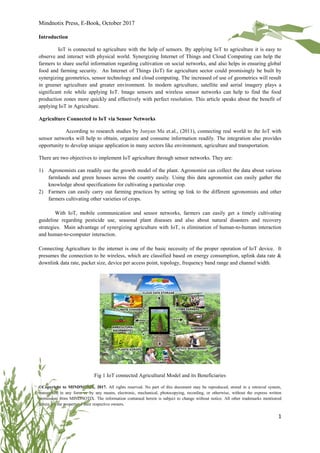
Fig 1 IoT connected Agricultural Model and its Beneficiaries
Mindnotix Press, E-Book, October 2017
©Copyright to MINDNOTIX, 2017. All rights reserved. No part of this document may be reproduced, stored in a retrieval system,
transmitted in any form or by any means, electronic, mechanical, photocopying, recording, or otherwise, without the express written
permission from MINDNOTIX. The information contained herein is subject to change without notice. All other trademarks mentioned
herein are the property of their respective owners.
2
Ontology for IoT based Agriculture
Networking and sensor technologies are connected to physical objects to form an Internet of things (IOT).
Ontolog is a research conducted on initiation of any object. Now-a-days IoT is used in agriculture for several
purposes. By using IoT in agriculture, it is possible to collect data from a spectrum of informational resources.
The way of collecting same type of data from multiple resources is termed as "semantic heterogeneity".
According to research, IoT faces a major concern in integration of data collected from multiple resources. To
overcome the challenge, Siquan Hu (2011) proposed an approach called Ontolog- based-approach. By using this
approach, it is possible to tap the semantics of agricultural objects easily and reuse the agriculture knowledge to
overcome the interoperation problem while collecting the data from multiple resource. Agent is created by the
agricultural life cycles which includes seeds, grains, transportation, storage and consumption. By using this
ontology approach, it is possible to derive a unified data model from agricultural lifecycle and the data collected
from multiple resources can easily be integrated without any inter-operational problem. This approach promises
seamless acquisition of the agricultural information system. If any new user wants to know the information of
the product, the user will get complete history of the product before going for further processing. In current
research, ontology approach is applied only after data collection from multiple resources. In future, it is possible
to develop an ontology approach that could readily be is applied at runtime i.e. devising agricultural
mechanisms, while data collection from several resources. This adds experience of migrating from the legacy
hierarchical system to an ontology based system.
IoT and Cloud Computing for Agriculture
Today, one of the revolutionary technology is Internet of Things (IOT) which represent the future of
computations and communications. In the today developed world, RFID technology adaption is common in food
traceability. Agri- Business organization are very active and increasing day-by-day in the social media
networks. According to a research by V.C. Patil (2012), at least 43% of farmers were active in social media
networks such as LinkedIn, Twitter and You tube. Though we several advantages in applying IoT for
agriculture, the reality still remains a challenge. Management of complex agro-ecosystem requires collaborative
efforts in a structured manner to overcome challenges in applying IoT for Agriculture.
An IoT Based Hydrological Monitoring System
An embedded system development platform based on GSM communication is proposed.
Hydrology monitoring system from wireless communication networks is a typical practical application of
embedded system, which has realized intelligence modernization high efficiency and networking of hydrology
monitoring management. Real time hydrological monitoring has become an important part of water pollution.
To avoid the drawbacks of manual monitors, KunHan et al., (2012) developed a set of things based on
distributed real time remote hydrological monitoring system. The system uses advanced GSM wireless
communication embedded and touch screen technology. Hydrological monitoring system is an application of
Zigbee technology which has a strong practical value. Wireless module can be easily ported to other wireless
application. Zigbee technology is used so that the system can quickly be applied to other areas.
Mindnotix Press, E-Book, October 2017
©Copyright to MINDNOTIX, 2017. All rights reserved. No part of this document may be reproduced, stored in a retrieval system,
transmitted in any form or by any means, electronic, mechanical, photocopying, recording, or otherwise, without the express written
permission from MINDNOTIX. The information contained herein is subject to change without notice. All other trademarks mentioned
herein are the property of their respective owners.
3
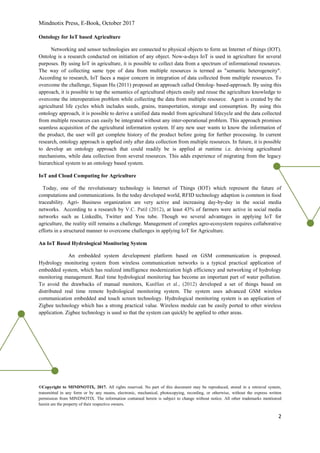
Fig 2 Crop Monitoring and saving in cloud server through GPRS
Wireless Sensor Networks (WSN) is the best way to solve the agricultural problems related to farming,
resource optimization, decision making support and land monitoring. This approach provides real-time
information about lands and crops that will help farmers to make right decisions. The wireless sensor network is
used widely now-a-days to build decision support systems to overcome many problems in the agricultural
sector, especially precision agriculture. Mohamed Rawidean et.al., (2014) mainly used the basic principles of
Internet and WSN technology precision agriculture system based on IoT. IoT may be applied for designing the
hardware architecture, network architecture and software process control for precision irrigation system.
Software monitors data from the sensors in a feedback loop which activates the control devices based on the
threshold value. WSN when implemented in precision architecture will optimize the usage of water fertilizer
and also maximizing the crop production. Green house cultivation may be followed as the major method for
crop production. Since, most green house is equipped with absolute technologies, farmers have to be on-duty all
days and work very hard in the green house. To overcome this issue, a project was designed by Mohamed
Rawidean et.al., which focused to transforming traditionally small – scale agri business that contribute to
national economic growth. Precision agriculture is precision decision in both size of the crops area it monitors as
well as in the delivery amount of water and fertilizer. WSN is a network of small sensing devices known as
sensor nodes or motors arranged in a distributor manner which collaborate with other to agree, process and
communicate over wireless channel about some physical phenomena. The sensor motors are low cost, small
devices that are of limited sensing and data processing capabilities.
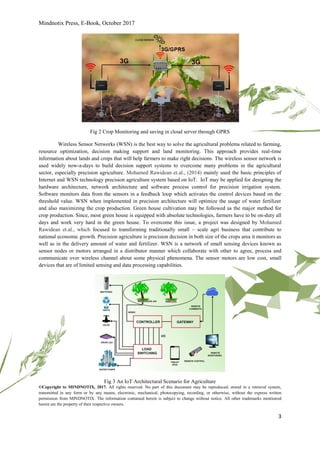
Fig 3 An IoT Architectural Scenario for Agriculture
Mindnotix Press, E-Book, October 2017
©Copyright to MINDNOTIX, 2017. All rights reserved. No part of this document may be reproduced, stored in a retrieval system,
transmitted in any form or by any means, electronic, mechanical, photocopying, recording, or otherwise, without the express written
permission from MINDNOTIX. The information contained herein is subject to change without notice. All other trademarks mentioned
herein are the property of their respective owners.
4
Cloud Centric IoT for Precision Agriculture Supply Chain Management
Today, supply chains are highly virtualized in response to market challenges and also to afford many new
technologies. The major advantage of using virtual supply chain management is that it eliminates the need of
physical proximity of control, thereby enabling other users to control and coordinate from remote locations.
Prashant Satpute (2014) focused on using IoT to develop virtualized chain management in agricultural sector.
Today smart phones applications are playing on important role on farms for both crop management and also the
livestock management. Developing country like China, exploits the latest technologies-Cloud Computing and
IoT to make significant contribution to agricultural sector. Prashant Satpute (2014), proposed a cloud
development model called “Agri - Assistant". " Agri- Assistant" is used to assist farmers to come up with
decisions on which crop is suitable for the soil and climatic condition, thereby increasing the farm productivity.
Finally we conclude the, cloud technology has brought a good opportunities to development of Agriculture.
References
[1] Siquan Hu, Haiou Wang, Chundong She, and Junfeng Wang, " AgOnt: Ontology for Agriculture
Internet of Things”, pp :131 - 137, 2011.
[2] Junyan Ma, Xingshe Zhou, Shining Li, Zhigang Li, "Connecting Agriculture to the Internet of Things
through Sensor Networks" pp:184- 186, 2011.
[3] M. Stočes, J. Vaněk, J. Masner, J. Pavlík, " Internet of Things (IoT) in Agriculture - Selected Aspects",
pp:83 - 88, 2016.
[4] V.C. Patil, K.A. Al-Gaadi, D.P. Biradar and M. Rangaswamy, "Internet of Things (IoT) And Cloud
Computing for Agriculture: An Overview" pp:292 - 296,2012.
[5] Prashant Satpute, Omprakash Tembhurne, “A Review of: Cloud Centric IoT based Framework for
Supply Chain Management in Precision Agriculture", pp:175 - 180,2014.
[6] Mohamed Rawidean Mohd Kassim,Ibrahim Mat,Ahmad Nizar Harun, "Wireless sensor network in
precision agriculture application" pp.1-4, 2014
[7] KunHan.Dacheng Zhang,Jingyi Bo,Zhiguang Zhang, "Hydrological monitoring system design and
implementation based on IoT",2012 International Conference on Medical Physics and Biomedical
Engineering,pages-450-454, 2012.
Mindnotix Press, E-Book, October 2017
©Copyright to MINDNOTIX, 2017. All rights reserved. No part of this document may be reproduced, stored in a retrieval system,
transmitted in any form or by any means, electronic, mechanical, photocopying, recording, or otherwise, without the express written
permission from MINDNOTIX. The information contained herein is subject to change without notice. All other trademarks mentioned
herein are the property of their respective owners.
5

IOT and Cloud in Agriculture

  • 1.
    Mindnotix Press, E-Book,October 2017 ©Copyright to MINDNOTIX, 2017. All rights reserved. No part of this document may be reproduced, stored in a retrieval system, transmitted in any form or by any means, electronic, mechanical, photocopying, recording, or otherwise, without the express written permission from MINDNOTIX. The information contained herein is subject to change without notice. All other trademarks mentioned herein are the property of their respective owners. 0 IoT and Cloud in Agriculture S.Sathish Kumar S.Balamurugan M.Gowtham S.Saranya
  • 2.
    Mindnotix Press, E-Book,October 2017 ©Copyright to MINDNOTIX, 2017. All rights reserved. No part of this document may be reproduced, stored in a retrieval system, transmitted in any form or by any means, electronic, mechanical, photocopying, recording, or otherwise, without the express written permission from MINDNOTIX. The information contained herein is subject to change without notice. All other trademarks mentioned herein are the property of their respective owners. 1 Introduction IoT is connected to agriculture with the help of sensors. By applying IoT to agriculture it is easy to observe and interact with physical world. Synergizing Internet of Things and Cloud Computing can help the farmers to share useful information regarding cultivation on social networks, and also helps in ensuring global food and farming security. An Internet of Things (IoT) for agriculture sector could promisingly be built by synergizing geometrics, sensor technology and cloud computing. The increased of use of geometrics will result in greener agriculture and greater environment. In modern agriculture, satellite and aerial imagery plays a significant role while applying IoT. Image sensors and wireless sensor networks can help to find the food production zones more quickly and effectively with perfect resolution. This article speaks about the benefit of applying IoT in Agriculture. Agriculture Connected to IoT via Sensor Networks According to research studies by Junyan Ma et.al., (2011), connecting real world to the IoT with sensor networks will help to obtain, organize and consume information readily. The integration also provides opportunity to develop unique application in many sectors like environment, agriculture and transportation. There are two objectives to implement IoT agriculture through sensor networks. They are: 1) Agronomists can readily use the growth model of the plant. Agronomist can collect the data about various farmlands and green houses across the country easily. Using this data agronomist can easily gather the knowledge about specifications for cultivating a particular crop. 2) Farmers can easily carry out farming practices by setting up link to the different agronomists and other farmers cultivating other varieties of crops. With IoT, mobile communication and sensor networks, farmers can easily get a timely cultivating guideline regarding pesticide use, seasonal plant diseases and also about natural disasters and recovery strategies. Main advantage of synergizing agriculture with IoT, is elimination of human-to-human interaction and human-to-computer interaction. Connecting Agriculture to the internet is one of the basic necessity of the proper operation of IoT device. It presumes the connection to be wireless, which are classified based on energy consumption, uplink data rate & downlink data rate, packet size, device per access point, topology, frequency band range and channel width. Fig 1 IoT connected Agricultural Model and its Beneficiaries
  • 3.
    Mindnotix Press, E-Book,October 2017 ©Copyright to MINDNOTIX, 2017. All rights reserved. No part of this document may be reproduced, stored in a retrieval system, transmitted in any form or by any means, electronic, mechanical, photocopying, recording, or otherwise, without the express written permission from MINDNOTIX. The information contained herein is subject to change without notice. All other trademarks mentioned herein are the property of their respective owners. 2 Ontology for IoT based Agriculture Networking and sensor technologies are connected to physical objects to form an Internet of things (IOT). Ontolog is a research conducted on initiation of any object. Now-a-days IoT is used in agriculture for several purposes. By using IoT in agriculture, it is possible to collect data from a spectrum of informational resources. The way of collecting same type of data from multiple resources is termed as "semantic heterogeneity". According to research, IoT faces a major concern in integration of data collected from multiple resources. To overcome the challenge, Siquan Hu (2011) proposed an approach called Ontolog- based-approach. By using this approach, it is possible to tap the semantics of agricultural objects easily and reuse the agriculture knowledge to overcome the interoperation problem while collecting the data from multiple resource. Agent is created by the agricultural life cycles which includes seeds, grains, transportation, storage and consumption. By using this ontology approach, it is possible to derive a unified data model from agricultural lifecycle and the data collected from multiple resources can easily be integrated without any inter-operational problem. This approach promises seamless acquisition of the agricultural information system. If any new user wants to know the information of the product, the user will get complete history of the product before going for further processing. In current research, ontology approach is applied only after data collection from multiple resources. In future, it is possible to develop an ontology approach that could readily be is applied at runtime i.e. devising agricultural mechanisms, while data collection from several resources. This adds experience of migrating from the legacy hierarchical system to an ontology based system. IoT and Cloud Computing for Agriculture Today, one of the revolutionary technology is Internet of Things (IOT) which represent the future of computations and communications. In the today developed world, RFID technology adaption is common in food traceability. Agri- Business organization are very active and increasing day-by-day in the social media networks. According to a research by V.C. Patil (2012), at least 43% of farmers were active in social media networks such as LinkedIn, Twitter and You tube. Though we several advantages in applying IoT for agriculture, the reality still remains a challenge. Management of complex agro-ecosystem requires collaborative efforts in a structured manner to overcome challenges in applying IoT for Agriculture. An IoT Based Hydrological Monitoring System An embedded system development platform based on GSM communication is proposed. Hydrology monitoring system from wireless communication networks is a typical practical application of embedded system, which has realized intelligence modernization high efficiency and networking of hydrology monitoring management. Real time hydrological monitoring has become an important part of water pollution. To avoid the drawbacks of manual monitors, KunHan et al., (2012) developed a set of things based on distributed real time remote hydrological monitoring system. The system uses advanced GSM wireless communication embedded and touch screen technology. Hydrological monitoring system is an application of Zigbee technology which has a strong practical value. Wireless module can be easily ported to other wireless application. Zigbee technology is used so that the system can quickly be applied to other areas.
  • 4.
    Mindnotix Press, E-Book,October 2017 ©Copyright to MINDNOTIX, 2017. All rights reserved. No part of this document may be reproduced, stored in a retrieval system, transmitted in any form or by any means, electronic, mechanical, photocopying, recording, or otherwise, without the express written permission from MINDNOTIX. The information contained herein is subject to change without notice. All other trademarks mentioned herein are the property of their respective owners. 3 Fig 2 Crop Monitoring and saving in cloud server through GPRS Wireless Sensor Networks (WSN) is the best way to solve the agricultural problems related to farming, resource optimization, decision making support and land monitoring. This approach provides real-time information about lands and crops that will help farmers to make right decisions. The wireless sensor network is used widely now-a-days to build decision support systems to overcome many problems in the agricultural sector, especially precision agriculture. Mohamed Rawidean et.al., (2014) mainly used the basic principles of Internet and WSN technology precision agriculture system based on IoT. IoT may be applied for designing the hardware architecture, network architecture and software process control for precision irrigation system. Software monitors data from the sensors in a feedback loop which activates the control devices based on the threshold value. WSN when implemented in precision architecture will optimize the usage of water fertilizer and also maximizing the crop production. Green house cultivation may be followed as the major method for crop production. Since, most green house is equipped with absolute technologies, farmers have to be on-duty all days and work very hard in the green house. To overcome this issue, a project was designed by Mohamed Rawidean et.al., which focused to transforming traditionally small – scale agri business that contribute to national economic growth. Precision agriculture is precision decision in both size of the crops area it monitors as well as in the delivery amount of water and fertilizer. WSN is a network of small sensing devices known as sensor nodes or motors arranged in a distributor manner which collaborate with other to agree, process and communicate over wireless channel about some physical phenomena. The sensor motors are low cost, small devices that are of limited sensing and data processing capabilities. Fig 3 An IoT Architectural Scenario for Agriculture
  • 5.
    Mindnotix Press, E-Book,October 2017 ©Copyright to MINDNOTIX, 2017. All rights reserved. No part of this document may be reproduced, stored in a retrieval system, transmitted in any form or by any means, electronic, mechanical, photocopying, recording, or otherwise, without the express written permission from MINDNOTIX. The information contained herein is subject to change without notice. All other trademarks mentioned herein are the property of their respective owners. 4 Cloud Centric IoT for Precision Agriculture Supply Chain Management Today, supply chains are highly virtualized in response to market challenges and also to afford many new technologies. The major advantage of using virtual supply chain management is that it eliminates the need of physical proximity of control, thereby enabling other users to control and coordinate from remote locations. Prashant Satpute (2014) focused on using IoT to develop virtualized chain management in agricultural sector. Today smart phones applications are playing on important role on farms for both crop management and also the livestock management. Developing country like China, exploits the latest technologies-Cloud Computing and IoT to make significant contribution to agricultural sector. Prashant Satpute (2014), proposed a cloud development model called “Agri - Assistant". " Agri- Assistant" is used to assist farmers to come up with decisions on which crop is suitable for the soil and climatic condition, thereby increasing the farm productivity. Finally we conclude the, cloud technology has brought a good opportunities to development of Agriculture. References [1] Siquan Hu, Haiou Wang, Chundong She, and Junfeng Wang, " AgOnt: Ontology for Agriculture Internet of Things”, pp :131 - 137, 2011. [2] Junyan Ma, Xingshe Zhou, Shining Li, Zhigang Li, "Connecting Agriculture to the Internet of Things through Sensor Networks" pp:184- 186, 2011. [3] M. Stočes, J. Vaněk, J. Masner, J. Pavlík, " Internet of Things (IoT) in Agriculture - Selected Aspects", pp:83 - 88, 2016. [4] V.C. Patil, K.A. Al-Gaadi, D.P. Biradar and M. Rangaswamy, "Internet of Things (IoT) And Cloud Computing for Agriculture: An Overview" pp:292 - 296,2012. [5] Prashant Satpute, Omprakash Tembhurne, “A Review of: Cloud Centric IoT based Framework for Supply Chain Management in Precision Agriculture", pp:175 - 180,2014. [6] Mohamed Rawidean Mohd Kassim,Ibrahim Mat,Ahmad Nizar Harun, "Wireless sensor network in precision agriculture application" pp.1-4, 2014 [7] KunHan.Dacheng Zhang,Jingyi Bo,Zhiguang Zhang, "Hydrological monitoring system design and implementation based on IoT",2012 International Conference on Medical Physics and Biomedical Engineering,pages-450-454, 2012.
  • 6.
    Mindnotix Press, E-Book,October 2017 ©Copyright to MINDNOTIX, 2017. All rights reserved. No part of this document may be reproduced, stored in a retrieval system, transmitted in any form or by any means, electronic, mechanical, photocopying, recording, or otherwise, without the express written permission from MINDNOTIX. The information contained herein is subject to change without notice. All other trademarks mentioned herein are the property of their respective owners. 5