GRADE 12
DAILY LESSON LOG
School Aguinaldo J. Santos National High School Grade Level 12
Teacher Mary Ann I. Santos Learning Area General Physics 2
Teaching Week FIFTH Quarter Fourth
DAY 1 DAY 2 DAY 3 DAY 4
Date Section Time Date Section Time Date Section Time Date Section Time
May 23, 2023
(Tue)
12-STEM 10:40-11:40 May 24, 2023
(Wed)
12-STEM 10:40-11:40 May 25, 2023
(Thurs)
12-STEM 10:40-11:40 May 26, 2023
(Fri)
12-STEM 10:40-11:40
I. OBJECTIVES
A. Content Standards The learners demonstrate an
understanding of:
1. Law of Reflection;
2. Law of Refraction (Snell’s Law);
3. Total internal reflection; and
4. Applications of concepts of reflection,
refraction and ray optics in experiments
and real-world setting.
The learners demonstrate an
understanding of:
1. Law of Reflection;
2. Law of Refraction (Snell’s Law);
3. Total internal reflection; and
4. Applications of concepts of reflection,
refraction and ray optics in experiments
and real-world setting.
The learners demonstrate an
understanding of reflection and refraction
at plane and spherical surfaces, and of
mirrors and image formation.
The learners demonstrate an
understanding of reflection and refraction
at plane and spherical surfaces, and of
mirrors and image formation.
B. Performance Standards Applications of reflection, refraction,
dispersion, and polarization
Applications of reflection, refraction,
dispersion, and polarization
The learners are able to use theoretical
and experimental approaches to solve
multi-concept and rich-context problems
involving geometric optics.
The learners are able to use theoretical
and experimental approaches to solve
multi-concept and rich-context problems
involving geometric optics.
C. Learning
Competencies/Objectives
Solve problems involving reflection,
refraction, dispersion, and polarization in
contexts such as, but not limited to,
(polarizing) sunglasses, atmospheric
haloes, and rainbows. STEM_GP12OPT-
IVc-21
Solve problems involving reflection,
refraction, dispersion, and polarization in
contexts such as, but not limited to,
(polarizing) sunglasses, atmospheric
haloes, and rainbows. STEM_GP12OPT-
IVc-21
At the end of the session, students are
expected to:
1 Relate properties of mirrors and
lenses (radii of curvature, focal
length, index of refraction [ for
lenses] ) to image and object
distance and
sizes(STEM_GP12OPT-IVd-23)
1.1 Enumerate properties of mirrors and
lenses
1.2 Illustrate the relation of properties of
mirrors and lenses to image and
object distance and sizes.
1.3 Exhibit appreciation on the
importance of basic understanding of
properties of mirrors and lenses to
image and object distance and sizes
At the end of the session, students are
expected to:
1. Determine graphically and
mathematically the type (virtual/real),
magnification, location, and orientation of
image of a point and extended object
produced by a plane or spherical mirror.
(STEM_GP12OPT-IVd-24)
Write the LC code for each
II. CONTENT
Reflection and Refraction at Plane and
Spherical Surfaces, and Mirrors and
Image Formation
Reflection and Refraction at Plane and
Spherical Surfaces, and Mirrors and
Image Formation
Reflection and Refraction at Plane and
Spherical Surfaces, and Mirrors and
Image Formation
III. LEARNING RESOURCES
A. References
1. Teacher’s Guide pages
2. Learner’s Materials pages
3. Textbook pages
4. Additional Materials from
Learning Resource (LR) portal
5. Other Learning Resources
IV.PROCEDURES
A. Reviewing the previous lesson or
presenting the new lesson
What is a polarizer Review of the image formation as an
application of reflection, refraction, and
paraxial approximation
Review ray diagram
B. Establishing the purpose of the
lesson
HOTSEAT: The students will get a paper
under their chair , and let them answer the
questions listed on the paper, leading to
the concept of the properties of mirrors
and lenses.
C. Presenting examples/instances
of the new lesson
Solving context rich problems provide
students the opportunities to practice
implementing the physics concepts and
techniques in realistic scenarios.
1.
Divide the class into three (3) groups.
Students will relate properties of mirrors
and lenses to image and object distance
and sizes.
1. radii of curvature,
2. focal length,
index of refraction (for lenses)
TRUE OR FALSE
1. All people who are viewing the
object in the mirror will sight
along the same geometrical line
of sight.
2. The precise direction of the sight
line depends on the location of
the object, the location of the
person, and the type of mirror.
3. All of the lines of sight,
regardless of their direction, will
pass through the image location.
4. Image is defined as the location
where it seems to every
observer as though light is
coming from.
Answer:
1.FALSE
2. TRUE
3. TRUE
4. FALSE
D. Discussing new concepts and
practicing skill # 1
1. Discuss the rationale of solving context-
rich problems in physics as articulated in
the Introduction.
2. Discuss the steps or framework for
problem-solving and specify the template
or distribute the problem-solving sheet.
3. Discuss the grading system for this
particular activity. The recommended
system is to grade each step, either in
equal weights in the scale of 1 to 5 (or 1 to
10) or in unequal weights, usually giving
more premium to analysis than to the final
answer. Allocating portions for peer- and
self-evaluation in the final grade is also
recommended.
4. Group the students (the recommended
number is three to five students per group)
and arrange their seats (the arrangement
should be conducive for long discussions).
Due effort should be exerted to achieve
heterogeneous distribution of students in
terms of gender and classperformance.
Encourage the students to device a
system that would allow every member of
the group to contribute to the discussion
for every step and to rotate the roles
among themselves, especially the role of
secretary or scribe.
Sample Problem on Reflection
Consider two plane mirrors M1 and M2
arranged perpendicular to one another. An
incident light ray strikes the first mirror at its
middle point 20 cm from the intersection. At
what angle of incidence should the first ray
be set to produce a reflected ray that will hit
the middle point of the second mirror?
Students will present their output in pre-
activity by means of illustration.
Students’ output will be graded by using
the following rubrics.
Rubrics:
(5 points) Excellent – students’ output far
exceed what is expected
(4 points) Very Good – information is
factually accurate and offers extra
supporting facts.
(3 points) Good – The student somewhat
responds beyond the basic level of the
question to provide supporting details and
or interpretation.
(2 points) Fair – students’ presentation
although somewhat correct, are lacking in
relevant details and supporting examples
and or interpretation.
(1 point) Not Mastered - students’
presentation is largely incorrect.
The students will be an activity sheet to
answer individually.
See attached sheet Ray Diagram
E. Discussing new concepts and
practicing new skill #2
Let the student answer the problem for
further enrichment of the concept.
1. An object 6 cm high located 30
cm in front of a convex mirror
with a 40-cm radius of
curvature. Determine the
position and height of the
object’s image.
2. An object 7 cm high is placed 15
cm from a convex mirror with a
45-cm radius of curvature.
Describe the image of the
object.
F. Developing Mastery
(Leads to Formative Assessment)
CONTEXT-RICH PROBLEMS
1. You discovered a strange material such that
when it is made into a triangular prism, the
general order of the rainbow it produces is
BIVGROY, instead of ROYGBIV. Describe or
sketch the general shape of its dispersion curve
(index of refraction versus wavelength). You
may use seven Snell's Law equations (one for
each representative color) to justify your
dispersion curve. (dispersion, visible spectrum)
Task No. 1: Problem Solving (reflection)
Directions: Solve the problem below in your
answer sheet. Identify the given data and the
unknown.
Consider two plane mirrors M1 and M2
arranged perpendicular to one another. An
incident light ray strikes the first mirror at 15
cm from the intersection O. At what angle of
incidence should the first ray be set to produce
a reflected ray that will hit the 12 cm length of
the second mirror from point O?
Let the student show and explain their answer
on the board in problem no 1 and 2.
G. Finding practical applications of
concepts and skills in daily living
You are in a open bazaar. A vendor tries to sell
to you a pair of polarizing sun glasses. Describe
an experiment that you can quickly perform to
verify the claim of the vendor. (transverse
versus longitudinal wave, Malus' Law,
Brewster's angle)
There are department stores in which mirrors
are installed at different angles such as on
walls, ceilings, pillars and other areas. What do
you think is the reason for this?
Ask students to give some practical applications
of using spherical mirrors, such as security
mirrors in stores, safety mirrors in roads with
sharp curves and dental procedures (concave),
among others.
H. Making generalizations and
abstractions about the lesson
You work in a research department of a
advertising regulatory agency. A businessman
proposes to advertise "polarizing sound ear
muffler". It is supposed to work like a polarizing
sun glasses, except that instead of sun light, it
filters sound. Write a report explaining why you
recommend approval or disapproval of the said
advertisement. (transverse versus longitudinal
wave)
Based on the objectives stated previously, ask
the following questions:
1. Give the different properties of
mirrors and lenses
2. Relate properties of mirrors and
lenses to image and object distance
and sizes
Based on the objectives stated previously, ask
the following questions:
Explain image formation as an application of
reflection, refraction, and paraxial
approximation. Give and describe at least two
practical applications of image formation.
I. Evaluating Learning Choose one from the choices to answer.
1. You are the mayor of a city. Your
constituents are anxious because, lately, the
sky in the afternoon is more reddish than
usual. They want you to explain and, if
Task No. 2: Problem Solving (refraction)
Directions: Solve the problem below in your
answer sheet. Identify the given data and the
unknown.
Construct a ray diagram showing the image
formed by a convex lens when the object is
located between the two principal foci.
Presentation of answers.
possible, act to minimize the phenomenon.
You have access to information such as maps
of highways, residential, industrial complexes,
forest, and geological structures in your region.
Furthermore, next month, you will attend an
international conference on climate, weather
and pollution along with the mayors of your
neighbor cities and countries. (Rayleigh
scattering, atmosphere)
2. You are the manager of a clothing store.
Recommend the size of the mirrors to install
such that the customers will be able to see
their full body in the changing room. (mirrors,
ray tracing)
3. Write a short semi-technical essay for a
hiker’s survival guide on the possible use of
atmospheric haloes for weather forecasting.
(dispersion, visible spectrum)
A light ray coming from air penetrates an
unknown material at an angle of incidence
equal to 650 with respect to the normal. The air
has a refractive index of 1.0 and the unknown
material causes the light ray to bend at 200
with the normal. How fast will the light moves
on this material?
J. Additional activities for application or
remediation
V.REMARKS
VI.REFLECTION
Sections
A.) No.of learners who earned 80% on the
formative assessment
B.)No.of learners who require additional
activities for remediation.
C.)Did the remedial lessons work? No. of
learners who have caught up with the lesson.
D.)No. of learners who continue to require.
E.)Which of my teaching strategies worked
well? Why did these work?
F.)What difficulties did I encounter which my
principal or supervisor can help me solve?
G.)What innovation or localized materials did
I use/discover which I wish to share with
other teachers?
Prepared by: Checked by: Approved by:
MARY ANN I. SANTOS ISABELITA S. CANOZA JAYPEE DS. ARMENION
Teacher III Assistant Principal II Principal I

GP2-5th WEEK DLL-4th - Copy.docx

  • 1.
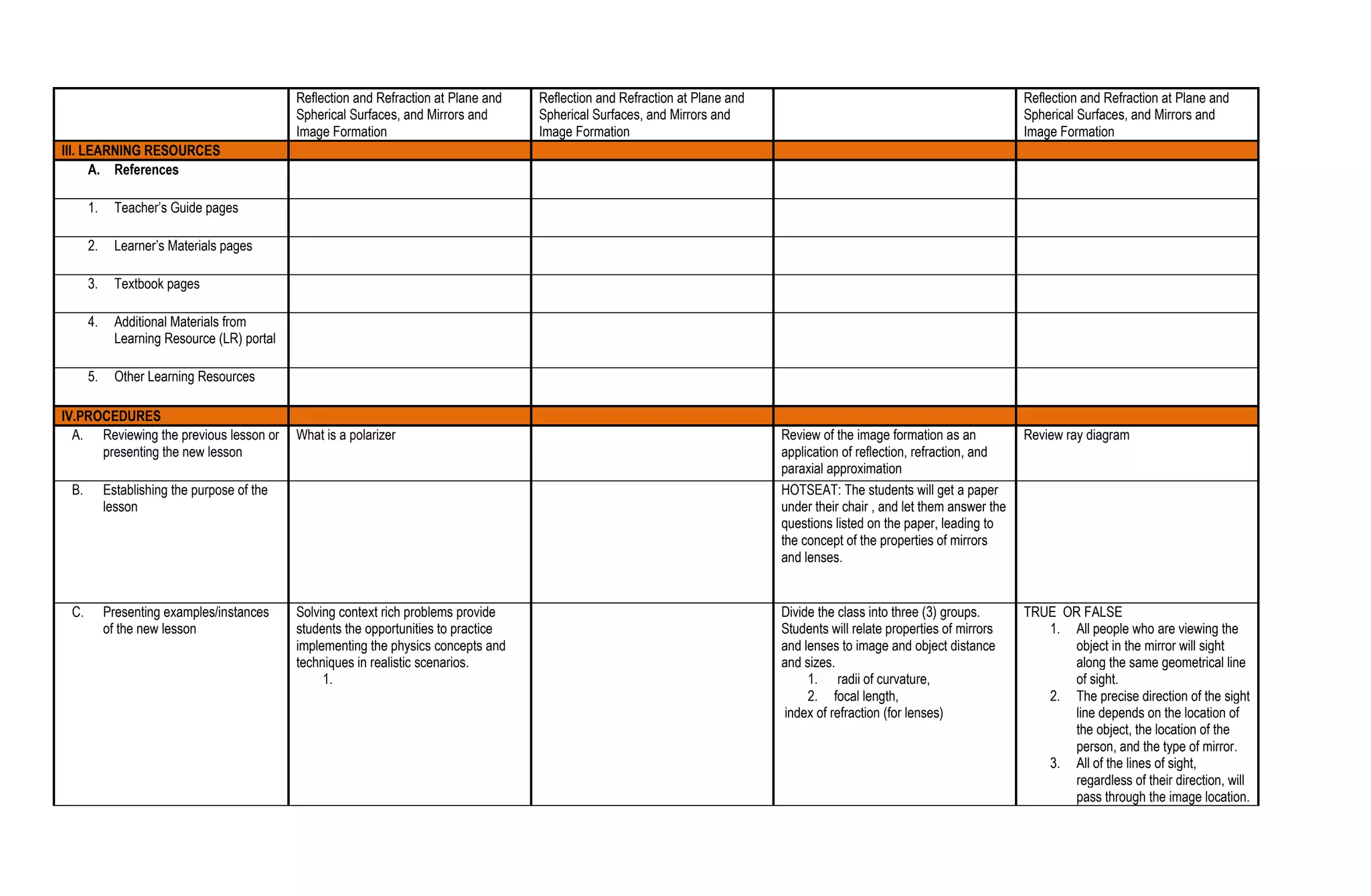
    GRADE 12 DAILY LESSONLOG School Aguinaldo J. Santos National High School Grade Level 12 Teacher Mary Ann I. Santos Learning Area General Physics 2 Teaching Week FIFTH Quarter Fourth DAY 1 DAY 2 DAY 3 DAY 4 Date Section Time Date Section Time Date Section Time Date Section Time May 23, 2023 (Tue) 12-STEM 10:40-11:40 May 24, 2023 (Wed) 12-STEM 10:40-11:40 May 25, 2023 (Thurs) 12-STEM 10:40-11:40 May 26, 2023 (Fri) 12-STEM 10:40-11:40 I. OBJECTIVES A. Content Standards The learners demonstrate an understanding of: 1. Law of Reflection; 2. Law of Refraction (Snell’s Law); 3. Total internal reflection; and 4. Applications of concepts of reflection, refraction and ray optics in experiments and real-world setting. The learners demonstrate an understanding of: 1. Law of Reflection; 2. Law of Refraction (Snell’s Law); 3. Total internal reflection; and 4. Applications of concepts of reflection, refraction and ray optics in experiments and real-world setting. The learners demonstrate an understanding of reflection and refraction at plane and spherical surfaces, and of mirrors and image formation. The learners demonstrate an understanding of reflection and refraction at plane and spherical surfaces, and of mirrors and image formation. B. Performance Standards Applications of reflection, refraction, dispersion, and polarization Applications of reflection, refraction, dispersion, and polarization The learners are able to use theoretical and experimental approaches to solve multi-concept and rich-context problems involving geometric optics. The learners are able to use theoretical and experimental approaches to solve multi-concept and rich-context problems involving geometric optics. C. Learning Competencies/Objectives Solve problems involving reflection, refraction, dispersion, and polarization in contexts such as, but not limited to, (polarizing) sunglasses, atmospheric haloes, and rainbows. STEM_GP12OPT- IVc-21 Solve problems involving reflection, refraction, dispersion, and polarization in contexts such as, but not limited to, (polarizing) sunglasses, atmospheric haloes, and rainbows. STEM_GP12OPT- IVc-21 At the end of the session, students are expected to: 1 Relate properties of mirrors and lenses (radii of curvature, focal length, index of refraction [ for lenses] ) to image and object distance and sizes(STEM_GP12OPT-IVd-23) 1.1 Enumerate properties of mirrors and lenses 1.2 Illustrate the relation of properties of mirrors and lenses to image and object distance and sizes. 1.3 Exhibit appreciation on the importance of basic understanding of properties of mirrors and lenses to image and object distance and sizes At the end of the session, students are expected to: 1. Determine graphically and mathematically the type (virtual/real), magnification, location, and orientation of image of a point and extended object produced by a plane or spherical mirror. (STEM_GP12OPT-IVd-24) Write the LC code for each II. CONTENT
  • 2.
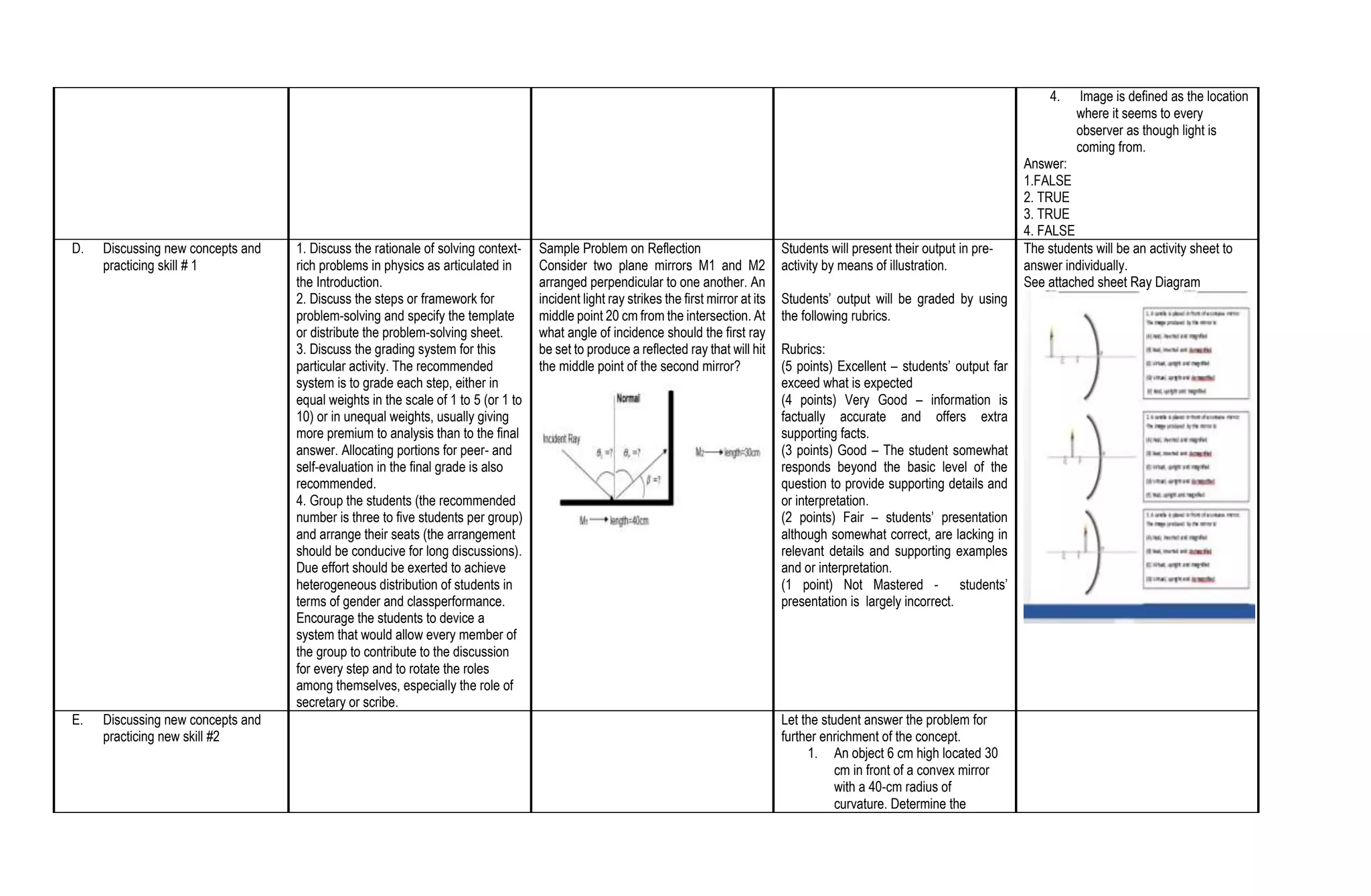
    Reflection and Refractionat Plane and Spherical Surfaces, and Mirrors and Image Formation Reflection and Refraction at Plane and Spherical Surfaces, and Mirrors and Image Formation Reflection and Refraction at Plane and Spherical Surfaces, and Mirrors and Image Formation III. LEARNING RESOURCES A. References 1. Teacher’s Guide pages 2. Learner’s Materials pages 3. Textbook pages 4. Additional Materials from Learning Resource (LR) portal 5. Other Learning Resources IV.PROCEDURES A. Reviewing the previous lesson or presenting the new lesson What is a polarizer Review of the image formation as an application of reflection, refraction, and paraxial approximation Review ray diagram B. Establishing the purpose of the lesson HOTSEAT: The students will get a paper under their chair , and let them answer the questions listed on the paper, leading to the concept of the properties of mirrors and lenses. C. Presenting examples/instances of the new lesson Solving context rich problems provide students the opportunities to practice implementing the physics concepts and techniques in realistic scenarios. 1. Divide the class into three (3) groups. Students will relate properties of mirrors and lenses to image and object distance and sizes. 1. radii of curvature, 2. focal length, index of refraction (for lenses) TRUE OR FALSE 1. All people who are viewing the object in the mirror will sight along the same geometrical line of sight. 2. The precise direction of the sight line depends on the location of the object, the location of the person, and the type of mirror. 3. All of the lines of sight, regardless of their direction, will pass through the image location.
  • 3.
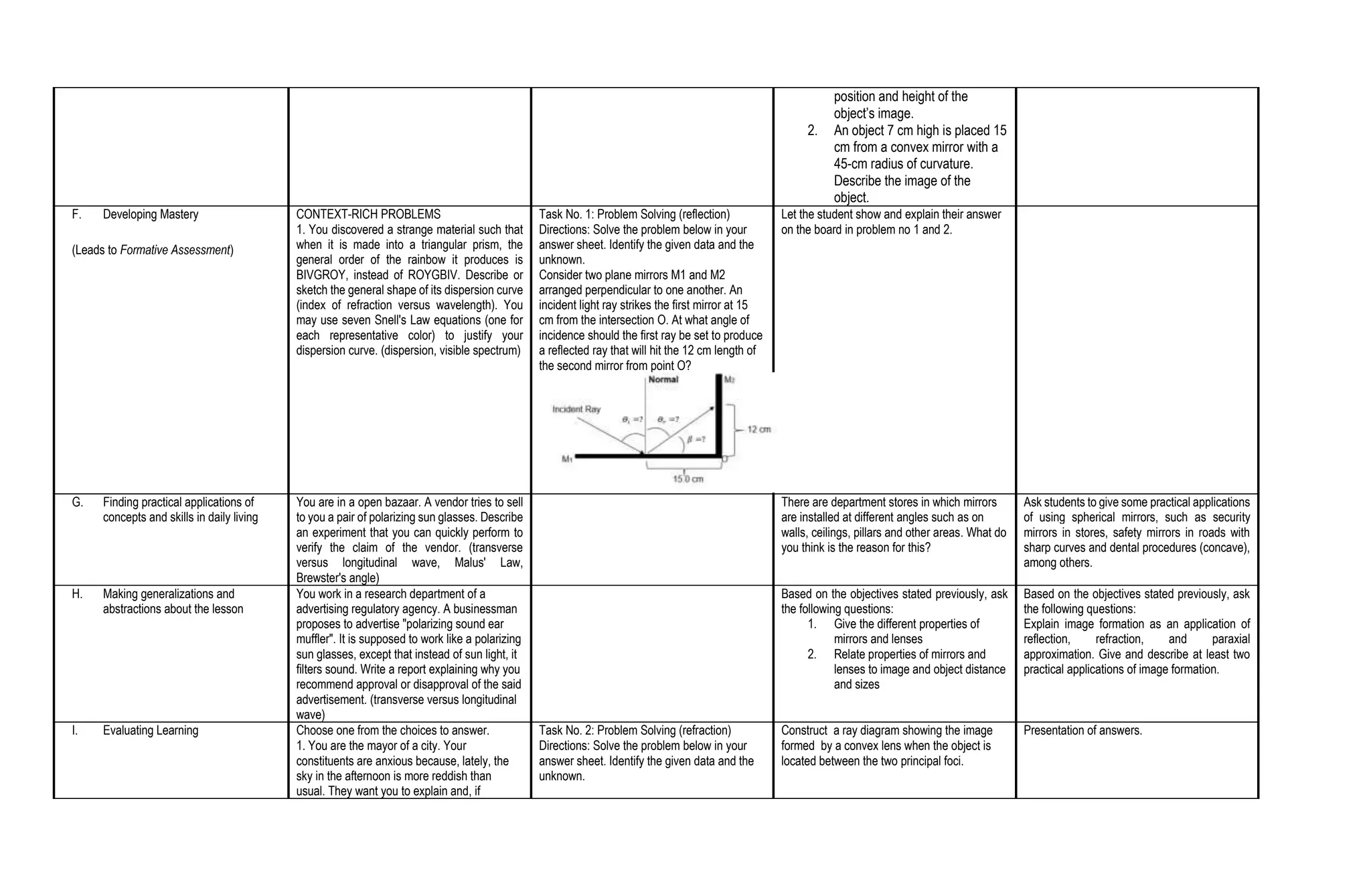
    4. Image isdefined as the location where it seems to every observer as though light is coming from. Answer: 1.FALSE 2. TRUE 3. TRUE 4. FALSE D. Discussing new concepts and practicing skill # 1 1. Discuss the rationale of solving context- rich problems in physics as articulated in the Introduction. 2. Discuss the steps or framework for problem-solving and specify the template or distribute the problem-solving sheet. 3. Discuss the grading system for this particular activity. The recommended system is to grade each step, either in equal weights in the scale of 1 to 5 (or 1 to 10) or in unequal weights, usually giving more premium to analysis than to the final answer. Allocating portions for peer- and self-evaluation in the final grade is also recommended. 4. Group the students (the recommended number is three to five students per group) and arrange their seats (the arrangement should be conducive for long discussions). Due effort should be exerted to achieve heterogeneous distribution of students in terms of gender and classperformance. Encourage the students to device a system that would allow every member of the group to contribute to the discussion for every step and to rotate the roles among themselves, especially the role of secretary or scribe. Sample Problem on Reflection Consider two plane mirrors M1 and M2 arranged perpendicular to one another. An incident light ray strikes the first mirror at its middle point 20 cm from the intersection. At what angle of incidence should the first ray be set to produce a reflected ray that will hit the middle point of the second mirror? Students will present their output in pre- activity by means of illustration. Students’ output will be graded by using the following rubrics. Rubrics: (5 points) Excellent – students’ output far exceed what is expected (4 points) Very Good – information is factually accurate and offers extra supporting facts. (3 points) Good – The student somewhat responds beyond the basic level of the question to provide supporting details and or interpretation. (2 points) Fair – students’ presentation although somewhat correct, are lacking in relevant details and supporting examples and or interpretation. (1 point) Not Mastered - students’ presentation is largely incorrect. The students will be an activity sheet to answer individually. See attached sheet Ray Diagram E. Discussing new concepts and practicing new skill #2 Let the student answer the problem for further enrichment of the concept. 1. An object 6 cm high located 30 cm in front of a convex mirror with a 40-cm radius of curvature. Determine the
  • 4.
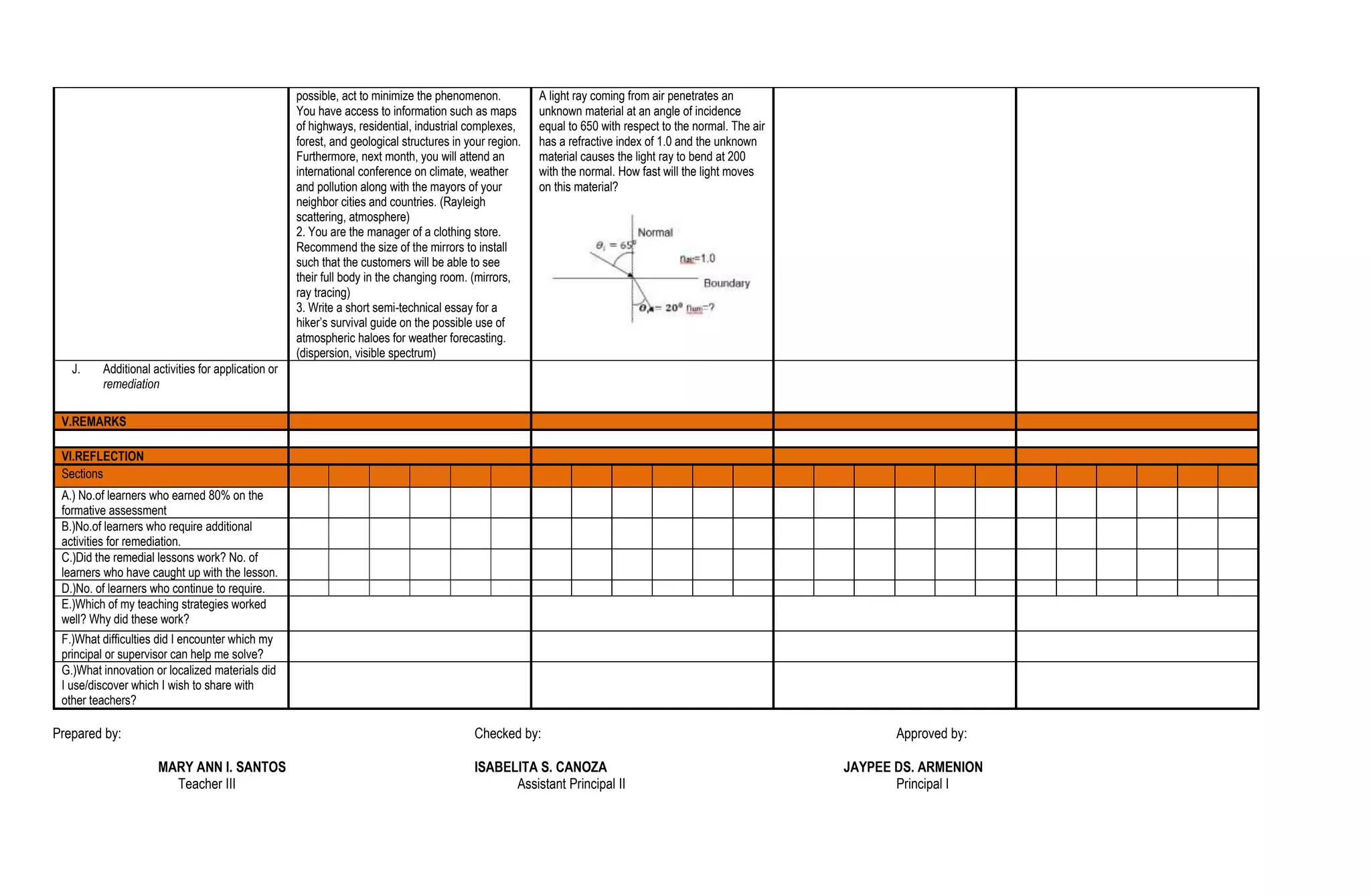
    position and heightof the object’s image. 2. An object 7 cm high is placed 15 cm from a convex mirror with a 45-cm radius of curvature. Describe the image of the object. F. Developing Mastery (Leads to Formative Assessment) CONTEXT-RICH PROBLEMS 1. You discovered a strange material such that when it is made into a triangular prism, the general order of the rainbow it produces is BIVGROY, instead of ROYGBIV. Describe or sketch the general shape of its dispersion curve (index of refraction versus wavelength). You may use seven Snell's Law equations (one for each representative color) to justify your dispersion curve. (dispersion, visible spectrum) Task No. 1: Problem Solving (reflection) Directions: Solve the problem below in your answer sheet. Identify the given data and the unknown. Consider two plane mirrors M1 and M2 arranged perpendicular to one another. An incident light ray strikes the first mirror at 15 cm from the intersection O. At what angle of incidence should the first ray be set to produce a reflected ray that will hit the 12 cm length of the second mirror from point O? Let the student show and explain their answer on the board in problem no 1 and 2. G. Finding practical applications of concepts and skills in daily living You are in a open bazaar. A vendor tries to sell to you a pair of polarizing sun glasses. Describe an experiment that you can quickly perform to verify the claim of the vendor. (transverse versus longitudinal wave, Malus' Law, Brewster's angle) There are department stores in which mirrors are installed at different angles such as on walls, ceilings, pillars and other areas. What do you think is the reason for this? Ask students to give some practical applications of using spherical mirrors, such as security mirrors in stores, safety mirrors in roads with sharp curves and dental procedures (concave), among others. H. Making generalizations and abstractions about the lesson You work in a research department of a advertising regulatory agency. A businessman proposes to advertise "polarizing sound ear muffler". It is supposed to work like a polarizing sun glasses, except that instead of sun light, it filters sound. Write a report explaining why you recommend approval or disapproval of the said advertisement. (transverse versus longitudinal wave) Based on the objectives stated previously, ask the following questions: 1. Give the different properties of mirrors and lenses 2. Relate properties of mirrors and lenses to image and object distance and sizes Based on the objectives stated previously, ask the following questions: Explain image formation as an application of reflection, refraction, and paraxial approximation. Give and describe at least two practical applications of image formation. I. Evaluating Learning Choose one from the choices to answer. 1. You are the mayor of a city. Your constituents are anxious because, lately, the sky in the afternoon is more reddish than usual. They want you to explain and, if Task No. 2: Problem Solving (refraction) Directions: Solve the problem below in your answer sheet. Identify the given data and the unknown. Construct a ray diagram showing the image formed by a convex lens when the object is located between the two principal foci. Presentation of answers.
  • 5.
    possible, act tominimize the phenomenon. You have access to information such as maps of highways, residential, industrial complexes, forest, and geological structures in your region. Furthermore, next month, you will attend an international conference on climate, weather and pollution along with the mayors of your neighbor cities and countries. (Rayleigh scattering, atmosphere) 2. You are the manager of a clothing store. Recommend the size of the mirrors to install such that the customers will be able to see their full body in the changing room. (mirrors, ray tracing) 3. Write a short semi-technical essay for a hiker’s survival guide on the possible use of atmospheric haloes for weather forecasting. (dispersion, visible spectrum) A light ray coming from air penetrates an unknown material at an angle of incidence equal to 650 with respect to the normal. The air has a refractive index of 1.0 and the unknown material causes the light ray to bend at 200 with the normal. How fast will the light moves on this material? J. Additional activities for application or remediation V.REMARKS VI.REFLECTION Sections A.) No.of learners who earned 80% on the formative assessment B.)No.of learners who require additional activities for remediation. C.)Did the remedial lessons work? No. of learners who have caught up with the lesson. D.)No. of learners who continue to require. E.)Which of my teaching strategies worked well? Why did these work? F.)What difficulties did I encounter which my principal or supervisor can help me solve? G.)What innovation or localized materials did I use/discover which I wish to share with other teachers? Prepared by: Checked by: Approved by: MARY ANN I. SANTOS ISABELITA S. CANOZA JAYPEE DS. ARMENION Teacher III Assistant Principal II Principal I