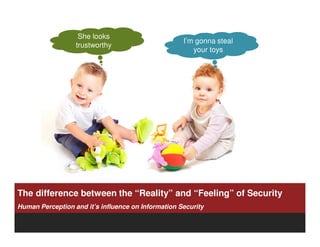
She looks
                                                    I’m gonna steal
                  trustworthy
                                                       your toys


The difference between the “Reality” and “Feeling” of Security
Human Perception and it’s influence on Information Security
The 3 pieces that makes up information security


                       Technology
                        (Firewall)


                        Information

                 People               Process


 Technology and processes are only as good as the people that
                         use them                          2
Focus of the talk


  • The Human Factor in Information Security
  • The difference between “Awareness and Competence”
  • The power of perception
  • Solution Model + Examples


                                                        3
Awareness


I know the traffic rules….

                             4
Competence?


Does it guarantee that I am a good driver?

                                             5
….even in Information Security!!!!

                     Don’t tell anyone,
  Security
                     my password is…..
   Policy

 Never share
  passwords


                                          6
Awareness >> Behaviour >> Culture


   Awareness            Behaviour           Culture
                        (Competence)

      • I know             • I do              • We know
                                                 and do


            Aim for a responsible security culture


                                                           7
What organizations need?
A system that periodically shows the current
Security Awareness and Competence Levels              Awareness score is 87%


         LOW AWARENESS           MEDIUM AWARENESS          HIGH AWARENESS


                                          Competence score is 65%


                                       MEDIUM
        LOW COMPETENCE               COMPETENCE           HIGH COMPETENCE


  A smart attacker will always try to influence the perception of the employee
                                                                                 8
The power of perception


Why do people make security mistakes?
Imagine…


       APJ Abdul Kalam walks into this room right
        now and offers you this glass of water….


                                                    10
Now, imagine this…

          This man walks into this room right now
           and offers you this glass of water….


                                                    11
Question


           Which water did
             you accept?


               Why?


                             12
Analysis

  Were you checking the water or the person serving
                     the water?


 People decide what is good and what is bad based on
                        “trust”
         Perception is influenced by Trust
                                                  13
How people make security decisions?


Influence of perception


                                      14
Analysis


           Of these two, which terrifies you the most?


     More people die of heart attacks than by getting eaten by sharks
             You may feel safe when you are actually not


                                                                        15
Analysis


           Of these two, which terrifies you the most?


       Adrenoleukodistrophy

   More kids die choking on french fries than due to Adrenoleukodistrophy
              People exaggerate risks that are uncommon


                                                                            16
I hope now it is clear that we must
address the human factor….

Let us summarize…


                                      17
Reason 1: Security is both a “Reality” and “Feeling”


                              For security practitioners
                              security is a “Reality” based
                              on the mathematical
                              probability of risks

                              For the end user security is a
                              “feeling”

                              Success lies in influencing
                              the “feeling” of security


                                                          18
RSA Attack


             19
The Incident


     In March 2011, RSA, one of the foremost security
     companies in the world disclosed that cyber-attacks had
     penetrated its internal networks and extracted information
     from its systems.

     The consequences were
        • Financial Loss
        • Reputational Loss
Attack


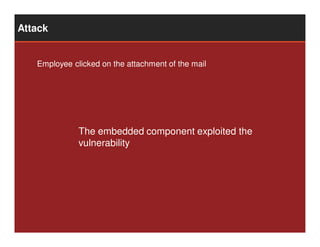
   Employee clicked on the attachment of the mail


              The embedded component exploited the
              vulnerability
Analysis: Why did the attack happen?
You may wonder…


  RSA must be having best-in-class firewalls, anti-viruses and other
  security systems. So, how did this attack happen?


                                 Failed to address the Human Factor
Reason 2: Technology…yes, but humans…of course!


                Aircrafts have become more advanced, but does it
                mean that pilot training requirements have reduced?


                 Medical technology has become more advanced,
                 but will you choose a hospital for it’s machines or
                                    the doctors?


                                                                       24
The Solution Model


Security Awareness and Competence Management
The solution is based on HIMIS


 • HIMIS – Human Impact
   Management for
   Information Security
 • Released under Creative
   Commons License
 • Free for Non-Commercial
   Use

                             http://www.isqworld.com/himis

                                                             26
HIMIS Implementation Model


   Define     Strategize     Deliver    Verify


   Responsible Information Security Behavior


                                                 27
Define


  • Choose the ESPs
  • Review and approval of ESPs


                                  28
Strategize


  For awareness management
     • Coverage

     • Format & visibility: Verbal, Paper and Electronic

     • Frequency

     • Quality of content

     • Retention measurement.(surveys,quiz)
  For behavior management
     • Motivational strategies

     • Enfoncement/ disciplinary stratégies


                                                           29
Deliver


  •   Define tolerable deviation
  •   Efficiency
  •   Collection of feedback
  •   Confirmation of receipt


                                   30
Verify


  •   Audit strategy
  •   Selection of ESP’s
  •   Define sample size
  •   Audit methods
      For awareness: Interviews, Surveys, Quizzes,
      For behavior: Observation, Review of incident reports, Social
      engineering?


                                                                      31
Examples


  • Deploy false emails seeking
    information
  • Tailgating into the facility
  • Placing media labeled with
    ‘confidential information’ in
    cafeteria or other places


                                    32
Reporting model

                     Organization’s awareness score was 87%


       LOW AWARENESS        MEDIUM AWARENESS       HIGH AWARENESS


    Organization’s competence score was 65%


                                  MEDIUM
      LOW COMPETENCE            COMPETENCE        HIGH COMPETENCE


                                                                    33
HIMIS Focus
1. Differentiate between Awareness Vs. Competence

 Consider both “Awareness” and “Competence” independently


                             Awareness
                                                      Assess,
           ESP                                      Improve, Re-
                                                      assess
                             Behaviour
                           (Competence)


                 ESP – Expected Security Practice


                                                                   35
2. Visualize ….and influence perception


                                          36
3. Scenario based training (Make people solve challenges)


                                                      37
Example

 Video (PLAY)


                38
4. Remember drip irrigation

 Which is more effective – Drip irrigation or spraying a lot of water once a day?


                   Small doses, more frequent
                                                                             39
5.Re-measure frequently

                     Organization’s awareness score was 87%
                                                                  ?


       LOW AWARENESS        MEDIUM AWARENESS       HIGH AWARENESS


    Organization’s competence score was 65%                   ?

                                  MEDIUM
      LOW COMPETENCE            COMPETENCE        HIGH COMPETENCE


                                                                      40
Summary


          “A smart user in front of
          the computer is a good
           security control and is
            not that expensive.”


                                41
Let’s switch ON the Human
Layer of Information Security
Defence
Thank You


http://www.isqworld.com/himis

The Difference Between the Reality and Feeling of Security by Thomas Kurian

  • 1.
    She looks I’m gonna steal trustworthy your toys The difference between the “Reality” and “Feeling” of Security Human Perception and it’s influence on Information Security
  • 2.
    The 3 piecesthat makes up information security Technology (Firewall) Information People Process Technology and processes are only as good as the people that use them 2
  • 3.
    Focus of thetalk • The Human Factor in Information Security • The difference between “Awareness and Competence” • The power of perception • Solution Model + Examples 3
  • 4.
    Awareness I know thetraffic rules…. 4
  • 5.
    Competence? Does it guaranteethat I am a good driver? 5
  • 6.
    ….even in InformationSecurity!!!! Don’t tell anyone, Security my password is….. Policy Never share passwords 6
  • 7.
    Awareness >> Behaviour>> Culture Awareness Behaviour Culture (Competence) • I know • I do • We know and do Aim for a responsible security culture 7
  • 8.
    What organizations need? Asystem that periodically shows the current Security Awareness and Competence Levels Awareness score is 87% LOW AWARENESS MEDIUM AWARENESS HIGH AWARENESS Competence score is 65% MEDIUM LOW COMPETENCE COMPETENCE HIGH COMPETENCE A smart attacker will always try to influence the perception of the employee 8
  • 9.
    The power ofperception Why do people make security mistakes?
  • 10.
    Imagine… APJ Abdul Kalam walks into this room right now and offers you this glass of water…. 10
  • 11.
    Now, imagine this… This man walks into this room right now and offers you this glass of water…. 11
  • 12.
    Question Which water did you accept? Why? 12
  • 13.
    Analysis Wereyou checking the water or the person serving the water? People decide what is good and what is bad based on “trust” Perception is influenced by Trust 13
  • 14.
    How people makesecurity decisions? Influence of perception 14
  • 15.
    Analysis Of these two, which terrifies you the most? More people die of heart attacks than by getting eaten by sharks You may feel safe when you are actually not 15
  • 16.
    Analysis Of these two, which terrifies you the most? Adrenoleukodistrophy More kids die choking on french fries than due to Adrenoleukodistrophy People exaggerate risks that are uncommon 16
  • 17.
    I hope nowit is clear that we must address the human factor…. Let us summarize… 17
  • 18.
    Reason 1: Securityis both a “Reality” and “Feeling” For security practitioners security is a “Reality” based on the mathematical probability of risks For the end user security is a “feeling” Success lies in influencing the “feeling” of security 18
  • 19.
  • 20.
    The Incident In March 2011, RSA, one of the foremost security companies in the world disclosed that cyber-attacks had penetrated its internal networks and extracted information from its systems. The consequences were • Financial Loss • Reputational Loss
  • 21.
    Attack Employee clicked on the attachment of the mail The embedded component exploited the vulnerability
  • 22.
    Analysis: Why didthe attack happen?
  • 23.
    You may wonder… RSA must be having best-in-class firewalls, anti-viruses and other security systems. So, how did this attack happen? Failed to address the Human Factor
  • 24.
    Reason 2: Technology…yes,but humans…of course! Aircrafts have become more advanced, but does it mean that pilot training requirements have reduced? Medical technology has become more advanced, but will you choose a hospital for it’s machines or the doctors? 24
  • 25.
    The Solution Model SecurityAwareness and Competence Management
  • 26.
    The solution isbased on HIMIS • HIMIS – Human Impact Management for Information Security • Released under Creative Commons License • Free for Non-Commercial Use http://www.isqworld.com/himis 26
  • 27.
    HIMIS Implementation Model Define Strategize Deliver Verify Responsible Information Security Behavior 27
  • 28.
    Define •Choose the ESPs • Review and approval of ESPs 28
  • 29.
    Strategize Forawareness management • Coverage • Format & visibility: Verbal, Paper and Electronic • Frequency • Quality of content • Retention measurement.(surveys,quiz) For behavior management • Motivational strategies • Enfoncement/ disciplinary stratégies 29
  • 30.
    Deliver • Define tolerable deviation • Efficiency • Collection of feedback • Confirmation of receipt 30
  • 31.
    Verify • Audit strategy • Selection of ESP’s • Define sample size • Audit methods For awareness: Interviews, Surveys, Quizzes, For behavior: Observation, Review of incident reports, Social engineering? 31
  • 32.
    Examples •Deploy false emails seeking information • Tailgating into the facility • Placing media labeled with ‘confidential information’ in cafeteria or other places 32
  • 33.
    Reporting model Organization’s awareness score was 87% LOW AWARENESS MEDIUM AWARENESS HIGH AWARENESS Organization’s competence score was 65% MEDIUM LOW COMPETENCE COMPETENCE HIGH COMPETENCE 33
  • 34.
  • 35.
    1. Differentiate betweenAwareness Vs. Competence Consider both “Awareness” and “Competence” independently Awareness Assess, ESP Improve, Re- assess Behaviour (Competence) ESP – Expected Security Practice 35
  • 36.
    2. Visualize ….andinfluence perception 36
  • 37.
    3. Scenario basedtraining (Make people solve challenges) 37
  • 38.
  • 39.
    4. Remember dripirrigation Which is more effective – Drip irrigation or spraying a lot of water once a day? Small doses, more frequent 39
  • 40.
    5.Re-measure frequently Organization’s awareness score was 87% ? LOW AWARENESS MEDIUM AWARENESS HIGH AWARENESS Organization’s competence score was 65% ? MEDIUM LOW COMPETENCE COMPETENCE HIGH COMPETENCE 40
  • 41.
    Summary “A smart user in front of the computer is a good security control and is not that expensive.” 41
  • 42.
    Let’s switch ONthe Human Layer of Information Security Defence Thank You http://www.isqworld.com/himis