GLUPK1073
LEGAL SKILL AND
RESEARCH METHODOLOGY
RESEARCH PROCESS 1 -
RESEARCH PLANNING
Identifying broad problem area
Reviewing existing research / theories
Identify research topic
Develop problem statement
 Develop the objectives &
research questions
 Identification of avenues (ways) of
research
Generation of key search words
2
Introduction
3
Research planning depends very
much upon the subject matter of
the research and sometimes on the
availability of the material
There is no golden rule for
planning and designing a research
project
But that does not mean that there
are no guidelines or format for
writing or preparing a sound and
convincing research proposal
Identifying broad
problem area
◦ The biggest step in research
◦ Students can get ideas for the
topic from:
◦ Materials which the students have
been reading
◦ Conversations the students have
been having with colleagues or in
class
◦ Current periodicals for hot
research topic
◦ Browsing through library shelves
to get an idea of the kinds of
subject
4
Reviewing existing
research/theory
◦ Known as literature review
◦ It provides a solid background for the
research problem
◦ Since it is not possible to include every
relevant information, the
researcher may use her/his
discretion in selecting what to
include and what to leave out
◦ It can be defined as a critical summary
assessment of the range of existing
materials dealing with knowledge and
understanding in a given field.
5
◦ It is a continuous activity
◦ It involves locating, reading and evaluating reports of
research as well as other materials.
◦ In general, the purpose of literature review is to locate the
research project, to form its contexts or background and to
provide insights into previous work.
◦ Read as much as possible everything written on the
research topic whether published or unpublished.
◦ Literature review usually leads to the establishment of
analytical and theoretical frameworks and critical review of
the available literature.
6
• 1) To bring clarity and focus of our research
problem.
• - The process of reviewing the literature helps us
to understand the subject area better and
thus enables us to conceptualize our
research problem more clearly and
precisely
• 2) To show (and understand) the path of the
previous research and how the
current research project is linked to it.
• - A good literature review then would place a
research project in a context and it
would demonstrate the relevance of the
project by making connections to a body
of knowledge
Four
goals of
literature
review:
6
3) To integrate and summarize what is
known in an area and therefore it
broadens the researcher’s knowledge
base in the area.
• - A good review in this case will highlight areas
where previous studies agree, where they disagree
and major questions remains unanswered.
4) To learn fromothers,
improve our methodology and
stimulate new ideas.
8
Characteristics of a good LR
§ Demonstrates that the researcher is familiar with the type of knowledge
that exists in respect of the topic research.
§ It indicates what information is available up to a point of time and what
possibilities exist for future research.
§ Identifies what type of studies have previously been made, what aspects
of the topic of current research project have yet to be sufficiently covered and
how the current project will be a contribution to the existing body of knowledge.
9
§ Enables the reader to know that the
researcher knows what has already been
written and is aware of the major issues
involved in the area of the proposed study.
§§ Problem statement can be made with
accuracy and clarity.
10
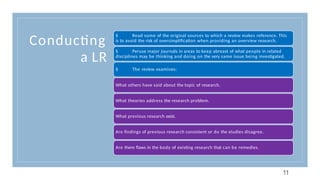
Conducting
a LR
§ Read some of the original sources to which a review makes reference. This
is to avoid the risk of oversimplification when providing an overview research.
§ Peruse major journals in areas to keep abreast of what people in related
disciplines may be thinking and doing on the very same issue being investigated.
§ The review examines:
What others have said about the topic of research.
What theories address the research problem.
What previous research exist.
Are findings of previous research consistent or do the studies disagree.
Are there flaws in the body of existing research that can be remedies.
11
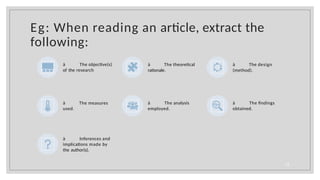
Eg: When reading an article, extract the
following:
à The objective(s)
of the research
à The theoretical
rationale.
à The design
(method).
The measures
à
used.
à The analysis
employed.
à The findings
obtained.
à Inferences and
implications made by
the author(s).
12
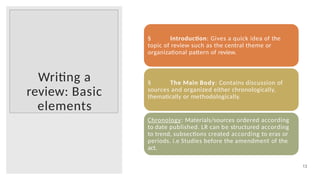
Writing a
review: Basic
elements
13
§ Introduction: Gives a quick idea of the
topic of review such as the central theme or
organizational pattern of review.
§ The Main Body: Contains discussion of
sources and organized either chronologically,
thematically or methodologically.
Chronology: Materials/sources ordered according
to date published. LR can be structured according
to trend, subsections created according to eras or
periods. i.e Studies before the amendment of the
act.
14
Thematic: LR organized around a
topic or issue. Subsections
created to capture essence of
theme or sub-themes within a
broader picture. I.e: Sexual
harassment. Sub-themes: gender
discrimination, deviant behaviour.
Methodological: Focuses
on
methods of the research. Evaluate
the multitude of methods or
approaches used in research.
◦  Conclusion/summary:
Discuss
what has been drawn from reviewing
literature.
Identify research
topic
Basic considerations in the
selection of topic:
◦ The topic should be of genuine
interest to the researcher
◦ The topic should involve
some
problem/researchable question
◦ The topic should be feasible to study
◦ The research should have academic
/ social value
15
Find a topic that:
◦ You like
◦ You have good interest
◦ Is able to provoke your eagerness
◦ Is interesting by itself
◦ Matches your inclinations
◦ You can put up with for the duration of
the research without undue hardship
◦ Is hot, up to date, presently debatable
and controversial or has academic
interest
◦ Has not been dealt with or discussed
the way you are going to do
◦ Have sufficient sources and reference
materials
◦ Have future prospects
◦ Its scope is limited
16
Restrictions that may
influence the selection of
topic
◦ University regulations and
guidelines
◦ Sponsor restrictions
◦ Personal restrictions
◦ Cost and time available
17
Framing the title
◦ 2 types of titles:
◦ Descriptive – is framed in terms of the content
of study – scope and content of study
◦ Eg: Law schools in Malaysia
◦ Malaysian Federal Court Judges: Qualifications
◦ Other examples?
◦ Analytical – points out the perspective of study –
bring in sharp focus either an issue / perspective
of study
◦ Eg: Child Adoption: A critical analysis on law and
procedures in Malaysia
◦ Sharenting in Malaysia: The functions of the legal
enforcement agencies
◦ Other examples?
Develop problem
statement
◦ In order to develop a problem, you
must identify the research problem clearly
◦ The right identification of the
research problem starts with asking right
questions ie: posing or casting
relevant and important questions in the
legal field
◦ Choosing a certain legal question to
be addressed by depending much on
the availability of the information and
material
19
◦ The research problem must form some
interest to the researcher
◦ The choice of the research problem
must be one that the researcher has an
idea and it must be within context
◦ Successful selection of research problem
is a process that involves considerable
reading and discussion
◦ Research problem must be stated in
broad terms.
◦ Then, it could be narrowed down
through the exposition of literature
review
◦ The statement must be declarative or
descriptive in nature or in question
form
20
Develop
the
objectives &
research
questions
21
Conventional legal
research usually have its
objectives of the study
It is the specific aims to
achieve the target of
research
You may have a general
and also specific
objectives of the study
Research questions
poses the subject of
interest
◦ 3 types of
research questions:
◦ Originating question
◦ The question
of rationale
◦ Specifying questions
22
Identification of
avenues of research
◦ Identify methods that you are
going to use in order to achieve
the objectives of the study
◦ Identify your
sample, instruments to be
used, data collection methods
and how to analyse data
23
Generation of key search words
◦Using 5W 1H –W (What, Who,
When, Where, Why) H
(How)
◦Further reference:
https://pgcc.libguides.com/c.php?g=60038&
p=385710#:~:text=Another%20good%20wa
y%20to%20create,where%2C%20why%2C%
20and%20how.


1-research planning and methodology approach

  • 1.
  • 2.
    RESEARCH PROCESS 1- RESEARCH PLANNING Identifying broad problem area Reviewing existing research / theories Identify research topic Develop problem statement  Develop the objectives & research questions  Identification of avenues (ways) of research Generation of key search words 2
  • 3.
    Introduction 3 Research planning dependsvery much upon the subject matter of the research and sometimes on the availability of the material There is no golden rule for planning and designing a research project But that does not mean that there are no guidelines or format for writing or preparing a sound and convincing research proposal
  • 4.
    Identifying broad problem area ◦The biggest step in research ◦ Students can get ideas for the topic from: ◦ Materials which the students have been reading ◦ Conversations the students have been having with colleagues or in class ◦ Current periodicals for hot research topic ◦ Browsing through library shelves to get an idea of the kinds of subject 4
  • 5.
    Reviewing existing research/theory ◦ Knownas literature review ◦ It provides a solid background for the research problem ◦ Since it is not possible to include every relevant information, the researcher may use her/his discretion in selecting what to include and what to leave out ◦ It can be defined as a critical summary assessment of the range of existing materials dealing with knowledge and understanding in a given field. 5
  • 6.
    ◦ It isa continuous activity ◦ It involves locating, reading and evaluating reports of research as well as other materials. ◦ In general, the purpose of literature review is to locate the research project, to form its contexts or background and to provide insights into previous work. ◦ Read as much as possible everything written on the research topic whether published or unpublished. ◦ Literature review usually leads to the establishment of analytical and theoretical frameworks and critical review of the available literature. 6
  • 7.
    • 1) Tobring clarity and focus of our research problem. • - The process of reviewing the literature helps us to understand the subject area better and thus enables us to conceptualize our research problem more clearly and precisely • 2) To show (and understand) the path of the previous research and how the current research project is linked to it. • - A good literature review then would place a research project in a context and it would demonstrate the relevance of the project by making connections to a body of knowledge Four goals of literature review: 6
  • 8.
    3) To integrateand summarize what is known in an area and therefore it broadens the researcher’s knowledge base in the area. • - A good review in this case will highlight areas where previous studies agree, where they disagree and major questions remains unanswered. 4) To learn fromothers, improve our methodology and stimulate new ideas. 8
  • 9.
    Characteristics of agood LR § Demonstrates that the researcher is familiar with the type of knowledge that exists in respect of the topic research. § It indicates what information is available up to a point of time and what possibilities exist for future research. § Identifies what type of studies have previously been made, what aspects of the topic of current research project have yet to be sufficiently covered and how the current project will be a contribution to the existing body of knowledge. 9
  • 10.
    § Enables thereader to know that the researcher knows what has already been written and is aware of the major issues involved in the area of the proposed study. §§ Problem statement can be made with accuracy and clarity. 10
  • 11.
    Conducting a LR § Readsome of the original sources to which a review makes reference. This is to avoid the risk of oversimplification when providing an overview research. § Peruse major journals in areas to keep abreast of what people in related disciplines may be thinking and doing on the very same issue being investigated. § The review examines: What others have said about the topic of research. What theories address the research problem. What previous research exist. Are findings of previous research consistent or do the studies disagree. Are there flaws in the body of existing research that can be remedies. 11
  • 12.
    Eg: When readingan article, extract the following: à The objective(s) of the research à The theoretical rationale. à The design (method). The measures à used. à The analysis employed. à The findings obtained. à Inferences and implications made by the author(s). 12
  • 13.
    Writing a review: Basic elements 13 §Introduction: Gives a quick idea of the topic of review such as the central theme or organizational pattern of review. § The Main Body: Contains discussion of sources and organized either chronologically, thematically or methodologically. Chronology: Materials/sources ordered according to date published. LR can be structured according to trend, subsections created according to eras or periods. i.e Studies before the amendment of the act.
  • 14.
    14 Thematic: LR organizedaround a topic or issue. Subsections created to capture essence of theme or sub-themes within a broader picture. I.e: Sexual harassment. Sub-themes: gender discrimination, deviant behaviour. Methodological: Focuses on methods of the research. Evaluate the multitude of methods or approaches used in research. ◦  Conclusion/summary: Discuss what has been drawn from reviewing literature.
  • 15.
    Identify research topic Basic considerationsin the selection of topic: ◦ The topic should be of genuine interest to the researcher ◦ The topic should involve some problem/researchable question ◦ The topic should be feasible to study ◦ The research should have academic / social value 15
  • 16.
    Find a topicthat: ◦ You like ◦ You have good interest ◦ Is able to provoke your eagerness ◦ Is interesting by itself ◦ Matches your inclinations ◦ You can put up with for the duration of the research without undue hardship ◦ Is hot, up to date, presently debatable and controversial or has academic interest ◦ Has not been dealt with or discussed the way you are going to do ◦ Have sufficient sources and reference materials ◦ Have future prospects ◦ Its scope is limited 16
  • 17.
    Restrictions that may influencethe selection of topic ◦ University regulations and guidelines ◦ Sponsor restrictions ◦ Personal restrictions ◦ Cost and time available 17
  • 18.
    Framing the title ◦2 types of titles: ◦ Descriptive – is framed in terms of the content of study – scope and content of study ◦ Eg: Law schools in Malaysia ◦ Malaysian Federal Court Judges: Qualifications ◦ Other examples? ◦ Analytical – points out the perspective of study – bring in sharp focus either an issue / perspective of study ◦ Eg: Child Adoption: A critical analysis on law and procedures in Malaysia ◦ Sharenting in Malaysia: The functions of the legal enforcement agencies ◦ Other examples?
  • 19.
    Develop problem statement ◦ Inorder to develop a problem, you must identify the research problem clearly ◦ The right identification of the research problem starts with asking right questions ie: posing or casting relevant and important questions in the legal field ◦ Choosing a certain legal question to be addressed by depending much on the availability of the information and material 19
  • 20.
    ◦ The researchproblem must form some interest to the researcher ◦ The choice of the research problem must be one that the researcher has an idea and it must be within context ◦ Successful selection of research problem is a process that involves considerable reading and discussion ◦ Research problem must be stated in broad terms. ◦ Then, it could be narrowed down through the exposition of literature review ◦ The statement must be declarative or descriptive in nature or in question form 20
  • 21.
    Develop the objectives & research questions 21 Conventional legal researchusually have its objectives of the study It is the specific aims to achieve the target of research You may have a general and also specific objectives of the study
  • 22.
    Research questions poses thesubject of interest ◦ 3 types of research questions: ◦ Originating question ◦ The question of rationale ◦ Specifying questions 22
  • 23.
    Identification of avenues ofresearch ◦ Identify methods that you are going to use in order to achieve the objectives of the study ◦ Identify your sample, instruments to be used, data collection methods and how to analyse data 23
  • 24.
    Generation of keysearch words ◦Using 5W 1H –W (What, Who, When, Where, Why) H (How) ◦Further reference: https://pgcc.libguides.com/c.php?g=60038& p=385710#:~:text=Another%20good%20wa y%20to%20create,where%2C%20why%2C% 20and%20how.