PRESENTED BY ZISHAN.S.SHAIKH GRADE 10
INTRODUCTION OF CYCLES OF LIFE CARBON CYCLE (include video) NITROGEN CYCLE (include video) QUESTION AND ANSWER SESION THE FINISHING PAGE PRESENTATION SUMMARY
THE MOVEMENT OF  ELEMENTS  FROM ONE BODY  TO THE OTHER. THE CYCLES OF LIFE
DEFINATION  :  It is a natural system consisting of plants, animals and microrganisms in an area functioning together will all non-living physical (A biotic) factors of the environment. Earth is a biosphere with a closed system For a steady supply of nutrient elements they must be recycled.  Different chemical elements like carbon, oxygen and nitrogen exist on earth in a fixed ratio. THE BIOSPHERE
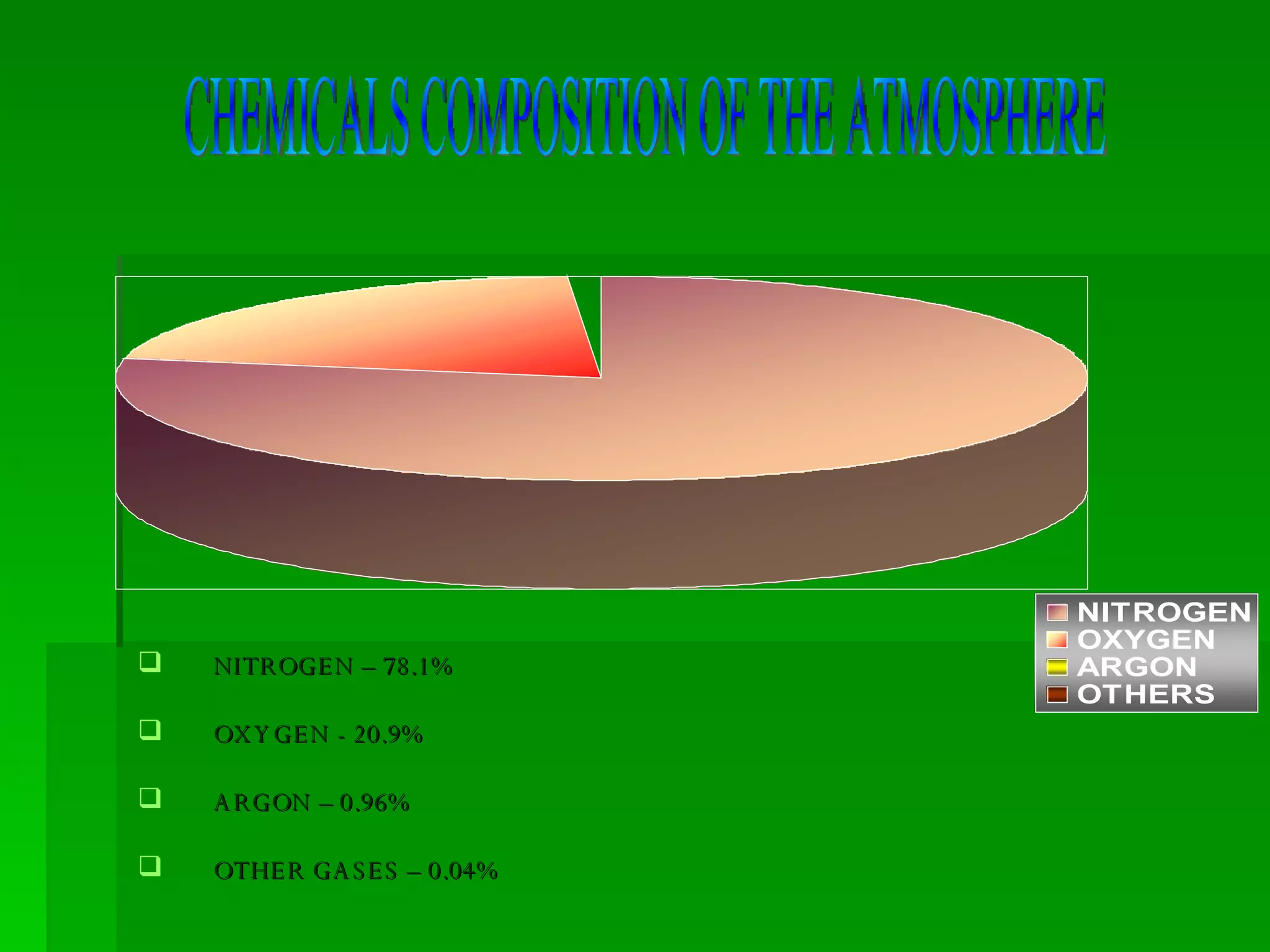
NITROGEN – 78.1% OXYGEN - 20.9% ARGON – 0.96% OTHER GASES – 0.04%  CHEMICALS COMPOSITION OF THE ATMOSPHERE
The cycle that includes both the living  biosphere and the non – living lithosphere,  atmosphere and hydrosphere. The carbon cycle and the nitrogen cycle are  both biogeochemical cycles. THE BIOGEOCHEMICAL CYCLE
THE CARBON CYCLE
Carbon is a non-metal. It belongs to the group 14 elements in the periodic table. The earth’s atmosphere is 0.19% carbon. The human body contains 18% carbon that is almost  hundred times more than in the atmosphere.  Every organism needs carbon either for its structure  or  for  energy. CARBON AS AN ELEMENT
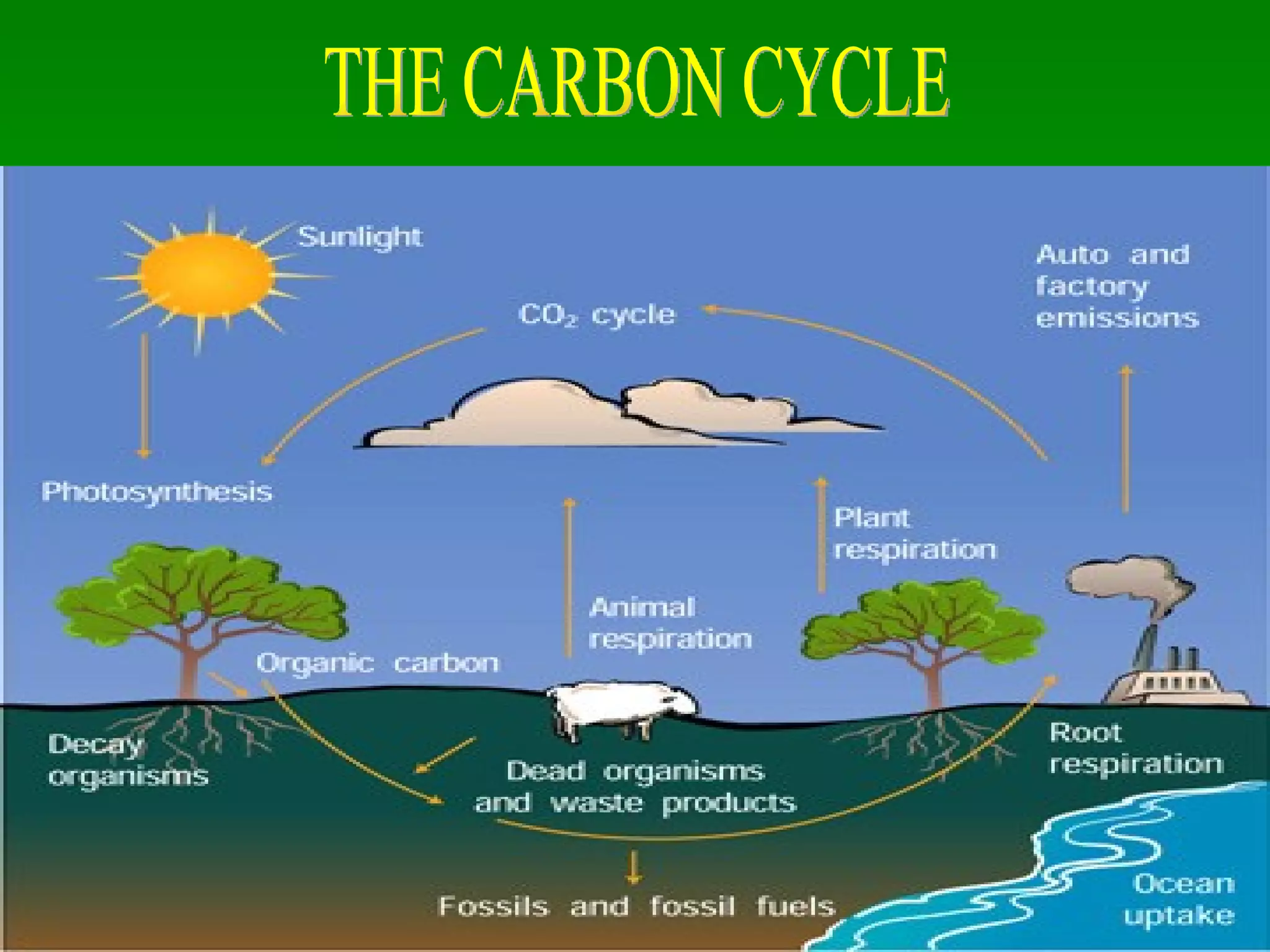
The carbon cycle is a process in which carbon is recycled over and over again. The process of recycling goes on in the earth’s atmosphere between the biotic and a-biotic environment. The complete cycle is made up of “sources” that put back carbon into the environment and “sinks” that absorb and stores carbon.  THE CARBON CYCLE
THE CARBON CYCLE
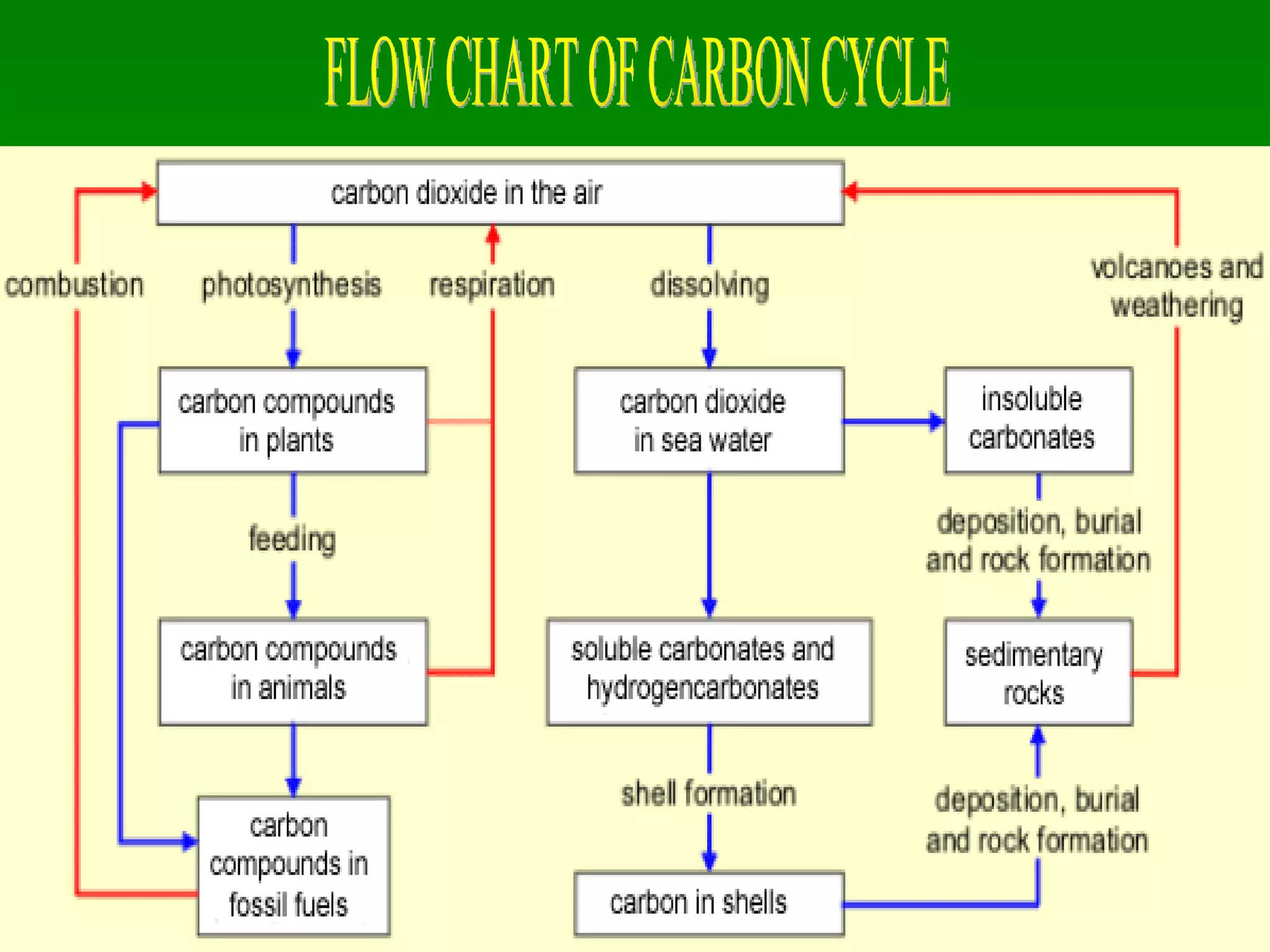
FLOW CHART OF CARBON CYCLE
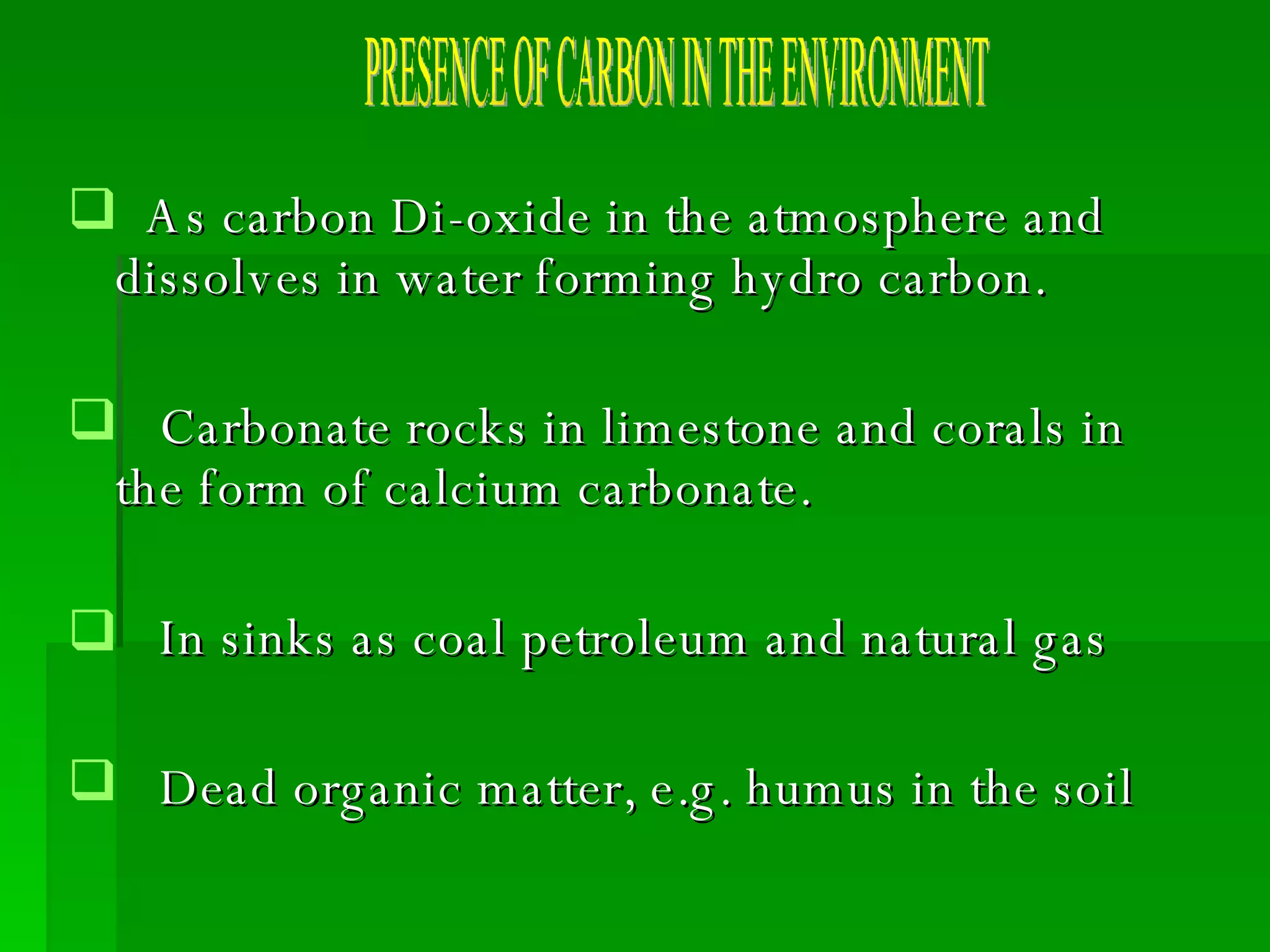
As carbon Di-oxide in the atmosphere and  dissolves in water forming hydro carbon. Carbonate rocks in limestone and corals in the form of calcium carbonate. In sinks as coal petroleum and natural gas  Dead organic matter, e.g. humus in the soil PRESENCE OF CARBON IN THE ENVIRONMENT
Carbon in the form of carbon di oxide enters in the phototrophic plants and algae that use it for photosynthesis.  Carbon passes up the food chain through the primary consumers. The primary consumers metabolise in presence of oxygen to produce carbon di oxide. CARBON IN THE BIOTIC ENVIRONMENT
Carbon di oxide is slightly soluble and diffuses in water, for example:  oceans and lakes.  The phytoplankton's and algae use carbon di oxide and photosynthesis  and later become a food for the primary consumers.  Some organisms like corals and animals with shells use carbon  di oxide and convert it into calcium carbonate. Decomposition: bacteria act upon dead and decaying matter to  form carbon di oxide. Over a period of time the shell sediments and the dead plants  and animals form limestone sinks. Weathering and volcanic eruptions also add carbon di oxide to the environment CARBON RETURNS TO THE ABIOTIC ENVIRONMENT
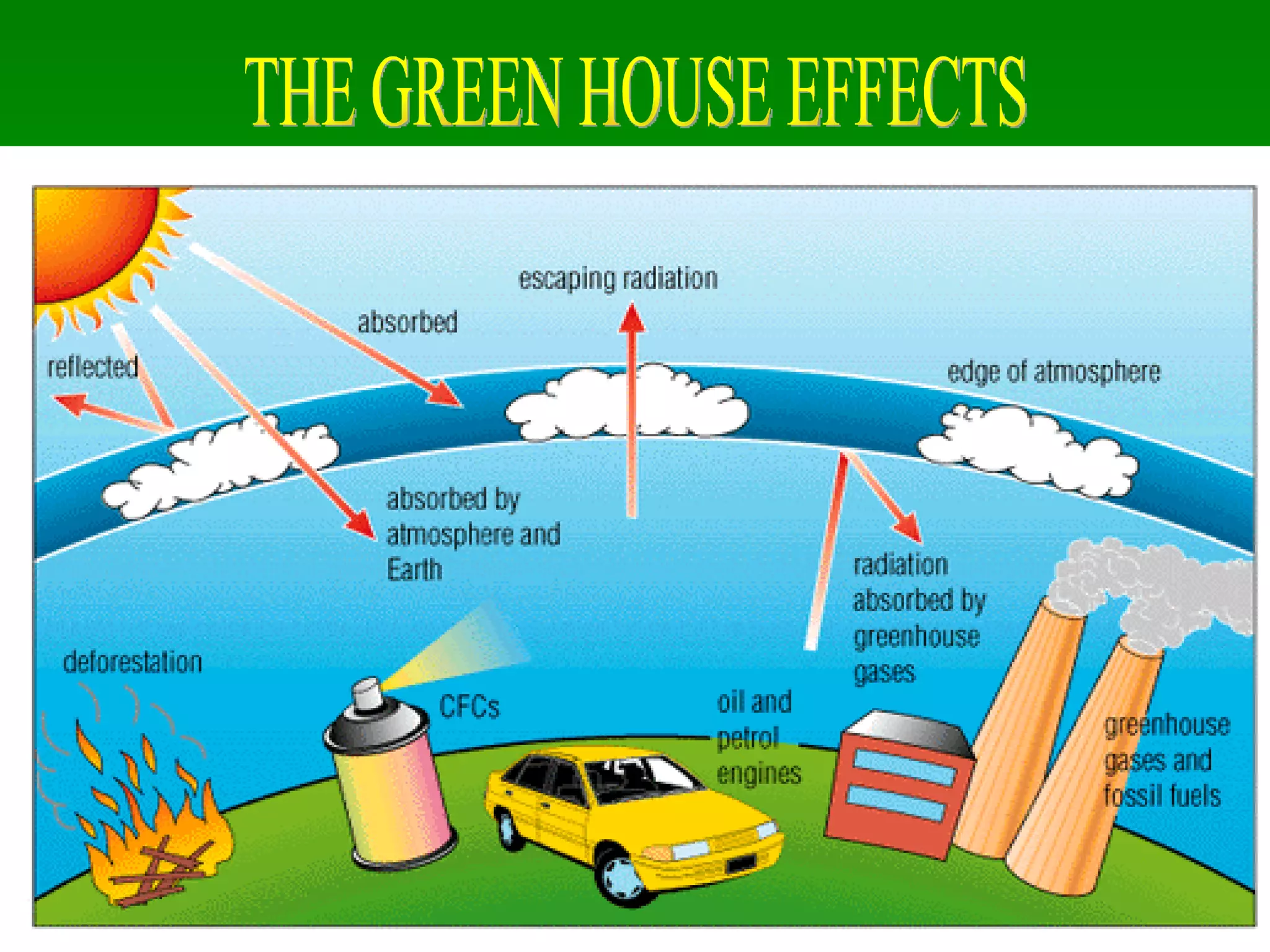
carbon di oxide is an important green house gas. excessive burning of fossil fuels release a considerably  high amounts of energy and carbon di oxide. deforestation has reduced the amount of carbon  di oxide used by plants for photosynthesis. resulting in glacial retreat and increase in   global temperatures. the sea levels have also increased due to  human interference. HUMAN EFFECTS ON CARBON CYCLE
THE GREEN HOUSE EFFECTS
 
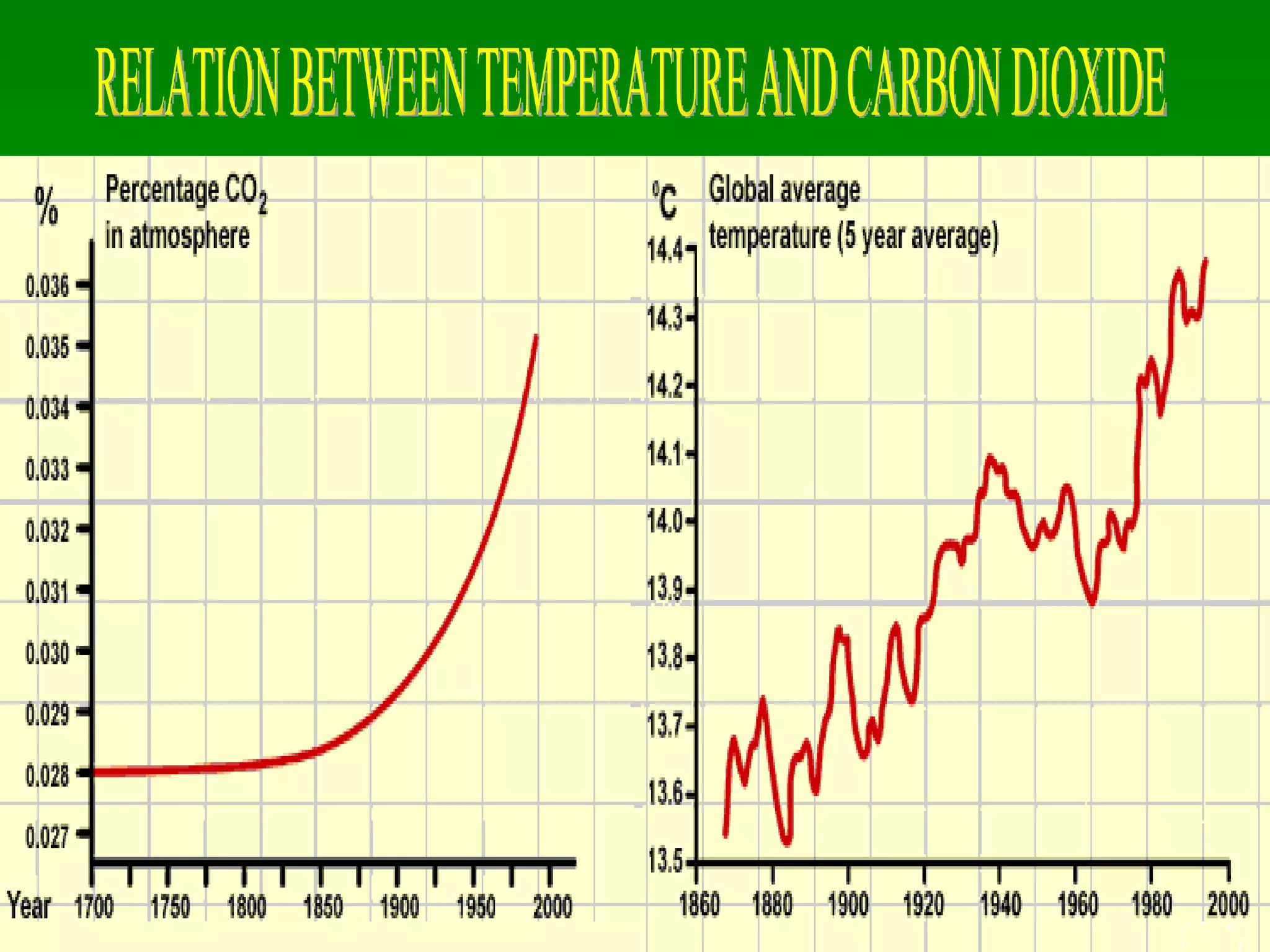
RELATION BETWEEN TEMPERATURE AND CARBON DIOXIDE
FACTS ON OZONE
THE NITROGEN  CYCLE
Nitrogen is a non – metal element usually in  gaseous state. It belongs to group 15 and period 2 of the periodic table.  It is the most abundant element in the earth’s  atmosphere, it makes up 78% of the atmosphere. The human body consists 3% nitrogen. Nitrogen is the building block of amino acids, which  form the proteins, enzymes and nucleic acids. NITROGEN AS AN ELEMENT
The transfer of nitrogen and nitrogen containing compounds in the  biotic and A biotic environment. THE NITROGEN CYCLE
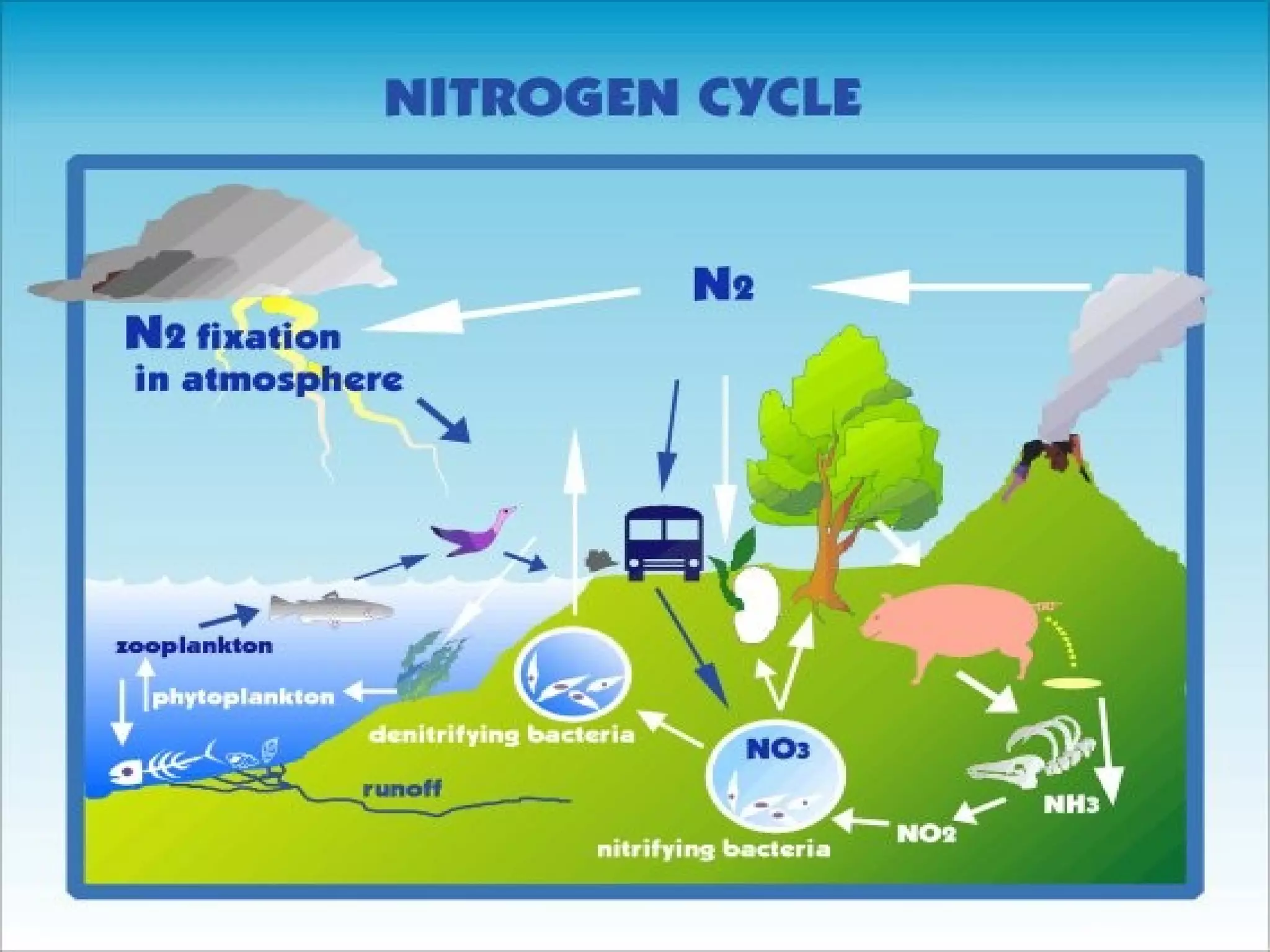
Plants and animals can’t use atmospheric nitrogen. Nitrogen fixation: conversion of atmospheric nitrogen   into nitrites and nitrates. Either by lightning or through some bacteria and algae  present in the soil. These nitrogenous compound enter the food cycle  through the plants. The excretory product and the dead are then converted by de-nitrification to ammonia gas.  THE NITROGEN CYCLE
 
 
FLOW CHART OF NITROGEN CYCLE
The major human activity involves excessive  fossil fuel combustion. The production and use of fertilizers. Resulting in global climate change, stratospheric  ozone depletion, regional smog, visibility degradation acid  rain, water – use impairment and eutrophication. THE HUMAN IMPACT
THE HUMAN IMPACT
THE HUMAN IMPACT
Acid rain is rain or any other form of  precipitation which is usually acidic. The term “acid rain” is commonly used to  mean deposition of acid components in rain,  snow, fog, dew or dry particles. ACID RAIN
Compounds like sulphur dioxide and  nitrogen oxides are released. Oxides reacts with water to form acid  precipitation called acid rain.  WHAT CAUSES ACID RAIN ?
CONTRIBUTION  TOWARDS  SAFE EARTH CONTROL DEFORESTATION TREAT CHEMICAL  WASTE BEFORE DISPOSAL USE BIO-DEGRADABLE  PRODUCTS RECYCLE THE WASTE USE VEHICLE WHEN  NECESSARY

The Cycle Of Life1

  • 1.
  • 2.
    INTRODUCTION OF CYCLESOF LIFE CARBON CYCLE (include video) NITROGEN CYCLE (include video) QUESTION AND ANSWER SESION THE FINISHING PAGE PRESENTATION SUMMARY
  • 3.
    THE MOVEMENT OF ELEMENTS FROM ONE BODY TO THE OTHER. THE CYCLES OF LIFE
  • 4.
    DEFINATION : It is a natural system consisting of plants, animals and microrganisms in an area functioning together will all non-living physical (A biotic) factors of the environment. Earth is a biosphere with a closed system For a steady supply of nutrient elements they must be recycled. Different chemical elements like carbon, oxygen and nitrogen exist on earth in a fixed ratio. THE BIOSPHERE
  • 5.
    NITROGEN – 78.1%OXYGEN - 20.9% ARGON – 0.96% OTHER GASES – 0.04% CHEMICALS COMPOSITION OF THE ATMOSPHERE
  • 6.
    The cycle thatincludes both the living biosphere and the non – living lithosphere, atmosphere and hydrosphere. The carbon cycle and the nitrogen cycle are both biogeochemical cycles. THE BIOGEOCHEMICAL CYCLE
  • 7.
  • 8.
    Carbon is anon-metal. It belongs to the group 14 elements in the periodic table. The earth’s atmosphere is 0.19% carbon. The human body contains 18% carbon that is almost hundred times more than in the atmosphere. Every organism needs carbon either for its structure or for energy. CARBON AS AN ELEMENT
  • 9.
    The carbon cycleis a process in which carbon is recycled over and over again. The process of recycling goes on in the earth’s atmosphere between the biotic and a-biotic environment. The complete cycle is made up of “sources” that put back carbon into the environment and “sinks” that absorb and stores carbon. THE CARBON CYCLE
  • 10.
  • 11.
    FLOW CHART OFCARBON CYCLE
  • 12.
    As carbon Di-oxidein the atmosphere and dissolves in water forming hydro carbon. Carbonate rocks in limestone and corals in the form of calcium carbonate. In sinks as coal petroleum and natural gas Dead organic matter, e.g. humus in the soil PRESENCE OF CARBON IN THE ENVIRONMENT
  • 13.
    Carbon in theform of carbon di oxide enters in the phototrophic plants and algae that use it for photosynthesis. Carbon passes up the food chain through the primary consumers. The primary consumers metabolise in presence of oxygen to produce carbon di oxide. CARBON IN THE BIOTIC ENVIRONMENT
  • 14.
    Carbon di oxideis slightly soluble and diffuses in water, for example: oceans and lakes. The phytoplankton's and algae use carbon di oxide and photosynthesis and later become a food for the primary consumers. Some organisms like corals and animals with shells use carbon di oxide and convert it into calcium carbonate. Decomposition: bacteria act upon dead and decaying matter to form carbon di oxide. Over a period of time the shell sediments and the dead plants and animals form limestone sinks. Weathering and volcanic eruptions also add carbon di oxide to the environment CARBON RETURNS TO THE ABIOTIC ENVIRONMENT
  • 15.
    carbon di oxideis an important green house gas. excessive burning of fossil fuels release a considerably high amounts of energy and carbon di oxide. deforestation has reduced the amount of carbon di oxide used by plants for photosynthesis. resulting in glacial retreat and increase in global temperatures. the sea levels have also increased due to human interference. HUMAN EFFECTS ON CARBON CYCLE
  • 16.
  • 17.
  • 18.
    RELATION BETWEEN TEMPERATUREAND CARBON DIOXIDE
  • 19.
  • 20.
  • 21.
    Nitrogen is anon – metal element usually in gaseous state. It belongs to group 15 and period 2 of the periodic table. It is the most abundant element in the earth’s atmosphere, it makes up 78% of the atmosphere. The human body consists 3% nitrogen. Nitrogen is the building block of amino acids, which form the proteins, enzymes and nucleic acids. NITROGEN AS AN ELEMENT
  • 22.
    The transfer ofnitrogen and nitrogen containing compounds in the biotic and A biotic environment. THE NITROGEN CYCLE
  • 23.
    Plants and animalscan’t use atmospheric nitrogen. Nitrogen fixation: conversion of atmospheric nitrogen into nitrites and nitrates. Either by lightning or through some bacteria and algae present in the soil. These nitrogenous compound enter the food cycle through the plants. The excretory product and the dead are then converted by de-nitrification to ammonia gas. THE NITROGEN CYCLE
  • 24.
  • 25.
  • 26.
    FLOW CHART OFNITROGEN CYCLE
  • 27.
    The major humanactivity involves excessive fossil fuel combustion. The production and use of fertilizers. Resulting in global climate change, stratospheric ozone depletion, regional smog, visibility degradation acid rain, water – use impairment and eutrophication. THE HUMAN IMPACT
  • 28.
  • 29.
  • 30.
    Acid rain israin or any other form of precipitation which is usually acidic. The term “acid rain” is commonly used to mean deposition of acid components in rain, snow, fog, dew or dry particles. ACID RAIN
  • 31.
    Compounds like sulphurdioxide and nitrogen oxides are released. Oxides reacts with water to form acid precipitation called acid rain. WHAT CAUSES ACID RAIN ?
  • 32.
    CONTRIBUTION TOWARDS SAFE EARTH CONTROL DEFORESTATION TREAT CHEMICAL WASTE BEFORE DISPOSAL USE BIO-DEGRADABLE PRODUCTS RECYCLE THE WASTE USE VEHICLE WHEN NECESSARY