GOOD DAY!
EMPOWERMENT
TECHNOLOGIES
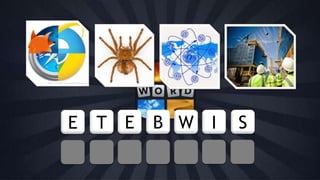
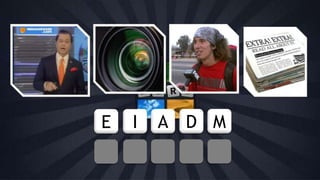
E T E B W I S
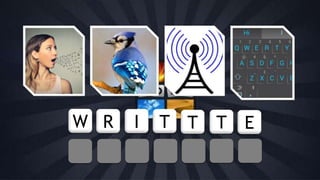
W R I T T T E
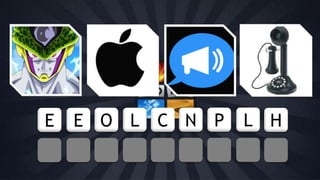
E E O L C N P L H
E I A D M
REVIEW
Technology - The application of scientific
knowledge for practical purposes, especially in
industry. A machinery and equipment
developed from the application of scientific
knowledge.
REVIEW
How dependent have we become
on technology?
REVIEW
Will our dependence on
technology increase or decrease in
the near future? Why?
REVIEW
As one of the dependents, what
should we do then to keep up?
The Current State of ICT
ICT – Information and Communications Technology.
It is an extended term of Information Technology (IT).
It stresses the role of unified communications and the
integration of telecommunications, computers, as well as
necessary enterprise software, middleware, storage, and audio-
visual systems, which enable users to access, store, transmit, and
manipulate information.
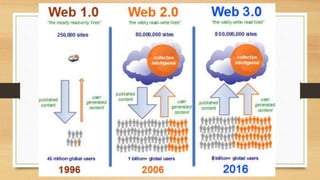
WEB 1.0
• It is a term coined to differentiate the first stage of the World
Wide Web (www) in comparison with the present stage of the
internet technology.
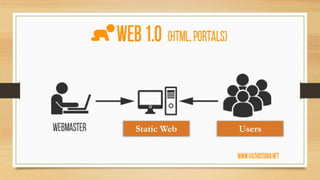
• At the beginning, there were few web content creators.
• Webpages were static and were called read only web.
• The only available feedback mechanism was through private
emails.
Static Web Users
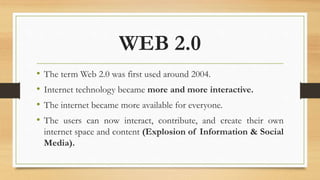
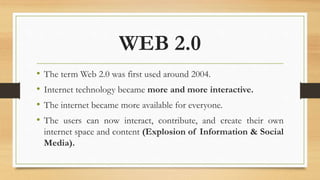
WEB 2.0
• The term Web 2.0 was first used around 2004.
• Internet technology became more and more interactive.
• The internet became more available for everyone.
• The users can now interact, contribute, and create their own
internet space and content (Explosion of Information & Social
Media).
WEB 2.0
• The term Web 2.0 was first used around 2004.
• Internet technology became more and more interactive.
• The internet became more available for everyone.
• The users can now interact, contribute, and create their own
internet space and content (Explosion of Information & Social
Media).
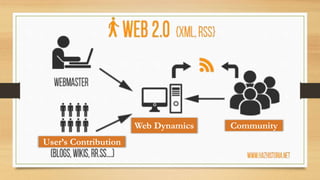
Web Dynamics
User’s Contribution
Community
WEB 3.0
• It is described by Time Berners-Lee (Father of the WWW) as the
read-write-execute web.
• It is referred to as the semantic web or data driven web content and
response.
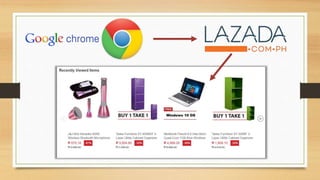
• The context of the search of the user is processed by a programming
language to help the user by presenting options of what the person is
interested in.
• It will not make Web 2.0 obsolete.
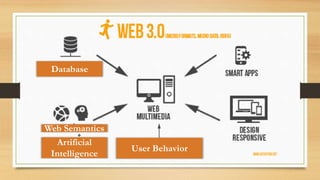
Database
Web Semantics
Artificial
Intelligence
User Behavior
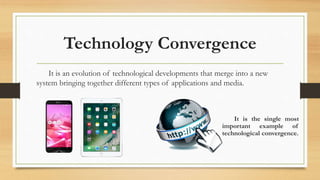
Technology Convergence
It is an evolution of technological developments that merge into a new
system bringing together different types of applications and media.
It is the single most
important example of
technological convergence.
SOCIAL MEDIA
It is a collection of internet-based communication tools
and computer assisted channels dedicated to allow users to
interact, communicate, and share information in a virtual
community and network.
It is a popular free social networking site with more than a
billion users around the globe that allows its users to create
profiles, upload photos and videos, create and join groups,
react to friend’s posts, creative events, send messages, keeping
in touch with close friends, and relatives.
With more than 300 Million users in 2016, this social
networking site allows users to microblog or broadcast short
messages called “tweets.” Registered Tweeter members can also
read and follow tweets of other users.
With more than 300 Million users in 2016, this social
networking site allows users to microblog or broadcast short
messages called “tweets.” Registered Tweeter members can also
read and follow tweets of other users.
With more than 300 Million users in 2016, this social
networking site allows users to microblog or broadcast short
messages called “tweets.” Registered Tweeter members can also
read and follow tweets of other users.
MOBILE MEDIA
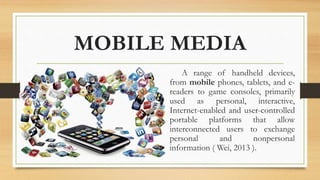
A range of handheld devices,
from mobile phones, tablets, and e-
readers to game consoles, primarily
used as personal, interactive,
Internet-enabled and user-controlled
portable platforms that allow
interconnected users to exchange
personal and nonpersonal
information ( Wei, 2013 ).
ASSISTIVE MEDIA
• It is a nonprofit organization founded in 1996 in Michigan,
USA. It was founded by David H. Harvey.
• The organization was the first internet-based reading service
for persons with visual and reading impairments.
• The produce and publish voice-recorded written materials on
cassettes, cds, and in the internet.

The Current State of ICT Technologies.pptx

  • 1.
  • 3.
    E T EB W I S
  • 4.
    W R IT T T E
  • 5.
    E E OL C N P L H
  • 6.
    E I AD M
  • 7.
    REVIEW Technology - Theapplication of scientific knowledge for practical purposes, especially in industry. A machinery and equipment developed from the application of scientific knowledge.
  • 8.
    REVIEW How dependent havewe become on technology?
  • 9.
    REVIEW Will our dependenceon technology increase or decrease in the near future? Why?
  • 10.
    REVIEW As one ofthe dependents, what should we do then to keep up?
  • 11.
    The Current Stateof ICT ICT – Information and Communications Technology. It is an extended term of Information Technology (IT). It stresses the role of unified communications and the integration of telecommunications, computers, as well as necessary enterprise software, middleware, storage, and audio- visual systems, which enable users to access, store, transmit, and manipulate information.
  • 12.
    WEB 1.0 • Itis a term coined to differentiate the first stage of the World Wide Web (www) in comparison with the present stage of the internet technology. • At the beginning, there were few web content creators. • Webpages were static and were called read only web. • The only available feedback mechanism was through private emails.
  • 13.
  • 14.
    WEB 2.0 • Theterm Web 2.0 was first used around 2004. • Internet technology became more and more interactive. • The internet became more available for everyone. • The users can now interact, contribute, and create their own internet space and content (Explosion of Information & Social Media).
  • 16.
    WEB 2.0 • Theterm Web 2.0 was first used around 2004. • Internet technology became more and more interactive. • The internet became more available for everyone. • The users can now interact, contribute, and create their own internet space and content (Explosion of Information & Social Media).
  • 17.
  • 19.
    WEB 3.0 • Itis described by Time Berners-Lee (Father of the WWW) as the read-write-execute web. • It is referred to as the semantic web or data driven web content and response. • The context of the search of the user is processed by a programming language to help the user by presenting options of what the person is interested in. • It will not make Web 2.0 obsolete.
  • 21.
  • 22.
    Technology Convergence It isan evolution of technological developments that merge into a new system bringing together different types of applications and media. It is the single most important example of technological convergence.
  • 24.
    SOCIAL MEDIA It isa collection of internet-based communication tools and computer assisted channels dedicated to allow users to interact, communicate, and share information in a virtual community and network.
  • 25.
    It is apopular free social networking site with more than a billion users around the globe that allows its users to create profiles, upload photos and videos, create and join groups, react to friend’s posts, creative events, send messages, keeping in touch with close friends, and relatives.
  • 26.
    With more than300 Million users in 2016, this social networking site allows users to microblog or broadcast short messages called “tweets.” Registered Tweeter members can also read and follow tweets of other users.
  • 27.
    With more than300 Million users in 2016, this social networking site allows users to microblog or broadcast short messages called “tweets.” Registered Tweeter members can also read and follow tweets of other users.
  • 28.
    With more than300 Million users in 2016, this social networking site allows users to microblog or broadcast short messages called “tweets.” Registered Tweeter members can also read and follow tweets of other users.
  • 29.
    MOBILE MEDIA A rangeof handheld devices, from mobile phones, tablets, and e- readers to game consoles, primarily used as personal, interactive, Internet-enabled and user-controlled portable platforms that allow interconnected users to exchange personal and nonpersonal information ( Wei, 2013 ).
  • 30.
    ASSISTIVE MEDIA • Itis a nonprofit organization founded in 1996 in Michigan, USA. It was founded by David H. Harvey. • The organization was the first internet-based reading service for persons with visual and reading impairments. • The produce and publish voice-recorded written materials on cassettes, cds, and in the internet.

Editor's Notes

  • #4 Website
  • #5 Twitter
  • #6 Cellphone
  • #7 Media
  • #12 Unified Communication (UC) = integration of real-time enterprise (satisfying organizations rather than individuals) communication services (instant messaging, presence of information, voice, mobility features, audio, web, & video conferencing, fixed-mobile convergence, desktop sharing, data sharing, etc. Sharing data in a common place using different mediums for access. Middleware – Software glue. These are the internal software or applications that help common software to function properly. It is like the codes that make the operating system work--- the hidden algorithms. Sharing data in a common place using different mediums for access.
  • #13 Read Only web - Because there was no user interaction available. You can only read text and look at the pictures. There
  • #14 HTML (HyperText Markup Language) is the most basic building block of the Web. It describes and defines the content of a webpage. Portal is a term, generally synonymous with gateway, for a World Wide Web site that is or proposes to be a major starting site for users when they get connected to the Web or that users tend to visit as an anchor site.  SEARCH ENGINE
  • #15 It is difficult to identify when this transition began. It just happened.
  • #17 It is difficult to identify when this transition began. It just happened.
  • #18 XML stands for eXtensible Markup Language. XML was designed to store and transport data. XML was designed to be both human- and machine-readable. RSS (Rich Site Summary; originally RDF Site Summary; often called Really Simple Syndication) is a type of web feed[2] which allows users to access updates to online content in a standardized, computer-readable format. 
  • #20 It is difficult to identify when this transition began. It just happened.
  • #21 Recommendation sonn TripAdvisor.com, Booking.com. Agoda.com, etc.
  • #22 Microformats are small patterns of HTML to represent commonly published things like people, events, blog posts, reviews and tags in web pages. Microdata is a WHATWG HTML specification used to nest metadata within existing content on web pages. RDFa (or Resource Description Framework in Attributes) is a W3C Recommendation that adds a set of attribute-level extensions to HTML, XHTML and various XML-based document types for embedding rich metadata within Web documents.
  • #30 Smartphones had been dominating the market since they came out. Epitome of the Technological Convergence.
  • #31 Smartphones had been dominating the market since they came out. Epitome of the Technological Convergence.