Lauren Jiggins 'The Conjuring' Opening analysis 
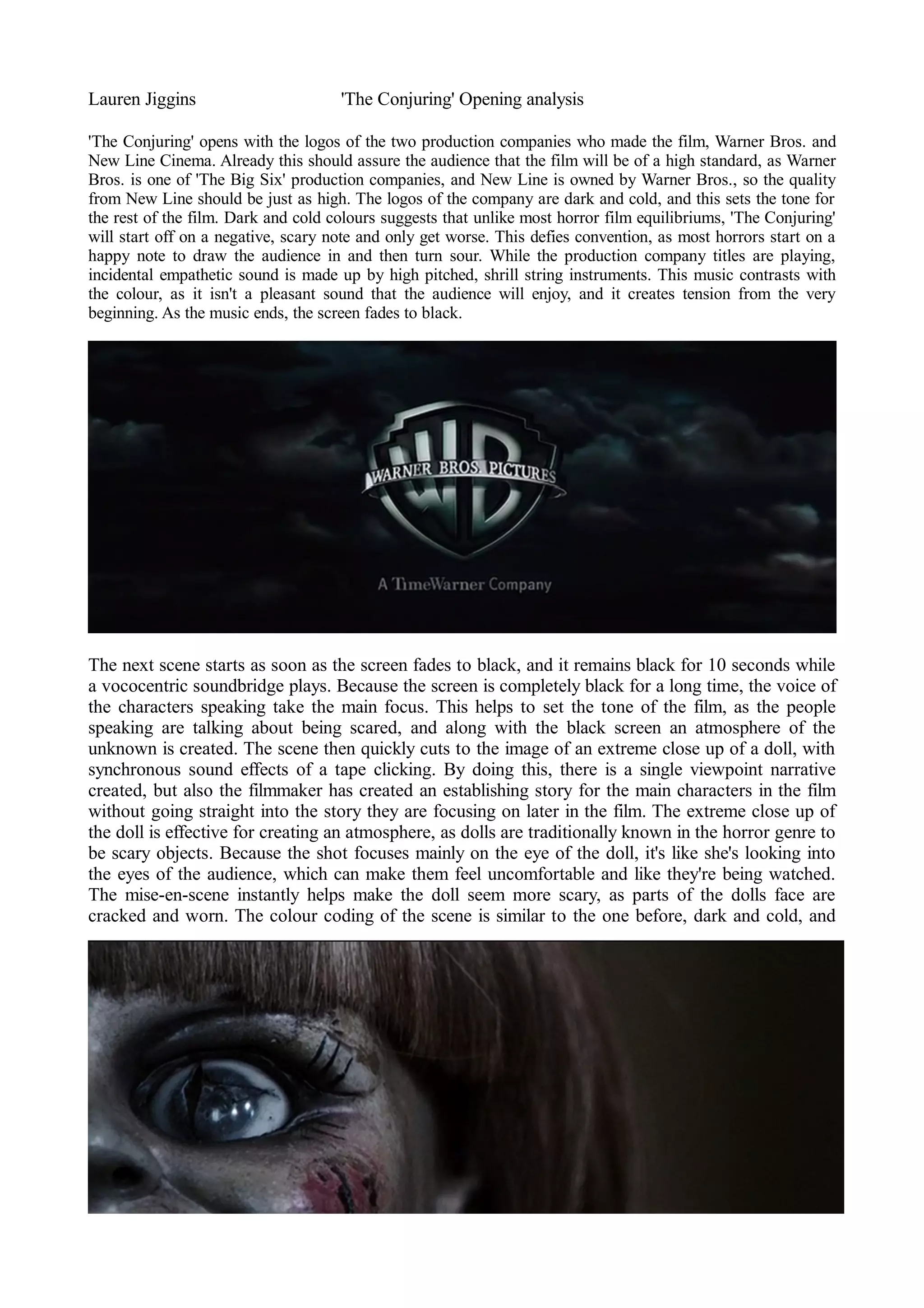
'The Conjuring' opens with the logos of the two production companies who made the film, Warner Bros. and 
New Line Cinema. Already this should assure the audience that the film will be of a high standard, as Warner 
Bros. is one of 'The Big Six' production companies, and New Line is owned by Warner Bros., so the quality 
from New Line should be just as high. The logos of the company are dark and cold, and this sets the tone for 
the rest of the film. Dark and cold colours suggests that unlike most horror film equilibriums, 'The Conjuring' 
will start off on a negative, scary note and only get worse. This defies convention, as most horrors start on a 
happy note to draw the audience in and then turn sour. While the production company titles are playing, 
incidental empathetic sound is made up by high pitched, shrill string instruments. This music contrasts with 
the colour, as it isn't a pleasant sound that the audience will enjoy, and it creates tension from the very 
beginning. As the music ends, the screen fades to black. 
The next scene starts as soon as the screen fades to black, and it remains black for 10 seconds while 
a vococentric soundbridge plays. Because the screen is completely black for a long time, the voice of 
the characters speaking take the main focus. This helps to set the tone of the film, as the people 
speaking are talking about being scared, and along with the black screen an atmosphere of the 
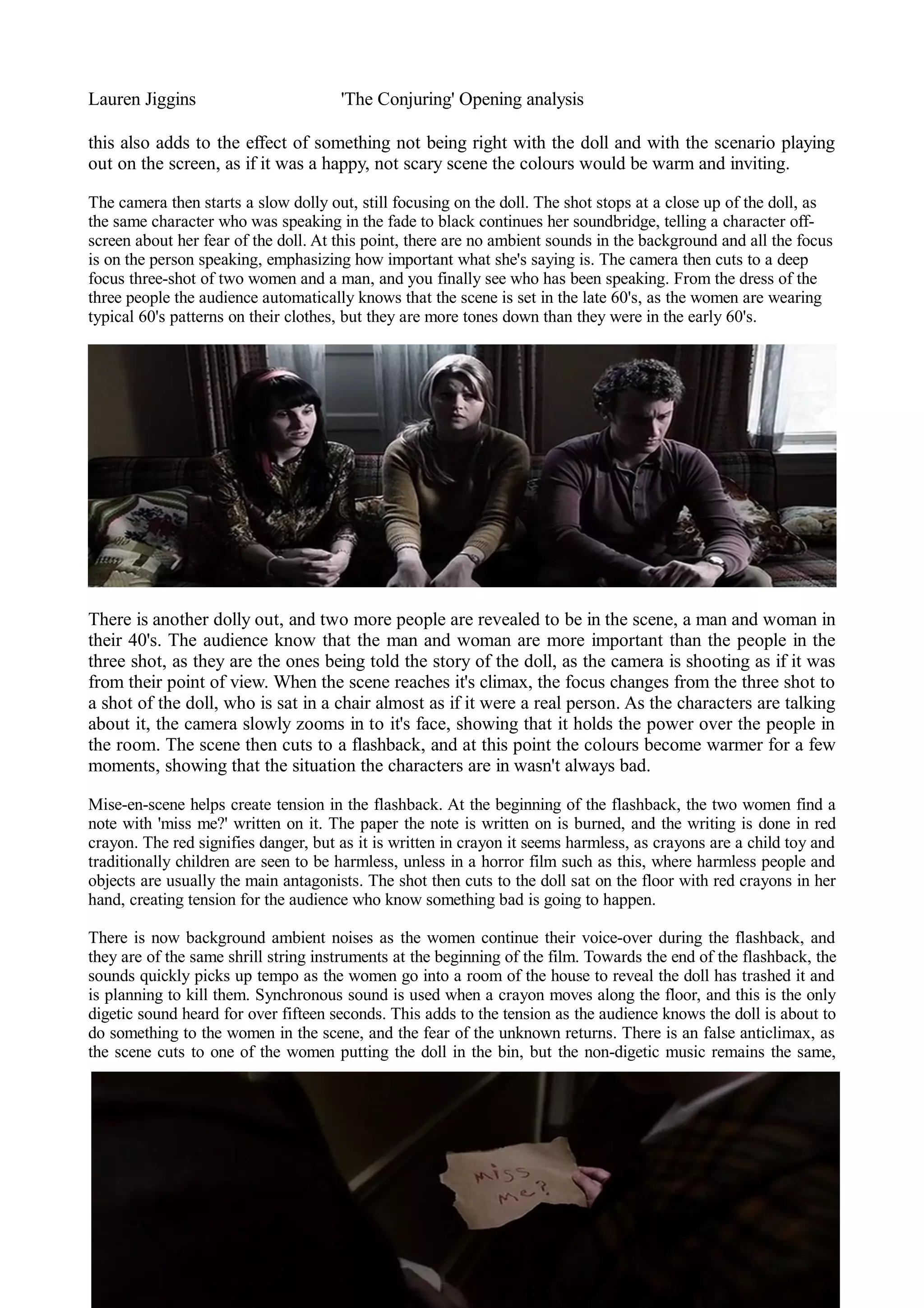
unknown is created. The scene then quickly cuts to the image of an extreme close up of a doll, with 
synchronous sound effects of a tape clicking. By doing this, there is a single viewpoint narrative 
created, but also the filmmaker has created an establishing story for the main characters in the film 
without going straight into the story they are focusing on later in the film. The extreme close up of 
the doll is effective for creating an atmosphere, as dolls are traditionally known in the horror genre to 
be scary objects. Because the shot focuses mainly on the eye of the doll, it's like she's looking into 
the eyes of the audience, which can make them feel uncomfortable and like they're being watched. 
The mise-en-scene instantly helps make the doll seem more scary, as parts of the dolls face are 
cracked and worn. The colour coding of the scene is similar to the one before, dark and cold, and
Lauren Jiggins 'The Conjuring' Opening analysis 
this also adds to the effect of something not being right with the doll and with the scenario playing 
out on the screen, as if it was a happy, not scary scene the colours would be warm and inviting. 
The camera then starts a slow dolly out, still focusing on the doll. The shot stops at a close up of the doll, as 
the same character who was speaking in the fade to black continues her soundbridge, telling a character off-screen 
about her fear of the doll. At this point, there are no ambient sounds in the background and all the focus 
is on the person speaking, emphasizing how important what she's saying is. The camera then cuts to a deep 
focus three-shot of two women and a man, and you finally see who has been speaking. From the dress of the 
three people the audience automatically knows that the scene is set in the late 60's, as the women are wearing 
typical 60's patterns on their clothes, but they are more tones down than they were in the early 60's. 
There is another dolly out, and two more people are revealed to be in the scene, a man and woman in 
their 40's. The audience know that the man and woman are more important than the people in the 
three shot, as they are the ones being told the story of the doll, as the camera is shooting as if it was 
from their point of view. When the scene reaches it's climax, the focus changes from the three shot to 
a shot of the doll, who is sat in a chair almost as if it were a real person. As the characters are talking 
about it, the camera slowly zooms in to it's face, showing that it holds the power over the people in 
the room. The scene then cuts to a flashback, and at this point the colours become warmer for a few 
moments, showing that the situation the characters are in wasn't always bad. 
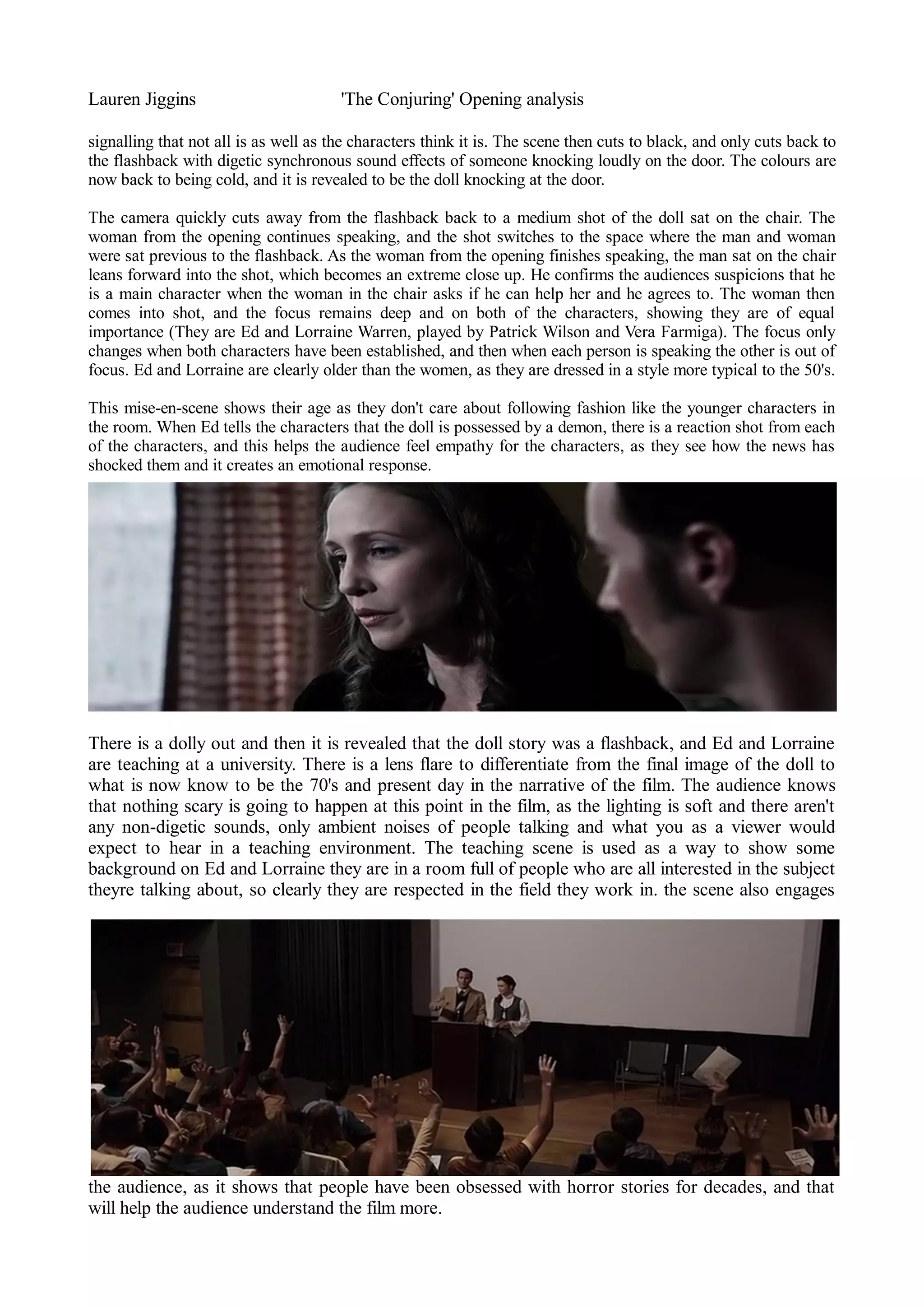
Mise-en-scene helps create tension in the flashback. At the beginning of the flashback, the two women find a 
note with 'miss me?' written on it. The paper the note is written on is burned, and the writing is done in red 
crayon. The red signifies danger, but as it is written in crayon it seems harmless, as crayons are a child toy and 
traditionally children are seen to be harmless, unless in a horror film such as this, where harmless people and 
objects are usually the main antagonists. The shot then cuts to the doll sat on the floor with red crayons in her 
hand, creating tension for the audience who know something bad is going to happen. 
There is now background ambient noises as the women continue their voice-over during the flashback, and 
they are of the same shrill string instruments at the beginning of the film. Towards the end of the flashback, the 
sounds quickly picks up tempo as the women go into a room of the house to reveal the doll has trashed it and 
is planning to kill them. Synchronous sound is used when a crayon moves along the floor, and this is the only 
digetic sound heard for over fifteen seconds. This adds to the tension as the audience knows the doll is about to 
do something to the women in the scene, and the fear of the unknown returns. There is an false anticlimax, as 
the scene cuts to one of the women putting the doll in the bin, but the non-digetic music remains the same,
Lauren Jiggins 'The Conjuring' Opening analysis 
signalling that not all is as well as the characters think it is. The scene then cuts to black, and only cuts back to 
the flashback with digetic synchronous sound effects of someone knocking loudly on the door. The colours are 
now back to being cold, and it is revealed to be the doll knocking at the door. 
The camera quickly cuts away from the flashback back to a medium shot of the doll sat on the chair. The 
woman from the opening continues speaking, and the shot switches to the space where the man and woman 
were sat previous to the flashback. As the woman from the opening finishes speaking, the man sat on the chair 
leans forward into the shot, which becomes an extreme close up. He confirms the audiences suspicions that he 
is a main character when the woman in the chair asks if he can help her and he agrees to. The woman then 
comes into shot, and the focus remains deep and on both of the characters, showing they are of equal 
importance (They are Ed and Lorraine Warren, played by Patrick Wilson and Vera Farmiga). The focus only 
changes when both characters have been established, and then when each person is speaking the other is out of 
focus. Ed and Lorraine are clearly older than the women, as they are dressed in a style more typical to the 50's. 
This mise-en-scene shows their age as they don't care about following fashion like the younger characters in 
the room. When Ed tells the characters that the doll is possessed by a demon, there is a reaction shot from each 
of the characters, and this helps the audience feel empathy for the characters, as they see how the news has 
shocked them and it creates an emotional response. 
There is a dolly out and then it is revealed that the doll story was a flashback, and Ed and Lorraine 
are teaching at a university. There is a lens flare to differentiate from the final image of the doll to 
what is now know to be the 70's and present day in the narrative of the film. The audience knows 
that nothing scary is going to happen at this point in the film, as the lighting is soft and there aren't 
any non-digetic sounds, only ambient noises of people talking and what you as a viewer would 
expect to hear in a teaching environment. The teaching scene is used as a way to show some 
background on Ed and Lorraine they are in a room full of people who are all interested in the subject 
theyre talking about, so clearly they are respected in the field they work in. the scene also engages 
the audience, as it shows that people have been obsessed with horror stories for decades, and that 
will help the audience understand the film more.
Lauren Jiggins 'The Conjuring' Opening analysis 
Ed and Lorraine are asked questions, and when they reveal to the audience in the cinema (the people in the film 
would already know who they are) who they are through Farmiga looking directly into the camera, thus 
breaking the fourth wall. The camera then pans slightly and settles on a medium close shot of Ed and Lorraine, 
and the scene changes into a freeze frame that looks like it's from a newspaper cutting, showing the 
prominence and fame the Warren's had in their day. As this happens the music from the beginning of the film 
starts to play, and the picture fades to black,as typewriting style words appear on the screen. The sentences 
give background on the Warren family and that the film is based on a true story. By breaking the fourth wall 
and saying the film is a true story, the audience feels more aware that the things they are about to see could 
happen to them, and it sets the narrative. 
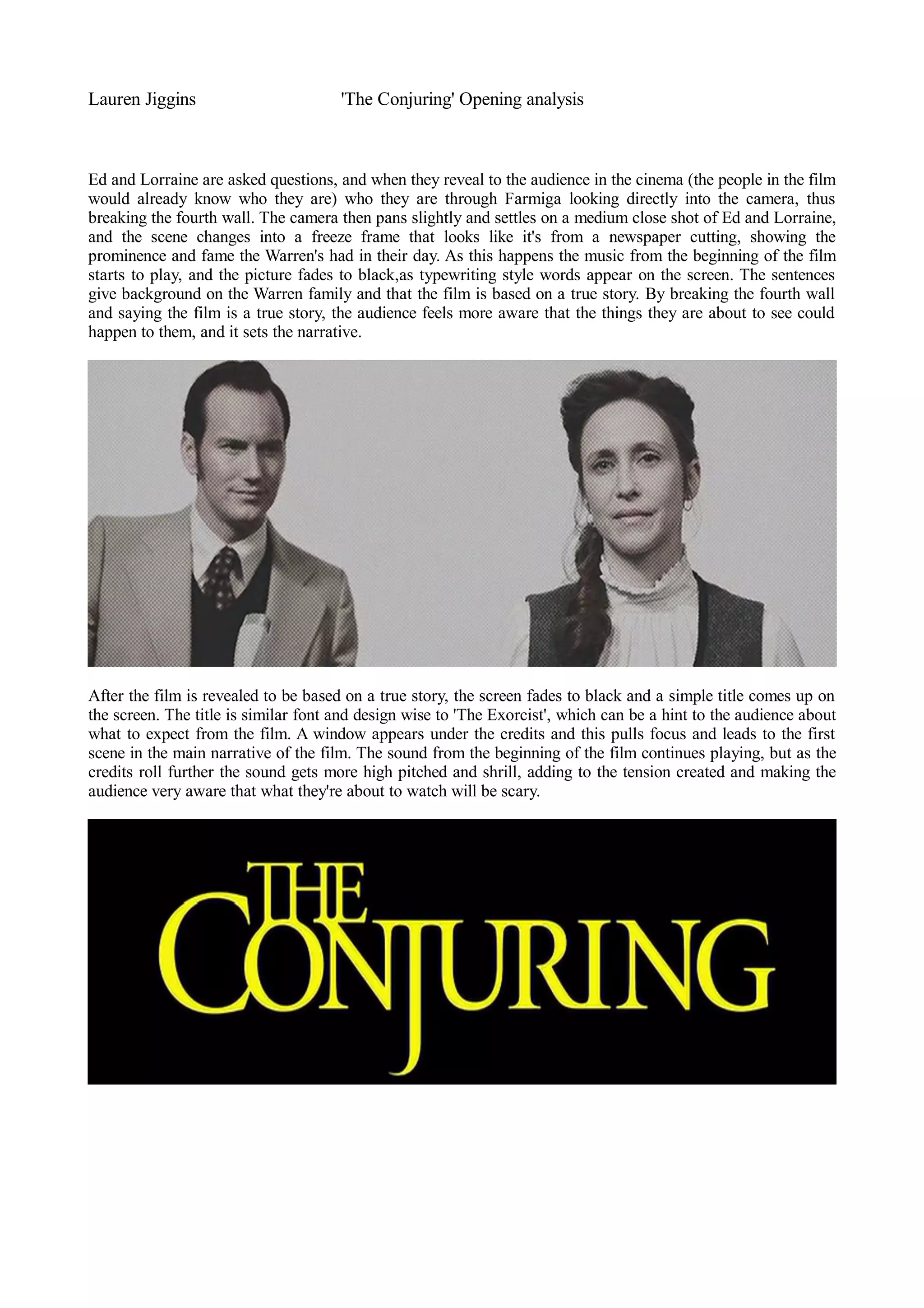
After the film is revealed to be based on a true story, the screen fades to black and a simple title comes up on 
the screen. The title is similar font and design wise to 'The Exorcist', which can be a hint to the audience about 
what to expect from the film. A window appears under the credits and this pulls focus and leads to the first 
scene in the main narrative of the film. The sound from the beginning of the film continues playing, but as the 
credits roll further the sound gets more high pitched and shrill, adding to the tension created and making the 
audience very aware that what they're about to watch will be scary.

The Conjuring

  • 1.
    Lauren Jiggins 'TheConjuring' Opening analysis 'The Conjuring' opens with the logos of the two production companies who made the film, Warner Bros. and New Line Cinema. Already this should assure the audience that the film will be of a high standard, as Warner Bros. is one of 'The Big Six' production companies, and New Line is owned by Warner Bros., so the quality from New Line should be just as high. The logos of the company are dark and cold, and this sets the tone for the rest of the film. Dark and cold colours suggests that unlike most horror film equilibriums, 'The Conjuring' will start off on a negative, scary note and only get worse. This defies convention, as most horrors start on a happy note to draw the audience in and then turn sour. While the production company titles are playing, incidental empathetic sound is made up by high pitched, shrill string instruments. This music contrasts with the colour, as it isn't a pleasant sound that the audience will enjoy, and it creates tension from the very beginning. As the music ends, the screen fades to black. The next scene starts as soon as the screen fades to black, and it remains black for 10 seconds while a vococentric soundbridge plays. Because the screen is completely black for a long time, the voice of the characters speaking take the main focus. This helps to set the tone of the film, as the people speaking are talking about being scared, and along with the black screen an atmosphere of the unknown is created. The scene then quickly cuts to the image of an extreme close up of a doll, with synchronous sound effects of a tape clicking. By doing this, there is a single viewpoint narrative created, but also the filmmaker has created an establishing story for the main characters in the film without going straight into the story they are focusing on later in the film. The extreme close up of the doll is effective for creating an atmosphere, as dolls are traditionally known in the horror genre to be scary objects. Because the shot focuses mainly on the eye of the doll, it's like she's looking into the eyes of the audience, which can make them feel uncomfortable and like they're being watched. The mise-en-scene instantly helps make the doll seem more scary, as parts of the dolls face are cracked and worn. The colour coding of the scene is similar to the one before, dark and cold, and
  • 2.
    Lauren Jiggins 'TheConjuring' Opening analysis this also adds to the effect of something not being right with the doll and with the scenario playing out on the screen, as if it was a happy, not scary scene the colours would be warm and inviting. The camera then starts a slow dolly out, still focusing on the doll. The shot stops at a close up of the doll, as the same character who was speaking in the fade to black continues her soundbridge, telling a character off-screen about her fear of the doll. At this point, there are no ambient sounds in the background and all the focus is on the person speaking, emphasizing how important what she's saying is. The camera then cuts to a deep focus three-shot of two women and a man, and you finally see who has been speaking. From the dress of the three people the audience automatically knows that the scene is set in the late 60's, as the women are wearing typical 60's patterns on their clothes, but they are more tones down than they were in the early 60's. There is another dolly out, and two more people are revealed to be in the scene, a man and woman in their 40's. The audience know that the man and woman are more important than the people in the three shot, as they are the ones being told the story of the doll, as the camera is shooting as if it was from their point of view. When the scene reaches it's climax, the focus changes from the three shot to a shot of the doll, who is sat in a chair almost as if it were a real person. As the characters are talking about it, the camera slowly zooms in to it's face, showing that it holds the power over the people in the room. The scene then cuts to a flashback, and at this point the colours become warmer for a few moments, showing that the situation the characters are in wasn't always bad. Mise-en-scene helps create tension in the flashback. At the beginning of the flashback, the two women find a note with 'miss me?' written on it. The paper the note is written on is burned, and the writing is done in red crayon. The red signifies danger, but as it is written in crayon it seems harmless, as crayons are a child toy and traditionally children are seen to be harmless, unless in a horror film such as this, where harmless people and objects are usually the main antagonists. The shot then cuts to the doll sat on the floor with red crayons in her hand, creating tension for the audience who know something bad is going to happen. There is now background ambient noises as the women continue their voice-over during the flashback, and they are of the same shrill string instruments at the beginning of the film. Towards the end of the flashback, the sounds quickly picks up tempo as the women go into a room of the house to reveal the doll has trashed it and is planning to kill them. Synchronous sound is used when a crayon moves along the floor, and this is the only digetic sound heard for over fifteen seconds. This adds to the tension as the audience knows the doll is about to do something to the women in the scene, and the fear of the unknown returns. There is an false anticlimax, as the scene cuts to one of the women putting the doll in the bin, but the non-digetic music remains the same,
  • 3.
    Lauren Jiggins 'TheConjuring' Opening analysis signalling that not all is as well as the characters think it is. The scene then cuts to black, and only cuts back to the flashback with digetic synchronous sound effects of someone knocking loudly on the door. The colours are now back to being cold, and it is revealed to be the doll knocking at the door. The camera quickly cuts away from the flashback back to a medium shot of the doll sat on the chair. The woman from the opening continues speaking, and the shot switches to the space where the man and woman were sat previous to the flashback. As the woman from the opening finishes speaking, the man sat on the chair leans forward into the shot, which becomes an extreme close up. He confirms the audiences suspicions that he is a main character when the woman in the chair asks if he can help her and he agrees to. The woman then comes into shot, and the focus remains deep and on both of the characters, showing they are of equal importance (They are Ed and Lorraine Warren, played by Patrick Wilson and Vera Farmiga). The focus only changes when both characters have been established, and then when each person is speaking the other is out of focus. Ed and Lorraine are clearly older than the women, as they are dressed in a style more typical to the 50's. This mise-en-scene shows their age as they don't care about following fashion like the younger characters in the room. When Ed tells the characters that the doll is possessed by a demon, there is a reaction shot from each of the characters, and this helps the audience feel empathy for the characters, as they see how the news has shocked them and it creates an emotional response. There is a dolly out and then it is revealed that the doll story was a flashback, and Ed and Lorraine are teaching at a university. There is a lens flare to differentiate from the final image of the doll to what is now know to be the 70's and present day in the narrative of the film. The audience knows that nothing scary is going to happen at this point in the film, as the lighting is soft and there aren't any non-digetic sounds, only ambient noises of people talking and what you as a viewer would expect to hear in a teaching environment. The teaching scene is used as a way to show some background on Ed and Lorraine they are in a room full of people who are all interested in the subject theyre talking about, so clearly they are respected in the field they work in. the scene also engages the audience, as it shows that people have been obsessed with horror stories for decades, and that will help the audience understand the film more.
  • 4.
    Lauren Jiggins 'TheConjuring' Opening analysis Ed and Lorraine are asked questions, and when they reveal to the audience in the cinema (the people in the film would already know who they are) who they are through Farmiga looking directly into the camera, thus breaking the fourth wall. The camera then pans slightly and settles on a medium close shot of Ed and Lorraine, and the scene changes into a freeze frame that looks like it's from a newspaper cutting, showing the prominence and fame the Warren's had in their day. As this happens the music from the beginning of the film starts to play, and the picture fades to black,as typewriting style words appear on the screen. The sentences give background on the Warren family and that the film is based on a true story. By breaking the fourth wall and saying the film is a true story, the audience feels more aware that the things they are about to see could happen to them, and it sets the narrative. After the film is revealed to be based on a true story, the screen fades to black and a simple title comes up on the screen. The title is similar font and design wise to 'The Exorcist', which can be a hint to the audience about what to expect from the film. A window appears under the credits and this pulls focus and leads to the first scene in the main narrative of the film. The sound from the beginning of the film continues playing, but as the credits roll further the sound gets more high pitched and shrill, adding to the tension created and making the audience very aware that what they're about to watch will be scary.