Trailer analysis by Ashleigh Foy
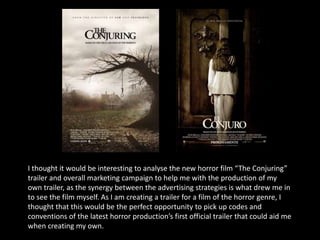
I thought it would be interesting to analyse the new horror film “The Conjuring”
trailer and overall marketing campaign to help me with the production of my
own trailer, as the synergy between the advertising strategies is what drew me in
to see the film myself. As I am creating a trailer for a film of the horror genre, I
thought that this would be the perfect opportunity to pick up codes and
conventions of the latest horror production’s first official trailer that could aid me
when creating my own.
To start off the analysis of the
official trailer, and a key feature that
attracted the audience to see the
film, is the background history of
the film being based on real life
events. “The Conjuring” follows the
lives of Lorraine and Ed Warren
(personal investigators who claim to
have been involved in over 10,000
cases during their careers) and the
Perron family, who moved to
Harrisville, Rhode Island (in 1971).
The story of the film follows the
Perron family through their
traumatic experiences with
paranormal activity in their house
with the aid of the Warrens. The
development of the film began
when Ed Warren himself
approached Tony DeRosa-Grund,
the producer, with a interview
recording with Carolyn Perron (the
mother) over 20 years ago about
their story. The images opposite are
of the real Perron family and the
Warrens.
The actors in the film include Lili Taylor as Carolyn Perron, and Vera Farmiga and
Patrick Wilson as the famous Lorraine and Ed Warren. The Conjuring was shot in
Wilmington, North Carolina on a $20 million budget, a large difference from the
$120 million budget that the director of ‘The Wolverine’ had on hand to make the
film. James Wan (the director) who also previously directed the critically acclaimed
‘Insidious’, released in 2009, has had a highly rated history of directing and is most
well known for directing the worldwide renowned movie ‘Saw’. The Conjuring was
produced by several studios, of which one includes New Line Cinema and distributed
Warner Bros. Pictures.
The date of release for Canada and US was the 19th of July of this year and then
slightly later on the 2nd of August in the UK and India. A teaser trailer, previously
shown at the 2012 New York Comic Con, kicked off the film’s marketing campaign in
February earlier this year. Throughout the campaign, the film was promoted heavily
as “based on a true story’ in the weeks leading up to the film’s release, trailers and
TV spots began to feature the real -life Perron family.
Although this film is a Blockbuster film, there is next to no CGI apart from some shots and
this is due to the fact that it is a horror film and not an action film such as ‘The Wolverine’,
which has the whole poster done in nearly all CGI. Instead of this, the tension is built up of
longer shots driven by sound to create the suspense and eerie atmosphere, and not through
quick, fast jump cuts.
Like a lot of trailers, ‘The Conjuring is split up into 3 acts. The first shot begins with an
introductory medium-long shot of all the characters piling into a grand house. They look
like a happy, stable family and by the dialogue in the scene by the children saying things like
“I call dibs on the rooms”, makes the audience believe that they have just moved into this
new house they are entering. The shot fades to black around 0:11, where a chilled
soundtrack kicks in and a few shots are displayed showing the Ident to the film, ‘Warner
Bros Pictures’. This creates a relaxed atmosphere to the beginning of the trailer. The song
used is a song released in 1968 called ‘Time of the Season’ by ‘The Zombies’. As the film
was set in 1971 this really translates and sets the era for the audience for the rest of the
trailer.
The first feel to the Mise-en-scene can be
seen in this first shot of the family
entering the house. The clothing of the
family is instantly a reflection of the
fashion and style of the 1970’s with the
family wearing warm tones such as
browns, oranges and yellows. These hues
were very popular of this decade which
connotes happiness and warmth. These
colours and connotations combined with
the visuals on screen of the smiling family
correlate together perfectly, showing them
to be happy, warm and welcoming.
The first extended scene takes place next and
lasts from 0:14 to 0:40. The scene begin with one
of the young female children counting from 1 and
on screen we see her spinning her mother
blindfolded so the audience knows they are
playing a game. The mother finishes counting to
ten and shouts “first clap!”, which is in turn
returned with a clap. We see one of the
daughters clap and we, as the audience, now
know how the game works (which is relevant for
the end of the scene and later in the trailer). The
innocence of the family is captured here.
We see the mother walk into a room, still
blindfolded and whispers (smiling) her daughters
name “April”. As she says this the camera is at a
medium long shot of the mother with the view of
the room in the background. A large antique
wardrobe doors open with a very loud diagetic
sound of a creak to a clothing filled space. The
music stops abruptly with the mother and the
shot fades to black. A sinister, eerie sound
follows.
The low menacing shrill covering the otherwise silence, creates a very uneasy atmosphere and
builds tension within the audience. This indicates to the audience that something is not quite
right. As the woman hears the creak and pauses in her steps she says again “Clap!”. We here the
screeching sound of the hangers of the clothing move and see only a pair of hands emerge
followed by a much slower clap than before. The mother walks towards the direction of the
wardrobe smiling, searching for the source of the clap (to win the game). She then says in a
playful almost childlike manner “I’m gonna get you now! … I can hear you breathing”. Just at this
moment, we hear a diagetic sound of very heavy breathing that would definitely not resonate
with the sound of a child breathing as the sinister booming sound grows.
As the audience, we know that none of the children are hiding in the wardrobe and so this builds
a lot of suspense and tension as we expect the mother to uncover a supernatural being.
Next, we here an echo of the youngest child laugh as she runs in from another room smiling.
She says as she enters “You took your blindfold off! I win! I was in Christine and Nancy’s
room!” This confuses the mother into looking horrified into the open wardrobe and pulling
aside the clothing to find nothing in there. Now, as the audience, we know that something is
not right and that some form of supernatural happenings are taking place from use
physically seeing the wardrobe door open and the clap of the hands as a viewer. This is the
point in the trailer were Todorov’s narrative theory can be applied as this is a disruption in
the story and the turning point from the original calmness to unusual circumstances.
After a fade to black transition, with a title
screen displaying “Based on A True Story”, an
establishing shot of the house is shown. By
including the fact that the film is based on a
true story into the trailer, this would massively
capture the audiences attention very quickly
and give the trailer, and film, automatic
credibility. As an audience we are always
encapsulated with the idea of knowing that
the happenings being presented to them
actually occurred in our world and so this is a
key component of the film in enticing an
audience to watch it.
By seeing the establishing shot of the
house at 1:03, you can see it’s grand scale
and antique style. There is a dark overcast
on the house, almost like a shroud, with
only a single white, clinical porch light
switched on. A slow zoom into the image
of the house lets the audience know that
this is the center of all events within the
trailer.
Next, a strange quiet background music begins as we see medium long shot from
behind the mother folding clothes in what is shown to be her new room. We hear a
child laughing and clapping as if the children were playing the game at the start of the
trailer even though it was established in the previous shot that it was really late at
night.
The woman walks out of her room and responds to this by saying “Girls!... It’s way past
your bedtime”. Silence follows this as she peers into the girls’ bedroom and finds them
all asleep in their room. A long pause with nothing but a diagetic sound of a clock
ticking can be heard until suddenly at 1:17, there is a huge crash as the mother turns
abruptly and horrified. The crashing turns out to be the paintings and pictures all along
the wall of the staircase swinging and crashing to the floor as we hear an overlap of
more laughing of a child echoing. This laugh is more menacing this time and feels as
though the destruction is creating its laughter
There are a series of quite slow fade to black transitions to span time as the mother walks
downstairs to investigate. A low booming echo is the overlay of sound here, as the woman
shouts in desperation and terror “who is that?!” She pauses as the unmissable sound of a door
very slowly creaking open as the camera pan around to an over the shoulder shot of an open
door which is revealing complete darkness. Out of nowhere all we here in another clap sound
emerge from the darkness, however this is non diagetic as we cannot see who is actually
clapping amongst the darkness.
The camera switches to a long shot from inside of the now open door looking out upon the
woman stood still. We know that all of the girls are upstairs asleep so it cannot be them and so
this leaves the audience asking questions like who is creating this torment? And why? A lot of
suspense is created here as she walks in through the cellar door, switches the light switch on
and the camera angle switches to a tilted extremely low angle long shot from the bottom of
the basement stairs. She threatens whatever is down there by saying “Whoever’s down there,
I’m going to lock you in now!” However, as she turns to walk out the door slams shut in her
face and the light bulb blows out as we hear the fizzling out sound of it dying.
Now in complete darkness we hear the woman in terror scrambling about, banging on the
door and screaming for help. This may make the audience have sympathy for the woman as
she is helpless in this situation. Next, we hear the sound of a match being struck and the
white hue flame light up the woman’s crouched body at the top of the stairs. The only sound
we hear is the woman’s heavy breathing depicting her fear. The shot shows a medium shot of
the woman holding the flame up with a shaking hand and an extended pause as she peers
down trying to make out something in the darkness.
Quickly, we see a pair of hands appear out of the dark above the woman’s shoulder and clap
twice. A fast jump cut ends the shot with the echo of the woman’s scream as the match
blows out. This is a typical sound of a horror movie which I feel defines the whole genre.
As the black background holds the screen a music box tune is played which mixes a childlike
innocence with an almost ominous feeling which is unsettling to the audience.
4 seconds of darkness stays on screen while the music box tune is played. The
echo of the woman’s scream would leave a lasting impression on the audience
to close the trailer effectively. This tune continues as the title is shown on
screen.

The conjuring Trailer Analysis

  • 1.
    Trailer analysis byAshleigh Foy
  • 2.
    I thought itwould be interesting to analyse the new horror film “The Conjuring” trailer and overall marketing campaign to help me with the production of my own trailer, as the synergy between the advertising strategies is what drew me in to see the film myself. As I am creating a trailer for a film of the horror genre, I thought that this would be the perfect opportunity to pick up codes and conventions of the latest horror production’s first official trailer that could aid me when creating my own.
  • 3.
    To start offthe analysis of the official trailer, and a key feature that attracted the audience to see the film, is the background history of the film being based on real life events. “The Conjuring” follows the lives of Lorraine and Ed Warren (personal investigators who claim to have been involved in over 10,000 cases during their careers) and the Perron family, who moved to Harrisville, Rhode Island (in 1971). The story of the film follows the Perron family through their traumatic experiences with paranormal activity in their house with the aid of the Warrens. The development of the film began when Ed Warren himself approached Tony DeRosa-Grund, the producer, with a interview recording with Carolyn Perron (the mother) over 20 years ago about their story. The images opposite are of the real Perron family and the Warrens.
  • 4.
    The actors inthe film include Lili Taylor as Carolyn Perron, and Vera Farmiga and Patrick Wilson as the famous Lorraine and Ed Warren. The Conjuring was shot in Wilmington, North Carolina on a $20 million budget, a large difference from the $120 million budget that the director of ‘The Wolverine’ had on hand to make the film. James Wan (the director) who also previously directed the critically acclaimed ‘Insidious’, released in 2009, has had a highly rated history of directing and is most well known for directing the worldwide renowned movie ‘Saw’. The Conjuring was produced by several studios, of which one includes New Line Cinema and distributed Warner Bros. Pictures. The date of release for Canada and US was the 19th of July of this year and then slightly later on the 2nd of August in the UK and India. A teaser trailer, previously shown at the 2012 New York Comic Con, kicked off the film’s marketing campaign in February earlier this year. Throughout the campaign, the film was promoted heavily as “based on a true story’ in the weeks leading up to the film’s release, trailers and TV spots began to feature the real -life Perron family.
  • 5.
    Although this filmis a Blockbuster film, there is next to no CGI apart from some shots and this is due to the fact that it is a horror film and not an action film such as ‘The Wolverine’, which has the whole poster done in nearly all CGI. Instead of this, the tension is built up of longer shots driven by sound to create the suspense and eerie atmosphere, and not through quick, fast jump cuts.
  • 6.
    Like a lotof trailers, ‘The Conjuring is split up into 3 acts. The first shot begins with an introductory medium-long shot of all the characters piling into a grand house. They look like a happy, stable family and by the dialogue in the scene by the children saying things like “I call dibs on the rooms”, makes the audience believe that they have just moved into this new house they are entering. The shot fades to black around 0:11, where a chilled soundtrack kicks in and a few shots are displayed showing the Ident to the film, ‘Warner Bros Pictures’. This creates a relaxed atmosphere to the beginning of the trailer. The song used is a song released in 1968 called ‘Time of the Season’ by ‘The Zombies’. As the film was set in 1971 this really translates and sets the era for the audience for the rest of the trailer.
  • 7.
    The first feelto the Mise-en-scene can be seen in this first shot of the family entering the house. The clothing of the family is instantly a reflection of the fashion and style of the 1970’s with the family wearing warm tones such as browns, oranges and yellows. These hues were very popular of this decade which connotes happiness and warmth. These colours and connotations combined with the visuals on screen of the smiling family correlate together perfectly, showing them to be happy, warm and welcoming.
  • 8.
    The first extendedscene takes place next and lasts from 0:14 to 0:40. The scene begin with one of the young female children counting from 1 and on screen we see her spinning her mother blindfolded so the audience knows they are playing a game. The mother finishes counting to ten and shouts “first clap!”, which is in turn returned with a clap. We see one of the daughters clap and we, as the audience, now know how the game works (which is relevant for the end of the scene and later in the trailer). The innocence of the family is captured here. We see the mother walk into a room, still blindfolded and whispers (smiling) her daughters name “April”. As she says this the camera is at a medium long shot of the mother with the view of the room in the background. A large antique wardrobe doors open with a very loud diagetic sound of a creak to a clothing filled space. The music stops abruptly with the mother and the shot fades to black. A sinister, eerie sound follows.
  • 9.
    The low menacingshrill covering the otherwise silence, creates a very uneasy atmosphere and builds tension within the audience. This indicates to the audience that something is not quite right. As the woman hears the creak and pauses in her steps she says again “Clap!”. We here the screeching sound of the hangers of the clothing move and see only a pair of hands emerge followed by a much slower clap than before. The mother walks towards the direction of the wardrobe smiling, searching for the source of the clap (to win the game). She then says in a playful almost childlike manner “I’m gonna get you now! … I can hear you breathing”. Just at this moment, we hear a diagetic sound of very heavy breathing that would definitely not resonate with the sound of a child breathing as the sinister booming sound grows. As the audience, we know that none of the children are hiding in the wardrobe and so this builds a lot of suspense and tension as we expect the mother to uncover a supernatural being.
  • 10.
    Next, we herean echo of the youngest child laugh as she runs in from another room smiling. She says as she enters “You took your blindfold off! I win! I was in Christine and Nancy’s room!” This confuses the mother into looking horrified into the open wardrobe and pulling aside the clothing to find nothing in there. Now, as the audience, we know that something is not right and that some form of supernatural happenings are taking place from use physically seeing the wardrobe door open and the clap of the hands as a viewer. This is the point in the trailer were Todorov’s narrative theory can be applied as this is a disruption in the story and the turning point from the original calmness to unusual circumstances.
  • 11.
    After a fadeto black transition, with a title screen displaying “Based on A True Story”, an establishing shot of the house is shown. By including the fact that the film is based on a true story into the trailer, this would massively capture the audiences attention very quickly and give the trailer, and film, automatic credibility. As an audience we are always encapsulated with the idea of knowing that the happenings being presented to them actually occurred in our world and so this is a key component of the film in enticing an audience to watch it. By seeing the establishing shot of the house at 1:03, you can see it’s grand scale and antique style. There is a dark overcast on the house, almost like a shroud, with only a single white, clinical porch light switched on. A slow zoom into the image of the house lets the audience know that this is the center of all events within the trailer.
  • 12.
    Next, a strangequiet background music begins as we see medium long shot from behind the mother folding clothes in what is shown to be her new room. We hear a child laughing and clapping as if the children were playing the game at the start of the trailer even though it was established in the previous shot that it was really late at night. The woman walks out of her room and responds to this by saying “Girls!... It’s way past your bedtime”. Silence follows this as she peers into the girls’ bedroom and finds them all asleep in their room. A long pause with nothing but a diagetic sound of a clock ticking can be heard until suddenly at 1:17, there is a huge crash as the mother turns abruptly and horrified. The crashing turns out to be the paintings and pictures all along the wall of the staircase swinging and crashing to the floor as we hear an overlap of more laughing of a child echoing. This laugh is more menacing this time and feels as though the destruction is creating its laughter
  • 13.
    There are aseries of quite slow fade to black transitions to span time as the mother walks downstairs to investigate. A low booming echo is the overlay of sound here, as the woman shouts in desperation and terror “who is that?!” She pauses as the unmissable sound of a door very slowly creaking open as the camera pan around to an over the shoulder shot of an open door which is revealing complete darkness. Out of nowhere all we here in another clap sound emerge from the darkness, however this is non diagetic as we cannot see who is actually clapping amongst the darkness. The camera switches to a long shot from inside of the now open door looking out upon the woman stood still. We know that all of the girls are upstairs asleep so it cannot be them and so this leaves the audience asking questions like who is creating this torment? And why? A lot of suspense is created here as she walks in through the cellar door, switches the light switch on and the camera angle switches to a tilted extremely low angle long shot from the bottom of the basement stairs. She threatens whatever is down there by saying “Whoever’s down there, I’m going to lock you in now!” However, as she turns to walk out the door slams shut in her face and the light bulb blows out as we hear the fizzling out sound of it dying.
  • 14.
    Now in completedarkness we hear the woman in terror scrambling about, banging on the door and screaming for help. This may make the audience have sympathy for the woman as she is helpless in this situation. Next, we hear the sound of a match being struck and the white hue flame light up the woman’s crouched body at the top of the stairs. The only sound we hear is the woman’s heavy breathing depicting her fear. The shot shows a medium shot of the woman holding the flame up with a shaking hand and an extended pause as she peers down trying to make out something in the darkness. Quickly, we see a pair of hands appear out of the dark above the woman’s shoulder and clap twice. A fast jump cut ends the shot with the echo of the woman’s scream as the match blows out. This is a typical sound of a horror movie which I feel defines the whole genre. As the black background holds the screen a music box tune is played which mixes a childlike innocence with an almost ominous feeling which is unsettling to the audience.
  • 15.
    4 seconds ofdarkness stays on screen while the music box tune is played. The echo of the woman’s scream would leave a lasting impression on the audience to close the trailer effectively. This tune continues as the title is shown on screen.