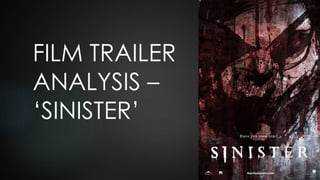
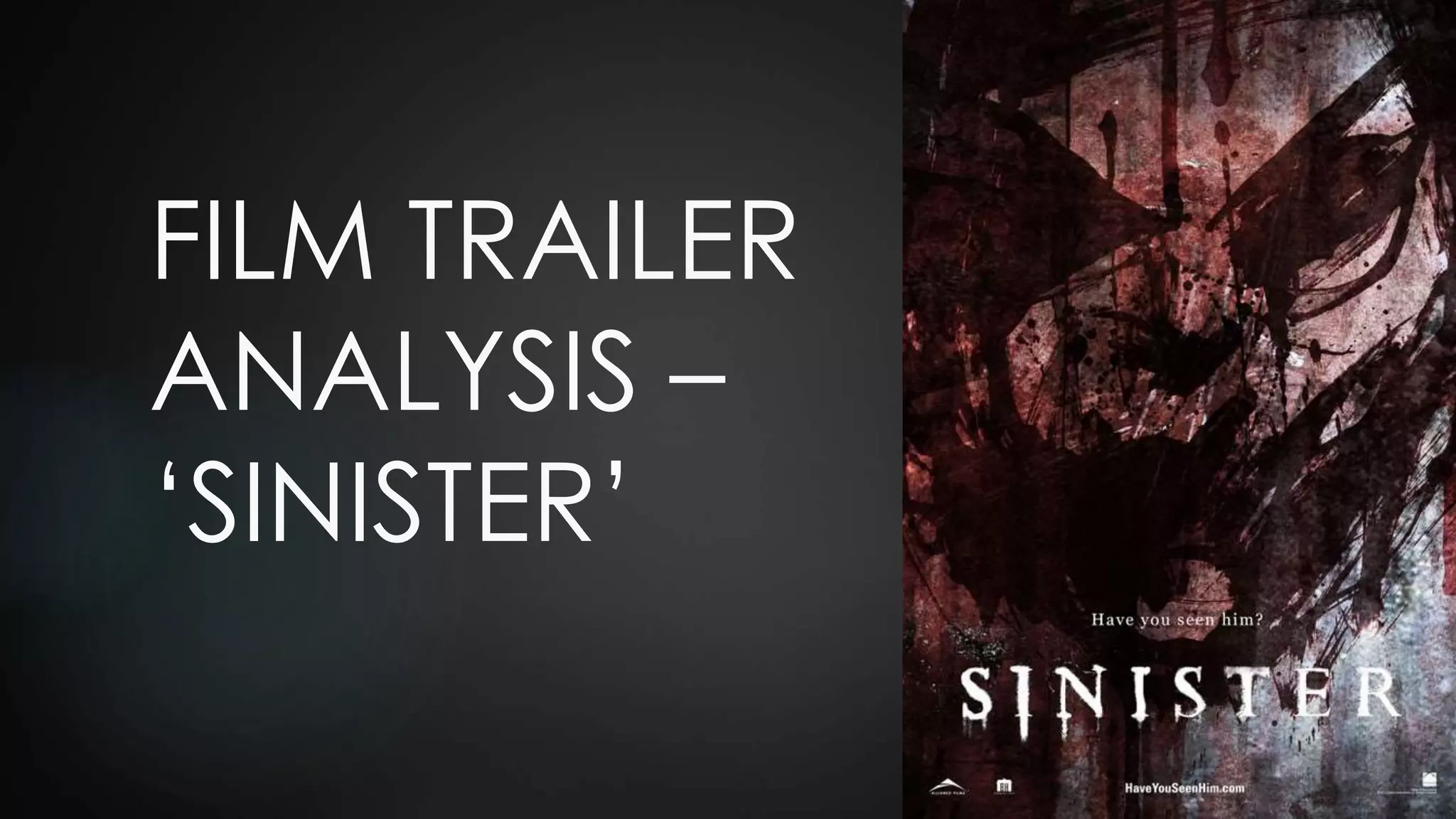
FILM TRAILER
ANALYSIS –
‘SINISTER’
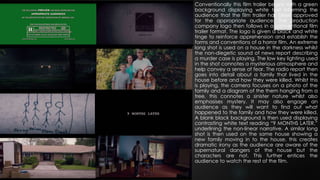
Conventionally this film trailer begins with a green
background displaying white text informing the
audience that the film trailer has been approved
for the appropriate audience. The production
company logo then follows in a conventional film
trailer format. The logo is given a black and white
tinge to reinforce apprehension and establish the
forms and conventions of a horror film. An extreme
long shot is used on a house in the darkness whilst
the non-diegetic sound of news report describing
a murder case is playing. The low key lighting used
in the shot connotes a mysterious atmosphere and
help convey a sense of fear. The radio report then
goes into detail about a family that lived in the
house before and how they were killed. Whilst this
is playing, the camera focuses on a photo of the
family and a diagram of the them hanging from a
tree, this connotes a sinister nature whilst also
emphasises mystery. It may also engage an
audience as they will want to find out what
happened to the family and how they were killed.
A blank black background is then used displaying
contrasting white text reading “9 MONTHS LATER,”
underlining the non-linear narrative. A similar long
shot is then used on the same house showing a
new family moving in to the house, this creates
dramatic irony as the audience are aware of the
supernatural dangers of the house but the
characters are not. This further entices the
audience to watch the rest of the film.
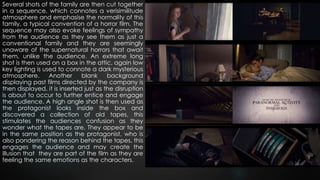
Several shots of the family are then cut together
in a sequence, which connotes a verisimilitude
atmosphere and emphasise the normality of this
family, a typical convention of a horror film. The
sequence may also evoke feelings of sympathy
from the audience as they see them as just a
conventional family and they are seemingly
unaware of the supernatural horrors that await
them, unlike the audience. An extreme long
shot is then used on a box in the attic, again low
key lighting is used to connote a dark mysterious
atmosphere. Another blank background
displaying past films directed by the company is
then displayed, it is inserted just as the disruption
is about to occur to further entice and engage
the audience. A high angle shot is then used as
the protagonist looks inside the box and
discovered a collection of old tapes, this
stimulates the audiences confusion as they
wonder what the tapes are, They appear to be
in the same position as the protagonist, who is
also pondering the reason behind the tapes, this
engages the audience and may create the
illusion that they are part of the film as they are
feeling the same emotions as the characters.
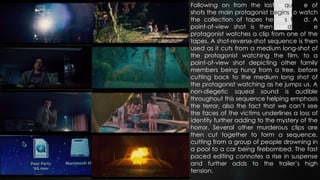
Following on from the last sequence of
shots the main protagonist begins to watch
the collection of tapes he has found. A
point-of-view shot is then used as the
protagonist watches a clip from one of the
tapes. A shot-reverse-shot sequence is then
used as it cuts from a medium long-shot of
the protagonist watching the film, to a
point-of-view shot depicting other family
members being hung from a tree, before
cutting back to the medium long shot of
the protagonist watching as he jumps us. A
non-diegetic squeal sound is audible
throughout this sequence helping emphasis
the terror, also the fact that we can’t see
the faces of the victims underlines a loss of
identity further adding to the mystery of the
horror. Several other murderous clips are
then cut together to form a sequence,
cutting from a group of people drowning in
a pool to a car being firebombed. The fast
paced editing connotes a rise in suspense
and further adds to the trailer’s high
tension.
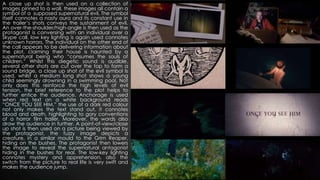
A close up shot is then used on a collection of
images pinned to a wall, these images all contain a
symbol of a supposed supernatural evil. The symbol
itself connotes a nasty aura and its constant use in
the trailer’s shots conveys the sustainment of evil.
An over-the-shoulder/high-angle is then used as the
protagonist is conversing with an individual over a
Skype call, low key lighting is again used connotes
unknown horrors. The individual on the other end of
the call appears to be delivering information about
the plot, claiming their house is haunted by a
supernatural being who “consumes the souls of
children.” Whilst this diegetic sound is audible,
several other shots are cut over the top to form a
sound bridge, a close up shot of the evil symbol Is
used, whilst a medium long shot shows a young
child seemingly drowning in a swimming pool. Not
only does this reinforce the high levels of evil
tension, the brief reference to the plot helps to
further entice the audience. Anchorage is used
when red text on a white background reads
“ONCE YOU SEE HIM,” the use of a dark red colour
not only makes the text stand out, it connotes
blood and death, highlighting to gory conventions
of a horror film trailer. Moreover, the words also
draw the audience in further. A point-of-view/close
up shot is then used on a picture being viewed by
the protagonist, the fuzzy image depicts a
creature, in a similar mould to the Grim Reaper,
hiding on the bushes. The protagonist then lowers
the image to reveal the supernatural antagonist
hiding in the bushes for real. The low-key lighting
connotes mystery and apprehension, also the
switch from the picture to real life is very swift and
makes the audience jump.
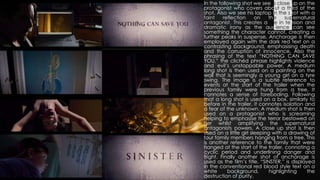
In the following shot we see a close up on the
protagonist who covers about a third of the
shot. Also we see his laptop in the shot with a
faint reflection on the supernatural
antagonist. This creates a rise in tension and
dramatic irony as the audience can see
something the character cannot, creating a
further peaks in suspense. Anchorage is then
employed again with the dark red text on a
contrasting background, emphasising death
and the corruption of innocence. Also the
phrasing of the text “NOTHING CAN SAVE
YOU,” the clichéd phrase highlights violence
and evil’s unstoppable power. A medium
long shot is then used on a painting on the
wall that is seemingly a young girl on a tyre
swing. The image is a subtle reference to
events at the start of the trailer when the
previous family were hung from a tree. It
connotes a sense of foreboding. Following
that a long shot is used on a box, similarly to
before in the trailer, it connotes isolation and
a fear of the unknown. A medium shot is then
used on a protagonist who is screaming
helping to emphasise the terror bestowed on
her whilst amplifying the supernatural
antagonists powers. A close up shot is then
used on a little girl sleeping with a drawing of
four family members hanging from a tree. This
is another reference to the family that were
hanged at the start of the trailer, connoting a
cyclic period and underlining danger and
fright. Finally another shot of anchorage is
used as the film’s title, “SINSTER,” is displayed
in the conventional red blood style text on a
white background, highlighting the
destruction of purity.
APPLYING MEDIA THEORY -
TODOROV
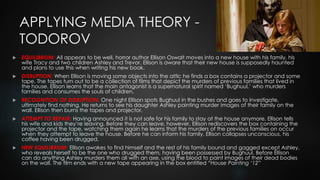
 EQUILIBRIUM: All appears to be well, horror author Ellison Oswalt moves into a new house with his family, his
wife Tracy and two children Ashley and Trevor. Ellison is aware that their new house is supposedly haunted
and plans to use this when writing his new book.
 DISRUPTION: When Ellison is moving some objects into the attic he finds a box contains a projector and some
tape. The tapes turn out to be a collection of films that depict the murders of previous families that lived in
the house. Ellison learns that the main antagonist is a supernatural spirit named ‘Bughuul,’ who murders
families and consumes the souls of children.
 RECOGNITION OF DISRUPTION: One night Ellison spots Bughuul in the bushes and goes to investigate,
ultimately find nothing. He returns to see his daughter Ashley painting murder images of their family on the
wall. Ellison then burns the tapes and projector.
 ATTEMPT TO REPAIR: Having announced it is not safe for his family to stay at the house anymore, Ellison tells
his wife and kids they’re leaving. Before they can leave, however, Ellison rediscovers the box containing the
projector and the tape, watching them again he learns that the murders of the previous families on occur
when they attempt to leave the house. Before he can inform his family, Ellison collapses unconscious, his
coffee having been drugged.
 NEW EQUILIBRIUM: Ellison awakes to find himself and the rest of his family bound and gagged except Ashley,
who reveals herself to be the one who drugged them, having been possessed by Bughuul. Before Ellison
can do anything Ashley murders them all with an axe, using the blood to paint images of their dead bodies
on the wall. The film ends with a new tape appearing in the box entitled “House Painting ‘12”
APPLYING MEDIA THEORY –
CHARACTER PROPP
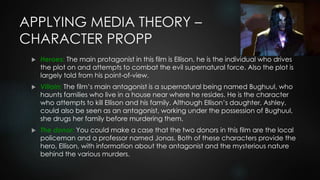
 Heroes: The main protagonist in this film is Ellison, he is the individual who drives
the plot on and attempts to combat the evil supernatural force. Also the plot is
largely told from his point-of-view.
 Villain: The film’s main antagonist is a supernatural being named Bughuul, who
haunts families who live in a house near where he resides. He is the character
who attempts to kill Ellison and his family. Although Ellison’s daughter, Ashley,
could also be seen as an antagonist, working under the possession of Bughuul,
she drugs her family before murdering them.
 The donor: You could make a case that the two donors in this film are the local
policeman and a professor named Jonas. Both of these characters provide the
hero, Ellison, with information about the antagonist and the mysterious nature
behind the various murders.
APPLYING MEDIA THEORY –
NARRATVE STRUCTURE
 Sinister is mainly a linear narrative as all the events proceed in a chronological order. However at the
start of the film there s seemingly a flash forward as it cuts from the death of the previous house
owners to the new family arriving. Furthermore, the film appears to be a closed narrative as there is
a clear beginning, middle and end and there is only one narrative strand running through it, making
the film a single plot. Moreover, the plot is parallel and first person is used.
 NARRATIVE COMPONENTS:
 Characters: The main characters in this film are Ellison and his family, Tracy, Ashley and Trevor. Also
the main antagonist Bughuul is an important feature to the narrative as he sets up the conflict
between good and evil.
 Events: Ellison and his family move into a new house and discover it is haunted by a supernatural
spirit who murders families and consumes the souls of children. The antagonist consumes Ashley and
uses her to murder the family.
 Locations: The main location is the new house and the surrounding areas where the family have
recently moved.
 Time: The timescale is very brief, it takes about five days for the plot to reach its climax, we also know
it takes place in 2012.
 Issues/themes: The main issues and themes of the film are death and the destruction of innocence.
APPLYING MEDIA THEORY
REPRESENTATION
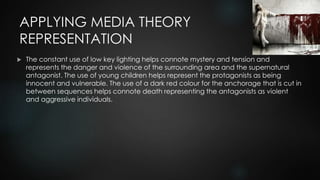
 The constant use of low key lighting helps connote mystery and tension and
represents the danger and violence of the surrounding area and the supernatural
antagonist. The use of young children helps represent the protagonists as being
innocent and vulnerable. The use of a dark red colour for the anchorage that is cut in
between sequences helps connote death representing the antagonists as violent
and aggressive individuals.

Film trailer analysis – ‘Sinister’

  • 1.
  • 2.
    Conventionally this filmtrailer begins with a green background displaying white text informing the audience that the film trailer has been approved for the appropriate audience. The production company logo then follows in a conventional film trailer format. The logo is given a black and white tinge to reinforce apprehension and establish the forms and conventions of a horror film. An extreme long shot is used on a house in the darkness whilst the non-diegetic sound of news report describing a murder case is playing. The low key lighting used in the shot connotes a mysterious atmosphere and help convey a sense of fear. The radio report then goes into detail about a family that lived in the house before and how they were killed. Whilst this is playing, the camera focuses on a photo of the family and a diagram of the them hanging from a tree, this connotes a sinister nature whilst also emphasises mystery. It may also engage an audience as they will want to find out what happened to the family and how they were killed. A blank black background is then used displaying contrasting white text reading “9 MONTHS LATER,” underlining the non-linear narrative. A similar long shot is then used on the same house showing a new family moving in to the house, this creates dramatic irony as the audience are aware of the supernatural dangers of the house but the characters are not. This further entices the audience to watch the rest of the film.
  • 3.
    Several shots ofthe family are then cut together in a sequence, which connotes a verisimilitude atmosphere and emphasise the normality of this family, a typical convention of a horror film. The sequence may also evoke feelings of sympathy from the audience as they see them as just a conventional family and they are seemingly unaware of the supernatural horrors that await them, unlike the audience. An extreme long shot is then used on a box in the attic, again low key lighting is used to connote a dark mysterious atmosphere. Another blank background displaying past films directed by the company is then displayed, it is inserted just as the disruption is about to occur to further entice and engage the audience. A high angle shot is then used as the protagonist looks inside the box and discovered a collection of old tapes, this stimulates the audiences confusion as they wonder what the tapes are, They appear to be in the same position as the protagonist, who is also pondering the reason behind the tapes, this engages the audience and may create the illusion that they are part of the film as they are feeling the same emotions as the characters.
  • 4.
    Following on fromthe last sequence of shots the main protagonist begins to watch the collection of tapes he has found. A point-of-view shot is then used as the protagonist watches a clip from one of the tapes. A shot-reverse-shot sequence is then used as it cuts from a medium long-shot of the protagonist watching the film, to a point-of-view shot depicting other family members being hung from a tree, before cutting back to the medium long shot of the protagonist watching as he jumps us. A non-diegetic squeal sound is audible throughout this sequence helping emphasis the terror, also the fact that we can’t see the faces of the victims underlines a loss of identity further adding to the mystery of the horror. Several other murderous clips are then cut together to form a sequence, cutting from a group of people drowning in a pool to a car being firebombed. The fast paced editing connotes a rise in suspense and further adds to the trailer’s high tension.
  • 5.
    A close upshot is then used on a collection of images pinned to a wall, these images all contain a symbol of a supposed supernatural evil. The symbol itself connotes a nasty aura and its constant use in the trailer’s shots conveys the sustainment of evil. An over-the-shoulder/high-angle is then used as the protagonist is conversing with an individual over a Skype call, low key lighting is again used connotes unknown horrors. The individual on the other end of the call appears to be delivering information about the plot, claiming their house is haunted by a supernatural being who “consumes the souls of children.” Whilst this diegetic sound is audible, several other shots are cut over the top to form a sound bridge, a close up shot of the evil symbol Is used, whilst a medium long shot shows a young child seemingly drowning in a swimming pool. Not only does this reinforce the high levels of evil tension, the brief reference to the plot helps to further entice the audience. Anchorage is used when red text on a white background reads “ONCE YOU SEE HIM,” the use of a dark red colour not only makes the text stand out, it connotes blood and death, highlighting to gory conventions of a horror film trailer. Moreover, the words also draw the audience in further. A point-of-view/close up shot is then used on a picture being viewed by the protagonist, the fuzzy image depicts a creature, in a similar mould to the Grim Reaper, hiding on the bushes. The protagonist then lowers the image to reveal the supernatural antagonist hiding in the bushes for real. The low-key lighting connotes mystery and apprehension, also the switch from the picture to real life is very swift and makes the audience jump.
  • 6.
    In the followingshot we see a close up on the protagonist who covers about a third of the shot. Also we see his laptop in the shot with a faint reflection on the supernatural antagonist. This creates a rise in tension and dramatic irony as the audience can see something the character cannot, creating a further peaks in suspense. Anchorage is then employed again with the dark red text on a contrasting background, emphasising death and the corruption of innocence. Also the phrasing of the text “NOTHING CAN SAVE YOU,” the clichéd phrase highlights violence and evil’s unstoppable power. A medium long shot is then used on a painting on the wall that is seemingly a young girl on a tyre swing. The image is a subtle reference to events at the start of the trailer when the previous family were hung from a tree. It connotes a sense of foreboding. Following that a long shot is used on a box, similarly to before in the trailer, it connotes isolation and a fear of the unknown. A medium shot is then used on a protagonist who is screaming helping to emphasise the terror bestowed on her whilst amplifying the supernatural antagonists powers. A close up shot is then used on a little girl sleeping with a drawing of four family members hanging from a tree. This is another reference to the family that were hanged at the start of the trailer, connoting a cyclic period and underlining danger and fright. Finally another shot of anchorage is used as the film’s title, “SINSTER,” is displayed in the conventional red blood style text on a white background, highlighting the destruction of purity.
  • 7.
    APPLYING MEDIA THEORY- TODOROV  EQUILIBRIUM: All appears to be well, horror author Ellison Oswalt moves into a new house with his family, his wife Tracy and two children Ashley and Trevor. Ellison is aware that their new house is supposedly haunted and plans to use this when writing his new book.  DISRUPTION: When Ellison is moving some objects into the attic he finds a box contains a projector and some tape. The tapes turn out to be a collection of films that depict the murders of previous families that lived in the house. Ellison learns that the main antagonist is a supernatural spirit named ‘Bughuul,’ who murders families and consumes the souls of children.  RECOGNITION OF DISRUPTION: One night Ellison spots Bughuul in the bushes and goes to investigate, ultimately find nothing. He returns to see his daughter Ashley painting murder images of their family on the wall. Ellison then burns the tapes and projector.  ATTEMPT TO REPAIR: Having announced it is not safe for his family to stay at the house anymore, Ellison tells his wife and kids they’re leaving. Before they can leave, however, Ellison rediscovers the box containing the projector and the tape, watching them again he learns that the murders of the previous families on occur when they attempt to leave the house. Before he can inform his family, Ellison collapses unconscious, his coffee having been drugged.  NEW EQUILIBRIUM: Ellison awakes to find himself and the rest of his family bound and gagged except Ashley, who reveals herself to be the one who drugged them, having been possessed by Bughuul. Before Ellison can do anything Ashley murders them all with an axe, using the blood to paint images of their dead bodies on the wall. The film ends with a new tape appearing in the box entitled “House Painting ‘12”
  • 8.
    APPLYING MEDIA THEORY– CHARACTER PROPP  Heroes: The main protagonist in this film is Ellison, he is the individual who drives the plot on and attempts to combat the evil supernatural force. Also the plot is largely told from his point-of-view.  Villain: The film’s main antagonist is a supernatural being named Bughuul, who haunts families who live in a house near where he resides. He is the character who attempts to kill Ellison and his family. Although Ellison’s daughter, Ashley, could also be seen as an antagonist, working under the possession of Bughuul, she drugs her family before murdering them.  The donor: You could make a case that the two donors in this film are the local policeman and a professor named Jonas. Both of these characters provide the hero, Ellison, with information about the antagonist and the mysterious nature behind the various murders.
  • 9.
    APPLYING MEDIA THEORY– NARRATVE STRUCTURE  Sinister is mainly a linear narrative as all the events proceed in a chronological order. However at the start of the film there s seemingly a flash forward as it cuts from the death of the previous house owners to the new family arriving. Furthermore, the film appears to be a closed narrative as there is a clear beginning, middle and end and there is only one narrative strand running through it, making the film a single plot. Moreover, the plot is parallel and first person is used.  NARRATIVE COMPONENTS:  Characters: The main characters in this film are Ellison and his family, Tracy, Ashley and Trevor. Also the main antagonist Bughuul is an important feature to the narrative as he sets up the conflict between good and evil.  Events: Ellison and his family move into a new house and discover it is haunted by a supernatural spirit who murders families and consumes the souls of children. The antagonist consumes Ashley and uses her to murder the family.  Locations: The main location is the new house and the surrounding areas where the family have recently moved.  Time: The timescale is very brief, it takes about five days for the plot to reach its climax, we also know it takes place in 2012.  Issues/themes: The main issues and themes of the film are death and the destruction of innocence.
  • 10.
    APPLYING MEDIA THEORY REPRESENTATION The constant use of low key lighting helps connote mystery and tension and represents the danger and violence of the surrounding area and the supernatural antagonist. The use of young children helps represent the protagonists as being innocent and vulnerable. The use of a dark red colour for the anchorage that is cut in between sequences helps connote death representing the antagonists as violent and aggressive individuals.