The
Complete
VisualGuideto
Building
a House
John Carroll and Chuck Lockhart
The
Complete
VisualGuideto
Building
a House
The
Complete
VisualGuideto
Building
a House
C
John Carroll and Chuck Lockhart
Text © 2013 by The Taunton Press, Inc.
Illustrations © 2013 by The Taunton Press, Inc.
All rights reserved.
Pp
The Taunton Press, Inc., 63 South Main Street, PO Box 5506, Newtown, CT 06470-5506
e-mail: tp@taunton.com
Editors: Peter Chapman, Scott Gibson
Copy editor: Diane sinitsky
Indexer: jim curtis
Jacket/Cover design: jean-marc Trodaec
Interior design: carol singer | notice design
Layout: Cathy Cassidy, chuck lockhart
Illustrator: chuck lockhart
The following names/manufacturers appearing in The Complete Visual Guide to Building a House
are trademarks: Backer-On™; C. H. Hanson® Pivot Square™; CavClear®; Cor-A-Vent®; Dap® Presto Patch®; Deck-
Armor™; Delta®-MS; DensShield®; DrainWrap™; DuPont StraightFlash™; DuPont™ FlexWrap™; Durock®; Festool®;
FoamSealR™; HardieBacker®; Home Slicker®; Ice & Water Shield®; Jambsill Guard®; Level-Best®; McFeely’s®;
MortarNet®; Osmose®; Porter-Cable®; RainDrop®; RockRipper®; Roofer’s Select™; Schluter®-DITRA; Sheetrock®;
Shingle Mate®; Simpson Strong-Tie®; Stanley® Quick Square®; StormGuard®; Super ThoroSeal®; Sure-Tite™;
SureCorner™; SureSill™ HeadFlash™ and HeadFlash-Flex™; Swanson® Big 12® Speed® Square; T-JAK®; Tapcon®;
Telpro® Panellift®; Timberline®; Titanium® 30; Typar®; Tyvek® StuccoWrap®; Warm-N-Dri®; Warner® Tool;
WaterWay™; Weathermate™ Sill Pan; WeatherTrek®; WinterGuard™; Wolman™; WonderBoard®
Library of Congress Cataloging-in-Publication Data
Carroll, John (John Michael), 1949-
The complete visual guide to building a house / John Carroll and Chuck Lockhart.
pages cm
Includes index.
E-Book ISBN 978-1-62710-608-5
1. House construction--Handbooks, manuals, etc. 2. House construction--Pictorial works. I. Lockhart, Chuck. II. Title.
TH4813.C37 2014
690’.837--dc23
2013048589
Printed in the United States of America
10 9 8 7 6 5 4 3 2 1
About Your Safety: Construction is inherently dangerous. Using hand or power tools improperly or
ignoring safety practices can lead to permanent injury or even death. Don’t try to perform operations
you learn about here (or elsewhere) unless you’re certain they are safe for you. If something about an
operation doesn’t feel right, don’t do it. Look for another way. We want you to enjoy working on your
home, so please keep safety foremost in your mind.
For my mother, Emily J. Carroll (1923–2012)
The idea for this book came from Steve Culpepper, who, at the
time, served as executive book editor for The Taunton Press. In looking at the
available general guides to residential building, Steve found that most were
several decades old and contained outdated information. He felt there was a
need for a reference that reflected today’s building industry, and, to my good
fortune, he thought I should be the one to write it.
Shortly after I started writing this book, however, Steve left Taunton and
Peter Chapman took over as book editor. In addition to all his other duties,
Peter served as the primary editor of this book. Peter’s help proved to be
invaluable. I am especially grateful for his forbearance with me as a writer
whose “cup runneth over” on a regular basis. In chapter after chapter, I sub-
mitted too many words and too much information, so Peter would patiently
work with me to pare the text down to a manageable size. With Peter’s help, I
was able to identify the essential information and present it in a much more
concise manner. His insights and suggestions made this book shorter, clearer,
and better organized.
My in-depth discussion of common building procedures would be confus-
ing without accompanying drawings. To graphically represent what I’ve
described, The Taunton Press brought in one of the finest illustrators in the
business, Chuck Lockhart. Having worked as art director for Fine Homebuilding
magazine for 18 years, Chuck brought a wealth of experience to this project.
His drawings are more extensive and provide more detail than would have
been possible with photographs, which require access to building projects at
key moments in the job. Anything I could describe Chuck could draw. Chuck
was able to highlight key details through the use of color and shading; in
many drawings, Chuck skillfully employed such devices as cutaway views and
cross-sectional drawings to show how the details of the job fit into the whole.
After all the parts of this book were produced, the unenviable task of
putting them together fell to Scott Gibson. A skilled carpenter and an accom-
plished writer and editor, Scott went through every word of text and every
drawing. In addition to looking for and finding mistakes, inconsistencies, and
omissions, Scott extracted information from the running text and applied it,
in the form of labels, to the drawings. His painstaking attention to detail,
his focus on accuracy, and his knowledge of current building practices—
especially the latest in building science—were extremely helpful and greatly
improved the quality of this book.
—John Carroll
ACKNOWLEDGMENTS
Building the Structure	 4
	 Chapter 1
	 Building Foundations	6
	Chapter 2
	 Framing Floors, Walls, and Ceilings	 50
	Chapter 3
	 Framing Roofs 1: Raftered Roofs	 98
	 Chapter 4
	 Framing Roofs 2: Trusses, Eaves, Rakes,
	 and Sheathing	142
	 Closing the House to the Weather	 182
	Chapter 5
	 Roofing the House	184
	 Chapter 6
	 Installing Windows, Exterior Doors,
	 Siding, and Trim	 231
	Chapter 7
	 Controlling Moisture in the Ground
	 and in the Air	278
	
pa r t tw o
pa r t o n e
	 introduction
table of contents
Finishing the House	 308
	 Chapter 8
	 Installing Wall and Floor Coverings	 310
	Chapter 9
	 Hanging Doors	354
	Chapter 10
	 Installing Trim and Cabinets	 396
	Chapter 11
	 Building Stairs	442
	appendices
	 Conversions	 500
	Base-1 Proportions of Standard Roof Pitches	 501
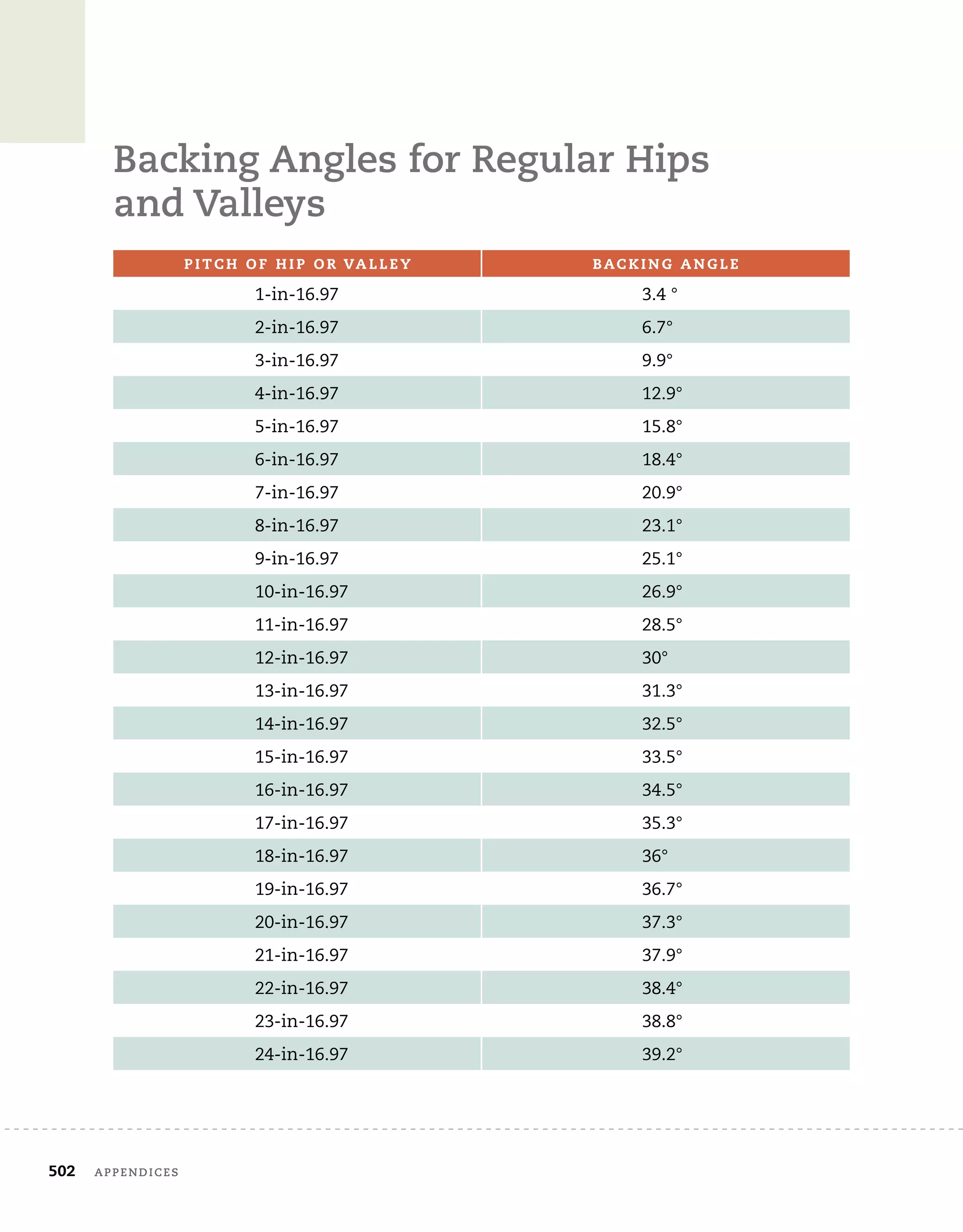
	Backing Angles for Regular Hips and Valleys	 502
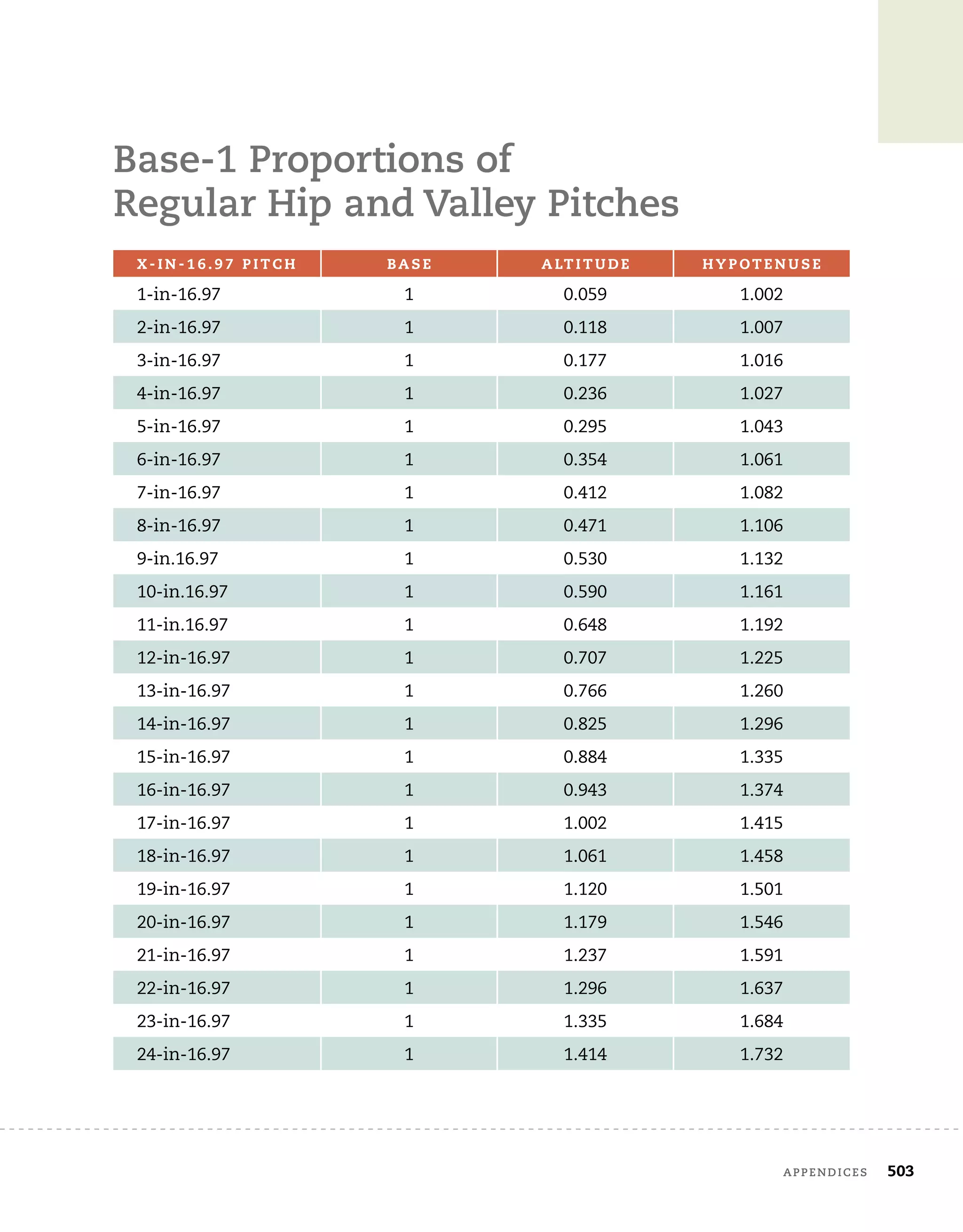
	Base-1 Proportions of Regular Hips and Valley Pitches	 503
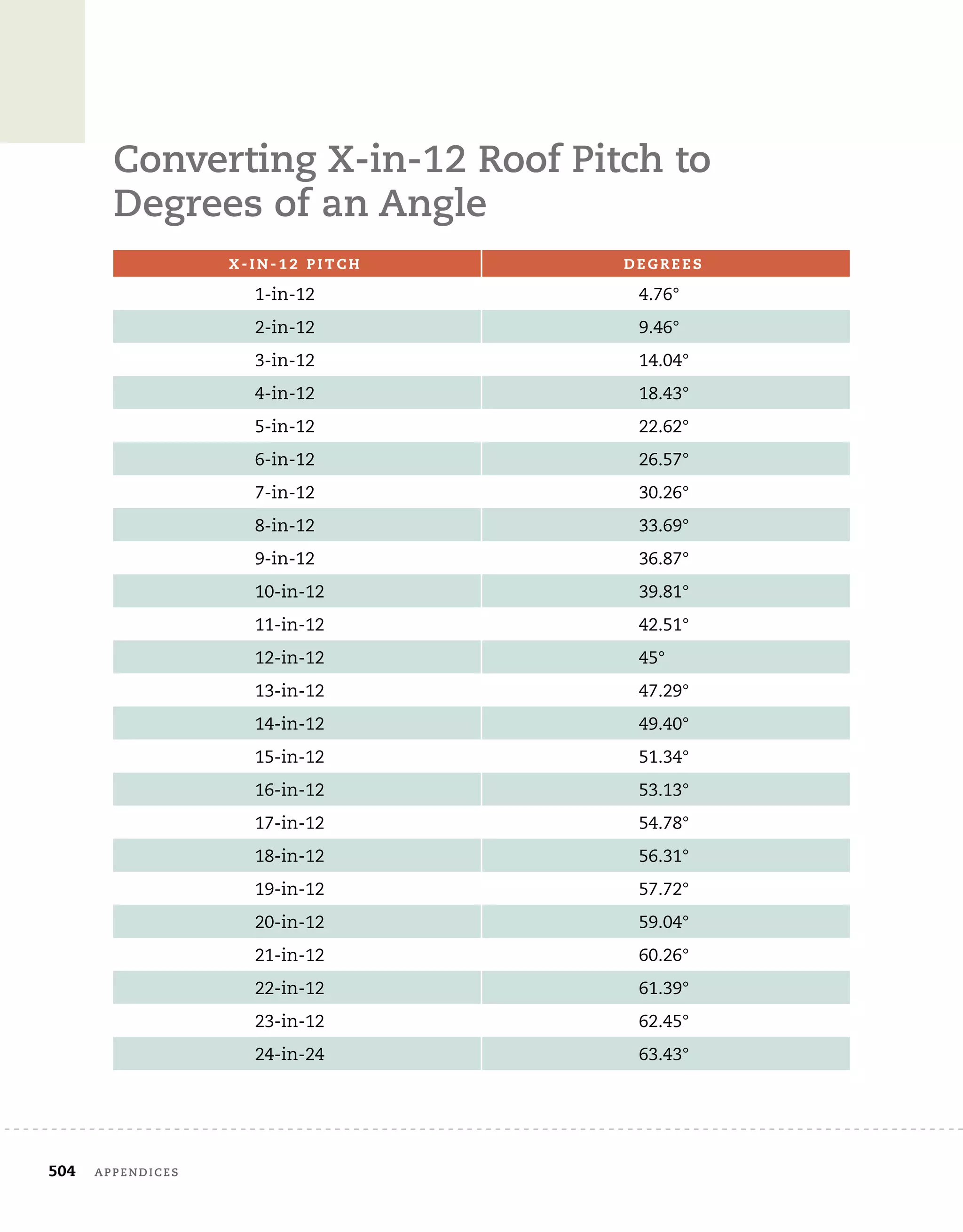
	Converting X-in-12 Roof Pitch to Degrees of an Angle	 504
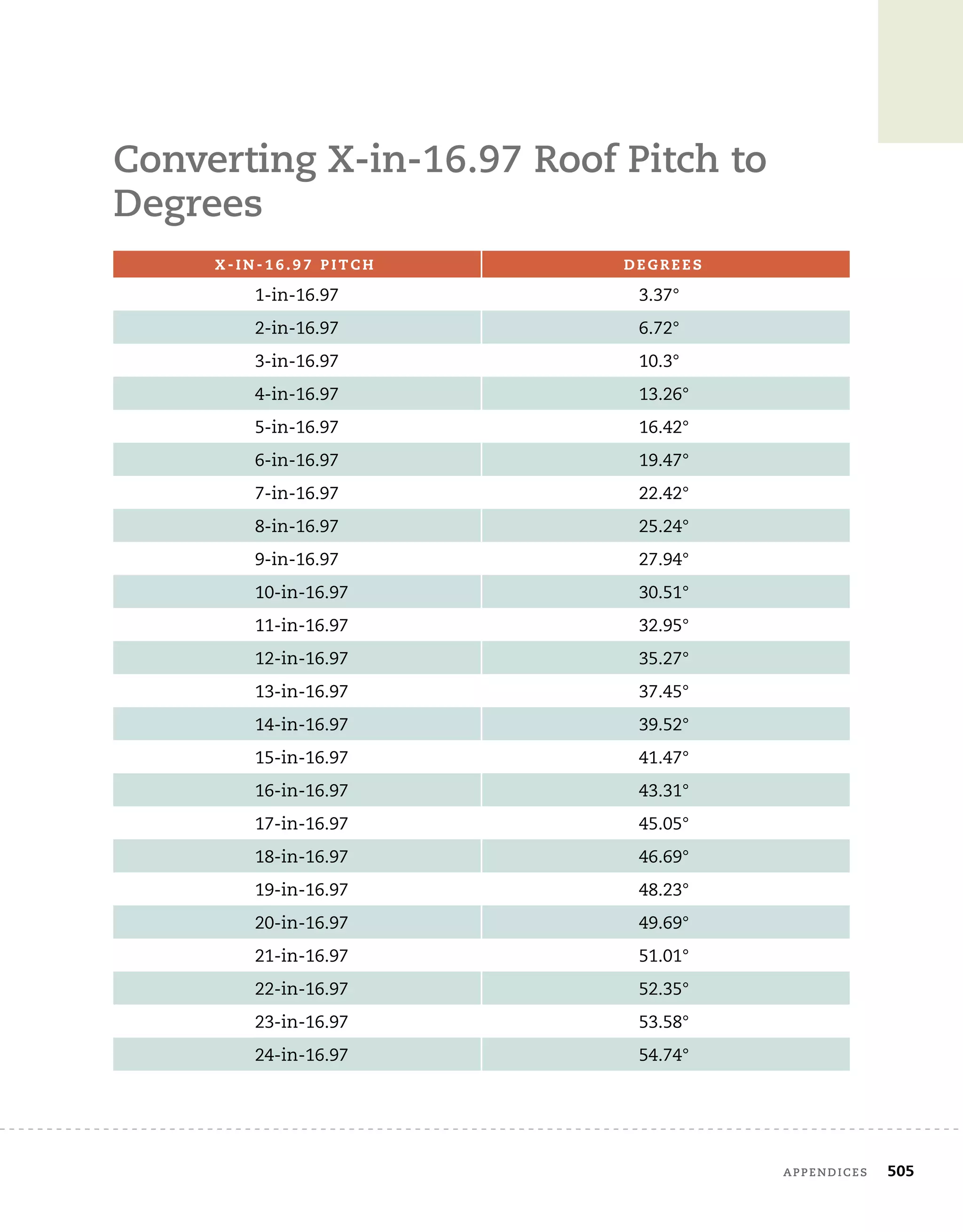
	Converting X-in-16.97 Roof Pitch to Degrees	 505
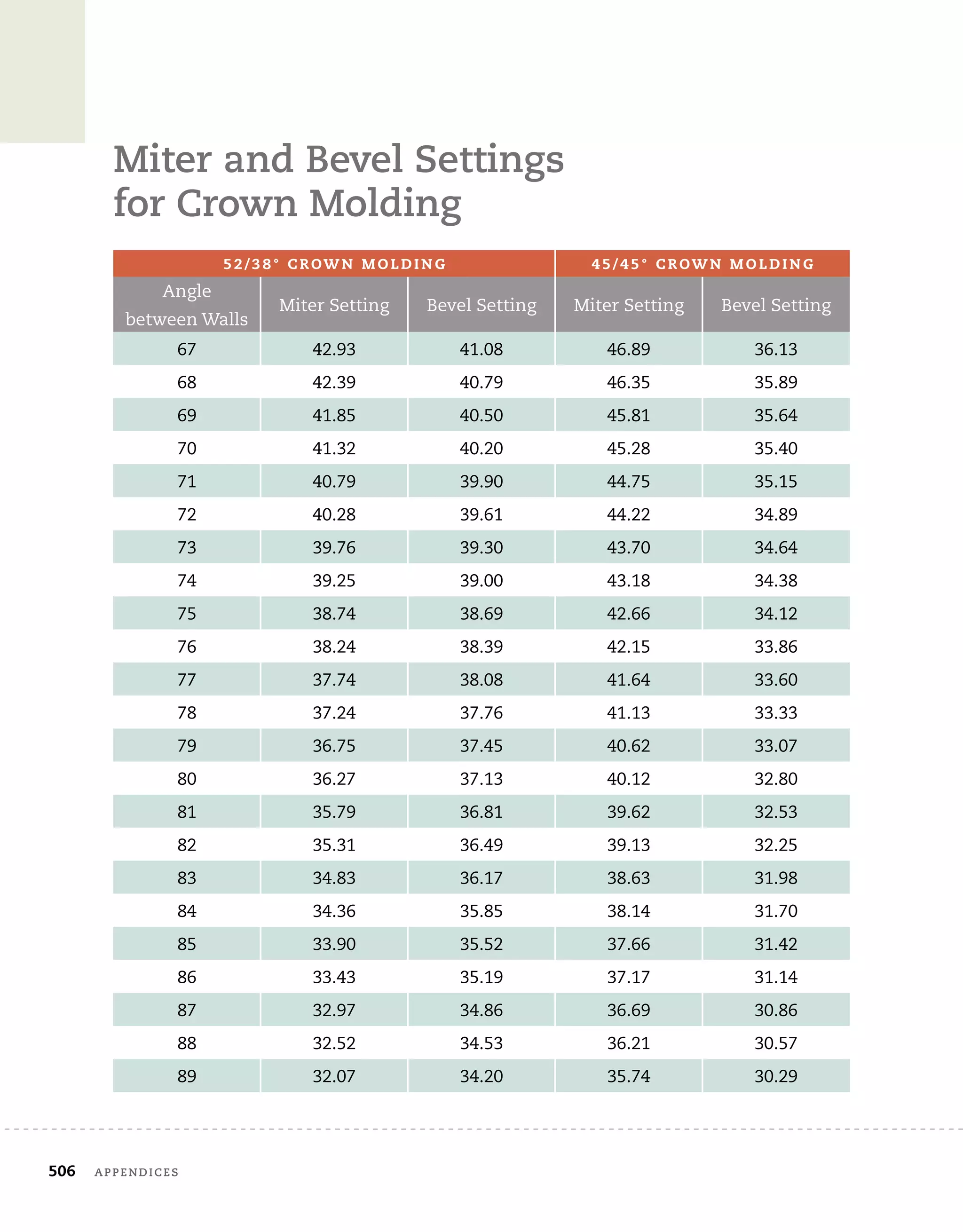
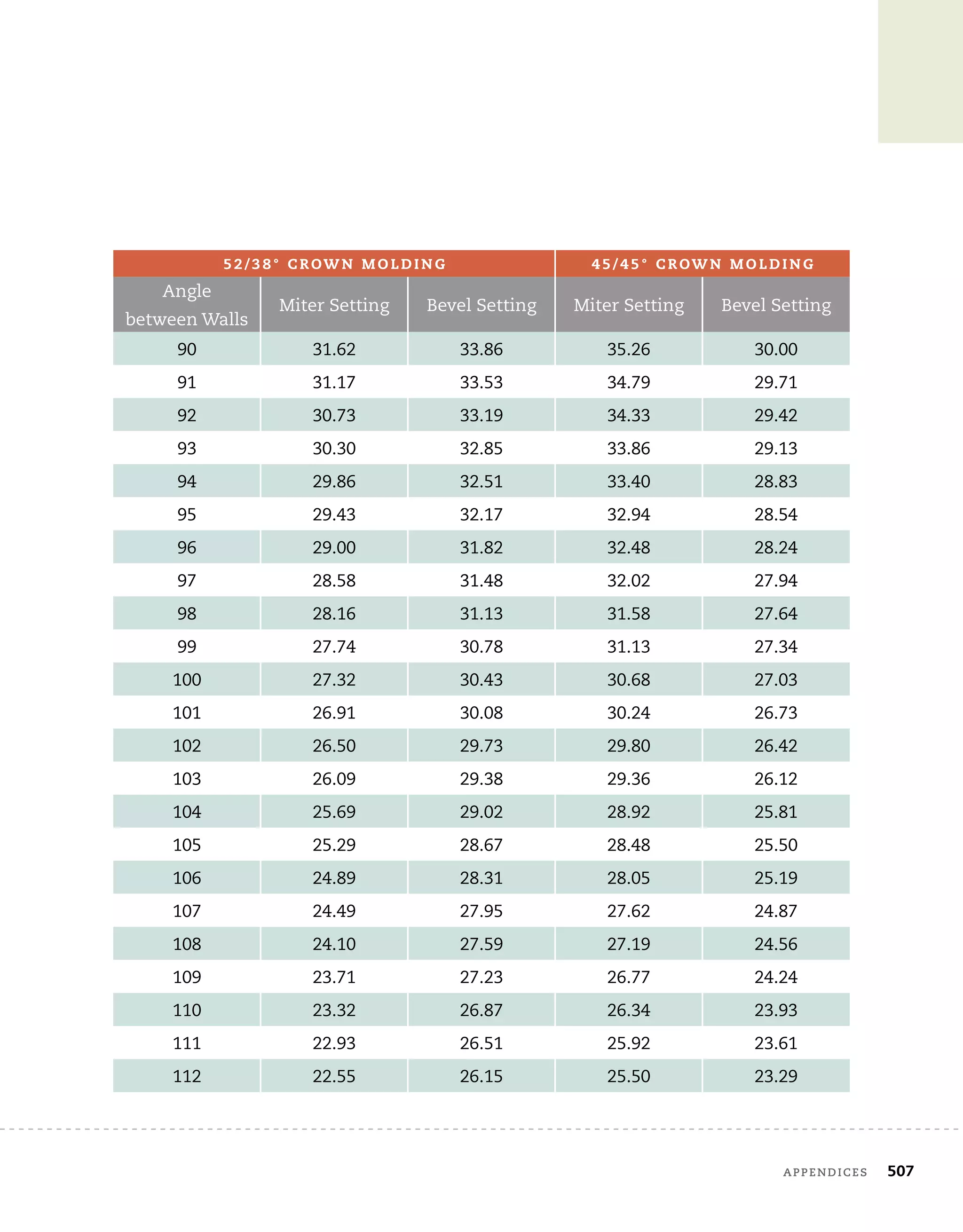
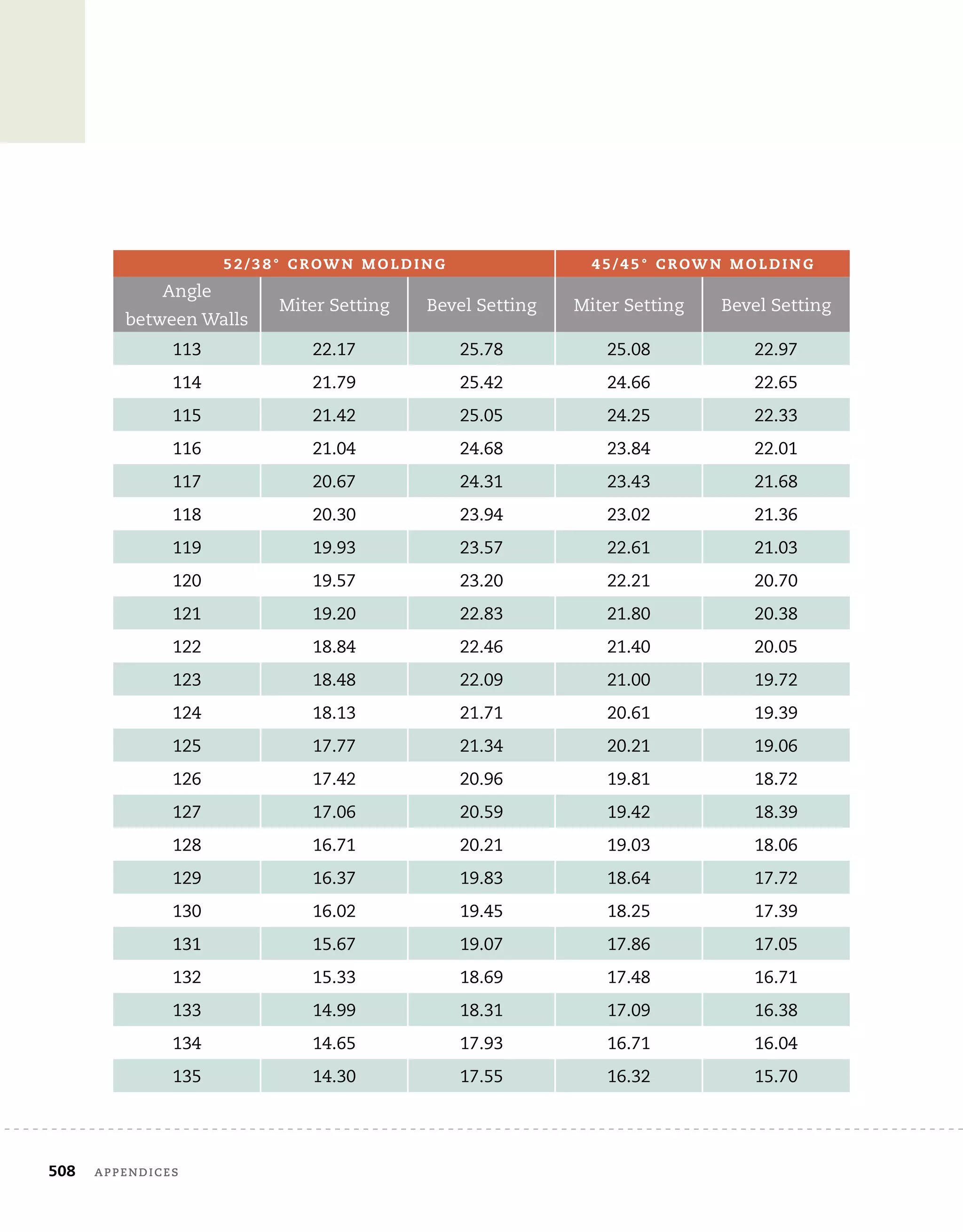
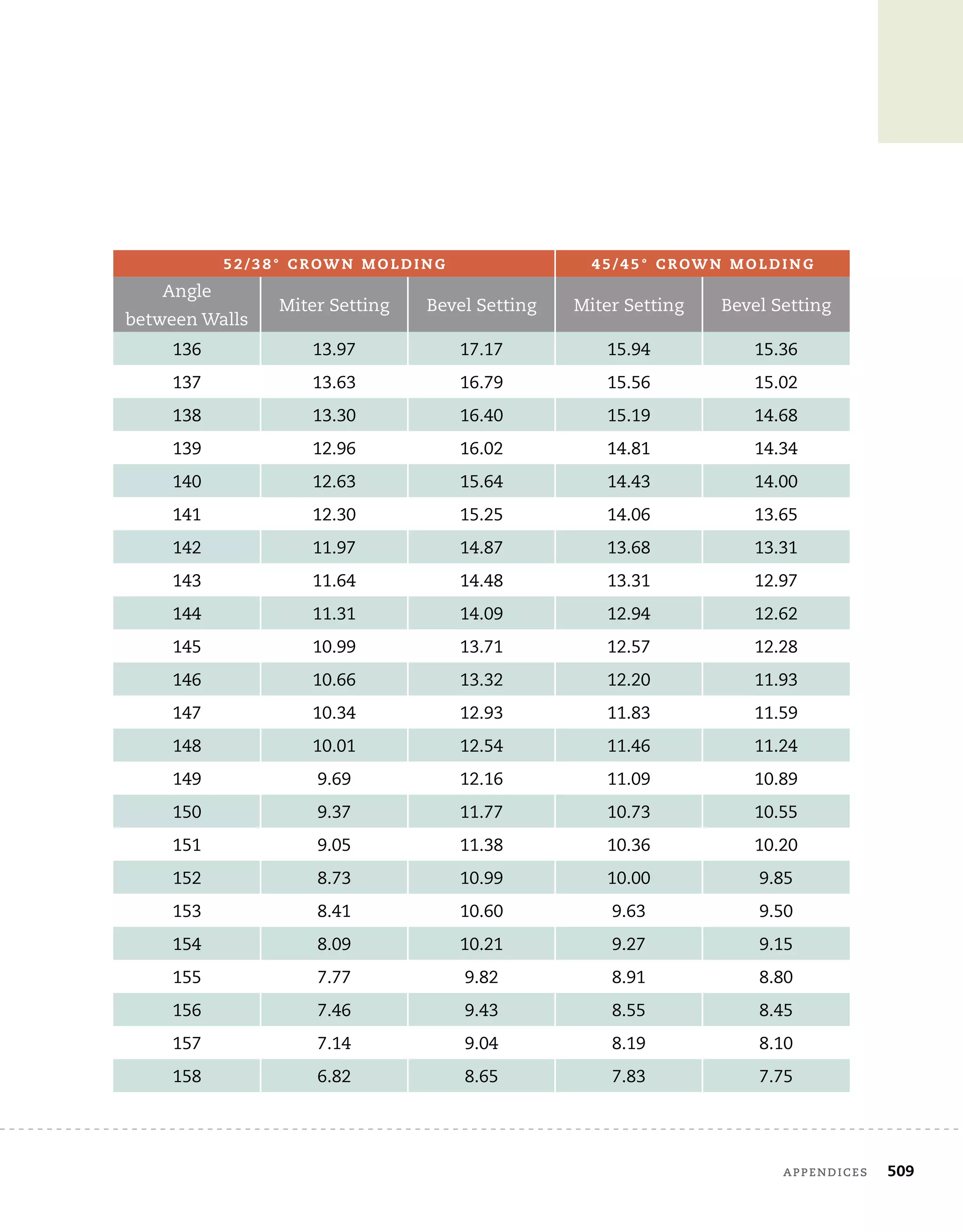
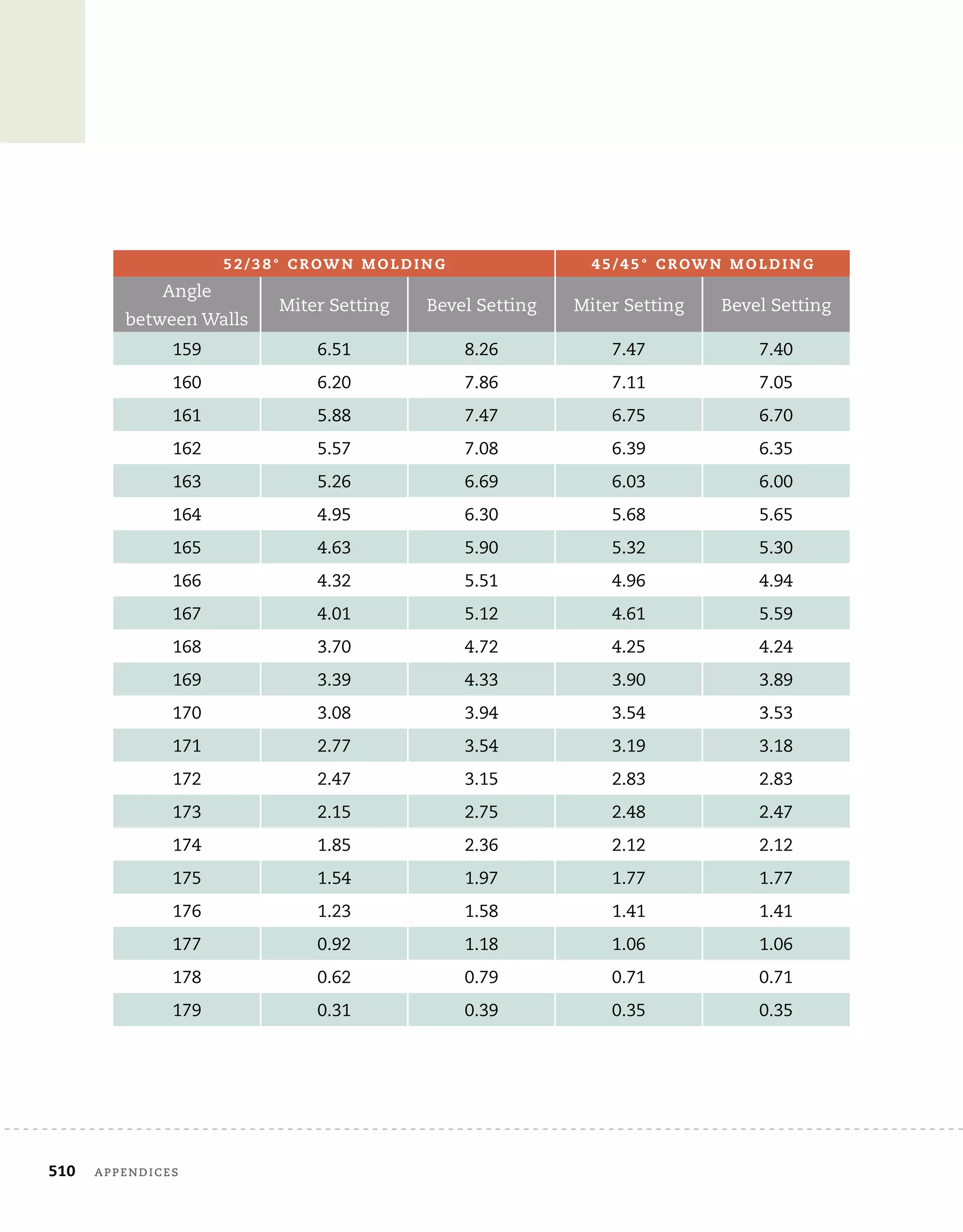
	Miter and Bevel Settings for Crown Molding	 506
	Index	 514
pa r t t h r ee
2	
In America, houses are built in areas where several feet of
snow accumulate, where hurricanes can be expected, or where tempera-
tures exceed 100°F. In some areas, all these conditions might occur within
the same year. Within these very different climatic regions, furthermore,
individual building sites pose a wide variety of challenges. The surface of
the land might slope steeply; the soil might contain expansive clay or bed-
rock; or there might be too much moisture in the ground.
To meet these and other challenges, builders have to adjust the design
of their houses to the climatic and topographical conditions of the area
they live in. In Florida, for example, roof structures must be tied down
with steel straps to keep them from being lifted off the walls during hur-
ricanes. In Maine, on the other hand, roof frames must be beefed up to keep
them from collapsing under the weight of several feet of snow. These mea-
sures, which are required by building codes, go a long way toward creating
durable houses.
Beyond simply building houses that last, however, builders need
to create houses that perform. Once viewed as basic shelters from the
extremes of the weather, houses are now seen as climate-controlled
enclaves. Most people expect the environment inside their house to be
comfortable year-round, no matter how brutal the weather is outside.
Accomplishing this goal in the face of ever-increasing energy costs is one of
the biggest challenges confronting builders today. Again, the plan of attack
has to be tailored to the location of the house. A house that keeps a family
warm during the winter on the Northern Plains has to be built much differ-
ently than a house that provides relief from the heat and humidity in the
Deep South.
The diverse local requirements of home building coupled with an
ever-expanding choice of building materials, tools, and systems present a
fundamental problem for a book like this one. Because there are so many
approaches and options, it’s difficult to decide what to discuss and how
detailed that discussion should be. As on any major building project, there
have been many hard decisions to make and there have been many inter-
esting and worthwhile topics that I could not include in this book.
introduction
The first thing I decided to drop was a comparative analysis of different
building systems. There are at least a half-dozen alternatives to the light
wood-framed house in America. However, builders and homeowners con-
tinue to vote with their wallets for the wood-framed house, which accounts
for 90% of the houses in the United States and Canada. Rather than devote
a good portion of this book to a discussion of the strengths and weaknesses
of the other systems, I chose to focus on the one system that dominates the
housing market: the wood-framed house.
Along the same lines, I’ve focused on mainstream materials when
describing the rest of the house. In the chapter on foundations, for example,
I concentrated on concrete and masonry, and in the chapter on roofing,
I focused on asphalt shingles because most houses in America are built
with those materials. If you happen to use materials that are outside of the
mainstream, there’s a good chance that the installation techniques pre-
sented here will work, with minor adjustments, with the materials you use.
I’ve also focused on common building projects and designs. Throughout
the book, I posed hypothetical building projects and then suggested ways
to build them. In these projects, the rectangle predominated—just as it
does on most residential building sites. In general, I have steered clear of
complex designs, such as octangular buildings and curved staircases—both
because they couldn’t be covered adequately in the space allotted and
because they are rare in American houses.
Sticking with common design elements and mainstream materials has
allowed me to go into considerable detail when describing building tech-
niques. These details are often vital to the quality of the job, and builders
who overlook them or try to force them in as an afterthought usually end
up with substandard work. Throughout this book, therefore, I’ve hammered
home the idea that quality work requires two things: forethought and the
proper sequence of installation. It’s essential to think through the details at
the beginning of the job and then install them at just the right moment.
No book, including this one, can provide every important detail for every
job. What I’ve tried to do here is show how to look at the job, anticipate
problems, and then work in the optimal sequence to fit the parts together
smoothly and correctly. Learn these lessons well and you’ll find it easy to
progress to more complex jobs.
	introduction	 3
4
6
50
98
142
5
PA r t 	 o n e
Building	the	structure
C H A P T E R 1
Building	Foundations
C H A P T E R 2
Framing	Floors,	Walls,	and	Ceilings
C H A P T E R 3
Framing	Roofs	1:	Raftered	Roofs
C H A P T E R 4
Framing	Roofs	2:	Trusses,	Eaves,	
Rakes,	and	Sheathing
6
1
CHAPTER
Building	
foundations
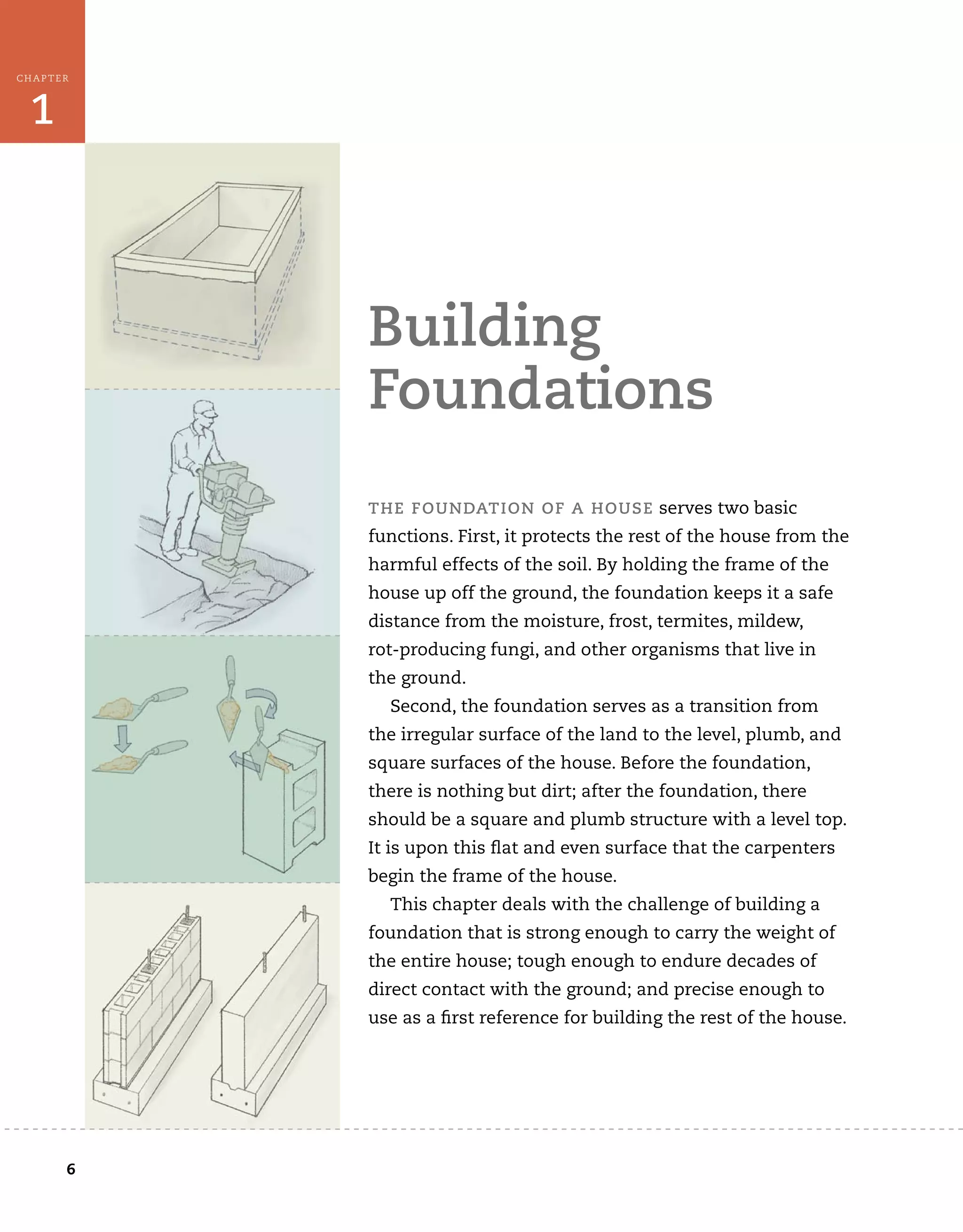
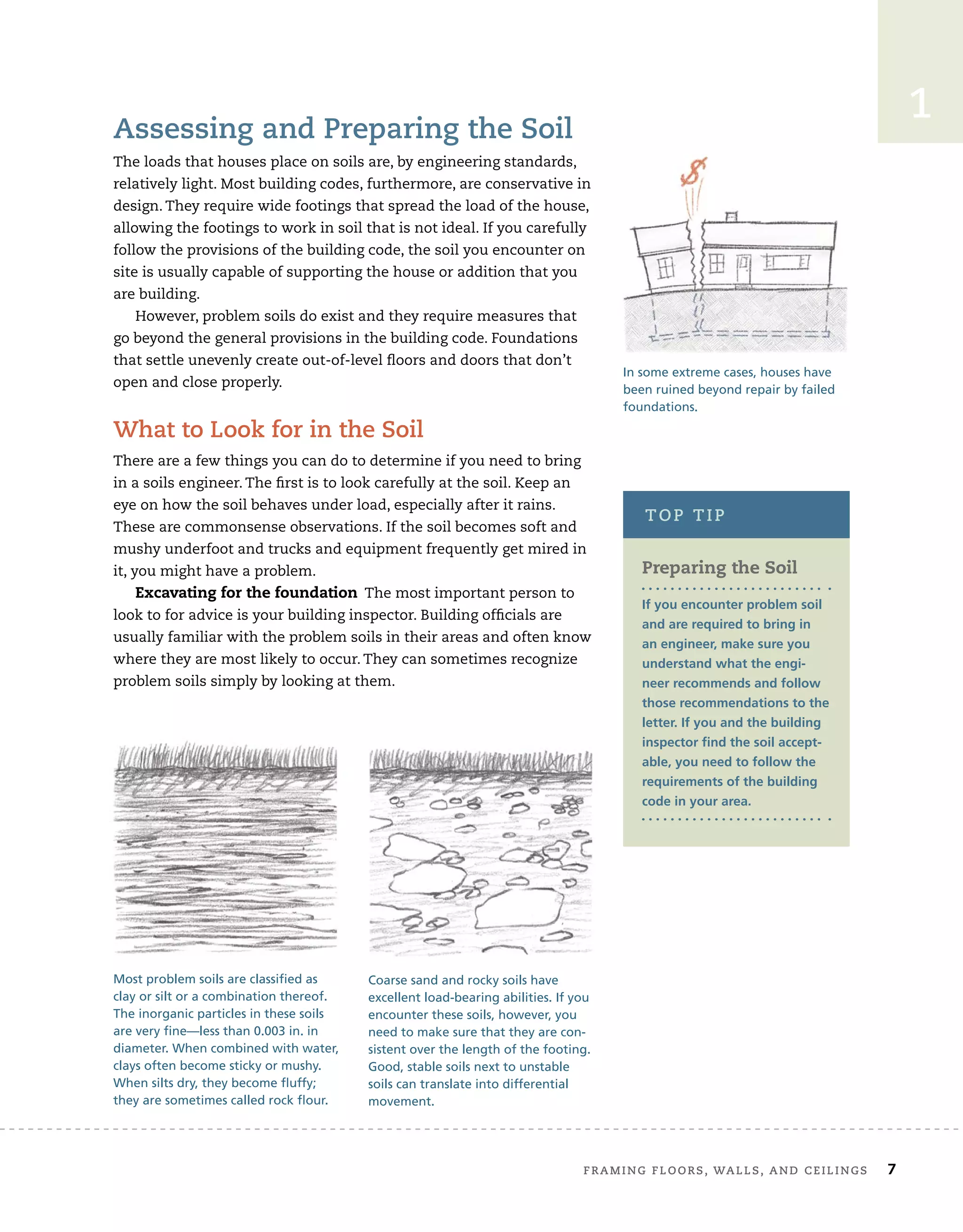
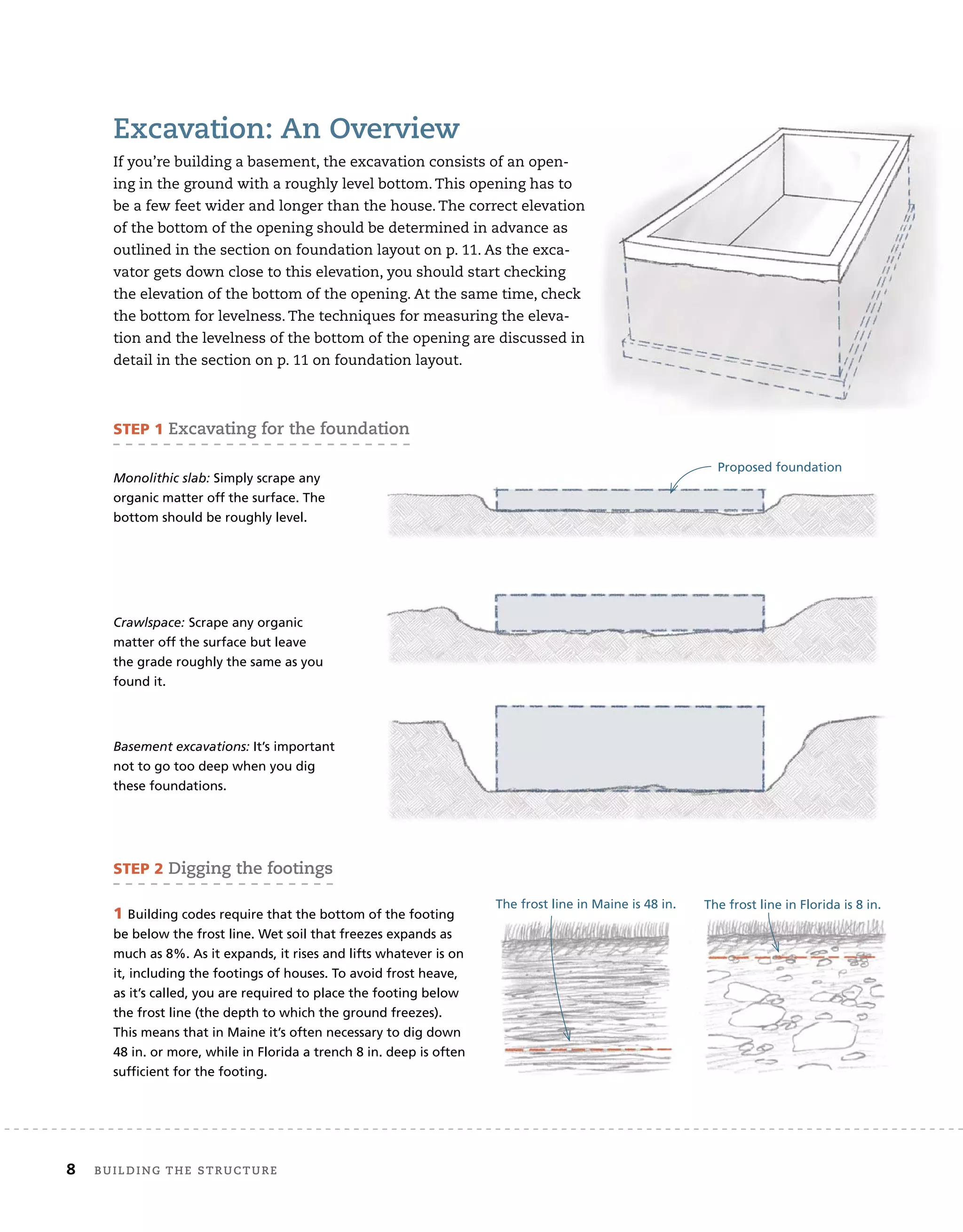
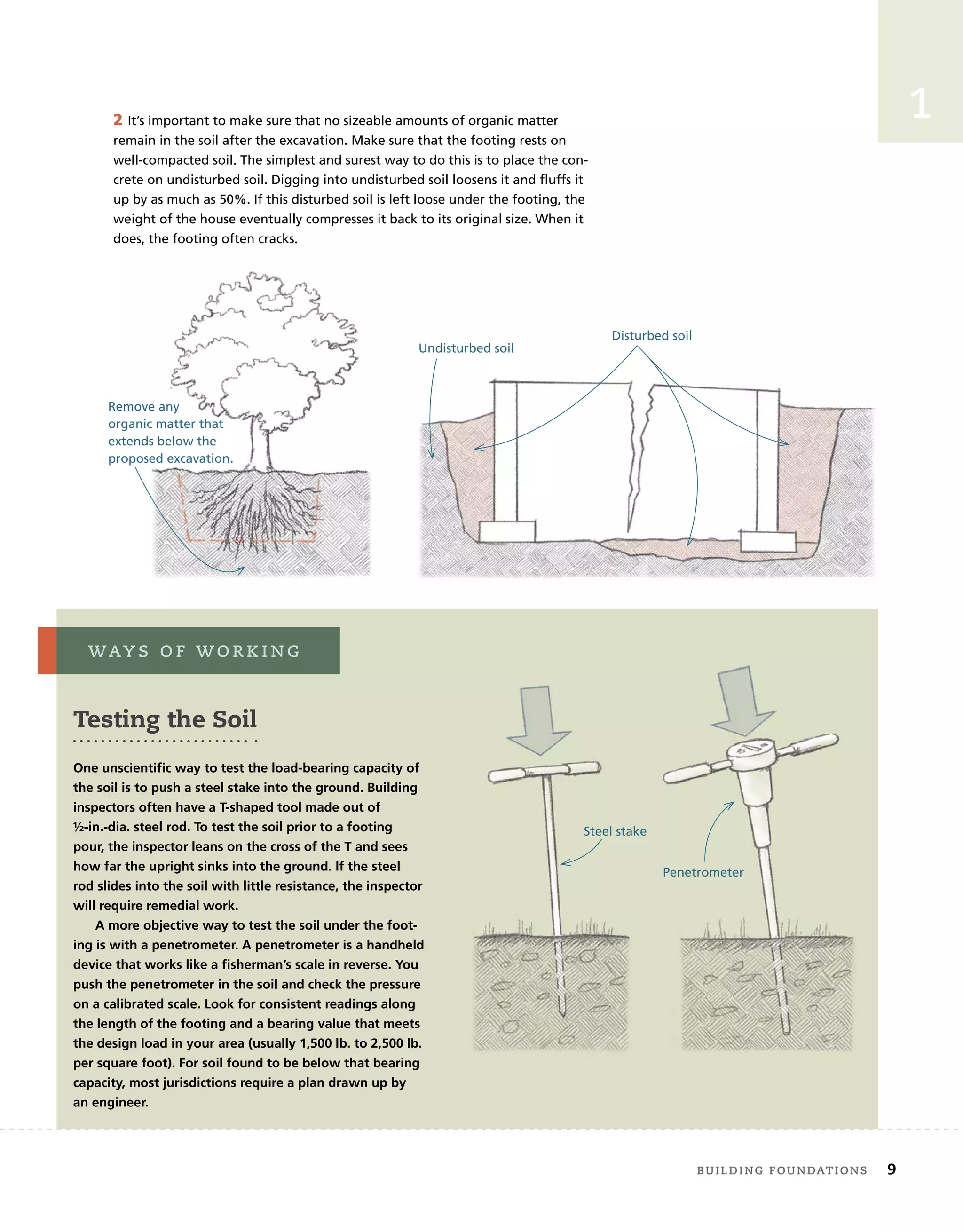
the	foundAtion	of	A	house	serves	two	basic	
functions.	First,	it	protects	the	rest	of	the	house	from	the	
harmful	effects	of	the	soil.	By	holding	the	frame	of	the	
house	up	off	the	ground,	the	foundation	keeps	it	a	safe	
distance	from	the	moisture,	frost,	termites,	mildew,	
rot-producing	fungi,	and	other	organisms	that	live	in	
the	ground.	
Second,	the	foundation	serves	as	a	transition	from	
the	irregular	surface	of	the	land	to	the	level,	plumb,	and	
square	surfaces	of	the	house.	Before	the	foundation,	
there	is	nothing	but	dirt;	after	the	foundation,	there	
should	be	a	square	and	plumb	structure	with	a	level	top.	
It	is	upon	this	fl
	at	and	even	surface	that	the	carpenters	
begin	the	frame	of	the	house.	
This	chapter	deals	with	the	challenge	of	building	a	
foundation	that	is	strong	enough	to	carry	the	weight	of	
the	entire	house;	tough	enough	to	endure	decades	of	
direct	contact	with	the	ground;	and	precise	enough	to	
use	as	a	fi
	rst	reference	for	building	the	rest	of	the	house.
frAMing	floors,	wAlls,	And	ceilings 7
2
Assessing	and	Preparing	the	soil
The	loads	that	houses	place	on	soils	are,	by	engineering	standards,	
relatively	light.	Most	building	codes,	furthermore,	are	conservative	in	
design.	They	require	wide	footings	that	spread	the	load	of	the	house,	
allowing	the	footings	to	work	in	soil	that	is	not	ideal.	If	you	carefully	
follow	the	provisions	of	the	building	code,	the	soil	you	encounter	on	
site	is	usually	capable	of	supporting	the	house	or	addition	that	you	
are	building.
However,	problem	soils	do	exist	and	they	require	measures	that	
go	beyond	the	general	provisions	in	the	building	code.	Foundations	
that	settle	unevenly	create	out-of-level	fl
	oors	and	doors	that	don’t	
open	and	close	properly.	
what	to	look	for	in	the	soil
There	are	a	few	things	you	can	do	to	determine	if	you	need	to	bring	
in	a	soils	engineer.	The	fi
	rst	is	to	look	carefully	at	the	soil.	Keep	an	
eye	on	how	the	soil	behaves	under	load,	especially	after	it	rains.	
These	are	commonsense	observations.	If	the	soil	becomes	soft	and	
mushy	underfoot	and	trucks	and	equipment	frequently	get	mired	in	
it,	you	might	have	a	problem.
Excavating for the foundation		The	most	important	person	to	
look	to	for	advice	is	your	building	inspector.	Building	offi
	cials	are	
usually	familiar	with	the	problem	soils	in	their	areas	and	often	know	
where	they	are	most	likely	to	occur.	They	can	sometimes	recognize	
problem	soils	simply	by	looking	at	them.
In some extreme cases, houses have
been ruined beyond repair by failed
foundations.
Most problem soils are classified as
clay or silt or a combination thereof.
The inorganic particles in these soils
are very fine—less than 0.003 in. in
diameter. When combined with water,
clays often become sticky or mushy.
When silts dry, they become fluffy;
they are sometimes called rock flour.
Coarse sand and rocky soils have
excellent load-bearing abilities. If you
encounter these soils, however, you
need to make sure that they are con-
sistent over the length of the footing.
Good, stable soils next to unstable
soils can translate into differential
movement.
1
Preparing the Soil
If you encounter problem soil
and are required to bring in
an engineer, make sure you
understand what the engi-
neer recommends and follow
those recommendations to the
letter. If you and the building
inspector find the soil accept-
able, you need to follow the
requirements of the building
code in your area.
toP	tiP
1
8 Building	the	structure
Monolithic slab: Simply scrape any
organic matter off the surface. The
bottom should be roughly level.
Crawlspace: Scrape any organic
matter off the surface but leave
the grade roughly the same as you
found it.
Basement excavations: It’s important
not to go too deep when you dig
these foundations.
excavation:	An	overview
If	you’re	building	a	basement,	the	excavation	consists	of	an	open-
ing	in	the	ground	with	a	roughly	level	bottom.	This	opening	has	to	
be	a	few	feet	wider	and	longer	than	the	house.	The	correct	elevation	
of	the	bottom	of	the	opening	should	be	determined	in	advance	as	
outlined	in	the	section	on	foundation	layout	on	p.	11.	As	the	exca-
vator	gets	down	close	to	this	elevation,	you	should	start	checking	
the	elevation	of	the	bottom	of	the	opening.	At	the	same	time,	check	
the	bottom	for	levelness.	The	techniques	for	measuring	the	eleva-
tion	and	the	levelness	of	the	bottom	of	the	opening	are	discussed	in	
detail	in	the	section	on	p.	11	on	foundation	layout.
STEP 1 excavating	for	the	foundation
Proposed foundation
STEP 2 digging	the	footings
1 Building codes require that the bottom of the footing
be below the frost line. Wet soil that freezes expands as
much as 8%. As it expands, it rises and lifts whatever is on
it, including the footings of houses. To avoid frost heave,
as it’s called, you are required to place the footing below
the frost line (the depth to which the ground freezes).
This means that in Maine it’s often necessary to dig down
48 in. or more, while in Florida a trench 8 in. deep is often
sufficient for the footing.
The frost line in Maine is 48 in. The frost line in Florida is 8 in.
1
2 It’s important to make sure that no sizeable amounts of organic matter
remain in the soil after the excavation. Make sure that the footing rests on
well-compacted soil. The simplest and surest way to do this is to place the con-
crete on undisturbed soil. Digging into undisturbed soil loosens it and fluffs it
up by as much as 50%. If this disturbed soil is left loose under the footing, the
weight of the house eventually compresses it back to its original size. When it
does, the footing often cracks.
Remove any
organic matter that
extends below the
proposed excavation.
Undisturbed soil
Disturbed soil
wAy s 	 o f 	w o r k i n g
Testing the Soil
One unscientific way to test the load-bearing capacity of
the soil is to push a steel stake into the ground. Building
inspectors often have a T-shaped tool made out of
½-in.-dia. steel rod. To test the soil prior to a footing
pour, the inspector leans on the cross of the T and sees
how far the upright sinks into the ground. If the steel
rod slides into the soil with little resistance, the inspector
will require remedial work.
A more objective way to test the soil under the foot-
ing is with a penetrometer. A penetrometer is a handheld
device that works like a fisherman’s scale in reverse. You
push the penetrometer in the soil and check the pressure
on a calibrated scale. Look for consistent readings along
the length of the footing and a bearing value that meets
the design load in your area (usually 1,500 lb. to 2,500 lb.
per square foot). For soil found to be below that bearing
capacity, most jurisdictions require a plan drawn up by
an engineer.
Steel stake
Penetrometer
	 Building	foundAtions 9
10 Building	the	structure 	
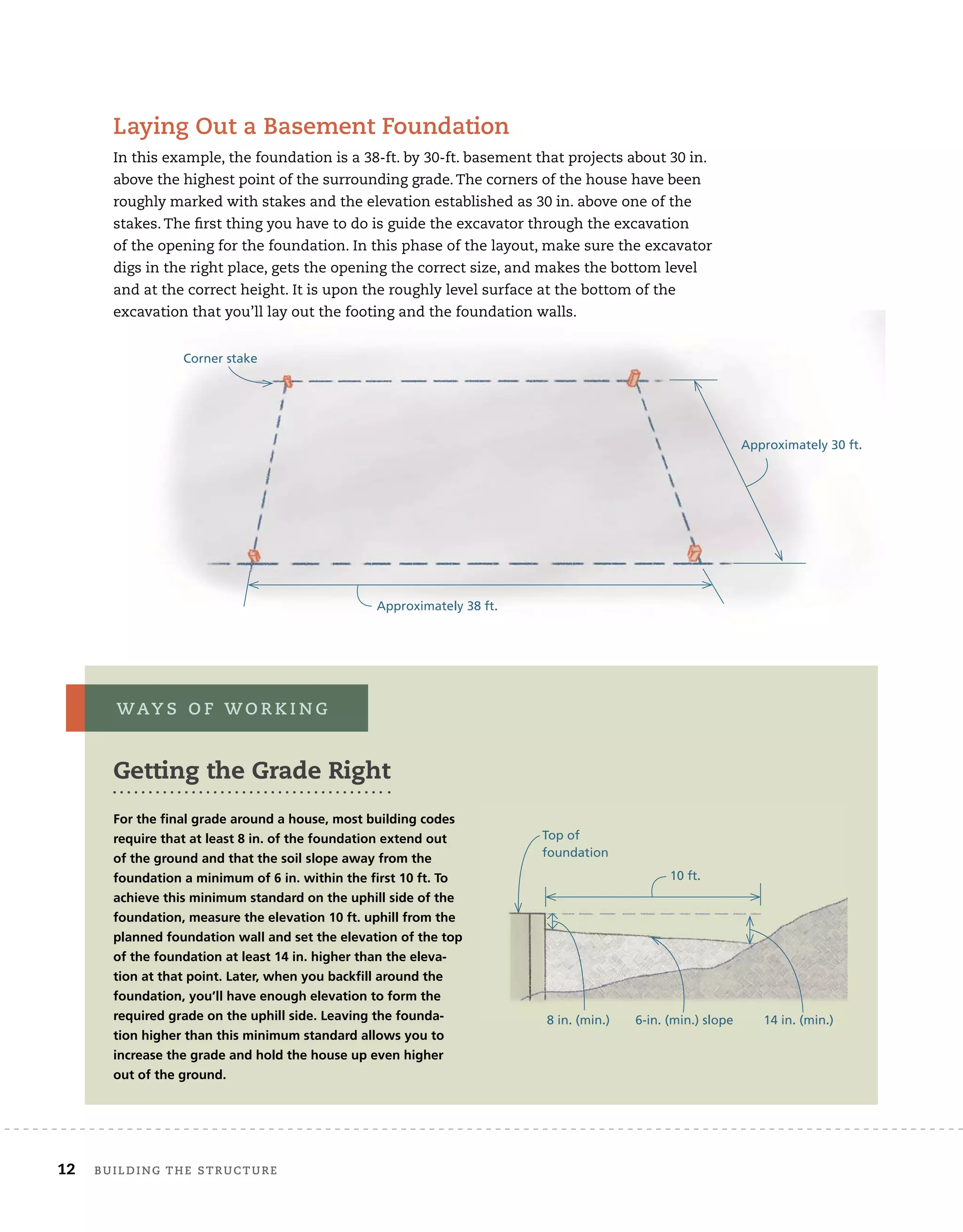
5 Footings spread the load they carry over a broad area. If
the weight of the building is concentrated on the edge of
the footing, however, it can cause the footing to rotate—just
as stepping on the edge of a snowshoe set on top of freshly
fallen snow would cause it to tip over.
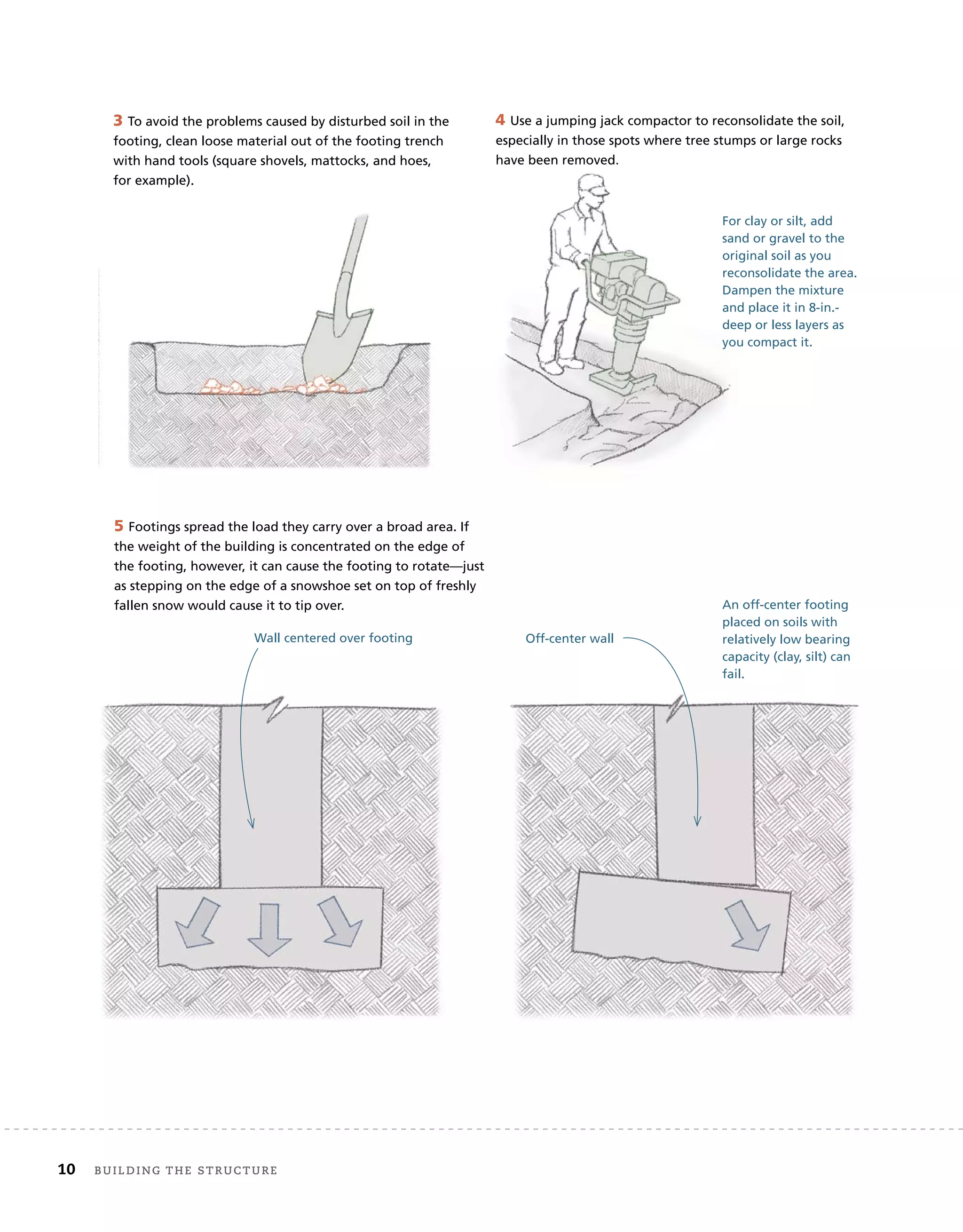
3 To avoid the problems caused by disturbed soil in the
footing, clean loose material out of the footing trench
with hand tools (square shovels, mattocks, and hoes,
for example).
Wall centered over footing
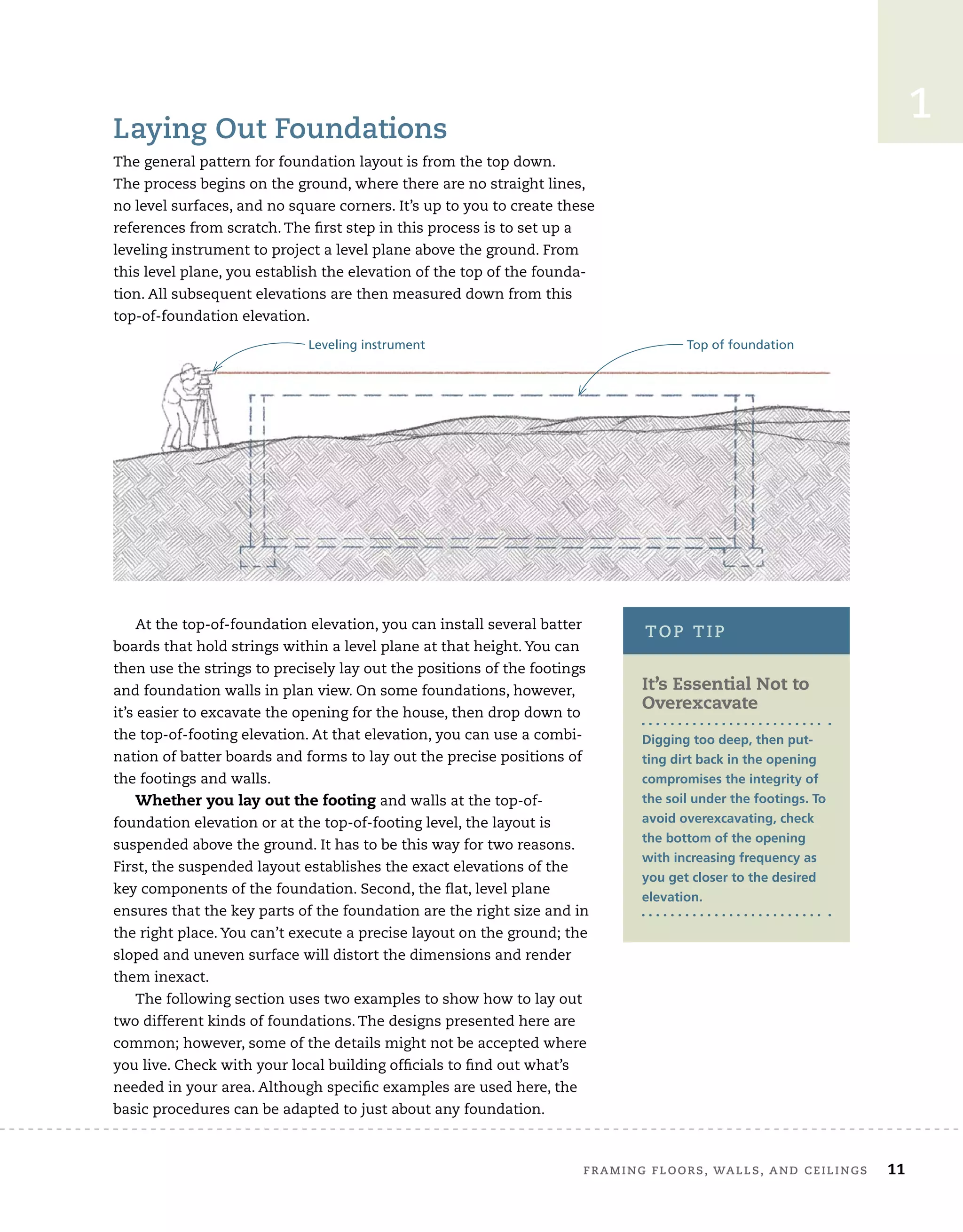
4 Use a jumping jack compactor to reconsolidate the soil,
especially in those spots where tree stumps or large rocks
have been removed.
For clay or silt, add
sand or gravel to the
original soil as you
reconsolidate the area.
Dampen the mixture
and place it in 8-in.-
deep or less layers as
you compact it.
Off-center wall
have been removed.
For clay or silt, add
sand or gravel to the
original soil as you
reconsolidate the area.
Dampen the mixture
and place it in 8-in.-
deep or less layers as
you compact it.
An off-center footing
placed on soils with
relatively low bearing
capacity (clay, silt) can
fail.
frAMing	floors,	wAlls,	And	ceilings 11
1
laying	out	foundations
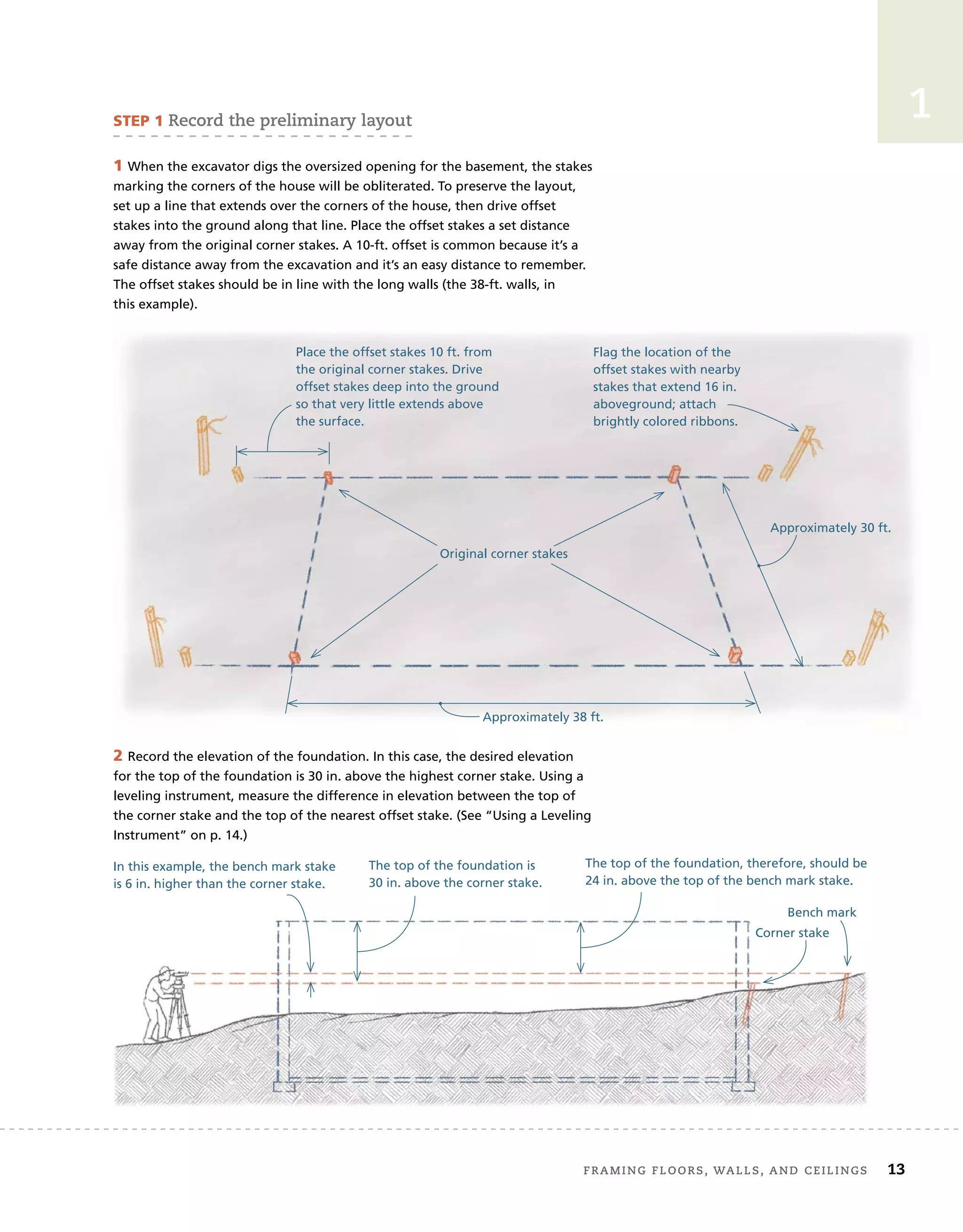
The	general	pattern	for	foundation	layout	is	from	the	top	down.	
The	process	begins	on	the	ground,	where	there	are	no	straight	lines,	
no	level	surfaces,	and	no	square	corners.	It’s	up	to	you	to	create	these	
references	from	scratch.	The	fi
	rst	step	in	this	process	is	to	set	up	a	
leveling	instrument	to	project	a	level	plane	above	the	ground.	From	
this	level	plane,	you	establish	the	elevation	of	the	top	of	the	founda-
tion.	All	subsequent	elevations	are	then	measured	down	from	this	
top-of-foundation	elevation.
At	the	top-of-foundation	elevation,	you	can	install	several	batter	
boards	that	hold	strings	within	a	level	plane	at	that	height.	You	can	
then	use	the	strings	to	precisely	lay	out	the	positions	of	the	footings	
and	foundation	walls	in	plan	view.	On	some	foundations,	however,	
it’s	easier	to	excavate	the	opening	for	the	house,	then	drop	down	to	
the	top-of-footing	elevation.	At	that	elevation,	you	can	use	a	combi-
nation	of	batter	boards	and	forms	to	lay	out	the	precise	positions	of	
the	footings	and	walls.
Whether you lay out the footing	and	walls	at	the	top-of-
foundation	elevation	or	at	the	top-of-footing	level,	the	layout	is	
suspended	above	the	ground.	It	has	to	be	this	way	for	two	reasons.	
First,	the	suspended	layout	establishes	the	exact	elevations	of	the	
key	components	of	the	foundation.	Second,	the	fl
	at,	level	plane	
ensures	that	the	key	parts	of	the	foundation	are	the	right	size	and	in	
the	right	place.	You	can’t	execute	a	precise	layout	on	the	ground;	the	
sloped	and	uneven	surface	will	distort	the	dimensions	and	render	
them	inexact.
The	following	section	uses	two	examples	to	show	how	to	lay	out	
two	different	kinds	of	foundations.	The	designs	presented	here	are	
common;	however,	some	of	the	details	might	not	be	accepted	where	
you	live.	Check	with	your	local	building	offi
	cials	to	fi
	nd	out	what’s	
needed	in	your	area.	Although	specifi
	c	examples	are	used	here,	the	
basic	procedures	can	be	adapted	to	just	about	any	foundation.
It’s Essential Not to
Overexcavate
Digging too deep, then put-
ting dirt back in the opening
compromises the integrity of
the soil under the footings. To
avoid overexcavating, check
the bottom of the opening
with increasing frequency as
you get closer to the desired
elevation.
toP	tiP
Leveling instrument Top of foundation
12 Building	the	structure 	
Approximately 30 ft.
Corner stake
Approximately 38 ft.
Getting the Grade Right
For the final grade around a house, most building codes
require that at least 8 in. of the foundation extend out
of the ground and that the soil slope away from the
foundation a minimum of 6 in. within the first 10 ft. To
achieve this minimum standard on the uphill side of the
foundation, measure the elevation 10 ft. uphill from the
planned foundation wall and set the elevation of the top
of the foundation at least 14 in. higher than the eleva-
tion at that point. Later, when you backfill around the
foundation, you’ll have enough elevation to form the
required grade on the uphill side. Leaving the founda-
tion higher than this minimum standard allows you to
increase the grade and hold the house up even higher
out of the ground.
laying	out	a	Basement	foundation
In	this	example,	the	foundation	is	a	38-ft.	by	30-ft.	basement	that	projects	about	30	in.	
above	the	highest	point	of	the	surrounding	grade.	The	corners	of	the	house	have	been	
roughly	marked	with	stakes	and	the	elevation	established	as	30	in.	above	one	of	the	
stakes.	The	fi
	rst	thing	you	have	to	do	is	guide	the	excavator	through	the	excavation	
of	the	opening	for	the	foundation.	In	this	phase	of	the	layout,	make	sure	the	excavator	
digs	in	the	right	place,	gets	the	opening	the	correct	size,	and	makes	the	bottom	level	
and	at	the	correct	height.	It	is	upon	the	roughly	level	surface	at	the	bottom	of	the	
excavation	that	you’ll	lay	out	the	footing	and	the	foundation	walls.
8 in. (min.) 6-in. (min.) slope 14 in. (min.)
Top of
foundation
10 ft.
wAy s 	 o f 	w o r k i n g
frAMing	floors,	wAlls,	And	ceilings 13
1
2 Record the elevation of the foundation. In this case, the desired elevation
for the top of the foundation is 30 in. above the highest corner stake. Using a
leveling instrument, measure the difference in elevation between the top of
the corner stake and the top of the nearest offset stake. (See “Using a Leveling
Instrument” on p. 14.)
Place the offset stakes 10 ft. from
the original corner stakes. Drive
offset stakes deep into the ground
so that very little extends above
the surface.
Original corner stakes
Approximately 30 ft.
Approximately 38 ft.
In this example, the bench mark stake
is 6 in. higher than the corner stake.
Bench mark
Corner stake
The top of the foundation, therefore, should be
24 in. above the top of the bench mark stake.
The top of the foundation is
30 in. above the corner stake.
STEP 1 record	the	preliminary	layout
1 When the excavator digs the oversized opening for the basement, the stakes
marking the corners of the house will be obliterated. To preserve the layout,
set up a line that extends over the corners of the house, then drive offset
stakes into the ground along that line. Place the offset stakes a set distance
away from the original corner stakes. A 10-ft. offset is common because it’s a
safe distance away from the excavation and it’s an easy distance to remember.
The offset stakes should be in line with the long walls (the 38-ft. walls, in
this example).
Flag the location of the
offset stakes with nearby
stakes that extend 16 in.
aboveground; attach
brightly colored ribbons.
14 Building	the	structure 	
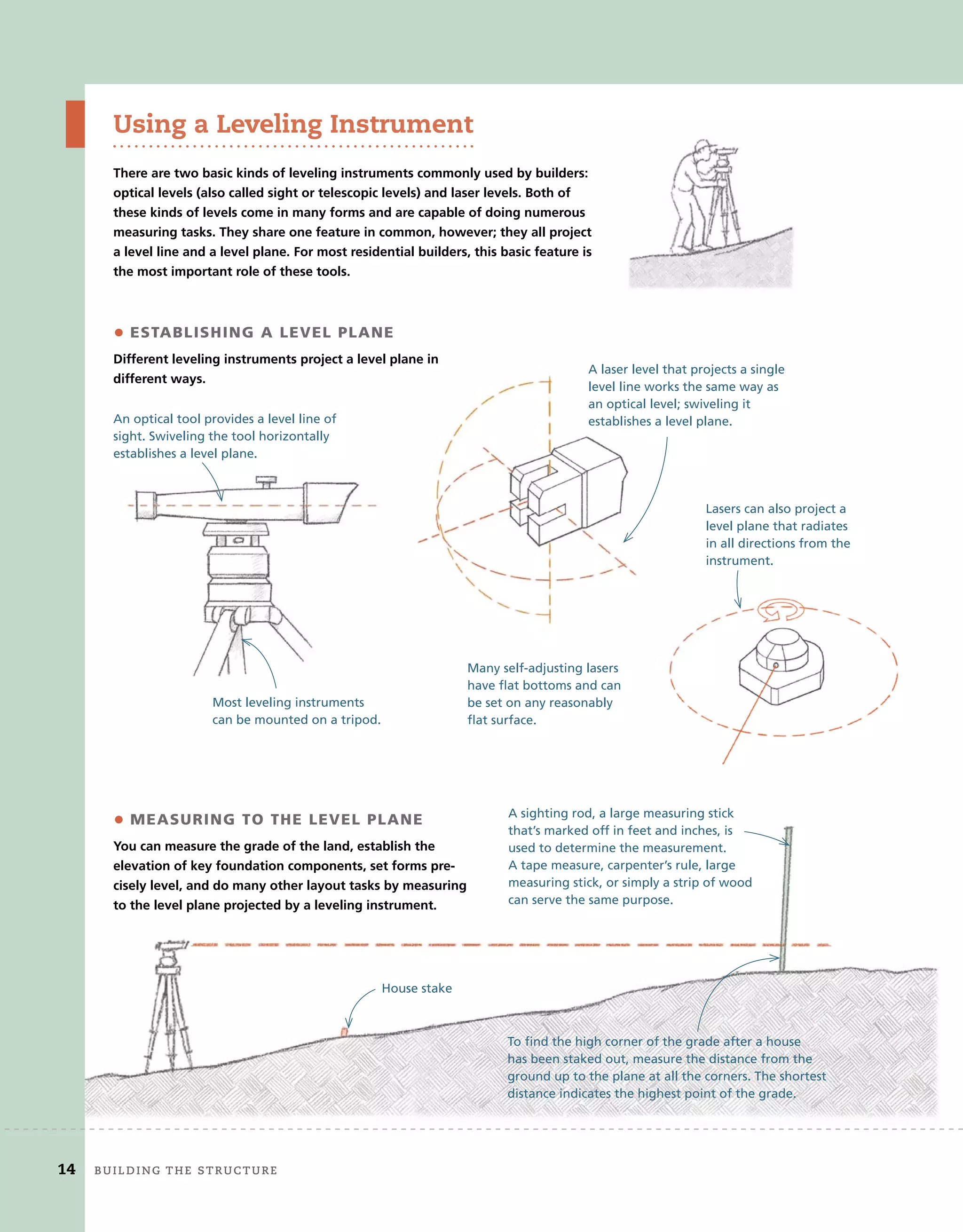
Using a Leveling Instrument
There are two basic kinds of leveling instruments commonly used by builders:
optical levels (also called sight or telescopic levels) and laser levels. Both of
these kinds of levels come in many forms and are capable of doing numerous
measuring tasks. They share one feature in common, however; they all project
a level line and a level plane. For most residential builders, this basic feature is
the most important role of these tools.
An optical tool provides a level line of
sight. Swiveling the tool horizontally
establishes a level plane.
• MEASURING TO THE LEVEL PLANE
You can measure the grade of the land, establish the
elevation of key foundation components, set forms pre-
cisely level, and do many other layout tasks by measuring
to the level plane projected by a leveling instrument.
A laser level that projects a single
level line works the same way as
an optical level; swiveling it
establishes a level plane.
• ESTABLISHING A LEVEL PLANE
Different leveling instruments project a level plane in
different ways.
Lasers can also project a
level plane that radiates
in all directions from the
instrument.
Most leveling instruments
can be mounted on a tripod.
Many self-adjusting lasers
have flat bottoms and can
be set on any reasonably
flat surface.
To find the high corner of the grade after a house
has been staked out, measure the distance from the
ground up to the plane at all the corners. The shortest
distance indicates the highest point of the grade.
A sighting rod, a large measuring stick
that’s marked off in feet and inches, is
used to determine the measurement.
A tape measure, carpenter’s rule, large
measuring stick, or simply a strip of wood
can serve the same purpose.
House stake
14 Building	the	structure
frAMing	floors,	wAlls,	And	ceilings 15
1
1
1
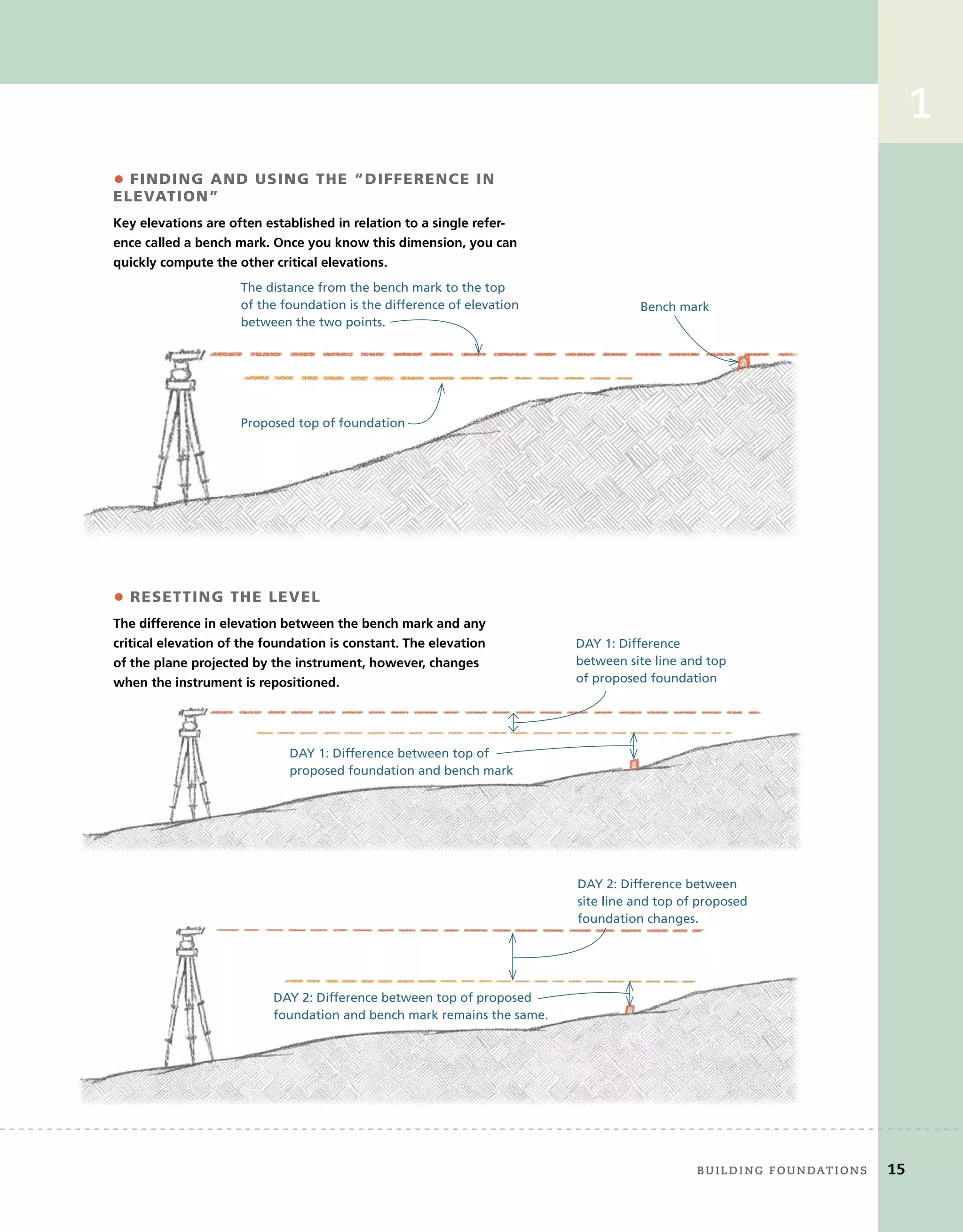
• FINDING AND USING THE “DIFFERENCE IN
ELEVATION”
Key elevations are often established in relation to a single refer-
ence called a bench mark. Once you know this dimension, you can
quickly compute the other critical elevations.
The distance from the bench mark to the top
of the foundation is the difference of elevation
between the two points.
Bench mark
Proposed top of foundation
• RESETTING THE LEVEL
The difference in elevation between the bench mark and any
critical elevation of the foundation is constant. The elevation
of the plane projected by the instrument, however, changes
when the instrument is repositioned.
The difference in elevation between the bench mark and any
critical elevation of the foundation is constant. The elevation
of the plane projected by the instrument, however, changes
when the instrument is repositioned.
DAY 1: Difference
between site line and top
of proposed foundation
DAY 1: Difference between top of
proposed foundation and bench mark
	 Building	foundAtions 15
DAY 2: Difference between top of proposed
foundation and bench mark remains the same.
DAY 2: Difference between
site line and top of proposed
foundation changes.
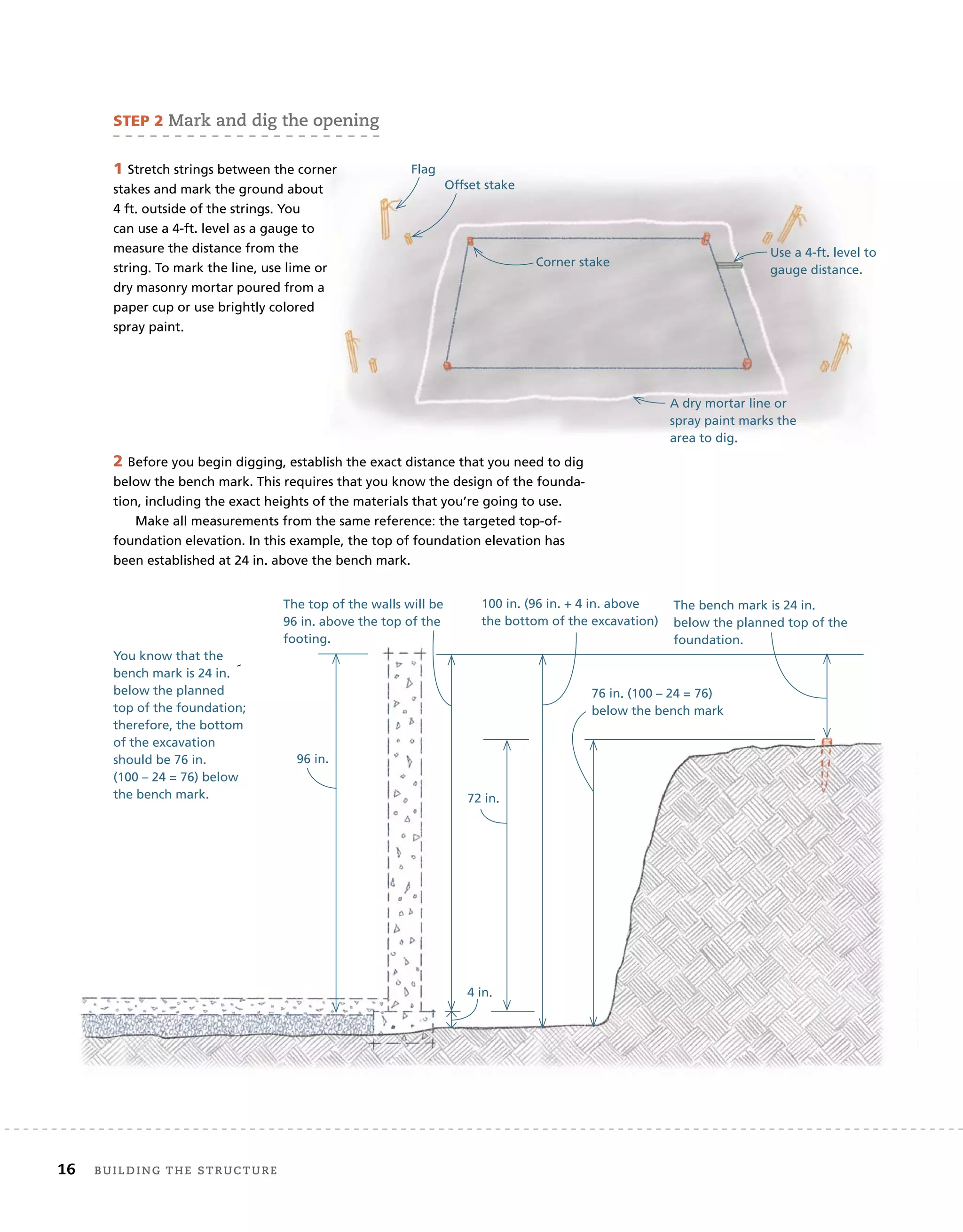
16 Building	the	structure 	
1 Stretch strings between the corner
stakes and mark the ground about
4 ft. outside of the strings. You
can use a 4-ft. level as a gauge to
measure the distance from the
string. To mark the line, use lime or
dry masonry mortar poured from a
paper cup or use brightly colored
spray paint.
STEP 2 Mark	and	dig	the	opening
Corner stake
Use a 4-ft. level to
gauge distance.
Flag
Offset stake
A dry mortar line or
spray paint marks the
area to dig.
2 Before you begin digging, establish the exact distance that you need to dig
below the bench mark. This requires that you know the design of the founda-
tion, including the exact heights of the materials that you’re going to use.
Make all measurements from the same reference: the targeted top-of-
foundation elevation. In this example, the top of foundation elevation has
been established at 24 in. above the bench mark.
The bench mark is 24 in.
below the planned top of the
foundation.
The top of the walls will be
96 in. above the top of the
footing.
4 in.
100 in. (96 in. + 4 in. above
the bottom of the excavation)
96 in.
76 in. (100 – 24 = 76)
below the bench mark
You know that the
bench mark is 24 in.
below the planned
top of the foundation;
therefore, the bottom
of the excavation
should be 76 in.
(100 – 24 = 76) below
the bench mark. 72 in.
frAMing	floors,	wAlls,	And	ceilings 17
2
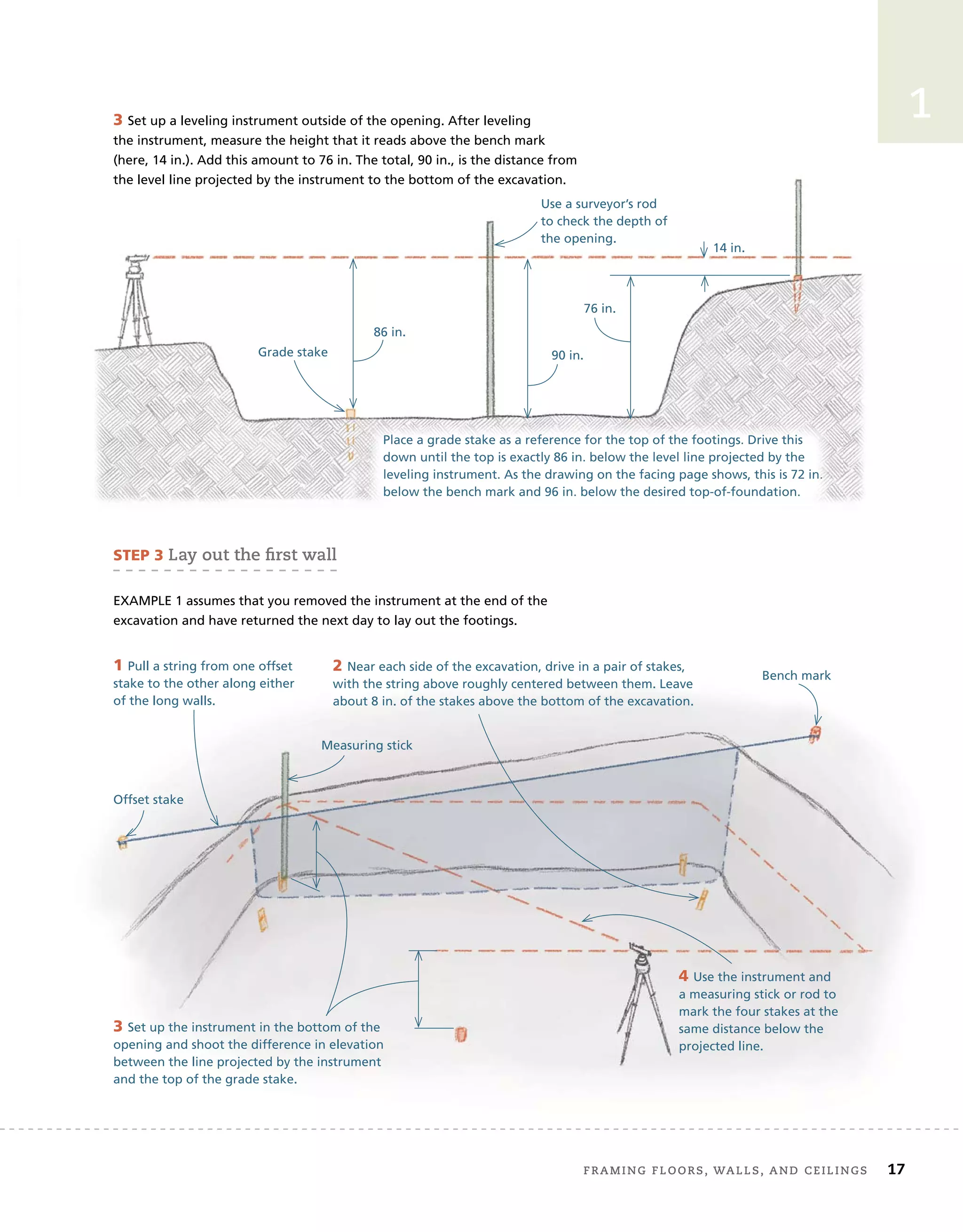
3 Set up a leveling instrument outside of the opening. After leveling
the instrument, measure the height that it reads above the bench mark
(here, 14 in.). Add this amount to 76 in. The total, 90 in., is the distance from
the level line projected by the instrument to the bottom of the excavation.
14 in.
76 in.
90 in.
86 in.
Use a surveyor’s rod
to check the depth of
the opening.
Grade stake
Place a grade stake as a reference for the top of the footings. Drive this
down until the top is exactly 86 in. below the level line projected by the
leveling instrument. As the drawing on the facing page shows, this is 72 in.
below the bench mark and 96 in. below the desired top-of-foundation.
STEP 3 lay	out	the	fi
	rst	wall	
EXAMPLE 1 assumes that you removed the instrument at the end of the
excavation and have returned the next day to lay out the footings.
1 Pull a string from one offset
stake to the other along either
of the long walls.
2 Near each side of the excavation, drive in a pair of stakes,
with the string above roughly centered between them. Leave
about 8 in. of the stakes above the bottom of the excavation.
3 Set up the instrument in the bottom of the
opening and shoot the difference in elevation
between the line projected by the instrument
and the top of the grade stake.
4 Use the instrument and
a measuring stick or rod to
mark the four stakes at the
same distance below the
projected line.
Offset stake
Bench mark
Measuring stick
1
18 Building	the	structure 	
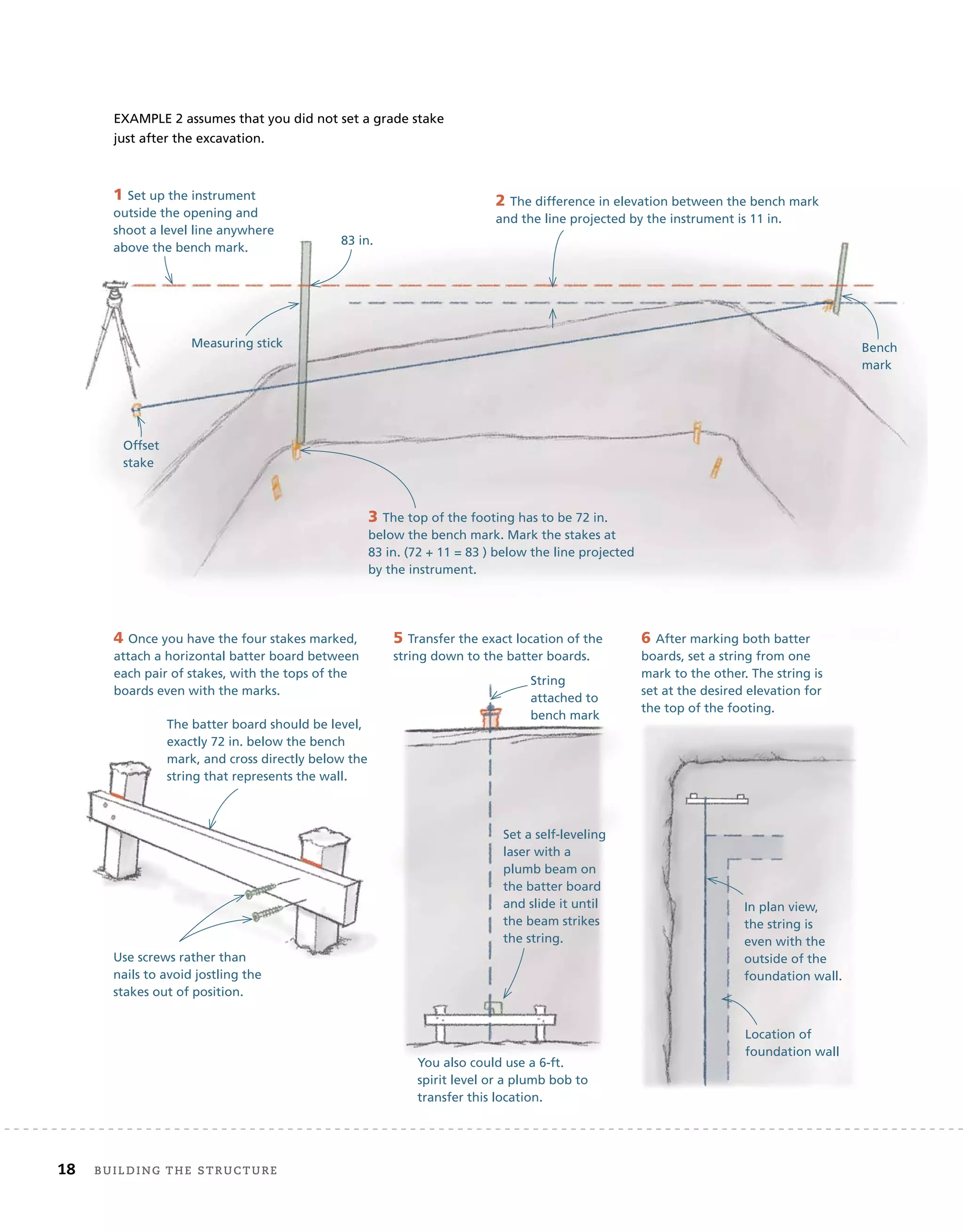
EXAMPLE 2 assumes that you did not set a grade stake
just after the excavation.
1 Set up the instrument
outside the opening and
shoot a level line anywhere
above the bench mark.
2 The difference in elevation between the bench mark
and the line projected by the instrument is 11 in.
3 The top of the footing has to be 72 in.
below the bench mark. Mark the stakes at
83 in. (72 + 11 = 83 ) below the line projected
by the instrument.
Offset
stake
Bench
mark
Measuring stick
83 in.
4 Once you have the four stakes marked,
attach a horizontal batter board between
each pair of stakes, with the tops of the
boards even with the marks.
Use screws rather than
nails to avoid jostling the
stakes out of position.
The batter board should be level,
exactly 72 in. below the bench
mark, and cross directly below the
string that represents the wall.
5 Transfer the exact location of the
string down to the batter boards.
You also could use a 6-ft.
spirit level or a plumb bob to
transfer this location.
String
attached to
bench mark
6 After marking both batter
boards, set a string from one
mark to the other. The string is
set at the desired elevation for
the top of the footing.
In plan view,
the string is
even with the
outside of the
foundation wall.
Location of
foundation wall
Set a self-leveling
laser with a
plumb beam on
the batter board
and slide it until
the beam strikes
the string.
frAMing	floors,	wAlls,	And	ceilings 19
2
1
1
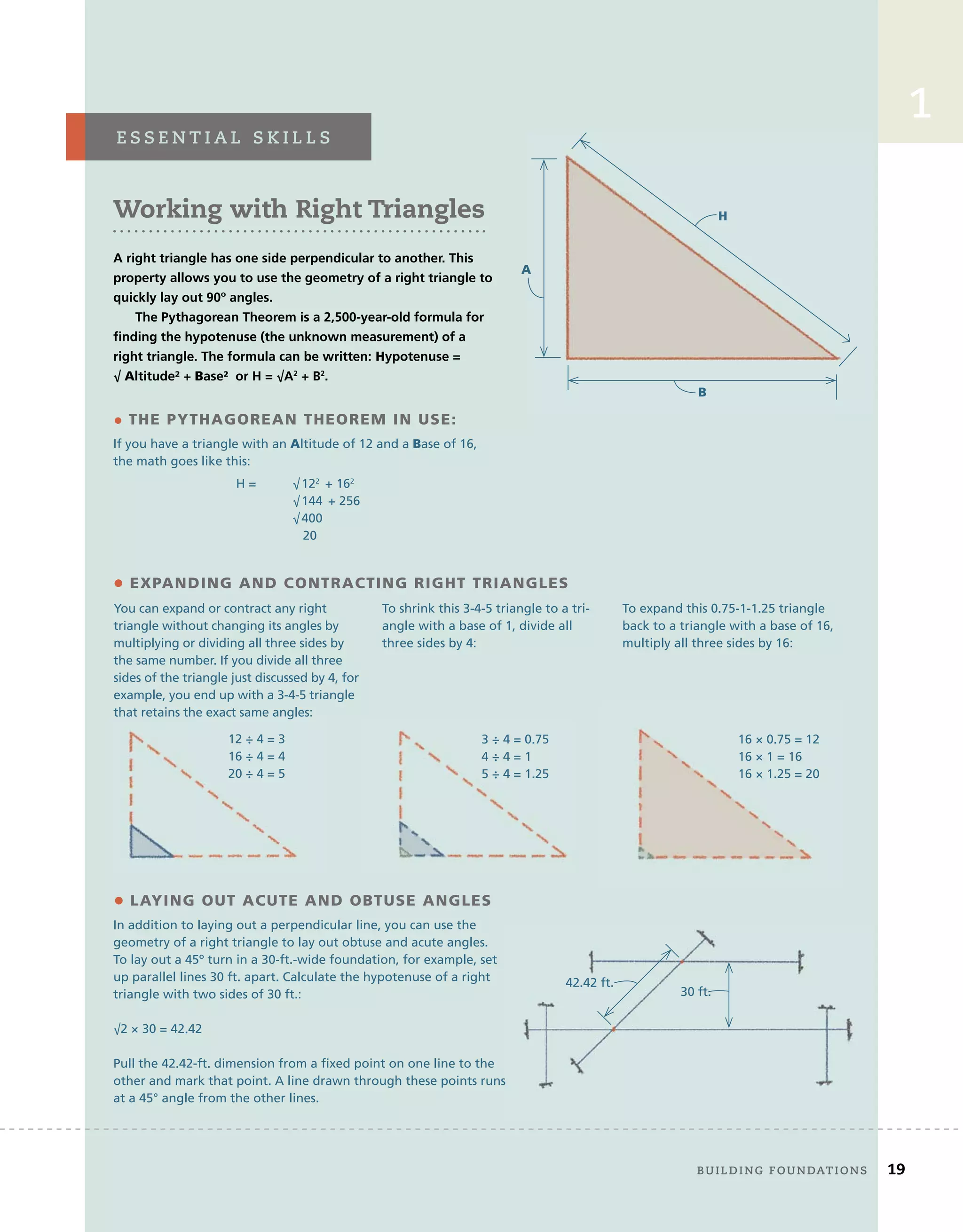
• THE PYTHAGOREAN THEOREM IN USE:
If you have a triangle with an Altitude of 12 and a Base of 16,
the math goes like this:
You can expand or contract any right
triangle without changing its angles by
multiplying or dividing all three sides by
the same number. If you divide all three
sides of the triangle just discussed by 4, for
example, you end up with a 3-4-5 triangle
that retains the exact same angles:
To shrink this 3-4-5 triangle to a tri-
angle with a base of 1, divide all
three sides by 4:
To expand this 0.75-1-1.25 triangle
back to a triangle with a base of 16,
multiply all three sides by 16:
A
B
H
• EXPANDING AND CONTRACTING RIGHT TRIANGLES
12 ÷ 4 = 3
16 ÷ 4 = 4
20 ÷ 4 = 5
3 ÷ 4 = 0.75
4 ÷ 4 = 1
5 ÷ 4 = 1.25
16 × 0.75 = 12
16 × 1 = 16
16 × 1.25 = 20
• LAYING OUT ACUTE AND OBTUSE ANGLES
In addition to laying out a perpendicular line, you can use the
geometry of a right triangle to lay out obtuse and acute angles.
To lay out a 45º turn in a 30-ft.-wide foundation, for example, set
up parallel lines 30 ft. apart. Calculate the hypotenuse of a right
triangle with two sides of 30 ft.:
√2 × 30 = 42.42
Pull the 42.42-ft. dimension from a fixed point on one line to the
other and mark that point. A line drawn through these points runs
at a 45° angle from the other lines.
30 ft.
42.42 ft.
Working with Right Triangles
A right triangle has one side perpendicular to another. This
property allows you to use the geometry of a right triangle to
quickly lay out 90º angles.
The Pythagorean Theorem is a 2,500-year-old formula for
finding the hypotenuse (the unknown measurement) of a
right triangle. The formula can be written: Hypotenuse =
√ Altitude² + Base² or H = √A2
+ B2
.
e s s e n t i A l 	 s k i l l s
	 Building	foundAtions 19
H = √122
+ 162
√144 + 256
√400
20
20 Building	the	structure
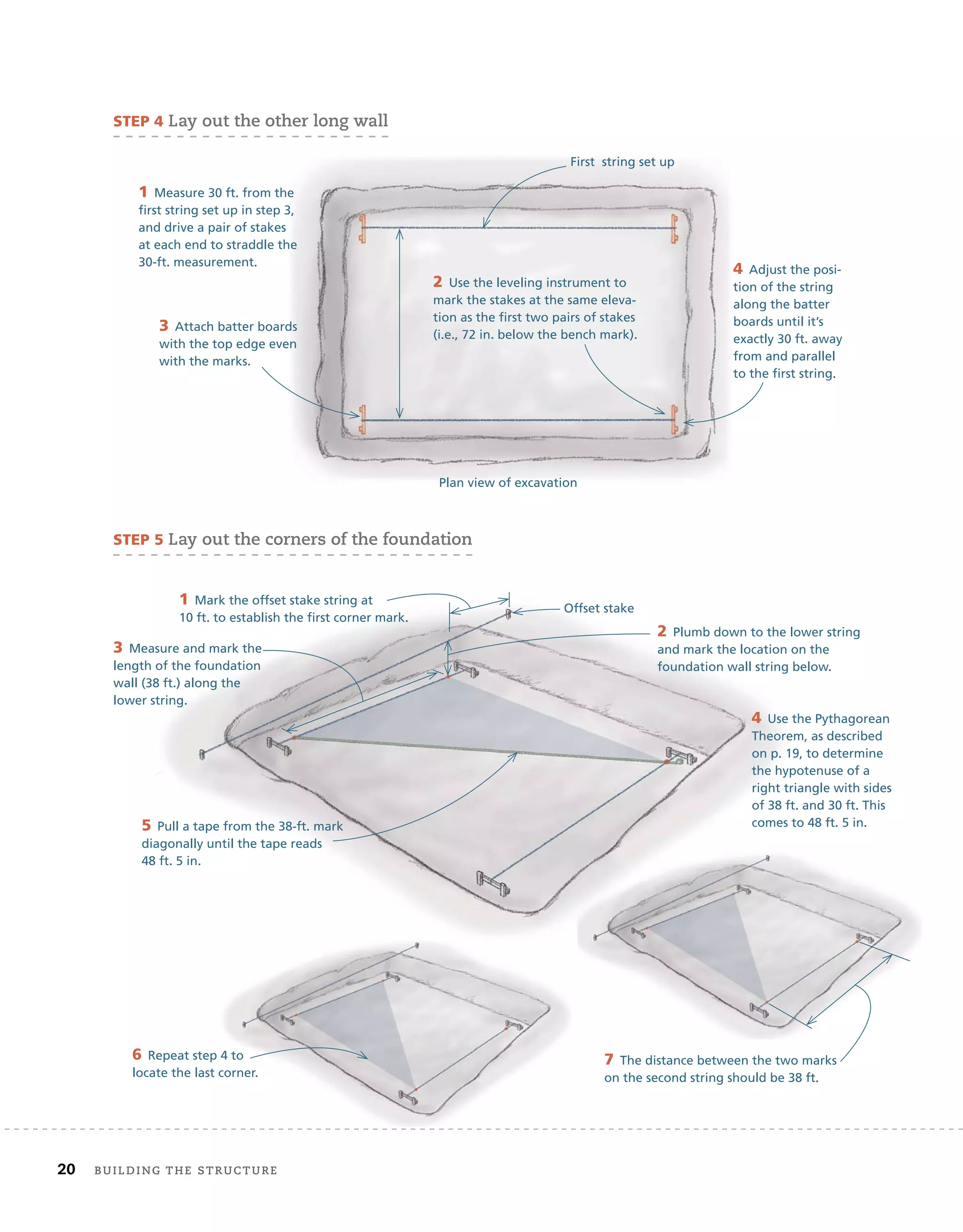
STEP 5 lay	out	the	corners	of	the	foundation
1 Measure 30 ft. from the
first string set up in step 3,
and drive a pair of stakes
at each end to straddle the
30-ft. measurement.
STEP 4 lay	out	the	other	long	wall
2 Use the leveling instrument to
mark the stakes at the same eleva-
tion as the first two pairs of stakes
(i.e., 72 in. below the bench mark).
4 Adjust the posi-
tion of the string
along the batter
boards until it’s
exactly 30 ft. away
from and parallel
to the first string.
3 Attach batter boards
with the top edge even
with the marks.
First string set up
Plan view of excavation
1 Mark the offset stake string at
10 ft. to establish the first corner mark.
2 Plumb down to the lower string
and mark the location on the
foundation wall string below.
3 Measure and mark the
length of the foundation
wall (38 ft.) along the
lower string.
5 Pull a tape from the 38-ft. mark
diagonally until the tape reads
48 ft. 5 in.
6 Repeat step 4 to
locate the last corner.
7 The distance between the two marks
on the second string should be 38 ft.
Offset stake
4 Use the Pythagorean
Theorem, as described
on p. 19, to determine
the hypotenuse of a
right triangle with sides
of 38 ft. and 30 ft. This
comes to 48 ft. 5 in.
1
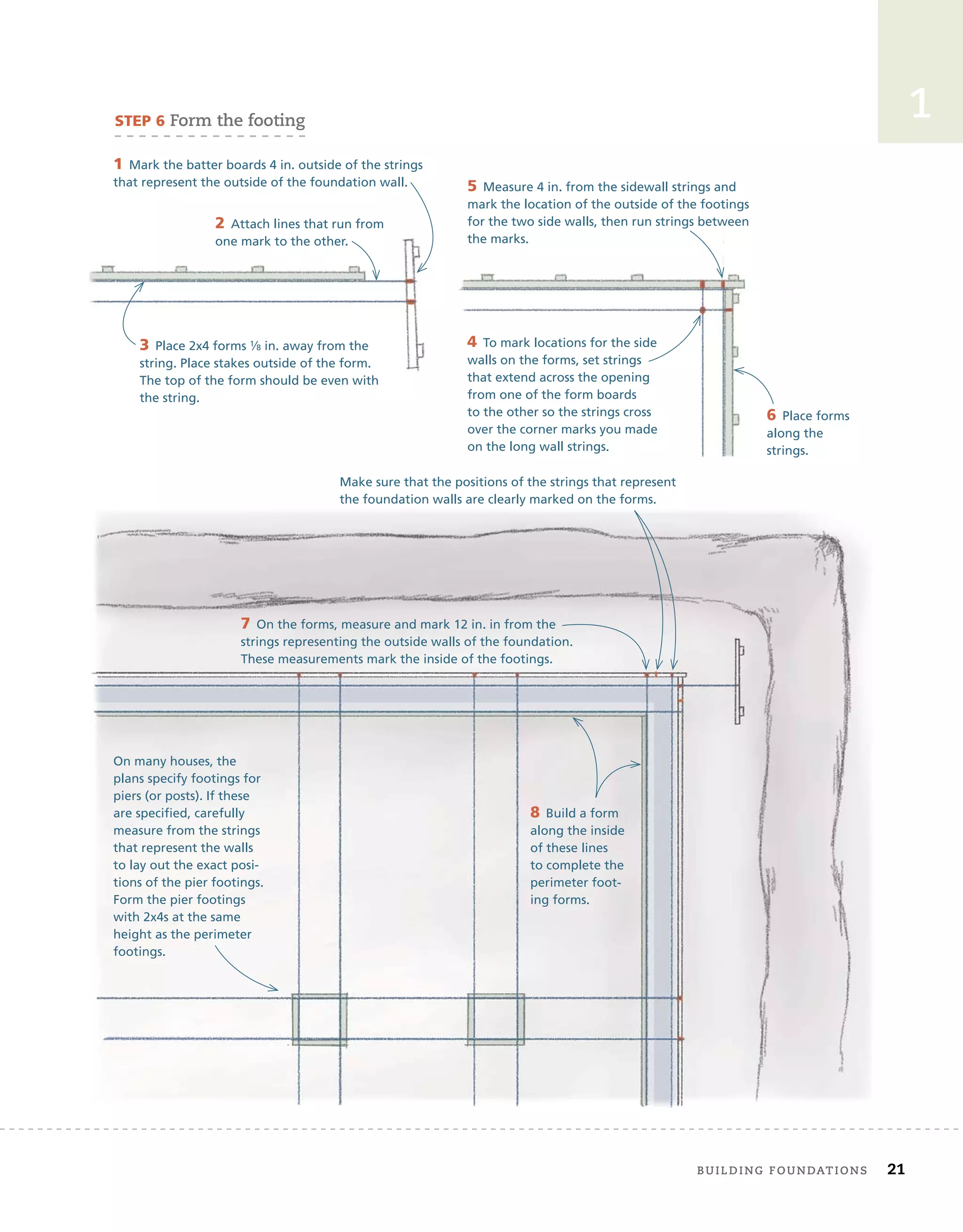
STEP 6 form	the	footing
1 Mark the batter boards 4 in. outside of the strings
that represent the outside of the foundation wall.
2 Attach lines that run from
one mark to the other.
3 Place 2x4 forms 1⁄8 in. away from the
string. Place stakes outside of the form.
The top of the form should be even with
the string.
4 To mark locations for the side
walls on the forms, set strings
that extend across the opening
from one of the form boards
to the other so the strings cross
over the corner marks you made
on the long wall strings.
5 Measure 4 in. from the sidewall strings and
mark the location of the outside of the footings
for the two side walls, then run strings between
the marks.
6 Place forms
along the
strings.
7 On the forms, measure and mark 12 in. in from the
strings representing the outside walls of the foundation.
These measurements mark the inside of the footings.
8 Build a form
along the inside
of these lines
to complete the
perimeter foot-
ing forms.
On many houses, the
plans specify footings for
piers (or posts). If these
are specified, carefully
measure from the strings
that represent the walls
to lay out the exact posi-
tions of the pier footings.
Form the pier footings
with 2x4s at the same
height as the perimeter
footings.
Make sure that the positions of the strings that represent
the foundation walls are clearly marked on the forms.
	 Building	foundAtions 21
22 Building	the	structure 	
STEP 8 Prepare	for	the	footing	pour
Install steel as required by your local code and by the
specifications on your plan. Check with the plumber
and septic system subcontractor for possible pipe place-
ment and any pipes or sleeves in the form. If a sump
pump is needed, place the pipe through the form.
In most jurisdictions, you’re required to have the
footing examined by the building inspector at this
point. Once you get the go-ahead from the inspector,
calculate the volume of concrete needed and schedule
a delivery. (There will be information on estimating
concrete quantities in the next section.)
STEP 7 dig	the	footings
Remove the strings and dig the footing between the
forms with a square shovel. Make the bottom of the
footing 8 in. from the top of the form. The bottom of the
trench should be flat and consist of undisturbed soil, and
the sides should extend straight down from the forms.
Measure frequently to
avoid overdigging.
Place vertical pieces
of steel precisely
by measuring and
marking directly on
the forms.
To measure the depth, place a
straightedge across the form and
measure to its bottom edge.
STEP 9 Pour	the	footing
Pour the concrete and strike it even with the top of the
form. Form a keyway in the footing, if your foundation
plan calls for one.
Place strips of wood in the wet
concrete just after you’ve placed
the concrete to mold the keyways.
Pour the concrete and strike it even with the top of the
form. Form a keyway in the footing, if your foundation
Place strips of wood in the wet
concrete just after you’ve placed
the concrete to mold the keyways.
frAMing	floors,	wAlls,	And	ceilings 23
1
STEP 10 lay	out	the	walls
A few days after pouring the footings, you can lay out the
foundation walls on the hardened concrete. The top of
the concrete should be level and at the correct elevation.
The locations of the walls are recorded on the forms.
Once you’ve determined that the layout is precisely
correct, you can build 96-in.-tall walls from poured con-
crete, concrete block, or insulated concrete forms. Any of
these wall systems would bring the foundation up to the
targeted elevation.
In cold climates, part of the footing may have to be dug
deeper than 8 in. If you’re planning a walk-out basement
door, the footing under and near the door may have to be
stepped down to get it below the frost line. Check with
your building inspector to see what you need.
1 Pull strings from the marks on
the forms to check the layout.
2 Check the
lengths of the
four walls.
4 Strike chalklines on the concrete.
3 Check the diagonals in
both directions to make
sure the layout is correct.
Marks on forms
24 Building	the	structure 	
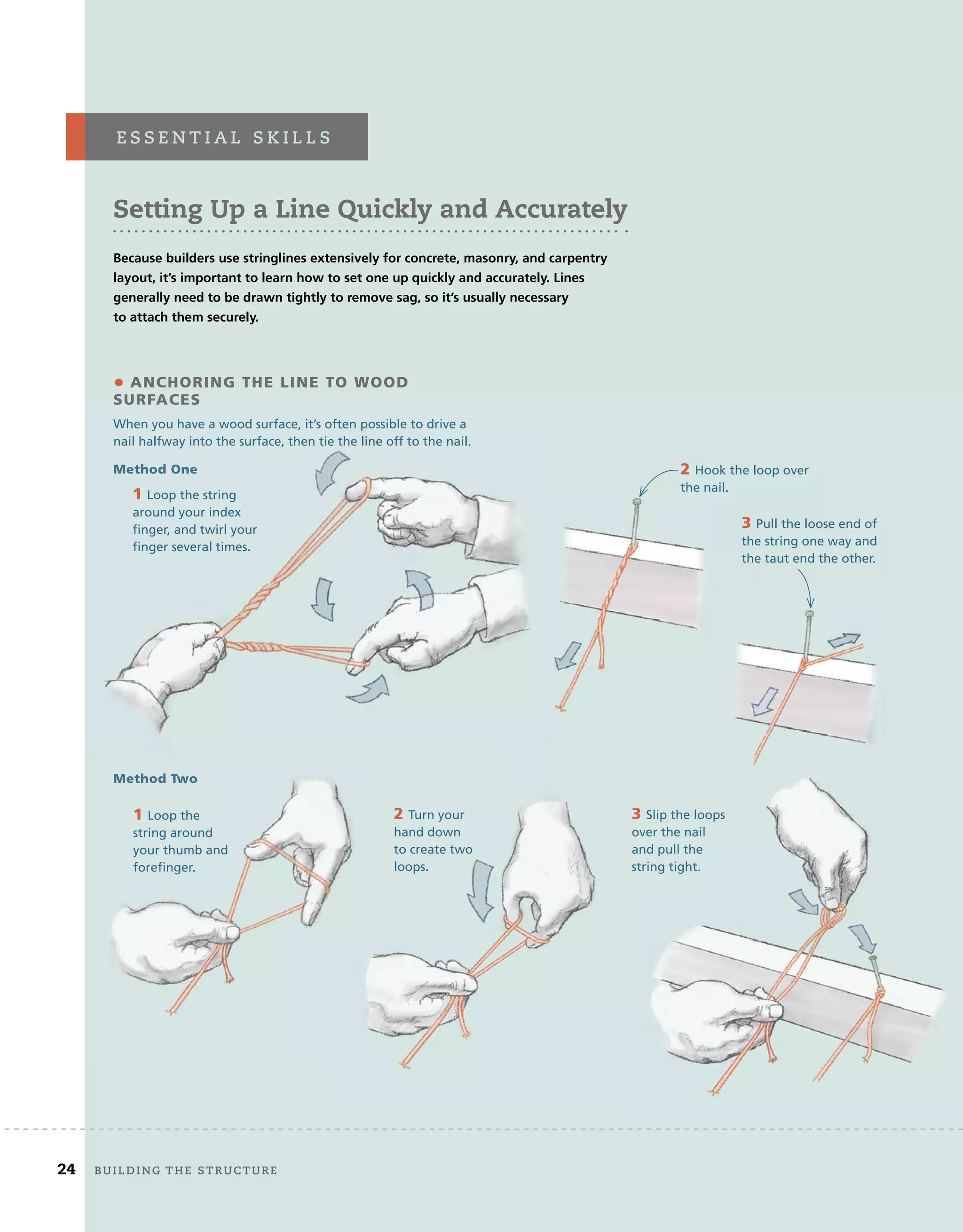
Setting Up a Line Quickly and Accurately
Because builders use stringlines extensively for concrete, masonry, and carpentry
layout, it’s important to learn how to set one up quickly and accurately. Lines
generally need to be drawn tightly to remove sag, so it’s usually necessary
to attach them securely.
• ANCHORING THE LINE TO WOOD
SURFACES
When you have a wood surface, it’s often possible to drive a
nail halfway into the surface, then tie the line off to the nail.
1 Loop the string
around your index
finger, and twirl your
finger several times.
2 Hook the loop over
the nail.
3 Pull the loose end of
the string one way and
the taut end the other.
1 Loop the
string around
your thumb and
forefinger.
Method One
Method Two
2 Turn your
hand down
to create two
loops.
3 Slip the loops
over the nail
and pull the
string tight.
e s s e n t i A l 	 s k i l l s
3 Slip the loops
over the nail
and pull the
string tight.
24 Building	the	structure
frAMing	floors,	wAlls,	And	ceilings 25
1
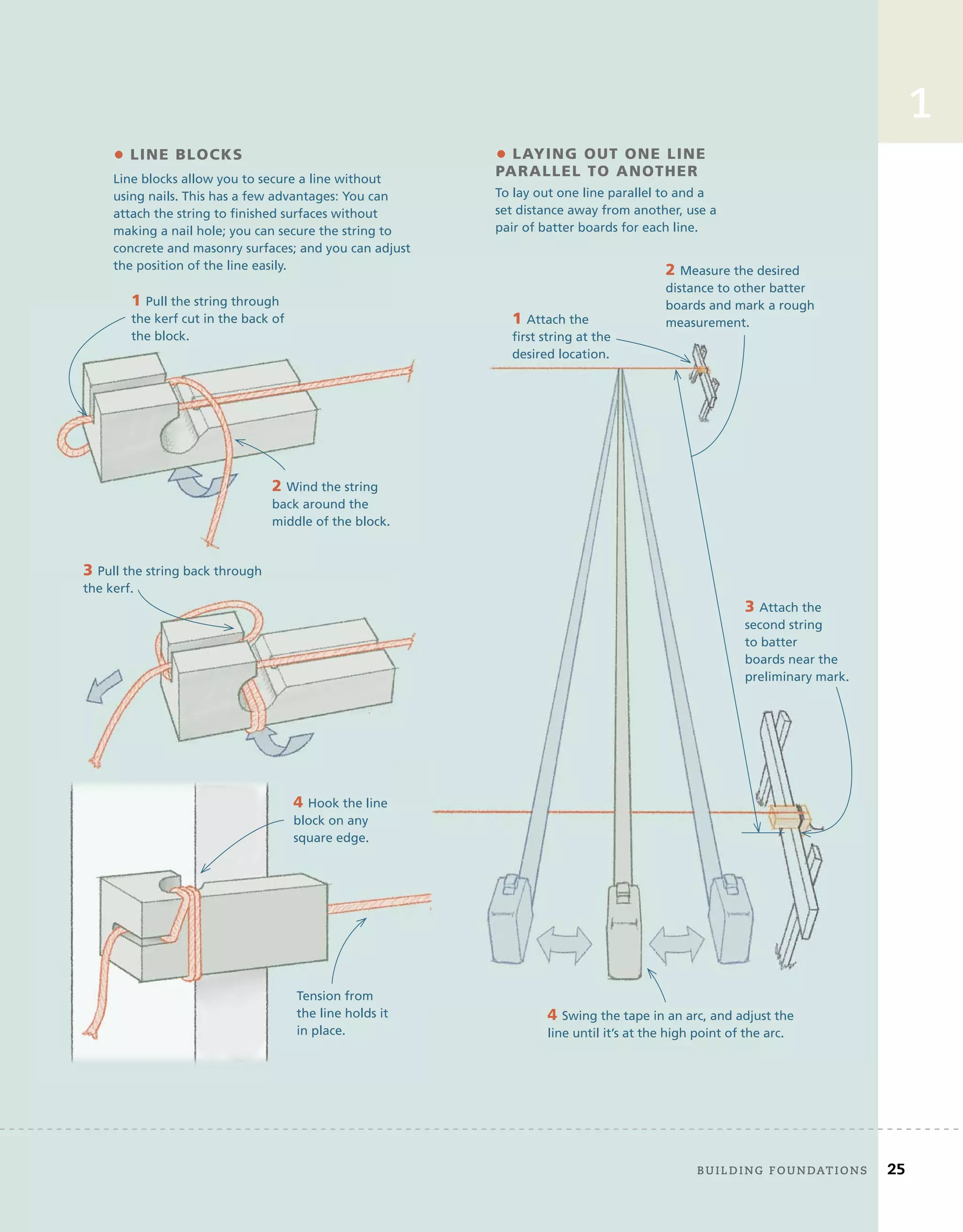
• LINE BLOCKS
Line blocks allow you to secure a line without
using nails. This has a few advantages: You can
attach the string to finished surfaces without
making a nail hole; you can secure the string to
concrete and masonry surfaces; and you can adjust
the position of the line easily.
2 Wind the string
back around the
middle of the block.
3 Pull the string back through
the kerf.
4 Hook the line
block on any
square edge.
Tension from
the line holds it
in place.
• LAYING OUT ONE LINE
PARALLEL TO ANOTHER
1 Attach the
first string at the
desired location.
2 Measure the desired
distance to other batter
boards and mark a rough
measurement.
To lay out one line parallel to and a
set distance away from another, use a
pair of batter boards for each line.
3 Attach the
second string
to batter
boards near the
preliminary mark.
4 Swing the tape in an arc, and adjust the
line until it’s at the high point of the arc.
1 Pull the string through
the kerf cut in the back of
the block.
	 Building	foundAtions 25
26 Building	the	structure 	
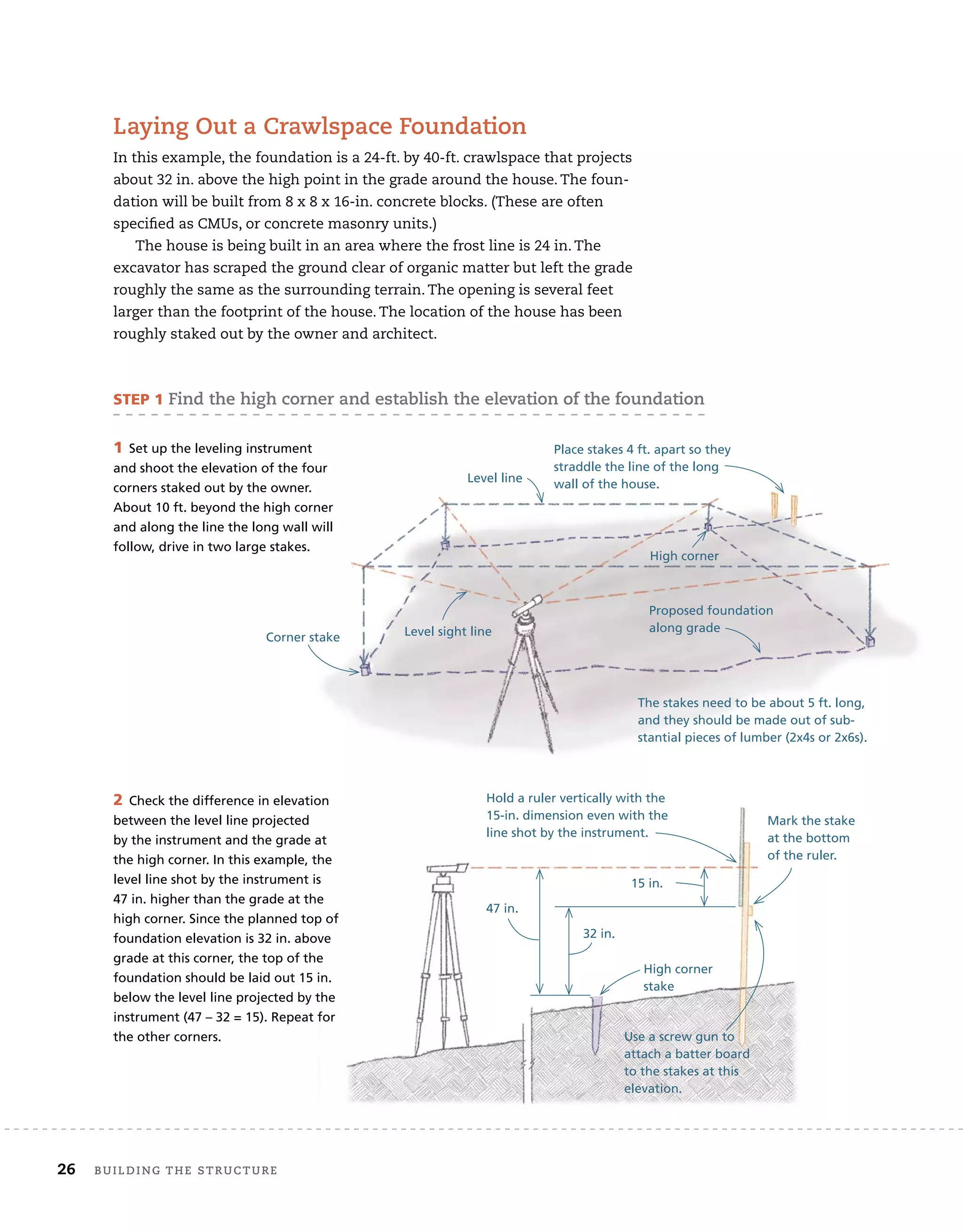
laying	out	a	crawlspace	foundation
In	this	example,	the	foundation	is	a	24-ft.	by	40-ft.	crawlspace	that	projects	
about	32	in.	above	the	high	point	in	the	grade	around	the	house.	The	foun-
dation	will	be	built	from	8	x	8	x	16-in.	concrete	blocks.	(These	are	often	
specifi
	ed	as	CMUs,	or	concrete	masonry	units.)
The	house	is	being	built	in	an	area	where	the	frost	line	is	24	in.	The	
excavator	has	scraped	the	ground	clear	of	organic	matter	but	left	the	grade	
roughly	the	same	as	the	surrounding	terrain.	The	opening	is	several	feet	
larger	than	the	footprint	of	the	house.	The	location	of	the	house	has	been	
roughly	staked	out	by	the	owner	and	architect.	
1 Set up the leveling instrument
and shoot the elevation of the four
corners staked out by the owner.
About 10 ft. beyond the high corner
and along the line the long wall will
follow, drive in two large stakes.
STEP 1 find	the	high	corner	and	establish	the	elevation	of	the	foundation
2 Check the difference in elevation
between the level line projected
by the instrument and the grade at
the high corner. In this example, the
level line shot by the instrument is
47 in. higher than the grade at the
high corner. Since the planned top of
foundation elevation is 32 in. above
grade at this corner, the top of the
foundation should be laid out 15 in.
below the level line projected by the
instrument (47 – 32 = 15). Repeat for
the other corners.
The stakes need to be about 5 ft. long,
and they should be made out of sub-
stantial pieces of lumber (2x4s or 2x6s).
Place stakes 4 ft. apart so they
straddle the line of the long
wall of the house.
Hold a ruler vertically with the
15-in. dimension even with the
line shot by the instrument.
Use a screw gun to
attach a batter board
to the stakes at this
elevation.
Mark the stake
at the bottom
of the ruler.
Corner stake
47 in.
Level line
Level sight line
Proposed foundation
along grade
High corner
High corner
stake
15 in.
32 in.
frAMing	floors,	wAlls,	And	ceilings 27
2
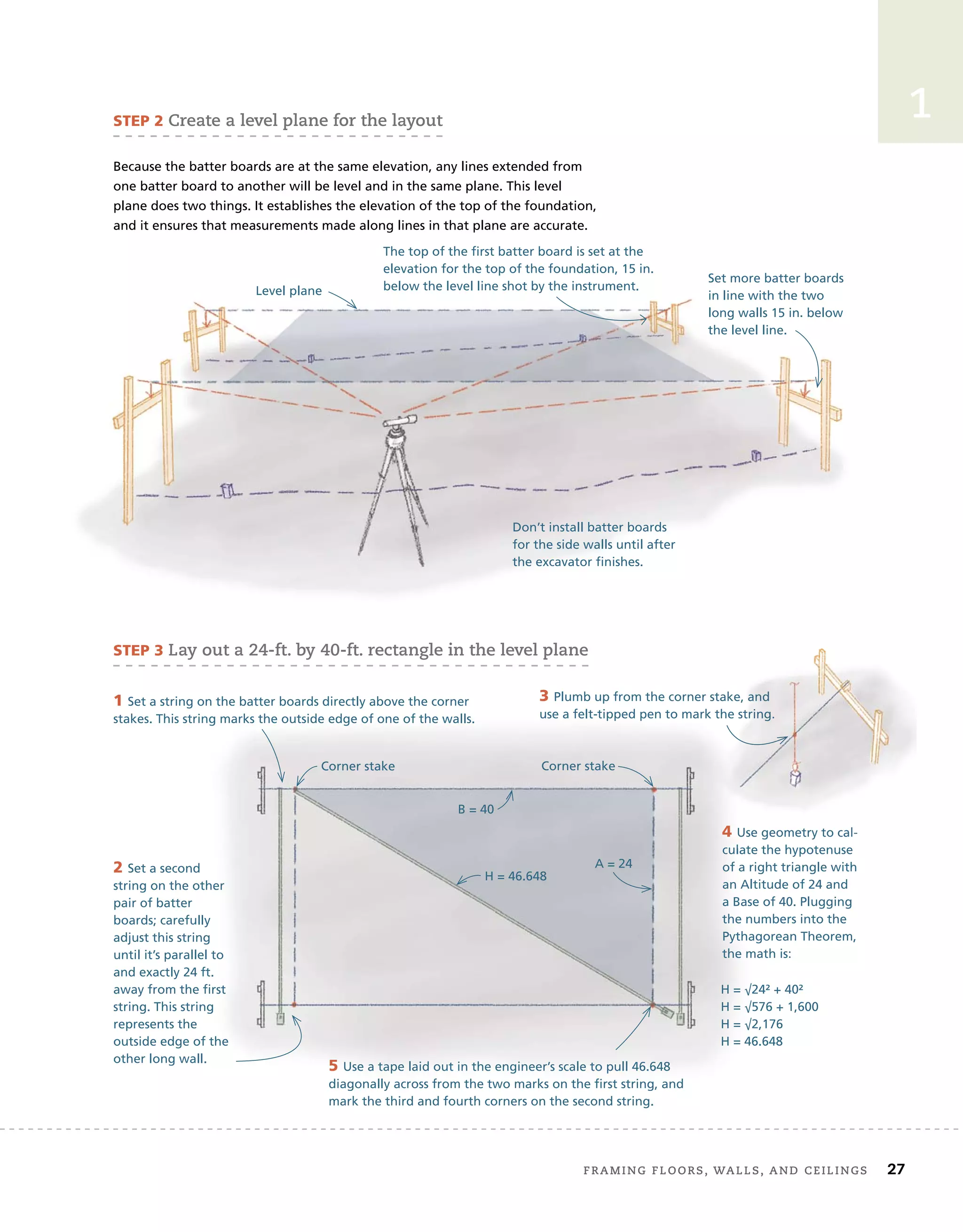
STEP 2 create	a	level	plane	for	the	layout
Because the batter boards are at the same elevation, any lines extended from
one batter board to another will be level and in the same plane. This level
plane does two things. It establishes the elevation of the top of the foundation,
and it ensures that measurements made along lines in that plane are accurate.
The top of the first batter board is set at the
elevation for the top of the foundation, 15 in.
below the level line shot by the instrument.
Set more batter boards
in line with the two
long walls 15 in. below
the level line.
Don’t install batter boards
for the side walls until after
the excavator finishes.
Level plane
STEP 3 lay	out	a	24-ft.	by	40-ft.	rectangle	in	the	level	plane
3 Plumb up from the corner stake, and
use a felt-tipped pen to mark the string.
1 Set a string on the batter boards directly above the corner
stakes. This string marks the outside edge of one of the walls.
Corner stake
2 Set a second
string on the other
pair of batter
boards; carefully
adjust this string
until it’s parallel to
and exactly 24 ft.
away from the first
string. This string
represents the
outside edge of the
other long wall.
4 Use geometry to cal-
culate the hypotenuse
of a right triangle with
an Altitude of 24 and
a Base of 40. Plugging
the numbers into the
Pythagorean Theorem,
the math is:
H = √24² + 40²
H = √576 + 1,600
H = √2,176
H = 46.648
5 Use a tape laid out in the engineer’s scale to pull 46.648
diagonally across from the two marks on the first string, and
mark the third and fourth corners on the second string.
Corner stake
A = 24
B = 40
H = 46.648
1
Plumb up from the corner stake, and
use a felt-tipped pen to mark the string.
4 Use geometry to cal-
Use geometry to cal-
culate the hypotenuse
STEP 4 record	the	layout	on	the	batter	boards
According to the plan, the foundation walls are 8 in. wide and the footings
are 16 in. wide. The footings must be centered under the walls. Around the
outside of the footing, you need an additional 6 in. or 8 in. for a drain system.
To accommodate the footing and the drain system, a 24-in.-wide footing
trench is planned.
8-in. foundation walls
16-in. footings
centered under
walls
Lay out both sides of the
foundation walls, both sides
of the footings, and the extra
8 in. for the drain system on
the batter boards.
Trench
8-in. foundation walls
16-in. footings centered
under walls
Allow 6 in.
or 8 in. for a
drain.
Trench
Measure the distance from the face of each batter
board to the corner mark on the string, and record
this measurement on the face of the batter board.
STEP 5 Mark	the	ground	for	the	footing	dig
1 To mark the trench for the long
walls, set up lines on the two outside
marks on the batter boards. Transfer
these locations to the ground with a
level, a plumb bob, or a laser.
2 To mark the trench for the side
walls, transfer the locations of the
four corners from the string to the
ground. Measure out 12 in. in both
directions.
3 Set strings just above the ground at
these locations, and mark the ground
with lime, mortar, or spray paint.
Transfer loca-
tions to the
ground.
Measure 12 in. in
both directions. Mark the
ground along
the strings.
28 Building	the	structure
STEP 6 dig	the	footing	to	the	right	depth
1 The bottom of the footing has to be at least 24 in. deep
to get it below the frost line. Also, because the specified
footing is 8 in. thick and the block courses will each be
8 in. high, the distance between the top of the founda-
tion and the bottom of the footing has to be evenly
divisible by 8 in.
2 In this example, you have scheduled a backhoe to dig
the footing the day after the layout, which means you’ve
had to move the leveling instrument. For the excavation
of the footing, you set it up again; this time it projects a
level line that’s 93⁄4 in. above the top of foundation.
The footing
needs to be
at least 24 in.
below the
frost line.
70 in. below the top
of the foundation
line is not divisible
by 8 in.
Measure from the strings on the
batter boards to find the lowest
corner—in this example, 46 in.—
below the top of the foundation.
Increasing the trench depth to
72 in. places the footing below
the frost line and conforms to
the 8-in. modular scheme.
The depth of the footing will be
813⁄4 in. (72 + 93⁄4) below the line shot
by the instrument.
The new level line is 93⁄4 in.
above the proposed
foundation top.
3 Remove the strings on the batter board to make room
for the backhoe. To get the trench in the right place, the
excavator digs to the lines you’ve made on the ground.
Check the depth using the
leveling instrument and a rod
marked at 813⁄4 in.
When the trench gets a little more than
32 in. below the surface, you can step the
depth up 8 in. From this point, make the
bottom 733⁄
3⁄
3 4
⁄4
⁄ in. (813⁄
3⁄
3 4
⁄4
⁄ – 8 = 733⁄
3⁄
3 4
⁄4
⁄ ) from the
line shot by the instrument.
1
	 Building	foundAtions 29
1
30 Building	the	structure
STEP 7 finish	the	trench	by	hand
STEP 8 get	ready	for	the	pour
7 Lay out and dig
footings for piers. They
don’t have to be below
the frost line but should
conform to the 8-in.
modular scheme men-
tioned on p. 29.
1 After the excavator finishes, install
batter boards for the footing side walls.
Attach new strings on the long wall
batter boards. Measure the distance
recorded on the face of the batter
board to mark one of the corners. 2 Measure 40 ft. down the string,
and mark the second corner.
3 Pull the 46.648-ft.
diagonals to lay out
the third and fourth
corners.
4 Pull strings
through the corner
marks to the side
batter boards, and
mark the batter
boards where the
strings cross them.
Mark the foundation wall.
5 Set strings on the
inside-of-trench and
outside-of-trench
marks on the batter
boards. Level down
from the strings to
see how well the
trench conforms
to the layout. Use
shovels to straighten
out the sides of the
trench and remove
any loose dirt from
the bottom.
Mark both sides
of the trench.
6 Measure the elevation of the bottom of the
footing against the strings. It should be 72 in.
in the lower area and 64 in. in the upper area.
Where the distance is less than these, dig to the
target distances. Be careful not to dig too deep.
1 Set lines on the marks for the
outside of the footing on the
batter boards.
3 Use 2x8s to form
the outside of the
footings.
2 Transfer these
locations to the
bottom of the trench
to get the forms in
the right place.
4 As you install the forms, measure up to the lines
to make sure you get the forms at the right eleva-
tion. The tops of the forms have to be at a height
that conforms to the 8-in. modular scheme. The
footings for the piers don’t require forms.
Set the rebar for the
footings as required by
your local code and the
specs on the plans.
1
STEP 10 lay	out	the	walls
After the concrete hardens, set lines on the batter boards and use a level,
plumb bob, or laser to transfer the locations of the walls to the top of the foot-
ing. Snap chalklines on the concrete to lay out the walls. Techniques for laying
the blocks up to the line will be discussed in the final section of this chapter.
Before beginning the block work, make a quick checklist of the things to
either allow for or include in the walls:
• Drainpipe to allow moisture inside the crawlspace to go through the wall
and into the perimeter drain system
• Access door
• Opening for an HVAC duct
• Foundation vents
• Beam pockets
• Anchors to bolt the frame to the foundation
STEP 9 Pour	the	footing
Before the concrete truck arrives, set up the leveling instrument and measure
the difference in elevation between the top of the batter boards and the line
shot by the instrument. Add the amount—in 8-in. increments—that you need
to go down to get the tops of the pier footings at the right height.
Measure down from
the level line projected
by the instrument to
pour the piers to the
correct elevation.
Inside the footing
trench, pour the
concrete even with
the top of the forms.
72 in.
64 in.
48 in. Line shot by
leveling instrument
Cave-ins:
A Deadly Hazard
The sides of trenches and
basement excavations can
collapse without warning. If a
person is buried over his head
in such a collapse, the chances
of survival are less than one in
ten. There are four things you
can do to reduce the chance of
a deadly cave-in:
• Any time you excavate
an opening for a basement,
make sure you dig at least
4 ft. beyond the footprint of
the house; this keeps workers
away from the deadly perim-
eter of the excavation.
• Slope the sides of the
excavation away from the
opening.
• Pile the spoils from a trench
excavation at least 2 ft. back
from the edge.
• Use a shoring system for
deep trenches. For more on
trenching safety, go to this
OSHA site: http://www.osha.
gov/SLTC/trenchingexcavation/
construction.html
sAfety	first
	 Building	foundAtions 31
32 Building	the	structure
Building	outside	the	Box	
Although	a	rectangular	fl
	oor	plan	has	the	advantages	of	speed	and	
economy,	designers	and	homeowners	often	desire	more	complicated	
shapes.	The	most	common	method	of	breaking	out	from	the	four	
walls	of	a	rectangular	house	is	to	add	more	rectangles	in	the	form	
of	ells,	wings,	and	insets.	There	are	many	occasions,	however,	when	
designers	abandon	the	rectangle	altogether	and	draw	up	buildings	or	
parts	of	buildings	with	obtuse	or	acute	angles	or	curved	walls.
To	lay	out	these	different	shapes,	follow	the	same	basic	sequence	
that	has	just	been	described.	First,	lay	out	a	level	plane	at	either	the	
top-of-foundation	or	the	top-of-footing	elevation.	Then	lay	out	the	
shape	within	that	plane.
Adding	rectangles	to	rectangles
To lay out these foundations, start by laying out the main rectangle and then
add more batter boards or forms to lay out the additional rectangles. Use
geometry to get the walls of the secondary rectangles square to the primary
rectangle.
Main rectangle
Added
rectangle
Parallel lines
Parallel lines Parallel lines
Added
rectangle
Added
rectangle
Equal diagonals
Batter board
1
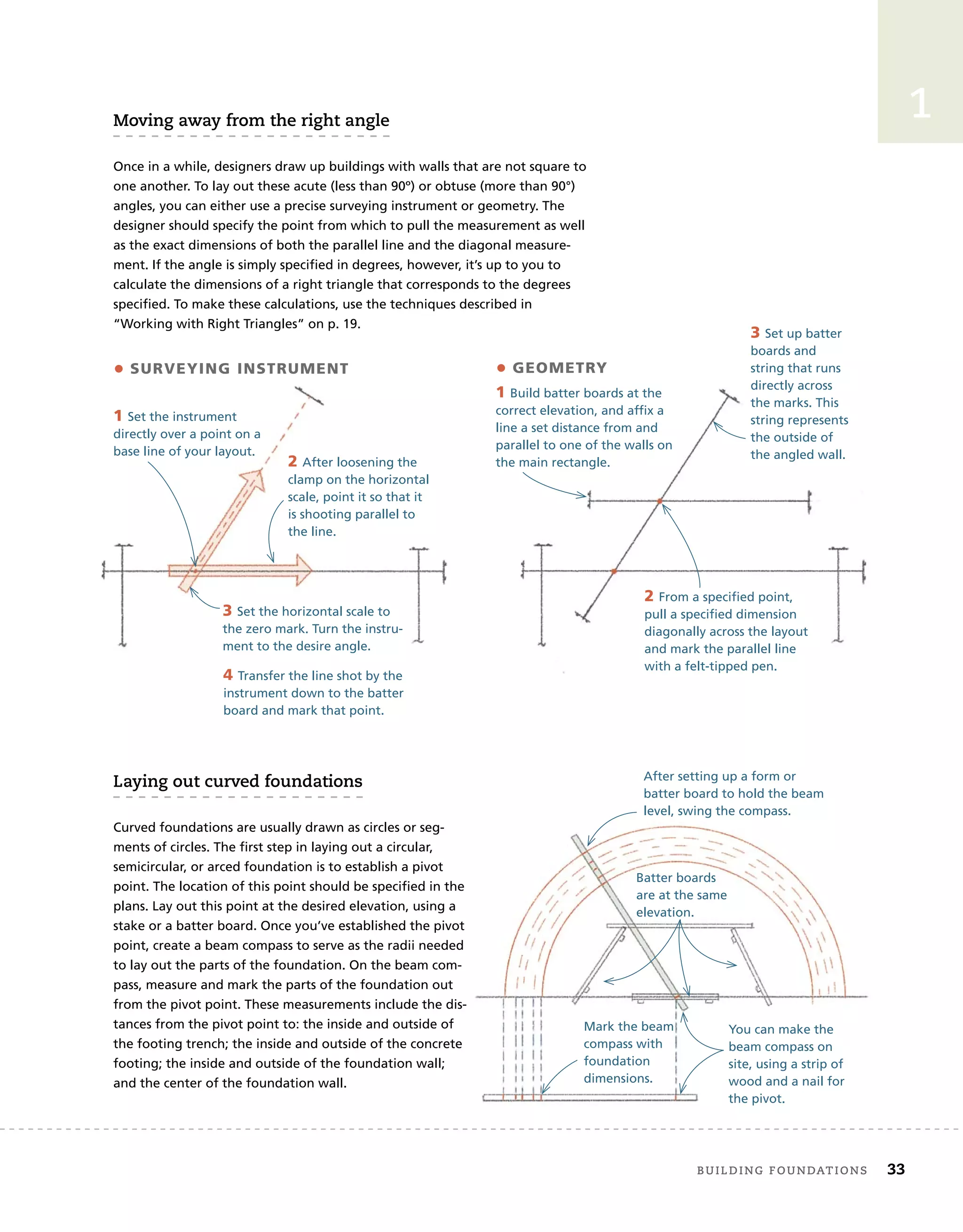
Moving	away	from	the	right	angle
Once in a while, designers draw up buildings with walls that are not square to
one another. To lay out these acute (less than 90º) or obtuse (more than 90°)
angles, you can either use a precise surveying instrument or geometry. The
designer should specify the point from which to pull the measurement as well
as the exact dimensions of both the parallel line and the diagonal measure-
ment. If the angle is simply specified in degrees, however, it’s up to you to
calculate the dimensions of a right triangle that corresponds to the degrees
specified. To make these calculations, use the techniques described in
“Working with Right Triangles” on p. 19.
2 From a specified point,
pull a specified dimension
diagonally across the layout
and mark the parallel line
with a felt-tipped pen.
2 After loosening the
clamp on the horizontal
scale, point it so that it
is shooting parallel to
the line.
3 Set the horizontal scale to
the zero mark. Turn the instru-
ment to the desire angle.
• SURVEYING INSTRUMENT • GEOMETRY
3 Set up batter
boards and
string that runs
directly across
the marks. This
string represents
the outside of
the angled wall.
1 Build batter boards at the
correct elevation, and affix a
line a set distance from and
parallel to one of the walls on
the main rectangle.
1 Set the instrument
directly over a point on a
base line of your layout.
4 Transfer the line shot by the
instrument down to the batter
board and mark that point.
laying	out	curved	foundations
Curved foundations are usually drawn as circles or seg-
ments of circles. The first step in laying out a circular,
semicircular, or arced foundation is to establish a pivot
point. The location of this point should be specified in the
plans. Lay out this point at the desired elevation, using a
stake or a batter board. Once you’ve established the pivot
point, create a beam compass to serve as the radii needed
to lay out the parts of the foundation. On the beam com-
pass, measure and mark the parts of the foundation out
from the pivot point. These measurements include the dis-
tances from the pivot point to: the inside and outside of
the footing trench; the inside and outside of the concrete
footing; the inside and outside of the foundation wall;
and the center of the foundation wall.
After setting up a form or
batter board to hold the beam
level, swing the compass.
You can make the
beam compass on
site, using a strip of
wood and a nail for
the pivot.
Mark the beam
compass with
foundation
dimensions.
Batter boards
are at the same
elevation.
	 Building	foundAtions 33
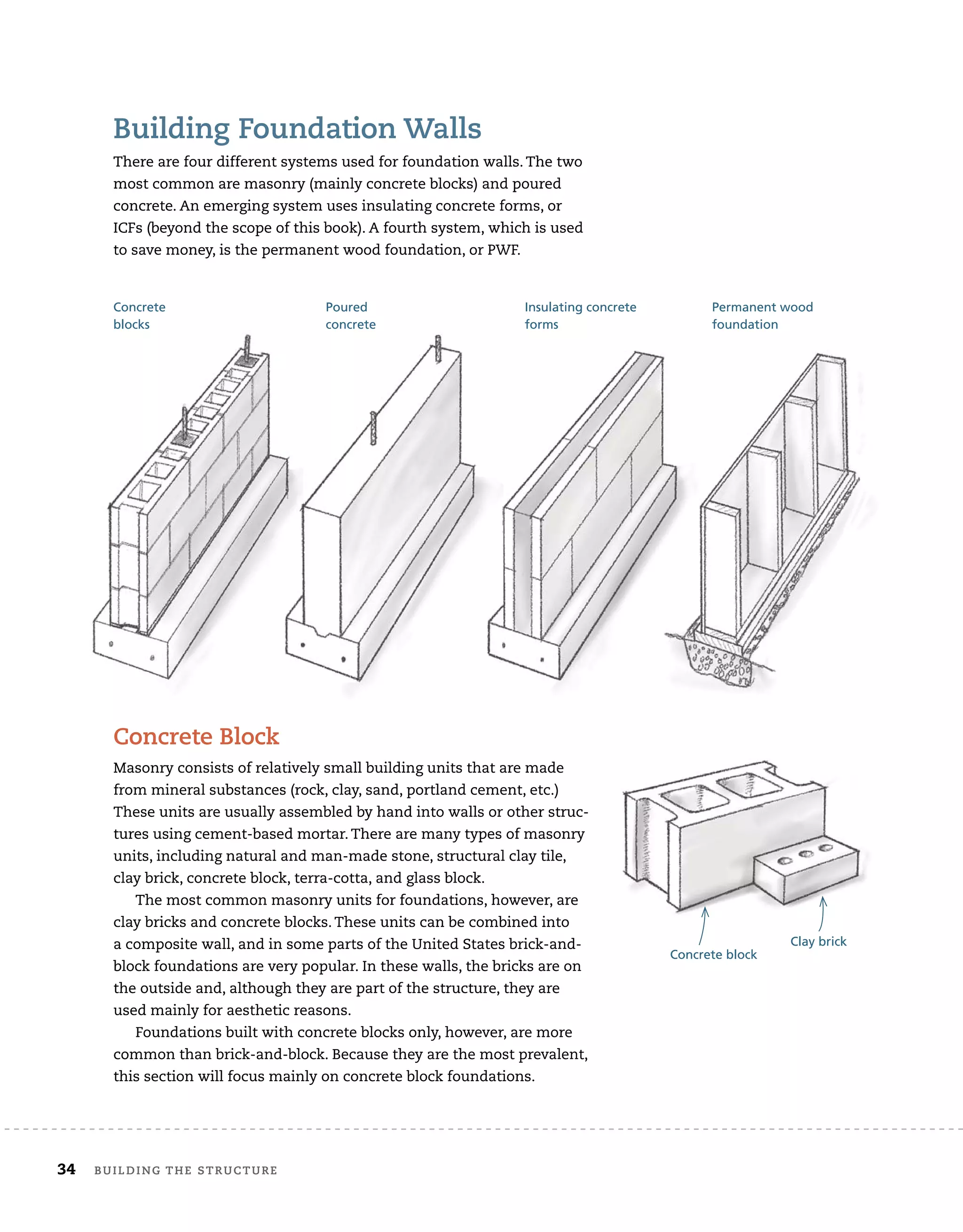
Building	foundation	walls
There	are	four	different	systems	used	for	foundation	walls.	The	two	
most	common	are	masonry	(mainly	concrete	blocks)	and	poured	
concrete.	An	emerging	system	uses	insulating	concrete	forms,	or	
ICFs	(beyond	the	scope	of	this	book).	A	fourth	system,	which	is	used	
to	save	money,	is	the	permanent	wood	foundation,	or	PWF.	
concrete	Block	
Masonry	consists	of	relatively	small	building	units	that	are	made	
from	mineral	substances	(rock,	clay,	sand,	portland	cement,	etc.)	
These	units	are	usually	assembled	by	hand	into	walls	or	other	struc-
tures	using	cement-based	mortar.	There	are	many	types	of	masonry	
units,	including	natural	and	man-made	stone,	structural	clay	tile,	
clay	brick,	concrete	block,	terra-cotta,	and	glass	block.
The	most	common	masonry	units	for	foundations,	however,	are	
clay	bricks	and	concrete	blocks.	These	units	can	be	combined	into	
a	composite	wall,	and	in	some	parts	of	the	United	States	brick-and-
block	foundations	are	very	popular.	In	these	walls,	the	bricks	are	on	
the	outside	and,	although	they	are	part	of	the	structure,	they	are	
used	mainly	for	aesthetic	reasons.
Foundations	built	with	concrete	blocks	only,	however,	are	more	
common	than	brick-and-block.	Because	they	are	the	most	prevalent,	
this	section	will	focus	mainly	on	concrete	block	foundations.
Concrete
blocks
Poured
concrete
Permanent wood
foundation
Concrete block
Clay brick
Insulating concrete
forms
34 Building	the	structure
blocks concrete foundation
forms
Masonry	consists	of	relatively	small	building	units	that	are	made	
from	mineral	substances	(rock,	clay,	sand,	portland	cement,	etc.)	
These	units	are	usually	assembled	by	hand	into	walls	or	other	struc-
tures	using	cement-based	mortar.	There	are	many	types	of	masonry	
units,	including	natural	and	man-made	stone,	structural	clay	tile,	
The	most	common	masonry	units	for	foundations,	however,	are	
clay	bricks	and	concrete	blocks.	These	units	can	be	combined	into	
a	composite	wall,	and	in	some	parts	of	the	United	States	brick-and-
block	foundations	are	very	popular.	In	these	walls,	the	bricks	are	on	
Concrete block
Clay brick
Building	foundation	walls
There	are	four	different	systems	used	for	foundation	walls.	The	two	
most	common	are	masonry	(mainly	concrete	blocks)	and	poured	
concrete.	An	emerging	system	uses	insulating	concrete	forms,	or	
ICFs	(beyond	the	scope	of	this	book).	A	fourth	system,	which	is	used	
to	save	money,	is	the	permanent	wood	foundation,	or	PWF.	
concrete	Block	
Masonry	consists	of	relatively	small	building	units	that	are	made	
from	mineral	substances	(rock,	clay,	sand,	portland	cement,	etc.)	
These	units	are	usually	assembled	by	hand	into	walls	or	other	struc-
tures	using	cement-based	mortar.	There	are	many	types	of	masonry	
units,	including	natural	and	man-made	stone,	structural	clay	tile,	
clay	brick,	concrete	block,	terra-cotta,	and	glass	block.
The	most	common	masonry	units	for	foundations,	however,	are	
clay	bricks	and	concrete	blocks.	These	units	can	be	combined	into	
a	composite	wall,	and	in	some	parts	of	the	United	States	brick-and-
block	foundations	are	very	popular.	In	these	walls,	the	bricks	are	on	
the	outside	and,	although	they	are	part	of	the	structure,	they	are	
used	mainly	for	aesthetic	reasons.
Foundations	built	with	concrete	blocks	only,	however,	are	more	
common	than	brick-and-block.	Because	they	are	the	most	prevalent,	
this	section	will	focus	mainly	on	concrete	block	foundations.
Concrete
blocks
Poured
concrete
Permanent wood
foundation
Concrete block
Clay brick
Insulating concrete
forms
2
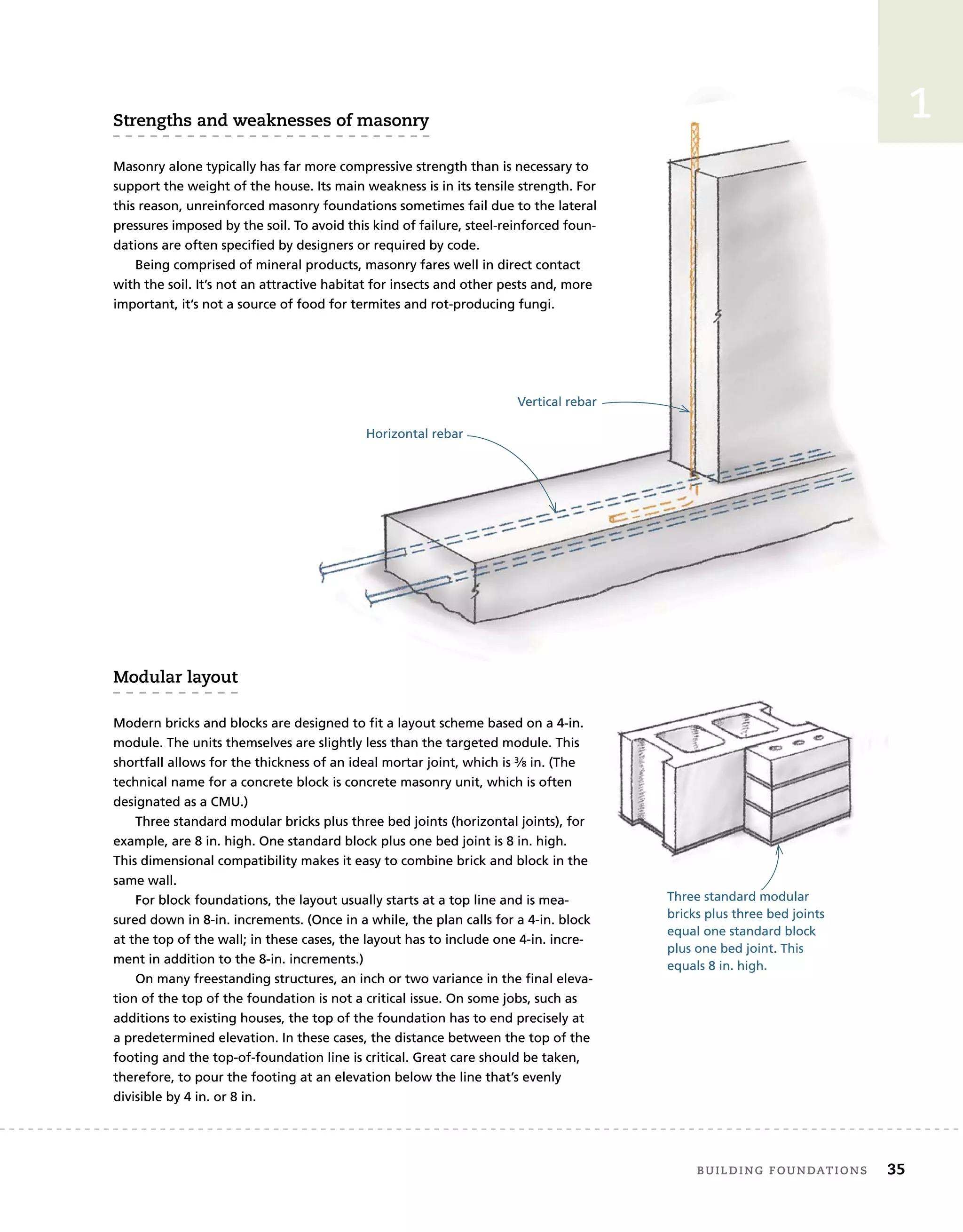
strengths	and	weaknesses	of	masonry
Masonry alone typically has far more compressive strength than is necessary to
support the weight of the house. Its main weakness is in its tensile strength. For
this reason, unreinforced masonry foundations sometimes fail due to the lateral
pressures imposed by the soil. To avoid this kind of failure, steel-reinforced foun-
dations are often specified by designers or required by code.
Being comprised of mineral products, masonry fares well in direct contact
with the soil. It’s not an attractive habitat for insects and other pests and, more
important, it’s not a source of food for termites and rot-producing fungi.
Modular	layout
Modern bricks and blocks are designed to fit a layout scheme based on a 4-in.
module. The units themselves are slightly less than the targeted module. This
shortfall allows for the thickness of an ideal mortar joint, which is 3⁄8 in. (The
technical name for a concrete block is concrete masonry unit, which is often
designated as a CMU.)
Three standard modular bricks plus three bed joints (horizontal joints), for
example, are 8 in. high. One standard block plus one bed joint is 8 in. high.
This dimensional compatibility makes it easy to combine brick and block in the
same wall.
For block foundations, the layout usually starts at a top line and is mea-
sured down in 8-in. increments. (Once in a while, the plan calls for a 4-in. block
at the top of the wall; in these cases, the layout has to include one 4-in. incre-
ment in addition to the 8-in. increments.)
On many freestanding structures, an inch or two variance in the final eleva-
tion of the top of the foundation is not a critical issue. On some jobs, such as
additions to existing houses, the top of the foundation has to end precisely at
a predetermined elevation. In these cases, the distance between the top of the
footing and the top-of-foundation line is critical. Great care should be taken,
therefore, to pour the footing at an elevation below the line that’s evenly
divisible by 4 in. or 8 in.
Horizontal rebar
Vertical rebar
Three standard modular
bricks plus three bed joints
equal one standard block
plus one bed joint. This
equals 8 in. high.
	 Building	foundAtions 35
strengths	and	weaknesses	of	masonry
Masonry alone typically has far more compressive strength than is necessary to
support the weight of the house. Its main weakness is in its tensile strength. For
this reason, unreinforced masonry foundations sometimes fail due to the lateral
pressures imposed by the soil. To avoid this kind of failure, steel-reinforced foun-
dations are often specified by designers or required by code.
Being comprised of mineral products, masonry fares well in direct contact
with the soil. It’s not an attractive habitat for insects and other pests and, more
important, it’s not a source of food for termites and rot-producing fungi.
Modular	layout
Modern bricks and blocks are designed to fit a layout scheme based on a 4-in.
module. The units themselves are slightly less than the targeted module. This
shortfall allows for the thickness of an ideal mortar joint, which is 3⁄8 in. (The
technical name for a concrete block is concrete masonry unit, which is often
designated as a CMU.)
Three standard modular bricks plus three bed joints (horizontal joints), for
example, are 8 in. high. One standard block plus one bed joint is 8 in. high.
This dimensional compatibility makes it easy to combine brick and block in the
same wall.
For block foundations, the layout usually starts at a top line and is mea-
sured down in 8-in. increments. (Once in a while, the plan calls for a 4-in. block
at the top of the wall; in these cases, the layout has to include one 4-in. incre-
ment in addition to the 8-in. increments.)
On many freestanding structures, an inch or two variance in the final eleva-
tion of the top of the foundation is not a critical issue. On some jobs, such as
additions to existing houses, the top of the foundation has to end precisely at
a predetermined elevation. In these cases, the distance between the top of the
footing and the top-of-foundation line is critical. Great care should be taken,
therefore, to pour the footing at an elevation below the line that’s evenly
divisible by 4 in. or 8 in.
Horizontal rebar
Vertical rebar
Three standard modular
bricks plus three bed joints
equal one standard block
plus one bed joint. This
equals 8 in. high.
1
strengths	and	weaknesses	of	masonry
Masonry alone typically has far more compressive strength than is necessary to
support the weight of the house. Its main weakness is in its tensile strength. For
this reason, unreinforced masonry foundations sometimes fail due to the lateral
pressures imposed by the soil. To avoid this kind of failure, steel-reinforced foun-
dations are often specified by designers or required by code.
Being comprised of mineral products, masonry fares well in direct contact
with the soil. It’s not an attractive habitat for insects and other pests and, more
important, it’s not a source of food for termites and rot-producing fungi.
Horizontal rebar
Horizontal rebar
Horizontal rebar
Vertical rebar
Vertical rebar
Vertical rebar
36 Building	the	structure
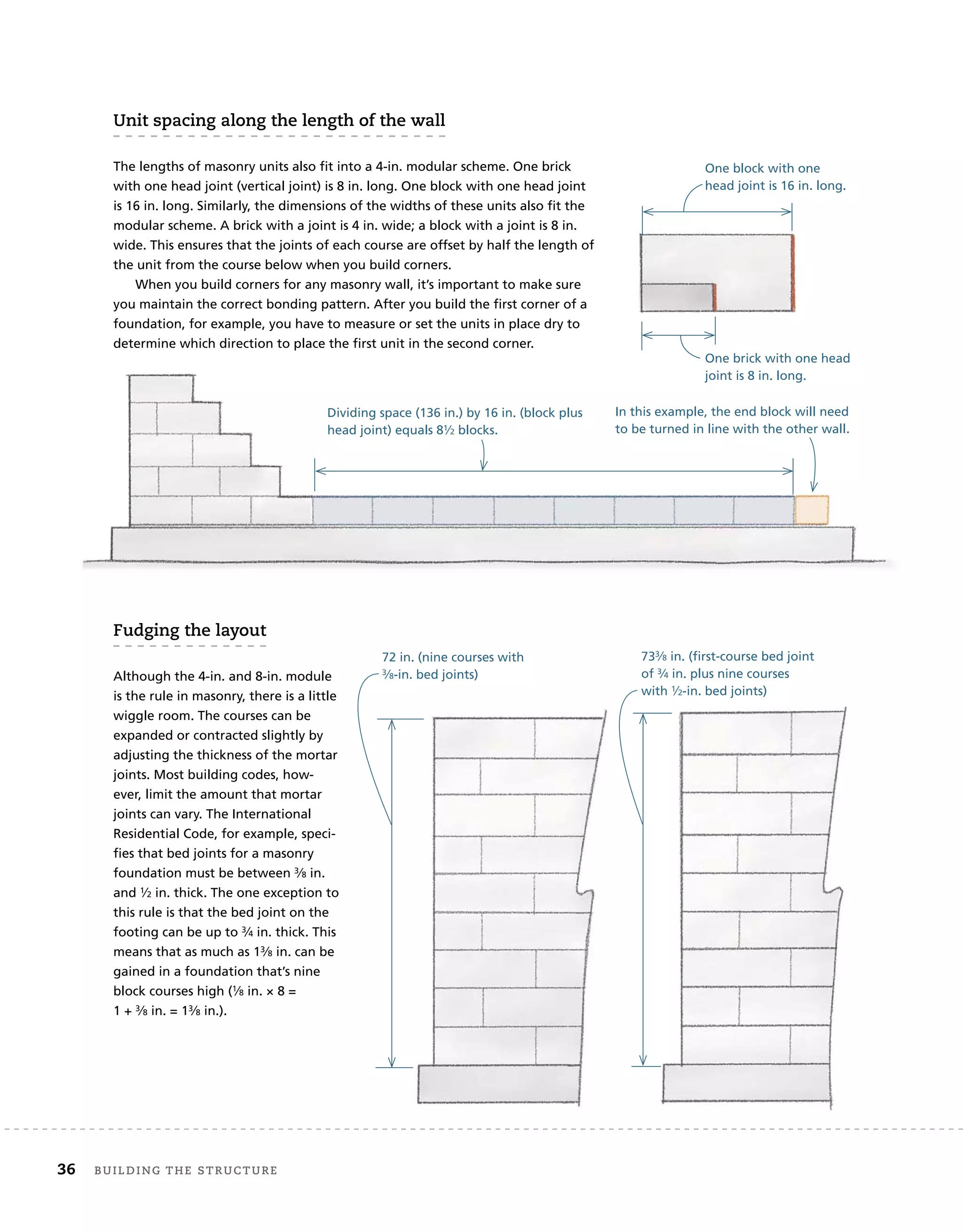
unit	spacing	along	the	length	of	the	wall	
The lengths of masonry units also fit into a 4-in. modular scheme. One brick
with one head joint (vertical joint) is 8 in. long. One block with one head joint
is 16 in. long. Similarly, the dimensions of the widths of these units also fit the
modular scheme. A brick with a joint is 4 in. wide; a block with a joint is 8 in.
wide. This ensures that the joints of each course are offset by half the length of
the unit from the course below when you build corners.
When you build corners for any masonry wall, it’s important to make sure
you maintain the correct bonding pattern. After you build the first corner of a
foundation, for example, you have to measure or set the units in place dry to
determine which direction to place the first unit in the second corner.
fudging	the	layout
Although the 4-in. and 8-in. module
is the rule in masonry, there is a little
wiggle room. The courses can be
expanded or contracted slightly by
adjusting the thickness of the mortar
joints. Most building codes, how-
ever, limit the amount that mortar
joints can vary. The International
Residential Code, for example, speci-
fies that bed joints for a masonry
foundation must be between 3⁄8 in.
and 1⁄2 in. thick. The one exception to
this rule is that the bed joint on the
footing can be up to 3⁄4 in. thick. This
means that as much as 13⁄8 in. can be
gained in a foundation that’s nine
block courses high (1⁄8 in. × 8 =
1 + 3⁄8 in. = 13⁄8 in.).
One brick with one head
joint is 8 in. long.
One block with one
head joint is 16 in. long.
Dividing space (136 in.) by 16 in. (block plus
head joint) equals 81⁄2 blocks.
In this example, the end block will need
to be turned in line with the other wall.
72 in. (nine courses with
3⁄8-in. bed joints)
733⁄8 in. (first-course bed joint
of 3⁄4 in. plus nine courses
with 1⁄2-in. bed joints)
1
wAy s 	 o f 	w o r k i n g
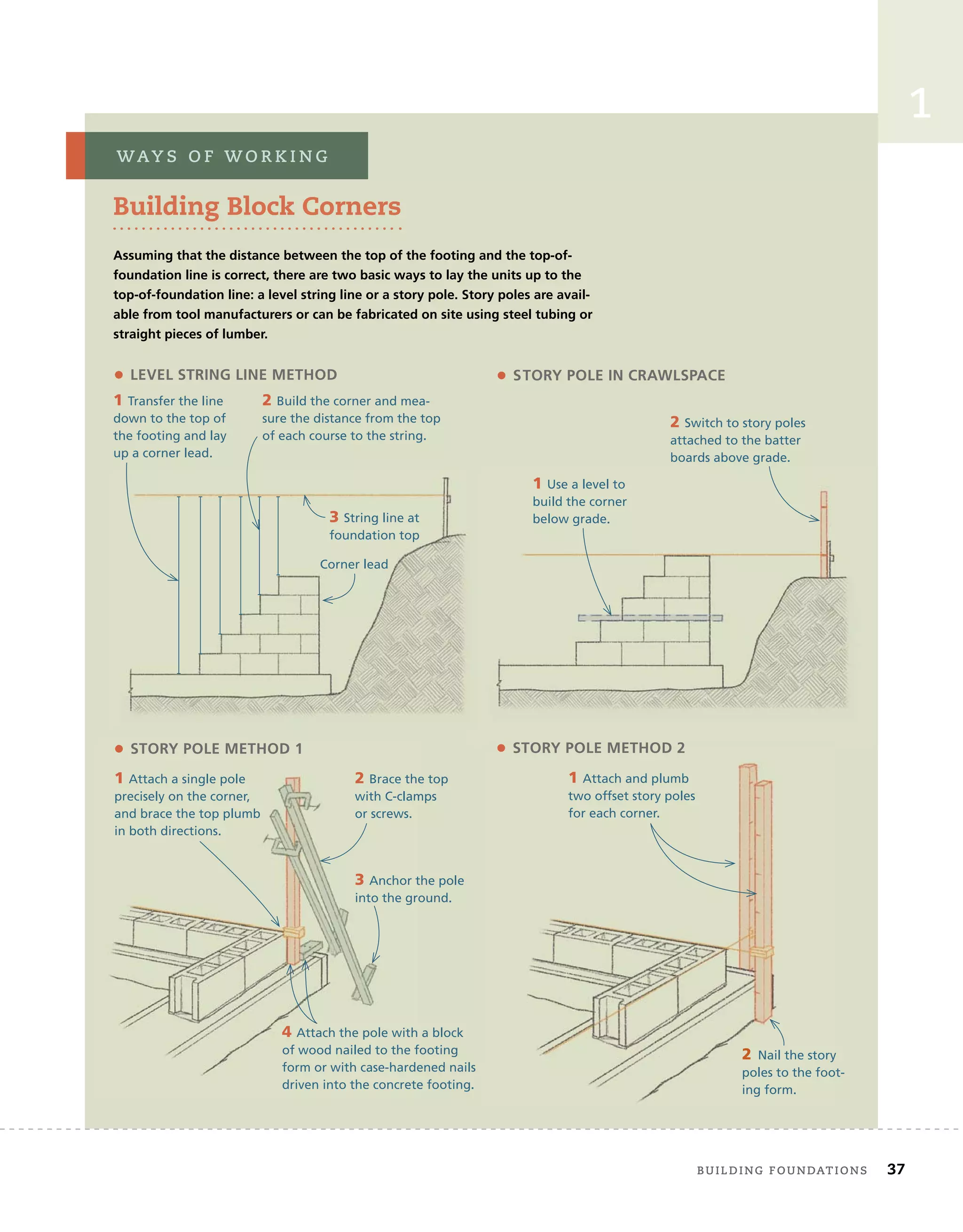
Building Block Corners
Assuming that the distance between the top of the footing and the top-of-
foundation line is correct, there are two basic ways to lay the units up to the
top-of-foundation line: a level string line or a story pole. Story poles are avail-
able from tool manufacturers or can be fabricated on site using steel tubing or
straight pieces of lumber.
• LEVEL STRING LINE METHOD
2 Build the corner and mea-
sure the distance from the top
of each course to the string.
1 Transfer the line
down to the top of
the footing and lay
up a corner lead.
3 String line at
foundation top
Corner lead
• STORY POLE METHOD 1
3 Anchor the pole
into the ground.
4 Attach the pole with a block
of wood nailed to the footing
form or with case-hardened nails
driven into the concrete footing.
1 Attach a single pole
precisely on the corner,
and brace the top plumb
in both directions.
2 Brace the top
with C-clamps
or screws.
• STORY POLE METHOD 2
2 Nail the story
poles to the foot-
ing form.
1 Attach and plumb
two offset story poles
for each corner.
• STORY POLE IN CRAWLSPACE
2 Switch to story poles
attached to the batter
boards above grade.
1 Use a level to
build the corner
below grade.
	 Building	foundAtions 37
38 Building	the	structure
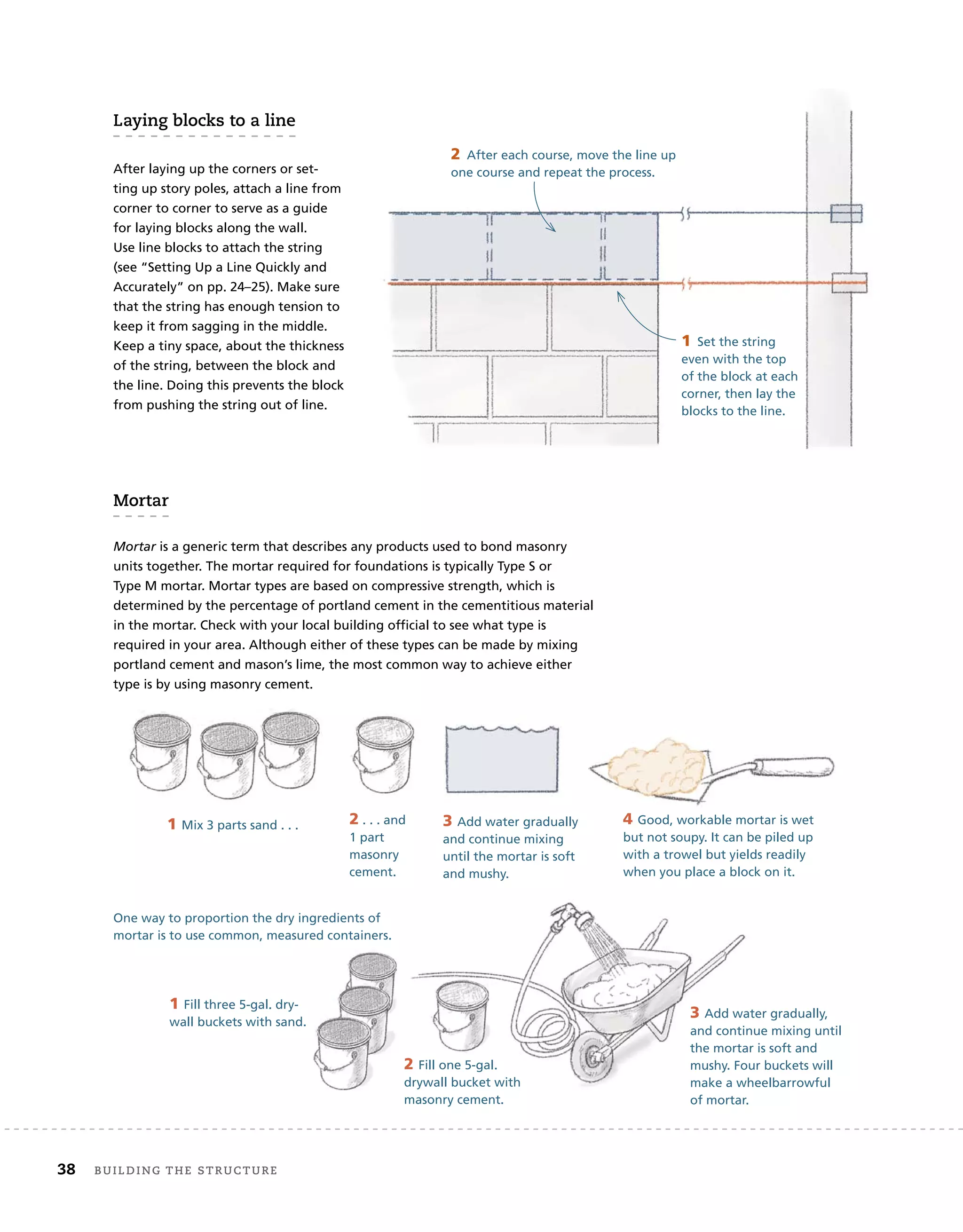
laying	blocks	to	a	line
After laying up the corners or set-
ting up story poles, attach a line from
corner to corner to serve as a guide
for laying blocks along the wall.
Use line blocks to attach the string
(see “Setting Up a Line Quickly and
Accurately” on pp. 24–25). Make sure
that the string has enough tension to
keep it from sagging in the middle.
Keep a tiny space, about the thickness
of the string, between the block and
the line. Doing this prevents the block
from pushing the string out of line.
Mortar
Mortar is a generic term that describes any products used to bond masonry
units together. The mortar required for foundations is typically Type S or
Type M mortar. Mortar types are based on compressive strength, which is
determined by the percentage of portland cement in the cementitious material
in the mortar. Check with your local building official to see what type is
required in your area. Although either of these types can be made by mixing
portland cement and mason’s lime, the most common way to achieve either
type is by using masonry cement.
1 Set the string
even with the top
of the block at each
corner, then lay the
blocks to the line.
2 After each course, move the line up
one course and repeat the process.
4 Good, workable mortar is wet
but not soupy. It can be piled up
with a trowel but yields readily
when you place a block on it.
1 Mix 3 parts sand . . . 2 . . . and
1 part
masonry
cement.
3 Add water gradually
and continue mixing
until the mortar is soft
and mushy.
One way to proportion the dry ingredients of
mortar is to use common, measured containers.
1 Fill three 5-gal. dry-
wall buckets with sand.
2 Fill one 5-gal.
drywall bucket with
masonry cement.
3 Add water gradually,
and continue mixing until
the mortar is soft and
mushy. Four buckets will
make a wheelbarrowful
of mortar.
1
troweling	techniques
Wielding a trowel is a physical skill that can be acquired only through
practice. Although there is no substitute for picking up a trowel and
having at it, here are a few basic techniques to get you started.
1 Pile mortar into a mound
in a mortar pan.
2 Scoop a full
but manageable
trowelful.
3 With the fully loaded
trowel a few inches above
the footing, give the
trowel a slight downward
tilt. Without stopping,
rotate your wrist and pull
the trowel.
4 The motion is like
the pull stroke when
you’re working with a
handsaw.
• TROWELING THE FIRST COURSE
• TROWELING BLOCKS
To butter the end of a block (or brick), you have to turn the
trowel over. The challenge is to keep the mortar from slid-
ing off the overturned trowel.
1 Pick up half a
trowelful.
2 With the mortar
facing up, thrust the
trowel straight down
and stop it abruptly.
3 With the mortar
flattened against the
trowel, it stays put as
you butter the ends
of the block.
Maximize the Bond
In addition to having com-
pressive strength, mortar has
to bond the masonry units
together tenaciously. To maxi-
mize bond, the units should
be dry and the mortar should
be as wet as possible and still
have enough body to sup-
port the weight of the units.
When mortar is spread on the
surface of a dry, porous unit,
the mortar is sucked into the
pores, creating a mechanical
as well as chemical bond.
There is an enduring myth
that masons should soak
units before laying them in
a wall. In most cases, this is
false. Most clay bricks and
all concrete blocks should be
kept dry before laying them
in a wall. On rare occasions,
unusually porous and dry clay
bricks have an excessively
high initial rate of absorption
(IRA). These bricks suck the
moisture out of the mortar at
such a rate that the mortar
dries almost immediately. This
makes them difficult to work
with and can have a nega-
tive effect on the bond. In
these cases, the bricks should
be wetted, then allowed to
surface-dry before they’re set
in the wall. Wet masonry units
should never be laid in a wall.
toP	tiP
	 Building	foundAtions 39
rebar	set	in	footing
Block walls are often reinforced with steel and grout. The
design should be drawn up by an engineer, or follow the
specifications of the building code in your area. Rebar
should be laid out so that it emerges from the footing
in the center of the block cores. After the footing pour,
builders sometimes bend incorrectly placed rebar to get it
in line with the block core. This practice compromises the
structural integrity of the system and should be avoided.
It’s far better to lay out the pieces of steel correctly prior
to the footing pour.
create	a	cleanout
It is important to keep the footing around the verti-
cal rebar clear of mortar droppings so the cavity can be
completely filled with grout later. To ensure that the
footing around the vertical rebar remains clean as you lay
up the wall, you need to cut a “cleanout,” a 4-in. by 4-in.
opening in the first block that goes over the rebar. As
the blocks are laid up, you can reach in and clean out the
droppings around the rebar several times a day.
As the blocks are laid up, keep the rebar in the center
of the core. Wire rebar positioners are available for
this purpose.
grout	block	cavities
The grout must bond the masonry units and the rebar
together. To achieve this bond, grout is much richer in
portland cement than concrete and it has much more
water. Because grout must fill the block cavities com-
pletely, pea gravel is often specified as the coarse aggre-
gate. Structural engineers often specify the proportions
for the grout on commercial masonry jobs. For residential
projects, however, you can usually get an acceptable mix
by conferring with your concrete supplier.
Rebar tied to
horizontal rebar
set in footing
prior to pour
Rebar
Grout
Footing
Cleanout
Rebar positioner Rebar
40 Building	the	structure
Poured	concrete	
Concrete	is	made	of	four	basic	ingredients:	water,	portland	cement,	
sand,	and	coarse	aggregate	(usually	gravel	or	crushed	stone).	In	a	
typical	batch	of	wet	concrete,	only	about	12%	of	the	mix	consists	of	
portland	cement.	Most	of	the	material	is	aggregate;	sand	comprises	
about	28%	of	the	mix,	while	gravel	or	crushed	stone	makes	up	44%	
of	the	total	volume.	The	fi
	nal	ingredient,	water,	varies	considerably	
from	batch	to	batch.	Ideally,	the	water	content	should	be	about	15%	
of	the	volume.	On	many	jobs,	air	is	also	mixed	into	the	concrete,	
typically	accounting	for	about	6%	of	the	volume.
When	water	is	mixed	with	the	dry	ingredients,	a	chemical	reac-
tion	in	the	portland	cement,	called	hydration,	takes	place.	Hydration	
causes	the	most	important	constituents	of	the	cement,	the	calcium	
silicates,	to	dissolve	and	then	gradually	reform	as	calcium	silicate	
hydrate	and	calcium	hydroxide.	As	hydration	proceeds,	these	newly	
formed	compounds	harden	and	bond	to	each	other	and	to	the	grains	
of	sand	and	stones	that	they	surround.	Meanwhile,	if	air-entraining	
chemicals	are	mixed	in,	billions	of	microscopic	air	pockets	per	cubic	
yard	are	formed.	After	air-entrained	concrete	is	fully	cured,	it	stands	
up	to	freezing	temperatures	much	better	than	untreated	concrete.	
The	tiny	chambers	relieve	internal	pressure	on	the	concrete	by	pro-
viding	space	for	the	water	to	expand	into	when	it	freezes.
strengths	and	weaknesses	of	concrete
Because the tools and skills required
for installing concrete and unit
masonry are so different, they are
considered separate branches of
the building industry. The materials,
however, are often indistinguish-
able. The ingredients of grout, for
example, are the same as those in
concrete. Concrete blocks are made
from concrete. A stone wall often
consists of the same materials as are
found in concrete: stone, sand, and
portland cement. And, while brick is
made of a different material (clay),
both brick and concrete are mineral
substances with great compressive
strength.
Concrete is often
reinforced with steel.
Because it is made from
mineral products, concrete
performs well in contact
with the ground.
Unreinforced concrete is relatively weak
in tensile strength.
Before the Truck
Comes
The trucks used to deliver
concrete and blocks are often
tall enough to hit overhead
power lines. When they do,
they can electrocute anyone
who touches any metal part of
the truck. Always reconnoiter
the route the truck will follow
and, if a line poses a hazard,
come up with an alternate
route or have the line discon-
nected by the power company.
sAfety	first
1
	 Building	foundAtions 41
water	and	concrete	
Ready-mixed concrete is proportioned at the concrete plant and delivered by
truck ready to place. The amount of water added to the mix at the plant is
specified by the buyer in terms of “slump” (see “Slump Test” above). The lower
the slump, the less water added and the stiffer the mix. Concrete with a 2-in.
slump, for example, is so stiff that it has to be pulled down the chute of the
truck and physically pulled into place and packed into forms to avoid honey-
combs (voids). Concrete with a 5-in. slump, on the other hand, flows down the
chute, spreads out, and fills forms easily.
Slump has a direct impact on the workability of the concrete. Low-slump
concrete is a lot harder to place and finish than high-slump concrete. There is
a tendency, therefore, on the part of the workers in the field to want to add
water to the concrete. Ready-mix trucks carry water for this purpose.
Ready-mix concrete suppliers, however, carefully document the amount
that is added, both at the plant and during the pour. The reason they do this
is because the amount of water mixed into concrete has a direct impact on the
strength and durability of the finished product.
The amount of water needed to cause hydration is surprisingly small. All
the dry ingredients have to be thoroughly dampened but they don’t need
Slump Test
To measure the consistency of wet
concrete, engineers have developed
the slump test. Although residential
builders rarely do slump tests,
they use a given “slump” to
indicate how much water they
want mixed in when they order
concrete. Concrete with a 4-in.
slump is typical for residential work.
1 Fill a cone-shaped
container of specified
proportions with
concrete.
2 Flip the con-
tainer. Slowly
lift the cone off
the concrete.
3 Measure how much
the cone of concrete sags.
tools	&	techniQues
Ready-mixed concrete is proportioned at the concrete plant and delivered by
truck ready to place. The amount of water added to the mix at the plant is
specified by the buyer in terms of “slump” (see “Slump Test” above). The lower
the slump, the less water added and the stiffer the mix. Concrete with a 2-in.
slump, for example, is so stiff that it has to be pulled down the chute of the
truck and physically pulled into place and packed into forms to avoid honey-
combs (voids). Concrete with a 5-in. slump, on the other hand, flows down the
Slump has a direct impact on the workability of the concrete. Low-slump
concrete is a lot harder to place and finish than high-slump concrete. There is
a tendency, therefore, on the part of the workers in the field to want to add
Ready-mix concrete suppliers, however, carefully document the amount
that is added, both at the plant and during the pour. The reason they do this
42 Building	the	structure
to be saturated with water. Every drop of water that is not consumed by the
hydration process has to exit the concrete via evaporation.
It is this evaporating water that causes problems. Above the amount neces-
sary for hydration, each added gallon of water per cubic yard decreases the
compressive strength of the concrete 200 to 300 psi (pounds per square inch)
and increases shrinkage potential about 10%. Furthermore, as the water-to-
cement ratio climbs, the durability of the concrete declines; problems such as
cracks, spalling, and freeze/thaw deterioration are directly related to the water
content in concrete.
Since excessive water can have a negative effect on the long-term perfor-
mance of the concrete, builders and/or owners should not leave the issue of
water content entirely in the hands of those who place the concrete. Because
adding water makes their job easier, leaving the issue of slump in the hands
of the concrete crew is a little like asking the fox to guard the hen house. The
slump of the concrete should be discussed and agreed upon prior to the pour
and, after the truck arrives, strict limits should be placed on how much water
can be added. If you’re not present at the pour, you can determine how much
water was added by reviewing the documentation of the ready-mix supplier.
curing	concrete
During hydration, cement and water are consumed as a new product—the
hardened concrete—is born. Although concrete is usually hard enough to walk
on within a few hours, it continues to hydrate long after it initially sets and it
does not achieve full strength for months or even years. The most important
period for hydration, however, is the first week after the concrete is poured. It
is during this critical period that hydration proceeds most rapidly. Because con-
crete attains about half of its ultimate strength in this first crucial week, water
within the concrete must not be allowed to evaporate completely or to freeze.
Because water must be present for hydration to occur, you should take
measures to keep the water within the concrete for several days. This process,
called curing, should not be confused with the initial mixing of water into
concrete. As noted above, hydration does not require very much water, and
you should use water sparingly when making concrete. Once the concrete is
mixed and poured, however, you need to keep that water within the concrete
Keep forms in place
for several days
and seal the top.
Cover the concrete with damp
burlap. Make sure the burlap
stays damp for several days.
	 Building	foundAtions 43
1
for as long as possible. In other words, the strongest concrete is made with as
little water as possible, retained inside the concrete for as long as possible.
There are two basic ways to cure concrete. The first is to seal the water
inside the concrete. On flat work, such as a basement floor, you can cover the
floor with plastic sheets or spray on a special waterproof coating called curing
compound. Do this several hours after the concrete has been finished and
achieved its initial set. Make sure you seal up the edges of the plastic sheets;
one way to do this is to place sand on top of the plastic around the perimeter
of the slab. On vertical work, such as foundation walls, the moisture can be
retained by keeping the forms in place for several days and just sealing the
top, exposed edge (see the drawing at left on p. 43).
The second basic strategy for curing concrete is to keep the exposed surface
of the concrete damp. One way to do this is to cover the concrete with damp
burlap. Make sure the burlap stays damp for several days.
forming	concrete
Wet concrete weighs more than 4,000 lb. per cubic yard. When first mixed,
it’s an amorphous blob that slumps and spreads out when poured. (Although
the amount of slump varies with the percentage of water in the mix, it almost
always has some slump.) When you pour this material into a form, the form has
to contain the slump of the wet concrete. The concrete presses down and out,
exerting tremendous pressure on the inside walls of the forms. This pressure
can force forms to bulge out or fail catastrophically, like a burst dam.
When you build forms for footings or foundation walls, you have to build
them strong enough to contain this pressure. This pressure grows substantially
with the height of the form and the quantity of concrete poured. Flatwork
(sidewalks, floors, driveways, etc.), for example, sometimes requires several
For footings 8 in. to 12 in.
tall and slab-on-grade
foundations, use 11⁄2-in.-
thick lumber for the forms.
Brace the stakes and tops of forms
to keep them from spreading.
2×4s or 2×6s are nailed to small stakes
driven into the ground every 4 ft.
44 Building	the	structure
Plywood and 2×4 forms
must be braced carefully
to keep the bottoms from
spreading.
yards of concrete. But, because the forms are usually just 4 in. to 6 in. high, the
thrusting forces of the concrete in these pours are relatively small. Typically, the
forms for these structures are made out of 2×4s or 2×6s nailed to small stakes
driven into the ground every 4 ft. or so.
When the forms are 8 in. to 12 in. tall, as is the case for some footings and
slab-on-grade foundations, 11⁄2-in.-thick lumber can still be used. However, the
stakes have to be braced and the tops of the forms have to be connected to
keep them from spreading.
Forms for walls 16 in. to 24 in. high typically require 4-in.-thick panels built
like the exterior walls of a house. These forms, built out of 2×4s and plywood,
must be braced carefully. To keep the bottoms from spreading, carpenters
often lay steel strapping on the footing, then wrap it up the outside of the
forms and nail it securely.
Forms for foundation walls taller than 24 in. can be erected with prefabri-
cated panels, or they can be built on site with plywood and studs. Because of
the tremendous pressure of the concrete, steel ties must be used to keep the
walls from spreading, buckling, or blowing out altogether. If you need to form
walls higher than 24 in., consider using a foundation subcontractor. He’ll have
the forms, the hardware, and the experience to build a form that can contain
the pressure of the concrete.
Cubic Inches
in a Cubic Yard
The number 46,656 is not easy
to remember and there’s no
reason to do so. A yard is 36 in.
and a cubic yard is 36 × 36 × 36,
which is 46,656. Anytime you
need this number for estimat-
ing volume, just do the multi-
plication and write it down.
toP	tiP
	 Building	foundAtions 45
1
46 Building	the	structure
estimating	concrete
In the United States, ready-mix concrete is sold by the cubic yard. To estimate
the amount needed for a pour, carefully measure the length, width, and depth
of the area enclosed by the forms. After converting these measurements to a
single measuring unit—usually feet or inches—multiply the length × the width
× the depth to arrive at the volume in cubic feet or cubic inches. If you have
the volume in cubic feet, divide by 27 (the number of cubic feet in a cubic yard)
to convert to cubic yards. If you have the volume in cubic inches, divide by
46,656 (the number of cubic inches in a cubic yard) to convert to cubic yards. To
make sure you don’t end up just short of concrete at the end of the pour, add
about 10% for footings and 5% for walls. These conversions can be simplified
by using a construction calculator.
Aligning	and	bracing	the	forms
When forming foundation walls, the layout often takes place at the footing
level. After snapping chalklines on the top of the footing, set the bottoms of
the forms on the lines, then brace them plumb. To ensure that the walls end
up straight, brace the corner panels plumb first, then set up a string stretching
from corner to corner. Brace the intermediate panels to the string. Anchor the
bottom of the braces to stakes driven into the ground, and attach the tops of
the braces to the panels with screws or nails.
Set the bottoms
of the forms on
snapped lines, then
brace them plumb.
Anchor the braces to
stakes driven into the
ground and attach the
tops to the panels.
1
Admixtures
Concrete suppliers often offer chemical admixtures that can improve the work-
ability or enhance the performance of concrete. The most common of these are
air-entrainment admixtures. Other admixtures include chemicals that inhibit
corrosion, reduce alkali-silica reaction, add bonding and damp-proofing
properties, and provide coloring. Retarding admixtures are used in hot weather
to slow down the setting rate of concrete. Accelerating admixtures are used
in cold weather to increase the rate at which concrete gains strength. This
means that the concrete has to be protected from freezing temperatures for a
shorter period.
Plasticizing admixtures make low-to-normal slump concrete more fluid
without adding more water. This makes the concrete easier to place but
doesn’t weaken it. This has given rise to a new use of the word “slump.” You
can now order concrete with a “4-in. slump, plasticized to a 6-in. slump.” The
4-in. slump is the slump created by the water content and the additional 2 in.
of slump is created by the admixture.
Plasticizing admixtures work great for vertical pours, but they can cause
problems for flat pours. This is because the effects of the plasticizing chemicals
are temporary, lasting 30 to 60 minutes. When they wear off, the surface of the
concrete can harden rather suddenly, making finishing difficult.
When to Hire a Concrete Subcontractor
Because of the stakes involved,
builders often use concrete subcon-
tractors. For large flat pours, such
as a basement floor, experienced
concrete masons can quickly pull
the concrete flat, cut it level with a
straightedge (often called a screed),
and float the surface. Speed is of the
essence, especially in hot weather.
Concrete crews that specialize in
flat work not only get the concrete
placed and floated quickly but
also have the skills and equipment
to achieve very smooth finished
surfaces.
Large vertical pours, such as
basement walls, require an enor-
mous amount of concrete. Crews
that specialize in basement walls
have reusable manufactured forms
that are engineered to contain the
concrete. They have the experience
to see how to bring in a truck close
to the forms or to realize when
they’re going to need to rent a con-
crete pump. They’ve also developed
the physical skills and the brawn
needed to handle a chute or a hose
full of concrete.
Large concrete pours are often
best left to specialists. Waiting for
a subcontractor, however, presents
its own set of problems. After you
dig, form, and install steel in a
footing, for example, you shouldn’t
delay the pour. If it rains and the
footing gets flooded, you’ll have to
spend a lot more time getting the
footing dry and removing silt that
has washed into the trench.
If you’re a custom builder or a
remodeling contractor, it pays to be
able to do small to medium pours
“in house.” The key is to know
what your crew can handle. This is
something that you can determine
only gradually, through experience.
Starting with small pours, you can
gradually develop the skills, acquire
the tools, and gain the confidence
needed for larger pours.
way s o f w o r k i n g
	 building foundations	 47
Permanent	wood	foundations,	or	PWFs,	have	been	
used	in	the	United	States	since	the	1960s.	While	
these	foundations	require	careful	detailing,	they	
can	be	built	by	any	carpentry	crew	using	standard	
framing	techniques.
The	footings	for	these	foundations	are	typically	
8	in.	of	compacted	gravel	in	a	16-in.-wide	trench.	
A	treated	plate	(usually	a	2×10	or	2×12)	is	laid	fl
	at	
on	this	bed	of	gravel.	Then	a	2×6	or	2×8	framed	
wall,	sheathed	with	treated	plywood,	is	nailed	to	
the	plate.
PWFs	are	engineered	systems	and	the	details	
vary	according	to	the	type	of	foundation	you’re	
building,	the	soil	you	encounter,	and	the	design	
load	of	the	house.	Before	starting	a	PWF,	make	
sure	you	know	and	understand	the	design,	and	
check	with	your	local	building	offi
	cial	to	see	what’s	
required	in	your	area.
Wood must be rated for
foundations. Types 304 or
314 stainless-steel fasteners
are generally required below
grade. In some jurisdictions,
other types of corrosion-
resistant nail are permitted
above grade.
Permanent	wood	foundations	(Pwfs)
controlling	water
Controlling water is an essential part of these systems. First, you
have to drain water from the footings, the base of the wall, and
under the floor. Second, you must add a protective barrier to the
outside of the foundation.
On a sloping lot, use a gravity
drain to move water away
from the house.
Drain water
from the
footing.
Drain conveys water
to daylight.
PWF wall
system
Permanent	wood	foundations,	or	PWFs,	have	been	
used	in	the	United	States	since	the	1960s.	While	
these	foundations	require	careful	detailing,	they	
can	be	built	by	any	carpentry	crew	using	standard	
The	footings	for	these	foundations	are	typically	
8	in.	of	compacted	gravel	in	a	16-in.-wide	trench.	
A	treated	plate	(usually	a	2×10	or	2×12)	is	laid	fl
	at	
wall,	sheathed	with	treated	plywood,	is	nailed	to	
PWFs	are	engineered	systems	and	the	details	
check	with	your	local	building	offi
	cial	to	see	what’s	
Wood must be rated for
foundations. Types 304 or
314 stainless-steel fasteners
are generally required below
grade. In some jurisdictions,
other types of corrosion-
resistant nail are permitted
above grade.
Permanent	wood	foundations	(Pwfs)
48 Building	the	structure
Protective	barrier
The second part of the process is
a protective barrier on the outside
of the foundation. Because of the
importance of keeping these systems
dry, PWFs are not a good choice in
very wet locations or where there’s
a high water table.
In basements, a concrete slab is
poured inside the walls. This slab
restrains the inward thrust that the
soil exerts against the bottom of
the walls. A treated wood floor, also
built inside the walls, can be used in
lieu of the concrete.
In crawlspace foundations, there
is less imbalanced fill between the
inside and outside of the founda-
tion wall. In these situations, the soil
inside the wall is used to counteract
pressure from the soil along the
outside.
Basements
crawlspace	foundations
The framed floor resists
inward pressure.
5 ft. to 7 ft. of soil
presses against the
wall system.
Framing anchors are
often specified for
connections at the stud/
plate and joist/plate.
Floor framing
Poured slab
Soil placed inside
the foundation
12-in.-wide treated
plywood holds the
sheet in place to
protect the top
edge of the plastic.
6-mil plastic sheet
to keep water
from seeping into
the frame
PWF wall
system
PWF wall
system
PWF wall
system
	 Building	foundAtions 49
1
50
CHAPTER
2
Framing	Floors,	
walls,	and	
ceilings
aFTer	comPleTing	THe	FoUndaTion,	builders	
should	have	a	level	surface	8	in.	or	more	above	grade.	
Upon	this	surface,	they	begin	the	frame	of	the	house,	a	
structure	that	will	defi
	ne	the	shape	of	the	house	and	the	
layout	of	the	rooms.	Due	to	the	size	and	complexity	of	
house	frames,	this	book	devotes	three	chapters	to	their	
construction.	This	chapter	concentrates	on	fl
	oors,
walls,	and	ceilings.	Chapters	3	and	4	will	be	devoted	to	
framing	roofs.
The	Three	Functions	of	the	Frame
When	you	build	the	frame	of	a	house,	you	need	to	do	
three	things.	First	and	foremost,	you	have	to	build	a	
safe	and	sound	structure.	Second,	you	have	to	build	a	
structure	that	accommodates	almost	all	the	subsequent	
work	on	the	house.	As	you	build	the	frame,	then,	you	
must	look	far	into	the	future	and	provide	for	the	needs	
of	plumbers,	drywall	hangers,	siders,	fi
	nish	carpenters,	
and	other	specialty	trade	contractors.	Third,	you
should	build	a	structure	that	meets	acceptable	
standards	of	quality.
2
	 Framing floors, walls, and ceilings	 51
Building a Safe and Sound Structure
The primary responsibility of frame carpenters is to build a safe and
durable structure. This aspect of frame carpentry is usually regulated
by local building officials.
Loads
The frame supports both the weight of the building (dead loads) and the loads
added by the inhabitants and the environment (live loads). The dead loads
imposed on the walls of a house include the combined weight of floors, ceil-
ings, and roof structures that bear on them and the weight of all the materi-
als that cover those structures. The live loads include furniture, equipment,
people, wind, snow, and seismic forces.
Both dead and live loads vary from building to building. If a customer wants
to roof her house in slate, for example, the dead load from the roof covering
would be substantially more than if she opts to use asphalt shingles.
The most important live loads are those generated by natural forces.
Because those forces differ according to the climate and topography of the
land, code requirements for frames vary from region to region. Different
codes, in fact, often govern different areas within the same state. It’s essential
to know and understand the code where you build.
Built-in durability
The frame not only has to have the strength to carry and resist loads, but it
also has to endure in an often hostile environment. The two biggest threats to
wood-framed houses are water and fire.
Although the first defenses against rainwater intrusion are the materials
that are later installed on the exterior of the frame, the frame itself contains
built-in features that help the building resist these destructive forces. One basic
built-in feature is the shape of the roof. A pitched roof helps move rainwater
down and off the house. Eaves and rakes provide even more built-in protection
because they keep most of the runoff from the roof away from the outside of
the walls.
Another built-in feature that resists the destructive force of water is the
use of treated wood wherever the wood is attached to masonry or concrete.
Masonry and concrete can absorb water through capillary action, the same
mechanism by which a sponge absorbs water. In hot, humid weather, moisture
from the air also condenses on concrete and masonry surfaces (which often
stay cooler than the ambient temperature). Over time, this moisture can cause
untreated wood to rot or attract termites. Because treated wood does not
deteriorate in the presence of water, it’s required by most building codes in
these locations.
A house is subject to dead loads
and live loads.
A pitched roof provides built-in
protection from water.
52 BUilding	THe	sTrUcTUre
Built-in	protection	from	fi
	re
There are two built-in measures that building codes require to help protect
wood-framed houses from fire. The first is to keep the wood frame from touch-
ing fireplaces and chimneys. Codes generally require a 2-in. clearance from all
sources of combustion. The second measure required by building codes is to
use fireblocking. By closing off cavities in walls, fireblocking restricts the supply
of oxygen to potential fires. Fireblocking the wall cavities at the floor and ceil-
ing levels also helps keep fire from spreading from floor to floor.
anticipating	subsequent	work
Along	with	the	ability	to	build	a	sound	and	durable	structure,	
frame	carpenters	have	to	anticipate	the	needs	of	all	the	trades	that	
follow.	Not	long	ago,	carpenters	framed	houses,	then	they	and	other	
craftsmen	fi
	t	their	materials	to	the	standing	structure.	Nowadays,	it’s	
quite	the	opposite.	To	a	large	degree,	carpenters	build	frames	to	fi
	t	
the	materials	that	will	cover	them.
modular	coordination
Like modern masonry materials, most of the materials that
cover house frames are manufactured in dimensions that fit
an industry-wide system called modular coordination. The
basic unit of this system is a 4-in.-square module, and most
building materials are manufactured in multiples of this
module. Plywood and drywall, for example, are manufac-
tured in sheets that are 48 in. wide and 96 in. or 144 in.
long. To make the frame fit the materials, carpenters gener-
ally lay out framing members (studs, joists, rafters, etc.) at
16-in. or 24-in. intervals. This process minimizes cutting and
saves time and material.
In addition to conforming to the modular system, frame
carpenters have to anticipate and allow for a large number
of nonmodular materials. Among these are doors, windows,
plumbing fixtures, plumbing lines, and heating and
venting ducts.
Backing	and	blocking
Frame carpenters also have to provide solid nailing surfaces for all the
materials that will later be attached to the frame. To do this, they have to
visualize how these materials will be attached and install backing (added
lumber for inside corners) and blocking (short pieces of lumber nailed
between studs and other framing members) at strategic locations through-
out the frame.
96 in.
48 in.
Studs on 16-in. centers align with drywall dimensions.
Top plates restrict fire from
advancing to the upper floor.
Blocking installed
between studs
Framing	Floors,	walls,	and	ceilings 53
2
The	Platform	Frame
There	are	many	ways	to	build	the	shell	of	a	house,	but	the	most	
common,	by	far,	is	the	platform	frame.	Because	it	accounts	for	more	
than	90%	of	the	new	single-family	homes	in	the	United	States,	the	
platform	frame	is	the	focus	of	this	book.	Most	of	the	building	tech-
niques	used	to	build	platform-framed	houses	are	readily	transferable	
to	other	systems.
The	platform	frame	is	a	relatively	new	construction	system.	It	
is	a	refi
	nement	of	the	balloon	frame,	which	was	developed	in	the	
American	West	in	the	mid-1800s.	In	the	1930s,	the	platform	frame	
emerged	as	a	modifi
	cation	of	the	balloon	frame.	The	main	innovation	
in	the	platform	frame	was	the	length	of	the	wall	studs.	In	a	two-story	
balloon	frame,	the	studs	extend	from	the	mudsill,	past	the	second	
Platform
framing uses
shorter studs.
Balloon framing uses
studs that extend from
the mudsill to the top
plate of the second floor.
Second-floor top plate
Mudsill
The floor system inter-
rupts studs and serves
as a platform to build
and raise walls.
54 BUilding	THe	sTrUcTUre
fl
	oor,	and	up	to	a	top	plate	just	below	the	eave	or	rake	of	the	roof.	The	
studs	often	have	to	be	16	ft.	to	20	ft.	long.	The	intervening	fl
	oors	bear	
on	ledgers	that	are	set	in	notches	cut	in	the	studs.
In	a	two-story	platform	frame,	carpenters	begin	by	building	a	
fl
	oor	system,	which	bears	on	the	mudsill.	This	fl
	oor	serves	as	a	
platform	upon	which	the	walls	for	the	fi
	rst	story	are	built.	After	
building,	raising,	and	bracing	the	fi
	rst-story	walls,	a	second	fl
	oor	is	
built	across	them.	This	fl
	oor	serves	as	a	second	platform	upon	which	
the	walls	for	the	second	story	are	built.	The	ceiling	at	the	uppermost	
level	serves	as	a	fi
	nal	platform	and	is	often	used	to	stand	on	as	the	
carpenters	assemble	the	roof	frame.	
Building	Floors
When	you	build	a	fl
	oor,	you	have	to	do	a	lot	more	than	provide	a	
level	surface	to	walk	on.	If	the	top	of	the	foundation	is	out-of-level	or	
out-of-square,	the	fl
	oor	system	provides	an	opportunity	to	partly	or	
completely	remove	these	fl
	aws.	You	also	have	to	think	far	ahead	in	
the	construction	process.	You	need	to	take	into	account:	the	struc-
tures	that	will	be	built	through	the	fl
	oor;	the	structures	that	will	be	
built	on	top	of	the	fl
	oor;	and	the	locations	of	plumbing	fi
	xtures	and	
heating	and	air-conditioning	lines.	This	section	examines	these	con-
cerns	as	it	describes	the	construction	of	a	typical	framed	fl
	oor.
install	the	mudsills	and	girders
STEP 1 measure	the	foundation	and	check	for	square	
1 Sight along the foundation walls to see if they are straight.
3 Measure the
length and width of
the foundation and check the
dimensions against those on the plan.
2 Measure across the diagonals;
if the diagonals are equal, the
foundation is square.
2
Materials Used in Platform Frames
• LUMBER
The most prevalent material in platform
frames is lumber, often called “solid-
sawn lumber” to differentiate it from
other wood products. Lumber is used to
frame floors, walls, ceilings, and roofs.
• ENGINEERED LUMBER
Engineered wood products are
present in almost all new frames.
Unlike sawn lumber, they are
manufactured components made
from lumber, wood veneer, or wood
strands.
Plywood and OSB
Plywood is manufactured by gluing thin
laminations of wood into panels.
Another kind of manufactured panel,
the oriented strand board (OSB) panel,
has recently captured much of the
market for structural wood panels. OSB
is manufactured by gluing together
strands of wood rather than veneers.
Structural composite lumber (SCL)
and glulams
Engineered lumber is manufactured
from small pieces of lumber, wood
veneers, and strands of wood that are
fused together with waterproof glue.
Among these timber substitutes are
three types of structural composite
lumbers: laminated veneer lumber
(LVL), laminated strand lumber (LSL),
and parallel strand lumber (PSL).
Another kind of timber substitute is
the glued laminated timber (Glulam).
Manufactured under controlled
conditions, these products are stronger,
straighter, and more stable than sawn
lumber.
Wood I-joists
Wood I-joists are comprised of top and
bottom flanges joined together with a
web. The top and bottom flanges can
be made out of sawn lumber or SCL.
The web is made of plywood or OSB.
Wood I-joists are used as floor and
ceiling joists and, less commonly, as
rafters in roof framing. I-joists are
straighter and have less deflection
than solid-sawn joists.
• TRUSSES
Engineered prefabricated trusses are
made of solid-sawn lumber connected
by metal plates. The wood must be
carefully graded and the metal plates
engineered to withstand the loads at
the joints. Trusses can be used as floor
joists and as structural components
for roof/ceiling systems. Because they
save lumber and can be installed quickly,
roof trusses are used in two-thirds of the
new houses built in the United States.
• STEEL
Nails
Since the first balloon frame was built in
the 1830s, nails have been an essential
part of light wood-frame systems. They
are a vital part of the structure and play
a particularly important role in resisting
live loads on the house. Building codes
specify the size, spacing, and quantity
of nails in key locations on the frame.
These nailing schedules are inspected
and enforced by building inspectors.
Steel connectors
Steel bolts and ties are used to tie
frames to foundations. Steel joist
hangers are used to support floor joists.
Manufactured metal connectors and
straps are available for a wide variety
of special purposes. Among these are
seismic hold-downs, plate-to-truss ties,
and plate-to-rafter ties. These are often
required by local codes to help the
frame resist live loads. In addition to
these manufactured steel connectors,
designers sometimes specify custom-
fabricated steel brackets and connectors.
Structural steel
Structural steel girders, beams, and flitch
plates (flat sheets of steel sandwiched
between two pieces of lumber) are
sometimes integrated into platform
frames to support large loads. Entire
frames, similar in construction to
wooden platform frames, can be built
from light steel studs, plates, floor
joists, and rafters. Occasionally, these
components are combined with wood
framing.
save lumber and can be installed quickly,
roof trusses are used in two-thirds of the
Since the first balloon frame was built in
part of light wood-frame systems. They
are a vital part of the structure and play
a particularly important role in resisting
live loads on the house. Building codes
hangers are used to support floor joists.
Manufactured metal connectors and
and plate-to-rafter ties. These are often
fabricated steel brackets and connectors.
Structural steel girders, beams, and flitch
The most prevalent material in platform
other wood products. Lumber is used to
Plywood is manufactured by gluing thin
market for structural wood panels. OSB
Structural composite lumber (SCL)
conditions, these products are stronger,
	 Framing	Floors,	walls,	and	ceilings 55
2
56 BUilding	THe	sTrUcTUre 	
STEP 2 mark	the	location	of	the	mudsill		
1 Measure the distance between
the outside surfaces of the long
walls. If they’re the right distance
apart, measure and mark the width
of the mudsill in from the outside
face of the foundation walls.
2 Snap a chalkline
from mark to mark
to lay out the inside
edge of the sill.
For a 2×6 mudsill,
measure in 5½ in.
3 Repeat the
process for the
side walls.
STEP 3 check	the	foundation	for	level
Set up a transit or laser and check the top of the foundation for level. Begin
by checking the elevation of the corners. Note which, if any, is the high corner.
After checking the corners, place 2×4 gauge blocks at each corner and stretch a
line over the blocks.
2×4 gauge block
Line
Scrap 2×4
Move a scrap 2×4 along the
foundation to check for dips
or high spots.
2×4 gauge block
Framing	Floors,	walls,	and	ceilings 57
2
STEP 4 correct	fl
	aws																					
After checking the top of the foundation for deviations from flat and level and
establishing a reasonable set of tolerances, you can do a couple of things to
overcome any flaws.
Use a gauge block and
string (step 3) to check
the correct height.
Use shims cut out of treated wood,
glued in place with construction
adhesive at 12-in. to 24-in. intervals.
Spread adhesive between
the shims before setting
the mudsill to support
the sill between shims.
• FILL LOW SPOTS
For deeper dips (those more
than 3⁄8 in.), use portland
cement–based patching
material.
Most patching
compounds require
12 to 24 hours to cure.
• REMOVE HIGH SPOTS
Remove small
high spots along
the top of the
foundation with
a grinder.
To overcome large high spots,
bolt the mudsill over the hump,
then make the adjustments
later when you install the joists
of the floor system.
(The procedure for cutting
joists to fit over the high spot
in the foundation is discussed
on p. 64.)
58 BUilding	THe	sTrUcTUre 	
waY s 	 o F 	w o r K i n g
Make Adjustments in the Mudsill Layout
If the walls of the foundation are not straight, or the dimensions are off, you
can partly or completely correct these flaws as you lay out the mudsills. If the
walls are not the right distance apart or if they deviate from parallel, adjust
the mudsill layout to bring the width partly or completely into the proper
alignment. You can easily make a 1-in. correction at this point. If you need a
larger adjustment, leave some of it for the next stage in the job.
1 Hold a block of the mudsill
material on each corner, one
side flush with the outside of
the long foundation wall.
2 Mark along
the inside
edge.
3 At each end of the foundation,
measure the distance between the
marks (here, 276 in.) and compare it
to the desired distance (277 in.).
4 Subtract the combined width of the
two mudsills (11 in.) from the specified
width of the building (288 in.). 276 in.
is an inch short of the desired width.
5 The measured distance in this exam-
ple is 276 in. To get the mudsill back to
the desired distance of 277 in., move
the mudsill layout ½ in. toward the out-
side on each side of the foundation.
Before snapping chalklines for the mudsills on the short
walls, check the layout for square. If the diagonals are
not equal, adjust the layout. The quickest way to make
this adjustment is to use the Pythagorean Theorem to
find the correct diagonal (see p. 19).
The mudsills are over-
hanging an acceptable
½ in. on both sides,
rather than an awkward
1 in. on one side.
Framing	Floors,	walls,	and	ceilings 59
2
STEP 5 attach	the	mudsills
Each mudsill must be drilled accurately, then threaded over the bolts or straps
embedded in the top surface of the foundation. Once the mudsill is in place,
you can mechanically attach it with either a washer and a nut (if you have
bolts) or nails (if you have straps).
1 Install a layer of sill seal or caulk
to prevent air infiltration in the seam
between the mudsill and the foundation.
2 Place the mudsill on top of the foundation
against the bolts, and mark both sides of the bolts
along the length of the mudsill with a square.
3 Mark the distance from the snapped line
on the foundation to the edge of the bolt.
Transfer that measurement to the mudsill;
add the thickness of the bolt.
4 Drill through
the center of
the marks.
Thickness of
bolt
install	girders	or	Basement	Bearing	walls
On	most	houses,	the	fl
	oor	joists	cannot	span	the	distance	between	
the	outside	walls	of	the	foundation.	There	is	typically	some	sort	of	
intermediate	support	system	at	or	near	the	center	of	the	foundation.	
These	support	systems	can	be	a	girder	bearing	on	masonry	or	con-
crete	piers,	a	girder	bearing	on	posts,	or	a	basement	bearing	wall.
The girders under the floor joists Girders flush with the floor joists
The girder sits in wall pockets
molded in the foundation.
The girder ends rest on
the mudsill.
The joists are
attached to
the side of
the girder.
• GIRDER LOCATION
60 BUilding	THe	sTrUcTUre 	
• BASEMENT BEARING WALLS
Set untreated
girder on
a block of
treated wood.
• GIRDERS ON PIERS OR POSTS
If you’re building the girder over masonry or concrete piers, check the heights
of the piers by stretching a string across the foundation above the piers.
Set the string after the mudsills are
installed.
Concrete floors typically end up with some dips and high spots. To avoid
transferring these flaws to the top of the bearing wall, you should custom-cut
the studs along the length of the wall.
1 Set a string on top of the mudsills that extends from one
end of the foundation to the other. Place the string even
with one of the top outside edges of the bearing wall to
be built.
2 Transfer the position of the
string to the basement floor.
3 Snap a chalkline on the
floor to lay out the position
of the bottom of the wall.
4 Cut and fit a treated
plate along the chalkline.
5 Lay out the positions of the studs on the plate.
6 At each stud location, stand
a stud on the plate and mark
the top at the string line.
7 Lay the stud perpendicular
to the plate at the stud location
and repeat the process.
8 Cut the stud 3 in. down
from the marks to allow for
a thickness of double the
top plate. 9 Return each
stud to its
proper place in
the layout.
Post
Beam pocket
Pier
10 Build and install the wall using the tech-
niques described on pp. 76–83.
Pier
Cut the stud 3 in. down
from the marks to allow for
9 Return each
Return each
The top of the post and the bottom of the beam pocket
must be an equal distance down from the string.
Framing	Floors,	walls,	and	ceilings 61
2
STEP 1 review	the	plan																					
When you review the plans, look for critical structural details. Among these
details are: the locations of the bearing walls that will later be built on the
floor; point loads that will later bear on the floor; and all large openings that
will have headers, such as the openings required for a stairwell or a chimney.
Note these details on the plan or in your notes; they will affect how you lay
out the floor joist.
install	the	Joists
The	following	steps	do	not	represent	a	strict	order	of	completion.	If	
you	have	a	crew,	many	of	the	steps	can	be	performed	simultaneously	
by	different	members	of	the	crew.
STEP 2 sort	and	crown	the	joist	material
The crown is the high side of the midsection of a board when it’s set on edge.
Lumber deforms as it dries, and few pieces stay as straight as they were the day
they were sawn. To get the most out of this dimensionally imperfect material,
you have to inspect and sort it as you use it. Placing the crown up on all the
floor joists serves three functions.
• It makes the surface of the floor more even than a
floor where a “crown-up” joist is installed next to
a “crown-down” joist.
• Placing the crown up helps the joists resist
midspan deflection.
• It compensates for the long-term sagging
of the joists; a crowned floor joist actually
gets straighter as it sags.
Mark each piece
with an arrow
to indicate its
“crown.”
• SORT FLOOR FRAMING MATERIALS INTO THREE PILES
Straightest pieces for the rim joists Mildly crooked pieces for floor joists Worst pieces for headers, blocks, and
shorter pieces
62 BUilding	THe	sTrUcTUre 	
STEP 3 lay	out	joist	locations	on	the	mudsill																					
Divide the layout into two phases. In the first phase, mark the joist locations
for critical details. When you get these joist locations marked, go back and mark
the rest of the joist locations at standard 16-in. or 24-in. intervals (or 19.2 in. if
the designer wants five structural members for each sheet of plywood/OSB).
Mark the critical
details in red; mark
the modular layout in
standard gray pencil.
Walls behind toilets need to be
built with 2x6 studs. Mark the
information on the sill.
Mark the location
of the toilet drain
121⁄2 in. in from wall,
then add 3 in. in both
directions. Clearly
mark this 6-in. space
as a no-joist zone.
Standard tubs are 30 in. by 60 in. The center of the drain will
be 12 in. from the wall; at the side of the tub, the center will
be 15 in. from the wall. On the mudsill, mark the center of
the drain and then mark 2 in. out in both directions.
Clearly mark the tub and toilet
drains as no-joist zones.
Toilet drain
Cumulative Gain
or Loss
You should be able to lay out
a wall by measuring over
16 in., marking, and then
repeating the process. In
practice, however, this method
often results in cumulative
gain or loss. If your measure-
ment is consistently 1⁄16 in.
long, for example, your layout
can grow by 1 in. in 22 ft.
To avoid cumulative error,
use a steel tape and pull the
measurements for the layout
from one reference point
(two, if the length of the wall
exceeds the length of your
tape measure).
ToP	TiP
• LAYING OUT THE CRITICAL DETAILS
Lay out the walls that will run parallel to the floor joists on the
mudsill. Give special attention to the bathroom walls. Make
sure that the bathroom walls are the right distance apart.
drains as no-joist zones.
Transfer marks down the outside
edge of the mudsill so the marks will
be visible after framing the floor.
Framing	Floors,	walls,	and	ceilings 63
2
• MARKING THE MODULAR LAYOUT
To get the panels to “break” or end on the center of the
joists, you need to get the center of the sixth joist (when
laying in 16-in. intervals) exactly 96 in. from the edge of
the floor. The layout, however, marks the edge of the joist,
which is ¾ in. over from the center of the joist. This means
that the sixth joist needs to be 95¼ in. from the edge of
the floor.
The most common spacing
is 16 in. on center.
Full sheets of plywood or
OSB will break evenly on
the floor joists.
Hook the tape over the
corner of the mudsill and
mark at 15¼ in.
Reset the tape at that point
and mark every 16 in.
Use a square to mark a
line at each mark, and
place an X on the far side
of the line.
Where the plan calls for stairwells or chimneys,
a double trimmer joist on each side of the
opening in the floor is required by code. These
openings are difficult to move or enlarge after
they are built, so it’s important to lay out the
locations of these joists carefully. (See chapter
11 for more on laying out stairwells.)
Double
trimmer
joists
After checking
the size and
location of the
opening on the
plan, mark the
locations of the
double trimmers
on the mudsill.
Stairwell or chimney opening
If the joists will lap over the central
girder or bearing wall, pull an
identical layout from the same end
of the foundation, but place a mark
on the near side of the line.
When the mark is set on
the far side of the line,
the layout is said to be
“set ahead.”
A mark on this side
of the layout is “set
behind.”
Mudsill
Central girder
Mudsill
Mudsill
64 BUilding	THe	sTrUcTUre 	
waY s 	 o F 	w o r K i n g
STEP 4 install	the	rim	joists
Snap chalklines 1½ in. in
from the edge of the mud-
sills to locate the rim joists.
Use the straightest
lumber for the rim joists
and toenail to mudsills
with 12d nails.
Going over High Spots in the Foundation
If you have to run the mudsill over a high spot in the
foundation, you’ll need to cut the bottom of the rim
joist to fit around the hump in the mudsill.
1 Set the rim joist in place.
2 Slip shims under each
end and adjust them until
the rim joist is level.
3 Set a divider fitted with
a pencil to the larger of
the two gaps at the ends
of the rim joist.
4 With one leg of the
divider riding along the
top of the mudsill, scribe
the rim with the side
fitted with the pencil.
5 Use a jigsaw to cut
along the line.
Framing	Floors,	walls,	and	ceilings 65
2
STEP 5 install	the	joists
1 Set a string to determine
if the girder or bearing wall
is straight. If necessary, use
braces to hold it straight.
2 Use a square to mark
plumb lines on the inside of
the rim joists at the layout
lines on the sill.
3 Place each joist on the
layout line on the mudsill
and push it tight to the rim
joist. Toenail the bottom of
the joist to the mudsill.
4 Align the joist edge with the plumb
line. Nail through the outside of the
rim joist into the end of the joist.
5 At the other end of the
joist, toenail the joist to
the girder or bearing wall.
Repeat this process for all
the joists.
6 Where joists
overlap in the
middle, nail them
together.
7 Install blocks
between overlapping
pairs of joists to hold
the ends plumb. Blocks
should be the full depth
of the joist material.
STEP 6 install	the	sheathing
The most common sheathing material is ¾-in. tongue-and-groove plywood or
OSB. This section provides the procedures for its installation.
• BASIC LAYOUT
4 After running the
first row, offset the
second row 48 in.
1 Measure 48 in. from the
edge of the framed floor.
3 Run the first row of
sheathing along this line.
Put the groove side of the
panel on the line.
Girder
2 Snap a chalkline that runs
perpendicular to the floor joists.
66 BUilding	THe	sTrUcTUre
• ADHESIVE
• EDGES
Spread a generous ½-in. bead
of construction adhesive on
each joist.
Do not spread adhesive
beyond the joists that will be
covered by the sheathing.
Angle the
sheathing into
the groove, then
drop in place.
Force the tongue of the panel
into the groove of the adjacent
panel.
• NAILING SCHEDULE
The nailing schedule for a ¾-in. wood
structural panel typically calls for 8d coated
sinkers every 6 in. at the edges of the panel . . .
. . . and 12 in. at
the intermediate
supports.
Flatten any upward
bowing parts along
the edge of the panel.
A block of wood
protects the
outside edge of
the panel.
To allow for expansion, drive 8d
nails along the end of the previously
installed panel. Butt the end of the
next panel against this nail.
Cut Out the Bad Spots
Once in a while, the tongue or
groove of a panel is mangled
or deformed, making it hard
to insert the tongue into the
groove. When you see a bad
spot, clean it up with a chisel
or utility knife before install-
ing the panel. Doing so will
make the installation go much
more smoothly.
ToP	TiP
of construction adhesive on
each joist.
beyond the joists that will be
covered by the sheathing.
2
Joist Details
• ALLOW FOR WIRING
Building codes require that bearing walls that run parallel
to the floor joists rest on a double joist (two joists nailed
together). To accommodate electric wires and plumbing
lines into the wall cavity from underneath, codes also allow
the two joists to be separated by blocking.
• RUNNING JOISTS OVER A HIGH SPOT
Where the rim joist has been cut to fit a high spot, you’ll
have to notch the ends of the joists slightly.
• BRIDGING
When using solid-sawn lumber, midspan bridging is not
required by most building codes. It adds little structurally
and is a common source of floor squeaks. It is not
recommended. Midspan bridging is required for floor joists
that exceed 2×12 in depth. The purpose of the bridging is
to keep the bottom of the joist from moving laterally. If
using engineered wood products for the joists, follow the
manufacturer’s directions for bridging.
• DRILLING AND
NOTCHING
Building codes permit the drilling and
notching of sawn lumber joists. There
are, however, specific regulations
concerning the size of the holes and
notches and their placement along
the length of the joist. These are the
restrictions specified in the International
Residential Code (IRC).
Nail a 1×3 strip of wood
across the bottom of the
joists to prevent movement.
Solid bridging and wood or
metal diagonal bridging is
also acceptable.
Place midspan bridging
and run perpendicular to
the joists.
3 Cut the notch with a
jigsaw, and install the
joist so the top is even
with the rim joist.
2 Measure and mark a
distance that will clear
the inside edge of the
mudsill.
1 Place the joist upside
down on layout and
push it against the rim
joist and mark.
If using engineered wood products
for floor joists, check with the
manufacturer for information on
permissible drilling and notching.
Notch 1⁄4 depth
of the joist
No notches in the
middle third of
the joist
2 in.
minimum
from the
edges
Holes 1⁄3 depth
of the joist
Top notch
1⁄6 depth of
the joist
3
jigsaw, and install the
joist so the top is even
with the rim joist.
2
distance that will clear
the inside edge of the
mudsill.
1
down on layout and
push it against the rim
joist and mark.
Double joist separated
by solid blocks that
equal the depth of the
joists and are spaced no
more than 4 ft. apart
	 Framing	Floors,	walls,	and	ceilings 67
2
68 BUilding	THe	sTrUcTUre 	
Using	engineered	lumber	for	Floor	systems
In	residential	construction	in	the	United	States,	more	than	a	third	
of	the	fl
	oors	in	new	houses	are	built	with	engineered	lumber	(EL).	
Because	there	are	several	advantages	to	these	products,	their	market	
share	is	growing	and	will	continue	to	grow	for	the	foreseeable	future.
advantages	of	el
Unlike	sawn	lumber,	which	is	simply	harvested	from	nature,	
engineered	lumber	is	manufactured	under	controlled	conditions.	
Sawn	lumber	is	typically	graded	visually,	a	process	that	is	subject	
to	human	error.	EL,	in	contrast,	is	mechanically	tested	for	structural	
properties,	which	provides	for	more	reliable	structural	performance	
than	sawn	lumber.
Being	a	natural	product,	sawn	lumber	has	defects,	such	as	knots	
and	uneven	grain.	As	it	dries,	it	shrinks.	Because	the	grain	is	uneven,	
this	shrinkage	causes	boards	to	deform	and	split.	EL	is	uniform	and	
dimensionally	stable.	It	stays	much	straighter	than	sawn	lumber,	
which	results	in	straighter,	more	even,	and	quieter	fl
	oors.
Another	advantage	of	using	EL	for	fl
	oors	is	that	it	can	span	larger	
openings	than	sawn	lumber.	This	allows	for	larger	rooms	and	more	
open	fl
	oor	plans.
A	fi
	nal	reason	for	the	increased	use	of	EL	is	the	fact	that	it	can	be	
made	up	of	small	pieces	of	wood	or	even	strands	of	wood.	This	has	
environmental	implications	because	fewer	large	trees	are	needed	for	
a	given	fl
	oor	system	than	would	be	required	using	sawn	lumber.	
engineered	systems
Working	with	engineered	lumber	requires	more	organization	and	
planning	than	working	with	sawn	lumber.	For	the	most	part,	you	
build	according	to	an	engineered	system	that’s	tailored	to	the	job	at	
hand.	These	plans	are	provided	by	the	manufacturer	when	you	order	
a	fl
	oor	package	through	your	supplier.
This	is	different	than	working	with	sawn	lumber,	where	you	
often	build	to	generic	requirements	that	are	written	into	the	code.	
Carpenters	and	builders	are	often	able	to	generate	an	acceptable	plan	
for	a	basic	structure	using	the	span	tables	for	sawn	lumber	in	the	
building	code.	If	you	want	to	use	EL,	however,	you	have	to	use	plans	
developed	by	the	manufacturer.	Building	inspectors	typically	ask	for	
these	plans	when	they	inspect	your	job.	In	addition	to	specifying	the	
size	and	placement	of	EL	components,	the	plan	includes	the	required	
hardware,	nailing	schedules,	bracing	requirements,	and	other	details.
In	residential	construction	in	the	United	States,	more	than	a	third	
of	the	fl
	oors	in	new	houses	are	built	with	engineered	lumber	(EL).	
Because	there	are	several	advantages	to	these	products,	their	market	
share	is	growing	and	will	continue	to	grow	for	the	foreseeable	future.
engineered	lumber	is	manufactured	under	controlled	conditions.	
Sawn	lumber	is	typically	graded	visually,	a	process	that	is	subject	
to	human	error.	EL,	in	contrast,	is	mechanically	tested	for	structural	
properties,	which	provides	for	more	reliable	structural	performance	
Being	a	natural	product,	sawn	lumber	has	defects,	such	as	knots	
and	uneven	grain.	As	it	dries,	it	shrinks.	Because	the	grain	is	uneven,	
this	shrinkage	causes	boards	to	deform	and	split.	EL	is	uniform	and	
dimensionally	stable.	It	stays	much	straighter	than	sawn	lumber,	
Another	advantage	of	using	EL	for	fl
	oors	is	that	it	can	span	larger	
openings	than	sawn	lumber.	This	allows	for	larger	rooms	and	more	
A	fi
	nal	reason	for	the	increased	use	of	EL	is	the	fact	that	it	can	be	
made	up	of	small	pieces	of	wood	or	even	strands	of	wood.	This	has	
environmental	implications	because	fewer	large	trees	are	needed	for	
Working	with	engineered	lumber	requires	more	organization	and	
planning	than	working	with	sawn	lumber.	For	the	most	part,	you	
build	according	to	an	engineered	system	that’s	tailored	to	the	job	at	
hand.	These	plans	are	provided	by	the	manufacturer	when	you	order	
often	build	to	generic	requirements	that	are	written	into	the	code.	
Carpenters	and	builders	are	often	able	to	generate	an	acceptable	plan	
for	a	basic	structure	using	the	span	tables	for	sawn	lumber	in	the	
building	code.	If	you	want	to	use	EL,	however,	you	have	to	use	plans	
developed	by	the	manufacturer.	Building	inspectors	typically	ask	for	
these	plans	when	they	inspect	your	job.	In	addition	to	specifying	the	
size	and	placement	of	EL	components,	the	plan	includes	the	required	
hardware,	nailing	schedules,	bracing	requirements,	and	other	details.
I-joist
Glulam
Laminated
veneer lumber
(LVL)
Laminated strand
lumber (LSL)
Parallel strand
lumber (PSL)
Framing	Floors,	walls,	and	ceilings 69
2
mixing	el	with	sawn	lumber
Sawn	lumber	shrinks	more	than	most	engineered	lumber.	Because	
of	this,	combining	the	two	materials	in	some	locations	can	
cause	problems.	The	intermixing	of	EL	and	sawn	lumber	is	most	
problematic	in	fl
	oor	systems.	In	platform	framing,	the	walls	are	built	
on	the	fl
	oor.	If	some	parts	of	the	fl
	oor	frame	are	shrinking	while	
others	are	dimensionally	stable,	the	walls	of	the	house	will	rest	on	
uneven	surfaces.
If	you	want	to	use	EL	in	key	locations	in	the	house,	think	in	terms	
of	systems.	It	would	be	fi
	ne,	for	instance,	to	use	laminated	veneer	
lumber	(LVL)	for	the	girder	under	a	fl
	oor,	then	use	sawn	lumber	for	
the	fl
	oor	joists.	It	would	be	a	mistake,	however,	to	use	a	combination	
of	lumber	and	EL	for	either	the	girder	or	the	fl
	oor	joist	system.
The	dimensional	differences	are	not	as	critical	in	other	systems—
especially	those	built	higher	in	the	structure.	As	you’ll	see	in	the	
next	section,	the	use	of	structural	composite	lumber	(LVL,	LSL,	and	
PSL)	is	acceptable	for	headers	in	sawn	lumber	walls.	One	reason	
this	practice	is	acceptable	is	that	most	of	the	shrinkage	in	lumber	is	
perpendicular	to	the	grain	of	the	wood;	there	is	little	shrinkage	along	
its	length.
el	for	girders
Because	of	its	dimensional	stability,	straightness,	and	great	strength,	
structural	composite	lumber	is	an	excellent	material	for	girders.	
There	are	three	types:	laminated	strand	lumber	(LSL),	parallel	strand	
lumber	(PSL),	and	laminated	veneer	lumber	(LVL).	For	most	carpentry	
crews,	LVL	is	the	best	choice	because	it’s	easiest	to	handle.	A	large	
beam	can	be	built	on	site	using	two	or	more	layers	of	LVL.	This	
means	no	equipment	is	required	to	set	it	in	place.
EL	girders	can	be	used	with	sawn	lumber	joists	or	EL	joists.	If	you	
plan	on	using	an	EL	girder	that	will	be	fl
	ush	with	the	fl
	oor	system,	
the	use	of	EL	joists	is	recommended	because	these	materials	are	
both	dimensionally	stable.	If	you	use	sawn	lumber	joists	with	an
EL	girder	and	you	want	to	set	the	girder	fl
	ush	with	the	joists,	set	the	
tops	of	the	joists	½	in.	higher	than	the	top	of	the	girder.	Doing	this	
allows	for	the	probable	shrinkage	in	the	height	of	the	fl
	oor	joists.		
Engineered lumber
remains stable.
Sawn lumber shrinks.
Floor system
Engineered lumber used as a girder
Set the tops of joists ½ in.
higher than the top of the
girder to allow for shrinking.
70 BUilding	THe	sTrUcTUre 	
el	for	Floor	Joists
wood	i-joists
Wood I-joists are the most common EL material used for floor framing. They
are now used almost as often as sawn lumber for joist material in new homes.
Because they shrink at different rates, do not use sawn lumber with I-joists. For
the rim joist on I-joist floor systems, use proprietary EL rim joist material. For
large openings, such as stairwells, use structural composite lumber (LVL, PSL,
or LSL). Follow the manufacturer’s specifications concerning the use of metal
hangers and nailing schedules
Parallel-chord	fl
	oor	trusses
Parallel-chord floor trusses are used in about 10% of new
houses. The main advantage to using trusses instead of
sawn wood or I-joists is that ducting, plumbing, and elec-
tric wires can simply be strung through the open webs.
Like I-joist systems, truss systems are engineered and the
manufacturer’s plan must be available for inspection by
code officials.
Unlike I-joists, parallel-chord trusses cannot be cut or
altered in any way without the approval of a design pro-
fessional. Code officials usually require a representative
of the manufacturer to sign off on any changes to trusses.
This means that changes are difficult to make midway
through a job.
Proprietary engineered
lumber rim joist
I-joist floor system
Use structural composite
lumber for large openings,
such as stairwells.
Wires and plumbing are installed
through the open webs of trusses.
Framing	Floors,	walls,	and	ceilings 71
2
Framing	walls
When	you	fi
	nish	the	fl
	oor	system,	you	should	have	a	level	platform	
on	which	to	build	and	raise	the	walls	of	the	house.	The	top	surface	of	
the	fl
	oor	is	now	fi
	xed,	and	there	is	no	practical	way	to	adjust	it.	The	
position	of	the	walls,	however,	can	still	be	adjusted	slightly.	As	you	
lay	them	out,	you	have	one	fi
	nal	opportunity	to	square	up	the	house.
When	you	lay	out	and	build	the	walls,	you	should	continue	to	
think	ahead	to	the	needs	of	the	trades	that	will	come	after	the	
completion	of	the	frame.
The	topics	discussed	here	are	roughly	in	the	order	that	they	
would	be	built.	However,	many	of	the	steps	in	this	section	can	be	
completed	simultaneously	by	different	members	of	your	crew.	
lay	out	exterior	wall	locations	
Some	carpenters	lay	out	the	locations	for	all	the	walls	of	the	house	
at	this	stage.	An	alternative	method	is	to	lay	out,	build,	and	erect	
the	exterior	walls	fi
	rst,	then	lay	out	the	interior	walls.	This	second	
sequence	is	the	one	that	will	be	followed	here.	
STEP 1 check	the	fl
	oor	system	for	square
Use the techniques described in the section on installing mudsills on p. 54.
2 Make final adjustments to get
exterior walls square and parallel.
1 Measure the length,
width, and diagonals of the
floor to see if it’s the right
size and square.
3 Snap lines around
the perimeter to lay
out the inside edges of
the exterior walls.
72 BUilding	THe	sTrUcTUre 	
STEP 2 lay	out	the	locations	of	intersecting	walls
Use a square to transfer the locations of
intersecting walls up the side of the rim
joist and onto the floor.
Speed® Square
Make marks on the mudsill.
Building codes require
2×6 walls where 3-in. drains
or vents will be used.
Many bathrooms have to be
60 in. to 60¼ in. wide to allow
a tub to fit wall to wall.
After laying out the locations of the exterior walls, examine the plan and note
the exact locations of intersecting walls. Lay out the locations of any intersect-
ing walls that are not already laid out on the mudsills. Compare these loca-
tions with the wall locations marked on the sides of the mudsill and make sure
they’re the same.
Split the Difference
Dealing with uneven, out-of-
square, and out-of-level struc-
tures and surfaces is a fact of
life. Fortunately, each new
stage of the job provides an
opportunity to remove these
imperfections. When you spot
a problem, however, don’t
feel compelled to remove the
problem in one fell swoop. In
some cases, doing this makes
the flaw more obvious. In
these cases, it’s often better to
split the difference between
the ideal and the existing.
ToP	TiP
Framing	Floors,	walls,	and	ceilings 73
2
waY s 	 o F 	w o r K i n g
lay	out	details	on	exterior	wall	Plates
STEP 1 sort	and	crown	lumber	for	the	plates
1 Set aside the straightest pieces
of lumber for the plates.
2 Place a single line of plates carefully
along layout lines, and transfer inter-
secting wall locations onto the plates.
3 Use a square to scribe perpen-
dicular lines across the plates.
Plate
1 Mark, by eye, what
you think is the center. 2 Measure the distance from one
side of the space to the mark.
3 Measure and mark the
same distance from the
other side.
4 Without removing the tape,
mark, by eye, what appears to be
the center between the marks. 5 Measure the same amount
from the other side and mark.
6 The two marks should now be close together and
you should be able to mark the center by eye.
7 You can double-check by measuring from both sides to confirm
that the final mark is exactly the same distance from both walls.
Eye the Center,
then Measure Out
In some instances, the designer
indicates that the window or door
should be centered in a given
space. When this is the case, you
can quickly find the center without
using math. The basic premise of
this procedure is that the center of
a space is the same distance from
each side of the space.
dicular lines across the plates.
Plate
74 BUilding	THe	sTrUcTUre
STEP 3 lay	out	the	trimmer	and	king	studs
STEP 2 mark	the	locations	of	the	rough	openings
Lay out the locations for the exterior doors and windows. Typically, these are
indicated on the drawing by a dimension that extends from an intersecting
wall (which should already be marked on the plate) to the center of the open-
ing. When you measure and mark this point, make sure you measure from the
side of the wall indicated on the drawing.
1 Find the center of the window on the plan.
Highlight the RO sides
with a red pencil.
2 Mark the center of the window on
the plate.
3 Measure half the rough opening (RO)
(37 in.) for the window distance from the
center mark in opposite directions.
Rough opening 74 in.
Lay out a single king stud 1½ in.
outside of the trimmers on each side.
Mark the king studs with Xs.
A modular, 16-in. o.c. pattern should be maintained under windows and above
headers. To differentiate these studs, called cripple studs, from full-length
studs, write C instead of X after the mark. Lay out the trimmer studs on both
sides of the opening. Make sure you mark the trimmers outside of the marks
for the openings. The trimmers will go under the headers and support their
weight. Mark trimmers with Ts.
Measure and mark 15¼ in. from the end of
the plate, and draw an X ahead of the mark
to indicate that the layout is “set ahead.”
Mark the plate at 16-in.
intervals, placing an X after
each mark.
Reset the tape at the 15¼-in. mark.
King stud
Trimmer studs
Cripple studs
King stud
King stud
Trimmer studs
Cripple studs
King stud
King stud
e s s e n T i a l 	 s K i l l s
	 Framing	Floors,	walls,	and	ceilings 75
2
Rough Openings for Doors and Windows
The first step in determining the size of a rough opening is to find out exactly
what window or door will be used. You need to know the manufacturer, kind of
door or window, model number, and size. Once you know this information, look
in the manufacturer’s literature for the rough opening (RO) needed. Catalogs are
often available through the supplier or they can be ordered or downloaded. The
first dimension is usually the width and the second dimension is the height.
• EXTERIOR DOORS • INTERIOR DOORS
• ROUGH OPENINGS FOR WINDOWS
ROs for windows are not standardized. Some designers
note them, usually in foot-inch form, on the drawing.
Others attach a window schedule with ROs on a separate
sheet of the plans. In some cases, the windows are
specified, but it’s left up to the builder to look up the
required RO for them. For their part, some window
manufacturers provide ROs in foot-inch designations;
others use straight inches.
It is up to the carpenter in the field
to calculate the size of the rough
opening needed.
A door 3 ft. wide
by 6 ft. 8 in. tall
is specified on a
plan as: 3-0/6-8.
Steel and fiberglass exterior doors are
often 1 in. shorter than their nominal
size. You can use the nominal height
to calculate the RO.
A 3-0/6-8
fiberglass door
is actually only
6 ft. 7 in. tall.
The rough opening for a basic hinged
interior door is usually 2 in. wider and
21⁄4 in. taller than the nominal size of
the door.
A 2-6/6-8 interior
door is 30 in. by
80 in.
If pocket doors, bifold doors, bypass
doors, or interior double doors are
planned, find out what the required
RO is for that specific unit.
• USE STRAIGHT INCHES
It’s easy to look at a plan and see 6-2 designated and
think “sixty-two inches.” In reality, the 6-2 designation is
6 ft. 2 in., or 74 in. This can be confusing, especially when
it comes to window openings. One way to avoid this con-
fusion is to go through the plan and change the foot-inch
designations for ROs to straight inches. An added benefit
is that it’s usually easier to divide an inches-only dimen-
sion in half (which is a necessary step when laying out an
opening from a center point).
Rough
opening
Rough opening
per manufacturer
specs
The RO should be
32 in. by 82¼ in.
76 BUilding	THe	sTrUcTUre 	
corners
Fabricated corners serve a few functions. They tie the perpendicular walls
together. They provide solid nailing surfaces for drywall and trim inside the
house. And they provide solid nailing surfaces for siding and corners outside
the house.
Fabricate	the	components	of	the	exterior	walls
T-intersections
T-intersections tie intersecting walls together and provide solid nailing surfaces
for drywall in the inside corners of rooms.
Use scraps for the
middle piece.
2x4s pro-
vide solid
nailing.
Fabricated corner
located on a wall plate
Fabricated
corner located
on a wall plate
Add this
piece when a
corner board is
planned.
Fabricated corner for
a 2x4 wall system
Fabricated corner for
a 2x6 wall system
Fabricated T-intersection
for a 2x4 wall system
Fabricated T-intersection
located on a wall plate
2x6s pro-
vide solid
nailing.
2x6s provide
solid nailing.
The blue tone indicates
the stud location when the
intersecting wall is installed.
If	you	have	a	crew,	some	members	can	occupy	themselves	with	
fabricating	the	components	of	the	wall	while	others	are	laying	out	
the	details	on	the	plates.	The	components	serve	different	functions.	
Some,	such	as	headers,	are	primarily	structural.	Others,	such	as	cor-
ners	and	T-intersections,	are	designed	mainly	to	provide	solid	nailing	
surfaces	for	subsequent	tradesmen.
Framing	Floors,	walls,	and	ceilings 77
2
Bearing	headers
• HEADERS IN 2×4 WALLS
• HEADERS IN 2×6 WALLS
Sawn lumber
held together
by 2×4 and/or
1×4 strips nailed
to the tops and
bottoms of the
header
The airspace
can be filled
with insulation.
Plywood or OSB
spacer between
header pieces
The size of the
header depends
on the span and
the load.
Sawn lumber
held together
by 2×6 and/or
1×6 strips nailed
to the tops and
bottoms of the
header
The airspace
can be filled
with insulation. This optional
header takes up
less vertical space.
Three thicknesses
of lumber with two
thicknesses of ½-in.
plywood or OSB
Bearing headers are structural beams that span openings and carry the weight
of overhead floors, ceilings, and roof systems. Engineered lumber is sometimes
used for headers because of its strength, stability, and straightness. Built-up
headers fabricated from sawn lumber are more common for openings less than
8 ft. wide. These built-up headers are less expensive than EL and they can be
insulated. Because they’re structural, bearing headers must meet the require-
ments of the code. Their size, which is based on the dead and live loads they
carry, is usually specified in the plan.
78 BUilding	THe	sTrUcTUre 	
nonbearing	headers
Headers that span openings on walls
that run parallel to floor and ceiling
joists and rafters often carry little
weight. For narrow openings, these
can often be made with the same
material used to build the walls (2×4s
or 2×6s).
The lengths of headers can be
measured off the plates you’ve
just laid out. If there are single
trimmers, the header will be 3 in.
larger than the RO; if there are
double trimmers, the header will
be 6 in. larger than the RO.
measuring	the	lengths	of	headers
Walls parallel to floor joists
Header
Measure the header from the wall plate.
The length is the distance between the
two king studs.
King stud (marked with an X) Trimmers (marked with a T)
Walls parallel to floor joists
Header
The lengths of headers can be
measured off the plates you’ve
just laid out. If there are single
trimmers, the header will be 3 in.
larger than the RO; if there are
double trimmers, the header will
be 6 in. larger than the RO.
Measure the header from the wall plate.
The length is the distance between the
King stud (marked with an X) Trimmers (marked with a T)
Framing	Floors,	walls,	and	ceilings 79
2
Trimmers	and	bearing	headers	for	entry	doors
Trimmer studs support headers. They are usually set on the bottom plate. The
length of trimmers varies with the height of the RO. Carpenters sometimes adjust
the height of ROs to fit the size of headers. It’s usually safe to make the height of
ROs for doors slightly larger than those called for by manufacturers.
• WINDOWS AND INTERIOR DOORS • TRIMMERS AND NONBEARING HEADERS
Bearing header made from
two 2×12 PSLs
Bearing header made from two
2×10s with a 2x4 top
(If 92¼-in. or 93-in. studs are standard, the trimmer size would have to be 81½ in. or 82¼ in., respectively.)
Double 2×12 header
Stud
925⁄8 in.
Stud
925⁄8 in.
Stud
925⁄8 in.
Trimmer
817⁄8 in.
Trimmer
803⁄4 in.
Trimmer
813⁄8 in.
Opening
833⁄8 in.
Opening
821⁄4 in.
Opening
827⁄8 in.
117⁄8 in.
103⁄4 in. 111⁄4 in.
Most interior
doors require an
82-in.-high RO.
Headers in nonbearing walls carry little weight and usually
need only be stiff enough to keep from sagging.
Stud
925⁄8 in.
Trimmer
803⁄8 in.
Opening
817⁄8 in.
121⁄4 in.
Stud
925⁄8 in.
Trimmer
801⁄2 in.
Opening
82 in.
6 in.
2×10s with a 2×4 on top and
a 1×4 on bottom
To optimize a sense of order, the tops of windows and
interior doors should be the same height. To do this, try
to keep the bottom-of-header height consistent through-
out the house for windows and interior doors. This not
only looks better but also simplifies the job and saves
time. Once you select a header height, make all the trim-
mers the same size.
Keeping the tops of openings the same height is not
always possible or desirable. Exterior doors, unusual
or custom doors, and very large openings sometimes
require different bottom-of-header heights. In some
cases, designers deliberately lower the tops of windows
for aesthetic reasons.
cripple	studs	and	windowsills
Cripple studs extend from the bottom of windowsills to the top of the bottom
plate or from the top of the header to the bottom of the lower top plate.
Although high-productivity crews often cut all the cripples and sills at once, it’s
simpler to measure and cut these after you install the trimmers and headers.
Cripple studs
A Word about Header Height
Cripple studs
Cripple studs
The height of bearing headers does not always have
to fill the space from the top of the RO to the underside
of the top plate. For narrow openings, you can often use
smaller pieces of lumber to satisfy structural require-
ments. When using smaller pieces for headers, you have
to use cripple studs above the header. If, for example,
you use 2×6s for a door opening, you have to use short
cripple studs above the opening to help carry the load.
Using smaller pieces for the header saves lumber but
requires more labor. The cripple studs are often very short
and prone to splitting. Carpenters and builders differ on
the relative merits of these two systems.
Cripple studs
Cripple studs
Cripple studs
80 BUilding	THe	sTrUcTUre
Framing	Floors,	walls,	and	ceilings 81
2
Building	exterior	walls
There	are	many	ways	to	assemble	exterior	walls.	Although	carpen-
ters	sometimes	argue	fi
	ercely	over	which	is	the	“correct”	way	to	build	
the	wall,	the	exact	sequence	has	little	effect	on	the	quality	of	the	
fi
	nished	wall.	The	following	is	a	fairly	common	order	of	assembly.
STEP 1 lay	out	the	top	plate
After you’ve laid out the locations of the corners, T-intersections, and studs on
the bottom plate (or plates, if you’re building a long wall), you need to trans-
fer the layout to the top plate. The object is to execute a layout that precisely
mirrors the one on the bottom plate.
4 Transfer Xs, Ts, and Cs,
keeping symbols on the
same side of the line as on
the first plate.
1 Align the plates side by side.
2 Clamps keep the
plates from moving
and remove bows that
might affect accuracy.
3 Use a square to extend
lines from the marked plate
to the unmarked plate.
STEP 2 install	the	studs,	corners,	and	T-intersections
1 Move the plates
about 9 ft. apart.
2 Place the corners, T-intersections,
studs, and headers in their proper
places between the plates.
Set the crown of all the studs in the same direction.
Place the connecting blocks of
the T-intersections down to face
inside once the walls are lifted.
3 Hold the stud to the
layout line, and nail
through the plate into the
top of the stud, corner, or
other vertical piece.
Use two 12d nails.
82 BUilding	THe	sTrUcTUre 	
STEP 3 Build	the	openings
1 Install the king studs first.
2 Drop the headers into
place between the king
studs, with the crown up.
If using a full header, tap it up
tight to the top plate with your
hammer. Nail through the top
plate into the top of the header
and through the king studs into
the sides of the header.
If using a smaller header,
cut and toenail the cripples
to the top of the header
before you drop the assembly
in place. Nail through the
top plate into the cripple and
through the king studs into
the sides of the header.
3 Fit trimmers under the header.
Nail them to the king studs, and nail
through the bottom plate into the
bottom end of the trimmers.
King stud
King studs
4 Measure down from
the underside of the
header and mark the
RO for each window.
5 Measure an additional 1½ in. to
mark the bottom of the sill at the
bottom of the RO. (Measure 3 in. if
doubled windowsills are planned.)
6 Measure from the second mark
down to the plate to determine
the length of the cripples.
7 Install a cripple at all
the locations already
laid out on the plate.
Top plate
Framing	Floors,	walls,	and	ceilings 83
2
sheathe	the	wall
Sheathing	the	walls	helps	to	protect	the	interior	of	the	house	from	
the	weather.	Sheathing	systems	also	serve	two	structural	functions.	
First,	they	hold	the	wall	rigidly	square;	second,	they	tie	the	parts	of	
the	wall	together	and,	in	many	cases,	tie	the	wall	to	the	fl
	oor	system.	
The	nails	used	to	attach	sheathing	are	important	in	any	sheath-
ing	system.	It’s	important,	therefore,	to	know	and	follow	the	nailing	
schedule	as	required	by	the	code	or	specifi
	ed	in	the	plan.
Exterior	walls	can	be	sheathed	before	or	after	they	are	raised.	In	
this	example,	the	walls	will	be	sheathed	prior	to	being	raised.
STEP 1 anchor	the	wall	and	adjust	for	square
STEP 2 nail	on	the	sheathing
1 Push and tap the wall into
place along the layout line.
2 Toenail the bottom plate
to the floor along the layout
line with 12d or 16d hand
nails every 5 ft.
3 Check the diagonals, and adjust the top
laterally until the diagonals are equal.
Nails should enter face of the
plate at a 45º angle about
1½ in. above the floor and
exit as close as possible to the
corner on the layout line.
Nails will hold the
bottom plate in
position when the
wall is raised.
9-ft. sheathing
ties wall with
floor system,
including the
mudsill, to tie
frame to the
foundation. It
also closes off
each bay for
fireblocking.
1 Measure and mark the thickness
of the floor up from the bottom of
sheathing on each side and align
marks with bottom of wall.
2 Nail the sheet according to
specified nailing schedule.
Wall Openings
Where you encounter open-
ings, you can measure, mark,
and cut the panels before you
install them. Alternatively, you
can nail the panels on whole
and cut the openings at any
time afterwards. Some carpen-
try crews wait until the walls
are built and installed before
they cut the sheathing at the
openings.
ToP	TiP
84 BUilding	THe	sTrUcTUre 	
raise	and	Brace	the	exterior	walls
Sheathed	walls	are	heavy	and	unwieldy,	so	it’s	important	to	have	an	
adequate	crew	for	the	raising.	
STEP 1 Plan	the	wall	raising	
Discuss the sequence of the raising and bracing before you lift the wall. You’ll
need at least one person to install the braces as the rest of the crew holds the
wall in a vertical position. Ideally, you’ll have an extra person for that job. If
you don’t, select a person to leave the wall and install the braces after it’s up.
Use a flat bar to lever up
the top plate of the wall
in several places.
Place 2×4 blocks under the
edge. The gap between the
wall and floor will allow crew
members to get a good grip.
Have several pieces of
2×4×12-ft. lumber on
hand for braces. Also,
have 2×4 scraps to attach
as blocks to the floor
and braces.
To lift the wall, position
one person for every
8 to 10 ft. of a sheathed
2×4 wall and one person
for every 6 to 8 ft. of a
2×6 wall.
Make sure none of the
crew is stationed at a
window or door opening.
It’s imperative not to let the wall go past vertical. A
wall that gets past the vertical plane can be difficult
to control and can topple off the edge of the floor.
A sledgehammer and
a stepladder or stool
are needed after the
wall is raised.
Raising Walls
Sheathed walls are not just
heavy and unwieldy; they also
present a broad target to the
wind. A wall that gets away
from a crew can topple off
the edge of the floor. Worse,
it can fall on a crew member.
Make sure you have a big
enough crew to raise the wall,
hold it upright, and brace it
off quickly.
If it’s windy, consider
postponing the wall raising
until the wind dies down. If
you can’t wait for a milder
day, build and raise the wall in
manageable sections or build
and raise it without sheathing.
The sheathing can be installed
later on the standing frame.
ToP	TiP
Use a flat bar to lever up
the top plate of the wall
in several places.
Place 2×4 blocks under the
edge. The gap between the
wall and floor will allow crew
members to get a good grip.
Have several pieces of
To lift the wall, position A sledgehammer and
Framing	Floors,	walls,	and	ceilings 85
2
STEP 2 raise	and	secure	the	wall
1 Slowly lift the wall,
pushing up and moving
one hand over the other
as you walk forward.
2 As the wall gets
close to vertical,
grab the studs to
keep the wall from
going too far.
5 Attach the bottom
plate.
3 With the wall
upright, check
that it is on the
layout line.
4 Adjust
the wall
into position
with a
sledge-
hammer.
7 Nail or
screw the
scraps of 2×4
to the floor.
6 Nail braces to the top of
the wall and to scraps of
wood on the deck.
8 Place the braces every
10 ft. or so along the wall.
STEP 3 Plumb,	straighten,	and	rebrace	the	wall
The wall is now held rigidly square with the sheathing and it’s nailed securely
along the layout line. If it weren’t for the temporary braces, the whole system
could pivot like a gigantic hinge. The next step is to brace the face of the wall
plumb and make sure that it’s straight down its length.
If the bottom plate is nailed along a straight line
and the two corners are plumb, the rest of the wall
will be plumb if the top follows a straight line.
1 At one end of
the wall, remove
the last brace.
2 Place a level against
the inside face of the wall,
then push or pull the top
until the wall is plumb.
Scrap 2×4
3 Hold the wall
in position and
install the brace.
Repeat the process
at the other end
of the wall.
4 Nail a block of
2×4 at the top inside
edge of each corner,
and extend a string
line from block to
block along the
length of the wall.
5 Remove the
temporary braces
one at a time.
Follow step 6,
then reinstall.
6 Slide a scrap of 2×4 gauge
between the face of the wall and
the string as a guide to straighten
and plumb the rest of the wall.
86	 BUilding	THe	sTrUcTUre
Details to Remember
When laying out interior walls, there are a few things to think about during the layout. The first is
the plumbing. Because of concerns over freezing and the need for access for future repairs, plumb-
ing supply lines are usually placed in interior walls.
Another area of concern is the distance between door openings and the inside corners of walls.
Although this is rarely indicated in drawings, you usually need at least 3 in. between the opening
and the corner.
Third, setting the bottom of the headers the same height throughout the house can save time
and make the finished rooms look more orderly.
To leave a space
for the mixing
valve, mark 61⁄4 in.
from the corner.
Set the layout
ahead in 16-in.
increments.
Access doors
behind mixing
valves are often
required by code.
A 3-in. stub wall
will allow a
standard 2¼-in.
door casing to fit
inside the finished
corner of the
drywall.
Door casing
Setting the bottom of
the headers the same
height throughout the
house will save time
and make the finished
rooms look more orderly.
Unless there’s a specific
reason to violate this
rule, make the tops of all
rough openings the same
height, about 82 in. off
the floor.
Setting the bottom of
the headers the same
height throughout the
house will save time
and make the finished
rooms look more orderly.
Unless there’s a specific
reason to violate this
rule, make the tops of all
rough openings the same
height, about 82 in. off
• PLUMBING
• HEADER HEIGHT
• DOOR CASING AT INSIDE CORNERS
To leave a space
for the mixing
valve, mark 61⁄
1⁄
1 4
⁄4
⁄ in.
from the corner.
Set the layout
ahead in 16-in.
increments.
Access doors
behind mixing
valves are often
required by code.
Framing	Floors,	walls,	and	ceiling 87
2
Build	and	install	interior	walls
Interior	walls	are	relatively	light	and	don’t	need	to	be	anchored	to	
the	layout	line	and	squared	like	exterior	walls.	Build	them	in	one	
place,	then	slide	them	into	position	in	another	place.	(Doing	this	is	
sometimes	necessary	because	the	braces	holding	the	exterior	walls	
are	in	the	way.)	
install	the	second	Top	Plate
The	second	top	plate	ties	the	walls	together	and	makes	them	more	rigid.	Where	
walls	intersect,	run	the	second	top	plate	across	the	intersection	of	the	plates.
1 Assemble
the wall in an
open area.
2 Move the wall into
position, lift, and push
it tight against the
exterior walls.
3 Nail the
bottom plate to
the floor along
the layout line.
4 Nail through the first stud into the T-intersection
in the exterior wall. Because the exterior wall is
plumb, fastening the interior wall to the inside face
ensures that the interior wall will be square and
that the studs will be plumb.
The second top
plate overlaps the
intersecting wall.
Second top plate Second top plate
Nail (12d or
16d) both sides
of the inter-
secting walls.
88 BUilding	THe	sTrUcTUre
Blocks and Backing
• FIRE BLOCKING
Fire blocking is required by code in
walls at the floor and ceiling of stud
bays and at 10-ft. intervals in walls
that are more than 10 ft. tall.
• BATHROOMS
Install fire blocks at the
ceiling level (about 8 ft.
off the floor) in a gable
wall that extends from
the bottom plate to the
underside of the rafters.
Fire blocking is
also required to
close off stud bays
from cabinet sof-
fits and dropped
ceilings.
Install the blocks lying flat to
close off the bays.
Cabinet soffit
Stud bay
Gable
wall
Shower curtain lengths vary
between 72 in. and 78 in.
long. Set upright blocks in
bays in line with the front
side of the tub. Center the
blocks at 77 in. off the floor
for standard shower curtains
and 83 in. off the floor for
oversized curtains.
If grab bars are planned,
install blocks to receive
fasteners for them.
Many blocks are needed in an average home. To keep from
overlooking any, generate a checklist, bring it to the job,
and consult it as you install the blocks. Keep notes to locate
the blocks after the drywall has been installed. Another way
to locate the blocks is to mark their location on the floor.
Blocks are needed to receive
fasteners for the flange of fiberglass
tubs and showers, and for drywall or
tile backer board above the unit.
Blocks are needed at the
front of tub or shower units
on the side wall (or walls)
to receive fasteners for the
wall covering.
Where tile backer board is
used, the best practice is
to provide solid backing at
the horizontal seams. Install
blocks in an upright position.
also required to
close off stud bays
from cabinet sof-
fits and dropped
ceilings.
Install the blocks lying flat to
close off the bays.
Cabinet soffit
Stud bay
Gable
wall
Framing	Floors,	walls,	and	ceilings 89
2
Blocking for towel racks
is 36 in. to 42 in. high.
Blocking for toilet
paper holders is 22 in.
to 24 in. high.
Blocking for toothbrush
holders at 54 in.
Grab bar
Install blocks for hanging a wall-
mounted medicine cabinet or
mirror. A bottom height of 50 in.
is generally acceptable.
If a pedestal sink is planned,
install the blocks at the required
height, typically between 24 in.
and 30 in. off the finished floor.
Blocks and Backing (continued)
90 BUilding	THe	sTrUcTUre
• STAIRCASES
The wall beside a staircase often needs blocking
to accept screws for the handrail. To lay out the
location of these 2×8 blocks, follow this procedure:
1 Place a level so that it
rests on the noses of the
treads and follows the
incline of the stairs.
2 Set a framing square
with the 16-in. leg resting
on the level and the
24-in. leg at a right angle
to the level.
3 Mark the stud along the top
of the 24-in. leg of the square to
mark the height of the block.
4 Mark the stud
at the top of the
staircase.
5 Snap a chalkline
from mark to mark.
If the skirt of the stairs ends in the middle of a stud bay, install
a block to catch fasteners, drywall, and baseboard.
• DOOR CASINGS AND CABINETS
Provide a nailing surface for
wide door casings. Nail a
short 2× block to the face of
the king stud. If a chair rail
is planned, make the block
long enough to catch both the
baseboard and the chair rail.
When a cabinet or built-in is planned,
add blocks to catch the nails at the end
of the baseboard and chair rail (typi-
cally 33 in. off the finished floor).
Blocks and Backing (continued)
The wall beside a staircase often needs blocking
to accept screws for the handrail. To lay out the
location of these 2×8 blocks, follow this procedure:
Place a level so that it
rests on the noses of the
Set a framing square
with the 16-in. leg resting
24-in. leg at a right angle
Mark the stud along the top
of the 24-in. leg of the square to
mark the height of the block.
4 Mark the stud
at the top of the
staircase.
5 Snap a chalkline
from mark to mark.
If the skirt of the stairs ends in the middle of a stud bay, install
a block to catch fasteners, drywall, and baseboard.
DOOR CASINGS AND CABINETS
When a cabinet or built-in is planned,
add blocks to catch the nails at the end
of the baseboard and chair rail (typi-
Framing	Floors,	walls,	and	ceilings 91
2
• BACKING
The purpose of building T-intersections and corners is to
provide backing (a solid nailing surface) for inside corners.
It’s easy to miss some backing, however, especially when the
plan for the frame has been modified during construction.
Before surrendering the frame to the mechanical
contractors, go through the house and look at every inside
corner to make sure there is a surface upon which to attach
the drywall. Look closely at closets, cabinet soffits, and
other small parts of the frame where backing may have
been overlooked.
• CEILINGS
When a wall runs parallel to the ceiling framing and the
wall is located between the joists, perpendicular blocks are
needed for two reasons. They tie the top of the wall to the
ceiling and thus hold it rigidly in place. And they provide
nailing surfaces for the drywall on the ceiling.
OPTION 1
OPTION 2
Where a wall that runs perpendicular to the ceiling
joists terminates between joists, install a block between
the joists at the end of the wall. It will catch drywall
nails or screws.
Sometimes cabinets or built-ins end within a ceiling joist
bay. Typically, the ceiling drywall is installed before these
are built, so nailing surfaces for drywall are not a concern.
If you plan to install crown molding, however, you need to
install perpendicular blocks to provide solid nailing surfaces.
Install blocks perpendicular
to the ceiling joists.
Place blocks in a modular
pattern (usually 16 in.
o.c.). Make sure the
blocks are located where
the drywall will meet.
Place 2×6 or 2×8
boards centered on
top of the wall to
provide solid nailing
for ceiling drywall
on both sides of
the wall.
Top of wall
Top of wall
Top of wall
Top of wall
Ceiling joists
Ceiling joists
Ceiling joists
Ceiling joists
Place blocks in a modular
pattern (usually 16 in.
o.c.). Make sure the
blocks are located where
the drywall will meet.
Top of wall
Ceiling joists
the joists at the end of the wall. It will catch drywall
nails or screws.
Top of wall
Ceiling joists
92 BUilding	THe	sTrUcTUre 	
Framing	the	ceiling
Not	all	houses	require	ceiling	framing;	where	trusses	are	used,	the	
bottom	chords	of	the	trusses	serve	as	the	ceiling.	Framed	ceilings	are	
required,	however,	where	rafters	are	used	for	the	roof	system;	the	
underside	of	the	second	fl
	oor	on	a	two-story	house	also	serves	as	a	
ceiling.	With	a	few	exceptions,	ceilings	are	built	much	like	fl
	oors.
The bottom chords serve as ceiling joists.
Ceiling joists with a framed roof
lay	out	the	ceiling	on	the	Top	Plates	of	the	walls
Ceiling	joist	locations	must	be	laid	out	on	the	top	plates	of	the	walls.	Joists	are	
usually	laid	out	16	in.	on	center.	Typically,	a	bearing	wall	near	the	center	of	the	
house	carries	half	the	weight	of	the	ceilings.	
Joists should overlap
over the bearing wall a
minimum of 3 in.
Typically a spacer
is required between
lapping joists.
1 Pull all layouts from the
same end of the house.
2 Set the first
exterior wall with
the layout ahead.
3 Mark an identical
layout on the bearing
wall with the layout
set behind.
4 The layout on the second
exterior wall must be 11⁄2 in. behind
the layout on the bearing wall.
Or, keep joists in line
and butt them over the
bearing wall.
The second floor serves as ceiling joists.
Typically a spacer
is required between
lapping joists.
bearing wall.
Top plate
Framing	Floors,	walls,	and	ceilings 93
2
large	openings
Just	as	with	the	fl
	oor	system,	you	have	to	lay	out	and	build	large	
openings	in	the	ceiling,	such	as	stairwells,	attic-access	openings,	
chimney	openings,	and	HVAC	chases,	with	double	trimmers,	
headers,	and	the	appropriate	hangers.	
anticipate	the	needs	of	Plumbers	and	electricians
Ceiling	joists	that	run	perpendicular	to	the	walls	below	don’t	impede	the	work	of	
plumbers	and	electricians.	However,	ceiling	joists	that	run	parallel	to	walls	can	
cause	diffi
	culties.	Where	plumbing	vent	lines	are	anticipated,	don’t	put	a	joist	
directly	on	a	wall	that	runs	in	the	same	direction	as	the	joist.	
Maintain 2-in. clearances
from chimneys.
Double trimmers
Double headers
Move the joist over, just
off the edge of the wall.
The repositioned joist provides nailing
for drywall on this side of the wall.
Instead of joists on both sides of the wall,
install blocks across the wall to allow access for
plumbing.
On exterior walls that
run parallel to the
ceiling joists, use blocks
(rather than a joist set
just inside the wall) to
provide a solid nailing
surface for the drywall
hangers.
headers,	and	the	appropriate	hangers.	
anticipate	the	needs	of	Plumbers	and	electricians
Maintain 2-in. clearances
from chimneys.
Double trimmers
Double headers
94 BUilding	THe	sTrUcTUre
cut	Joist	ends	to	conform	to	the	Pitch	of	the	rafters
In	some	cases,	the	ends	of	fl
	oor	joists	have	to	be	cut	to	prevent	them	from	protrud-
ing	above	the	plane	of	raftered	roofs.	Before	you	install	the	joist,	fi
	nd	out	what	mate-
rial	will	be	used	for	the	rafters	and	what	will	be	the	pitch.	For	more	on	roof	pitch	and	
techniques	for	cutting	rafters,	see	chapter	3.
installing	ceiling	Joists
Install	ceiling	joists	with	the	crown	up.	Unlike	fl
	oor	systems,	ceiling	
frames	don’t	have	rim	joists.	Because	of	this,	ceiling	joists	generally	
extend	to	the	outside	of	the	wall.	Toenail	the	ceiling	joist	to	the	top	
plates	of	the	bearing	walls	using	two	or	three	8d	nails	at	each	con-
nection.	On	raftered	roofs	with	nonstructural	ridges,	the	joists	must	
resist	the	thrusting	forces	exerted	by	the	rafters.	In	these	designs,	the	
connections	between	the	joists	and	the	rafters	and	the	joists	where	
they	overlap	over	the	central	bearing	wall	are	very	important.
4 Scribe the joist along the
top of the rafter; cut off the
excess to use as a template
for marking joists.
Toenail the ceiling joist to
the top plates of the bearing
walls using two or three 8d
nails at each connection.
At the laps over the bearing wall,
use three 10d (or larger) nails.
1 Lay out and cut the bird’s
mouth for the rafter on a
scrap of rafter material.
2 Align the level cut of the bird’s
mouth with the bottom joist material.
3 The plumb cut of the bird’s mouth
should be even with the end joist.
Framing	Floors,	walls,	and	ceilings 95
2
Framing	a	gable-end	wall
In	this	section,	we	have	to	jump	ahead	and	assume	that	the	rafters	
have	been	installed.	The	procedure	discussed	here	describes	how	to	
fi
	ll	in	the	wall	between	the	fl
	oor	and	the	underside	of	the	roof.	It	is	
assumed	that	the	underside	of	the	rafters	will	serve	as	the	ceiling,	
often	called	a	cathedral	ceiling.
STEP 1 install	the	plates
1 Nail the bottom plate along
the layout line on the floor.
2 Install blocks perpendicular to
the two rafters above the plate.
The blocks should be flush with the
bottom edges of the rafters.
3 Lay out these blocks16 in. on
center to provide solid nailing
surfaces for the drywall.
4 Plumb up from each end
of the bottom plate and mark
the blocks at those points.
5 Snap a line from
mark to mark. Cut and
install the top plate
along the chalkline.
waY s 	 o F 	w o r K i n g
96 BUilding	THe	sTrUcTUre
STEP 2 lay	out	the	details	on	the	plates
Because the upper plate follows the pitch of the roof, it’s always longer than
the bottom plate. The intervals between the layout marks on the top plate,
therefore, have to be proportionately longer than those on the bottom plate
to maintain a pattern of plumb studs.
Drawing the Pitch Triangle
Use a level and a straight piece of
lumber to transfer the layout up to
the top plate. If you have a laser
plumb bob, you can use that instead
of the straightedge and level.
Mark the layout on the
bottom plate in the
usual manner.
1 Mark a perpendicular line out from
the factory edge of a sheet of plywood.
2 From the line,
measure and mark
12 in. along the edge
of the plywood.
3 Mark 10 in. up the line.
4 Connect the marks
with a straight line past
the 10-in. mark; this line
represents the roof pitch.
5 Mark 16 in. from the 12-in. mark
along the edge of the plywood.
6 Extend a
perpendicular line
from the 16-in.
mark through the
roof pitch line.
7 The length of the roof pitch line,
2013⁄16 in., is the length needed on the
top plate to maintain a 16-in. stud
spacing.
If you want to avoid plumbing
up from the bottom plate at each
mark, you can make a drawing of
the pitch and then measure off the
drawing. To see how this works, let’s
say the pitch of the roof is 10-in-12.
(For more on pitch designation, see
chapter 3.) The stud spacing in this
example is 16 in. on center.
Framing	Floors,	walls,	and	ceilings 97
2
Framing Circular Shapes
• CIRCULAR WALLS
The main challenge in framing circular walls is to cut the
circular top and bottom plates.
• FRAMING ARCHED
OPENINGS
Like standard headers, arch-shaped
headers can be built up in layers to
match the thickness of walls. In many
cases, you can use two 2×10s and one
layer of ½-in. plywood to achieve the
thickness of a 2×4 wall.
• LAYING OUT OCTAGONS
1 Use two layers of ¾-in. plywood to
equal the thickness of 2× sawn lumber.
2 Mark the center of the
circle and the length of
the radius to the outside
of the wall.
3 Set a beam compass a distance
equal to the radius; scribe the
outer circumference of the plate.
4 Scribe the inner
circumference of the
plate (usually either
3½ in. or 5½ in.).
5 Assemble
the plates, then
install in place.
One layer of ½-in. plywood
2×10s
1 Lay out a square. The sides should
be equal to the width of the octagon,
as measured from one flat side to the
opposing flat side.
2 Mark the
center of each
side of the
square.
3 Multiply the length of the side of
the square by 0.207. The product is
one-half the length of each side of
the octagon.
4 Measure out the distance (in step 3) from
the center points in both directions to lay out
the eight points of the octagon.
• FRAMING ARCHED
OPENINGS
• LAYING OUT OCTAGONS
1 Use two layers of ¾-in. plywood to
equal the thickness of 2× sawn lumber.
2 Mark the center of the
circle and the length of
the radius to the outside
of the wall.
3 Set a beam compass a distance
equal to the radius; scribe the
outer circumference of the plate.
4 Scribe the inner
circumference of the
plate (usually either
3½ in. or 5½ in.).
5 Assemble
the plates, then
install in place.
98
3
CHAPTER
framing roofs 1:
raftered roofs
for thousands of Years, carpenters have built
pitched-roof structures to shed rainwater. These
structures present two challenges. First, they are often
the hardest part of the frame to visualize and lay out.
The sloped surfaces are neither plumb nor level, and
the angles they create are more varied—and more
complex—than the right angles that are repeatedly used
in the walls and floors below.
Second, roofs are often the most difficult part of the
frame to physically build. The roof is the highest point
on the frame. Materials must be hauled up and then
installed above the ceilings. This requires frequent
trips up ladders and a lot of climbing around on an
uneven surface.
There are two basic ways to frame roofs. For centu-
ries, carpenters have “stick built” roofs, meaning they
have constructed roofs by cutting lumber into rafters,
ridges, and the other parts of traditional roof frames. For
the last couple of generations, however, builders have
relied increasingly on trusses, which are engineered and
fabricated in plants and shipped ready-to-install to the
job site. (For more, see “Rafters vs. Trusses” on p. 103.)
3
framing roofs 1: raftered roofs	 99
This chapter focuses on the framing of traditional, stick-built roofs.
Chapter 4 discusses trussed roofs and also examines the details that
complete the roof frame, including eaves and rakes and the installation
of the roof deck.
raftered roof Basics
Over the centuries, carpenters have given names to dozens of parts
on every conceivable stick-built roof. The names of many of these are
obscure, vary from region to region, and need not concern us here. There
are a number of parts that are found on most stick-built roofs, however,
and these need to be identified.
Parts of a stick-built roof
3
complete the roof frame, including eaves and rakes and the installation
of the roof deck.
raftered roof Basics
Trussed roof
Stick-built
(raftered roof)
Rafter tail
Joist
Collar tie
Ridge
Valley rafter Hip rafter
Jack rafters
Common rafter
100 Building the structure
the loads carried by a roof
The dead loads on most roofs are pretty small; because the roof is
the highest part of the frame, it merely has to carry its own weight
and the weight of the shingles (or other roofing material) installed
over it. The live loads are a different matter. The roof takes the brunt
of the weather and, in some areas, the live loads imposed by Mother
Nature can be very large. If you’re building in an area where heavy
snow, high winds, or seismic events occur, the roof structure has to
be designed and detailed to meet those conditions. As always, the
best sources of this information are local building officials and local
design professionals.
two structural approaches
When architects and engineers design raftered roofs, they
use one of two basic approaches. If they use a structural
ridge, the ridge serves the same function as any of the
other structural beams in the house. It has to be strong
enough to carry the loads imposed on it, and it needs to
be properly supported at each end. The posts that support
the ends of structural ridges create point loads, and these
loads have to be transferred via a well-conceived load
path to the footing. Both the beam and the load path
should be designed by an engineer or architect.
Structural ridges are heavy and expensive, and the
main reason designers specify them is to open up the
space below the roof. With a structural ridge, there is
no need to restrain the bottom ends of rafters from
spreading and, hence, no need to specify joists or collar
ties. Designers often specify structural ridges, therefore,
when they want to create cathedral ceilings.
The second approach to raftered roof structure uses
nonstructural ridges, which are lighter and less expensive
than structural ridges. Nonstructural ridges serve mainly
as convenient surfaces to attach opposing pairs of
rafters. The rafters lean against one another, with the
ridge sandwiched between them. In essence, the load on
one side is offset by the load on the other. The ridge,
which can be as thin as 3⁄4 in., doesn’t hold this weight
up; instead, it simply serves as a surface to press against.
Nonstructural
ridges spread
the load to the
side walls.
Structural ridge
transfers load to
supports at each
end of the building.
best sources of this information are local building officials and local
design professionals.
framing roofs 1: raftered roofs	 101
3
With the ridge doing little to hold up the rafters, there is
a strong tendency for the ridge to sink and the bottom
ends of the rafters to push out. Here is where the ceiling
joists or, in some cases, exposed beams or cables come
into play. They run across the span of the building and tie
the bottoms of opposing rafters together. If the bottoms
can’t thrust out, the top can’t sink.
Because restraining the outward thrust of the rafter
bottoms is an essential part of the structural scheme, it is
extremely important to know and follow the fastening
schedule at the rafter/joist intersection. On many houses
and additions, there is an equally important connection
toward the center of the structure. Where single joists
or beams cannot span the entire width of the structure,
carpenters need to overlap two pieces—usually over a
central wall. These overlapping pieces must be properly
connected; otherwise, the bottoms of the opposing
rafters will not be tied together. Be sure, then, to follow
the fastening schedule specified for this connection, too.
roof Pitch
The pitch of the roof largely defines the shape of the house and
thus has a big impact on its appearance. It also affects the structural
design, the layout of rooms below, and how well the finished roof
will shed water. The choice of pitch, therefore, should not be taken
lightly; it’s an important decision that should be thought through
during the design phase of the job.
how pitch is designated
In the United States, pitch is designated as the ratio of the rise to the run, with
the run being 12. Although it’s reasonable to assume that this designation
arose from our use of the foot, it’s important to remember that this ratio
remains the same no matter what measuring unit is used. A 6-in-12 roof, for
example, rises 6 in. for every 12 in. of run; 6 ft. for every 12 ft. of run; or 6 yd.
for every 12 yd. of run. For that matter, a 6:12 roof rises 6 cm for every 12 cm of
run. So long as the measuring unit is the same for both parts of the ratio, you
can use any unit you like.
Pitch and degrees of an angle
Although American builders normally describe the pitch of a roof in a 12-based
ratio, most carpenters have saws with angle settings that are designated in
degrees. It’s important, then, to know how to go from pitch to degrees and
back again. There are many ways to make these conversions; the sidebar on
p. 104 shows three ways to convert a 4-in-12 pitch into degrees using both
graphic and mathematic techniques. (See also “Converting X-in-12 Roof Pitch
to Degrees of an Angle” on p. 504.)
Overlapping pieces must
be properly connected
to resist outward thrust
from the roof load.
In the United States, pitch is designated as the ratio of the rise to the run, with
the run being 12. Although it’s reasonable to assume that this designation
arose from our use of the foot, it’s important to remember that this ratio
remains the same no matter what measuring unit is used. A 6-in-12 roof, for
example, rises 6 in. for every 12 in. of run; 6 ft. for every 12 ft. of run; or 6 yd.
for every 12 yd. of run. For that matter, a 6:12 roof rises 6 cm for every 12 cm of
run. So long as the measuring unit is the same for both parts of the ratio, you
6
12
102 Building the structure
rafter cuts
There are several kinds of cuts required for roof framing. Here are
the most common.
miter and bevel cuts
Plumb, level, and bird’s-mouth cuts
reference points on miters and bevels
At the end of the
rafter tail, there’s
another plumb cut,
which determines the
length of the tail.
The miter cut at the
bottom, which has to
fit the top of the wall,
is called the “level” or
“seat” cut. There’s also a
level cut, which forms the
underside of the tail.
The notch in the rafter that fits the top of
the wall is called a bird’s-mouth cut.
Miters are angles that run across
the face of a board. In roof framing,
miters are usually cut with a circular
saw set to 0º.
Bevels are angles laid out
across the thickness of a
board. A bevel can be ripped
along the length of a piece
of lumber, cut across the
width of the board,
or cut along
a miter.
The short point, or heel, of a
miter or bevel is the obtuse
angle formed by the cut.
The long point is the acute angle.
The miter cut at the top, which has
to fit the vertical side of the ridge,
is called a “plumb cut” or a “top
plumb cut.”
The plumb cut fits
over the outside
of the exterior
wall.
The level or seat cut runs
along the top of the wall.
Acute
Obtuse
3
Rafters vs. Trusses
There are many factors to consider when choosing between rafters and trusses for the roof
frame: the effect that the designer wants to achieve; the size and skill of the crew that will
frame the roof; the budget and schedule of the job; and the amount of space available
around the building.
Use	of	space
In conjunction with a structural ridge, you can build
rooms with cathedral ceilings. If you use a nonstructural
ridge, you can make full use of the space between the
joists and the rafters. The size and openness of the
rooms under raftered roofs are limited by the spans of
the rafters, joists, and, sometimes, structural ridges.
Use	of	space
Engineers can design trusses that are capable of spanning
very long spaces between bearing walls. This permits the
rooms beneath to be large and open. Trusses can be made
for cathedral ceilings (“scissor trusses”), but the effect is less
spectacular than those created by rafters.
The	crew
The layout for raftered roofs is one of the most difficult
layouts in frame carpentry. The individual pieces of the
frame are fairly light, however, and one or two carpenters
can usually move them around and install them with
little difficulty.
The	crew
The layout for trussed roofs is usually straightforward.
This does not mean, however, that installing trusses is
not challenging. Because trusses have to be ordered in
advance, the builder needs to have good organizational
and communication skills. Trusses are large, heavy, and
unwieldy. Getting them hoisted, set, and braced is a logistic
challenge, which often requires a large crew and a crane.
Budget,	schedule,	and	job-site	conditions
On small jobs, it’s often easier to use rafters. There’s no
lead time and no need to set up a large crew or a crane.
On some restricted sites, rafters are the only option—both
because there’s no room to maneuver a crane and because
there’s no place to store trusses. In general, rafters are
lighter and more flexible in use; these attributes make them
popular with remodeling contractors and custom builders.
Budget,	schedule,	and	job-site	conditions
It’s not possible to say whether trussed roof systems are
less expensive than raftered roof systems because there are
so many variables in building design. Residential builders,
however, have voted with their wallets on this issue.
Accounting for about three-quarters of the roof systems
in new houses, they are the heavy favorite in housing
developments, even high-end developments. Large building
developers are equipped for trusses; they usually have
plenty of space, lifting equipment, and large crews. In these
circumstances, trussed roof systems go together in a matter
of hours.
• RAFTERS • TRUSSES
Open space
framing roofs 1: raftered roofs	 103
3
104 Building the structure
rafter cuts (continued)
compound angles
Jack rafters, which terminate at a hip or valley, have to
be cut at compound angles. These angles are created by
laying out a miter on the lumber and setting a bevel on a
circular saw. If you have a compound miter saw, you can
set both the miter and the bevel on the saw.
Bevels that conform to the pitch
On some roofs, it’s desirable to rip the top or bottom
edges of horizontal pieces at an angle that’s equal to
the pitch. Among these pieces are ridges, headers, and
subfascias.
Backing bevels
The top and the bottom edges of hips and valleys are
sometimes ripped at an angle to bring them into plane
with the rest of the rafters. The angle at which they are
ripped is called the backing angle.
Three Ways to Convert Pitch to Degrees
WaY s o f W o r K i n g
• PROTRACTOR • ROOF	PITCH	SQUARE •	MATH
To find the degrees of a
4-in-12 pitch, use a framing
square to mark the 4-in.
altitude and 12-in. base.
Connect the hypotenuse.
Hook the corner of the fence on
a board and rotate square until
4 on the common pitch scale
aligns with the edge of the board.
If you’re using a scientific calculator,
divide the rise of the pitch by 12, then
multiply the result by tan-1. Here’s the
formula and the math:
rise/run x tan-1 = degrees
4/12 = 0.3333 0.3333 x tan-1 = 18.43º
To go from degrees to pitch,
use this formula:
degrees x tan x 12 = rise of pitch
18.43 x tan = 0.3333
0.3333 x 12 = 3.9999
Use a protractor to measure the
acute angle formed by the base
and hypotenuse, about 18.5º.
The degree scale should read
about 18.5º.
Compound angle
Backing bevel
Angle cut to
match roof pitch
Miter
Bevel
Fence
Pitch scale
Degree
scale
framing roofs 1: raftered roofs	 105
3
Building a gable roof
The basic gable roof is one of the most common
roofs in the world. In this example, the house is
24 ft. wide (24 ft., 1 in. when the thickness of the
sheathing is included). The plan specifies 2x6 walls
and a roof with a 6-in-12 pitch. The lumber speci-
fied for this roof consists of 2x8s for the rafters
and joists and a 2x10 for a nonstructural ridge. At
the bottom of the roof, the architect has drawn an
eave and noted that the frame of the rough eave
should end up 12 in. out from the framed wall.
At this point, you’ve built, raised, straightened,
and braced the two exterior 2x6 bearing walls.
You’ve also raised and braced off a 2x4 center
bearing wall. A few measurements at the tops of
the walls confirm that the three walls are paral-
lel to each other and the specified distance apart.
Above these walls, there is nothing but blue sky
and a few clouds. Where do you start?
expanding and contracting triangles
You can expand the size of any triangle—without altering its
angles—by simply multiplying the lengths of all three sides by the
same number. This process works in the other direction, too. You
can shrink the size of any triangle—without changing its angles—by
dividing the lengths of all three sides by the same number. Since
the math involved in most roof framing boils down to the making
of a large triangle out of a small triangle, you can usually do all the
calculations necessary by using simple math (addition, subtraction,
division, and multiplication).
the difference between math and layout
Math alone cannot lay out the parts of a roof frame. Before you do
the math, you need to have a clear picture of how that math will fit
into the finished structure. You have to know what to measure and
you have to do so accurately. Then, after you take the measurements
and crunch the numbers, you have to see clearly how to apply that
geometry to the lumber in front of you. In roof framing, math is a
powerful tool but is the servant of layout.
Layout is an organizational process. To lay out a roof frame, or
any other element of a building, you need to visualize and put all the
details in their proper place. In addition to keeping track of all the
parts, you have to account for the thickness of those parts and the
spaces between them. For this reason, a simple sketch is usually a
more effective tool than a calculator.
Expanded angles
remain the same.
sheathing is included). The plan specifies 2x6 walls
and joists and a 2x10 for a nonstructural ridge. At
the bottom of the roof, the architect has drawn an
At this point, you’ve built, raised, straightened,
expanding and contracting triangles
angles—by simply multiplying the lengths of all three sides by the
can shrink the size of any triangle—without changing its angles—by
the math involved in most roof framing boils down to the making
of a large triangle out of a small triangle, you can usually do all the
calculations necessary by using simple math (addition, subtraction,
the difference between math and layout
Math alone cannot lay out the parts of a roof frame. Before you do
the math, you need to have a clear picture of how that math will fit
into the finished structure. You have to know what to measure and
you have to do so accurately. Then, after you take the measurements
and crunch the numbers, you have to see clearly how to apply that
geometry to the lumber in front of you. In roof framing, math is a
Layout is an organizational process. To lay out a roof frame, or
any other element of a building, you need to visualize and put all the
remain the same.
106 Building the structure
Building the structure
finding the hypotenuse of the pitch triangle
Because the desired pitch for the sample roof is 6-in-12, you can simply begin
with a “pitch triangle” that has a 6-in. altitude and a 12-in. base. You can use
a calculator to determine the hypotenuse of this triangle, which is 13.42 in.
(rounded). Another route to the same number is to look at the first line in the
rafter tables on a traditional rafter square. If you look under the number 6, the
first entry is 13.42. Keep in mind, though, that using a rafter square introduces
minor rounding errors because multipliers only extend two decimal points.
A calculator is more precise.
finding the dimensions of the measuring triangle
Once you know the hypotenuse of the pitch triangle, all you have to do is to
expand it into a large “measuring triangle,” which establishes the exact height
for the ridge and provides you with the critical dimensions for the rafter
layout. The math is easy; simply multiply 6, 12, and 13.42 by the same number.
The difficult part is discovering what that number, or multiplier, is.
You can find the correct multiplier and the dimensions of the measuring
triangle by going through a simple three-step process. A simple sketch can be
helpful for this, especially the first couple of times you do it.
In this example, the
bird’s mouth will be
cut the full depth
of the wall.
Code permits as
little as 11⁄2 in. of
the rafter bearing
on the walls.
• STEP	1:	FIND	THE	BASE	OF	THE	
MEASURING	TRIANGLE
Measure the distance in inches between the
exterior bearing walls (A), 277 in. (23 ft. 1 in.).
Subtract the ridge thickness (B) (1.5 in.).
Divide the remainder in half (C)
(277–1.5 = 275.5; 275.5 ÷ 2 = 137.75).
The base of the measuring
triangle is 137.75 in.
•	STEP	2:	DIVIDE	THE	BASE	BY	12
To create a triangle that has 137.75 as a base and has
the exact same pitch and angles as the small pitch
triangle, you need to find the multiplier.
Divide 137.75 by 12.
The result, 11.479, is the multiplier you need.
A
B
C
Because the desired pitch for the sample roof is 6-in-12, you can simply begin
with a “pitch triangle” that has a 6-in. altitude and a 12-in. base. You can use
a calculator to determine the hypotenuse of this triangle, which is 13.42 in.
(rounded). Another route to the same number is to look at the first line in the
rafter tables on a traditional rafter square. If you look under the number 6, the
first entry is 13.42. Keep in mind, though, that using a rafter square introduces
minor rounding errors because multipliers only extend two decimal points.
In this example, the
bird’s mouth will be
cut the full depth
of the wall.
Code permits as
little as 1
the rafter bearing
on the walls.
13.42
12
6
framing roofs 1: raftered roofs	 107
3
•	STEP	3:	EXPAND	THE	PITCH	TRIANGLE	BY	
THE	MULTIPLIER
Multiplying 6, 12, and 13.42 by 11.479 gives you the three sides
of the measuring triangle.
The altitude of the mea-
suring triangle, 68.874 in.
(687⁄8 in.), is the distance
to the bottom of the
ridge. (The ridge has
been ripped to match the
height of the plumb cut
of the rafter.)
The hypotenuse, 154.048 in. (1541⁄16 in.), is
the distance between the short point of
the top, plumb cut of the rafter, and the
short point of the level cut of the bird’s
mouth at the bottom.
Using Base-1 Triangles
You can simplify the math by shrinking the base-12 pitch
triangle to a base-1 triangle. Divide 6, 12, and 13.42 by
12; the result is a triangle with a base of 1, an altitude
of 0.5, and a hypotenuse of 1.118. Now expand this tiny
pitch triangle by a factor of 137.75, which is the base
of the measuring triangle you want to create. Of course,
1 x 137.75 = 137.75; 0.5 x 137.75 = 68.875; and 1.118 x
137.75 = 154. (For a table of base-1 numbers, see “Base-1
Proportions of Standard Roof Pitches” on p. 501.)
Once you find the “run” of the rafter (i.e., the base
of the measuring triangle), you can use that dimension
with these numbers to determine both the height of the
ridge and the key dimensions of the rafter for any whole
number pitch from a 3:12 to an 18:12. As you’ll see later
in this chapter, using base-1 numbers can really simplify
matters when you get into more complex roofs and
when you frame walls and other elements that have
to follow the pitch of the roof.
WaY s o f W o r K i n g
Proportions of Standard Roof Pitches” on p. 501.)
Once you find the “run” of the rafter (i.e., the base
of the measuring triangle), you can use that dimension
with these numbers to determine both the height of the
ridge and the key dimensions of the rafter for any whole
number pitch from a 3:12 to an 18:12. As you’ll see later
in this chapter, using base-1 numbers can really simplify
matters when you get into more complex roofs and
when you frame walls and other elements that have
137.75 in.
13.42
12
0.5
6
154
1.118
1
0.5
68.875
137.75
1.118
1
108 Building the structure
Make a Rafter Jig
There are several special-purpose squares on the market for laying out the
plumb and level cuts on rafters. Among these are a traditional rafter square,
a Swanson® Speed Square, a Stanley® Quick Square®, and a C.H. Hanson®
Pivot Square™. If you choose to use any of these tools, read the manual to see
how to use it to lay out the cuts.
Another way to lay out plumb and level cuts is to make a rafter jig.
Because it is a simple and easy-to-use tool, the rafter jig will be used to
describe the layout of stick-built roofs in this chapter. You can make a rafter jig
in 5 to 10 minutes out of three scraps of wood.
Start with a scrap of plywood; for the roof here, you’d need one about
15 in. by 30 in. You need a crisp right angle for the jig, so look for a scrap with
a factory-cut corner.
J i g s & f i X t u r e s
For this example, make a right triangle
with the hypotenuse sloped in a 6-in-12
pitch. Multiply both the altitude (6-in.)
and the base (12-in.) dimensions by a
factor of 2 so the jig fits the 2×8 rafter.
Attach a fence along the
hypotenuse on both sides
of the plywood.
The fence
slides on
the rafter.
Keep the fence short on the
altitude side. This way the
fence won’t interfere with your
circular saw if you decide to use
the jig as a saw guide.
framing roofs 1: raftered roofs	 109
3
lay out, cut, and assemble the gable roof
With the locations of the rafters and joists marked on the walls and
the ceiling joists in place, set planking across the joists and use this
platform to stand on as you install the ridge and the upper ends of
the rafters.
STEP	1	rip the ridge
There are two ways to use the altitude of the measuring triangle, 687⁄
7⁄
7 8
⁄8
⁄ in.,
to set the ridge at the right height. Both methods rely on finding the length
of the top cut. The ridge in Method One will be used on the following steps.
Subtract 11⁄8 in. from the altitude of the
measuring triangle to find the correct
height for the bottom of the ridge
(687⁄8 – 11⁄8 = 673⁄4) above the top of
the walls.
The measured
length of the
plumb cut is
81⁄8 in.
• FIND	THE	PLUMB	CUT	LENGTH
Use a rafter square set to 6 and
12 to scribe a plumb line on a
piece of the 2x8 rafter material.
• METHOD	ONE
• METHOD	TWO
Rip a 2x10 to the 81⁄8-in. length
of the top cut.
The bottom of this ridge should
be set exactly 687⁄8 in. above the
top of the walls.
To use a full 2x10, mark 81⁄8 in.
from one edge of the 2x10.
Remaining amount, 11⁄8 in.
6
12
2×8 rafter
110 Building the structure
STEP	2	use posts to hold the ridge at the correct height
Set the ridge pieces in place on top of the blocks, and screw them to the sides
of the posts. Over the length of the house, you would probably need to use
three or four pieces of lumber for the entire ridge.
1	Cut 2x4s to a length
of about 77 in. over
the height of the
center bearing wall
and mark
them at 687⁄8 in.
2	Fasten blocks at
each mark as shown to
hold the ridge in place
at the proper height.
3	Nail the posts to the
center wall and brace
them plumb.
4	Try to get the ends of
the ridge pieces close to the
center of the rafter bays;
you’ll be able to see where
these are by looking at the
positions of the joists.
5	Use splice plates to hold the pieces
of the ridge together and run the ridge
long at each end.
6 To eliminate movement along
the length of the ridge, set the
braces at a 45º angle down to the
top plate of the center wall.
A little deflection in the
ridge assembly (front to
back) is not a concern. The
rafters will center the ridge
as they’re installed, so it’s
good to have a bit of play
in that direction.
Ceiling joists removed for clarity
framing roofs 1: raftered roofs	 111
3
Secure the Planks
When you place planking
temporarily across the joists,
always screw it in place.
Unsecured planking can move
as you work. When it works
its way short of the outside
joist, it can tip down when
you step on it and send you
on an unpleasant ride.
s a f e t Y f i r s t
STEP	3	lay out the rafter locations on the ridge
STEP	4	lay out and cut the rafters
• LOCATE	THE	MEASURING	TRIANGLE
1	Use a 6-ft. level or other device to transfer the
locations of the ends of the house up to the ridge.
2	Lay out the rafter locations on
the ridge; the layout must match
and be pulled from the same end
of the house as the rafter
locations on the wall.
3	Before beginning the rafter
installation, cut the ridge to length at
the two marks that represent the end
of the house (or trim them to fit into
a planned overhanging rake).
2	Hold the rafter jig against the top
edge of the rafter material and scribe the
top plumb cut line.
3	To locate the bird’s-mouth level line
(B), measure and mark a distance equal
to the hypotenuse of the measuring
triangle (1541⁄16, in this case) from the
short point of the top plumb cut (A).
Ceiling joists removed for clarity
Measuring
triangle
1	Crown the rafter material as
explained in chapter 2 (see p. 61).
Short point
of top
plumb cut
(A)
B
Plumb cut
line
112 Building the structure
STEP	5	lay out and cut the bird’s mouth
1	At the bird’s mouth (B), use the
rafter jig to lay out a level line.
B
C
2	From B, measure along a level line
equal to the exterior wall (6 in.), plus about 3⁄8 in.
(C) (to allow for slight variations in the wall).
3	Slide the jig down until the plumb edge
lines up with the mark, and scribe a plumb
line to finish the bird’s-mouth layout.
J i g s & f i X t u r e s
Making a Story Stick
After laying out and cutting the first rafter, many carpen-
ters use it as a pattern to lay out the rest of the rafters.
This works fine, but lifting and tracing the pattern rafter
dozens of times is a bit strenuous. On larger roofs, you
can avoid this work by measuring with a tape measure
and a story stick rather than a 16-ft.-long 2x8.
1	Place a short strip of wood along
the bottom of the first rafter below
the four lines that represent the bird’s
mouth and rafter tail layouts. Transfer
the points where these lines meet the
edge of the board to the strip of wood.
2	For subsequent rafters, make
the top cut with the rafter jig.
3	Use a tape to take the long
measurement to the bird’s mouth.
4	Use the story stick to transfer
the three other marks to the
bottom side of the rafter.
5	Use the rafter jig to draw
the four lines of the bird’s
mouth and rafter tail layouts.
1	At the bird’s mouth (B), use the
rafter jig to lay out a level line.
B
C
2	From B, measure along a level line
equal to the exterior wall (6 in.), plus about 3⁄
3⁄
3 8
⁄8
⁄ in.
(C) (to allow for slight variations in the wall).
3	Slide the jig down until the plumb edge
lines up with the mark, and scribe a plumb
line to finish the bird’s-mouth layout.
framing roofs 1: raftered roofs	 113
3
To find the distance from B	to the
end of the rafter tail, multiply 16.5 x
1.118 = 18.447 (187⁄16 in.).
Measure and mark this distance along
the bottom edge of the rafter from
the 1541⁄16 in. mark. Use the plumb
edge of the rafter jig to mark the end
of the rafter tail.
The undersides of the rafter tails
may need to be cut along a level
line. Measure and mark the desired
distance from the top of the plumb
cut, slide the rafter jig to that mark,
and scribe along the level edge.
STEP	6	lay out the rafter tail
The rafter tail is the section of the rafter that extends beyond the outside of
the exterior wall and forms the upper side of the eave.
At this point, you’ve completed the layout for the main section of the
rafter. You could cut the bird’s mouth and begin installing the rafters, leaving
the rafter tails for later. Alternatively, you can lay out and cut the tails while
the rafters are still on the ground.
In this example, the rafter tails will
be left long and cut after the rafters
are installed.
Calculate the amount of rafter mate-
rial you’ll need beyond the outside
of the wall.
B
•	CUT	BEFORE	
INSTALLING	
In this example, the framed eave
should end 12 in. beyond the framed
wall. Part of the framed eave will
consist of a subfascia that’s 11⁄2 in.
thick; therefore, the end of the rafter
tail needs to be 101⁄2 in. out from the
face of the exterior wall. Because the
wall is 6 in. thick, the end of the rafter
should be 161⁄2 in. out from the inside
of the wall.
The 161⁄2-in. dimension runs along a
level line, so you can use it as the base
of a second measuring triangle.
The hypotenuse of this triangle
will be the distance from the first
(1541⁄16 in., B) mark to the end of the
rafter. Here’s a good opportunity to
use the base-1 numbers, which, hope-
fully, you’ve written right on your
rafter jig.
•	LEAVE	THE	TAILS	
LONG	
6 in. (2×6 + sheathing)
187
⁄16 in.
101⁄2 in.
161⁄2 in.
101⁄2 in.
Mark and cut along
the line after the rafters
are installed.
114 Building the structure
Installing Rafters
Installing the rafters is straightforward. Although not
essential, you can clamp or screw a “thrust block” at the
heel of the bird’s-mouth cut; this helps hold and align the
rafter as you install it.
WaY s o f W o r K i n g
1	Cut a thrust block at the same angle as the
plumb cut of the rafter (26.5º on this roof) to
get a snug fit against the inside of the wall.
A thrust block is
particularly effective if
you’re working alone
or in a small crew.
2	To nail off the tops of
the rafters, drive two or
three 16d nails through the
ridge and into the rafter.
Start on the side of the first
rafter installed and angle
the nails slightly when you
attach the second rafter.
3	At the bottom, drive in a couple of
toe nails just above the bird’s mouth
to attach the rafter to the plate.
4	Follow the specified fasten-
ing schedule when you attach
the rafter to the joists.
framing roofs 1: Raftered Roofs	 115
3
Building a Hip Roof
In this example, the building is 16 ft. wide and 24 ft. long (not includ-
ing the thickness of the sheathing). The 2x6 walls are braced, but the
ceiling is not yet installed. The plan calls for a 7-in-12 hip roof with
16-in. rough eaves.
King Common Rafters
The king common rafters are exactly the same as the rest of the
common rafters; the name is used to indicate where they are placed
in the roof frame.
End king commons
extend from the ends
of the ridge to the
center of the end walls.
2x10 common
rafter
2x12 ridge
End king
common (EKC)
rafter
Side king common (SKC)
rafters
Side king common rafters
Hip rafter
Hip rafter
Hip rafter
Hip rafter
Side king commons run
perpendicular to the ridge
and are installed against
the sides of the ridge at
each end.
In plan view, the layout of
the king common rafters
forms two equal squares at
each end of the building.
Ridge
Hip rafter
End king
common rafter
Common rafter
116 Building the structure
STEP	1	lay out the king common rafter locations on the walls
STEP	2	lay out the hip rafter locations
1	Mark a diagonal line running
from the outside corner of the
wall to the inside corner.
1	Find the
center of one
of the end walls.
2	Mark the
center of the
other end wall.
3	From the center point, measure and mark
¾ in. in both directions, locating both sides
of the end king commons.
4	Measure from an inside
corner to the closest of the
two lines. In this example, that
distance is 89.75 in. (893⁄4 in.).
5	Transfer the layout to the
other end wall and to both
sides of the long walls. At
each location, mark both
sides of the layout and use
a red pencil.
The outside lines mark the
locations of the sides of the
built-up hip rafters.
2	Measure out 11⁄2 in. in
both directions and scribe
two more diagonal lines.
1	Find the
center of one
of the end walls.
2	Mark the
center of the
other end wall.
3	From the center point, measure and mark
¾ in. in both directions, locating both sides
of the end king commons.
4	Measure from an inside
corner to the closest of the
two lines. In this example, that
distance is 89.75 in. (893⁄
3⁄
3 4
⁄4
⁄ in.).
5	Transfer the layout to the
other end wall and to both
sides of the long walls. At
each location, mark both
sides of the layout and use
a red pencil.
1	Mark a diagonal line running
from the outside corner of the
wall to the inside corner.
The outside lines mark the
locations of the sides of the
built-up hip rafters.
2	Measure out 11⁄
1⁄
1 2
⁄2
⁄ in. in
both directions and scribe
two more diagonal lines.
89.75 in.
89.75 in.
framing roofs 1: raftered roofs	 117
3
STEP	3	lay out the jack and common rafter locations on the long walls
The jack rafters extend from the tops of the walls to the hip rafters. On the
long walls, they are located in the areas between the side king common
rafters and the corner of the building. The common rafters are located
in the area between the two side king common rafters, in the
midsection of the long walls.
1	Butt a story stick
against the inside of
the end wall at the
corner.
2	Transfer the layout
from the top of the long
wall to the story stick.
3	Swing the story stick
around and butt the end into
the inside of the long wall.
4 Transfer the layout
from the story stick to the
top of the end wall.
STEP	4	lay out the jack rafter locations on the end walls
Jack rafter locations for each half of the end walls need to mirror those on the
adjacent long wall. This layout ensures that the jack rafters will meet in oppos-
ing pairs on the hip rafters.
Pull a tape measure from the
same end of the building and
mark identical layouts on the
two long walls.
The layout for the jack and common
rafters should be in a continuous
modular pattern. In this example, the
layout is in 16-in. intervals.
SKC
SKC
EKC
SKC
SKC
EKC
118 Building the structure
STEP	5	take key measurements off the top plates of the walls
The key dimensions for the parts of the roof frame can be taken directly from
the layout on the tops of the walls. Take these measurements now and record
them in your notes.
1	LENGTH	OF	THE	RIDGE
The ridge (97.5 in. on this roof) is equal to the distance
between the side king commons, including the thickness
of the side king commons.
2	COMMON	RAFTERS	AND	
HEIGHT	OF	RIDGE
The key dimension for the common
rafters, including the six king common
rafters, and height of the ridge is the
distance from the edge of any king
rafter to the corner of the walls (here,
89.75 in.).
3	HIP	RAFTERS	
The key dimension for the
hip rafter, measured along
the inside of the wall, is
the distance from the side
of any king common to
the side of the nearest hip
rafter (87.63 in.).
4	JACK	RAFTERS	
Measure from the side of the hip rafter
layout to the jack rafter layout.
7.63 in.
23.63 in.
39.63 in.
55.63 in.
71.63 in.
King common
layout marks
5	HIP	RAFTER	
SEAT	CUT	
Use the layout of the
hip rafter to measure
the length of the
seat cut for the bird’s
mouth. The diagonal
line is 81⁄2 in. long.
STEP	6	install the ceiling joists
You can install the ceiling joists at any time after you have
laid out the rafter locations. In some cases, the ceiling
structure serves as a convenient platform to work from
as you install the ridge and the rafters. Some carpenters,
however, like to install the ceiling joists at the same time
that they install the roof structure. To install the ceiling
joists, use the procedure discussed in chapter 2 (see p. 94).
distance from the edge of any king
rafter to the corner of the walls (here,
3
The procedure for installing the ceiling under a hip roof differs from ceilings
installed under other roofs in one detail. You often have to leave out ceiling
joists that are within 16 in. of the end walls to leave room for the rafters.
Leave Room for the Rafters at the Ends of the Roof
9¼ in. (9.25 in.)
16 in.
9.33 in.
•	NO-JOIST	ZONE
In this example, the height of the
2x10 joists is 91⁄4 in. (9.25 in.). The
base-1 altitude for a 7-in-12
pitch is 0.583 (see p. 501), which
means that the underside of the
rafters rises 0.583 in. for every 1 in.
of horizontal run.
First ceiling joist location
9¼ in. (9.25 in.)
16 in.
9.33 in.
	NO-JOIST	ZONE
In this example, the height of the
2x10 joists is 91⁄
1⁄
1 4
⁄4
⁄ in. (9.25 in.). The
base-1 altitude for a 7-in-12
pitch is 0.583 (see p. 501), which
means that the underside of the
rafters rises 0.583 in. for every 1 in.
of horizontal run.
First ceiling joist location
framing roofs 1: raftered roofs	 119
•	PROVIDE	BACKING	FOR	THE	DRYWALL
Install perpendicular blocks, as explained in chapter 2 on p. 93, to provide a sur-
face for attaching the drywall. Since these blocks have to be nailed from above,
it’s easier to install them before you sheathe that section of the roof. Make sure
not to install them in the locations laid out for rafters.
Blocking
Ceiling joists
120 Building the structure
Make Two Rafter Jigs
J i g s & f i X t u r e s
STEP	7	cut and install the ridge
•	COMMON	AND	JACK	RAFTER	JIG
For the common and jack rafters, make a 7-in-12 rafter
jig following the procedures discussed in “Building a
Gable Roof.” Look up the base-1 proportions for a 7-in-
12 pitch on p. 501.
•	HIP	RAFTER	JIG
For the hip rafter, make a 7-in-16.97 jig. Because the
hip slashes diagonally across the roof structure (in plan
view), the base number of the pitch is √2 x 12, or 16.97.
Look up the base-1 proportions for a for a 7-in-16.97
pitch (p. 503) and mark them on the jig.
Base Altitude
Hypotenuse
Look up the degree
equivalent for a 7-in-12
pitch on p. 504. Note the
degrees—30.26º—on the jig.
Base Altitude
Hypotenuse
Look up and note the degree
equivalent of the pitch (22.42º,
p. 505) and the backing angle
(20.87º, p. 502) on the jig.
•	MARK	THE	PLUMB	CUT	FOR	A	7-IN-12	
RAFTER	
Measure the length of the plumb
cut line on a 2x10 rafter. In this
example, it is 1011⁄16 in.
•	CUT	AND	RIP	THE	RIDGE	TO	THE	LENGTH	
Rip the 2x12 ridge
material to 1011⁄16 in.
Cut the ridge to the length
measured on the long wall,
971⁄2 in.
•	USE	THE	KEY	DIMENSION	(89.75	IN.)	
TO	CALCULATE	RIDGE	HEIGHT
Multiply the base-1 altitude for a 7-in-12 pitch roof
(0.583) by 89.75 to determine the height of the bottom
of the ridge (0.583 x 89.75 = 52.32).
Cut posts to temporarily
support the ridge at
525⁄16 in. above the top
of the walls.
89.75 in.
3
framing roofs 1: raftered roofs	 121
STEP	8	lay out the common rafters
Use the techniques described in “Building a Gable Roof” to lay out the common rafters. To
determine the distance between the short point of the top plumb cut and the short point of
the level cut of the bird’s-mouth cut, multiply the base-1 hypotenuse for a 7-in-12 roof (1.158),
by 89.75 (1.158 x 89.75 = 103.93). Use the 7-in-12 rafter jig to lay out the common rafters as shown.
STEP	9	install the common rafters
Begin by installing the six king common rafters using the techniques discussed
in “Building a Gable Roof” on p. 105. Since the king commons are identical,
they will center the ridge both between the end walls and the long walls.
Short point of
top plumb cut
89.75
103.93 Leave the tails long. Use the
techniques described on p. 113 to
calculate how much rafter material
you’ll need to leave beyond the
outside of the wall.
Install the common rafters, making sure you
follow the code and the specifications in
the plan when you make the
rafter-to-joist and joist-to-joist
connections over
bearing walls.
Use a story stick to record
the layout of the common
rafters on one of the long
walls. Transfer the layout
to the ridge.
Ceiling joists not shown.
in “Building a Gable Roof” on p. 105. Since the king commons are identical,
they will center the ridge both between the end walls and the long walls.
Install the common rafters, making sure you
follow the code and the specifications in
the plan when you make the
rafter-to-joist and joist-to-joist
connections over
bearing walls.
Use a story stick to record
the layout of the common
rafters on one of the long
walls. Transfer the layout
to the ridge.
Ceiling joists not shown.
122	 	 Building the structure
A
B
C
The overall rise of
both rafters is 52.32;
it was set when the
ridge was installed.
1	Calculate	the	base	of	the	
measuring	triangle	
The key dimension for the hip, as
measured off the top plate, is 875⁄8 or
87.625 in. (D). To find the run along
the side of the hip rafter, multiply
√2 × 87.625 = 123.92 in. This is the
base of the measuring triangle for
the hip rafter.
Measuring triangle for the
king and common rafters
The pitch of the hip rafter
is 7 (C)-in-16.97 (B).
2	Calculate	the	hypotenuse	of	
the	measuring	triangle	for	the	
hip	rafter
Look up the hypotenuse of a base-1
triangle for 7 (C)-in-16.97 (B) on
p. 503. Multiply that number, 1.082, by
123.92 to find the hypotenuse:
1.082 × 123.93 = 134.09 (1341⁄16 in.).
Ridge
The horizontal run of the hip rafter is 1.414 (or √2) × the length of the
horizontal run of the common rafters. This is always the case on “regular” hip
and valley roofs. A regular roof is when two sections of a roof meet at a right
angle and are the same pitch.
STEP	10	lay out the hip rafters
D
The hip rafter slices
diagonally across the
square formed by the
end king commons and
the side king commons.
A
B
For every 12 in. of run
under the common rafter
(A), there is 16.97 in.
of run (√2 × 12 = 16.97)
under the hip rafter (B).
King and common rafters
1
2
3
.
9
2
i
n
.
87.625 in.
Plan	view
3
Hip Trouble
When the area under the roof frame is going to remain unfinished, the only thing
you have to worry about is lining up the top edges of the hips with the plane
formed by the tops of the common rafters. When the area under the roof is going
to be finished with a cathedral ceiling, however, the bottom edges of the hips
should be in the same place as the bottoms of the common rafters.
The blue area indicates a level plane
as it turns the corner of a hip roof.
The red dots and lines show where
the plane comes in contact with the
building material.
If a standard hip is installed,
a gap is created above the
hip centerline.
Adding a bevel to the plumb cut allows the
material to fit between the king commons.
Bevel the top surface of
the hip for a better nailing
surface.
Bevel the bottom surface of
the hip for a better nailing
surface for a cathedral
ceiling.
The blue area indicates a level plane
as it turns the corner of a hip roof.
The red dots and lines show where
the plane comes in contact with the
building material.
If a standard hip is installed,
a gap is created above the
hip centerline.
Adding a bevel to the plumb cut allows the
material to fit between the king commons.
Adding a bevel to the plumb cut allows the
material to fit between the king commons.
Bevel the top surface of
the hip for a better nailing
surface.
Bevel the bottom surface of
the hip for a better nailing
surface for a cathedral
ceiling.
framing roofs 1: raftered roofs	 123
124 Building the structure
4	Measure the length of the perpendicular line
from the edge of the board to the mark. That
length, 97⁄8 in., is the correct width to rip each piece
of the built-up hip.
STEP	11	determine the width to rip the material
Prep the hip material using the techniques described on p. 127. In this example,
the plan specifies that the hip rafters should be built up out of two 2×12s and
that the bottoms of the hips should end up in plane with the common and
jack rafters.
1	Measure the plumb cut
on a common rafter and
note its length, 1011⁄16 in.
3	Draw a line that’s perpendicular
to the edge of the board through
the mark.
STEP	12	rip the material
1	Find the backing angle for hips and valleys for a
7-in-12 roof. It should be written on the jig (see the
sidebar on p. 120). Set your circular saw to that angle,
which is 21º (rounded).
2	Cut a 21º bevel along
the top of the board.
3	Measure and mark a line
97⁄8 in. down from the short
point of the bevel.
4	Cut a parallel 21º bevel along
the line 97⁄8 in. down from the
short point of the bevel.
2	Lay out a plumb cut line on
the hip rafter material, using the
7-in-16.97 jig. Measure and mark
1011⁄16 in. along this line.
Flip the hip material
so the wide side of the
shoe plate rests on
the board.
Common
rafter
framing roofs 1: raftered roofs	 125
3
STEP	13	lay out and cut the top plumb cut
For each half of the built-up hip, use the 7-in-16.97 jig
to lay out the top plumb cut. When nailed together, the
bevels will form an arrow pointing out from the board.
1	Mark a plumb line on the face of
the board that has the long point
of the ripped bevel at the top.
This side will be the inside
face when the two parts are
sandwiched together.
2	Set your saw to a 45º bevel,
and cut along the line.
3	Orient the cut so that
the line ends up as the
long point of the bevel.
1	Flip the hip material over. From the bottom
of the plumb cut, at the short point of the bevel,
measure and mark 1341⁄16 in.
2	At the mark, use the jig
to scribe a level line.
3	Mark 87⁄8 in. out along
the level line. This is equal to
the length of the hip rafter
layout on the plate, 81⁄2 in.,
plus 3⁄8 in. for clearance.
4	Use the rafter jig to
mark a plumb line down
from the mark to complete
the bird’s-mouth layout.
5	Cut the level line of
the bird’s mouth with
the saw set to 0º. Set
the saw to a 45º bevel
before cutting the
plumb line. Make the
line the long point of
the bevel. Finish the
cut with a handsaw.
STEP	14	lay out and cut the bird’s mouth
Cross section of hip material
Short point at
the bottom of the
plumb cut
Waste
3	Mark 8
Mark 87⁄
7⁄
7 8
⁄8
⁄ in. out along
the level line. This is equal to
the length of the hip rafter
layout on the plate, 81⁄
1⁄
1 2
⁄2
⁄ in.,
plus 3⁄
3⁄
3 8
⁄8
⁄ in. for clearance.
4	Use the rafter jig to
mark a plumb line down
from the mark to complete
the bird’s-mouth layout.
5	Cut the level line of
the bird’s mouth with
the saw set to 0º. Set
the saw to a 45º bevel
before cutting the
plumb line. Make the
line the long point of
the bevel. Finish the
cut with a handsaw.
plumb cut
126 Building the structure
STEP	15	assemble and install the built-up hip
1	Nail the two parts
of the built-up rafter
together.
2	At the top, the built-
up rafter fits snugly in the
intersection of the side king
common and the end king
common rafters.
Side king common
End king common
The top and bottom edges of the
built-up hip rafter should be even
with the tops and bottoms of the
king common rafters.
3	At the lower end, the
short point of the bird’s-
mouth cut should align
with the inside of the wall.
t o P t i P
Orienting the Rafter Jig
You can’t always set the fence of the
rafter jig against the top of the board.
Occasionally, you run out of material
at the lower end of the board before
you’re able to lay out the plumb cut
of the rafter tail. Another instance is
when you rip a backing bevel along
the top edge of a hip rafter. This cre-
ates an awkward surface on which to
hook the fence. In both cases, you can
rotate the jig and set the fence along
the bottom edge.
Rotate the jig to set the fence
against the bottom of the
rafter for better support.
Poor support at
the end of the
rafter may cause
the jig to tilt.
assemble and install the built-up hip
2	
2	At the top, the built-
up rafter fits snugly in the
intersection of the side king
common and the end king
common rafters.
common rafters.
Side king common
End king common
End king common
The top and bottom edges of the
built-up hip rafter should be even
with the tops and bottoms of the
king common rafters.
At the lower end, the
short point of the bird’s-
mouth cut should align
with the inside of the wall.
framing roofs 1: raftered roofs	 127
3
WaY s o f W o r K i n g
Getting Hips and Valleys in Plane with the Rest of the Roof
Laying out hip or valley rafters so that they provide full bearing of the jack
rafters yet stay in line along the top plane of the roof is one of the most
challenging layout tasks in roof framing.
LAYOUT	IS	THE	SAME	FOR	ALL	METHODS
1	Mark the top plumb cut. 2	Transfer the length
of a common rafter
plumb cut.
3	Draw a line
perpendicular to
the edge of the hip
through the mark.
4	The distance from the top
edge to the mark will align the
hip with the common rafters.
•	TOPS	OF	HIPS	IN	PLANE •	DROPPING	THE	HIP
•	TOP	AND	BOTTOM	OF	HIPS	IN	PLANE •	TOP	AND	BOTTOM	EDGES	OF	VALLEY	
IN	PLANE
1	Lay out the hip width as
shown above.
1	Lay out the hip width as
shown above.
1	Lay out the hip width
as shown above. 1	Lay out the hip width as above.
3	Rip the hip
material with the
saw set at 0°.
4 Measure along the bottom
to lay out the bird’s mouth.
2	Mark a line at
that width.
3	Make a plumb cut
at the top of the hip.
4	Measure along the line to
lay out the bird’s mouth.
5	Extend the level and plumb
line to the edge of the board.
Excess width will protrude below the plane of the
common and jack rafters into the unfinished area.
2	Use the correct backing
angle to rip bevels at the
top and bottom edges
of the valley.
2	Set the saw to the correct
backing angle (see p. 502) and
rip the bottom edge at the
correct width.
3	Rip the top edge with
the same backing angle.
3	 Install the valley so that
the point of the V created by
the bevel rips points down.
2	Mark a line along
the length of the
hip material.
128 Building the structure
STEP	16	do the math for the jack rafters
The math looks like this:
A	7.63 × 1.158 = 8.84 (813⁄16 in.)
B	23.63 × 1.158 = 27.36 (273⁄8 in.)
C	39.63 × 1.158 = 45.89 (457⁄8 in.)
D	55.63 × 1.158 = 64.42 (647⁄16 in.)
E	71.63 × 1.158 = 82.95 (8215⁄16 in.)
A
D
C
E
B
Doubled hip
End king common
rafter
Top plate
The key dimensions for the jack rafters are taken off the
top plate (7.63, 23.63, etc.). To calculate length, multiply
each of these numbers by the hypotenuse of the base-1
triangle for a 7-in-12 pitch. That number, which should be
written on your rafter jig, is 1.158.
STEP	17		lay out and cut the jack rafters
1	Use the 7-in-12 jig to lay out the top plumb cut. 2	Set a circular saw to a 45º bevel and cut along the line.
Orient bevels in opposing directions for each pair of rafters.
Cut down for the first rafter and up for the second.
3	Measure from the bottom of
the plumb cut at the long point
of the bevel to lay out the level
cut of the bird’s mouth.
The dimensions—813⁄16 in., 273⁄8 in.,
457⁄8 in., 647⁄16 in., and 8215⁄16 in.—
represent the distances needed
between the short point of the top
plumb cut and the short point of the
level cut of the bird’s mouth, as mea-
sured along the bottom of the rafters.
Side king
common rafter
framing roofs 1: raftered roofs	 129
3
STEP	18	install the jack rafters
This bevel cut is needed to
allow the tops of the jack
rafters to fit against the
sides of the hip, which is
running at a 45º angle to
the jack rafters.
1	There is no need to lay out the
rafter locations on the hip. Check
the hip for straightness and, if
need be, use a brace to force it
into a straight line.
2	Install the bottoms of the jacks as
you did the common rafters, with the
short point of the bird’s mouth even
with the inside of the wall.
3	Fit the top even with
the top outside edge
of the hip and nail it in
place. To avoid forcing the
hip out of line, install the
jacks in opposing pairs.
Side king
common rafter
End king
common rafter
130 Building the structure
Building a roof with a true Valley
In this third example, the main portion of the house is 24 ft. wide. An
intersecting wing is 16 ft. wide. The planned pitch for both sections
of the roof is 12-in-12. A 10-in. rough eave is planned; the rafter tails
will be left long and cut in place later.
The intersection of the two roofs will form two true valleys. In
a true valley, the valley rafter serves as a beam that is connected
to and supports the weight of the jack rafters on both sides of the
valley. The area under the valley is open and can be used for living
space or storage.
The walls of the house are 2×4s. The common and jack rafters will
be made from 2×8s. The ridges and the built-up valleys will be made
from 2×12s.
The roof intersection
forms a true valley.
Intersecting
wing 16 ft.
10-in. rough eave
Main house 12-in-12 pitch
Main house 24 ft. Wing 12-in-12 pitch
A	= 139.75 B	= 139.75 C	= 197.64 A	= 91.75 B	= 91.75 C	= 129.75
A
B
C
A
B
C
Make a 12-in-16.97 Jig
You don’t need a 12-in-12 jig for the common and jack
rafters because both the plumb and level cuts are 45º.
Use a large triangular square to lay out these cuts.
J i g s & f i X t u r e s
Make a 12-in-16.97 jig for the
valley rafters using the techniques
described in “Building a Gable
Roof” on p. 105.
Write the base-1 proportions
(p. 503), the pitch in degrees
(p. 505), and the backing
angle (p. 502) on the jig.
Use a standard large square to
lay out the common rafters.
framing roofs 1: raftered roofs	 131
3
STEP	1	lay out and install the ridges and the common rafters
The entire ridge for the main section can be installed at this point. The
ridge for the wing is lower and must be attached to the main roof. In this
framing plan, the lower ridge and the valleys are carried by a header, which
is supported on each side by trimmers. The plan specifies double 2×8s for the
trimmers and a double 2×12 for the header. Steel hangers are specified for
carrying the header.
To prevent overloading one
side of the upper ridge,
leave the common rafters
off until opposing rafters
are installed.
Upper ridge
•	UPPER	RIDGE	ON	MAIN	HOUSE
Using the techniques described in “Building a Gable Roof” on
p. 105, lay out, cut, and install the ridges and common rafters.
Lower ridge
Main roof
common
rafters
Lower
header
Top plate
1	Lay out the position of the valleys on the top plates.
Locate the trimmers just outside the valleys as shown.
Trimmers
Valleys
2	After laying out the bird’s mouth of the trimmers,
cut the ends at a 45º angle. This cut allows the valleys
to run past the trimmers.
Installed
trimmers
Valley ends
cut at 45º
Common and jack
rafter tails are left
long; they will be cut
in place.
132 Building the structure
•	LOWER	RIDGE	ON	WING
The plan specifies double 2×8s for the trimmers and
a double 2×12 to carry the header. Steel hangers are
specified for carrying the lower header.
1	Set the header at the same height as the lower ridge
with the bottom even with the underside of the trimmer.
2	Rip the tops of the lower
header at a 45º angle to con-
form to the pitch of the roof.
3	Add pieces ripped
at a 45º angle to the
underside. This brings the
underside in plane with
the common rafters.
4	Extend the lower ridge to the header.
Use a string or a straightedge to keep it in
line with the rest of the ridge.
STEP	1	lay out and install the ridges and the common rafters (continued)
Double 2×8
trimmers
Steel hanger
STEP	2	Prep the valley material
1	Using the 12-in-16.97 jig, mark a plumb
cut line on the 2×12 valley material.
2	Measure the length
of the plumb cut on a
common rafter (10¼ in.),
and transfer to the
plumb line on the
valley rafters.
3	 Draw a perpendicular line through
the mark on the valley material.
4	Measure the distance
from the edge to the
mark (83⁄8 in.).
5	Find the backing
angle for a 12-in-12
roof, and rip a 30º bevel
along the top edge.
6 Mark a line 83⁄8 in.
from the top edge and
rip a parallel bevel.
framing roofs 1: raftered roofs	 133
3
STEP	3	lay out and cut the plumb cuts and the bird’s mouth of the valleys
1	The key dimension for finding the base of
the valley measuring triangle is the base of the
common rafter measuring triangle. Multiply
that dimension, 91.75 in., by √2 to determine
the base of the measuring triangle for the
valley: √2 × 91.75 = 129.75.
2	Find the hypotenuse of the base-1 triangle
for a 12-in-16.97. (It should be on your jig.)
Multiply that number, 1.225, by 129.75 to
determine the hypotenuse of the measuring
triangle for the valley: 1.225 × 129.75 = 158.95
(15815⁄16 in.).
3	Lay out the plumb cut at the
top of the valley, set your saw to
a 45º bevel, and cut along the
plumb cut line.
4	From the short point of the
plumb cut, measure and mark
15815⁄16 in. along the bottom.
5	From that point, use the jig to lay out
the bird’s mouth. Measure the layout line
on the top of the wall to determine the
correct length (about 6 in.) to make the
level line of the bird’s mouth. 6	Cut the bird’s mouth with
the saw set to 0º.
STEP	4	lay out and cut the tails of the valleys
Because the rafter tails converge at the valley, it’s difficult to cut the ends of
the valleys in place. To lay out and cut the valley rafters prior to their installa-
tion, follow these steps.
1	Find the length
of the base of the
measuring triangle
for the rafter tail.
The rough eave is
specified at 10 in.
from the outside face
of the wall including
a 1½-in. subfascia.
2	The valley
plumb cut is
8½ in. from the
outside face of
the wall.
3	The walls are 4 in. thick so the
plumb cuts need to be 12.5 in.
from the inside face of the wall.
4	The valley rafter runs at a 45º angle to the
wall. The distance from the inside of the wall
to the end of the rafter tail is √2 × 12.5 = 17.68.
5 Multiply 17.68 × 1.225 to
find the hypotenuse of the
measuring triangle for the
rafter tail = 21.66 (215⁄8 in.).
6 Use the jig to mark a
plumb line 21.66 (215⁄8 in.)
from the level line of the
bird’s mouth.
7 Cut a 45º bevel
along the plumb line.
8 Use the jig to lay
out the level line
for the tail at the
desired location.
Set the saw to 0º
and cut along
the line.
134 Building the structure
STEP	5	install the valley rafters
5	The bevels at the lower
end of the valley should run
parallel with the walls and
form a right angle.
STEP	6	lay out the common rafters in the area above the header
1	Install the first board of
the built-up valley.
2	Install the second board
back-to-back, then nail the
two parts together.
3	The bevels along the
top and bottom edges
of the built-up valley
should form parallel Vs
(with the points down)
in cross section.
4	The bevels at the upper
end of the valleys should
fit into the right
angle formed by
the header and
the ridge.
1	On the upper ridge, find the center of
the space between the two trimmers.
Header Lower
ridge
2	Lay out half of
the upper ridge in a
continuation of the
16-in. o.c. pattern of the
common rafters to the left
of the trimmer. Stop at the
center mark.
3	Butt a story stick against the left trimmer and record
the layout. Reverse the story stick, butt it against the right
trimmer, and transfer the mirror-image layout.
4	Use the story
stick to transfer
an identical
layout to the
header.
5	Use the story
stick to mark a
mirror-image
layout along the
lower ridge.
Lower
ridge
Header
common rafters to the left
of the trimmer. Stop at the
4	
stick to transfer
an identical
layout to the
header.
5	
stick to mark a
mirror-image
layout along the
lower ridge.
The bevels along the
top and bottom edges
of the built-up valley
should form parallel Vs
(with the points down)
in cross section.
framing roofs 1: raftered roofs	 135
3
STEP	7	calculate the measuring lengths of the jack rafters
STEP	8	lay out, cut, and install the jack rafters
Install	the	Remaining	
Common	Rafters
Fill in the common rafters in
the area above the header
and on the other side
of the upper
ridge.
1	At the upper end of the valleys, measure the
distances from the edge of the valleys to the far side of
each rafter location. You can do this along the header
or along the ridge; they should be identical. In this
example, those distances are:
4.75
20.75
36.75
52.75
68.75
84.75
2	These dimensions are equal to the bases of
the measuring triangles needed for the jack
rafters. The hypotenuse of a base-1 measur-
ing triangle for a 12-in-12 roof is 1.414, which
is √2. Multiply √2 by each of these dimensions
to find the measuring lengths of the jack
rafters:
√2 × 4.75 = 6.72 (611⁄16 in.)
√2 × 20.75 = 29.34 (293⁄8 in.)
√2 × 36.75 = 51.97 (52 in.)
√2 × 52.75 = 74.56 (745⁄8 in.)
√2 × 68.75 = 97.23 (97¼ in.)
√2 × 84.75 = 119.85 (1197⁄8 in.)
1	At the top of each opposing pair of
rafters, use your square to lay out the 12-in-
12 plumb cut, which is a 45º angle.
2	Set your saw to 0º and
cut along the line.
3	From the long point of the cut,
measure and mark the length
you’ve calculated for the rafter.
4	At the mark,
lay out a second
plumb cut.
5	Set the saw to a
45º bevel and cut
along the line.
6	Install the jacks in opposing pairs.
and on the other side
of the upper
ridge.
136 Building the structure
Building a doghouse dormer
In this example, the 10-in-12 roof is partially framed and an opening
needs to be framed for the dormer. The dormer will be 48 in. wide
with a front wall that’s 60 in. high. The pitch of the dormer roof is
10-in-12—the same as the main roof.
The walls of the dormer will be framed with 2×4s. The rafters will
be made of 2×8s, and the ridge will be made of a 2×12. The rafters on
the main roof are made of 2×10s. A rough eave of 5-in. is specified.
The valleys for the dormer will be “blind” valleys. A blind valley
is formed when one section of a gable roof is built on top of another.
These valleys are easier to build than true valleys; however, the space
underneath them cannot be used.
STEP	1	Build the opening the correct size
•	FIND	THE	WIDTH	OF	THE	OPENING •	FIND	THE	LENGTH	OF	THE	OPENING
1	The width of the dormer is specified at 48 in.
3	The opening between the trimmers
will be 40 in. (48 in. minus 8 in.).
2	Subtract the two 4-in.-
thick sheathed 2×4 walls.
The outside face of the
4-in.-thick front wall will sit
on a header at the bottom
of the opening.
1 Install the header
at the lower end of
the opening.
2	Cut a 2x4 that conforms to the roof pitch at 60½ in.
(equal to the height of the wall plus the thickness of the
roof sheathing), and nail it temporarily on the trimmer.
The side with the short point of the cut should be even
with the lower end of the opening. Brace the post plumb.
4	To locate the
bottom of the
header, level
over from the
top of the post
to the trimmer.
3	Use a level and a
straightedge to make
the top of the open-
ing. Install the upper
header of the opening
so that the bottom is
even with the mark.
Trimmers
Brace
Short point
60½ in.
framing roofs 1: raftered roofs	 137
3
STEP	2	frame the walls
•	BUILD	THE	FRONT	WALL
•	SIDE	WALL	PLATES
1	Rip the bottom plate at an angle
that conforms to the roof pitch.
2	The bottoms of the
studs and corners need to
be mitered to match the
roof pitch.
3	Build the wall with
the rough opening
for the window as
specified in the plan.
5	Use a single top plate
and make the height
11⁄2 in. lower than the
specified 60 in. Install a
second top plate later to
bring it up to full height.
4	Level over from
the underside of the
plate to the side of
the opening.
6	Cut bottom plates to fit between the back of
the wall and the previous mark. The cut at the
lower end of the plate matches the roof pitch.
The cut at the upper end is its complement.
7	Install a stud
against the back of
the front wall. The
bottom cut matches
the roof pitch. The
top is square.
9	Cut and install a top plate; the
end cuts match the roof pitch.
8	Lay out stud locations
on the top plate at 16-in.
centers.
Lower header
The beveled
edges should
be parallel.
against the back of
the front wall. The
bottom cut matches
the roof pitch. The
9	Cut and install a top plate; the
end cuts match the roof pitch.
8	Lay out stud locations
on the top plate at 16-in.
centers.
138 Building the structure
Using the techniques discussed in “Building a Gable Roof”
on p. 105, determine the correct width of the ridge
(97⁄16 in.) here and rip the ridge to that width. Then calcu-
late the measuring triangle for the dormer roof.
STEP	3	cut and install the ridge
1	Measure and mark
a 161⁄16-in. line across a
wide board.
2	Attach the board to the inside
of the front wall with the 161⁄16-in.
line even with the top of the wall.
Center the board, by eye,
on the wall.
3	Use a jig to cut the end of the ridge. This
angle is the same as the roof pitch. Set the
ridge on the board with the cut end against
the sheathing.
4	Adjust until level.
5	Center ridge by
eye, and fasten
temporarily with
one small nail.
6	Use a level to mark a line on
the ridge plumb with the outside
face of the front wall. Cut to
the line.
KEY	DIMENSIONS
48 in.
40 in.
3.5 in.
25.06 in.
19.25 in.
19.25 x 0.833 = 16.04
19.25 x 1.302 = 25.06
25.06 in.
Height,
16.04 in.
framing roofs 1: raftered roofs	 139
3
STEP	4	cut and install the common rafters
Using the techniques discussed in “Building a Gable Roof” on p. 105, cut the
common rafters, including the tails.
1	The first pair of
rafters centers the front
of the ridge between
the two side walls.
2	Remove the nail connecting
the cut end of the ridge to the
roof deck.
3	Lay out the
rafter locations
at 16-in. intervals.
4	Install a
second pair of
rafters to center
the ridge.
5	Nail the ridge to the sheathing.
6	Install the rest of
the common rafters.
6	Install the rest of
the common rafters.
140 Building the structure
STEP	5	lay out and install the valley plate
The jack rafters need to rest on a plate (sometimes called a sleeper). Because
of its thickness, you need to install the plate inside the valley line; the object
is to get the top outside edge of the plate in plane with the tops of the
common rafters.
1	Use a straightedge to extend the
plane of the common rafters to the
deck of the main roof.
2	Snap a line
between the
top and bottom
points to lay out
the valley.
3	Set a scrap of
wood along the
valley line.
4	Set a second
scrap along the
ridge. Scribe
along the edge
to mark an
angle on the
first scrap. Cut
along the line.
5	Place scrap piece against the
ridge. Move it along the ridge
until the top corner is even with
the top outside corner of the
ridge.
6	Mark the
sheathing along
the edge, and
measure the
distance from the
valley line.
7	Mark an
identical distance
at the bottom of
the valley. Snap a
line between the
two marks.
8	Slide the cut block down to
the short point on the level cut
on the ridge. Scribe along the
edge of the block.
9	Measure the distance
between this line and the valley
plate line. This is the minimum
needed for the valley plate.
10	Measure the length of the
valley plate line, and cut the
valley plate with the appropriate
miters at the ends.
11	Nail the
valley plate
along the line.
framing roofs 1: raftered roofs	 141
3
framing roofs 1: raftered roofs	 141
STEP	6	lay out the valley jack locations
1	Hook a tape measure
over the nearest installed
common rafter. Mark the
ridge at 16-in. intervals,
with the layout set ahead.
(On this small roof, there
should be only one or two
jack rafters.) Use a square
to mark the layout on both
sides of the ridge.
2	Place the body of a framing square
along the far edge of the common
rafter, and mark the plate along the
end of the tongue (the 16-in. leg).
Repeat this process, if necessary, after
you install each jack rafter.
3	Measure the distance from the
top of the ridge to the outside of the
valley plate at each rafter location.
4	At the top of a piece of rafter material, lay out a plumb cut
with the rafter jig. Set the saw to 0º and make the plumb cut.
These cuts are identical to the top cuts on the common rafters.
5	Measure the length
along the top edge from
the long point of the
plumb cut. At the mark,
use the 10-in-12 jig to lay
out a level line.
6	Set your saw to a bevel
that’s equal to the pitch
(40º), and cut along the
line. Make the line the
long point of the bevel.
7	Nail the jacks in place.
Hook a tape measure
Hook a tape measure
over the nearest installed
common rafter. Mark the
ridge at 16-in. intervals,
with the layout set ahead.
(On this small roof, there
should be only one or two
jack rafters.) Use a square
to mark the layout on both
sides of the ridge.
Place the body of a framing square
along the far edge of the common
rafter, and mark the plate along the
end of the tongue (the 16-in. leg).
Repeat this process, if necessary, after
you install each jack rafter.
3	Measure the distance from the
top of the ridge to the outside of the
valley plate at each rafter location.
142
4
CHAPTER
Framing Roofs 2:
Trusses, Eaves,
Rakes, and
Sheathing
ABOUT TWO-THIRDS OF THE RESIDENTIAL ROOFS
in America are built with manufactured trusses. In
many ways, trusses simplify roof construction. You don’t
have to calculate lengths or lay out angles, and for the
most part cutting is not permitted. Only cutting the
tails, which are outside the bearing points, is permitted.
Trusses are prefabricated assemblies that you install on
common layout intervals. Installation can be very fast;
experienced crews can often set the trusses for a house
in a few hours.
Yet, it’s easy to oversimplify the installation process.
Trusses are an engineered lumber product, and, like all
engineered lumber products, they are part of an engi-
neered system. It’s essential to understand how trussed-
roof systems work and why truss designers specify the
details of the specific system you’re working with. It’s
also important to understand how to store, move, and
handle trusses. Once set and braced, trusses have tre-
mendous strength, but they can be damaged if they
aren’t properly cared for prior to the installation.
FRAMING ROOFS 2: TRUSSES, EAVES, RAKES, AND SHEATHING 143
4
The first part of this chapter deals with the entire process of
building with roof trusses, from ordering the truss package to set-
ting and bracing the trusses. The second part focuses on the work
that follows the installation of rafters or trusses, namely finishing
the rakes and eaves. The basic construction of these elements is
the same whether the roof is stick-built or trussed.
The final topic of this chapter is the installation of the sheath-
ing on the finished roof frame. As with eaves and rakes, this job is
essentially the same whether the frame has been built with rafters
or trusses.
Trusses
Although heavy timber trusses have been around for centuries,
modern, pre-engineered trusses, which are made from light dimen-
sional lumber and connected by steel plates, came into being in
1952. In that year, A. Carroll Sanford invented and patented the
metal plate–connected engineered wood truss.
Sanford’s light manufactured trusses worked well with platform-
framed houses. They also helped overcome the problem of a
shortage of skilled carpenters following World War II because
trusses eliminated the complicated layout required for stick-built
roofs. And, unlike the heavy timber-frame trusses that preceded
them, these metal plate–connected trusses were light enough
to be lifted in place by the framing crew. This was a major advan-
tage in the days before portable cranes and telehandlers were
widely available.
The Beauty of a Triangle
A truss is essentially a framework of triangles held together by
metal plates. Triangles are inherently rigid; unlike rectangles and
other polygons, it’s impossible to alter the shape of a triangle with-
out changing the length of one of its sides.
The size and configuration of the triangles, the grade and spe-
cies of the wood, and the strength of the connecting plates are
essential elements of the design. These are the concerns of the
companies that design and manufacture the trusses, however. Your
job is to store, handle, and install them in a manner that doesn’t
compromise their structural integrity. This boils down to preserving
the strength and rigidity of the triangles that make up the trusses.
Heavy timber
truss
Pre-engineered truss
The shape of a triangle can’t change unless
the length of one of its sides changes,
and that’s the key to truss design.
Rectangles and other polygons can change
shape even when the lengths of the sides
remain fixed.
144 BUILDING THE STRUCTURE
Never cut or alter a truss.
Except for pilot holes for nails, never drill into a truss.
If one triangle in a truss is weakened, the entire truss is compromised. If you need
to alter a truss, always consult the truss designer first. Building codes require
documentation for any alterations.
One of the major benefits of metal plate–connected
trusses is quality control. Prior to the invention of
the metal plate truss connector, carpenters some-
times built trusses on site using solid wood or
plywood gusset plates. The engineering for these
trusses consisted of guesswork on the part of the
carpenters and, not surprisingly, the connections
sometimes failed. Site-built trusses are not permitted
in today’s building codes.
Engineering, Oversight, and Governing Organizations
As the truss industry grew, two governing orga-
nizations emerged to provide engineering standards
and oversight. These organizations, the Truss Plate
Institute (established in 1960) and the Wood Truss
Council of America (established in 1983), provide the
standards for building trusses throughout America.
In addition to guiding and regulating the design and
manufacture of trusses, these organizations offer
guidance to carpenters who install them.
WAY S O F W O R K I N G
FRAMING ROOFS 2: TRUSSES, EAVES, RAKES, AND SHEATHING 145
4
Truss Options
Trusses can be made for spans in excess of 50 ft. and, thanks to
computers, packages for all common roof shapes can be designed
and built quickly and precisely.
• GABLE-END TRUSSES
Strictly speaking, gable-end “trusses” are not trusses. They
are frames built in the shape of the other trusses in a pack-
age. Instead of a series of interlocking triangles, they have
vertical pieces set at intervals of 16 in. or 24 in. for attach-
ing sheathing and siding. However, this configuration gives
the gable frame little tensile strength and it must rest on
the end wall of the house. Using gable-end trusses saves
time by eliminating the need to frame a gable-end wall.
Vertical pieces provide
the required nailing for
sheathing and siding.
• DROP-TOP GABLE-END TRUSS
Where rake overhangs are planned, truss suppliers can
fabricate drop-top gable-end trusses. These are dropped the
width of the top chord (usually 31⁄2 in.) from the common
trusses in the package. After you set all the trusses, you can
install a rake that passes over the drop-top truss and ties
into the first truss inside the wall.
• SCISSOR TRUSSES
Scissor trusses are used to construct cathedral ceilings in
rooms with wide spans between bearing walls. Because
these trusses exert no thrusting force on the walls, hori-
zontal restraints, such as exposed beams or cables, are
not necessary.
• ATTIC TRUSSES
Attic trusses are designed with open spaces above
the bottom chord that can be used for storage or for
living space.
A drop-top truss supports the
rake boards.
Barge
rafter
146 BUILDING THE STRUCTURE
• CANTILEVER TRUSSES
To support the roof over a porch without using posts,
designers sometimes specify cantilever trusses.
• VALLEY TRUSSES
When a house has one section running perpendicular to
another, the intersecting roofs form valleys. To build these
valleys with trusses, you run the first roof frame straight
through the main section of the house. After sheathing
the main house, use step-down valley trusses to build the
intersection are on top of the roof deck.
• GIRDER TRUSSES
On some houses, valley trusses are used in conjunction with
girder trusses to create a wide opening between the main
house and the intersection wing.
Girder trusses are typically made from several trusses that
are fastened together on site. Because these multi-ply
trusses support a huge amount of weight, they should
never be designed on site. The trusses and the mechanical
fasteners used to tie them together must be specified by
the truss fabricator.
On these houses, the girder trusses are set first, extending
across the opening to the intersecting wing. Then, when
the trusses from the main rectangle of the house are set,
the ends adjacent to the wing are supported by metal
hangers affixed to the girder truss.
After the common trusses are set, valley trusses are installed
on top of them to form the valleys.
Main house
Bearing wall
Step-down
valley trusses
Common trusses are installed
in the adjoining section.
A girder truss spans
the opening in a wall of
the main house.
A girder truss supports both the main
roof and the valley trusses in this area.
FRAMING ROOFS 2: TRUSSES, EAVES, RAKES, AND SHEATHING 147
4
• HIP TRUSSES
Girder trusses are also used for hip roof
packages. After setting the girder truss a
specified distance from the corner, hip jack
trusses and end jack trusses are attached to
the girder truss with metal hangers.
• MASTER AND SPLIT TRUSSES
When the plan calls for a large framed opening
in the roof, as would be required for many chim-
neys and skylights, truss designers use master and
split trusses. The master trusses work like trimmer
rafters, carrying the weight of the framing below
and above the opening. Like girder trusses,
master trusses are often made up of multiple
plies of trusses fastened together on site.
The top and bottom of the opening are made
from header trusses attached to the master
trusses with metal hangers. Split trusses are then
attached to the header trusses to fill above and
below the opening.
• OTHER SHAPES
Trusses can be made for a variety of roof styles,
including dual-pitched, gambrel, and mansard roofs.
4
Girder trusses are also used for hip roof
packages. After setting the girder truss a
specified distance from the corner, hip jack
trusses and end jack trusses are attached to
the girder truss with metal hangers.
Master truss
Header trusses
Dual pitched
Mansard
Gambrel
Split trusses
Chimney
PLAN VIEW
148 BUILDING THE STRUCTURE
Storing and Handling Trusses
There are two basic rules for storing and handling trusses: Keep
them straight and keep them dry. Trusses have great strength when
pressure is applied parallel to their depth. They are weak and flex-
ible, however, when forces are applied perpendicular to their depth.
Excessive bending can loosen connections and jeopardize the
structural integrity of the truss. Store banded truss packages on
edge, if possible (to keep them from falling over, you may need to use
braces). In general, follow these guidelines:
Ordering Trusses
Typically, truss fabricators sell through building suppliers.
For simple gable roofs on rectangular buildings, you and
the building-supply salesman can supply the necessary
data. You will have to provide the width of the building,
the desired pitch, the width of the eaves, and your gable-
end preferences.
The truss designer works with assumptions about live
and dead loads. In most cases, he’ll be familiar with the
live loads in your area and he’ll use dead load assump-
tions based on common building materials and practices.
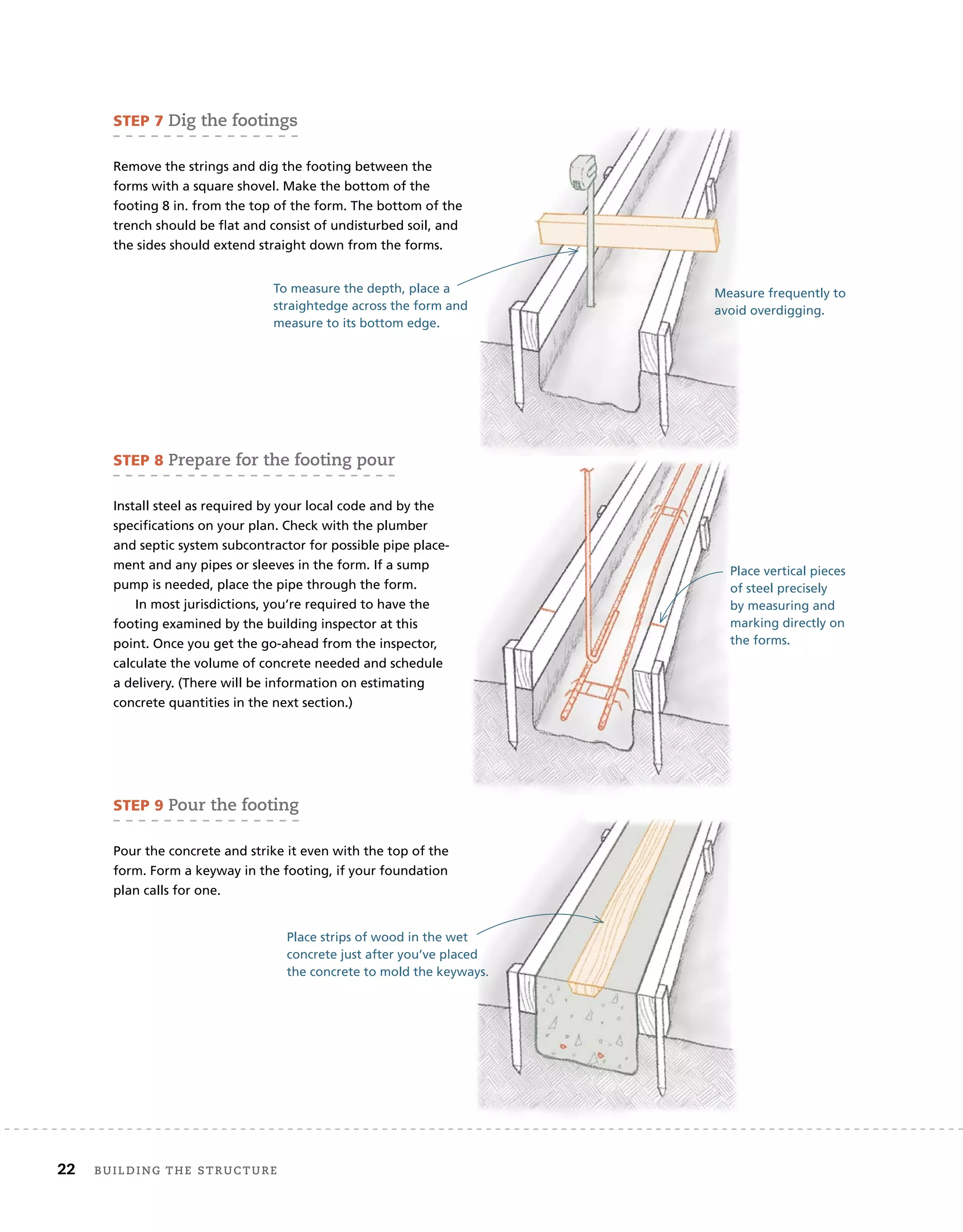
If you plan to use an unusually heavy roofing mate-
rial, such as slate; plan to place extra loads on the roof,
such as air-conditioning equipment; or if you’re build-
ing a more involved roof, you usually have to provide
your supplier with a copy of the plans. The supplier, in
turn, will submit a copy of the plans to the truss manu-
facturer. The truss designer uses the plans to develop an
engineered plan for the trusses. When the trusses arrive,
they’ll have a copy of the truss design drawings attached.
WAY S O F W O R K I N G
Store trusses on edge, if possible.
You may have to install braces to keep
them from falling over.
Before trusses are
dropped off by the
delivery truck, place
wood blocks on
the ground to keep
the trusses off the
ground.
Keep trusses banded together
until you are ready to install them.
Gable-end
truss
Desired pitch
Width of eaves
Width of building
FRAMING ROOFS 2: TRUSSES, EAVES, RAKES, AND SHEATHING 149
4
Watch Out When
Unbanding Truss
Packages
When you cut the bands
holding the truss package
together, the band can spring
out unpredictably and present
a serious cutting hazard. Wear
gloves and eye protection, and
don’t position yourself in line
with the band.
Another hazard is the way
the trusses fall when you cut
the band. Before you cut the
band, set the package on its
side and either position your-
self on top of the package or
uphill from the package. And
make sure you have a clear
route to escape the trusses in
the event that they start slid-
ing toward you.
SAFETY FIRST
To store trusses on their sides, place them
on as flat a surface as possible. If the
ground is uneven, stack blocks in low spots
for the trusses to rest on.
Use a tarp to protect
trusses from rain.
When you move trusses,
try to move them in the
vertical position.
If you’re moving large trusses by
hand, it’s sometimes necessary to
carry them in the flat position.
In these cases, station some
members of the crew near the
center to keep the truss from
bending too much.
150 BUILDING THE STRUCTURE
Moving and Hoisting Trusses
On most houses, a carpentry crew can move and hoist the trusses
by hand. For the last 25 years or so, however, carpenters have been
able to hire portable cranes to lift the trusses. And, today, production
framing crews often invest in telehandlers (telescoping forklifts),
which are capable of hoisting trusses for most houses.
Use the same procedure as you would for rafter locations (see
chapter 3). Although the procedure is essentially the same, spacing
for trusses is usually 24 in. on center, as opposed to the 16-in. inter-
vals common for rafters.
• SETTING TRUSSES BY HAND
When you install trusses by hand, lift one end at a time
over the bearing walls. If possible, keep the truss vertical,
with the apex of the truss pointed down. With the ends
overlapping the walls, rotate the truss into the upright
position. Use one or two forked push sticks made out of
2x4s to finish rotating the truss above ceiling level. If the
span is less than 20 ft., you can use one push stick close to
the center of the top chord. If the span is more than 20 ft.,
you should use two push sticks placed under the top chord
about one-third of the way down from the apex. Make sure
a crew member is stationed at the top to catch the truss as
it is rotated into the upright position.
• SETTING TRUSSES WITH A CRANE
For spans 30 ft. or less, attach the sling of the crane at two
points near the first web/top chord intersection down from
the apex of the truss. For spans longer than 30 ft., use a
spreader bar and three points of attachment.
Lift from two points
for spans of 30 ft.
or less.
For spans greater than
30 ft., lift from three points.
1 Lift the truss onto
the bearing wall.
2 Rotate the truss so
the apex points up.
FRAMING ROOFS 2: TRUSSES, EAVES, RAKES, AND SHEATHING 151
4
Aligning Trusses
It’s important to line up trusses precisely as you install them.
When the trusses are not aligned accurately, the roof ends up
with a crooked ridge and unsightly dips and humps in the deck.
There are a few approaches to aligning trusses as you install them.
with a crooked ridge and unsightly dips and humps in the deck.
There are a few approaches to aligning trusses as you install them.
• SETTING TRUSSES BY HAND
If you’re installing the trusses by hand, you can set
up a string in the center of the span and set the
apex of each truss to the string. A simple way to
do this is to install a truss at each end of the house,
then run a string from the apex of one truss to the
apex of the other.
• SETTING TRUSSES WITH A CRANE
OR TELEHANDLER
If you’re using a crane or a telehandler, the string would get
in the way as you lower the truss into place. In these cases,
mark the bottom chord of the truss where it will meet the
inside of one of the walls before you hoist the truss.
First, mark the center of the bottom chord. From the center
point, measure and mark one-half the span (the distance
between the bearing walls). When you set each truss, line up
this mark with the inside of the wall before you install it.
A string can be used
to keep trusses aligned.
When a stringline
would be in the way,
mark the bottom
chords and align with
the wall.
• USING A LASER LEVEL
Another approach is to use a laser level rather than a string.
Set it up at one end of the house so that it shoots a level line
just below the apex of the first truss installed. Before hoisting
each truss, use a felt-tipped pen to draw a plumb line down
from the apex. When the dot or line from the laser strikes the
plumb line, the truss is aligned and can be installed.
Laser level Mark the truss apex and align
with the beam of the laser level.
152 BUILDING THE STRUCTURE
1 Braces
attached
to ground
stakes
Three Kinds of Braces
Braces are essential to truss roofs. During the instal-
lation, temporary braces hold the trusses straight and
keep them from toppling over. After the installation is
complete, permanent braces tie the trusses together
and hold them rigidly in place. Braces are divided into
three distinct categories: ground braces, temporary truss
braces, and permanent truss braces.
Ground braces
Ground braces are used to hold the first truss in a line of
trusses in place. The advantage of setting the braces to
the exterior of the house is that they’re not in the way
of subsequent trusses. The bottoms of these braces are
either anchored to stakes driven into the ground (hence
the term ground brace) or to the floor of the house. The
ground braces have to be strong enough to hold the first
truss rigidly in the correct position as well as hold the
subsequent trusses that are tied to the first one. Because
of their length, ground braces often have to be built with
two pieces of lumber. Near the center of these built-up
braces, you should add braces extending back to the base
of the frame. The ground braces also have to be braced
laterally to keep them from buckling.
On one-story buildings, where the first floor is close
to the ground, you can brace the first truss to stakes
driven into the ground.
On two-story houses, on buildings with high founda-
tions, and on houses with exterior grades that slope rap-
idly away from the foundation, exterior ground braces
are not practical. In these cases, it’s easier to use interior
ground braces that are tied to the floor.
Because these interior braces interfere with the sub-
sequent trusses, the first truss can’t be placed at the end
of the house. Install the first truss near the center of the
house and brace it straight, plumb, and in-plane. After
installing and bracing the first half of the trusses, you can
remove the ground bracing and install the trusses on that
side of the house.
WAY S O F W O R K I N G
side of the house.
Additional
support
Interior braces attached
to the floor
Braces attached to
ground stakes
FRAMING ROOFS 2: TRUSSES, EAVES, RAKES, AND SHEATHING 153
4
Temporary truss braces
After securing the first truss with ground braces, subse-
quent trusses are tied to the first truss with temporary
bracing and lateral restraints. The lateral restraints are
used to keep the spacing between the trusses correct;
the braces hold the trusses safely in the upright position
during the installation.
Inadequate bracing during the setting of trusses is a
serious safety hazard. A network of diagonal braces and
lateral restraints, installed inside the truss system,
is essential for both a safe and accurate installation.
Permanent truss braces
Temporary bracing has to be followed by permanent
bracing that becomes part of the permanent structure.
This two-part bracing procedure, however, is not always
essential. With careful planning, much of the bracing
used during the truss installation can be left for perma-
nent bracing. The truss bracing requirements are usu-
ally specified in either the approved plan or in the truss
design drawings that come with the truss package.
Materials for truss bracing
The material for truss bracing varies. Temporary bracing
is usually composed of 2x4 lumber connected with 12d to
16d nails. The nails should be driven tight, so if you plan
to remove the bracing, you can make the job easier by
using double-headed nails.
Metal braces and restraints, designed specifically for
truss installation, also are used for both temporary and
permanent bracing.
Materials for permanent bracing include 2×4 lumber
and structural panel materials, such as plywood and
oriented strand board (OSB). Finally, the materials that
cover the frame—roof sheathing and ceiling drywall—are
considered permanent bracing materials.
Lateral restraints
maintain the spacing
between trusses.
Temporary
braces
154 BUILDING THE STRUCTURE
Building a Gable Roof
with Trusses
This section uses the example of a simple gable roof to show the
basics of framing roofs with trusses. Once these principles are
mastered, they can be applied to just about any trussed roof. In this
example, the locations of the trusses are already marked on the walls.
The goal of installing a trussed roof is to set each truss straight,
plumb, and in-plane over its length. In this position, where the
triangles of the truss line up with the force of gravity and with each
other, the truss is working at its optimal strength.
To get all the trusses straight, plumb, and in-plane, install the first
truss precisely and then use it as a reference for the rest of the
trusses. Once you have the first truss securely braced straight and
plumb, you can transfer those attributes to the rest of the trusses
by bracing them in precise increments (usually 24 in.) away from
the first truss.
STEP 1 Set the first truss
1 Lift or hoist the first truss in place on the walls
using the techniques described earlier.
2 Attach the truss to the top plates of the walls.
(For more on attaching the trusses to the wall, see
“Anchoring Rafters and Trusses to Walls” on p. 156.)
3 Brace the truss straight and plumb.
STEP 2 Establish a system
for aligning the trusses
1 Since you’re setting these trusses by hand,
use a string to align the trusses.
2 Set and brace a second truss at the far end of the house.
The bracing here does not have to be as extensive as
that installed on the first truss because this truss will
not support the subsequent trusses.
3 Set up a string that extends from the apex of the
first truss to the apex of the second truss.
Braces extend from
the truss to stakes
in the ground.
Set and brace a second truss at the far end of the house.
1 Set and brace
the first truss.
2 Set the
second truss.
3 Stretch the string
from one truss to the
other at the apex.
FRAMING ROOFS 2: TRUSSES, EAVES, RAKES, AND SHEATHING 155
4
STEP 3 Set subsequent trusses
Set the next truss on the walls, and move it until the apex is
aligned with the string and on the layouts marked on the walls.
Predrill and toenail it to the walls. To hold the truss upright, use a
2x4 block of wood that’s nailed on the top of the top chord and
tied to the first truss.
STEP 4 Add restraints
After setting three or four trusses in this manner, begin installing
lateral restraints. Set these in horizontal lines perpendicular to
the trusses. They should line up with the ground braces and, in
most cases, be 10 ft. or less apart. Use the lateral restraints to set
the top chords of each rafter the proper distance away from the
top chord of the first rafter. These distances should be identi-
cal to the layout on the bearing walls (which is 24 in. on center
in this example). You can mark the layout directly on the lateral
restraints, then move the top chords of the trusses to the layout
as you nail on the restraint. On large roofs, use diagonal braces
along with the lateral restraints to provide added rigidity.
• BRACE AS YOU GO
Install temporary bracing in the web and bottom chord planes as
directed by instructions that come with the trusses. In this example,
the web bracing is made up of lateral restraints combined with diag-
onal braces. To prevent a domino-like collapse, don’t wait until all
the trusses have been set. Braces and restraints should be installed
as you set the trusses.
STEP 5 Begin planning for eaves and rakes
On some roofs, you can postpone work on the eaves and rakes
until later. On complex roofs, it may make sense to build eaves
and rakes before installing the sheathing. On most simple roofs,
however, carpenters follow a middle ground in which they cut the
rafter tails and install a subfascia but leave most of the framing
for the eaves and rakes for later. (For more on cutting the tails in
place, see “Framing Eaves” on p. 157.)
1 Move the truss on the walls until
the apex lines up with the string.
2 Set the bottom chord
to the layout marks on
the top plates.
Lateral restraints
Diagonal braces
stiffen the assembly.
Lateral restraints
in webs
156 BUILDING THE STRUCTURE
Anchoring Rafters
and Trusses to Walls
Whether you build a roof system with rafters or
trusses, it must be tied securely to the bearing
walls. The structural demands for this connection
vary according to the design loads in your area.
Toenails
The most common way to attach rafters and
trusses to bearing walls is with toenails. Use
three 12d or 16d nails at each connection. Drive
two nails in from one side and the third into
the center of the wall from the other side.
To avoid splitting the wood, predrill with a
1⁄8-in.-dia. hole.
Metal rafter/truss ties
Metal ties are required by building codes where
high winds can be expected. You can confer with
the building inspector and with customer support
at the manufacturer to find out which type of tie
to use. In many cases, you can initially install the
rafters or trusses with toenails, and then come
back later to install the metal connectors. Always
use the nails specified by the manufacturer to
attach the connectors.
Slotted truss anchors
At midspan walls, trusses should not be rigidly
anchored to walls. To accommodate slight move-
ment in the trusses yet hold interior walls in
place, slotted anchors are recommended instead.
Slotted anchors are particularly important with
scissor trusses.
WAY S O F W O R K I N G
Toenail the truss
to the bearing walls.
Local code may
require metal
connectors.
Use slotted anchors
at midspan walls.
FRAMING ROOFS 2: TRUSSES, EAVES, RAKES, AND SHEATHING 157
4
Framing Eaves
There are several ways to frame roof overhangs. Here, we’ll look at
framing eaves and then, in the next section, at framing rakes. The
design of the eaves is influenced by the budget of the job, the width
of the eave, whether the house will have an overhanging rake, and
the personal preferences of the carpenter doing the work. The fol-
lowing discussion focuses on the best techniques for building wide
eaves on houses that also have wide rake overhangs.
Precut Rafter and Truss Tails
The procedure for laying out and cutting rafter tails is discussed in
chapter 3 (p. 113). If the roof is built with trusses, the trusses can be
ordered with precut tails. With either rafters or trusses, you should
expect to make some adjustments to the tails when you build the
eaves. Because wood is not dimensionally stable, the ends of the
tails almost never line up perfectly after the rafters or trusses are
installed. To get the ends of the tails in line, follow these steps:
STEP 6 Install the sheathing
Gradually remove the temporary bracing and restraints
on the top chord plane of the trusses and install the
sheathing. Use the techniques described in “Installing
Roof Sheathing” on p. 177. In this example, a ladder-type
rake is planned. Leave the sheathing long at both ends of
the house. You can cut the sheathing and build the rake
later. (For more on building the rake, see “Framing Rake
Overhangs” on p. 164.)
Use Your Rafter Jig
If you’ve fabricated a rafter
jig, it pays dividends when
you frame eaves, rakes, gable
ends, and returns. Not only
can you use it to lay out
plumb and level cuts, but if
you’ve written the pertinent
information on the jig, you
can also refer to it to find the
angle of the pitch in degrees
and the dimensions of the
base-1 triangle.
TOP TIP
1 Measure several tails
and find an average
distance out from the
wall. Mark the tails on
each end of the house
at the same distance.
2 Strike a line
between the marks.
3 Cut the ends of the tails that stick
out past the line, and shim the ones
that fall short of the line as you
install the subfascia.
Shim
158 BUILDING THE STRUCTURE
Cutting Tails in Place
Since some cutting and shimming is usually necessary, many
carpenters don’t worry about cutting the tails until after the
rafters or trusses are installed. Here’s how to lay out and cut
the tails:
1 Scribe a
plumb line
indicating
the outside
face of the
finish fascia.
2 Measure
and mark
the thick-
ness of the
finish fascia,
and draw
a second
plumb line.
3 Measure
and mark the
thickness of
the subfascia,
and draw a
third plumb
line.
24 in.
The subfascia will be nailed to the rafter
tail. The end of the tail, therefore, should
be cut along the third vertical line.
STEP 1 Lay out the end of the first tail
Select any tail to draw the layout on. After deciding the width
that you want to make the eave, measure that distance out
from the face of the bearing wall. In this example, the width of
the finished eave is 24 in. from the finish materials that will be
added to the wall.
STEP 2 Lay out the bottom of the first tail
1 Draw in the width
of the finish fascia.
1 Using the first tail as
a reference, lay out the
ends of the rafter/truss at
each end of the eave.
2 Draw in the bottom of the
subfascia. Mark the amount that
you want the finish fascia to lap
over the soffit of the eave (1 in.,
in this example). Next, draw in the
thickness of the soffit material
(3⁄8-in. plywood here). The bottom
of the subfascia is at the level of
the top of the soffit plywood.
2 Mark the tops of the end rafters/trusses at the layout,
then snap a chalkline across the tops of the tails between
the two marks.
3 Cut along a level line that’s even
with the bottom of the subfascia.
3 From the marks left
by the chalkline, scribe
plumb lines on the sides
of the tails. Cut along
the plumb lines.
STEP 3 Mark the ends of the rest of the tails
3⁄8-in. soffit
Subfascia
4
Don’t Sweat the
Small Stuff
On narrow eaves, the soffit
material can be nailed directly
to the horizontal cut on the
eave. On wide eaves, where
soffits will be nailed to addi-
tional blocking, some carpen-
ters like to cut slightly above
the subfascia line on the rafter
tails. If the rafter tail won’t
be part of the soffit framing,
there’s no reason to fuss
over the cut.
TOP TIP
Don’t Let
the Kerf Close
When you cut the end of
a rafter tail, gravity pulls
the offcut down. If you cut
from the top, the offcut falls
harmlessly down and away
from the spinning blade. If
you cut from the bottom up,
on the other hand, the kerf
closes as the offcut begins to
fall. At the least, this creates
an alarming screech, and
sometimes the offcut is flung
by the spinning blade. At the
worst, the closing kerf can
bind on the sawblade, causing
the saw to kick back.
If at all possible, cut
from the top down. If this
is impractical, find a way to
support the offcut while you
make the cut. One way to
do this is to screw or clamp a
block of 2x4 to the underside
of the tail.
E S S E N T I A L S K I L L S
2 If the scrap piece
is wider than the 2x
rafter tail, a tongue
of material will be
left when the tail is
trimmed, which will
prevent the offcut
from falling.
Cut down to avoid pinch-
ing the blade.
1 If you must cut up, clamp
a length of scrap to the
bottom of the rafter or
truss tail.
FRAMING ROOFS 2: TRUSSES, EAVES, RAKES, AND SHEATHING 159
160 BUILDING THE STRUCTURE
Subfascias
Carpenters disagree over the need for a subfascia. If you decide
to use one, you have two options: Choose a material size that fits,
uncut, under the sheathing, or rip the top of the subfascia to fit
snugly under the sheathing.
Leaving the top of the subfascia square The subfascia can be
left square on top and set so that the outside edge is just touching
or slightly below the underside of the roof sheathing. This method is
often used when installing a 2x4 subfascia on 2x4 truss tails. Use a
straightedge, as shown in the top drawing on the facing page, to keep
the outside corner of the subfascia in plane with the top of the truss.
STEP 4 Mark level lines
On truss tails, this step is not normally necessary because the
bottom of the subfascia is set even with (or below) the bottom
of the plumb cut. For a stick-built roof, measure the distance
from the top of the plumb cut to the level line marked on
the first rafter/truss.
1 Mark this dis-
tance down from
the top of the
plumb cut on the
tails at each end
of the eave.
Plumb cut
Level cut
2 Snap a chalkline from
mark to mark on the
ends of the rafter tails.
3 From the marks left by
the chalkline, draw level
lines on the sides of the
tails. Use a circular saw to
cut along the level lines.
FRAMING ROOFS 2: TRUSSES, EAVES, RAKES, AND SHEATHING 161
4
Ripping the top of the subfascia To provide a full nailing sur-
face for the roof sheathing, rip the top of the subfascia at an angle
equal to the roof pitch. Measure the size of the plumb cuts on the
ends of the rafter tails, and mark that width along the length of the
subfascia material. If you want the bottom of the subfascia to end up
a bit below the level cut on the rafter tail, mark the width 1⁄4 in. wider
than the plumb cut. Set your saw to the degree equivalent of the roof
pitch and cut along the line.
Installing the subfascia Drive two 12d or 16d nails at each tail
to install the subfascia. As you nail it off, have a helper at the far
end lever the board up or down until it’s in plane with the top of the
rafter or truss.
Straightedge
Subfascia
Rip the top edge to
match the slope of
the roof.
Run the
subfascia long
if a rake is
planned.
Two 12d or 16d nails
at each tail
Advantages of
Using a Subfascia
Not all carpenters use a subfascia. You
can save time and material by simply
nailing the finish fascia to the rafter/
truss tails. To help support the outside
of the soffit material, some carpenters
rout a groove in the back of the finish
fascia. They slip one edge of the soffit
material into this groove, then nail
the other edge to a ledger attached
to the wall.
Other carpenters rely on cross
blocks that are nailed to the sides of
the tails. Although the subfascia can be
eliminated, it enhances the quality of
the finished job in several ways. First,
it provides a continuous nailing surface
for the soffit and, sometimes, for the
edge of the roof deck. This translates
into a straight and secure edge for
both surfaces.
Second, a subfascia serves an
important structural role when an
overhanging rake is planned. The
subfascia can be extended out past the
corner of the house, where it helps
support the overhang rakes and rake/
cornice returns.
Finally, the subfascia provides a
solid surface the whole length of
the eave for receiving gutter spikes
or screws.
Groove
routed in
the back of
the fascia
Ledger attached to
the wall
Soffit
Cross block
The subfascia provides
continuous support.
162 BUILDING THE STRUCTURE
FRAMING ROOFS 2: TRUSSES, EAVES, RAKES, AND SHEATHING 163
4
If you plan to use rake overhangs, let the subfascia run past the
ends of the house. Make sure that this piece is attached to several
tails in from the corner and that it extends outside the planned rake.
Installing the ledger Level over from the bottom of the sub-
fascia, and mark both ends of the wall. Strike a chalkline between
the marks, then nail the ledger along the line. If you plan on building
a rake or cornice return, let the ledger run past the corner. Make sure
it extends beyond the planned rake.
Adding cross blocks Narrow eaves without continuous eave
vents do not require cross blocks (also called “soffit joists”). If you
plan on using continuous eave vents or have eaves that are more
than 12 in. wide, you need cross blocks.
If you’ve used a subfascia, you can install the cross blocks flat to
provide a wide surface for nailing off the soffit. Nail through the sub-
fascia to attach the outside end; toenail into the ledger to attach the
inside end. If you have not used a subfascia, install the cross blocks
on edge and nail them to the sides of the truss/rafter tails.
Run the
subfascia and
rake ledger
long for rake
overhangs.
Level
Cross block
Subfascia
164 BUILDING THE STRUCTURE
Framing Rake Overhangs
There are two basic ways to frame a rake overhang. In the first
approach, a ladderlike frame is nailed outside the first rafter or truss.
In the second, a series of lookouts are tied to a rafter or truss 16 in.
to 24 in. inside the roof. From there, they bear on the gable-end wall
and cantilever out to a barge rafter at the edge of the rake.
Building a Ladder-Type Rake
On rakes that are less than 16 in. wide and not subjected to heavy
snow and wind loads, a simple ladder-type rake is usually sufficient.
These are built outside the gable-end rafter or truss.
• LADDER-TYPE RAKES
This design relies on several things to keep the rake
from sagging.
Sheathing on the roof deck
provides tensile strength.
Perpendicular
blocks extended
from the wall to
the barge rafter
provide compres-
sive strength.
On the under-
side of the rake,
plywood soffit
material adds to
the compressive
strength of the
blocks.
At the lower
end of the rake,
the subfascia
helps to hold up
the bottom of
the barge rafter.
At the upper
end of the rake,
an extension of the
ridge (on stick-built
roofs) provides
support for the top
of the barge rafter.
STEP 1 Cut the subfascia
and ridge to length
1 Use a straightedge
or a square to extend
the location of the
end wall of the house
out to the subfascia.
2 Measure out the desired
width of the rake, minus the
thickness of the barge rafter
and the finish rake material.
3 Draw a
plumb line
at that point,
and cut along
the line.
4 Measure and mark a distance that is
equal to the distance marked out from
the end wall along the subfascia.
Cut along the line.
FRAMING ROOFS 2: TRUSSES, EAVES, RAKES, AND SHEATHING 165
4
STEP 2 Cut the ridge to width
1 Make a plumb cut on a
scrap of the barge rafter
material (usually a 2x4), and
position the scrap against the
end of the ridge.
STEP 3 Install the sheathing
Install the sheathing on the roof using the methods
described on p. 177.
Where a rake or cornice return is
planned, you may want to install
the first panel of sheathing at
the bottom of the rake so it can
be removed easily.
At the end of the
roof, leave the
sheathing about
1⁄8 in. short of
the outer extent
of the planned
rake.
4 Let the barge rafter run past the
subfascia. Attach the barge rafter
to the subfascia with a couple of
12d nails. Cut the barge rafter flush
with the subfascia.
STEP 4 Install the barge rafter
1 Snap a line
representing
the inside of the
barge rafter on
the top of the
sheathing.
2 Select a straight
piece of lumber,
and make a plumb
cut at the top.
Center the barge
rafter on the end
of the ridge, and
nail it in place.
3 Working your way
down, hold the inside
edge of the barge rafter
even with the line (you
should be able to see the
barge rafter through gaps
in the sheathing), and nail
through the plywood with
8d nails every 8 in.
STEP 5 Install the ledger
and cross blocks
1 Hold the ledger up against the
underside of the plywood as you
nail it to the truss/rafter.
2 Measure and install cross
blocks that run from the ledger
to the barge rafter every 16 in.
or 24 in. Toenail the blocks into
the ledger, and nail through the
barge rafter to attach. Also nail
through the sheathing.
2 Mark the point where
the bottom of the scrap
piece meets the centerline
of the ridge. Cut horizon-
tally here.
166 BUILDING THE STRUCTURE
Building a Cantilevered Rake Overhang
If you’re using heavy roofing material, such as slate or tile, live in
an area where strong wind or heavy snow is expected, or plan on
building a rake 16 in. or wider, you should use a cantilevered rake
overhang.
In a cantilevered rake, a series of lookouts are nailed to the first
rafter or truss inside the wall. The lookouts bear on the end wall or a
notched verge rafter and extend out to a barge rafter at the outside of
the rake. This design is more difficult to frame than the ladder type
just described, but it’s considerably stronger.
There are three ways to support the lookouts at the gable wall.
Method 1: Use a drop-top gable-end truss If you’re using
trusses, order drop-top gable-end trusses for the rakes (see p. 145).
These are lower than the others by the depth of the top chord
(typically 31⁄2 in.). After setting and bracing the drop-top gable-end
truss, nail the ends of the lookouts to the first truss inside the end
wall and have the lookouts extend out to the barge rafter.
Method 2: Build a dropped gable-end wall Like a drop-top
gable-end truss, a dropped gable-end wall is built a set distance
(usually 31⁄2 in.) below the top edge of the rafter/truss. See the facing
page for a step-by-step example of the layout and construction of
one of these walls.
Method 3: Use a notched verge rafter In this system, you lay
out a pair of verge rafters for the gable-end wall. The layout for these
rafters is just like the layout for the other rafters in the roof. Before
installing these rafters, however, you cut a series of notches through
which the lookouts can pass. See p. 168 for a step-by-step discussion
of how to cut these notches accurately.
Drop-top
gable-end
truss
Barge
rafter
Lookouts cantilever over
the end of the wall and are
nailed to the first rafter of
the truss inside wall.
FRAMING ROOFS 2: TRUSSES, EAVES, RAKES, AND SHEATHING 167
4
Laying Out and Building a Dropped
Gable-End Wall
In this example, the building is 24 ft. wide and the roof is a 10-in-12 pitch.
The rafters are made from 2x10s. At the top of the dropped gable-end
wall, there will be a double top plate. This example follows the process
for one-half of the gable-end wall; the other half repeats the process.
2 Transfer the location of the end wall to the ridge.
Mark the location of the outside of the wall frame,
not the outside of the sheathing.
STEP 1 Transfer the location of the
ridge to the end wall
STEP 3 Cut and install the lower top plate
Set your saw to a 40° bevel (the equivalent in degrees
of a 10-in-12 pitch) and crosscut the plate. From the short
point of the cut, measure and mark 1841⁄16 in. On the
edge of the board, lay out a level cut. Start with a
circular saw and finish with a handsaw.
STEP 2 Lay out the short points
of the lower top plate
The bottom of the lower top plate of the gable-end
wall should be approximately 61⁄2 in. below the top of
the rafter (lookout width of 31⁄2 in. plus two top plates).
Set a combination square to this dimension.
STEP 4 Install the studs and the
upper top plate
Ridge
Plumb line
Top plate
1 Use a level and straightedge, a plumb bob,
or a laser level to transfer the location of the ridge
to the top of the end wall. Mark both sides of the
ridge on the top plate. 3 At the wall that the rafter bears on, draw a line on the top
plate starting at the line you just made. You can now determine
the length of the lower top plate by measuring the distance
between the lines (in this example, 1841⁄16 in., short point to
short point).
1 On the first
rafter in from
the end of the
wall, use the
combination
square to mark
the location of
the bottom of
the lower top
plate of the
gable-end wall.
2 At the ridge, draw a
level line on the side of
the ridge, starting at the
line you just made.
Install the plate with
the short point of the
plumb cut set on the
line on the ridge and
the short point of the
level cut set on the
line on the wall. If
necessary, use braces
to hold it in line until
you get the studs
installed.
2 Measure and
cut the upper top
plate and nail
it on top of the
lower top plate.
1 Cut and install the studs
for the gable-end wall.
168 BUILDING THE STRUCTURE
Installing notched verge rafters If you have good woodworking
skills and sharp hand tools, you can simplify the construction of cantile-
vered rakes by using notched verge rafters.
When You Don’t Have
a Ridge, Use Math
Another way to lay out the dropped gable-end wall is to
use math. Although math is not necessary for this task
on a raftered roof, it would be necessary on a trussed
roof, where there is no ridge from which to measure. If
this were a trussed roof, you’d need to measure the base
of the measuring triangle along the end wall. This is the
distance between the line you just made on the bearing
wall to the center of the end wall. Once you have the
base of the measuring triangle (142.125 in this example),
multiply it by the base-1 hypotenuse for a 10-in-12 pitch
(1.302) to determine the length of the lower top plate of
the gable wall: 142.125 x 1.302 = 185.05.
WAY S O F W O R K I N G
STEP 1 Lay out the notches STEP 2 Cut the notches
1 Clamp
the rafters
back-to-back.
2 Lay out the notches
on the top edge of
the rafters. In this
example, the notches
will accommodate
2x4 lookouts on edge,
installed every 16 in.
Notches are 31⁄2 in. deep. 1 Set your circular saw to 0° and cut across
both rafters at the same time, staying within
the layout marks. Then make five or six quick
cuts between them. The ideal depth to make
these cuts is 37⁄16 in.; the final 1⁄16 in. can then
be pared away with a chisel.
2 Unclamp the rafters, and use a combination
square to mark the bottom of the notches
at 37⁄16 in. Complete the cuts down to the
layout lines with a jigsaw or sharp handsaw.
Bearing wall
No ridge
185.05
Center of
end wall
142.125
10-in-12
rafter jig
FRAMING ROOFS 2: TRUSSES, EAVES, RAKES, AND SHEATHING 169
4
Framing the cantilevered rake The frame for the cantilevered rake
is basically the same whether you’ve used a drop-top gable-end frame, a
dropped gable-end wall, or a notched verge rafter.
STEP 3 Clean out the notches
2 Break out the remaining wafers
of wood with a hammer.
3 Use a sharp chisel to
clean out the bottoms
of the notches.
4 Test-fit a
piece of look-
out material. It
should be flush
with the top of
the rafter.
1 Make
several
passes.
4 Cut and
install the studs.
STEP 4 Build the gable-end wall
1 Install the verge rafters in the same manner
as the other common rafters.
2 Install a series of cross blocks
between the verge rafter and first
rafter inside the house. These blocks
should be installed flat and flush with
the bottoms of the rafters.
3 Install a top plate
flush with the outside of
the verge rafter.
STEP 1 Trim the ridge and the subfascia
Ridge
Subfascia
1 Mark and cut the ridge
and the subfascia to the
correct length. Mark and
cut the exterior portion
of the ridge to the correct
width.
2 After bracing the first
rafter inside the house, you
can simply cut all the look-
outs the same length and
install them. Alternatively,
you can run the lookouts
slightly long, stretch a
chalkline from the ridge
to the subfascia, and snap
a line.
3 Square down from the marks, and cut the lookouts in
place. On trussed roofs, where there is no ridge, cut and
install the uppermost lookout. Then stretch the stringline or
chalkline from the end of that lookout to the subfascia.
STEP 2 Install the lookouts
170 BUILDING THE STRUCTURE
STEP 3 Install the barge rafter STEP 4 Install blocks between lookouts
1 Make a plumb cut on the top end of a long 2x4.
Install the top with the plumb cut at the center of
the ridge. (If the roof is built with trusses and there
is no ridge, center the first barge rafter by using a
scrap with a plumb cut on it.)
1 On rakes that cantilever over dropped walls, install blocks in
the spaces between the lookouts. Blocks keep lookouts from
rotating and close off the first rafter bay from the weather.
TOP TIP
Venting the First Bay
If you’re planning to use the underside of the
rafters as a cathedral ceiling and the design speci-
fies eave/ridge vents, you need to ensure that air
flows freely in the top inch or so of every rafter
bay. Left unmodified, the lookouts of the rake
can block this flow of air. You can provide for this
air movement by cutting a dip about 3⁄4 in. deep
in the top of the lookout in the area that will be
inside the bay.
2 Let the bottom run long.
Then, after you’ve nailed
off the barge rafter, cut the
bottom flush with the out-
side face of the subfascia.
2 If a rake return is planned,
don’t install the block in the
space at the bottom of the
dropped wall until you’ve
installed a backing block for
the return. Once you have the
backing block in place, notch the
final block between the lookouts
over it. For more, see p. 172 for
how to install rake returns.
Roof deck
Ceiling
Dropped
gable wall
Lookout Barge
rafter
3⁄4-in. gap allows air to flow
to ridge vent
FRAMING ROOFS 2: TRUSSES, EAVES, RAKES, AND SHEATHING 171
4
Rake and
Cornice Returns
Rake and cornice returns provide a graceful
transition from the level eave to the sloping rake.
Cutting and fitting the angled pieces for this tran-
sition is difficult, but the biggest challenge of this
job is structural. The returns have almost nothing
under them because they’re located outside the
corner of the house.
As with eaves and rakes, the designs of returns
vary considerably. This section uses three exam-
ples to show how to build common rake and cor-
nice returns. The approaches presented here can
be applied to many different designs.
Building Structurally
Sound Returns
There are several things you can do to ensure
that rake and cornice returns are structurally sound.
Anchor the ledger
and subfascia deep in the eave
Rake and cornice returns get most of their structural
support from the ledger and subfascia of the eave. When
you install these pieces, therefore, make sure they’re
anchored several feet into the length of the eave. Make
sure the ledger and the subfascia extend to the end of
the rake. The surest way to do this is to install them long
and cut them in place.
Think ahead
If you don’t think about the return until after you’ve
installed the roof sheathing, it can be difficult to securely
anchor key parts of the return up inside the rake. To
avoid having to compromise these connections, do the
following:
If possible, don’t install the sheathing on the lower
outside corners of the roof. You can sheathe the rest of
the roof and leave these corner pieces for later. Or, if you
prefer, you can cut and tack them in place so they can be
removed easily. After you finish the return, you’ll be able
to reinstall these pieces quickly.
If you don’t want to delay the installation of the
sheathing, at least place backing blocks in the rakes.
Having these in place makes your job a lot easier when
you get around to framing the return.
When a cornice return is planned, build the return
before you install the barge rafter and the sheathing.
E S S E N T I A L S K I L L S
that rake and cornice returns are structurally sound.
Leave this sheathing off until
the rake return blocking is
installed.
Basic rake
return
Cornice
return with
shed roof
Cornice return
with hip roof
172 BUILDING THE STRUCTURE
Framing a Basic Rake Return
Using the subfascia and ledger for support, build the rake return in
two layers.
STEP 1 Cut the ledger
Use a level to transfer a plumb line down from the inside of the barge rafter
to the ledger. Cut the ledger in place.
STEP 2 Install a backing block above the ledger
At the inside of the rake, there are two possible scenarios. If you have a
ladder-type rake or you’ve used a notched verge rafter, the first rafter will be
flush with the gable-end wall. If you’ve used a drop-top gable-end truss or
built a dropped gable-end wall, there will be a space above the truss or wall.
Barge rafter
Ledger
Backing
block
2 Transfer the
outside face of
the ledger up to
the first rafter or
truss inside the
house.
2 Transfer the
outside face of the
ledger up to the side
of the first rafter.
1 Use a level
to transfer the
outside face
of the ledger
up to the
barge rafter.
1 Use a level
to transfer the
outside face of
the ledger up
to the barge
rafter.
• LADDER RAKES OR VERGE RAFTERS • DROP-TOP TRUSS OR DROPPED GABLE-
END WALL
3 Rip a scrap of wood at an
angle that matches the pitch
of the roof, and nail this scrap
above the marks you’ve just
made on the barge rafter and
the rafter or truss and flush
with the bottom of the rake.
3 If you have a drop-top gable-
end truss or you’ve built a dropped
gable-end wall, this backing block
must extend back to the first rafter/
truss inside the wall.
Level
FRAMING ROOFS 2: TRUSSES, EAVES, RAKES, AND SHEATHING 173
4
STEP 3 Install the first layer
Frame the basic shape of the return with 24 and
26 scraps.
STEP 4 Install the second layer
Cut and fit pieces to bring the recessed surfaces of the
return flush with the ledger and rake.
1 Nail a vertical 2x4 on each side
of the back of the return.
2 Cut a piece of 2x6 that fits inside the barge
rafter. Hold the piece so that the top is flush
with the top of the barge rafter and nail it in
place. There should be about 2 in. of the 2x6
sticking out below the barge rafter.
1 Rip a scrap of wood at an angle that matches
the pitch of the roof. Cut and install this piece
on the vertical pieces. The outside end should
be even with the inside of the barge rafter. The
top should be against the backing block in the
rake. The face of this block should be flush with
the face of the ledger.
2 Cut a triangular
piece to pad out the
side of the return.
(On large eaves and
on steep-pitched
roofs, you’ll need
two horizontal
pieces.)
Framing a Cornice Return
A cornice return (also called a Greek return) brings the eave and
fascia of the main roof around to the gable-end side. Above them, a
diminutive roof is tucked up under the rake. The roof, which is some-
times called a water table, can be a shed roof or a hip roof. The size
and configuration of cornice returns vary. A return that is 24 in. to
30 in. long, however, is fairly common.
The following examples provide step-by-step procedures for
building two types of cornice returns. In both examples, the process
begins before the barge rafter has been installed.
174 BUILDING THE STRUCTURE
Building a Cornice Return
with a Shed Roof
This section describes a method for building the simplest type of
cornice return, one that features a basic shed roof.
STEP 1 Cut the subfascia
and the ledger
As with a rake return, start by installing
the ledger and subfascia long and then
cut them in place when you build the
cornice return.
STEP 2 Install the ledger
on the gable-end wall
Draw the cross section of the cornice return full size to determine
the width of the ledger. Rip the top of the ledger to the pitch of the
cornice return roof. In most cases, a single ledger made from a wide
piece of lumber is wide enough to extend from the bottom to the
top of the ledger. You can use two pieces, one for the top and one
for the bottom, if necessary.
On both the subfascia
and the ledger, measure
and mark the desired width
of the rake frame, minus
the thickness of the barge
rafter. Scribe plumb lines at
these points and cut along
the lines.
Subfascia
1 The ledger
of the cornice
return must
extend from
the outside
end of the
return over to
the subfascia
of the eave.
2 Notch the cornice ledger
over the main eave ledger.
Or, if you have to use two pieces,
one part extends from the ledger
of the main eave to the subfascia.
The other part starts at the other
side of the ledger of the main
eave and extends to the end of the
cornice.
FRAMING ROOFS 2: TRUSSES, EAVES, RAKES, AND SHEATHING 175
4
4 The outside
piece has to
be 3 in. longer
than the other
piece(s) to allow
it to overlap
both the cornice
return ledger
and the cornice
return subfascia.
STEP 3 Extend the
subfascia around to
the gable-end wall
Cut the subfascia to length and
width and nail it to the ends of
the subfascia and ledger of the
main eave.
STEP 4 Install the
cornice rafters
Using the techniques discussed on
pp. 105–108, lay out, cut, and install
the rafters of the cornice return.
1 Rip the top of the subfascia
material to the pitch of the
roof of the cornice return, cut
it to length, and nail it to the
ends of the subfascia and the
ledger of the main eave.
2 At the corner,
pare the bevel of the
subfascia of the cornice
return to make it even
with the bevel of the
subfascia of the
main eave.
3 Cut two or
three boards at
an angle that
matches the
desired pitch of
the cornice roof.
STEP 5 Install the
sheathing
Cut the sheathing so that it doesn’t
extend past the plane of the main
roof deck and nail it to the rafters.
STEP 6 Install the
barge rafter
Cut the barge rafter to fit over the
deck of the cornice return and nail it
in place.
1 Cut and install the
sheathing on the cornice
return roof.
2 After cutting
the top plumb cut
and measuring
the barge rafter
to length, mark a
level cut for the
bottom. Set your
saw to a bevel
that matches the
pitch of the cor-
nice return roof,
and cut along the
level cutline. Nail
the barge rafter
to the ridge, look-
outs, and cornice
return roof.
176 BUILDING THE STRUCTURE
Roof Sheathing
The sheathing on a roof serves two functions. First, it is a substrate
for final roofing materials. Second, it plays an essential structural
role in the roof frame. In this capacity, it serves as a rigid diaphragm
that holds the rafters or the top chord of the trusses in place and
keeps the top surface of the roof from moving out of square.
In addition to these structural roles, sheathing can also play an
aesthetic one. In some designs, the underside of the sheathing is
left open to view. In these cases, the way the sheathing looks when
viewed from below is an important part of the design.
Building a Cornice Return with a Hip Roof
The procedure for building a cornice return with a hip roof is similar
to the method for a shed roof. The only difference is the outside end,
which has a hip roof. To frame the hip roof, take the following steps:
1 Lay out the ledger
with one end cut at
the same slope as
common rafters in
the cornice return.
2 Rip a piece the
same size and with
the same bevel as
the subfascia on the
front of the cornice
return, and install
on the end of the
cornice return.
3 Where the level section of the ledger
ends, install a common rafter. This rafter
should be the same length and pitch as the
sloping section of the ledger. In plan view,
this rafter, the sloping section of the ledger,
and the subfascia should form a square.
4 Install the hip rafter. Rip the top with a double bevel.
The angle of the bevel should match the backing angle
for the pitch of the cornice return roof. Mark the plumb
cuts at the top and bottom of the hip, then set your saw
to a 45° angle. Cut a double bevel at both the top and
bottom of the hip.
End view
STEP 1 Shape the end of
the ledger into a rafter
Lay out and cut the end of
the ledger to conform to the
desired pitch.
STEP 2 Extend the subfascia
around the corner
Cut and install the subfascia on the
front and side of the return.
STEP 3 Install
common rafters
Lay out and cut common rafters to
the desired pitch.
STEP 4 Cut and install
the hip rafter
Using the techniques discussed on
pp. 122–127, lay out, cut, and install
the hip rafter.
FRAMING ROOFS 2: TRUSSES, EAVES, RAKES, AND SHEATHING 177
4
Spacing panels: To provide for expansion of the panels,
manufacturers recommend leaving a 1⁄8-in. gap between
the edges of the installed panels. Most panels are sized to
allow for this space.
Textured side up: When installing OSB, set the textured
side up. Doing this provides better footing.
Nailing schedule: In most areas, sheathing should be
fastened with 8d common nails. At the ends of the panels,
the nails should be placed every 6 in. At the intermedi-
ate rafter/trusses, the nails should be placed every 12 in.
(This nailing schedule does not meet code requirements in
areas prone to high-speed winds. Check local codes.)
Installing Roof Sheathing
When you install roof sheathing, you have to think about more than
the sheathing itself; you also need to consider the rafters/trusses
below. While the rafters or trusses support the sheathing, the sheath-
ing holds the rafters or trusses permanently in place.
Stagger the courses: Each horizontal
course of sheathing should be offset from
the course below. The most common
offset is half the length of the panel,
or 48 in.
Long side runs perpendicular to the rafters/
trusses: Sheathing panels are stronger
along their length than across their width.
Install them perpendicularly across the
rafters/trusses.
• ROOF SHEATHING BASICS
Clips: On trussed roofs, H-clips are required on the edges
of panels between trusses. Clips are generally not required
on raftered roofs that are laid out on 16-in. intervals.
178 BUILDING THE STRUCTURE
Skip sheathing is still used for certain types of roofing.
Sheathing Materials
There are four materials commonly used for roof
sheathing: solid-sawn lumber, plywood, OSB, and
composite panels.
Solid-sawn lumber
Prior to the 1950s, almost all roofs were sheathed with
solid-sawn lumber. Although this material has been
largely replaced with structural wood panels (plywood,
OSB, and composite panels), solid-wood sheathing
performs well and is still in use.
It’s used for roof systems where skip sheathing is
installed. Skip sheathing, which consists of strips of
wood with open spaces between them, has been used
for centuries under tile, slate, metal, and wood roofs.
Using lumber sheathing also can save money for
builders or homeowners if they have a local source
of lumber.
But these days, sawn sheathing is primarily used
for visual impact. In cabins and in houses where the
rafters and sheathing are left exposed to view, solid-
sawn tongue-and-groove sheathing is attractive when
viewed from below. To optimize the visual impact, the
edges of the boards are usually milled with a V-groove
or a bead.
In some cases, tongue-and-groove sheathing is used
along with wood structural panel sheathing. On houses
that have open eaves and rakes, where the underside
of the sheathing is visible from the ground, the eaves
and rakes are often sheathed with tongue-and-groove
boards. To save money, however, the rest of the roof is
sheathed in wood structural panels.
Plywood
In the 1950s, plywood began to replace solid-sawn
sheathing on roofs. Because it was inexpensive, easy
to install, and performed well, plywood rapidly gained
acceptance and soon became the dominant sheathing
material in America.
Plywood is made by gluing three or more veneers or
plies into a sheet. Each layer of veneer is set at a right
angle to the one below. This configuration gives the ply-
wood strength across both its width and along its length;
it also provides dimensional stability.
Plywood manufacturers fabricate the panels with an
odd number of plies. The majority of the layers, including
the two exterior plies, run along the length of the panel.
Because of this, plywood is stronger along its length than
along its width.
Plywood is made from three
or more plies of veneer.
FRAMING ROOFS 2: TRUSSES, EAVES, RAKES, AND SHEATHING 179
4
Performance
Standards for
Wood Structural
Panels
All model building codes in
the United States use the
term wood structural panel to
describe structural sheathing.
Model codes do not differenti-
ate between plywood, OSB, and
composite panels.
Choosing code-
compliant sheathing
Model building codes require
that panels used for roof sheath-
ing conform to Department of
Commerce Standard PS-1 (for
plywood) or PS-2 (for OSB and
composite panels).
About 75% of wood struc-
tural panels in the United States
also are rated by the APA—The
Engineered Wood Association.
In addition to the PS-1 or PS-2
designations, these panels are
stamped with an APA perfor-
mance rating. Because the APA
rating describes the intended
use of the panel, it’s easy to
understand and use.
For most houses, a 15⁄32-in.
panel that’s APA-rated for
sheathing and is “exposure 1” is
suitable for roof sheathing. As
far as the code is concerned, it
doesn’t matter if that panel is
plywood, OSB, or a composite
panel. In terms of structure, they
are considered equal.
WAY S O F W O R K I N G
OSB
Waferboard, the precursor of OSB, first appeared
in 1963. These panels were produced by randomly
placing wood fibers or wafers in the panel. This
technology was refined and improved in 1978,
when manufacturers developed oriented strand
board. In OSB, the strands of wood are oriented,
not randomly placed.
OSB panels are made of layered mats. The
mats on the external surfaces are composed of
strands oriented along the length of the panel.
The mats inside the panel are composed of
strands that are oriented at a right angle to those
on the surface. Because of this configuration,
OSB is like plywood in that it’s stronger along its
length than it is across its width.
Composite panels
Far less common than plywood or OSB, composite
panels (such as COM-PLY) offer something of a
compromise between the two technologies. The
exterior surface of a composite panel is made of
conventional veneer; the interior is composed of
fibers or strands. In thicker panels, a third layer
of veneer, running at a right angle to the surface
veneers, is placed in the core of the panel.
Oriented strand board
(OSB) is made of layered
mats of wood fiber.
180 BUILDING THE STRUCTURE
Temporary brace
• TEMPORARY BRACE
STEP 1 Lay out for the
first course
Follow a line to make sure the first
course of sheathing stays straight.
STEP 2 Align the panel
After bracing the first rafter straight,
set the panel along the chalkline and
center it over the last rafter it covers.
STEP 3 Attach the panel
Nail the bottom of the panel to hold
it in place then pull or push the last
rafter it sits on until it is centered
under the end of the panel. When
it’s centered nail through the panel
to hold the rafter in place.
1 Strike a chalkline to
guide the first horizon-
tal course of sheathing.
Carpenters usually mark
this line 48 in. (the width of
a panel) above the bottom
edge of the roof frame.
2 After making sure that the
first rafter/truss is braced in
the correct position, set the
first panel on the horizontal
chalkline. Move the panel
along the line until it is just
short of the center of the
last rafter/truss it can reach,
allowing for a 1⁄8-in. gap
between panels.
3 Drive a few nails along
the bottom of the panel
to hold it in place. If
the final rafter or truss
tapers along the edge
of the panel, push the
rafter or truss until it
runs parallel with the
end of the panel.
4 Drive a nail in the top corner of
the panel to hold that rafter/truss
in line with the end of the panel.
FRAMING ROOFS 2: TRUSSES, EAVES, RAKES, AND SHEATHING 181
4
STEP 5 Gap the next course
Before installing the next panel, drive a couple of 8d or 10d nails partway in
along the end of the panel just installed. Butting the next panel against the
nails creates the required 1⁄8-in. gap.
For each panel in the horizontal course, pull the layout from the same
starting point, namely, the outside of the first rafter/truss. As before, mark the
layout on the top edge of the panel and push the rafter/truss to the layout
marks before anchoring them in place with nails.
You don’t need a line for subsequent horizontal courses. Use nails, driven
partway in along the top of the panels below, to maintain the required gap.
Offset each succeeding course from the one below.
STEP 4 Lay out the top of the panel
Hook your tape measure over the outside edge of the first truss, and pull the
layout from that point. Mark the layout on the top edge of the panel, with the
layout set ahead. If any of the rafter/trusses need to be adjusted to align with
the layout, push or pull them to the layout marks. Anchor them in place by
driving in a nail an inch or two from the top edge of the panel. (If you plan on
removing the first panel to make it easier to build the rake return, don’t drive
these nails all the way in.)
Mark the
layout ahead.
TOP TIP
Lay Out Sheathing
from the Top
If you measure down from
the top in 4-ft. increments,
you can start the sheathing
installation with ripped pieces
at the bottom. These ripped
pieces will be lighter and
easier to handle on the first
row of sheathing, which is
often the most difficult
to install.
Closing the House
to the Weather
pa r t t w o
C h a p t e r 5
Roofing the House
C h a p t e r 6
Installing Windows, Exterior Doors,
Siding, and Trim
C h a p t e r 7
Controlling Moisture in the Ground
and in the Air
278
231
184
	 	 183
184
5
CHAPTER
roofing
the House
MoDern HoMeBuilDers HaVe inHeriteD many
practices, but few are as ancient or widespread as our
basic approach to roofing and siding. When our an-
cestors were still following herds of wild animals and
foraging for edible roots and berries, they often lived in
temporary structures framed with tree branches and
covered by the skins of the animals they killed. At some
point they learned to arrange their hides in an over-
lapping pattern. This pattern ensured that as rainwater
flowed down over one piece of hide, it ran onto the top
of the piece below. Once learned, this lesson was surely
remembered, for the reward was a dry place to sleep.
Today, this simple principle—that the upper piece
always overlaps the lower piece—is still the first and
foremost rule for installing roofing and siding. In this
chapter (and the next), we’ll return again to this basic
rule as we examine the techniques that builders have
developed to keep rainwater out of houses.
roofing tHe House 185
5
two roofing systems
Roofing is generally divided into two basic systems: low-sloped roof-
ing and steep-sloped roofing. Low-sloped roofing systems are used
on roofs with pitches of 3-in-12 or less. Usually, they are used on
roofs that are nearly flat. These roofs are used extensively in com-
mercial and institutional construction, and they are rare in residen-
tial construction.
Steep-sloped roofs typically require a pitch of 4-in-12 or greater.
The most common residential roof in America by far (and the main
focus of this chapter) is a steep-sloped roof covered in asphalt
shingles.
low-sloped roofs
Because water spreads unpredictably on low-sloped roofs, the roof
must form a watertight barrier. Creating this barrier can be challeng-
ing and often requires special tools and equipment. These roofs can
be divided into four categories.
Built-up roofs Built-up roofs are made from layers of roofing felt
(or special fabrics) fused together with bitumen (hot asphalt, hot coal
tar, or cold-applied liquid adhesives). They have been in use since the
1840s. Until recently, built-up roofs required an investment in equip-
ment, both to heat asphalt or coal tar and to transport these materi-
als safely up to the roof.
Today, some systems use cold-applied liquid adhesive; others
use special adhesives that can be softened with a portable propane
torch. Because they require much less capital investment, these
cold-applied systems are more practical for small roofing contractors
and builders.
Flat-seamed metal roofs Flat-seamed metals roofs have been
used for more than a century but they are rare today. Requiring
special tools and skills, including the ability to solder, these roofs are
expensive and it’s often difficult to find roofers able to do them.
There are three layers on a typical
asphalt-shingle roof.
Substrate (plywood, OSB, or sawn lumber)
Underlayment
Overlapping shingles
A 6-in-12 roof pitch is about the steepest
pitch most people feel comfortable
walking on.
186	 closing the house to the weather 	
Spray polyurethane foam roofs Spray polyurethane foam (SPF)
has been used on commercial buildings for more than 35 years. It’s
produced by a chemical reaction when two liquid components—
isocyanate and polyol resin—are mixed at the nozzle of a spray
gun. After they’re combined, the materials expand to 30 times their
liquid volume and in a matter of minutes dry to a solid polyurethane
foam. This foam is both waterproof and has a high insulation value.
Because of the investment in equipment and training, these roofs are
typically installed by specialty roofing contractors.
Single-ply roofs Since the 1960s, a variety of waterproof mem-
branes have been developed for low-sloped roofing applications. The
most common of these is ethylene propylene diene monomer rubber
(EPDM). Other systems are polyvinyl chloride (PVC) roofing and
Curon, a polymer system that cures under ultraviolet (UV) light.
Unlike built-up roofs, these systems have only one ply, or layer.
They come in two forms. The first, sheet systems, have special pro-
cedures for sealing the seams between the sheets. Some use propri-
etary sealants; others use heat. The Curon system uses UV light from
the sun or an artificial source to weld the sheets together.
In the second form, the membrane comes as a liquid that
the installer paints on the roof deck with a brush, roller, or spray
equipment.
Single-ply roofs often require special tools and careful installa-
tion. However, they typically require much less capital outlay than
is required for other low-slope roofing systems. For small residential
builders and remodelers who want to do their own low-slope roofs,
these systems are the most feasible options.
Installing a
Single-Ply System
If you decide to use this type of roofing system, follow
these steps:
1. 
Study the manufacturer’s recommendations carefully.
These are usually available in printed form and online.
Many manufacturers offer detailed instruction manuals
that can be downloaded to your computer.
2. 
Learn what accessories are available. You’ll need
these for flashing walls, pipes, chimneys, and roof
intersections.
3. 
Make sure you have sufficient pitch. Although these
roofs are often referred to as “flat” roofs, most require
a slight pitch (usually a minimum of 1⁄4-in.-in-12).
4. 
Prep the subsurface carefully, as recommended by the
manufacturer. In most cases, the deck must be clean
and dry.
5. 
Keep an eye on the weather. These systems often have
to be installed in dry weather and within specified
temperature ranges.
way s o f w o r k i n g
Low Slope Advisory
On roofs with pitches
between 2-in-12 and 4-in-12,
avoid using shingles when
there are penetrations (pipes,
skylights, etc.) adjoining walls
and valleys. When these ele-
ments are present, a low-slope
roofing system is a better
option. Shingle manufactur-
ers do not permit the use of
shingles at all on roofs with
a pitch less than 2-in-12. The
National Roofing Contractors
Association is more conserva-
tive; it does not recommend
the use of asphalt shingles on
roofs below a 3-in-12 pitch.
top tip
roofing tHe House 187
5
steep-sloped roofs
Unlike low-sloped roofs, steep-sloped roofs do not present a
watertight barrier to the weather. Instead, they rely on a pattern
of overlapping shingles, shakes, or tiles to shed water.
A steep-sloped roof typically consists of thousands of these
roofing units attached with thousands of nails. Neither the seams
between the units nor the nails are sealed against the penetration of
water. The overlapping pattern covers and protects these vulnerable
points—so long as water flows in the right direction. If water flows in
the opposite direction or spreads laterally, these roofs leak. For this
system to work, the roofer has to be able to count on a predictable
flow of water.
using pitch to Control the flow of Water
In the abstract, water should flow down the tiniest of grades. But
in reality, water lingers on shallow pitches and spreads unpredict-
ably. Water may pool in low spots, or gather behind dams created
by debris from trees, dust, and loose granules from the shingles.
Another concern is the wind, which can push water laterally or even
uphill. As a result of these factors, builders have come to recognize
that the minimum pitch for shingled roofs is 4-in-12. From the point
of view of controlling the flow of water, steeper is better.
Shingles can be applied to roofs with
pitches of 4-in-12 or greater, although
lower pitches are accepted by roofing
manufacturers as long as special
precautions are taken.
Overlapping
layers of roofing
material keep
water away
from fasteners
and seams.
A 4-in-12 pitch is not an absolute minimum for
asphalt-shingle roofs. Shingle manufacturers permit
the use of asphalt shingles on roofs that have
pitches between 2-in-12 and 4-in-12, but they require
that special measures be taken before the shingles
are installed. You must either install a layer of peel-
and-stick elastomeric membrane directly to the roof
deck or install a double layer of roofing felt before
installing the shingles. These measures amount to a
backup roof beneath the shingle roof, and they basi-
Shingling roofs with Less than a 4-in-12 pitch
cally concede that some water will get through the
shingle barrier.
Of the two systems permitted by shingle manu-
facturers, the elastomeric membrane is superior. The
membrane seals around the shanks of the nails used
for the shingle installation. When using two layers
of roofing felt, on the other hand, the punctures cre-
ated by the nails used for the shingles are possible
sources of leaks. Unfortunately, the use of an elasto-
meric membrane can triple the cost of a shingle roof.
Way s o f W o r k i n g
188 Closing tHe House to tHe WeatHer
Measuring roof pitch
There are several ways to measure roof pitch accurately:
• digital level: Place the tool so that it runs straight up
the roof, and read the pitch in the digital display.
• Spirit level with integral protractor: Place the level
so that it runs straight up the roof, and rotate the
protractor until it reads level. Read the angle and
convert it to roof pitch, using the table on p. 504.
• Pivot square: Set the pivot square so that it runs
straight up the roof. Pivot the tool until it reads level
and lock it in place. Read the pitch in the scale on
the side of the tool.
If you don’t want to invest in these or other special tools,
use the following procedure:
1. Place a wide board so that it runs straight
up the roof.
2. Use a level to mark a level line on the side
of the board.
3. Take the board down to a worktable.
Starting at the point where the line intersects the
bottom of the board, measure and mark 12 in.
4. Use a square to mark a perpendicular line down
from the mark to the bottom of the board.
5. Measure the length of the perpendicular line
to ascertain the x-in-12 pitch.
1
2
3
4
5
protecting the fasteners and seams on
steep-sloped roofs
Relying on a predictable flow of water, roofers use a logical system of
overlapping units to keep water away from fasteners and seams.
In most steep-sloped roofing systems, rainwater reaches very
few fasteners. Each horizontal course laps over the fasteners of the
course below, which keeps the fastener dry. The few fasteners left
uncovered at the top of a roof are typically protected by sealant.
36 in.
12 in.
The offset between courses is
usually a minimum of 4 in.
Roofers typically leave a 5-in.
weather exposure, with the
top 7 in. of the shingle
covered by the course above.
Overlapping layers
protect fasteners from water.
roofing tHe House 189
5
asphalt-shingle roofs
Since their development in the early 1900s, asphalt shingles have come in
many sizes and shapes. Today, however, most asphalt shingles are either
flat (usually three-tab) shingles or laminated (often called architectural)
shingles.
• STanding-SEaM METal roofS
Interlocking seams between sheets of metal are raised
and covered to keep water out.
• TilE roofS
The edges of roofing tiles are raised above the flow of
water, preventing leaks. An overlap of 2 in. between
vertical courses is usually enough.
Two types: Most shingles
today are either flat (usu-
ally three-tab) or laminated
(often called architectural).
In the United States, shingles
are typically 36 in. long and
12 in. wide, although 1-meter
by 1⁄3-meter shingles also are
available.
Minimum pitch: Without an elastomeric membrane
or double felt layer, minimum roof pitch is 4-in-12.
Unless shingles are hand-sealed, the maximum pitch
is 21-in-12.
ridges and hips: Ridges and hips are covered
in caps. These caps can be cut from standard
three-tab shingles or come in the form of
manufactured accessories. Ridge caps are often
nailed over manufactured ridge-vent systems.
low-slope roofs:
Low-slope roofs require
different materials and
techniques.
underlayment: An approved underlayment
(#15 roofing felt, #30 felt, or one of several
proprietary products) is usually specified by
shingle manufacturers. The underlayment should
be installed in horizontal rows, with each course
overlapping the one below by a minimum of 2 in.
Ventilation: Roof ventilation
is a matter of dispute between
code-enforcement officials, shingle
manufacturers, and building sci-
entists. Ventilation is required by
many building codes and shingle
manufacturers. A combination of
eave and ridge vents is considered
the most effective ventilation
system. In recent years, some
building scientists have advocated
the use of a carefully sealed,
unvented roof.
Metal flashing: is used to treat seams between the roof deck and
walls, chimneys, and skylights. Special-purpose flashings are used
to treat the seams between the roof deck and pipes and vents.
drip edge: Manufacturers recommend the instal-
lation of metal drip edge at eaves and rakes. The
shingle roof should overlap the trim board or drip
edge, if one is used, by 1⁄2 in. to 1 in.
190	 closing the house to the weather 	
Asphalt Shingle Layout Basics
A shingle roof is laid out after the underlayment and drip edge
(if used) have been installed. Layout includes careful measuring and then
snapping a number of chalklines to guide shingle installation. The layout
creates a shingle pattern that not only sheds water effectively but also
serves an aesthetic purpose by keeping courses straight and uniform in
size. That gives the completed roof a neat and professional appearance.
This section shows how to lay out the roof for standard 36-in. by
12-in. shingles. The same basic procedure is used for metric shingles, but
the dimensions must be adapted slightly.
Here, the layout will be broken down into several steps for better
clarity. In common practice, however, the layout consists of two steps:
First, all the lines are measured and marked; then, all the chalklines are
snapped at the same time.
Laying Out the Horizontal Courses
The layout for horizontal courses can be divided into three distinct parts:
the layout for the starter course; the layout for the first course; and the
layout for all the subsequent courses going up the roof.
There are two things that must be determined before marking the
line for the starter course. First is how much the shingles will overhang
the bottom edge of the roof deck (including the fascia and drip edge, if
one is used). An overhang between 1⁄2 in. and 1 in. is generally acceptable.
Second is the width of the starter material. Prefabricated starter strips
come in 7-in. and 10-in. widths. If these aren’t available, you can cut the
starter off the shingles you’re using. For standard 3-ft. shingles, cut off
the bottom 5 in. of the shingle to create a 7-in. starter strip.
In this example, the bottom edge of the roofing will extend 3⁄4 in. over
the bottom of the drip edge and a 7-in.-wide starter course will be used.
The distance between the layout lines varies from
roofer to roofer. Some roofers snap lines every 5 in.
so they have a chalkline to guide every course of
shingles. Others might snap a line every 30 in., which
provides a chalkline to guide every sixth course. The
way s o f w o r k i n g
choice of increment is not important on simple roofs,
but it can be on complex roofs. As shown on p. 218,
the right increment can help keep the layout con-
sistent on roofs that must go over and around such
obstructions as intersecting roofs and dormers.
When to Snap Chalklines
roofing tHe House 191
5
STEP 3 lay out the rest of the courses
Lay out the rest of the courses from the first course mark. The
increments must be in amounts that are equally divisible by
the desired “exposure to the weather,” often simply called the
exposure. For a roof with 36-in. shingles, the required exposure
is usually 5 in. Therefore, the distance between the horizontal
lines, starting at the first course, can be any multiple of 5 in.
apart, such as 5, 10, 15, 20, 25, and 30 in.
Hold the ruler so that the end is even with the first course
line, and mark in the desired increments. In our example, the
courses are marked every 10 in.
3⁄4 in.
STEP 1 lay out the starter course
1 Hold a ruler flat on the deck, with 3⁄4 in.
extending past the bottom edge of the deck,
and mark at 7 in.
2 Do this at both ends
of the roof, and strike a
line from mark to mark.
STEP 2 lay out the first course
Lay out the first course at the same time you lay out the
starter course. As you hold the ruler with 3⁄4 in. extending
over the bottom edge of the roof, mark at 12 in. just after
you mark at 7 in.
12 in.
7 in.
3⁄4 in.
top tip
a ruler Works Best on roofs
The best measuring tool on a roof deck is a ruler
(either a 6-ft. folding carpenter’s ruler or a large
aluminum ruler). Unlike a standard tape measure,
it isn’t curved in cross section and it doesn’t have
an annoying hook at the end, which means it lies
flat of the deck. And, because it’s rigid, it can be
held with one hand as you mark with the other.
To mark measure-
ments on roofing felt,
use a nail to scratch a
V-shaped mark.
192 Closing tHe House to tHe WeatHer
laying out the offset
To keep water from running into the seams on
asphalt-shingle roofs, it’s necessary to offset each
horizontal course from the one below. In addi-
tion to this practical function, the offset plays
an important aesthetic role. The offset creates a
pattern that’s visible from the ground and, where
windows overlook sections of the roof, from within
the house. If you fail to follow the manufacturer’s
offset specifications and/or install the pattern in
a sloppy manner, the result can be a roof that is
an eyesore.
Offsets for architectural shingles
Manufacturers of architectural shingles use mul-
tiple laminations to provide an irregular surface.
This uneven surface, combined with shading
patterns in the color, gives the shingles a textured
look that suggests slate, wood shingles, or
ceramic tile.
To achieve this look, however, you need to
follow the instructions for offsetting the courses.
These instructions differ with the type of shingle
being used. It’s important, then, to consult and
follow the manufacturer’s instructions, which are
printed on the wrapper for each bundle.
Because the texture of architectural shingles
is rough, the layout doesn’t need to be as precise
as it does for three-tab shingles. The layout for
architectural shingles is usually accomplished by
simply cutting off a specified amount during
the installation. The drawings at right are for
GAF Timberline® 30 shingles.
The layout for other brands of architectural
shingles may be different. Make sure you read
and understand the directions for the shingles
you’re using.
three offsets for three-tab shingles The
grooves of three-tab shingles are clearly visible
from the ground, and the manner in which they
line up can have a strong impact on the way the
roof looks. The challenge in laying out the offset is
to ensure that the grooves end up in a neat pattern
that imparts a sense of order and craftsmanship.
STEP 1 starter and first course
STEP 2 second course
STEP 3 third course
STEP 4 fourth course
1 Cut the starter
course 7 in. wide
and offset 6 in. from
the first course.
2 Install a full
shingle to start the
first course.
3 Trim 6 in. from the end of the shingle.
4 Trim 11 in. from the end of the shingle.
5 Trim 17 in. from the end of the shingle.
For the remaining courses, repeat the
layout for the first through fourth courses.
roofing tHe House 193
5
The most common offset for 36-in. three-tab shingles is the 6-in.
offset, which places the offset in the middle of the tab of the shingle
immediately below. In some regions of the United States (mainly in
the West), roofers prefer the 5-in. offset. A 4-in. offset, which places
the offset at the one-third point of the tab below, is less common.
• offSET affEcTS aPPEarancE
Offsets between adjacent courses of 6 in., 5 in.,
and 4 in. all are used, and they each impart a different
effect on the appearance of the roof.
• laYing ouT a 6-in. offSET
6-in. offset
5-in. offset
4-in. offset
1 Measure and mark two vertical bond lines
that are 6 in. apart and parallel to one another.
2 When you install the shingles, simply start
each horizontal course on alternate bond
lines to create the offset pattern.
• laYing ouT a 5-in. offSET • laYing ouT a 4-in. offSET
1 Measure and
mark a single
bond line.
2 After setting the first shingle of the first horizontal
course on the bond line, use a gauged roofing hammer
to line up the offset for the next course up. Make sure
the gauge is set to 5 in. Hook the gauge of the roofing
hammer on the edge of the installed shingle, and line up
the offset for the next shingle up, as shown. Repeat the
process for subsequent courses.
1 Measure and
mark three bond
lines 4 in. apart.
2 As you install the
shingles, move over
one line at a time
to create the offset
pattern.
3 You also can use a gauged
roofing hammer with the
gauge set at 4 in., using the
same procedure as explained
for the 5-in. offset.
194 Closing tHe House to tHe WeatHer
Roofers often measure over from the rake to lay out
bond lines. After making marks at the top and bottom of
the roof, they strike chalklines between the marks and
use those lines to guide the shingle offset.
In most cases, this works just fine. but once in a
while, the final vertical row of grooves at the far end
of the roof ends up very close to the rake. This leaves
undersize tabs (less than 2 in. wide) along the rake at the
far side of the roof. The tabs are unsightly and often tear
off in the wind.
To avoid undersize tabs, use the procedure below:
avoiding Undersize tabs along the rakes
This technique also works when using 4-in. offsets.
However, you must divide half the width of the roof by
4 in. (the size of the offset). If the decimal portion of the
result is less than 0.5, indicating that a shift is needed,
move the baseline over 2 in. (half the width of the
offset).
This technique does not work when using 5-in. offsets
because the pattern does not have strong vertical align-
ment. (The grooves line up only every twelfth course.)
Way s o f W o r k i n g
STEP 1 Mark what will be the center of the finished roof
STEP 2 Do the math
STEP 3 adjust the centerline
1 It’s essential to take into
account the overhang on
the rakes. To do this, nail
down a scrap of plywood
with the end overlapping
the edge of the rake board
or drip edge, if one is used,
the same amount that the
finished roof will overlap
the edge. After nailing
down the scraps at both
ends, find the center of the
space between the outside
edges of the two pieces of
plywood. Note the distance
from the outside of one
of the scraps to the center
mark and divide by 6 (the
size of the offset).
2 If the decimal fraction at the end
of the result is more than 0.5, leave
the baseline of the layout in the
center of the roof.
3 If the decimal fraction at the
end of the result is less than 0.5,
shift the baseline of the layout over
3 in. (half the size of the offset).
roofing the house	 195
5
Maintaining the Offset Pattern
When You Cross Obstructions
Sometimes a dormer, an intersecting section of the roof, or some
other architectural feature interrupts the plane of a given section of
the roof. When this occurs, it’s essential to maintain a neat, consis-
tent offset pattern on the far side of the obstruction.
With some architectural shingles, maintaining a consistent pat-
tern is easy because the pattern is meant to be random. With these
shingles, the roofer can arbitrarily pick a starting point at the bottom
of the section on the far side of an obstruction. This simplified layout
is a feature that many roofers like about architectural shingles.
However, not all architectural shingles are so forgiving. Some
come with stricter offset rules, and it’s essential to lay out the offsets
in order to maintain the pattern on the far side of the obstruction.
This also is true with three-tab shingles. Whether you’re using a
4-in., a 5-in., or a 6-in. offset, maintaining a precise and consistent
pattern on the other side of an interrupting element is essential to
achieving a professional-looking job.
Anticipating the layout of offsets on the far side of obstruc-
tions When you install the shingles on a roof with valleys, dormers,
and other interruptions, you have to pause during the installation
and lay out the area on the far side of the obstruction. Because this
layout comes in the middle of the installation phase of the job, it will
be discussed in detail in the section on p. 218 on installing shingles.
Although you can’t lay out those sections until you get to them
during the shingling phase of the job, there is an important step you
can take at the very beginning of the main layout that can greatly
simplify the task of keeping the offset pattern consistent on the far
side of an obstruction.
Most offset patterns are repetitive. They begin on a given bond
line, then after a certain number of horizontal courses, they return to
the original bond line and the process starts again. Before laying out
the horizontal lines on the roof, look closely at the shingles you’re
working with and the offset pattern you’re using. Determine how
many courses it takes to return to the original bond line. Then, when
you lay out the horizontal lines, make sure you mark these lines in
a manner that distinguishes them from any other horizontal lines.
This way, the shingles in every marked horizontal course will be on
the same bond line.
Don’t Leave Cap
Nails Lying Around
Unlike most other nails, a
cap nail can come to rest on
its head with the point of
the nail sticking straight up.
In this position, they are a
safety hazard. If you drop
any cap nails, pick them up
immediately to prevent them
from finding the bottom of
someone’s foot.
safety first
196 Closing tHe House to tHe WeatHer
• TiMBErlinE 30 ShinglES
• ThrEE-TaB, 6-in. offSET
• ThrEE TaB, 4-in. offSET
With the GAF Timberline 30 shingles, the offset pattern returns to the original
bond line every fourth course. One way to distinguish these courses would be
to simply mark horizontal courses every 20 in. and not use any other horizontal
lines. You can line up the shingles for the three courses in between by eye or
by using a gauged roofing hammer. If you prefer working with more horizon-
tal lines, use a different color chalk for the courses in between the 20-in. lines.
Three-tab shingles, laid out with 6-in. offsets, return to the original bond line
every other course. On these roofs, strike lines every 10 in. or 20 in.
Three-tab shingles, laid out with 4-in. offsets, return to the original bond line
every third course. On these roofs, strike lines every 15 in.
Mark horizontal
courses every 20 in.
For courses in between,
use a gauged roofing
hammer or a different
color chalk.
6-in. offset
Strike lines every
10 in. or 20 in.
Strike lines
every 15 in.
4-in. offset
roofing tHe House 197
5
installing asphalt shingles
While the details of layout vary for different styles of asphalt shingles,
the installation is basically the same. Roofers apply the underlay-
ment and drip edge (if one is used), lay out shingle locations and snap
chalklines, and then apply the shingles.
In addition to cutting shingles to fit along the eaves and rakes, roofers
often have to cut around pipes, vents, chimneys, and other obstacles in
the plane of the roof. On some roofs, they also have to trim shingles to fit
along walls. At each of these interruptions, they have to install flashing.
When two roof sections intersect, there is a valley to contend with.
The finishing touch on the roof is the installation of the ridge caps.
On hip roofs, these must also be installed along the hips. Sometimes this
phase of the job also includes the installation of a ridge vent.
installing underlayment and Drip edge
All shingle manufacturers recommend the installation of an approved
underlayment and drip edge prior to the shingle installation. The drip
edge along the eave should be installed before the underlayment, then
the underlayment should lap over the drip edge. Along the rakes, the
underlayment should be installed first and the drip edge should be
installed on top of the underlayment. The exception is when you install a
peel-and-stick membrane, such as Ice  Water Shield®, along the eaves.
In that case, the membrane goes on first, followed by the drip edge.
Should water back up along the eave in winter because of an ice dam, it
won’t be able to get beneath the membrane.
Overlap sections
2 in. to 4 in.
STEP 1 install the drip edge
1 Starting at one corner, pull the drip
edge up snug but not tight to the fascia.
2 Near the
corner, drive a
nail halfway in
within 1 in. of
the top edge.
3 Pull the other end of the drip edge up
to the fascia, and check to make sure that
doing so doesn’t create a buckle in the drip
edge. If the drip edge remains straight,
nail it off. If it buckles, reset the nail in the
corner and then place one roofing nail
every 16 in., close to the top edge.
198 Closing tHe House to tHe WeatHer
STEP 2 install the underlayment
1 Place the roll so that the bottom edge is 1⁄2 in. to 1 in. above the bottom edge
of the drip edge. Starting at one rake, unroll about 3 ft. of the underlayment,
and drive three or four nails near the center at the beginning of the strip. Placing
nails in a tight pattern near the center will allow you to pivot the sheet up or
down without buckling it when you align it with the bottom of the roof.
Align the bottom edge of the under-
layment 1⁄2 in. to 1 in. above the
bottom edge of the drip edge.
3 or 4 nails
Drip edge
2 Unroll the underlayment about halfway across the roof. Align the bottom
of the roll so that it’s parallel with the bottom edge of the drip edge. Pull the roll
to eliminate any wrinkles, and then nail the underlayment. Place three or four
nails across the width of the underlayment. Continue unrolling the underlayment
until you get to the end of the roof. Cut the piece at the rake, pull it taut, and
nail it in place.
3 Add succeeding courses. Lap each course of underlayment 2 in. to 3 in.
over the one below. If you’re using roofing felt and expect to shingle the roof
immediately after installing the felt, you need only put in enough nails to hold it
in place. For synthetic underlayment, follow the manufacturer’s instructions.
Nail across the width of
the underlayment.
The lower edge should be parallel
to the edge of the drip edge.
Overlap 2 in. to 3 in.
When the roll runs out in
the middle of a course,
nail off the strip and start
a new roll with an over-
lap of at least 6 in.
If not shingling
immediately, nail every
6 in. along the bottom
edge and every 12 in. in
two equally divided rows
in the field.
roofing tHe House 199
5
roof Underlayments
Roofing manufacturers and the National Roofing
Contractors Association (NRCA) accept #15 or #30
asphalt-impregnated roofing felt as an underlayment
for roofs with at least a 4-in-12 pitch. These materi-
als, which have been in use for more than 50 years,
have several shortcomings. They often stretch and
buckle, especially after getting wet. The bubbles
formed in the underlayment frequently telegraph
through the finished shingle roof and detract from
its appearance. Roofing felt also rips easily, both in
the wind and underfoot. This weakness makes felt a
poor temporary roof and presents a safety hazard to
the workers installing the roof.
In recent years, manufacturers have offered two
alternatives to standard felt. An improved fiberglass-
reinforced felt has helped reduce the problems of
stretching and tearing. These go by trade names
such as Roofer’s Select™ (CertainTeed) and Shingle
Mate® (gAf).
Another alternative is a nonasphaltic or syn-
thetic underlayment. These underlayments are up
to seven times stronger than standard felt and,
although waterproof, permit the passage of water
vapor. These go by trade names such as Titanium® 30
(InterWrap) and deck-Armor™ (gAf).
In areas subject to ice damming, designers often
specify a peel-and-stick membrane for the first
3 ft. to 6 ft. up from the bottom edge of the roof.
These membranes, sold under trade names such
as Ice  Water Shield (grace), Stormguard® (gAf),
and Winterguard™ (CertainTeed), also are used on
vulnerable areas of the roof such as valleys and the
area behind chimneys. They are also the best choice
of underlayment for shingle roofs installed on slopes
between 2-in-12 and 4-in-12.
Fasteners for underlayment
There are two types of fasteners commonly used
for underlayment. for roofing felt, roofing nails are
acceptable. If the underlayment will be exposed to
the weather for several days, cap nails, which have
metal or plastic heads that are about 1 in. wide,
are often chosen because of their superior holding
power. Cap nails are generally required when using
synthetic underlayment.
Way s o f W o r k i n g
Overlap the
drip edge
on the rake
by 2 in. to
4 in.
STEP 3 add drip edge to rakes
Starting at the bottom of the rake, position the rake-side drip
edge so it runs over the drip edge on the fascia. Avoid pulling the
drip edge so tight to the rake that it creates buckles. As you go up
the rake, overlap succeeding pieces of drip edge 2 in. to 4 in.
installing the shingles
After the underlayment and drip edge have been installed, the roof
is ready to be shingled. This process begins by laying out the roof
according to the specifications of the shingle manufacturer and
snapping chalklines. After snapping lines, it’s time to nail down the
shingles and flash the penetrations of the roof plane. This section
describes shingling with 36-in. three-tab shingles and a 6-in. offset.
This procedure, with minor adjustments, can be applied to all types
of asphalt shingles and to all offset patterns.
200	 closing the house to the weather 	
Getting started The layout of this roof consists of a starter
course line at 7 in. and a first course at 12 in. with 3⁄4 in. overhang-
ing the drip edge at the eave. From the starter course line, horizontal
course lines have been snapped every 10 in. The bond lines are laid
out 6 in. apart and positioned so as to maximize the size of the tabs
along the rake. They’ve been struck near the left rake of the roof.
STEP 1 Begin the starter course
Begin the starter course on the left bond line.
1 Align the top of
the starter shingle
with the horizontal
chalkline.
3 Place a roofing nail
every 12 in. from the
right end of the shingle.
Place the nails about
1 in. to 2 in. above the
tab sealant strip.
2 Line up the right edge
with the bond line. Make
sure the tab sealant strip
is at the bottom.
4 Install two additional starter shingles to the right
of the first one installed. Butt the left side against
the shingle you’ve just installed, and make sure the
top lines up with the horizontal chalkline.
STEP 2 Begin the first full course STEP 3 Begin the second full course
1 Begin
the first full
course on the
right bond
line. This
shingle goes
directly over
the starter
course.
2 Line up the top with the 12-in. line, and make the bottom even with the bottom of the
starter course. Install one additional shingle along the line to the right of the first one. Place
one nail at each end and one above each of the two grooves in the shingles. The nails should
be at least 1⁄2 in. above the grooves and below the sealant strip. If there’s not enough room to
fit the nail below the sealant strip, place it in the nearest space between the sealant deposits.
3 Start the shingle
on the left bond line.
4 Line up this shingle horizontally by eye
or by using a gauged roofing hammer. To
align the shingle by eye, set the bottom
even with the top of the groove in the
shingle directly below.
5 Install a second shingle to the right of
the one just installed.
roofing tHe House 201
5
STEP 4 Begin the third full course
STEP 5 Begin the fourth full course
Start this one on the left bond line. Line up this shingle
horizontally by eye or use a gauged roofing hammer.
Begin the next diagonal row to the right of those shingles
already installed. When you reach the top of the pattern,
start a fifth horizontal course with the edge aligned with
the right-hand bond line. Repeat this pattern to the top of
the roof.
1 Align the shingle with
the right bond line.
2 Align the top even with the first horizontal line.
Notice how the two full shingles that have been placed
on chalked horizontal lines have also been placed on right
bond lines. This pattern, which will be repeated all the
way up the bond lines, will make the layout of shingles
on the far side of interruptions in the roof plane easier.
top tip
Using a Gauged roofing hammer
gauged roofing hammers can be used to lay out
offsets or horizontal courses. To lay out horizontal
courses, set the gauge to 5 in. (55⁄8 in. for metric
shingles). Hook the gauge on the bottom edge of
the shingle in the course below, and set the bottom
of the shingle you’re installing on the head of the
hammer.
To lay out offsets, set the gauge to the desired
offset. Hook the gauge on the top 2 in. of the end
of the shingle in the course below. Slide the shingle
up against the head of the hammer to set it at the
proper offset.
Set the gauge
at 5 in.
Gauged roofing hammer
202 Closing tHe House to tHe WeatHer
three Installation patterns
As you go up the roof, alternating between the two bond lines with each horizontal course,
you can choose between three basic installation patterns.
Way s o f W o r k i n g
METhod 1 running the shingles in horizontal rows
For most neophyte roofers, the easiest approach is to simply carry each course horizontally across
the roof. After reaching the end of the roof, start the next course on the other bond line and then
carry that course across the entire width of the roof. This pattern is simple but slow and tiring.
1 Carry one course completely across
the roof before starting another.
2 Alternate bond lines
on adjacent courses.
METhod 2 running shingles in a
stair-step pattern
A second approach is to set up a diagonal,
stair-step pattern as you go up the bond lines.
To do this, you need to cut three-tab shingles
into two-tab and one-tab shingles. This pat-
tern is often recommended by shingle manu-
facturers for aesthetic reasons and because it
blends colors effectively. It can be efficient on
long sections of roof, less so on short sections.
It is not the best choice for roofs cut up by
dormers and intersecting roofs.
1 Insert
two
two-tab
shingles
here.
2 Insert
two
one-tab
shingles
here.
roofing tHe House 203
5
METhod 3 running shingles up in vertical rows (racking)
The third approach is to run the shingles up in vertical rows, a process called racking.
This installation pattern can’t be used for many architectural shingles. For three-tab shingles,
this pattern is popular among professional roofers for three reasons: It is the fastest installation
method for most roofs; it reduces the chance of scuffing shingles on hot days; and it simplifies the
process of keeping the offset pattern consistent on the far side of obstructions on the roof.
Some manufacturers, however, caution that racking the shingles can cause less than optimal
color patterns in the finished roof. Other concerns are that shingles can be damaged as tabs are
lifted on every other row and that nails might be forgotten. These concerns, however, are often
overstated. And it’s worth noting that the manufacturers of some architectural shingles require a
racking installation pattern.
Leave out the fourth
nail on every other
shingle so that the
shingles in the next
vertical row can
be slid under the
overlapping half-tab.
Drive this nail after
sliding the shingle
into place.
Cutting and
Fitting Shingles
every shingle roof requires a
lot of cutting, and the ability
to make these cuts quickly and
accurately is an essential skill.
Tools for cutting shingles:
The two basic tools for cutting
three-tab shingles are a utility
knife with a straight blade
and a utility knife with a hook
blade. for thick architectural
shingles, it’s often easier to
use a pair of snips. In addition
to these generic tools, profes-
sional roofers sometimes invest
in special shingle-cutting tools.
These work like a guillotine-
style paper trimmer.
cutting techniques: You will
often need to cut shingles
before they’re installed. This is
the case when you need to cut
full shingles into starter courses,
for example. The easiest way to
cut these pieces out of three-
tab shingles is to cut from the
backside of the shingle. Using
a utility knife with a straight
blade, cut a line partway
through the shingle, then bend
and break the shingle along the
incised line.
for architectural shingles,
use a knife with a hook blade
or, if this proves difficult, a pair
of snips.
e s s e n t i a l s k i l l s
• JigS and ToolS for accuraTE cuTS
To cut starter shingles out of three-tab shingles, follow these steps:
• To cuT caPS
for cutting either caps or one- and two-tab shingles from full-length three-tab
shingles, follow these steps:
1 Set a scrap
of plywood on
a workbench,
and on it mark
two lines 7 in.
apart.
3 Place a shingle
facedown on the
plywood with the
top edge butted
against the two
nails.
2 Drive two nails
about 24 in. apart
halfway into the
plywood on one
line.
4 Drive two more nails part of the way in on
the second line. Place these nails a couple of
inches beyond the ends of the shingle.
5 Butt an
aluminum
straightedge/
ruler against
the second
pair of nails,
and use it as a
guide as you
score the back
of the shingle.
6 Bend and
break the
shingle along
the incised
line.
3 Score the shingles from the centers of
the grooves to the top of the shingle, then
bend and break the shingles along the
scored line.
1 Use a
Swanson
Big 12®
Speed
Square as
a guide.
2 Set the fence
of the square
along the top
of the shingle.
204 Closing tHe House to tHe WeatHer
5
2 Starting
at the top of
the rake, use
a knife with
a hook blade
to cut along
the line. Avoid
hanging more
than 12 in. of
shingle over
the edge.
2 Starting at the
top, use a knife
with a hook blade
to cut along the
line. (The location
of the line varies.
For more, see the
section on cutting
valleys on p. 216.)
1 Set the shingle as it will be oriented horizontally, and
mark the end at the height where it will have to be cut.
3 Extend lines
from these points
to lay out the
height and width
of the cut. If you
need to round
the corners, do
so by eye. Cut
the shingle with
either a hook
blade or snips.
• cuTTing ShinglES To fiT
To cut a shingle to fit against a wall:
1 Place the shingle facedown with one
end butted against the wall and the
other end overlapping the last installed
shingle in the course.
2 Mark the top of the shingle about 1⁄4 in.
short of the end of the installed shingle. Take
the shingle out and cut it at the mark, using a
Big 12 square as a guide.
3 The cut shingle should
fit and the offset pattern
should remain consistent.
• cuTTing raKES
• cuTTing around VEnTS
and PiPE flangES
1 Run shingles long, then snap a chalkline
3⁄4 in. out from the drip edge.
• cuTTing VallEYS
1 Run the
shingles over the
valley, then snap
a line.
2 Set the shingle above the pipe or vent,
placing it so that the end butts against the
last shingle installed in the horizontal course.
Mark the bottom at the points along the length
where the shingle will have to be cut.
roofing tHe House 205
206	 closing the house to the weather 	
Installing Flashing
On shingle roofs that have at least a 4-in-12 pitch, few problems
occur in the field. Most leaks occur in the valleys formed when two
roof planes intersect, or in the seams where the roof meets a vertical
surface, such as a wall, a pipe, or a vent. In all these locations, roofers
rely on metal and plastic flashing.
How flashing works Flashing has two main purposes. First,
it serves as a barrier that covers the crack between the roof deck
and the wall, pipe, or other object that breaks the plane of the roof.
Second, flashing channels water out and away from parts of the
building that are vulnerable to water damage. Like shingles, pieces
of flashing should be installed in an overlapping pattern, with the
upper piece always lapping over the lower piece. The pieces of flash-
ing, furthermore, should be woven into the overlapping pattern of
the shingles. The object is to get water that flows over a piece of
flashing to spill out on top of the roof. To do this, visualize how the
water will flow and follow this simple rule: The bottom of the flash-
ing should always run out on top of a shingle.
Flashing pipes and vents Pipe and vent flashings work by
channeling water around a raised part of the flashing and out over
the roof.
• 
Resists corrosion without a protective coating
• 
Corrodes when embedded in wet mortar
Lead
• 
Popular in tradition-bound New England
• 
Highly resistant to corrosion
• Easy to cut and bend
Copper and stainless steel
• 
Used mainly on upscale jobs
• 
Very durable but expensive
Prefabricated flashings
• Flashings for pipes and vents made
from aluminum, coated steel, copper,
stainless steel, and plastic
tools  techniques
Flashing Materials
A variety of sheet metals are used for flashing; some
are available in precut and prebent versions.
Prefabricated pipe and vent flashing assemblies also
are widely available.
Galvanized and tern-coated steel
• 
Most common flashing metals
in this country for generations
• 
Will rust if not maintained with paint
or other protective coatings
• 
Used less frequently today
Aluminum
• 
Most common flashing material today
roofing tHe House 207
5
2 After cutting
the pieces that go
over the flashing,
resume shingling
up the roof in the
normal fashion.
STEP 1 run shingles up and around
the pipe or vent opening
In most cases, the first two horizontal courses after you
reach the pipe or vent opening should be cut and fit around
the pipe or opening.
STEP 2 Check the fit of the flashing
STEP 3 install shingles around the flange
the pipe or opening.
1 If you’re installing a pipe flange, slip it
over the pipe to check the fit. If it’s a vent
flashing, position it over the opening as
it will sit when installed. If the bottom of
the flashing extends down to the exposed
portion (the lower 5 in.) of the last shingle
installed, you’re ready to install the flash-
ing. If the bottom of the flashing doesn’t
reach the exposed portion of the shingle,
fit and install one more shingle.
2 Nail the pipe or vent flashing securely in place. Place the
nails near the four corners. In doing this, anticipate where the
grooves in the shingles above will be, and make sure you offset
the nails to keep them from being exposed in the groove. Make
sure nails in the lower part of the flashing will not be exposed.
1 Cut and install the
shingles around the
pipe flange or vent
flashing, using the
method described in
the section on cutting
shingles on p. 205.
208 Closing tHe House to tHe WeatHer
Keep Seams away from Flashing
Once in a while, the seams between the shingles in a course will land on a pipe or vent opening. You can easily move
the seam over by using a one-tab or two-tab shingle for the last shingle before the pipe or vent opening. After install-
ing the shortened shingle, install a full shingle to straddle the pipe or vent opening. After installing the full shingle,
install the tab or tabs you cut off to get back to the original installation pattern.
top tip
4 Install the tab or tabs you
cut off to get back to the
original installation pattern.
1 The seam lands
directly on the pipe.
2 Use a one-tab or two-tab
shingle for the last shingle before
the pipe or vent opening.
3 Install a full shingle to
straddle the pipe or vent opening.
Flashing walls At the roof/wall juncture, builders install flash-
ing first and then lap the siding over the flashing. This assembly
works like a shower curtain, depositing the water on the outside of
the flashing, where it can run safely down the roof.
There are three kinds of flashing used to flash roof/wall junc-
tures. On walls located above a section of the roof, such as the front
of a dormer, apron flashing is used. On walls located on the side of
a section of the roof, such as the side of a dormer, step flashing is
used. On short walls below a section of the roof, such as the uphill
side of a framed chimney, a wide piece of flashing is used. This
flashing is sometimes called a header flashing, but, more commonly,
it’s simply referred to as the back piece of flashing.
1 Apron
flashing
goes here.
2 Step
flashing
goes here.
3 Run the shingles up to
and around the bottom
side of the wall. Stop
when the bottom of the
apron will extend into
the exposed portion of
the shingle.
roofing tHe House 209
5
installing apron flashing
Apron flashing comes in long pieces bent in a roughly L-shaped
profile. A small turned-down lip at the bottom is added to keep that
edge straight and to fit tightly against the roof. Ideally, the horizon-
tal leg of the L would be bent to match the pitch of the roof; in most
cases, however, it’s bent at an average pitch (about 6-in-12) so that
the same piece can be used for a variety of roof pitches. The biggest
challenge in installing apron flashing is where the roof goes up and
around the corner of a wall.
1 Hold the apron in
place with about 4 in.
running past the corner
of the wall. Using a
felt-tipped pen, scribe
the back of the apron
along the sidewall.
2 Take the apron out, and
cut the top leg at an angle
about halfway between the
scribed line and the bend in
the flashing.
3 Use a pair of hand seamers to bend the top leg at the line.
This part will wrap around the wall. Bend down the section
below the cut so that it will lie flat on the roof.
4 Install the apron so
that it fits snug against
the wall. Make sure
that the bent section
wraps tightly around
the corner.
5 Drive one roofing nail every 24 in. through the lower leg of the
flashing to fasten the apron. If the wall is longer than the piece of
apron flashing, overlap the next piece at least 4 in. The nails holding
the apron, which will be exposed, must be coated with sealant.
210 Closing tHe House to tHe WeatHer
• inSTalling ThE flaShing
1 Check that the first piece of step flashing will fit tightly
around the corner. Squirt a bit of caulk in the corner, and
put the flashing in place over the glob of sealant. Place one
nail in the outside corner.
2 Cut and install the
next shingle over the
flashing. Make sure
that seams between
shingles do not land
under or near the step
flashing.
3 Install the next piece of
flashing over the shingle.
Place the bottom of the
piece of step flashing
just above the top of the
exposed area of the shingle.
4 Nail the flashing
along the outside
edge about 2 in. up
from the bottom.
5 Repeat the process all
the way to the top of the
roof/wall juncture.
Step flashing is available in flat, unbent pieces or as pieces that
have already been bent. Prebent pieces are well worth the small
mark-up in price, both because they save time and because the crisp,
right-angle bends fit tighter in the roof/wall intersection, reducing
the chance of wind-blown rain from going under the flashing.
At the top of the wall, there are three possible scenarios: the wall
will terminate under the rake overhang of an upper roof; the roof
will end before the wall and terminate at a ridge; or the roof will go
around a corner in the wall and up the back of the structure.
installing step flashing
Precut step flashing comes in two sizes: 5 in. by 7 in. and 7 in. by
7 in. The smaller size generally works fine and is less expensive.
Many roofers, however, are willing to pay the small difference in
price for the larger pieces, which provide greater protection.
roofing tHe House 211
5
2 Cut and bend a second piece
of flashing to cover the first.
Before installing, put a dab of
caulk at the corner.
When the rake overhangs the wall,
flash the seam where the underside
of the rake joins the lower roof.
• ThE Wall TErMinaTES undEr a raKE oVErhang
• ThE roof goES around a cornEr
1 Cut the step flashing
to fit under the eave.
3 Install a piece of step flashing
on the subfascia of the upper roof,
with the flashing cut so one leg folds
over the edge of the apron flashing.
• ThE roof PEaKS BEloW ThE ToP of ThE Wall
1 Cut a piece of step flashing,
and fold it over the peak.
1 Cut and bend flashing around
the corner in the same manner as
described for the lower corner.
2 Cut and fold a second piece of step
flashing to cover the peak from the
opposite direction.
2 Install apron flashing over the last
piece of step flashing along the wall.
Cut the flashing, and fold up one tab
over the subfascia.
Subfascia
Cricket
212 Closing tHe House to tHe WeatHer
installing Back-piece flashing
On chimneys, skylights, and other square structures that rise above
the roof plane, the back is a barrier to the free flow of water down
the roof. In addition to using a peel-and-stick membrane in the area
behind a chimney or other structure, there are two basic strategies
for flashing. You can use a wide back piece of flashing, or you can
build a cricket.
Using a back piece is simple and cheap—but it’s not as effective
as a cricket. When you use a cricket, water runs down valleys formed
by the roof/cricket intersection and spills out on both sides of the
chimney. Methods for building and flashing a cricket are discussed
on p. 222.
Although back pieces work on narrow chimneys, you shouldn’t
use them on chimneys wider than 24 in.
1 Bend a piece of flashing 20 in. wide to
match the pitch of the roof, with a mini-
mum of 14 in. on the leg that will run up
the roof and a vertical leg of at least 5 in.
Cut the piece so that it’s 8 in. longer than
the width of the chimney.
2 Set the piece in place with 4 in. project-
ing past each side of the chimney. Using a
felt-tipped pen, mark the flashing along
the side of the chimney.
3 Make an angled cut above the bend in
the flashing. Start the cut 1 in. to 2 in. above
the bend and end at the point where the
marked line intersects with the bend.
4 Trim the piece, as shown,
then use hand seamers to bend
the upper leg at both corners.
roofing tHe House 213
5
installing Valleys
Three valley treatments are commonly accepted for asphalt-shingle
roofs: metal valleys (often called open valleys), woven valleys, and
closed-cut valleys. Any of these options can be used to install a
secure, trouble-free valley. Most manufacturers recommend the use
of peel-and-stick underlayment under valleys.
Installing a metal valley Although roofers often simply cover
the valley with metal from a roll, a proper metal valley should be
shaped to keep water from migrating over the sides, as shown in the
top drawing on p. 214.
5 Install the flashing,
overlapping the shingles
and step flashing on the
sides of the chimney.
6 Squirt some sealant under the corners
just before you install the back piece.
7 Place the nails in the
upper part of both legs.
8 Install shingles
over the back
piece.
9 It’s not necessary to install
the overlapping shingles tight
to the chimney. Leave a couple
of inches of clearance to aid
water movement.
214 Closing tHe House to tHe WeatHer
• METal VallEY ProfilES
Prebent valley flashing typically comes in 10-ft. lengths and is available at roofing-supply
houses or through sheet-metal shops (you won’t find it at big-box stores).
• inSTalling a METal VallEY
1 A standing
seam at the
center keeps
water from
flowing across
the valley and
up and under
the shingles on
the other side.
Starter
course
STEP 1 install the starter course on both sides
of the valley so one piece overlaps the other
STEP 2 Cut the bottom of the valley to fit the eave
STEP 3 install the valley
If the valley has lips
at the edge, drive
nails just outside so
the nail heads hold
the valley in place.
If the valley does not have lips
along the edges, nail in the outer
inch of the valley. Where more
than one piece of valley flash-
ing will be used, you may nail
through the field of the valley in
the top 4 in.; these nails will be
covered by the next piece.
STEP 4 overlap the next piece,
if needed, by at least 5 in.
Lap the starter courses from both
roof sections across the valley.
Lap the upper
piece over the
lower piece
a minimum
of 5 in.
Standing Seam lipped Edges
3 The optimum
profile combines
a standing seam
with lipped
edges.
combination
Peel-and-stick
underlayment
2 Lipped edges
prevent water
from flowing
out and under
shingles.
roofing tHe House 215
5
STEP 5 fit the top of the valley
1 Cut the valley 10 in. above the
intersection of the ridge and main roof.
2 Cut the half
of the metal
valley that rests
on the lesser
roof about
4 in. above the
ridge.
3 Trim the
overlapping
4-in. piece at
an angle, as
shown. Stop
at the point
where the
framed ridge
meets the
center of the
framed valley.
4 Fold one piece over the
ridge, and let the other
lie flat on the roof deck of
the main roof.
6 Before you nail the second valley in place, squirt
a dab of sealant under the flap that folds over the
first. Keep nails out of exposed areas of the valley.
STEP 6 run full shingles into the valleys
Do not nail through the valleys; nail only outside the
edges of the valleys.
1 At the top of the valley, measure
and mark the shingles 2 in. from
the centerline of the valley.
5 Repeat the
process on the
other valley,
cutting and
folding the
flashing the
same way.
2 At the bottom, measure
and mark 21⁄2 in. from the
centerline of the valley.
3 Snap a chalkline from mark to
mark, and then cut the shingles
along the line. Use a knife with a
hook blade, starting at the top of
the valley.
21⁄2 in.
2 in.
216 Closing tHe House to tHe WeatHer
Installing a woven valley Woven valleys are
formed by crisscrossing the shingles from both
sections of the roof over the valley. Both sides of
the roof must be installed at the same time. When
weaving the valleys, follow these general rules:
• WoVEn VallEY
1 Use a full shingle in the valley, and press
each shingle snugly into the valley before
nailing it.
2 Extend the top of the
shingle at least 6 in. past the
centerline of the valley.
3 Keep nails
6 in. from the
centerline of
the valley. Also,
note where the
grooves will be
in the course
above, and keep
nails away
from them.
4 Overlap
the shingles
as close to
the center-
line of the
valley as
possible.
• cloSEd-cuT VallEY
1 Install shingles on the lower-pitched or
smaller of the two roof sections first.
2 Use full shingles on both sides of
the valley, installing a one-tab or a
two-tab shingle prior to the valley
if necessary.
3 On the first layer, make sure
the tops of the shingles extend
at least 6 in. past the centerline,
and press each shingle snugly
against the framed valley
before nailing it.
4 Keep the nails 6 in.
away from the center-
line of the valleys, as
well as away from the
groove in the course
above.
5 Snap a
chalkline
2 in. up from
the center-
line, and
cut along
this line.
2 in.
Installing a closed-cut valley In this
approach, one entire side is run through the valley
first, then the second roof is run over the first side.
When installing a closed-cut valley, follow these
general rules:
When roofs have Different pitches
When intersecting roofs are not of the same pitch, there will be more courses on
the side with the lower pitch. If you simply alternate sides as you weave the valley,
the crossing point will quickly move out of the valley, increasing the odds of a leak
and creating a sloppy appearance.
Avoid this problem by keeping an eye on the top edges of the shingles. When
the tops cross on one side, install a shingle on the other side. When the tops don’t
cross on the side you’re working on, install another shingle on that side. follow
this rule all the way up the roof to keep the weave near the centerline of the valley.
5
roofing tHe House 217
Extend valley
shingles about
6 in. past
centerline.
Full shingle
One-tab
shingle
Full shingle
Center of valley Install a one- or
two-tab shingle
to ensure a full
shingle extends
through the
valley.
Shingles from both
sides are lapped
over the valley.
218 Closing tHe House to tHe WeatHer
shingling around obstacles
When you run into an obstacle such as a dormer, an intersecting sec-
tion of the roof, or some other architectural feature, you have to stop
shingling and execute a layout to maintain the offset pattern on the
other side of the obstacle.
The roof in the examples shown here is covered with 36-in.,
three-tab shingles, installed with standard 6-in. offsets in a racking
pattern. If you use other shingles or other offsets, the details of the
• Shingling around a doghouSE dorMEr
1 Lay out and strike the
horizontal lines on the
far side of the obstacle if
not already done.
2 Run the shingles
below the dormer
beyond the far side,
and stop as soon as the
dormer is cleared.
3 Run the shingles up
the near side of the
dormer. Flash the wall
and install the valleys.
4 On one of the marked lines above the
ridge of the dormer, run a horizontal
course, making sure the bottom of the
course clears the intersecting ridge. Nail
in the top 2 in. of the shingle.
6 Strike two bond lines between
the top and bottom sections to
guide shingles on the far side of
the dormer.
5 Install shingles above the
course you’ve just nailed.
You can run these to the
ridge, but it’s not essential.
roofing the house	 219
5
process will vary, but the basic process is the same. A racking pattern
simplifies the process with three-tab shingles, but this system also
works with a horizontal or stair-step pattern.
Shingling around a doghouse dormer When you shingle
around an obstacle that begins above the bottom of the roof and
ends before the ridge of the roof, keeping the grooves arrow-straight
on the far side of the obstacle is often an important aesthetic goal.
This technique can be applied to a chimney, a skylight, a large vent,
or any other obstacle.
Shingling around an intersecting roof When an adjoining roof
intersects the section you’re working on, you can’t run the bottom
past the obstruction. You’ll have to measure and mark the bottoms
of the bond lines on the far side of the obstruction. Then, when you
begin shingling at the bottom of the section on the other side of the
obstacle, you have to start on the correct bond line. If you start on
the wrong bond line, you end up with two grooves in a row. This is
both an eyesore and a source of a leak.
7 Begin shingling on the correct bond
line. Put the starter course on the left-
hand bond line and the first course on
the right-hand bond line. Every course
that hits a horizontal line will also hit a
right-hand bond line, and the shingle
layout will meet perfectly.
• Shingling around an Intersecting Roof
1 Lay out horizontal lines in
increments that reflect the
repeatable pattern of the
offsets (10-in. increments in
this case).
2 On one of the marked lines
above the ridge of the intersecting
roof, run a horizontal course
that clears the obstruction.
Nail shingles within 2 in. of
the top edge.
3 Run shingles above the
course you just nailed.
4 Measure the distance
from the edge of the roof
deck (including the drip edge)
to the end of the shingle in
the last course installed.
5 Measure and mark that
distance at the bottom of
the roof. From that mark,
measure and mark 6 in.
6 Strike two bond lines
from these marks up to
the shingles above.
220 Closing tHe House to tHe WeatHer
Shingling around an intersecting roof without a bottom
course Sometimes there’s no bottom course on the far side of an
intersecting roof. To get the triangular section of the roof on the
other side of the obstacle properly bonded, follow the steps above.
flashing Masonry Walls
On most masonry walls, the face of the masonry is left uncovered
and becomes the finished surface. Thus, when a roof intersects a
brick or stone wall, there is no siding to direct the water to the out-
side of the flashing. In these situations, another layer of flashing is
required. This flashing, called counterflashing, channels the water
streaming down the face of a masonry wall to the outside of step
flashing and, sometimes, to the outside face of apron flashing and
the back piece of chimney flashing.
Installing counterflashing along a brick wall Counterflashing
is a simple sheet-metal barrier, affixed to the wall and lapped over
the vertical leg of the roof/wall flashing. The metal must be attached
• Shingling around an inTErSEcTing roof WiThouT
a BoTToM courSE
1 Beginning at the first line that goes over the
ridge of the intersecting roof, mark horizontal
lines in the section beyond the obstruction.
These lines are in 10-in. increments.
2 On one of the marked lines that clears the ridge, run a hori-
zontal course all the way to the rake. The bottom of the course
should be above the ridge of the intersecting roof. Nail this
course high (in the top 2 in.).
3 Install the shingles above the
course you nailed high.
4 Measure the distance from the
edge of the roof to the center of
the first groove in the course that
you nailed high. If this distance is
less than 5 in., you’ll have to move
the layout over 12 in. to the second
groove.
5 Measure and mark 6 in. from
the first mark.
6 Strike two bond lines, as shown.
7 Begin shingling at the bottom corner of the
triangle. Make sure that the first shingle that hits a
horizontal line is on the same bond line as the first
shingle above, in the course that you nailed high.
roofing tHe House 221
5
in a manner that is watertight along the top edge. The installation
also should be pleasing to the eye because it’s often highly visible.
The traditional way of attaching the counterflashing is to embed
it in the mortar as the masonry wall is built. This requires careful
layout and cooperation between the mason and the roofer.
Counterflashing also can be mechanically fastened to the brick,
with a sealant waterproofing the top edge. Because the sealant often
cracks over time, this approach is prone to failure in the long term
and often looks sloppy.
The third approach is a compromise between the first two. A
groove is cut in the finished masonry and then the top of the step
flashing is bent and set in the groove. This is easier and less expen-
sive than the first approach and far better than the second. Follow
these steps:
STEP 1
Bend the
counterflashing
Although you can
bend the flashing on
site, it’s preferable to
have it done in a sheet
metal shop where
greater precision and
crisper bends are
possible.
3 Mark a line on the flashing
and cut the bottom edge to
the angle of the roof.
1 Make a
right-angle
bend with
a leg 11⁄4 in.
long.
2 Bend the
last 3⁄8 in.
up at a
45º angle.
Step flashing
STEP 3 attach the flashing
Insert the top edge in the groove and push the flashing
flush with the wall. If you need to tap in place with a
hammer, use a scrap of wood to protect the flashing.
STEP 2 Cut the bottom of the flashing
to fit the roof line.
Measure the distance between the brick course
where the flashing will be installed to the roof and
subtract ½ in.
Upper piece of counter-
flashing overlaps lower
piece by 2 in. to 3 in.
222 Closing tHe House to tHe WeatHer
STEP 5 seal with caulk or mortar.
To keep the brick above the flashing clean, use painter’s tape above
the groove.
STEP 4 fasten the flashing
Use Tapcon® concrete screws, screws with anchors, masonry nails, or lead
wedges. Make sure the fasteners are galvanically compatible with the metal
you’re using for the flashing.
• oPTionS for aTTaching flaShing
Concrete screws or
masonry nails
Lead wedges Caulk or mortar (to keep
the brick above the flashing
clean, use painter’s tape).
top tip
Making Lead
anchors
To make lead wedges, cut
1-in. by 2-in. strips of soft
lead flashing. before you set
the flashing in the groove,
wrap the strip around the
bent portion at the top.
After tapping the flashing
into the groove, use a punch
to pack the lead in the joint.
Flashing
Lead
strip
Building a Cricket and flashing
a Masonry Chimney
The flashing for a chimney varies, depending on the location of the
chimney in the roof. This section discusses the flashing of a chimney
in the field of a roof with the back facing uphill. The techniques can
be adapted with minor modification to flashing a chimney in any
part of the roof.
When the chimney is in the field of a roof, a back piece of flash-
ing is sometimes used. (For more on the back piece of flashing, see
“Flashing Masonry Walls” on p. 220.) In this section, the other option,
building a water-diverting cricket, is presented.
roofing tHe House 223
5
STEP 1 frame the cricket
Frame a small gable roof the width of the chimney on
top of the main roof.
STEP 3 install the front piece of flashing
The front piece is essentially a large piece of apron
flashing. Trim the corners, as shown, and insert the top
edge in the groove.
STEP 2 install peel-and-stick membrane
Frame cricket using the techniques
discussed on pp. 138–140.
Cut and fit the membrane in
the valleys.
1-in. bend
Place a dab of
silicone here
before installing
the first piece of
step flashing.
5 in.
5 in.
4 in.
224 Closing tHe House to tHe WeatHer
STEP 4 step-flash the sides
of the chimney
Wrap the corners carefully to prevent leaks.
STEP 5 Begin shingling up both
sides of the cricket
Step-flash the back of the chimney and, at the same
time, install the valley system. Woven or closed-cut
valleys are best. 1 Install step flashing in the
same manner as you would
for a wood-frame wall.
2 Carefully wrap the
corner and continue up
the cricket.
STEP 1 Mark the front of the second step
Lay two full courses of bricks above the roofline, and
mark the front of the second step by laying a 2x4 on
edge and marking where it crosses the top of the last
course of bricks laid.
Flashing a
Stone Chimney
The intersection between a stone
chimney and a roof is difficult to
flash and is often a source of leaks.
because the stone surface is so
irregular, it’s hard to fit the step
flashing tight to the wall. An even
more challenging task is getting a
waterproof seal along the top of the
step flashing.
The best way to flash a stone
chimney that’s already built is to use
sheet lead. This soft and malleable
material, which can be formed to the
irregular shapes of the stones, offers
the best possibility of getting a rea-
sonably tight fit to the uneven wall.
When building new, have
the mason use brick below the
roofline—either in the attic or within
the thickness of the roof frame.
As the mason brings the chimney
through the roof, have him lay the
bricks to the layout of the flashing.
Here’s how:
Way s o f W o r k i n g
Two
courses
above the
roofline
Mark
here.
24
roofing tHe House 225
5
STEP 6 install the counterflashing
Wrap the corners by about 13⁄4 in., as shown.
Use hand seam-
ers to bend this
piece around the
corner.
STEP 2 at the mark, begin
the second step
Steps one brick tall are good for roofs
up to 8-in-12 in pitch. Above that, make
each step two bricks tall.
STEP 3 repeat steps
1 and 2 to create the third
and succeeding steps
Counterflashing
STEP 4 Build the chimney out of stone
After forming these steps out of brick, the mason
can build the wall or chimney out of stone above
the brick
Have him rake out the horizontal joint between
the brick and the stone before the mortar sets up.
This will obviate the need to cut a groove later.
STEP 5 Complete the top with stone, and
hide the seam with counterflashing
New courses
start here.
226 Closing tHe House to tHe WeatHer
finishing the roof
After installing shingles and flashing, there are a few steps left to
finish the roof: capping the ridge and hips (on hip roofs); caulking
key points in the roof; and, on some roofs, installing vents.
installing ridge and Hip Caps
On roofs that don’t have a ridge-vent system, the caps are installed
directly over the shingles. Here, I’ll describe a method for cutting and
installing caps made from three-tab shingles. The same basic proce-
dure can be followed to install the custom caps that are sometimes
used with architectural shingles.
2 Double-cut the caps for ridges that
are clearly visible from a window.
• running caPS on a SiMPlE gaBlE roof
STEP 1 Cut the caps
1 Using a 12-in. Speed Square as a guide,
cut from the center of the groove to the
top of the shingle.
2 Snap a chalkline connecting the bottom edge of
one shingle with the bottom edge of the other.
STEP 2 strike a line
1 On both ends of the roof,
center a cap over the ridge by eye.
3 Set the second cap over the top 7 in. of the
first, leaving 5 in. of the first shingle exposed.
STEP 3 nail down the caps
1 Set the first cap with the edge on the
line, fold it over the ridge, and nail the cap
on both sides.
2 Place nails
about 1 in.
from the
edge and just
below the
sealing strip.
4 Repeat this
process for the
length of the
ridge.
roofing tHe House 227
5
Installing hip caps Hip caps are usually visible from the ground
and often visually prominent. Although the installation of hip caps is
similar to that of ridge caps, there are a few important differences, as
shown below.
3 Use two nails on each side of this cover
cap. These nail heads should be the only ones
exposed to the weather in the entire ridge.
Coat them with sealant.
STEP 4 install the final cap
1 At the far end of the roof,
trim the top of the first cap that
reaches the rake as needed to fit
with the 5-in. exposure.
2 Cut the lower 5 in. off a cap (the part normally
exposed to view), and use that piece to cover the
upper part of the last cap installed.
STEP 1 trim the first cap to match the eaves
STEP 2 Double-cut the remaining caps with
tapers on each upper edge for a clean appearance
1 Trim the
bottom cap piece.
2 Cut from the
grooves toward
the top of the
shingle.
228 Closing tHe House to tHe WeatHer
STEP 1 install shingles
Capping an intersecting ridge The ridge-cap shingles on a
dormer or intersecting roof are installed just like any other ridge
caps—until you get to the main roof. At that point, the caps have to
cross the tops of the valleys and run neatly under shingles on the
main roof.
When running shingles on the main roof across the intersecting
roof, always leave space below the first horizontal row of shingles
to allow the ridge caps to be installed. Nail this course high so that
you’ll be able to slip the shingles and caps into place as you finish
both the valleys and ridge. To install these caps and finish the main
roof, use the following procedure:
STEP 3 fold each cap
over the hip
3 Use one nail per side, placing the
nails just below the seal-down side
(above the exposure line).
3 When the cap reaches the main roof,
cut down the center of the cap, fold the
pieces up the main roof, and nail them.
You may have to cut and install two
caps in this manner.
As you reach the top of the hip, cut the portion of the cap that runs over
the top. Make this cut from the center of the top edge of the cap down
to the point where the hip reaches the ridge. Fold the exposed part over
the end roof and trim the edges that will extend below the ridge cap.
STEP 4 trim the top
STEP 2 Cap the ridge
1 Run shingles on both sides of the intersecting roof
and on the main roof above the intersecting roof,
making sure to leave room for the cap pieces on the
intersecting ridge.
2 Cap the ridge of the intersecting
roof in the normal way, starting at
the outside end.
Hip caps
roofing tHe House 229
5
installing ridge Vents
Building scientists disagree over the necessity of roof ventilation
(see chapter 7), but when ventilation is used, most experts agree that
the ventilating air should move in a sheet from the eave to the top of
a section of the roof (either the ridge or where the section of a roof
terminates at a wall). This involves the use of strip vents along the
eaves and continuous vents along the ridge or wall. This section dis-
cusses the installation of ridge vents. The installation of eave vents
will be discussed in chapter 6.
STEP 3 install the final cap and finish the shingles on
the main roof
Cut the center of the final cap from the bottom up, and install over the
seam of the second-to-last cap.
STEP 4 finish the shingles on the main roof
1 Notch the tab to
fit snugly over the
ridge.
2 The shingles on the main
roof should run over the
cut portion of the caps.
Where necessary, install
exposed nails at the ridge/
main roof intersection to
make the shingles lie flat.
Seal any exposed nails and
the intersection of the
ridge and the main with
caulk or roofing cement.
2 For roofs with a ridge, make the
slot about 4 in. wide to allow air to
flow around the ridge. You can use
a 2-in. slot if the ridge drops below
the tops of the rafters, but check
with your building inspector first.
1 For roofs with no ridge (i.e., truss roofs),
make the slot about 2 in. wide.
• ridgE VEnTS
230 Closing tHe House to tHe WeatHer
Installing ridge vents There are two main types of ridge vents:
metal and nail-over. Both types are installed over a slot cut in the
apex of the roof deck.
Run the shingles all the way up to the edge of the slot, and cut the
final courses around the slot. Make sure the vent will extend into the
exposed area of the final shingle (the lower 5 in.).
Metal ridge vents are simply centered over the slot and nailed
in place. Before installing a metal ridge vent, you have to run three
or four caps on each end of the ridge. The vent then overlaps about
10 in. of the caps. To waterproof the ends and the splices between
pieces, use the neoprene pieces that come with the vents. Nail the
vents according to the schedule specified by the manufacturer.
There are three types of nail-over vents: corrugated, rigid, and
mesh. The first two come in 4-ft. sections; the mesh vents come
in a roll.
• nail-oVEr VEnTS
All three types of nail-over vents are made with tough composites, and the instal-
lation for all three is essentially the same. As with metal ridge vents, nail-over
vents should overlap caps at each end of the roof about 10 in. Use long roofing
nails (2 in. to 21⁄2 in.) to nail caps over the vents.
Corrugated Rigid Mesh
final inspection
Clean up any dropped nails, which can rust and stain the roof if left
in place. Look for any shingles that are sticking up. If you see one, lift
the tab and look for a dropped nail under the tab or a nail not driven
all the way in. Go over the roof and make sure all exposed nails are
covered with sealant. Finally, check the corners of flashing and fill
any openings with sealant.
231
6
CHAPTER	
installing	
windows,	
exterior	doors,	
siding,	and	trim
as	we	saw	in	chapter	2,	exterior	walls	play	a	
major	role	in	the	structure	of	the	house,	holding	up	
fl
	oors,	walls,	and	ceilings	and	resisting	the	lateral	forces
imposed	by	wind	and	seismic	events.	Exterior	walls	
serve	as	a	barrier	to	the	weather,	keeping	the	interior	
comfortable	and	protecting	the	wood	frame	from	the	
harmful	effects	of	water.	Exterior	walls	also	have	open-
ings	(doors	and	windows)	that	permit	access,	allow
light	and	air	into	the	house,	and	provide	a	view.	Finally,	
exterior	walls	have	an	enormous	impact	on	the	way	the	
house	looks.	A	great	deal	of	the	creative	energy	that	goes	
into	the	design	of	a	house	is,	in	fact,	devoted	to	the	
choice	of	the	materials	and	the	way	they	are	installed	on	
the	outside	walls	of	the	house.
Because	they	do	so	many	things,	modern	exterior	
walls	are	multifaceted	assemblies,	which	are	built	in	
layers.	This	chapter	discusses	the	outermost	layer	of	
exterior	walls,	which	includes	the	windows,	doors,	
and	siding	systems.
232 closing	the	house	to	the	weather 	
shedding	rainwater
Although	there	are	important	differences	between	the	way	water	runs	
down	the	surface	of	siding	and	the	way	it	runs	down	a	roof	(see	the	
drawing	on	the	facing	page),	the	strategies	for	shedding	water	are
basically	the	same.	Builders	rely	on	a	predictable	fl
	ow	of	water	and
use	a	combination	of	overlapping	materials	and	fl
	ashing	in	key	points
to	keep	the	water	on	the	outside	of	the	wall.
The	biggest	challenges	are	posed	by	horizontal	surfaces	that	interrupt	
the	fl
	ow	of	water	down	the	side	of	a	house.	These	include	doorsills	and	
windowsills,	the	tops	of	doors	and	windows,	horizontal	trim	details,	and	
the	ledgers	of	exterior	decks.	It’s	not	hard	to	visualize	why	these	areas	
are	the	most	likely	candidates	for	trouble.	Under	the	right	wind	condi-
tions,	water	fl
	ows	in	a	sheet	down	the	siding	or	the	face	of	a	door	or	
window.	When	this	sheet	of	water	crashes	into	a	sill,	deck	ledger,	or	other	
horizontal	piece,	it	splashes	and	moves	laterally,	making	the	potential	for	
leaks	high.	
Door sill
• eXTerior WaTer collecTors
Horizontal elements that interrupt the flow of water are the
most likely source of leaks.
Tops of doors and
windows, especially
those on tall walls or
on houses with small
or nonexistent roof
overhangs, can cause
problems.
installing	windows,	exterior	doors,	siding,	and	trim		 233
6
As water flows down the slope
of a roof, gravity pulls it tight
to the surface and through any
defects in the roof. Because of
this, a 12-in.-wide asphalt shingle
requires an overlap of 7 in. And,
a caulk joint is never a good way
to protect the seams of a roof.
• comparing roofs and Walls
Like roofs, exterior walls face the weather, but there are several key differences
in how these two surfaces shed water.
Walls are often protected by
overhanging eaves, rakes, and
porches. Even modestly sized
eaves and rakes protect the wall
from much of the rain that falls
on the house, especially the
upper parts of walls.
When there’s little wind,
water falls parallel to the face of
the wall, and little water reaches
the siding. When wind does push
rainwater against a wall, gravity
pulls the water straight down,
not into vertical seams.
Wind also
pushes water
away from the
wall on the
lee side of
the house.
Wind often
pushes a lot of
water against
the wall.
Limiting Vapor Transmission
In addition to rainwater, another source of moisture in
exterior walls is vapor, which can come from inside or
outside the house. Moisture is conveyed into and through
a wall in two ways. First, vapor is carried by air that
passes through openings in the wall—a process called
air transport. Second, vapor moves through the material
of the wall as a result of vapor pressure difference—
a process called vapor diffusion.
Controlling the transmission of vapor into and
through walls (and floors and ceilings) is essential to both
the energy efficiency and the long-term durability of
the house. It’s a complex process, and, to make matters
worse, systems for controlling the passage of vapor must
be tailored to the climate where the house is built.
Windows, doors, and siding systems are just one
part of a larger strategy for controlling the movement of
vapor into and through exterior wall assemblies. A more
comprehensive discussion is the subject of chapter 7.
way s 	 o f 	w o r k i n g
234 closing	the	house	to	the	weather 	
installing	underlayment
For	about	75	years,	builders	have	been	using	asphalt-impregnated	build-
ing	paper,	usually	called	tar	paper	or	roofi
	ng	felt,	as	an	underlayment	for	
siding.	It’s	still	widely	used.	In	the	past	20	years,	however,	a	number	of	
synthetic	housewraps	have	emerged	as	alternatives.
Building	scientists	classify	both	types	as	weather-resistive	barriers	
(WRBs).	They	play	an	essential	part	in	wood-framed	exterior	wall	assem-
blies	by	serving	as	a	secondary	barrier	to	keep	rainwater	out	of	the	wall	
and	by	blocking	the	passage	of	air.
This	section	focuses	on	the	proper	installation	of	both	types	of	under-
layment.	The	general	guidelines	provided	here	work	with	felt	and	most	
types	of	housewrap.	If	you’re	using	housewrap,	check	the	manufacturer’s	
instructions	to	see	if	there	are	any	special	requirements	for	that	material.
dealing	with	openings
The	sequence	for	dealing	with	window	and	door	openings	varies.	When	
using	housewrap,	which	has	far	more	resistance	to	tears	and	wind	
damage	than	felt,	builders	often	run	the	underlayment	over	the	openings	
and	leave	the	cutting	and	detailing	for	later.	Typically,	they	deal	with	the	
openings	as	they	install	the	windows	and	doors.	When	using	felt,	which	
is	more	likely	to	rip	and	blow	off	in	the	wind,	they	often	wrap	and	fl
	ash	
the	opening	as	they	install	the	underlayment.	
6 Don’t install fasteners in the first 12 in. above the tops of
window and door openings, and extend this no-nail zone 12 in.
past both sides of the opening. The underlayment in these areas
will need to be folded up when you install the windows or doors.
• underlaymenT insTallaTion basics
The guiding principle for installing underlayment is the same as it is for all roofing and siding material.
1 The top piece always laps over the lower piece.
2 Install the pieces horizontally, starting at the bottom of the
framed wall.
3 Lap each succeeding row at least 2 in. over the row just below.
4 Overlap corners by at least 12 in. Where one roll of underlay-
ment runs out, overlap the end by at least 12 in. (check the manu-
facturer’s recommendations).
5 For felt, use roofing nails or cap nails (nails with large plastic
washers) to attach the underlayment. For housewrap, use the
fasteners recommended by the manufacturer, usually wide-crown
staples or cap nails. Fastening schedules are often specified by
manufacturers and/or building codes.
installing	windows,	exterior	doors,	siding,	and	trim		 235
6
• dealing WiTh openings
In the example shown here, the underlayment is housewrap, but use the same approach
when using felt. The underlying principle is to interweave the underlayment, the flashing,
and the window or door unit so that the water always flows over the piece below.
sTep 1	cut	an	inverted	y	
pattern	in	the	underlayment	
The bottom of the Y pattern should
end at the two sides of the opening,
2 in. above the bottom.
sTep 2	cut	the	
bottom	2	in.	even	
with	the	sides
sTep 3	cut	along
the	top	of	the	opening
sTep 4	cut	away	the	top	
corners	at	roughly	a
45°	angle	for	about	10	in.	
above	the	opening
1 Cut an inverted Y.
2 Cut 2 in. up along the side of the
framed opening.
6 Fold the sides in and
attach minimally.
5 Fold this
flap in.
7 Leave the top
flap loose.
3 Cut flush with
the frame.
4 Cut up and out
from the corner.
sTep 5	fold	the	bottom	into	the	opening	
and	over	the	inside	wall
sTep 6	temporarily	fasten	
the	side	fl
	aps	to	the	inside	
of	the	wall
You will have to unloosen them
briefly when you install the sill
flashing for the door or window.
sTep 7	leave	the	top	loose	
for	now;	it	will	lap	over	
the	head	fl
	ashing	of	the	
door	or	window
Drainable
Housewraps
Even when installed properly, windows, doors,
and siding are rarely perfect weather barriers.
Fierce storms and power-washing equipment
occasionally force water past this primary bar-
rier. The sun, the settlement of the house, and
the shrinking and swelling of materials all take
a toll on key points in the barrier, leaving open-
ings for water to enter.
The WRB, whether it’s made of felt or
housewrap, serves as a secondary barrier to
help keep the water out. But what becomes of
this water after it hits the WRB? Water often
becomes trapped between the back of the
siding and the WRB. From there, most of the
water slowly seeps down and weeps out on top
of flashing or exits through the bottom of the
cladding. Some of the moisture stays behind the
siding until it evaporates.
This is far from ideal—especially in locations
where the siding is subject to large amounts of
wind-driven rain. To drain this water more rap-
idly and more completely, many builders have
begun using drainable housewraps or rain-
screens. These allow the water to run, rather
than seep, out of the assembly.
Building scientists recommend these sys-
tems be used in areas that receive more than
50 in. of rain per year. Because they are the best
way to drain and dry wall assemblies, they’re a
good choice anywhere heavy rain and wind is
expected.
These housewraps, which are sold
under trade names such as DrainWrap™,
WeatherTrek®, and RainDrop®, use crinkles,
dimples, or corrugations on the surface to
create spaces through which the water runs
down and out of the exterior shell. These
housewraps also speed up the drying of walls
that get wet behind the siding. They are
installed in the same basic manner as smooth
housewraps.
When using drainable housewraps, it’s
essential to get the flashing details right. The
water that runs down behind the siding must
run over the flashing and out of the assembly.
• draining WaTer ThaT geTs
pasT The siding
Drainable
housewrap has a
textured surface
that permits water
to drain behind
the siding.
Conventional
housewrap and
building felt can
trap water behind
the siding.
236 closing	the	house	to	the	weather
Water
seeps
down
and out.
Water
runs down
through
spaces
created
by the
texture of
housewrap.
installing	windows,	exterior	doors,	siding,	and	trim		 237
6
Rainscreens A	rainscreen	is	a	3⁄8-in.	to	3⁄4-in.	airspace	built	
between	the	WRB	and	the	back	of	the	siding.	Most	of	the	water	that	
gets	past	the	siding	doesn’t	make	it	to	the	WRB;	instead,	it	runs	
down	the	inside	face	of	the	siding.	Rainscreens	not	only	drain	water	
quickly	but	also	dry	out	quickly.
The	space	behind	the	siding	has	two	other	important	advan-
tages.	It	equalizes	the	air	pressure	on	the	inside	and	outside	of	the	
siding,	and	it	serves	as	a	capillary	break	inside	the	wall	assembly.	By	
equalizing	the	air	pressure,	the	space	neutralizes	one	of	the	main	
forces	that	draws	moisture	into	the	wall:	air	pressure	differential.	By	
providing	a	capillary	break,	the	space	stops	the	wall	assembly	from	
soaking	up	the	water	that	makes	it	past	the	siding.	(There	will	be	
more	on	pressure	equalization	and	capillary	action	in	chapter	7.)
There	are,	however,	some	tradeoffs.	A	rainscreen	is	an	additional	
expense,	and	it	requires	a	crew	that	understands	how	it	works.	It	
also	complicates	construction.
Ask about Fire
Blocking
Building codes generally
require fire blocking at the
tops and bottoms of all wall
cavities. Doing this in the cavi-
ties of the rainscreen would
block drainage and prevent
drying, defeating its purpose.
Many building officials make
an exception for rainscreens,
but others do not. If you want
to build a rainscreen, make
sure that your compliance
officer will accept it.
top	tip
• building a TradiTional rainscreen
1 After installing the
WRB and flashing,
align furring strips
(3⁄8 in. minimum but
often 3⁄4 in. by 11⁄2 in.)
over the studs, and
nail them to the wall.
Visualize how doors,
windows, and trim will
be attached, and make
sure furring strips are
strategically placed to
support them.
2 Nail the siding to
the furring strips.
3 At the bottom
and top of the wall,
screen cavities to
keep out insects,
using window screen
or a product such as
Cor-A-Vent®
SV3.
238 closing	the	house	to	the	weather 	
Installing manufactured rainscreen materials In	recent	years,	
manufacturers	have	created	meshlike	plastic	materials	that	hold	
siding	materials	out	from	the	face	of	the	WRB,	serving	much	the	
same	purpose	as	a	conventional	rainscreen.	These	materials,	sold	
under	trade	names	such	as	Home	Slicker®	and	WaterWay,	consist	of	
grids	that	are	molded	with	ridges	to	create	a	space	behind	the	siding.	
They	have	enough	body	to	resist	compression	when	siding	and	trim	
are	nailed	over	them.	They	usually	come	in	1-m	(39.37-in.)	rolls.
Install	the	WRB	and	the	doors,	windows,	and	fl
	ashing	in	the	
standard	manner.	In	some	cases,	it’s	necessary	to	fur	out	trim	and	
window	and	door	casing	to	make	up	for	the	extra	depth	of	the	rain-
screen.	Attach	the	rainscreen	material	using	the	fasteners	specifi
	ed	
by	the	manufacturer.	Don’t	stretch	the	material	as	you	install	it.	
And	don’t	overlap	the	pieces;	butt	the	edges	on	the	ends	and	at	the	
bottom	and	top	of	each	horizontal	course.	Benjamin	Obdyke,	the	
manufacturer	of	Home	Slicker,	also	offers	rainscreen	products	that	
come	attached	to	either	felt	or	smooth	housewrap.
• manufacTured rainscreens
Helps drain water and
encourages airflow
behind siding
Installed directly
over WRB
installing	windows,	exterior	doors,	siding,	and	trim		 239
6
installing	windows	
and	exterior	doors
The	installation	of	a	window	or	door	is	a	three-part	process:	fl
	ashing	
the	bottom	of	the	opening;	installing	the	unit;	and	fl
	ashing	the	sides	
and	the	top	of	the	window	or	door.	
flashing	the	Bottom	of	the	opening
Crack in sill
• poTenTial for leaKs
Rain blown against a window flows down
the surface and strikes the sill, making this
a high-risk area for rot.
Deteriorated
sealant between
sill and jamb
3 Wrap the flaps of
the WRB around the
sides of the opening,
and attach them to the
inside face of the wall.
Flaps should overlap
the sill flashing.
• flashing The boTTom of
a WindoW opening
1 Cut the WRB
horizontally 2 in.
above the bottom
of the opening on
each side.
2 Loosen the side flaps,
and slip the edge of the
flashing into this cut.
At the top, the flashing
will be directly against
the sheathing; at the
bottom, it overlaps the
WRB, as shown.
4 Tape the slit
closed. Make sure
the tape you use
is compatible with
the housewrap.
Failed
glazing
Materials for
Flashing Sills
There are three basic options for sill flashing material:
straight pieces of peel-and-stick flashing; flexible/
conformable peel-and-stick flashing; and sill pan flashing.
Option 1:
Straight peel-and-stick
sill flashing
Straight pieces of peel-and-stick flashing can be installed
by cutting the corners as shown. This kind of flashing
has an important shortcoming: The corners must be cut
and folded on site. When you do this, you end up with
seams in the most vulnerable points in the flashing—the
corners—and you must rely on sealant to waterproof
these seams. To avoid the necessity for this sealant, some
manufacturers offer preformed corners (SureCorner™),
which can be used in conjunction with straight pieces of
peel-and-stick flashing.
Option 2:
Flexible/conformable
flashing
Another option is to use a peel-and-stick product
(FlexWrap) that stretches around corners without need-
ing to be cut. This seamless option is easy to install and
better than relying on sealant.
Option 3: Sill pans
A third option is to use a sill pan. Molded PVC sill pans
can be cut and fit to any size door or window opening.
There are several types of these pans, which go by such
trade names as Weathermate™ Sill Pan, Jambsill Guard®,
and SureSill. All of these have molded corners, which
eliminate the need for sealant in the corners. A middle
section is cut to fit the size of the opening and then glued
with PVC cement to the corner pieces. The best designs
have ribs and are sloped toward the outside of the open-
ing. Both of these measures help move the water quickly
to the outside of the wall.
All of these products are fairly new and have not
yet passed the test of time. So far, however, it appears
that sill pans are the best option for flashing sills. Check
the manufacturer’s instructions before installing any of
these products.
240 closing	the	house	to	the	weather
installing	windows,	exterior	doors,	siding,	and	trim		 241
6
setting	window	and	door	units
Installation Basics
When you fasten exterior windows and doors to the
wall, you have to do three things. First, attach them
precisely and securely. As part of the outer shell of the
exterior walls, windows and doors are often exposed
to strong wind loads. However, the primary loads come
from humans. Windows and doors are operable assem-
blies, and the occupants of the house open and close
them often. To keep these mechanical devices operating
smoothly for decades, they have to be firmly and solidly
attached to the frame.
Second, prevent leaks around the perimeter. To avoid
leaks, integrate the WRB and the window and door flash-
ings with the units as you install them.
Third, install windows and doors plumb and square
and, usually, at the same height. In some cases, the
spaces between windows also need to be uniform in size.
Avoid denting or chipping the surface of the units.
way s 	 o f 	w o r k i n g
4 Place a level on
the outside edge
of one of the side
casings or window
frames (when hang-
ing a door, plumb the
hinged side of the
doors). Move the top
of the unit until the
side is plumb, then
place three or four
nails in the casing or
nailing fin to hold it
in place.
sTep 1	
prepare	the	opening
sTep 2	
install	the	unit
1 Lift the top flap and
tape it to the wall above
the opening.
2 Make sure the perimeter of
the opening is clean. Measure
the distance the casing or nailing
fin extends past the outside face
of the window jamb, then, using
a combination square, mark the
perimeter of the opening.
1 Run a bead of sealant up the
sides and across the top of the
opening.
2 Tilt the unit into the opening, and
center it between the lines you marked
with the combination square.
Check the operation of the window or door as
you nail off the other side. Finish nailing off the
sides and the top. Place a nail every 8 in. or so.
(On some “hinged flange” windows, you have
to apply a nailing fin corner gasket to the top
corners at this point.)
3 Nail through the bottom corners of the casing
or nailing fin to hold the bottom in place. Use
2-in. roofing nails for windows with nailing fins,
or 12d casing or finish nails for windows and doors
with applied casings.
242 closing	the	house	to	the	weather 	
2 Nail through the jambs and shims
and into the inside edge of the
framed opening. (For more on shim-
ming techniques, see chapter 9 on
hanging interior doors, p. 354.)
The flashings under the sills and along the sides of
windows are secondary barriers, designed to shed
the water that gets through the primary barrier
formed by the window or door and the surrounding
casing and siding. If the primary barrier is working
correctly, water flows down the face of the window
or door, flows out over the sill, and runs down the
outside of siding below. Along the vertical seams
between the casing or raised edge of the window
and the siding, water flows rapidly down the
caulked joint. Assuming the caulking is sound, the
water should not enter the seam.
In a carefully built and caulked exterior, very
little water should reach the flashing installed along
the sides and bottom of the opening. But even small
leaks can cause serious problems that are difficult
to fix. So installing flashing in these locations is the
smart thing to do and is now required by code in
many areas.
The flashing along the tops of windows and
doors is not a secondary barrier. On the contrary, it’s
a key part of the primary barrier shedding water off
the house. Water running down the siding above
windows and doors flows, often in sheets, over the
head flashing (also called drip-cap flashing) and
out over the outside face of the window or door. If
casing is used, the head flashing should be installed
on top of the casing. There it directs the water to the
outside face of the casing.
Because the tops of windows and doors are
horizontal surfaces that interrupt the flow of water
down the face of the wall, they are highly vulnerable
points in exterior wall assemblies. The flashings at
these locations handle large amounts of water and
must be installed with care. It often makes sense to
build in redundancy in these critical junctures.
Primary and Secondary Barriers
way s 	 o f 	w o r k i n g
sTep 3	shim	the	jamb,	and	fi
	nish	attaching	the	unit
1 From
inside, shim
the jambs
straight and
plumb.
installing	windows,	exterior	doors,	siding,	and	trim		 243
6
flashing	the	sides	and	top	of	the	unit
sTep 1	flash	the	sides
Run a strip of peel-and-stick flashing
vertically up both sides of the unit.
Strips should overlap the sill flashing
at the bottom and extend 4 in. to
6 in. above the top of the window.
Use a flashing tape such as DuPont™
StraightFlash™ or Typar® Peel 
Stick Window Flashing.
sTep 2	flash	the	top
1 Install peel-and-stick flashing across the
top of the unit. The tape should extend
over the pieces installed along the sides
of the windows. Flashing should fold over
the top of the window casing or the top
edge of the clad or vinyl windows.
2 Fold the WRB flap down and over
the flashing, and apply seal tape to the
diagonal cuts. If you want an extra layer
of weather protection, however, proceed
to the next step.
sTep 3	install	drip-cap	fl
	ashing
For an extra measure of protection, install drip-cap
flashing before folding the flap of WRB down and
taping the corners.
1 Run a bead of sealant
on the top of the window
(or window casing) and on
the wall.
2 Apply drip-cap flashing
over the window or door.
Use prebent aluminum
drip cap, available at most
building-supply stores,
or PVC, such as SureSill™
HeadFlash™. (When using
a rainscreen, you may
have to use a brake or
have aluminum drip cap
custom-made.)
3 Nail through the vertical
leg of the flashing with roof-
ing nails to hold the flashing
in place.
1 Fold the flap of WRB
over the flashing.
2 Apply seal tape over
the diagonal cut.
sTep 4	finish	up
Peel-and-stick
side flashing
244 closing	the	house	to	the	weather 	
flashing	wide	doorsills
Sills	under	large	multidoor	units,	such	as	patio,	French,	or	atrium	
doors,	are	especially	vulnerable	to	leaks.	Because	the	sills	are	so	long,	
up	to	12	ft.,	they	cannot	be	supported	solely	by	their	connection	to	
the	jambs	but	typically	must	be	fastened	along	their	length	to	the	
bottom	of	the	rough	opening.	These	penetrations	are	weak	points	
that	are	often	breached	by	the	water.
First,	choose	the	right	door.	Some	manufacturers	place	fastening	
points	near	the	interior	edge	of	the	sill,	where	they	are	better	pro-
tected	from	the	weather.	This	is	a	better	design	than	less-expensive	
doors	that	have	the	fastening	points	down	the	center	of	the	sill.	
When	you	have	to	set	a	multidoor	unit	in	an	exposed	location,	
choose	a	unit	that	places	the	fasteners	toward	the	inside	of	the	sill.	
4 If the sill of the unit
has hollow extrusions,
it may not be possible
to fill the hole with
sealant. In these cases,
coat the threads of
the screw with sealant
before installing it.
Make sure the sealant
is compatible with the
sill flashing.
• flashing Wide doorsills
4 If the sill of the unit
has hollow extrusions,
it may not be possible
to fill the hole with
sealant. In these cases,
coat the threads of
the screw with sealant
before installing it.
Make sure the sealant
1 Flash the sill using either a flexible/conformable flashing
(FlexWrap, for example) or a hard sill with molded corners
(SureSill, for example). Avoid straight flashing, which must
be cut and folded in place.
2 After setting the unit
in place, predrill the holes
for the screws.
3 Squirt sealant
into the hole just
before you install
each screw.
installing	windows,	exterior	doors,	siding,	and	trim		 245
6
flashing	the	tops	of	
arched	windows	and	doors
To	fl
	ash	the	tops	of	arched	windows	and	doors,	use	a	fl
	exible	fl
	ash-
ing,	such	as	DuPont	FlexWrap™	or	SureSill	HeadFlash-Flex™.	The	
following	steps	could	be	used	with	any	type	of	siding.
• flashing arched WindoWs and doors
sTep 1	Before	installing	
the	unit,	cut	the	top	of	the	
wrB	at	an	angle	and	fold	
the	fl
	ap	back
sTep 2	install	fl
	ashing
on	the	sides
Extend the flashing up about 6 in.
past the bottom of the arch. Fold the
flashing up the raised edge of the
unit or the edge of the casing.
1 Cut the WRB at an
angle, beginning the cut
on the sides at the points
where the arch begins.
3 After setting the unit,
install straight pieces of
peel-and-stick flashing up
and over the cut.
Overlap the side
pieces with flexible
flashing.
sTep 3	install	the	fl
	exible	
fl
	ashing	over	the	arch	
If you’re using FlexWrap, no seal-
ant is required because this mate-
rial is self-sealing. If you’re using
HeadFlash-Flex, apply an approved
sealant to the window flange before
installing the flashing. Install the
flashing so that it wraps seamlessly
over the arch and overlaps the two
side pieces by at least 4 in. If you’re
using HeadFlash-Flex, nail it in place
with roofing nails.
2 Fold the flap back and hold it out
of the way with tape.
246 closing	the	house	to	the	weather 	
sTep 4	reinstall	the	wrB
4 Fold the flap down
again and press the
bottom of the flap into
the sealant.
2 Tape the flap
of the WRB back
against the wall.
5 Tape the diagonal
cuts in the WRB.
3 Run a bead of
sealant over the
top edge of the
flashing.
1 Fold WRB back over the window
and trim to fit over the flashing.
installing	windows,	exterior	doors,	siding,	and	trim		 247
6
flashing	slope-topped	windows
Typically,	slope-topped	windows	are	located	on	gables,	with	the	pitch	
at	the	top	of	the	window	running	parallel	to	the	pitch	of	the	roof.	The	
bottom	and	sides	of	these	windows	should	be	fl
	ashed	like	any	rectangu-
lar	window.
Much	of	the	water	that	runs	down	the	wall	above	the	window	will	run	
down	the	slope	of	the	head	fl
	ashing.	This	means	that	you	should	detail	
the	lower	corner	of	the	head	fl
	ashing	in	a	manner	that	directs	the	water	
to	the	outside	of	the	siding.	(For	information	on	how	to	get	lapped	siding	
coursed	at	the	correct	height	to	receive	the	fl
	ashing,	see	the	section	on	
lapped	sidings	on	p.	263.)
sTep 4	tape	the	seam
sTep 5	continue	siding	
up	the	wall
sTep 1	flash	the	sides	and	top	
of	the	window
1 Use straight
peel-and-stick
flashing first,
making sure it
overlaps both
the top edge
of the window
casing and the
flashing on the
sides of the
window.
2 Install siding
to the top of the
window.
4 Apply sealant to the
top of the drip-cap flash-
ing. Fold the flap of the
WRB down over the drip
cap and press it into the
sealant. Tape the WRB.
3 Install metal drip-
cap flashing over
the peel-and-stick
flashing. Run the
bottom edge of the
metal drip cap over
the siding.
5 Install siding
over the drip
edge.
sTep 2	run	siding	up	the	sides	
of	the	window
sTep 3	run	drip	edge	over	the	siding
248 closing	the	house	to	the	weather 	
flashing	octagonal	windows
One	challenge	in	fl
	ashing	octagonal	(and	round)	windows	is	decid-
ing	which	areas	should	be	fl
	ashed	like	sills,	which	areas	should	be	
fl
	ashed	like	sides,	and	which	areas	should	be	fl
	ashed	like	head	fl
	ash-
ing.	The	best	way	to	do	this	is	to	visualize	how	the	water	will	fl
	ow	off	
the	siding	above,	over	the	window,	then	out	over	the	siding	below.	
Follow	these	steps:
Custom-Fabricated Drip-Cap Flashing
For octagonal or round windows, you can get custom-fabricated head flashing (aka drip-cap flashing) made up
by a sheet-metal shop or a commercial roofing company. To avoid errors, make a plywood template of the top
of the window or bring the window itself to the shop.
top	tip
sTep 1	lap	sill	fl
	ashing	over	the	wrB
Treat the bottom and the two adjacent sloping
sides as the sill.
Lap the flashing over the WRB
using a flexible peel-and-stick flash-
ing, such as FlexWrap.
Lap the bottom over the sill flashing,
and run the top 4 in. to 6 in. above
the top of the side.
sTep 2	tape	the	sides
Install the window, and treat the two vertical sides
as the sides of the window.
installing	windows,	exterior	doors,	siding,	and	trim		 249
6
Use FlexWrap (or a similar product)
to flash the top.
Run the drip cap over the siding.
Press the flap into the sealant
and tape the seam.
sTep 3	tape	the	top	of	the	window
Treat the level top and the two adjacent sloping sides as
the head of the window.
sTep 5	fit	the	wrB	to	the	
top	of	the	window
Add a bead of sealant to the
head flashing, and reinstall the
WRB. Tape the corners.
sTep 4	run	the	siding	and	install	the	
drip	cap
When you run the siding, you can add a second layer
of head flashing that runs out on top of the siding,
as described in the section on slope-topped windows
on p. 245.
250 closing	the	house	to	the	weather 	
flashing	round	windows
sTep 1	lap	sill	fl
	ashing	over	the	wrB
Treat the bottom half of the circular opening
as the sill.
sTep 3	side	and	install	drip	cap
When you install the siding, you may add
a second layer of head flashing that runs
out over the siding, as described in the
section on slope-topped windows
on p. 245.
sTep 4	fit	the	wrB	to	the	
window	
Add a bead of sealant to the head flash-
ing, and reinstall the WRB flap. Tape the
corners.
Use
FlexWrap
(or a similar
product),
and lap the
flashing in
this area
over the
WRB.
Run siding
halfway up
the window
and lap head
flashing over
siding.
Press the flap
into the seal-
ant and tape
the seams.
Lap
FlexWrap
over the sill
flashing.
sTep 2	flash	the	top
Treat the top half of the window as the head
of the window.
installing	windows,	exterior	doors,	siding,	and	trim		 251
Flashing
Deck
Ledgers
The ledger of a deck
is a horizontal board
that’s bolted to the
house, often at the
bottom of the wall. The
ledger ties the deck to
the house and helps
carry roughly half the
weight of the deck.
On most houses, a
huge volume of water
flows down the wall
toward the deck ledger.
If even a small per-
centage of this water
seeps into the seam
between the ledge and
the frame, it can cause
extensive rot. It’s essen-
tial to flash this joint
properly.
way s 	 o f 	w o r k i n g
• give The WaTer a Way ouT
A better approach is to use a ledger
that’s wider than the joists.
• WhaT To avoid
• run decK boards perpendicular
To The JoisTs
1 After installing
the ledger and
perpendicular
joists, carpenters
sometimes install
an L-shaped metal
flashing.
2 The first deck board
installed closes off the space
between the deck board and
the wall. To make matters
worse, carpenters sometimes
create holes in the flashing
when they nail the deck
board to the ledge.
3 Water sitting in the channel between the first deck
board and the wall can seep into the nail holes and into
the seams created by overlapping pieces of flashing.
1 Set the top
of the ledger
even with the
planned top of
the deck boards.
3 Install the joists so that
their top edges are below
the top of the ledger an
amount equal to the thick-
ness of the decking.
3 Install 2x4 sleepers perpendicular to the joists;
set the sleeper closest to the house about 3 in.
away from the ledger.
4 Install the first piece
of decking along the
wall with a 3⁄4-in. space
between it and the ledger.
The top of the deck board
should be even with the
top of the ledger.
5 Water runs over the
flashing and through the
3⁄4-in. gap and onto the
outside face of the ledger.
6
2 Make up the
flashing with an
extra bend that
goes down the
face of the ledger
the thickness of
the deck boards.
2 Make up the
flashing with an
extra bend that
goes down the
face of the ledge.
1 To maximize
drainage, use a
ledger that’s wider
than the joists by an
amount that equals
the thickness of the
deck boards plus
11⁄2 in.
4 Install the decking on
the sleepers perpendicular
to the house, maintaining
a 3⁄4-in. gap between the
ends of the deck boards
and the ledge.
252 closing	the	house	to	the	weather 	
installing	exterior	trim
The	edges	of	exterior	siding	have	to	be	fi
	nished	in	a	manner	that’s	
durable,	waterproof,	and	pleasing	to	the	eye.	In	some	cases,
these	edges	can	be	fi
	nished	without	using	trim.	Most	of	the	time,	
however,	trim	is	the	easiest	and	most	attractive	option,	and	it’s	often	
used	to	fi
	nish	eaves,	rakes,	corners,	and	the	perimeters	of	windows	
and	doors.
Trim	systems	vary	enormously.	Trim	is	affected	by	the	size	and	
shape	of	the	eaves	and	rakes,	the	materials	used	for	siding	and	trim,	
details	for	ventilation,	the	aesthetic	goals	of	the	designer,	and	the	
budget.	Trim	is	generally	installed	before	siding,	and	then	the	siding	
is	fi
	tted	to	the	trim.	There	are	a	few	exceptions	to	this	general	rule,	
however.
This	section	provides	examples	of	a	few	of	the	most	common	
trim	systems.	In	most	cases,	the	approaches	shown	here	can	be	used	
to	create	other	trim	treatments.
trimming	eaves
There	are	typically	three	parts	to	the	eaves	trim:	the	soffi
	t,	the	
fascia,	and	the	frieze.	In	addition	to	these	basic	parts,	some	designs	
incorporate	decorative	moldings	and	a	vent	for	the	roof.	Usually,	the	
sequence	of	installation	is	not	critical.	Some	carpenters,	for	example,	
like	to	install	the	soffi
	t	fi
	rst;	others	prefer	to	install	the	fascia	before	
the	soffi
	t.	
Builders	use	a	variety	of	materials	to	cover	the	bottom	of	the	eave,	
including	sawn	lumber,	plywood,	aluminum,	fi
	ber	cement	boards,	
and	vinyl.	In	the	example	shown	here,	the	material	is	1⁄4-in.	plywood	
with	a	2-in.	vent	down	the	middle,	a	common	design.	
Sealing End Grain
When you crosscut a piece of
wood or fiber cement siding
(or trim), the raw end grain
provides an easy path for
water to enter the material.
To close this path, get in the
habit of sealing the end grain.
Use a brush to paint on primer
or end-grain sealant after each
cut. Doing so slows down the
installation a bit, but it can
lengthen the life of the siding
considerably.
top	tip
Subfascia
Fascia
Soffit
Vent
Frieze
installing	windows,	exterior	doors,	siding,	and	trim		 253
6
sTep 1	install	the	soffi
	t
1 Lay out the underside of the eave. In this example, the
total width of the soffit is 16 in. The frieze is 1 in. thick. To
center the vent visually, move the beginning of the layout
1 in. out from the wall. Find the center, then mark 1 in. out
in both directions from the center mark. Do this at both
ends, and strike a chalkline to finish the layout.
2 Rip the plywood. In this layout, the plywood should
be ripped to widths of 61⁄2 in. and 71⁄4 in. Adding these
dimensions to the 2-in. width of the vent comes to
153⁄4 in., slightly less than the width of the framed eave.
3 Install the first strip of plywood. Set the 61⁄2-in.-wide
strips along the outside line, and attach them to the
frame with 4d galvanized box nails. On the vent side
of the strip, don’t drive the nails tight, and keep the
nails 1 in. or more away from the edge. Cut strips so
they land in the middle of cross blocks. Leave a 1⁄8-in.
gap between the butt ends of strips to allow for con-
traction of the frame (fill joints later with caulk).
4 Install the vents. Slip the flange of the vent into
the seam between the plywood and the cross blocks,
and slide it until the raised portion of the vent butts
against the edge of the plywood. Drive the nails
along the edge of the plywood tight. If necessary,
install a couple of staples into the flange on the
other side of the vent to help hold it up. Install vents
along the whole length of the eave, butting the ends
tightly together.
5 Install the second strip of plywood on the other
side of the vent. Butt the plywood against the raised
portion of the vent, and nail it in place with 4d galva-
nized nails. Run these pieces down the length of the
eave, leaving 1⁄8-in. gaps between the pieces.
254 closing	the	house	to	the	weather 	
trimming	rakes
There	are	four	parts	to	the	rake:	the	soffi
	t,	the	rake	boards,	the	rake	
returns,	and	the	rake	frieze.	In	the	following	example,	the	roof	is	a	
7-in-12	pitch	and	the	eave	(which	has	already	been	trimmed)	is	16	in.	
wide.	The	frame	of	the	rake	overhang	is	16	in.	wide	(from	the	face	of	
the	sheathing	to	the	outside	of	the	frame).	Both	the	fascia	(already	
installed)	and	the	rake	board	are	made	from	1x6	lumber.
3 Make sure the end grain of the frieze will be covered by installing
the vertical board first or by marking the width of the corner board
on the wall and setting the frieze to the mark. As with the fascia,
bevel the ends where boards meet, and use 12d casing or siding nails
to attach the frieze.
sTep 2	install	the	fascia
Although some carpenters cut a 45° bevel at the ends of the fascia where it
meets the rake, most make a simple 90° cut. This creates a more durable joint,
and if a gutter is used, the joint is largely covered.
1 Where more than one board is used
along the length of the fascia, bevel
the ends at a 30° or 45° angle.
2 Use 10d or 12d siding, casing,
or finish nails to attach the fascia
to the subfascia. Place a pair of
nails every 16 in. to 24 in.
sTep 3:	install	the	frieze In Carpentry, 5/4 = 1
This frieze is made from
5/4x6-in. lumber, which is the
same thickness as the planned
corner boards. In the jargon of
the lumber industry, a board
that’s a full inch thick is “nomi-
nally” 5/4 of an inch thick,
just as a board that’s actually
11⁄2 in. by 31⁄2 in. is “nominally”
a 2x4.
top	tip
installing	windows,	exterior	doors,	siding,	and	trim		 255
6
Use a Rafter Jig for Angled Cuts
You can use a rafter jig (described in chapter 3) to lay out the angled cuts on the rakes, the rake returns,
and the siding on gables and on any section that runs above a roof.
top	tip
Rafter jig
Lays out
cuts for rake
boards
Lays out end cuts on siding
sTep 1	install	the	soffi
	t
1 Rip the plywood into strips that are
1⁄4 in. less than the framed width. Install
the strips even with the outside edge of
the frame.
3 Use 4d galvanized box
or sinker nails to attach
the pieces.
2 Crosscut the pieces so that they
break on the lookouts of the rake
frame. Leave a small gap on the ends
to allow for contraction of the frame.
256 closing	the	house	to	the	weather 	
sTep 2	install	the	rake	boards
sTep 3	install	the	rake	returns
3 Mark and cut the top of the rake board at the
angle noted above. Set the board in place with the
top butted tightly against the scrap. Either nail the
piece in place with the lower end running past the
fascia or mark the end cut by scribing along the
face of the fascia.
4 If you’ve nailed the piece running long, cut it
even with the face of the fascia with a sharp hand-
saw. If you’ve scribed the piece, remove it and saw
it along the line with a power saw. Nail the piece
in place with galvanized casing, finish, or siding
nails. Remove the scrap at the top, and repeat the
process on the opposite side of the gable.
3
angle noted above. Set the board in place with the
top butted tightly against the scrap. Either nail the
piece in place with the lower end running past the
fascia or mark the end cut by scribing along the
2 When satisfied with the fit, nail
one of the scraps to the frame.
1 Mark and cut two scraps of the rake material to
test-fit the joint at the top of the rake. Adjust the
cut slightly until the two pieces fit tightly together.
Note the precise angle of the cut.
1 Mark a level
line at the
bottom of the
rake board that’s
even with the
bottom of the
fascia by extend-
ing a line around
the corner with a
square. Cut along
the line.
2 Install the back of the rake return. Bevel the
top (here, at a 30.26° angle to match the 7-in-12
roof pitch). Cut the width so that it fits between
the rake board and the wall.
3 Mark and cut the bottom so that it’s even
with the bottom of the fascia. Use 10d casing or
siding nails to install the piece.
4 Install the triangular side piece. Cut the material at a 7-in-12 pitch. Check the fit, and trim
if necessary to make a tight joint. Slide it in place, then scribe along the back piece. Cut along
the line, and install the piece using galvanized 10d casing, siding, or finish nails.
installing	windows,	exterior	doors,	siding,	and	trim		 257
6
trimming	corners
Because	vertical	corner	boards	are	easy	to	install,	relatively	inexpensive,	
and	aesthetically	pleasing,	they	are	the	most	common	way	to	fi
	nish	the	
corners	of	a	house.	(For	a	discussion	of	alternatives	to	vertical	corner	
boards,	see	“Houses	without	Trimmed	Corners”	on	p.	260.)
This	section	describes	the	installation	of	41⁄2-in.	corners,	which	are	
commonly	used	with	lapped	siding.	These	corners	consist	of	one	piece	
that’s	5/4	x	4	with	an	overlapping	5/4	x	5,	which	makes	both	sides	of	the	
corner	the	same	size.	The	rakes	in	this	example	are	on	a	7-in-12	roof.	
sTep 4	install	the	rake	frieze
3 Use 12d casing or siding
nails to attach the frieze.
3 Use 12d casing or siding
nails to attach the frieze.
1 Fit the frieze
at the top.
2 Measure the distance from the top to the back
of the rake return, and cut the frieze to length
with the correct angles at top and bottom.
sTep 1	measure	the	length	of	the	corner
1 The bottom of
the corner trim
establishes where
the bottom of the
siding will be. In this
example, the corners
and the siding over-
lap the top of the
foundation about
1 in. At each corner,
mark a point 1 in.
below the top of the
foundation.
2 Measure the
distance from
the mark to the
underside of the
rake frieze.
258 closing	the	house	to	the	weather 	
sTep 2	cut	and	fi
	t	the	back	half	of	the	corner
sTep 3	install	the	back	half	of	the	corner
1 Cut the 5/4x4
several inches long.
Cut the top at a
30.26° bevel.
several inches long.
2 Measure the notch needed to
fit around the back of the return
at the top of the corner board.
When you’re satisfied with the
fit, set the piece in place, and
transfer the mark from the foun-
dation to the board.
3 Cut the bottom
at the mark.
1 Make sure the
back half of the
corner is flush
with (or slightly
proud of) the
front wall so
that when the
front is nailed
on there will be
no gap between
the two.
2 As you nail the back half in place,
hold a straightedge or block of wood
against the front wall with a few
inches extending past the side of the
corner of the frame. As you nail off
the back half of the corner, push it
against the block.
installing	windows,	exterior	doors,	siding,	and	trim		 259
6
sTep 4	install	the	front	half	of	the	corner
• rule of Thumb
Orient the beveled joint so that it
sheds water.
2 Nail the piece in
place, with the edge
flush with the face of
the back half of the
corner.
1 Measure and cut
the 5/4x5. Hold the
piece in place, with
the top pushed up
against the soffit
of the eave. Mark
the bottom even
with the bottom
of the back half of
the corner.
1 When you have to
use two pieces for very
long corners, make
45° beveled cuts to
join the pieces. Always
orient the cuts so that
the bevel on the upper
piece overlaps the bevel
on the lower piece.
2 Use 12d casing, finish,
or siding nails. Predrill
for the nails that join the
two parts of the corner.
Doing this keeps the nail
from coming out on the
face of the back half of
the corner.
trimming	clad-wood	and	Vinyl	windows
Wood	and	fi
	berglass	composite	windows	usually	come	with	casing	
attached	to	the	window.	With	most	manufacturers,	you	can	order	win-
dows	with	brick	molding	or	fl
	at	casing.	Some	vinyl,	metal,	and	clad-wood	
windows	have	a	casing	profi
	le	molded	into	the	perimeter.
Many	clad-wood	and	vinyl	widows	have	a	raised	edge	along	the	sides	
and	top.	In	most	cases,	the	siding	is	then	butted	to	this	edge.	On	many	
jobs,	however,	builders	apply	casing	around	the	perimeter	of	these	
windows	for	aesthetic	purposes.	To	seal	this	trim	properly,	follow	the	
steps	shown	on	pp.	261-262.
260 closing	the	house	to	the	weather 	
Option 1: Brick and stone veneer
Not all siding systems use vertical trim boards on the corners.
Although the corners of a brick- or stone-veneered house could
be trimmed with vertical boards, the trim would look out of
place and provide an avenue for water intrusion. A better way
to accent the corners is to build features, such as quoins, into the
masonry.
Houses without Trimmed Corners
way s 	 o f 	w o r k i n g
Option 2: Stucco
Houses clad in stucco rarely have vertical trim boards on the
corners. On these houses, the corner boards would look awkward
and be more prone to leaks than a continuous coat of stucco. Like
masonry veneer, stucco walls sometimes incorporate corner treat-
ments, such as quoins, in the stucco itself.
Option 3: Wood
Although most houses sided with wood shingles and clapboards have
vertical trim on the corners, some designs don’t use corner boards.
Instead, the siding material is carefully joined at the corners, creat-
ing horizontal lines that continue, uninterrupted, around the corners.
These treatments can be very handsome, but they are painstakingly
slow and difficult to install. As such, they are usually more expensive
than trimmed corners.
installing	windows,	exterior	doors,	siding,	and	trim		 261
6
3 Install a strip
of WRB over the
flashing at the top
of the window.
• Trimming WindoWs
sTep 1	cut	and	fold	up	the	top	
of	the	wrB
sTep 3	install	the	casing
1 After installing
and flashing the
window with
straight flashing
tape, extend the
45° cuts in the WRB
at the top corners
of the windows
a few inches.
2 Tape the
top flap up.
To achieve a uniform gap and provide backing for the seal-
ant, install a strip of self-adhering foam weatherstripping
about 5⁄8 in. wide around the perimeter of the window. Set
the weatherstripping about 1⁄8 in. in from the front face of
the window edge.
sTep 2	install	foam	weatherstripping	
to	the	perimeter
Straight
flashing
tape
1 Cut and fit the
casing around
the window. Fit
the pieces so that
they lightly touch
the weatherstrip-
ping, without
compressing it.
2 Typically, the sides
run past the bottom.
3 The top runs
past the sides.
4 Use an approved
sealant to seal the
gap between the
window and the
casing.
Self-adhering
weather-
stripping
creates a
uniform gap.
262 closing	the	house	to	the	weather 	
sTep 4	install	drip-cap	fl
	ashing	on	top	of	the	casing
1 Install metal or
vinyl flashing on
top of the casing,
using the tech-
niques described
in “Flashing the
Sides and Top
of the Unit”
on p. 243.
3 Apply an approved sealant
along the top of the flashing.
Fold the flap down, and press
it down into the sealant.
4 Tape the WRB at
the 45° cuts.
2 Fold the WRB down over
the flashing, and trim it to
fit. Tape it back up.
Installing windows, exterior doors, siding, and trim 	 263
6
Installing Siding
Builders use a wide variety of materials for exterior cladding. Along
with traditional choices such as wood, brick, and stone, options now
include plastics, composites, and metals. It’s possible to group these
divergent materials into a few basic systems. Within these systems,
very different materials are often installed in much the same way.
Lapped Siding Systems 	
(Horizontal Courses)
Lap sidings include wood boards sawn into several different profiles
(square edge and tapered clapboards, Dutch lap siding), fiber cement
siding, wood shingles, wood shakes, and slate and cement-based
shingles. The overlapping pattern has a distinct advantage over	
other siding systems: The size of the courses can be compressed	
or expanded.
Clapboards Shiplap Dutch lap
• siding profiles
264	 closing the house to the weather 	
Expanding or compressing courses: initial layout In this example,
the siding is 81⁄4-in. fiber cement siding. The recommended exposure is
7 in. To expand or compress the courses, use the following procedure.
STEP 1 Mark the first
course of siding
With fiber cement siding, the
courses are usually laid out at the
tops of the siding. At both ends,
set a scrap of siding even with the
bottom of the corner, and mark
along the top of the scrap. Snap a
chalkline from mark to mark to lay
out the first course of siding.
STEP 2 Mark the desired
landing point of the
courses
In this example, the landing point
of the layout is the top of the
whole course above the window.
To mark this point, hold a scrap of
siding about 1⁄2 in. above the head
flashing and mark along the top of
the scrap. Mark the same distance
up from the first course line at the
other side of the space. Strike a
chalkline from mark to mark.
The bottom of the corner
overlaps the foundation 1 in.
Siding scrap
2 Use a scrap of siding to mark
the upper line.
1 Snap a chalkline to lay out
the top of the first course.
Why Adjust the Size of the Courses?
There are three reasons to adjust the size of siding courses.
First, it imparts a sense of order in the siding. If the tops of all the win-
dows are set at the same height, for example, you can adjust the siding so
that a full piece goes across the tops of the windows. This looks neat and
orderly.
Second, it saves time. In the example just noted, there’s no need to fit
the siding around the window; a full piece runs right over the top.
Third, flashing can be installed in key locations so that it directs rain-
water to the outside of the siding.
way s o f w o r k i n g
Installing windows, exterior doors, siding, and trim 	 265
6
3 Mark both sides of the space in this manner, then snap
chalklines from mark to mark to lay out the increments.
(For other ways to divide a space into equal increments,
see “Three Ways to Divide a Space into Equal Increments”
on p. 460.)
STEP 3 Calculate the number of courses
In this example, the distance between the line marking the top of the first
course and the desired landing point of the layout is 93.5 in. The recommended
exposure for the fiber cement siding used in the example is 7 in. Divide 93.5 by
7 to determine the number of courses desired: 93.5 ÷ 7 = 13.36. This means you
can either use 13 slightly expanded courses or 14 slightly compressed courses.
In this example, 14 slightly compressed courses will be used.
931⁄2 in.
STEP 4 Use the slant-rule trick to lay out the courses
Divide 93.5 by 14, which equals 6.68. Round the result up to the nearest whole
number, which is 7. Multiply 7 by 14 to get 98. Multiply 7 by 14 to get 98.
1 Hold a tape measure on the bottom
line, and slant it until the number 98
aligns with the upper line.
2 Mark every
7 in. along the
tape measure.
Transfer the layout
to a story pole held
plumb.
• using a story pole
266	 closing the house to the weather 	
Using a story pole After marking the first section, transfer the
layout to a story pole, and then use the story pole to mark subse-
quent sections (see the bottom right drawing on p. 265). Mark a line
for the first course on all sides of the house, then set the story pole
on the line to mark the section. In some cases, such as when running
wood shingles, the first course is sometimes installed first and then
the story pole is aligned with the bottom of the first course.
Nails for lapped siding The nails and the nailing schedule
vary with the siding material that you use. Here are some common
recommendations:
For wood siding, use 6d or 8d galvanized siding nails. Do not nail
the top and bottom of the piece. (See “Save the Tight Joints for Inside
the House” on p. 270.)
For cement board siding, you can face-nail the siding, as you
would with wood siding. In areas not prone to strong winds, you also
have the option of blind nailing in the area that will be covered by
the piece above. For face nailing, use 6d to 8d galvanized siding nails.
For blind nailing, use 2-in. roofing nails. Determine the amount that
the course will overlap, and set the nails near the bottom of the zone
that will be covered.
• 
Weaving flashing
into the courses
One of the benefits of using lapped
siding is that flashing can be run
to the front of the siding, where it
directs water to the outside of the
wall. To take advantage of this fea-
ture, you have to lay out the courses
so that they land at the correct
height. The two most common places
where this should be used are at the
tops of windows and doors and at the
bottom of a roof/siding intersection.
Flashing laps over siding.
The next row of siding laps
over flashing. Flashing laps
over siding.
Smaller Courses
Allow Greater
Adjustment
When you plan to adjust
lapped siding, consider using
a siding with a small exposure.
The smaller the exposure, the
more courses a given space
will have. This permits a
greater cumulative gain or loss
with a slight adjustment per
course.
top tip
Lapped Siding Systems (Vertical Courses)
This group includes board-and-batten and shiplap sidings. Like
horizontal lapped siding, the courses in these systems can be com-
pressed and expanded; however, the amount of adjustment possible
is usually smaller.
Installing windows, exterior doors, siding, and trim 	 267
6
Vertical siding is oriented in the same direction as the studs of
a wood-framed house. The traditional way to provide a surface to
receive the fasteners for the siding is to nail horizontal sleepers
perpendicular to the studs. Usually, the sleepers are nailed on the
face of the sheathing (after it has been covered with the WRB). Doing
it this way, however, creates a drainage problem. The cavities created
by the sleepers are oriented the wrong way, and water that enters
the cavities will be stopped by the sleepers as it flows down.
• Getting the Nails in the Right Spot
3 To achieve this
level of precision,
mark the boundary
of the zone before
nailing. Set a com-
bination square to
the correct height,
and mark the
siding at each stud.
Then, nail just
above the marks.
1 When you nail lapped siding
at the bottom, the nail should go
just above the top of the piece of
siding below it.
2 When you nail fiber cement
siding at the top, the nail should
be as low as possible and still be
covered by the next course of
siding.
5 Nail the battens over the seams between
the boards. Use one nail in the center of the
batten. The nail should not go through the
edge of either board; it should go through
the seam between the battens.
• Installing board-and-batten siding
The following offers one solution for draining a wall with board-and-batten siding.
The same basic system can be used with vertical shiplapped siding.
1 Install the WRB
over the sheathing.
2 Install 3⁄8-in. vertical furring strips
over the WRB. Nail the strips vertically
over each stud, along the perimeter
of openings and at corners.
3 Install 2x3 sleepers perpendicular
to the furring strips. Use fasteners
long enough to go through the
furring strips, sheathing, and at
least 11⁄4 in. into the studs.
4 Nail the boards up with
galvanized nails. Use one nail
per sleeper with the nail in the
center of the board.
268	 closing the house to the weather 	
• Vinyl trim
Several types of trim are available to finish vinyl siding and to anchor the ends
against the wind. Like the siding itself, these pieces should be hung, rather than
nailed tight. Install these trim pieces before installing the siding. The siding then
slips into channels in the trim. The most common trim pieces are shown below.
Outside corners. These are
nailed to the outside corners
of the wall. Integral chan-
nels on both sides receive
the ends of the siding.
Starter strips. These are nailed along
the bottom of the wall, with the
bottom edge overlapping the founda-
tion. The first piece of siding then
locks onto the starter strip.
Undersill trim strips. These are nailed under
windows and under eave soffits. To get the
siding to clip inside these pieces, you have to
use a special tool, called a snap lock punch, to
create notches in the siding.
J-channel. These are all-
purpose pieces of trim,
which are used on the sides
and tops of windows and
doors, along roofs, and at
inside corners.
Installing windows, exterior doors, siding, and trim 	 269
6
Interlocking Siding Systems
Interlocking siding systems include horizontal vinyl siding, horizon-
tal aluminum siding, and vertical steel, vinyl, and aluminum sidings.
The size of the courses in these systems cannot be adjusted. This
section looks at the installation of horizontal vinyl siding, which is
the most common interlocking siding system.
Laying out vinyl siding To lay out vinyl siding, strike a level
line around the house to guide the installation of the starting strip.
Overlap the foundation 1⁄4 in. Once this line is established, the layout
is complete. Because the pieces interlock, there is no adjustment in
the size of the courses.
Cutting vinyl siding Vinyl siding can be cut with snips, by scor-
ing with a knife and bending the material back and forth, or with one
of several types of power saws. You can use a circular saw, but, for
crosscutting, a miter saw or a sliding compound miter saw is faster
and more accurate. Use a small-toothed blade, such as a plywood
blade. Mounting the blade backwards produces smoother cuts.
Nailing vinyl siding Use roofing nails long enough to penetrate
at least 3⁄4 in. into the studs of the frame. On a house with 1⁄2-in.
sheathing, the nails should be 13⁄4 in. to 2 in. long. Vinyl siding should
not be nailed tight to the wall.
Flashing vinyl siding The manufacturers of vinyl siding read-
ily admit that it is not a watertight material. It is designed to shed
most of the water that strikes it. To drain the water that gets past
the exterior face, there are weep holes at the bottom of every piece
of siding. Compared with other siding systems, it allows more water
in but provides a better route out. At the tops of level windows, you
usually can’t lap the flashing over the siding (as is possible with
lapped siding systems). Because of this, you have to rely on a careful
flashing of the window that’s tightly sealed to the WRB. Along roofs
and slope-topped windows, use the methods described in “Protecting
a Most Vulnerable Spot” on p. 276.
Plywood Panel Siding
Plywood panel sidings, such as T 1-11 and “reverse board and batten,”
are used mainly to save money. They are easy to install, and they 	
can be used both as a siding material and as a bracing material 	
for the frame. When used for shops and garages and low-cost hous-
ing, plywood panel sidings are often nailed directly to the studs of
the frame.
Hide the Lap
During installation along the
sides of the house, always lap
pieces toward the front of the
house over pieces toward the
back. This sequence makes it
hard to see the overlap from
the front of the house.
top tip
(continued on p. 272)
Save the Tight Joints for Inside the House
The exterior walls of a house are subject to freezing temperatures, rain, and scorching sun. In response
to these changes, most siding materials expand and contract, some more than others. When two mate-
rials have to be tied together, this “differential movement” can damage one or both of the materials. In
addition to dimensional instability, many siding materials need to dry to prevent a number of problems,
including rot, peeling paint, and mold.
• alloW for movemenT
To allow for movement, joints at key locations in the siding system should be left slightly open.
Shown here are some ways to address these key locations.
Leave about 1⁄8 in. where wood
and fiber cement siding meet
windows, doors, and corners.
This size gap permits movement
and is also more waterproof than
a tight joint. Caulk cannot enter a
tight joint, but it fills and seals a
1⁄8-in. joint.
Where vinyl siding
meets windows,
doors, and corners,
always leave room
for expansion. If
the temperature is
above 40°F, leave
a 1⁄4-in. gap; if the
temperature is
below 40°F, leave a
3⁄8-in. gap.
Where the ends
of vinyl siding
overlap, overlap
ends by about
1 in. (about one-
half the factory
notches) to allow
for movement
along the length
of the siding.
270 closing	the	house	to	the	weather
6
Where the ends of horizontal lapped siding meet, leave the
final nail out when you install the first piece.
• Where bricK veneer meeTs
doors and WindoWs
• Where sTeel linTels cross
openings
• Where siding meeTs a roof
Cut wood siding so that it’s at least 3⁄4 in. above the surface
of the roof, and seal the ends before installation.
1 Slip a 2-in.-wide strip of #30 felt or aluminum behind the
end. Cut the strip a bit longer than the height of the siding
material, and make sure the strip overlaps the piece of
siding below.
2 Install the
next piece of
siding with a
1⁄16-in. to 1⁄8-in.
gap between
the ends.
3 Fill the gap
with caulk
before painting.
• nailing paTTerns for Wood
siding
• nailing vinyl siding
1 To prevent siding from cracking as it shrinks,
nail just above the top of the piece below.
To permit the
inevitable move-
ment in vinyl
siding, leave the
heads of the
nails about
1⁄8 in. out from
the sheathing
and always place
the nail in the
center of the
slot. Never nail
the siding tight
to the wall.
2 To avoid
shrinking cracks
in board-and-
batten siding,
place one nail
in the center of
the board.
3 When you nail the
batten, place one nail in
the center of the batten.
This nail should go through
the gap between the two
vertical siding boards.
Vertical acces-
sories, such as
corners, should
be hung from a
top nail.
Nails below
should be set
in the center of
the slot.
Leave a 1⁄8-in. gap between brick veneer and the mold-
ing around windows and doors. An easy way to do
this is to apply self-adhering weatherstripping to the
perimeter of the window or door before the mason lays
the brick. Lay the bricks so they just touch the weather-
stripping and later caulk the seam.
Self-adhering
weatherstripping
Brick veneer
Hold back 3⁄8 in.
from the outside.
Molding
Never bolt or
nail the lintel
for masonry to
the frame of
the house. The
wooden frame
shrinks and
expands at a
much greater
rate than the
masonry.
Always have
the lintel
clear the
head of the
window by
at least 1⁄8 in.
Lintel
When using vinyl
siding, J-channel is
typically installed
along the roof and the
siding is inserted in
the channel. Hold the
J-channel up off the
roof at least 3⁄4 in.
	 installing	windows,	exterior	doors,	siding,	and	trim 271
272 closing	the	house	to	the	weather 	
5 Install the siding. Cut the panels to fit between the trim on the win-
dows, doors, and corners. Use 8d galvanized, box, siding, or casing nails.
Nail every 6 in. along the edges and every 12 in. on intermediate supports.
• insTalling plyWood siding
1 When foregoing sheathing, nail the
WRB directly to the studs. For a better
job, install sheathing and then the WRB.
2 Flash the openings.
3 Install the
windows and doors.
Allow
for trim.
It’s essential to pro-
vide backers at the
perimeter of win-
dows and doors and
at corners to catch
siding nails after
the trim has been
installed. Backers
can be added as
walls are framed.
4 Install the trim
on the windows,
doors, and corners.
Above window
and door trim,
install drip-cap
flashing.
installing	windows,	exterior	doors,	siding,	and	trim		 273
6
stucco	and	masonry	siding	systems
Stucco	and	masonry	siding	systems	require	plastering	and	masonry	
skills	that	few	carpenters	have.	Specialty	contractors	usually	handle	
these	materials.
In	and	of	themselves,	these	siding	materials	are	tough	and	
durable.	They	typically	last,	with	little	or	no	maintenance,	for	the	
life	of	the	house.	When	problems	do	crop	up,	they	are	usually	in	the	
frame	behind	the	siding.	Both	stucco	and	masonry	absorb	water,	so	
if	they	aren’t	drained	properly,	the	water	can	damage	the	frame	of	
the	house.	For	this	reason,	the	focus	of	this	section	will	be	on	how	to	
manage	water.
• insTalling panels
As you go, coat any cuts with primer or end-grain sealant. Where the walls are
taller than the height of one panel, you’ll need to stack the second row of panels
over the first.
Option 1:
Lap. Pad the
wall out even
with the first
row of panels,
then lap the
second row over
the one below.
Option 2:
Butt and flash. A more common
solution is to use Z-flashing. Set the
Z-flashing on the top edge of the first
panel, then place the bottom of the
upper panel 1⁄4 in. to 3⁄8 in. above the
top of the lower panel.
Overlap the ends of Z-flashing 3 in. Apply sealant in the
area where the sections overlap. To optimize the flashing,
plan to have the horizontal seams land even with the tops
of windows and at other key locations, such as at the bot-
toms of roof/wall intersections.
• sTucco
Stucco is a portland
cement–based plas-
ter installed over
a drainable WRB
and reinforced with
wire lath. The basic
steps for installing
stucco are shown
at right. Make sure
that openings are
flashed correctly.
1 Install a drainable WRB. Use a WRB designed
for stucco (Tyvek® StuccoWrap®, for example)
or two layers of roofing felt. When two layers
are used, the outer layer protects the inner
layer from the stucco and water runs down the
seam between the two layers.
2 Install wire or fiberglass mesh.
3 Install the three coats of stucco—the scratch
coat, the brown coat, and the finish coat.
274 closing	the	house	to	the	weather 	
9 After setting the lintel,
install flashing over it.
Make sure the WRB laps
over the flashing.
• masonry siding sysTems
Masonry siding systems include brick and stone veneer. These systems are tied to the frame
with corrugated wall ties that are nailed to the house and embedded in the mortar joints.
Drainage is achieved by attaching a WRB to the sheathing and by creating a drainage
plane behind the veneer. With brick and stone of uniform thickness, masons can simply
build the veneer 1 in. or more away from the wall. This creates a uniform space between
the veneer and the frame.
With irregular stone, it is difficult or impossible to keep mortar out of this cavity. In
these cases, a drainable mat must be placed between the veneer and the wall of the frame.
These have trade names such as CavClear®, MortarNet®, and WaterWay™.
After installing flashing at doors and windows, place weatherstripping around outside
edges of frames, and take these steps:
1 Install flashing at the base of the veneer.
The vertical leg of the flashing should sit against
the foundation (or the frame if the foundation is
a slab on grade). The horizontal leg should extend
across the thickness of the bricks.
2 Install a strip of WRB
that laps over the flashing.
Slip the top of the strip
behind the WRB above so
that the upper piece laps
over the lower piece.
3 Install masonry
over the flashing.
7 At windows and doors, keep the
masonry 1⁄8 in. from the frame. Use
weatherstripping to keep the units
from sitting hard against the frame.
4 In the first course, create weep holes between
the units every 16 in. These holes or slots must
extend down to the horizontal leg of the flashing
so that all the water behind the veneer will drain.
6 Keep the channel
behind the masonry
clear of mortar droppings,
using a drain mat, such as
CavClear or MortarNet,
if necessary.
5 Install ties every 16 in. (every sixth course of bricks).
Attach the ties to every stud with 2-in. screws.
8 At the top of
windows and
doors, use a steel
lintel to span the
opening. This must
rest on at least
4 in. of masonry
on each side of the
opening.
10 When you
lay the first
course of veneer
on top of the
flashing, create
weep holes
every 16 in.
Installing windows, exterior doors, siding, and trim 	 275
6
• Installing corrugated wall ties
2 Install the ties as you
lay up the veneer with
the vertical leg of the
L pointing up.
3 Place the fastener as close to
the bend in the tie as possible.
4 Make sure the end of
the tie is at least 5⁄8 in. in
from the outside face of
the veneer.
5 Use 2-in. pan-head screws, not
nails, to attach the ties. Pounding
nails into the frame can break the
bond in newly laid bricks below.
1 Bend the
wall ties into
an L shape.
Protecting a Most Vulnerable Spot
On houses where a wall extends past the eave, the bottom of the roof/wall intersection is prone to
leaks because the vertical leg of the flashing is behind the siding. Consequently, a lot of the water
running down the bend in the flashing flows behind the siding at the bottom of the roof.
To block the path of the water, builders sometimes fill the lower end of the gap between the
roof and the siding with caulk, which is prone to failure. A much better solution is to redirect the
flashing at the bottom of the roof so that it runs out in front of the siding. Details vary with the
type of siding used.
• horiZonTal lapped siding
The critical detail is to get the siding courses to work out at the correct elevation for the flashing.
WRB
1 After establishing where the bottom
of the first course of roof shingles will
be, lay out the landing point for the top
of the siding 11⁄4 in. up from that point.
Adjust siding courses so that they land
at this point.
2 Run the siding up to
the line, compressing
or expanding courses
to land at the target
elevation.
3 Install the flashing over
the top piece of siding.
WRB laps over flashing.
Water runs
out on top of
the siding.
4 Continue the siding. In many
cases, getting the siding courses to
land at this point will be in conflict
with getting the courses to land so
that a whole piece of siding runs
over the windows. If you must
choose between one and the other,
get the siding layout to work with
the bottom of the step flashing.
276 closing	the	house	to	the	weather
6
• verTical lapped siding and plyWood panel siding
If possible, don’t use this type of siding when a wall extends past an eave because flashing here is inherently
difficult. If you must use this siding, you can do one of three things.
Option 1:
Cut an
angled kerf
in the wood,
and bring
the flashing
out through
the kerf.
Option 2:
Use a piece
of “kick-out
flashing,” and
then cut the
wood over the
flashing.
Option 3:
Cut the wood so
that the joint is
just below the
bottom edge of
the first course
of shingles.
Install Z-flashing
on top of the
wood siding.
Extend the first
piece of step
flashing so that
it runs over the
Z-flashing.
Option 3:
Install an alu-
minum diverter.
Make sure the
diverter extends
down over the
top 1 in. of the
last piece of
siding installed.
Place it over the
vertical piece of
J-channel and
behind the step
flashing.
• vinyl siding
Vinyl siding also is problematic from this point of view.
However, the siding is so porous that water that gets
behind it drains out quickly. If you use vinyl, you can do
one of three things.
Option 1:
Run the bottom
piece of flashing
in front of the
siding. If the
metal shows, it
can be painted
the same color
as the siding.
Option 2:
Use a piece
of kick-out
flashing. Cut
the J-channel
as shown, and
then run the
siding into the
J-channel.
6
	 installing	windows,	exterior	doors,	siding,	and	trim		 277
278
7
CHAPTER
	
controlling	
moisture	
in	the	ground	
and	in	the	air
houses	can	Be	threatened	by	two	kinds	of
moisture:	water	in	the	ground	and	water	in	the	air.
Unchecked,	excessive	groundwater	may	damage	the	
foundation.	Moisture	in	the	form	of	water	vapor	can	
nurture	rot-producing	fungi	inside	wall	and	roof
assemblies,	a	risk	for	both	the	building	and	its
occupants.	It’s	essential	to	understand	how	moisture	
collects	and	moves	and	how	it	can	be	controlled.	
Controlling	water	under	and	around	the	foundation	
is	a	two-part	process.	The	fi
	rst	step	is	to	manage	the	
volume	of	water	that	collects	under	and	around	the	
house.	This	water,	which	comes	in	the	form	of	precipita-
tion	and	from	underground	sources,	must	be	diverted	
away	from	the	foundation.	The	second	step	is	the	cre-
ation	of	a	barrier	against	water	that	remains	in	the	soil.	
This	includes	sealing	the	underside	of	basement	and	
slab-on-grade	fl
	oors,	damp-proofi
	ng	the	dirt	fl
	oor	of	a	
crawlspace,	and	waterproofi
	ng	foundation	walls.
controlling	moisture	in	the	ground	and	in	the	air 279
7
managing	surface	water
There	are	two	basic	ways	to	manage	surface	water.	The	fi
	rst	is	to	
grade	the	soil	and	any	paved	surfaces	next	to	the	house	so	they	slope	
away	from	the	foundation.	The	second	is	to	collect	the	water	that	
runs	off	the	roof	and	direct	it	safely	away.
grading	the	soil	around	the	Foundation
Grading	the	soil	around	the	foundation	is	usually	one	of	the	last	
things	to	be	done	during	construction,	but	it	should	be	part	of	the	
planning	from	the	very	beginning,	when	you	lay	out	the	foundation.	
Most	building	codes	require	the	top	of	the	foundation	to	extend	at	
least	8	in.	above	grade,	and	the	grade	should	then	slope	1	in.	per	foot	
for	a	minimum	of	6	ft.	
• WATER FROM BELOW
Groundwater is a potential threat to the foundation.
A crawlspace foundation typically should be higher so
it meets the code-required minimum of 24 in. between
the ground and the underside of the floor system.
• PLAN FOR AN ADEQUATE SLOPE
When you lay out the foundation, find the highest point
6 ft. from the foundation and add at least 14 in. to establish
the lowest permissible elevation for the top of the founda-
tion. A higher foundation gives you the option of increas-
ing the size and slope of the grade away from the house.
24 in. min.
14 in. min.
280 closing	the	house	to	the	weather 	
• MARK THE FOUNDATION FOR WATERPROOFING
After the foundation is complete, establish final grade precisely so you know
where to end the foundation waterproofing. Mark the grade near the corners,
and strike chalklines to mark the final grade on the walls.
When the land slopes down
and away from the foundation,
extend the existing grade up to
the foundation.
On the uphill side of the foundation, drive a stake in the ground 6 ft. from the
foundation, leaving at least 6 in. out of the ground. Use a level to transfer the
elevation of the top of the stake to the foundation wall.
• SPECIAL GRADING PROBLEMS
Steep lots can be challenging. Even mildly sloping lots can present a problem
when, for example, you build an addition.
If you lay out the top of the foundation so it will be high enough
on the uphill side of the house, the grade will be correct there.
But on the low end, too much
foundation will be exposed.
Building an addi-
tion onto an
existing house may
place the top of the
foundation too low
in the ground.
Resolve these
problems by
altering the grade
near the house.
The best solution
is to build a
retaining wall.
The area between the house and retaining wall
can be paved, creating a patio. Make sure the
surface slopes away from the house.
controlling	moisture	in	the	ground	and	in	the	air 281
7
collecting	and	draining	
rain	from	the	roof
A	small	house,	with	a	roof	that	totals	1,600	sq.	ft.	in	area,	sheds	more	
than	1,000	gal.	of	water	for	every	inch	of	water	that	falls	on	the	roof.	
Keeping	this	runoff	away	from	the	foundation	is	an	essential	part	of	
any	water-control	plan.
The	most	effective	solution	is	a	gutter	and	downspout	system	
that	carries	water	away	from	the	foundation,	as	shown	below.	
Alternatively,	insert	the	downspout	into	a	drain	(usually	a
4-in.-dia.	or	6-in.-dia.	PVC	pipe)	that	carries	the	water	farther	away	
from	the	house.	If	you	go	with	this	option,	include	a	cleanout	in	the	
system	to	make	it	easier	to	clear	clogs	in	the	future.	Never	direct	the	
runoff	from	the	roof	into	the	perimeter	drains	of	the	foundation.	
Downspouts
should discharge
the water into
splash blocks.
Whenever possible, direct gutters toward the
lower end of the exterior grade.
282 closing	the	house	to	the	weather 	
managing	groundwater
Water	in	the	soil	is	much	less	predictable	than	water	aboveground.	It	
can	move	in	any	direction,	even	uphill.	It’s	important	to	remember,	
however,	that	gravity	is	still	your	main	ally	in	controlling	water	under	
and	around	the	foundation.
managing	water	under	a	slab	or	Basement
Keeping	concrete	fl
	oors	dry	is	a	two-part	process.	The	fi
	rst	part	is	to	
collect	and	drain	the	water	under	the	fl
	oor;	the	second	is	to	install	a	
vapor	barrier	between	the	soil	and	the	underside	of	the	slab.
Begin	by	grading	the	soil.	Use	a	transit,	laser	level,	or	string	as	a	
guide	as	you	knock	down	the	high	points	and	fi
	ll	in	the	low	spots.	
Compact	any	loose	soil	by	using	a	handheld	plate	compactor	or	a	
mechanical	compactor.
If	the	plan	calls	for	a	sump	crock	(also	called	a	sump	basin),	dig	
and	install	it	now.	The	top	of	the	crock	should	be	set	even	with	the	
top	of	the	planned	fl
	oor.	(For	more	on	the	setting	of	the	crock,	see	
“Setting	a	Sump	Crock”	on	p.	284.)
Once	the	soil	is	graded,	put	down	a	layer	of	washed	gravel	a	mini-
mum	of	4	in.	thick.	The	stones	in	the	gravel	should	range	from	1⁄2	in.	
to	1	in.	in	size.	Use	a	transit,	laser	level,	or	string	as	a	guide	as	you	
install	the	gravel	level	and	to	the	correct	elevation.
How Water Can Move Uphill
Just as a sponge soaks up water on a countertop,
water is often drawn up through the pores between
particles of the soil via capillary action. In the ground,
this effect differs with the size and type of soil par-
ticles and the spaces between them. Although it’s
not always true, capillary action is more pronounced
when the particles and the spaces between them are
small. Clays have the smallest particles of all types
of soils, and water in some clays can rise 30 verti-
cal feet through capillary action. Other types of clay,
however, block the passage of water. One of them,
called bentonite clay, is actually used as a waterproof-
ing material (see “damp-Proofing and Waterproofing
materials” on p. 287).
waY s 	 o F 	w o r K i n g
Very coarse soil does not usually support capillary
action. Gravity pulls water down through the large
spaces between coarse sand and gravel, a process
called percolation.
Movement by Pressure
Water can be transported by
pressure. Pressure from water or
soil above compresses the water.
When it finds a fracture, a seam, or
a streak of coarse particles in the
soil, this water can move rapidly
uphill in the form of a spring. This
is like the water that comes out of
a garden hose. When you open the
tap, the compressed water comes
squirting out.
Springs in clay often follow a
streak of coarse sand or gravel.
Builders imitate this by installing a
layer of gravel in the soil, through
which the water flows according to
the dictates of gravity.
top	tip
controlling	moisture	in	the	ground	and	in	the	air 283
7
This	gravel	is	a	capillary	break,	which	creates	an	easy	path	for	
the	water	to	fl
	ow	through	on	its	way	to	either	an	exterior	drain	or	
a	sump	crock.	Ideally,	you’ll	be	able	to	drain	the	water	to	a	point	
outside	the	house	that’s	lower	than	the	soil	under	the	slab.	This	kind	
of	drain,	called	a	“daylight”	or	“gravity”	drain,	doesn’t	require	a	sump	
pump,	but	it	does	require	forethought.
If	there	is	no	point	on	the	building	lot	that’s	lower	than	the	soil	
under	the	slab,	you’ll	need	to	install	a	sump	crock.	
The	fi
	nal	step	in	managing	the	water	under	the	fl
	oor	is	to	install	
a	layer	of	polyethylene	sheeting	on	top	of	the	gravel.	Typically,	6-mil	
rolls	are	used	with	a	12-in.	overlap	at	any	seams.	The	plastic	sheeting	
retains	moisture	in	the	concrete	during	the	pour,	which	helps	it	cure	
properly.	After	the	concrete	cures,	the	polyethylene	acts	as	a	vapor	
barrier	and	keeps	moisture	from	passing	through	the	concrete.
A gravity drain often requires a
4-in. drainpipe that passes through
the footing. It should be installed
before the footing is poured.
• MANAGING WATER IN A CRAWLSPACE
If a crawlspace will have a dirt floor, the most common design, there are several
measures you can take to keep groundwater from collecting.
1 Install a perimeter drain around
the outside of the footing, and
waterproof foundation walls.
2 If water is migrating up
through the dirt floor and the
grade outside permits, run a
gravity drain to the outside. If
not, install a sump crock in the
lowest point in the crawlspace
and pump the water out.
3 Dig shallow trenches in the floor of
the crawlspace to direct the water to
the gravity drain or the sump crock.
4 Cover the ground with
a vapor barrier.
Drainpipe extends
to lower point on
exterior grade.
Polyethylene
vapor barrier
4-in. layer
washed gravel
284 closing	the	house	to	the	weather 	
managing	water	around	
the	outside	of	the	Foundation
Controlling	water	around	a	foundation	takes	a	different	approach.	
When	you	install	basement	fl
	oors,	you	work	from	the	ground	up,	
beginning	with	the	soil	and	ending	with	the	concrete	slab.	When	you	
build	a	foundation,	on	the	other	hand,	you	work	from	the	walls	out.	
Setting a Sump Crock
After water in a sump crock reaches a certain height, a
sump pump is automatically activated and discharges
the water through a drainpipe. Before setting the sump
crock, you have to have a plan for collecting the water
and discharging it.
First, think about how the sump crock will collect this
water. Then, settle on the location, elevation, and exact
orientation of the inlets. Also, make sure the sump crock
is in a location where the pump will be able to discharge
1 When the grade
of the lot doesn’t
allow draining the
perimeter drain
system by gravity to
a lower point, route
the perimeter drain
system through the
footing and into the
sump crock.
2 In the same
basement, the
water that comes
up under the
floor also will
have to drain
into the crock via
another inlet.
Sump
pump
controlling	moisture	in	the	ground	and	in	the	air 285
The	process	begins	with	building	the	walls	and	ends	with	backfi
	lling	
around	the	foundation.	
Damp-proofing and waterproofing foundations 	Most	building	
codes	require	builders	to	damp-proof	foundations	from	the	top	of	
the	footing	to	the	top	of	the	fi
	nished	grade.	In	areas	where	the	water	
table	is	high,	where	the	surrounding	soil	is	often	saturated	with	
water,	or	where	active	springs	are	present,	waterproofi
	ng	is	required.
water via pipes to the outside of the foundation. The
water should be deposited several feet away from the
foundation on its downhill side. From there, the pumped
water will flow away from the house.
If you’re building a basement with exterior stairs
leading down to a basement door, install a drain
in the floor of the stairway, which should also
be routed into the sump crock.
7
Foundation
wall
Stairs Retaining wall
286 closing	the	house	to	the	weather 	
Damp-Proofing vs.
Waterproofing
damp-proofing is a water-
repellent layer that keeps the
foundation materials from
absorbing water through
capillary action. It protects the
foundation against flowing
and shallow standing water.
Waterproofing is a watertight
layer that protects the founda-
tion from deep standing water
and water under dynamic
pressure.
top	tip
In	deciding	whether	to	use	standard	damp-proofi
	ng	materials	or	
more	expensive	waterproofi
	ng	materials,	one	of	the	most	important	
considerations	is	whether	the	area	in	the	basement	will	be	used	as	a	
living	space.	If	so,	waterproofi
	ng	should	be	used.	The	percolation	rate	
of	the	soil	around	the	foundation	is	also	important.	If	the	soil	drains	
well,	a	damp-proofi
	ng	material	should	be	suffi
	cient;	if	the	soil	has	
average	or	poor	percolation	rates,	waterproofi
	ng	is	a	good	invest-
ment.	Keep	in	mind	that	the	difference	in	price	when	the	foundation	
is	exposed	is	small	compared	to	a	repair	later,	after	the	foundation	
has	been	backfi
	lled.
Installing drainage board Soils	rich	in	clay	and	silt	hold	water	
against	the	foundation	walls.	In	periods	of	heavy	rain,	this	water	
increases	the	possibility	of	leaks;	in	frigid	weather,	water	can	freeze	
and	expand,	damaging	the	foundation.
Builders	use	two	methods	to	drain	the	water	in	soil	next	to	the	
foundation.	The	fi
	rst	is	to	install	drainage	board	against	the	founda-
tion,	as	shown	below.	
Drainage board usually goes
on after the damp-proofing or
waterproofing has been applied to
the walls and before the perimeter
drains are installed.
Damp-proofing
Drainage board
Coarse gravel
Drain line through
footing
Perimeter
drain
controlling moisture in the ground and in the air	 287
Damp-Proofing and
Waterproofing Materials
A variety of materials can be used for damp-proofing and
waterproofing foundations. They can be divided into four
main groups:
Cementitious systems
These are modified portland cement products. The most
common type for residential work is Super ThoroSeal®,
a polymer-modified cement product that comes in dry
powder form. It’s mixed with water and applied with
a trowel or brush. Its two main advantages are that no
special tools or skills are required, and it can be applied to
surfaces that are not completely dry. The main disadvan-
tage is that it lacks crack-bridging capabilities. If a crack
develops, the coating will be breached.
Fluid-applied membranes
Fluid-applied systems are solvent-based or water-based
liquids that are sprayed, rolled, or brushed on and dry as
a seamless membrane. These materials contain ure-
thanes, rubbers, asphalts or plastics, and other flexible,
waterproof solids. The chief advantage of these materi-
als is that they are elastomeric. This means that they can
stretch and thus have good crack-bridging properties.
The main disadvantage is that they often require special
equipment. Some formulations have to be heated and
sprayed; others are two-part systems that require special
mixing equipment. Also, the concrete or masonry surface
must be cured, clean, and dry. This often means delays of
several weeks after the foundation is erected.
Sheet membranes
The most common membranes are high-density polyeth-
ylene, vulcanized rubber, and PVC. Some of the sheets are
hot-applied or are self-adhering (peel-and-stick). Others
are mechanically attached. The mechanically attached
sheets don’t require a cured, dried surface.
With the exception of the hot-applied systems, these
materials can be installed without special skills or equip-
ment. Unlike fluid-applied membranes, they have seams,
which must be detailed carefully to avoid leaks.
Sheets that are glued to the foundation usually have
fair crack-bridging capabilities; those that are not glued
have excellent crack-bridging capabilities.
Some of these membranes have dimpled surfaces,
which is an asset because the dimples create an effective
drainage plane next to the foundation.
Bentonite clay
Bentonite clay expands in the presence of water and in
this swollen state blocks the passage of water. It comes in
several forms, but the most common for residential work
is thin rolls or sheets. These often have a paper or plastic
backing to help hold the clay in place during installation.
Some are self-adhering and applied like any peel-and-
stick membrane.
Bentonite demands little surface preparation and is
self-healing. If the foundation cracks, the bentonite will
swell and close the crack in the waterproofing layer.
No special tools are necessary for the installation. It
should be protected from rain until you backfill. When
installed correctly, it’s an excellent waterproofing mate-
rial, but it’s not available in many areas.
There are several kinds of drainage boards. One of the most
common is a dense fiberglass sheet with most of the fibers oriented
vertically. Water follows the fibers down to the perimeter drain at
the bottom of the foundation. These drainage boards also protect the
waterproofing during backfilling, and they provide thermal insula-
tion. One brand is Warm-N-Dri®.
Another type is a semirigid sheet of high-density polyethylene
with dimples on one or both sides, which works as both a water-
7
288 closing	the	house	to	the	weather 	
proofi
	ng	sheet	and	a	drainage	layer.	Water	runs	down	the	spaces	
between	the	dimples	to	the	perimeter	drain	at	the	bottom	of	the	
foundation.	Delta®-MS	is	one	brand.
Builders	also	may	use	drainable	soil	for	the	backfi
	ll.	It	can	be	used	
in	combination	with	drainage	board	to	maximize	drainage.
Installing perimeter drains 	Perimeter	drains	are	usually	
installed	around	the	outside	of	the	footing	and	either	gravity-drained	
to	a	lower	point	on	the	lot	or	directed	to	a	sump	crock.	In	some	cases,	
especially	when	retrofi
	tted	into	an	existing	house,	perimeter	drains	
are	installed	along	the	inside	of	the	footing.	Some	builders	play	it	
safe	by	installing	perimeter	drains	on	both	sides	of	the	footing.	
3 Install about 12 in.
of coarse gravel over
the drainpipe, and
fold the filter fabric
over the gravel.
• INSTALLING A PERIMETER DRAIN
1 Lay a strip of filter
fabric about 6 ft. wide
on the soil next to the
footing. Fold one edge
up the footing and the
other up the side of the
excavation.
2 Place about 2 in. of
gravel on the filter fabric,
then install the drainpipe
around the footing. Make
sure the drainpipe is level
or graded slightly down
toward the outlet. Use
either flexible corrugated
drainpipes with slots or
rigid PVC drainpipes with
holes (holes in rigid pipe
should face down). Direct
the perforated drainpipe
into a solid drainpipe
that leads to daylight at
a point that’s lower than
the bottom of the footing,
or direct the drainpipe
into a sump crock inside
the foundation.
Filter
fabric
Drainage
board
controlling	moisture	in	the	ground	and	in	the	air 289
7
Backfilling the excavation 	If	the	soil	from	the	excavation	is	clay	
or	silt,	both	of	which	hold	water,	it	makes	sense	to	truck	in	coarse	
sand	for	the	backfi
	ll.	This	material	allows	water	to	percolate	quickly	
to	the	perimeter	drain.
If	the	backfi
	ll	area	is	very	wide,	the	cost	of	the	sand	can	add	up	
quickly.	In	these	cases,	the	excavation	contractor	should	be	able	to	
drop	the	sand	next	to	the	foundation	and	fi
	ll	the	rest	of	the	space	
with	material	from	the	excavation.
Drainable	soil	removed	during	the	excavation	can	be	used	for	
backfi
	ll.	If	it	contains	large	or	jagged	stones,	however,	place	a	layer	
of	sand	next	to	the	foundation	to	avoid	damaging	the	waterproofi
	ng	
layer	or	the	foundation	itself.
Clay	prevents	the	rapid	absorption	of	surface	water	into	the	soil.	
If	you	have	clay	on	site,	use	it	for	the	fi
	nal	layer	of	the	backfi
	ll.	Make	
sure	you	grade	this	fi
	nal	layer,	sometimes	called	a	clay	cap,	away	
from	the	foundation	so	the	water	on	the	surface	runs	away	from
the	house.	
Coarse gravel
Clay cap
sloped away
from the
house
Drainable
backfill
• BACKFILLING THE EXCAVATION
Waterproofing
Drainage
board
290	 closing the house to the weather 	
Controlling the Water in the Air
In the first half of the 20th century, wall, floor, and ceiling assemblies
were porous, allowing large amounts of air to pass freely in and out.
Assemblies stayed dry because air could get out as quickly as it got
in. In this relatively dry environment, organisms that cause rot and
mold were not able to thrive. The idea of a “climate-controlled” inte-
rior had not yet taken hold.
Since the 1960s, houses have gotten bigger, and people have come
to expect central heat and air-conditioning. At the same time, the
cost of energy has gone up. This combination has put a premium on
energy efficiency, and this means less porous building assemblies.
The risk is that tighter assemblies will trap moisture, promoting
mold and rot.
The challenge for builders—one of the most vexatious in residen-
tial building—is to keep as much moisture vapor out of the frame as
possible while providing some mechanism to allow moisture that
does get in to escape.
Concrete, masonry, lumber, drywall joint compound, paint, and
other materials often hold a lot of water when new and they often
get wet during construction. For this reason alone, it’s important to
provide some means for building assemblies to dry, a process that
can take a year or more. After that, the object is to keep the rate that
moisture enters building assemblies roughly even with or slightly
below the rate that moisture exits. The ultimate goal is to keep the
assemblies balanced at a humidity level that’s too dry to support rot-
producing fungi and mold.
Air Transport and Vapor Diffusion
Vapor migrates into building assemblies via air transport and vapor
diffusion, which are different mechanisms.
Air transport of vapor Air that moves into an assembly because
of pressure differentials brings vapor with it. There are two ways to
slow down this movement of air even though it can never be totally
stopped.
First, install an airflow retarder. This can be made from a variety
of materials and can be installed on the inside, outside, or within
the thickness of the assembly. It should be as continuous and as free
from openings as possible. A leak in an airflow retarder can carry
large amounts of vapor inside wall and roof assemblies. Airflow
retarders need not be impermeable to the passage of vapor. When
detailed correctly, gypsum drywall, for example, can be an effective
airflow retarder—even though it is a highly permeable material.
Three Things to
Know about Air
To keep air from depositing
moisture in building assem-
blies, it’s important to under-
stand how it collects, moves,
and releases moisture. Here
are some of the basics:
Air rises when heated. This
is the basic principle at work
in hot-air balloons. Heated air
is lighter than surrounding air,
so it rises.
Warm air holds more
moisture than cool air. When
the air is 90°F (32°C), it holds
about six times as much
moisture as air that’s just
above freezing. When warm,
moisture-laden air comes into
contact with a cool surface, it
releases the water in the form
of frost or drops of water.
Air moves from areas of
high pressure to areas of low
pressure. This is what happens
when you pull the trigger on
a nail gun. Air that has been
mechanically compressed
rushes out of the tank,
through the hose, and out the
end of the nail gun. The air
in the high-pressure area (the
tank) has moved with great
force to an area of low pres-
sure (the air outside).
top tip
controlling	moisture	in	the	ground	and	in	the	air 291
7
The	second	way	to	slow	down	the	movement	of	air	is	to	equal-
ize	air	pressure	on	both	sides	of	the	enclosure.	Since	you	can’t	do	
anything	about	the	air	pressure	outside,	this	process	is	restricted	to	
adjusting	the	air	pressure	inside	the	house,	a	task	typically	left	to	
qualifi
	ed	HVAC	contractors.
Vapor diffusion Vapor	diffusion	is	the	movement	of	water	vapor	
through	building	materials.	Vapor	moves	from	areas	of	higher	pres-
sure	to	areas	of	lower	pressure,	from	the	warm	side	of	an	assembly	
to	the	cool	side.	To	reduce	vapor	diffusion,	builders	install	a	vapor-
diffusion	retarder,	such	as	the	kraft	paper	facing	on	batt	insulation,	
on	the	side	of	the	enclosure	that	is	warmest	for	most	of	the	year.	
Although	once	cutting	edge,	the	use	of	polyethylene	sheeting	is	no	
longer	considered	good	building	practice	in	most	climate	zones.
Air moves from
areas of high
pressure to
areas of low
pressure, and
when building
assemblies are
leaky, water
vapor will go
along with it.
By equalizing
the air pres-
sure inside a
house with
the pressure
outside, you
can reduce
the flow of air
through the
assembly.
292 closing	the	house	to	the	weather 	
Vapor Diffusion Essentials
Vapor-diffusion retarders (Vdrs) are unlike airflow retarders in sev-
eral ways.
• They are effective even if they have some openings or aren’t con-
tinuous. If a Vdr covers 90% of a wall surface, it will impede water
vapor diffusion over 90% of the wall.
• The degree of permeability is an essential factor. Vdrs are made
from relatively impermeable materials. Building materials such as
gypsum drywall cannot be used as Vdrs.
• Vdrs are not nearly as important in controlling vapor movement as
airflow retarders. If you do a thorough job of preventing the move-
ment of air into building assemblies, chances are good you won’t
have a problem with excessive moisture.
waY s 	 o F 	w o r K i n g
Water vapor migrates from
the warmer and/or wetter
side to the cooler and/or
drier side to equalize the
proportion of water
molecules in the pore
spaces of the material.
Strictly Speaking
Permeability is the rate at
which water vapor passes
through a material. materials
that impede the passage of
water vapor are considered
impermeable. materials that
permit vapor to pass through
are permeable.
top	tip
controlling	moisture	in	the	ground	and	in	the	air 293
7
controlling	Vapor	and	capillary	action	
in	Foundations	and	Basements
Concrete	is	laden	with	moisture	when	it’s	fi
	rst	poured.	A	concrete	
foundation	may	require	1,000	gal.	of	mixing	water,	and	much	of	it	
remains	in	the	concrete	long	after	the	surface	is	dry.	Concrete	also	
wicks	up	moisture	from	the	ground	through	capillary	action	and	
admits	water	by	vapor	diffusion.
Installing vapor barriers
and capillary breaks is
the key to keeping mois-
ture out of foundations
and basement floors.
4 Before installing the bottom plates of the
exterior wall, install both a vapor barrier and
a sill gasket. The vapor barrier, which can
be a brushed-on waterproofing material or
a polyethylene sheet, keeps moisture from
wicking up from the foundation into the wall
plate. The sill gasket keeps air from infiltrat-
ing the seam between the wall plate and the
top of the foundation. Sill gaskets, such as
FoamSealR™, come in rolls.
• SLAB-ON-GRADE FOUNDATIONS
1 Before pouring the
slab, place at least
4 in. of washed
gravel under the
floor area as a capil-
lary break. Install a
drainpipe to daylight
(gravity drain) or to
a sump crock.
2 After forming the perimeter of the foun-
dation, install a vapor retarder (usually a
sheet of 6-mil polyethylene) under both the
floor and the integral footing to prevent
moisture in the gravel layer from condensing
on the underside of the floor. In the footing
area, it prevents water from wicking up
into the concrete.
3 After strip-
ping the forms,
waterproof the
outside edge of
the slab and install
a drain system.
In cold areas, you
may opt to install
rigid insulation
at the perimeter
before installing
the drain.
Retarder vs. Barrier
Because vapor can pass
through all materials, build-
ing scientists prefer the more
accurate term “vapor-diffusion
retarder” over “vapor bar-
rier.” Polyethylene sheeting
and other highly impermeable
materials, however, have such
an extremely low permeability
rating that they are routinely
referred to as vapor barriers.
top	tip
294 closing	the	house	to	the	weather 	
Vapor barriers and capillary breaks for crawlspace
foundations		Crawlspace	foundations	can	be	vented	or	unvented.	
Vented	crawlspaces	are	the	traditional	design,	accepted	by	almost	
all	building	codes.	Unvented	crawlspaces	are	relatively	new	and	
not	universally	accepted	by	code.
Drying strategies for basements		With	the	waterproofi
	ng	on	
the	outside,	the	mixing	water	in	the	foundation	wall	will	dry	to	
the	interior.	With	the	polyethylene	under	the	concrete	fl
	oor,	the	
mixing	water	in	the	slab	will	also	dry	to	the	inside.	Because	the	
initial	drying	of	these	materials	takes	months,	it’s	prudent	to	wait	
as	long	as	possible	before	fi
	nishing	the	basement.	In	the	mean-
time,	use	dehumidifi
	ers	and	ventilation	to	remove	the	moisture	as	
it	dries	to	the	inside	of	the	basement.
Hold Off on Floor
Coverings
With a vapor barrier under and
around the sides of the slab, the
moisture placed in the concrete
during the pour can only exit
through the top surface of the
floor. Once the floor is under
cover, allow the concrete to dry
thoroughly before installing floor
covering. Avoid floor coverings
that trap moisture, such as vinyl.
top	tip
6 Install a vapor barrier/capillary
break at the top of the foundation
so that moisture from the foundation
won’t wick up into the sill plate.
• VENTED CRAWLSPACES
Vented crawlspace foundations treat the area under the first floor of the house
the same as any covered exterior space.
1 An insulated floor is the barrier between the living
space and the exterior. The area between the framed
floor and the dirt floor is not heated or cooled.
2 Openings in the walls ventilate
the crawlspace. Cross ventilation
allows vapor-laden air to escape.
3 Damp-proof
the area
below grade.
4 Install a
perimeter drain.
If necessary,
install a sump
crock.
5 Most building codes require a
vapor barrier over the dirt floor, but
this is often installed without much
care. The assumption is that vents
will take care of the problem.
controlling	moisture	in	the	ground	and	in	the	air 295
7
• UNVENTED CRAWLSPACES
Unvented crawlspaces are treated as part of the building enclosure. The walls of the foundation, which
don’t have any vents, are insulated and the crawlspace is heated in the winter. The thinking is that vents
can bring more moisture into the crawlspace than they carry away. In hot, humid weather, warm moisture-
laden air enters a cool crawlspace and condenses, leaving water behind. Unvented crawlspaces must be
detailed carefully.
2 Install
a perim-
eter drain
around the
outside
of the
foundation.
3 Install a well-sealed vapor
barrier on the ground
(a very important detail).
4 Insulate foundation walls, either on the
inside or outside (here, it’s on the inside).
In termite-prone areas, install insulation on
the inside and include an open or removable
termite-inspection strip at the top of the wall.
5 Install a vapor barrier/capillary break
at the top of the foundation. On top of
the vapor barrier, install a sill gasket to
prevent air intrusion.
Expansion joint
• VAPOR BARRIERS AND CAPILLARY BREAKS
FOR BASEMENTS
Because masonry and concrete support capillarity, it’s
important to install barriers and breaks at key points.
1 After building the foundation
walls, damp-proof both sides of
the wall in the area that will be
below grade.
1 Create a keyway in
the footing at the center
of the planned founda-
tion wall.
2 After the concrete sets, coat the
top of the footing with cement-based
damp-proofing (such as ThoroSeal)
to create a capillary break.
3 Damp-proof or
waterproof the
outside side of the
foundation. On
the inside, damp-
proof the first 8 in.
of the foundation
wall above the
footing.
4 Install a
system to drain
groundwater
away from
the foundation.
5 Before pouring the
concrete floor, install
4 in. of washed gravel
on the soil as a capillary
break. Install a layer of
6-mil polyethylene over
the gravel as a vapor
barrier. Install an expan-
sion joint around the
inside of the foundation,
and pour the concrete
floor even with the top
of the expansion joint.
6 Install a capillary
break and sill gasket on
top of the foundation.
296 closing	the	house	to	the	weather 	
When	you	decide	to	fi
	nish	the	basement,	build	assemblies	that	
allow	the	concrete	to	continue	to	dry	to	the	inside.	Interior	insula-
tion	assemblies	and	fi
	nishes	should	be	as	airtight	as	possible.	In	the	
winter,	the	heated	air	in	the	fi
	nished	basement	will	be	high	in	mois-
ture	content,	and	this	air	should	not	be	allowed	to	penetrate	the	fi
	n-
ished	fl
	oor	and	walls,	where	moisture	can	condense	on	the	concrete.	
At	the	same	time,	the	fi
	nished	fl
	oor	and	wall	assemblies	should	be	
vapor	permeable	so	the	concrete	can	dry.
• USING RIGID-FOAM BOARD
1 An effective way to finish
basement floors and walls
is to use sheets of extruded
polystyrene (XPS) or
expanded polystyrene (EPS).
Carefully tape or seal all
the joints to keep moisture-
laden air from reaching the
concrete and condensing.
2 Rigid sheets
of foam will
allow vapor to
diffuse slowly
from the con-
crete into the
basement.
3 The foam has a low perm rate, but it’s much higher
than the waterproofing membrane on the outside of the
foundation. Moisture in the concrete will slowly escape
to the inside through vapor diffusion, where it will be
gradually eliminated by HVAC equipment.
Wood floor
Vapor barrier
Sleepers fastened
with concrete screws
controlling	moisture	in	the	ground	and	in	the	air 297
7
Assemblies for finishing basement floors and walls
Basement	fl
	oor	covering	should	be	vapor	permeable	to	allow	mois-
ture	in	the	concrete	to	escape.	One	approach	is	to	install	sleepers	
over	a	1-in.-	to	2-in.-thick	layer	of	expanded	polystyrene	(EPS).	Use	
concrete	screws	(such	as	Tapcon	screws)	long	enough	to	extend	
through	the	rigid	foam	and	penetrate	the	concrete.	Next,	attach	a	
wood	fl
	oor	to	the	sleepers.	Don’t	install	a	vapor	barrier	between	the	
sleepers	and	the	wood	fl
	oor;	doing	so	would	trap	vapor	that	has	dif-
fused	through	the	insulation.
The	wall	fi
	nishing	assembly	can	be	designed	essentially	like	the	
fl
	oor	assembly.	Attach	sleepers	using	concrete	screws	over	a	layer	of	
EPS,	then	attach	drywall	to	the	sleepers.	Just	as	when	installing	fl
	oor-
ing,	don’t	install	a	vapor	barrier	between	the	drywall	and	the	sleepers.
controlling	Vapor	in	
wood-Framed	assemblies
Airfl
	ow	retarders	and	vapor-diffusion	retarders	limit	the	amount	of	
vapor	that	enters	and	passes	through	building	assemblies,	protect-
ing	them	from	moisture	and	condensation.	The	optimal	location	for	
these	materials	varies	according	to	the	climate,	so	it’s	essential	to	
know	what	climatic	zone	you’re	building	in	and	what	works	best	in	
that	area.
An	important	component	of	these	systems	is	insulation.	Although	
most	people	see	insulation	mainly	in	terms	of	comfort	and	energy	
savings,	it	also	plays	a	major	role	in	the	durability	of	the	house.	By	
raising	the	temperature	of	fl
	oors,	walls,	and	ceilings,	insulation
prevents	water	vapor	from	condensing	inside	them.	
• EIGHT CLIMATE ZONES
There are many ways to classify climatic zones, but building scientists have
reduced this list to eight broad categories. Climate zone 8, the subarctic U.S.
climate zone, is found only in Alaska. It is not shown on this map.
Hot/Humid
Mixed/Humid
Hot/Dry
Mixed/Dry
Marine
Cold
Very cold
298	 closing the house to the weather 	
Vapor Permeability of
Different Building Materials
The vapor permeability of a building material describes the rate at which it allows water molecules to
pass through by vapor diffusion. Permeability is measured in “perms.” The lower the perm rating, the
less vapor will go through the material. A material is considered a vapor barrier if it has a perm rating
of 1 or less. To avoid trapping moisture in an assembly, the perm rating of the material on the cold side
should be at least five times the perm rating of the material on the warm side.
Common building materials can be separated into four general classes:
Vapor semipermeable
(greater than 1 perm and
less than 10 perms)
• Plywood
• OSB
• Unfaced EPS
• Unfaced XPS 1 in. or less in thickness
• #30 tar paper
• Unfaced polyisocyanurate sheathing
• Latex paint
• Low water-to-cement ratio concrete
Vapor permeable
(greater than 10 perms)
• Unpainted gypsum board or plaster
• Unfaced fiberglass insulation
• Cellulose insulation
• Unpainted synthetic stucco
• #15 tar paper
• Asphalt-impregnated fiberboard sheathing
• Housewraps
Controlling Vapor in Framed 	
Floor Systems
Framed floors are vulnerable to vapor infiltration from below and at
the perimeter. There are three basic ways to control the vapor:
	 • 
Limit the moisture coming up toward the floor system.
	 • 
Install a capillary break between the foundation and the sill.
	 • 
Seal the perimeter of the floor system from air infiltration.
Methods for limiting moisture at the source and installing capil-
lary breaks have already been discussed in “Managing Groundwater”  
Vapor impermeable
(less than 0.01 perm)
• Rubber membranes
• Polyethylene film
• Glass
• Sheet metal
• Foil-faced sheathings
• Vinyl floor covering
Vapor semi-impermeable
(greater than 0.01 perm and
less than 1 perm)
• Oil-based paints
• Vinyl wall coverings
• 
Unfaced XPS more than 1 in. thick
• 
Traditional hard-coat stucco installed
over building felt
controlling	moisture	in	the	ground	and	in	the	air 299
7
on	p.	282	and	“Controlling	Vapor	and	Capillary	Action	in	Foundations	
and	Basements”	on	p.	293.	To	seal	the	perimeter	of	the	fl
	oor	system,	
see	the	drawing	above.
controlling	Vapor	in	Framed	walls
To	limit	vapor	intrusion	and	avoid	condensation	within	wall	assem-
blies,	pick	a	strategy	that	fi
	ts	your	climate	zone.	The	following	exam-
ples	are	chosen	to	show	how	to	approach	these	different	conditions	
using	various	materials.	However,	it	is	important	to	note	that	the	
assemblies	shown	here	are	not	the	only	options.	The	range	of	avail-
able	materials	is	large,	and	the	ways	in	which	these	materials	can	be	
combined	into	wall	assemblies	is	almost	endless.	The	object	of	this	
section	is	not	to	recommend	a	specifi
	c	wall	assembly;	it	is,	rather,	to	
show	how	to	develop	sound	strategies	for	designing	one.
• SEAL THE PERIMETER OF THE FLOOR SYSTEM
FROM AIR INFILTRATION
To seal the floor system, do the following as you frame the floor.
1 Install a sill gasket between
the foundation and the sill.
2 Seal the rim
joist to the sill,
using either sealant
or construction
adhesive.
3 When you install the plywood subfloor,
seal the top of the rim joist with a continuous
bead of construction adhesive.
4 As you install
the sheathing on
the exterior walls,
run a continuous
bead of sealant
or adhesive to the
outside edge of
the sill plate.
300 closing	the	house	to	the	weather 	
• WALLS FOR COLD AND VERY COLD AREAS
In the winter, warm, moist air wants to move through the walls toward colder and drier air outside.
To add to this outward drive, the inside of the house is often pressurized by blowers in the heating
system. After taking the following steps, also check with an HVAC contractor about balancing air
pressure inside the house with that outside.
To stop the
outward flow
of the warm,
moist air, use a
vapor-permeable
housewrap as an
airflow retarder.
To impede the diffusion of vapor into the wall,
use kraft-faced insulation, with the facing stapled
to the inside edges of the studs. Walls will dry
primarily to the outside in winter with some
drying toward the interior in summer.
2x6 framed wall
Gypsum board
OSB or
plywood
Using a drainable housewrap as an airflow
retarder (perm rating greater than 10) allows
drying to the exterior. Tape joints and seams.
Dries to
outside
controlling	moisture	in	the	ground	and	in	the	air 301
7
Wood siding
should be back-
primed and all cut
edges sealed with
primer or paint to
extend the life of
the siding.
• WALLS FOR MIXED/HUMID AREAS
At cooler times of year, when the house is heated, inside air is warm and moist and the movement
of moisture and air is from inside to outside. In hot weather, it’s the opposite. In these assemblies,
a vapor-diffusion barrier is not a good idea. In this climate zone, both sides of walls should be allowed
to dry. Check with an HVAC contractor about balancing the air pressure on the inside with that
on the outside.
2x6 framed wall
Gypsum board should be installed
with sealant at the top and
bottom plates as an airflow
retarder. Use latex paint.
Use cellulose insulation in
wall cavities.
Plywood or OSB
sheathing permits
slow drying toward
the exterior.
Tar paper with the
seams sealed as a
semipermeable airflow
retarder permits drying
toward the exterior.
Furring strips
create a drain-
age plane and a
capillary break.
Dries to both
inside and outside
302 closing	the	house	to	the	weather 	
• WALLS FOR HOT/HUMID AREAS
In hot/humid climates, where air-conditioning is used much of the year, the air outside is typically
hotter and wetter than inside air, creating inward pressure. Since plywood or OSB sheathing is not used
in this sample assembly, an alternate method for resisting wall racking must be used, such as let-in brac-
ing, steel-strap bracing, or inset sheer panels. Check with an HVAC contractor about balancing the air
pressure on the inside with that on the outside.
To stop the
inward flow of
vapor, attach
rigid-foam
insulation
to studs as a
vapor-diffusion
retarder. Tape
all seams. Seal
the bottom
edge to the
rim joist.
Gypsum board should be installed with sealant at
the top and bottom plates as an airflow retarder.
Use latex paint.
Unfaced batt insulation permits
drying toward the interior.
Drainable
housewrap
over foam
helps drain
infiltrating
rainwater.
2x6 framed wall
Drying is toward the interior.
controlling	moisture	in	the	ground	and	in	the	air 303
7
controlling	Vapor	in	ceiling	assemblies
In	a	heated	house,	warm,	moist	air	rises	and	presses	against	the	
highest	ceiling.	If	the	ceiling	system	has	leaks,	the	air	migrates	into	
the	ceiling	assembly,	where	it	can	foster	mildew	and	rot.
To	prevent	a	buildup	of	moisture	in	the	attic,	historically	build-
ers	have	vented	the	space	above	the	ceiling.	This	strategy	is	still	
common	today.	Recently,	some	building	scientists	have	expressed	
concerns	about	this	system—especially	in	hot,	humid	climates.	The	
problem	is	similar	to	that	of	vented	crawlspaces.	Vents	allow	hot,	
humid	air	inside.	If	this	air	cools	down,	water	vapor	condenses.	To	
avoid	this,	some	building	scientists	advocate	unvented	roof	sys-
tems.	Key	elements	of	this	approach	include	fi
	nding	and	sealing	off	
all	potential	leaks	from	the	heated	space	into	the	ceiling,	and	using	
heavy	insulation	that	prevents	condensation.	Unvented	systems	are	
not	accepted	by	all	building	codes.
Ridge vent
• CEILINGS FOR COLD AND MIXED CLIMATES
In a vented ceiling assembly, it’s still important to keep as much of the condi-
tioned air out of the attic as possible. If any moisture manages to breach this
barrier, the ventilation facilitates drying toward the outside.
Trussed roof with
flat ceiling
6-mil polyethylene
vapor barrier/airflow
retarder, sealed
at all seams and
penetrations
Gypsum
board
Cellulose
insulation
dries toward
the attic side.
A wind baffle maintains
a 2-in. minimum airspace
under the roof deck.
Continuous
soffit vent
Stop installed
at wall
contains
insulation.
304 closing	the	house	to	the	weather 	
Ridge vent
• CEILINGS FOR COOLING CLIMATE
In a cooling climate, the hot, humid air is mainly outside and the cool, dry air is
inside. The tendency, then, is for warm air to move from the outside toward the
inside. At some locations in the house, however, warm, moist air is generated by
cooking, showers, and similar activities. This warm air rises. Because the moisture
can come from both directions, the ceiling assembly should allow drying to take
place toward both the exterior and the interior.
Truss
construction
with flat ceiling
Gypsum drywall as an air-
flow retarder is vapor per-
meable and allows drying
toward the inside. Finish
drywall with latex paint.
Cellulose
insulation allows
drying toward
the outside.
A wind baffle
maintains a 2-in.
airspace under
the roof deck.
Continuous
soffit vent
Use IC-Rated Recessed Lights in Insulated Ceilings
recessed lights produce a lot of heat. When insulation prevents this heat from dissipating,
the units can be a fire hazard. manufacturers have responded to this threat by producing
insulation-contact (IC) recessed lights, which can be safely placed against insulation. When
using recessed lights in an insulated ceiling, always make sure they are rated IC.
top	tip
controlling	moisture	in	the	ground	and	in	the	air 305
7
using	insulation	to	control	Vapor
Insulation	can	be	used	to	control	vapor	in	two	ways.	First,	it	can	stop	
the	fl
	ow	of	air	through	assemblies.	Second,	it	can	keep	the	tempera-
ture	inside	assemblies	above	the	point	at	which	vapor	will	condense	
into	water	(the	dew	point).
Insulation as an airflow retarder Some	types	of	insulation	
are	very	effective	at	blocking	the	passage	of	air,	particularly	sprayed	
polyurethane	foam.	Others	types,	such	as	unfaced	fi
	berglass	batts,	
are	not	effective	air	barriers.
Seal gaps with low-expanding insulation, such as Dap®
window and door foam. Avoid high-expanding foams,
which can bow in door and window jambs.
• FOAM SEALING AROUND WINDOWS AND DOORS
The space between the
rough opening and a
window or door unit is
a common point of air
leaks.
306	 closing the house to the weather 	
Insulation and Air Sealing
Many materials are used for insulation, but the three
most common types in the United States are fiberglass,
cellulose, and foam. Fiberglass is available in blankets
that fit between framing members or as loose fill that is
blown into place. Cellulose is available as loose fill that
is blown into place. Foam comes in rigid sheets or as a
liquid that is sprayed into place, where it expands as it
dries. The price, the chemical make-up, and the physical
properties of foams vary widely. Do your research before
deciding on which to use.
In wood-framed houses, most insulation is installed
after the building is under roof and the wiring, plumbing,
and HVAC are complete. One important exception is the
installation of rigid-foam sheathing, which is sometimes
fastened to the exterior walls as the house is framed. This
is often the only part of the insulation installed by the
carpentry crew.
Specialty subcontractors, who know local code
requirements and have the required equipment, often
install insulation. Builders and remodelers are usually
deterred from using their own crews to install cellulose
and spray-foam insulation because they don’t have the
equipment or the special skills they need.
Fiberglass blankets are relatively easy to install,
but these, too, are often farmed out to subcontractors.
Because of their speed and familiarity with the code
requirements, insulation contractors often do the job
cheaper and faster than can be done in-house.
The importance of air sealing
Installing insulation without careful air sealing is like
donning a heavy coat on a cold day and leaving it unbut-
toned. Air sealing is the sum total of many little things—
gluing the sheathing to the rim joist, carefully taping the
seams of housewrap, and closing off walls before build-
ing soffits for cabinets. All of these steps seal the house
from wasteful and damaging air movement.
This process continues after the frame is complete.
Whether the person in charge of the job is a superinten-
dent or a lead carpenter, he has to tie up the loose ends
left between subcontractors. When plumbers or electri-
cians drill holes in exterior assemblies, for example, the
superintendent/lead carpenter has to make sure that
those holes are sealed before the walls are covered with
siding and drywall.
The superintendent/lead carpenter also is responsible
for making sure insulation subcontractors do their jobs
correctly.
Air sealing doesn’t end with the insulation contractor.
When the airtight drywall approach is specified, drywall
installers also have a role in ensuring a tightly sealed
house (for more on installing drywall, see chapter 8).
Panels must be sealed to studs, and openings for electric
boxes also must be sealed. Installers should take steps
not to damage insulating facings on exterior walls.
No matter what kind of insulation you choose, it’s a good idea to
check the Department of Energy’s recommended R-values for new
wood-framed houses, which vary by climate zone.
Insulation as a tool to prevent condensation Another way to
avoid condensation is to keep the temperature of surfaces within the
building assembly higher than the point of condensation, or the dew
point. This can be achieved by installing enough insulation so the
point at which moisture vapor stops (the condensing surface) is kept
above the dew points.
controlling	moisture	in	the	ground	and	in	the	air 307
7
Framing	materials	have	a	signifi
	cantly	lower	R-value	than	insu-
lation	in	wall	and	roof	cavities,	which	leads	to	a	phenomenon	in	
conventional	construction	called	“thermal	bridging.”	Heat	losses	
through	framing	are	much	higher	than	heat	losses	through	the	insu-
lation.	There	are	several	ways	to	minimize	this	effect.	One	is	to	use	
rigid-foam	insulation	on	the	outside	of	the	walls	and	even	the	roof.	
Another	is	to	build	double-stud	walls	with	a	space	between	the	inner	
and	outer	wall,	as	shown	in	the	drawing	above.	Builders	considering	
these	specialized	assemblies	should	make	sure	they	are	detailed	cor-
rectly	for	their	climate	zone.
• DOUBLE-STUD WALLS
1 One way of building a super-
insulated wall is to use two 2x4
walls with a gap of 2 in. to 4 in.
between them.
2 The entire assembly, including
the gap between the walls, is
filled with blown-in insulation.
The continuous layer of insula-
tion in the space between the
walls prevents thermal bridging.
3 Other than the latex paint on
the drywall, no vapor-diffusion
retarder is used.
4 Walls can dry
to both the inside
and the outside.
Careful detailing
of the drywall,
exterior sheathing,
and housewrap
keeps air infiltra-
tion to a minimum.
Housewrap
Sheathing
309
pa r t t h r e e
442
396
354
C h a p t e r 8
Installing Wall and Floor Coverings
C h a p t e r 9
Hanging Doors
C h a p t e r 1 0
Installing Trim and Cabinets
C h a p t e r 1 1
Building Stairs
Finishing the House
310
8
CHAPTER
	
310
at	the	saMe	tiMe	that	rooFers	and	siders	are	
working	on	the	outer	shell	of	the	house,	other	special-
trade	contractors	can	begin	inside	the	house.	While	the	
studs	and	joists	are	still	accessible,	electricians,	plumb-
ers,	and	HVAC	technicians	thread	wires,	water	lines,	and	
ductwork	through	the	skeleton	of	the	frame.	Because	it	
will	soon	be	covered,	this	work	must	now	be	tested	and	
inspected	according	to	local	codes.
After	these	installations	are	approved,	the	walls,	
fl
	oors,	and	ceilings	that	comprise	the	building	envelope	
are	insulated.	Then,	interior	surfaces	can	be	fi
	nished.	
That	process	is	the	topic	of	this	chapter.
installing	
wall	and	Floor	
coverings
installing	wall	and	Floor	coverings 311
8
ceiling	and	wall	coverings
Ceilings	and	interior	walls	are	usually	fi
	nished	in	drywall,	plaster,	
wood,	or	tile.	Because	it’s	inexpensive	and	easy	to	work	with,	drywall	
(also	called	gypsum	board,	wallboard,	and	Sheetrock®
)	is	by	far	the	
most	common	ceiling	and	wall	covering.	For	this	reason,	it	will	be	the	
prime	focus	of	the	fi
	rst	half	of	this	chapter.
drywall	Basics
Drywall	is	a	quickly	installed,	economical	ceiling	and	wall	covering	
that	emerged	in	the	post-World	War	II	building	boom.	Like	plywood,	
masonry	units,	and	many	other	modern	building	products,	drywall	
conforms	to	the	“modular	coordination”	format	developed	in	the
late	1930s.
The finished
side is smooth
and white and
is exposed when
the sheet is
installed. On
some special-
purpose drywall,
the finished side
is blue or green.
• MAKE-UP OF DRYWALL
• PANEL SIZES
Walls built with precut studs are between 963⁄4 in.
and 971⁄2 in. tall, varying slightly by region. The 1⁄2-in.
thickness of the drywall on the ceiling reduces this space
to 961⁄4 in. to 97 in.—just enough to accommodate two
full horizontal rows of drywall.
Gypsum core
Paper covers
both sides.
The back face is
covered in rough gray
paper and is installed
against the framing.
Standard drywall is 48 in.
wide, which fits into the
modular format of most
modern buildings.
Drywall also comes in
54-in. widths for use with
9-ft.-high ceilings. It’s usu-
ally a special order.
Panels 8 ft. and 12 ft. long are the most common, but
drywall also is manufactured in 9-ft., 10-ft., 14-ft.,
and 16-ft. lengths. Nonstandard sizes are available
from a drywall-supply house.
9 ft.
10 ft.
14 ft.
16 ft.
48 in. 54 in.
12 ft.
8 ft.
312 Finishing	the	house 	
• TAPERED EDGES
• AVOIDING BUTTED SEAMS
Choose panel lengths that keep the number of finished
butt joints to a minimum. Before ordering drywall, measure
each room and order the panels in lengths to match. Better
planning means less waste and less work.
Long edges on
the finished face
are tapered,
creating a
shallow recess
about 5 in. wide
when sheets are
installed next to
each other.
The recess provides space for
drywall compound and tape.
The ends of panels are not tapered
but are finished the same way.
Finishing Butted Seams
Finishing panel ends without a
taper is more difficult because
the compound and tape build
up above the face of the board.
It requires a very wide joint that
slopes gradually down to a feath-
ered edge on both sides.
top	tip
No butt joints
Two butt joints
16 ft.
16 ft.
4 ft.
12 ft. Panels 3⁄4 in. thick are also available.
• PANEL THICKNESS
Standard panel,
1⁄2 in. thick
3⁄8 in. thick
1⁄4 in. thick 5⁄8 in. thick
A single 16-ft. panel
spans the length of
the wall.
Butt joints
installing wall and floor coverings	 313
8
General-purpose 1⁄2-in.-thick drywall is standard for
residential construction. However, there are other
grades and thicknesses for special purposes:
Fire-resistant
Often called “firerock,” it features a specially formu-
lated core for use in fire resistance–rated designs.
Designated as Type X or Type C, it’s available in 1⁄2-in.
and 5⁄8-in. thicknesses. (Type C provides a higher level
of fire resistance than Type X.)
Moisture-resistant
With thicker and more water-resistant paper, it’s
often specified for bathrooms and kitchens. Moisture-
resistant drywall has green-colored paper on the
finished face to distinguish it from regular drywall.
It’s available in 1⁄2-in. thickness.
Abuse-resistant
Designed to be harder and tougher than regular
drywall, abuse-resistant drywall is often specified for
high-traffic areas in commercial construction. It’s avail-
able in 1⁄2-in. and 5⁄8-in. thicknesses.
Ceiling
Stiffer than regular drywall, it’s typically used where
ceiling framing is 24 in. on center. Available in 1⁄2-in.
thickness, it’s less likely to sag.
Flexible
Designed for covering curved surfaces, flexible drywall
is available in 1⁄4-in. thickness. It’s usually installed in
two layers to match the thickness of regular drywall.
Paperless
The gypsum core is covered on both sides with a water-
resistant fiberglass mat, which inhibits the growth of
mold. It’s available in 1⁄2-in. thickness.
Nonstandard thickness
Panels 1⁄4 in. and 3⁄8 in. thick are lighter and some-
times used in lieu of 1⁄2-in. drywall to cover damaged
plaster in remodeling jobs. Panels 5⁄8 in. and 3⁄4 in. thick
are often specified to increase fire resistance or add
stiffness.
Matching Wallboard to the Job
Hanging Drywall
Drywall is a building system designed for speed. It’s soft and
easy to cut, and precise measuring and fitting is not necessary or
even desirable. The goal of the drywall hanger should be to do an
adequate job and do it quickly. The basics are:
	 • Fasten the boards securely to the frame.
	 • Set the screws (or nails) below the finished face of the board.
	 • Keep most of the seams 3⁄8 in. or less in width.
The biggest challenges in hanging drywall are the same as
those for moving drywall, namely, the size and weight of the
panels and the fact that they break easily.
Estimating Wallboard
The main goal in drawing up a drywall order is to
minimize the number of butt joints. That will be
easier to achieve if your supplier offers lengths of up
to 16 ft. Look for a specialist supplier. Most general
building suppliers offer only 8-ft. and 12-ft. lengths.
Start by finding out what’s available in your area,
then go from room to room and tally up the quanti-
ties needed for each length.
First, determine the length
On each section of the ceilings and walls in each
room, begin by measuring perpendicular to the sup-
porting members of the frame (ceiling joists, trusses,
or studs). This measurement determines the length
of the board needed. Sometimes you’ll need more
than one board to cover the length, which means
you’ll have a butt joint.
Second, determine the quantity
After determining the length, measure parallel to the
supports to find the number of boards needed at
that length. You’ll need one board for every 4 ft.
Because walls are usually 8 ft. tall, they typically
require two boards. On a wall with a door, the lower
board will terminate at the opening.
Designate quantities for each room
In addition to drawing up a bill of goods for the
entire order of wallboard, designate the numbers
and lengths that go in each room. The supplier can
then use this list to get the boards in or, at least,
near the rooms where the boards are needed.
e s s e n t i a l s k i l l s
Work to Sensible
Tolerances
Because drywall is so fragile, it
often breaks when it’s forced
into a tight space. It’s necessary,
then, to leave a bit of play. Loose
fits also increase productivity.
These tolerances vary from place
to place during the installation.
It’s important to learn how close
you need to be in some places
and what you can “get away
with” in others.
top tip
	 314	 finishing the house
installing	wall	and	Floor	coverings 315
8
Carrying Drywall
When you carry drywall, keep in mind that it’s a fragile material. It can easily break if you
allow it to bend excessively or set it down on a corner. To avoid breaking the boards, follow
these guidelines:
• Carry the drywall in a vertical position, with one person at each end. Drywall that’s carried
flat bends excessively and can break.
• If possible, leave the panels in their two-sheet bundles. Doing so decreases how much they
will flex. If the bundles are too heavy, you may have to open them and carry one piece at a
time. But be extra careful to keep single boards from bowing too much.
• Don’t set the sheet down on one corner; lower the panel down so that the bottom edge is
square to the floor. If you want to store it flat, use two people and support the center as you
lower it into the flat position.
way s 	 o F 	w o r k i n g
protecting Doors and Windows
A bundle of drywall is a heavy, awkward load. Here are a few tips to help avoid damage to doors
and windows as you bring drywall into the house:
• If possible, schedule the delivery before you hang doors and windows. If you don’t want
to hold up the installation of the doors, windows, and siding, consider leaving out a single
window designated for the drywall delivery. After you get the drywall in the house, install the
window and finish the siding.
• If you’ve already installed the door, pull it off the hinges and store it in a safe place during the
delivery. Build a simple protective cap for the doorsill.
• If the window is already installed, you can usually remove the sash and build a protective cover
over the sill.
top	tip
316 Finishing	the	house 	
6 After making the
cut, run a drywall
rasp over the edge
a few times. It will
smooth the edge
and help the piece
fit easily into place.
• CROSSCUTTING DRYWALL BEFORE IT’S HUNG
1 Hold a 48-in.
drywall T-square at
the desired length
on the finished face
of the board.
2 Run a utility
knife along the
edge of the square
to cut through the
paper, with the
panel flat on the
floor or standing
on edge.
3 Stand the panel
on edge if it has
been cut in the flat
position. Place your
knee or a hand
behind the incised
line, and swing the
panel on one side
of the incision back
to break the core
along the line.
4 Rotate the
smaller portion of
the panel back until
it’s more than 90°
from the front.
5 Use the knife to
cut the paper on the
back of the board
along the crease.
You can make this
second cut from
the front side (by
cutting through the
broken seam) or the
back side. It doesn’t
matter; do what’s
convenient and fast.
3 Stand the panel
tools	and	techniques	for	cutting	drywall
The	most	common	tools	for	cutting	drywall	are	a	utility	knife	and	
two	types	of	handsaws	made	for	drywall.	In	addition,	there	are	a	
variety	of	special-purpose	hand	tools	designed	to	speed	up	specifi
	c	
cutting	tasks	(see	“Special-Purpose	Hand	Tools	for	Cutting	Drywall”	
on	p.	318). There’s	also	an	electric	router	that’s	used	mainly	for	cut-
ting	around	electric	boxes	and	fi
	xtures. Depending	on	the	situation,	
drywall	can	be	cut	before	or	after	the	board	is	installed.
installing	wall	and	Floor	coverings 317
8
• RIP CUTTING DRYWALL BEFORE IT’S HUNG
Professional drywall hangers use several methods to rip wallboard along its
length quickly. This method requires just a chalkline and a knife.
1 With the board lying flat and
the finished face up, snap the
line at the correct dimension.
3 Raise the board to
a vertical position,
with the smaller por-
tion up, and snap the
upper piece down,
folding it against the
lower portion.
5 Lift the smaller
piece up, and cut
the paper on the
back along the
crease.
2 Cut along
the line with
your knife.
2 Cut along
the line with
your knife.
3 Raise the board to
a vertical position,
with the smaller por-
tion up, and snap the
upper piece down,
folding it against the
lower portion.
4 Carefully lower
the folded board
down to a flat
position, with the
finished face of the
larger portion
facing down.
3 Push the flap that covers the
doorway up to snap the board along
the incised line, and use a knife to cut
the paper on the front of the flap.
• CUTTING AROUND INTERIOR DOOR OPENINGS
To cut the upper piece along an interior door opening, use a 15-in. drywall
saw, followed by a utility knife.
1 After hanging the board across the
opening, use a 15-in. drywall saw to
cut along the sides of the opening.
Work from the finished side of the
board, and keep the saw against the
side of the frame.
2 Duck under the panel and, from
the back side of the board, run a
utility knife along the underside of
the header.
318 Finishing	the	house 	
tools		techniQues
Special-purpose hand tools for Cutting Drywall
Because hanging drywall is a production-oriented task, there are several tools
available that help increase the speed of laying out and cutting the boards.
4. Circle cutter.
A drywall circle
cutter consists of
a short alumi-
num arm with
an adjustable
pin on one end
and a case-
hardened steel
cutting wheel at
the other end.
After marking
the center of the circle, set the tool to the radius of the
desired circle. Push the pin through the marked point and
rotate the arm. As you swing the arm, apply pressure
over the wheel to cut the circumference of the circle in
the paper.
1. A 48-in. drywall T-square. This is the standard tool for
guiding crosscuts in drywall. Set the square over the edge
of the panel, align with the mark, and use as a guide as
you cut the panel with a knife.
2. Johnson Level  Tool RockRipper®
. This 24-in. T-square
is used to rip drywall along its length. The blade of the
square has a football-shaped hole every 1⁄16 in. Put the
point of the knife in the appropriate hole, and slide the
fence along the edge.
3. Warner®
Tool Drywall Edge Cutter. The Edge Cutter
is good for cutting narrow strips of drywall (from 1⁄2 in.
to 41⁄2 in. wide). As the fence slides along the edge of
the panel, opposing toothed wheels score the paper on
both sides of the sheet. The strip then breaks off along
the line. This tool is especially effective at cutting very
narrow strips quickly and cleanly.
installing	wall	and	Floor	coverings 319
8
• CUTTING THE LOWER PIECE IN A DOORWAY
• CUTTING AROUND EXTERIOR DOORS AND WINDOWS
Because exterior doors and windows are installed before the drywall is hung, you can’t
hang a full board and then cut it in place, as described for interior door openings.
In these situations, you have to measure the locations of the opening, transfer those
measurements to the board, then cut the board before hanging it.
3 Cut the crease on
the front of the board.
1 Install the board so that
it runs past the opening.
2 From the back of the panel,
run the knife up the side of the
opening, and snap the portion that
runs into the opening out away
from the doorway.
3 Use a drywall T-square to lay out the side cuts and a
chalkline or a straightedge to lay out the horizontal cuts.
Then stand the board on edge, and use a 15-in. drywall saw
to make the side cut or cuts. Cut along the horizontal line
with a knife, push the flap out away from the incised line,
and cut the back paper along the crease.
1 Because the gap between the jamb and the
drywall will be covered by casing (which is
typically at least 21⁄4 in. wide), the measuring
tolerance for exterior windows and doors is very
coarse. In most cases, you can safely use a 5⁄8-in.
gap around exterior window and door jambs.
Mark, by eye, points
that are about 5⁄8 in.
outside the jamb and
sill (on windows).
2 Measure to
those points, and
transfer the points
to the board.
320 Finishing	the	house 	
cutting	around	electric	switches,	
outlets,	and	small	Fixtures
You	can	cut	out	spaces	for	electric	boxes	and	fi
	xtures	with	hand	tools	
or	a	drywall	router.	The	following	steps	describe	the	process	using	
hand	tools.	A	technique	for	cutting	around	these	openings	with	a	
router	is	discussed	on	p.	322.
The	tolerances	for	electric	boxes	and	many	ceiling	fi
	xtures	are	
small.	If	you	want	to	avoid	clunky	oversize	plates	or	time-consuming	
repairs,	you	need	to	cut	no	more	than	1⁄4	in.	outside	of	electric	boxes	
and	3⁄8	in.	outside	of	many	ceiling	fi
	xtures.
Using Lipstick to Mark
Boxes and Fixtures
One simple way to mark boxes
(and fixtures) is to use lipstick. Cut
the board to fit the space, and coat
the edge of the box with lipstick.
Set the board in place, and press
it against the box to transfer the
location of the box. Some installers
use chalk instead of lipstick.
top	tip
7 Cut the
circle out
with a drywall
keyhole saw.
• CUTTING AROUND CIRCULAR FIXTURES AND
ELECTRIC BOXES IN CEILINGS
To lay out around recessed lights and electric boxes, find the center,
then use a compass or a circle cutter to scribe the circumference.
1 Measure from a point 1⁄4 in. in from the wall frame to the
front and back of the circle. (The 1⁄4 in. allows for a small gap
between the end of the panel and the wall frame.)
2 Measure from
a point 1⁄4 in. in
from the wall
frame to the top
and bottom of
the circle.
3 Transfer these
dimensions to
the panel.
4 Use a T-square
and a small
flat square to
draw a square
box at these
dimensions.
5 Mark the center of the square by drawing
two diagonal lines from the corners of the box.
6 Set a compass or circle cutter to
a radius that’s 3⁄8 in. larger than the
dimension from the center point to
the side of the square. (Make it larger
if you know you can work to greater
tolerances.) Using the center point,
scribe the circumference of the circle
with a compass or a circle cutter.
installing	wall	and	Floor	coverings 321
8
• CUTTING AROUND RECTANGULAR SWITCH BOXES
Wall switch boxes are usually placed with the center 4 ft. off the floor, which is
in the seam between the upper and lower pieces of drywall. As a result, the cut
is done in two stages, with one cut out for the upper board and a second cut for
the lower board.
Upper board
Lower board
1 Hold the board in place on the wall,
and mark the locations of the sides of the
box on the bottom edge of the board.
2 Measure the
distance from the
bottom of the box
to the bottom
edge of the board.
Remove the board.
3 Use a square to lay out the
sides of the box.
4 Hold your tape measure so that the
amount you measured to the bottom
of the box extends past the bottom
edge of the board. Mark the board at
a dimension equal to the size of the
box (usually 37⁄8 in.). Lay out the top
horizontal line of the box.
5 Use a drywall key-
hole saw to cut out for
the box. Cut just out-
side the line. Install the
upper board.
1 Set the lower board in
place, and mark the location
of the sides of the box on
the top edge of the board.
2 Remove the board and lay out
the sides with a square. Measure
down from the bottom of the
(installed) upper board to the
bottom of the box. Transfer
this measurement to the board,
and lay out the location of the
bottom of the box.
3 Use a keyhole saw to cut out for
the box. Cut just outside the lines.
322 Finishing	the	house 	
• CUTTING AROUND ELECTRICAL OUTLET BOXES
Outlet boxes are usually 12 in. to 16 in. off the floor.
1 Set a rafter
square on the
floor, slide it
against each
side of the box,
and mark the
floor to indicate
the locations of
the sides.
2 At the same time,
read the measurements
of the top and bottom
of the box off the floor.
Write these dimensions
on the floor.
4 Set the square
on the marks on
the floor, and
scribe lines repre-
senting the sides
of the box.
5 Use the scale on
the square to mark
the top and bottom
measurements.
6 Unscrew the
board, and use a
square to mark the
top and bottom lines.
7 Use a drywall key-
hole saw to cut about
1⁄8 in. outside the lines
of the layout.
• USING A DRYWALL ROUTER
Drywall routers speed up installation considerably, even if they are a little tricky to work with. Equipped
with a special bit, the router follows the perimeter of electric boxes and fixtures as it cuts the board.
Push the wires in the box as far back as possible to lessen the possibility of hitting them with the router
bit. Measure roughly to the center of the box or fixture along both the length and width of the space that
will be covered by the board. Note or mark the dimensions for use after the board is hung.
Hang the board. Use just enough screws to hold the board in place; don’t put any screws in the area
around the box or fixture.
1 Use the
dimensions
noted earlier
to mark the
approximate
center of the
box or fixture.
2 Set the depth of the router
bit so it will cut all the way
through the drywall and make
firm contact with the sides of
the box but not so deep as to
jeopardize the wiring in the
box. A good depth for 1⁄2-in.
drywall is 3⁄4 in. below the base
of the router.
3 With the
router running,
plunge the bit
through the
center mark.
4 Move the router slowly to the side until you
make contact with the side of the box. Carefully
withdraw the router until the bit can slide over
the edge of the box. Plunge the router back in
as soon as you feel it clear the edge.
5 Run the router counter-
clockwise around the
outside of the box to
complete the cut.
3 After cutting
the drywall to
length, bring it to
the wall and tem-
porarily hang it
with two screws.
installing	wall	and	Floor	coverings 323
8
three Fastening Systems
Drywall screws
The bugle-shaped heads can be set below the surface
without tearing the paper. For wood framing, use coarse-
threaded screws; for metal studs, use fine-threaded
screws. For 1⁄2-in. drywall, use screws that are 11⁄8 in. or
11⁄4 in. long. It’s essential to set the screws to the proper
depth, which is below the surface but not so deep as to
break the paper. To do this, you need a drywall screw
gun, which sets screws precisely.
To make sure the screws are set deep enough, run the
blade of a 6-in. knife over the head; if the head is proud
of the surface, you’ll be able to feel it with the knife.
The screws should be placed every 12 in. along each
joist, truss, or stud. Keep screws about 7 in. away from
ceiling/wall intersections.
Drywall nails
Once the standard fasteners for hanging wallboard, dry-
wall nails are rarely used nowadays, except in conjunc-
tion with glue or to attach corner bead. Still, drywall nails
are an acceptable alternative to screws if you rarely hang
drywall and want to avoid the expense of a screw gun.
Use 11⁄4-in. ring-shanked drywall nails for 1⁄2-in. dry-
wall. Install a nail every 7 in. along each joist, truss,
or stud.
Drywall adhesive
To cut down on the number of fasteners, some drywall
hangers use adhesive to help hold the boards to the
frame. On exterior walls and ceilings, the adhesive also
can be part of an air-retarder system called the airtight
drywall approach (ADA).
When using adhesive:
• Apply adhesive for a single panel at a time.
• Use just enough nails or screws to hold the board in
place; two fasteners per support is usually sufficient.
• If you’re using the airtight drywall approach, make
sure you apply a continuous bead of adhesive to the
top and bottom plates.
• The adhesive must be applied directly to the wood
frame. Don’t use glue if you have a polyethylene
vapor barrier or the frame is covered by paper- or
foil-backed insulation.
way s 	 o F 	w o r k i n g
To set a nail below
the surface, hit it until a
shallow dimple appears
around the head. Don’t
pound the nail so hard that
you crush the gypsum core
or break the paper.
Set drywall screws
so the head is below
the surface but not
breaking the paper.
324 Finishing	the	house 	
hanging	ceilings	and	walls
Ceilings	should	be	hung	before	walls.	You’ll	need	a	pair	of	sturdy	
benches	(about	18	in.	to	24	in.	high	for	8-ft.-high	ceilings)	to	stand	
on	as	you	measure	and	then	hang	the	boards.	A	simple	site-built	
T-support	about	1⁄4	in.	taller	than	the	fi
	nished	ceiling	height	is	nice	to	
have,	too.	It	helps	hold	up	the	panel	as	you	fasten	it	to	the	frame.
The	sidebar	on	pp.	326–327	illustrates	the	installation	of	a	typical	
ceiling	and	walls	in	a	house	with	standard	8-ft.	ceilings.
4 One way to avoid this
problem is to use a drywall
crimper, which doesn’t
require any fasteners. If you
don’t want to invest in a
drywall crimper, use nails,
which have flatter heads
than screws, to attach the
corner bead.
• INSTALLING CORNER BEADS
1 Outside corners are
typically covered with
metal or plastic corner
beads, which provide a
straight edge to work
as you build up a crisp
and durable corner.
2 Cut the bead to fit, center it on the
corner, and attach it with nails or a
special corner crimping tool. When
the corner extends down to the floor,
leave about a 3⁄4-in. gap at the floor to
allow for settling of the frame. If you
plan on installing hardwood floors,
leave a 1-in. gap.
3 It’s essential to keep
the heads of the fasteners
lower than the bead. If they
project above the bead, they
won’t get covered by the
drywall compound.
Dealing with
arched Openings
If you have to install dry-
wall to an arched opening,
attach two layers of flex-
ible 1⁄4-in. drywall for the
underside of the arch. And
use arch bead, a bendable
plastic corner bead, for
the curved section of the
opening.
top	tip
Flexible 1⁄4-in. drywall
Arch bead
Corner bead
installing	wall	and	Floor	coverings 325
8
Finishing	drywall
The	joints,	fasteners,	and	corners	of	drywall	must	be	fi
	nished	with	
drywall	compound,	often	called	“mud,”	and	tape.	For	accomplished	
fi
	nishers,	this	process	requires	three	coats	of	compound,	some	light	
sanding,	and	a	bit	of	fi
	nal	touch-up	work.	Less-experienced	fi
	nish-
ers	often	require	additional	coats	and	much	more	sanding.	If	the	job	
is	done	well,	the	screws	and	seams	should	be	smooth,	the	corners	
should	be	crisp	and	straight,	and	the	edges	of	the	compound	should	
blend	seamlessly	into	the	surface	of	the	drywall.
Finishing	Materials
The	basic	materials	for	fi
	nishing	drywall	are	drywall	tape	and
drywall	compound.	There	are	two	types	of	tape	and	two	types
of	compound.
of	compound.
Mesh tape comes with a coat of adhesive and can be
stuck directly on the wall without embedding it in
compound. Mesh tape is not as strong as paper tape.
It should be used only for tapered seams, not inside
corners or butted seams. After mesh tape is applied to
tapered seams, the first coat covering it should be a
high-strength compound.
Tapes
Compounds
Paper tape is a general-purpose tape used for inside
corners, tapered seams, and butt seams. It can be used
with a variety of compound materials. To attach it to
the wall, embed it in a wet coat of compound.
Setting-type compound comes in a
powdered form and is mixed with
water. It cures by chemical reaction
in times ranging from a half-hour
to half a day. The fast-drying com-
pound is great for repairs and small
jobs. Compounds with longer open
times are usually used for larger jobs.
Setting-type compounds are strong
and a good choice for the first coat
over mesh tape. On the down side,
setting-type compounds can be dif-
ficult to work with.
Drying-type compound usually comes ready-mixed
in 1-gal. or 5-gal. buckets. It cures through evapo-
ration, often requiring a full day for each of the
first two coats and several hours for the final coat
(longer in cool, wet weather). Drying-type com-
pound comes in three varieties: taping, topping,
and general purpose.
hanging Drywall on Ceilings and Walls
tools		techniQues
1 If you’re using a mechanical hoist, such as a
Telpro® Panellift® (often available at equipment
rental yards), set the carriage in the vertical posi-
tion, and center the panel on the carriage. Rotate
the carriage to the horizontal position, and crank
up the hoist until the board reaches the ceiling.
2 If you’re doing the job manually, you need at least two
people to hold boards up to 12 ft. and three people for
longer boards. For a 12-ft. board, each person should be
about 3 ft. in from the end. With the board sitting on edge,
lift it straight up and rotate it overhead. Raise one end up
to the ceiling and slide it into the corner, then raise the
other end.
3 If you have a T-support handy, push it tight
against the board to help hold the load.
Place one screw every 10 in. to 12 in. along
each joist or truss.
4 Keep fasteners at least 7 in. away from the edge.
Omitting these fasteners permits seasonal movement of
the ceiling frame without cracking the joint in the wall/
ceiling intersection. This measure is especially important
with trusses. Panels installed on the walls help support the
perimeter of the ceiling.
Before hanging any panels, mark the locations of the joists or trusses on the wall.
Also, make any necessary cutouts for electrical boxes or fixtures.
There are two ways to lift drywall panels into position: with a mechanical hoist
or by hand.
326 Finishing	the	house
8
5 As you plan the layout of panels, remember that
all butt joints in adjacent rows should be offset by
at least 4 ft.
6 If one board spans the ceiling, measure wall to wall and
subtract 1⁄2 in. from the measurement. This leaves a 1⁄4-in. gap at
each end, which will be covered by the thickness of the drywall
when you hang the walls. If you can’t span the ceiling with one
board, measure from the wall to the center of the joist or truss
where it will land and subtract 1⁄4 in.
• HANGING WALLS
In a house with standard 8-ft.-high ceilings, there are two rows of drywall. The top row should be hung first.
6 Screw the panel in
place, and make any cuts
that you’ve saved until
this point.
If there will be butt seams, make sure you
plan to offset those in the lower row from
those in the upper row by at least 4 ft.
1 Mark the stud locations
on the ceiling and floor. 2 Measure and cut
the upper panel.
Measure the length
of the room, and
subtract 1⁄4 in. for
each inside corner.
Use the techniques
described on p. 317 to
measure and cut for
the openings.
3 Grip the panel by the bottom edge, and push it tight against the
ceiling as you fasten it to the wall. As with the ceilings, keep the
screws about 7 in. away from the wall/ceiling intersection.
4 After cutting the lower board to length,
measure and cut for the openings, then
install the lower boards tight to the bottom
edge of the upper boards.
5 Use a drywall kicker, an inexpensive
tool that works like a seesaw, to lever the
lower piece tight against the upper piece.
Stepping on the outside end of the kicker
forces the inside end up and lifts the board
tight against the upper panel.
on the ceiling and floor.
	 installing	wall	and	Floor	coverings 327
328 Finishing	the	house 	
2 After applying the compound, scrape the blade of
the knife clean, and run it over the mud at about a
30° angle. This second pass cuts the compound even
with the surrounding surface.
• THE FIRST COAT: TAPING
In this initial step, tape all the seams and apply a first coat over screw heads and outside corners.
STEP 1	tapered	seams
STEP 2	screw	heads
1 If you’re using mesh tape,
center it over the seam and
press it in place.
2 Use a 6-in. knife to apply a
smooth coat of high-strength
compound about 4 in. wide and
1⁄4 in. thick over the tape.
3 Hold the knife at a 15° to 20°
angle as you apply the mud and
at a shallower angle to smooth
it out.
4 If you’re using paper tape, use a 6-in. knife
to apply a layer of mud about 4 in. wide and
1⁄4 in. thick centered over the seam.
5 Press the tape lightly into the com-
pound with your fingers, keeping the
tape centered over the seam.
6 Use the knife to embed the paper in the mud. Go
lightly over the paper with the knife at a shallow
angle, flattening out wrinkles and bubbles under the
tape as you go. As you work, remove the excess mud
that squeezes out from under the tape. Apply enough
pressure to press the tape flat and below the surface
of the face of the drywall but not so much as to
squeeze all the mud out from under the tape.
1 Put the first coat on the screw heads. You can do
this with two quick swipes of a 6-in. knife. On the first
swipe, press a dollop of mud onto the screw head, with
the knife held nearly parallel to the surface.
installing	wall	and	Floor	coverings 329
8
3 Cut a piece of paper tape to
length, and fold it along the
crease. Use your fingers to press
the tape into the mud, with the
crease centered in the corner.
Clean your knife frequently, and
use several light passes to work
the tape into the corner. Run the
side of the knife along the side
of the corner as you work each
corner. Remove mud that squeezes
out from under the tape, and
work the tape flat but don’t apply
so much pressure that you squeeze
all of the compound out from
under the tape.
STEP 3	inside	corners
Finishing inside corners is the most challenging part of the job. It’s best to
begin these seams after the perpendicular tapered joints have dried.
STEP 4	Butt	seams
Ideally, there are few butt seams. Tape these at the same time that you do
the inside corners. Use the same basic technique that you used for the tapered
seams, but keep in mind that the swath of compound over these seams will
have to be much wider than the compound over the (recessed) tapered seams.
STEP 5	outside	corners
1 Load one side of the knife, and
apply a line of mud about 21⁄2 in.
wide and 1⁄4 in. deep to one side of
the corner.
2 Load the other side of the knife,
and apply a similar line of mud to
the other side of the corner. Always
load the side of the knife that will
be in the corner, and hold the knife
at a shallow angle (10° to 15°) as you
apply the mud to the surface.
begin these seams after the perpendicular tapered joints have dried.
2 The edge of the
knife or trowel
should bridge the
area from the bead
to a point about
8 in. away on the
wall. You can work
on both sides of the
corner at the same
time or finish one
side then immedi-
ately do the other.
1 To get the mud
smooth, use a 10-in.
or 12-in. knife or
a 14-in. trowel.
Pull the knife or
trowel along the
bead at a shallow
angle, cleaning
off the excess mud
frequently.
330 Finishing	the	house 	
STEP 2	screw	heads
Recoat the screw heads using
the same technique as you used
on the first coat.
• SECOND COAT: BUILDING UP THE MUD
In this coat, go over all of the areas covered in the first coat. The object is to cover
the tape and build up and widen all the mudded areas.
STEP 1	tapered	seams
1 Use a 6-in. knife
to apply a swath of
compound about
8 in. wide and 3⁄8 in.
thick over the tape.
2 Make a second
pass to cover the
other side of the
seam.
3 Use a 12-in. knife
or a 14-in. drywall
trowel to smooth
out the compound,
feathering one side
of the seam . . .
4 . . . and then the
other side, holding
the knife or trowel
at a shallow angle
(about 10°).
5 Finally, smooth
the middle.
Speeding Up Corners
When finishing inside corners,
the mud on one side of the
corner must dry before a
second coat can be applied on
the other side. For this reason,
finishers often use setting-
type mortar for this coat on
the inside corners. It dries
faster than general-purpose
compound and reduces
the wait.
top	tip
installing	wall	and	Floor	coverings 331
8
3 Once the first side
dries completely, coat
the second side using the
same technique as you
used on the first.
STEP 3	inside	corners
1 Cut off a workable
portion of mud with
a 6-in. knife, and
load one side of the
knife with mud.
2 Hold the knife at a shallow angle
(10° to 15°) with the loaded side of
the knife in the corner. As you apply
the mud to one side of the corner,
keep the side of the knife against the
other side of the corner.
STEP 4	Butt	joints
Use a 6-in. knife to apply a 12-in.- to 16-in.-wide swath on the joint. This will require
three or four passes with the knife. Smooth the joints using the same technique
described for tapered joints.
STEP 5	outside	corners
3 Bring the mud out an addi-
tional 4 in. to 5 in. on each side,
and feather the outside edge.
1 Clear any dried mud off of
the bead. One way to do this is
to use a block of wood. Hold the
end of the block square to the
bead (at about a 45° angle to
both walls) and at about a
20° angle and run the block up
along the bead. The dried mud
on the bead should crumble off
as you apply moderate pressure.
2 Once the bead is cleared,
go over the compound on both
sides using the same method
as you used on the first coat.
332 Finishing	the	house 	
• THIRD COAT: FINISHING UP
Before starting the third coat, it’s often a good idea to do some light sanding—
especially if you’re new to drywall finishing. Use 120-grit drywall sandpaper or
sanding screen mounted on a pole sander. Concentrate on high spots, such as
ridges and lumps, and ignore low spots, such as nicks and grooves. The low spots
can be filled in with subsequent coats of mud. Sand parallel to the seams.
The third coat should be a light finishing coat that fills low spots, smooths the
surface, and feathers and extends the outside edge.
Working
with Mud
If you’re new to drywall
finishing, the following
pointers should help you
get started. But remember,
finishing drywall is a skill
that can be mastered only
through practice.
way s 	 o F 	w o r k i n g
1 Get something to hold the compound,
such as a rectangular “mud pan,” a hawk,
or a drywall trowel (shown here). These
implements provide a flat surface for
cleanly cutting off a workable portion of
mud with a drywall knife. They also offer a
straight edge, which can be used to scrape
mud off the knife and to shape the mud
on a loaded knife.
For spreading mud on flat surfaces
(for tapered or butted seams), load the
center of the knife and leave both sides
clear. For spreading mud on inside corners,
load one half of the knife (the side that
will go into the corner) and leave one
side clear.
2 To avoid dropping mud as you
apply it to the ceiling or wall, learn
to load the knife correctly by leaving
one or both sides of the knife free of
compound.
6 It’s important to hold the knife or
trowel at the correct angle as you
apply and smooth the compound.
The angles are mostly learned by feel.
As you work with a knife or trowel,
experiment with different angles and
note which ones work best for the
particular job you’re doing.
installing	wall	and	Floor	coverings 333
8
Touching up After the third coat dries, go over the finished areas again. Look
for thick edges, especially along the outside of the joints’ edges, and any pits or
grooves (see the drawing on p. 334).
Fill pits and other low points using the same technique described for filling the
area over screw heads.
Sanding When the compound dries, put on a dust mask and sand the finished
areas. Use 120-grit drywall sandpaper or sanding screen. When sanding the screw
heads and the edges of the compound, be careful not to damage the paper by
oversanding.
7 To blend the compound seam-
lessly with the paper surface of the
wallboard, the finished areas have
to be feathered along the outside
edges. To achieve a feathered edge,
hold the knife or trowel at a shallow
(5° to 10°) angle as you pull it down
the outside edge of the mud. At
the same time, press the side that’s
outside the mud tight against the
surface, and leave the side over the
mud just off the surface.
3 There are two ways to load up the
knife with one or both sides clear of
mud. The first is to cut off a workable
portion of compound along the full
length of the knife . . .
4 . . . and then use the edge of
the implement to cut the mud
off one or both sides.
5 The second method works best
if you’re using a trowel to hold
the compound. Spread the mud in
a line 1 in. to 2 in. wide along the
edge of the trowel, then cut off a
workable portion with the center
or one side of the knife.
334 Finishing	the	house 	
wood	and	ceramic	tile
Although	more	expensive	than	drywall,	wood	and	ceramic	tile	are	
both	alternatives	for	ceiling	and	wall	coverings.	Wood	is	often	chosen	
for	its	aesthetic	impact	and	might	be	installed	in	just	a	few	areas	in	
the	house.	Ceramic	tile	is	a	durable,	water-resistant	material	fre-
quently	used	in	bathrooms	and	other	wet	or	damp	locations	(for	
more,	see	the	section	on	fl
	ooring	later	in	this	chapter).
wood	ceiling	and	wall	coverings
Solid-sawn	wood	and	man-made	wood	products	are	both	used	for	
ceiling	and	wall	coverings.	Both	solid-sawn	planking	and	plywood	
made	to	look	like	planking	are	options.	In	fi
	ne	homes,	architectural	
wood	treatments,	such	as	coffered	ceilings	and	stile-and-rail	panel	
systems,	are	used.
Installing solid-sawn tongue-and-groove plank paneling
Planks	are	usually	set	perpendicular	to	supporting	members	of	the	
frame	and	held	in	place	by	one	nail	per	support.	The	nail,	which	is	
driven	at	an	angle	through	the	tongue,	is	covered	by	the	grooved	
edge	of	the	next	board	installed.	For	3⁄4-in.	panels,	use	6d	fi
	nish	nails	
if	you’re	driving	them	by	hand;	when	using	a	nail	gun,	use	2-in.
15-	or	16-gauge	nails.	
If	you	want	to	run	this	kind	of	paneling	parallel	to	the	framing	
member,	as	would	be	the	case	when	running	wall	paneling	vertically,	
you	have	to	install	sleepers	fi
	rst.
Solid-wood	tongue-and-groove	paneling	is	subject	to	expansion	
and	contraction.	For	this	reason,	let	the	wood	acclimate	inside	for	a	
few	days	before	installation,	and	leave	room	around	the	perimeter	
of	the	ceiling	or	wall	to	allow	for	expansion	during	periods	of	high	
humidity.	Most	of	the	expansion	takes	place	across	the	width	of	the	
planks.	This	gap	is	typically	covered	by	molding.	
apply extra Coats
and reduce Sanding
There is no law that says
drywall must be finished in
three coats. You can eliminate
imperfections in two ways:
Sand them out or fill them in
with a bit more mud. Before
attacking the surface with
sandpaper, consider doing a
bit more touch-up. These coats
are very thin and dry fast—
and they usually yield a better
job with less sanding.
top	tip
To taper a thick edge down,
apply a small amount of
compound along the outside
of the edge. Hold the knife at
about a 45° angle with one
side riding the edge. Pull the
knife parallel to the edge as
you scrape up the excess mud.
This leaves a tiny amount of
mud beside the edge and
tapers the compound down
to a fine feathered edge.
installing	wall	and	Floor	coverings 335
8
Installing plywood paneling Plywood	paneling	looks	a	lot	like	
solid-sawn	paneling	when	it’s	installed	on	8-ft.-high	walls	or	on	ceil-
ings	less	than	8	ft.	wide.	In	taller	walls	or	wider	ceilings,	however,	the	
seams	at	the	ends	of	the	panels	give	away	the	fact	that	it	isn’t	made	
of	individual	planks.	
Plywood	paneling	is	dimensionally	stable,	so	placing	the	mate-
rial	inside	the	house	prior	to	the	installation	is	not	essential.	Nail	the	
panels	to	the	frame	in	the	same	basic	way	that	drywall	is	attached	to	
the	frame.	Use	6d	casing	or	fi
	nishing	nails	if	you’re	hand	nailing;	use	
2-in.	15-	or	16-gauge	fi
	nish	nails	if	you’re	using	a	nail	gun.	The	inden-
tations	from	the	nails	can	be	fi
	lled	with	putty	afterwards.
Plywood	paneling	should	be	installed	with	the	long	dimension	
perpendicular	to	the	framing	members	or	furring	strips.	All	edges	
must	be	nailed	to	solid	framing	or	furring	strips.	A	typical	nailing	
schedule	is	every	6	in.	around	the	perimeter	and	every	12	in.	on	each	
supporting	member	in	the	fi
	eld.
Solid-sawn
tongue-and-
groove plank-
ing can be
installed
on ceilings in
the same way
hardwood
flooring is
installed.
If you want to
run solid-sawn
tongue-and-
groove panel-
ing parallel to
the framing
member, as
would be the
case when
running wall
paneling verti-
cally, you have
to install
sleepers first.
Plywood
made to look
like tongue-
and-groove
planks goes
up quickly.
336	 finishing the house
Floor Coverings
No single material dominates the floor-covering market the way dry-
wall dominates walls and ceilings. The four most common options—
wall-to-wall carpet, sheet vinyl, wood, and ceramic tile—all have
sizable chunks of the market. In addition, there are many less-	
common materials that people use either to save money or to make
an architectural statement. Among them are linoleum (tiles and
sheet goods), vinyl tile, vinyl and laminate floating floor systems,
cork, and masonry (brick, stone, and concrete).
Floor coverings are usually installed by special-trade contrac-
tors, many of whom work with a single material. They have the tools
and skills to do the job quickly and correctly, and they typically sell
the material and the installation together. This helps contractors
manage their schedules while controlling costs and quality. Whether
you choose to work with subcontractors or do the job yourself, it’s
important to know the strengths and weaknesses of the materials
and the best ways to install them.
Wood Floors
Today, there are two basic wood floor systems: solid planks and
engineered flooring. Solid flooring comes finished or unfinished.
Engineered wood flooring is made of multiple plies of wood glued
together like plywood. The top layer, usually a layer of hardwood, is
called the wear layer. Engineered flooring doesn’t need sanding or
finishing after installation.
The installation of either solid-wood or engineered floors is well
within the abilities of most carpenters, and the only special tool
required is a flooring cleat nailer (which costs between $100 and
$300). For these reasons, many builders and remodeling contractors
install wood floors themselves. It is also a common job for advanced
do-it-yourselfers.
This section covers the installation of the most common type
of wood flooring, 3⁄4-in. by 21⁄4-in. tongue-and-groove strip flooring.
With some minor adjustments, the procedure discussed here can
be applied to other sizes of both unfinished and nailed engineered
flooring.
Estimating what you’ll need Calculate the square footage and
add 6% for waste. If you’re using 21⁄4-in. strip flooring, you’ll need
about eight flooring cleats or staples per sq. ft. For every 400 sq. ft. of
floor covering, you’ll need one roll of #15 tar paper.
Preparing the house and material Bring the wood flooring to
the house three days before the installation, and maintain the heat
or air-conditioning at a comfortable level. Clean the subfloor thor-
oughly, and nail down or remove any protruding nails or staples.
Do the Floors Last
Installing floors should be
one of the last jobs done in
the house. Builders delay the
installation of floor coverings
for a practical reason. Before
finish floors are down, they
can drop drywall compound,
splatter paint, drag benches
and ladders into place, and set
their tools and materials on
the subfloor. Any damage will
soon be covered. Being able to
do this speeds up the job and
minimizes problems with the
finished floor.
top tip
installing	wall	and	Floor	coverings 337
8
Remove	doors,	and	trim	the	bottoms	of	the	door	jambs.	If	you	use	
a	power	saw,	set	the	height	just	above	the	estimated	height	of	the	
top	of	the	fi
	nished	fl
	oor.	If	you	use	a	manual	saw,	set	the	saw	on	top	
of	a	scrap	of	the	fl
	ooring,	and	use	it	as	a	guide	to	trim	the	bottom	of	
the	jamb.	Although	not	as	easy	as	using	a	manual	undercutting	saw,	
you	can	also	use	a	standard	handsaw	or	a	Japanese	pull	saw	along	
with	the	scrap.	
Decide on how the floor will run 	Solid-wood	fl
	ooring	is	usually	
laid	out	perpendicular	to	the	joists,	which	helps	to	stiffen	the	fl
	oor.	If	
you	have	to	run	the	boards	parallel	to	the	joists,	you	may	need	to	add	
a	layer	of	underlayment	to	stiffen	the	subfl
	oor.
In	general,	a	3⁄4-in.	plywood	or	OSB	subfl
	oor	is	suffi
	cient	when	
3⁄4-in.	wood	fl
	ooring	is	perpendicular	to	fl
	oor	joists	that	are	installed	
16	in.	on	center.	A	combined	subfl
	oor	thickness	of	11⁄8	in.	is	recom-
mended	when	the	wood	fl
	ooring	is	run	parallel	to	the	joists.	In	new	
houses	and	additions,	this	thickness	is	typically	achieved	by	adding	
a	1⁄2-in.	layer	of	APA–The	Engineered	Wood	Association	(APA)-rated	
underlayment.	If	you	plan	to	run	the	fl
	ooring	parallel	to	the	joist,	
check	with	the	fl
	ooring	manufacturer	to	verify	its	requirement.
The wear layer on engineered wood
flooring is relatively thin and can only
be refinished a few times.
Solid-lumber flooring can be
refinished many times.
Strip and plank
Flooring
Wood flooring that’s 31⁄4 in. or
less in width is usually called
strip flooring. Wood flooring
wider than 31⁄4 in. is usually
called plank flooring. Strip and
plank flooring are installed the
same basic way.
top	tip
STEP 1	install	tar	paper
Make sure the subfloor is clean and dry before you install
the tar paper.
1 Mark the locations of
the joists (apparent by
the nailing pattern in the
subfloor) on the wall.
2 Cover the subfloor with #15 roofing tar
paper. Overlap the rows 2 in. and fasten
with 1⁄4-in. staples. Use only enough staples
to hold the tar paper in place.
3 Transfer the marks on the wall to the
floor. Snap chalklines between these marks
to indicate where the floor joists are.
Carpet Basics
Carpet is the single most popular floor covering,
typically installed by subcontractors. Carpet is
manufactured in very long rolls, which are cut to
length by retail suppliers. The rolls come in three
basic widths: 12 ft. (the most common), 131⁄2 ft., and
15 ft. It usually makes sense to let the width of the
main rooms in the house influence your choice
of carpet. If you have a couple of rooms that are
141⁄2 ft. wide, for example, try to find a carpet that’s
available in 15-ft. widths.
STEP 1	clean	the	fl
	oor
Remove doors, scrape up all lumps of drywall mud and
construction adhesive, and remove staples and nails (or
pound them flat). Sweep and vacuum thoroughly.
STEP 2	install	tackless	strips	and	pad
1 Place strips about 1⁄2 in.
from the face of the baseboard.
2 Make sure pins
face the wall.
STEP 4	seam	the	pieces
Cut mating edges carefully, and put a strip of seaming
tape under the seam. Use a seaming iron to melt the glue,
and press the carpet just behind the iron as you advance.
It’s a delicate process that requires
precision and timing.
It’s a delicate process that requires
precision and timing.
STEP 3	cut	and	fi
	t	the	carpet
Measure the rooms and determine where to locate
seams, if any. Cut the carpet into pieces a few inches
larger than the rooms, with the pile running consistently
in the same direction.
Three basic widths
12 ft. 131⁄2 ft 15 ft.
STEP 5	stretch,	hook,	and	trim
After the seams dry, use kickers and stretchers to pull
the carpet taut, then press the edges onto the pins of the
tackless strips. After the carpet is hooked on the pins,
use a knife to trim the edges along the wall, leaving
about 1⁄2 in. extra.
STEP 6	tuck	the	edge
Tuck the excess into the space between
the wall and the tackless strips.
3 Install the carpet pad inside the framework of the
tackless strips. Padding is typically attached with an
electric staple gun, with one staple every 8 in. or so.
Seams should be butted and not overlapped. Seams are
held together with tape (typically, duct tape).
338 Finishing	the	house
8
	 installing	wall	and	Floor	coverings 339
STEP 2	Mark	a	baseline
1 Measure the same distance
from each end of the wall from
which you intend to start the
flooring to a point near the
center of the room, and mark
the floor.
4 If this measurement
is even with the second
mark, the walls are
parallel and you can
snap a baseline.
2 Measure the distance from
one of the marks to the oppo-
site wall.
5 If the measurement does not
land evenly with the second
mark, the walls aren’t parallel.
6 Mark the halfway point between
the first mark and the mark you just
made. Now snap the baseline from
the middle mark to the single mark
at the other end of the room. This
baseline evenly divides the amount
that the walls are out of parallel.
3 Measure and mark the same
distance from the opposite wall
toward the second mark.
4 If this measurement
is even with the second
mark, the walls are
3 This starting line will run
at a slight angle in respect
to the wall. If you’ve held
the drywall and base up
off the floor (see Top Tip
above), you’ll have about 11⁄4 in. of space under these materials.
In some cases, however, you’ll have to taper-cut the first floor-
board to meet the twin requirements of running parallel to the
baseline and fitting along the wall with the 1⁄2-in. gap.
STEP 3	lay	out	the	fi
	rst	strip
1⁄2-in. gap
1 To allow for
expansion of the
wood, leave a
gap of at least
1⁄2 in. between
the floor and the wall. If the walls
are parallel or nearly so, simply strike
a line that’s parallel to your baseline
about 3 in. from the face of the wall
(when using 21⁄4-in. flooring).
2 If the walls are not paral-
lel, measure and mark from
the baseline.
Make room for
the expansion Gap
If you plan to use hardwood
flooring, think ahead when
you’re installing the drywall
and baseboard. Hold both the
drywall and the baseboard up
at least 3⁄4 in. off the floor. This
allows flooring to go under
the baseboard and still have
plenty of room to expand
due to changes in relative
humidity.
top	tip
STEP 4	install	the	fi
	rst	few	strips
1 Orient the first strip with the tongue facing
the inside of the room and the outer edge of
the tongue even with the line.
2 Face-nail the first strip to anchor it along the
line. Be careful to keep the strip on the line as you
nail it off. Place a nail every 8 in. and in every joist.
(The locations of the joists should be marked by
chalklines on the tar paper.)
3 Go back and blind-nail the first strip by nailing
at an angle through the tongue. Don’t drive these
nails all the way in to avoid damaging the edge
of the strip.
4 Use a nail set to drive in the last 1⁄8 in. of the nail.
5 The ends of the floorboards in each row should
offset the ends of the boards in adjoining rows by
at least 3 in. Begin the second row with at least this
offset, and blind-nail the strips. The second and third
rows usually have to be nailed by hand because of the
difficulty of fitting a nailer against the wall.
2 Face-nail the first strip to anchor it along the
4 Place the strip right side up and nail it in place. To save
time, installers lay out several rows at the same time, a
process called racking. While racking several rows at
once is not essential, it’s a good practice that saves time
and energy.
STEP 5	lay	the	rest	of	the	fl
	oor
After two or three courses, you’ll have enough room to
use the flooring nailer. For each row, select strips that
leave the minimum 3-in. offsets. Use the mallet to tap
each piece tight into the groove of the preceding row and
tight at the end to the last piece installed.
When you get to the end of the row, cut the last piece
to length. Since you should leave a gap at the end of the
floor, this is not a precise cut.
1 Set the piece in
place upside down.
2 Use your finger as a gauge
for the gap at the wall.
3 Mark the other side end even with the end of the last
piece installed. Cut at the mark. The best tool for making
these cuts is a small miter saw.
4 Place the strip right side up and nail it in place. To save
STEP 6	Finish	up	
At the far end of the floor, the opposite wall interferes
with the nailer, so you have to face-nail the last few rows.
340 Finishing	the	house
8
Using a Floor Nailer
There are two types of floor nailers: manual and pneumatic.
To use a manual nailer, you deliver a sharp blow or blows with a mallet to the head
of a ram, which drives the floor cleat into the wood. A pneumatic nailer also is actuated
by smacking the ram with a mallet. But in this case, the blow opens a valve, allowing a
burst of compressed air to drive the ram against the cleat.
Both of these nailers have a plate that fits snugly over the tongue of the board and
both drive the nail at the correct angle (usually 45°), in the right location and to the
correct depth. Many nailers can use floor staples in lieu of cleats. Although the manual
nailer takes more energy to use, it works as well as the pneumatic nailer.
Nailers typically come with a special-purpose mallet. And manufacturers usually offer
accessory shoes for fastening floors with thicknesses other than 3⁄4 in. and for face nail-
ing. If you plan on installing prefinished wood, use a nailer with a mar-resistant plate.
tools		techniQues
Floating Floor Systems
In recent years, a new kind of wood floor system, called
the floating floor, has been introduced by several man-
ufacturers. Although solid wood is used in a few of
these systems, most are made from prefinished
engineered wood.
As the name suggests, the floors are not nailed or
stapled to the subfloor. Rather, they’re simply set on a
special cushioned underlayment. The edges and ends of
the boards are glued or locked together mechanically,
and the whole system floats over the subfloor. The main
advantage to this system is that it is forgiving of flaws
and movement in the subfloor. It’s also easy to install
and requires no special tools. For these reasons, it’s often
marketed as a do-it-yourself product.
Non-wood floating floors
In addition to engineered wood floating floor systems,
there are two other floating systems that are made from
materials other than wood. These include laminate floor-
ing systems and vinyl flooring systems. These systems
are installed like wood floating floors and work the same
basic way.
The details of installing floating floors vary with the
product used. It’s essential, therefore, to read the specific
guidelines that are provided by the manufacturer of the
floor you’re installing.
way s 	 o F 	w o r k i n g
	 installing	wall	and	Floor	coverings 341
342 Finishing	the	house 	
Sheet Vinyl Basics
Sheet vinyl flooring accounts for about 12% of the
market in the United States, second only to carpet.
It’s similar to carpet in several respects. Like carpet,
it’s delivered to retail suppliers in very long rolls,
then it’s cut and sold by the running foot. Suppliers
often offer a package deal that includes installation.
Standard widths are 6 ft. and 12 ft. When seams
are required, they should be placed in inconspicuous
locations whenever possible. Sheet vinyl often has
a pattern, so the offset required to keep the pattern
true must be taken into account any time a seam will
be necessary. Keep that in mind as you estimate how
much material you’ll need.
two ways to glue down vinyl
Sheet vinyl may be fully adhered or perimeter
bonded. Most vinyl flooring is designed for one
or the other system. Make sure you know which
method is specified. Either system can result in an
attractive, durable floor.
A fully adhered floor has adhesive applied under
the entire sheet. The process is more time consuming
and difficult, and the underlayment must be nearly
flawless. But fully adhered floors feel more solid
underfoot, and they tend to last longer.
If the floor has a seam, the vinyl is bonded along
the seam first. The installer typically folds one half of
the floor back and tapes it to hold it out of the way.
Using the edge of the vinyl that’s still on the floor as
a guide, the installer then marks the location of the
seam on the underlayment.
Apply adhesive with a notched trowel (use the
adhesive and notch size recommended by the vinyl
manufacturer). Fold the vinyl back over the adhe-
sive, then repeat the process on the other half of the
sheet. Embed the vinyl with a 100-lb. roller.
A perimeter-bonded floor should have only a 4-in.
to 8-in. swath of adhesive applied at the seam and
around the perimeter of the room. Seams should be
bonded first, followed by the perimeter. If the edges
will later be covered by baseboard and shoe molding,
the edges are sometimes anchored with small nails.
Perimeter-bonded systems are easier to put down
and more forgiving of defects in the underlayment,
but they’re more prone to coming loose and buckling.
STEP 1	prepare	the	fl
	oor	and	the	vinyl	
Bring all materials into the house a few days before the
installation, and maintain indoor temperatures between 65°F
and 100°F. Subfloors must be clean and dry. Mop the floor to
remove any dust, which can prevent a good bond from the
adhesive, and let it dry completely.
Remove any doors that have been installed, and cut the
bottoms of the door jambs so the underlayment and the vinyl
can slide under. This can be done with a hand or electric saw
(specialty floor-covering tools are available from Crain Tools).
STEP 2	install	the	underlayment
Install a new layer of underlayment (typically 1⁄4 in. thick). Use
panels that are APA-rated for underlayment. Installers usually
use an electric stapler with 1-in. underlayment staples. Ring-
shank nails (1 in. to 11⁄4 in. long) are an acceptable alternative.
The fastening schedule is every 3 in. along the edges and every
6 in. in both directions in the field of the panel.
1 Maintain a gap of at least 1⁄4 in.
between the underlayment and the
walls to allow the underlayment to
expand slightly without buckling.
2 Offset joints between sheets of underlayment from seams
in the plywood subfloor.
3 Leave a 1⁄32-in. gap
between the edges.
342 Finishing	the	house
installing	wall	and	Floor	coverings 343
8
Knife
Straightedge
Cut both layers
at once.
STEP 3	Fill	seams	and	defects
The seams and any defects in the panels should be filled with
a floor-leveling compound (such as Level-Best® Floor Leveler
or Dap Presto Patch®). After troweling on the compound and
allowing it to dry, sand the compound smooth. The under-
layment must then be thoroughly cleaned.
STEP 4	cut	and	fi
	t	the	vinyl
After measuring the room or rooms and planning the location of seams, vinyl installers either make
a template of the floor or they cut the sheet (or sheets) slightly larger than the room.
STEP 5	or	cut	in	place
If you cut the vinyl large, fold the edges up on the walls
and trim them in place as the sheet is installed.
1 To make a template, bring red rosin paper or roofing
felt to within about 1 in. of the walls, cabinets, and other
boundaries.
2 Tape this rough
template together.
3 Use a framing square to mark a precise 2-in. offsetting
line inside the boundaries. For edges that aren’t straight,
use a divider set to 2 in. Carefully roll up the template.
4 On a large, clean surface, unroll the vinyl
sheet and place the template on top.
5 Align the framing square on the lines on
the template to mark the lines to cut the vinyl.
Cut the sheet precisely along the line.
STEP 6	double-cutting	seams
As in carpet installation, the cutting and joining of seams
is the most challenging part of installing vinyl sheet goods.
Vinyl installers begin by overlapping the two pieces so that
the pattern is exactly aligned. Using a knife equipped with a
new blade and a steel straightedge, they cut through both
sheets at the same time—a process called double-cutting.
	 installing	wall	and	Floor	coverings 343
8
344 Finishing	the	house 	
installing	ceramic	tile
Prior	to	the	1980s,	quality	tile	jobs	could	only	be	achieved	with	a	wet	
mortar	base,	which	required	troweling	skills	that	few	carpenters	
possessed.	In	addition,	equipment	for	sawing	tile	was	prohibitively	
expensive.
In	the	last	few	decades,	both	of	these	barriers	have	been	broken.	
Tile	backer	board,	such	as	HardieBacker®,	Durock®,	and	DensShield®,	
has	largely	replaced	mortar	bases.	And	modestly	priced	tile	saws	
equipped	with	diamond	blades	have	greatly	reduced	the	cost	of	cut-
ting	tile.	Tilesetting	is	now	far	more	accessible	to	carpenters—and	to	
anyone	who’s	comfortable	working	with	tools.
There	are	two	structural	considerations	for	a	tile	fl
	oor:	how	much	
bounce	is	in	the	fl
	oor	you’re	starting	with,	and	how	thick	the	subfl
	oor	
should	be	underneath	the	tile.
• WHAT GOES INTO A TILE FLOOR?
Ceramic tile must be installed as a system that includes the base or substrate,
an adhesive to bond the tile to the substrate, and the grout used to fill the joints
between the tiles. In some circumstances, one or more membranes are included.
Details vary according to the conditions and the budget.
Tile
Grout
Adhesive
Substrate
Subfloor
Framing
installing	wall	and	Floor	coverings 345
8
• CUTTING BACKER BOARD
Backer board can be cut and
snapped, like drywall. But this can
be difficult with backer boards that
are cement based.
An alternative is to use a 41⁄2-in. mini-grinder
equipped with a diamond blade. While this tool
cuts quickly, it creates a lot of dust. Try to make
the cuts outside, and always wear goggles and
a good dust mask.
• INSTALLING BACKER BOARD ON WALLS
Backer board can usually be installed with galvanized roofing nails or screws designed for backer
board (such as Backer-On™ screws).
1 On walls, use
11⁄4-in. screws or
galvanized roof-
ing nails when
attaching the
board directly
to studs.
2 Use 2-in. screws or galvanized
nails when installing the backer
board over a layer of drywall.
3 Blocking is generally required
along factory edges when studs
are 24 in. on center but not when
framing is 16 in. on center.
4 Vertical edges
of the board
have to be fas-
tened to a stud.
5 Fasten the
board every 6 in.
on each stud.
Drywall
Backer board
346 Finishing	the	house 	
• INSTALLING BACKER BOARD ON FLOORS
1 Spread a layer of latex-modified
thinset mortar over the subfloor
with a 1⁄4-in. square-notched trowel.
To prevent the mortar from skim-
ming over (drying on the surface),
spread only enough mortar for one
sheet at a time.
2 Lower the backer-
board panel into the
mortar, and install
11⁄4-in. roofing nails or
backer-board screws
every 8 in. in both
directions.
3 Leave a gap of at
least 1⁄4 in. around
the perimeter of the
floor for expansion.
4 Leave a 1⁄8-in. gap
between backer-
board panels.
5 On both walls
and floors, fill joints
between pieces of
backer board with
thinset mortar.
This includes inside
and outside corners.
6 Cover the seam
with alkali-resistant
fiberglass tape.
7 Smooth out the mortar
with a 6-in. drywall knife.
Membrane Options
Membranes isolate tile from the underlying structure
and waterproof the area under the tile. Isolation
membranes are used to prevent cracks from differ-
ential movement between the substrate and the tile.
Waterproofing membranes are used in wet locations
to prevent leaks and inhibit the growth of mold and
mildew. Some membranes do both.
In the past, waterproofing membranes were
installed under the tile substrate, but newer systems
go over the substrate and the tile is set directly on
them. This is an improvement because there’s less
space for water to collect under the tile.
Membranes come in two forms. Liquid mem-
branes, such as Pro-Shield and DuroSET, are painted
on with a brush or a roller. Sheet membranes, such
as Schluter®-DITRA and Schluter-KERDI, are adhered
with special adhesives or thinset.
tools		techniQues
installing	wall	and	Floor	coverings 347
8
• LAYING OUT TILE
The goal in laying out tile is to maximize the size of the cut tiles around the perimeter
of the room while maintaining a symmetrical layout. That is, you want cut tile of equal
widths on each side of the room. Tile spacing is established for each axis of the room.
Careful layout ensured
that the courses ran
straight and stayed
square to each other.
Careful layout also
ensured that the pattern
fit symmetrically in the
room and that the tiles
cut along the walls were
as large as possible.
To center tiles across the width: To center tiles along the length:
To set second baseline perpendicular to the first:
1 Find the center.
2 Lay the tiles out dry.
3 Measure the space
between the last full tile
and the wall.
4 If that space is larger
than half the width
of one tile, leave the
baseline at the edge of
any of the tiles. Here,
the baseline is marked
at the edge of the tile
closest to the wall.
5 This baseline centers
the layout across the
width of the room.
2 Lay the tiles out dry along
the baseline for the width.
1 Find the center.
4 If that space were more
than half the width of one
tile, the baseline for the
length would begin at the
edge of any of the tiles.
Here, the space is less than
half the width of a tile and
the starting point of the tiles
is shifted a distance equal to
half the width of a tile.
5 This mark centers the
layout along the length of
the room.
1 From starting point A,
measure length  along
the first baseline and
mark point B.
2 Mark a short line paral-
lel to and exactly  away
from first baseline.
3 Multiply  by √2
(approx. 1.414).
4 From point B, mea-
sure diagonally across to
the short line. Mark the
short line at the point (C)
where √2 intersects it.
5 Extend a line from A
to C to mark the second
baseline.
More
than
½ tile
Less than ½ tile
3 Measure
the space
between
the last full
tile and the
wall.
First
baseline
Starting
point A

Point B
√2
Second
baseline
Point C
Completed tilework:
First baseline
Second baseline
348 Finishing	the	house 	
4 From point B, measure diagonally across to
the parallel line. Swing the tape measure until the
847⁄8-in. dimension intersects with the line, and
mark the second line at C.
• LAY OUT A PERPENDICULAR LINE
To begin laying tile, you need a layout line perpendicular to the first. Where
these two lines meet is the spot where you’ll start to lay tile. For small layouts,
you can use a framing square to create a perpendicular reference line.
For a large floor, however, the following procedure is more precise:
1 Mark the desired point on the base-
line at which you want to lay out the
perpendicular line. In this example,
this is A.
2 Measure and lay out a parallel line near the wall. The exact
distance is not important, but the second line should be pre-
cisely parallel to the first. It’s easier if you use a distance that’s
in full inches. In this example, the distance is 60 in.
3 Measure and mark the same distance (60 in.)
along the baseline, starting at the beginning point
on the baseline. The second mark is B. Now find the
hypotenuse of a right triangle with two sides that
are 60 in. The formula is √260. This comes
to 84.85 or 847⁄8 in.
5 Snap a perpendicular line from A to C.
A B
C
Don’t tile Yourself
into a Corner
Before you strike the layout
baseline, think about how
you’ll bring the material into
the room and how you’ll work
your way out. Mark both the
baseline and the perpendicular
control line across the room
from the most convenient door.
top	tip
installing wall and floor coverings	 349
8
Setting Tile
There are two kinds of adhesives used to bond tile to its substrate.
Organic mastic comes premixed in a bucket. It’s easy to spread on
the wall and has good “grab,” meaning that once tiles are set, they
tend to stay put. Thinset mortar, which is portland cement based,
must be mixed on site. It’s a bit harder to work with, especially on
vertical surfaces where tiles have a tendency to slide down. Despite
these problems, thinset is worth the extra effort; it’s stronger and
more durable than organic mastic.
Adhesive is applied with a notched trowel. Different-size notches
are recommended for different tiles. Generally, the larger the tile, the
larger the notch needed. Notch sizes are specified by the tile manu-
facturers and are usually printed on the boxes that the tile comes in.
Ceramic tile should never be installed over surfaces that are
dimensionally unstable, such as solid wood or fiberboard. Tile can be
installed over drywall or plywood, but substrates designed specifi-
cally for tile are usually better choices. These include cement-based
products, such as WonderBoard®
, HardieBacker, or Durock, and
gypsum-based products, such as DensShield.
What’s under the Tile
The Tile Council of America, among others, specifies
a maximum deflection of l/360 in a floor that will
be tiled (that’s the span divided by 360). This works
out to roughly 3⁄8 in. over 12 ft. Few builders actually
measure this. Most builders and tilesetters use a rule
of thumb that says if you can feel the floor bounce,
you need to stiffen it up.
When you use concrete backer board (which
this book recommends), you need an underlayment
that’s rated Exposure I and at least 5⁄8 in. thick. In
new construction, this is no problem because most
houses are built with 3⁄4-in. underlayment, rated
Exposure I.
In remodeling jobs, of course, you have to deal
with existing conditions. In houses built before
the 1960s, the subfloor is usually solid-sawn wood
planking installed on the diagonal. The ideal thing to
do is take up the subfloor and replace it with 3⁄4-in.
tongue-and-groove plywood. This is not as easy as
it might seem at first glance. A practical alternative
is to patch and tighten the plank subfloor, then go
over it with 5⁄8-in. or 3⁄4-in. Exposure I underlayment.
In houses built in the 1960s and 1970s, build-
ers often used 1⁄2-in. underlayment. Then after the
walls were built on this layer of underlayment, they
installed a second layer of plywood or particleboard
within the wall plates. In these cases, the best solu-
tion is to take up the top layer and replace it with
5⁄8-in. or 3⁄4-in. Exposure I plywood underlayment.
way s o f w o r k i n g
350 Finishing	the	house 	
• SETTING TILE
1 Dump a pile of mortar on the
floor, and use the smooth edge of
the notched trowel to spread the
mortar over the surface.
2 Keep the mortar just off the
layout lines, and avoid spreading
so much mortar that it will skin
over before you set the tiles in it.
3 Hold the trowel at about a
30° angle as you spread the
mortar out.
Cutting tile
Although some tilesetters still use a score-and-snap
cutter to make straight cuts in tile, the tile saw is
now the standard tool. You can buy a small sliding-
table tile saw equipped with a diamond blade and
a watering system for less than $100. The watering
system helps keep the dust down and prolongs the
life of the blade.
To make a straight cut, set the tile against the
fence of the saw, and slide it through the spinning
blade. Most saws have fence stops, which you can
use to make repetitive cuts of the same dimension.
For curved cuts or right-angle cuts (which are
often needed when tiling around a corner), use a
41⁄2-in. grinder equipped with a dry-cutting blade.
You can often start the cut with a tile saw and com-
plete it with the grinder.
tools		techniQues
installing	wall	and	Floor	coverings 351
8
4 After spreading the mortar out,
go over it with the notched edge
of the trowel. Hold the trowel at
about a 45° angle as you scrape it
over the mortar, leaving ridges of
mortar that are evenly spaced and
of a consistent height.
5 Beginning along the
baseline, set the tiles in
the mortar.
6 When using large floor tiles, set
one end down first, then lower the
other end down into the mortar.
7 After setting the tile in the
mortar, give it a slight twist
as you press it down to help
embed it in the mud.
8 Use spacers to keep the
grout joints consistent.
352 Finishing	the	house 	
grouting	and	cleaning
Grout	fi
	lls	the	spaces	between	tiles.	It	comes	in	two	forms.	Sanded	
grout,	which	has	sand	as	an	aggregate,	is	used	for	joints	that	are	
larger	than	1⁄16	in.	The	sand	helps	grout	shrink	less	as	it	dries.	Plain	
grout	has	no	sand	and	should	be	used	for	joints	that	are	1⁄8	in.	or	less	
in	width.	Wait	at	least	48	hours	before	grouting	the	joints.	
Mixing grout Mix	the	grout	according	to	the	instructions	on	the	
bag.	In	most	cases,	the	manufacturer	specifi
	es	that	the	grout	should	
be	slaked	(left	standing	after	mixing)	for	a	given	period	of	time,	usu-
ally	about	10	minutes.	This	reduces	the	amount	that	the	grout	will	
shrink	and,	thus,	reduces	the	chance	of	hairline	cracks	forming	in	
the	joints.	It’s	important	not	to	skip	this	step.
After	the	slaking	period,	the	grout	may	be	a	little	stiff.	Remix	it	
vigorously,	and	it	should	loosen	up	suffi
	ciently.	If	it’s	still	too	stiff	to	
work	with,	it’s	OK	to	add	water	or	a	liquid	latex	additive,	but	do	so	
sparingly.	Add	it	gradually	and	use	as	little	as	possible.
3 Hold the trowel at a steep angle as
you spread the grout over a section of
the floor. Then, with the trowel at a low
angle, press the grout into the joints.
After you’ve pressed the grout into the
joints, hold the trowel at a steep angle
and scrape it over the surface to remove
the excess. Keep the edge of the trowel
tight to the tile, and move the trowel at
an angle to the joints. It’s important to
keep the edge of the trowel from align-
ing with the joints so it won’t dig into
the grout.
• APPLYING GROUT
1 Dump a load of the
grout on the floor.
2 Push it over the
tiles with a rubber
grouting trowel.
Use a Scrubby If
the Grout Gets ahead
of You
Keep a few green synthetic
scouring pads handy (3M
Scotch-Brite™) to help remove
grout that has gotten too hard
to remove with the sponge.
They cut more aggressively
than the sponge, so keep
them away from the grout
joints.
top	tip
installing	wall	and	Floor	coverings 353
8
Cleaning the tile The	biggest	challenge	of	grouting	begins	now,	
after	the	bulk	of	the	excess	mortar	has	been	removed	by	the	grout	
trowel.	The	trick	is	to	get	the	faces	of	the	tiles	clean	without	pulling	
the	grout	out	of	the	joint.	This	requires	patience,	careful	observation,	
and	timing.
Wait	until	the	grout	starts	to	dry	on	the	face	of	the	tile,	then	go	
over	the	tiles	with	a	damp	sponge.	Concentrate	on	the	tile,	and	go	
very	lightly	over	the	joints.	Rinse	the	sponge	frequently,	and	wring	it	
out	thoroughly	after	each	rinse.
Let	any	remaining	grout	on	the	face	of	the	tile	begin	to	harden	
again.	When	it	begins	to	dry	again,	go	over	the	tiles	once	more	with	
a	damp	sponge.	This	time,	put	a	little	more	pressure	on	the	joints	
and	try	running	the	sponge	along	them.	If	the	joints	are	ready,	the	
sponge	won’t	pull	grout	out.	If	they	aren’t	ready	and	you	notice	too	
much	grout	being	picked	up	by	the	sponge,	lighten	up	on	the	sponge	
or	wait	a	little	longer.
Repeat	the	process	one	or	two	times.	In	the	fi
	nal	pass,	clean	the	
sponge	frequently	and	make	long	passes	(the	full	reach	of	your	arm).	
Wait	until	the	grout	dries,	then	polish	the	tiles	with	a	clean	terry-
cloth	rag.
Once the grout starts to dry on
the face of the tile, go over the
tiles with a damp sponge.
354
9
CHAPTER
hanging	
doors
	
unLiKe	Most	of	the	things	carpenters	build	and	
install,	doors	move.	They	are	mechanical	devices	that	
are	used	often	and	must	operate	smoothly.	Getting	a	
door	to	work	properly,	however,	is	only	half	the	battle.	
Doors	also	must	fi
	t	snugly	in	their	openings.	Most	car-
penters	try	to	make	the	margin	between	a	door	and	the	
jamb	1⁄8	in.	or	less.	This	level	of	craftsmanship	makes	the	
door	assembly	look	neat	and	professional	and	lends	an	
air	of	quality	to	the	house.
This	chapter	explains	how	to	hang	a	variety	of	door	
assemblies	in	both	new	construction	and	remodeling.	
Much	of	the	chapter	is	devoted	to	doors	that	swing	on	
hinges.	But	many	modern	doors	roll	on	wheels,	which	is	
covered	at	the	end	of	the	chapter.
Because	different	carpenters	bring	different	combina-
tions	of	tools	to	the	job	of	hanging	doors,	this	chapter	
will	often	offer	more	than	one	way	of	doing	the	same	
task.	But	however	you	approach	it,	the	process	will	go	
smoothly	only	if	the	rough	openings	are	reasonably	
square,	plumb,	and	the	right	size.
hanging	doors 355
9
hanging	Prehung	doors
Prehung	doors	come	bored	and	mortised	for	the	knobs	and	catches.	
They	are	hinged	to	preassembled	jambs,	which	have	the	casing	
installed	on	at	least	one	side.	This	factory	fi
	tting	makes	them	easy	to	
install	with	basic	carpentry	tools.	Because	they	save	time	and	money,	
they	are	used	extensively	in	residential	construction.
On most jobs, the finish carpenters start by hanging and trimming out the doors.
Several moldings and architectural elements, including base molding, chair rail mold-
ing, wainscoting, and, in many cases, cabinets and built-ins, must fit tightly against the
outside edge of the door casing. This means that the doors have to be hung and cased
out before carpenters can start on these other items.
Rough opening,
square and plumb
Prehung door
installed
Door cased
and trimmed
Because the split-jamb style is the most prevalent, that type will be
used here to illustrate the procedure for hanging prehung doors.
• TWo sTYLes oF PreHUng Doors
one-jamb style split-jamb style
A one-jamb style
includes the jamb
with the casing on
the side with the
hinges, along with
the door. Once this is
installed, you install
the casing on the
opposite side of the
jamb, just as you
would for an exterior
door or window.
With a split-jamb
style, the jamb comes
with the casing
mounted on both
sides of the jamb.
The jamb comes
apart along a line
that follows the
doorstop. The part
of the jamb without
hinges fits, tongue
and groove style,
into the hinged side.
The main advantage
of using these units
is that casings on the
side without hinges
are factory installed.
356 finishing	the	house
4 Then use a
sharp hand-
saw to cut the
remainder of
the jamb. (The
other half of the
split jamb can be
cut at this time
or wait until
after the door
is installed.)
The unit needs to fit in the rough
opening with a little extra space so
you can make minor adjustments
during the installation. The unit
should fit with 1⁄2 in. to 1 in. of play
around the perimeter. Measure the
opening with a tape or carefully take
off the non-hinge side of the split
jamb, put it aside, and then simply
pick up the other half of the unit
(with the door attached) and see if
it fits in the opening.
Rough opening
Use a tape to mea-
sure the opening.
4 Then use a
sharp hand-
saw to cut the
remainder of
the jamb. (The
other half of the
split jamb can be
cut at this time
or wait until
after the door
is installed.)
sTeP 2	trim	the	jamb	to	fi
	t	the	rough	opening
Sometimes, the unit will fit side-to-side but be a bit tall for the framed open-
ing. This is usually because the preassembled jamb/casing is 11⁄2 in. or so longer
than the door, with the excess sticking out beyond the bottom of the door.
Door manufacturers do this to allow plenty of room for the thickness of the
floor covering (which is normally installed after the finish carpenters are done).
If the unit is too tall to fit into the opening, cut enough off the bottoms of the
jamb/casing assembly to allow the unit to fit, with a little to spare between the
top of the unit and the header.
1 Set the assembly
with the door in
place across a pair
of sawhorses.
2 Use a square
and a pencil to
mark the cuts on
both the fronts
of the casings
and the insides
of the jambs.
3 Use a circular
saw to cut across
the face of the
casing and part
of the jamb.
sTeP 1	Measure	the	rough	opening
Adjusting the Rough Opening
Once in a while, you’ll need to make minor adjustments to the rough opening.
Here are some common quick fixes:
1 If the opening is too
big, simply pad it by
nailing strips of wood
to the inside edges of
the opening.
If you have to enlarge an opening in a bearing wall or if an opening is grossly out of square
or out of plumb, you’ll have to remove the drywall in that area and reframe the opening.
2 After you build
in the opening, set
the unit in place
to make sure the
casing extends
over the drywall.
If the casing
ends up short
of the drywall,
you’ll need to
do some drywall
repair before
proceeding.
3 If the opening in a nonbearing wall is too narrow,
carefully cut the drywall and remove the trimmer,
then replace it with a 1x4. If need be, you can do
this on both sides of the opening.
Trimmer
1x4
4 If the surface of the wall is out of plumb, kick
the bottom plate over to bring the wall within an
acceptable range. Place a block against the wall,
and whack it with a sledgehammer until the
wall is acceptably plumb.
	 hanging	doors 357
9
358 finishing	the	house
sTeP 3	Check	the	rough	opening	for	plumb
The problem of out-of-plumb wall surfaces is much aggravated if the top of
the opening happens to be leaning in one direction on one side and in the
other on the opposite side. This can cause the top or bottom of a door to hit
the doorstop before the latch bolt catches on the strike, causing the ever-
irritating door that won’t stay closed. If the jambs are leaning in opposite
directions, then you may want to make adjustments even if the out-of-plumb
reading is less than 1⁄4 in.
sTeP 4	Check	the	fl
	oor	of	the	opening	for	level
Place a 2-ft. level on the floor between the two sides of the opening, and
slide it back and forth to determine if one side is higher than the other. If the
floor is precisely level or the high side is the same as the side on which the
hinges of the door will be, you’re all set. If the high side is the latch side,
you need to shim up the hinge side until it’s slightly higher (about 1⁄8 in.) than
the latch side.
1 Place a 4-ft. or 6-ft. level
against the inside edge of
each side of the rough open-
ing. If these are within 3⁄8 in.
or so of being plumb, the
rough opening should be
fine. If they’re out of level
by more than that, you may
have to make adjustments
to the opening (see
“Adjusting the Rough
Opening” on p. 357).
2 In addition to checking the
inside edges of the opening for
plumb, make sure the surfaces
of the wall around the perim-
eter of the opening are plumb
and in line with one another.
Place the level vertically on the
face of the wall just outside the
opening. Do this on both sides
of the opening. If the reading
is the same on both sides of
the opening and within 1⁄4 in.
of being plumb, the face of
the wall is OK. If it’s more than
that, you may need to make
adjustments.
hanging	doors 359
9
sTeP 5	shim	the	hinge	side	of	the	rough	opening
1 Set the unit in the opening, and mark the
location of the centers of the hinges on the
wall. Make these marks on the wall just outside
of the casing. Remove the unit and set it aside.
2 At the heights of these
marks, install two or three
pairs (depending on the
number of hinges) of
tapered shims on the inside
edge of the rough opening.
If this side of the opening
is out of plumb, set the first
pair of shims at the loca-
tion that is leaning toward
the inside of the opening.
Adjust the overlap of the
shims until they are about
1⁄4 in. thick, and attach them
with finishing nails.
Once this pair of shims is attached, install
the other pair of shims at the other hinge
locations. Adjust the overlap of these until
the faces are precisely plumb to the face
of the first pair, either with a self-leveling
laser or with a plumb bob.
Use a utility knife or
saw to cut off the
parts of the shims
that extend past the
face of the wall.
Plumbing Door Shims
Laser level: To plumb pairs of door shims, set a self-leveling laser
on the floor 2 in. from the inside edge of the rough opening. With
the unit on, set a scrap of wood against the first pair of shims and
mark where the laser beam strikes it. Adjust the second and third
pairs of shims until the beam hits the same mark when you hold
the scrap against it.
Plumb bob: Screw a small eyebolt into the underside of the
header about 2 in. from the side of the rough opening. About
12 in. away from the eyebolt, drive in two nails that are angled
away from each other to create a cleat. Thread the end of the
plumb bob string through the eyebolt, pull the bob to the top,
and bring it to a rest. Slowly lower the bob. When the tip is just
above the floor, tie it off on the cleat. Use a scrap of wood in the
same manner as just described, using the string as a reference.
Use a pencil to mark the floor just below the tip of the bob.
This makes it easier to reset the bob if you happen to disturb it
while nailing on the shims.
WaY s 	 o f 	W o r K i n g
Laser-level method
Shims
Plumb-bob method
Nails
Eyebolt
Plumb
bob
Laser
level
360 finishing	the	house 	
3 Adjust the other two pieces of the
jamb/casing assembly by eye, using
the clearance between the door and
the jamb on the hinge side as a guide.
Make the space, which is usually just
under 1⁄8 in., consistent all the way
along the door and nail the other two
pieces of casing to the wall.
sTeP 6	hang	the	hinge	side	of	the	assembly
1 Set the assembly in the open-
ing, pushing it tight against both
the face of the wall and the shims
you’ve just installed.
2 With a 4-ft. or 6-ft. level held along
the outside edge of the casing on the
hinge side, check for plumb. If the
casing is plumb, drive two or three
nails through it to attach the hinge
side of the assembly to the wall.
5 Insert the
latch side of
the split jamb,
and attach
it by nailing
through the
casing.
sTeP 7	add	shims	and	install	the	latch	side	of	the	split	jamb
1 Open the door and step
through the opening. Install
shims on the latch side near
the top and bottom and just
behind the strike.
Shims should be
snug to the back
of the jamb but
should not force
the jamb to bow.
2 Check the fit
as you go by
closing the door
and making sure
the clearance
between the door
and the jamb
stays consistent.
4 Nail through
the jamb at all
the shim loca-
tions. Be sure not
to nail through
the groove that
will receive the
tongue of the
other half of the
jamb.
3 Remove one of
the screws on the
top hinge, and
replace it with a
screw that’s long
enough to pen-
etrate through
the shims to the
jamb. Predrill to
avoid splitting
the shims.
hanging	doors 361
9
3 Screw in the strike plate to
complete the closure hardware.
sTeP 8	install	the	closure	hardware
Installing the hardware for prehung interior doors is simple because the door
and jamb are already bored and mortised to accept the hardware.
fitting	new	doors	
to	existing	openings
In	residential	remodeling	projects,	it’s	often	necessary	to	fi
	t	new	
doors	to	existing	openings.	On	these	jobs,	the	carpenter	has	to	start	
from	scratch,	boring	and	mortising	a	blank	door	to	match	hardware	
that’s	already	in	place.	He	also	has	to	cut	and	plane	the	door	to	fi
	t	the	
size	and	shape	of	the	existing	door	jamb.	These	jambs	are	seldom	
perfect.	Many	were	built	on	site	decades	before	carpenters	had	
access	to	prehung	units.	If	they	were	ever	square	and	plumb,	these	
jambs	have	almost	always	moved	as	the	house	has	aged	and	settled.	
To	do	his	job	well,	the	carpenter	must	cut	and	shape	the	door	so	that	
it	conforms	to	the	quirks	and	eccentricities	of	the	standing	jamb.
1 Screw in the latch bolt assembly,
making sure that the bevel on the
spring bolt is oriented correctly.
2 Insert the spindles of the door
handles through the opening
in the latch mechanism, and
attach the handles with the long
machine screws provided.
Jambs on existing
openings in older
homes are often
out of square and
out of plumb.
362 finishing	the	house 	
This	section	provides	a	step-by-step	procedure	for	custom-
tailoring	a	solid-wood	door	to	an	irregular	opening.	In	the	example	
shown	here,	the	existing	hinges	and	the	strike	are	in	place	on	the	
jamb	and	will	be	used	with	the	new	door.
Beware of
Hollow-Core Doors
Hollow-core doors can be a
bad choice for fitting to exist-
ing openings. They are hollow
except for a thin strip of solid
wood around the perim-
eter. These strips are often
less than 3⁄4 in. wide, which
severely limits the amount of
material that can be taken off
the door to fit the opening.
In older houses, which have
widely varying door openings,
it’s a safer bet to use solid-
wood doors for replacements.
toP	tiP
• FiTTing neW Doors To eXisTing oPenings
sTeP 1	Check	the	height	and	width	of	the	opening
Check to make sure that the opening is no wider than the door plus 1⁄4 in.
As a rule, it’s a lot easier to buy a door that’s too big and cut it to fit than it
is to enlarge a door.
1 If the door
is less than
1⁄2 in. wider
than the
opening, take
all of that off
the latch side.
2 If the
difference is
greater than
that, take
about half
off of each
side.
3 If the door
is taller than
the opening,
cut most of
the differ-
ence off the
bottom of
the door.
Solid-panel doors usually have a very wide bottom rail, which can be cut down
without making the door look out of balance.
Latch
side
hanging	doors 363
9
3 Checking the opening for square is
important. If the top of the opening
goes uphill as it moves away from the
hinged side and you leave the door
square, you’ll end up with an unsightly
wedged-shaped gap above the door.
sTeP 2	Check	the	angle	of	the	top	of	the	opening	to	the	hinge	side	
1 Use a straightedge to see if the
hinge side of the opening is straight.
If so, use a framing square to see if
the header of the casing is square to
the side. If the top is not square to
the side, note which direction it devi-
ates from a right angle and carefully
measure the amount that it’s out of
square.
2 If the hinge side of the casing is not
straight, hold the straightedge against
the side of the casing, and then hold
the square against the straightedge
to check the angle of the header.
The straightedge spans any dips in
the casing and gives a more accurate
measurement.
sTeP 3	Mark	and	cut	the	top	of	the	door
If you’ve found that the top is not square to the side of the opening, cut the top
of the door to conform to that angle before you lay out the hinge locations.
To make the cut, use a
circular saw guided by a
straightedge (see “Using
a Saw or Router Guide”
on p. 364). To minimize
splintering, score the
line with a sharp utility
knife; be sure to carry
this incision down the
edge of the door where
the saw will be exiting
the cut.
The locations of the hinge mortises cannot
be marked before this cut because they
must be measured from the top of the
door after it has been fitted to the header.
Using a Saw
or Router Guide
Using a guide is essential for cutting a crisp, straight line
with a circular saw or plowing a straight groove with a
router. There are several excellent factory-made guides
available, but they are not essential. You also can achieve
quality results using a square, a metal straightedge, or a
straight piece of wood as a guide.
The best commercially available saw guides include
the EZ Smart Guide and the Festool® Saw System, which
can be set directly along the line you need to cut. These
are excellent tools but they’re expensive, and they
require either matching saws (Festool) or saws equipped
with special bases (EZ Smart). The EZ Smart Guide cannot
be used with a router.
Less expensive saw guides and ones you might rig up
on site are a little more difficult to use, but they are more
versatile. These must be set up at an offset from the line
you want to cut or rout. The size of the offset is equal
to the distance from the edge of the sawblade or router
bit to the edge of the base. To use these guides, hold the
base of the saw or the router against the guide as you
push the tool through the workpiece.
Fabricating a site-built gauge
The most difficult part of using one of these site-rigged
or less expensive guides is getting the straightedge
precisely offset from the cut. The easiest way to find this
distance is to fabricate a site-built gauge. Here’s a simple
procedure for making this gauge:
e s s e n t i a L 	 s K i L L s
1 Clamp any board with a straight edge to your
workbench or sawhorses. Clamp a large Speed Square
on the board with the fence snug against the edge.
2 Use a pencil to mark the board along the edge
of the square that runs perpendicular to the edge
of the board.
3 Set the tool you’re going to use
(your saw or router) to make a shal-
low cut (1⁄8 in. to 1⁄4 in.) in the board.
After removing the square, the
distance between the line and the
edge of the cut is the precise offset
distance needed.
You can now cut this section
off the board and use it as
a gauge for laying out the
precise location of your
straightedge.
on the board with the fence snug against the edge. of the board.
Set the tool you’re going to use
(your saw or router) to make a shal-
in.) in the board.
After removing the square, the
distance between the line and the
edge of the cut is the precise offset
You can now cut this section
off the board and use it as
a gauge for laying out the
precise location of your
straightedge.
364 finishing	the	house
Offset distance
Set straightedge on
this line.
Desired cut line
hanging	doors 365
9
sTeP 4	Bevel	the	edge	
of	the	hinge	side
After you’ve trimmed the top, the door
is locked into an orientation; there is a
hinge side edge, a latch side edge, an
outside face (the side with the hinge
pins), and an inside face (the side that
closes against the doorstop). Label
these in pencil to avoid mental lapses
as you work.
To reduce the possibility of
a hinge-bound door, put a
4° bevel on the hinge side
edge. The bevel should
angle in from the outside
face toward the center of
the door. After you’ve made
the cut, you can smooth it
with a few passes of a sharp
handplane.
Hinge
side
edge
Latch
side
edge
Doorstop
face
Hinge-
pin
face
sTeP 5	Cut	the	bottom	of	the	door,	if	necessary
1 Measure the distance
from the floor to the top
of the opening along the
hinge side jamb.
2 If this distance is less
than the hinge side edge
of the door, cut the
bottom of the door.
366 finishing	the	house 	
5 Extend a line over from this mark
that reflects any deviation from
square that you detected.
5 Extend a line over from this mark
3 Before you mark the door,
use a framing square and a
straightedge to see if the floor
is square to the hinge side jamb.
Note the direction and amount
that it deviates from square.
4 After you’ve
checked for square,
measure down from
the top of the hinge
edge of the door,
and mark a distance
that is 1⁄2 in. less than
the distance you
found when measur-
ing the jamb.
tooLs		teChniQues
sTeP 5	Cut	the	bottom	of	the	door,	if	necessary	(continued)
Securing a
Door on Edge
It’s often necessary to hold a door
securely on edge as you work on it.
There are factory-built brackets that
do this, but most carpenters simply
fabricate door-holding brackets out
of scrap. One design is the pair of
L-shaped brackets shown here.
To use, place the brackets back-
to-back with the door sandwiched
between them, and then clamp
the whole works together with a
C-clamp or a small bar clamp.
to-back with the door sandwiched
between them, and then clamp
the whole works together with a
C-clamp or a small bar clamp.
Clamp
6 in.
14 in.
14 in.
14 in.
143⁄4 in.
hanging	doors 367
9
sTeP 6	install	the	top	hinge	on	the	door
1 Measure the
distance from the
underside of the
header casing to
the top of the
first hinge.
Secure the door on edge
with the hinge side up (see
“Securing a Door on Edge”
on the facing page).
2 Measure the same dis-
tance down, minus 1⁄8 in.,
and mark that amount
on the hinge edge of
the door.
3 Remove the pin
from the hinge, and
use the leaf to mark
the bottom of the
top hinge on
the door.
4 Once the bottom
is marked, go back to
the jamb and measure
the distance from
the front edge of the
jamb to the back of
the hinge.
BEST METHOD:
Set a combination
square along the edge
of the jamb, then slide
the ruler until it’s even
with the back of the
hinge. Tighten the nut
on the square.
A Forgotten but Still Useful Tool
toP	tiP
If you have a butt-marking gauge that’s the same
size as the hinge that you’re installing, it may work
for marking the hinge mortises on the new door.
Carpenters have been using these gauges for genera-
tions, and there’s a fair chance that it will match the
height and width of the mortises on the jamb. To use
the butt marker, slide it on the edge of the door until
the stops come in contact with the corner. Smack it
with a hammer to mark the sides and back of the mor-
tise. Before you use it on the door, give it a test run on
a scrap of wood to see if it matches the mortises on
the jamb.
368 finishing	the	house 	
sTeP 6	install	the	top	hinge	on	the	door	(continued)
5 Use the
combination
square to mark
the back of the
hinge mortise.
Make sure to place the fence of the
square on the outside face of the door
(the side that will have the hinge pins) as
you mark the back of the mortise.
6 Cut the outside of the mortise with
a utility knife fitted with a new blade.
Using the
combination
square as a guide,
make several light,
controlled cuts.
7 Install a straight mortising bit in your router, and use a trial-and-error process
with scrap to set it to the correct depth (the thickness of the hinge).
Set the bit as close
as possible by eye.
Clamp a scrap of wood
to the worktable.
Rout a small area
on the scrap.
Place the hinge leaf in
the recessed area to
check the depth.
Adjust as necessary until
the hinge leaf is flush with
the surrounding surface when
placed in the routed area.
(continued on p. 370)
hanging	doors 369
9
Options for Mortising Hinges,
Latch Plates, and Strikes
There are two basic ways to cut mortises: with a chisel
and hammer, or with a router fitted with a straight,
bottom-cutting bit.
Using a chisel and hammer
Although they don’t cut as fast as a router, chisels require
no setup time and they can be used in places that are not
accessible to power tools. For a single mortise, it’s often
faster to use a chisel and a hammer than it is to set up
a router and a template. The key to using chisels effec-
tively is to have a sharp edge. (Note: If you happen to
have nice, wood-handled chisels, you may prefer to use a
mallet instead of a hammer.)
Using a router
Aside from the speed at which it cuts, one of the biggest
advantages to using a router to cut mortises is that you
can set the depth of the cut with great precision. On the
down side, it’s hard to see the cutter because the base
is in the way. It’s also hard to control the side-to-side
movement of the router with the bit spinning at 10,000 to
30,000 revolutions per minute.
Because the lateral movement is difficult to control,
it is often best to use templates. Templates constrain the
movement of the router. There are two basic ways these
templates work. In one, a bearing that’s slightly wider
than the cutter is mounted on the shank of the router
bit just above the cutter. As the bearing rides along the
inside edge of the template, the bit of the router cuts the
mortise below.
Templates also work with guide collars attached to
the base of the router. The router bit fits inside the collar.
As the collar rides along the inside edge of the template,
the bit cuts the mortise below.
Tool manufacturers offer many kinds of router
templates. One of these, Templaco Tools (www.
templaco.com), specializes in templates for mortising
doors. Templates are simple brackets, however, and many
carpenters simply make their own on site.
One type of mortise that’s conducive to freehand
routing is the mortise for a hinge. Because you need to
cut one side all the way to the edge of the door, it’s easy
to enter the cut from that open side. Once the router bit
is cutting inside the marked mortise, make sure you stay
1⁄8 in. or so away from the perimeter. You can clean up
the final 1⁄8 in. quickly with a sharp chisel.
Routing inside a template
Because templates for hinges, strikes, and latch plates
are usually enclosed on all four sides, you have to lower
a spinning router bit into the workpiece. Carpenters
often do this by tilting a fixed-base router into the area
enclosed by the template. This can be hazardous because
the bit can catch and jerk the router. It’s a lot safer to use
a plunge router, which enters the cut with the entire base
firmly planted on top of the template. No matter which
router you use, always secure the template to the work
and hold the router firmly with two hands.
WaY s 	 o f 	W o r K i n g
Plunge
router
Fixed-base
router
370 finishing	the	house 	
sTeP 6	install	the	top	hinge	on	the	door	(continued)
	install	the	top	hinge	on	the	door	(continued)
10 Install the leaf of
the hinge. It should fit
snugly and be flush with
the surface around it.
8 Take the router over to the
door, and rout most of the mortise
freehand. Stay about 1⁄8 in. away
from the incised perimeter.
9 Use a sharp chisel to
remove the area around
the perimeter.
sTeP 7	Mark	and	install	the	other	hinges
2 Open the lower hinges,
and mark the edge of the
door along their top and
bottom edges.
1 Close the two lower hinges on the
jamb. With the leaf of the top hinge
on the door, bring the door over to the
opening and drop in the hinge pin.
Use Vix Bits
for Hinge Screws
Use Vix bits to predrill for the
screws. These spring-loaded
bits are sheathed in cylindri-
cal guides that keep them
centered in the screw holes of
the hinge. Standard drill bits
can wander.
toP	tiP
hanging	doors 371
9
3 Slip the pin out,
and set the door back
up on edge with the
hinge edge up. Use
the combination
square to lay out the
lower hinge mortises
at the marks. Incise
and rout the mortises
as described in step 6.
4 Bring the door
back over to the
opening, and drop
the pin in once
again. Check to see
if the two lower
hinges fit properly
in the mortises. If
not, mark where
they need to be
trimmed, remove
the pin, and make
the modifications.
When the hinges on
the jamb fold back
into the mortises,
drill and screw them
into the door.
3 Transfer these measure-
ments to the face of the door,
and set up a saw guide with
the proper offset from the
marks. Set a circular saw to
3° and cut the door. Make
sure the bevel tilts toward the
center of the door from the
hinge pin face.
sTeP 8	Cut	and	fi
	t	the	latch	
side	of	the	door
In addition to fitting the door to the
opening, the latch side of the door
should be beveled 3° to allow the
leading edge of the door to clear the
jamb as it’s closed.
1 Swing the
door to the
closed position,
and mark the
casing on the
latch side
where the
door meets it.
2 Take out the hinge pins
and remove the door. Hold
a block of wood against the
face of the jamb with an
inch or so projecting past the
edge. Measure over from
the side of the block to the
line you’ve just made on the
casing. Make these measure-
ments in three or four places
over the length of the casing.
372 finishing	the	house 	
Options for Boring Doors and Strikes
Boring locksets
There are two basic ways to bore doors for locksets: using common carpentry tools,
or using a door-boring jig.
tooLs		teChniQues
• coMMon carPenTrY TooLs
1 Begin by laying out the center of the holes,
using either the paper template that comes with
the lockset or a square and a ruler.
2 Carefully bore the holes with a portable
drill. To help keep the doorknob hole from
drifting off the layout and to prevent the
bit from splintering the face of the door, lay
out both sides of the door and drill about
halfway through from each side.
1 Begin by laying out the center of the holes,
using either the paper template that comes with
the lockset or a square and a ruler.
To help keep the latch
hole centered, you can
clamp a piece of wood to
the door and use it as a
guide as you drill.
Paper template
Door edge
Door edge Mark the centers.
hanging	doors 373
9
• Door-Boring Jig
• coMMon carPenTrY TooLs
One way to cut the deep mortises required for mor-
tise locksets is to drill a series of overlapping holes
in the edge of the door. To get the holes the right
depth, mark the drill bit with tape or a felt-tipped
pen. After you finish drilling the holes, clean up the
sides of the mortise with a sharp chisel.
• LocK MorTiser
The second way to cut the mortises is to use a
special-purpose tool called a lock mortiser, which
consists of a powerful router mounted on a jig that
clamps to the door. Porter-Cable® and Bosch offer
slightly different versions.
1 The jig speeds up the job and ensures accurate results. There’s
no need to lay out the centers of the bores. For the doorknob
bore, the jig is set to drill a standard 21⁄8-in. hole that’s precisely
centered at the backset, 23⁄8 in. from the edge of the door.
2 For the latch bolt, the bore jig centers the hole in the edge of
the door and aligns it with the doorknob bore. The jig holds the
bits square to the door and prevents them from wandering out of
alignment. Simply clamp the jig on the door at the correct height
and drill the holes with the bits provided.
Door edge
Latch-bolt bit
Doorknob bit
Always drill the doorknob holes before the latch-bolt holes. With
a door-boring jig, there’s no need to drill the doorknob holes
from both sides of the door. The surface of the jig applies pressure
against the opposite side of the door, which keeps the surface
from splintering when the bit exits the hole.
Boring deep mortises
374 finishing	the	house 	
sTeP 9	install	the	closure	hardware
This section describes the layout for installing a standard doorknob with a 23⁄8-in. backset.
1 Open the door and mark the
location of the center of the latch
hole on the outside edge of
the strike.
2 Close the door and
transfer the mark to
the door.
3 Open the door again and use a square to
draw a line perpendicular to the edge of the
door at the mark.
5 Set the combination
square to 23⁄8 in. and
mark the backset.
After laying out the location of the latch
and backset, bore the holes using one of
the methods discussed on pp. 372-373.
Mortise the latch and strike plates with a
sharp chisel or a router as described on
pp. 368–370. Install the closure hardware
to complete the job (this task is described
on p. 361).
5 Set the combination
square to 23⁄
3⁄
3 8
⁄8
⁄ in. and
mark the backset.
4 Use the square to bring
the line on the edge out
to the face of the door.
Edge of the door
23⁄8 in.
Face of the door
hanging doors	 375
9
Hanging French Double Doors
Strictly speaking, any door that has glass along its full length is a
French door. French double doors, however, are the most popular
style. These doors swing on hinges mounted on the opposite sides
of an opening and meet in the middle. One door is fixed in place
by sliding bolts, while the second swings freely and latches to the
fixed door. By retracting the slide bolts, the fixed door can also swing
freely, thus creating an opening the size of two doors.
Prehung French double-door assemblies are available for both
interior and exterior applications. They are fairly easy to install and
are the first choice of most builders for new construction and addi-
tions. In some older houses, however, prehung French double-door
assemblies are not the best choice. Where there is already a large
cased opening, it often makes sense to preserve the existing opening.
This ensures that you won’t damage plaster or destroy old, hard-to-
find molding. In these cases, it’s easier and less expensive to care-
fully fit a new pair of doors to the existing opening.
This section provides a step-by-step procedure for fitting double
doors to an existing opening such as you might find between the
dining room and the hall in an older home.
376	 finishing the house 	
• Hanging French Doors
STEP 1 Check the opening
Check the height and width of the opening
before you buy the doors. The combined
width of the new doors needs to be as wide,
or wider, than the width of the opening. The
standard height of doors has been 6 ft. 8 in.
(80 in.) for a long time. However, because
the cased opening might not have been built
for a door, it’s important to make sure the
height is within an acceptable range for the
doors. If it’s outside that range, you’ll need
to buy shorter or taller doors or have them
custom built.
STEP 2 Cut and fit the doors
roughly to the opening
Take an equal amount off all four sides to
roughly fit the two doors to the width of the
opening. Leave the total width of the two
doors about 1⁄4 in. wider than the opening.
If the top of the opening is not square to the
sides, cut the tops of the doors to conform to
that deviation from square. Cut the bottoms,
if necessary.
For an 80-in.-tall
door, the height of
the opening should
be between 77 in.
and 81 in.
hanging doors	 377
9
5 With the door hanging from the top hinge, open the bottom and middle hinges
and mark their locations on the jamb.
6 Take the pin out of the top hinge and set the door aside. Cut mortises for the two
lower hinges in the jamb.
7 Bring the door back over to the jamb, reset the pin in the upper hinge, fold the
lower hinges into the mortises and screw them to the jamb.
STEP 3 Hang the fixed door
With two minor differences, you can use the same basic approach as the one
described on p. 370 to hang the door. The first difference is that you have to
lay out the hinge locations from scratch in this situation. The second is that you
have to transfer the hinge locations from the door to the jamb. In the previous
example, the hinge locations were transferred from the jamb to the door.
1 Lay out and install three hinges
on the door. Set hinges 6 in. from
the top and bottom edges and
center a third midway between
them. (Techniques for laying out and
installing hinges are discussed on
pp. 368–370.)
2 Lay out and cut the mortise for the top
hinge on the jamb, with the top edge
61⁄8 in. down from the header jamb.
3 Remove the pin from the top hinge on the
door and install the loose leaf in the mortise
you just cut on the jamb.
4 Bring the door over to the jamb, slide the
top hinge into place and insert the pin.
378	 finishing the house 	
STEP 4 Hang the active door
Swing open the fixed door. Install the
active door on the opposite side of
the opening, using the procedure
described in step 3.
STEP 5 Fit the doors to each other
1 Swing one door into the closed position, and mark
along the outer edge of the door on the top jamb.
2 Swing in the other door, and mark it
in the same way.
hanging doors	 379
9
3 Mark the center point of the space
between the two marks.
4 Swing the fixed door closed, and transfer the center
point from the jamb to the top of the door. With the door
held in this position, use a laser, a plumb bob, or a reliable
level to mark a plumb line down from this mark.
5 Remove the door from the hinges,
and place it across a pair of sawhorses.
Cut along the line using a circular saw
and a guide. Do not bevel this edge.
380 finishing	the	house 	
6 Swing the active door into the closed position.
(Use a toolbox or other heavy item to keep it from
swinging past the closed position.)
8 Remove the door from the hinges, and set it across a pair of saw-
horses. Set your circular saw to a 3° bevel, and, using a saw guide, cut
along the line. Reinstall the door, and carefully mark it for final planing.
9 Remove the door
again, and secure it
on its edge. Plane
it precisely to the
marks.
7 Swing the fixed door until it overlaps the active door. Scribe along
the edge of the fixed door to mark the edge of the active door.
sTeP 5	fit	the	doors	to	each	other	(continued)
hanging	doors 381
9
sTeP 6	install	the	hardware	
1 There are two kinds of slide bolts used to hold the door in a
fixed position. The first is a surface bolt. Installation is straight-
forward, but it can be difficult to install the catch at the top
of the door gracefully. If it’s mounted on the hinge-pin face
of the door, the bolt will have to slide into the edge of the
casing; if it’s on the other side of the door, the doorstop will
have to be notched to accommodate the bolt.
2 Flush bolts are mounted on the
door edge. To install these, you
must cut a mortise to house the
plate of the assembly. Use either a
chisel and hammer or a router and
template to cut this mortise.
3 Closure hardware for double doors consists of a
“dummy” knob or handle on the fixed door and a pair
of regular operating handles with a latch bolt assembly
on the active door. Opposite the latch bolt assembly,
there also is a latch hole covered by a strike plate on the
edge of the fixed door. Screw the dummy handle to the
face of the door.
4 Install the latch bolt assembly and the doorknobs
using the procedure described in the previous section.
5 After installing the closure
hardware on the active panel,
close the door until the bolt just
touches the fixed panel. Mark the
top and bottom of the bolt.
6 Drill the latch hole in
the edge of the fixed door.
7 Hold the strike plate in the right
position, and mark the perimeter.
Cut a mortise, and install the
latch plate.
382 finishing	the	house 	
3 Close the door to check the fit.
Adjust the stop, if necessary. When
you get a satisfactory fit, finish nail-
ing off the stop.
sTeP 7	install	the	stop	molding
1 Swing the door closed, and hold it so
that the hinge-pin face is flush with the
corner of the casing. Mark the casing
along the doorstop face of the door.
2 Install the stop molding 1⁄16 in. from
the line with a minimal number of nails.
hanging	doors 383
9
installing	Pocket	doors
Pocket	doors	roll	on	wheels	attached	to	the	top	of	the	door	that	fi
	t	in	
an	overhead	rail.	To	open	the	door,	you	slide	it	into	a	slot	or	“pocket”	
in	the	wall	adjacent	to	the	door	opening.	The	key	parts	for	pocket	
doors	come	in	kits	that	can	be	cut	to	match	the	size	of	the	door	or	
doors	that	you	are	using.	Although	these	kits	are	made	for	2x4	inte-
rior	walls,	the	wall	can	be	thickened,	both	to	stiffen	it	and	to	make	
room	for	shallow	electrical	outlets.	Because	different	manufacturers	
have	slightly	different	systems,	make	sure	you	read	the	directions	
that	come	with	the	specifi
	c	kit	you’re	installing.	This	section	provides	
step-by-step	procedures	for	installing	a	typical	pocket-door	assembly.
2 Because the door
is suspended from
an overhead rail, the
height of the rough
opening must also be
oversize. A common
requirement is 41⁄2 in.
taller than the height
of the door. Heavy-duty
kits sometimes require a
slightly taller opening.
sTeP 1	Build	an	oversize	rough	opening
1 The rough opening for a pocket
typically has to be twice the width
of the door plus 1 in.
sTeP 2	hang	the	
rail	assembly
Rail assemblies come
ready to install when
you’re using common
door sizes. If you have to
alter the rail assembly, just
follow the instructions
included with the kit.
1 The rail assembly should not be
installed to the underside of the header
of the rough opening; rather, it should
be hung on the sides of the rough
opening, below and independent of the
header. This ensures that the rail will
be straight and will not be affected by
any downward settlement of the rough
opening header. The correct height of
the rail assembly depends both on the
pocket-door kit you’re using and on the
thickness of the floor covering, which
will be installed later. Read the direc-
tions that come with the kit.
384 finishing	the	house 	
2 Check the instructions for the correct height of the rail, mea-
sure this distance from the floor on each trimmer stud, and use
a square to mark lines perpendicular to the edge of the trimmer
stud at the marks.
3 At each of these points, drive in 12d common
nails, leaving the heads of the nails about 1⁄4 in.
proud of the surface. The ends of the rail assembly
are notched. When the tops of the notches seat
against the incompletely driven nails, the assembly
is at the correct height.
4 After setting the assembly
on the nails and squaring the
brackets up with the sides of the
openings, drive two more nails
through the holes in the brack-
ets. Then, drive the two gauge
nails home.
Important Things to Know about Pocket Doors
WaY s 	 o f 	W o r K i n g
There are three important differences between hang-
ing pocket doors and other kinds of doors.
• A pocket door requires a much larger rough
opening than other kinds of doors of the
same size.
• Pocket doors must be installed much earlier in
the building sequence than other doors. Most
of the work of hanging a pocket door must be
done before you hang the drywall.
• The jambs on two sides of the opening must be
split with the door set between the two halves.
On one side of the door, the half-jamb must be
removable.
sTeP 2	hang	the	rail	assembly	(continued)
hanging doors	 385
9
5 Find and mark the center of the space between the
split jamb you’ve just installed and the end of the rough
opening on the pocket wall side. Install a second split
jamb at this location using the procedure just described.
Typically, the pocket for the door is created by
two pairs of split jambs. These are usually made
up of 1x3s that are clad on three sides by steel.
The steel cladding is used both to help hold the
pieces straight and to protect the pocket from
protruding fasteners.
STEP 3 Install the split jambs
1 To install the split
jambs, begin by
using a chalkline or a
straightedge to mark
two straight lines on
the floor connecting
the outside edges of
the wall through the
rough opening.
2 The location of the first
pair of split jambs marks
the edge of the door
opening. This is already
laid out on the rail assem-
bly. There is a shoulder
at the end of the “door
header” section of the rail
assembly; this is the area
of the rail that will be
directly above the closed
door. The first pair of split
jambs butts against this
shoulder and extends to
the floor.
3 Insert the bottom
ends of the two split
jamb pieces into the
metal floor brackets
that come with
the kit.
4 Hold the tops of the split jambs against the shoulder,
and attach them to the wood part of the assembly (above
the rail) with one screw per piece. Hold a level against the
edge of the split jamb assembly, and move the bottom until
the level reads plumb. Drive nails through the holes in the
bracket and into the floor. After you get the
bottom attached, drive in a second screw
on both pieces at the top.
386 finishing	the	house 	
Use Screws
in Key Locations
Although you can nail most
of the parts of a pocket door
together, it’s often better to
use screws. For attaching the
split jambs to the rail assem-
bly, predrill and screw to avoid
splitting the jamb or bending
the rail. To attach the drywall
to the split jambs, use 1-in.
screws. Finally, always use
screws to attach at least one
side of the finished jambs so
that you’ll be able to remove
the door in the future.
toP	tiP
sTeP 4	hang	the	door
1 Hangers that suspend
the door from the railing
are two-part mecha-
nisms. The first part is a
plate that you screw to
the top of the door.
3 The second part is a roller
that fits in the rail. Insert
the two rollers into the
rail through the gap at the
latch-side end of the rail.
If the rollers have three
wheels, alternate the side
that has two wheels as you
place them in the rail.
2 Although the instructions
generally call for these to be
placed 2 in. to 3 in. from the
ends of the doors, it’s better
to place them just in from
the stiles on paneled doors
because the attachment
screws will not be in end
grain. Make sure you install
these with the lock tab facing
the same side of the door.
4 Align the rollers near the
plates on the door, and lift
the door. At each roller, slide
the pin at the bottom of the
roller into the slot in the
door plate. Rotate the lock
tab on the door plate over
the pin to lock it in place.
Check the fit and operation
of the door. Make sure there
will be enough space under
it to install the floor and
that it rolls smoothly.
When you’re satisfied with the fit, remove the door by undoing the lock
tabs and sliding the pins in the slots in the door plates. Store the door in
a safe place until the drywall is finished.
these with the lock tab facing
hanging	doors 387
9
sTeP 5	hang	and	
fi
	nish	the	drywall
Rip a piece of 2x4 about 4 ft. long
to a width of 21⁄8 in.—the width of
the pocket. Slide this board into the
pocket, and hold it horizontally as
another person hangs the drywall.
The board supports the somewhat
fragile split jambs during this pro-
cess. Use screws rather than nails to
fasten the drywall, and make sure
screws are no longer than 1 in. It is
important to avoid having any fas-
tener protrude into the pocket.
sTeP 6	install	the	trim
1 Remove the door
plates, prime or seal
all four edges of the
door, and reinstall
the plates. Prior to
sealing the top of
the door, take off the
door plates; reinstall
them when the sealer
dries. Make sure the
lock tabs of both
plates face the same
side of the door.
2 Fasten a bumper on
the back edge of the
door about 40 in. from
the bottom. Rehang
the door using the
procedure described
in step 4.
3 The finished jamb on the latch side is one
solid piece. Cut and install this piece so that it
extends up to the underside of the rail assem-
bly. Use shims to make it plumb and straight,
and attach it with finish nails as you would
any piece of trim.
388 finishing	the	house 	
4 On the pocket side,
install the split finished
jambs. These need to be
ripped wide enough to
cover the edge of the
drywall and the rough
jamb. And they need to
extend from the floor
to the underside of the
rail assembly.
5 Nails need to hit the slots in the steel
on the side of the rough split jambs.
Before you set the finish jamb pieces in
place, mark the height of the centers
of the slots on the surface. These marks
show you the height of the slots.
6 To get the location right
along the width of the
jambs, set a combination
square to the depth of the
centers of the slots with the
fence of the square resting
on the face of the drywall.
Use a pencil to transfer this
distance to the jamb.
7 The jamb along the header is also a split jamb.
One side—the same as the side that the lock tabs are
on—has to be removable so the door can be taken off if
necessary. Use screws on the removable side of the split
jamb. One graceful way to do this is to use brass oval-head
screws with decorative washers. Nails are OK for the other
side. Always put the head jamb on after the side finished
jambs, which aids disassembly.
8 Lay out the reveal for the casing so that it covers
one-half or less of the head casing. This makes it easier to
access the hangers later. Use nails that will not protrude
into the pocket or hit the rail. On a standard 2x4 wall, the
nails usually need to be 11⁄2 in. to 13⁄4 in. long. Along the
removable half of the header jamb, make sure you don’t
attach the casing to the jamb.
sTeP 6	install	the	trim	(continued)
hanging	doors 389
9
3 Reinstall the door and the removable jamb, and make sure
you’re satisfied with the fit and operation of the door. Install
latch hardware on the jamb, if necessary. Finally, install the
plastic guides that come with the door at the bottom of the
split jamb.
sTeP 7	finish	the	job
1 Take off the removable jamb at the
header. Slide the door until it’s almost
closed, and adjust the hangers until
the front edge of the door is even
with the latch side jamb.
2 Mark the door for the closure
hardware you are using. Undo the
lock tabs, and take the door off the
rail. Install the hardware on the door
according to the directions that come
with the hardware. After you install
the hardware, you may want to imme-
diately remove it and paint or stain
the door before rehanging it.
390 finishing	the	house 	
2 The required
height depends on
the size of the door
panels. For a bifold
with 77-in.-tall door
panels, make the
height of the rough
opening 801⁄2 in.
above the subfloor;
for a bifold with
79-in.-tall panels,
make the height
821⁄2 in. After the
drywall has been
hung and finished,
proceed to step 2.
sTeP 1	Build	the	rough	opening
sTeP 2	determine	the	size	
of	the	fi
	nished	opening
Before putting together the jamb assembly, you have to know the
exact dimensions of the finished opening. There are two variables:
the size of the door panels and the thickness of the floor covering.
1 The required width of the rough opening for
bifold doors installed within a cased opening is usu-
ally the nominal dimension of the doors plus 2 in.
1 The width of the
finished opening
is usually the same
as the nominal
width of the set of
doors. For a 48-in.
set of doors, for
example, make the
finished opening
exactly 48 in. wide.
2 The height
of the finished
opening nor-
mally should be
the height of
the door panel
plus 11⁄4 in.
above the top
of the finished
floor.
Make sure you take into account
the anticipated thickness of the
floor covering when you calcu-
late the height of the opening.
If, for example, you’re using
79-in.-tall door panels and you
plan on adding 3⁄4-in.-thick hard-
wood flooring, you need to add
79 + 1.25 + 0.75. In this case, you
should make the height of the
finished opening 81 in. off the
top of the subfloor.
installing	Bifold	doors
As	the	name	suggests,	bifold	doors	fold	in	
half	as	they’re	opened.	To	do	this,	they	use	
a	combination	of	pins,	hinges,	and	an	over-
head	track.	There	are	two	separate	stages	
for	the	installation	of	bifold	doors.	First,	you	
have	to	build	a	fi
	nished	opening	the	correct	
size,	and,	second,	you	install	the	hardware	
and	hang	the	doors.	This	section	provides	a	
step-by-step	procedure	for	building	a	cased	
opening	and	installing	a	pair	of	48-in.-wide	
by	79-in.-tall	bifold	doors.	A	cased	opening	is	
the	most	common	confi
	guration,	but	you	can	
also	install	bifold	doors	in	an	opening	that	is	
fi
	nished	in	drywall	only.
hanging	doors 391
9
1 Preformed jambs often have a
3⁄8-in.-deep by 3⁄4-in.-wide rabbet to
help align the head jamb with the
side jamb at the correct height.
sTeP 3	install	the	jamb
2 With a 3⁄8-in.-deep
rabbet, cut the header
3⁄4 in. longer than the
desired width of the
finished opening to
account for the depth
of the rabbets.
4 Drive three screws or
nails through each side
jamb and into the edge
of the head jamb to build
the three-piece jamb
assembly.
Many preformed jambs are cut to a length of 81 in. below the
rabbet. If so, there’s no need to cut the side jambs to length. If the
jamb material is longer, cut it to 81 in. below the rabbet now.
3 Arrange the
pieces on edge on
the floor, and set
the header jamb
in the rabbets of
the side jambs.
5 Attach stops that are flush with one face
of the wall and project into the door open-
ing. Attach these scraps close to the edge so
the screw holes will be covered by the casing.
Place stops
about 1 ft.
from the top
and bottom
of each side.
392 finishing	the	house 	
6 Place the jamb
assembly in the
opening, and push
it against the stops
you’ve just installed.
7 Check the header
jamb with a level.
If one side is higher
than the other, begin
the installation on
that side.
8 On the side jamb on the high side, predrill and drive
in a couple of 8d finish nails as you hold the jamb snug
to the stops. Leave nails projecting about 1⁄4 in. so
you can remove them easily if need be. Place one nail
about a foot from the top and the other about a foot
from the bottom.
10 When you get the
header level, temporarily
attach the side jamb. As on
the first side, press the side
jamb against the stops,
predrill, and drive a couple
of nails in partially to hold
the jamb in place.
9 Slide shims under the bottom edge of
the other side jamb. Tap the shims in while
checking the header for level.
sTeP 3	install	the	jamb	(continued)
hanging	doors 393
9
12 Permanently
attach the jambs
with nails and shims,
checking frequently
for plumb, level,
and straightness as
you go. Place pairs
of shims every 20 in.
or so on the sides.
Place one pair of
shims about 2 in. in
from each end of
the header jamb (to
shore up the area
where the pivot pin
will be) and one
pair near the center.
Remove the stops.
11 Use a thin pry
bar to lever the
jambs away from
the trimmers as you
center the assembly
roughly in the open-
ing. Double-check
the header for level,
and make sure the
side jambs are still
against the stops.
sTeP 4	install	the	casing
Install three pieces of casing on each side of the wall using the same techniques
you would use for any door or window.
2 Center the
bracket on the
jamb. Screw the
vertical portion of
the bracket to the
jamb and the
horizontal part to
the floor.
sTeP 5	install	the	jamb	brackets	and	track
A 48-in.-wide door assembly typically
consists of two bifold doors, with
each door having two panels. In such
a four-panel installation, there are
two jamb brackets, one on each side
of the opening. Both the sequence
and the exact procedure for install-
ing the jamb brackets depend on
the floor covering. If you plan to
use hardwood, vinyl, or tile for the
finished floor, wait until after those
materials are installed, then install
the jamb brackets on top of them.
1 If carpet is planned,
install the brackets before
the carpet. Start by install-
ing blocks of plywood
where the brackets will
go. These raise the brack-
ets up so that they’ll clear
the surface of the carpet.
For most carpets, you
can use 1⁄2-in. plywood.
Make the blocks about
1⁄4 in. wider and longer
than the jamb brackets.
Carpet should be installed
around the blocks.
394 finishing	the	house 	
Why Preformed
Jambs Are Oversize
and Beveled
Most building-supply stores
have 49⁄16-in.-wide preformed
jambs. These jambs are 1⁄16 in.
wider than the nominal thick-
ness of a 2x4 interior wall,
which is 41⁄2 in. Another fea-
ture of these preformed jambs
is that the edges are beveled
slightly. This shape is designed
to make it easy to get a tight
joint where the casing fits
against the jamb.
toP	tiP
5 In a four-panel assembly, there are pivot brackets at each end of the
track. Sometimes you need to move a top pivot bracket to access the
screw hole at the end of the track. To move the bracket, loosen the screw
that clamps it in place, and slide the bracket down the track and out of
the way. After screwing off the track, slide the bracket back toward the
end of the track, and clamp it in place by tightening the screw.
3 Find the center of the
head jamb and mark a line.
4 Align the track
with the line by
viewing the line
through the screw
holes in the center
of the track.
3 Swing the bottom of the door
over the jamb bracket, and lower
the bottom pivot onto the lower
bracket. Slide the door closed.
sTeP 6	install	the	doors
1 Tap the
three pivots
into the holes
in the door.
2 With the door partially folded
together and the bottom tilted toward
the center of the opening, thread the
top pivot into the top pivot bracket and
the guide pivot (or roller) into the track.
sTeP 5	install	the	jamb	brackets	and	track	(continued)
hanging	doors 395
9
4 Adjust the lateral
position of the bottom
of the door by lifting it
and resetting the pivot
pin along the length of
the bracket.
Before opening the
door, mark the posi-
tion of the end of the
pivot bracket on the
track. Estimate how
much lateral movement
will be necessary to get
the door in line with
the jamb, and make
a second mark on the
track that marks that
distance. Open the door,
loosen the clamping
screw, and slide the
bracket down to the
second mark. Tighten the screw, close the door, and see how the
door now aligns with the jamb. If further adjustment is necessary,
repeat the process; you may also want to readjust the
bottom laterally.
5 Adjust the lateral position of the top of the door by sliding
the top pivot bracket in the track. You can leave the door pin in
the bracket as you make this adjustment, but you have to slide
the door into the open position to access the clamping screw.
7 Turn the pin clockwise to raise the door or counterclockwise to
lower it. Adjust the door until the top is parallel with the track, with
a 1⁄8-in. to 1⁄4-in. space between the two. Make sure the door pivots
without hitting the jamb and there’s a consistent 1⁄8-in. to 1⁄4-in. gap
between the edge of the door and the jamb in the closed position.
6 To adjust the height of the door, lift the door until the bottom
pivot is just clear of the bracket. One way to lift the door is with a
flat bar and fulcrum.
3 Install the doorknobs.
Place these near the center
of each door (near the hinges
that the door folds on).
This placement maximizes
the leverage for pulling
the door open.
sTeP 7	finish	the	job
Clip the snugger guide into the track
near the center of its length.
1 Install the aligners to the
back of the leading edges of
the doors (the edges that meet
in the middle of the opening).
The liners should be offset
about 3⁄8 in. and set about
12 in. from the bottoms of
the doors.
2 Install trim to cover the
gaps between the doors and
the side jambs and to con-
ceal the track. (These pieces
of trim are optional and not
often used.)
396
10
CHAPTER
	
installing	trim	
and	cabinets
after	hanging	the	doors,	carpenters	install	trim	
and	hang	cabinets,	a	process	that	is	generally	referred	
to	as	fi
	nish	carpentry.	Custom	millwork	companies	fi
	ll	
thick	catalogs	with	molding	profi
	le	options.	In	most	
houses,	however,	the	trim	can	be	divided	into	two	gen-
eral	categories:	door	and	window	trim	and	baseboard	
molding.	While	these	trim	systems	serve	a	practical	
function,	they	are	also	exploited	for	aesthetic	purposes.	
Window,	door,	and	baseboard	trim	treatments,	in	fact,	
often	play	a	major	role	in	defi
	ning	the	character	and	
style	of	the	inside	of	the	house.
In	addition	to	these	common	and	necessary	trim	
systems,	many	houses	also	feature	chair	rail	molding	
and	crown	molding.	Unlike	door	and	window	trim	and	
baseboard	molding,	these	traditional	trim	treatments	
are	rarely	necessary.	In	most	cases,	they’re	used	purely	
for	decorative	purposes.
installing trim and cabinets	 397
10
Installing Door Casing
Although prehung interior doors usually come with the casing
attached, there are almost always some doors inside the house that
require casing. Exterior doors and the interior doors in a variety of
custom design schemes, for example, usually require the on-site
installation of casing. The steps on the following pages describe a
method for fitting and installing a typical door casing.
Crown molding
is used for decorative
purposes at the junction
of the wall and ceiling.
• Interior Trim
Door and window trim cover
the gap between the jamb
and the rough opening.
Baseboard molding
covers the gap between
the wall and the floor.
Decorative
molding includes
chair rail.
398 finishing	the	house 	
2 If the edge of the jamb is proud of the wall surface, it
will have to be planed flush; if the edge of the jamb is
short of the surface, it will have to be extended.
SteP 1	check	the	jamb
The edge of the jamb should be flush with the surface of the drywall.
SteP 2	plane	the	jamb	if	necessary
If you need to plane the jamb, use either a handplane or power plane.
1 To check for
flushness, place a
straightedge on the
face of the drywall
and extend it over
the jamb.
1 Hold the plane at
about a 45° angle
with the sole resting
on the wall surface.
Plane the edge in
long strokes, taking
off a small amount in
each pass. Check the
jamb frequently, and
stop when the edge
is flush with the wall.
2 To plane the last
2 in., use a sharp
chisel or bullnose
plane. Alternatively,
you can sand this
material off using
either sandpaper
wrapped around a
wooden block or
an electric sander.
Drywall
Jamb
Framing
Plan View
installing	trim	and	cabinets 399
10
2 When the jamb is slightly
recessed from the drywall
(1⁄8 in. or less), you can often
fix the problem by shaving the
drywall surface with a drywall
rasp. Make sure you don’t shave
outside the area that will be
covered by the casing.
SteP 3	extend	the	jamb	if	necessary
1 If the jamb is short of the wall
surface, the jamb will have to be
extended. Door and window manu-
facturers offer “jamb extensions” for
use when the exterior walls (with
1⁄2-in. drywall) are thicker than 41⁄2 in.
If you don’t have these, rip a strip of
3⁄4-in.-thick wood and tack it on the
edge of the jamb.
When marking the reveal at the top corners of the jamb,
extend the lines past one another. That will make it easier to
transfer the layout to the casing when you cut it to length.
SteP 4	mark	the	reveal
The inside edge of the casing should be set in slightly from the face of
the jamb. To maintain a straight and consistent reveal, set a combination
square to the desired distance (typically 1⁄4 in.) and use it to mark
the edge of the jamb every 8 in. or so.
1⁄4-in.
reveal
400 finishing	the	house 	
Miter Saw Options
The miter saw is the primary cutting tool for trim car-
penters. There are three basic types, and manufacturers
also offer a number of accessories and gadgets. Here’s an
overview of what’s available.
Basic miter saws
This kind of miter saw, which has been in use since the
1970s, has a motor and blade assembly that’s fixed in
the vertical position. By swiveling the motor and blade
assembly, you can cut any angle from 0° to about 50°
(the exact range of angles differs slightly with different
models). While basic miter saws ruled the trim-carpentry
trade for two decades, they are uncommon today.
tools		techniQues
1 With a basic miter saw, if you
hold the board or piece of trim
flat on the table, the saw cuts
a miter.
2 If you hold the board on
edge against the fence, the
saw cuts a bevel.
Compound miter saws have
blades that tilt as well as swivel.
Compound miter saws
In the 1990s, manufacturers began offering compound
miter saws in which the motor and blade assembly could
tilt as well as swivel. This tilting feature is now standard,
and miter saws that don’t have it are as rare as cars that
don’t have automatic transmissions.
The tilting feature makes it possible to bevel the
piece when it’s flat on the table, significantly increasing
capacity. A basic 10-in. miter saw, for example, can only
bevel material up to 4 in. wide. By placing the piece flat
on the table, a 10-in. compound miter saw can bevel
stock almost 6 in. wide. A 12-in. compound miter saw
bevels trim close to 8 in. wide. This added capability is a
must for beveling the outside corners of tall baseboards.
The tilting mechanism also increases the width of crown
molding that can be cut at the required compound angle.
installing	trim	and	cabinets 401
10
installing	Window	trim
The	following	steps	describe	the	installation	of	a	traditional	window	
trim	treatment.	This	design	includes	a	sill	and	an	apron	under	the	
sill.[Dwgs	ch10_18,	19,	20,	21,	22,	23,	24a,	24b,	25,][SB	10-6]
installing	baseboard	molding
There	are	two	basic	kinds	of	baseboard	molding.	The	fi
	rst	is	a	tra-
ditional	two-piece	system	made	up	of	a	baseboard	and	a	base	cap	
molding.	In	the	past,	the	baseboard	was	usually	made	from	1x6	or	
1x8	boards;	today,	baseboard	that	will	be	painted	is	often	made	of	
medium-density	fi
	berboard	(MDF).	Base	cap	molding,	which	is	milled	
in	a	wide	variety	of	profi
	les,	is	installed	on	the	top	edge	of	the	base-
board	after	the	baseboard	is	installed.
The	second	kind	of	baseboard	molding	is	made	in	a	single	piece.	
Other features and considerations
Manufacturers offer a number of other features and
accessories. These include electric brakes, digital
angle readouts, detents and highlighted marks for
common settings, laser lines, dust-collection systems,
work lights, a variety of fence configurations, clamp-
ing systems, and stops. Make sure you consider the
weight of the saw and how much noise it makes. This
information can be found in comparative tool reviews,
tool catalogs, and on Web tool sites. You can also
check the specifications provided online by individual
tool manufacturers.
Sliding compound miter saws
Costing about twice as much as a compound miter saw,
the sliding compound miter saw (SCMS) has a much
larger cutting capacity. On these saws, the motor and
blade assembly is mounted on an arm. By sliding the
assembly along the arm, it’s possible to make very long
yet precise cuts.
Most SCMS are capable of crosscutting boards that
are 12 in. wide. And they’re capable of making compound
miter/bevel cuts at 45°/45° in material that’s 8 in. wide.
Because of its long cutting capacity, the SCMS is also a
great tool for making the compound miter cuts required
for hip and valley roofs.
A 10-in. sliding compound miter saw
can precisely cut just about any base or
crown molding or crosscut shelves
and stair-tread material.
A dual-bevel feature adds to the cost of
the saw, but it’s well worth the money if you
expect to install a lot of crown molding or
build complex roofs.
Dual-bevel feature
By repositioning the motor and handle of their
saws, some manufacturers now offer compound
miter saws and SCMS that can be tilted to the right
or the left.
402 finishing	the	house 	
3 Mark the other end of the casing where the
lines marking the reveal on that side intersect.
Make a 45° miter cut at the mark. Then hold the
piece on the reveal marks, and nail it in place.
SteP 5	cut	and	install	the	top	piece
1 Make a 45° miter cut on a piece
of casing, then cut the piece off a few
inches longer than will be needed.
2 Hold the piece
in place with the
bottom of the miter
cut even with the
intersecting lines
that markthe reveal.
4 Check the fit. If the
joint is slightly open at
the long point, recut
the piece at a slightly
increased angle (at
451⁄2° or 46°). If the joint
is slightly open at the
short point, recut at a
slightly decreased angle
(441⁄2° or 44°). Repeat
the process until the
joint fits tightly.
SteP 6	cut	and	fi
	t	the	side	pieces
1 Set a piece of casing on the floor with
the finished (molded) face toward the wall
and the outside edge butted to the top
piece of casing.
2 Scribe along the top of the top piece
of casing to mark the side piece to length.
3 Cut a 45°
miter, with
the long
point of the
cut at the
mark.
installing	trim	and	cabinets 403
10
SteP 7	cut	the	bottoms,	if	necessary
Flooring contractors typically have undercutting saws and can cut the bottom
of the casing in place. Leaving this cut to the flooring contractor ensures that
the casing will be cut at the correct distance above the floor. If you’re going
to install the floor yourself and you don’t have an undercutting saw, however,
you might want to cut the bottoms of the side pieces before you install them.
SteP 8	install	the	side	pieces
On each side, hold the piece along the reveal marks with the joint
lined up and nail it in place.
3 Place the mock-up
next to the casing,
and scribe the casing
along the top of the
mock-up.
Remove the piece
and square-cut along
the scribed line with
your miter saw.
1 Hold the casing
in place with the
joint carefully fitted.
(You may have to
use a couple of nails
to hold it in place
temporarily.)
2 Make a small mock-up of
the finished floor out of scraps.
Be sure to include any underlayment
that you plan on using.
Joints for Trim Carpentry
The essence of trim carpentry is the ability to
create neat, tight joints where pieces of trim intersect.
There are five basic joints in trim carpentry.
e s s e n t i a l 	 s k i l l s
Butt joint
This joint is commonly used to fit molding
against the outside of door or window casing or
other flat surfaces, such as the side of a cabinet.
It’s also used to fit the first piece of a coped joint
into an inside corner.
Miter joint
Miters join two pieces that turn a corner. The pieces are
cut at an angle that equals half the turn (45° each for a
90° corner). When the trim turns at an angle other than
90°, the miter is adjusted accordingly.
Compound miter joint
This joint is used mainly for crown molding. Crown
molding is usually installed at a 38° angle to the wall.
To accommodate this angle and go around the corners
of the room at the same time, crown molding has to be
cut at a compound angle.
A butt joint is created by making
a simple square crosscut in the trim.
In some cases, the cut is adjusted
a degree or two for a better fit.
Because most of the trim in
a house turns at a 90° angle,
most miter cuts are close to
a 45° angle.
Crown molding is cut
at a compound angle.
404 finishing	the	house
10
Miter or Bevel?
Strictly speaking, a miter cut is an angled cut
across the face of a piece of molding, and a
bevel cut is an angled cut across the thickness of
the piece. Carpenters don’t always speak strictly,
however, and in trim carpentry all joints formed
by angled cuts are called “mitered joints.”
top	tip
Coped joint
This joint is used to join certain moldings (baseboard,
chair rail, and crown molding) at inside corners. The
joint is made in two parts. If the butted end of the
piece ends up 1⁄16 in. short of the corner, it’s not a
problem because the gap at the butted end will be
covered by the coped piece.
Splice joint
Sometimes called a scarfed joint, this joint is used to
join pieces end-to-end. The joint should be placed
over a solid nailing surface and should be used only
when the wall of a room is longer than the longest
piece of molding available.
1 The end of the molding
fits against the second wall
with a plain butt joint. 2 On the second wall,
the piece is “coped,” or
cut in the exact profile
of the molding so it fits
over the first piece.
In a splice, both pieces
are bevel-cut at the
same angle (usually
a 30° or 45°angle).
Nailing Schedule for Trim
• Casing, outside edge: One 2-in. finish nail
(6d hand nail; 16 gauge x 2-in. gun nail) every
24 in. about 3⁄4 in. from the edge.
• Casing, inside edge: One 11⁄4-in. nail (3d hand
nail; 18 gauge x 11⁄4-in. nail gun brads) every
24 in. about 3⁄8 in. from the edge.
• 35⁄8-in. base molding: Two 2-in. finish nails
(6d hand nail; 16 gauge x 2-in. gun nail)
every 32 in. about 1 in. from the top and
bottom edges.
• 3-in. chair rail molding, top edge: One 2-in.
finish nail (6d hand nail; 16 gauge x 2-in. gun
nail) every 32 in. through thickest portion of
molding.
• 3-in. chair rail molding, bottom edge: One
11⁄2-in. finish nail (4d hand nail; 16 gauge x
11⁄2-in. gun nail) every 32 in. near edge of
molding.
• 3-in. crown molding: One 21⁄2-in. finish nail
every 32 in. (8d hand nail; 16 gauge x 21⁄2-in.
gun nail). Nail in center of the molding; drive
nail perpendicular to the face of the molding.
• 31⁄2-in. and larger crown molding: Two 2-in.
finish nails (6d hand nail; 16 gauge x 2-in. gun
nail) every 32 in. about 1 in. from top and
bottom edges.
WaY s 	 o f 	W o r k i n g
	 installing	trim	and	cabinets 405
406 finishing	the	house 	
installing	Window	trim
The	following	steps	describe	the	installation	of	a	traditional	window	
trim	treatment.	This	design	includes	a	sill	and	an	apron	under	the	sill.
SteP 1	check	the	jamb	and	adjust	if	necessary
Use the methods described in steps 1 through 3 in “Installing
Door Casing” on pp. 398–399 to check the jamb. Plane or
extend the jamb if necessary.
SteP 2	mark	the	reveal
Use the method described in step 4 in “Installing
Door Casing” on p. 399 to mark the reveal.
1 Hold a
scrap of the
casing on the
reveal marks
with one
end extend-
ing several
inches below
the window
opening.
Reveal
mark
2 Scribe along the outside
edge of the scrap to mark
where the outside edge of
the casing will end up. Make
sure you extend the line
below the window.
3 Mark the outside edge
of the casing on both sides
of the window.
Hold a
scrap of the
casing on the
reveal marks
with one
end extend-
ing several
inches below
the window
opening.
the casing will end up. Make
3 Mark the outside edge
of the casing on both sides
of the window.
SteP 3	mark	the	outside	edge	of	the	casing
installing	trim	and	cabinets 407
10
SteP 4	cut	and	fi
	t	the	windowsill	
1 Measure
and mark
3⁄4 in. outside
of the lines
representing
the outside
of the casing.
2 Square-cut a piece of
the windowsill material,
and hold it against the
wall with the cut end on
one of the marks.
3 Transfer the mark at the other
end to the windowsill, and cut
the windowsill to length at the
second mark.
4 Hold the
windowsill on
the marks, and
mark it at the
inside faces of
the two jambs.
5 Set a divider to the distance
between the sash and the edge
of the windowsill.
6 At each end, run
the divider along
the wall. While one
leg follows the wall,
a pencil mounted
on the other leg
marks the window-
sill the correct
distance away.
7 Remove the windowsill,
and use a square to extend lines
from the marks you made at
the insides of the jamb.
8 Use a jigsaw to cut
out the rectangular
pieces at each end of
the windowsill.
9 Check the fit.
Make sure the sash can
close inside the sill.
408 finishing	the	house 	
SteP 5	cut	and	attach	returns	on	the	windowsill
To carry the profile on the nose of the windowsill back to the wall,
cut and install a return.
1 Cut 45° miters
at both ends of the
windowsill, with the
long points at the
outside corners of
the sill.
2 Cut matching
45° miter returns
out of the win-
dowsill material.
(See “Cutting Miter
Returns Safely,”
below.)
3 Attach the returns.
To avoid the possibility
of splitting the return,
don’t use nails or brads.
Use carpenter’s glue, and
clamp or tape the pieces
together for a couple
of hours. If you don’t
want to wait, use a
fast-acting glue.
SteP 6	install	the	windowsill
Line up the ends of the windowsill with the marks on the wall, and install it
with 2-in. finish nails.
5 Install the pieces
with the bottom sitting
on the windowsill,
the inside edge even
with the reveal marks,
and the bottom of the
miter cut even with the
reveal mark at the top.
SteP 7	cut	and	install	the	side	pieces	of	casing
1 Square-cut two pieces
of casing a few inches
longer than you’ll need.
2 Set one of these
pieces on the windowsill
with the inside edge
even with the reveal
marks.
3 Mark the top at the reveal mark at the top
of the window. Repeat the process on the
other side of the window.
4 On each piece,
cut a 45° miter,
with the short end
of the cut even
with the mark.
Cutting Miter
Returns Safely
When you need to cut a miter
return, start by making the
miter cut at the end of a piece
at least 8 in. long. Then cut
the tiny return off with your
hand a safe distance away. If
you cut the miter return a bit
too long, don’t be tempted
to recut it; start over with a
larger piece.
safetY	first
installing	trim	and	cabinets 409
10
3 Cut the top piece at the marks.
For each end, adjust the miter saw
to the setting you noted when you
pretested with the scrap. Make the
long point of the cuts even with
the marks. Nail the piece in place.
SteP 8	install	the	top	piece	of	casing
Make 45° miter cuts at both ends of a piece of
scrap. Hold the test piece on the reveal marks,
and test the fit at both ends. On each side,
adjust the miter setting, if necessary, until you
get a satisfactory fit. Note the setting when
you get a good fit.
1 Cut a piece
a few inches
longer than
you’ll need. Set
the piece upside
down and bridg-
ing across the
top of the two
side pieces.
2 Mark both
ends of the top
piece by scrib-
ing along the
outside edges of
the side pieces.
4 Use a square to transfer the
marks from the back of the top
edge to the front. Extend the
marks around the corner to the
front face of the apron.
SteP 9	cut	and	install	the	apron
1 Cut a piece of
apron that’s a few
inches longer than
the sill.
2 Place the
piece upside
down on the
wall with the
bottom butted
tight to the
underside of
the sill.
3 Mark the top
of the apron at
the vertical lines
you drew (in step
3), laying out the
locations of the
outside edges of
the two side pieces
of casing.
5 Cut a 45° bevel at each of
the marks with the long point
of the cuts at the marks on the
front of the casing.
6 Cut and glue miter returns on each end of the apron. Begin by cutting
bevels in a scrap of apron, with the long points of the cuts along the
finished face of the molding. Crosscut the piece at the short points of
the bevel to create the returns. To attach the return, use carpenter’s glue
and tape it in place. Set the piece aside for a couple of hours. If you don’t
want to wait, you can use a fast-acting adhesive.
7 Hold the apron
assembly against
the bottom of the
sill and centered
between the verti-
cal lines. Nail it
in place.
410 finishing	the	house 	
Base cap
Two-part
baseboard
One-part
baseboard
installing	baseboard	molding
There	are	two	basic	kinds	of	baseboard	molding.	The	fi
	rst	is	a	tra-
ditional	two-piece	system	made	up	of	a	baseboard	and	a	base	cap	
molding.	In	the	past,	the	baseboard	was	usually	made	from	1x6	or	
1x8	boards;	today,	baseboard	that	will	be	painted	is	often	made	of	
medium-density	fi
	berboard	(MDF).	Base	cap	molding,	which	is	milled	
in	a	wide	variety	of	profi
	les,	is	installed	on	the	top	edge	of	the	base-
board	after	the	baseboard	is	installed.
The	second	kind	of	baseboard	molding	is	made	in	a	single	piece.	
In	the	most	common	profi
	le,	the	molding	is	31⁄2	in.	to	4	in.	wide.	The	
top	inch	or	so	has	an	ogee	shape	and	the	lower	3	in.	or	so	has	a	fl
	at	
face.	It’s	made	to	resemble	two-piece	molding,	but	it’s	a	lot	smaller	
than	its	predecessor.
Traditional	two-piece	baseboard	molding	takes	longer	to	install	
than	one-piece	base	molding	because,	with	two-piece	molding,	you	
have	to	install	twice	as	many	pieces.	The	joinery	in	two-piece	molding,	
however,	is	simpler	because	it’s	divided	into	two	manageable	parts.
This	section	discusses	the	installation	of	the	more	common	one-
piece	molding.	Although	two-piece	molding	is	more	attractive	and	
more	expensive,	one-piece	molding	is	more	challenging	to	install.	If	
you	can	install	one-piece	base	molding,	you	should	have	no	prob-
lems	installing	two-piece	base	molding.
installing	trim	and	cabinets 411
10
planning	and	preparing	for	baseboard
Baseboard	molding	fi
	ts	against	the	outside	edges	of	door	casing,	
base	cabinets,	built-in	bookcases,	and	other	fl
	at	surfaces.	These	
items,	therefore,	must	be	installed	before	you	can	run	the	base-
board.	Furthermore,	before	you	start	the	baseboard	molding	in	
any	room,	it	pays	to	spend	a	little	time	preparing	the	surface	of	
the	wall	that	will	receive	the	base	molding.	Doing	so	can	make	the	
installation	go	smoother	and	improve	the	quality	of	the	job.	It’s	
also	important	to	allow	for	the	fl
	oor	covering,	which	usually	does	
not	get	installed	until	the	rest	of	the	fi
	nish	carpentry	is	completed.
Preparing the walls Take	a	quick	look	at	the	base	of	the	
walls,	especially	at	the	inside	and	outside	corners.	These	are	the	
points	where	pieces	of	the	baseboard	molding	will	have	to	be	
joined.	Look	for	globs	of	drywall	compound	that	might	keep	the	
molding	from	lying	fl
	at	against	the	wall.	If	you	see	any	clumps,	
scrape	or	sand	them	off.
Another	potential	problem	is	that	the	walls	usually	taper	in	at	
the	bottom.	In	most	houses,	two	full,	horizontal	panels	of	dry-
wall	cover	the	walls.	Because	the	panels	are	manufactured	with	
tapered	edges,	the	edge	along	the	fl
	oor—just	where	you	need	to	
attach	the	base	molding—usually	swerves	inward	about	1⁄8	in.	in	
the	last	few	inches.	When	you	nail	the	molding	to	this	surface,	
the	bottom	gets	pulled	in	and	ends	up	out	of	square	with	the	
fl
	oor.	This	complicates	the	joinery	at	the	inside	corners	and	often	
results	in	joints	that	are	open	at	the	bottom.	To	keep	the	base-
board	from	tilting	in,	use	a	screw	or	a	shim	at	the	bottom	of	the	
tapered	edge,	as	shown	in	the	drawing	at	right.
Matching the gap to the floor covering Make	sure	the	gap	
below	the	baseboard	(see	the	sidebar	on	p.	413)	matches	the	fl
	oor	
covering	that	will	be	installed	later.	When	the	fl
	oor	covering	will	
be	wood,	tile,	or	vinyl	(over	a	layer	of	underlayment),	determine	
the	total	thickness	and	add	about	1⁄8	in.	If	3⁄4-in.	wood	fl
	ooring	is	
planned,	for	example,	raise	the	baseboard	molding	about	7⁄8	in.	The	
gap	will	be	covered	by	a	piece	of	shoe	molding,	which	is	usually	
installed	by	the	fl
	ooring	contractor.	
Use scraps to hold the baseboard molding up To	hold	the	
baseboard	molding	a	consistent	distance	above	the	subfl
	oor,	set	
it	on	blocks	as	you	install	it.	You	can	often	fi
	nd	scraps	of	mate-
rial	that	are	the	right	thickness	on	site.	If	you	want	to	raise	the	
baseboard	1⁄2	in.,	for	example,	you	can	cut	some	blocks	out	of	
1⁄2-in.	sheathing	scraps.	If	you	can’t	fi
	nd	material	that	matches	the	
gap	you	want	to	create,	rip	blocks	to	the	desired	thickness	on	a	
tablesaw.
Drywall screws hold the baseboard
plumb. Drive the screws in at the
bottom of the wall, leaving the head
about 1⁄8 in. proud of the surface.
Check the alignment of the screw
head with the wall above by placing a
square on the floor. If necessary, turn
the screw in or out to fine-tune its
position.
Set a square on the floor to check the
surface. If the wall tapers in, use shims
or drywall screws to create a plumb
surface for the baseboard molding.
e s s e n t i a l 	 s k i l l s
Six Rules of Trim Carpentry
Although there are many variations in molding profiles and trim applications, most installations
follow these basic principles.
Rule 3: Work from the complex to the simple
Rule 4: Avoid coped cuts at both ends
1 Leave the piece several inches long as you
work on the joint at the inside corner.
2 Once you’re
satisfied with the
inside corner, mark
and cut the piece to
fit the open end.
2 After you fine-tune this difficult
joint, you can hold the piece in place
and mark it at the door casing for the
simple, straight cut required there.
1 If you have to install
a piece of base molding
that extends from a stone
chimney to a door casing,
fit the irregular scribed
cut at the chimney first.
Because coped joints often
require some fine-tuning, it’s
difficult to get tight coped
joints at both ends. Plan ahead
to avoid double-coped pieces.
412 finishing	the	house
Rule 2: Work from the inside out
Joining inside corners is usually the most chal-
lenging part of trim carpentry. Pieces rarely fit on
the first try, and slight adjustments to the cut are
routinely required. When the far end of the piece
will end at a window or door casing or an outside
corner, take advantage of the open end.
Rule 1: Work from large to small
To reduce the number of splice joints and to save
material, start on the long walls. Use the cutoffs
from the longer walls for closets, bump-outs, and
other short walls.
10
Rule 5: Consider lines of sight
Coped joints are hard to see if you view the joint from
behind the overlapping piece. To enhance the perceived
quality of the joint, therefore, think about the most
common lines of sight and lap coped joints parallel to
those lines whenever possible.
Rule 6: Measure as little as possible
Trim is light. It’s usually easy to hold it in place as you
mark it to length. Doing this is almost always faster and
more accurate than taking a measurement and then
transferring that measurement to the piece of trim.
Line of sight perpendicular to coped piece
Coped piece
Coped piece
Joint less
obvious
Raising the
Baseboard off the
Subfloor
For both practical and aes-
thetic reasons, it’s usually
a good idea to leave a gap
between the bottom of the
baseboard molding and the
subfloor. On a practical level,
this gap leaves room for
finish-floor systems to expand.
On an aesthetic level, raising
the baseboard leaves more of
it exposed to view after the
finish floor is installed. This
can make a big difference,
visually, when you’re using a
small, one-piece base molding.
top	tip
	 installing	trim	and	cabinets 413
Line of sight parallel to coped piece
Joint more
obvious
414 finishing	the	house 	
cutting	and	fitting	baseboard	molding
This	section	uses	the	example	of	a	bedroom	with	a	closet	to	show	
how	to	run	baseboard	molding	in	a	typical	room.	The	best	place	to	
start	baseboard	molding	is	often	the	wall	opposite	the	main	door.	
In	this	example,	this	starting	point	has	two	advantages:	The	coped	
pieces	will	all	be	aligned	with	the	primary	line	of	sight	(the	doorway),	
and	no	pieces	will	have	two	coped	joints.	
Caution with
Carpeted Floors
Be careful about raising the
baseboard molding when
the planned floor covering
is carpet. It’s difficult to attach
shoe molding when the floor
is covered in carpet. So, if you
end up with a gap between
the bottom of the baseboard
molding and the carpet,
the standard solution is of
little help.
Carpet is a soft material
that’s stretched over hooks
when it’s installed. This means
that, unlike most floor-
covering materials, you don’t
have to provide room for it to
expand.
top	tip
Make the gap under the
molding fairly small (about
3⁄8 in. for short-pile carpet
and 1⁄2 in. for tall-pile carpet).
This leaves just enough room
for the carpet installer to tuck
the end of the carpet under
the molding.
• InStALLInG BASeBoArD moLDInG
Start on
this wall.
Doorway
Closet
Line of sight
1
2
3 8
7
6
5
4
installing	trim	and	cabinets 415
10
Inside-to-Inside
Measurements
Rather than bending a tape
measure into an inside corner
and guessing which mark on
the tape coincides exactly with
the corner, use a measured
block. Begin by cutting a
block exactly 10 in. long. Butt
one end of the block into the
corner, and mark along the
other end. Measure from the
opposite corner to the mark,
and then add the 10 in. back
to the measurement.
top	tip
3 Set the piece
on blocks to
hold it at the
desired height,
and nail it
in place.
SteP 1	install	the	fi
	rst	piece
SteP 2	install	the	second	piece
1 Measure the
wall from corner
to corner.
2 Transfer the measurement to a piece
of the molding, and cut both ends square.
5 Set the piece in place, and check the fit at
the coped end. If the cope isn’t satisfactory,
mark where it needs to be cut. Remove the
piece and fine-tune the cut. Install the piece.
1 Set blocks in
place to raise
the molding the
desired amount.
2 Measure from
the face of the
first piece to
the far corner.
3 Cope the end of a piece
of the baseboard molding
that’s longer than the
wall. (See “Coping Basics”
on p. 419.)
4 Hook the
end of your tape
over the lower,
straight section
of the coped cut.
Pull the tape
from that point
as you transfer
the measurement
from the wall,
then square-cut
the piece at the
measurement.
416 finishing	the	house 	
SteP 3	install	the	third	piece
SteP 4	install	the	fourth	piece
1 Set blocks in place
to raise the baseboard
molding. Cut the molding
several inches long.
2 Cut and fit the coped joint. When
you’re satisfied with the coped joint,
hold the piece in place and mark it at
the door casing.
1 Set blocks in place
to raise the baseboard
molding. Cut the molding
several inches long.
2 Cut and fit the coped joint. When
you’re satisfied with the coped joint,
hold the piece in place and mark it at
the door casing.
3 Square-cut the
piece at the mark.
Install the piece.
Install this piece
using the techniques
described in step 3. Locating Studs
If the walls have been painted
and you’re having a hard time
finding the studs, check beside
the electric outlets. Electricians
nail the boxes for these out-
lets to studs. You can also use
a stud finder or a rare-earth
magnet to locate the studs. If
all else fails, drive a finish nail
or drill a small hole every inch
in a horizontal line until you
hit a stud. If you use a nail or
a drill to find the studs, make
sure you do so in a place that
will be covered by trim. Once
you find a stud center, mea-
sure in 16-in. or 24-in. incre-
ments away from that point to
find the rest of the studs.
top	tip
installing	trim	and	cabinets 417
10
SteP 5	install	the	fi
	fth	and	sixth	pieces
7 Hold both pieces together at
the corner, and check the fit. Once
you’re satisfied, install both pieces.
1 Set blocks in place
to raise the baseboard
molding.
2 Cut two short scraps at a 45° bevel, with the long
points of the bevels at the finished face of the mold-
ing. Test the fit at the outside corner. If the joint is
not acceptable, adjust the setting of the saw and
recut the pieces. Repeat this process until you’re satis-
fied with the fit. Note the bevel setting on the saw.
3 Cut and fit the fifth piece. Square-cut the end
of the piece to fit against the door casing.
4 Hold the piece in place, and scribe the
back along the outside corner of the wall.
Set the saw to the bevel setting you noted.
Bevel-cut the piece along the scribed line
with the short point of the bevel at the
line. Set the piece aside for now.
6 Scribe the back side of the piece along the out-
side corner of the wall. Set the saw to the bevel
setting noted. Cut the piece along the line with
the short point of the bevel at the line.
5 After square-cutting the end of the sixth
piece, set it tight to the inside corner with the
other end running past the outside corner.
418 finishing	the	house
2 Square-cut
the opposite end.
SteP 6	install	the	seventh	piece
Use the techniques described in step 2 to fit and install the seventh piece.
SteP 7	install	the	eighth	piece
Use the techniques described in step 3 to fit and install this piece.
1 Cope the end
that intersects with
the sixth piece.
2 Square-cut the end
that intersects with
the door casing.
1 Cope the end
that intersects with
the seventh piece.
10
Coping Basics
Coping the end of a piece of molding to
fit over the profile of an installed piece is
a three-step process: Mark the profile,
cut the profile, and, in most cases, fine-
tune the cut.
To speed up the cuts, finish carpen-
ters sometimes use power tools. The
most common of these are jigsaws fitted
with a special shoe, such as the Collins
Coping Foot, or 4-in. grinders equipped
with a coarse sanding disk.
Tools for fine-tuning the fit
Carpenters differ widely over the proper
tools to use for removing the last bit of
wood that keeps a joint from closing
tight. Some like to pare away the offend-
ing projections with sharp-edge tools
such as chisels, knives, and handplanes.
These offer precise control but only if
they’re razor sharp. If you want to use
edge tools, you have to develop sharpen-
ing skills.
Other carpenters prefer sandpaper
and rasps. To follow straight sections
of the profile, wrap sandpaper around
wood blocks; to follow round sections of
the profile, wrap the sandpaper around
dowels and short sections of plastic pipes.
Another option is to use electric sand-
ers and grinders. Some detail sanders
offer great control, but they’re expensive
and they can be slow. Belt sanders and
grinders are faster, but they can be too
aggressive and quickly ruin the joint.
The choice of tools for fine-tuning
the joint is a personal matter. Experiment
with different approaches, and use the
tools that work best for you.
e s s e n t i a l 	 s k i l l s
1 If there’s a gap of equal size
along the entire joint, there’s
material behind the front
edge that’s keeping the joint
from closing. Remove the
piece and pare or sand away
material behind the leading
edge of the joint.
• mArKInG tHe ProFILe
• CUttInG tHe CoPe
Once you’ve marked the profile, clamp the piece to your worktable
and use a coping saw to cut precisely along the line.
1 Make a 45° bevel cut with the short
point, or heel, of the bevel on the face
of the molding. The irregular edge cre-
ated along the heel of the bevel cut pre-
cisely mimics the profile of the molding.
2 You can make this edge
more visible by rubbing it
with the side of a pencil lead.
As you cut, tilt the coping saw at about a 30° angle in from the face.
This is called back-cutting and is designed to remove material behind
the leading edge of the joint that might keep the front of the joint
from closing.
• FIne-tUnInG tHe CUt
After cutting the cope, check the fit by holding the piece in place.
2 If there’s a tapered gap, you’ll need
to work on the front edge of the cut.
Carefully mark a line that runs parallel
to the profile of the piece you’re joining.
This line should be offset from the face
of the piece you’re joining at least as
much as the width of the gap. Remove
the piece and pare or sand to the line.
	 installing	trim	and	cabinets 419
ated along the heel of the bevel cut pre-
CUttInG tHe CoPe
cisely mimics the profile of the molding.
Coping saw blade
420 finishing	the	house 	
installing	chair	rail	molding
Chair	rail	molding	is	typically	installed	along	a	level	line	33	in.	to
36	in.	above	the	fl
	oor	in	the	same	basic	manner	as	baseboard	
molding.
laying	out	the	Job
Chair	rail	molding	was	originally	designed	to	keep	the	backs	of	chairs	
from	damaging	plaster	walls.	For	this	reason,	chair	rail	is	usually	
installed	with	the	top	33	in.	off	the	fi
	nished	fl
	oor,	which	is	about	the	
average	height	of	the	top	of	the	back	of	a	dining	room	chair.
Mark	a	level	line	around	the	room	at	that	height.	The	best	tool	
for	this	layout	is	an	accurate	laser	level,	especially	one	that	projects	
a	level	line.	If	you	don’t	have	a	laser	level,	you	can	use	an	optical	
builder’s	level	or	a	reliable	spirit	level.
getting	the	right	side	up
There	are	many	profi
	les	for	chair	rail	molding,	so	it	can	be	confusing	
to	decide	which	edge	goes	up.	In	most	cases,	the	thickest	part	goes	up.
Carpenters	usually	join	chair	rail	molding	at	inside	corners	with	
coped	joints.	If	the	profi
	le	is	very	complex,	however,	it’s	often	easier	
to	miter	inside	joints.	To	get	the	joints	tight,	cut	test	pieces	in	scrap	
material	until	the	joint	is	satisfactory.
As	with	other	types	of	molding,	plan	the	installation	so	that	you	
can	work	from	the	inside	out.	When	you	have	to	fi
	t	a	piece	with	an	
inside	corner	and	an	“open”	end	(an	end	that	runs	into	a	window	or	
door	casing	or	an	outside	corner),	deal	with	the	inside	corner	fi
	rst	
and	leave	the	other	end	long.	After	you	get	the	inside	corner	right,	
mark	and	cut	the	open	end.	Also,	keep	the	primary	line	of	sight	in	
mind	when	you	plan	the	order	of	installation.
If necessary, raise the height of
the chair rail to avoid an awkward
joint at the windowsill.
Avoid a
joint like this.
The thickest part of the molding is
usually rounded and might be called
the “rail” of the molding. In most
cases, this thickest part goes up.
installing	trim	and	cabinets 421
10
installing	crown	molding
Installing	crown	molding	is	one	of	the	most	challenging	jobs	in	trim	
carpentry.	The	main	diffi
	culty	is	that	most	types	of	crown	molding	
have	to	be	installed	at	an	angle	to	the	wall.	This	means	that	the	cuts	
for	inside	and	outside	corners	must	be	compound	miter	cuts.	Adding	
to	this	diffi
	culty	is	the	fact	that	almost	all	of	the	joints	for	crown	
molding	are	inside	corners.	While	the	simple	butt	joints	at	doors	and	
windows	provide	relief	when	you’re	running	baseboard	or	chair	rail	
molding,	crown	molding	usually	runs	above	those	openings.	
order	of	installation
In	a	simple	rectangular	room,	the	walls	meet	at	four	inside	corners.	
All	the	joints	in	the	crown	molding,	therefore,	will	be	inside	corners.	
In	these	rooms,	you	have	two	options.
3 After installing
the next two pieces,
remove the scrap and
slip the square-cut end
of the last piece inside
the coped end of the
first piece. This second
option is more forgiv-
ing because the last
piece can be slightly
short.
• oPtIon 1:
CoPe BotH enDS
oF tHe FInAL PIeCe
This option is difficult because both
coped joints have to be accurately
cut on the first try. If one of the
copes is open, you can’t fine-tune
the joint without shortening the
piece and thus creating a gap at the
other end.
• oPtIon 2:
ALL FoUr PIeCeS HAVe one CoPeD JoInt
1 Cope the first
piece over a scrap of
the molding tempo-
rarily nailed in place
at the corner.
2 After fine-tuning the coped end,
square-cut the opposite end and
install the first piece.
422 finishing	the	house 	
Both	of	the	options	mentioned	on	p.	421	are	diffi
	cult	to	do	well.	
So,	if	the	room	you’re	working	in	happens	to	have	an	outside	corner,	
take	advantage	of	it.	By	working	toward	the	outside	corner,	you	can	
leave	the	fi
	nal	two	pieces	long	as	you	fi
	ne-tune	the	coped	inside	
corners.	
cutting	compound	miters
Most	crown	molding	is	designed	to	fi
	t	in	the	wall/ceiling	intersection	
at	a	38°	angle	from	the	wall.	A	few	styles	of	crown,	mainly	cove-
shaped	moldings,	are	designed	to	fi
	t	at	a	45°	angle.	In	the	parlance	of	
carpentry,	this	angle	is	called	the	“spring	angle.”	Whether	the	spring	
angle	is	38°	or	45°,	there	are	two	ways	to	cut	the	compound	miters	
required	for	the	joints.
2 Cut the pieces for the
outside corner. To avoid an
open joint at the outside
corner, cut test pieces with
scrap material to establish
the exact miter setting
you need. (For more on
fitting the pieces at outside
corners, see “Cutting and
Fitting Baseboard Molding”
on p. 414.)
• WorK toWArD tHe oUtSIDe Corner
1 Fit the two
inside corners
tightly.
2 The nesting method requires a jig or, at a minimum,
a line on the table of the saw to ensure that the piece is
leaned against the fence at the correct angle. Once this
preliminary setup is complete, nesting the crown
simplifies the compound cuts.
• metHoD 1: neStInG tHe CroWn
The tilted crown combined with the miter setting creates the compound cut.
1 Prop the crown against the fence at the correct spring
angle. Set the miter angle to make the cut. If the walls turn
at a true 90° angle, set the saw to a 45° miter.
installing	trim	and	cabinets 423
10
When	molding	is	cut	fl
	at	on	the	saw,	the	angles	needed	for	a
90°	corner	are	diffi
	cult	to	compute	and	easy	to	forget.	Fortunately,	
almost	all	compound	miter	saws	and	sliding	compound	miter	saws	
have	these	settings	distinctly	marked	on	their	scales.	They	are	31.62°	
for	the	miter	and	33.86°	for	the	bevel.	Many	saws	also	have	the	set-
tings	for	crown	designed	with	a	spring	angle	of	45°	distinctly	marked.
When	the	crown	molding	has	to	go	around	a	corner	that’s	not	
square,	the	settings	highlighted	on	the	saws	don’t	work.	For	these	
situations,	most	saw	manufacturers	provide	a	table	of	the	settings	
for	any	possible	corner.	This	table	is	usually	included	in	the	owner’s	
manual.	For	more	on	measuring	out-of-square	walls	and	fi
	nding	
the	correct	compound	miter	settings,	see	“Trimming	with	Oblique	
Angles”	on	p.	432.
laying	out	crown	molding
Before	beginning	the	installation,	use	a	scrap	and	a	framing	square	
to	draw	out	the	critical	dimensions.	Then,	use	these	dimensions	to	
lay	out	the	bottom	of	the	crown	molding	on	the	wall,	to	set	up	the	
saw	for	cutting	the	crown	at	the	spring	angle,	and	to	cut	backing	
blocks	of	the	correct	size.
4 The bevel is set by tilting the motor
and blade assembly. The scale for this
setting is above the table and toward
the back of the saw.
• metHoD 2: LAYInG tHe CroWn FLAt
1 Place the molding flat on the saw with the molded
face up. Depending on the saw and the cut needed,
hold either the top or the bottom edge of the molding
against the fence. Then cut the piece at a compound
angle. Although this cut is usually called a compound
miter cut, technically it is a compound miter/bevel cut.
This is an important distinction because the miter and
bevel cuts must be set at different angles.
2 With the piece lying flat on the table, set the miter
by swiveling the motor and blade assembly.
3 The scale for this setting is the
large semicircular scale below the
table and at the front of the saw.
424 finishing	the	house 	
Framing square
SteP 1	draw	the	critical	dimensions
1 Place a framing square on a scrap of plywood and
trace along the inside edges to draw a right angle.
2 Square-cut a
piece of the crown
molding about
4 in. long and place
it between the
legs of the square,
making sure the
back edges of the
crown sit flush with
the inside of the
square.
3 Carefully trace the profile
of the crown, including the
back, onto the plywood.
Carefully trace the profile
of the crown, including the
back, onto the plywood.
2 Use the scrap as a gauge to mark the layout
for the bottom of the crown molding on the
wall. At the corners and at roughly 32-in. inter-
vals along the walls, push the block against the
ceiling and scribe along the bottom.
SteP 2	lay	out	the	bottom	of	the	crown	molding	on	the	wall
1 Remove the square and
measure the distance between
the corner (formed by the right
angle of the triangle) and the
bottom of the crown. Cut a
scrap this length.
Bottom
Top fillet
Back
installing	trim	and	cabinets 425
10
SteP 3	position	the	crown	on	the	miter	saw
2 To avoid holding the
molding out from the
wall, make the backing
blocks 1⁄8 in. smaller
than the triangle.
When using the nesting method to
cut the crown, mark a line on the
table of the saw to hold the crown
molding at the proper angle. The
correct distance from the fence to
the line is equal to the distance from
the corner (formed by the right
angle of the triangle) to the face
of the fillet at the top of the crown
molding on the drawing.
1 If you decide to use backing blocks for
installing the crown, use the triangle of
the drawing as a guide. The backing blocks
should be ripped at the spring angle and
fit inside the triangle.
SteP 4	lay	out	backing	blocks
Top of crown
426 finishing	the	house 	
cutting	and	fitting	inside	corners
As	with	base	and	chair	rail	molding,	the	inside	corners	of	crown	
molding	are	usually	coped.	And,	like	those	other	moldings,	the	
process	of	marking	the	profi
	le	begins	with	a	miter	cut	in	which	the	
molded	side	of	the	piece	is	the	short	point	of	the	cut.	Unlike	those	
other	moldings,	however,	the	preliminary	cut	has	to	be	a	compound	
miter	cut.
Cutting the cope After	making	the	preliminary	cut,	darken	the	
edge	at	the	heel	of	the	cut	with	the	side	of	a	pencil	lead.	This	line	
follows	the	profi
	le	of	the	crown	molding	as	it	will	be	situated	when	
both	pieces	are	installed	at	the	spring	angle.	Cut	along	the	line	with	a	
coping	saw.	Check	the	fi
	t	against	a	scrap.	Fine-tune	the	cut	until	the	
coped	piece	fi
	ts	tightly	over	the	scrap.
SteP 1	make	the	preliminary	cut
5 For an inside corner on the left end of a
piece, set the saw to a left 45° miter. Plan
on using the portion to the left of the cut.
• metHoD 1: neStInG metHoD
1 Refer to the layout draw-
ing to find out how far to
lay out the stop line from
the fence of the saw. It’s the
distance from the corner to
the front of the crown mold-
ing at the top. Measure and
mark the stop line on the
table of the saw.
2 If possible, affix stop blocks to the table at the line. Most miter
saws now offer accessories for this purpose. If your saw doesn’t
have a system for setting up stop blocks, you can simply hold the
molding on the line as you cut it. Or you can fabricate a jig with
a secondary table.
3 Set the piece on
the saw with the top
edge of the molding
down and against
the stop (or on the
line) and the bottom
edge leaning against
the fence.
4 For an inside
corner on the right
end of a piece, set
the saw to a right
45° miter. Plan on
using the portion to
the right of the cut.
top	tip
Upside Down
and Backwards
When using the nesting method,
the piece is always placed in the
saw with the top down. Since
the piece is upside down and
will have to be rotated 180°
when it’s installed, the cut is
also at the opposite end of the
piece as it’s being cut.
Mark table
here.
installing	trim	and	cabinets 427
10
6 Set the bevel to 33.86° tilted left
(single-bevel saws can only tilt left).
Plan on using the portion to the left
of the cut.
• metHoD 2: on tHe FLAt WItH A SInGLe-BeVeL SAW
For crown molding with a 38° spring angle (most crown molding), use the settings marked
on your miter saw. They will be enumerated here. (For crown molding with a 45° spring angle,
substitute the miter and bevel settings found in the table on p. 506 for the ones provided here.)
• metHoD 3: on tHe FLAt WItH A DUAL-BeVeL SAW
1 For an inside corner on
the right end of the piece,
set the top of the molding
against the fence.
2 Set the miter to
31.62° swiveled right.
3 Set the bevel to 33.86° tilted
left (single-bevel saws can only tilt
left). Plan on using the portion to
the left of the cut.
4 For an inside corner on
the left end of the piece, set
the bottom of the molding
against the fence.
5 Set the miter to
31.62° swiveled left.
against the fence.
4 Set the bevel to 33.86° tilted right. Plan
on using the portion to the right of the cut.
1 For an inside corner on the right
end of the piece, set the miter to
31.62° swiveled right.
2 Set the bevel to 33.86° tilted left. Plan on
using the portion to the left of the cut.
3 For an inside corner on the left end
of the piece, set the miter to 31.62°
swiveled left.
Both of
the cuts
described
here start
with the
top edge of
the molding
against the
fence.
428	 finishing the house 	
Measuring and Cutting, Inside Corner
to Outside Corner
As with baseboard and chair rail molding, when the opposite end is
an outside corner, leave the piece long until you get the inside corner
fine-tuned. Once you’re satisfied with the inside corner, hold the
piece in place as you mark it at the outside corner. The two pieces
that form an outside corner can be fitted by using test pieces in scrap
material. (For more on this process, see step 5 of “Cutting and Fitting
Baseboard Molding” on p. 417.)
4 Hold the piece in place and check the fit at the coped end.
Fine-tune the cut if necessary. When you’re satisfied with the
fit at the coped end, hold the piece tight to the matching
piece and install it along the marks you made on the wall.
STEP 2 Measure and cut the piece to length
(inside corner to inside corner)
2 Hook your tape over
the top front edge of
the coped cut to trans-
fer the measurement
to the piece.
1 To measure from an installed piece to an inside
corner, place a 10-in. block against the top out-
side edge of the piece (the top fillet), and mark
along the other end of the block. Measure from
the opposite corner to the mark, and add 10 in.
to the measurement.
3 Square-cut the
piece at the mark.
Installed crown
installing	trim	and	cabinets 429
10
fitting	outside	corners	with	the	
nesting	method
Fitting	outside	corners	using	the	nesting	method	is	simple	because	
there’s	only	one	angle	to	adjust:	the	miter	setting	on	the	saw.	Begin	
by	cutting	matching	outside	corners	at	45°	miters,	and	adjust	as	
needed	until	the	pieces	fi
	t	tightly	together	at	the	corner.	As	with	
inside	corners,	these	cuts	must	be	made	with	the	molding	set	upside	
down	on	the	table.
4 Use the portion to
the left of the cut.
1 For an outside corner on the
right end of the piece, set the saw
to a left 45° miter.
2 Use the portion to
the right of the cut.
3 For an outside corner on
the left end of the piece, set
the saw to a right 45° miter.
430 finishing	the	house 	
fitting	outside	corners	on	the	flat	
Fitting	outside	corners	with	the	piece	lying	fl
	at	can	be	more	diffi
	cult	
than	doing	so	with	the	nesting	method.	When	you	use	compound	
miter/bevel	settings,	both	settings	have	to	be	changed	for	any	adjust-
ments.	The	settings	for	crown	molding	with	a	38°	spring	angle	going	
around	a	true	90°	corner	are	given	here.	If	you’re	using	crown	mold-
ing	with	a	45°	spring	angle	or	you	have	to	adjust	the	fi
	t	of	38°	crown	
molding,	refer	to	the	table	on	p.	506.	
6 Set the bevel to 33.86°,
tilted left. Use the portion
to the right of the cut.
• mIter/BeVeL SettInGS WHen USInG
A SInGLe-BeVeL SAW
1 For an outside corner
on the right end of the
piece, set the bottom of
the molding against the
fence.
2 Set the miter to 31.62°,
swiveled left.
3 Set the bevel to 33.86°
tilted left (single-bevel
saws can only tilt left). Use
the portion to the right of
the cut.
4 For an outside corner
on the left end of the
piece, set the top of the
molding against the
fence.
5 Set the miter to
31.62°, swiveled right.
installing	trim	and	cabinets 431
10
6 Set the bevel to
33.86° tilted left. Plan
on using the portion
to the right of the cut.
• mIter/BeVeL SettInGS For A DUAL-BeVeL SAW
1 For an outside
corner on the right
end of the piece, set
the top of the mold-
ing against the fence.
2 Set the miter to
31.62°, swiveled left.
3 Set the bevel to
33.86°, tilted right.
Use the portion to
the left of the cut.
4 For an outside
corner on the left
end of the piece, set
the top of the mold-
ing against the fence.
5 Set the miter to
31.62°, swiveled
right.
attaching	crown	molding
Crown	molding	up	to	3	in.	wide	can	be	attached	with	one	21⁄2-in.	
fi
	nish	nail	driven	through	the	center	of	the	piece	every	32	in.	or	so.	In	
most	cases,	the	top	plate	of	the	wall	provides	a	solid	nailing	surface	
along	the	entire	wall.	
If	you	have	trouble	fi
	nding	a	suitable	nailing	base,	you’re	install-
ing	crown	that’s	larger	than	3	in.,	or	you	just	want	to	provide	a	very	
solid	nailing	base,	make	up	and	install	backer	blocks.	Make	the	
backer	blocks	as	described	in	“Laying	Out	Crown	Molding”	on	p.	425.	
You	can	normally	install	the	backer	blocks	by	nailing	horizontally	
into	the	top	plate	of	the	wall.
432	 finishing the house 	
Trimming with Oblique Angles
Although most of the corners inside a house are 90°, many are a
degree or two out of square. In addition to these accidental out-
of-square corners, there are often corners and intersections that,
by design or necessity, are far from square. Designers might draw
up plans with walls that turn at a 45° angle, or they might specify
octagonal windows. A common spot for an oblique angle is where a
skirtboard on a staircase meets the horizontal baseboard.
Whether these angles are the result of sloppy framing or the
design of the house, they usually require trim. This section shows
how to achieve neat, tight joints when the trim has to meet at
oblique angles.
Bisecting the Angle
Carpenters use the same basic technique to join trim at oblique
angles that they use for right angles. The essence of this technique
is to bisect the angle at the miter joint. With a true 90° angle, of
course, the two pieces are cut at 45° miters. With oblique angles, the
trim must be miter-cut at an angle that’s exactly half of the angle at
which the trim turns. The challenge is to find that angle.
In some cases, the correct miter is not too hard to find. When
casing out an octagonal window, most carpenters can see that the
jamb turns at a 45° angle. The miter setting, then, is 221⁄2° (or close
to that setting). In other cases, the correct miter is not apparent and
has to be measured. There are several ways to measure the bisecting
angle. Here are two simple approaches.
Method 1: Trial and error. If you have a rough idea of the angle,
you can quickly determine the correct miter by making test cuts in
scrap material. If an outside corner is slightly out of square, you can
start with 45° cuts on two scraps. If these pieces don’t fit together
properly, adjust the miter slightly and try again. Repeat until you
arrive at a perfect fit.
Method 2: Measure the angle with a scrap and two squares.
Another way to measure the bisecting angle is to draw it in place,
transfer it to a board, and measure it. To measure the bisecting miter
angle needed for base cap molding that turns from the horizontal to
the sloping angle of the stair skirt, follow these steps.
Defining Angles
All angles that are not right
angles (90° angles) are called
oblique angles. Oblique angles
can be acute (less than 90°) or
obtuse (more than 90°).
top tip
installing	trim	and	cabinets 433
10
• meASUre tHe AnGLe WItH A SCrAP AnD tWo
SQUAreS
• USe mIterS to JoIn oBLIQUe InSIDe CornerS
6 Measure the bisecting
miter angle with a Swanson
Speed Square, a Stanley Quick
Square, or a C. H. Hanson Pivot
Square. (You can also measure
the angle with a protractor and
subtract it from 90° to get the
bisecting miter angle.)
1 Set a scrap of 1x4 on the skirt-
board, and scribe a line on the wall
along the top edge of the scrap.
2 Set the same scrap on the base-
board, and scribe a line along the
top of the scrap.
3 Use a straightedge to draw a
line from the corner formed by the
skirtboard and the baseboard to
the intersection of the lines.
4 Set a bevel square on either the
skirtboard or the baseboard, and
adjust the square until it matches
the angle of the line.
5 Transfer the
angle on the bevel
square to a flat
board.
2 It’s more practical to cut matching miters for these joints.
After measuring the bisecting angles, use test pieces to
fine-tune the fit.
1 It’s difficult to cope inside corners when the angle is
substantially greater than 90°. The cope must be back-cut at
a very steep angle to allow the coped piece to overlap the
installed piece.
434 finishing	the	house 	
running	crown	molding	
around	an	oblique	angle
The	simplest	way	to	run	crown	molding	around	oblique	corners	is	
to	use	the	nesting	method.	If	the	crown	is	too	big	to	fi
	t	in	the	nested	
position,	however,	you	may	have	to	lay	it	fl
	at	and	use	compound	
miter/bevel	cuts.
Using the nesting method		Use	a	piece	of	1x4	scrap	to	draw	
lines	parallel	to	the	wall	on	the	ceiling.	The	lines	should	intersect	
outside	of	the	corner.	Use	the	method	described	in	“Measure	the	
Angle	with	a	Scrap	and	Two	Squares”	on	pp.	432–433	to	determine	the	
bisecting	angle	of	the	walls.	Set	the	crown	in	the	miter	saw	upside	
down	and	leaning	against	the	fence	at	the	spring	angle.	Set	the	miter	
to	the	bisecting	miter	angle	to	cut	inside	or	outside	corners.
3 Once you have the angle
between the walls, look up the
correct miter and bevel settings
for that angle in the table on
p. 506. If you’re using 38° crown
molding and the angle between
the walls is 136°, for example,
the settings are 13.97° miter
and 17.17° bevel. These settings
would be good for either an
inside or an outside corner.
• CroWn AroUnD oBLIQUe AnGLeS:
mAKInG tHe CUtS on tHe FLAt
W
a
l
l
Wall
136°
44°
22°
1 Begin by determining the angle between the
walls. This angle is different from the bisecting
miter angle!
2 However, you can use the bisecting miter angle
to compute the angle between the walls; the
process is described in the Top Tip at right. It’s
faster to use a bevel square to transfer the angle
to a board and then measure it with a protractor,
as shown. You can also invest in any of several
special tools for measuring this angle.
Using the Bisecting
Miter Angle to Find
the Angle between
the Walls
If you know the bisect-
ing miter angle, double it
and then subtract the total
from 180° to find the angle
between the walls. If the
bisecting miter angle is 22°,
for example, you know that
the wall turns at 44°. Subtract
that from 180° to find the
angle between the walls,
which in this case is 136°
(180 – 44 = 136).
top	tip
installing	trim	and	cabinets 435
10
installing	cabinets
Kitchen	and	bathroom	cabinets	generally	follow	trim.	Cabinets	
usually	arrive	in	a	single	“cabinet	package,”	which	should	include	a	
complete	list	of	cabinets	and	accessories	and	a	plan	for	the	kitchen	
installation.	(Bathroom	cabinets	usually	don’t	require	a	plan.)	First,	
make	sure	everything	on	the	list	has,	in	fact,	been	delivered.	Second,	
check	the	dimensions	on	the	plan	against	the	actual	dimensions	of	
the	kitchen.	
thinking	through	the	Job
At	this	point,	it’s	always	a	good	idea	to	review	the	plan.	Look	for	
potential	problems	and	pitfalls	and	establish	the	critical	dimension	
of	the	installation.	Here	are	a	few	things	to	think	about	now	and	as	
you	install	the	cabinets.
• CHeCK For DrAWer CLeArAnCe
A common error is not to leave enough room for drawers at the inside corners
of base cabinets. The thickness of the doors and the projection of doorknobs and
drawer pulls can prevent the drawers on the other side of the corner from
opening. Other trouble spots:
1 Door casing
can prevent a
drawer from
opening if the
door is just
a few inches
in front of
the cabinets
and the base
cabinet is set
tight to the
corner.
3 Frameless cabinets pose particular problems because
drawer fronts extend to the outside edges of the cabinet
box. The solution is to place filler strips at these locations
to move the drawers over an inch or two, where they can
slide freely in front of the obstruction.
2 Door handles usually project
out a couple of inches. This can
stop drawers from sliding open
and interfere with the swing
of doors.
Don’t Forget the
Finish Floor
If you install the base cabi-
nets on the subfloor and the
finished floor ends up 3⁄4 in.
thick, you may not be able
to squeeze the dishwasher in
later. To avoid this problem,
find out what floor covering is
planned and how much it will
raise the floor. Use plywood of
that thickness to raise the area
under the base cabinets the
required amount.
top	tip
436	 finishing the house 	
Leave Room
for the Appliances
As you install the cabinets, you must leave openings for
the appliances. The sizes of these openings are critical. If
the openings are too small, you won’t be able to fit the
appliance into place; if the openings are too big, there
will be an unacceptable gap around them.
• 
Dishwasher: Most dishwashers are 24 in. wide. To play
it safe, many installers make the opening 241⁄4 in. wide.
The height of the opening should be 341⁄2 in., which
is the height of a standard base cabinet. The most
common alternate width is 18 in.
• 
Range: Most ranges are 30 in. wide. Many installers
make the opening 301⁄4 in. wide. The height is not an
issue because the top of the range sits above the top
of the countertop. There are several alternate widths,
including 20 in., 24 in., 36 in., 40 in., and 48 in.
• 
Refrigerator: There is no standard size for refrigerators,
so you need to find out what will be used. Unlike other
appliances, the refrigerator is not installed. Rather, it’s
placed loosely in a niche where it can be easily rolled
in and out of place. The opening for the refrigerator,
therefore, does not need to be as tight as for the other
appliances. Kitchen planners often leave a 1-in. to 2-in.
space on the sides of refrigerators and several inches
above them.
e s s e n t i a l s k i l l s
Laying Out the Job
Before installing the cabinets, you have to lay out level lines on the
walls for the base cabinets and the wall cabinets (see the drawing on
the facing page). You also have to mark the locations of the studs. If
you need to build up the floor below the base cabinets to allow for the
thickness of the floor covering, you need to lay out those areas, too.
Attaching Cabinets to the Walls
The cabinets should be securely attached to the walls and to one
another with screws. In addition to avoiding the problems discussed
on p. 435, the cabinets should be installed level and with the face
frames flush to one another. If the cabinets don’t have face frames,
the front edges of the cabinet boxes should end up even.
Some carpenters prefer to install all the wall cabinets before they
install the base cabinets. Other carpenters find it easier to install the
base cabinets first. Both methods work. The drawings on pp. 438–441
follow the more common sequence of installing wall cabinets first. In
general, the installation should run from inside corners toward the
outside and from critical dimensions to noncritical dimensions. As
we’ve seen, the opening for a dishwasher or range is a critical dimen-
sion. An example of a noncritical dimension might be when a line of
cabinets ends several inches away from a door or window casing. An
inch or two doesn’t matter much.
Remove Drawers
and Doors
To reduce the weight of the
cabinets and to minimize
damage, remove the doors
and drawers from the cabinets
before you hang them. Most
cabinets now come with Euro
hinges, which are easy to take
off. Store the doors and draw-
ers in a safe place to avoid
damaging them.
top tip
installing	trim	and	cabinets 437
10
SteP 1	mark	a	level	line	for	the	base	cabinets	and	wall	cabinets
1 Find the highest point on the floor in the area where the base cabinets will be installed.
The best tool for this is an accurate laser level, but if you don’t have one, use a builder’s
level or a reliable spirit level.
2 If the finished floor has not been installed, add the thickness of the planned floor cover-
ing, including any underlayment, and mark a point on the wall up 341⁄2 in. from the highest
point on the floor.
3 Use a laser level, a builder’s level, or a spirit level to extend a level line from this mark.
4 Measure and mark a distance equal to the thickness of the countertop above the line you
made for the base cabinets. The standard thickness of plastic laminate countertops is 11⁄2 in.
5 Measure and mark 18 in. up from the mark representing the top of the countertop (this
standard is common but not absolute).
SteP 2	mark	the	locations	of	the	studs
Mark the positions of the studs on the wall just above the level layout line for the base cabinets.
You don’t have to worry about marks or holes made in this area because it will be covered later
by the countertop.
SteP 3	lay	out	the	locations	of	the	base	cabinets	
If you have to raise the base cabinets to allow for the thickness of the finish floor, mark the exact
position of the base cabinets on the floor. Measure the depth of the base cabinets at the bottom;
in standard cabinets, this distance is typically 21 in. Strike a chalkline this distance out from the
walls where the base cabinets will be set. Carefully mark the locations of the base cabinets and
spacers along the line.
Wall
Level line for wall cabinets
Level line for
base cabinets
Studs
Thickness of
countertop
Thickness of planned
floor covering
Subfloor
6 Starting at this mark, snap a level line on the
wall where the wall cabinets will be installed. You
can use the line you’ve already drawn for the base
cabinets as a level reference. Usually, this means
measuring and marking a parallel line that’s
191⁄2 in. above the base cabinet layout line.
18 in.
341⁄2 in.
2
4
5
3
438 finishing	the	house
Screws for hanging cabinets Use	3-in.	cabinet	hanger	screws	
to	attach	cabinets	to	the	wall.	The	manner	in	which	cabinets	are	
attached	to	each	other	depends	on	whether	they	have	face	frames
or	are	frameless.	Traditional	American	cabinets	with	face	frames
can	be	held	together	with	#8	fl
	at-head	steel	screws.	Make	sure	the	
screw	is	long	enough	to	extend	through	one	face	frame	and	about
1	in.	into	the	other	but	not	so	long	as	to	come	through	the	other	side.	
Frameless	cabinets,	often	called	European	cabinets,	should	be	con-
nected	to	each	other	using	special	cabinet-connecting	screws,	which	
fi
	t	into	the	predrilled	shelf-pin	holes.	If	you	can’t	buy	these	screws	
locally,	you	can	order	them	at	McFeely’s®	(www.mcfeelys.com).
SteP 1	hanging	the	fi
	rst	wall	cabinet
Install the first cabinet at an inside corner. Measure stud locations and predrill
the hanging strips at the top and bottom of the cabinet. Hold the cabinet on
the line, and drive the screws through the pilot holes and into the studs.
Although you can ask a helper to hold the
cabinet in position while you attach it, another
approach is to install a temporary 2x4 ledger on
the line to support the cabinet while you screw
it to the wall. The problem with this method is
that there will be screw holes in the wall after
you remove the ledger.
Although you can ask a helper to hold the
cabinet in position while you attach it, another
approach is to install a temporary 2x4 ledger on
the line to support the cabinet while you screw
it to the wall. The problem with this method is
that there will be screw holes in the wall after
you remove the ledger.
Top of base
cabinets
Layout line for
cabinet height
installing	trim	and	cabinets 439
10
Top of base
cabinets
Or, fabricate an L-shaped bracket that
extends down below the line representing
the top of the base cabinets. As you hold
the top of the bracket even with the line
for the wall cabinets, screw it to a stud in
the area below the line representing the
base cabinets. The bracket and a block will
support the next cabinet.
top	tip
Supporting
Upper Cabinets
the Easy Way
The quickest and easiest way
to hold up the cabinets is
to use a manufactured tool
designed specifically for that
purpose. The T-JAK® (www.
tjak.com) is a simple support
that can be set to roughly the
desired height and then finely
adjusted to bring the cabinet
even with the line. It’s well
worth the investment if you
anticipate installing cabinets
on a regular basis.
440 finishing	the	house 	
2 Set the other
end on a site-built
or T-JAK bracket.
SteP 2	hanging	
subsequent	wall	cabinets
Before you set the cabinet in place,
carefully measure the location of the
stud or studs from the side of the
installed cabinet. Transfer the mea-
surement to the hanging strips, and
drill pilot holes for hanging screws.
1 Use the first installed cabinet to support the next one down
the line by clamping a scrap to the bottom of the installed
cabinet with a few inches extending past the side. Set one end
of the next cabinet on the scrap.
5 Near each clamp, drill a 7⁄16-in. pilot hole
through the inside edge of one face frame
and into the other. Countersink the holes,
then drive two #8 flat-head screws to hold
the face frames together.
3 If the cabinets have face frames, clamp
the face frames of the two cabinets
together near the top and bottom.
4 As the clamps
begin to get snug,
adjust the face
frames in and out
until they’re flush.
After you get the
face frames flush,
pull them tight
together with
the clamp.
8 Once the cabinets are
connected to each other, screw
the cabinets to the wall.
6 If the cabinets
are frameless,
clamp the sides
of the boxes
together, making
sure the front
edges are even.
7 Select a couple
of shelf-pin holes
near the top
and bottom on
the inside of the
cabinets. Drill
through the holes
with a 5mm bit,
and install a pair of
connecting screws.
installing	trim	and	cabinets 441
10
4 Attach the cabinets to the studs with 3-in. cabinet-hanging
screws. After attaching each cabinet at the line, check for
level from front to back, shimming as needed to get the
front level with the back.
SteP 3	installing	base	cabinets
SteP 4	cutting	and	fi
	tting	fi
	ller	strips
1 If you need to install plywood to raise the level of
the cabinets, do so now. Double-check the layout to
make sure the plywood ends up even with the outside
edges of the cabinets.
2 Start the installation of base
cabinets at an inside corner.
3 Since the 341⁄2-in. line was referenced at the
highest point in the floor, you’ll need to shim many of
the base cabinets to keep them even with the line.
7 As with wall cabinets, screw the fronts of the cabinets
together. Make sure the face frames or the front edges
of frameless cabinets are flush when you screw them to
one another. Also, attach the cabinets to one another
toward the back.
5 When the cabinets have face frames, the stiles of the frame extend
about 1⁄8 in. beyond the sides, creating a 1⁄4-in. space between the sides
of adjoining cabinets.
6 Insert shims from the top into the space between the
cabinets, then tie the two cabinets together with a short
screw. This screw should be installed in the top inch close
to the back of the cabinet.
2 Filler strips can be used between cabinets or at the edge
of openings. After cutting the filler strip to the desired width
(best done on a tablesaw), clamp it to the edge of the face
frame (or to the side of frameless cabinets), and attach it
with flat-head screws.
1 Filler strips, which match the outside faces of the cabinets, move cabinets away from
corners so drawers can open, and they expand the overall length of a cabinet run so boxes
fit neatly into a given space. Standard cabinets are manufactured in 3-in. increments.
When the space isn’t a perfect multiple of 3, a filler makes up the difference.
442
11
CHAPTER
building	
stairs
	
ManY	houses	haVe	both	interior	and	exterior	
stairs.	Outside,	stairs	are	usually	placed	directly	on	the	
soil	and	face	the	brunt	of	the	weather.	To	endure	these	
harsh	conditions,	they	have	to	be	made	from	tough
materials.	Inside	the	house,	stairs	are	protected	from	the	
weather	and	can	be	built	with	materials	chosen	for	their	
beauty.	Both	kinds	of	stairs	are	subject	to	the	same	code	
provisions.	This	means	that	many	of	the	methods	and
approaches	used	with	exterior	stairs	can	be	applied	to	
stairways	inside.
This	chapter	begins	with	the	general	characteristics	
of	stairs.	Then	it	describes	the	layout	and	construc-
tion	of	several	kinds	of	exterior	stairs.	The	fi
	nal	section	
shows	how	the	lessons	learned	from	building	exterior	
stairs	can	be	used	to	build	interior	stairs.
building	stairs 443
11
general	Characteristics	of	stairs
Before	getting	into	the	specifi
	cs	of	exterior	and	interior	stairs,	it’s	
helpful	to	familiarize	yourself	with	the	names	of	the	most	common	
parts	of	stairways,	the	basic	terminology	of	stair	building,	and	the	
dimensions	of	stairs.
• stair Parts
Stringer
Skirtboard
Riser
Tread
Nosing
Baluster
Balustrade
Newel
Handrail
Stairwell
Closed stringer
Landing
Open
stringer
444 finishing	the	house 	
• stair-BuiLding terminOLOgy
Total rise
Adjusted
total rise
2°
Total run
Exterior stairs pitched
at 2° (1⁄4 in. per ft.)
to shed rainwater
Notched
stringer
Housed
stringer
Unit run
Stairwell
Nosing line
Tread depth
Headroom
Unit rise
Unit rise/unit
run = riser/tread
combination
building	stairs 445
11
• Key dimensiOns
Riser and tread sizes
must not vary more
than 3⁄8 in. within any
flight of stairs.
Riser and tread sizes
must not vary more
than
flight of stairs.
Minimum width
of stairs 36 in.
above railings.
Minimum width
27 in. between
two railings
Minimum
headroom
80 in.
Maximum riser
height 73⁄4 in.
Minimum
tread depth
10 in.
Nosing minimum 3⁄4 in.;
maximum 11⁄4 in. No nosing
where the tread depth is
11 in. or more.
dimensions	of	stairs
Of	all	the	architectural	elements	in	a	house,	none	is	built	
on	more	of	a	human	scale	than	the	stairway.	Developed	over	
thousands	of	years,	the	dimensions	of	stairways	fi
	t	the	size	
of	our	hands	and	feet	and	the	way	we	walk.	The	main	reason	
for	this	close	connection	is	the	inherent	danger	of	climb-
ing	up	and	down	stairs.	Building	scientists	generally	agree	
that	the	stairway	is	the	single	most	hazardous	architectural	
element	in	a	house.	By	carefully	matching	the	stairs	to	the	
people	who	use	them,	building	codes	have	striven	to	reduce	
the	risks.
Stairs	also	are	relatively	diffi
	cult	to	traverse,	especially	for	
the	small,	the	infi
	rm,	and	the	old.	We	can	never	make	stairs	
easy	for	everyone	to	use.	But	by	building	within	a	limited	
range	of	dimensions,	we	can	make	them	comfortable	for	
most	people.
446 finishing	the	house 	
In	addition	to	building	stairs	and	stair	rails	within	a	prescribed	
range	of	dimensions,	you	have	to	build	them	to	consistent	dimen-
sions.	People	are	creatures	of	habit,	so	consistent,	predictable	stair	
dimensions	substantially	reduce	the	chance	of	an	accident.
One	dimension	specifi
	ed	in	building	codes	that’s	not	directly	
related	to	the	proportions	of	humans	is	the	width	of	the	stairs.	If	
stairs	only	needed	to	accommodate	people,	they	could	be	much	nar-
rower	than	they	are.	But	stairways	also	have	to	allow	for	the	passage	
of	furniture,	appliances,	and	other	bulky	items.
Maximum opening in the triangular space
created by the bottom rail, the riser, and
the tread: A 6-in. sphere must not be able
to pass through the space.
• raiL and guardraiL dimensiOns
Handrails are required
when stairs have four
or more risers.
Guardrails are required where porches,
decks, ramps, or differences in floor
surfaces are greater than 30 in.
Guardrails are required along stairs with open sides
when the total rise is 30 in. or greater. Handrail
grip size must conform to Type I or Type II hand-
rails or be determined by the building inspector to
provide equivalent graspability.
The top of the handrail, measured vertically from
the nosing line, must be a minimum of 34 in. and a
maximum of 38 in.
Along balconies, decks, and porches, the guardrail
must be a minimum of 36 in. above the deck.
Maximum opening between balusters (including
the space between balusters and post) on decks,
porches, and balconies: A 4-in. sphere must not be
able to pass through the balustrade at any point.
Maximum opening in guardrail along
stairs: A 43⁄8-in. sphere must not be able to
pass through the guardrail, except in the
triangular area under the lower rail.
building	stairs 447
11
The International Residential Code (IRC) requires that
riser heights be no more than 73⁄4 in., but it doesn’t stipu-
late a minimum riser height. It requires that tread depth
be at least 10 in., but it doesn’t stipulate a maximum
tread depth. Other building codes specify a minimum
riser height of 4 in. or 5 in. Always check your local build-
ing code before choosing a riser/tread combination.
Building codes are focused on preventing stairs that
are too steep. Yet it’s possible to stay within these limits
and lay out a stairway that’s awkward to use, unneces-
sarily expensive, or both. A stairway with 2-in. risers and
30-in. treads, for example, is within the specifications of
the IRC, but it would not be a comfortable or practical
stairway. Beyond laying out stairs that meet the building
code, you should try to make the stairs within well-
established comfort zones. At the same time, you can
choose riser/run combinations that save time and money.
Make the stairs comfortable to use
The Stairway Manufacturers’ Association (SMA) says
stairs should ascend at an angle between 20° and 38°.
Within that zone, the stairs are comfortable for most
Choosing a Riser/Tread Combination
people to use. If you’re thinking about a riser/tread
combination, you can find the angle mathematically, by
measuring it, or by referring to the table on p. 508.
To find the angle mathematically, use the formula:
riser ÷ tread depth x tan-1. To measure the angle, see the
drawings below left.
While the 20° to 38° range is great for stairs with a
minimum riser height of 6 in., it doesn’t work when you
want to make the riser less than 6 in. high. When you
build stairs with a shorter rise than 6 in., use the “Rule of
Proportion.” It states:
2 risers + 1 tread = 24 in. to 26 in.
Suppose you are building a set of stairs on a bank
that slopes at 14º. You could build a code-complying set
of stairs with 4-in. risers and 16-in. treads. This combina-
tion matches the 14º slope of the bank, so it is outside
the 20º to 38º range. But it meets the Rule of Proportion
(4 + 4 + 16 = 24) and it produces a very comfortable
stairway.
Choose a combination
that saves time and money
Within these parameters, you can often save time and
money—without sacrificing safety or comfort—by laying
out the riser and/or the tread depth to match the size of
materials. This is especially true for exterior stairs, where
the total run is usually not limited and the total rise can
be adjusted by altering the grade slightly.
WaY s 	 o f 	W o r K i n g
1 To measure the
angle of a stair, use
a framing square to
draw a right triangle
with an altitude equal
to the riser height and
a base equal to the
tread depth.
2 Measure the
angle formed
by the base
and the hypot-
enuse with a
protractor.
Riser height
Tread depth
4-in. riser
16-in. tread
14° slope
448 finishing	the	house 	
building	exterior	stairs
Exterior	stairs	are	subjected	to	a	wide	range	of	environmental	
assaults,	from	blistering	summer	heat	and	winter	ice	to	rain	and	
wide	swings	in	humidity.	In	snow	country,	they’re	often	subjected	
to	heavy	snow	loads;	in	hot,	humid	areas,	they’re	vulnerable	to	rot	
and	termite	infestation.	Because	of	these	conditions,	exterior	stairs	
should	be	built	with	tough,	durable	materials.	Masonry	and	concrete	
are	common	choices,	particularly	for	short	sets	of	stairs	built	directly	
on	the	ground.	Wood	is	also	a	common	choice,	especially	for	longer	
stairways.	Building	codes	usually	require	chemically	treated	wood	or	
a	wood	species	that’s	naturally	resistant	to	rot	and	termites.
No	matter	what	material	is	used,	exterior	stairs	built	on	the	
ground	have	to	be	protected	from	frost	heave.	The	most	common	
way	to	do	this	is	to	place	the	stairs	on	structural	points	that	bear	on	
soil	below	the	frost	line.	Another	approach	is	to	focus	on	draining	
away	the	water	that	causes	frost	heave	in	the	fi
	rst	place.
Masonry	stairs
Stairs	can	be	made	from	bricks,	concrete	masonry	units	(CMUs),	
stone,	or	a	combination	of	these	materials.	Bricks	are	popular	for	
exterior	stairs	because	of	the	way	they	look,	their	durability,	and	
because	the	size	of	bricks	conforms	nicely	to	the	required	riser	
height.	You	can	save	money	on	material	by	using	CMUs	the	same	
thickness	as	the	bricks	for	fi
	ll-in	areas	that	won’t	be	visible	in	the	
fi
	nished	stairs.
• BricK stairs
Brick stairs are typically made in horizontal layers. Each layer consists of
two courses. The following example complies with code, falls within the
limits of the Rule of Proportion, and slopes at a gentle 29º angle.
3 In the first course,
bricks are laid flat.
4 In the second course, bricks are
laid on edge in a rowlock course. This
combination totals 65⁄8 in. to 63⁄4 in.,
which is ideal for a stair riser.
1 To start, measure
down in 65⁄8-in. incre-
ments from the top to
establish the height of
a supporting slab.
2 Pitch the slab down away
from the house at a rate of
1⁄4 in. per foot to encourage
water to drain off the surface.
5 Allow 12 in. for the depth of each
tread, which is not only a comfortable
depth but also eliminates the need
for a nosing.
building	stairs 449
11
poured	Concrete	stairs
Unlike	masonry	stairs,	which	should	be	laid	out	to	fi
	t	the	size	of	the	
units,	poured	concrete	stairs	can	be	made	to	any	size.	When	there	
are	just	a	few	steps,	they’re	often	poured	in	a	solid	mass	with	a	level	
bottom.	To	save	money	on	concrete,	you	can	use	rubble	to	fi
	ll	some	
of	the	space	inside	the	stairs.	For	rubble,	always	use	mineral	mate-
rial,	such	as	broken	concrete,	bricks,	CMUs,	or	stone.	Don’t	use	dirt	or	
organic	material.
For	longer	sets	of	stairs,	the	concrete	can	be	formed	with	a	slop-
ing	bottom.	In	commercial	construction,	free-spanning	concrete	
stairs	with	a	sloping	bottom	are	often	used	to	span	between	two	
bearing	points.	In	residential	construction,	free-spanning	concrete	
stairs	are	rare.	
Building concrete stairs with a level bottom Building	concrete	
stairs	is	a	two-part	process:	laying	out	and	building	a	form,	and	pour-
ing	and	fi
	nishing	the	concrete.	Forms	for	concrete	stairs	must	be	laid	
out	carefully	to	ensure	the	fi
	nished	stairs	comply	with	the	code.	At	
the	bottom,	the	grade	is	adjustable.	The	best	reference	for	the	layout,	
therefore,	is	a	line	established	at	the	top.	From	there,	the	layout	is	
made	from	the	top	down.
In	the	instance	shown	here,	we’re	building	a	small	set	of	stairs	
leading	up	to	a	masonry	porch.	During	construction	of	the	porch,	
footings	and	bearing	walls	were	built	to	support	the	stairs.	The	area	
inside	and	around	the	bearing	walls	has	since	been	backfi
	lled	with	
drainable	material.
211⁄2 in.
• cOncrete stairs
steP 1	Measure	
the	total	rise
Set a level on the
edge of the porch,
and measure up from
the grade to the level.
In this example,
the measurement is
211⁄2 in.
Porch
450 finishing	the	house 	
steP 2	factor	in	the	pitch	of	the	tread	surfaces
At first glance, it would seem that three risers a little over 7 in. high would
work here. But that assumes that the treads will be level. By code, treads have
to be pitched 2% (or 1⁄4 in. per foot) to shed water. Carpenters often lay out
the risers and treads and then taper the treads 1⁄4 in. before cutting the forms.
If you do it that way, the riser at the top will be 1⁄4 in. taller than the other
risers. To avoid this problem, subtract 1⁄4 in. per step (including the final step up
to the porch) from the total rise. Since there are three steps, subtract 3⁄4 in. This
is the adjusted total rise.
Grade
211⁄2 in. = total rise
203⁄4 in. =
adjusted total rise
Level line
2°
63⁄4 in.
63⁄4 in.
63⁄4 in.
steP 3	Choose	a	riser/tread	combination
Divide the adjusted total rise by 3 to find the unit rise of each step: 20.75 ÷ 3 =
6.91 (615⁄16 in.). To simplify things, you can make the risers 63⁄4 in. and leave the
entire set of stairs step 1⁄2 in. higher above the ground. The slight amount of
difference in the riser for the first step will be easy to make up when you grade
the soil around the stairs. In this example, there’s no limit on the overall length
of the stairs. To make a gentle slope and to avoid the need to provide a nosing,
treads will be 12 in. wide.
steP 4	lay	out	the	risers	and	treads
1 Measure 63⁄4 in. down from the top
of the porch, and mark a level line at
this height on the side of the porch.
This line indicates where the top of
the form should be. Mark plumb lines
representing the sides of the stairs on
the side of the porch.
Top of porch
Side of porch
To maintain 2% pitch, lay out tops of
treads parallel with lower line.
building	stairs 451
11
2 At one of the
plumb lines, set
a piece of 3⁄4-in.
plywood that’s
slightly taller and
slightly longer than
the stairs will be. If
necessary, scribe and
cut the bottom or
side to get a fairly
tight fit along the
side of the porch
and the base.
3 Hold the piece perpendicular to the side of the porch, and use
a level to mark a level line out from the line on the side of the
porch. Set the plywood across a pair of sawhorses to lay out the
risers and treads.
4 Begin by measuring out 36 in.
along the level line.
5 From this point,
mark a point 3⁄4 in.
down from the level
line. Mark a second
line that tapers down
from the first line to
the 3⁄4-in. mark. This
tapered line is the
baseline for the layout.
6 Measure and mark 12 in.
along the baseline. Use a square
to draw a perpendicular line to
mark the riser of the top step.
7 Mark a line 63⁄4 in. down from
and parallel to the baseline.
8 Measure and mark 12 in. out
from the top riser. Square down
from this mark to draw the
next riser.
9 Mark a line 131⁄2 in.
down from the baseline
to lay out the bottom
(ground-level) tread.
Repeat the process
described above to
mark the end of the
ground-level tread.
10 Use the same technique to lay
out the form on the other side of
the stairs.
452 finishing	the	house 	
6 Screw through
the riser into the
vertical 2x4s on
the sides of the
form to fasten
the riser to the
form. On stairs
wider than 48 in.,
you’ll also need
a center brace
running over the
risers of the form.
steP 5	build	the	form
1 Cut out the
plywood along
the layout.
2 To keep the sides from bulging
out from the lateral pressure of
the wet concrete during the pour,
reinforce the form at key places
with 2x4 lumber.
3 To keep the bottom and back of the form from
spreading, use steel straps across the bottom of the
stairs and up the outside surface of the forms. Straps
also can be used at the back of the form. Perforated
steel strapping used to hang pipes is ideal.
4 Use 2x8 lumber to form
the fronts of the risers.
Rip these at 63⁄4 in.
5 Bevel the bottom of the risers at a
30º angle to permit a cement trowel
to fit into the inside corner when you
pour the concrete.
building	stairs 453
11
6 Rub the entire surface with
a silicon rub brick. (Rub bricks
are available at masonry-supply
stores or can be ordered from
Bon Tool Co. at www.bontool.
com.) Use the rub brick to
knock down high spots and fill
in small voids. Mix the slurry
frequently and apply it as
needed as you rub the surface.
Cover the stairs to keep them
out of direct sunlight for a
couple of days.
steP 6	pour	and	fi
	nish	the	concrete
1 Order concrete with a fairly stiff slump of
2 in. or 3 in. (For more on slump, see
p. 42 in chapter 1.) Use a 2x4 to pack con-
crete into the corners of the form.
2 Tap the outside of the forms with
a hammer to help eliminate voids
on the finished surface.
3 Right after you place the con-
crete, float the tops of the steps.
The next day, carefully remove the
forms. (Here’s where using screws to
assemble the forms pays off.)
4 Mix a slurry of one part port-
land cement, one part sand, and
enough water to give it the consis-
tency of wet mortar.
5 Trowel the
slurry onto
any voids.
454 finishing	the	house 	
Wood	exterior	stairs
For	both	practical	and	aesthetic	reasons,	wood	stairs	are	often	used	
on	the	outside	of	houses.	On	a	practical	level,	wood	stairs	are	usu-
ally	less	expensive	than	masonry	or	concrete	stairs.	This	is	especially	
true	when	the	stairs	require	more	than	a	few	steps.	On	an	aesthetic	
level,	wood	stairs	often	match	the	rest	of	the	exterior	of	the	house	
much	better	than	masonry	stairs.
Design considerations for wood exterior stairs Wood	exterior	
stairs	have	to	be	detailed	to	help	them	last.	The	two	most	important	
concerns	are	moisture	content	and	the	fasteners	used	to	tie	the	
stairs	together.
When	wood	absorbs	moisture,	it	swells;	when	it	dries	out,	it	
contracts.	When	a	piece	of	wood	dries	out	on	one	side	and	remains	
moist	on	the	other,	the	board	cups	or	twists.	When	a	board	is	
anchored	along	both	edges	and	contracts,	it	splits.	Because	of	these	
problems,	keeping	the	moisture	content	as	consistent	as	possible	is	a	
major	design	priority	for	wood	stairs	built	outdoors.	There	are	three	
measures	you	can	take	to	achieve	this	goal.
•	Pitch	the	treads	so	that	they	shed	water.
•	Avoid	joints	that	collect	water.
•	Coat	the	wood	with	a	water-resistant	fi
	nish.	Manufacturers	of	
treated	wood,	such	as	Osmose®
	and	Wolman™,	offer	wood	preser-
vatives	that	include	a	water-repellent	component.	When	you	build	
stairs	out	of	treated	wood,	use	one	of	these	to	coat	all	the	cuts	as	
you	build	the	stairs.	When	the	stairs	are	fi
	nished,	coat	them	as	soon	
as	possible	with	a	water-repellent	stain,	a	clear	water	repellent,	or	
paint.	Whatever	coating	you	use,	follow	the	recommendations	of	the	
manufacturer.
The	most	common	chemical	for	treating	wood,	alkaline	copper	
quaternary	(ACQ),	rapidly	corrodes	common	steel.	All	fasteners	in	
treated	wood,	therefore,	should	be	hot-dipped	galvanized	steel,	stain-
less	steel,	or	coated	deck	screws	approved	for	contact	with	pressure-
treated	material.	
Laying out wood stringers The	layout	for	wood	stringers	differs	
from	the	layout	of	masonry	and	concrete	stairs	in	one	important	
regard.	When	you	lay	out	brick	or	concrete	stairs,	you	lay	out	to	the	
fi
	nal	dimensions	of	the	risers	and	treads.	But	when	you	lay	out	a	
notched	stringer,	you	lay	out	to	dimensions	that	are	short	of	the	fi
	nal	
dimensions	by	the	thickness	of	the	treads	and	risers.
In	this	instance,	we’re	going	to	build	stairs	to	a	deck	that’s	about
5	ft.	off	the	ground.	The	process	can	be	divided	into	nine	steps.
building	stairs 455
11
Stringers
attached one
step down.
steP 1	Choose	a	method	for	attaching	
the	stringers	to	the	deck
Stringers can be attached in one of two ways: even with the top of the deck
or one step down from the top of the deck. In this example, stringers will be
attached one step down. To provide a bearing surface for the stringers, two
posts were strategically placed as the deck was built. The same posts extend
past the deck and will later serve as newels for the railing system.
Stair stringers
attached so they
are even with the
top of the deck.
2 Divide that distance by 7 to get
an idea of how many risers will be
required to get from the ground to the
deck: 55.5 ÷ 7 = 7.93. Round up and
down to whole numbers. In this case,
the preliminary estimate is that the
stairs will require seven or eight risers.
Keep in mind that these are preliminary
numbers; the final tally won’t be known
until after you measure the grade and
make the adjustment necessary to shed
rainwater.
steP 2	estimate	the	total	rise
1 Measure the
distance from
the ground to
the top of the
deck. In this
example, that
distance is
551⁄2 in.
456 finishing	the	house 	
5 Measure down from the bottom of the board to check the difference
in grade. In this case, the grade drops 5 in. over a 78-in. span.
4 If you have seven
treads, the total run will
be 73.5 in. (7 x 10.5 =
73.5). If you have eight
treads, the total run will
be 84 in. (8 x 10.5 = 84).
Measure and mark a
straight board at a point
that’s about midway
between these lengths
(about 78 in.). Set a level
on the board, and hold
the assembly so that it
spans from the deck edge
to the approximate land-
ing point of the stairs.
3 Because a 1-in.
nosing is planned,
the tread depth
will be 10 in.
2 Treads will be divided by two
1⁄4-in. spaces, so the installed width
of the treads will be 111⁄2 in.
steP 3	Measure	the	difference	in	grade
Before you can measure the difference in grade between the edge of the
deck and the point at which the stairs will land, you have to estimate the
total run of the stairs. And for that, you’ll need an estimate on the size
and number of treads.
1 Two deck
boards 51⁄2 in.
wide will be used
for the treads.
building	stairs 457
11
Adjusted total
rise = 58.875 in.
steP 4	Calculate	the	adjusted	total	rise
Add the height at the edge of the deck to the 5 in. of fall in the grade:
55.5 + 5 = 60.5. This is the total rise. To determine the amount that you need
to drop the bottom of the stringer to get the required 1⁄4-in.-per-foot grade on
the treads, divide the estimated run, 78 in., by 12, then multiply the result by
0.25 (78 ÷ 12 = 6.5; 6.5 x 0.25 = 1.625). Subtract the result from the total rise:
60.5 – 1.625 = 58.875. The adjusted total rise is 58.875 in.
Adjusted total
rise = 58.875 in.
steP 5	Choose	a	riser	size
Divide the adjusted total rise by seven risers: 58.875 ÷ 7 = 8.41. This riser
height is too high to meet code. Divide the adjusted total rise by eight risers:
58.875 ÷ 8 = 7.36. This riser height is just over the width of a 2x8, which is
71⁄4 in. If you choose a riser height of 71⁄4 in., the total rise of the stairs would
be 58 in. (7.25 x 8 = 58). This would mean that the first step up in the finished
stairs would be about 7⁄8 in. higher than the other steps. This could
be easily remedied by building up the grade at the bottom of the stairs.
The final choice for the riser/tread combination for these stairs, therefore,
is: 7.25-in. riser/10.5-in. tread. This combination complies with the building
code, falls within the limits of the Rule of Proportion (7.25 + 7.25 + 10.5 = 25),
and ascends at a comfortable 34.6º angle. An added benefit is that you’ll save
time building the stairs because you won’t have to rip material for the risers
or treads.
55.5 in.
5 in.
Total rise = 60.5 in.
1.625 in.
Estimated run = 78 in.
458 finishing	the	house 	
7 Attach fences
on the lines of
both sides of
the piece. The
fences should
be in the exact
same position
on both sides of
the jig.
steP 6	fabricate	a	stair	jig
You can use a framing square or a stair jig to lay out the risers and treads
on the stringers. Here, a stair jig will be used. It takes only about 10 minutes
to make one, and it can be used to lay out identical risers and treads quickly.
It’s also a handy tool for laying out the guardrail. Plywood is the best
material to use for the jig.
1 Measure
and mark
71⁄4 in. up
from the
corner.
2 Measure and mark 101⁄2 in.
out from the same corner.
3 Connect the
marks with a
straight line.
5 Cut the piece off
at this second line.
6 At the first line, square across the
edges at both ends. Use the marks on
the edges to transfer the first line to
the back side of the piece.
4 Draw a second line
parallel to and about
2 in. above the first line.
building	stairs 459
11
steP 7	divide	the	stringer	into	eight	equal	parts
When laying out a stringer, a small error repeated numerous times can add
up to a significant error. To avoid making a cumulative error in the layout,
start with the overall layout along the top of the stringer and then divide that
layout into eight equal parts. To calculate the total layout along the top of the
stringer, start with the total rise for this stairway (58 in., from step 5). Next,
find the total run for an equal number of stairs, with the chosen tread depth:
8 x 10.5 = 84 in.
Find the hypotenuse of a right triangle with an altitude of 58 and a base
of 84. The formula for this calculation is: H = √A² + B², where H is the hypot-
enuse, A is the altitude, and B is the base. Plugging in the numbers, the math
looks like this:
H = √58² + 84²
H = √10,420
H = 102.0784
This hypotenuse is the length of the overall layout along the top edge of
the stringer. Divide the overall length into eight equal increments, each of
which will represent the hypotenuse of an individual riser/tread combination:
(102.0784 ÷ 8 = 12.759799).
Methods for marking these increments precisely on the stringer are
discussed in “Three Ways to Divide a Space into Equal Increments” on p. 460.
1 For these stairs, the stringers
will be cut from three treated
2x12s. Crown one of the 2x12s,
and lay out the equal increments
along the top edge.
2 Crown the other boards,
and clamp all three pieces
together with the crown up.
Use a square to transfer the
layout to the edges of the
other two stringers.
(continued on p. 462)
460 finishing	the	house 	
There are three ways to lay out equal increments within a
given space: use the slant rule trick; use a divider; or use
the add-on feature of your calculator.
Method 1: Using the slant rule trick
The slant rule trick, which is discussed on p. 265, has the
advantage of simplicity. However, it requires a broad, flat
surface and the snapping of numerous chalklines. While
it works great for laying out shingle or siding courses
directly on the sheathing of a house, it’s not the best
technique for laying out equal increments on a lineal
surface. For stair stringers or balustrades, use one of the
following techniques.
Method 2: Using a divider
The divider is a simple A-shaped tool that can be used for
scribing irregular shapes, drawing arcs and circles, trans-
ferring measurements, and dividing a given distance into
equal increments. For dividing a stair stringer into equal
increments, you’ll need a divider at least 12 in. long. The
best size for stair stringers is an 18-in. divider. One source
for a divider this size is Highland Woodworking (www.
highlandwoodworking.com). For dividing a section of a
balustrade into equal increments, you can usually use an
8-in. or smaller divider.
In this example, the overall layout on a stair stringer
is 188.468 in., and you need to divide it into 15 equal
increments. Find the size of the increments:
188.468 ÷ 15 = 12.57 or 129⁄16 in.
WaY s 	 o f 	W o r K i n g
1 Make two
marks 129⁄16 in.
apart on a piece
of wood, and
set the dividers
to the marks.
2 Mark the
beginning and
ending points
of the overall
layout on the
stringer.
3 Use the divider to mark a
single increment. The remain-
ing space must now be divided
into 14 equal increments.
4 Divide the remaining space, which is about 1757⁄8 in.
long, precisely in half, using the technique described on
p. 73. Once this space is divided into equal parts about
8715⁄16 in. long, transfer the length of one of the halves to
a strip of wood.
5 Use the divider to mark off seven equal increments on the
strip of wood. Starting at one mark, march the divider end-
over-end up the strip. If it doesn’t land on the other mark,
use the threaded knob to minutely adjust the spread of the
legs and try again. Repeat the process until the divider lands
evenly at the second mark. When it does, walk the divider up
the layout one last time, marking each increment as you go.
6 Transfer the layout from the
strip of wood to the two equal
spaces on the stringer.
Three Ways to Divide a Space into Equal Increments
8715⁄16 in.
building	stairs 461
11
Method 3: Using the add-on
feature of your calculator
Although using a divider to lay out equal increments is
reasonably fast, you can save time using the add-on fea-
ture of your calculator. The add-on feature adds the same
number over and over again to an ever-growing total. If
you start with 3, for example, the totals would be 3, 6, 9,
12, etc. With most handheld calculators, you would start
this process by entering 3 + =. Doing this brings up the
number 6. Now each time you enter =, the calculator adds
3 to the last total. Some handheld calculators require you
to start by entering 3 + 3 =. After 6 appears, press = again
and the add-on feature begins.
To see how this would work for laying out evenly
spaced balusters along a rail, let’s use the example of a
section of a balustrade. In this example, the space is
92.25 in. long, and we want to divide it into 21 equal
spaces.
Step 1: Divide the overall length by the number of
increments: 92.25 ÷ 21 = 4.3928571. With most calcula-
tors, you can now enter + = and the number 8.785714286
will appear. You are now in the add-on mode and can
enter = again to get the next total. (With some calcula-
tors, you have to add 4.3928571 to 4.3928571 to start the
process.)
Step 2: Leave the numbers in the calculator carried
out to as many decimals as your calculator displays.
Doing this avoids the cumulative error that might occur
from rounding the first number and then adding the
rounded number 21 times.
Step 3: Each time you enter = and a new total
appears, write the number down. Round the numbers
to two decimal places as you write them down. The first
two numbers in this example, for instance, could be writ-
ten down as 4.39 and 8.79.
Step 4: After you’ve written down all 21 numbers,
convert them from decimals to fractions (see p. 500).
Step 5: Use the fractional dimensions to pull the
layout from a single starting point.
Avoiding the decimal
to fraction conversions
There are two ways to avoid the decimal to fraction
conversions. The first is to use a construction calculator,
which adds in fractions of an inch. The second is to use
metric units. Begin by converting the increment from
inches to centimeters: 4.3928571 in. x 2.54 = 11.157857cm.
Starting with this number, use the add-on feature to find
the cumulative totals for the layout. Round the results to
one decimal place, and use a metric tape to lay out the
rounded dimensions from a single starting point.
92.25 in.
Tape
measure
43⁄8 in. 811⁄16 in.
462 finishing	the	house 	
2 Scribe along both edges to mark the riser and tread. Slide the jig to the
next marks and repeat the process. As you work your way up the stringer,
keep the jig centered between the marks to avoid cumulative error.
steP 8	Mark	the	risers	and	treads	on	the	stringers
2 Scribe along both edges to mark the riser and tread. Slide the jig to the
1 With the fence on the top edge of the board,
center the stair jig between the marks.
steP 9	lay	out	the	
top	and	bottom	stairs
To get the top and bottom of the stairs right,
visualize exactly how the stairs will be installed
and finished. In this stairway, the bottom of the
stringer will rest on a concrete pad. At the top,
the outside stringers will bear against the posts
installed on the deck. The center stringer will
bear against a header attached to the front of the
posts. At both the top and the bottom, the riser/
tread layout has to be altered from the combina-
tions marked on the stringers. All the steps in
between will be cut exactly as they are now laid
out on the stringers.
1 Starting at the second riser from the
top, draw in the top two risers and treads.
At the top riser/tread combination, superimpose
the location of the decking, rim joist, and post. On
this deck the rim joist and decking work well with
the stairs. Since the same material is used for the
decking and the stair treads, they are the same
thickness. The rim joist is a 2x8, which is the same
height and thickness as the risers.
2 At the bottom, draw in
the first riser and tread.
3 Measure down 71⁄4 in. from the top of the
drawn-in tread to establish the height of the concrete
and the level cut at the bottom of the stringer.
Doing this makes the riser height 1 in. shorter than
the riser height for all the other steps, as marked
on the stringer. The 1-in. difference will be made
up when the tread is added to the first step.
The two outside stringers fit just under the rim joist and bear
against the posts. The cut for these stringers is at the front edge
of the post, which is in line with the uppermost riser that you
marked on the stringer with the stair jig.
The center stringer has to be cut differently because it will bear
on a header joist that’s fastened to the face of the posts. Draw
in the location of the header joist on the front of the post, and
mark the cutline for the stringer at the front face of the header.
Header joist
Riser Tread Rim joist Post Top of deck
top of stair
Bottom of stair
Cut outside stringers
on this line.
Cut center stringer
on this line.
71⁄4 in.
Cut this line.
building	stairs 463
11
steP 1	Cut	the	stringers
1 Cut the stringers along the
layout lines. Avoid overcutting at
the inside corner formed by the
riser and the tread, which looks
sloppy and weakens the stringer.
2 Use a jigsaw or a hand-
saw to complete the cuts
at the corners. Don’t forget
to coat the cuts with stain,
clear water repellent, or an
approved primer.
steP 2	dig	the	footing
Hold the stringer in place to mark the footing.
1 Clamp a 2x4
across the base
of the posts on
the deck.
Posts
Stringer
2 Convert a 3-ft./4-ft./5-ft. right
triangle into inches. Then, enlarge
this triangle by a factor of 1.5.
Use these dimensions to make a
large square with the side extended
to square up the stringer.
1.5 x 36 = 54
1.5 x 48 = 72
1.5 x 60 = 90
• cut and instaLL the stairs
The process of cutting and installing these stairs can be divided
into six steps.
464 finishing	the	house 	
5 The part of the
footing above grade
will be formed even
with the outside
stringer, as shown.
3 After marking the landing point for
the stringers, dig the footing. The top
of the footing will form a ground-level
landing exactly 71⁄4 in. down from the
top of the first tread.
4 To anchor the stairs to the footing, the
outside stringers will be bolted to the posts
that will be used for the guardrail. These posts
will be embedded in the concrete, so make the
footing several inches wider than the stairs.
Formboard
4 Before attaching the stringers,
hold an 8-ft. 2x4 under the header
joist and transfer the locations of all
three stringers to the 2x4.
steP 3	install	the	stringers
1 Cut and install a header joist. Rip it to a bevel
that equals the pitch of the stairs (34.6°). The
width of the header joist should be equal to the
bearing surface of the center stringer.
2 Cut the header joist so that it fits 11⁄2 in. in
from the outside edges of the posts. The two
stringers on the outside will then lap over and
cover the ends of the header joist.
3 Lay out the location of
the center stringer on the
header joist.
4 Before attaching the stringers,
hold an 8-ft. 2x4 under the header
joist and transfer the locations of all
three stringers to the 2x4.
2 Cut the header joist so that it fits 1
from the outside edges of the posts. The two
stringers on the outside will then lap over and
cover the ends of the header joist.
steP 2	dig	the	footing	(continued)
building	stairs 465
11
8 Drive stakes in
the ground, and
brace the stringers
in this position.
5 Attach the tops of the three
stringers to the deck. They
should fit tight to the underside
of the rim joist of the deck. The
two outside stringers can be
fastened to both the rim joist
and to the ends of the header
joist. The center stringer should
be fastened to the header joist
at the layout mark.
6 At the bottom, screw the
2x4 across the bottoms of the
second riser, making sure the
stringers line up with the layout
marks on the 2x4. Use scraps
to prop up the ends of the 2x4.
Use the 3-4-5 square to adjust
the stringers square to the deck.
7 Check the treads to make sure
that they have the requisite
1⁄4-in. pitch, and check for level
along the length of the 2x4.
Adjust as necessary with scraps
and shims until the stringers are
in the right position.
steP 4	form	the	landing
Form the landing so that the concrete slopes at the same 2° (1⁄4 in. in 12 in.)
as the treads of the stringer. The landing can be any size, but this one is
111⁄2 in. wide, the same size as the stair treads. Make the outside of the form
13 in. from the vertical cut on the stringer. After the riser and the nosing of the
tread above are added, the tread depth of the landing will be reduced to
101⁄2 in.—the same as all the treads above.
Pitch the
landing 2°.
13 in.
466 finishing	the	house 	
3 In the area that will be embedded in
the concrete, drive several large screws
on each side of the post, leaving about
11⁄2 in. of the screws sticking out of the
surface. These will help anchor the posts
in the concrete.
steP 5	install	the	posts
Make sure you have enough of the post above the stringer. The post has to be tall enough
to accept the rail at a code-approved height. For ways to determine the required height,
see “Measure the baluster lengths” on p. 475.
1 The posts should extend at least
8 in. into the concrete.
2 Cut a notch in the posts, and fit them
over the stringer so that the outside of
the post is even with the outside of the
stringer. This places them in line with
the posts at the top of the stringer. (See
“Cutting Notches in Newels” on p. 491.)
4 After fitting the post over
the stringer, clamp it plumb
in the plane of the stringer.
Drill and bolt the post to
the stringer. Brace the post
side-to-side.
5 Mix up concrete for the foot-
ing. Pour it up to the top of the
form, then use a brush to give it
a textured, nonslip finish.
Add a Step and Keep
the Risers and Treads
Even
When the stringer will be
installed one riser height
down from the top of the
deck, include an extra step,
representing the final riser up
to the deck (or top floor), in
the layout. This step will not
be part of the stringer, but it’s
helpful to draw it in detail.
Also, when you calculate the
overall run, always use an
equal number of risers and
treads. If these aren’t the
same, the overall run will
be wrong.
top	tip
building	stairs 467
11
3 Install the second with a 1⁄4-in. space between
it and the first tread board. Leave a 1-in. overlap
on each side. Use 21⁄2-in. deck screws for the
risers and 2-in. deck screws for the treads.
Predrill to avoid splitting the wood.
steP 6	install	the	risers	and	the	treads
Let the concrete cure for 72 hours before installing
the risers and treads.
1 Install the risers first.
Square-cut the 2x8s to the
width of the stairs, and
screw them to the vertical
cuts on the risers.
2 Cut the treads 2 in.
longer than the risers.
Install the first tread
board 1⁄4 in. out from
the riser.
exterior	balustrades
The	balustrade	on	exterior	stairs,	porches,	and	decks	is	essential	
for	safety	as	well	as	appearance.	Although	exterior	balustrades	
can	be	made	from	masonry	or	metal,	wood	balustrades	are	more	
common	for	residential	construction.	In	this	section,	we’ll	exam-
ine	the	construction	of	a	wood	balustrade	built	along	the	perim-
eter	of	a	deck	and	the	sides	of	a	set	of	stairs.	This	balustrade	
will	have	a	space	beneath	the	lower	rail,	which	is	convenient	for	
sweeping	snow,	leaves,	and	other	debris	off	the	deck.
A Graspable Handrail
inside a Treated
Guardrail
For both practical and aes-
thetic reasons, the rails on the
balustrades of decks are often
made with 2x4 or 2x6 lumber.
This is fine for guardrails but
is not always acceptable for
the handrail along the stairs.
If your inspector does not
accept 2x handrails, you can
build guardrails out of treated
lumber and install graspable
handrails inside the guardrails
along the stairs.
top	tip
468	 finishing the house 	
• 
Laying Out a Balustrade along
Level Sections
The process of laying out a horizontal balustrade that complies with
the building code can be divided into four steps.
STEP 1 Install the posts
1 Posts that support a deck
or porch also can support the
balustrade. At the stairway,
the same post can support a
section of the deck, a stringer,
a horizontal section of the
balustrade, and a sloping
section of the balustrade. On
covered porches, the posts
that support the roof can also
support the balustrade.
2 If you build a deck with
a cantilevered frame, the
posts that support the deck
are set in from the outside
edge and can’t be used for
the balustrade. In these cases,
use hot-dipped galvanized
bolts to anchor the posts to
the frame. In some cases,
the building inspector might
also require galvanized steel
anchors, such as Simpson
Strong-Tie®’s DTT22.
Whether the posts extend from the ground
up or begin at the deck frame, make sure you
extend them high enough above the deck. The
simplest way to avoid a mistake is to leave them
several inches long at this stage and cut them
down to precise dimensions later. To get an idea
of how high to leave the posts, see step 4.
STEP 2 Mark the rails
At each section, place a rail on the deck so that it runs past the posts
at both ends.
Mark the rail along
the sides of the posts.
building stairs	 469
11
STEP 3
Measure 	
the baluster
lengths
The top of the
balustrade in this
example will be
38 in. above the
deck. The space
under the bottom
rail will be 31⁄2 in.
1 At the bottom, mark the
post 31⁄2 in. up from the deck.
Measure up the thickness of the
lower rail (11⁄2 in. in this example)
and mark the post.
Post
Top rail
Bottom rail
2 At the top, mark the post at
38 in. Measure down the thickness
of the upper rail (11⁄2 in. in this
example). Use a square to draw
level lines at these four points.
311⁄2 in.
31⁄2 in.
3 The distance
between the top
of the lower rail
and the bottom
of the upper rail is
the length of the
balusters (311⁄2 in.
in this example).
1 On the lower rail, mark the thick-
ness of a baluster (11⁄2 in. in this
example) to the outside of one of
the marks on the rail. The distance
from this mark to the far mark
on the rail is the overall length of
the layout (the distance between
the posts plus the thickness of one
baluster).
In this example, the overall length
of the layout is 705⁄8 in. Each incre-
ment in the layout should be equal
to one baluster and one space. Since
one baluster (11⁄2 in.) plus one space
(4 in.) equals 51⁄2 in., the maximum
size of an increment is 51⁄2 in. Divide
the overall length by 5.5 to find the
number of increments: 70.625 ÷ 5.5
= 12.84. Rounding up to the nearest
whole number indicates that the
space should be divided into
13 increments.
STEP 4 Lay out the baluster locations on the lower rails
All the spaces between balusters in each section of railing will be the same size,
including the distance from each post to the nearest baluster. Any slight differ-
ence in spacing from section to section shouldn’t be noticeable. Spaces should
be as large as possible while still meeting code (4 in.).
11⁄2 in.
Edge of post
Start layout here.
End layout here.
3 Start the layout at
the mark that’s one bal-
uster width beyond the
post-to-post marks and
set the layout ahead.
2 Divide 70.625 by 13 to find the size of the increment:
70.625 ÷ 13 = 5.4326923. Use one of the techniques described
in “Three Ways to Divide a Space into Equal Increments” on
p. 460 to lay out the baluster locations.
11⁄2 in.
Distance between posts
38 in.
470	 finishing the house 	
• Cut, Assemble,
and Install
the Horizontal
Balustrade
Sections
In this example, the top rail on
the deck goes over a center post
and abuts the corner posts. The
lower rail is divided into two
sections, one on each side of the
center post. The process of cut-
ting, assembling, and installing
the balustrade can be divided
into seven steps.
Post Post
Out-of-plumb post
STEP 1 Check the posts
Use a level to check that posts are reasonably plumb in the plane of the
balustrade. If they’re slightly out of plumb, they usually flex enough to allow
you to push or pull them into place.
1 If posts need persuading, wedge a
brace that extends from the base of the
neighboring post to the top of the out-
of-plumb post. Push down on the brace
until the post is plumb.
2 To pull a post into plumb, attach a
hinged brace and push down at the
hinge. Attach braces to hold the posts
plumb while you mark them at the
correct height.
STEP 2 Mark and cut the posts
1 Mark the corner
posts at 38 in. to
indicate the height
of the top of
the rail.
2 Measure and mark the distance that you want the
post to extend above the rail (2 in. in this example). This
is the height at which the corner posts should be cut.
3 Measure
and mark 11⁄2 in.
down from the
38-in. marks on
the corner posts
to indicate the
height of the
bottom of the
upper rail.
4 Pull a line from corner post to corner post at this height, and
mark the center post at the height of the line. This is the height
at which the center post should be cut. (Laying out the post this
way, rather than simply measuring 361⁄2 in. up from the deck,
ensures that dips or rises in the deck won’t be transferred to the
top of the rail.)
Corner post
Corner post
Corner
post
Corner
post
11⁄2 in.
Bottom of upper rail
Use a circular saw
to cut the posts.
If braces used
to plumb the
posts are in the
way, temporarily
remove them.
Center post
38 in.
2 in.
38 in.
building	stairs 471
11
safetY	first
Cutting Posts
the Safe Way
At the end of a cut on a
standing post, the section
above the cut suddenly
comes down on the spinning
sawblade. Usually, the saw-
blade screeches and sends
the waste flying. Worse, the
dropped piece sometimes
causes the saw to kick back.
1 To avoid this
dangerous situa-
tion, set the depth
of your saw so that
it leaves about a
1-in.-square piece
of wood in the
center of the post.
2 Cut to the
layout line with
a circular saw.
3 Finish the
cut with a
handsaw.
Center post
steP 3	Cut	and	fi
	t	the	rails
Re-plumb the posts, if necessary.
1 Once you get a post plumb,
attach a brace on the outside
face to hold it plumb. Make
sure the brace is out of the way
so you’ll be able to install the
balustrade sections. The bottom
rail has already been marked to
length. Double-check the marks
and then cut it to length.
2 Hold the top rail in place and
mark it to length. After cutting
it to fit between the two corner
posts, set it in place and mark
the location of the center post.
Corner post Corner post
472	 finishing the house 	
Top rail
STEP 4 Transfer the baluster locations to the top rail
Bottom rail
Set the rails side-by-side and use a square to transfer the
baluster locations from the bottom rail to the top rail.
STEP 5 Cut the balusters
The length of the balusters has
already been established at 311⁄2 in.
(See “Measure the baluster lengths”
on p. 469.) Measure and cut one
baluster at this length.
STEP 6 Assemble the section of the balustrade
The balustrade described in this section has no exposed fasteners on the top
of the upper rail. If you want to simplify the job and you don’t mind seeing
the fasteners, you can screw or nail through the top of the upper rail into
the balusters. In this design, the balusters are attached to a 1⁄2-in. fillet that
is then inserted in a dado plowed in the underside of the top rail.
Set up a stop at the end of the
cut baluster to help make
repetitive cuts the same length.
Stop
1 Use a router to
cut a dado in the
underside of the rail.
Center the dado, and
make it 1⁄2 in. deep
by 11⁄2 in. wide.
2 Rip a 1⁄2-in. by
11⁄2-in. fillet that
fits in the dado.
building stairs	 473
11
4 Remove the fillet, and
attach the balusters to the
fillet and the bottom rail.
5 Fit the top rail over the fillet,
and attach the assembly to the top
rail with construction adhesive and
screws driven in from the bottom.
3 Set the fillet in the dado,
and transfer the layout on
the rail to the fillet.
2 To attach the
balustrade to the
posts, predrill and
drive 16d galvanized
finish nails through
the sides of the rails.
Set the heads below
the surface, and plan
on filling the recess
before you stain or
paint the rail.
STEP 7 Install the section of the balustrade
1 You can use 2x4
blocks set on edge
to hold the section
at the desired
height as you
install it.
474	 finishing the house 	
• Laying Out a Balustrade along Sloped Sections
The process for laying out a code-complying balustrade along a set of stairs can be
divided into five steps.
STEP 1 Install the posts and mark the rails
1 In this example,
the top post was
installed when the
deck was built.
2 The
bottom post
was installed
when the
stairs were
built.
3 On each side of
the stairs, place a
rail so that it sits
on the nosings of
the stair treads
and runs past the
posts at the top
and bottom of
the stairs.
4 Mark the rail along
the sides of the post.
STEP 2 Check the triangular space below the rail
Rail
Nosing
With the rail resting on the nos-
ings, check the triangular section
formed by the riser, the tread,
and the rail. To meet code, this
space must not permit a 6-in.
sphere to pass through. To
check, set a divider to 3 in. and
draw a 6-in. circle on a scrap of
plywood. Cut out the circle with
a jigsaw. Hold the disk in the
corner formed by the riser and
tread, and mark the rail along
the circumference of the disk.
The distance from the bottom
edge of the rail to the top of the
arc is the maximum distance you
can install the rail above
the nosings.
A Ready-Made
6-In. Disk
A full-circle 6-in. protractor
works great for checking the
triangular sections under stair
railings. You can buy one for
a few dollars and store it in a
toolbox.
top tip
building	stairs 475
11
steP 3	Mark	the	nosing	line	on	the	posts
steP 4	Measure	the	baluster	lengths
8 Measure the
distance between
the lines repre-
senting the top of
the lower rail and
the bottom of the
upper rail. This is
the length of the
balusters.
1 In this example,
the top of the
guardrail will be
35 in. above the
nosing line.
2 The underside of the
bottom rail will be 1⁄2 in.
above the nosing line.
3 Make a bevel
cut on a scrap of
the rail at an angle
that equals the
slope, 34.6º. This
is the same angle
as the one you just
marked on the post
and the one that’s
on the stair jig.
4 From the nosing lines
on the posts, measure up
1⁄2 in. to mark the bottom
of the lower rail. Measure
at a right angle to the
nosing line. Use the stair jig
to extend the line to the
corner. Use a square to carry
a level line across the inside
face of the post.
7 Place the bevel-cut scrap
on the mark, and scribe
along the bottom of the
piece. This second mark
locates the underside of
the top rail.
6 Measure 35 in. up from
the nosing line on the post
to mark the top of the
upper rail.
5 Hold the
bevel-cut end of
the scrap on the
line, and scribe
along the top
of the scrap to
mark the top of
the lower rail.
Nosing line
Before removing the
rail from the stairs,
scribe the posts along
the underside of the
rail. These lines will
serve as references for
laying out the length
of the balusters, cut-
ting the posts, and
installing the section
of the balustrade.
476	 finishing the house 	
STEP 5 Lay out the baluster locations on the bottom rails
As with the level sections, the plan for this section of the balustrade is to end
up with evenly spaced balusters that are as large as possible without exceeding
the 4-in. space allowed by code. To do so, you have to determine how much
the key dimensions increase as they go from a level plane to a sloping plane.
Begin by drawing the riser/tread combination on a board as if you were laying
out the riser and treads on a stringer. You can do this with the stair jig
(or a framing square).
1 Starting at the
corner where the
tread line meets the
riser line, measure
and mark 11⁄2 in.
along the tread line.
2 Next, measure
and mark 51⁄2 in.
from the same
corner.
3 Use a stair jig (or a square) to draw
lines that run parallel to the riser line
from these two marks up to the edge
of the board.
4 Take two measurements along the
edge of the board. From the original
riser line, measure to the first parallel
line. This measurement determines
the length of the cross section of
a baluster when it’s cut at a 34.6°
angle. That length is 113⁄16 in.
5 Next, measure from the original riser line
to the second parallel line. This measurement
determines the length along the sloping
surface you have to traverse to move 5.5 in.
along a level line. That measurement is
61⁄16 in. or 6.6875 in.
Riser
line
Tread
line
6 To find the overall length of the layout,
start by marking on the side of the lower
rail a point 113⁄16 in. beyond one of the two
marks indicating the distance between the
posts. The distance between this mark and
the mark at the far end of the rail is the over-
all length of the layout. In this example, the
overall layout is 1025⁄8 in. or 102.625.
Lower rail
Distance between posts
7 Divide the overall layout by the maximum size of the increment to
determine the number of increments: 102.624 ÷ 6.6875 = 15.34. Rounding
up to the nearest whole number indicates that the number of increments
is 16. Divide the overall layout by 16 to determine the size of the incre-
ments: 102.625 ÷ 16 = 6.4140625.
Use one of the techniques described in “Three Ways to Divide a Space
into Equal Increments” on p. 460 to lay out the baluster locations. Start
at the mark one baluster width beyond the post-to-post marks and set
the layout ahead. When you lay out the increments on the lower rail,
mark them on the top of the rail and use a square to carry the marks over
to the corners. At the corners, use the stair jig or a bevel square set at a
34.6° angle to draw lines down from the layout on the top surface.
51⁄2 in.
11⁄2 in.
113⁄16 in.
Start
layout
here.
End layout here.
building stairs	 477
11
• Cut, Assemble, and Install the Sloped
Balustrade Section
In this example, the top rail along the stairs abuts the top post and runs over the
bottom post. The process of cutting, assembling, and installing the balustrade can
be divided into seven steps.
STEP 1 Check the posts
Use a level to check the posts for plumb. Use the
techniques described in the previous section to
adjust the posts, if necessary.
The post at the bottom
must be cut to allow the top
rail to run over it (the post at
the top will not be cut and
has already been marked at
the point where the top rail
will be attached). The height
of the rail was established
in the process of measuring
baluster lengths. The post
will be cut along the line
that represents the bottom
of the upper rail.
STEP 2 Mark and
cut the posts
Bottom of
upper rail
The line should be
at the same angle
as the pitch of the
stairs (34.6º).
3 Measure and mark
the amount that you
want the rail to over-
hang the post (5 in. in
this example). Cut the
bottom of the rail at
a 34.6° bevel with the
long point at the mark.
STEP 3 Cut and fit the rails
The bottom rail has already been marked to length.
Double-check the marks, then cut it to length. Both
the top and bottom have to be cut at a 34.6° bevel.
1 Cut a 34.6°
bevel at the top
of the upper rail,
and check the fit.
2 Once you’re satisfied
with the fit, hold the
piece at the mark at the
top and let the bottom
run over the post at the
bottom. Mark the posi-
tion of the post at the
bottom of the rail.
478	 finishing the house 	
STEP 4 Transfer the baluster locations
Top rail
1 Set the rails on edge, and clamp
the pieces together with the top
bevel cut of the two pieces lined up.
2 Use the stair jig (or bevel square) to
transfer the layout from the bottom to
the top rail. Unclamp the rails.
Bottom rail
STEP 5 Cut the balusters
The length of the balusters can be transferred directly from the layout already
drawn on the posts (see step 4 on p. 475). Measure and cut one baluster with
34.6° miters at both ends. As with square-cut balusters, you can save time and
get consistent results by setting up a stop at the saw.
STEP 6 Assemble the
section of the balustrade
Use the techniques described in the
previous section on building a hori-
zontal balustrade to assemble this
sloping section.
STEP 7 Install the
section of the balustrade
Lower the section down over the
post at the bottom. The section
should be wedged in the correct
position. Use 16d finish nails, as
described in the section on installing
the horizontal sections, to fasten the
balustrade section to the posts.
building stairs	 479
11
Building Interior Stairs
When you move inside the house to build stairs, you no longer
have to worry about frost heave, the pitching of stair treads to shed
rainwater, and other measures taken to protect the stairs from the
weather. The floors are reasonably level, and there’s no need to
measure and fit the stairs to the grade. On the other hand, there’s
no grade to adjust inside the house, which means that interior stairs
must fit precisely between two fixed levels. The length of a staircase
may be limited by doors, hallways, and walls. And, unlike exterior
stairs, interior stairs usually pass through a floor. This means that
you often have to lay out and build a stairwell.
Another challenge in building interior stairways is the use of land-
ings. On the inside of houses, where stairways are generally 14 or	
15 steps long, landings are often used to divide and turn the stairs.
Doing this can improve the use of space and traffic flow.These land-
ings must be precisely built and treated like one of the steps in the
stairway.
Perhaps the most nettlesome problem of interior stair building
is the fact that the stairs are often built long before the floor cover-
ings are installed. So the builder has to factor in the thicknesses of
both floors as well as the thickness of the treads when laying out the
stringers. When there’s a landing, of course, the stairbuilder also has
to account for the floor covering there.
Some details in the framing of interior stairs are different from
those of exterior wood stairs, but the overall process is essentially the
same. Both types of stairs must meet the same code requirements,
and all of the layout techniques used outside can be used inside.
Laying Out the Stairwell
In most houses, the stairwell is a simple rectangular opening framed
into the floor system. The actual framing is a straightforward process
that’s discussed in chapter 2. Before you build the stairwell, however,
you must determine its length and width. These dimensions are not
always specified, and calculating them on site is more difficult than
it might seem. It’s complicated by the fact that the stairwell is often
framed when the floor system is built, which might be weeks or
months before you build the stairs.
Lay out the width The width of the rough opening of the stair-
well is the easier of the two dimensions to determine. Before you
start, you have to know two things: the desired width of the finished
stairway and the materials that will be used to finish the wall (or
walls) along the sides of the stairs. Add the combined thickness of
the finished materials to the planned width of the finished stairs to
determine the width of the rough opening.
480	 finishing the house 	
Allow extra room in the length The length of the stairwell
depends on several factors and is much more difficult to determine
than the width. One approach is to allow extra length when you
frame the floor initially. Then, when you get to the stairs at a later
date, it’s fairly simple to shorten the opening to its finished length by
adding material at one end.
In this example, the opening is far longer than normally required
for a house with 8-ft. ceilings. When you turn your attention to the
stairs, you’ll be starting with an oversized opening 13 ft. long.
The length of the framed stairwell is dependent on several fac-
tors, including the depth of the upper floor system, the manner in
which the stairs will be attached at the top, the materials planned for
finishing the inner edge of the stairwell, and the riser/tread combina-
tion. Once you have this information, you can determine the mini-
mum length of the stairwell.
• Calculate the Riser/Tread Combination
STEP 1 Establish the heights of the finished floors
Here, the floor covering on the lower floor will be 2 in. thick. Flooring on the
upper floor will be 3⁄4 in. thick. Make a block equal to the thickness of each of
these floor coverings. Set these on the subfloor of each level to mock up the
final heights of the floors.
Level line
3⁄4-in.-thick block
2-in.-thick block
1 If the floor is out-of-level,
extend a level from the top of
the upper floor block.
2 Place the floor-thickness
block at the approximate
landing point of the stairs
and measure up to the
level line.
105.75 in.
building stairs	 481
11
STEP 2 Measure the total rise
Begin by making sure the landing point at the bottom of the stairs is level with
the floor directly below the landing point at the top of the stairs. If you find
that the lower floor is out of level, extend a level line over from the top of the
floor thickness block on the upper floor and then measure straight down from
that point. Measure from the top of the lower floor thickness block to the top
of the upper floor thickness block to determine the total rise. In this example,
the total rise is 105.75 in.
STEP 3 Establish the total length
A door opening, which has not yet been trimmed out, is about 12 ft. away
from the point on the stairwell where the stairs will begin.
2 Plumb down from
the end of the stairwell.
3 Measure the distance from
that line to the point where the
stair stringers must end. In this
example, that distance is 141 in.
1 Determine where
the door casing will
end, and then add
2 in. for the amount
that the riser and
nosing will project.
This establishes the
point beyond which
the stair stringers
cannot go.
2 in.
15 risers
@ 7.05 in.
14 treads @ 10.07 in.
STEP 4 Determine the riser/tread combination
Divide the total rise by 7 to determine the number of risers needed: 105.75 ÷
7 = 15.107. Rounding this result indicates that there should be 15 risers. Divide
the total rise by 15 to find the size of a single riser: 105.75 ÷ 15 = 7.05.
Because the stringers will be attached one-riser height down from the top
floor, there will only be 14 treads. Divide the total length by 14 to determine
the size of the tread depths: 141 ÷ 14 = 10.07. The riser/tread combination for
this example is 7.05/10.07.
Door
casing
482	 finishing the house 	
• Calculate the Length of the Stairwell
Once you have the riser/tread combination in hand, you can calculate the length
of the stairwell.
1 Add the depth of
the floor system to the
required headroom.
In this example, the
finished floor system
will be 111⁄4 in. thick.
Add this to the required
headroom: 11.25 + 80 =
91.25. The total descent
needed to go from
the top floor to the
required headroom is
91.25 in.
2 Determine
the number of steps.
Divide 91.25 by 7.05
and round up to
the nearest whole
number: 91.25 ÷
7.05 = 12.94 (13,
rounded). This indi-
cates that 13 steps
are needed to get
below the required
80-in. clearance.
3 Determine the minimum length
of the finished stairwell. Multiply
the tread depth by the number of
steps down: 10.07 x 13 = 130.91.
This is the minimum length that
the finished stairwell should be.
4 Determine the length of the rough stairwell.
Add the thicknesses of the finish materials and
the final projection of the nosings to find the size
of the framed stairwell. In this example, these
thicknesses add up to 21⁄4 in. Therefore, the rough
stairwell should be at least 133.16 in. long (130.91
+ 2.25). Build the stairwell to this length.
5 Decide how
to attach stringers.
If you have enough
space and want to
attach the stairs
flush with the upper
floor, add an extra
riser and a partial
tread (about 7 in.
in width). Make the
stairwell longer by
the width of the
tread.
80 in.
Floor
frame
Edge of rough
stairwell
111⁄4 in.
7 in.
Stringer attached
even with top floor
building	stairs 483
11
Stair jig
Stringer
1843⁄8 in.
step 1	divide	the	overall	layout	into	equal	increments
Find the combined length of 15 treads: 10.07 + 141 = 151.07. Calculate
the hypotenuse of a triangle with an altitude that equals 15 risers (105.75)
and a base that equals 15 treads (151.07):
H = √ A² + B²
H = √105.75² + 151.07²
H = 184.405 (1843⁄8 in.)
Make two marks 1843⁄8 in. apart on the top of the stringer material.
Use one of the techniques described in “Three Ways to Divide a Space
into Equal Increments” on p. 460 to divide the 184.405-in. space into
15 equal increments.
step 2	lay	out	the	risers	and	treads	on	the	stringer.	
Make a stair jig with a rise of 71⁄16 in. and a run of 101⁄16 in., and lay out the
risers and treads on the stringer, as described in “Laying out wood stringers”
on p. 454.
• Laying Out the stringers
Using the riser/tread combination found in the previous section, lay out the
stringers by following these steps.
steP 3	lay	out	the	top	and	bottom	steps
Bottom of stringer
71⁄16 in.
Top of
finished
floor
Cut
this line.
top of stringer
5 To lay out the
bottom, draw
the finish tread
on the first tread
of the stringer.
7 Place the floor thickness block
on the finish floor line, and scribe
along the bottom edge to draw in
the thickness of the floor covering.
Cut along this second line.
2 Measure and
mark one riser
height (71⁄16 in.)
down from the top
of the block. This
mark represents
the top of the
finish tread. 4 To lay out the cut
at the top of the
stringer, extend the
final riser line down
to the bottom of the
stringer.
1 To lay out the
level at which to
install the top of
the stringers, start
by setting the floor
thickness block on
the edge of the
stairwell.
71⁄16 in.
1 in.
3 Measure
down the
thickness of the
tread (1 in. in
this example)
from the mark
to indicate the
level at which
the string-
ers should be
installed.
6 Measure and mark one riser
height (71⁄16 in.) down from the
top of the drawn-in tread. Use
the stair jig to draw a line at
the mark, indicating the top of
the finished floor.
484 finishing	the	house 	
• Laying Out Landings
Landings are simple platforms that are easy to frame. As with a stairwell,
the main challenge is in the layout. In the finished stairway, the landing
should be the same width as the stairs.
Lay out the width of the finished stairs and landing on the floor.
Then measure and mark the rough landing inside that layout.
Extend the area that will support the upper flight about 15 in.
The height of the finished landing has to fit
precisely into the riser pattern of the stairs. The
risers up and down from the landing, in other
words, have to be exactly the same height as all
the other risers in the finished stairs. The layout
can be divided into four steps.
Landing
15 in.
Up
Up
Width of
stair + 15 in.
1 Measure the total
rise. The total rise in this
example is 105.75 in.
2 Decide on a riser/
tread combination. In this
example, the riser/tread
combination is 7.05/10.07
and there will be 15 risers.
3 Establish the height of the finished landing. Measure down in full riser increments
from the finished floor height at the top. In this example, the finished landing is nine
riser increments down from the top (9 x 7.05 = 63.45). Mark this height on the wall.
To double-check this height, multiply the remaining risers by the unit riser height:
6 x 7.05 = 42.3. Add this to 63.45 to see if they equal the total rise: 42.3 + 63.45 = 105.75.
4 Mark the height of the
rough landing. Measure
and mark an amount equal
to the thickness of the
floor covering down from
the top of finished landing
mark. In this example, the
floor covering will be 3⁄4 in.
thick. The top of the rough
landing, including the
plywood sheathing, should
end up at this mark.
105.75 in.
Finished floor height
Top of
finished
floor on
landing
63.45 in.
42.3 in.
Thickness of finished
floor on landing
building	stairs 485
11
Cutting	and	installing	interior	stringers
Interior	stairs	are	often	supported	by	walls	on	both	sides.	Where	no	
walls	are	planned,	you	can	either	beef	up	the	stringers	or	install	a	
support	at	midspan.
Materials for the Stringers
Solid-sawn lumber has been used for stringers for centuries. If the stairs
will be partially or fully supported by walls (either under or running
beside the stairs), 2x12 stringers work fine. If the design calls for an open
space below the stringer, the stringer material and the details of the
design should be specified by an architect or structural engineer.
Engineered lumber is also used for stringer material. In every respect
except price, it is superior to solid-sawn lumber. It’s stronger and less
likely to warp, cup, or split. And it’s far more dimensionally stable than
solid-sawn wood. This stability means that stairs built with engineered
wood stringers are less likely to develop squeaks. For most jobs,
117⁄8-in. x 11⁄4-in. laminated strand lumber (LSL) works well for the
stringers. To keep the treads from deflecting, the distance between the
stringers should not exceed 24 in. Typically, three stringers are required.
Don’t overcut the stringers; use a jigsaw to finish the cuts in the corners.
WaY s 	 o f 	W o r K i n g
• fastening the stringers when the stairs
run aLOng a waLL
For staircases that run up along a wall that will be finished with drywall, you can
save time by sandwiching a 2x4 spacer between the wall frame and the stringer.
Afterwards, you’ll be able to slide both the drywall and a finish skirtboard into
the space without having to fit these materials around the stairs.
1 To lay out
a line for the
2x4 spacer, set
the stringer in
place tempo-
rarily and scribe
a line along the
bottom edge.
2 Use two nails or
screws per stud to
attach the spacer.
3 When you install
the stringer, nail or
screw it to the spacer.
A 11⁄2-in. space leaves
room for the drywall
and skirtboard.
Drywall
486 finishing	the	house 	
2 Use a thrust
block at the
bottom.
Joist header
• fastening free-sPanning stringers
Stairs that don’t run along a wall and will not have a wall built under them,
such as the stairs that lead down to the center of a basement, depend on strong
connections at both the top and bottom of the stringers. In general, the stringers
want to move down at the top and thrust out at the bottom.
1 To counteract
these forces, use
framing anchors
or a joist header
at the top.
2 Use a thrust
block at the
bottom.
Framing anchor
building	stairs 487
11
installing	newels,	skirtboards,	risers,	and	treads
The	sequence	for	installing	the	fi
	nish	materials	varies	according	to	the	system	being	
used	and	the	preferences	of	the	installer.	A	common	sequence	of	installation	is:
•	Newels
•	Skirtboards
•	Risers
•	Treads
This	sequence	will	be	followed	in	the	example	shown	here.
• instaLLing the neweLs
To install newels in the right place, you have to think several steps into the
future, anticipating the buildup of the materials that will be installed later.
Among these materials are drywall, skirtboards, risers and treads, and balusters.
The easiest way to do this is to divide the layout into two parts:
location and height.
• Laying Out the LOcatiOns (PLan view)
1 After the newels are
installed, drywall (1⁄2 in.) and
the skirtboard (3⁄4 in.) will be
installed over the outside of
the stringer.
2 Then the stair treads will overhang the
skirtboard by 1 in. So, if you want the stair
treads to fit nicely against the side of the
newel, you need to mount it so that at least
21⁄4 in. sit outside of the rough stringer. In
corners, you also need to factor in the thick-
ness of the risers and the projection of the
tread nosing of the upper set of stairs. At
the bottom of the stairs, you need to shift
the newel forward of the nosing so that
the final baluster won’t be crowded against
the newel.
3 The easiest way to figure out the exact location of the
newel is to make a full-size drawing. Begin by drawing
a cross section of the newel and fill in the components,
working from the end of the nosing back to the frame.
Drywall
Skirtboard
Stringer
Nosing
Riser
Location of first baluster
Side of tread
Shifting the layout forward
keeps the space between
the newel and the first
baluster close to the size
of the other spaces.
488 finishing	the	house 	
5 Mark the nosing line on the 2x4.
• Laying Out the height
1 After laying out the location of
the newel, attach a board the same
width as the newel on the layout
and brace it plumb. In this example,
the newel is 31⁄2 in. wide, so a 2x4
works well.
3 Temporarily attach
two treads in the exact
position that the finished
treads will be installed.
2x4 template for
newel
4 Hold a straightedge,
such as a 4-ft. level, so that
it runs over the nosings of
the temporary treads.
2 Scribe along the top of the
level cut of the stringer to
mark its position on the 2x4.
This mark will serve as a
reference for laying
out the notches on
the newel.
building	stairs 489
11
1 Remove the
2x4. From the
nosing line (which
is marked on the
2x4), measure and
mark the height
of the top rail of
the balustrade.
The top of the rail
must be between
34 in. and 38 in.
above the
nosing line.
2 After marking
the rail, measure
and mark the
amount above
the rail that you
want the newel
to project.
Template
Nosing line
Notch
• cutting and nOtching the neweLs
To locate newels precisely on the layout, they usually need to be notched
to fit over the stair stringer, the landing, or the balcony at the upper floor.
Newels located in corners have to fit over two things at the same time, thus
requiring compound notches. Because newels are usually finished at the top
and often have a specific area to which the rails can be attached, start the
layout at the top.
Template
5 Cut the bottom
of the newel.
3 Transfer the layout on the
marked 2x4 to the newel. This
part of the layout extends from
the top of the newel to the top of
the rough stringer.
4 Below the top of the rough
stringer, you have to lay out the
notch. At the bottom step, the
newel sits partly on the sub-
floor and partly on the stringer.
Typically, it requires about a 7-in.
notch. On landings, the newel
typically has to be notched to fit
over the first step of the upper
flight and also over the landing.
From the landing, a portion of
the newel extends down past
the skirtboard, which is not yet
installed. In all, a compound
notch like this must be about
20 in. long.
To lay out the height (or heights) of the notch, hold the newel in place and mark
the locations of the things that the newel must overlap. To lay out the depths of
the notch, carefully measure the amount that the newel has to move to reach
its location. This is a piecemeal process and you should approach it methodically.
Techniques for cutting notches are discussed in the sidebar “Cutting Notches in
Newels “ on p. 491.
490 finishing	the	house
Lag bolts
• attaching the neweLs
The way newels are attached varies with the design of the balustrade.
1 The starting newel at the base of the stairs can be bolted to
the floor with special hardware, such as the Sure-Tite™ fastener
(available from L. J. Smith Stair Systems at www.ljsmith.com).
Follow the instructions that come with the hardware.
2 At landings
and balconies,
you can lag
the newel to
the side of the
structure. Recess
the heads of the
screws and cover
them later with
plugs.
Starting
newel
Fastener
Nut
Newel
Follow the instructions that come with the hardware.
Starting
newel
Fastener
Nut
Floor
Landing
installing	the	skirtboards
In	this	example,	the	drywall	was	hung	and	fi
	nished	after	the	stair	
stringers	were	installed.	Because	a	2x4	spacer	was	used	on	the	
stringer	against	the	wall,	the	drywall	could	slip	into	the	slot	between	
the	stringer	and	the	wall,	leaving	a	1-in.	gap	for	the	skirtboard	along	
the	wall.
3 If the design calls for a small, one-
piece base molding, you might cut the
skirtboard square to the floor and a
few inches taller than the base mold-
ing. The base molding can then butt
into the end of the skirtboard.
• instaLLing the sKirtBOard aLOng the waLL
The skirt should gracefully join the baseboard along the top and bottom floors
and along the landing, if the stairway has one.
few inches taller than the base mold-
ing. The base molding can then butt
into the end of the skirtboard.
Skirtboard
Base cap
molding
Baseboard
1 If the design calls for a tall, two-
piece base treatment, you can carry
the skirtboard to a point that’s even
with the top of the baseboard.
2 After installing the baseboard,
continue the base cap molding over the skirtboard.
One-piece
molding
Plug
11
Cutting
Notches in
Newels
Notches are cut with a combin-
ation of power and hand tools.
To cut a simple, rectangular notch
at the bottom of a treated post or
an interior newel, start by setting
the circular saw to the depth of
the notch.
1. Crosscut the newel along the
layout line, and from there crosscut
the piece every 1⁄4 in. or so. These
cuts don’t have to be square to the
edge; you can make them by eye.
The main concern is the depth of the
cut, so make sure you hold the table
of the saw flush with the surface all
the way through the cut.
2. Break away the thin wafers
left between the kerfs with a
hammer.
3. Use a sharp chisel to clean up
the bottom of the notch.
4. A sharp plane also is an effec-
tive tool here.
On notches that extend to the
end of the post (or newel), you can
stop kerfing the piece after a few
inches and make the rest of the
notch by making two rip cuts with
the circular saw.
On notches that don’t go all the
way across the newel, you can’t use
the kerfing method. Make two rip
cuts and then use a chisel to finish
the inside corner of the notch.
e s s e n t i a l 	 s K i l l s
1
2
3
4
	 building	stairs 491
492 finishing	the	house 	
• instaLLing the sKirtBOard On the OPen side
The skirtboard on the open side of the stairs must fit between the newels.
1 Place a straightedge along the nosing of the
stairs, and set a combination square to a length
that’s just short of the combined width of the
skirtboard and the straightedge.
8 Temporarily attach the skirtboard to the side of the stairs, and
use a straightedge spanning all three stringers to transfer the loca-
tion of the risers and treads to the inside of the skirtboard. For the
risers, use a scrap of the riser stock as a spacer to lay out the loca-
tion of the outside face of the risers.
2 Use the square
to mark the line.
9 Use a square to transfer the layout from the inside of the skirt-
board to the outside face. Set your saw to a 45º bevel, and cut
along the lines representing the risers. Set the saw to 0º to cut the
lines representing the treads.
3 At the top of the stringer,
use a bevel square to measure
the angle.
10 Return the skirtboard to the stairs and reinstall it.
4 Transfer that angle
to the skirtboard material.
5 Measure the distance
along the line representing
the bottom of the stringer.
6 At the bottom of the line marked
on the wall, use a bevel square to
measure the angle between the line
and the floor and transfer it to the
skirtboard. Cut the skirt at these two
angle lines.
7 Hold the skirtboard in place, and scribe
along the lower newel to mark the vertical
cut. Cut the board along this line.
skirtboard and the straightedge.
2 Use the square
to mark the line.
the angle.
Skirtboard
building stairs	 493
11
Installing the Risers and Treads
Because the skirtboards are rarely perfectly square to the stringer
and because the miter cuts on the open skirtboard are usually a bit
off, you have to fit each riser and tread to the skirtboards and the
stringers. Carpenters have many ways of approaching this fussy job,
and the following example is just one of many possible ways to do it.
• Fitting the Risers
The risers, which have to join the open skirtboard at a long 45º miter, are espe-
cially difficult to fit. You don’t have the luxury of leaving one end long, fitting
one joint, and then cutting and fitting the other. You have to fit both joints and
the length at the same time.
One way to achieve high-quality results is to use a template. If you expect to
build more than one set of stairs, you might consider investing in a manufactured
tool designed for this task (such as the Wheaton Tools PL200 Stair Wizard). If the
stairs are a once-in-a-decade job, you can make a simple template. Here’s one ver-
sion of a site-built template:
Plywood template
1 Cut a strip of 3⁄4-in. plywood the same height as the
riser and about 11⁄2 in. shorter than the space between
the skirtboards. Temporarily screw it in place with
about a 3⁄4-in. space at each end.
2 Set a combination square to the
exact width of an L-shaped spacer. In this
example, the L-shaped spacer is a piece
of 1-in. by 2-in. steel angle. (You can
make a similar spacer from wood.)
L-shaped
spacer
Combination
square
3 At the skirtboard along
the wall, set the spacer in
the corner and scribe a line
along the outside edge.
Spacer
4 At the other end, use
the combination square
to mark the offset.
Skirtboard
494	 finishing the house 	
Remove the template and place it over the riser material.
Spacer
Riser material
Template
5 On each end, place
the L-shaped spacer
on the line.
6 Mark a parallel line
the correct distance from
the offset line.
The only part of the joints that will show
in the finished stairs is at the outside.
7 To make sure the outside of the miter joint is
closed, set your saw to 46º and cut about 1⁄16 in.
outside the line.
8 On the other side, where the joint is a
simple butt joint, set the saw to 1º to help
close the visible outside edge of the joint.
You may have to do some final touchup
with sharp edge tools or a sanding block
before installing the riser. When you’re
satisfied with the fit, use two finish nails or
trim screws per stringer to attach the riser.
46° miter
Skirtboard
• Fitting the Treads
The treads are easier to fit than the risers because they overlap the stringer
on the open end. In this example, the treads come with factory-installed
mitered returns.
1 Measure the distance from the
outside of the open skirtboard to
the face of the skirtboard that’s
attached to the wall, and add an
inch (to allow for the overlap at the
open stringer) to the measurement.
Mark this length on the tread.
Skirtboard
Riser
1 in.
Length of tread
building stairs	 495
11
2 Starting at the
outside of the
mitered return of
the tread, measure
and mark the length
on the finish tread.
Add 1 in. and cut
the tread at
that line.
3 Set the tread on the stringers, and place a 2-in.
spacer on top of the tread (a piece of wood works
fine). Hold the spacer against the skirtboard, and slide
the tread until the mark lines up with the edge of the
spacer. Make sure you keep the tread against the riser
and the spacer against the skirtboard. Draw a line
along the edge of the spacer. Cut to the line. Check
the fit and fine-tune the cut, if necessary.
4 When you’re satisfied with the fit, install the tread. Use
construction adhesive and three finish nails or finish screws per
stringer. From under the stairs, drive several screws through the
riser and into the back edge of the tread.
Tread
2-in.
spacer
Screws
through
riser
Finish nails
and construction
adhesive
496 finishing	the	house 	
installing	the	balustrade
There	are	many	styles	of	balustrades	and	many	ways	they	can	be	
assembled	and	installed.	The	manufacturers	of	these	different	sys-
tems	offer	specialized	hardware	and	provide	detailed	instructions	
on	how	to	assemble	their	products.	To	install	the	railings,	follow	the	
instructions	and	use	the	hardware	provided	by	the	manufacturer	of	
the	stair	parts.	In	this	section,	we’ll	focus	on	the	layout	and	installa-
tion	of	the	balusters.	
laying	out	a	Code-Complying	balustrade
Unlike	exterior	stairs,	where	a	bottom	rail	is	often	used,	the
balusters	on	most	interior	stairways	go	all	the	way	down	to	the	
treads.	In	this	section,	we’ll	discuss	the	layout	of	a	balustrade	along	
an	open-stringer	stairway	in	which	the	tread	depth	is	101⁄16	in.	and	
the	ballusters	are	narrow	“pool	cue”	balusters.	To	comply	with	the	
code,	we	must	use	three	balusters	per	tread.
• suPerimPOsing an eQuaLLy
divided LayOut On the stairs
1 Set a 2x4 along
the nosings of the
treads, and clamp
it to the newels.
2 At each step, set a square on the
tread with the vertical edge pushed up
against the nosing of the tread above.
With the square in this position, mark
the side of the 2x4. Also mark the 2x4
along the sides of the newels.
building	stairs 497
11
5 Use the rafter jig (or a bevel square)
to transfer the lines on the top of the
2x4 to the side. These lines should run at
the same angle as the lines first marked
on the side of the 2x4. At each line on
the side of the 2x4, draw in the thickness
(3⁄4 in.) of the balusters.
Transfer the layout
to a story stick.
Use the story stick to lay
out baluster locations.
3 Remove the 2x4. All the spaces between the marks
should be equal except the ones adjacent to the
newels. Carry the marks over to the top of the 2x4,
and use a square to mark lines that are perpendicu-
lar to the edge. Divide the spaces between the lines
that are the same size into three equal increments.
Since these are identical in size (or very close to
being identical), you can divide one space into three
equal increments, transfer that layout to a story
stick, and then use the story stick to lay out the rest
of the spaces.
4 Use the story stick to extend
the pattern into the two spaces
adjacent to the newels.
4 Clamp the 2x4 story
stick in place, and use a
square to transfer the
layout from the 2x4 to
the stair treads. Transfer
both lines for each
baluster.
• at the stairs, marK the LOcatiOn
Of a BaLuster On One Of the treads
Ordinarily, the front of the baluster lines up with the face of the riser
below it.
1 Set a square on the
tread just below, with the
vertical edge against
the nosing.
2 Measure and mark 1 in. (the projection of the nosing) in from
the blade of the square. Doing this marks the face of the riser.
This mark lays out the position of the front of the base of the
baluster, which is 11⁄4 in thick.
3 Hold a square on this second mark.
Set the 2x4 on the nosings, and slide
it along the stairs until the layout line
representing the front of a baluster lines
up with the blade of the square. Check
the layout of the balusters adjacent to
the newels. The spaces between the last
balusters at both ends and the newels
are usually different from the other
spaces. You have to accept this incon-
sistency because the baluster layout is
linked to tread size. However, at this
point you can move the entire layout
a small amount, if necessary. In this
example, the baluster layout is accept-
able in relation to the newels. (Here’s
where foresight at the time of laying
out the newel location at the bottom of
the stairs pays off.)
498 finishing	the	house 	
• instaLLing the BaLusters
1 Mark the center of each baluster on the stair
treads. In this case, the centerline is 13⁄4 in. in from
the ends of the treads and midway between the
two marks you made for the baluster layout.
2 Transfer the center marks up to the underside
of the top rail. The best tool for this job is a self-leveling
laser with a plumb (vertical) dot or line. If you don’t
have a laser, you can use a level to make a mark on the
side of the rail and then carry the layout to the
underside of the rail.
• driLL hOLes in the treads and the underside
Of the raiL tO receive the BaLusters
1 The hole at the
bottom should be
just a bit deeper
than the dowel at
the bottom of the
baluster. Tape the
bit to show when
to stop drilling.
2 The hole at the top must be fairly deep and slightly larger than the bal-
usters. For the 3⁄4-in. balusters in this example, use a 13⁄16-in. bit and drill the
holes 13⁄4 in. deep. When you install the baluster, you’ll have to slide it far
enough up into the rail to allow the dowel at the bottom to clear the tread.
Once it’s over the hole at the bottom, you can slide it down into the hole. As
with the bottom, tape the drill bit to show when you reach the desired depth.
3 To get the holes in the under-
side of the top rail plumb, cut
a guide block at an angle that
equals the slope of the stairs
(35º in this example).
4 After drilling the holes, measure,
cut, and install the balusters. Each
of the three balusters for each step
has to be a different length, so you
can’t set up a stop and rapidly cut all
the balusters at once. Measure the
distance between the tread and the
underside of the rail and add 3⁄4 in.
After cutting the balusters, dry-fit
them. If everything fits, put a dab
of glue on the dowel at the bottom,
and slide it up into the rail and
down into the hole at the bottom.
Drill a pilot hole and drive a single
3d finish nail at an angle at the top
and bottom of each baluster.
Laser transfers layout to underside of rail.
building	stairs 499
11
steP 2	find	the	number	and	size	of	the	increments
Divide the overall length by the increment size along the stairs: 136.375 ÷ 3.356
= 40.63. Round this number to find the number of increments (41). Divide the
overall length by the number of increments to determine the size of the incre-
ments: 136.375 ÷ 41 = 3.3262195.
steP 3	layout	the	centers	of	the	balusters
Using one of the techniques described in “Three Ways to Divide a Space into
Equal Increments” on p. 460, lay out 41 equal increments along the 136.375-in.
length. The marks represent the centers of the balusters. Install the balusters
using the techniques described on p. 498.
• Laying Out and instaLLing the BaLusters On
the BaLcOny
The layout of the balusters on the balcony should match the layout of the balus-
ters along the stairs. On the stairs in this example, there were three balusters for
every 10.07 in. of tread depth. The increment between the balusters, therefore,
was 3.356 (10.07 ÷ 3 = 3.356). The increments along the balcony should be as
close as possible to this increment.
steP 1	find	the	overall	length	of	the	layout
2 Mark a distance equal to half the circumference of the base of a baluster
beyond each line. Since the balusters are 11⁄4 in. thick at the base, you should
measure 5⁄8 in. out from each line. The distance between these marks,
1363⁄8 in. in this example, is the overall length of the layout.
1 Set a 2x4 against the two newels,
and mark along the edges. These lines
mark the distance between the newels.
1363⁄8 in.
Newel
Baluster
Nosing
Skirtboard
Newel
500	
Conversions
F r ac t i o n s to D e c i m a l s
Divide numerator (upper number) by denominator (lower number).
	 Example: 3⁄8 in. = 0.375 in. (3 ÷ 8 = 0.375)
D e c i m a l P o rt i o n o f a n I n c h to F r ac t i o n s o f a n I n c h
Multiply decimal by 16 and round to the nearest whole number to find the number of
sixteenths; convert to eighths or quarters, if necessary.
	 Example: 0.352 = 3⁄8 in. (0.352 X 16 = 5.63; 5.63 rounds to 6; 6/16 = 3⁄8)
I n c h e s to C e n t i m e t e r s
Multiply inches by 2.54.
	 Example: 120 in. = 304.8 cm (120 X 2.54 = 304.8)
C e n t i m e t e r s to I n c h e s
Divide centimeters by 2.54.
	 Example: 84cm = 33.07 in. (84 ÷ 2.54 = 33.07)
appendices	 501
Base-1 Proportions of 	
Standard Roof Pitches
X - i n - 1 2 R o o f P i t c h Ba s e A lt i t u d e h y p ot e n u s e
1-in-12 1 0.083 1.003
2-in-12 1 0.166 1.014
3-in-12 1 0.25 1.031
4-in-12 1 0.333 1.054
5-in-12 1 0.417 1.083
6-in-12 1 0.5 1.118
7-in-12 1 0.583 1.158
8-in-12 1 0.666 1.202
9-in-12 1 0.75 1.25
10-in-12 1 0.833 1.302
11-in-12 1 0.917 1.357
12-in-12 1 1.0 1.414
13-in-12 1 1.083 1.474
14-in-12 1 1.166 1.537
15-in-12 1 1.25 1.601
16-in-12 1 1.333 1.667
17-in-12 1 1.417 1.734
18-in-12 1 1.5 1.803
19-in-12 1 1.583 1.873
20-in-12 1 1.666 1.944
21-in-12 1 1.75 2.016
22-in-12 1 1.833 2.088
23-in-12 1 1.917 2.162
24-in-12 1 2.0 2.236
502	 appendices
Backing Angles for Regular Hips 	
and Valleys
P i t c h o f H i p o r Va l l e y Bac k i n g A n g l e
1-in-16.97 3.4 °
2-in-16.97 6.7°
3-in-16.97 9.9°
4-in-16.97 12.9°
5-in-16.97 15.8°
6-in-16.97 18.4°
7-in-16.97 20.9°
8-in-16.97 23.1°
9-in-16.97 25.1°
10-in-16.97 26.9°
11-in-16.97 28.5°
12-in-16.97 30°
13-in-16.97 31.3°
14-in-16.97 32.5°
15-in-16.97 33.5°
16-in-16.97 34.5°
17-in-16.97 35.3°
18-in-16.97 36°
19-in-16.97 36.7°
20-in-16.97 37.3°
21-in-16.97 37.9°
22-in-16.97 38.4°
23-in-16.97 38.8°
24-in-16.97 39.2°
503
	 appendices	 503
Base-1 Proportions of 	
Regular Hip and Valley Pitches
X - i n - 1 6 . 9 7 P i t c h Ba s e A lt i t u d e h y p ot e n u s e
1-in-16.97 1 0.059 1.002
2-in-16.97 1 0.118 1.007
3-in-16.97 1 0.177 1.016
4-in-16.97 1 0.236 1.027
5-in-16.97 1 0.295 1.043
6-in-16.97 1 0.354 1.061
7-in-16.97 1 0.412 1.082
8-in-16.97 1 0.471 1.106
9-in.16.97 1 0.530 1.132
10-in.16.97 1 0.590 1.161
11-in.16.97 1 0.648 1.192
12-in-16.97 1 0.707 1.225
13-in-16.97 1 0.766 1.260
14-in-16.97 1 0.825 1.296
15-in-16.97 1 0.884 1.335
16-in-16.97 1 0.943 1.374
17-in-16.97 1 1.002 1.415
18-in-16.97 1 1.061 1.458
19-in-16.97 1 1.120 1.501
20-in-16.97 1 1.179 1.546
21-in-16.97 1 1.237 1.591
22-in-16.97 1 1.296 1.637
23-in-16.97 1 1.335 1.684
24-in-16.97 1 1.414 1.732
504	 appendices
Converting X-in-12 Roof Pitch to
Degrees of an Angle
X - i n - 1 2 P i t c h D e g r e e s
1-in-12 4.76°
2-in-12 9.46°
3-in-12 14.04°
4-in-12 18.43°
5-in-12 22.62°
6-in-12 26.57°
7-in-12 30.26°
8-in-12 33.69°
9-in-12 36.87°
10-in-12 39.81°
11-in-12 42.51°
12-in-12 45°
13-in-12 47.29°
14-in-12 49.40°
15-in-12 51.34°
16-in-12 53.13°
17-in-12 54.78°
18-in-12 56.31°
19-in-12 57.72°
20-in-12 59.04°
21-in-12 60.26°
22-in-12 61.39°
23-in-12 62.45°
24-in-24 63.43°
appendices	 505
Converting X-in-16.97 Roof Pitch to
Degrees
X - i n - 1 6 . 9 7 P i t c h D e g r e e s
1-in-16.97 3.37°
2-in-16.97 6.72°
3-in-16.97 10.3°
4-in-16.97 13.26°
5-in-16.97 16.42°
6-in-16.97 19.47°
7-in-16.97 22.42°
8-in-16.97 25.24°
9-in-16.97 27.94°
10-in-16.97 30.51°
11-in-16.97 32.95°
12-in-16.97 35.27°
13-in-16.97 37.45°
14-in-16.97 39.52°
15-in-16.97 41.47°
16-in-16.97 43.31°
17-in-16.97 45.05°
18-in-16.97 46.69°
19-in-16.97 48.23°
20-in-16.97 49.69°
21-in-16.97 51.01°
22-in-16.97 52.35°
23-in-16.97 53.58°
24-in-16.97 54.74°
506	 appendices
Miter and Bevel Settings 	
for Crown Molding
5 2 / 3 8 ° C r ow n M o l d i n g 4 5 / 4 5 ° C r ow n M o l d i n g
Angle
between Walls
Miter Setting Bevel Setting Miter Setting Bevel Setting
67 42.93 41.08 46.89 36.13
68 42.39 40.79 46.35 35.89
69 41.85 40.50 45.81 35.64
70 41.32 40.20 45.28 35.40
71 40.79 39.90 44.75 35.15
72 40.28 39.61 44.22 34.89
73 39.76 39.30 43.70 34.64
74 39.25 39.00 43.18 34.38
75 38.74 38.69 42.66 34.12
76 38.24 38.39 42.15 33.86
77 37.74 38.08 41.64 33.60
78 37.24 37.76 41.13 33.33
79 36.75 37.45 40.62 33.07
80 36.27 37.13 40.12 32.80
81 35.79 36.81 39.62 32.53
82 35.31 36.49 39.13 32.25
83 34.83 36.17 38.63 31.98
84 34.36 35.85 38.14 31.70
85 33.90 35.52 37.66 31.42
86 33.43 35.19 37.17 31.14
87 32.97 34.86 36.69 30.86
88 32.52 34.53 36.21 30.57
89 32.07 34.20 35.74 30.29
appendices	 507
5 2 / 3 8 ° C r ow n M o l d i n g 4 5 / 4 5 ° C r ow n M o l d i n g
Angle
between Walls
Miter Setting Bevel Setting Miter Setting Bevel Setting
90 31.62 33.86 35.26 30.00
91 31.17 33.53 34.79 29.71
92 30.73 33.19 34.33 29.42
93 30.30 32.85 33.86 29.13
94 29.86 32.51 33.40 28.83
95 29.43 32.17 32.94 28.54
96 29.00 31.82 32.48 28.24
97 28.58 31.48 32.02 27.94
98 28.16 31.13 31.58 27.64
99 27.74 30.78 31.13 27.34
100 27.32 30.43 30.68 27.03
101 26.91 30.08 30.24 26.73
102 26.50 29.73 29.80 26.42
103 26.09 29.38 29.36 26.12
104 25.69 29.02 28.92 25.81
105 25.29 28.67 28.48 25.50
106 24.89 28.31 28.05 25.19
107 24.49 27.95 27.62 24.87
108 24.10 27.59 27.19 24.56
109 23.71 27.23 26.77 24.24
110 23.32 26.87 26.34 23.93
111 22.93 26.51 25.92 23.61
112 22.55 26.15 25.50 23.29
508	 appendices
5 2 / 3 8 ° C r ow n M o l d i n g 4 5 / 4 5 ° C r ow n M o l d i n g
Angle
between Walls
Miter Setting Bevel Setting Miter Setting Bevel Setting
113 22.17 25.78 25.08 22.97
114 21.79 25.42 24.66 22.65
115 21.42 25.05 24.25 22.33
116 21.04 24.68 23.84 22.01
117 20.67 24.31 23.43 21.68
118 20.30 23.94 23.02 21.36
119 19.93 23.57 22.61 21.03
120 19.57 23.20 22.21 20.70
121 19.20 22.83 21.80 20.38
122 18.84 22.46 21.40 20.05
123 18.48 22.09 21.00 19.72
124 18.13 21.71 20.61 19.39
125 17.77 21.34 20.21 19.06
126 17.42 20.96 19.81 18.72
127 17.06 20.59 19.42 18.39
128 16.71 20.21 19.03 18.06
129 16.37 19.83 18.64 17.72
130 16.02 19.45 18.25 17.39
131 15.67 19.07 17.86 17.05
132 15.33 18.69 17.48 16.71
133 14.99 18.31 17.09 16.38
134 14.65 17.93 16.71 16.04
135 14.30 17.55 16.32 15.70
appendices	 509
5 2 / 3 8 ° C r ow n M o l d i n g 4 5 / 4 5 ° C r ow n M o l d i n g
Angle
between Walls
Miter Setting Bevel Setting Miter Setting Bevel Setting
136 13.97 17.17 15.94 15.36
137 13.63 16.79 15.56 15.02
138 13.30 16.40 15.19 14.68
139 12.96 16.02 14.81 14.34
140 12.63 15.64 14.43 14.00
141 12.30 15.25 14.06 13.65
142 11.97 14.87 13.68 13.31
143 11.64 14.48 13.31 12.97
144 11.31 14.09 12.94 12.62
145 10.99 13.71 12.57 12.28
146 10.66 13.32 12.20 11.93
147 10.34 12.93 11.83 11.59
148 10.01 12.54 11.46 11.24
149 9.69 12.16 11.09 10.89
150 9.37 11.77 10.73 10.55
151 9.05 11.38 10.36 10.20
152 8.73 10.99 10.00 9.85
153 8.41 10.60 9.63 9.50
154 8.09 10.21 9.27 9.15
155 7.77 9.82 8.91 8.80
156 7.46 9.43 8.55 8.45
157 7.14 9.04 8.19 8.10
158 6.82 8.65 7.83 7.75
510	 appendices
5 2 / 3 8 ° C r ow n M o l d i n g 4 5 / 4 5 ° C r ow n M o l d i n g
Angle
between Walls
Miter Setting Bevel Setting Miter Setting Bevel Setting
159 6.51 8.26 7.47 7.40
160 6.20 7.86 7.11 7.05
161 5.88 7.47 6.75 6.70
162 5.57 7.08 6.39 6.35
163 5.26 6.69 6.03 6.00
164 4.95 6.30 5.68 5.65
165 4.63 5.90 5.32 5.30
166 4.32 5.51 4.96 4.94
167 4.01 5.12 4.61 5.59
168 3.70 4.72 4.25 4.24
169 3.39 4.33 3.90 3.89
170 3.08 3.94 3.54 3.53
171 2.77 3.54 3.19 3.18
172 2.47 3.15 2.83 2.83
173 2.15 2.75 2.48 2.47
174 1.85 2.36 2.12 2.12
175 1.54 1.97 1.77 1.77
176 1.23 1.58 1.41 1.41
177 0.92 1.18 1.06 1.06
178 0.62 0.79 0.71 0.71
179 0.31 0.39 0.35 0.35
511
Index
A
Air
basic facts, 290
sealing, 306
vapor (see Vapor)
Asphalt-shingle roofs
components of, 189
cutting and fitting shingles,
204–5
flashing (see Flashing)
gauged roofing hammer, use
of, 201
installing, 197, 199–201
layout, 190
horizontal courses,
190–91
increment for snapping
chalklines, 190
maintaining the offset
when crossing
obstructions, 195
the offset, 192–93, 196
undersize tabs along the
rakes, avoiding, 194
low slope advisory for, 186
minimum pitch for, 187, 189
obstacles, shingling around,
218–20
ridge and hip caps, installing,
226–29
ridge vents, installing, 229–30
three patterns for shingling,
202–3
underlayment and drip edge,
197–99
valleys, options for shingling,
215–17
Attic trusses, 145
B
Backing, 52, 88, 91, 119
Backing bevels, 104
Balustrades
exterior, 467
level sections, cutting,
assembling, and
installing, 470–73
level sections, laying out,
468–69
posts, safe cutting of, 471
sloped sections, cutting,
assembling, and
installing, 477–78
sloped sections, laying
out, 474–76
interior, 496
balusters, installing, 498
balusters on the balcony,
laying out and
installing, 499
laying out a code-
complying, 496–97
Baseboard molding. See Trim,
baseboard
Basement bearing walls, 60
Basements
allowing concrete to dry, 294,
296
controlling water, 49, 282–83
excavating, 8
laying out, 12–13, 16–18,
20–23
rigid foam sheets on walls,
294, 296
vapor barriers and capillary
breaks, 295–96
Bathrooms, blocking needed for,
88–89
Batter boards
foundation layout, use in, 18,
20, 21, 27, 28, 29, 30, 31
non-right triangles and
curves, use in laying out,
33
stringlines, use with, 25
using additional when
adding rectangles to the
foundation, 32
Blocking, 52, 67, 88–91, 237
Bridging, 67
Building codes
fire protection, 52
frost line, bottom of footings
below, 8
roof sheathing, performance
standards for, 179
stairs, dimensions of, 447
Building inspectors
engineered lumber used for
floor systems, 68
soil, advice on, 7
Butt joint, 404
Butt-marking gauge, 367
C
Cabinets
appliances, leaving room for,
436
check clearances and
allowance for the finished
floor, 435
cutting and fitting filler
strips, 441
installing base, 441
installing wall, 436, 438–40
layout, 436, 437
remove drawers and doors,
436
screws for hanging, 438
supporting upper, 439
Cantilever trusses, 146
Ceilings
blocking needed for, 91
controlling vapor, 303–4
drywall (see Drywall)
installing under a hip roof,
119
512	 index
joists for, 93–94, 118
large openings in, 93
laying out on top plates,
92–93
solid-sawn tongue-and-
groove plank paneling,
334–35
Ceramic tile
cutting, 350
cutting backer board, 345
grouting and cleaning,
352–53
installing backer board on
floors, 346
installing backer board on
walls, 345
laying out, 347–48
membranes used with, 346
setting, 349–51
tile floor, components of, 344
underlayment under, 349
Chalklines, 190
Chimneys
masonry, building a cricket
and flashing, 222–24
stone, flashing, 224–25
Circular saws, guide for using,
364
Climate
controlling vapor in ceilings
based on, 303–4
controlling vapor in walls
based on, 299–302
zones, 297
Collar ties, 99
Composite panels, 179
Compound angles, cutting, 104
Compound miter joints, 404,
422–23
Concrete
admixtures, 47
curing, 43–44
estimating volume, 45, 46
floors, letting moisture exit
from, 294
forms, 44–45, 452
forms, aligning and bracing,
46
ingredients, 41
poured for exterior stairs,
453
poured for foundation walls,
44–47
slump, 42, 453
stairs, 449–53
strengths and weaknesses,
41
subcontractor, hiring a, 47
water and, 42–43
Concrete block
building corners, 37
foundation walls, 34–40
fudging the layout, 36
laying to a line, 38
mortar, 38, 39
rebar, cleanouts, and grout,
40
troweling technique, 39
unit spacing, 36
Condensation, preventing with
insulation, 306–7
Conversions between units of
measure, 500
Coped joints, 405, 419
Corners
houses without trimmed
corners, 260
installing trim, 257–59
Cornices
framing a return, 173
returns, building structurally
sound, 171
return with a hip roof, 176
return with a shed roof,
174–75
Corrugated wall ties, 275
Crawlspaces
controlling vapor, 294–95
controlling water, 49, 283
excavating, 8
laying out, 26–31
Cricket, building and flashing a,
222–24
Crown molding. See Trim, crown
molding
D
Damp-proofing and
waterproofing, 285–87
Deck ledgers, flashing, 251
Door-boring jig, 373
Doors, 354
arched, flashing tops of,
244–46
bifold, 390
framing the opening and
installing the jamb,
390–93
installing casing and
hardware, 393–94
installing doors, 394–95
boring locksets, 372–73
casings and cabinets,
blocking needed for, 90
fitting new doors to existing
openings, 361–63, 365–68,
370–71, 374
flashing sides and top of, 243
flashing wide doorsills, 244
foam sealing around, 305
hanging French double
doors, 375–82
hanging prehung, 355–61
index	 513
hollow core, concerns
regarding, 362
installing, 241–42
installing casing, 397–99,
402–3
layout of rough openings for,
74, 75 (see also Headers)
mortising hinges, latch
plates, and strikes, 369
openings, installing
underlayment around,
234–35
plumbing door shims, 359
pocket, 383
finishing the wall and
installing trim, 387–89
framing the opening,
383–85
hanging the door, 386
important things to know
about, 384
screws, using, 386
preformed jambs, 394
prehung, styles of, 355
rough openings, adjusting,
357
securing on edge, 366
Dormer, doghouse, 136–41,
218–19
Drainage boards, 286–88
Drip edge, 189, 197, 199
Drop-top gable-end trusses, 145,
166
Drywall
basics of, 311–12
carrying, 315
cutting
around electrical boxes
and small fixtures,
320–22
lipstick, marking
electrical boxes and
small fixtures with,
320
special-purpose tools for,
318
tools and techniques for,
316–17, 319
using a drywall router,
322
fastening systems, 323
finishing
extra coats to reduce
sanding, 334
first coat, 328–29
inside corners, 330
materials, 325
second coat, 330–31
third coat, 332–33
working with mud,
332–34
hanging, 314
arched openings, 324
ceilings and walls, 324,
326–27
corner beads, installing,
324
expansion gap for
flooring, allowing for,
339
tolerances, 314
ordering, estimates for, 314
types of matched to the job,
313
E
Eaves
begin planning for, 155
cross blocks or soffit joists,
installing, 163
cutting tails in place,
procedure for, 158–60
ledger, installing the, 163
precut rafter and truss tails,
adjustments to, 157
subfascia, advantages of
using, 162
subfascia, procedure for
installing, 160–61, 163
trim, installing, 252–54
Elastomeric membrane, 187
Elevations. See Leveling
instruments
End grain, sealing, 252
Engineered lumber (EL), 55,
68–70, 485
Exterior trim
clad-wood and vinyl
windows, 259, 261–62
corners, 257–59
corners, houses without
trimmed, 260
eaves, 252–54
installing, 252
rakes, 254–57
F
Fascia, 254
Fire, protection from, 52
Fire blocking, 88
Flashing, 189
apron, 209
back-piece, 212–13
deck ledgers, 251
drip-cap, 243, 247, 248, 249,
262
installing, 206–8
lapped siding, weaving into,
266
lead anchors, making, 222
masonry chimneys, 222–24
masonry siding systems, 274
masonry walls, 220–22
materials for, 206
514	 index
as primary and secondary
barriers shedding water,
242
seams between shingles and,
208
sills, materials for, 240
step, 210–11
stone chimneys, 224–25
valleys, treatments of, 213–15
windows and doors, 239–50,
262
Z-, 273
Floors, 54
carpeting, 338
ceramic tile (see Ceramic tile)
engineered lumber, use of,
68–70
floating floor systems, 341
floor nailer, use of, 341
installing girders or
basement bearing walls,
59–60
installing joists, 61–65
installing sheathing, 65–66
mudsills, 54, 56–59
sealing perimeter from air
infiltration, 299
sheet vinyl, 342–43
timing of installation, 336
wood, installation of, 336–37,
339–41
Footings, 8–10
digging, 28–30
forms for, 21
frost lines and depth of, 23
pouring, 22, 30–31
rebar set in, 40
Foundations, 6
backfilling, 289
controlling vapor and
capillary action, 293–94
damp-proofing and
waterproofing, 285–87
drainage boards, 286–88
excavating, 8–10, 11, 289
footings, 8–10
grading around, 12, 279–80
layouts, 11
basement, 12–13, 16–18,
20–23
beyond rectangular floor
plans, 32–33
crawl spaces, 26–31
curves, 33
mudsill, making
adjustments in, 58
managing water, 279, 284–89
soil, assessing and preparing,
7, 9
Foundation walls
concrete block, 34–40
permanent wood
foundations (PWFs), 48–49
poured concrete, 41–47
systems used for, 34
Framing a house, general
considerations for
anticipating subsequent
work, 52
balloon vs. platform frame,
53–54
durability, 51
fire protection, 52
framing circular shapes, 97
functions of the frame, 50
loads, 51
materials used in platform
frames, 55
French double doors, 375–82
Frieze, 254, 257
Frost heave, 8, 448
G
Gable-end trusses, 145
Geometry of building a house
backing angles for regular
hips and valleys, 502
base-1 proportions of regular
hip and valley pitches,
503
base-1 proportions of
standard roof pitches, 501
converting X-in-12 roof pitch
to degrees of an angle,
504
converting X-in-16.97 roof
pitch to degrees of an
angle, 505
dropped gable-end wall, lay
out of, 168
gable roof, math and layout
in building a, 105–7
hip rafters, 122
jack rafters, 128, 135
pitch, 101, 104
right triangles, working with,
19
Girders, 59–60, 69
Girder trusses, 146
Glulams, 55
Guardrails. See Stairs, rails
Guide for saw or router, 364
H
Handrails. See Stairs, rails
Headers
for arched openings, 97
fabricating bearing, 77
fabricating nonbearing, 78
height of, 80, 86
measuring the lengths of, 78
trimmer studs for, 79
Hip caps, 227–29
Hips, roofing. See Roofs, hip
Hip trusses, 147
Housewraps, drainable, 236
index	 515
I
Insulation
air sealing and, 306
controlling vapor, 297, 305–7
IC-rated recessed lights, 304
J
Jambs, preformed, 394
Joints for trim carpentry, 404–5
Joists
ceiling
installing, 94, 118, 119
laying out on top plates,
92
needs of plumbers
and electricians,
anticipating, 93
pitch of the rafters,
cutting ends to
conform to, 94
floor
details of installation, 67
high spots in the
foundation and, 57,
64, 67
installing, 65
installing rim joists, 64
layout on the mudsill,
62–63
sort and crown material,
61
wood I-joists, 55, 70
roof, 99
Jumping jack compactor, 10
L
Laser levels, 14, 151
Layouts
balustrades, 468–69, 496–97
base-1 triangles, using, 107
cabinets, 437
center of a space, finding the,
73
ceramic tile, 347–48
conversions between units of
measure, 500
crown molding, 423–25
cumulative gain or loss in
measurement, avoiding,
62
dividing a space into equal
increments, 460–61
floors (see Floors)
foundations (see
Foundations, layouts)
gable roof, geometry of
building a, 105–7 (see also
Roofs, gable)
leveling instruments, use of,
14–15 (see also Leveling
instruments)
math and, difference
between, 105
octagons, 97
problems in, splitting the
difference when facing,
72
rafters (see Rafters; Roofs)
right triangles, working with,
19
rough openings for doors
and windows, 75
slant-rule trick, 265, 460
stringlines, setting up, 24–25
(see also Stringlines)
walls (see Walls)
Leveling instruments
aligning trusses with, 151
checking for level, 56
foundation layout and, 17,
18, 26, 27, 29, 31, 32, 33
use of, 14–15
Lighting, IC-rated recessed
lights in insulated
ceilings, 304
Loads, 51, 100
Lock mortiser, 373
Lumber
engineered, advantages of,
68, 485
engineered for floor systems,
girders, joists, and
trusses, 69–70
nominal sizing of, 254
solid-sawn and engineered,
55, 69
solid-sawn for sheathing, 178
M
Masonry
foundation walls, used for,
34–40
siding, 273–75
strengths and weaknesses
of, 35
Master and split trusses, 147
Metal rafter/truss ties, 156
Miter cuts, 102
Miter joint, 404
Miter returns, safely cutting, 408
Miter saws, 400–401
Modular coordination, 52
Moisture. See Vapor; Water
Mortar, 38, 39
Mudsills, 54, 56–59, 62–63
O
Offset stakes, 13, 16, 17, 18, 20
Optical levels, 14. See also
Leveling instruments
Oriented strand board (OSB), 55,
177, 179
516	 index
P
Paneling, plank and plywood,
334–35
Penetrometer, 9
Perimeter drains, 288
Pipe flanges
cutting shingles around, 205
installing flashing around,
206–7
Pitch
controlling the flow of water
with, 187
converting X-in-12 roof pitch
to degrees of an angle,
504
converting X-in-16.97 roof
pitch to degrees of an
angle, 505
degrees of an angle and,
conversion between, 101,
104
designation of, 101
low slope advisory for use of
shingles, 186
low-sloped and steep-sloped
roofing systems, 185–89
measuring roof, 188
minimum for asphalt-
shingled roofs, 187, 189
Pitch triangles, 96
Plywood, 55, 178
R
Rafter jigs, 108, 120, 126, 130,
157, 255
Rafters
attachment to bearing walls,
156
barge, 164–65, 170, 172, 175
common, 99, 115–16, 117, 118,
121, 131, 134, 139
cornice, 175
cuts required for framing,
102, 104
gable roof, lay out and
cutting, 111–12
hip, 99, 115, 116, 118, 122–26
hip roof, lay out and cutting,
115–29
installing, 114, 121
jack, 99, 104, 117, 118, 128–29,
135, 141
tails, 99, 113, 133, 157–58
trusses vs., 103
valley, 99, 132–34
verge, 166, 168–69, 172
Rainscreens, 237–38
Rakes
begin planning, 155
cantilevered overhang,
building
cantilevered rake,
framing, 169–70
dropped gable-end
wall, laying out and
building, 167
notched verge rafters,
installing, 168–69
returns, framing, 172–73
venting the first bay, 170
cutting shingles for, 205
flashing the underside of,
211
installing trim, 254–57
ladder-type, building, 164–65,
172
returns, building structurally
sound, 171
returns, framing, 172–73
Returns
building structurally sound,
171
cornice
framing, 173
with a hip roof, 176
with a shed roof, 174–75
rake, framing a, 172–73
Ridge caps, 189, 226–29
Ridges, 99, 109–10, 118, 120,
131–32
Ridge vents, 229–30
Roofing, 184
asphalt-shingle (see Asphalt-
shingle roofs)
final inspection, 230
protecting fasteners and
seams on steep-sloped
roofs, 188–89
ruler to use on a roof deck,
191
single-ply systems,
installing, 186
two basic systems of, 185
low-sloped roofs, 185–86
steep-sloped roofs, 185,
187–89
valleys (see Valleys)
Roofing felt, 199. See also
Underlayment
Roofs
asphalt-shingle (see Asphalt-
shingle roofs)
built-up, 185
challenges of building, 98,
127
doghouse dormer, 136–41
eaves (see Eaves)
flat-seamed metal, 185
gable, 105
lay out, cut and assemble,
109–13
math and the layout of,
105–7, 501
with trusses, 154–55
getting hips and valleys in
plane with the roof, 127
hip, 115
backing angles for regular
hips and valleys, 502
index	 517
base-1 proportions of
regular hip and valley
pitches, 503
ceiling joists and backing
under, 119
common rafter lay out
and installation, 121
cut and install the ridge,
120
hip rafter assembly and
installation, 126
hip rafter lay out and
cutting, 122–25
jack rafter lay out and
installation, 128–29
key measurements taken
off top plates, 118
lay out rafter locations,
115–17
loads carried by, 100
parts of stick-built, 99
pitch of, 101, 104 (See also
Pitch)
rafters vs. trusses, 103
rain, collecting and draining,
281
rakes (see Rakes)
sheathing, 176
installing, 177, 180–81
materials for, 178–79
single-ply, 186
spray polyurethane foam,
186
structural approaches to,
100–101
trusses (see Trusses)
valley plates, 140
with valleys, 130
install valley rafters, 134
lay out, cut, and install
jack rafters, 135
lay out and and cut valley
rafters, 133
lay out and install ridges
and common rafters,
131–32
lay out common rafters
for area above the
header, 134
prep material for valleys,
132
Routers
guide for using, 364
mortising hinges, latch
plates, and strikes, 369
Rule of Proportion, 447
S
Safety
cap nails, picking up, 195
concrete delivery trucks, 41
cutting miter returns, 408
cutting posts, 471
fire blocking, 88, 237
frame, as a function of, 51–52
raising walls on a windy day,
84
securing planks set across
joists, 111
trenches and basement
excavations, 31
unbanding packages of
trusses, dangers of, 149
Scarfed joint, 405
Scissor trusses, 145
Sheathing
bad spots in tongue or
groove, cutting out, 66
installing floor, 65–66
installing roof, 177, 180–81
lay out from the top, 181
performance standards for
roof, 179
for roofs, 176, 178–79
Sheetrock. See Drywall
Siding
adjusting the size of courses,
reasons for, 264
installing board-and-batten,
267
interlocking systems, 269
lapped systems with
horizontal courses, 263–
66, 276
lapped systems with vertical
courses, 266–67, 277
most vulnerable spot,
protection at, 276–77
movement from the weather,
allowing for, 270–71
nailing lapped, 267, 271
plywood panel, 269, 272–73,
277
profiles of, 263
stucco and masonry, 273–75
vinyl trim, 268
weaving flashing into
courses of, 266
Slabs
excavation for, 8
managing water under, 282–
83, 293
Slant-rule trick, 265, 460
Slotted truss anchors, 156
Soffit, 253, 255
Soil
assessing and preparing, 7
testing, 9
Splice joint, 405
Staircases, blocking needed for,
90
Stair jig, 458
Stairs, 442
balustrades (see Balustrades)
exterior, 448
interior, 479
landings, laying out, 484
newels, cutting notches
in, 491
newels, installing, 487–89
518	 index
risers and treads,
installing, 493–95
riser/tread combination,
calculating, 480–81
skirtboards, installing,
490, 492
stairwell, calculating
length of, 482
stairwell, laying out,
479–80
stringers, fastening,
485–86
stringers, laying out, 483
key dimensions of, 445–46
masonry, 448
parts of, 443
poured concrete, 449–53
rails
graspable handrail inside
a guardrail, 467
key dimensions of, 446
riser/tread combinations,
choosing, 447, 450
stringers, materials for, 485
terminology of building, 444
wood exterior
design considerations, 454
footing, digging, 463–64
grade, measuring difference
in, 456
landing and posts,
positioning and pouring
concrete for, 465–66
rise, calculating adjusted
total, 457
rise, estimating total, 455
risers, choosing size for, 457
risers and treads, installing,
467
stringers, attaching to the
deck, 455
stringers, cutting, 463
stringers, dividing into equal
parts, 459
stringers, installing, 464–65
stringers, laying out, 454
stringers, marking risers and
treads on, 462
top and bottom stairs, laying
out, 462
Story poles/sticks
balustrades, layout of, 497
cement block corners, use in
building, 37
rafters, layout of, 112, 121,
134
siding, use in installing, 265
Stringlines
aligning trusses with, 151
checking layout of
foundation walls, 23
footings, layout of, 29, 30
laying block walls, 37, 38
laying out angles that are not
90°, 33
laying out foundations, 27, 28
layout of foundation walls,
31
poured concrete walls, layout
of, 46
setting up, 24–25
Structural composite lumber
(SCL), 55, 69–70
Studs
cripple, 80
king, trimmer, and cripple
for rough openings, 74
trimmer, 79
Subfascia, 160–61, 162, 163, 164,
169, 175
T
Toenails, 156
Treated wood, 51
Trim, 396–97
baseboard
carpeted floors, caution
regarding, 414
cutting and fitting, 414–18
expansion gap for
flooring, allowing for,
339
installing, 410
planning and preparing
for, 411
raising off the subfloor,
413
chair rail molding, 420
coped joints, fine-tuning, 419
crown molding, 421
attaching, 431
cutting and fitting inside
corners, 426–28
cutting compound miters,
422–23
fitting outside corners on
the flat, 430–31
fitting outside corners
with the nesting
method, 429
laying out, 423–25
measuring and cutting
inside corner to
outside corner, 428
miter and bevel settings
for, 506–10
oblique angles, running
around, 434
order of installation,
421–22
door casing, 397–99, 402–3
exterior (see Exterior trim)
inside-to-inside
measurements, tip for
making, 415, 428
miter returns, safely cutting,
408
nailing schedule, 405
oblique (not right) angles,
methods for, 432–33
index	 519
studs, locating, 416
window, 406–9
Trim carpentry
joints for, 404–5
miter vs. bevel cuts, 405
six rules of, 412–13
Trusses, 55, 142–43
aligning during installation,
151
alterations of, need to avoid,
144
attachment to bearing walls,
156
braces: ground, temporary,
and permanent, 152–53,
155
drop-top gable-end trusses,
145, 166
as a framework of triangles,
143
gable roof built with, 154–55,
157
moving and hoisting, 150
options for, 145–47
ordering, 148
organizational oversight of
design and manufacture,
144
parallel-chord floor trusses,
70
rafters vs., 103
storing and handling, 148–49
unbanding packages of,
dangers from, 149
Truss Plate Institute, 144
U
Underlayment
under ceramic tile, 349
under roofing shingles, 189,
197–98, 199
under siding, 234–35 (see also
Weather-resistive barriers
(WRBs))
V
Valley plates, 140
Valleys
cutting shingles for, 205
flashing in, 213–15
framing (see Roofs, with
valleys)
options for shingling, 215–16
shingling when roofs have
different pitches, 217
Valley trusses, 146
Vapor
air transport of, 290–91
controlling in foundations
and basements, 293–97
controlling in wood-framed
assemblies, 297–308
in ceiling assemblies,
303–4
in framed floor systems,
298–99
in framed walls, 299–302
controlling transmission of,
233, 290
diffusion through building
materials, 291–92
permeability of building
materials, 298
permeable and impermeable
materials, 292
using insulation to control,
297, 305–7
Ventilation
with asphalt-shingle roofs,
189
ridge vents, 229–30
Vents
cutting shingles around, 205
installing flashing around,
206–7
Vix bits, 370
W
Wallboard. See Drywall
Walls
blocking and backing, 88–91
ceramic tile (see Ceramic tile)
cutting shingles to fit
against, 205
dropped gable-end, 166, 167
drywall (see Drywall)
exterior
assembling, 81–82
bearing headers, 77
cripple studs and
windowsills, 80
fabricated corners, 76
fabricating components
of, 76–80
laying out details on
plates, 73–74
laying out locations of,
71–72
nonbearing headers, 78
raising and bracing, 84–85
sheathing, 83
T-intersections, 76
trimmer studs and
bearing headers for
doors, 79
flashing masonry, 220–22
framing circular shapes, 97
gable-ends
framing, 95–96
pitch triangle, using a, 96
installing flashing at the
roof/wall juncture, 208
interior
layout, details to
remember during, 86
lifting and installing, 87
paneling, plank and plywood,
334–35
second top plate, installing
the, 87
vapor control in, 299–302, 307
520 indeX
Water
in the air (see Vapor)
controlling, foundations and,
48–49
damp-proofing and
waterproofing
foundations, 285–87
durability of frame
construction and, 51
inside siding, 236
managing groundwater, 279,
282–89
managing outside the
foundation, 284–89
managing surface, 279–81
managing under a slab or
basement, 282–83
most vulnerable spot,
protection at, 276–77
movement in the ground, 282
perimeter drains, 288
primary and secondary
barriers for shedding, 242
rain from the roof, collecting
and draining, 281
shedding rainwater, 232–33
sump crock, setting a, 284–85
See also Vapor
Weather-resistive barriers
(WRBs), 234–37
flashing sides and tops of
doors and windows, 243,
245–50, 261–62
stucco and masonry siding
systems and, 273–74
Weatherstripping, trimming
windows, 261
Windows
arched, flashing tops of,
244–46
clad-wood and vinyl,
installing trim around,
259, 261–62
flashing bottom of the
opening, 239
flashing sides and top of, 243
foam sealing around, 305
installing, 241–42
installing trim, 406–9
layout of rough openings for,
74, 75 (see also Headers)
octagonal, flashing tops of,
248–49
openings, installing
underlayment around,
234–35
round, flashing tops of, 250
sills, materials for flashing,
240
slope-topped, flashing tops
of, 247
Windowsills, 80
Wood I-joists, 55, 70
Wood Truss Council of America,
144
If you like this book,
you’ll love Fine Homebuilding.
Read Fine Homebuilding Magazine:
Get eight issues, including our two annual design
issues, Houses and Kitchens  Baths, plus FREE
tablet editions. Packed with expert advice and skill-
building techniques, every issue provides the latest
information on quality building and remodeling.
Subscribe today at:
FineHomebuilding.com/4Sub
Discover our Fine Homebuilding
Online Store:
It’s your destination for premium resources from
America’s best builders: how-to and design books,
DVDs, videos, special interest publications, and more.
Visit today at:
FineHomebuilding.com/4More
Get our FREE Fine Homebuilding
eNewsletter:
Keep up with the current best practices, the newest
tools, and the latest materials, plus free tips and
advice from Fine Homebuilding editors.
Sign up, it’s free:
FineHomebuilding.com/4Newsletter
Become a FineHomebuilding.com member
Join to enjoy unlimited access to premium content and
exclusive benefits, including: 1,400+ articles; 350 tip,
tool, and technique videos; our how-to video project
series; over 1,600 field-tested tips; monthly giveaways;
tablet editions; contests; special offers, and more.
Discover more information online:
FineHomebuilding.com/4Join
FREE
tablet
editions
Themostcomprehensive
step-by-step guide
to residential carpentry
HOUSE  HOME FROM THE PUBLISHERS OF FINE HOMEBUILDING
John Carroll has been building and repairing
houses since the late 1960s. He writes regularly for
Fine Homebuilding magazine and is the author of two
best-selling books, Working Alone and Measuring,
Marking  Layout.
Chuck Lockharthas worked with The Taunton
Press for well over 20 years, first as art director
for Fine Homebuilding magazine, where he helped
define the look of the magazine, and most recently
as an illustrator of Taunton Press books.
If the idea of building your own
home with your own hands
sounds positively exhilarating,
The Complete Visual Guide to
Building a House will show you
how. This essential reference
takes a unique visual approach
to instruction, with over 1,000
drawings of every step in the
building process—from laying
a foundation through installing
the finishing touch on a newel
post. Combining the expertise
of builder John Carroll and the
engaging drawings of illustrator
Chuck Lockhart, this guide is
just that: complete.
Fine Homebuilding

The Complete Visual Guide To Building A House.pdf

  • 1.
  • 2.
  • 4.
  • 5.
    Text © 2013by The Taunton Press, Inc. Illustrations © 2013 by The Taunton Press, Inc. All rights reserved. Pp The Taunton Press, Inc., 63 South Main Street, PO Box 5506, Newtown, CT 06470-5506 e-mail: tp@taunton.com Editors: Peter Chapman, Scott Gibson Copy editor: Diane sinitsky Indexer: jim curtis Jacket/Cover design: jean-marc Trodaec Interior design: carol singer | notice design Layout: Cathy Cassidy, chuck lockhart Illustrator: chuck lockhart The following names/manufacturers appearing in The Complete Visual Guide to Building a House are trademarks: Backer-On™; C. H. Hanson® Pivot Square™; CavClear®; Cor-A-Vent®; Dap® Presto Patch®; Deck- Armor™; Delta®-MS; DensShield®; DrainWrap™; DuPont StraightFlash™; DuPont™ FlexWrap™; Durock®; Festool®; FoamSealR™; HardieBacker®; Home Slicker®; Ice & Water Shield®; Jambsill Guard®; Level-Best®; McFeely’s®; MortarNet®; Osmose®; Porter-Cable®; RainDrop®; RockRipper®; Roofer’s Select™; Schluter®-DITRA; Sheetrock®; Shingle Mate®; Simpson Strong-Tie®; Stanley® Quick Square®; StormGuard®; Super ThoroSeal®; Sure-Tite™; SureCorner™; SureSill™ HeadFlash™ and HeadFlash-Flex™; Swanson® Big 12® Speed® Square; T-JAK®; Tapcon®; Telpro® Panellift®; Timberline®; Titanium® 30; Typar®; Tyvek® StuccoWrap®; Warm-N-Dri®; Warner® Tool; WaterWay™; Weathermate™ Sill Pan; WeatherTrek®; WinterGuard™; Wolman™; WonderBoard® Library of Congress Cataloging-in-Publication Data Carroll, John (John Michael), 1949- The complete visual guide to building a house / John Carroll and Chuck Lockhart. pages cm Includes index. E-Book ISBN 978-1-62710-608-5 1. House construction--Handbooks, manuals, etc. 2. House construction--Pictorial works. I. Lockhart, Chuck. II. Title. TH4813.C37 2014 690’.837--dc23 2013048589 Printed in the United States of America 10 9 8 7 6 5 4 3 2 1 About Your Safety: Construction is inherently dangerous. Using hand or power tools improperly or ignoring safety practices can lead to permanent injury or even death. Don’t try to perform operations you learn about here (or elsewhere) unless you’re certain they are safe for you. If something about an operation doesn’t feel right, don’t do it. Look for another way. We want you to enjoy working on your home, so please keep safety foremost in your mind.
  • 6.
    For my mother,Emily J. Carroll (1923–2012) The idea for this book came from Steve Culpepper, who, at the time, served as executive book editor for The Taunton Press. In looking at the available general guides to residential building, Steve found that most were several decades old and contained outdated information. He felt there was a need for a reference that reflected today’s building industry, and, to my good fortune, he thought I should be the one to write it. Shortly after I started writing this book, however, Steve left Taunton and Peter Chapman took over as book editor. In addition to all his other duties, Peter served as the primary editor of this book. Peter’s help proved to be invaluable. I am especially grateful for his forbearance with me as a writer whose “cup runneth over” on a regular basis. In chapter after chapter, I sub- mitted too many words and too much information, so Peter would patiently work with me to pare the text down to a manageable size. With Peter’s help, I was able to identify the essential information and present it in a much more concise manner. His insights and suggestions made this book shorter, clearer, and better organized. My in-depth discussion of common building procedures would be confus- ing without accompanying drawings. To graphically represent what I’ve described, The Taunton Press brought in one of the finest illustrators in the business, Chuck Lockhart. Having worked as art director for Fine Homebuilding magazine for 18 years, Chuck brought a wealth of experience to this project. His drawings are more extensive and provide more detail than would have been possible with photographs, which require access to building projects at key moments in the job. Anything I could describe Chuck could draw. Chuck was able to highlight key details through the use of color and shading; in many drawings, Chuck skillfully employed such devices as cutaway views and cross-sectional drawings to show how the details of the job fit into the whole. After all the parts of this book were produced, the unenviable task of putting them together fell to Scott Gibson. A skilled carpenter and an accom- plished writer and editor, Scott went through every word of text and every drawing. In addition to looking for and finding mistakes, inconsistencies, and omissions, Scott extracted information from the running text and applied it, in the form of labels, to the drawings. His painstaking attention to detail, his focus on accuracy, and his knowledge of current building practices— especially the latest in building science—were extremely helpful and greatly improved the quality of this book. —John Carroll ACKNOWLEDGMENTS
  • 7.
    Building the Structure 4 Chapter 1 Building Foundations 6 Chapter 2 Framing Floors, Walls, and Ceilings 50 Chapter 3 Framing Roofs 1: Raftered Roofs 98 Chapter 4 Framing Roofs 2: Trusses, Eaves, Rakes, and Sheathing 142 Closing the House to the Weather 182 Chapter 5 Roofing the House 184 Chapter 6 Installing Windows, Exterior Doors, Siding, and Trim 231 Chapter 7 Controlling Moisture in the Ground and in the Air 278 pa r t tw o pa r t o n e introduction table of contents
  • 8.
    Finishing the House 308 Chapter 8 Installing Wall and Floor Coverings 310 Chapter 9 Hanging Doors 354 Chapter 10 Installing Trim and Cabinets 396 Chapter 11 Building Stairs 442 appendices Conversions 500 Base-1 Proportions of Standard Roof Pitches 501 Backing Angles for Regular Hips and Valleys 502 Base-1 Proportions of Regular Hips and Valley Pitches 503 Converting X-in-12 Roof Pitch to Degrees of an Angle 504 Converting X-in-16.97 Roof Pitch to Degrees 505 Miter and Bevel Settings for Crown Molding 506 Index 514 pa r t t h r ee
  • 9.
    2 In America, housesare built in areas where several feet of snow accumulate, where hurricanes can be expected, or where tempera- tures exceed 100°F. In some areas, all these conditions might occur within the same year. Within these very different climatic regions, furthermore, individual building sites pose a wide variety of challenges. The surface of the land might slope steeply; the soil might contain expansive clay or bed- rock; or there might be too much moisture in the ground. To meet these and other challenges, builders have to adjust the design of their houses to the climatic and topographical conditions of the area they live in. In Florida, for example, roof structures must be tied down with steel straps to keep them from being lifted off the walls during hur- ricanes. In Maine, on the other hand, roof frames must be beefed up to keep them from collapsing under the weight of several feet of snow. These mea- sures, which are required by building codes, go a long way toward creating durable houses. Beyond simply building houses that last, however, builders need to create houses that perform. Once viewed as basic shelters from the extremes of the weather, houses are now seen as climate-controlled enclaves. Most people expect the environment inside their house to be comfortable year-round, no matter how brutal the weather is outside. Accomplishing this goal in the face of ever-increasing energy costs is one of the biggest challenges confronting builders today. Again, the plan of attack has to be tailored to the location of the house. A house that keeps a family warm during the winter on the Northern Plains has to be built much differ- ently than a house that provides relief from the heat and humidity in the Deep South. The diverse local requirements of home building coupled with an ever-expanding choice of building materials, tools, and systems present a fundamental problem for a book like this one. Because there are so many approaches and options, it’s difficult to decide what to discuss and how detailed that discussion should be. As on any major building project, there have been many hard decisions to make and there have been many inter- esting and worthwhile topics that I could not include in this book. introduction
  • 10.
    The first thingI decided to drop was a comparative analysis of different building systems. There are at least a half-dozen alternatives to the light wood-framed house in America. However, builders and homeowners con- tinue to vote with their wallets for the wood-framed house, which accounts for 90% of the houses in the United States and Canada. Rather than devote a good portion of this book to a discussion of the strengths and weaknesses of the other systems, I chose to focus on the one system that dominates the housing market: the wood-framed house. Along the same lines, I’ve focused on mainstream materials when describing the rest of the house. In the chapter on foundations, for example, I concentrated on concrete and masonry, and in the chapter on roofing, I focused on asphalt shingles because most houses in America are built with those materials. If you happen to use materials that are outside of the mainstream, there’s a good chance that the installation techniques pre- sented here will work, with minor adjustments, with the materials you use. I’ve also focused on common building projects and designs. Throughout the book, I posed hypothetical building projects and then suggested ways to build them. In these projects, the rectangle predominated—just as it does on most residential building sites. In general, I have steered clear of complex designs, such as octangular buildings and curved staircases—both because they couldn’t be covered adequately in the space allotted and because they are rare in American houses. Sticking with common design elements and mainstream materials has allowed me to go into considerable detail when describing building tech- niques. These details are often vital to the quality of the job, and builders who overlook them or try to force them in as an afterthought usually end up with substandard work. Throughout this book, therefore, I’ve hammered home the idea that quality work requires two things: forethought and the proper sequence of installation. It’s essential to think through the details at the beginning of the job and then install them at just the right moment. No book, including this one, can provide every important detail for every job. What I’ve tried to do here is show how to look at the job, anticipate problems, and then work in the optimal sequence to fit the parts together smoothly and correctly. Learn these lessons well and you’ll find it easy to progress to more complex jobs. introduction 3
  • 11.
  • 12.
    6 50 98 142 5 PA r t o n e Building the structure C H A P T E R 1 Building Foundations C H A P T E R 2 Framing Floors, Walls, and Ceilings C H A P T E R 3 Framing Roofs 1: Raftered Roofs C H A P T E R 4 Framing Roofs 2: Trusses, Eaves, Rakes, and Sheathing
  • 13.
    6 1 CHAPTER Building foundations the foundAtion of A house serves two basic functions. First, it protects the rest of the house from the harmful effects of the soil. By holding the frame of the house up off the ground, the foundation keeps it a safe distance from the moisture, frost, termites, mildew, rot-producing fungi, and other organisms that live in the ground. Second, the foundation serves as a transition from the irregular surface of the land to the level, plumb, and square surfaces of the house. Before the foundation, there is nothing but dirt; after the foundation, there should be a square and plumb structure with a level top. It is upon this fl at and even surface that the carpenters begin the frame of the house. This chapter deals with the challenge of building a foundation that is strong enough to carry the weight of the entire house; tough enough to endure decades of direct contact with the ground; and precise enough to use as a fi rst reference for building the rest of the house.
  • 14.
    frAMing floors, wAlls, And ceilings 7 2 Assessing and Preparing the soil The loads that houses place on soils are, by engineering standards, relatively light. Most building codes, furthermore, are conservative in design. They require wide footings that spread the load of the house, allowing the footings to work in soil that is not ideal. If you carefully follow the provisions of the building code, the soil you encounter on site is usually capable of supporting the house or addition that you are building. However, problem soils do exist and they require measures that go beyond the general provisions in the building code. Foundations that settle unevenly create out-of-level fl oors and doors that don’t open and close properly. what to look for in the soil There are a few things you can do to determine if you need to bring in a soils engineer. The fi rst is to look carefully at the soil. Keep an eye on how the soil behaves under load, especially after it rains. These are commonsense observations. If the soil becomes soft and mushy underfoot and trucks and equipment frequently get mired in it, you might have a problem. Excavating forthe foundation The most important person to look to for advice is your building inspector. Building offi cials are usually familiar with the problem soils in their areas and often know where they are most likely to occur. They can sometimes recognize problem soils simply by looking at them. In some extreme cases, houses have been ruined beyond repair by failed foundations. Most problem soils are classified as clay or silt or a combination thereof. The inorganic particles in these soils are very fine—less than 0.003 in. in diameter. When combined with water, clays often become sticky or mushy. When silts dry, they become fluffy; they are sometimes called rock flour. Coarse sand and rocky soils have excellent load-bearing abilities. If you encounter these soils, however, you need to make sure that they are con- sistent over the length of the footing. Good, stable soils next to unstable soils can translate into differential movement. 1 Preparing the Soil If you encounter problem soil and are required to bring in an engineer, make sure you understand what the engi- neer recommends and follow those recommendations to the letter. If you and the building inspector find the soil accept- able, you need to follow the requirements of the building code in your area. toP tiP 1
  • 15.
    8 Building the structure Monolithic slab:Simply scrape any organic matter off the surface. The bottom should be roughly level. Crawlspace: Scrape any organic matter off the surface but leave the grade roughly the same as you found it. Basement excavations: It’s important not to go too deep when you dig these foundations. excavation: An overview If you’re building a basement, the excavation consists of an open- ing in the ground with a roughly level bottom. This opening has to be a few feet wider and longer than the house. The correct elevation of the bottom of the opening should be determined in advance as outlined in the section on foundation layout on p. 11. As the exca- vator gets down close to this elevation, you should start checking the elevation of the bottom of the opening. At the same time, check the bottom for levelness. The techniques for measuring the eleva- tion and the levelness of the bottom of the opening are discussed in detail in the section on p. 11 on foundation layout. STEP 1 excavating for the foundation Proposed foundation STEP 2 digging the footings 1 Building codes require that the bottom of the footing be below the frost line. Wet soil that freezes expands as much as 8%. As it expands, it rises and lifts whatever is on it, including the footings of houses. To avoid frost heave, as it’s called, you are required to place the footing below the frost line (the depth to which the ground freezes). This means that in Maine it’s often necessary to dig down 48 in. or more, while in Florida a trench 8 in. deep is often sufficient for the footing. The frost line in Maine is 48 in. The frost line in Florida is 8 in.
  • 16.
    1 2 It’s importantto make sure that no sizeable amounts of organic matter remain in the soil after the excavation. Make sure that the footing rests on well-compacted soil. The simplest and surest way to do this is to place the con- crete on undisturbed soil. Digging into undisturbed soil loosens it and fluffs it up by as much as 50%. If this disturbed soil is left loose under the footing, the weight of the house eventually compresses it back to its original size. When it does, the footing often cracks. Remove any organic matter that extends below the proposed excavation. Undisturbed soil Disturbed soil wAy s o f w o r k i n g Testing the Soil One unscientific way to test the load-bearing capacity of the soil is to push a steel stake into the ground. Building inspectors often have a T-shaped tool made out of ½-in.-dia. steel rod. To test the soil prior to a footing pour, the inspector leans on the cross of the T and sees how far the upright sinks into the ground. If the steel rod slides into the soil with little resistance, the inspector will require remedial work. A more objective way to test the soil under the foot- ing is with a penetrometer. A penetrometer is a handheld device that works like a fisherman’s scale in reverse. You push the penetrometer in the soil and check the pressure on a calibrated scale. Look for consistent readings along the length of the footing and a bearing value that meets the design load in your area (usually 1,500 lb. to 2,500 lb. per square foot). For soil found to be below that bearing capacity, most jurisdictions require a plan drawn up by an engineer. Steel stake Penetrometer Building foundAtions 9
  • 17.
    10 Building the structure 5Footings spread the load they carry over a broad area. If the weight of the building is concentrated on the edge of the footing, however, it can cause the footing to rotate—just as stepping on the edge of a snowshoe set on top of freshly fallen snow would cause it to tip over. 3 To avoid the problems caused by disturbed soil in the footing, clean loose material out of the footing trench with hand tools (square shovels, mattocks, and hoes, for example). Wall centered over footing 4 Use a jumping jack compactor to reconsolidate the soil, especially in those spots where tree stumps or large rocks have been removed. For clay or silt, add sand or gravel to the original soil as you reconsolidate the area. Dampen the mixture and place it in 8-in.- deep or less layers as you compact it. Off-center wall have been removed. For clay or silt, add sand or gravel to the original soil as you reconsolidate the area. Dampen the mixture and place it in 8-in.- deep or less layers as you compact it. An off-center footing placed on soils with relatively low bearing capacity (clay, silt) can fail.
  • 18.
    frAMing floors, wAlls, And ceilings 11 1 laying out foundations The general pattern for foundation layout is from the top down. The process begins on the ground, where there are no straight lines, no level surfaces, and no square corners. It’s up to you to create these references from scratch. The fi rst step in this process is to set up a leveling instrument to project a level plane above the ground. From this level plane, you establish the elevation of the top of the founda- tion. All subsequent elevations are then measured down from this top-of-foundation elevation. At the top-of-foundation elevation, you can install several batter boards that hold strings within a level plane at that height. You can then use the strings to precisely lay out the positions of the footings and foundation walls in plan view. On some foundations, however, it’s easier to excavate the opening for the house, then drop down to the top-of-footing elevation. At that elevation, you can use a combi- nation of batter boards and forms to lay out the precise positions of the footings and walls. Whether youlay out the footing and walls at the top-of- foundation elevation or at the top-of-footing level, the layout is suspended above the ground. It has to be this way for two reasons. First, the suspended layout establishes the exact elevations of the key components of the foundation. Second, the fl at, level plane ensures that the key parts of the foundation are the right size and in the right place. You can’t execute a precise layout on the ground; the sloped and uneven surface will distort the dimensions and render them inexact. The following section uses two examples to show how to lay out two different kinds of foundations. The designs presented here are common; however, some of the details might not be accepted where you live. Check with your local building offi cials to fi nd out what’s needed in your area. Although specifi c examples are used here, the basic procedures can be adapted to just about any foundation. It’s Essential Not to Overexcavate Digging too deep, then put- ting dirt back in the opening compromises the integrity of the soil under the footings. To avoid overexcavating, check the bottom of the opening with increasing frequency as you get closer to the desired elevation. toP tiP Leveling instrument Top of foundation
  • 19.
    12 Building the structure Approximately30 ft. Corner stake Approximately 38 ft. Getting the Grade Right For the final grade around a house, most building codes require that at least 8 in. of the foundation extend out of the ground and that the soil slope away from the foundation a minimum of 6 in. within the first 10 ft. To achieve this minimum standard on the uphill side of the foundation, measure the elevation 10 ft. uphill from the planned foundation wall and set the elevation of the top of the foundation at least 14 in. higher than the eleva- tion at that point. Later, when you backfill around the foundation, you’ll have enough elevation to form the required grade on the uphill side. Leaving the founda- tion higher than this minimum standard allows you to increase the grade and hold the house up even higher out of the ground. laying out a Basement foundation In this example, the foundation is a 38-ft. by 30-ft. basement that projects about 30 in. above the highest point of the surrounding grade. The corners of the house have been roughly marked with stakes and the elevation established as 30 in. above one of the stakes. The fi rst thing you have to do is guide the excavator through the excavation of the opening for the foundation. In this phase of the layout, make sure the excavator digs in the right place, gets the opening the correct size, and makes the bottom level and at the correct height. It is upon the roughly level surface at the bottom of the excavation that you’ll lay out the footing and the foundation walls. 8 in. (min.) 6-in. (min.) slope 14 in. (min.) Top of foundation 10 ft. wAy s o f w o r k i n g
  • 20.
    frAMing floors, wAlls, And ceilings 13 1 2 Recordthe elevation of the foundation. In this case, the desired elevation for the top of the foundation is 30 in. above the highest corner stake. Using a leveling instrument, measure the difference in elevation between the top of the corner stake and the top of the nearest offset stake. (See “Using a Leveling Instrument” on p. 14.) Place the offset stakes 10 ft. from the original corner stakes. Drive offset stakes deep into the ground so that very little extends above the surface. Original corner stakes Approximately 30 ft. Approximately 38 ft. In this example, the bench mark stake is 6 in. higher than the corner stake. Bench mark Corner stake The top of the foundation, therefore, should be 24 in. above the top of the bench mark stake. The top of the foundation is 30 in. above the corner stake. STEP 1 record the preliminary layout 1 When the excavator digs the oversized opening for the basement, the stakes marking the corners of the house will be obliterated. To preserve the layout, set up a line that extends over the corners of the house, then drive offset stakes into the ground along that line. Place the offset stakes a set distance away from the original corner stakes. A 10-ft. offset is common because it’s a safe distance away from the excavation and it’s an easy distance to remember. The offset stakes should be in line with the long walls (the 38-ft. walls, in this example). Flag the location of the offset stakes with nearby stakes that extend 16 in. aboveground; attach brightly colored ribbons.
  • 21.
    14 Building the structure Usinga Leveling Instrument There are two basic kinds of leveling instruments commonly used by builders: optical levels (also called sight or telescopic levels) and laser levels. Both of these kinds of levels come in many forms and are capable of doing numerous measuring tasks. They share one feature in common, however; they all project a level line and a level plane. For most residential builders, this basic feature is the most important role of these tools. An optical tool provides a level line of sight. Swiveling the tool horizontally establishes a level plane. • MEASURING TO THE LEVEL PLANE You can measure the grade of the land, establish the elevation of key foundation components, set forms pre- cisely level, and do many other layout tasks by measuring to the level plane projected by a leveling instrument. A laser level that projects a single level line works the same way as an optical level; swiveling it establishes a level plane. • ESTABLISHING A LEVEL PLANE Different leveling instruments project a level plane in different ways. Lasers can also project a level plane that radiates in all directions from the instrument. Most leveling instruments can be mounted on a tripod. Many self-adjusting lasers have flat bottoms and can be set on any reasonably flat surface. To find the high corner of the grade after a house has been staked out, measure the distance from the ground up to the plane at all the corners. The shortest distance indicates the highest point of the grade. A sighting rod, a large measuring stick that’s marked off in feet and inches, is used to determine the measurement. A tape measure, carpenter’s rule, large measuring stick, or simply a strip of wood can serve the same purpose. House stake 14 Building the structure
  • 22.
    frAMing floors, wAlls, And ceilings 15 1 1 1 • FINDINGAND USING THE “DIFFERENCE IN ELEVATION” Key elevations are often established in relation to a single refer- ence called a bench mark. Once you know this dimension, you can quickly compute the other critical elevations. The distance from the bench mark to the top of the foundation is the difference of elevation between the two points. Bench mark Proposed top of foundation • RESETTING THE LEVEL The difference in elevation between the bench mark and any critical elevation of the foundation is constant. The elevation of the plane projected by the instrument, however, changes when the instrument is repositioned. The difference in elevation between the bench mark and any critical elevation of the foundation is constant. The elevation of the plane projected by the instrument, however, changes when the instrument is repositioned. DAY 1: Difference between site line and top of proposed foundation DAY 1: Difference between top of proposed foundation and bench mark Building foundAtions 15 DAY 2: Difference between top of proposed foundation and bench mark remains the same. DAY 2: Difference between site line and top of proposed foundation changes.
  • 23.
    16 Building the structure 1Stretch strings between the corner stakes and mark the ground about 4 ft. outside of the strings. You can use a 4-ft. level as a gauge to measure the distance from the string. To mark the line, use lime or dry masonry mortar poured from a paper cup or use brightly colored spray paint. STEP 2 Mark and dig the opening Corner stake Use a 4-ft. level to gauge distance. Flag Offset stake A dry mortar line or spray paint marks the area to dig. 2 Before you begin digging, establish the exact distance that you need to dig below the bench mark. This requires that you know the design of the founda- tion, including the exact heights of the materials that you’re going to use. Make all measurements from the same reference: the targeted top-of- foundation elevation. In this example, the top of foundation elevation has been established at 24 in. above the bench mark. The bench mark is 24 in. below the planned top of the foundation. The top of the walls will be 96 in. above the top of the footing. 4 in. 100 in. (96 in. + 4 in. above the bottom of the excavation) 96 in. 76 in. (100 – 24 = 76) below the bench mark You know that the bench mark is 24 in. below the planned top of the foundation; therefore, the bottom of the excavation should be 76 in. (100 – 24 = 76) below the bench mark. 72 in.
  • 24.
    frAMing floors, wAlls, And ceilings 17 2 3 Setup a leveling instrument outside of the opening. After leveling the instrument, measure the height that it reads above the bench mark (here, 14 in.). Add this amount to 76 in. The total, 90 in., is the distance from the level line projected by the instrument to the bottom of the excavation. 14 in. 76 in. 90 in. 86 in. Use a surveyor’s rod to check the depth of the opening. Grade stake Place a grade stake as a reference for the top of the footings. Drive this down until the top is exactly 86 in. below the level line projected by the leveling instrument. As the drawing on the facing page shows, this is 72 in. below the bench mark and 96 in. below the desired top-of-foundation. STEP 3 lay out the fi rst wall EXAMPLE 1 assumes that you removed the instrument at the end of the excavation and have returned the next day to lay out the footings. 1 Pull a string from one offset stake to the other along either of the long walls. 2 Near each side of the excavation, drive in a pair of stakes, with the string above roughly centered between them. Leave about 8 in. of the stakes above the bottom of the excavation. 3 Set up the instrument in the bottom of the opening and shoot the difference in elevation between the line projected by the instrument and the top of the grade stake. 4 Use the instrument and a measuring stick or rod to mark the four stakes at the same distance below the projected line. Offset stake Bench mark Measuring stick 1
  • 25.
    18 Building the structure EXAMPLE2 assumes that you did not set a grade stake just after the excavation. 1 Set up the instrument outside the opening and shoot a level line anywhere above the bench mark. 2 The difference in elevation between the bench mark and the line projected by the instrument is 11 in. 3 The top of the footing has to be 72 in. below the bench mark. Mark the stakes at 83 in. (72 + 11 = 83 ) below the line projected by the instrument. Offset stake Bench mark Measuring stick 83 in. 4 Once you have the four stakes marked, attach a horizontal batter board between each pair of stakes, with the tops of the boards even with the marks. Use screws rather than nails to avoid jostling the stakes out of position. The batter board should be level, exactly 72 in. below the bench mark, and cross directly below the string that represents the wall. 5 Transfer the exact location of the string down to the batter boards. You also could use a 6-ft. spirit level or a plumb bob to transfer this location. String attached to bench mark 6 After marking both batter boards, set a string from one mark to the other. The string is set at the desired elevation for the top of the footing. In plan view, the string is even with the outside of the foundation wall. Location of foundation wall Set a self-leveling laser with a plumb beam on the batter board and slide it until the beam strikes the string.
  • 26.
    frAMing floors, wAlls, And ceilings 19 2 1 1 • THEPYTHAGOREAN THEOREM IN USE: If you have a triangle with an Altitude of 12 and a Base of 16, the math goes like this: You can expand or contract any right triangle without changing its angles by multiplying or dividing all three sides by the same number. If you divide all three sides of the triangle just discussed by 4, for example, you end up with a 3-4-5 triangle that retains the exact same angles: To shrink this 3-4-5 triangle to a tri- angle with a base of 1, divide all three sides by 4: To expand this 0.75-1-1.25 triangle back to a triangle with a base of 16, multiply all three sides by 16: A B H • EXPANDING AND CONTRACTING RIGHT TRIANGLES 12 ÷ 4 = 3 16 ÷ 4 = 4 20 ÷ 4 = 5 3 ÷ 4 = 0.75 4 ÷ 4 = 1 5 ÷ 4 = 1.25 16 × 0.75 = 12 16 × 1 = 16 16 × 1.25 = 20 • LAYING OUT ACUTE AND OBTUSE ANGLES In addition to laying out a perpendicular line, you can use the geometry of a right triangle to lay out obtuse and acute angles. To lay out a 45º turn in a 30-ft.-wide foundation, for example, set up parallel lines 30 ft. apart. Calculate the hypotenuse of a right triangle with two sides of 30 ft.: √2 × 30 = 42.42 Pull the 42.42-ft. dimension from a fixed point on one line to the other and mark that point. A line drawn through these points runs at a 45° angle from the other lines. 30 ft. 42.42 ft. Working with Right Triangles A right triangle has one side perpendicular to another. This property allows you to use the geometry of a right triangle to quickly lay out 90º angles. The Pythagorean Theorem is a 2,500-year-old formula for finding the hypotenuse (the unknown measurement) of a right triangle. The formula can be written: Hypotenuse = √ Altitude² + Base² or H = √A2 + B2 . e s s e n t i A l s k i l l s Building foundAtions 19 H = √122 + 162 √144 + 256 √400 20
  • 27.
    20 Building the structure STEP 5lay out the corners of the foundation 1 Measure 30 ft. from the first string set up in step 3, and drive a pair of stakes at each end to straddle the 30-ft. measurement. STEP 4 lay out the other long wall 2 Use the leveling instrument to mark the stakes at the same eleva- tion as the first two pairs of stakes (i.e., 72 in. below the bench mark). 4 Adjust the posi- tion of the string along the batter boards until it’s exactly 30 ft. away from and parallel to the first string. 3 Attach batter boards with the top edge even with the marks. First string set up Plan view of excavation 1 Mark the offset stake string at 10 ft. to establish the first corner mark. 2 Plumb down to the lower string and mark the location on the foundation wall string below. 3 Measure and mark the length of the foundation wall (38 ft.) along the lower string. 5 Pull a tape from the 38-ft. mark diagonally until the tape reads 48 ft. 5 in. 6 Repeat step 4 to locate the last corner. 7 The distance between the two marks on the second string should be 38 ft. Offset stake 4 Use the Pythagorean Theorem, as described on p. 19, to determine the hypotenuse of a right triangle with sides of 38 ft. and 30 ft. This comes to 48 ft. 5 in.
  • 28.
    1 STEP 6 form the footing 1Mark the batter boards 4 in. outside of the strings that represent the outside of the foundation wall. 2 Attach lines that run from one mark to the other. 3 Place 2x4 forms 1⁄8 in. away from the string. Place stakes outside of the form. The top of the form should be even with the string. 4 To mark locations for the side walls on the forms, set strings that extend across the opening from one of the form boards to the other so the strings cross over the corner marks you made on the long wall strings. 5 Measure 4 in. from the sidewall strings and mark the location of the outside of the footings for the two side walls, then run strings between the marks. 6 Place forms along the strings. 7 On the forms, measure and mark 12 in. in from the strings representing the outside walls of the foundation. These measurements mark the inside of the footings. 8 Build a form along the inside of these lines to complete the perimeter foot- ing forms. On many houses, the plans specify footings for piers (or posts). If these are specified, carefully measure from the strings that represent the walls to lay out the exact posi- tions of the pier footings. Form the pier footings with 2x4s at the same height as the perimeter footings. Make sure that the positions of the strings that represent the foundation walls are clearly marked on the forms. Building foundAtions 21
  • 29.
    22 Building the structure STEP8 Prepare for the footing pour Install steel as required by your local code and by the specifications on your plan. Check with the plumber and septic system subcontractor for possible pipe place- ment and any pipes or sleeves in the form. If a sump pump is needed, place the pipe through the form. In most jurisdictions, you’re required to have the footing examined by the building inspector at this point. Once you get the go-ahead from the inspector, calculate the volume of concrete needed and schedule a delivery. (There will be information on estimating concrete quantities in the next section.) STEP 7 dig the footings Remove the strings and dig the footing between the forms with a square shovel. Make the bottom of the footing 8 in. from the top of the form. The bottom of the trench should be flat and consist of undisturbed soil, and the sides should extend straight down from the forms. Measure frequently to avoid overdigging. Place vertical pieces of steel precisely by measuring and marking directly on the forms. To measure the depth, place a straightedge across the form and measure to its bottom edge. STEP 9 Pour the footing Pour the concrete and strike it even with the top of the form. Form a keyway in the footing, if your foundation plan calls for one. Place strips of wood in the wet concrete just after you’ve placed the concrete to mold the keyways. Pour the concrete and strike it even with the top of the form. Form a keyway in the footing, if your foundation Place strips of wood in the wet concrete just after you’ve placed the concrete to mold the keyways.
  • 30.
    frAMing floors, wAlls, And ceilings 23 1 STEP 10lay out the walls A few days after pouring the footings, you can lay out the foundation walls on the hardened concrete. The top of the concrete should be level and at the correct elevation. The locations of the walls are recorded on the forms. Once you’ve determined that the layout is precisely correct, you can build 96-in.-tall walls from poured con- crete, concrete block, or insulated concrete forms. Any of these wall systems would bring the foundation up to the targeted elevation. In cold climates, part of the footing may have to be dug deeper than 8 in. If you’re planning a walk-out basement door, the footing under and near the door may have to be stepped down to get it below the frost line. Check with your building inspector to see what you need. 1 Pull strings from the marks on the forms to check the layout. 2 Check the lengths of the four walls. 4 Strike chalklines on the concrete. 3 Check the diagonals in both directions to make sure the layout is correct. Marks on forms
  • 31.
    24 Building the structure SettingUp a Line Quickly and Accurately Because builders use stringlines extensively for concrete, masonry, and carpentry layout, it’s important to learn how to set one up quickly and accurately. Lines generally need to be drawn tightly to remove sag, so it’s usually necessary to attach them securely. • ANCHORING THE LINE TO WOOD SURFACES When you have a wood surface, it’s often possible to drive a nail halfway into the surface, then tie the line off to the nail. 1 Loop the string around your index finger, and twirl your finger several times. 2 Hook the loop over the nail. 3 Pull the loose end of the string one way and the taut end the other. 1 Loop the string around your thumb and forefinger. Method One Method Two 2 Turn your hand down to create two loops. 3 Slip the loops over the nail and pull the string tight. e s s e n t i A l s k i l l s 3 Slip the loops over the nail and pull the string tight. 24 Building the structure
  • 32.
    frAMing floors, wAlls, And ceilings 25 1 • LINEBLOCKS Line blocks allow you to secure a line without using nails. This has a few advantages: You can attach the string to finished surfaces without making a nail hole; you can secure the string to concrete and masonry surfaces; and you can adjust the position of the line easily. 2 Wind the string back around the middle of the block. 3 Pull the string back through the kerf. 4 Hook the line block on any square edge. Tension from the line holds it in place. • LAYING OUT ONE LINE PARALLEL TO ANOTHER 1 Attach the first string at the desired location. 2 Measure the desired distance to other batter boards and mark a rough measurement. To lay out one line parallel to and a set distance away from another, use a pair of batter boards for each line. 3 Attach the second string to batter boards near the preliminary mark. 4 Swing the tape in an arc, and adjust the line until it’s at the high point of the arc. 1 Pull the string through the kerf cut in the back of the block. Building foundAtions 25
  • 33.
    26 Building the structure laying out a crawlspace foundation In this example, the foundation is a 24-ft. by 40-ft. crawlspace that projects about 32 in. above the high point in the grade around the house. The foun- dation will be built from 8 x 8 x 16-in. concrete blocks. (These are often specifi ed as CMUs, or concrete masonry units.) The house is being built in an area where the frost line is 24 in. The excavator has scraped the ground clear of organic matter but left the grade roughly the same as the surrounding terrain. The opening is several feet larger than the footprint of the house. The location of the house has been roughly staked out by the owner and architect. 1Set up the leveling instrument and shoot the elevation of the four corners staked out by the owner. About 10 ft. beyond the high corner and along the line the long wall will follow, drive in two large stakes. STEP 1 find the high corner and establish the elevation of the foundation 2 Check the difference in elevation between the level line projected by the instrument and the grade at the high corner. In this example, the level line shot by the instrument is 47 in. higher than the grade at the high corner. Since the planned top of foundation elevation is 32 in. above grade at this corner, the top of the foundation should be laid out 15 in. below the level line projected by the instrument (47 – 32 = 15). Repeat for the other corners. The stakes need to be about 5 ft. long, and they should be made out of sub- stantial pieces of lumber (2x4s or 2x6s). Place stakes 4 ft. apart so they straddle the line of the long wall of the house. Hold a ruler vertically with the 15-in. dimension even with the line shot by the instrument. Use a screw gun to attach a batter board to the stakes at this elevation. Mark the stake at the bottom of the ruler. Corner stake 47 in. Level line Level sight line Proposed foundation along grade High corner High corner stake 15 in. 32 in.
  • 34.
    frAMing floors, wAlls, And ceilings 27 2 STEP 2create a level plane for the layout Because the batter boards are at the same elevation, any lines extended from one batter board to another will be level and in the same plane. This level plane does two things. It establishes the elevation of the top of the foundation, and it ensures that measurements made along lines in that plane are accurate. The top of the first batter board is set at the elevation for the top of the foundation, 15 in. below the level line shot by the instrument. Set more batter boards in line with the two long walls 15 in. below the level line. Don’t install batter boards for the side walls until after the excavator finishes. Level plane STEP 3 lay out a 24-ft. by 40-ft. rectangle in the level plane 3 Plumb up from the corner stake, and use a felt-tipped pen to mark the string. 1 Set a string on the batter boards directly above the corner stakes. This string marks the outside edge of one of the walls. Corner stake 2 Set a second string on the other pair of batter boards; carefully adjust this string until it’s parallel to and exactly 24 ft. away from the first string. This string represents the outside edge of the other long wall. 4 Use geometry to cal- culate the hypotenuse of a right triangle with an Altitude of 24 and a Base of 40. Plugging the numbers into the Pythagorean Theorem, the math is: H = √24² + 40² H = √576 + 1,600 H = √2,176 H = 46.648 5 Use a tape laid out in the engineer’s scale to pull 46.648 diagonally across from the two marks on the first string, and mark the third and fourth corners on the second string. Corner stake A = 24 B = 40 H = 46.648 1 Plumb up from the corner stake, and use a felt-tipped pen to mark the string. use a felt-tipped pen to mark the string. 4 Use geometry to cal- Use geometry to cal- culate the hypotenuse culate the hypotenuse
  • 35.
    STEP 4 record the layout on the batter boards Accordingto the plan, the foundation walls are 8 in. wide and the footings are 16 in. wide. The footings must be centered under the walls. Around the outside of the footing, you need an additional 6 in. or 8 in. for a drain system. To accommodate the footing and the drain system, a 24-in.-wide footing trench is planned. 8-in. foundation walls 16-in. footings centered under walls Lay out both sides of the foundation walls, both sides of the footings, and the extra 8 in. for the drain system on the batter boards. Trench 8-in. foundation walls 16-in. footings centered under walls Allow 6 in. or 8 in. for a drain. Trench Measure the distance from the face of each batter board to the corner mark on the string, and record this measurement on the face of the batter board. STEP 5 Mark the ground for the footing dig 1 To mark the trench for the long walls, set up lines on the two outside marks on the batter boards. Transfer these locations to the ground with a level, a plumb bob, or a laser. 2 To mark the trench for the side walls, transfer the locations of the four corners from the string to the ground. Measure out 12 in. in both directions. 3 Set strings just above the ground at these locations, and mark the ground with lime, mortar, or spray paint. Transfer loca- tions to the ground. Measure 12 in. in both directions. Mark the ground along the strings. 28 Building the structure
  • 36.
    STEP 6 dig the footing to the right depth 1The bottom of the footing has to be at least 24 in. deep to get it below the frost line. Also, because the specified footing is 8 in. thick and the block courses will each be 8 in. high, the distance between the top of the founda- tion and the bottom of the footing has to be evenly divisible by 8 in. 2 In this example, you have scheduled a backhoe to dig the footing the day after the layout, which means you’ve had to move the leveling instrument. For the excavation of the footing, you set it up again; this time it projects a level line that’s 93⁄4 in. above the top of foundation. The footing needs to be at least 24 in. below the frost line. 70 in. below the top of the foundation line is not divisible by 8 in. Measure from the strings on the batter boards to find the lowest corner—in this example, 46 in.— below the top of the foundation. Increasing the trench depth to 72 in. places the footing below the frost line and conforms to the 8-in. modular scheme. The depth of the footing will be 813⁄4 in. (72 + 93⁄4) below the line shot by the instrument. The new level line is 93⁄4 in. above the proposed foundation top. 3 Remove the strings on the batter board to make room for the backhoe. To get the trench in the right place, the excavator digs to the lines you’ve made on the ground. Check the depth using the leveling instrument and a rod marked at 813⁄4 in. When the trench gets a little more than 32 in. below the surface, you can step the 32 in. below the surface, you can step the depth up 8 in. From this point, make the bottom 733⁄ 3⁄ 3 4 ⁄4 ⁄ in. (813⁄ 3⁄ 3 4 ⁄4 ⁄ – 8 = 733⁄ 3⁄ 3 4 ⁄4 ⁄ ) from the line shot by the instrument. 1 Building foundAtions 29 1
  • 37.
    30 Building the structure STEP 7finish the trench by hand STEP 8 get ready for the pour 7 Lay out and dig footings for piers. They don’t have to be below the frost line but should conform to the 8-in. modular scheme men- tioned on p. 29. 1 After the excavator finishes, install batter boards for the footing side walls. Attach new strings on the long wall batter boards. Measure the distance recorded on the face of the batter board to mark one of the corners. 2 Measure 40 ft. down the string, and mark the second corner. 3 Pull the 46.648-ft. diagonals to lay out the third and fourth corners. 4 Pull strings through the corner marks to the side batter boards, and mark the batter boards where the strings cross them. Mark the foundation wall. 5 Set strings on the inside-of-trench and outside-of-trench marks on the batter boards. Level down from the strings to see how well the trench conforms to the layout. Use shovels to straighten out the sides of the trench and remove any loose dirt from the bottom. Mark both sides of the trench. 6 Measure the elevation of the bottom of the footing against the strings. It should be 72 in. in the lower area and 64 in. in the upper area. Where the distance is less than these, dig to the target distances. Be careful not to dig too deep. 1 Set lines on the marks for the outside of the footing on the batter boards. 3 Use 2x8s to form the outside of the footings. 2 Transfer these locations to the bottom of the trench to get the forms in the right place. 4 As you install the forms, measure up to the lines to make sure you get the forms at the right eleva- tion. The tops of the forms have to be at a height that conforms to the 8-in. modular scheme. The footings for the piers don’t require forms. Set the rebar for the footings as required by your local code and the specs on the plans.
  • 38.
    1 STEP 10 lay out the walls Afterthe concrete hardens, set lines on the batter boards and use a level, plumb bob, or laser to transfer the locations of the walls to the top of the foot- ing. Snap chalklines on the concrete to lay out the walls. Techniques for laying the blocks up to the line will be discussed in the final section of this chapter. Before beginning the block work, make a quick checklist of the things to either allow for or include in the walls: • Drainpipe to allow moisture inside the crawlspace to go through the wall and into the perimeter drain system • Access door • Opening for an HVAC duct • Foundation vents • Beam pockets • Anchors to bolt the frame to the foundation STEP 9 Pour the footing Before the concrete truck arrives, set up the leveling instrument and measure the difference in elevation between the top of the batter boards and the line shot by the instrument. Add the amount—in 8-in. increments—that you need to go down to get the tops of the pier footings at the right height. Measure down from the level line projected by the instrument to pour the piers to the correct elevation. Inside the footing trench, pour the concrete even with the top of the forms. 72 in. 64 in. 48 in. Line shot by leveling instrument Cave-ins: A Deadly Hazard The sides of trenches and basement excavations can collapse without warning. If a person is buried over his head in such a collapse, the chances of survival are less than one in ten. There are four things you can do to reduce the chance of a deadly cave-in: • Any time you excavate an opening for a basement, make sure you dig at least 4 ft. beyond the footprint of the house; this keeps workers away from the deadly perim- eter of the excavation. • Slope the sides of the excavation away from the opening. • Pile the spoils from a trench excavation at least 2 ft. back from the edge. • Use a shoring system for deep trenches. For more on trenching safety, go to this OSHA site: http://www.osha. gov/SLTC/trenchingexcavation/ construction.html sAfety first Building foundAtions 31
  • 39.
    32 Building the structure Building outside the Box Although a rectangular fl oor plan has the advantages of speed and economy, designers and homeowners often desire more complicated shapes. The most common method of breaking out from the four walls of a rectangular house is to add more rectangles in the form of ells, wings, and insets. There are many occasions, however, when designers abandon the rectangle altogether and draw up buildings or parts of buildings with obtuse or acute angles or curved walls. To lay out these different shapes, follow the same basic sequence that has just been described. First, lay out a level plane at either the top-of-foundation or the top-of-footing elevation. Then lay out the shape within that plane. Adding rectangles to rectangles To layout these foundations, start by laying out the main rectangle and then add more batter boards or forms to lay out the additional rectangles. Use geometry to get the walls of the secondary rectangles square to the primary rectangle. Main rectangle Added rectangle Parallel lines Parallel lines Parallel lines Added rectangle Added rectangle Equal diagonals Batter board
  • 40.
    1 Moving away from the right angle Once in awhile, designers draw up buildings with walls that are not square to one another. To lay out these acute (less than 90º) or obtuse (more than 90°) angles, you can either use a precise surveying instrument or geometry. The designer should specify the point from which to pull the measurement as well as the exact dimensions of both the parallel line and the diagonal measure- ment. If the angle is simply specified in degrees, however, it’s up to you to calculate the dimensions of a right triangle that corresponds to the degrees specified. To make these calculations, use the techniques described in “Working with Right Triangles” on p. 19. 2 From a specified point, pull a specified dimension diagonally across the layout and mark the parallel line with a felt-tipped pen. 2 After loosening the clamp on the horizontal scale, point it so that it is shooting parallel to the line. 3 Set the horizontal scale to the zero mark. Turn the instru- ment to the desire angle. • SURVEYING INSTRUMENT • GEOMETRY 3 Set up batter boards and string that runs directly across the marks. This string represents the outside of the angled wall. 1 Build batter boards at the correct elevation, and affix a line a set distance from and parallel to one of the walls on the main rectangle. 1 Set the instrument directly over a point on a base line of your layout. 4 Transfer the line shot by the instrument down to the batter board and mark that point. laying out curved foundations Curved foundations are usually drawn as circles or seg- ments of circles. The first step in laying out a circular, semicircular, or arced foundation is to establish a pivot point. The location of this point should be specified in the plans. Lay out this point at the desired elevation, using a stake or a batter board. Once you’ve established the pivot point, create a beam compass to serve as the radii needed to lay out the parts of the foundation. On the beam com- pass, measure and mark the parts of the foundation out from the pivot point. These measurements include the dis- tances from the pivot point to: the inside and outside of the footing trench; the inside and outside of the concrete footing; the inside and outside of the foundation wall; and the center of the foundation wall. After setting up a form or batter board to hold the beam level, swing the compass. You can make the beam compass on site, using a strip of wood and a nail for the pivot. Mark the beam compass with foundation dimensions. Batter boards are at the same elevation. Building foundAtions 33
  • 41.
    Building foundation walls There are four different systems used for foundation walls. The two most common are masonry (mainly concrete blocks) and poured concrete. An emerging system uses insulating concrete forms, or ICFs (beyond the scope of this book). A fourth system, which is used to save money, is the permanent wood foundation, or PWF. concrete Block Masonry consists of relatively small building units that are made from mineral substances (rock, clay, sand, portland cement, etc.) These units are usually assembled by hand into walls or other struc- tures using cement-based mortar. There are many types of masonry units, including natural and man-made stone, structural clay tile, clay brick, concrete block, terra-cotta, and glass block. The most common masonry units for foundations, however, are clay bricks and concrete blocks. These units can be combined into a composite wall, and in some parts of the United States brick-and- block foundations are very popular. In these walls, the bricks are on the outside and, although they are part of the structure, they are used mainly for aesthetic reasons. Foundations built with concrete blocks only, however, are more common than brick-and-block. Because they are the most prevalent, this section will focus mainly on concrete block foundations. Concrete blocks Poured concrete Permanent wood foundation Concrete block Claybrick Insulating concrete forms 34 Building the structure 34 Building the structure blocks concrete foundation forms Masonry consists of relatively small building units that are made from mineral substances (rock, clay, sand, portland cement, etc.) These units are usually assembled by hand into walls or other struc- tures using cement-based mortar. There are many types of masonry units, including natural and man-made stone, structural clay tile, The most common masonry units for foundations, however, are clay bricks and concrete blocks. These units can be combined into a composite wall, and in some parts of the United States brick-and- block foundations are very popular. In these walls, the bricks are on Concrete block Clay brick Building foundation walls There are four different systems used for foundation walls. The two most common are masonry (mainly concrete blocks) and poured concrete. An emerging system uses insulating concrete forms, or ICFs (beyond the scope of this book). A fourth system, which is used to save money, is the permanent wood foundation, or PWF. concrete Block Masonry consists of relatively small building units that are made from mineral substances (rock, clay, sand, portland cement, etc.) These units are usually assembled by hand into walls or other struc- tures using cement-based mortar. There are many types of masonry units, including natural and man-made stone, structural clay tile, clay brick, concrete block, terra-cotta, and glass block. The most common masonry units for foundations, however, are clay bricks and concrete blocks. These units can be combined into a composite wall, and in some parts of the United States brick-and- block foundations are very popular. In these walls, the bricks are on the outside and, although they are part of the structure, they are used mainly for aesthetic reasons. Foundations built with concrete blocks only, however, are more common than brick-and-block. Because they are the most prevalent, this section will focus mainly on concrete block foundations. Concrete blocks Poured concrete Permanent wood foundation Concrete block Clay brick Insulating concrete forms
  • 42.
    2 strengths and weaknesses of masonry Masonry alone typicallyhas far more compressive strength than is necessary to support the weight of the house. Its main weakness is in its tensile strength. For this reason, unreinforced masonry foundations sometimes fail due to the lateral pressures imposed by the soil. To avoid this kind of failure, steel-reinforced foun- dations are often specified by designers or required by code. Being comprised of mineral products, masonry fares well in direct contact with the soil. It’s not an attractive habitat for insects and other pests and, more important, it’s not a source of food for termites and rot-producing fungi. Modular layout Modern bricks and blocks are designed to fit a layout scheme based on a 4-in. module. The units themselves are slightly less than the targeted module. This shortfall allows for the thickness of an ideal mortar joint, which is 3⁄8 in. (The technical name for a concrete block is concrete masonry unit, which is often designated as a CMU.) Three standard modular bricks plus three bed joints (horizontal joints), for example, are 8 in. high. One standard block plus one bed joint is 8 in. high. This dimensional compatibility makes it easy to combine brick and block in the same wall. For block foundations, the layout usually starts at a top line and is mea- sured down in 8-in. increments. (Once in a while, the plan calls for a 4-in. block at the top of the wall; in these cases, the layout has to include one 4-in. incre- ment in addition to the 8-in. increments.) On many freestanding structures, an inch or two variance in the final eleva- tion of the top of the foundation is not a critical issue. On some jobs, such as additions to existing houses, the top of the foundation has to end precisely at a predetermined elevation. In these cases, the distance between the top of the footing and the top-of-foundation line is critical. Great care should be taken, therefore, to pour the footing at an elevation below the line that’s evenly divisible by 4 in. or 8 in. Horizontal rebar Vertical rebar Three standard modular bricks plus three bed joints equal one standard block plus one bed joint. This equals 8 in. high. Building foundAtions 35 strengths and weaknesses of masonry Masonry alone typically has far more compressive strength than is necessary to support the weight of the house. Its main weakness is in its tensile strength. For this reason, unreinforced masonry foundations sometimes fail due to the lateral pressures imposed by the soil. To avoid this kind of failure, steel-reinforced foun- dations are often specified by designers or required by code. Being comprised of mineral products, masonry fares well in direct contact with the soil. It’s not an attractive habitat for insects and other pests and, more important, it’s not a source of food for termites and rot-producing fungi. Modular layout Modern bricks and blocks are designed to fit a layout scheme based on a 4-in. module. The units themselves are slightly less than the targeted module. This shortfall allows for the thickness of an ideal mortar joint, which is 3⁄8 in. (The technical name for a concrete block is concrete masonry unit, which is often designated as a CMU.) Three standard modular bricks plus three bed joints (horizontal joints), for example, are 8 in. high. One standard block plus one bed joint is 8 in. high. This dimensional compatibility makes it easy to combine brick and block in the same wall. For block foundations, the layout usually starts at a top line and is mea- sured down in 8-in. increments. (Once in a while, the plan calls for a 4-in. block at the top of the wall; in these cases, the layout has to include one 4-in. incre- ment in addition to the 8-in. increments.) On many freestanding structures, an inch or two variance in the final eleva- tion of the top of the foundation is not a critical issue. On some jobs, such as additions to existing houses, the top of the foundation has to end precisely at a predetermined elevation. In these cases, the distance between the top of the footing and the top-of-foundation line is critical. Great care should be taken, therefore, to pour the footing at an elevation below the line that’s evenly divisible by 4 in. or 8 in. Horizontal rebar Vertical rebar Three standard modular bricks plus three bed joints equal one standard block plus one bed joint. This equals 8 in. high. 1 strengths and weaknesses of masonry strengths and weaknesses of masonry strengths and weaknesses of masonry Masonry alone typically has far more compressive strength than is necessary to Masonry alone typically has far more compressive strength than is necessary to Masonry alone typically has far more compressive strength than is necessary to support the weight of the house. Its main weakness is in its tensile strength. For support the weight of the house. Its main weakness is in its tensile strength. For support the weight of the house. Its main weakness is in its tensile strength. For this reason, unreinforced masonry foundations sometimes fail due to the lateral this reason, unreinforced masonry foundations sometimes fail due to the lateral this reason, unreinforced masonry foundations sometimes fail due to the lateral pressures imposed by the soil. To avoid this kind of failure, steel-reinforced foun- pressures imposed by the soil. To avoid this kind of failure, steel-reinforced foun- pressures imposed by the soil. To avoid this kind of failure, steel-reinforced foun- dations are often specified by designers or required by code. dations are often specified by designers or required by code. dations are often specified by designers or required by code. Being comprised of mineral products, masonry fares well in direct contact Being comprised of mineral products, masonry fares well in direct contact Being comprised of mineral products, masonry fares well in direct contact with the soil. It’s not an attractive habitat for insects and other pests and, more with the soil. It’s not an attractive habitat for insects and other pests and, more with the soil. It’s not an attractive habitat for insects and other pests and, more important, it’s not a source of food for termites and rot-producing fungi. important, it’s not a source of food for termites and rot-producing fungi. important, it’s not a source of food for termites and rot-producing fungi. Horizontal rebar Horizontal rebar Horizontal rebar Vertical rebar Vertical rebar Vertical rebar
  • 43.
    36 Building the structure unit spacing along the length of the wall The lengthsof masonry units also fit into a 4-in. modular scheme. One brick with one head joint (vertical joint) is 8 in. long. One block with one head joint is 16 in. long. Similarly, the dimensions of the widths of these units also fit the modular scheme. A brick with a joint is 4 in. wide; a block with a joint is 8 in. wide. This ensures that the joints of each course are offset by half the length of the unit from the course below when you build corners. When you build corners for any masonry wall, it’s important to make sure you maintain the correct bonding pattern. After you build the first corner of a foundation, for example, you have to measure or set the units in place dry to determine which direction to place the first unit in the second corner. fudging the layout Although the 4-in. and 8-in. module is the rule in masonry, there is a little wiggle room. The courses can be expanded or contracted slightly by adjusting the thickness of the mortar joints. Most building codes, how- ever, limit the amount that mortar joints can vary. The International Residential Code, for example, speci- fies that bed joints for a masonry foundation must be between 3⁄8 in. and 1⁄2 in. thick. The one exception to this rule is that the bed joint on the footing can be up to 3⁄4 in. thick. This means that as much as 13⁄8 in. can be gained in a foundation that’s nine block courses high (1⁄8 in. × 8 = 1 + 3⁄8 in. = 13⁄8 in.). One brick with one head joint is 8 in. long. One block with one head joint is 16 in. long. Dividing space (136 in.) by 16 in. (block plus head joint) equals 81⁄2 blocks. In this example, the end block will need to be turned in line with the other wall. 72 in. (nine courses with 3⁄8-in. bed joints) 733⁄8 in. (first-course bed joint of 3⁄4 in. plus nine courses with 1⁄2-in. bed joints)
  • 44.
    1 wAy s o f w o r k i n g Building Block Corners Assuming that the distance between the top of the footing and the top-of- foundation line is correct, there are two basic ways to lay the units up to the top-of-foundation line: a level string line or a story pole. Story poles are avail- able from tool manufacturers or can be fabricated on site using steel tubing or straight pieces of lumber. • LEVEL STRING LINE METHOD 2 Build the corner and mea- sure the distance from the top of each course to the string. 1 Transfer the line down to the top of the footing and lay up a corner lead. 3 String line at foundation top Corner lead • STORY POLE METHOD 1 3 Anchor the pole into the ground. 4 Attach the pole with a block of wood nailed to the footing form or with case-hardened nails driven into the concrete footing. 1 Attach a single pole precisely on the corner, and brace the top plumb in both directions. 2 Brace the top with C-clamps or screws. • STORY POLE METHOD 2 2 Nail the story poles to the foot- ing form. 1 Attach and plumb two offset story poles for each corner. • STORY POLE IN CRAWLSPACE 2 Switch to story poles attached to the batter boards above grade. 1 Use a level to build the corner below grade. Building foundAtions 37
  • 45.
    38 Building the structure laying blocks to a line After layingup the corners or set- ting up story poles, attach a line from corner to corner to serve as a guide for laying blocks along the wall. Use line blocks to attach the string (see “Setting Up a Line Quickly and Accurately” on pp. 24–25). Make sure that the string has enough tension to keep it from sagging in the middle. Keep a tiny space, about the thickness of the string, between the block and the line. Doing this prevents the block from pushing the string out of line. Mortar Mortar is a generic term that describes any products used to bond masonry units together. The mortar required for foundations is typically Type S or Type M mortar. Mortar types are based on compressive strength, which is determined by the percentage of portland cement in the cementitious material in the mortar. Check with your local building official to see what type is required in your area. Although either of these types can be made by mixing portland cement and mason’s lime, the most common way to achieve either type is by using masonry cement. 1 Set the string even with the top of the block at each corner, then lay the blocks to the line. 2 After each course, move the line up one course and repeat the process. 4 Good, workable mortar is wet but not soupy. It can be piled up with a trowel but yields readily when you place a block on it. 1 Mix 3 parts sand . . . 2 . . . and 1 part masonry cement. 3 Add water gradually and continue mixing until the mortar is soft and mushy. One way to proportion the dry ingredients of mortar is to use common, measured containers. 1 Fill three 5-gal. dry- wall buckets with sand. 2 Fill one 5-gal. drywall bucket with masonry cement. 3 Add water gradually, and continue mixing until the mortar is soft and mushy. Four buckets will make a wheelbarrowful of mortar.
  • 46.
    1 troweling techniques Wielding a trowelis a physical skill that can be acquired only through practice. Although there is no substitute for picking up a trowel and having at it, here are a few basic techniques to get you started. 1 Pile mortar into a mound in a mortar pan. 2 Scoop a full but manageable trowelful. 3 With the fully loaded trowel a few inches above the footing, give the trowel a slight downward tilt. Without stopping, rotate your wrist and pull the trowel. 4 The motion is like the pull stroke when you’re working with a handsaw. • TROWELING THE FIRST COURSE • TROWELING BLOCKS To butter the end of a block (or brick), you have to turn the trowel over. The challenge is to keep the mortar from slid- ing off the overturned trowel. 1 Pick up half a trowelful. 2 With the mortar facing up, thrust the trowel straight down and stop it abruptly. 3 With the mortar flattened against the trowel, it stays put as you butter the ends of the block. Maximize the Bond In addition to having com- pressive strength, mortar has to bond the masonry units together tenaciously. To maxi- mize bond, the units should be dry and the mortar should be as wet as possible and still have enough body to sup- port the weight of the units. When mortar is spread on the surface of a dry, porous unit, the mortar is sucked into the pores, creating a mechanical as well as chemical bond. There is an enduring myth that masons should soak units before laying them in a wall. In most cases, this is false. Most clay bricks and all concrete blocks should be kept dry before laying them in a wall. On rare occasions, unusually porous and dry clay bricks have an excessively high initial rate of absorption (IRA). These bricks suck the moisture out of the mortar at such a rate that the mortar dries almost immediately. This makes them difficult to work with and can have a nega- tive effect on the bond. In these cases, the bricks should be wetted, then allowed to surface-dry before they’re set in the wall. Wet masonry units should never be laid in a wall. toP tiP Building foundAtions 39
  • 47.
    rebar set in footing Block walls areoften reinforced with steel and grout. The design should be drawn up by an engineer, or follow the specifications of the building code in your area. Rebar should be laid out so that it emerges from the footing in the center of the block cores. After the footing pour, builders sometimes bend incorrectly placed rebar to get it in line with the block core. This practice compromises the structural integrity of the system and should be avoided. It’s far better to lay out the pieces of steel correctly prior to the footing pour. create a cleanout It is important to keep the footing around the verti- cal rebar clear of mortar droppings so the cavity can be completely filled with grout later. To ensure that the footing around the vertical rebar remains clean as you lay up the wall, you need to cut a “cleanout,” a 4-in. by 4-in. opening in the first block that goes over the rebar. As the blocks are laid up, you can reach in and clean out the droppings around the rebar several times a day. As the blocks are laid up, keep the rebar in the center of the core. Wire rebar positioners are available for this purpose. grout block cavities The grout must bond the masonry units and the rebar together. To achieve this bond, grout is much richer in portland cement than concrete and it has much more water. Because grout must fill the block cavities com- pletely, pea gravel is often specified as the coarse aggre- gate. Structural engineers often specify the proportions for the grout on commercial masonry jobs. For residential projects, however, you can usually get an acceptable mix by conferring with your concrete supplier. Rebar tied to horizontal rebar set in footing prior to pour Rebar Grout Footing Cleanout Rebar positioner Rebar 40 Building the structure
  • 48.
    Poured concrete Concrete is made of four basic ingredients: water, portland cement, sand, and coarse aggregate (usually gravel or crushed stone). In a typical batch of wet concrete, only about 12% of the mix consists of portland cement. Most of the material is aggregate; sand comprises about 28% of the mix, while gravel or crushed stone makes up 44% of the total volume. The fi nal ingredient, water, varies considerably from batch to batch. Ideally, the water content should be about 15% of the volume. On many jobs, air is also mixed into the concrete, typically accounting for about 6% of the volume. When water is mixed with the dry ingredients, a chemical reac- tion in the portland cement, called hydration, takes place. Hydration causes the most important constituents of the cement, the calcium silicates, to dissolve and then gradually reform as calcium silicate hydrate and calcium hydroxide. As hydration proceeds, these newly formed compounds harden and bond to each other and to the grains of sand and stones that they surround. Meanwhile, if air-entraining chemicals are mixed in, billions of microscopic air pockets per cubic yard are formed. After air-entrained concrete is fully cured, it stands up to freezing temperatures much better than untreated concrete. The tiny chambers relieve internal pressure on the concrete by pro- viding space for the water to expand into when it freezes. strengths and weaknesses of concrete Because the toolsand skills required for installing concrete and unit masonry are so different, they are considered separate branches of the building industry. The materials, however, are often indistinguish- able. The ingredients of grout, for example, are the same as those in concrete. Concrete blocks are made from concrete. A stone wall often consists of the same materials as are found in concrete: stone, sand, and portland cement. And, while brick is made of a different material (clay), both brick and concrete are mineral substances with great compressive strength. Concrete is often reinforced with steel. Because it is made from mineral products, concrete performs well in contact with the ground. Unreinforced concrete is relatively weak in tensile strength. Before the Truck Comes The trucks used to deliver concrete and blocks are often tall enough to hit overhead power lines. When they do, they can electrocute anyone who touches any metal part of the truck. Always reconnoiter the route the truck will follow and, if a line poses a hazard, come up with an alternate route or have the line discon- nected by the power company. sAfety first 1 Building foundAtions 41
  • 49.
    water and concrete Ready-mixed concrete isproportioned at the concrete plant and delivered by truck ready to place. The amount of water added to the mix at the plant is specified by the buyer in terms of “slump” (see “Slump Test” above). The lower the slump, the less water added and the stiffer the mix. Concrete with a 2-in. slump, for example, is so stiff that it has to be pulled down the chute of the truck and physically pulled into place and packed into forms to avoid honey- combs (voids). Concrete with a 5-in. slump, on the other hand, flows down the chute, spreads out, and fills forms easily. Slump has a direct impact on the workability of the concrete. Low-slump concrete is a lot harder to place and finish than high-slump concrete. There is a tendency, therefore, on the part of the workers in the field to want to add water to the concrete. Ready-mix trucks carry water for this purpose. Ready-mix concrete suppliers, however, carefully document the amount that is added, both at the plant and during the pour. The reason they do this is because the amount of water mixed into concrete has a direct impact on the strength and durability of the finished product. The amount of water needed to cause hydration is surprisingly small. All the dry ingredients have to be thoroughly dampened but they don’t need Slump Test To measure the consistency of wet concrete, engineers have developed the slump test. Although residential builders rarely do slump tests, they use a given “slump” to indicate how much water they want mixed in when they order concrete. Concrete with a 4-in. slump is typical for residential work. 1 Fill a cone-shaped container of specified proportions with concrete. 2 Flip the con- tainer. Slowly lift the cone off the concrete. 3 Measure how much the cone of concrete sags. tools & techniQues Ready-mixed concrete is proportioned at the concrete plant and delivered by truck ready to place. The amount of water added to the mix at the plant is specified by the buyer in terms of “slump” (see “Slump Test” above). The lower the slump, the less water added and the stiffer the mix. Concrete with a 2-in. slump, for example, is so stiff that it has to be pulled down the chute of the truck and physically pulled into place and packed into forms to avoid honey- combs (voids). Concrete with a 5-in. slump, on the other hand, flows down the Slump has a direct impact on the workability of the concrete. Low-slump concrete is a lot harder to place and finish than high-slump concrete. There is a tendency, therefore, on the part of the workers in the field to want to add Ready-mix concrete suppliers, however, carefully document the amount that is added, both at the plant and during the pour. The reason they do this 42 Building the structure
  • 50.
    to be saturatedwith water. Every drop of water that is not consumed by the hydration process has to exit the concrete via evaporation. It is this evaporating water that causes problems. Above the amount neces- sary for hydration, each added gallon of water per cubic yard decreases the compressive strength of the concrete 200 to 300 psi (pounds per square inch) and increases shrinkage potential about 10%. Furthermore, as the water-to- cement ratio climbs, the durability of the concrete declines; problems such as cracks, spalling, and freeze/thaw deterioration are directly related to the water content in concrete. Since excessive water can have a negative effect on the long-term perfor- mance of the concrete, builders and/or owners should not leave the issue of water content entirely in the hands of those who place the concrete. Because adding water makes their job easier, leaving the issue of slump in the hands of the concrete crew is a little like asking the fox to guard the hen house. The slump of the concrete should be discussed and agreed upon prior to the pour and, after the truck arrives, strict limits should be placed on how much water can be added. If you’re not present at the pour, you can determine how much water was added by reviewing the documentation of the ready-mix supplier. curing concrete During hydration, cement and water are consumed as a new product—the hardened concrete—is born. Although concrete is usually hard enough to walk on within a few hours, it continues to hydrate long after it initially sets and it does not achieve full strength for months or even years. The most important period for hydration, however, is the first week after the concrete is poured. It is during this critical period that hydration proceeds most rapidly. Because con- crete attains about half of its ultimate strength in this first crucial week, water within the concrete must not be allowed to evaporate completely or to freeze. Because water must be present for hydration to occur, you should take measures to keep the water within the concrete for several days. This process, called curing, should not be confused with the initial mixing of water into concrete. As noted above, hydration does not require very much water, and you should use water sparingly when making concrete. Once the concrete is mixed and poured, however, you need to keep that water within the concrete Keep forms in place for several days and seal the top. Cover the concrete with damp burlap. Make sure the burlap stays damp for several days. Building foundAtions 43 1
  • 51.
    for as longas possible. In other words, the strongest concrete is made with as little water as possible, retained inside the concrete for as long as possible. There are two basic ways to cure concrete. The first is to seal the water inside the concrete. On flat work, such as a basement floor, you can cover the floor with plastic sheets or spray on a special waterproof coating called curing compound. Do this several hours after the concrete has been finished and achieved its initial set. Make sure you seal up the edges of the plastic sheets; one way to do this is to place sand on top of the plastic around the perimeter of the slab. On vertical work, such as foundation walls, the moisture can be retained by keeping the forms in place for several days and just sealing the top, exposed edge (see the drawing at left on p. 43). The second basic strategy for curing concrete is to keep the exposed surface of the concrete damp. One way to do this is to cover the concrete with damp burlap. Make sure the burlap stays damp for several days. forming concrete Wet concrete weighs more than 4,000 lb. per cubic yard. When first mixed, it’s an amorphous blob that slumps and spreads out when poured. (Although the amount of slump varies with the percentage of water in the mix, it almost always has some slump.) When you pour this material into a form, the form has to contain the slump of the wet concrete. The concrete presses down and out, exerting tremendous pressure on the inside walls of the forms. This pressure can force forms to bulge out or fail catastrophically, like a burst dam. When you build forms for footings or foundation walls, you have to build them strong enough to contain this pressure. This pressure grows substantially with the height of the form and the quantity of concrete poured. Flatwork (sidewalks, floors, driveways, etc.), for example, sometimes requires several For footings 8 in. to 12 in. tall and slab-on-grade foundations, use 11⁄2-in.- thick lumber for the forms. Brace the stakes and tops of forms to keep them from spreading. 2×4s or 2×6s are nailed to small stakes driven into the ground every 4 ft. 44 Building the structure
  • 52.
    Plywood and 2×4forms must be braced carefully to keep the bottoms from spreading. yards of concrete. But, because the forms are usually just 4 in. to 6 in. high, the thrusting forces of the concrete in these pours are relatively small. Typically, the forms for these structures are made out of 2×4s or 2×6s nailed to small stakes driven into the ground every 4 ft. or so. When the forms are 8 in. to 12 in. tall, as is the case for some footings and slab-on-grade foundations, 11⁄2-in.-thick lumber can still be used. However, the stakes have to be braced and the tops of the forms have to be connected to keep them from spreading. Forms for walls 16 in. to 24 in. high typically require 4-in.-thick panels built like the exterior walls of a house. These forms, built out of 2×4s and plywood, must be braced carefully. To keep the bottoms from spreading, carpenters often lay steel strapping on the footing, then wrap it up the outside of the forms and nail it securely. Forms for foundation walls taller than 24 in. can be erected with prefabri- cated panels, or they can be built on site with plywood and studs. Because of the tremendous pressure of the concrete, steel ties must be used to keep the walls from spreading, buckling, or blowing out altogether. If you need to form walls higher than 24 in., consider using a foundation subcontractor. He’ll have the forms, the hardware, and the experience to build a form that can contain the pressure of the concrete. Cubic Inches in a Cubic Yard The number 46,656 is not easy to remember and there’s no reason to do so. A yard is 36 in. and a cubic yard is 36 × 36 × 36, which is 46,656. Anytime you need this number for estimat- ing volume, just do the multi- plication and write it down. toP tiP Building foundAtions 45 1
  • 53.
    46 Building the structure estimating concrete In theUnited States, ready-mix concrete is sold by the cubic yard. To estimate the amount needed for a pour, carefully measure the length, width, and depth of the area enclosed by the forms. After converting these measurements to a single measuring unit—usually feet or inches—multiply the length × the width × the depth to arrive at the volume in cubic feet or cubic inches. If you have the volume in cubic feet, divide by 27 (the number of cubic feet in a cubic yard) to convert to cubic yards. If you have the volume in cubic inches, divide by 46,656 (the number of cubic inches in a cubic yard) to convert to cubic yards. To make sure you don’t end up just short of concrete at the end of the pour, add about 10% for footings and 5% for walls. These conversions can be simplified by using a construction calculator. Aligning and bracing the forms When forming foundation walls, the layout often takes place at the footing level. After snapping chalklines on the top of the footing, set the bottoms of the forms on the lines, then brace them plumb. To ensure that the walls end up straight, brace the corner panels plumb first, then set up a string stretching from corner to corner. Brace the intermediate panels to the string. Anchor the bottom of the braces to stakes driven into the ground, and attach the tops of the braces to the panels with screws or nails. Set the bottoms of the forms on snapped lines, then brace them plumb. Anchor the braces to stakes driven into the ground and attach the tops to the panels.
  • 54.
    1 Admixtures Concrete suppliers oftenoffer chemical admixtures that can improve the work- ability or enhance the performance of concrete. The most common of these are air-entrainment admixtures. Other admixtures include chemicals that inhibit corrosion, reduce alkali-silica reaction, add bonding and damp-proofing properties, and provide coloring. Retarding admixtures are used in hot weather to slow down the setting rate of concrete. Accelerating admixtures are used in cold weather to increase the rate at which concrete gains strength. This means that the concrete has to be protected from freezing temperatures for a shorter period. Plasticizing admixtures make low-to-normal slump concrete more fluid without adding more water. This makes the concrete easier to place but doesn’t weaken it. This has given rise to a new use of the word “slump.” You can now order concrete with a “4-in. slump, plasticized to a 6-in. slump.” The 4-in. slump is the slump created by the water content and the additional 2 in. of slump is created by the admixture. Plasticizing admixtures work great for vertical pours, but they can cause problems for flat pours. This is because the effects of the plasticizing chemicals are temporary, lasting 30 to 60 minutes. When they wear off, the surface of the concrete can harden rather suddenly, making finishing difficult. When to Hire a Concrete Subcontractor Because of the stakes involved, builders often use concrete subcon- tractors. For large flat pours, such as a basement floor, experienced concrete masons can quickly pull the concrete flat, cut it level with a straightedge (often called a screed), and float the surface. Speed is of the essence, especially in hot weather. Concrete crews that specialize in flat work not only get the concrete placed and floated quickly but also have the skills and equipment to achieve very smooth finished surfaces. Large vertical pours, such as basement walls, require an enor- mous amount of concrete. Crews that specialize in basement walls have reusable manufactured forms that are engineered to contain the concrete. They have the experience to see how to bring in a truck close to the forms or to realize when they’re going to need to rent a con- crete pump. They’ve also developed the physical skills and the brawn needed to handle a chute or a hose full of concrete. Large concrete pours are often best left to specialists. Waiting for a subcontractor, however, presents its own set of problems. After you dig, form, and install steel in a footing, for example, you shouldn’t delay the pour. If it rains and the footing gets flooded, you’ll have to spend a lot more time getting the footing dry and removing silt that has washed into the trench. If you’re a custom builder or a remodeling contractor, it pays to be able to do small to medium pours “in house.” The key is to know what your crew can handle. This is something that you can determine only gradually, through experience. Starting with small pours, you can gradually develop the skills, acquire the tools, and gain the confidence needed for larger pours. way s o f w o r k i n g building foundations 47
  • 55.
    Permanent wood foundations, or PWFs, have been used in the United States since the 1960s. While these foundations require careful detailing, they can be built by any carpentry crew using standard framing techniques. The footings for these foundations are typically 8 in. of compacted gravel in a 16-in.-wide trench. A treated plate (usually a 2×10 or 2×12) is laid fl at on this bed of gravel. Then a 2×6 or 2×8 framed wall, sheathed with treated plywood, is nailed to the plate. PWFs are engineered systems and the details vary according to the type of foundation you’re building, the soil you encounter, and the design load of the house. Before starting a PWF, make sure you know and understand the design, and check with your local building offi cial to see what’s required in your area. Wood must berated for foundations. Types 304 or 314 stainless-steel fasteners are generally required below grade. In some jurisdictions, other types of corrosion- resistant nail are permitted above grade. Permanent wood foundations (Pwfs) controlling water Controlling water is an essential part of these systems. First, you have to drain water from the footings, the base of the wall, and under the floor. Second, you must add a protective barrier to the outside of the foundation. On a sloping lot, use a gravity drain to move water away from the house. Drain water from the footing. Drain conveys water to daylight. PWF wall system Permanent wood foundations, or PWFs, have been used in the United States since the 1960s. While these foundations require careful detailing, they can be built by any carpentry crew using standard The footings for these foundations are typically 8 in. of compacted gravel in a 16-in.-wide trench. A treated plate (usually a 2×10 or 2×12) is laid fl at wall, sheathed with treated plywood, is nailed to PWFs are engineered systems and the details check with your local building offi cial to see what’s Wood must be rated for foundations. Types 304 or 314 stainless-steel fasteners are generally required below grade. In some jurisdictions, other types of corrosion- resistant nail are permitted above grade. Permanent wood foundations (Pwfs) 48 Building the structure
  • 56.
    Protective barrier The second partof the process is a protective barrier on the outside of the foundation. Because of the importance of keeping these systems dry, PWFs are not a good choice in very wet locations or where there’s a high water table. In basements, a concrete slab is poured inside the walls. This slab restrains the inward thrust that the soil exerts against the bottom of the walls. A treated wood floor, also built inside the walls, can be used in lieu of the concrete. In crawlspace foundations, there is less imbalanced fill between the inside and outside of the founda- tion wall. In these situations, the soil inside the wall is used to counteract pressure from the soil along the outside. Basements crawlspace foundations The framed floor resists inward pressure. 5 ft. to 7 ft. of soil presses against the wall system. Framing anchors are often specified for connections at the stud/ plate and joist/plate. Floor framing Poured slab Soil placed inside the foundation 12-in.-wide treated plywood holds the sheet in place to protect the top edge of the plastic. 6-mil plastic sheet to keep water from seeping into the frame PWF wall system PWF wall system PWF wall system Building foundAtions 49 1
  • 57.
    50 CHAPTER 2 Framing Floors, walls, and ceilings aFTer comPleTing THe FoUndaTion, builders should have a level surface 8 in. or more above grade. Upon this surface, they begin the frame of the house, a structure that will defi ne the shape of the house and the layout of the rooms. Due to the size and complexity of house frames, this book devotes three chapters to their construction. This chapter concentrates on fl oors, walls, and ceilings. Chapters 3 and 4 will be devoted to framing roofs. The Three Functions of the Frame When you build the frame of a house, you need to do three things. First and foremost, you have to build a safe and sound structure. Second, you have to build a structure that accommodates almost all the subsequent work on the house. As you build the frame, then, you must look far into the future and provide for the needs of plumbers, drywall hangers, siders, fi nish carpenters, and other specialty trade contractors. Third, you should build a structure that meets acceptable standards of quality.
  • 58.
    2 Framing floors,walls, and ceilings 51 Building a Safe and Sound Structure The primary responsibility of frame carpenters is to build a safe and durable structure. This aspect of frame carpentry is usually regulated by local building officials. Loads The frame supports both the weight of the building (dead loads) and the loads added by the inhabitants and the environment (live loads). The dead loads imposed on the walls of a house include the combined weight of floors, ceil- ings, and roof structures that bear on them and the weight of all the materi- als that cover those structures. The live loads include furniture, equipment, people, wind, snow, and seismic forces. Both dead and live loads vary from building to building. If a customer wants to roof her house in slate, for example, the dead load from the roof covering would be substantially more than if she opts to use asphalt shingles. The most important live loads are those generated by natural forces. Because those forces differ according to the climate and topography of the land, code requirements for frames vary from region to region. Different codes, in fact, often govern different areas within the same state. It’s essential to know and understand the code where you build. Built-in durability The frame not only has to have the strength to carry and resist loads, but it also has to endure in an often hostile environment. The two biggest threats to wood-framed houses are water and fire. Although the first defenses against rainwater intrusion are the materials that are later installed on the exterior of the frame, the frame itself contains built-in features that help the building resist these destructive forces. One basic built-in feature is the shape of the roof. A pitched roof helps move rainwater down and off the house. Eaves and rakes provide even more built-in protection because they keep most of the runoff from the roof away from the outside of the walls. Another built-in feature that resists the destructive force of water is the use of treated wood wherever the wood is attached to masonry or concrete. Masonry and concrete can absorb water through capillary action, the same mechanism by which a sponge absorbs water. In hot, humid weather, moisture from the air also condenses on concrete and masonry surfaces (which often stay cooler than the ambient temperature). Over time, this moisture can cause untreated wood to rot or attract termites. Because treated wood does not deteriorate in the presence of water, it’s required by most building codes in these locations. A house is subject to dead loads and live loads. A pitched roof provides built-in protection from water.
  • 59.
    52 BUilding THe sTrUcTUre Built-in protection from fi re There aretwo built-in measures that building codes require to help protect wood-framed houses from fire. The first is to keep the wood frame from touch- ing fireplaces and chimneys. Codes generally require a 2-in. clearance from all sources of combustion. The second measure required by building codes is to use fireblocking. By closing off cavities in walls, fireblocking restricts the supply of oxygen to potential fires. Fireblocking the wall cavities at the floor and ceil- ing levels also helps keep fire from spreading from floor to floor. anticipating subsequent work Along with the ability to build a sound and durable structure, frame carpenters have to anticipate the needs of all the trades that follow. Not long ago, carpenters framed houses, then they and other craftsmen fi t their materials to the standing structure. Nowadays, it’s quite the opposite. To a large degree, carpenters build frames to fi t the materials that will cover them. modular coordination Like modern masonry materials, most of the materials that cover house frames are manufactured in dimensions that fit an industry-wide system called modular coordination. The basic unit of this system is a 4-in.-square module, and most building materials are manufactured in multiples of this module. Plywood and drywall, for example, are manufac- tured in sheets that are 48 in. wide and 96 in. or 144 in. long. To make the frame fit the materials, carpenters gener- ally lay out framing members (studs, joists, rafters, etc.) at 16-in. or 24-in. intervals. This process minimizes cutting and saves time and material. In addition to conforming to the modular system, frame carpenters have to anticipate and allow for a large number of nonmodular materials. Among these are doors, windows, plumbing fixtures, plumbing lines, and heating and venting ducts. Backing and blocking Frame carpenters also have to provide solid nailing surfaces for all the materials that will later be attached to the frame. To do this, they have to visualize how these materials will be attached and install backing (added lumber for inside corners) and blocking (short pieces of lumber nailed between studs and other framing members) at strategic locations through- out the frame. 96 in. 48 in. Studs on 16-in. centers align with drywall dimensions. Top plates restrict fire from advancing to the upper floor. Blocking installed between studs
  • 60.
    Framing Floors, walls, and ceilings 53 2 The Platform Frame There are many ways to build the shell of a house, but the most common, by far, is the platform frame. Because it accounts for more than 90% of the new single-family homes in the United States, the platform frame is the focus of this book. Most of the building tech- niques used to build platform-framed houses are readily transferable to other systems. The platform frame is a relatively new construction system. It is a refi nement of the balloon frame, which was developed in the American West in the mid-1800s. In the 1930s, the platform frame emerged as a modifi cation of the balloon frame. The main innovation in the platform frame was the length of the wall studs. In a two-story balloon frame, the studs extend from the mudsill, past the second Platform framing uses shorterstuds. Balloon framing uses studs that extend from the mudsill to the top plate of the second floor. Second-floor top plate Mudsill The floor system inter- rupts studs and serves as a platform to build and raise walls.
  • 61.
    54 BUilding THe sTrUcTUre fl oor, and up to a top plate just below the eave or rake of the roof. The studs often have to be 16 ft. to 20 ft. long. The intervening fl oors bear on ledgers that are set in notches cut in the studs. In a two-story platform frame, carpenters begin by building a fl oor system, which bears on the mudsill. This fl oor serves as a platform upon which the walls for the fi rst story are built. After building, raising, and bracing the fi rst-story walls, a second fl oor is built across them. This fl oor serves as a second platform upon which the walls for the second story are built. The ceiling at the uppermost level serves as a fi nal platform and is often used to stand on as the carpenters assemble the roof frame. Building Floors When you build a fl oor, you have to do a lot more than provide a level surface to walk on. If the top of the foundation is out-of-level or out-of-square, the fl oor system provides an opportunity to partly or completely remove these fl aws. You also have to think far ahead in the construction process. You need to take into account: the struc- tures that will be built through the fl oor; the structures that will be built on top of the fl oor; and the locations of plumbing fi xtures and heating and air-conditioning lines. This section examines these con- cerns as it describes the construction of a typical framed fl oor. install the mudsills and girders STEP 1measure the foundation and check for square 1 Sight along the foundation walls to see if they are straight. 3 Measure the length and width of the foundation and check the dimensions against those on the plan. 2 Measure across the diagonals; if the diagonals are equal, the foundation is square.
  • 62.
    2 Materials Used inPlatform Frames • LUMBER The most prevalent material in platform frames is lumber, often called “solid- sawn lumber” to differentiate it from other wood products. Lumber is used to frame floors, walls, ceilings, and roofs. • ENGINEERED LUMBER Engineered wood products are present in almost all new frames. Unlike sawn lumber, they are manufactured components made from lumber, wood veneer, or wood strands. Plywood and OSB Plywood is manufactured by gluing thin laminations of wood into panels. Another kind of manufactured panel, the oriented strand board (OSB) panel, has recently captured much of the market for structural wood panels. OSB is manufactured by gluing together strands of wood rather than veneers. Structural composite lumber (SCL) and glulams Engineered lumber is manufactured from small pieces of lumber, wood veneers, and strands of wood that are fused together with waterproof glue. Among these timber substitutes are three types of structural composite lumbers: laminated veneer lumber (LVL), laminated strand lumber (LSL), and parallel strand lumber (PSL). Another kind of timber substitute is the glued laminated timber (Glulam). Manufactured under controlled conditions, these products are stronger, straighter, and more stable than sawn lumber. Wood I-joists Wood I-joists are comprised of top and bottom flanges joined together with a web. The top and bottom flanges can be made out of sawn lumber or SCL. The web is made of plywood or OSB. Wood I-joists are used as floor and ceiling joists and, less commonly, as rafters in roof framing. I-joists are straighter and have less deflection than solid-sawn joists. • TRUSSES Engineered prefabricated trusses are made of solid-sawn lumber connected by metal plates. The wood must be carefully graded and the metal plates engineered to withstand the loads at the joints. Trusses can be used as floor joists and as structural components for roof/ceiling systems. Because they save lumber and can be installed quickly, roof trusses are used in two-thirds of the new houses built in the United States. • STEEL Nails Since the first balloon frame was built in the 1830s, nails have been an essential part of light wood-frame systems. They are a vital part of the structure and play a particularly important role in resisting live loads on the house. Building codes specify the size, spacing, and quantity of nails in key locations on the frame. These nailing schedules are inspected and enforced by building inspectors. Steel connectors Steel bolts and ties are used to tie frames to foundations. Steel joist hangers are used to support floor joists. Manufactured metal connectors and straps are available for a wide variety of special purposes. Among these are seismic hold-downs, plate-to-truss ties, and plate-to-rafter ties. These are often required by local codes to help the frame resist live loads. In addition to these manufactured steel connectors, designers sometimes specify custom- fabricated steel brackets and connectors. Structural steel Structural steel girders, beams, and flitch plates (flat sheets of steel sandwiched between two pieces of lumber) are sometimes integrated into platform frames to support large loads. Entire frames, similar in construction to wooden platform frames, can be built from light steel studs, plates, floor joists, and rafters. Occasionally, these components are combined with wood framing. save lumber and can be installed quickly, roof trusses are used in two-thirds of the Since the first balloon frame was built in part of light wood-frame systems. They are a vital part of the structure and play a particularly important role in resisting live loads on the house. Building codes hangers are used to support floor joists. Manufactured metal connectors and and plate-to-rafter ties. These are often fabricated steel brackets and connectors. Structural steel girders, beams, and flitch The most prevalent material in platform other wood products. Lumber is used to Plywood is manufactured by gluing thin market for structural wood panels. OSB Structural composite lumber (SCL) conditions, these products are stronger, Framing Floors, walls, and ceilings 55 2
  • 63.
    56 BUilding THe sTrUcTUre STEP2 mark the location of the mudsill 1 Measure the distance between the outside surfaces of the long walls. If they’re the right distance apart, measure and mark the width of the mudsill in from the outside face of the foundation walls. 2 Snap a chalkline from mark to mark to lay out the inside edge of the sill. For a 2×6 mudsill, measure in 5½ in. 3 Repeat the process for the side walls. STEP 3 check the foundation for level Set up a transit or laser and check the top of the foundation for level. Begin by checking the elevation of the corners. Note which, if any, is the high corner. After checking the corners, place 2×4 gauge blocks at each corner and stretch a line over the blocks. 2×4 gauge block Line Scrap 2×4 Move a scrap 2×4 along the foundation to check for dips or high spots. 2×4 gauge block
  • 64.
    Framing Floors, walls, and ceilings 57 2 STEP 4correct fl aws After checking the top of the foundation for deviations from flat and level and establishing a reasonable set of tolerances, you can do a couple of things to overcome any flaws. Use a gauge block and string (step 3) to check the correct height. Use shims cut out of treated wood, glued in place with construction adhesive at 12-in. to 24-in. intervals. Spread adhesive between the shims before setting the mudsill to support the sill between shims. • FILL LOW SPOTS For deeper dips (those more than 3⁄8 in.), use portland cement–based patching material. Most patching compounds require 12 to 24 hours to cure. • REMOVE HIGH SPOTS Remove small high spots along the top of the foundation with a grinder. To overcome large high spots, bolt the mudsill over the hump, then make the adjustments later when you install the joists of the floor system. (The procedure for cutting joists to fit over the high spot in the foundation is discussed on p. 64.)
  • 65.
    58 BUilding THe sTrUcTUre waYs o F w o r K i n g Make Adjustments in the Mudsill Layout If the walls of the foundation are not straight, or the dimensions are off, you can partly or completely correct these flaws as you lay out the mudsills. If the walls are not the right distance apart or if they deviate from parallel, adjust the mudsill layout to bring the width partly or completely into the proper alignment. You can easily make a 1-in. correction at this point. If you need a larger adjustment, leave some of it for the next stage in the job. 1 Hold a block of the mudsill material on each corner, one side flush with the outside of the long foundation wall. 2 Mark along the inside edge. 3 At each end of the foundation, measure the distance between the marks (here, 276 in.) and compare it to the desired distance (277 in.). 4 Subtract the combined width of the two mudsills (11 in.) from the specified width of the building (288 in.). 276 in. is an inch short of the desired width. 5 The measured distance in this exam- ple is 276 in. To get the mudsill back to the desired distance of 277 in., move the mudsill layout ½ in. toward the out- side on each side of the foundation. Before snapping chalklines for the mudsills on the short walls, check the layout for square. If the diagonals are not equal, adjust the layout. The quickest way to make this adjustment is to use the Pythagorean Theorem to find the correct diagonal (see p. 19). The mudsills are over- hanging an acceptable ½ in. on both sides, rather than an awkward 1 in. on one side.
  • 66.
    Framing Floors, walls, and ceilings 59 2 STEP 5attach the mudsills Each mudsill must be drilled accurately, then threaded over the bolts or straps embedded in the top surface of the foundation. Once the mudsill is in place, you can mechanically attach it with either a washer and a nut (if you have bolts) or nails (if you have straps). 1 Install a layer of sill seal or caulk to prevent air infiltration in the seam between the mudsill and the foundation. 2 Place the mudsill on top of the foundation against the bolts, and mark both sides of the bolts along the length of the mudsill with a square. 3 Mark the distance from the snapped line on the foundation to the edge of the bolt. Transfer that measurement to the mudsill; add the thickness of the bolt. 4 Drill through the center of the marks. Thickness of bolt install girders or Basement Bearing walls On most houses, the fl oor joists cannot span the distance between the outside walls of the foundation. There is typically some sort of intermediate support system at or near the center of the foundation. These support systems can be a girder bearing on masonry or con- crete piers, a girder bearing on posts, or a basement bearing wall. The girders under the floor joists Girders flush with the floor joists The girder sits in wall pockets molded in the foundation. The girder ends rest on the mudsill. The joists are attached to the side of the girder. • GIRDER LOCATION
  • 67.
    60 BUilding THe sTrUcTUre •BASEMENT BEARING WALLS Set untreated girder on a block of treated wood. • GIRDERS ON PIERS OR POSTS If you’re building the girder over masonry or concrete piers, check the heights of the piers by stretching a string across the foundation above the piers. Set the string after the mudsills are installed. Concrete floors typically end up with some dips and high spots. To avoid transferring these flaws to the top of the bearing wall, you should custom-cut the studs along the length of the wall. 1 Set a string on top of the mudsills that extends from one end of the foundation to the other. Place the string even with one of the top outside edges of the bearing wall to be built. 2 Transfer the position of the string to the basement floor. 3 Snap a chalkline on the floor to lay out the position of the bottom of the wall. 4 Cut and fit a treated plate along the chalkline. 5 Lay out the positions of the studs on the plate. 6 At each stud location, stand a stud on the plate and mark the top at the string line. 7 Lay the stud perpendicular to the plate at the stud location and repeat the process. 8 Cut the stud 3 in. down from the marks to allow for a thickness of double the top plate. 9 Return each stud to its proper place in the layout. Post Beam pocket Pier 10 Build and install the wall using the tech- niques described on pp. 76–83. Pier Cut the stud 3 in. down from the marks to allow for 9 Return each Return each The top of the post and the bottom of the beam pocket must be an equal distance down from the string.
  • 68.
    Framing Floors, walls, and ceilings 61 2 STEP 1review the plan When you review the plans, look for critical structural details. Among these details are: the locations of the bearing walls that will later be built on the floor; point loads that will later bear on the floor; and all large openings that will have headers, such as the openings required for a stairwell or a chimney. Note these details on the plan or in your notes; they will affect how you lay out the floor joist. install the Joists The following steps do not represent a strict order of completion. If you have a crew, many of the steps can be performed simultaneously by different members of the crew. STEP 2 sort and crown the joist material The crown is the high side of the midsection of a board when it’s set on edge. Lumber deforms as it dries, and few pieces stay as straight as they were the day they were sawn. To get the most out of this dimensionally imperfect material, you have to inspect and sort it as you use it. Placing the crown up on all the floor joists serves three functions. • It makes the surface of the floor more even than a floor where a “crown-up” joist is installed next to a “crown-down” joist. • Placing the crown up helps the joists resist midspan deflection. • It compensates for the long-term sagging of the joists; a crowned floor joist actually gets straighter as it sags. Mark each piece with an arrow to indicate its “crown.” • SORT FLOOR FRAMING MATERIALS INTO THREE PILES Straightest pieces for the rim joists Mildly crooked pieces for floor joists Worst pieces for headers, blocks, and shorter pieces
  • 69.
    62 BUilding THe sTrUcTUre STEP3 lay out joist locations on the mudsill Divide the layout into two phases. In the first phase, mark the joist locations for critical details. When you get these joist locations marked, go back and mark the rest of the joist locations at standard 16-in. or 24-in. intervals (or 19.2 in. if the designer wants five structural members for each sheet of plywood/OSB). Mark the critical details in red; mark the modular layout in standard gray pencil. Walls behind toilets need to be built with 2x6 studs. Mark the information on the sill. Mark the location of the toilet drain 121⁄2 in. in from wall, then add 3 in. in both directions. Clearly mark this 6-in. space as a no-joist zone. Standard tubs are 30 in. by 60 in. The center of the drain will be 12 in. from the wall; at the side of the tub, the center will be 15 in. from the wall. On the mudsill, mark the center of the drain and then mark 2 in. out in both directions. Clearly mark the tub and toilet drains as no-joist zones. Toilet drain Cumulative Gain or Loss You should be able to lay out a wall by measuring over 16 in., marking, and then repeating the process. In practice, however, this method often results in cumulative gain or loss. If your measure- ment is consistently 1⁄16 in. long, for example, your layout can grow by 1 in. in 22 ft. To avoid cumulative error, use a steel tape and pull the measurements for the layout from one reference point (two, if the length of the wall exceeds the length of your tape measure). ToP TiP • LAYING OUT THE CRITICAL DETAILS Lay out the walls that will run parallel to the floor joists on the mudsill. Give special attention to the bathroom walls. Make sure that the bathroom walls are the right distance apart. drains as no-joist zones. Transfer marks down the outside edge of the mudsill so the marks will be visible after framing the floor.
  • 70.
    Framing Floors, walls, and ceilings 63 2 • MARKINGTHE MODULAR LAYOUT To get the panels to “break” or end on the center of the joists, you need to get the center of the sixth joist (when laying in 16-in. intervals) exactly 96 in. from the edge of the floor. The layout, however, marks the edge of the joist, which is ¾ in. over from the center of the joist. This means that the sixth joist needs to be 95¼ in. from the edge of the floor. The most common spacing is 16 in. on center. Full sheets of plywood or OSB will break evenly on the floor joists. Hook the tape over the corner of the mudsill and mark at 15¼ in. Reset the tape at that point and mark every 16 in. Use a square to mark a line at each mark, and place an X on the far side of the line. Where the plan calls for stairwells or chimneys, a double trimmer joist on each side of the opening in the floor is required by code. These openings are difficult to move or enlarge after they are built, so it’s important to lay out the locations of these joists carefully. (See chapter 11 for more on laying out stairwells.) Double trimmer joists After checking the size and location of the opening on the plan, mark the locations of the double trimmers on the mudsill. Stairwell or chimney opening If the joists will lap over the central girder or bearing wall, pull an identical layout from the same end of the foundation, but place a mark on the near side of the line. When the mark is set on the far side of the line, the layout is said to be “set ahead.” A mark on this side of the layout is “set behind.” Mudsill Central girder Mudsill Mudsill
  • 71.
    64 BUilding THe sTrUcTUre waYs o F w o r K i n g STEP 4 install the rim joists Snap chalklines 1½ in. in from the edge of the mud- sills to locate the rim joists. Use the straightest lumber for the rim joists and toenail to mudsills with 12d nails. Going over High Spots in the Foundation If you have to run the mudsill over a high spot in the foundation, you’ll need to cut the bottom of the rim joist to fit around the hump in the mudsill. 1 Set the rim joist in place. 2 Slip shims under each end and adjust them until the rim joist is level. 3 Set a divider fitted with a pencil to the larger of the two gaps at the ends of the rim joist. 4 With one leg of the divider riding along the top of the mudsill, scribe the rim with the side fitted with the pencil. 5 Use a jigsaw to cut along the line.
  • 72.
    Framing Floors, walls, and ceilings 65 2 STEP 5install the joists 1 Set a string to determine if the girder or bearing wall is straight. If necessary, use braces to hold it straight. 2 Use a square to mark plumb lines on the inside of the rim joists at the layout lines on the sill. 3 Place each joist on the layout line on the mudsill and push it tight to the rim joist. Toenail the bottom of the joist to the mudsill. 4 Align the joist edge with the plumb line. Nail through the outside of the rim joist into the end of the joist. 5 At the other end of the joist, toenail the joist to the girder or bearing wall. Repeat this process for all the joists. 6 Where joists overlap in the middle, nail them together. 7 Install blocks between overlapping pairs of joists to hold the ends plumb. Blocks should be the full depth of the joist material. STEP 6 install the sheathing The most common sheathing material is ¾-in. tongue-and-groove plywood or OSB. This section provides the procedures for its installation. • BASIC LAYOUT 4 After running the first row, offset the second row 48 in. 1 Measure 48 in. from the edge of the framed floor. 3 Run the first row of sheathing along this line. Put the groove side of the panel on the line. Girder 2 Snap a chalkline that runs perpendicular to the floor joists.
  • 73.
    66 BUilding THe sTrUcTUre • ADHESIVE •EDGES Spread a generous ½-in. bead of construction adhesive on each joist. Do not spread adhesive beyond the joists that will be covered by the sheathing. Angle the sheathing into the groove, then drop in place. Force the tongue of the panel into the groove of the adjacent panel. • NAILING SCHEDULE The nailing schedule for a ¾-in. wood structural panel typically calls for 8d coated sinkers every 6 in. at the edges of the panel . . . . . . and 12 in. at the intermediate supports. Flatten any upward bowing parts along the edge of the panel. A block of wood protects the outside edge of the panel. To allow for expansion, drive 8d nails along the end of the previously installed panel. Butt the end of the next panel against this nail. Cut Out the Bad Spots Once in a while, the tongue or groove of a panel is mangled or deformed, making it hard to insert the tongue into the groove. When you see a bad spot, clean it up with a chisel or utility knife before install- ing the panel. Doing so will make the installation go much more smoothly. ToP TiP of construction adhesive on each joist. beyond the joists that will be covered by the sheathing.
  • 74.
    2 Joist Details • ALLOWFOR WIRING Building codes require that bearing walls that run parallel to the floor joists rest on a double joist (two joists nailed together). To accommodate electric wires and plumbing lines into the wall cavity from underneath, codes also allow the two joists to be separated by blocking. • RUNNING JOISTS OVER A HIGH SPOT Where the rim joist has been cut to fit a high spot, you’ll have to notch the ends of the joists slightly. • BRIDGING When using solid-sawn lumber, midspan bridging is not required by most building codes. It adds little structurally and is a common source of floor squeaks. It is not recommended. Midspan bridging is required for floor joists that exceed 2×12 in depth. The purpose of the bridging is to keep the bottom of the joist from moving laterally. If using engineered wood products for the joists, follow the manufacturer’s directions for bridging. • DRILLING AND NOTCHING Building codes permit the drilling and notching of sawn lumber joists. There are, however, specific regulations concerning the size of the holes and notches and their placement along the length of the joist. These are the restrictions specified in the International Residential Code (IRC). Nail a 1×3 strip of wood across the bottom of the joists to prevent movement. Solid bridging and wood or metal diagonal bridging is also acceptable. Place midspan bridging and run perpendicular to the joists. 3 Cut the notch with a jigsaw, and install the joist so the top is even with the rim joist. 2 Measure and mark a distance that will clear the inside edge of the mudsill. 1 Place the joist upside down on layout and push it against the rim joist and mark. If using engineered wood products for floor joists, check with the manufacturer for information on permissible drilling and notching. Notch 1⁄4 depth of the joist No notches in the middle third of the joist 2 in. minimum from the edges Holes 1⁄3 depth of the joist Top notch 1⁄6 depth of the joist 3 jigsaw, and install the joist so the top is even with the rim joist. 2 distance that will clear the inside edge of the mudsill. 1 down on layout and push it against the rim joist and mark. Double joist separated by solid blocks that equal the depth of the joists and are spaced no more than 4 ft. apart Framing Floors, walls, and ceilings 67 2
  • 75.
    68 BUilding THe sTrUcTUre Using engineered lumber for Floor systems In residential construction in the United States, more than a third of the fl oors in new houses are built with engineered lumber (EL). Because there are several advantages to these products, their market share is growing and will continue to grow for the foreseeable future. advantages of el Unlike sawn lumber, which is simply harvested from nature, engineered lumber is manufactured under controlled conditions. Sawn lumber is typically graded visually, a process that is subject to human error. EL, in contrast, is mechanically tested for structural properties, which provides for more reliable structural performance than sawn lumber. Being a natural product, sawn lumber has defects, such as knots and uneven grain. As it dries, it shrinks. Because the grain is uneven, this shrinkage causes boards to deform and split. EL is uniform and dimensionally stable. It stays much straighter than sawn lumber, which results in straighter, more even, and quieter fl oors. Another advantage of using EL for fl oors is that it can span larger openings than sawn lumber. This allows for larger rooms and more open fl oor plans. A fi nal reason for the increased use of EL is the fact that it can be made up of small pieces of wood or even strands of wood. This has environmental implications because fewer large trees are needed for a given fl oor system than would be required using sawn lumber. engineered systems Working with engineered lumber requires more organization and planning than working with sawn lumber. For the most part, you build according to an engineered system that’s tailored to the job at hand. These plans are provided by the manufacturer when you order a fl oor package through your supplier. This is different than working with sawn lumber, where you often build to generic requirements that are written into the code. Carpenters and builders are often able to generate an acceptable plan for a basic structure using the span tables for sawn lumber in the building code. If you want to use EL, however, you have to use plans developed by the manufacturer. Building inspectors typically ask for these plans when they inspect your job. In addition to specifying the size and placement of EL components, the plan includes the required hardware, nailing schedules, bracing requirements, and other details. In residential construction in the United States, more than a third of the fl oors in new houses are built with engineered lumber (EL). Because there are several advantages to these products, their market share is growing and will continue to grow for the foreseeable future. engineered lumber is manufactured under controlled conditions. Sawn lumber is typically graded visually, a process that is subject to human error. EL, in contrast, is mechanically tested for structural properties, which provides for more reliable structural performance Being a natural product, sawn lumber has defects, such as knots and uneven grain. As it dries, it shrinks. Because the grain is uneven, this shrinkage causes boards to deform and split. EL is uniform and dimensionally stable. It stays much straighter than sawn lumber, Another advantage of using EL for fl oors is that it can span larger openings than sawn lumber. This allows for larger rooms and more A fi nal reason for the increased use of EL is the fact that it can be made up of small pieces of wood or even strands of wood. This has environmental implications because fewer large trees are needed for Working with engineered lumber requires more organization and planning than working with sawn lumber. For the most part, you build according to an engineered system that’s tailored to the job at hand. These plans are provided by the manufacturer when you order often build to generic requirements that are written into the code. Carpenters and builders are often able to generate an acceptable plan for a basic structure using the span tables for sawn lumber in the building code. If you want to use EL, however, you have to use plans developed by the manufacturer. Building inspectors typically ask for these plans when they inspect your job. In addition to specifying the size and placement of EL components, the plan includes the required hardware, nailing schedules, bracing requirements, and other details. I-joist Glulam Laminated veneerlumber (LVL) Laminated strand lumber (LSL) Parallel strand lumber (PSL)
  • 76.
    Framing Floors, walls, and ceilings 69 2 mixing el with sawn lumber Sawn lumber shrinks more than most engineered lumber. Because of this, combining the two materials in some locations can cause problems. The intermixing of EL and sawn lumber is most problematic in fl oor systems. In platform framing, the walls are built on the fl oor. If some parts of the fl oor frame are shrinking while others are dimensionally stable, the walls of the house will rest on uneven surfaces. If you want to use EL in key locations in the house, think in terms of systems. It would be fi ne, for instance, to use laminated veneer lumber (LVL) for the girder under a fl oor, then use sawn lumber for the fl oor joists. It would be a mistake, however, to use a combination of lumber and EL for either the girder or the fl oor joist system. The dimensional differences are not as critical in other systems— especially those built higher in the structure. As you’ll see in the next section, the use of structural composite lumber (LVL, LSL, and PSL) is acceptable for headers in sawn lumber walls. One reason this practice is acceptable is that most of the shrinkage in lumber is perpendicular to the grain of the wood; there is little shrinkage along its length. el for girders Because of its dimensional stability, straightness, and great strength, structural composite lumber is an excellent material for girders. There are three types: laminated strand lumber (LSL), parallel strand lumber (PSL), and laminated veneer lumber (LVL). For most carpentry crews, LVL is the best choice because it’s easiest to handle. A large beam can be built on site using two or more layers of LVL. This means no equipment is required to set it in place. EL girders can be used with sawn lumber joists or EL joists. If you plan on using an EL girder that will be fl ush with the fl oor system, the use of EL joists is recommended because these materials are both dimensionally stable. If you use sawn lumber joists with an EL girder and you want to set the girder fl ush with the joists, set the tops of the joists ½ in. higher than the top of the girder. Doing this allows for the probable shrinkage in the height of the fl oor joists. Engineered lumber remainsstable. Sawn lumber shrinks. Floor system Engineered lumber used as a girder Set the tops of joists ½ in. higher than the top of the girder to allow for shrinking. girder to allow for shrinking.
  • 77.
    70 BUilding THe sTrUcTUre el for Floor Joists wood i-joists WoodI-joists are the most common EL material used for floor framing. They are now used almost as often as sawn lumber for joist material in new homes. Because they shrink at different rates, do not use sawn lumber with I-joists. For the rim joist on I-joist floor systems, use proprietary EL rim joist material. For large openings, such as stairwells, use structural composite lumber (LVL, PSL, or LSL). Follow the manufacturer’s specifications concerning the use of metal hangers and nailing schedules Parallel-chord fl oor trusses Parallel-chord floor trusses are used in about 10% of new houses. The main advantage to using trusses instead of sawn wood or I-joists is that ducting, plumbing, and elec- tric wires can simply be strung through the open webs. Like I-joist systems, truss systems are engineered and the manufacturer’s plan must be available for inspection by code officials. Unlike I-joists, parallel-chord trusses cannot be cut or altered in any way without the approval of a design pro- fessional. Code officials usually require a representative of the manufacturer to sign off on any changes to trusses. This means that changes are difficult to make midway through a job. Proprietary engineered lumber rim joist I-joist floor system Use structural composite lumber for large openings, such as stairwells. Wires and plumbing are installed through the open webs of trusses.
  • 78.
    Framing Floors, walls, and ceilings 71 2 Framing walls When you fi nish the fl oor system, you should have a level platform on which to build and raise the walls of the house. The top surface of the fl oor is now fi xed, and there is no practical way to adjust it. The position of the walls, however, can still be adjusted slightly. As you lay them out, you have one fi nal opportunity to square up the house. When you lay out and build the walls, you should continue to think ahead to the needs of the trades that will come after the completion of the frame. The topics discussed here are roughly in the order that they would be built. However, many of the steps in this section can be completed simultaneously by different members of your crew. lay out exterior wall locations Some carpenters lay out the locations for all the walls of the house at this stage. An alternative method is to lay out, build, and erect the exterior walls fi rst, then lay out the interior walls. This second sequence is the one that will be followed here. STEP 1check the fl oor system for square Use the techniques described in the section on installing mudsills on p. 54. 2 Make final adjustments to get exterior walls square and parallel. 1 Measure the length, width, and diagonals of the floor to see if it’s the right size and square. 3 Snap lines around the perimeter to lay out the inside edges of the exterior walls.
  • 79.
    72 BUilding THe sTrUcTUre STEP2 lay out the locations of intersecting walls Use a square to transfer the locations of intersecting walls up the side of the rim joist and onto the floor. Speed® Square Make marks on the mudsill. Building codes require 2×6 walls where 3-in. drains or vents will be used. Many bathrooms have to be 60 in. to 60¼ in. wide to allow a tub to fit wall to wall. After laying out the locations of the exterior walls, examine the plan and note the exact locations of intersecting walls. Lay out the locations of any intersect- ing walls that are not already laid out on the mudsills. Compare these loca- tions with the wall locations marked on the sides of the mudsill and make sure they’re the same. Split the Difference Dealing with uneven, out-of- square, and out-of-level struc- tures and surfaces is a fact of life. Fortunately, each new stage of the job provides an opportunity to remove these imperfections. When you spot a problem, however, don’t feel compelled to remove the problem in one fell swoop. In some cases, doing this makes the flaw more obvious. In these cases, it’s often better to split the difference between the ideal and the existing. ToP TiP
  • 80.
    Framing Floors, walls, and ceilings 73 2 waY s o F w o r K i n g lay out details on exterior wall Plates STEP 1 sort and crown lumber for the plates 1 Set aside the straightest pieces of lumber for the plates. 2 Place a single line of plates carefully along layout lines, and transfer inter- secting wall locations onto the plates. 3 Use a square to scribe perpen- dicular lines across the plates. Plate 1 Mark, by eye, what you think is the center. 2 Measure the distance from one side of the space to the mark. 3 Measure and mark the same distance from the other side. 4 Without removing the tape, mark, by eye, what appears to be the center between the marks. 5 Measure the same amount from the other side and mark. 6 The two marks should now be close together and you should be able to mark the center by eye. 7 You can double-check by measuring from both sides to confirm that the final mark is exactly the same distance from both walls. Eye the Center, then Measure Out In some instances, the designer indicates that the window or door should be centered in a given space. When this is the case, you can quickly find the center without using math. The basic premise of this procedure is that the center of a space is the same distance from each side of the space. dicular lines across the plates. Plate
  • 81.
    74 BUilding THe sTrUcTUre STEP 3lay out the trimmer and king studs STEP 2 mark the locations of the rough openings Lay out the locations for the exterior doors and windows. Typically, these are indicated on the drawing by a dimension that extends from an intersecting wall (which should already be marked on the plate) to the center of the open- ing. When you measure and mark this point, make sure you measure from the side of the wall indicated on the drawing. 1 Find the center of the window on the plan. Highlight the RO sides with a red pencil. 2 Mark the center of the window on the plate. 3 Measure half the rough opening (RO) (37 in.) for the window distance from the center mark in opposite directions. Rough opening 74 in. Lay out a single king stud 1½ in. outside of the trimmers on each side. Mark the king studs with Xs. A modular, 16-in. o.c. pattern should be maintained under windows and above headers. To differentiate these studs, called cripple studs, from full-length studs, write C instead of X after the mark. Lay out the trimmer studs on both sides of the opening. Make sure you mark the trimmers outside of the marks for the openings. The trimmers will go under the headers and support their weight. Mark trimmers with Ts. Measure and mark 15¼ in. from the end of the plate, and draw an X ahead of the mark to indicate that the layout is “set ahead.” Mark the plate at 16-in. intervals, placing an X after each mark. Reset the tape at the 15¼-in. mark. King stud Trimmer studs Cripple studs King stud King stud Trimmer studs Cripple studs King stud King stud
  • 82.
    e s se n T i a l s K i l l s Framing Floors, walls, and ceilings 75 2 Rough Openings for Doors and Windows The first step in determining the size of a rough opening is to find out exactly what window or door will be used. You need to know the manufacturer, kind of door or window, model number, and size. Once you know this information, look in the manufacturer’s literature for the rough opening (RO) needed. Catalogs are often available through the supplier or they can be ordered or downloaded. The first dimension is usually the width and the second dimension is the height. • EXTERIOR DOORS • INTERIOR DOORS • ROUGH OPENINGS FOR WINDOWS ROs for windows are not standardized. Some designers note them, usually in foot-inch form, on the drawing. Others attach a window schedule with ROs on a separate sheet of the plans. In some cases, the windows are specified, but it’s left up to the builder to look up the required RO for them. For their part, some window manufacturers provide ROs in foot-inch designations; others use straight inches. It is up to the carpenter in the field to calculate the size of the rough opening needed. A door 3 ft. wide by 6 ft. 8 in. tall is specified on a plan as: 3-0/6-8. Steel and fiberglass exterior doors are often 1 in. shorter than their nominal size. You can use the nominal height to calculate the RO. A 3-0/6-8 fiberglass door is actually only 6 ft. 7 in. tall. The rough opening for a basic hinged interior door is usually 2 in. wider and 21⁄4 in. taller than the nominal size of the door. A 2-6/6-8 interior door is 30 in. by 80 in. If pocket doors, bifold doors, bypass doors, or interior double doors are planned, find out what the required RO is for that specific unit. • USE STRAIGHT INCHES It’s easy to look at a plan and see 6-2 designated and think “sixty-two inches.” In reality, the 6-2 designation is 6 ft. 2 in., or 74 in. This can be confusing, especially when it comes to window openings. One way to avoid this con- fusion is to go through the plan and change the foot-inch designations for ROs to straight inches. An added benefit is that it’s usually easier to divide an inches-only dimen- sion in half (which is a necessary step when laying out an opening from a center point). Rough opening Rough opening per manufacturer specs The RO should be 32 in. by 82¼ in.
  • 83.
    76 BUilding THe sTrUcTUre corners Fabricatedcorners serve a few functions. They tie the perpendicular walls together. They provide solid nailing surfaces for drywall and trim inside the house. And they provide solid nailing surfaces for siding and corners outside the house. Fabricate the components of the exterior walls T-intersections T-intersections tie intersecting walls together and provide solid nailing surfaces for drywall in the inside corners of rooms. Use scraps for the middle piece. 2x4s pro- vide solid nailing. Fabricated corner located on a wall plate Fabricated corner located on a wall plate Add this piece when a corner board is planned. Fabricated corner for a 2x4 wall system Fabricated corner for a 2x6 wall system Fabricated T-intersection for a 2x4 wall system Fabricated T-intersection located on a wall plate 2x6s pro- vide solid nailing. 2x6s provide solid nailing. The blue tone indicates the stud location when the intersecting wall is installed. If you have a crew, some members can occupy themselves with fabricating the components of the wall while others are laying out the details on the plates. The components serve different functions. Some, such as headers, are primarily structural. Others, such as cor- ners and T-intersections, are designed mainly to provide solid nailing surfaces for subsequent tradesmen.
  • 84.
    Framing Floors, walls, and ceilings 77 2 Bearing headers • HEADERSIN 2×4 WALLS • HEADERS IN 2×6 WALLS Sawn lumber held together by 2×4 and/or 1×4 strips nailed to the tops and bottoms of the header The airspace can be filled with insulation. Plywood or OSB spacer between header pieces The size of the header depends on the span and the load. Sawn lumber held together by 2×6 and/or 1×6 strips nailed to the tops and bottoms of the header The airspace can be filled with insulation. This optional header takes up less vertical space. Three thicknesses of lumber with two thicknesses of ½-in. plywood or OSB Bearing headers are structural beams that span openings and carry the weight of overhead floors, ceilings, and roof systems. Engineered lumber is sometimes used for headers because of its strength, stability, and straightness. Built-up headers fabricated from sawn lumber are more common for openings less than 8 ft. wide. These built-up headers are less expensive than EL and they can be insulated. Because they’re structural, bearing headers must meet the require- ments of the code. Their size, which is based on the dead and live loads they carry, is usually specified in the plan.
  • 85.
    78 BUilding THe sTrUcTUre nonbearing headers Headersthat span openings on walls that run parallel to floor and ceiling joists and rafters often carry little weight. For narrow openings, these can often be made with the same material used to build the walls (2×4s or 2×6s). The lengths of headers can be measured off the plates you’ve just laid out. If there are single trimmers, the header will be 3 in. larger than the RO; if there are double trimmers, the header will be 6 in. larger than the RO. measuring the lengths of headers Walls parallel to floor joists Header Measure the header from the wall plate. The length is the distance between the two king studs. King stud (marked with an X) Trimmers (marked with a T) Walls parallel to floor joists Header The lengths of headers can be measured off the plates you’ve just laid out. If there are single trimmers, the header will be 3 in. larger than the RO; if there are double trimmers, the header will be 6 in. larger than the RO. Measure the header from the wall plate. The length is the distance between the King stud (marked with an X) Trimmers (marked with a T)
  • 86.
    Framing Floors, walls, and ceilings 79 2 Trimmers and bearing headers for entry doors Trimmer studssupport headers. They are usually set on the bottom plate. The length of trimmers varies with the height of the RO. Carpenters sometimes adjust the height of ROs to fit the size of headers. It’s usually safe to make the height of ROs for doors slightly larger than those called for by manufacturers. • WINDOWS AND INTERIOR DOORS • TRIMMERS AND NONBEARING HEADERS Bearing header made from two 2×12 PSLs Bearing header made from two 2×10s with a 2x4 top (If 92¼-in. or 93-in. studs are standard, the trimmer size would have to be 81½ in. or 82¼ in., respectively.) Double 2×12 header Stud 925⁄8 in. Stud 925⁄8 in. Stud 925⁄8 in. Trimmer 817⁄8 in. Trimmer 803⁄4 in. Trimmer 813⁄8 in. Opening 833⁄8 in. Opening 821⁄4 in. Opening 827⁄8 in. 117⁄8 in. 103⁄4 in. 111⁄4 in. Most interior doors require an 82-in.-high RO. Headers in nonbearing walls carry little weight and usually need only be stiff enough to keep from sagging. Stud 925⁄8 in. Trimmer 803⁄8 in. Opening 817⁄8 in. 121⁄4 in. Stud 925⁄8 in. Trimmer 801⁄2 in. Opening 82 in. 6 in. 2×10s with a 2×4 on top and a 1×4 on bottom
  • 87.
    To optimize asense of order, the tops of windows and interior doors should be the same height. To do this, try to keep the bottom-of-header height consistent through- out the house for windows and interior doors. This not only looks better but also simplifies the job and saves time. Once you select a header height, make all the trim- mers the same size. Keeping the tops of openings the same height is not always possible or desirable. Exterior doors, unusual or custom doors, and very large openings sometimes require different bottom-of-header heights. In some cases, designers deliberately lower the tops of windows for aesthetic reasons. cripple studs and windowsills Cripple studs extend from the bottom of windowsills to the top of the bottom plate or from the top of the header to the bottom of the lower top plate. Although high-productivity crews often cut all the cripples and sills at once, it’s simpler to measure and cut these after you install the trimmers and headers. Cripple studs A Word about Header Height Cripple studs Cripple studs The height of bearing headers does not always have to fill the space from the top of the RO to the underside of the top plate. For narrow openings, you can often use smaller pieces of lumber to satisfy structural require- ments. When using smaller pieces for headers, you have to use cripple studs above the header. If, for example, you use 2×6s for a door opening, you have to use short cripple studs above the opening to help carry the load. Using smaller pieces for the header saves lumber but requires more labor. The cripple studs are often very short and prone to splitting. Carpenters and builders differ on the relative merits of these two systems. Cripple studs Cripple studs Cripple studs 80 BUilding THe sTrUcTUre
  • 88.
    Framing Floors, walls, and ceilings 81 2 Building exterior walls There are many ways to assemble exterior walls. Although carpen- ters sometimes argue fi ercely over which is the “correct” way to build the wall, the exact sequence has little effect on the quality of the fi nished wall. The following is a fairly common order of assembly. STEP 1lay out the top plate After you’ve laid out the locations of the corners, T-intersections, and studs on the bottom plate (or plates, if you’re building a long wall), you need to trans- fer the layout to the top plate. The object is to execute a layout that precisely mirrors the one on the bottom plate. 4 Transfer Xs, Ts, and Cs, keeping symbols on the same side of the line as on the first plate. 1 Align the plates side by side. 2 Clamps keep the plates from moving and remove bows that might affect accuracy. 3 Use a square to extend lines from the marked plate to the unmarked plate. STEP 2 install the studs, corners, and T-intersections 1 Move the plates about 9 ft. apart. 2 Place the corners, T-intersections, studs, and headers in their proper places between the plates. Set the crown of all the studs in the same direction. Place the connecting blocks of the T-intersections down to face inside once the walls are lifted. 3 Hold the stud to the layout line, and nail through the plate into the top of the stud, corner, or other vertical piece. Use two 12d nails.
  • 89.
    82 BUilding THe sTrUcTUre STEP3 Build the openings 1 Install the king studs first. 2 Drop the headers into place between the king studs, with the crown up. If using a full header, tap it up tight to the top plate with your hammer. Nail through the top plate into the top of the header and through the king studs into the sides of the header. If using a smaller header, cut and toenail the cripples to the top of the header before you drop the assembly in place. Nail through the top plate into the cripple and through the king studs into the sides of the header. 3 Fit trimmers under the header. Nail them to the king studs, and nail through the bottom plate into the bottom end of the trimmers. King stud King studs 4 Measure down from the underside of the header and mark the RO for each window. 5 Measure an additional 1½ in. to mark the bottom of the sill at the bottom of the RO. (Measure 3 in. if doubled windowsills are planned.) 6 Measure from the second mark down to the plate to determine the length of the cripples. 7 Install a cripple at all the locations already laid out on the plate. Top plate
  • 90.
    Framing Floors, walls, and ceilings 83 2 sheathe the wall Sheathing the walls helps to protect the interior of the house from the weather. Sheathing systems also serve two structural functions. First, they hold the wall rigidly square; second, they tie the parts of the wall together and, in many cases, tie the wall to the fl oor system. The nails used to attach sheathing are important in any sheath- ing system. It’s important, therefore, to know and follow the nailing schedule as required by the code or specifi ed in the plan. Exterior walls can be sheathed before or after they are raised. In this example, the walls will be sheathed prior to being raised. STEP 1anchor the wall and adjust for square STEP 2 nail on the sheathing 1 Push and tap the wall into place along the layout line. 2 Toenail the bottom plate to the floor along the layout line with 12d or 16d hand nails every 5 ft. 3 Check the diagonals, and adjust the top laterally until the diagonals are equal. Nails should enter face of the plate at a 45º angle about 1½ in. above the floor and exit as close as possible to the corner on the layout line. Nails will hold the bottom plate in position when the wall is raised. 9-ft. sheathing ties wall with floor system, including the mudsill, to tie frame to the foundation. It also closes off each bay for fireblocking. 1 Measure and mark the thickness of the floor up from the bottom of sheathing on each side and align marks with bottom of wall. 2 Nail the sheet according to specified nailing schedule. Wall Openings Where you encounter open- ings, you can measure, mark, and cut the panels before you install them. Alternatively, you can nail the panels on whole and cut the openings at any time afterwards. Some carpen- try crews wait until the walls are built and installed before they cut the sheathing at the openings. ToP TiP
  • 91.
    84 BUilding THe sTrUcTUre raise and Brace the exterior walls Sheathed walls are heavy and unwieldy, so it’s important to have an adequate crew for the raising. STEP1 Plan the wall raising Discuss the sequence of the raising and bracing before you lift the wall. You’ll need at least one person to install the braces as the rest of the crew holds the wall in a vertical position. Ideally, you’ll have an extra person for that job. If you don’t, select a person to leave the wall and install the braces after it’s up. Use a flat bar to lever up the top plate of the wall in several places. Place 2×4 blocks under the edge. The gap between the wall and floor will allow crew members to get a good grip. Have several pieces of 2×4×12-ft. lumber on hand for braces. Also, have 2×4 scraps to attach as blocks to the floor and braces. To lift the wall, position one person for every 8 to 10 ft. of a sheathed 2×4 wall and one person for every 6 to 8 ft. of a 2×6 wall. Make sure none of the crew is stationed at a window or door opening. It’s imperative not to let the wall go past vertical. A wall that gets past the vertical plane can be difficult to control and can topple off the edge of the floor. A sledgehammer and a stepladder or stool are needed after the wall is raised. Raising Walls Sheathed walls are not just heavy and unwieldy; they also present a broad target to the wind. A wall that gets away from a crew can topple off the edge of the floor. Worse, it can fall on a crew member. Make sure you have a big enough crew to raise the wall, hold it upright, and brace it off quickly. If it’s windy, consider postponing the wall raising until the wind dies down. If you can’t wait for a milder day, build and raise the wall in manageable sections or build and raise it without sheathing. The sheathing can be installed later on the standing frame. ToP TiP Use a flat bar to lever up the top plate of the wall in several places. Place 2×4 blocks under the edge. The gap between the wall and floor will allow crew members to get a good grip. Have several pieces of To lift the wall, position A sledgehammer and
  • 92.
    Framing Floors, walls, and ceilings 85 2 STEP 2raise and secure the wall 1 Slowly lift the wall, pushing up and moving one hand over the other as you walk forward. 2 As the wall gets close to vertical, grab the studs to keep the wall from going too far. 5 Attach the bottom plate. 3 With the wall upright, check that it is on the layout line. 4 Adjust the wall into position with a sledge- hammer. 7 Nail or screw the scraps of 2×4 to the floor. 6 Nail braces to the top of the wall and to scraps of wood on the deck. 8 Place the braces every 10 ft. or so along the wall. STEP 3 Plumb, straighten, and rebrace the wall The wall is now held rigidly square with the sheathing and it’s nailed securely along the layout line. If it weren’t for the temporary braces, the whole system could pivot like a gigantic hinge. The next step is to brace the face of the wall plumb and make sure that it’s straight down its length. If the bottom plate is nailed along a straight line and the two corners are plumb, the rest of the wall will be plumb if the top follows a straight line. 1 At one end of the wall, remove the last brace. 2 Place a level against the inside face of the wall, then push or pull the top until the wall is plumb. Scrap 2×4 3 Hold the wall in position and install the brace. Repeat the process at the other end of the wall. 4 Nail a block of 2×4 at the top inside edge of each corner, and extend a string line from block to block along the length of the wall. 5 Remove the temporary braces one at a time. Follow step 6, then reinstall. 6 Slide a scrap of 2×4 gauge between the face of the wall and the string as a guide to straighten and plumb the rest of the wall.
  • 93.
    86 BUilding THe sTrUcTUre Details toRemember When laying out interior walls, there are a few things to think about during the layout. The first is the plumbing. Because of concerns over freezing and the need for access for future repairs, plumb- ing supply lines are usually placed in interior walls. Another area of concern is the distance between door openings and the inside corners of walls. Although this is rarely indicated in drawings, you usually need at least 3 in. between the opening and the corner. Third, setting the bottom of the headers the same height throughout the house can save time and make the finished rooms look more orderly. To leave a space for the mixing valve, mark 61⁄4 in. from the corner. Set the layout ahead in 16-in. increments. Access doors behind mixing valves are often required by code. A 3-in. stub wall will allow a standard 2¼-in. door casing to fit inside the finished corner of the drywall. Door casing Setting the bottom of the headers the same height throughout the house will save time and make the finished rooms look more orderly. Unless there’s a specific reason to violate this rule, make the tops of all rough openings the same height, about 82 in. off the floor. Setting the bottom of the headers the same height throughout the house will save time and make the finished rooms look more orderly. Unless there’s a specific reason to violate this rule, make the tops of all rough openings the same height, about 82 in. off • PLUMBING • HEADER HEIGHT • DOOR CASING AT INSIDE CORNERS To leave a space for the mixing valve, mark 61⁄ 1⁄ 1 4 ⁄4 ⁄ in. from the corner. Set the layout ahead in 16-in. increments. Access doors behind mixing valves are often required by code.
  • 94.
    Framing Floors, walls, and ceiling 87 2 Build and install interior walls Interior walls are relatively light and don’t need to be anchored to the layout line and squared like exterior walls. Build them in one place, then slide them into position in another place. (Doing this is sometimes necessary because the braces holding the exterior walls are in the way.) install the second Top Plate The second top plate ties the walls together and makes them more rigid. Where walls intersect, run the second top plate across the intersection of the plates. 1 Assemble thewall in an open area. 2 Move the wall into position, lift, and push it tight against the exterior walls. 3 Nail the bottom plate to the floor along the layout line. 4 Nail through the first stud into the T-intersection in the exterior wall. Because the exterior wall is plumb, fastening the interior wall to the inside face ensures that the interior wall will be square and that the studs will be plumb. The second top plate overlaps the intersecting wall. Second top plate Second top plate Nail (12d or 16d) both sides of the inter- secting walls.
  • 95.
    88 BUilding THe sTrUcTUre Blocks andBacking • FIRE BLOCKING Fire blocking is required by code in walls at the floor and ceiling of stud bays and at 10-ft. intervals in walls that are more than 10 ft. tall. • BATHROOMS Install fire blocks at the ceiling level (about 8 ft. off the floor) in a gable wall that extends from the bottom plate to the underside of the rafters. Fire blocking is also required to close off stud bays from cabinet sof- fits and dropped ceilings. Install the blocks lying flat to close off the bays. Cabinet soffit Stud bay Gable wall Shower curtain lengths vary between 72 in. and 78 in. long. Set upright blocks in bays in line with the front side of the tub. Center the blocks at 77 in. off the floor for standard shower curtains and 83 in. off the floor for oversized curtains. If grab bars are planned, install blocks to receive fasteners for them. Many blocks are needed in an average home. To keep from overlooking any, generate a checklist, bring it to the job, and consult it as you install the blocks. Keep notes to locate the blocks after the drywall has been installed. Another way to locate the blocks is to mark their location on the floor. Blocks are needed to receive fasteners for the flange of fiberglass tubs and showers, and for drywall or tile backer board above the unit. Blocks are needed at the front of tub or shower units on the side wall (or walls) to receive fasteners for the wall covering. Where tile backer board is used, the best practice is to provide solid backing at the horizontal seams. Install blocks in an upright position. also required to close off stud bays from cabinet sof- fits and dropped ceilings. Install the blocks lying flat to close off the bays. Cabinet soffit Stud bay Gable wall
  • 96.
    Framing Floors, walls, and ceilings 89 2 Blocking fortowel racks is 36 in. to 42 in. high. Blocking for toilet paper holders is 22 in. to 24 in. high. Blocking for toothbrush holders at 54 in. Grab bar Install blocks for hanging a wall- mounted medicine cabinet or mirror. A bottom height of 50 in. is generally acceptable. If a pedestal sink is planned, install the blocks at the required height, typically between 24 in. and 30 in. off the finished floor.
  • 97.
    Blocks and Backing(continued) 90 BUilding THe sTrUcTUre • STAIRCASES The wall beside a staircase often needs blocking to accept screws for the handrail. To lay out the location of these 2×8 blocks, follow this procedure: 1 Place a level so that it rests on the noses of the treads and follows the incline of the stairs. 2 Set a framing square with the 16-in. leg resting on the level and the 24-in. leg at a right angle to the level. 3 Mark the stud along the top of the 24-in. leg of the square to mark the height of the block. 4 Mark the stud at the top of the staircase. 5 Snap a chalkline from mark to mark. If the skirt of the stairs ends in the middle of a stud bay, install a block to catch fasteners, drywall, and baseboard. • DOOR CASINGS AND CABINETS Provide a nailing surface for wide door casings. Nail a short 2× block to the face of the king stud. If a chair rail is planned, make the block long enough to catch both the baseboard and the chair rail. When a cabinet or built-in is planned, add blocks to catch the nails at the end of the baseboard and chair rail (typi- cally 33 in. off the finished floor). Blocks and Backing (continued) The wall beside a staircase often needs blocking to accept screws for the handrail. To lay out the location of these 2×8 blocks, follow this procedure: Place a level so that it rests on the noses of the Set a framing square with the 16-in. leg resting 24-in. leg at a right angle Mark the stud along the top of the 24-in. leg of the square to mark the height of the block. 4 Mark the stud at the top of the staircase. 5 Snap a chalkline from mark to mark. If the skirt of the stairs ends in the middle of a stud bay, install a block to catch fasteners, drywall, and baseboard. DOOR CASINGS AND CABINETS When a cabinet or built-in is planned, add blocks to catch the nails at the end of the baseboard and chair rail (typi-
  • 98.
    Framing Floors, walls, and ceilings 91 2 • BACKING Thepurpose of building T-intersections and corners is to provide backing (a solid nailing surface) for inside corners. It’s easy to miss some backing, however, especially when the plan for the frame has been modified during construction. Before surrendering the frame to the mechanical contractors, go through the house and look at every inside corner to make sure there is a surface upon which to attach the drywall. Look closely at closets, cabinet soffits, and other small parts of the frame where backing may have been overlooked. • CEILINGS When a wall runs parallel to the ceiling framing and the wall is located between the joists, perpendicular blocks are needed for two reasons. They tie the top of the wall to the ceiling and thus hold it rigidly in place. And they provide nailing surfaces for the drywall on the ceiling. OPTION 1 OPTION 2 Where a wall that runs perpendicular to the ceiling joists terminates between joists, install a block between the joists at the end of the wall. It will catch drywall nails or screws. Sometimes cabinets or built-ins end within a ceiling joist bay. Typically, the ceiling drywall is installed before these are built, so nailing surfaces for drywall are not a concern. If you plan to install crown molding, however, you need to install perpendicular blocks to provide solid nailing surfaces. Install blocks perpendicular to the ceiling joists. Place blocks in a modular pattern (usually 16 in. o.c.). Make sure the blocks are located where the drywall will meet. Place 2×6 or 2×8 boards centered on top of the wall to provide solid nailing for ceiling drywall on both sides of the wall. Top of wall Top of wall Top of wall Top of wall Ceiling joists Ceiling joists Ceiling joists Ceiling joists Place blocks in a modular pattern (usually 16 in. o.c.). Make sure the blocks are located where the drywall will meet. Top of wall Ceiling joists the joists at the end of the wall. It will catch drywall nails or screws. Top of wall Ceiling joists
  • 99.
    92 BUilding THe sTrUcTUre Framing the ceiling Not all houses require ceiling framing; where trusses are used, the bottom chords of the trusses serve as the ceiling. Framed ceilings are required, however, where rafters are used for the roof system; the underside of the second fl oor on a two-story house also serves as a ceiling. With a few exceptions, ceilings are built much like fl oors. Thebottom chords serve as ceiling joists. Ceiling joists with a framed roof lay out the ceiling on the Top Plates of the walls Ceiling joist locations must be laid out on the top plates of the walls. Joists are usually laid out 16 in. on center. Typically, a bearing wall near the center of the house carries half the weight of the ceilings. Joists should overlap over the bearing wall a minimum of 3 in. Typically a spacer is required between lapping joists. 1 Pull all layouts from the same end of the house. 2 Set the first exterior wall with the layout ahead. 3 Mark an identical layout on the bearing wall with the layout set behind. 4 The layout on the second exterior wall must be 11⁄2 in. behind the layout on the bearing wall. Or, keep joists in line and butt them over the bearing wall. The second floor serves as ceiling joists. Typically a spacer is required between lapping joists. bearing wall. Top plate
  • 100.
    Framing Floors, walls, and ceilings 93 2 large openings Just as with the fl oor system, you have to lay out and build large openings in the ceiling, such as stairwells, attic-access openings, chimney openings, and HVAC chases, with double trimmers, headers, and the appropriate hangers. anticipate the needs of Plumbers and electricians Ceiling joists that run perpendicular to the walls below don’t impede the work of plumbers and electricians. However, ceiling joists that run parallel to walls can cause diffi culties. Where plumbing vent lines are anticipated, don’t put a joist directly on a wall that runs in the same direction as the joist. Maintain 2-in.clearances from chimneys. Double trimmers Double headers Move the joist over, just off the edge of the wall. The repositioned joist provides nailing for drywall on this side of the wall. Instead of joists on both sides of the wall, install blocks across the wall to allow access for plumbing. On exterior walls that run parallel to the ceiling joists, use blocks (rather than a joist set just inside the wall) to provide a solid nailing surface for the drywall hangers. headers, and the appropriate hangers. anticipate the needs of Plumbers and electricians Maintain 2-in. clearances from chimneys. Double trimmers Double headers
  • 101.
    94 BUilding THe sTrUcTUre cut Joist ends to conform to the Pitch of the rafters In some cases, the ends of fl oor joists have to be cut to prevent them from protrud- ing above the plane of raftered roofs. Before you install the joist, fi nd out what mate- rial will be used for the rafters and what will be the pitch. For more on roof pitch and techniques for cutting rafters, see chapter 3. installing ceiling Joists Install ceiling joists with the crown up. Unlike fl oor systems, ceiling frames don’t have rim joists. Because of this, ceiling joists generally extend to the outside of the wall. Toenail the ceiling joist to the top plates of the bearing walls using two or three 8d nails at each con- nection. On raftered roofs with nonstructural ridges, the joists must resist the thrusting forces exerted by the rafters. In these designs, the connections between the joists and the rafters and the joists where they overlap over the central bearing wall are very important. 4 Scribethe joist along the top of the rafter; cut off the excess to use as a template for marking joists. Toenail the ceiling joist to the top plates of the bearing walls using two or three 8d nails at each connection. At the laps over the bearing wall, use three 10d (or larger) nails. 1 Lay out and cut the bird’s mouth for the rafter on a scrap of rafter material. 2 Align the level cut of the bird’s mouth with the bottom joist material. 3 The plumb cut of the bird’s mouth should be even with the end joist.
  • 102.
    Framing Floors, walls, and ceilings 95 2 Framing a gable-end wall In this section, we have to jump ahead and assume that the rafters have been installed. The procedure discussed here describes how to fi ll in the wall between the fl oor and the underside of the roof. It is assumed that the underside of the rafters will serve as the ceiling, often called a cathedral ceiling. STEP 1install the plates 1 Nail the bottom plate along the layout line on the floor. 2 Install blocks perpendicular to the two rafters above the plate. The blocks should be flush with the bottom edges of the rafters. 3 Lay out these blocks16 in. on center to provide solid nailing surfaces for the drywall. 4 Plumb up from each end of the bottom plate and mark the blocks at those points. 5 Snap a line from mark to mark. Cut and install the top plate along the chalkline.
  • 103.
    waY s o F w o r K i n g 96 BUilding THe sTrUcTUre STEP 2 lay out the details on the plates Because the upper plate follows the pitch of the roof, it’s always longer than the bottom plate. The intervals between the layout marks on the top plate, therefore, have to be proportionately longer than those on the bottom plate to maintain a pattern of plumb studs. Drawing the Pitch Triangle Use a level and a straight piece of lumber to transfer the layout up to the top plate. If you have a laser plumb bob, you can use that instead of the straightedge and level. Mark the layout on the bottom plate in the usual manner. 1 Mark a perpendicular line out from the factory edge of a sheet of plywood. 2 From the line, measure and mark 12 in. along the edge of the plywood. 3 Mark 10 in. up the line. 4 Connect the marks with a straight line past the 10-in. mark; this line represents the roof pitch. 5 Mark 16 in. from the 12-in. mark along the edge of the plywood. 6 Extend a perpendicular line from the 16-in. mark through the roof pitch line. 7 The length of the roof pitch line, 2013⁄16 in., is the length needed on the top plate to maintain a 16-in. stud spacing. If you want to avoid plumbing up from the bottom plate at each mark, you can make a drawing of the pitch and then measure off the drawing. To see how this works, let’s say the pitch of the roof is 10-in-12. (For more on pitch designation, see chapter 3.) The stud spacing in this example is 16 in. on center.
  • 104.
    Framing Floors, walls, and ceilings 97 2 Framing CircularShapes • CIRCULAR WALLS The main challenge in framing circular walls is to cut the circular top and bottom plates. • FRAMING ARCHED OPENINGS Like standard headers, arch-shaped headers can be built up in layers to match the thickness of walls. In many cases, you can use two 2×10s and one layer of ½-in. plywood to achieve the thickness of a 2×4 wall. • LAYING OUT OCTAGONS 1 Use two layers of ¾-in. plywood to equal the thickness of 2× sawn lumber. 2 Mark the center of the circle and the length of the radius to the outside of the wall. 3 Set a beam compass a distance equal to the radius; scribe the outer circumference of the plate. 4 Scribe the inner circumference of the plate (usually either 3½ in. or 5½ in.). 5 Assemble the plates, then install in place. One layer of ½-in. plywood 2×10s 1 Lay out a square. The sides should be equal to the width of the octagon, as measured from one flat side to the opposing flat side. 2 Mark the center of each side of the square. 3 Multiply the length of the side of the square by 0.207. The product is one-half the length of each side of the octagon. 4 Measure out the distance (in step 3) from the center points in both directions to lay out the eight points of the octagon. • FRAMING ARCHED OPENINGS • LAYING OUT OCTAGONS 1 Use two layers of ¾-in. plywood to equal the thickness of 2× sawn lumber. 2 Mark the center of the circle and the length of the radius to the outside of the wall. 3 Set a beam compass a distance equal to the radius; scribe the outer circumference of the plate. 4 Scribe the inner circumference of the plate (usually either 3½ in. or 5½ in.). 5 Assemble the plates, then install in place.
  • 105.
    98 3 CHAPTER framing roofs 1: rafteredroofs for thousands of Years, carpenters have built pitched-roof structures to shed rainwater. These structures present two challenges. First, they are often the hardest part of the frame to visualize and lay out. The sloped surfaces are neither plumb nor level, and the angles they create are more varied—and more complex—than the right angles that are repeatedly used in the walls and floors below. Second, roofs are often the most difficult part of the frame to physically build. The roof is the highest point on the frame. Materials must be hauled up and then installed above the ceilings. This requires frequent trips up ladders and a lot of climbing around on an uneven surface. There are two basic ways to frame roofs. For centu- ries, carpenters have “stick built” roofs, meaning they have constructed roofs by cutting lumber into rafters, ridges, and the other parts of traditional roof frames. For the last couple of generations, however, builders have relied increasingly on trusses, which are engineered and fabricated in plants and shipped ready-to-install to the job site. (For more, see “Rafters vs. Trusses” on p. 103.)
  • 106.
    3 framing roofs 1:raftered roofs 99 This chapter focuses on the framing of traditional, stick-built roofs. Chapter 4 discusses trussed roofs and also examines the details that complete the roof frame, including eaves and rakes and the installation of the roof deck. raftered roof Basics Over the centuries, carpenters have given names to dozens of parts on every conceivable stick-built roof. The names of many of these are obscure, vary from region to region, and need not concern us here. There are a number of parts that are found on most stick-built roofs, however, and these need to be identified. Parts of a stick-built roof 3 complete the roof frame, including eaves and rakes and the installation of the roof deck. raftered roof Basics Trussed roof Stick-built (raftered roof) Rafter tail Joist Collar tie Ridge Valley rafter Hip rafter Jack rafters Common rafter
  • 107.
    100 Building thestructure the loads carried by a roof The dead loads on most roofs are pretty small; because the roof is the highest part of the frame, it merely has to carry its own weight and the weight of the shingles (or other roofing material) installed over it. The live loads are a different matter. The roof takes the brunt of the weather and, in some areas, the live loads imposed by Mother Nature can be very large. If you’re building in an area where heavy snow, high winds, or seismic events occur, the roof structure has to be designed and detailed to meet those conditions. As always, the best sources of this information are local building officials and local design professionals. two structural approaches When architects and engineers design raftered roofs, they use one of two basic approaches. If they use a structural ridge, the ridge serves the same function as any of the other structural beams in the house. It has to be strong enough to carry the loads imposed on it, and it needs to be properly supported at each end. The posts that support the ends of structural ridges create point loads, and these loads have to be transferred via a well-conceived load path to the footing. Both the beam and the load path should be designed by an engineer or architect. Structural ridges are heavy and expensive, and the main reason designers specify them is to open up the space below the roof. With a structural ridge, there is no need to restrain the bottom ends of rafters from spreading and, hence, no need to specify joists or collar ties. Designers often specify structural ridges, therefore, when they want to create cathedral ceilings. The second approach to raftered roof structure uses nonstructural ridges, which are lighter and less expensive than structural ridges. Nonstructural ridges serve mainly as convenient surfaces to attach opposing pairs of rafters. The rafters lean against one another, with the ridge sandwiched between them. In essence, the load on one side is offset by the load on the other. The ridge, which can be as thin as 3⁄4 in., doesn’t hold this weight up; instead, it simply serves as a surface to press against. Nonstructural ridges spread the load to the side walls. Structural ridge transfers load to supports at each end of the building. best sources of this information are local building officials and local design professionals.
  • 108.
    framing roofs 1:raftered roofs 101 3 With the ridge doing little to hold up the rafters, there is a strong tendency for the ridge to sink and the bottom ends of the rafters to push out. Here is where the ceiling joists or, in some cases, exposed beams or cables come into play. They run across the span of the building and tie the bottoms of opposing rafters together. If the bottoms can’t thrust out, the top can’t sink. Because restraining the outward thrust of the rafter bottoms is an essential part of the structural scheme, it is extremely important to know and follow the fastening schedule at the rafter/joist intersection. On many houses and additions, there is an equally important connection toward the center of the structure. Where single joists or beams cannot span the entire width of the structure, carpenters need to overlap two pieces—usually over a central wall. These overlapping pieces must be properly connected; otherwise, the bottoms of the opposing rafters will not be tied together. Be sure, then, to follow the fastening schedule specified for this connection, too. roof Pitch The pitch of the roof largely defines the shape of the house and thus has a big impact on its appearance. It also affects the structural design, the layout of rooms below, and how well the finished roof will shed water. The choice of pitch, therefore, should not be taken lightly; it’s an important decision that should be thought through during the design phase of the job. how pitch is designated In the United States, pitch is designated as the ratio of the rise to the run, with the run being 12. Although it’s reasonable to assume that this designation arose from our use of the foot, it’s important to remember that this ratio remains the same no matter what measuring unit is used. A 6-in-12 roof, for example, rises 6 in. for every 12 in. of run; 6 ft. for every 12 ft. of run; or 6 yd. for every 12 yd. of run. For that matter, a 6:12 roof rises 6 cm for every 12 cm of run. So long as the measuring unit is the same for both parts of the ratio, you can use any unit you like. Pitch and degrees of an angle Although American builders normally describe the pitch of a roof in a 12-based ratio, most carpenters have saws with angle settings that are designated in degrees. It’s important, then, to know how to go from pitch to degrees and back again. There are many ways to make these conversions; the sidebar on p. 104 shows three ways to convert a 4-in-12 pitch into degrees using both graphic and mathematic techniques. (See also “Converting X-in-12 Roof Pitch to Degrees of an Angle” on p. 504.) Overlapping pieces must be properly connected to resist outward thrust from the roof load. In the United States, pitch is designated as the ratio of the rise to the run, with the run being 12. Although it’s reasonable to assume that this designation arose from our use of the foot, it’s important to remember that this ratio remains the same no matter what measuring unit is used. A 6-in-12 roof, for example, rises 6 in. for every 12 in. of run; 6 ft. for every 12 ft. of run; or 6 yd. for every 12 yd. of run. For that matter, a 6:12 roof rises 6 cm for every 12 cm of run. So long as the measuring unit is the same for both parts of the ratio, you 6 12
  • 109.
    102 Building thestructure rafter cuts There are several kinds of cuts required for roof framing. Here are the most common. miter and bevel cuts Plumb, level, and bird’s-mouth cuts reference points on miters and bevels At the end of the rafter tail, there’s another plumb cut, which determines the length of the tail. The miter cut at the bottom, which has to fit the top of the wall, is called the “level” or “seat” cut. There’s also a level cut, which forms the underside of the tail. The notch in the rafter that fits the top of the wall is called a bird’s-mouth cut. Miters are angles that run across the face of a board. In roof framing, miters are usually cut with a circular saw set to 0º. Bevels are angles laid out across the thickness of a board. A bevel can be ripped along the length of a piece of lumber, cut across the width of the board, or cut along a miter. The short point, or heel, of a miter or bevel is the obtuse angle formed by the cut. The long point is the acute angle. The miter cut at the top, which has to fit the vertical side of the ridge, is called a “plumb cut” or a “top plumb cut.” The plumb cut fits over the outside of the exterior wall. The level or seat cut runs along the top of the wall. Acute Obtuse
  • 110.
    3 Rafters vs. Trusses Thereare many factors to consider when choosing between rafters and trusses for the roof frame: the effect that the designer wants to achieve; the size and skill of the crew that will frame the roof; the budget and schedule of the job; and the amount of space available around the building. Use of space In conjunction with a structural ridge, you can build rooms with cathedral ceilings. If you use a nonstructural ridge, you can make full use of the space between the joists and the rafters. The size and openness of the rooms under raftered roofs are limited by the spans of the rafters, joists, and, sometimes, structural ridges. Use of space Engineers can design trusses that are capable of spanning very long spaces between bearing walls. This permits the rooms beneath to be large and open. Trusses can be made for cathedral ceilings (“scissor trusses”), but the effect is less spectacular than those created by rafters. The crew The layout for raftered roofs is one of the most difficult layouts in frame carpentry. The individual pieces of the frame are fairly light, however, and one or two carpenters can usually move them around and install them with little difficulty. The crew The layout for trussed roofs is usually straightforward. This does not mean, however, that installing trusses is not challenging. Because trusses have to be ordered in advance, the builder needs to have good organizational and communication skills. Trusses are large, heavy, and unwieldy. Getting them hoisted, set, and braced is a logistic challenge, which often requires a large crew and a crane. Budget, schedule, and job-site conditions On small jobs, it’s often easier to use rafters. There’s no lead time and no need to set up a large crew or a crane. On some restricted sites, rafters are the only option—both because there’s no room to maneuver a crane and because there’s no place to store trusses. In general, rafters are lighter and more flexible in use; these attributes make them popular with remodeling contractors and custom builders. Budget, schedule, and job-site conditions It’s not possible to say whether trussed roof systems are less expensive than raftered roof systems because there are so many variables in building design. Residential builders, however, have voted with their wallets on this issue. Accounting for about three-quarters of the roof systems in new houses, they are the heavy favorite in housing developments, even high-end developments. Large building developers are equipped for trusses; they usually have plenty of space, lifting equipment, and large crews. In these circumstances, trussed roof systems go together in a matter of hours. • RAFTERS • TRUSSES Open space framing roofs 1: raftered roofs 103 3
  • 111.
    104 Building thestructure rafter cuts (continued) compound angles Jack rafters, which terminate at a hip or valley, have to be cut at compound angles. These angles are created by laying out a miter on the lumber and setting a bevel on a circular saw. If you have a compound miter saw, you can set both the miter and the bevel on the saw. Bevels that conform to the pitch On some roofs, it’s desirable to rip the top or bottom edges of horizontal pieces at an angle that’s equal to the pitch. Among these pieces are ridges, headers, and subfascias. Backing bevels The top and the bottom edges of hips and valleys are sometimes ripped at an angle to bring them into plane with the rest of the rafters. The angle at which they are ripped is called the backing angle. Three Ways to Convert Pitch to Degrees WaY s o f W o r K i n g • PROTRACTOR • ROOF PITCH SQUARE • MATH To find the degrees of a 4-in-12 pitch, use a framing square to mark the 4-in. altitude and 12-in. base. Connect the hypotenuse. Hook the corner of the fence on a board and rotate square until 4 on the common pitch scale aligns with the edge of the board. If you’re using a scientific calculator, divide the rise of the pitch by 12, then multiply the result by tan-1. Here’s the formula and the math: rise/run x tan-1 = degrees 4/12 = 0.3333 0.3333 x tan-1 = 18.43º To go from degrees to pitch, use this formula: degrees x tan x 12 = rise of pitch 18.43 x tan = 0.3333 0.3333 x 12 = 3.9999 Use a protractor to measure the acute angle formed by the base and hypotenuse, about 18.5º. The degree scale should read about 18.5º. Compound angle Backing bevel Angle cut to match roof pitch Miter Bevel Fence Pitch scale Degree scale
  • 112.
    framing roofs 1:raftered roofs 105 3 Building a gable roof The basic gable roof is one of the most common roofs in the world. In this example, the house is 24 ft. wide (24 ft., 1 in. when the thickness of the sheathing is included). The plan specifies 2x6 walls and a roof with a 6-in-12 pitch. The lumber speci- fied for this roof consists of 2x8s for the rafters and joists and a 2x10 for a nonstructural ridge. At the bottom of the roof, the architect has drawn an eave and noted that the frame of the rough eave should end up 12 in. out from the framed wall. At this point, you’ve built, raised, straightened, and braced the two exterior 2x6 bearing walls. You’ve also raised and braced off a 2x4 center bearing wall. A few measurements at the tops of the walls confirm that the three walls are paral- lel to each other and the specified distance apart. Above these walls, there is nothing but blue sky and a few clouds. Where do you start? expanding and contracting triangles You can expand the size of any triangle—without altering its angles—by simply multiplying the lengths of all three sides by the same number. This process works in the other direction, too. You can shrink the size of any triangle—without changing its angles—by dividing the lengths of all three sides by the same number. Since the math involved in most roof framing boils down to the making of a large triangle out of a small triangle, you can usually do all the calculations necessary by using simple math (addition, subtraction, division, and multiplication). the difference between math and layout Math alone cannot lay out the parts of a roof frame. Before you do the math, you need to have a clear picture of how that math will fit into the finished structure. You have to know what to measure and you have to do so accurately. Then, after you take the measurements and crunch the numbers, you have to see clearly how to apply that geometry to the lumber in front of you. In roof framing, math is a powerful tool but is the servant of layout. Layout is an organizational process. To lay out a roof frame, or any other element of a building, you need to visualize and put all the details in their proper place. In addition to keeping track of all the parts, you have to account for the thickness of those parts and the spaces between them. For this reason, a simple sketch is usually a more effective tool than a calculator. Expanded angles remain the same. sheathing is included). The plan specifies 2x6 walls and joists and a 2x10 for a nonstructural ridge. At the bottom of the roof, the architect has drawn an At this point, you’ve built, raised, straightened, expanding and contracting triangles angles—by simply multiplying the lengths of all three sides by the can shrink the size of any triangle—without changing its angles—by the math involved in most roof framing boils down to the making of a large triangle out of a small triangle, you can usually do all the calculations necessary by using simple math (addition, subtraction, the difference between math and layout Math alone cannot lay out the parts of a roof frame. Before you do the math, you need to have a clear picture of how that math will fit into the finished structure. You have to know what to measure and you have to do so accurately. Then, after you take the measurements and crunch the numbers, you have to see clearly how to apply that geometry to the lumber in front of you. In roof framing, math is a Layout is an organizational process. To lay out a roof frame, or any other element of a building, you need to visualize and put all the remain the same.
  • 113.
    106 Building thestructure Building the structure finding the hypotenuse of the pitch triangle Because the desired pitch for the sample roof is 6-in-12, you can simply begin with a “pitch triangle” that has a 6-in. altitude and a 12-in. base. You can use a calculator to determine the hypotenuse of this triangle, which is 13.42 in. (rounded). Another route to the same number is to look at the first line in the rafter tables on a traditional rafter square. If you look under the number 6, the first entry is 13.42. Keep in mind, though, that using a rafter square introduces minor rounding errors because multipliers only extend two decimal points. A calculator is more precise. finding the dimensions of the measuring triangle Once you know the hypotenuse of the pitch triangle, all you have to do is to expand it into a large “measuring triangle,” which establishes the exact height for the ridge and provides you with the critical dimensions for the rafter layout. The math is easy; simply multiply 6, 12, and 13.42 by the same number. The difficult part is discovering what that number, or multiplier, is. You can find the correct multiplier and the dimensions of the measuring triangle by going through a simple three-step process. A simple sketch can be helpful for this, especially the first couple of times you do it. In this example, the bird’s mouth will be cut the full depth of the wall. Code permits as little as 11⁄2 in. of the rafter bearing on the walls. • STEP 1: FIND THE BASE OF THE MEASURING TRIANGLE Measure the distance in inches between the exterior bearing walls (A), 277 in. (23 ft. 1 in.). Subtract the ridge thickness (B) (1.5 in.). Divide the remainder in half (C) (277–1.5 = 275.5; 275.5 ÷ 2 = 137.75). The base of the measuring triangle is 137.75 in. • STEP 2: DIVIDE THE BASE BY 12 To create a triangle that has 137.75 as a base and has the exact same pitch and angles as the small pitch triangle, you need to find the multiplier. Divide 137.75 by 12. The result, 11.479, is the multiplier you need. A B C Because the desired pitch for the sample roof is 6-in-12, you can simply begin with a “pitch triangle” that has a 6-in. altitude and a 12-in. base. You can use a calculator to determine the hypotenuse of this triangle, which is 13.42 in. (rounded). Another route to the same number is to look at the first line in the rafter tables on a traditional rafter square. If you look under the number 6, the first entry is 13.42. Keep in mind, though, that using a rafter square introduces minor rounding errors because multipliers only extend two decimal points. In this example, the bird’s mouth will be cut the full depth of the wall. Code permits as little as 1 the rafter bearing on the walls. 13.42 12 6
  • 114.
    framing roofs 1:raftered roofs 107 3 • STEP 3: EXPAND THE PITCH TRIANGLE BY THE MULTIPLIER Multiplying 6, 12, and 13.42 by 11.479 gives you the three sides of the measuring triangle. The altitude of the mea- suring triangle, 68.874 in. (687⁄8 in.), is the distance to the bottom of the ridge. (The ridge has been ripped to match the height of the plumb cut of the rafter.) The hypotenuse, 154.048 in. (1541⁄16 in.), is the distance between the short point of the top, plumb cut of the rafter, and the short point of the level cut of the bird’s mouth at the bottom. Using Base-1 Triangles You can simplify the math by shrinking the base-12 pitch triangle to a base-1 triangle. Divide 6, 12, and 13.42 by 12; the result is a triangle with a base of 1, an altitude of 0.5, and a hypotenuse of 1.118. Now expand this tiny pitch triangle by a factor of 137.75, which is the base of the measuring triangle you want to create. Of course, 1 x 137.75 = 137.75; 0.5 x 137.75 = 68.875; and 1.118 x 137.75 = 154. (For a table of base-1 numbers, see “Base-1 Proportions of Standard Roof Pitches” on p. 501.) Once you find the “run” of the rafter (i.e., the base of the measuring triangle), you can use that dimension with these numbers to determine both the height of the ridge and the key dimensions of the rafter for any whole number pitch from a 3:12 to an 18:12. As you’ll see later in this chapter, using base-1 numbers can really simplify matters when you get into more complex roofs and when you frame walls and other elements that have to follow the pitch of the roof. WaY s o f W o r K i n g Proportions of Standard Roof Pitches” on p. 501.) Once you find the “run” of the rafter (i.e., the base of the measuring triangle), you can use that dimension with these numbers to determine both the height of the ridge and the key dimensions of the rafter for any whole number pitch from a 3:12 to an 18:12. As you’ll see later in this chapter, using base-1 numbers can really simplify matters when you get into more complex roofs and when you frame walls and other elements that have 137.75 in. 13.42 12 0.5 6 154 1.118 1 0.5 68.875 137.75 1.118 1
  • 115.
    108 Building thestructure Make a Rafter Jig There are several special-purpose squares on the market for laying out the plumb and level cuts on rafters. Among these are a traditional rafter square, a Swanson® Speed Square, a Stanley® Quick Square®, and a C.H. Hanson® Pivot Square™. If you choose to use any of these tools, read the manual to see how to use it to lay out the cuts. Another way to lay out plumb and level cuts is to make a rafter jig. Because it is a simple and easy-to-use tool, the rafter jig will be used to describe the layout of stick-built roofs in this chapter. You can make a rafter jig in 5 to 10 minutes out of three scraps of wood. Start with a scrap of plywood; for the roof here, you’d need one about 15 in. by 30 in. You need a crisp right angle for the jig, so look for a scrap with a factory-cut corner. J i g s & f i X t u r e s For this example, make a right triangle with the hypotenuse sloped in a 6-in-12 pitch. Multiply both the altitude (6-in.) and the base (12-in.) dimensions by a factor of 2 so the jig fits the 2×8 rafter. Attach a fence along the hypotenuse on both sides of the plywood. The fence slides on the rafter. Keep the fence short on the altitude side. This way the fence won’t interfere with your circular saw if you decide to use the jig as a saw guide.
  • 116.
    framing roofs 1:raftered roofs 109 3 lay out, cut, and assemble the gable roof With the locations of the rafters and joists marked on the walls and the ceiling joists in place, set planking across the joists and use this platform to stand on as you install the ridge and the upper ends of the rafters. STEP 1 rip the ridge There are two ways to use the altitude of the measuring triangle, 687⁄ 7⁄ 7 8 ⁄8 ⁄ in., to set the ridge at the right height. Both methods rely on finding the length of the top cut. The ridge in Method One will be used on the following steps. Subtract 11⁄8 in. from the altitude of the measuring triangle to find the correct height for the bottom of the ridge (687⁄8 – 11⁄8 = 673⁄4) above the top of the walls. The measured length of the plumb cut is 81⁄8 in. • FIND THE PLUMB CUT LENGTH Use a rafter square set to 6 and 12 to scribe a plumb line on a piece of the 2x8 rafter material. • METHOD ONE • METHOD TWO Rip a 2x10 to the 81⁄8-in. length of the top cut. The bottom of this ridge should be set exactly 687⁄8 in. above the top of the walls. To use a full 2x10, mark 81⁄8 in. from one edge of the 2x10. Remaining amount, 11⁄8 in. 6 12 2×8 rafter
  • 117.
    110 Building thestructure STEP 2 use posts to hold the ridge at the correct height Set the ridge pieces in place on top of the blocks, and screw them to the sides of the posts. Over the length of the house, you would probably need to use three or four pieces of lumber for the entire ridge. 1 Cut 2x4s to a length of about 77 in. over the height of the center bearing wall and mark them at 687⁄8 in. 2 Fasten blocks at each mark as shown to hold the ridge in place at the proper height. 3 Nail the posts to the center wall and brace them plumb. 4 Try to get the ends of the ridge pieces close to the center of the rafter bays; you’ll be able to see where these are by looking at the positions of the joists. 5 Use splice plates to hold the pieces of the ridge together and run the ridge long at each end. 6 To eliminate movement along the length of the ridge, set the braces at a 45º angle down to the top plate of the center wall. A little deflection in the ridge assembly (front to back) is not a concern. The rafters will center the ridge as they’re installed, so it’s good to have a bit of play in that direction. Ceiling joists removed for clarity
  • 118.
    framing roofs 1:raftered roofs 111 3 Secure the Planks When you place planking temporarily across the joists, always screw it in place. Unsecured planking can move as you work. When it works its way short of the outside joist, it can tip down when you step on it and send you on an unpleasant ride. s a f e t Y f i r s t STEP 3 lay out the rafter locations on the ridge STEP 4 lay out and cut the rafters • LOCATE THE MEASURING TRIANGLE 1 Use a 6-ft. level or other device to transfer the locations of the ends of the house up to the ridge. 2 Lay out the rafter locations on the ridge; the layout must match and be pulled from the same end of the house as the rafter locations on the wall. 3 Before beginning the rafter installation, cut the ridge to length at the two marks that represent the end of the house (or trim them to fit into a planned overhanging rake). 2 Hold the rafter jig against the top edge of the rafter material and scribe the top plumb cut line. 3 To locate the bird’s-mouth level line (B), measure and mark a distance equal to the hypotenuse of the measuring triangle (1541⁄16, in this case) from the short point of the top plumb cut (A). Ceiling joists removed for clarity Measuring triangle 1 Crown the rafter material as explained in chapter 2 (see p. 61). Short point of top plumb cut (A) B Plumb cut line
  • 119.
    112 Building thestructure STEP 5 lay out and cut the bird’s mouth 1 At the bird’s mouth (B), use the rafter jig to lay out a level line. B C 2 From B, measure along a level line equal to the exterior wall (6 in.), plus about 3⁄8 in. (C) (to allow for slight variations in the wall). 3 Slide the jig down until the plumb edge lines up with the mark, and scribe a plumb line to finish the bird’s-mouth layout. J i g s & f i X t u r e s Making a Story Stick After laying out and cutting the first rafter, many carpen- ters use it as a pattern to lay out the rest of the rafters. This works fine, but lifting and tracing the pattern rafter dozens of times is a bit strenuous. On larger roofs, you can avoid this work by measuring with a tape measure and a story stick rather than a 16-ft.-long 2x8. 1 Place a short strip of wood along the bottom of the first rafter below the four lines that represent the bird’s mouth and rafter tail layouts. Transfer the points where these lines meet the edge of the board to the strip of wood. 2 For subsequent rafters, make the top cut with the rafter jig. 3 Use a tape to take the long measurement to the bird’s mouth. 4 Use the story stick to transfer the three other marks to the bottom side of the rafter. 5 Use the rafter jig to draw the four lines of the bird’s mouth and rafter tail layouts. 1 At the bird’s mouth (B), use the rafter jig to lay out a level line. B C 2 From B, measure along a level line equal to the exterior wall (6 in.), plus about 3⁄ 3⁄ 3 8 ⁄8 ⁄ in. (C) (to allow for slight variations in the wall). 3 Slide the jig down until the plumb edge lines up with the mark, and scribe a plumb line to finish the bird’s-mouth layout.
  • 120.
    framing roofs 1:raftered roofs 113 3 To find the distance from B to the end of the rafter tail, multiply 16.5 x 1.118 = 18.447 (187⁄16 in.). Measure and mark this distance along the bottom edge of the rafter from the 1541⁄16 in. mark. Use the plumb edge of the rafter jig to mark the end of the rafter tail. The undersides of the rafter tails may need to be cut along a level line. Measure and mark the desired distance from the top of the plumb cut, slide the rafter jig to that mark, and scribe along the level edge. STEP 6 lay out the rafter tail The rafter tail is the section of the rafter that extends beyond the outside of the exterior wall and forms the upper side of the eave. At this point, you’ve completed the layout for the main section of the rafter. You could cut the bird’s mouth and begin installing the rafters, leaving the rafter tails for later. Alternatively, you can lay out and cut the tails while the rafters are still on the ground. In this example, the rafter tails will be left long and cut after the rafters are installed. Calculate the amount of rafter mate- rial you’ll need beyond the outside of the wall. B • CUT BEFORE INSTALLING In this example, the framed eave should end 12 in. beyond the framed wall. Part of the framed eave will consist of a subfascia that’s 11⁄2 in. thick; therefore, the end of the rafter tail needs to be 101⁄2 in. out from the face of the exterior wall. Because the wall is 6 in. thick, the end of the rafter should be 161⁄2 in. out from the inside of the wall. The 161⁄2-in. dimension runs along a level line, so you can use it as the base of a second measuring triangle. The hypotenuse of this triangle will be the distance from the first (1541⁄16 in., B) mark to the end of the rafter. Here’s a good opportunity to use the base-1 numbers, which, hope- fully, you’ve written right on your rafter jig. • LEAVE THE TAILS LONG 6 in. (2×6 + sheathing) 187 ⁄16 in. 101⁄2 in. 161⁄2 in. 101⁄2 in. Mark and cut along the line after the rafters are installed.
  • 121.
    114 Building thestructure Installing Rafters Installing the rafters is straightforward. Although not essential, you can clamp or screw a “thrust block” at the heel of the bird’s-mouth cut; this helps hold and align the rafter as you install it. WaY s o f W o r K i n g 1 Cut a thrust block at the same angle as the plumb cut of the rafter (26.5º on this roof) to get a snug fit against the inside of the wall. A thrust block is particularly effective if you’re working alone or in a small crew. 2 To nail off the tops of the rafters, drive two or three 16d nails through the ridge and into the rafter. Start on the side of the first rafter installed and angle the nails slightly when you attach the second rafter. 3 At the bottom, drive in a couple of toe nails just above the bird’s mouth to attach the rafter to the plate. 4 Follow the specified fasten- ing schedule when you attach the rafter to the joists.
  • 122.
    framing roofs 1:Raftered Roofs 115 3 Building a Hip Roof In this example, the building is 16 ft. wide and 24 ft. long (not includ- ing the thickness of the sheathing). The 2x6 walls are braced, but the ceiling is not yet installed. The plan calls for a 7-in-12 hip roof with 16-in. rough eaves. King Common Rafters The king common rafters are exactly the same as the rest of the common rafters; the name is used to indicate where they are placed in the roof frame. End king commons extend from the ends of the ridge to the center of the end walls. 2x10 common rafter 2x12 ridge End king common (EKC) rafter Side king common (SKC) rafters Side king common rafters Hip rafter Hip rafter Hip rafter Hip rafter Side king commons run perpendicular to the ridge and are installed against the sides of the ridge at each end. In plan view, the layout of the king common rafters forms two equal squares at each end of the building. Ridge Hip rafter End king common rafter Common rafter
  • 123.
    116 Building thestructure STEP 1 lay out the king common rafter locations on the walls STEP 2 lay out the hip rafter locations 1 Mark a diagonal line running from the outside corner of the wall to the inside corner. 1 Find the center of one of the end walls. 2 Mark the center of the other end wall. 3 From the center point, measure and mark ¾ in. in both directions, locating both sides of the end king commons. 4 Measure from an inside corner to the closest of the two lines. In this example, that distance is 89.75 in. (893⁄4 in.). 5 Transfer the layout to the other end wall and to both sides of the long walls. At each location, mark both sides of the layout and use a red pencil. The outside lines mark the locations of the sides of the built-up hip rafters. 2 Measure out 11⁄2 in. in both directions and scribe two more diagonal lines. 1 Find the center of one of the end walls. 2 Mark the center of the other end wall. 3 From the center point, measure and mark ¾ in. in both directions, locating both sides of the end king commons. 4 Measure from an inside corner to the closest of the two lines. In this example, that distance is 89.75 in. (893⁄ 3⁄ 3 4 ⁄4 ⁄ in.). 5 Transfer the layout to the other end wall and to both sides of the long walls. At each location, mark both sides of the layout and use a red pencil. 1 Mark a diagonal line running from the outside corner of the wall to the inside corner. The outside lines mark the locations of the sides of the built-up hip rafters. 2 Measure out 11⁄ 1⁄ 1 2 ⁄2 ⁄ in. in both directions and scribe two more diagonal lines. 89.75 in. 89.75 in.
  • 124.
    framing roofs 1:raftered roofs 117 3 STEP 3 lay out the jack and common rafter locations on the long walls The jack rafters extend from the tops of the walls to the hip rafters. On the long walls, they are located in the areas between the side king common rafters and the corner of the building. The common rafters are located in the area between the two side king common rafters, in the midsection of the long walls. 1 Butt a story stick against the inside of the end wall at the corner. 2 Transfer the layout from the top of the long wall to the story stick. 3 Swing the story stick around and butt the end into the inside of the long wall. 4 Transfer the layout from the story stick to the top of the end wall. STEP 4 lay out the jack rafter locations on the end walls Jack rafter locations for each half of the end walls need to mirror those on the adjacent long wall. This layout ensures that the jack rafters will meet in oppos- ing pairs on the hip rafters. Pull a tape measure from the same end of the building and mark identical layouts on the two long walls. The layout for the jack and common rafters should be in a continuous modular pattern. In this example, the layout is in 16-in. intervals. SKC SKC EKC SKC SKC EKC
  • 125.
    118 Building thestructure STEP 5 take key measurements off the top plates of the walls The key dimensions for the parts of the roof frame can be taken directly from the layout on the tops of the walls. Take these measurements now and record them in your notes. 1 LENGTH OF THE RIDGE The ridge (97.5 in. on this roof) is equal to the distance between the side king commons, including the thickness of the side king commons. 2 COMMON RAFTERS AND HEIGHT OF RIDGE The key dimension for the common rafters, including the six king common rafters, and height of the ridge is the distance from the edge of any king rafter to the corner of the walls (here, 89.75 in.). 3 HIP RAFTERS The key dimension for the hip rafter, measured along the inside of the wall, is the distance from the side of any king common to the side of the nearest hip rafter (87.63 in.). 4 JACK RAFTERS Measure from the side of the hip rafter layout to the jack rafter layout. 7.63 in. 23.63 in. 39.63 in. 55.63 in. 71.63 in. King common layout marks 5 HIP RAFTER SEAT CUT Use the layout of the hip rafter to measure the length of the seat cut for the bird’s mouth. The diagonal line is 81⁄2 in. long. STEP 6 install the ceiling joists You can install the ceiling joists at any time after you have laid out the rafter locations. In some cases, the ceiling structure serves as a convenient platform to work from as you install the ridge and the rafters. Some carpenters, however, like to install the ceiling joists at the same time that they install the roof structure. To install the ceiling joists, use the procedure discussed in chapter 2 (see p. 94). distance from the edge of any king rafter to the corner of the walls (here, rafter to the corner of the walls (here,
  • 126.
    3 The procedure forinstalling the ceiling under a hip roof differs from ceilings installed under other roofs in one detail. You often have to leave out ceiling joists that are within 16 in. of the end walls to leave room for the rafters. Leave Room for the Rafters at the Ends of the Roof 9¼ in. (9.25 in.) 16 in. 9.33 in. • NO-JOIST ZONE In this example, the height of the 2x10 joists is 91⁄4 in. (9.25 in.). The base-1 altitude for a 7-in-12 pitch is 0.583 (see p. 501), which means that the underside of the rafters rises 0.583 in. for every 1 in. of horizontal run. First ceiling joist location 9¼ in. (9.25 in.) 16 in. 9.33 in. NO-JOIST ZONE In this example, the height of the 2x10 joists is 91⁄ 1⁄ 1 4 ⁄4 ⁄ in. (9.25 in.). The base-1 altitude for a 7-in-12 pitch is 0.583 (see p. 501), which means that the underside of the rafters rises 0.583 in. for every 1 in. of horizontal run. First ceiling joist location framing roofs 1: raftered roofs 119 • PROVIDE BACKING FOR THE DRYWALL Install perpendicular blocks, as explained in chapter 2 on p. 93, to provide a sur- face for attaching the drywall. Since these blocks have to be nailed from above, it’s easier to install them before you sheathe that section of the roof. Make sure not to install them in the locations laid out for rafters. Blocking Ceiling joists
  • 127.
    120 Building thestructure Make Two Rafter Jigs J i g s & f i X t u r e s STEP 7 cut and install the ridge • COMMON AND JACK RAFTER JIG For the common and jack rafters, make a 7-in-12 rafter jig following the procedures discussed in “Building a Gable Roof.” Look up the base-1 proportions for a 7-in- 12 pitch on p. 501. • HIP RAFTER JIG For the hip rafter, make a 7-in-16.97 jig. Because the hip slashes diagonally across the roof structure (in plan view), the base number of the pitch is √2 x 12, or 16.97. Look up the base-1 proportions for a for a 7-in-16.97 pitch (p. 503) and mark them on the jig. Base Altitude Hypotenuse Look up the degree equivalent for a 7-in-12 pitch on p. 504. Note the degrees—30.26º—on the jig. Base Altitude Hypotenuse Look up and note the degree equivalent of the pitch (22.42º, p. 505) and the backing angle (20.87º, p. 502) on the jig. • MARK THE PLUMB CUT FOR A 7-IN-12 RAFTER Measure the length of the plumb cut line on a 2x10 rafter. In this example, it is 1011⁄16 in. • CUT AND RIP THE RIDGE TO THE LENGTH Rip the 2x12 ridge material to 1011⁄16 in. Cut the ridge to the length measured on the long wall, 971⁄2 in. • USE THE KEY DIMENSION (89.75 IN.) TO CALCULATE RIDGE HEIGHT Multiply the base-1 altitude for a 7-in-12 pitch roof (0.583) by 89.75 to determine the height of the bottom of the ridge (0.583 x 89.75 = 52.32). Cut posts to temporarily support the ridge at 525⁄16 in. above the top of the walls. 89.75 in.
  • 128.
    3 framing roofs 1:raftered roofs 121 STEP 8 lay out the common rafters Use the techniques described in “Building a Gable Roof” to lay out the common rafters. To determine the distance between the short point of the top plumb cut and the short point of the level cut of the bird’s-mouth cut, multiply the base-1 hypotenuse for a 7-in-12 roof (1.158), by 89.75 (1.158 x 89.75 = 103.93). Use the 7-in-12 rafter jig to lay out the common rafters as shown. STEP 9 install the common rafters Begin by installing the six king common rafters using the techniques discussed in “Building a Gable Roof” on p. 105. Since the king commons are identical, they will center the ridge both between the end walls and the long walls. Short point of top plumb cut 89.75 103.93 Leave the tails long. Use the techniques described on p. 113 to calculate how much rafter material you’ll need to leave beyond the outside of the wall. Install the common rafters, making sure you follow the code and the specifications in the plan when you make the rafter-to-joist and joist-to-joist connections over bearing walls. Use a story stick to record the layout of the common rafters on one of the long walls. Transfer the layout to the ridge. Ceiling joists not shown. in “Building a Gable Roof” on p. 105. Since the king commons are identical, they will center the ridge both between the end walls and the long walls. Install the common rafters, making sure you follow the code and the specifications in the plan when you make the rafter-to-joist and joist-to-joist connections over bearing walls. Use a story stick to record the layout of the common rafters on one of the long walls. Transfer the layout to the ridge. Ceiling joists not shown.
  • 129.
    122 Buildingthe structure A B C The overall rise of both rafters is 52.32; it was set when the ridge was installed. 1 Calculate the base of the measuring triangle The key dimension for the hip, as measured off the top plate, is 875⁄8 or 87.625 in. (D). To find the run along the side of the hip rafter, multiply √2 × 87.625 = 123.92 in. This is the base of the measuring triangle for the hip rafter. Measuring triangle for the king and common rafters The pitch of the hip rafter is 7 (C)-in-16.97 (B). 2 Calculate the hypotenuse of the measuring triangle for the hip rafter Look up the hypotenuse of a base-1 triangle for 7 (C)-in-16.97 (B) on p. 503. Multiply that number, 1.082, by 123.92 to find the hypotenuse: 1.082 × 123.93 = 134.09 (1341⁄16 in.). Ridge The horizontal run of the hip rafter is 1.414 (or √2) × the length of the horizontal run of the common rafters. This is always the case on “regular” hip and valley roofs. A regular roof is when two sections of a roof meet at a right angle and are the same pitch. STEP 10 lay out the hip rafters D The hip rafter slices diagonally across the square formed by the end king commons and the side king commons. A B For every 12 in. of run under the common rafter (A), there is 16.97 in. of run (√2 × 12 = 16.97) under the hip rafter (B). King and common rafters 1 2 3 . 9 2 i n . 87.625 in. Plan view
  • 130.
    3 Hip Trouble When thearea under the roof frame is going to remain unfinished, the only thing you have to worry about is lining up the top edges of the hips with the plane formed by the tops of the common rafters. When the area under the roof is going to be finished with a cathedral ceiling, however, the bottom edges of the hips should be in the same place as the bottoms of the common rafters. The blue area indicates a level plane as it turns the corner of a hip roof. The red dots and lines show where the plane comes in contact with the building material. If a standard hip is installed, a gap is created above the hip centerline. Adding a bevel to the plumb cut allows the material to fit between the king commons. Bevel the top surface of the hip for a better nailing surface. Bevel the bottom surface of the hip for a better nailing surface for a cathedral ceiling. The blue area indicates a level plane as it turns the corner of a hip roof. The red dots and lines show where the plane comes in contact with the building material. If a standard hip is installed, a gap is created above the hip centerline. Adding a bevel to the plumb cut allows the material to fit between the king commons. Adding a bevel to the plumb cut allows the material to fit between the king commons. Bevel the top surface of the hip for a better nailing surface. Bevel the bottom surface of the hip for a better nailing surface for a cathedral ceiling. framing roofs 1: raftered roofs 123
  • 131.
    124 Building thestructure 4 Measure the length of the perpendicular line from the edge of the board to the mark. That length, 97⁄8 in., is the correct width to rip each piece of the built-up hip. STEP 11 determine the width to rip the material Prep the hip material using the techniques described on p. 127. In this example, the plan specifies that the hip rafters should be built up out of two 2×12s and that the bottoms of the hips should end up in plane with the common and jack rafters. 1 Measure the plumb cut on a common rafter and note its length, 1011⁄16 in. 3 Draw a line that’s perpendicular to the edge of the board through the mark. STEP 12 rip the material 1 Find the backing angle for hips and valleys for a 7-in-12 roof. It should be written on the jig (see the sidebar on p. 120). Set your circular saw to that angle, which is 21º (rounded). 2 Cut a 21º bevel along the top of the board. 3 Measure and mark a line 97⁄8 in. down from the short point of the bevel. 4 Cut a parallel 21º bevel along the line 97⁄8 in. down from the short point of the bevel. 2 Lay out a plumb cut line on the hip rafter material, using the 7-in-16.97 jig. Measure and mark 1011⁄16 in. along this line. Flip the hip material so the wide side of the shoe plate rests on the board. Common rafter
  • 132.
    framing roofs 1:raftered roofs 125 3 STEP 13 lay out and cut the top plumb cut For each half of the built-up hip, use the 7-in-16.97 jig to lay out the top plumb cut. When nailed together, the bevels will form an arrow pointing out from the board. 1 Mark a plumb line on the face of the board that has the long point of the ripped bevel at the top. This side will be the inside face when the two parts are sandwiched together. 2 Set your saw to a 45º bevel, and cut along the line. 3 Orient the cut so that the line ends up as the long point of the bevel. 1 Flip the hip material over. From the bottom of the plumb cut, at the short point of the bevel, measure and mark 1341⁄16 in. 2 At the mark, use the jig to scribe a level line. 3 Mark 87⁄8 in. out along the level line. This is equal to the length of the hip rafter layout on the plate, 81⁄2 in., plus 3⁄8 in. for clearance. 4 Use the rafter jig to mark a plumb line down from the mark to complete the bird’s-mouth layout. 5 Cut the level line of the bird’s mouth with the saw set to 0º. Set the saw to a 45º bevel before cutting the plumb line. Make the line the long point of the bevel. Finish the cut with a handsaw. STEP 14 lay out and cut the bird’s mouth Cross section of hip material Short point at the bottom of the plumb cut Waste 3 Mark 8 Mark 87⁄ 7⁄ 7 8 ⁄8 ⁄ in. out along the level line. This is equal to the level line. This is equal to the length of the hip rafter layout on the plate, 81⁄ 1⁄ 1 2 ⁄2 ⁄ in., plus 3⁄ 3⁄ 3 8 ⁄8 ⁄ in. for clearance. 4 Use the rafter jig to mark a plumb line down from the mark to complete the bird’s-mouth layout. 5 Cut the level line of the bird’s mouth with the saw set to 0º. Set the saw to a 45º bevel before cutting the plumb line. Make the line the long point of the bevel. Finish the cut with a handsaw. plumb cut
  • 133.
    126 Building thestructure STEP 15 assemble and install the built-up hip 1 Nail the two parts of the built-up rafter together. 2 At the top, the built- up rafter fits snugly in the intersection of the side king common and the end king common rafters. Side king common End king common The top and bottom edges of the built-up hip rafter should be even with the tops and bottoms of the king common rafters. 3 At the lower end, the short point of the bird’s- mouth cut should align with the inside of the wall. t o P t i P Orienting the Rafter Jig You can’t always set the fence of the rafter jig against the top of the board. Occasionally, you run out of material at the lower end of the board before you’re able to lay out the plumb cut of the rafter tail. Another instance is when you rip a backing bevel along the top edge of a hip rafter. This cre- ates an awkward surface on which to hook the fence. In both cases, you can rotate the jig and set the fence along the bottom edge. Rotate the jig to set the fence against the bottom of the rafter for better support. Poor support at the end of the rafter may cause the jig to tilt. assemble and install the built-up hip 2 2 At the top, the built- up rafter fits snugly in the up rafter fits snugly in the intersection of the side king intersection of the side king common and the end king common and the end king common rafters. common rafters. Side king common End king common End king common The top and bottom edges of the built-up hip rafter should be even with the tops and bottoms of the king common rafters. At the lower end, the At the lower end, the short point of the bird’s- short point of the bird’s- mouth cut should align with the inside of the wall. with the inside of the wall.
  • 134.
    framing roofs 1:raftered roofs 127 3 WaY s o f W o r K i n g Getting Hips and Valleys in Plane with the Rest of the Roof Laying out hip or valley rafters so that they provide full bearing of the jack rafters yet stay in line along the top plane of the roof is one of the most challenging layout tasks in roof framing. LAYOUT IS THE SAME FOR ALL METHODS 1 Mark the top plumb cut. 2 Transfer the length of a common rafter plumb cut. 3 Draw a line perpendicular to the edge of the hip through the mark. 4 The distance from the top edge to the mark will align the hip with the common rafters. • TOPS OF HIPS IN PLANE • DROPPING THE HIP • TOP AND BOTTOM OF HIPS IN PLANE • TOP AND BOTTOM EDGES OF VALLEY IN PLANE 1 Lay out the hip width as shown above. 1 Lay out the hip width as shown above. 1 Lay out the hip width as shown above. 1 Lay out the hip width as above. 3 Rip the hip material with the saw set at 0°. 4 Measure along the bottom to lay out the bird’s mouth. 2 Mark a line at that width. 3 Make a plumb cut at the top of the hip. 4 Measure along the line to lay out the bird’s mouth. 5 Extend the level and plumb line to the edge of the board. Excess width will protrude below the plane of the common and jack rafters into the unfinished area. 2 Use the correct backing angle to rip bevels at the top and bottom edges of the valley. 2 Set the saw to the correct backing angle (see p. 502) and rip the bottom edge at the correct width. 3 Rip the top edge with the same backing angle. 3 Install the valley so that the point of the V created by the bevel rips points down. 2 Mark a line along the length of the hip material.
  • 135.
    128 Building thestructure STEP 16 do the math for the jack rafters The math looks like this: A 7.63 × 1.158 = 8.84 (813⁄16 in.) B 23.63 × 1.158 = 27.36 (273⁄8 in.) C 39.63 × 1.158 = 45.89 (457⁄8 in.) D 55.63 × 1.158 = 64.42 (647⁄16 in.) E 71.63 × 1.158 = 82.95 (8215⁄16 in.) A D C E B Doubled hip End king common rafter Top plate The key dimensions for the jack rafters are taken off the top plate (7.63, 23.63, etc.). To calculate length, multiply each of these numbers by the hypotenuse of the base-1 triangle for a 7-in-12 pitch. That number, which should be written on your rafter jig, is 1.158. STEP 17 lay out and cut the jack rafters 1 Use the 7-in-12 jig to lay out the top plumb cut. 2 Set a circular saw to a 45º bevel and cut along the line. Orient bevels in opposing directions for each pair of rafters. Cut down for the first rafter and up for the second. 3 Measure from the bottom of the plumb cut at the long point of the bevel to lay out the level cut of the bird’s mouth. The dimensions—813⁄16 in., 273⁄8 in., 457⁄8 in., 647⁄16 in., and 8215⁄16 in.— represent the distances needed between the short point of the top plumb cut and the short point of the level cut of the bird’s mouth, as mea- sured along the bottom of the rafters. Side king common rafter
  • 136.
    framing roofs 1:raftered roofs 129 3 STEP 18 install the jack rafters This bevel cut is needed to allow the tops of the jack rafters to fit against the sides of the hip, which is running at a 45º angle to the jack rafters. 1 There is no need to lay out the rafter locations on the hip. Check the hip for straightness and, if need be, use a brace to force it into a straight line. 2 Install the bottoms of the jacks as you did the common rafters, with the short point of the bird’s mouth even with the inside of the wall. 3 Fit the top even with the top outside edge of the hip and nail it in place. To avoid forcing the hip out of line, install the jacks in opposing pairs. Side king common rafter End king common rafter
  • 137.
    130 Building thestructure Building a roof with a true Valley In this third example, the main portion of the house is 24 ft. wide. An intersecting wing is 16 ft. wide. The planned pitch for both sections of the roof is 12-in-12. A 10-in. rough eave is planned; the rafter tails will be left long and cut in place later. The intersection of the two roofs will form two true valleys. In a true valley, the valley rafter serves as a beam that is connected to and supports the weight of the jack rafters on both sides of the valley. The area under the valley is open and can be used for living space or storage. The walls of the house are 2×4s. The common and jack rafters will be made from 2×8s. The ridges and the built-up valleys will be made from 2×12s. The roof intersection forms a true valley. Intersecting wing 16 ft. 10-in. rough eave Main house 12-in-12 pitch Main house 24 ft. Wing 12-in-12 pitch A = 139.75 B = 139.75 C = 197.64 A = 91.75 B = 91.75 C = 129.75 A B C A B C Make a 12-in-16.97 Jig You don’t need a 12-in-12 jig for the common and jack rafters because both the plumb and level cuts are 45º. Use a large triangular square to lay out these cuts. J i g s & f i X t u r e s Make a 12-in-16.97 jig for the valley rafters using the techniques described in “Building a Gable Roof” on p. 105. Write the base-1 proportions (p. 503), the pitch in degrees (p. 505), and the backing angle (p. 502) on the jig. Use a standard large square to lay out the common rafters.
  • 138.
    framing roofs 1:raftered roofs 131 3 STEP 1 lay out and install the ridges and the common rafters The entire ridge for the main section can be installed at this point. The ridge for the wing is lower and must be attached to the main roof. In this framing plan, the lower ridge and the valleys are carried by a header, which is supported on each side by trimmers. The plan specifies double 2×8s for the trimmers and a double 2×12 for the header. Steel hangers are specified for carrying the header. To prevent overloading one side of the upper ridge, leave the common rafters off until opposing rafters are installed. Upper ridge • UPPER RIDGE ON MAIN HOUSE Using the techniques described in “Building a Gable Roof” on p. 105, lay out, cut, and install the ridges and common rafters. Lower ridge Main roof common rafters Lower header Top plate 1 Lay out the position of the valleys on the top plates. Locate the trimmers just outside the valleys as shown. Trimmers Valleys 2 After laying out the bird’s mouth of the trimmers, cut the ends at a 45º angle. This cut allows the valleys to run past the trimmers. Installed trimmers Valley ends cut at 45º Common and jack rafter tails are left long; they will be cut in place.
  • 139.
    132 Building thestructure • LOWER RIDGE ON WING The plan specifies double 2×8s for the trimmers and a double 2×12 to carry the header. Steel hangers are specified for carrying the lower header. 1 Set the header at the same height as the lower ridge with the bottom even with the underside of the trimmer. 2 Rip the tops of the lower header at a 45º angle to con- form to the pitch of the roof. 3 Add pieces ripped at a 45º angle to the underside. This brings the underside in plane with the common rafters. 4 Extend the lower ridge to the header. Use a string or a straightedge to keep it in line with the rest of the ridge. STEP 1 lay out and install the ridges and the common rafters (continued) Double 2×8 trimmers Steel hanger STEP 2 Prep the valley material 1 Using the 12-in-16.97 jig, mark a plumb cut line on the 2×12 valley material. 2 Measure the length of the plumb cut on a common rafter (10¼ in.), and transfer to the plumb line on the valley rafters. 3 Draw a perpendicular line through the mark on the valley material. 4 Measure the distance from the edge to the mark (83⁄8 in.). 5 Find the backing angle for a 12-in-12 roof, and rip a 30º bevel along the top edge. 6 Mark a line 83⁄8 in. from the top edge and rip a parallel bevel.
  • 140.
    framing roofs 1:raftered roofs 133 3 STEP 3 lay out and cut the plumb cuts and the bird’s mouth of the valleys 1 The key dimension for finding the base of the valley measuring triangle is the base of the common rafter measuring triangle. Multiply that dimension, 91.75 in., by √2 to determine the base of the measuring triangle for the valley: √2 × 91.75 = 129.75. 2 Find the hypotenuse of the base-1 triangle for a 12-in-16.97. (It should be on your jig.) Multiply that number, 1.225, by 129.75 to determine the hypotenuse of the measuring triangle for the valley: 1.225 × 129.75 = 158.95 (15815⁄16 in.). 3 Lay out the plumb cut at the top of the valley, set your saw to a 45º bevel, and cut along the plumb cut line. 4 From the short point of the plumb cut, measure and mark 15815⁄16 in. along the bottom. 5 From that point, use the jig to lay out the bird’s mouth. Measure the layout line on the top of the wall to determine the correct length (about 6 in.) to make the level line of the bird’s mouth. 6 Cut the bird’s mouth with the saw set to 0º. STEP 4 lay out and cut the tails of the valleys Because the rafter tails converge at the valley, it’s difficult to cut the ends of the valleys in place. To lay out and cut the valley rafters prior to their installa- tion, follow these steps. 1 Find the length of the base of the measuring triangle for the rafter tail. The rough eave is specified at 10 in. from the outside face of the wall including a 1½-in. subfascia. 2 The valley plumb cut is 8½ in. from the outside face of the wall. 3 The walls are 4 in. thick so the plumb cuts need to be 12.5 in. from the inside face of the wall. 4 The valley rafter runs at a 45º angle to the wall. The distance from the inside of the wall to the end of the rafter tail is √2 × 12.5 = 17.68. 5 Multiply 17.68 × 1.225 to find the hypotenuse of the measuring triangle for the rafter tail = 21.66 (215⁄8 in.). 6 Use the jig to mark a plumb line 21.66 (215⁄8 in.) from the level line of the bird’s mouth. 7 Cut a 45º bevel along the plumb line. 8 Use the jig to lay out the level line for the tail at the desired location. Set the saw to 0º and cut along the line.
  • 141.
    134 Building thestructure STEP 5 install the valley rafters 5 The bevels at the lower end of the valley should run parallel with the walls and form a right angle. STEP 6 lay out the common rafters in the area above the header 1 Install the first board of the built-up valley. 2 Install the second board back-to-back, then nail the two parts together. 3 The bevels along the top and bottom edges of the built-up valley should form parallel Vs (with the points down) in cross section. 4 The bevels at the upper end of the valleys should fit into the right angle formed by the header and the ridge. 1 On the upper ridge, find the center of the space between the two trimmers. Header Lower ridge 2 Lay out half of the upper ridge in a continuation of the 16-in. o.c. pattern of the common rafters to the left of the trimmer. Stop at the center mark. 3 Butt a story stick against the left trimmer and record the layout. Reverse the story stick, butt it against the right trimmer, and transfer the mirror-image layout. 4 Use the story stick to transfer an identical layout to the header. 5 Use the story stick to mark a mirror-image layout along the lower ridge. Lower ridge Header common rafters to the left of the trimmer. Stop at the 4 stick to transfer an identical layout to the header. 5 stick to mark a mirror-image layout along the lower ridge. The bevels along the top and bottom edges of the built-up valley should form parallel Vs (with the points down) in cross section.
  • 142.
    framing roofs 1:raftered roofs 135 3 STEP 7 calculate the measuring lengths of the jack rafters STEP 8 lay out, cut, and install the jack rafters Install the Remaining Common Rafters Fill in the common rafters in the area above the header and on the other side of the upper ridge. 1 At the upper end of the valleys, measure the distances from the edge of the valleys to the far side of each rafter location. You can do this along the header or along the ridge; they should be identical. In this example, those distances are: 4.75 20.75 36.75 52.75 68.75 84.75 2 These dimensions are equal to the bases of the measuring triangles needed for the jack rafters. The hypotenuse of a base-1 measur- ing triangle for a 12-in-12 roof is 1.414, which is √2. Multiply √2 by each of these dimensions to find the measuring lengths of the jack rafters: √2 × 4.75 = 6.72 (611⁄16 in.) √2 × 20.75 = 29.34 (293⁄8 in.) √2 × 36.75 = 51.97 (52 in.) √2 × 52.75 = 74.56 (745⁄8 in.) √2 × 68.75 = 97.23 (97¼ in.) √2 × 84.75 = 119.85 (1197⁄8 in.) 1 At the top of each opposing pair of rafters, use your square to lay out the 12-in- 12 plumb cut, which is a 45º angle. 2 Set your saw to 0º and cut along the line. 3 From the long point of the cut, measure and mark the length you’ve calculated for the rafter. 4 At the mark, lay out a second plumb cut. 5 Set the saw to a 45º bevel and cut along the line. 6 Install the jacks in opposing pairs. and on the other side of the upper ridge.
  • 143.
    136 Building thestructure Building a doghouse dormer In this example, the 10-in-12 roof is partially framed and an opening needs to be framed for the dormer. The dormer will be 48 in. wide with a front wall that’s 60 in. high. The pitch of the dormer roof is 10-in-12—the same as the main roof. The walls of the dormer will be framed with 2×4s. The rafters will be made of 2×8s, and the ridge will be made of a 2×12. The rafters on the main roof are made of 2×10s. A rough eave of 5-in. is specified. The valleys for the dormer will be “blind” valleys. A blind valley is formed when one section of a gable roof is built on top of another. These valleys are easier to build than true valleys; however, the space underneath them cannot be used. STEP 1 Build the opening the correct size • FIND THE WIDTH OF THE OPENING • FIND THE LENGTH OF THE OPENING 1 The width of the dormer is specified at 48 in. 3 The opening between the trimmers will be 40 in. (48 in. minus 8 in.). 2 Subtract the two 4-in.- thick sheathed 2×4 walls. The outside face of the 4-in.-thick front wall will sit on a header at the bottom of the opening. 1 Install the header at the lower end of the opening. 2 Cut a 2x4 that conforms to the roof pitch at 60½ in. (equal to the height of the wall plus the thickness of the roof sheathing), and nail it temporarily on the trimmer. The side with the short point of the cut should be even with the lower end of the opening. Brace the post plumb. 4 To locate the bottom of the header, level over from the top of the post to the trimmer. 3 Use a level and a straightedge to make the top of the open- ing. Install the upper header of the opening so that the bottom is even with the mark. Trimmers Brace Short point 60½ in.
  • 144.
    framing roofs 1:raftered roofs 137 3 STEP 2 frame the walls • BUILD THE FRONT WALL • SIDE WALL PLATES 1 Rip the bottom plate at an angle that conforms to the roof pitch. 2 The bottoms of the studs and corners need to be mitered to match the roof pitch. 3 Build the wall with the rough opening for the window as specified in the plan. 5 Use a single top plate and make the height 11⁄2 in. lower than the specified 60 in. Install a second top plate later to bring it up to full height. 4 Level over from the underside of the plate to the side of the opening. 6 Cut bottom plates to fit between the back of the wall and the previous mark. The cut at the lower end of the plate matches the roof pitch. The cut at the upper end is its complement. 7 Install a stud against the back of the front wall. The bottom cut matches the roof pitch. The top is square. 9 Cut and install a top plate; the end cuts match the roof pitch. 8 Lay out stud locations on the top plate at 16-in. centers. Lower header The beveled edges should be parallel. against the back of the front wall. The bottom cut matches the roof pitch. The 9 Cut and install a top plate; the end cuts match the roof pitch. 8 Lay out stud locations on the top plate at 16-in. centers.
  • 145.
    138 Building thestructure Using the techniques discussed in “Building a Gable Roof” on p. 105, determine the correct width of the ridge (97⁄16 in.) here and rip the ridge to that width. Then calcu- late the measuring triangle for the dormer roof. STEP 3 cut and install the ridge 1 Measure and mark a 161⁄16-in. line across a wide board. 2 Attach the board to the inside of the front wall with the 161⁄16-in. line even with the top of the wall. Center the board, by eye, on the wall. 3 Use a jig to cut the end of the ridge. This angle is the same as the roof pitch. Set the ridge on the board with the cut end against the sheathing. 4 Adjust until level. 5 Center ridge by eye, and fasten temporarily with one small nail. 6 Use a level to mark a line on the ridge plumb with the outside face of the front wall. Cut to the line. KEY DIMENSIONS 48 in. 40 in. 3.5 in. 25.06 in. 19.25 in. 19.25 x 0.833 = 16.04 19.25 x 1.302 = 25.06 25.06 in. Height, 16.04 in.
  • 146.
    framing roofs 1:raftered roofs 139 3 STEP 4 cut and install the common rafters Using the techniques discussed in “Building a Gable Roof” on p. 105, cut the common rafters, including the tails. 1 The first pair of rafters centers the front of the ridge between the two side walls. 2 Remove the nail connecting the cut end of the ridge to the roof deck. 3 Lay out the rafter locations at 16-in. intervals. 4 Install a second pair of rafters to center the ridge. 5 Nail the ridge to the sheathing. 6 Install the rest of the common rafters. 6 Install the rest of the common rafters.
  • 147.
    140 Building thestructure STEP 5 lay out and install the valley plate The jack rafters need to rest on a plate (sometimes called a sleeper). Because of its thickness, you need to install the plate inside the valley line; the object is to get the top outside edge of the plate in plane with the tops of the common rafters. 1 Use a straightedge to extend the plane of the common rafters to the deck of the main roof. 2 Snap a line between the top and bottom points to lay out the valley. 3 Set a scrap of wood along the valley line. 4 Set a second scrap along the ridge. Scribe along the edge to mark an angle on the first scrap. Cut along the line. 5 Place scrap piece against the ridge. Move it along the ridge until the top corner is even with the top outside corner of the ridge. 6 Mark the sheathing along the edge, and measure the distance from the valley line. 7 Mark an identical distance at the bottom of the valley. Snap a line between the two marks. 8 Slide the cut block down to the short point on the level cut on the ridge. Scribe along the edge of the block. 9 Measure the distance between this line and the valley plate line. This is the minimum needed for the valley plate. 10 Measure the length of the valley plate line, and cut the valley plate with the appropriate miters at the ends. 11 Nail the valley plate along the line.
  • 148.
    framing roofs 1:raftered roofs 141 3 framing roofs 1: raftered roofs 141 STEP 6 lay out the valley jack locations 1 Hook a tape measure over the nearest installed common rafter. Mark the ridge at 16-in. intervals, with the layout set ahead. (On this small roof, there should be only one or two jack rafters.) Use a square to mark the layout on both sides of the ridge. 2 Place the body of a framing square along the far edge of the common rafter, and mark the plate along the end of the tongue (the 16-in. leg). Repeat this process, if necessary, after you install each jack rafter. 3 Measure the distance from the top of the ridge to the outside of the valley plate at each rafter location. 4 At the top of a piece of rafter material, lay out a plumb cut with the rafter jig. Set the saw to 0º and make the plumb cut. These cuts are identical to the top cuts on the common rafters. 5 Measure the length along the top edge from the long point of the plumb cut. At the mark, use the 10-in-12 jig to lay out a level line. 6 Set your saw to a bevel that’s equal to the pitch (40º), and cut along the line. Make the line the long point of the bevel. 7 Nail the jacks in place. Hook a tape measure Hook a tape measure over the nearest installed over the nearest installed common rafter. Mark the common rafter. Mark the ridge at 16-in. intervals, ridge at 16-in. intervals, with the layout set ahead. with the layout set ahead. (On this small roof, there (On this small roof, there should be only one or two should be only one or two jack rafters.) Use a square jack rafters.) Use a square to mark the layout on both to mark the layout on both sides of the ridge. Place the body of a framing square Place the body of a framing square along the far edge of the common along the far edge of the common rafter, and mark the plate along the rafter, and mark the plate along the end of the tongue (the 16-in. leg). end of the tongue (the 16-in. leg). Repeat this process, if necessary, after Repeat this process, if necessary, after you install each jack rafter. you install each jack rafter. 3 Measure the distance from the top of the ridge to the outside of the valley plate at each rafter location.
  • 149.
    142 4 CHAPTER Framing Roofs 2: Trusses,Eaves, Rakes, and Sheathing ABOUT TWO-THIRDS OF THE RESIDENTIAL ROOFS in America are built with manufactured trusses. In many ways, trusses simplify roof construction. You don’t have to calculate lengths or lay out angles, and for the most part cutting is not permitted. Only cutting the tails, which are outside the bearing points, is permitted. Trusses are prefabricated assemblies that you install on common layout intervals. Installation can be very fast; experienced crews can often set the trusses for a house in a few hours. Yet, it’s easy to oversimplify the installation process. Trusses are an engineered lumber product, and, like all engineered lumber products, they are part of an engi- neered system. It’s essential to understand how trussed- roof systems work and why truss designers specify the details of the specific system you’re working with. It’s also important to understand how to store, move, and handle trusses. Once set and braced, trusses have tre- mendous strength, but they can be damaged if they aren’t properly cared for prior to the installation.
  • 150.
    FRAMING ROOFS 2:TRUSSES, EAVES, RAKES, AND SHEATHING 143 4 The first part of this chapter deals with the entire process of building with roof trusses, from ordering the truss package to set- ting and bracing the trusses. The second part focuses on the work that follows the installation of rafters or trusses, namely finishing the rakes and eaves. The basic construction of these elements is the same whether the roof is stick-built or trussed. The final topic of this chapter is the installation of the sheath- ing on the finished roof frame. As with eaves and rakes, this job is essentially the same whether the frame has been built with rafters or trusses. Trusses Although heavy timber trusses have been around for centuries, modern, pre-engineered trusses, which are made from light dimen- sional lumber and connected by steel plates, came into being in 1952. In that year, A. Carroll Sanford invented and patented the metal plate–connected engineered wood truss. Sanford’s light manufactured trusses worked well with platform- framed houses. They also helped overcome the problem of a shortage of skilled carpenters following World War II because trusses eliminated the complicated layout required for stick-built roofs. And, unlike the heavy timber-frame trusses that preceded them, these metal plate–connected trusses were light enough to be lifted in place by the framing crew. This was a major advan- tage in the days before portable cranes and telehandlers were widely available. The Beauty of a Triangle A truss is essentially a framework of triangles held together by metal plates. Triangles are inherently rigid; unlike rectangles and other polygons, it’s impossible to alter the shape of a triangle with- out changing the length of one of its sides. The size and configuration of the triangles, the grade and spe- cies of the wood, and the strength of the connecting plates are essential elements of the design. These are the concerns of the companies that design and manufacture the trusses, however. Your job is to store, handle, and install them in a manner that doesn’t compromise their structural integrity. This boils down to preserving the strength and rigidity of the triangles that make up the trusses. Heavy timber truss Pre-engineered truss The shape of a triangle can’t change unless the length of one of its sides changes, and that’s the key to truss design. Rectangles and other polygons can change shape even when the lengths of the sides remain fixed.
  • 151.
    144 BUILDING THESTRUCTURE Never cut or alter a truss. Except for pilot holes for nails, never drill into a truss. If one triangle in a truss is weakened, the entire truss is compromised. If you need to alter a truss, always consult the truss designer first. Building codes require documentation for any alterations. One of the major benefits of metal plate–connected trusses is quality control. Prior to the invention of the metal plate truss connector, carpenters some- times built trusses on site using solid wood or plywood gusset plates. The engineering for these trusses consisted of guesswork on the part of the carpenters and, not surprisingly, the connections sometimes failed. Site-built trusses are not permitted in today’s building codes. Engineering, Oversight, and Governing Organizations As the truss industry grew, two governing orga- nizations emerged to provide engineering standards and oversight. These organizations, the Truss Plate Institute (established in 1960) and the Wood Truss Council of America (established in 1983), provide the standards for building trusses throughout America. In addition to guiding and regulating the design and manufacture of trusses, these organizations offer guidance to carpenters who install them. WAY S O F W O R K I N G
  • 152.
    FRAMING ROOFS 2:TRUSSES, EAVES, RAKES, AND SHEATHING 145 4 Truss Options Trusses can be made for spans in excess of 50 ft. and, thanks to computers, packages for all common roof shapes can be designed and built quickly and precisely. • GABLE-END TRUSSES Strictly speaking, gable-end “trusses” are not trusses. They are frames built in the shape of the other trusses in a pack- age. Instead of a series of interlocking triangles, they have vertical pieces set at intervals of 16 in. or 24 in. for attach- ing sheathing and siding. However, this configuration gives the gable frame little tensile strength and it must rest on the end wall of the house. Using gable-end trusses saves time by eliminating the need to frame a gable-end wall. Vertical pieces provide the required nailing for sheathing and siding. • DROP-TOP GABLE-END TRUSS Where rake overhangs are planned, truss suppliers can fabricate drop-top gable-end trusses. These are dropped the width of the top chord (usually 31⁄2 in.) from the common trusses in the package. After you set all the trusses, you can install a rake that passes over the drop-top truss and ties into the first truss inside the wall. • SCISSOR TRUSSES Scissor trusses are used to construct cathedral ceilings in rooms with wide spans between bearing walls. Because these trusses exert no thrusting force on the walls, hori- zontal restraints, such as exposed beams or cables, are not necessary. • ATTIC TRUSSES Attic trusses are designed with open spaces above the bottom chord that can be used for storage or for living space. A drop-top truss supports the rake boards. Barge rafter
  • 153.
    146 BUILDING THESTRUCTURE • CANTILEVER TRUSSES To support the roof over a porch without using posts, designers sometimes specify cantilever trusses. • VALLEY TRUSSES When a house has one section running perpendicular to another, the intersecting roofs form valleys. To build these valleys with trusses, you run the first roof frame straight through the main section of the house. After sheathing the main house, use step-down valley trusses to build the intersection are on top of the roof deck. • GIRDER TRUSSES On some houses, valley trusses are used in conjunction with girder trusses to create a wide opening between the main house and the intersection wing. Girder trusses are typically made from several trusses that are fastened together on site. Because these multi-ply trusses support a huge amount of weight, they should never be designed on site. The trusses and the mechanical fasteners used to tie them together must be specified by the truss fabricator. On these houses, the girder trusses are set first, extending across the opening to the intersecting wing. Then, when the trusses from the main rectangle of the house are set, the ends adjacent to the wing are supported by metal hangers affixed to the girder truss. After the common trusses are set, valley trusses are installed on top of them to form the valleys. Main house Bearing wall Step-down valley trusses Common trusses are installed in the adjoining section. A girder truss spans the opening in a wall of the main house. A girder truss supports both the main roof and the valley trusses in this area.
  • 154.
    FRAMING ROOFS 2:TRUSSES, EAVES, RAKES, AND SHEATHING 147 4 • HIP TRUSSES Girder trusses are also used for hip roof packages. After setting the girder truss a specified distance from the corner, hip jack trusses and end jack trusses are attached to the girder truss with metal hangers. • MASTER AND SPLIT TRUSSES When the plan calls for a large framed opening in the roof, as would be required for many chim- neys and skylights, truss designers use master and split trusses. The master trusses work like trimmer rafters, carrying the weight of the framing below and above the opening. Like girder trusses, master trusses are often made up of multiple plies of trusses fastened together on site. The top and bottom of the opening are made from header trusses attached to the master trusses with metal hangers. Split trusses are then attached to the header trusses to fill above and below the opening. • OTHER SHAPES Trusses can be made for a variety of roof styles, including dual-pitched, gambrel, and mansard roofs. 4 Girder trusses are also used for hip roof packages. After setting the girder truss a specified distance from the corner, hip jack trusses and end jack trusses are attached to the girder truss with metal hangers. Master truss Header trusses Dual pitched Mansard Gambrel Split trusses Chimney PLAN VIEW
  • 155.
    148 BUILDING THESTRUCTURE Storing and Handling Trusses There are two basic rules for storing and handling trusses: Keep them straight and keep them dry. Trusses have great strength when pressure is applied parallel to their depth. They are weak and flex- ible, however, when forces are applied perpendicular to their depth. Excessive bending can loosen connections and jeopardize the structural integrity of the truss. Store banded truss packages on edge, if possible (to keep them from falling over, you may need to use braces). In general, follow these guidelines: Ordering Trusses Typically, truss fabricators sell through building suppliers. For simple gable roofs on rectangular buildings, you and the building-supply salesman can supply the necessary data. You will have to provide the width of the building, the desired pitch, the width of the eaves, and your gable- end preferences. The truss designer works with assumptions about live and dead loads. In most cases, he’ll be familiar with the live loads in your area and he’ll use dead load assump- tions based on common building materials and practices. If you plan to use an unusually heavy roofing mate- rial, such as slate; plan to place extra loads on the roof, such as air-conditioning equipment; or if you’re build- ing a more involved roof, you usually have to provide your supplier with a copy of the plans. The supplier, in turn, will submit a copy of the plans to the truss manu- facturer. The truss designer uses the plans to develop an engineered plan for the trusses. When the trusses arrive, they’ll have a copy of the truss design drawings attached. WAY S O F W O R K I N G Store trusses on edge, if possible. You may have to install braces to keep them from falling over. Before trusses are dropped off by the delivery truck, place wood blocks on the ground to keep the trusses off the ground. Keep trusses banded together until you are ready to install them. Gable-end truss Desired pitch Width of eaves Width of building
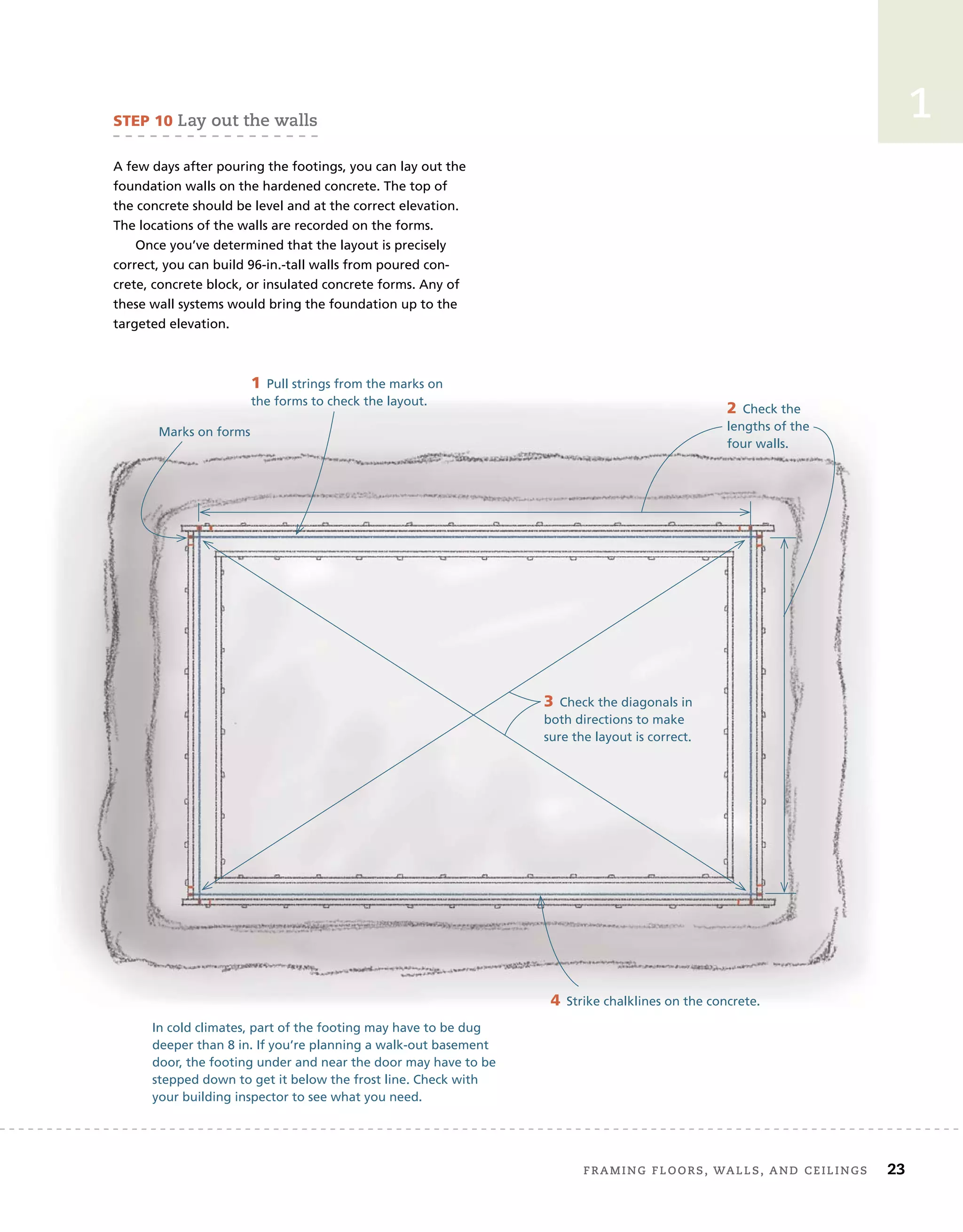
  • 156.
    FRAMING ROOFS 2:TRUSSES, EAVES, RAKES, AND SHEATHING 149 4 Watch Out When Unbanding Truss Packages When you cut the bands holding the truss package together, the band can spring out unpredictably and present a serious cutting hazard. Wear gloves and eye protection, and don’t position yourself in line with the band. Another hazard is the way the trusses fall when you cut the band. Before you cut the band, set the package on its side and either position your- self on top of the package or uphill from the package. And make sure you have a clear route to escape the trusses in the event that they start slid- ing toward you. SAFETY FIRST To store trusses on their sides, place them on as flat a surface as possible. If the ground is uneven, stack blocks in low spots for the trusses to rest on. Use a tarp to protect trusses from rain. When you move trusses, try to move them in the vertical position. If you’re moving large trusses by hand, it’s sometimes necessary to carry them in the flat position. In these cases, station some members of the crew near the center to keep the truss from bending too much.
  • 157.
    150 BUILDING THESTRUCTURE Moving and Hoisting Trusses On most houses, a carpentry crew can move and hoist the trusses by hand. For the last 25 years or so, however, carpenters have been able to hire portable cranes to lift the trusses. And, today, production framing crews often invest in telehandlers (telescoping forklifts), which are capable of hoisting trusses for most houses. Use the same procedure as you would for rafter locations (see chapter 3). Although the procedure is essentially the same, spacing for trusses is usually 24 in. on center, as opposed to the 16-in. inter- vals common for rafters. • SETTING TRUSSES BY HAND When you install trusses by hand, lift one end at a time over the bearing walls. If possible, keep the truss vertical, with the apex of the truss pointed down. With the ends overlapping the walls, rotate the truss into the upright position. Use one or two forked push sticks made out of 2x4s to finish rotating the truss above ceiling level. If the span is less than 20 ft., you can use one push stick close to the center of the top chord. If the span is more than 20 ft., you should use two push sticks placed under the top chord about one-third of the way down from the apex. Make sure a crew member is stationed at the top to catch the truss as it is rotated into the upright position. • SETTING TRUSSES WITH A CRANE For spans 30 ft. or less, attach the sling of the crane at two points near the first web/top chord intersection down from the apex of the truss. For spans longer than 30 ft., use a spreader bar and three points of attachment. Lift from two points for spans of 30 ft. or less. For spans greater than 30 ft., lift from three points. 1 Lift the truss onto the bearing wall. 2 Rotate the truss so the apex points up.
  • 158.
    FRAMING ROOFS 2:TRUSSES, EAVES, RAKES, AND SHEATHING 151 4 Aligning Trusses It’s important to line up trusses precisely as you install them. When the trusses are not aligned accurately, the roof ends up with a crooked ridge and unsightly dips and humps in the deck. There are a few approaches to aligning trusses as you install them. with a crooked ridge and unsightly dips and humps in the deck. There are a few approaches to aligning trusses as you install them. • SETTING TRUSSES BY HAND If you’re installing the trusses by hand, you can set up a string in the center of the span and set the apex of each truss to the string. A simple way to do this is to install a truss at each end of the house, then run a string from the apex of one truss to the apex of the other. • SETTING TRUSSES WITH A CRANE OR TELEHANDLER If you’re using a crane or a telehandler, the string would get in the way as you lower the truss into place. In these cases, mark the bottom chord of the truss where it will meet the inside of one of the walls before you hoist the truss. First, mark the center of the bottom chord. From the center point, measure and mark one-half the span (the distance between the bearing walls). When you set each truss, line up this mark with the inside of the wall before you install it. A string can be used to keep trusses aligned. When a stringline would be in the way, mark the bottom chords and align with the wall. • USING A LASER LEVEL Another approach is to use a laser level rather than a string. Set it up at one end of the house so that it shoots a level line just below the apex of the first truss installed. Before hoisting each truss, use a felt-tipped pen to draw a plumb line down from the apex. When the dot or line from the laser strikes the plumb line, the truss is aligned and can be installed. Laser level Mark the truss apex and align with the beam of the laser level.
  • 159.
    152 BUILDING THESTRUCTURE 1 Braces attached to ground stakes Three Kinds of Braces Braces are essential to truss roofs. During the instal- lation, temporary braces hold the trusses straight and keep them from toppling over. After the installation is complete, permanent braces tie the trusses together and hold them rigidly in place. Braces are divided into three distinct categories: ground braces, temporary truss braces, and permanent truss braces. Ground braces Ground braces are used to hold the first truss in a line of trusses in place. The advantage of setting the braces to the exterior of the house is that they’re not in the way of subsequent trusses. The bottoms of these braces are either anchored to stakes driven into the ground (hence the term ground brace) or to the floor of the house. The ground braces have to be strong enough to hold the first truss rigidly in the correct position as well as hold the subsequent trusses that are tied to the first one. Because of their length, ground braces often have to be built with two pieces of lumber. Near the center of these built-up braces, you should add braces extending back to the base of the frame. The ground braces also have to be braced laterally to keep them from buckling. On one-story buildings, where the first floor is close to the ground, you can brace the first truss to stakes driven into the ground. On two-story houses, on buildings with high founda- tions, and on houses with exterior grades that slope rap- idly away from the foundation, exterior ground braces are not practical. In these cases, it’s easier to use interior ground braces that are tied to the floor. Because these interior braces interfere with the sub- sequent trusses, the first truss can’t be placed at the end of the house. Install the first truss near the center of the house and brace it straight, plumb, and in-plane. After installing and bracing the first half of the trusses, you can remove the ground bracing and install the trusses on that side of the house. WAY S O F W O R K I N G side of the house. Additional support Interior braces attached to the floor Braces attached to ground stakes
  • 160.
    FRAMING ROOFS 2:TRUSSES, EAVES, RAKES, AND SHEATHING 153 4 Temporary truss braces After securing the first truss with ground braces, subse- quent trusses are tied to the first truss with temporary bracing and lateral restraints. The lateral restraints are used to keep the spacing between the trusses correct; the braces hold the trusses safely in the upright position during the installation. Inadequate bracing during the setting of trusses is a serious safety hazard. A network of diagonal braces and lateral restraints, installed inside the truss system, is essential for both a safe and accurate installation. Permanent truss braces Temporary bracing has to be followed by permanent bracing that becomes part of the permanent structure. This two-part bracing procedure, however, is not always essential. With careful planning, much of the bracing used during the truss installation can be left for perma- nent bracing. The truss bracing requirements are usu- ally specified in either the approved plan or in the truss design drawings that come with the truss package. Materials for truss bracing The material for truss bracing varies. Temporary bracing is usually composed of 2x4 lumber connected with 12d to 16d nails. The nails should be driven tight, so if you plan to remove the bracing, you can make the job easier by using double-headed nails. Metal braces and restraints, designed specifically for truss installation, also are used for both temporary and permanent bracing. Materials for permanent bracing include 2×4 lumber and structural panel materials, such as plywood and oriented strand board (OSB). Finally, the materials that cover the frame—roof sheathing and ceiling drywall—are considered permanent bracing materials. Lateral restraints maintain the spacing between trusses. Temporary braces
  • 161.
    154 BUILDING THESTRUCTURE Building a Gable Roof with Trusses This section uses the example of a simple gable roof to show the basics of framing roofs with trusses. Once these principles are mastered, they can be applied to just about any trussed roof. In this example, the locations of the trusses are already marked on the walls. The goal of installing a trussed roof is to set each truss straight, plumb, and in-plane over its length. In this position, where the triangles of the truss line up with the force of gravity and with each other, the truss is working at its optimal strength. To get all the trusses straight, plumb, and in-plane, install the first truss precisely and then use it as a reference for the rest of the trusses. Once you have the first truss securely braced straight and plumb, you can transfer those attributes to the rest of the trusses by bracing them in precise increments (usually 24 in.) away from the first truss. STEP 1 Set the first truss 1 Lift or hoist the first truss in place on the walls using the techniques described earlier. 2 Attach the truss to the top plates of the walls. (For more on attaching the trusses to the wall, see “Anchoring Rafters and Trusses to Walls” on p. 156.) 3 Brace the truss straight and plumb. STEP 2 Establish a system for aligning the trusses 1 Since you’re setting these trusses by hand, use a string to align the trusses. 2 Set and brace a second truss at the far end of the house. The bracing here does not have to be as extensive as that installed on the first truss because this truss will not support the subsequent trusses. 3 Set up a string that extends from the apex of the first truss to the apex of the second truss. Braces extend from the truss to stakes in the ground. Set and brace a second truss at the far end of the house. 1 Set and brace the first truss. 2 Set the second truss. 3 Stretch the string from one truss to the other at the apex.
  • 162.
    FRAMING ROOFS 2:TRUSSES, EAVES, RAKES, AND SHEATHING 155 4 STEP 3 Set subsequent trusses Set the next truss on the walls, and move it until the apex is aligned with the string and on the layouts marked on the walls. Predrill and toenail it to the walls. To hold the truss upright, use a 2x4 block of wood that’s nailed on the top of the top chord and tied to the first truss. STEP 4 Add restraints After setting three or four trusses in this manner, begin installing lateral restraints. Set these in horizontal lines perpendicular to the trusses. They should line up with the ground braces and, in most cases, be 10 ft. or less apart. Use the lateral restraints to set the top chords of each rafter the proper distance away from the top chord of the first rafter. These distances should be identi- cal to the layout on the bearing walls (which is 24 in. on center in this example). You can mark the layout directly on the lateral restraints, then move the top chords of the trusses to the layout as you nail on the restraint. On large roofs, use diagonal braces along with the lateral restraints to provide added rigidity. • BRACE AS YOU GO Install temporary bracing in the web and bottom chord planes as directed by instructions that come with the trusses. In this example, the web bracing is made up of lateral restraints combined with diag- onal braces. To prevent a domino-like collapse, don’t wait until all the trusses have been set. Braces and restraints should be installed as you set the trusses. STEP 5 Begin planning for eaves and rakes On some roofs, you can postpone work on the eaves and rakes until later. On complex roofs, it may make sense to build eaves and rakes before installing the sheathing. On most simple roofs, however, carpenters follow a middle ground in which they cut the rafter tails and install a subfascia but leave most of the framing for the eaves and rakes for later. (For more on cutting the tails in place, see “Framing Eaves” on p. 157.) 1 Move the truss on the walls until the apex lines up with the string. 2 Set the bottom chord to the layout marks on the top plates. Lateral restraints Diagonal braces stiffen the assembly. Lateral restraints in webs
  • 163.
    156 BUILDING THESTRUCTURE Anchoring Rafters and Trusses to Walls Whether you build a roof system with rafters or trusses, it must be tied securely to the bearing walls. The structural demands for this connection vary according to the design loads in your area. Toenails The most common way to attach rafters and trusses to bearing walls is with toenails. Use three 12d or 16d nails at each connection. Drive two nails in from one side and the third into the center of the wall from the other side. To avoid splitting the wood, predrill with a 1⁄8-in.-dia. hole. Metal rafter/truss ties Metal ties are required by building codes where high winds can be expected. You can confer with the building inspector and with customer support at the manufacturer to find out which type of tie to use. In many cases, you can initially install the rafters or trusses with toenails, and then come back later to install the metal connectors. Always use the nails specified by the manufacturer to attach the connectors. Slotted truss anchors At midspan walls, trusses should not be rigidly anchored to walls. To accommodate slight move- ment in the trusses yet hold interior walls in place, slotted anchors are recommended instead. Slotted anchors are particularly important with scissor trusses. WAY S O F W O R K I N G Toenail the truss to the bearing walls. Local code may require metal connectors. Use slotted anchors at midspan walls.
  • 164.
    FRAMING ROOFS 2:TRUSSES, EAVES, RAKES, AND SHEATHING 157 4 Framing Eaves There are several ways to frame roof overhangs. Here, we’ll look at framing eaves and then, in the next section, at framing rakes. The design of the eaves is influenced by the budget of the job, the width of the eave, whether the house will have an overhanging rake, and the personal preferences of the carpenter doing the work. The fol- lowing discussion focuses on the best techniques for building wide eaves on houses that also have wide rake overhangs. Precut Rafter and Truss Tails The procedure for laying out and cutting rafter tails is discussed in chapter 3 (p. 113). If the roof is built with trusses, the trusses can be ordered with precut tails. With either rafters or trusses, you should expect to make some adjustments to the tails when you build the eaves. Because wood is not dimensionally stable, the ends of the tails almost never line up perfectly after the rafters or trusses are installed. To get the ends of the tails in line, follow these steps: STEP 6 Install the sheathing Gradually remove the temporary bracing and restraints on the top chord plane of the trusses and install the sheathing. Use the techniques described in “Installing Roof Sheathing” on p. 177. In this example, a ladder-type rake is planned. Leave the sheathing long at both ends of the house. You can cut the sheathing and build the rake later. (For more on building the rake, see “Framing Rake Overhangs” on p. 164.) Use Your Rafter Jig If you’ve fabricated a rafter jig, it pays dividends when you frame eaves, rakes, gable ends, and returns. Not only can you use it to lay out plumb and level cuts, but if you’ve written the pertinent information on the jig, you can also refer to it to find the angle of the pitch in degrees and the dimensions of the base-1 triangle. TOP TIP 1 Measure several tails and find an average distance out from the wall. Mark the tails on each end of the house at the same distance. 2 Strike a line between the marks. 3 Cut the ends of the tails that stick out past the line, and shim the ones that fall short of the line as you install the subfascia. Shim
  • 165.
    158 BUILDING THESTRUCTURE Cutting Tails in Place Since some cutting and shimming is usually necessary, many carpenters don’t worry about cutting the tails until after the rafters or trusses are installed. Here’s how to lay out and cut the tails: 1 Scribe a plumb line indicating the outside face of the finish fascia. 2 Measure and mark the thick- ness of the finish fascia, and draw a second plumb line. 3 Measure and mark the thickness of the subfascia, and draw a third plumb line. 24 in. The subfascia will be nailed to the rafter tail. The end of the tail, therefore, should be cut along the third vertical line. STEP 1 Lay out the end of the first tail Select any tail to draw the layout on. After deciding the width that you want to make the eave, measure that distance out from the face of the bearing wall. In this example, the width of the finished eave is 24 in. from the finish materials that will be added to the wall. STEP 2 Lay out the bottom of the first tail 1 Draw in the width of the finish fascia. 1 Using the first tail as a reference, lay out the ends of the rafter/truss at each end of the eave. 2 Draw in the bottom of the subfascia. Mark the amount that you want the finish fascia to lap over the soffit of the eave (1 in., in this example). Next, draw in the thickness of the soffit material (3⁄8-in. plywood here). The bottom of the subfascia is at the level of the top of the soffit plywood. 2 Mark the tops of the end rafters/trusses at the layout, then snap a chalkline across the tops of the tails between the two marks. 3 Cut along a level line that’s even with the bottom of the subfascia. 3 From the marks left by the chalkline, scribe plumb lines on the sides of the tails. Cut along the plumb lines. STEP 3 Mark the ends of the rest of the tails 3⁄8-in. soffit Subfascia
  • 166.
    4 Don’t Sweat the SmallStuff On narrow eaves, the soffit material can be nailed directly to the horizontal cut on the eave. On wide eaves, where soffits will be nailed to addi- tional blocking, some carpen- ters like to cut slightly above the subfascia line on the rafter tails. If the rafter tail won’t be part of the soffit framing, there’s no reason to fuss over the cut. TOP TIP Don’t Let the Kerf Close When you cut the end of a rafter tail, gravity pulls the offcut down. If you cut from the top, the offcut falls harmlessly down and away from the spinning blade. If you cut from the bottom up, on the other hand, the kerf closes as the offcut begins to fall. At the least, this creates an alarming screech, and sometimes the offcut is flung by the spinning blade. At the worst, the closing kerf can bind on the sawblade, causing the saw to kick back. If at all possible, cut from the top down. If this is impractical, find a way to support the offcut while you make the cut. One way to do this is to screw or clamp a block of 2x4 to the underside of the tail. E S S E N T I A L S K I L L S 2 If the scrap piece is wider than the 2x rafter tail, a tongue of material will be left when the tail is trimmed, which will prevent the offcut from falling. Cut down to avoid pinch- ing the blade. 1 If you must cut up, clamp a length of scrap to the bottom of the rafter or truss tail. FRAMING ROOFS 2: TRUSSES, EAVES, RAKES, AND SHEATHING 159
  • 167.
    160 BUILDING THESTRUCTURE Subfascias Carpenters disagree over the need for a subfascia. If you decide to use one, you have two options: Choose a material size that fits, uncut, under the sheathing, or rip the top of the subfascia to fit snugly under the sheathing. Leaving the top of the subfascia square The subfascia can be left square on top and set so that the outside edge is just touching or slightly below the underside of the roof sheathing. This method is often used when installing a 2x4 subfascia on 2x4 truss tails. Use a straightedge, as shown in the top drawing on the facing page, to keep the outside corner of the subfascia in plane with the top of the truss. STEP 4 Mark level lines On truss tails, this step is not normally necessary because the bottom of the subfascia is set even with (or below) the bottom of the plumb cut. For a stick-built roof, measure the distance from the top of the plumb cut to the level line marked on the first rafter/truss. 1 Mark this dis- tance down from the top of the plumb cut on the tails at each end of the eave. Plumb cut Level cut 2 Snap a chalkline from mark to mark on the ends of the rafter tails. 3 From the marks left by the chalkline, draw level lines on the sides of the tails. Use a circular saw to cut along the level lines.
  • 168.
    FRAMING ROOFS 2:TRUSSES, EAVES, RAKES, AND SHEATHING 161 4 Ripping the top of the subfascia To provide a full nailing sur- face for the roof sheathing, rip the top of the subfascia at an angle equal to the roof pitch. Measure the size of the plumb cuts on the ends of the rafter tails, and mark that width along the length of the subfascia material. If you want the bottom of the subfascia to end up a bit below the level cut on the rafter tail, mark the width 1⁄4 in. wider than the plumb cut. Set your saw to the degree equivalent of the roof pitch and cut along the line. Installing the subfascia Drive two 12d or 16d nails at each tail to install the subfascia. As you nail it off, have a helper at the far end lever the board up or down until it’s in plane with the top of the rafter or truss. Straightedge Subfascia Rip the top edge to match the slope of the roof. Run the subfascia long if a rake is planned. Two 12d or 16d nails at each tail
  • 169.
    Advantages of Using aSubfascia Not all carpenters use a subfascia. You can save time and material by simply nailing the finish fascia to the rafter/ truss tails. To help support the outside of the soffit material, some carpenters rout a groove in the back of the finish fascia. They slip one edge of the soffit material into this groove, then nail the other edge to a ledger attached to the wall. Other carpenters rely on cross blocks that are nailed to the sides of the tails. Although the subfascia can be eliminated, it enhances the quality of the finished job in several ways. First, it provides a continuous nailing surface for the soffit and, sometimes, for the edge of the roof deck. This translates into a straight and secure edge for both surfaces. Second, a subfascia serves an important structural role when an overhanging rake is planned. The subfascia can be extended out past the corner of the house, where it helps support the overhang rakes and rake/ cornice returns. Finally, the subfascia provides a solid surface the whole length of the eave for receiving gutter spikes or screws. Groove routed in the back of the fascia Ledger attached to the wall Soffit Cross block The subfascia provides continuous support. 162 BUILDING THE STRUCTURE
  • 170.
    FRAMING ROOFS 2:TRUSSES, EAVES, RAKES, AND SHEATHING 163 4 If you plan to use rake overhangs, let the subfascia run past the ends of the house. Make sure that this piece is attached to several tails in from the corner and that it extends outside the planned rake. Installing the ledger Level over from the bottom of the sub- fascia, and mark both ends of the wall. Strike a chalkline between the marks, then nail the ledger along the line. If you plan on building a rake or cornice return, let the ledger run past the corner. Make sure it extends beyond the planned rake. Adding cross blocks Narrow eaves without continuous eave vents do not require cross blocks (also called “soffit joists”). If you plan on using continuous eave vents or have eaves that are more than 12 in. wide, you need cross blocks. If you’ve used a subfascia, you can install the cross blocks flat to provide a wide surface for nailing off the soffit. Nail through the sub- fascia to attach the outside end; toenail into the ledger to attach the inside end. If you have not used a subfascia, install the cross blocks on edge and nail them to the sides of the truss/rafter tails. Run the subfascia and rake ledger long for rake overhangs. Level Cross block Subfascia
  • 171.
    164 BUILDING THESTRUCTURE Framing Rake Overhangs There are two basic ways to frame a rake overhang. In the first approach, a ladderlike frame is nailed outside the first rafter or truss. In the second, a series of lookouts are tied to a rafter or truss 16 in. to 24 in. inside the roof. From there, they bear on the gable-end wall and cantilever out to a barge rafter at the edge of the rake. Building a Ladder-Type Rake On rakes that are less than 16 in. wide and not subjected to heavy snow and wind loads, a simple ladder-type rake is usually sufficient. These are built outside the gable-end rafter or truss. • LADDER-TYPE RAKES This design relies on several things to keep the rake from sagging. Sheathing on the roof deck provides tensile strength. Perpendicular blocks extended from the wall to the barge rafter provide compres- sive strength. On the under- side of the rake, plywood soffit material adds to the compressive strength of the blocks. At the lower end of the rake, the subfascia helps to hold up the bottom of the barge rafter. At the upper end of the rake, an extension of the ridge (on stick-built roofs) provides support for the top of the barge rafter. STEP 1 Cut the subfascia and ridge to length 1 Use a straightedge or a square to extend the location of the end wall of the house out to the subfascia. 2 Measure out the desired width of the rake, minus the thickness of the barge rafter and the finish rake material. 3 Draw a plumb line at that point, and cut along the line. 4 Measure and mark a distance that is equal to the distance marked out from the end wall along the subfascia. Cut along the line.
  • 172.
    FRAMING ROOFS 2:TRUSSES, EAVES, RAKES, AND SHEATHING 165 4 STEP 2 Cut the ridge to width 1 Make a plumb cut on a scrap of the barge rafter material (usually a 2x4), and position the scrap against the end of the ridge. STEP 3 Install the sheathing Install the sheathing on the roof using the methods described on p. 177. Where a rake or cornice return is planned, you may want to install the first panel of sheathing at the bottom of the rake so it can be removed easily. At the end of the roof, leave the sheathing about 1⁄8 in. short of the outer extent of the planned rake. 4 Let the barge rafter run past the subfascia. Attach the barge rafter to the subfascia with a couple of 12d nails. Cut the barge rafter flush with the subfascia. STEP 4 Install the barge rafter 1 Snap a line representing the inside of the barge rafter on the top of the sheathing. 2 Select a straight piece of lumber, and make a plumb cut at the top. Center the barge rafter on the end of the ridge, and nail it in place. 3 Working your way down, hold the inside edge of the barge rafter even with the line (you should be able to see the barge rafter through gaps in the sheathing), and nail through the plywood with 8d nails every 8 in. STEP 5 Install the ledger and cross blocks 1 Hold the ledger up against the underside of the plywood as you nail it to the truss/rafter. 2 Measure and install cross blocks that run from the ledger to the barge rafter every 16 in. or 24 in. Toenail the blocks into the ledger, and nail through the barge rafter to attach. Also nail through the sheathing. 2 Mark the point where the bottom of the scrap piece meets the centerline of the ridge. Cut horizon- tally here.
  • 173.
    166 BUILDING THESTRUCTURE Building a Cantilevered Rake Overhang If you’re using heavy roofing material, such as slate or tile, live in an area where strong wind or heavy snow is expected, or plan on building a rake 16 in. or wider, you should use a cantilevered rake overhang. In a cantilevered rake, a series of lookouts are nailed to the first rafter or truss inside the wall. The lookouts bear on the end wall or a notched verge rafter and extend out to a barge rafter at the outside of the rake. This design is more difficult to frame than the ladder type just described, but it’s considerably stronger. There are three ways to support the lookouts at the gable wall. Method 1: Use a drop-top gable-end truss If you’re using trusses, order drop-top gable-end trusses for the rakes (see p. 145). These are lower than the others by the depth of the top chord (typically 31⁄2 in.). After setting and bracing the drop-top gable-end truss, nail the ends of the lookouts to the first truss inside the end wall and have the lookouts extend out to the barge rafter. Method 2: Build a dropped gable-end wall Like a drop-top gable-end truss, a dropped gable-end wall is built a set distance (usually 31⁄2 in.) below the top edge of the rafter/truss. See the facing page for a step-by-step example of the layout and construction of one of these walls. Method 3: Use a notched verge rafter In this system, you lay out a pair of verge rafters for the gable-end wall. The layout for these rafters is just like the layout for the other rafters in the roof. Before installing these rafters, however, you cut a series of notches through which the lookouts can pass. See p. 168 for a step-by-step discussion of how to cut these notches accurately. Drop-top gable-end truss Barge rafter Lookouts cantilever over the end of the wall and are nailed to the first rafter of the truss inside wall.
  • 174.
    FRAMING ROOFS 2:TRUSSES, EAVES, RAKES, AND SHEATHING 167 4 Laying Out and Building a Dropped Gable-End Wall In this example, the building is 24 ft. wide and the roof is a 10-in-12 pitch. The rafters are made from 2x10s. At the top of the dropped gable-end wall, there will be a double top plate. This example follows the process for one-half of the gable-end wall; the other half repeats the process. 2 Transfer the location of the end wall to the ridge. Mark the location of the outside of the wall frame, not the outside of the sheathing. STEP 1 Transfer the location of the ridge to the end wall STEP 3 Cut and install the lower top plate Set your saw to a 40° bevel (the equivalent in degrees of a 10-in-12 pitch) and crosscut the plate. From the short point of the cut, measure and mark 1841⁄16 in. On the edge of the board, lay out a level cut. Start with a circular saw and finish with a handsaw. STEP 2 Lay out the short points of the lower top plate The bottom of the lower top plate of the gable-end wall should be approximately 61⁄2 in. below the top of the rafter (lookout width of 31⁄2 in. plus two top plates). Set a combination square to this dimension. STEP 4 Install the studs and the upper top plate Ridge Plumb line Top plate 1 Use a level and straightedge, a plumb bob, or a laser level to transfer the location of the ridge to the top of the end wall. Mark both sides of the ridge on the top plate. 3 At the wall that the rafter bears on, draw a line on the top plate starting at the line you just made. You can now determine the length of the lower top plate by measuring the distance between the lines (in this example, 1841⁄16 in., short point to short point). 1 On the first rafter in from the end of the wall, use the combination square to mark the location of the bottom of the lower top plate of the gable-end wall. 2 At the ridge, draw a level line on the side of the ridge, starting at the line you just made. Install the plate with the short point of the plumb cut set on the line on the ridge and the short point of the level cut set on the line on the wall. If necessary, use braces to hold it in line until you get the studs installed. 2 Measure and cut the upper top plate and nail it on top of the lower top plate. 1 Cut and install the studs for the gable-end wall.
  • 175.
    168 BUILDING THESTRUCTURE Installing notched verge rafters If you have good woodworking skills and sharp hand tools, you can simplify the construction of cantile- vered rakes by using notched verge rafters. When You Don’t Have a Ridge, Use Math Another way to lay out the dropped gable-end wall is to use math. Although math is not necessary for this task on a raftered roof, it would be necessary on a trussed roof, where there is no ridge from which to measure. If this were a trussed roof, you’d need to measure the base of the measuring triangle along the end wall. This is the distance between the line you just made on the bearing wall to the center of the end wall. Once you have the base of the measuring triangle (142.125 in this example), multiply it by the base-1 hypotenuse for a 10-in-12 pitch (1.302) to determine the length of the lower top plate of the gable wall: 142.125 x 1.302 = 185.05. WAY S O F W O R K I N G STEP 1 Lay out the notches STEP 2 Cut the notches 1 Clamp the rafters back-to-back. 2 Lay out the notches on the top edge of the rafters. In this example, the notches will accommodate 2x4 lookouts on edge, installed every 16 in. Notches are 31⁄2 in. deep. 1 Set your circular saw to 0° and cut across both rafters at the same time, staying within the layout marks. Then make five or six quick cuts between them. The ideal depth to make these cuts is 37⁄16 in.; the final 1⁄16 in. can then be pared away with a chisel. 2 Unclamp the rafters, and use a combination square to mark the bottom of the notches at 37⁄16 in. Complete the cuts down to the layout lines with a jigsaw or sharp handsaw. Bearing wall No ridge 185.05 Center of end wall 142.125 10-in-12 rafter jig
  • 176.
    FRAMING ROOFS 2:TRUSSES, EAVES, RAKES, AND SHEATHING 169 4 Framing the cantilevered rake The frame for the cantilevered rake is basically the same whether you’ve used a drop-top gable-end frame, a dropped gable-end wall, or a notched verge rafter. STEP 3 Clean out the notches 2 Break out the remaining wafers of wood with a hammer. 3 Use a sharp chisel to clean out the bottoms of the notches. 4 Test-fit a piece of look- out material. It should be flush with the top of the rafter. 1 Make several passes. 4 Cut and install the studs. STEP 4 Build the gable-end wall 1 Install the verge rafters in the same manner as the other common rafters. 2 Install a series of cross blocks between the verge rafter and first rafter inside the house. These blocks should be installed flat and flush with the bottoms of the rafters. 3 Install a top plate flush with the outside of the verge rafter. STEP 1 Trim the ridge and the subfascia Ridge Subfascia 1 Mark and cut the ridge and the subfascia to the correct length. Mark and cut the exterior portion of the ridge to the correct width. 2 After bracing the first rafter inside the house, you can simply cut all the look- outs the same length and install them. Alternatively, you can run the lookouts slightly long, stretch a chalkline from the ridge to the subfascia, and snap a line. 3 Square down from the marks, and cut the lookouts in place. On trussed roofs, where there is no ridge, cut and install the uppermost lookout. Then stretch the stringline or chalkline from the end of that lookout to the subfascia. STEP 2 Install the lookouts
  • 177.
    170 BUILDING THESTRUCTURE STEP 3 Install the barge rafter STEP 4 Install blocks between lookouts 1 Make a plumb cut on the top end of a long 2x4. Install the top with the plumb cut at the center of the ridge. (If the roof is built with trusses and there is no ridge, center the first barge rafter by using a scrap with a plumb cut on it.) 1 On rakes that cantilever over dropped walls, install blocks in the spaces between the lookouts. Blocks keep lookouts from rotating and close off the first rafter bay from the weather. TOP TIP Venting the First Bay If you’re planning to use the underside of the rafters as a cathedral ceiling and the design speci- fies eave/ridge vents, you need to ensure that air flows freely in the top inch or so of every rafter bay. Left unmodified, the lookouts of the rake can block this flow of air. You can provide for this air movement by cutting a dip about 3⁄4 in. deep in the top of the lookout in the area that will be inside the bay. 2 Let the bottom run long. Then, after you’ve nailed off the barge rafter, cut the bottom flush with the out- side face of the subfascia. 2 If a rake return is planned, don’t install the block in the space at the bottom of the dropped wall until you’ve installed a backing block for the return. Once you have the backing block in place, notch the final block between the lookouts over it. For more, see p. 172 for how to install rake returns. Roof deck Ceiling Dropped gable wall Lookout Barge rafter 3⁄4-in. gap allows air to flow to ridge vent
  • 178.
    FRAMING ROOFS 2:TRUSSES, EAVES, RAKES, AND SHEATHING 171 4 Rake and Cornice Returns Rake and cornice returns provide a graceful transition from the level eave to the sloping rake. Cutting and fitting the angled pieces for this tran- sition is difficult, but the biggest challenge of this job is structural. The returns have almost nothing under them because they’re located outside the corner of the house. As with eaves and rakes, the designs of returns vary considerably. This section uses three exam- ples to show how to build common rake and cor- nice returns. The approaches presented here can be applied to many different designs. Building Structurally Sound Returns There are several things you can do to ensure that rake and cornice returns are structurally sound. Anchor the ledger and subfascia deep in the eave Rake and cornice returns get most of their structural support from the ledger and subfascia of the eave. When you install these pieces, therefore, make sure they’re anchored several feet into the length of the eave. Make sure the ledger and the subfascia extend to the end of the rake. The surest way to do this is to install them long and cut them in place. Think ahead If you don’t think about the return until after you’ve installed the roof sheathing, it can be difficult to securely anchor key parts of the return up inside the rake. To avoid having to compromise these connections, do the following: If possible, don’t install the sheathing on the lower outside corners of the roof. You can sheathe the rest of the roof and leave these corner pieces for later. Or, if you prefer, you can cut and tack them in place so they can be removed easily. After you finish the return, you’ll be able to reinstall these pieces quickly. If you don’t want to delay the installation of the sheathing, at least place backing blocks in the rakes. Having these in place makes your job a lot easier when you get around to framing the return. When a cornice return is planned, build the return before you install the barge rafter and the sheathing. E S S E N T I A L S K I L L S that rake and cornice returns are structurally sound. Leave this sheathing off until the rake return blocking is installed. Basic rake return Cornice return with shed roof Cornice return with hip roof
  • 179.
    172 BUILDING THESTRUCTURE Framing a Basic Rake Return Using the subfascia and ledger for support, build the rake return in two layers. STEP 1 Cut the ledger Use a level to transfer a plumb line down from the inside of the barge rafter to the ledger. Cut the ledger in place. STEP 2 Install a backing block above the ledger At the inside of the rake, there are two possible scenarios. If you have a ladder-type rake or you’ve used a notched verge rafter, the first rafter will be flush with the gable-end wall. If you’ve used a drop-top gable-end truss or built a dropped gable-end wall, there will be a space above the truss or wall. Barge rafter Ledger Backing block 2 Transfer the outside face of the ledger up to the first rafter or truss inside the house. 2 Transfer the outside face of the ledger up to the side of the first rafter. 1 Use a level to transfer the outside face of the ledger up to the barge rafter. 1 Use a level to transfer the outside face of the ledger up to the barge rafter. • LADDER RAKES OR VERGE RAFTERS • DROP-TOP TRUSS OR DROPPED GABLE- END WALL 3 Rip a scrap of wood at an angle that matches the pitch of the roof, and nail this scrap above the marks you’ve just made on the barge rafter and the rafter or truss and flush with the bottom of the rake. 3 If you have a drop-top gable- end truss or you’ve built a dropped gable-end wall, this backing block must extend back to the first rafter/ truss inside the wall. Level
  • 180.
    FRAMING ROOFS 2:TRUSSES, EAVES, RAKES, AND SHEATHING 173 4 STEP 3 Install the first layer Frame the basic shape of the return with 24 and 26 scraps. STEP 4 Install the second layer Cut and fit pieces to bring the recessed surfaces of the return flush with the ledger and rake. 1 Nail a vertical 2x4 on each side of the back of the return. 2 Cut a piece of 2x6 that fits inside the barge rafter. Hold the piece so that the top is flush with the top of the barge rafter and nail it in place. There should be about 2 in. of the 2x6 sticking out below the barge rafter. 1 Rip a scrap of wood at an angle that matches the pitch of the roof. Cut and install this piece on the vertical pieces. The outside end should be even with the inside of the barge rafter. The top should be against the backing block in the rake. The face of this block should be flush with the face of the ledger. 2 Cut a triangular piece to pad out the side of the return. (On large eaves and on steep-pitched roofs, you’ll need two horizontal pieces.) Framing a Cornice Return A cornice return (also called a Greek return) brings the eave and fascia of the main roof around to the gable-end side. Above them, a diminutive roof is tucked up under the rake. The roof, which is some- times called a water table, can be a shed roof or a hip roof. The size and configuration of cornice returns vary. A return that is 24 in. to 30 in. long, however, is fairly common. The following examples provide step-by-step procedures for building two types of cornice returns. In both examples, the process begins before the barge rafter has been installed.
  • 181.
    174 BUILDING THESTRUCTURE Building a Cornice Return with a Shed Roof This section describes a method for building the simplest type of cornice return, one that features a basic shed roof. STEP 1 Cut the subfascia and the ledger As with a rake return, start by installing the ledger and subfascia long and then cut them in place when you build the cornice return. STEP 2 Install the ledger on the gable-end wall Draw the cross section of the cornice return full size to determine the width of the ledger. Rip the top of the ledger to the pitch of the cornice return roof. In most cases, a single ledger made from a wide piece of lumber is wide enough to extend from the bottom to the top of the ledger. You can use two pieces, one for the top and one for the bottom, if necessary. On both the subfascia and the ledger, measure and mark the desired width of the rake frame, minus the thickness of the barge rafter. Scribe plumb lines at these points and cut along the lines. Subfascia 1 The ledger of the cornice return must extend from the outside end of the return over to the subfascia of the eave. 2 Notch the cornice ledger over the main eave ledger. Or, if you have to use two pieces, one part extends from the ledger of the main eave to the subfascia. The other part starts at the other side of the ledger of the main eave and extends to the end of the cornice.
  • 182.
    FRAMING ROOFS 2:TRUSSES, EAVES, RAKES, AND SHEATHING 175 4 4 The outside piece has to be 3 in. longer than the other piece(s) to allow it to overlap both the cornice return ledger and the cornice return subfascia. STEP 3 Extend the subfascia around to the gable-end wall Cut the subfascia to length and width and nail it to the ends of the subfascia and ledger of the main eave. STEP 4 Install the cornice rafters Using the techniques discussed on pp. 105–108, lay out, cut, and install the rafters of the cornice return. 1 Rip the top of the subfascia material to the pitch of the roof of the cornice return, cut it to length, and nail it to the ends of the subfascia and the ledger of the main eave. 2 At the corner, pare the bevel of the subfascia of the cornice return to make it even with the bevel of the subfascia of the main eave. 3 Cut two or three boards at an angle that matches the desired pitch of the cornice roof. STEP 5 Install the sheathing Cut the sheathing so that it doesn’t extend past the plane of the main roof deck and nail it to the rafters. STEP 6 Install the barge rafter Cut the barge rafter to fit over the deck of the cornice return and nail it in place. 1 Cut and install the sheathing on the cornice return roof. 2 After cutting the top plumb cut and measuring the barge rafter to length, mark a level cut for the bottom. Set your saw to a bevel that matches the pitch of the cor- nice return roof, and cut along the level cutline. Nail the barge rafter to the ridge, look- outs, and cornice return roof.
  • 183.
    176 BUILDING THESTRUCTURE Roof Sheathing The sheathing on a roof serves two functions. First, it is a substrate for final roofing materials. Second, it plays an essential structural role in the roof frame. In this capacity, it serves as a rigid diaphragm that holds the rafters or the top chord of the trusses in place and keeps the top surface of the roof from moving out of square. In addition to these structural roles, sheathing can also play an aesthetic one. In some designs, the underside of the sheathing is left open to view. In these cases, the way the sheathing looks when viewed from below is an important part of the design. Building a Cornice Return with a Hip Roof The procedure for building a cornice return with a hip roof is similar to the method for a shed roof. The only difference is the outside end, which has a hip roof. To frame the hip roof, take the following steps: 1 Lay out the ledger with one end cut at the same slope as common rafters in the cornice return. 2 Rip a piece the same size and with the same bevel as the subfascia on the front of the cornice return, and install on the end of the cornice return. 3 Where the level section of the ledger ends, install a common rafter. This rafter should be the same length and pitch as the sloping section of the ledger. In plan view, this rafter, the sloping section of the ledger, and the subfascia should form a square. 4 Install the hip rafter. Rip the top with a double bevel. The angle of the bevel should match the backing angle for the pitch of the cornice return roof. Mark the plumb cuts at the top and bottom of the hip, then set your saw to a 45° angle. Cut a double bevel at both the top and bottom of the hip. End view STEP 1 Shape the end of the ledger into a rafter Lay out and cut the end of the ledger to conform to the desired pitch. STEP 2 Extend the subfascia around the corner Cut and install the subfascia on the front and side of the return. STEP 3 Install common rafters Lay out and cut common rafters to the desired pitch. STEP 4 Cut and install the hip rafter Using the techniques discussed on pp. 122–127, lay out, cut, and install the hip rafter.
  • 184.
    FRAMING ROOFS 2:TRUSSES, EAVES, RAKES, AND SHEATHING 177 4 Spacing panels: To provide for expansion of the panels, manufacturers recommend leaving a 1⁄8-in. gap between the edges of the installed panels. Most panels are sized to allow for this space. Textured side up: When installing OSB, set the textured side up. Doing this provides better footing. Nailing schedule: In most areas, sheathing should be fastened with 8d common nails. At the ends of the panels, the nails should be placed every 6 in. At the intermedi- ate rafter/trusses, the nails should be placed every 12 in. (This nailing schedule does not meet code requirements in areas prone to high-speed winds. Check local codes.) Installing Roof Sheathing When you install roof sheathing, you have to think about more than the sheathing itself; you also need to consider the rafters/trusses below. While the rafters or trusses support the sheathing, the sheath- ing holds the rafters or trusses permanently in place. Stagger the courses: Each horizontal course of sheathing should be offset from the course below. The most common offset is half the length of the panel, or 48 in. Long side runs perpendicular to the rafters/ trusses: Sheathing panels are stronger along their length than across their width. Install them perpendicularly across the rafters/trusses. • ROOF SHEATHING BASICS Clips: On trussed roofs, H-clips are required on the edges of panels between trusses. Clips are generally not required on raftered roofs that are laid out on 16-in. intervals.
  • 185.
    178 BUILDING THESTRUCTURE Skip sheathing is still used for certain types of roofing. Sheathing Materials There are four materials commonly used for roof sheathing: solid-sawn lumber, plywood, OSB, and composite panels. Solid-sawn lumber Prior to the 1950s, almost all roofs were sheathed with solid-sawn lumber. Although this material has been largely replaced with structural wood panels (plywood, OSB, and composite panels), solid-wood sheathing performs well and is still in use. It’s used for roof systems where skip sheathing is installed. Skip sheathing, which consists of strips of wood with open spaces between them, has been used for centuries under tile, slate, metal, and wood roofs. Using lumber sheathing also can save money for builders or homeowners if they have a local source of lumber. But these days, sawn sheathing is primarily used for visual impact. In cabins and in houses where the rafters and sheathing are left exposed to view, solid- sawn tongue-and-groove sheathing is attractive when viewed from below. To optimize the visual impact, the edges of the boards are usually milled with a V-groove or a bead. In some cases, tongue-and-groove sheathing is used along with wood structural panel sheathing. On houses that have open eaves and rakes, where the underside of the sheathing is visible from the ground, the eaves and rakes are often sheathed with tongue-and-groove boards. To save money, however, the rest of the roof is sheathed in wood structural panels. Plywood In the 1950s, plywood began to replace solid-sawn sheathing on roofs. Because it was inexpensive, easy to install, and performed well, plywood rapidly gained acceptance and soon became the dominant sheathing material in America. Plywood is made by gluing three or more veneers or plies into a sheet. Each layer of veneer is set at a right angle to the one below. This configuration gives the ply- wood strength across both its width and along its length; it also provides dimensional stability. Plywood manufacturers fabricate the panels with an odd number of plies. The majority of the layers, including the two exterior plies, run along the length of the panel. Because of this, plywood is stronger along its length than along its width. Plywood is made from three or more plies of veneer.
  • 186.
    FRAMING ROOFS 2:TRUSSES, EAVES, RAKES, AND SHEATHING 179 4 Performance Standards for Wood Structural Panels All model building codes in the United States use the term wood structural panel to describe structural sheathing. Model codes do not differenti- ate between plywood, OSB, and composite panels. Choosing code- compliant sheathing Model building codes require that panels used for roof sheath- ing conform to Department of Commerce Standard PS-1 (for plywood) or PS-2 (for OSB and composite panels). About 75% of wood struc- tural panels in the United States also are rated by the APA—The Engineered Wood Association. In addition to the PS-1 or PS-2 designations, these panels are stamped with an APA perfor- mance rating. Because the APA rating describes the intended use of the panel, it’s easy to understand and use. For most houses, a 15⁄32-in. panel that’s APA-rated for sheathing and is “exposure 1” is suitable for roof sheathing. As far as the code is concerned, it doesn’t matter if that panel is plywood, OSB, or a composite panel. In terms of structure, they are considered equal. WAY S O F W O R K I N G OSB Waferboard, the precursor of OSB, first appeared in 1963. These panels were produced by randomly placing wood fibers or wafers in the panel. This technology was refined and improved in 1978, when manufacturers developed oriented strand board. In OSB, the strands of wood are oriented, not randomly placed. OSB panels are made of layered mats. The mats on the external surfaces are composed of strands oriented along the length of the panel. The mats inside the panel are composed of strands that are oriented at a right angle to those on the surface. Because of this configuration, OSB is like plywood in that it’s stronger along its length than it is across its width. Composite panels Far less common than plywood or OSB, composite panels (such as COM-PLY) offer something of a compromise between the two technologies. The exterior surface of a composite panel is made of conventional veneer; the interior is composed of fibers or strands. In thicker panels, a third layer of veneer, running at a right angle to the surface veneers, is placed in the core of the panel. Oriented strand board (OSB) is made of layered mats of wood fiber.
  • 187.
    180 BUILDING THESTRUCTURE Temporary brace • TEMPORARY BRACE STEP 1 Lay out for the first course Follow a line to make sure the first course of sheathing stays straight. STEP 2 Align the panel After bracing the first rafter straight, set the panel along the chalkline and center it over the last rafter it covers. STEP 3 Attach the panel Nail the bottom of the panel to hold it in place then pull or push the last rafter it sits on until it is centered under the end of the panel. When it’s centered nail through the panel to hold the rafter in place. 1 Strike a chalkline to guide the first horizon- tal course of sheathing. Carpenters usually mark this line 48 in. (the width of a panel) above the bottom edge of the roof frame. 2 After making sure that the first rafter/truss is braced in the correct position, set the first panel on the horizontal chalkline. Move the panel along the line until it is just short of the center of the last rafter/truss it can reach, allowing for a 1⁄8-in. gap between panels. 3 Drive a few nails along the bottom of the panel to hold it in place. If the final rafter or truss tapers along the edge of the panel, push the rafter or truss until it runs parallel with the end of the panel. 4 Drive a nail in the top corner of the panel to hold that rafter/truss in line with the end of the panel.
  • 188.
    FRAMING ROOFS 2:TRUSSES, EAVES, RAKES, AND SHEATHING 181 4 STEP 5 Gap the next course Before installing the next panel, drive a couple of 8d or 10d nails partway in along the end of the panel just installed. Butting the next panel against the nails creates the required 1⁄8-in. gap. For each panel in the horizontal course, pull the layout from the same starting point, namely, the outside of the first rafter/truss. As before, mark the layout on the top edge of the panel and push the rafter/truss to the layout marks before anchoring them in place with nails. You don’t need a line for subsequent horizontal courses. Use nails, driven partway in along the top of the panels below, to maintain the required gap. Offset each succeeding course from the one below. STEP 4 Lay out the top of the panel Hook your tape measure over the outside edge of the first truss, and pull the layout from that point. Mark the layout on the top edge of the panel, with the layout set ahead. If any of the rafter/trusses need to be adjusted to align with the layout, push or pull them to the layout marks. Anchor them in place by driving in a nail an inch or two from the top edge of the panel. (If you plan on removing the first panel to make it easier to build the rake return, don’t drive these nails all the way in.) Mark the layout ahead. TOP TIP Lay Out Sheathing from the Top If you measure down from the top in 4-ft. increments, you can start the sheathing installation with ripped pieces at the bottom. These ripped pieces will be lighter and easier to handle on the first row of sheathing, which is often the most difficult to install.
  • 190.
    Closing the House tothe Weather pa r t t w o C h a p t e r 5 Roofing the House C h a p t e r 6 Installing Windows, Exterior Doors, Siding, and Trim C h a p t e r 7 Controlling Moisture in the Ground and in the Air 278 231 184 183
  • 191.
    184 5 CHAPTER roofing the House MoDern HoMeBuilDersHaVe inHeriteD many practices, but few are as ancient or widespread as our basic approach to roofing and siding. When our an- cestors were still following herds of wild animals and foraging for edible roots and berries, they often lived in temporary structures framed with tree branches and covered by the skins of the animals they killed. At some point they learned to arrange their hides in an over- lapping pattern. This pattern ensured that as rainwater flowed down over one piece of hide, it ran onto the top of the piece below. Once learned, this lesson was surely remembered, for the reward was a dry place to sleep. Today, this simple principle—that the upper piece always overlaps the lower piece—is still the first and foremost rule for installing roofing and siding. In this chapter (and the next), we’ll return again to this basic rule as we examine the techniques that builders have developed to keep rainwater out of houses.
  • 192.
    roofing tHe House185 5 two roofing systems Roofing is generally divided into two basic systems: low-sloped roof- ing and steep-sloped roofing. Low-sloped roofing systems are used on roofs with pitches of 3-in-12 or less. Usually, they are used on roofs that are nearly flat. These roofs are used extensively in com- mercial and institutional construction, and they are rare in residen- tial construction. Steep-sloped roofs typically require a pitch of 4-in-12 or greater. The most common residential roof in America by far (and the main focus of this chapter) is a steep-sloped roof covered in asphalt shingles. low-sloped roofs Because water spreads unpredictably on low-sloped roofs, the roof must form a watertight barrier. Creating this barrier can be challeng- ing and often requires special tools and equipment. These roofs can be divided into four categories. Built-up roofs Built-up roofs are made from layers of roofing felt (or special fabrics) fused together with bitumen (hot asphalt, hot coal tar, or cold-applied liquid adhesives). They have been in use since the 1840s. Until recently, built-up roofs required an investment in equip- ment, both to heat asphalt or coal tar and to transport these materi- als safely up to the roof. Today, some systems use cold-applied liquid adhesive; others use special adhesives that can be softened with a portable propane torch. Because they require much less capital investment, these cold-applied systems are more practical for small roofing contractors and builders. Flat-seamed metal roofs Flat-seamed metals roofs have been used for more than a century but they are rare today. Requiring special tools and skills, including the ability to solder, these roofs are expensive and it’s often difficult to find roofers able to do them. There are three layers on a typical asphalt-shingle roof. Substrate (plywood, OSB, or sawn lumber) Underlayment Overlapping shingles A 6-in-12 roof pitch is about the steepest pitch most people feel comfortable walking on.
  • 193.
    186 closing thehouse to the weather Spray polyurethane foam roofs Spray polyurethane foam (SPF) has been used on commercial buildings for more than 35 years. It’s produced by a chemical reaction when two liquid components— isocyanate and polyol resin—are mixed at the nozzle of a spray gun. After they’re combined, the materials expand to 30 times their liquid volume and in a matter of minutes dry to a solid polyurethane foam. This foam is both waterproof and has a high insulation value. Because of the investment in equipment and training, these roofs are typically installed by specialty roofing contractors. Single-ply roofs Since the 1960s, a variety of waterproof mem- branes have been developed for low-sloped roofing applications. The most common of these is ethylene propylene diene monomer rubber (EPDM). Other systems are polyvinyl chloride (PVC) roofing and Curon, a polymer system that cures under ultraviolet (UV) light. Unlike built-up roofs, these systems have only one ply, or layer. They come in two forms. The first, sheet systems, have special pro- cedures for sealing the seams between the sheets. Some use propri- etary sealants; others use heat. The Curon system uses UV light from the sun or an artificial source to weld the sheets together. In the second form, the membrane comes as a liquid that the installer paints on the roof deck with a brush, roller, or spray equipment. Single-ply roofs often require special tools and careful installa- tion. However, they typically require much less capital outlay than is required for other low-slope roofing systems. For small residential builders and remodelers who want to do their own low-slope roofs, these systems are the most feasible options. Installing a Single-Ply System If you decide to use this type of roofing system, follow these steps: 1. Study the manufacturer’s recommendations carefully. These are usually available in printed form and online. Many manufacturers offer detailed instruction manuals that can be downloaded to your computer. 2. Learn what accessories are available. You’ll need these for flashing walls, pipes, chimneys, and roof intersections. 3. Make sure you have sufficient pitch. Although these roofs are often referred to as “flat” roofs, most require a slight pitch (usually a minimum of 1⁄4-in.-in-12). 4. Prep the subsurface carefully, as recommended by the manufacturer. In most cases, the deck must be clean and dry. 5. Keep an eye on the weather. These systems often have to be installed in dry weather and within specified temperature ranges. way s o f w o r k i n g Low Slope Advisory On roofs with pitches between 2-in-12 and 4-in-12, avoid using shingles when there are penetrations (pipes, skylights, etc.) adjoining walls and valleys. When these ele- ments are present, a low-slope roofing system is a better option. Shingle manufactur- ers do not permit the use of shingles at all on roofs with a pitch less than 2-in-12. The National Roofing Contractors Association is more conserva- tive; it does not recommend the use of asphalt shingles on roofs below a 3-in-12 pitch. top tip
  • 194.
    roofing tHe House187 5 steep-sloped roofs Unlike low-sloped roofs, steep-sloped roofs do not present a watertight barrier to the weather. Instead, they rely on a pattern of overlapping shingles, shakes, or tiles to shed water. A steep-sloped roof typically consists of thousands of these roofing units attached with thousands of nails. Neither the seams between the units nor the nails are sealed against the penetration of water. The overlapping pattern covers and protects these vulnerable points—so long as water flows in the right direction. If water flows in the opposite direction or spreads laterally, these roofs leak. For this system to work, the roofer has to be able to count on a predictable flow of water. using pitch to Control the flow of Water In the abstract, water should flow down the tiniest of grades. But in reality, water lingers on shallow pitches and spreads unpredict- ably. Water may pool in low spots, or gather behind dams created by debris from trees, dust, and loose granules from the shingles. Another concern is the wind, which can push water laterally or even uphill. As a result of these factors, builders have come to recognize that the minimum pitch for shingled roofs is 4-in-12. From the point of view of controlling the flow of water, steeper is better. Shingles can be applied to roofs with pitches of 4-in-12 or greater, although lower pitches are accepted by roofing manufacturers as long as special precautions are taken. Overlapping layers of roofing material keep water away from fasteners and seams. A 4-in-12 pitch is not an absolute minimum for asphalt-shingle roofs. Shingle manufacturers permit the use of asphalt shingles on roofs that have pitches between 2-in-12 and 4-in-12, but they require that special measures be taken before the shingles are installed. You must either install a layer of peel- and-stick elastomeric membrane directly to the roof deck or install a double layer of roofing felt before installing the shingles. These measures amount to a backup roof beneath the shingle roof, and they basi- Shingling roofs with Less than a 4-in-12 pitch cally concede that some water will get through the shingle barrier. Of the two systems permitted by shingle manu- facturers, the elastomeric membrane is superior. The membrane seals around the shanks of the nails used for the shingle installation. When using two layers of roofing felt, on the other hand, the punctures cre- ated by the nails used for the shingles are possible sources of leaks. Unfortunately, the use of an elasto- meric membrane can triple the cost of a shingle roof. Way s o f W o r k i n g
  • 195.
    188 Closing tHeHouse to tHe WeatHer Measuring roof pitch There are several ways to measure roof pitch accurately: • digital level: Place the tool so that it runs straight up the roof, and read the pitch in the digital display. • Spirit level with integral protractor: Place the level so that it runs straight up the roof, and rotate the protractor until it reads level. Read the angle and convert it to roof pitch, using the table on p. 504. • Pivot square: Set the pivot square so that it runs straight up the roof. Pivot the tool until it reads level and lock it in place. Read the pitch in the scale on the side of the tool. If you don’t want to invest in these or other special tools, use the following procedure: 1. Place a wide board so that it runs straight up the roof. 2. Use a level to mark a level line on the side of the board. 3. Take the board down to a worktable. Starting at the point where the line intersects the bottom of the board, measure and mark 12 in. 4. Use a square to mark a perpendicular line down from the mark to the bottom of the board. 5. Measure the length of the perpendicular line to ascertain the x-in-12 pitch. 1 2 3 4 5 protecting the fasteners and seams on steep-sloped roofs Relying on a predictable flow of water, roofers use a logical system of overlapping units to keep water away from fasteners and seams. In most steep-sloped roofing systems, rainwater reaches very few fasteners. Each horizontal course laps over the fasteners of the course below, which keeps the fastener dry. The few fasteners left uncovered at the top of a roof are typically protected by sealant. 36 in. 12 in. The offset between courses is usually a minimum of 4 in. Roofers typically leave a 5-in. weather exposure, with the top 7 in. of the shingle covered by the course above. Overlapping layers protect fasteners from water.
  • 196.
    roofing tHe House189 5 asphalt-shingle roofs Since their development in the early 1900s, asphalt shingles have come in many sizes and shapes. Today, however, most asphalt shingles are either flat (usually three-tab) shingles or laminated (often called architectural) shingles. • STanding-SEaM METal roofS Interlocking seams between sheets of metal are raised and covered to keep water out. • TilE roofS The edges of roofing tiles are raised above the flow of water, preventing leaks. An overlap of 2 in. between vertical courses is usually enough. Two types: Most shingles today are either flat (usu- ally three-tab) or laminated (often called architectural). In the United States, shingles are typically 36 in. long and 12 in. wide, although 1-meter by 1⁄3-meter shingles also are available. Minimum pitch: Without an elastomeric membrane or double felt layer, minimum roof pitch is 4-in-12. Unless shingles are hand-sealed, the maximum pitch is 21-in-12. ridges and hips: Ridges and hips are covered in caps. These caps can be cut from standard three-tab shingles or come in the form of manufactured accessories. Ridge caps are often nailed over manufactured ridge-vent systems. low-slope roofs: Low-slope roofs require different materials and techniques. underlayment: An approved underlayment (#15 roofing felt, #30 felt, or one of several proprietary products) is usually specified by shingle manufacturers. The underlayment should be installed in horizontal rows, with each course overlapping the one below by a minimum of 2 in. Ventilation: Roof ventilation is a matter of dispute between code-enforcement officials, shingle manufacturers, and building sci- entists. Ventilation is required by many building codes and shingle manufacturers. A combination of eave and ridge vents is considered the most effective ventilation system. In recent years, some building scientists have advocated the use of a carefully sealed, unvented roof. Metal flashing: is used to treat seams between the roof deck and walls, chimneys, and skylights. Special-purpose flashings are used to treat the seams between the roof deck and pipes and vents. drip edge: Manufacturers recommend the instal- lation of metal drip edge at eaves and rakes. The shingle roof should overlap the trim board or drip edge, if one is used, by 1⁄2 in. to 1 in.
  • 197.
    190 closing thehouse to the weather Asphalt Shingle Layout Basics A shingle roof is laid out after the underlayment and drip edge (if used) have been installed. Layout includes careful measuring and then snapping a number of chalklines to guide shingle installation. The layout creates a shingle pattern that not only sheds water effectively but also serves an aesthetic purpose by keeping courses straight and uniform in size. That gives the completed roof a neat and professional appearance. This section shows how to lay out the roof for standard 36-in. by 12-in. shingles. The same basic procedure is used for metric shingles, but the dimensions must be adapted slightly. Here, the layout will be broken down into several steps for better clarity. In common practice, however, the layout consists of two steps: First, all the lines are measured and marked; then, all the chalklines are snapped at the same time. Laying Out the Horizontal Courses The layout for horizontal courses can be divided into three distinct parts: the layout for the starter course; the layout for the first course; and the layout for all the subsequent courses going up the roof. There are two things that must be determined before marking the line for the starter course. First is how much the shingles will overhang the bottom edge of the roof deck (including the fascia and drip edge, if one is used). An overhang between 1⁄2 in. and 1 in. is generally acceptable. Second is the width of the starter material. Prefabricated starter strips come in 7-in. and 10-in. widths. If these aren’t available, you can cut the starter off the shingles you’re using. For standard 3-ft. shingles, cut off the bottom 5 in. of the shingle to create a 7-in. starter strip. In this example, the bottom edge of the roofing will extend 3⁄4 in. over the bottom of the drip edge and a 7-in.-wide starter course will be used. The distance between the layout lines varies from roofer to roofer. Some roofers snap lines every 5 in. so they have a chalkline to guide every course of shingles. Others might snap a line every 30 in., which provides a chalkline to guide every sixth course. The way s o f w o r k i n g choice of increment is not important on simple roofs, but it can be on complex roofs. As shown on p. 218, the right increment can help keep the layout con- sistent on roofs that must go over and around such obstructions as intersecting roofs and dormers. When to Snap Chalklines
  • 198.
    roofing tHe House191 5 STEP 3 lay out the rest of the courses Lay out the rest of the courses from the first course mark. The increments must be in amounts that are equally divisible by the desired “exposure to the weather,” often simply called the exposure. For a roof with 36-in. shingles, the required exposure is usually 5 in. Therefore, the distance between the horizontal lines, starting at the first course, can be any multiple of 5 in. apart, such as 5, 10, 15, 20, 25, and 30 in. Hold the ruler so that the end is even with the first course line, and mark in the desired increments. In our example, the courses are marked every 10 in. 3⁄4 in. STEP 1 lay out the starter course 1 Hold a ruler flat on the deck, with 3⁄4 in. extending past the bottom edge of the deck, and mark at 7 in. 2 Do this at both ends of the roof, and strike a line from mark to mark. STEP 2 lay out the first course Lay out the first course at the same time you lay out the starter course. As you hold the ruler with 3⁄4 in. extending over the bottom edge of the roof, mark at 12 in. just after you mark at 7 in. 12 in. 7 in. 3⁄4 in. top tip a ruler Works Best on roofs The best measuring tool on a roof deck is a ruler (either a 6-ft. folding carpenter’s ruler or a large aluminum ruler). Unlike a standard tape measure, it isn’t curved in cross section and it doesn’t have an annoying hook at the end, which means it lies flat of the deck. And, because it’s rigid, it can be held with one hand as you mark with the other. To mark measure- ments on roofing felt, use a nail to scratch a V-shaped mark.
  • 199.
    192 Closing tHeHouse to tHe WeatHer laying out the offset To keep water from running into the seams on asphalt-shingle roofs, it’s necessary to offset each horizontal course from the one below. In addi- tion to this practical function, the offset plays an important aesthetic role. The offset creates a pattern that’s visible from the ground and, where windows overlook sections of the roof, from within the house. If you fail to follow the manufacturer’s offset specifications and/or install the pattern in a sloppy manner, the result can be a roof that is an eyesore. Offsets for architectural shingles Manufacturers of architectural shingles use mul- tiple laminations to provide an irregular surface. This uneven surface, combined with shading patterns in the color, gives the shingles a textured look that suggests slate, wood shingles, or ceramic tile. To achieve this look, however, you need to follow the instructions for offsetting the courses. These instructions differ with the type of shingle being used. It’s important, then, to consult and follow the manufacturer’s instructions, which are printed on the wrapper for each bundle. Because the texture of architectural shingles is rough, the layout doesn’t need to be as precise as it does for three-tab shingles. The layout for architectural shingles is usually accomplished by simply cutting off a specified amount during the installation. The drawings at right are for GAF Timberline® 30 shingles. The layout for other brands of architectural shingles may be different. Make sure you read and understand the directions for the shingles you’re using. three offsets for three-tab shingles The grooves of three-tab shingles are clearly visible from the ground, and the manner in which they line up can have a strong impact on the way the roof looks. The challenge in laying out the offset is to ensure that the grooves end up in a neat pattern that imparts a sense of order and craftsmanship. STEP 1 starter and first course STEP 2 second course STEP 3 third course STEP 4 fourth course 1 Cut the starter course 7 in. wide and offset 6 in. from the first course. 2 Install a full shingle to start the first course. 3 Trim 6 in. from the end of the shingle. 4 Trim 11 in. from the end of the shingle. 5 Trim 17 in. from the end of the shingle. For the remaining courses, repeat the layout for the first through fourth courses.
  • 200.
    roofing tHe House193 5 The most common offset for 36-in. three-tab shingles is the 6-in. offset, which places the offset in the middle of the tab of the shingle immediately below. In some regions of the United States (mainly in the West), roofers prefer the 5-in. offset. A 4-in. offset, which places the offset at the one-third point of the tab below, is less common. • offSET affEcTS aPPEarancE Offsets between adjacent courses of 6 in., 5 in., and 4 in. all are used, and they each impart a different effect on the appearance of the roof. • laYing ouT a 6-in. offSET 6-in. offset 5-in. offset 4-in. offset 1 Measure and mark two vertical bond lines that are 6 in. apart and parallel to one another. 2 When you install the shingles, simply start each horizontal course on alternate bond lines to create the offset pattern. • laYing ouT a 5-in. offSET • laYing ouT a 4-in. offSET 1 Measure and mark a single bond line. 2 After setting the first shingle of the first horizontal course on the bond line, use a gauged roofing hammer to line up the offset for the next course up. Make sure the gauge is set to 5 in. Hook the gauge of the roofing hammer on the edge of the installed shingle, and line up the offset for the next shingle up, as shown. Repeat the process for subsequent courses. 1 Measure and mark three bond lines 4 in. apart. 2 As you install the shingles, move over one line at a time to create the offset pattern. 3 You also can use a gauged roofing hammer with the gauge set at 4 in., using the same procedure as explained for the 5-in. offset.
  • 201.
    194 Closing tHeHouse to tHe WeatHer Roofers often measure over from the rake to lay out bond lines. After making marks at the top and bottom of the roof, they strike chalklines between the marks and use those lines to guide the shingle offset. In most cases, this works just fine. but once in a while, the final vertical row of grooves at the far end of the roof ends up very close to the rake. This leaves undersize tabs (less than 2 in. wide) along the rake at the far side of the roof. The tabs are unsightly and often tear off in the wind. To avoid undersize tabs, use the procedure below: avoiding Undersize tabs along the rakes This technique also works when using 4-in. offsets. However, you must divide half the width of the roof by 4 in. (the size of the offset). If the decimal portion of the result is less than 0.5, indicating that a shift is needed, move the baseline over 2 in. (half the width of the offset). This technique does not work when using 5-in. offsets because the pattern does not have strong vertical align- ment. (The grooves line up only every twelfth course.) Way s o f W o r k i n g STEP 1 Mark what will be the center of the finished roof STEP 2 Do the math STEP 3 adjust the centerline 1 It’s essential to take into account the overhang on the rakes. To do this, nail down a scrap of plywood with the end overlapping the edge of the rake board or drip edge, if one is used, the same amount that the finished roof will overlap the edge. After nailing down the scraps at both ends, find the center of the space between the outside edges of the two pieces of plywood. Note the distance from the outside of one of the scraps to the center mark and divide by 6 (the size of the offset). 2 If the decimal fraction at the end of the result is more than 0.5, leave the baseline of the layout in the center of the roof. 3 If the decimal fraction at the end of the result is less than 0.5, shift the baseline of the layout over 3 in. (half the size of the offset).
  • 202.
    roofing the house 195 5 Maintaining the Offset Pattern When You Cross Obstructions Sometimes a dormer, an intersecting section of the roof, or some other architectural feature interrupts the plane of a given section of the roof. When this occurs, it’s essential to maintain a neat, consis- tent offset pattern on the far side of the obstruction. With some architectural shingles, maintaining a consistent pat- tern is easy because the pattern is meant to be random. With these shingles, the roofer can arbitrarily pick a starting point at the bottom of the section on the far side of an obstruction. This simplified layout is a feature that many roofers like about architectural shingles. However, not all architectural shingles are so forgiving. Some come with stricter offset rules, and it’s essential to lay out the offsets in order to maintain the pattern on the far side of the obstruction. This also is true with three-tab shingles. Whether you’re using a 4-in., a 5-in., or a 6-in. offset, maintaining a precise and consistent pattern on the other side of an interrupting element is essential to achieving a professional-looking job. Anticipating the layout of offsets on the far side of obstruc- tions When you install the shingles on a roof with valleys, dormers, and other interruptions, you have to pause during the installation and lay out the area on the far side of the obstruction. Because this layout comes in the middle of the installation phase of the job, it will be discussed in detail in the section on p. 218 on installing shingles. Although you can’t lay out those sections until you get to them during the shingling phase of the job, there is an important step you can take at the very beginning of the main layout that can greatly simplify the task of keeping the offset pattern consistent on the far side of an obstruction. Most offset patterns are repetitive. They begin on a given bond line, then after a certain number of horizontal courses, they return to the original bond line and the process starts again. Before laying out the horizontal lines on the roof, look closely at the shingles you’re working with and the offset pattern you’re using. Determine how many courses it takes to return to the original bond line. Then, when you lay out the horizontal lines, make sure you mark these lines in a manner that distinguishes them from any other horizontal lines. This way, the shingles in every marked horizontal course will be on the same bond line. Don’t Leave Cap Nails Lying Around Unlike most other nails, a cap nail can come to rest on its head with the point of the nail sticking straight up. In this position, they are a safety hazard. If you drop any cap nails, pick them up immediately to prevent them from finding the bottom of someone’s foot. safety first
  • 203.
    196 Closing tHeHouse to tHe WeatHer • TiMBErlinE 30 ShinglES • ThrEE-TaB, 6-in. offSET • ThrEE TaB, 4-in. offSET With the GAF Timberline 30 shingles, the offset pattern returns to the original bond line every fourth course. One way to distinguish these courses would be to simply mark horizontal courses every 20 in. and not use any other horizontal lines. You can line up the shingles for the three courses in between by eye or by using a gauged roofing hammer. If you prefer working with more horizon- tal lines, use a different color chalk for the courses in between the 20-in. lines. Three-tab shingles, laid out with 6-in. offsets, return to the original bond line every other course. On these roofs, strike lines every 10 in. or 20 in. Three-tab shingles, laid out with 4-in. offsets, return to the original bond line every third course. On these roofs, strike lines every 15 in. Mark horizontal courses every 20 in. For courses in between, use a gauged roofing hammer or a different color chalk. 6-in. offset Strike lines every 10 in. or 20 in. Strike lines every 15 in. 4-in. offset
  • 204.
    roofing tHe House197 5 installing asphalt shingles While the details of layout vary for different styles of asphalt shingles, the installation is basically the same. Roofers apply the underlay- ment and drip edge (if one is used), lay out shingle locations and snap chalklines, and then apply the shingles. In addition to cutting shingles to fit along the eaves and rakes, roofers often have to cut around pipes, vents, chimneys, and other obstacles in the plane of the roof. On some roofs, they also have to trim shingles to fit along walls. At each of these interruptions, they have to install flashing. When two roof sections intersect, there is a valley to contend with. The finishing touch on the roof is the installation of the ridge caps. On hip roofs, these must also be installed along the hips. Sometimes this phase of the job also includes the installation of a ridge vent. installing underlayment and Drip edge All shingle manufacturers recommend the installation of an approved underlayment and drip edge prior to the shingle installation. The drip edge along the eave should be installed before the underlayment, then the underlayment should lap over the drip edge. Along the rakes, the underlayment should be installed first and the drip edge should be installed on top of the underlayment. The exception is when you install a peel-and-stick membrane, such as Ice Water Shield®, along the eaves. In that case, the membrane goes on first, followed by the drip edge. Should water back up along the eave in winter because of an ice dam, it won’t be able to get beneath the membrane. Overlap sections 2 in. to 4 in. STEP 1 install the drip edge 1 Starting at one corner, pull the drip edge up snug but not tight to the fascia. 2 Near the corner, drive a nail halfway in within 1 in. of the top edge. 3 Pull the other end of the drip edge up to the fascia, and check to make sure that doing so doesn’t create a buckle in the drip edge. If the drip edge remains straight, nail it off. If it buckles, reset the nail in the corner and then place one roofing nail every 16 in., close to the top edge.
  • 205.
    198 Closing tHeHouse to tHe WeatHer STEP 2 install the underlayment 1 Place the roll so that the bottom edge is 1⁄2 in. to 1 in. above the bottom edge of the drip edge. Starting at one rake, unroll about 3 ft. of the underlayment, and drive three or four nails near the center at the beginning of the strip. Placing nails in a tight pattern near the center will allow you to pivot the sheet up or down without buckling it when you align it with the bottom of the roof. Align the bottom edge of the under- layment 1⁄2 in. to 1 in. above the bottom edge of the drip edge. 3 or 4 nails Drip edge 2 Unroll the underlayment about halfway across the roof. Align the bottom of the roll so that it’s parallel with the bottom edge of the drip edge. Pull the roll to eliminate any wrinkles, and then nail the underlayment. Place three or four nails across the width of the underlayment. Continue unrolling the underlayment until you get to the end of the roof. Cut the piece at the rake, pull it taut, and nail it in place. 3 Add succeeding courses. Lap each course of underlayment 2 in. to 3 in. over the one below. If you’re using roofing felt and expect to shingle the roof immediately after installing the felt, you need only put in enough nails to hold it in place. For synthetic underlayment, follow the manufacturer’s instructions. Nail across the width of the underlayment. The lower edge should be parallel to the edge of the drip edge. Overlap 2 in. to 3 in. When the roll runs out in the middle of a course, nail off the strip and start a new roll with an over- lap of at least 6 in. If not shingling immediately, nail every 6 in. along the bottom edge and every 12 in. in two equally divided rows in the field.
  • 206.
    roofing tHe House199 5 roof Underlayments Roofing manufacturers and the National Roofing Contractors Association (NRCA) accept #15 or #30 asphalt-impregnated roofing felt as an underlayment for roofs with at least a 4-in-12 pitch. These materi- als, which have been in use for more than 50 years, have several shortcomings. They often stretch and buckle, especially after getting wet. The bubbles formed in the underlayment frequently telegraph through the finished shingle roof and detract from its appearance. Roofing felt also rips easily, both in the wind and underfoot. This weakness makes felt a poor temporary roof and presents a safety hazard to the workers installing the roof. In recent years, manufacturers have offered two alternatives to standard felt. An improved fiberglass- reinforced felt has helped reduce the problems of stretching and tearing. These go by trade names such as Roofer’s Select™ (CertainTeed) and Shingle Mate® (gAf). Another alternative is a nonasphaltic or syn- thetic underlayment. These underlayments are up to seven times stronger than standard felt and, although waterproof, permit the passage of water vapor. These go by trade names such as Titanium® 30 (InterWrap) and deck-Armor™ (gAf). In areas subject to ice damming, designers often specify a peel-and-stick membrane for the first 3 ft. to 6 ft. up from the bottom edge of the roof. These membranes, sold under trade names such as Ice Water Shield (grace), Stormguard® (gAf), and Winterguard™ (CertainTeed), also are used on vulnerable areas of the roof such as valleys and the area behind chimneys. They are also the best choice of underlayment for shingle roofs installed on slopes between 2-in-12 and 4-in-12. Fasteners for underlayment There are two types of fasteners commonly used for underlayment. for roofing felt, roofing nails are acceptable. If the underlayment will be exposed to the weather for several days, cap nails, which have metal or plastic heads that are about 1 in. wide, are often chosen because of their superior holding power. Cap nails are generally required when using synthetic underlayment. Way s o f W o r k i n g Overlap the drip edge on the rake by 2 in. to 4 in. STEP 3 add drip edge to rakes Starting at the bottom of the rake, position the rake-side drip edge so it runs over the drip edge on the fascia. Avoid pulling the drip edge so tight to the rake that it creates buckles. As you go up the rake, overlap succeeding pieces of drip edge 2 in. to 4 in. installing the shingles After the underlayment and drip edge have been installed, the roof is ready to be shingled. This process begins by laying out the roof according to the specifications of the shingle manufacturer and snapping chalklines. After snapping lines, it’s time to nail down the shingles and flash the penetrations of the roof plane. This section describes shingling with 36-in. three-tab shingles and a 6-in. offset. This procedure, with minor adjustments, can be applied to all types of asphalt shingles and to all offset patterns.
  • 207.
    200 closing thehouse to the weather Getting started The layout of this roof consists of a starter course line at 7 in. and a first course at 12 in. with 3⁄4 in. overhang- ing the drip edge at the eave. From the starter course line, horizontal course lines have been snapped every 10 in. The bond lines are laid out 6 in. apart and positioned so as to maximize the size of the tabs along the rake. They’ve been struck near the left rake of the roof. STEP 1 Begin the starter course Begin the starter course on the left bond line. 1 Align the top of the starter shingle with the horizontal chalkline. 3 Place a roofing nail every 12 in. from the right end of the shingle. Place the nails about 1 in. to 2 in. above the tab sealant strip. 2 Line up the right edge with the bond line. Make sure the tab sealant strip is at the bottom. 4 Install two additional starter shingles to the right of the first one installed. Butt the left side against the shingle you’ve just installed, and make sure the top lines up with the horizontal chalkline. STEP 2 Begin the first full course STEP 3 Begin the second full course 1 Begin the first full course on the right bond line. This shingle goes directly over the starter course. 2 Line up the top with the 12-in. line, and make the bottom even with the bottom of the starter course. Install one additional shingle along the line to the right of the first one. Place one nail at each end and one above each of the two grooves in the shingles. The nails should be at least 1⁄2 in. above the grooves and below the sealant strip. If there’s not enough room to fit the nail below the sealant strip, place it in the nearest space between the sealant deposits. 3 Start the shingle on the left bond line. 4 Line up this shingle horizontally by eye or by using a gauged roofing hammer. To align the shingle by eye, set the bottom even with the top of the groove in the shingle directly below. 5 Install a second shingle to the right of the one just installed.
  • 208.
    roofing tHe House201 5 STEP 4 Begin the third full course STEP 5 Begin the fourth full course Start this one on the left bond line. Line up this shingle horizontally by eye or use a gauged roofing hammer. Begin the next diagonal row to the right of those shingles already installed. When you reach the top of the pattern, start a fifth horizontal course with the edge aligned with the right-hand bond line. Repeat this pattern to the top of the roof. 1 Align the shingle with the right bond line. 2 Align the top even with the first horizontal line. Notice how the two full shingles that have been placed on chalked horizontal lines have also been placed on right bond lines. This pattern, which will be repeated all the way up the bond lines, will make the layout of shingles on the far side of interruptions in the roof plane easier. top tip Using a Gauged roofing hammer gauged roofing hammers can be used to lay out offsets or horizontal courses. To lay out horizontal courses, set the gauge to 5 in. (55⁄8 in. for metric shingles). Hook the gauge on the bottom edge of the shingle in the course below, and set the bottom of the shingle you’re installing on the head of the hammer. To lay out offsets, set the gauge to the desired offset. Hook the gauge on the top 2 in. of the end of the shingle in the course below. Slide the shingle up against the head of the hammer to set it at the proper offset. Set the gauge at 5 in. Gauged roofing hammer
  • 209.
    202 Closing tHeHouse to tHe WeatHer three Installation patterns As you go up the roof, alternating between the two bond lines with each horizontal course, you can choose between three basic installation patterns. Way s o f W o r k i n g METhod 1 running the shingles in horizontal rows For most neophyte roofers, the easiest approach is to simply carry each course horizontally across the roof. After reaching the end of the roof, start the next course on the other bond line and then carry that course across the entire width of the roof. This pattern is simple but slow and tiring. 1 Carry one course completely across the roof before starting another. 2 Alternate bond lines on adjacent courses. METhod 2 running shingles in a stair-step pattern A second approach is to set up a diagonal, stair-step pattern as you go up the bond lines. To do this, you need to cut three-tab shingles into two-tab and one-tab shingles. This pat- tern is often recommended by shingle manu- facturers for aesthetic reasons and because it blends colors effectively. It can be efficient on long sections of roof, less so on short sections. It is not the best choice for roofs cut up by dormers and intersecting roofs. 1 Insert two two-tab shingles here. 2 Insert two one-tab shingles here.
  • 210.
    roofing tHe House203 5 METhod 3 running shingles up in vertical rows (racking) The third approach is to run the shingles up in vertical rows, a process called racking. This installation pattern can’t be used for many architectural shingles. For three-tab shingles, this pattern is popular among professional roofers for three reasons: It is the fastest installation method for most roofs; it reduces the chance of scuffing shingles on hot days; and it simplifies the process of keeping the offset pattern consistent on the far side of obstructions on the roof. Some manufacturers, however, caution that racking the shingles can cause less than optimal color patterns in the finished roof. Other concerns are that shingles can be damaged as tabs are lifted on every other row and that nails might be forgotten. These concerns, however, are often overstated. And it’s worth noting that the manufacturers of some architectural shingles require a racking installation pattern. Leave out the fourth nail on every other shingle so that the shingles in the next vertical row can be slid under the overlapping half-tab. Drive this nail after sliding the shingle into place.
  • 211.
    Cutting and Fitting Shingles everyshingle roof requires a lot of cutting, and the ability to make these cuts quickly and accurately is an essential skill. Tools for cutting shingles: The two basic tools for cutting three-tab shingles are a utility knife with a straight blade and a utility knife with a hook blade. for thick architectural shingles, it’s often easier to use a pair of snips. In addition to these generic tools, profes- sional roofers sometimes invest in special shingle-cutting tools. These work like a guillotine- style paper trimmer. cutting techniques: You will often need to cut shingles before they’re installed. This is the case when you need to cut full shingles into starter courses, for example. The easiest way to cut these pieces out of three- tab shingles is to cut from the backside of the shingle. Using a utility knife with a straight blade, cut a line partway through the shingle, then bend and break the shingle along the incised line. for architectural shingles, use a knife with a hook blade or, if this proves difficult, a pair of snips. e s s e n t i a l s k i l l s • JigS and ToolS for accuraTE cuTS To cut starter shingles out of three-tab shingles, follow these steps: • To cuT caPS for cutting either caps or one- and two-tab shingles from full-length three-tab shingles, follow these steps: 1 Set a scrap of plywood on a workbench, and on it mark two lines 7 in. apart. 3 Place a shingle facedown on the plywood with the top edge butted against the two nails. 2 Drive two nails about 24 in. apart halfway into the plywood on one line. 4 Drive two more nails part of the way in on the second line. Place these nails a couple of inches beyond the ends of the shingle. 5 Butt an aluminum straightedge/ ruler against the second pair of nails, and use it as a guide as you score the back of the shingle. 6 Bend and break the shingle along the incised line. 3 Score the shingles from the centers of the grooves to the top of the shingle, then bend and break the shingles along the scored line. 1 Use a Swanson Big 12® Speed Square as a guide. 2 Set the fence of the square along the top of the shingle. 204 Closing tHe House to tHe WeatHer
  • 212.
    5 2 Starting at thetop of the rake, use a knife with a hook blade to cut along the line. Avoid hanging more than 12 in. of shingle over the edge. 2 Starting at the top, use a knife with a hook blade to cut along the line. (The location of the line varies. For more, see the section on cutting valleys on p. 216.) 1 Set the shingle as it will be oriented horizontally, and mark the end at the height where it will have to be cut. 3 Extend lines from these points to lay out the height and width of the cut. If you need to round the corners, do so by eye. Cut the shingle with either a hook blade or snips. • cuTTing ShinglES To fiT To cut a shingle to fit against a wall: 1 Place the shingle facedown with one end butted against the wall and the other end overlapping the last installed shingle in the course. 2 Mark the top of the shingle about 1⁄4 in. short of the end of the installed shingle. Take the shingle out and cut it at the mark, using a Big 12 square as a guide. 3 The cut shingle should fit and the offset pattern should remain consistent. • cuTTing raKES • cuTTing around VEnTS and PiPE flangES 1 Run shingles long, then snap a chalkline 3⁄4 in. out from the drip edge. • cuTTing VallEYS 1 Run the shingles over the valley, then snap a line. 2 Set the shingle above the pipe or vent, placing it so that the end butts against the last shingle installed in the horizontal course. Mark the bottom at the points along the length where the shingle will have to be cut. roofing tHe House 205
  • 213.
    206 closing thehouse to the weather Installing Flashing On shingle roofs that have at least a 4-in-12 pitch, few problems occur in the field. Most leaks occur in the valleys formed when two roof planes intersect, or in the seams where the roof meets a vertical surface, such as a wall, a pipe, or a vent. In all these locations, roofers rely on metal and plastic flashing. How flashing works Flashing has two main purposes. First, it serves as a barrier that covers the crack between the roof deck and the wall, pipe, or other object that breaks the plane of the roof. Second, flashing channels water out and away from parts of the building that are vulnerable to water damage. Like shingles, pieces of flashing should be installed in an overlapping pattern, with the upper piece always lapping over the lower piece. The pieces of flash- ing, furthermore, should be woven into the overlapping pattern of the shingles. The object is to get water that flows over a piece of flashing to spill out on top of the roof. To do this, visualize how the water will flow and follow this simple rule: The bottom of the flash- ing should always run out on top of a shingle. Flashing pipes and vents Pipe and vent flashings work by channeling water around a raised part of the flashing and out over the roof. • Resists corrosion without a protective coating • Corrodes when embedded in wet mortar Lead • Popular in tradition-bound New England • Highly resistant to corrosion • Easy to cut and bend Copper and stainless steel • Used mainly on upscale jobs • Very durable but expensive Prefabricated flashings • Flashings for pipes and vents made from aluminum, coated steel, copper, stainless steel, and plastic tools techniques Flashing Materials A variety of sheet metals are used for flashing; some are available in precut and prebent versions. Prefabricated pipe and vent flashing assemblies also are widely available. Galvanized and tern-coated steel • Most common flashing metals in this country for generations • Will rust if not maintained with paint or other protective coatings • Used less frequently today Aluminum • Most common flashing material today
  • 214.
    roofing tHe House207 5 2 After cutting the pieces that go over the flashing, resume shingling up the roof in the normal fashion. STEP 1 run shingles up and around the pipe or vent opening In most cases, the first two horizontal courses after you reach the pipe or vent opening should be cut and fit around the pipe or opening. STEP 2 Check the fit of the flashing STEP 3 install shingles around the flange the pipe or opening. 1 If you’re installing a pipe flange, slip it over the pipe to check the fit. If it’s a vent flashing, position it over the opening as it will sit when installed. If the bottom of the flashing extends down to the exposed portion (the lower 5 in.) of the last shingle installed, you’re ready to install the flash- ing. If the bottom of the flashing doesn’t reach the exposed portion of the shingle, fit and install one more shingle. 2 Nail the pipe or vent flashing securely in place. Place the nails near the four corners. In doing this, anticipate where the grooves in the shingles above will be, and make sure you offset the nails to keep them from being exposed in the groove. Make sure nails in the lower part of the flashing will not be exposed. 1 Cut and install the shingles around the pipe flange or vent flashing, using the method described in the section on cutting shingles on p. 205.
  • 215.
    208 Closing tHeHouse to tHe WeatHer Keep Seams away from Flashing Once in a while, the seams between the shingles in a course will land on a pipe or vent opening. You can easily move the seam over by using a one-tab or two-tab shingle for the last shingle before the pipe or vent opening. After install- ing the shortened shingle, install a full shingle to straddle the pipe or vent opening. After installing the full shingle, install the tab or tabs you cut off to get back to the original installation pattern. top tip 4 Install the tab or tabs you cut off to get back to the original installation pattern. 1 The seam lands directly on the pipe. 2 Use a one-tab or two-tab shingle for the last shingle before the pipe or vent opening. 3 Install a full shingle to straddle the pipe or vent opening. Flashing walls At the roof/wall juncture, builders install flash- ing first and then lap the siding over the flashing. This assembly works like a shower curtain, depositing the water on the outside of the flashing, where it can run safely down the roof. There are three kinds of flashing used to flash roof/wall junc- tures. On walls located above a section of the roof, such as the front of a dormer, apron flashing is used. On walls located on the side of a section of the roof, such as the side of a dormer, step flashing is used. On short walls below a section of the roof, such as the uphill side of a framed chimney, a wide piece of flashing is used. This flashing is sometimes called a header flashing, but, more commonly, it’s simply referred to as the back piece of flashing. 1 Apron flashing goes here. 2 Step flashing goes here. 3 Run the shingles up to and around the bottom side of the wall. Stop when the bottom of the apron will extend into the exposed portion of the shingle.
  • 216.
    roofing tHe House209 5 installing apron flashing Apron flashing comes in long pieces bent in a roughly L-shaped profile. A small turned-down lip at the bottom is added to keep that edge straight and to fit tightly against the roof. Ideally, the horizon- tal leg of the L would be bent to match the pitch of the roof; in most cases, however, it’s bent at an average pitch (about 6-in-12) so that the same piece can be used for a variety of roof pitches. The biggest challenge in installing apron flashing is where the roof goes up and around the corner of a wall. 1 Hold the apron in place with about 4 in. running past the corner of the wall. Using a felt-tipped pen, scribe the back of the apron along the sidewall. 2 Take the apron out, and cut the top leg at an angle about halfway between the scribed line and the bend in the flashing. 3 Use a pair of hand seamers to bend the top leg at the line. This part will wrap around the wall. Bend down the section below the cut so that it will lie flat on the roof. 4 Install the apron so that it fits snug against the wall. Make sure that the bent section wraps tightly around the corner. 5 Drive one roofing nail every 24 in. through the lower leg of the flashing to fasten the apron. If the wall is longer than the piece of apron flashing, overlap the next piece at least 4 in. The nails holding the apron, which will be exposed, must be coated with sealant.
  • 217.
    210 Closing tHeHouse to tHe WeatHer • inSTalling ThE flaShing 1 Check that the first piece of step flashing will fit tightly around the corner. Squirt a bit of caulk in the corner, and put the flashing in place over the glob of sealant. Place one nail in the outside corner. 2 Cut and install the next shingle over the flashing. Make sure that seams between shingles do not land under or near the step flashing. 3 Install the next piece of flashing over the shingle. Place the bottom of the piece of step flashing just above the top of the exposed area of the shingle. 4 Nail the flashing along the outside edge about 2 in. up from the bottom. 5 Repeat the process all the way to the top of the roof/wall juncture. Step flashing is available in flat, unbent pieces or as pieces that have already been bent. Prebent pieces are well worth the small mark-up in price, both because they save time and because the crisp, right-angle bends fit tighter in the roof/wall intersection, reducing the chance of wind-blown rain from going under the flashing. At the top of the wall, there are three possible scenarios: the wall will terminate under the rake overhang of an upper roof; the roof will end before the wall and terminate at a ridge; or the roof will go around a corner in the wall and up the back of the structure. installing step flashing Precut step flashing comes in two sizes: 5 in. by 7 in. and 7 in. by 7 in. The smaller size generally works fine and is less expensive. Many roofers, however, are willing to pay the small difference in price for the larger pieces, which provide greater protection.
  • 218.
    roofing tHe House211 5 2 Cut and bend a second piece of flashing to cover the first. Before installing, put a dab of caulk at the corner. When the rake overhangs the wall, flash the seam where the underside of the rake joins the lower roof. • ThE Wall TErMinaTES undEr a raKE oVErhang • ThE roof goES around a cornEr 1 Cut the step flashing to fit under the eave. 3 Install a piece of step flashing on the subfascia of the upper roof, with the flashing cut so one leg folds over the edge of the apron flashing. • ThE roof PEaKS BEloW ThE ToP of ThE Wall 1 Cut a piece of step flashing, and fold it over the peak. 1 Cut and bend flashing around the corner in the same manner as described for the lower corner. 2 Cut and fold a second piece of step flashing to cover the peak from the opposite direction. 2 Install apron flashing over the last piece of step flashing along the wall. Cut the flashing, and fold up one tab over the subfascia. Subfascia Cricket
  • 219.
    212 Closing tHeHouse to tHe WeatHer installing Back-piece flashing On chimneys, skylights, and other square structures that rise above the roof plane, the back is a barrier to the free flow of water down the roof. In addition to using a peel-and-stick membrane in the area behind a chimney or other structure, there are two basic strategies for flashing. You can use a wide back piece of flashing, or you can build a cricket. Using a back piece is simple and cheap—but it’s not as effective as a cricket. When you use a cricket, water runs down valleys formed by the roof/cricket intersection and spills out on both sides of the chimney. Methods for building and flashing a cricket are discussed on p. 222. Although back pieces work on narrow chimneys, you shouldn’t use them on chimneys wider than 24 in. 1 Bend a piece of flashing 20 in. wide to match the pitch of the roof, with a mini- mum of 14 in. on the leg that will run up the roof and a vertical leg of at least 5 in. Cut the piece so that it’s 8 in. longer than the width of the chimney. 2 Set the piece in place with 4 in. project- ing past each side of the chimney. Using a felt-tipped pen, mark the flashing along the side of the chimney. 3 Make an angled cut above the bend in the flashing. Start the cut 1 in. to 2 in. above the bend and end at the point where the marked line intersects with the bend. 4 Trim the piece, as shown, then use hand seamers to bend the upper leg at both corners.
  • 220.
    roofing tHe House213 5 installing Valleys Three valley treatments are commonly accepted for asphalt-shingle roofs: metal valleys (often called open valleys), woven valleys, and closed-cut valleys. Any of these options can be used to install a secure, trouble-free valley. Most manufacturers recommend the use of peel-and-stick underlayment under valleys. Installing a metal valley Although roofers often simply cover the valley with metal from a roll, a proper metal valley should be shaped to keep water from migrating over the sides, as shown in the top drawing on p. 214. 5 Install the flashing, overlapping the shingles and step flashing on the sides of the chimney. 6 Squirt some sealant under the corners just before you install the back piece. 7 Place the nails in the upper part of both legs. 8 Install shingles over the back piece. 9 It’s not necessary to install the overlapping shingles tight to the chimney. Leave a couple of inches of clearance to aid water movement.
  • 221.
    214 Closing tHeHouse to tHe WeatHer • METal VallEY ProfilES Prebent valley flashing typically comes in 10-ft. lengths and is available at roofing-supply houses or through sheet-metal shops (you won’t find it at big-box stores). • inSTalling a METal VallEY 1 A standing seam at the center keeps water from flowing across the valley and up and under the shingles on the other side. Starter course STEP 1 install the starter course on both sides of the valley so one piece overlaps the other STEP 2 Cut the bottom of the valley to fit the eave STEP 3 install the valley If the valley has lips at the edge, drive nails just outside so the nail heads hold the valley in place. If the valley does not have lips along the edges, nail in the outer inch of the valley. Where more than one piece of valley flash- ing will be used, you may nail through the field of the valley in the top 4 in.; these nails will be covered by the next piece. STEP 4 overlap the next piece, if needed, by at least 5 in. Lap the starter courses from both roof sections across the valley. Lap the upper piece over the lower piece a minimum of 5 in. Standing Seam lipped Edges 3 The optimum profile combines a standing seam with lipped edges. combination Peel-and-stick underlayment 2 Lipped edges prevent water from flowing out and under shingles.
  • 222.
    roofing tHe House215 5 STEP 5 fit the top of the valley 1 Cut the valley 10 in. above the intersection of the ridge and main roof. 2 Cut the half of the metal valley that rests on the lesser roof about 4 in. above the ridge. 3 Trim the overlapping 4-in. piece at an angle, as shown. Stop at the point where the framed ridge meets the center of the framed valley. 4 Fold one piece over the ridge, and let the other lie flat on the roof deck of the main roof. 6 Before you nail the second valley in place, squirt a dab of sealant under the flap that folds over the first. Keep nails out of exposed areas of the valley. STEP 6 run full shingles into the valleys Do not nail through the valleys; nail only outside the edges of the valleys. 1 At the top of the valley, measure and mark the shingles 2 in. from the centerline of the valley. 5 Repeat the process on the other valley, cutting and folding the flashing the same way. 2 At the bottom, measure and mark 21⁄2 in. from the centerline of the valley. 3 Snap a chalkline from mark to mark, and then cut the shingles along the line. Use a knife with a hook blade, starting at the top of the valley. 21⁄2 in. 2 in.
  • 223.
    216 Closing tHeHouse to tHe WeatHer Installing a woven valley Woven valleys are formed by crisscrossing the shingles from both sections of the roof over the valley. Both sides of the roof must be installed at the same time. When weaving the valleys, follow these general rules: • WoVEn VallEY 1 Use a full shingle in the valley, and press each shingle snugly into the valley before nailing it. 2 Extend the top of the shingle at least 6 in. past the centerline of the valley. 3 Keep nails 6 in. from the centerline of the valley. Also, note where the grooves will be in the course above, and keep nails away from them. 4 Overlap the shingles as close to the center- line of the valley as possible. • cloSEd-cuT VallEY 1 Install shingles on the lower-pitched or smaller of the two roof sections first. 2 Use full shingles on both sides of the valley, installing a one-tab or a two-tab shingle prior to the valley if necessary. 3 On the first layer, make sure the tops of the shingles extend at least 6 in. past the centerline, and press each shingle snugly against the framed valley before nailing it. 4 Keep the nails 6 in. away from the center- line of the valleys, as well as away from the groove in the course above. 5 Snap a chalkline 2 in. up from the center- line, and cut along this line. 2 in. Installing a closed-cut valley In this approach, one entire side is run through the valley first, then the second roof is run over the first side. When installing a closed-cut valley, follow these general rules:
  • 224.
    When roofs haveDifferent pitches When intersecting roofs are not of the same pitch, there will be more courses on the side with the lower pitch. If you simply alternate sides as you weave the valley, the crossing point will quickly move out of the valley, increasing the odds of a leak and creating a sloppy appearance. Avoid this problem by keeping an eye on the top edges of the shingles. When the tops cross on one side, install a shingle on the other side. When the tops don’t cross on the side you’re working on, install another shingle on that side. follow this rule all the way up the roof to keep the weave near the centerline of the valley. 5 roofing tHe House 217 Extend valley shingles about 6 in. past centerline. Full shingle One-tab shingle Full shingle Center of valley Install a one- or two-tab shingle to ensure a full shingle extends through the valley. Shingles from both sides are lapped over the valley.
  • 225.
    218 Closing tHeHouse to tHe WeatHer shingling around obstacles When you run into an obstacle such as a dormer, an intersecting sec- tion of the roof, or some other architectural feature, you have to stop shingling and execute a layout to maintain the offset pattern on the other side of the obstacle. The roof in the examples shown here is covered with 36-in., three-tab shingles, installed with standard 6-in. offsets in a racking pattern. If you use other shingles or other offsets, the details of the • Shingling around a doghouSE dorMEr 1 Lay out and strike the horizontal lines on the far side of the obstacle if not already done. 2 Run the shingles below the dormer beyond the far side, and stop as soon as the dormer is cleared. 3 Run the shingles up the near side of the dormer. Flash the wall and install the valleys. 4 On one of the marked lines above the ridge of the dormer, run a horizontal course, making sure the bottom of the course clears the intersecting ridge. Nail in the top 2 in. of the shingle. 6 Strike two bond lines between the top and bottom sections to guide shingles on the far side of the dormer. 5 Install shingles above the course you’ve just nailed. You can run these to the ridge, but it’s not essential.
  • 226.
    roofing the house 219 5 process will vary, but the basic process is the same. A racking pattern simplifies the process with three-tab shingles, but this system also works with a horizontal or stair-step pattern. Shingling around a doghouse dormer When you shingle around an obstacle that begins above the bottom of the roof and ends before the ridge of the roof, keeping the grooves arrow-straight on the far side of the obstacle is often an important aesthetic goal. This technique can be applied to a chimney, a skylight, a large vent, or any other obstacle. Shingling around an intersecting roof When an adjoining roof intersects the section you’re working on, you can’t run the bottom past the obstruction. You’ll have to measure and mark the bottoms of the bond lines on the far side of the obstruction. Then, when you begin shingling at the bottom of the section on the other side of the obstacle, you have to start on the correct bond line. If you start on the wrong bond line, you end up with two grooves in a row. This is both an eyesore and a source of a leak. 7 Begin shingling on the correct bond line. Put the starter course on the left- hand bond line and the first course on the right-hand bond line. Every course that hits a horizontal line will also hit a right-hand bond line, and the shingle layout will meet perfectly. • Shingling around an Intersecting Roof 1 Lay out horizontal lines in increments that reflect the repeatable pattern of the offsets (10-in. increments in this case). 2 On one of the marked lines above the ridge of the intersecting roof, run a horizontal course that clears the obstruction. Nail shingles within 2 in. of the top edge. 3 Run shingles above the course you just nailed. 4 Measure the distance from the edge of the roof deck (including the drip edge) to the end of the shingle in the last course installed. 5 Measure and mark that distance at the bottom of the roof. From that mark, measure and mark 6 in. 6 Strike two bond lines from these marks up to the shingles above.
  • 227.
    220 Closing tHeHouse to tHe WeatHer Shingling around an intersecting roof without a bottom course Sometimes there’s no bottom course on the far side of an intersecting roof. To get the triangular section of the roof on the other side of the obstacle properly bonded, follow the steps above. flashing Masonry Walls On most masonry walls, the face of the masonry is left uncovered and becomes the finished surface. Thus, when a roof intersects a brick or stone wall, there is no siding to direct the water to the out- side of the flashing. In these situations, another layer of flashing is required. This flashing, called counterflashing, channels the water streaming down the face of a masonry wall to the outside of step flashing and, sometimes, to the outside face of apron flashing and the back piece of chimney flashing. Installing counterflashing along a brick wall Counterflashing is a simple sheet-metal barrier, affixed to the wall and lapped over the vertical leg of the roof/wall flashing. The metal must be attached • Shingling around an inTErSEcTing roof WiThouT a BoTToM courSE 1 Beginning at the first line that goes over the ridge of the intersecting roof, mark horizontal lines in the section beyond the obstruction. These lines are in 10-in. increments. 2 On one of the marked lines that clears the ridge, run a hori- zontal course all the way to the rake. The bottom of the course should be above the ridge of the intersecting roof. Nail this course high (in the top 2 in.). 3 Install the shingles above the course you nailed high. 4 Measure the distance from the edge of the roof to the center of the first groove in the course that you nailed high. If this distance is less than 5 in., you’ll have to move the layout over 12 in. to the second groove. 5 Measure and mark 6 in. from the first mark. 6 Strike two bond lines, as shown. 7 Begin shingling at the bottom corner of the triangle. Make sure that the first shingle that hits a horizontal line is on the same bond line as the first shingle above, in the course that you nailed high.
  • 228.
    roofing tHe House221 5 in a manner that is watertight along the top edge. The installation also should be pleasing to the eye because it’s often highly visible. The traditional way of attaching the counterflashing is to embed it in the mortar as the masonry wall is built. This requires careful layout and cooperation between the mason and the roofer. Counterflashing also can be mechanically fastened to the brick, with a sealant waterproofing the top edge. Because the sealant often cracks over time, this approach is prone to failure in the long term and often looks sloppy. The third approach is a compromise between the first two. A groove is cut in the finished masonry and then the top of the step flashing is bent and set in the groove. This is easier and less expen- sive than the first approach and far better than the second. Follow these steps: STEP 1 Bend the counterflashing Although you can bend the flashing on site, it’s preferable to have it done in a sheet metal shop where greater precision and crisper bends are possible. 3 Mark a line on the flashing and cut the bottom edge to the angle of the roof. 1 Make a right-angle bend with a leg 11⁄4 in. long. 2 Bend the last 3⁄8 in. up at a 45º angle. Step flashing STEP 3 attach the flashing Insert the top edge in the groove and push the flashing flush with the wall. If you need to tap in place with a hammer, use a scrap of wood to protect the flashing. STEP 2 Cut the bottom of the flashing to fit the roof line. Measure the distance between the brick course where the flashing will be installed to the roof and subtract ½ in. Upper piece of counter- flashing overlaps lower piece by 2 in. to 3 in.
  • 229.
    222 Closing tHeHouse to tHe WeatHer STEP 5 seal with caulk or mortar. To keep the brick above the flashing clean, use painter’s tape above the groove. STEP 4 fasten the flashing Use Tapcon® concrete screws, screws with anchors, masonry nails, or lead wedges. Make sure the fasteners are galvanically compatible with the metal you’re using for the flashing. • oPTionS for aTTaching flaShing Concrete screws or masonry nails Lead wedges Caulk or mortar (to keep the brick above the flashing clean, use painter’s tape). top tip Making Lead anchors To make lead wedges, cut 1-in. by 2-in. strips of soft lead flashing. before you set the flashing in the groove, wrap the strip around the bent portion at the top. After tapping the flashing into the groove, use a punch to pack the lead in the joint. Flashing Lead strip Building a Cricket and flashing a Masonry Chimney The flashing for a chimney varies, depending on the location of the chimney in the roof. This section discusses the flashing of a chimney in the field of a roof with the back facing uphill. The techniques can be adapted with minor modification to flashing a chimney in any part of the roof. When the chimney is in the field of a roof, a back piece of flash- ing is sometimes used. (For more on the back piece of flashing, see “Flashing Masonry Walls” on p. 220.) In this section, the other option, building a water-diverting cricket, is presented.
  • 230.
    roofing tHe House223 5 STEP 1 frame the cricket Frame a small gable roof the width of the chimney on top of the main roof. STEP 3 install the front piece of flashing The front piece is essentially a large piece of apron flashing. Trim the corners, as shown, and insert the top edge in the groove. STEP 2 install peel-and-stick membrane Frame cricket using the techniques discussed on pp. 138–140. Cut and fit the membrane in the valleys. 1-in. bend Place a dab of silicone here before installing the first piece of step flashing. 5 in. 5 in. 4 in.
  • 231.
    224 Closing tHeHouse to tHe WeatHer STEP 4 step-flash the sides of the chimney Wrap the corners carefully to prevent leaks. STEP 5 Begin shingling up both sides of the cricket Step-flash the back of the chimney and, at the same time, install the valley system. Woven or closed-cut valleys are best. 1 Install step flashing in the same manner as you would for a wood-frame wall. 2 Carefully wrap the corner and continue up the cricket. STEP 1 Mark the front of the second step Lay two full courses of bricks above the roofline, and mark the front of the second step by laying a 2x4 on edge and marking where it crosses the top of the last course of bricks laid. Flashing a Stone Chimney The intersection between a stone chimney and a roof is difficult to flash and is often a source of leaks. because the stone surface is so irregular, it’s hard to fit the step flashing tight to the wall. An even more challenging task is getting a waterproof seal along the top of the step flashing. The best way to flash a stone chimney that’s already built is to use sheet lead. This soft and malleable material, which can be formed to the irregular shapes of the stones, offers the best possibility of getting a rea- sonably tight fit to the uneven wall. When building new, have the mason use brick below the roofline—either in the attic or within the thickness of the roof frame. As the mason brings the chimney through the roof, have him lay the bricks to the layout of the flashing. Here’s how: Way s o f W o r k i n g Two courses above the roofline Mark here. 24
  • 232.
    roofing tHe House225 5 STEP 6 install the counterflashing Wrap the corners by about 13⁄4 in., as shown. Use hand seam- ers to bend this piece around the corner. STEP 2 at the mark, begin the second step Steps one brick tall are good for roofs up to 8-in-12 in pitch. Above that, make each step two bricks tall. STEP 3 repeat steps 1 and 2 to create the third and succeeding steps Counterflashing STEP 4 Build the chimney out of stone After forming these steps out of brick, the mason can build the wall or chimney out of stone above the brick Have him rake out the horizontal joint between the brick and the stone before the mortar sets up. This will obviate the need to cut a groove later. STEP 5 Complete the top with stone, and hide the seam with counterflashing New courses start here.
  • 233.
    226 Closing tHeHouse to tHe WeatHer finishing the roof After installing shingles and flashing, there are a few steps left to finish the roof: capping the ridge and hips (on hip roofs); caulking key points in the roof; and, on some roofs, installing vents. installing ridge and Hip Caps On roofs that don’t have a ridge-vent system, the caps are installed directly over the shingles. Here, I’ll describe a method for cutting and installing caps made from three-tab shingles. The same basic proce- dure can be followed to install the custom caps that are sometimes used with architectural shingles. 2 Double-cut the caps for ridges that are clearly visible from a window. • running caPS on a SiMPlE gaBlE roof STEP 1 Cut the caps 1 Using a 12-in. Speed Square as a guide, cut from the center of the groove to the top of the shingle. 2 Snap a chalkline connecting the bottom edge of one shingle with the bottom edge of the other. STEP 2 strike a line 1 On both ends of the roof, center a cap over the ridge by eye. 3 Set the second cap over the top 7 in. of the first, leaving 5 in. of the first shingle exposed. STEP 3 nail down the caps 1 Set the first cap with the edge on the line, fold it over the ridge, and nail the cap on both sides. 2 Place nails about 1 in. from the edge and just below the sealing strip. 4 Repeat this process for the length of the ridge.
  • 234.
    roofing tHe House227 5 Installing hip caps Hip caps are usually visible from the ground and often visually prominent. Although the installation of hip caps is similar to that of ridge caps, there are a few important differences, as shown below. 3 Use two nails on each side of this cover cap. These nail heads should be the only ones exposed to the weather in the entire ridge. Coat them with sealant. STEP 4 install the final cap 1 At the far end of the roof, trim the top of the first cap that reaches the rake as needed to fit with the 5-in. exposure. 2 Cut the lower 5 in. off a cap (the part normally exposed to view), and use that piece to cover the upper part of the last cap installed. STEP 1 trim the first cap to match the eaves STEP 2 Double-cut the remaining caps with tapers on each upper edge for a clean appearance 1 Trim the bottom cap piece. 2 Cut from the grooves toward the top of the shingle.
  • 235.
    228 Closing tHeHouse to tHe WeatHer STEP 1 install shingles Capping an intersecting ridge The ridge-cap shingles on a dormer or intersecting roof are installed just like any other ridge caps—until you get to the main roof. At that point, the caps have to cross the tops of the valleys and run neatly under shingles on the main roof. When running shingles on the main roof across the intersecting roof, always leave space below the first horizontal row of shingles to allow the ridge caps to be installed. Nail this course high so that you’ll be able to slip the shingles and caps into place as you finish both the valleys and ridge. To install these caps and finish the main roof, use the following procedure: STEP 3 fold each cap over the hip 3 Use one nail per side, placing the nails just below the seal-down side (above the exposure line). 3 When the cap reaches the main roof, cut down the center of the cap, fold the pieces up the main roof, and nail them. You may have to cut and install two caps in this manner. As you reach the top of the hip, cut the portion of the cap that runs over the top. Make this cut from the center of the top edge of the cap down to the point where the hip reaches the ridge. Fold the exposed part over the end roof and trim the edges that will extend below the ridge cap. STEP 4 trim the top STEP 2 Cap the ridge 1 Run shingles on both sides of the intersecting roof and on the main roof above the intersecting roof, making sure to leave room for the cap pieces on the intersecting ridge. 2 Cap the ridge of the intersecting roof in the normal way, starting at the outside end. Hip caps
  • 236.
    roofing tHe House229 5 installing ridge Vents Building scientists disagree over the necessity of roof ventilation (see chapter 7), but when ventilation is used, most experts agree that the ventilating air should move in a sheet from the eave to the top of a section of the roof (either the ridge or where the section of a roof terminates at a wall). This involves the use of strip vents along the eaves and continuous vents along the ridge or wall. This section dis- cusses the installation of ridge vents. The installation of eave vents will be discussed in chapter 6. STEP 3 install the final cap and finish the shingles on the main roof Cut the center of the final cap from the bottom up, and install over the seam of the second-to-last cap. STEP 4 finish the shingles on the main roof 1 Notch the tab to fit snugly over the ridge. 2 The shingles on the main roof should run over the cut portion of the caps. Where necessary, install exposed nails at the ridge/ main roof intersection to make the shingles lie flat. Seal any exposed nails and the intersection of the ridge and the main with caulk or roofing cement. 2 For roofs with a ridge, make the slot about 4 in. wide to allow air to flow around the ridge. You can use a 2-in. slot if the ridge drops below the tops of the rafters, but check with your building inspector first. 1 For roofs with no ridge (i.e., truss roofs), make the slot about 2 in. wide. • ridgE VEnTS
  • 237.
    230 Closing tHeHouse to tHe WeatHer Installing ridge vents There are two main types of ridge vents: metal and nail-over. Both types are installed over a slot cut in the apex of the roof deck. Run the shingles all the way up to the edge of the slot, and cut the final courses around the slot. Make sure the vent will extend into the exposed area of the final shingle (the lower 5 in.). Metal ridge vents are simply centered over the slot and nailed in place. Before installing a metal ridge vent, you have to run three or four caps on each end of the ridge. The vent then overlaps about 10 in. of the caps. To waterproof the ends and the splices between pieces, use the neoprene pieces that come with the vents. Nail the vents according to the schedule specified by the manufacturer. There are three types of nail-over vents: corrugated, rigid, and mesh. The first two come in 4-ft. sections; the mesh vents come in a roll. • nail-oVEr VEnTS All three types of nail-over vents are made with tough composites, and the instal- lation for all three is essentially the same. As with metal ridge vents, nail-over vents should overlap caps at each end of the roof about 10 in. Use long roofing nails (2 in. to 21⁄2 in.) to nail caps over the vents. Corrugated Rigid Mesh final inspection Clean up any dropped nails, which can rust and stain the roof if left in place. Look for any shingles that are sticking up. If you see one, lift the tab and look for a dropped nail under the tab or a nail not driven all the way in. Go over the roof and make sure all exposed nails are covered with sealant. Finally, check the corners of flashing and fill any openings with sealant.
  • 238.
    231 6 CHAPTER installing windows, exterior doors, siding, and trim as we saw in chapter 2, exterior walls play a major role in the structure of the house, holding up fl oors, walls, and ceilings and resisting the lateral forces imposed by wind and seismic events. Exterior walls serve as a barrier to the weather, keeping the interior comfortable and protecting the wood frame from the harmful effects of water. Exterior walls also have open- ings (doors and windows) that permit access, allow light and air into the house, and provide a view. Finally, exterior walls have an enormous impact on the way the house looks. A great deal of the creative energy that goes into the design of a house is, in fact, devoted to the choice of the materials and the way they are installed on the outside walls of the house. Because they do so many things, modern exterior walls are multifaceted assemblies, which are built in layers. This chapter discusses the outermost layer of exterior walls, which includes the windows, doors, and siding systems.
  • 239.
    232 closing the house to the weather shedding rainwater Although there are important differences between the way water runs down the surface of siding and the way it runs down a roof (see the drawing on the facing page), the strategies for shedding water are basically the same. Builders rely on a predictable fl ow of water and use a combination of overlapping materials and fl ashing in key points to keep the water on the outside of the wall. The biggest challenges are posed by horizontal surfaces that interrupt the fl ow of water down the side of a house. These include doorsills and windowsills, the tops of doors and windows, horizontal trim details, and the ledgers of exterior decks. It’s not hard to visualize why these areas are the most likely candidates for trouble. Under the right wind condi- tions, water fl ows in a sheet down the siding or the face of a door or window. When this sheet of water crashes into a sill, deck ledger, or other horizontal piece, it splashes and moves laterally, making the potential for leaks high. Doorsill • eXTerior WaTer collecTors Horizontal elements that interrupt the flow of water are the most likely source of leaks. Tops of doors and windows, especially those on tall walls or on houses with small or nonexistent roof overhangs, can cause problems.
  • 240.
    installing windows, exterior doors, siding, and trim 233 6 As waterflows down the slope of a roof, gravity pulls it tight to the surface and through any defects in the roof. Because of this, a 12-in.-wide asphalt shingle requires an overlap of 7 in. And, a caulk joint is never a good way to protect the seams of a roof. • comparing roofs and Walls Like roofs, exterior walls face the weather, but there are several key differences in how these two surfaces shed water. Walls are often protected by overhanging eaves, rakes, and porches. Even modestly sized eaves and rakes protect the wall from much of the rain that falls on the house, especially the upper parts of walls. When there’s little wind, water falls parallel to the face of the wall, and little water reaches the siding. When wind does push rainwater against a wall, gravity pulls the water straight down, not into vertical seams. Wind also pushes water away from the wall on the lee side of the house. Wind often pushes a lot of water against the wall. Limiting Vapor Transmission In addition to rainwater, another source of moisture in exterior walls is vapor, which can come from inside or outside the house. Moisture is conveyed into and through a wall in two ways. First, vapor is carried by air that passes through openings in the wall—a process called air transport. Second, vapor moves through the material of the wall as a result of vapor pressure difference— a process called vapor diffusion. Controlling the transmission of vapor into and through walls (and floors and ceilings) is essential to both the energy efficiency and the long-term durability of the house. It’s a complex process, and, to make matters worse, systems for controlling the passage of vapor must be tailored to the climate where the house is built. Windows, doors, and siding systems are just one part of a larger strategy for controlling the movement of vapor into and through exterior wall assemblies. A more comprehensive discussion is the subject of chapter 7. way s o f w o r k i n g
  • 241.
    234 closing the house to the weather installing underlayment For about 75 years, builders have been using asphalt-impregnated build- ing paper, usually called tar paper or roofi ng felt, as an underlayment for siding. It’s still widely used. In the past 20 years, however, a number of synthetic housewraps have emerged as alternatives. Building scientists classify both types as weather-resistive barriers (WRBs). They play an essential part in wood-framed exterior wall assem- blies by serving as a secondary barrier to keep rainwater out of the wall and by blocking the passage of air. This section focuses on the proper installation of both types of under- layment. The general guidelines provided here work with felt and most types of housewrap. If you’re using housewrap, check the manufacturer’s instructions to see if there are any special requirements for that material. dealing with openings The sequence for dealing with window and door openings varies. When using housewrap, which has far more resistance to tears and wind damage than felt, builders often run the underlayment over the openings and leave the cutting and detailing for later. Typically, they deal with the openings as they install the windows and doors. When using felt, which is more likely to rip and blow off in the wind, they often wrap and fl ash the opening as they install the underlayment. 6Don’t install fasteners in the first 12 in. above the tops of window and door openings, and extend this no-nail zone 12 in. past both sides of the opening. The underlayment in these areas will need to be folded up when you install the windows or doors. • underlaymenT insTallaTion basics The guiding principle for installing underlayment is the same as it is for all roofing and siding material. 1 The top piece always laps over the lower piece. 2 Install the pieces horizontally, starting at the bottom of the framed wall. 3 Lap each succeeding row at least 2 in. over the row just below. 4 Overlap corners by at least 12 in. Where one roll of underlay- ment runs out, overlap the end by at least 12 in. (check the manu- facturer’s recommendations). 5 For felt, use roofing nails or cap nails (nails with large plastic washers) to attach the underlayment. For housewrap, use the fasteners recommended by the manufacturer, usually wide-crown staples or cap nails. Fastening schedules are often specified by manufacturers and/or building codes.
  • 242.
    installing windows, exterior doors, siding, and trim 235 6 • dealingWiTh openings In the example shown here, the underlayment is housewrap, but use the same approach when using felt. The underlying principle is to interweave the underlayment, the flashing, and the window or door unit so that the water always flows over the piece below. sTep 1 cut an inverted y pattern in the underlayment The bottom of the Y pattern should end at the two sides of the opening, 2 in. above the bottom. sTep 2 cut the bottom 2 in. even with the sides sTep 3 cut along the top of the opening sTep 4 cut away the top corners at roughly a 45° angle for about 10 in. above the opening 1 Cut an inverted Y. 2 Cut 2 in. up along the side of the framed opening. 6 Fold the sides in and attach minimally. 5 Fold this flap in. 7 Leave the top flap loose. 3 Cut flush with the frame. 4 Cut up and out from the corner. sTep 5 fold the bottom into the opening and over the inside wall sTep 6 temporarily fasten the side fl aps to the inside of the wall You will have to unloosen them briefly when you install the sill flashing for the door or window. sTep 7 leave the top loose for now; it will lap over the head fl ashing of the door or window
  • 243.
    Drainable Housewraps Even when installedproperly, windows, doors, and siding are rarely perfect weather barriers. Fierce storms and power-washing equipment occasionally force water past this primary bar- rier. The sun, the settlement of the house, and the shrinking and swelling of materials all take a toll on key points in the barrier, leaving open- ings for water to enter. The WRB, whether it’s made of felt or housewrap, serves as a secondary barrier to help keep the water out. But what becomes of this water after it hits the WRB? Water often becomes trapped between the back of the siding and the WRB. From there, most of the water slowly seeps down and weeps out on top of flashing or exits through the bottom of the cladding. Some of the moisture stays behind the siding until it evaporates. This is far from ideal—especially in locations where the siding is subject to large amounts of wind-driven rain. To drain this water more rap- idly and more completely, many builders have begun using drainable housewraps or rain- screens. These allow the water to run, rather than seep, out of the assembly. Building scientists recommend these sys- tems be used in areas that receive more than 50 in. of rain per year. Because they are the best way to drain and dry wall assemblies, they’re a good choice anywhere heavy rain and wind is expected. These housewraps, which are sold under trade names such as DrainWrap™, WeatherTrek®, and RainDrop®, use crinkles, dimples, or corrugations on the surface to create spaces through which the water runs down and out of the exterior shell. These housewraps also speed up the drying of walls that get wet behind the siding. They are installed in the same basic manner as smooth housewraps. When using drainable housewraps, it’s essential to get the flashing details right. The water that runs down behind the siding must run over the flashing and out of the assembly. • draining WaTer ThaT geTs pasT The siding Drainable housewrap has a textured surface that permits water to drain behind the siding. Conventional housewrap and building felt can trap water behind the siding. 236 closing the house to the weather Water seeps down and out. Water runs down through spaces created by the texture of housewrap.
  • 244.
    installing windows, exterior doors, siding, and trim 237 6 Rainscreens A rainscreen is a 3⁄8-in. to 3⁄4-in. airspace built between the WRB and the back of the siding. Most of the water that gets past the siding doesn’t make it to the WRB; instead, it runs down the inside face of the siding. Rainscreens not only drain water quickly but also dry out quickly. The space behind the siding has two other important advan- tages. It equalizes the air pressure on the inside and outside of the siding, and it serves as a capillary break inside the wall assembly. By equalizing the air pressure, the space neutralizes one of the main forces that draws moisture into the wall: air pressure differential. By providing a capillary break, the space stops the wall assembly from soaking up the water that makes it past the siding. (There will be more on pressure equalization and capillary action in chapter 7.) There are, however, some tradeoffs. A rainscreen is an additional expense, and it requires a crew that understands how it works. It also complicates construction. Askabout Fire Blocking Building codes generally require fire blocking at the tops and bottoms of all wall cavities. Doing this in the cavi- ties of the rainscreen would block drainage and prevent drying, defeating its purpose. Many building officials make an exception for rainscreens, but others do not. If you want to build a rainscreen, make sure that your compliance officer will accept it. top tip • building a TradiTional rainscreen 1 After installing the WRB and flashing, align furring strips (3⁄8 in. minimum but often 3⁄4 in. by 11⁄2 in.) over the studs, and nail them to the wall. Visualize how doors, windows, and trim will be attached, and make sure furring strips are strategically placed to support them. 2 Nail the siding to the furring strips. 3 At the bottom and top of the wall, screen cavities to keep out insects, using window screen or a product such as Cor-A-Vent® SV3.
  • 245.
    238 closing the house to the weather Installingmanufactured rainscreen materials In recent years, manufacturers have created meshlike plastic materials that hold siding materials out from the face of the WRB, serving much the same purpose as a conventional rainscreen. These materials, sold under trade names such as Home Slicker® and WaterWay, consist of grids that are molded with ridges to create a space behind the siding. They have enough body to resist compression when siding and trim are nailed over them. They usually come in 1-m (39.37-in.) rolls. Install the WRB and the doors, windows, and fl ashing in the standard manner. In some cases, it’s necessary to fur out trim and window and door casing to make up for the extra depth of the rain- screen. Attach the rainscreen material using the fasteners specifi ed by the manufacturer. Don’t stretch the material as you install it. And don’t overlap the pieces; butt the edges on the ends and at the bottom and top of each horizontal course. Benjamin Obdyke, the manufacturer of Home Slicker, also offers rainscreen products that come attached to either felt or smooth housewrap. • manufacTured rainscreens Helps drain water and encourages airflow behind siding Installed directly over WRB
  • 246.
    installing windows, exterior doors, siding, and trim 239 6 installing windows and exterior doors The installation of a window or door is a three-part process: fl ashing the bottom of the opening; installing the unit; and fl ashing the sides and the top of the window or door. flashing the Bottom of the opening Crack insill • poTenTial for leaKs Rain blown against a window flows down the surface and strikes the sill, making this a high-risk area for rot. Deteriorated sealant between sill and jamb 3 Wrap the flaps of the WRB around the sides of the opening, and attach them to the inside face of the wall. Flaps should overlap the sill flashing. • flashing The boTTom of a WindoW opening 1 Cut the WRB horizontally 2 in. above the bottom of the opening on each side. 2 Loosen the side flaps, and slip the edge of the flashing into this cut. At the top, the flashing will be directly against the sheathing; at the bottom, it overlaps the WRB, as shown. 4 Tape the slit closed. Make sure the tape you use is compatible with the housewrap. Failed glazing
  • 247.
    Materials for Flashing Sills Thereare three basic options for sill flashing material: straight pieces of peel-and-stick flashing; flexible/ conformable peel-and-stick flashing; and sill pan flashing. Option 1: Straight peel-and-stick sill flashing Straight pieces of peel-and-stick flashing can be installed by cutting the corners as shown. This kind of flashing has an important shortcoming: The corners must be cut and folded on site. When you do this, you end up with seams in the most vulnerable points in the flashing—the corners—and you must rely on sealant to waterproof these seams. To avoid the necessity for this sealant, some manufacturers offer preformed corners (SureCorner™), which can be used in conjunction with straight pieces of peel-and-stick flashing. Option 2: Flexible/conformable flashing Another option is to use a peel-and-stick product (FlexWrap) that stretches around corners without need- ing to be cut. This seamless option is easy to install and better than relying on sealant. Option 3: Sill pans A third option is to use a sill pan. Molded PVC sill pans can be cut and fit to any size door or window opening. There are several types of these pans, which go by such trade names as Weathermate™ Sill Pan, Jambsill Guard®, and SureSill. All of these have molded corners, which eliminate the need for sealant in the corners. A middle section is cut to fit the size of the opening and then glued with PVC cement to the corner pieces. The best designs have ribs and are sloped toward the outside of the open- ing. Both of these measures help move the water quickly to the outside of the wall. All of these products are fairly new and have not yet passed the test of time. So far, however, it appears that sill pans are the best option for flashing sills. Check the manufacturer’s instructions before installing any of these products. 240 closing the house to the weather
  • 248.
    installing windows, exterior doors, siding, and trim 241 6 setting window and door units Installation Basics Whenyou fasten exterior windows and doors to the wall, you have to do three things. First, attach them precisely and securely. As part of the outer shell of the exterior walls, windows and doors are often exposed to strong wind loads. However, the primary loads come from humans. Windows and doors are operable assem- blies, and the occupants of the house open and close them often. To keep these mechanical devices operating smoothly for decades, they have to be firmly and solidly attached to the frame. Second, prevent leaks around the perimeter. To avoid leaks, integrate the WRB and the window and door flash- ings with the units as you install them. Third, install windows and doors plumb and square and, usually, at the same height. In some cases, the spaces between windows also need to be uniform in size. Avoid denting or chipping the surface of the units. way s o f w o r k i n g 4 Place a level on the outside edge of one of the side casings or window frames (when hang- ing a door, plumb the hinged side of the doors). Move the top of the unit until the side is plumb, then place three or four nails in the casing or nailing fin to hold it in place. sTep 1 prepare the opening sTep 2 install the unit 1 Lift the top flap and tape it to the wall above the opening. 2 Make sure the perimeter of the opening is clean. Measure the distance the casing or nailing fin extends past the outside face of the window jamb, then, using a combination square, mark the perimeter of the opening. 1 Run a bead of sealant up the sides and across the top of the opening. 2 Tilt the unit into the opening, and center it between the lines you marked with the combination square. Check the operation of the window or door as you nail off the other side. Finish nailing off the sides and the top. Place a nail every 8 in. or so. (On some “hinged flange” windows, you have to apply a nailing fin corner gasket to the top corners at this point.) 3 Nail through the bottom corners of the casing or nailing fin to hold the bottom in place. Use 2-in. roofing nails for windows with nailing fins, or 12d casing or finish nails for windows and doors with applied casings.
  • 249.
    242 closing the house to the weather 2Nail through the jambs and shims and into the inside edge of the framed opening. (For more on shim- ming techniques, see chapter 9 on hanging interior doors, p. 354.) The flashings under the sills and along the sides of windows are secondary barriers, designed to shed the water that gets through the primary barrier formed by the window or door and the surrounding casing and siding. If the primary barrier is working correctly, water flows down the face of the window or door, flows out over the sill, and runs down the outside of siding below. Along the vertical seams between the casing or raised edge of the window and the siding, water flows rapidly down the caulked joint. Assuming the caulking is sound, the water should not enter the seam. In a carefully built and caulked exterior, very little water should reach the flashing installed along the sides and bottom of the opening. But even small leaks can cause serious problems that are difficult to fix. So installing flashing in these locations is the smart thing to do and is now required by code in many areas. The flashing along the tops of windows and doors is not a secondary barrier. On the contrary, it’s a key part of the primary barrier shedding water off the house. Water running down the siding above windows and doors flows, often in sheets, over the head flashing (also called drip-cap flashing) and out over the outside face of the window or door. If casing is used, the head flashing should be installed on top of the casing. There it directs the water to the outside face of the casing. Because the tops of windows and doors are horizontal surfaces that interrupt the flow of water down the face of the wall, they are highly vulnerable points in exterior wall assemblies. The flashings at these locations handle large amounts of water and must be installed with care. It often makes sense to build in redundancy in these critical junctures. Primary and Secondary Barriers way s o f w o r k i n g sTep 3 shim the jamb, and fi nish attaching the unit 1 From inside, shim the jambs straight and plumb.
  • 250.
    installing windows, exterior doors, siding, and trim 243 6 flashing the sides and top of the unit sTep 1 flash the sides Runa strip of peel-and-stick flashing vertically up both sides of the unit. Strips should overlap the sill flashing at the bottom and extend 4 in. to 6 in. above the top of the window. Use a flashing tape such as DuPont™ StraightFlash™ or Typar® Peel Stick Window Flashing. sTep 2 flash the top 1 Install peel-and-stick flashing across the top of the unit. The tape should extend over the pieces installed along the sides of the windows. Flashing should fold over the top of the window casing or the top edge of the clad or vinyl windows. 2 Fold the WRB flap down and over the flashing, and apply seal tape to the diagonal cuts. If you want an extra layer of weather protection, however, proceed to the next step. sTep 3 install drip-cap fl ashing For an extra measure of protection, install drip-cap flashing before folding the flap of WRB down and taping the corners. 1 Run a bead of sealant on the top of the window (or window casing) and on the wall. 2 Apply drip-cap flashing over the window or door. Use prebent aluminum drip cap, available at most building-supply stores, or PVC, such as SureSill™ HeadFlash™. (When using a rainscreen, you may have to use a brake or have aluminum drip cap custom-made.) 3 Nail through the vertical leg of the flashing with roof- ing nails to hold the flashing in place. 1 Fold the flap of WRB over the flashing. 2 Apply seal tape over the diagonal cut. sTep 4 finish up Peel-and-stick side flashing
  • 251.
    244 closing the house to the weather flashing wide doorsills Sills under large multidoor units, such as patio, French, or atrium doors, are especially vulnerable to leaks. Because the sills are so long, up to 12 ft., they cannot be supported solely by their connection to the jambs but typically must be fastened along their length to the bottom of the rough opening. These penetrations are weak points that are often breached by the water. First, choose the right door. Some manufacturers place fastening points near the interior edge of the sill, where they are better pro- tected from the weather. This is a better design than less-expensive doors that have the fastening points down the center of the sill. When you have to set a multidoor unit in an exposed location, choose a unit that places the fasteners toward the inside of the sill. 4If the sill of the unit has hollow extrusions, it may not be possible to fill the hole with sealant. In these cases, coat the threads of the screw with sealant before installing it. Make sure the sealant is compatible with the sill flashing. • flashing Wide doorsills 4 If the sill of the unit has hollow extrusions, it may not be possible to fill the hole with sealant. In these cases, coat the threads of the screw with sealant before installing it. Make sure the sealant 1 Flash the sill using either a flexible/conformable flashing (FlexWrap, for example) or a hard sill with molded corners (SureSill, for example). Avoid straight flashing, which must be cut and folded in place. 2 After setting the unit in place, predrill the holes for the screws. 3 Squirt sealant into the hole just before you install each screw.
  • 252.
    installing windows, exterior doors, siding, and trim 245 6 flashing the tops of arched windows and doors To fl ash the tops of arched windows and doors, use a fl exible fl ash- ing, such as DuPont FlexWrap™ or SureSill HeadFlash-Flex™. The following steps could be used with any type of siding. • flashingarched WindoWs and doors sTep 1 Before installing the unit, cut the top of the wrB at an angle and fold the fl ap back sTep 2 install fl ashing on the sides Extend the flashing up about 6 in. past the bottom of the arch. Fold the flashing up the raised edge of the unit or the edge of the casing. 1 Cut the WRB at an angle, beginning the cut on the sides at the points where the arch begins. 3 After setting the unit, install straight pieces of peel-and-stick flashing up and over the cut. Overlap the side pieces with flexible flashing. sTep 3 install the fl exible fl ashing over the arch If you’re using FlexWrap, no seal- ant is required because this mate- rial is self-sealing. If you’re using HeadFlash-Flex, apply an approved sealant to the window flange before installing the flashing. Install the flashing so that it wraps seamlessly over the arch and overlaps the two side pieces by at least 4 in. If you’re using HeadFlash-Flex, nail it in place with roofing nails. 2 Fold the flap back and hold it out of the way with tape.
  • 253.
    246 closing the house to the weather sTep4 reinstall the wrB 4 Fold the flap down again and press the bottom of the flap into the sealant. 2 Tape the flap of the WRB back against the wall. 5 Tape the diagonal cuts in the WRB. 3 Run a bead of sealant over the top edge of the flashing. 1 Fold WRB back over the window and trim to fit over the flashing.
  • 254.
    installing windows, exterior doors, siding, and trim 247 6 flashing slope-topped windows Typically, slope-topped windows are located on gables, with the pitch at the top of the window running parallel to the pitch of the roof. The bottom and sides of these windows should be fl ashed like any rectangu- lar window. Much of the water that runs down the wall above the window will run down the slope of the head fl ashing. This means that you should detail the lower corner of the head fl ashing in a manner that directs the water to the outside of the siding. (For information on how to get lapped siding coursed at the correct height to receive the fl ashing, see the section on lapped sidings on p. 263.) sTep 4 tape the seam sTep5 continue siding up the wall sTep 1 flash the sides and top of the window 1 Use straight peel-and-stick flashing first, making sure it overlaps both the top edge of the window casing and the flashing on the sides of the window. 2 Install siding to the top of the window. 4 Apply sealant to the top of the drip-cap flash- ing. Fold the flap of the WRB down over the drip cap and press it into the sealant. Tape the WRB. 3 Install metal drip- cap flashing over the peel-and-stick flashing. Run the bottom edge of the metal drip cap over the siding. 5 Install siding over the drip edge. sTep 2 run siding up the sides of the window sTep 3 run drip edge over the siding
  • 255.
    248 closing the house to the weather flashing octagonal windows One challenge in fl ashing octagonal (and round) windows is decid- ing which areas should be fl ashed like sills, which areas should be fl ashed like sides, and which areas should be fl ashed like head fl ash- ing. The best way to do this is to visualize how the water will fl ow off the siding above, over the window, then out over the siding below. Follow these steps: Custom-FabricatedDrip-Cap Flashing For octagonal or round windows, you can get custom-fabricated head flashing (aka drip-cap flashing) made up by a sheet-metal shop or a commercial roofing company. To avoid errors, make a plywood template of the top of the window or bring the window itself to the shop. top tip sTep 1 lap sill fl ashing over the wrB Treat the bottom and the two adjacent sloping sides as the sill. Lap the flashing over the WRB using a flexible peel-and-stick flash- ing, such as FlexWrap. Lap the bottom over the sill flashing, and run the top 4 in. to 6 in. above the top of the side. sTep 2 tape the sides Install the window, and treat the two vertical sides as the sides of the window.
  • 256.
    installing windows, exterior doors, siding, and trim 249 6 Use FlexWrap(or a similar product) to flash the top. Run the drip cap over the siding. Press the flap into the sealant and tape the seam. sTep 3 tape the top of the window Treat the level top and the two adjacent sloping sides as the head of the window. sTep 5 fit the wrB to the top of the window Add a bead of sealant to the head flashing, and reinstall the WRB. Tape the corners. sTep 4 run the siding and install the drip cap When you run the siding, you can add a second layer of head flashing that runs out on top of the siding, as described in the section on slope-topped windows on p. 245.
  • 257.
    250 closing the house to the weather flashing round windows sTep1 lap sill fl ashing over the wrB Treat the bottom half of the circular opening as the sill. sTep 3 side and install drip cap When you install the siding, you may add a second layer of head flashing that runs out over the siding, as described in the section on slope-topped windows on p. 245. sTep 4 fit the wrB to the window Add a bead of sealant to the head flash- ing, and reinstall the WRB flap. Tape the corners. Use FlexWrap (or a similar product), and lap the flashing in this area over the WRB. Run siding halfway up the window and lap head flashing over siding. Press the flap into the seal- ant and tape the seams. Lap FlexWrap over the sill flashing. sTep 2 flash the top Treat the top half of the window as the head of the window.
  • 258.
    installing windows, exterior doors, siding, and trim 251 Flashing Deck Ledgers The ledgerof a deck is a horizontal board that’s bolted to the house, often at the bottom of the wall. The ledger ties the deck to the house and helps carry roughly half the weight of the deck. On most houses, a huge volume of water flows down the wall toward the deck ledger. If even a small per- centage of this water seeps into the seam between the ledge and the frame, it can cause extensive rot. It’s essen- tial to flash this joint properly. way s o f w o r k i n g • give The WaTer a Way ouT A better approach is to use a ledger that’s wider than the joists. • WhaT To avoid • run decK boards perpendicular To The JoisTs 1 After installing the ledger and perpendicular joists, carpenters sometimes install an L-shaped metal flashing. 2 The first deck board installed closes off the space between the deck board and the wall. To make matters worse, carpenters sometimes create holes in the flashing when they nail the deck board to the ledge. 3 Water sitting in the channel between the first deck board and the wall can seep into the nail holes and into the seams created by overlapping pieces of flashing. 1 Set the top of the ledger even with the planned top of the deck boards. 3 Install the joists so that their top edges are below the top of the ledger an amount equal to the thick- ness of the decking. 3 Install 2x4 sleepers perpendicular to the joists; set the sleeper closest to the house about 3 in. away from the ledger. 4 Install the first piece of decking along the wall with a 3⁄4-in. space between it and the ledger. The top of the deck board should be even with the top of the ledger. 5 Water runs over the flashing and through the 3⁄4-in. gap and onto the outside face of the ledger. 6 2 Make up the flashing with an extra bend that goes down the face of the ledger the thickness of the deck boards. 2 Make up the flashing with an extra bend that goes down the face of the ledge. 1 To maximize drainage, use a ledger that’s wider than the joists by an amount that equals the thickness of the deck boards plus 11⁄2 in. 4 Install the decking on the sleepers perpendicular to the house, maintaining a 3⁄4-in. gap between the ends of the deck boards and the ledge.
  • 259.
    252 closing the house to the weather installing exterior trim The edges of exterior siding have to be fi nished in a manner that’s durable, waterproof, and pleasing to the eye. In some cases, these edges can be fi nished without using trim. Most of the time, however, trim is the easiest and most attractive option, and it’s often used to fi nish eaves, rakes, corners, and the perimeters of windows and doors. Trim systems vary enormously. Trim is affected by the size and shape of the eaves and rakes, the materials used for siding and trim, details for ventilation, the aesthetic goals of the designer, and the budget. Trim is generally installed before siding, and then the siding is fi tted to the trim. There are a few exceptions to this general rule, however. This section provides examples of a few of the most common trim systems. In most cases, the approaches shown here can be used to create other trim treatments. trimming eaves There are typically three parts to the eaves trim: the soffi t, the fascia, and the frieze. In addition to these basic parts, some designs incorporate decorative moldings and a vent for the roof. Usually, the sequence of installation is not critical. Some carpenters, for example, like to install the soffi t fi rst; others prefer to install the fascia before the soffi t. Builders use a variety of materials to cover the bottom of the eave, including sawn lumber, plywood, aluminum, fi ber cement boards, and vinyl. In the example shown here, the material is 1⁄4-in. plywood with a 2-in. vent down the middle, a common design. SealingEnd Grain When you crosscut a piece of wood or fiber cement siding (or trim), the raw end grain provides an easy path for water to enter the material. To close this path, get in the habit of sealing the end grain. Use a brush to paint on primer or end-grain sealant after each cut. Doing so slows down the installation a bit, but it can lengthen the life of the siding considerably. top tip Subfascia Fascia Soffit Vent Frieze
  • 260.
    installing windows, exterior doors, siding, and trim 253 6 sTep 1 install the soffi t 1Lay out the underside of the eave. In this example, the total width of the soffit is 16 in. The frieze is 1 in. thick. To center the vent visually, move the beginning of the layout 1 in. out from the wall. Find the center, then mark 1 in. out in both directions from the center mark. Do this at both ends, and strike a chalkline to finish the layout. 2 Rip the plywood. In this layout, the plywood should be ripped to widths of 61⁄2 in. and 71⁄4 in. Adding these dimensions to the 2-in. width of the vent comes to 153⁄4 in., slightly less than the width of the framed eave. 3 Install the first strip of plywood. Set the 61⁄2-in.-wide strips along the outside line, and attach them to the frame with 4d galvanized box nails. On the vent side of the strip, don’t drive the nails tight, and keep the nails 1 in. or more away from the edge. Cut strips so they land in the middle of cross blocks. Leave a 1⁄8-in. gap between the butt ends of strips to allow for con- traction of the frame (fill joints later with caulk). 4 Install the vents. Slip the flange of the vent into the seam between the plywood and the cross blocks, and slide it until the raised portion of the vent butts against the edge of the plywood. Drive the nails along the edge of the plywood tight. If necessary, install a couple of staples into the flange on the other side of the vent to help hold it up. Install vents along the whole length of the eave, butting the ends tightly together. 5 Install the second strip of plywood on the other side of the vent. Butt the plywood against the raised portion of the vent, and nail it in place with 4d galva- nized nails. Run these pieces down the length of the eave, leaving 1⁄8-in. gaps between the pieces.
  • 261.
    254 closing the house to the weather trimming rakes There are four parts to the rake: the soffi t, the rake boards, the rake returns, and the rake frieze. In the following example, the roof is a 7-in-12 pitch and the eave (which has already been trimmed) is 16 in. wide. The frame of the rake overhang is 16 in. wide (from the face of the sheathing to the outside of the frame). Both the fascia (already installed) and the rake board are made from 1x6 lumber. 3Make sure the end grain of the frieze will be covered by installing the vertical board first or by marking the width of the corner board on the wall and setting the frieze to the mark. As with the fascia, bevel the ends where boards meet, and use 12d casing or siding nails to attach the frieze. sTep 2 install the fascia Although some carpenters cut a 45° bevel at the ends of the fascia where it meets the rake, most make a simple 90° cut. This creates a more durable joint, and if a gutter is used, the joint is largely covered. 1 Where more than one board is used along the length of the fascia, bevel the ends at a 30° or 45° angle. 2 Use 10d or 12d siding, casing, or finish nails to attach the fascia to the subfascia. Place a pair of nails every 16 in. to 24 in. sTep 3: install the frieze In Carpentry, 5/4 = 1 This frieze is made from 5/4x6-in. lumber, which is the same thickness as the planned corner boards. In the jargon of the lumber industry, a board that’s a full inch thick is “nomi- nally” 5/4 of an inch thick, just as a board that’s actually 11⁄2 in. by 31⁄2 in. is “nominally” a 2x4. top tip
  • 262.
    installing windows, exterior doors, siding, and trim 255 6 Use aRafter Jig for Angled Cuts You can use a rafter jig (described in chapter 3) to lay out the angled cuts on the rakes, the rake returns, and the siding on gables and on any section that runs above a roof. top tip Rafter jig Lays out cuts for rake boards Lays out end cuts on siding sTep 1 install the soffi t 1 Rip the plywood into strips that are 1⁄4 in. less than the framed width. Install the strips even with the outside edge of the frame. 3 Use 4d galvanized box or sinker nails to attach the pieces. 2 Crosscut the pieces so that they break on the lookouts of the rake frame. Leave a small gap on the ends to allow for contraction of the frame.
  • 263.
    256 closing the house to the weather sTep2 install the rake boards sTep 3 install the rake returns 3 Mark and cut the top of the rake board at the angle noted above. Set the board in place with the top butted tightly against the scrap. Either nail the piece in place with the lower end running past the fascia or mark the end cut by scribing along the face of the fascia. 4 If you’ve nailed the piece running long, cut it even with the face of the fascia with a sharp hand- saw. If you’ve scribed the piece, remove it and saw it along the line with a power saw. Nail the piece in place with galvanized casing, finish, or siding nails. Remove the scrap at the top, and repeat the process on the opposite side of the gable. 3 angle noted above. Set the board in place with the top butted tightly against the scrap. Either nail the piece in place with the lower end running past the fascia or mark the end cut by scribing along the 2 When satisfied with the fit, nail one of the scraps to the frame. 1 Mark and cut two scraps of the rake material to test-fit the joint at the top of the rake. Adjust the cut slightly until the two pieces fit tightly together. Note the precise angle of the cut. 1 Mark a level line at the bottom of the rake board that’s even with the bottom of the fascia by extend- ing a line around the corner with a square. Cut along the line. 2 Install the back of the rake return. Bevel the top (here, at a 30.26° angle to match the 7-in-12 roof pitch). Cut the width so that it fits between the rake board and the wall. 3 Mark and cut the bottom so that it’s even with the bottom of the fascia. Use 10d casing or siding nails to install the piece. 4 Install the triangular side piece. Cut the material at a 7-in-12 pitch. Check the fit, and trim if necessary to make a tight joint. Slide it in place, then scribe along the back piece. Cut along the line, and install the piece using galvanized 10d casing, siding, or finish nails.
  • 264.
    installing windows, exterior doors, siding, and trim 257 6 trimming corners Because vertical corner boards are easy to install, relatively inexpensive, and aesthetically pleasing, they are the most common way to fi nish the corners of a house. (For a discussion of alternatives to vertical corner boards, see “Houses without Trimmed Corners” on p. 260.) This section describes the installation of 41⁄2-in. corners, which are commonly used with lapped siding. These corners consist of one piece that’s 5/4 x 4 with an overlapping 5/4 x 5, which makes both sides of the corner the same size. The rakes in this example are on a 7-in-12 roof. sTep 4 install the rake frieze 3Use 12d casing or siding nails to attach the frieze. 3 Use 12d casing or siding nails to attach the frieze. 1 Fit the frieze at the top. 2 Measure the distance from the top to the back of the rake return, and cut the frieze to length with the correct angles at top and bottom. sTep 1 measure the length of the corner 1 The bottom of the corner trim establishes where the bottom of the siding will be. In this example, the corners and the siding over- lap the top of the foundation about 1 in. At each corner, mark a point 1 in. below the top of the foundation. 2 Measure the distance from the mark to the underside of the rake frieze.
  • 265.
    258 closing the house to the weather sTep2 cut and fi t the back half of the corner sTep 3 install the back half of the corner 1 Cut the 5/4x4 several inches long. Cut the top at a 30.26° bevel. several inches long. 2 Measure the notch needed to fit around the back of the return at the top of the corner board. When you’re satisfied with the fit, set the piece in place, and transfer the mark from the foun- dation to the board. 3 Cut the bottom at the mark. 1 Make sure the back half of the corner is flush with (or slightly proud of) the front wall so that when the front is nailed on there will be no gap between the two. 2 As you nail the back half in place, hold a straightedge or block of wood against the front wall with a few inches extending past the side of the corner of the frame. As you nail off the back half of the corner, push it against the block.
  • 266.
    installing windows, exterior doors, siding, and trim 259 6 sTep 4 install the front half of the corner •rule of Thumb Orient the beveled joint so that it sheds water. 2 Nail the piece in place, with the edge flush with the face of the back half of the corner. 1 Measure and cut the 5/4x5. Hold the piece in place, with the top pushed up against the soffit of the eave. Mark the bottom even with the bottom of the back half of the corner. 1 When you have to use two pieces for very long corners, make 45° beveled cuts to join the pieces. Always orient the cuts so that the bevel on the upper piece overlaps the bevel on the lower piece. 2 Use 12d casing, finish, or siding nails. Predrill for the nails that join the two parts of the corner. Doing this keeps the nail from coming out on the face of the back half of the corner. trimming clad-wood and Vinyl windows Wood and fi berglass composite windows usually come with casing attached to the window. With most manufacturers, you can order win- dows with brick molding or fl at casing. Some vinyl, metal, and clad-wood windows have a casing profi le molded into the perimeter. Many clad-wood and vinyl widows have a raised edge along the sides and top. In most cases, the siding is then butted to this edge. On many jobs, however, builders apply casing around the perimeter of these windows for aesthetic purposes. To seal this trim properly, follow the steps shown on pp. 261-262.
  • 267.
    260 closing the house to the weather Option1: Brick and stone veneer Not all siding systems use vertical trim boards on the corners. Although the corners of a brick- or stone-veneered house could be trimmed with vertical boards, the trim would look out of place and provide an avenue for water intrusion. A better way to accent the corners is to build features, such as quoins, into the masonry. Houses without Trimmed Corners way s o f w o r k i n g Option 2: Stucco Houses clad in stucco rarely have vertical trim boards on the corners. On these houses, the corner boards would look awkward and be more prone to leaks than a continuous coat of stucco. Like masonry veneer, stucco walls sometimes incorporate corner treat- ments, such as quoins, in the stucco itself. Option 3: Wood Although most houses sided with wood shingles and clapboards have vertical trim on the corners, some designs don’t use corner boards. Instead, the siding material is carefully joined at the corners, creat- ing horizontal lines that continue, uninterrupted, around the corners. These treatments can be very handsome, but they are painstakingly slow and difficult to install. As such, they are usually more expensive than trimmed corners.
  • 268.
    installing windows, exterior doors, siding, and trim 261 6 3 Installa strip of WRB over the flashing at the top of the window. • Trimming WindoWs sTep 1 cut and fold up the top of the wrB sTep 3 install the casing 1 After installing and flashing the window with straight flashing tape, extend the 45° cuts in the WRB at the top corners of the windows a few inches. 2 Tape the top flap up. To achieve a uniform gap and provide backing for the seal- ant, install a strip of self-adhering foam weatherstripping about 5⁄8 in. wide around the perimeter of the window. Set the weatherstripping about 1⁄8 in. in from the front face of the window edge. sTep 2 install foam weatherstripping to the perimeter Straight flashing tape 1 Cut and fit the casing around the window. Fit the pieces so that they lightly touch the weatherstrip- ping, without compressing it. 2 Typically, the sides run past the bottom. 3 The top runs past the sides. 4 Use an approved sealant to seal the gap between the window and the casing. Self-adhering weather- stripping creates a uniform gap.
  • 269.
    262 closing the house to the weather sTep4 install drip-cap fl ashing on top of the casing 1 Install metal or vinyl flashing on top of the casing, using the tech- niques described in “Flashing the Sides and Top of the Unit” on p. 243. 3 Apply an approved sealant along the top of the flashing. Fold the flap down, and press it down into the sealant. 4 Tape the WRB at the 45° cuts. 2 Fold the WRB down over the flashing, and trim it to fit. Tape it back up.
  • 270.
    Installing windows, exteriordoors, siding, and trim 263 6 Installing Siding Builders use a wide variety of materials for exterior cladding. Along with traditional choices such as wood, brick, and stone, options now include plastics, composites, and metals. It’s possible to group these divergent materials into a few basic systems. Within these systems, very different materials are often installed in much the same way. Lapped Siding Systems (Horizontal Courses) Lap sidings include wood boards sawn into several different profiles (square edge and tapered clapboards, Dutch lap siding), fiber cement siding, wood shingles, wood shakes, and slate and cement-based shingles. The overlapping pattern has a distinct advantage over other siding systems: The size of the courses can be compressed or expanded. Clapboards Shiplap Dutch lap • siding profiles
  • 271.
    264 closing thehouse to the weather Expanding or compressing courses: initial layout In this example, the siding is 81⁄4-in. fiber cement siding. The recommended exposure is 7 in. To expand or compress the courses, use the following procedure. STEP 1 Mark the first course of siding With fiber cement siding, the courses are usually laid out at the tops of the siding. At both ends, set a scrap of siding even with the bottom of the corner, and mark along the top of the scrap. Snap a chalkline from mark to mark to lay out the first course of siding. STEP 2 Mark the desired landing point of the courses In this example, the landing point of the layout is the top of the whole course above the window. To mark this point, hold a scrap of siding about 1⁄2 in. above the head flashing and mark along the top of the scrap. Mark the same distance up from the first course line at the other side of the space. Strike a chalkline from mark to mark. The bottom of the corner overlaps the foundation 1 in. Siding scrap 2 Use a scrap of siding to mark the upper line. 1 Snap a chalkline to lay out the top of the first course. Why Adjust the Size of the Courses? There are three reasons to adjust the size of siding courses. First, it imparts a sense of order in the siding. If the tops of all the win- dows are set at the same height, for example, you can adjust the siding so that a full piece goes across the tops of the windows. This looks neat and orderly. Second, it saves time. In the example just noted, there’s no need to fit the siding around the window; a full piece runs right over the top. Third, flashing can be installed in key locations so that it directs rain- water to the outside of the siding. way s o f w o r k i n g
  • 272.
    Installing windows, exteriordoors, siding, and trim 265 6 3 Mark both sides of the space in this manner, then snap chalklines from mark to mark to lay out the increments. (For other ways to divide a space into equal increments, see “Three Ways to Divide a Space into Equal Increments” on p. 460.) STEP 3 Calculate the number of courses In this example, the distance between the line marking the top of the first course and the desired landing point of the layout is 93.5 in. The recommended exposure for the fiber cement siding used in the example is 7 in. Divide 93.5 by 7 to determine the number of courses desired: 93.5 ÷ 7 = 13.36. This means you can either use 13 slightly expanded courses or 14 slightly compressed courses. In this example, 14 slightly compressed courses will be used. 931⁄2 in. STEP 4 Use the slant-rule trick to lay out the courses Divide 93.5 by 14, which equals 6.68. Round the result up to the nearest whole number, which is 7. Multiply 7 by 14 to get 98. Multiply 7 by 14 to get 98. 1 Hold a tape measure on the bottom line, and slant it until the number 98 aligns with the upper line. 2 Mark every 7 in. along the tape measure. Transfer the layout to a story pole held plumb. • using a story pole
  • 273.
    266 closing thehouse to the weather Using a story pole After marking the first section, transfer the layout to a story pole, and then use the story pole to mark subse- quent sections (see the bottom right drawing on p. 265). Mark a line for the first course on all sides of the house, then set the story pole on the line to mark the section. In some cases, such as when running wood shingles, the first course is sometimes installed first and then the story pole is aligned with the bottom of the first course. Nails for lapped siding The nails and the nailing schedule vary with the siding material that you use. Here are some common recommendations: For wood siding, use 6d or 8d galvanized siding nails. Do not nail the top and bottom of the piece. (See “Save the Tight Joints for Inside the House” on p. 270.) For cement board siding, you can face-nail the siding, as you would with wood siding. In areas not prone to strong winds, you also have the option of blind nailing in the area that will be covered by the piece above. For face nailing, use 6d to 8d galvanized siding nails. For blind nailing, use 2-in. roofing nails. Determine the amount that the course will overlap, and set the nails near the bottom of the zone that will be covered. • Weaving flashing into the courses One of the benefits of using lapped siding is that flashing can be run to the front of the siding, where it directs water to the outside of the wall. To take advantage of this fea- ture, you have to lay out the courses so that they land at the correct height. The two most common places where this should be used are at the tops of windows and doors and at the bottom of a roof/siding intersection. Flashing laps over siding. The next row of siding laps over flashing. Flashing laps over siding. Smaller Courses Allow Greater Adjustment When you plan to adjust lapped siding, consider using a siding with a small exposure. The smaller the exposure, the more courses a given space will have. This permits a greater cumulative gain or loss with a slight adjustment per course. top tip Lapped Siding Systems (Vertical Courses) This group includes board-and-batten and shiplap sidings. Like horizontal lapped siding, the courses in these systems can be com- pressed and expanded; however, the amount of adjustment possible is usually smaller.
  • 274.
    Installing windows, exteriordoors, siding, and trim 267 6 Vertical siding is oriented in the same direction as the studs of a wood-framed house. The traditional way to provide a surface to receive the fasteners for the siding is to nail horizontal sleepers perpendicular to the studs. Usually, the sleepers are nailed on the face of the sheathing (after it has been covered with the WRB). Doing it this way, however, creates a drainage problem. The cavities created by the sleepers are oriented the wrong way, and water that enters the cavities will be stopped by the sleepers as it flows down. • Getting the Nails in the Right Spot 3 To achieve this level of precision, mark the boundary of the zone before nailing. Set a com- bination square to the correct height, and mark the siding at each stud. Then, nail just above the marks. 1 When you nail lapped siding at the bottom, the nail should go just above the top of the piece of siding below it. 2 When you nail fiber cement siding at the top, the nail should be as low as possible and still be covered by the next course of siding. 5 Nail the battens over the seams between the boards. Use one nail in the center of the batten. The nail should not go through the edge of either board; it should go through the seam between the battens. • Installing board-and-batten siding The following offers one solution for draining a wall with board-and-batten siding. The same basic system can be used with vertical shiplapped siding. 1 Install the WRB over the sheathing. 2 Install 3⁄8-in. vertical furring strips over the WRB. Nail the strips vertically over each stud, along the perimeter of openings and at corners. 3 Install 2x3 sleepers perpendicular to the furring strips. Use fasteners long enough to go through the furring strips, sheathing, and at least 11⁄4 in. into the studs. 4 Nail the boards up with galvanized nails. Use one nail per sleeper with the nail in the center of the board.
  • 275.
    268 closing thehouse to the weather • Vinyl trim Several types of trim are available to finish vinyl siding and to anchor the ends against the wind. Like the siding itself, these pieces should be hung, rather than nailed tight. Install these trim pieces before installing the siding. The siding then slips into channels in the trim. The most common trim pieces are shown below. Outside corners. These are nailed to the outside corners of the wall. Integral chan- nels on both sides receive the ends of the siding. Starter strips. These are nailed along the bottom of the wall, with the bottom edge overlapping the founda- tion. The first piece of siding then locks onto the starter strip. Undersill trim strips. These are nailed under windows and under eave soffits. To get the siding to clip inside these pieces, you have to use a special tool, called a snap lock punch, to create notches in the siding. J-channel. These are all- purpose pieces of trim, which are used on the sides and tops of windows and doors, along roofs, and at inside corners.
  • 276.
    Installing windows, exteriordoors, siding, and trim 269 6 Interlocking Siding Systems Interlocking siding systems include horizontal vinyl siding, horizon- tal aluminum siding, and vertical steel, vinyl, and aluminum sidings. The size of the courses in these systems cannot be adjusted. This section looks at the installation of horizontal vinyl siding, which is the most common interlocking siding system. Laying out vinyl siding To lay out vinyl siding, strike a level line around the house to guide the installation of the starting strip. Overlap the foundation 1⁄4 in. Once this line is established, the layout is complete. Because the pieces interlock, there is no adjustment in the size of the courses. Cutting vinyl siding Vinyl siding can be cut with snips, by scor- ing with a knife and bending the material back and forth, or with one of several types of power saws. You can use a circular saw, but, for crosscutting, a miter saw or a sliding compound miter saw is faster and more accurate. Use a small-toothed blade, such as a plywood blade. Mounting the blade backwards produces smoother cuts. Nailing vinyl siding Use roofing nails long enough to penetrate at least 3⁄4 in. into the studs of the frame. On a house with 1⁄2-in. sheathing, the nails should be 13⁄4 in. to 2 in. long. Vinyl siding should not be nailed tight to the wall. Flashing vinyl siding The manufacturers of vinyl siding read- ily admit that it is not a watertight material. It is designed to shed most of the water that strikes it. To drain the water that gets past the exterior face, there are weep holes at the bottom of every piece of siding. Compared with other siding systems, it allows more water in but provides a better route out. At the tops of level windows, you usually can’t lap the flashing over the siding (as is possible with lapped siding systems). Because of this, you have to rely on a careful flashing of the window that’s tightly sealed to the WRB. Along roofs and slope-topped windows, use the methods described in “Protecting a Most Vulnerable Spot” on p. 276. Plywood Panel Siding Plywood panel sidings, such as T 1-11 and “reverse board and batten,” are used mainly to save money. They are easy to install, and they can be used both as a siding material and as a bracing material for the frame. When used for shops and garages and low-cost hous- ing, plywood panel sidings are often nailed directly to the studs of the frame. Hide the Lap During installation along the sides of the house, always lap pieces toward the front of the house over pieces toward the back. This sequence makes it hard to see the overlap from the front of the house. top tip (continued on p. 272)
  • 277.
    Save the TightJoints for Inside the House The exterior walls of a house are subject to freezing temperatures, rain, and scorching sun. In response to these changes, most siding materials expand and contract, some more than others. When two mate- rials have to be tied together, this “differential movement” can damage one or both of the materials. In addition to dimensional instability, many siding materials need to dry to prevent a number of problems, including rot, peeling paint, and mold. • alloW for movemenT To allow for movement, joints at key locations in the siding system should be left slightly open. Shown here are some ways to address these key locations. Leave about 1⁄8 in. where wood and fiber cement siding meet windows, doors, and corners. This size gap permits movement and is also more waterproof than a tight joint. Caulk cannot enter a tight joint, but it fills and seals a 1⁄8-in. joint. Where vinyl siding meets windows, doors, and corners, always leave room for expansion. If the temperature is above 40°F, leave a 1⁄4-in. gap; if the temperature is below 40°F, leave a 3⁄8-in. gap. Where the ends of vinyl siding overlap, overlap ends by about 1 in. (about one- half the factory notches) to allow for movement along the length of the siding. 270 closing the house to the weather
  • 278.
    6 Where the endsof horizontal lapped siding meet, leave the final nail out when you install the first piece. • Where bricK veneer meeTs doors and WindoWs • Where sTeel linTels cross openings • Where siding meeTs a roof Cut wood siding so that it’s at least 3⁄4 in. above the surface of the roof, and seal the ends before installation. 1 Slip a 2-in.-wide strip of #30 felt or aluminum behind the end. Cut the strip a bit longer than the height of the siding material, and make sure the strip overlaps the piece of siding below. 2 Install the next piece of siding with a 1⁄16-in. to 1⁄8-in. gap between the ends. 3 Fill the gap with caulk before painting. • nailing paTTerns for Wood siding • nailing vinyl siding 1 To prevent siding from cracking as it shrinks, nail just above the top of the piece below. To permit the inevitable move- ment in vinyl siding, leave the heads of the nails about 1⁄8 in. out from the sheathing and always place the nail in the center of the slot. Never nail the siding tight to the wall. 2 To avoid shrinking cracks in board-and- batten siding, place one nail in the center of the board. 3 When you nail the batten, place one nail in the center of the batten. This nail should go through the gap between the two vertical siding boards. Vertical acces- sories, such as corners, should be hung from a top nail. Nails below should be set in the center of the slot. Leave a 1⁄8-in. gap between brick veneer and the mold- ing around windows and doors. An easy way to do this is to apply self-adhering weatherstripping to the perimeter of the window or door before the mason lays the brick. Lay the bricks so they just touch the weather- stripping and later caulk the seam. Self-adhering weatherstripping Brick veneer Hold back 3⁄8 in. from the outside. Molding Never bolt or nail the lintel for masonry to the frame of the house. The wooden frame shrinks and expands at a much greater rate than the masonry. Always have the lintel clear the head of the window by at least 1⁄8 in. Lintel When using vinyl siding, J-channel is typically installed along the roof and the siding is inserted in the channel. Hold the J-channel up off the roof at least 3⁄4 in. installing windows, exterior doors, siding, and trim 271
  • 279.
    272 closing the house to the weather 5Install the siding. Cut the panels to fit between the trim on the win- dows, doors, and corners. Use 8d galvanized, box, siding, or casing nails. Nail every 6 in. along the edges and every 12 in. on intermediate supports. • insTalling plyWood siding 1 When foregoing sheathing, nail the WRB directly to the studs. For a better job, install sheathing and then the WRB. 2 Flash the openings. 3 Install the windows and doors. Allow for trim. It’s essential to pro- vide backers at the perimeter of win- dows and doors and at corners to catch siding nails after the trim has been installed. Backers can be added as walls are framed. 4 Install the trim on the windows, doors, and corners. Above window and door trim, install drip-cap flashing.
  • 280.
    installing windows, exterior doors, siding, and trim 273 6 stucco and masonry siding systems Stucco and masonry siding systems require plastering and masonry skills that few carpenters have. Specialty contractors usually handle these materials. In and of themselves, these siding materials are tough and durable. They typically last, with little or no maintenance, for the life of the house. When problems do crop up, they are usually in the frame behind the siding. Both stucco and masonry absorb water, so if they aren’t drained properly, the water can damage the frame of the house. For this reason, the focus of this section will be on how to manage water. • insTallingpanels As you go, coat any cuts with primer or end-grain sealant. Where the walls are taller than the height of one panel, you’ll need to stack the second row of panels over the first. Option 1: Lap. Pad the wall out even with the first row of panels, then lap the second row over the one below. Option 2: Butt and flash. A more common solution is to use Z-flashing. Set the Z-flashing on the top edge of the first panel, then place the bottom of the upper panel 1⁄4 in. to 3⁄8 in. above the top of the lower panel. Overlap the ends of Z-flashing 3 in. Apply sealant in the area where the sections overlap. To optimize the flashing, plan to have the horizontal seams land even with the tops of windows and at other key locations, such as at the bot- toms of roof/wall intersections. • sTucco Stucco is a portland cement–based plas- ter installed over a drainable WRB and reinforced with wire lath. The basic steps for installing stucco are shown at right. Make sure that openings are flashed correctly. 1 Install a drainable WRB. Use a WRB designed for stucco (Tyvek® StuccoWrap®, for example) or two layers of roofing felt. When two layers are used, the outer layer protects the inner layer from the stucco and water runs down the seam between the two layers. 2 Install wire or fiberglass mesh. 3 Install the three coats of stucco—the scratch coat, the brown coat, and the finish coat.
  • 281.
    274 closing the house to the weather 9After setting the lintel, install flashing over it. Make sure the WRB laps over the flashing. • masonry siding sysTems Masonry siding systems include brick and stone veneer. These systems are tied to the frame with corrugated wall ties that are nailed to the house and embedded in the mortar joints. Drainage is achieved by attaching a WRB to the sheathing and by creating a drainage plane behind the veneer. With brick and stone of uniform thickness, masons can simply build the veneer 1 in. or more away from the wall. This creates a uniform space between the veneer and the frame. With irregular stone, it is difficult or impossible to keep mortar out of this cavity. In these cases, a drainable mat must be placed between the veneer and the wall of the frame. These have trade names such as CavClear®, MortarNet®, and WaterWay™. After installing flashing at doors and windows, place weatherstripping around outside edges of frames, and take these steps: 1 Install flashing at the base of the veneer. The vertical leg of the flashing should sit against the foundation (or the frame if the foundation is a slab on grade). The horizontal leg should extend across the thickness of the bricks. 2 Install a strip of WRB that laps over the flashing. Slip the top of the strip behind the WRB above so that the upper piece laps over the lower piece. 3 Install masonry over the flashing. 7 At windows and doors, keep the masonry 1⁄8 in. from the frame. Use weatherstripping to keep the units from sitting hard against the frame. 4 In the first course, create weep holes between the units every 16 in. These holes or slots must extend down to the horizontal leg of the flashing so that all the water behind the veneer will drain. 6 Keep the channel behind the masonry clear of mortar droppings, using a drain mat, such as CavClear or MortarNet, if necessary. 5 Install ties every 16 in. (every sixth course of bricks). Attach the ties to every stud with 2-in. screws. 8 At the top of windows and doors, use a steel lintel to span the opening. This must rest on at least 4 in. of masonry on each side of the opening. 10 When you lay the first course of veneer on top of the flashing, create weep holes every 16 in.
  • 282.
    Installing windows, exteriordoors, siding, and trim 275 6 • Installing corrugated wall ties 2 Install the ties as you lay up the veneer with the vertical leg of the L pointing up. 3 Place the fastener as close to the bend in the tie as possible. 4 Make sure the end of the tie is at least 5⁄8 in. in from the outside face of the veneer. 5 Use 2-in. pan-head screws, not nails, to attach the ties. Pounding nails into the frame can break the bond in newly laid bricks below. 1 Bend the wall ties into an L shape.
  • 283.
    Protecting a MostVulnerable Spot On houses where a wall extends past the eave, the bottom of the roof/wall intersection is prone to leaks because the vertical leg of the flashing is behind the siding. Consequently, a lot of the water running down the bend in the flashing flows behind the siding at the bottom of the roof. To block the path of the water, builders sometimes fill the lower end of the gap between the roof and the siding with caulk, which is prone to failure. A much better solution is to redirect the flashing at the bottom of the roof so that it runs out in front of the siding. Details vary with the type of siding used. • horiZonTal lapped siding The critical detail is to get the siding courses to work out at the correct elevation for the flashing. WRB 1 After establishing where the bottom of the first course of roof shingles will be, lay out the landing point for the top of the siding 11⁄4 in. up from that point. Adjust siding courses so that they land at this point. 2 Run the siding up to the line, compressing or expanding courses to land at the target elevation. 3 Install the flashing over the top piece of siding. WRB laps over flashing. Water runs out on top of the siding. 4 Continue the siding. In many cases, getting the siding courses to land at this point will be in conflict with getting the courses to land so that a whole piece of siding runs over the windows. If you must choose between one and the other, get the siding layout to work with the bottom of the step flashing. 276 closing the house to the weather
  • 284.
    6 • verTical lappedsiding and plyWood panel siding If possible, don’t use this type of siding when a wall extends past an eave because flashing here is inherently difficult. If you must use this siding, you can do one of three things. Option 1: Cut an angled kerf in the wood, and bring the flashing out through the kerf. Option 2: Use a piece of “kick-out flashing,” and then cut the wood over the flashing. Option 3: Cut the wood so that the joint is just below the bottom edge of the first course of shingles. Install Z-flashing on top of the wood siding. Extend the first piece of step flashing so that it runs over the Z-flashing. Option 3: Install an alu- minum diverter. Make sure the diverter extends down over the top 1 in. of the last piece of siding installed. Place it over the vertical piece of J-channel and behind the step flashing. • vinyl siding Vinyl siding also is problematic from this point of view. However, the siding is so porous that water that gets behind it drains out quickly. If you use vinyl, you can do one of three things. Option 1: Run the bottom piece of flashing in front of the siding. If the metal shows, it can be painted the same color as the siding. Option 2: Use a piece of kick-out flashing. Cut the J-channel as shown, and then run the siding into the J-channel. 6 installing windows, exterior doors, siding, and trim 277
  • 285.
    278 7 CHAPTER controlling moisture in the ground and in the air houses can Be threatened by two kinds of moisture: water in the ground and water in the air. Unchecked, excessive groundwater may damage the foundation. Moisture in the form of water vapor can nurture rot-producing fungi inside wall and roof assemblies, a risk for both the building and its occupants. It’s essential to understand how moisture collects and moves and how it can be controlled. Controlling water under and around the foundation is a two-part process. The fi rst step is to manage the volume of water that collects under and around the house. This water, which comes in the form of precipita- tion and from underground sources, must be diverted away from the foundation. The second step is the cre- ation of a barrier against water that remains in the soil. This includes sealing the underside of basement and slab-on-grade fl oors, damp-proofi ng the dirt fl oor of a crawlspace, and waterproofi ng foundation walls.
  • 286.
    controlling moisture in the ground and in the air 279 7 managing surface water There are two basic ways to manage surface water. The fi rst is to grade the soil and any paved surfaces next to the house so they slope away from the foundation. The second is to collect the water that runs off the roof and direct it safely away. grading the soil around the Foundation Grading the soil around the foundation is usually one of the last things to be done during construction, but it should be part of the planning from the very beginning, when you lay out the foundation. Most building codes require the top of the foundation to extend at least 8 in. above grade, and the grade should then slope 1 in. per foot for a minimum of 6 ft. • WATERFROM BELOW Groundwater is a potential threat to the foundation. A crawlspace foundation typically should be higher so it meets the code-required minimum of 24 in. between the ground and the underside of the floor system. • PLAN FOR AN ADEQUATE SLOPE When you lay out the foundation, find the highest point 6 ft. from the foundation and add at least 14 in. to establish the lowest permissible elevation for the top of the founda- tion. A higher foundation gives you the option of increas- ing the size and slope of the grade away from the house. 24 in. min. 14 in. min.
  • 287.
    280 closing the house to the weather •MARK THE FOUNDATION FOR WATERPROOFING After the foundation is complete, establish final grade precisely so you know where to end the foundation waterproofing. Mark the grade near the corners, and strike chalklines to mark the final grade on the walls. When the land slopes down and away from the foundation, extend the existing grade up to the foundation. On the uphill side of the foundation, drive a stake in the ground 6 ft. from the foundation, leaving at least 6 in. out of the ground. Use a level to transfer the elevation of the top of the stake to the foundation wall. • SPECIAL GRADING PROBLEMS Steep lots can be challenging. Even mildly sloping lots can present a problem when, for example, you build an addition. If you lay out the top of the foundation so it will be high enough on the uphill side of the house, the grade will be correct there. But on the low end, too much foundation will be exposed. Building an addi- tion onto an existing house may place the top of the foundation too low in the ground. Resolve these problems by altering the grade near the house. The best solution is to build a retaining wall. The area between the house and retaining wall can be paved, creating a patio. Make sure the surface slopes away from the house.
  • 288.
    controlling moisture in the ground and in the air 281 7 collecting and draining rain from the roof A small house, with a roof that totals 1,600 sq. ft. in area, sheds more than 1,000 gal. of water for every inch of water that falls on the roof. Keeping this runoff away from the foundation is an essential part of any water-control plan. The most effective solution is a gutter and downspout system that carries water away from the foundation, as shown below. Alternatively, insert the downspout into a drain (usually a 4-in.-dia. or 6-in.-dia. PVC pipe) that carries the water farther away from the house. If you go with this option, include a cleanout in the system to make it easier to clear clogs in the future. Never direct the runoff from the roof into the perimeter drains of the foundation. Downspouts should discharge thewater into splash blocks. Whenever possible, direct gutters toward the lower end of the exterior grade.
  • 289.
    282 closing the house to the weather managing groundwater Water in the soil is much less predictable than water aboveground. It can move in any direction, even uphill. It’s important to remember, however, that gravity is still your main ally in controlling water under and around the foundation. managing water under a slab or Basement Keeping concrete fl oors dry is a two-part process. The fi rst part is to collect and drain the water under the fl oor; the second is to install a vapor barrier between the soil and the underside of the slab. Begin by grading the soil. Use a transit, laser level, or string as a guide as you knock down the high points and fi ll in the low spots. Compact any loose soil by using a handheld plate compactor or a mechanical compactor. If the plan calls for a sump crock (also called a sump basin), dig and install it now. The top of the crock should be set even with the top of the planned fl oor. (For more on the setting of the crock, see “Setting a Sump Crock” on p. 284.) Once the soil is graded, put down a layer of washed gravel a mini- mum of 4 in. thick. The stones in the gravel should range from 1⁄2 in. to 1 in. in size. Use a transit, laser level, or string as a guide as you install the gravel level and to the correct elevation. HowWater Can Move Uphill Just as a sponge soaks up water on a countertop, water is often drawn up through the pores between particles of the soil via capillary action. In the ground, this effect differs with the size and type of soil par- ticles and the spaces between them. Although it’s not always true, capillary action is more pronounced when the particles and the spaces between them are small. Clays have the smallest particles of all types of soils, and water in some clays can rise 30 verti- cal feet through capillary action. Other types of clay, however, block the passage of water. One of them, called bentonite clay, is actually used as a waterproof- ing material (see “damp-Proofing and Waterproofing materials” on p. 287). waY s o F w o r K i n g Very coarse soil does not usually support capillary action. Gravity pulls water down through the large spaces between coarse sand and gravel, a process called percolation. Movement by Pressure Water can be transported by pressure. Pressure from water or soil above compresses the water. When it finds a fracture, a seam, or a streak of coarse particles in the soil, this water can move rapidly uphill in the form of a spring. This is like the water that comes out of a garden hose. When you open the tap, the compressed water comes squirting out. Springs in clay often follow a streak of coarse sand or gravel. Builders imitate this by installing a layer of gravel in the soil, through which the water flows according to the dictates of gravity. top tip
  • 290.
    controlling moisture in the ground and in the air 283 7 This gravel is a capillary break, which creates an easy path for the water to fl ow through on its way to either an exterior drain or a sump crock. Ideally, you’ll be able to drain the water to a point outside the house that’s lower than the soil under the slab. This kind of drain, called a “daylight” or “gravity” drain, doesn’t require a sump pump, but it does require forethought. If there is no point on the building lot that’s lower than the soil under the slab, you’ll need to install a sump crock. The fi nal step in managing the water under the fl oor is to install a layer of polyethylene sheeting on top of the gravel. Typically, 6-mil rolls are used with a 12-in. overlap at any seams. The plastic sheeting retains moisture in the concrete during the pour, which helps it cure properly. After the concrete cures, the polyethylene acts as a vapor barrier and keeps moisture from passing through the concrete. A gravitydrain often requires a 4-in. drainpipe that passes through the footing. It should be installed before the footing is poured. • MANAGING WATER IN A CRAWLSPACE If a crawlspace will have a dirt floor, the most common design, there are several measures you can take to keep groundwater from collecting. 1 Install a perimeter drain around the outside of the footing, and waterproof foundation walls. 2 If water is migrating up through the dirt floor and the grade outside permits, run a gravity drain to the outside. If not, install a sump crock in the lowest point in the crawlspace and pump the water out. 3 Dig shallow trenches in the floor of the crawlspace to direct the water to the gravity drain or the sump crock. 4 Cover the ground with a vapor barrier. Drainpipe extends to lower point on exterior grade. Polyethylene vapor barrier 4-in. layer washed gravel
  • 291.
    284 closing the house to the weather managing water around the outside of the Foundation Controlling water around a foundation takes a different approach. When you install basement fl oors, you work from the ground up, beginning with the soil and ending with the concrete slab. When you build a foundation, on the other hand, you work from the walls out. Settinga Sump Crock After water in a sump crock reaches a certain height, a sump pump is automatically activated and discharges the water through a drainpipe. Before setting the sump crock, you have to have a plan for collecting the water and discharging it. First, think about how the sump crock will collect this water. Then, settle on the location, elevation, and exact orientation of the inlets. Also, make sure the sump crock is in a location where the pump will be able to discharge 1 When the grade of the lot doesn’t allow draining the perimeter drain system by gravity to a lower point, route the perimeter drain system through the footing and into the sump crock. 2 In the same basement, the water that comes up under the floor also will have to drain into the crock via another inlet. Sump pump
  • 292.
    controlling moisture in the ground and in the air 285 The process begins with building the walls and ends with backfi lling around the foundation. Damp-proofing andwaterproofing foundations Most building codes require builders to damp-proof foundations from the top of the footing to the top of the fi nished grade. In areas where the water table is high, where the surrounding soil is often saturated with water, or where active springs are present, waterproofi ng is required. water via pipes to the outside of the foundation. The water should be deposited several feet away from the foundation on its downhill side. From there, the pumped water will flow away from the house. If you’re building a basement with exterior stairs leading down to a basement door, install a drain in the floor of the stairway, which should also be routed into the sump crock. 7 Foundation wall Stairs Retaining wall
  • 293.
    286 closing the house to the weather Damp-Proofingvs. Waterproofing damp-proofing is a water- repellent layer that keeps the foundation materials from absorbing water through capillary action. It protects the foundation against flowing and shallow standing water. Waterproofing is a watertight layer that protects the founda- tion from deep standing water and water under dynamic pressure. top tip In deciding whether to use standard damp-proofi ng materials or more expensive waterproofi ng materials, one of the most important considerations is whether the area in the basement will be used as a living space. If so, waterproofi ng should be used. The percolation rate of the soil around the foundation is also important. If the soil drains well, a damp-proofi ng material should be suffi cient; if the soil has average or poor percolation rates, waterproofi ng is a good invest- ment. Keep in mind that the difference in price when the foundation is exposed is small compared to a repair later, after the foundation has been backfi lled. Installing drainage board Soils rich in clay and silt hold water against the foundation walls. In periods of heavy rain, this water increases the possibility of leaks; in frigid weather, water can freeze and expand, damaging the foundation. Builders use two methods to drain the water in soil next to the foundation. The fi rst is to install drainage board against the founda- tion, as shown below. Drainage board usually goes on after the damp-proofing or waterproofing has been applied to the walls and before the perimeter drains are installed. Damp-proofing Drainage board Coarse gravel Drain line through footing Perimeter drain
  • 294.
    controlling moisture inthe ground and in the air 287 Damp-Proofing and Waterproofing Materials A variety of materials can be used for damp-proofing and waterproofing foundations. They can be divided into four main groups: Cementitious systems These are modified portland cement products. The most common type for residential work is Super ThoroSeal®, a polymer-modified cement product that comes in dry powder form. It’s mixed with water and applied with a trowel or brush. Its two main advantages are that no special tools or skills are required, and it can be applied to surfaces that are not completely dry. The main disadvan- tage is that it lacks crack-bridging capabilities. If a crack develops, the coating will be breached. Fluid-applied membranes Fluid-applied systems are solvent-based or water-based liquids that are sprayed, rolled, or brushed on and dry as a seamless membrane. These materials contain ure- thanes, rubbers, asphalts or plastics, and other flexible, waterproof solids. The chief advantage of these materi- als is that they are elastomeric. This means that they can stretch and thus have good crack-bridging properties. The main disadvantage is that they often require special equipment. Some formulations have to be heated and sprayed; others are two-part systems that require special mixing equipment. Also, the concrete or masonry surface must be cured, clean, and dry. This often means delays of several weeks after the foundation is erected. Sheet membranes The most common membranes are high-density polyeth- ylene, vulcanized rubber, and PVC. Some of the sheets are hot-applied or are self-adhering (peel-and-stick). Others are mechanically attached. The mechanically attached sheets don’t require a cured, dried surface. With the exception of the hot-applied systems, these materials can be installed without special skills or equip- ment. Unlike fluid-applied membranes, they have seams, which must be detailed carefully to avoid leaks. Sheets that are glued to the foundation usually have fair crack-bridging capabilities; those that are not glued have excellent crack-bridging capabilities. Some of these membranes have dimpled surfaces, which is an asset because the dimples create an effective drainage plane next to the foundation. Bentonite clay Bentonite clay expands in the presence of water and in this swollen state blocks the passage of water. It comes in several forms, but the most common for residential work is thin rolls or sheets. These often have a paper or plastic backing to help hold the clay in place during installation. Some are self-adhering and applied like any peel-and- stick membrane. Bentonite demands little surface preparation and is self-healing. If the foundation cracks, the bentonite will swell and close the crack in the waterproofing layer. No special tools are necessary for the installation. It should be protected from rain until you backfill. When installed correctly, it’s an excellent waterproofing mate- rial, but it’s not available in many areas. There are several kinds of drainage boards. One of the most common is a dense fiberglass sheet with most of the fibers oriented vertically. Water follows the fibers down to the perimeter drain at the bottom of the foundation. These drainage boards also protect the waterproofing during backfilling, and they provide thermal insula- tion. One brand is Warm-N-Dri®. Another type is a semirigid sheet of high-density polyethylene with dimples on one or both sides, which works as both a water- 7
  • 295.
    288 closing the house to the weather proofi ng sheet and a drainage layer. Water runs down the spaces between the dimples to the perimeter drain at the bottom of the foundation. Delta®-MS is one brand. Builders also may use drainable soil for the backfi ll. It can be used in combination with drainage board to maximize drainage. Installingperimeter drains Perimeter drains are usually installed around the outside of the footing and either gravity-drained to a lower point on the lot or directed to a sump crock. In some cases, especially when retrofi tted into an existing house, perimeter drains are installed along the inside of the footing. Some builders play it safe by installing perimeter drains on both sides of the footing. 3 Install about 12 in. of coarse gravel over the drainpipe, and fold the filter fabric over the gravel. • INSTALLING A PERIMETER DRAIN 1 Lay a strip of filter fabric about 6 ft. wide on the soil next to the footing. Fold one edge up the footing and the other up the side of the excavation. 2 Place about 2 in. of gravel on the filter fabric, then install the drainpipe around the footing. Make sure the drainpipe is level or graded slightly down toward the outlet. Use either flexible corrugated drainpipes with slots or rigid PVC drainpipes with holes (holes in rigid pipe should face down). Direct the perforated drainpipe into a solid drainpipe that leads to daylight at a point that’s lower than the bottom of the footing, or direct the drainpipe into a sump crock inside the foundation. Filter fabric Drainage board
  • 296.
    controlling moisture in the ground and in the air 289 7 Backfilling theexcavation If the soil from the excavation is clay or silt, both of which hold water, it makes sense to truck in coarse sand for the backfi ll. This material allows water to percolate quickly to the perimeter drain. If the backfi ll area is very wide, the cost of the sand can add up quickly. In these cases, the excavation contractor should be able to drop the sand next to the foundation and fi ll the rest of the space with material from the excavation. Drainable soil removed during the excavation can be used for backfi ll. If it contains large or jagged stones, however, place a layer of sand next to the foundation to avoid damaging the waterproofi ng layer or the foundation itself. Clay prevents the rapid absorption of surface water into the soil. If you have clay on site, use it for the fi nal layer of the backfi ll. Make sure you grade this fi nal layer, sometimes called a clay cap, away from the foundation so the water on the surface runs away from the house. Coarse gravel Clay cap sloped away from the house Drainable backfill • BACKFILLING THE EXCAVATION Waterproofing Drainage board
  • 297.
    290 closing thehouse to the weather Controlling the Water in the Air In the first half of the 20th century, wall, floor, and ceiling assemblies were porous, allowing large amounts of air to pass freely in and out. Assemblies stayed dry because air could get out as quickly as it got in. In this relatively dry environment, organisms that cause rot and mold were not able to thrive. The idea of a “climate-controlled” inte- rior had not yet taken hold. Since the 1960s, houses have gotten bigger, and people have come to expect central heat and air-conditioning. At the same time, the cost of energy has gone up. This combination has put a premium on energy efficiency, and this means less porous building assemblies. The risk is that tighter assemblies will trap moisture, promoting mold and rot. The challenge for builders—one of the most vexatious in residen- tial building—is to keep as much moisture vapor out of the frame as possible while providing some mechanism to allow moisture that does get in to escape. Concrete, masonry, lumber, drywall joint compound, paint, and other materials often hold a lot of water when new and they often get wet during construction. For this reason alone, it’s important to provide some means for building assemblies to dry, a process that can take a year or more. After that, the object is to keep the rate that moisture enters building assemblies roughly even with or slightly below the rate that moisture exits. The ultimate goal is to keep the assemblies balanced at a humidity level that’s too dry to support rot- producing fungi and mold. Air Transport and Vapor Diffusion Vapor migrates into building assemblies via air transport and vapor diffusion, which are different mechanisms. Air transport of vapor Air that moves into an assembly because of pressure differentials brings vapor with it. There are two ways to slow down this movement of air even though it can never be totally stopped. First, install an airflow retarder. This can be made from a variety of materials and can be installed on the inside, outside, or within the thickness of the assembly. It should be as continuous and as free from openings as possible. A leak in an airflow retarder can carry large amounts of vapor inside wall and roof assemblies. Airflow retarders need not be impermeable to the passage of vapor. When detailed correctly, gypsum drywall, for example, can be an effective airflow retarder—even though it is a highly permeable material. Three Things to Know about Air To keep air from depositing moisture in building assem- blies, it’s important to under- stand how it collects, moves, and releases moisture. Here are some of the basics: Air rises when heated. This is the basic principle at work in hot-air balloons. Heated air is lighter than surrounding air, so it rises. Warm air holds more moisture than cool air. When the air is 90°F (32°C), it holds about six times as much moisture as air that’s just above freezing. When warm, moisture-laden air comes into contact with a cool surface, it releases the water in the form of frost or drops of water. Air moves from areas of high pressure to areas of low pressure. This is what happens when you pull the trigger on a nail gun. Air that has been mechanically compressed rushes out of the tank, through the hose, and out the end of the nail gun. The air in the high-pressure area (the tank) has moved with great force to an area of low pres- sure (the air outside). top tip
  • 298.
    controlling moisture in the ground and in the air 291 7 The second way to slow down the movement of air is to equal- ize air pressure on both sides of the enclosure. Since you can’t do anything about the air pressure outside, this process is restricted to adjusting the air pressure inside the house, a task typically left to qualifi ed HVAC contractors. Vapor diffusionVapor diffusion is the movement of water vapor through building materials. Vapor moves from areas of higher pres- sure to areas of lower pressure, from the warm side of an assembly to the cool side. To reduce vapor diffusion, builders install a vapor- diffusion retarder, such as the kraft paper facing on batt insulation, on the side of the enclosure that is warmest for most of the year. Although once cutting edge, the use of polyethylene sheeting is no longer considered good building practice in most climate zones. Air moves from areas of high pressure to areas of low pressure, and when building assemblies are leaky, water vapor will go along with it. By equalizing the air pres- sure inside a house with the pressure outside, you can reduce the flow of air through the assembly.
  • 299.
    292 closing the house to the weather VaporDiffusion Essentials Vapor-diffusion retarders (Vdrs) are unlike airflow retarders in sev- eral ways. • They are effective even if they have some openings or aren’t con- tinuous. If a Vdr covers 90% of a wall surface, it will impede water vapor diffusion over 90% of the wall. • The degree of permeability is an essential factor. Vdrs are made from relatively impermeable materials. Building materials such as gypsum drywall cannot be used as Vdrs. • Vdrs are not nearly as important in controlling vapor movement as airflow retarders. If you do a thorough job of preventing the move- ment of air into building assemblies, chances are good you won’t have a problem with excessive moisture. waY s o F w o r K i n g Water vapor migrates from the warmer and/or wetter side to the cooler and/or drier side to equalize the proportion of water molecules in the pore spaces of the material. Strictly Speaking Permeability is the rate at which water vapor passes through a material. materials that impede the passage of water vapor are considered impermeable. materials that permit vapor to pass through are permeable. top tip
  • 300.
    controlling moisture in the ground and in the air 293 7 controlling Vapor and capillary action in Foundations and Basements Concrete is laden with moisture when it’s fi rst poured. A concrete foundation may require 1,000 gal. of mixing water, and much of it remains in the concrete long after the surface is dry. Concrete also wicks up moisture from the ground through capillary action and admits water by vapor diffusion. Installing vaporbarriers and capillary breaks is the key to keeping mois- ture out of foundations and basement floors. 4 Before installing the bottom plates of the exterior wall, install both a vapor barrier and a sill gasket. The vapor barrier, which can be a brushed-on waterproofing material or a polyethylene sheet, keeps moisture from wicking up from the foundation into the wall plate. The sill gasket keeps air from infiltrat- ing the seam between the wall plate and the top of the foundation. Sill gaskets, such as FoamSealR™, come in rolls. • SLAB-ON-GRADE FOUNDATIONS 1 Before pouring the slab, place at least 4 in. of washed gravel under the floor area as a capil- lary break. Install a drainpipe to daylight (gravity drain) or to a sump crock. 2 After forming the perimeter of the foun- dation, install a vapor retarder (usually a sheet of 6-mil polyethylene) under both the floor and the integral footing to prevent moisture in the gravel layer from condensing on the underside of the floor. In the footing area, it prevents water from wicking up into the concrete. 3 After strip- ping the forms, waterproof the outside edge of the slab and install a drain system. In cold areas, you may opt to install rigid insulation at the perimeter before installing the drain. Retarder vs. Barrier Because vapor can pass through all materials, build- ing scientists prefer the more accurate term “vapor-diffusion retarder” over “vapor bar- rier.” Polyethylene sheeting and other highly impermeable materials, however, have such an extremely low permeability rating that they are routinely referred to as vapor barriers. top tip
  • 301.
    294 closing the house to the weather Vaporbarriers and capillary breaks for crawlspace foundations Crawlspace foundations can be vented or unvented. Vented crawlspaces are the traditional design, accepted by almost all building codes. Unvented crawlspaces are relatively new and not universally accepted by code. Drying strategies for basements With the waterproofi ng on the outside, the mixing water in the foundation wall will dry to the interior. With the polyethylene under the concrete fl oor, the mixing water in the slab will also dry to the inside. Because the initial drying of these materials takes months, it’s prudent to wait as long as possible before fi nishing the basement. In the mean- time, use dehumidifi ers and ventilation to remove the moisture as it dries to the inside of the basement. Hold Off on Floor Coverings With a vapor barrier under and around the sides of the slab, the moisture placed in the concrete during the pour can only exit through the top surface of the floor. Once the floor is under cover, allow the concrete to dry thoroughly before installing floor covering. Avoid floor coverings that trap moisture, such as vinyl. top tip 6 Install a vapor barrier/capillary break at the top of the foundation so that moisture from the foundation won’t wick up into the sill plate. • VENTED CRAWLSPACES Vented crawlspace foundations treat the area under the first floor of the house the same as any covered exterior space. 1 An insulated floor is the barrier between the living space and the exterior. The area between the framed floor and the dirt floor is not heated or cooled. 2 Openings in the walls ventilate the crawlspace. Cross ventilation allows vapor-laden air to escape. 3 Damp-proof the area below grade. 4 Install a perimeter drain. If necessary, install a sump crock. 5 Most building codes require a vapor barrier over the dirt floor, but this is often installed without much care. The assumption is that vents will take care of the problem.
  • 302.
    controlling moisture in the ground and in the air 295 7 • UNVENTEDCRAWLSPACES Unvented crawlspaces are treated as part of the building enclosure. The walls of the foundation, which don’t have any vents, are insulated and the crawlspace is heated in the winter. The thinking is that vents can bring more moisture into the crawlspace than they carry away. In hot, humid weather, warm moisture- laden air enters a cool crawlspace and condenses, leaving water behind. Unvented crawlspaces must be detailed carefully. 2 Install a perim- eter drain around the outside of the foundation. 3 Install a well-sealed vapor barrier on the ground (a very important detail). 4 Insulate foundation walls, either on the inside or outside (here, it’s on the inside). In termite-prone areas, install insulation on the inside and include an open or removable termite-inspection strip at the top of the wall. 5 Install a vapor barrier/capillary break at the top of the foundation. On top of the vapor barrier, install a sill gasket to prevent air intrusion. Expansion joint • VAPOR BARRIERS AND CAPILLARY BREAKS FOR BASEMENTS Because masonry and concrete support capillarity, it’s important to install barriers and breaks at key points. 1 After building the foundation walls, damp-proof both sides of the wall in the area that will be below grade. 1 Create a keyway in the footing at the center of the planned founda- tion wall. 2 After the concrete sets, coat the top of the footing with cement-based damp-proofing (such as ThoroSeal) to create a capillary break. 3 Damp-proof or waterproof the outside side of the foundation. On the inside, damp- proof the first 8 in. of the foundation wall above the footing. 4 Install a system to drain groundwater away from the foundation. 5 Before pouring the concrete floor, install 4 in. of washed gravel on the soil as a capillary break. Install a layer of 6-mil polyethylene over the gravel as a vapor barrier. Install an expan- sion joint around the inside of the foundation, and pour the concrete floor even with the top of the expansion joint. 6 Install a capillary break and sill gasket on top of the foundation.
  • 303.
    296 closing the house to the weather When you decide to fi nish the basement, build assemblies that allow the concrete to continue to dry to the inside. Interior insula- tion assemblies and fi nishes should be as airtight as possible. In the winter, the heated air in the fi nished basement will be high in mois- ture content, and this air should not be allowed to penetrate the fi n- ished fl oor and walls, where moisture can condense on the concrete. At the same time, the fi nished fl oor and wall assemblies should be vapor permeable so the concrete can dry. •USING RIGID-FOAM BOARD 1 An effective way to finish basement floors and walls is to use sheets of extruded polystyrene (XPS) or expanded polystyrene (EPS). Carefully tape or seal all the joints to keep moisture- laden air from reaching the concrete and condensing. 2 Rigid sheets of foam will allow vapor to diffuse slowly from the con- crete into the basement. 3 The foam has a low perm rate, but it’s much higher than the waterproofing membrane on the outside of the foundation. Moisture in the concrete will slowly escape to the inside through vapor diffusion, where it will be gradually eliminated by HVAC equipment. Wood floor Vapor barrier Sleepers fastened with concrete screws
  • 304.
    controlling moisture in the ground and in the air 297 7 Assemblies forfinishing basement floors and walls Basement fl oor covering should be vapor permeable to allow mois- ture in the concrete to escape. One approach is to install sleepers over a 1-in.- to 2-in.-thick layer of expanded polystyrene (EPS). Use concrete screws (such as Tapcon screws) long enough to extend through the rigid foam and penetrate the concrete. Next, attach a wood fl oor to the sleepers. Don’t install a vapor barrier between the sleepers and the wood fl oor; doing so would trap vapor that has dif- fused through the insulation. The wall fi nishing assembly can be designed essentially like the fl oor assembly. Attach sleepers using concrete screws over a layer of EPS, then attach drywall to the sleepers. Just as when installing fl oor- ing, don’t install a vapor barrier between the drywall and the sleepers. controlling Vapor in wood-Framed assemblies Airfl ow retarders and vapor-diffusion retarders limit the amount of vapor that enters and passes through building assemblies, protect- ing them from moisture and condensation. The optimal location for these materials varies according to the climate, so it’s essential to know what climatic zone you’re building in and what works best in that area. An important component of these systems is insulation. Although most people see insulation mainly in terms of comfort and energy savings, it also plays a major role in the durability of the house. By raising the temperature of fl oors, walls, and ceilings, insulation prevents water vapor from condensing inside them. • EIGHT CLIMATE ZONES There are many ways to classify climatic zones, but building scientists have reduced this list to eight broad categories. Climate zone 8, the subarctic U.S. climate zone, is found only in Alaska. It is not shown on this map. Hot/Humid Mixed/Humid Hot/Dry Mixed/Dry Marine Cold Very cold
  • 305.
    298 closing thehouse to the weather Vapor Permeability of Different Building Materials The vapor permeability of a building material describes the rate at which it allows water molecules to pass through by vapor diffusion. Permeability is measured in “perms.” The lower the perm rating, the less vapor will go through the material. A material is considered a vapor barrier if it has a perm rating of 1 or less. To avoid trapping moisture in an assembly, the perm rating of the material on the cold side should be at least five times the perm rating of the material on the warm side. Common building materials can be separated into four general classes: Vapor semipermeable (greater than 1 perm and less than 10 perms) • Plywood • OSB • Unfaced EPS • Unfaced XPS 1 in. or less in thickness • #30 tar paper • Unfaced polyisocyanurate sheathing • Latex paint • Low water-to-cement ratio concrete Vapor permeable (greater than 10 perms) • Unpainted gypsum board or plaster • Unfaced fiberglass insulation • Cellulose insulation • Unpainted synthetic stucco • #15 tar paper • Asphalt-impregnated fiberboard sheathing • Housewraps Controlling Vapor in Framed Floor Systems Framed floors are vulnerable to vapor infiltration from below and at the perimeter. There are three basic ways to control the vapor: • Limit the moisture coming up toward the floor system. • Install a capillary break between the foundation and the sill. • Seal the perimeter of the floor system from air infiltration. Methods for limiting moisture at the source and installing capil- lary breaks have already been discussed in “Managing Groundwater” Vapor impermeable (less than 0.01 perm) • Rubber membranes • Polyethylene film • Glass • Sheet metal • Foil-faced sheathings • Vinyl floor covering Vapor semi-impermeable (greater than 0.01 perm and less than 1 perm) • Oil-based paints • Vinyl wall coverings • Unfaced XPS more than 1 in. thick • Traditional hard-coat stucco installed over building felt
  • 306.
    controlling moisture in the ground and in the air 299 7 on p. 282 and “Controlling Vapor and Capillary Action in Foundations and Basements” on p. 293. To seal the perimeter of the fl oor system, see the drawing above. controlling Vapor in Framed walls To limit vapor intrusion and avoid condensation within wall assem- blies, pick a strategy that fi ts your climate zone. The following exam- ples are chosen to show how to approach these different conditions using various materials. However, it is important to note that the assemblies shown here are not the only options. The range of avail- able materials is large, and the ways in which these materials can be combined into wall assemblies is almost endless. The object of this section is not to recommend a specifi c wall assembly; it is, rather, to show how to develop sound strategies for designing one. • SEALTHE PERIMETER OF THE FLOOR SYSTEM FROM AIR INFILTRATION To seal the floor system, do the following as you frame the floor. 1 Install a sill gasket between the foundation and the sill. 2 Seal the rim joist to the sill, using either sealant or construction adhesive. 3 When you install the plywood subfloor, seal the top of the rim joist with a continuous bead of construction adhesive. 4 As you install the sheathing on the exterior walls, run a continuous bead of sealant or adhesive to the outside edge of the sill plate.
  • 307.
    300 closing the house to the weather •WALLS FOR COLD AND VERY COLD AREAS In the winter, warm, moist air wants to move through the walls toward colder and drier air outside. To add to this outward drive, the inside of the house is often pressurized by blowers in the heating system. After taking the following steps, also check with an HVAC contractor about balancing air pressure inside the house with that outside. To stop the outward flow of the warm, moist air, use a vapor-permeable housewrap as an airflow retarder. To impede the diffusion of vapor into the wall, use kraft-faced insulation, with the facing stapled to the inside edges of the studs. Walls will dry primarily to the outside in winter with some drying toward the interior in summer. 2x6 framed wall Gypsum board OSB or plywood Using a drainable housewrap as an airflow retarder (perm rating greater than 10) allows drying to the exterior. Tape joints and seams. Dries to outside
  • 308.
    controlling moisture in the ground and in the air 301 7 Wood siding shouldbe back- primed and all cut edges sealed with primer or paint to extend the life of the siding. • WALLS FOR MIXED/HUMID AREAS At cooler times of year, when the house is heated, inside air is warm and moist and the movement of moisture and air is from inside to outside. In hot weather, it’s the opposite. In these assemblies, a vapor-diffusion barrier is not a good idea. In this climate zone, both sides of walls should be allowed to dry. Check with an HVAC contractor about balancing the air pressure on the inside with that on the outside. 2x6 framed wall Gypsum board should be installed with sealant at the top and bottom plates as an airflow retarder. Use latex paint. Use cellulose insulation in wall cavities. Plywood or OSB sheathing permits slow drying toward the exterior. Tar paper with the seams sealed as a semipermeable airflow retarder permits drying toward the exterior. Furring strips create a drain- age plane and a capillary break. Dries to both inside and outside
  • 309.
    302 closing the house to the weather •WALLS FOR HOT/HUMID AREAS In hot/humid climates, where air-conditioning is used much of the year, the air outside is typically hotter and wetter than inside air, creating inward pressure. Since plywood or OSB sheathing is not used in this sample assembly, an alternate method for resisting wall racking must be used, such as let-in brac- ing, steel-strap bracing, or inset sheer panels. Check with an HVAC contractor about balancing the air pressure on the inside with that on the outside. To stop the inward flow of vapor, attach rigid-foam insulation to studs as a vapor-diffusion retarder. Tape all seams. Seal the bottom edge to the rim joist. Gypsum board should be installed with sealant at the top and bottom plates as an airflow retarder. Use latex paint. Unfaced batt insulation permits drying toward the interior. Drainable housewrap over foam helps drain infiltrating rainwater. 2x6 framed wall Drying is toward the interior.
  • 310.
    controlling moisture in the ground and in the air 303 7 controlling Vapor in ceiling assemblies In a heated house, warm, moist air rises and presses against the highest ceiling. If the ceiling system has leaks, the air migrates into the ceiling assembly, where it can foster mildew and rot. To prevent a buildup of moisture in the attic, historically build- ers have vented the space above the ceiling. This strategy is still common today. Recently, some building scientists have expressed concerns about this system—especially in hot, humid climates. The problem is similar to that of vented crawlspaces. Vents allow hot, humid air inside. If this air cools down, water vapor condenses. To avoid this, some building scientists advocate unvented roof sys- tems. Key elements of this approach include fi nding and sealing off all potential leaks from the heated space into the ceiling, and using heavy insulation that prevents condensation. Unvented systems are not accepted by all building codes. Ridge vent •CEILINGS FOR COLD AND MIXED CLIMATES In a vented ceiling assembly, it’s still important to keep as much of the condi- tioned air out of the attic as possible. If any moisture manages to breach this barrier, the ventilation facilitates drying toward the outside. Trussed roof with flat ceiling 6-mil polyethylene vapor barrier/airflow retarder, sealed at all seams and penetrations Gypsum board Cellulose insulation dries toward the attic side. A wind baffle maintains a 2-in. minimum airspace under the roof deck. Continuous soffit vent Stop installed at wall contains insulation.
  • 311.
    304 closing the house to the weather Ridgevent • CEILINGS FOR COOLING CLIMATE In a cooling climate, the hot, humid air is mainly outside and the cool, dry air is inside. The tendency, then, is for warm air to move from the outside toward the inside. At some locations in the house, however, warm, moist air is generated by cooking, showers, and similar activities. This warm air rises. Because the moisture can come from both directions, the ceiling assembly should allow drying to take place toward both the exterior and the interior. Truss construction with flat ceiling Gypsum drywall as an air- flow retarder is vapor per- meable and allows drying toward the inside. Finish drywall with latex paint. Cellulose insulation allows drying toward the outside. A wind baffle maintains a 2-in. airspace under the roof deck. Continuous soffit vent Use IC-Rated Recessed Lights in Insulated Ceilings recessed lights produce a lot of heat. When insulation prevents this heat from dissipating, the units can be a fire hazard. manufacturers have responded to this threat by producing insulation-contact (IC) recessed lights, which can be safely placed against insulation. When using recessed lights in an insulated ceiling, always make sure they are rated IC. top tip
  • 312.
    controlling moisture in the ground and in the air 305 7 using insulation to control Vapor Insulation can be used to control vapor in two ways. First, it can stop the fl ow of air through assemblies. Second, it can keep the tempera- ture inside assemblies above the point at which vapor will condense into water (the dew point). Insulation asan airflow retarder Some types of insulation are very effective at blocking the passage of air, particularly sprayed polyurethane foam. Others types, such as unfaced fi berglass batts, are not effective air barriers. Seal gaps with low-expanding insulation, such as Dap® window and door foam. Avoid high-expanding foams, which can bow in door and window jambs. • FOAM SEALING AROUND WINDOWS AND DOORS The space between the rough opening and a window or door unit is a common point of air leaks.
  • 313.
    306 closing thehouse to the weather Insulation and Air Sealing Many materials are used for insulation, but the three most common types in the United States are fiberglass, cellulose, and foam. Fiberglass is available in blankets that fit between framing members or as loose fill that is blown into place. Cellulose is available as loose fill that is blown into place. Foam comes in rigid sheets or as a liquid that is sprayed into place, where it expands as it dries. The price, the chemical make-up, and the physical properties of foams vary widely. Do your research before deciding on which to use. In wood-framed houses, most insulation is installed after the building is under roof and the wiring, plumbing, and HVAC are complete. One important exception is the installation of rigid-foam sheathing, which is sometimes fastened to the exterior walls as the house is framed. This is often the only part of the insulation installed by the carpentry crew. Specialty subcontractors, who know local code requirements and have the required equipment, often install insulation. Builders and remodelers are usually deterred from using their own crews to install cellulose and spray-foam insulation because they don’t have the equipment or the special skills they need. Fiberglass blankets are relatively easy to install, but these, too, are often farmed out to subcontractors. Because of their speed and familiarity with the code requirements, insulation contractors often do the job cheaper and faster than can be done in-house. The importance of air sealing Installing insulation without careful air sealing is like donning a heavy coat on a cold day and leaving it unbut- toned. Air sealing is the sum total of many little things— gluing the sheathing to the rim joist, carefully taping the seams of housewrap, and closing off walls before build- ing soffits for cabinets. All of these steps seal the house from wasteful and damaging air movement. This process continues after the frame is complete. Whether the person in charge of the job is a superinten- dent or a lead carpenter, he has to tie up the loose ends left between subcontractors. When plumbers or electri- cians drill holes in exterior assemblies, for example, the superintendent/lead carpenter has to make sure that those holes are sealed before the walls are covered with siding and drywall. The superintendent/lead carpenter also is responsible for making sure insulation subcontractors do their jobs correctly. Air sealing doesn’t end with the insulation contractor. When the airtight drywall approach is specified, drywall installers also have a role in ensuring a tightly sealed house (for more on installing drywall, see chapter 8). Panels must be sealed to studs, and openings for electric boxes also must be sealed. Installers should take steps not to damage insulating facings on exterior walls. No matter what kind of insulation you choose, it’s a good idea to check the Department of Energy’s recommended R-values for new wood-framed houses, which vary by climate zone. Insulation as a tool to prevent condensation Another way to avoid condensation is to keep the temperature of surfaces within the building assembly higher than the point of condensation, or the dew point. This can be achieved by installing enough insulation so the point at which moisture vapor stops (the condensing surface) is kept above the dew points.
  • 314.
    controlling moisture in the ground and in the air 307 7 Framing materials have a signifi cantly lower R-value than insu- lation in wall and roof cavities, which leads to a phenomenon in conventional construction called “thermal bridging.” Heat losses through framing are much higher than heat losses through the insu- lation. There are several ways to minimize this effect. One is to use rigid-foam insulation on the outside of the walls and even the roof. Another is to build double-stud walls with a space between the inner and outer wall, as shown in the drawing above. Builders considering these specialized assemblies should make sure they are detailed cor- rectly for their climate zone. • DOUBLE-STUDWALLS 1 One way of building a super- insulated wall is to use two 2x4 walls with a gap of 2 in. to 4 in. between them. 2 The entire assembly, including the gap between the walls, is filled with blown-in insulation. The continuous layer of insula- tion in the space between the walls prevents thermal bridging. 3 Other than the latex paint on the drywall, no vapor-diffusion retarder is used. 4 Walls can dry to both the inside and the outside. Careful detailing of the drywall, exterior sheathing, and housewrap keeps air infiltra- tion to a minimum. Housewrap Sheathing
  • 316.
    309 pa r tt h r e e 442 396 354 C h a p t e r 8 Installing Wall and Floor Coverings C h a p t e r 9 Hanging Doors C h a p t e r 1 0 Installing Trim and Cabinets C h a p t e r 1 1 Building Stairs Finishing the House 310
  • 317.
  • 318.
    installing wall and Floor coverings 311 8 ceiling and wall coverings Ceilings and interior walls are usually fi nished in drywall, plaster, wood, or tile. Because it’s inexpensive and easy to work with, drywall (also called gypsum board, wallboard, and Sheetrock® ) is by far the most common ceiling and wall covering. For this reason, it will be the prime focus of the fi rst half of this chapter. drywall Basics Drywall is a quickly installed, economical ceiling and wall covering that emerged in the post-World War II building boom. Like plywood, masonry units, and many other modern building products, drywall conforms to the “modular coordination” format developed in the late 1930s. The finished sideis smooth and white and is exposed when the sheet is installed. On some special- purpose drywall, the finished side is blue or green. • MAKE-UP OF DRYWALL • PANEL SIZES Walls built with precut studs are between 963⁄4 in. and 971⁄2 in. tall, varying slightly by region. The 1⁄2-in. thickness of the drywall on the ceiling reduces this space to 961⁄4 in. to 97 in.—just enough to accommodate two full horizontal rows of drywall. Gypsum core Paper covers both sides. The back face is covered in rough gray paper and is installed against the framing. Standard drywall is 48 in. wide, which fits into the modular format of most modern buildings. Drywall also comes in 54-in. widths for use with 9-ft.-high ceilings. It’s usu- ally a special order. Panels 8 ft. and 12 ft. long are the most common, but drywall also is manufactured in 9-ft., 10-ft., 14-ft., and 16-ft. lengths. Nonstandard sizes are available from a drywall-supply house. 9 ft. 10 ft. 14 ft. 16 ft. 48 in. 54 in. 12 ft. 8 ft.
  • 319.
    312 Finishing the house •TAPERED EDGES • AVOIDING BUTTED SEAMS Choose panel lengths that keep the number of finished butt joints to a minimum. Before ordering drywall, measure each room and order the panels in lengths to match. Better planning means less waste and less work. Long edges on the finished face are tapered, creating a shallow recess about 5 in. wide when sheets are installed next to each other. The recess provides space for drywall compound and tape. The ends of panels are not tapered but are finished the same way. Finishing Butted Seams Finishing panel ends without a taper is more difficult because the compound and tape build up above the face of the board. It requires a very wide joint that slopes gradually down to a feath- ered edge on both sides. top tip No butt joints Two butt joints 16 ft. 16 ft. 4 ft. 12 ft. Panels 3⁄4 in. thick are also available. • PANEL THICKNESS Standard panel, 1⁄2 in. thick 3⁄8 in. thick 1⁄4 in. thick 5⁄8 in. thick A single 16-ft. panel spans the length of the wall. Butt joints
  • 320.
    installing wall andfloor coverings 313 8 General-purpose 1⁄2-in.-thick drywall is standard for residential construction. However, there are other grades and thicknesses for special purposes: Fire-resistant Often called “firerock,” it features a specially formu- lated core for use in fire resistance–rated designs. Designated as Type X or Type C, it’s available in 1⁄2-in. and 5⁄8-in. thicknesses. (Type C provides a higher level of fire resistance than Type X.) Moisture-resistant With thicker and more water-resistant paper, it’s often specified for bathrooms and kitchens. Moisture- resistant drywall has green-colored paper on the finished face to distinguish it from regular drywall. It’s available in 1⁄2-in. thickness. Abuse-resistant Designed to be harder and tougher than regular drywall, abuse-resistant drywall is often specified for high-traffic areas in commercial construction. It’s avail- able in 1⁄2-in. and 5⁄8-in. thicknesses. Ceiling Stiffer than regular drywall, it’s typically used where ceiling framing is 24 in. on center. Available in 1⁄2-in. thickness, it’s less likely to sag. Flexible Designed for covering curved surfaces, flexible drywall is available in 1⁄4-in. thickness. It’s usually installed in two layers to match the thickness of regular drywall. Paperless The gypsum core is covered on both sides with a water- resistant fiberglass mat, which inhibits the growth of mold. It’s available in 1⁄2-in. thickness. Nonstandard thickness Panels 1⁄4 in. and 3⁄8 in. thick are lighter and some- times used in lieu of 1⁄2-in. drywall to cover damaged plaster in remodeling jobs. Panels 5⁄8 in. and 3⁄4 in. thick are often specified to increase fire resistance or add stiffness. Matching Wallboard to the Job
  • 321.
    Hanging Drywall Drywall isa building system designed for speed. It’s soft and easy to cut, and precise measuring and fitting is not necessary or even desirable. The goal of the drywall hanger should be to do an adequate job and do it quickly. The basics are: • Fasten the boards securely to the frame. • Set the screws (or nails) below the finished face of the board. • Keep most of the seams 3⁄8 in. or less in width. The biggest challenges in hanging drywall are the same as those for moving drywall, namely, the size and weight of the panels and the fact that they break easily. Estimating Wallboard The main goal in drawing up a drywall order is to minimize the number of butt joints. That will be easier to achieve if your supplier offers lengths of up to 16 ft. Look for a specialist supplier. Most general building suppliers offer only 8-ft. and 12-ft. lengths. Start by finding out what’s available in your area, then go from room to room and tally up the quanti- ties needed for each length. First, determine the length On each section of the ceilings and walls in each room, begin by measuring perpendicular to the sup- porting members of the frame (ceiling joists, trusses, or studs). This measurement determines the length of the board needed. Sometimes you’ll need more than one board to cover the length, which means you’ll have a butt joint. Second, determine the quantity After determining the length, measure parallel to the supports to find the number of boards needed at that length. You’ll need one board for every 4 ft. Because walls are usually 8 ft. tall, they typically require two boards. On a wall with a door, the lower board will terminate at the opening. Designate quantities for each room In addition to drawing up a bill of goods for the entire order of wallboard, designate the numbers and lengths that go in each room. The supplier can then use this list to get the boards in or, at least, near the rooms where the boards are needed. e s s e n t i a l s k i l l s Work to Sensible Tolerances Because drywall is so fragile, it often breaks when it’s forced into a tight space. It’s necessary, then, to leave a bit of play. Loose fits also increase productivity. These tolerances vary from place to place during the installation. It’s important to learn how close you need to be in some places and what you can “get away with” in others. top tip 314 finishing the house
  • 322.
    installing wall and Floor coverings 315 8 Carrying Drywall Whenyou carry drywall, keep in mind that it’s a fragile material. It can easily break if you allow it to bend excessively or set it down on a corner. To avoid breaking the boards, follow these guidelines: • Carry the drywall in a vertical position, with one person at each end. Drywall that’s carried flat bends excessively and can break. • If possible, leave the panels in their two-sheet bundles. Doing so decreases how much they will flex. If the bundles are too heavy, you may have to open them and carry one piece at a time. But be extra careful to keep single boards from bowing too much. • Don’t set the sheet down on one corner; lower the panel down so that the bottom edge is square to the floor. If you want to store it flat, use two people and support the center as you lower it into the flat position. way s o F w o r k i n g protecting Doors and Windows A bundle of drywall is a heavy, awkward load. Here are a few tips to help avoid damage to doors and windows as you bring drywall into the house: • If possible, schedule the delivery before you hang doors and windows. If you don’t want to hold up the installation of the doors, windows, and siding, consider leaving out a single window designated for the drywall delivery. After you get the drywall in the house, install the window and finish the siding. • If you’ve already installed the door, pull it off the hinges and store it in a safe place during the delivery. Build a simple protective cap for the doorsill. • If the window is already installed, you can usually remove the sash and build a protective cover over the sill. top tip
  • 323.
    316 Finishing the house 6After making the cut, run a drywall rasp over the edge a few times. It will smooth the edge and help the piece fit easily into place. • CROSSCUTTING DRYWALL BEFORE IT’S HUNG 1 Hold a 48-in. drywall T-square at the desired length on the finished face of the board. 2 Run a utility knife along the edge of the square to cut through the paper, with the panel flat on the floor or standing on edge. 3 Stand the panel on edge if it has been cut in the flat position. Place your knee or a hand behind the incised line, and swing the panel on one side of the incision back to break the core along the line. 4 Rotate the smaller portion of the panel back until it’s more than 90° from the front. 5 Use the knife to cut the paper on the back of the board along the crease. You can make this second cut from the front side (by cutting through the broken seam) or the back side. It doesn’t matter; do what’s convenient and fast. 3 Stand the panel tools and techniques for cutting drywall The most common tools for cutting drywall are a utility knife and two types of handsaws made for drywall. In addition, there are a variety of special-purpose hand tools designed to speed up specifi c cutting tasks (see “Special-Purpose Hand Tools for Cutting Drywall” on p. 318). There’s also an electric router that’s used mainly for cut- ting around electric boxes and fi xtures. Depending on the situation, drywall can be cut before or after the board is installed.
  • 324.
    installing wall and Floor coverings 317 8 • RIPCUTTING DRYWALL BEFORE IT’S HUNG Professional drywall hangers use several methods to rip wallboard along its length quickly. This method requires just a chalkline and a knife. 1 With the board lying flat and the finished face up, snap the line at the correct dimension. 3 Raise the board to a vertical position, with the smaller por- tion up, and snap the upper piece down, folding it against the lower portion. 5 Lift the smaller piece up, and cut the paper on the back along the crease. 2 Cut along the line with your knife. 2 Cut along the line with your knife. 3 Raise the board to a vertical position, with the smaller por- tion up, and snap the upper piece down, folding it against the lower portion. 4 Carefully lower the folded board down to a flat position, with the finished face of the larger portion facing down. 3 Push the flap that covers the doorway up to snap the board along the incised line, and use a knife to cut the paper on the front of the flap. • CUTTING AROUND INTERIOR DOOR OPENINGS To cut the upper piece along an interior door opening, use a 15-in. drywall saw, followed by a utility knife. 1 After hanging the board across the opening, use a 15-in. drywall saw to cut along the sides of the opening. Work from the finished side of the board, and keep the saw against the side of the frame. 2 Duck under the panel and, from the back side of the board, run a utility knife along the underside of the header.
  • 325.
    318 Finishing the house tools techniQues Special-purposehand tools for Cutting Drywall Because hanging drywall is a production-oriented task, there are several tools available that help increase the speed of laying out and cutting the boards. 4. Circle cutter. A drywall circle cutter consists of a short alumi- num arm with an adjustable pin on one end and a case- hardened steel cutting wheel at the other end. After marking the center of the circle, set the tool to the radius of the desired circle. Push the pin through the marked point and rotate the arm. As you swing the arm, apply pressure over the wheel to cut the circumference of the circle in the paper. 1. A 48-in. drywall T-square. This is the standard tool for guiding crosscuts in drywall. Set the square over the edge of the panel, align with the mark, and use as a guide as you cut the panel with a knife. 2. Johnson Level Tool RockRipper® . This 24-in. T-square is used to rip drywall along its length. The blade of the square has a football-shaped hole every 1⁄16 in. Put the point of the knife in the appropriate hole, and slide the fence along the edge. 3. Warner® Tool Drywall Edge Cutter. The Edge Cutter is good for cutting narrow strips of drywall (from 1⁄2 in. to 41⁄2 in. wide). As the fence slides along the edge of the panel, opposing toothed wheels score the paper on both sides of the sheet. The strip then breaks off along the line. This tool is especially effective at cutting very narrow strips quickly and cleanly.
  • 326.
    installing wall and Floor coverings 319 8 • CUTTINGTHE LOWER PIECE IN A DOORWAY • CUTTING AROUND EXTERIOR DOORS AND WINDOWS Because exterior doors and windows are installed before the drywall is hung, you can’t hang a full board and then cut it in place, as described for interior door openings. In these situations, you have to measure the locations of the opening, transfer those measurements to the board, then cut the board before hanging it. 3 Cut the crease on the front of the board. 1 Install the board so that it runs past the opening. 2 From the back of the panel, run the knife up the side of the opening, and snap the portion that runs into the opening out away from the doorway. 3 Use a drywall T-square to lay out the side cuts and a chalkline or a straightedge to lay out the horizontal cuts. Then stand the board on edge, and use a 15-in. drywall saw to make the side cut or cuts. Cut along the horizontal line with a knife, push the flap out away from the incised line, and cut the back paper along the crease. 1 Because the gap between the jamb and the drywall will be covered by casing (which is typically at least 21⁄4 in. wide), the measuring tolerance for exterior windows and doors is very coarse. In most cases, you can safely use a 5⁄8-in. gap around exterior window and door jambs. Mark, by eye, points that are about 5⁄8 in. outside the jamb and sill (on windows). 2 Measure to those points, and transfer the points to the board.
  • 327.
    320 Finishing the house cutting around electric switches, outlets, and small Fixtures You can cut out spaces for electric boxes and fi xtures with hand tools or a drywall router. The following steps describe the process using hand tools. A technique for cutting around these openings with a router is discussed on p. 322. The tolerances for electric boxes and many ceiling fi xtures are small. If you want to avoid clunky oversize plates or time-consuming repairs, you need to cut no more than 1⁄4 in. outside of electric boxes and 3⁄8 in. outside of many ceiling fi xtures. UsingLipstick to Mark Boxes and Fixtures One simple way to mark boxes (and fixtures) is to use lipstick. Cut the board to fit the space, and coat the edge of the box with lipstick. Set the board in place, and press it against the box to transfer the location of the box. Some installers use chalk instead of lipstick. top tip 7 Cut the circle out with a drywall keyhole saw. • CUTTING AROUND CIRCULAR FIXTURES AND ELECTRIC BOXES IN CEILINGS To lay out around recessed lights and electric boxes, find the center, then use a compass or a circle cutter to scribe the circumference. 1 Measure from a point 1⁄4 in. in from the wall frame to the front and back of the circle. (The 1⁄4 in. allows for a small gap between the end of the panel and the wall frame.) 2 Measure from a point 1⁄4 in. in from the wall frame to the top and bottom of the circle. 3 Transfer these dimensions to the panel. 4 Use a T-square and a small flat square to draw a square box at these dimensions. 5 Mark the center of the square by drawing two diagonal lines from the corners of the box. 6 Set a compass or circle cutter to a radius that’s 3⁄8 in. larger than the dimension from the center point to the side of the square. (Make it larger if you know you can work to greater tolerances.) Using the center point, scribe the circumference of the circle with a compass or a circle cutter.
  • 328.
    installing wall and Floor coverings 321 8 • CUTTINGAROUND RECTANGULAR SWITCH BOXES Wall switch boxes are usually placed with the center 4 ft. off the floor, which is in the seam between the upper and lower pieces of drywall. As a result, the cut is done in two stages, with one cut out for the upper board and a second cut for the lower board. Upper board Lower board 1 Hold the board in place on the wall, and mark the locations of the sides of the box on the bottom edge of the board. 2 Measure the distance from the bottom of the box to the bottom edge of the board. Remove the board. 3 Use a square to lay out the sides of the box. 4 Hold your tape measure so that the amount you measured to the bottom of the box extends past the bottom edge of the board. Mark the board at a dimension equal to the size of the box (usually 37⁄8 in.). Lay out the top horizontal line of the box. 5 Use a drywall key- hole saw to cut out for the box. Cut just out- side the line. Install the upper board. 1 Set the lower board in place, and mark the location of the sides of the box on the top edge of the board. 2 Remove the board and lay out the sides with a square. Measure down from the bottom of the (installed) upper board to the bottom of the box. Transfer this measurement to the board, and lay out the location of the bottom of the box. 3 Use a keyhole saw to cut out for the box. Cut just outside the lines.
  • 329.
    322 Finishing the house •CUTTING AROUND ELECTRICAL OUTLET BOXES Outlet boxes are usually 12 in. to 16 in. off the floor. 1 Set a rafter square on the floor, slide it against each side of the box, and mark the floor to indicate the locations of the sides. 2 At the same time, read the measurements of the top and bottom of the box off the floor. Write these dimensions on the floor. 4 Set the square on the marks on the floor, and scribe lines repre- senting the sides of the box. 5 Use the scale on the square to mark the top and bottom measurements. 6 Unscrew the board, and use a square to mark the top and bottom lines. 7 Use a drywall key- hole saw to cut about 1⁄8 in. outside the lines of the layout. • USING A DRYWALL ROUTER Drywall routers speed up installation considerably, even if they are a little tricky to work with. Equipped with a special bit, the router follows the perimeter of electric boxes and fixtures as it cuts the board. Push the wires in the box as far back as possible to lessen the possibility of hitting them with the router bit. Measure roughly to the center of the box or fixture along both the length and width of the space that will be covered by the board. Note or mark the dimensions for use after the board is hung. Hang the board. Use just enough screws to hold the board in place; don’t put any screws in the area around the box or fixture. 1 Use the dimensions noted earlier to mark the approximate center of the box or fixture. 2 Set the depth of the router bit so it will cut all the way through the drywall and make firm contact with the sides of the box but not so deep as to jeopardize the wiring in the box. A good depth for 1⁄2-in. drywall is 3⁄4 in. below the base of the router. 3 With the router running, plunge the bit through the center mark. 4 Move the router slowly to the side until you make contact with the side of the box. Carefully withdraw the router until the bit can slide over the edge of the box. Plunge the router back in as soon as you feel it clear the edge. 5 Run the router counter- clockwise around the outside of the box to complete the cut. 3 After cutting the drywall to length, bring it to the wall and tem- porarily hang it with two screws.
  • 330.
    installing wall and Floor coverings 323 8 three FasteningSystems Drywall screws The bugle-shaped heads can be set below the surface without tearing the paper. For wood framing, use coarse- threaded screws; for metal studs, use fine-threaded screws. For 1⁄2-in. drywall, use screws that are 11⁄8 in. or 11⁄4 in. long. It’s essential to set the screws to the proper depth, which is below the surface but not so deep as to break the paper. To do this, you need a drywall screw gun, which sets screws precisely. To make sure the screws are set deep enough, run the blade of a 6-in. knife over the head; if the head is proud of the surface, you’ll be able to feel it with the knife. The screws should be placed every 12 in. along each joist, truss, or stud. Keep screws about 7 in. away from ceiling/wall intersections. Drywall nails Once the standard fasteners for hanging wallboard, dry- wall nails are rarely used nowadays, except in conjunc- tion with glue or to attach corner bead. Still, drywall nails are an acceptable alternative to screws if you rarely hang drywall and want to avoid the expense of a screw gun. Use 11⁄4-in. ring-shanked drywall nails for 1⁄2-in. dry- wall. Install a nail every 7 in. along each joist, truss, or stud. Drywall adhesive To cut down on the number of fasteners, some drywall hangers use adhesive to help hold the boards to the frame. On exterior walls and ceilings, the adhesive also can be part of an air-retarder system called the airtight drywall approach (ADA). When using adhesive: • Apply adhesive for a single panel at a time. • Use just enough nails or screws to hold the board in place; two fasteners per support is usually sufficient. • If you’re using the airtight drywall approach, make sure you apply a continuous bead of adhesive to the top and bottom plates. • The adhesive must be applied directly to the wood frame. Don’t use glue if you have a polyethylene vapor barrier or the frame is covered by paper- or foil-backed insulation. way s o F w o r k i n g To set a nail below the surface, hit it until a shallow dimple appears around the head. Don’t pound the nail so hard that you crush the gypsum core or break the paper. Set drywall screws so the head is below the surface but not breaking the paper.
  • 331.
    324 Finishing the house hanging ceilings and walls Ceilings should be hung before walls. You’ll need a pair of sturdy benches (about 18 in. to 24 in. high for 8-ft.-high ceilings) to stand on as you measure and then hang the boards. A simple site-built T-support about 1⁄4 in. taller than the fi nished ceiling height is nice to have, too. It helps hold up the panel as you fasten it to the frame. The sidebar on pp. 326–327 illustrates the installation of a typical ceiling and walls in a house with standard 8-ft. ceilings. 4One way to avoid this problem is to use a drywall crimper, which doesn’t require any fasteners. If you don’t want to invest in a drywall crimper, use nails, which have flatter heads than screws, to attach the corner bead. • INSTALLING CORNER BEADS 1 Outside corners are typically covered with metal or plastic corner beads, which provide a straight edge to work as you build up a crisp and durable corner. 2 Cut the bead to fit, center it on the corner, and attach it with nails or a special corner crimping tool. When the corner extends down to the floor, leave about a 3⁄4-in. gap at the floor to allow for settling of the frame. If you plan on installing hardwood floors, leave a 1-in. gap. 3 It’s essential to keep the heads of the fasteners lower than the bead. If they project above the bead, they won’t get covered by the drywall compound. Dealing with arched Openings If you have to install dry- wall to an arched opening, attach two layers of flex- ible 1⁄4-in. drywall for the underside of the arch. And use arch bead, a bendable plastic corner bead, for the curved section of the opening. top tip Flexible 1⁄4-in. drywall Arch bead Corner bead
  • 332.
    installing wall and Floor coverings 325 8 Finishing drywall The joints, fasteners, and corners of drywall must be fi nished with drywall compound, often called “mud,” and tape. For accomplished fi nishers, this process requires three coats of compound, some light sanding, and a bit of fi nal touch-up work. Less-experienced fi nish- ers often require additional coats and much more sanding. If the job is done well, the screws and seams should be smooth, the corners should be crisp and straight, and the edges of the compound should blend seamlessly into the surface of the drywall. Finishing Materials The basic materials for fi nishing drywall are drywall tape and drywall compound. There are two types of tape and two types of compound. of compound. Mesh tapecomes with a coat of adhesive and can be stuck directly on the wall without embedding it in compound. Mesh tape is not as strong as paper tape. It should be used only for tapered seams, not inside corners or butted seams. After mesh tape is applied to tapered seams, the first coat covering it should be a high-strength compound. Tapes Compounds Paper tape is a general-purpose tape used for inside corners, tapered seams, and butt seams. It can be used with a variety of compound materials. To attach it to the wall, embed it in a wet coat of compound. Setting-type compound comes in a powdered form and is mixed with water. It cures by chemical reaction in times ranging from a half-hour to half a day. The fast-drying com- pound is great for repairs and small jobs. Compounds with longer open times are usually used for larger jobs. Setting-type compounds are strong and a good choice for the first coat over mesh tape. On the down side, setting-type compounds can be dif- ficult to work with. Drying-type compound usually comes ready-mixed in 1-gal. or 5-gal. buckets. It cures through evapo- ration, often requiring a full day for each of the first two coats and several hours for the final coat (longer in cool, wet weather). Drying-type com- pound comes in three varieties: taping, topping, and general purpose.
  • 333.
    hanging Drywall onCeilings and Walls tools techniQues 1 If you’re using a mechanical hoist, such as a Telpro® Panellift® (often available at equipment rental yards), set the carriage in the vertical posi- tion, and center the panel on the carriage. Rotate the carriage to the horizontal position, and crank up the hoist until the board reaches the ceiling. 2 If you’re doing the job manually, you need at least two people to hold boards up to 12 ft. and three people for longer boards. For a 12-ft. board, each person should be about 3 ft. in from the end. With the board sitting on edge, lift it straight up and rotate it overhead. Raise one end up to the ceiling and slide it into the corner, then raise the other end. 3 If you have a T-support handy, push it tight against the board to help hold the load. Place one screw every 10 in. to 12 in. along each joist or truss. 4 Keep fasteners at least 7 in. away from the edge. Omitting these fasteners permits seasonal movement of the ceiling frame without cracking the joint in the wall/ ceiling intersection. This measure is especially important with trusses. Panels installed on the walls help support the perimeter of the ceiling. Before hanging any panels, mark the locations of the joists or trusses on the wall. Also, make any necessary cutouts for electrical boxes or fixtures. There are two ways to lift drywall panels into position: with a mechanical hoist or by hand. 326 Finishing the house
  • 334.
    8 5 As youplan the layout of panels, remember that all butt joints in adjacent rows should be offset by at least 4 ft. 6 If one board spans the ceiling, measure wall to wall and subtract 1⁄2 in. from the measurement. This leaves a 1⁄4-in. gap at each end, which will be covered by the thickness of the drywall when you hang the walls. If you can’t span the ceiling with one board, measure from the wall to the center of the joist or truss where it will land and subtract 1⁄4 in. • HANGING WALLS In a house with standard 8-ft.-high ceilings, there are two rows of drywall. The top row should be hung first. 6 Screw the panel in place, and make any cuts that you’ve saved until this point. If there will be butt seams, make sure you plan to offset those in the lower row from those in the upper row by at least 4 ft. 1 Mark the stud locations on the ceiling and floor. 2 Measure and cut the upper panel. Measure the length of the room, and subtract 1⁄4 in. for each inside corner. Use the techniques described on p. 317 to measure and cut for the openings. 3 Grip the panel by the bottom edge, and push it tight against the ceiling as you fasten it to the wall. As with the ceilings, keep the screws about 7 in. away from the wall/ceiling intersection. 4 After cutting the lower board to length, measure and cut for the openings, then install the lower boards tight to the bottom edge of the upper boards. 5 Use a drywall kicker, an inexpensive tool that works like a seesaw, to lever the lower piece tight against the upper piece. Stepping on the outside end of the kicker forces the inside end up and lifts the board tight against the upper panel. on the ceiling and floor. installing wall and Floor coverings 327
  • 335.
    328 Finishing the house 2After applying the compound, scrape the blade of the knife clean, and run it over the mud at about a 30° angle. This second pass cuts the compound even with the surrounding surface. • THE FIRST COAT: TAPING In this initial step, tape all the seams and apply a first coat over screw heads and outside corners. STEP 1 tapered seams STEP 2 screw heads 1 If you’re using mesh tape, center it over the seam and press it in place. 2 Use a 6-in. knife to apply a smooth coat of high-strength compound about 4 in. wide and 1⁄4 in. thick over the tape. 3 Hold the knife at a 15° to 20° angle as you apply the mud and at a shallower angle to smooth it out. 4 If you’re using paper tape, use a 6-in. knife to apply a layer of mud about 4 in. wide and 1⁄4 in. thick centered over the seam. 5 Press the tape lightly into the com- pound with your fingers, keeping the tape centered over the seam. 6 Use the knife to embed the paper in the mud. Go lightly over the paper with the knife at a shallow angle, flattening out wrinkles and bubbles under the tape as you go. As you work, remove the excess mud that squeezes out from under the tape. Apply enough pressure to press the tape flat and below the surface of the face of the drywall but not so much as to squeeze all the mud out from under the tape. 1 Put the first coat on the screw heads. You can do this with two quick swipes of a 6-in. knife. On the first swipe, press a dollop of mud onto the screw head, with the knife held nearly parallel to the surface.
  • 336.
    installing wall and Floor coverings 329 8 3 Cuta piece of paper tape to length, and fold it along the crease. Use your fingers to press the tape into the mud, with the crease centered in the corner. Clean your knife frequently, and use several light passes to work the tape into the corner. Run the side of the knife along the side of the corner as you work each corner. Remove mud that squeezes out from under the tape, and work the tape flat but don’t apply so much pressure that you squeeze all of the compound out from under the tape. STEP 3 inside corners Finishing inside corners is the most challenging part of the job. It’s best to begin these seams after the perpendicular tapered joints have dried. STEP 4 Butt seams Ideally, there are few butt seams. Tape these at the same time that you do the inside corners. Use the same basic technique that you used for the tapered seams, but keep in mind that the swath of compound over these seams will have to be much wider than the compound over the (recessed) tapered seams. STEP 5 outside corners 1 Load one side of the knife, and apply a line of mud about 21⁄2 in. wide and 1⁄4 in. deep to one side of the corner. 2 Load the other side of the knife, and apply a similar line of mud to the other side of the corner. Always load the side of the knife that will be in the corner, and hold the knife at a shallow angle (10° to 15°) as you apply the mud to the surface. begin these seams after the perpendicular tapered joints have dried. begin these seams after the perpendicular tapered joints have dried. 2 The edge of the knife or trowel should bridge the area from the bead to a point about 8 in. away on the wall. You can work on both sides of the corner at the same time or finish one side then immedi- ately do the other. 1 To get the mud smooth, use a 10-in. or 12-in. knife or a 14-in. trowel. Pull the knife or trowel along the bead at a shallow angle, cleaning off the excess mud frequently.
  • 337.
    330 Finishing the house STEP2 screw heads Recoat the screw heads using the same technique as you used on the first coat. • SECOND COAT: BUILDING UP THE MUD In this coat, go over all of the areas covered in the first coat. The object is to cover the tape and build up and widen all the mudded areas. STEP 1 tapered seams 1 Use a 6-in. knife to apply a swath of compound about 8 in. wide and 3⁄8 in. thick over the tape. 2 Make a second pass to cover the other side of the seam. 3 Use a 12-in. knife or a 14-in. drywall trowel to smooth out the compound, feathering one side of the seam . . . 4 . . . and then the other side, holding the knife or trowel at a shallow angle (about 10°). 5 Finally, smooth the middle. Speeding Up Corners When finishing inside corners, the mud on one side of the corner must dry before a second coat can be applied on the other side. For this reason, finishers often use setting- type mortar for this coat on the inside corners. It dries faster than general-purpose compound and reduces the wait. top tip
  • 338.
    installing wall and Floor coverings 331 8 3 Oncethe first side dries completely, coat the second side using the same technique as you used on the first. STEP 3 inside corners 1 Cut off a workable portion of mud with a 6-in. knife, and load one side of the knife with mud. 2 Hold the knife at a shallow angle (10° to 15°) with the loaded side of the knife in the corner. As you apply the mud to one side of the corner, keep the side of the knife against the other side of the corner. STEP 4 Butt joints Use a 6-in. knife to apply a 12-in.- to 16-in.-wide swath on the joint. This will require three or four passes with the knife. Smooth the joints using the same technique described for tapered joints. STEP 5 outside corners 3 Bring the mud out an addi- tional 4 in. to 5 in. on each side, and feather the outside edge. 1 Clear any dried mud off of the bead. One way to do this is to use a block of wood. Hold the end of the block square to the bead (at about a 45° angle to both walls) and at about a 20° angle and run the block up along the bead. The dried mud on the bead should crumble off as you apply moderate pressure. 2 Once the bead is cleared, go over the compound on both sides using the same method as you used on the first coat.
  • 339.
    332 Finishing the house •THIRD COAT: FINISHING UP Before starting the third coat, it’s often a good idea to do some light sanding— especially if you’re new to drywall finishing. Use 120-grit drywall sandpaper or sanding screen mounted on a pole sander. Concentrate on high spots, such as ridges and lumps, and ignore low spots, such as nicks and grooves. The low spots can be filled in with subsequent coats of mud. Sand parallel to the seams. The third coat should be a light finishing coat that fills low spots, smooths the surface, and feathers and extends the outside edge. Working with Mud If you’re new to drywall finishing, the following pointers should help you get started. But remember, finishing drywall is a skill that can be mastered only through practice. way s o F w o r k i n g way s o F w o r k i n g 1 Get something to hold the compound, such as a rectangular “mud pan,” a hawk, or a drywall trowel (shown here). These implements provide a flat surface for cleanly cutting off a workable portion of mud with a drywall knife. They also offer a straight edge, which can be used to scrape mud off the knife and to shape the mud on a loaded knife. For spreading mud on flat surfaces (for tapered or butted seams), load the center of the knife and leave both sides clear. For spreading mud on inside corners, load one half of the knife (the side that will go into the corner) and leave one side clear. 2 To avoid dropping mud as you apply it to the ceiling or wall, learn to load the knife correctly by leaving one or both sides of the knife free of compound. 6 It’s important to hold the knife or trowel at the correct angle as you apply and smooth the compound. The angles are mostly learned by feel. As you work with a knife or trowel, experiment with different angles and note which ones work best for the particular job you’re doing.
  • 340.
    installing wall and Floor coverings 333 8 Touching upAfter the third coat dries, go over the finished areas again. Look for thick edges, especially along the outside of the joints’ edges, and any pits or grooves (see the drawing on p. 334). Fill pits and other low points using the same technique described for filling the area over screw heads. Sanding When the compound dries, put on a dust mask and sand the finished areas. Use 120-grit drywall sandpaper or sanding screen. When sanding the screw heads and the edges of the compound, be careful not to damage the paper by oversanding. 7 To blend the compound seam- lessly with the paper surface of the wallboard, the finished areas have to be feathered along the outside edges. To achieve a feathered edge, hold the knife or trowel at a shallow (5° to 10°) angle as you pull it down the outside edge of the mud. At the same time, press the side that’s outside the mud tight against the surface, and leave the side over the mud just off the surface. 3 There are two ways to load up the knife with one or both sides clear of mud. The first is to cut off a workable portion of compound along the full length of the knife . . . 4 . . . and then use the edge of the implement to cut the mud off one or both sides. 5 The second method works best if you’re using a trowel to hold the compound. Spread the mud in a line 1 in. to 2 in. wide along the edge of the trowel, then cut off a workable portion with the center or one side of the knife.
  • 341.
    334 Finishing the house wood and ceramic tile Although more expensive than drywall, wood and ceramic tile are both alternatives for ceiling and wall coverings. Wood is often chosen for its aesthetic impact and might be installed in just a few areas in the house. Ceramic tile is a durable, water-resistant material fre- quently used in bathrooms and other wet or damp locations (for more, see the section on fl ooring later in this chapter). wood ceiling and wall coverings Solid-sawn wood and man-made wood products are both used for ceiling and wall coverings. Both solid-sawn planking and plywood made to look like planking are options. In fi ne homes, architectural wood treatments, such as coffered ceilings and stile-and-rail panel systems, are used. Installingsolid-sawn tongue-and-groove plank paneling Planks are usually set perpendicular to supporting members of the frame and held in place by one nail per support. The nail, which is driven at an angle through the tongue, is covered by the grooved edge of the next board installed. For 3⁄4-in. panels, use 6d fi nish nails if you’re driving them by hand; when using a nail gun, use 2-in. 15- or 16-gauge nails. If you want to run this kind of paneling parallel to the framing member, as would be the case when running wall paneling vertically, you have to install sleepers fi rst. Solid-wood tongue-and-groove paneling is subject to expansion and contraction. For this reason, let the wood acclimate inside for a few days before installation, and leave room around the perimeter of the ceiling or wall to allow for expansion during periods of high humidity. Most of the expansion takes place across the width of the planks. This gap is typically covered by molding. apply extra Coats and reduce Sanding There is no law that says drywall must be finished in three coats. You can eliminate imperfections in two ways: Sand them out or fill them in with a bit more mud. Before attacking the surface with sandpaper, consider doing a bit more touch-up. These coats are very thin and dry fast— and they usually yield a better job with less sanding. top tip To taper a thick edge down, apply a small amount of compound along the outside of the edge. Hold the knife at about a 45° angle with one side riding the edge. Pull the knife parallel to the edge as you scrape up the excess mud. This leaves a tiny amount of mud beside the edge and tapers the compound down to a fine feathered edge.
  • 342.
    installing wall and Floor coverings 335 8 Installing plywoodpaneling Plywood paneling looks a lot like solid-sawn paneling when it’s installed on 8-ft.-high walls or on ceil- ings less than 8 ft. wide. In taller walls or wider ceilings, however, the seams at the ends of the panels give away the fact that it isn’t made of individual planks. Plywood paneling is dimensionally stable, so placing the mate- rial inside the house prior to the installation is not essential. Nail the panels to the frame in the same basic way that drywall is attached to the frame. Use 6d casing or fi nishing nails if you’re hand nailing; use 2-in. 15- or 16-gauge fi nish nails if you’re using a nail gun. The inden- tations from the nails can be fi lled with putty afterwards. Plywood paneling should be installed with the long dimension perpendicular to the framing members or furring strips. All edges must be nailed to solid framing or furring strips. A typical nailing schedule is every 6 in. around the perimeter and every 12 in. on each supporting member in the fi eld. Solid-sawn tongue-and- groove plank- ing can be installed on ceilings in the same way hardwood flooring is installed. If you want to run solid-sawn tongue-and- groove panel- ing parallel to the framing member, as would be the case when running wall paneling verti- cally, you have to install sleepers first. Plywood made to look like tongue- and-groove planks goes up quickly.
  • 343.
    336 finishing thehouse Floor Coverings No single material dominates the floor-covering market the way dry- wall dominates walls and ceilings. The four most common options— wall-to-wall carpet, sheet vinyl, wood, and ceramic tile—all have sizable chunks of the market. In addition, there are many less- common materials that people use either to save money or to make an architectural statement. Among them are linoleum (tiles and sheet goods), vinyl tile, vinyl and laminate floating floor systems, cork, and masonry (brick, stone, and concrete). Floor coverings are usually installed by special-trade contrac- tors, many of whom work with a single material. They have the tools and skills to do the job quickly and correctly, and they typically sell the material and the installation together. This helps contractors manage their schedules while controlling costs and quality. Whether you choose to work with subcontractors or do the job yourself, it’s important to know the strengths and weaknesses of the materials and the best ways to install them. Wood Floors Today, there are two basic wood floor systems: solid planks and engineered flooring. Solid flooring comes finished or unfinished. Engineered wood flooring is made of multiple plies of wood glued together like plywood. The top layer, usually a layer of hardwood, is called the wear layer. Engineered flooring doesn’t need sanding or finishing after installation. The installation of either solid-wood or engineered floors is well within the abilities of most carpenters, and the only special tool required is a flooring cleat nailer (which costs between $100 and $300). For these reasons, many builders and remodeling contractors install wood floors themselves. It is also a common job for advanced do-it-yourselfers. This section covers the installation of the most common type of wood flooring, 3⁄4-in. by 21⁄4-in. tongue-and-groove strip flooring. With some minor adjustments, the procedure discussed here can be applied to other sizes of both unfinished and nailed engineered flooring. Estimating what you’ll need Calculate the square footage and add 6% for waste. If you’re using 21⁄4-in. strip flooring, you’ll need about eight flooring cleats or staples per sq. ft. For every 400 sq. ft. of floor covering, you’ll need one roll of #15 tar paper. Preparing the house and material Bring the wood flooring to the house three days before the installation, and maintain the heat or air-conditioning at a comfortable level. Clean the subfloor thor- oughly, and nail down or remove any protruding nails or staples. Do the Floors Last Installing floors should be one of the last jobs done in the house. Builders delay the installation of floor coverings for a practical reason. Before finish floors are down, they can drop drywall compound, splatter paint, drag benches and ladders into place, and set their tools and materials on the subfloor. Any damage will soon be covered. Being able to do this speeds up the job and minimizes problems with the finished floor. top tip
  • 344.
    installing wall and Floor coverings 337 8 Remove doors, and trim the bottoms of the door jambs. If you use a power saw, set the height just above the estimated height of the top of the fi nished fl oor. If you use a manual saw, set the saw on top of a scrap of the fl ooring, and use it as a guide to trim the bottom of the jamb. Although not as easy as using a manual undercutting saw, you can also use a standard handsaw or a Japanese pull saw along with the scrap. Decide onhow the floor will run Solid-wood fl ooring is usually laid out perpendicular to the joists, which helps to stiffen the fl oor. If you have to run the boards parallel to the joists, you may need to add a layer of underlayment to stiffen the subfl oor. In general, a 3⁄4-in. plywood or OSB subfl oor is suffi cient when 3⁄4-in. wood fl ooring is perpendicular to fl oor joists that are installed 16 in. on center. A combined subfl oor thickness of 11⁄8 in. is recom- mended when the wood fl ooring is run parallel to the joists. In new houses and additions, this thickness is typically achieved by adding a 1⁄2-in. layer of APA–The Engineered Wood Association (APA)-rated underlayment. If you plan to run the fl ooring parallel to the joist, check with the fl ooring manufacturer to verify its requirement. The wear layer on engineered wood flooring is relatively thin and can only be refinished a few times. be refinished a few times. Solid-lumber flooring can be refinished many times. Strip and plank Flooring Wood flooring that’s 31⁄4 in. or less in width is usually called strip flooring. Wood flooring wider than 31⁄4 in. is usually called plank flooring. Strip and plank flooring are installed the same basic way. top tip STEP 1 install tar paper Make sure the subfloor is clean and dry before you install the tar paper. 1 Mark the locations of the joists (apparent by the nailing pattern in the subfloor) on the wall. 2 Cover the subfloor with #15 roofing tar paper. Overlap the rows 2 in. and fasten with 1⁄4-in. staples. Use only enough staples to hold the tar paper in place. 3 Transfer the marks on the wall to the floor. Snap chalklines between these marks to indicate where the floor joists are.
  • 345.
    Carpet Basics Carpet isthe single most popular floor covering, typically installed by subcontractors. Carpet is manufactured in very long rolls, which are cut to length by retail suppliers. The rolls come in three basic widths: 12 ft. (the most common), 131⁄2 ft., and 15 ft. It usually makes sense to let the width of the main rooms in the house influence your choice of carpet. If you have a couple of rooms that are 141⁄2 ft. wide, for example, try to find a carpet that’s available in 15-ft. widths. STEP 1 clean the fl oor Remove doors, scrape up all lumps of drywall mud and construction adhesive, and remove staples and nails (or pound them flat). Sweep and vacuum thoroughly. STEP 2 install tackless strips and pad 1 Place strips about 1⁄2 in. from the face of the baseboard. 2 Make sure pins face the wall. STEP 4 seam the pieces Cut mating edges carefully, and put a strip of seaming tape under the seam. Use a seaming iron to melt the glue, and press the carpet just behind the iron as you advance. It’s a delicate process that requires precision and timing. It’s a delicate process that requires precision and timing. STEP 3 cut and fi t the carpet Measure the rooms and determine where to locate seams, if any. Cut the carpet into pieces a few inches larger than the rooms, with the pile running consistently in the same direction. Three basic widths 12 ft. 131⁄2 ft 15 ft. STEP 5 stretch, hook, and trim After the seams dry, use kickers and stretchers to pull the carpet taut, then press the edges onto the pins of the tackless strips. After the carpet is hooked on the pins, use a knife to trim the edges along the wall, leaving about 1⁄2 in. extra. STEP 6 tuck the edge Tuck the excess into the space between the wall and the tackless strips. 3 Install the carpet pad inside the framework of the tackless strips. Padding is typically attached with an electric staple gun, with one staple every 8 in. or so. Seams should be butted and not overlapped. Seams are held together with tape (typically, duct tape). 338 Finishing the house
  • 346.
    8 installing wall and Floor coverings 339 STEP2 Mark a baseline 1 Measure the same distance from each end of the wall from which you intend to start the flooring to a point near the center of the room, and mark the floor. 4 If this measurement is even with the second mark, the walls are parallel and you can snap a baseline. 2 Measure the distance from one of the marks to the oppo- site wall. 5 If the measurement does not land evenly with the second mark, the walls aren’t parallel. 6 Mark the halfway point between the first mark and the mark you just made. Now snap the baseline from the middle mark to the single mark at the other end of the room. This baseline evenly divides the amount that the walls are out of parallel. 3 Measure and mark the same distance from the opposite wall toward the second mark. 4 If this measurement is even with the second mark, the walls are 3 This starting line will run at a slight angle in respect to the wall. If you’ve held the drywall and base up off the floor (see Top Tip above), you’ll have about 11⁄4 in. of space under these materials. In some cases, however, you’ll have to taper-cut the first floor- board to meet the twin requirements of running parallel to the baseline and fitting along the wall with the 1⁄2-in. gap. STEP 3 lay out the fi rst strip 1⁄2-in. gap 1 To allow for expansion of the wood, leave a gap of at least 1⁄2 in. between the floor and the wall. If the walls are parallel or nearly so, simply strike a line that’s parallel to your baseline about 3 in. from the face of the wall (when using 21⁄4-in. flooring). 2 If the walls are not paral- lel, measure and mark from the baseline. Make room for the expansion Gap If you plan to use hardwood flooring, think ahead when you’re installing the drywall and baseboard. Hold both the drywall and the baseboard up at least 3⁄4 in. off the floor. This allows flooring to go under the baseboard and still have plenty of room to expand due to changes in relative humidity. top tip
  • 347.
    STEP 4 install the fi rst few strips 1 Orientthe first strip with the tongue facing the inside of the room and the outer edge of the tongue even with the line. 2 Face-nail the first strip to anchor it along the line. Be careful to keep the strip on the line as you nail it off. Place a nail every 8 in. and in every joist. (The locations of the joists should be marked by chalklines on the tar paper.) 3 Go back and blind-nail the first strip by nailing at an angle through the tongue. Don’t drive these nails all the way in to avoid damaging the edge of the strip. 4 Use a nail set to drive in the last 1⁄8 in. of the nail. 5 The ends of the floorboards in each row should offset the ends of the boards in adjoining rows by at least 3 in. Begin the second row with at least this offset, and blind-nail the strips. The second and third rows usually have to be nailed by hand because of the difficulty of fitting a nailer against the wall. 2 Face-nail the first strip to anchor it along the 4 Place the strip right side up and nail it in place. To save time, installers lay out several rows at the same time, a process called racking. While racking several rows at once is not essential, it’s a good practice that saves time and energy. STEP 5 lay the rest of the fl oor After two or three courses, you’ll have enough room to use the flooring nailer. For each row, select strips that leave the minimum 3-in. offsets. Use the mallet to tap each piece tight into the groove of the preceding row and tight at the end to the last piece installed. When you get to the end of the row, cut the last piece to length. Since you should leave a gap at the end of the floor, this is not a precise cut. 1 Set the piece in place upside down. 2 Use your finger as a gauge for the gap at the wall. 3 Mark the other side end even with the end of the last piece installed. Cut at the mark. The best tool for making these cuts is a small miter saw. 4 Place the strip right side up and nail it in place. To save STEP 6 Finish up At the far end of the floor, the opposite wall interferes with the nailer, so you have to face-nail the last few rows. 340 Finishing the house
  • 348.
    8 Using a FloorNailer There are two types of floor nailers: manual and pneumatic. To use a manual nailer, you deliver a sharp blow or blows with a mallet to the head of a ram, which drives the floor cleat into the wood. A pneumatic nailer also is actuated by smacking the ram with a mallet. But in this case, the blow opens a valve, allowing a burst of compressed air to drive the ram against the cleat. Both of these nailers have a plate that fits snugly over the tongue of the board and both drive the nail at the correct angle (usually 45°), in the right location and to the correct depth. Many nailers can use floor staples in lieu of cleats. Although the manual nailer takes more energy to use, it works as well as the pneumatic nailer. Nailers typically come with a special-purpose mallet. And manufacturers usually offer accessory shoes for fastening floors with thicknesses other than 3⁄4 in. and for face nail- ing. If you plan on installing prefinished wood, use a nailer with a mar-resistant plate. tools techniQues Floating Floor Systems In recent years, a new kind of wood floor system, called the floating floor, has been introduced by several man- ufacturers. Although solid wood is used in a few of these systems, most are made from prefinished engineered wood. As the name suggests, the floors are not nailed or stapled to the subfloor. Rather, they’re simply set on a special cushioned underlayment. The edges and ends of the boards are glued or locked together mechanically, and the whole system floats over the subfloor. The main advantage to this system is that it is forgiving of flaws and movement in the subfloor. It’s also easy to install and requires no special tools. For these reasons, it’s often marketed as a do-it-yourself product. Non-wood floating floors In addition to engineered wood floating floor systems, there are two other floating systems that are made from materials other than wood. These include laminate floor- ing systems and vinyl flooring systems. These systems are installed like wood floating floors and work the same basic way. The details of installing floating floors vary with the product used. It’s essential, therefore, to read the specific guidelines that are provided by the manufacturer of the floor you’re installing. way s o F w o r k i n g installing wall and Floor coverings 341
  • 349.
    342 Finishing the house SheetVinyl Basics Sheet vinyl flooring accounts for about 12% of the market in the United States, second only to carpet. It’s similar to carpet in several respects. Like carpet, it’s delivered to retail suppliers in very long rolls, then it’s cut and sold by the running foot. Suppliers often offer a package deal that includes installation. Standard widths are 6 ft. and 12 ft. When seams are required, they should be placed in inconspicuous locations whenever possible. Sheet vinyl often has a pattern, so the offset required to keep the pattern true must be taken into account any time a seam will be necessary. Keep that in mind as you estimate how much material you’ll need. two ways to glue down vinyl Sheet vinyl may be fully adhered or perimeter bonded. Most vinyl flooring is designed for one or the other system. Make sure you know which method is specified. Either system can result in an attractive, durable floor. A fully adhered floor has adhesive applied under the entire sheet. The process is more time consuming and difficult, and the underlayment must be nearly flawless. But fully adhered floors feel more solid underfoot, and they tend to last longer. If the floor has a seam, the vinyl is bonded along the seam first. The installer typically folds one half of the floor back and tapes it to hold it out of the way. Using the edge of the vinyl that’s still on the floor as a guide, the installer then marks the location of the seam on the underlayment. Apply adhesive with a notched trowel (use the adhesive and notch size recommended by the vinyl manufacturer). Fold the vinyl back over the adhe- sive, then repeat the process on the other half of the sheet. Embed the vinyl with a 100-lb. roller. A perimeter-bonded floor should have only a 4-in. to 8-in. swath of adhesive applied at the seam and around the perimeter of the room. Seams should be bonded first, followed by the perimeter. If the edges will later be covered by baseboard and shoe molding, the edges are sometimes anchored with small nails. Perimeter-bonded systems are easier to put down and more forgiving of defects in the underlayment, but they’re more prone to coming loose and buckling. STEP 1 prepare the fl oor and the vinyl Bring all materials into the house a few days before the installation, and maintain indoor temperatures between 65°F and 100°F. Subfloors must be clean and dry. Mop the floor to remove any dust, which can prevent a good bond from the adhesive, and let it dry completely. Remove any doors that have been installed, and cut the bottoms of the door jambs so the underlayment and the vinyl can slide under. This can be done with a hand or electric saw (specialty floor-covering tools are available from Crain Tools). STEP 2 install the underlayment Install a new layer of underlayment (typically 1⁄4 in. thick). Use panels that are APA-rated for underlayment. Installers usually use an electric stapler with 1-in. underlayment staples. Ring- shank nails (1 in. to 11⁄4 in. long) are an acceptable alternative. The fastening schedule is every 3 in. along the edges and every 6 in. in both directions in the field of the panel. 1 Maintain a gap of at least 1⁄4 in. between the underlayment and the walls to allow the underlayment to expand slightly without buckling. 2 Offset joints between sheets of underlayment from seams in the plywood subfloor. 3 Leave a 1⁄32-in. gap between the edges. 342 Finishing the house
  • 350.
    installing wall and Floor coverings 343 8 Knife Straightedge Cut bothlayers at once. STEP 3 Fill seams and defects The seams and any defects in the panels should be filled with a floor-leveling compound (such as Level-Best® Floor Leveler or Dap Presto Patch®). After troweling on the compound and allowing it to dry, sand the compound smooth. The under- layment must then be thoroughly cleaned. STEP 4 cut and fi t the vinyl After measuring the room or rooms and planning the location of seams, vinyl installers either make a template of the floor or they cut the sheet (or sheets) slightly larger than the room. STEP 5 or cut in place If you cut the vinyl large, fold the edges up on the walls and trim them in place as the sheet is installed. 1 To make a template, bring red rosin paper or roofing felt to within about 1 in. of the walls, cabinets, and other boundaries. 2 Tape this rough template together. 3 Use a framing square to mark a precise 2-in. offsetting line inside the boundaries. For edges that aren’t straight, use a divider set to 2 in. Carefully roll up the template. 4 On a large, clean surface, unroll the vinyl sheet and place the template on top. 5 Align the framing square on the lines on the template to mark the lines to cut the vinyl. Cut the sheet precisely along the line. STEP 6 double-cutting seams As in carpet installation, the cutting and joining of seams is the most challenging part of installing vinyl sheet goods. Vinyl installers begin by overlapping the two pieces so that the pattern is exactly aligned. Using a knife equipped with a new blade and a steel straightedge, they cut through both sheets at the same time—a process called double-cutting. installing wall and Floor coverings 343 8
  • 351.
    344 Finishing the house installing ceramic tile Prior to the 1980s, quality tile jobs could only be achieved with a wet mortar base, which required troweling skills that few carpenters possessed. In addition, equipment for sawing tile was prohibitively expensive. In the last few decades, both of these barriers have been broken. Tile backer board, such as HardieBacker®, Durock®, and DensShield®, has largely replaced mortar bases. And modestly priced tile saws equipped with diamond blades have greatly reduced the cost of cut- ting tile. Tilesetting is now far more accessible to carpenters—and to anyone who’s comfortable working with tools. There are two structural considerations for a tile fl oor: how much bounce is in the fl oor you’re starting with, and how thick the subfl oor should be underneath the tile. •WHAT GOES INTO A TILE FLOOR? Ceramic tile must be installed as a system that includes the base or substrate, an adhesive to bond the tile to the substrate, and the grout used to fill the joints between the tiles. In some circumstances, one or more membranes are included. Details vary according to the conditions and the budget. Tile Grout Adhesive Substrate Subfloor Framing
  • 352.
    installing wall and Floor coverings 345 8 • CUTTINGBACKER BOARD Backer board can be cut and snapped, like drywall. But this can be difficult with backer boards that are cement based. An alternative is to use a 41⁄2-in. mini-grinder equipped with a diamond blade. While this tool cuts quickly, it creates a lot of dust. Try to make the cuts outside, and always wear goggles and a good dust mask. • INSTALLING BACKER BOARD ON WALLS Backer board can usually be installed with galvanized roofing nails or screws designed for backer board (such as Backer-On™ screws). 1 On walls, use 11⁄4-in. screws or galvanized roof- ing nails when attaching the board directly to studs. 2 Use 2-in. screws or galvanized nails when installing the backer board over a layer of drywall. 3 Blocking is generally required along factory edges when studs are 24 in. on center but not when framing is 16 in. on center. 4 Vertical edges of the board have to be fas- tened to a stud. 5 Fasten the board every 6 in. on each stud. Drywall Backer board
  • 353.
    346 Finishing the house •INSTALLING BACKER BOARD ON FLOORS 1 Spread a layer of latex-modified thinset mortar over the subfloor with a 1⁄4-in. square-notched trowel. To prevent the mortar from skim- ming over (drying on the surface), spread only enough mortar for one sheet at a time. 2 Lower the backer- board panel into the mortar, and install 11⁄4-in. roofing nails or backer-board screws every 8 in. in both directions. 3 Leave a gap of at least 1⁄4 in. around the perimeter of the floor for expansion. 4 Leave a 1⁄8-in. gap between backer- board panels. 5 On both walls and floors, fill joints between pieces of backer board with thinset mortar. This includes inside and outside corners. 6 Cover the seam with alkali-resistant fiberglass tape. 7 Smooth out the mortar with a 6-in. drywall knife. Membrane Options Membranes isolate tile from the underlying structure and waterproof the area under the tile. Isolation membranes are used to prevent cracks from differ- ential movement between the substrate and the tile. Waterproofing membranes are used in wet locations to prevent leaks and inhibit the growth of mold and mildew. Some membranes do both. In the past, waterproofing membranes were installed under the tile substrate, but newer systems go over the substrate and the tile is set directly on them. This is an improvement because there’s less space for water to collect under the tile. Membranes come in two forms. Liquid mem- branes, such as Pro-Shield and DuroSET, are painted on with a brush or a roller. Sheet membranes, such as Schluter®-DITRA and Schluter-KERDI, are adhered with special adhesives or thinset. tools techniQues
  • 354.
    installing wall and Floor coverings 347 8 • LAYINGOUT TILE The goal in laying out tile is to maximize the size of the cut tiles around the perimeter of the room while maintaining a symmetrical layout. That is, you want cut tile of equal widths on each side of the room. Tile spacing is established for each axis of the room. Careful layout ensured that the courses ran straight and stayed square to each other. Careful layout also ensured that the pattern fit symmetrically in the room and that the tiles cut along the walls were as large as possible. To center tiles across the width: To center tiles along the length: To set second baseline perpendicular to the first: 1 Find the center. 2 Lay the tiles out dry. 3 Measure the space between the last full tile and the wall. 4 If that space is larger than half the width of one tile, leave the baseline at the edge of any of the tiles. Here, the baseline is marked at the edge of the tile closest to the wall. 5 This baseline centers the layout across the width of the room. 2 Lay the tiles out dry along the baseline for the width. 1 Find the center. 4 If that space were more than half the width of one tile, the baseline for the length would begin at the edge of any of the tiles. Here, the space is less than half the width of a tile and the starting point of the tiles is shifted a distance equal to half the width of a tile. 5 This mark centers the layout along the length of the room. 1 From starting point A, measure length along the first baseline and mark point B. 2 Mark a short line paral- lel to and exactly away from first baseline. 3 Multiply by √2 (approx. 1.414). 4 From point B, mea- sure diagonally across to the short line. Mark the short line at the point (C) where √2 intersects it. 5 Extend a line from A to C to mark the second baseline. More than ½ tile Less than ½ tile 3 Measure the space between the last full tile and the wall. First baseline Starting point A Point B √2 Second baseline Point C Completed tilework: First baseline Second baseline
  • 355.
    348 Finishing the house 4From point B, measure diagonally across to the parallel line. Swing the tape measure until the 847⁄8-in. dimension intersects with the line, and mark the second line at C. • LAY OUT A PERPENDICULAR LINE To begin laying tile, you need a layout line perpendicular to the first. Where these two lines meet is the spot where you’ll start to lay tile. For small layouts, you can use a framing square to create a perpendicular reference line. For a large floor, however, the following procedure is more precise: 1 Mark the desired point on the base- line at which you want to lay out the perpendicular line. In this example, this is A. 2 Measure and lay out a parallel line near the wall. The exact distance is not important, but the second line should be pre- cisely parallel to the first. It’s easier if you use a distance that’s in full inches. In this example, the distance is 60 in. 3 Measure and mark the same distance (60 in.) along the baseline, starting at the beginning point on the baseline. The second mark is B. Now find the hypotenuse of a right triangle with two sides that are 60 in. The formula is √260. This comes to 84.85 or 847⁄8 in. 5 Snap a perpendicular line from A to C. A B C Don’t tile Yourself into a Corner Before you strike the layout baseline, think about how you’ll bring the material into the room and how you’ll work your way out. Mark both the baseline and the perpendicular control line across the room from the most convenient door. top tip
  • 356.
    installing wall andfloor coverings 349 8 Setting Tile There are two kinds of adhesives used to bond tile to its substrate. Organic mastic comes premixed in a bucket. It’s easy to spread on the wall and has good “grab,” meaning that once tiles are set, they tend to stay put. Thinset mortar, which is portland cement based, must be mixed on site. It’s a bit harder to work with, especially on vertical surfaces where tiles have a tendency to slide down. Despite these problems, thinset is worth the extra effort; it’s stronger and more durable than organic mastic. Adhesive is applied with a notched trowel. Different-size notches are recommended for different tiles. Generally, the larger the tile, the larger the notch needed. Notch sizes are specified by the tile manu- facturers and are usually printed on the boxes that the tile comes in. Ceramic tile should never be installed over surfaces that are dimensionally unstable, such as solid wood or fiberboard. Tile can be installed over drywall or plywood, but substrates designed specifi- cally for tile are usually better choices. These include cement-based products, such as WonderBoard® , HardieBacker, or Durock, and gypsum-based products, such as DensShield. What’s under the Tile The Tile Council of America, among others, specifies a maximum deflection of l/360 in a floor that will be tiled (that’s the span divided by 360). This works out to roughly 3⁄8 in. over 12 ft. Few builders actually measure this. Most builders and tilesetters use a rule of thumb that says if you can feel the floor bounce, you need to stiffen it up. When you use concrete backer board (which this book recommends), you need an underlayment that’s rated Exposure I and at least 5⁄8 in. thick. In new construction, this is no problem because most houses are built with 3⁄4-in. underlayment, rated Exposure I. In remodeling jobs, of course, you have to deal with existing conditions. In houses built before the 1960s, the subfloor is usually solid-sawn wood planking installed on the diagonal. The ideal thing to do is take up the subfloor and replace it with 3⁄4-in. tongue-and-groove plywood. This is not as easy as it might seem at first glance. A practical alternative is to patch and tighten the plank subfloor, then go over it with 5⁄8-in. or 3⁄4-in. Exposure I underlayment. In houses built in the 1960s and 1970s, build- ers often used 1⁄2-in. underlayment. Then after the walls were built on this layer of underlayment, they installed a second layer of plywood or particleboard within the wall plates. In these cases, the best solu- tion is to take up the top layer and replace it with 5⁄8-in. or 3⁄4-in. Exposure I plywood underlayment. way s o f w o r k i n g
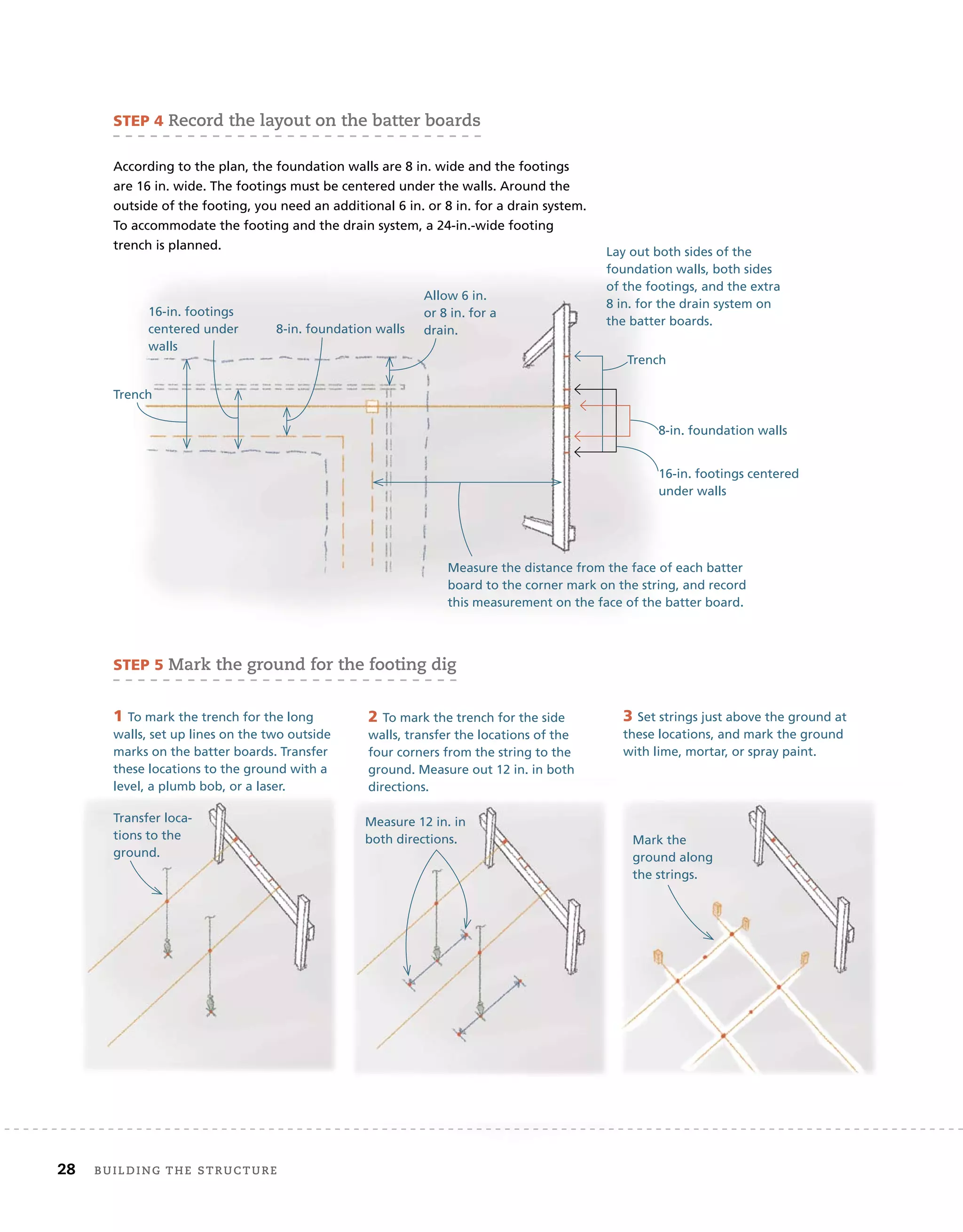
  • 357.
    350 Finishing the house •SETTING TILE 1 Dump a pile of mortar on the floor, and use the smooth edge of the notched trowel to spread the mortar over the surface. 2 Keep the mortar just off the layout lines, and avoid spreading so much mortar that it will skin over before you set the tiles in it. 3 Hold the trowel at about a 30° angle as you spread the mortar out. Cutting tile Although some tilesetters still use a score-and-snap cutter to make straight cuts in tile, the tile saw is now the standard tool. You can buy a small sliding- table tile saw equipped with a diamond blade and a watering system for less than $100. The watering system helps keep the dust down and prolongs the life of the blade. To make a straight cut, set the tile against the fence of the saw, and slide it through the spinning blade. Most saws have fence stops, which you can use to make repetitive cuts of the same dimension. For curved cuts or right-angle cuts (which are often needed when tiling around a corner), use a 41⁄2-in. grinder equipped with a dry-cutting blade. You can often start the cut with a tile saw and com- plete it with the grinder. tools techniQues
  • 358.
    installing wall and Floor coverings 351 8 4 Afterspreading the mortar out, go over it with the notched edge of the trowel. Hold the trowel at about a 45° angle as you scrape it over the mortar, leaving ridges of mortar that are evenly spaced and of a consistent height. 5 Beginning along the baseline, set the tiles in the mortar. 6 When using large floor tiles, set one end down first, then lower the other end down into the mortar. 7 After setting the tile in the mortar, give it a slight twist as you press it down to help embed it in the mud. 8 Use spacers to keep the grout joints consistent.
  • 359.
    352 Finishing the house grouting and cleaning Grout fi lls the spaces between tiles. It comes in two forms. Sanded grout, which has sand as an aggregate, is used for joints that are larger than 1⁄16 in. The sand helps grout shrink less as it dries. Plain grout has no sand and should be used for joints that are 1⁄8 in. or less in width. Wait at least 48 hours before grouting the joints. Mixinggrout Mix the grout according to the instructions on the bag. In most cases, the manufacturer specifi es that the grout should be slaked (left standing after mixing) for a given period of time, usu- ally about 10 minutes. This reduces the amount that the grout will shrink and, thus, reduces the chance of hairline cracks forming in the joints. It’s important not to skip this step. After the slaking period, the grout may be a little stiff. Remix it vigorously, and it should loosen up suffi ciently. If it’s still too stiff to work with, it’s OK to add water or a liquid latex additive, but do so sparingly. Add it gradually and use as little as possible. 3 Hold the trowel at a steep angle as you spread the grout over a section of the floor. Then, with the trowel at a low angle, press the grout into the joints. After you’ve pressed the grout into the joints, hold the trowel at a steep angle and scrape it over the surface to remove the excess. Keep the edge of the trowel tight to the tile, and move the trowel at an angle to the joints. It’s important to keep the edge of the trowel from align- ing with the joints so it won’t dig into the grout. • APPLYING GROUT 1 Dump a load of the grout on the floor. 2 Push it over the tiles with a rubber grouting trowel. Use a Scrubby If the Grout Gets ahead of You Keep a few green synthetic scouring pads handy (3M Scotch-Brite™) to help remove grout that has gotten too hard to remove with the sponge. They cut more aggressively than the sponge, so keep them away from the grout joints. top tip
  • 360.
    installing wall and Floor coverings 353 8 Cleaning thetile The biggest challenge of grouting begins now, after the bulk of the excess mortar has been removed by the grout trowel. The trick is to get the faces of the tiles clean without pulling the grout out of the joint. This requires patience, careful observation, and timing. Wait until the grout starts to dry on the face of the tile, then go over the tiles with a damp sponge. Concentrate on the tile, and go very lightly over the joints. Rinse the sponge frequently, and wring it out thoroughly after each rinse. Let any remaining grout on the face of the tile begin to harden again. When it begins to dry again, go over the tiles once more with a damp sponge. This time, put a little more pressure on the joints and try running the sponge along them. If the joints are ready, the sponge won’t pull grout out. If they aren’t ready and you notice too much grout being picked up by the sponge, lighten up on the sponge or wait a little longer. Repeat the process one or two times. In the fi nal pass, clean the sponge frequently and make long passes (the full reach of your arm). Wait until the grout dries, then polish the tiles with a clean terry- cloth rag. Once the grout starts to dry on the face of the tile, go over the tiles with a damp sponge.
  • 361.
    354 9 CHAPTER hanging doors unLiKe Most of the things carpenters build and install, doors move. They are mechanical devices that are used often and must operate smoothly. Getting a door to work properly, however, is only half the battle. Doors also must fi t snugly in their openings. Most car- penters try to make the margin between a door and the jamb 1⁄8 in. or less. This level of craftsmanship makes the door assembly look neat and professional and lends an air of quality to the house. This chapter explains how to hang a variety of door assemblies in both new construction and remodeling. Much of the chapter is devoted to doors that swing on hinges. But many modern doors roll on wheels, which is covered at the end of the chapter. Because different carpenters bring different combina- tions of tools to the job of hanging doors, this chapter will often offer more than one way of doing the same task. But however you approach it, the process will go smoothly only if the rough openings are reasonably square, plumb, and the right size.
  • 362.
    hanging doors 355 9 hanging Prehung doors Prehung doors come bored and mortised for the knobs and catches. They are hinged to preassembled jambs, which have the casing installed on at least one side. This factory fi tting makes them easy to install with basic carpentry tools. Because they save time and money, they are used extensively in residential construction. On mostjobs, the finish carpenters start by hanging and trimming out the doors. Several moldings and architectural elements, including base molding, chair rail mold- ing, wainscoting, and, in many cases, cabinets and built-ins, must fit tightly against the outside edge of the door casing. This means that the doors have to be hung and cased out before carpenters can start on these other items. Rough opening, square and plumb Prehung door installed Door cased and trimmed Because the split-jamb style is the most prevalent, that type will be used here to illustrate the procedure for hanging prehung doors. • TWo sTYLes oF PreHUng Doors one-jamb style split-jamb style A one-jamb style includes the jamb with the casing on the side with the hinges, along with the door. Once this is installed, you install the casing on the opposite side of the jamb, just as you would for an exterior door or window. With a split-jamb style, the jamb comes with the casing mounted on both sides of the jamb. The jamb comes apart along a line that follows the doorstop. The part of the jamb without hinges fits, tongue and groove style, into the hinged side. The main advantage of using these units is that casings on the side without hinges are factory installed.
  • 363.
    356 finishing the house 4 Thenuse a sharp hand- saw to cut the remainder of the jamb. (The other half of the split jamb can be cut at this time or wait until after the door is installed.) The unit needs to fit in the rough opening with a little extra space so you can make minor adjustments during the installation. The unit should fit with 1⁄2 in. to 1 in. of play around the perimeter. Measure the opening with a tape or carefully take off the non-hinge side of the split jamb, put it aside, and then simply pick up the other half of the unit (with the door attached) and see if it fits in the opening. Rough opening Use a tape to mea- sure the opening. 4 Then use a sharp hand- saw to cut the remainder of the jamb. (The other half of the split jamb can be cut at this time or wait until after the door is installed.) sTeP 2 trim the jamb to fi t the rough opening Sometimes, the unit will fit side-to-side but be a bit tall for the framed open- ing. This is usually because the preassembled jamb/casing is 11⁄2 in. or so longer than the door, with the excess sticking out beyond the bottom of the door. Door manufacturers do this to allow plenty of room for the thickness of the floor covering (which is normally installed after the finish carpenters are done). If the unit is too tall to fit into the opening, cut enough off the bottoms of the jamb/casing assembly to allow the unit to fit, with a little to spare between the top of the unit and the header. 1 Set the assembly with the door in place across a pair of sawhorses. 2 Use a square and a pencil to mark the cuts on both the fronts of the casings and the insides of the jambs. 3 Use a circular saw to cut across the face of the casing and part of the jamb. sTeP 1 Measure the rough opening
  • 364.
    Adjusting the RoughOpening Once in a while, you’ll need to make minor adjustments to the rough opening. Here are some common quick fixes: 1 If the opening is too big, simply pad it by nailing strips of wood to the inside edges of the opening. If you have to enlarge an opening in a bearing wall or if an opening is grossly out of square or out of plumb, you’ll have to remove the drywall in that area and reframe the opening. 2 After you build in the opening, set the unit in place to make sure the casing extends over the drywall. If the casing ends up short of the drywall, you’ll need to do some drywall repair before proceeding. 3 If the opening in a nonbearing wall is too narrow, carefully cut the drywall and remove the trimmer, then replace it with a 1x4. If need be, you can do this on both sides of the opening. Trimmer 1x4 4 If the surface of the wall is out of plumb, kick the bottom plate over to bring the wall within an acceptable range. Place a block against the wall, and whack it with a sledgehammer until the wall is acceptably plumb. hanging doors 357 9
  • 365.
    358 finishing the house sTeP 3 Check the rough opening for plumb Theproblem of out-of-plumb wall surfaces is much aggravated if the top of the opening happens to be leaning in one direction on one side and in the other on the opposite side. This can cause the top or bottom of a door to hit the doorstop before the latch bolt catches on the strike, causing the ever- irritating door that won’t stay closed. If the jambs are leaning in opposite directions, then you may want to make adjustments even if the out-of-plumb reading is less than 1⁄4 in. sTeP 4 Check the fl oor of the opening for level Place a 2-ft. level on the floor between the two sides of the opening, and slide it back and forth to determine if one side is higher than the other. If the floor is precisely level or the high side is the same as the side on which the hinges of the door will be, you’re all set. If the high side is the latch side, you need to shim up the hinge side until it’s slightly higher (about 1⁄8 in.) than the latch side. 1 Place a 4-ft. or 6-ft. level against the inside edge of each side of the rough open- ing. If these are within 3⁄8 in. or so of being plumb, the rough opening should be fine. If they’re out of level by more than that, you may have to make adjustments to the opening (see “Adjusting the Rough Opening” on p. 357). 2 In addition to checking the inside edges of the opening for plumb, make sure the surfaces of the wall around the perim- eter of the opening are plumb and in line with one another. Place the level vertically on the face of the wall just outside the opening. Do this on both sides of the opening. If the reading is the same on both sides of the opening and within 1⁄4 in. of being plumb, the face of the wall is OK. If it’s more than that, you may need to make adjustments.
  • 366.
    hanging doors 359 9 sTeP 5 shim the hinge side of the rough opening 1Set the unit in the opening, and mark the location of the centers of the hinges on the wall. Make these marks on the wall just outside of the casing. Remove the unit and set it aside. 2 At the heights of these marks, install two or three pairs (depending on the number of hinges) of tapered shims on the inside edge of the rough opening. If this side of the opening is out of plumb, set the first pair of shims at the loca- tion that is leaning toward the inside of the opening. Adjust the overlap of the shims until they are about 1⁄4 in. thick, and attach them with finishing nails. Once this pair of shims is attached, install the other pair of shims at the other hinge locations. Adjust the overlap of these until the faces are precisely plumb to the face of the first pair, either with a self-leveling laser or with a plumb bob. Use a utility knife or saw to cut off the parts of the shims that extend past the face of the wall. Plumbing Door Shims Laser level: To plumb pairs of door shims, set a self-leveling laser on the floor 2 in. from the inside edge of the rough opening. With the unit on, set a scrap of wood against the first pair of shims and mark where the laser beam strikes it. Adjust the second and third pairs of shims until the beam hits the same mark when you hold the scrap against it. Plumb bob: Screw a small eyebolt into the underside of the header about 2 in. from the side of the rough opening. About 12 in. away from the eyebolt, drive in two nails that are angled away from each other to create a cleat. Thread the end of the plumb bob string through the eyebolt, pull the bob to the top, and bring it to a rest. Slowly lower the bob. When the tip is just above the floor, tie it off on the cleat. Use a scrap of wood in the same manner as just described, using the string as a reference. Use a pencil to mark the floor just below the tip of the bob. This makes it easier to reset the bob if you happen to disturb it while nailing on the shims. WaY s o f W o r K i n g Laser-level method Shims Plumb-bob method Nails Eyebolt Plumb bob Laser level
  • 367.
    360 finishing the house 3Adjust the other two pieces of the jamb/casing assembly by eye, using the clearance between the door and the jamb on the hinge side as a guide. Make the space, which is usually just under 1⁄8 in., consistent all the way along the door and nail the other two pieces of casing to the wall. sTeP 6 hang the hinge side of the assembly 1 Set the assembly in the open- ing, pushing it tight against both the face of the wall and the shims you’ve just installed. 2 With a 4-ft. or 6-ft. level held along the outside edge of the casing on the hinge side, check for plumb. If the casing is plumb, drive two or three nails through it to attach the hinge side of the assembly to the wall. 5 Insert the latch side of the split jamb, and attach it by nailing through the casing. sTeP 7 add shims and install the latch side of the split jamb 1 Open the door and step through the opening. Install shims on the latch side near the top and bottom and just behind the strike. Shims should be snug to the back of the jamb but should not force the jamb to bow. 2 Check the fit as you go by closing the door and making sure the clearance between the door and the jamb stays consistent. 4 Nail through the jamb at all the shim loca- tions. Be sure not to nail through the groove that will receive the tongue of the other half of the jamb. 3 Remove one of the screws on the top hinge, and replace it with a screw that’s long enough to pen- etrate through the shims to the jamb. Predrill to avoid splitting the shims.
  • 368.
    hanging doors 361 9 3 Screwin the strike plate to complete the closure hardware. sTeP 8 install the closure hardware Installing the hardware for prehung interior doors is simple because the door and jamb are already bored and mortised to accept the hardware. fitting new doors to existing openings In residential remodeling projects, it’s often necessary to fi t new doors to existing openings. On these jobs, the carpenter has to start from scratch, boring and mortising a blank door to match hardware that’s already in place. He also has to cut and plane the door to fi t the size and shape of the existing door jamb. These jambs are seldom perfect. Many were built on site decades before carpenters had access to prehung units. If they were ever square and plumb, these jambs have almost always moved as the house has aged and settled. To do his job well, the carpenter must cut and shape the door so that it conforms to the quirks and eccentricities of the standing jamb. 1 Screw in the latch bolt assembly, making sure that the bevel on the spring bolt is oriented correctly. 2 Insert the spindles of the door handles through the opening in the latch mechanism, and attach the handles with the long machine screws provided. Jambs on existing openings in older homes are often out of square and out of plumb.
  • 369.
    362 finishing the house This section provides a step-by-step procedure for custom- tailoring a solid-wood door to an irregular opening. In the example shown here, the existing hinges and the strike are in place on the jamb and will be used with the new door. Bewareof Hollow-Core Doors Hollow-core doors can be a bad choice for fitting to exist- ing openings. They are hollow except for a thin strip of solid wood around the perim- eter. These strips are often less than 3⁄4 in. wide, which severely limits the amount of material that can be taken off the door to fit the opening. In older houses, which have widely varying door openings, it’s a safer bet to use solid- wood doors for replacements. toP tiP • FiTTing neW Doors To eXisTing oPenings sTeP 1 Check the height and width of the opening Check to make sure that the opening is no wider than the door plus 1⁄4 in. As a rule, it’s a lot easier to buy a door that’s too big and cut it to fit than it is to enlarge a door. 1 If the door is less than 1⁄2 in. wider than the opening, take all of that off the latch side. 2 If the difference is greater than that, take about half off of each side. 3 If the door is taller than the opening, cut most of the differ- ence off the bottom of the door. Solid-panel doors usually have a very wide bottom rail, which can be cut down without making the door look out of balance. Latch side
  • 370.
    hanging doors 363 9 3 Checkingthe opening for square is important. If the top of the opening goes uphill as it moves away from the hinged side and you leave the door square, you’ll end up with an unsightly wedged-shaped gap above the door. sTeP 2 Check the angle of the top of the opening to the hinge side 1 Use a straightedge to see if the hinge side of the opening is straight. If so, use a framing square to see if the header of the casing is square to the side. If the top is not square to the side, note which direction it devi- ates from a right angle and carefully measure the amount that it’s out of square. 2 If the hinge side of the casing is not straight, hold the straightedge against the side of the casing, and then hold the square against the straightedge to check the angle of the header. The straightedge spans any dips in the casing and gives a more accurate measurement. sTeP 3 Mark and cut the top of the door If you’ve found that the top is not square to the side of the opening, cut the top of the door to conform to that angle before you lay out the hinge locations. To make the cut, use a circular saw guided by a straightedge (see “Using a Saw or Router Guide” on p. 364). To minimize splintering, score the line with a sharp utility knife; be sure to carry this incision down the edge of the door where the saw will be exiting the cut. The locations of the hinge mortises cannot be marked before this cut because they must be measured from the top of the door after it has been fitted to the header.
  • 371.
    Using a Saw orRouter Guide Using a guide is essential for cutting a crisp, straight line with a circular saw or plowing a straight groove with a router. There are several excellent factory-made guides available, but they are not essential. You also can achieve quality results using a square, a metal straightedge, or a straight piece of wood as a guide. The best commercially available saw guides include the EZ Smart Guide and the Festool® Saw System, which can be set directly along the line you need to cut. These are excellent tools but they’re expensive, and they require either matching saws (Festool) or saws equipped with special bases (EZ Smart). The EZ Smart Guide cannot be used with a router. Less expensive saw guides and ones you might rig up on site are a little more difficult to use, but they are more versatile. These must be set up at an offset from the line you want to cut or rout. The size of the offset is equal to the distance from the edge of the sawblade or router bit to the edge of the base. To use these guides, hold the base of the saw or the router against the guide as you push the tool through the workpiece. Fabricating a site-built gauge The most difficult part of using one of these site-rigged or less expensive guides is getting the straightedge precisely offset from the cut. The easiest way to find this distance is to fabricate a site-built gauge. Here’s a simple procedure for making this gauge: e s s e n t i a L s K i L L s 1 Clamp any board with a straight edge to your workbench or sawhorses. Clamp a large Speed Square on the board with the fence snug against the edge. 2 Use a pencil to mark the board along the edge of the square that runs perpendicular to the edge of the board. 3 Set the tool you’re going to use (your saw or router) to make a shal- low cut (1⁄8 in. to 1⁄4 in.) in the board. After removing the square, the distance between the line and the edge of the cut is the precise offset distance needed. You can now cut this section off the board and use it as a gauge for laying out the precise location of your straightedge. on the board with the fence snug against the edge. of the board. Set the tool you’re going to use (your saw or router) to make a shal- in.) in the board. After removing the square, the distance between the line and the edge of the cut is the precise offset You can now cut this section off the board and use it as a gauge for laying out the precise location of your straightedge. 364 finishing the house Offset distance Set straightedge on this line. Desired cut line
  • 372.
    hanging doors 365 9 sTeP 4 Bevel the edge of the hinge side Afteryou’ve trimmed the top, the door is locked into an orientation; there is a hinge side edge, a latch side edge, an outside face (the side with the hinge pins), and an inside face (the side that closes against the doorstop). Label these in pencil to avoid mental lapses as you work. To reduce the possibility of a hinge-bound door, put a 4° bevel on the hinge side edge. The bevel should angle in from the outside face toward the center of the door. After you’ve made the cut, you can smooth it with a few passes of a sharp handplane. Hinge side edge Latch side edge Doorstop face Hinge- pin face sTeP 5 Cut the bottom of the door, if necessary 1 Measure the distance from the floor to the top of the opening along the hinge side jamb. 2 If this distance is less than the hinge side edge of the door, cut the bottom of the door.
  • 373.
    366 finishing the house 5Extend a line over from this mark that reflects any deviation from square that you detected. 5 Extend a line over from this mark 3 Before you mark the door, use a framing square and a straightedge to see if the floor is square to the hinge side jamb. Note the direction and amount that it deviates from square. 4 After you’ve checked for square, measure down from the top of the hinge edge of the door, and mark a distance that is 1⁄2 in. less than the distance you found when measur- ing the jamb. tooLs teChniQues sTeP 5 Cut the bottom of the door, if necessary (continued) Securing a Door on Edge It’s often necessary to hold a door securely on edge as you work on it. There are factory-built brackets that do this, but most carpenters simply fabricate door-holding brackets out of scrap. One design is the pair of L-shaped brackets shown here. To use, place the brackets back- to-back with the door sandwiched between them, and then clamp the whole works together with a C-clamp or a small bar clamp. to-back with the door sandwiched between them, and then clamp the whole works together with a C-clamp or a small bar clamp. Clamp 6 in. 14 in. 14 in. 14 in. 143⁄4 in.
  • 374.
    hanging doors 367 9 sTeP 6 install the top hinge on the door 1Measure the distance from the underside of the header casing to the top of the first hinge. Secure the door on edge with the hinge side up (see “Securing a Door on Edge” on the facing page). 2 Measure the same dis- tance down, minus 1⁄8 in., and mark that amount on the hinge edge of the door. 3 Remove the pin from the hinge, and use the leaf to mark the bottom of the top hinge on the door. 4 Once the bottom is marked, go back to the jamb and measure the distance from the front edge of the jamb to the back of the hinge. BEST METHOD: Set a combination square along the edge of the jamb, then slide the ruler until it’s even with the back of the hinge. Tighten the nut on the square. A Forgotten but Still Useful Tool toP tiP If you have a butt-marking gauge that’s the same size as the hinge that you’re installing, it may work for marking the hinge mortises on the new door. Carpenters have been using these gauges for genera- tions, and there’s a fair chance that it will match the height and width of the mortises on the jamb. To use the butt marker, slide it on the edge of the door until the stops come in contact with the corner. Smack it with a hammer to mark the sides and back of the mor- tise. Before you use it on the door, give it a test run on a scrap of wood to see if it matches the mortises on the jamb.
  • 375.
    368 finishing the house sTeP6 install the top hinge on the door (continued) 5 Use the combination square to mark the back of the hinge mortise. Make sure to place the fence of the square on the outside face of the door (the side that will have the hinge pins) as you mark the back of the mortise. 6 Cut the outside of the mortise with a utility knife fitted with a new blade. Using the combination square as a guide, make several light, controlled cuts. 7 Install a straight mortising bit in your router, and use a trial-and-error process with scrap to set it to the correct depth (the thickness of the hinge). Set the bit as close as possible by eye. Clamp a scrap of wood to the worktable. Rout a small area on the scrap. Place the hinge leaf in the recessed area to check the depth. Adjust as necessary until the hinge leaf is flush with the surrounding surface when placed in the routed area. (continued on p. 370)
  • 376.
    hanging doors 369 9 Options forMortising Hinges, Latch Plates, and Strikes There are two basic ways to cut mortises: with a chisel and hammer, or with a router fitted with a straight, bottom-cutting bit. Using a chisel and hammer Although they don’t cut as fast as a router, chisels require no setup time and they can be used in places that are not accessible to power tools. For a single mortise, it’s often faster to use a chisel and a hammer than it is to set up a router and a template. The key to using chisels effec- tively is to have a sharp edge. (Note: If you happen to have nice, wood-handled chisels, you may prefer to use a mallet instead of a hammer.) Using a router Aside from the speed at which it cuts, one of the biggest advantages to using a router to cut mortises is that you can set the depth of the cut with great precision. On the down side, it’s hard to see the cutter because the base is in the way. It’s also hard to control the side-to-side movement of the router with the bit spinning at 10,000 to 30,000 revolutions per minute. Because the lateral movement is difficult to control, it is often best to use templates. Templates constrain the movement of the router. There are two basic ways these templates work. In one, a bearing that’s slightly wider than the cutter is mounted on the shank of the router bit just above the cutter. As the bearing rides along the inside edge of the template, the bit of the router cuts the mortise below. Templates also work with guide collars attached to the base of the router. The router bit fits inside the collar. As the collar rides along the inside edge of the template, the bit cuts the mortise below. Tool manufacturers offer many kinds of router templates. One of these, Templaco Tools (www. templaco.com), specializes in templates for mortising doors. Templates are simple brackets, however, and many carpenters simply make their own on site. One type of mortise that’s conducive to freehand routing is the mortise for a hinge. Because you need to cut one side all the way to the edge of the door, it’s easy to enter the cut from that open side. Once the router bit is cutting inside the marked mortise, make sure you stay 1⁄8 in. or so away from the perimeter. You can clean up the final 1⁄8 in. quickly with a sharp chisel. Routing inside a template Because templates for hinges, strikes, and latch plates are usually enclosed on all four sides, you have to lower a spinning router bit into the workpiece. Carpenters often do this by tilting a fixed-base router into the area enclosed by the template. This can be hazardous because the bit can catch and jerk the router. It’s a lot safer to use a plunge router, which enters the cut with the entire base firmly planted on top of the template. No matter which router you use, always secure the template to the work and hold the router firmly with two hands. WaY s o f W o r K i n g Plunge router Fixed-base router
  • 377.
    370 finishing the house sTeP6 install the top hinge on the door (continued) install the top hinge on the door (continued) 10 Install the leaf of the hinge. It should fit snugly and be flush with the surface around it. 8 Take the router over to the door, and rout most of the mortise freehand. Stay about 1⁄8 in. away from the incised perimeter. 9 Use a sharp chisel to remove the area around the perimeter. sTeP 7 Mark and install the other hinges 2 Open the lower hinges, and mark the edge of the door along their top and bottom edges. 1 Close the two lower hinges on the jamb. With the leaf of the top hinge on the door, bring the door over to the opening and drop in the hinge pin. Use Vix Bits for Hinge Screws Use Vix bits to predrill for the screws. These spring-loaded bits are sheathed in cylindri- cal guides that keep them centered in the screw holes of the hinge. Standard drill bits can wander. toP tiP
  • 378.
    hanging doors 371 9 3 Slipthe pin out, and set the door back up on edge with the hinge edge up. Use the combination square to lay out the lower hinge mortises at the marks. Incise and rout the mortises as described in step 6. 4 Bring the door back over to the opening, and drop the pin in once again. Check to see if the two lower hinges fit properly in the mortises. If not, mark where they need to be trimmed, remove the pin, and make the modifications. When the hinges on the jamb fold back into the mortises, drill and screw them into the door. 3 Transfer these measure- ments to the face of the door, and set up a saw guide with the proper offset from the marks. Set a circular saw to 3° and cut the door. Make sure the bevel tilts toward the center of the door from the hinge pin face. sTeP 8 Cut and fi t the latch side of the door In addition to fitting the door to the opening, the latch side of the door should be beveled 3° to allow the leading edge of the door to clear the jamb as it’s closed. 1 Swing the door to the closed position, and mark the casing on the latch side where the door meets it. 2 Take out the hinge pins and remove the door. Hold a block of wood against the face of the jamb with an inch or so projecting past the edge. Measure over from the side of the block to the line you’ve just made on the casing. Make these measure- ments in three or four places over the length of the casing.
  • 379.
    372 finishing the house Optionsfor Boring Doors and Strikes Boring locksets There are two basic ways to bore doors for locksets: using common carpentry tools, or using a door-boring jig. tooLs teChniQues • coMMon carPenTrY TooLs 1 Begin by laying out the center of the holes, using either the paper template that comes with the lockset or a square and a ruler. 2 Carefully bore the holes with a portable drill. To help keep the doorknob hole from drifting off the layout and to prevent the bit from splintering the face of the door, lay out both sides of the door and drill about halfway through from each side. 1 Begin by laying out the center of the holes, using either the paper template that comes with the lockset or a square and a ruler. To help keep the latch hole centered, you can clamp a piece of wood to the door and use it as a guide as you drill. Paper template Door edge Door edge Mark the centers.
  • 380.
    hanging doors 373 9 • Door-BoringJig • coMMon carPenTrY TooLs One way to cut the deep mortises required for mor- tise locksets is to drill a series of overlapping holes in the edge of the door. To get the holes the right depth, mark the drill bit with tape or a felt-tipped pen. After you finish drilling the holes, clean up the sides of the mortise with a sharp chisel. • LocK MorTiser The second way to cut the mortises is to use a special-purpose tool called a lock mortiser, which consists of a powerful router mounted on a jig that clamps to the door. Porter-Cable® and Bosch offer slightly different versions. 1 The jig speeds up the job and ensures accurate results. There’s no need to lay out the centers of the bores. For the doorknob bore, the jig is set to drill a standard 21⁄8-in. hole that’s precisely centered at the backset, 23⁄8 in. from the edge of the door. 2 For the latch bolt, the bore jig centers the hole in the edge of the door and aligns it with the doorknob bore. The jig holds the bits square to the door and prevents them from wandering out of alignment. Simply clamp the jig on the door at the correct height and drill the holes with the bits provided. Door edge Latch-bolt bit Doorknob bit Always drill the doorknob holes before the latch-bolt holes. With a door-boring jig, there’s no need to drill the doorknob holes from both sides of the door. The surface of the jig applies pressure against the opposite side of the door, which keeps the surface from splintering when the bit exits the hole. Boring deep mortises
  • 381.
    374 finishing the house sTeP9 install the closure hardware This section describes the layout for installing a standard doorknob with a 23⁄8-in. backset. 1 Open the door and mark the location of the center of the latch hole on the outside edge of the strike. 2 Close the door and transfer the mark to the door. 3 Open the door again and use a square to draw a line perpendicular to the edge of the door at the mark. 5 Set the combination square to 23⁄8 in. and mark the backset. After laying out the location of the latch and backset, bore the holes using one of the methods discussed on pp. 372-373. Mortise the latch and strike plates with a sharp chisel or a router as described on pp. 368–370. Install the closure hardware to complete the job (this task is described on p. 361). 5 Set the combination square to 23⁄ 3⁄ 3 8 ⁄8 ⁄ in. and mark the backset. 4 Use the square to bring the line on the edge out to the face of the door. Edge of the door 23⁄8 in. Face of the door
  • 382.
    hanging doors 375 9 HangingFrench Double Doors Strictly speaking, any door that has glass along its full length is a French door. French double doors, however, are the most popular style. These doors swing on hinges mounted on the opposite sides of an opening and meet in the middle. One door is fixed in place by sliding bolts, while the second swings freely and latches to the fixed door. By retracting the slide bolts, the fixed door can also swing freely, thus creating an opening the size of two doors. Prehung French double-door assemblies are available for both interior and exterior applications. They are fairly easy to install and are the first choice of most builders for new construction and addi- tions. In some older houses, however, prehung French double-door assemblies are not the best choice. Where there is already a large cased opening, it often makes sense to preserve the existing opening. This ensures that you won’t damage plaster or destroy old, hard-to- find molding. In these cases, it’s easier and less expensive to care- fully fit a new pair of doors to the existing opening. This section provides a step-by-step procedure for fitting double doors to an existing opening such as you might find between the dining room and the hall in an older home.
  • 383.
    376 finishing thehouse • Hanging French Doors STEP 1 Check the opening Check the height and width of the opening before you buy the doors. The combined width of the new doors needs to be as wide, or wider, than the width of the opening. The standard height of doors has been 6 ft. 8 in. (80 in.) for a long time. However, because the cased opening might not have been built for a door, it’s important to make sure the height is within an acceptable range for the doors. If it’s outside that range, you’ll need to buy shorter or taller doors or have them custom built. STEP 2 Cut and fit the doors roughly to the opening Take an equal amount off all four sides to roughly fit the two doors to the width of the opening. Leave the total width of the two doors about 1⁄4 in. wider than the opening. If the top of the opening is not square to the sides, cut the tops of the doors to conform to that deviation from square. Cut the bottoms, if necessary. For an 80-in.-tall door, the height of the opening should be between 77 in. and 81 in.
  • 384.
    hanging doors 377 9 5With the door hanging from the top hinge, open the bottom and middle hinges and mark their locations on the jamb. 6 Take the pin out of the top hinge and set the door aside. Cut mortises for the two lower hinges in the jamb. 7 Bring the door back over to the jamb, reset the pin in the upper hinge, fold the lower hinges into the mortises and screw them to the jamb. STEP 3 Hang the fixed door With two minor differences, you can use the same basic approach as the one described on p. 370 to hang the door. The first difference is that you have to lay out the hinge locations from scratch in this situation. The second is that you have to transfer the hinge locations from the door to the jamb. In the previous example, the hinge locations were transferred from the jamb to the door. 1 Lay out and install three hinges on the door. Set hinges 6 in. from the top and bottom edges and center a third midway between them. (Techniques for laying out and installing hinges are discussed on pp. 368–370.) 2 Lay out and cut the mortise for the top hinge on the jamb, with the top edge 61⁄8 in. down from the header jamb. 3 Remove the pin from the top hinge on the door and install the loose leaf in the mortise you just cut on the jamb. 4 Bring the door over to the jamb, slide the top hinge into place and insert the pin.
  • 385.
    378 finishing thehouse STEP 4 Hang the active door Swing open the fixed door. Install the active door on the opposite side of the opening, using the procedure described in step 3. STEP 5 Fit the doors to each other 1 Swing one door into the closed position, and mark along the outer edge of the door on the top jamb. 2 Swing in the other door, and mark it in the same way.
  • 386.
    hanging doors 379 9 3Mark the center point of the space between the two marks. 4 Swing the fixed door closed, and transfer the center point from the jamb to the top of the door. With the door held in this position, use a laser, a plumb bob, or a reliable level to mark a plumb line down from this mark. 5 Remove the door from the hinges, and place it across a pair of sawhorses. Cut along the line using a circular saw and a guide. Do not bevel this edge.
  • 387.
    380 finishing the house 6Swing the active door into the closed position. (Use a toolbox or other heavy item to keep it from swinging past the closed position.) 8 Remove the door from the hinges, and set it across a pair of saw- horses. Set your circular saw to a 3° bevel, and, using a saw guide, cut along the line. Reinstall the door, and carefully mark it for final planing. 9 Remove the door again, and secure it on its edge. Plane it precisely to the marks. 7 Swing the fixed door until it overlaps the active door. Scribe along the edge of the fixed door to mark the edge of the active door. sTeP 5 fit the doors to each other (continued)
  • 388.
    hanging doors 381 9 sTeP 6 install the hardware 1There are two kinds of slide bolts used to hold the door in a fixed position. The first is a surface bolt. Installation is straight- forward, but it can be difficult to install the catch at the top of the door gracefully. If it’s mounted on the hinge-pin face of the door, the bolt will have to slide into the edge of the casing; if it’s on the other side of the door, the doorstop will have to be notched to accommodate the bolt. 2 Flush bolts are mounted on the door edge. To install these, you must cut a mortise to house the plate of the assembly. Use either a chisel and hammer or a router and template to cut this mortise. 3 Closure hardware for double doors consists of a “dummy” knob or handle on the fixed door and a pair of regular operating handles with a latch bolt assembly on the active door. Opposite the latch bolt assembly, there also is a latch hole covered by a strike plate on the edge of the fixed door. Screw the dummy handle to the face of the door. 4 Install the latch bolt assembly and the doorknobs using the procedure described in the previous section. 5 After installing the closure hardware on the active panel, close the door until the bolt just touches the fixed panel. Mark the top and bottom of the bolt. 6 Drill the latch hole in the edge of the fixed door. 7 Hold the strike plate in the right position, and mark the perimeter. Cut a mortise, and install the latch plate.
  • 389.
    382 finishing the house 3Close the door to check the fit. Adjust the stop, if necessary. When you get a satisfactory fit, finish nail- ing off the stop. sTeP 7 install the stop molding 1 Swing the door closed, and hold it so that the hinge-pin face is flush with the corner of the casing. Mark the casing along the doorstop face of the door. 2 Install the stop molding 1⁄16 in. from the line with a minimal number of nails.
  • 390.
    hanging doors 383 9 installing Pocket doors Pocket doors roll on wheels attached to the top of the door that fi t in an overhead rail. To open the door, you slide it into a slot or “pocket” in the wall adjacent to the door opening. The key parts for pocket doors come in kits that can be cut to match the size of the door or doors that you are using. Although these kits are made for 2x4 inte- rior walls, the wall can be thickened, both to stiffen it and to make room for shallow electrical outlets. Because different manufacturers have slightly different systems, make sure you read the directions that come with the specifi c kit you’re installing. This section provides step-by-step procedures for installing a typical pocket-door assembly. 2 Becausethe door is suspended from an overhead rail, the height of the rough opening must also be oversize. A common requirement is 41⁄2 in. taller than the height of the door. Heavy-duty kits sometimes require a slightly taller opening. sTeP 1 Build an oversize rough opening 1 The rough opening for a pocket typically has to be twice the width of the door plus 1 in. sTeP 2 hang the rail assembly Rail assemblies come ready to install when you’re using common door sizes. If you have to alter the rail assembly, just follow the instructions included with the kit. 1 The rail assembly should not be installed to the underside of the header of the rough opening; rather, it should be hung on the sides of the rough opening, below and independent of the header. This ensures that the rail will be straight and will not be affected by any downward settlement of the rough opening header. The correct height of the rail assembly depends both on the pocket-door kit you’re using and on the thickness of the floor covering, which will be installed later. Read the direc- tions that come with the kit.
  • 391.
    384 finishing the house 2Check the instructions for the correct height of the rail, mea- sure this distance from the floor on each trimmer stud, and use a square to mark lines perpendicular to the edge of the trimmer stud at the marks. 3 At each of these points, drive in 12d common nails, leaving the heads of the nails about 1⁄4 in. proud of the surface. The ends of the rail assembly are notched. When the tops of the notches seat against the incompletely driven nails, the assembly is at the correct height. 4 After setting the assembly on the nails and squaring the brackets up with the sides of the openings, drive two more nails through the holes in the brack- ets. Then, drive the two gauge nails home. Important Things to Know about Pocket Doors WaY s o f W o r K i n g There are three important differences between hang- ing pocket doors and other kinds of doors. • A pocket door requires a much larger rough opening than other kinds of doors of the same size. • Pocket doors must be installed much earlier in the building sequence than other doors. Most of the work of hanging a pocket door must be done before you hang the drywall. • The jambs on two sides of the opening must be split with the door set between the two halves. On one side of the door, the half-jamb must be removable. sTeP 2 hang the rail assembly (continued)
  • 392.
    hanging doors 385 9 5Find and mark the center of the space between the split jamb you’ve just installed and the end of the rough opening on the pocket wall side. Install a second split jamb at this location using the procedure just described. Typically, the pocket for the door is created by two pairs of split jambs. These are usually made up of 1x3s that are clad on three sides by steel. The steel cladding is used both to help hold the pieces straight and to protect the pocket from protruding fasteners. STEP 3 Install the split jambs 1 To install the split jambs, begin by using a chalkline or a straightedge to mark two straight lines on the floor connecting the outside edges of the wall through the rough opening. 2 The location of the first pair of split jambs marks the edge of the door opening. This is already laid out on the rail assem- bly. There is a shoulder at the end of the “door header” section of the rail assembly; this is the area of the rail that will be directly above the closed door. The first pair of split jambs butts against this shoulder and extends to the floor. 3 Insert the bottom ends of the two split jamb pieces into the metal floor brackets that come with the kit. 4 Hold the tops of the split jambs against the shoulder, and attach them to the wood part of the assembly (above the rail) with one screw per piece. Hold a level against the edge of the split jamb assembly, and move the bottom until the level reads plumb. Drive nails through the holes in the bracket and into the floor. After you get the bottom attached, drive in a second screw on both pieces at the top.
  • 393.
    386 finishing the house UseScrews in Key Locations Although you can nail most of the parts of a pocket door together, it’s often better to use screws. For attaching the split jambs to the rail assem- bly, predrill and screw to avoid splitting the jamb or bending the rail. To attach the drywall to the split jambs, use 1-in. screws. Finally, always use screws to attach at least one side of the finished jambs so that you’ll be able to remove the door in the future. toP tiP sTeP 4 hang the door 1 Hangers that suspend the door from the railing are two-part mecha- nisms. The first part is a plate that you screw to the top of the door. 3 The second part is a roller that fits in the rail. Insert the two rollers into the rail through the gap at the latch-side end of the rail. If the rollers have three wheels, alternate the side that has two wheels as you place them in the rail. 2 Although the instructions generally call for these to be placed 2 in. to 3 in. from the ends of the doors, it’s better to place them just in from the stiles on paneled doors because the attachment screws will not be in end grain. Make sure you install these with the lock tab facing the same side of the door. 4 Align the rollers near the plates on the door, and lift the door. At each roller, slide the pin at the bottom of the roller into the slot in the door plate. Rotate the lock tab on the door plate over the pin to lock it in place. Check the fit and operation of the door. Make sure there will be enough space under it to install the floor and that it rolls smoothly. When you’re satisfied with the fit, remove the door by undoing the lock tabs and sliding the pins in the slots in the door plates. Store the door in a safe place until the drywall is finished. these with the lock tab facing
  • 394.
    hanging doors 387 9 sTeP 5 hang and fi nish the drywall Ripa piece of 2x4 about 4 ft. long to a width of 21⁄8 in.—the width of the pocket. Slide this board into the pocket, and hold it horizontally as another person hangs the drywall. The board supports the somewhat fragile split jambs during this pro- cess. Use screws rather than nails to fasten the drywall, and make sure screws are no longer than 1 in. It is important to avoid having any fas- tener protrude into the pocket. sTeP 6 install the trim 1 Remove the door plates, prime or seal all four edges of the door, and reinstall the plates. Prior to sealing the top of the door, take off the door plates; reinstall them when the sealer dries. Make sure the lock tabs of both plates face the same side of the door. 2 Fasten a bumper on the back edge of the door about 40 in. from the bottom. Rehang the door using the procedure described in step 4. 3 The finished jamb on the latch side is one solid piece. Cut and install this piece so that it extends up to the underside of the rail assem- bly. Use shims to make it plumb and straight, and attach it with finish nails as you would any piece of trim.
  • 395.
    388 finishing the house 4On the pocket side, install the split finished jambs. These need to be ripped wide enough to cover the edge of the drywall and the rough jamb. And they need to extend from the floor to the underside of the rail assembly. 5 Nails need to hit the slots in the steel on the side of the rough split jambs. Before you set the finish jamb pieces in place, mark the height of the centers of the slots on the surface. These marks show you the height of the slots. 6 To get the location right along the width of the jambs, set a combination square to the depth of the centers of the slots with the fence of the square resting on the face of the drywall. Use a pencil to transfer this distance to the jamb. 7 The jamb along the header is also a split jamb. One side—the same as the side that the lock tabs are on—has to be removable so the door can be taken off if necessary. Use screws on the removable side of the split jamb. One graceful way to do this is to use brass oval-head screws with decorative washers. Nails are OK for the other side. Always put the head jamb on after the side finished jambs, which aids disassembly. 8 Lay out the reveal for the casing so that it covers one-half or less of the head casing. This makes it easier to access the hangers later. Use nails that will not protrude into the pocket or hit the rail. On a standard 2x4 wall, the nails usually need to be 11⁄2 in. to 13⁄4 in. long. Along the removable half of the header jamb, make sure you don’t attach the casing to the jamb. sTeP 6 install the trim (continued)
  • 396.
    hanging doors 389 9 3 Reinstallthe door and the removable jamb, and make sure you’re satisfied with the fit and operation of the door. Install latch hardware on the jamb, if necessary. Finally, install the plastic guides that come with the door at the bottom of the split jamb. sTeP 7 finish the job 1 Take off the removable jamb at the header. Slide the door until it’s almost closed, and adjust the hangers until the front edge of the door is even with the latch side jamb. 2 Mark the door for the closure hardware you are using. Undo the lock tabs, and take the door off the rail. Install the hardware on the door according to the directions that come with the hardware. After you install the hardware, you may want to imme- diately remove it and paint or stain the door before rehanging it.
  • 397.
    390 finishing the house 2The required height depends on the size of the door panels. For a bifold with 77-in.-tall door panels, make the height of the rough opening 801⁄2 in. above the subfloor; for a bifold with 79-in.-tall panels, make the height 821⁄2 in. After the drywall has been hung and finished, proceed to step 2. sTeP 1 Build the rough opening sTeP 2 determine the size of the fi nished opening Before putting together the jamb assembly, you have to know the exact dimensions of the finished opening. There are two variables: the size of the door panels and the thickness of the floor covering. 1 The required width of the rough opening for bifold doors installed within a cased opening is usu- ally the nominal dimension of the doors plus 2 in. 1 The width of the finished opening is usually the same as the nominal width of the set of doors. For a 48-in. set of doors, for example, make the finished opening exactly 48 in. wide. 2 The height of the finished opening nor- mally should be the height of the door panel plus 11⁄4 in. above the top of the finished floor. Make sure you take into account the anticipated thickness of the floor covering when you calcu- late the height of the opening. If, for example, you’re using 79-in.-tall door panels and you plan on adding 3⁄4-in.-thick hard- wood flooring, you need to add 79 + 1.25 + 0.75. In this case, you should make the height of the finished opening 81 in. off the top of the subfloor. installing Bifold doors As the name suggests, bifold doors fold in half as they’re opened. To do this, they use a combination of pins, hinges, and an over- head track. There are two separate stages for the installation of bifold doors. First, you have to build a fi nished opening the correct size, and, second, you install the hardware and hang the doors. This section provides a step-by-step procedure for building a cased opening and installing a pair of 48-in.-wide by 79-in.-tall bifold doors. A cased opening is the most common confi guration, but you can also install bifold doors in an opening that is fi nished in drywall only.
  • 398.
    hanging doors 391 9 1 Preformedjambs often have a 3⁄8-in.-deep by 3⁄4-in.-wide rabbet to help align the head jamb with the side jamb at the correct height. sTeP 3 install the jamb 2 With a 3⁄8-in.-deep rabbet, cut the header 3⁄4 in. longer than the desired width of the finished opening to account for the depth of the rabbets. 4 Drive three screws or nails through each side jamb and into the edge of the head jamb to build the three-piece jamb assembly. Many preformed jambs are cut to a length of 81 in. below the rabbet. If so, there’s no need to cut the side jambs to length. If the jamb material is longer, cut it to 81 in. below the rabbet now. 3 Arrange the pieces on edge on the floor, and set the header jamb in the rabbets of the side jambs. 5 Attach stops that are flush with one face of the wall and project into the door open- ing. Attach these scraps close to the edge so the screw holes will be covered by the casing. Place stops about 1 ft. from the top and bottom of each side.
  • 399.
    392 finishing the house 6Place the jamb assembly in the opening, and push it against the stops you’ve just installed. 7 Check the header jamb with a level. If one side is higher than the other, begin the installation on that side. 8 On the side jamb on the high side, predrill and drive in a couple of 8d finish nails as you hold the jamb snug to the stops. Leave nails projecting about 1⁄4 in. so you can remove them easily if need be. Place one nail about a foot from the top and the other about a foot from the bottom. 10 When you get the header level, temporarily attach the side jamb. As on the first side, press the side jamb against the stops, predrill, and drive a couple of nails in partially to hold the jamb in place. 9 Slide shims under the bottom edge of the other side jamb. Tap the shims in while checking the header for level. sTeP 3 install the jamb (continued)
  • 400.
    hanging doors 393 9 12 Permanently attachthe jambs with nails and shims, checking frequently for plumb, level, and straightness as you go. Place pairs of shims every 20 in. or so on the sides. Place one pair of shims about 2 in. in from each end of the header jamb (to shore up the area where the pivot pin will be) and one pair near the center. Remove the stops. 11 Use a thin pry bar to lever the jambs away from the trimmers as you center the assembly roughly in the open- ing. Double-check the header for level, and make sure the side jambs are still against the stops. sTeP 4 install the casing Install three pieces of casing on each side of the wall using the same techniques you would use for any door or window. 2 Center the bracket on the jamb. Screw the vertical portion of the bracket to the jamb and the horizontal part to the floor. sTeP 5 install the jamb brackets and track A 48-in.-wide door assembly typically consists of two bifold doors, with each door having two panels. In such a four-panel installation, there are two jamb brackets, one on each side of the opening. Both the sequence and the exact procedure for install- ing the jamb brackets depend on the floor covering. If you plan to use hardwood, vinyl, or tile for the finished floor, wait until after those materials are installed, then install the jamb brackets on top of them. 1 If carpet is planned, install the brackets before the carpet. Start by install- ing blocks of plywood where the brackets will go. These raise the brack- ets up so that they’ll clear the surface of the carpet. For most carpets, you can use 1⁄2-in. plywood. Make the blocks about 1⁄4 in. wider and longer than the jamb brackets. Carpet should be installed around the blocks.
  • 401.
    394 finishing the house WhyPreformed Jambs Are Oversize and Beveled Most building-supply stores have 49⁄16-in.-wide preformed jambs. These jambs are 1⁄16 in. wider than the nominal thick- ness of a 2x4 interior wall, which is 41⁄2 in. Another fea- ture of these preformed jambs is that the edges are beveled slightly. This shape is designed to make it easy to get a tight joint where the casing fits against the jamb. toP tiP 5 In a four-panel assembly, there are pivot brackets at each end of the track. Sometimes you need to move a top pivot bracket to access the screw hole at the end of the track. To move the bracket, loosen the screw that clamps it in place, and slide the bracket down the track and out of the way. After screwing off the track, slide the bracket back toward the end of the track, and clamp it in place by tightening the screw. 3 Find the center of the head jamb and mark a line. 4 Align the track with the line by viewing the line through the screw holes in the center of the track. 3 Swing the bottom of the door over the jamb bracket, and lower the bottom pivot onto the lower bracket. Slide the door closed. sTeP 6 install the doors 1 Tap the three pivots into the holes in the door. 2 With the door partially folded together and the bottom tilted toward the center of the opening, thread the top pivot into the top pivot bracket and the guide pivot (or roller) into the track. sTeP 5 install the jamb brackets and track (continued)
  • 402.
    hanging doors 395 9 4 Adjustthe lateral position of the bottom of the door by lifting it and resetting the pivot pin along the length of the bracket. Before opening the door, mark the posi- tion of the end of the pivot bracket on the track. Estimate how much lateral movement will be necessary to get the door in line with the jamb, and make a second mark on the track that marks that distance. Open the door, loosen the clamping screw, and slide the bracket down to the second mark. Tighten the screw, close the door, and see how the door now aligns with the jamb. If further adjustment is necessary, repeat the process; you may also want to readjust the bottom laterally. 5 Adjust the lateral position of the top of the door by sliding the top pivot bracket in the track. You can leave the door pin in the bracket as you make this adjustment, but you have to slide the door into the open position to access the clamping screw. 7 Turn the pin clockwise to raise the door or counterclockwise to lower it. Adjust the door until the top is parallel with the track, with a 1⁄8-in. to 1⁄4-in. space between the two. Make sure the door pivots without hitting the jamb and there’s a consistent 1⁄8-in. to 1⁄4-in. gap between the edge of the door and the jamb in the closed position. 6 To adjust the height of the door, lift the door until the bottom pivot is just clear of the bracket. One way to lift the door is with a flat bar and fulcrum. 3 Install the doorknobs. Place these near the center of each door (near the hinges that the door folds on). This placement maximizes the leverage for pulling the door open. sTeP 7 finish the job Clip the snugger guide into the track near the center of its length. 1 Install the aligners to the back of the leading edges of the doors (the edges that meet in the middle of the opening). The liners should be offset about 3⁄8 in. and set about 12 in. from the bottoms of the doors. 2 Install trim to cover the gaps between the doors and the side jambs and to con- ceal the track. (These pieces of trim are optional and not often used.)
  • 403.
    396 10 CHAPTER installing trim and cabinets after hanging the doors, carpenters install trim and hang cabinets, a process that is generally referred to as fi nish carpentry. Custom millwork companies fi ll thick catalogs with molding profi le options. In most houses, however, the trim can be divided into two gen- eral categories: door and window trim and baseboard molding. While these trim systems serve a practical function, they are also exploited for aesthetic purposes. Window, door, and baseboard trim treatments, in fact, often play a major role in defi ning the character and style of the inside of the house. In addition to these common and necessary trim systems, many houses also feature chair rail molding and crown molding. Unlike door and window trim and baseboard molding, these traditional trim treatments are rarely necessary. In most cases, they’re used purely for decorative purposes.
  • 404.
    installing trim andcabinets 397 10 Installing Door Casing Although prehung interior doors usually come with the casing attached, there are almost always some doors inside the house that require casing. Exterior doors and the interior doors in a variety of custom design schemes, for example, usually require the on-site installation of casing. The steps on the following pages describe a method for fitting and installing a typical door casing. Crown molding is used for decorative purposes at the junction of the wall and ceiling. • Interior Trim Door and window trim cover the gap between the jamb and the rough opening. Baseboard molding covers the gap between the wall and the floor. Decorative molding includes chair rail.
  • 405.
    398 finishing the house 2If the edge of the jamb is proud of the wall surface, it will have to be planed flush; if the edge of the jamb is short of the surface, it will have to be extended. SteP 1 check the jamb The edge of the jamb should be flush with the surface of the drywall. SteP 2 plane the jamb if necessary If you need to plane the jamb, use either a handplane or power plane. 1 To check for flushness, place a straightedge on the face of the drywall and extend it over the jamb. 1 Hold the plane at about a 45° angle with the sole resting on the wall surface. Plane the edge in long strokes, taking off a small amount in each pass. Check the jamb frequently, and stop when the edge is flush with the wall. 2 To plane the last 2 in., use a sharp chisel or bullnose plane. Alternatively, you can sand this material off using either sandpaper wrapped around a wooden block or an electric sander. Drywall Jamb Framing Plan View
  • 406.
    installing trim and cabinets 399 10 2 Whenthe jamb is slightly recessed from the drywall (1⁄8 in. or less), you can often fix the problem by shaving the drywall surface with a drywall rasp. Make sure you don’t shave outside the area that will be covered by the casing. SteP 3 extend the jamb if necessary 1 If the jamb is short of the wall surface, the jamb will have to be extended. Door and window manu- facturers offer “jamb extensions” for use when the exterior walls (with 1⁄2-in. drywall) are thicker than 41⁄2 in. If you don’t have these, rip a strip of 3⁄4-in.-thick wood and tack it on the edge of the jamb. When marking the reveal at the top corners of the jamb, extend the lines past one another. That will make it easier to transfer the layout to the casing when you cut it to length. SteP 4 mark the reveal The inside edge of the casing should be set in slightly from the face of the jamb. To maintain a straight and consistent reveal, set a combination square to the desired distance (typically 1⁄4 in.) and use it to mark the edge of the jamb every 8 in. or so. 1⁄4-in. reveal
  • 407.
    400 finishing the house MiterSaw Options The miter saw is the primary cutting tool for trim car- penters. There are three basic types, and manufacturers also offer a number of accessories and gadgets. Here’s an overview of what’s available. Basic miter saws This kind of miter saw, which has been in use since the 1970s, has a motor and blade assembly that’s fixed in the vertical position. By swiveling the motor and blade assembly, you can cut any angle from 0° to about 50° (the exact range of angles differs slightly with different models). While basic miter saws ruled the trim-carpentry trade for two decades, they are uncommon today. tools techniQues 1 With a basic miter saw, if you hold the board or piece of trim flat on the table, the saw cuts a miter. 2 If you hold the board on edge against the fence, the saw cuts a bevel. Compound miter saws have blades that tilt as well as swivel. Compound miter saws In the 1990s, manufacturers began offering compound miter saws in which the motor and blade assembly could tilt as well as swivel. This tilting feature is now standard, and miter saws that don’t have it are as rare as cars that don’t have automatic transmissions. The tilting feature makes it possible to bevel the piece when it’s flat on the table, significantly increasing capacity. A basic 10-in. miter saw, for example, can only bevel material up to 4 in. wide. By placing the piece flat on the table, a 10-in. compound miter saw can bevel stock almost 6 in. wide. A 12-in. compound miter saw bevels trim close to 8 in. wide. This added capability is a must for beveling the outside corners of tall baseboards. The tilting mechanism also increases the width of crown molding that can be cut at the required compound angle.
  • 408.
    installing trim and cabinets 401 10 installing Window trim The following steps describe the installation of a traditional window trim treatment. This design includes a sill and an apron under the sill.[Dwgs ch10_18, 19, 20, 21, 22, 23, 24a, 24b, 25,][SB 10-6] installing baseboard molding There are two basic kinds of baseboard molding. The fi rst is a tra- ditional two-piece system made up of a baseboard and a base cap molding. In the past, the baseboard was usually made from 1x6 or 1x8 boards; today, baseboard that will be painted is often made of medium-density fi berboard (MDF). Base cap molding, which is milled in a wide variety of profi les, is installed on the top edge of the base- board after the baseboard is installed. The second kind of baseboard molding is made in a single piece. Other featuresand considerations Manufacturers offer a number of other features and accessories. These include electric brakes, digital angle readouts, detents and highlighted marks for common settings, laser lines, dust-collection systems, work lights, a variety of fence configurations, clamp- ing systems, and stops. Make sure you consider the weight of the saw and how much noise it makes. This information can be found in comparative tool reviews, tool catalogs, and on Web tool sites. You can also check the specifications provided online by individual tool manufacturers. Sliding compound miter saws Costing about twice as much as a compound miter saw, the sliding compound miter saw (SCMS) has a much larger cutting capacity. On these saws, the motor and blade assembly is mounted on an arm. By sliding the assembly along the arm, it’s possible to make very long yet precise cuts. Most SCMS are capable of crosscutting boards that are 12 in. wide. And they’re capable of making compound miter/bevel cuts at 45°/45° in material that’s 8 in. wide. Because of its long cutting capacity, the SCMS is also a great tool for making the compound miter cuts required for hip and valley roofs. A 10-in. sliding compound miter saw can precisely cut just about any base or crown molding or crosscut shelves and stair-tread material. A dual-bevel feature adds to the cost of the saw, but it’s well worth the money if you expect to install a lot of crown molding or build complex roofs. Dual-bevel feature By repositioning the motor and handle of their saws, some manufacturers now offer compound miter saws and SCMS that can be tilted to the right or the left.
  • 409.
    402 finishing the house 3Mark the other end of the casing where the lines marking the reveal on that side intersect. Make a 45° miter cut at the mark. Then hold the piece on the reveal marks, and nail it in place. SteP 5 cut and install the top piece 1 Make a 45° miter cut on a piece of casing, then cut the piece off a few inches longer than will be needed. 2 Hold the piece in place with the bottom of the miter cut even with the intersecting lines that markthe reveal. 4 Check the fit. If the joint is slightly open at the long point, recut the piece at a slightly increased angle (at 451⁄2° or 46°). If the joint is slightly open at the short point, recut at a slightly decreased angle (441⁄2° or 44°). Repeat the process until the joint fits tightly. SteP 6 cut and fi t the side pieces 1 Set a piece of casing on the floor with the finished (molded) face toward the wall and the outside edge butted to the top piece of casing. 2 Scribe along the top of the top piece of casing to mark the side piece to length. 3 Cut a 45° miter, with the long point of the cut at the mark.
  • 410.
    installing trim and cabinets 403 10 SteP 7 cut the bottoms, if necessary Flooringcontractors typically have undercutting saws and can cut the bottom of the casing in place. Leaving this cut to the flooring contractor ensures that the casing will be cut at the correct distance above the floor. If you’re going to install the floor yourself and you don’t have an undercutting saw, however, you might want to cut the bottoms of the side pieces before you install them. SteP 8 install the side pieces On each side, hold the piece along the reveal marks with the joint lined up and nail it in place. 3 Place the mock-up next to the casing, and scribe the casing along the top of the mock-up. Remove the piece and square-cut along the scribed line with your miter saw. 1 Hold the casing in place with the joint carefully fitted. (You may have to use a couple of nails to hold it in place temporarily.) 2 Make a small mock-up of the finished floor out of scraps. Be sure to include any underlayment that you plan on using.
  • 411.
    Joints for TrimCarpentry The essence of trim carpentry is the ability to create neat, tight joints where pieces of trim intersect. There are five basic joints in trim carpentry. e s s e n t i a l s k i l l s Butt joint This joint is commonly used to fit molding against the outside of door or window casing or other flat surfaces, such as the side of a cabinet. It’s also used to fit the first piece of a coped joint into an inside corner. Miter joint Miters join two pieces that turn a corner. The pieces are cut at an angle that equals half the turn (45° each for a 90° corner). When the trim turns at an angle other than 90°, the miter is adjusted accordingly. Compound miter joint This joint is used mainly for crown molding. Crown molding is usually installed at a 38° angle to the wall. To accommodate this angle and go around the corners of the room at the same time, crown molding has to be cut at a compound angle. A butt joint is created by making a simple square crosscut in the trim. In some cases, the cut is adjusted a degree or two for a better fit. Because most of the trim in a house turns at a 90° angle, most miter cuts are close to a 45° angle. Crown molding is cut at a compound angle. 404 finishing the house
  • 412.
    10 Miter or Bevel? Strictlyspeaking, a miter cut is an angled cut across the face of a piece of molding, and a bevel cut is an angled cut across the thickness of the piece. Carpenters don’t always speak strictly, however, and in trim carpentry all joints formed by angled cuts are called “mitered joints.” top tip Coped joint This joint is used to join certain moldings (baseboard, chair rail, and crown molding) at inside corners. The joint is made in two parts. If the butted end of the piece ends up 1⁄16 in. short of the corner, it’s not a problem because the gap at the butted end will be covered by the coped piece. Splice joint Sometimes called a scarfed joint, this joint is used to join pieces end-to-end. The joint should be placed over a solid nailing surface and should be used only when the wall of a room is longer than the longest piece of molding available. 1 The end of the molding fits against the second wall with a plain butt joint. 2 On the second wall, the piece is “coped,” or cut in the exact profile of the molding so it fits over the first piece. In a splice, both pieces are bevel-cut at the same angle (usually a 30° or 45°angle). Nailing Schedule for Trim • Casing, outside edge: One 2-in. finish nail (6d hand nail; 16 gauge x 2-in. gun nail) every 24 in. about 3⁄4 in. from the edge. • Casing, inside edge: One 11⁄4-in. nail (3d hand nail; 18 gauge x 11⁄4-in. nail gun brads) every 24 in. about 3⁄8 in. from the edge. • 35⁄8-in. base molding: Two 2-in. finish nails (6d hand nail; 16 gauge x 2-in. gun nail) every 32 in. about 1 in. from the top and bottom edges. • 3-in. chair rail molding, top edge: One 2-in. finish nail (6d hand nail; 16 gauge x 2-in. gun nail) every 32 in. through thickest portion of molding. • 3-in. chair rail molding, bottom edge: One 11⁄2-in. finish nail (4d hand nail; 16 gauge x 11⁄2-in. gun nail) every 32 in. near edge of molding. • 3-in. crown molding: One 21⁄2-in. finish nail every 32 in. (8d hand nail; 16 gauge x 21⁄2-in. gun nail). Nail in center of the molding; drive nail perpendicular to the face of the molding. • 31⁄2-in. and larger crown molding: Two 2-in. finish nails (6d hand nail; 16 gauge x 2-in. gun nail) every 32 in. about 1 in. from top and bottom edges. WaY s o f W o r k i n g installing trim and cabinets 405
  • 413.
    406 finishing the house installing Window trim The following steps describe the installation of a traditional window trim treatment. This design includes a sill and an apron under the sill. SteP1 check the jamb and adjust if necessary Use the methods described in steps 1 through 3 in “Installing Door Casing” on pp. 398–399 to check the jamb. Plane or extend the jamb if necessary. SteP 2 mark the reveal Use the method described in step 4 in “Installing Door Casing” on p. 399 to mark the reveal. 1 Hold a scrap of the casing on the reveal marks with one end extend- ing several inches below the window opening. Reveal mark 2 Scribe along the outside edge of the scrap to mark where the outside edge of the casing will end up. Make sure you extend the line below the window. 3 Mark the outside edge of the casing on both sides of the window. Hold a scrap of the casing on the reveal marks with one end extend- ing several inches below the window opening. the casing will end up. Make 3 Mark the outside edge of the casing on both sides of the window. SteP 3 mark the outside edge of the casing
  • 414.
    installing trim and cabinets 407 10 SteP 4 cut and fi t the windowsill 1Measure and mark 3⁄4 in. outside of the lines representing the outside of the casing. 2 Square-cut a piece of the windowsill material, and hold it against the wall with the cut end on one of the marks. 3 Transfer the mark at the other end to the windowsill, and cut the windowsill to length at the second mark. 4 Hold the windowsill on the marks, and mark it at the inside faces of the two jambs. 5 Set a divider to the distance between the sash and the edge of the windowsill. 6 At each end, run the divider along the wall. While one leg follows the wall, a pencil mounted on the other leg marks the window- sill the correct distance away. 7 Remove the windowsill, and use a square to extend lines from the marks you made at the insides of the jamb. 8 Use a jigsaw to cut out the rectangular pieces at each end of the windowsill. 9 Check the fit. Make sure the sash can close inside the sill.
  • 415.
    408 finishing the house SteP5 cut and attach returns on the windowsill To carry the profile on the nose of the windowsill back to the wall, cut and install a return. 1 Cut 45° miters at both ends of the windowsill, with the long points at the outside corners of the sill. 2 Cut matching 45° miter returns out of the win- dowsill material. (See “Cutting Miter Returns Safely,” below.) 3 Attach the returns. To avoid the possibility of splitting the return, don’t use nails or brads. Use carpenter’s glue, and clamp or tape the pieces together for a couple of hours. If you don’t want to wait, use a fast-acting glue. SteP 6 install the windowsill Line up the ends of the windowsill with the marks on the wall, and install it with 2-in. finish nails. 5 Install the pieces with the bottom sitting on the windowsill, the inside edge even with the reveal marks, and the bottom of the miter cut even with the reveal mark at the top. SteP 7 cut and install the side pieces of casing 1 Square-cut two pieces of casing a few inches longer than you’ll need. 2 Set one of these pieces on the windowsill with the inside edge even with the reveal marks. 3 Mark the top at the reveal mark at the top of the window. Repeat the process on the other side of the window. 4 On each piece, cut a 45° miter, with the short end of the cut even with the mark. Cutting Miter Returns Safely When you need to cut a miter return, start by making the miter cut at the end of a piece at least 8 in. long. Then cut the tiny return off with your hand a safe distance away. If you cut the miter return a bit too long, don’t be tempted to recut it; start over with a larger piece. safetY first
  • 416.
    installing trim and cabinets 409 10 3 Cutthe top piece at the marks. For each end, adjust the miter saw to the setting you noted when you pretested with the scrap. Make the long point of the cuts even with the marks. Nail the piece in place. SteP 8 install the top piece of casing Make 45° miter cuts at both ends of a piece of scrap. Hold the test piece on the reveal marks, and test the fit at both ends. On each side, adjust the miter setting, if necessary, until you get a satisfactory fit. Note the setting when you get a good fit. 1 Cut a piece a few inches longer than you’ll need. Set the piece upside down and bridg- ing across the top of the two side pieces. 2 Mark both ends of the top piece by scrib- ing along the outside edges of the side pieces. 4 Use a square to transfer the marks from the back of the top edge to the front. Extend the marks around the corner to the front face of the apron. SteP 9 cut and install the apron 1 Cut a piece of apron that’s a few inches longer than the sill. 2 Place the piece upside down on the wall with the bottom butted tight to the underside of the sill. 3 Mark the top of the apron at the vertical lines you drew (in step 3), laying out the locations of the outside edges of the two side pieces of casing. 5 Cut a 45° bevel at each of the marks with the long point of the cuts at the marks on the front of the casing. 6 Cut and glue miter returns on each end of the apron. Begin by cutting bevels in a scrap of apron, with the long points of the cuts along the finished face of the molding. Crosscut the piece at the short points of the bevel to create the returns. To attach the return, use carpenter’s glue and tape it in place. Set the piece aside for a couple of hours. If you don’t want to wait, you can use a fast-acting adhesive. 7 Hold the apron assembly against the bottom of the sill and centered between the verti- cal lines. Nail it in place.
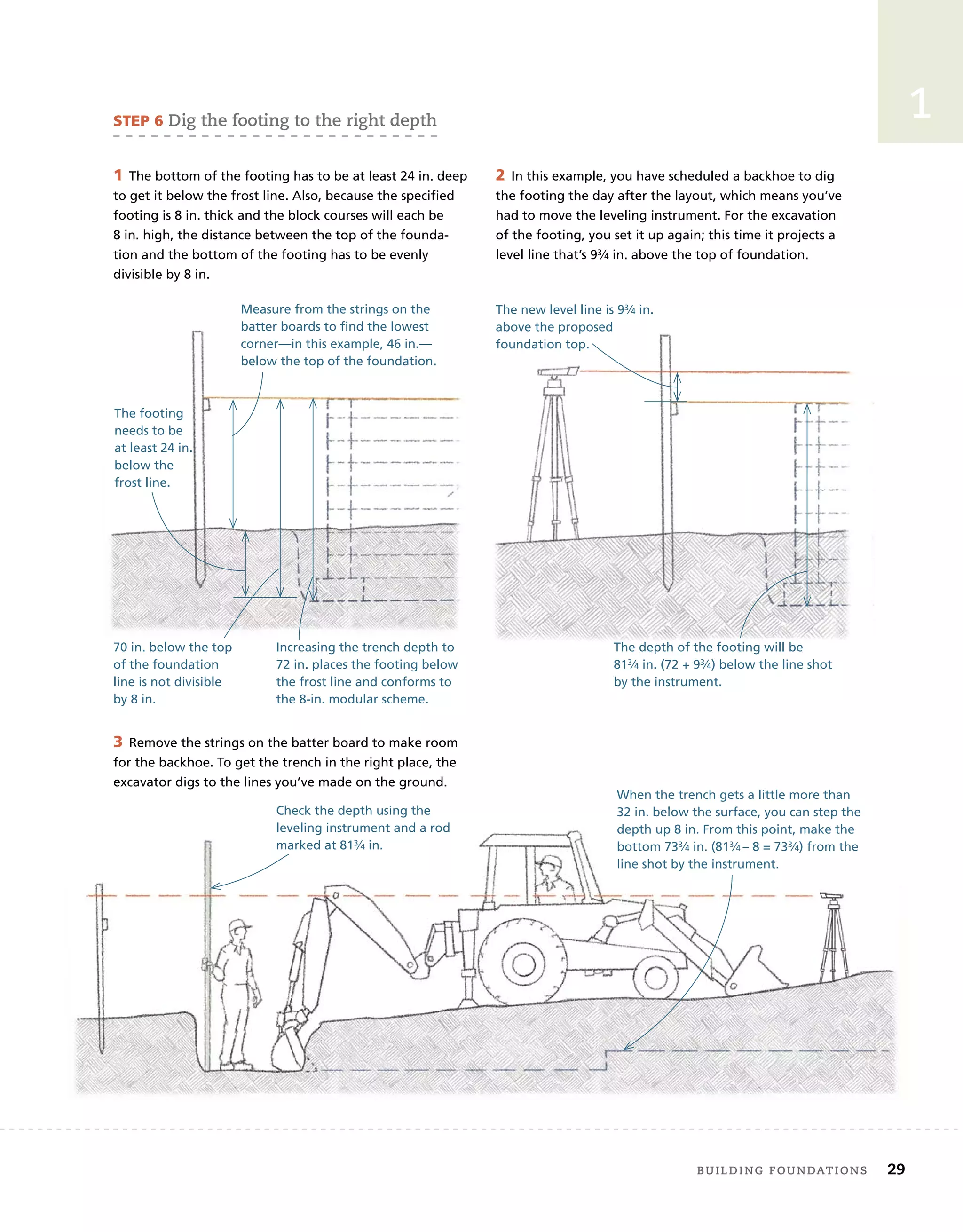
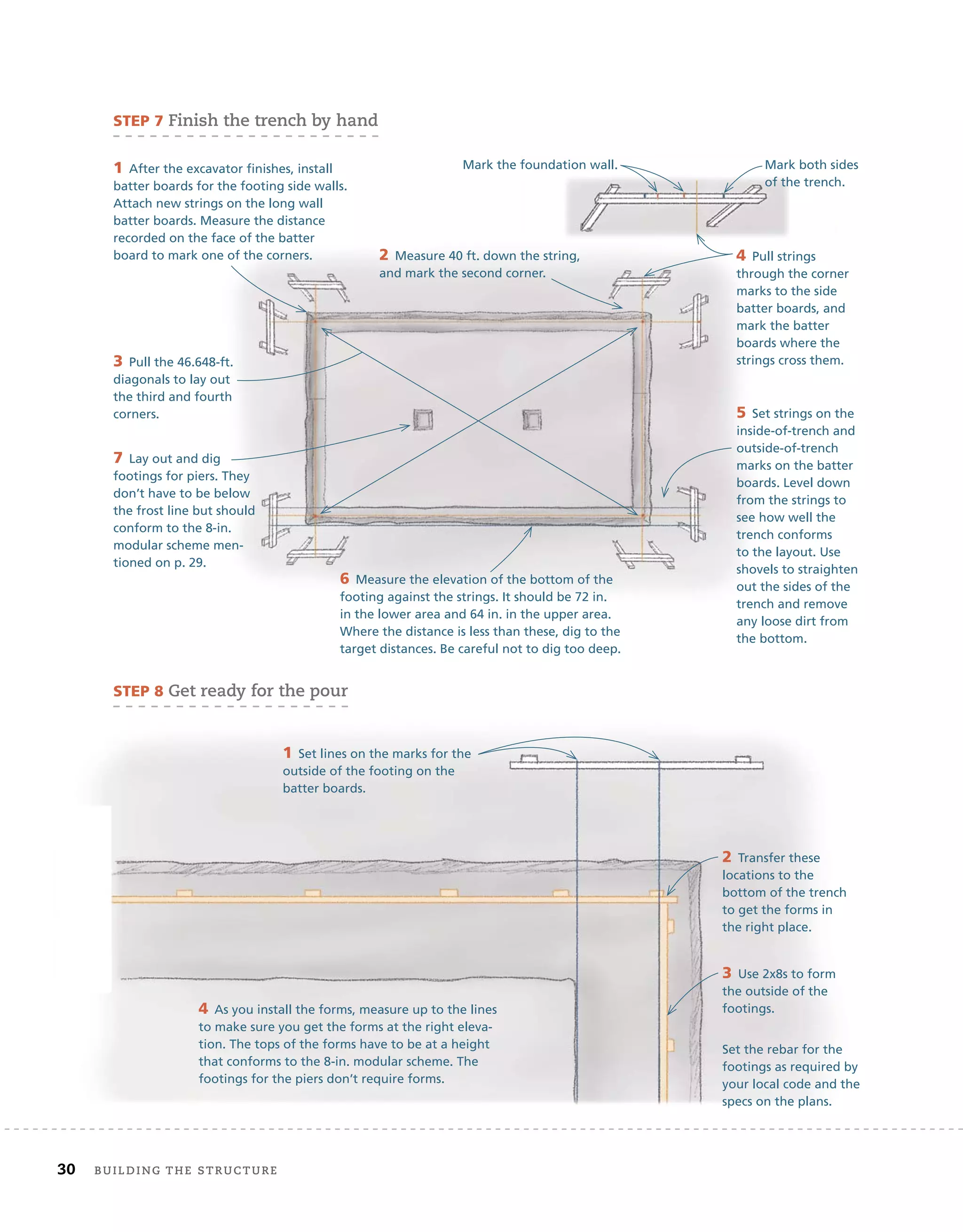
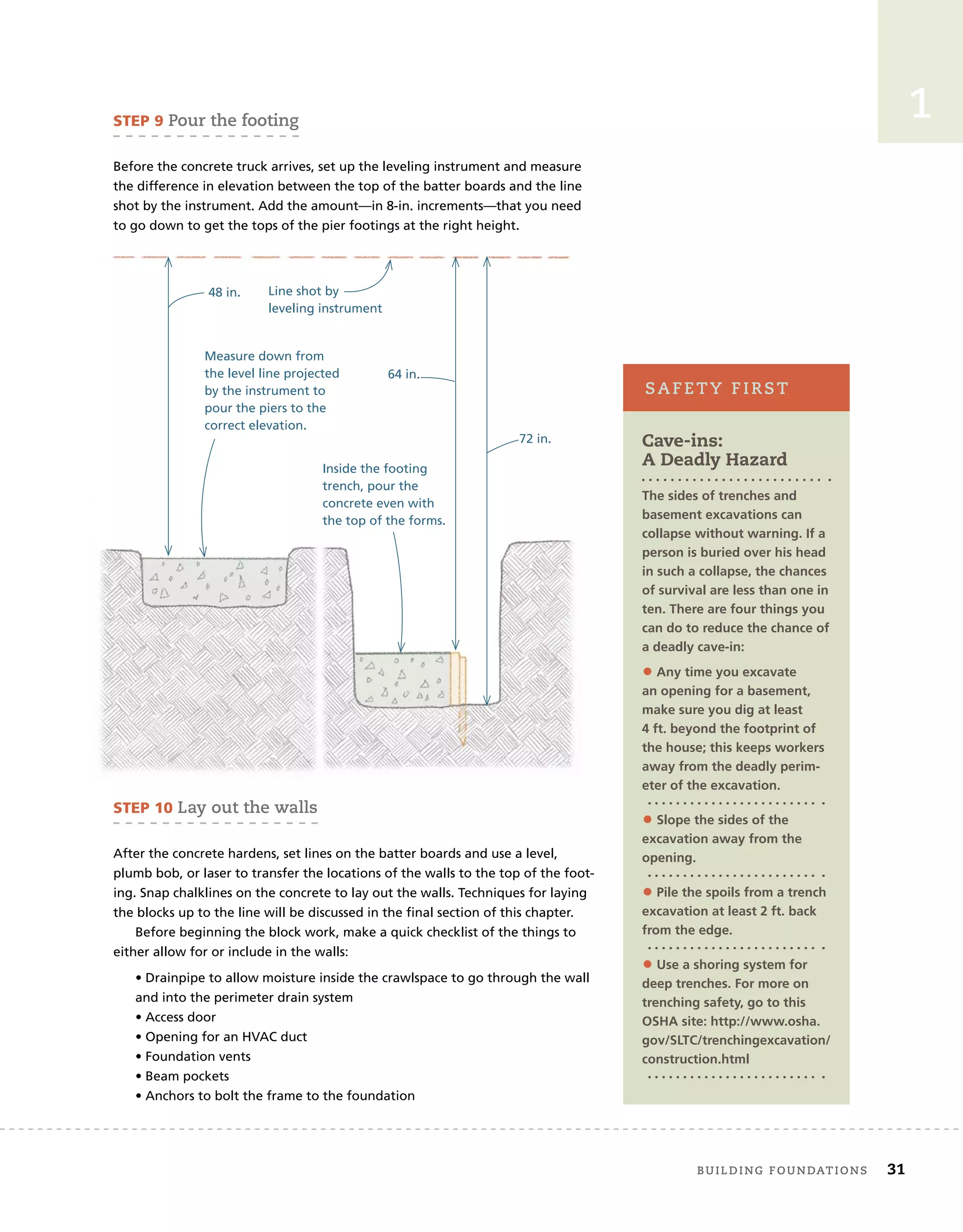
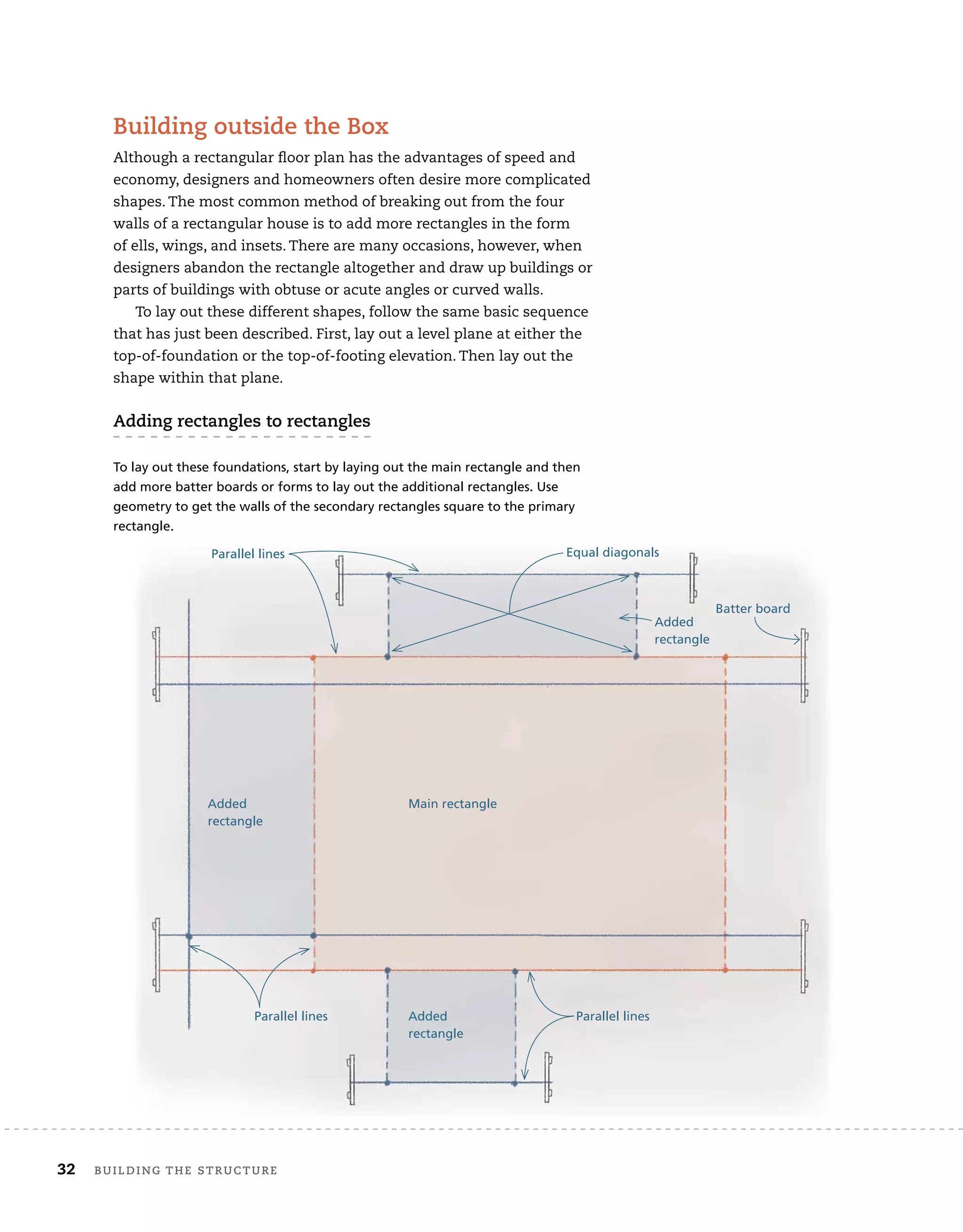
  • 417.
    410 finishing the house Basecap Two-part baseboard One-part baseboard installing baseboard molding There are two basic kinds of baseboard molding. The fi rst is a tra- ditional two-piece system made up of a baseboard and a base cap molding. In the past, the baseboard was usually made from 1x6 or 1x8 boards; today, baseboard that will be painted is often made of medium-density fi berboard (MDF). Base cap molding, which is milled in a wide variety of profi les, is installed on the top edge of the base- board after the baseboard is installed. The second kind of baseboard molding is made in a single piece. In the most common profi le, the molding is 31⁄2 in. to 4 in. wide. The top inch or so has an ogee shape and the lower 3 in. or so has a fl at face. It’s made to resemble two-piece molding, but it’s a lot smaller than its predecessor. Traditional two-piece baseboard molding takes longer to install than one-piece base molding because, with two-piece molding, you have to install twice as many pieces. The joinery in two-piece molding, however, is simpler because it’s divided into two manageable parts. This section discusses the installation of the more common one- piece molding. Although two-piece molding is more attractive and more expensive, one-piece molding is more challenging to install. If you can install one-piece base molding, you should have no prob- lems installing two-piece base molding.
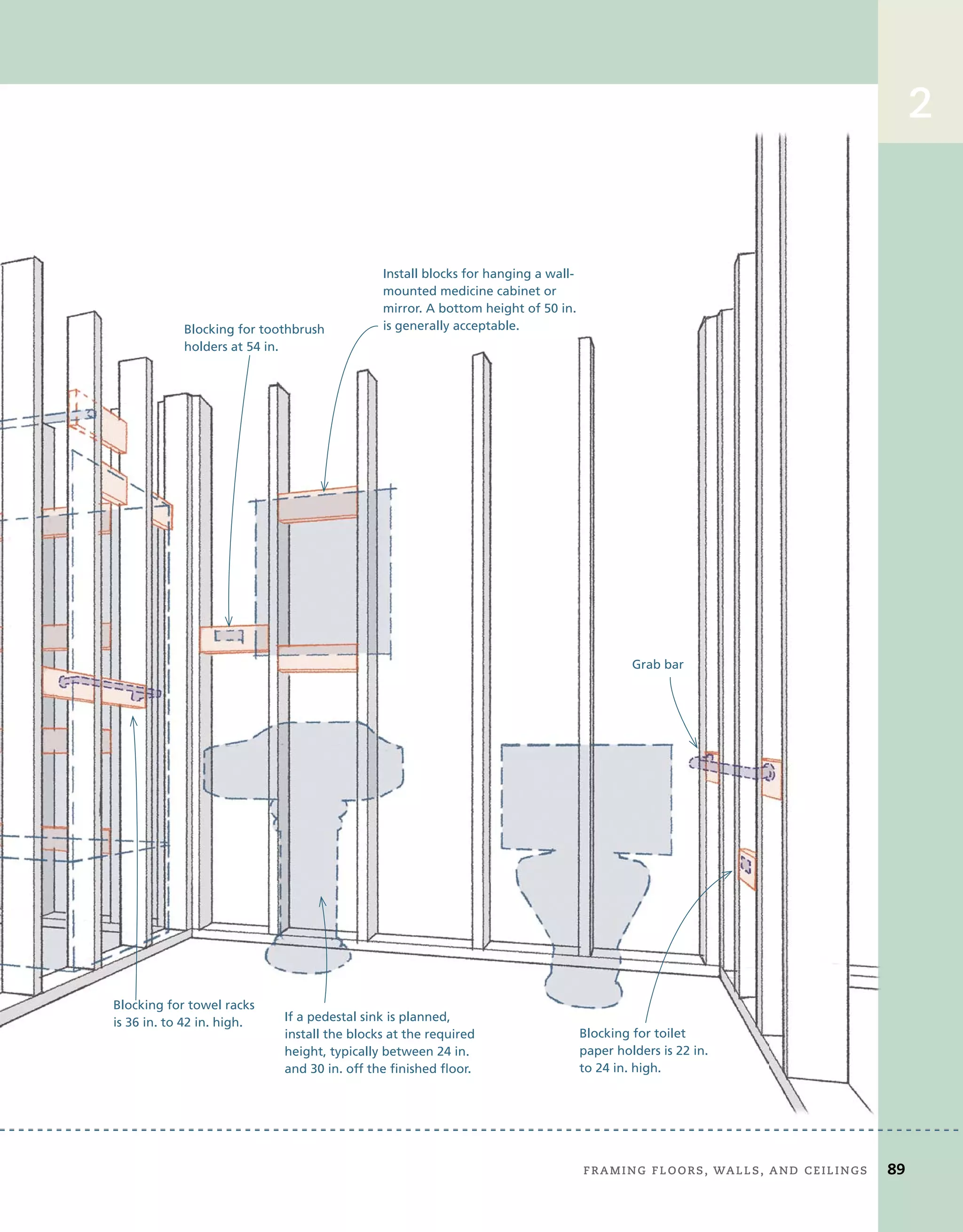
  • 418.
    installing trim and cabinets 411 10 planning and preparing for baseboard Baseboard molding fi ts against the outside edges of door casing, base cabinets, built-in bookcases, and other fl at surfaces. These items, therefore, must be installed before you can run the base- board. Furthermore, before you start the baseboard molding in any room, it pays to spend a little time preparing the surface of the wall that will receive the base molding. Doing so can make the installation go smoother and improve the quality of the job. It’s also important to allow for the fl oor covering, which usually does not get installed until the rest of the fi nish carpentry is completed. Preparing thewalls Take a quick look at the base of the walls, especially at the inside and outside corners. These are the points where pieces of the baseboard molding will have to be joined. Look for globs of drywall compound that might keep the molding from lying fl at against the wall. If you see any clumps, scrape or sand them off. Another potential problem is that the walls usually taper in at the bottom. In most houses, two full, horizontal panels of dry- wall cover the walls. Because the panels are manufactured with tapered edges, the edge along the fl oor—just where you need to attach the base molding—usually swerves inward about 1⁄8 in. in the last few inches. When you nail the molding to this surface, the bottom gets pulled in and ends up out of square with the fl oor. This complicates the joinery at the inside corners and often results in joints that are open at the bottom. To keep the base- board from tilting in, use a screw or a shim at the bottom of the tapered edge, as shown in the drawing at right. Matching the gap to the floor covering Make sure the gap below the baseboard (see the sidebar on p. 413) matches the fl oor covering that will be installed later. When the fl oor covering will be wood, tile, or vinyl (over a layer of underlayment), determine the total thickness and add about 1⁄8 in. If 3⁄4-in. wood fl ooring is planned, for example, raise the baseboard molding about 7⁄8 in. The gap will be covered by a piece of shoe molding, which is usually installed by the fl ooring contractor. Use scraps to hold the baseboard molding up To hold the baseboard molding a consistent distance above the subfl oor, set it on blocks as you install it. You can often fi nd scraps of mate- rial that are the right thickness on site. If you want to raise the baseboard 1⁄2 in., for example, you can cut some blocks out of 1⁄2-in. sheathing scraps. If you can’t fi nd material that matches the gap you want to create, rip blocks to the desired thickness on a tablesaw. Drywall screws hold the baseboard plumb. Drive the screws in at the bottom of the wall, leaving the head about 1⁄8 in. proud of the surface. Check the alignment of the screw head with the wall above by placing a square on the floor. If necessary, turn the screw in or out to fine-tune its position. Set a square on the floor to check the surface. If the wall tapers in, use shims or drywall screws to create a plumb surface for the baseboard molding.
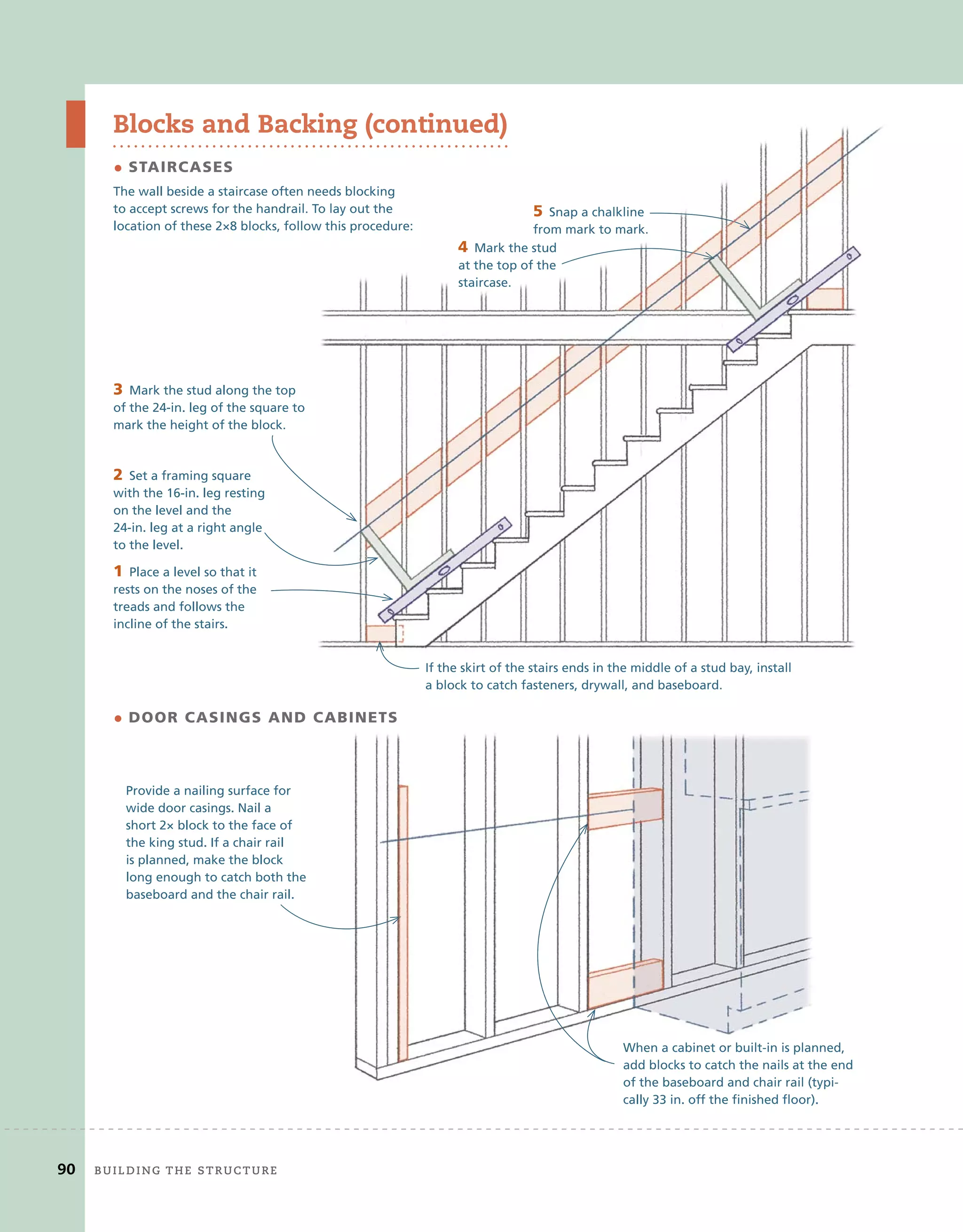
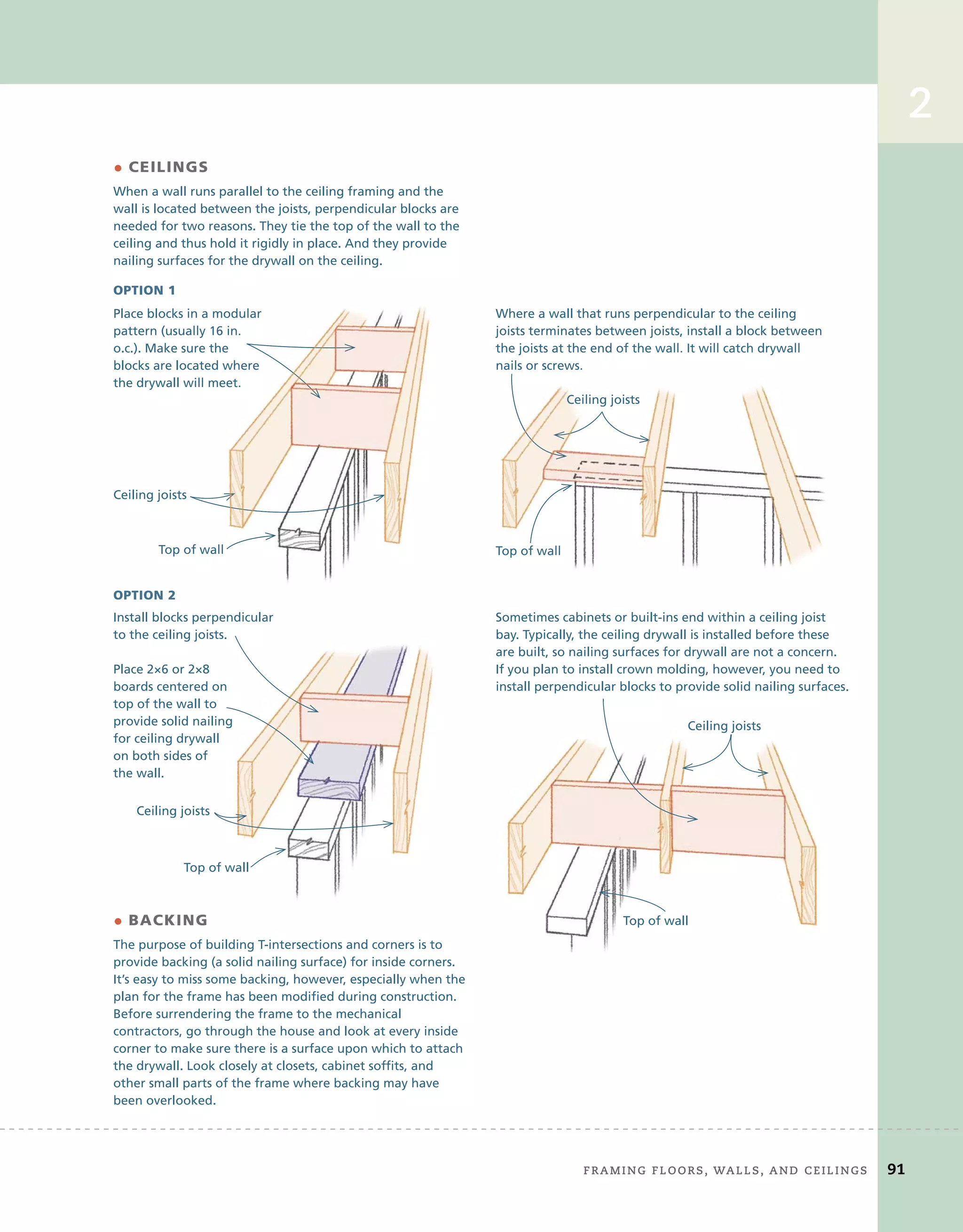
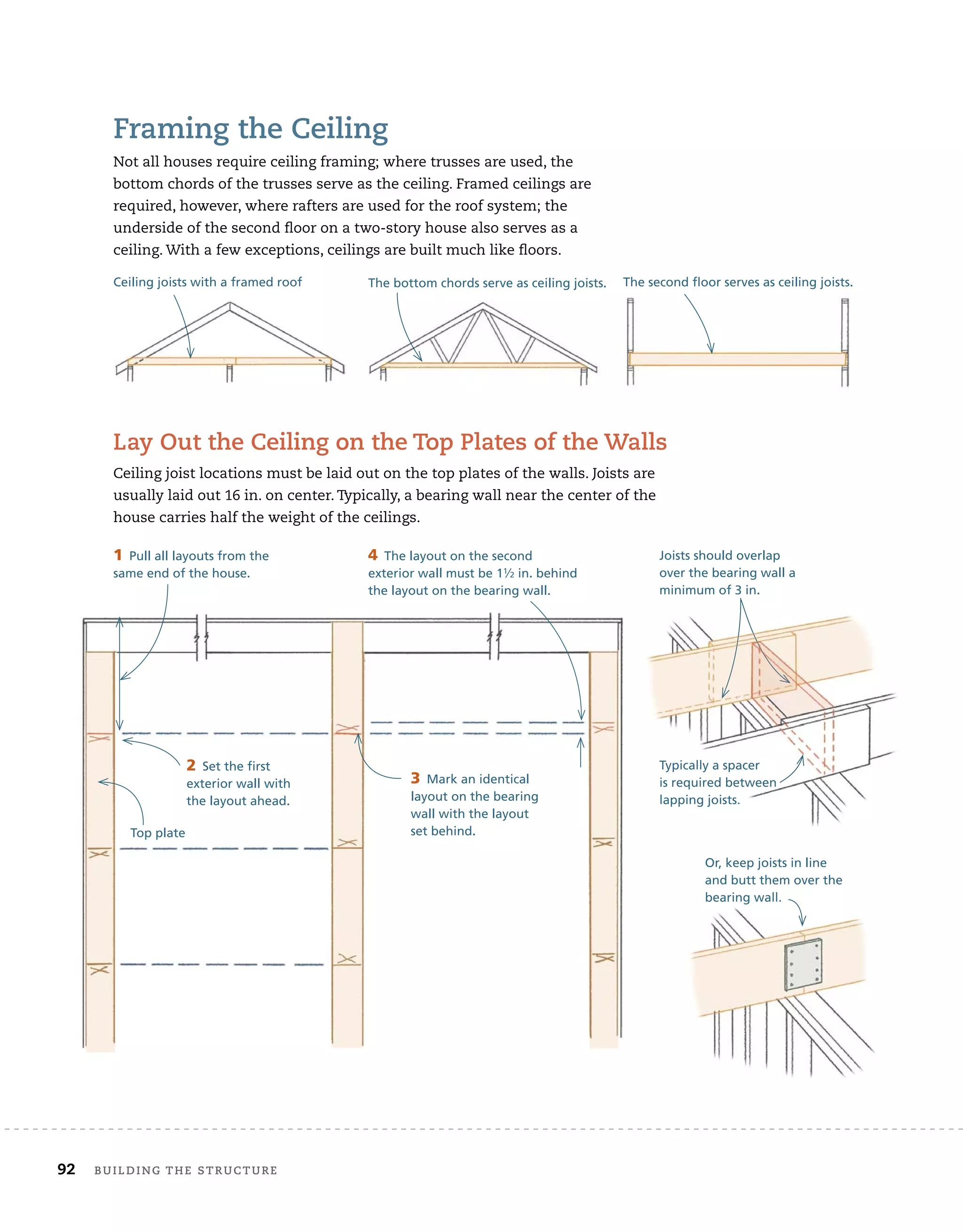
  • 419.
    e s se n t i a l s k i l l s Six Rules of Trim Carpentry Although there are many variations in molding profiles and trim applications, most installations follow these basic principles. Rule 3: Work from the complex to the simple Rule 4: Avoid coped cuts at both ends 1 Leave the piece several inches long as you work on the joint at the inside corner. 2 Once you’re satisfied with the inside corner, mark and cut the piece to fit the open end. 2 After you fine-tune this difficult joint, you can hold the piece in place and mark it at the door casing for the simple, straight cut required there. 1 If you have to install a piece of base molding that extends from a stone chimney to a door casing, fit the irregular scribed cut at the chimney first. Because coped joints often require some fine-tuning, it’s difficult to get tight coped joints at both ends. Plan ahead to avoid double-coped pieces. 412 finishing the house Rule 2: Work from the inside out Joining inside corners is usually the most chal- lenging part of trim carpentry. Pieces rarely fit on the first try, and slight adjustments to the cut are routinely required. When the far end of the piece will end at a window or door casing or an outside corner, take advantage of the open end. Rule 1: Work from large to small To reduce the number of splice joints and to save material, start on the long walls. Use the cutoffs from the longer walls for closets, bump-outs, and other short walls.
  • 420.
    10 Rule 5: Considerlines of sight Coped joints are hard to see if you view the joint from behind the overlapping piece. To enhance the perceived quality of the joint, therefore, think about the most common lines of sight and lap coped joints parallel to those lines whenever possible. Rule 6: Measure as little as possible Trim is light. It’s usually easy to hold it in place as you mark it to length. Doing this is almost always faster and more accurate than taking a measurement and then transferring that measurement to the piece of trim. Line of sight perpendicular to coped piece Coped piece Coped piece Joint less obvious Raising the Baseboard off the Subfloor For both practical and aes- thetic reasons, it’s usually a good idea to leave a gap between the bottom of the baseboard molding and the subfloor. On a practical level, this gap leaves room for finish-floor systems to expand. On an aesthetic level, raising the baseboard leaves more of it exposed to view after the finish floor is installed. This can make a big difference, visually, when you’re using a small, one-piece base molding. top tip installing trim and cabinets 413 Line of sight parallel to coped piece Joint more obvious
  • 421.
    414 finishing the house cutting and fitting baseboard molding This section uses the example of a bedroom with a closet to show how to run baseboard molding in a typical room. The best place to start baseboard molding is often the wall opposite the main door. In this example, this starting point has two advantages: The coped pieces will all be aligned with the primary line of sight (the doorway), and no pieces will have two coped joints. Cautionwith Carpeted Floors Be careful about raising the baseboard molding when the planned floor covering is carpet. It’s difficult to attach shoe molding when the floor is covered in carpet. So, if you end up with a gap between the bottom of the baseboard molding and the carpet, the standard solution is of little help. Carpet is a soft material that’s stretched over hooks when it’s installed. This means that, unlike most floor- covering materials, you don’t have to provide room for it to expand. top tip Make the gap under the molding fairly small (about 3⁄8 in. for short-pile carpet and 1⁄2 in. for tall-pile carpet). This leaves just enough room for the carpet installer to tuck the end of the carpet under the molding. • InStALLInG BASeBoArD moLDInG Start on this wall. Doorway Closet Line of sight 1 2 3 8 7 6 5 4
  • 422.
    installing trim and cabinets 415 10 Inside-to-Inside Measurements Rather thanbending a tape measure into an inside corner and guessing which mark on the tape coincides exactly with the corner, use a measured block. Begin by cutting a block exactly 10 in. long. Butt one end of the block into the corner, and mark along the other end. Measure from the opposite corner to the mark, and then add the 10 in. back to the measurement. top tip 3 Set the piece on blocks to hold it at the desired height, and nail it in place. SteP 1 install the fi rst piece SteP 2 install the second piece 1 Measure the wall from corner to corner. 2 Transfer the measurement to a piece of the molding, and cut both ends square. 5 Set the piece in place, and check the fit at the coped end. If the cope isn’t satisfactory, mark where it needs to be cut. Remove the piece and fine-tune the cut. Install the piece. 1 Set blocks in place to raise the molding the desired amount. 2 Measure from the face of the first piece to the far corner. 3 Cope the end of a piece of the baseboard molding that’s longer than the wall. (See “Coping Basics” on p. 419.) 4 Hook the end of your tape over the lower, straight section of the coped cut. Pull the tape from that point as you transfer the measurement from the wall, then square-cut the piece at the measurement.
  • 423.
    416 finishing the house SteP3 install the third piece SteP 4 install the fourth piece 1 Set blocks in place to raise the baseboard molding. Cut the molding several inches long. 2 Cut and fit the coped joint. When you’re satisfied with the coped joint, hold the piece in place and mark it at the door casing. 1 Set blocks in place to raise the baseboard molding. Cut the molding several inches long. 2 Cut and fit the coped joint. When you’re satisfied with the coped joint, hold the piece in place and mark it at the door casing. 3 Square-cut the piece at the mark. Install the piece. Install this piece using the techniques described in step 3. Locating Studs If the walls have been painted and you’re having a hard time finding the studs, check beside the electric outlets. Electricians nail the boxes for these out- lets to studs. You can also use a stud finder or a rare-earth magnet to locate the studs. If all else fails, drive a finish nail or drill a small hole every inch in a horizontal line until you hit a stud. If you use a nail or a drill to find the studs, make sure you do so in a place that will be covered by trim. Once you find a stud center, mea- sure in 16-in. or 24-in. incre- ments away from that point to find the rest of the studs. top tip
  • 424.
    installing trim and cabinets 417 10 SteP 5 install the fi fth and sixth pieces 7Hold both pieces together at the corner, and check the fit. Once you’re satisfied, install both pieces. 1 Set blocks in place to raise the baseboard molding. 2 Cut two short scraps at a 45° bevel, with the long points of the bevels at the finished face of the mold- ing. Test the fit at the outside corner. If the joint is not acceptable, adjust the setting of the saw and recut the pieces. Repeat this process until you’re satis- fied with the fit. Note the bevel setting on the saw. 3 Cut and fit the fifth piece. Square-cut the end of the piece to fit against the door casing. 4 Hold the piece in place, and scribe the back along the outside corner of the wall. Set the saw to the bevel setting you noted. Bevel-cut the piece along the scribed line with the short point of the bevel at the line. Set the piece aside for now. 6 Scribe the back side of the piece along the out- side corner of the wall. Set the saw to the bevel setting noted. Cut the piece along the line with the short point of the bevel at the line. 5 After square-cutting the end of the sixth piece, set it tight to the inside corner with the other end running past the outside corner.
  • 425.
    418 finishing the house 2 Square-cut theopposite end. SteP 6 install the seventh piece Use the techniques described in step 2 to fit and install the seventh piece. SteP 7 install the eighth piece Use the techniques described in step 3 to fit and install this piece. 1 Cope the end that intersects with the sixth piece. 2 Square-cut the end that intersects with the door casing. 1 Cope the end that intersects with the seventh piece.
  • 426.
    10 Coping Basics Coping theend of a piece of molding to fit over the profile of an installed piece is a three-step process: Mark the profile, cut the profile, and, in most cases, fine- tune the cut. To speed up the cuts, finish carpen- ters sometimes use power tools. The most common of these are jigsaws fitted with a special shoe, such as the Collins Coping Foot, or 4-in. grinders equipped with a coarse sanding disk. Tools for fine-tuning the fit Carpenters differ widely over the proper tools to use for removing the last bit of wood that keeps a joint from closing tight. Some like to pare away the offend- ing projections with sharp-edge tools such as chisels, knives, and handplanes. These offer precise control but only if they’re razor sharp. If you want to use edge tools, you have to develop sharpen- ing skills. Other carpenters prefer sandpaper and rasps. To follow straight sections of the profile, wrap sandpaper around wood blocks; to follow round sections of the profile, wrap the sandpaper around dowels and short sections of plastic pipes. Another option is to use electric sand- ers and grinders. Some detail sanders offer great control, but they’re expensive and they can be slow. Belt sanders and grinders are faster, but they can be too aggressive and quickly ruin the joint. The choice of tools for fine-tuning the joint is a personal matter. Experiment with different approaches, and use the tools that work best for you. e s s e n t i a l s k i l l s 1 If there’s a gap of equal size along the entire joint, there’s material behind the front edge that’s keeping the joint from closing. Remove the piece and pare or sand away material behind the leading edge of the joint. • mArKInG tHe ProFILe • CUttInG tHe CoPe Once you’ve marked the profile, clamp the piece to your worktable and use a coping saw to cut precisely along the line. 1 Make a 45° bevel cut with the short point, or heel, of the bevel on the face of the molding. The irregular edge cre- ated along the heel of the bevel cut pre- cisely mimics the profile of the molding. 2 You can make this edge more visible by rubbing it with the side of a pencil lead. As you cut, tilt the coping saw at about a 30° angle in from the face. This is called back-cutting and is designed to remove material behind the leading edge of the joint that might keep the front of the joint from closing. • FIne-tUnInG tHe CUt After cutting the cope, check the fit by holding the piece in place. 2 If there’s a tapered gap, you’ll need to work on the front edge of the cut. Carefully mark a line that runs parallel to the profile of the piece you’re joining. This line should be offset from the face of the piece you’re joining at least as much as the width of the gap. Remove the piece and pare or sand to the line. installing trim and cabinets 419 ated along the heel of the bevel cut pre- CUttInG tHe CoPe cisely mimics the profile of the molding. Coping saw blade
  • 427.
    420 finishing the house installing chair rail molding Chair rail molding is typically installed along a level line 33 in. to 36 in. above the fl oor in the same basic manner as baseboard molding. laying out the Job Chair rail molding was originally designed to keep the backs of chairs from damaging plaster walls. For this reason, chair rail is usually installed with the top 33 in. off the fi nished fl oor, which is about the average height of the top of the back of a dining room chair. Mark a level line around the room at that height. The best tool for this layout is an accurate laser level, especially one that projects a level line. If you don’t have a laser level, you can use an optical builder’s level or a reliable spirit level. getting the right side up There are many profi les for chair rail molding, so it can be confusing to decide which edge goes up. In most cases, the thickest part goes up. Carpenters usually join chair rail molding at inside corners with coped joints. If the profi le is very complex, however, it’s often easier to miter inside joints. To get the joints tight, cut test pieces in scrap material until the joint is satisfactory. As with other types of molding, plan the installation so that you can work from the inside out. When you have to fi t a piece with an inside corner and an “open” end (an end that runs into a window or door casing or an outside corner), deal with the inside corner fi rst and leave the other end long. After you get the inside corner right, mark and cut the open end. Also, keep the primary line of sight in mind when you plan the order of installation. Ifnecessary, raise the height of the chair rail to avoid an awkward joint at the windowsill. Avoid a joint like this. The thickest part of the molding is usually rounded and might be called the “rail” of the molding. In most cases, this thickest part goes up.
  • 428.
    installing trim and cabinets 421 10 installing crown molding Installing crown molding is one of the most challenging jobs in trim carpentry. The main diffi culty is that most types of crown molding have to be installed at an angle to the wall. This means that the cuts for inside and outside corners must be compound miter cuts. Adding to this diffi culty is the fact that almost all of the joints for crown molding are inside corners. While the simple butt joints at doors and windows provide relief when you’re running baseboard or chair rail molding, crown molding usually runs above those openings. order of installation In a simple rectangular room, the walls meet at four inside corners. All the joints in the crown molding, therefore, will be inside corners. In these rooms, you have two options. 3 Afterinstalling the next two pieces, remove the scrap and slip the square-cut end of the last piece inside the coped end of the first piece. This second option is more forgiv- ing because the last piece can be slightly short. • oPtIon 1: CoPe BotH enDS oF tHe FInAL PIeCe This option is difficult because both coped joints have to be accurately cut on the first try. If one of the copes is open, you can’t fine-tune the joint without shortening the piece and thus creating a gap at the other end. • oPtIon 2: ALL FoUr PIeCeS HAVe one CoPeD JoInt 1 Cope the first piece over a scrap of the molding tempo- rarily nailed in place at the corner. 2 After fine-tuning the coped end, square-cut the opposite end and install the first piece.
  • 429.
    422 finishing the house Both of the options mentioned on p. 421 are diffi cult to do well. So, if the room you’re working in happens to have an outside corner, take advantage of it. By working toward the outside corner, you can leave the fi nal two pieces long as you fi ne-tune the coped inside corners. cutting compound miters Most crown molding is designed to fi t in the wall/ceiling intersection at a 38° angle from the wall. A few styles of crown, mainly cove- shaped moldings, are designed to fi t at a 45° angle. In the parlance of carpentry, this angle is called the “spring angle.” Whether the spring angle is 38° or 45°, there are two ways to cut the compound miters required for the joints. 2Cut the pieces for the outside corner. To avoid an open joint at the outside corner, cut test pieces with scrap material to establish the exact miter setting you need. (For more on fitting the pieces at outside corners, see “Cutting and Fitting Baseboard Molding” on p. 414.) • WorK toWArD tHe oUtSIDe Corner 1 Fit the two inside corners tightly. 2 The nesting method requires a jig or, at a minimum, a line on the table of the saw to ensure that the piece is leaned against the fence at the correct angle. Once this preliminary setup is complete, nesting the crown simplifies the compound cuts. • metHoD 1: neStInG tHe CroWn The tilted crown combined with the miter setting creates the compound cut. The tilted crown combined with the miter setting creates the compound cut. 1 Prop the crown against the fence at the correct spring angle. Set the miter angle to make the cut. If the walls turn at a true 90° angle, set the saw to a 45° miter.
  • 430.
    installing trim and cabinets 423 10 When molding is cut fl at on the saw, the angles needed for a 90° corner are diffi cult to compute and easy to forget. Fortunately, almost all compound miter saws and sliding compound miter saws have these settings distinctly marked on their scales. They are 31.62° for the miter and 33.86° for the bevel. Many saws also have the set- tings for crown designed with a spring angle of 45° distinctly marked. When the crown molding has to go around a corner that’s not square, the settings highlighted on the saws don’t work. For these situations, most saw manufacturers provide a table of the settings for any possible corner. This table is usually included in the owner’s manual. For more on measuring out-of-square walls and fi nding the correct compound miter settings, see “Trimming with Oblique Angles” on p. 432. laying out crown molding Before beginning the installation, use a scrap and a framing square to draw out the critical dimensions. Then, use these dimensions to lay out the bottom of the crown molding on the wall, to set up the saw for cutting the crown at the spring angle, and to cut backing blocks of the correct size. 4 Thebevel is set by tilting the motor and blade assembly. The scale for this setting is above the table and toward the back of the saw. • metHoD 2: LAYInG tHe CroWn FLAt 1 Place the molding flat on the saw with the molded face up. Depending on the saw and the cut needed, hold either the top or the bottom edge of the molding against the fence. Then cut the piece at a compound angle. Although this cut is usually called a compound miter cut, technically it is a compound miter/bevel cut. This is an important distinction because the miter and bevel cuts must be set at different angles. 2 With the piece lying flat on the table, set the miter by swiveling the motor and blade assembly. 3 The scale for this setting is the large semicircular scale below the table and at the front of the saw.
  • 431.
    424 finishing the house Framingsquare SteP 1 draw the critical dimensions 1 Place a framing square on a scrap of plywood and trace along the inside edges to draw a right angle. 2 Square-cut a piece of the crown molding about 4 in. long and place it between the legs of the square, making sure the back edges of the crown sit flush with the inside of the square. 3 Carefully trace the profile of the crown, including the back, onto the plywood. Carefully trace the profile of the crown, including the back, onto the plywood. 2 Use the scrap as a gauge to mark the layout for the bottom of the crown molding on the wall. At the corners and at roughly 32-in. inter- vals along the walls, push the block against the ceiling and scribe along the bottom. SteP 2 lay out the bottom of the crown molding on the wall 1 Remove the square and measure the distance between the corner (formed by the right angle of the triangle) and the bottom of the crown. Cut a scrap this length. Bottom Top fillet Back
  • 432.
    installing trim and cabinets 425 10 SteP 3 position the crown on the miter saw 2To avoid holding the molding out from the wall, make the backing blocks 1⁄8 in. smaller than the triangle. When using the nesting method to cut the crown, mark a line on the table of the saw to hold the crown molding at the proper angle. The correct distance from the fence to the line is equal to the distance from the corner (formed by the right angle of the triangle) to the face of the fillet at the top of the crown molding on the drawing. 1 If you decide to use backing blocks for installing the crown, use the triangle of the drawing as a guide. The backing blocks should be ripped at the spring angle and fit inside the triangle. SteP 4 lay out backing blocks Top of crown
  • 433.
    426 finishing the house cutting and fitting inside corners As with base and chair rail molding, the inside corners of crown molding are usually coped. And, like those other moldings, the process of marking the profi le begins with a miter cut in which the molded side of the piece is the short point of the cut. Unlike those other moldings, however, the preliminary cut has to be a compound miter cut. Cuttingthe cope After making the preliminary cut, darken the edge at the heel of the cut with the side of a pencil lead. This line follows the profi le of the crown molding as it will be situated when both pieces are installed at the spring angle. Cut along the line with a coping saw. Check the fi t against a scrap. Fine-tune the cut until the coped piece fi ts tightly over the scrap. SteP 1 make the preliminary cut 5 For an inside corner on the left end of a piece, set the saw to a left 45° miter. Plan on using the portion to the left of the cut. • metHoD 1: neStInG metHoD 1 Refer to the layout draw- ing to find out how far to lay out the stop line from the fence of the saw. It’s the distance from the corner to the front of the crown mold- ing at the top. Measure and mark the stop line on the table of the saw. 2 If possible, affix stop blocks to the table at the line. Most miter saws now offer accessories for this purpose. If your saw doesn’t have a system for setting up stop blocks, you can simply hold the molding on the line as you cut it. Or you can fabricate a jig with a secondary table. 3 Set the piece on the saw with the top edge of the molding down and against the stop (or on the line) and the bottom edge leaning against the fence. 4 For an inside corner on the right end of a piece, set the saw to a right 45° miter. Plan on using the portion to the right of the cut. top tip Upside Down and Backwards When using the nesting method, the piece is always placed in the saw with the top down. Since the piece is upside down and will have to be rotated 180° when it’s installed, the cut is also at the opposite end of the piece as it’s being cut. Mark table here.
  • 434.
    installing trim and cabinets 427 10 6 Setthe bevel to 33.86° tilted left (single-bevel saws can only tilt left). Plan on using the portion to the left of the cut. • metHoD 2: on tHe FLAt WItH A SInGLe-BeVeL SAW For crown molding with a 38° spring angle (most crown molding), use the settings marked on your miter saw. They will be enumerated here. (For crown molding with a 45° spring angle, substitute the miter and bevel settings found in the table on p. 506 for the ones provided here.) • metHoD 3: on tHe FLAt WItH A DUAL-BeVeL SAW 1 For an inside corner on the right end of the piece, set the top of the molding against the fence. 2 Set the miter to 31.62° swiveled right. 3 Set the bevel to 33.86° tilted left (single-bevel saws can only tilt left). Plan on using the portion to the left of the cut. 4 For an inside corner on the left end of the piece, set the bottom of the molding against the fence. 5 Set the miter to 31.62° swiveled left. against the fence. 4 Set the bevel to 33.86° tilted right. Plan on using the portion to the right of the cut. 1 For an inside corner on the right end of the piece, set the miter to 31.62° swiveled right. 2 Set the bevel to 33.86° tilted left. Plan on using the portion to the left of the cut. 3 For an inside corner on the left end of the piece, set the miter to 31.62° swiveled left. Both of the cuts described here start with the top edge of the molding against the fence.
  • 435.
    428 finishing thehouse Measuring and Cutting, Inside Corner to Outside Corner As with baseboard and chair rail molding, when the opposite end is an outside corner, leave the piece long until you get the inside corner fine-tuned. Once you’re satisfied with the inside corner, hold the piece in place as you mark it at the outside corner. The two pieces that form an outside corner can be fitted by using test pieces in scrap material. (For more on this process, see step 5 of “Cutting and Fitting Baseboard Molding” on p. 417.) 4 Hold the piece in place and check the fit at the coped end. Fine-tune the cut if necessary. When you’re satisfied with the fit at the coped end, hold the piece tight to the matching piece and install it along the marks you made on the wall. STEP 2 Measure and cut the piece to length (inside corner to inside corner) 2 Hook your tape over the top front edge of the coped cut to trans- fer the measurement to the piece. 1 To measure from an installed piece to an inside corner, place a 10-in. block against the top out- side edge of the piece (the top fillet), and mark along the other end of the block. Measure from the opposite corner to the mark, and add 10 in. to the measurement. 3 Square-cut the piece at the mark. Installed crown
  • 436.
  • 437.
    430 finishing the house fitting outside corners on the flat Fitting outside corners with the piece lying fl at can be more diffi cult than doing so with the nesting method. When you use compound miter/bevel settings, both settings have to be changed for any adjust- ments. The settings for crown molding with a 38° spring angle going around a true 90° corner are given here. If you’re using crown mold- ing with a 45° spring angle or you have to adjust the fi t of 38° crown molding, refer to the table on p. 506. 6Set the bevel to 33.86°, tilted left. Use the portion to the right of the cut. • mIter/BeVeL SettInGS WHen USInG A SInGLe-BeVeL SAW 1 For an outside corner on the right end of the piece, set the bottom of the molding against the fence. 2 Set the miter to 31.62°, swiveled left. 3 Set the bevel to 33.86° tilted left (single-bevel saws can only tilt left). Use the portion to the right of the cut. 4 For an outside corner on the left end of the piece, set the top of the molding against the fence. 5 Set the miter to 31.62°, swiveled right.
  • 438.
    installing trim and cabinets 431 10 6 Setthe bevel to 33.86° tilted left. Plan on using the portion to the right of the cut. • mIter/BeVeL SettInGS For A DUAL-BeVeL SAW 1 For an outside corner on the right end of the piece, set the top of the mold- ing against the fence. 2 Set the miter to 31.62°, swiveled left. 3 Set the bevel to 33.86°, tilted right. Use the portion to the left of the cut. 4 For an outside corner on the left end of the piece, set the top of the mold- ing against the fence. 5 Set the miter to 31.62°, swiveled right. attaching crown molding Crown molding up to 3 in. wide can be attached with one 21⁄2-in. fi nish nail driven through the center of the piece every 32 in. or so. In most cases, the top plate of the wall provides a solid nailing surface along the entire wall. If you have trouble fi nding a suitable nailing base, you’re install- ing crown that’s larger than 3 in., or you just want to provide a very solid nailing base, make up and install backer blocks. Make the backer blocks as described in “Laying Out Crown Molding” on p. 425. You can normally install the backer blocks by nailing horizontally into the top plate of the wall.
  • 439.
    432 finishing thehouse Trimming with Oblique Angles Although most of the corners inside a house are 90°, many are a degree or two out of square. In addition to these accidental out- of-square corners, there are often corners and intersections that, by design or necessity, are far from square. Designers might draw up plans with walls that turn at a 45° angle, or they might specify octagonal windows. A common spot for an oblique angle is where a skirtboard on a staircase meets the horizontal baseboard. Whether these angles are the result of sloppy framing or the design of the house, they usually require trim. This section shows how to achieve neat, tight joints when the trim has to meet at oblique angles. Bisecting the Angle Carpenters use the same basic technique to join trim at oblique angles that they use for right angles. The essence of this technique is to bisect the angle at the miter joint. With a true 90° angle, of course, the two pieces are cut at 45° miters. With oblique angles, the trim must be miter-cut at an angle that’s exactly half of the angle at which the trim turns. The challenge is to find that angle. In some cases, the correct miter is not too hard to find. When casing out an octagonal window, most carpenters can see that the jamb turns at a 45° angle. The miter setting, then, is 221⁄2° (or close to that setting). In other cases, the correct miter is not apparent and has to be measured. There are several ways to measure the bisecting angle. Here are two simple approaches. Method 1: Trial and error. If you have a rough idea of the angle, you can quickly determine the correct miter by making test cuts in scrap material. If an outside corner is slightly out of square, you can start with 45° cuts on two scraps. If these pieces don’t fit together properly, adjust the miter slightly and try again. Repeat until you arrive at a perfect fit. Method 2: Measure the angle with a scrap and two squares. Another way to measure the bisecting angle is to draw it in place, transfer it to a board, and measure it. To measure the bisecting miter angle needed for base cap molding that turns from the horizontal to the sloping angle of the stair skirt, follow these steps. Defining Angles All angles that are not right angles (90° angles) are called oblique angles. Oblique angles can be acute (less than 90°) or obtuse (more than 90°). top tip
  • 440.
    installing trim and cabinets 433 10 • meASUretHe AnGLe WItH A SCrAP AnD tWo SQUAreS • USe mIterS to JoIn oBLIQUe InSIDe CornerS 6 Measure the bisecting miter angle with a Swanson Speed Square, a Stanley Quick Square, or a C. H. Hanson Pivot Square. (You can also measure the angle with a protractor and subtract it from 90° to get the bisecting miter angle.) 1 Set a scrap of 1x4 on the skirt- board, and scribe a line on the wall along the top edge of the scrap. 2 Set the same scrap on the base- board, and scribe a line along the top of the scrap. 3 Use a straightedge to draw a line from the corner formed by the skirtboard and the baseboard to the intersection of the lines. 4 Set a bevel square on either the skirtboard or the baseboard, and adjust the square until it matches the angle of the line. 5 Transfer the angle on the bevel square to a flat board. 2 It’s more practical to cut matching miters for these joints. After measuring the bisecting angles, use test pieces to fine-tune the fit. 1 It’s difficult to cope inside corners when the angle is substantially greater than 90°. The cope must be back-cut at a very steep angle to allow the coped piece to overlap the installed piece.
  • 441.
    434 finishing the house running crown molding around an oblique angle The simplest way to run crown molding around oblique corners is to use the nesting method. If the crown is too big to fi t in the nested position, however, you may have to lay it fl at and use compound miter/bevel cuts. Usingthe nesting method Use a piece of 1x4 scrap to draw lines parallel to the wall on the ceiling. The lines should intersect outside of the corner. Use the method described in “Measure the Angle with a Scrap and Two Squares” on pp. 432–433 to determine the bisecting angle of the walls. Set the crown in the miter saw upside down and leaning against the fence at the spring angle. Set the miter to the bisecting miter angle to cut inside or outside corners. 3 Once you have the angle between the walls, look up the correct miter and bevel settings for that angle in the table on p. 506. If you’re using 38° crown molding and the angle between the walls is 136°, for example, the settings are 13.97° miter and 17.17° bevel. These settings would be good for either an inside or an outside corner. • CroWn AroUnD oBLIQUe AnGLeS: mAKInG tHe CUtS on tHe FLAt W a l l Wall 136° 44° 22° 1 Begin by determining the angle between the walls. This angle is different from the bisecting miter angle! 2 However, you can use the bisecting miter angle to compute the angle between the walls; the process is described in the Top Tip at right. It’s faster to use a bevel square to transfer the angle to a board and then measure it with a protractor, as shown. You can also invest in any of several special tools for measuring this angle. Using the Bisecting Miter Angle to Find the Angle between the Walls If you know the bisect- ing miter angle, double it and then subtract the total from 180° to find the angle between the walls. If the bisecting miter angle is 22°, for example, you know that the wall turns at 44°. Subtract that from 180° to find the angle between the walls, which in this case is 136° (180 – 44 = 136). top tip
  • 442.
    installing trim and cabinets 435 10 installing cabinets Kitchen and bathroom cabinets generally follow trim. Cabinets usually arrive in a single “cabinet package,” which should include a complete list of cabinets and accessories and a plan for the kitchen installation. (Bathroom cabinets usually don’t require a plan.) First, make sure everything on the list has, in fact, been delivered. Second, check the dimensions on the plan against the actual dimensions of the kitchen. thinking through the Job At this point, it’s always a good idea to review the plan. Look for potential problems and pitfalls and establish the critical dimension of the installation. Here are a few things to think about now and as you install the cabinets. • CHeCKFor DrAWer CLeArAnCe A common error is not to leave enough room for drawers at the inside corners of base cabinets. The thickness of the doors and the projection of doorknobs and drawer pulls can prevent the drawers on the other side of the corner from opening. Other trouble spots: 1 Door casing can prevent a drawer from opening if the door is just a few inches in front of the cabinets and the base cabinet is set tight to the corner. 3 Frameless cabinets pose particular problems because drawer fronts extend to the outside edges of the cabinet box. The solution is to place filler strips at these locations to move the drawers over an inch or two, where they can slide freely in front of the obstruction. 2 Door handles usually project out a couple of inches. This can stop drawers from sliding open and interfere with the swing of doors. Don’t Forget the Finish Floor If you install the base cabi- nets on the subfloor and the finished floor ends up 3⁄4 in. thick, you may not be able to squeeze the dishwasher in later. To avoid this problem, find out what floor covering is planned and how much it will raise the floor. Use plywood of that thickness to raise the area under the base cabinets the required amount. top tip
  • 443.
    436 finishing thehouse Leave Room for the Appliances As you install the cabinets, you must leave openings for the appliances. The sizes of these openings are critical. If the openings are too small, you won’t be able to fit the appliance into place; if the openings are too big, there will be an unacceptable gap around them. • Dishwasher: Most dishwashers are 24 in. wide. To play it safe, many installers make the opening 241⁄4 in. wide. The height of the opening should be 341⁄2 in., which is the height of a standard base cabinet. The most common alternate width is 18 in. • Range: Most ranges are 30 in. wide. Many installers make the opening 301⁄4 in. wide. The height is not an issue because the top of the range sits above the top of the countertop. There are several alternate widths, including 20 in., 24 in., 36 in., 40 in., and 48 in. • Refrigerator: There is no standard size for refrigerators, so you need to find out what will be used. Unlike other appliances, the refrigerator is not installed. Rather, it’s placed loosely in a niche where it can be easily rolled in and out of place. The opening for the refrigerator, therefore, does not need to be as tight as for the other appliances. Kitchen planners often leave a 1-in. to 2-in. space on the sides of refrigerators and several inches above them. e s s e n t i a l s k i l l s Laying Out the Job Before installing the cabinets, you have to lay out level lines on the walls for the base cabinets and the wall cabinets (see the drawing on the facing page). You also have to mark the locations of the studs. If you need to build up the floor below the base cabinets to allow for the thickness of the floor covering, you need to lay out those areas, too. Attaching Cabinets to the Walls The cabinets should be securely attached to the walls and to one another with screws. In addition to avoiding the problems discussed on p. 435, the cabinets should be installed level and with the face frames flush to one another. If the cabinets don’t have face frames, the front edges of the cabinet boxes should end up even. Some carpenters prefer to install all the wall cabinets before they install the base cabinets. Other carpenters find it easier to install the base cabinets first. Both methods work. The drawings on pp. 438–441 follow the more common sequence of installing wall cabinets first. In general, the installation should run from inside corners toward the outside and from critical dimensions to noncritical dimensions. As we’ve seen, the opening for a dishwasher or range is a critical dimen- sion. An example of a noncritical dimension might be when a line of cabinets ends several inches away from a door or window casing. An inch or two doesn’t matter much. Remove Drawers and Doors To reduce the weight of the cabinets and to minimize damage, remove the doors and drawers from the cabinets before you hang them. Most cabinets now come with Euro hinges, which are easy to take off. Store the doors and draw- ers in a safe place to avoid damaging them. top tip
  • 444.
    installing trim and cabinets 437 10 SteP 1 mark a level line for the base cabinets and wall cabinets 1Find the highest point on the floor in the area where the base cabinets will be installed. The best tool for this is an accurate laser level, but if you don’t have one, use a builder’s level or a reliable spirit level. 2 If the finished floor has not been installed, add the thickness of the planned floor cover- ing, including any underlayment, and mark a point on the wall up 341⁄2 in. from the highest point on the floor. 3 Use a laser level, a builder’s level, or a spirit level to extend a level line from this mark. 4 Measure and mark a distance equal to the thickness of the countertop above the line you made for the base cabinets. The standard thickness of plastic laminate countertops is 11⁄2 in. 5 Measure and mark 18 in. up from the mark representing the top of the countertop (this standard is common but not absolute). SteP 2 mark the locations of the studs Mark the positions of the studs on the wall just above the level layout line for the base cabinets. You don’t have to worry about marks or holes made in this area because it will be covered later by the countertop. SteP 3 lay out the locations of the base cabinets If you have to raise the base cabinets to allow for the thickness of the finish floor, mark the exact position of the base cabinets on the floor. Measure the depth of the base cabinets at the bottom; in standard cabinets, this distance is typically 21 in. Strike a chalkline this distance out from the walls where the base cabinets will be set. Carefully mark the locations of the base cabinets and spacers along the line. Wall Level line for wall cabinets Level line for base cabinets Studs Thickness of countertop Thickness of planned floor covering Subfloor 6 Starting at this mark, snap a level line on the wall where the wall cabinets will be installed. You can use the line you’ve already drawn for the base cabinets as a level reference. Usually, this means measuring and marking a parallel line that’s 191⁄2 in. above the base cabinet layout line. 18 in. 341⁄2 in. 2 4 5 3
  • 445.
    438 finishing the house Screws forhanging cabinets Use 3-in. cabinet hanger screws to attach cabinets to the wall. The manner in which cabinets are attached to each other depends on whether they have face frames or are frameless. Traditional American cabinets with face frames can be held together with #8 fl at-head steel screws. Make sure the screw is long enough to extend through one face frame and about 1 in. into the other but not so long as to come through the other side. Frameless cabinets, often called European cabinets, should be con- nected to each other using special cabinet-connecting screws, which fi t into the predrilled shelf-pin holes. If you can’t buy these screws locally, you can order them at McFeely’s® (www.mcfeelys.com). SteP 1 hanging the fi rst wall cabinet Install the first cabinet at an inside corner. Measure stud locations and predrill the hanging strips at the top and bottom of the cabinet. Hold the cabinet on the line, and drive the screws through the pilot holes and into the studs. Although you can ask a helper to hold the cabinet in position while you attach it, another approach is to install a temporary 2x4 ledger on the line to support the cabinet while you screw it to the wall. The problem with this method is that there will be screw holes in the wall after you remove the ledger. Although you can ask a helper to hold the cabinet in position while you attach it, another approach is to install a temporary 2x4 ledger on the line to support the cabinet while you screw it to the wall. The problem with this method is that there will be screw holes in the wall after you remove the ledger. Top of base cabinets Layout line for cabinet height
  • 446.
    installing trim and cabinets 439 10 Top ofbase cabinets Or, fabricate an L-shaped bracket that extends down below the line representing the top of the base cabinets. As you hold the top of the bracket even with the line for the wall cabinets, screw it to a stud in the area below the line representing the base cabinets. The bracket and a block will support the next cabinet. top tip Supporting Upper Cabinets the Easy Way The quickest and easiest way to hold up the cabinets is to use a manufactured tool designed specifically for that purpose. The T-JAK® (www. tjak.com) is a simple support that can be set to roughly the desired height and then finely adjusted to bring the cabinet even with the line. It’s well worth the investment if you anticipate installing cabinets on a regular basis.
  • 447.
    440 finishing the house 2Set the other end on a site-built or T-JAK bracket. SteP 2 hanging subsequent wall cabinets Before you set the cabinet in place, carefully measure the location of the stud or studs from the side of the installed cabinet. Transfer the mea- surement to the hanging strips, and drill pilot holes for hanging screws. 1 Use the first installed cabinet to support the next one down the line by clamping a scrap to the bottom of the installed cabinet with a few inches extending past the side. Set one end of the next cabinet on the scrap. 5 Near each clamp, drill a 7⁄16-in. pilot hole through the inside edge of one face frame and into the other. Countersink the holes, then drive two #8 flat-head screws to hold the face frames together. 3 If the cabinets have face frames, clamp the face frames of the two cabinets together near the top and bottom. 4 As the clamps begin to get snug, adjust the face frames in and out until they’re flush. After you get the face frames flush, pull them tight together with the clamp. 8 Once the cabinets are connected to each other, screw the cabinets to the wall. 6 If the cabinets are frameless, clamp the sides of the boxes together, making sure the front edges are even. 7 Select a couple of shelf-pin holes near the top and bottom on the inside of the cabinets. Drill through the holes with a 5mm bit, and install a pair of connecting screws.
  • 448.
    installing trim and cabinets 441 10 4 Attachthe cabinets to the studs with 3-in. cabinet-hanging screws. After attaching each cabinet at the line, check for level from front to back, shimming as needed to get the front level with the back. SteP 3 installing base cabinets SteP 4 cutting and fi tting fi ller strips 1 If you need to install plywood to raise the level of the cabinets, do so now. Double-check the layout to make sure the plywood ends up even with the outside edges of the cabinets. 2 Start the installation of base cabinets at an inside corner. 3 Since the 341⁄2-in. line was referenced at the highest point in the floor, you’ll need to shim many of the base cabinets to keep them even with the line. 7 As with wall cabinets, screw the fronts of the cabinets together. Make sure the face frames or the front edges of frameless cabinets are flush when you screw them to one another. Also, attach the cabinets to one another toward the back. 5 When the cabinets have face frames, the stiles of the frame extend about 1⁄8 in. beyond the sides, creating a 1⁄4-in. space between the sides of adjoining cabinets. 6 Insert shims from the top into the space between the cabinets, then tie the two cabinets together with a short screw. This screw should be installed in the top inch close to the back of the cabinet. 2 Filler strips can be used between cabinets or at the edge of openings. After cutting the filler strip to the desired width (best done on a tablesaw), clamp it to the edge of the face frame (or to the side of frameless cabinets), and attach it with flat-head screws. 1 Filler strips, which match the outside faces of the cabinets, move cabinets away from corners so drawers can open, and they expand the overall length of a cabinet run so boxes fit neatly into a given space. Standard cabinets are manufactured in 3-in. increments. When the space isn’t a perfect multiple of 3, a filler makes up the difference.
  • 449.
    442 11 CHAPTER building stairs ManY houses haVe both interior and exterior stairs. Outside, stairs are usually placed directly on the soil and face the brunt of the weather. To endure these harsh conditions, they have to be made from tough materials. Inside the house, stairs are protected from the weather and can be built with materials chosen for their beauty. Both kinds of stairs are subject to the same code provisions. This means that many of the methods and approaches used with exterior stairs can be applied to stairways inside. This chapter begins with the general characteristics of stairs. Then it describes the layout and construc- tion of several kinds of exterior stairs. The fi nal section shows how the lessons learned from building exterior stairs can be used to build interior stairs.
  • 450.
  • 451.
    444 finishing the house •stair-BuiLding terminOLOgy Total rise Adjusted total rise 2° Total run Exterior stairs pitched at 2° (1⁄4 in. per ft.) to shed rainwater Notched stringer Housed stringer Unit run Stairwell Nosing line Tread depth Headroom Unit rise Unit rise/unit run = riser/tread combination
  • 452.
    building stairs 445 11 • KeydimensiOns Riser and tread sizes must not vary more than 3⁄8 in. within any flight of stairs. Riser and tread sizes must not vary more than flight of stairs. Minimum width of stairs 36 in. above railings. Minimum width 27 in. between two railings Minimum headroom 80 in. Maximum riser height 73⁄4 in. Minimum tread depth 10 in. Nosing minimum 3⁄4 in.; maximum 11⁄4 in. No nosing where the tread depth is 11 in. or more. dimensions of stairs Of all the architectural elements in a house, none is built on more of a human scale than the stairway. Developed over thousands of years, the dimensions of stairways fi t the size of our hands and feet and the way we walk. The main reason for this close connection is the inherent danger of climb- ing up and down stairs. Building scientists generally agree that the stairway is the single most hazardous architectural element in a house. By carefully matching the stairs to the people who use them, building codes have striven to reduce the risks. Stairs also are relatively diffi cult to traverse, especially for the small, the infi rm, and the old. We can never make stairs easy for everyone to use. But by building within a limited range of dimensions, we can make them comfortable for most people.
  • 453.
    446 finishing the house In addition to building stairs and stair rails within a prescribed range of dimensions, you have to build them to consistent dimen- sions. People are creatures of habit, so consistent, predictable stair dimensions substantially reduce the chance of an accident. One dimension specifi ed in building codes that’s not directly related to the proportions of humans is the width of the stairs. If stairs only needed to accommodate people, they could be much nar- rower than they are. But stairways also have to allow for the passage of furniture, appliances, and other bulky items. Maximumopening in the triangular space created by the bottom rail, the riser, and the tread: A 6-in. sphere must not be able to pass through the space. • raiL and guardraiL dimensiOns Handrails are required when stairs have four or more risers. Guardrails are required where porches, decks, ramps, or differences in floor surfaces are greater than 30 in. Guardrails are required along stairs with open sides when the total rise is 30 in. or greater. Handrail grip size must conform to Type I or Type II hand- rails or be determined by the building inspector to provide equivalent graspability. The top of the handrail, measured vertically from the nosing line, must be a minimum of 34 in. and a maximum of 38 in. Along balconies, decks, and porches, the guardrail must be a minimum of 36 in. above the deck. Maximum opening between balusters (including the space between balusters and post) on decks, porches, and balconies: A 4-in. sphere must not be able to pass through the balustrade at any point. Maximum opening in guardrail along stairs: A 43⁄8-in. sphere must not be able to pass through the guardrail, except in the triangular area under the lower rail.
  • 454.
    building stairs 447 11 The InternationalResidential Code (IRC) requires that riser heights be no more than 73⁄4 in., but it doesn’t stipu- late a minimum riser height. It requires that tread depth be at least 10 in., but it doesn’t stipulate a maximum tread depth. Other building codes specify a minimum riser height of 4 in. or 5 in. Always check your local build- ing code before choosing a riser/tread combination. Building codes are focused on preventing stairs that are too steep. Yet it’s possible to stay within these limits and lay out a stairway that’s awkward to use, unneces- sarily expensive, or both. A stairway with 2-in. risers and 30-in. treads, for example, is within the specifications of the IRC, but it would not be a comfortable or practical stairway. Beyond laying out stairs that meet the building code, you should try to make the stairs within well- established comfort zones. At the same time, you can choose riser/run combinations that save time and money. Make the stairs comfortable to use The Stairway Manufacturers’ Association (SMA) says stairs should ascend at an angle between 20° and 38°. Within that zone, the stairs are comfortable for most Choosing a Riser/Tread Combination people to use. If you’re thinking about a riser/tread combination, you can find the angle mathematically, by measuring it, or by referring to the table on p. 508. To find the angle mathematically, use the formula: riser ÷ tread depth x tan-1. To measure the angle, see the drawings below left. While the 20° to 38° range is great for stairs with a minimum riser height of 6 in., it doesn’t work when you want to make the riser less than 6 in. high. When you build stairs with a shorter rise than 6 in., use the “Rule of Proportion.” It states: 2 risers + 1 tread = 24 in. to 26 in. Suppose you are building a set of stairs on a bank that slopes at 14º. You could build a code-complying set of stairs with 4-in. risers and 16-in. treads. This combina- tion matches the 14º slope of the bank, so it is outside the 20º to 38º range. But it meets the Rule of Proportion (4 + 4 + 16 = 24) and it produces a very comfortable stairway. Choose a combination that saves time and money Within these parameters, you can often save time and money—without sacrificing safety or comfort—by laying out the riser and/or the tread depth to match the size of materials. This is especially true for exterior stairs, where the total run is usually not limited and the total rise can be adjusted by altering the grade slightly. WaY s o f W o r K i n g 1 To measure the angle of a stair, use a framing square to draw a right triangle with an altitude equal to the riser height and a base equal to the tread depth. 2 Measure the angle formed by the base and the hypot- enuse with a protractor. Riser height Tread depth 4-in. riser 16-in. tread 14° slope
  • 455.
    448 finishing the house building exterior stairs Exterior stairs are subjected to a wide range of environmental assaults, from blistering summer heat and winter ice to rain and wide swings in humidity. In snow country, they’re often subjected to heavy snow loads; in hot, humid areas, they’re vulnerable to rot and termite infestation. Because of these conditions, exterior stairs should be built with tough, durable materials. Masonry and concrete are common choices, particularly for short sets of stairs built directly on the ground. Wood is also a common choice, especially for longer stairways. Building codes usually require chemically treated wood or a wood species that’s naturally resistant to rot and termites. No matter what material is used, exterior stairs built on the ground have to be protected from frost heave. The most common way to do this is to place the stairs on structural points that bear on soil below the frost line. Another approach is to focus on draining away the water that causes frost heave in the fi rst place. Masonry stairs Stairs can be made from bricks, concrete masonry units (CMUs), stone, or a combination of these materials. Bricks are popular for exterior stairs because of the way they look, their durability, and because the size of bricks conforms nicely to the required riser height. You can save money on material by using CMUs the same thickness as the bricks for fi ll-in areas that won’t be visible in the fi nished stairs. •BricK stairs Brick stairs are typically made in horizontal layers. Each layer consists of two courses. The following example complies with code, falls within the limits of the Rule of Proportion, and slopes at a gentle 29º angle. 3 In the first course, bricks are laid flat. 4 In the second course, bricks are laid on edge in a rowlock course. This combination totals 65⁄8 in. to 63⁄4 in., which is ideal for a stair riser. 1 To start, measure down in 65⁄8-in. incre- ments from the top to establish the height of a supporting slab. 2 Pitch the slab down away from the house at a rate of 1⁄4 in. per foot to encourage water to drain off the surface. 5 Allow 12 in. for the depth of each tread, which is not only a comfortable depth but also eliminates the need for a nosing.
  • 456.
    building stairs 449 11 poured Concrete stairs Unlike masonry stairs, which should be laid out to fi t the size of the units, poured concrete stairs can be made to any size. When there are just a few steps, they’re often poured in a solid mass with a level bottom. To save money on concrete, you can use rubble to fi ll some of the space inside the stairs. For rubble, always use mineral mate- rial, such as broken concrete, bricks, CMUs, or stone. Don’t use dirt or organic material. For longer sets of stairs, the concrete can be formed with a slop- ing bottom. In commercial construction, free-spanning concrete stairs with a sloping bottom are often used to span between two bearing points. In residential construction, free-spanning concrete stairs are rare. Building concretestairs with a level bottom Building concrete stairs is a two-part process: laying out and building a form, and pour- ing and fi nishing the concrete. Forms for concrete stairs must be laid out carefully to ensure the fi nished stairs comply with the code. At the bottom, the grade is adjustable. The best reference for the layout, therefore, is a line established at the top. From there, the layout is made from the top down. In the instance shown here, we’re building a small set of stairs leading up to a masonry porch. During construction of the porch, footings and bearing walls were built to support the stairs. The area inside and around the bearing walls has since been backfi lled with drainable material. 211⁄2 in. • cOncrete stairs steP 1 Measure the total rise Set a level on the edge of the porch, and measure up from the grade to the level. In this example, the measurement is 211⁄2 in. Porch
  • 457.
    450 finishing the house steP2 factor in the pitch of the tread surfaces At first glance, it would seem that three risers a little over 7 in. high would work here. But that assumes that the treads will be level. By code, treads have to be pitched 2% (or 1⁄4 in. per foot) to shed water. Carpenters often lay out the risers and treads and then taper the treads 1⁄4 in. before cutting the forms. If you do it that way, the riser at the top will be 1⁄4 in. taller than the other risers. To avoid this problem, subtract 1⁄4 in. per step (including the final step up to the porch) from the total rise. Since there are three steps, subtract 3⁄4 in. This is the adjusted total rise. Grade 211⁄2 in. = total rise 203⁄4 in. = adjusted total rise Level line 2° 63⁄4 in. 63⁄4 in. 63⁄4 in. steP 3 Choose a riser/tread combination Divide the adjusted total rise by 3 to find the unit rise of each step: 20.75 ÷ 3 = 6.91 (615⁄16 in.). To simplify things, you can make the risers 63⁄4 in. and leave the entire set of stairs step 1⁄2 in. higher above the ground. The slight amount of difference in the riser for the first step will be easy to make up when you grade the soil around the stairs. In this example, there’s no limit on the overall length of the stairs. To make a gentle slope and to avoid the need to provide a nosing, treads will be 12 in. wide. steP 4 lay out the risers and treads 1 Measure 63⁄4 in. down from the top of the porch, and mark a level line at this height on the side of the porch. This line indicates where the top of the form should be. Mark plumb lines representing the sides of the stairs on the side of the porch. Top of porch Side of porch To maintain 2% pitch, lay out tops of treads parallel with lower line.
  • 458.
    building stairs 451 11 2 Atone of the plumb lines, set a piece of 3⁄4-in. plywood that’s slightly taller and slightly longer than the stairs will be. If necessary, scribe and cut the bottom or side to get a fairly tight fit along the side of the porch and the base. 3 Hold the piece perpendicular to the side of the porch, and use a level to mark a level line out from the line on the side of the porch. Set the plywood across a pair of sawhorses to lay out the risers and treads. 4 Begin by measuring out 36 in. along the level line. 5 From this point, mark a point 3⁄4 in. down from the level line. Mark a second line that tapers down from the first line to the 3⁄4-in. mark. This tapered line is the baseline for the layout. 6 Measure and mark 12 in. along the baseline. Use a square to draw a perpendicular line to mark the riser of the top step. 7 Mark a line 63⁄4 in. down from and parallel to the baseline. 8 Measure and mark 12 in. out from the top riser. Square down from this mark to draw the next riser. 9 Mark a line 131⁄2 in. down from the baseline to lay out the bottom (ground-level) tread. Repeat the process described above to mark the end of the ground-level tread. 10 Use the same technique to lay out the form on the other side of the stairs.
  • 459.
    452 finishing the house 6Screw through the riser into the vertical 2x4s on the sides of the form to fasten the riser to the form. On stairs wider than 48 in., you’ll also need a center brace running over the risers of the form. steP 5 build the form 1 Cut out the plywood along the layout. 2 To keep the sides from bulging out from the lateral pressure of the wet concrete during the pour, reinforce the form at key places with 2x4 lumber. 3 To keep the bottom and back of the form from spreading, use steel straps across the bottom of the stairs and up the outside surface of the forms. Straps also can be used at the back of the form. Perforated steel strapping used to hang pipes is ideal. 4 Use 2x8 lumber to form the fronts of the risers. Rip these at 63⁄4 in. 5 Bevel the bottom of the risers at a 30º angle to permit a cement trowel to fit into the inside corner when you pour the concrete.
  • 460.
    building stairs 453 11 6 Rubthe entire surface with a silicon rub brick. (Rub bricks are available at masonry-supply stores or can be ordered from Bon Tool Co. at www.bontool. com.) Use the rub brick to knock down high spots and fill in small voids. Mix the slurry frequently and apply it as needed as you rub the surface. Cover the stairs to keep them out of direct sunlight for a couple of days. steP 6 pour and fi nish the concrete 1 Order concrete with a fairly stiff slump of 2 in. or 3 in. (For more on slump, see p. 42 in chapter 1.) Use a 2x4 to pack con- crete into the corners of the form. 2 Tap the outside of the forms with a hammer to help eliminate voids on the finished surface. 3 Right after you place the con- crete, float the tops of the steps. The next day, carefully remove the forms. (Here’s where using screws to assemble the forms pays off.) 4 Mix a slurry of one part port- land cement, one part sand, and enough water to give it the consis- tency of wet mortar. 5 Trowel the slurry onto any voids.
  • 461.
    454 finishing the house Wood exterior stairs For both practical and aesthetic reasons, wood stairs are often used on the outside of houses. On a practical level, wood stairs are usu- ally less expensive than masonry or concrete stairs. This is especially true when the stairs require more than a few steps. On an aesthetic level, wood stairs often match the rest of the exterior of the house much better than masonry stairs. Designconsiderations for wood exterior stairs Wood exterior stairs have to be detailed to help them last. The two most important concerns are moisture content and the fasteners used to tie the stairs together. When wood absorbs moisture, it swells; when it dries out, it contracts. When a piece of wood dries out on one side and remains moist on the other, the board cups or twists. When a board is anchored along both edges and contracts, it splits. Because of these problems, keeping the moisture content as consistent as possible is a major design priority for wood stairs built outdoors. There are three measures you can take to achieve this goal. • Pitch the treads so that they shed water. • Avoid joints that collect water. • Coat the wood with a water-resistant fi nish. Manufacturers of treated wood, such as Osmose® and Wolman™, offer wood preser- vatives that include a water-repellent component. When you build stairs out of treated wood, use one of these to coat all the cuts as you build the stairs. When the stairs are fi nished, coat them as soon as possible with a water-repellent stain, a clear water repellent, or paint. Whatever coating you use, follow the recommendations of the manufacturer. The most common chemical for treating wood, alkaline copper quaternary (ACQ), rapidly corrodes common steel. All fasteners in treated wood, therefore, should be hot-dipped galvanized steel, stain- less steel, or coated deck screws approved for contact with pressure- treated material. Laying out wood stringers The layout for wood stringers differs from the layout of masonry and concrete stairs in one important regard. When you lay out brick or concrete stairs, you lay out to the fi nal dimensions of the risers and treads. But when you lay out a notched stringer, you lay out to dimensions that are short of the fi nal dimensions by the thickness of the treads and risers. In this instance, we’re going to build stairs to a deck that’s about 5 ft. off the ground. The process can be divided into nine steps.
  • 462.
    building stairs 455 11 Stringers attached one stepdown. steP 1 Choose a method for attaching the stringers to the deck Stringers can be attached in one of two ways: even with the top of the deck or one step down from the top of the deck. In this example, stringers will be attached one step down. To provide a bearing surface for the stringers, two posts were strategically placed as the deck was built. The same posts extend past the deck and will later serve as newels for the railing system. past the deck and will later serve as newels for the railing system. past the deck and will later serve as newels for the railing system. Stair stringers attached so they are even with the top of the deck. 2 Divide that distance by 7 to get an idea of how many risers will be required to get from the ground to the deck: 55.5 ÷ 7 = 7.93. Round up and down to whole numbers. In this case, the preliminary estimate is that the stairs will require seven or eight risers. Keep in mind that these are preliminary numbers; the final tally won’t be known until after you measure the grade and make the adjustment necessary to shed rainwater. steP 2 estimate the total rise 1 Measure the distance from the ground to the top of the deck. In this example, that distance is 551⁄2 in.
  • 463.
    456 finishing the house 5Measure down from the bottom of the board to check the difference in grade. In this case, the grade drops 5 in. over a 78-in. span. 4 If you have seven treads, the total run will be 73.5 in. (7 x 10.5 = 73.5). If you have eight treads, the total run will be 84 in. (8 x 10.5 = 84). Measure and mark a straight board at a point that’s about midway between these lengths (about 78 in.). Set a level on the board, and hold the assembly so that it spans from the deck edge to the approximate land- ing point of the stairs. 3 Because a 1-in. nosing is planned, the tread depth will be 10 in. 2 Treads will be divided by two 1⁄4-in. spaces, so the installed width of the treads will be 111⁄2 in. steP 3 Measure the difference in grade Before you can measure the difference in grade between the edge of the deck and the point at which the stairs will land, you have to estimate the total run of the stairs. And for that, you’ll need an estimate on the size and number of treads. 1 Two deck boards 51⁄2 in. wide will be used for the treads.
  • 464.
    building stairs 457 11 Adjusted total rise= 58.875 in. steP 4 Calculate the adjusted total rise Add the height at the edge of the deck to the 5 in. of fall in the grade: 55.5 + 5 = 60.5. This is the total rise. To determine the amount that you need to drop the bottom of the stringer to get the required 1⁄4-in.-per-foot grade on the treads, divide the estimated run, 78 in., by 12, then multiply the result by 0.25 (78 ÷ 12 = 6.5; 6.5 x 0.25 = 1.625). Subtract the result from the total rise: 60.5 – 1.625 = 58.875. The adjusted total rise is 58.875 in. Adjusted total rise = 58.875 in. steP 5 Choose a riser size Divide the adjusted total rise by seven risers: 58.875 ÷ 7 = 8.41. This riser height is too high to meet code. Divide the adjusted total rise by eight risers: 58.875 ÷ 8 = 7.36. This riser height is just over the width of a 2x8, which is 71⁄4 in. If you choose a riser height of 71⁄4 in., the total rise of the stairs would be 58 in. (7.25 x 8 = 58). This would mean that the first step up in the finished stairs would be about 7⁄8 in. higher than the other steps. This could be easily remedied by building up the grade at the bottom of the stairs. The final choice for the riser/tread combination for these stairs, therefore, is: 7.25-in. riser/10.5-in. tread. This combination complies with the building code, falls within the limits of the Rule of Proportion (7.25 + 7.25 + 10.5 = 25), and ascends at a comfortable 34.6º angle. An added benefit is that you’ll save time building the stairs because you won’t have to rip material for the risers or treads. 55.5 in. 5 in. Total rise = 60.5 in. 1.625 in. Estimated run = 78 in.
  • 465.
    458 finishing the house 7Attach fences on the lines of both sides of the piece. The fences should be in the exact same position on both sides of the jig. steP 6 fabricate a stair jig You can use a framing square or a stair jig to lay out the risers and treads on the stringers. Here, a stair jig will be used. It takes only about 10 minutes to make one, and it can be used to lay out identical risers and treads quickly. It’s also a handy tool for laying out the guardrail. Plywood is the best material to use for the jig. 1 Measure and mark 71⁄4 in. up from the corner. 2 Measure and mark 101⁄2 in. out from the same corner. 3 Connect the marks with a straight line. 5 Cut the piece off at this second line. 6 At the first line, square across the edges at both ends. Use the marks on the edges to transfer the first line to the back side of the piece. 4 Draw a second line parallel to and about 2 in. above the first line.
  • 466.
    building stairs 459 11 steP 7 divide the stringer into eight equal parts Whenlaying out a stringer, a small error repeated numerous times can add up to a significant error. To avoid making a cumulative error in the layout, start with the overall layout along the top of the stringer and then divide that layout into eight equal parts. To calculate the total layout along the top of the stringer, start with the total rise for this stairway (58 in., from step 5). Next, find the total run for an equal number of stairs, with the chosen tread depth: 8 x 10.5 = 84 in. Find the hypotenuse of a right triangle with an altitude of 58 and a base of 84. The formula for this calculation is: H = √A² + B², where H is the hypot- enuse, A is the altitude, and B is the base. Plugging in the numbers, the math looks like this: H = √58² + 84² H = √10,420 H = 102.0784 This hypotenuse is the length of the overall layout along the top edge of the stringer. Divide the overall length into eight equal increments, each of which will represent the hypotenuse of an individual riser/tread combination: (102.0784 ÷ 8 = 12.759799). Methods for marking these increments precisely on the stringer are discussed in “Three Ways to Divide a Space into Equal Increments” on p. 460. 1 For these stairs, the stringers will be cut from three treated 2x12s. Crown one of the 2x12s, and lay out the equal increments along the top edge. 2 Crown the other boards, and clamp all three pieces together with the crown up. Use a square to transfer the layout to the edges of the other two stringers. (continued on p. 462)
  • 467.
    460 finishing the house Thereare three ways to lay out equal increments within a given space: use the slant rule trick; use a divider; or use the add-on feature of your calculator. Method 1: Using the slant rule trick The slant rule trick, which is discussed on p. 265, has the advantage of simplicity. However, it requires a broad, flat surface and the snapping of numerous chalklines. While it works great for laying out shingle or siding courses directly on the sheathing of a house, it’s not the best technique for laying out equal increments on a lineal surface. For stair stringers or balustrades, use one of the following techniques. Method 2: Using a divider The divider is a simple A-shaped tool that can be used for scribing irregular shapes, drawing arcs and circles, trans- ferring measurements, and dividing a given distance into equal increments. For dividing a stair stringer into equal increments, you’ll need a divider at least 12 in. long. The best size for stair stringers is an 18-in. divider. One source for a divider this size is Highland Woodworking (www. highlandwoodworking.com). For dividing a section of a balustrade into equal increments, you can usually use an 8-in. or smaller divider. In this example, the overall layout on a stair stringer is 188.468 in., and you need to divide it into 15 equal increments. Find the size of the increments: 188.468 ÷ 15 = 12.57 or 129⁄16 in. WaY s o f W o r K i n g 1 Make two marks 129⁄16 in. apart on a piece of wood, and set the dividers to the marks. 2 Mark the beginning and ending points of the overall layout on the stringer. 3 Use the divider to mark a single increment. The remain- ing space must now be divided into 14 equal increments. 4 Divide the remaining space, which is about 1757⁄8 in. long, precisely in half, using the technique described on p. 73. Once this space is divided into equal parts about 8715⁄16 in. long, transfer the length of one of the halves to a strip of wood. 5 Use the divider to mark off seven equal increments on the strip of wood. Starting at one mark, march the divider end- over-end up the strip. If it doesn’t land on the other mark, use the threaded knob to minutely adjust the spread of the legs and try again. Repeat the process until the divider lands evenly at the second mark. When it does, walk the divider up the layout one last time, marking each increment as you go. 6 Transfer the layout from the strip of wood to the two equal spaces on the stringer. Three Ways to Divide a Space into Equal Increments 8715⁄16 in.
  • 468.
    building stairs 461 11 Method 3:Using the add-on feature of your calculator Although using a divider to lay out equal increments is reasonably fast, you can save time using the add-on fea- ture of your calculator. The add-on feature adds the same number over and over again to an ever-growing total. If you start with 3, for example, the totals would be 3, 6, 9, 12, etc. With most handheld calculators, you would start this process by entering 3 + =. Doing this brings up the number 6. Now each time you enter =, the calculator adds 3 to the last total. Some handheld calculators require you to start by entering 3 + 3 =. After 6 appears, press = again and the add-on feature begins. To see how this would work for laying out evenly spaced balusters along a rail, let’s use the example of a section of a balustrade. In this example, the space is 92.25 in. long, and we want to divide it into 21 equal spaces. Step 1: Divide the overall length by the number of increments: 92.25 ÷ 21 = 4.3928571. With most calcula- tors, you can now enter + = and the number 8.785714286 will appear. You are now in the add-on mode and can enter = again to get the next total. (With some calcula- tors, you have to add 4.3928571 to 4.3928571 to start the process.) Step 2: Leave the numbers in the calculator carried out to as many decimals as your calculator displays. Doing this avoids the cumulative error that might occur from rounding the first number and then adding the rounded number 21 times. Step 3: Each time you enter = and a new total appears, write the number down. Round the numbers to two decimal places as you write them down. The first two numbers in this example, for instance, could be writ- ten down as 4.39 and 8.79. Step 4: After you’ve written down all 21 numbers, convert them from decimals to fractions (see p. 500). Step 5: Use the fractional dimensions to pull the layout from a single starting point. Avoiding the decimal to fraction conversions There are two ways to avoid the decimal to fraction conversions. The first is to use a construction calculator, which adds in fractions of an inch. The second is to use metric units. Begin by converting the increment from inches to centimeters: 4.3928571 in. x 2.54 = 11.157857cm. Starting with this number, use the add-on feature to find the cumulative totals for the layout. Round the results to one decimal place, and use a metric tape to lay out the rounded dimensions from a single starting point. 92.25 in. Tape measure 43⁄8 in. 811⁄16 in.
  • 469.
    462 finishing the house 2Scribe along both edges to mark the riser and tread. Slide the jig to the next marks and repeat the process. As you work your way up the stringer, keep the jig centered between the marks to avoid cumulative error. steP 8 Mark the risers and treads on the stringers 2 Scribe along both edges to mark the riser and tread. Slide the jig to the 1 With the fence on the top edge of the board, center the stair jig between the marks. steP 9 lay out the top and bottom stairs To get the top and bottom of the stairs right, visualize exactly how the stairs will be installed and finished. In this stairway, the bottom of the stringer will rest on a concrete pad. At the top, the outside stringers will bear against the posts installed on the deck. The center stringer will bear against a header attached to the front of the posts. At both the top and the bottom, the riser/ tread layout has to be altered from the combina- tions marked on the stringers. All the steps in between will be cut exactly as they are now laid out on the stringers. 1 Starting at the second riser from the top, draw in the top two risers and treads. At the top riser/tread combination, superimpose the location of the decking, rim joist, and post. On this deck the rim joist and decking work well with the stairs. Since the same material is used for the decking and the stair treads, they are the same thickness. The rim joist is a 2x8, which is the same height and thickness as the risers. 2 At the bottom, draw in the first riser and tread. 3 Measure down 71⁄4 in. from the top of the drawn-in tread to establish the height of the concrete and the level cut at the bottom of the stringer. Doing this makes the riser height 1 in. shorter than the riser height for all the other steps, as marked on the stringer. The 1-in. difference will be made up when the tread is added to the first step. The two outside stringers fit just under the rim joist and bear against the posts. The cut for these stringers is at the front edge of the post, which is in line with the uppermost riser that you marked on the stringer with the stair jig. The center stringer has to be cut differently because it will bear on a header joist that’s fastened to the face of the posts. Draw in the location of the header joist on the front of the post, and mark the cutline for the stringer at the front face of the header. Header joist Riser Tread Rim joist Post Top of deck top of stair Bottom of stair Cut outside stringers on this line. Cut center stringer on this line. 71⁄4 in. Cut this line.
  • 470.
    building stairs 463 11 steP 1 Cut the stringers 1Cut the stringers along the layout lines. Avoid overcutting at the inside corner formed by the riser and the tread, which looks sloppy and weakens the stringer. 2 Use a jigsaw or a hand- saw to complete the cuts at the corners. Don’t forget to coat the cuts with stain, clear water repellent, or an approved primer. steP 2 dig the footing Hold the stringer in place to mark the footing. 1 Clamp a 2x4 across the base of the posts on the deck. Posts Stringer 2 Convert a 3-ft./4-ft./5-ft. right triangle into inches. Then, enlarge this triangle by a factor of 1.5. Use these dimensions to make a large square with the side extended to square up the stringer. 1.5 x 36 = 54 1.5 x 48 = 72 1.5 x 60 = 90 • cut and instaLL the stairs The process of cutting and installing these stairs can be divided into six steps.
  • 471.
    464 finishing the house 5The part of the footing above grade will be formed even with the outside stringer, as shown. 3 After marking the landing point for the stringers, dig the footing. The top of the footing will form a ground-level landing exactly 71⁄4 in. down from the top of the first tread. 4 To anchor the stairs to the footing, the outside stringers will be bolted to the posts that will be used for the guardrail. These posts will be embedded in the concrete, so make the footing several inches wider than the stairs. Formboard 4 Before attaching the stringers, hold an 8-ft. 2x4 under the header joist and transfer the locations of all three stringers to the 2x4. steP 3 install the stringers 1 Cut and install a header joist. Rip it to a bevel that equals the pitch of the stairs (34.6°). The width of the header joist should be equal to the bearing surface of the center stringer. 2 Cut the header joist so that it fits 11⁄2 in. in from the outside edges of the posts. The two stringers on the outside will then lap over and cover the ends of the header joist. 3 Lay out the location of the center stringer on the header joist. 4 Before attaching the stringers, hold an 8-ft. 2x4 under the header joist and transfer the locations of all three stringers to the 2x4. 2 Cut the header joist so that it fits 1 from the outside edges of the posts. The two stringers on the outside will then lap over and cover the ends of the header joist. steP 2 dig the footing (continued)
  • 472.
    building stairs 465 11 8 Drivestakes in the ground, and brace the stringers in this position. 5 Attach the tops of the three stringers to the deck. They should fit tight to the underside of the rim joist of the deck. The two outside stringers can be fastened to both the rim joist and to the ends of the header joist. The center stringer should be fastened to the header joist at the layout mark. 6 At the bottom, screw the 2x4 across the bottoms of the second riser, making sure the stringers line up with the layout marks on the 2x4. Use scraps to prop up the ends of the 2x4. Use the 3-4-5 square to adjust the stringers square to the deck. 7 Check the treads to make sure that they have the requisite 1⁄4-in. pitch, and check for level along the length of the 2x4. Adjust as necessary with scraps and shims until the stringers are in the right position. steP 4 form the landing Form the landing so that the concrete slopes at the same 2° (1⁄4 in. in 12 in.) as the treads of the stringer. The landing can be any size, but this one is 111⁄2 in. wide, the same size as the stair treads. Make the outside of the form 13 in. from the vertical cut on the stringer. After the riser and the nosing of the tread above are added, the tread depth of the landing will be reduced to 101⁄2 in.—the same as all the treads above. Pitch the landing 2°. 13 in.
  • 473.
    466 finishing the house 3In the area that will be embedded in the concrete, drive several large screws on each side of the post, leaving about 11⁄2 in. of the screws sticking out of the surface. These will help anchor the posts in the concrete. steP 5 install the posts Make sure you have enough of the post above the stringer. The post has to be tall enough to accept the rail at a code-approved height. For ways to determine the required height, see “Measure the baluster lengths” on p. 475. 1 The posts should extend at least 8 in. into the concrete. 2 Cut a notch in the posts, and fit them over the stringer so that the outside of the post is even with the outside of the stringer. This places them in line with the posts at the top of the stringer. (See “Cutting Notches in Newels” on p. 491.) 4 After fitting the post over the stringer, clamp it plumb in the plane of the stringer. Drill and bolt the post to the stringer. Brace the post side-to-side. 5 Mix up concrete for the foot- ing. Pour it up to the top of the form, then use a brush to give it a textured, nonslip finish. Add a Step and Keep the Risers and Treads Even When the stringer will be installed one riser height down from the top of the deck, include an extra step, representing the final riser up to the deck (or top floor), in the layout. This step will not be part of the stringer, but it’s helpful to draw it in detail. Also, when you calculate the overall run, always use an equal number of risers and treads. If these aren’t the same, the overall run will be wrong. top tip
  • 474.
    building stairs 467 11 3 Installthe second with a 1⁄4-in. space between it and the first tread board. Leave a 1-in. overlap on each side. Use 21⁄2-in. deck screws for the risers and 2-in. deck screws for the treads. Predrill to avoid splitting the wood. steP 6 install the risers and the treads Let the concrete cure for 72 hours before installing the risers and treads. 1 Install the risers first. Square-cut the 2x8s to the width of the stairs, and screw them to the vertical cuts on the risers. 2 Cut the treads 2 in. longer than the risers. Install the first tread board 1⁄4 in. out from the riser. exterior balustrades The balustrade on exterior stairs, porches, and decks is essential for safety as well as appearance. Although exterior balustrades can be made from masonry or metal, wood balustrades are more common for residential construction. In this section, we’ll exam- ine the construction of a wood balustrade built along the perim- eter of a deck and the sides of a set of stairs. This balustrade will have a space beneath the lower rail, which is convenient for sweeping snow, leaves, and other debris off the deck. A Graspable Handrail inside a Treated Guardrail For both practical and aes- thetic reasons, the rails on the balustrades of decks are often made with 2x4 or 2x6 lumber. This is fine for guardrails but is not always acceptable for the handrail along the stairs. If your inspector does not accept 2x handrails, you can build guardrails out of treated lumber and install graspable handrails inside the guardrails along the stairs. top tip
  • 475.
    468 finishing thehouse • Laying Out a Balustrade along Level Sections The process of laying out a horizontal balustrade that complies with the building code can be divided into four steps. STEP 1 Install the posts 1 Posts that support a deck or porch also can support the balustrade. At the stairway, the same post can support a section of the deck, a stringer, a horizontal section of the balustrade, and a sloping section of the balustrade. On covered porches, the posts that support the roof can also support the balustrade. 2 If you build a deck with a cantilevered frame, the posts that support the deck are set in from the outside edge and can’t be used for the balustrade. In these cases, use hot-dipped galvanized bolts to anchor the posts to the frame. In some cases, the building inspector might also require galvanized steel anchors, such as Simpson Strong-Tie®’s DTT22. Whether the posts extend from the ground up or begin at the deck frame, make sure you extend them high enough above the deck. The simplest way to avoid a mistake is to leave them several inches long at this stage and cut them down to precise dimensions later. To get an idea of how high to leave the posts, see step 4. STEP 2 Mark the rails At each section, place a rail on the deck so that it runs past the posts at both ends. Mark the rail along the sides of the posts.
  • 476.
    building stairs 469 11 STEP3 Measure the baluster lengths The top of the balustrade in this example will be 38 in. above the deck. The space under the bottom rail will be 31⁄2 in. 1 At the bottom, mark the post 31⁄2 in. up from the deck. Measure up the thickness of the lower rail (11⁄2 in. in this example) and mark the post. Post Top rail Bottom rail 2 At the top, mark the post at 38 in. Measure down the thickness of the upper rail (11⁄2 in. in this example). Use a square to draw level lines at these four points. 311⁄2 in. 31⁄2 in. 3 The distance between the top of the lower rail and the bottom of the upper rail is the length of the balusters (311⁄2 in. in this example). 1 On the lower rail, mark the thick- ness of a baluster (11⁄2 in. in this example) to the outside of one of the marks on the rail. The distance from this mark to the far mark on the rail is the overall length of the layout (the distance between the posts plus the thickness of one baluster). In this example, the overall length of the layout is 705⁄8 in. Each incre- ment in the layout should be equal to one baluster and one space. Since one baluster (11⁄2 in.) plus one space (4 in.) equals 51⁄2 in., the maximum size of an increment is 51⁄2 in. Divide the overall length by 5.5 to find the number of increments: 70.625 ÷ 5.5 = 12.84. Rounding up to the nearest whole number indicates that the space should be divided into 13 increments. STEP 4 Lay out the baluster locations on the lower rails All the spaces between balusters in each section of railing will be the same size, including the distance from each post to the nearest baluster. Any slight differ- ence in spacing from section to section shouldn’t be noticeable. Spaces should be as large as possible while still meeting code (4 in.). 11⁄2 in. Edge of post Start layout here. End layout here. 3 Start the layout at the mark that’s one bal- uster width beyond the post-to-post marks and set the layout ahead. 2 Divide 70.625 by 13 to find the size of the increment: 70.625 ÷ 13 = 5.4326923. Use one of the techniques described in “Three Ways to Divide a Space into Equal Increments” on p. 460 to lay out the baluster locations. 11⁄2 in. Distance between posts 38 in.
  • 477.
    470 finishing thehouse • Cut, Assemble, and Install the Horizontal Balustrade Sections In this example, the top rail on the deck goes over a center post and abuts the corner posts. The lower rail is divided into two sections, one on each side of the center post. The process of cut- ting, assembling, and installing the balustrade can be divided into seven steps. Post Post Out-of-plumb post STEP 1 Check the posts Use a level to check that posts are reasonably plumb in the plane of the balustrade. If they’re slightly out of plumb, they usually flex enough to allow you to push or pull them into place. 1 If posts need persuading, wedge a brace that extends from the base of the neighboring post to the top of the out- of-plumb post. Push down on the brace until the post is plumb. 2 To pull a post into plumb, attach a hinged brace and push down at the hinge. Attach braces to hold the posts plumb while you mark them at the correct height. STEP 2 Mark and cut the posts 1 Mark the corner posts at 38 in. to indicate the height of the top of the rail. 2 Measure and mark the distance that you want the post to extend above the rail (2 in. in this example). This is the height at which the corner posts should be cut. 3 Measure and mark 11⁄2 in. down from the 38-in. marks on the corner posts to indicate the height of the bottom of the upper rail. 4 Pull a line from corner post to corner post at this height, and mark the center post at the height of the line. This is the height at which the center post should be cut. (Laying out the post this way, rather than simply measuring 361⁄2 in. up from the deck, ensures that dips or rises in the deck won’t be transferred to the top of the rail.) Corner post Corner post Corner post Corner post 11⁄2 in. Bottom of upper rail Use a circular saw to cut the posts. If braces used to plumb the posts are in the way, temporarily remove them. Center post 38 in. 2 in. 38 in.
  • 478.
    building stairs 471 11 safetY first Cutting Posts theSafe Way At the end of a cut on a standing post, the section above the cut suddenly comes down on the spinning sawblade. Usually, the saw- blade screeches and sends the waste flying. Worse, the dropped piece sometimes causes the saw to kick back. 1 To avoid this dangerous situa- tion, set the depth of your saw so that it leaves about a 1-in.-square piece of wood in the center of the post. 2 Cut to the layout line with a circular saw. 3 Finish the cut with a handsaw. Center post steP 3 Cut and fi t the rails Re-plumb the posts, if necessary. 1 Once you get a post plumb, attach a brace on the outside face to hold it plumb. Make sure the brace is out of the way so you’ll be able to install the balustrade sections. The bottom rail has already been marked to length. Double-check the marks and then cut it to length. 2 Hold the top rail in place and mark it to length. After cutting it to fit between the two corner posts, set it in place and mark the location of the center post. Corner post Corner post
  • 479.
    472 finishing thehouse Top rail STEP 4 Transfer the baluster locations to the top rail Bottom rail Set the rails side-by-side and use a square to transfer the baluster locations from the bottom rail to the top rail. STEP 5 Cut the balusters The length of the balusters has already been established at 311⁄2 in. (See “Measure the baluster lengths” on p. 469.) Measure and cut one baluster at this length. STEP 6 Assemble the section of the balustrade The balustrade described in this section has no exposed fasteners on the top of the upper rail. If you want to simplify the job and you don’t mind seeing the fasteners, you can screw or nail through the top of the upper rail into the balusters. In this design, the balusters are attached to a 1⁄2-in. fillet that is then inserted in a dado plowed in the underside of the top rail. Set up a stop at the end of the cut baluster to help make repetitive cuts the same length. Stop 1 Use a router to cut a dado in the underside of the rail. Center the dado, and make it 1⁄2 in. deep by 11⁄2 in. wide. 2 Rip a 1⁄2-in. by 11⁄2-in. fillet that fits in the dado.
  • 480.
    building stairs 473 11 4Remove the fillet, and attach the balusters to the fillet and the bottom rail. 5 Fit the top rail over the fillet, and attach the assembly to the top rail with construction adhesive and screws driven in from the bottom. 3 Set the fillet in the dado, and transfer the layout on the rail to the fillet. 2 To attach the balustrade to the posts, predrill and drive 16d galvanized finish nails through the sides of the rails. Set the heads below the surface, and plan on filling the recess before you stain or paint the rail. STEP 7 Install the section of the balustrade 1 You can use 2x4 blocks set on edge to hold the section at the desired height as you install it.
  • 481.
    474 finishing thehouse • Laying Out a Balustrade along Sloped Sections The process for laying out a code-complying balustrade along a set of stairs can be divided into five steps. STEP 1 Install the posts and mark the rails 1 In this example, the top post was installed when the deck was built. 2 The bottom post was installed when the stairs were built. 3 On each side of the stairs, place a rail so that it sits on the nosings of the stair treads and runs past the posts at the top and bottom of the stairs. 4 Mark the rail along the sides of the post. STEP 2 Check the triangular space below the rail Rail Nosing With the rail resting on the nos- ings, check the triangular section formed by the riser, the tread, and the rail. To meet code, this space must not permit a 6-in. sphere to pass through. To check, set a divider to 3 in. and draw a 6-in. circle on a scrap of plywood. Cut out the circle with a jigsaw. Hold the disk in the corner formed by the riser and tread, and mark the rail along the circumference of the disk. The distance from the bottom edge of the rail to the top of the arc is the maximum distance you can install the rail above the nosings. A Ready-Made 6-In. Disk A full-circle 6-in. protractor works great for checking the triangular sections under stair railings. You can buy one for a few dollars and store it in a toolbox. top tip
  • 482.
    building stairs 475 11 steP 3 Mark the nosing line on the posts steP4 Measure the baluster lengths 8 Measure the distance between the lines repre- senting the top of the lower rail and the bottom of the upper rail. This is the length of the balusters. 1 In this example, the top of the guardrail will be 35 in. above the nosing line. 2 The underside of the bottom rail will be 1⁄2 in. above the nosing line. 3 Make a bevel cut on a scrap of the rail at an angle that equals the slope, 34.6º. This is the same angle as the one you just marked on the post and the one that’s on the stair jig. 4 From the nosing lines on the posts, measure up 1⁄2 in. to mark the bottom of the lower rail. Measure at a right angle to the nosing line. Use the stair jig to extend the line to the corner. Use a square to carry a level line across the inside face of the post. 7 Place the bevel-cut scrap on the mark, and scribe along the bottom of the piece. This second mark locates the underside of the top rail. 6 Measure 35 in. up from the nosing line on the post to mark the top of the upper rail. 5 Hold the bevel-cut end of the scrap on the line, and scribe along the top of the scrap to mark the top of the lower rail. Nosing line Before removing the rail from the stairs, scribe the posts along the underside of the rail. These lines will serve as references for laying out the length of the balusters, cut- ting the posts, and installing the section of the balustrade.
  • 483.
    476 finishing thehouse STEP 5 Lay out the baluster locations on the bottom rails As with the level sections, the plan for this section of the balustrade is to end up with evenly spaced balusters that are as large as possible without exceeding the 4-in. space allowed by code. To do so, you have to determine how much the key dimensions increase as they go from a level plane to a sloping plane. Begin by drawing the riser/tread combination on a board as if you were laying out the riser and treads on a stringer. You can do this with the stair jig (or a framing square). 1 Starting at the corner where the tread line meets the riser line, measure and mark 11⁄2 in. along the tread line. 2 Next, measure and mark 51⁄2 in. from the same corner. 3 Use a stair jig (or a square) to draw lines that run parallel to the riser line from these two marks up to the edge of the board. 4 Take two measurements along the edge of the board. From the original riser line, measure to the first parallel line. This measurement determines the length of the cross section of a baluster when it’s cut at a 34.6° angle. That length is 113⁄16 in. 5 Next, measure from the original riser line to the second parallel line. This measurement determines the length along the sloping surface you have to traverse to move 5.5 in. along a level line. That measurement is 61⁄16 in. or 6.6875 in. Riser line Tread line 6 To find the overall length of the layout, start by marking on the side of the lower rail a point 113⁄16 in. beyond one of the two marks indicating the distance between the posts. The distance between this mark and the mark at the far end of the rail is the over- all length of the layout. In this example, the overall layout is 1025⁄8 in. or 102.625. Lower rail Distance between posts 7 Divide the overall layout by the maximum size of the increment to determine the number of increments: 102.624 ÷ 6.6875 = 15.34. Rounding up to the nearest whole number indicates that the number of increments is 16. Divide the overall layout by 16 to determine the size of the incre- ments: 102.625 ÷ 16 = 6.4140625. Use one of the techniques described in “Three Ways to Divide a Space into Equal Increments” on p. 460 to lay out the baluster locations. Start at the mark one baluster width beyond the post-to-post marks and set the layout ahead. When you lay out the increments on the lower rail, mark them on the top of the rail and use a square to carry the marks over to the corners. At the corners, use the stair jig or a bevel square set at a 34.6° angle to draw lines down from the layout on the top surface. 51⁄2 in. 11⁄2 in. 113⁄16 in. Start layout here. End layout here.
  • 484.
    building stairs 477 11 •Cut, Assemble, and Install the Sloped Balustrade Section In this example, the top rail along the stairs abuts the top post and runs over the bottom post. The process of cutting, assembling, and installing the balustrade can be divided into seven steps. STEP 1 Check the posts Use a level to check the posts for plumb. Use the techniques described in the previous section to adjust the posts, if necessary. The post at the bottom must be cut to allow the top rail to run over it (the post at the top will not be cut and has already been marked at the point where the top rail will be attached). The height of the rail was established in the process of measuring baluster lengths. The post will be cut along the line that represents the bottom of the upper rail. STEP 2 Mark and cut the posts Bottom of upper rail The line should be at the same angle as the pitch of the stairs (34.6º). 3 Measure and mark the amount that you want the rail to over- hang the post (5 in. in this example). Cut the bottom of the rail at a 34.6° bevel with the long point at the mark. STEP 3 Cut and fit the rails The bottom rail has already been marked to length. Double-check the marks, then cut it to length. Both the top and bottom have to be cut at a 34.6° bevel. 1 Cut a 34.6° bevel at the top of the upper rail, and check the fit. 2 Once you’re satisfied with the fit, hold the piece at the mark at the top and let the bottom run over the post at the bottom. Mark the posi- tion of the post at the bottom of the rail.
  • 485.
    478 finishing thehouse STEP 4 Transfer the baluster locations Top rail 1 Set the rails on edge, and clamp the pieces together with the top bevel cut of the two pieces lined up. 2 Use the stair jig (or bevel square) to transfer the layout from the bottom to the top rail. Unclamp the rails. Bottom rail STEP 5 Cut the balusters The length of the balusters can be transferred directly from the layout already drawn on the posts (see step 4 on p. 475). Measure and cut one baluster with 34.6° miters at both ends. As with square-cut balusters, you can save time and get consistent results by setting up a stop at the saw. STEP 6 Assemble the section of the balustrade Use the techniques described in the previous section on building a hori- zontal balustrade to assemble this sloping section. STEP 7 Install the section of the balustrade Lower the section down over the post at the bottom. The section should be wedged in the correct position. Use 16d finish nails, as described in the section on installing the horizontal sections, to fasten the balustrade section to the posts.
  • 486.
    building stairs 479 11 BuildingInterior Stairs When you move inside the house to build stairs, you no longer have to worry about frost heave, the pitching of stair treads to shed rainwater, and other measures taken to protect the stairs from the weather. The floors are reasonably level, and there’s no need to measure and fit the stairs to the grade. On the other hand, there’s no grade to adjust inside the house, which means that interior stairs must fit precisely between two fixed levels. The length of a staircase may be limited by doors, hallways, and walls. And, unlike exterior stairs, interior stairs usually pass through a floor. This means that you often have to lay out and build a stairwell. Another challenge in building interior stairways is the use of land- ings. On the inside of houses, where stairways are generally 14 or 15 steps long, landings are often used to divide and turn the stairs. Doing this can improve the use of space and traffic flow.These land- ings must be precisely built and treated like one of the steps in the stairway. Perhaps the most nettlesome problem of interior stair building is the fact that the stairs are often built long before the floor cover- ings are installed. So the builder has to factor in the thicknesses of both floors as well as the thickness of the treads when laying out the stringers. When there’s a landing, of course, the stairbuilder also has to account for the floor covering there. Some details in the framing of interior stairs are different from those of exterior wood stairs, but the overall process is essentially the same. Both types of stairs must meet the same code requirements, and all of the layout techniques used outside can be used inside. Laying Out the Stairwell In most houses, the stairwell is a simple rectangular opening framed into the floor system. The actual framing is a straightforward process that’s discussed in chapter 2. Before you build the stairwell, however, you must determine its length and width. These dimensions are not always specified, and calculating them on site is more difficult than it might seem. It’s complicated by the fact that the stairwell is often framed when the floor system is built, which might be weeks or months before you build the stairs. Lay out the width The width of the rough opening of the stair- well is the easier of the two dimensions to determine. Before you start, you have to know two things: the desired width of the finished stairway and the materials that will be used to finish the wall (or walls) along the sides of the stairs. Add the combined thickness of the finished materials to the planned width of the finished stairs to determine the width of the rough opening.
  • 487.
    480 finishing thehouse Allow extra room in the length The length of the stairwell depends on several factors and is much more difficult to determine than the width. One approach is to allow extra length when you frame the floor initially. Then, when you get to the stairs at a later date, it’s fairly simple to shorten the opening to its finished length by adding material at one end. In this example, the opening is far longer than normally required for a house with 8-ft. ceilings. When you turn your attention to the stairs, you’ll be starting with an oversized opening 13 ft. long. The length of the framed stairwell is dependent on several fac- tors, including the depth of the upper floor system, the manner in which the stairs will be attached at the top, the materials planned for finishing the inner edge of the stairwell, and the riser/tread combina- tion. Once you have this information, you can determine the mini- mum length of the stairwell. • Calculate the Riser/Tread Combination STEP 1 Establish the heights of the finished floors Here, the floor covering on the lower floor will be 2 in. thick. Flooring on the upper floor will be 3⁄4 in. thick. Make a block equal to the thickness of each of these floor coverings. Set these on the subfloor of each level to mock up the final heights of the floors. Level line 3⁄4-in.-thick block 2-in.-thick block 1 If the floor is out-of-level, extend a level from the top of the upper floor block. 2 Place the floor-thickness block at the approximate landing point of the stairs and measure up to the level line. 105.75 in.
  • 488.
    building stairs 481 11 STEP2 Measure the total rise Begin by making sure the landing point at the bottom of the stairs is level with the floor directly below the landing point at the top of the stairs. If you find that the lower floor is out of level, extend a level line over from the top of the floor thickness block on the upper floor and then measure straight down from that point. Measure from the top of the lower floor thickness block to the top of the upper floor thickness block to determine the total rise. In this example, the total rise is 105.75 in. STEP 3 Establish the total length A door opening, which has not yet been trimmed out, is about 12 ft. away from the point on the stairwell where the stairs will begin. 2 Plumb down from the end of the stairwell. 3 Measure the distance from that line to the point where the stair stringers must end. In this example, that distance is 141 in. 1 Determine where the door casing will end, and then add 2 in. for the amount that the riser and nosing will project. This establishes the point beyond which the stair stringers cannot go. 2 in. 15 risers @ 7.05 in. 14 treads @ 10.07 in. STEP 4 Determine the riser/tread combination Divide the total rise by 7 to determine the number of risers needed: 105.75 ÷ 7 = 15.107. Rounding this result indicates that there should be 15 risers. Divide the total rise by 15 to find the size of a single riser: 105.75 ÷ 15 = 7.05. Because the stringers will be attached one-riser height down from the top floor, there will only be 14 treads. Divide the total length by 14 to determine the size of the tread depths: 141 ÷ 14 = 10.07. The riser/tread combination for this example is 7.05/10.07. Door casing
  • 489.
    482 finishing thehouse • Calculate the Length of the Stairwell Once you have the riser/tread combination in hand, you can calculate the length of the stairwell. 1 Add the depth of the floor system to the required headroom. In this example, the finished floor system will be 111⁄4 in. thick. Add this to the required headroom: 11.25 + 80 = 91.25. The total descent needed to go from the top floor to the required headroom is 91.25 in. 2 Determine the number of steps. Divide 91.25 by 7.05 and round up to the nearest whole number: 91.25 ÷ 7.05 = 12.94 (13, rounded). This indi- cates that 13 steps are needed to get below the required 80-in. clearance. 3 Determine the minimum length of the finished stairwell. Multiply the tread depth by the number of steps down: 10.07 x 13 = 130.91. This is the minimum length that the finished stairwell should be. 4 Determine the length of the rough stairwell. Add the thicknesses of the finish materials and the final projection of the nosings to find the size of the framed stairwell. In this example, these thicknesses add up to 21⁄4 in. Therefore, the rough stairwell should be at least 133.16 in. long (130.91 + 2.25). Build the stairwell to this length. 5 Decide how to attach stringers. If you have enough space and want to attach the stairs flush with the upper floor, add an extra riser and a partial tread (about 7 in. in width). Make the stairwell longer by the width of the tread. 80 in. Floor frame Edge of rough stairwell 111⁄4 in. 7 in. Stringer attached even with top floor
  • 490.
    building stairs 483 11 Stair jig Stringer 1843⁄8in. step 1 divide the overall layout into equal increments Find the combined length of 15 treads: 10.07 + 141 = 151.07. Calculate the hypotenuse of a triangle with an altitude that equals 15 risers (105.75) and a base that equals 15 treads (151.07): H = √ A² + B² H = √105.75² + 151.07² H = 184.405 (1843⁄8 in.) Make two marks 1843⁄8 in. apart on the top of the stringer material. Use one of the techniques described in “Three Ways to Divide a Space into Equal Increments” on p. 460 to divide the 184.405-in. space into 15 equal increments. step 2 lay out the risers and treads on the stringer. Make a stair jig with a rise of 71⁄16 in. and a run of 101⁄16 in., and lay out the risers and treads on the stringer, as described in “Laying out wood stringers” on p. 454. • Laying Out the stringers Using the riser/tread combination found in the previous section, lay out the stringers by following these steps. steP 3 lay out the top and bottom steps Bottom of stringer 71⁄16 in. Top of finished floor Cut this line. top of stringer 5 To lay out the bottom, draw the finish tread on the first tread of the stringer. 7 Place the floor thickness block on the finish floor line, and scribe along the bottom edge to draw in the thickness of the floor covering. Cut along this second line. 2 Measure and mark one riser height (71⁄16 in.) down from the top of the block. This mark represents the top of the finish tread. 4 To lay out the cut at the top of the stringer, extend the final riser line down to the bottom of the stringer. 1 To lay out the level at which to install the top of the stringers, start by setting the floor thickness block on the edge of the stairwell. 71⁄16 in. 1 in. 3 Measure down the thickness of the tread (1 in. in this example) from the mark to indicate the level at which the string- ers should be installed. 6 Measure and mark one riser height (71⁄16 in.) down from the top of the drawn-in tread. Use the stair jig to draw a line at the mark, indicating the top of the finished floor.
  • 491.
    484 finishing the house •Laying Out Landings Landings are simple platforms that are easy to frame. As with a stairwell, the main challenge is in the layout. In the finished stairway, the landing should be the same width as the stairs. Lay out the width of the finished stairs and landing on the floor. Then measure and mark the rough landing inside that layout. Extend the area that will support the upper flight about 15 in. The height of the finished landing has to fit precisely into the riser pattern of the stairs. The risers up and down from the landing, in other words, have to be exactly the same height as all the other risers in the finished stairs. The layout can be divided into four steps. Landing 15 in. Up Up Width of stair + 15 in. 1 Measure the total rise. The total rise in this example is 105.75 in. 2 Decide on a riser/ tread combination. In this example, the riser/tread combination is 7.05/10.07 and there will be 15 risers. 3 Establish the height of the finished landing. Measure down in full riser increments from the finished floor height at the top. In this example, the finished landing is nine riser increments down from the top (9 x 7.05 = 63.45). Mark this height on the wall. To double-check this height, multiply the remaining risers by the unit riser height: 6 x 7.05 = 42.3. Add this to 63.45 to see if they equal the total rise: 42.3 + 63.45 = 105.75. 4 Mark the height of the rough landing. Measure and mark an amount equal to the thickness of the floor covering down from the top of finished landing mark. In this example, the floor covering will be 3⁄4 in. thick. The top of the rough landing, including the plywood sheathing, should end up at this mark. 105.75 in. Finished floor height Top of finished floor on landing 63.45 in. 42.3 in. Thickness of finished floor on landing
  • 492.
    building stairs 485 11 Cutting and installing interior stringers Interior stairs are often supported by walls on both sides. Where no walls are planned, you can either beef up the stringers or install a support at midspan. Materials forthe Stringers Solid-sawn lumber has been used for stringers for centuries. If the stairs will be partially or fully supported by walls (either under or running beside the stairs), 2x12 stringers work fine. If the design calls for an open space below the stringer, the stringer material and the details of the design should be specified by an architect or structural engineer. Engineered lumber is also used for stringer material. In every respect except price, it is superior to solid-sawn lumber. It’s stronger and less likely to warp, cup, or split. And it’s far more dimensionally stable than solid-sawn wood. This stability means that stairs built with engineered wood stringers are less likely to develop squeaks. For most jobs, 117⁄8-in. x 11⁄4-in. laminated strand lumber (LSL) works well for the stringers. To keep the treads from deflecting, the distance between the stringers should not exceed 24 in. Typically, three stringers are required. Don’t overcut the stringers; use a jigsaw to finish the cuts in the corners. WaY s o f W o r K i n g • fastening the stringers when the stairs run aLOng a waLL For staircases that run up along a wall that will be finished with drywall, you can save time by sandwiching a 2x4 spacer between the wall frame and the stringer. Afterwards, you’ll be able to slide both the drywall and a finish skirtboard into the space without having to fit these materials around the stairs. 1 To lay out a line for the 2x4 spacer, set the stringer in place tempo- rarily and scribe a line along the bottom edge. 2 Use two nails or screws per stud to attach the spacer. 3 When you install the stringer, nail or screw it to the spacer. A 11⁄2-in. space leaves room for the drywall and skirtboard. Drywall
  • 493.
    486 finishing the house 2Use a thrust block at the bottom. Joist header • fastening free-sPanning stringers Stairs that don’t run along a wall and will not have a wall built under them, such as the stairs that lead down to the center of a basement, depend on strong connections at both the top and bottom of the stringers. In general, the stringers want to move down at the top and thrust out at the bottom. 1 To counteract these forces, use framing anchors or a joist header at the top. 2 Use a thrust block at the bottom. Framing anchor
  • 494.
    building stairs 487 11 installing newels, skirtboards, risers, and treads The sequence for installing the fi nish materials varies according to the system being used and the preferences of the installer. A common sequence of installation is: • Newels • Skirtboards • Risers • Treads This sequence will be followed in the example shown here. • instaLLingthe neweLs To install newels in the right place, you have to think several steps into the future, anticipating the buildup of the materials that will be installed later. Among these materials are drywall, skirtboards, risers and treads, and balusters. The easiest way to do this is to divide the layout into two parts: location and height. • Laying Out the LOcatiOns (PLan view) 1 After the newels are installed, drywall (1⁄2 in.) and the skirtboard (3⁄4 in.) will be installed over the outside of the stringer. 2 Then the stair treads will overhang the skirtboard by 1 in. So, if you want the stair treads to fit nicely against the side of the newel, you need to mount it so that at least 21⁄4 in. sit outside of the rough stringer. In corners, you also need to factor in the thick- ness of the risers and the projection of the tread nosing of the upper set of stairs. At the bottom of the stairs, you need to shift the newel forward of the nosing so that the final baluster won’t be crowded against the newel. 3 The easiest way to figure out the exact location of the newel is to make a full-size drawing. Begin by drawing a cross section of the newel and fill in the components, working from the end of the nosing back to the frame. Drywall Skirtboard Stringer Nosing Riser Location of first baluster Side of tread Shifting the layout forward keeps the space between the newel and the first baluster close to the size of the other spaces.
  • 495.
    488 finishing the house 5Mark the nosing line on the 2x4. • Laying Out the height 1 After laying out the location of the newel, attach a board the same width as the newel on the layout and brace it plumb. In this example, the newel is 31⁄2 in. wide, so a 2x4 works well. 3 Temporarily attach two treads in the exact position that the finished treads will be installed. 2x4 template for newel 4 Hold a straightedge, such as a 4-ft. level, so that it runs over the nosings of the temporary treads. 2 Scribe along the top of the level cut of the stringer to mark its position on the 2x4. This mark will serve as a reference for laying out the notches on the newel.
  • 496.
    building stairs 489 11 1 Removethe 2x4. From the nosing line (which is marked on the 2x4), measure and mark the height of the top rail of the balustrade. The top of the rail must be between 34 in. and 38 in. above the nosing line. 2 After marking the rail, measure and mark the amount above the rail that you want the newel to project. Template Nosing line Notch • cutting and nOtching the neweLs To locate newels precisely on the layout, they usually need to be notched to fit over the stair stringer, the landing, or the balcony at the upper floor. Newels located in corners have to fit over two things at the same time, thus requiring compound notches. Because newels are usually finished at the top and often have a specific area to which the rails can be attached, start the layout at the top. Template 5 Cut the bottom of the newel. 3 Transfer the layout on the marked 2x4 to the newel. This part of the layout extends from the top of the newel to the top of the rough stringer. 4 Below the top of the rough stringer, you have to lay out the notch. At the bottom step, the newel sits partly on the sub- floor and partly on the stringer. Typically, it requires about a 7-in. notch. On landings, the newel typically has to be notched to fit over the first step of the upper flight and also over the landing. From the landing, a portion of the newel extends down past the skirtboard, which is not yet installed. In all, a compound notch like this must be about 20 in. long. To lay out the height (or heights) of the notch, hold the newel in place and mark the locations of the things that the newel must overlap. To lay out the depths of the notch, carefully measure the amount that the newel has to move to reach its location. This is a piecemeal process and you should approach it methodically. Techniques for cutting notches are discussed in the sidebar “Cutting Notches in Newels “ on p. 491.
  • 497.
    490 finishing the house Lag bolts •attaching the neweLs The way newels are attached varies with the design of the balustrade. 1 The starting newel at the base of the stairs can be bolted to the floor with special hardware, such as the Sure-Tite™ fastener (available from L. J. Smith Stair Systems at www.ljsmith.com). Follow the instructions that come with the hardware. 2 At landings and balconies, you can lag the newel to the side of the structure. Recess the heads of the screws and cover them later with plugs. Starting newel Fastener Nut Newel Follow the instructions that come with the hardware. Starting newel Fastener Nut Floor Landing installing the skirtboards In this example, the drywall was hung and fi nished after the stair stringers were installed. Because a 2x4 spacer was used on the stringer against the wall, the drywall could slip into the slot between the stringer and the wall, leaving a 1-in. gap for the skirtboard along the wall. 3 If the design calls for a small, one- piece base molding, you might cut the skirtboard square to the floor and a few inches taller than the base mold- ing. The base molding can then butt into the end of the skirtboard. • instaLLing the sKirtBOard aLOng the waLL The skirt should gracefully join the baseboard along the top and bottom floors and along the landing, if the stairway has one. few inches taller than the base mold- ing. The base molding can then butt into the end of the skirtboard. Skirtboard Base cap molding Baseboard 1 If the design calls for a tall, two- piece base treatment, you can carry the skirtboard to a point that’s even with the top of the baseboard. 2 After installing the baseboard, continue the base cap molding over the skirtboard. One-piece molding Plug
  • 498.
    11 Cutting Notches in Newels Notches arecut with a combin- ation of power and hand tools. To cut a simple, rectangular notch at the bottom of a treated post or an interior newel, start by setting the circular saw to the depth of the notch. 1. Crosscut the newel along the layout line, and from there crosscut the piece every 1⁄4 in. or so. These cuts don’t have to be square to the edge; you can make them by eye. The main concern is the depth of the cut, so make sure you hold the table of the saw flush with the surface all the way through the cut. 2. Break away the thin wafers left between the kerfs with a hammer. 3. Use a sharp chisel to clean up the bottom of the notch. 4. A sharp plane also is an effec- tive tool here. On notches that extend to the end of the post (or newel), you can stop kerfing the piece after a few inches and make the rest of the notch by making two rip cuts with the circular saw. On notches that don’t go all the way across the newel, you can’t use the kerfing method. Make two rip cuts and then use a chisel to finish the inside corner of the notch. e s s e n t i a l s K i l l s 1 2 3 4 building stairs 491
  • 499.
    492 finishing the house •instaLLing the sKirtBOard On the OPen side The skirtboard on the open side of the stairs must fit between the newels. 1 Place a straightedge along the nosing of the stairs, and set a combination square to a length that’s just short of the combined width of the skirtboard and the straightedge. 8 Temporarily attach the skirtboard to the side of the stairs, and use a straightedge spanning all three stringers to transfer the loca- tion of the risers and treads to the inside of the skirtboard. For the risers, use a scrap of the riser stock as a spacer to lay out the loca- tion of the outside face of the risers. 2 Use the square to mark the line. 9 Use a square to transfer the layout from the inside of the skirt- board to the outside face. Set your saw to a 45º bevel, and cut along the lines representing the risers. Set the saw to 0º to cut the lines representing the treads. 3 At the top of the stringer, use a bevel square to measure the angle. 10 Return the skirtboard to the stairs and reinstall it. 4 Transfer that angle to the skirtboard material. 5 Measure the distance along the line representing the bottom of the stringer. 6 At the bottom of the line marked on the wall, use a bevel square to measure the angle between the line and the floor and transfer it to the skirtboard. Cut the skirt at these two angle lines. 7 Hold the skirtboard in place, and scribe along the lower newel to mark the vertical cut. Cut the board along this line. skirtboard and the straightedge. 2 Use the square to mark the line. the angle. Skirtboard
  • 500.
    building stairs 493 11 Installingthe Risers and Treads Because the skirtboards are rarely perfectly square to the stringer and because the miter cuts on the open skirtboard are usually a bit off, you have to fit each riser and tread to the skirtboards and the stringers. Carpenters have many ways of approaching this fussy job, and the following example is just one of many possible ways to do it. • Fitting the Risers The risers, which have to join the open skirtboard at a long 45º miter, are espe- cially difficult to fit. You don’t have the luxury of leaving one end long, fitting one joint, and then cutting and fitting the other. You have to fit both joints and the length at the same time. One way to achieve high-quality results is to use a template. If you expect to build more than one set of stairs, you might consider investing in a manufactured tool designed for this task (such as the Wheaton Tools PL200 Stair Wizard). If the stairs are a once-in-a-decade job, you can make a simple template. Here’s one ver- sion of a site-built template: Plywood template 1 Cut a strip of 3⁄4-in. plywood the same height as the riser and about 11⁄2 in. shorter than the space between the skirtboards. Temporarily screw it in place with about a 3⁄4-in. space at each end. 2 Set a combination square to the exact width of an L-shaped spacer. In this example, the L-shaped spacer is a piece of 1-in. by 2-in. steel angle. (You can make a similar spacer from wood.) L-shaped spacer Combination square 3 At the skirtboard along the wall, set the spacer in the corner and scribe a line along the outside edge. Spacer 4 At the other end, use the combination square to mark the offset. Skirtboard
  • 501.
    494 finishing thehouse Remove the template and place it over the riser material. Spacer Riser material Template 5 On each end, place the L-shaped spacer on the line. 6 Mark a parallel line the correct distance from the offset line. The only part of the joints that will show in the finished stairs is at the outside. 7 To make sure the outside of the miter joint is closed, set your saw to 46º and cut about 1⁄16 in. outside the line. 8 On the other side, where the joint is a simple butt joint, set the saw to 1º to help close the visible outside edge of the joint. You may have to do some final touchup with sharp edge tools or a sanding block before installing the riser. When you’re satisfied with the fit, use two finish nails or trim screws per stringer to attach the riser. 46° miter Skirtboard • Fitting the Treads The treads are easier to fit than the risers because they overlap the stringer on the open end. In this example, the treads come with factory-installed mitered returns. 1 Measure the distance from the outside of the open skirtboard to the face of the skirtboard that’s attached to the wall, and add an inch (to allow for the overlap at the open stringer) to the measurement. Mark this length on the tread. Skirtboard Riser 1 in. Length of tread
  • 502.
    building stairs 495 11 2Starting at the outside of the mitered return of the tread, measure and mark the length on the finish tread. Add 1 in. and cut the tread at that line. 3 Set the tread on the stringers, and place a 2-in. spacer on top of the tread (a piece of wood works fine). Hold the spacer against the skirtboard, and slide the tread until the mark lines up with the edge of the spacer. Make sure you keep the tread against the riser and the spacer against the skirtboard. Draw a line along the edge of the spacer. Cut to the line. Check the fit and fine-tune the cut, if necessary. 4 When you’re satisfied with the fit, install the tread. Use construction adhesive and three finish nails or finish screws per stringer. From under the stairs, drive several screws through the riser and into the back edge of the tread. Tread 2-in. spacer Screws through riser Finish nails and construction adhesive
  • 503.
    496 finishing the house installing the balustrade There are many styles of balustrades and many ways they can be assembled and installed. The manufacturers of these different sys- tems offer specialized hardware and provide detailed instructions on how to assemble their products. To install the railings, follow the instructions and use the hardware provided by the manufacturer of the stair parts. In this section, we’ll focus on the layout and installa- tion of the balusters. laying out a Code-Complying balustrade Unlike exterior stairs, where a bottom rail is often used, the balusters on most interior stairways go all the way down to the treads. In this section, we’ll discuss the layout of a balustrade along an open-stringer stairway in which the tread depth is 101⁄16 in. and the ballusters are narrow “pool cue” balusters. To comply with the code, we must use three balusters per tread. •suPerimPOsing an eQuaLLy divided LayOut On the stairs 1 Set a 2x4 along the nosings of the treads, and clamp it to the newels. 2 At each step, set a square on the tread with the vertical edge pushed up against the nosing of the tread above. With the square in this position, mark the side of the 2x4. Also mark the 2x4 along the sides of the newels.
  • 504.
    building stairs 497 11 5 Usethe rafter jig (or a bevel square) to transfer the lines on the top of the 2x4 to the side. These lines should run at the same angle as the lines first marked on the side of the 2x4. At each line on the side of the 2x4, draw in the thickness (3⁄4 in.) of the balusters. Transfer the layout to a story stick. Use the story stick to lay out baluster locations. 3 Remove the 2x4. All the spaces between the marks should be equal except the ones adjacent to the newels. Carry the marks over to the top of the 2x4, and use a square to mark lines that are perpendicu- lar to the edge. Divide the spaces between the lines that are the same size into three equal increments. Since these are identical in size (or very close to being identical), you can divide one space into three equal increments, transfer that layout to a story stick, and then use the story stick to lay out the rest of the spaces. 4 Use the story stick to extend the pattern into the two spaces adjacent to the newels. 4 Clamp the 2x4 story stick in place, and use a square to transfer the layout from the 2x4 to the stair treads. Transfer both lines for each baluster. • at the stairs, marK the LOcatiOn Of a BaLuster On One Of the treads Ordinarily, the front of the baluster lines up with the face of the riser below it. 1 Set a square on the tread just below, with the vertical edge against the nosing. 2 Measure and mark 1 in. (the projection of the nosing) in from the blade of the square. Doing this marks the face of the riser. This mark lays out the position of the front of the base of the baluster, which is 11⁄4 in thick. 3 Hold a square on this second mark. Set the 2x4 on the nosings, and slide it along the stairs until the layout line representing the front of a baluster lines up with the blade of the square. Check the layout of the balusters adjacent to the newels. The spaces between the last balusters at both ends and the newels are usually different from the other spaces. You have to accept this incon- sistency because the baluster layout is linked to tread size. However, at this point you can move the entire layout a small amount, if necessary. In this example, the baluster layout is accept- able in relation to the newels. (Here’s where foresight at the time of laying out the newel location at the bottom of the stairs pays off.)
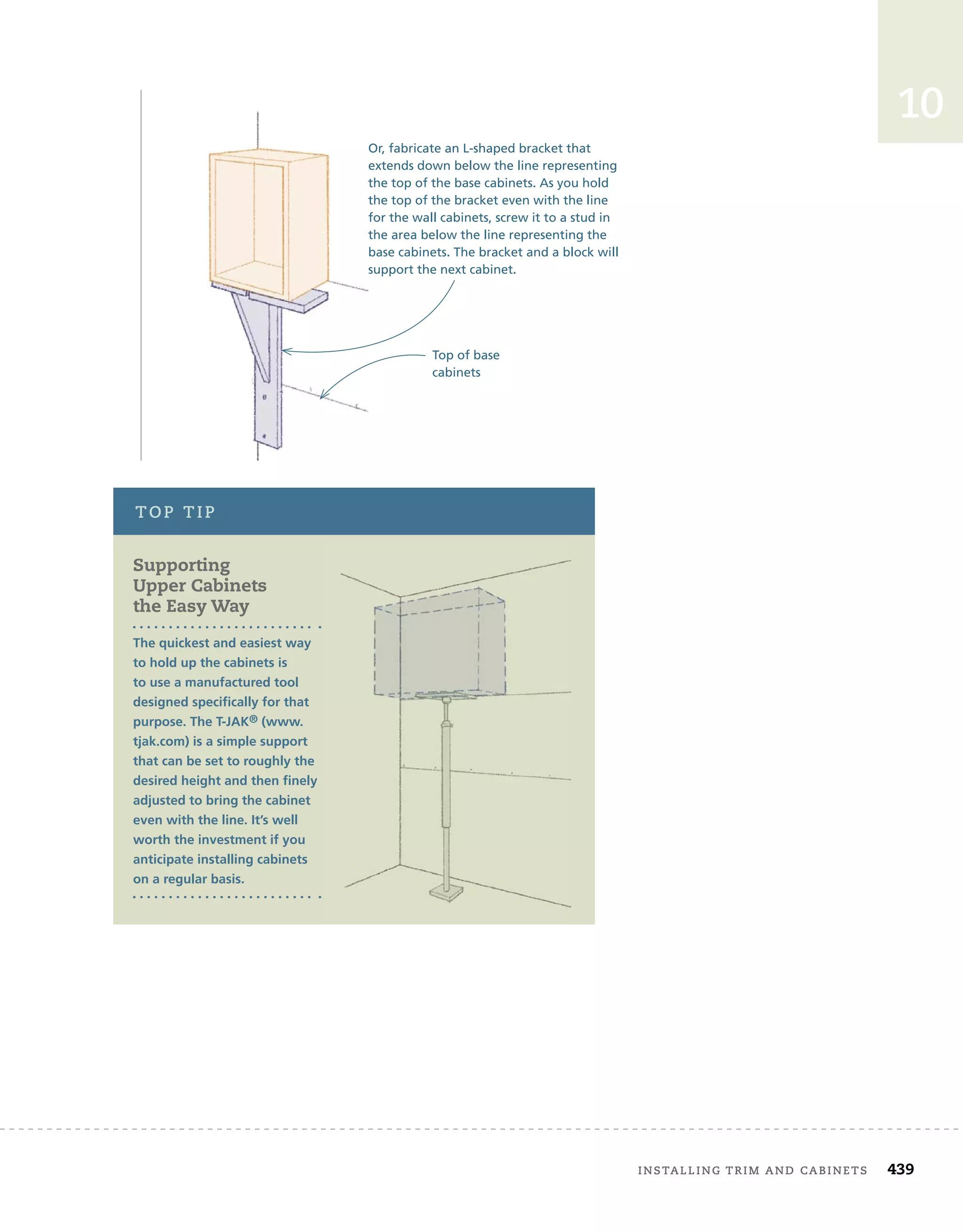
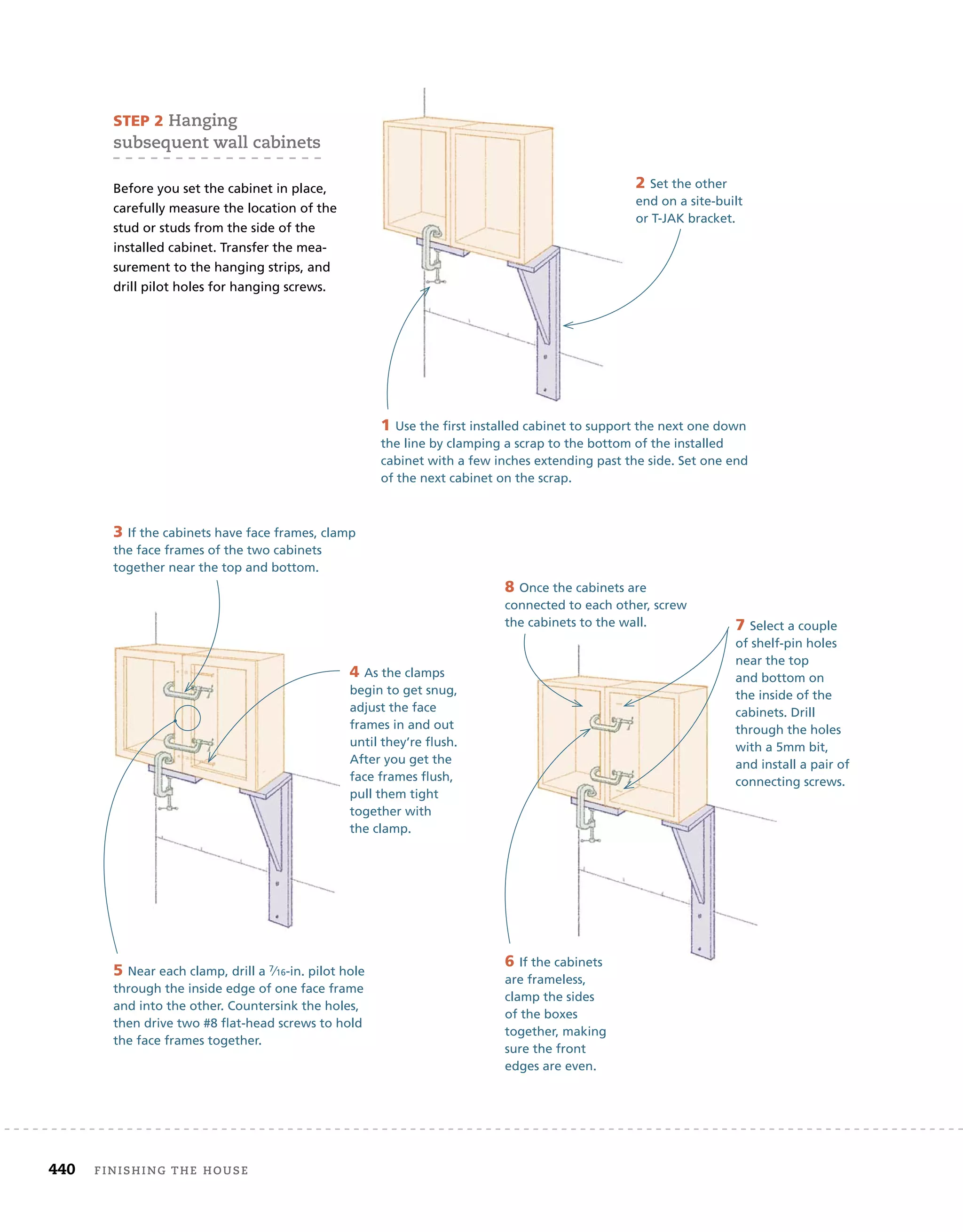
  • 505.
    498 finishing the house •instaLLing the BaLusters 1 Mark the center of each baluster on the stair treads. In this case, the centerline is 13⁄4 in. in from the ends of the treads and midway between the two marks you made for the baluster layout. 2 Transfer the center marks up to the underside of the top rail. The best tool for this job is a self-leveling laser with a plumb (vertical) dot or line. If you don’t have a laser, you can use a level to make a mark on the side of the rail and then carry the layout to the underside of the rail. • driLL hOLes in the treads and the underside Of the raiL tO receive the BaLusters 1 The hole at the bottom should be just a bit deeper than the dowel at the bottom of the baluster. Tape the bit to show when to stop drilling. 2 The hole at the top must be fairly deep and slightly larger than the bal- usters. For the 3⁄4-in. balusters in this example, use a 13⁄16-in. bit and drill the holes 13⁄4 in. deep. When you install the baluster, you’ll have to slide it far enough up into the rail to allow the dowel at the bottom to clear the tread. Once it’s over the hole at the bottom, you can slide it down into the hole. As with the bottom, tape the drill bit to show when you reach the desired depth. 3 To get the holes in the under- side of the top rail plumb, cut a guide block at an angle that equals the slope of the stairs (35º in this example). 4 After drilling the holes, measure, cut, and install the balusters. Each of the three balusters for each step has to be a different length, so you can’t set up a stop and rapidly cut all the balusters at once. Measure the distance between the tread and the underside of the rail and add 3⁄4 in. After cutting the balusters, dry-fit them. If everything fits, put a dab of glue on the dowel at the bottom, and slide it up into the rail and down into the hole at the bottom. Drill a pilot hole and drive a single 3d finish nail at an angle at the top and bottom of each baluster. Laser transfers layout to underside of rail.
  • 506.
    building stairs 499 11 steP 2 find the number and size of the increments Dividethe overall length by the increment size along the stairs: 136.375 ÷ 3.356 = 40.63. Round this number to find the number of increments (41). Divide the overall length by the number of increments to determine the size of the incre- ments: 136.375 ÷ 41 = 3.3262195. steP 3 layout the centers of the balusters Using one of the techniques described in “Three Ways to Divide a Space into Equal Increments” on p. 460, lay out 41 equal increments along the 136.375-in. length. The marks represent the centers of the balusters. Install the balusters using the techniques described on p. 498. • Laying Out and instaLLing the BaLusters On the BaLcOny The layout of the balusters on the balcony should match the layout of the balus- ters along the stairs. On the stairs in this example, there were three balusters for every 10.07 in. of tread depth. The increment between the balusters, therefore, was 3.356 (10.07 ÷ 3 = 3.356). The increments along the balcony should be as close as possible to this increment. steP 1 find the overall length of the layout 2 Mark a distance equal to half the circumference of the base of a baluster beyond each line. Since the balusters are 11⁄4 in. thick at the base, you should measure 5⁄8 in. out from each line. The distance between these marks, 1363⁄8 in. in this example, is the overall length of the layout. 1 Set a 2x4 against the two newels, and mark along the edges. These lines mark the distance between the newels. 1363⁄8 in. Newel Baluster Nosing Skirtboard Newel
  • 507.
    500 Conversions F r act i o n s to D e c i m a l s Divide numerator (upper number) by denominator (lower number). Example: 3⁄8 in. = 0.375 in. (3 ÷ 8 = 0.375) D e c i m a l P o rt i o n o f a n I n c h to F r ac t i o n s o f a n I n c h Multiply decimal by 16 and round to the nearest whole number to find the number of sixteenths; convert to eighths or quarters, if necessary. Example: 0.352 = 3⁄8 in. (0.352 X 16 = 5.63; 5.63 rounds to 6; 6/16 = 3⁄8) I n c h e s to C e n t i m e t e r s Multiply inches by 2.54. Example: 120 in. = 304.8 cm (120 X 2.54 = 304.8) C e n t i m e t e r s to I n c h e s Divide centimeters by 2.54. Example: 84cm = 33.07 in. (84 ÷ 2.54 = 33.07)
  • 508.
    appendices 501 Base-1 Proportionsof Standard Roof Pitches X - i n - 1 2 R o o f P i t c h Ba s e A lt i t u d e h y p ot e n u s e 1-in-12 1 0.083 1.003 2-in-12 1 0.166 1.014 3-in-12 1 0.25 1.031 4-in-12 1 0.333 1.054 5-in-12 1 0.417 1.083 6-in-12 1 0.5 1.118 7-in-12 1 0.583 1.158 8-in-12 1 0.666 1.202 9-in-12 1 0.75 1.25 10-in-12 1 0.833 1.302 11-in-12 1 0.917 1.357 12-in-12 1 1.0 1.414 13-in-12 1 1.083 1.474 14-in-12 1 1.166 1.537 15-in-12 1 1.25 1.601 16-in-12 1 1.333 1.667 17-in-12 1 1.417 1.734 18-in-12 1 1.5 1.803 19-in-12 1 1.583 1.873 20-in-12 1 1.666 1.944 21-in-12 1 1.75 2.016 22-in-12 1 1.833 2.088 23-in-12 1 1.917 2.162 24-in-12 1 2.0 2.236
  • 509.
    502 appendices Backing Anglesfor Regular Hips and Valleys P i t c h o f H i p o r Va l l e y Bac k i n g A n g l e 1-in-16.97 3.4 ° 2-in-16.97 6.7° 3-in-16.97 9.9° 4-in-16.97 12.9° 5-in-16.97 15.8° 6-in-16.97 18.4° 7-in-16.97 20.9° 8-in-16.97 23.1° 9-in-16.97 25.1° 10-in-16.97 26.9° 11-in-16.97 28.5° 12-in-16.97 30° 13-in-16.97 31.3° 14-in-16.97 32.5° 15-in-16.97 33.5° 16-in-16.97 34.5° 17-in-16.97 35.3° 18-in-16.97 36° 19-in-16.97 36.7° 20-in-16.97 37.3° 21-in-16.97 37.9° 22-in-16.97 38.4° 23-in-16.97 38.8° 24-in-16.97 39.2°
  • 510.
    503 appendices 503 Base-1Proportions of Regular Hip and Valley Pitches X - i n - 1 6 . 9 7 P i t c h Ba s e A lt i t u d e h y p ot e n u s e 1-in-16.97 1 0.059 1.002 2-in-16.97 1 0.118 1.007 3-in-16.97 1 0.177 1.016 4-in-16.97 1 0.236 1.027 5-in-16.97 1 0.295 1.043 6-in-16.97 1 0.354 1.061 7-in-16.97 1 0.412 1.082 8-in-16.97 1 0.471 1.106 9-in.16.97 1 0.530 1.132 10-in.16.97 1 0.590 1.161 11-in.16.97 1 0.648 1.192 12-in-16.97 1 0.707 1.225 13-in-16.97 1 0.766 1.260 14-in-16.97 1 0.825 1.296 15-in-16.97 1 0.884 1.335 16-in-16.97 1 0.943 1.374 17-in-16.97 1 1.002 1.415 18-in-16.97 1 1.061 1.458 19-in-16.97 1 1.120 1.501 20-in-16.97 1 1.179 1.546 21-in-16.97 1 1.237 1.591 22-in-16.97 1 1.296 1.637 23-in-16.97 1 1.335 1.684 24-in-16.97 1 1.414 1.732
  • 511.
    504 appendices Converting X-in-12Roof Pitch to Degrees of an Angle X - i n - 1 2 P i t c h D e g r e e s 1-in-12 4.76° 2-in-12 9.46° 3-in-12 14.04° 4-in-12 18.43° 5-in-12 22.62° 6-in-12 26.57° 7-in-12 30.26° 8-in-12 33.69° 9-in-12 36.87° 10-in-12 39.81° 11-in-12 42.51° 12-in-12 45° 13-in-12 47.29° 14-in-12 49.40° 15-in-12 51.34° 16-in-12 53.13° 17-in-12 54.78° 18-in-12 56.31° 19-in-12 57.72° 20-in-12 59.04° 21-in-12 60.26° 22-in-12 61.39° 23-in-12 62.45° 24-in-24 63.43°
  • 512.
    appendices 505 Converting X-in-16.97Roof Pitch to Degrees X - i n - 1 6 . 9 7 P i t c h D e g r e e s 1-in-16.97 3.37° 2-in-16.97 6.72° 3-in-16.97 10.3° 4-in-16.97 13.26° 5-in-16.97 16.42° 6-in-16.97 19.47° 7-in-16.97 22.42° 8-in-16.97 25.24° 9-in-16.97 27.94° 10-in-16.97 30.51° 11-in-16.97 32.95° 12-in-16.97 35.27° 13-in-16.97 37.45° 14-in-16.97 39.52° 15-in-16.97 41.47° 16-in-16.97 43.31° 17-in-16.97 45.05° 18-in-16.97 46.69° 19-in-16.97 48.23° 20-in-16.97 49.69° 21-in-16.97 51.01° 22-in-16.97 52.35° 23-in-16.97 53.58° 24-in-16.97 54.74°
  • 513.
    506 appendices Miter andBevel Settings for Crown Molding 5 2 / 3 8 ° C r ow n M o l d i n g 4 5 / 4 5 ° C r ow n M o l d i n g Angle between Walls Miter Setting Bevel Setting Miter Setting Bevel Setting 67 42.93 41.08 46.89 36.13 68 42.39 40.79 46.35 35.89 69 41.85 40.50 45.81 35.64 70 41.32 40.20 45.28 35.40 71 40.79 39.90 44.75 35.15 72 40.28 39.61 44.22 34.89 73 39.76 39.30 43.70 34.64 74 39.25 39.00 43.18 34.38 75 38.74 38.69 42.66 34.12 76 38.24 38.39 42.15 33.86 77 37.74 38.08 41.64 33.60 78 37.24 37.76 41.13 33.33 79 36.75 37.45 40.62 33.07 80 36.27 37.13 40.12 32.80 81 35.79 36.81 39.62 32.53 82 35.31 36.49 39.13 32.25 83 34.83 36.17 38.63 31.98 84 34.36 35.85 38.14 31.70 85 33.90 35.52 37.66 31.42 86 33.43 35.19 37.17 31.14 87 32.97 34.86 36.69 30.86 88 32.52 34.53 36.21 30.57 89 32.07 34.20 35.74 30.29
  • 514.
    appendices 507 5 2/ 3 8 ° C r ow n M o l d i n g 4 5 / 4 5 ° C r ow n M o l d i n g Angle between Walls Miter Setting Bevel Setting Miter Setting Bevel Setting 90 31.62 33.86 35.26 30.00 91 31.17 33.53 34.79 29.71 92 30.73 33.19 34.33 29.42 93 30.30 32.85 33.86 29.13 94 29.86 32.51 33.40 28.83 95 29.43 32.17 32.94 28.54 96 29.00 31.82 32.48 28.24 97 28.58 31.48 32.02 27.94 98 28.16 31.13 31.58 27.64 99 27.74 30.78 31.13 27.34 100 27.32 30.43 30.68 27.03 101 26.91 30.08 30.24 26.73 102 26.50 29.73 29.80 26.42 103 26.09 29.38 29.36 26.12 104 25.69 29.02 28.92 25.81 105 25.29 28.67 28.48 25.50 106 24.89 28.31 28.05 25.19 107 24.49 27.95 27.62 24.87 108 24.10 27.59 27.19 24.56 109 23.71 27.23 26.77 24.24 110 23.32 26.87 26.34 23.93 111 22.93 26.51 25.92 23.61 112 22.55 26.15 25.50 23.29
  • 515.
    508 appendices 5 2/ 3 8 ° C r ow n M o l d i n g 4 5 / 4 5 ° C r ow n M o l d i n g Angle between Walls Miter Setting Bevel Setting Miter Setting Bevel Setting 113 22.17 25.78 25.08 22.97 114 21.79 25.42 24.66 22.65 115 21.42 25.05 24.25 22.33 116 21.04 24.68 23.84 22.01 117 20.67 24.31 23.43 21.68 118 20.30 23.94 23.02 21.36 119 19.93 23.57 22.61 21.03 120 19.57 23.20 22.21 20.70 121 19.20 22.83 21.80 20.38 122 18.84 22.46 21.40 20.05 123 18.48 22.09 21.00 19.72 124 18.13 21.71 20.61 19.39 125 17.77 21.34 20.21 19.06 126 17.42 20.96 19.81 18.72 127 17.06 20.59 19.42 18.39 128 16.71 20.21 19.03 18.06 129 16.37 19.83 18.64 17.72 130 16.02 19.45 18.25 17.39 131 15.67 19.07 17.86 17.05 132 15.33 18.69 17.48 16.71 133 14.99 18.31 17.09 16.38 134 14.65 17.93 16.71 16.04 135 14.30 17.55 16.32 15.70
  • 516.
    appendices 509 5 2/ 3 8 ° C r ow n M o l d i n g 4 5 / 4 5 ° C r ow n M o l d i n g Angle between Walls Miter Setting Bevel Setting Miter Setting Bevel Setting 136 13.97 17.17 15.94 15.36 137 13.63 16.79 15.56 15.02 138 13.30 16.40 15.19 14.68 139 12.96 16.02 14.81 14.34 140 12.63 15.64 14.43 14.00 141 12.30 15.25 14.06 13.65 142 11.97 14.87 13.68 13.31 143 11.64 14.48 13.31 12.97 144 11.31 14.09 12.94 12.62 145 10.99 13.71 12.57 12.28 146 10.66 13.32 12.20 11.93 147 10.34 12.93 11.83 11.59 148 10.01 12.54 11.46 11.24 149 9.69 12.16 11.09 10.89 150 9.37 11.77 10.73 10.55 151 9.05 11.38 10.36 10.20 152 8.73 10.99 10.00 9.85 153 8.41 10.60 9.63 9.50 154 8.09 10.21 9.27 9.15 155 7.77 9.82 8.91 8.80 156 7.46 9.43 8.55 8.45 157 7.14 9.04 8.19 8.10 158 6.82 8.65 7.83 7.75
  • 517.
    510 appendices 5 2/ 3 8 ° C r ow n M o l d i n g 4 5 / 4 5 ° C r ow n M o l d i n g Angle between Walls Miter Setting Bevel Setting Miter Setting Bevel Setting 159 6.51 8.26 7.47 7.40 160 6.20 7.86 7.11 7.05 161 5.88 7.47 6.75 6.70 162 5.57 7.08 6.39 6.35 163 5.26 6.69 6.03 6.00 164 4.95 6.30 5.68 5.65 165 4.63 5.90 5.32 5.30 166 4.32 5.51 4.96 4.94 167 4.01 5.12 4.61 5.59 168 3.70 4.72 4.25 4.24 169 3.39 4.33 3.90 3.89 170 3.08 3.94 3.54 3.53 171 2.77 3.54 3.19 3.18 172 2.47 3.15 2.83 2.83 173 2.15 2.75 2.48 2.47 174 1.85 2.36 2.12 2.12 175 1.54 1.97 1.77 1.77 176 1.23 1.58 1.41 1.41 177 0.92 1.18 1.06 1.06 178 0.62 0.79 0.71 0.71 179 0.31 0.39 0.35 0.35
  • 518.
    511 Index A Air basic facts, 290 sealing,306 vapor (see Vapor) Asphalt-shingle roofs components of, 189 cutting and fitting shingles, 204–5 flashing (see Flashing) gauged roofing hammer, use of, 201 installing, 197, 199–201 layout, 190 horizontal courses, 190–91 increment for snapping chalklines, 190 maintaining the offset when crossing obstructions, 195 the offset, 192–93, 196 undersize tabs along the rakes, avoiding, 194 low slope advisory for, 186 minimum pitch for, 187, 189 obstacles, shingling around, 218–20 ridge and hip caps, installing, 226–29 ridge vents, installing, 229–30 three patterns for shingling, 202–3 underlayment and drip edge, 197–99 valleys, options for shingling, 215–17 Attic trusses, 145 B Backing, 52, 88, 91, 119 Backing bevels, 104 Balustrades exterior, 467 level sections, cutting, assembling, and installing, 470–73 level sections, laying out, 468–69 posts, safe cutting of, 471 sloped sections, cutting, assembling, and installing, 477–78 sloped sections, laying out, 474–76 interior, 496 balusters, installing, 498 balusters on the balcony, laying out and installing, 499 laying out a code- complying, 496–97 Baseboard molding. See Trim, baseboard Basement bearing walls, 60 Basements allowing concrete to dry, 294, 296 controlling water, 49, 282–83 excavating, 8 laying out, 12–13, 16–18, 20–23 rigid foam sheets on walls, 294, 296 vapor barriers and capillary breaks, 295–96 Bathrooms, blocking needed for, 88–89 Batter boards foundation layout, use in, 18, 20, 21, 27, 28, 29, 30, 31 non-right triangles and curves, use in laying out, 33 stringlines, use with, 25 using additional when adding rectangles to the foundation, 32 Blocking, 52, 67, 88–91, 237 Bridging, 67 Building codes fire protection, 52 frost line, bottom of footings below, 8 roof sheathing, performance standards for, 179 stairs, dimensions of, 447 Building inspectors engineered lumber used for floor systems, 68 soil, advice on, 7 Butt joint, 404 Butt-marking gauge, 367 C Cabinets appliances, leaving room for, 436 check clearances and allowance for the finished floor, 435 cutting and fitting filler strips, 441 installing base, 441 installing wall, 436, 438–40 layout, 436, 437 remove drawers and doors, 436 screws for hanging, 438 supporting upper, 439 Cantilever trusses, 146 Ceilings blocking needed for, 91 controlling vapor, 303–4 drywall (see Drywall) installing under a hip roof, 119
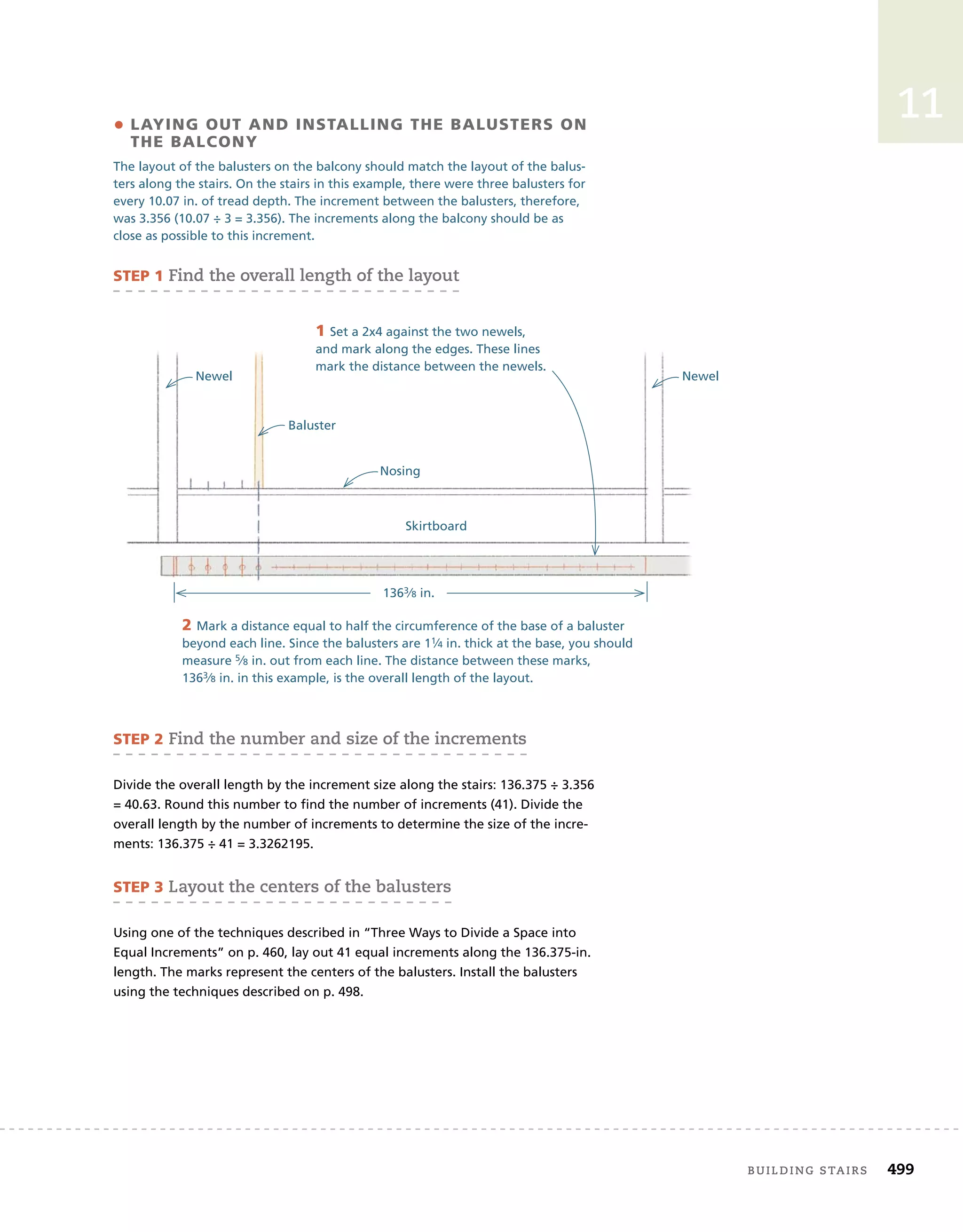
  • 519.
    512 index joists for,93–94, 118 large openings in, 93 laying out on top plates, 92–93 solid-sawn tongue-and- groove plank paneling, 334–35 Ceramic tile cutting, 350 cutting backer board, 345 grouting and cleaning, 352–53 installing backer board on floors, 346 installing backer board on walls, 345 laying out, 347–48 membranes used with, 346 setting, 349–51 tile floor, components of, 344 underlayment under, 349 Chalklines, 190 Chimneys masonry, building a cricket and flashing, 222–24 stone, flashing, 224–25 Circular saws, guide for using, 364 Climate controlling vapor in ceilings based on, 303–4 controlling vapor in walls based on, 299–302 zones, 297 Collar ties, 99 Composite panels, 179 Compound angles, cutting, 104 Compound miter joints, 404, 422–23 Concrete admixtures, 47 curing, 43–44 estimating volume, 45, 46 floors, letting moisture exit from, 294 forms, 44–45, 452 forms, aligning and bracing, 46 ingredients, 41 poured for exterior stairs, 453 poured for foundation walls, 44–47 slump, 42, 453 stairs, 449–53 strengths and weaknesses, 41 subcontractor, hiring a, 47 water and, 42–43 Concrete block building corners, 37 foundation walls, 34–40 fudging the layout, 36 laying to a line, 38 mortar, 38, 39 rebar, cleanouts, and grout, 40 troweling technique, 39 unit spacing, 36 Condensation, preventing with insulation, 306–7 Conversions between units of measure, 500 Coped joints, 405, 419 Corners houses without trimmed corners, 260 installing trim, 257–59 Cornices framing a return, 173 returns, building structurally sound, 171 return with a hip roof, 176 return with a shed roof, 174–75 Corrugated wall ties, 275 Crawlspaces controlling vapor, 294–95 controlling water, 49, 283 excavating, 8 laying out, 26–31 Cricket, building and flashing a, 222–24 Crown molding. See Trim, crown molding D Damp-proofing and waterproofing, 285–87 Deck ledgers, flashing, 251 Door-boring jig, 373 Doors, 354 arched, flashing tops of, 244–46 bifold, 390 framing the opening and installing the jamb, 390–93 installing casing and hardware, 393–94 installing doors, 394–95 boring locksets, 372–73 casings and cabinets, blocking needed for, 90 fitting new doors to existing openings, 361–63, 365–68, 370–71, 374 flashing sides and top of, 243 flashing wide doorsills, 244 foam sealing around, 305 hanging French double doors, 375–82 hanging prehung, 355–61
  • 520.
    index 513 hollow core,concerns regarding, 362 installing, 241–42 installing casing, 397–99, 402–3 layout of rough openings for, 74, 75 (see also Headers) mortising hinges, latch plates, and strikes, 369 openings, installing underlayment around, 234–35 plumbing door shims, 359 pocket, 383 finishing the wall and installing trim, 387–89 framing the opening, 383–85 hanging the door, 386 important things to know about, 384 screws, using, 386 preformed jambs, 394 prehung, styles of, 355 rough openings, adjusting, 357 securing on edge, 366 Dormer, doghouse, 136–41, 218–19 Drainage boards, 286–88 Drip edge, 189, 197, 199 Drop-top gable-end trusses, 145, 166 Drywall basics of, 311–12 carrying, 315 cutting around electrical boxes and small fixtures, 320–22 lipstick, marking electrical boxes and small fixtures with, 320 special-purpose tools for, 318 tools and techniques for, 316–17, 319 using a drywall router, 322 fastening systems, 323 finishing extra coats to reduce sanding, 334 first coat, 328–29 inside corners, 330 materials, 325 second coat, 330–31 third coat, 332–33 working with mud, 332–34 hanging, 314 arched openings, 324 ceilings and walls, 324, 326–27 corner beads, installing, 324 expansion gap for flooring, allowing for, 339 tolerances, 314 ordering, estimates for, 314 types of matched to the job, 313 E Eaves begin planning for, 155 cross blocks or soffit joists, installing, 163 cutting tails in place, procedure for, 158–60 ledger, installing the, 163 precut rafter and truss tails, adjustments to, 157 subfascia, advantages of using, 162 subfascia, procedure for installing, 160–61, 163 trim, installing, 252–54 Elastomeric membrane, 187 Elevations. See Leveling instruments End grain, sealing, 252 Engineered lumber (EL), 55, 68–70, 485 Exterior trim clad-wood and vinyl windows, 259, 261–62 corners, 257–59 corners, houses without trimmed, 260 eaves, 252–54 installing, 252 rakes, 254–57 F Fascia, 254 Fire, protection from, 52 Fire blocking, 88 Flashing, 189 apron, 209 back-piece, 212–13 deck ledgers, 251 drip-cap, 243, 247, 248, 249, 262 installing, 206–8 lapped siding, weaving into, 266 lead anchors, making, 222 masonry chimneys, 222–24 masonry siding systems, 274 masonry walls, 220–22 materials for, 206
  • 521.
    514 index as primaryand secondary barriers shedding water, 242 seams between shingles and, 208 sills, materials for, 240 step, 210–11 stone chimneys, 224–25 valleys, treatments of, 213–15 windows and doors, 239–50, 262 Z-, 273 Floors, 54 carpeting, 338 ceramic tile (see Ceramic tile) engineered lumber, use of, 68–70 floating floor systems, 341 floor nailer, use of, 341 installing girders or basement bearing walls, 59–60 installing joists, 61–65 installing sheathing, 65–66 mudsills, 54, 56–59 sealing perimeter from air infiltration, 299 sheet vinyl, 342–43 timing of installation, 336 wood, installation of, 336–37, 339–41 Footings, 8–10 digging, 28–30 forms for, 21 frost lines and depth of, 23 pouring, 22, 30–31 rebar set in, 40 Foundations, 6 backfilling, 289 controlling vapor and capillary action, 293–94 damp-proofing and waterproofing, 285–87 drainage boards, 286–88 excavating, 8–10, 11, 289 footings, 8–10 grading around, 12, 279–80 layouts, 11 basement, 12–13, 16–18, 20–23 beyond rectangular floor plans, 32–33 crawl spaces, 26–31 curves, 33 mudsill, making adjustments in, 58 managing water, 279, 284–89 soil, assessing and preparing, 7, 9 Foundation walls concrete block, 34–40 permanent wood foundations (PWFs), 48–49 poured concrete, 41–47 systems used for, 34 Framing a house, general considerations for anticipating subsequent work, 52 balloon vs. platform frame, 53–54 durability, 51 fire protection, 52 framing circular shapes, 97 functions of the frame, 50 loads, 51 materials used in platform frames, 55 French double doors, 375–82 Frieze, 254, 257 Frost heave, 8, 448 G Gable-end trusses, 145 Geometry of building a house backing angles for regular hips and valleys, 502 base-1 proportions of regular hip and valley pitches, 503 base-1 proportions of standard roof pitches, 501 converting X-in-12 roof pitch to degrees of an angle, 504 converting X-in-16.97 roof pitch to degrees of an angle, 505 dropped gable-end wall, lay out of, 168 gable roof, math and layout in building a, 105–7 hip rafters, 122 jack rafters, 128, 135 pitch, 101, 104 right triangles, working with, 19 Girders, 59–60, 69 Girder trusses, 146 Glulams, 55 Guardrails. See Stairs, rails Guide for saw or router, 364 H Handrails. See Stairs, rails Headers for arched openings, 97 fabricating bearing, 77 fabricating nonbearing, 78 height of, 80, 86 measuring the lengths of, 78 trimmer studs for, 79 Hip caps, 227–29 Hips, roofing. See Roofs, hip Hip trusses, 147 Housewraps, drainable, 236
  • 522.
    index 515 I Insulation air sealingand, 306 controlling vapor, 297, 305–7 IC-rated recessed lights, 304 J Jambs, preformed, 394 Joints for trim carpentry, 404–5 Joists ceiling installing, 94, 118, 119 laying out on top plates, 92 needs of plumbers and electricians, anticipating, 93 pitch of the rafters, cutting ends to conform to, 94 floor details of installation, 67 high spots in the foundation and, 57, 64, 67 installing, 65 installing rim joists, 64 layout on the mudsill, 62–63 sort and crown material, 61 wood I-joists, 55, 70 roof, 99 Jumping jack compactor, 10 L Laser levels, 14, 151 Layouts balustrades, 468–69, 496–97 base-1 triangles, using, 107 cabinets, 437 center of a space, finding the, 73 ceramic tile, 347–48 conversions between units of measure, 500 crown molding, 423–25 cumulative gain or loss in measurement, avoiding, 62 dividing a space into equal increments, 460–61 floors (see Floors) foundations (see Foundations, layouts) gable roof, geometry of building a, 105–7 (see also Roofs, gable) leveling instruments, use of, 14–15 (see also Leveling instruments) math and, difference between, 105 octagons, 97 problems in, splitting the difference when facing, 72 rafters (see Rafters; Roofs) right triangles, working with, 19 rough openings for doors and windows, 75 slant-rule trick, 265, 460 stringlines, setting up, 24–25 (see also Stringlines) walls (see Walls) Leveling instruments aligning trusses with, 151 checking for level, 56 foundation layout and, 17, 18, 26, 27, 29, 31, 32, 33 use of, 14–15 Lighting, IC-rated recessed lights in insulated ceilings, 304 Loads, 51, 100 Lock mortiser, 373 Lumber engineered, advantages of, 68, 485 engineered for floor systems, girders, joists, and trusses, 69–70 nominal sizing of, 254 solid-sawn and engineered, 55, 69 solid-sawn for sheathing, 178 M Masonry foundation walls, used for, 34–40 siding, 273–75 strengths and weaknesses of, 35 Master and split trusses, 147 Metal rafter/truss ties, 156 Miter cuts, 102 Miter joint, 404 Miter returns, safely cutting, 408 Miter saws, 400–401 Modular coordination, 52 Moisture. See Vapor; Water Mortar, 38, 39 Mudsills, 54, 56–59, 62–63 O Offset stakes, 13, 16, 17, 18, 20 Optical levels, 14. See also Leveling instruments Oriented strand board (OSB), 55, 177, 179
  • 523.
    516 index P Paneling, plankand plywood, 334–35 Penetrometer, 9 Perimeter drains, 288 Pipe flanges cutting shingles around, 205 installing flashing around, 206–7 Pitch controlling the flow of water with, 187 converting X-in-12 roof pitch to degrees of an angle, 504 converting X-in-16.97 roof pitch to degrees of an angle, 505 degrees of an angle and, conversion between, 101, 104 designation of, 101 low slope advisory for use of shingles, 186 low-sloped and steep-sloped roofing systems, 185–89 measuring roof, 188 minimum for asphalt- shingled roofs, 187, 189 Pitch triangles, 96 Plywood, 55, 178 R Rafter jigs, 108, 120, 126, 130, 157, 255 Rafters attachment to bearing walls, 156 barge, 164–65, 170, 172, 175 common, 99, 115–16, 117, 118, 121, 131, 134, 139 cornice, 175 cuts required for framing, 102, 104 gable roof, lay out and cutting, 111–12 hip, 99, 115, 116, 118, 122–26 hip roof, lay out and cutting, 115–29 installing, 114, 121 jack, 99, 104, 117, 118, 128–29, 135, 141 tails, 99, 113, 133, 157–58 trusses vs., 103 valley, 99, 132–34 verge, 166, 168–69, 172 Rainscreens, 237–38 Rakes begin planning, 155 cantilevered overhang, building cantilevered rake, framing, 169–70 dropped gable-end wall, laying out and building, 167 notched verge rafters, installing, 168–69 returns, framing, 172–73 venting the first bay, 170 cutting shingles for, 205 flashing the underside of, 211 installing trim, 254–57 ladder-type, building, 164–65, 172 returns, building structurally sound, 171 returns, framing, 172–73 Returns building structurally sound, 171 cornice framing, 173 with a hip roof, 176 with a shed roof, 174–75 rake, framing a, 172–73 Ridge caps, 189, 226–29 Ridges, 99, 109–10, 118, 120, 131–32 Ridge vents, 229–30 Roofing, 184 asphalt-shingle (see Asphalt- shingle roofs) final inspection, 230 protecting fasteners and seams on steep-sloped roofs, 188–89 ruler to use on a roof deck, 191 single-ply systems, installing, 186 two basic systems of, 185 low-sloped roofs, 185–86 steep-sloped roofs, 185, 187–89 valleys (see Valleys) Roofing felt, 199. See also Underlayment Roofs asphalt-shingle (see Asphalt- shingle roofs) built-up, 185 challenges of building, 98, 127 doghouse dormer, 136–41 eaves (see Eaves) flat-seamed metal, 185 gable, 105 lay out, cut and assemble, 109–13 math and the layout of, 105–7, 501 with trusses, 154–55 getting hips and valleys in plane with the roof, 127 hip, 115 backing angles for regular hips and valleys, 502
  • 524.
    index 517 base-1 proportionsof regular hip and valley pitches, 503 ceiling joists and backing under, 119 common rafter lay out and installation, 121 cut and install the ridge, 120 hip rafter assembly and installation, 126 hip rafter lay out and cutting, 122–25 jack rafter lay out and installation, 128–29 key measurements taken off top plates, 118 lay out rafter locations, 115–17 loads carried by, 100 parts of stick-built, 99 pitch of, 101, 104 (See also Pitch) rafters vs. trusses, 103 rain, collecting and draining, 281 rakes (see Rakes) sheathing, 176 installing, 177, 180–81 materials for, 178–79 single-ply, 186 spray polyurethane foam, 186 structural approaches to, 100–101 trusses (see Trusses) valley plates, 140 with valleys, 130 install valley rafters, 134 lay out, cut, and install jack rafters, 135 lay out and and cut valley rafters, 133 lay out and install ridges and common rafters, 131–32 lay out common rafters for area above the header, 134 prep material for valleys, 132 Routers guide for using, 364 mortising hinges, latch plates, and strikes, 369 Rule of Proportion, 447 S Safety cap nails, picking up, 195 concrete delivery trucks, 41 cutting miter returns, 408 cutting posts, 471 fire blocking, 88, 237 frame, as a function of, 51–52 raising walls on a windy day, 84 securing planks set across joists, 111 trenches and basement excavations, 31 unbanding packages of trusses, dangers of, 149 Scarfed joint, 405 Scissor trusses, 145 Sheathing bad spots in tongue or groove, cutting out, 66 installing floor, 65–66 installing roof, 177, 180–81 lay out from the top, 181 performance standards for roof, 179 for roofs, 176, 178–79 Sheetrock. See Drywall Siding adjusting the size of courses, reasons for, 264 installing board-and-batten, 267 interlocking systems, 269 lapped systems with horizontal courses, 263– 66, 276 lapped systems with vertical courses, 266–67, 277 most vulnerable spot, protection at, 276–77 movement from the weather, allowing for, 270–71 nailing lapped, 267, 271 plywood panel, 269, 272–73, 277 profiles of, 263 stucco and masonry, 273–75 vinyl trim, 268 weaving flashing into courses of, 266 Slabs excavation for, 8 managing water under, 282– 83, 293 Slant-rule trick, 265, 460 Slotted truss anchors, 156 Soffit, 253, 255 Soil assessing and preparing, 7 testing, 9 Splice joint, 405 Staircases, blocking needed for, 90 Stair jig, 458 Stairs, 442 balustrades (see Balustrades) exterior, 448 interior, 479 landings, laying out, 484 newels, cutting notches in, 491 newels, installing, 487–89
  • 525.
    518 index risers andtreads, installing, 493–95 riser/tread combination, calculating, 480–81 skirtboards, installing, 490, 492 stairwell, calculating length of, 482 stairwell, laying out, 479–80 stringers, fastening, 485–86 stringers, laying out, 483 key dimensions of, 445–46 masonry, 448 parts of, 443 poured concrete, 449–53 rails graspable handrail inside a guardrail, 467 key dimensions of, 446 riser/tread combinations, choosing, 447, 450 stringers, materials for, 485 terminology of building, 444 wood exterior design considerations, 454 footing, digging, 463–64 grade, measuring difference in, 456 landing and posts, positioning and pouring concrete for, 465–66 rise, calculating adjusted total, 457 rise, estimating total, 455 risers, choosing size for, 457 risers and treads, installing, 467 stringers, attaching to the deck, 455 stringers, cutting, 463 stringers, dividing into equal parts, 459 stringers, installing, 464–65 stringers, laying out, 454 stringers, marking risers and treads on, 462 top and bottom stairs, laying out, 462 Story poles/sticks balustrades, layout of, 497 cement block corners, use in building, 37 rafters, layout of, 112, 121, 134 siding, use in installing, 265 Stringlines aligning trusses with, 151 checking layout of foundation walls, 23 footings, layout of, 29, 30 laying block walls, 37, 38 laying out angles that are not 90°, 33 laying out foundations, 27, 28 layout of foundation walls, 31 poured concrete walls, layout of, 46 setting up, 24–25 Structural composite lumber (SCL), 55, 69–70 Studs cripple, 80 king, trimmer, and cripple for rough openings, 74 trimmer, 79 Subfascia, 160–61, 162, 163, 164, 169, 175 T Toenails, 156 Treated wood, 51 Trim, 396–97 baseboard carpeted floors, caution regarding, 414 cutting and fitting, 414–18 expansion gap for flooring, allowing for, 339 installing, 410 planning and preparing for, 411 raising off the subfloor, 413 chair rail molding, 420 coped joints, fine-tuning, 419 crown molding, 421 attaching, 431 cutting and fitting inside corners, 426–28 cutting compound miters, 422–23 fitting outside corners on the flat, 430–31 fitting outside corners with the nesting method, 429 laying out, 423–25 measuring and cutting inside corner to outside corner, 428 miter and bevel settings for, 506–10 oblique angles, running around, 434 order of installation, 421–22 door casing, 397–99, 402–3 exterior (see Exterior trim) inside-to-inside measurements, tip for making, 415, 428 miter returns, safely cutting, 408 nailing schedule, 405 oblique (not right) angles, methods for, 432–33
  • 526.
    index 519 studs, locating,416 window, 406–9 Trim carpentry joints for, 404–5 miter vs. bevel cuts, 405 six rules of, 412–13 Trusses, 55, 142–43 aligning during installation, 151 alterations of, need to avoid, 144 attachment to bearing walls, 156 braces: ground, temporary, and permanent, 152–53, 155 drop-top gable-end trusses, 145, 166 as a framework of triangles, 143 gable roof built with, 154–55, 157 moving and hoisting, 150 options for, 145–47 ordering, 148 organizational oversight of design and manufacture, 144 parallel-chord floor trusses, 70 rafters vs., 103 storing and handling, 148–49 unbanding packages of, dangers from, 149 Truss Plate Institute, 144 U Underlayment under ceramic tile, 349 under roofing shingles, 189, 197–98, 199 under siding, 234–35 (see also Weather-resistive barriers (WRBs)) V Valley plates, 140 Valleys cutting shingles for, 205 flashing in, 213–15 framing (see Roofs, with valleys) options for shingling, 215–16 shingling when roofs have different pitches, 217 Valley trusses, 146 Vapor air transport of, 290–91 controlling in foundations and basements, 293–97 controlling in wood-framed assemblies, 297–308 in ceiling assemblies, 303–4 in framed floor systems, 298–99 in framed walls, 299–302 controlling transmission of, 233, 290 diffusion through building materials, 291–92 permeability of building materials, 298 permeable and impermeable materials, 292 using insulation to control, 297, 305–7 Ventilation with asphalt-shingle roofs, 189 ridge vents, 229–30 Vents cutting shingles around, 205 installing flashing around, 206–7 Vix bits, 370 W Wallboard. See Drywall Walls blocking and backing, 88–91 ceramic tile (see Ceramic tile) cutting shingles to fit against, 205 dropped gable-end, 166, 167 drywall (see Drywall) exterior assembling, 81–82 bearing headers, 77 cripple studs and windowsills, 80 fabricated corners, 76 fabricating components of, 76–80 laying out details on plates, 73–74 laying out locations of, 71–72 nonbearing headers, 78 raising and bracing, 84–85 sheathing, 83 T-intersections, 76 trimmer studs and bearing headers for doors, 79 flashing masonry, 220–22 framing circular shapes, 97 gable-ends framing, 95–96 pitch triangle, using a, 96 installing flashing at the roof/wall juncture, 208 interior layout, details to remember during, 86 lifting and installing, 87 paneling, plank and plywood, 334–35 second top plate, installing the, 87 vapor control in, 299–302, 307
  • 527.
    520 indeX Water in theair (see Vapor) controlling, foundations and, 48–49 damp-proofing and waterproofing foundations, 285–87 durability of frame construction and, 51 inside siding, 236 managing groundwater, 279, 282–89 managing outside the foundation, 284–89 managing surface, 279–81 managing under a slab or basement, 282–83 most vulnerable spot, protection at, 276–77 movement in the ground, 282 perimeter drains, 288 primary and secondary barriers for shedding, 242 rain from the roof, collecting and draining, 281 shedding rainwater, 232–33 sump crock, setting a, 284–85 See also Vapor Weather-resistive barriers (WRBs), 234–37 flashing sides and tops of doors and windows, 243, 245–50, 261–62 stucco and masonry siding systems and, 273–74 Weatherstripping, trimming windows, 261 Windows arched, flashing tops of, 244–46 clad-wood and vinyl, installing trim around, 259, 261–62 flashing bottom of the opening, 239 flashing sides and top of, 243 foam sealing around, 305 installing, 241–42 installing trim, 406–9 layout of rough openings for, 74, 75 (see also Headers) octagonal, flashing tops of, 248–49 openings, installing underlayment around, 234–35 round, flashing tops of, 250 sills, materials for flashing, 240 slope-topped, flashing tops of, 247 Windowsills, 80 Wood I-joists, 55, 70 Wood Truss Council of America, 144
  • 529.
    If you likethis book, you’ll love Fine Homebuilding. Read Fine Homebuilding Magazine: Get eight issues, including our two annual design issues, Houses and Kitchens Baths, plus FREE tablet editions. Packed with expert advice and skill- building techniques, every issue provides the latest information on quality building and remodeling. Subscribe today at: FineHomebuilding.com/4Sub Discover our Fine Homebuilding Online Store: It’s your destination for premium resources from America’s best builders: how-to and design books, DVDs, videos, special interest publications, and more. Visit today at: FineHomebuilding.com/4More Get our FREE Fine Homebuilding eNewsletter: Keep up with the current best practices, the newest tools, and the latest materials, plus free tips and advice from Fine Homebuilding editors. Sign up, it’s free: FineHomebuilding.com/4Newsletter Become a FineHomebuilding.com member Join to enjoy unlimited access to premium content and exclusive benefits, including: 1,400+ articles; 350 tip, tool, and technique videos; our how-to video project series; over 1,600 field-tested tips; monthly giveaways; tablet editions; contests; special offers, and more. Discover more information online: FineHomebuilding.com/4Join FREE tablet editions
  • 530.
    Themostcomprehensive step-by-step guide to residentialcarpentry HOUSE HOME FROM THE PUBLISHERS OF FINE HOMEBUILDING John Carroll has been building and repairing houses since the late 1960s. He writes regularly for Fine Homebuilding magazine and is the author of two best-selling books, Working Alone and Measuring, Marking Layout. Chuck Lockharthas worked with The Taunton Press for well over 20 years, first as art director for Fine Homebuilding magazine, where he helped define the look of the magazine, and most recently as an illustrator of Taunton Press books. If the idea of building your own home with your own hands sounds positively exhilarating, The Complete Visual Guide to Building a House will show you how. This essential reference takes a unique visual approach to instruction, with over 1,000 drawings of every step in the building process—from laying a foundation through installing the finishing touch on a newel post. Combining the expertise of builder John Carroll and the engaging drawings of illustrator Chuck Lockhart, this guide is just that: complete. Fine Homebuilding