The collaboration network in OSM:
the case of Italy.
Maurizio Napolitano
<napo@fbk.eu>
State of the Map 2013
The OpenStreetMap Event
6-8 September 2013
Birmingham, UK
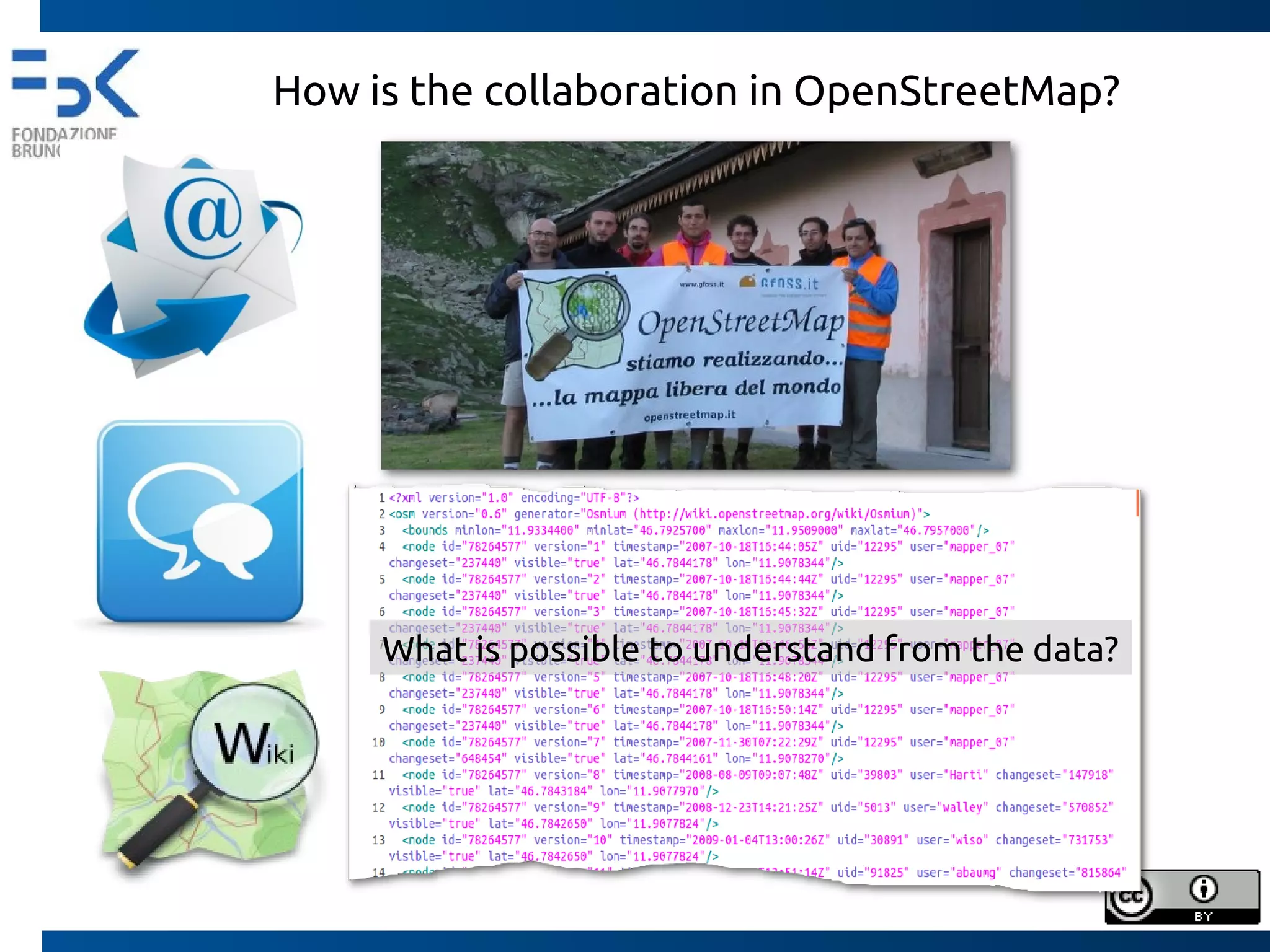
How is the collaboration in OpenStreetMap?
What is possible to understand from the data?
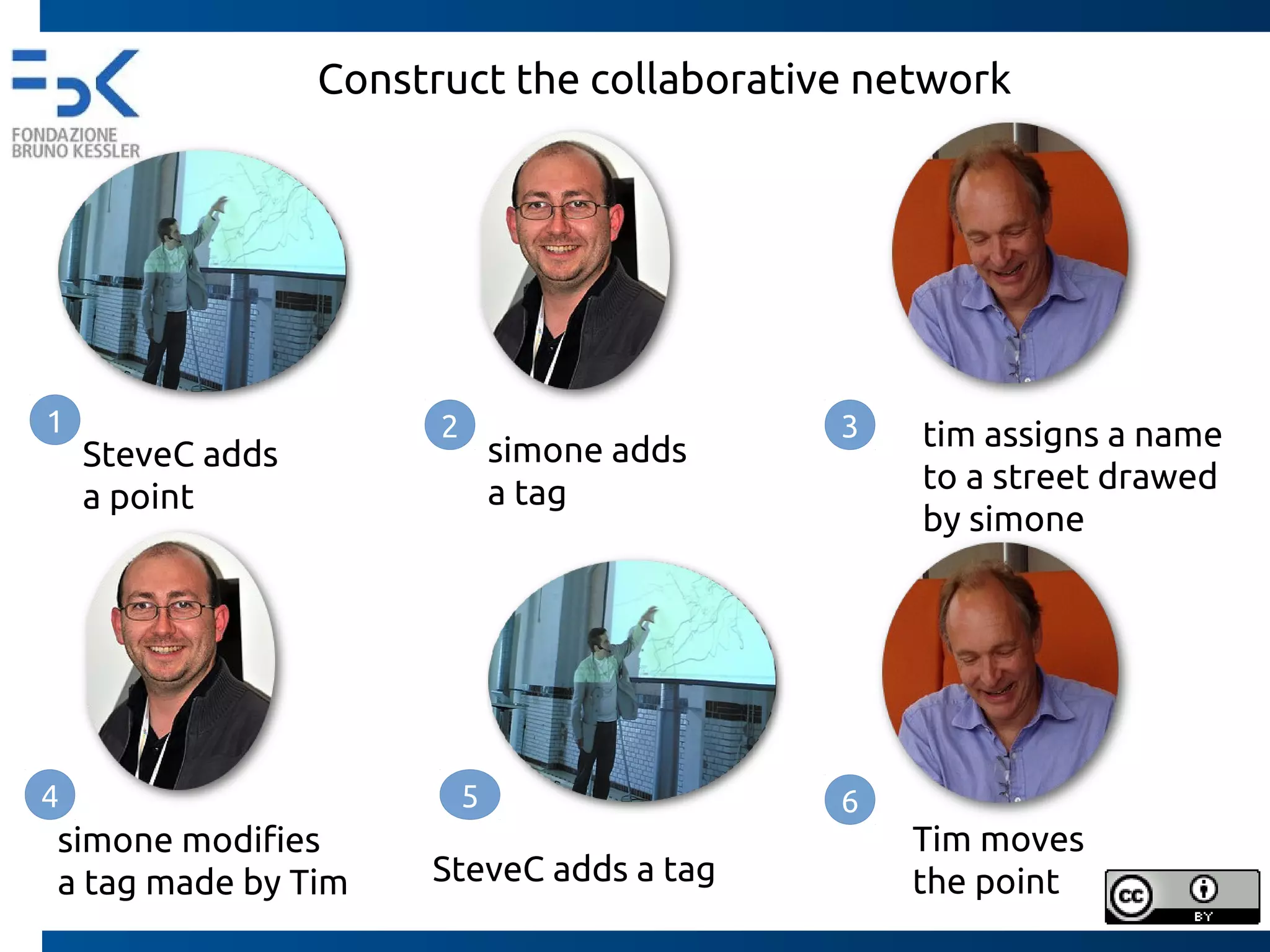
Construct the collaborative network
simone modifies
a tag made by Tim
SteveC adds
a point
simone adds
a tag
1 2 3
4
tim assigns a name
to a street drawed
by simone
5
SteveC adds a tag
6
Tim moves
the point
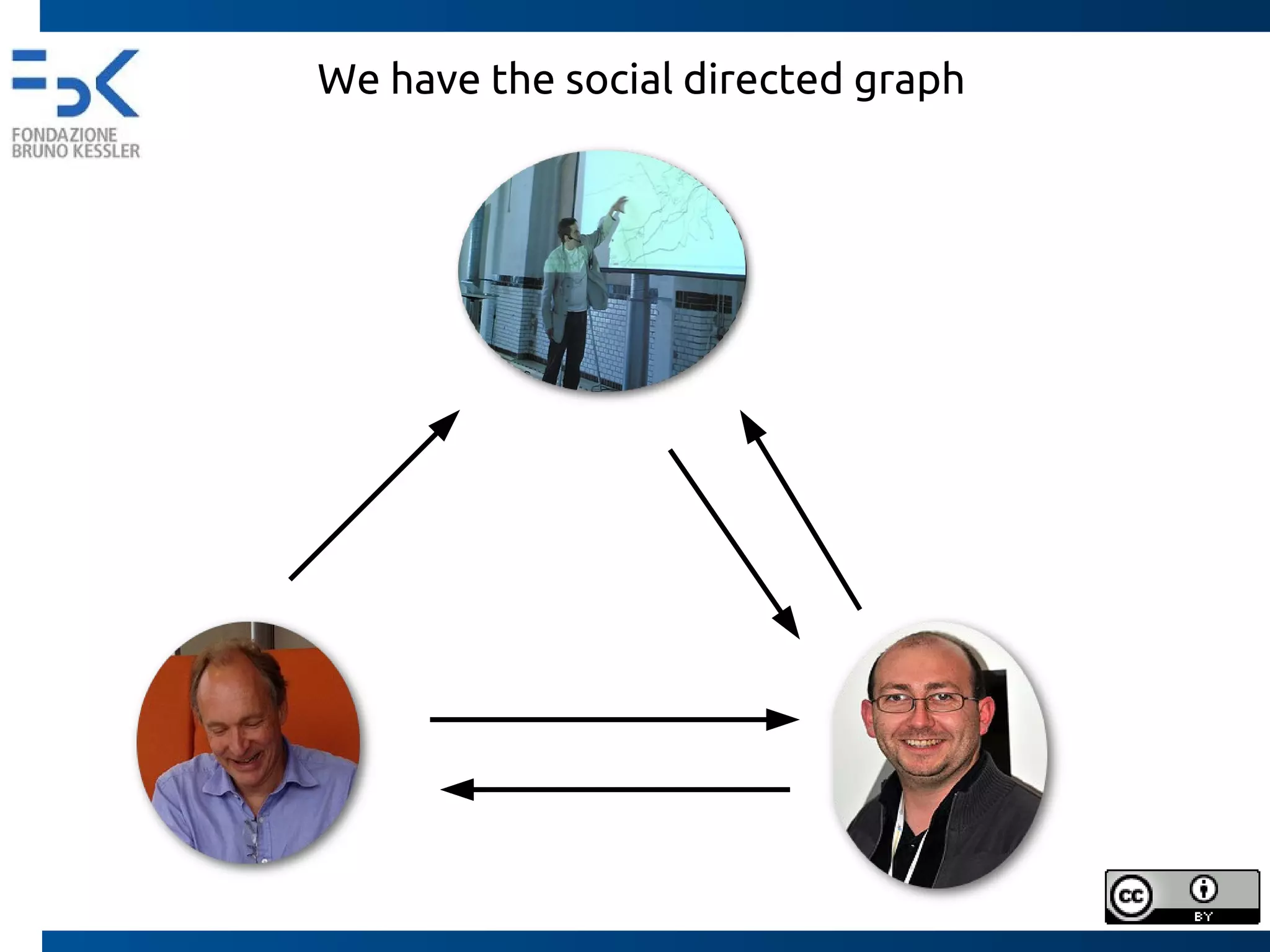
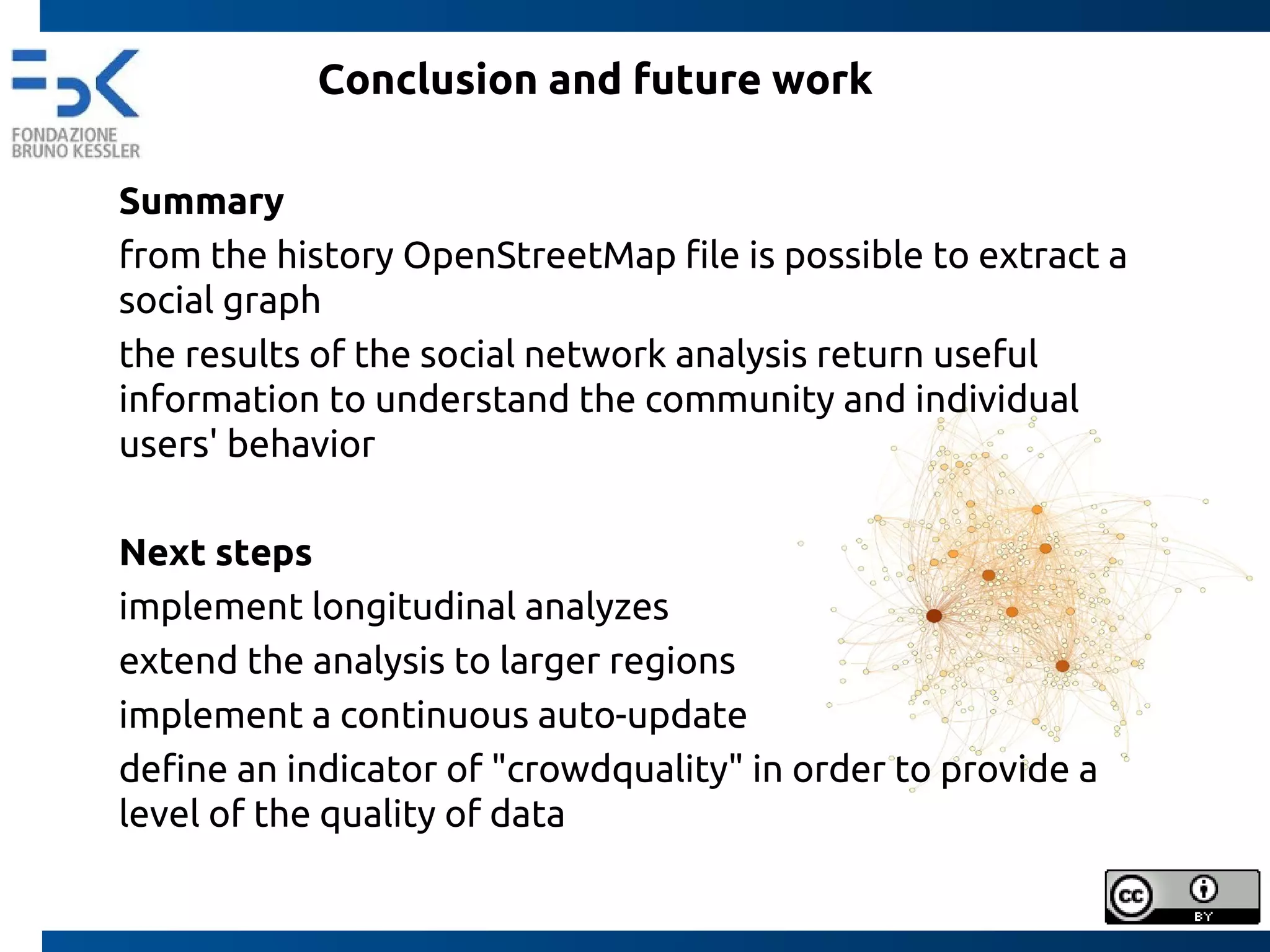
We have the social directed graph
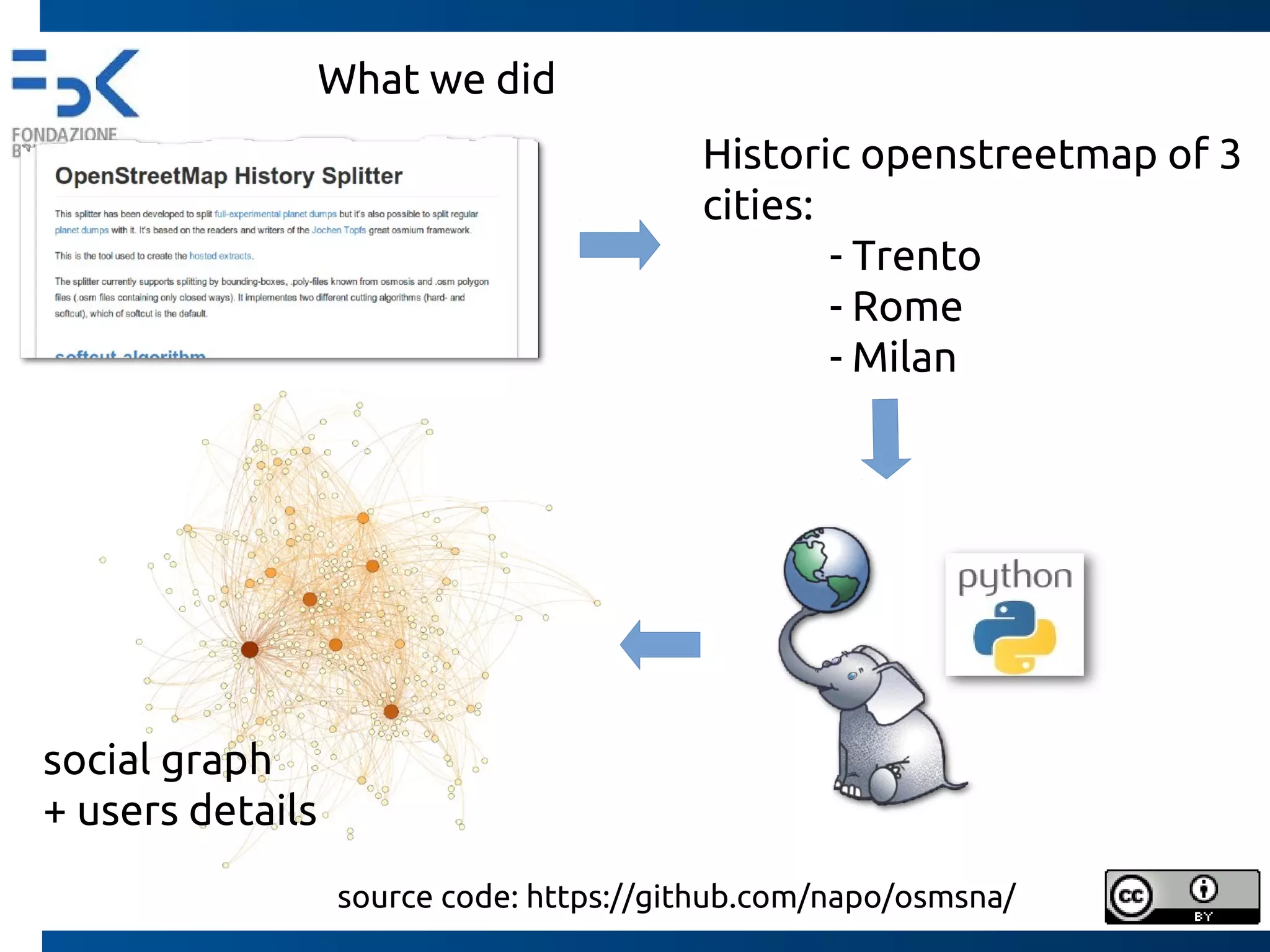
What we did
Historic openstreetmap of 3
cities:
- Trento
- Rome
- Milan
source code: https://github.com/napo/osmsna/
social graph
+ users details
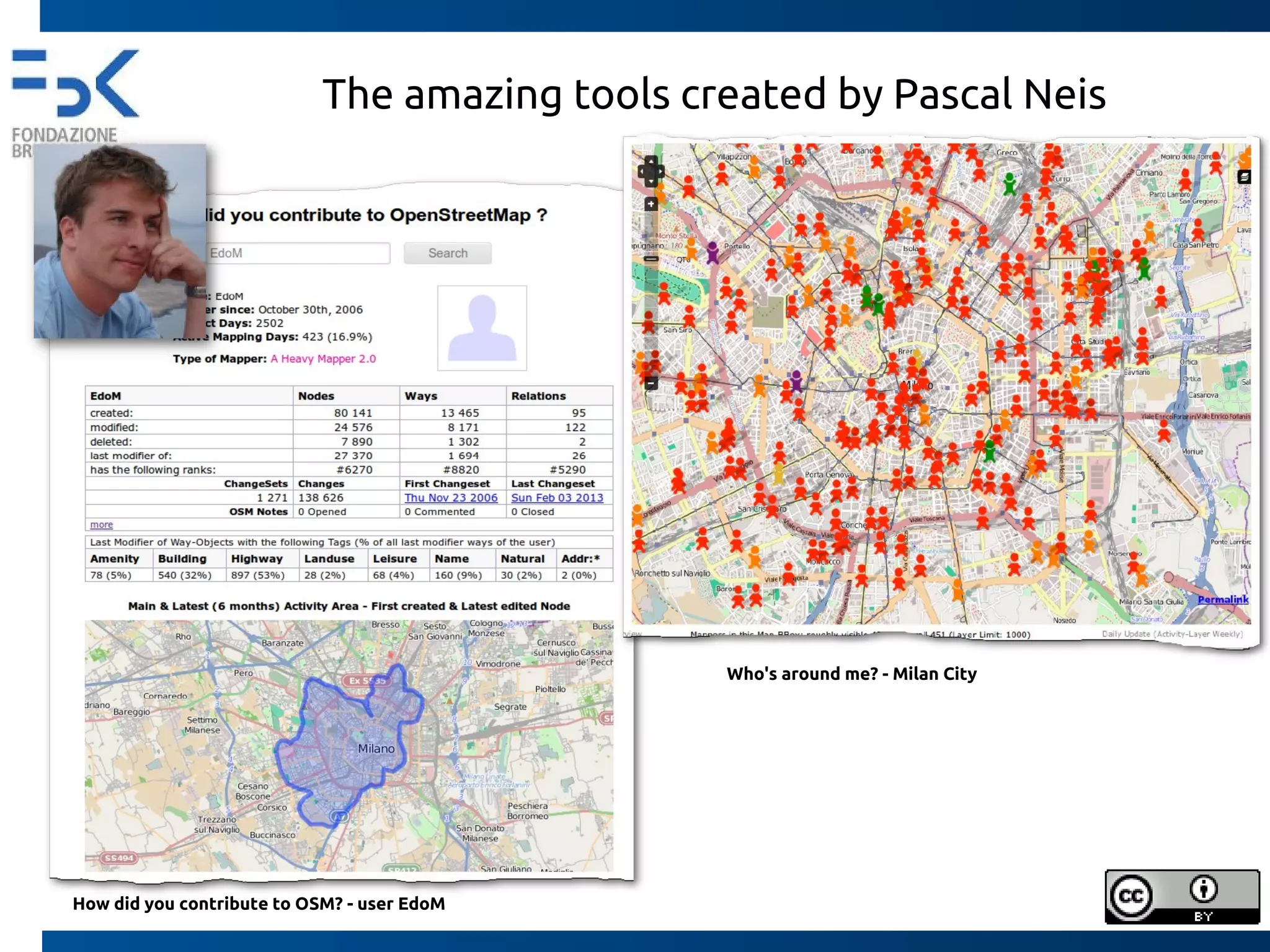
The amazing tools created by Pascal Neis
How did you contribute to OSM? - user EdoM
Who's around me? - Milan City
ABC of SNA
by Michela Ferron
http://www.slideshare.net/fbk.eu/fbk-seminar-michela-ferron-presentation
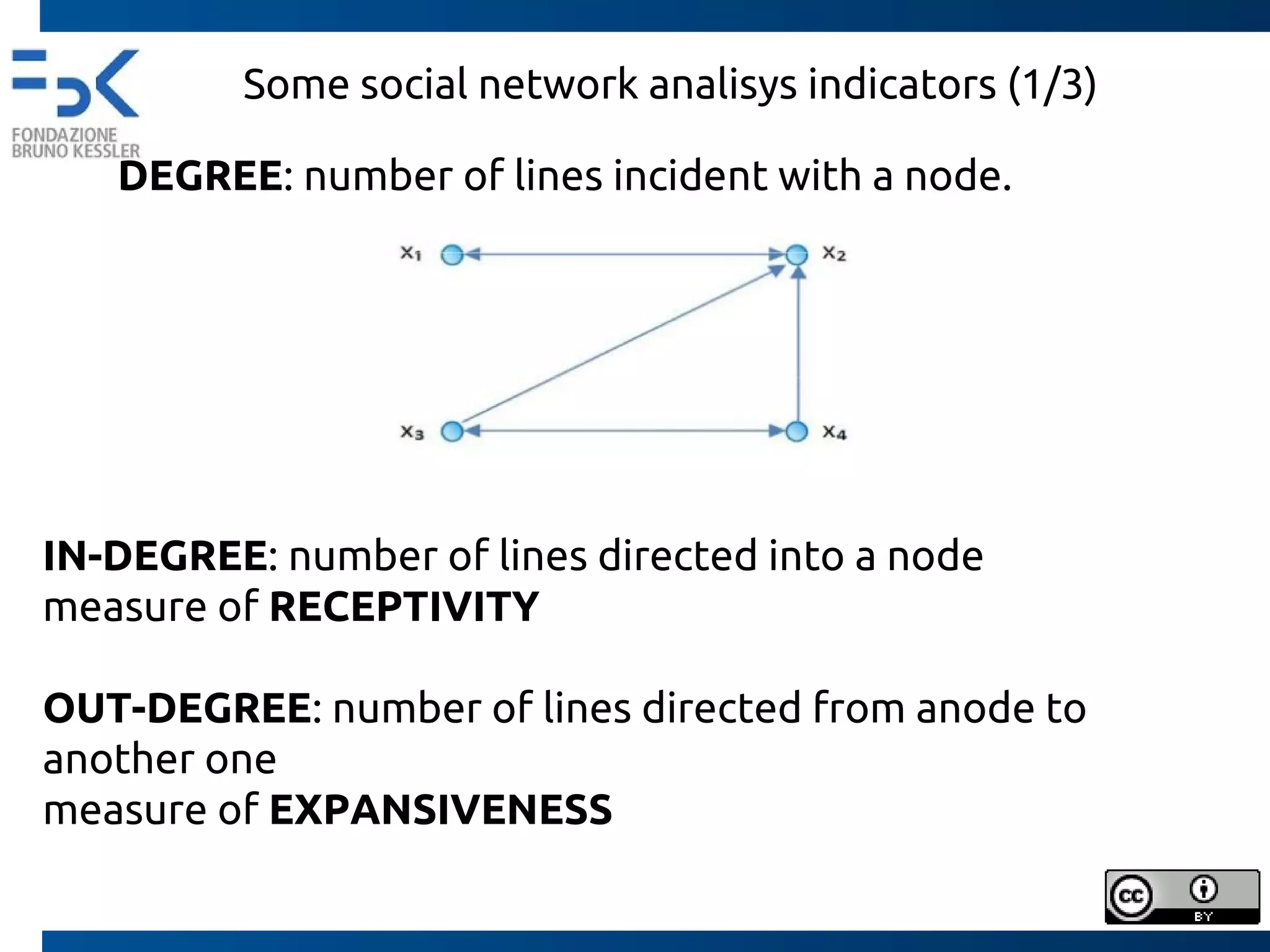
Some social network analisys indicators (1/3)
DEGREE: number of lines incident with a node.
IN-DEGREE: number of lines directed into a node
measure of RECEPTIVITY
OUT-DEGREE: number of lines directed from anode to
another one
measure of EXPANSIVENESS
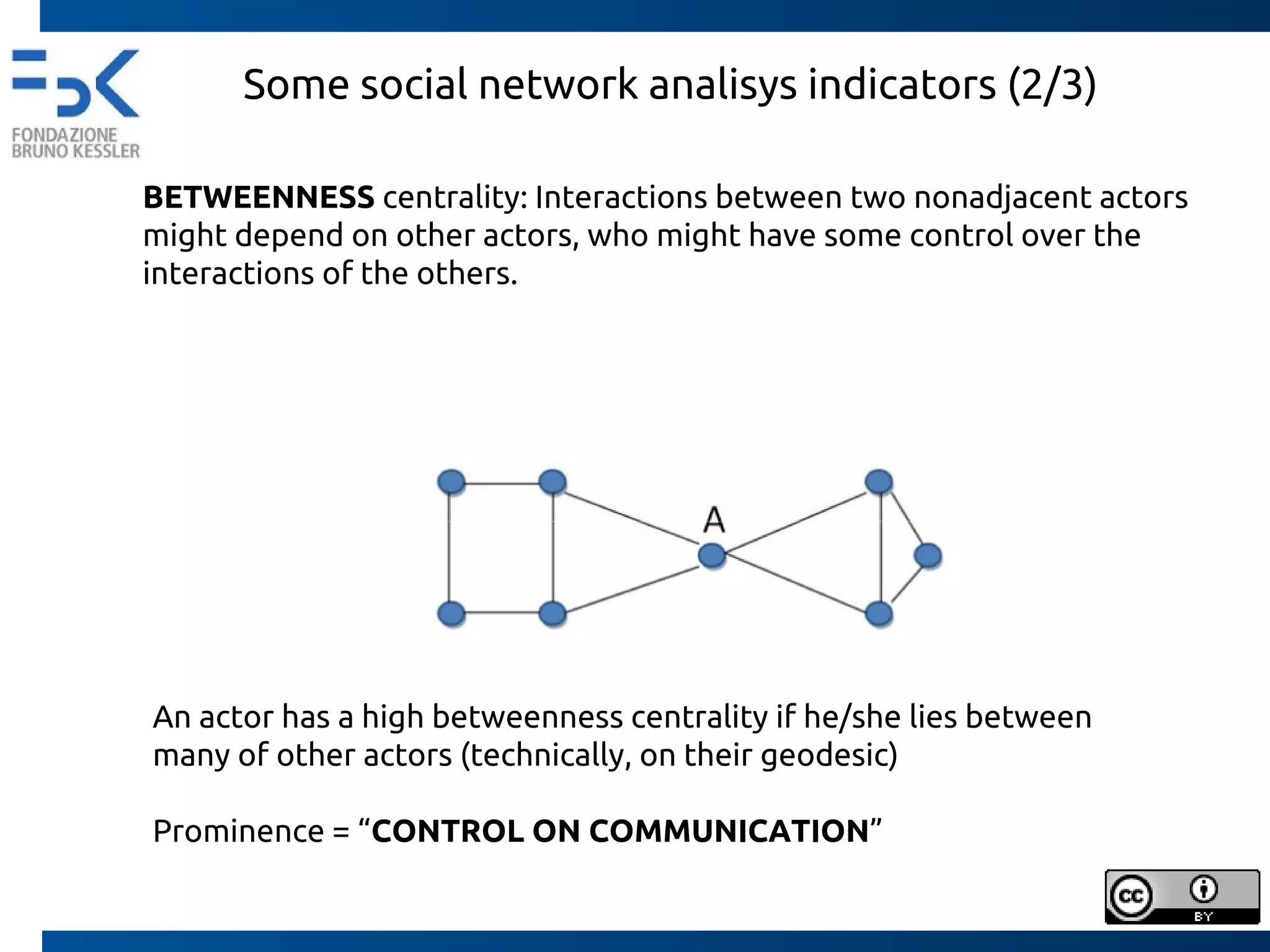
Some social network analisys indicators (2/3)
An actor has a high betweenness centrality if he/she lies between
many of other actors (technically, on their geodesic)
Prominence = “CONTROL ON COMMUNICATION”
BETWEENNESS centrality: Interactions between two nonadjacent actors
might depend on other actors, who might have some control over the
interactions of the others.
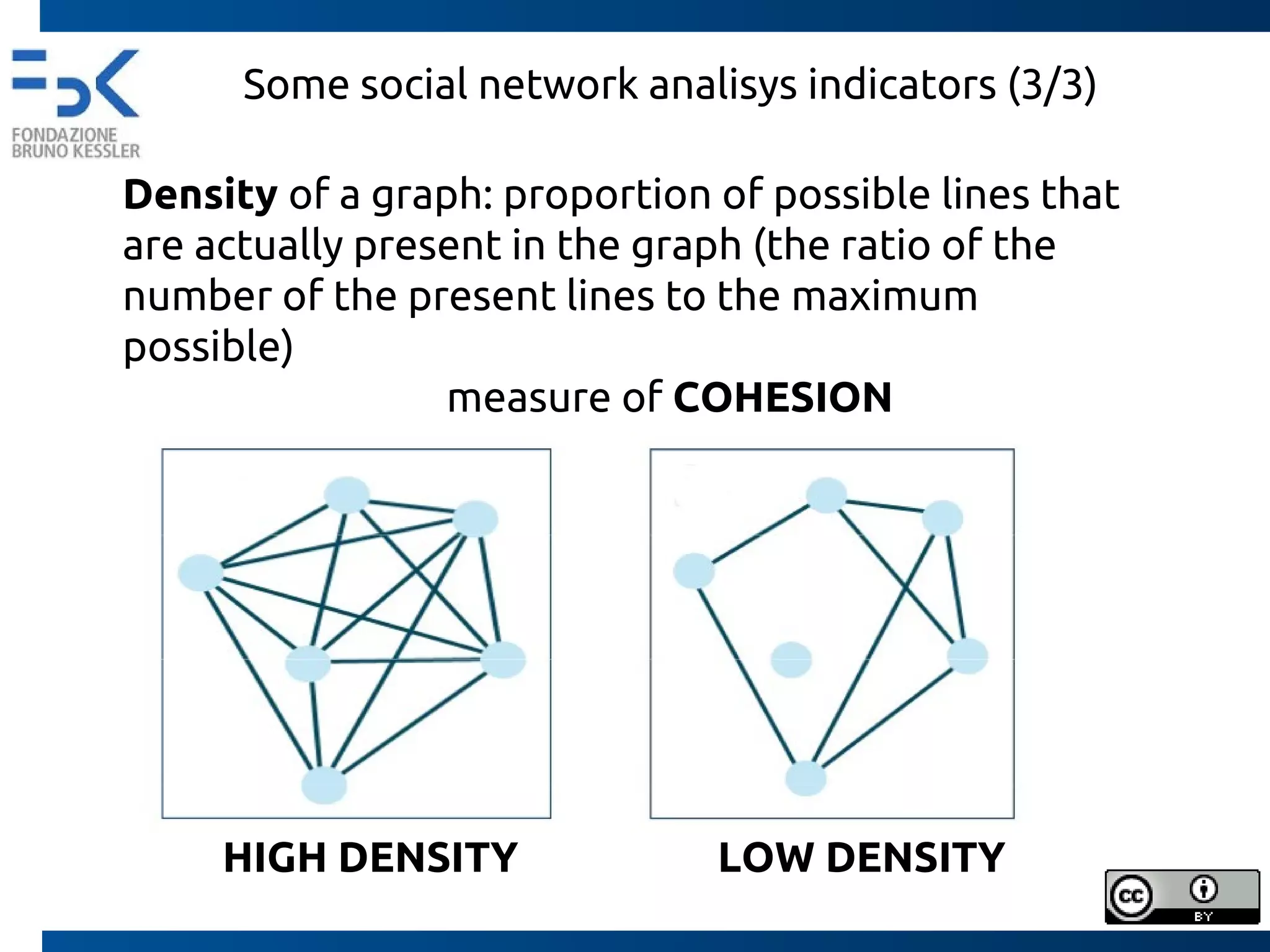
Density of a graph: proportion of possible lines that
are actually present in the graph (the ratio of the
number of the present lines to the maximum
possible)
measure of COHESION
Some social network analisys indicators (3/3)
HIGH DENSITY LOW DENSITY
• DEGREE: level of activity in the community
• IN-DEGREE: level of corrections received
• OUT-DEGREE: level of corrections made
• BETWEENNESS: level of collaboration in the
community
• DENSITY: community cohesion indicator
In the case of the OpenStreetMap users:
The three cities
ROME
People
2.638.842
Area
1,285.31 km2
Density
2,100/km2
MILAN
People
1.247.379
Area
181.76 km2
Density
6,900/km2
TRENTO
People
117.307
Area
157.9 km2
Density
740/km2
data & pictures from wikipedia
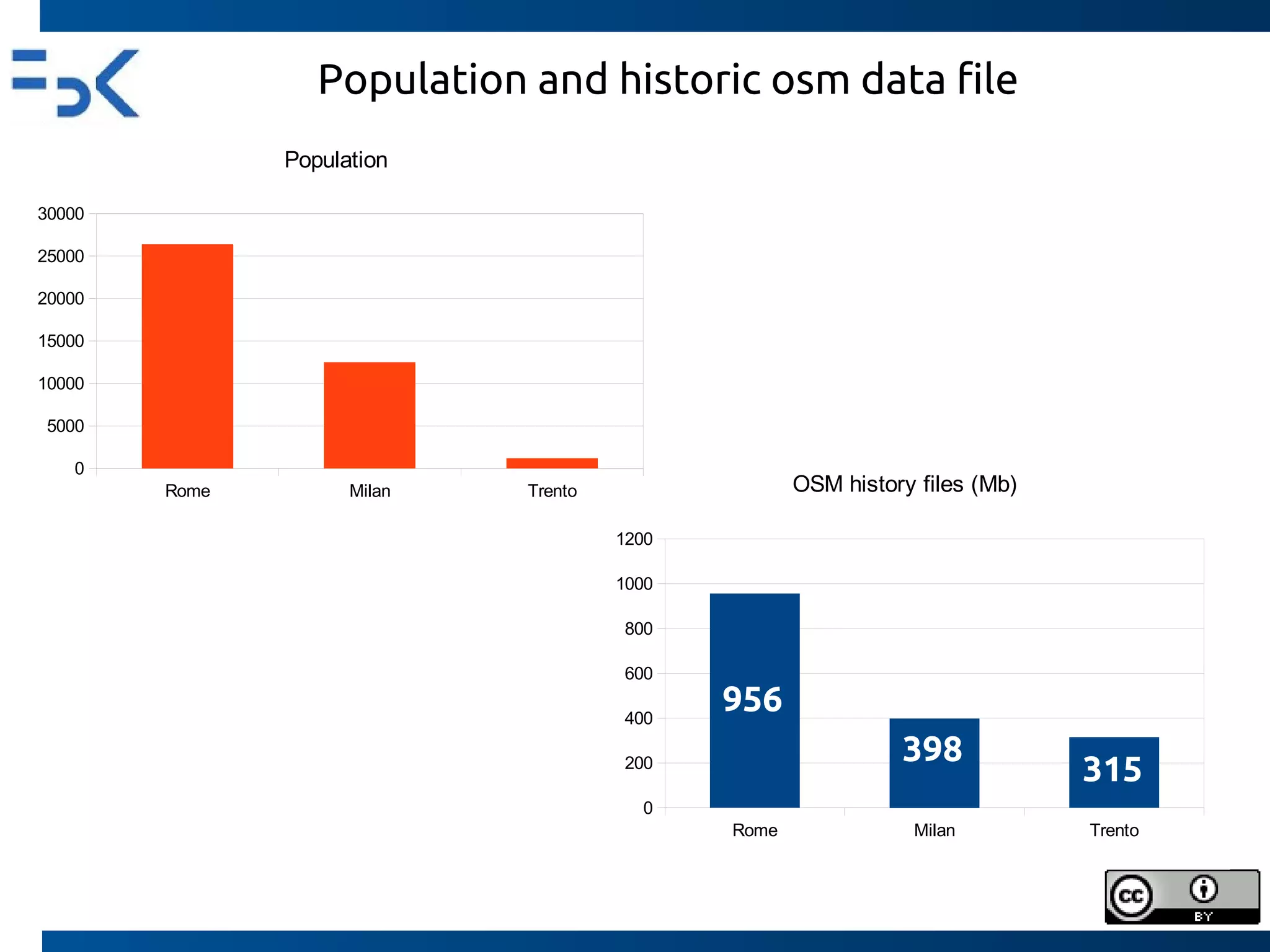
Rome Milan Trento
0
200
400
600
800
1000
1200
OSM history files (Mb)
Population and historic osm data file
Rome Milan Trento
0
5000
10000
15000
20000
25000
30000
Population
956
398
315
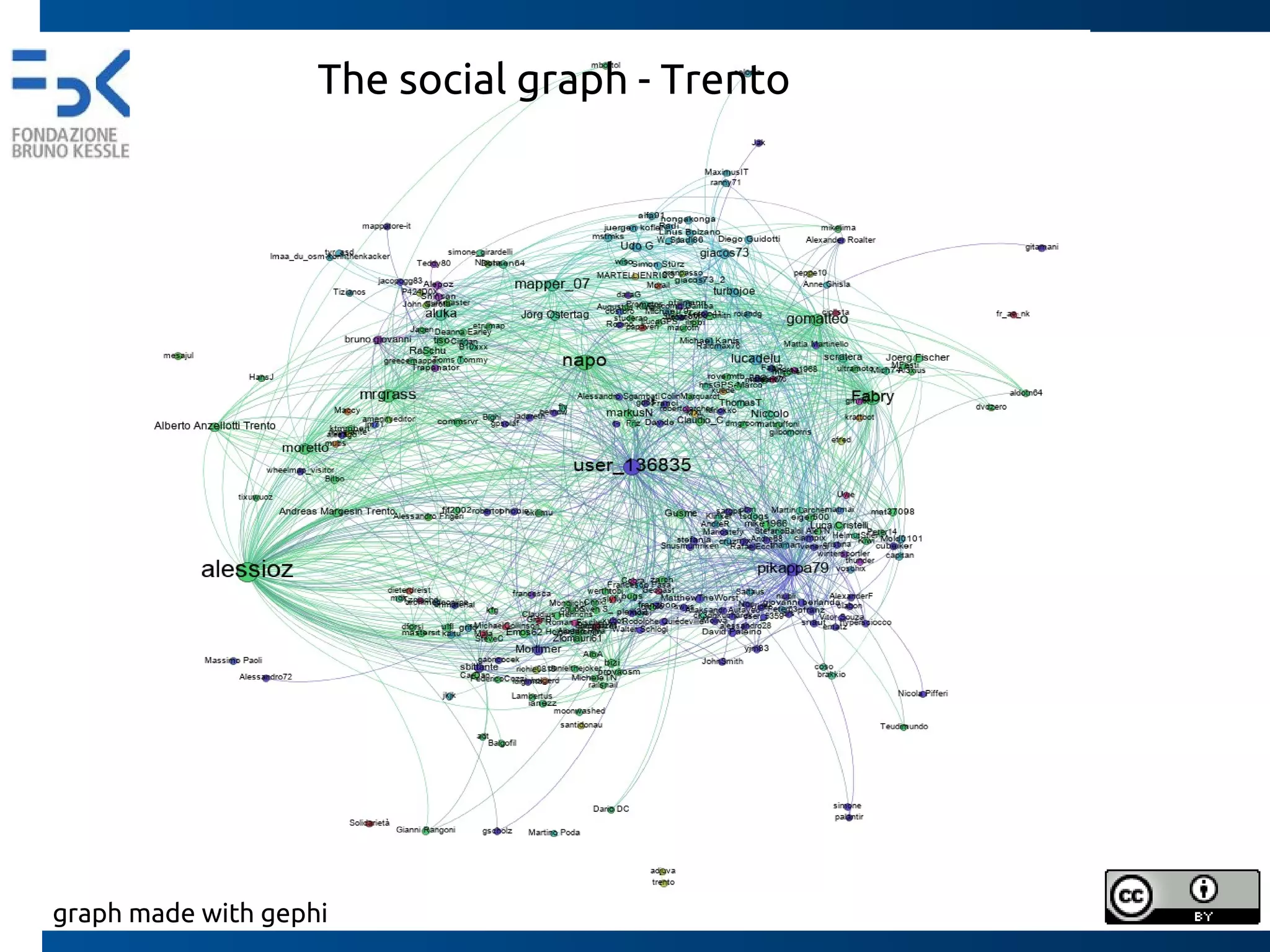
The social graph - Trento
graph made with gephi
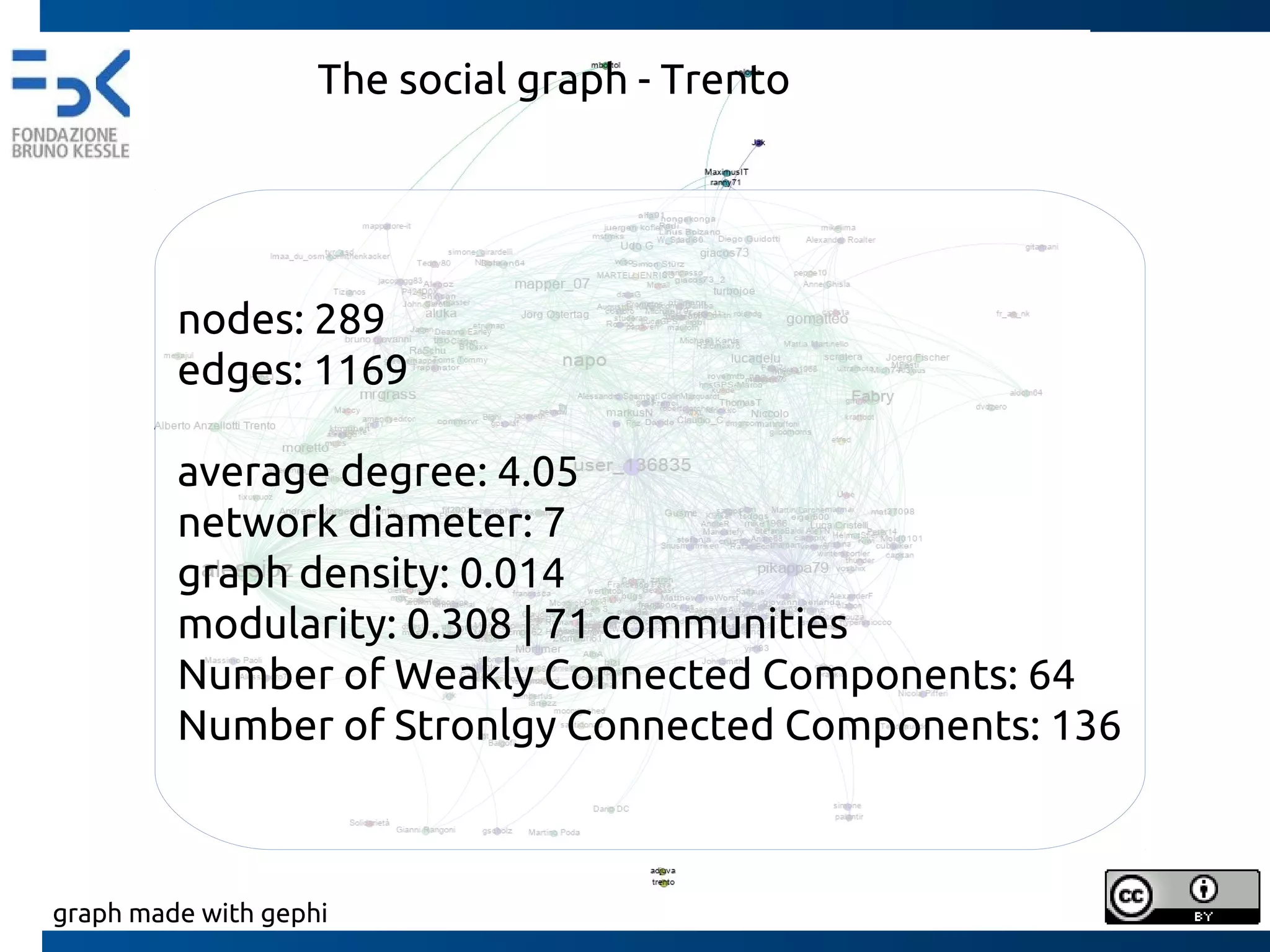
The social graph - Trento
nodes: 289
edges: 1169
average degree: 4.05
network diameter: 7
graph density: 0.014
modularity: 0.308 | 71 communities
Number of Weakly Connected Components: 64
Number of Stronlgy Connected Components: 136
graph made with gephi
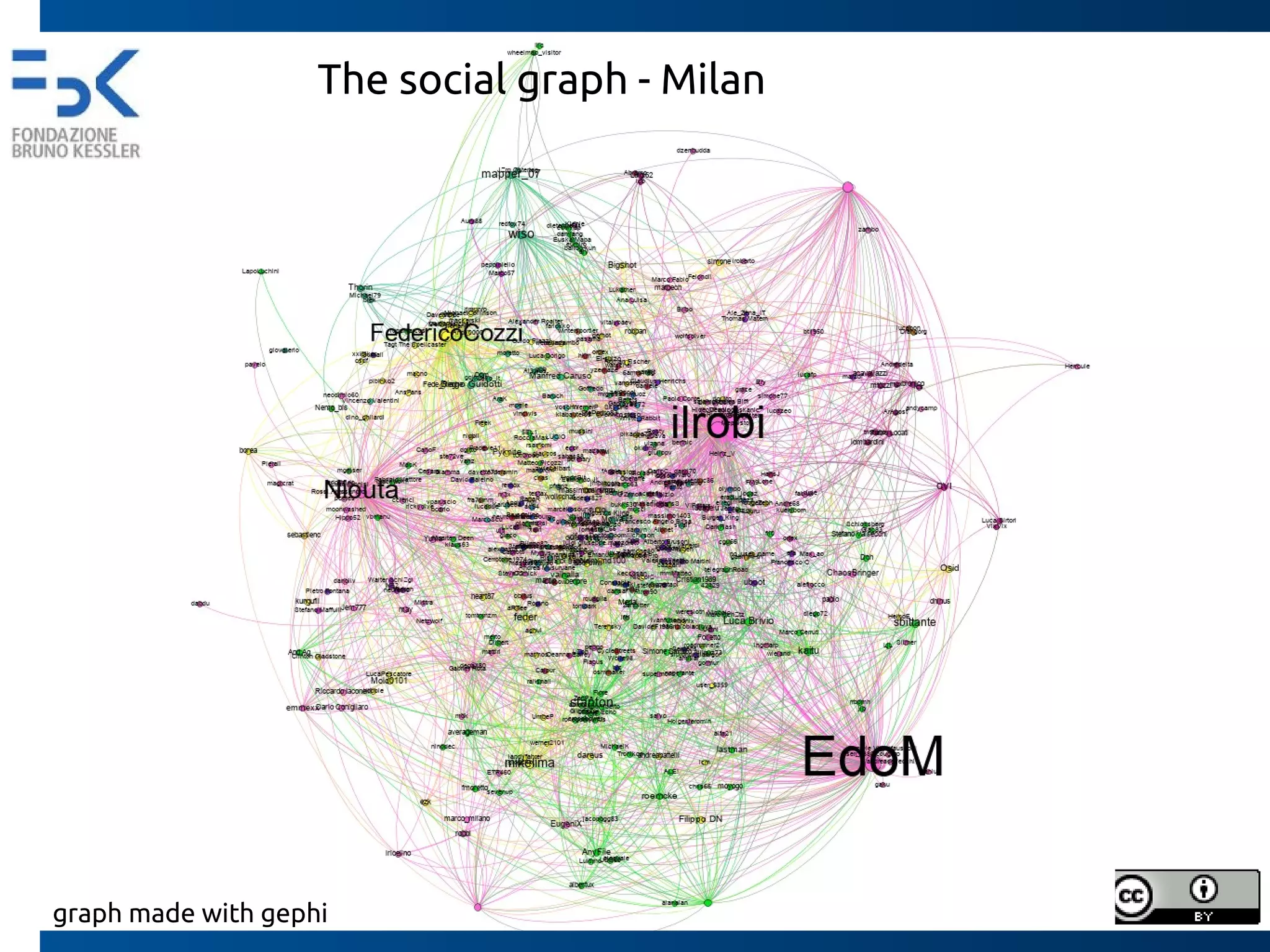
The social graph - Milan
graph made with gephi
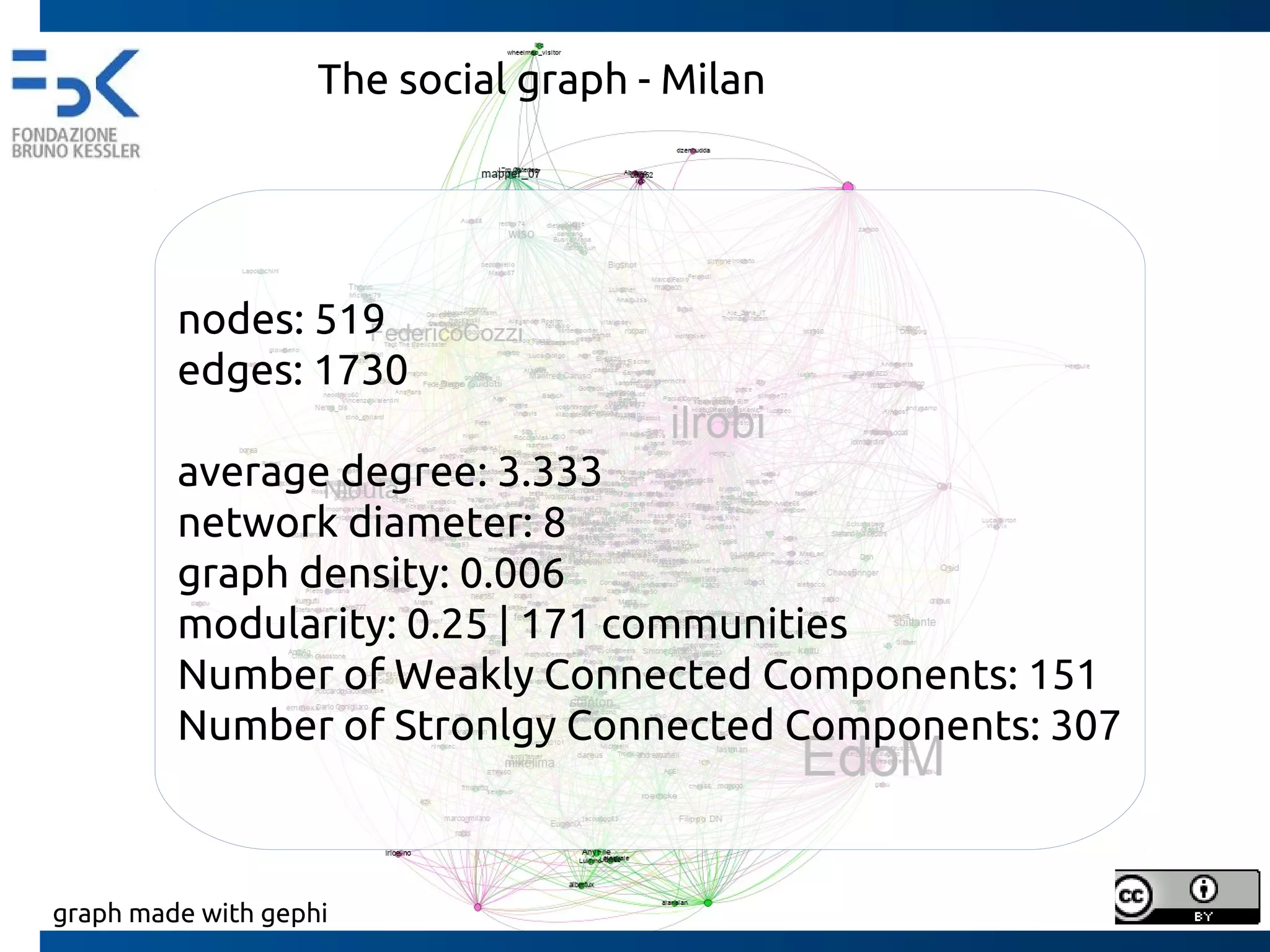
The social graph - Milan
nodes: 519
edges: 1730
average degree: 3.333
network diameter: 8
graph density: 0.006
modularity: 0.25 | 171 communities
Number of Weakly Connected Components: 151
Number of Stronlgy Connected Components: 307
graph made with gephi
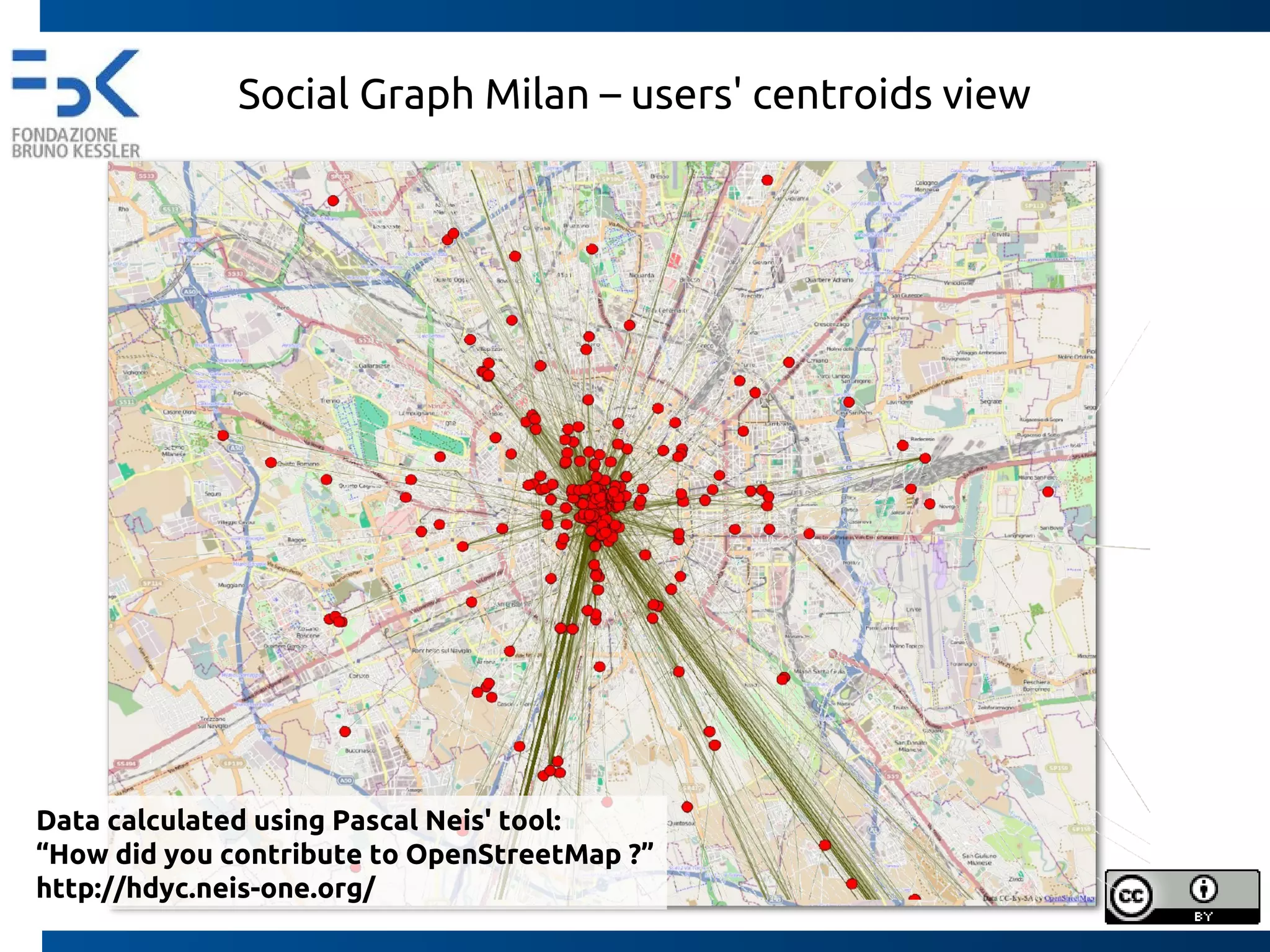
Social Graph Milan – users' centroids view
Data calculated using Pascal Neis' tool:
“How did you contribute to OpenStreetMap ?”
http://hdyc.neis-one.org/
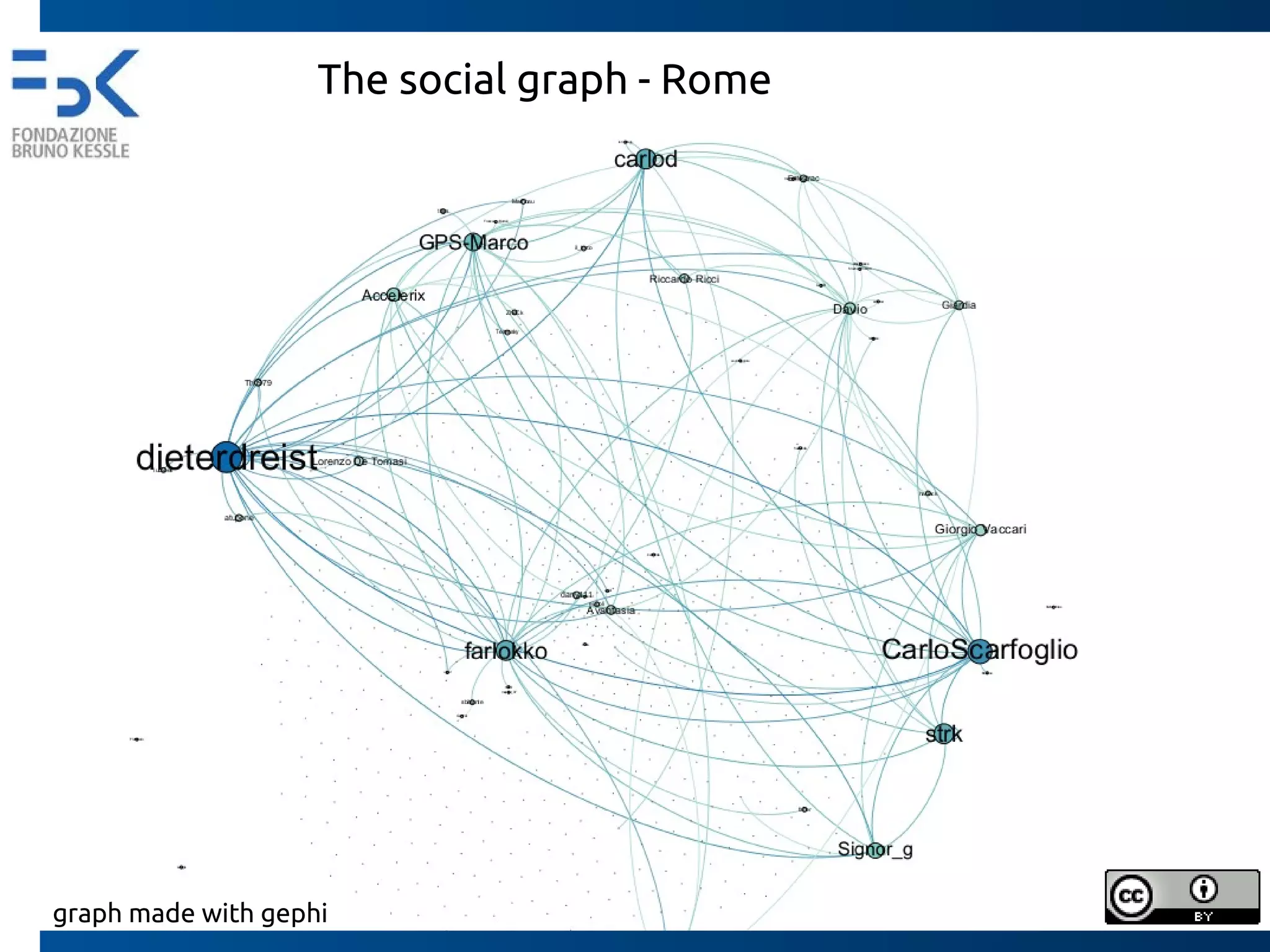
The social graph - Rome
graph made with gephi
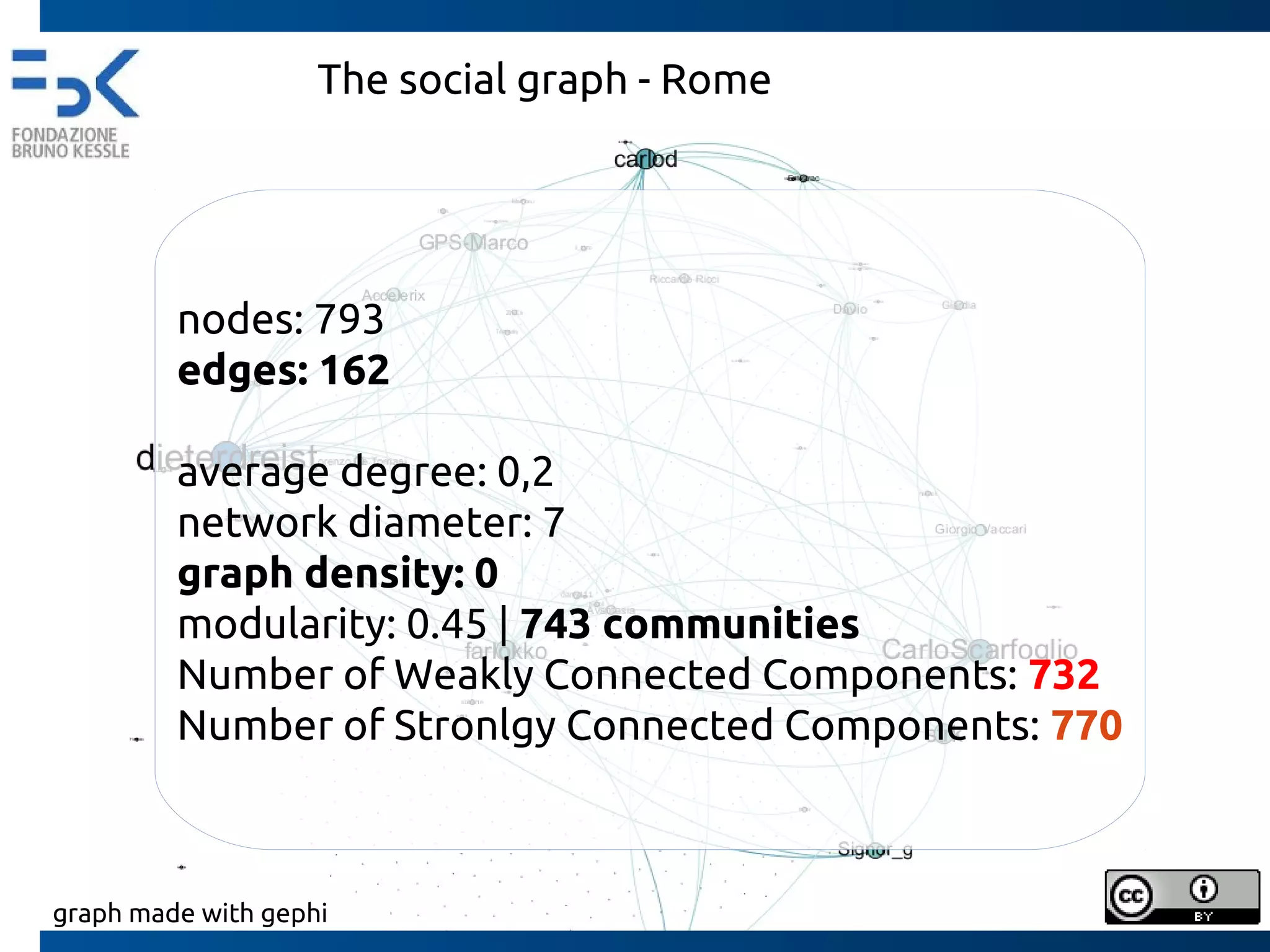
The social graph - Rome
nodes: 793
edges: 162
average degree: 0,2
network diameter: 7
graph density: 0
modularity: 0.45 | 743 communities
Number of Weakly Connected Components: 732
Number of Stronlgy Connected Components: 770
graph made with gephi
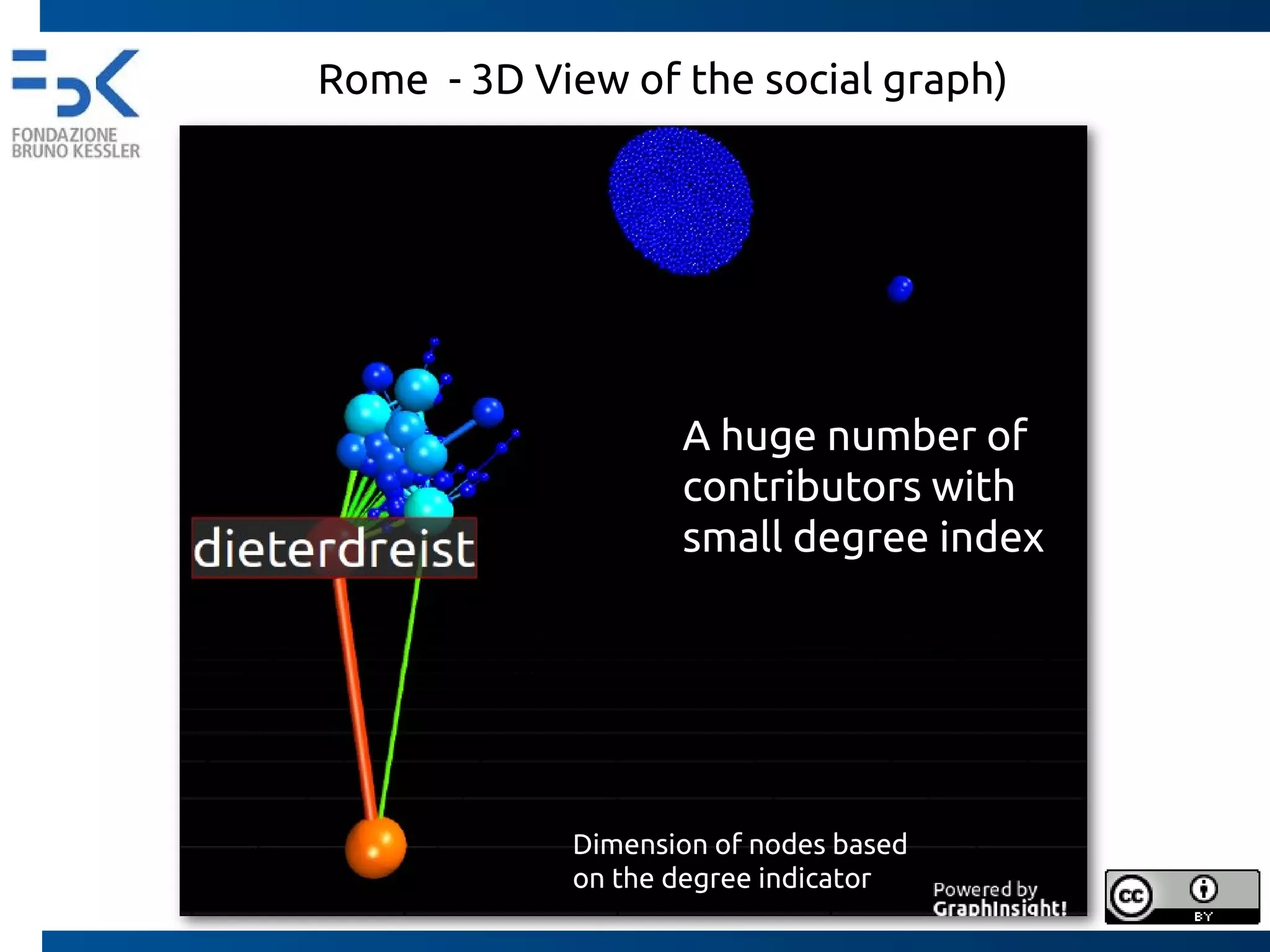
Rome - 3D View of the social graph)
A HUGE NUMBER
OF CONTRIBUTORS
Dimension of nodes based
on the degree indicator
A huge number of
contributors with
small degree index
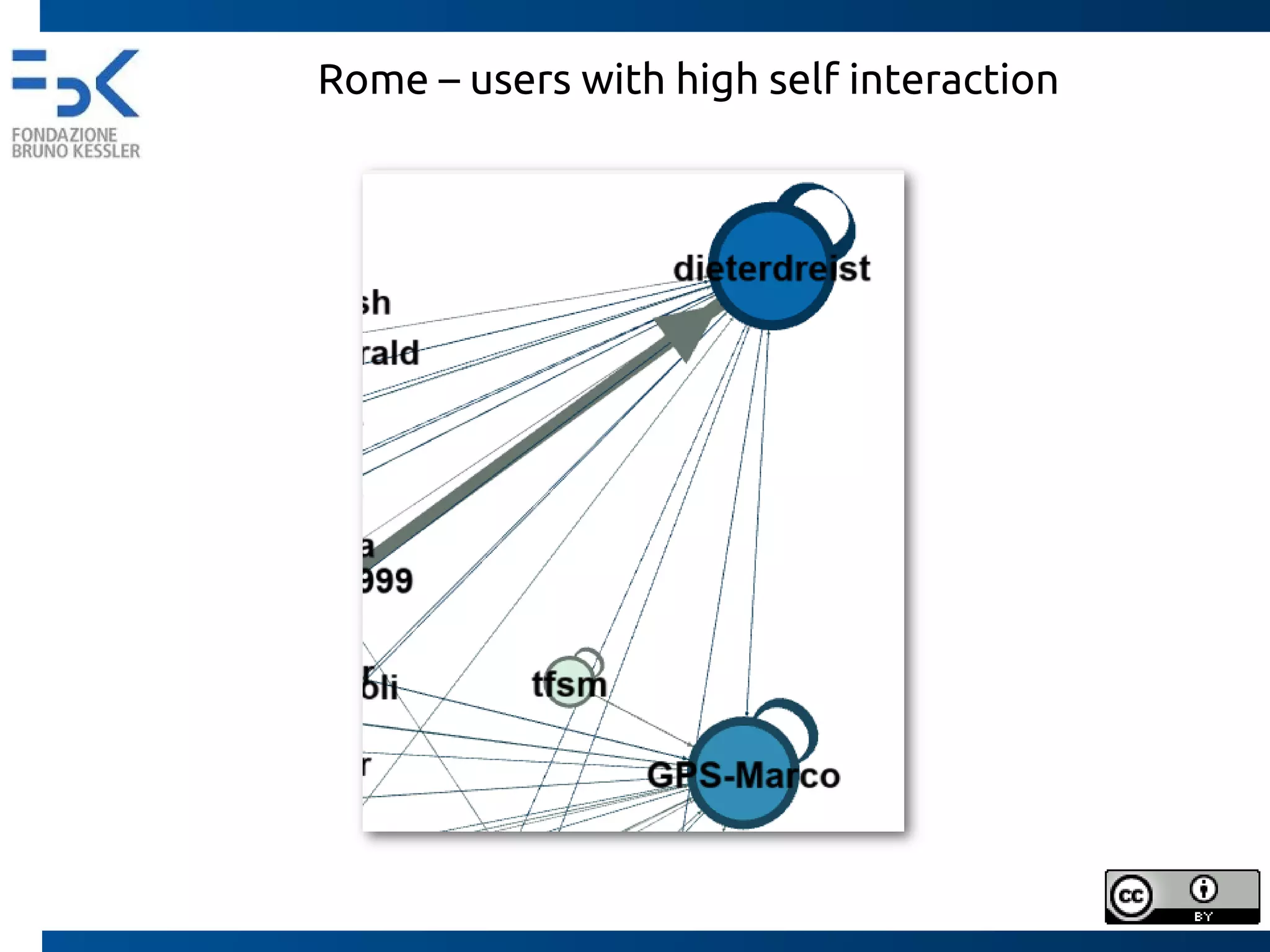
Rome – users with high self interaction
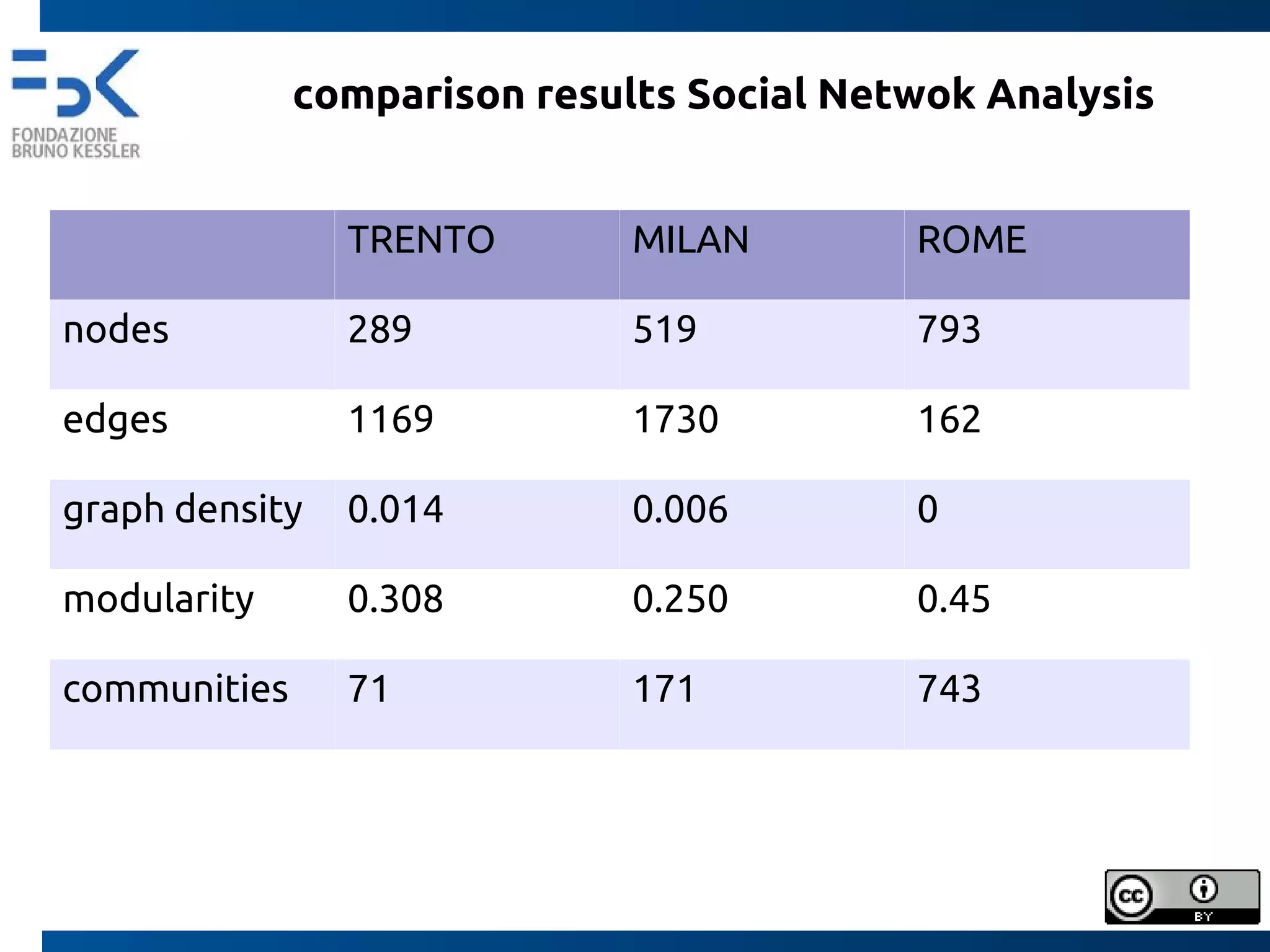
comparison results Social Netwok Analysis
TRENTO MILAN ROME
nodes 289 519 793
edges 1169 1730 162
graph density 0.014 0.006 0
modularity 0.308 0.250 0.45
communities 71 171 743
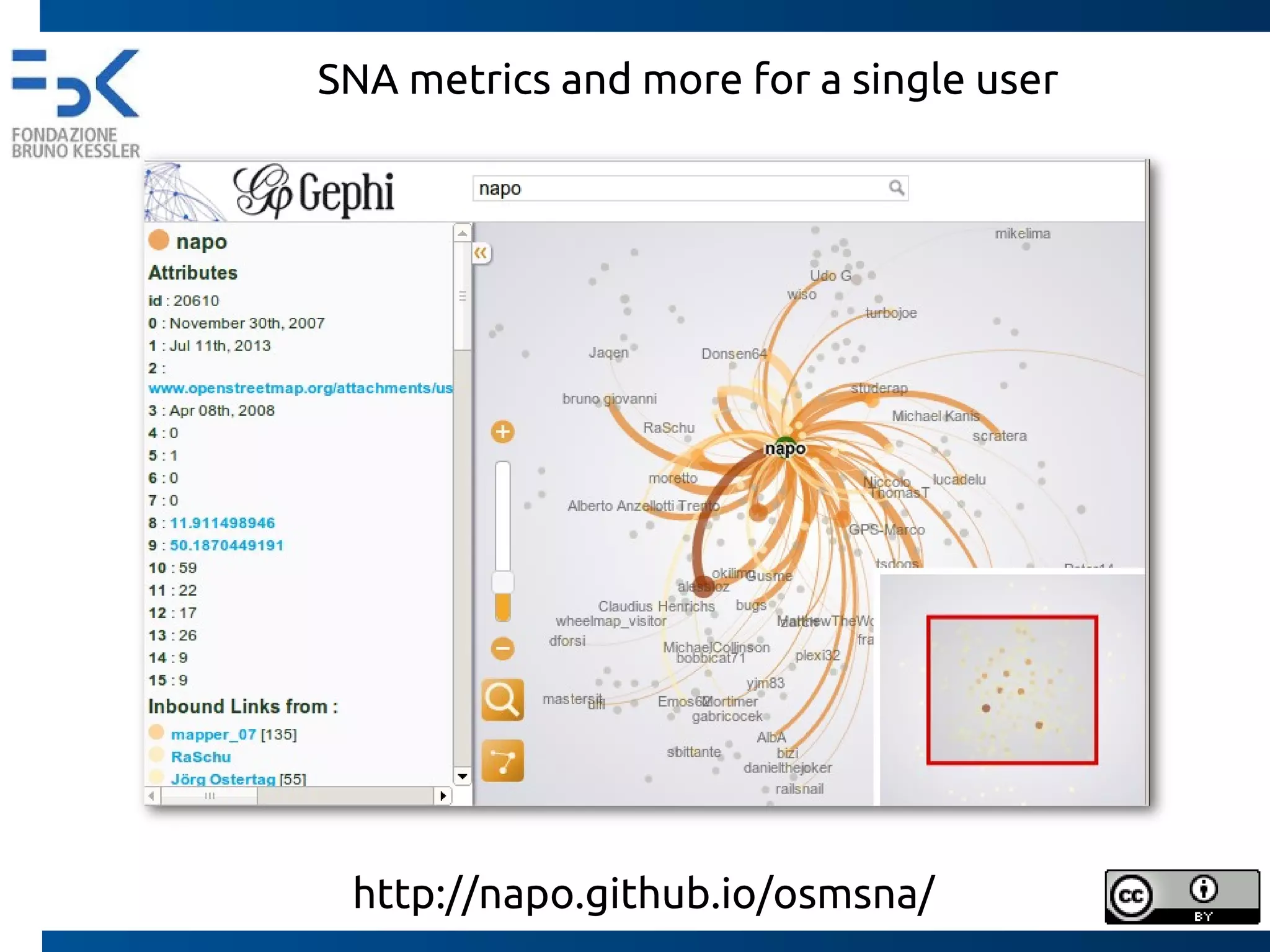
SNA metrics and more for a single user
http://napo.github.io/osmsna/
Summary
from the history OpenStreetMap file is possible to
extract a social graph
the results of the social network analysis return useful
information to understand the community and individual
users' behavior
Next steps
implement longitudinal analyzes
extend the analysis to larger regions
implement a continuous auto-update
define an indicator of "crowdquality" in order to provide
a level of the quality of data
Conclusion and future work
Thank for your attention!
twitter: @napo
blog: http://de.straba.us
email: napo@fbk.eu
slide: http://slideshare.net/napo
This work is supported by T2DataExchange – http://trentino.dandelion.eu/
a project by Spaziodati Srl, Edizioni Curcu&Genovese, Fondazione Bruno Kessler
with funds from the European Regional Development Fund

The collaboration network in OSM - the case of Italy

  • 1.
    The collaboration networkin OSM: the case of Italy. Maurizio Napolitano <napo@fbk.eu> State of the Map 2013 The OpenStreetMap Event 6-8 September 2013 Birmingham, UK
  • 2.
    How is thecollaboration in OpenStreetMap? What is possible to understand from the data?
  • 3.
    Construct the collaborativenetwork simone modifies a tag made by Tim SteveC adds a point simone adds a tag 1 2 3 4 tim assigns a name to a street drawed by simone 5 SteveC adds a tag 6 Tim moves the point
  • 4.
    We have thesocial directed graph
  • 5.
    What we did Historicopenstreetmap of 3 cities: - Trento - Rome - Milan source code: https://github.com/napo/osmsna/ social graph + users details
  • 6.
    The amazing toolscreated by Pascal Neis How did you contribute to OSM? - user EdoM Who's around me? - Milan City
  • 7.
    ABC of SNA byMichela Ferron http://www.slideshare.net/fbk.eu/fbk-seminar-michela-ferron-presentation
  • 8.
    Some social networkanalisys indicators (1/3) DEGREE: number of lines incident with a node. IN-DEGREE: number of lines directed into a node measure of RECEPTIVITY OUT-DEGREE: number of lines directed from anode to another one measure of EXPANSIVENESS
  • 9.
    Some social networkanalisys indicators (2/3) An actor has a high betweenness centrality if he/she lies between many of other actors (technically, on their geodesic) Prominence = “CONTROL ON COMMUNICATION” BETWEENNESS centrality: Interactions between two nonadjacent actors might depend on other actors, who might have some control over the interactions of the others.
  • 10.
    Density of agraph: proportion of possible lines that are actually present in the graph (the ratio of the number of the present lines to the maximum possible) measure of COHESION Some social network analisys indicators (3/3) HIGH DENSITY LOW DENSITY
  • 11.
    • DEGREE: levelof activity in the community • IN-DEGREE: level of corrections received • OUT-DEGREE: level of corrections made • BETWEENNESS: level of collaboration in the community • DENSITY: community cohesion indicator In the case of the OpenStreetMap users:
  • 12.
    The three cities ROME People 2.638.842 Area 1,285.31km2 Density 2,100/km2 MILAN People 1.247.379 Area 181.76 km2 Density 6,900/km2 TRENTO People 117.307 Area 157.9 km2 Density 740/km2 data & pictures from wikipedia
  • 13.
    Rome Milan Trento 0 200 400 600 800 1000 1200 OSMhistory files (Mb) Population and historic osm data file Rome Milan Trento 0 5000 10000 15000 20000 25000 30000 Population 956 398 315
  • 14.
    The social graph- Trento graph made with gephi
  • 15.
    The social graph- Trento nodes: 289 edges: 1169 average degree: 4.05 network diameter: 7 graph density: 0.014 modularity: 0.308 | 71 communities Number of Weakly Connected Components: 64 Number of Stronlgy Connected Components: 136 graph made with gephi
  • 16.
    The social graph- Milan graph made with gephi
  • 17.
    The social graph- Milan nodes: 519 edges: 1730 average degree: 3.333 network diameter: 8 graph density: 0.006 modularity: 0.25 | 171 communities Number of Weakly Connected Components: 151 Number of Stronlgy Connected Components: 307 graph made with gephi
  • 18.
    Social Graph Milan– users' centroids view Data calculated using Pascal Neis' tool: “How did you contribute to OpenStreetMap ?” http://hdyc.neis-one.org/
  • 19.
    The social graph- Rome graph made with gephi
  • 20.
    The social graph- Rome nodes: 793 edges: 162 average degree: 0,2 network diameter: 7 graph density: 0 modularity: 0.45 | 743 communities Number of Weakly Connected Components: 732 Number of Stronlgy Connected Components: 770 graph made with gephi
  • 21.
    Rome - 3DView of the social graph) A HUGE NUMBER OF CONTRIBUTORS Dimension of nodes based on the degree indicator A huge number of contributors with small degree index
  • 22.
    Rome – userswith high self interaction
  • 23.
    comparison results SocialNetwok Analysis TRENTO MILAN ROME nodes 289 519 793 edges 1169 1730 162 graph density 0.014 0.006 0 modularity 0.308 0.250 0.45 communities 71 171 743
  • 24.
    SNA metrics andmore for a single user http://napo.github.io/osmsna/
  • 25.
    Summary from the historyOpenStreetMap file is possible to extract a social graph the results of the social network analysis return useful information to understand the community and individual users' behavior Next steps implement longitudinal analyzes extend the analysis to larger regions implement a continuous auto-update define an indicator of "crowdquality" in order to provide a level of the quality of data Conclusion and future work
  • 26.
    Thank for yourattention! twitter: @napo blog: http://de.straba.us email: napo@fbk.eu slide: http://slideshare.net/napo This work is supported by T2DataExchange – http://trentino.dandelion.eu/ a project by Spaziodati Srl, Edizioni Curcu&Genovese, Fondazione Bruno Kessler with funds from the European Regional Development Fund