CS105 Introduction to
Social Network
Lecture: Yang Mu
UMass Boston
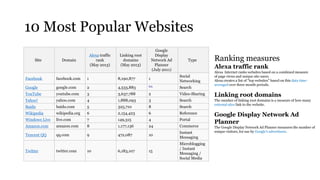
10 Most Popular Websites
Site Domain
Alexa traffic
rank
(May 2013)
Linking root
domains
(May 2013)
Google
Display
Network Ad
Planner
(July 2011)
Type
Facebook facebook.com 1 8,190,877 1
Social
Networking
Google google.com 2 4,533,883 NA Search
YouTube youtube.com 3 3,637,788 2 Video-Sharing
Yahoo! yahoo.com 4 1,888,093 3 Search
Baidu baidu.com 5 325,710 8 Search
Wikipedia wikipedia.org 6 2,154,423 6 Reference
Windows Live live.com 7 149,315 4 Portal
Amazon.com amazon.com 8 1,177,136 24 Commerce
Tencent QQ qq.com 9 472,087 10
Instant
Messaging
Twitter twitter.com 10 6,183,107 15
Microblogging
/ Instant
Messaging /
Social Media
Ranking measures
Alexa traffic rank
Alexa Internet ranks websites based on a combined measure
of page views and unique site users.
Alexa creates a list of "top websites" based on this data time-
averaged over three month periods.
Linking root domains
The number of linking root domains is a measure of how many
external sites link to the website.
Google Display Network Ad
Planner
The Google Display Network Ad Planner measures the number of
unique visitors, for use by Google's advertisers.
SOCIAL NETWORK
= SOCIA MEDIA + NETWORKING
SOCIA MEDIA IS AN UMBRELLA TERM
THAT DEFINES THE VARIOUS ACTIVITIES
THAT INTEGRATE TECHNOLOGY, SOCIAL
INTERACTION, AND THE
CONSTRUCTION OF WORDS, PICTURES,
VIDEOS AND AUDIO.
http://www.wikipedia.org
“Social media
is people having
conversation
online.”
More simply put:
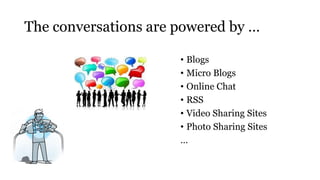
The conversations are powered by …
• Blogs
• Micro Blogs
• Online Chat
• RSS
• Video Sharing Sites
• Photo Sharing Sites
…
“WHY SHOULD
I CARE?”
Reason #1
SOCIAL-NETWORKING SITES
ARE THE MOST
POPULAR SITES.
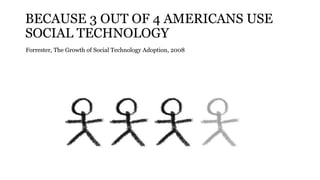
BECAUSE 3 OUT OF 4 AMERICANS USE
SOCIAL TECHNOLOGY
Forrester, The Growth of Social Technology Adoption, 2008
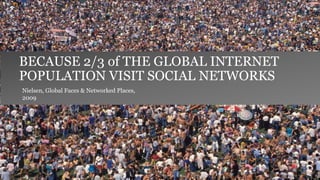
Nielsen, Global Faces & Networked Places,
2009
BECAUSE 2/3 of THE GLOBAL INTERNET
POPULATION VISIT SOCIAL NETWORKS
Reason #2
78%
OF PEOPLE TRUST THE
RECOMMENDATIONS OF OTHER
CONSUMERS.
NIELSEN “TRUST IN ADVERTISING” REPORT, OCTOBER 2007
Reason #3
BECAUSE TIME SPENT ON SOCIAL
NETWORKS IS GROWING AT 3X
THE OVERALL INTERNET RATE,
ACCOUNTING FOR ~10% OF ALL
INTERNET TIME.
Nielsen, Global & Networked Places, 2009
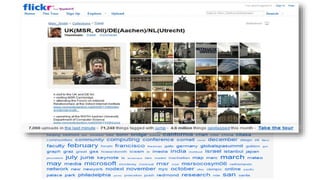
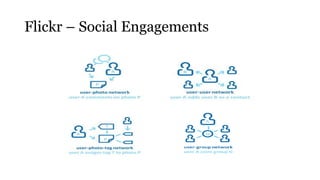
Flickr – Social Engagements
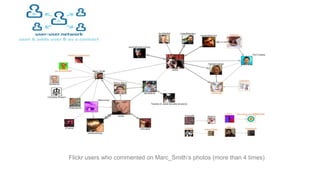
Flickr users who commented on Marc_Smith’s photos (more than 4 times)
Human Super-Connectors
Flickr users who commented on Marc_Smith’s photos (more than 4 times)
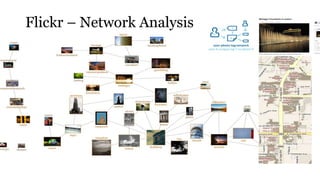
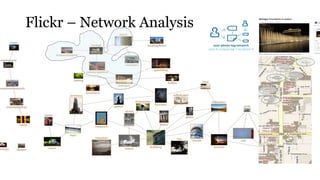
Flickr – Network Analysis
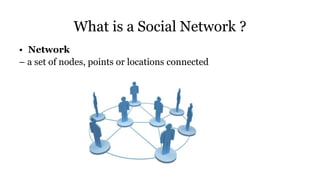
What is a Social Network ?
• Network
– a set of nodes, points or locations connected
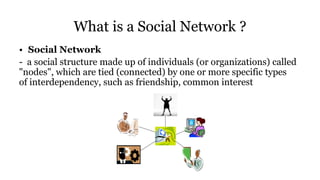
What is a Social Network ?
• Social Network
- a social structure made up of individuals (or organizations) called
"nodes", which are tied (connected) by one or more specific types
of interdependency, such as friendship, common interest
What is a Social Network ?
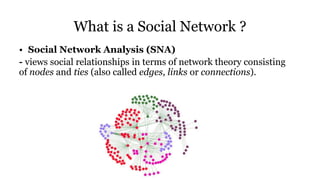
• Social Network Analysis (SNA)
- views social relationships in terms of network theory consisting
of nodes and ties (also called edges, links or connections).
Some concepts
• A node or vertex is an individual unit in the graph or system.
• A graph or system or network is a set of units that may be (but are not
necessarily) connected to each other.
Some concepts
• An “edge” is a connection or tie between two nodes.
• A neighborhood N for a vertex or node is the set of its immediately
connected nodes.
• Degree: The degree ki of a vertex or node is the number of other nodes in
its neighborhood.
Some concepts
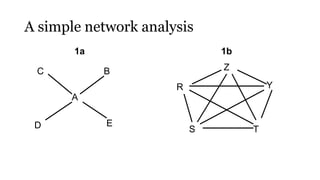
• In an undirected graph or network, the edges are reciprocal—so if A is connected to B, B
is by definition connected to A.
• In a directed graph or network, the edges are not necessarily reciprocal—A may be
connected to B, but B may not be connected to A (think of a graph with arrows indicating
direction of the edges.)
C
D
B
E
A
1a
R
Z
Y
S T
1b
A simple network analysis
CS105 Introduction to
Graph
Lecture: Yang Mu
UMass Boston
What is a Network?
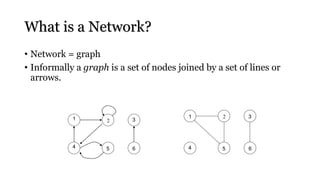
• Network = graph
• Informally a graph is a set of nodes joined by a set of lines or
arrows.
1 1
2 3
4 4
5 5
6 6
2 3
Graph-based representations
 Representing a problem as a graph can provide a different point of view
 Representing a problem as a graph can make a problem much simpler
 More accurately, it can provide the appropriate tools for solving the
problem
What is network theory?
 Network theory provides a set of techniques for analysing graphs
 Complex systems network theory provides techniques for analysing
structure in a system of interacting agents, represented as a network
 Applying network theory to a system means using a graph-theoretic
representation
What makes a problem graph-like?
 There are two components to a graph
 Nodes and edges
 In graph-like problems, these components
have natural correspondences to problem
elements
 Entities are nodes and interactions between
entities are edges
 Most complex systems are graph-like
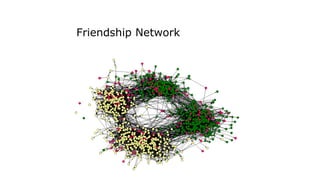
Friendship Network
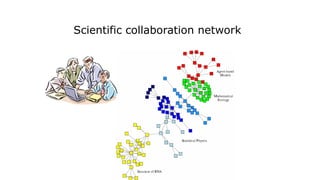
Scientific collaboration network
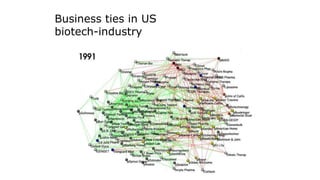
Business ties in US
biotech-industry
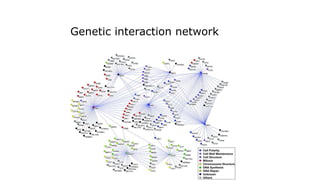
Genetic interaction network
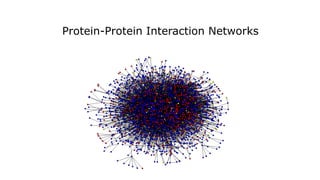
Protein-Protein Interaction Networks
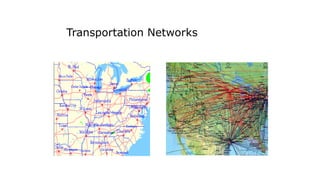
Transportation Networks
Internet
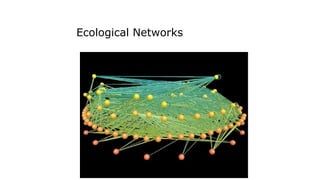
Ecological Networks
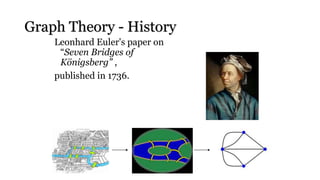
Graph Theory - History
Leonhard Euler's paper on
“Seven Bridges of
Königsberg” ,
published in 1736.
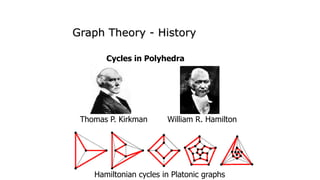
Graph Theory - History
Cycles in Polyhedra
Thomas P. Kirkman William R. Hamilton
Hamiltonian cycles in Platonic graphs
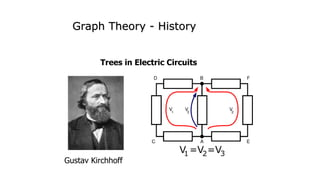
Graph Theory - History
Gustav Kirchhoff
Trees in Electric Circuits
Graph Theory - History
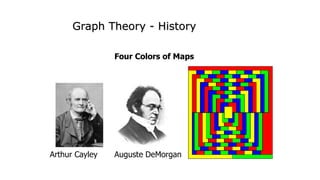
Arthur Cayley Auguste DeMorgan
Four Colors of Maps
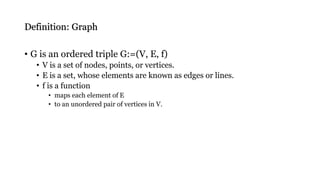
Definition: Graph
• G is an ordered triple G:=(V, E, f)
• V is a set of nodes, points, or vertices.
• E is a set, whose elements are known as edges or lines.
• f is a function
• maps each element of E
• to an unordered pair of vertices in V.
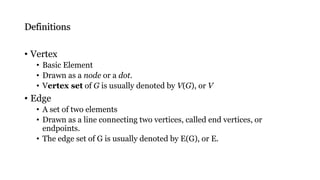
Definitions
• Vertex
• Basic Element
• Drawn as a node or a dot.
• Vertex set of G is usually denoted by V(G), or V
• Edge
• A set of two elements
• Drawn as a line connecting two vertices, called end vertices, or
endpoints.
• The edge set of G is usually denoted by E(G), or E.
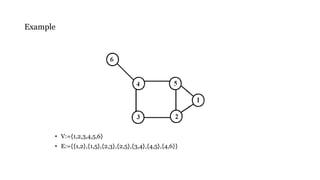
Example
• V:={1,2,3,4,5,6}
• E:={{1,2},{1,5},{2,3},{2,5},{3,4},{4,5},{4,6}}
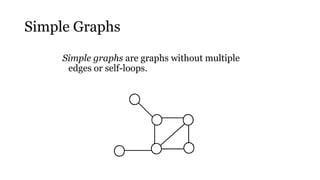
Simple Graphs
Simple graphs are graphs without multiple
edges or self-loops.
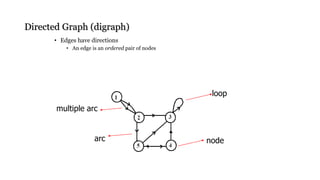
Directed Graph (digraph)
• Edges have directions
• An edge is an ordered pair of nodes
loop
node
multiple arc
arc
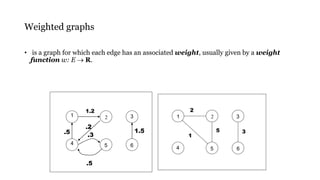
Weighted graphs
1 2 3
4 5 6
.5
1.2
.2
.5
1.5
.3
1
4 5 6
2 3
2
1
3
5
• is a graph for which each edge has an associated weight, usually given by a weight
function w: E  R.
Structures and structural metrics
 Graph structures are used to isolate interesting or important sections of a
graph
 Structural metrics provide a measurement of a structural property of a
graph
 Global metrics refer to a whole graph
 Local metrics refer to a single node in a graph
Graph structures
 Identify interesting sections of a graph
 Interesting because they form a significant
domain-specific structure, or because they
significantly contribute to graph properties
 A subset of the nodes and edges in a
graph that possess certain characteristics,
or relate to each other in particular ways
Connectivity
• a graph is connected if
• you can get from any node to any other by following a sequence of edges OR
• any two nodes are connected by a path.
• A directed graph is strongly connected if there is a directed path from any node to any
other node.
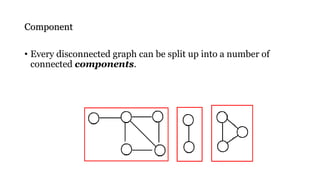
Component
• Every disconnected graph can be split up into a number of
connected components.

lec3_socialnetwork_part1.pptx

  • 1.
    CS105 Introduction to SocialNetwork Lecture: Yang Mu UMass Boston
  • 2.
    10 Most PopularWebsites Site Domain Alexa traffic rank (May 2013) Linking root domains (May 2013) Google Display Network Ad Planner (July 2011) Type Facebook facebook.com 1 8,190,877 1 Social Networking Google google.com 2 4,533,883 NA Search YouTube youtube.com 3 3,637,788 2 Video-Sharing Yahoo! yahoo.com 4 1,888,093 3 Search Baidu baidu.com 5 325,710 8 Search Wikipedia wikipedia.org 6 2,154,423 6 Reference Windows Live live.com 7 149,315 4 Portal Amazon.com amazon.com 8 1,177,136 24 Commerce Tencent QQ qq.com 9 472,087 10 Instant Messaging Twitter twitter.com 10 6,183,107 15 Microblogging / Instant Messaging / Social Media Ranking measures Alexa traffic rank Alexa Internet ranks websites based on a combined measure of page views and unique site users. Alexa creates a list of "top websites" based on this data time- averaged over three month periods. Linking root domains The number of linking root domains is a measure of how many external sites link to the website. Google Display Network Ad Planner The Google Display Network Ad Planner measures the number of unique visitors, for use by Google's advertisers.
  • 3.
    SOCIAL NETWORK = SOCIAMEDIA + NETWORKING
  • 4.
    SOCIA MEDIA ISAN UMBRELLA TERM THAT DEFINES THE VARIOUS ACTIVITIES THAT INTEGRATE TECHNOLOGY, SOCIAL INTERACTION, AND THE CONSTRUCTION OF WORDS, PICTURES, VIDEOS AND AUDIO. http://www.wikipedia.org
  • 5.
    “Social media is peoplehaving conversation online.” More simply put:
  • 6.
    The conversations arepowered by … • Blogs • Micro Blogs • Online Chat • RSS • Video Sharing Sites • Photo Sharing Sites …
  • 7.
  • 8.
  • 9.
    BECAUSE 3 OUTOF 4 AMERICANS USE SOCIAL TECHNOLOGY Forrester, The Growth of Social Technology Adoption, 2008
  • 10.
    Nielsen, Global Faces& Networked Places, 2009 BECAUSE 2/3 of THE GLOBAL INTERNET POPULATION VISIT SOCIAL NETWORKS
  • 11.
    Reason #2 78% OF PEOPLETRUST THE RECOMMENDATIONS OF OTHER CONSUMERS. NIELSEN “TRUST IN ADVERTISING” REPORT, OCTOBER 2007
  • 12.
    Reason #3 BECAUSE TIMESPENT ON SOCIAL NETWORKS IS GROWING AT 3X THE OVERALL INTERNET RATE, ACCOUNTING FOR ~10% OF ALL INTERNET TIME. Nielsen, Global & Networked Places, 2009
  • 16.
    Flickr – SocialEngagements
  • 17.
    Flickr users whocommented on Marc_Smith’s photos (more than 4 times)
  • 18.
    Human Super-Connectors Flickr userswho commented on Marc_Smith’s photos (more than 4 times)
  • 19.
  • 20.
  • 21.
    What is aSocial Network ? • Network – a set of nodes, points or locations connected
  • 22.
    What is aSocial Network ? • Social Network - a social structure made up of individuals (or organizations) called "nodes", which are tied (connected) by one or more specific types of interdependency, such as friendship, common interest
  • 23.
    What is aSocial Network ? • Social Network Analysis (SNA) - views social relationships in terms of network theory consisting of nodes and ties (also called edges, links or connections).
  • 24.
    Some concepts • Anode or vertex is an individual unit in the graph or system. • A graph or system or network is a set of units that may be (but are not necessarily) connected to each other.
  • 25.
    Some concepts • An“edge” is a connection or tie between two nodes. • A neighborhood N for a vertex or node is the set of its immediately connected nodes. • Degree: The degree ki of a vertex or node is the number of other nodes in its neighborhood.
  • 26.
    Some concepts • Inan undirected graph or network, the edges are reciprocal—so if A is connected to B, B is by definition connected to A. • In a directed graph or network, the edges are not necessarily reciprocal—A may be connected to B, but B may not be connected to A (think of a graph with arrows indicating direction of the edges.)
  • 27.
  • 28.
  • 29.
    What is aNetwork? • Network = graph • Informally a graph is a set of nodes joined by a set of lines or arrows. 1 1 2 3 4 4 5 5 6 6 2 3
  • 30.
    Graph-based representations  Representinga problem as a graph can provide a different point of view  Representing a problem as a graph can make a problem much simpler  More accurately, it can provide the appropriate tools for solving the problem
  • 31.
    What is networktheory?  Network theory provides a set of techniques for analysing graphs  Complex systems network theory provides techniques for analysing structure in a system of interacting agents, represented as a network  Applying network theory to a system means using a graph-theoretic representation
  • 32.
    What makes aproblem graph-like?  There are two components to a graph  Nodes and edges  In graph-like problems, these components have natural correspondences to problem elements  Entities are nodes and interactions between entities are edges  Most complex systems are graph-like
  • 33.
  • 34.
  • 35.
    Business ties inUS biotech-industry
  • 36.
  • 37.
  • 38.
  • 39.
  • 40.
  • 41.
    Graph Theory -History Leonhard Euler's paper on “Seven Bridges of Königsberg” , published in 1736.
  • 42.
    Graph Theory -History Cycles in Polyhedra Thomas P. Kirkman William R. Hamilton Hamiltonian cycles in Platonic graphs
  • 43.
    Graph Theory -History Gustav Kirchhoff Trees in Electric Circuits
  • 44.
    Graph Theory -History Arthur Cayley Auguste DeMorgan Four Colors of Maps
  • 45.
    Definition: Graph • Gis an ordered triple G:=(V, E, f) • V is a set of nodes, points, or vertices. • E is a set, whose elements are known as edges or lines. • f is a function • maps each element of E • to an unordered pair of vertices in V.
  • 46.
    Definitions • Vertex • BasicElement • Drawn as a node or a dot. • Vertex set of G is usually denoted by V(G), or V • Edge • A set of two elements • Drawn as a line connecting two vertices, called end vertices, or endpoints. • The edge set of G is usually denoted by E(G), or E.
  • 47.
  • 48.
    Simple Graphs Simple graphsare graphs without multiple edges or self-loops.
  • 49.
    Directed Graph (digraph) •Edges have directions • An edge is an ordered pair of nodes loop node multiple arc arc
  • 50.
    Weighted graphs 1 23 4 5 6 .5 1.2 .2 .5 1.5 .3 1 4 5 6 2 3 2 1 3 5 • is a graph for which each edge has an associated weight, usually given by a weight function w: E  R.
  • 51.
    Structures and structuralmetrics  Graph structures are used to isolate interesting or important sections of a graph  Structural metrics provide a measurement of a structural property of a graph  Global metrics refer to a whole graph  Local metrics refer to a single node in a graph
  • 52.
    Graph structures  Identifyinteresting sections of a graph  Interesting because they form a significant domain-specific structure, or because they significantly contribute to graph properties  A subset of the nodes and edges in a graph that possess certain characteristics, or relate to each other in particular ways
  • 53.
    Connectivity • a graphis connected if • you can get from any node to any other by following a sequence of edges OR • any two nodes are connected by a path. • A directed graph is strongly connected if there is a directed path from any node to any other node.
  • 54.
    Component • Every disconnectedgraph can be split up into a number of connected components.