SUSTAINABILITY
GLOBAL
CHALLANGES
PROF.DR. COSKUN CAN AKTAN
Presented at the International Conference on Sustainability,
Chuo University, Tokyo, Japan
27 January 2019
What are the challenges facing humanity today
and in the future?
How can we create and rediscover sustainable ways
of living on this planet?
With accelerating trends such as climate change,
water scarcity, energy depletion, social injustice,
economic crisis, resource wars, decline of
democracies, erosion of social capital and other
challenges, there is a growing need for sustainable
alternatives.
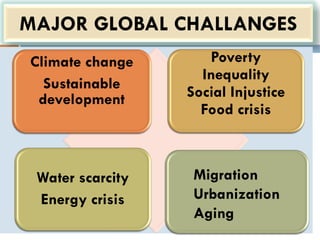
MAJOR GLOBAL CHALLANGES
Climate change
Sustainable
development
Poverty
Inequality
Social Injustice
Food crisis
Water scarcity
Energy crisis
Migration
Urbanization
Aging
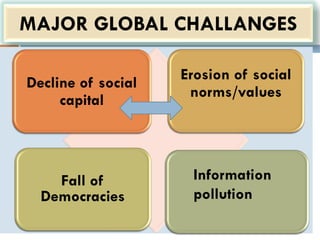
MAJOR GLOBAL CHALLANGES
Decline of social
capital
Erosion of social
norms/values
Fall of
Democracies
Information
pollution
GLOBAL CHALLENGES: 1
CLIMATE CHANGE
AND SUSTAINABLE
DEVELOPMENT
At the United Nations Sustainable Development
Summit in 2015, world leaders adopted the
2030 Agenda for Sustainable Development,
which includes a set of 17 Sustainable
Development Goals (SDGs) aimed at ending
poverty, fighting inequality and injustice and
tackling climate change by 2030.
Sustainable Development Goals (SDGs)
CLIMATE CHANGE : The Challenge
…a gradual upward warming trend caused by an
increased amount of carbon emissions in the
atmosphere, which is recognized as the primary
contributor to global climate change and the significant
environmental issues we face today.
Unless we make changes in our consumption habits, the
impacts on global weather, sea levels, and biodiversity
are predicted only to get worse.
IMPACT OF CLIMATE
CHANGE ON
HUMAN HEALTH
Source: the Centers for Disease Control Climate Effects on Health.
Climate change – experienced primarily through
shifts in temperature, rainfall, sea - level rise and
weather volatility – can have drastic impacts on
human health.
Climate change could see more than 100 million
people return to extreme poverty by 2030 unless
concerted action is taken.
Source: World Bank (2018) on Climate Change and Health.
GLOBAL CHALLENGES: 2
SUSTAINABILITY OF
WATER
Water scarcity – the volumetric abundance, or lack thereof, of freshwater resources
Water stress – the ability, or lack thereof, to meet human and ecological demand for fresh water; compared to
scarcity, “water stress” is a more inclusive and broader concept
Water risk – the possibility of an entity experiencing a water-related challenge (e.g., water scarcity, water stress,
flooding, infrastructure decay, drought)
SOURCE: world resources institute
Water scarcity
Water scarcity is the lack of sufficient
available water resources to meet the
demands of water usage within a region. It
already affects every continent . More than
1.2 billion people lack access to clean
drinking water.
References World Economic Forum. (2018). The Global Risks Report 2018
World Health Organization and UNICEF Joint Monitoring Programme (JMP). (2017). Progress on Drinking Water and Sanitation, 2017 Update and
MDG Assessment.
GLOBAL CHALLENGES: 3
SUSTAINABILITY OF FOOD
AND AGRICULTURE
Global Challenge:
How can population and resources be
brought into balance?
MALTHUS LAW
 Population versus resources. The world population is
growing rapidly and probably there will be 9.1
billion people in 2050. Basically, it means that we
need more resources. Therefore, people should work
on how they can supply more and more food.
 People need water for agriculture for growing world
population. There is population’s increase on the earth.
We estimate that the population will reach 9.1 billion
in 2050 food production must rise by 70%.
SUSTAINABILITY OF FOOD AND
AGRICULTURE
 Improving efficiency in the use of resources is crucial
to sustainable agriculture
 Sustainability requires direct action to conserve,
protect and enhance natural resources
 Agriculture that fails to protect and improve rural
livelihoods and social well-being is unsustainable
 Enhanced resilience of people, communities and
ecosystems is key to sustainable agriculture
 Sustainable food and agriculture requires responsible
and effective governance mechanisms
SUSTAINABILITYGLOBAL CHALLANGES

SUSTAINABILITY GLOBAL CHALLANGES

  • 1.
    SUSTAINABILITY GLOBAL CHALLANGES PROF.DR. COSKUN CANAKTAN Presented at the International Conference on Sustainability, Chuo University, Tokyo, Japan 27 January 2019
  • 2.
    What are thechallenges facing humanity today and in the future? How can we create and rediscover sustainable ways of living on this planet? With accelerating trends such as climate change, water scarcity, energy depletion, social injustice, economic crisis, resource wars, decline of democracies, erosion of social capital and other challenges, there is a growing need for sustainable alternatives.
  • 3.
    MAJOR GLOBAL CHALLANGES Climatechange Sustainable development Poverty Inequality Social Injustice Food crisis Water scarcity Energy crisis Migration Urbanization Aging
  • 4.
    MAJOR GLOBAL CHALLANGES Declineof social capital Erosion of social norms/values Fall of Democracies Information pollution
  • 5.
    GLOBAL CHALLENGES: 1 CLIMATECHANGE AND SUSTAINABLE DEVELOPMENT
  • 6.
    At the UnitedNations Sustainable Development Summit in 2015, world leaders adopted the 2030 Agenda for Sustainable Development, which includes a set of 17 Sustainable Development Goals (SDGs) aimed at ending poverty, fighting inequality and injustice and tackling climate change by 2030. Sustainable Development Goals (SDGs)
  • 9.
    CLIMATE CHANGE :The Challenge …a gradual upward warming trend caused by an increased amount of carbon emissions in the atmosphere, which is recognized as the primary contributor to global climate change and the significant environmental issues we face today. Unless we make changes in our consumption habits, the impacts on global weather, sea levels, and biodiversity are predicted only to get worse.
  • 10.
    IMPACT OF CLIMATE CHANGEON HUMAN HEALTH
  • 11.
    Source: the Centersfor Disease Control Climate Effects on Health.
  • 12.
    Climate change –experienced primarily through shifts in temperature, rainfall, sea - level rise and weather volatility – can have drastic impacts on human health. Climate change could see more than 100 million people return to extreme poverty by 2030 unless concerted action is taken. Source: World Bank (2018) on Climate Change and Health.
  • 13.
  • 14.
    Water scarcity –the volumetric abundance, or lack thereof, of freshwater resources Water stress – the ability, or lack thereof, to meet human and ecological demand for fresh water; compared to scarcity, “water stress” is a more inclusive and broader concept Water risk – the possibility of an entity experiencing a water-related challenge (e.g., water scarcity, water stress, flooding, infrastructure decay, drought) SOURCE: world resources institute
  • 16.
    Water scarcity Water scarcityis the lack of sufficient available water resources to meet the demands of water usage within a region. It already affects every continent . More than 1.2 billion people lack access to clean drinking water. References World Economic Forum. (2018). The Global Risks Report 2018 World Health Organization and UNICEF Joint Monitoring Programme (JMP). (2017). Progress on Drinking Water and Sanitation, 2017 Update and MDG Assessment.
  • 17.
    GLOBAL CHALLENGES: 3 SUSTAINABILITYOF FOOD AND AGRICULTURE
  • 18.
    Global Challenge: How canpopulation and resources be brought into balance?
  • 19.
    MALTHUS LAW  Populationversus resources. The world population is growing rapidly and probably there will be 9.1 billion people in 2050. Basically, it means that we need more resources. Therefore, people should work on how they can supply more and more food.  People need water for agriculture for growing world population. There is population’s increase on the earth. We estimate that the population will reach 9.1 billion in 2050 food production must rise by 70%.
  • 22.
    SUSTAINABILITY OF FOODAND AGRICULTURE  Improving efficiency in the use of resources is crucial to sustainable agriculture  Sustainability requires direct action to conserve, protect and enhance natural resources  Agriculture that fails to protect and improve rural livelihoods and social well-being is unsustainable  Enhanced resilience of people, communities and ecosystems is key to sustainable agriculture  Sustainable food and agriculture requires responsible and effective governance mechanisms