CHAPTER 1
INTRODUCTION TO ECONOMICS
LEARNING
OUTCOMES
AFTER READING THE WHOLE CHAPTER, THE STUDENT IS EXPECTED
TO BE ABLE TO:
Define economics and distinguish between
microeconomics and macroeconomics
Describe basic economic concepts: scarcity, choices
and opportunity cost
Use the production possibilities curve to explain the
basic economic concepts
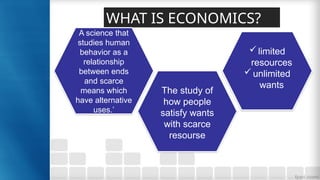
WHAT IS ECONOMICS?
limited
resources
unlimited
wants
A science that
studies human
behavior as a
relationship
between ends
and scarce
means which
have alternative
uses.’
The study of
how people
satisfy wants
with scarce
resourse
MICROECONOMICS VS MACROECONOMICS
MICROECONOMI
C
INDIVIDUAL HOUSEHOLD FIRMS
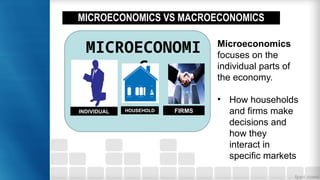
Microeconomics
focuses on the
individual parts of
the economy.
• How households
and firms make
decisions and
how they
interact in
specific markets
MACROECONOMIC
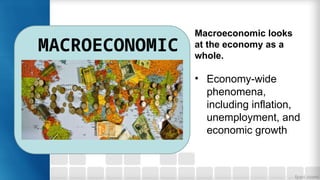
Macroeconomic looks
at the economy as a
whole.
• Economy-wide
phenomena,
including inflation,
unemployment, and
economic growth
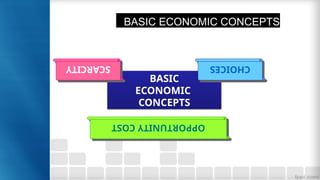
BASIC ECONOMIC CONCEPTS
BASIC
ECONOMIC
CONCEPTS
SCARCITY CHOICES
OPPORTUNITY
COST
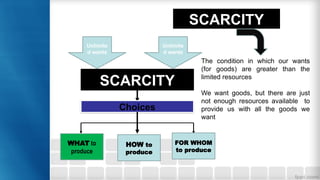
SCARCITY
Unlimite
d wants
Unlimite
d wants
SCARCITY
Choices
WHAT to
produce
HOW to
produce
FOR WHOM
to produce
The condition in which our wants
(for goods) are greater than the
limited resources
We want goods, but there are just
not enough resources available to
provide us with all the goods we
want
What to Produce?
• The economy of every nation has to take a
fundamental decision of what to produce
because of the limited economic resources
• Depends on the what type of goods and
services to produce
How To Produce
• Depends on the cheapest method of
production
• There are alternative techniques of
producing goods and services
For Whom To Produce
• Depends on the distribution of income
• Example: Who will drive the latest model
of an imported car
RESOURCES
LAND
LABOR
CAPITAL
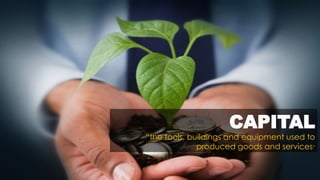
CAPITAL
“the tools, buildings and equipment used to
produced goods and services”
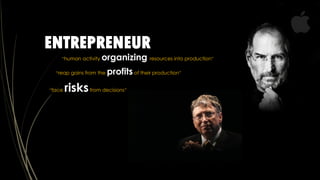
“face risksfrom decisions”
“reap gains from the profitsof their production”
ENTREPRENEUR
“human activity organizing resources into production”
PRODUCTION
POSSIBILITIES
FRONTEIR (PPF)
PRODUCTION POSSIBILITIES FRONTEIR
(PPF)
The PPF shows various
possible combination of
goods or services produced within
a specified time with its resources
fully and efficiently employed.
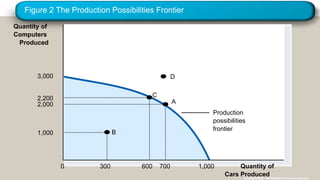
All production possibilities frontiers have two characteristics in
common:
♦ Production points inside and on the PPF are attainable. Points
beyond the PPF are not attainable.
♦ Production points on the PPF achieve production efficiency
because more of one good can be obtained only by producing less of
the other good. Production points inside the PPF are inefficient, with
misallocated or unused resources.
Consumer Goods (million)
Defence Goods (million)
PRODUCTION POSSIBILITIES
(CON’T)
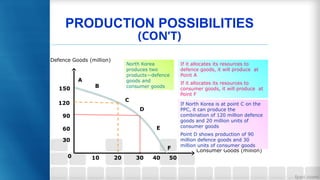
North Korea
produces two
products—defence
goods and
consumer goods
If North Korea is at point C on the
PPC, it can produce the
combination of 120 million defence
goods and 20 million units of
consumer goods
Point D shows production of 90
million defence goods and 30
million units of consumer goods
D
C
B
E
If it allocates its resources to
defence goods, it will produce at
Point A
If it allocates its resources to
consumer goods, it will produce at
Point F
A
F
40 50
0 10 20 30
90
60
120
150
30
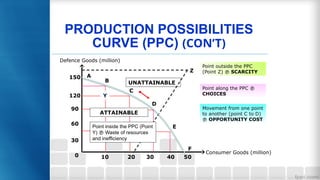
Point along the PPC 
CHOICES
Point outside the PPC
(Point Z)  SCARCITY
UNATTAINABLE
PRODUCTION POSSIBILITIES
CURVE (PPC) (CON’T)
Movement from one point
to another (point C to D)
 OPPORTUNITY COST
Defence Goods (million)
Consumer Goods (million)
F
Z
D
C
A
B
E
120
40
60
50
30
90
150
0 10 20 30
Y
ATTAINABLE
Point inside the PPC (Point
Y)  Waste of resources
and inefficiency
Figure 2 The Production Possibilities Frontier
Copyright©2003 Southwestern/Thomson Learning
Production
possibilities
frontier
A
B
C
Quantity of
Cars Produced
2,200
600
1,000
300
0 700
2,000
3,000
1,000
Quantity of
Computers
Produced
D
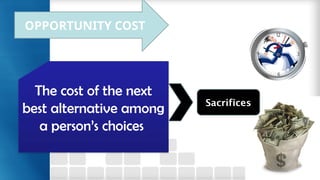
OPPORTUNITY COST
The cost of the next
best alternative among
a person’s choices
Sacrifices
The Circular-Flow Diagram
The circular-flow diagram is a
visual model of the economy that
shows how dollars flow through
markets among households and
firms.
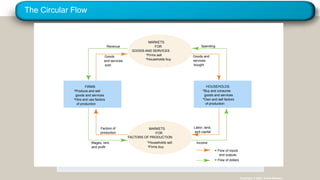
The Circular Flow
Copyright © 2004 South-Western
Spending
Goods and
services
bought
Revenue
Goods
and services
sold
Labor, land,
and capital
Income
= Flow of inputs
and outputs
= Flow of dollars
Factors of
production
Wages, rent,
and profit
FIRMS
•Produce and sell
goods and services
•Hire and use factors
of production
•Buy and consume
goods and services
•Own and sell factors
of production
HOUSEHOLDS
•Households sell
•Firms buy
MARKETS
FOR
FACTORS OF PRODUCTION
•Firms sell
•Households buy
MARKETS
FOR
GOODS AND SERVICES
Firms
• Produce and sell goods and services
• Hire and use factors of production
Households
• Buy and consume goods and services
• Own and sell factors of production
Markets for Goods and Services
• Firms sell
• Households buy
Markets for Factors of Production
• Households sell
• Firms buy
Factors of Production
• Inputs used to produce goods and services
• Land, labor, and capital
SUMMARY
• Economists try to address their subjects with a scientist’s
objectivity.
• They make appropriate assumptions and build simplified models in
order to understand the world around them.
• Two simple economic models are the circular-flow diagram and the
production possibilities frontier.
SUMMARY
• Economics is divided into two subfields:
• Micro economists study decision-making by households
and firms in the marketplace.
• Macroeconomists study the forces and trends that affect the
economy as a whole

Introduction to economics basic economics book

  • 1.
  • 2.
    LEARNING OUTCOMES AFTER READING THEWHOLE CHAPTER, THE STUDENT IS EXPECTED TO BE ABLE TO: Define economics and distinguish between microeconomics and macroeconomics Describe basic economic concepts: scarcity, choices and opportunity cost Use the production possibilities curve to explain the basic economic concepts
  • 3.
    WHAT IS ECONOMICS? limited resources unlimited wants Ascience that studies human behavior as a relationship between ends and scarce means which have alternative uses.’ The study of how people satisfy wants with scarce resourse
  • 4.
    MICROECONOMICS VS MACROECONOMICS MICROECONOMI C INDIVIDUALHOUSEHOLD FIRMS Microeconomics focuses on the individual parts of the economy. • How households and firms make decisions and how they interact in specific markets
  • 5.
    MACROECONOMIC Macroeconomic looks at theeconomy as a whole. • Economy-wide phenomena, including inflation, unemployment, and economic growth
  • 6.
  • 7.
    SCARCITY Unlimite d wants Unlimite d wants SCARCITY Choices WHATto produce HOW to produce FOR WHOM to produce The condition in which our wants (for goods) are greater than the limited resources We want goods, but there are just not enough resources available to provide us with all the goods we want
  • 8.
    What to Produce? •The economy of every nation has to take a fundamental decision of what to produce because of the limited economic resources • Depends on the what type of goods and services to produce
  • 9.
    How To Produce •Depends on the cheapest method of production • There are alternative techniques of producing goods and services
  • 10.
    For Whom ToProduce • Depends on the distribution of income • Example: Who will drive the latest model of an imported car
  • 11.
  • 12.
  • 13.
  • 14.
    CAPITAL CAPITAL “the tools, buildingsand equipment used to produced goods and services”
  • 15.
    “face risksfrom decisions” “reapgains from the profitsof their production” ENTREPRENEUR “human activity organizing resources into production”
  • 16.
  • 17.
    PRODUCTION POSSIBILITIES FRONTEIR (PPF) ThePPF shows various possible combination of goods or services produced within a specified time with its resources fully and efficiently employed.
  • 18.
    All production possibilitiesfrontiers have two characteristics in common: ♦ Production points inside and on the PPF are attainable. Points beyond the PPF are not attainable. ♦ Production points on the PPF achieve production efficiency because more of one good can be obtained only by producing less of the other good. Production points inside the PPF are inefficient, with misallocated or unused resources.
  • 19.
    Consumer Goods (million) DefenceGoods (million) PRODUCTION POSSIBILITIES (CON’T) North Korea produces two products—defence goods and consumer goods If North Korea is at point C on the PPC, it can produce the combination of 120 million defence goods and 20 million units of consumer goods Point D shows production of 90 million defence goods and 30 million units of consumer goods D C B E If it allocates its resources to defence goods, it will produce at Point A If it allocates its resources to consumer goods, it will produce at Point F A F 40 50 0 10 20 30 90 60 120 150 30
  • 20.
    Point along thePPC  CHOICES Point outside the PPC (Point Z)  SCARCITY UNATTAINABLE PRODUCTION POSSIBILITIES CURVE (PPC) (CON’T) Movement from one point to another (point C to D)  OPPORTUNITY COST Defence Goods (million) Consumer Goods (million) F Z D C A B E 120 40 60 50 30 90 150 0 10 20 30 Y ATTAINABLE Point inside the PPC (Point Y)  Waste of resources and inefficiency
  • 21.
    Figure 2 TheProduction Possibilities Frontier Copyright©2003 Southwestern/Thomson Learning Production possibilities frontier A B C Quantity of Cars Produced 2,200 600 1,000 300 0 700 2,000 3,000 1,000 Quantity of Computers Produced D
  • 22.
    OPPORTUNITY COST The costof the next best alternative among a person’s choices Sacrifices
  • 23.
    The Circular-Flow Diagram Thecircular-flow diagram is a visual model of the economy that shows how dollars flow through markets among households and firms.
  • 24.
    The Circular Flow Copyright© 2004 South-Western Spending Goods and services bought Revenue Goods and services sold Labor, land, and capital Income = Flow of inputs and outputs = Flow of dollars Factors of production Wages, rent, and profit FIRMS •Produce and sell goods and services •Hire and use factors of production •Buy and consume goods and services •Own and sell factors of production HOUSEHOLDS •Households sell •Firms buy MARKETS FOR FACTORS OF PRODUCTION •Firms sell •Households buy MARKETS FOR GOODS AND SERVICES
  • 25.
    Firms • Produce andsell goods and services • Hire and use factors of production Households • Buy and consume goods and services • Own and sell factors of production
  • 26.
    Markets for Goodsand Services • Firms sell • Households buy Markets for Factors of Production • Households sell • Firms buy Factors of Production • Inputs used to produce goods and services • Land, labor, and capital
  • 27.
    SUMMARY • Economists tryto address their subjects with a scientist’s objectivity. • They make appropriate assumptions and build simplified models in order to understand the world around them. • Two simple economic models are the circular-flow diagram and the production possibilities frontier.
  • 28.
    SUMMARY • Economics isdivided into two subfields: • Micro economists study decision-making by households and firms in the marketplace. • Macroeconomists study the forces and trends that affect the economy as a whole