The Big bang and the universe
The Beginning10-20 billion years agoThere was nothingSingularity-thought to be originAppearance of a ball of massHydrogen and a little helium
The big bangExpansion NOT ExplosionTrillionth-Trillionth of a secondImagine balloon expanding instead of poppingFirst proposed by George Lemaitre
What happened nextSlower expansionCooling, appearances of forces and particlesRadiation, x-rays, radio wavesPackets of gasFormation of galaxies and planets
EvidenceBackground microwavesUniverse still expandingUniverse had beginningTheory of Relativity being provenAbundance of lightest elements
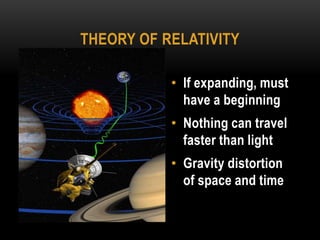
If expanding, must have a beginningNothing can travel faster than lightGravity distortion of space and timeTheory of Relativity
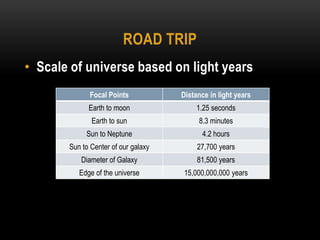
Road tripScale of universe based on light years
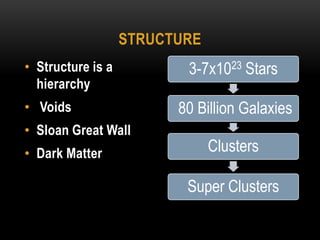
Structure is a hierarchy VoidsSloan Great WallDark MatterStructure
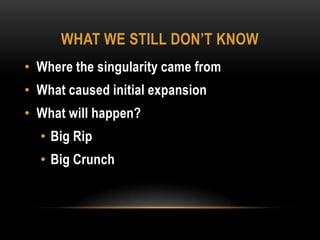
What we still don’t knowWhere the singularity came fromWhat caused initial expansionWhat will happen?Big RipBig Crunch
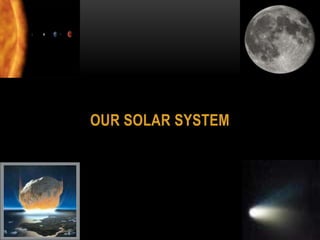
Our solar system
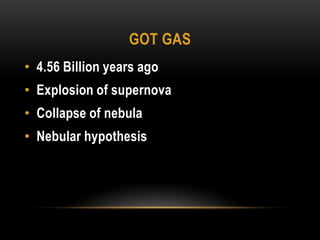
Got gas4.56 Billion years agoExplosion of supernovaCollapse of nebulaNebular hypothesis
The sunGas from collapse of nebula concentratesConservation of Angular MomentumBecomes hotter and denser as spinsStart hydrogen nuclear fusionWhite Dwarf
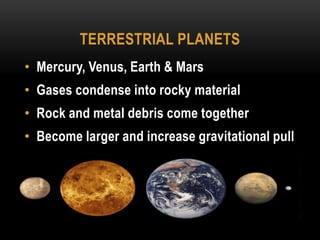
Terrestrial planetsMercury, Venus, Earth & MarsGases condense into rocky materialRock and metal debris come togetherBecome larger and increase gravitational pull
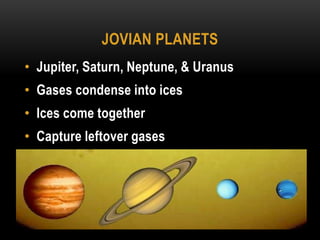
Jovian PlanetsJupiter, Saturn, Neptune, & UranusGases condense into icesIces come togetherCapture leftover gases
MotionTilted 90 degrees“Bouncing” through the galaxy217.215 k/s226 Million years
You are hereMilky way galaxySpiral armSolar system located on Orion armIt’s difficult to tell exactly whereConstant expansionInstead, described as when
Websiteshttp://www.big-bang-theory.com/http://en.wikipedia.org/wiki/Big_Banghttp://science.nationalgeographic.com/science/space/universe/origins-universe-article.htmlhttp://map.gsfc.nasa.gov/universe/bb_theory.htmlhttp://www.infoplease.com/ipa/A0004428.htmlhttp://www.windows2universe.org/our_solar_system/formation.htmlhttp://en.wikipedia.org/wiki/General_relativityhttp://www.pbs.org/deepspace/timeline/index.htmlhttp://en.wikipedia.org/wiki/Introduction_to_general_relativityhttp://en.wikipedia.org/wiki/Observable_universehttp://www.krysstal.com/scale.htmlhttp://en.wikipedia.org/wiki/Solar_Systemhttp://lasp.colorado.edu/education/outerplanets/solsys_planets.phphttp://www.universetoday.com/37360/structure-of-the-universe/MediaNASA, Merging Galaxies, Cosmic Collisions - GPN-2000-000912, July 15 1999 via Wikipedia, public domainNASA, Sig05-16, September 15, 2005 via Wikipedia, public domainNASA, Einstein Cross, September 13, 1990 via Wikipedia, public domainNASA, Sig06-005, January 11, 2006 via Wikipedia, public domainNASA, Cassini-Science-br,  February 25 2006 via Wikipedia, public domainRrinsindika, Solar system a, September 5, 2009 via Wikipedia, creative commons attribution-share alikeLuc Viatour, Full Moon Luc Viatour, October 7, 2006 via Wikipedia, creative commons attribution-share alikeMagicknight94, Asteroid_1, October 17, 2009 via Wikipedia, public domainMiketsukunibito, Comet c1995o1, May 10 2005 via Wikipedia, creative commons attribution-share alikeBrian0918, terrestrial planet size comparison, October 14 2009 via Wikipedia, public domainUrhixidur, Gas Giants and the Sun, August 8 2004 via Wikipedia, public domain

The Big Bang