The Best of Both Worlds:
Implementing Hybrid IT with AWS
Brian Adler, Principal Cloud Architect, RightScale

© 2013 Amazon.com, Inc. and its affiliates. All rights reserved. May not be copied, modified, or distributed in whole or in part without the express consent of Amazon.com, Inc.
Introductions
Brian Adler!
Principal Cloud Architect!
RightScale
Agenda
• 
• 
• 
• 
• 
• 

What is Hybrid IT?
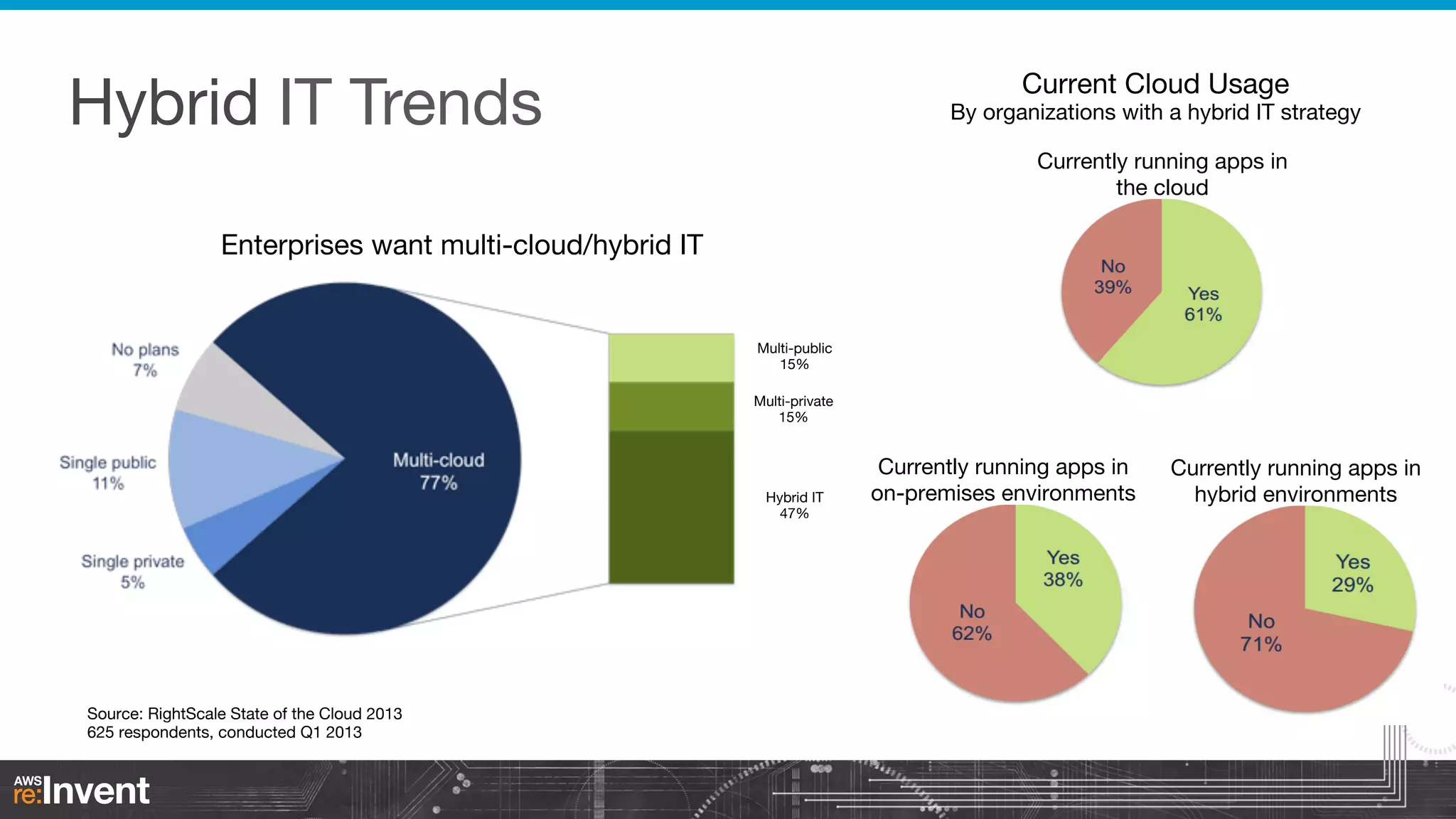
Hybrid IT Trends
Use Cases
Connecting your Hybrid IT Environment
Management of your Hybrid IT Environment
Q&A
What is Hybrid IT?
What is Hybrid IT?
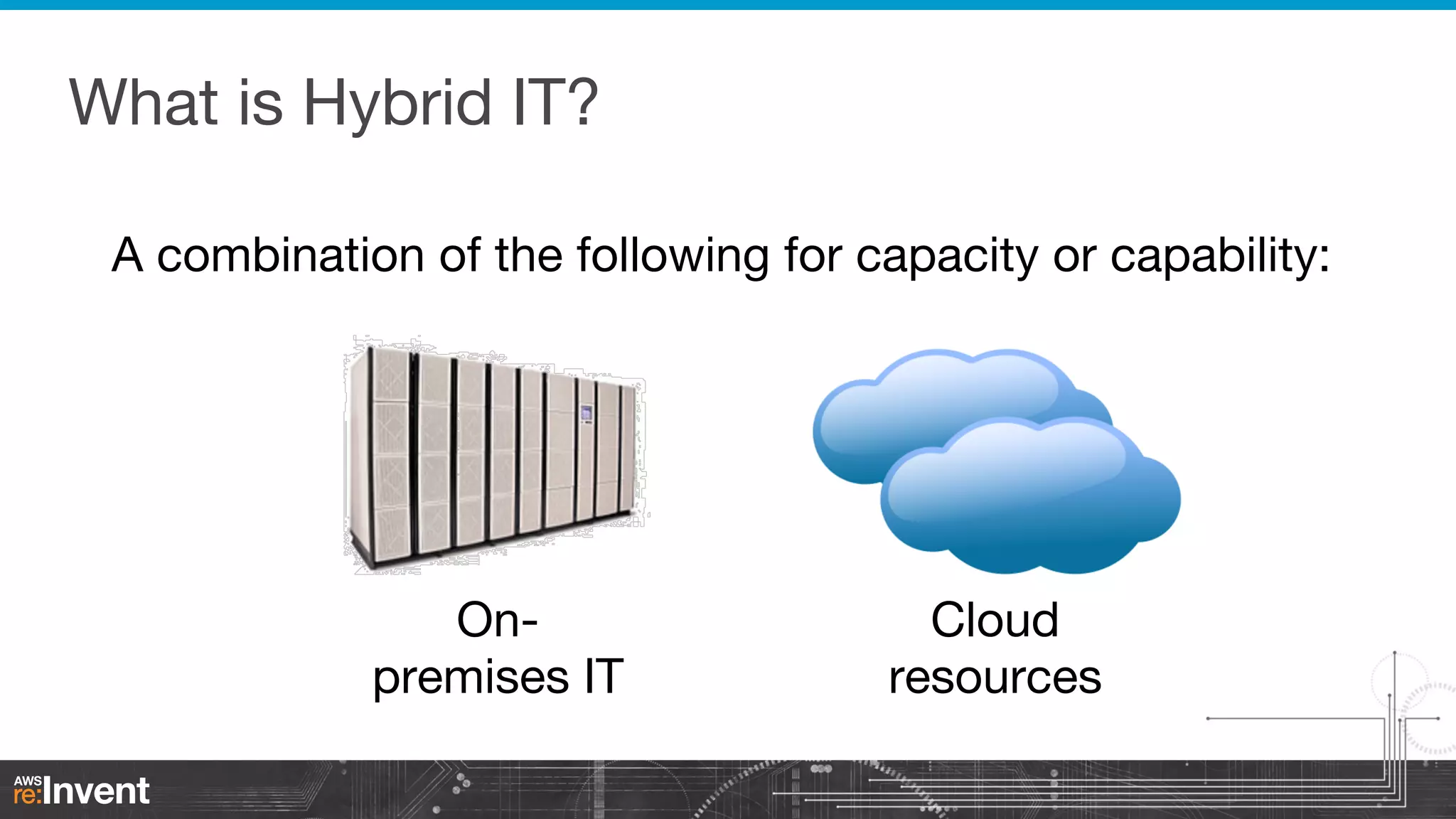
A combination of the following for capacity or capability:

Onpremises IT

Cloud
resources
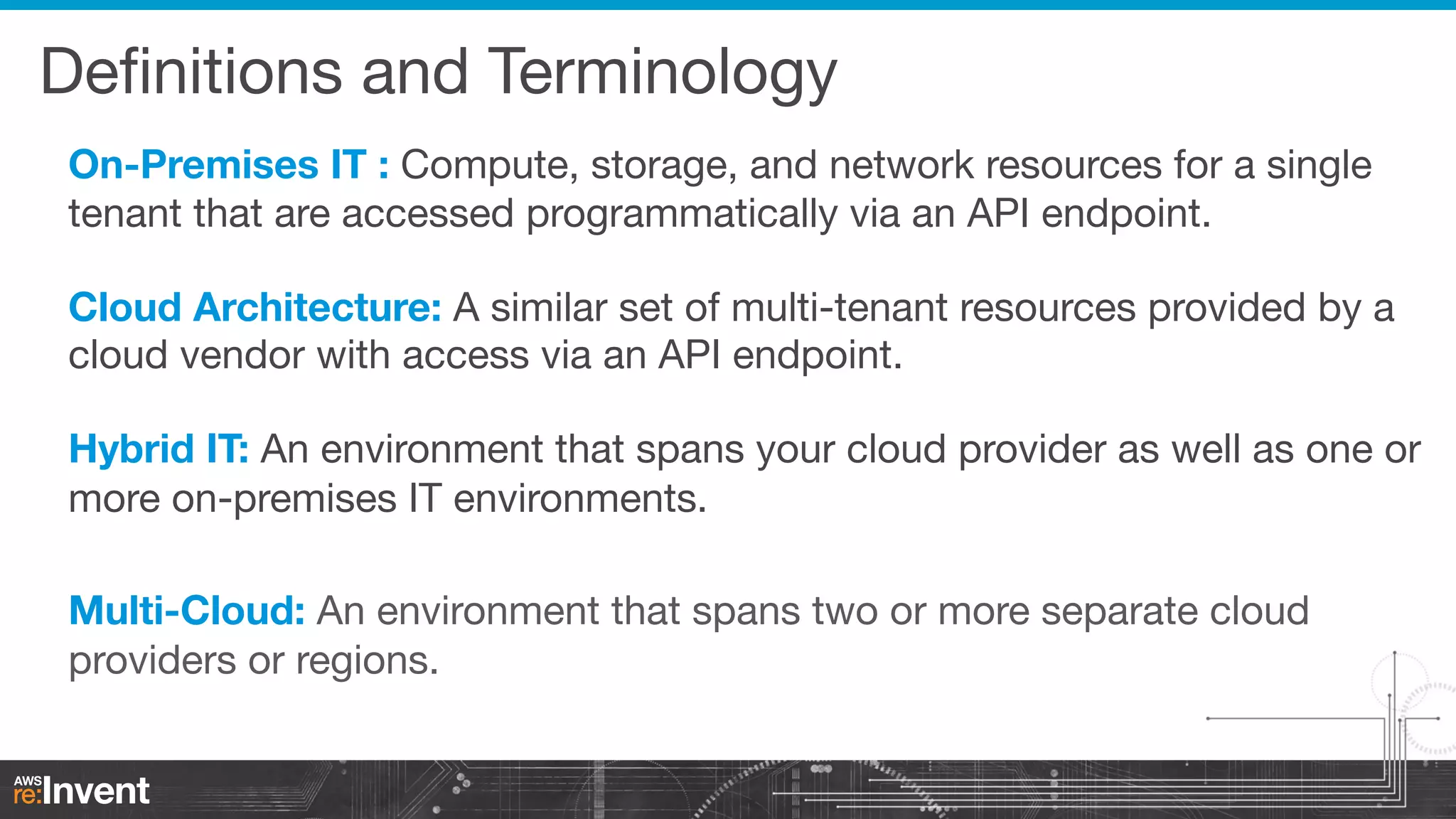
Definitions and Terminology
On-Premises IT : Compute, storage, and network resources for a single
tenant that are accessed programmatically via an API endpoint.


Cloud Architecture: A similar set of multi-tenant resources provided by a
cloud vendor with access via an API endpoint.


Hybrid IT: An environment that spans your cloud provider as well as one or
more on-premises IT environments.

Multi-Cloud: An environment that spans two or more separate cloud
providers or regions.
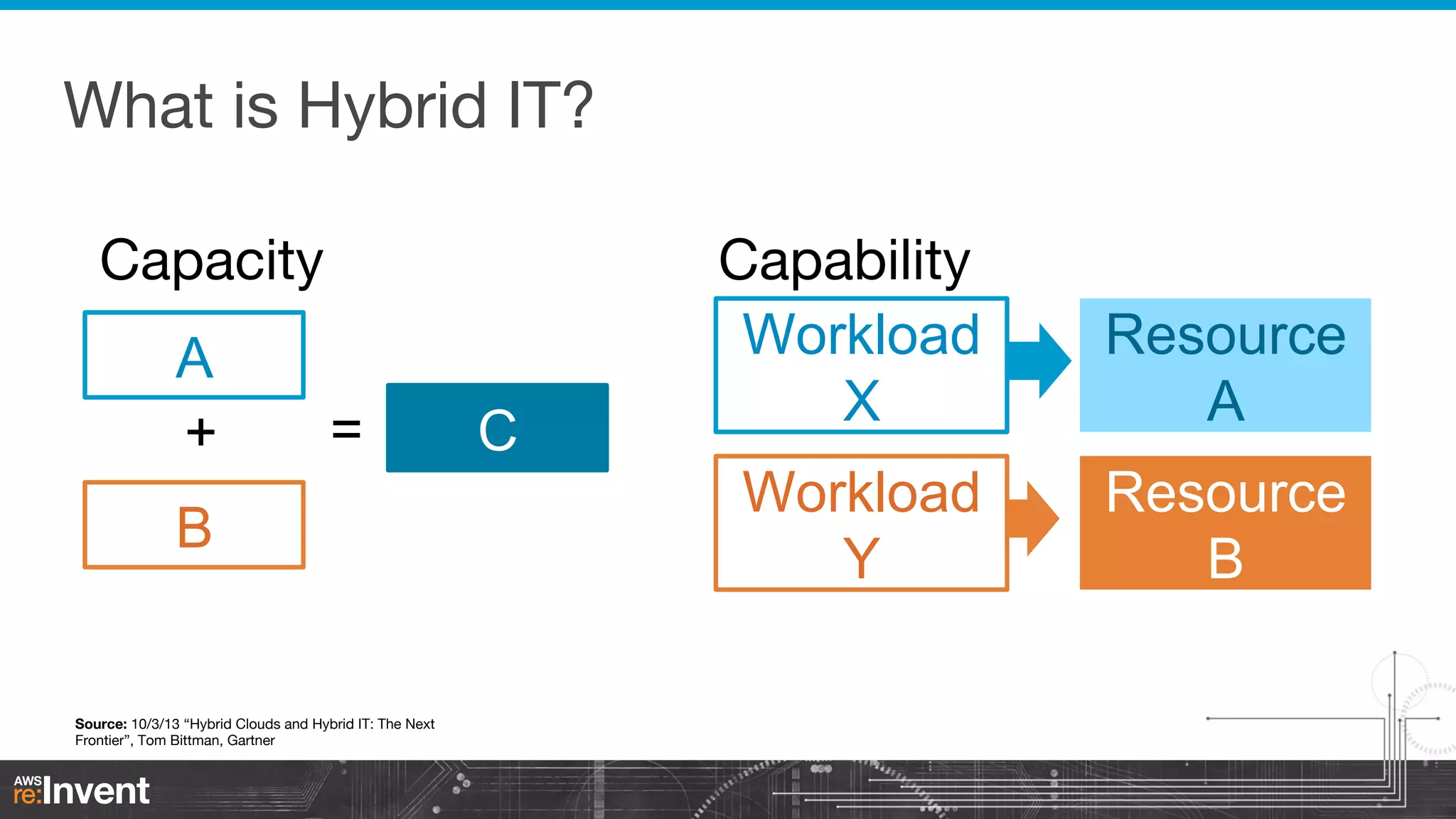
What is Hybrid IT?
Capacity
A
+

=

B

Source: 10/3/13 “Hybrid Clouds and Hybrid IT: The Next
Frontier”, Tom Bittman, Gartner

C

Capability
Workload
X

Resource
A

Workload
Y

Resource
B
Hybrid IT Trends
Hybrid IT Trends

Current Cloud Usage

By organizations with a hybrid IT strategy
Currently running apps in
the cloud

Enterprises want multi-cloud/hybrid IT

Multi-public
15%
Multi-private
15%

Hybrid IT
47%

Source: RightScale State of the Cloud 2013
625 respondents, conducted Q1 2013

Currently running apps in
on-premises environments

Currently running apps in
hybrid environments
Common Use Cases
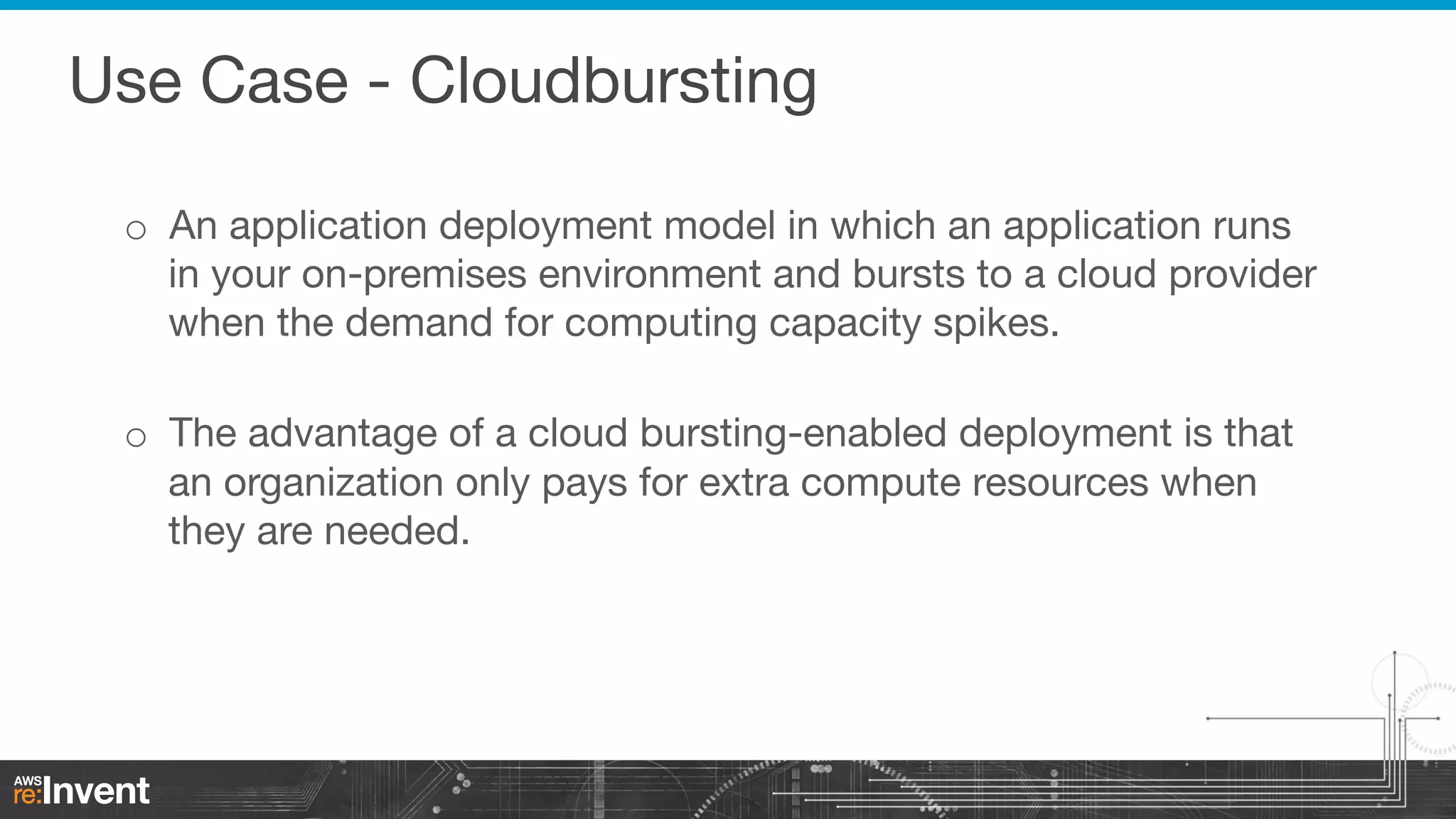
Use Case - Cloudbursting
o  An application deployment model in which an application runs
in your on-premises environment and bursts to a cloud provider
when the demand for computing capacity spikes. 
o  The advantage of a cloud bursting-enabled deployment is that
an organization only pays for extra compute resources when
they are needed.
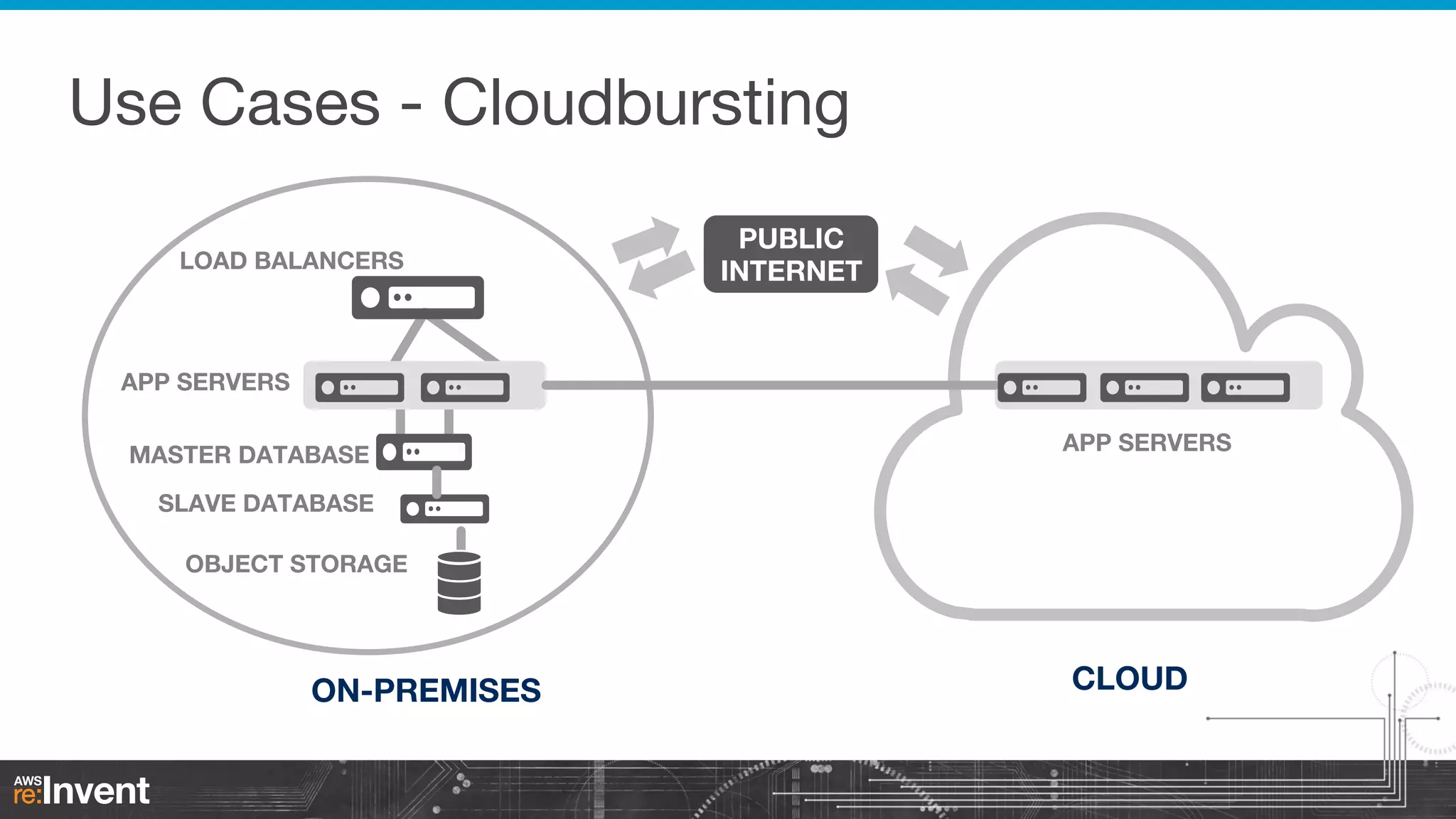
Use Cases - Cloudbursting
LOAD BALANCERS

PUBLIC
INTERNET

APP SERVERS
MASTER DATABASE

APP SERVERS

SLAVE DATABASE
OBJECT STORAGE

ON-PREMISES

CLOUD
Use Cases - Disaster Recovery

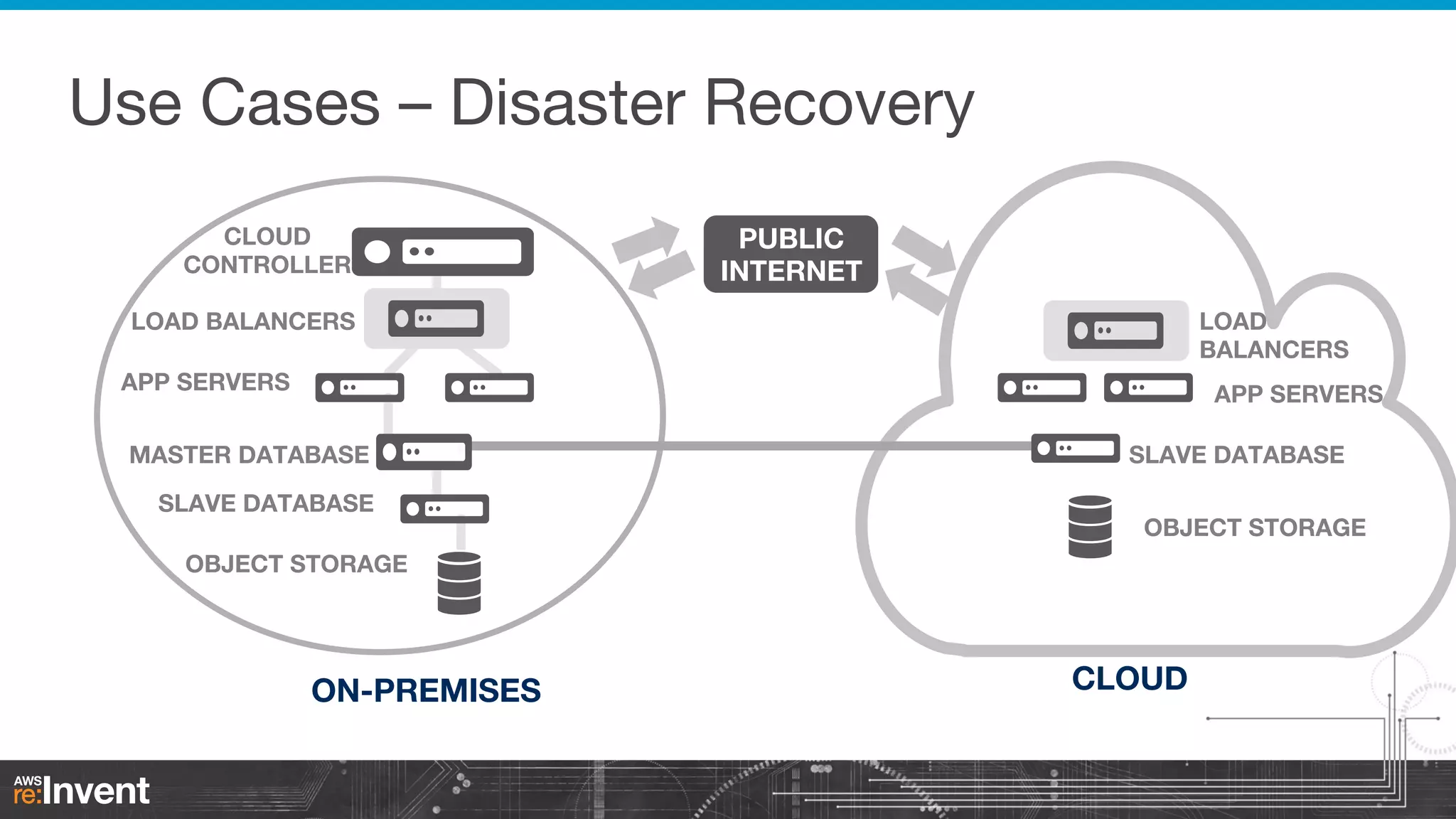
o  Production environment in on-premises
o  DR environment in cloud
o  Most common configuration is the “Warm DR” scenario
•  Replicating slave in the cloud
•  All other servers in non-operational state
Use Cases – Disaster Recovery
CLOUD
CONTROLLER

PUBLIC
INTERNET

LOAD BALANCERS

LOAD
BALANCERS

APP SERVERS

APP SERVERS

MASTER DATABASE
SLAVE DATABASE

SLAVE DATABASE
OBJECT STORAGE

OBJECT STORAGE

ON-PREMISES

CLOUD
Use Cases – Data Residency Requirements
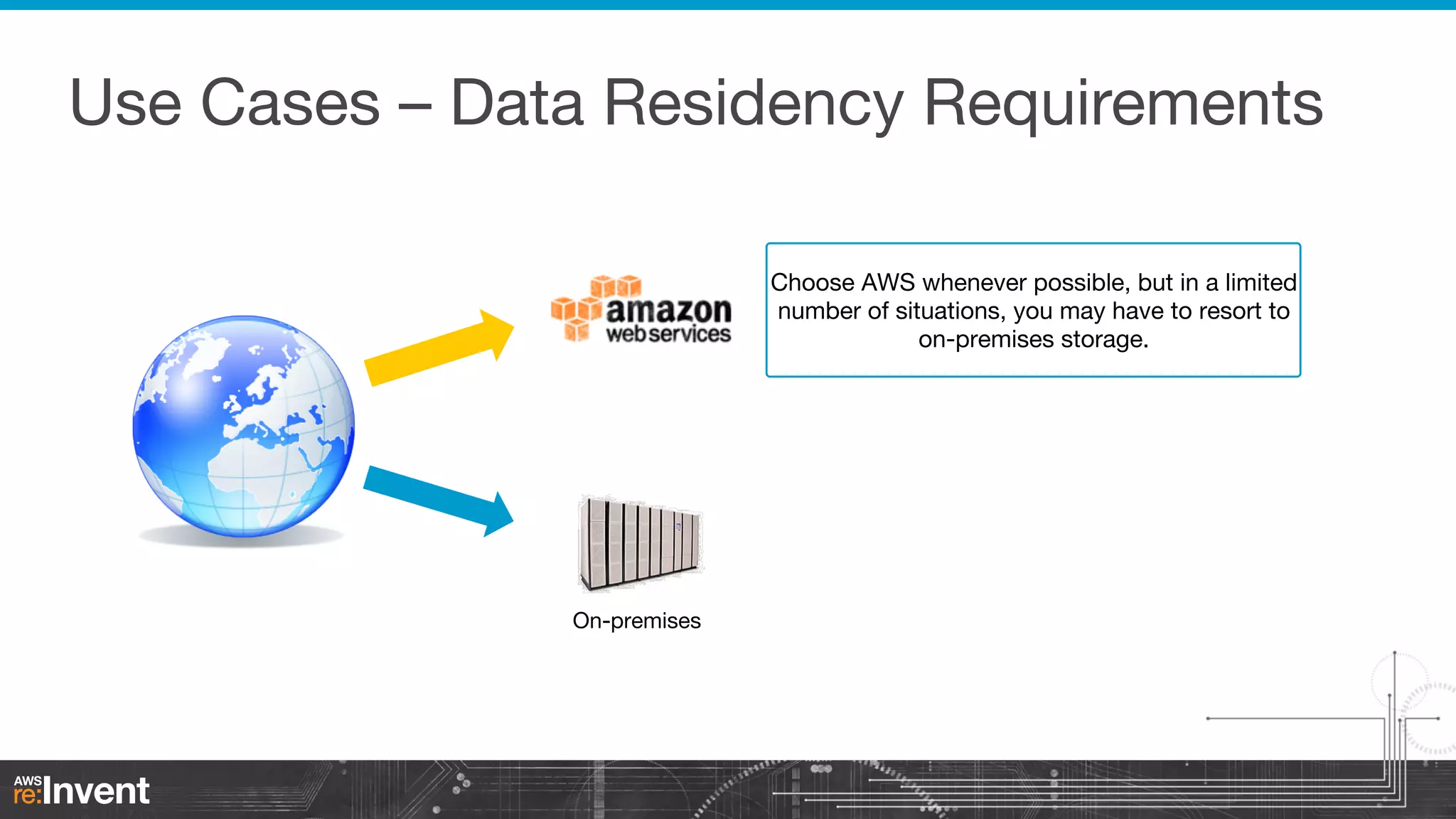
Choose AWS whenever possible, but in a limited
number of situations, you may have to resort to
on-premises storage.

On-premises
Connecting Your Hybrid IT Environment
Connecting Clouds
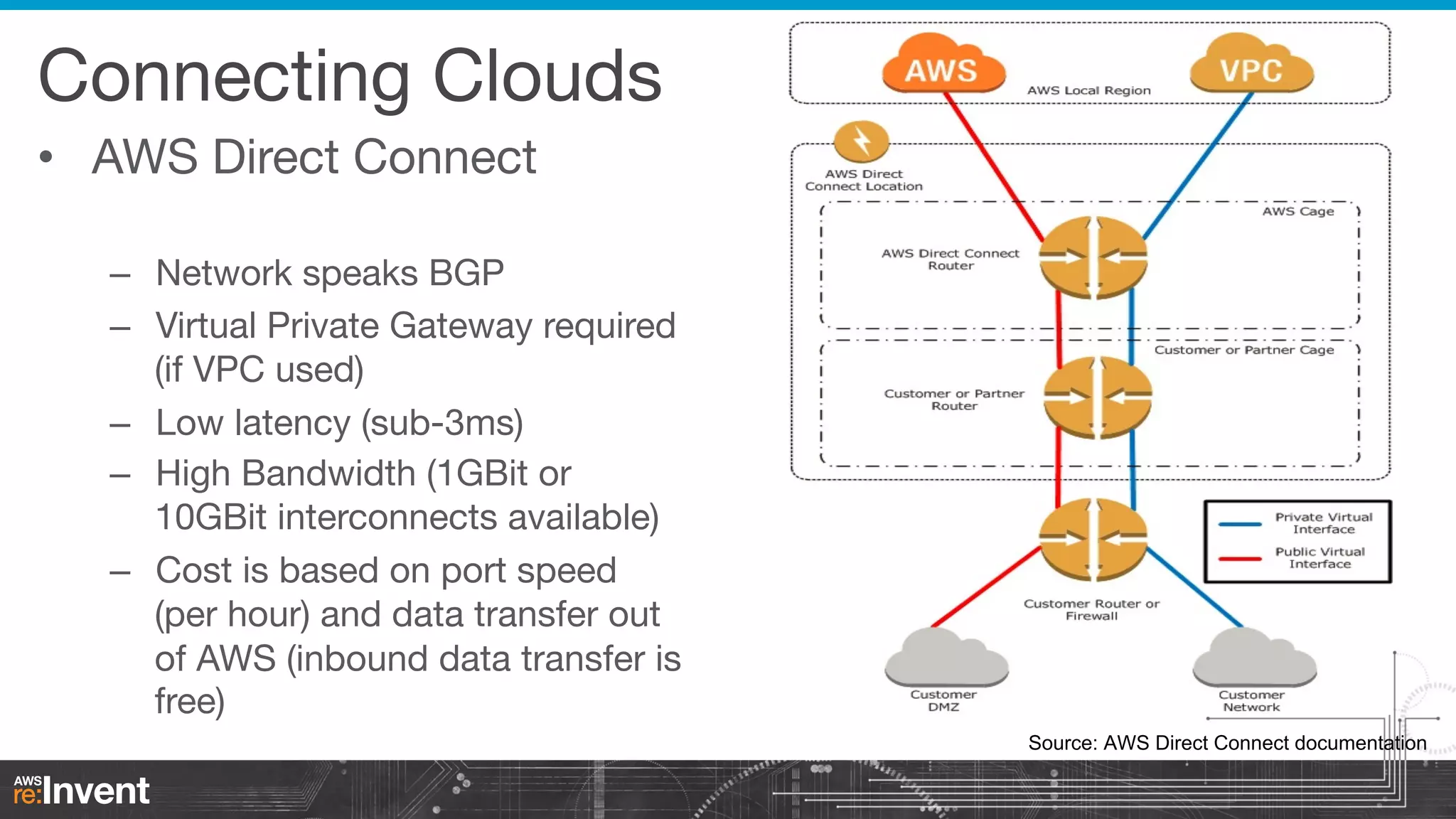
•  AWS Direct Connect
–  Network speaks BGP
–  Virtual Private Gateway required
(if VPC used)
–  Low latency (sub-3ms)
–  High Bandwidth (1GBit or
10GBit interconnects available)
–  Cost is based on port speed
(per hour) and data transfer out
of AWS (inbound data transfer is
free)


Source: AWS Direct Connect documentation
Connecting Clouds
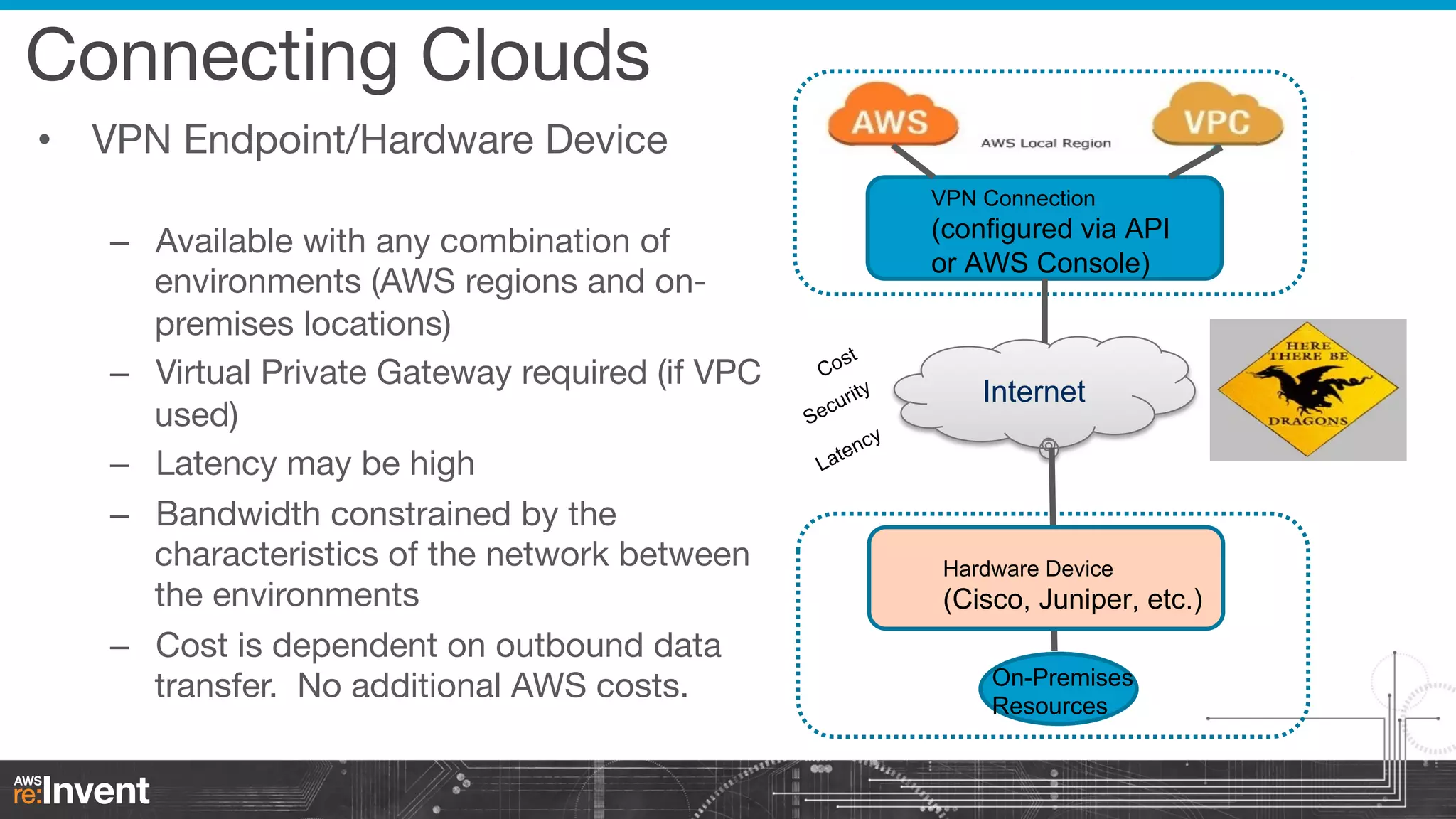
•  VPN Endpoint/Hardware Device
VPN Connection

–  Available with any combination of
environments (AWS regions and onpremises locations)
–  Virtual Private Gateway required (if VPC
used)
–  Latency may be high
–  Bandwidth constrained by the
characteristics of the network between
the environments
–  Cost is dependent on outbound data
transfer. No additional AWS costs.


(configured via API
or AWS Console)

Internet

Hardware Device

(Cisco, Juniper, etc.)
On-Premises
Resources
Connecting Clouds
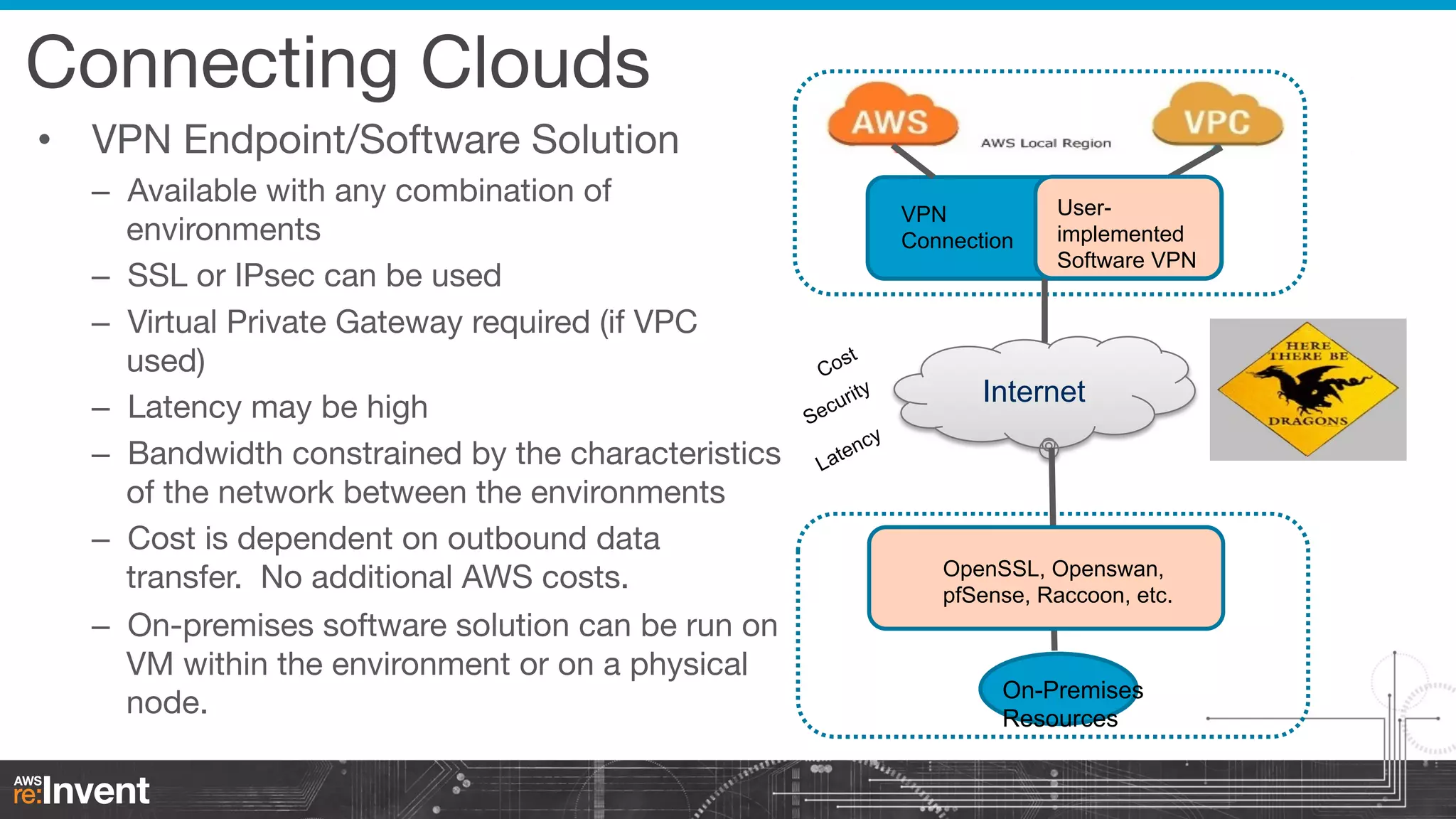
•  VPN Endpoint/Software Solution
–  Available with any combination of
environments
–  SSL or IPsec can be used
–  Virtual Private Gateway required (if VPC
used)
–  Latency may be high
–  Bandwidth constrained by the characteristics
of the network between the environments
–  Cost is dependent on outbound data
transfer. No additional AWS costs.
–  On-premises software solution can be run on
VM within the environment or on a physical
node.


VPN
Connection

Userimplemented
Software VPN

Internet

OpenSSL, Openswan,
pfSense, Raccoon, etc.

On-Premises
Resources
Management of Your Hybrid IT Environment
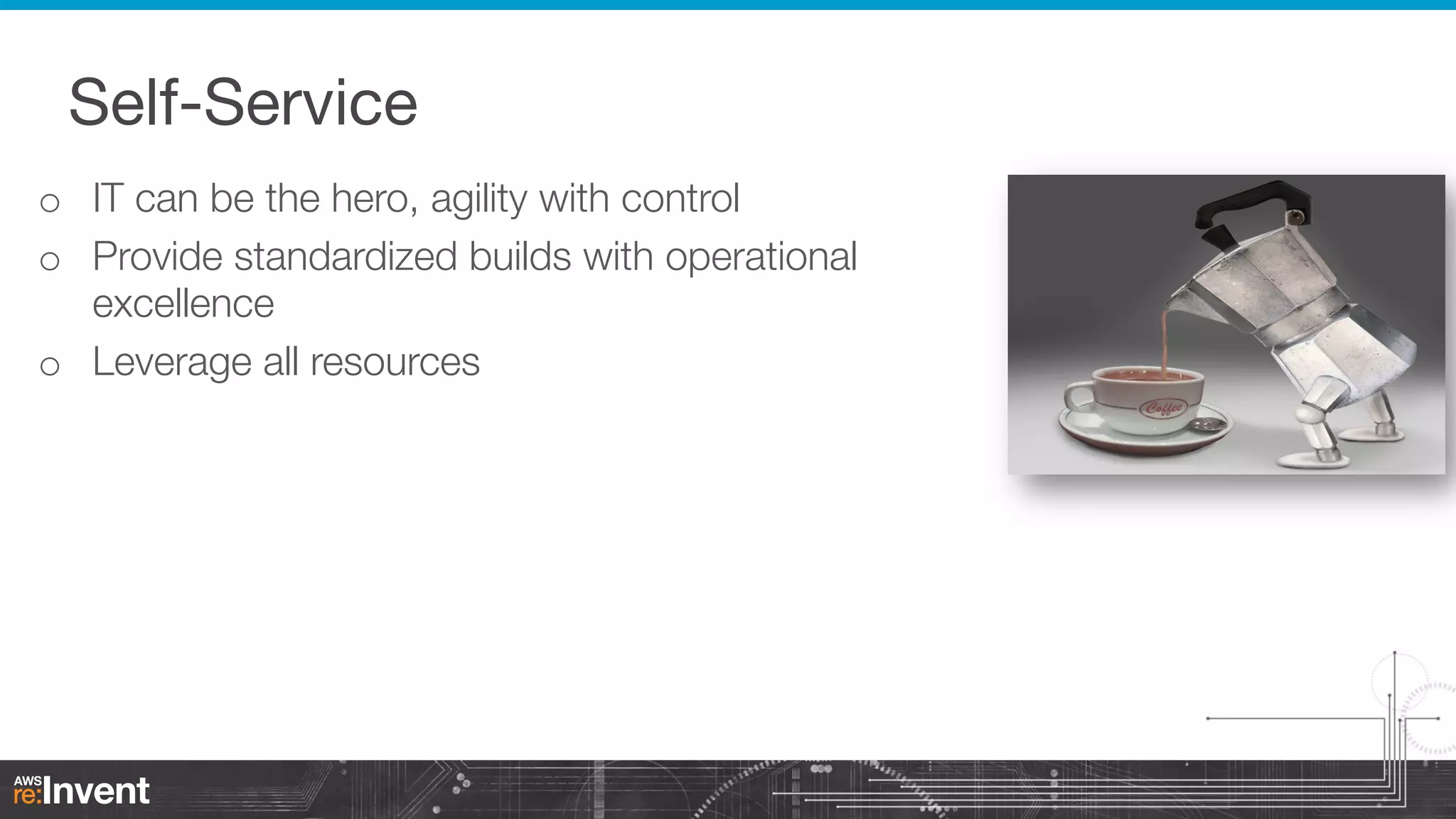
Self-Service
o  IT can be the hero, agility with control
o  Provide standardized builds with operational
excellence
o  Leverage all resources
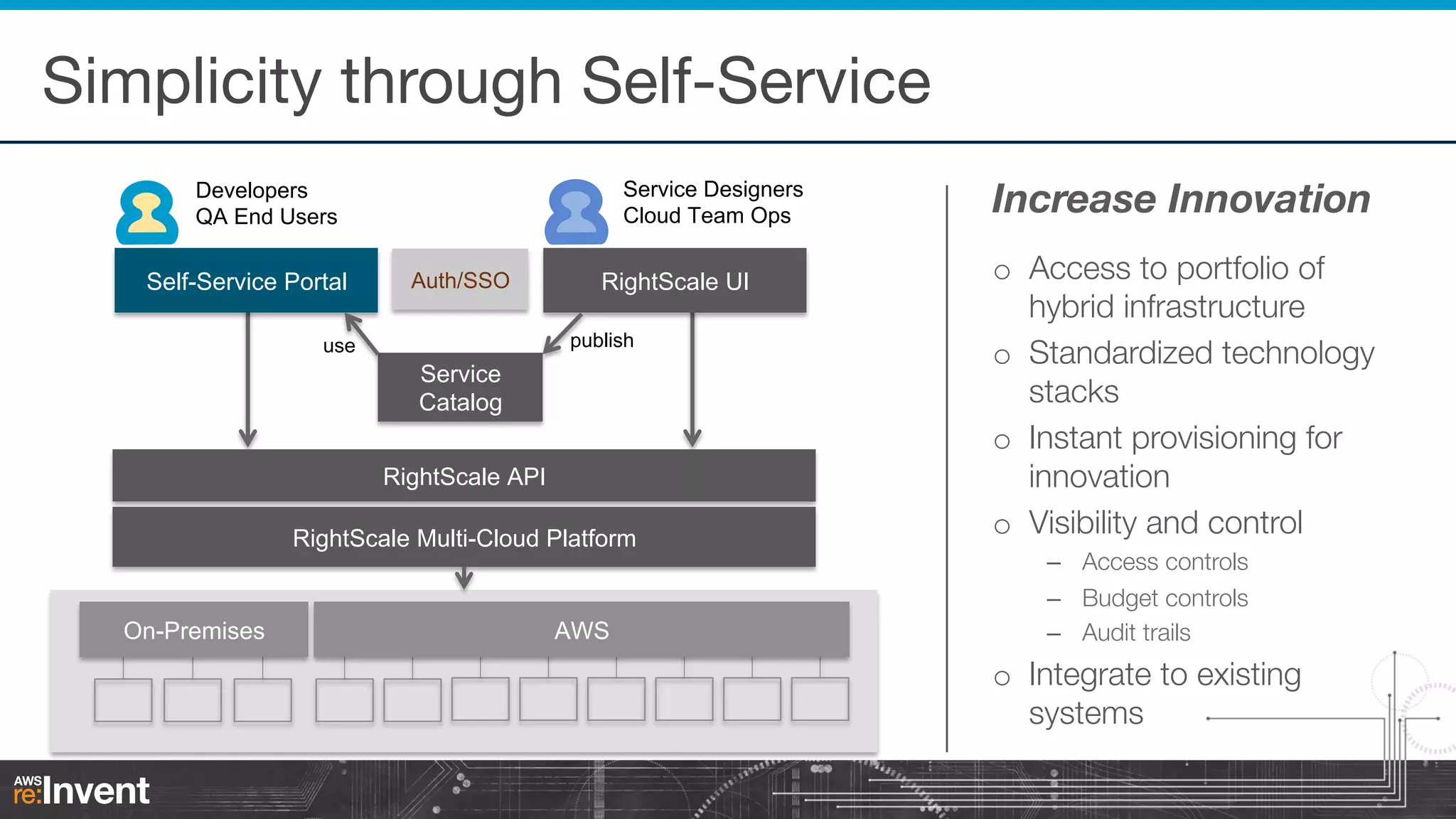
Simplicity through Self-Service
Service Designers
Cloud Team Ops

Developers
QA End Users

Self-Service Portal

Auth/SSO

RightScale UI
publish

use

Service
Catalog
RightScale API
RightScale Multi-Cloud Platform

On-Premises

Increase Innovation
o  Access to portfolio of
hybrid infrastructure
o  Standardized technology
stacks
o  Instant provisioning for
innovation
o  Visibility and control
–  Access controls
–  Budget controls
–  Audit trails

AWS

o  Integrate to existing
systems
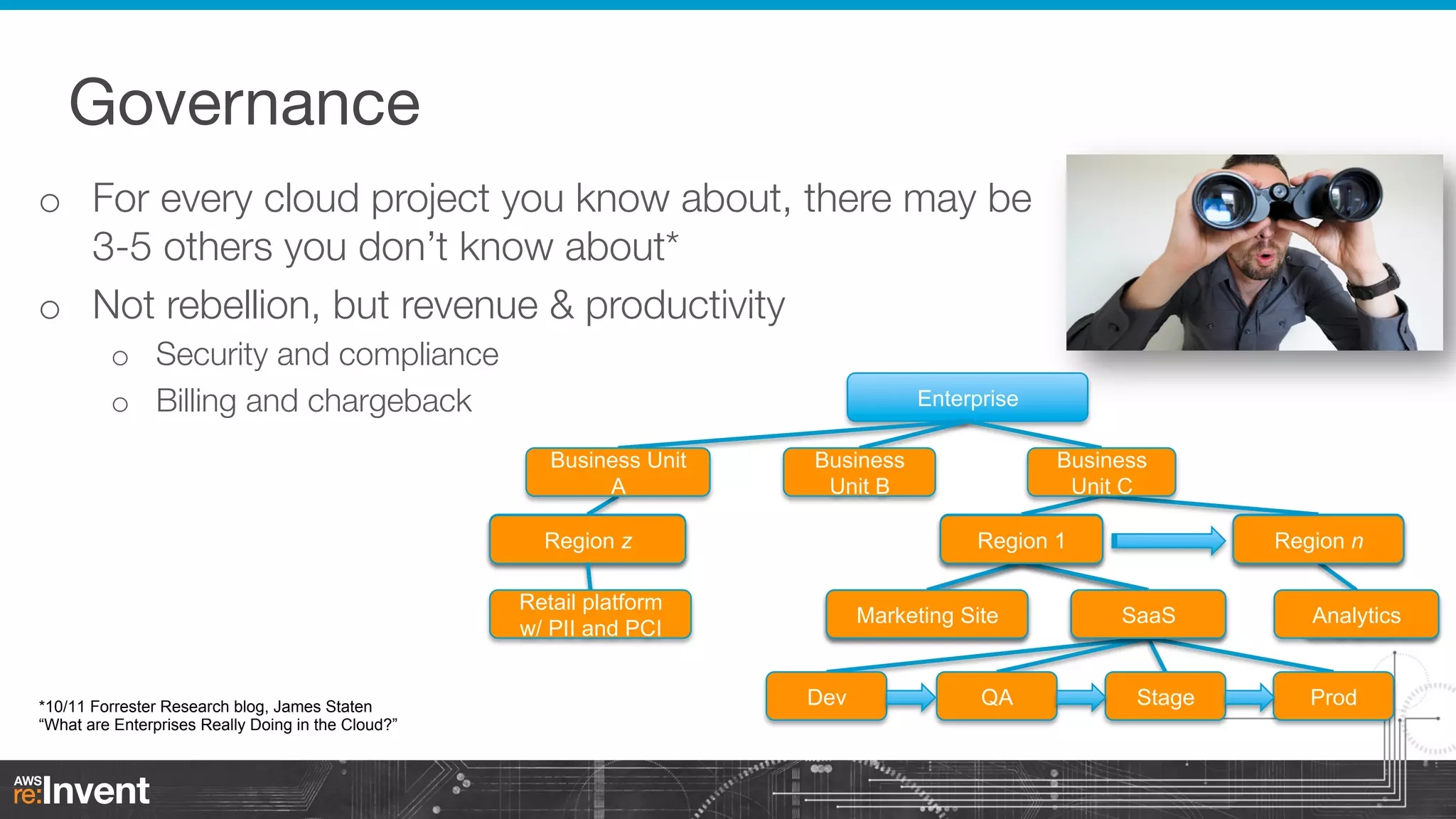
Governance
o  For every cloud project you know about, there may be
3-5 others you don’t know about*
o  Not rebellion, but revenue & productivity
o  Security and compliance
o  Billing and chargeback

Enterprise
Business Unit
A
Tokyo
Region z

San Diego
Region 1

Retail platform
w/ PII and PCI

*10/11 Forrester Research blog, James Staten
“What are Enterprises Really Doing in the Cloud?”

Business
Unit C

Business
Unit B

Marketing Site

Dev

QA

Chicago
Region n
Business
SaaS
Unit 2
Stage

Busines
Analytics
s Unit 1
Prod
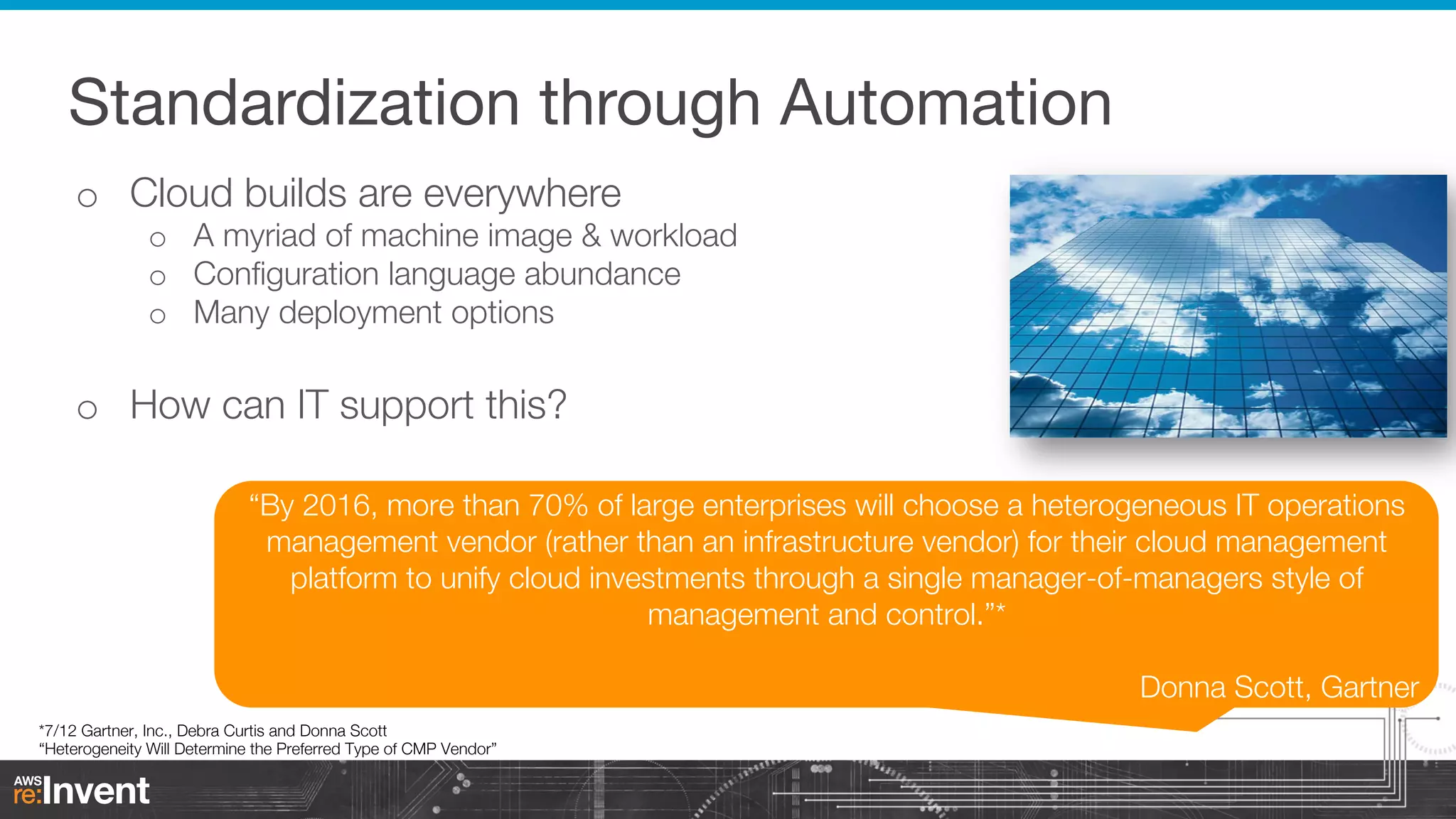
Standardization through Automation
o  Cloud builds are everywhere

o  A myriad of machine image & workload
o  Configuration language abundance
o  Many deployment options

o  How can IT support this?
“By 2016, more than 70% of large enterprises will choose a heterogeneous IT operations
management vendor (rather than an infrastructure vendor) for their cloud management
platform to unify cloud investments through a single manager-of-managers style of
management and control.”*


Donna Scott, Gartner

*7/12 Gartner, Inc., Debra Curtis and Donna Scott
“Heterogeneity Will Determine the Preferred Type of CMP Vendor”
Cost Management
o 
o 
o 
o 

End-user awareness of spend
Cost visibility
Chargeback capability
Cloud Analytics for optimization
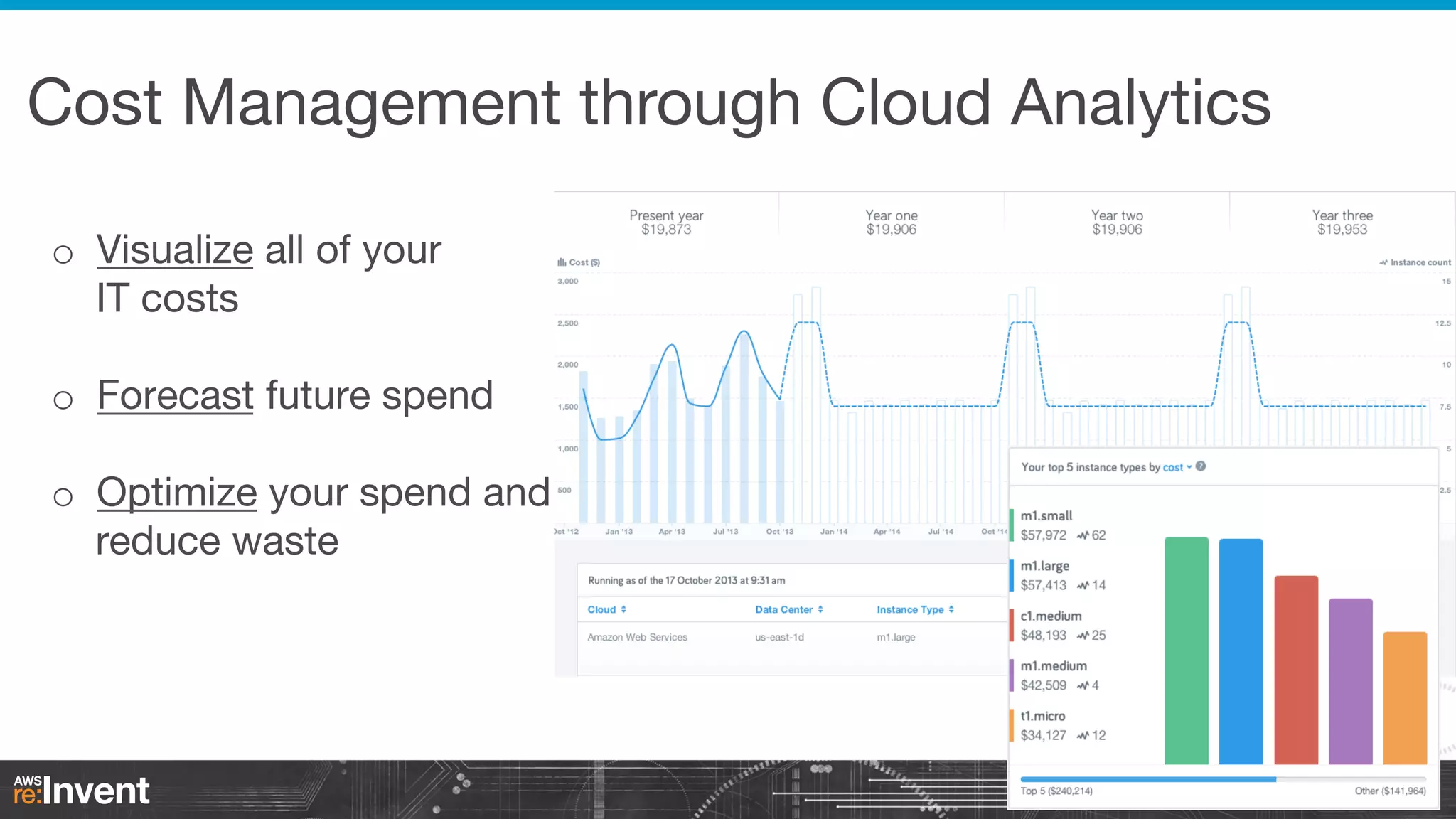
Cost Management through Cloud Analytics
o  Visualize all of your 
IT costs

o  Forecast future spend
o  Optimize your spend and
reduce waste
Questions?

The Best of Both Worlds: Implementing Hybrid IT with AWS

  • 1.
    The Best ofBoth Worlds: Implementing Hybrid IT with AWS Brian Adler, Principal Cloud Architect, RightScale © 2013 Amazon.com, Inc. and its affiliates. All rights reserved. May not be copied, modified, or distributed in whole or in part without the express consent of Amazon.com, Inc.
  • 2.
  • 3.
    Agenda •  •  •  •  •  •  What is HybridIT? Hybrid IT Trends Use Cases Connecting your Hybrid IT Environment Management of your Hybrid IT Environment Q&A
  • 4.
  • 5.
    What is HybridIT? A combination of the following for capacity or capability: Onpremises IT Cloud resources
  • 6.
    Definitions and Terminology On-PremisesIT : Compute, storage, and network resources for a single tenant that are accessed programmatically via an API endpoint. Cloud Architecture: A similar set of multi-tenant resources provided by a cloud vendor with access via an API endpoint. Hybrid IT: An environment that spans your cloud provider as well as one or more on-premises IT environments. Multi-Cloud: An environment that spans two or more separate cloud providers or regions.
  • 7.
    What is HybridIT? Capacity A + = B Source: 10/3/13 “Hybrid Clouds and Hybrid IT: The Next Frontier”, Tom Bittman, Gartner C Capability Workload X Resource A Workload Y Resource B
  • 8.
  • 9.
    Hybrid IT Trends CurrentCloud Usage By organizations with a hybrid IT strategy Currently running apps in the cloud Enterprises want multi-cloud/hybrid IT Multi-public 15% Multi-private 15% Hybrid IT 47% Source: RightScale State of the Cloud 2013 625 respondents, conducted Q1 2013 Currently running apps in on-premises environments Currently running apps in hybrid environments
  • 10.
  • 11.
    Use Case -Cloudbursting o  An application deployment model in which an application runs in your on-premises environment and bursts to a cloud provider when the demand for computing capacity spikes. o  The advantage of a cloud bursting-enabled deployment is that an organization only pays for extra compute resources when they are needed.
  • 12.
    Use Cases -Cloudbursting LOAD BALANCERS PUBLIC INTERNET APP SERVERS MASTER DATABASE APP SERVERS SLAVE DATABASE OBJECT STORAGE ON-PREMISES CLOUD
  • 13.
    Use Cases -Disaster Recovery o  Production environment in on-premises o  DR environment in cloud o  Most common configuration is the “Warm DR” scenario •  Replicating slave in the cloud •  All other servers in non-operational state
  • 14.
    Use Cases –Disaster Recovery CLOUD CONTROLLER PUBLIC INTERNET LOAD BALANCERS LOAD BALANCERS APP SERVERS APP SERVERS MASTER DATABASE SLAVE DATABASE SLAVE DATABASE OBJECT STORAGE OBJECT STORAGE ON-PREMISES CLOUD
  • 15.
    Use Cases –Data Residency Requirements Choose AWS whenever possible, but in a limited number of situations, you may have to resort to on-premises storage. On-premises
  • 16.
    Connecting Your HybridIT Environment
  • 17.
    Connecting Clouds •  AWSDirect Connect –  Network speaks BGP –  Virtual Private Gateway required (if VPC used) –  Low latency (sub-3ms) –  High Bandwidth (1GBit or 10GBit interconnects available) –  Cost is based on port speed (per hour) and data transfer out of AWS (inbound data transfer is free) Source: AWS Direct Connect documentation
  • 18.
    Connecting Clouds •  VPNEndpoint/Hardware Device VPN Connection –  Available with any combination of environments (AWS regions and onpremises locations) –  Virtual Private Gateway required (if VPC used) –  Latency may be high –  Bandwidth constrained by the characteristics of the network between the environments –  Cost is dependent on outbound data transfer. No additional AWS costs. (configured via API or AWS Console) Internet Hardware Device (Cisco, Juniper, etc.) On-Premises Resources
  • 19.
    Connecting Clouds •  VPNEndpoint/Software Solution –  Available with any combination of environments –  SSL or IPsec can be used –  Virtual Private Gateway required (if VPC used) –  Latency may be high –  Bandwidth constrained by the characteristics of the network between the environments –  Cost is dependent on outbound data transfer. No additional AWS costs. –  On-premises software solution can be run on VM within the environment or on a physical node. VPN Connection Userimplemented Software VPN Internet OpenSSL, Openswan, pfSense, Raccoon, etc. On-Premises Resources
  • 20.
    Management of YourHybrid IT Environment
  • 21.
    Self-Service o  IT canbe the hero, agility with control o  Provide standardized builds with operational excellence o  Leverage all resources
  • 22.
    Simplicity through Self-Service ServiceDesigners Cloud Team Ops Developers QA End Users Self-Service Portal Auth/SSO RightScale UI publish use Service Catalog RightScale API RightScale Multi-Cloud Platform On-Premises Increase Innovation o  Access to portfolio of hybrid infrastructure o  Standardized technology stacks o  Instant provisioning for innovation o  Visibility and control –  Access controls –  Budget controls –  Audit trails AWS o  Integrate to existing systems
  • 23.
    Governance o  For everycloud project you know about, there may be 3-5 others you don’t know about* o  Not rebellion, but revenue & productivity o  Security and compliance o  Billing and chargeback Enterprise Business Unit A Tokyo Region z San Diego Region 1 Retail platform w/ PII and PCI *10/11 Forrester Research blog, James Staten “What are Enterprises Really Doing in the Cloud?” Business Unit C Business Unit B Marketing Site Dev QA Chicago Region n Business SaaS Unit 2 Stage Busines Analytics s Unit 1 Prod
  • 24.
    Standardization through Automation o Cloud builds are everywhere o  A myriad of machine image & workload o  Configuration language abundance o  Many deployment options o  How can IT support this? “By 2016, more than 70% of large enterprises will choose a heterogeneous IT operations management vendor (rather than an infrastructure vendor) for their cloud management platform to unify cloud investments through a single manager-of-managers style of management and control.”* Donna Scott, Gartner *7/12 Gartner, Inc., Debra Curtis and Donna Scott “Heterogeneity Will Determine the Preferred Type of CMP Vendor”
  • 25.
    Cost Management o  o  o  o  End-user awarenessof spend Cost visibility Chargeback capability Cloud Analytics for optimization
  • 26.
    Cost Management throughCloud Analytics o  Visualize all of your IT costs o  Forecast future spend o  Optimize your spend and reduce waste
  • 27.