Download to read offline



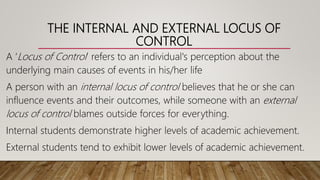


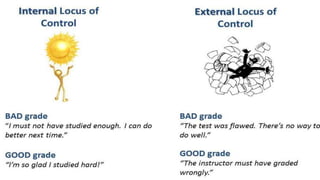





The attribution theory describes how students explain their successes and failures. There are three dimensions: locus of control (internal vs. external), stability of causes (stable vs. unstable), and controllability of behavior (controllable vs. uncontrollable). Students with an internal locus of control believe they can influence outcomes through effort, while those with an external locus see outside forces as responsible. Encouragement focuses on effort and fosters an internal locus, while praise emphasizes outcomes and encourages external attributions. Stable causes are difficult to change, so attributing failures to them can reduce motivation, whereas unstable causes can be altered by more effort. Controllable factors can be influenced, versus uncontrollable ones that cannot be changed.


