The American Inventions
That Revolutionized
Manufacturing
• Invented by Eli Whitney
• Patented in 1794
• Removed the seeds from cotton fiber,
dramatically reducing the time it took to produce
cotton
• Other inventors and plantation owners produced
their own gins, so Whitney turned his attention to
other innovations
Cotton Gin
• Concept introduced by Eli Whitney in 1798
• Whitney needed to fulfill an order of 10,000
muskets for the U.S. army
• Rather than making the guns from scratch,
Whitney came up with the idea of standardized,
interchangeable parts
• Workers could produce high volume at lower
costs and in a much more timely manner
• Ability to swap out parts made repairs much more
efficient
Interchangeable Parts
• Patented by Alexander Graham Bell on February
14, 1876
• Bell was working on a device to help the hearing
impaired
• Many other inventors were working on similar
devices
• Elisa Gray filed a patent just two hours after
Bell
• Allowed shops to take orders over the phone
(instead of by mail), which led to a boon for
efficiency, productivity and, ultimately, profitability
The Telephone
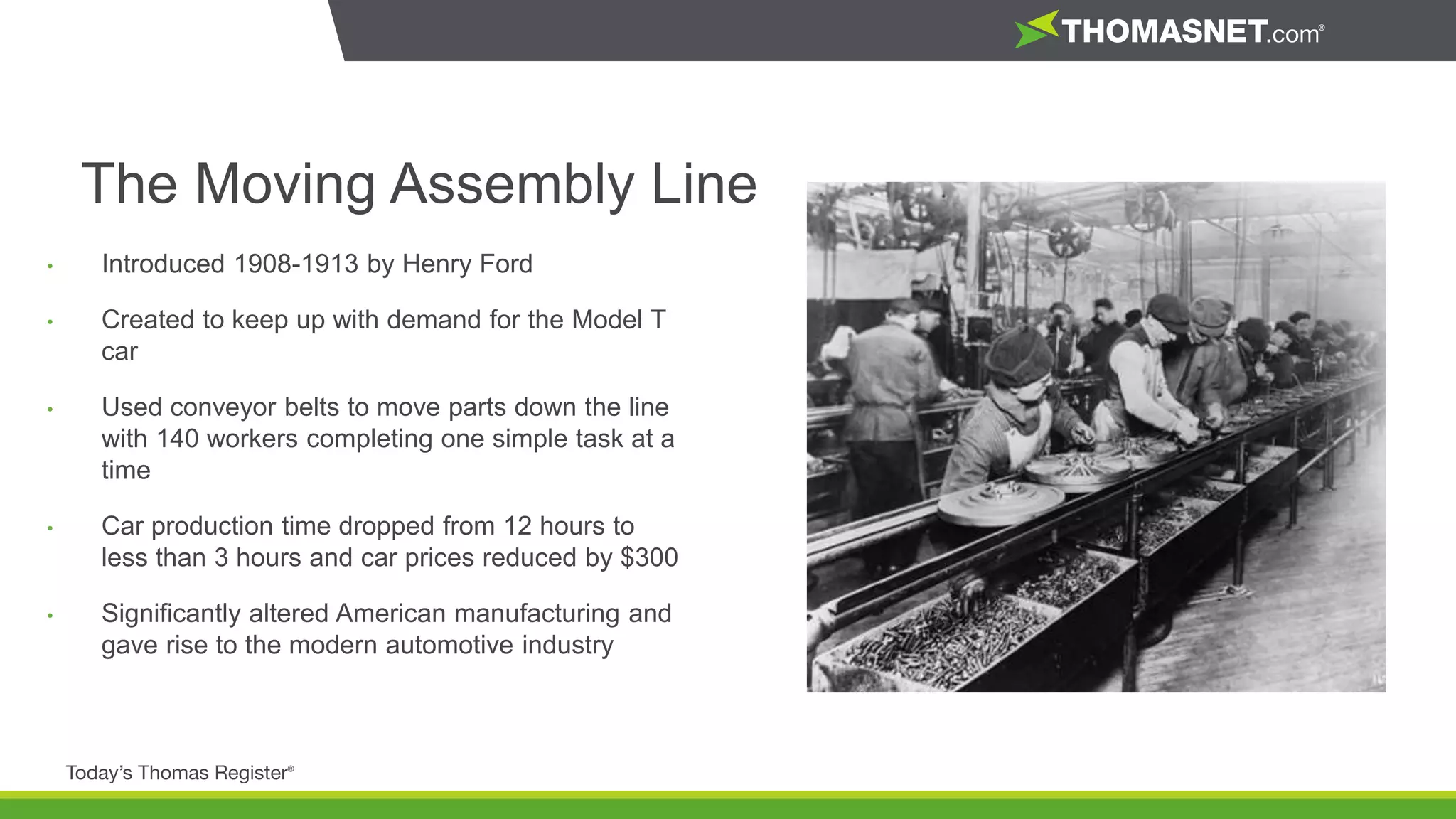
• Introduced 1908-1913 by Henry Ford
• Created to keep up with demand for the Model T
car
• Used conveyor belts to move parts down the line
with 140 workers completing one simple task at a
time
• Car production time dropped from 12 hours to
less than 3 hours and car prices reduced by $300
• Significantly altered American manufacturing and
gave rise to the modern automotive industry
The Moving Assembly Line
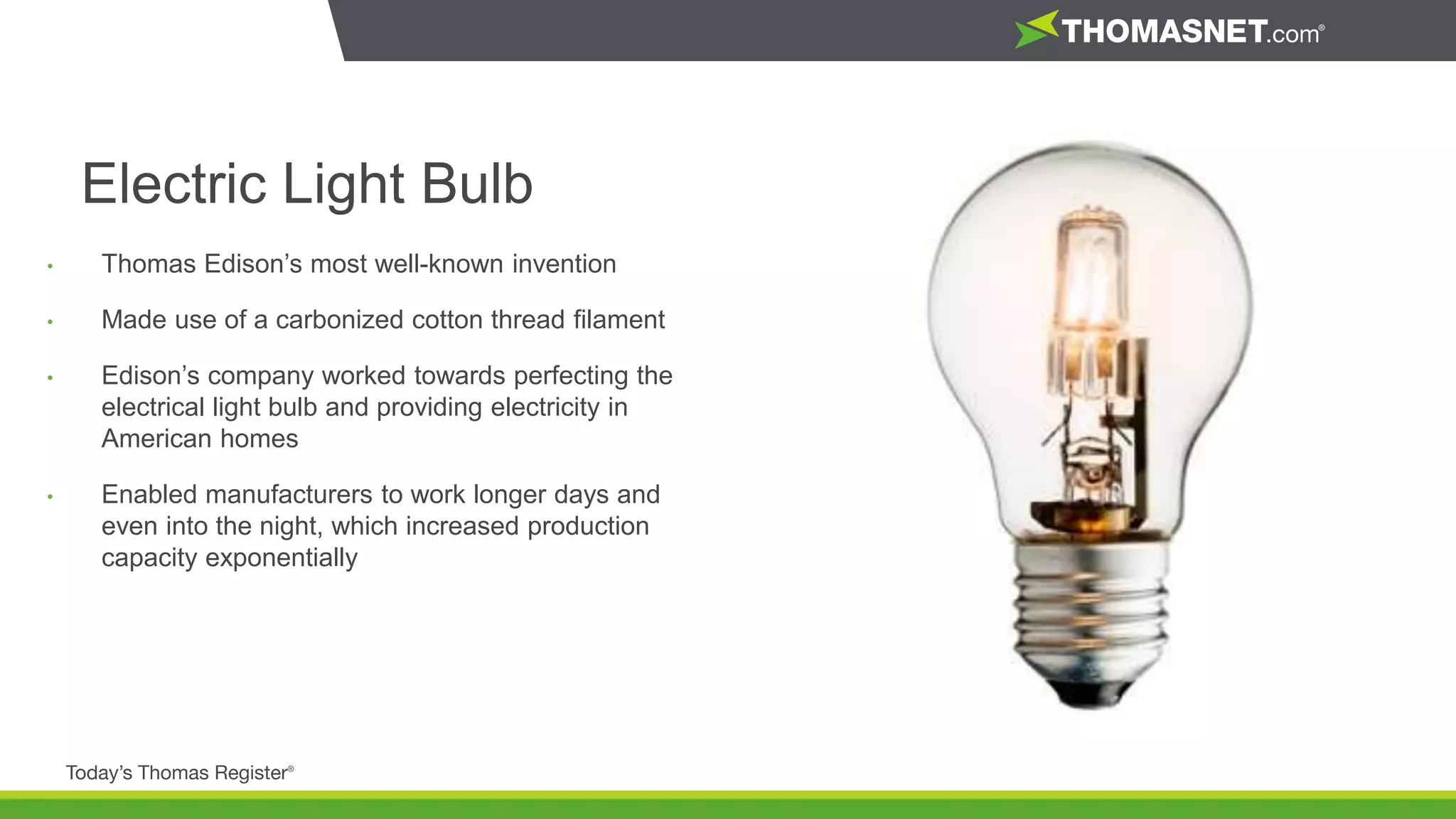
• Thomas Edison’s most well-known invention
• Made use of a carbonized cotton thread filament
• Edison’s company worked towards perfecting the
electrical light bulb and providing electricity in
American homes
• Enabled manufacturers to work longer days and
even into the night, which increased production
capacity exponentially
Electric Light Bulb
• In the 1950s, computer scientist Patrick Hanratty
developed the first commercial CNC
programming system called PRONTO
• By 1963, a PhD candidate from MIT named Ivan
Sutherland created Sketchpad, which is
considered one of the first computer aided design
(CAD) programs
• CAD set the foundation for modern engineering
designs and continues to influence how engineers
mock-up their products
Computer Aided Design (CAD)
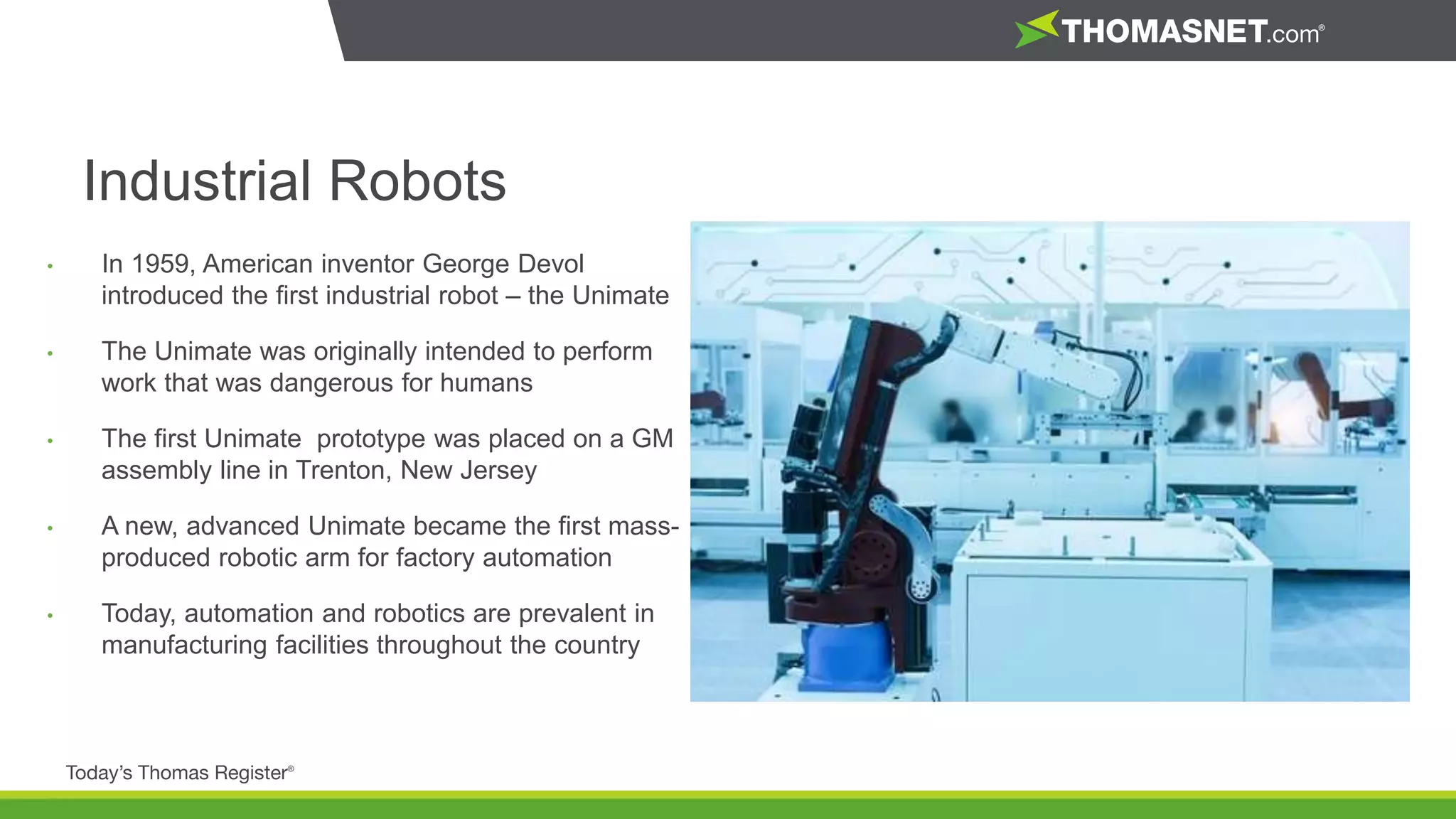
• In 1959, American inventor George Devol
introduced the first industrial robot – the Unimate
• The Unimate was originally intended to perform
work that was dangerous for humans
• The first Unimate prototype was placed on a GM
assembly line in Trenton, New Jersey
• A new, advanced Unimate became the first mass-
produced robotic arm for factory automation
• Today, automation and robotics are prevalent in
manufacturing facilities throughout the country
Industrial Robots
• In 1986, American engineer Charles Hull patented
the very first 3D printer, the stereolithography
(SLA)
• 3D printing has evolved, and it has helped
transform the manufacturing industry along with it
• As 3D technologies become more affordable and
accessible, it will very likely lead to more
American innovations
3D Printing
The American Inventions That Revolutionized Manufacturing

The American Inventions That Revolutionized Manufacturing

  • 1.
    The American Inventions ThatRevolutionized Manufacturing
  • 2.
    • Invented byEli Whitney • Patented in 1794 • Removed the seeds from cotton fiber, dramatically reducing the time it took to produce cotton • Other inventors and plantation owners produced their own gins, so Whitney turned his attention to other innovations Cotton Gin
  • 3.
    • Concept introducedby Eli Whitney in 1798 • Whitney needed to fulfill an order of 10,000 muskets for the U.S. army • Rather than making the guns from scratch, Whitney came up with the idea of standardized, interchangeable parts • Workers could produce high volume at lower costs and in a much more timely manner • Ability to swap out parts made repairs much more efficient Interchangeable Parts
  • 4.
    • Patented byAlexander Graham Bell on February 14, 1876 • Bell was working on a device to help the hearing impaired • Many other inventors were working on similar devices • Elisa Gray filed a patent just two hours after Bell • Allowed shops to take orders over the phone (instead of by mail), which led to a boon for efficiency, productivity and, ultimately, profitability The Telephone
  • 5.
    • Introduced 1908-1913by Henry Ford • Created to keep up with demand for the Model T car • Used conveyor belts to move parts down the line with 140 workers completing one simple task at a time • Car production time dropped from 12 hours to less than 3 hours and car prices reduced by $300 • Significantly altered American manufacturing and gave rise to the modern automotive industry The Moving Assembly Line
  • 6.
    • Thomas Edison’smost well-known invention • Made use of a carbonized cotton thread filament • Edison’s company worked towards perfecting the electrical light bulb and providing electricity in American homes • Enabled manufacturers to work longer days and even into the night, which increased production capacity exponentially Electric Light Bulb
  • 7.
    • In the1950s, computer scientist Patrick Hanratty developed the first commercial CNC programming system called PRONTO • By 1963, a PhD candidate from MIT named Ivan Sutherland created Sketchpad, which is considered one of the first computer aided design (CAD) programs • CAD set the foundation for modern engineering designs and continues to influence how engineers mock-up their products Computer Aided Design (CAD)
  • 8.
    • In 1959,American inventor George Devol introduced the first industrial robot – the Unimate • The Unimate was originally intended to perform work that was dangerous for humans • The first Unimate prototype was placed on a GM assembly line in Trenton, New Jersey • A new, advanced Unimate became the first mass- produced robotic arm for factory automation • Today, automation and robotics are prevalent in manufacturing facilities throughout the country Industrial Robots
  • 9.
    • In 1986,American engineer Charles Hull patented the very first 3D printer, the stereolithography (SLA) • 3D printing has evolved, and it has helped transform the manufacturing industry along with it • As 3D technologies become more affordable and accessible, it will very likely lead to more American innovations 3D Printing