Agile Coaching
DNAOverview
Manoel Pimentel
Agile Coach and Author
leanpub.com/TheAgileCoachingDNA
About me
Manoel is a catalyser of changes, author of the book ‘The Agile
Coaching DNA’, speaker, cyclist enthusiast, and Agile Coach at at
Elabor8 in Australia. He has over 20 years of experience
working as a designer of solutions and helping software
development teams to create better ways of working. Manoel is
also passionate about innovative ways of improving
organisations, for this reason, he helps companies applying
practices of Management 3.0, Learning 3.0 and Lean Change
Management and Agile in large scale.
What’s
Agile Coaching?
My definition
Agile Coaching is an approach to foster an
organisation shift to improve the work, the
behaviours, and the outcomes in the context of the
development of solutions/products.
What’s the
purpose of
Agile Coaching?
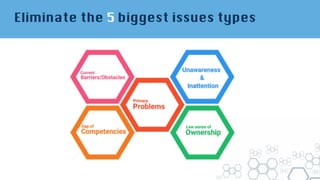
Eliminate the 5 biggest issues types
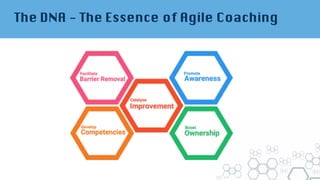
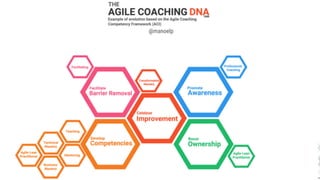
The DNA - The Essence of Agile Coaching
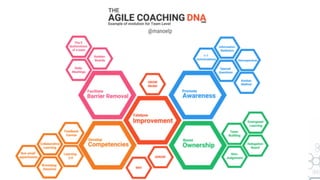
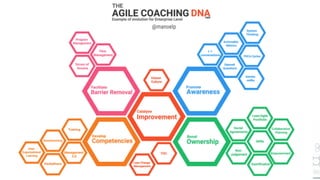
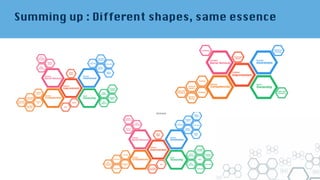
Evolving the DNA
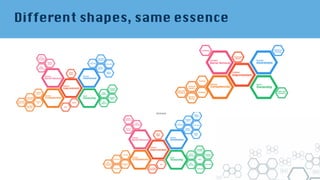
Different shapes, same essence
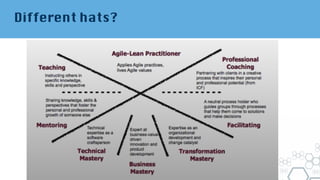
Different hats?
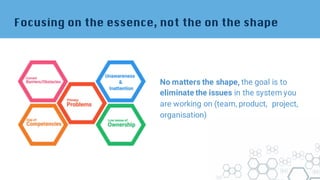
Focusing on the essence, not the on the shape
No matters the shape, the goal is to
eliminate the issues in the system you
are working on (team, product, project,
organisation)
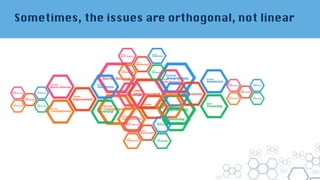
Sometimes, the issues are orthogonal, not linear
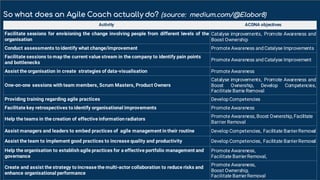
So what does an Agile Coach actually do? (source: medium.com/@Elabor8)
Activity ACDNA objectives
Facilitate sessions for envisioning the change involving people from different levels of the
organisation
Catalyse improvements, Promote Awareness and
Boost Ownership
Conduct assessments to identify what change/improvement Promote Awareness and Catalyse Improvements
Facilitate sessions to map the current value stream in the company to identify pain points
and bottlenecks
Promote Awareness and Catalyse Improvement
Assist the organisation in create strategies of data-visualisation Promote Awareness
One-on-one sessions with team members, Scrum Masters, Product Owners
Catalyse improvements, Promote Awareness and
Boost Ownership, Develop Competencies,
Facilitate Barrie Removal
Providing training regarding agile practices Develop Competencies
Facilitate key retrospectives to identify organisational improvements Promote Awareness
Help the teams in the creation of effective information radiators
Promote Awareness, Boost Ownership, Facilitate
Barrier Removal
Assist managers and leaders to embed practices of agile management in their routine Develop Competencies, Facilitate BarrierRemoval
Assist the team to implement good practices to increase quality and productivity Develop Competencies, Facilitate BarrierRemoval
Help the organisation to establish agile practices for a effective portfolio management and
governance
Promote Awareness,
Facilitate BarrierRemoval,
Create and assist the strategy to increase the multi-actor collaboration to reduce risks and
enhance organisational performance
Promote Awareness,
Boost Ownership,
Facilitate BarrierRemoval
Exploring the 5
elements
With a few examples of tools and
approaches
Catalyse
Improvements
Catalyse Improvement
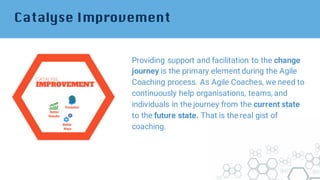
Providing support and facilitation to the change
journey is the primary element during the Agile
Coaching process. As Agile Coaches, we need to
continuously help organisations, teams, and
individuals in the journey from the current state
to the future state. That is the real gist of
coaching.
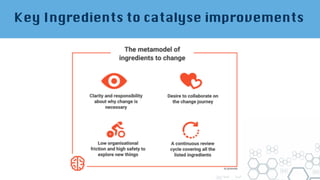
Key Ingredients to catalyse improvements
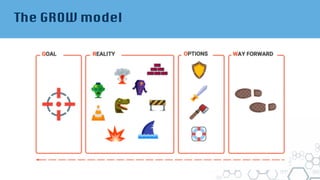
The GROW model
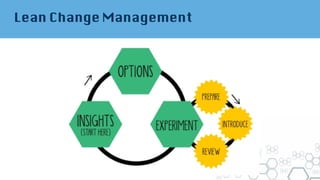
Lean Change Management
Promote
Awareness
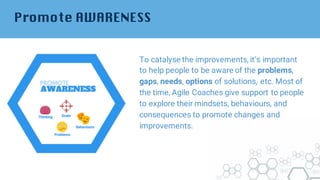
Promote AWARENESS
To catalyse the improvements, it’s important
to help people to be aware of the problems,
gaps, needs, options of solutions, etc. Most of
the time, Agile Coaches give support to people
to explore their mindsets, behaviours, and
consequences to promote changes and
improvements.
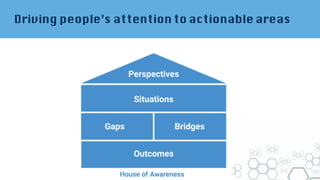
Driving people’s attention to actionable areas
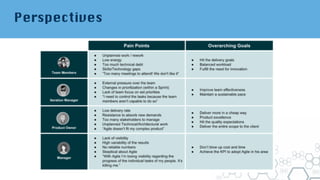
Perspectives
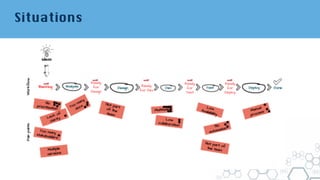
Situations
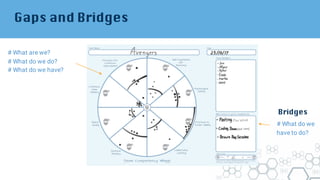
Gaps and Bridges
# What are we?
# What do we do?
# What do we have?
Bridges
# What do we
have to do?
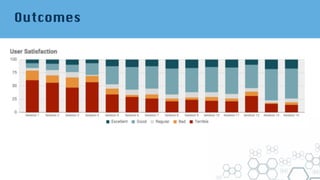
Outcomes
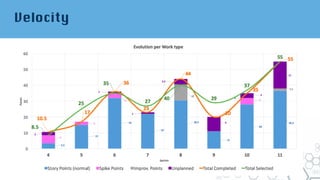
Velocity
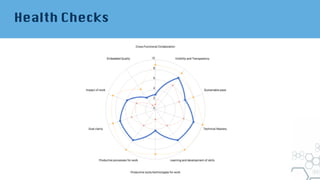
Health Checks
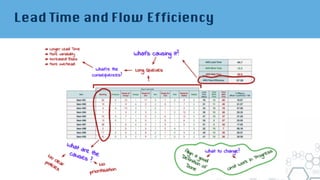
Lead Time and Flow Efficiency
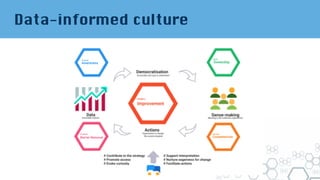
Data-informed culture
Boost Ownership
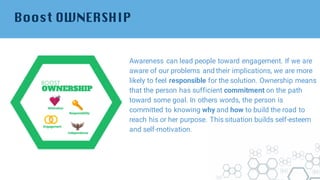
Boost OWNERSHIP
Awareness can lead people toward engagement. If we are
aware of our problems and their implications, we are more
likely to feel responsible for the solution. Ownership means
that the person has sufficient commitment on the path
toward some goal. In others words, the person is
committed to knowing why and how to build the road to
reach his or her purpose. This situation builds self-esteem
and self-motivation.
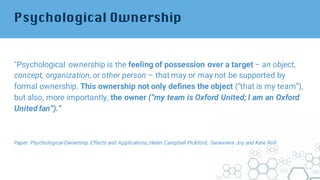
Psychological Ownership
"Psychological ownership is the feeling of possession over a target – an object,
concept, organization, or other person – that may or may not be supported by
formal ownership. This ownership not only defines the object (“that is my team”),
but also, more importantly, the owner (“my team is Oxford United; I am an Oxford
United fan”).”
Paper: Psychological Ownership Effects and Applications,Helen Campbell Pickford, Genevieve Joy and Kate Roll
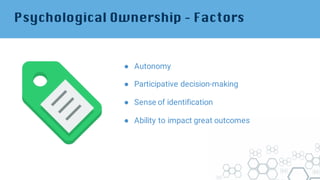
Psychological Ownership – Factors
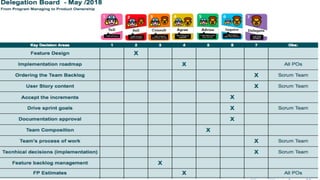
● Autonomy
● Participative decision-making
● Sense of identification
● Ability to impact great outcomes
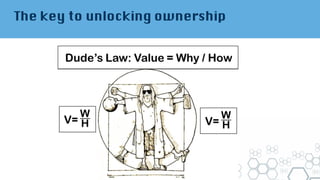
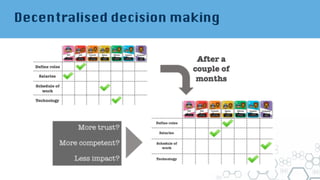
The key to unlocking ownership
Decentralised decision making
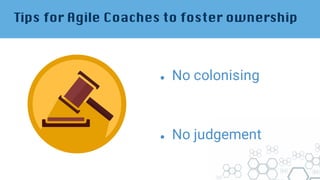
Tips for Agile Coaches to foster ownership
● No colonising
● No judgement
“Give a man a fish, and you feed him
for a day. Teach a man to fish, and
you feed him for a lifetime.”
Develop
Competencies
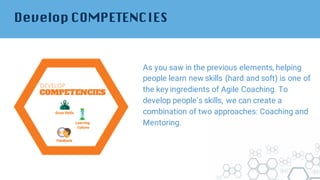
Develop COMPETENCIES
As you saw in the previous elements, helping
people learn new skills (hard and soft) is one of
the key ingredients of Agile Coaching. To
develop people’s skills, we can create a
combination of two approaches: Coaching and
Mentoring.
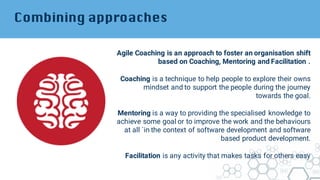
Agile Coaching is an approach to foster an organisation shift
based on Coaching, Mentoring and Facilitation .
Coaching is a technique to help people to explore their owns
mindset and to support the people during the journey
towards the goal.
Mentoring is a way to providing the specialised knowledge to
achieve some goal or to improve the work and the behaviours
at all `in the context of software development and software
based product development.
Facilitation is any activity that makes tasks for others easy
Combining approaches
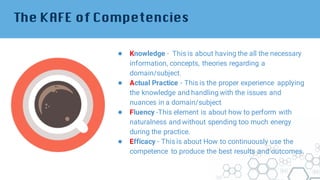
The KAFE of Competencies
● Knowledge - This is about having the all the necessary
information, concepts, theories regarding a
domain/subject.
● Actual Practice - This is the proper experience applying
the knowledge and handling with the issues and
nuances in a domain/subject
● Fluency -This element is about how to perform with
naturalness and without spending too much energy
during the practice.
● Efficacy - This is about How to continuously use the
competence to produce the best results and outcomes.
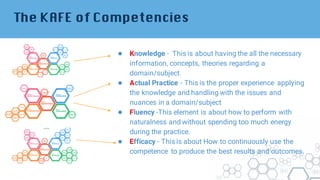
The KAFE of Competencies
● Knowledge - This is about having the all the necessary
information, concepts, theories regarding a
domain/subject.
● Actual Practice - This is the proper experience applying
the knowledge and handling with the issues and
nuances in a domain/subject
● Fluency -This element is about how to perform with
naturalness and without spending too much energy
during the practice.
● Efficacy - This is about How to continuously use the
competence to produce the best results and outcomes.
Facilitate Barrier
Removal
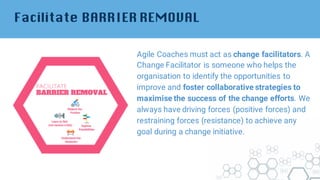
Facilitate BARRIER REMOVAL
Agile Coaches must act as change facilitators. A
Change Facilitator is someone who helps the
organisation to identify the opportunities to
improve and foster collaborative strategies to
maximise the success of the change efforts. We
always have driving forces (positive forces) and
restraining forces (resistance) to achieve any
goal during a change initiative.
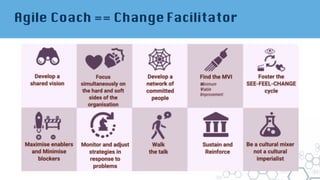
Agile Coach == Change Facilitator
Summing up : Different shapes, same essence
Good bye?
leanpub.com/TheAgileCoachingDNA
twitter.com/manoelp
manoelp@gmail.com

The Agile Coaching DNA - Overview

  • 1.
    Agile Coaching DNAOverview Manoel Pimentel AgileCoach and Author leanpub.com/TheAgileCoachingDNA
  • 2.
    About me Manoel isa catalyser of changes, author of the book ‘The Agile Coaching DNA’, speaker, cyclist enthusiast, and Agile Coach at at Elabor8 in Australia. He has over 20 years of experience working as a designer of solutions and helping software development teams to create better ways of working. Manoel is also passionate about innovative ways of improving organisations, for this reason, he helps companies applying practices of Management 3.0, Learning 3.0 and Lean Change Management and Agile in large scale.
  • 3.
  • 4.
    My definition Agile Coachingis an approach to foster an organisation shift to improve the work, the behaviours, and the outcomes in the context of the development of solutions/products.
  • 5.
  • 6.
    Eliminate the 5biggest issues types
  • 7.
    The DNA -The Essence of Agile Coaching
  • 8.
  • 9.
  • 11.
  • 14.
    Focusing on theessence, not the on the shape No matters the shape, the goal is to eliminate the issues in the system you are working on (team, product, project, organisation)
  • 15.
    Sometimes, the issuesare orthogonal, not linear
  • 16.
    So what doesan Agile Coach actually do? (source: medium.com/@Elabor8) Activity ACDNA objectives Facilitate sessions for envisioning the change involving people from different levels of the organisation Catalyse improvements, Promote Awareness and Boost Ownership Conduct assessments to identify what change/improvement Promote Awareness and Catalyse Improvements Facilitate sessions to map the current value stream in the company to identify pain points and bottlenecks Promote Awareness and Catalyse Improvement Assist the organisation in create strategies of data-visualisation Promote Awareness One-on-one sessions with team members, Scrum Masters, Product Owners Catalyse improvements, Promote Awareness and Boost Ownership, Develop Competencies, Facilitate Barrie Removal Providing training regarding agile practices Develop Competencies Facilitate key retrospectives to identify organisational improvements Promote Awareness Help the teams in the creation of effective information radiators Promote Awareness, Boost Ownership, Facilitate Barrier Removal Assist managers and leaders to embed practices of agile management in their routine Develop Competencies, Facilitate BarrierRemoval Assist the team to implement good practices to increase quality and productivity Develop Competencies, Facilitate BarrierRemoval Help the organisation to establish agile practices for a effective portfolio management and governance Promote Awareness, Facilitate BarrierRemoval, Create and assist the strategy to increase the multi-actor collaboration to reduce risks and enhance organisational performance Promote Awareness, Boost Ownership, Facilitate BarrierRemoval
  • 17.
    Exploring the 5 elements Witha few examples of tools and approaches
  • 18.
  • 19.
    Catalyse Improvement Providing supportand facilitation to the change journey is the primary element during the Agile Coaching process. As Agile Coaches, we need to continuously help organisations, teams, and individuals in the journey from the current state to the future state. That is the real gist of coaching.
  • 20.
    Key Ingredients tocatalyse improvements
  • 21.
  • 22.
  • 23.
  • 24.
    Promote AWARENESS To catalysethe improvements, it’s important to help people to be aware of the problems, gaps, needs, options of solutions, etc. Most of the time, Agile Coaches give support to people to explore their mindsets, behaviours, and consequences to promote changes and improvements.
  • 25.
    Driving people’s attentionto actionable areas
  • 26.
  • 27.
  • 28.
    Gaps and Bridges #What are we? # What do we do? # What do we have? Bridges # What do we have to do?
  • 29.
  • 30.
  • 31.
  • 32.
    Lead Time andFlow Efficiency
  • 33.
  • 34.
  • 35.
    Boost OWNERSHIP Awareness canlead people toward engagement. If we are aware of our problems and their implications, we are more likely to feel responsible for the solution. Ownership means that the person has sufficient commitment on the path toward some goal. In others words, the person is committed to knowing why and how to build the road to reach his or her purpose. This situation builds self-esteem and self-motivation.
  • 36.
    Psychological Ownership "Psychological ownershipis the feeling of possession over a target – an object, concept, organization, or other person – that may or may not be supported by formal ownership. This ownership not only defines the object (“that is my team”), but also, more importantly, the owner (“my team is Oxford United; I am an Oxford United fan”).” Paper: Psychological Ownership Effects and Applications,Helen Campbell Pickford, Genevieve Joy and Kate Roll
  • 37.
    Psychological Ownership –Factors ● Autonomy ● Participative decision-making ● Sense of identification ● Ability to impact great outcomes
  • 38.
    The key tounlocking ownership
  • 40.
  • 42.
    Tips for AgileCoaches to foster ownership ● No colonising ● No judgement
  • 43.
    “Give a mana fish, and you feed him for a day. Teach a man to fish, and you feed him for a lifetime.”
  • 44.
  • 45.
    Develop COMPETENCIES As yousaw in the previous elements, helping people learn new skills (hard and soft) is one of the key ingredients of Agile Coaching. To develop people’s skills, we can create a combination of two approaches: Coaching and Mentoring.
  • 46.
    Agile Coaching isan approach to foster an organisation shift based on Coaching, Mentoring and Facilitation . Coaching is a technique to help people to explore their owns mindset and to support the people during the journey towards the goal. Mentoring is a way to providing the specialised knowledge to achieve some goal or to improve the work and the behaviours at all `in the context of software development and software based product development. Facilitation is any activity that makes tasks for others easy Combining approaches
  • 47.
    The KAFE ofCompetencies ● Knowledge - This is about having the all the necessary information, concepts, theories regarding a domain/subject. ● Actual Practice - This is the proper experience applying the knowledge and handling with the issues and nuances in a domain/subject ● Fluency -This element is about how to perform with naturalness and without spending too much energy during the practice. ● Efficacy - This is about How to continuously use the competence to produce the best results and outcomes.
  • 48.
    The KAFE ofCompetencies ● Knowledge - This is about having the all the necessary information, concepts, theories regarding a domain/subject. ● Actual Practice - This is the proper experience applying the knowledge and handling with the issues and nuances in a domain/subject ● Fluency -This element is about how to perform with naturalness and without spending too much energy during the practice. ● Efficacy - This is about How to continuously use the competence to produce the best results and outcomes.
  • 49.
  • 50.
    Facilitate BARRIER REMOVAL AgileCoaches must act as change facilitators. A Change Facilitator is someone who helps the organisation to identify the opportunities to improve and foster collaborative strategies to maximise the success of the change efforts. We always have driving forces (positive forces) and restraining forces (resistance) to achieve any goal during a change initiative.
  • 51.
    Agile Coach ==Change Facilitator
  • 53.
    Summing up :Different shapes, same essence
  • 55.