The Agile Bank—
Transforming the
Customer Experience
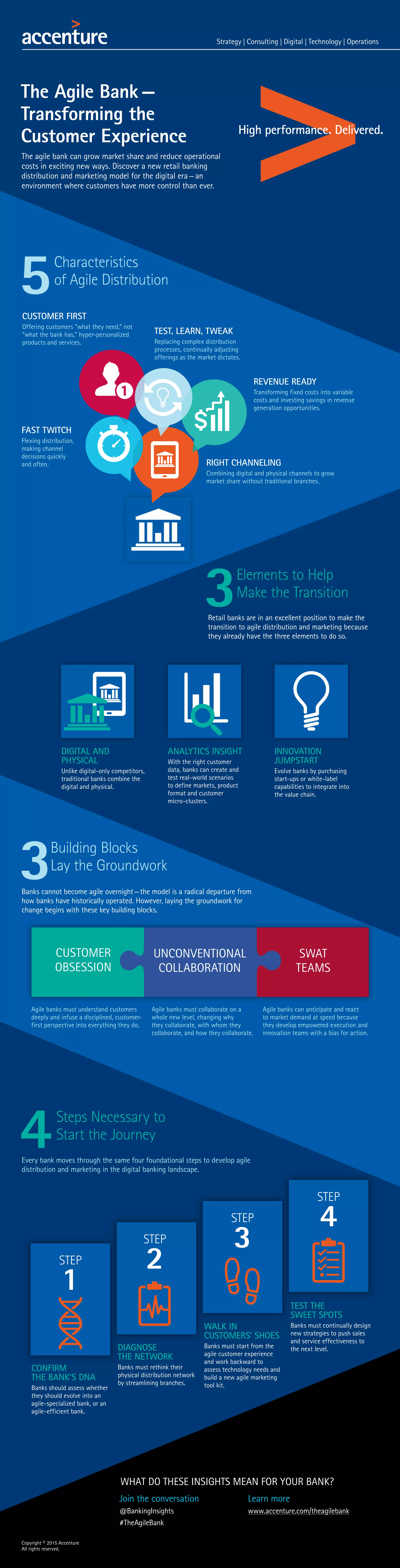
The agile bank can grow market share and reduce operational
costs in exciting new ways. Discover a new retail banking
distribution and marketing model for the digital era—an
environment where customers have more control than ever.
5Characteristics
of Agile Distribution
3Elements to Help
Make the Transition
3Building Blocks
Lay the Groundwork
4Steps Necessary to
Start the Journey
FAST TWITCH
Flexing distribution,
making channel
decisions quickly
and often.
CUSTOMER FIRST
Offering customers “what they need,” not
“what the bank has,” hyper-personalized
products and services.
RIGHT CHANNELING
Combining digital and physical channels to grow
market share without traditional branches.
TEST, LEARN, TWEAK
Replacing complex distribution
processes, continually adjusting
offerings as the market dictates.
REVENUE READY
Transforming fixed costs into variable
costs and investing savings in revenue
generation opportunities.
Retail banks are in an excellent position to make the
transition to agile distribution and marketing because
they already have the three elements to do so.
Banks cannot become agile overnight—the model is a radical departure from
how banks have historically operated. However, laying the groundwork for
change begins with these key building blocks.
DIGITAL AND
PHYSICAL
Unlike digital-only competitors,
traditional banks combine the
digital and physical.
ANALYTICS INSIGHT
With the right customer
data, banks can create and
test real-world scenarios
to define markets, product
format and customer
micro-clusters.
INNOVATION
JUMPSTART
Evolve banks by purchasing
start-ups or white-label
capabilities to integrate into
the value chain.
Agile banks must understand customers
deeply and infuse a disciplined, customer-
first perspective into everything they do.
Agile banks must collaborate on a
whole new level, changing why
they collaborate, with whom they
collaborate, and how they collaborate.
Agile banks can anticipate and react
to market demand at speed because
they develop empowered execution and
innovation teams with a bias for action.
Every bank moves through the same four foundational steps to develop agile
distribution and marketing in the digital banking landscape.
STEP
1
STEP
2
STEP
3
STEP
4
CONFIRM
THE BANK’S DNA
Banks should assess whether
they should evolve into an
agile-specialized bank, or an
agile-efficient bank.
DIAGNOSE
THE NETWORK
Banks must rethink their
physical distribution network
by streamlining branches.
WALK IN
CUSTOMERS’ SHOES
Banks must start from the
agile customer experience
and work backward to
assess technology needs and
build a new agile marketing
tool kit.
TEST THE
SWEET SPOTS
Banks must continually design
new strategies to push sales
and service effectiveness to
the next level.
CUSTOMER
OBSESSION
UNCONVENTIONAL
COLLABORATION
SWAT
TEAMS
WHAT DO THESE INSIGHTS MEAN FOR YOUR BANK?
Copyright © 2015 Accenture
All rights reserved.
Join the conversation
@BankingInsights
#TheAgileBank
Learn more
www.accenture.com/theagilebank

The Agile Bank Infographic

  • 1.
    The Agile Bank— Transformingthe Customer Experience The agile bank can grow market share and reduce operational costs in exciting new ways. Discover a new retail banking distribution and marketing model for the digital era—an environment where customers have more control than ever. 5Characteristics of Agile Distribution 3Elements to Help Make the Transition 3Building Blocks Lay the Groundwork 4Steps Necessary to Start the Journey FAST TWITCH Flexing distribution, making channel decisions quickly and often. CUSTOMER FIRST Offering customers “what they need,” not “what the bank has,” hyper-personalized products and services. RIGHT CHANNELING Combining digital and physical channels to grow market share without traditional branches. TEST, LEARN, TWEAK Replacing complex distribution processes, continually adjusting offerings as the market dictates. REVENUE READY Transforming fixed costs into variable costs and investing savings in revenue generation opportunities. Retail banks are in an excellent position to make the transition to agile distribution and marketing because they already have the three elements to do so. Banks cannot become agile overnight—the model is a radical departure from how banks have historically operated. However, laying the groundwork for change begins with these key building blocks. DIGITAL AND PHYSICAL Unlike digital-only competitors, traditional banks combine the digital and physical. ANALYTICS INSIGHT With the right customer data, banks can create and test real-world scenarios to define markets, product format and customer micro-clusters. INNOVATION JUMPSTART Evolve banks by purchasing start-ups or white-label capabilities to integrate into the value chain. Agile banks must understand customers deeply and infuse a disciplined, customer- first perspective into everything they do. Agile banks must collaborate on a whole new level, changing why they collaborate, with whom they collaborate, and how they collaborate. Agile banks can anticipate and react to market demand at speed because they develop empowered execution and innovation teams with a bias for action. Every bank moves through the same four foundational steps to develop agile distribution and marketing in the digital banking landscape. STEP 1 STEP 2 STEP 3 STEP 4 CONFIRM THE BANK’S DNA Banks should assess whether they should evolve into an agile-specialized bank, or an agile-efficient bank. DIAGNOSE THE NETWORK Banks must rethink their physical distribution network by streamlining branches. WALK IN CUSTOMERS’ SHOES Banks must start from the agile customer experience and work backward to assess technology needs and build a new agile marketing tool kit. TEST THE SWEET SPOTS Banks must continually design new strategies to push sales and service effectiveness to the next level. CUSTOMER OBSESSION UNCONVENTIONAL COLLABORATION SWAT TEAMS WHAT DO THESE INSIGHTS MEAN FOR YOUR BANK? Copyright © 2015 Accenture All rights reserved. Join the conversation @BankingInsights #TheAgileBank Learn more www.accenture.com/theagilebank