The IT Guide to Identity
Management 2016
Identities have quietly become
the most critical digital assets
in the modern era
And whether management knows it or not
(hint: they don’t) many of the most critical
conversations they have with IT are really
conversations about identities.
Want better security?
If hackers steal your company’s identities, they steal the
very core of your business. This fear would keep any IT
team up at night.
How about more efficiency?
Wouldn’t it be nice if with just one click, you could grant
and revoke access to the myriad of resources your
employee needs? This would allow your team to
focus on building and strengthening your business.
Want better security
and efficiency?
Step 1 Overview:
The New Identity
Let’s start by taking a look at everything IT is
supposed to provision access to in 2016:
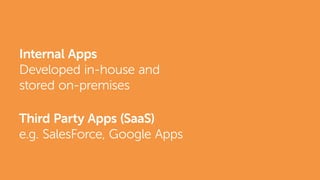
Third Party Apps (SaaS)
e.g. SalesForce, Google Apps
Internal Apps
Developed in-house and
stored on-premises
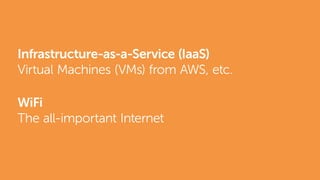
Infrastructure-as-a-Service (IaaS)
Virtual Machines (VMs) from AWS, etc.
WiFi
The all-important Internet
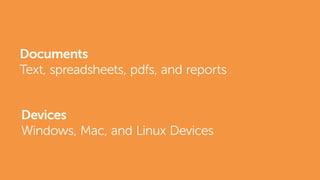
Documents
Text, spreadsheets, pdfs, and reports
Devices
Windows, Mac, and Linux Devices
Categories of the Identity and Access Market
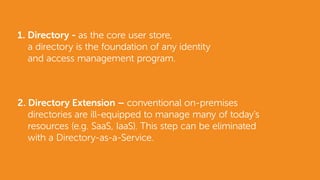
1. Directory - as the core user store,
a directory is the foundation of any identity
and access management program.
2. Directory Extension – conventional on-premises
directories are ill-equipped to manage many of today’s
resources (e.g. SaaS, IaaS). This step can be eliminated
with a Directory-as-a-Service.
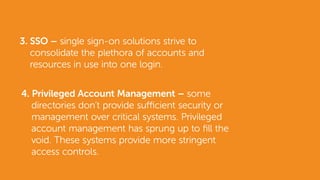
3. SSO – single sign-on solutions strive to
consolidate the plethora of accounts and
resources in use into one login.
4. Privileged Account Management – some
directories don’t provide sufficient security or
management over critical systems. Privileged
account management has sprung up to fill the
void. These systems provide more stringent
access controls.
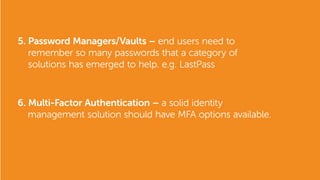
5. Password Managers/Vaults – end users need to
remember so many passwords that a category of
solutions has emerged to help. e.g. LastPass
6. Multi-Factor Authentication – a solid identity
management solution should have MFA options available.
Part 2:
Challenges
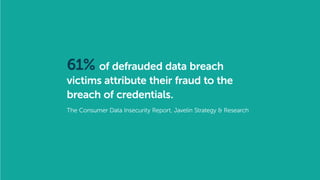
61% of defrauded data breach
victims attribute their fraud to the
breach of credentials.
The Consumer Data Insecurity Report, Javelin Strategy & Research
In 2016, the need for greater security and stronger
authentication is paramount for every organization,
large or small.
But the threat of hacked identities has never
been more clear. In 2014 alone, more than
one billion personal records were illegally
accessed [Gemalto].
Everyone likes to say,
“It will never happen to me.”
Identity Sprawl
Security – Identity sprawl creates a chaotic environment that
is difficult to secure. When an employee leaves, instead
of being able to de-provision access to all resources with
one click, IT must be very meticulous and deprovision
access individually. One mistake, one little oversight, and
someone has access who shouldn’t.
To hackers, identity sprawl
looks a lot like opportunity
“People average 25 accounts,
but only 6.5 passwords”
So when a third-party hack happens (e.g. LinkedIn,
Sony, Target), the passwords for internal accounts
are often compromised as well. But IT has no way of
knowing because it exists entirely out of their purview.
Efficiency – At the user level, identity sprawl leads to more
time logging in and looking up passwords (and ringing the
help desk when they inevitably can’t remember what key
goes to what account). On the admin side, it’s even worse. IT
loses centralized control. They make a change in the central
directory and it ends up propagating to only some IT
resources. This requires that the admin keep track of
which resources require separate control.
The solution is to consolidate
identities, but our next challenge,
legacy systems, is a major roadblock
toward that goal...
Legacy Systems
95% of Fortune 1000 companies
[Enterprise Systems Journal].
But a lot has changed since 1999.
Microsoft Active Directory has served valiantly as the
core identity provider since its release with Windows
2000. It earned an early stranglehold on the market
and is still in place at a commanding
The preeminence of Microsoft AD is in fact
the single biggest reason for identity sprawl.
AD doesn’t effectively manage devices that
don’t run Windows – and the number of
Mac and Linux devices has been on the
uptick year after year.
The other major legacy directory in place
in companies is OpenLDAP. LDAP is better
with Linux and Unix systems than AD, but
it has the same difficulties managing cloud
infrastructure. Furthermore, OpenLDAP
is partial to LDAP (go figure) and other
ascendent protocols like SAML, Kerberos,
and RADIUS are out of reach.
Shadow IT
Shadow IT refers to systems and solutions
implemented inside organizations without
the IT department’s knowledge or approval.
Widespread
83% of CIOs report “some level of
unauthorized provisioning of cloud services”
Risky
89% of CIOs feel Shadow IT presents a
long-term security risk
Expensive
CIOs reported an average of $13 million in
annual spending on Shadow IT
“The worst part of Shadow IT is that it is not
connected to the core directory structure.
Many IT admins have no idea how to
connect all of these newly implemented
devices, applications, and networks back to
their core directory.”
The Consumer Data Insecurity Report, Javelin Strategy & Research
Ultimately, you can’t (and shouldn’t)
eliminate Shadow IT altogether.
The approach must be twofold:
First - Train employees about Shadow IT,
discouraging risky behavior.
Second - Eliminate the need for Shadow IT
by improving your IT infrastructure to better
accommodate and manage the types of
apps that are likely to implemented by
rogue innovators.
Vendor Lock-In
Refers to when a customer is dependent on
a vendor for products and services, unable
to use another vendor without substantial
switching costs.
The market for your identities
has never been so competitive.
As a result, one of the more subtle factors working against
identity management is vendor lock-in. This refers to all of the
companies that are trying to woo enterprises into using their
identities (often for free) so that you become dependent on
their services. Eventually, this means they can lock you into
paying for their services.
Part 3:
Solutions
Better Security
Enterprise security once meant installing
anti-virus software and a firewall. It used to
be that easy.
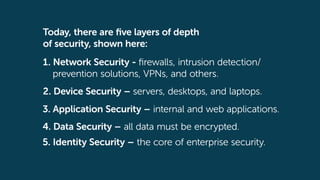
1. Network Security - firewalls, intrusion detection/
prevention solutions, VPNs, and others.
Today, there are five layers of depth
of security, shown here:
2. Device Security – servers, desktops, and laptops.
3. Application Security – internal and web applications.
4. Data Security – all data must be encrypted.
5. Identity Security – the core of enterprise security.
Multi-Factor Authentication
MFA is an easy way to gain some extra peace of mind.
With MFA, the standard password is supplemented with
another form of authentication, be it a code sent to
your phone, a fingerprint, or a retinal print.
Multi-Factor Authentication
A high-end computer can now crack an eight-character
password in 5.5 hours. [Halock]
Luckily, IT has the ability to implement password
requirements. Most experts recommend enforcing a 12
character password requirement. At JumpCloud, we
recommend at least 18 characters.
Cloud Based Directories
Cloud-based directory services have been built from
the ground up to manage identities and resources
across the cloud. Google Apps? Check. WiFi networks?
Check. AWS, SalesForce, and more? Check, check,
and check.
Discover Your True Identity
When people look back on the trajectory of the
Identity and Access Market decades from now, they’ll
see 2016 as an inflection point – the moment when
identities stopped proliferating out endlessly and
began to consolidate back in. The future of identities
is simpler, more efficient, and more secure.
If you would like to learn more about how
Directory-as-a-Service solves today’s identity
management challenges, drop us a note at
sales@jumpcloud.com.

The 2016 Guide to IT Identity Management

  • 1.
    The IT Guideto Identity Management 2016
  • 2.
    Identities have quietlybecome the most critical digital assets in the modern era And whether management knows it or not (hint: they don’t) many of the most critical conversations they have with IT are really conversations about identities.
  • 3.
    Want better security? Ifhackers steal your company’s identities, they steal the very core of your business. This fear would keep any IT team up at night. How about more efficiency? Wouldn’t it be nice if with just one click, you could grant and revoke access to the myriad of resources your employee needs? This would allow your team to focus on building and strengthening your business.
  • 4.
  • 5.
    Step 1 Overview: TheNew Identity Let’s start by taking a look at everything IT is supposed to provision access to in 2016:
  • 6.
    Third Party Apps(SaaS) e.g. SalesForce, Google Apps Internal Apps Developed in-house and stored on-premises
  • 7.
    Infrastructure-as-a-Service (IaaS) Virtual Machines(VMs) from AWS, etc. WiFi The all-important Internet
  • 8.
    Documents Text, spreadsheets, pdfs,and reports Devices Windows, Mac, and Linux Devices
  • 9.
    Categories of theIdentity and Access Market
  • 10.
    1. Directory -as the core user store, a directory is the foundation of any identity and access management program. 2. Directory Extension – conventional on-premises directories are ill-equipped to manage many of today’s resources (e.g. SaaS, IaaS). This step can be eliminated with a Directory-as-a-Service.
  • 11.
    3. SSO –single sign-on solutions strive to consolidate the plethora of accounts and resources in use into one login. 4. Privileged Account Management – some directories don’t provide sufficient security or management over critical systems. Privileged account management has sprung up to fill the void. These systems provide more stringent access controls.
  • 12.
    5. Password Managers/Vaults– end users need to remember so many passwords that a category of solutions has emerged to help. e.g. LastPass 6. Multi-Factor Authentication – a solid identity management solution should have MFA options available.
  • 13.
  • 14.
    61% of defraudeddata breach victims attribute their fraud to the breach of credentials. The Consumer Data Insecurity Report, Javelin Strategy & Research
  • 15.
    In 2016, theneed for greater security and stronger authentication is paramount for every organization, large or small. But the threat of hacked identities has never been more clear. In 2014 alone, more than one billion personal records were illegally accessed [Gemalto]. Everyone likes to say, “It will never happen to me.”
  • 16.
  • 17.
    Security – Identitysprawl creates a chaotic environment that is difficult to secure. When an employee leaves, instead of being able to de-provision access to all resources with one click, IT must be very meticulous and deprovision access individually. One mistake, one little oversight, and someone has access who shouldn’t.
  • 18.
    To hackers, identitysprawl looks a lot like opportunity
  • 19.
    “People average 25accounts, but only 6.5 passwords”
  • 20.
    So when athird-party hack happens (e.g. LinkedIn, Sony, Target), the passwords for internal accounts are often compromised as well. But IT has no way of knowing because it exists entirely out of their purview.
  • 21.
    Efficiency – Atthe user level, identity sprawl leads to more time logging in and looking up passwords (and ringing the help desk when they inevitably can’t remember what key goes to what account). On the admin side, it’s even worse. IT loses centralized control. They make a change in the central directory and it ends up propagating to only some IT resources. This requires that the admin keep track of which resources require separate control.
  • 22.
    The solution isto consolidate identities, but our next challenge, legacy systems, is a major roadblock toward that goal...
  • 23.
  • 24.
    95% of Fortune1000 companies [Enterprise Systems Journal]. But a lot has changed since 1999. Microsoft Active Directory has served valiantly as the core identity provider since its release with Windows 2000. It earned an early stranglehold on the market and is still in place at a commanding
  • 25.
    The preeminence ofMicrosoft AD is in fact the single biggest reason for identity sprawl. AD doesn’t effectively manage devices that don’t run Windows – and the number of Mac and Linux devices has been on the uptick year after year.
  • 26.
    The other majorlegacy directory in place in companies is OpenLDAP. LDAP is better with Linux and Unix systems than AD, but it has the same difficulties managing cloud infrastructure. Furthermore, OpenLDAP is partial to LDAP (go figure) and other ascendent protocols like SAML, Kerberos, and RADIUS are out of reach.
  • 27.
    Shadow IT Shadow ITrefers to systems and solutions implemented inside organizations without the IT department’s knowledge or approval.
  • 28.
    Widespread 83% of CIOsreport “some level of unauthorized provisioning of cloud services”
  • 29.
    Risky 89% of CIOsfeel Shadow IT presents a long-term security risk
  • 30.
    Expensive CIOs reported anaverage of $13 million in annual spending on Shadow IT
  • 31.
    “The worst partof Shadow IT is that it is not connected to the core directory structure. Many IT admins have no idea how to connect all of these newly implemented devices, applications, and networks back to their core directory.” The Consumer Data Insecurity Report, Javelin Strategy & Research
  • 32.
    Ultimately, you can’t(and shouldn’t) eliminate Shadow IT altogether. The approach must be twofold:
  • 33.
    First - Trainemployees about Shadow IT, discouraging risky behavior. Second - Eliminate the need for Shadow IT by improving your IT infrastructure to better accommodate and manage the types of apps that are likely to implemented by rogue innovators.
  • 34.
    Vendor Lock-In Refers towhen a customer is dependent on a vendor for products and services, unable to use another vendor without substantial switching costs.
  • 35.
    The market foryour identities has never been so competitive. As a result, one of the more subtle factors working against identity management is vendor lock-in. This refers to all of the companies that are trying to woo enterprises into using their identities (often for free) so that you become dependent on their services. Eventually, this means they can lock you into paying for their services.
  • 36.
  • 37.
    Better Security Enterprise securityonce meant installing anti-virus software and a firewall. It used to be that easy.
  • 38.
    1. Network Security- firewalls, intrusion detection/ prevention solutions, VPNs, and others. Today, there are five layers of depth of security, shown here: 2. Device Security – servers, desktops, and laptops. 3. Application Security – internal and web applications. 4. Data Security – all data must be encrypted. 5. Identity Security – the core of enterprise security.
  • 39.
    Multi-Factor Authentication MFA isan easy way to gain some extra peace of mind. With MFA, the standard password is supplemented with another form of authentication, be it a code sent to your phone, a fingerprint, or a retinal print.
  • 40.
    Multi-Factor Authentication A high-endcomputer can now crack an eight-character password in 5.5 hours. [Halock] Luckily, IT has the ability to implement password requirements. Most experts recommend enforcing a 12 character password requirement. At JumpCloud, we recommend at least 18 characters.
  • 41.
    Cloud Based Directories Cloud-baseddirectory services have been built from the ground up to manage identities and resources across the cloud. Google Apps? Check. WiFi networks? Check. AWS, SalesForce, and more? Check, check, and check.
  • 42.
  • 43.
    When people lookback on the trajectory of the Identity and Access Market decades from now, they’ll see 2016 as an inflection point – the moment when identities stopped proliferating out endlessly and began to consolidate back in. The future of identities is simpler, more efficient, and more secure.
  • 44.
    If you wouldlike to learn more about how Directory-as-a-Service solves today’s identity management challenges, drop us a note at sales@jumpcloud.com.