TEXT
SUMMARIZATION
USING AI TOOLS
The Art of Distilling Information
AGENDA
• What is Text Summarization?
• Types of Text Summarization
• AI Tools Used for Text Summarization
• How AI Tools Summarize Text
• Benefits of using AI Tools for Text
Summarization
What is Text
Summarization?
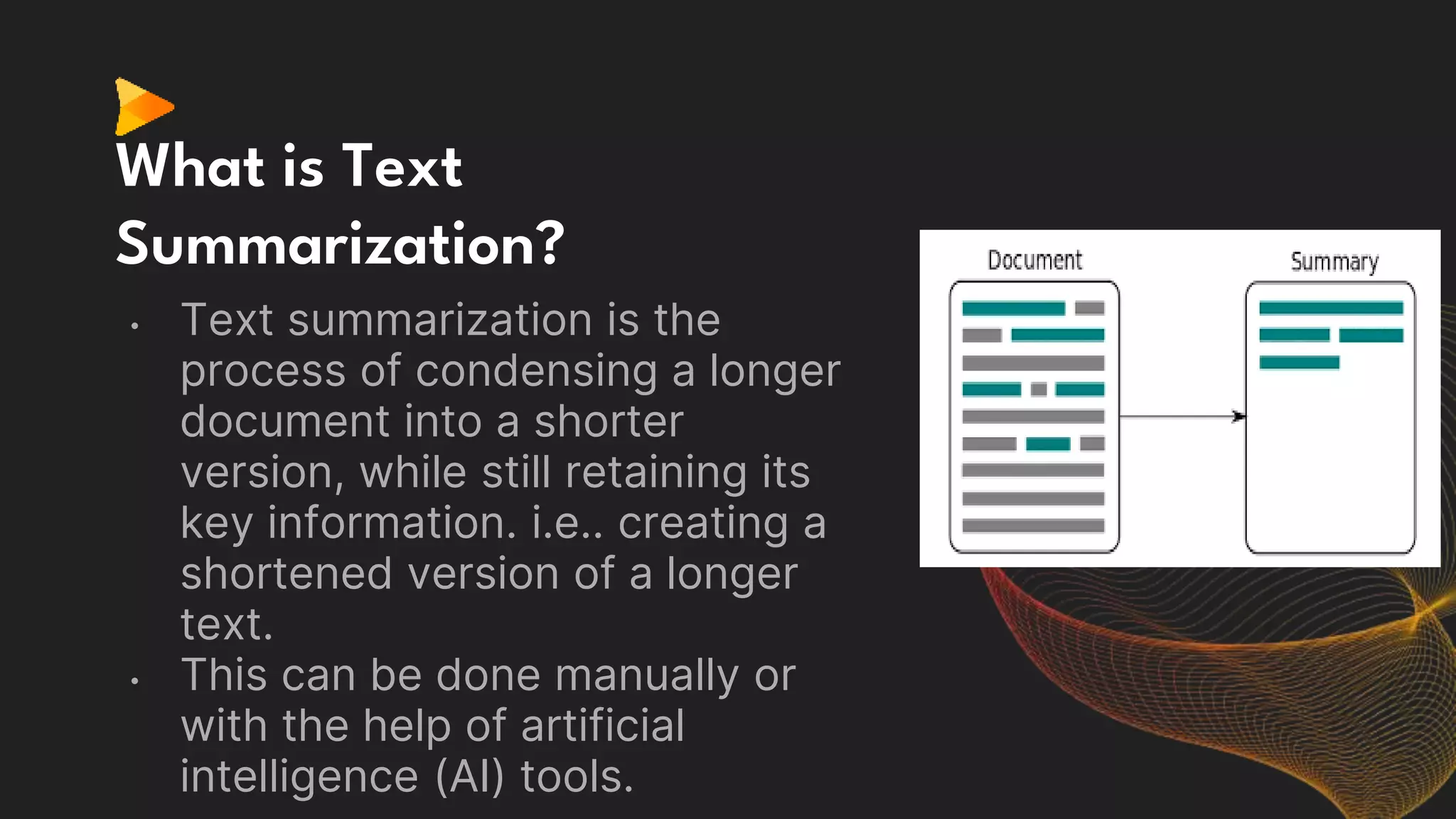
• Text summarization is the
process of condensing a longer
document into a shorter
version, while still retaining its
key information. i.e.. creating a
shortened version of a longer
text.
• This can be done manually or
with the help of artificial
intelligence (AI) tools.
Types of Text Summarization
There are two main types of text
summarization:
1. Extractive Summarization.
2. Abstractive Summarization.
Extractive Summarization
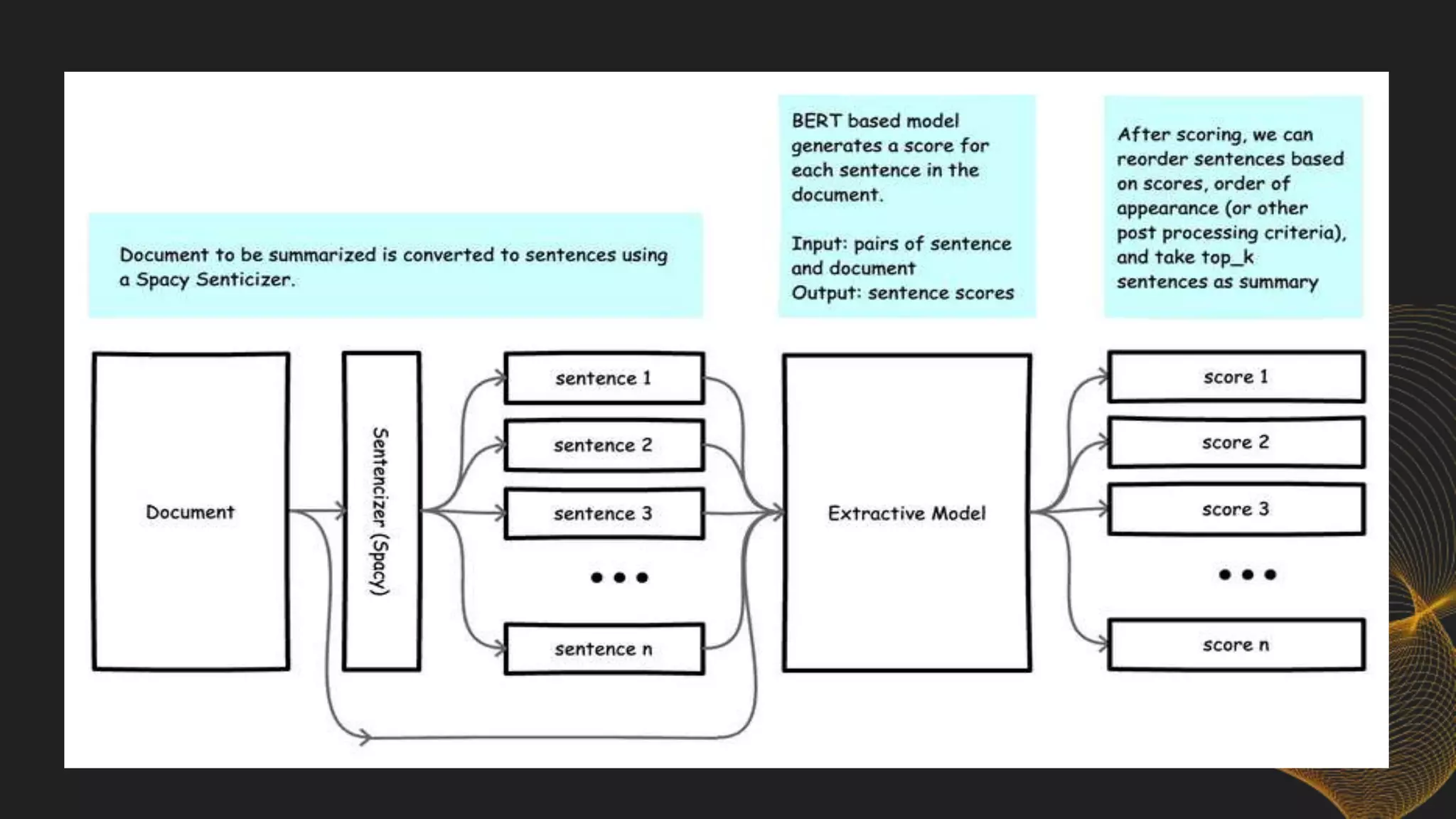
• Extractive summarization involves selecting
the most important sentences or phrases
from the original text and presenting them
in a condensed form. This type of
summarization is simpler and more
common, as it relies on existing content.
• Extractive summarization is often used for
news articles, where the goal is to present
the key points of a story in a concise
format.
Abstractive summarization
• Abstractive summarization, on the other hand,
involves generating new sentences that capture
the essence of the original text. This type of
summarization is more complex and requires
advanced natural language processing
techniques.
• Abstractive summarization is more commonly
used in research papers and academic writing,
where the goal is to condense large amounts of
information into a shorter format without losing
important details.
AI Tools Used for Text Summarization
• There are a variety of AI tools available today that can be used for text
summarization. One popular tool is the GPT-3 language model, which
uses deep learning techniques to generate high-quality summaries.
• Another tool is BERT, a pre-trained language model that can be fine-
tuned for summarization tasks. Other tools include OpenAI's Text
Summarizer and Google's T5 model.
• These AI tools work by analyzing the input text and identifying key
phrases and sentences that capture the most important information.
They then use various algorithms and techniques to generate a
summary that accurately captures the essence of the original text.
• SummaRuNNer: Recurrent Neural Network-based summarization tool
• BART: Pretrained model for abstractive summarization
• TextRank: Graph-based algorithm for extractive summarization
How AI Tools Summarizes Text
• AI tools use a complex set of algorithms to analyze text and extract the most
important information.
• These algorithms are designed to identify key phrases, sentences, and ideas that
are essential for understanding the overall meaning of the text.
• They then condense this information into a concise summary that captures the
essence of the original content.
• One of the most common techniques used by AI tools for text summarization is
called 'extractive summarization'. This involves identifying the most important
sentences or phrases in a piece of text and using them to create a summary.
• Another technique is 'abstractive summarization', which involves generating a
new summary that is not necessarily based on the exact words in the original
text, but rather captures the key concepts and ideas.
Benefits of using AI Tools for Text
Summarization
• AI tools have revolutionized the way we summarize text. These
tools are able to quickly analyze and condense large amounts of
information into a concise and easy-to-read format.
• This saves time and improves productivity, allowing users to focus
on other important tasks.
• Another benefit of using AI tools for text summarization is their
ability to eliminate bias.
• Human summarizers may accidently include their own opinions or
biases in their summaries, but AI tools provide an objective
summary that is based solely on the content of the text. This can be
particularly useful in situations where unbiased information is
critical, such as in legal or medical documents.
Demo Session
Thank you for your time and attention 🙂
Q & A SESSION

Text Summarization Using AI Tools.pptx

  • 1.
    TEXT SUMMARIZATION USING AI TOOLS TheArt of Distilling Information
  • 2.
    AGENDA • What isText Summarization? • Types of Text Summarization • AI Tools Used for Text Summarization • How AI Tools Summarize Text • Benefits of using AI Tools for Text Summarization
  • 3.
    What is Text Summarization? •Text summarization is the process of condensing a longer document into a shorter version, while still retaining its key information. i.e.. creating a shortened version of a longer text. • This can be done manually or with the help of artificial intelligence (AI) tools.
  • 4.
    Types of TextSummarization There are two main types of text summarization: 1. Extractive Summarization. 2. Abstractive Summarization.
  • 5.
    Extractive Summarization • Extractivesummarization involves selecting the most important sentences or phrases from the original text and presenting them in a condensed form. This type of summarization is simpler and more common, as it relies on existing content. • Extractive summarization is often used for news articles, where the goal is to present the key points of a story in a concise format.
  • 6.
    Abstractive summarization • Abstractivesummarization, on the other hand, involves generating new sentences that capture the essence of the original text. This type of summarization is more complex and requires advanced natural language processing techniques. • Abstractive summarization is more commonly used in research papers and academic writing, where the goal is to condense large amounts of information into a shorter format without losing important details.
  • 7.
    AI Tools Usedfor Text Summarization • There are a variety of AI tools available today that can be used for text summarization. One popular tool is the GPT-3 language model, which uses deep learning techniques to generate high-quality summaries. • Another tool is BERT, a pre-trained language model that can be fine- tuned for summarization tasks. Other tools include OpenAI's Text Summarizer and Google's T5 model. • These AI tools work by analyzing the input text and identifying key phrases and sentences that capture the most important information. They then use various algorithms and techniques to generate a summary that accurately captures the essence of the original text. • SummaRuNNer: Recurrent Neural Network-based summarization tool • BART: Pretrained model for abstractive summarization • TextRank: Graph-based algorithm for extractive summarization
  • 8.
    How AI ToolsSummarizes Text • AI tools use a complex set of algorithms to analyze text and extract the most important information. • These algorithms are designed to identify key phrases, sentences, and ideas that are essential for understanding the overall meaning of the text. • They then condense this information into a concise summary that captures the essence of the original content. • One of the most common techniques used by AI tools for text summarization is called 'extractive summarization'. This involves identifying the most important sentences or phrases in a piece of text and using them to create a summary. • Another technique is 'abstractive summarization', which involves generating a new summary that is not necessarily based on the exact words in the original text, but rather captures the key concepts and ideas.
  • 10.
    Benefits of usingAI Tools for Text Summarization • AI tools have revolutionized the way we summarize text. These tools are able to quickly analyze and condense large amounts of information into a concise and easy-to-read format. • This saves time and improves productivity, allowing users to focus on other important tasks. • Another benefit of using AI tools for text summarization is their ability to eliminate bias. • Human summarizers may accidently include their own opinions or biases in their summaries, but AI tools provide an objective summary that is based solely on the content of the text. This can be particularly useful in situations where unbiased information is critical, such as in legal or medical documents.
  • 11.
  • 12.
    Thank you foryour time and attention 🙂
  • 13.
    Q & ASESSION