Agile Meets CMMI… Again

               Notes from Tes Trek conference -
                        Keynote presentation by
                                  James McHale
                              November 8th 2012


“Notes from Tes Trek conference” by Maira Bay de Souza is licensed under a
   Creative Commons Attribution-NonCommercial-ShareAlike 3.0 Unported License
Before we begin ...
Items in this font are the notes I took of what Jim
  said


Items in this font are my own comments
Introduction

Process-oriented people have always tried to be more
  Agile, while Agile defenders are constantly trying to be
  more process-oriented!

Interesting comment. I had never thought of it that way, but I think
he is right.

Good process professionals will build a process that works for the
people, instead of having people work for the process. That means no
useless paperwork or bureaucracy. Only do what is essential. And
isn't that what Agile is about?
About SEI and CMMI
SEI works on the state of the practice, not the state of the art

CMMI will soon move out of SEI and into a new organization called the
  CMMI Institute. There will be little or no change on how you work
  with them and on the contracts themselves.

State of the art = latest research on process improvement

State of the practice = what companies are actually doing

I have studied about process and then worked in organizations of all sizes. I
agree that there is a difference between the best thing that companies
should be doing (according to research) and what they are actually doing.

From what Jim said, it seems like this new organization will be more “for
profit” than SEI. There isn't much info on the web yet about this
transition. The best place I could find was here:
http://sei-pab-chair.blogspot.com/
CMMI and Agile - similarities


CMMI and Agile have roots in common: Agile was
 developed after CMMI because CMMI was too
 heavyweight for some organizations.
CMMI and Agile - differences
CMMI was developed based on ideas of authors that came
 from a manufacturing background (see recommended
 readings 1, 2 and 3)

The people who developed Agile were more in line with the
  thoughts of Peter Drucker. He was more focused on the
  knowledge industry.

Very interesting remark. I have heard a few people in the software
  community say that we shouldn't take a manufacturing approach to
  software development. We are after all building a product based on
  information. We are not manufacturing tangible goods.

I hope to learn more about the connection between Peter Drucker and
   Agile, and then share it with you!
Other SDLCs
The original author of the Waterfall model (see
  recommended reading 5) intended it to be iterative. But
  the DOD ended up implementing it as a one-time
  iteration.
Agile is very similar to TSP, making it closer to CMMI than
  we would think.


Interesting comment about the waterfall model. It relates to
  what he said before about state of the art and state of the
  practice: what the author intended was not what ended up
  being done.
Organizations

Most organizations adapt themselves to look like
 their products and not the other way around
 (unfortunately)


I agree with him. It is unfortunate but true. I've seen many
   organizations that work around their systems instead of
   changing or modernizing their systems to make them more
   efficient and customer-focused.
BDUF
BDUF = Big Design Up-Front
This type of software life-cycle was not
 created because of CMMI. It was
 created because of the DOD's
 competition rules. Design had to be
 ready before the competition started.

Ah, that explains a lot!
It's amazing how much the DOD has shaped
  the world of software development.
New trend
5 years ago the DOD noticed that CMMI L3 to L5
  companies had no difference in the performance
  between them.


Interesting. If I were to make a guess I would say that L5 companies
  aren't following their processes as strictly as they should, hence
  performing as L3. But that's just a guess. I wonder if they found a
  reason for this, and what the reason was.
Contradiction
Some people in the Agile world are very strict on their
  processes, which is funny, because that was the whole
  point of Agile in the first place ( = to not follow any
  process!)
A company called Systematic is following Agile, but has
  lots of data (just like a CMMI L4 company)


Well, what can I say... humans are contradictory!
By the way, I don't have anything against the Agile people. I
  believe that whatever works for an organization is what they
  should use - as long as it will still keep on working in the
  short to medium term future.
Kelvin's quote
“When you can measure what you are speaking about, and
  express it in numbers, you know something about it,
  when you cannot express it in numbers, your knowledge
  is of a meager and unsatisfactory kind; it may be the
  beginning of knowledge, but you have scarely, in your
  thoughts advanced to the stage of science.”


Measurement is the foundation for improvement
Measurement is the act of reducing uncertainty
Look at recommended reading 7
Metrics and QA
QA has most of the data about an SDLC
I go to organizations and the first place I look for data is
   the QA department
Sometimes it's the first time anyone has ever asked to see
  the data they have been collecting for so long

I'm surprised and disappointed by that information. The data
  collected by QA should be used in improving the process. If
  the organization is not using the data, then they are wasting
  the QA team's time and consequently their own money.
As I love to say it: the process should work for the people, and
  not the people work for the process. The case Jim describes
  is a classical case of people working for the process. That
  means huge waste of resources, time and money.
QA and defects
In a project where testing is only done at the end (i.e.,
  using waterfall SDLC), the # of defects found/hour varies
  a lot. Example: QA spent 5 hours of test execution and
  didn't find any defects. Then, in the next 30 min they
  found 14 defects.
In a project with early testing (using V-Model SDLC), the #
  of defects found/hour is more constant. Example: QA
  found 1-2 defects every 30 min.


Interesting observation. That tells me that QA will be
  perceived as more efficient with early testing.
Scenario Coverage
Did you know? When Microsoft tests Windows, they only
  cover 0.1% to 2% of the possible scenarios!
That is because the PC has too many possible
  configurations (think of all the different brands of
  motherboard, video card, mouse, etc that exist).
Apple computers, on the other hand, have much less
  variability. That's why they are able to test a much
  bigger % of the configuration possibilities.
Micheal Fagan (see recommended reading 9) started doing
  inspection in the 60s!

A-ha! That explains a lot!
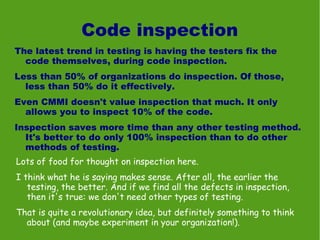
Code inspection
The latest trend in testing is having the testers fix the
  code themselves, during code inspection.
Less than 50% of organizations do inspection. Of those,
  less than 50% do it effectively.
Even CMMI doesn't value inspection that much. It only
  allows you to inspect 10% of the code.
Inspection saves more time than any other testing method.
  It's better to do only 100% inspection than to do other
  methods of testing.
Lots of food for thought on inspection here.
I think what he is saying makes sense. After all, the earlier the
   testing, the better. And if we find all the defects in inspection,
   then it's true: we don't need other types of testing.
That is quite a revolutionary idea, but definitely something to think
  about (and maybe experiment in your organization!).
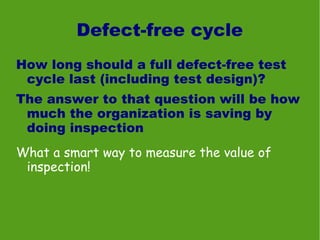
Defect-free cycle
How long should a full defect-free test
 cycle last (including test design)?
The answer to that question will be how
 much the organization is saving by
 doing inspection
What a smart way to measure the value of
 inspection!
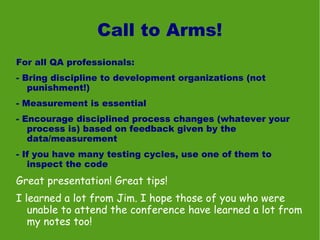
Call to Arms!
For all QA professionals:
- Bring discipline to development organizations (not
   punishment!)
- Measurement is essential
- Encourage disciplined process changes (whatever your
   process is) based on feedback given by the
   data/measurement
- If you have many testing cycles, use one of them to
   inspect the code
Great presentation! Great tips!
I learned a lot from Jim. I hope those of you who were
   unable to attend the conference have learned a lot from
   my notes too!
Recommended Readings
[1] Quality is Free - Philip B. Crosby

[2] works of Watts Humphrey

[3] The Knowledge-Creating Company - Ikujiro Nonaka and Hirotaka Takeuchi

[4] Software Engineering Best Practices - Capers Jones

[5] works of Winston Royce

[6] Jeff Sutherland's articles on MSDN:
http://msdn.microsoft.com/en-us/library/dd997578(v=vs.100).aspx

http://msdn.microsoft.com/en-us/library/hh350860(v=vs.100).aspx

[7] How to Measure Anything - Douglas W. Hubbard

[8] The Checklist Manifesto - Atul Gawande

[9] works of Michael Fagan
Disclaimer
The notes presented here are what I understood from what Jim
  communicated. They might not be 100% accurate, as I was taking
  notes and listening to the presentation at the same time.
All the information I am quoting from Jim is his intellectual property.
   I am reproducing it here under the fair use policy, for quoting
   purposes only.

TesTrek Notes

  • 1.
    Agile Meets CMMI…Again Notes from Tes Trek conference - Keynote presentation by James McHale November 8th 2012 “Notes from Tes Trek conference” by Maira Bay de Souza is licensed under a Creative Commons Attribution-NonCommercial-ShareAlike 3.0 Unported License
  • 2.
    Before we begin... Items in this font are the notes I took of what Jim said Items in this font are my own comments
  • 3.
    Introduction Process-oriented people havealways tried to be more Agile, while Agile defenders are constantly trying to be more process-oriented! Interesting comment. I had never thought of it that way, but I think he is right. Good process professionals will build a process that works for the people, instead of having people work for the process. That means no useless paperwork or bureaucracy. Only do what is essential. And isn't that what Agile is about?
  • 4.
    About SEI andCMMI SEI works on the state of the practice, not the state of the art CMMI will soon move out of SEI and into a new organization called the CMMI Institute. There will be little or no change on how you work with them and on the contracts themselves. State of the art = latest research on process improvement State of the practice = what companies are actually doing I have studied about process and then worked in organizations of all sizes. I agree that there is a difference between the best thing that companies should be doing (according to research) and what they are actually doing. From what Jim said, it seems like this new organization will be more “for profit” than SEI. There isn't much info on the web yet about this transition. The best place I could find was here: http://sei-pab-chair.blogspot.com/
  • 5.
    CMMI and Agile- similarities CMMI and Agile have roots in common: Agile was developed after CMMI because CMMI was too heavyweight for some organizations.
  • 6.
    CMMI and Agile- differences CMMI was developed based on ideas of authors that came from a manufacturing background (see recommended readings 1, 2 and 3) The people who developed Agile were more in line with the thoughts of Peter Drucker. He was more focused on the knowledge industry. Very interesting remark. I have heard a few people in the software community say that we shouldn't take a manufacturing approach to software development. We are after all building a product based on information. We are not manufacturing tangible goods. I hope to learn more about the connection between Peter Drucker and Agile, and then share it with you!
  • 7.
    Other SDLCs The originalauthor of the Waterfall model (see recommended reading 5) intended it to be iterative. But the DOD ended up implementing it as a one-time iteration. Agile is very similar to TSP, making it closer to CMMI than we would think. Interesting comment about the waterfall model. It relates to what he said before about state of the art and state of the practice: what the author intended was not what ended up being done.
  • 8.
    Organizations Most organizations adaptthemselves to look like their products and not the other way around (unfortunately) I agree with him. It is unfortunate but true. I've seen many organizations that work around their systems instead of changing or modernizing their systems to make them more efficient and customer-focused.
  • 9.
    BDUF BDUF = BigDesign Up-Front This type of software life-cycle was not created because of CMMI. It was created because of the DOD's competition rules. Design had to be ready before the competition started. Ah, that explains a lot! It's amazing how much the DOD has shaped the world of software development.
  • 10.
    New trend 5 yearsago the DOD noticed that CMMI L3 to L5 companies had no difference in the performance between them. Interesting. If I were to make a guess I would say that L5 companies aren't following their processes as strictly as they should, hence performing as L3. But that's just a guess. I wonder if they found a reason for this, and what the reason was.
  • 11.
    Contradiction Some people inthe Agile world are very strict on their processes, which is funny, because that was the whole point of Agile in the first place ( = to not follow any process!) A company called Systematic is following Agile, but has lots of data (just like a CMMI L4 company) Well, what can I say... humans are contradictory! By the way, I don't have anything against the Agile people. I believe that whatever works for an organization is what they should use - as long as it will still keep on working in the short to medium term future.
  • 12.
    Kelvin's quote “When youcan measure what you are speaking about, and express it in numbers, you know something about it, when you cannot express it in numbers, your knowledge is of a meager and unsatisfactory kind; it may be the beginning of knowledge, but you have scarely, in your thoughts advanced to the stage of science.” Measurement is the foundation for improvement Measurement is the act of reducing uncertainty Look at recommended reading 7
  • 13.
    Metrics and QA QAhas most of the data about an SDLC I go to organizations and the first place I look for data is the QA department Sometimes it's the first time anyone has ever asked to see the data they have been collecting for so long I'm surprised and disappointed by that information. The data collected by QA should be used in improving the process. If the organization is not using the data, then they are wasting the QA team's time and consequently their own money. As I love to say it: the process should work for the people, and not the people work for the process. The case Jim describes is a classical case of people working for the process. That means huge waste of resources, time and money.
  • 14.
    QA and defects Ina project where testing is only done at the end (i.e., using waterfall SDLC), the # of defects found/hour varies a lot. Example: QA spent 5 hours of test execution and didn't find any defects. Then, in the next 30 min they found 14 defects. In a project with early testing (using V-Model SDLC), the # of defects found/hour is more constant. Example: QA found 1-2 defects every 30 min. Interesting observation. That tells me that QA will be perceived as more efficient with early testing.
  • 15.
    Scenario Coverage Did youknow? When Microsoft tests Windows, they only cover 0.1% to 2% of the possible scenarios! That is because the PC has too many possible configurations (think of all the different brands of motherboard, video card, mouse, etc that exist). Apple computers, on the other hand, have much less variability. That's why they are able to test a much bigger % of the configuration possibilities. Micheal Fagan (see recommended reading 9) started doing inspection in the 60s! A-ha! That explains a lot!
  • 16.
    Code inspection The latesttrend in testing is having the testers fix the code themselves, during code inspection. Less than 50% of organizations do inspection. Of those, less than 50% do it effectively. Even CMMI doesn't value inspection that much. It only allows you to inspect 10% of the code. Inspection saves more time than any other testing method. It's better to do only 100% inspection than to do other methods of testing. Lots of food for thought on inspection here. I think what he is saying makes sense. After all, the earlier the testing, the better. And if we find all the defects in inspection, then it's true: we don't need other types of testing. That is quite a revolutionary idea, but definitely something to think about (and maybe experiment in your organization!).
  • 17.
    Defect-free cycle How longshould a full defect-free test cycle last (including test design)? The answer to that question will be how much the organization is saving by doing inspection What a smart way to measure the value of inspection!
  • 18.
    Call to Arms! Forall QA professionals: - Bring discipline to development organizations (not punishment!) - Measurement is essential - Encourage disciplined process changes (whatever your process is) based on feedback given by the data/measurement - If you have many testing cycles, use one of them to inspect the code Great presentation! Great tips! I learned a lot from Jim. I hope those of you who were unable to attend the conference have learned a lot from my notes too!
  • 19.
    Recommended Readings [1] Qualityis Free - Philip B. Crosby [2] works of Watts Humphrey [3] The Knowledge-Creating Company - Ikujiro Nonaka and Hirotaka Takeuchi [4] Software Engineering Best Practices - Capers Jones [5] works of Winston Royce [6] Jeff Sutherland's articles on MSDN: http://msdn.microsoft.com/en-us/library/dd997578(v=vs.100).aspx http://msdn.microsoft.com/en-us/library/hh350860(v=vs.100).aspx [7] How to Measure Anything - Douglas W. Hubbard [8] The Checklist Manifesto - Atul Gawande [9] works of Michael Fagan
  • 20.
    Disclaimer The notes presentedhere are what I understood from what Jim communicated. They might not be 100% accurate, as I was taking notes and listening to the presentation at the same time. All the information I am quoting from Jim is his intellectual property. I am reproducing it here under the fair use policy, for quoting purposes only.