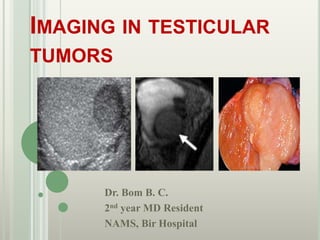
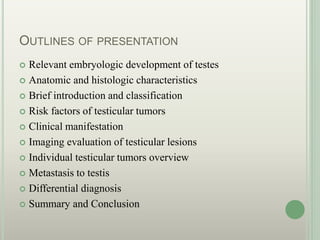
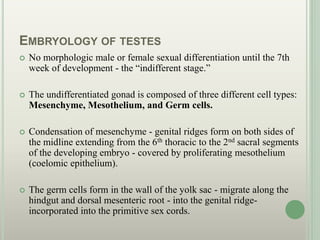
IMAGING IN TESTICULAR
TUMORS
Dr. Bom B. C.
2nd year MD Resident
NAMS, Bir Hospital
OUTLINES OF PRESENTATION
 Relevant embryologic development of testes
 Anatomic and histologic characteristics
 Brief introduction and classification
 Risk factors of testicular tumors
 Clinical manifestation
 Imaging evaluation of testicular lesions
 Individual testicular tumors overview
 Metastasis to testis
 Differential diagnosis
 Summary and Conclusion
EMBRYOLOGY OF TESTES
 No morphologic male or female sexual differentiation until the 7th
week of development - the “indifferent stage.”
 The undifferentiated gonad is composed of three different cell types:
Mesenchyme, Mesothelium, and Germ cells.
 Condensation of mesenchyme - genital ridges form on both sides of
the midline extending from the 6th thoracic to the 2nd sacral segments
of the developing embryo - covered by proliferating mesothelium
(coelomic epithelium).
 The germ cells form in the wall of the yolk sac - migrate along the
hindgut and dorsal mesenteric root - into the genital ridge-
incorporated into the primitive sex cords.
 Further development of gonad into a testis - requires the
presence of a Y chromosome (testis-determining factor)
under which influence the primitive sex cords form the
seminiferous tubules.
 From two distinct cell lines:
 From the mesothelium are the Sertoli or supporting
cells and
 From the migrated germ cells become the
spermatogonia.
 The mesenchyme between the developing seminiferous
tubules differentiates into the interstitial (Leydig) cells.
8 weeks gestational age
 Leydig cells begin to secrete testosterone - mesonephric
(wolffian) ducts differentiate into the epididymis, vas
deferens, seminal vesicles, and ejaculatory ducts.
 Sertoli cells - Mullerian Inhibiting Factor (paramesonephric
or Mullerian ducts regress).
Testes contract and become more ovoid as they descend into the
pelvis.
Remain near the deep inguinal ring until the 7th month - begin
descent through the inguinal canal into twin scrotal sacs.
ANATOMY AND HISTOLOGIC
CHARACTERISTICS
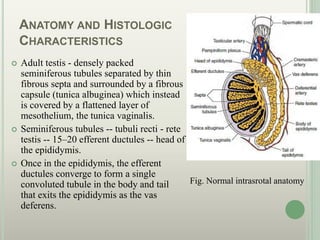
 Adult testis - densely packed
seminiferous tubules separated by thin
fibrous septa and surrounded by a fibrous
capsule (tunica albuginea) which instead
is covered by a flattened layer of
mesothelium, the tunica vaginalis.
 Seminiferous tubules -- tubuli recti - rete
testis -- 15–20 efferent ductules -- head of
the epididymis.
 Once in the epididymis, the efferent
ductules converge to form a single
convoluted tubule in the body and tail
that exits the epididymis as the vas
deferens.
Fig. Normal intrasrotal anatomy
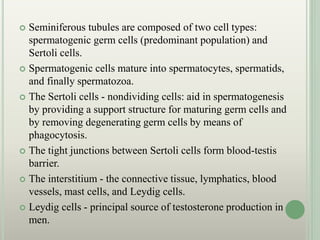
 Seminiferous tubules are composed of two cell types:
spermatogenic germ cells (predominant population) and
Sertoli cells.
 Spermatogenic cells mature into spermatocytes, spermatids,
and finally spermatozoa.
 The Sertoli cells - nondividing cells: aid in spermatogenesis
by providing a support structure for maturing germ cells and
by removing degenerating germ cells by means of
phagocytosis.
 The tight junctions between Sertoli cells form blood-testis
barrier.
 The interstitium - the connective tissue, lymphatics, blood
vessels, mast cells, and Leydig cells.
 Leydig cells - principal source of testosterone production in
men.
 Each adult testis measures approximately 5 × 3 × 3 cm.
 Each testicular artery arises directly from the aorta.
 The right testicular vein drains into the inferior vena
cava, and the left testicular vein drains into the left renal
vein .
 Lymphatic drainage follows venous drainage, such that
the testes drain into paraaortic and paracaval lymph
nodes .
 The lymphatic and venous drainage pathways of the
testes explain why paraaortic and paracaval lymph nodes
at the level of the kidneys are the initial nodal stations
affected by testicular malignancies.
INTRODUCTION
 Relatively uncommon tumor (representing approximately 1%
of all cancers in men), testicular cancer is the commonest
malignancy in males between 20 to 40 yrs of age with the
incidence apparently rising.
 Broadly categorized into germ cell and non–germ cell tumors.
 Germ cell tumors
 arise from spermatogenic cells
 95% of testicular neoplasms. Majorities are malignant.
 Non–germ cell primary tumors
 arise from the sex cords (Sertoli cells) and stroma (Leydig cells).
Malignant in only 10% of cases.
 Nonprimary tumors - lymphoma, leukemia and metastases
can also manifest as testicular masses.
CLASSIFICATION OF TESTICULAR TUMORS
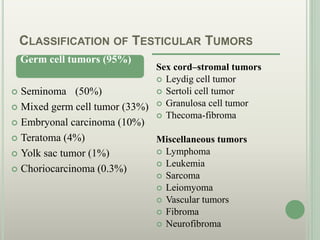
 Seminoma (50%)
 Mixed germ cell tumor (33%)
 Embryonal carcinoma (10%)
 Teratoma (4%)
 Yolk sac tumor (1%)
 Choriocarcinoma (0.3%)
Sex cord–stromal tumors
 Leydig cell tumor
 Sertoli cell tumor
 Granulosa cell tumor
 Thecoma-fibroma
Miscellaneous tumors
 Lymphoma
 Leukemia
 Sarcoma
 Leiomyoma
 Vascular tumors
 Fibroma
 Neurofibroma
Germ cell tumors (95%)
RISK FACTORS FOR TESTICULAR
TUMORS
 Well-established positive associations with testicular
carcinoma:
 Cryptorchidism
 Prior testicular tumor,
 Positive family history,
 Infertility, and
 Intersex syndromes (Gonadal dysgenesis, True hermaphroditism,
and Pseudohermaphroditism)
 Others: Microlithiasis, Testicular atrophy, Infantile hernia, low
birth weight and maternal exposure to DES
 Cryptoorchidism: increased risk (upto 40 times than normal
in intra-abdominal testes in above 5 yrs : Sutton).
 If a patient has had carcinoma in one testis, his risk for
developing a contralateral tumor is more than 20 times that of
the general population.
 A history of testicular carcinoma in a first-degree relative
increases the risk factor six times.
CLINICAL MANIFESTATION
 Painless scrotal mass- most common presentation
 Patient may sometimes may complain of dull ache of
sensation of heaviness or fullness in the lower abdomen
or scrotum.
 Pain: much less common presenting symptom, reported
by approximately 10% of patients.
 May initially be misdiagnosed as orchitis.
 May have normal or small testes at presentation - present
with metastases ( Pulmonary of abdominal) as tumors
may undergo regression, necrosis, and scarring (so-called
burned-out germ cell tumors).
 Endocrine abnormalities, most commonly gynecomastia
(minority of patients with hormonally active tumors).
ROLE OF RADIOLOGISTS
 Identifying tumors at patient presentation,
 Accurately staging disease, and
 Detecting recurrence during imaging
surveillance
IMAGING EVALUATION OF THE TESTIS
 Ultrasonography (US) with high frequency transducer - the
primary imaging modality for investigating testicular lesions
which is nearly 100% sensitive in the identification of scrotal
masses.
 Intratesticular versus extratesticular pathologic conditions
can be differentiated with 98%–100% sensitivity.
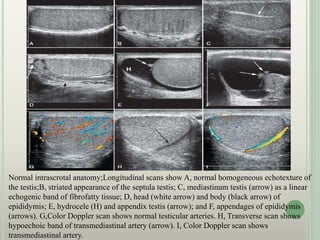
 On USG, normal testis - homogeneous, medium-level,
granular echotexture.
 The epididymis - isoechoic or slightly hyperechoic compared
with the testis.
Normal intrascrotal anatomy;Longitudinal scans show A, normal homogeneous echotexture of
the testis;B, striated appearance of the septula testis; C, mediastinum testis (arrow) as a linear
echogenic band of fibrofatty tissue; D, head (white arrow) and body (black arrow) of
epididymis; E, hydrocele (H) and appendix testis (arrow); and F, appendages of epididymis
(arrows). G,Color Doppler scan shows normal testicular arteries. H, Transverse scan shows
hypoechoic band of transmediastinal artery (arrow). I, Color Doppler scan shows
transmediastinal artery.
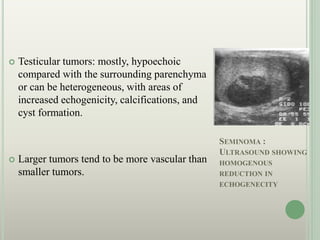
SEMINOMA :
ULTRASOUND SHOWING
HOMOGENOUS
REDUCTION IN
ECHOGENECITY
 Testicular tumors: mostly, hypoechoic
compared with the surrounding parenchyma
or can be heterogeneous, with areas of
increased echogenicity, calcifications, and
cyst formation.
 Larger tumors tend to be more vascular than
smaller tumors.
MR IMAGING
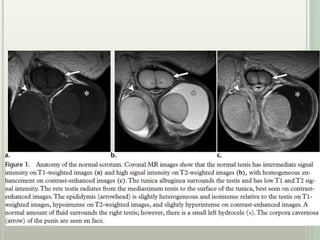
 The normal testis is a sharply demarcated homogeneous oval
structure with low to intermediate signal intensity on T1WI
and high signal intensity on T2WI .
 The testis is surrounded by the tunica albuginea, which has
low T1 and T2 signal intensity.
 The mediastinum testis has signal intensity similar to that of
the testis on T1WI and is lower in signal intensity than the
testis on T2WI.
 The rete testis radiates from the mediastinum testis to the
surface of the tunica.
 High signal intensity of the testis on T2-weighted images
allows excellent depiction of focal solid testicular masses,
which most commonly have lower T2 signal intensity.
 T1WI are useful in detection of fat or methemoglobin,
both of which have high signal intensity.
 The epididymis is slightly heterogeneous and isointense
to the testis on T1-weighted images.
 The epididymis is more clearly differentiated from the
testis on T2-weighted images because it has lower signal
intensity than the adjacent testis.
 Contrast material–enhanced images demonstrate
homogeneous enhancement of the testis and
hyperintensity of the epididymis relative to the testis.
Can be heterogeneous in signal intensity -suggests the
presence of calcifications, necrosis, or hemorrhage.
 The scrotal wall is typically hypointense on T1- and T2-
weighted images
 MR imaging - useful problem-solving tool in rare cases
of inconclusive USG results, particularly helpful in the
evaluation of cryptorchidism.
 Contrast enhanced MR – characterization of
indeterminate scrotal masses.
GERM CELL TUMORS
 Intratubular germ cell neoplasia - precursor of most germ
cell tumors.
 These abnormal cells develop either along a unipotential
gonadal line - form seminoma or along a totipotential
cell line - form nonseminomatous tumors.
 Totipotential cells –
 Largely undifferentiated (embryonal carcinoma) or
 Embryonic differentiation (teratoma) or
 Extraembryonic differentiation (yolk sac tumors,
choriocarcinoma).
PATTERNS OF SPREAD
 Metastases - both lymphatic and hematogenous routes.
 Direct extension through the tunica albuginea with
involvement of the scrotal skin: rare and late finding .
 Germ cell tumors spread first via the lymphatics rather
than hematogenously. (exception choriocarcinoma- early
hematogenous spread).
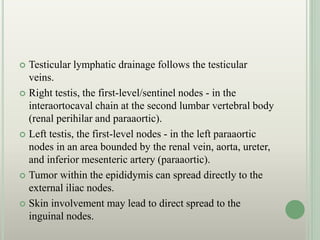
 Testicular lymphatic drainage follows the testicular
veins.
 Right testis, the first-level/sentinel nodes - in the
interaortocaval chain at the second lumbar vertebral body
(renal perihilar and paraaortic).
 Left testis, the first-level nodes - in the left paraaortic
nodes in an area bounded by the renal vein, aorta, ureter,
and inferior mesenteric artery (paraaortic).
 Tumor within the epididymis can spread directly to the
external iliac nodes.
 Skin involvement may lead to direct spread to the
inguinal nodes.
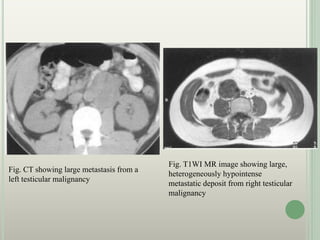
Fig. CT showing large metastasis from a
left testicular malignancy
Fig. T1WI MR image showing large,
heterogeneously hypointense
metastatic deposit from right testicular
malignancy
 Hematogenous spread -- distant organ metastases.
 Pulmonary metastases - most common for all germ cell
tumors, followed by liver, brain, and bone metastases.
 Brain metastases - particularly common with
choriocarcinoma.
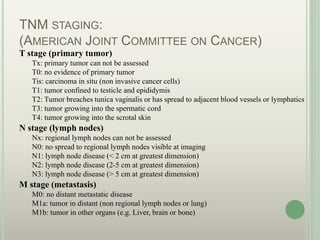
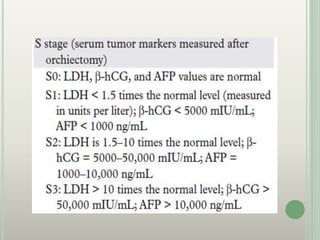
TNM STAGING:
(AMERICAN JOINT COMMITTEE ON CANCER)
T stage (primary tumor)
Tx: primary tumor can not be assessed
T0: no evidence of primary tumor
Tis: carcinoma in situ (non invasive cancer cells)
T1: tumor confined to testicle and epididymis
T2: Tumor breaches tunica vaginalis or has spread to adjacent blood vessels or lymphatics
T3: tumor growing into the spermatic cord
T4: tumor growing into the scrotal skin
N stage (lymph nodes)
Nx: regional lymph nodes can not be assessed
N0: no spread to regional lymph nodes visible at imaging
N1: lymph node disease (< 2 cm at greatest dimension)
N2: lymph node disease (2-5 cm at greatest dimension)
N3: lymph node disease (> 5 cm at greatest dimension)
M stage (metastasis)
M0: no distant metastatic disease
M1a: tumor in distant (non regional lymph nodes or lung)
M1b: tumor in other organs (e.g. Liver, brain or bone)
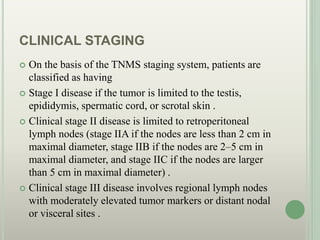
CLINICAL STAGING
 On the basis of the TNMS staging system, patients are
classified as having
 Stage I disease if the tumor is limited to the testis,
epididymis, spermatic cord, or scrotal skin .
 Clinical stage II disease is limited to retroperitoneal
lymph nodes (stage IIA if the nodes are less than 2 cm in
maximal diameter, stage IIB if the nodes are 2–5 cm in
maximal diameter, and stage IIC if the nodes are larger
than 5 cm in maximal diameter) .
 Clinical stage III disease involves regional lymph nodes
with moderately elevated tumor markers or distant nodal
or visceral sites .
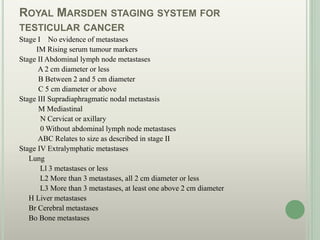
ROYAL MARSDEN STAGING SYSTEM FOR
TESTICULAR CANCER
Stage I No evidence of metastases
IM Rising serum tumour markers
Stage II Abdominal lymph node metastases
A 2 cm diameter or less
B Between 2 and 5 cm diameter
C 5 cm diameter or above
Stage III Supradiaphragmatic nodal metastasis
M Mediastinal
N Cervicat or axillary
0 Without abdominal lymph node metastases
ABC Relates to size as described in stage II
Stage IV Extralymphatic metastases
Lung
Ll 3 metastases or less
L2 More than 3 metastases, all 2 cm diameter or less
L3 More than 3 metastases, at least one above 2 cm diameter
H Liver metastases
Br Cerebral metastases
Bo Bone metastases
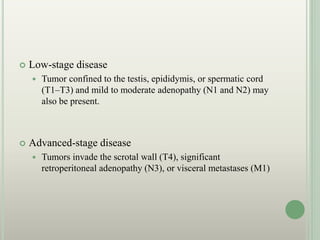
 Low-stage disease
 Tumor confined to the testis, epididymis, or spermatic cord
(T1–T3) and mild to moderate adenopathy (N1 and N2) may
also be present.
 Advanced-stage disease
 Tumors invade the scrotal wall (T4), significant
retroperitoneal adenopathy (N3), or visceral metastases (M1)
SEMINOMA
 Most common (35%–50%), pure germ cell tumor.
 Average patient age of 40.5 years (35-45 years).
 Approximately 75% - disease limited to the testis, 20% -
retroperitoneal adenopathy, and 5% - extranodal
metastases.
 Ranges from small well-defined lesion to large masses
that totally replace the testicle.
 Larger tumors - more heterogeneous.
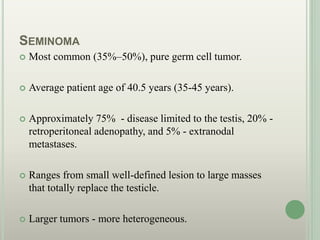
Fig. Seminoma
Transverse USG: well-
defined, hypoechoic
lesion in posterior aspect
of testis
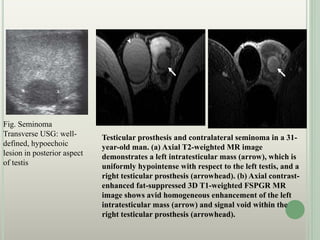
Testicular prosthesis and contralateral seminoma in a 31-
year-old man. (a) Axial T2-weighted MR image
demonstrates a left intratesticular mass (arrow), which is
uniformly hypointense with respect to the left testis, and a
right testicular prosthesis (arrowhead). (b) Axial contrast-
enhanced fat-suppressed 3D T1-weighted FSPGR MR
image shows avid homogeneous enhancement of the left
intratesticular mass (arrow) and signal void within the
right testicular prosthesis (arrowhead).
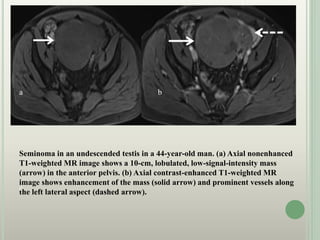
Seminoma in an undescended testis in a 44-year-old man. (a) Axial nonenhanced
T1-weighted MR image shows a 10-cm, lobulated, low-signal-intensity mass
(arrow) in the anterior pelvis. (b) Axial contrast-enhanced T1-weighted MR
image shows enhancement of the mass (solid arrow) and prominent vessels along
the left lateral aspect (dashed arrow).
a b
c
 Can be lobulated or multinodular; most
commonly in continuity with one
another.
 Bilateral tumors: rare (2%) - almost
always asynchronous.
 Seminoma - extremely radiosensitive.
5-year survival rate of 95% for low-
stage tumors.
 Patients with advanced stage disease –
chemotherapy followed by radiation
therapy.
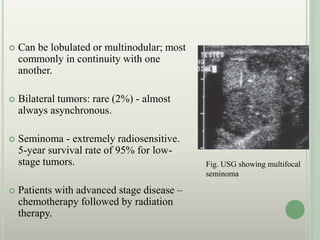
Fig. USG showing multifocal
seminoma
NONSEMINOMATOUS GERM CELL TUMORS
EMBRYONAL CARCINOMA
 Composed of primitive anaplastic epithelial cells that
resemble early embryonic cells.
 Present in 87% of mixed germ cell tumors, although in
its pure form - only 2%–3% of all testicular tumors.
 occurs in a younger population than does seminoma
(men aged 25–35 years).
 Often smaller than seminoma at the time of presentation
but tends to be more aggressive in behavior.
 The tunica albuginea may be invaded, and the borders of
the tumor are less distinct, often blending imperceptibly
into the adjacent parenchyma.
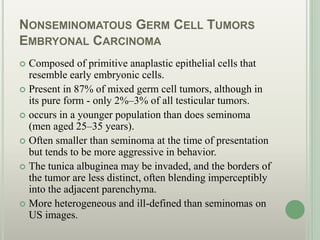
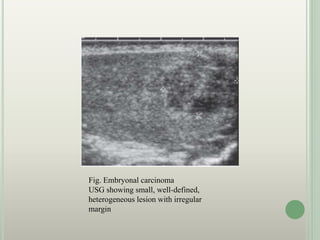
 More heterogeneous and ill-defined than seminomas on
US images.
Fig. Embryonal carcinoma
USG showing small, well-defined,
heterogeneous lesion with irregular
margin
YOLK SAC TUMOR/ENDODERMAL SINUS
TUMOR
 80% of childhood testicular tumors - most cases
occurring before the age of 2 years.
 Present in 44% of adult cases of mixed germ cell tumor
(rare in adults in its pure form).
 Alpha-fetoprotein, normally produced by the embryonic
yolk sac - elevated in greater than 90% of patients with
yolk sac tumor.
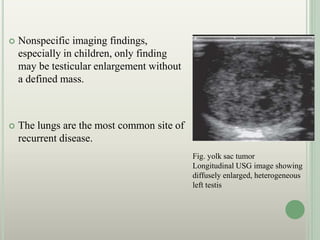
 Nonspecific imaging findings,
especially in children, only finding
may be testicular enlargement without
a defined mass.
 The lungs are the most common site of
recurrent disease.
Fig. yolk sac tumor
Longitudinal USG image showing
diffusely enlarged, heterogeneous
left testis
TERATOMA
 Occur in children less than 4 years of age.
 Occur in approximately half of all adult cases of mixed
germ cell tumor, rare in adults in its pure form
 Complex tumor, showing disorderly arrangement of
adult and fetal tissues, with all three germ layers
(endoderm, mesoderm, and ectoderm) involved.
 Dermoids, most common teratomatous lesion in the
ovary, constitute only a small minority of testicular
teratomas.
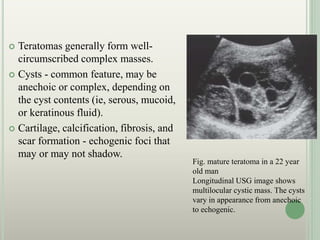
 Teratomas generally form well-
circumscribed complex masses.
 Cysts - common feature, may be
anechoic or complex, depending on
the cyst contents (ie, serous, mucoid,
or keratinous fluid).
 Cartilage, calcification, fibrosis, and
scar formation - echogenic foci that
may or may not shadow.
Fig. mature teratoma in a 22 year
old man
Longitudinal USG image shows
multilocular cystic mass. The cysts
vary in appearance from anechoic
to echogenic.
 In prepubertal testes, pure teratomas
are considered benign even when they
are histologically immature.
 Every element in a postpubertal
testicular teratoma (mature or
immature) can metastasize,
irrespective of its histologic
characteristic.
 Metastases may contain non-
teratomatous germ cell elements.
 Thus, mature teratoma should not be
equated with benignity.
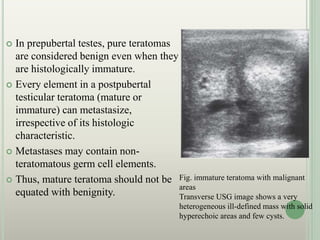
Fig. immature teratoma with malignant
areas
Transverse USG image shows a very
heterogeneous ill-defined mass with solid
hyperechoic areas and few cysts.
CHORIOCARCINOMA
 Rare germ cell tumor, seen in less than 1% of patients in
its pure form but it occurs in 8% of cases of mixed germ
cell tumors.
 2nd and 3rd decades of life, a highly malignant tumor
composed of an admixture of cytotrophoblastic and
syncytiotrophoblastic cells.
 Early widespread metastasis, may present with
symptoms referable to their metastases rather than a
palpable testicular mass. Sites of metastases include the
lung, liver, gastrointestinal tract, and brain.
 The primary tumor and metastases are often
hemorrhagic.
 The levels of human chorionic gonadotropin – elevated,
cause gynecomastia in 10% of cases.
 Worst prognosis, with death usually occurring within 1
year of diagnosis.
 Patients with mixed germ cell tumors with
choriocarcinoma fair better than those with pure
choriocarcinoma tumors
 A very high level of human chorionic gonadotropin
(50,000 IU/L) – carries poor prognosis with a 5-year
survival rate of 48%.
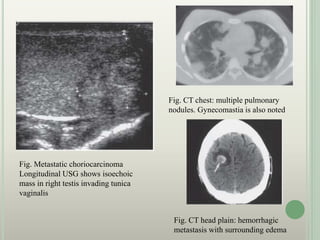
Fig. Metastatic choriocarcinoma
Longitudinal USG shows isoechoic
mass in right testis invading tunica
vaginalis
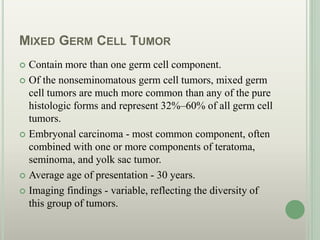
Fig. CT chest: multiple pulmonary
nodules. Gynecomastia is also noted
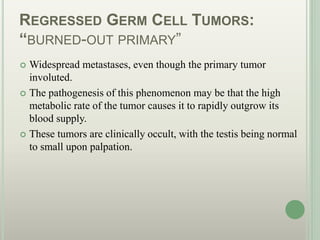
Fig. CT head plain: hemorrhagic
metastasis with surrounding edema
MIXED GERM CELL TUMOR
 Contain more than one germ cell component.
 Of the nonseminomatous germ cell tumors, mixed germ
cell tumors are much more common than any of the pure
histologic forms and represent 32%–60% of all germ cell
tumors.
 Embryonal carcinoma - most common component, often
combined with one or more components of teratoma,
seminoma, and yolk sac tumor.
 Average age of presentation - 30 years.
 Imaging findings - variable, reflecting the diversity of
this group of tumors.
REGRESSED GERM CELL TUMORS:
“BURNED-OUT PRIMARY”
 Widespread metastases, even though the primary tumor
involuted.
 The pathogenesis of this phenomenon may be that the high
metabolic rate of the tumor causes it to rapidly outgrow its
blood supply.
 These tumors are clinically occult, with the testis being normal
to small upon palpation.
 US plays a vital role in the search for the primary
regressed tumor.
 These primary tumors have a variable appearance.
 They are generally small and can be hypoechoic,
hyperechoic, or merely an area of focal calcification.
 Histologic analysis may reveal minute amounts of
residual tumor or only dense deposits of collagen with
scattered inflammatory cells.
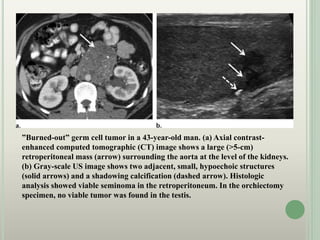
”Burned-out” germ cell tumor in a 43-year-old man. (a) Axial contrast-
enhanced computed tomographic (CT) image shows a large (>5-cm)
retroperitoneal mass (arrow) surrounding the aorta at the level of the kidneys.
(b) Gray-scale US image shows two adjacent, small, hypoechoic structures
(solid arrows) and a shadowing calcification (dashed arrow). Histologic
analysis showed viable seminoma in the retroperitoneum. In the orchiectomy
specimen, no viable tumor was found in the testis.
PRIMARY EXTRA-GONADAL
GERM CELL TUMORS
 Can occur outside the gonads and should be
differentiated from regressed germ cell tumor with
metastasis.
 May occur in the retroperitoneum, mediastinum,
sacrococcygeal area, and pineal gland.
 Result from
 aberrant migration of the germ cells from the yolk sac.
 persistent pluripotential cells that remained in primitive rests
during somatic development.
 But in a male patient, retroperitoneal germ cell tumor
mostly represent metastatic disease.
 Testes thoroughly evaluated (including with sonography)
for an occult testicular primary lesion.
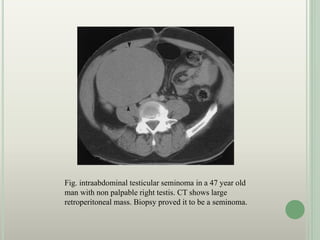
Fig. intraabdominal testicular seminoma in a 47 year old
man with non palpable right testis. CT shows large
retroperitoneal mass. Biopsy proved it to be a seminoma.
NON–GERM CELL TUMORS
SEX CORD/STROMALTUMORS:
 arise from the cells forming the sex cords (Sertoli cells) and
interstitial stroma (Leydig cells) - ~4% of all testicular tumors.
 higher in the pediatric age group - 10%– 30% of all testicular
neoplasms.
 Non–germ cell tumors – 90 % benign.
 No radiologic criteria allow differentiation of benign from
malignant disease, and orchiectomy is performed in all cases.
 Even with histologic analysis - difficult to determine the
biologic behavior of these tumors.
 Although usually benign, even tumors without aggressive
histologic features may metastasize.
LEYDIG CELL TUMORS
 most common in this group, 1%–3% of all testicular
tumors.
 Seen in any age group - 30% in patients aged 30–50
years
 30% of patients - endocrinopathy secondary to secretion
of androgens or estrogens by the tumor.
 may manifest as precocious virilization, gynecomastia,
or decreased libido.
 Generally small solid masses, but may show cystic areas,
hemorrhage, or necrosis.
 Sonographic appearance - variable and indistinguishable
from that of germ cell tumors.
Sertoli cell tumors
 less common, less than 1% of testicular
tumors.
 Less likely than Leydig cell tumors to be
hormonally active, but gynecomastia can
occur.
 Typically well-circumscribed, unilateral,
round to lobulated masses.
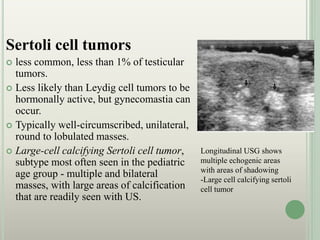
 Large-cell calcifying Sertoli cell tumor,
subtype most often seen in the pediatric
age group - multiple and bilateral
masses, with large areas of calcification
that are readily seen with US.
Longitudinal USG shows
multiple echogenic areas
with areas of shadowing
-Large cell calcifying sertoli
cell tumor
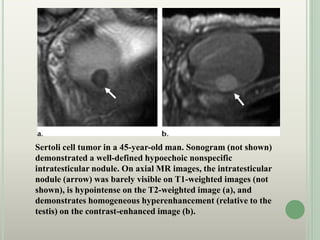
Sertoli cell tumor in a 45-year-old man. Sonogram (not shown)
demonstrated a well-defined hypoechoic nonspecific
intratesticular nodule. On axial MR images, the intratesticular
nodule (arrow) was barely visible on T1-weighted images (not
shown), is hypointense on the T2-weighted image (a), and
demonstrates homogeneous hyperenhancement (relative to the
testis) on the contrast-enhanced image (b).
 Other less common sex cord/stromal tumors:
 granulosa cell tumors, fibroma-thecomas, and mixed sex
cord–stromal tumors.
 Gonadoblastoma belongs in a final category that contains
both sex cord – stromal elements and germ cells.
 occur in the setting of gonadal dysgenesis and intersex
syndromes.
 Approximately 80% of the patients are phenotypically
female.
LYMPHOMA
 Can occur in the testis in one of three ways:
 as the primary site of involvement, as the initial manifestation
of clinically occult disease, or as the site of recurrent disease.
 5% of all testicular tumors, testicular lymphoma occurs
in less than 1% of patients with lymphoma.
 Occurs in a much older population, most common in
men over 60 years of age.
 Clinically - painless testicular enlargement,
 systemic symptoms: weight loss, anorexia, fever, and
weakness, initial complaint in 25% of patients.
 Most common B/L testicular tumor, up to 25% (Sutton)
of all cases, either synchronously or, more commonly,
metachronously.
 The epididymis and spermatic cord - commonly
involved.
 Almost all are B-cell lymphoma, commonly diffuse large
cell.
 Associated with extranodal involvement esp. in the
pharynx, skin and CNS.
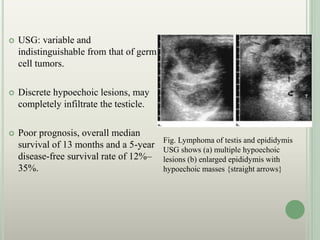
 USG: variable and
indistinguishable from that of germ
cell tumors.
 Discrete hypoechoic lesions, may
completely infiltrate the testicle.
 Poor prognosis, overall median
survival of 13 months and a 5-year
disease-free survival rate of 12%–
35%.
Fig. Lymphoma of testis and epididymis
USG shows (a) multiple hypoechoic
lesions (b) enlarged epididymis with
hypoechoic masses {straight arrows}
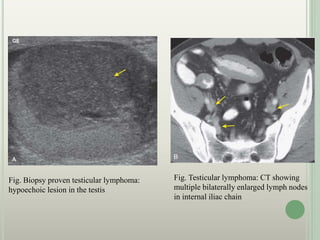
Fig. Biopsy proven testicular lymphoma:
hypoechoic lesion in the testis
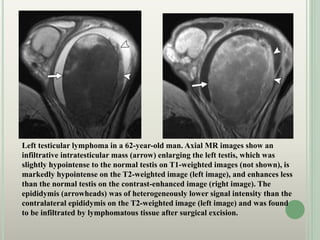
Fig. Testicular lymphoma: CT showing
multiple bilaterally enlarged lymph nodes
in internal iliac chain
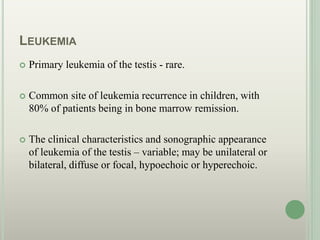
Left testicular lymphoma in a 62-year-old man. Axial MR images show an
infiltrative intratesticular mass (arrow) enlarging the left testis, which was
slightly hypointense to the normal testis on T1-weighted images (not shown), is
markedly hypointense on the T2-weighted image (left image), and enhances less
than the normal testis on the contrast-enhanced image (right image). The
epididymis (arrowheads) was of heterogeneously lower signal intensity than the
contralateral epididymis on the T2-weighted image (left image) and was found
to be infiltrated by lymphomatous tissue after surgical excision.
LEUKEMIA
 Primary leukemia of the testis - rare.
 Common site of leukemia recurrence in children, with
80% of patients being in bone marrow remission.
 The clinical characteristics and sonographic appearance
of leukemia of the testis – variable; may be unilateral or
bilateral, diffuse or focal, hypoechoic or hyperechoic.
METASTASES TO THE TESTES
 Rare (other than those from lymphoma and leukemia)
 Have been reported most commonly in cases of primary
prostate, lung cancer and malignant melanoma.
 Generally seen in the setting of widespread disease and
rarely the presenting complaint.
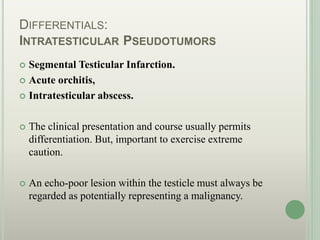
DIFFERENTIALS:
INTRATESTICULAR PSEUDOTUMORS
 Segmental Testicular Infarction.
 Acute orchitis,
 Intratesticular abscess.
 The clinical presentation and course usually permits
differentiation. But, important to exercise extreme
caution.
 An echo-poor lesion within the testicle must always be
regarded as potentially representing a malignancy.
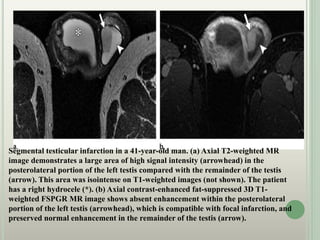
Segmental testicular infarction in a 41-year-old man. (a) Axial T2-weighted MR
image demonstrates a large area of high signal intensity (arrowhead) in the
posterolateral portion of the left testis compared with the remainder of the testis
(arrow). This area was isointense on T1-weighted images (not shown). The patient
has a right hydrocele (*). (b) Axial contrast-enhanced fat-suppressed 3D T1-
weighted FSPGR MR image shows absent enhancement within the posterolateral
portion of the left testis (arrowhead), which is compatible with focal infarction, and
preserved normal enhancement in the remainder of the testis (arrow).
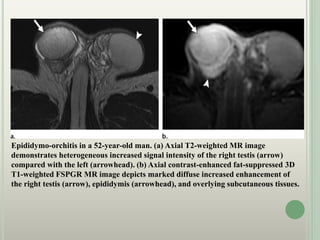
Epididymo-orchitis in a 52-year-old man. (a) Axial T2-weighted MR image
demonstrates heterogeneous increased signal intensity of the right testis (arrow)
compared with the left (arrowhead). (b) Axial contrast-enhanced fat-suppressed 3D
T1-weighted FSPGR MR image depicts marked diffuse increased enhancement of
the right testis (arrow), epididymis (arrowhead), and overlying subcutaneous tissues.
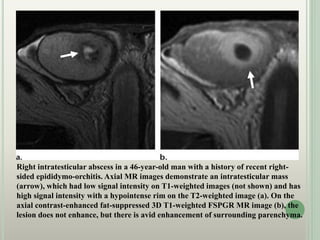
Right intratesticular abscess in a 46-year-old man with a history of recent right-
sided epididymo-orchitis. Axial MR images demonstrate an intratesticular mass
(arrow), which had low signal intensity on T1-weighted images (not shown) and has
high signal intensity with a hypointense rim on the T2-weighted image (a). On the
axial contrast-enhanced fat-suppressed 3D T1-weighted FSPGR MR image (b), the
lesion does not enhance, but there is avid enhancement of surrounding parenchyma.
EXTRATESTICULAR TUMOURS
 Rare and usually benign;
 most common is the adenomatoid tumour of the
epididymis –
 Benign hamartoma, most frequently seen in the tail.
 Varies in size from about 5 to 50 mm and
 similar or slightly increased echogenicity compared
with normal testicle.
 Others include benign neoplasms. such as mesenchymal
tumours
 (leiomyoma, fibroma, lipoma), adrenal rests and benign
mesothelioma.
 arises from the tunica vaginalis.
 produces small paratesticular hypcrechoic masses and a
disproportionately
 large hydrocele.
 Extratesticular malignancies are extremely rare.
 least rare malignant neoplasia - sarcoma of the spermatic
cord, most commonly embryonal rhabdomyosarcoma (in
younger patients)
SUMMARY
 Testicular tumors - only 1% of all neoplasms in men, but most
common malignancy in the 15–34-year-old age group.
 Germ cell tumors constitute 95% of all testicular tumors - a
varied group of neoplasms whose imaging features reflect
their underlying histologic characteristics.
 Seminomas - generally well-defined homogeneous lesions,
whereas the nonseminomatous tumors (mixed germ cell
tumor, embryonal carcinoma, yolk sac tumor,
choriocarcinoma and teratoma) - much more varied
appearance.
 Germ cell tumors follow a predictable pattern of spread via
the lymphatic drainage to the retroperitoneal nodes with
exception as Choriocarcinoma shows early hematogenous
spread .
 Testicular tumors - may also arise from the sex cords (Sertoli
cells) and stroma (Leydig cells) where majority are benign
(90% ), there are no reliable imaging criteria to differentiate
them from malignant masses.
 US is used to distinguish between intratesticular masses,
which are more commonly malignant, and extratesticular
masses, which are more commonly benign. US can also
be used to accurately differentiate intratesticular solid
masses, which are often malignant, from cystic lesions,
which are usually benign.
 Overlap exists between the imaging appearances of
testicular tumors and those of nontumorous conditions
such as focal infarction, hematoma, and infection, which
can also appear as hypoechoic masslike areas with
variable internal blood flow. Therefore, correlation with
the patient’s clinical history is critical to avoid
unnecessary surgery.
CONCLUSION
 Testicular cancer is considered an oncologic
success story because most individuals will be
cured with a combination of surgery and
chemotherapy.
 Radiologists play an important role in
identifying tumors at patient presentation,
accurately staging disease, and detecting
recurrence during imaging surveillance.
REFERENCES:
 Text book of Imaging and radiology, David Sutton 7/e
 CT and MRI of the whole body, Haaga; 6/e
 Diagnostic ultrasound 4/e, Rumack
 Testicular Tumors : What Radiologists need to know-
Differential Diagnosis, Staging and management : Moreno er al.
Radiographics 2015
 Tumors and Tumor-like Lesions of the Testis: Radiologic-
Pathologic Correlation; Woodward et. al, RadioGraphics 2002;
22:189–216
 MR Imaging of Scrotal Tumors and Pseudotumors-Cassidy et
al., RSNA, 2010 , radiographics.rsna.org
Testicular tumor imaging

Testicular tumor imaging

  • 1.
    IMAGING IN TESTICULAR TUMORS Dr.Bom B. C. 2nd year MD Resident NAMS, Bir Hospital
  • 2.
    OUTLINES OF PRESENTATION Relevant embryologic development of testes  Anatomic and histologic characteristics  Brief introduction and classification  Risk factors of testicular tumors  Clinical manifestation  Imaging evaluation of testicular lesions  Individual testicular tumors overview  Metastasis to testis  Differential diagnosis  Summary and Conclusion
  • 3.
    EMBRYOLOGY OF TESTES No morphologic male or female sexual differentiation until the 7th week of development - the “indifferent stage.”  The undifferentiated gonad is composed of three different cell types: Mesenchyme, Mesothelium, and Germ cells.  Condensation of mesenchyme - genital ridges form on both sides of the midline extending from the 6th thoracic to the 2nd sacral segments of the developing embryo - covered by proliferating mesothelium (coelomic epithelium).  The germ cells form in the wall of the yolk sac - migrate along the hindgut and dorsal mesenteric root - into the genital ridge- incorporated into the primitive sex cords.
  • 4.
     Further developmentof gonad into a testis - requires the presence of a Y chromosome (testis-determining factor) under which influence the primitive sex cords form the seminiferous tubules.  From two distinct cell lines:  From the mesothelium are the Sertoli or supporting cells and  From the migrated germ cells become the spermatogonia.  The mesenchyme between the developing seminiferous tubules differentiates into the interstitial (Leydig) cells.
  • 5.
    8 weeks gestationalage  Leydig cells begin to secrete testosterone - mesonephric (wolffian) ducts differentiate into the epididymis, vas deferens, seminal vesicles, and ejaculatory ducts.  Sertoli cells - Mullerian Inhibiting Factor (paramesonephric or Mullerian ducts regress). Testes contract and become more ovoid as they descend into the pelvis. Remain near the deep inguinal ring until the 7th month - begin descent through the inguinal canal into twin scrotal sacs.
  • 6.
    ANATOMY AND HISTOLOGIC CHARACTERISTICS Adult testis - densely packed seminiferous tubules separated by thin fibrous septa and surrounded by a fibrous capsule (tunica albuginea) which instead is covered by a flattened layer of mesothelium, the tunica vaginalis.  Seminiferous tubules -- tubuli recti - rete testis -- 15–20 efferent ductules -- head of the epididymis.  Once in the epididymis, the efferent ductules converge to form a single convoluted tubule in the body and tail that exits the epididymis as the vas deferens. Fig. Normal intrasrotal anatomy
  • 7.
     Seminiferous tubulesare composed of two cell types: spermatogenic germ cells (predominant population) and Sertoli cells.  Spermatogenic cells mature into spermatocytes, spermatids, and finally spermatozoa.  The Sertoli cells - nondividing cells: aid in spermatogenesis by providing a support structure for maturing germ cells and by removing degenerating germ cells by means of phagocytosis.  The tight junctions between Sertoli cells form blood-testis barrier.  The interstitium - the connective tissue, lymphatics, blood vessels, mast cells, and Leydig cells.  Leydig cells - principal source of testosterone production in men.
  • 8.
     Each adulttestis measures approximately 5 × 3 × 3 cm.  Each testicular artery arises directly from the aorta.  The right testicular vein drains into the inferior vena cava, and the left testicular vein drains into the left renal vein .  Lymphatic drainage follows venous drainage, such that the testes drain into paraaortic and paracaval lymph nodes .  The lymphatic and venous drainage pathways of the testes explain why paraaortic and paracaval lymph nodes at the level of the kidneys are the initial nodal stations affected by testicular malignancies.
  • 9.
    INTRODUCTION  Relatively uncommontumor (representing approximately 1% of all cancers in men), testicular cancer is the commonest malignancy in males between 20 to 40 yrs of age with the incidence apparently rising.  Broadly categorized into germ cell and non–germ cell tumors.  Germ cell tumors  arise from spermatogenic cells  95% of testicular neoplasms. Majorities are malignant.  Non–germ cell primary tumors  arise from the sex cords (Sertoli cells) and stroma (Leydig cells). Malignant in only 10% of cases.  Nonprimary tumors - lymphoma, leukemia and metastases can also manifest as testicular masses.
  • 10.
    CLASSIFICATION OF TESTICULARTUMORS  Seminoma (50%)  Mixed germ cell tumor (33%)  Embryonal carcinoma (10%)  Teratoma (4%)  Yolk sac tumor (1%)  Choriocarcinoma (0.3%) Sex cord–stromal tumors  Leydig cell tumor  Sertoli cell tumor  Granulosa cell tumor  Thecoma-fibroma Miscellaneous tumors  Lymphoma  Leukemia  Sarcoma  Leiomyoma  Vascular tumors  Fibroma  Neurofibroma Germ cell tumors (95%)
  • 11.
    RISK FACTORS FORTESTICULAR TUMORS  Well-established positive associations with testicular carcinoma:  Cryptorchidism  Prior testicular tumor,  Positive family history,  Infertility, and  Intersex syndromes (Gonadal dysgenesis, True hermaphroditism, and Pseudohermaphroditism)  Others: Microlithiasis, Testicular atrophy, Infantile hernia, low birth weight and maternal exposure to DES  Cryptoorchidism: increased risk (upto 40 times than normal in intra-abdominal testes in above 5 yrs : Sutton).  If a patient has had carcinoma in one testis, his risk for developing a contralateral tumor is more than 20 times that of the general population.  A history of testicular carcinoma in a first-degree relative increases the risk factor six times.
  • 12.
    CLINICAL MANIFESTATION  Painlessscrotal mass- most common presentation  Patient may sometimes may complain of dull ache of sensation of heaviness or fullness in the lower abdomen or scrotum.  Pain: much less common presenting symptom, reported by approximately 10% of patients.  May initially be misdiagnosed as orchitis.  May have normal or small testes at presentation - present with metastases ( Pulmonary of abdominal) as tumors may undergo regression, necrosis, and scarring (so-called burned-out germ cell tumors).  Endocrine abnormalities, most commonly gynecomastia (minority of patients with hormonally active tumors).
  • 13.
    ROLE OF RADIOLOGISTS Identifying tumors at patient presentation,  Accurately staging disease, and  Detecting recurrence during imaging surveillance
  • 14.
    IMAGING EVALUATION OFTHE TESTIS  Ultrasonography (US) with high frequency transducer - the primary imaging modality for investigating testicular lesions which is nearly 100% sensitive in the identification of scrotal masses.  Intratesticular versus extratesticular pathologic conditions can be differentiated with 98%–100% sensitivity.  On USG, normal testis - homogeneous, medium-level, granular echotexture.  The epididymis - isoechoic or slightly hyperechoic compared with the testis.
  • 15.
    Normal intrascrotal anatomy;Longitudinalscans show A, normal homogeneous echotexture of the testis;B, striated appearance of the septula testis; C, mediastinum testis (arrow) as a linear echogenic band of fibrofatty tissue; D, head (white arrow) and body (black arrow) of epididymis; E, hydrocele (H) and appendix testis (arrow); and F, appendages of epididymis (arrows). G,Color Doppler scan shows normal testicular arteries. H, Transverse scan shows hypoechoic band of transmediastinal artery (arrow). I, Color Doppler scan shows transmediastinal artery.
  • 16.
    SEMINOMA : ULTRASOUND SHOWING HOMOGENOUS REDUCTIONIN ECHOGENECITY  Testicular tumors: mostly, hypoechoic compared with the surrounding parenchyma or can be heterogeneous, with areas of increased echogenicity, calcifications, and cyst formation.  Larger tumors tend to be more vascular than smaller tumors.
  • 17.
    MR IMAGING  Thenormal testis is a sharply demarcated homogeneous oval structure with low to intermediate signal intensity on T1WI and high signal intensity on T2WI .  The testis is surrounded by the tunica albuginea, which has low T1 and T2 signal intensity.  The mediastinum testis has signal intensity similar to that of the testis on T1WI and is lower in signal intensity than the testis on T2WI.  The rete testis radiates from the mediastinum testis to the surface of the tunica.  High signal intensity of the testis on T2-weighted images allows excellent depiction of focal solid testicular masses, which most commonly have lower T2 signal intensity.
  • 18.
     T1WI areuseful in detection of fat or methemoglobin, both of which have high signal intensity.  The epididymis is slightly heterogeneous and isointense to the testis on T1-weighted images.  The epididymis is more clearly differentiated from the testis on T2-weighted images because it has lower signal intensity than the adjacent testis.  Contrast material–enhanced images demonstrate homogeneous enhancement of the testis and hyperintensity of the epididymis relative to the testis. Can be heterogeneous in signal intensity -suggests the presence of calcifications, necrosis, or hemorrhage.
  • 19.
     The scrotalwall is typically hypointense on T1- and T2- weighted images  MR imaging - useful problem-solving tool in rare cases of inconclusive USG results, particularly helpful in the evaluation of cryptorchidism.  Contrast enhanced MR – characterization of indeterminate scrotal masses.
  • 21.
    GERM CELL TUMORS Intratubular germ cell neoplasia - precursor of most germ cell tumors.  These abnormal cells develop either along a unipotential gonadal line - form seminoma or along a totipotential cell line - form nonseminomatous tumors.  Totipotential cells –  Largely undifferentiated (embryonal carcinoma) or  Embryonic differentiation (teratoma) or  Extraembryonic differentiation (yolk sac tumors, choriocarcinoma).
  • 22.
    PATTERNS OF SPREAD Metastases - both lymphatic and hematogenous routes.  Direct extension through the tunica albuginea with involvement of the scrotal skin: rare and late finding .  Germ cell tumors spread first via the lymphatics rather than hematogenously. (exception choriocarcinoma- early hematogenous spread).
  • 23.
     Testicular lymphaticdrainage follows the testicular veins.  Right testis, the first-level/sentinel nodes - in the interaortocaval chain at the second lumbar vertebral body (renal perihilar and paraaortic).  Left testis, the first-level nodes - in the left paraaortic nodes in an area bounded by the renal vein, aorta, ureter, and inferior mesenteric artery (paraaortic).  Tumor within the epididymis can spread directly to the external iliac nodes.  Skin involvement may lead to direct spread to the inguinal nodes.
  • 24.
    Fig. CT showinglarge metastasis from a left testicular malignancy Fig. T1WI MR image showing large, heterogeneously hypointense metastatic deposit from right testicular malignancy
  • 25.
     Hematogenous spread-- distant organ metastases.  Pulmonary metastases - most common for all germ cell tumors, followed by liver, brain, and bone metastases.  Brain metastases - particularly common with choriocarcinoma.
  • 26.
    TNM STAGING: (AMERICAN JOINTCOMMITTEE ON CANCER) T stage (primary tumor) Tx: primary tumor can not be assessed T0: no evidence of primary tumor Tis: carcinoma in situ (non invasive cancer cells) T1: tumor confined to testicle and epididymis T2: Tumor breaches tunica vaginalis or has spread to adjacent blood vessels or lymphatics T3: tumor growing into the spermatic cord T4: tumor growing into the scrotal skin N stage (lymph nodes) Nx: regional lymph nodes can not be assessed N0: no spread to regional lymph nodes visible at imaging N1: lymph node disease (< 2 cm at greatest dimension) N2: lymph node disease (2-5 cm at greatest dimension) N3: lymph node disease (> 5 cm at greatest dimension) M stage (metastasis) M0: no distant metastatic disease M1a: tumor in distant (non regional lymph nodes or lung) M1b: tumor in other organs (e.g. Liver, brain or bone)
  • 28.
    CLINICAL STAGING  Onthe basis of the TNMS staging system, patients are classified as having  Stage I disease if the tumor is limited to the testis, epididymis, spermatic cord, or scrotal skin .  Clinical stage II disease is limited to retroperitoneal lymph nodes (stage IIA if the nodes are less than 2 cm in maximal diameter, stage IIB if the nodes are 2–5 cm in maximal diameter, and stage IIC if the nodes are larger than 5 cm in maximal diameter) .  Clinical stage III disease involves regional lymph nodes with moderately elevated tumor markers or distant nodal or visceral sites .
  • 29.
    ROYAL MARSDEN STAGINGSYSTEM FOR TESTICULAR CANCER Stage I No evidence of metastases IM Rising serum tumour markers Stage II Abdominal lymph node metastases A 2 cm diameter or less B Between 2 and 5 cm diameter C 5 cm diameter or above Stage III Supradiaphragmatic nodal metastasis M Mediastinal N Cervicat or axillary 0 Without abdominal lymph node metastases ABC Relates to size as described in stage II Stage IV Extralymphatic metastases Lung Ll 3 metastases or less L2 More than 3 metastases, all 2 cm diameter or less L3 More than 3 metastases, at least one above 2 cm diameter H Liver metastases Br Cerebral metastases Bo Bone metastases
  • 30.
     Low-stage disease Tumor confined to the testis, epididymis, or spermatic cord (T1–T3) and mild to moderate adenopathy (N1 and N2) may also be present.  Advanced-stage disease  Tumors invade the scrotal wall (T4), significant retroperitoneal adenopathy (N3), or visceral metastases (M1)
  • 31.
    SEMINOMA  Most common(35%–50%), pure germ cell tumor.  Average patient age of 40.5 years (35-45 years).  Approximately 75% - disease limited to the testis, 20% - retroperitoneal adenopathy, and 5% - extranodal metastases.  Ranges from small well-defined lesion to large masses that totally replace the testicle.  Larger tumors - more heterogeneous.
  • 32.
    Fig. Seminoma Transverse USG:well- defined, hypoechoic lesion in posterior aspect of testis Testicular prosthesis and contralateral seminoma in a 31- year-old man. (a) Axial T2-weighted MR image demonstrates a left intratesticular mass (arrow), which is uniformly hypointense with respect to the left testis, and a right testicular prosthesis (arrowhead). (b) Axial contrast- enhanced fat-suppressed 3D T1-weighted FSPGR MR image shows avid homogeneous enhancement of the left intratesticular mass (arrow) and signal void within the right testicular prosthesis (arrowhead).
  • 33.
    Seminoma in anundescended testis in a 44-year-old man. (a) Axial nonenhanced T1-weighted MR image shows a 10-cm, lobulated, low-signal-intensity mass (arrow) in the anterior pelvis. (b) Axial contrast-enhanced T1-weighted MR image shows enhancement of the mass (solid arrow) and prominent vessels along the left lateral aspect (dashed arrow). a b c
  • 34.
     Can belobulated or multinodular; most commonly in continuity with one another.  Bilateral tumors: rare (2%) - almost always asynchronous.  Seminoma - extremely radiosensitive. 5-year survival rate of 95% for low- stage tumors.  Patients with advanced stage disease – chemotherapy followed by radiation therapy. Fig. USG showing multifocal seminoma
  • 35.
    NONSEMINOMATOUS GERM CELLTUMORS EMBRYONAL CARCINOMA  Composed of primitive anaplastic epithelial cells that resemble early embryonic cells.  Present in 87% of mixed germ cell tumors, although in its pure form - only 2%–3% of all testicular tumors.  occurs in a younger population than does seminoma (men aged 25–35 years).  Often smaller than seminoma at the time of presentation but tends to be more aggressive in behavior.  The tunica albuginea may be invaded, and the borders of the tumor are less distinct, often blending imperceptibly into the adjacent parenchyma.  More heterogeneous and ill-defined than seminomas on US images.
  • 36.
    Fig. Embryonal carcinoma USGshowing small, well-defined, heterogeneous lesion with irregular margin
  • 37.
    YOLK SAC TUMOR/ENDODERMALSINUS TUMOR  80% of childhood testicular tumors - most cases occurring before the age of 2 years.  Present in 44% of adult cases of mixed germ cell tumor (rare in adults in its pure form).  Alpha-fetoprotein, normally produced by the embryonic yolk sac - elevated in greater than 90% of patients with yolk sac tumor.
  • 38.
     Nonspecific imagingfindings, especially in children, only finding may be testicular enlargement without a defined mass.  The lungs are the most common site of recurrent disease. Fig. yolk sac tumor Longitudinal USG image showing diffusely enlarged, heterogeneous left testis
  • 39.
    TERATOMA  Occur inchildren less than 4 years of age.  Occur in approximately half of all adult cases of mixed germ cell tumor, rare in adults in its pure form  Complex tumor, showing disorderly arrangement of adult and fetal tissues, with all three germ layers (endoderm, mesoderm, and ectoderm) involved.  Dermoids, most common teratomatous lesion in the ovary, constitute only a small minority of testicular teratomas.
  • 40.
     Teratomas generallyform well- circumscribed complex masses.  Cysts - common feature, may be anechoic or complex, depending on the cyst contents (ie, serous, mucoid, or keratinous fluid).  Cartilage, calcification, fibrosis, and scar formation - echogenic foci that may or may not shadow. Fig. mature teratoma in a 22 year old man Longitudinal USG image shows multilocular cystic mass. The cysts vary in appearance from anechoic to echogenic.
  • 41.
     In prepubertaltestes, pure teratomas are considered benign even when they are histologically immature.  Every element in a postpubertal testicular teratoma (mature or immature) can metastasize, irrespective of its histologic characteristic.  Metastases may contain non- teratomatous germ cell elements.  Thus, mature teratoma should not be equated with benignity. Fig. immature teratoma with malignant areas Transverse USG image shows a very heterogeneous ill-defined mass with solid hyperechoic areas and few cysts.
  • 42.
    CHORIOCARCINOMA  Rare germcell tumor, seen in less than 1% of patients in its pure form but it occurs in 8% of cases of mixed germ cell tumors.  2nd and 3rd decades of life, a highly malignant tumor composed of an admixture of cytotrophoblastic and syncytiotrophoblastic cells.  Early widespread metastasis, may present with symptoms referable to their metastases rather than a palpable testicular mass. Sites of metastases include the lung, liver, gastrointestinal tract, and brain.  The primary tumor and metastases are often hemorrhagic.
  • 43.
     The levelsof human chorionic gonadotropin – elevated, cause gynecomastia in 10% of cases.  Worst prognosis, with death usually occurring within 1 year of diagnosis.  Patients with mixed germ cell tumors with choriocarcinoma fair better than those with pure choriocarcinoma tumors  A very high level of human chorionic gonadotropin (50,000 IU/L) – carries poor prognosis with a 5-year survival rate of 48%.
  • 44.
    Fig. Metastatic choriocarcinoma LongitudinalUSG shows isoechoic mass in right testis invading tunica vaginalis Fig. CT chest: multiple pulmonary nodules. Gynecomastia is also noted Fig. CT head plain: hemorrhagic metastasis with surrounding edema
  • 45.
    MIXED GERM CELLTUMOR  Contain more than one germ cell component.  Of the nonseminomatous germ cell tumors, mixed germ cell tumors are much more common than any of the pure histologic forms and represent 32%–60% of all germ cell tumors.  Embryonal carcinoma - most common component, often combined with one or more components of teratoma, seminoma, and yolk sac tumor.  Average age of presentation - 30 years.  Imaging findings - variable, reflecting the diversity of this group of tumors.
  • 46.
    REGRESSED GERM CELLTUMORS: “BURNED-OUT PRIMARY”  Widespread metastases, even though the primary tumor involuted.  The pathogenesis of this phenomenon may be that the high metabolic rate of the tumor causes it to rapidly outgrow its blood supply.  These tumors are clinically occult, with the testis being normal to small upon palpation.
  • 47.
     US playsa vital role in the search for the primary regressed tumor.  These primary tumors have a variable appearance.  They are generally small and can be hypoechoic, hyperechoic, or merely an area of focal calcification.  Histologic analysis may reveal minute amounts of residual tumor or only dense deposits of collagen with scattered inflammatory cells.
  • 48.
    ”Burned-out” germ celltumor in a 43-year-old man. (a) Axial contrast- enhanced computed tomographic (CT) image shows a large (>5-cm) retroperitoneal mass (arrow) surrounding the aorta at the level of the kidneys. (b) Gray-scale US image shows two adjacent, small, hypoechoic structures (solid arrows) and a shadowing calcification (dashed arrow). Histologic analysis showed viable seminoma in the retroperitoneum. In the orchiectomy specimen, no viable tumor was found in the testis.
  • 49.
    PRIMARY EXTRA-GONADAL GERM CELLTUMORS  Can occur outside the gonads and should be differentiated from regressed germ cell tumor with metastasis.  May occur in the retroperitoneum, mediastinum, sacrococcygeal area, and pineal gland.  Result from  aberrant migration of the germ cells from the yolk sac.  persistent pluripotential cells that remained in primitive rests during somatic development.  But in a male patient, retroperitoneal germ cell tumor mostly represent metastatic disease.  Testes thoroughly evaluated (including with sonography) for an occult testicular primary lesion.
  • 50.
    Fig. intraabdominal testicularseminoma in a 47 year old man with non palpable right testis. CT shows large retroperitoneal mass. Biopsy proved it to be a seminoma.
  • 51.
    NON–GERM CELL TUMORS SEXCORD/STROMALTUMORS:  arise from the cells forming the sex cords (Sertoli cells) and interstitial stroma (Leydig cells) - ~4% of all testicular tumors.  higher in the pediatric age group - 10%– 30% of all testicular neoplasms.  Non–germ cell tumors – 90 % benign.  No radiologic criteria allow differentiation of benign from malignant disease, and orchiectomy is performed in all cases.  Even with histologic analysis - difficult to determine the biologic behavior of these tumors.  Although usually benign, even tumors without aggressive histologic features may metastasize.
  • 52.
    LEYDIG CELL TUMORS most common in this group, 1%–3% of all testicular tumors.  Seen in any age group - 30% in patients aged 30–50 years  30% of patients - endocrinopathy secondary to secretion of androgens or estrogens by the tumor.  may manifest as precocious virilization, gynecomastia, or decreased libido.  Generally small solid masses, but may show cystic areas, hemorrhage, or necrosis.  Sonographic appearance - variable and indistinguishable from that of germ cell tumors.
  • 53.
    Sertoli cell tumors less common, less than 1% of testicular tumors.  Less likely than Leydig cell tumors to be hormonally active, but gynecomastia can occur.  Typically well-circumscribed, unilateral, round to lobulated masses.  Large-cell calcifying Sertoli cell tumor, subtype most often seen in the pediatric age group - multiple and bilateral masses, with large areas of calcification that are readily seen with US. Longitudinal USG shows multiple echogenic areas with areas of shadowing -Large cell calcifying sertoli cell tumor
  • 54.
    Sertoli cell tumorin a 45-year-old man. Sonogram (not shown) demonstrated a well-defined hypoechoic nonspecific intratesticular nodule. On axial MR images, the intratesticular nodule (arrow) was barely visible on T1-weighted images (not shown), is hypointense on the T2-weighted image (a), and demonstrates homogeneous hyperenhancement (relative to the testis) on the contrast-enhanced image (b).
  • 55.
     Other lesscommon sex cord/stromal tumors:  granulosa cell tumors, fibroma-thecomas, and mixed sex cord–stromal tumors.  Gonadoblastoma belongs in a final category that contains both sex cord – stromal elements and germ cells.  occur in the setting of gonadal dysgenesis and intersex syndromes.  Approximately 80% of the patients are phenotypically female.
  • 56.
    LYMPHOMA  Can occurin the testis in one of three ways:  as the primary site of involvement, as the initial manifestation of clinically occult disease, or as the site of recurrent disease.  5% of all testicular tumors, testicular lymphoma occurs in less than 1% of patients with lymphoma.  Occurs in a much older population, most common in men over 60 years of age.  Clinically - painless testicular enlargement,  systemic symptoms: weight loss, anorexia, fever, and weakness, initial complaint in 25% of patients.
  • 57.
     Most commonB/L testicular tumor, up to 25% (Sutton) of all cases, either synchronously or, more commonly, metachronously.  The epididymis and spermatic cord - commonly involved.  Almost all are B-cell lymphoma, commonly diffuse large cell.  Associated with extranodal involvement esp. in the pharynx, skin and CNS.
  • 58.
     USG: variableand indistinguishable from that of germ cell tumors.  Discrete hypoechoic lesions, may completely infiltrate the testicle.  Poor prognosis, overall median survival of 13 months and a 5-year disease-free survival rate of 12%– 35%. Fig. Lymphoma of testis and epididymis USG shows (a) multiple hypoechoic lesions (b) enlarged epididymis with hypoechoic masses {straight arrows}
  • 59.
    Fig. Biopsy proventesticular lymphoma: hypoechoic lesion in the testis Fig. Testicular lymphoma: CT showing multiple bilaterally enlarged lymph nodes in internal iliac chain
  • 60.
    Left testicular lymphomain a 62-year-old man. Axial MR images show an infiltrative intratesticular mass (arrow) enlarging the left testis, which was slightly hypointense to the normal testis on T1-weighted images (not shown), is markedly hypointense on the T2-weighted image (left image), and enhances less than the normal testis on the contrast-enhanced image (right image). The epididymis (arrowheads) was of heterogeneously lower signal intensity than the contralateral epididymis on the T2-weighted image (left image) and was found to be infiltrated by lymphomatous tissue after surgical excision.
  • 61.
    LEUKEMIA  Primary leukemiaof the testis - rare.  Common site of leukemia recurrence in children, with 80% of patients being in bone marrow remission.  The clinical characteristics and sonographic appearance of leukemia of the testis – variable; may be unilateral or bilateral, diffuse or focal, hypoechoic or hyperechoic.
  • 62.
    METASTASES TO THETESTES  Rare (other than those from lymphoma and leukemia)  Have been reported most commonly in cases of primary prostate, lung cancer and malignant melanoma.  Generally seen in the setting of widespread disease and rarely the presenting complaint.
  • 63.
    DIFFERENTIALS: INTRATESTICULAR PSEUDOTUMORS  SegmentalTesticular Infarction.  Acute orchitis,  Intratesticular abscess.  The clinical presentation and course usually permits differentiation. But, important to exercise extreme caution.  An echo-poor lesion within the testicle must always be regarded as potentially representing a malignancy.
  • 64.
    Segmental testicular infarctionin a 41-year-old man. (a) Axial T2-weighted MR image demonstrates a large area of high signal intensity (arrowhead) in the posterolateral portion of the left testis compared with the remainder of the testis (arrow). This area was isointense on T1-weighted images (not shown). The patient has a right hydrocele (*). (b) Axial contrast-enhanced fat-suppressed 3D T1- weighted FSPGR MR image shows absent enhancement within the posterolateral portion of the left testis (arrowhead), which is compatible with focal infarction, and preserved normal enhancement in the remainder of the testis (arrow).
  • 65.
    Epididymo-orchitis in a52-year-old man. (a) Axial T2-weighted MR image demonstrates heterogeneous increased signal intensity of the right testis (arrow) compared with the left (arrowhead). (b) Axial contrast-enhanced fat-suppressed 3D T1-weighted FSPGR MR image depicts marked diffuse increased enhancement of the right testis (arrow), epididymis (arrowhead), and overlying subcutaneous tissues.
  • 66.
    Right intratesticular abscessin a 46-year-old man with a history of recent right- sided epididymo-orchitis. Axial MR images demonstrate an intratesticular mass (arrow), which had low signal intensity on T1-weighted images (not shown) and has high signal intensity with a hypointense rim on the T2-weighted image (a). On the axial contrast-enhanced fat-suppressed 3D T1-weighted FSPGR MR image (b), the lesion does not enhance, but there is avid enhancement of surrounding parenchyma.
  • 67.
    EXTRATESTICULAR TUMOURS  Rareand usually benign;  most common is the adenomatoid tumour of the epididymis –  Benign hamartoma, most frequently seen in the tail.  Varies in size from about 5 to 50 mm and  similar or slightly increased echogenicity compared with normal testicle.
  • 68.
     Others includebenign neoplasms. such as mesenchymal tumours  (leiomyoma, fibroma, lipoma), adrenal rests and benign mesothelioma.  arises from the tunica vaginalis.  produces small paratesticular hypcrechoic masses and a disproportionately  large hydrocele.  Extratesticular malignancies are extremely rare.  least rare malignant neoplasia - sarcoma of the spermatic cord, most commonly embryonal rhabdomyosarcoma (in younger patients)
  • 69.
    SUMMARY  Testicular tumors- only 1% of all neoplasms in men, but most common malignancy in the 15–34-year-old age group.  Germ cell tumors constitute 95% of all testicular tumors - a varied group of neoplasms whose imaging features reflect their underlying histologic characteristics.  Seminomas - generally well-defined homogeneous lesions, whereas the nonseminomatous tumors (mixed germ cell tumor, embryonal carcinoma, yolk sac tumor, choriocarcinoma and teratoma) - much more varied appearance.  Germ cell tumors follow a predictable pattern of spread via the lymphatic drainage to the retroperitoneal nodes with exception as Choriocarcinoma shows early hematogenous spread .  Testicular tumors - may also arise from the sex cords (Sertoli cells) and stroma (Leydig cells) where majority are benign (90% ), there are no reliable imaging criteria to differentiate them from malignant masses.
  • 70.
     US isused to distinguish between intratesticular masses, which are more commonly malignant, and extratesticular masses, which are more commonly benign. US can also be used to accurately differentiate intratesticular solid masses, which are often malignant, from cystic lesions, which are usually benign.  Overlap exists between the imaging appearances of testicular tumors and those of nontumorous conditions such as focal infarction, hematoma, and infection, which can also appear as hypoechoic masslike areas with variable internal blood flow. Therefore, correlation with the patient’s clinical history is critical to avoid unnecessary surgery.
  • 71.
    CONCLUSION  Testicular canceris considered an oncologic success story because most individuals will be cured with a combination of surgery and chemotherapy.  Radiologists play an important role in identifying tumors at patient presentation, accurately staging disease, and detecting recurrence during imaging surveillance.
  • 72.
    REFERENCES:  Text bookof Imaging and radiology, David Sutton 7/e  CT and MRI of the whole body, Haaga; 6/e  Diagnostic ultrasound 4/e, Rumack  Testicular Tumors : What Radiologists need to know- Differential Diagnosis, Staging and management : Moreno er al. Radiographics 2015  Tumors and Tumor-like Lesions of the Testis: Radiologic- Pathologic Correlation; Woodward et. al, RadioGraphics 2002; 22:189–216  MR Imaging of Scrotal Tumors and Pseudotumors-Cassidy et al., RSNA, 2010 , radiographics.rsna.org

Editor's Notes

  • #5 A thick fibrous capsule, the tunica albuginea, forms along the surface of the primitive testis.
  • #7 This area of thickened tunica albuginea invaginates into the testis and forms the mediastinum testis. The ducts, nerves, and vessels enter and exit the testis through the mediastinum testis.
  • #8 In a normal adult testis, there are 200–300 lobules, each of which contains 400–600 seminiferous tubules. Each tubule is 30–80 cm long; thus, the total estimated length of all seminiferous tubules is 300–980 meters. The space between the seminiferous tubules is the interstitium, which is derived from the mesenchyme.
  • #10 most common malignancy in young men and boys 15–34 years of age
  • #12 This theory is supported by two important clinical observations: (a) the risk for testicular carcinoma is not limited to the cryptorchid testis but also extends to the contralateral testis, even if it is normally descended, and (b) orchiopexy, even at an early age, does not appreciably decrease the risk of developing a tumor. Orchiopexy continues to be recommended, however, because it does reduce the likelihood of infertility and clearly allows for easier clinical assessment. The risk of carcinoma increases with the degree of ectopy, with a patient with an intraabdominal testis being at highest risk. This observation also supports the pathophysiology theory above because it is assumes that the greatest degree of ectopy is the result of the greatest degree of defective embryogenesis. The majority of these tumors are seminomas, especially in the abdominally located testis.
  • #15 The covering tunica albuginea is generally not seen as a separate structure; however, where it invaginates to form the mediastinum testis, it can be seen as an echogenic line emanating from the posterior aspect of the testis.
  • #17 When a palpable mass is evaluated with US, the primary goal is localization of the mass (intratesticular or extratesticular) and further characterization of the lesion (cystic or solid). With rare exception, solid intratesticular masses should be considered malignant. The sonographic appearance of tumors reflects their gross morphology and underlying histologic characteristics.However, the use of color Doppler US to investigate suspected tumors is not particular helpful in adults. Color Doppler US has however, proved to be helpful in prepubertal boys when the gray-scale findings are subtle and may help identify an isoechoic mass
  • #20 The MR imaging examination should be performed with a surface coil. These coils have superior signal-to-noise ratios that permit high-resolution imaging. With the patient supine, a towel is placed under the scrotum to raise it from between the thighs. The penis is positioned on the abdomen out of the area of interest. A second towel is draped over the scrotum, and the coil is placed on the towel. The towels should be warm to reduce scrotal muscular contractions that would degrade the images. In patients with suspected cryptorchidism, the abdomen and pelvis may also need to be evaluated. For this purpose, a head coil is employed for infants and small children and a torso coil for older boys.
  • #22 It is the testicular equivalent of carcinoma in situ. Fifty percent of patients with intratubular germ cell neoplasia will develop an invasive tumor in 5 years. Because these totipotential cells can develop along several pathways at once, multiple histologic types often occur together, yielding a mixed germ cell tumor. For clinical purposes, germ cell tumors are divided into two groups: seminomatous and nonseminomatous germ cell tumors.
  • #23 Lymphatic involvement occurs in a predictable step-wise fashion. Knowledge of this well-defined pathway of lymphatic spread is the basis for modern surgical treatment. More conservative dissections of retroperitoneal lymph nodes spare the sympathetic nerves involved in emission (movement of semen into the posterior urethra) and antegrade ejaculation.
  • #24 For this reason, a trans-scrotal surgical approach is contraindicated. Orchiectomy, the first line treatment for all testicular tumors, is therefore performed through an inguinal approach. Some crossover of lymphatic involvement can occur in a right-to-left fashion following the normal drainage pattern to the cisterna chyli and thoracic duct. From the thoracic duct, tumor can spread to the left supraclavicular nodes and subsequently to the lungs. Left-to-right crossover is rare.
  • #26 Hematogenous spread can occur late in the disease process for any germ cell tumor, but it is the primary mode of spread for choriocarcinoma. Of important note, germ cell tumor metastases may have histologic characteristics that are different than those of the primary testicular tumor, indicating the totipotential nature of the germ cells.
  • #27 CT detection of lymph node metastases depends on size. Lymph nodes above 1.0 cm are usually involved (specificity 87%), and above 1.5 cm are almost always involved (specificity 98%).
  • #32 The rather large percentage ranges for both seminomas and mixed germ cell tumors stem from differences in pathologic reporting. Approximately 15% of seminomas have syncytiotrophoblasts, which has led to inconsistencies in classification. Clinically, however, the presence of syncytiotrophoblasts does not affect the overall good prognosis for patients with these tumors. comparison with nonseminomatous tumors, occur in a somewhat older population. At histologic analysis, the cellular morphology of seminomas resembles that of primitive germ cells. The cells are relatively uniform with clear cytoplasm and an associated lymphoid infiltrate.
  • #35 In rare cases, true multifocal nodules can be seen.
  • #36 Second most common histologic type of testicular tumor after seminoma.
  • #38 The totipotential germ cells that differentiate toward extra-embryonic fetal membranes give rise to yolk sac tumors.
  • #39 Treatment of yolk sac tumors in adults does not differ from that of other nonseminomatous tumors. Treatment in the pediatric population is somewhat controversial. If the yolk sac tumor is confined to the testis at the time of orchiectomy (as it is in over 80% of cases) and if the serum level of alpha-fetoprotein is not elevated, the patient can be closely monitored without further therapy and the prognosis is excellent. If relapse occurs, chemotherapy is the treatment of choice.
  • #40 After yolk sac tumor, teratoma is the second most common testicular tumor in children.
  • #41 The complex nature of this tumor is reflected in its sonographic appearance. Care must be taken in differentiating teratomas from benign cysts within the testis.
  • #42 The biologic behavior of teratomas is quite variable, depending on the pubertal status of the testis. This benign behavior has led some investigators to recommend a testis sparing tumor enucleation rather than orchiectomy. However, such conservative treatment is not an option for teratomas in postpubertal testes.
  • #50 since retroperitoneal germ cell tumors are more likely to have a testicular origin rather than be a primary tumor.
  • #53 20% of cases occurring in patients younger than 10 years, 25% in patients aged 10–30 years and 25% in patients older than 50 years.
  • #54 This subgroup has been associated with Peutz-Jeghers syndrome (gastrointestinal polyposis and mucocutaneous pigmentation) and Carney syndrome (pituitary adenomas, mucocutaneous pigmentation, and myxomas of the heart, skin, eyelids, and breast).
  • #57 Clinically, it is very distinct from other testicular tumors. Unlike germ cell tumors, it does not have a racial predilection.
  • #59 The patient’s age at presentation, symptoms, and medical history, as well as the multiplicity and bilaterality of the lesions, are all important factors in making the appropriate diagnosis. Some patients with localized disease are cured following orchiectomy, but the majority will have evidence of disseminated disease within 6–12 months.
  • #62 The blood-testis barrier allows leukemic cells to be “hidden” during chemotherapy.
  • #64 Therefore, if an intratesticular lesion is not showing progressive resolution within a short time (a fortnight or less), consideration of orchidectomy would be recommended and the dilemma discussed with the patient. Occasionally a lesion of a centimetre or less is encountered within the testicle. Those that have been observed over a prolonged period of time appear to show a benign course