Test Bank for Operating Systems: Internals and
Design Principles, 8/E 8th Edition : 0133805913

download
http://testbankbell.com/product/test-bank-for-operating-systems-
internals-and-design-principles-8-e-8th-edition-0133805913/
TestBankBell.com: Your Ultimate Source for Test Banks and Academic Resources
TestBankBell.com is a leading online platform offering instant access to a wide
variety of test banks and academic resources. Whether you're a student, educator, or
professional, we provide the tools and materials you need to excel in your studies and
career. Our website features test banks for textbooks across multiple disciplines,
offering comprehensive solutions to enhance your learning experience.
Keywords:
test bank, academic resources, study guides, test preparation, testbankbell, download test
bank, textbook solutions
Contact Information:
Visit us at: https://testbankbell.com - For inquiries, email us:
testbankbell.com@gmail.com
Important Links:
Download Test Banks: https://testbankbell.com/
Copyright © 2025 TestBankBell. All Rights Reserved.
Instant digital products (PDF, ePub, MOBI) ready for you
Download now and discover formats that fit your needs...
Start reading on any device today!
Solution Manual for Operating Systems: Internals and
Design Principles, 8/E 8th Edition : 0133805913
https://testbankbell.com/product/solution-manual-for-operating-
systems-internals-and-design-principles-8-e-8th-edition-0133805913/
testbankbell.com
Test Bank for Operating Systems: Internals and Design
Principles, 7th Edition: William Stallings
https://testbankbell.com/product/test-bank-for-operating-systems-
internals-and-design-principles-7th-edition-william-stallings/
testbankbell.com
Test Bank for Systems Analysis and Design, 8th Edition:
Shelly
https://testbankbell.com/product/test-bank-for-systems-analysis-and-
design-8th-edition-shelly/
testbankbell.com
Test Bank for Systems Analysis and Design 8th Edition:
Kendall
https://testbankbell.com/product/test-bank-for-systems-analysis-and-
design-8th-edition-kendall/
testbankbell.com
Solution Manual for Systems Analysis and Design 8th
Edition by Kendall
https://testbankbell.com/product/solution-manual-for-systems-analysis-
and-design-8th-edition-by-kendall/
testbankbell.com
Survey of Operating Systems 5th Edition Holcombe Solutions
Manual
https://testbankbell.com/product/survey-of-operating-systems-5th-
edition-holcombe-solutions-manual/
testbankbell.com
Test Bank for Food Service Organizations: A Managerial and
Systems Approach, 8/E 8th Edition Mary B. Gregoire
https://testbankbell.com/product/test-bank-for-food-service-
organizations-a-managerial-and-systems-approach-8-e-8th-edition-mary-
b-gregoire/
testbankbell.com
Solution Manual for Guide to Operating Systems, 6th
Edition Greg Tomsho
https://testbankbell.com/product/solution-manual-for-guide-to-
operating-systems-6th-edition-greg-tomsho/
testbankbell.com
Solution Manual for Operating Systems, 3/E 3rd Edition.
Gary Nutt
https://testbankbell.com/product/solution-manual-for-operating-
systems-3-e-3rd-edition-gary-nutt/
testbankbell.com
Operating Systems: Internals and Design Principles, 8th Edition Testbank Chapter 2
Test Bank for Operating Systems: Internals and Design
Principles, 8/E 8th Edition : 0133805913
Download full chapter at: https://testbankbell.com/product/test-bank-for-operating
systems-internals-and-design-principles-8-e-8th-edition-0133805913/
Chapter 2 – Operating System Overview
TRUE/FALSE QUESTIONS:
T F 1) An OS should be constructed in such a way as to permit the effective
development, testing, and introduction of new system functions without
interfering with service.
T F 2) The OS masks the details of the hardware from the programmer and provides
the programmer with a convenient interface for using the system.
T F 3) The ABI gives a program access to the hardware resources and services available
in a system through the user ISA.
T F 4) The OS frequently relinquishes control and must depend on the processor to allow
it to regain control.
T F 5) One of the driving forces in operating system evolution is advancement in the
underlying hardware technology.
T F 6) The processor itself is not a resource so the OS is not involved in determining how
much of the processor time is devoted to the execution of a user program.
T F 7) A process consists of three components: an executable program, the associated
data needed by the program, and the execution context of the program.
T F 8) Uniprogramming typically provides better utilization of system resources than
multiprogramming.
T F 9) A monolithic kernel is implemented as a single process with all elements sharing
the same address space.
T F 10) The user has direct access to the processor with a batch-processing type of OS.
T F 11) Both batch processing and time-sharing use multiprogramming.
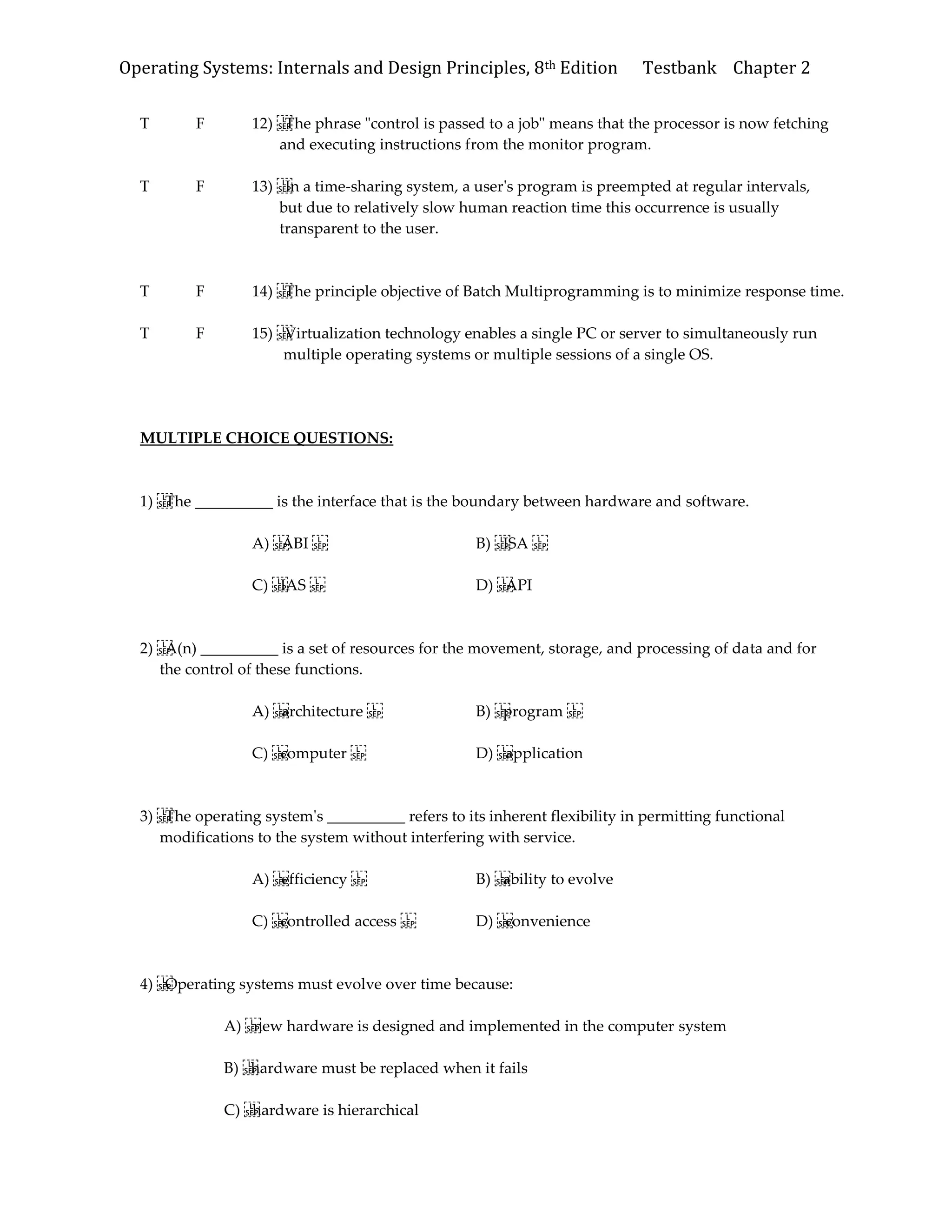
Operating Systems: Internals and Design Principles, 8th Edition Testbank Chapter 2
T F 12) The phrase "control is passed to a job" means that the processor is now fetching
and executing instructions from the monitor program.
T F 13) In a time-sharing system, a user's program is preempted at regular intervals,
but due to relatively slow human reaction time this occurrence is usually
transparent to the user.
T F 14) The principle objective of Batch Multiprogramming is to minimize response time.
T F 15) Virtualization technology enables a single PC or server to simultaneously run
multiple operating systems or multiple sessions of a single OS.
MULTIPLE CHOICE QUESTIONS:
1) The __________ is the interface that is the boundary between hardware and software.
A) ABI B) ISA
C) IAS D) API
2) A(n) __________ is a set of resources for the movement, storage, and processing of data and for
the control of these functions.
A) architecture B) program
C) computer D) application
3) The operating system's __________ refers to its inherent flexibility in permitting functional
modifications to the system without interfering with service.
A) efficiency B) ability to evolve
C) controlled access D) convenience
4) Operating systems must evolve over time because:
A) new hardware is designed and implemented in the computer system
B) hardware must be replaced when it fails
C) hardware is hierarchical
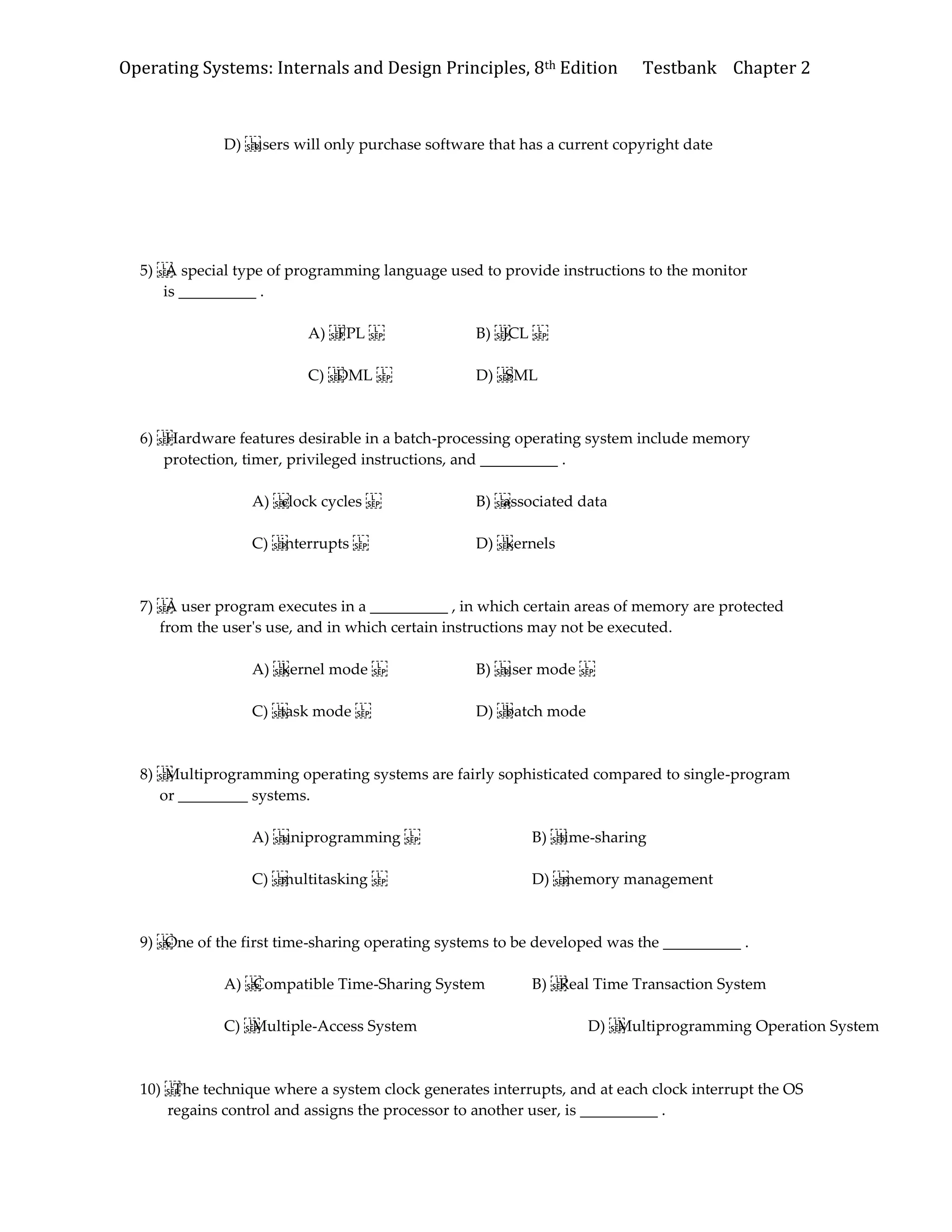
Operating Systems: Internals and Design Principles, 8th Edition Testbank Chapter 2
D) users will only purchase software that has a current copyright date
5) A special type of programming language used to provide instructions to the monitor
is __________ .
A) FPL B) JCL
C) DML D) SML
6) Hardware features desirable in a batch-processing operating system include memory
protection, timer, privileged instructions, and __________ .
A) clock cycles B) associated data
C) interrupts D) kernels
7) A user program executes in a __________ , in which certain areas of memory are protected
from the user's use, and in which certain instructions may not be executed.
A) kernel mode B) user mode
C) task mode D) batch mode
8) Multiprogramming operating systems are fairly sophisticated compared to single-program
or _________ systems.
A) uniprogramming B) time-sharing
C) multitasking D) memory management
9) One of the first time-sharing operating systems to be developed was the __________ .
A) Compatible Time-Sharing System B) Real Time Transaction System
C) Multiple-Access System D) Multiprogramming Operation System
10) The technique where a system clock generates interrupts, and at each clock interrupt the OS
regains control and assigns the processor to another user, is __________ .
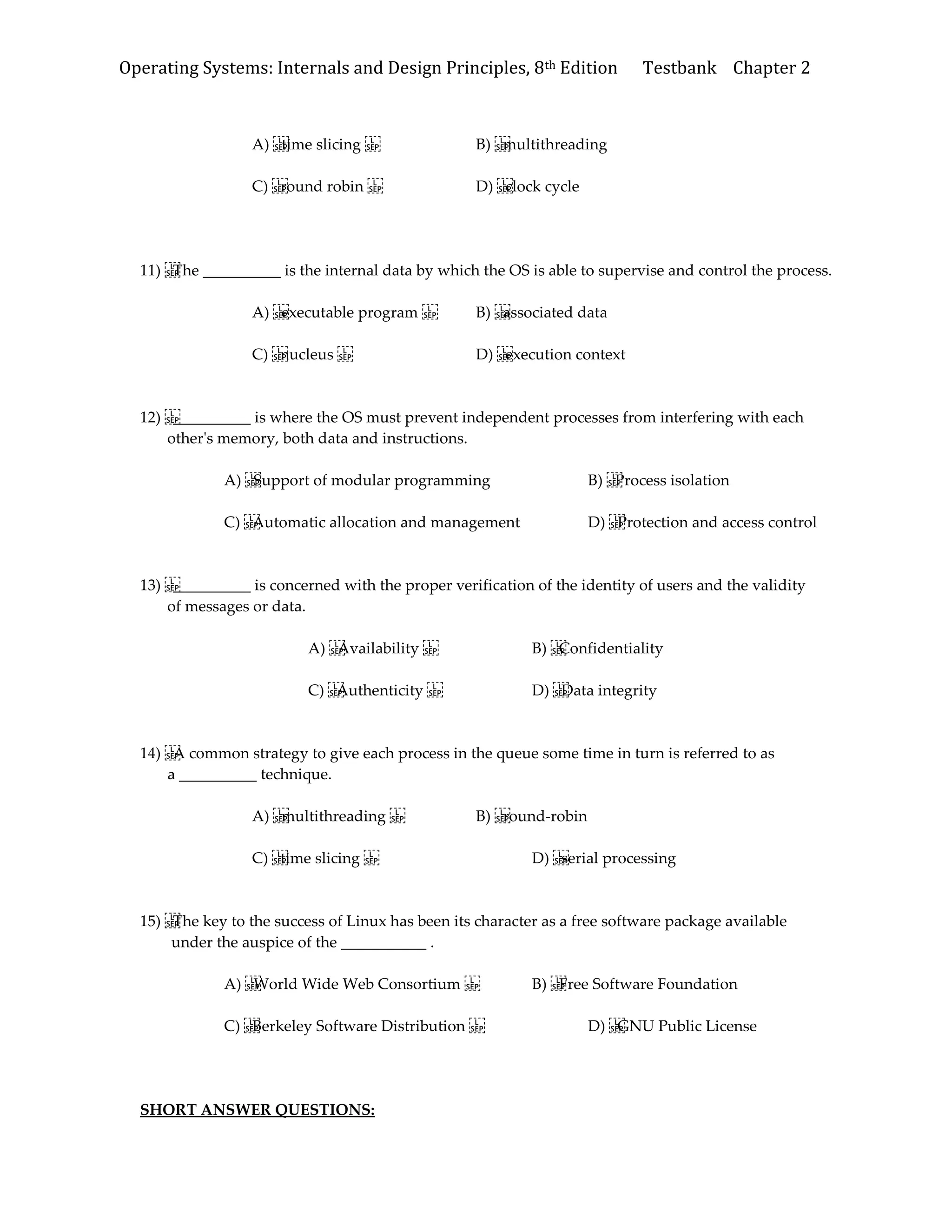
Operating Systems: Internals and Design Principles, 8th Edition Testbank Chapter 2
A) time slicing B) multithreading
C) round robin D) clock cycle
11) The __________ is the internal data by which the OS is able to supervise and control the process.
A) executable program B) associated data
C) nucleus D) execution context
12) __________ is where the OS must prevent independent processes from interfering with each
other's memory, both data and instructions.
A) Support of modular programming B) Process isolation
C) Automatic allocation and management D) Protection and access control
13) __________ is concerned with the proper verification of the identity of users and the validity
of messages or data.
A) Availability B) Confidentiality
C) Authenticity D) Data integrity
14) A common strategy to give each process in the queue some time in turn is referred to as
a __________ technique.
A) multithreading B) round-robin
C) time slicing D) serial processing
15) The key to the success of Linux has been its character as a free software package available
under the auspice of the ___________ .
A) World Wide Web Consortium B) Free Software Foundation
C) Berkeley Software Distribution D) GNU Public License
SHORT ANSWER QUESTIONS:
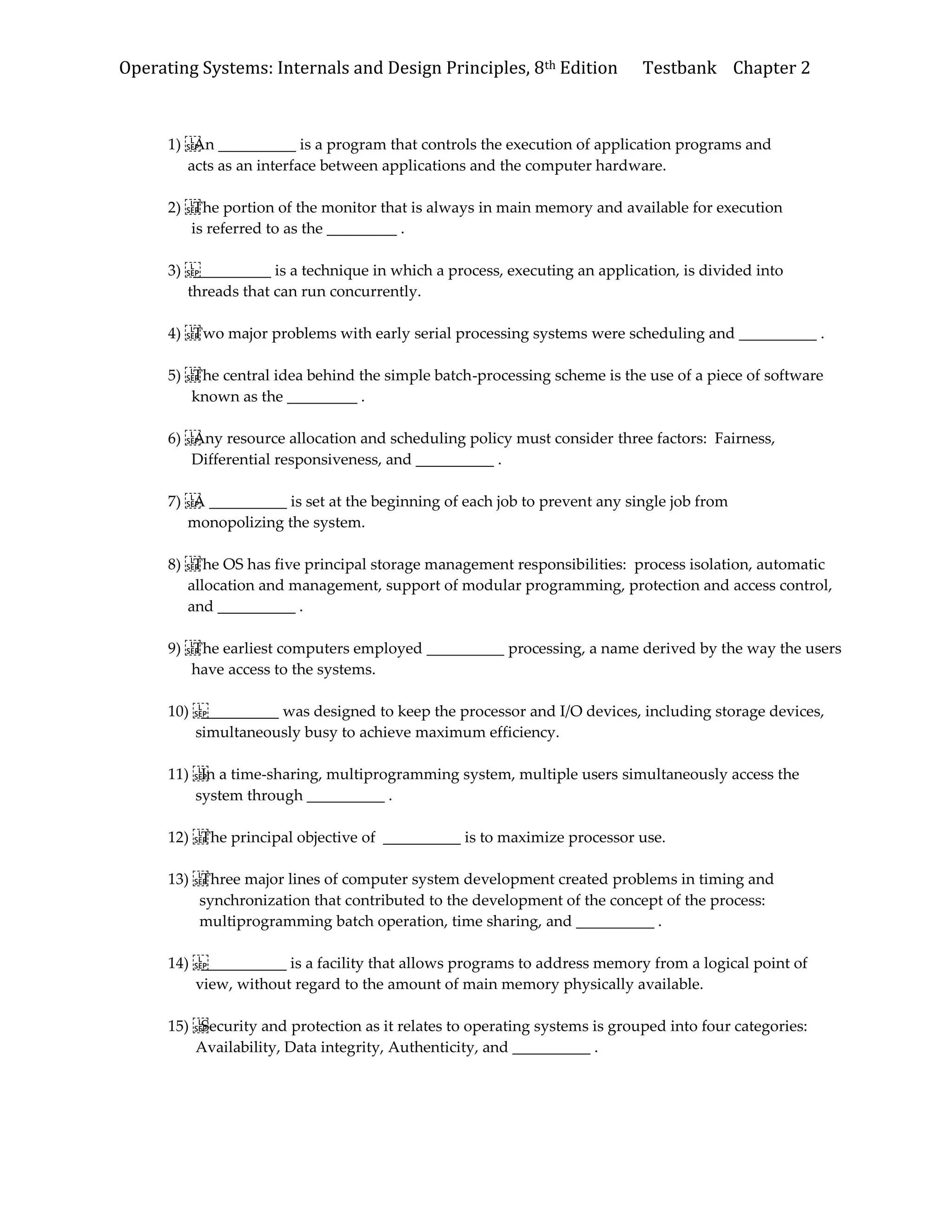
Operating Systems: Internals and Design Principles, 8th Edition Testbank Chapter 2
1) An __________ is a program that controls the execution of application programs and
acts as an interface between applications and the computer hardware.
2) The portion of the monitor that is always in main memory and available for execution
is referred to as the _________ .
3) __________ is a technique in which a process, executing an application, is divided into
threads that can run concurrently.
4) Two major problems with early serial processing systems were scheduling and __________ .
5) The central idea behind the simple batch-processing scheme is the use of a piece of software
known as the _________ .
6) Any resource allocation and scheduling policy must consider three factors: Fairness,
Differential responsiveness, and __________ .
7) A __________ is set at the beginning of each job to prevent any single job from
monopolizing the system.
8) The OS has five principal storage management responsibilities: process isolation, automatic
allocation and management, support of modular programming, protection and access control,
and __________ .
9) The earliest computers employed __________ processing, a name derived by the way the users
have access to the systems.
10) __________ was designed to keep the processor and I/O devices, including storage devices,
simultaneously busy to achieve maximum efficiency.
11) In a time-sharing, multiprogramming system, multiple users simultaneously access the
system through __________ .
12) The principal objective of __________ is to maximize processor use.
13) Three major lines of computer system development created problems in timing and
synchronization that contributed to the development of the concept of the process:
multiprogramming batch operation, time sharing, and __________ .
14) ___________ is a facility that allows programs to address memory from a logical point of
view, without regard to the amount of main memory physically available.
15) Security and protection as it relates to operating systems is grouped into four categories:
Availability, Data integrity, Authenticity, and __________ .
Other documents randomly have
different content
It is the site of the garden-plot of delights, all shining with an ineffable
light. It is the station of the sacred mysteries; may God forever increase
their significance! It is the throne of the rule of the Omnipotent and the
threshold of the court of the All-Merciful. It is the centre of the earth around
which the heavens accomplish their revolutions. It might be compared to a
holy man, tall in stature; and the black gem to the buckle of his girdle. The
black gem is the jewel of salvation kissed with awe by the friends of God. It
is the first thing honored by the hand of the Creator; the more precious than
amber, adorning the earth’s surface. The chief treasure of the secrets of the
Divinity’s palace, the ornament of humanity’s domain, the dust at its portals
is as a balm to the eyes; ’tis the abode of generosity and the happy home of
purity. The life-giving water of the well of Zemzem is all prepared for the
cleansing of our sins. The holy ground is the glory of the well of Zemzem,
itself the glory of the world.
Mercy escapes from its golden funnel in inexhaustible abundance,
purifying our faults. The water of Zemzem is a pure remedy which restores
health to those who languish in separation. When thou dost arrive to the
limits of the sacred territory, then visit the two walls of the ihrâm. The
visiting of holy spots gives new life; each band of pilgrims participates in
the divine mercy. Each breath which escapes these breasts burning with
love is as a spirit messenger ascending to heaven. O felicity, O delight, O
unspeakable honor, to revolve around God’s throne! Over this sacred place
of processions, that it be not profaned, let thy forehead be as a tapestry! And
thy heart, like a moth, should circle around this holy candle! Diligently visit
the court of the Author of all good. L’Arifè is a figure of the gathering at
resurrection and the solemn day of the counsel of the merciful Lord. There
the crowds which cover Mount Arafat receive the certificate of the pardon
of sins.
There are purified those who were burdened with crime; there are freed
the slaves of sin. These culprits form a dazzling ring whose setting is the
column of divine mercy. All that was dark becomes white as snow; the
record of evil deeds is thrown in the fire. Mina is a vast market where
pardon is given in exchange for sins. The temple of Caaba is as the heart of
the world, and its black gem is its inmost part. Exert thyself to penetrate the
mystery of thy nature, formed of slime and water; on this question exhaust
all thy faculties. If thou dost desire to discover its central point, imitate the
compass that always turns in the same circle.
CHAPTER IX
Of the Excellence of Alms-Giving
O precious pearl, worthiest heir of a noble family, give till the last para
the alms prescribed by law: they will amass for thee a capital of salvation
and blessings. Alms are due unto God: beware of negligence in paying him.
Thou with whom the Lord has so generously shared, dost thou not hasten to
purify thy wealth? Alms are the wealth of the poor; if thou dost retain them
unjustly, thou wilt tarnish a legitimately acquired fortune. What thou dost
give to obey the law of God, he will return to thee tenfold. If thou dost
refuse, he will withdraw his benediction, and thy prosperity will vanish.
Wealth not purified by alms is soon spent, and serves as a target for the
blows of adversity. That blessed by this holy practice is as a seed which it
pleases God to fructify. The grains dispersed here and there will grow and
multiply, and thou wilt derive profit from them both in this world and in the
next.
He who created poverty and wealth made alms the share of the poor. By
an impenetrable mystery of his omnipotence, he has assigned to thee ease
and to another indigence. Retain not unjustly the rights of the poor; pay
them as soon as they are due. Complete legal alms by voluntary ones, which
are the branches which shoot forth from the trunk of the others. How many
passages of the Sacred Book bear witness to the excellence of their merits!
Without poverty riches would have no value, so has ordained he who has
done all things. The poor are as the mirrors of the rich; thus the nature of
each thing is revealed by contrasts. What couldst thou have accomplished
against fate, hadst thou been poor and not rich? The sight of poverty
provokes the rich to thankfulness; it gives them occasion to congratulate
themselves for their prosperity.
If there were no beggars in the roads of this perishable world, how
couldst thou purify thy goods by alms? If the pauper refuses thee, thou hast
reason to be sad; if he accepts, thou art his debtor. Is he not the instrument
of thy joy and of thy prosperity? What do I say: he is one more benefit
added to all those thou hast received from God. Know that it is the liberality
of the Lord which sends the mendicant to the faithful, because the profit of
alms is his who donates. Thank the Lord for the gifts he has bestowed upon
thee; thy glory will become more brilliant. Look upon the poor with the eye
of compassion; beware from speaking harshly to them. Be affable and mild
to them. Pour forth thy riches upon those who suffer from hunger; it is their
right.
Let thy door be the rendezvous of the poor that thy bounty may equal thy
power. Is it not better to come to the aid of the unfortunate, and assuage the
pangs of the hungry, than to impose on thyself an added abstinence, and to
defray the costs of repairing several mosques? There is more merit in giving
water to one who thirsts than to visit Caaba annually. Glory and honor to
him around whom press all those who suffer, and happy indeed is the
wealth which serves to solace the misery of the poor. How worthy of envy
is that powerful man who bestows bounty upon thousands of paupers! Is he
not a river of blessings, whose liberality pours over all his brothers?
Do not regard the poor with disdain, nor reproach them with the gifts
thou hast made. May thy benevolence rejoice children, and thy caresses
console their afflicted hearts!
Blessed be the treasures destined by God for such glorious uses, that are
as a saving ointment on the wounded hearts of defenceless orphans! Dry
their tears with thy beneficent hand; may thy caresses make them forget the
parents they have lost! When thou dost prosper in thy affairs, when
Providence overwhelms thee with favors, put not thy foot in the way of
ingratitude; fly from it with all the strength of thy soul! Gratitude is often
only a vain word; let it be more in thy actions than in thy speech. Thank
God from the bottom of thy heart; be generous to the poor. When thou seest
the servants of God without bread and without garments, close not before
them the door of liberality; repulse not those who extend to thee suppliant
hands.
Whoever be the guest who takes shelter beneath thy roof, spare nothing
to spread before him the table of hospitality. Treat him according to his
deserts; honor him according to his dignity. If he makes himself
troublesome, have patience; perhaps a single word will win his heart to
thee. Let not disappointment fill his eyes with tears; refuse him nothing, if it
is possible. Dost not wish to deliver him from all anxiety and to second with
thy efforts all his desires? If it is not in thy power to content him, at least let
the mildness of thy refusal leave him without regrets. Calm his mind with
goodly words; fetter his heart with benevolence. That he may not leave thee
with a wounded heart, think of what thou wouldst do in his place. How
many ways thou hast to show thy gratitude!
No, gratitude cannot be limited. The mind of man is as incapable of
understanding its merits as he is of worthily manifesting it. If thou dost
wish the sincerity of thy sentiments not to be suspected, bestow liberally of
thy wealth upon the poor. Let thy bounties, pure of all ostentation, have no
other witness than the Divine Majesty. Beware of making allusions to them
in words of pride; the Lord will know how to raise the veil with which thy
modesty has covered them. The misconduct of intoxication is better than
benefits accompanied with reproaches. There are many whom shame
prevents from begging; go to meet those who have a right to thy
compassion. How many men are divested of prosperity and whom
misfortune has thrown at thy feet! To him who remains so overwhelmed in
misery, even though he solicit not thy generosity, go, extend a succoring
hand; that is more profitable than the building of sumptuous palaces.
Be convinced of this truth: thou wilt receive the reward for thy good
deeds. Hypocrisy soils thy bounties; they will be neither useful to thee nor
to them who have received them. Better is it to aid one unfortunate than to
invite the rich to luxurious repasts. Seated at thy table, they would laugh at
thy expense, and would criticise thy least faults. Hospitality given thus to
the opulent, what is it but prodigality? What will it reap, in this world and in
the next, but the eternal tortures of hell? Except in the cases where it is
absolutely necessary to avoid serious inconvenience, to conciliate the good-
will of thy brothers and live on good terms with them, every time that
abundance reigns with thee, call in the poor and the orphans to share with
thee.
CHAPTER X
The Desirability of Knowledge
O young and growing shrub, ornament of the meadow of education,
thou who dost lighten the heart and the eyes of thy father, apply thyself
night and day to the study of noble wisdom; remain not like the brute,
plunged in ignorance. Beware of a shameful idleness; knowledge and study
are inseparable. The numerical value of these words is a proof in itself of
this truth. Without study no knowledge; where one is not, the other cannot
exist. Knowledge is the attribute of God; it is the most precious of all
qualities. Neglect nothing to acquire it; such is the teaching of the illustrious
preceptor. He also has said: Devote thyself to study from the cradle to the
tomb. Exert, then, all thy strength to arrive at a city whose gate is the son-
in-law of the Prophet.
Knowledge, celestial gift, is the table of divine hospitality. Mediator
between being and void, it adorns the visage of existence. It is for it that the
king of the domain of light exclaimed: Lord, increase my knowledge! It is
the source of glory and of elevation; it gives an authority free from all taint.
It holds the empire of dignity and of elucidation; it dispenses all knowledge.
Vast ocean without bounds, he who claims to possess it is without wisdom.
Ignorance is death, knowledge is life, said the Lord; dost thou then desire to
be counted among the dead? Do not deprive thyself of eternal life; learn,
with the aid of knowledge, to distinguish good from evil. Enrich thy mind
with all kinds of knowledge; who knows if thou wilt not have occasion to
make use of it? If thou art questioned concerning a difficulty, is it not better
to reply thereunto than to confess thy ignorance?
God said to men: Seek knowledge even to the ends of the earth. Blush
not to take lessons from a teacher skilful in archery; in all things it is finer
to know than to be ignorant. The unlearned, in comparison with the learned,
are dunces, and even less. How can an educated man be compared to an
ignorant one? are the blind and those that see on the same level? Whatever
be his rank and power, true dignity will never be the portion of the ignorant.
Ignorance is the capital of shame and dishonor; his lot is debasement and
contempt. It is a cursed prison, in which those who fall never see liberty
again. Ignorance is chaos, knowledge is existence, how can two such
contrary principles be associated?
Apply thyself to the study of the secrets of nature; do not stray in the
valley of philosophy. What is more precious than knowledge? have any ever
repented of devoting themselves to it? Subjects and kings all have need of
the assistance of learned men. The nobility of knowledge has no more limits
than the attributes of the Creator. As long as these cannot be limited, how
can one fix boundaries to the others? Do not pause at the shell of things;
seek to penetrate to the marrow. From the surface, pass to the interior: does
the bird fly in the air without wings? The outside of a house is as a place of
passage; it is within one seeks repose. Pearls are not found on the borders of
the sea; if thou dost wish to possess them, thou must plunge in the depths.
The study of grammar, of syntax, and of literature is necessary; they are
indispensable instruments to learn Arabic; but it is not necessary to give all
one’s time to it: of what good is an instrument which one does not use? It is
good to acquire all sorts of knowledge; not, however, to the same degree. It
suffices thee to ornament thy mind with the knowledge of jurisprudence, of
the hâdis and of the commentaries of the Koran. For the rest, content thyself
with theory, leave to others the practice: fly lawsuits and contests. Abandon
law for the practice of good works; enter not in the domains of chicanery: if
thou dost not understand anything of the questions of purchase and sale,
what disadvantage will come to thee of it in this world and the next?
CHAPTER XI
Of the Knowledge of God
O most beautiful of the pages of the book of creatures, thou whose
image adorns the mirror of qualities! hearken to this paternal counsel: Boast
of thy merit to no one; do not pursue a vain science which is babbled of in
public lest thou consume thy strength to no purpose. Devote thyself to some
science worthy of thy Creator and of thyself. Only pass through the realm
of philosophy, but fasten thy attention on the writings of the friends of God.
The holy aspirations of these illustrious guides bring men to truth. How
difficult is it to find a perfect spiritual director! For the present, these
precepts may suffice for thee. Let thy piety be enlightened. Far be it from
thee to become a hypocrite and bigot, and weary not of aspiring to
perfection and of working to become a sincere adorer of God.
Do not stray in the slippery places of doubt, for there are no wise men
save those who are learned in divine things. How can he who devotes
himself to grammatical subtilities penetrate the divine mysteries? The
Creator of love has said: Acquire knowledge; such should be the aim of the
two worlds. Knowledge is the ornament of man and the last places are the
share of the ignorant. Knowledge is a spiritual happiness and a gift of
divine beneficence. The ignorant reject knowledge because they cannot
raise themselves to the required level, for they would devote themselves to
it body and soul, were it possible. Examine closely, and then decide.
The mud of deception is not able to sully the garb of knowledge and the
garment of instruction. Thou knowest that it is God himself who hath put
thee in this world to serve him with all thy heart. Of necessity he is the
master of the house; the fool only sees the house and mistakes the master.
Labor courageously night and day to obtain the grace of the abiding of God
with thee. Let him be the constant object of thy thoughts and of thy
meditations, and be attentive to this great spectacle beneath thy eyes.
Trouble not thyself with heaven or with hell, for it is their Master only
whom thou must seek. If thou dost possess him, O life of my soul, thou wilt
possess two worlds.
Seek to know thyself well, if thou dost wish to fathom the mysteries of
this world. Seek morality eagerly, and give thyself no respite when thou
wilt have found it. Whoever knows it not is a blind man below the ox and
the ass. Morality is the chief riches of an enlightened soul and heart, and the
last step to the knowledge of God. He who hath not penetrated to the light
of morality remains lost in the shadows of error.
If thou dost well understand the truth of things, O pearl of Aden, thou
wilt be invulnerable against fear and sadness. There lies all the mystery of
unity; there is the secret of eternal felicity. Light of mine eyes! how full of
anguish it is to be struck with blindness in this world and in the next!
Anoint thine eyes with the salve of morality; if not, the day of judgment
will be that of thy condemnation. He is blind, he that does not bear witness,
for whom the gates of truth remain closed. He who was the glory of
prophets asked in his prayers that the truth might be revealed to him. The
writings of the men of God make the mirror of the intelligence to burn: do
thou apply thyself to understand their meaning. Let these teachings be the
safeguard of thy soul. He who seeks God has no better guide than the
mesnévis of the greatest Physician. The sublime truths of the “Book of
Victories and of Distinctions” are a balm of purity for the mind’s eye. The
saints have left many teachings which aid man to know his Creator. Therein
are found mystic and spiritual truths derived from the Koran. Outwardly,
they are only legal decisions, but beneath is a whole order of incontestable
revelations. Consecrate all thy hours to the study of these books: mayst thou
possess in full the doctrine which they contain!
CHAPTER XII
Eulogy of Constantinople
O moon that dost light the eye of hope, and dost adorn the days of thy
aged father! it availeth thee more to cultivate thy talents than to break the
seal of a treasure. Knowledge and instruction have no surer asylum than
Constantinople, which has not its equal for the flavor of its intellectual fruit.
May God prosper this abode of all greatness, the home and school of all
great men, and the seat of administration for all people! There merit always
finds consideration. Every perfection, every talent, is there esteemed at its
just value. There are all the degrees of honor and of nobility; everywhere
else life is lost and wasted. There everything has its peaceable course, and
merit has not the injustice of fortune to fear. There are found all places, all
dignities, and all careers. Heaven in vain revolves around the world, it sees
nowhere a city like unto Constantinople. There are seen paintings,
drawings, writings, and gildings, dazzling and gleaming beyond belief. All
possible kinds of arts contribute their own brilliancy and splendor. See how
she gleams with a beauty all her own, as the sea languidly caresses her!
At Constantinople all arts and all professions are esteemed and honored,
and one finds here talents whose names even are unknown elsewhere. Does
he who is outside the house know what is within? Does he who stands on
the shore see what is hidden by the depth of the sea? There also they excel
in archery and the names of conquerors are immortalized on stone. Without
mention of the rest, how pleasant and charming it is to fly over the surface
of the sea, to reign at the same time over the air and the waves, like
Solomon on his throne, and to recline luxuriously on a cushion with eyes
fixed on a mirror of silver! There are combined at once music, song, and all
pleasures. There, riding on the wings of the wind, the eyes perceive a great
number of cities. Tranquilly resting on the breeze, one traverses the earth
without fatigue. There are marvellously reflected the most gorgeous
spectacles, which seem to mirror one another and give an enchanted aspect
to the shores. The quaîqs glide lightly over the water, with their wind-filled
sails like a bird’s wings. How can so beautiful a sight be described? what
need has it of eulogy?
Behold Saint Sophia, marvel of the world, whose cupola might be
termed the eighth celestial body. Nowhere has she her equal, save, perhaps
in paradise. Contemplate the imperial seat of the sultans of the world, the
dwelling of the kings of time, the court of the Ottoman Empire, and the
centre of the rule of the khans. In this ever-blessed region is found all that is
desirable. Whatever thou canst imagine, she possesses in the highest degree.
She combines the elect of the beys, of the pachas, and the efendis, the most
illustrious warriors and the most renowned wise men.
All the world’s difficulties there find their solutions: all efforts are there
crowned with success. The mind cannot conceive all the charms she
contains. If she were not afflicted with all kinds of disease and the
abominable plague, who would consent to leave this celestial abode whence
care is forever exiled? If her temperature were more equal, would she not
cause the rest of the world to be forgotten? Whoever has an established
fortune should not establish his home in any other country. No city, no
country, resembles or is comparable to her. She is the asylum of all
sciences: everywhere else study is neglected for gain, commerce,
agriculture, or usury, so that all vestiges of knowledge have disappeared.
Money takes the place of talent in a province, and it seems as if merit could
be extracted from it. In the provinces scientific men have become extinct
and books are forgotten. Poetry and prose are both held in aversion, and
even a Persian phrase is tabooed. The study of Arabic has vanished as snow
without consistency, and the principles of grammar and syntax are entirely
neglected. Luxury and presumption have intoxicated all hearts, and there is
no worship but that of dignities and employments. There one finds neither
virtue nor knowledge, and morality is outraged.
The ambition to secure vain honors leaves no time for the labor for
perfection. How many do not lift up their voices unto the Lord except when
their fortunes are threatened by reverses! It is by a special dispensation of
Providence that God has withdrawn learning from the provinces. If he had
not first chained them in ignorance, who could have governed such men?
The seat of power belongs to the great, but pride is the part of provincials.
He who is high placed is not vainglorious; but these wretches are filled with
arrogance. They constantly compare their dignity and importance to that of
the representatives of authority.
But what would it be if they possessed learning? They would not deign
to look at their fellows. They know not their value, and take no account of
their worth.
Nothing teaches the inferiority of the provinces more than the sight of
Constantinople. In the gatherings of the capital he who passes elsewhere for
a wisest man of the century is but a blockhead; the strong-minded loses his
assurance, and the fine talker has no longer a tongue. They who boasted so
loudly of their rank and nobility are only admitted to the most
commonplace circles. The arrogant, who knit his brows so disdainfully,
eagerly seeks the door-keepers. He who bore a title so pompously cannot
even obtain the honor of kissing the hem of a robe. He who occupied the
first place is not even deemed worthy to remain at the door. What city can
be compared to Constantinople? Is not the prince above him whose
homages he receives? After the capital, there is no place so charming as
Halep. Halep! honor of the province, illustrious and flourishing city; the
resort of Indians, Europeans, and Chinese; object of the envy of the whole
universe; the market of all merchandise; haven of joys and wealth, with thy
delicious waters and climate, thy vast plains and magnificent buildings.
CHAPTER XIII
On Flight from Avidity and Avarice
O new copy of the collection of mysteries, rosebud of the garden of
graces! discover thy needs to no one, bend not thy back under the load of a
favor received. Open not thy mouth to request; let not servile and entreating
speech soil thy lips. Cupidity always engenders a bad reputation: the true
secret to gain the esteem of others is to moderate thy desires. Hast thou not
received the portion assigned to thee by destiny? What is the water of life, if
it is not consideration? Should we not always show it? Be animated by
generous feelings, beware of baseness, and do not demand all that thou
seest. What is there so desirable in thy brother’s hand that thou shouldst so
unceasingly covet? Has he not need of the gifts of the Lord, as thou hast?
and is he not also the debtor of his universal beneficence? Is he not able to
show thee favor, a weak mortal, and has he not sufficient wealth to share
with thee? God never reproaches us with the benefits he grants: but is the
hand of man other than an instrument?
Although in all things the first causes must be considered, what are these
causes without that which directs them? Seek not the creature to the
exclusion of the Creator; lose not thy trouble. Confide in the generosity of
the Lord; the portion he has allotted thee will return in spite of thyself. How
sweet it is to repose in the shade of a modest retreat and to content one’s
self with the gifts of Providence! Lay not a bold hand on the object of thy
covetousness; God knows what is necessary for thee. Let thy heart, satisfied
with the Creator’s gifts, accept with gratitude all that he grants thee! In his
high wisdom, he knows all thy needs and he will provide for them at the
seasonable time. Pious legacies do not belong to thee; the universal
Dispenser will exhaust other sources to enrich thee. Money cannot appease
hunger nor can it serve for the nourishing of thy body. If thou didst amass
pyramids of gold or of silver, could they take the place of bread, or of oil, or
of rice? Why trouble thyself concerning thy subsistence? Does not God
provide for his servants’ needs? All that is not given willingly loses its
worth: were it a rose, it has no longer a perfume.
If thou art offered anything, O soul of thy father! sully not thy eyes and
thy heart with cupidity: be courageous, and abase not thyself by looks
which beg on all sides. However, thou canst accept with simplicity what a
friend offers. In thy turn, thou wilt evidence thy gratitude by some present.
Let thy promises remain always inviolable: be a religious observer of thy
word. Know that a promise is a sacred obligation, and that to fail therein is
to be covered with shame. Beware lest by lying words thou plantest the tree
of promise on the roots of bad faith.
CHAPTER XIV
On the Bad Effects of Pleasantry and Jocularity
O thou who dost aspire to repose in this world and in the next, who dost
seek the way of peace of soul, abandon not thyself to pleasantries and
jokes! This habit plunges into trouble all those who contract it. Sacrifice not
thy friend to a play on words; throw not to the wind the rights of bread and
salt. Pleasantry breaks the ties of intimacy, and its results are sad and
painful. However brilliant it may be, it inflicts none the less deep wounds.
How can the name of pleasantries be given to those burning arrows aimed
at a friend’s heart?
How many sallies, impregnated with venomous spleen, have filled with
anger and rage those whom thou dost love! True wit is that which is
appropriate, brief in expression, full of sense, innocent and inoffensive, like
a blooming rose of the heart’s garden, whose charms attract from afar all
the nightingales. Its perfume, breathed with delight, drives from the heart
all thoughts of hate. It charms the ear like good tidings, and all who hear it
are filled with joy. It is carried from city to city, and passes into a proverb
from age to age. Nothing is more charming than such a pleasantry; if it is
otherwise, it were better to refrain from making it.
Beware of fault-finding and backbiting: a shame for all wise men. No
pleasure nor profit can be found therein, and a very great sin is committed
in yielding to it. The confidence of thy friends is lost; and thy name is
detested where it is uttered. Fault-finding and backbiting render one as
odious as does calumny. May God preserve thee from this scourge; mayst
thou live in purity of heart and tranquillity of body!
CHAPTER XV
Of the Nobility of Generosity
O thou who dost enumerate carefully the advantages of success, and
dost consider the spectacle of refusals and welcomes, throw not a look of
indifference on thy neighbor! Turn with interest to the unfortunate. Observe
the rights of thy neighbors with justice; let the expression of thy
countenance wound no one. Be not so parsimonious with thy food that thou
canst not share it with others. Provide for their needs as much as possible.
Let all the weak take refuge in the shadows of thy generosity! Do not
entertain sentiments of hate and enmity against anyone; do not acquire the
habit of tumult and agitation. Beware of anger, rage, and revenge; show to
no one a countenance furrowed with discontent.
Live on good terms with all the world and be always of an equable
disposition. Do not annoy thy inferiors, nor impose upon them the
constraint of cold formalities. Let not the expression of thy countenance
grieve anyone; captivate everyone with thy good-nature. Let no one be a
victim of thy injustice, never return evil for evil. Be not a burden on thy
friends, do not make thyself insupportable by thy bad disposition. Let no
soul be in anguish for thee; rather labor to elevate those who are desperate.
Bring no lawsuit against anyone, that God may preserve thee in turn from
litigants. Do not compromise thy honor in this world and in the next for
strange interests. Be neither guardian, counsellor, nor trustee.
Fly the domain of chicanery; do not rush into profitless agitation with
lowered head. He who enters into quarrelling and strife with others brings
down upon himself trouble and anxiety. Never follow the road of disputes
and strife, for they provoke the flames of hatred! Raise not a finger to do
evil: let one of thy hands be always busy in doing good. Carry not thy
complaints to the door of the prince; refer to God’s tribunal him who hath
wronged thee. However great be thy weakness and impotence, will the Lord
therefore be less zealous for thy defence? Resigned and modest, be without
care and without anxiety.
CHAPTER XVI
Eulogy of Good-nature
O precious pearl of the sea of life, chosen model of the beauty of
virtues! practise modesty, have always a dervish’s heart. Content thyself
with little, practise humility: shoot forth roots in the garden-plot of the roses
of prosperity. Mildness, politeness, and good deeds will win to thee all
unprejudiced men. Is it fitting for good-nature to knit the brow and contract
the forehead? Kindness and urbanity of character brighten the mirror of the
heart. As truly as a smiling countenance is an indication of the mercy of
God, so is a sullen face a cause for reprobation.
Bad morals, reprehensible habits, and ill-humor lead to eternal
damnation. How insupportable are the manners of whomsoever is given to
haughtiness! Presumption is a diabolical fault unknown to the court of
angels. Have no intercourse with the vainglorious; fly from him. If thou be
forced to sit near him, show humility. The wise men, although with
apparent moderation, have said: Be proud with him who is proud; but as
thereby there may be cause for discord, hasten to avoid it by thy humility.
Pride and presumption in human nature are an inevitable malady and
incurable wound. He who falls into this abyss cannot prosper; the hurt of
his misfortune becomes incurable.
Suffer not thyself to be intoxicated by honors and dignities; expose not
thus thy brow to the wrath of the lord. Grandeur and eminence are fitting in
God; but what can they accomplish in a slave? Let all thy ways be
submissive: never reach forth thy hand to do wrong to another. If pride and
haughtiness appear in thee, God will raise up enemies for thee even among
thy kindred. Let us suppose that thy rank lifts thee to heaven, thou art none
the less the last of the slaves of the Lord. Repulse no one from thy door
harshly; give neither thy hand nor the hem of thy robe to be kissed.
However high placed thou mayst be, do not exact servile homage. It is
thou who shouldst prostrate thy countenance on the ground: is it fitting for a
slave to have his hand and his garment kissed? Do not conceive a false
opinion of thy own worth; as much as possible, do not take precedence.
Many candidates aspire to precedence, and perhaps they will obtain it
before thee. Boast to no one of thy rank and importance, for fear of
becoming a burden to him. Salute others with mildness and modesty; oblige
no one to remain standing. If thou art treated with honor, there is nothing
better; if otherwise, dispute not. If modesty and good form reign in thy
conduct, doubtless consideration will be shown in turn to thee. Modesty is
the ornament of the countenance of faith; effrontery is pernicious in this
world and the next. Let morality perfect good-nature in thee; then see how
many joys there are in modesty!
Morality is the ornament of man; without it, he is but the slave of Satan.
Because he was without it, the envious one was driven from the throne of
celestial mercy. At the last judgment, on the day of the final catastrophe,
thou wilt not be able to lift thy head nor turn thy eyes. But the judgment of
God is omnipresent; his eye embraces all that is. In the eyes of his
omniscience there is no difference between this world and the world to
come. The Creator is beyond the vicissitudes of fortune; no change can
affect him. Knowing that he is omnipresent and all-seeing, how dost thou
dare to break the laws of morality?
Show not to the foolish the depths of thy heart; hearken unto the
prophets, practise their teachings. Did not the Apostle of God receive the
order to act with wise dissimulation? Without it, thou wilt have no repose,
says the Glory of the World, the Spring of all Wisdom. It is for thee as a
protecting arm; without its aid, how many quarrels and disputes! It is the
surest rampart against all the troubles of the world. Do not turn like the
wind in all directions; like the sun, do not shine on the doors of all. Do not
reveal thy secrets to strangers; open not to fools the gate to thy private
affairs. Give not thy confidence to the first comer; do not retail in public
what regards thee alone. Do not believe that all men are sincere, but do not
look upon them all as hypocrites. Be not blinded by the praises that thou
dost receive; be not loath to overcome thy passions. How could these
praises lavished on thee be free from hypocrisy?
For myself I see no difference between the stings of the wasp and the
flattering words of the foolish. If they have nothing to hope from thee, they
will never gather in thy house. On a festival day, do not go to anyone’s
house without an invitation, nor to the homes of any save the honorable. Let
the gatherings that thou dost frequent be composed of pious men. Let them
not be meetings of corruption and perversity. While thou must acknowledge
an invitation, wilt thou not be out of place where thy honor is
compromised? When thou art in an assembly, abuse neither speech nor
silence; use in turn thy tongue and thy ear. Let thy words like pearls be as
brief as possible. Govern thy speech according to this motto: brevity and
clearness. Man has only one tongue and two ears; speak, then, little and
listen much.
However, if a garrulous person evinces stupidity the silent man ends by
becoming burdensome. Speak neither too little nor too much; keep a correct
medium. Be neither stupid nor importune. He who holds the scales of good
education said: to speak too much availeth a man nothing. Do not recite in
public the praises of God; prayer should be hidden in solitude; before others
it is only hypocrisy and importunity; a terrible chastisement will be its just
award.
Never reply harshly; when thou speakest to anyone let it be with sweet
courtesy. Reproach no one face to face with his hidden faults; lend to his
discourse a friendly ear. Never expose the ignorance of anyone. Why cover
with confusion a creature of God? Take care not to strike with the weapon
of slander; an eternal penalty will be its punishment. The penetration of him
who has given thee the jewel of knowledge has shown him that ignorance
was well for thy brother. Such is the providential dispensation of the
Creator; so has ordained the justice of his omnipotence. Let these words be
the ornament of thy mouth; woe unto thee if thou dost not heed them!
Renounce injustice and violence; never utter harsh words that wound the
heart. Be generous, whatever happens, O soul of my soul; let thy tongue
outrage no one! To wound thy brother to the heart is the worst of sins, the
greatest of all iniquities. Labor with ardor to raise up those who have fallen;
wouldst thou desire to overthrow the throne of the Lord? Will the avenging
God suffer a temple to be ruined from dome to foundation? Light of mine
eyes! be convinced that there is no pardon for such a sin.
CHAPTER XVII
Of Lying and of Hypocrisy
O thou who dost hearken unto my teachings, who dost take lessons in
the school of experience, never contract the habit of lying and of hypocrisy
which sap the foundations of concord. Give no access in thy heart to
deception; be simple, ingenuous, and without cunning. Lying and deception
are pollutions which only produce deception and confusion. Forerunners of
the works of Satan, they throw their authors in eternal chains. Justly
abhorred by men, they only produce disastrous results.
What is more horrible than never to open the mouth for good, and to
excite discord by false allegations? It is a speech passed into a proverb that
the perfidious die in grief. Infamy is the only good that they can acquire;
their life is consumed in sadness and grief. Perfidy, bad faith, lying,
hypocrisy, perversity of mind, and corruption of heart; all these are the
qualities of the damned, but they become not the true faithful. The great
teacher of religion said: The true Mussulman is he whose hand and tongue
are not to be feared. O thou who dost seek happiness, should not the
reputation, life, and riches of all believers be regarded a sacred repository?
CHAPTER XVIII
Forbidding the Practice of Astrology and Chiromancy
O thou who dost aspire to a solidly founded happiness, who seekest the
ways to obtain the favors of Providence! be not addicted to the sorceries of
chiromancy and astrology; they draw down misfortune on those who
practise them; they precipitate them to ruin: instead of the gold they hoped
to receive, they draw forth a vile metal. Since immutable destiny has
ordained all that can come to pass, forget the future to think only of the
present. Why be troubled in advance by what is not yet, and sow needlessly
in thy heart the seeds of anguish and trouble?
Believe not the lying words of chiromancy, for God above knows what is
concealed. Even if this were a science, the man who teaches it is of no
worth; his knowledge is null, his words false, his mind diseased. Do we not
see what happens to these diviners and astrologers; is there a single one
who prospers? Might we not say that misfortune is the satellite of all these
sorceries? Leave, then, loans, and enjoy thy ready money. What wilt thou
do when thou shalt have been plunged in all these agonies? Believe my
words, and may God preserve thee from so disastrous a blindness.
CHAPTER XIX
Of the Defilement of Drunkenness
O precious pearl of the jewel casket of my soul, thou whose image is
stamped on my heart! be not seduced by the rosy cup; it debases man in the
eyes of his fellows, renders him odious to all, and deprives him of his honor
and respect. Have no connection with this mother of all vices, who
engenders all sorts of calamities. What a shame to pass for a debauchee, to
be known everywhere for thy passion for wine! Beware of drunkenness, of
that stupefaction which causes the loss of reason. Since the all-wise Creator
has forbidden this excess, be submissive to his decision. Sully not thyself
with the crime of revolt, have no cause to blush before thy Creator. Fear to
fall in the snares of sin; if that occurs, entreat for pardon.
When thou dost visit an assembly, publicly reproach no one. Do not
jostle those who are drunk; do not throw stones at those without reason.
Why grieve these senseless persons, when thou thyself art able to share
their misfortune? Why molest them? Some time, doubtless, a like mishap
will befall thee. Avoid reproaching others for their blindness in sin, and
declaring thyself free from stain. O soul of thy father, know well; when thou
dost accuse thy brother, thou dost render thyself guilty. Must thou attack
with violence the errors of others, and turn thy eyes from thy own conduct?
Repentance always follows sin, for adversity is the consequence of crime.
One day, in a gathering, at the house of Djelal eddin Roumi, someone said
boastingly: “I have never seen the color of wine, never have I tasted liquor.”
“It were better still not to drink it after having seen it,” answered this holy
sage, the pole of good conduct, the king of the domain of grace, shocked at
this proud presumption.
Suffer not thyself to be weakened by the assaults of drunkenness, do not
deliver thyself up to the seductions of hashish and opium. Bendj[1] and
esrar[2] are still more destructive; he who consumes them is a dunce. These
drugs make a man the laughing-stock of other men: he is an ape in human
form. Obscure not the light of thy soul’s jewel; cover not with darkness the
eye of thy intelligence. Wrap not opium in a shroud during the Ramazan, so
that thy body may become as the tomb of one dead. This poison makes man
wicked and immoral; perverts him, corrupts his heart, alters his features,
and bewilders his tongue. When intoxication arrives, he hugs himself with
delight; when it is dissipated, he is beside himself; he is a corpse in the form
of one living: the brilliancy of his cheeks is blighted. Even though there
appeared no exterior effects, who would not blush to be called Teriaki?
CHAPTER XX
Of the Vanity of Adornment
O thou who art as the veil behind which hides seductive beauty, thou
who canst not be captivated by the wish for notoriety, fasten not thy heart
on ornaments and adornment; do not love inordinately pearls and precious
stones. Doubtless the sight of these objects rejoices the eye, but they are not
suitable for men. For him, gold is the source of all benefits; for woman, it is
the ornament of the body. Leave finery, then, to women, make a generous
use of thy riches. Be not with thy sparkling garments like unto a gilded box
of perfume.
Do not pride thyself on the splendor of thy raiment, but content thyself
with a modest outfit. Although moral purity is indeed estimable, still the
fabrics which cover thy body should be spotless. Do not torment thyself
with the search of all manner of tissues for thy adornment. All who see
anyone arrayed after that fashion shrug their shoulders in passing him.
Whatever be the costume adopted by thy equals, adopt it thyself. Let thy
garb be conformed to theirs, however different thy fortune may be. Let the
carpets and fringes of thy hangings, and all the objects thou dost use, be not
distinguished by inordinate luxury. If thou art able to wear sable, is not the
fox’s fur as useful? It is nothing, after all, but the skin of a dead animal;
nothing is less precious in the eyes of wise men. Luxury in furs and raiment
throws man into ruinous expenses; he gets into debt to keep up his pomp,
and adds to his troubles and anxieties.
Do not dissipate thy goods inconsiderately: prodigality is detested by
God. A wise man, to teach the value of wealth, used this just and reasonable
comparison: To acquire riches, to accumulate a capital which keeps us in
ease, is as difficult as to tear a cliff away from the earth and carry it to the
summit of a mountain; to spend our money is as easy as to let it roll to the
base. Appreciate after that, which of the two requires the more trouble, and
weigh all thy actions in a just scale. Suspend from thy ear the pearl of my
words. O soul of thy father, beware of debt! Debt changes a man
completely; were he a Plato, it makes of him a Medjnoun. His body is in
perfect health, his morals are diseased; he bears on his neck the yoke of his
creditor. Debts make a fool of a wise man; they enervate the most heroic
hearts, their day of reckoning is like that of death, and they lead to prison as
death to the tomb. What is that, then, when a harsh creditor throws every
day trouble into the heart of the debtor, when usurious interests, increasing
the capital, make his body bend under an unsupportable burden; when the
creditor, invoking the aid of the law, calls to his assistance false witnesses;
when, crushing his victim under the feet of violence, he dishonors him in
the eyes of everyone until that moment when, unable to vindicate himself,
the end of life draws near?
O light of mine eyes, may Almighty God preserve thee from the scourge
of debt! Better is it a thousand times to sell thy raiment and carpets, to go to
rest fasting and in tatters, than to have creditors and lose thy peace in
litigation. Lend to no one at usurious interest; it becomes the source of
disputes. The fear of God is rare in this world: people are always ready to
conceal and deny the truth; the most incontestable rights are unceasingly
contested; all are busy in denying or taking oaths. A delay is demanded,
then another. The money which is refused thee is eaten up by the expenses
of justice. Is thy debtor the relative of some personage? claim thy money if
thou dost dare; even at the hour of payment he goes to see that personage,
warms his zeal by some present, and says to him: “What, lord, thou art here,
and yet such an one would force me to pay!” Immediately this oppressor
mounts his horse, and goes to the cadi and mufti; then thou wilt be
threatened with the wrath of the judges, and thou wilt be continually urged
to renounce thy pretensions. If all these artifices have no effect, thy
adversary will stir up the waves of lying, will raise up false witnesses, will
produce legal deeds and manufactured fetvas. Whatever thou mayst do in
the vain hope of winning thy cause, he will do all to make it of no avail.
Such is the custom of our times. Woe to him who lends his money to
another!
I
THE ASCENSION OF MAHOMET
[Translated by A. P. Courteille and Robert Arnot]
INTRODUCTION
N the journal of Antoine Galland, the celebrated translator of the
“Arabian Nights,” we read on page 29 of M. Charles Schefer’s edition:
“Thursday, January 14: I purchased for his excellency (M. de Nointel) a
book entitled ‘The Marvels of Creatures,’ written in old Cufic characters
with sixty-six illustrations representing different fabulous actions of
Mahomet for the establishment of his pernicious doctrines, such as his
ascension to heaven, his descent to hell, etc.; I bought it for twenty-five
piastres.”
This manuscript to which Galland, although he was of small experience
in such matters, gives so singular a title, was brought to France and
presented to Colbert by the Marquis de Nointel. Colbert, who prided
himself on his knowledge of the treasures of his library, commissioned
François Pétis de la Croix, the elder, to prepare a notice of his new
acquisition. The learned Orientalist, after a minute examination of the
manuscript, recognized the fact that it would be impossible for him to
decipher it. He, therefore, contented himself with giving a detailed
description of the curious miniatures with which the manuscript is
ornamented, and introduced it with the following note: “Translation of the
inscriptions in the Turkish language which give the subjects of the sixty-
four illustrations of the book ‘Leilet el Mirage,’ written in curious script, in
the library of Monseigneur Colbert, by La Croix, Interpreter and Secretary
to the King. ‘The Night of the Ascension’ treats of the Mahometan faith and
of the story of Mahomet. This is assumed with some justice, not only on
account of the Turkish and Arabic inscriptions which it contains, but also on
account of the words that have been deciphered in the queer script in which
it is written. For instance, the profession of faith of the Mahometans in the
forty-fourth and forty-fifth illustrations, which is painted in miniature
capitals, can be easily read. Its script is fundamentally Arabic and is
ancient; not that which we ordinarily call ancient Arabic, of which there are
A
several books from five to six hundred years old; but another ancient script
called Cufic, used by the people of Cufa, to distinguish them from the other
Arabs, several figures of their letters resembling that Chaldaic script which
was originally Syriac.”
THE ASCENSION OF MAHOMET
LL praise and thanksgiving to the Almighty, the Everlasting, who has
created and disposed the 18,000 worlds, he who has no equal, the sole
pre-eminent Being, the sovereign Lord, the most high God. May his
glory shine forth forever! May his holy name be hallowed! There is no
other God but he. A hundred thousand prayers and blessings upon the
Friend of the most high God, the chief of the 124,000 prophets, Mahomet
the chosen of God! May the celestial graces fall in abundance on the
children and the four companions of the Prophet of God (on whom be
benedictions!). May the Lord deign to favor them all!
Now you must know that the title of this work is “The Book of the
Ascension.” We have translated it from that book known as “The Way of
Paradise” into the Turkish language, that a greater number of readers may
derive profit from it. Since it is completely translated, we hope, by the grace
of God, that many intelligences may be thereby enlightened.
Imam Bagavi (may the divine mercy rest doubly on him!) in his book
entitled “The Beacon Lights” has narrated an Arabic tradition, the substance
of which is as follows:
Enis Ibn Malek tells concerning the Prophet that, on the night of the
ascension, Gabriel came to him, leading Borak, all saddled and bridled.
When the Prophet (blessed be his name!) prepared to mount him, Borak
was restive. Whereupon Gabriel exclaimed, Never hath a nobler before God
than Mahomet mounted thee, O Borak! At which words Borak sweated
from fright.
Moreover, one of the Prophet’s companions, named Malik, gives the
following story of Oumm Hani, the sister of Ali: One night, the Prophet (on
whom be blessings forever!) lodged in our house. In the morning he arose,
and said to us: There happened to me many strange adventures last night.
What were they, O Mahomet? we asked. I will tell you. Listen to me. Know
that last night Gabriel and Michael came to me, each accompanied by
66,000 angels, and leading with them an animal called Borak, saddled and

Test Bank for Operating Systems: Internals and Design Principles, 8/E 8th Edition : 0133805913

  • 1.
    Test Bank forOperating Systems: Internals and Design Principles, 8/E 8th Edition : 0133805913 download http://testbankbell.com/product/test-bank-for-operating-systems- internals-and-design-principles-8-e-8th-edition-0133805913/
  • 2.
    TestBankBell.com: Your UltimateSource for Test Banks and Academic Resources TestBankBell.com is a leading online platform offering instant access to a wide variety of test banks and academic resources. Whether you're a student, educator, or professional, we provide the tools and materials you need to excel in your studies and career. Our website features test banks for textbooks across multiple disciplines, offering comprehensive solutions to enhance your learning experience. Keywords: test bank, academic resources, study guides, test preparation, testbankbell, download test bank, textbook solutions Contact Information: Visit us at: https://testbankbell.com - For inquiries, email us: testbankbell.com@gmail.com Important Links: Download Test Banks: https://testbankbell.com/ Copyright © 2025 TestBankBell. All Rights Reserved.
  • 3.
    Instant digital products(PDF, ePub, MOBI) ready for you Download now and discover formats that fit your needs... Start reading on any device today! Solution Manual for Operating Systems: Internals and Design Principles, 8/E 8th Edition : 0133805913 https://testbankbell.com/product/solution-manual-for-operating- systems-internals-and-design-principles-8-e-8th-edition-0133805913/ testbankbell.com Test Bank for Operating Systems: Internals and Design Principles, 7th Edition: William Stallings https://testbankbell.com/product/test-bank-for-operating-systems- internals-and-design-principles-7th-edition-william-stallings/ testbankbell.com Test Bank for Systems Analysis and Design, 8th Edition: Shelly https://testbankbell.com/product/test-bank-for-systems-analysis-and- design-8th-edition-shelly/ testbankbell.com Test Bank for Systems Analysis and Design 8th Edition: Kendall https://testbankbell.com/product/test-bank-for-systems-analysis-and- design-8th-edition-kendall/ testbankbell.com
  • 4.
    Solution Manual forSystems Analysis and Design 8th Edition by Kendall https://testbankbell.com/product/solution-manual-for-systems-analysis- and-design-8th-edition-by-kendall/ testbankbell.com Survey of Operating Systems 5th Edition Holcombe Solutions Manual https://testbankbell.com/product/survey-of-operating-systems-5th- edition-holcombe-solutions-manual/ testbankbell.com Test Bank for Food Service Organizations: A Managerial and Systems Approach, 8/E 8th Edition Mary B. Gregoire https://testbankbell.com/product/test-bank-for-food-service- organizations-a-managerial-and-systems-approach-8-e-8th-edition-mary- b-gregoire/ testbankbell.com Solution Manual for Guide to Operating Systems, 6th Edition Greg Tomsho https://testbankbell.com/product/solution-manual-for-guide-to- operating-systems-6th-edition-greg-tomsho/ testbankbell.com Solution Manual for Operating Systems, 3/E 3rd Edition. Gary Nutt https://testbankbell.com/product/solution-manual-for-operating- systems-3-e-3rd-edition-gary-nutt/ testbankbell.com
  • 6.
    Operating Systems: Internalsand Design Principles, 8th Edition Testbank Chapter 2 Test Bank for Operating Systems: Internals and Design Principles, 8/E 8th Edition : 0133805913 Download full chapter at: https://testbankbell.com/product/test-bank-for-operating systems-internals-and-design-principles-8-e-8th-edition-0133805913/ Chapter 2 – Operating System Overview TRUE/FALSE QUESTIONS: T F 1) An OS should be constructed in such a way as to permit the effective development, testing, and introduction of new system functions without interfering with service. T F 2) The OS masks the details of the hardware from the programmer and provides the programmer with a convenient interface for using the system. T F 3) The ABI gives a program access to the hardware resources and services available in a system through the user ISA. T F 4) The OS frequently relinquishes control and must depend on the processor to allow it to regain control. T F 5) One of the driving forces in operating system evolution is advancement in the underlying hardware technology. T F 6) The processor itself is not a resource so the OS is not involved in determining how much of the processor time is devoted to the execution of a user program. T F 7) A process consists of three components: an executable program, the associated data needed by the program, and the execution context of the program. T F 8) Uniprogramming typically provides better utilization of system resources than multiprogramming. T F 9) A monolithic kernel is implemented as a single process with all elements sharing the same address space. T F 10) The user has direct access to the processor with a batch-processing type of OS. T F 11) Both batch processing and time-sharing use multiprogramming.

  • 7.
    Operating Systems: Internalsand Design Principles, 8th Edition Testbank Chapter 2 T F 12) The phrase "control is passed to a job" means that the processor is now fetching and executing instructions from the monitor program. T F 13) In a time-sharing system, a user's program is preempted at regular intervals, but due to relatively slow human reaction time this occurrence is usually transparent to the user. T F 14) The principle objective of Batch Multiprogramming is to minimize response time. T F 15) Virtualization technology enables a single PC or server to simultaneously run multiple operating systems or multiple sessions of a single OS. MULTIPLE CHOICE QUESTIONS: 1) The __________ is the interface that is the boundary between hardware and software. A) ABI B) ISA C) IAS D) API 2) A(n) __________ is a set of resources for the movement, storage, and processing of data and for the control of these functions. A) architecture B) program C) computer D) application 3) The operating system's __________ refers to its inherent flexibility in permitting functional modifications to the system without interfering with service. A) efficiency B) ability to evolve C) controlled access D) convenience 4) Operating systems must evolve over time because: A) new hardware is designed and implemented in the computer system B) hardware must be replaced when it fails C) hardware is hierarchical
  • 8.
    Operating Systems: Internalsand Design Principles, 8th Edition Testbank Chapter 2 D) users will only purchase software that has a current copyright date 5) A special type of programming language used to provide instructions to the monitor is __________ . A) FPL B) JCL C) DML D) SML 6) Hardware features desirable in a batch-processing operating system include memory protection, timer, privileged instructions, and __________ . A) clock cycles B) associated data C) interrupts D) kernels 7) A user program executes in a __________ , in which certain areas of memory are protected from the user's use, and in which certain instructions may not be executed. A) kernel mode B) user mode C) task mode D) batch mode 8) Multiprogramming operating systems are fairly sophisticated compared to single-program or _________ systems. A) uniprogramming B) time-sharing C) multitasking D) memory management 9) One of the first time-sharing operating systems to be developed was the __________ . A) Compatible Time-Sharing System B) Real Time Transaction System C) Multiple-Access System D) Multiprogramming Operation System 10) The technique where a system clock generates interrupts, and at each clock interrupt the OS regains control and assigns the processor to another user, is __________ .
  • 9.
    Operating Systems: Internalsand Design Principles, 8th Edition Testbank Chapter 2 A) time slicing B) multithreading C) round robin D) clock cycle 11) The __________ is the internal data by which the OS is able to supervise and control the process. A) executable program B) associated data C) nucleus D) execution context 12) __________ is where the OS must prevent independent processes from interfering with each other's memory, both data and instructions. A) Support of modular programming B) Process isolation C) Automatic allocation and management D) Protection and access control 13) __________ is concerned with the proper verification of the identity of users and the validity of messages or data. A) Availability B) Confidentiality C) Authenticity D) Data integrity 14) A common strategy to give each process in the queue some time in turn is referred to as a __________ technique. A) multithreading B) round-robin C) time slicing D) serial processing 15) The key to the success of Linux has been its character as a free software package available under the auspice of the ___________ . A) World Wide Web Consortium B) Free Software Foundation C) Berkeley Software Distribution D) GNU Public License SHORT ANSWER QUESTIONS:
  • 10.
    Operating Systems: Internalsand Design Principles, 8th Edition Testbank Chapter 2 1) An __________ is a program that controls the execution of application programs and acts as an interface between applications and the computer hardware. 2) The portion of the monitor that is always in main memory and available for execution is referred to as the _________ . 3) __________ is a technique in which a process, executing an application, is divided into threads that can run concurrently. 4) Two major problems with early serial processing systems were scheduling and __________ . 5) The central idea behind the simple batch-processing scheme is the use of a piece of software known as the _________ . 6) Any resource allocation and scheduling policy must consider three factors: Fairness, Differential responsiveness, and __________ . 7) A __________ is set at the beginning of each job to prevent any single job from monopolizing the system. 8) The OS has five principal storage management responsibilities: process isolation, automatic allocation and management, support of modular programming, protection and access control, and __________ . 9) The earliest computers employed __________ processing, a name derived by the way the users have access to the systems. 10) __________ was designed to keep the processor and I/O devices, including storage devices, simultaneously busy to achieve maximum efficiency. 11) In a time-sharing, multiprogramming system, multiple users simultaneously access the system through __________ . 12) The principal objective of __________ is to maximize processor use. 13) Three major lines of computer system development created problems in timing and synchronization that contributed to the development of the concept of the process: multiprogramming batch operation, time sharing, and __________ . 14) ___________ is a facility that allows programs to address memory from a logical point of view, without regard to the amount of main memory physically available. 15) Security and protection as it relates to operating systems is grouped into four categories: Availability, Data integrity, Authenticity, and __________ .
  • 11.
    Other documents randomlyhave different content
  • 12.
    It is thesite of the garden-plot of delights, all shining with an ineffable light. It is the station of the sacred mysteries; may God forever increase their significance! It is the throne of the rule of the Omnipotent and the threshold of the court of the All-Merciful. It is the centre of the earth around which the heavens accomplish their revolutions. It might be compared to a holy man, tall in stature; and the black gem to the buckle of his girdle. The black gem is the jewel of salvation kissed with awe by the friends of God. It is the first thing honored by the hand of the Creator; the more precious than amber, adorning the earth’s surface. The chief treasure of the secrets of the Divinity’s palace, the ornament of humanity’s domain, the dust at its portals is as a balm to the eyes; ’tis the abode of generosity and the happy home of purity. The life-giving water of the well of Zemzem is all prepared for the cleansing of our sins. The holy ground is the glory of the well of Zemzem, itself the glory of the world. Mercy escapes from its golden funnel in inexhaustible abundance, purifying our faults. The water of Zemzem is a pure remedy which restores health to those who languish in separation. When thou dost arrive to the limits of the sacred territory, then visit the two walls of the ihrâm. The visiting of holy spots gives new life; each band of pilgrims participates in the divine mercy. Each breath which escapes these breasts burning with love is as a spirit messenger ascending to heaven. O felicity, O delight, O unspeakable honor, to revolve around God’s throne! Over this sacred place of processions, that it be not profaned, let thy forehead be as a tapestry! And thy heart, like a moth, should circle around this holy candle! Diligently visit the court of the Author of all good. L’Arifè is a figure of the gathering at resurrection and the solemn day of the counsel of the merciful Lord. There the crowds which cover Mount Arafat receive the certificate of the pardon of sins. There are purified those who were burdened with crime; there are freed the slaves of sin. These culprits form a dazzling ring whose setting is the column of divine mercy. All that was dark becomes white as snow; the record of evil deeds is thrown in the fire. Mina is a vast market where pardon is given in exchange for sins. The temple of Caaba is as the heart of the world, and its black gem is its inmost part. Exert thyself to penetrate the mystery of thy nature, formed of slime and water; on this question exhaust all thy faculties. If thou dost desire to discover its central point, imitate the compass that always turns in the same circle.
  • 13.
    CHAPTER IX Of theExcellence of Alms-Giving O precious pearl, worthiest heir of a noble family, give till the last para the alms prescribed by law: they will amass for thee a capital of salvation and blessings. Alms are due unto God: beware of negligence in paying him. Thou with whom the Lord has so generously shared, dost thou not hasten to purify thy wealth? Alms are the wealth of the poor; if thou dost retain them unjustly, thou wilt tarnish a legitimately acquired fortune. What thou dost give to obey the law of God, he will return to thee tenfold. If thou dost refuse, he will withdraw his benediction, and thy prosperity will vanish. Wealth not purified by alms is soon spent, and serves as a target for the blows of adversity. That blessed by this holy practice is as a seed which it pleases God to fructify. The grains dispersed here and there will grow and multiply, and thou wilt derive profit from them both in this world and in the next. He who created poverty and wealth made alms the share of the poor. By an impenetrable mystery of his omnipotence, he has assigned to thee ease and to another indigence. Retain not unjustly the rights of the poor; pay them as soon as they are due. Complete legal alms by voluntary ones, which are the branches which shoot forth from the trunk of the others. How many passages of the Sacred Book bear witness to the excellence of their merits! Without poverty riches would have no value, so has ordained he who has done all things. The poor are as the mirrors of the rich; thus the nature of each thing is revealed by contrasts. What couldst thou have accomplished against fate, hadst thou been poor and not rich? The sight of poverty provokes the rich to thankfulness; it gives them occasion to congratulate themselves for their prosperity. If there were no beggars in the roads of this perishable world, how couldst thou purify thy goods by alms? If the pauper refuses thee, thou hast reason to be sad; if he accepts, thou art his debtor. Is he not the instrument of thy joy and of thy prosperity? What do I say: he is one more benefit added to all those thou hast received from God. Know that it is the liberality of the Lord which sends the mendicant to the faithful, because the profit of alms is his who donates. Thank the Lord for the gifts he has bestowed upon
  • 14.
    thee; thy glorywill become more brilliant. Look upon the poor with the eye of compassion; beware from speaking harshly to them. Be affable and mild to them. Pour forth thy riches upon those who suffer from hunger; it is their right. Let thy door be the rendezvous of the poor that thy bounty may equal thy power. Is it not better to come to the aid of the unfortunate, and assuage the pangs of the hungry, than to impose on thyself an added abstinence, and to defray the costs of repairing several mosques? There is more merit in giving water to one who thirsts than to visit Caaba annually. Glory and honor to him around whom press all those who suffer, and happy indeed is the wealth which serves to solace the misery of the poor. How worthy of envy is that powerful man who bestows bounty upon thousands of paupers! Is he not a river of blessings, whose liberality pours over all his brothers? Do not regard the poor with disdain, nor reproach them with the gifts thou hast made. May thy benevolence rejoice children, and thy caresses console their afflicted hearts! Blessed be the treasures destined by God for such glorious uses, that are as a saving ointment on the wounded hearts of defenceless orphans! Dry their tears with thy beneficent hand; may thy caresses make them forget the parents they have lost! When thou dost prosper in thy affairs, when Providence overwhelms thee with favors, put not thy foot in the way of ingratitude; fly from it with all the strength of thy soul! Gratitude is often only a vain word; let it be more in thy actions than in thy speech. Thank God from the bottom of thy heart; be generous to the poor. When thou seest the servants of God without bread and without garments, close not before them the door of liberality; repulse not those who extend to thee suppliant hands. Whoever be the guest who takes shelter beneath thy roof, spare nothing to spread before him the table of hospitality. Treat him according to his deserts; honor him according to his dignity. If he makes himself troublesome, have patience; perhaps a single word will win his heart to thee. Let not disappointment fill his eyes with tears; refuse him nothing, if it is possible. Dost not wish to deliver him from all anxiety and to second with thy efforts all his desires? If it is not in thy power to content him, at least let the mildness of thy refusal leave him without regrets. Calm his mind with goodly words; fetter his heart with benevolence. That he may not leave thee
  • 15.
    with a woundedheart, think of what thou wouldst do in his place. How many ways thou hast to show thy gratitude! No, gratitude cannot be limited. The mind of man is as incapable of understanding its merits as he is of worthily manifesting it. If thou dost wish the sincerity of thy sentiments not to be suspected, bestow liberally of thy wealth upon the poor. Let thy bounties, pure of all ostentation, have no other witness than the Divine Majesty. Beware of making allusions to them in words of pride; the Lord will know how to raise the veil with which thy modesty has covered them. The misconduct of intoxication is better than benefits accompanied with reproaches. There are many whom shame prevents from begging; go to meet those who have a right to thy compassion. How many men are divested of prosperity and whom misfortune has thrown at thy feet! To him who remains so overwhelmed in misery, even though he solicit not thy generosity, go, extend a succoring hand; that is more profitable than the building of sumptuous palaces. Be convinced of this truth: thou wilt receive the reward for thy good deeds. Hypocrisy soils thy bounties; they will be neither useful to thee nor to them who have received them. Better is it to aid one unfortunate than to invite the rich to luxurious repasts. Seated at thy table, they would laugh at thy expense, and would criticise thy least faults. Hospitality given thus to the opulent, what is it but prodigality? What will it reap, in this world and in the next, but the eternal tortures of hell? Except in the cases where it is absolutely necessary to avoid serious inconvenience, to conciliate the good- will of thy brothers and live on good terms with them, every time that abundance reigns with thee, call in the poor and the orphans to share with thee. CHAPTER X The Desirability of Knowledge O young and growing shrub, ornament of the meadow of education, thou who dost lighten the heart and the eyes of thy father, apply thyself night and day to the study of noble wisdom; remain not like the brute, plunged in ignorance. Beware of a shameful idleness; knowledge and study are inseparable. The numerical value of these words is a proof in itself of
  • 16.
    this truth. Withoutstudy no knowledge; where one is not, the other cannot exist. Knowledge is the attribute of God; it is the most precious of all qualities. Neglect nothing to acquire it; such is the teaching of the illustrious preceptor. He also has said: Devote thyself to study from the cradle to the tomb. Exert, then, all thy strength to arrive at a city whose gate is the son- in-law of the Prophet. Knowledge, celestial gift, is the table of divine hospitality. Mediator between being and void, it adorns the visage of existence. It is for it that the king of the domain of light exclaimed: Lord, increase my knowledge! It is the source of glory and of elevation; it gives an authority free from all taint. It holds the empire of dignity and of elucidation; it dispenses all knowledge. Vast ocean without bounds, he who claims to possess it is without wisdom. Ignorance is death, knowledge is life, said the Lord; dost thou then desire to be counted among the dead? Do not deprive thyself of eternal life; learn, with the aid of knowledge, to distinguish good from evil. Enrich thy mind with all kinds of knowledge; who knows if thou wilt not have occasion to make use of it? If thou art questioned concerning a difficulty, is it not better to reply thereunto than to confess thy ignorance? God said to men: Seek knowledge even to the ends of the earth. Blush not to take lessons from a teacher skilful in archery; in all things it is finer to know than to be ignorant. The unlearned, in comparison with the learned, are dunces, and even less. How can an educated man be compared to an ignorant one? are the blind and those that see on the same level? Whatever be his rank and power, true dignity will never be the portion of the ignorant. Ignorance is the capital of shame and dishonor; his lot is debasement and contempt. It is a cursed prison, in which those who fall never see liberty again. Ignorance is chaos, knowledge is existence, how can two such contrary principles be associated? Apply thyself to the study of the secrets of nature; do not stray in the valley of philosophy. What is more precious than knowledge? have any ever repented of devoting themselves to it? Subjects and kings all have need of the assistance of learned men. The nobility of knowledge has no more limits than the attributes of the Creator. As long as these cannot be limited, how can one fix boundaries to the others? Do not pause at the shell of things; seek to penetrate to the marrow. From the surface, pass to the interior: does the bird fly in the air without wings? The outside of a house is as a place of
  • 17.
    passage; it iswithin one seeks repose. Pearls are not found on the borders of the sea; if thou dost wish to possess them, thou must plunge in the depths. The study of grammar, of syntax, and of literature is necessary; they are indispensable instruments to learn Arabic; but it is not necessary to give all one’s time to it: of what good is an instrument which one does not use? It is good to acquire all sorts of knowledge; not, however, to the same degree. It suffices thee to ornament thy mind with the knowledge of jurisprudence, of the hâdis and of the commentaries of the Koran. For the rest, content thyself with theory, leave to others the practice: fly lawsuits and contests. Abandon law for the practice of good works; enter not in the domains of chicanery: if thou dost not understand anything of the questions of purchase and sale, what disadvantage will come to thee of it in this world and the next? CHAPTER XI Of the Knowledge of God O most beautiful of the pages of the book of creatures, thou whose image adorns the mirror of qualities! hearken to this paternal counsel: Boast of thy merit to no one; do not pursue a vain science which is babbled of in public lest thou consume thy strength to no purpose. Devote thyself to some science worthy of thy Creator and of thyself. Only pass through the realm of philosophy, but fasten thy attention on the writings of the friends of God. The holy aspirations of these illustrious guides bring men to truth. How difficult is it to find a perfect spiritual director! For the present, these precepts may suffice for thee. Let thy piety be enlightened. Far be it from thee to become a hypocrite and bigot, and weary not of aspiring to perfection and of working to become a sincere adorer of God. Do not stray in the slippery places of doubt, for there are no wise men save those who are learned in divine things. How can he who devotes himself to grammatical subtilities penetrate the divine mysteries? The Creator of love has said: Acquire knowledge; such should be the aim of the two worlds. Knowledge is the ornament of man and the last places are the share of the ignorant. Knowledge is a spiritual happiness and a gift of divine beneficence. The ignorant reject knowledge because they cannot
  • 18.
    raise themselves tothe required level, for they would devote themselves to it body and soul, were it possible. Examine closely, and then decide. The mud of deception is not able to sully the garb of knowledge and the garment of instruction. Thou knowest that it is God himself who hath put thee in this world to serve him with all thy heart. Of necessity he is the master of the house; the fool only sees the house and mistakes the master. Labor courageously night and day to obtain the grace of the abiding of God with thee. Let him be the constant object of thy thoughts and of thy meditations, and be attentive to this great spectacle beneath thy eyes. Trouble not thyself with heaven or with hell, for it is their Master only whom thou must seek. If thou dost possess him, O life of my soul, thou wilt possess two worlds. Seek to know thyself well, if thou dost wish to fathom the mysteries of this world. Seek morality eagerly, and give thyself no respite when thou wilt have found it. Whoever knows it not is a blind man below the ox and the ass. Morality is the chief riches of an enlightened soul and heart, and the last step to the knowledge of God. He who hath not penetrated to the light of morality remains lost in the shadows of error. If thou dost well understand the truth of things, O pearl of Aden, thou wilt be invulnerable against fear and sadness. There lies all the mystery of unity; there is the secret of eternal felicity. Light of mine eyes! how full of anguish it is to be struck with blindness in this world and in the next! Anoint thine eyes with the salve of morality; if not, the day of judgment will be that of thy condemnation. He is blind, he that does not bear witness, for whom the gates of truth remain closed. He who was the glory of prophets asked in his prayers that the truth might be revealed to him. The writings of the men of God make the mirror of the intelligence to burn: do thou apply thyself to understand their meaning. Let these teachings be the safeguard of thy soul. He who seeks God has no better guide than the mesnévis of the greatest Physician. The sublime truths of the “Book of Victories and of Distinctions” are a balm of purity for the mind’s eye. The saints have left many teachings which aid man to know his Creator. Therein are found mystic and spiritual truths derived from the Koran. Outwardly, they are only legal decisions, but beneath is a whole order of incontestable revelations. Consecrate all thy hours to the study of these books: mayst thou possess in full the doctrine which they contain!
  • 19.
    CHAPTER XII Eulogy ofConstantinople O moon that dost light the eye of hope, and dost adorn the days of thy aged father! it availeth thee more to cultivate thy talents than to break the seal of a treasure. Knowledge and instruction have no surer asylum than Constantinople, which has not its equal for the flavor of its intellectual fruit. May God prosper this abode of all greatness, the home and school of all great men, and the seat of administration for all people! There merit always finds consideration. Every perfection, every talent, is there esteemed at its just value. There are all the degrees of honor and of nobility; everywhere else life is lost and wasted. There everything has its peaceable course, and merit has not the injustice of fortune to fear. There are found all places, all dignities, and all careers. Heaven in vain revolves around the world, it sees nowhere a city like unto Constantinople. There are seen paintings, drawings, writings, and gildings, dazzling and gleaming beyond belief. All possible kinds of arts contribute their own brilliancy and splendor. See how she gleams with a beauty all her own, as the sea languidly caresses her! At Constantinople all arts and all professions are esteemed and honored, and one finds here talents whose names even are unknown elsewhere. Does he who is outside the house know what is within? Does he who stands on the shore see what is hidden by the depth of the sea? There also they excel in archery and the names of conquerors are immortalized on stone. Without mention of the rest, how pleasant and charming it is to fly over the surface of the sea, to reign at the same time over the air and the waves, like Solomon on his throne, and to recline luxuriously on a cushion with eyes fixed on a mirror of silver! There are combined at once music, song, and all pleasures. There, riding on the wings of the wind, the eyes perceive a great number of cities. Tranquilly resting on the breeze, one traverses the earth without fatigue. There are marvellously reflected the most gorgeous spectacles, which seem to mirror one another and give an enchanted aspect to the shores. The quaîqs glide lightly over the water, with their wind-filled sails like a bird’s wings. How can so beautiful a sight be described? what need has it of eulogy?
  • 20.
    Behold Saint Sophia,marvel of the world, whose cupola might be termed the eighth celestial body. Nowhere has she her equal, save, perhaps in paradise. Contemplate the imperial seat of the sultans of the world, the dwelling of the kings of time, the court of the Ottoman Empire, and the centre of the rule of the khans. In this ever-blessed region is found all that is desirable. Whatever thou canst imagine, she possesses in the highest degree. She combines the elect of the beys, of the pachas, and the efendis, the most illustrious warriors and the most renowned wise men. All the world’s difficulties there find their solutions: all efforts are there crowned with success. The mind cannot conceive all the charms she contains. If she were not afflicted with all kinds of disease and the abominable plague, who would consent to leave this celestial abode whence care is forever exiled? If her temperature were more equal, would she not cause the rest of the world to be forgotten? Whoever has an established fortune should not establish his home in any other country. No city, no country, resembles or is comparable to her. She is the asylum of all sciences: everywhere else study is neglected for gain, commerce, agriculture, or usury, so that all vestiges of knowledge have disappeared. Money takes the place of talent in a province, and it seems as if merit could be extracted from it. In the provinces scientific men have become extinct and books are forgotten. Poetry and prose are both held in aversion, and even a Persian phrase is tabooed. The study of Arabic has vanished as snow without consistency, and the principles of grammar and syntax are entirely neglected. Luxury and presumption have intoxicated all hearts, and there is no worship but that of dignities and employments. There one finds neither virtue nor knowledge, and morality is outraged. The ambition to secure vain honors leaves no time for the labor for perfection. How many do not lift up their voices unto the Lord except when their fortunes are threatened by reverses! It is by a special dispensation of Providence that God has withdrawn learning from the provinces. If he had not first chained them in ignorance, who could have governed such men? The seat of power belongs to the great, but pride is the part of provincials. He who is high placed is not vainglorious; but these wretches are filled with arrogance. They constantly compare their dignity and importance to that of the representatives of authority. But what would it be if they possessed learning? They would not deign to look at their fellows. They know not their value, and take no account of
  • 21.
    their worth. Nothing teachesthe inferiority of the provinces more than the sight of Constantinople. In the gatherings of the capital he who passes elsewhere for a wisest man of the century is but a blockhead; the strong-minded loses his assurance, and the fine talker has no longer a tongue. They who boasted so loudly of their rank and nobility are only admitted to the most commonplace circles. The arrogant, who knit his brows so disdainfully, eagerly seeks the door-keepers. He who bore a title so pompously cannot even obtain the honor of kissing the hem of a robe. He who occupied the first place is not even deemed worthy to remain at the door. What city can be compared to Constantinople? Is not the prince above him whose homages he receives? After the capital, there is no place so charming as Halep. Halep! honor of the province, illustrious and flourishing city; the resort of Indians, Europeans, and Chinese; object of the envy of the whole universe; the market of all merchandise; haven of joys and wealth, with thy delicious waters and climate, thy vast plains and magnificent buildings. CHAPTER XIII On Flight from Avidity and Avarice O new copy of the collection of mysteries, rosebud of the garden of graces! discover thy needs to no one, bend not thy back under the load of a favor received. Open not thy mouth to request; let not servile and entreating speech soil thy lips. Cupidity always engenders a bad reputation: the true secret to gain the esteem of others is to moderate thy desires. Hast thou not received the portion assigned to thee by destiny? What is the water of life, if it is not consideration? Should we not always show it? Be animated by generous feelings, beware of baseness, and do not demand all that thou seest. What is there so desirable in thy brother’s hand that thou shouldst so unceasingly covet? Has he not need of the gifts of the Lord, as thou hast? and is he not also the debtor of his universal beneficence? Is he not able to show thee favor, a weak mortal, and has he not sufficient wealth to share with thee? God never reproaches us with the benefits he grants: but is the hand of man other than an instrument?
  • 22.
    Although in allthings the first causes must be considered, what are these causes without that which directs them? Seek not the creature to the exclusion of the Creator; lose not thy trouble. Confide in the generosity of the Lord; the portion he has allotted thee will return in spite of thyself. How sweet it is to repose in the shade of a modest retreat and to content one’s self with the gifts of Providence! Lay not a bold hand on the object of thy covetousness; God knows what is necessary for thee. Let thy heart, satisfied with the Creator’s gifts, accept with gratitude all that he grants thee! In his high wisdom, he knows all thy needs and he will provide for them at the seasonable time. Pious legacies do not belong to thee; the universal Dispenser will exhaust other sources to enrich thee. Money cannot appease hunger nor can it serve for the nourishing of thy body. If thou didst amass pyramids of gold or of silver, could they take the place of bread, or of oil, or of rice? Why trouble thyself concerning thy subsistence? Does not God provide for his servants’ needs? All that is not given willingly loses its worth: were it a rose, it has no longer a perfume. If thou art offered anything, O soul of thy father! sully not thy eyes and thy heart with cupidity: be courageous, and abase not thyself by looks which beg on all sides. However, thou canst accept with simplicity what a friend offers. In thy turn, thou wilt evidence thy gratitude by some present. Let thy promises remain always inviolable: be a religious observer of thy word. Know that a promise is a sacred obligation, and that to fail therein is to be covered with shame. Beware lest by lying words thou plantest the tree of promise on the roots of bad faith. CHAPTER XIV On the Bad Effects of Pleasantry and Jocularity O thou who dost aspire to repose in this world and in the next, who dost seek the way of peace of soul, abandon not thyself to pleasantries and jokes! This habit plunges into trouble all those who contract it. Sacrifice not thy friend to a play on words; throw not to the wind the rights of bread and salt. Pleasantry breaks the ties of intimacy, and its results are sad and painful. However brilliant it may be, it inflicts none the less deep wounds.
  • 23.
    How can thename of pleasantries be given to those burning arrows aimed at a friend’s heart? How many sallies, impregnated with venomous spleen, have filled with anger and rage those whom thou dost love! True wit is that which is appropriate, brief in expression, full of sense, innocent and inoffensive, like a blooming rose of the heart’s garden, whose charms attract from afar all the nightingales. Its perfume, breathed with delight, drives from the heart all thoughts of hate. It charms the ear like good tidings, and all who hear it are filled with joy. It is carried from city to city, and passes into a proverb from age to age. Nothing is more charming than such a pleasantry; if it is otherwise, it were better to refrain from making it. Beware of fault-finding and backbiting: a shame for all wise men. No pleasure nor profit can be found therein, and a very great sin is committed in yielding to it. The confidence of thy friends is lost; and thy name is detested where it is uttered. Fault-finding and backbiting render one as odious as does calumny. May God preserve thee from this scourge; mayst thou live in purity of heart and tranquillity of body! CHAPTER XV Of the Nobility of Generosity O thou who dost enumerate carefully the advantages of success, and dost consider the spectacle of refusals and welcomes, throw not a look of indifference on thy neighbor! Turn with interest to the unfortunate. Observe the rights of thy neighbors with justice; let the expression of thy countenance wound no one. Be not so parsimonious with thy food that thou canst not share it with others. Provide for their needs as much as possible. Let all the weak take refuge in the shadows of thy generosity! Do not entertain sentiments of hate and enmity against anyone; do not acquire the habit of tumult and agitation. Beware of anger, rage, and revenge; show to no one a countenance furrowed with discontent. Live on good terms with all the world and be always of an equable disposition. Do not annoy thy inferiors, nor impose upon them the constraint of cold formalities. Let not the expression of thy countenance grieve anyone; captivate everyone with thy good-nature. Let no one be a
  • 24.
    victim of thyinjustice, never return evil for evil. Be not a burden on thy friends, do not make thyself insupportable by thy bad disposition. Let no soul be in anguish for thee; rather labor to elevate those who are desperate. Bring no lawsuit against anyone, that God may preserve thee in turn from litigants. Do not compromise thy honor in this world and in the next for strange interests. Be neither guardian, counsellor, nor trustee. Fly the domain of chicanery; do not rush into profitless agitation with lowered head. He who enters into quarrelling and strife with others brings down upon himself trouble and anxiety. Never follow the road of disputes and strife, for they provoke the flames of hatred! Raise not a finger to do evil: let one of thy hands be always busy in doing good. Carry not thy complaints to the door of the prince; refer to God’s tribunal him who hath wronged thee. However great be thy weakness and impotence, will the Lord therefore be less zealous for thy defence? Resigned and modest, be without care and without anxiety. CHAPTER XVI Eulogy of Good-nature O precious pearl of the sea of life, chosen model of the beauty of virtues! practise modesty, have always a dervish’s heart. Content thyself with little, practise humility: shoot forth roots in the garden-plot of the roses of prosperity. Mildness, politeness, and good deeds will win to thee all unprejudiced men. Is it fitting for good-nature to knit the brow and contract the forehead? Kindness and urbanity of character brighten the mirror of the heart. As truly as a smiling countenance is an indication of the mercy of God, so is a sullen face a cause for reprobation. Bad morals, reprehensible habits, and ill-humor lead to eternal damnation. How insupportable are the manners of whomsoever is given to haughtiness! Presumption is a diabolical fault unknown to the court of angels. Have no intercourse with the vainglorious; fly from him. If thou be forced to sit near him, show humility. The wise men, although with apparent moderation, have said: Be proud with him who is proud; but as thereby there may be cause for discord, hasten to avoid it by thy humility. Pride and presumption in human nature are an inevitable malady and
  • 25.
    incurable wound. Hewho falls into this abyss cannot prosper; the hurt of his misfortune becomes incurable. Suffer not thyself to be intoxicated by honors and dignities; expose not thus thy brow to the wrath of the lord. Grandeur and eminence are fitting in God; but what can they accomplish in a slave? Let all thy ways be submissive: never reach forth thy hand to do wrong to another. If pride and haughtiness appear in thee, God will raise up enemies for thee even among thy kindred. Let us suppose that thy rank lifts thee to heaven, thou art none the less the last of the slaves of the Lord. Repulse no one from thy door harshly; give neither thy hand nor the hem of thy robe to be kissed. However high placed thou mayst be, do not exact servile homage. It is thou who shouldst prostrate thy countenance on the ground: is it fitting for a slave to have his hand and his garment kissed? Do not conceive a false opinion of thy own worth; as much as possible, do not take precedence. Many candidates aspire to precedence, and perhaps they will obtain it before thee. Boast to no one of thy rank and importance, for fear of becoming a burden to him. Salute others with mildness and modesty; oblige no one to remain standing. If thou art treated with honor, there is nothing better; if otherwise, dispute not. If modesty and good form reign in thy conduct, doubtless consideration will be shown in turn to thee. Modesty is the ornament of the countenance of faith; effrontery is pernicious in this world and the next. Let morality perfect good-nature in thee; then see how many joys there are in modesty! Morality is the ornament of man; without it, he is but the slave of Satan. Because he was without it, the envious one was driven from the throne of celestial mercy. At the last judgment, on the day of the final catastrophe, thou wilt not be able to lift thy head nor turn thy eyes. But the judgment of God is omnipresent; his eye embraces all that is. In the eyes of his omniscience there is no difference between this world and the world to come. The Creator is beyond the vicissitudes of fortune; no change can affect him. Knowing that he is omnipresent and all-seeing, how dost thou dare to break the laws of morality? Show not to the foolish the depths of thy heart; hearken unto the prophets, practise their teachings. Did not the Apostle of God receive the order to act with wise dissimulation? Without it, thou wilt have no repose, says the Glory of the World, the Spring of all Wisdom. It is for thee as a
  • 26.
    protecting arm; withoutits aid, how many quarrels and disputes! It is the surest rampart against all the troubles of the world. Do not turn like the wind in all directions; like the sun, do not shine on the doors of all. Do not reveal thy secrets to strangers; open not to fools the gate to thy private affairs. Give not thy confidence to the first comer; do not retail in public what regards thee alone. Do not believe that all men are sincere, but do not look upon them all as hypocrites. Be not blinded by the praises that thou dost receive; be not loath to overcome thy passions. How could these praises lavished on thee be free from hypocrisy? For myself I see no difference between the stings of the wasp and the flattering words of the foolish. If they have nothing to hope from thee, they will never gather in thy house. On a festival day, do not go to anyone’s house without an invitation, nor to the homes of any save the honorable. Let the gatherings that thou dost frequent be composed of pious men. Let them not be meetings of corruption and perversity. While thou must acknowledge an invitation, wilt thou not be out of place where thy honor is compromised? When thou art in an assembly, abuse neither speech nor silence; use in turn thy tongue and thy ear. Let thy words like pearls be as brief as possible. Govern thy speech according to this motto: brevity and clearness. Man has only one tongue and two ears; speak, then, little and listen much. However, if a garrulous person evinces stupidity the silent man ends by becoming burdensome. Speak neither too little nor too much; keep a correct medium. Be neither stupid nor importune. He who holds the scales of good education said: to speak too much availeth a man nothing. Do not recite in public the praises of God; prayer should be hidden in solitude; before others it is only hypocrisy and importunity; a terrible chastisement will be its just award. Never reply harshly; when thou speakest to anyone let it be with sweet courtesy. Reproach no one face to face with his hidden faults; lend to his discourse a friendly ear. Never expose the ignorance of anyone. Why cover with confusion a creature of God? Take care not to strike with the weapon of slander; an eternal penalty will be its punishment. The penetration of him who has given thee the jewel of knowledge has shown him that ignorance was well for thy brother. Such is the providential dispensation of the Creator; so has ordained the justice of his omnipotence. Let these words be the ornament of thy mouth; woe unto thee if thou dost not heed them!
  • 27.
    Renounce injustice andviolence; never utter harsh words that wound the heart. Be generous, whatever happens, O soul of my soul; let thy tongue outrage no one! To wound thy brother to the heart is the worst of sins, the greatest of all iniquities. Labor with ardor to raise up those who have fallen; wouldst thou desire to overthrow the throne of the Lord? Will the avenging God suffer a temple to be ruined from dome to foundation? Light of mine eyes! be convinced that there is no pardon for such a sin. CHAPTER XVII Of Lying and of Hypocrisy O thou who dost hearken unto my teachings, who dost take lessons in the school of experience, never contract the habit of lying and of hypocrisy which sap the foundations of concord. Give no access in thy heart to deception; be simple, ingenuous, and without cunning. Lying and deception are pollutions which only produce deception and confusion. Forerunners of the works of Satan, they throw their authors in eternal chains. Justly abhorred by men, they only produce disastrous results. What is more horrible than never to open the mouth for good, and to excite discord by false allegations? It is a speech passed into a proverb that the perfidious die in grief. Infamy is the only good that they can acquire; their life is consumed in sadness and grief. Perfidy, bad faith, lying, hypocrisy, perversity of mind, and corruption of heart; all these are the qualities of the damned, but they become not the true faithful. The great teacher of religion said: The true Mussulman is he whose hand and tongue are not to be feared. O thou who dost seek happiness, should not the reputation, life, and riches of all believers be regarded a sacred repository? CHAPTER XVIII Forbidding the Practice of Astrology and Chiromancy O thou who dost aspire to a solidly founded happiness, who seekest the ways to obtain the favors of Providence! be not addicted to the sorceries of chiromancy and astrology; they draw down misfortune on those who
  • 28.
    practise them; theyprecipitate them to ruin: instead of the gold they hoped to receive, they draw forth a vile metal. Since immutable destiny has ordained all that can come to pass, forget the future to think only of the present. Why be troubled in advance by what is not yet, and sow needlessly in thy heart the seeds of anguish and trouble? Believe not the lying words of chiromancy, for God above knows what is concealed. Even if this were a science, the man who teaches it is of no worth; his knowledge is null, his words false, his mind diseased. Do we not see what happens to these diviners and astrologers; is there a single one who prospers? Might we not say that misfortune is the satellite of all these sorceries? Leave, then, loans, and enjoy thy ready money. What wilt thou do when thou shalt have been plunged in all these agonies? Believe my words, and may God preserve thee from so disastrous a blindness. CHAPTER XIX Of the Defilement of Drunkenness O precious pearl of the jewel casket of my soul, thou whose image is stamped on my heart! be not seduced by the rosy cup; it debases man in the eyes of his fellows, renders him odious to all, and deprives him of his honor and respect. Have no connection with this mother of all vices, who engenders all sorts of calamities. What a shame to pass for a debauchee, to be known everywhere for thy passion for wine! Beware of drunkenness, of that stupefaction which causes the loss of reason. Since the all-wise Creator has forbidden this excess, be submissive to his decision. Sully not thyself with the crime of revolt, have no cause to blush before thy Creator. Fear to fall in the snares of sin; if that occurs, entreat for pardon. When thou dost visit an assembly, publicly reproach no one. Do not jostle those who are drunk; do not throw stones at those without reason. Why grieve these senseless persons, when thou thyself art able to share their misfortune? Why molest them? Some time, doubtless, a like mishap will befall thee. Avoid reproaching others for their blindness in sin, and declaring thyself free from stain. O soul of thy father, know well; when thou dost accuse thy brother, thou dost render thyself guilty. Must thou attack with violence the errors of others, and turn thy eyes from thy own conduct?
  • 29.
    Repentance always followssin, for adversity is the consequence of crime. One day, in a gathering, at the house of Djelal eddin Roumi, someone said boastingly: “I have never seen the color of wine, never have I tasted liquor.” “It were better still not to drink it after having seen it,” answered this holy sage, the pole of good conduct, the king of the domain of grace, shocked at this proud presumption. Suffer not thyself to be weakened by the assaults of drunkenness, do not deliver thyself up to the seductions of hashish and opium. Bendj[1] and esrar[2] are still more destructive; he who consumes them is a dunce. These drugs make a man the laughing-stock of other men: he is an ape in human form. Obscure not the light of thy soul’s jewel; cover not with darkness the eye of thy intelligence. Wrap not opium in a shroud during the Ramazan, so that thy body may become as the tomb of one dead. This poison makes man wicked and immoral; perverts him, corrupts his heart, alters his features, and bewilders his tongue. When intoxication arrives, he hugs himself with delight; when it is dissipated, he is beside himself; he is a corpse in the form of one living: the brilliancy of his cheeks is blighted. Even though there appeared no exterior effects, who would not blush to be called Teriaki? CHAPTER XX Of the Vanity of Adornment O thou who art as the veil behind which hides seductive beauty, thou who canst not be captivated by the wish for notoriety, fasten not thy heart on ornaments and adornment; do not love inordinately pearls and precious stones. Doubtless the sight of these objects rejoices the eye, but they are not suitable for men. For him, gold is the source of all benefits; for woman, it is the ornament of the body. Leave finery, then, to women, make a generous use of thy riches. Be not with thy sparkling garments like unto a gilded box of perfume. Do not pride thyself on the splendor of thy raiment, but content thyself with a modest outfit. Although moral purity is indeed estimable, still the fabrics which cover thy body should be spotless. Do not torment thyself with the search of all manner of tissues for thy adornment. All who see anyone arrayed after that fashion shrug their shoulders in passing him.
  • 30.
    Whatever be thecostume adopted by thy equals, adopt it thyself. Let thy garb be conformed to theirs, however different thy fortune may be. Let the carpets and fringes of thy hangings, and all the objects thou dost use, be not distinguished by inordinate luxury. If thou art able to wear sable, is not the fox’s fur as useful? It is nothing, after all, but the skin of a dead animal; nothing is less precious in the eyes of wise men. Luxury in furs and raiment throws man into ruinous expenses; he gets into debt to keep up his pomp, and adds to his troubles and anxieties. Do not dissipate thy goods inconsiderately: prodigality is detested by God. A wise man, to teach the value of wealth, used this just and reasonable comparison: To acquire riches, to accumulate a capital which keeps us in ease, is as difficult as to tear a cliff away from the earth and carry it to the summit of a mountain; to spend our money is as easy as to let it roll to the base. Appreciate after that, which of the two requires the more trouble, and weigh all thy actions in a just scale. Suspend from thy ear the pearl of my words. O soul of thy father, beware of debt! Debt changes a man completely; were he a Plato, it makes of him a Medjnoun. His body is in perfect health, his morals are diseased; he bears on his neck the yoke of his creditor. Debts make a fool of a wise man; they enervate the most heroic hearts, their day of reckoning is like that of death, and they lead to prison as death to the tomb. What is that, then, when a harsh creditor throws every day trouble into the heart of the debtor, when usurious interests, increasing the capital, make his body bend under an unsupportable burden; when the creditor, invoking the aid of the law, calls to his assistance false witnesses; when, crushing his victim under the feet of violence, he dishonors him in the eyes of everyone until that moment when, unable to vindicate himself, the end of life draws near? O light of mine eyes, may Almighty God preserve thee from the scourge of debt! Better is it a thousand times to sell thy raiment and carpets, to go to rest fasting and in tatters, than to have creditors and lose thy peace in litigation. Lend to no one at usurious interest; it becomes the source of disputes. The fear of God is rare in this world: people are always ready to conceal and deny the truth; the most incontestable rights are unceasingly contested; all are busy in denying or taking oaths. A delay is demanded, then another. The money which is refused thee is eaten up by the expenses of justice. Is thy debtor the relative of some personage? claim thy money if thou dost dare; even at the hour of payment he goes to see that personage,
  • 31.
    warms his zealby some present, and says to him: “What, lord, thou art here, and yet such an one would force me to pay!” Immediately this oppressor mounts his horse, and goes to the cadi and mufti; then thou wilt be threatened with the wrath of the judges, and thou wilt be continually urged to renounce thy pretensions. If all these artifices have no effect, thy adversary will stir up the waves of lying, will raise up false witnesses, will produce legal deeds and manufactured fetvas. Whatever thou mayst do in the vain hope of winning thy cause, he will do all to make it of no avail. Such is the custom of our times. Woe to him who lends his money to another!
  • 32.
    I THE ASCENSION OFMAHOMET [Translated by A. P. Courteille and Robert Arnot] INTRODUCTION N the journal of Antoine Galland, the celebrated translator of the “Arabian Nights,” we read on page 29 of M. Charles Schefer’s edition: “Thursday, January 14: I purchased for his excellency (M. de Nointel) a book entitled ‘The Marvels of Creatures,’ written in old Cufic characters with sixty-six illustrations representing different fabulous actions of Mahomet for the establishment of his pernicious doctrines, such as his ascension to heaven, his descent to hell, etc.; I bought it for twenty-five piastres.” This manuscript to which Galland, although he was of small experience in such matters, gives so singular a title, was brought to France and presented to Colbert by the Marquis de Nointel. Colbert, who prided himself on his knowledge of the treasures of his library, commissioned François Pétis de la Croix, the elder, to prepare a notice of his new acquisition. The learned Orientalist, after a minute examination of the manuscript, recognized the fact that it would be impossible for him to decipher it. He, therefore, contented himself with giving a detailed description of the curious miniatures with which the manuscript is ornamented, and introduced it with the following note: “Translation of the inscriptions in the Turkish language which give the subjects of the sixty- four illustrations of the book ‘Leilet el Mirage,’ written in curious script, in the library of Monseigneur Colbert, by La Croix, Interpreter and Secretary to the King. ‘The Night of the Ascension’ treats of the Mahometan faith and of the story of Mahomet. This is assumed with some justice, not only on account of the Turkish and Arabic inscriptions which it contains, but also on account of the words that have been deciphered in the queer script in which it is written. For instance, the profession of faith of the Mahometans in the forty-fourth and forty-fifth illustrations, which is painted in miniature capitals, can be easily read. Its script is fundamentally Arabic and is ancient; not that which we ordinarily call ancient Arabic, of which there are
  • 33.
    A several books fromfive to six hundred years old; but another ancient script called Cufic, used by the people of Cufa, to distinguish them from the other Arabs, several figures of their letters resembling that Chaldaic script which was originally Syriac.” THE ASCENSION OF MAHOMET LL praise and thanksgiving to the Almighty, the Everlasting, who has created and disposed the 18,000 worlds, he who has no equal, the sole pre-eminent Being, the sovereign Lord, the most high God. May his glory shine forth forever! May his holy name be hallowed! There is no other God but he. A hundred thousand prayers and blessings upon the Friend of the most high God, the chief of the 124,000 prophets, Mahomet the chosen of God! May the celestial graces fall in abundance on the children and the four companions of the Prophet of God (on whom be benedictions!). May the Lord deign to favor them all! Now you must know that the title of this work is “The Book of the Ascension.” We have translated it from that book known as “The Way of Paradise” into the Turkish language, that a greater number of readers may derive profit from it. Since it is completely translated, we hope, by the grace of God, that many intelligences may be thereby enlightened. Imam Bagavi (may the divine mercy rest doubly on him!) in his book entitled “The Beacon Lights” has narrated an Arabic tradition, the substance of which is as follows: Enis Ibn Malek tells concerning the Prophet that, on the night of the ascension, Gabriel came to him, leading Borak, all saddled and bridled. When the Prophet (blessed be his name!) prepared to mount him, Borak was restive. Whereupon Gabriel exclaimed, Never hath a nobler before God than Mahomet mounted thee, O Borak! At which words Borak sweated from fright. Moreover, one of the Prophet’s companions, named Malik, gives the following story of Oumm Hani, the sister of Ali: One night, the Prophet (on whom be blessings forever!) lodged in our house. In the morning he arose, and said to us: There happened to me many strange adventures last night. What were they, O Mahomet? we asked. I will tell you. Listen to me. Know that last night Gabriel and Michael came to me, each accompanied by 66,000 angels, and leading with them an animal called Borak, saddled and