Chapter 2
Operating System Overview
Patricia Roy
Manatee Community College, Venice,
FL
©2008, Prentice Hall
Operating Systems:
Internals and Design Principles, 6/E
William Stallings
Operating System
• A program that controls the execution of
application programs
• An interface between applications and
hardware
Operating System Objectives
• Convenience
• Efficiency
• Ability to evolve
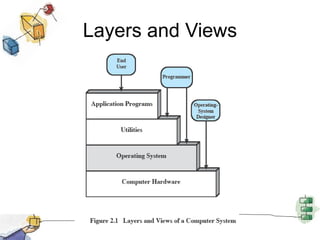
Layers and Views
Services Provided by the OS
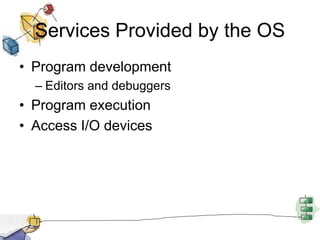
• Program development
– Editors and debuggers
• Program execution
• Access I/O devices
Services Provided by the OS
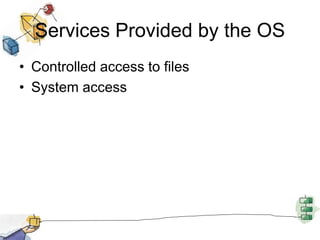
• Controlled access to files
• System access
Services Provided by the OS
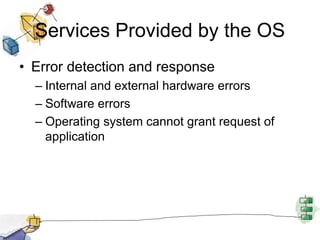
• Error detection and response
– Internal and external hardware errors
– Software errors
– Operating system cannot grant request of
application
Services Provided by the OS
• Accounting
– Collect usage statistics
– Monitor performance
– Used to anticipate future enhancements
– Used for billing purposes
Operating System
• Responsible for managing resources
• Functions same way as ordinary computer
software
– It is a program that is executed
• Operating system relinquishes control of
the processor
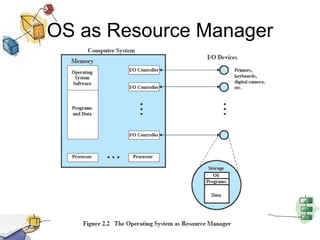
OS as Resource Manager
Kernel
• Portion of operating system that is in main
memory
• Contains most frequently used functions
• Also called the nucleus
Evolution of Operating
Systems
• Hardware upgrades plus new types of
hardware
• New services
• Fixes
Evolution of Operating
Systems
• Serial processing
– No operating system
– Machines run from a console with display
lights, toggle switches, input device, and
printer
Evolution of Operating
Systems
• Serial processing
– Schedule time
– Setup included loading the compiler, source
program, saving compiled program, and
loading and linking
Evolution of Operating
Systems
• Simple batch system
– Monitor
• Software that controls the sequence of events
• Batch jobs together
• Program returns control to monitor when finished
Job Control Language
• Special type of programming language
• Provides instruction to the monitor
– What compiler to use
– What data to use
Hardware Features
• Memory protection
– Does not allow the memory area containing
the monitor to be altered
• Timer
– Prevents a job from monopolizing the system
Hardware Features
• Privileged instructions
– Certain machine level instructions can only be
executed by the monitor
• Interrupts
– Early computer models did not have this
capability
Memory Protection
• User program executes in user mode
– Certain instructions may not be executed
Memory Protection
• Monitor executes in system mode
– Kernel mode
– Privileged instructions are executed
– Protected areas of memory may be accessed
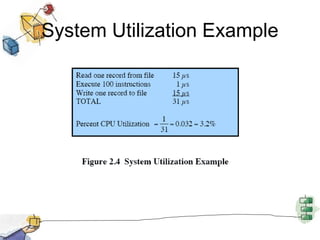
System Utilization Example
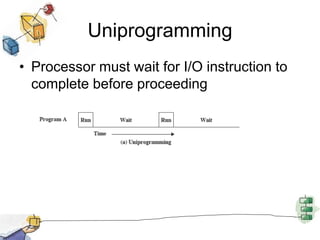
Uniprogramming
• Processor must wait for I/O instruction to
complete before proceeding
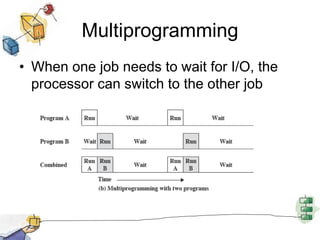
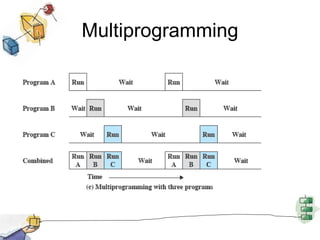
Multiprogramming
• When one job needs to wait for I/O, the
processor can switch to the other job
Multiprogramming
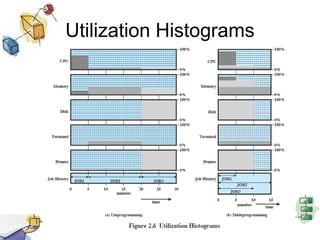
Utilization Histograms
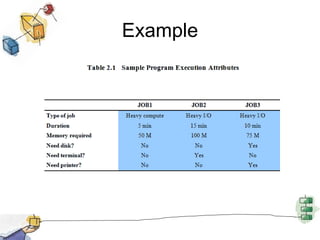
Example
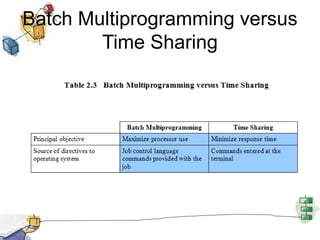
Time Sharing Systems
• Using multiprogramming to handle multiple
interactive jobs
• Processor’s time is shared among multiple
users
• Multiple users simultaneously access the
system through terminals
Batch Multiprogramming versus
Time Sharing
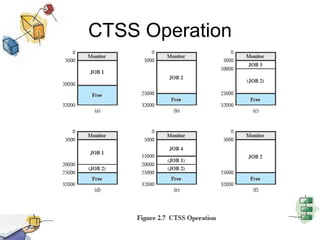
CTSS Operation
Major Achievements
• Processes
• Memory management
• Information protection and security
• Scheduling and resource management
• System structure
Process
• A program in execution
• An instance of a program running on a
computer
• The entity that can be assigned to and
executed on a processor
Process
• A unit of activity characterized by
– A single sequential thread of execution
– A current state
– An associated set of system resources
Difficulties with Designing
System Software
• Improper synchronization
• Failed mutual exclusion
• Nondeterminate program operation
• Deadlocks
Process
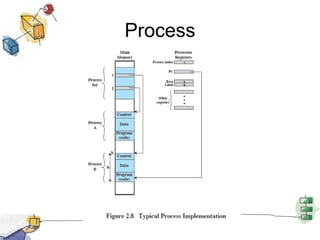
• Consists of three components
– An executable program
– Associated data needed by the program
– Execution context of the program
• All information the operating system needs to
manage the process
Process
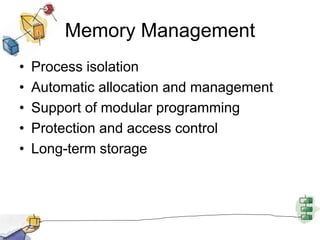
Memory Management
• Process isolation
• Automatic allocation and management
• Support of modular programming
• Protection and access control
• Long-term storage
Virtual Memory
• Implements long-term store
• Information stored in named objects called
files
• Allows programmers to address memory
from a logical point of view
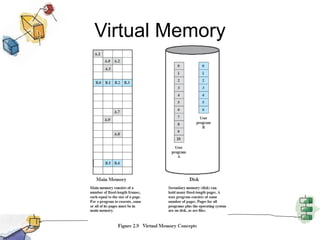
Paging
• Allows process to be comprised of a
number of fixed-size blocks, called pages
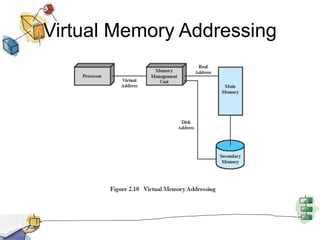
• Virtual address is a page number and an
offset within the page
• Each page may be located anywhere in
main memory
• Real address or physical address is the
main memory address
Virtual Memory
Virtual Memory Addressing
Information Protection and
Security
• Availability
– Concerned with protecting the system against
interruption
• Confidentiality
– Assuring that users cannot read data for
which access is unauthorized
Information Protection and
Security
• Data integrity
– Protection of data from unauthorized
modification
• Authenticity
– Concerned with the proper verification of the
identity of users and the validity of messages
or data
Scheduling and Resource
Management
• Fairness
– Give equal and fair access to resources
• Differential responsiveness
– Discriminate among different classes of jobs
Scheduling and Resource
Management
• Efficiency
– Maximize throughput, minimize response
time, and accommodate as many uses as
possible
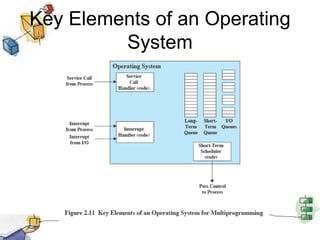
Key Elements of an Operating
System
System Structure
• View the system as a series of levels
• Each level performs a related subset of
functions
• Each level relies on the next lower level to
perform more primitive functions
• This decomposes a problem into a number
of more manageable subproblems
Levels
• Level 1
– Electronic circuits
– Objects are registers, memory cells, and logic
gates
– Operations are clearing a register or reading a
memory location
• Level 2
– Processor’s instruction set
– Operations such as add, subtract, load, and
store
Levels
• Level 3
– Adds the concept of a procedure or
subroutine, plus call/return operations
• Level 4
– Interrupts
Concepts Related to
Multiprogramming
• Level 5
– Process as a program in execution
– Suspend and resume processes
• Level 6
– Secondary storage devices
– Transfer of blocks of data
Concepts Related to
Multiprogramming
• Level 7
– Creates logical address space for processes
– Organizes virtual address space into blocks
Deal with External Objects
• Level 8
– Communication of information and messages
between processes
• Level 9
– Supports long-term storage of named files
• Level 10
– Provides access to external devices using
standardized interfaces
Deal with External Objects
• Level 11
– Responsible for maintaining the association
between the external and internal identifiers
• Level 12
– Provides full-featured facility for the support of
processes
• Level 13
– Provides an interface to the OS for the user
Modern Operating Systems
• Microkernel architecture
– Assigns only a few essential functions to the
kernel
• Address spaces
• Interprocess communication (IPC)
• Basic scheduling
Modern Operating Systems
• Multithreading
– Process is divided into threads that can run
concurrently
• Thread
– Dispatchable unit of work
– executes sequentially and is interruptable
• Process is a collection of one or more threads
Modern Operating Systems
• Symmetric multiprocessing (SMP)
– There are multiple processors
– These processors share same main memory
and I/O facilities
– All processors can perform the same
functions
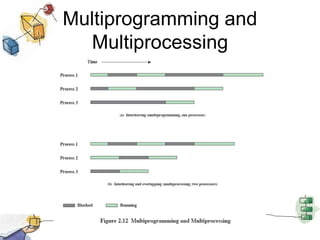
Multiprogramming and
Multiprocessing
Modern Operating Systems
• Distributed operating systems
– Provides the illusion of a single main memory
space and single secondary memory space
Modern Operating Systems
• Object-oriented design
– Used for adding modular extensions to a
small kernel
– Enables programmers to customize an
operating system without disrupting system
integrity

Chapter02-rev.pptx

  • 1.
    Chapter 2 Operating SystemOverview Patricia Roy Manatee Community College, Venice, FL ©2008, Prentice Hall Operating Systems: Internals and Design Principles, 6/E William Stallings
  • 2.
    Operating System • Aprogram that controls the execution of application programs • An interface between applications and hardware
  • 3.
    Operating System Objectives •Convenience • Efficiency • Ability to evolve
  • 4.
  • 5.
    Services Provided bythe OS • Program development – Editors and debuggers • Program execution • Access I/O devices
  • 6.
    Services Provided bythe OS • Controlled access to files • System access
  • 7.
    Services Provided bythe OS • Error detection and response – Internal and external hardware errors – Software errors – Operating system cannot grant request of application
  • 8.
    Services Provided bythe OS • Accounting – Collect usage statistics – Monitor performance – Used to anticipate future enhancements – Used for billing purposes
  • 9.
    Operating System • Responsiblefor managing resources • Functions same way as ordinary computer software – It is a program that is executed • Operating system relinquishes control of the processor
  • 10.
  • 11.
    Kernel • Portion ofoperating system that is in main memory • Contains most frequently used functions • Also called the nucleus
  • 12.
    Evolution of Operating Systems •Hardware upgrades plus new types of hardware • New services • Fixes
  • 13.
    Evolution of Operating Systems •Serial processing – No operating system – Machines run from a console with display lights, toggle switches, input device, and printer
  • 14.
    Evolution of Operating Systems •Serial processing – Schedule time – Setup included loading the compiler, source program, saving compiled program, and loading and linking
  • 15.
    Evolution of Operating Systems •Simple batch system – Monitor • Software that controls the sequence of events • Batch jobs together • Program returns control to monitor when finished
  • 16.
    Job Control Language •Special type of programming language • Provides instruction to the monitor – What compiler to use – What data to use
  • 17.
    Hardware Features • Memoryprotection – Does not allow the memory area containing the monitor to be altered • Timer – Prevents a job from monopolizing the system
  • 18.
    Hardware Features • Privilegedinstructions – Certain machine level instructions can only be executed by the monitor • Interrupts – Early computer models did not have this capability
  • 19.
    Memory Protection • Userprogram executes in user mode – Certain instructions may not be executed
  • 20.
    Memory Protection • Monitorexecutes in system mode – Kernel mode – Privileged instructions are executed – Protected areas of memory may be accessed
  • 21.
  • 22.
    Uniprogramming • Processor mustwait for I/O instruction to complete before proceeding
  • 23.
    Multiprogramming • When onejob needs to wait for I/O, the processor can switch to the other job
  • 24.
  • 25.
  • 26.
  • 27.
    Time Sharing Systems •Using multiprogramming to handle multiple interactive jobs • Processor’s time is shared among multiple users • Multiple users simultaneously access the system through terminals
  • 28.
  • 29.
  • 30.
    Major Achievements • Processes •Memory management • Information protection and security • Scheduling and resource management • System structure
  • 31.
    Process • A programin execution • An instance of a program running on a computer • The entity that can be assigned to and executed on a processor
  • 32.
    Process • A unitof activity characterized by – A single sequential thread of execution – A current state – An associated set of system resources
  • 33.
    Difficulties with Designing SystemSoftware • Improper synchronization • Failed mutual exclusion • Nondeterminate program operation • Deadlocks
  • 34.
    Process • Consists ofthree components – An executable program – Associated data needed by the program – Execution context of the program • All information the operating system needs to manage the process
  • 35.
  • 36.
    Memory Management • Processisolation • Automatic allocation and management • Support of modular programming • Protection and access control • Long-term storage
  • 37.
    Virtual Memory • Implementslong-term store • Information stored in named objects called files • Allows programmers to address memory from a logical point of view
  • 38.
    Paging • Allows processto be comprised of a number of fixed-size blocks, called pages • Virtual address is a page number and an offset within the page • Each page may be located anywhere in main memory • Real address or physical address is the main memory address
  • 39.
  • 40.
  • 41.
    Information Protection and Security •Availability – Concerned with protecting the system against interruption • Confidentiality – Assuring that users cannot read data for which access is unauthorized
  • 42.
    Information Protection and Security •Data integrity – Protection of data from unauthorized modification • Authenticity – Concerned with the proper verification of the identity of users and the validity of messages or data
  • 43.
    Scheduling and Resource Management •Fairness – Give equal and fair access to resources • Differential responsiveness – Discriminate among different classes of jobs
  • 44.
    Scheduling and Resource Management •Efficiency – Maximize throughput, minimize response time, and accommodate as many uses as possible
  • 45.
    Key Elements ofan Operating System
  • 46.
    System Structure • Viewthe system as a series of levels • Each level performs a related subset of functions • Each level relies on the next lower level to perform more primitive functions • This decomposes a problem into a number of more manageable subproblems
  • 47.
    Levels • Level 1 –Electronic circuits – Objects are registers, memory cells, and logic gates – Operations are clearing a register or reading a memory location • Level 2 – Processor’s instruction set – Operations such as add, subtract, load, and store
  • 48.
    Levels • Level 3 –Adds the concept of a procedure or subroutine, plus call/return operations • Level 4 – Interrupts
  • 49.
    Concepts Related to Multiprogramming •Level 5 – Process as a program in execution – Suspend and resume processes • Level 6 – Secondary storage devices – Transfer of blocks of data
  • 50.
    Concepts Related to Multiprogramming •Level 7 – Creates logical address space for processes – Organizes virtual address space into blocks
  • 51.
    Deal with ExternalObjects • Level 8 – Communication of information and messages between processes • Level 9 – Supports long-term storage of named files • Level 10 – Provides access to external devices using standardized interfaces
  • 52.
    Deal with ExternalObjects • Level 11 – Responsible for maintaining the association between the external and internal identifiers • Level 12 – Provides full-featured facility for the support of processes • Level 13 – Provides an interface to the OS for the user
  • 53.
    Modern Operating Systems •Microkernel architecture – Assigns only a few essential functions to the kernel • Address spaces • Interprocess communication (IPC) • Basic scheduling
  • 54.
    Modern Operating Systems •Multithreading – Process is divided into threads that can run concurrently • Thread – Dispatchable unit of work – executes sequentially and is interruptable • Process is a collection of one or more threads
  • 55.
    Modern Operating Systems •Symmetric multiprocessing (SMP) – There are multiple processors – These processors share same main memory and I/O facilities – All processors can perform the same functions
  • 56.
  • 57.
    Modern Operating Systems •Distributed operating systems – Provides the illusion of a single main memory space and single secondary memory space
  • 58.
    Modern Operating Systems •Object-oriented design – Used for adding modular extensions to a small kernel – Enables programmers to customize an operating system without disrupting system integrity