Test Bank for Operating Systems: Internals and
Design Principles, 7th Edition: William Stallings
download pdf
http://testbankbell.com/product/test-bank-for-operating-systems-
internals-and-design-principles-7th-edition-william-stallings/
Visit testbankbell.com today to download the complete set of
test banks or solution manuals!
We believe these products will be a great fit for you. Click
the link to download now, or visit testbankbell.com
to discover even more!
Test Bank for Operating Systems: Internals and Design
Principles, 8/E 8th Edition : 0133805913
http://testbankbell.com/product/test-bank-for-operating-systems-
internals-and-design-principles-8-e-8th-edition-0133805913/
Solution Manual for Operating Systems: Internals and
Design Principles, 8/E 8th Edition : 0133805913
http://testbankbell.com/product/solution-manual-for-operating-systems-
internals-and-design-principles-8-e-8th-edition-0133805913/
Cryptography and Network Security Principles and Practice
6th Edition William Stallings Test Bank
http://testbankbell.com/product/cryptography-and-network-security-
principles-and-practice-6th-edition-william-stallings-test-bank/
Test Bank for Nursing Research in Canada, 3rd Edition:
Geri LoBiondo-Wood
http://testbankbell.com/product/test-bank-for-nursing-research-in-
canada-3rd-edition-geri-lobiondo-wood/
Test Bank for Labour Relations, 3/E 3rd Canadian Edition
Larry Suffield
http://testbankbell.com/product/test-bank-for-labour-
relations-3-e-3rd-canadian-edition-larry-suffield/
Financial and Managerial Accounting 14th Edition Warren
Test Bank
http://testbankbell.com/product/financial-and-managerial-
accounting-14th-edition-warren-test-bank/
Solution Manual for Essentials of Modern Business
Statistics with Microsoft Excel, 7th Edition, David R.
Anderson
http://testbankbell.com/product/solution-manual-for-essentials-of-
modern-business-statistics-with-microsoft-excel-7th-edition-david-r-
anderson/
Test Bank for Critical Care Nursing Diagnosis and
Management, 8th Edition, Linda Urden Kathleen Stacy Mary
Lough
http://testbankbell.com/product/test-bank-for-critical-care-nursing-
diagnosis-and-management-8th-edition-linda-urden-kathleen-stacy-mary-
lough/
Concepts in Strategic Management and Business Policy
Wheelen 14th Edition Test Bank
http://testbankbell.com/product/concepts-in-strategic-management-and-
business-policy-wheelen-14th-edition-test-bank/
Test Bank For Children: A Chronological Approach, 5th
Canadian Edition Robert V. Kail Theresa Zolner
http://testbankbell.com/product/test-bank-for-children-a-
chronological-approach-5th-canadian-edition-robert-v-kail-theresa-
zolner-2/
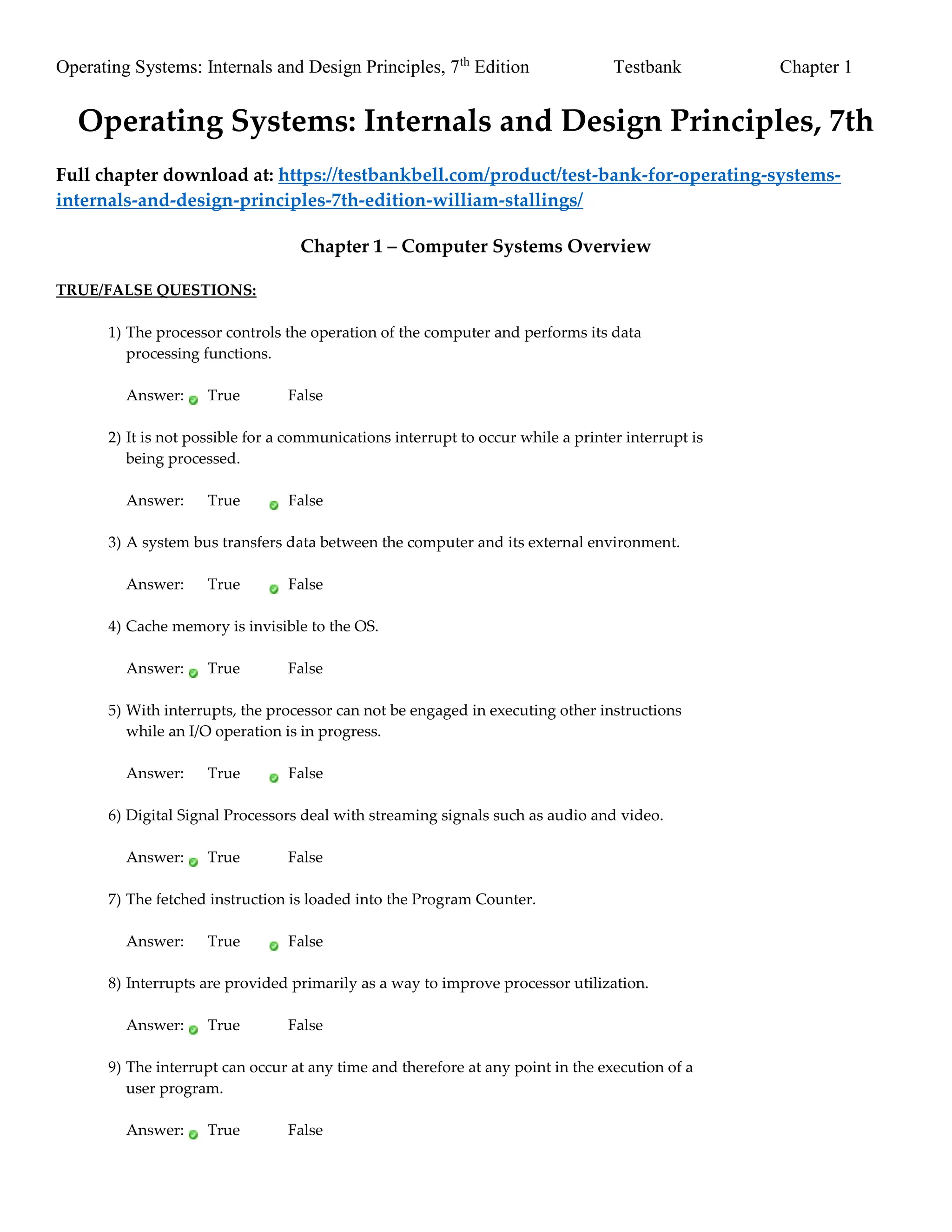
Operating Systems: Internals and Design Principles, 7th
Edition Testbank Chapter 1
Operating Systems: Internals and Design Principles, 7th
Full chapter download at: https://testbankbell.com/product/test-bank-for-operating-systems-
internals-and-design-principles-7th-edition-william-stallings/
Chapter 1 – Computer Systems Overview
TRUE/FALSE QUESTIONS:
1) The processor controls the operation of the computer and performs its data
processing functions.
Answer: True False
2) It is not possible for a communications interrupt to occur while a printer interrupt is
being processed.
Answer: True False
3) A system bus transfers data between the computer and its external environment.
Answer: True False
4) Cache memory is invisible to the OS.
Answer: True False
5) With interrupts, the processor can not be engaged in executing other instructions
while an I/O operation is in progress.
Answer: True False
6) Digital Signal Processors deal with streaming signals such as audio and video.
Answer: True False
7) The fetched instruction is loaded into the Program Counter.
Answer: True False
8) Interrupts are provided primarily as a way to improve processor utilization.
Answer: True False
9) The interrupt can occur at any time and therefore at any point in the execution of a
user program.
Answer: True False
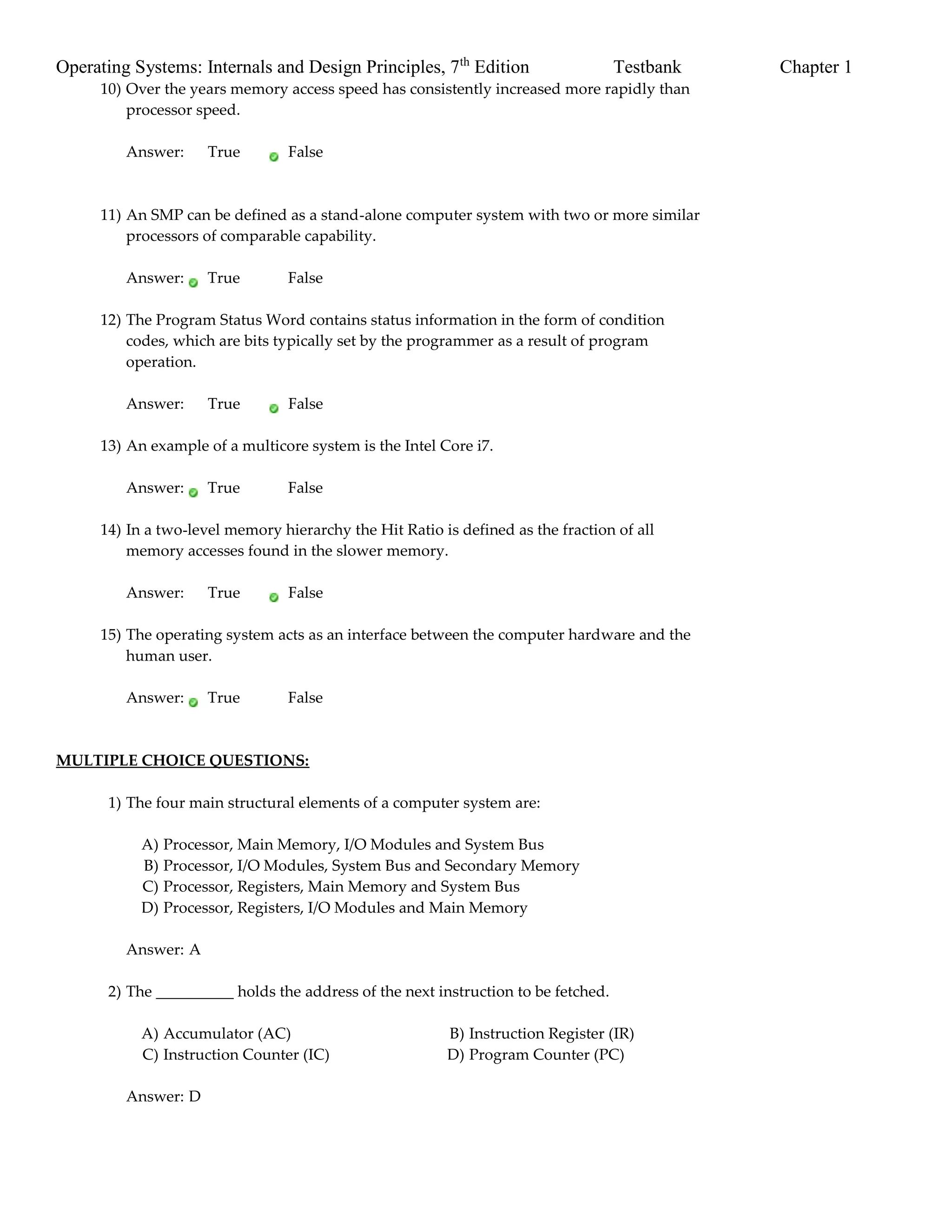
Operating Systems: Internals and Design Principles, 7th
Edition Testbank Chapter 1
10) Over the years memory access speed has consistently increased more rapidly than
processor speed.
Answer: True False
11) An SMP can be defined as a stand-alone computer system with two or more similar
processors of comparable capability.
Answer: True False
12) The Program Status Word contains status information in the form of condition
codes, which are bits typically set by the programmer as a result of program
operation.
Answer: True False
13) An example of a multicore system is the Intel Core i7.
Answer: True False
14) In a two-level memory hierarchy the Hit Ratio is defined as the fraction of all
memory accesses found in the slower memory.
Answer: True False
15) The operating system acts as an interface between the computer hardware and the
human user.
Answer: True False
MULTIPLE CHOICE QUESTIONS:
1) The four main structural elements of a computer system are:
A) Processor, Main Memory, I/O Modules and System Bus
B) Processor, I/O Modules, System Bus and Secondary Memory
C) Processor, Registers, Main Memory and System Bus
D) Processor, Registers, I/O Modules and Main Memory
Answer: A
2) The __________ holds the address of the next instruction to be fetched.
A) Accumulator (AC) B) Instruction Register (IR)
C) Instruction Counter (IC) D) Program Counter (PC)
Answer: D
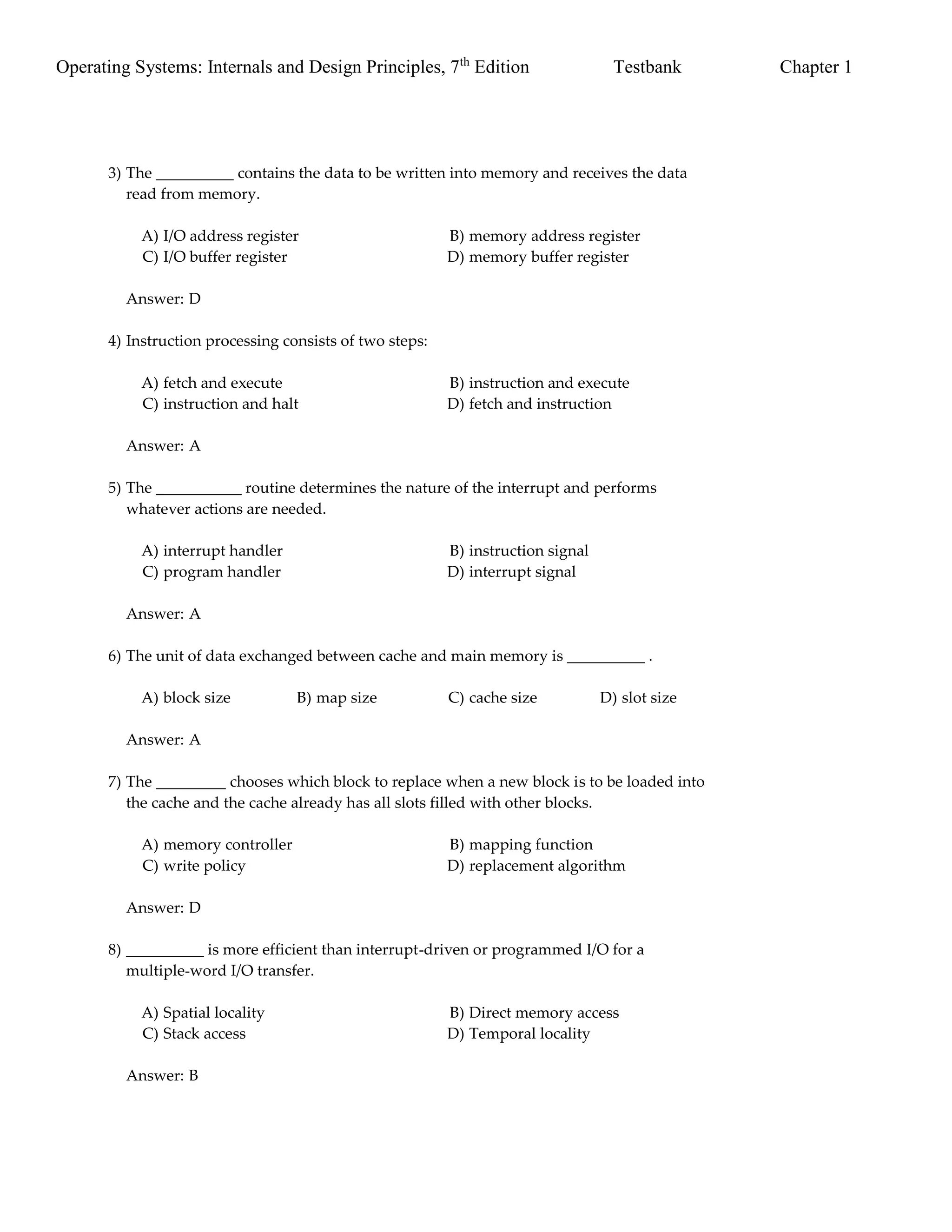
Operating Systems: Internals and Design Principles, 7th
Edition Testbank Chapter 1
3) The __________ contains the data to be written into memory and receives the data
read from memory.
A) I/O address register B) memory address register
C) I/O buffer register D) memory buffer register
Answer: D
4) Instruction processing consists of two steps:
A) fetch and execute B) instruction and execute
C) instruction and halt D) fetch and instruction
Answer: A
5) The ___________ routine determines the nature of the interrupt and performs
whatever actions are needed.
A) interrupt handler B) instruction signal
C) program handler D) interrupt signal
Answer: A
6) The unit of data exchanged between cache and main memory is __________ .
A) block size B) map size C) cache size D) slot size
Answer: A
7) The _________ chooses which block to replace when a new block is to be loaded into
the cache and the cache already has all slots filled with other blocks.
A) memory controller B) mapping function
C) write policy D) replacement algorithm
Answer: D
8) __________ is more efficient than interrupt-driven or programmed I/O for a
multiple-word I/O transfer.
A) Spatial locality B) Direct memory access
C) Stack access D) Temporal locality
Answer: B
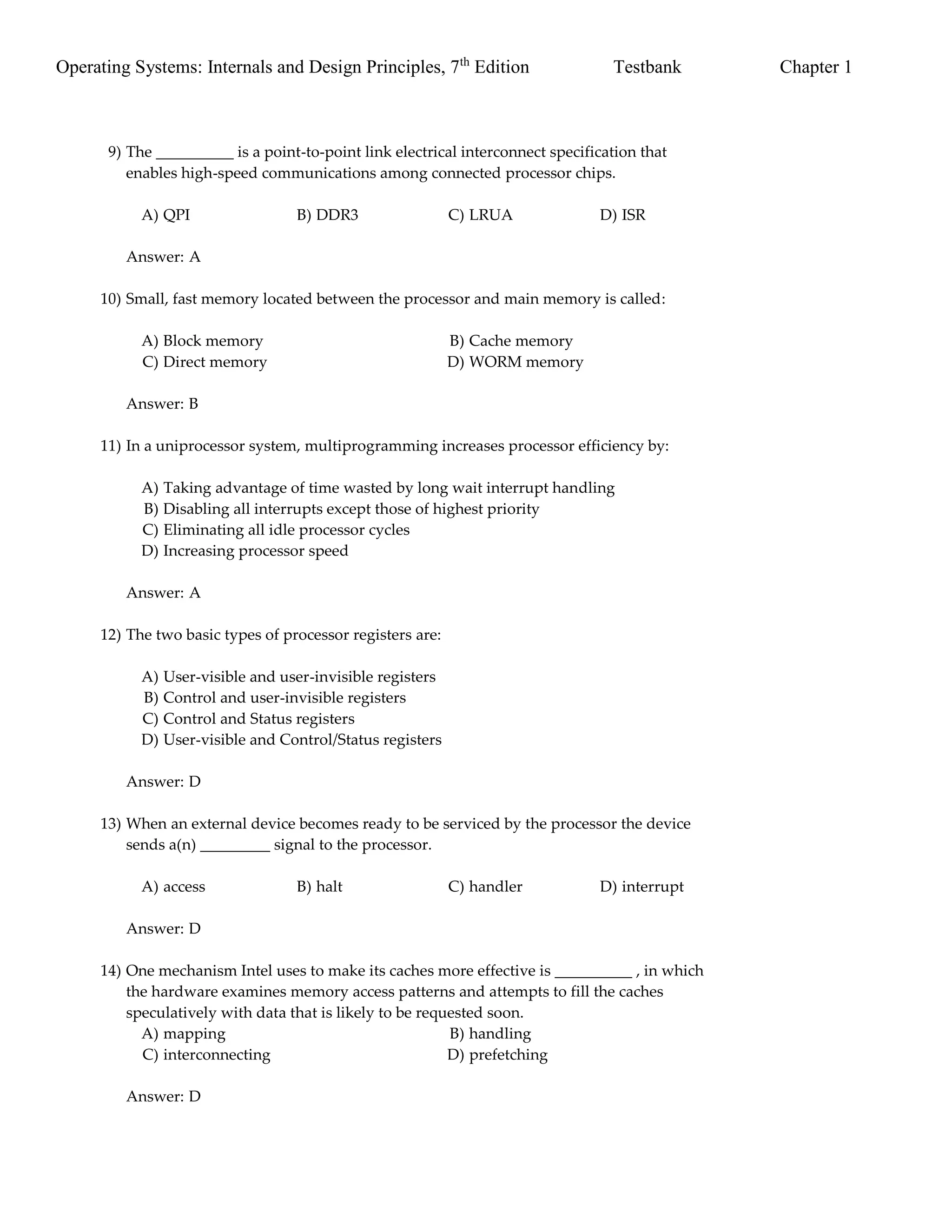
Operating Systems: Internals and Design Principles, 7th
Edition Testbank Chapter 1
9) The __________ is a point-to-point link electrical interconnect specification that
enables high-speed communications among connected processor chips.
A) QPI B) DDR3 C) LRUA D) ISR
Answer: A
10) Small, fast memory located between the processor and main memory is called:
A) Block memory B) Cache memory
C) Direct memory D) WORM memory
Answer: B
11) In a uniprocessor system, multiprogramming increases processor efficiency by:
A) Taking advantage of time wasted by long wait interrupt handling
B) Disabling all interrupts except those of highest priority
C) Eliminating all idle processor cycles
D) Increasing processor speed
Answer: A
12) The two basic types of processor registers are:
A) User-visible and user-invisible registers
B) Control and user-invisible registers
C) Control and Status registers
D) User-visible and Control/Status registers
Answer: D
13) When an external device becomes ready to be serviced by the processor the device
sends a(n) _________ signal to the processor.
A) access B) halt C) handler D) interrupt
Answer: D
14) One mechanism Intel uses to make its caches more effective is __________ , in which
the hardware examines memory access patterns and attempts to fill the caches
speculatively with data that is likely to be requested soon.
A) mapping B) handling
C) interconnecting D) prefetching
Answer: D
Operating Systems: Internals and Design Principles, 7th
Edition Testbank Chapter 1
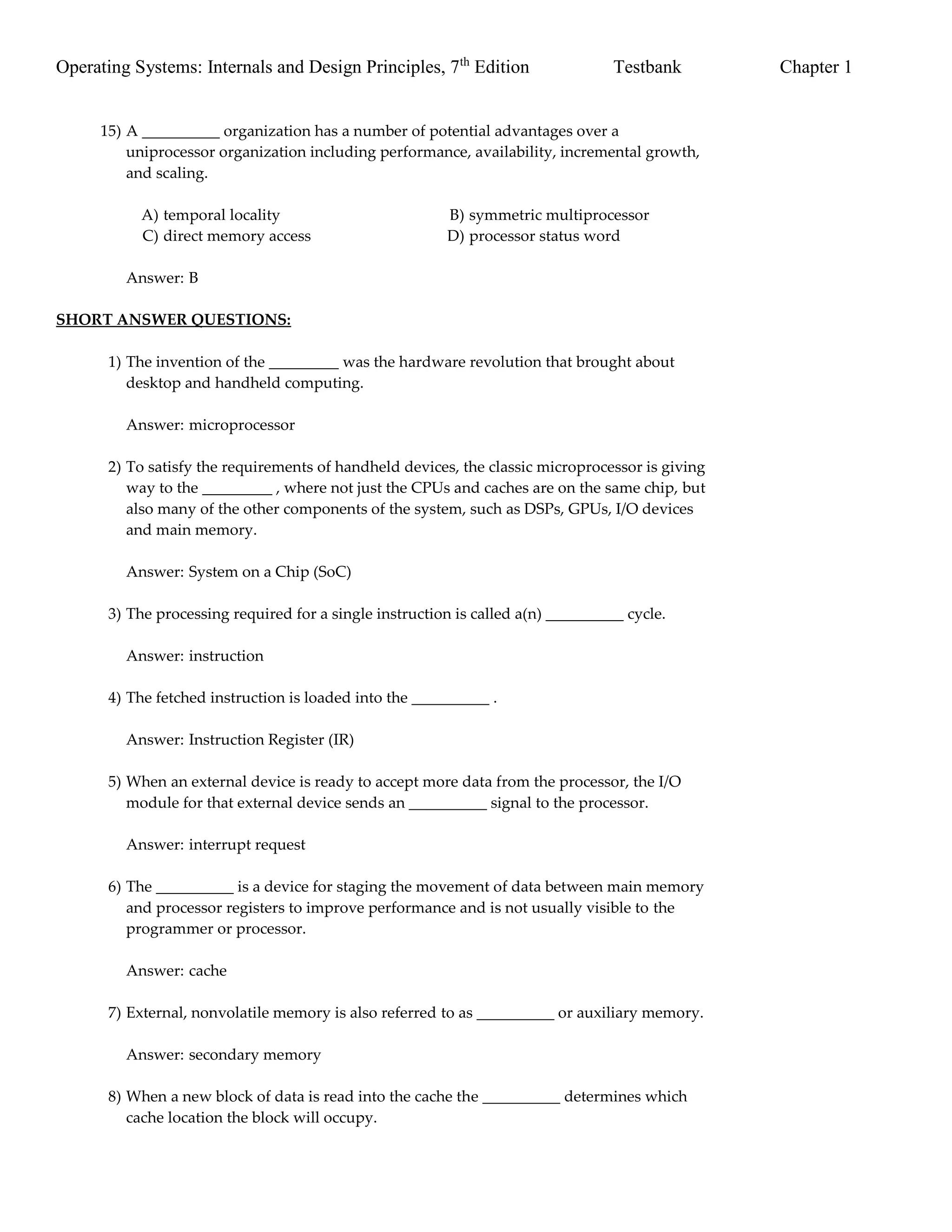
15) A __________ organization has a number of potential advantages over a
uniprocessor organization including performance, availability, incremental growth,
and scaling.
A) temporal locality B) symmetric multiprocessor
C) direct memory access D) processor status word
Answer: B
SHORT ANSWER QUESTIONS:
1) The invention of the _________ was the hardware revolution that brought about
desktop and handheld computing.
Answer: microprocessor
2) To satisfy the requirements of handheld devices, the classic microprocessor is giving
way to the _________ , where not just the CPUs and caches are on the same chip, but
also many of the other components of the system, such as DSPs, GPUs, I/O devices
and main memory.
Answer: System on a Chip (SoC)
3) The processing required for a single instruction is called a(n) __________ cycle.
Answer: instruction
4) The fetched instruction is loaded into the __________ .
Answer: Instruction Register (IR)
5) When an external device is ready to accept more data from the processor, the I/O
module for that external device sends an __________ signal to the processor.
Answer: interrupt request
6) The __________ is a device for staging the movement of data between main memory
and processor registers to improve performance and is not usually visible to the
programmer or processor.
Answer: cache
7) External, nonvolatile memory is also referred to as __________ or auxiliary memory.
Answer: secondary memory
8) When a new block of data is read into the cache the __________ determines which
cache location the block will occupy.
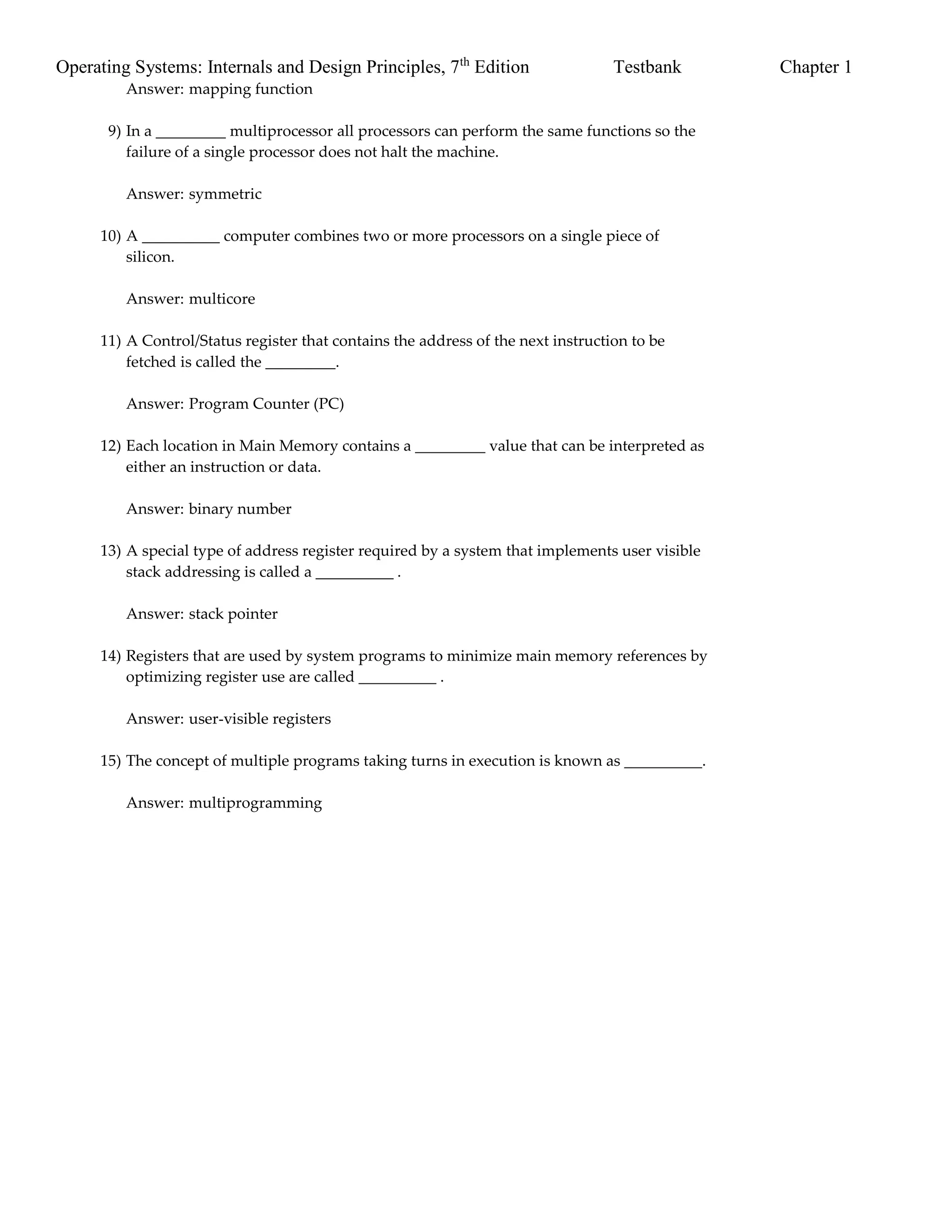
Operating Systems: Internals and Design Principles, 7th
Edition Testbank Chapter 1
Answer: mapping function
9) In a _________ multiprocessor all processors can perform the same functions so the
failure of a single processor does not halt the machine.
Answer: symmetric
10) A __________ computer combines two or more processors on a single piece of
silicon.
Answer: multicore
11) A Control/Status register that contains the address of the next instruction to be
fetched is called the _________.
Answer: Program Counter (PC)
12) Each location in Main Memory contains a _________ value that can be interpreted as
either an instruction or data.
Answer: binary number
13) A special type of address register required by a system that implements user visible
stack addressing is called a __________ .
Answer: stack pointer
14) Registers that are used by system programs to minimize main memory references by
optimizing register use are called __________ .
Answer: user-visible registers
15) The concept of multiple programs taking turns in execution is known as __________.
Answer: multiprogramming
Random documents with unrelated
content Scribd suggests to you:
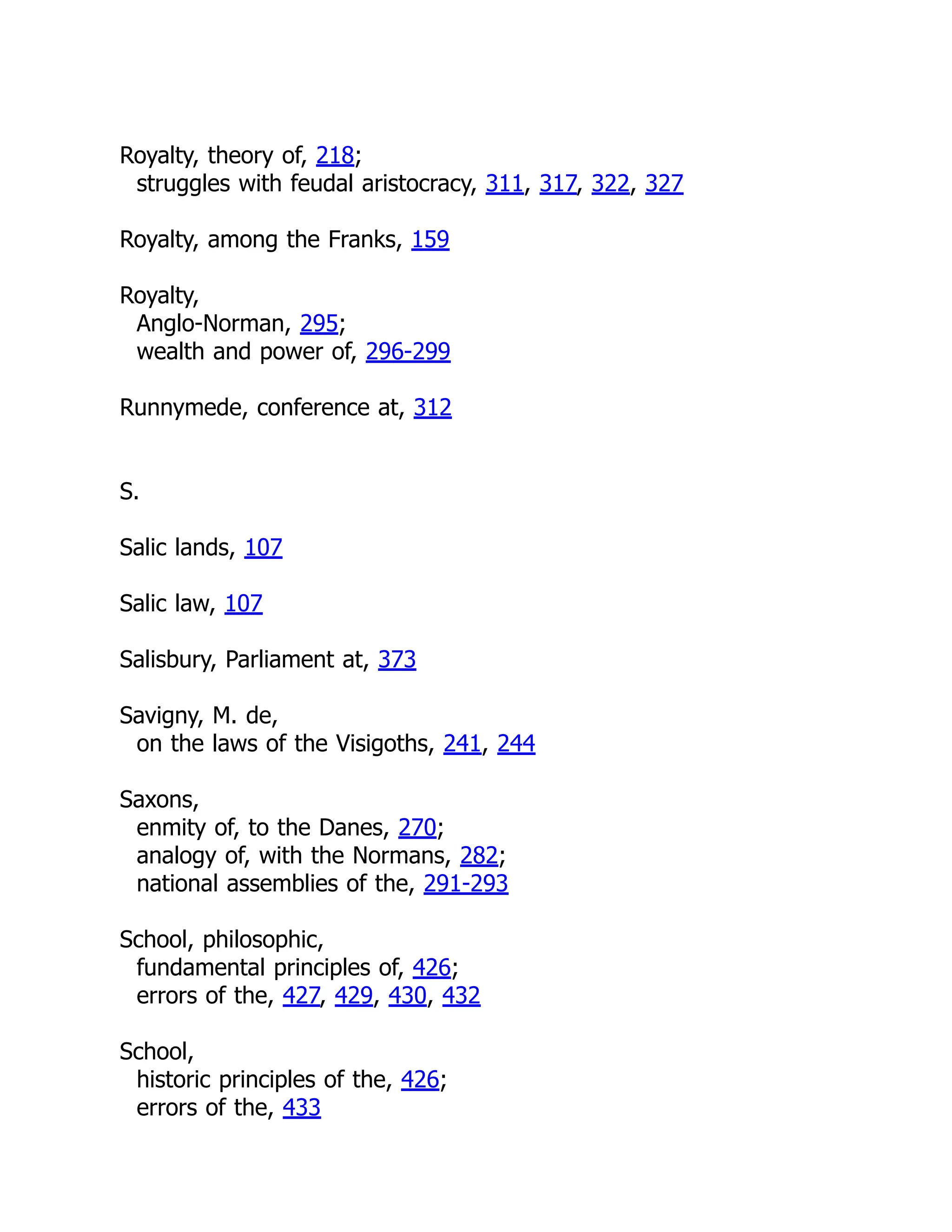
Royalty, theory of, 218;
struggles with feudal aristocracy, 311, 317, 322, 327
Royalty, among the Franks, 159
Royalty,
Anglo-Norman, 295;
wealth and power of, 296-299
Runnymede, conference at, 312
S.
Salic lands, 107
Salic law, 107
Salisbury, Parliament at, 373
Savigny, M. de,
on the laws of the Visigoths, 241, 244
Saxons,
enmity of, to the Danes, 270;
analogy of, with the Normans, 282;
national assemblies of the, 291-293
School, philosophic,
fundamental principles of, 426;
errors of the, 427, 429, 430, 432
School,
historic principles of the, 426;
errors of the, 433
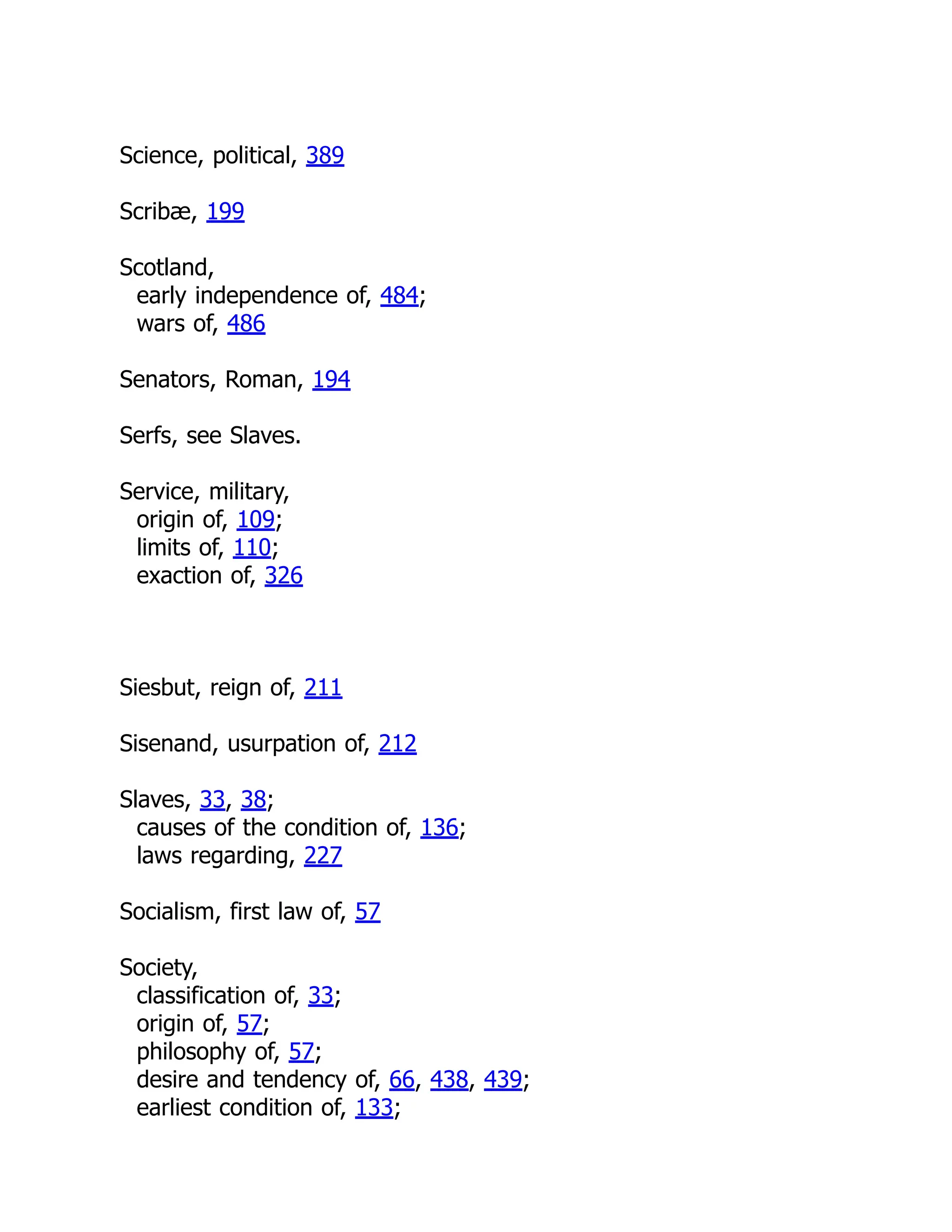
Science, political, 389
Scribæ, 199
Scotland,
early independence of, 484;
wars of, 486
Senators, Roman, 194
Serfs, see Slaves.
Service, military,
origin of, 109;
limits of, 110;
exaction of, 326
Siesbut, reign of, 211
Sisenand, usurpation of, 212
Slaves, 33, 38;
causes of the condition of, 136;
laws regarding, 227
Socialism, first law of, 57
Society,
classification of, 33;
origin of, 57;
philosophy of, 57;
desire and tendency of, 66, 438, 439;
earliest condition of, 133;
tests of the social condition of, 137;
meaning and object of, 441;
government of, 288;
parliamentary classification of, 420, 422;
great aim of, 432, 438
Society, Anglo-Saxon, 34-37
Society, Christian,
influence of, on the fallen powers of Rome, 187;
growth of, 189
Sovereignty,
right of, 58;
effects of, 67;
theories of, 263, 264;
opinions of Bracton and Fortescue on, 267
Sovereignty, individual,
theory of, 336-338, 242;
results of, 443;
division of, 445
Sovereignty, of the majority, 340
Sovereignty, of reason, 343
Sovereignty, of will, 341, 344
Spain,
under the Roman Empire, 206;
invasion of, 209;
monarchy in, 210;
fall of the, 214;
division of, into dioceses, 213;
Gothic laws of, 246, 247;
institutions of, 235
Speaker of the House of Commons,
first appointed, 478;
functions of the, 511
Speech, liberty of, secured, 510
State,
councils of, 165;
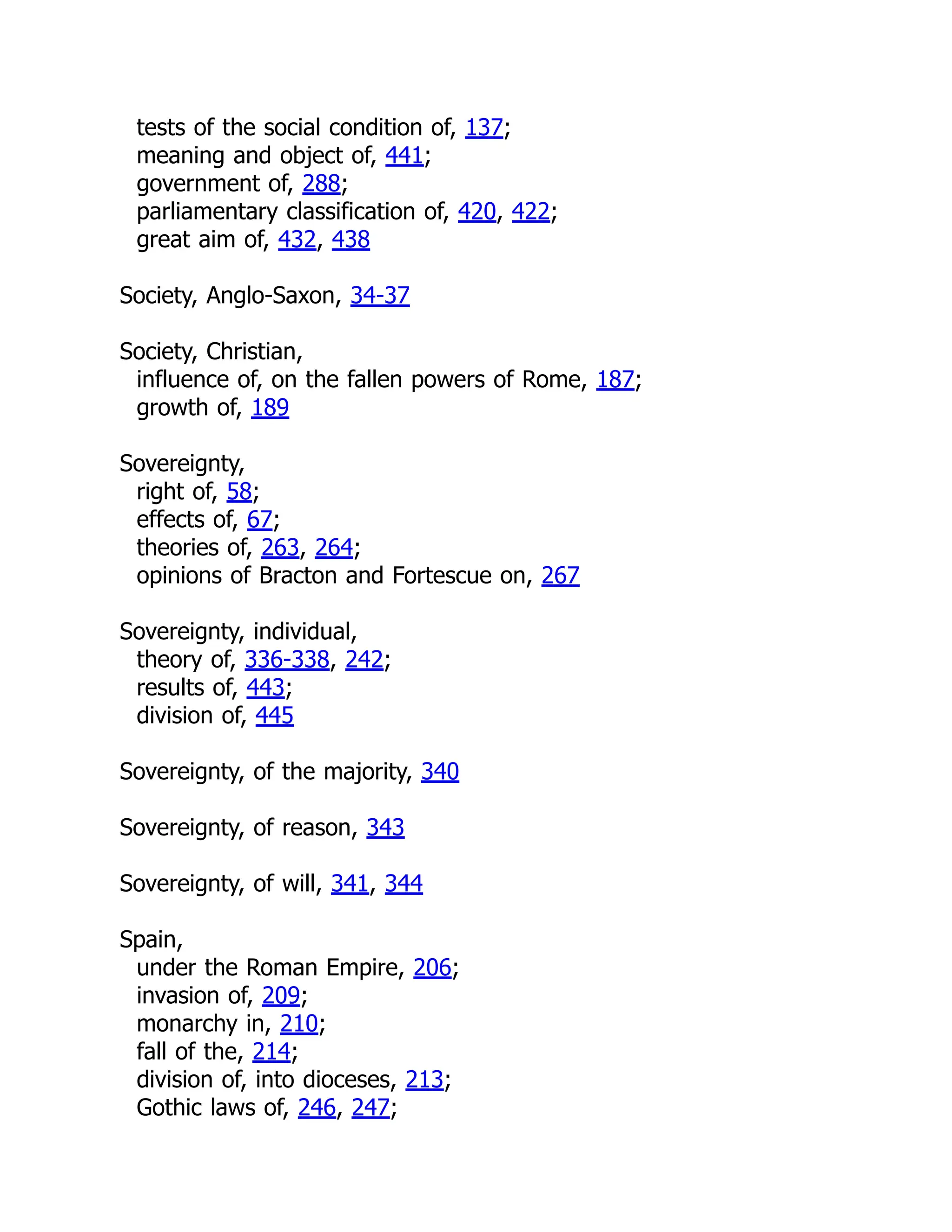
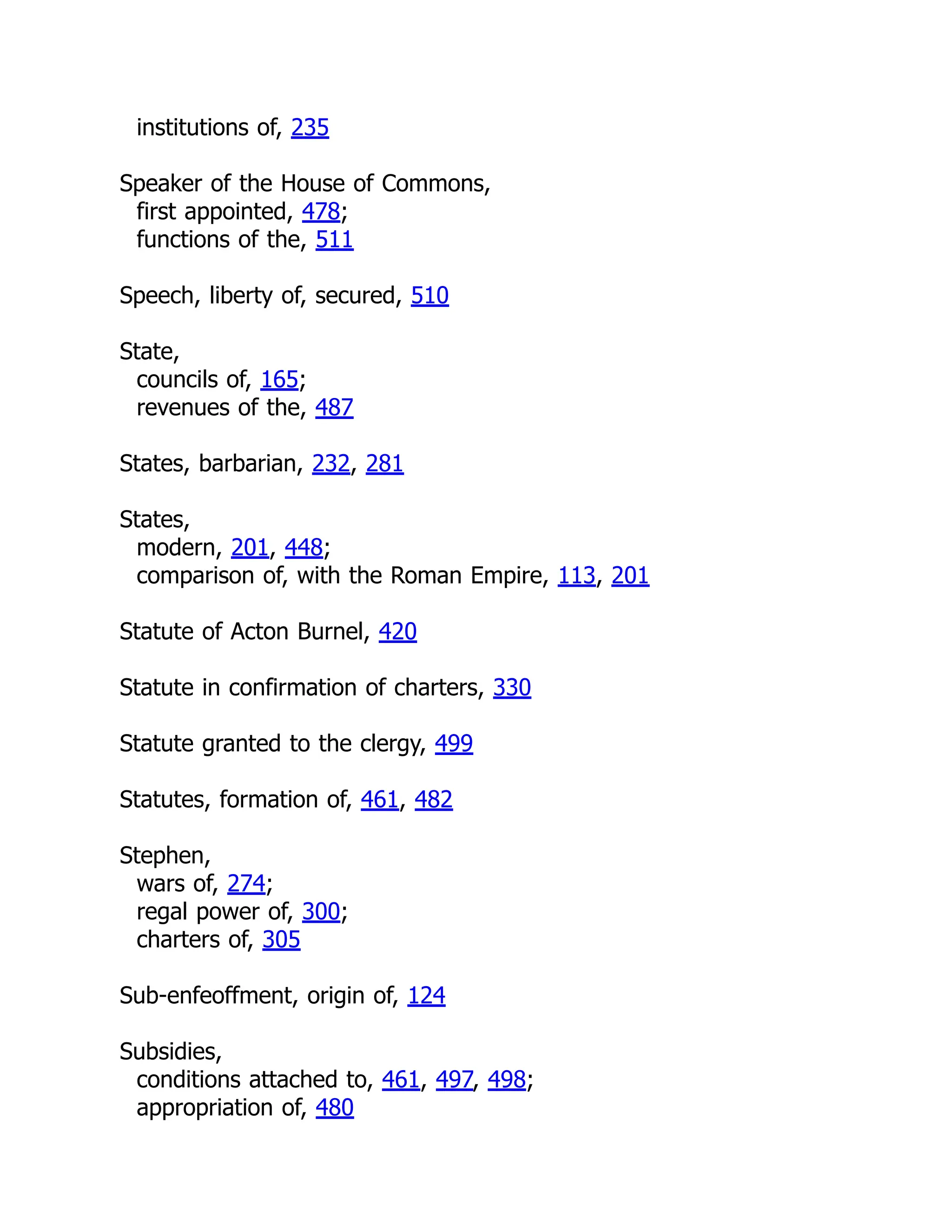
revenues of the, 487
States, barbarian, 232, 281
States,
modern, 201, 448;
comparison of, with the Roman Empire, 113, 201
Statute of Acton Burnel, 420
Statute in confirmation of charters, 330
Statute granted to the clergy, 499
Statutes, formation of, 461, 482
Stephen,
wars of, 274;
regal power of, 300;
charters of, 305
Sub-enfeoffment, origin of, 124
Subsidies,
conditions attached to, 461, 497, 498;
appropriation of, 480
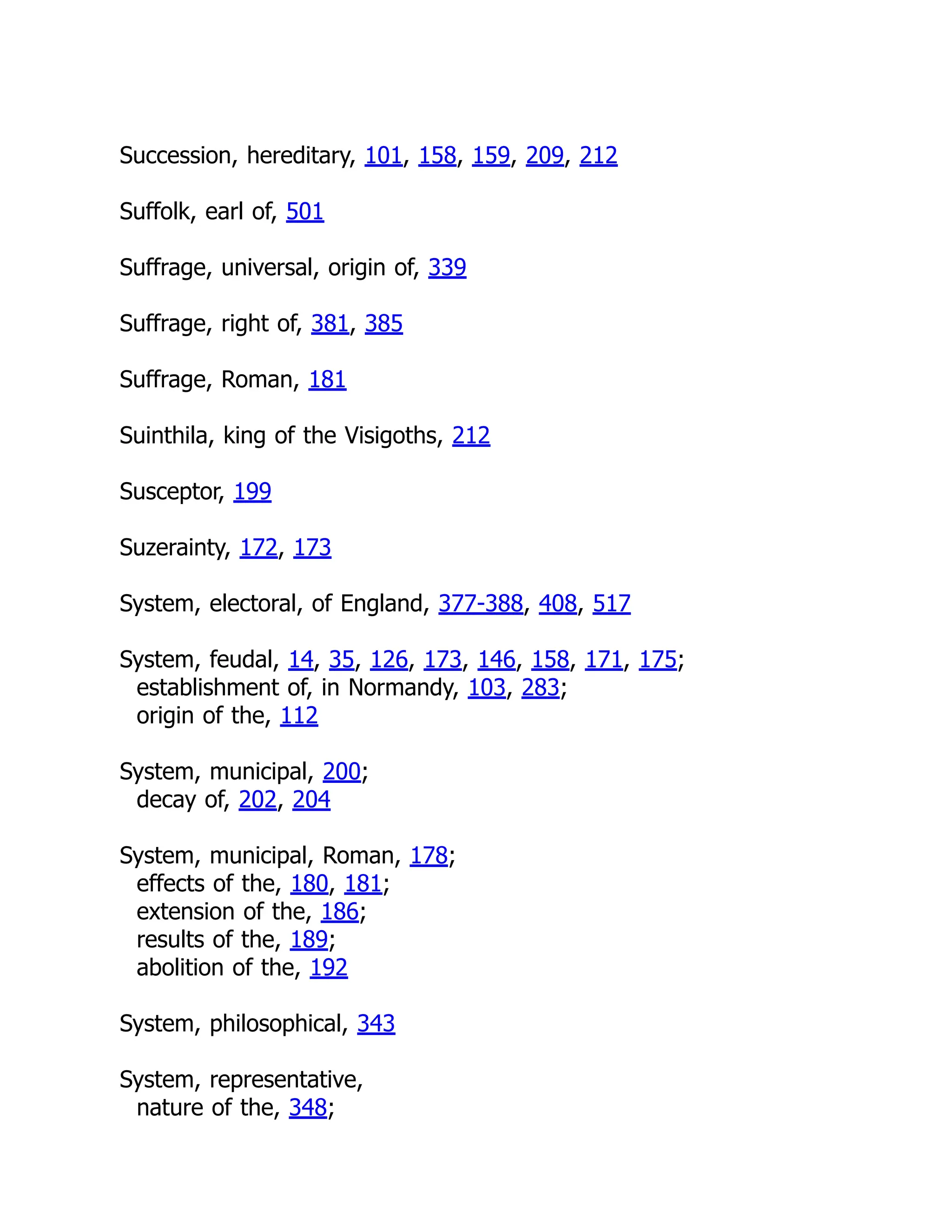
Succession, hereditary, 101, 158, 159, 209, 212
Suffolk, earl of, 501
Suffrage, universal, origin of, 339
Suffrage, right of, 381, 385
Suffrage, Roman, 181
Suinthila, king of the Visigoths, 212
Susceptor, 199
Suzerainty, 172, 173
System, electoral, of England, 377-388, 408, 517
System, feudal, 14, 35, 126, 173, 146, 158, 171, 175;
establishment of, in Normandy, 103, 283;
origin of the, 112
System, municipal, 200;
decay of, 202, 204
System, municipal, Roman, 178;
effects of the, 180, 181;
extension of the, 186;
results of the, 189;
abolition of the, 192
System, philosophical, 343
System, representative,
nature of the, 348;
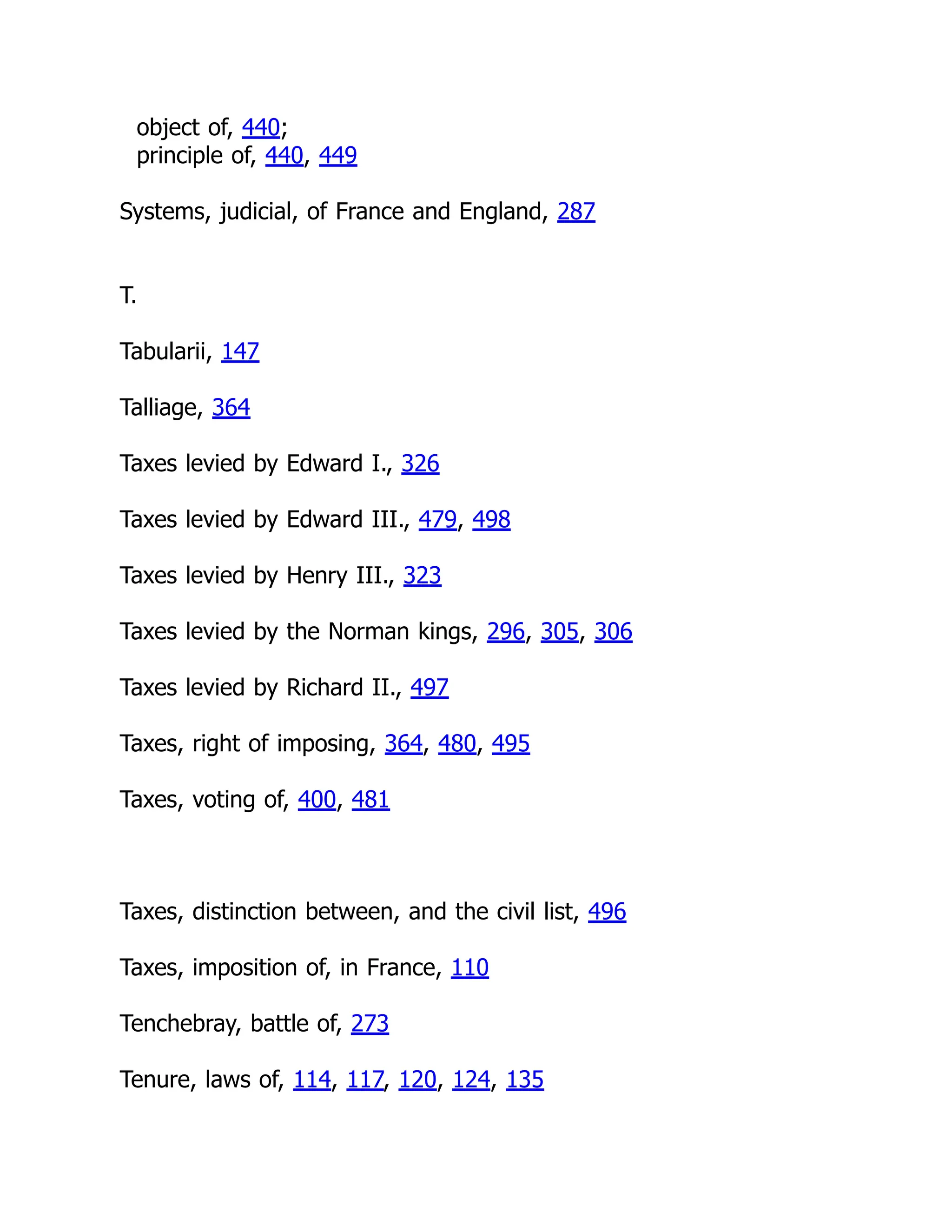
object of, 440;
principle of, 440, 449
Systems, judicial, of France and England, 287
T.
Tabularii, 147
Talliage, 364
Taxes levied by Edward I., 326
Taxes levied by Edward III., 479, 498
Taxes levied by Henry III., 323
Taxes levied by the Norman kings, 296, 305, 306
Taxes levied by Richard II., 497
Taxes, right of imposing, 364, 480, 495
Taxes, voting of, 400, 481
Taxes, distinction between, and the civil list, 496
Taxes, imposition of, in France, 110
Tenchebray, battle of, 273
Tenure, laws of, 114, 117, 120, 124, 135
Tenure, Montesquieu on, 116
Tenure, of national assemblies, 293
Territory, divisions of, under the Anglo-Saxons, 42
Territory, divisions of, by the Frankish kings, 86, 92
Thanes, history of the, 33-35
Theodosius the Great, 24
Theodoric,
dominions of, 86
invasion of Spain by, 207;
death of, 208
Theodoric II., 208
Theory of law, 217
Theory of power, 219, 220
Theory of reconciliation, 338
Theory of royalty, 218
Theories of representation, 335, 336;
consequences of, 337
Theories of government, 341
Theudegisil, king of the Visigoths, 210
Thorismund, 208
Time,
past, importance of the study of, 5;
present characteristics of the, 21
Toledo, general councils of, 211-213, 221, 230;
political influence of the, 231, 233;
Abbé Mariana on the, 241
Tories,
their estimation of Saxon and Norman institutions, 283;
opinions of, on national assemblies, 290;
on electors, 377;
theories of, refuted, 382
Towns, English,
importance of, 268, 306, 362, 364;
liberties of, 265, 280;
effects of the Norman conquest on, 294;
deputies of, called to Parliament, 362;
representation of, 366
Towns, conquered, treatment of, by the Romans, 181
Trial, by ordeal, 249, 251
Trial by jury, 250, 252
Tribute, laws of, 108
Truth,
difficulty of attaining the, 19;
characteristics of, 68
Tyranny,
local, effects of, 174;
origin of; 340, 341
Tythes,
institution of, 326;
continuation of, 372
U.
Unity,
definition of, 62, 265;
power of, in government, 72
University of Oxford first represented in Parliament, 373
Usurpation, frequency of, 223
V.
Vascons or Basques, defeat of the, 210
Vassals,
etymology of the term, 122;
condition of, 175
Vassals, royal, duties of, 296
Vassalage, 122, 126
Visigoth legislation, character of, 215
Visigoths,
laws of the, 119, 125, 177, 208, 215;
national assemblies of, 211;
institutions of, 237
Visigoths, monarchy of the, in Gaul, 207, 208
Visigoths, monarchy in Spain, 207, 210
Visigoths,
bishops of the, 232;
character of, 236
Visigoths,
kings of the, 207-214;
duties of the, 225
Votes, classification of, 420
W.
Wallia, king of the Visigoths, 207
Wamba, 213
Wars, civil, 274, 275, 280, 311, 519;
results of, 301, 520
Wars of Clovis, 34
Wars of Edward II., 456
Wars of Henry III., 323
Wars of Stephen, 274
Wars regulated by Parliament, 486
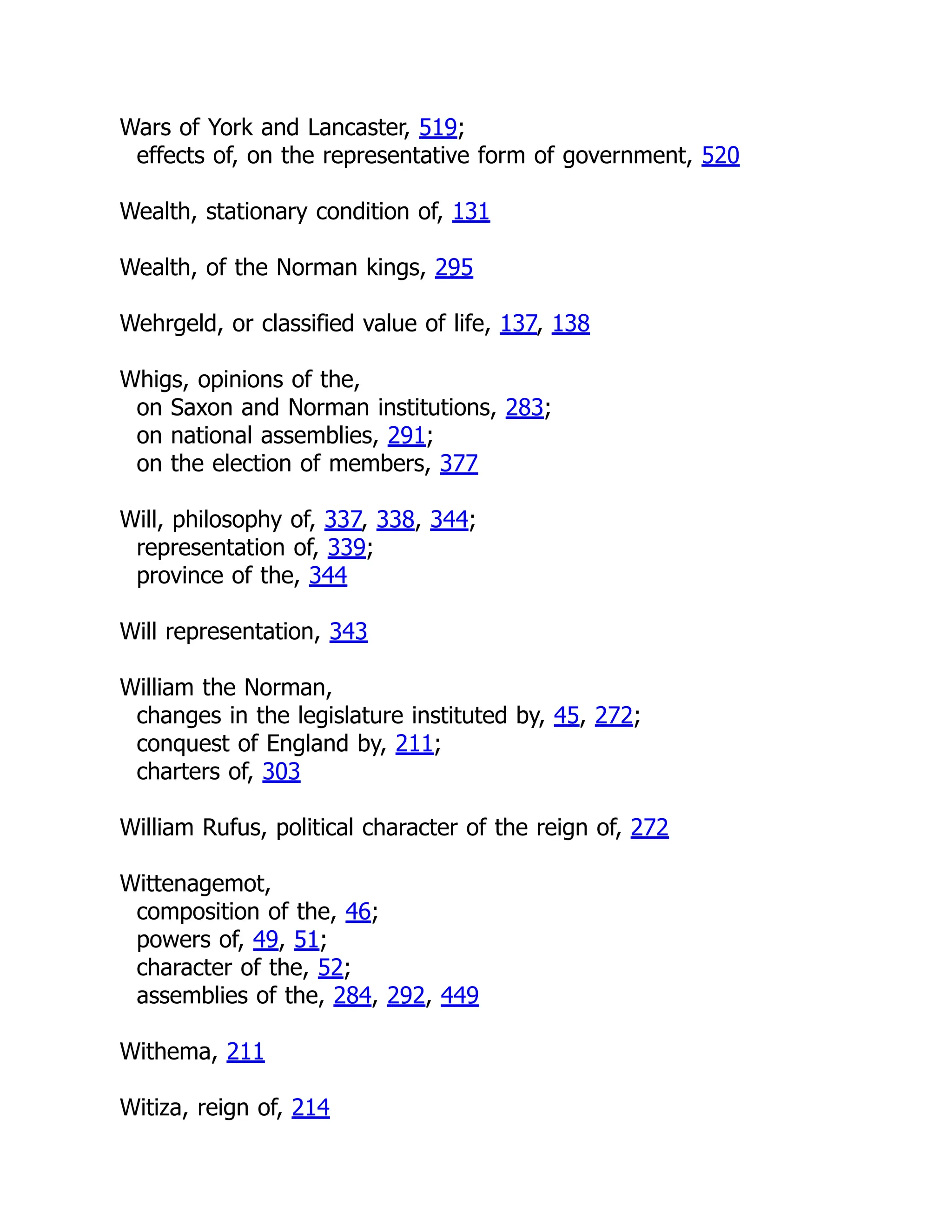
Wars of York and Lancaster, 519;
effects of, on the representative form of government, 520
Wealth, stationary condition of, 131
Wealth, of the Norman kings, 295
Wehrgeld, or classified value of life, 137, 138
Whigs, opinions of the,
on Saxon and Norman institutions, 283;
on national assemblies, 291;
on the election of members, 377
Will, philosophy of, 337, 338, 344;
representation of, 339;
province of the, 344
Will representation, 343
William the Norman,
changes in the legislature instituted by, 45, 272;
conquest of England by, 211;
charters of, 303
William Rufus, political character of the reign of, 272
Wittenagemot,
composition of the, 46;
powers of, 49, 51;
character of the, 52;
assemblies of the, 284, 292, 449
Withema, 211
Witiza, reign of, 214
Writs of Chancery, 297
Writs of convocation, 371, 373, 374
Writs of election, 386
Y.
Yeomanry, English, origin of the, 36
Printed By Harrison And Son, London Gazette Office, St. Martin's-
lane; and Orchard-street, Westminster.
End of Main Text
[Transcriber's note: The prices listed use the £sd system (or Lsd),
"pounds, shillings and pence," from librae, solidi, and denarii.
12d (pence) is a shilling. 20s (shillings), or 240d (pence), is a
pound. The purchasing power of one pence is 1852 is about
US$.58 in 2020. A common price of 3s. 6d. is about $40.]
Publisher's Advertisements
Bohn's Classical Library,
A Series Of Literal Prose Translations
Of The Greek And Latin Classics,
With Notes And Indexes.
Uniform with the Standard Library, 6s. each (except
Thucydides, Æschylus, Virgil, Horace, Cicero's Offices,
Demosthenes, Appendix to Æschylus, Aristotle's Organon,
all of which are, 3s. 6d, each volume).
1. Herodotus.
By The Rev. Henry Cary, M.A. Frontispiece.
2 & 3. Thucydides.
By The Rev. H. Dale.
In 2 Vols. (3s. 6d. Each). Frontispiece.
4. Plato. Vol. 1. By Cary.
[The Apology of Socrates, Crito, Plædo, Gorgias, Protagotas,
Phædrus, Theætetus, Euthyphron, Lysis.] Frontispiece.
5. Livy's History Of Rome,
literally translated. Vol. I., Books 1 to 8.
6. Plato. Vol.II. By Davis.
[The Republic, Timæus, and Critias.]
7. Livy's History Of Rome. Vol. II., Books 9 to 26.
8. Sophocles. The Oxford Translation, revised.
9. Æschylus, literally translated.
By an Oxonian. (Price 3s. 6d.)
9* Æschylus, Appendix to, containing the new readings given in
Hermann's posthumous edition of Æschylus, translated and edited
by G. Burges, M A. (3s. 6d).
10. Aristotle's Rhetoric And Poetic.
With Examination Questions.
11. Livy's History Of Rome. Vol. III., Books 27 to 36.
12 & 14. Euripides, literally translated.
From the Text of Dindorf. In 2 Vols.
13. Virgil By Davidson. New Edition, Revised.
(Price 3s. 6d.) Frontispiece.
15. Horace. By Smart. New Edition, Revised.
(Price 3s. 6d.) Frontispiece.
16. Aristotle's Ethics.
By Prof. R. W. Browne, of King's College.
17. Cicero's Offices.
[Old Age, Friendship, Scipio's Dream, Paradoxes, &c.]
18. Plato. Vol. III. By G. Burges, M.A.
[Enthydemus, Symposium, Sophistes, Politicus, Laches, Parmenides,
Cratylus, and Meno.]
19. Livy's History Of Rome. Vol. IV.
(which completes the work).
20. Cæsar And Hirtius. With Index.
21. Homer's Iliad, in prose, literally translated.
Frontispiece.
22. Homer's Odyssey, Hymns, Epigrams, And Battle Of The Frogs
And Mice.
23. Plato. Vol. IV. By G. Burges, M.A.
[Philebus, Charmides, Laches, The Two Alcibiades, and Ten other
Dialogues.]
24. 25, & 32. Ovid. By H. T. Riley, B.A.
Complete in 3 Vols. Frontispieces.
26. Lucretius. By The Rev. J. S. Watson.
With the Metrical Version of J. M. Good.
27, 30, 31, &. 34. Cicero's Orations.
By C. D. Yonge.
Complete in 4 Vols.
(Vol. 4 contains also the Rhetorical Pieces.)
28. Pindar. By Dawson W. Turner.
With the Metrical Version of Moore. Front.
29. Plato. Vol. V. By G. Burges, M.A. [The Laws.]
33 &, 36. The Comedies Of Plautus,
By H. T. Riley, B.A. In 2 Vols.
35. Juvenal, Persius, &c.
By The Rev. L. Evans, M.A. With the Metrical Version of Gifford.
Frontispiece.
37. The Greek Anthology,
translated chiefly by G. Burges, A.M., with Metrical Versions by
various Authors.
38. Demosthenes.
The Olynthiac, Philippic, and other Public Orations, with Notes,
Appendices, &c., by C. Rann Kennedy. (3s. 6d.)
39. Sallust, Florus, and Velleius Paterculus,
with copious Notes, Biographical Notices, and Index, by the Rev. J.
S. Watson, M.A.
40. Lucan's Pharsalia,
with copious Notes, by H. T. Riley, B.A.
41 Theocritus, Bion, Moschus And Tyrtæus,
by the Rev. J. Banks, M.A. With the Metrical Versions of Chapman.
Frontispiece.
42. Cicero's Academics, De Finibus and Tusculan Questions,
by C. D. Yonge, B A. With Sketch of the Greek Philosophy.
43. Aristotle's Politics And Economics,
by E. Walford, M.A., with Notes, Analyses, Life, Introduction, and
Index.
44. Diogenes Laertius. Lives And Opinions Of The Ancient
Philosophers, with Notes by C. D. Yonge, B.A.
45. Terence And Phædrus, By H. T. Riley.
To which is added Smart's Metrical Version of Phædrus.
Frontispiece.
46 & 47. Aristotle's Organon, or, Logical Treatises, and the
Introduction of Porphyry with Notes, Analysis, Introduction and
Index, by the Rev. O. Owen, M. A. 2 Vols., 3s. 6d. per Vol.
48 & 49. Aristophanes,
with Notes and Extracts from the best Metrical Versions, by W. J.
Hickie, in 2 Vols. Frontispiece.
50. Cicero On The Nature Of The Gods, Divination, Fate,
Laws, Republic, &c, translated by C. D. Yonge, B.A.
51. Apuleius. [The Golden Ass, Death of Socrates, Florida, and
Defence or Discourse on Magic]. To which is added a Metrical
Version of Cupid and Psyche; and Mrs. Tighe's Psyche.
Frontispiece.
52. Justin, Cornelius Nepos And Eutropius,
with Notes and a General Index, by the Rev. J. S. Watson, M.A.
53 & 58. Tacitus. Vol. I. The Annals.
Vol. II. The History, Germania, Agricola, &c. With Index.
54. Plato. Vol VI., completing the work, and containing Epinomis,
Axiochus, Eryxias, on Virtue, on Justice, Sisyphus, Demodocus, and
Definitions; the Treatise of Timæus Locrus on the Soul of the World
and Nature; the Lives of Plato by Diogenes Laertius, Hesychius, and
Olympiodorus; and the Introductions to his Doctrines by Alcinous
and Albinus; Apuleius on the Doctrines of Plato, and Remarks on
Plato's Writings by the Poet Gray. Edited, with Notes, by G. Burges,
M.A., Trin. Coll., Camb. With general Index to the 6 Volumes.
55, 56, 57. Athenæus.
The Deipnosophists, or the Banquet of the Learned, translated by
C. D. Yonge, B.A., with an Appendix of Poetical Fragments rendered
into English verse by various Authors, and a general Index.
Complete in 3 Vols.
59. Catullus, Tibullus, And The Vigil Of Venus.
A literal prose translation. To which are added Metrical Versions by
Lamb, Grainger, and others. Frontispiece.
60. Propertius, Petronius Arbiter, And Johannes Secundus,
literally translated, and accompanied by Poetical Versions, from
various sources; to which are added the Love Epistles Of
Aristænetus. Edited by W. K. Kelly.
61. 74, & 82 The Geography Of Strabo,
translated, with copious Notes, by W. Falconer, M.A., and H. C.
Hamilton, Esq. In 3 vols., and Index.
62. Xenophon's Anabasis, or Expedition of Cyrus, and
Memorabilia, or Memoirs of Socrates, translated by the Rev. J. S.
Watson, with a Geographical Commentary by W. F. Ainsworth.
Frontispiece.
63. Xenophon's Cyropædia And Hellenics,
by the Rev. H. Dale, and the Rev. J. S. Watson.
64. 67, 69, 72, 78, & 81. Pliny's Natural History, with copious
Notes, by Dr. Bostock and T. H. Riley. In 6 volumes. Vols. I., II.,
III., IV., V. and VI.
65. Suetonius. Lives of the Cæsars, and other Works. Thomson's
Translation revised by T. Forester.
66. Demosthenes On The Crown, And Embassy,
by C. Rann Kennedy.
68. Cicero On Oratory And Orators,
by the Rev. J. S. Watson, M.A. This volume completes the Classical
Library edition of Cicero.
70. Greek Romances.
Heliodorus, Longus, and Achilles Tatius.
71 & 76. Quintilian's Institutes Of Oratory.
By the Rev. J. S. Watson, M.A. Complete, with Notes, Index, and
Biographical Notice. 2 volumes.
73. Hesiod, Callimachus, And Theognis, in Prose, by Banks,
with the Metrical Versions of Elton, Tytler, And Frere.
75. Dictionary Of Latin Quotations,
with the Quantities marked and English Translations; including
Proverbs, Maxims, Mottoes, Law Terms and PHrases; with a
Collection of above 500 Greek Quotations.
77. Demosthenes Against Leptines, Midias, Androtion, And
Aristocrates. By Charles Rann Kennedy.
79. Xenophon's Minor Works;
translated by the Rev. J. S. Watson.
80. Aristotle's Metaphysics,
literally translated, with Notes, Analysis, Examination Questions and
Index, by the Rev. John H. M'Mahon, M.A.
Bohn's Antiquarian Library.
Uniform with the Standard Library,
price 5s.,
1. Bede's Ecclesiastical History, &
The Anglo-Saxon Chronicle.
2. Mallets Northern Antiquities.
By Bishop Percy. With Abstract of the Erbyggia Saga, by Sir Walter
Scott. Edited by J. A. Blackwell.
3. William Of Malmesbury's Chronicle Of The Kings Of
England.
4. Six Old English Chronicles: viz., Asser's Life of Alfred; the
Chronicles of Ethelwerd, Gildas, Nennius, Geoffry of Monmouth, and
Richard of Cirencester.
5. Ellis's Early English Metrical Romances.
Revised by J. Orchard Halliwell.
Complete in one vol., Illuminated Frontispiece.
6. Chronicles Of The Crusaders:
Richard of Devizes. Geoffrey de Vinsauf. Lord de Joinville. Complete
in 1 volume. Frontispiece.
7. Early Travels In Palestine.
Willibald, Sæwulf, Benjamin of Tudela, Mandeville, La Brocquiere,
and Maundrell. In one volume. With Map.
8, 10, & 12. Brand's Popular Antiquities Of Great Britain. By
Sir Henry Ellis. In 3 Vols.
9 & 11. Roger Of Wendover's Flowers Of History
(formerly ascribed to Matthew Paris.) In 2 Vols.
13. Keightley's Fairy Mythology.
Enlarged. Frontispiece by Cruikshank.
14, 15, &, 16. Sir Thomas Browne's Works.
Edited by Simon Wilkin.
Portrait. In 3 Vols. With Index.
17, 19, & 31. Matthew Paris's Chronicle,
containing the History of England from 1235, with Index to the
whole, including the portion published under the name of Roger Of
Wendover, in 3 Vols. (See 9 and 11). Portrait.
18. Yule-tide Stories,
A collection of Scandinavian Tales and Traditions, edited by B.
Thorpe, Esq.
20 & 23. Roger De Hoveden's Annals Of English History, from
A.D. 732 to A.D. 1201. Translated by H. T. Riley, Esq., B.A. In 2
Vols.
21. Henry Of Huntingdon's History Of The English,
from the Roman Invasion to Henry II.; with The Acts of King
Stephen, &c.
22. Pauli's Life Of Alfred The Great.
To which is appended Alfred's Anglo-Saxon Version Of
Orosius, with a literal translation. Notes, and an Anglo-Saxon
Grammar and Glossary, by B. Thorpe, Esq.
24 & 25. Matthew Of Westminster's Flowers Of History,
especially such as relate to the affairs of Britain, from the beginning
of the world to A.D. 1307. Translated by C. D. Yonge, B.A. In 2
Vols.
26. Lepsius's Letters From Egypt, Ethiopia, and the
Peninsula of Sinai. Revised by the Author.
Translated by Leonora And Joanna B. Horner.
With Maps and Coloured View of Mount Barkal.
27, 28, 30 & 36. Ordericus Vitalis, His Ecclesiastical History of
England and Normandy, translated, with Notes, the Introduction
of Guizot, Critical Notice by M. Deiille, and very copious Index, by
T. Forester, M.A. In 4 Vols.
29. Ingulph's Chronicle Of The Abbey Of Croyland, with the
Continuations by Peter of Blois and other Writers. Translated, with
Notes and an Index, by H. T. Riley, B.A.
32. Lamb's Specimens Of English Dramatic Poets of the time
of Elizabeth; including his Selections from the Garrick Plays.
33. Marco Polo's Travels, the translation of Marsden, edited, with
Notes and Introduction, by T. Wright, M.A., F.S.A., &c.
34. Florence Of Worcester's Chronicle, with the Two
Continuations; comprising Annals of English History, from the
Departure of the Romans to the Reign of Edward I.
Translated, with Notes, by T. Forester, Esq.
35. Hand-book Of Proverbs, comprising the whole of Ray's
Collection, and a complete Alphabetical Index, in which are
introduced large Additions collected by Henry G. Bohn.
37. Chronicles Of The Tombs:
a select Collection of Epitaphs; with Essay on Monumental
Inscriptions, &c., by T. J. Pettigrew, F.R.S., F.S.A.
38. A Polyglot Of Foreign Proverbs; comprising French, Italian,
German, Dutch, Spanish, Portuguese & Danish. With English
Translations, & General Index.
Welcome to our website – the perfect destination for book lovers and
knowledge seekers. We believe that every book holds a new world,
offering opportunities for learning, discovery, and personal growth.
That’s why we are dedicated to bringing you a diverse collection of
books, ranging from classic literature and specialized publications to
self-development guides and children's books.
More than just a book-buying platform, we strive to be a bridge
connecting you with timeless cultural and intellectual values. With an
elegant, user-friendly interface and a smart search system, you can
quickly find the books that best suit your interests. Additionally,
our special promotions and home delivery services help you save time
and fully enjoy the joy of reading.
Join us on a journey of knowledge exploration, passion nurturing, and
personal growth every day!
testbankbell.com

Test Bank for Operating Systems: Internals and Design Principles, 7th Edition: William Stallings
  • 1.
    Test Bank forOperating Systems: Internals and Design Principles, 7th Edition: William Stallings download pdf http://testbankbell.com/product/test-bank-for-operating-systems- internals-and-design-principles-7th-edition-william-stallings/ Visit testbankbell.com today to download the complete set of test banks or solution manuals!

  • 2.
    We believe theseproducts will be a great fit for you. Click the link to download now, or visit testbankbell.com to discover even more! Test Bank for Operating Systems: Internals and Design Principles, 8/E 8th Edition : 0133805913 http://testbankbell.com/product/test-bank-for-operating-systems- internals-and-design-principles-8-e-8th-edition-0133805913/ Solution Manual for Operating Systems: Internals and Design Principles, 8/E 8th Edition : 0133805913 http://testbankbell.com/product/solution-manual-for-operating-systems- internals-and-design-principles-8-e-8th-edition-0133805913/ Cryptography and Network Security Principles and Practice 6th Edition William Stallings Test Bank http://testbankbell.com/product/cryptography-and-network-security- principles-and-practice-6th-edition-william-stallings-test-bank/ Test Bank for Nursing Research in Canada, 3rd Edition: Geri LoBiondo-Wood http://testbankbell.com/product/test-bank-for-nursing-research-in- canada-3rd-edition-geri-lobiondo-wood/
  • 3.
    Test Bank forLabour Relations, 3/E 3rd Canadian Edition Larry Suffield http://testbankbell.com/product/test-bank-for-labour- relations-3-e-3rd-canadian-edition-larry-suffield/ Financial and Managerial Accounting 14th Edition Warren Test Bank http://testbankbell.com/product/financial-and-managerial- accounting-14th-edition-warren-test-bank/ Solution Manual for Essentials of Modern Business Statistics with Microsoft Excel, 7th Edition, David R. Anderson http://testbankbell.com/product/solution-manual-for-essentials-of- modern-business-statistics-with-microsoft-excel-7th-edition-david-r- anderson/ Test Bank for Critical Care Nursing Diagnosis and Management, 8th Edition, Linda Urden Kathleen Stacy Mary Lough http://testbankbell.com/product/test-bank-for-critical-care-nursing- diagnosis-and-management-8th-edition-linda-urden-kathleen-stacy-mary- lough/ Concepts in Strategic Management and Business Policy Wheelen 14th Edition Test Bank http://testbankbell.com/product/concepts-in-strategic-management-and- business-policy-wheelen-14th-edition-test-bank/
  • 4.
    Test Bank ForChildren: A Chronological Approach, 5th Canadian Edition Robert V. Kail Theresa Zolner http://testbankbell.com/product/test-bank-for-children-a- chronological-approach-5th-canadian-edition-robert-v-kail-theresa- zolner-2/
  • 5.
    Operating Systems: Internalsand Design Principles, 7th Edition Testbank Chapter 1 Operating Systems: Internals and Design Principles, 7th Full chapter download at: https://testbankbell.com/product/test-bank-for-operating-systems- internals-and-design-principles-7th-edition-william-stallings/ Chapter 1 – Computer Systems Overview TRUE/FALSE QUESTIONS: 1) The processor controls the operation of the computer and performs its data processing functions. Answer: True False 2) It is not possible for a communications interrupt to occur while a printer interrupt is being processed. Answer: True False 3) A system bus transfers data between the computer and its external environment. Answer: True False 4) Cache memory is invisible to the OS. Answer: True False 5) With interrupts, the processor can not be engaged in executing other instructions while an I/O operation is in progress. Answer: True False 6) Digital Signal Processors deal with streaming signals such as audio and video. Answer: True False 7) The fetched instruction is loaded into the Program Counter. Answer: True False 8) Interrupts are provided primarily as a way to improve processor utilization. Answer: True False 9) The interrupt can occur at any time and therefore at any point in the execution of a user program. Answer: True False
  • 6.
    Operating Systems: Internalsand Design Principles, 7th Edition Testbank Chapter 1 10) Over the years memory access speed has consistently increased more rapidly than processor speed. Answer: True False 11) An SMP can be defined as a stand-alone computer system with two or more similar processors of comparable capability. Answer: True False 12) The Program Status Word contains status information in the form of condition codes, which are bits typically set by the programmer as a result of program operation. Answer: True False 13) An example of a multicore system is the Intel Core i7. Answer: True False 14) In a two-level memory hierarchy the Hit Ratio is defined as the fraction of all memory accesses found in the slower memory. Answer: True False 15) The operating system acts as an interface between the computer hardware and the human user. Answer: True False MULTIPLE CHOICE QUESTIONS: 1) The four main structural elements of a computer system are: A) Processor, Main Memory, I/O Modules and System Bus B) Processor, I/O Modules, System Bus and Secondary Memory C) Processor, Registers, Main Memory and System Bus D) Processor, Registers, I/O Modules and Main Memory Answer: A 2) The __________ holds the address of the next instruction to be fetched. A) Accumulator (AC) B) Instruction Register (IR) C) Instruction Counter (IC) D) Program Counter (PC) Answer: D
  • 7.
    Operating Systems: Internalsand Design Principles, 7th Edition Testbank Chapter 1 3) The __________ contains the data to be written into memory and receives the data read from memory. A) I/O address register B) memory address register C) I/O buffer register D) memory buffer register Answer: D 4) Instruction processing consists of two steps: A) fetch and execute B) instruction and execute C) instruction and halt D) fetch and instruction Answer: A 5) The ___________ routine determines the nature of the interrupt and performs whatever actions are needed. A) interrupt handler B) instruction signal C) program handler D) interrupt signal Answer: A 6) The unit of data exchanged between cache and main memory is __________ . A) block size B) map size C) cache size D) slot size Answer: A 7) The _________ chooses which block to replace when a new block is to be loaded into the cache and the cache already has all slots filled with other blocks. A) memory controller B) mapping function C) write policy D) replacement algorithm Answer: D 8) __________ is more efficient than interrupt-driven or programmed I/O for a multiple-word I/O transfer. A) Spatial locality B) Direct memory access C) Stack access D) Temporal locality Answer: B
  • 8.
    Operating Systems: Internalsand Design Principles, 7th Edition Testbank Chapter 1 9) The __________ is a point-to-point link electrical interconnect specification that enables high-speed communications among connected processor chips. A) QPI B) DDR3 C) LRUA D) ISR Answer: A 10) Small, fast memory located between the processor and main memory is called: A) Block memory B) Cache memory C) Direct memory D) WORM memory Answer: B 11) In a uniprocessor system, multiprogramming increases processor efficiency by: A) Taking advantage of time wasted by long wait interrupt handling B) Disabling all interrupts except those of highest priority C) Eliminating all idle processor cycles D) Increasing processor speed Answer: A 12) The two basic types of processor registers are: A) User-visible and user-invisible registers B) Control and user-invisible registers C) Control and Status registers D) User-visible and Control/Status registers Answer: D 13) When an external device becomes ready to be serviced by the processor the device sends a(n) _________ signal to the processor. A) access B) halt C) handler D) interrupt Answer: D 14) One mechanism Intel uses to make its caches more effective is __________ , in which the hardware examines memory access patterns and attempts to fill the caches speculatively with data that is likely to be requested soon. A) mapping B) handling C) interconnecting D) prefetching Answer: D
  • 9.
    Operating Systems: Internalsand Design Principles, 7th Edition Testbank Chapter 1 15) A __________ organization has a number of potential advantages over a uniprocessor organization including performance, availability, incremental growth, and scaling. A) temporal locality B) symmetric multiprocessor C) direct memory access D) processor status word Answer: B SHORT ANSWER QUESTIONS: 1) The invention of the _________ was the hardware revolution that brought about desktop and handheld computing. Answer: microprocessor 2) To satisfy the requirements of handheld devices, the classic microprocessor is giving way to the _________ , where not just the CPUs and caches are on the same chip, but also many of the other components of the system, such as DSPs, GPUs, I/O devices and main memory. Answer: System on a Chip (SoC) 3) The processing required for a single instruction is called a(n) __________ cycle. Answer: instruction 4) The fetched instruction is loaded into the __________ . Answer: Instruction Register (IR) 5) When an external device is ready to accept more data from the processor, the I/O module for that external device sends an __________ signal to the processor. Answer: interrupt request 6) The __________ is a device for staging the movement of data between main memory and processor registers to improve performance and is not usually visible to the programmer or processor. Answer: cache 7) External, nonvolatile memory is also referred to as __________ or auxiliary memory. Answer: secondary memory 8) When a new block of data is read into the cache the __________ determines which cache location the block will occupy.
  • 10.
    Operating Systems: Internalsand Design Principles, 7th Edition Testbank Chapter 1 Answer: mapping function 9) In a _________ multiprocessor all processors can perform the same functions so the failure of a single processor does not halt the machine. Answer: symmetric 10) A __________ computer combines two or more processors on a single piece of silicon. Answer: multicore 11) A Control/Status register that contains the address of the next instruction to be fetched is called the _________. Answer: Program Counter (PC) 12) Each location in Main Memory contains a _________ value that can be interpreted as either an instruction or data. Answer: binary number 13) A special type of address register required by a system that implements user visible stack addressing is called a __________ . Answer: stack pointer 14) Registers that are used by system programs to minimize main memory references by optimizing register use are called __________ . Answer: user-visible registers 15) The concept of multiple programs taking turns in execution is known as __________. Answer: multiprogramming
  • 11.
    Random documents withunrelated content Scribd suggests to you:
  • 12.
    Royalty, theory of,218; struggles with feudal aristocracy, 311, 317, 322, 327 Royalty, among the Franks, 159 Royalty, Anglo-Norman, 295; wealth and power of, 296-299 Runnymede, conference at, 312 S. Salic lands, 107 Salic law, 107 Salisbury, Parliament at, 373 Savigny, M. de, on the laws of the Visigoths, 241, 244 Saxons, enmity of, to the Danes, 270; analogy of, with the Normans, 282; national assemblies of the, 291-293 School, philosophic, fundamental principles of, 426; errors of the, 427, 429, 430, 432 School, historic principles of the, 426; errors of the, 433
  • 13.
    Science, political, 389 Scribæ,199 Scotland, early independence of, 484; wars of, 486 Senators, Roman, 194 Serfs, see Slaves. Service, military, origin of, 109; limits of, 110; exaction of, 326 Siesbut, reign of, 211 Sisenand, usurpation of, 212 Slaves, 33, 38; causes of the condition of, 136; laws regarding, 227 Socialism, first law of, 57 Society, classification of, 33; origin of, 57; philosophy of, 57; desire and tendency of, 66, 438, 439; earliest condition of, 133;
  • 14.
    tests of thesocial condition of, 137; meaning and object of, 441; government of, 288; parliamentary classification of, 420, 422; great aim of, 432, 438 Society, Anglo-Saxon, 34-37 Society, Christian, influence of, on the fallen powers of Rome, 187; growth of, 189 Sovereignty, right of, 58; effects of, 67; theories of, 263, 264; opinions of Bracton and Fortescue on, 267 Sovereignty, individual, theory of, 336-338, 242; results of, 443; division of, 445 Sovereignty, of the majority, 340 Sovereignty, of reason, 343 Sovereignty, of will, 341, 344 Spain, under the Roman Empire, 206; invasion of, 209; monarchy in, 210; fall of the, 214; division of, into dioceses, 213; Gothic laws of, 246, 247;
  • 15.
    institutions of, 235 Speakerof the House of Commons, first appointed, 478; functions of the, 511 Speech, liberty of, secured, 510 State, councils of, 165; revenues of the, 487 States, barbarian, 232, 281 States, modern, 201, 448; comparison of, with the Roman Empire, 113, 201 Statute of Acton Burnel, 420 Statute in confirmation of charters, 330 Statute granted to the clergy, 499 Statutes, formation of, 461, 482 Stephen, wars of, 274; regal power of, 300; charters of, 305 Sub-enfeoffment, origin of, 124 Subsidies, conditions attached to, 461, 497, 498; appropriation of, 480
  • 16.
    Succession, hereditary, 101,158, 159, 209, 212 Suffolk, earl of, 501 Suffrage, universal, origin of, 339 Suffrage, right of, 381, 385 Suffrage, Roman, 181 Suinthila, king of the Visigoths, 212 Susceptor, 199 Suzerainty, 172, 173 System, electoral, of England, 377-388, 408, 517 System, feudal, 14, 35, 126, 173, 146, 158, 171, 175; establishment of, in Normandy, 103, 283; origin of the, 112 System, municipal, 200; decay of, 202, 204 System, municipal, Roman, 178; effects of the, 180, 181; extension of the, 186; results of the, 189; abolition of the, 192 System, philosophical, 343 System, representative, nature of the, 348;
  • 17.
    object of, 440; principleof, 440, 449 Systems, judicial, of France and England, 287 T. Tabularii, 147 Talliage, 364 Taxes levied by Edward I., 326 Taxes levied by Edward III., 479, 498 Taxes levied by Henry III., 323 Taxes levied by the Norman kings, 296, 305, 306 Taxes levied by Richard II., 497 Taxes, right of imposing, 364, 480, 495 Taxes, voting of, 400, 481 Taxes, distinction between, and the civil list, 496 Taxes, imposition of, in France, 110 Tenchebray, battle of, 273 Tenure, laws of, 114, 117, 120, 124, 135
  • 18.
    Tenure, Montesquieu on,116 Tenure, of national assemblies, 293 Territory, divisions of, under the Anglo-Saxons, 42 Territory, divisions of, by the Frankish kings, 86, 92 Thanes, history of the, 33-35 Theodosius the Great, 24 Theodoric, dominions of, 86 invasion of Spain by, 207; death of, 208 Theodoric II., 208 Theory of law, 217 Theory of power, 219, 220 Theory of reconciliation, 338 Theory of royalty, 218 Theories of representation, 335, 336; consequences of, 337 Theories of government, 341 Theudegisil, king of the Visigoths, 210 Thorismund, 208
  • 19.
    Time, past, importance ofthe study of, 5; present characteristics of the, 21 Toledo, general councils of, 211-213, 221, 230; political influence of the, 231, 233; Abbé Mariana on the, 241 Tories, their estimation of Saxon and Norman institutions, 283; opinions of, on national assemblies, 290; on electors, 377; theories of, refuted, 382 Towns, English, importance of, 268, 306, 362, 364; liberties of, 265, 280; effects of the Norman conquest on, 294; deputies of, called to Parliament, 362; representation of, 366 Towns, conquered, treatment of, by the Romans, 181 Trial, by ordeal, 249, 251 Trial by jury, 250, 252 Tribute, laws of, 108 Truth, difficulty of attaining the, 19; characteristics of, 68 Tyranny, local, effects of, 174; origin of; 340, 341
  • 20.
    Tythes, institution of, 326; continuationof, 372 U. Unity, definition of, 62, 265; power of, in government, 72 University of Oxford first represented in Parliament, 373 Usurpation, frequency of, 223 V. Vascons or Basques, defeat of the, 210 Vassals, etymology of the term, 122; condition of, 175 Vassals, royal, duties of, 296 Vassalage, 122, 126 Visigoth legislation, character of, 215 Visigoths, laws of the, 119, 125, 177, 208, 215; national assemblies of, 211; institutions of, 237
  • 21.
    Visigoths, monarchy ofthe, in Gaul, 207, 208 Visigoths, monarchy in Spain, 207, 210 Visigoths, bishops of the, 232; character of, 236 Visigoths, kings of the, 207-214; duties of the, 225 Votes, classification of, 420 W. Wallia, king of the Visigoths, 207 Wamba, 213 Wars, civil, 274, 275, 280, 311, 519; results of, 301, 520 Wars of Clovis, 34 Wars of Edward II., 456 Wars of Henry III., 323 Wars of Stephen, 274 Wars regulated by Parliament, 486
  • 22.
    Wars of Yorkand Lancaster, 519; effects of, on the representative form of government, 520 Wealth, stationary condition of, 131 Wealth, of the Norman kings, 295 Wehrgeld, or classified value of life, 137, 138 Whigs, opinions of the, on Saxon and Norman institutions, 283; on national assemblies, 291; on the election of members, 377 Will, philosophy of, 337, 338, 344; representation of, 339; province of the, 344 Will representation, 343 William the Norman, changes in the legislature instituted by, 45, 272; conquest of England by, 211; charters of, 303 William Rufus, political character of the reign of, 272 Wittenagemot, composition of the, 46; powers of, 49, 51; character of the, 52; assemblies of the, 284, 292, 449 Withema, 211 Witiza, reign of, 214
  • 23.
    Writs of Chancery,297 Writs of convocation, 371, 373, 374 Writs of election, 386 Y. Yeomanry, English, origin of the, 36
  • 24.
    Printed By HarrisonAnd Son, London Gazette Office, St. Martin's- lane; and Orchard-street, Westminster. End of Main Text [Transcriber's note: The prices listed use the £sd system (or Lsd), "pounds, shillings and pence," from librae, solidi, and denarii. 12d (pence) is a shilling. 20s (shillings), or 240d (pence), is a pound. The purchasing power of one pence is 1852 is about US$.58 in 2020. A common price of 3s. 6d. is about $40.] Publisher's Advertisements
  • 25.
    Bohn's Classical Library, ASeries Of Literal Prose Translations Of The Greek And Latin Classics, With Notes And Indexes. Uniform with the Standard Library, 6s. each (except Thucydides, Æschylus, Virgil, Horace, Cicero's Offices, Demosthenes, Appendix to Æschylus, Aristotle's Organon, all of which are, 3s. 6d, each volume). 1. Herodotus. By The Rev. Henry Cary, M.A. Frontispiece. 2 & 3. Thucydides. By The Rev. H. Dale. In 2 Vols. (3s. 6d. Each). Frontispiece. 4. Plato. Vol. 1. By Cary. [The Apology of Socrates, Crito, Plædo, Gorgias, Protagotas, Phædrus, Theætetus, Euthyphron, Lysis.] Frontispiece. 5. Livy's History Of Rome, literally translated. Vol. I., Books 1 to 8. 6. Plato. Vol.II. By Davis. [The Republic, Timæus, and Critias.] 7. Livy's History Of Rome. Vol. II., Books 9 to 26. 8. Sophocles. The Oxford Translation, revised. 9. Æschylus, literally translated. By an Oxonian. (Price 3s. 6d.)
  • 26.
    9* Æschylus, Appendixto, containing the new readings given in Hermann's posthumous edition of Æschylus, translated and edited by G. Burges, M A. (3s. 6d). 10. Aristotle's Rhetoric And Poetic. With Examination Questions. 11. Livy's History Of Rome. Vol. III., Books 27 to 36. 12 & 14. Euripides, literally translated. From the Text of Dindorf. In 2 Vols. 13. Virgil By Davidson. New Edition, Revised. (Price 3s. 6d.) Frontispiece. 15. Horace. By Smart. New Edition, Revised. (Price 3s. 6d.) Frontispiece. 16. Aristotle's Ethics. By Prof. R. W. Browne, of King's College. 17. Cicero's Offices. [Old Age, Friendship, Scipio's Dream, Paradoxes, &c.] 18. Plato. Vol. III. By G. Burges, M.A. [Enthydemus, Symposium, Sophistes, Politicus, Laches, Parmenides, Cratylus, and Meno.] 19. Livy's History Of Rome. Vol. IV. (which completes the work). 20. Cæsar And Hirtius. With Index. 21. Homer's Iliad, in prose, literally translated. Frontispiece. 22. Homer's Odyssey, Hymns, Epigrams, And Battle Of The Frogs And Mice.
  • 27.
    23. Plato. Vol.IV. By G. Burges, M.A. [Philebus, Charmides, Laches, The Two Alcibiades, and Ten other Dialogues.] 24. 25, & 32. Ovid. By H. T. Riley, B.A. Complete in 3 Vols. Frontispieces. 26. Lucretius. By The Rev. J. S. Watson. With the Metrical Version of J. M. Good. 27, 30, 31, &. 34. Cicero's Orations. By C. D. Yonge. Complete in 4 Vols. (Vol. 4 contains also the Rhetorical Pieces.) 28. Pindar. By Dawson W. Turner. With the Metrical Version of Moore. Front. 29. Plato. Vol. V. By G. Burges, M.A. [The Laws.] 33 &, 36. The Comedies Of Plautus, By H. T. Riley, B.A. In 2 Vols. 35. Juvenal, Persius, &c. By The Rev. L. Evans, M.A. With the Metrical Version of Gifford. Frontispiece. 37. The Greek Anthology, translated chiefly by G. Burges, A.M., with Metrical Versions by various Authors. 38. Demosthenes. The Olynthiac, Philippic, and other Public Orations, with Notes, Appendices, &c., by C. Rann Kennedy. (3s. 6d.) 39. Sallust, Florus, and Velleius Paterculus, with copious Notes, Biographical Notices, and Index, by the Rev. J.
  • 28.
    S. Watson, M.A. 40.Lucan's Pharsalia, with copious Notes, by H. T. Riley, B.A. 41 Theocritus, Bion, Moschus And Tyrtæus, by the Rev. J. Banks, M.A. With the Metrical Versions of Chapman. Frontispiece. 42. Cicero's Academics, De Finibus and Tusculan Questions, by C. D. Yonge, B A. With Sketch of the Greek Philosophy. 43. Aristotle's Politics And Economics, by E. Walford, M.A., with Notes, Analyses, Life, Introduction, and Index. 44. Diogenes Laertius. Lives And Opinions Of The Ancient Philosophers, with Notes by C. D. Yonge, B.A. 45. Terence And Phædrus, By H. T. Riley. To which is added Smart's Metrical Version of Phædrus. Frontispiece. 46 & 47. Aristotle's Organon, or, Logical Treatises, and the Introduction of Porphyry with Notes, Analysis, Introduction and Index, by the Rev. O. Owen, M. A. 2 Vols., 3s. 6d. per Vol. 48 & 49. Aristophanes, with Notes and Extracts from the best Metrical Versions, by W. J. Hickie, in 2 Vols. Frontispiece. 50. Cicero On The Nature Of The Gods, Divination, Fate, Laws, Republic, &c, translated by C. D. Yonge, B.A. 51. Apuleius. [The Golden Ass, Death of Socrates, Florida, and Defence or Discourse on Magic]. To which is added a Metrical
  • 29.
    Version of Cupidand Psyche; and Mrs. Tighe's Psyche. Frontispiece. 52. Justin, Cornelius Nepos And Eutropius, with Notes and a General Index, by the Rev. J. S. Watson, M.A. 53 & 58. Tacitus. Vol. I. The Annals. Vol. II. The History, Germania, Agricola, &c. With Index. 54. Plato. Vol VI., completing the work, and containing Epinomis, Axiochus, Eryxias, on Virtue, on Justice, Sisyphus, Demodocus, and Definitions; the Treatise of Timæus Locrus on the Soul of the World and Nature; the Lives of Plato by Diogenes Laertius, Hesychius, and Olympiodorus; and the Introductions to his Doctrines by Alcinous and Albinus; Apuleius on the Doctrines of Plato, and Remarks on Plato's Writings by the Poet Gray. Edited, with Notes, by G. Burges, M.A., Trin. Coll., Camb. With general Index to the 6 Volumes. 55, 56, 57. Athenæus. The Deipnosophists, or the Banquet of the Learned, translated by C. D. Yonge, B.A., with an Appendix of Poetical Fragments rendered into English verse by various Authors, and a general Index. Complete in 3 Vols. 59. Catullus, Tibullus, And The Vigil Of Venus. A literal prose translation. To which are added Metrical Versions by Lamb, Grainger, and others. Frontispiece. 60. Propertius, Petronius Arbiter, And Johannes Secundus, literally translated, and accompanied by Poetical Versions, from various sources; to which are added the Love Epistles Of Aristænetus. Edited by W. K. Kelly. 61. 74, & 82 The Geography Of Strabo, translated, with copious Notes, by W. Falconer, M.A., and H. C. Hamilton, Esq. In 3 vols., and Index.
  • 30.
    62. Xenophon's Anabasis,or Expedition of Cyrus, and Memorabilia, or Memoirs of Socrates, translated by the Rev. J. S. Watson, with a Geographical Commentary by W. F. Ainsworth. Frontispiece. 63. Xenophon's Cyropædia And Hellenics, by the Rev. H. Dale, and the Rev. J. S. Watson. 64. 67, 69, 72, 78, & 81. Pliny's Natural History, with copious Notes, by Dr. Bostock and T. H. Riley. In 6 volumes. Vols. I., II., III., IV., V. and VI. 65. Suetonius. Lives of the Cæsars, and other Works. Thomson's Translation revised by T. Forester. 66. Demosthenes On The Crown, And Embassy, by C. Rann Kennedy. 68. Cicero On Oratory And Orators, by the Rev. J. S. Watson, M.A. This volume completes the Classical Library edition of Cicero. 70. Greek Romances. Heliodorus, Longus, and Achilles Tatius. 71 & 76. Quintilian's Institutes Of Oratory. By the Rev. J. S. Watson, M.A. Complete, with Notes, Index, and Biographical Notice. 2 volumes. 73. Hesiod, Callimachus, And Theognis, in Prose, by Banks, with the Metrical Versions of Elton, Tytler, And Frere. 75. Dictionary Of Latin Quotations, with the Quantities marked and English Translations; including Proverbs, Maxims, Mottoes, Law Terms and PHrases; with a Collection of above 500 Greek Quotations.
  • 31.
    77. Demosthenes AgainstLeptines, Midias, Androtion, And Aristocrates. By Charles Rann Kennedy. 79. Xenophon's Minor Works; translated by the Rev. J. S. Watson. 80. Aristotle's Metaphysics, literally translated, with Notes, Analysis, Examination Questions and Index, by the Rev. John H. M'Mahon, M.A.
  • 32.
    Bohn's Antiquarian Library. Uniformwith the Standard Library, price 5s., 1. Bede's Ecclesiastical History, & The Anglo-Saxon Chronicle. 2. Mallets Northern Antiquities. By Bishop Percy. With Abstract of the Erbyggia Saga, by Sir Walter Scott. Edited by J. A. Blackwell. 3. William Of Malmesbury's Chronicle Of The Kings Of England. 4. Six Old English Chronicles: viz., Asser's Life of Alfred; the Chronicles of Ethelwerd, Gildas, Nennius, Geoffry of Monmouth, and Richard of Cirencester. 5. Ellis's Early English Metrical Romances. Revised by J. Orchard Halliwell. Complete in one vol., Illuminated Frontispiece. 6. Chronicles Of The Crusaders: Richard of Devizes. Geoffrey de Vinsauf. Lord de Joinville. Complete in 1 volume. Frontispiece. 7. Early Travels In Palestine. Willibald, Sæwulf, Benjamin of Tudela, Mandeville, La Brocquiere, and Maundrell. In one volume. With Map. 8, 10, & 12. Brand's Popular Antiquities Of Great Britain. By Sir Henry Ellis. In 3 Vols.
  • 33.
    9 & 11.Roger Of Wendover's Flowers Of History (formerly ascribed to Matthew Paris.) In 2 Vols. 13. Keightley's Fairy Mythology. Enlarged. Frontispiece by Cruikshank. 14, 15, &, 16. Sir Thomas Browne's Works. Edited by Simon Wilkin. Portrait. In 3 Vols. With Index. 17, 19, & 31. Matthew Paris's Chronicle, containing the History of England from 1235, with Index to the whole, including the portion published under the name of Roger Of Wendover, in 3 Vols. (See 9 and 11). Portrait. 18. Yule-tide Stories, A collection of Scandinavian Tales and Traditions, edited by B. Thorpe, Esq. 20 & 23. Roger De Hoveden's Annals Of English History, from A.D. 732 to A.D. 1201. Translated by H. T. Riley, Esq., B.A. In 2 Vols. 21. Henry Of Huntingdon's History Of The English, from the Roman Invasion to Henry II.; with The Acts of King Stephen, &c. 22. Pauli's Life Of Alfred The Great. To which is appended Alfred's Anglo-Saxon Version Of Orosius, with a literal translation. Notes, and an Anglo-Saxon Grammar and Glossary, by B. Thorpe, Esq. 24 & 25. Matthew Of Westminster's Flowers Of History, especially such as relate to the affairs of Britain, from the beginning of the world to A.D. 1307. Translated by C. D. Yonge, B.A. In 2 Vols.
  • 34.
    26. Lepsius's LettersFrom Egypt, Ethiopia, and the Peninsula of Sinai. Revised by the Author. Translated by Leonora And Joanna B. Horner. With Maps and Coloured View of Mount Barkal. 27, 28, 30 & 36. Ordericus Vitalis, His Ecclesiastical History of England and Normandy, translated, with Notes, the Introduction of Guizot, Critical Notice by M. Deiille, and very copious Index, by T. Forester, M.A. In 4 Vols. 29. Ingulph's Chronicle Of The Abbey Of Croyland, with the Continuations by Peter of Blois and other Writers. Translated, with Notes and an Index, by H. T. Riley, B.A. 32. Lamb's Specimens Of English Dramatic Poets of the time of Elizabeth; including his Selections from the Garrick Plays. 33. Marco Polo's Travels, the translation of Marsden, edited, with Notes and Introduction, by T. Wright, M.A., F.S.A., &c. 34. Florence Of Worcester's Chronicle, with the Two Continuations; comprising Annals of English History, from the Departure of the Romans to the Reign of Edward I. Translated, with Notes, by T. Forester, Esq. 35. Hand-book Of Proverbs, comprising the whole of Ray's Collection, and a complete Alphabetical Index, in which are introduced large Additions collected by Henry G. Bohn. 37. Chronicles Of The Tombs: a select Collection of Epitaphs; with Essay on Monumental Inscriptions, &c., by T. J. Pettigrew, F.R.S., F.S.A. 38. A Polyglot Of Foreign Proverbs; comprising French, Italian, German, Dutch, Spanish, Portuguese & Danish. With English Translations, & General Index.
  • 35.
    Welcome to ourwebsite – the perfect destination for book lovers and knowledge seekers. We believe that every book holds a new world, offering opportunities for learning, discovery, and personal growth. That’s why we are dedicated to bringing you a diverse collection of books, ranging from classic literature and specialized publications to self-development guides and children's books. More than just a book-buying platform, we strive to be a bridge connecting you with timeless cultural and intellectual values. With an elegant, user-friendly interface and a smart search system, you can quickly find the books that best suit your interests. Additionally, our special promotions and home delivery services help you save time and fully enjoy the joy of reading. Join us on a journey of knowledge exploration, passion nurturing, and personal growth every day! testbankbell.com