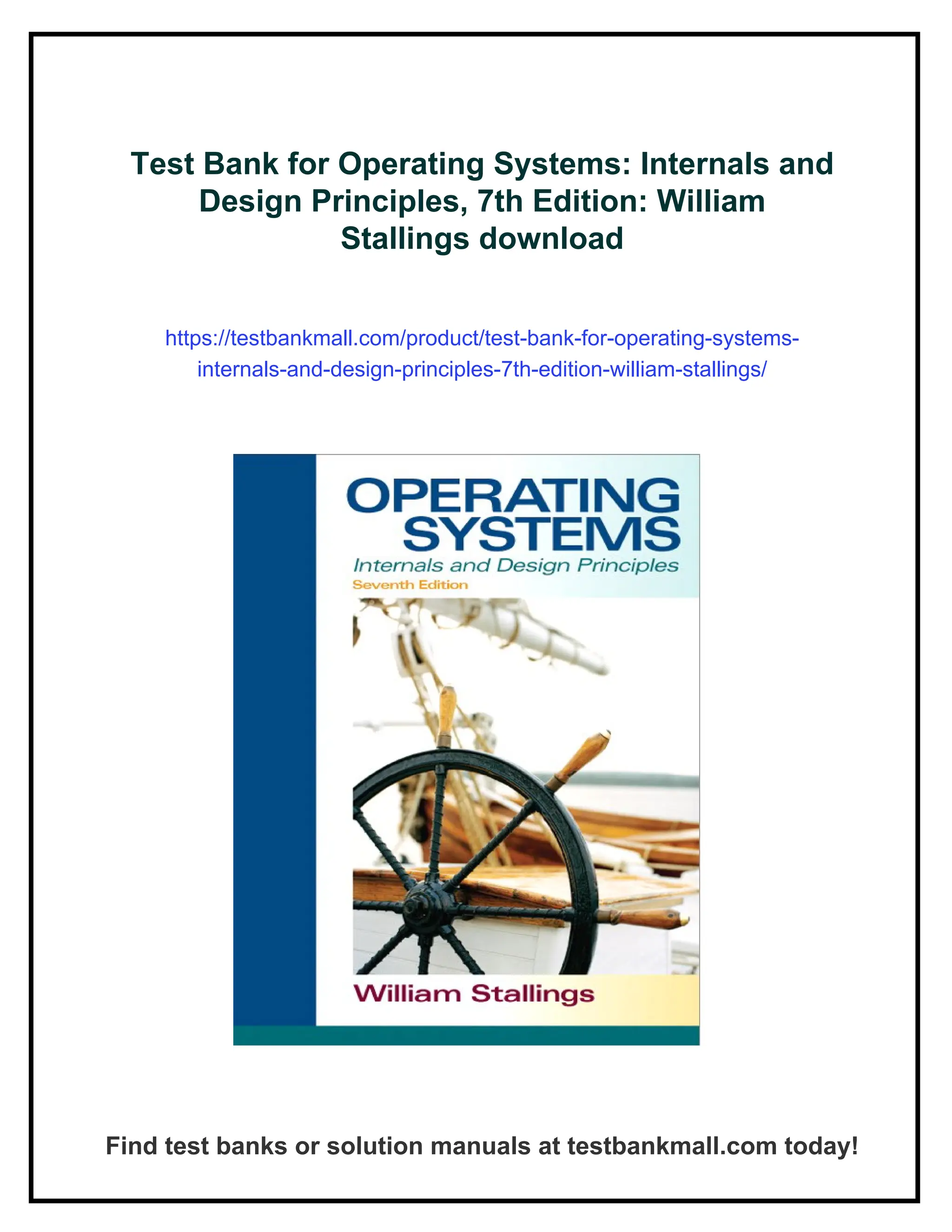
Test Bank for Operating Systems: Internals and
Design Principles, 7th Edition: William
Stallings download
https://testbankmall.com/product/test-bank-for-operating-systems-
internals-and-design-principles-7th-edition-william-stallings/
Find test banks or solution manuals at testbankmall.com today!
We believe these products will be a great fit for you. Click
the link to download now, or visit testbankmall.com
to discover even more!
Test Bank for Operating Systems: Internals and Design
Principles, 8/E 8th Edition : 0133805913
https://testbankmall.com/product/test-bank-for-operating-systems-
internals-and-design-principles-8-e-8th-edition-0133805913/
Solution Manual for Operating Systems: Internals and
Design Principles, 8/E 8th Edition : 0133805913
https://testbankmall.com/product/solution-manual-for-operating-
systems-internals-and-design-principles-8-e-8th-edition-0133805913/
Cryptography and Network Security Principles and Practice
6th Edition William Stallings Test Bank
https://testbankmall.com/product/cryptography-and-network-security-
principles-and-practice-6th-edition-william-stallings-test-bank/
Test Bank for LeMone and Burkes Medical Surgical Nursing
7th Edition by Bauldoff
https://testbankmall.com/product/test-bank-for-lemone-and-burkes-
medical-surgical-nursing-7th-edition-by-bauldoff/
Maders Understanding Human Anatomy and Physiology 8th
Edition Susannah Nelson Longenbaker Test Bank
https://testbankmall.com/product/maders-understanding-human-anatomy-
and-physiology-8th-edition-susannah-nelson-longenbaker-test-bank/
Test Bank for Human Resource Management, 12th Edition:
Dessler
https://testbankmall.com/product/test-bank-for-human-resource-
management-12th-edition-dessler/
Test Bank for Essentials of Statistics for Business and
Economics 9th Edition David R. Anderson
https://testbankmall.com/product/test-bank-for-essentials-of-
statistics-for-business-and-economics-9th-edition-david-r-anderson/
Test Bank for Precalculus, 5th Edition, Blitzer
https://testbankmall.com/product/test-bank-for-precalculus-5th-
edition-blitzer/
Solution Manual for Introduction to Mechatronic Design by
Carryer
https://testbankmall.com/product/solution-manual-for-introduction-to-
mechatronic-design-by-carryer/
Solution Manual for Succeeding in Business with Microsoft
Excel 2013 A Problem-Solving Approach, 1st Edition
https://testbankmall.com/product/solution-manual-for-succeeding-in-
business-with-microsoft-excel-2013-a-problem-solving-approach-1st-
edition/
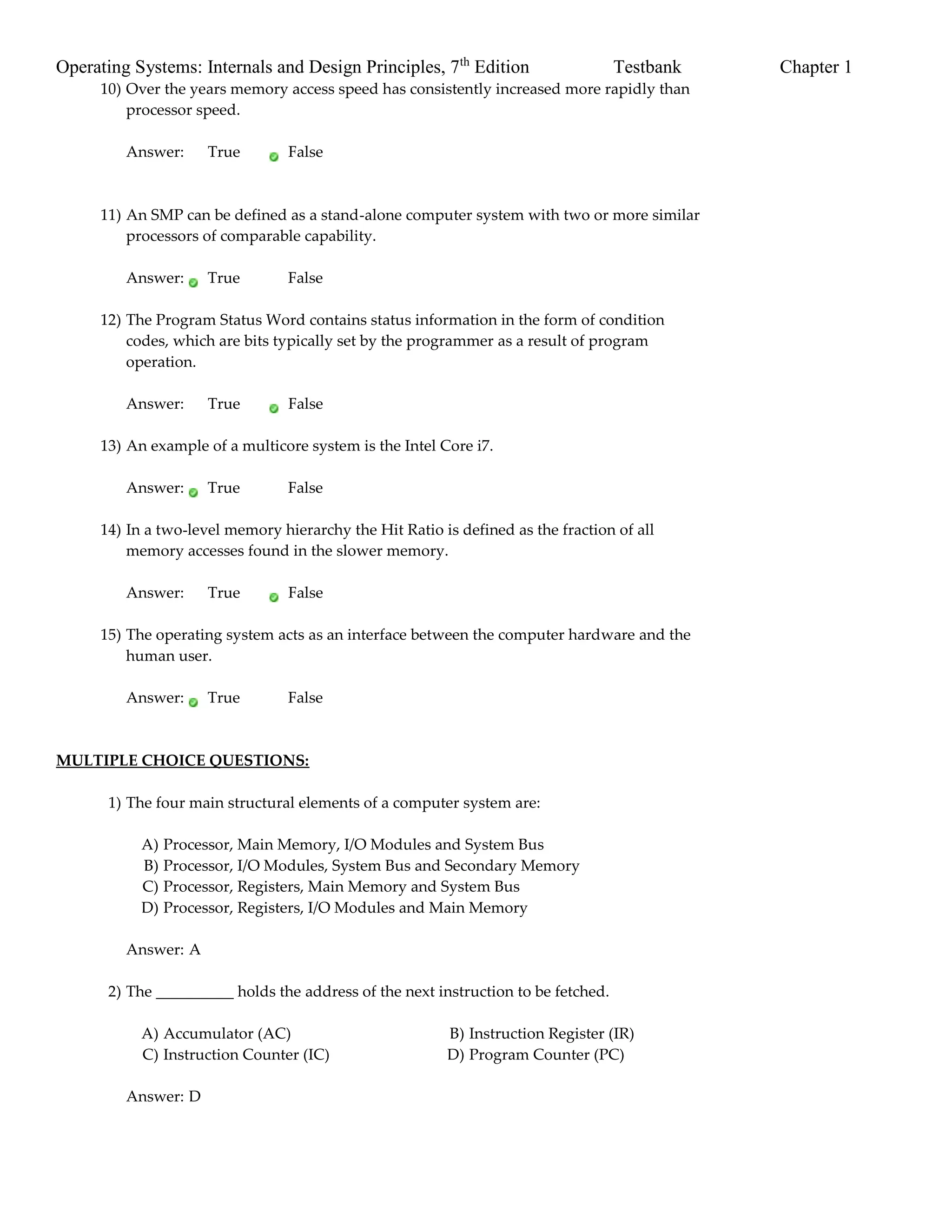
Operating Systems: Internals and Design Principles, 7th
Edition Testbank Chapter 1
10) Over the years memory access speed has consistently increased more rapidly than
processor speed.
Answer: True False
11) An SMP can be defined as a stand-alone computer system with two or more similar
processors of comparable capability.
Answer: True False
12) The Program Status Word contains status information in the form of condition
codes, which are bits typically set by the programmer as a result of program
operation.
Answer: True False
13) An example of a multicore system is the Intel Core i7.
Answer: True False
14) In a two-level memory hierarchy the Hit Ratio is defined as the fraction of all
memory accesses found in the slower memory.
Answer: True False
15) The operating system acts as an interface between the computer hardware and the
human user.
Answer: True False
MULTIPLE CHOICE QUESTIONS:
1) The four main structural elements of a computer system are:
A) Processor, Main Memory, I/O Modules and System Bus
B) Processor, I/O Modules, System Bus and Secondary Memory
C) Processor, Registers, Main Memory and System Bus
D) Processor, Registers, I/O Modules and Main Memory
Answer: A
2) The __________ holds the address of the next instruction to be fetched.
A) Accumulator (AC) B) Instruction Register (IR)
C) Instruction Counter (IC) D) Program Counter (PC)
Answer: D
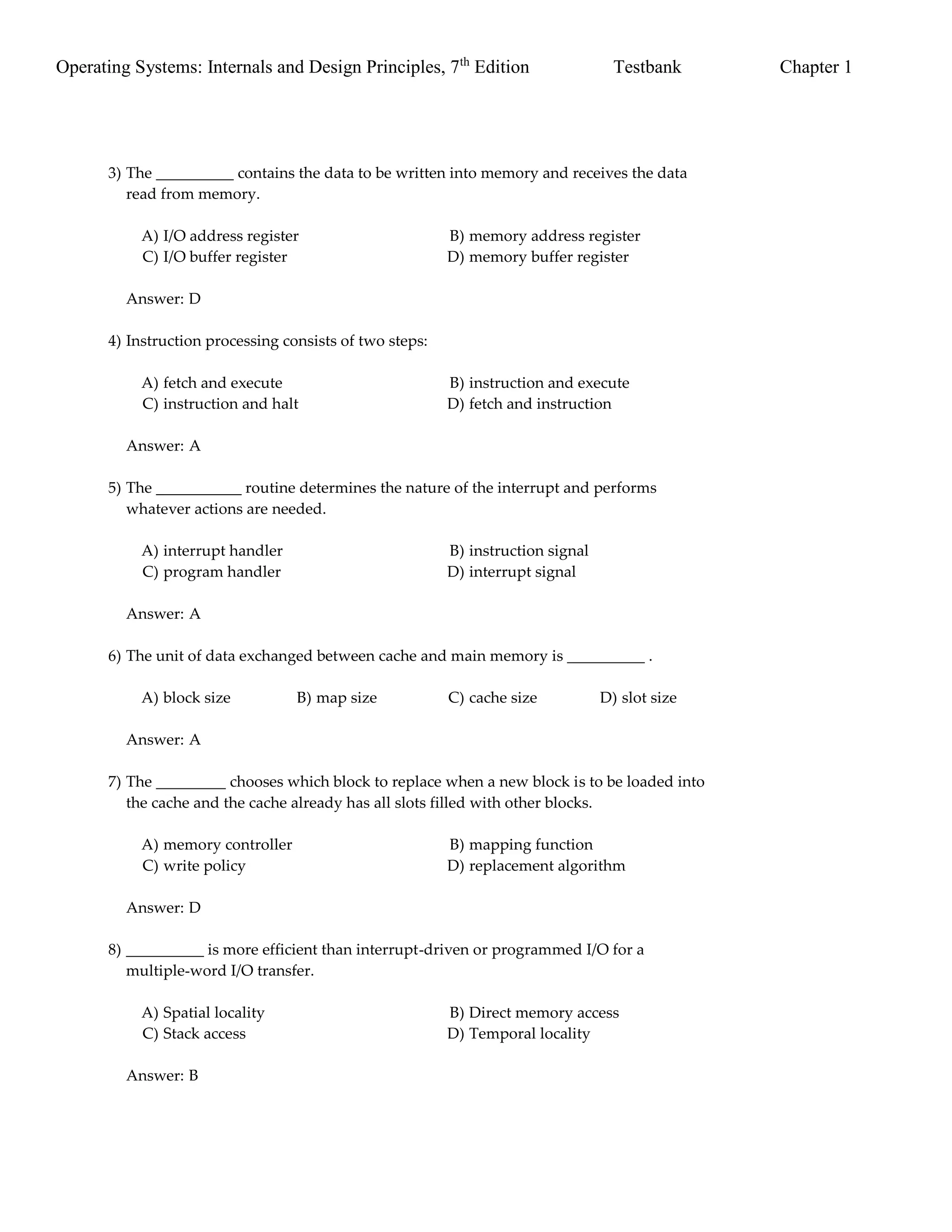
Operating Systems: Internals and Design Principles, 7th
Edition Testbank Chapter 1
3) The __________ contains the data to be written into memory and receives the data
read from memory.
A) I/O address register B) memory address register
C) I/O buffer register D) memory buffer register
Answer: D
4) Instruction processing consists of two steps:
A) fetch and execute B) instruction and execute
C) instruction and halt D) fetch and instruction
Answer: A
5) The ___________ routine determines the nature of the interrupt and performs
whatever actions are needed.
A) interrupt handler B) instruction signal
C) program handler D) interrupt signal
Answer: A
6) The unit of data exchanged between cache and main memory is __________ .
A) block size B) map size C) cache size D) slot size
Answer: A
7) The _________ chooses which block to replace when a new block is to be loaded into
the cache and the cache already has all slots filled with other blocks.
A) memory controller B) mapping function
C) write policy D) replacement algorithm
Answer: D
8) __________ is more efficient than interrupt-driven or programmed I/O for a
multiple-word I/O transfer.
A) Spatial locality B) Direct memory access
C) Stack access D) Temporal locality
Answer: B
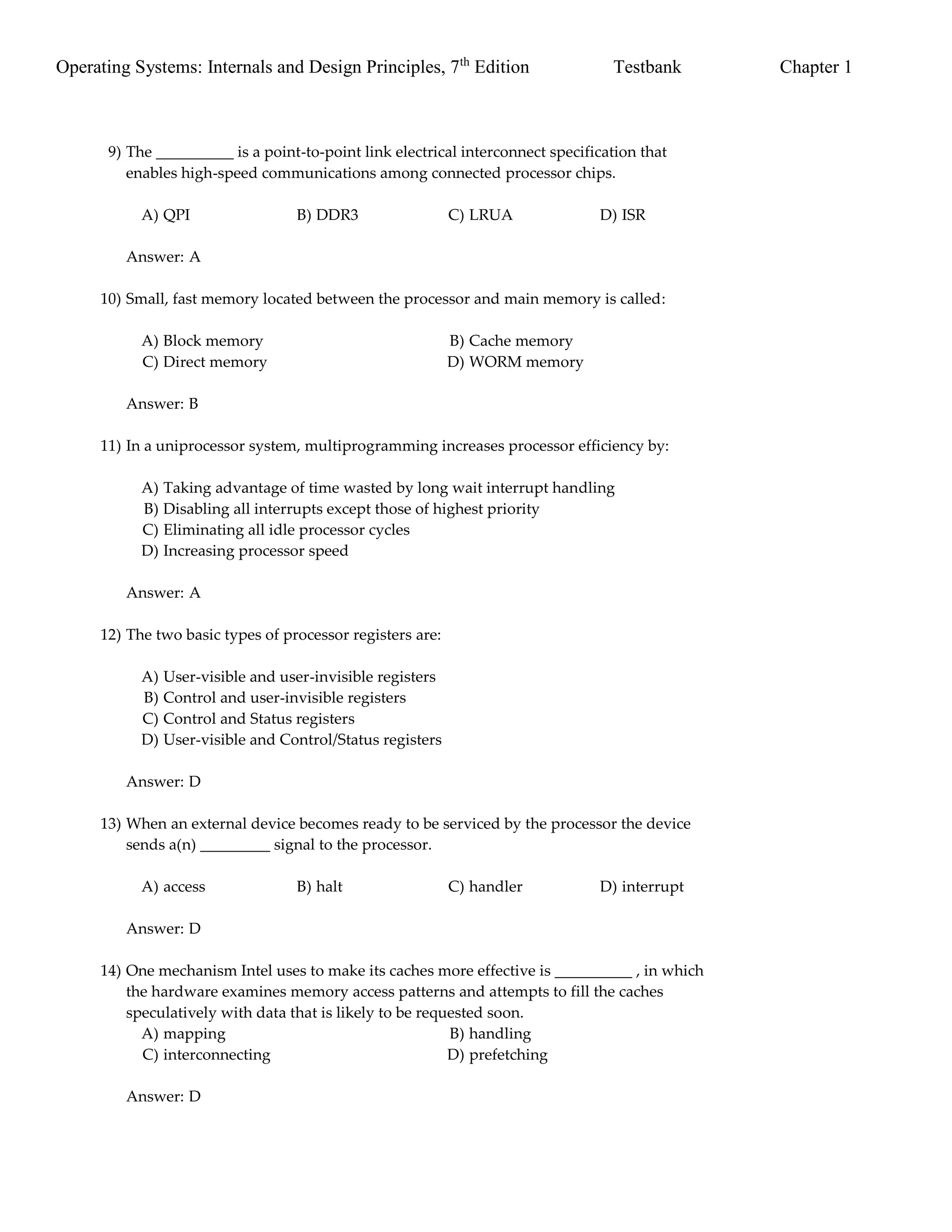
Operating Systems: Internals and Design Principles, 7th
Edition Testbank Chapter 1
9) The __________ is a point-to-point link electrical interconnect specification that
enables high-speed communications among connected processor chips.
A) QPI B) DDR3 C) LRUA D) ISR
Answer: A
10) Small, fast memory located between the processor and main memory is called:
A) Block memory B) Cache memory
C) Direct memory D) WORM memory
Answer: B
11) In a uniprocessor system, multiprogramming increases processor efficiency by:
A) Taking advantage of time wasted by long wait interrupt handling
B) Disabling all interrupts except those of highest priority
C) Eliminating all idle processor cycles
D) Increasing processor speed
Answer: A
12) The two basic types of processor registers are:
A) User-visible and user-invisible registers
B) Control and user-invisible registers
C) Control and Status registers
D) User-visible and Control/Status registers
Answer: D
13) When an external device becomes ready to be serviced by the processor the device
sends a(n) _________ signal to the processor.
A) access B) halt C) handler D) interrupt
Answer: D
14) One mechanism Intel uses to make its caches more effective is __________ , in which
the hardware examines memory access patterns and attempts to fill the caches
speculatively with data that is likely to be requested soon.
A) mapping B) handling
C) interconnecting D) prefetching
Answer: D
Operating Systems: Internals and Design Principles, 7th
Edition Testbank Chapter 1
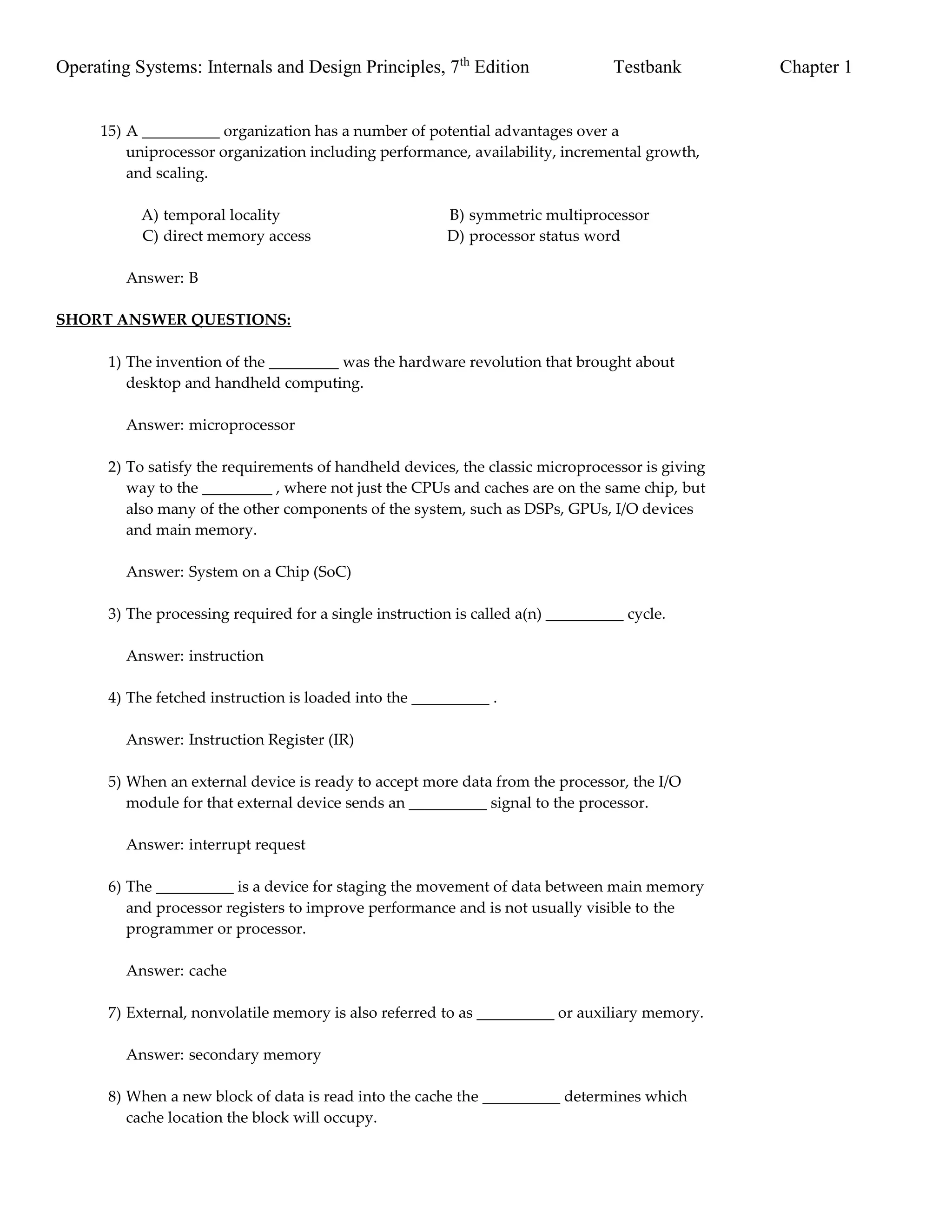
15) A __________ organization has a number of potential advantages over a
uniprocessor organization including performance, availability, incremental growth,
and scaling.
A) temporal locality B) symmetric multiprocessor
C) direct memory access D) processor status word
Answer: B
SHORT ANSWER QUESTIONS:
1) The invention of the _________ was the hardware revolution that brought about
desktop and handheld computing.
Answer: microprocessor
2) To satisfy the requirements of handheld devices, the classic microprocessor is giving
way to the _________ , where not just the CPUs and caches are on the same chip, but
also many of the other components of the system, such as DSPs, GPUs, I/O devices
and main memory.
Answer: System on a Chip (SoC)
3) The processing required for a single instruction is called a(n) __________ cycle.
Answer: instruction
4) The fetched instruction is loaded into the __________ .
Answer: Instruction Register (IR)
5) When an external device is ready to accept more data from the processor, the I/O
module for that external device sends an __________ signal to the processor.
Answer: interrupt request
6) The __________ is a device for staging the movement of data between main memory
and processor registers to improve performance and is not usually visible to the
programmer or processor.
Answer: cache
7) External, nonvolatile memory is also referred to as __________ or auxiliary memory.
Answer: secondary memory
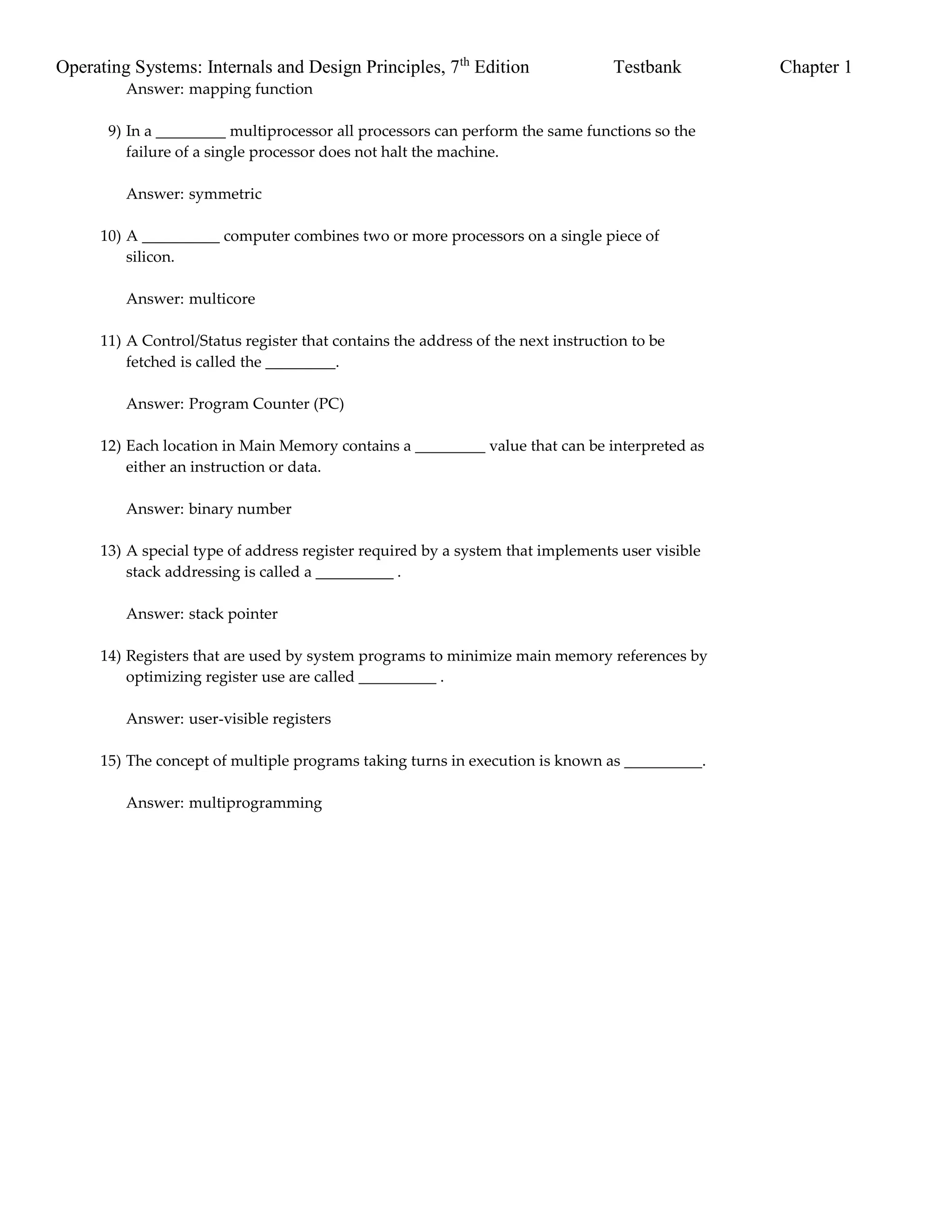
8) When a new block of data is read into the cache the __________ determines which
cache location the block will occupy.
Operating Systems: Internals and Design Principles, 7th
Edition Testbank Chapter 1
Answer: mapping function
9) In a _________ multiprocessor all processors can perform the same functions so the
failure of a single processor does not halt the machine.
Answer: symmetric
10) A __________ computer combines two or more processors on a single piece of
silicon.
Answer: multicore
11) A Control/Status register that contains the address of the next instruction to be
fetched is called the _________.
Answer: Program Counter (PC)
12) Each location in Main Memory contains a _________ value that can be interpreted as
either an instruction or data.
Answer: binary number
13) A special type of address register required by a system that implements user visible
stack addressing is called a __________ .
Answer: stack pointer
14) Registers that are used by system programs to minimize main memory references by
optimizing register use are called __________ .
Answer: user-visible registers
15) The concept of multiple programs taking turns in execution is known as __________.
Answer: multiprogramming
Random documents with unrelated
content Scribd suggests to you:
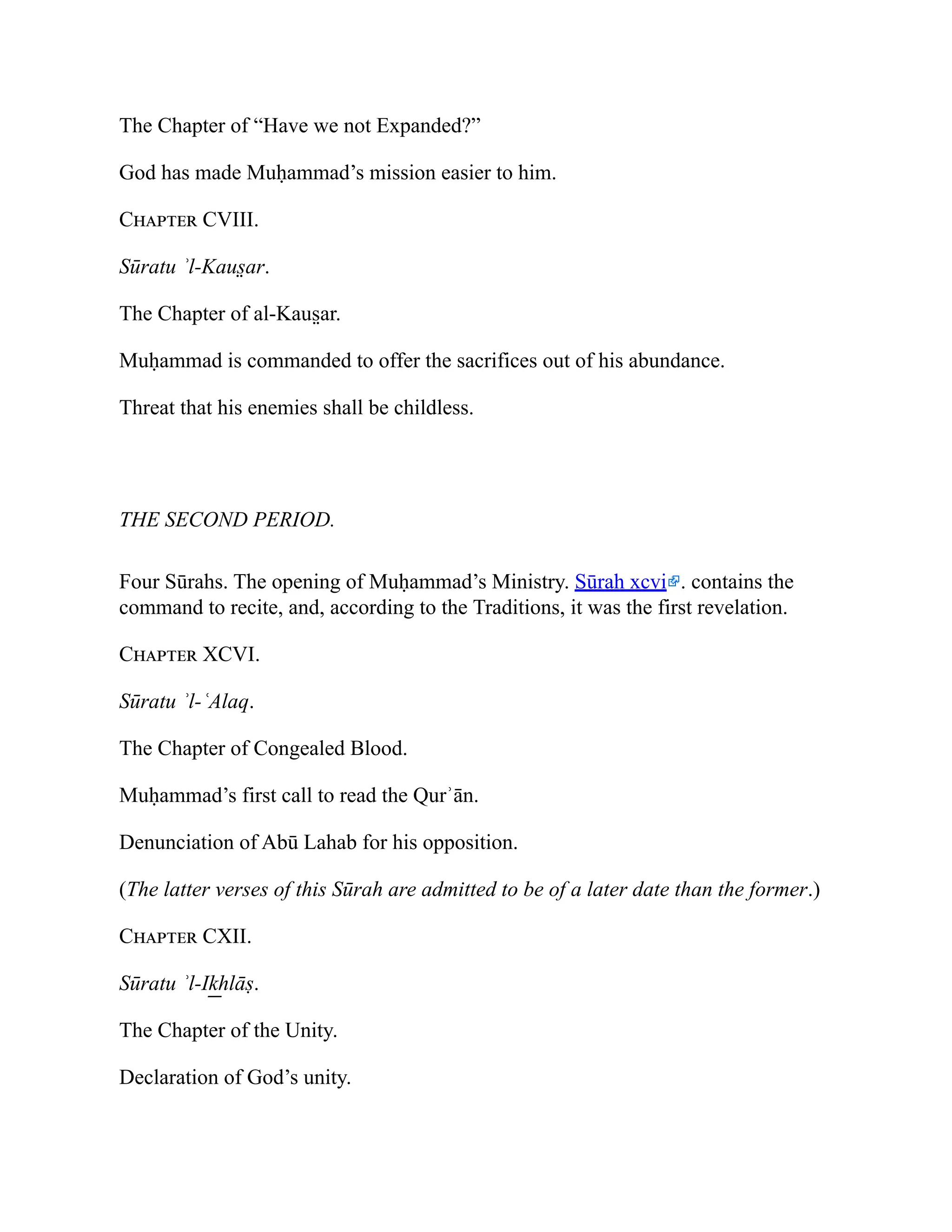
The Chapter of “Have we not Expanded?”
God has made Muḥammad’s mission easier to him.
Chapter CVIII.
Sūratu ʾl-Kaus̤ ar.
The Chapter of al-Kaus̤ ar.
Muḥammad is commanded to offer the sacrifices out of his abundance.
Threat that his enemies shall be childless.
THE SECOND PERIOD.
Four Sūrahs. The opening of Muḥammad’s Ministry. Sūrah xcvi . contains the
command to recite, and, according to the Traditions, it was the first revelation.
Chapter XCVI.
Sūratu ʾl-ʿAlaq.
The Chapter of Congealed Blood.
Muḥammad’s first call to read the Qurʾān.
Denunciation of Abū Lahab for his opposition.
(The latter verses of this Sūrah are admitted to be of a later date than the former.)
Chapter CXII.
Sūratu ʾl-Ik͟ hlāṣ.
The Chapter of the Unity.
Declaration of God’s unity.
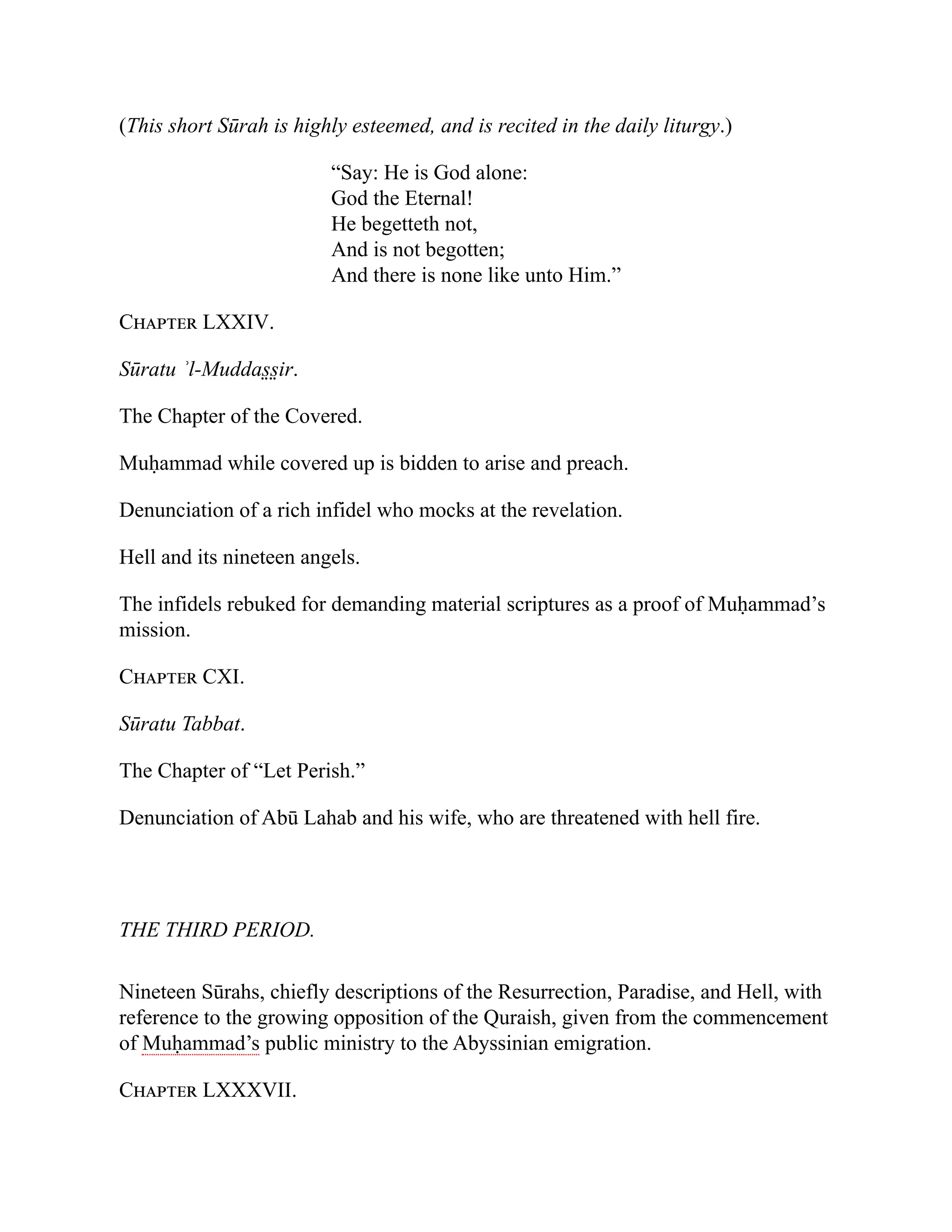
(This short Sūrah is highly esteemed, and is recited in the daily liturgy.)
“Say: He is God alone:
God the Eternal!
He begetteth not,
And is not begotten;
And there is none like unto Him.”
Chapter LXXIV.
Sūratu ʾl-Muddas̤ s̤ ir.
The Chapter of the Covered.
Muḥammad while covered up is bidden to arise and preach.
Denunciation of a rich infidel who mocks at the revelation.
Hell and its nineteen angels.
The infidels rebuked for demanding material scriptures as a proof of Muḥammad’s
mission.
Chapter CXI.
Sūratu Tabbat.
The Chapter of “Let Perish.”
Denunciation of Abū Lahab and his wife, who are threatened with hell fire.
THE THIRD PERIOD.
Nineteen Sūrahs, chiefly descriptions of the Resurrection, Paradise, and Hell, with
reference to the growing opposition of the Quraish, given from the commencement
of Muḥammad’s public ministry to the Abyssinian emigration.
Chapter LXXXVII.
Sūratu ʾl-Aʿlā.
The Chapter of the Most High.
Muḥammad shall not forget any of the revelation save what God pleases.
The revelation is the same as that given to Abraham and Moses.
Chapter XCVII.
Sūratu ʾl-Qadr.
The Chapter of Power.
The Qurʾān revealed on the night of power.
Its excellence.
Angels descend thereon.
Chapter LXXXVIII.
Sūratu ʾl-G͟ hāshiyah.
The Chapter of the Overwhelming.
Description of the Last Day, Heaven and Hell.
Chapter LXXX.
Sūratu ʿAbasa.
The Chapter “he Frowned.”
The Prophet rebuked for frowning on a poor blind believer.
The Creation and Resurrection.
Chapter LXXXIV.
Sūratu ʾl-Inshiqāq.
The Chapter of the Rending Asunder.
Signs of the Judgment Day.
The books of men’s actions.
The Resurrection.
Denunciation of misbelievers.
Chapter LXXXI.
Sūratu ʾl-Takwīr.
The Chapter of the Folding-up.
Terrors of the Judgment Day.
The female child who has been buried alive will demand vengeance.
Allusion to the Prophet’s vision of Gabriel on Mount Ḥirāʾ.
He is vindicated from the charge of madness.
Chapter LXXXVI.
Sūratu ʾt̤-T̤ āriq.
The Chapter of the Night Star.
By the night-star, every soul has a guardian angel.
Creation and resurrection of man.
The plot of the infidels shall be frustrated.
Chapter CX.
Sūratu ʾn-Naṣr.
The Chapter of Help.
Prophecy that men shall join Islām by troops.
Chapter LXXXV.
Sūratu ʾl-Burūj.
The Chapter of the Zodiacal Signs.
Denunciation of those who persecute believers.
Example of the fate of Pharaoh and S̤ amūd.
Chapter LXXXIII.
Sūratu ʾt-Tat̤fīf.
The Chapter of those who give Short Weight.
Fraudulent traders are warned.
Sijjīn, the register of the acts of the wicked.
Hell and heaven.
Chapter LXXVIII.
Sūratu ʾn-Nabaʾ.
The Chapter of the Information.
Description of the Day of Judgment, hell, and heaven.
Chapter LXXVII.
Sūratu ʾl-Mursalāt.
The Chapter of Messengers.
Oath by the angels who execute God’s behests.
Terrors of the Last Day.
Hell and Heaven.
Chapter LXXVI.
Sūratu ʾd-Dahr.
The Chapter of Time.
Man’s conception and birth.
Unbelievers warned and believers promised a reward.
Exhortation to charity.
Bliss of the charitable in Paradise.
The Qurʾān revealed by degrees.
Only those believe whom God wills.
Chapter LXXV.
Sūratu ʾl-Qiyāmah.
The Chapter of Resurrection.
The Resurrection.
Muḥammad is bidden not to be hurried in repeating the Qurʾān so as to commit it
to memory.
Dying agony of an infidel.
Chapter LXX.
Sūratu ʾl-Maʿārij.
The Chapter of the Ascents.
An unbeliever mockingly calls for a judgment on himself and his companions.
The terrors of the Judgment Day.
Man’s ingratitude.
Adultery denounced.
Certainty of the Judgment Day.
Chapter CIX.
Sūratu ʾl-Kāfirūn.
The Chapter of the Misbelievers.
The Prophet will not follow the religion of the misbelievers.
Chapter CVII.
Sūratu ʾl-Māʿūn.
The Chapter of Necessaries.
Denunciation of the unbelieving and uncharitable.
Chapter LV.
Sūratu ʾr-Raḥmān.
The Chapter of the Merciful.
An enumeration of the works of the Lord ending with a description of Paradise and
Hell.
A refrain runs throughout this chapter:—
“Which then of your Lord’s bounties do ye twain deny?”
Chapter LVI.
Sūratu ʾl-Wāqiʿah.
The Chapter of the Inevitable.
Terrors of the inevitable Day of Judgment.
Description of Paradise and Hell.
Proofs in Nature.
None but the clean may touch the Qurʾān.
The condition of a dying man.
THE FOURTH PERIOD.
Twenty-two Sūrahs, given from the sixth to the tenth year of Muḥammad’s
ministry. With this period begin the narratives of the Jewish Scriptures, and
Rabbinical and Arab legends. The temporary compromise with idolatry is
connected with Sūrah liii .
Chapter LXVII.
Sūratu ʾl-Mulk.
The Chapter of the Kingdom.
God the Lord of heavens.
The marvels thereof.
The discomfiture of the misbelievers in Hell.
The power of God exhibited in Nature.
Warnings and threats of punishment.
Chapter LIII.
Sūratu ʾn-Najm.
The Chapter of the Star.
Oath by the star that Muḥammad’s vision of his ascent to heaven was not a
delusion.
Description of the same.
The amended passage relating to idolatry.
Wickedness of asserting the angels to be females.
God’s Omniscience.
Rebuke of an apostle who paid another to take upon him his burden at the
Judgment Day.
Definition of true religion.
God’s attributes.
Chapter XXXII.
Sūratu ʾs-Sajdah.
The Chapter of Adoration.
The Qurʾān is truth from the Lord.
God the Creator and Governor.
The Resurrection.
Conduct of true believers when they hear the word.
Their reward.
The punishment of misbelievers.
Description of Hell.
The people are exhorted to believe and are admonished by the fate of the ruined
cities they see around them.
They are warned of the Judgment Day.
Chapter XXXIX.
Sūratu ʾz-Zumar.
The Chapter of the Troops.
Rebuke to the idolaters who say they serve false gods as a means of access to God
himself.
The unity of God, the Creator and Controller of the universe.
His independence and omnipotence.
Ingratitude of man for God’s help.
Difference between the believers and unbelievers.
Muḥammad is called to sincerity of religion and to Islām.
He is to fear the torment at the Judgment Day if he disobeys the call.
Hell-fire is prepared for the infidels.
Paradise promised to those who avoid idolatry.
The irrigation of the soil and the growth of corn are signs.
The Qurʾān makes the skin of those who fear God creep.
Threat of the Judgment Day.
The Makkans are warned by the fate of their predecessors not to reject the Qurʾān.
Parable showing the uncertain position of the idolaters.
Muḥammad not immortal.
Warning to those who lie against God, and promise of reward to those who assert
the truth.
Muḥammad is not to be frightened with the idols of the Makkans.
Their helplessness demonstrated.
The Qurʾān is a guide, but the Prophet cannot compel men to follow it.
Human souls are taken to God during sleep, and those who are destined to live on
are sent back.
No intercession allowed with God.
The doctrine of the unity of God terrifies the idolaters.
Prayer to God to decide between them.
The infidels will regret on the Resurrection Day.
Ingratitude of man for God’s help in trouble.
The Makkans are warned by the fate of their predecessors.
Exhortation to repentance before it is too late.
Salvation of the God-fearing.
God the creator and controller of everything.
Description of the Last Judgment.
All souls driven in troops to heaven or to hell.
Chapter LXXIII.
Sūratu ʾl-Muzzammil.
The Chapter of the Enwrapped.
Muḥammad, when wrapped up in his mantle, is bidden to arise and pray.
Is bidden to repeat the Qurʾān and to practice devotion by night.
He is to bear with the unbelievers for a while.
Pharaoh rejected the apostle sent to him.
Stated times for prayer prescribed.
Almsgiving prescribed.
Chapter LXXIX.
Sūratu ʾn-Nāziʿāt.
The Chapter of those who Tear Out.
The coming of the Day of Judgment.
The call of Moses.
His interview with Pharaoh.
Chastisement of the latter.
The Creation and Resurrection.
Chapter LIV.
Sūratu ʾl-Qamar.
The Chapter of the Moon.
The splitting asunder of the moon.
Muḥammad accused of imposture.
The Makkans warned by the stories of Noah and the Deluge, of S̤ amūd, the people
of Sodom, and Pharaoh.
The sure coming of the Judgment.
Chapter XXXIV.
Sūratu Sabaʾ.
The Chapter of Sabaʾ.
The omniscience of God.
Those who have received knowledge recognise the revelation.
The unbelievers mock at Muḥammad for preaching the Resurrection.
The birds and mountains sing praises with David.
Iron softened for him.
He makes coats of mail.
The wind subjected to Solomon.
A fountain of brass made to flow for him.
The jinns compelled to work for him.
His death only discovered by means of the worm that gnawed.
The staff that supported his corpse.
The prosperity of Sabaʾ.
Bursting of the dyke (al-ʿArim) and ruin of the town.
Helplessness of the false gods.
They cannot intercede for their worshippers when assembled at the Last Day.
Fate of the misbelievers on that day.
The proud and the weak shall dispute as to which misled the others.
The affluence of the Makkans will only increase their ruin.
The angels shall disown the worshippers of false gods.
The Makkans accuse Muḥammad of imposture.
So did other nations deal with their Prophets and were punished for it.
Muḥammad is cleared of the suspicion of insanity.
The wretched plight of the misbelievers on the Last Day.
Chapter XXXI.
Sūratu Luqmān.
The Chapter of Luqmān.
The Qurʾān a guidance to believers.
Denunciation of one who purchased Persian legends and preferred them to the
Qurʾān.
God in Nature.
Other gods can create nothing.
Wisdom granted to Luqmān.
His advice to his son.
The obstinacy of the infidels rebuked.
If the sea were ink and the trees pens, they would not suffice to write the words of
the Lord.
God manifest in the night and day, in the sun and moon, and in rescuing men from
dangers by sea.
God only knows the future.
Chapter LXIX.
Sūratu ʾl-Ḥāqqah.
The Chapter of the Inevitable.
The inevitable judgment.
Fate of those who denied it, of ʿĀd, S̤ amūd, and Pharaoh.
The Deluge and the Last Judgment.
Vindication of Muḥammad from the charge of having forged the Qurʾān.
Chapter LXVIII.
Sūratu ʾl-Qalam.
The Chapter of the Pen.
Muḥammad is neither mad nor an impostor.
Denounced by an insolent opponent.
Example from the fate of the owner of the gardens.
Unbelievers threatened.
Muḥammad exhorted to be patient and not to follow the example of Jonah.
Chapter XLI.
Sūratu Fuṣṣilat.
The Chapter “Are Detailed.”
The Makkans are called on to believe the Qurʾān.
The creation of the heavens and the earth.
Warning from the fate of ʿĀd and S̤ amūd.
The very skins of the unbelievers shall bear witness against them on the Day of
Judgement.
Punishment of those who reject the Qurʾān.
The angels descend and encourage those who believe.
Precept to return good for evil.
Refuge to be sought with God against temptation from the devil.
Against sun and moon worship.
The angels praise God, though the idolators are too proud to do so.
The quickening of the earth with rain is a sign.
The Qurʾān a confirmation of previous scriptures.
If it had been revealed in a foreign tongue the people would have objected that they
could not understand it, and that the Prophet, being an Arab, should have had a
revelation in his own language.
Moses’ scripture was also the subject of dispute.
God is omniscient.
The false gods will desert their worshippers at the Resurrection.
Man’s ingratitude for God’s help in trouble.
God is sufficient witness of the truth.
Chapter LXXI.
Sūratu Nūḥ.
The Chapter of Noah.
Noah’s preaching to the Antediluvians.
Their five idols also worshipped by the Arabs.
Their fate.
Chapter LII.
Sūratu ʾt̤-T̤ ūr.
The Chapter of the Mount.
Oath by Mount Sinai and other things.
Terrors of the Last Day.
Bliss of Paradise.
Muḥammad is neither a madman, soothsayer, poet, nor impostor.
Reproof of the Makkans for their superstitions, and for proudly rejecting the
Prophet.
Chapter L.
Sūratu Qāf.
The Chapter of Qāf.
Proofs in nature of a future life.
Example of the fate of the nations of old who rejected the apostles.
Creation of man.
God’s proximity to him.
The two recording angels.
Death and Resurrection.
The Last Judgment and exhortation to believe.
Chapter XLV.
Sūratu ʾl-Jās̤ iyah.
The Chapter of the Kneeling.
God revealed in nature.
Denunciation of the infidels.
Trading by sea a sign of God’s providence.
The law first given to Israel, then to Muḥammad in the Qurʾān.
Answer to the infidels who deny the Resurrection, and warning of their fate on that
day.
Chapter XLIV.
Sūratu ʾd-Duk͟ hān.
The Chapter of the Smoke.
Night of the revelation of the Qurʾān.
Unity of God.
Threat of the Last Day, when a smoke shall cover the heavens, and the unbelievers
shall be punished for rejecting the Prophet, and saying he is taught by others or
distracted.
Fate of Pharaoh for rejecting Moses.
Fate of the people of Jubbaʿ.
The Judgment Day.
The tree Zaqqūm and the punishment of hell.
Paradise and the virgins thereof.
The Qurʾān revealed in Arabic for an admonition.
Chapter XXXVII.
Sūratu ʾṣ-Ṣāffāt.
The Chapter of the Ranged.
Oath by the angels ranged in rank, by those who drive the clouds, and by those
who rehearse the Qurʾān, that God is one alone!
They guard the gates of heaven, and pelt the devils, who would listen there, with
shooting-stars.
Do the Makkans imagine themselves stronger than the angels, that they mock of
God’s signs and deny the Resurrection?
The false gods and the Makkans shall recriminate each other at the Judgment Day.
They say now, “Shall we leave our gods for a mad poet?”
They shall taste hell-fire for their unbelief, while the believers are in Paradise.
Description of the delights thereof.
The maidens there.
The blessed shall see their unbelieving former comrades in hell.
Immortality of the blessed.
Az-Zaqqūm the accursed tree in hell.
Horrors of that place.
The posterity of Noah were blessed.
Abraham mocks at and breaks the idols.
He is condemned to be burnt alive, but is delivered.
Is commanded to offer up his son as a sacrifice; obeys, but his son is spared.
His posterity is blessed.
Moses and Aaron, too, left a good report behind them; so, too, did Elias, who
protested against the worship of Baal.
Lot was saved.
Jonah was delivered after having been thrown overboard and swallowed by a fish.
The gourd.
Jonah is sent to preach to the people of the city (of Nineveh).
The Makkans rebuked for saying that God has daughters, and for saying that He is
akin to the jinns.
The angels declare that they are but the humble servants of God.
The success of the Prophet and the confusion of the infidels foretold.
Chapter XXX.
Sūratu ʾr-Rūm.
The Chapter of the Greeks.
Victory of the Persians over the Greeks.
Prophecy of the coming triumph of the latter.
The Makkans warned by the fate of former cities.
The idols shall forsake them at the Resurrection.
The believers shall enter Paradise.
God is to be praised in the morning and evening and at noon and sunset.
His creation of man and of the universe and His providence are signs.
He is the incomparable Lord of all.
Warning against idolatry and schism.
Honesty inculcated and usury reproved.
God only creates and kills.
Corruption in the earth through sin.
The fate of former idolaters.
Exhortation to believe before the sudden coming of the Judgment Day.
God’s sending rain to quicken the earth is a sign of His power.
Muḥammad cannot make the deaf hear his message.
Warning of the Last Day.
Chapter XXVI.
Sūratu ʾsh-Shuʿarāʾ.
The Chapter of the Poets.
Muḥammad is not to be vexed by the people’s unbelief.
Though called a liar now, his cause shall triumph in the end.
Moses and Pharaoh.
He fears lest he may be killed for slaying the Egyptian.
Pharaoh charges him with ingratitude.
Their dispute about God.
Pharaoh claims to be God himself.
The miracles of the rod and the white hand.
Moses’ contest with the magicians.
The magicians are conquered and believe.
Pharaoh threatens them with condign punishment.
The Israelites leave Egypt and are pursued.
The passing of the Red Sea and destruction of Pharaoh and his hosts.
The history of Abraham.
He preaches against idolatry.
Noah is called a liar and vindicated.
Hūd preaches to the people of ʿĀd and Ṣāliḥ to S̤ amūd.
The latter hamstring the she-camel and perish.
The crime and punishment of the people of Sodom.
The people of the Grove and the prophet Shuʿaib.
The Qurʾān revealed through the instrumentality of the Faithful Spirit (Gabriel) in
plain Arabic.
The learned Jews recognise its truth from the prophecies in their own scriptures.
The devils could not have brought it.
Muḥammad is to be meek towards believers and to warn his clansmen.
Those upon whom the devils descend, namely, the poets who wander distraught in
every vale.
Chapter XV.
Sūratu ʾl-Ḥijr.
The Chapter of al-Ḥijr.
Misbelievers will one day regret their misbelief.
No city was ever destroyed without warning.
The infidels mockingly ask Muḥammad to bring down angels to punish them.
So did the sinners of old act towards their apostles.
There are signs enough in the zodiac, guarded as they are from the devils who are
pelted with shooting-stars if they attempt to listen.
All nature is under God’s control.
Man created from clay, and jinn from smokeless fire.
The angels bidden to adore Adam.
The devil refuses, is cursed and expelled, but respited until the Day of Judgment.
Is allowed to seduce mankind.
Hell, with its seven doors, promised to misbelievers, and Paradise to believers.
Story of Abraham’s angelic guests.
They announce to him the birth of a son.
They proceed to Lot’s family.
The crime and punishment of the people of Sodom.
The ruined cities still remain to tell the tale.
Similar fate of the people of the Grove and of al-Ḥijr.
The hour draws nigh.
The Lord Omniscient Creator has sent the Qurʾān and the seven verses of
repetition.
Muḥammad is not to grieve at the worldly success of unbelievers.
Those who dismember the Qurʾān are threatened with punishment.
Muḥammad is encouraged against the misbelievers.
Chapter LI.
Sūratu ʾẕ-Ẕāriyāt.
The Chapter of the Scatterers.
Oaths by different natural phenomena that the Judgment Day will come.
Story of Abraham’s entertaining the angels.
The destruction of Sodom.
Fate of Pharaoh, of ʿĀd, of S̤ amūd, and of the people of Noah.
Vindication of Muḥammad against the charges of imposture or madness.
THE FIFTH PERIOD.
Thirty-one Sūrahs. From the tenth year of Muḥammad’s ministry to the flight from
Makkah.
The Sūrahs of this period contain some narratives from the gospel. The rites of
pilgrimage are enjoined. The cavillings of the Quraish are refuted; and we have
vivid picturings of the Resurrection and Judgment, of Heaven and Hell, with
proofs of God’s unity, power and providence.
From stage to stage the Sūrahs become, on the average, longer, and some of them
now fill many pages. In the latter Sūrahs of this period, we meet not unfrequently
with Madīnah passages, which have been interpolated as bearing on some
connected subject. As examples may be taken, verse 40 of Sūrah xxii ., in which
permission is given to bear arms against the Makkans; verse 33, Sūrah xvii .,
containing rules for the administration of justice; verse 111, Sūrah xvi ., referring
to such believers as had fled their country and fought for the faith; being all
passages which could have been promulgated only after the Flight to al-Madīnah.
Chapter XLVI.
Sūratu ʾl-Aḥqāf.
The Chapter of al-Aḥqāf.
God the only God and Creator.
The unbelievers call Muḥammad a sorcerer or a forger.
The book of Moses was revealed before, and the Qurʾān is a confirmation of it in
Arabic.
Conception, birth, and life of man.
Kindness to parents and acceptance of Islām enjoined.
Welcome to our website – the perfect destination for book lovers and
knowledge seekers. We believe that every book holds a new world,
offering opportunities for learning, discovery, and personal growth.
That’s why we are dedicated to bringing you a diverse collection of
books, ranging from classic literature and specialized publications to
self-development guides and children's books.
More than just a book-buying platform, we strive to be a bridge
connecting you with timeless cultural and intellectual values. With an
elegant, user-friendly interface and a smart search system, you can
quickly find the books that best suit your interests. Additionally,
our special promotions and home delivery services help you save time
and fully enjoy the joy of reading.
Join us on a journey of knowledge exploration, passion nurturing, and
personal growth every day!
testbankmall.com

Test Bank for Operating Systems: Internals and Design Principles, 7th Edition: William Stallings
  • 1.
    Test Bank forOperating Systems: Internals and Design Principles, 7th Edition: William Stallings download https://testbankmall.com/product/test-bank-for-operating-systems- internals-and-design-principles-7th-edition-william-stallings/ Find test banks or solution manuals at testbankmall.com today!
  • 2.
    We believe theseproducts will be a great fit for you. Click the link to download now, or visit testbankmall.com to discover even more! Test Bank for Operating Systems: Internals and Design Principles, 8/E 8th Edition : 0133805913 https://testbankmall.com/product/test-bank-for-operating-systems- internals-and-design-principles-8-e-8th-edition-0133805913/ Solution Manual for Operating Systems: Internals and Design Principles, 8/E 8th Edition : 0133805913 https://testbankmall.com/product/solution-manual-for-operating- systems-internals-and-design-principles-8-e-8th-edition-0133805913/ Cryptography and Network Security Principles and Practice 6th Edition William Stallings Test Bank https://testbankmall.com/product/cryptography-and-network-security- principles-and-practice-6th-edition-william-stallings-test-bank/ Test Bank for LeMone and Burkes Medical Surgical Nursing 7th Edition by Bauldoff https://testbankmall.com/product/test-bank-for-lemone-and-burkes- medical-surgical-nursing-7th-edition-by-bauldoff/
  • 3.
    Maders Understanding HumanAnatomy and Physiology 8th Edition Susannah Nelson Longenbaker Test Bank https://testbankmall.com/product/maders-understanding-human-anatomy- and-physiology-8th-edition-susannah-nelson-longenbaker-test-bank/ Test Bank for Human Resource Management, 12th Edition: Dessler https://testbankmall.com/product/test-bank-for-human-resource- management-12th-edition-dessler/ Test Bank for Essentials of Statistics for Business and Economics 9th Edition David R. Anderson https://testbankmall.com/product/test-bank-for-essentials-of- statistics-for-business-and-economics-9th-edition-david-r-anderson/ Test Bank for Precalculus, 5th Edition, Blitzer https://testbankmall.com/product/test-bank-for-precalculus-5th- edition-blitzer/ Solution Manual for Introduction to Mechatronic Design by Carryer https://testbankmall.com/product/solution-manual-for-introduction-to- mechatronic-design-by-carryer/
  • 4.
    Solution Manual forSucceeding in Business with Microsoft Excel 2013 A Problem-Solving Approach, 1st Edition https://testbankmall.com/product/solution-manual-for-succeeding-in- business-with-microsoft-excel-2013-a-problem-solving-approach-1st- edition/
  • 5.
    Operating Systems: Internalsand Design Principles, 7th Edition Testbank Chapter 1 10) Over the years memory access speed has consistently increased more rapidly than processor speed. Answer: True False 11) An SMP can be defined as a stand-alone computer system with two or more similar processors of comparable capability. Answer: True False 12) The Program Status Word contains status information in the form of condition codes, which are bits typically set by the programmer as a result of program operation. Answer: True False 13) An example of a multicore system is the Intel Core i7. Answer: True False 14) In a two-level memory hierarchy the Hit Ratio is defined as the fraction of all memory accesses found in the slower memory. Answer: True False 15) The operating system acts as an interface between the computer hardware and the human user. Answer: True False MULTIPLE CHOICE QUESTIONS: 1) The four main structural elements of a computer system are: A) Processor, Main Memory, I/O Modules and System Bus B) Processor, I/O Modules, System Bus and Secondary Memory C) Processor, Registers, Main Memory and System Bus D) Processor, Registers, I/O Modules and Main Memory Answer: A 2) The __________ holds the address of the next instruction to be fetched. A) Accumulator (AC) B) Instruction Register (IR) C) Instruction Counter (IC) D) Program Counter (PC) Answer: D
  • 6.
    Operating Systems: Internalsand Design Principles, 7th Edition Testbank Chapter 1 3) The __________ contains the data to be written into memory and receives the data read from memory. A) I/O address register B) memory address register C) I/O buffer register D) memory buffer register Answer: D 4) Instruction processing consists of two steps: A) fetch and execute B) instruction and execute C) instruction and halt D) fetch and instruction Answer: A 5) The ___________ routine determines the nature of the interrupt and performs whatever actions are needed. A) interrupt handler B) instruction signal C) program handler D) interrupt signal Answer: A 6) The unit of data exchanged between cache and main memory is __________ . A) block size B) map size C) cache size D) slot size Answer: A 7) The _________ chooses which block to replace when a new block is to be loaded into the cache and the cache already has all slots filled with other blocks. A) memory controller B) mapping function C) write policy D) replacement algorithm Answer: D 8) __________ is more efficient than interrupt-driven or programmed I/O for a multiple-word I/O transfer. A) Spatial locality B) Direct memory access C) Stack access D) Temporal locality Answer: B
  • 7.
    Operating Systems: Internalsand Design Principles, 7th Edition Testbank Chapter 1 9) The __________ is a point-to-point link electrical interconnect specification that enables high-speed communications among connected processor chips. A) QPI B) DDR3 C) LRUA D) ISR Answer: A 10) Small, fast memory located between the processor and main memory is called: A) Block memory B) Cache memory C) Direct memory D) WORM memory Answer: B 11) In a uniprocessor system, multiprogramming increases processor efficiency by: A) Taking advantage of time wasted by long wait interrupt handling B) Disabling all interrupts except those of highest priority C) Eliminating all idle processor cycles D) Increasing processor speed Answer: A 12) The two basic types of processor registers are: A) User-visible and user-invisible registers B) Control and user-invisible registers C) Control and Status registers D) User-visible and Control/Status registers Answer: D 13) When an external device becomes ready to be serviced by the processor the device sends a(n) _________ signal to the processor. A) access B) halt C) handler D) interrupt Answer: D 14) One mechanism Intel uses to make its caches more effective is __________ , in which the hardware examines memory access patterns and attempts to fill the caches speculatively with data that is likely to be requested soon. A) mapping B) handling C) interconnecting D) prefetching Answer: D
  • 8.
    Operating Systems: Internalsand Design Principles, 7th Edition Testbank Chapter 1 15) A __________ organization has a number of potential advantages over a uniprocessor organization including performance, availability, incremental growth, and scaling. A) temporal locality B) symmetric multiprocessor C) direct memory access D) processor status word Answer: B SHORT ANSWER QUESTIONS: 1) The invention of the _________ was the hardware revolution that brought about desktop and handheld computing. Answer: microprocessor 2) To satisfy the requirements of handheld devices, the classic microprocessor is giving way to the _________ , where not just the CPUs and caches are on the same chip, but also many of the other components of the system, such as DSPs, GPUs, I/O devices and main memory. Answer: System on a Chip (SoC) 3) The processing required for a single instruction is called a(n) __________ cycle. Answer: instruction 4) The fetched instruction is loaded into the __________ . Answer: Instruction Register (IR) 5) When an external device is ready to accept more data from the processor, the I/O module for that external device sends an __________ signal to the processor. Answer: interrupt request 6) The __________ is a device for staging the movement of data between main memory and processor registers to improve performance and is not usually visible to the programmer or processor. Answer: cache 7) External, nonvolatile memory is also referred to as __________ or auxiliary memory. Answer: secondary memory 8) When a new block of data is read into the cache the __________ determines which cache location the block will occupy.
  • 9.
    Operating Systems: Internalsand Design Principles, 7th Edition Testbank Chapter 1 Answer: mapping function 9) In a _________ multiprocessor all processors can perform the same functions so the failure of a single processor does not halt the machine. Answer: symmetric 10) A __________ computer combines two or more processors on a single piece of silicon. Answer: multicore 11) A Control/Status register that contains the address of the next instruction to be fetched is called the _________. Answer: Program Counter (PC) 12) Each location in Main Memory contains a _________ value that can be interpreted as either an instruction or data. Answer: binary number 13) A special type of address register required by a system that implements user visible stack addressing is called a __________ . Answer: stack pointer 14) Registers that are used by system programs to minimize main memory references by optimizing register use are called __________ . Answer: user-visible registers 15) The concept of multiple programs taking turns in execution is known as __________. Answer: multiprogramming
  • 10.
    Random documents withunrelated content Scribd suggests to you:
  • 11.
    The Chapter of“Have we not Expanded?” God has made Muḥammad’s mission easier to him. Chapter CVIII. Sūratu ʾl-Kaus̤ ar. The Chapter of al-Kaus̤ ar. Muḥammad is commanded to offer the sacrifices out of his abundance. Threat that his enemies shall be childless. THE SECOND PERIOD. Four Sūrahs. The opening of Muḥammad’s Ministry. Sūrah xcvi . contains the command to recite, and, according to the Traditions, it was the first revelation. Chapter XCVI. Sūratu ʾl-ʿAlaq. The Chapter of Congealed Blood. Muḥammad’s first call to read the Qurʾān. Denunciation of Abū Lahab for his opposition. (The latter verses of this Sūrah are admitted to be of a later date than the former.) Chapter CXII. Sūratu ʾl-Ik͟ hlāṣ. The Chapter of the Unity. Declaration of God’s unity.
  • 12.
    (This short Sūrahis highly esteemed, and is recited in the daily liturgy.) “Say: He is God alone: God the Eternal! He begetteth not, And is not begotten; And there is none like unto Him.” Chapter LXXIV. Sūratu ʾl-Muddas̤ s̤ ir. The Chapter of the Covered. Muḥammad while covered up is bidden to arise and preach. Denunciation of a rich infidel who mocks at the revelation. Hell and its nineteen angels. The infidels rebuked for demanding material scriptures as a proof of Muḥammad’s mission. Chapter CXI. Sūratu Tabbat. The Chapter of “Let Perish.” Denunciation of Abū Lahab and his wife, who are threatened with hell fire. THE THIRD PERIOD. Nineteen Sūrahs, chiefly descriptions of the Resurrection, Paradise, and Hell, with reference to the growing opposition of the Quraish, given from the commencement of Muḥammad’s public ministry to the Abyssinian emigration. Chapter LXXXVII.
  • 13.
    Sūratu ʾl-Aʿlā. The Chapterof the Most High. Muḥammad shall not forget any of the revelation save what God pleases. The revelation is the same as that given to Abraham and Moses. Chapter XCVII. Sūratu ʾl-Qadr. The Chapter of Power. The Qurʾān revealed on the night of power. Its excellence. Angels descend thereon. Chapter LXXXVIII. Sūratu ʾl-G͟ hāshiyah. The Chapter of the Overwhelming. Description of the Last Day, Heaven and Hell. Chapter LXXX. Sūratu ʿAbasa. The Chapter “he Frowned.” The Prophet rebuked for frowning on a poor blind believer. The Creation and Resurrection. Chapter LXXXIV. Sūratu ʾl-Inshiqāq.
  • 14.
    The Chapter ofthe Rending Asunder. Signs of the Judgment Day. The books of men’s actions. The Resurrection. Denunciation of misbelievers. Chapter LXXXI. Sūratu ʾl-Takwīr. The Chapter of the Folding-up. Terrors of the Judgment Day. The female child who has been buried alive will demand vengeance. Allusion to the Prophet’s vision of Gabriel on Mount Ḥirāʾ. He is vindicated from the charge of madness. Chapter LXXXVI. Sūratu ʾt̤-T̤ āriq. The Chapter of the Night Star. By the night-star, every soul has a guardian angel. Creation and resurrection of man. The plot of the infidels shall be frustrated. Chapter CX. Sūratu ʾn-Naṣr. The Chapter of Help.
  • 15.
    Prophecy that menshall join Islām by troops. Chapter LXXXV. Sūratu ʾl-Burūj. The Chapter of the Zodiacal Signs. Denunciation of those who persecute believers. Example of the fate of Pharaoh and S̤ amūd. Chapter LXXXIII. Sūratu ʾt-Tat̤fīf. The Chapter of those who give Short Weight. Fraudulent traders are warned. Sijjīn, the register of the acts of the wicked. Hell and heaven. Chapter LXXVIII. Sūratu ʾn-Nabaʾ. The Chapter of the Information. Description of the Day of Judgment, hell, and heaven. Chapter LXXVII. Sūratu ʾl-Mursalāt. The Chapter of Messengers. Oath by the angels who execute God’s behests. Terrors of the Last Day.
  • 16.
    Hell and Heaven. ChapterLXXVI. Sūratu ʾd-Dahr. The Chapter of Time. Man’s conception and birth. Unbelievers warned and believers promised a reward. Exhortation to charity. Bliss of the charitable in Paradise. The Qurʾān revealed by degrees. Only those believe whom God wills. Chapter LXXV. Sūratu ʾl-Qiyāmah. The Chapter of Resurrection. The Resurrection. Muḥammad is bidden not to be hurried in repeating the Qurʾān so as to commit it to memory. Dying agony of an infidel. Chapter LXX. Sūratu ʾl-Maʿārij. The Chapter of the Ascents. An unbeliever mockingly calls for a judgment on himself and his companions. The terrors of the Judgment Day.
  • 17.
    Man’s ingratitude. Adultery denounced. Certaintyof the Judgment Day. Chapter CIX. Sūratu ʾl-Kāfirūn. The Chapter of the Misbelievers. The Prophet will not follow the religion of the misbelievers. Chapter CVII. Sūratu ʾl-Māʿūn. The Chapter of Necessaries. Denunciation of the unbelieving and uncharitable. Chapter LV. Sūratu ʾr-Raḥmān. The Chapter of the Merciful. An enumeration of the works of the Lord ending with a description of Paradise and Hell. A refrain runs throughout this chapter:— “Which then of your Lord’s bounties do ye twain deny?” Chapter LVI. Sūratu ʾl-Wāqiʿah. The Chapter of the Inevitable. Terrors of the inevitable Day of Judgment.
  • 18.
    Description of Paradiseand Hell. Proofs in Nature. None but the clean may touch the Qurʾān. The condition of a dying man. THE FOURTH PERIOD. Twenty-two Sūrahs, given from the sixth to the tenth year of Muḥammad’s ministry. With this period begin the narratives of the Jewish Scriptures, and Rabbinical and Arab legends. The temporary compromise with idolatry is connected with Sūrah liii . Chapter LXVII. Sūratu ʾl-Mulk. The Chapter of the Kingdom. God the Lord of heavens. The marvels thereof. The discomfiture of the misbelievers in Hell. The power of God exhibited in Nature. Warnings and threats of punishment. Chapter LIII. Sūratu ʾn-Najm. The Chapter of the Star. Oath by the star that Muḥammad’s vision of his ascent to heaven was not a delusion.
  • 19.
    Description of thesame. The amended passage relating to idolatry. Wickedness of asserting the angels to be females. God’s Omniscience. Rebuke of an apostle who paid another to take upon him his burden at the Judgment Day. Definition of true religion. God’s attributes. Chapter XXXII. Sūratu ʾs-Sajdah. The Chapter of Adoration. The Qurʾān is truth from the Lord. God the Creator and Governor. The Resurrection. Conduct of true believers when they hear the word. Their reward. The punishment of misbelievers. Description of Hell. The people are exhorted to believe and are admonished by the fate of the ruined cities they see around them. They are warned of the Judgment Day. Chapter XXXIX.
  • 20.
    Sūratu ʾz-Zumar. The Chapterof the Troops. Rebuke to the idolaters who say they serve false gods as a means of access to God himself. The unity of God, the Creator and Controller of the universe. His independence and omnipotence. Ingratitude of man for God’s help. Difference between the believers and unbelievers. Muḥammad is called to sincerity of religion and to Islām. He is to fear the torment at the Judgment Day if he disobeys the call. Hell-fire is prepared for the infidels. Paradise promised to those who avoid idolatry. The irrigation of the soil and the growth of corn are signs. The Qurʾān makes the skin of those who fear God creep. Threat of the Judgment Day. The Makkans are warned by the fate of their predecessors not to reject the Qurʾān. Parable showing the uncertain position of the idolaters. Muḥammad not immortal. Warning to those who lie against God, and promise of reward to those who assert the truth. Muḥammad is not to be frightened with the idols of the Makkans. Their helplessness demonstrated.
  • 21.
    The Qurʾān isa guide, but the Prophet cannot compel men to follow it. Human souls are taken to God during sleep, and those who are destined to live on are sent back. No intercession allowed with God. The doctrine of the unity of God terrifies the idolaters. Prayer to God to decide between them. The infidels will regret on the Resurrection Day. Ingratitude of man for God’s help in trouble. The Makkans are warned by the fate of their predecessors. Exhortation to repentance before it is too late. Salvation of the God-fearing. God the creator and controller of everything. Description of the Last Judgment. All souls driven in troops to heaven or to hell. Chapter LXXIII. Sūratu ʾl-Muzzammil. The Chapter of the Enwrapped. Muḥammad, when wrapped up in his mantle, is bidden to arise and pray. Is bidden to repeat the Qurʾān and to practice devotion by night. He is to bear with the unbelievers for a while. Pharaoh rejected the apostle sent to him. Stated times for prayer prescribed.
  • 22.
    Almsgiving prescribed. Chapter LXXIX. Sūratuʾn-Nāziʿāt. The Chapter of those who Tear Out. The coming of the Day of Judgment. The call of Moses. His interview with Pharaoh. Chastisement of the latter. The Creation and Resurrection. Chapter LIV. Sūratu ʾl-Qamar. The Chapter of the Moon. The splitting asunder of the moon. Muḥammad accused of imposture. The Makkans warned by the stories of Noah and the Deluge, of S̤ amūd, the people of Sodom, and Pharaoh. The sure coming of the Judgment. Chapter XXXIV. Sūratu Sabaʾ. The Chapter of Sabaʾ. The omniscience of God. Those who have received knowledge recognise the revelation.
  • 23.
    The unbelievers mockat Muḥammad for preaching the Resurrection. The birds and mountains sing praises with David. Iron softened for him. He makes coats of mail. The wind subjected to Solomon. A fountain of brass made to flow for him. The jinns compelled to work for him. His death only discovered by means of the worm that gnawed. The staff that supported his corpse. The prosperity of Sabaʾ. Bursting of the dyke (al-ʿArim) and ruin of the town. Helplessness of the false gods. They cannot intercede for their worshippers when assembled at the Last Day. Fate of the misbelievers on that day. The proud and the weak shall dispute as to which misled the others. The affluence of the Makkans will only increase their ruin. The angels shall disown the worshippers of false gods. The Makkans accuse Muḥammad of imposture. So did other nations deal with their Prophets and were punished for it. Muḥammad is cleared of the suspicion of insanity. The wretched plight of the misbelievers on the Last Day.
  • 24.
    Chapter XXXI. Sūratu Luqmān. TheChapter of Luqmān. The Qurʾān a guidance to believers. Denunciation of one who purchased Persian legends and preferred them to the Qurʾān. God in Nature. Other gods can create nothing. Wisdom granted to Luqmān. His advice to his son. The obstinacy of the infidels rebuked. If the sea were ink and the trees pens, they would not suffice to write the words of the Lord. God manifest in the night and day, in the sun and moon, and in rescuing men from dangers by sea. God only knows the future. Chapter LXIX. Sūratu ʾl-Ḥāqqah. The Chapter of the Inevitable. The inevitable judgment. Fate of those who denied it, of ʿĀd, S̤ amūd, and Pharaoh. The Deluge and the Last Judgment. Vindication of Muḥammad from the charge of having forged the Qurʾān.
  • 25.
    Chapter LXVIII. Sūratu ʾl-Qalam. TheChapter of the Pen. Muḥammad is neither mad nor an impostor. Denounced by an insolent opponent. Example from the fate of the owner of the gardens. Unbelievers threatened. Muḥammad exhorted to be patient and not to follow the example of Jonah. Chapter XLI. Sūratu Fuṣṣilat. The Chapter “Are Detailed.” The Makkans are called on to believe the Qurʾān. The creation of the heavens and the earth. Warning from the fate of ʿĀd and S̤ amūd. The very skins of the unbelievers shall bear witness against them on the Day of Judgement. Punishment of those who reject the Qurʾān. The angels descend and encourage those who believe. Precept to return good for evil. Refuge to be sought with God against temptation from the devil. Against sun and moon worship. The angels praise God, though the idolators are too proud to do so.
  • 26.
    The quickening ofthe earth with rain is a sign. The Qurʾān a confirmation of previous scriptures. If it had been revealed in a foreign tongue the people would have objected that they could not understand it, and that the Prophet, being an Arab, should have had a revelation in his own language. Moses’ scripture was also the subject of dispute. God is omniscient. The false gods will desert their worshippers at the Resurrection. Man’s ingratitude for God’s help in trouble. God is sufficient witness of the truth. Chapter LXXI. Sūratu Nūḥ. The Chapter of Noah. Noah’s preaching to the Antediluvians. Their five idols also worshipped by the Arabs. Their fate. Chapter LII. Sūratu ʾt̤-T̤ ūr. The Chapter of the Mount. Oath by Mount Sinai and other things. Terrors of the Last Day. Bliss of Paradise.
  • 27.
    Muḥammad is neithera madman, soothsayer, poet, nor impostor. Reproof of the Makkans for their superstitions, and for proudly rejecting the Prophet. Chapter L. Sūratu Qāf. The Chapter of Qāf. Proofs in nature of a future life. Example of the fate of the nations of old who rejected the apostles. Creation of man. God’s proximity to him. The two recording angels. Death and Resurrection. The Last Judgment and exhortation to believe. Chapter XLV. Sūratu ʾl-Jās̤ iyah. The Chapter of the Kneeling. God revealed in nature. Denunciation of the infidels. Trading by sea a sign of God’s providence. The law first given to Israel, then to Muḥammad in the Qurʾān. Answer to the infidels who deny the Resurrection, and warning of their fate on that day.
  • 28.
    Chapter XLIV. Sūratu ʾd-Duk͟hān. The Chapter of the Smoke. Night of the revelation of the Qurʾān. Unity of God. Threat of the Last Day, when a smoke shall cover the heavens, and the unbelievers shall be punished for rejecting the Prophet, and saying he is taught by others or distracted. Fate of Pharaoh for rejecting Moses. Fate of the people of Jubbaʿ. The Judgment Day. The tree Zaqqūm and the punishment of hell. Paradise and the virgins thereof. The Qurʾān revealed in Arabic for an admonition. Chapter XXXVII. Sūratu ʾṣ-Ṣāffāt. The Chapter of the Ranged. Oath by the angels ranged in rank, by those who drive the clouds, and by those who rehearse the Qurʾān, that God is one alone! They guard the gates of heaven, and pelt the devils, who would listen there, with shooting-stars. Do the Makkans imagine themselves stronger than the angels, that they mock of God’s signs and deny the Resurrection? The false gods and the Makkans shall recriminate each other at the Judgment Day.
  • 29.
    They say now,“Shall we leave our gods for a mad poet?” They shall taste hell-fire for their unbelief, while the believers are in Paradise. Description of the delights thereof. The maidens there. The blessed shall see their unbelieving former comrades in hell. Immortality of the blessed. Az-Zaqqūm the accursed tree in hell. Horrors of that place. The posterity of Noah were blessed. Abraham mocks at and breaks the idols. He is condemned to be burnt alive, but is delivered. Is commanded to offer up his son as a sacrifice; obeys, but his son is spared. His posterity is blessed. Moses and Aaron, too, left a good report behind them; so, too, did Elias, who protested against the worship of Baal. Lot was saved. Jonah was delivered after having been thrown overboard and swallowed by a fish. The gourd. Jonah is sent to preach to the people of the city (of Nineveh). The Makkans rebuked for saying that God has daughters, and for saying that He is akin to the jinns. The angels declare that they are but the humble servants of God.
  • 30.
    The success ofthe Prophet and the confusion of the infidels foretold. Chapter XXX. Sūratu ʾr-Rūm. The Chapter of the Greeks. Victory of the Persians over the Greeks. Prophecy of the coming triumph of the latter. The Makkans warned by the fate of former cities. The idols shall forsake them at the Resurrection. The believers shall enter Paradise. God is to be praised in the morning and evening and at noon and sunset. His creation of man and of the universe and His providence are signs. He is the incomparable Lord of all. Warning against idolatry and schism. Honesty inculcated and usury reproved. God only creates and kills. Corruption in the earth through sin. The fate of former idolaters. Exhortation to believe before the sudden coming of the Judgment Day. God’s sending rain to quicken the earth is a sign of His power. Muḥammad cannot make the deaf hear his message. Warning of the Last Day.
  • 31.
    Chapter XXVI. Sūratu ʾsh-Shuʿarāʾ. TheChapter of the Poets. Muḥammad is not to be vexed by the people’s unbelief. Though called a liar now, his cause shall triumph in the end. Moses and Pharaoh. He fears lest he may be killed for slaying the Egyptian. Pharaoh charges him with ingratitude. Their dispute about God. Pharaoh claims to be God himself. The miracles of the rod and the white hand. Moses’ contest with the magicians. The magicians are conquered and believe. Pharaoh threatens them with condign punishment. The Israelites leave Egypt and are pursued. The passing of the Red Sea and destruction of Pharaoh and his hosts. The history of Abraham. He preaches against idolatry. Noah is called a liar and vindicated. Hūd preaches to the people of ʿĀd and Ṣāliḥ to S̤ amūd. The latter hamstring the she-camel and perish.
  • 32.
    The crime andpunishment of the people of Sodom. The people of the Grove and the prophet Shuʿaib. The Qurʾān revealed through the instrumentality of the Faithful Spirit (Gabriel) in plain Arabic. The learned Jews recognise its truth from the prophecies in their own scriptures. The devils could not have brought it. Muḥammad is to be meek towards believers and to warn his clansmen. Those upon whom the devils descend, namely, the poets who wander distraught in every vale. Chapter XV. Sūratu ʾl-Ḥijr. The Chapter of al-Ḥijr. Misbelievers will one day regret their misbelief. No city was ever destroyed without warning. The infidels mockingly ask Muḥammad to bring down angels to punish them. So did the sinners of old act towards their apostles. There are signs enough in the zodiac, guarded as they are from the devils who are pelted with shooting-stars if they attempt to listen. All nature is under God’s control. Man created from clay, and jinn from smokeless fire. The angels bidden to adore Adam. The devil refuses, is cursed and expelled, but respited until the Day of Judgment. Is allowed to seduce mankind.
  • 33.
    Hell, with itsseven doors, promised to misbelievers, and Paradise to believers. Story of Abraham’s angelic guests. They announce to him the birth of a son. They proceed to Lot’s family. The crime and punishment of the people of Sodom. The ruined cities still remain to tell the tale. Similar fate of the people of the Grove and of al-Ḥijr. The hour draws nigh. The Lord Omniscient Creator has sent the Qurʾān and the seven verses of repetition. Muḥammad is not to grieve at the worldly success of unbelievers. Those who dismember the Qurʾān are threatened with punishment. Muḥammad is encouraged against the misbelievers. Chapter LI. Sūratu ʾẕ-Ẕāriyāt. The Chapter of the Scatterers. Oaths by different natural phenomena that the Judgment Day will come. Story of Abraham’s entertaining the angels. The destruction of Sodom. Fate of Pharaoh, of ʿĀd, of S̤ amūd, and of the people of Noah. Vindication of Muḥammad against the charges of imposture or madness.
  • 34.
    THE FIFTH PERIOD. Thirty-oneSūrahs. From the tenth year of Muḥammad’s ministry to the flight from Makkah. The Sūrahs of this period contain some narratives from the gospel. The rites of pilgrimage are enjoined. The cavillings of the Quraish are refuted; and we have vivid picturings of the Resurrection and Judgment, of Heaven and Hell, with proofs of God’s unity, power and providence. From stage to stage the Sūrahs become, on the average, longer, and some of them now fill many pages. In the latter Sūrahs of this period, we meet not unfrequently with Madīnah passages, which have been interpolated as bearing on some connected subject. As examples may be taken, verse 40 of Sūrah xxii ., in which permission is given to bear arms against the Makkans; verse 33, Sūrah xvii ., containing rules for the administration of justice; verse 111, Sūrah xvi ., referring to such believers as had fled their country and fought for the faith; being all passages which could have been promulgated only after the Flight to al-Madīnah. Chapter XLVI. Sūratu ʾl-Aḥqāf. The Chapter of al-Aḥqāf. God the only God and Creator. The unbelievers call Muḥammad a sorcerer or a forger. The book of Moses was revealed before, and the Qurʾān is a confirmation of it in Arabic. Conception, birth, and life of man. Kindness to parents and acceptance of Islām enjoined.
  • 35.
    Welcome to ourwebsite – the perfect destination for book lovers and knowledge seekers. We believe that every book holds a new world, offering opportunities for learning, discovery, and personal growth. That’s why we are dedicated to bringing you a diverse collection of books, ranging from classic literature and specialized publications to self-development guides and children's books. More than just a book-buying platform, we strive to be a bridge connecting you with timeless cultural and intellectual values. With an elegant, user-friendly interface and a smart search system, you can quickly find the books that best suit your interests. Additionally, our special promotions and home delivery services help you save time and fully enjoy the joy of reading. Join us on a journey of knowledge exploration, passion nurturing, and personal growth every day! testbankmall.com