Visit https://testbankbell.com to download the full version and
explore more testbank or solution manual
Test Bank for Operating Systems: Internals and
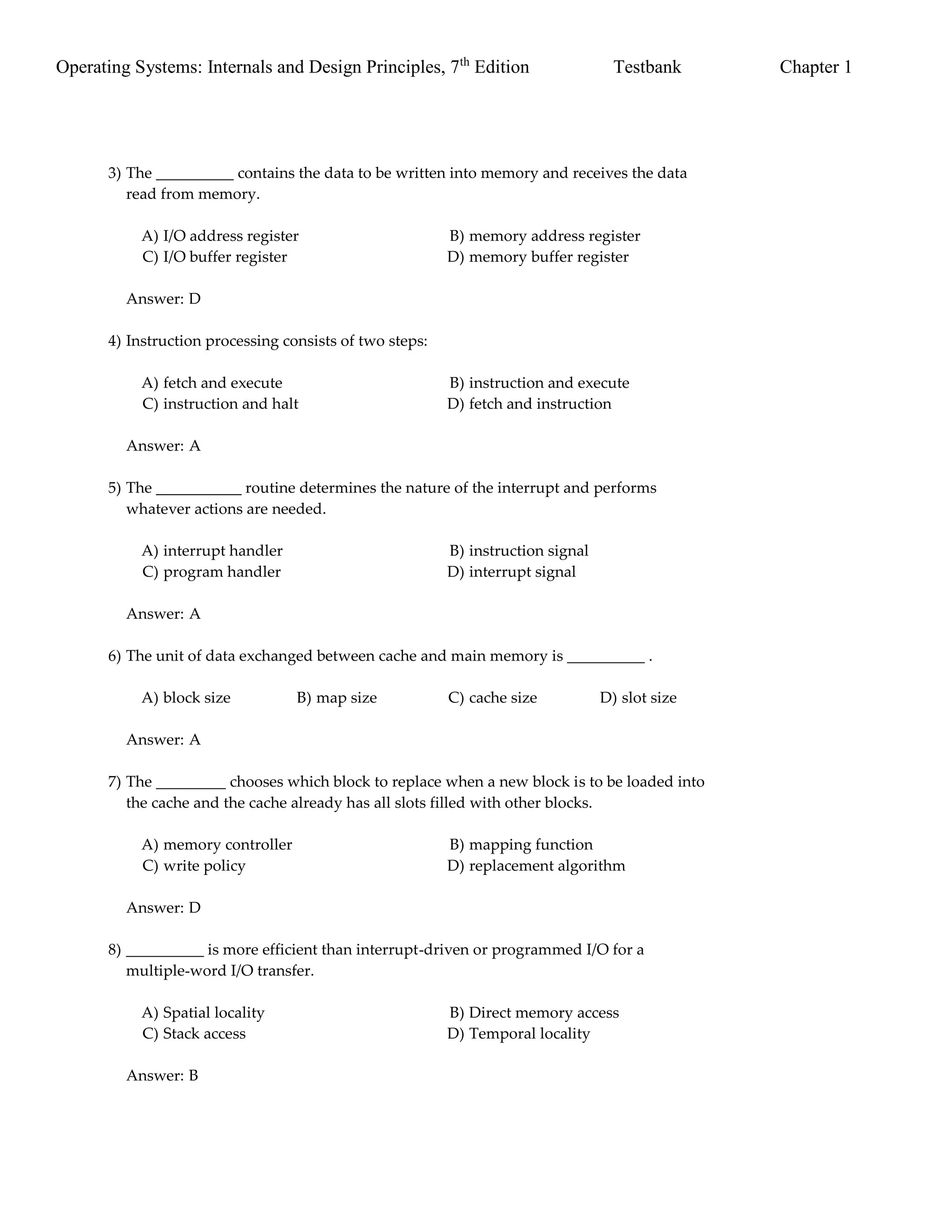
Design Principles, 7th Edition: William
Stallings
_____ Click the link below to download _____
http://testbankbell.com/product/test-bank-for-
operating-systems-internals-and-design-principles-7th-
edition-william-stallings/
Explore and download more testbank at testbankbell.com
Here are some suggested products you might be interested in.
Click the link to download
Test Bank for Operating Systems: Internals and Design
Principles, 8/E 8th Edition : 0133805913
http://testbankbell.com/product/test-bank-for-operating-systems-
internals-and-design-principles-8-e-8th-edition-0133805913/
Solution Manual for Operating Systems: Internals and
Design Principles, 8/E 8th Edition : 0133805913
http://testbankbell.com/product/solution-manual-for-operating-systems-
internals-and-design-principles-8-e-8th-edition-0133805913/
Cryptography and Network Security Principles and Practice
6th Edition William Stallings Test Bank
http://testbankbell.com/product/cryptography-and-network-security-
principles-and-practice-6th-edition-william-stallings-test-bank/
Test Bank for Nursing Research in Canada, 3rd Edition:
Geri LoBiondo-Wood
http://testbankbell.com/product/test-bank-for-nursing-research-in-
canada-3rd-edition-geri-lobiondo-wood/
Test Bank for Labour Relations, 3/E 3rd Canadian Edition
Larry Suffield
http://testbankbell.com/product/test-bank-for-labour-
relations-3-e-3rd-canadian-edition-larry-suffield/
Financial and Managerial Accounting 14th Edition Warren
Test Bank
http://testbankbell.com/product/financial-and-managerial-
accounting-14th-edition-warren-test-bank/
Solution Manual for Essentials of Modern Business
Statistics with Microsoft Excel, 7th Edition, David R.
Anderson
http://testbankbell.com/product/solution-manual-for-essentials-of-
modern-business-statistics-with-microsoft-excel-7th-edition-david-r-
anderson/
Test Bank for Critical Care Nursing Diagnosis and
Management, 8th Edition, Linda Urden Kathleen Stacy Mary
Lough
http://testbankbell.com/product/test-bank-for-critical-care-nursing-
diagnosis-and-management-8th-edition-linda-urden-kathleen-stacy-mary-
lough/
Concepts in Strategic Management and Business Policy
Wheelen 14th Edition Test Bank
http://testbankbell.com/product/concepts-in-strategic-management-and-
business-policy-wheelen-14th-edition-test-bank/
Test Bank For Children: A Chronological Approach, 5th
Canadian Edition Robert V. Kail Theresa Zolner
http://testbankbell.com/product/test-bank-for-children-a-
chronological-approach-5th-canadian-edition-robert-v-kail-theresa-
zolner-2/
Operating Systems: Internals and Design Principles, 7th
Edition Testbank Chapter 1
Operating Systems: Internals and Design Principles, 7th
Full chapter download at: https://testbankbell.com/product/test-bank-for-operating-systems-
internals-and-design-principles-7th-edition-william-stallings/
Chapter 1 – Computer Systems Overview
TRUE/FALSE QUESTIONS:
1) The processor controls the operation of the computer and performs its data
processing functions.
Answer: True False
2) It is not possible for a communications interrupt to occur while a printer interrupt is
being processed.
Answer: True False
3) A system bus transfers data between the computer and its external environment.
Answer: True False
4) Cache memory is invisible to the OS.
Answer: True False
5) With interrupts, the processor can not be engaged in executing other instructions
while an I/O operation is in progress.
Answer: True False
6) Digital Signal Processors deal with streaming signals such as audio and video.
Answer: True False
7) The fetched instruction is loaded into the Program Counter.
Answer: True False
8) Interrupts are provided primarily as a way to improve processor utilization.
Answer: True False
9) The interrupt can occur at any time and therefore at any point in the execution of a
user program.
Answer: True False
Operating Systems: Internals and Design Principles, 7th
Edition Testbank Chapter 1
10) Over the years memory access speed has consistently increased more rapidly than
processor speed.
Answer: True False
11) An SMP can be defined as a stand-alone computer system with two or more similar
processors of comparable capability.
Answer: True False
12) The Program Status Word contains status information in the form of condition
codes, which are bits typically set by the programmer as a result of program
operation.
Answer: True False
13) An example of a multicore system is the Intel Core i7.
Answer: True False
14) In a two-level memory hierarchy the Hit Ratio is defined as the fraction of all
memory accesses found in the slower memory.
Answer: True False
15) The operating system acts as an interface between the computer hardware and the
human user.
Answer: True False
MULTIPLE CHOICE QUESTIONS:
1) The four main structural elements of a computer system are:
A) Processor, Main Memory, I/O Modules and System Bus
B) Processor, I/O Modules, System Bus and Secondary Memory
C) Processor, Registers, Main Memory and System Bus
D) Processor, Registers, I/O Modules and Main Memory
Answer: A
2) The __________ holds the address of the next instruction to be fetched.
A) Accumulator (AC) B) Instruction Register (IR)
C) Instruction Counter (IC) D) Program Counter (PC)
Answer: D
Operating Systems: Internals and Design Principles, 7th
Edition Testbank Chapter 1
3) The __________ contains the data to be written into memory and receives the data
read from memory.
A) I/O address register B) memory address register
C) I/O buffer register D) memory buffer register
Answer: D
4) Instruction processing consists of two steps:
A) fetch and execute B) instruction and execute
C) instruction and halt D) fetch and instruction
Answer: A
5) The ___________ routine determines the nature of the interrupt and performs
whatever actions are needed.
A) interrupt handler B) instruction signal
C) program handler D) interrupt signal
Answer: A
6) The unit of data exchanged between cache and main memory is __________ .
A) block size B) map size C) cache size D) slot size
Answer: A
7) The _________ chooses which block to replace when a new block is to be loaded into
the cache and the cache already has all slots filled with other blocks.
A) memory controller B) mapping function
C) write policy D) replacement algorithm
Answer: D
8) __________ is more efficient than interrupt-driven or programmed I/O for a
multiple-word I/O transfer.
A) Spatial locality B) Direct memory access
C) Stack access D) Temporal locality
Answer: B
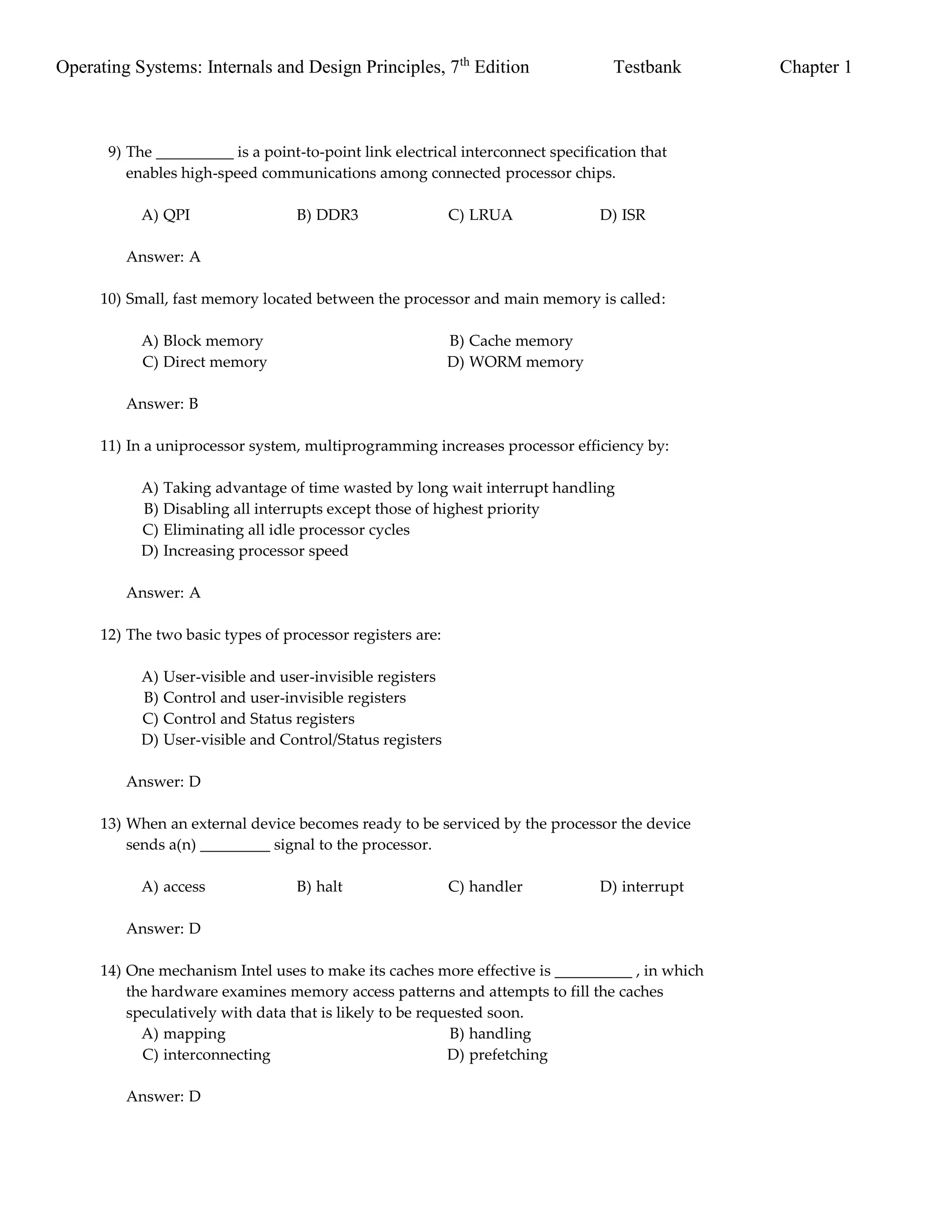
Operating Systems: Internals and Design Principles, 7th
Edition Testbank Chapter 1
9) The __________ is a point-to-point link electrical interconnect specification that
enables high-speed communications among connected processor chips.
A) QPI B) DDR3 C) LRUA D) ISR
Answer: A
10) Small, fast memory located between the processor and main memory is called:
A) Block memory B) Cache memory
C) Direct memory D) WORM memory
Answer: B
11) In a uniprocessor system, multiprogramming increases processor efficiency by:
A) Taking advantage of time wasted by long wait interrupt handling
B) Disabling all interrupts except those of highest priority
C) Eliminating all idle processor cycles
D) Increasing processor speed
Answer: A
12) The two basic types of processor registers are:
A) User-visible and user-invisible registers
B) Control and user-invisible registers
C) Control and Status registers
D) User-visible and Control/Status registers
Answer: D
13) When an external device becomes ready to be serviced by the processor the device
sends a(n) _________ signal to the processor.
A) access B) halt C) handler D) interrupt
Answer: D
14) One mechanism Intel uses to make its caches more effective is __________ , in which
the hardware examines memory access patterns and attempts to fill the caches
speculatively with data that is likely to be requested soon.
A) mapping B) handling
C) interconnecting D) prefetching
Answer: D
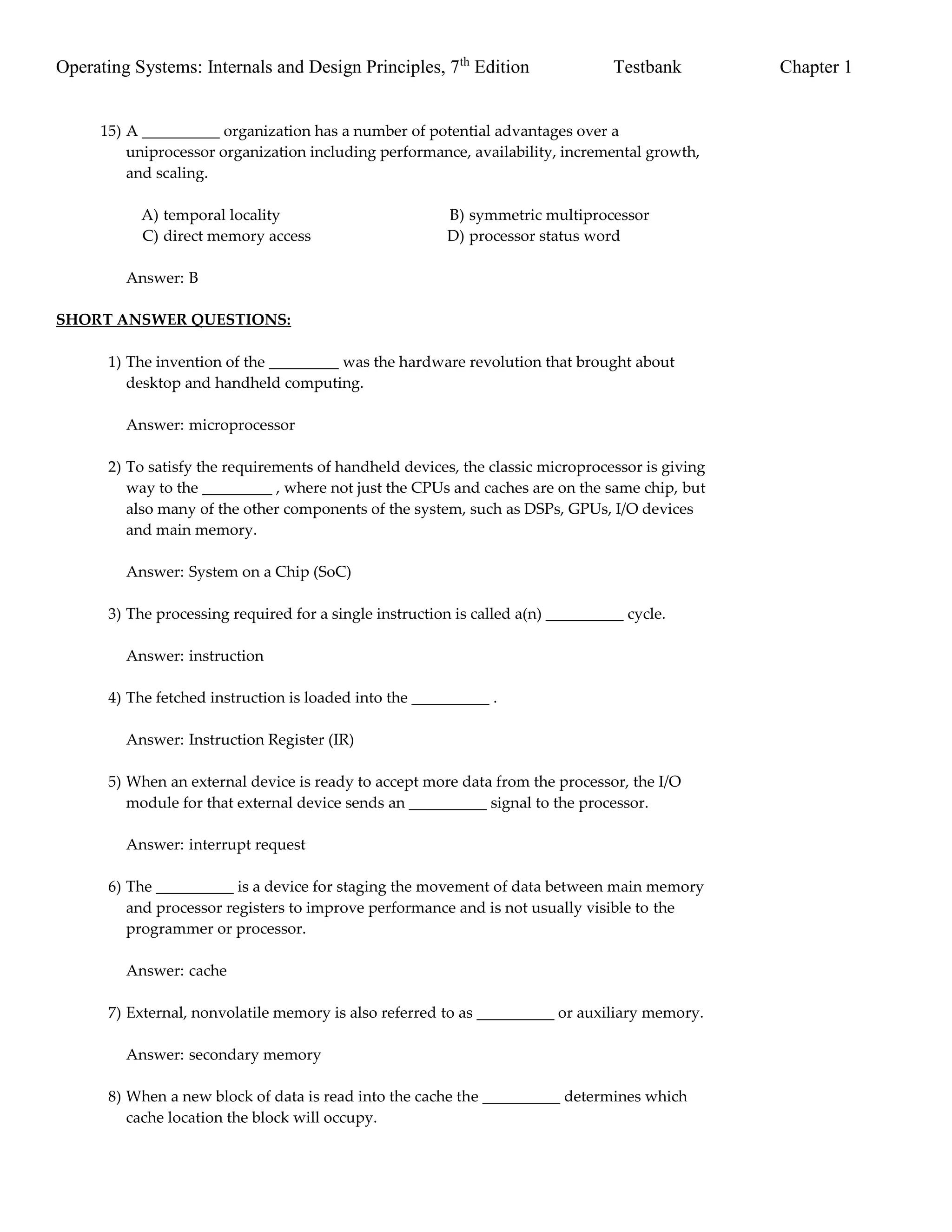
Operating Systems: Internals and Design Principles, 7th
Edition Testbank Chapter 1
15) A __________ organization has a number of potential advantages over a
uniprocessor organization including performance, availability, incremental growth,
and scaling.
A) temporal locality B) symmetric multiprocessor
C) direct memory access D) processor status word
Answer: B
SHORT ANSWER QUESTIONS:
1) The invention of the _________ was the hardware revolution that brought about
desktop and handheld computing.
Answer: microprocessor
2) To satisfy the requirements of handheld devices, the classic microprocessor is giving
way to the _________ , where not just the CPUs and caches are on the same chip, but
also many of the other components of the system, such as DSPs, GPUs, I/O devices
and main memory.
Answer: System on a Chip (SoC)
3) The processing required for a single instruction is called a(n) __________ cycle.
Answer: instruction
4) The fetched instruction is loaded into the __________ .
Answer: Instruction Register (IR)
5) When an external device is ready to accept more data from the processor, the I/O
module for that external device sends an __________ signal to the processor.
Answer: interrupt request
6) The __________ is a device for staging the movement of data between main memory
and processor registers to improve performance and is not usually visible to the
programmer or processor.
Answer: cache
7) External, nonvolatile memory is also referred to as __________ or auxiliary memory.
Answer: secondary memory
8) When a new block of data is read into the cache the __________ determines which
cache location the block will occupy.
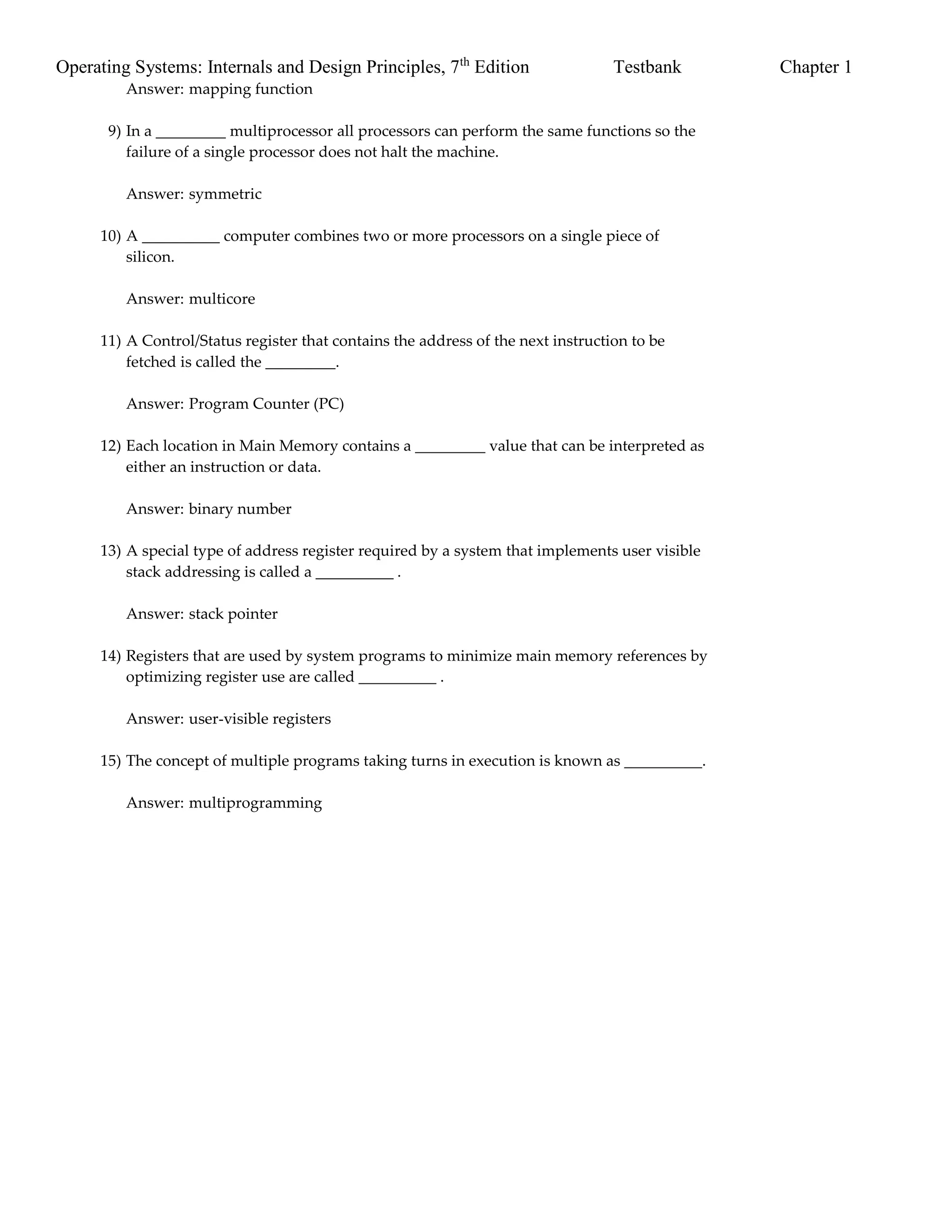
Operating Systems: Internals and Design Principles, 7th
Edition Testbank Chapter 1
Answer: mapping function
9) In a _________ multiprocessor all processors can perform the same functions so the
failure of a single processor does not halt the machine.
Answer: symmetric
10) A __________ computer combines two or more processors on a single piece of
silicon.
Answer: multicore
11) A Control/Status register that contains the address of the next instruction to be
fetched is called the _________.
Answer: Program Counter (PC)
12) Each location in Main Memory contains a _________ value that can be interpreted as
either an instruction or data.
Answer: binary number
13) A special type of address register required by a system that implements user visible
stack addressing is called a __________ .
Answer: stack pointer
14) Registers that are used by system programs to minimize main memory references by
optimizing register use are called __________ .
Answer: user-visible registers
15) The concept of multiple programs taking turns in execution is known as __________.
Answer: multiprogramming
Other documents randomly have
different content
THE FULL PROJECT GUTENBERG LICENSE
PLEASE READ THIS BEFORE YOU DISTRIBUTE OR USE THIS WORK
To protect the Project Gutenberg™ mission of promoting the free
distribution of electronic works, by using or distributing this work (or
any other work associated in any way with the phrase “Project
Gutenberg”), you agree to comply with all the terms of the Full
Project Gutenberg™ License available with this file or online at
www.gutenberg.org/license.
Section 1. General Terms of Use and
Redistributing Project Gutenberg™
electronic works
1.A. By reading or using any part of this Project Gutenberg™
electronic work, you indicate that you have read, understand, agree
to and accept all the terms of this license and intellectual property
(trademark/copyright) agreement. If you do not agree to abide by all
the terms of this agreement, you must cease using and return or
destroy all copies of Project Gutenberg™ electronic works in your
possession. If you paid a fee for obtaining a copy of or access to a
Project Gutenberg™ electronic work and you do not agree to be
bound by the terms of this agreement, you may obtain a refund
from the person or entity to whom you paid the fee as set forth in
paragraph 1.E.8.
1.B. “Project Gutenberg” is a registered trademark. It may only be
used on or associated in any way with an electronic work by people
who agree to be bound by the terms of this agreement. There are a
few things that you can do with most Project Gutenberg™ electronic
works even without complying with the full terms of this agreement.
See paragraph 1.C below. There are a lot of things you can do with
Project Gutenberg™ electronic works if you follow the terms of this
agreement and help preserve free future access to Project
Gutenberg™ electronic works. See paragraph 1.E below.
1.C. The Project Gutenberg Literary Archive Foundation (“the
Foundation” or PGLAF), owns a compilation copyright in the
collection of Project Gutenberg™ electronic works. Nearly all the
individual works in the collection are in the public domain in the
United States. If an individual work is unprotected by copyright law
in the United States and you are located in the United States, we do
not claim a right to prevent you from copying, distributing,
performing, displaying or creating derivative works based on the
work as long as all references to Project Gutenberg are removed. Of
course, we hope that you will support the Project Gutenberg™
mission of promoting free access to electronic works by freely
sharing Project Gutenberg™ works in compliance with the terms of
this agreement for keeping the Project Gutenberg™ name associated
with the work. You can easily comply with the terms of this
agreement by keeping this work in the same format with its attached
full Project Gutenberg™ License when you share it without charge
with others.
1.D. The copyright laws of the place where you are located also
govern what you can do with this work. Copyright laws in most
countries are in a constant state of change. If you are outside the
United States, check the laws of your country in addition to the
terms of this agreement before downloading, copying, displaying,
performing, distributing or creating derivative works based on this
work or any other Project Gutenberg™ work. The Foundation makes
no representations concerning the copyright status of any work in
any country other than the United States.
1.E. Unless you have removed all references to Project Gutenberg:
1.E.1. The following sentence, with active links to, or other
immediate access to, the full Project Gutenberg™ License must
appear prominently whenever any copy of a Project Gutenberg™
work (any work on which the phrase “Project Gutenberg” appears,
or with which the phrase “Project Gutenberg” is associated) is
accessed, displayed, performed, viewed, copied or distributed:
This eBook is for the use of anyone anywhere in the United
States and most other parts of the world at no cost and with
almost no restrictions whatsoever. You may copy it, give it away
or re-use it under the terms of the Project Gutenberg License
included with this eBook or online at www.gutenberg.org. If you
are not located in the United States, you will have to check the
laws of the country where you are located before using this
eBook.
1.E.2. If an individual Project Gutenberg™ electronic work is derived
from texts not protected by U.S. copyright law (does not contain a
notice indicating that it is posted with permission of the copyright
holder), the work can be copied and distributed to anyone in the
United States without paying any fees or charges. If you are
redistributing or providing access to a work with the phrase “Project
Gutenberg” associated with or appearing on the work, you must
comply either with the requirements of paragraphs 1.E.1 through
1.E.7 or obtain permission for the use of the work and the Project
Gutenberg™ trademark as set forth in paragraphs 1.E.8 or 1.E.9.
1.E.3. If an individual Project Gutenberg™ electronic work is posted
with the permission of the copyright holder, your use and distribution
must comply with both paragraphs 1.E.1 through 1.E.7 and any
additional terms imposed by the copyright holder. Additional terms
will be linked to the Project Gutenberg™ License for all works posted
with the permission of the copyright holder found at the beginning
of this work.
1.E.4. Do not unlink or detach or remove the full Project
Gutenberg™ License terms from this work, or any files containing a
part of this work or any other work associated with Project
Gutenberg™.
1.E.5. Do not copy, display, perform, distribute or redistribute this
electronic work, or any part of this electronic work, without
prominently displaying the sentence set forth in paragraph 1.E.1
with active links or immediate access to the full terms of the Project
Gutenberg™ License.
1.E.6. You may convert to and distribute this work in any binary,
compressed, marked up, nonproprietary or proprietary form,
including any word processing or hypertext form. However, if you
provide access to or distribute copies of a Project Gutenberg™ work
in a format other than “Plain Vanilla ASCII” or other format used in
the official version posted on the official Project Gutenberg™ website
(www.gutenberg.org), you must, at no additional cost, fee or
expense to the user, provide a copy, a means of exporting a copy, or
a means of obtaining a copy upon request, of the work in its original
“Plain Vanilla ASCII” or other form. Any alternate format must
include the full Project Gutenberg™ License as specified in
paragraph 1.E.1.
1.E.7. Do not charge a fee for access to, viewing, displaying,
performing, copying or distributing any Project Gutenberg™ works
unless you comply with paragraph 1.E.8 or 1.E.9.
1.E.8. You may charge a reasonable fee for copies of or providing
access to or distributing Project Gutenberg™ electronic works
provided that:
• You pay a royalty fee of 20% of the gross profits you derive
from the use of Project Gutenberg™ works calculated using
the method you already use to calculate your applicable
taxes. The fee is owed to the owner of the Project
Gutenberg™ trademark, but he has agreed to donate
royalties under this paragraph to the Project Gutenberg
Literary Archive Foundation. Royalty payments must be paid
within 60 days following each date on which you prepare (or
are legally required to prepare) your periodic tax returns.
Royalty payments should be clearly marked as such and sent
to the Project Gutenberg Literary Archive Foundation at the
address specified in Section 4, “Information about donations
to the Project Gutenberg Literary Archive Foundation.”
• You provide a full refund of any money paid by a user who
notifies you in writing (or by e-mail) within 30 days of
receipt that s/he does not agree to the terms of the full
Project Gutenberg™ License. You must require such a user
to return or destroy all copies of the works possessed in a
physical medium and discontinue all use of and all access to
other copies of Project Gutenberg™ works.
• You provide, in accordance with paragraph 1.F.3, a full
refund of any money paid for a work or a replacement copy,
if a defect in the electronic work is discovered and reported
to you within 90 days of receipt of the work.
• You comply with all other terms of this agreement for free
distribution of Project Gutenberg™ works.
1.E.9. If you wish to charge a fee or distribute a Project Gutenberg™
electronic work or group of works on different terms than are set
forth in this agreement, you must obtain permission in writing from
the Project Gutenberg Literary Archive Foundation, the manager of
the Project Gutenberg™ trademark. Contact the Foundation as set
forth in Section 3 below.
1.F.
1.F.1. Project Gutenberg volunteers and employees expend
considerable effort to identify, do copyright research on, transcribe
and proofread works not protected by U.S. copyright law in creating
the Project Gutenberg™ collection. Despite these efforts, Project
Gutenberg™ electronic works, and the medium on which they may
be stored, may contain “Defects,” such as, but not limited to,
incomplete, inaccurate or corrupt data, transcription errors, a
copyright or other intellectual property infringement, a defective or
damaged disk or other medium, a computer virus, or computer
codes that damage or cannot be read by your equipment.
1.F.2. LIMITED WARRANTY, DISCLAIMER OF DAMAGES - Except for
the “Right of Replacement or Refund” described in paragraph 1.F.3,
the Project Gutenberg Literary Archive Foundation, the owner of the
Project Gutenberg™ trademark, and any other party distributing a
Project Gutenberg™ electronic work under this agreement, disclaim
all liability to you for damages, costs and expenses, including legal
fees. YOU AGREE THAT YOU HAVE NO REMEDIES FOR
NEGLIGENCE, STRICT LIABILITY, BREACH OF WARRANTY OR
BREACH OF CONTRACT EXCEPT THOSE PROVIDED IN PARAGRAPH
1.F.3. YOU AGREE THAT THE FOUNDATION, THE TRADEMARK
OWNER, AND ANY DISTRIBUTOR UNDER THIS AGREEMENT WILL
NOT BE LIABLE TO YOU FOR ACTUAL, DIRECT, INDIRECT,
CONSEQUENTIAL, PUNITIVE OR INCIDENTAL DAMAGES EVEN IF
YOU GIVE NOTICE OF THE POSSIBILITY OF SUCH DAMAGE.
1.F.3. LIMITED RIGHT OF REPLACEMENT OR REFUND - If you
discover a defect in this electronic work within 90 days of receiving
it, you can receive a refund of the money (if any) you paid for it by
sending a written explanation to the person you received the work
from. If you received the work on a physical medium, you must
return the medium with your written explanation. The person or
entity that provided you with the defective work may elect to provide
a replacement copy in lieu of a refund. If you received the work
electronically, the person or entity providing it to you may choose to
give you a second opportunity to receive the work electronically in
lieu of a refund. If the second copy is also defective, you may
demand a refund in writing without further opportunities to fix the
problem.
1.F.4. Except for the limited right of replacement or refund set forth
in paragraph 1.F.3, this work is provided to you ‘AS-IS’, WITH NO
OTHER WARRANTIES OF ANY KIND, EXPRESS OR IMPLIED,
INCLUDING BUT NOT LIMITED TO WARRANTIES OF
MERCHANTABILITY OR FITNESS FOR ANY PURPOSE.
1.F.5. Some states do not allow disclaimers of certain implied
warranties or the exclusion or limitation of certain types of damages.
If any disclaimer or limitation set forth in this agreement violates the
law of the state applicable to this agreement, the agreement shall be
interpreted to make the maximum disclaimer or limitation permitted
by the applicable state law. The invalidity or unenforceability of any
provision of this agreement shall not void the remaining provisions.
1.F.6. INDEMNITY - You agree to indemnify and hold the Foundation,
the trademark owner, any agent or employee of the Foundation,
anyone providing copies of Project Gutenberg™ electronic works in
accordance with this agreement, and any volunteers associated with
the production, promotion and distribution of Project Gutenberg™
electronic works, harmless from all liability, costs and expenses,
including legal fees, that arise directly or indirectly from any of the
following which you do or cause to occur: (a) distribution of this or
any Project Gutenberg™ work, (b) alteration, modification, or
additions or deletions to any Project Gutenberg™ work, and (c) any
Defect you cause.
Section 2. Information about the Mission
of Project Gutenberg™
Project Gutenberg™ is synonymous with the free distribution of
electronic works in formats readable by the widest variety of
computers including obsolete, old, middle-aged and new computers.
It exists because of the efforts of hundreds of volunteers and
donations from people in all walks of life.
Volunteers and financial support to provide volunteers with the
assistance they need are critical to reaching Project Gutenberg™’s
goals and ensuring that the Project Gutenberg™ collection will
remain freely available for generations to come. In 2001, the Project
Gutenberg Literary Archive Foundation was created to provide a
secure and permanent future for Project Gutenberg™ and future
generations. To learn more about the Project Gutenberg Literary
Archive Foundation and how your efforts and donations can help,
see Sections 3 and 4 and the Foundation information page at
www.gutenberg.org.
Section 3. Information about the Project
Gutenberg Literary Archive Foundation
The Project Gutenberg Literary Archive Foundation is a non-profit
501(c)(3) educational corporation organized under the laws of the
state of Mississippi and granted tax exempt status by the Internal
Revenue Service. The Foundation’s EIN or federal tax identification
number is 64-6221541. Contributions to the Project Gutenberg
Literary Archive Foundation are tax deductible to the full extent
permitted by U.S. federal laws and your state’s laws.
The Foundation’s business office is located at 809 North 1500 West,
Salt Lake City, UT 84116, (801) 596-1887. Email contact links and up
to date contact information can be found at the Foundation’s website
and official page at www.gutenberg.org/contact
Section 4. Information about Donations to
the Project Gutenberg Literary Archive
Foundation
Project Gutenberg™ depends upon and cannot survive without
widespread public support and donations to carry out its mission of
increasing the number of public domain and licensed works that can
be freely distributed in machine-readable form accessible by the
widest array of equipment including outdated equipment. Many
small donations ($1 to $5,000) are particularly important to
maintaining tax exempt status with the IRS.
The Foundation is committed to complying with the laws regulating
charities and charitable donations in all 50 states of the United
States. Compliance requirements are not uniform and it takes a
considerable effort, much paperwork and many fees to meet and
keep up with these requirements. We do not solicit donations in
locations where we have not received written confirmation of
compliance. To SEND DONATIONS or determine the status of
compliance for any particular state visit www.gutenberg.org/donate.
While we cannot and do not solicit contributions from states where
we have not met the solicitation requirements, we know of no
prohibition against accepting unsolicited donations from donors in
such states who approach us with offers to donate.
International donations are gratefully accepted, but we cannot make
any statements concerning tax treatment of donations received from
outside the United States. U.S. laws alone swamp our small staff.
Please check the Project Gutenberg web pages for current donation
methods and addresses. Donations are accepted in a number of
other ways including checks, online payments and credit card
donations. To donate, please visit: www.gutenberg.org/donate.
Section 5. General Information About
Project Gutenberg™ electronic works
Professor Michael S. Hart was the originator of the Project
Gutenberg™ concept of a library of electronic works that could be
freely shared with anyone. For forty years, he produced and
distributed Project Gutenberg™ eBooks with only a loose network of
volunteer support.
Project Gutenberg™ eBooks are often created from several printed
editions, all of which are confirmed as not protected by copyright in
the U.S. unless a copyright notice is included. Thus, we do not
necessarily keep eBooks in compliance with any particular paper
edition.
Most people start at our website which has the main PG search
facility: www.gutenberg.org.
This website includes information about Project Gutenberg™,
including how to make donations to the Project Gutenberg Literary
Archive Foundation, how to help produce our new eBooks, and how
to subscribe to our email newsletter to hear about new eBooks.
Welcome to our website – the ideal destination for book lovers and
knowledge seekers. With a mission to inspire endlessly, we offer a
vast collection of books, ranging from classic literary works to
specialized publications, self-development books, and children's
literature. Each book is a new journey of discovery, expanding
knowledge and enriching the soul of the reade
Our website is not just a platform for buying books, but a bridge
connecting readers to the timeless values of culture and wisdom. With
an elegant, user-friendly interface and an intelligent search system,
we are committed to providing a quick and convenient shopping
experience. Additionally, our special promotions and home delivery
services ensure that you save time and fully enjoy the joy of reading.
Let us accompany you on the journey of exploring knowledge and
personal growth!
testbankbell.com

Full Download of Test Bank for Operating Systems: Internals and Design Principles, 7th Edition: William Stallings in PDF DOCX Format

  • 1.
    Visit https://testbankbell.com todownload the full version and explore more testbank or solution manual Test Bank for Operating Systems: Internals and Design Principles, 7th Edition: William Stallings _____ Click the link below to download _____ http://testbankbell.com/product/test-bank-for- operating-systems-internals-and-design-principles-7th- edition-william-stallings/ Explore and download more testbank at testbankbell.com
  • 2.
    Here are somesuggested products you might be interested in. Click the link to download Test Bank for Operating Systems: Internals and Design Principles, 8/E 8th Edition : 0133805913 http://testbankbell.com/product/test-bank-for-operating-systems- internals-and-design-principles-8-e-8th-edition-0133805913/ Solution Manual for Operating Systems: Internals and Design Principles, 8/E 8th Edition : 0133805913 http://testbankbell.com/product/solution-manual-for-operating-systems- internals-and-design-principles-8-e-8th-edition-0133805913/ Cryptography and Network Security Principles and Practice 6th Edition William Stallings Test Bank http://testbankbell.com/product/cryptography-and-network-security- principles-and-practice-6th-edition-william-stallings-test-bank/ Test Bank for Nursing Research in Canada, 3rd Edition: Geri LoBiondo-Wood http://testbankbell.com/product/test-bank-for-nursing-research-in- canada-3rd-edition-geri-lobiondo-wood/
  • 3.
    Test Bank forLabour Relations, 3/E 3rd Canadian Edition Larry Suffield http://testbankbell.com/product/test-bank-for-labour- relations-3-e-3rd-canadian-edition-larry-suffield/ Financial and Managerial Accounting 14th Edition Warren Test Bank http://testbankbell.com/product/financial-and-managerial- accounting-14th-edition-warren-test-bank/ Solution Manual for Essentials of Modern Business Statistics with Microsoft Excel, 7th Edition, David R. Anderson http://testbankbell.com/product/solution-manual-for-essentials-of- modern-business-statistics-with-microsoft-excel-7th-edition-david-r- anderson/ Test Bank for Critical Care Nursing Diagnosis and Management, 8th Edition, Linda Urden Kathleen Stacy Mary Lough http://testbankbell.com/product/test-bank-for-critical-care-nursing- diagnosis-and-management-8th-edition-linda-urden-kathleen-stacy-mary- lough/ Concepts in Strategic Management and Business Policy Wheelen 14th Edition Test Bank http://testbankbell.com/product/concepts-in-strategic-management-and- business-policy-wheelen-14th-edition-test-bank/
  • 4.
    Test Bank ForChildren: A Chronological Approach, 5th Canadian Edition Robert V. Kail Theresa Zolner http://testbankbell.com/product/test-bank-for-children-a- chronological-approach-5th-canadian-edition-robert-v-kail-theresa- zolner-2/
  • 5.
    Operating Systems: Internalsand Design Principles, 7th Edition Testbank Chapter 1 Operating Systems: Internals and Design Principles, 7th Full chapter download at: https://testbankbell.com/product/test-bank-for-operating-systems- internals-and-design-principles-7th-edition-william-stallings/ Chapter 1 – Computer Systems Overview TRUE/FALSE QUESTIONS: 1) The processor controls the operation of the computer and performs its data processing functions. Answer: True False 2) It is not possible for a communications interrupt to occur while a printer interrupt is being processed. Answer: True False 3) A system bus transfers data between the computer and its external environment. Answer: True False 4) Cache memory is invisible to the OS. Answer: True False 5) With interrupts, the processor can not be engaged in executing other instructions while an I/O operation is in progress. Answer: True False 6) Digital Signal Processors deal with streaming signals such as audio and video. Answer: True False 7) The fetched instruction is loaded into the Program Counter. Answer: True False 8) Interrupts are provided primarily as a way to improve processor utilization. Answer: True False 9) The interrupt can occur at any time and therefore at any point in the execution of a user program. Answer: True False
  • 6.
    Operating Systems: Internalsand Design Principles, 7th Edition Testbank Chapter 1 10) Over the years memory access speed has consistently increased more rapidly than processor speed. Answer: True False 11) An SMP can be defined as a stand-alone computer system with two or more similar processors of comparable capability. Answer: True False 12) The Program Status Word contains status information in the form of condition codes, which are bits typically set by the programmer as a result of program operation. Answer: True False 13) An example of a multicore system is the Intel Core i7. Answer: True False 14) In a two-level memory hierarchy the Hit Ratio is defined as the fraction of all memory accesses found in the slower memory. Answer: True False 15) The operating system acts as an interface between the computer hardware and the human user. Answer: True False MULTIPLE CHOICE QUESTIONS: 1) The four main structural elements of a computer system are: A) Processor, Main Memory, I/O Modules and System Bus B) Processor, I/O Modules, System Bus and Secondary Memory C) Processor, Registers, Main Memory and System Bus D) Processor, Registers, I/O Modules and Main Memory Answer: A 2) The __________ holds the address of the next instruction to be fetched. A) Accumulator (AC) B) Instruction Register (IR) C) Instruction Counter (IC) D) Program Counter (PC) Answer: D
  • 7.
    Operating Systems: Internalsand Design Principles, 7th Edition Testbank Chapter 1 3) The __________ contains the data to be written into memory and receives the data read from memory. A) I/O address register B) memory address register C) I/O buffer register D) memory buffer register Answer: D 4) Instruction processing consists of two steps: A) fetch and execute B) instruction and execute C) instruction and halt D) fetch and instruction Answer: A 5) The ___________ routine determines the nature of the interrupt and performs whatever actions are needed. A) interrupt handler B) instruction signal C) program handler D) interrupt signal Answer: A 6) The unit of data exchanged between cache and main memory is __________ . A) block size B) map size C) cache size D) slot size Answer: A 7) The _________ chooses which block to replace when a new block is to be loaded into the cache and the cache already has all slots filled with other blocks. A) memory controller B) mapping function C) write policy D) replacement algorithm Answer: D 8) __________ is more efficient than interrupt-driven or programmed I/O for a multiple-word I/O transfer. A) Spatial locality B) Direct memory access C) Stack access D) Temporal locality Answer: B
  • 8.
    Operating Systems: Internalsand Design Principles, 7th Edition Testbank Chapter 1 9) The __________ is a point-to-point link electrical interconnect specification that enables high-speed communications among connected processor chips. A) QPI B) DDR3 C) LRUA D) ISR Answer: A 10) Small, fast memory located between the processor and main memory is called: A) Block memory B) Cache memory C) Direct memory D) WORM memory Answer: B 11) In a uniprocessor system, multiprogramming increases processor efficiency by: A) Taking advantage of time wasted by long wait interrupt handling B) Disabling all interrupts except those of highest priority C) Eliminating all idle processor cycles D) Increasing processor speed Answer: A 12) The two basic types of processor registers are: A) User-visible and user-invisible registers B) Control and user-invisible registers C) Control and Status registers D) User-visible and Control/Status registers Answer: D 13) When an external device becomes ready to be serviced by the processor the device sends a(n) _________ signal to the processor. A) access B) halt C) handler D) interrupt Answer: D 14) One mechanism Intel uses to make its caches more effective is __________ , in which the hardware examines memory access patterns and attempts to fill the caches speculatively with data that is likely to be requested soon. A) mapping B) handling C) interconnecting D) prefetching Answer: D
  • 9.
    Operating Systems: Internalsand Design Principles, 7th Edition Testbank Chapter 1 15) A __________ organization has a number of potential advantages over a uniprocessor organization including performance, availability, incremental growth, and scaling. A) temporal locality B) symmetric multiprocessor C) direct memory access D) processor status word Answer: B SHORT ANSWER QUESTIONS: 1) The invention of the _________ was the hardware revolution that brought about desktop and handheld computing. Answer: microprocessor 2) To satisfy the requirements of handheld devices, the classic microprocessor is giving way to the _________ , where not just the CPUs and caches are on the same chip, but also many of the other components of the system, such as DSPs, GPUs, I/O devices and main memory. Answer: System on a Chip (SoC) 3) The processing required for a single instruction is called a(n) __________ cycle. Answer: instruction 4) The fetched instruction is loaded into the __________ . Answer: Instruction Register (IR) 5) When an external device is ready to accept more data from the processor, the I/O module for that external device sends an __________ signal to the processor. Answer: interrupt request 6) The __________ is a device for staging the movement of data between main memory and processor registers to improve performance and is not usually visible to the programmer or processor. Answer: cache 7) External, nonvolatile memory is also referred to as __________ or auxiliary memory. Answer: secondary memory 8) When a new block of data is read into the cache the __________ determines which cache location the block will occupy.
  • 10.
    Operating Systems: Internalsand Design Principles, 7th Edition Testbank Chapter 1 Answer: mapping function 9) In a _________ multiprocessor all processors can perform the same functions so the failure of a single processor does not halt the machine. Answer: symmetric 10) A __________ computer combines two or more processors on a single piece of silicon. Answer: multicore 11) A Control/Status register that contains the address of the next instruction to be fetched is called the _________. Answer: Program Counter (PC) 12) Each location in Main Memory contains a _________ value that can be interpreted as either an instruction or data. Answer: binary number 13) A special type of address register required by a system that implements user visible stack addressing is called a __________ . Answer: stack pointer 14) Registers that are used by system programs to minimize main memory references by optimizing register use are called __________ . Answer: user-visible registers 15) The concept of multiple programs taking turns in execution is known as __________. Answer: multiprogramming
  • 11.
    Other documents randomlyhave different content
  • 12.
    THE FULL PROJECTGUTENBERG LICENSE
  • 13.
    PLEASE READ THISBEFORE YOU DISTRIBUTE OR USE THIS WORK To protect the Project Gutenberg™ mission of promoting the free distribution of electronic works, by using or distributing this work (or any other work associated in any way with the phrase “Project Gutenberg”), you agree to comply with all the terms of the Full Project Gutenberg™ License available with this file or online at www.gutenberg.org/license. Section 1. General Terms of Use and Redistributing Project Gutenberg™ electronic works 1.A. By reading or using any part of this Project Gutenberg™ electronic work, you indicate that you have read, understand, agree to and accept all the terms of this license and intellectual property (trademark/copyright) agreement. If you do not agree to abide by all the terms of this agreement, you must cease using and return or destroy all copies of Project Gutenberg™ electronic works in your possession. If you paid a fee for obtaining a copy of or access to a Project Gutenberg™ electronic work and you do not agree to be bound by the terms of this agreement, you may obtain a refund from the person or entity to whom you paid the fee as set forth in paragraph 1.E.8. 1.B. “Project Gutenberg” is a registered trademark. It may only be used on or associated in any way with an electronic work by people who agree to be bound by the terms of this agreement. There are a few things that you can do with most Project Gutenberg™ electronic works even without complying with the full terms of this agreement. See paragraph 1.C below. There are a lot of things you can do with Project Gutenberg™ electronic works if you follow the terms of this agreement and help preserve free future access to Project Gutenberg™ electronic works. See paragraph 1.E below.
  • 14.
    1.C. The ProjectGutenberg Literary Archive Foundation (“the Foundation” or PGLAF), owns a compilation copyright in the collection of Project Gutenberg™ electronic works. Nearly all the individual works in the collection are in the public domain in the United States. If an individual work is unprotected by copyright law in the United States and you are located in the United States, we do not claim a right to prevent you from copying, distributing, performing, displaying or creating derivative works based on the work as long as all references to Project Gutenberg are removed. Of course, we hope that you will support the Project Gutenberg™ mission of promoting free access to electronic works by freely sharing Project Gutenberg™ works in compliance with the terms of this agreement for keeping the Project Gutenberg™ name associated with the work. You can easily comply with the terms of this agreement by keeping this work in the same format with its attached full Project Gutenberg™ License when you share it without charge with others. 1.D. The copyright laws of the place where you are located also govern what you can do with this work. Copyright laws in most countries are in a constant state of change. If you are outside the United States, check the laws of your country in addition to the terms of this agreement before downloading, copying, displaying, performing, distributing or creating derivative works based on this work or any other Project Gutenberg™ work. The Foundation makes no representations concerning the copyright status of any work in any country other than the United States. 1.E. Unless you have removed all references to Project Gutenberg: 1.E.1. The following sentence, with active links to, or other immediate access to, the full Project Gutenberg™ License must appear prominently whenever any copy of a Project Gutenberg™ work (any work on which the phrase “Project Gutenberg” appears, or with which the phrase “Project Gutenberg” is associated) is accessed, displayed, performed, viewed, copied or distributed:
  • 15.
    This eBook isfor the use of anyone anywhere in the United States and most other parts of the world at no cost and with almost no restrictions whatsoever. You may copy it, give it away or re-use it under the terms of the Project Gutenberg License included with this eBook or online at www.gutenberg.org. If you are not located in the United States, you will have to check the laws of the country where you are located before using this eBook. 1.E.2. If an individual Project Gutenberg™ electronic work is derived from texts not protected by U.S. copyright law (does not contain a notice indicating that it is posted with permission of the copyright holder), the work can be copied and distributed to anyone in the United States without paying any fees or charges. If you are redistributing or providing access to a work with the phrase “Project Gutenberg” associated with or appearing on the work, you must comply either with the requirements of paragraphs 1.E.1 through 1.E.7 or obtain permission for the use of the work and the Project Gutenberg™ trademark as set forth in paragraphs 1.E.8 or 1.E.9. 1.E.3. If an individual Project Gutenberg™ electronic work is posted with the permission of the copyright holder, your use and distribution must comply with both paragraphs 1.E.1 through 1.E.7 and any additional terms imposed by the copyright holder. Additional terms will be linked to the Project Gutenberg™ License for all works posted with the permission of the copyright holder found at the beginning of this work. 1.E.4. Do not unlink or detach or remove the full Project Gutenberg™ License terms from this work, or any files containing a part of this work or any other work associated with Project Gutenberg™. 1.E.5. Do not copy, display, perform, distribute or redistribute this electronic work, or any part of this electronic work, without prominently displaying the sentence set forth in paragraph 1.E.1
  • 16.
    with active linksor immediate access to the full terms of the Project Gutenberg™ License. 1.E.6. You may convert to and distribute this work in any binary, compressed, marked up, nonproprietary or proprietary form, including any word processing or hypertext form. However, if you provide access to or distribute copies of a Project Gutenberg™ work in a format other than “Plain Vanilla ASCII” or other format used in the official version posted on the official Project Gutenberg™ website (www.gutenberg.org), you must, at no additional cost, fee or expense to the user, provide a copy, a means of exporting a copy, or a means of obtaining a copy upon request, of the work in its original “Plain Vanilla ASCII” or other form. Any alternate format must include the full Project Gutenberg™ License as specified in paragraph 1.E.1. 1.E.7. Do not charge a fee for access to, viewing, displaying, performing, copying or distributing any Project Gutenberg™ works unless you comply with paragraph 1.E.8 or 1.E.9. 1.E.8. You may charge a reasonable fee for copies of or providing access to or distributing Project Gutenberg™ electronic works provided that: • You pay a royalty fee of 20% of the gross profits you derive from the use of Project Gutenberg™ works calculated using the method you already use to calculate your applicable taxes. The fee is owed to the owner of the Project Gutenberg™ trademark, but he has agreed to donate royalties under this paragraph to the Project Gutenberg Literary Archive Foundation. Royalty payments must be paid within 60 days following each date on which you prepare (or are legally required to prepare) your periodic tax returns. Royalty payments should be clearly marked as such and sent to the Project Gutenberg Literary Archive Foundation at the
  • 17.
    address specified inSection 4, “Information about donations to the Project Gutenberg Literary Archive Foundation.” • You provide a full refund of any money paid by a user who notifies you in writing (or by e-mail) within 30 days of receipt that s/he does not agree to the terms of the full Project Gutenberg™ License. You must require such a user to return or destroy all copies of the works possessed in a physical medium and discontinue all use of and all access to other copies of Project Gutenberg™ works. • You provide, in accordance with paragraph 1.F.3, a full refund of any money paid for a work or a replacement copy, if a defect in the electronic work is discovered and reported to you within 90 days of receipt of the work. • You comply with all other terms of this agreement for free distribution of Project Gutenberg™ works. 1.E.9. If you wish to charge a fee or distribute a Project Gutenberg™ electronic work or group of works on different terms than are set forth in this agreement, you must obtain permission in writing from the Project Gutenberg Literary Archive Foundation, the manager of the Project Gutenberg™ trademark. Contact the Foundation as set forth in Section 3 below. 1.F. 1.F.1. Project Gutenberg volunteers and employees expend considerable effort to identify, do copyright research on, transcribe and proofread works not protected by U.S. copyright law in creating the Project Gutenberg™ collection. Despite these efforts, Project Gutenberg™ electronic works, and the medium on which they may be stored, may contain “Defects,” such as, but not limited to, incomplete, inaccurate or corrupt data, transcription errors, a copyright or other intellectual property infringement, a defective or
  • 18.
    damaged disk orother medium, a computer virus, or computer codes that damage or cannot be read by your equipment. 1.F.2. LIMITED WARRANTY, DISCLAIMER OF DAMAGES - Except for the “Right of Replacement or Refund” described in paragraph 1.F.3, the Project Gutenberg Literary Archive Foundation, the owner of the Project Gutenberg™ trademark, and any other party distributing a Project Gutenberg™ electronic work under this agreement, disclaim all liability to you for damages, costs and expenses, including legal fees. YOU AGREE THAT YOU HAVE NO REMEDIES FOR NEGLIGENCE, STRICT LIABILITY, BREACH OF WARRANTY OR BREACH OF CONTRACT EXCEPT THOSE PROVIDED IN PARAGRAPH 1.F.3. YOU AGREE THAT THE FOUNDATION, THE TRADEMARK OWNER, AND ANY DISTRIBUTOR UNDER THIS AGREEMENT WILL NOT BE LIABLE TO YOU FOR ACTUAL, DIRECT, INDIRECT, CONSEQUENTIAL, PUNITIVE OR INCIDENTAL DAMAGES EVEN IF YOU GIVE NOTICE OF THE POSSIBILITY OF SUCH DAMAGE. 1.F.3. LIMITED RIGHT OF REPLACEMENT OR REFUND - If you discover a defect in this electronic work within 90 days of receiving it, you can receive a refund of the money (if any) you paid for it by sending a written explanation to the person you received the work from. If you received the work on a physical medium, you must return the medium with your written explanation. The person or entity that provided you with the defective work may elect to provide a replacement copy in lieu of a refund. If you received the work electronically, the person or entity providing it to you may choose to give you a second opportunity to receive the work electronically in lieu of a refund. If the second copy is also defective, you may demand a refund in writing without further opportunities to fix the problem. 1.F.4. Except for the limited right of replacement or refund set forth in paragraph 1.F.3, this work is provided to you ‘AS-IS’, WITH NO OTHER WARRANTIES OF ANY KIND, EXPRESS OR IMPLIED,
  • 19.
    INCLUDING BUT NOTLIMITED TO WARRANTIES OF MERCHANTABILITY OR FITNESS FOR ANY PURPOSE. 1.F.5. Some states do not allow disclaimers of certain implied warranties or the exclusion or limitation of certain types of damages. If any disclaimer or limitation set forth in this agreement violates the law of the state applicable to this agreement, the agreement shall be interpreted to make the maximum disclaimer or limitation permitted by the applicable state law. The invalidity or unenforceability of any provision of this agreement shall not void the remaining provisions. 1.F.6. INDEMNITY - You agree to indemnify and hold the Foundation, the trademark owner, any agent or employee of the Foundation, anyone providing copies of Project Gutenberg™ electronic works in accordance with this agreement, and any volunteers associated with the production, promotion and distribution of Project Gutenberg™ electronic works, harmless from all liability, costs and expenses, including legal fees, that arise directly or indirectly from any of the following which you do or cause to occur: (a) distribution of this or any Project Gutenberg™ work, (b) alteration, modification, or additions or deletions to any Project Gutenberg™ work, and (c) any Defect you cause. Section 2. Information about the Mission of Project Gutenberg™ Project Gutenberg™ is synonymous with the free distribution of electronic works in formats readable by the widest variety of computers including obsolete, old, middle-aged and new computers. It exists because of the efforts of hundreds of volunteers and donations from people in all walks of life. Volunteers and financial support to provide volunteers with the assistance they need are critical to reaching Project Gutenberg™’s goals and ensuring that the Project Gutenberg™ collection will
  • 20.
    remain freely availablefor generations to come. In 2001, the Project Gutenberg Literary Archive Foundation was created to provide a secure and permanent future for Project Gutenberg™ and future generations. To learn more about the Project Gutenberg Literary Archive Foundation and how your efforts and donations can help, see Sections 3 and 4 and the Foundation information page at www.gutenberg.org. Section 3. Information about the Project Gutenberg Literary Archive Foundation The Project Gutenberg Literary Archive Foundation is a non-profit 501(c)(3) educational corporation organized under the laws of the state of Mississippi and granted tax exempt status by the Internal Revenue Service. The Foundation’s EIN or federal tax identification number is 64-6221541. Contributions to the Project Gutenberg Literary Archive Foundation are tax deductible to the full extent permitted by U.S. federal laws and your state’s laws. The Foundation’s business office is located at 809 North 1500 West, Salt Lake City, UT 84116, (801) 596-1887. Email contact links and up to date contact information can be found at the Foundation’s website and official page at www.gutenberg.org/contact Section 4. Information about Donations to the Project Gutenberg Literary Archive Foundation Project Gutenberg™ depends upon and cannot survive without widespread public support and donations to carry out its mission of increasing the number of public domain and licensed works that can be freely distributed in machine-readable form accessible by the widest array of equipment including outdated equipment. Many
  • 21.
    small donations ($1to $5,000) are particularly important to maintaining tax exempt status with the IRS. The Foundation is committed to complying with the laws regulating charities and charitable donations in all 50 states of the United States. Compliance requirements are not uniform and it takes a considerable effort, much paperwork and many fees to meet and keep up with these requirements. We do not solicit donations in locations where we have not received written confirmation of compliance. To SEND DONATIONS or determine the status of compliance for any particular state visit www.gutenberg.org/donate. While we cannot and do not solicit contributions from states where we have not met the solicitation requirements, we know of no prohibition against accepting unsolicited donations from donors in such states who approach us with offers to donate. International donations are gratefully accepted, but we cannot make any statements concerning tax treatment of donations received from outside the United States. U.S. laws alone swamp our small staff. Please check the Project Gutenberg web pages for current donation methods and addresses. Donations are accepted in a number of other ways including checks, online payments and credit card donations. To donate, please visit: www.gutenberg.org/donate. Section 5. General Information About Project Gutenberg™ electronic works Professor Michael S. Hart was the originator of the Project Gutenberg™ concept of a library of electronic works that could be freely shared with anyone. For forty years, he produced and distributed Project Gutenberg™ eBooks with only a loose network of volunteer support.
  • 22.
    Project Gutenberg™ eBooksare often created from several printed editions, all of which are confirmed as not protected by copyright in the U.S. unless a copyright notice is included. Thus, we do not necessarily keep eBooks in compliance with any particular paper edition. Most people start at our website which has the main PG search facility: www.gutenberg.org. This website includes information about Project Gutenberg™, including how to make donations to the Project Gutenberg Literary Archive Foundation, how to help produce our new eBooks, and how to subscribe to our email newsletter to hear about new eBooks.
  • 23.
    Welcome to ourwebsite – the ideal destination for book lovers and knowledge seekers. With a mission to inspire endlessly, we offer a vast collection of books, ranging from classic literary works to specialized publications, self-development books, and children's literature. Each book is a new journey of discovery, expanding knowledge and enriching the soul of the reade Our website is not just a platform for buying books, but a bridge connecting readers to the timeless values of culture and wisdom. With an elegant, user-friendly interface and an intelligent search system, we are committed to providing a quick and convenient shopping experience. Additionally, our special promotions and home delivery services ensure that you save time and fully enjoy the joy of reading. Let us accompany you on the journey of exploring knowledge and personal growth! testbankbell.com