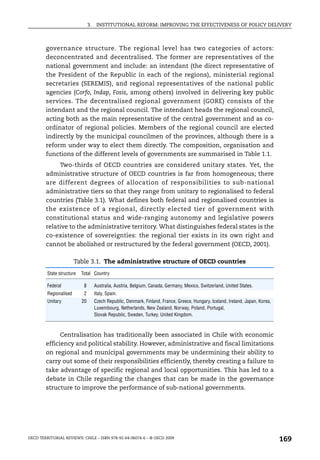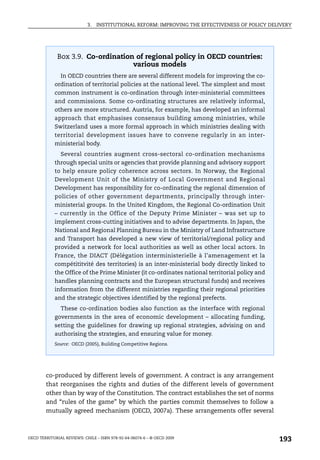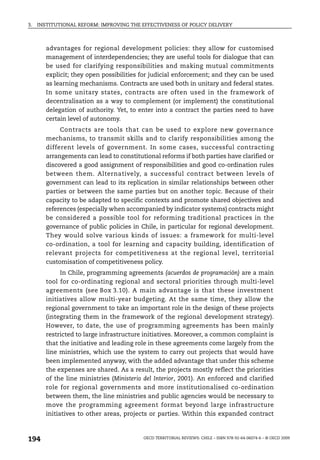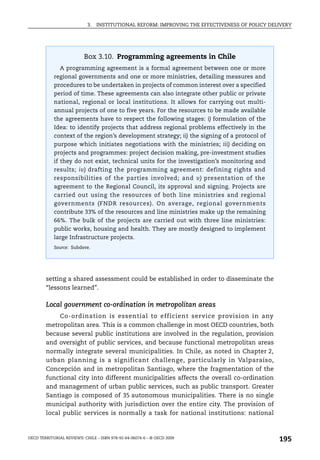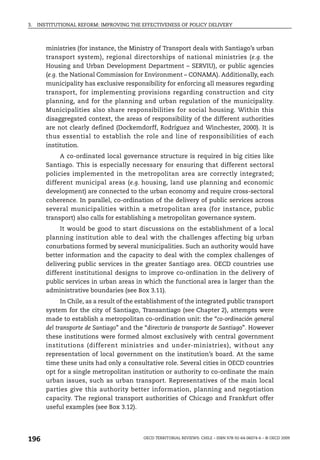


OECD Territorial Reviews


      Chile
ORGANISATION FOR ECONOMIC CO-OPERATION
                    AND DEVELOPMENT

     The OECD is a unique forum where the governments of 30 democracies work
together to address the economic, social and environmental challenges of globalisation.
The OECD is also at the forefront of efforts to understand and to help governments
respond to new developments and concerns, such as corporate governance, the
information economy and the challenges of an ageing population. The Organisation
provides a setting where governments can compare policy experiences, seek answers to
common problems, identify good practice and work to co-ordinate domestic and
international policies.
     The OECD member countries are: Australia, Austria, Belgium, Canada, the
Czech Republic, Denmark, Finland, France, Germany, Greece, Hungary, Iceland,
Ireland, Italy, Japan, Korea, Luxembourg, Mexico, the Netherlands, New Zealand,
Norway, Poland, Portugal, the Slovak Republic, Spain, Sweden, Switzerland, Turkey,
the United Kingdom and the United States. The Commission of the European
Communities takes part in the work of the OECD.
    OECD Publishing disseminates widely the results of the Organisation’s statistics
gathering and research on economic, social and environmental issues, as well as the
conventions, guidelines and standards agreed by its members.


               This work is published on the responsibility of the Secretary-General of
            the OECD. The opinions expressed and arguments employed herein do not
            necessarily reflect the official views of the Organisation or of the governments
            of its member countries.


Corrigenda to OECD publications may be found on line at: www.oecd.org/publishing/corrigenda.
© OECD 2009

You can copy, download or print OECD content for your own use, and you can include excerpts from OECD publications,
databases and multimedia products in your own documents, presentations, blogs, websites and teaching materials,
provided that suitable acknowledgment of OECD as source and copyright owner is given. All requests for public or
commercial use and translation rights should be submitted to rights@oecd.org. Requests for permission to photocopy
portions of this material for public or commercial use shall be addressed directly to the Copyright Clearance Center
(CCC) at info@copyright.com or the Centre français d'exploitation du droit de copie (CFC) at contact@cfcopies.com.
FOREWORD


                                                    Foreword
        A     t the beginning of this new millennium, regional economies are confronting
        momentous changes. The globalisation of trade and economic activity is increasingly
        testing their ability to adapt and maintain their competitive edge. There is a tendency
        for income and performance gaps to widen between and within regions, and the cost of
        maintaining social cohesion is increasing. On the other hand rapid technological
        change and greater use of knowledge are offering new opportunities for local and
        regional development but demand further investment from enterprises, reorganisation
        of labour and production, more advanced skills and environmental improvements.
             Amid this change and turbulence, regions continue to follow very different
        paths. Some regions are doing well and are driving growth. Others are less
        successful at capturing trade and additional economic activities. Many territories
        with poor links to the sources of growth and prosperity, are finding it difficult to keep
        up with the general trend.
              At the same time central governments are no longer the sole provider of territorial
        policy. The vertical distribution of power between the different tiers of government
        needs to be reassessed as well as the decentralisation of resources and competences in
        order to better respond to the different opportunities and demands of the different
        regions and improve policy efficiency. In that context public authorities need to
        weigh up current challenges, evaluate the strategies pursued in recent years and
        define new options.
              Responding to a need to study and spread innovative territorial development
        strategies and governance in a more systematic way, in 1999 the OECD created the
        Territorial Development Policy Committee (TDPC) as a unique forum for international
        exchange and debate. The TDPC has developed a number of activities, among which
        are a series of national reviews. These studies, such as this one, follow a standard
        methodology and a common conceptual framework, allowing countries to share their
        experiences and disseminate information on good practices. This series is intended to
        produce a synthesis that will formulate and diffuse horizontal policy recommendations.


OECD TERRITORIAL REVIEWS: CHILE – ISBN 978-92-64-06074-6 – © OECD 2009
                                                                                                    3
ACKNOWLEDGEMENTS


                              Acknowledgements
     T  he OECD would like to thank the Chilean authorities at the national and sub-national
     levels for their co-operation and support during the reviewing process. The OECD
     expresses its special gratitude to the Sub-secretariat for Regional Development of Chile
     (Subdere) local counterpart in the reviewing process. The valuable support received from
     the Chilean Economic Development Agency (CORFO) and from the Inter-American
     Development Bank (IDB) is also gratefully acknowledge. Special thanks are given to
     Ms. Claudia Serrano, Undersecretary of Regional Development during the process of
     elaboration of this review, Mr. Carlos Alvarez, Executive Vice-President of the Chilean
     Economic Development Agency, CORFO, Ms. Ignacia Fernández, Ms. María Angélica
     Ropert, Ms. Paula Pacheco, Mr. Osvaldo Henriquez, Mr. Jaime Fierro and to all the staff
     of Subdere that collaborated in the process of the review. The OECD would also like to
     thank to the authorities of the regions of Coquimbo and Valparaíso, and to the more than
     100 actors from the public and private sectors, international organisations, civil society
     and academia that participated in several meetings for their cooperation and support.
          Peer Reviewer Countries (Canada and the United Kingdom) were represented by
     Mr. Paul Le Blanc, Executive Vice-President of the Atlantic Canada Opportunities
     Agency (ACOA) and Mr. Graham Garbutt, Chief Executive Commission for Rural
     Communities, UK, who provided substantial support and collaboration in all the
     review process. Significant contributions were also received from Mr. Krister
     Andersson, Professor at the University of Colorado at Boulder, United States.
           This review was written and co-ordinated by Mr. Carlos Icaza Lara, under the
     direction of Mr. Mario Pezzini, Deputy Director of Public Governance and Territorial
     Development and Mr. Roberto Villarreal (first draft). Substantial contributions were
     provided by Mr. Enrique Garcilazo, and Mr. Andrew Davies. Additional contributions
     were provided by Ms. Claire Charbit, Ms. Dorothee Allain Dupre, Ms. Lee Mizell,
     Mr. Martin Forst and Ms. Maria Varinia Michalun.
          Ms. Doranne Lecercle edited the final manuscript and Ms. Sophia Katsira and Ms.
     Jeanette Duboys prepared the Review for publication.


4                                          OECD TERRITORIAL REVIEWS: CHILE – ISBN 978-92-64-06074-6 – © OECD 2009
ACKNOWLEDGEMENTS


                                        Country Profile of Chile
    ● Area (sq Kilometers): 756 946

    ● Population: 16.6 million people (2007 official estimate).

    ● Form of state: unitary republic with a presidential regime and a democratic,
       multiparty political system.
    ● Political system: The Chilean State is split into three independent branches: the
       Executive, headed by the President of the Republic; the Judicial, with its highest
       tribunal, the Supreme Court; and the Legislative, which has a Chamber of Deputies
       (or House of Representatives) and a Senate. The President is directly elected to one
       four-year term.

                                        Economic Trends (2006)
    ● GDP (at current prices and current exchange rate; USD billion): 145.8.

    ● GDP per Head (USD at PPP): 13 042.

    ● Unemployment rate (% of labour force): 7.7%.

    ● Trade in goods and services (as a percentage of GDP): 64.46%.


                                          Public Finance (2006)
    ● General Government Budget Balance (% of GDP): 7.9.

    ● General Government Revenue (% of GDP): 27.9.

    ● General Government Expenditure (% of GDP): 20.0.


                                        Living Standards (2006)

    ● Life expectancy at Birth: 78.4.

    ● Income Inequality (Gini Coefficient): 54.

    ● Poverty incidence (national poverty line): 13.7.


                     Territorial and Institutional Framework of Chile

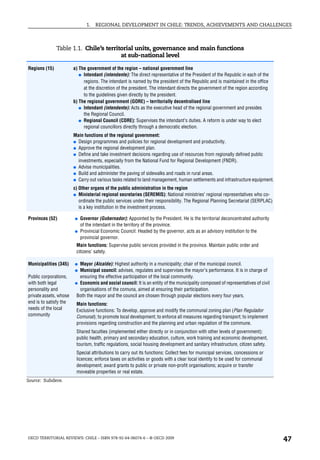
    ● Chile      has a three-tier government system: 15 regions; 52 provinces; and
       345 municipalities.
    ● Administrative authority at regional level is directed by an intendant (Intendente) as
       a head of the regional executive appointed by the President, and a regional council
       (consejo regional) indirectly elected by municipal councilmen. Each province is
       headed by a Governor, appointed by the President and directly reporting to the
       regional Intendant. Municipalities are governed by a mayor (alcalde), who heads the
       local administration, and a municipal council (concejo municipal), with decision-
       making, regulatory and supervisory functions. Both the mayor and the council are
       directly elected by citizens for four-year terms.


OECD TERRITORIAL REVIEWS: CHILE – ISBN 978-92-64-06074-6 – © OECD 2009
                                                                                               5
ACKNOWLEDGEMENTS


                         Chile’s Regions

                   N°      Region                                      Capital city

                   I       Tarapacá                                    Iquique

                   II      Antofagasta                                 Antofagasta

                   III     Atacama                                     Copiapo

                   IV      Coquimbo                                    La Serena

                   V       Valparaíso                                  Valparaíso

                   RM Metropolitan Region                              Santiago

                   VI      O’Higgins                                   Rancagua

                   VII     Maule                                       Talca

                   VIII Bío-Bío                                        Concepción

                   IX      Araucanía                                   Temuco

                   X       Los Lagos                                   Puerto Montt

                   XI      Aysén del General Carlos Ibáñez del Campo   Coyhaique

                   XII     Magallanes y la Antártica Chilena           Punta Arenas

                   XIV Los Ríos                                        Valdivia

                   XV      Arica-Parinacota                            Arica


6                          OECD TERRITORIAL REVIEWS: CHILE – ISBN 978-92-64-06074-6 – © OECD 2009
TABLE OF CONTENTS


                                               Table of Contents
        List of Acronyms and Abbreviations . . . . . . . . . . . . . . . . . . . . . . . . . . . . . . .                           13

        Assessment and Recommendations . . . . . . . . . . . . . . . . . . . . . . . . . . . . . . .                               17

        Chapter 1. Regional Development in Chile: Trends, Achievements
                         and Challenges . . . . . . . . . . . . . . . . . . . . . . . . . . . . . . . . . . . . . . . .            39
               1.1. Major macroeconomic trends . . . . . . . . . . . . . . . . . . . . . . . . . . . . . .                         40
                     Assessing the macroeconomic environment . . . . . . . . . . . . . . . . .                                     40
                     Challenges . . . . . . . . . . . . . . . . . . . . . . . . . . . . . . . . . . . . . . . . . . . . . .        42
               1.2. Regional dimension . . . . . . . . . . . . . . . . . . . . . . . . . . . . . . . . . . . . . .                 45
                     Territorial units – Chile’s administrative system . . . . . . . . . . . . . .                                 46
                     Measuring economic performance in the regions . . . . . . . . . . . . .                                       47
               1.3. Assets in Chilean regions. . . . . . . . . . . . . . . . . . . . . . . . . . . . . . . . . .                   58
                     Population, settlement and geography . . . . . . . . . . . . . . . . . . . . . .                              58
                     Natural resources . . . . . . . . . . . . . . . . . . . . . . . . . . . . . . . . . . . . . . . .             63
                     Human capital . . . . . . . . . . . . . . . . . . . . . . . . . . . . . . . . . . . . . . . . . . .           66
                     Infrastructure. . . . . . . . . . . . . . . . . . . . . . . . . . . . . . . . . . . . . . . . . . . .         69
                     Access to basic services . . . . . . . . . . . . . . . . . . . . . . . . . . . . . . . . . . .                73
                     Industrial clusters and areas of specialisation . . . . . . . . . . . . . . . .                               74
               1.4. Specific challenges of urban and rural regions. . . . . . . . . . . . . . . .                                  79
                     Rural regions . . . . . . . . . . . . . . . . . . . . . . . . . . . . . . . . . . . . . . . . . . . .         79
                     Urban metropolis . . . . . . . . . . . . . . . . . . . . . . . . . . . . . . . . . . . . . . . .              82
               Conclusion. . . . . . . . . . . . . . . . . . . . . . . . . . . . . . . . . . . . . . . . . . . . . . . . . .       85
               Notes . . . . . . . . . . . . . . . . . . . . . . . . . . . . . . . . . . . . . . . . . . . . . . . . . . . . . .   86
               Bibliography . . . . . . . . . . . . . . . . . . . . . . . . . . . . . . . . . . . . . . . . . . . . . . . .        87
               Annex 1.A1. OECD Regional Typology in Chile . . . . . . . . . . . . . . . . . . . .                                 88
               Annex 1.A2. Specialisation Index . . . . . . . . . . . . . . . . . . . . . . . . . . . . . . .                      90

        Chapter 2. Regional Approaches to Economic Development Challenges . .                                                      91
               Introduction: The emergence of a new debate on regional policy . . .                                                92
               2.1. The focus on innovation: from a centralised policy focus
                     to a regional approach . . . . . . . . . . . . . . . . . . . . . . . . . . . . . . . . . . . .                94
                     Regional innovation as a key instrument of national economic
                     policy. . . . . . . . . . . . . . . . . . . . . . . . . . . . . . . . . . . . . . . . . . . . . . . . . . .   95


OECD TERRITORIAL REVIEWS: CHILE – ISBN 978-92-64-06074-6 – © OECD 2009
                                                                                                                                        7
TABLE OF CONTENTS


          2.2. Co-ordinating productive development in the regions . . . . . . . . . 105
                Chile’s regional development agencies . . . . . . . . . . . . . . . . . . . . . . 109
                Micro, small and medium-sized enterprises . . . . . . . . . . . . . . . . . 117
          2.3. Education and human capital as a priority target . . . . . . . . . . . . . 122
                Human capital and territorial competitiveness . . . . . . . . . . . . . . . 122
                Towards quality education accessible to all . . . . . . . . . . . . . . . . . . 128
          2.4. From agriculture to rural development . . . . . . . . . . . . . . . . . . . . . . 133
                Diversifying activities . . . . . . . . . . . . . . . . . . . . . . . . . . . . . . . . . . . . . 134
                The role of public policies to promote rural development . . . . . . 137
                Towards a broad territorial approach to rural policies . . . . . . . . . 139
          2.5. Towards comprehensive territorial infrastructure planning . . . . 142
                Transport infrastructure and the need for territorial co-ordination                                      144
                Urban transport planning . . . . . . . . . . . . . . . . . . . . . . . . . . . . . . . . . 147
          2.6. Regional economic objectives and public investment mechanisms 148
                Regionally decided investments: the FNDR . . . . . . . . . . . . . . . . . . 151
                Regional distribution of the FNDR . . . . . . . . . . . . . . . . . . . . . . . . . . 151
                From sectoral subsidies to integrated grants . . . . . . . . . . . . . . . . . 154
                The National Investment System . . . . . . . . . . . . . . . . . . . . . . . . . . . 156
                Benefits/challenges of the National Investment System . . . . . . . 158
          Conclusion. . . . . . . . . . . . . . . . . . . . . . . . . . . . . . . . . . . . . . . . . . . . . . . . . . 160
          Notes . . . . . . . . . . . . . . . . . . . . . . . . . . . . . . . . . . . . . . . . . . . . . . . . . . . . . . 162
          Bibliography . . . . . . . . . . . . . . . . . . . . . . . . . . . . . . . . . . . . . . . . . . . . . . . . 163
          Annex 2.A1. The FNDR Process . . . . . . . . . . . . . . . . . . . . . . . . . . . . . . . . . 165

     Chapter 3. Institutional Reform: Improving the Effectiveness
                   of Policy Delivery . . . . . . . . . . . . . . . . . . . . . . . . . . . . . . . . . . . . . . 167
          Introduction . . . . . . . . . . . . . . . . . . . . . . . . . . . . . . . . . . . . . . . . . . . . . . . . 168
          3.1. A centralised system engaged in a reform debate . . . . . . . . . . . . . 168
                Administrative and financial challenges for sub-national
                governments . . . . . . . . . . . . . . . . . . . . . . . . . . . . . . . . . . . . . . . . . . . . 170
                The decentralisation debate . . . . . . . . . . . . . . . . . . . . . . . . . . . . . . . 174
          3.2. Making decentralisation reforms work . . . . . . . . . . . . . . . . . . . . . . 183
                The scope for reform and implementation . . . . . . . . . . . . . . . . . . . 184
                A judicious reallocation of responsibilities . . . . . . . . . . . . . . . . . . . 186
                Co-ordination arrangements . . . . . . . . . . . . . . . . . . . . . . . . . . . . . . . 191
                Capacity building and reform at sub-national level . . . . . . . . . . . 200
                Enhancing participation. . . . . . . . . . . . . . . . . . . . . . . . . . . . . . . . . . . 207
          Conclusion. . . . . . . . . . . . . . . . . . . . . . . . . . . . . . . . . . . . . . . . . . . . . . . . . . 212
          Notes . . . . . . . . . . . . . . . . . . . . . . . . . . . . . . . . . . . . . . . . . . . . . . . . . . . . . . 214
          Bibliography . . . . . . . . . . . . . . . . . . . . . . . . . . . . . . . . . . . . . . . . . . . . . . . . 215


8                                                      OECD TERRITORIAL REVIEWS: CHILE – ISBN 978-92-64-06074-6 – © OECD 2009
TABLE OF CONTENTS


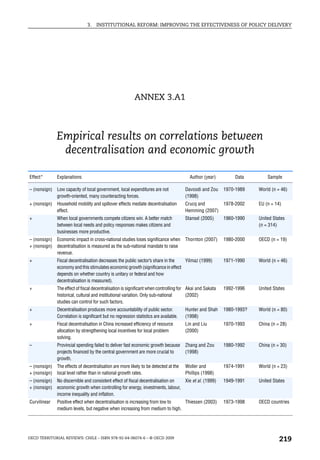
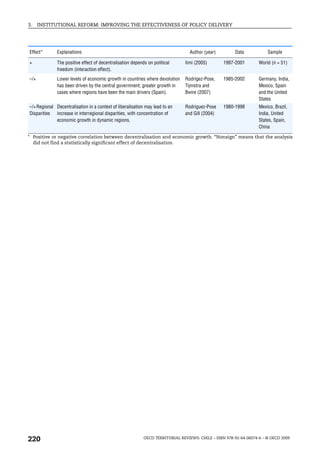
               Annex 3.A1. Empirical results on correlations between
                           decentralisation and economic growth. . . . . . . . . . . . . . . 219
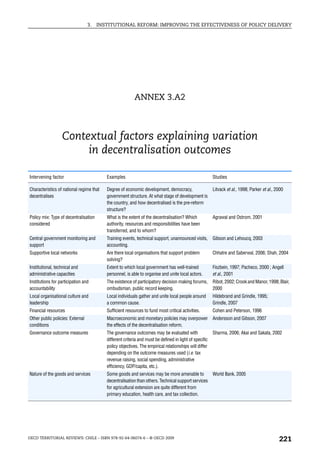
               Annex 3.A2. Contextual factors explaining variation in
                           decentralisation outcomes . . . . . . . . . . . . . . . . . . . . . . . . . 221

        Boxes

            1.1.   Native forests and economic sustainability in Chile . . . . . . . . . . . .                                   65
            1.2.   Rural Infrastructure for Territorial Development . . . . . . . . . . . . . . .                                74
            1.3.   Identifying competitive clusters in Chile . . . . . . . . . . . . . . . . . . . . . . . . .                   75
            1.4.   The OECD Rural Paradigm . . . . . . . . . . . . . . . . . . . . . . . . . . . . . . . . . .                   81
            2.1.   Towards a comprehensive place-based approach to regional
                   development . . . . . . . . . . . . . . . . . . . . . . . . . . . . . . . . . . . . . . . . . . . . .          92
            2.2.   Agencies for innovation at the national level . . . . . . . . . . . . . . . . . .                              97
            2.3.   The national innovation strategy. . . . . . . . . . . . . . . . . . . . . . . . . . . . . . . .                98
            2.4.   The Competitiveness Innovation Fund of Regional Assignment . . . .                                            101
            2.5.   Regional innovation strategies: toolkit for French regional
                   authorities, 2007 . . . . . . . . . . . . . . . . . . . . . . . . . . . . . . . . . . . . . . . . . .         102
            2.6.   Atlantic Innovation Fund . . . . . . . . . . . . . . . . . . . . . . . . . . . . . . . . . . .                103
            2.7.   Collaborative mechanisms for selecting cluster targets
                   in OECD countries . . . . . . . . . . . . . . . . . . . . . . . . . . . . . . . . . . . . . . . . .           107
           2.8.    The challenge of diversification in Norway. . . . . . . . . . . . . . . . . . . .                             108
           2.9.    Specific objectives of the regional development agencies in Chile. . .                                        110
          2.10.    Chilean RDAs’ budget for productive development 2008 . . . . . . . .                                          112
          2.11.    Main problems of MSME in Chile . . . . . . . . . . . . . . . . . . . . . . . . . . . .                        118
          2.12.    Chile Emprende . . . . . . . . . . . . . . . . . . . . . . . . . . . . . . . . . . . . . . . . . . .          120
          2.13.    Provincial Offices for Economic Development . . . . . . . . . . . . . . . . .                                 121
          2.14.    The New University for Regional Innovation (NURI) in Korea . . . .                                            124
          2.15.    Knowledge House in England’s northeast and Georgia Tech . . . .                                               125
          2.16.    Chile Califica. . . . . . . . . . . . . . . . . . . . . . . . . . . . . . . . . . . . . . . . . . . . . . .   127
          2.17.    Preferential Scholar Subsidy . . . . . . . . . . . . . . . . . . . . . . . . . . . . . . . .                  131
          2.18.    Renewable Energy in Germany . . . . . . . . . . . . . . . . . . . . . . . . . . . . . .                       135
          2.19.    Rural tourism in OECD countries . . . . . . . . . . . . . . . . . . . . . . . . . . . .                       136
          2.20.    Innovation in rural areas . . . . . . . . . . . . . . . . . . . . . . . . . . . . . . . . . . .               138
          2.21.    The LEADER+ Programme . . . . . . . . . . . . . . . . . . . . . . . . . . . . . . . . . .                     140
          2.22.    Strategy for Territorial Economic Development of the Ministry
                   of Agriculture of Chile. . . . . . . . . . . . . . . . . . . . . . . . . . . . . . . . . . . . . .            141
          2.23.    Trans-European networks . . . . . . . . . . . . . . . . . . . . . . . . . . . . . . . . . .                   143
          2.24.    Prince Edward Island’s Umbrella Governance Framework
                   for Infrastructure . . . . . . . . . . . . . . . . . . . . . . . . . . . . . . . . . . . . . . . . . .        145
          2.25.    Chile’s Infrastructure for Competitiveness plan. . . . . . . . . . . . . . . .                                146
          2.26.    The Transantiago Plan . . . . . . . . . . . . . . . . . . . . . . . . . . . . . . . . . . . . .               148
          2.27.    Territorial Management Programme . . . . . . . . . . . . . . . . . . . . . . . . .                            149


OECD TERRITORIAL REVIEWS: CHILE – ISBN 978-92-64-06074-6 – © OECD 2009
                                                                                                                                       9
TABLE OF CONTENTS


       2.28.     PTI: The salmon and wine clusters . . . . . . . . . . . . . . . . . . . . . . . . . . .                      150
       2.29.     The FNDR . . . . . . . . . . . . . . . . . . . . . . . . . . . . . . . . . . . . . . . . . . . . . . . .     152
       2.30.     The technical and economic analysis of Mideplan . . . . . . . . . . . . .                                    157
       2.31.     Preliminary draft on regional investment, ARI
                 (Anteproyecto Regional de Inversiones) . . . . . . . . . . . . . . . . . . . . . . . . . .                   159
         3.1.    The Inter-municipal Common Fund (Fondo Común Municipal) . . . .                                              172
         3.2.    Regional government resources . . . . . . . . . . . . . . . . . . . . . . . . . . . . .                      174
         3.3.    Decentralisation in the United Kingdom . . . . . . . . . . . . . . . . . . . . . .                           175
         3.4.    Recent developments and prospects of the Chilean
                 decentralisation process . . . . . . . . . . . . . . . . . . . . . . . . . . . . . . . . . . . . . . .       178
        3.5.     The third division of the regional government . . . . . . . . . . . . . . . . . .                            179
        3.6.     Decentralisation, democracy and participation . . . . . . . . . . . . . . . . . . .                          181
        3.7.     Decentralisation and economic growth . . . . . . . . . . . . . . . . . . . . . . .                           182
        3.8.     Measures used in OECD countries to enable reforms . . . . . . . . . . . . . .                                187
        3.9.     Co-ordination of regional policy in OECD countries: various models                                           193
       3.10.     Programming agreements in Chile . . . . . . . . . . . . . . . . . . . . . . . . . . .                        195
       3.11.     Types of metropolitan governance in OECD countries . . . . . . . . . . . . .                                 197
       3.12.     Transport authorities in Chicago and Frankfurt . . . . . . . . . . . . . . . . .                             198
       3.13.     Transport authorities: Vancouver’s TransLink . . . . . . . . . . . . . . . . .                               199
       3.14.     Interchange Canada . . . . . . . . . . . . . . . . . . . . . . . . . . . . . . . . . . . . . . .             202
       3.15.     Asymmetrical decentralisation in Sweden . . . . . . . . . . . . . . . . . . . .                              204
       3.16.     Main performance indicator initiatives in Chile. . . . . . . . . . . . . . . .                               206
       3.17.     The Innovation and Citizenry Award programme . . . . . . . . . . . . . .                                     210
       3.18.     E-government in Chile . . . . . . . . . . . . . . . . . . . . . . . . . . . . . . . . . . . . .              211

     Tables

     Country Profile of Chile . . . . . . . . . . . . . . . . . . . . . . . . . . . . . . . . . . . . . . . . . . . . . . .     5
     Chile’s Regions . . . . . . . . . . . . . . . . . . . . . . . . . . . . . . . . . . . . . . . . . . . . . . . . . .        6
       1.1. Chile’s territorial units, governance and main functions at
             sub-national level . . . . . . . . . . . . . . . . . . . . . . . . . . . . . . . . . . . . . . . . . . . . .     47
       1.2. GDP by selected sectors/region 2005. . . . . . . . . . . . . . . . . . . . . . . . . .                            48
       1.3. Regional Data and Indicators. . . . . . . . . . . . . . . . . . . . . . . . . . . . . . . .                       49
       1.4. Quintile distribution GDP per capita PPP OECD TL2 regions, 2004 . . .                                             52
       1.5. Natural assets of regions . . . . . . . . . . . . . . . . . . . . . . . . . . . . . . . . . . .                   66
       1.6. Distances and estimated journey time to Santiago from the main
             cities in the north and the south. . . . . . . . . . . . . . . . . . . . . . . . . . . . .                       70
       1.7. Location of transport infrastructure under concession
             projects 1993-2006 . . . . . . . . . . . . . . . . . . . . . . . . . . . . . . . . . . . . . . . . .              70
       1.8. Access to basic services in rural and urban households . . . . . . . . .                                           73
       1.9. Specialisation Index, 2003 . . . . . . . . . . . . . . . . . . . . . . . . . . . . . . . . . .                     76
      1.10. Main social indicators in polarised comunas within Santiago
             metropolitan area, 2006 . . . . . . . . . . . . . . . . . . . . . . . . . . . . . . . . . . . .                   83


10                                                         OECD TERRITORIAL REVIEWS: CHILE – ISBN 978-92-64-06074-6 – © OECD 2009
TABLE OF CONTENTS


        1.A1.1.    Chilean provinces classified by the OECD typology . . . . . . . . . . . .                                89
           2.1.    The regional scientific and technological centres . . . . . . . . . . . . . . . . .                     100
           2.2.    Advantages of top-down and bottom-up selection of clusters. . . .                                       106
           2.3.    Key functions of development agencies in OECD countries . . . . . .                                     111
           2.4.    Funding for regional development agencies, selected examples . . .                                      113
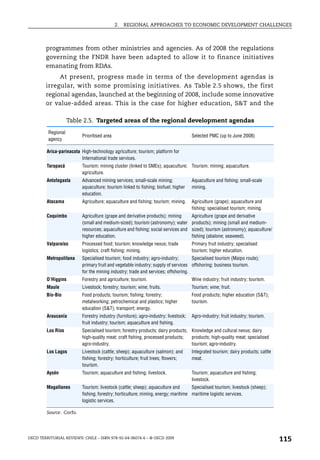
           2.5.    Targeted areas of the regional development agendas . . . . . . . . . . .                                115
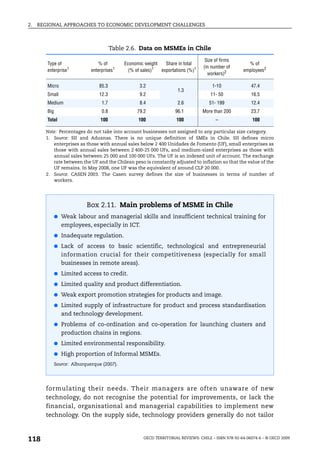
           2.6.    Data on MSMEs in Chile . . . . . . . . . . . . . . . . . . . . . . . . . . . . . . . . . . . .          118
           2.7.    Public investment . . . . . . . . . . . . . . . . . . . . . . . . . . . . . . . . . . . . . . . . .     152
           2.8.    Regional allocation of the FNDR . . . . . . . . . . . . . . . . . . . . . . . . . . . . .               154
           3.1.    The administrative structure of OECD countries . . . . . . . . . . . . . . .                            169
           3.2.    Main sources of municipal revenues (2006). . . . . . . . . . . . . . . . . . . .                        172

        Figures

            1.1.   Growth in GDP per capita (1980 = 100) at 2000 PPP, 1980-2003 . . . .                                    41
            1.2.   Labour productivity, Chile and the OECD area, 1986-2003 . . . . . . .                                   43
            1.3.   PISA survey science scale, 2005 . . . . . . . . . . . . . . . . . . . . . . . . . . . . . .             44
            1.4.   Tertiary educational attainments, 2005 or latest available year . .                                     44
            1.5.   Gini coefficient of income inequalities in Chile and selected
                   OECD countries, 2004 or latest available year . . . . . . . . . . . . . . . . . .                       45
            1.6.   Poverty rate by region, 2006 . . . . . . . . . . . . . . . . . . . . . . . . . . . . . . . . .          50
            1.7.   Initial GDP per capita PPP and average annual growth rates . . . . .                                    51
            1.8.   Shares of GDP and GDP per capita growth and variation,
                   1990-2004 and 1995-2004 . . . . . . . . . . . . . . . . . . . . . . . . . . . . . . . . . . .            53
            1.9.   Gini index of inequality and coefficient of variation in GDP
                   per capita across TL2 regions within each country, 2004 . . . . . . . .                                  54
          1.10.    Disparities in GDP per capita among Chilean regions, 1990-2004 . . . .                                   54
          1.11.    National GDP per capita growth and changes in regional
                   disparities in GDP per capita across OECD TL2 regions within
                   each country, 1995-2004 . . . . . . . . . . . . . . . . . . . . . . . . . . . . . . . . . . . .          55
          1.12.    GDP per capita in PPP and regional disparities across
                   TL2 regions within each country, 2004 or latest available year . . .                                     56
          1.13.    GDP per capita in PPP and regional disparities between
                   TL3 regions, 2004 . . . . . . . . . . . . . . . . . . . . . . . . . . . . . . . . . . . . . . . . . .    56
          1.14.    Gini index of inequality of GDP per worker across TL2 regions
                   within each country, 2004 or latest available year . . . . . . . . . . . . . .                           57
          1.15.    Regional disparities in GDP per capita, productivity, household
                   income, tertiary education and unemployment relative
                   to the national average (Chile = 1), 2004 . . . . . . . . . . . . . . . . . . . . . .                   58
          1.16.    Index of geographic concentration of total population (TL2 regions).                                    59
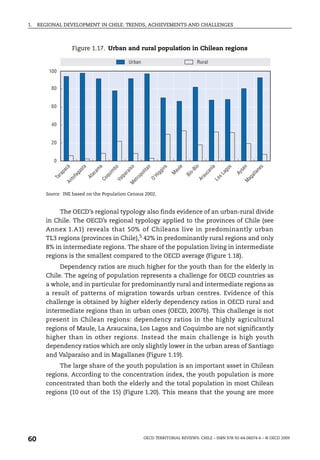
          1.17.    Urban and rural population in Chilean regions . . . . . . . . . . . . . . . .                           60
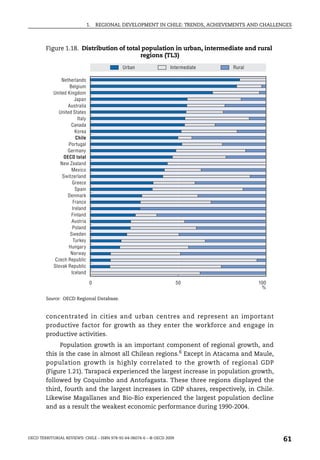
          1.18.    Distribution of total population in urban, intermediate
                   and rural regions (TL3) . . . . . . . . . . . . . . . . . . . . . . . . . . . . . . . . . . . . .        61


OECD TERRITORIAL REVIEWS: CHILE – ISBN 978-92-64-06074-6 – © OECD 2009
                                                                                                                                 11
TABLE OF CONTENTS


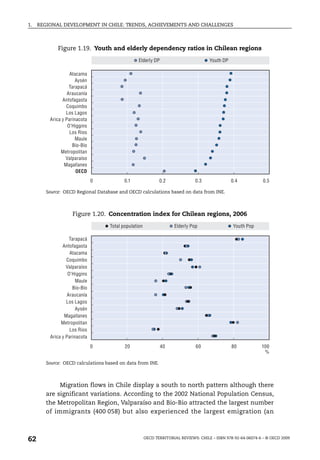
       1.19.   Youth and elderly dependency ratios in Chilean regions . . . . . . . .                                        62
       1.20.   Concentration index for Chilean regions, 2006 . . . . . . . . . . . . . . . . .                               62
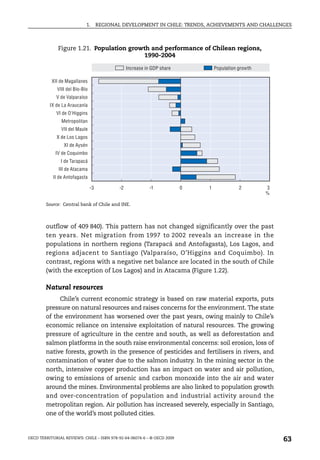
       1.21.   Population growth and performance of Chilean regions, 1990-2004 .                                             63
       1.22.   Internal migration rates . . . . . . . . . . . . . . . . . . . . . . . . . . . . . . . . . . . .              64
       1.23.   Share of total population enrolled in primary, secondary
               and tertiary education, 2006 . . . . . . . . . . . . . . . . . . . . . . . . . . . . . . . .                   67
       1.24.   Average Simce score by school socio-economic group 2006. . . . . .                                             68
       1.25.   Regional higher education enrolment . . . . . . . . . . . . . . . . . . . . . . . .                            68
       1.26.   Fixed phone lines per 100 inhabitants, Chile and selected
               OECD countries (2006) . . . . . . . . . . . . . . . . . . . . . . . . . . . . . . . . . . . . . .              71
       1.27.   Households with Internet access, Chile and selected
               OECD countries (2006) . . . . . . . . . . . . . . . . . . . . . . . . . . . . . . . . . . . . . .              72
       1.28.   Interregional disparities in Internet access . . . . . . . . . . . . . . . . . . . .                           72
       1.29.   Specialisation Index and increase in GDP per capita, 1990-2003 . .                                             78
       1.30.   Share of agriculture in regional GDP, 2003 . . . . . . . . . . . . . . . . . . . .                             79
       1.31.   Disparities in metropolitan Santiago, 2006 . . . . . . . . . . . . . . . . . . . .                             83
        2.1.   R&D Intensity in selected countries, 2004 or latest available year . . .                                       96
        2.2.   Public Investment in Innovation . . . . . . . . . . . . . . . . . . . . . . . . . . . .                       101
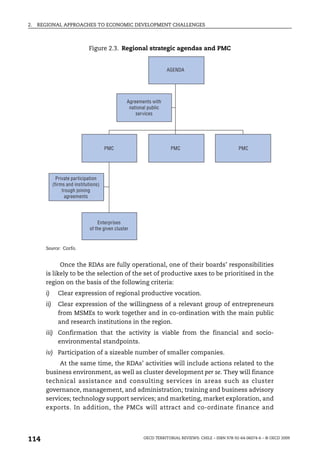
        2.3.   Regional strategic agendas and PMC . . . . . . . . . . . . . . . . . . . . . . . . .                          114
        2.4.   Integration of regional infrastructure in Latin America . . . . . . . . .                                     144
        2.5.   FNDR and the poverty rate. . . . . . . . . . . . . . . . . . . . . . . . . . . . . . . . . .                  153
        2.6.   FNDR and GDP per capita . . . . . . . . . . . . . . . . . . . . . . . . . . . . . . . . . . .                 153
        2.7.   FNDR resources assigned by sector 2006 . . . . . . . . . . . . . . . . . . . . . .                            155
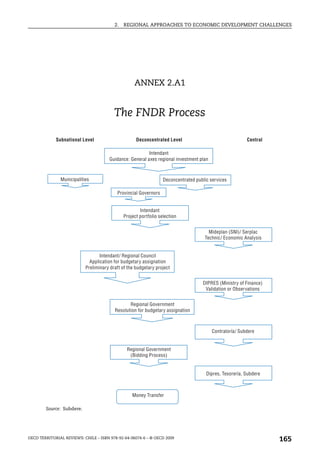
     2.A1.1.   The FNDR Process . . . . . . . . . . . . . . . . . . . . . . . . . . . . . . . . . . . . . . . . .            165
        3.1.   Fiscal decentralisation OECD countries and Chile . . . . . . . . . . . . . .                                  171
        3.2.   Changes in the share of sub-national government contributions
               in total public revenues and spending in OECD countries
               and Chile . . . . . . . . . . . . . . . . . . . . . . . . . . . . . . . . . . . . . . . . . . . . . . . . .   177


12                                                       OECD TERRITORIAL REVIEWS: CHILE – ISBN 978-92-64-06074-6 – © OECD 2009
LIST OF ACRONYMS AND ABBREVIATIONS


                         List of Acronyms and Abbreviations


        ACOA               Atlantic Canada Opportunities Agency
        ARI                Preliminary draft on regional investment
        BOT                Build-operate-transfer concession
        CAD                Canadian Dollar
        CASEN              National Household Survey
        CLP                Chilean peso
        CONAF              National Forest Corporation
        CNE                National Commission for Energy
        CNIC               The National Innovation Council for Competitiveness
        CO                 Carbon Monoxide
        CONICYT            National Commission for Scientific and Technological Research
        CORFO              Chilean Economic Development Agency
        CONADI             Corporation for Indigenous Development
        CORE               Regional Council
        DIPRES             National Budgetary Secretary
        EDT                Strategy for Territorial Economic Development of the Ministry of
                           Agriculture
        EU                 European Union
        FAO                Food and Agriculture Organisation of the United Nations
        FCM                Inter-municipal Common Fund
        FDI                Foreign Direct Investment
        FIA                Agrarian Innovation Fund
        FIC                Innovation for Competitiveness Fund
        FNDR               National Fund for Regional Development
        FOSIS              Social and Solidarity Investment Fund
        GDP                Gross Domestic Product
        GERD               Gross Domestic Expenditure on Research and Development
        GORE               Regional Government
        GT                 Territorial Management Programme
        IDB                Inter-American Development Bank
        ICT                Information and Communications Technologies
        IDR                Regionally defined investments
        IFOP               Institute for Fishing Development
        IMF                International Monetary Fund


OECD TERRITORIAL REVIEWS: CHILE – ISBN 978-92-64-06074-6 – © OECD 2009
                                                                                                        13
LIST OF ACRONYMS AND ABBREVIATIONS


     INE           National Statistics Institute
     INIA          National Institute of Agricultural Research
     INDAP         Agricultural Development Institute
     IT            Information technology
     Km.           Kilometres
     Mat.          Mathematics
     MIDEPLAN      Ministry of Planning and Cooperation
     MINVU         Ministry of Housing and Urban Planning
     MSME          Micro, small and medium-sized enterprises
     Mw            Megawatt
     NGO           Non Governmental Organisation
     ODEPA         Office of Agricultural Policies and Studies
     OECD          Organisation for Economic Cooperation and Development
     pc            Per capita
     PISA          OECD Programme for International Student Assessment
     PM2.5         Particle Pollution (Particles less than 2.5 micrometers in diameter)
     PM10          Particle Pollution (Particles less than 10 micrometers in diameter)
     PMC           Program for improved competitiveness
     PMG           Management Improvement Programme
     PPP           Purchasing Power Parity
     PROCHILE      Chilean Export Development Agency
     PROPIR        Public programme for regional investment
     PTI           Corfo’s Integrated Territorial Program
     R&D           Research and Development
     RDA           Regional Development Agency
     RHEIs         Research and higher education institutions
     S&T           Science and Technology
     SENCE         National Service of Training and Employment
     SERCOTEC      Technical Cooperation Service
     SEREMI        Ministerial Regional Secretariats
     SERPLAC       Regional offices of Mideplan
     SERVIU        Urban and Housing Service
     SHOA          Hydrography and Oceanography Service of the Chilean Navy
     SII           Internal Revenue Service
     RICYT         Network on Science and Technology Indicators (Ibero-American
                   and Inter-American)
     SAG           Agriculture and Livestock Service
     SIMCE         System for Measuring Educational Quality
     SENCE         National Training and Employment Service
     SMEs          Small and medium-sized enterprises
     SINIM         National System of Municipal Indicators
     SNI           National Investment System


14                                      OECD TERRITORIAL REVIEWS: CHILE – ISBN 978-92-64-06074-6 – © OECD 2009
LIST OF ACRONYMS AND ABBREVIATIONS


        SUBDERE            Sub-secretariat for Regional and Administrative Development
                           of Chile
        SUBTEL             Sub-secretariat of Telecommunications
        TFP                Total factor productivity
        TL2                Territorial Level 2
        TL3                Territorial Level 3
        UF                 Chilean Unit of Account
        UNCTAD             United Nations Conference on Trade and Development
        USD                United States Dollar
        VET                Vocational Education and training


OECD TERRITORIAL REVIEWS: CHILE – ISBN 978-92-64-06074-6 – © OECD 2009
                                                                                                        15
ISBN 978-92-64-06074-6
       OECD Territorial Reviews: Chile
       © OECD 2009


                 Assessment and Recommendations

Chile has achieved strong economic growth
and institutional stability

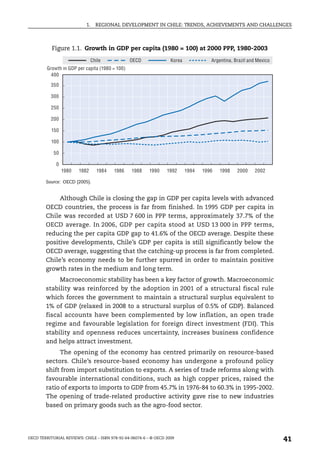
      During the past two decades Chile’s GDP per capita has risen strongly.
      Between 1988 and 1997, Chile grew at an average annual rate of 7.9%. In 1998
      growth slowed to 3.2% and in 1999 the economy contracted (–0.8%). Then,
      from 2000 to 2003, growth returned, and in 2004 and 2005, real GDP rose sharply
      by 6.2 and 6.3%, respectively. Macroeconomic stability has been a key factor of
      growth. Balanced fiscal accounts have been complemented by low inflation, an
      open trade regime and favourable legislation for foreign direct investment (FDI).
      The opening of the economy has centred mainly on resource-based sectors,
      primarily copper mining and sub-products and the agro-food sector. A series of
      trade reforms along with favourable international conditions, such as high
      copper prices, raised the ratio of exports to imports to GDP from 45.7% in 1976-
      84 to 60.3% in 1995-2002. At the same time, the strength and reliability of Chile’s
      institutions have also had a favourable effect on growth. The quality of
      institutions and the stability of Chile’s regulatory framework are comparable to
      those of OECD countries. As a result of this situation, Chile has been among the
      most successful countries in reducing poverty levels worldwide: in 1990 almost
      40% of Chilean population lived in poverty; in 2006 the poverty rate was 13.7%.


Yet, as in other countries, the Chilean economic
outlook changed with the world economic crisis,
emphasising the importance of maximising
the impact of public investment
in productivity growth

      The overall Chilean economic outlook changed drastically during the last quarter
      of 2008 with the world economic crisis. The exchange rate has depreciated
      significantly in nominal terms. Growth and domestic demand decelerated
      significantly. Meanwhile, during the first months of 2009, Chile faced a sharp
      terms of trade shock, reflected by a severe drop in international copper prices,
      which fell to an averaged USD 1.50 a pound after reaching nearly USD 4 in the
      first half of 2008. Nevertheless, the structural surplus and the stabilisation funds


                                                                                             17
ASSESSMENT AND RECOMMENDATIONS


      accumulated during the “prosperous” years, are now available for judicious use.
      In this regard, in response to the crisis, the government announced a
      USD 4 billion (2.8% of GDP) fiscal stimulus package in January 2009, boosting
      public investment programmes and transfers. This stimulus package includes
      among others, investments in infrastructure, small enterprise development, and
      subsidies to low income households. As in other countries, regional policies could
      offer an important tool for the allocation of public investment for maximum long-
      term impact in terms of productivity growth.


Regional performance varies widely, revealing
underutilised regional potential

      The current economic crisis highlights the importance of a long term strategy
      to boost productivity growth nation-wide to complement and deepen the
      gains arising from sound economic management. Challenges in terms of
      labour productivity and human capital show the country’s potential for
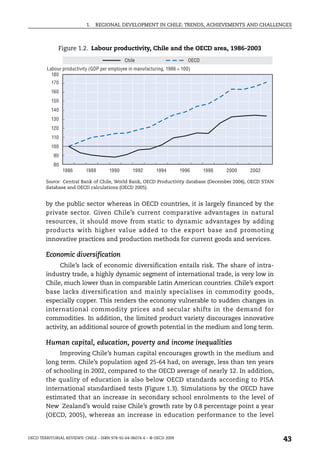
      further growth. In contrast to income levels, the productivity gap between
      Chile and the OECD average has widened in recent years. Moreover, Chile’s
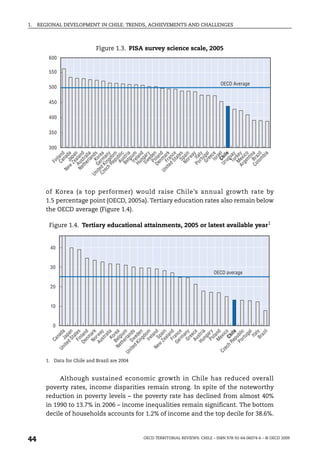
      R&D intensity, tertiary education rates and PISA results are very low in
      comparison with OECD countries, revealing clear room for improvement.
      Chile’s lack of productive diversification makes the economy vulnerable and
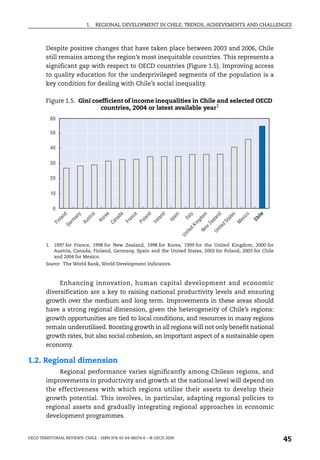
      also creates risk. Finally, the outstanding reduction in poverty levels has not
      been accompanied by a reduction in income inequalities: despite positive
      changes between 2003 and 2006, Chile still remains among the countries with
      the highest income inequalities in the region.
      These challenges have a clear spatial dimension. Performance varies
      markedly among Chilean regions. Regional disparities are substantially higher
      than in most OECD countries and are closely associated with large disparities
      in labour productivity. Regional inequality in GDP per capita declined
      from 1998 to 2004, but a longer time period (1990-2004) reveals significant
      variability, with upward and downward movements in the Gini coefficient of
      interregional disparities, mainly caused by marked fluctuations in growth in
      the northern mining-intensive regions of Antofagasta and Atacama.
      Territorial inequalities are also severe in access to education, in research and
      innovation, and in poverty levels. The pattern of regional disparities has three
      main characteristics: i) a wide gap between the mining-intensive regions of
      the North, such as Antofagasta and Tarapaca, and the Metropolitan Region of
      Santiago on the one hand, and the agriculture-intensive regions such as La
      Araucania, Coquimbo and Maule, on the other; ii) the concentration of
      business activity, firms and workforce in the capital, Santiago, which has 40%
      of the population, is responsible for 47% of GDP and records the county’s
      highest labour force participation rate; and iii) lack of growth in key regions: in


18                                       OECD TERRITORIAL REVIEWS: CHILE – ISBN 978-92-64-06074-6 – © OECD 2009
ASSESSMENT AND RECOMMENDATIONS


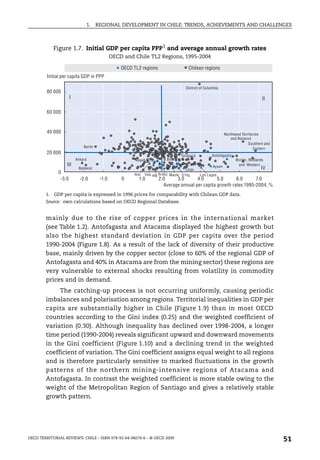
        spite of the country’s overall strong economic growth, four regions – Atacama,
        Valparaíso, the Metropolitan Region of Santiago and Magallanes – which
        represent half of the population and include the Metropolitan Region and the
        third most populated region, Valparaíso, recorded slower annual average
        growth rates from 1995 to 2004 than the average OECD TL2 regions.


The characteristics and assets of the regional
economies are particularly varied but Chile remains
highly concentrated

        The structure, characteristics and assets of Chile’s regional economies are
        particularly varied. Chile is over 4 300 km long and has an average width of
        close to 180 km. It has a wide range of soil types, climatic and environmental
        conditions, ranging from deserts in the north to lakes, fjords and glaciers in
        the south. Mining is the dominant sector in the north. In the Metropolitan
        Region of Santiago, industry and financial services prevail. Agriculture,
        forestry and fishing are the dominant sectors in the country’s centre and
        south. However, in demographic and economic terms, Chile remains very
        concentrated: Santiago has most of the political, economic and intellectual
        capital and nearly half of the population. The economy depends on a few
        sectors, largely located in a small number of regions, which receive much of
        the private and public investment. This reinforces economic concentration
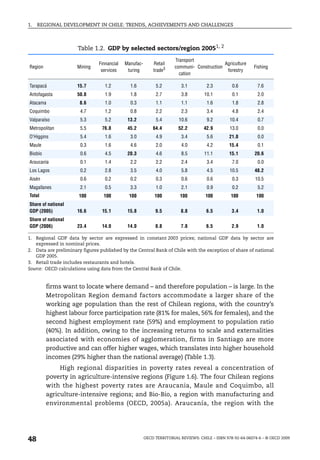
        and causes regional imbalances to persist and amplify. Mining (23% of GDP
        in 2006) and financial services (14% of GDP) are largely located in Antofagasta
        and the Metropolitan Region, respectively. Antofagasta alone accounts for
        close to 50% of the GDP from the mining sector; including Tarapaca and
        Atacama, the two other main northern mining regions, raises the share to
        75%. Likewise, the Metropolitan Region accounts for nearly 77% of GDP from
        financial services.


Economic concentration on the resource-based
sectors puts pressure on natural resources

        Chile’s economy is highly specialised in commodities and this puts pressure
        on natural resources and raises environmental concerns. Intensive agriculture
        in the centre and south and deforestation and salmon platforms in the south
        lead to soil erosion, loss of native forests, a rise in the presence of pesticides
        and fertilisers in rivers, and contamination of water due to the salmon
        industry. In the north, intensive copper production results in emissions of
        arsenic and carbon monoxide into the air and water around the mines. The
        concentration of population and industrial activity around Santiago, one of
        the world’s most polluted cities, creates its own environmental problems.


OECD TERRITORIAL REVIEWS: CHILE – ISBN 978-92-64-06074-6 – © OECD 2009
                                                                                                    19
ASSESSMENT AND RECOMMENDATIONS


      Natural resources are one of Chile’s important economic assets, but to avoid
      over-exploitation of non – renewable resources, a transition towards a
      sustainable development model should be a priority. Several potential
      measures are:
      ●   Improve the sustainable management of natural resources. In particular,
          sustainable use of Chilean forests would be important both to conserve the
          country’s rich biological diversity and to ensure economic sustainability
          and diversity, especially in the southern regions.
      ●   Examine alternative energy sources, such as wind, hydro, solar and
          biomass. Chile has enormous potential in terms of alternative energy
          sources which have just started to be exploited.
      ●   Reinforce public control of the sustainability of economic activities, as well
          as control of industries and vehicles emissions.
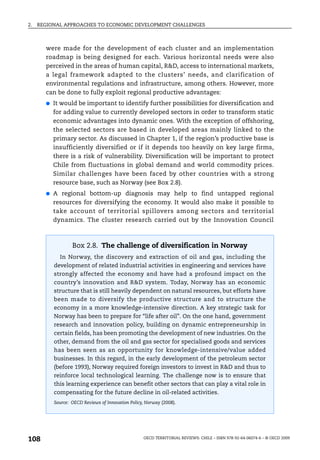
      ●   Diversify the economy towards non – resource based activities.


Diversifying Chile’s productive base is as important
as adding value to existing sectors.

      Regional policies should not only promote growth in areas in which
      economies of agglomeration are present, they should also encourage all
      regions to use their assets to reach their growth potential. In this respect Chile
      could benefit from greater economic and geographical diversification while
      continuing to add value to established sectors to make them more
      competitive. Chile’s lack of economic diversification and over-dependency on
      commodity goods makes the economy vulnerable to sudden changes in
      international commodity prices and secular shifts in demand, and may
      constrain its long-term growth potential. OECD countries are generally much
      less dependent than Chile on natural resources. Diversification induces
      regions to mobilise their resources instead of depending on top-down
      development strategies. At the same time, Chilean regions need to transform
      static into dynamic advantages by producing more complex and higher value
      added goods in their sectors of specialisation. Science, technology and
      innovation policy can play a key role, first by exploring new products in
      emerging sectors and second by making existing ones more productive and
      efficient. Furthermore as Chile develops higher skills and technology in
      resource-based sectors it can transfer knowledge and productivity gains to
      other sectors.
      Given its production of primary goods, Chile’s manufacturing potential is
      clear, although the sector’s potential for developing higher value added goods
      has not been fully exploited. Few regions are specialised in manufacturing and
      those that are moderately specialised, such as Bio-Bio or Valparaíso, have


20                                         OECD TERRITORIAL REVIEWS: CHILE – ISBN 978-92-64-06074-6 – © OECD 2009
ASSESSMENT AND RECOMMENDATIONS


        recorded low growth rates. Technological upgrading of traditional industries
        for an innovation-led growth can be a spur for these regions as well as others,
        such as the northern regions in which manufacturing is underdeveloped. The
        mining industry should be the nexus of a broad set of diversified and
        interrelated services and manufacturing activities.


Improvements in productivity and diversification
of the productive base require context-specific
territorial policies

        Improving productivity will require context-specific territorial policies.
        Chilean regions would benefit particularly from policies aimed at boosting
        productivity, such as those targeted at innovation and entrepreneurship and
        at improving education and training. These areas have a strong regional
        dimension given the heterogeneity of Chilean territories, as growth
        opportunities are tied to local conditions and resources are often
        underutilised. At the same time, diversifying regional economic structures
        would also require regionally driven strategies, capable of mobilising regional
        resources and taking advantage of the different possibilities offered by Chile’s
        regions. This suggests the need for tailored place-based policies that can make
        targeted efforts to improve the quality of public investments and services to
        the regions. Boosting regional growth through context-specific territorial
        policies will not only benefit national growth but also territorial cohesion, an
        important element of a sustainable open economy.


The concentration of Chile’s innovation system
in and around Santiago slows the development of
regional innovative systems, but progress is being
made to promote regional innovation initiatives

        At present, Chile’s innovation system is concentrated in the capital to the
        detriment of regional innovative systems. Chile needs to move to a system
        that promotes regional-level innovation while maximising the diffusion of
        outcomes from the Santiago region. A specific challenge for developing a
        regional approach is the fact that innovation investment focuses strongly on
        public R&D, which tends to be carried out in the capital. On average, close to
        40% of total R&D expenditure is carried out by universities, mainly located in
        Santiago: the two largest – the University of Chile and the Catholic University
        of Chile – account for a large share of university-performed R&D. Most private
        investment also goes to Santiago. The main regional industries perform little
        R&D.


OECD TERRITORIAL REVIEWS: CHILE – ISBN 978-92-64-06074-6 – © OECD 2009
                                                                                                    21
ASSESSMENT AND RECOMMENDATIONS


      In 2000, Conicyt launched 11 scientific and technological centres in various
      regions of the country to stimulate the development of centres of excellence
      in disciplines or specific areas of research that are consistent with regional
      assets and advantages. The initiative is managed by Conicyt, in a joint effort
      involving regional governments, universities and the private sector. Apart
      from its territorial focus, these initiatives have the clear advantage of inter-
      institutional articulation and the involvement of regional universities and the
      regional government in regionally driven innovation initiatives. However,
      these initiatives still represent a modest share of the public innovation budget.
      It is recommended to extend such initiatives and to allocate more resources to
      them. Regional scientific centres could be launched in areas with enormous
      potential, such as alternative energy sources or biotechnology. It will be crucial
      to give regional institutions and regional universities a role in the selection of
      targeted areas and in project implementation.
      From 2008, regions participate in the assigning of 25% of the resources of the
      recently launched Competitiveness Innovation Fund. This fund allocates
      resources from the newly established mining royalty to improve the
      innovative capabilities of the different regions and represents a very
      promising initiative. The regional government, taking into consideration the
      national innovation strategy, will define the use of these resources in projects
      related to science, applied research, innovative entrepreneurship, human
      resources, or the transfer and diffusion of technology. A main challenge will be
      to reach a fair balance between the main priorities of the national innovation
      strategy and the regions’ specific conditions, opportunities and strengths.
      Support from the centre is essential and involves, in particular, helping
      regional actors understand and react to global challenges, and providing
      innovative solutions to help them gradually integrate new approaches into
      their economic development programmes. However, regional governments
      and regional institutions need to have sufficient autonomy to adapt national
      innovation guidelines to the regional priorities.


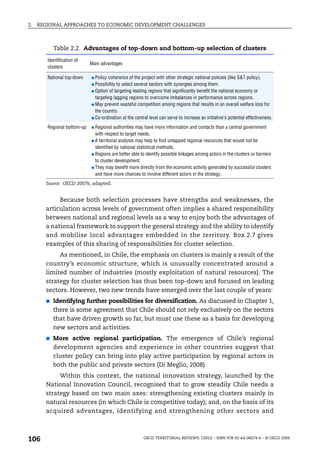
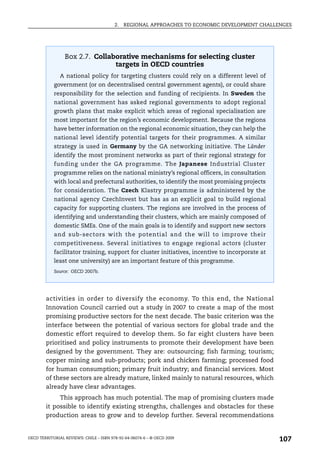
Development of clusters has paid little attention
to bottom-up definition of regional potential,
thus undermining productive diversification

      The government of Chile, through the National Innovation Council, has
      launched a new national strategy for developing more competitive clusters
      based on the view that to grow steadily Chile requires a strategy with two
      main axes: strengthening existing and competitive clusters, mainly through
      knowledge; and on the basis of their strengths, identifying and strengthening
      other sectors and activities in order to diversify production. In 2007 the
      National Innovation Council carried out a study to identify the country’s most


22                                         OECD TERRITORIAL REVIEWS: CHILE – ISBN 978-92-64-06074-6 – © OECD 2009
ASSESSMENT AND RECOMMENDATIONS


        promising productive sectors in the next decade. The eight clusters selected so
        far are mainly in mature sectors linked to natural resources: mining in the
        north and agriculture and fishing in the south, in addition to financial services
        in Santiago. In defining the clusters, there was little bottom-up input. This can
        be an obstacle to further productive diversification and to taking full
        advantage of the regions’ diverse potential. Regional bottom-up diagnosis can
        help to find untapped regional resources for diversifying the economy. It
        would also make it possible to take account of territorial spillovers among
        sectors and regional dynamics.


Regional development agencies have been
established as a key initiative to tackle this
challenge

        Between 2006 and 2007 the Chilean government established regional
        development agencies (RDAs) as a means of transferring responsibilities for
        productive development to the regions. RDAs are meant to further the move
        towards an integrated approach to regional development. Through the
        agencies, coalitions of public and private actors design the region’s productive
        agenda on the basis of the region’s strengths and challenges. They also seek to
        increase the participation of micro, small and medium-sized companies.
        In 2007 the agencies prepared strategic development agendas in which they
        defined a set of regional productive priorities. The agenda serves as a basis for
        developing programmes to improve competitiveness (PMCs) and for defining a
        strategy and concrete actions to increase the competitiveness of a subset of
        the region’s priority clusters. It opens the way to place-based analysis in order
        to find untapped regional resources and thus diversify the economy. It can
        also take account of territorial spillovers among sectors and place-based
        dynamics. Finally, the agencies are to have an important role in co-ordinating
        and linking support for business development from Chile’s public agencies.
        From 2008 at least 10% of the resources of national public agencies involved in
        productive development are to finance the RDAs’ PMCs, a clear indication of
        the Chilean government’s commitment to the RDAs.


Yet, there is a need to better articulate regional
and national perspectives. RDAs should strengthen
their regional perspective

        At present, progress in implementing the RDAs’ regional agendas is irregular,
        with some promising initiatives. The first strategic agendas, launched at the
        beginning of 2008, include some innovative or value-added areas. However,


OECD TERRITORIAL REVIEWS: CHILE – ISBN 978-92-64-06074-6 – © OECD 2009
                                                                                                    23
ASSESSMENT AND RECOMMENDATIONS


      the current agendas and PMCs largely concern the priority sectors set by the
      National Innovation Council (mainly mining, agriculture, fishing and primary
      fruit industry). While it is logical to take national priorities and strong
      productive sectors into account, one of the main values of the RDAs should be
      to set agendas based on specific regional vocations and opportunities for
      expanding the regional productive base. This will be crucial both for
      diversifying the regions’ economic base and for adding value to existing
      sectors. The challenge for policy makers is to balance support for key sectors
      with an approach that allows greater flexibility across regions.
      To improve the effectiveness of regional development agencies as the
      framework to promote regionally based productive development, the
      following challenges need to be tackled:
      ●   The regional vocation of the RDAs should be gradually reinforced in parallel
          with an institutional strengthening of the RDAs’ strategic boards. Currently
          the RDAs’ progress towards meeting their objectives is very dependent on
          the commitment of the region’s intendant (head of the regional government
          appointed by the president who also acts as the head of the RDAs).
      ●   An enlarged team of professionals with the capacity to make an in-depth
          analysis of the different regional vocations and opportunities is required.
          Each regional development agency has a very reduced team of technical
          staff: five people per agency including an executive director. OECD RDAs’
          with similar ambitions normally have a larger group of employees.
      ●   The responsibilities of the RDAs should be further clarified and their
          interaction with the regional government reinforced. Co-ordination
          mechanisms between the RDAs, the national public agencies and the
          regional government will be crucial for integrating the diverse and so far
          fragmented regional development initiatives in a common and coherent
          framework.
      ●   There will be a need to further link the strategic agenda developed by the
          RDAs with the regional investment process. Currently the different public
          actors that intervene in the investment process are not required to consider
          the prioritised productive areas set in the strategic agendas of the RDAs.


To enhance the productivity of Chile’s national
and regional economies, the competitiveness
and participation of micro, small and medium-sized
enterprises must increase

      As in many OECD countries, improving the productivity and competitiveness
      of micro, small and medium-sized enterprises (MSMEs) is a key challenge.
      These companies account for more than 99% of firms and are responsible for


24                                       OECD TERRITORIAL REVIEWS: CHILE – ISBN 978-92-64-06074-6 – © OECD 2009
ASSESSMENT AND RECOMMENDATIONS


        more than 75% of the country’s jobs, yet they produce only 21% of national
        sales and only 4% of national exports. A lack of skills and insufficient access to
        financial services or to innovation, among other factors, make it difficult for
        these firms to cope with the challenges of global competitiveness. The
        productivity gap of these firms clearly affects Chile’s capacity to reach its
        growth potential. Taking regional vocations into account and offering MSMEs
        better access to skills, innovation and technology will help to improve the
        quality and value added of their products. They will also need a better
        institutional framework of public support at the regional level. The RDAs
        and programmes like Chile Emprende aim especially at improving the
        competitiveness of these enterprises. The Chile Emprende programme is a very
        interesting initiative that offers an integrated territorial approach to the
        promotion and development of MSMEs. It brings together the efforts and
        views of different ministries, public agencies and private actors in specific
        territories, opening the way to integrated place-based policies that go far
        beyond the traditional sectoral orientation. The RDAs can also help to
        strengthen the competitiveness of MSMEs at the regional level by involving
        them in regional productive planning. MSMEs are expected to find in the RDAs
        a good platform for articulating and setting out their particular requirements.
        However, special attention should be paid to ensure that RDAs do not become
        dominated by the interests of large firms.


Education and the improvement of human capital
must be a priority for reasons of competitiveness
and equity

        Human capital development is crucial for improving the productivity of
        Chilean regions and for catching up with OECD countries. Efforts have been
        made, but higher educational attainments and better quality education still
        remain key national and regional priorities. Tertiary attainment rates and
        public investment in tertiary education are very low when compared to OECD
        countries: the share of the population with tertiary attainment was only 13%
        in 2004 (the OECD average was 26% in 2005). At the same time there are great
        territorial disparities with most high-quality tertiary education opportunities
        concentrated in Santiago (in 2006, 48% of student enrolments in higher
        education institutions were in the Metropolitan Region) and a few core cities.
        Regions with high poverty levels have especially low tertiary educational
        attainment rates. Chile must seek to spread access to quality education,
        research and vocational training opportunities to the different regions and to
        the underprivileged segments of the population in order to improve
        conditions in its different territories and develop their potential.


OECD TERRITORIAL REVIEWS: CHILE – ISBN 978-92-64-06074-6 – © OECD 2009
                                                                                                    25
ASSESSMENT AND RECOMMENDATIONS


      Traditionally, in Chile, as in most OECD countries, research and higher
      education institutions (RHEIs) emphasise the pursuit of knowledge based on
      national goals with little regard for local frameworks. Given the diversity of
      Chile’s regional assets and characteristics, strengthening the links between
      the regional labour market and higher education and training programmes
      would help to close the gap between education and employment portfolios
      and give graduates a better chance to find local employment and remain in
      their home region. By meeting specific skills requirements it would also help
      local employers. Achieving this goal will require: i) education and human
      capital policies that are sensitive to the characteristics of the regional
      environment; ii) greater participation of education institutions in regional
      development matters; and iii) stronger collaboration and links among higher
      education institutions, research and innovation centres, regional and local
      authorities, local businesses, and regional development agencies. The goal is
      to raise the quality and relevance of education, research and training, making
      them more relevant to the economic needs and potential of each region.
      Improving access to quality education for underprivileged segments of the
      population will be crucial for tackling the challenge of income inequalities in
      Chile. It will require in particular increases in the technical and financial
      resources available to municipalities for carrying out their devolved
      responsibilities for public primary and secondary education, since municipal
      schools manage close to 70% of the socio-economically underprivileged
      students. The recently approved preferential scholar subsidy represents a
      promising step by targeting educational subsidies to the poorest population
      and tying the delivery of funds to the development of a quality improvement
      plan and to performance. These measures would need to be accompanied by
      support to raise the capacities of teachers and the quality of programmes,
      along with further efforts to remove barriers to pre-primary and tertiary
      education for vulnerable social groups as a way to reach minimum standards
      throughout the country.


The agricultural sector plays a key role in Chile’s
economy, but to improve the prospects of rural
areas a shift towards a multi-sectoral place-based
approach of rural development is needed

      There is a need to shift from sectoral policies focused on agricultural subsidies
      towards comprehensive rural development programmes. The agricultural
      sector is a significant contributor to regional output in various Chilean
      regions: in O’Higgins, Maule and Araucanía the share of the agriculture sector
      in total regional GDP exceeds 15%; in Coquimbo and Los Lagos is close to 10%.
      However, most agricultural regions lag behind in economic growth and


26                                         OECD TERRITORIAL REVIEWS: CHILE – ISBN 978-92-64-06074-6 – © OECD 2009
ASSESSMENT AND RECOMMENDATIONS


        development. In addition, small-scale farmers have seen little change in their
        farm incomes, with most of their gains coming from off-farm opportunities.
        Close to half of rural households in Chile are employed in non-agricultural
        activities, basically in manufacturing and the services sector, which offer an
        alternative or complementary source of income. Yet, national policies remain
        focused on agricultural promotion and there is as yet no national rural
        development strategy in Chile. The development of such a strategy with a
        comprehensive territorial focus is highly recommended. OECD governments
        are increasingly recognising the need to shift from traditional rural sectoral
        policies toward s comprehensive place-based approaches to rural
        development. Rural place-based programmes that consider agricultural and
        non-agricultural policies and the links between rural and urban areas would
        be better adapted to the diverse socio-economic characteristics and
        productive processes that affect the development of Chile’s rural territories.
        Within these programmes, regional institutions (regional governments, RDAs)
        are called to play an active role: they are in the best position to plan a
        comprehensive approach to rural development and to make it part of their
        development strategies and agendas.
        Several off-farm activities offer rural areas significant opportunities.
        Renewable energy could mean higher prices for producers, land rents for wind
        and solar facilities, jobs in construction, operations and maintenance, among
        others. Tourism represents another attractive alternative: given Chile’s rich
        and diverse environmental attractiveness and rural heritage, tourism offers
        many unexploited opportunities. However, the diversification of activities
        depends largely on the capacities and attributes of the rural locality. These
        capacities are largely determined by drivers such as human capital,
        entrepreneurship, innovation, and availability of services and infrastructure.
        Improving the level of human capital in rural areas is crucial to enhancing
        their capacity to innovate – and to assimilate innovation – and to ensure that
        capital investment does not leak out of the region. In addition, local
        involvement and entrepreneurship will be important to ensure that the area
        produces value added for itself.


Infrastructure has been much improved, but further
improvements are needed to connect peripheral
regions and rural areas

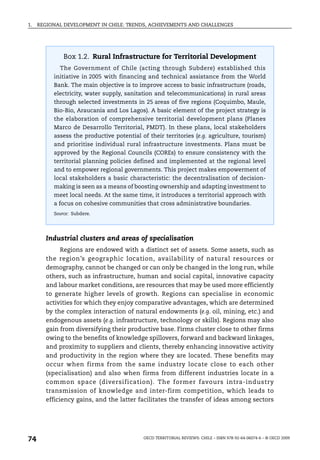
        Chile’s challenging geographical and topographical situation presents a
        number of challenges fo r developing and manag ing the national
        infrastructure system and providing access to transport infrastructure,
        communications and basic services, especially in remote and peripheral
        regions. Under Chile’s concession programme, which started in 1993, the


OECD TERRITORIAL REVIEWS: CHILE – ISBN 978-92-64-06074-6 – © OECD 2009
                                                                                                    27
ASSESSMENT AND RECOMMENDATIONS


      transport infrastructure network was substantially improved; however the
      needs of peripheral regions and rural areas have yet to be met. Connectivity
      with peripheral areas and remote regions needs to be improved, but care must
      be taken not to focus solely on inter-city linkages: connections between urban
      centres and rural areas are crucial for greater development of rural regions.
      Concession programmes based on shared public-private risk might be used for
      projects with high social returns, such as those to extend the infrastructure
      network in peripheral areas.
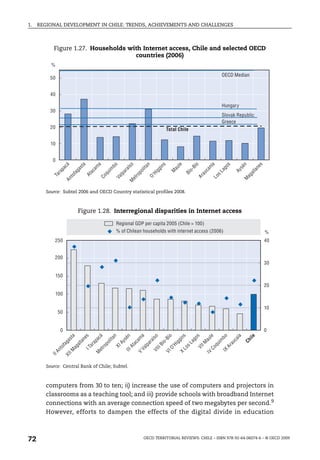
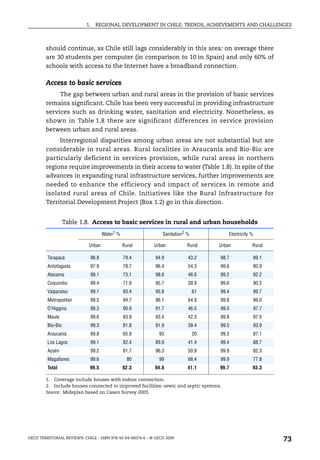
      Interregional disparities in access to telecommunications also remain
      significant: while more than 30% of households in the Metropolitan Region or
      in the mining region of Antofagasta have Internet access, only close to 10% of
      households do so in Maule and Araucanía (agriculture-intensive regions) and
      in the far south reg ion of Aysén. These ineq ualities in access to
      communication broadly correspond to disparities in GDP per capita.
      Improving access to telecommunications represents a potential source of
      growth and should be favoured.


The potential of transport infrastructure will only
be fully exploited if co-ordination and territorial
synergies exist; this will require governance
arrangements and greater involvement
of sub-national actors

      Co-ordination of the different institutions dealing with transport
      infrastructure in Chile and of infrastructure and other economic development
      policies is crucial. Because several institutions play a role in infrastructure
      planning and development, territorial co-ordination is essential. There is also
      a need for synergies between transport infrastructure and other policies with
      an impact on regional development. Investment in infrastructure can
      facilitate development and help to diminish regional disadvantages, yet
      parallel measures (promoting innovation, investment incentives, and
      improvement of education and work skills) are also needed to ensure that a
      region, especially a backward one, takes full advantage of the opportunities
      that improved connectivity creates. In Chile, some initiatives towards inter-
      ministerial agreements such as the Infrastructure for Competitiveness plan
      suggest some progress. However, such initiatives tend to take a top-down
      approach and thus fail to exploit basic information regarding local
      opportunities and regional assets. Greater involvement of regional and local
      institutions (local and regional governments and RDAs) in these initiatives will
      be important to improve the information available about regional needs and to
      make local actors embrace the project and feel part of it. The need for greater
      collaboration by different levels of government and for harmonisation of


28                                         OECD TERRITORIAL REVIEWS: CHILE – ISBN 978-92-64-06074-6 – © OECD 2009
ASSESSMENT AND RECOMMENDATIONS


        policies with a territorial impact calls for moving towards long-term
        governance structures for planning and co-ordinating regional policies.


Metropolitan governance remains a challenge in big
cities like Santiago

        A co-ordinated local governance structure is required in metropolitan areas
        like greater Santiago where the fragmentation of the urban territory into
        different comunas (municipalities) affects the overall co-ordination and
        management of urban public services. Greater Santiago is composed of
        35 autonomous municipalities, and there is no single authority with
        jurisdiction over the entire city. The provision of local public services is
        normally the task of national institutions: national ministries (for instance,
        the Ministry of Transport deals with Santiago’s urban transport system),
        regional directorships of national ministries or public agencies. Additionally,
        each comuna has exclusive responsibility for enforcing measures regarding
        transport, for implementing provisions regarding construction and city
        planning, and for planning and urban regulations. Finally, comunas also share
        responsibilities for social housing. In this context, it is essential to establish
        more clearly the role and responsibilities of the different authorities. In
        addition, metropolitan areas require a governance system which takes into
        account the position and knowledge of local actors. This is especially
        necessary for ensuring co-ordination in the delivery of key public services
        (especially public transport) across several municipalities of the functional
        metropolitan area, and for ensuring that sectoral policies are correctly
        integrated. Areas such as housing, land use planning and economic
        development need to be connected to the urban economy and require cross-
        sectoral coherence.


Chile increasingly includes the regional perspective
in its agenda

        Chile, historically a strongly centralised country, is increasingly including the
        regional development perspective on its agenda. Chile is moving towards a
        territorial development perspective as a way to adapt public policies to the
        characteristics and assets of the different regions. Up to now, Chile has not
        had a clearly identifiable regional policy and interventions at the regional level
        have been largely defined from the centre. However, in recent years some
        initiatives and governance reforms suggest a move towards greater emphasis
        on the regional dimension of economic development. Some institutional


OECD TERRITORIAL REVIEWS: CHILE – ISBN 978-92-64-06074-6 – © OECD 2009
                                                                                                    29
ASSESSMENT AND RECOMMENDATIONS


       initiatives (the RDAs) and programmes (such as Chile Emprende, or Chile Califica)
       have gone in this direction.


The government has also made decentralisation
a priority

       Moving towards an integrated territorial development approach in Chile will
       require changes in order to establish a governance structure capable of
       context-sensitive interventions. Under the current system, the head of the
       regional government, the intendant, is appointed from the centre, and
       presides over an indirectly elected regional council. Regional actors and
       policies remain largely controlled from Santiago. Yet, during the last years, the
       government of Chile has set high priority on decentralisation with the aim of
       providing sub-national governments with the tools, capacities and legitimacy
       to improve their autonomy and performance. To this end, several reforms are
       under way, including a reform to elect the regional council directly. This will
       create a democratically elected body for managing regional development.
       Additionally, responsibility for regional planning has been transferred from
       the national planning ministry to regional governments, and a new regional
       planning division has been established to manage it. On the municipal side a
       reform is under way to modernise municipal organisation and to give more
       autonomy and further responsibilities to municipalities. However,
       administrative and financial limitations on sub-national governments and an
       agenda still largely determined by national guidelines undermine these
       decentralisation reforms.


There are institutional obstacles to a territorial
approach: investment in the regions follows
a sectoral logic

       Sectorally driven national grants are the main source of investment in the
       regions, a fact that hinders the development and financing of territorial
       initiatives. The norms and procedures that govern the Chilean public
       investment process are regulated by the National Investment System which
       also establishes the capacity of expenditure of each Chilean institution.
       Regional governments do not have an independent budget for carrying out
       regional investments. However they guide the allocation of resources from the
       annually determined regionally defined investments (24% of total public
       investments in 2006): different requesting entities (municipalities, provinces,
       regions, RDAs – from 2008 – and deconcentrated national public services)
       submit proposals to the intendant who selects a portfolio of projects for


30                                           OECD TERRITORIAL REVIEWS: CHILE – ISBN 978-92-64-06074-6 – © OECD 2009
ASSESSMENT AND RECOMMENDATIONS


        submission to the National Investment System. However, the analysis and
        selection of the projects to be included in the regional portfolio (in which the
        Planning Ministry intervenes) largely take place on a project-by-project basis
        and so lack an overall territorial articulation. At the same time, the current
        system makes it difficult to move towards a multi-annual budgeting planning
        framework.
        A gradual transition from sectoral subsidies to integrated territorial grants can
        pay off. Regional policy, in OECD countries, has increasingly shifted from
        sectoral subsidies to comprehensive regional policies directed to mobilise
        underutilised regional resources. The Sub-secretariat for Regional and
        Administrative Development of Chile, Subdere, has been closely involved in
        trying to move the main national source of investment in the regions, the
        National Fund for Regional Development (FNDR) from being a compensatory
        fund focused on infrastructure provision towards a territorial development
        fund with more comprehensive goals. This is not yet the case. Most of the
        projects submitted to the FNDR have a municipal basis and mainly seek to
        finance basic infrastructure and services requested by municipalities rather
        than integrated regional projects. The launching of the RDAs, which can
        present initiatives to the FNDR, promises to give a greater role to economic
        development initiatives for promoting endogenous growth. This will require
        attention both to the regional focus of the RDAs’ proposals and to
        strengthening co-ordination between the RDAs and the regional government.
        At the same time, a shift towards more comprehensive regional investments
        would require further measures to adapt the investment process to a
        territorial logic that makes it possible to finance integrated, multi-sectoral
        initiatives and to a multi-annual budgeting planning framework.


A territorial approach to development requires
reinforcing the role of regional governments
in defining a regionally based agenda

        Moving towards an integrated territorial approach in Chile will require
        evolving towards a solid regional governance structure that is able to create a
        coherent framework for economic development. In Chile this will involve
        increasing institutional support to regional governments to give them
        enforcement powers, legitimacy and further capacity to arbitrate in the
        discussion, planning and co-ordination of comprehensive regional
        development policies. Recent decentralisation reforms devolved regional
        planning responsibilities to regional governments. However, regional
        governments still do not have enough institutional strength to manage and
        co-ordinate a common strategy for the region that draws together the various
        agencies and actors operating in the region. The various public actors that


OECD TERRITORIAL REVIEWS: CHILE – ISBN 978-92-64-06074-6 – © OECD 2009
                                                                                                    31
ASSESSMENT AND RECOMMENDATIONS


      intervene in the regional investment process are not required to follow the
      guidelines set in the regional development strategies or in the strategic
      agendas of the RDAs. Moreover, information does not circulate well between
      national agencies and regional governments: regional governments
      sometimes learn about projects to be carried out by a national public agency
      in their region only when the projects have already been planned and are
      about to be implemented. All this affects the capacity to provide a coherent
      framework for formulating regional policies and creates a disincentive for
      regional planning.
      National institutions and agencies, especially the regional representatives of
      national public services and the representative of line ministries in the regions
      (SEREMI), should reinforce their links, co-ordination and co-operation with
      regional governments. Institutionalised channels of collaboration should be
      enforced by law as a way to give regional governments a real capacity to lead
      the process of regional planning. There is also a need for greater co-ordination
      between the regional bodies dealing with economic development issues,
      mainly the RDAs and the planning division of the regional government.
      Attention should be paid to clarifying the roles and strengthening the
      interaction mechanisms of these two recently established institutions.
      Institutionally reinforced regional development strategies, linked to the
      national investment process, would give the regional government and the new
      planning division the opportunity to play a greater role in guiding overall
      regional development. At the same time, it is necessary to ensure the quality
      of regional development strategies. Currently, their quality is variable and
      some regional plans do not provide a qualified analysis and definition of the
      strategic objectives and guidelines for regional economic development.
      Subdere has been carrying out training programmes with a view to improving
      the capacity and performance of the regional governments. Collaboration
      should continue in order to ensure that the regional governments and
      especially the new planning division have the elements and capacity to carry
      out their mandate efficiently.


The role of the regional intendant has to be more
clearly defined and the territorial focus
of the regional council further strengthened

      The role of the intendant should be better defined. Intendants are the
      representative of the president and the main authority of the central
      government in the region, but, at the same time, they preside over the regional
      council, the unit in charge of regional planning. As head of the regional
      government, intendants work to develop the region, but as the president’s


32                                        OECD TERRITORIAL REVIEWS: CHILE – ISBN 978-92-64-06074-6 – © OECD 2009
ASSESSMENT AND RECOMMENDATIONS


        representative, they are also responsible for implementing national policies
        and guidelines. This coexisting mandate generates a problem of divided
        loyalty (to the central state and to the region) which can undermine the
        process of building place-based agendas. The reform under way to elect
        regional councillors through regional elections and the establishment
        from 2008 of a regional planning division are steps towards building a more
        regionally oriented body in charge of regional planning. These efforts should
        gradually go further in order to reinforce the role and position of the regional
        council as a more autonomous regional unit.


Decentralisation requires a clear presentation
of the roles of the different actors

        Decentralisation in Chile will require establishing a national consensus
        regarding the objectives and scope of the process and the role and means at
        the disposal of the different actors. Targets in terms of the reallocation of
        responsibilities must be clear as must the path and means to reach them. In
        Chile, two organic laws define the main functions and responsibilities of
        regional and local governments. Yet, as of now, as in most OECD countries,
        concurrent responsibilities across different levels of governments, along with
        various overlapping functions, generate ambiguity. This makes it crucial to
        clearly define the roles, responsibilities and interactions of and between the
        different actors: vaguely defined or coexisting mandates may compromise the
        implementation of key services. Finally, to ensure service delivery, the
        devolution of responsibilities should be accompanied by a concomitant
        allocation of the resources, competences and organisational flexibility needed
        to carry them out efficiently.


A territorial approach will require strengthening
multi-level governance arrangements

        Moving towards comprehensive place-based approaches in Chile will require
        developing governance arrangements among the different levels of
        government and among the different actors operating in the territory. Because
        they can be adapted to specific contexts and promote shared objectives and
        references (especially when accompanied by indicator systems) contracts
        might be considered a tool for reforming traditional practices in the
        governance of public policies in Chile, in particular for regional development.
        Programming agreements (acuerdos de programación) are in place and involve
        multi-level agreements between one or more regional governments and one
        or more ministries, public or private agencies, to implement certain projects.


OECD TERRITORIAL REVIEWS: CHILE – ISBN 978-92-64-06074-6 – © OECD 2009
                                                                                                    33
ASSESSMENT AND RECOMMENDATIONS


      Programming agreements are an important tool for co-ordinating regional and
      sectoral priorities. An additional advantage is that investment initiatives
      under these agreements allow for multi-year budgeting. Yet, to date, the use of
      programming agreements has mainly been restricted to big infrastructure
      initiatives; in addition, the leading role in these agreements is currently
      mostly played by the line ministries. A stronger and clarified role for regional
      governments and more institutionalised co-ordination between them, the line
      ministries and public agencies would be necessary to move the programming
      agreement format beyond big infrastructure initiatives to other areas, projects
      or parties, and to give a greater role to the regional government in their design
      and co-ordination.


Co-ordination at the national level is also required

      In addition to greater involvement of sub-national governments in regional
      planning, it is important for central policies on regional development to have
      a territorial dimension. While there have been some valuable agreements to
      finance comprehensive place-based initiatives (e.g. Chile Emprende) with
      resources and support from several public agencies, these have been mostly
      ad hoc efforts. To promote integrated territorial approaches to regional policy,
      the central government level should consider the following: i) at the central
      level place-based rather than one-size-fits-all policies should have high
      priority on the political agenda; ii) efficient administrative and fiscal
      mechanisms for inter-ministerial co-ordination require procedures for
      financing multi-sectoral investments as well as collaborative mechanisms
      among ministries and public agencies; iii) involvement of local actors
      (including local and regional governments or RDAs) in the design and co-
      ordination of national initiatives to be carried out in the regions can improve
      information on regional requirements and regional synergies and help to
      see how the initiative fits with other projects being carried out in the territory.
      The role of the Sub-secretariat for Regional and Administrative Development
      (Subdere) as “arbiter” to facilitate and foster integral place-based approaches
      should be strengthened. Subdere is the national unit in charge of promoting
      regional development under the Ministry of the Interior and has a high degree
      of autonomy in dealing with different ministries on issues under its
      responsibility. Subdere supports initiatives that incorporate a regional vision
      in the activities of other central government institutions. However, it is
      currently very difficult for Subdere, in practice, to act as the national co-
      ordination unit. On the one hand, national investment funds are regulated by
      the National Investment System and are largely delivered on a sectoral basis.
      On the other, initiatives proposed by national ministries and public agencies
      normally follow a top-down approach, sometimes with insufficient


34                                         OECD TERRITORIAL REVIEWS: CHILE – ISBN 978-92-64-06074-6 – © OECD 2009
ASSESSMENT AND RECOMMENDATIONS


        consultation and co-ordination with Subdere. Institutionalised channels of
        communication between line ministries and Subdere should be strengthened.


At municipal level, assignment of responsibilities
should go along with a coherent allocation of
resources and competence to carry them out

        Important responsibilities have been transferred to Chilean municipalities but
        these have, on average, few resources and insufficient technical capacity to
        execute them efficiently, a situation that is especially problematic for less
        developed localities. Municipalities have few autonomous sources of revenue:
        sub-national revenues account for only 8.1% of total government revenues, a
        very low figure in comparison to OECD countries. They depend essentially on
        central government transfers and on an inter-municipal equalisation system,
        the Inter-municipal Common Fund (FCM), to carry out their principal devolved
        responsibilities, mainly primary and secondary education and basic health.
        Because the national transfers for education and health are insufficient to
        cover the provision of these services, municipalities must complement
        national grants with own resources. Small and less developed localities with
        small tax bases find this difficult to do, and the FCM’s compensatory
        mechanism has proven insufficient. The recently approved preferential
        scholar subsidy will provide an additional source of revenue and technical
        support for municipalities. However, beyond that, Chile should undertake an
        in-depth evaluation of the resources and support required to provide less
        developed municipalities with enough technical support and economic
        resources to implement these basic public services efficiently.


The municipal reform under way is a necessary
step in adapting municipal structure, capacities
and resources to municipal responsibilities

        The reform of the organic constitutional law of municipalities which is under
        way is a necessary step in adapting municipalities’ organisational structure,
        capacities and resources to local characteristics and demands. It proposes
        several measures for creating an institutional framework more in keeping
        with the responsibilities of local governments. They include: i) improving
        municipalities’ fiscal revenues and redesigning the FCM to improve its
        redistributive impact; ii) giving more flexibility to municipalities to adapt their
        organisational structure to their particular characteristics and to manage their
        staff (currently these functions are defined in national laws); iii) making
        performance incentives part of the remuneration of local officials and offering


OECD TERRITORIAL REVIEWS: CHILE – ISBN 978-92-64-06074-6 – © OECD 2009
                                                                                                    35
ASSESSMENT AND RECOMMENDATIONS


      municipalities further capacity building; and iv) giving associations of
      municipalities the status of legal person, a crucial and necessary step for
      promoting associations of municipalities and backing the requests for
      investment from coalitions of municipalities. The underlying logic is that the
      assignment of responsibilities to municipalities has to be accompanied by a
      coherent allocation of resources, competences and organisational flexibility to
      carry them out efficiently.
      To increase the municipal tax base, the municipal property tax exemption
      could be modified. At present, the exemption concerns an important share of
      the property of less developed municipalities, thereby undermining their
      capacity to tax (close to one-third of municipalities’ revenues come from the
      property tax). Currently the FCM compensates municipalities for exempted
      land or property but the compensation is said to be insufficient. Changes
      could be implemented in order to apply the tax exemption only to low-income
      properties belonging to households under the poverty level (currently
      exempted properties may be secondary residences) and to further
      compensate municipalities for the fiscal shortfall due to the exemption (the
      source of the exemption is a national law aimed at social compensation, yet
      the poorest municipalities bear the burden of this measure).


An incentive to promote local economic
development could be added to the Inter-municipal
Common Fund

      Currently less advantaged municipalities have neither the resources nor the
      incentive to invest in local economic development initiatives. Only richer
      localities can afford to use their autonomous resources in this way. Most of the
      locally available resources of the poorest localities go to municipal education
      and health systems to complement transfers from the national level, leaving
      few resources available for additional investment. In this regard, the FCM does
      not offer any incentive to encourage efficient public management in
      municipalities. Part of the fund could be gradually shifted from unconditional
      subsidies to conditional transfers to support local investment initiatives (for
      instance, fostering innovation and competitiveness, business development, or
      promotion of MSMEs) to promote endogenous growth of under-performing
      municipalities. Such a measure should be accompanied by at least temporary
      support to municipalities for designing such initiatives. Finally, it would be
      important to ensure that the additional resources for promoting endogenous
      growth allocated to municipalities through this incentive scheme do not
      replace funds for social equalisation purposes, thereby leaving overall
      spending unaltered: poorest municipalities are very dependent on this fund to
      carry out their primary activities (such as provision of public education). To


36                                       OECD TERRITORIAL REVIEWS: CHILE – ISBN 978-92-64-06074-6 – © OECD 2009
ASSESSMENT AND RECOMMENDATIONS


        avoid this, the national government’s contribution to the FCM (only 4% of total
        FCM resources in 2007) could rise in the same proportion as the economic
        development incentive.


Efforts have been made in capacity building
and performance measurement and should
be strengthened and go further

        Investing in capacity building and measurement of performance will be
        crucial to the implementation of decentralisation reforms in Chile in order to
        dispel one of the fears of opponents to these reforms (lack of sub-national
        officials’ capacity to carry out a broader mandate). Chile is implementing
        some programmes that aim to improve the skills of local and regional public
        officials in order to prepare them to carry out their devolved responsibilities
        efficiently. This is the case of Subdere’s Governance Improvement Programme
        (Program de Mejoramiento de la Gestión de Subdere). Chile has also implemented
        several performance management programmes based on indicators, such as
        the Management Improvement Programme and the Municipal Services
        Accreditation System. The success of these measures in improving sub-
        national governance performance is likely to depend on several parallel
        factors: i) the existence of efficient multi-level governance arrangements for
        co-operation and co-ordination; ii) the release of regulatory constraints that
        impede the adaptation of municipalities’ organisational structure to local
        requirements; iii) the gradual implementation of a learning-by-doing
        framework by offering technical assistance and capacity building along with
        the progressive transfer of responsibilities; and iv) the participation of sub-
        national governments and institutions in the assessment of the most
        important skills and training programmes needed.


Within the decentralisation context the central
government has an important role to play

        Finally, greater decentralisation does not mean that the central government
        should leave sub-national governments alone. Central governments need to
        set the general legal framework to enable virtuous relations, vertically among
        the different levels of governments and horizontally among the different
        national sectoral policies and among the different regions or municipalities. In
        Chile, the central government can help sub-national governments carry out
        their new mandates by offering technical support and training, and especially
        by monitoring and evaluating their performance.


OECD TERRITORIAL REVIEWS: CHILE – ISBN 978-92-64-06074-6 – © OECD 2009
                                                                                                    37
ASSESSMENT AND RECOMMENDATIONS


To sum up

     Chile, traditionally an extremely centralised country, has made stronger
     territorial policy and greater decentralistion a priority as a way to adapt public
     policies to the characteristics and assets of its diverse territories and to
     unleash their potential. At present, progress remains irregular. Attention to
     national policy goals should be combined with greater involvement of regional
     actors in designing a territorial agenda based on particular regional strengths
     and opportunities as a way to improve their competitiveness. Measures such
     as the launching of the RDAs or the devolution of responsibility for regional
     planning to regional governments are a step forward. However these efforts
     should gradually be extended in order to reinforce the institutional setting of
     the regional governments to make them more independent and capable
     regional bodies. The devolution of responsibilities to sub-national
     governments should be accompanied by the resources and competences
     necessary to execute them efficiently. All this will imply building trust and
     increasing co-operation among levels of government. Co-ordination
     arrangements and other mechanisms, such as capacity building, performance
     indicators, or institutions for participation and accountability, could help by
     raising sub-national governments’ capacities and strengthening the
     legitimacy, coherence and effectiveness of the reform.


38                                      OECD TERRITORIAL REVIEWS: CHILE – ISBN 978-92-64-06074-6 – © OECD 2009
ISBN 978-92-64-06074-6
OECD Territorial Reviews: Chile
© OECD 2009


                                  Chapter 1


           Regional Development in Chile:
        Trends, Achievements and Challenges


                                              39
1.   REGIONAL DEVELOPMENT IN CHILE: TRENDS, ACHIEVEMENTS AND CHALLENGES


        c  hile’s macroeconomy has been well managed, but the government is
        looking to enhance performance in a number of key areas, especially
        productivity, innovation, human capital and economic diversification.
        Furthermore, Chile’s economy depends on a few resource-based sectors
        located in a small number of regions which receive much of the private and
        public investment. This reinforces economic concentration and causes
        regional imbalances to persist and even amplify. In this respect Chile could
        benefit from deepening economic diversification while continuing to add
        value to established sectors. It needs to seek out growth potential in its regions
        by identifying and developing the accumulated skills, practices and assets of
        different territories as potential sources of competitive advantage. All this
        calls for moving towards tailored place-based policies, in order to better adjust
        public management to the different opportunities, strengths and needs of the
        country’s diverse territories.

1.1. Major macroeconomic trends
             At the national level, Chile’s economy has been buoyant over the last two
        decades, with sound management of public finances. Macroeconomics and fiscal
        stability have been key drivers of growth in Chile’s open resource-based economy.
        While necessary, these conditions are not sufficient to sustain positive growth
        rates in the medium and long term. In fact growth rates have recently slowed,
        mainly owing to lags in productivity, human capital, innovation and lack of
        economic diversification. Improvements in these areas represent potential
        sources of growth and a means of accelerating the catching-up process.

        Assessing the macroeconomic environment
             During the past two decades Chile has experienced strong GDP per capita
        growth rates. Growth was particularly buoyant between 1988 and 1997, with
        annual average rates of 7.9%. In 1998 growth rates slowed to 3.2% and in 1999
        the economy contracted (–0.8%). From 2000 to 2003, growth rebounded but
        remained more varied than in the decade to 1997. Then, in 2004 and 2005, real
        GDP rose sharply by 6.2 and 6.3%, respectively. This pattern contrasts with the
        performance of most Latin American economies, which experienced
        stagnation and macroeconomic disarray in the aftermath of the debt crisis of
        the 1980s. Chile not only outperformed its neighbouring countries but also the
        majority of OECD countries (Figure 1.1).


40                                         OECD TERRITORIAL REVIEWS: CHILE – ISBN 978-92-64-06074-6 – © OECD 2009
1.    REGIONAL DEVELOPMENT IN CHILE: TRENDS, ACHIEVEMENTS AND CHALLENGES


           Figure 1.1. Growth in GDP per capita (1980 = 100) at 2000 PPP, 1980-2003
                               Chile             OECD               Korea             Argentina, Brazil and Mexico
         Growth in GDP per capita (1980 = 100)
           400

           350

           300

           250

           200

           150

           100

            50

             0
                 1980   1982     1984    1986    1988     1990    1992      1994   1996   1998    2000    2002

        Source: OECD (2005).


             Although Chile is closing the gap in GDP per capita levels with advanced
        OECD countries, the process is far from finished. In 1995 GDP per capita in
        Chile was recorded at USD 7 600 in PPP terms, approximately 37.7% of the
        OECD average. In 2006, GDP per capita stood at USD 13 000 in PPP terms,
        reducing the per capita GDP gap to 41.6% of the OECD average. Despite these
        positive developments, Chile’s GDP per capita is still significantly below the
        OECD average, suggesting that the catching-up process is far from completed.
        Chile’s economy needs to be further spurred in order to maintain positive
        growth rates in the medium and long term.
             Macroeconomic stability has been a key factor of growth. Macroeconomic
        stability was reinforced by the adoption in 2001 of a structural fiscal rule
        which forces the government to maintain a structural surplus equivalent to
        1% of GDP (relaxed in 2008 to a structural surplus of 0.5% of GDP). Balanced
        fiscal accounts have been complemented by low inflation, an open trade
        regime and favourable legislation for foreign direct investment (FDI). This
        stability and openness reduces uncertainty, increases business confidence
        and helps attract investment.
             The opening of the economy has centred primarily on resource-based
        sectors. Chile’s resource-based economy has undergone a profound policy
        shift from import substitution to exports. A series of trade reforms along with
        favourable international conditions, such as high copper prices, raised the
        ratio of exports to imports to GDP from 45.7% in 1976-84 to 60.3% in 1995-2002.
        The opening of trade-related productive activity gave rise to new industries
        based on primary goods such as the agro-food sector.


OECD TERRITORIAL REVIEWS: CHILE – ISBN 978-92-64-06074-6 – © OECD 2009
                                                                                                                     41
1.   REGIONAL DEVELOPMENT IN CHILE: TRENDS, ACHIEVEMENTS AND CHALLENGES


             Institutions in Chile have been strong and reliable with favourable effects
        on growth. The quality of institutions and the stability of Chile’s regulatory
        framework are comparable to those of OECD countries.1 National regulations
        in Chile focus on full disclosure of public information and sanctions of
        irregularities, thereby encouraging good governance practices with a view to
        strengthening the country’s democratic system. The stability of the national
        regulations applied to foreign investment is internationally recognised. This
        stable regulatory framework and solid macroeconomic management have
        helped to create the conditions for growth.
              The overall Chilean economic outlook shifted drastically during the last
        quarter of 2008 with the world economic crisis. The exchange rate has
        depreciated significantly in nominal terms. Growth and domestic demand
        decelerated significantly. Meanwhile, during the first months of 2009, Chile faced
        a sharp terms of trade shock, reflected by a severe drop in international copper
        prices, which fell to an averaged USD 1.50 a pound after reaching nearly USD 4 in
        the first half of 2008. Nevertheless, the structural surplus and the stabilisation
        funds accumulated during the “prosperous” years, are now available for judicious
        use. In this regard, in response to the crisis, the government announced a
        USD 4 billion (2.8% of GDP) fiscal stimulus package in January 2009, boosting
        public investment programmes and transfers. This stimulus package includes
        among others, investments in infrastructure, small enterprise development, and
        subsidies to low income households. As in other countries, regional policies could
        offer an important tool for the allocation of public investment for maximum long-
        term impact in terms of productivity growth.

        Challenges
        Productivity and innovation
              The productivity gap has widened in recent years. Chile’s productivity
        remains low by OECD country standards. Total factors productivity (TFP), the
        efficiency with which inputs are combined to produce outputs, is estimated to
        have accounted for about one-third of GDP growth in the 1990s (OECD, 2005).
        This suggests that there is room to lift GDP growth further by some
        combination of faster growth in the quantity and quality of labour inputs,
        physical capital accumulation, and more efficient ways of using inputs, which
        can be achieved through technological deepening (i.e. innovation).
        Furthermore, in contrast to income levels, the productivity gap between Chile
        and the OECD average has widened in recent years (Figure 1.2).
             Innovative practices and production methods should be further pursued.
        At 0.68% (2004), Chile’s total R&D intensity (the ratio of gross expenditure on
        research and development [GERD] to GDP) is less than one-third of the OECD
        average of 2.25% (2003). Furthermore innovation in Chile is primarily financed


42                                         OECD TERRITORIAL REVIEWS: CHILE – ISBN 978-92-64-06074-6 – © OECD 2009
1.   REGIONAL DEVELOPMENT IN CHILE: TRENDS, ACHIEVEMENTS AND CHALLENGES


              Figure 1.2. Labour productivity, Chile and the OECD area, 1986-2003
                                              Chile                         OECD
         Labour productivity (GDP per employee in manufacturing, 1986 = 100)
           180
           170
           160
           150
           140
           130
           120
           110
           100
            90
            80
                 1986      1988       1990        1992       1994        1996      1998   2000   2002

        Source: Central Bank of Chile, World Bank, OECD Productivity database (December 2004), OECD STAN
        database and OECD calculations (OECD 2005).


        by the public sector whereas in OECD countries, it is largely financed by the
        private sector. Given Chile’s current comparative advantages in natural
        resources, it should move from static to dynamic advantages by adding
        products with higher value added to the export base and promoting
        innovative practices and production methods for current goods and services.

        Economic diversification
             Chile’s lack of economic diversification entails risk. The share of intra-
        industry trade, a highly dynamic segment of international trade, is very low in
        Chile, much lower than in comparable Latin American countries. Chile’s export
        base lacks diversification and mainly specialises in commodity goods,
        especially copper. This renders the economy vulnerable to sudden changes in
        international commodity prices and secular shifts in the demand for
        commodities. In addition, the limited product variety discourages innovative
        activity, an additional source of growth potential in the medium and long term.

        Human capital, education, poverty and income inequalities
             Improving Chile’s human capital encourages growth in the medium and
        long term. Chile’s population aged 25-64 had, on average, less than ten years
        of schooling in 2002, compared to the OECD average of nearly 12. In addition,
        the quality of education is also below OECD standards according to PISA
        international standardised tests (Figure 1.3). Simulations by the OECD have
        estimated that an increase in secondary school enrolments to the level of
        New Zealand’s would raise Chile’s growth rate by 0.8 percentage point a year
        (OECD, 2005), whereas an increase in education performance to the level


OECD TERRITORIAL REVIEWS: CHILE – ISBN 978-92-64-06074-6 – © OECD 2009
                                                                                                           43
1.   REGIONAL DEVELOPMENT IN CHILE: TRENDS, ACHIEVEMENTS AND CHALLENGES


                              Figure 1.3. PISA survey science scale, 2005
         600

         550

                                                                                    OECD Average
         500


         450


         400


         350


         300
                        Au blic
                        C a land
                    w Ja da
                           a n
                Ne Aus land
                        er li a

             i t e G e Kor s
           Cz d K rm ea
                  h gd y
                          pu m

                           lg ia
                        Ir i u m
                          n d
                            e y
                      De ol a n
                          nm n d
                  i te Fr a ar k
                          St e
                           S es
                            rw n
                      Po It a y
                          r tu l y
                             ee l
                           Is c e
                      Ur C h i l
                          ug le
                         Tu y
                    A r ex e y
                        ge ico

                     Co Br a a
                         lo z il
                                  a
                                 e
                        Gr g a
                              nd


                                a
              e c in a n


                              ua


                               in

                               bi
                       d nc
                       S w g ar


                       No pai
                       Ze pa


                      Hu e l a n


                        P de


                              ra
                       Be s tr
                      Re o


                        M rk
                             at
                     th tr a
                            na


                            m
                            nt
                           la
                           n
                        Fi

              Ne


            Un
          Un


        of Korea (a top performer) would raise Chile’s annual growth rate by
        1.5 percentage point (OECD, 2005a). Tertiary education rates also remain below
        the OECD average (Figure 1.4).

         Figure 1.4. Tertiary educational attainments, 2005 or latest available year1


         40


         30
                                                                                 OECD average

         20


          10


           0
                           r tu c
                  i te Jap a
                       d an
                         F i tes
                          nm d
                        No ar k
                          st y
                            Ko i a
                 Ne Belg e a
                        er m
              i te S w nds
                         ng n
                         Ir e o m
               Ne S nd
                        Z e in
                          Fr nd
                          rm e
                         Gr n y
                         Au ce
                            ng a
                         Po ar y
                         M nd

                  h Ch o
                           p e


                              It a l
                            Br l y
                                    il
                                ga
                       Po ub l i
                                 d


                      Au r wa


                       Hu s t r i
                      Ge anc


                               az
                      R e il
                      De lan


                      K i de


                                ic
                                  l


                    w pa
                     t h iu


                              ee
                                r
                              ra
                             na


                               a
                              la


                               a


                              la
                              a


                            ex
                              d
                            la
                  d e


                            al
                          St
                            n
          Ca


               ec
               Un


            Cz
           Un


        1. Data for Chile and Brazil are 2004


             Although sustained economic growth in Chile has reduced overall
        poverty rates, income disparities remain strong. In spite of the noteworthy
        reduction in poverty levels – the poverty rate has declined from almost 40%
        in 1990 to 13.7% in 2006 – income inequalities remain significant. The bottom
        decile of households accounts for 1.2% of income and the top decile for 38.6%.


44                                              OECD TERRITORIAL REVIEWS: CHILE – ISBN 978-92-64-06074-6 – © OECD 2009
1.    REGIONAL DEVELOPMENT IN CHILE: TRENDS, ACHIEVEMENTS AND CHALLENGES


        Despite positive changes that have taken place between 2003 and 2006, Chile
        still remains among the region’s most inequitable countries. This represents a
        significant gap with respect to OECD countries (Figure 1.5). Improving access
        to quality education for the underprivileged segments of the population is a
        key condition for dealing with Chile’s social inequality.

        Figure 1.5. Gini coefficient of income inequalities in Chile and selected OECD
                            countries, 2004 or latest available year1
          60

          50


          40


          30


          20


          10


           0
                 d

                          y

                               ria


                                          a

                                                   da

                                                             ce

                                                                   nd

                                                                           nd


                                                                                 n

                                                                                        ly

                                                                                                    m


                                                                                                             d

                                                                                                                     es


                                                                                                                              o

                                                                                                                                    il e
                         an


                                      re


                                                                                 ai
               an


                                                                                                         an


                                                                                                                              ic
                                                                                      It a

                                                                                                do


                                                                                                                     at
                                                        an
                                               na


                                                                   la

                                                                          la
                               st


                                                                                                                                   Ch
                                                                                sp


                                                                                                                          ex
                                     Ko
                     rm
               nl


                                                                                                         al

                                                                                                                 St
                                                                  Po

                                                                        Ir e


                                                                                               ng
                              Au


                                                        Fr
                                              Ca


                                                                                                                          M
                                                                                                        Ze
            Fi

                    Ge


                                                                                                                d
                                                                                             Ki


                                                                                                              i te
                                                                                                    w
                                                                                           d

                                                                                                  Ne

                                                                                                         Un
                                                                                       i te
                                                                                      Un


        1. 1997 for France, 1998 for New Zealand, 1998 for Korea, 1999 for the United Kingdom, 2000 for
           Austria, Canada, Finland, Germany, Spain and the United States, 2002 for Poland, 2003 for Chile
           and 2004 for Mexico.
        Source: The World Bank, World Development Indicators.


             Enhancing innovation, human capital development and economic
        diversification are a key to raising national productivity levels and ensuring
        growth over the medium and long term. Improvements in these areas should
        have a strong regional dimension, given the heterogeneity of Chile’s regions:
        growth opportunities are tied to local conditions, and resources in many regions
        remain underutilised. Boosting growth in all regions will not only benefit national
        growth rates, but also social cohesion, an important aspect of a sustainable open
        economy.

1.2. Regional dimension
             Regional performance varies significantly among Chilean regions, and
        improvements in productivity and growth at the national level will depend on
        the effectiveness with which regions utilise their assets to develop their
        growth potential. This involves, in particular, adapting regional policies to
        regional assets and gradually integrating regional approaches in economic
        development programmes.


OECD TERRITORIAL REVIEWS: CHILE – ISBN 978-92-64-06074-6 – © OECD 2009
                                                                                                                                           45
1.   REGIONAL DEVELOPMENT IN CHILE: TRENDS, ACHIEVEMENTS AND CHALLENGES


        Territorial units – Chile’s administrative system
              Chile is a centralised unitary state. At the sub-national level there are
        t h re e m a i n t e r r i t o r i a l u n i t s , e a ch w i t h d i f f e re n t a d m i n i s t ra t ive
        responsibilities: 15 regions, 52 provinces and 345 municipalities (comunas).2
        Yet, under the tight administrative, fiscal and regulatory framework of the
        central state, the main sub-national actors remain largely controlled by
        national guidelines (this issue is examined in Chapter 3). The composition,
        organisation and function of the different regional, provincial and local
        governments are summarised in Table 1.1. This territorial review focuses on
        13 regions for which data are available (the regions of Los Ríos [previously part
        of the region of Los Lagos] and Arica y Parinacota [on the northern border with
        Peru, formerly part of the region of Tarapacá] were added to the previously
        existing 13 regions in 2007).

        Measuring economic performance in the regions
             The geographical structure, characteristics and assets of Chile’s regional
        economies are particularly diverse. However, Chile’s economy depends on a
        few sectors. In the north mining is the dominant sector. In the metropolitan
        region, industry and financial services prevail. Finally, agriculture, forestry and
        fishing are the leading sectors in the centre and south of the country. Indeed,
        sectors are largely located in a small number of regions, which receive much
        of the private and public investment. Mining (23% of GDP in 2006) and
        financial services (14% of GDP) are largely located in Antofagasta and the
        Metropolitan Region, respectively. Antofagasta alone accounts for close to 50%
        of the GDP from the mining sector (year 2005); when including Tarapaca and
        Atacama, the two other main northern mining regions, the share increases to
        close to 75%. Likewise, the Metropolitan Region accounts for nearly 77% of GDP
        from financial services (see Table 1.2).
             Mining-intensive regions and the capital region (Región Metropolitana
        referred to as the Metropolitan Region of Santiago, RM) display the highest
        GDP per capita among Chilean regions. The highest GDP per capital levels are
        recorded in the northern regions of Antofagasta (USD 20 411 in 2004 PPP) and
        Tarapacá (USD 10 443), which have intensive mining, along with the sparsely
        populated southern region of Magallanes (USD 11 543) and the Metropolitan
        Region (USD 10 111). Their GDP per capita levels are up to five times higher
        than in La Araucania (USD 3 951) and Coquimbo (USD 4 887) (Table 1.3).
             The Metropolitan Region of Santiago, home to 40% of Chile’s population,
        has the highest labour force participation and household income. This densely
        populated Region attracts a considerable share of business activity and labour
        demand mainly owing to the benefits of agglomeration. People want to live
        where firms – and therefore job opportunities – are concentrated. For their part,


46                                                   OECD TERRITORIAL REVIEWS: CHILE – ISBN 978-92-64-06074-6 – © OECD 2009
1.   REGIONAL DEVELOPMENT IN CHILE: TRENDS, ACHIEVEMENTS AND CHALLENGES


               Table 1.1. Chile’s territorial units, governance and main functions
                                        at sub-national level

Regions (15)            a) The government of the region – national government line
                           ● Intendant (intendente): The direct representative of the President of the Republic in each of the
                             regions. The intendant is named by the president of the Republic and is maintained in the office
                             at the discretion of the president. The intendant directs the government of the region according
                             to the guidelines given directly by the president.
                        b) The regional government (GORE) – territorially decentralised line
                           ● Intendant (intendente): Acts as the executive head of the regional government and presides
                             the Regional Council.
                           ● Regional Council (CORE): Supervises the intendant’s duties. A reform is under way to elect
                             regional councillors directly through a democratic election.
                        Main functions of the regional government:
                        ● Design programmes and policies for regional development and productivity.
                        ● Approve the regional development plan.
                        ● Define and take investment decisions regarding use of resources from regionally defined public
                          investments, especially from the National Fund for Regional Development (FNDR).
                        ● Advise municipalities.
                        ● Build and administer the paving of sidewalks and roads in rural areas.
                        ● Carry out various tasks related to land management, human settlements and infrastructure equipment.

                        c) Other organs of the public administration in the region
                        ●  Ministerial regional secretaries (SEREMIS): National ministries’ regional representatives who co-
                           ordinate the public services under their responsibility. The Regional Planning Secretariat (SERPLAC)
                           is a key institution in the investment process.

Provinces (52)          ●    Governor (Gobernador): Appointed by the President. He is the territorial deconcentrated authority
                             of the intendant in the territory of the province.
                        ●    Provincial Economic Council: Headed by the governor, acts as an advisory institution to the
                             provincial governor.
                            Main functions: Supervise public services provided in the province. Maintain public order and
                            citizens’ safety.

Municipalities (345)    ● Mayor (Alcalde): Highest authority in a municipality; chair of the municipal council.
                        ● Municipal council: advises, regulates and supervises the mayor’s performance. It is in charge of
Public corporations,      ensuring the effective participation of the local community.
with both legal         ● Economic and social council: It is an entity of the municipality composed of representatives of civil
personality and           organisations of the comuna, aimed at ensuring their participation.
private assets, whose    Both the mayor and the council are chosen through popular elections every four years.
end is to satisfy the       Main functions:
needs of the local          Exclusive functions: To develop, approve and modify the communal zoning plan (Plan Regulador
community                   Comunal); to promote local development; to enforce all measures regarding transport; to implement
                            provisions regarding construction and the planning and urban regulation of the commune.
                            Shared faculties (implemented either directly or in conjunction with other levels of government):
                            public health, primary and secondary education, culture, work training and economic development,
                            tourism, traffic regulations, social housing development and sanitary infrastructure, citizen safety.
                            Special attributions to carry out its functions: Collect fees for municipal services, concessions or
                            licences; enforce taxes on activities or goods with a clear local identity to be used for communal
                            development; award grants to public or private non-profit organisations; acquire or transfer
                            moveable properties or real estate.
Source: Subdere.


OECD TERRITORIAL REVIEWS: CHILE – ISBN 978-92-64-06074-6 – © OECD 2009
                                                                                                                                    47
1.   REGIONAL DEVELOPMENT IN CHILE: TRENDS, ACHIEVEMENTS AND CHALLENGES


                      Table 1.2. GDP by selected sectors/region 20051, 2
                                                                     Transport
                               Finnancial   Manufac-       Retail                          Agriculture
Region                Mining                                         communi- Construction                 Fishing
                                services     turing        trade3                           forestry
                                                                       cation

Tarapacá              15.7        1.2         1.6           5.2          3.1         2.3         0.6         7.6
Antofagasta           50.8        1.9         1.8           2.7          3.8        10.1         0.1         2.0
Atacama                8.6        1.0         0.3           1.1          1.1         1.6         1.8         2.8
Coquimbo               4.7        1.2         0.8           2.2          2.3         3.4         4.8         2.4
Valparaíso             5.3        5.2        13.2           5.4        10.6          9.2        10.4         0.7
Metropolitan           5.5       76.8        45.2          64.4        52.2        42.9         13.0         0.0
O’Higgins              5.4        1.6         3.0           4.9          3.4         5.6        21.0         0.0
Maule                  0.3        1.6         4.6           2.0          4.0         4.2        15.4         0.1
Biobío                 0.6        4.5        20.3           4.6          8.5        11.1        15.1        20.6
Araucanía              0.1        1.4         2.2           2.2          2.4         3.4         7.0         0.0
Los Lagos              0.2        2.8         3.5           4.0          5.8         4.5        10.5        48.2
Aisén                  0.6        0.2         0.2           0.3          0.6         0.6         0.3        10.5
Magallanes             2.1        0.5         3.3           1.0          2.1         0.9         0.2         5.2
Total                 100        100         100            100         100         100         100          100
Share of national
GDP (2005)            16.6       15.1        15.8           9.5         8.8          6.5         3.4         1.0
Share of national
GDP (2006)            23.4       14.0        14.0           8.8         7.8          6.5         2.9         1.0

1. Regional GDP data by sector are expressed in constant 2003 prices; national GDP data by sector are
   expressed in nominal prices.
2. Data are preliminary figures published by the Central Bank of Chile with the exception of share of national
   GDP 2005.
3. Retail trade includes restaurants and hotels.
Source: OECD calculations using data from the Central Bank of Chile.


         firms want to locate where demand – and therefore population – is large. In the
         Metropolitan Region demand factors accommodate a larger share of the
         working age population than the rest of Chilean regions, with the country’s
         highest labour force participation rate (81% for males, 56% for females), and the
         second highest employment rate (59%) and employment to population ratio
         (40%). In addition, owing to the increasing returns to scale and externalities
         associated with economies of agglomeration, firms in Santiago are more
         productive and can offer higher wages, which translates into higher household
         incomes (29% higher than the national average) (Table 1.3).
              High regional disparities in poverty rates reveal a concentration of
         poverty in agriculture-intensive regions (Figure 1.6). The four Chilean regions
         with the highest poverty rates are Araucania, Maule and Coquimbo, all
         agriculture-intensive regions; and Bio-Bio, a region with manufacturing and
         environmental problems (OECD, 2005a). Araucanía, the region with the


48                                                     OECD TERRITORIAL REVIEWS: CHILE – ISBN 978-92-64-06074-6 – © OECD 2009
Table 1.3. Regional Data and Indicators
                                                                                                                                                   2007 or latest year available

                                                                                                     Economic                Population        Household income5                  Labour Market6                          Employment by sector7

                                                                                             GDP         GDP     Competi-                 % in                             Emp/pop- Unem- Participa- Participa- Agricul-
                                                                                                                              Population               % Poverty Employ-                                                               Construc-
                                                                                           per capita per worker tive index              urban Average                      ulation ployment tion rate tion rate ture, Mining Industry           Services
                                                                                                                            (thousands)3                  rate   ment rate                                                               tion
                                                                                             PPP1       PPP1       20032                 areas4                              ratio     rate   (male) (female) fishing

                                                                         I. Tarapacá       10 443    15 639     242         481.7         94     91.2    14.5      0.57    0.39         8.5        0.43   0.25    8.79    2.59   12.31     7.52   68.79
                                                                                                                                                                                                                                                            1.


                                                                         II. Antofagasta   20 411    30 325     353         554.8         98    118.3     7.3      0.55    0.37         7.9        0.72   0.50    3.10    8.33   13.24   16.54    58.80
                                                                         III. Atacama        9 189   14 069     232         274.4         91    105.7    10.5      0.58    0.38         9.6        0.74   0.49   12.23   11.07    5.21   16.90    54.60
                                                                         IV. Coquimbo        4 887    7 499     272         687.7         78     76.7    15.9      0.54    0.35         7.0        0.79   0.41   21.04    6.08    7.29     8.74   56.84
                                                                         V. Valparaíso       7 524   11 313     270       1 701.3         92     81.9    15.3      0.56    0.37         8.7        0.77   0.49   10.59    1.86    8.35     6.28   72.92
                                                                         RM Metropolitan   10 111    14 947     362       6 676.7         97    128.9    10.6      0.59    0.40         7.8        0.81   0.56    2.87    0.36   15.41     8.79   72.57
                                                                         VI. O’Higgins       7 311   11 071     226         857.7         70     76.9    11.4      0.54    0.36         5.4        0.80   0.45   33.46    2.77    8.84     7.68   47.25
                                                                         VII. Maule          5 365    8 109     211         983.4         66     70.0    17.7      0.55    0.37         7.1        0.79   0.46   32.70    0.78   10.06     6.77   49.68
                                                                         VIII. Bío-Bío       6 846   10 287     273       1 996.1         82     73.9    20.1      0.52    0.35        10.1        0.72   0.42   15.22    0.51   14.97     6.47   62.82
                                                                         IX. Araucanía       3 951    6 109     189         945.5         68     69.9    20.7      0.56    0.36         7.7        0.77   0.42   29.52    0.04   10.32     8.96   51.16
                                                                         X. Los Lagos        5 977    9 094     279       1 180.2         68     81.9      14      0.57    0.38         5.6        0.54   0.32   23.93    0.05   15.83     5.68   54.51


OECD TERRITORIAL REVIEWS: CHILE – ISBN 978-92-64-06074-6 – © OECD 2009
                                                                         XI. Aysén           8 294   12 501     246         101.5         80     88.9     9.2      0.66    0.44         5.4        0.70   0.49   15.02    1.93   13.75   10.00    59.30
                                                                         XII. Magallanes   11 543    16 778     350         157.0         93    109.2     6.3      0.57    0.40         4.2        0.68   0.52   10.97    4.94    8.18   10.67    65.24

                                                                         1. OECD calculations based on data from the Central bank of Chile. Data for 2004 expressed in 1996 USD Constant PPP.
                                                                         2. The competitive index is elaborated by the Sub-secretariat for Regional Development taking into account 65 different variables from seven strategic regional competitive
                                                                            areas: economic results; business structure; education, working and social indicators; infrastructure; natural resources; local and regional institutional performance; and
                                                                            innovation.
                                                                         3. Data for 2007; Source: The National Institute of Chile (INE).
                                                                         4. Source: INE based on the 2002 population census.
                                                                         5. Source: MIDEPLAN based on the 2006 National Household Survey (CASEN).
                                                                         6. OECD calculations based on data from INE for 2006.
                                                                         7. Source: INE based on data for October-December 2007. The services sector includes: electricity gas and water, business activities, transport storage and
                                                                            communication, financial services, personal and social services.


49
                                                                                                                                                                                                                                                            REGIONAL DEVELOPMENT IN CHILE: TRENDS, ACHIEVEMENTS AND CHALLENGES
1.   REGIONAL DEVELOPMENT IN CHILE: TRENDS, ACHIEVEMENTS AND CHALLENGES


                                            Figure 1.6. Poverty rate by region, 2006
          25


          20


          15                   Chile: 13.7%


          10


           5


           0
                    s


                              a


                                        n


                                                  a


                                                                  )


                                                                           s

                                                                                    os


                                                                                                 á

                                                                                                          so


                                                                                                                     bo


                                                                                                                              le


                                                                                                                                        o


                                                                                                                                                 a
                                                              M
                                                am


                                                                       in


                                                                                                                                                 ní
                ne


                                                                                                ac
                              st


                                                                                                                                    Bí
                                    sé


                                                                                                                          au
                                                                                 ag


                                                                                                          ai

                                                                                                                    im
                                                             (R


                                                                      gg


                                                                                                                                             ca
                         ga


                                                                                                                                   o-
                                                                                           ap
               la


                                   Ay


                                                                                                                          M
                                                                                                     ar
                                             ac


                                                                               sL


                                                                                                                qu
             al


                                                                                                                                            au
                                                                                                                                   Bí
                         fa


                                                                      Hi
                                                       an


                                                                                            r

                                                                                                     lp
                                            At


                                                                                         Ta
           ag


                     to


                                                                                                               Co
                                                                  O’


                                                                                                                                        Ar
                                                                            Lo


                                                                                                 Va
                                                      li t
                    An
         M


                                                  po
                                                 ro
                                             et
                                            M


        Source: Casen Survey (2006).


        highest poverty rate (20.7% of the population) and lowest per capita GDP is
        also home to the indigenous ethnic group Mapuche. As expected, poverty
        rates and per capita incomes are inversely related.
             Approximately half of the Chilean population lives in regions that are
        growing more slowly than the average OECD TL2 region. Four regions – Atacama,
        Valparaíso, Metropolitan Region and Magallanes – recorded slower annual
        average growth rates during 1995-2004 than the average OECD TL2 region (third
        quadrant in Figure 1.7). Although small in number, these regions are home to 53%
        of the national population3 and 55% of the labour force. Therefore Chile’s
        catching-up process needs to include a larger portion of the population.
             At the same time, more than half of the Chilean population lives in
        regions that fall in the bottom quintile of the OECD GDP per capita
        distribution. Only four regions (Antofagasta, Tarapacá, the Metropolitan
        Region and Magallanes) have per capita incomes above the bottom quintile.
        Antofagasta’s USD 20 411 approximates OECD standards, but remains below
        the OECD average in TL2 regions (USD 21 306). Furthermore in nine out of the
        13 regions, which are again home to close to 53% of the population as well as
        to 50% of the labour force, per capita income levels fall in the bottom quintile
        of the OECD TL2 distribution (Table 1.4). Convergence is not occurring
        uniformly across the national territory and is far from achieved.
             Although growth rates in northern regions are higher, they fluctuate
        more, owing to the volatility of the mining sector. For instance, the mining
        sector accounted for 17% of the national GDP in 2005, and rose to 23% in 2006


50                                                                         OECD TERRITORIAL REVIEWS: CHILE – ISBN 978-92-64-06074-6 – © OECD 2009
1.     REGIONAL DEVELOPMENT IN CHILE: TRENDS, ACHIEVEMENTS AND CHALLENGES


            Figure 1.7. Initial GDP per capita PPP1 and average annual growth rates
                                               OECD and Chile TL2 Regions, 1995-2004

                                                   OECD TL2 regions                     Chilean regions
         Initial per capita GDP in PPP

                                                                                       District of Columbia
         80 000
                      I                                                                                                             II

         60 000


         40 000                                                                                                Northwest Territories
                                                                                                                  and Nunavut
                                                                                                                             Southern and
                              Berlin                                                                                            Eastern
         20 000
                                                                                    Tarapacá           Antofagasta
                          Ankara                         Magall.         B.Bio.                                      Border, Midlands
                   III                                                                                 Aysen          and Western
                           Balikesir                                                  Coqu.                                        IV
              0                                         Atac. Valp. RM Arauc. Maule O’Hig.     Los Lagos
               -3.0         -2.0        -1.0       0       1.0        2.0     3.0       4.0       5.0      6.0      7.0
                                                                        Average annual per capita growth rates 1995-2004, %
        1. GDP per capita is expressed in 1996 prices for comparability with Chilean GDP data.
        Source: own calculations based on OECD Regional Database.


        mainly due to the rise of copper prices in the international market
        (see Table 1.2). Antofagasta and Atacama displayed the highest growth but
        also the highest standard deviation in GDP per capita over the period
        1990-2004 (Figure 1.8). As a result of the lack of diversity of their productive
        base, mainly driven by the copper sector (close to 60% of the regional GDP of
        Antofagasta and 40% in Atacama are from the mining sector) these regions are
        very vulnerable to external shocks resulting from volatility in commodity
        prices and in demand.
             The catching-up process is not occurring uniformly, causing periodic
        imbalances and polarisation among regions. Territorial inequalities in GDP per
        capita are substantially higher in Chile (Figure 1.9) than in most OECD
        countries according to the Gini index (0.25) and the weighted coefficient of
        variation (0.30). Although inequality has declined over 1998-2004, a longer
        time period (1990-2004) reveals significant upward and downward movements
        in the Gini coefficient (Figure 1.10) and a declining trend in the weighted
        coefficient of variation. The Gini coefficient assigns equal weight to all regions
        and is therefore particularly sensitive to marked fluctuations in the growth
        patterns of the northern mining-intensive regions of Atacama and
        Antofagasta. In contrast the weighted coefficient is more stable owing to the
        weight of the Metropolitan Region of Santiago and gives a relatively stable
        growth pattern.


OECD TERRITORIAL REVIEWS: CHILE – ISBN 978-92-64-06074-6 – © OECD 2009
                                                                                                                                            51
1.   REGIONAL DEVELOPMENT IN CHILE: TRENDS, ACHIEVEMENTS AND CHALLENGES


          Table 1.4. Quintile distribution GDP per capita PPP OECD TL2 regions, 2004
                                                Number of regions in

                         Top quintile                                            Bottom quintile      Total

                              1            2             3               4              5

       United States         38           11             2               0              0              51
       Ireland                1            1             0               0              0               2
       Finland                2            0             3               0              0               5
       Australia              3            3             2               0              0               8
       Austria                3            4             2               0              0               9
       Belgium                1            1             1               0              0               3
       Denmark                1            1             1               0              0               3
       Canada                 3            5             4               0              0              12
       Netherlands            1            3             0               0              0               4
       Italy                  4            8             2               7              0              21
       United Kingdom         2            7             3               0              0              12
       Korea                  1            0             1               5              0               7
       Norway                 1            0             4               2              0               7
       Germany                2            4             5               5              0              16
       Czech Republic         1            0             0               7              0               8
       Sweden                 1            5             2               0              0               8
       France                 1            1            20               0              0              22
       Japan                  0            4             5               1              0              10
       Spain                  0            6             7               6              0              19
       Slovak Republic        0            1             0               2              1               4
       Greece                 0            1             1               2              0               4
       Portugal               0            1             1               5              0               7
       Hungary                0            1             0               6              0               7
       Chile                  0            0             1               3              9              13
       Mexico                 0            0             1               7             24              32
       Poland                 0            0             0               9              7              16
       Turkey                 0            0             0               1             25              26
       Iceland              n.a.         n.a.          n.a.            n.a.           n.a.            n.a.
       New Zealand          n.a.         n.a.          n.a.            n.a.           n.a.            n.a.
       Switzerland          n.a.         n.a.          n.a.            n.a.           n.a.            n.a.

       n.a.: not available.
       Source: OECD Regional Database; Chile: INE and Casen Survey.


             Territorial disparities are associated with the convergence process.
        Territorial inequalities are particularly marked in converging countries with
        low per capita incomes. In such countries, agglomeration economies occur in
        specific regions bringing benefits to these places as increasing returns to scale,
        lower transport costs, forward and backward linkages and positive
        externalities that operate as drivers of the national economy. These benefits
        translate into positive national growth rates, especially – as in the case of


52                                                OECD TERRITORIAL REVIEWS: CHILE – ISBN 978-92-64-06074-6 – © OECD 2009
1.   REGIONAL DEVELOPMENT IN CHILE: TRENDS, ACHIEVEMENTS AND CHALLENGES


                    Figure 1.8. Shares of GDP and GDP per capita growth and variation,
                                          1990-2004 and 1995-2004

               %              GDP shares 1990                   Growth GDP per capita 1990-2004                       Growth GDP per capita 1995-2004
            16
                                                                                                               47.7%
            14

            12

            10

               8

               6

               4

               2

               0
                                                                                           bo


                                                                                                      an


                                                                                                                   a


                                                                                                                             s


                                                                                                                                        ío

                                                                                                                                                  so


                                                                                                                                                             s
                         a


                                    a


                                                 le


                                                            n

                                                                     os


                                                                                 á


                                                                                                                   ní


                                                                                                                           in


                                                                                                                                                            ne
                    am


                                                                                ac
                                   st


                                                           sé


                                                                                                                                       -B
                                             au


                                                                                                                                                  aí
                                                                                                     li t
                                                                                          im
                                                                    ag


                                                                                                                        gg
                                                                                                                 ca
                              ga


                                                                                                                                                        la
                                                                           ap
                                                       Ay


                                                                                                                                   ío


                                                                                                                                             ar
                ac


                                             M


                                                                                                 po
                                                                sL


                                                                                      qu


                                                                                                                                                        al
                                                                                                              au


                                                                                                                        Hi
                              fa


                                                                                                                                  lB
                                                                           ar


                                                                                                                                             lp
               At


                                                      de
                                        el


                                                                                                ro


                                                                                                                                                       ag
                             to


                                                                                     Co


                                                                                                                      O'
                                                                                                            Ar
                                                                         eT
                                                               Lo


                                                                                                                                            Va
                                    Id


                                                                                                                              de
                                                                                               et
          de


                                                                                                                                                   eM
                         An


                                                 XI


                                                                                                                   de
                                                                                                       La
                                                                                de
                                                                     Id


                                                                                           M
                                   VI


                                                           de


                                                                                                                                       de
                                                                                                                             II
         III


                     de


                                                                                                                           VI


                                                                                                                                                 Id
                                                                                                                 VI
                                                                                                     de
                                                                            IV
                                                           X


                                                                                                                                   V

                                                                                                                                             XI
                    II


                                                                                                IX


               %                  Growth GDP per capita 1990-2004                                           Standard deviation GDP per capita growth
            14
            12
            10
               8
               6
               4
               2
               0
               -2
               -4
               -6
               -8
           -10
                                                                                           bo


                                                                                                      an


                                                                                                                   a


                                                                                                                             s


                                                                                                                                        ío

                                                                                                                                                  so


                                                                                                                                                             s
                         a


                                    a


                                                 le


                                                            n

                                                                     os


                                                                                 á


                                                                                                                   ní


                                                                                                                           in


                                                                                                                                                            ne
                    am


                                                                                ac
                                   st


                                                           sé


                                                                                                                                       -B
                                             au


                                                                                                                                                  aí
                                                                                                     li t
                                                                                          im
                                                                    ag


                                                                                                                        gg
                                                                                                                 ca
                              ga


                                                                                                                                                        la
                                                                           ap
                                                       Ay


                                                                                                                                   ío


                                                                                                                                             ar
                ac


                                             M


                                                                                                 po
                                                                sL


                                                                                      qu


                                                                                                                                                        al
                                                                                                              au


                                                                                                                        Hi
                              fa


                                                                                                                                  lB
                                                                           ar


                                                                                                                                             lp
               At


                                                      de
                                        el


                                                                                                ro


                                                                                                                                                       ag
                             to


                                                                                     Co


                                                                                                                      O'
                                                                                                            Ar
                                                                         eT
                                                               Lo


                                                                                                                                            Va
                                    Id


                                                                                                                              de
                                                                                               et
          de


                                                                                                                                                   eM
                         An


                                                 XI


                                                                                                                   de
                                                                                                       La
                                                                                de
                                                                     Id


                                                                                           M
                                   VI


                                                           de


                                                                                                                                       de
                                                                                                                             II
         III


                     de


                                                                                                                           VI


                                                                                                                                                 Id
                                                                                                                 VI
                                                                                                     de
                                                                            IV
                                                           X


                                                                                                                                   V

                                                                                                                                             XI
                    II


                                                                                                IX


        Source: OECD calculations based on data from the Central Bank of Chile.


        Santiago – when the region represents a large share of the national economy.
        In this case, national growth rates are positively associated with increases in
        disparities (Figure 1.11).


OECD TERRITORIAL REVIEWS: CHILE – ISBN 978-92-64-06074-6 – © OECD 2009
                                                                                                                                                                 53
1.   REGIONAL DEVELOPMENT IN CHILE: TRENDS, ACHIEVEMENTS AND CHALLENGES


            Figure 1.9. Gini index of inequality and coefficient of variation in GDP
                   per capita across TL2 regions within each country, 2004

           %                   Gini coefficient 2004                 Weighted coeficient of variation 2004
          50
          45
          40
          35
          30
          25
          20
           15
           10
            5
            0
                          M lic


                          Ir e l i c
                        Re ium


                   h Ch o
                           pu e


                            n d
                           nm y
                           rm k
                 2 6 C an ny
                           er a
                          Gr g e
                                   ce
              Un F t a l y
                        d nd

                           r tu s
                              rw l
                            Ko a y
                          Au rea
                          Po r i a

                   d Sp d
                          ng n
                           st m
                 N e S w li a
                         er n
                           Ja ds
                          Fr n
                                   ce
                         No ga
                        av ad


                        Po a te
                       Ge ar
                       De g ar
                        R e il


                       K i ai
                        Hu l a n


                                   n


                      th ede


                                 pa
                                  ic


                       Au do
                              ee


                              an
                                 b


                                 b


                               ra


                                 n
                                 a


                                a


                   i t e inl a


                               la
                              st
                             ex
                           pu


                               I


                             la
                 ak elg


                           St
                        B


               ec


              i te
             CD
          ov


            Cz


           Un
         Sl


          OE


        Source: OECD database and OECD calculations based on data from the Central Bank of Chile.


        Figure 1.10. Disparities in GDP per capita among Chilean regions, 1990-2004
                             Gini coefficient                            Weighted coefficient of variation
         0.28                                                                                                 0.600

         0.27                                                                                                 0.500

         0.26                                                                                                 0.400

         0.25                                                                                                 0.300

         0.24                                                                                                 0.200


         0.23                                                                                                 0.100


         0.22                                                                                                 0
                1990 1991 1992 1993 1994 1995 1996 1997 1998 1999 2000 2001 2002 2003 2004

        Source: OECD calculations based on data from the Central Bank of Chile.


             As countries develop higher per capita income territorial disparities might
        balance out. Economies of agglomeration may eventually suffer from congestion
        costs and oversupply of labour in the medium and longer term. As a result, other
        regions in the territory converge and therefore reduce territorial imbalances.
        Figures 1.12 and 1.13 show that the most advanced economies tend to have lower
        interregional disparities. Regional policies should not only promote growth in


54                                                     OECD TERRITORIAL REVIEWS: CHILE – ISBN 978-92-64-06074-6 – © OECD 2009
1.    REGIONAL DEVELOPMENT IN CHILE: TRENDS, ACHIEVEMENTS AND CHALLENGES


            Figure 1.11. National GDP per capita growth and changes in regional
         disparities in GDP per capita across OECD TL2 regions within each country,
                                          1995-2004
                                              GDPpc                               Fitted values
         Growth GDP per capita
          0.06


          0.05


          0.04


          0.03


          0.02


          0.01

                 -0.05                    0                     0.05                   0.10                      0.15
                                                                                              Growth Gini coefficient

         Growth GDP per capita
          0.06


          0.05


          0.04


          0.03


          0.02


          0.01

                 -0.05              0                  0.05              0.10              0.15                 0.20
                                                                            Growth weighted coefficient of variation

        Source: OECD calculations using the OECD Regional Database.


        areas in which economies of agglomeration are present, but they should also
        incite all regions to reach their growth potential. Chilean regions have so far not
        fully utilised their assets and reached their potential for growth.
             Chile’s regional disparities in labour productivity are very high in
        comparison to OECD countries (Figure 1.14). Disparities in GDP per capita are
        often associated with marked disparities in factors affecting regional growth.
        The OECD has identified a series of factors that are relevant for regional
        growth; they are both exogenous (i.e. demography, natural resources,
        connectivity) and endogenous (productivity, labour force, human capital,


OECD TERRITORIAL REVIEWS: CHILE – ISBN 978-92-64-06074-6 – © OECD 2009
                                                                                                                        55
1.   REGIONAL DEVELOPMENT IN CHILE: TRENDS, ACHIEVEMENTS AND CHALLENGES


                Figure 1.12. GDP per capita in PPP and regional disparities across
                  TL2 regions within each country, 2004 or latest available year
                                GDPpc                       Gini coefficient of territorial disparities
        0.40                                                                                              50 000

        0.35                                                                                              45 000
                                                                                                          40 000
        0.30
                                                                                                          35 000
        0.25                                                                                              30 000
        0.20                                                                                              25 000

        0.15                                                                                              20 000
                                                                                                          15 000
        0.10
                                                                                                          10 000
        0.05                                                                                              5 000
           0                                                                                              0


                                ey 1
                a k un i c

                        Po blic
                         St y
                        Ir e t e s
                       C a and
                                   a
                         st n
                        A u li a
                Ne en tr i a
                       er r k
                 d inl s
                        ng d
                      B e dom
                        Fr um
                         Ja ce
                                   n
                         rm ly
                          Sp y
                        Gr a in
          C z P Ko e
              ec o rea

            ov H ub l l

                         pu y

                        M and

                           C o
                       Tu hile
                         p a
                      d a


                       S w ad


             i te F and


                               an


                                 c


                      Re g ar
                     Au ede


                     K i an


                               pa


                                ic
                      Re g
                     Ge It a
                    th ma
                 i t e or w


                             an


                             ee
                             ra


                 h r tu
                              a


                            rk
                           ex
                              i
                     D s
                             n
                             l


                             l
                          lg
                           l
            Un N


         Un


         Sl
        1. Data for 2001.
        Source: OECD database and OECD calculations based on data from the Central Bank of Chile.


          Figure 1.13. GDP per capita in PPP and regional disparities between TL31
                                        regions, 2004
                                GDPpc                       Gini coefficient of territorial disparities
        0.30                                                                                               50 000
                                                                                                           45 000
        0.25
                                                                                                           40 000
                                                                                                           35 000
        0.20
                                                                                                           30 000
         0.15                                                                                              25 000
                                                                                                           20 000
         0.10
                                                                                                           15 000
                                                                                                           10 000
        0.05
                                                                                                           5 000
           0                                                                                               0
                            Ir e e s 1


                            A u li a 1


                             Ch o 1
                                         1
                  a k un i c

                            Po blic
                            St y

                           C a and

                       Au ed a
                            s t en

                  Ne n ia
                           er r k
                    d inl s
                            ng d
                          B e dom
                            Fr um
                             Ja ce
                                       n
                  26 rm ly
                             er y
                              Sp e
                            Gr a in
            C z P Ko e
                ec o rea

              ov H ub l l

                             pu y

                             ex d
                             p a


                                   il e
                         d wa


                          S w ad


               i te F and


                         av an


                                     c


                         Re g ar
                         K i an


                                   pa


                                  ag


                          M lan
                         Re g
                         De s tr


             CD Ge It a
                        th ma


                                  ic
                                 an


                                 ee
                                at


                     h r tu
                                ra


                                  i
                                 n
                                 l


                              lg
                   i t e N or


                               l
         Un


           Un


           Sl
          OE


        1. GDP data for Mexico, Chile, Australia and the United States are only available for TL2 regions.
        Source: OECD database and OECD calculations based on data from the Central Bank of Chile.


56                                                  OECD TERRITORIAL REVIEWS: CHILE – ISBN 978-92-64-06074-6 – © OECD 2009
1.   REGIONAL DEVELOPMENT IN CHILE: TRENDS, ACHIEVEMENTS AND CHALLENGES


         Figure 1.14. Gini index of inequality of GDP per worker across TL2 regions
                      within each country, 2004 or latest available year
                       Chile                                                                                0.24
                    Mexico                                                                               0.24
                    Turkey1                                                                           0.23
                    Canada                                                              0.17
                    Ireland                                                           0.16
           Slovak Republic                                              0.12
                    Greece                                             0.12
                  Portugal                                            0.12
                  Hungary                                             0.12
                   Belgium                                           0.11
          OECD26 average                                          0.10
                    Poland                                       0.10
                  Germany                                      0.09
            Czech Republic                                   0.09
                    Austria                                  0.09
                   Norway                             0.07
                  Denmark                            0.07
                  Australia                          0.07
                      Korea                         0.07
                      Japan                        0.06
                        Italy                     0.06
           United Kingdom                        0.06
                   Sweden                       0.06
                    Finland                     0.05
                      Spain                  0.04
                     France                  0.04
               Netherlands                  0.04
                                 0         0.05              0.10              0.15            0.20      0.25      0.30
        1. Labour productivity data for Turkey for 2000 using employment in the place of residence.
        Source: OECD database and OECD calculations based on data from the Central Bank of Chile and INE.


        innovation capacity, among others) (OECD, 2007a). Indeed, the large disparities
        in Chile’s GDP per capita are associated with large disparities in labour
        productivity, a key factor in growth.
             Chile’s marked regional disparities show that lagging regions have lower
        productivity levels, lower tertiary education enrolment rates – with the
        exception of Bio-Bio and Coquimbo – and lower household income levels than
        the national average (Figure 1.15). This implies that lagging regions are
        underutilising their resources and could particularly benefit from policies
        aimed at boosting productivity, such as those targeted at improving education
        and training. Such policies can not only encourage innovation activity in these
        regions but also increase their capacity to absorb innovation. In addition,
        improvements in human capital and innovation will lessen the risk of capital
        leaking out of the regions.


OECD TERRITORIAL REVIEWS: CHILE – ISBN 978-92-64-06074-6 – © OECD 2009
                                                                                                                          57
1.   REGIONAL DEVELOPMENT IN CHILE: TRENDS, ACHIEVEMENTS AND CHALLENGES


           Figure 1.15. Regional disparities in GDP per capita, productivity, household
              income, tertiary education and unemployment relative to the national
                                     average (Chile = 1), 2004

                               Tertiary edu. enrolment of working age pop.                        Productivity                      GDP per capita
                               Unemployment rate                                                  Household income
           3.00

           2.50


           2.00


           1.50


           1.00


           0.50


                0
                                             le


                                                       os


                                                                  ío


                                                                                                  n


                                                                                                            a

                                                                                                                      an


                                                                                                                                 á
                     a


                                bo


                                                                             s

                                                                                       so


                                                                                                                                            s


                                                                                                                                                      a
                                                                                                        am


                                                                                                                               ac
                                                                                                 sé
                                         au
                     ní


                                                                            in


                                                                                                                                          ne


                                                                                                                                                      st
                                                                 -B
                                                   ag


                                                                                                                     li t
                                                                                       aí
                               im


                                                                                                                            ap
                                                                                             Ay
                                                                        gg
                    ca


                                                                                                                                                 ga
                                         M


                                                             ío


                                                                                                                                       la
                                                                                                       ac


                                                                                                                 po
                                                                                  ar
                                                  sL
                           qu


                                                                                                                                      al
                                                                                                                          ar
                au


                                                            lB


                                                                                                                                                 fa
                                                                       Hi


                                                                                                       At
                                                                                            de
                                     el


                                                                                  lp


                                                                                                                ro


                                                                                                                                     ag
                                                                                                                        eT
                                              Lo


                                                                                                                                               to
                          Co


                                                                       O'
            Ar


                                    Id


                                                        de


                                                                                Va


                                                                                                             et
                                                                                                  de
                                                                                        XI


                                                                                                                                            An
                                                                                                                                 eM
                                                                                                                      Id
                                VI


                                             de


                                                                  de


                                                                                                            M
           La


                     de


                                                       II


                                                                             de


                                                                                                 III
                                                   VI


                                                                                                                                          de
                                                                                                                            Id
                                          X


                                                                 VI
       de


                    IV


                                                                            V


                                                                                                                            XI


                                                                                                                                      II
      IX


        Source: Central Bank of Chile, CASEN Survey 2006, Chilean Ministry of Education 2006, INE Chile.


1.3. Assets in Chilean regions
             Regional performance varies significantly among OECD regions as a
        result of differences in the endowment of a fixed number of exogenous and
        endogenous assets. A region’s growth potential largely depends, in addition to
        its endowments, on the efficiency with which the region can mobilise its
        assets and resources for productive activities.

        Population, settlement and geography
             Chile’s geographical structure is both an asset and a challenge. Chile is
        over 4 300 km long with an average width of close to 180 km. This creates a
        challenge for developing and managing connections among individuals, firms
        and regions throughout the country. Moreover, international connectivity is
        essential to innovation and economic growth and represents a challenge for
        countries and regions that are at a distance from major markets. Nevertheless,
        Chile’s remoteness can also be viewed as an asset, especially in a turbulent
        region where macroeconomic stability and resilience can attract foreign
        capital and business activity from neighbouring countries that also experience
        poor international connectivity.
            Although Chile’s population is more concentrated than that of OECD
        countries, there has been a trend toward deconcentration during the past


58                                                                          OECD TERRITORIAL REVIEWS: CHILE – ISBN 978-92-64-06074-6 – © OECD 2009
1.   REGIONAL DEVELOPMENT IN CHILE: TRENDS, ACHIEVEMENTS AND CHALLENGES


        20 years. With nearly half of the Chilean population living in the Metropolitan
        region of Santiago and almost 60% in Santiago and Bio-Bio, demographic
        concentration in Chile is almost twice the OECD average. However, the past
        20 years have seen a slight move towards deconcentration of the population
        and a decline in the geographic index of concentration of 3 percentage points
        (Figure 1.16).

                Figure 1.16. Index of geographic concentration of total population
                                           (TL2 regions)
                                                      1985                                   2006

                   Iceland                                                                          61
                      Chile                                                                           61
                  Sweden                                                                    52
                   Canada                                                                49
                 Australia                                                                 47
            United States                                                           44
                   Finland                                                        42
                   Mexico                                                        41
                     Korea                                                      40
                     Spain                                                 38
                  Norway                                                  37
                 Portugal                                                 37
                     Japan                                              35
             New Zealand                                               34
                   Greece                                            33
           OECD average                                             32
          United Kingdom                                            32
                 Denmark                                      27
                    Turkey                                    27
                    France                                    27
                 Germany                                 24
                   Austria                              23
                  Belgium                              23
              Netherlands                             22
              Switzerland                             22
                   Ireland                           21
                 Hungary                            21
                       Italy                        20
           Czech Republic                      17
                   Poland                      16
          Slovak Republic                 11
                               0                20                          40                   60                   80
                                                                   Index of geographic concentration of population (TL2)

        Source: OECD Regional Database.


             Settlement in Chile is characterised by an urban-rural divide. The share
        of the urban population4 nationwide has been increasing and accounted for
        86.6% of the total population in 2002. However, while regions such as
        Antofagasta, the Metropolitan Region or Tarapacá concentrate close to 95% of
        their inhabitants in urban areas, Maule, Araucanía, Los Lagos and O’Higgins
        have nearly 30% of their inhabitants in rural localities (Figure 1.17).


OECD TERRITORIAL REVIEWS: CHILE – ISBN 978-92-64-06074-6 – © OECD 2009
                                                                                                                           59
1.   REGIONAL DEVELOPMENT IN CHILE: TRENDS, ACHIEVEMENTS AND CHALLENGES


                         Figure 1.17. Urban and rural population in Chilean regions

                                                            Urban                                   Rural
         100


          80


          60


          40


          20


           0


                                                                                                    o
                    á


                              a


                                        a

                                                 bo


                                                           so


                                                                      an


                                                                                 s

                                                                                          le


                                                                                                             a

                                                                                                                       os


                                                                                                                                 n


                                                                                                                                          s
                                                                                                Bí
                                    am


                                                                                 in


                                                                                                             ní


                                                                                                                                       ne
                  ac


                              st


                                                                                                                             sé
                                                                                      au
                                                           aí


                                                                                                                   ag
                                                                     li t
                                              im


                                                                             gg


                                                                                                         ca
                         ga


                                                                                               o-
               ap


                                                                                                                                     la
                                                                                                                            Ay
                                                                                      M
                                                      ar
                                   ac


                                                                 po


                                                                                                                  sL
                                            qu


                                                                                               Bí


                                                                                                                                     al
                                                                                                        au
                         fa


                                                                            Hi
              r


                                                      lp
                                   At
           Ta


                                                                ro


                                                                                                                                  ag
                       to


                                         Co


                                                                            O'


                                                                                                    Ar


                                                                                                              Lo
                                                   Va


                                                                et
                    An


                                                                                                                                 M
                                                            M


        Source: INE based on the Population Census 2002.


             The OECD’s regional typology also finds evidence of an urban-rural divide
        in Chile. The OECD’s regional typology applied to the provinces of Chile (see
        Annex 1.A1) reveals that 50% of Chileans live in predominantly urban
        TL3 regions (provinces in Chile),5 42% in predominantly rural regions and only
        8% in intermediate regions. The share of the population living in intermediate
        regions is the smallest compared to the OECD average (Figure 1.18).
             Dependency ratios are much higher for the youth than for the elderly in
        Chile. The ageing of population represents a challenge for OECD countries as
        a whole, and in particular for predominantly rural and intermediate regions as
        a result of patterns of migration towards urban centres. Evidence of this
        challenge is obtained by higher elderly dependency ratios in OECD rural and
        intermediate regions than in urban ones (OECD, 2007b). This challenge is not
        present in Chilean regions: dependency ratios in the highly agricultural
        regions of Maule, La Araucaina, Los Lagos and Coquimbo are not significantly
        higher than in other regions. Instead the main challenge is high youth
        dependency ratios which are only slightly lower in the urban areas of Santiago
        and Valparaíso and in Magallanes (Figure 1.19).
             The large share of the youth population is an important asset in Chilean
        regions. According to the concentration index, the youth population is more
        concentrated than both the elderly and the total population in most Chilean
        regions (10 out of the 15) (Figure 1.20). This means that the young are more


60                                                                    OECD TERRITORIAL REVIEWS: CHILE – ISBN 978-92-64-06074-6 – © OECD 2009
1.   REGIONAL DEVELOPMENT IN CHILE: TRENDS, ACHIEVEMENTS AND CHALLENGES


        Figure 1.18. Distribution of total population in urban, intermediate and rural
                                          regions (TL3)
                                               Urban                Intermediate    Rural

                Netherlands
                    Belgium
            United Kingdom
                       Japan
                   Australia
              United States
                         Italy
                     Canada
                       Korea
                        Chile
                   Portugal
                   Germany
                 OECD total
               New Zealand
                     Mexico
                Switzerland
                     Greece
                       Spain
                   Denmark
                      France
                     Ireland
                     Finland
                     Austria
                     Poland
                    Sweden
                      Turkey
                   Hungary
                    Norway
             Czech Republic
            Slovak Republic
                     Iceland

                                  0                                      50                 100
                                                                                             %

        Source: OECD Regional Database.


        concentrated in cities and urban centres and represent an important
        productive factor for growth as they enter the workforce and engage in
        productive activities.
             Population growth is an important component of regional growth, and
        this is the case in almost all Chilean regions.6 Except in Atacama and Maule,
        population growth is highly correlated to the growth of regional GDP
        (Figure 1.21). Tarapacá experienced the largest increase in population growth,
        followed by Coquimbo and Antofagasta. These three regions displayed the
        third, fourth and the largest increases in GDP shares, respectively, in Chile.
        Likewise Magallanes and Bio-Bio experienced the largest population decline
        and as a result the weakest economic performance during 1990-2004.


OECD TERRITORIAL REVIEWS: CHILE – ISBN 978-92-64-06074-6 – © OECD 2009
                                                                                                     61
1.   REGIONAL DEVELOPMENT IN CHILE: TRENDS, ACHIEVEMENTS AND CHALLENGES


             Figure 1.19. Youth and elderly dependency ratios in Chilean regions
                                                 Elderly DP                          Youth DP

                   Atacama
                      Aysén
                   Tarapacá
                  Araucanía
               Antofagasta
                 Coquimbo
                 Los Lagos
         Arica y Parinacota
                  O'Higgins
                   Los Rios
                      Maule
                    Bío-Bío
              Metropolitan
                 Valparaíso
                Magallanes
                      OECD
                              0           0.1                0.2              0.3               0.4            0.5

        Source: OECD Regional Database and OECD calculations based on data from INE.


                   Figure 1.20. Concentration index for Chilean regions, 2006
                                   Total population                 Elderly Pop                  Youth Pop

                   Tarapacá
               Antofagasta
                   Atacama
                 Coquimbo
                 Valparaíso
                  O'Higgins
                      Maule
                    Bío-Bío
                  Araucanía
                 Los Lagos
                      Aysén
                Magallanes
              Metropolitan
                   Los Rios
         Arica y Parinacota
                              0           20                  40              60                80            100
                                                                                                               %

        Source: OECD calculations based on data from INE.


             Migration flows in Chile display a south to north pattern although there
        are significant variations. According to the 2002 National Population Census,
        the Metropolitan Region, Valparaíso and Bio-Bio attracted the largest number
        of immigrants (400 058) but also experienced the largest emigration (an


62                                                    OECD TERRITORIAL REVIEWS: CHILE – ISBN 978-92-64-06074-6 – © OECD 2009
1.       REGIONAL DEVELOPMENT IN CHILE: TRENDS, ACHIEVEMENTS AND CHALLENGES


              Figure 1.21. Population growth and performance of Chilean regions,
                                          1990-2004

                                                   Increase in GDP share           Population growth

           XII de Magallanes
              VIII del Bío-Bío
             V de Valparaíso
          IX de La Araucanía
             VI de O'Higgins
                Metropolitan
                VII del Maule
             X de Los Lagos
                 XI de Aysén
             IV de Coquimbo
               I de Tarapacá
              III de Atacama
            II de Antofagasta

                                 -3           -2              -1           0   1              2        3
                                                                                                       %

        Source: Central bank of Chile and INE.


        outflow of 409 840). This pattern has not changed significantly over the past
        ten years. Net migration from 1997 to 2002 reveals an increase in the
        populations in northern regions (Tarapacá and Antofagasta), Los Lagos, and
        regions adjacent to Santiago (Valparaíso, O’Higgins and Coquimbo). In
        contrast, regions with a negative net balance are located in the south of Chile
        (with the exception of Los Lagos) and in Atacama (Figure 1.22).

        Natural resources
             Chile’s current economic strategy is based on raw material exports, puts
        pressure on natural resources and raises concerns for the environment. The state
        of the environment has worsened over the past years, owing mainly to Chile’s
        economic reliance on intensive exploitation of natural resources. The growing
        pressure of agriculture in the centre and south, as well as deforestation and
        salmon platforms in the south raise environmental concerns: soil erosion, loss of
        native forests, growth in the presence of pesticides and fertilisers in rivers, and
        contamination of water due to the salmon industry. In the mining sector in the
        north, intensive copper production has an impact on water and air pollution,
        owing to emissions of arsenic and carbon monoxide into the air and water
        around the mines. Environmental problems are also linked to population growth
        and over-concentration of population and industrial activity around the
        metropolitan region. Air pollution has increased severely, especially in Santiago,
        one of the world’s most polluted cities.


OECD TERRITORIAL REVIEWS: CHILE – ISBN 978-92-64-06074-6 – © OECD 2009
                                                                                                           63
1.   REGIONAL DEVELOPMENT IN CHILE: TRENDS, ACHIEVEMENTS AND CHALLENGES


                                  Figure 1.22. Internal migration rates


        Source: Celade, based on the Population Census 2002.


             Chile’s forestry sector is of considerable economic importance. Yet
        unsustainable use of forests has a negative impact on economic sustainability.
        Forestry is the country’s second largest export sector after copper, accounting
        for 13% of exports in 2005. Nearly half of the sector’s exports are in the form of
        pulp and paper. Forestry is also a major employer, particularly in the south of
        the country. However, deforestation and the conversion of native forests to
        plantations has increased rapidly in recent years, raising concerns about the
        trade-off between growth and objectives such as protecting the country’s rich
        ecosystem and biodiversity and the long-term sustainability of local economies
        especially in the southern regions. Sustainable use of Chilean forests would be
        important both to conserve the country’s rich biological diversity and to ensure
        the economic sustainability and diversity of its regions (see Box 1.1). The recent
        approval of the national law for native forest protection represents a step
        forward towards sustainable management of natural resources.


64                                                OECD TERRITORIAL REVIEWS: CHILE – ISBN 978-92-64-06074-6 – © OECD 2009
1.   REGIONAL DEVELOPMENT IN CHILE: TRENDS, ACHIEVEMENTS AND CHALLENGES


              Box 1.1. Native forests and economic sustainability in Chile
               Research by the Austral University of Valdivia reveals the importance of
            native forest conservation for economic sustainability in the south of Chile.
            The native forest supports fundamental ecological functions, which provide
            a range of ecosystem services and goods such as conservation of biological
            diversity, better water retention, maintenance of soil fertility, supply of water
            for human consumption, and provision of nature-based tourism
            opportunities, among others. Native forests play a key role in storing and
            gradually releasing water, which is the basis for important economic
            activities in the south of the country, including agriculture, salmon farming,
            sports fishing and tourism. The presence of native forests in watersheds is
            particularly crucial for maintaining summer streamflows and the associated
            dissolved oxygen in fjords and estuaries above the critical values required for
            salmon production. Mismanagement of the sector in the past degraded
            native forests, decreasing water availability in forest regions. This had a
            negative impact on rural communities and put added stress on the problems
            of poverty and emigration in these areas.
            Source: Lara et al. (2003).


             Natural resources are an important asset, but to avoid over-exploitation
        of non – renewable resources a transition towards a sustainable development
        models should be a priority. Several potential measures are:
        ●   Improve the sustainable management of natural resources.
        ●   Reinforce public control of the sustainability of economic activities.
        ●   Diversify the economy towards non – resource based activities.
        ●   Further examine alternative energy sources, such as wind, hydro, solar,
            biomass, hybrid and small-scale natural gas systems.
             Given the current over-exploitation of resources, Chile’s energy
        dependency, and the environmental problems associated with traditional
        sources of energy, Chile is well positioned to rely more on research on and use
        of renewable energy. Chile’s growing reliance on energy imports has generated
        problems with the energy supply. In April 2004, Argentina began restricting
        natural gas exports to Chile, with cuts reaching nearly 50% of contracted
        volumes on some days. According to the National Commission for Energy
        (CNE), Chile had an installed power-generating capacity of 12 658 Mw at the
        end of 2006. Hydroelectric energy accounted for 38% of the country’s
        generating capacity, thermal plants for 61.8% and wind power only for 0.2%.
        Other sources, such as geothermal or solar energy, have enormous potential.
        Individual photovoltaic (solar) panels have been installed to supply energy to


OECD TERRITORIAL REVIEWS: CHILE – ISBN 978-92-64-06074-6 – © OECD 2009
                                                                                                65
1.   REGIONAL DEVELOPMENT IN CHILE: TRENDS, ACHIEVEMENTS AND CHALLENGES


         rural households and schools in the north. However, the north of Chile has an
         enormous potential which has just started to be exploited in this area, as it
         receives a high amount of solar radiation (see Table 1.5).

                                                          Table 1.5. Natural assets of regions


                                                                                                          Metropolitan
                                        Antofagasta


                                                                                                                                                                                                       Magallanes
                                                                          Coquimbo


                                                                                                                                                                               Los Lagos
                                                                                         Valparaíso


                                                                                                                                                                   Araucanía
                                                                                                                             O’Higgins
                             Tarapacá


                                                            Atacama


                                                                                                                                                         Bío-Bío
                                                                                                                                             Maule


                                                                                                                                                                                           Aysén


                                                                                                                                                                                                                        Total
% of territory covered by
forest                         0.6                    0               0     0.1               10             6.3             13.5              26        47.3      40.4        57.1          45        20.7             20.6
% continental water            0.1         0.1                0.1           0.1             0.3              0.2               0.5            0.9          1.3       1.7         4.9        3.7           2.5            1.6
Solar radiation
(Kcal/ M2/day)              4 554 4 828 4 346 4 258 3 520 3 570 3 676 3 672 3 475 3 076 2 626 2 603 2 107                                                                                                                       –
Detected locations with
geotermic potential              23           13                      7              2                3                  7               2           9      10          13          25             6                –           –

Source: Conaf and CNE.


         Human capital
              Human capital development is essential for boosting the catching-up
         process. Human capital is necessary to sustain high levels of growth in the
         medium and long term. Recent estimates suggest that an additional year of
         schooling raises GDP per capita in OECD countries by over 5% (Bassanini and
         Scarpetta, 2002a; Cohen and Soto 2007; de la Fuente and Domenech, 2006;
         OECD, 2003b). The benefits of better skills include less risk of unemployment
         and higher future earnings potential. Educational attainment is an important
         hedge against the risk of unemployment, as individuals with no secondary
         educational attainment have an estimated unemployment rate penalty of
         5 percentage points (OECD PISA).
              Disparities in tertiary enrolment rates in Chilean regions are larger than
         in primary and secondary enrolments. Valparaíso, the Metropolitan Region,
         Bio-Bio, Tarapacá and Antofagasta display significantly higher enrolment
         rates in tertiary education. In contrast, regions with very high poverty levels –
         Araucania, Maule, and Atacama, along with Aysén and O’Higgins – lag in
         tertiary educational enrolment (Figure 1.23).
              Improving access to quality education would have an effect on inequality.
         Overall income and territorial inequalities are closely tied to inequalities in
         access to education. Those in the top quintile of income earners have close to
         five more years of education than those in the bottom quintile.7 At the same
         time, standardised tests of education performance (SIMCE8 results for primary
         and secondary education) reveal that students from the poorest families
         perform worse than those from families with higher incomes (Figure 1.24).


66                                                                                         OECD TERRITORIAL REVIEWS: CHILE – ISBN 978-92-64-06074-6 – © OECD 2009
1.    REGIONAL DEVELOPMENT IN CHILE: TRENDS, ACHIEVEMENTS AND CHALLENGES


               Figure 1.23. Share of total population enrolled in primary, secondary
                                    and tertiary education, 2006
                                              Primary                              Secondary                            Tertiary
           %
           16
           15
           14
           13
           12
           11
           10
            9
            8
            7
            6
            5
            4
            3
            2
            1
            0
                     a


                                a


                                             a

                                                      os


                                                                á


                                                                          n


                                                                                    s

                                                                                              le


                                                                                                         ío


                                                                                                                   bo


                                                                                                                             so


                                                                                                                                              )


                                                                                                                                                       s
                                                                                                                                          M
                               ní


                                                                                   in
                 am


                                                                                                                                                   ne
                                                               ac
                                          st


                                                                         sé


                                                                                          au


                                                                                                        -B
                                                   ag


                                                                                                                             aí
                                                                                                                  im


                                                                                                                                         (R
                                                                               gg
                           ca


                                         ga


                                                           ap


                                                                                                                                                  la
                                                                     Ay


                                                                                          M


                                                                                                    ío


                                                                                                                          ar
                ac


                                                 sL


                                                                                                              qu


                                                                                                                                                  al
                          au


                                     fa


                                                                               Hi


                                                                                                                                   an
                                                          ar


                                                                                                   lB


                                                                                                                        lp
               At


                                                                    de


                                                                                         el


                                                                                                                                              ag
                                    to


                                                                                                             Co
                                                                              O'
                      Ar


                                                        eT
                                              Lo


                                                                                                                       Va


                                                                                                                                  li t
                                                                                     Id


                                                                                               de
           de


                                An


                                                                                                                                          eM
                                                                XI


                                                                                                                             po
                                                                          de
                     La


                                                      Id


                                                                                                        de
                                                                                    VI
                                          de


                                                                                                                   de
                                                                                              II
         III


                            de


                                                                                                                            ro
                                                                                              VI


                                                                                                                                         Id
                                                                         VI
                de


                                                                                                    IV
                                         X


                                                                                                                  V

                                                                                                                          et


                                                                                                                                     XI
                           II
               IX


                                                                                                                        M
        Source: Ministerio de Educación de Chile.


        Close to 70% of the poorest students attend municipal schools and challenge
        the capacity of municipalities to provide adequate primary and secondary
        education, one of their main devolved responsibilities. Moreover reasonably
        qualified students from low- and middle-income backgrounds who could be
        successful in university have restricted access to higher education because of
        financial barriers to entry (OECD, 2004).
             Higher education centres of excellence are concentrated in few main
        cities, especially in Santiago. In 2006, 48% of student enrolments in higher
        education institutions were in the Metropolitan Region (see Figure 1.25). There
        are centres of excellence in some regions, but most of the high-quality tertiary
        education opportunities are concentrated in the capital city.
            In spite of the recent favourable trend in rising educational attainments,
        improving the quality of education remains a key national and regional priority.
        The low quality of education evidenced by Chile’s poor performance in
        standardised tests such as PISA (Figure 1.3) reveals significant gaps in this area.
             Extending and improving centres of excellence with a regional focus can
        help improve enrolments, quality of education and labour stability in the
        regions. Improving the quality and national recognition of regional tertiary
        education centres could improve enrolment rates and help attract talent from
        outside. At the same time developing education centres with a regional focus
        – specialised in subjects related to regional assets and regional economic
        specialisation – would improve employment opportunities and help local


OECD TERRITORIAL REVIEWS: CHILE – ISBN 978-92-64-06074-6 – © OECD 2009
                                                                                                                                                           67
1.   REGIONAL DEVELOPMENT IN CHILE: TRENDS, ACHIEVEMENTS AND CHALLENGES


          Figure 1.24. Average Simce score by school socio-economic group1 2006
                                                     Fourth grade                              Second year of high school
         350

         300

         250

         200

         150

         100

          50

           0
                            Low                 Medium-low                      Medium             Medium-high                      High
        1. Socio-economically homogeneous groups of schools are based on three variables: parents’
           educational level, family income and school vulnerability index.
        Source: Simce 2006.


                                 Figure 1.25. Regional higher education enrolment
                            Share of national population (2007)                                Tertiary education enrolment (2006)
         50


         40


         30


         20


          10


           0
                  á


                            a


                                       a


                                                bo


                                                          so


                                                                     an


                                                                                 s


                                                                                         le


                                                                                                   o


                                                                                                            a

                                                                                                                      os


                                                                                                                                n


                                                                                                                                           s
                                   am


                                                                                in


                                                                                                            ní


                                                                                                                                         ne
                 ac


                            st


                                                                                               Bí


                                                                                                                            sé
                                                                                     au
                                                          aí


                                                                                                                  ag
                                                                    li t
                                             im


                                                                            gg


                                                                                                        ca
                       ga


                                                                                              o-
            ap


                                                                                                                                      la
                                                                                                                           Ay
                                                                                     M
                                                     ar
                                  ac


                                                                po


                                                                                                                 sL
                                           qu


                                                                                                                                     al
                                                                                                       au
                                                                                              Bi
                       fa


                                                                           Hi
             r


                                                     lp
                                 At
          Ta


                                                               ro


                                                                                                                                    ag
                      to


                                        Co


                                                                           O'


                                                                                                   Ar

                                                                                                             Lo
                                                  Va


                                                           et
                  An


                                                                                                                                M
                                                           M


        Source: INE; Ministerio de Educación.


        employers by responding to skills requirements. This will improve the balance
        between labour market supply and demand and allow more local graduates to
        find local employment and remain in their home region.
             Improving education, skills and human capital policies can boost labour
        productivity and innovation. Regions with low levels of education face
        difficulties for improving labour productivity and for initiating and


68                                                                    OECD TERRITORIAL REVIEWS: CHILE – ISBN 978-92-64-06074-6 – © OECD 2009
1.   REGIONAL DEVELOPMENT IN CHILE: TRENDS, ACHIEVEMENTS AND CHALLENGES


        stimulating innovation. Improvements in human capital and innovation can
        help attract capital investments and economic activity to regions and lead to
        higher living standards in the medium and long run. Skills formation should
        be stressed at all levels, rather than simply at the high end of skills.
        Furthermore, given the large number of small and medium-sized enterprises
        (SMEs) in Chile, vocational training and on-the-job training can be effective
        ways to improve skills in firms. Human capital policies are examined further
        in Chapter 2.

        Infrastructure
             Chile’s unusual geography – its length exceeds its average width by a
        factor of more than 20 – presents a number of challenges for developing and
        managing the national infrastructure system and providing access to
        communications and basic services especially in remote and peripheral
        regions. The physical separation of knowledge producers from users and the
        distance to major markets and centres of knowledge are major difficulties for
        these regions, raising concerns about their capacity to reach their growth
        potential and their capacity to innovate. In addition it raises issues relating to
        social cohesion, public service delivery and sustainable growth in the medium
        and long term.

        Transport and connectivity
             In general, for a given distance, the better the infrastructure is, the lower
        the average transport costs and the better the market accessibility. Therefore,
        investments in transport infrastructure between dispersed regions reduce the
        distance between lagging regions and the main knowledge and economic
        centres. This facilitates the creation of trade corridors and the productivity
        and profitability of firms in remote areas. In addition, transport infrastructure
        enhances labour mobility, firm relocation, access to public services and the
        educational opportunities that are only present in few central regions.
              The country’s geographical and topological characteristics represent a
        significant challenge. The country’s length creates problems of communication,
        especially for cities in the extreme north and south (see Table 1.6). At the same
        time, the territory between the regions of Los Lagos and Magallanes is
        characterised by insular fragmentation and ice fields, meaning that there is no
        land connection to “continental Chile”. In this regard, a main concern is to
        connect the southern zone and the different islands with the rest of the
        country. At present, this is only possible by air, sea or in some cases, through
        Argentina. In the extreme north, there is also a problem of accessibility owing
        to a lack of infrastructure in the mountainous area.


OECD TERRITORIAL REVIEWS: CHILE – ISBN 978-92-64-06074-6 – © OECD 2009
                                                                                               69
1.   REGIONAL DEVELOPMENT IN CHILE: TRENDS, ACHIEVEMENTS AND CHALLENGES


        Table 1.6. Distances and estimated journey time to Santiago from the main
                              cities in the north and the south
        To Santiago                        Distance in Km                   By air1                      By road2

        Arica                                  2 062                       2.40 h                          29 h
        Antofagasta                            1 319                       2.00 h                          19 h
        Concepción                                  519                    1.10 h                         6.5 h
        Puerto Montt                           1 016                       1.45 h                          13 h
        Punta Arenas3                          3 090                       3.20 h                            –

        1. Estimated time based on the Lanchile timetable.
        2. Estimated time based on Turbus passenger transport company timetable.
        3. Punta Arenas has no land connection to continental Chile. Distance in km to Santiago is expressed
           as land connection through Argentina.


             Expanding and maintaining a high-quality road network has been a key
        objective in Chile. Yet, additional means of transport are needed. The road
        network is the principal means of transport in Chile. Route 5, the only road
        that links Chile from north to south, concentrates most of the transport of
        goods. Accidents or repair work are not unusual, causing problems and delays.
        Alternative means of transport, such as railway or sea freight, are
        underutilised and represent a potential way to improve transport services.
             While the current concession scheme successfully developed
        infrastructure in the core regions around Santiago, the needs of peripheral
        regions have yet to be met. About one-third (32%) of all transport concession
        projects are located in the Metropolitan Region or Valparaíso. Furthermore,
        19% of other interregional roads cross the Metropolitan Region. This
        represents close to 70% of the total investment in transport infrastructure
        under the concession projects. The current concession scheme reinforces the
        trend towards economic concentration in the core regions, especially around
        Santiago (Table 1.7).


                 Table 1.7. Location of transport infrastructure under concession
                                         projects 1993-2006
                                                                                          Investment
                                                            KM             Km %                            Investment %
                                                                                        (USD Millions)

        Central Zone (RM and Region V)                     806.9             32.2         3 057.5                 51.6
        Other interregional roads crossing the RM          483.3             19.3         1 081.8                 18.2
        Region IV                                          228.6              9.1           265.0                   4.5
        Regions VII, VIII, IX and X                        986.8             39.4         1 526.7                 25.7
        Total                                             2 505.6            100          5 931.0                   100

       Source: Ministerio de Obras Públicas de Chile.


70                                                        OECD TERRITORIAL REVIEWS: CHILE – ISBN 978-92-64-06074-6 – © OECD 2009
1.    REGIONAL DEVELOPMENT IN CHILE: TRENDS, ACHIEVEMENTS AND CHALLENGES


        Access to communications technology
             Communications infrastructure in Chile has improved greatly during the
        past decades, but interregional disparities in access to telecommunications
        remain significant. In 2006, Chile had an average of 20 fixed phone lines per
        100 inhabitants (a figure similar to OECD countries such as Mexico or the
        Slovak Republic but lower than the OECD area average of 35.6). Yet, the
        number of fixed phones per 100 inhabitants in the Metropolitan Region or in
        Antofagasta was double that of the regions of Maule, Bio-Bio or la Araucanía
        (Figure 1.26). On the other hand, 22% of Chilean households had Internet
        access in 2006, a figure comparable to OECD countries such as Greece (but
        considerably lower than the OECD Median of 58%). However, only 8% of
        households in Maule and 10% in Aysén had Internet access, compared to 37%
        in Antofagasta and 31% in the Metropolitan Region (Figure 1.27).


        Figure 1.26. Fixed phone lines per 100 inhabitants, Chile and selected OECD
                                      countries (2006)1
          40
                                                                                                                    Total OECD1

          30

                                                                                        Total Chile
                                                                                                                    Slovak Republic1
          20

                                                                                                                    Mexico 1

          10


           0
                    á


                              a


                                         a

                                                   bo


                                                             so


                                                                        an


                                                                                   s

                                                                                            le


                                                                                                      o


                                                                                                               a

                                                                                                                         os


                                                                                                                                    n


                                                                                                                                             s
                                        am


                                                                                   in


                                                                                                               ní


                                                                                                                                          ne
                  ac


                              st


                                                                                                  Bí


                                                                                                                                sé
                                                                                        au
                                                             aí


                                                                                                                      ag
                                                                       li t
                                                  im


                                                                               gg


                                                                                                           ca
                         ga


                                                                                                 o-
               ap


                                                                                                                                        la
                                                                                                                               Ay
                                                                                        M
                                                        ar
                                   ac


                                                                   po


                                                                                                                    sL
                                              qu


                                                                                                                                        al
                                                                                                          au
                                                                                                 Bí
                         fa


                                                                              Hi
              r


                                                        lp
                                   At
           Ta


                                                                  ro


                                                                                                                                     ag
                       to


                                             Co


                                                                              O'


                                                                                                      Ar


                                                                                                                Lo
                                                       Va


                                                                  et
                    An


                                                                                                                                    M
                                                              M


        1. 2005 data for OECD; 2004 for the Slovak Republic.
        Source: Subtel 2006 and OECD Telecommunications database


            Improving access to telecommunications represents a potential source of
        growth especially in regions with low connectivity. Interregional disparities in
        access to telecommunications are closely correlated with economic
        disparities in GDP per capita (Figure 1.28).
             Efforts to further improve access to telecommunications in the Chilean
        educational system should be enhanced to dampen the effects of the digital
        divide. The government is currently implementing a three-year plan to:
        i) install new computers in schools to reduce the ratio of students to


OECD TERRITORIAL REVIEWS: CHILE – ISBN 978-92-64-06074-6 – © OECD 2009
                                                                                                                                                 71
1.   REGIONAL DEVELOPMENT IN CHILE: TRENDS, ACHIEVEMENTS AND CHALLENGES


           Figure 1.27. Households with Internet access, Chile and selected OECD
                                     countries (2006)
          %

                                                                                                                                      OECD Median
          50


         40

                                                                                                                                      Hungary
          30
                                                                                                                                      Slovak Republic
                                                                                                                                      Greece
          20                                                                                   Total Chile

          10


           0
                    á


                               a


                                          a

                                                     bo


                                                                so


                                                                              an


                                                                                          s


                                                                                                        le


                                                                                                                  o


                                                                                                                            a

                                                                                                                                       os


                                                                                                                                                     n


                                                                                                                                                                s
                                       am


                                                                                          in


                                                                                                                            ní


                                                                                                                                                            ne
                  ac


                              st


                                                                                                              Bí


                                                                                                                                                 sé
                                                                                                    au
                                                                aí


                                                                                                                                      ag
                                                                             li t
                                                   im


                                                                                     gg


                                                                                                                        ca
                            ga


                                                                                                             o-
               ap


                                                                                                                                                           la
                                                                                                                                            Ay
                                                                                                   M
                                                               ar
                                    ac


                                                                         po


                                                                                                                                 sL
                                                qu


                                                                                                                                                         al
                                                                                                                       au
                                                                                                             Bí
                         fa


                                                                                    Hi
              r


                                                           lp
                                   At
           Ta


                                                                        ro


                                                                                                                                                      ag
                       to


                                              Co


                                                                                    O'


                                                                                                                   Ar


                                                                                                                             Lo
                                                          Va


                                                                     et
                    An


                                                                                                                                                     M
                                                                    M


        Source: Subtel 2006 and OECD Country statistical profiles 2008.


                              Figure 1.28. Interregional disparities in Internet access

                                                          Regional GDP per capita 2005 (Chile = 100)
                                                          % of Chilean households with internet access (2006)                                                       %
            250                                                                                                                                                     40


            200
                                                                                                                                                                    30

            150
                                                                                                                                                                    20
            100

                                                                                                                                                                    10
               50


                0                                                                                                                                                   0
                        a

                                   s

                                            á

                                                     an


                                                                n

                                                                           a

                                                                                    so


                                                                                               o

                                                                                                         s

                                                                                                                  os


                                                                                                                            le

                                                                                                                                      bo


                                                                                                                                                ía

                                                                                                                                                         il e
                                                                                                        in
                              ne


                                                                        am
                                          ac
                       st


                                                                                               Bí
                                                               sé


                                                                                                                        au


                                                                                                                                            ca
                                                                                    aí


                                                                                                              ag
                                                   li t


                                                                                                                                  im


                                                                                                                                                     Ch
                                                                                                    gg
                    ga


                                                                                              o-
                                       ap
                              la


                                                           Ay


                                                                                                                                           au
                                                                                                                       IM
                                                                                ar
                                                                      ac
                                                po


                                                                                                             sL


                                                                                                                                 qu
                            al


                                                                                          Bí
                  fa


                                                                                                    Hi
                                     ar


                                                                              lp


                                                                                                                                       Ar
                                                                    At
                                                          XI
                                              ro
                         ag


                                                                                                                   VI
               to


                                                                                                                            Co
                                                                                                   O’
                                   IT


                                                                                                         Lo
                                                                                         II
                                                                             Va
                                            et


                                                                III


                                                                                     VI


                                                                                                                                      IX
           An

                       IM


                                                                                               VI


                                                                                                                        IV
                                                                                                         X
                                          M


                                                                         V
                    XI
          II


        Source: Central Bank of Chile; Subtel.


        computers from 30 to ten; ii) increase the use of computers and projectors in
        classrooms as a teaching tool; and iii) provide schools with broadband Internet
        connections with an average connection speed of two megabytes per second.9
        However, efforts to dampen the effects of the digital divide in education


72                                                                             OECD TERRITORIAL REVIEWS: CHILE – ISBN 978-92-64-06074-6 – © OECD 2009
1.   REGIONAL DEVELOPMENT IN CHILE: TRENDS, ACHIEVEMENTS AND CHALLENGES


        should continue, as Chile still lags considerably in this area: on average there
        are 30 students per computer (in comparison to 10 in Spain) and only 60% of
        schools with access to the Internet have a broadband connection.

        Access to basic services
             The gap between urban and rural areas in the provision of basic services
        remains significant. Chile has been very successful in providing infrastructure
        services such as drinking water, sanitation and electricity. Nonetheless, as
        shown in Table 1.8 there are significant differences in service provision
        between urban and rural areas.
             Interregional disparities among urban areas are not substantial but are
        considerable in rural areas. Rural localities in Araucanía and Bio-Bio are
        particularly deficient in services provision, while rural areas in northern
        regions require improvements in their access to water (Table 1.8). In spite of the
        advances in expanding rural infrastructure services, further improvements are
        needed to enhance the efficiency and impact of services in remote and
        isolated rural areas of Chile. Initiatives like the Rural Infrastructure for
        Territorial Development Project (Box 1.2) go in this direction.


                   Table 1.8. Access to basic services in rural and urban households
                                     Water1 %                   Sanitation2 %            Electricity %

                             Urban              Rural       Urban          Rural     Urban           Rural

         Tarapacá            98.8               79.4         94.9           43.2     98.7            89.1
         Antofagasta         97.9               78.7         96.4           54.3     99.6            80.9
         Atacama             99.1               73.1         98.6           46.6     99.2            92.2
         Coquimbo            99.4               71.9         95.7           39.9     99.6            90.2
         Valparaíso          99.1               93.4         95.8               61   99.4            99.7
         Metropolitan        99.5               94.7         96.1           64.9     99.8            99.0
         O'Higgins           99.3               90.9         91.7           46.5     99.5            97.7
         Maule               99.6               83.9         93.4           42.3     99.8            97.5
         Bío-Bío             99.3               81.8         91.9           39.4     99.5            93.9
         Araucanía           99.8               65.9          93                20   99.3            87.1
         Los Lagos           99.1               82.4         89.9           41.4     99.4            88.7
         Aysén               99.2               81.7         96.3           50.9     99.9            82.3
         Magallanes          99.6                 80          99            68.4     99.9            77.8
         Total               99.5               82.3        94.8            41.1     99.7            93.3

        1. Coverage include houses with indoor connection.
        2. Include houses connected to improved facilities: sewic and septic systems.
        Source: Mideplan based on Casen Survey 2003.


OECD TERRITORIAL REVIEWS: CHILE – ISBN 978-92-64-06074-6 – © OECD 2009
                                                                                                             73
1.   REGIONAL DEVELOPMENT IN CHILE: TRENDS, ACHIEVEMENTS AND CHALLENGES


              Box 1.2. Rural Infrastructure for Territorial Development
            The Government of Chile (acting through Subdere) established this
          initiative in 2005 with financing and technical assistance from the World
          Bank. The main objective is to improve access to basic infrastructure (roads,
          electricity, water supply, sanitation and telecommunications) in rural areas
          through selected investments in 25 areas of five regions (Coquimbo, Maule,
          Bio-Bio, Araucania and Los Lagos). A basic element of the project strategy is
          the elaboration of comprehensive territorial development plans (Planes
          Marco de Desarrollo Territorial, PMDT). In these plans, local stakeholders
          assess the productive potential of their territories (e.g. agriculture, tourism)
          and prioritise individual rural infrastructure investments. Plans must be
          approved by the Regional Councils (COREs) to ensure consistency with the
          territorial planning policies defined and implemented at the regional level
          and to empower regional governments. This project makes empowerment of
          local stakeholders a basic characteristic: the decentralisation of decision-
          making is seen as a means of boosting ownership and adapting investment to
          meet local needs. At the same time, it introduces a territorial approach with
          a focus on cohesive communities that cross administrative boundaries.
          Source: Subdere.


        Industrial clusters and areas of specialisation
              Regions are endowed with a distinct set of assets. Some assets, such as
        the region’s geographic location, availability of natural resources or
        demography, cannot be changed or can only be changed in the long run, while
        others, such as infrastructure, human and social capital, innovative capacity
        and labour market conditions, are resources that may be used more efficiently
        to generate higher levels of growth. Regions can specialise in economic
        activities for which they enjoy comparative advantages, which are determined
        by the complex interaction of natural endowments (e.g. oil, mining, etc.) and
        endogenous assets (e.g. infrastructure, technology or skills). Regions may also
        gain from diversifying their productive base. Firms cluster close to other firms
        owing to the benefits of knowledge spillovers, forward and backward linkages,
        and proximity to suppliers and clients, thereby enhancing innovative activity
        and productivity in the region where they are located. These benefits may
        occur when firms from the same industry locate close to each other
        (specialisation) and also when firms from different industries locate in a
        common space (diversification). The former favours intra-industry
        transmission of knowledge and inter-firm competition, which leads to
        efficiency gains, and the latter facilitates the transfer of ideas among sectors


74                                         OECD TERRITORIAL REVIEWS: CHILE – ISBN 978-92-64-06074-6 – © OECD 2009
1.   REGIONAL DEVELOPMENT IN CHILE: TRENDS, ACHIEVEMENTS AND CHALLENGES


        through formal and informal interaction which also leads to efficiency gains
        and to a larger portfolio of goods and services.
             In Chile competitive clusters favour a few regions, most of which are in
        resource-based sectors. The main clusters of competitive potential identified
        in Chile are: outsourcing, fish farming, tourism, copper mining and sub-
        products, pork and chicken farming, processed food for human consumption,
        primary fruit industry, and financial services (see Box 1.3). Most of these
        sectors are already mature and the clusters naturally occur in the regions with
        abundant natural assets: mining in the north and agriculture and fishing in
        the south, in addition to financial services in Santiago (see the specialisation
        index in Table 1.9). The current strategy ignores the potentialities of other
        Chilean regions; in addition these clusters do not require a highly skilled


                    Box 1.3. Identifying competitive clusters in Chile
      Chile’s National Innovation Council carried out a study to identify the main clusters
   with competitive potential. The report prioritised eight clusters (outsourcing, fish
   farming, tourism, copper mining and sub-products, pork and chicken farming,
   processed food for human consumption, primary fruit industry, and financial services)
   using a three-step methodology:
      Step 1: Identify an initial (long) list of 70 potential sectors through workshops,
   consultations with national experts, research in relevant literature and benchmarking
   methods.
      Step 2: Narrow the list to 31 sectors, subjecting them to four basic criteria:
   ● Possibility of consolidating various opportunities.

   ● Current and expected size of the sectors.

   ● Compatibility with current or potential competitive advantages in the Chilean
       economy.
   ● The possibility that this sector could be considered a cross-platform that supports
       other sectors rather than an individual sector (i.e. human resources or energy).
      Step 3: Narrow the list to 8 sectors using an analysis based on four variables:
   ● Define a starting point – the current importance of each sector in total GDP.

   ● Measure the growth potential of each sector – how much each sector could
       contribute to GDP over the next 10 years.
   ● Efforts required to increase GDP on the basis of geographic location, existence of
       natural resources, human capital, attracting investment, access to technology,
       infrastructure and logistics, association and/or connection, environmental
       sustainability, sustainability of advantages and regulatory framework.
   ● The necessary intervention by the state to capture the potential of the sector.


OECD TERRITORIAL REVIEWS: CHILE – ISBN 978-92-64-06074-6 – © OECD 2009
                                                                                               75
1.   REGIONAL DEVELOPMENT IN CHILE: TRENDS, ACHIEVEMENTS AND CHALLENGES


                Box 1.3. Identifying competitive clusters in Chile (cont.)
        In spite of the efforts made to identify competitive clusters, the report and the list of
     clusters have several limitations:
     ● A “low effort” criterion hinders growth in the medium and long term. A vigorous
        economy is based on a highly skilled labour force and innovative activity. Both
        require investment in human capital and in research and development. The low
        effort criterion overlooks the potential returns from these investments in the
        medium and long term.
     ● The study did not take account of spillovers among industries and or place-based
        dynamics. The unit of analysis in the selection process treated sectors as isolated
        units. There was no consideration of technological spillovers between industries,
        forward and backward linkages, interaction between industries and the regulatory
        framework, institutional specificities and other actors in regions.
     ● The eight clusters do not diversify the productive base. Most of the chosen sectors
        are mature resource-based sectors that do not require or encourage further
        development of a skilled labour force or innovative activity.
     ● There is little attention to a bottom-up approach to identifying possible
        competitive clusters. Local authorities and stakeholder possess valuable
        information at the local level that can help identify local resources and opportunities
        for growth in the region. Their knowledge and their input are essential for
        successfully mobilising these local assets into growth opportunities.


                                       Table 1.9. Specialisation Index,1 2003
               Agricul-                                           Electricity, Transport, Retail                      Public
                                                      Construc-                                    Finacial Housing           Personal
Regions          ture     Fishing   Mining   Manuf.                  gas, communi- trade, rest.                      adminis-
                                                        tion                                       services property          services
               forestry                                             water       cations and hotels                    tration

Tarapacá        0.21       1.14     2.65     0.81       0.51        1.27      1.63      0.80      0.33      0.68      0.67     1.56
Antofagasta     0.01       0.25     7.53     0.24       1.50        1.03       0.18     0.40      0.20      0.42      0.45     0.46
Atacama         0.97       1.88     4.68     0.16       2.34        0.96       0.64     0.51      0.34      0.96      0.70     0.84
Coquimbo        2.03       1.54     2.78     0.46       0.74        1.23       0.57     0.64      0.57      1.12      1.06     0.87
Valparaíso      1.29       0.10     0.44     1.29       1.27        1.07       0.63     1.78      0.46      1.05      1.06     1.57
Metropolitan    0.30       0.00     0.13     1.00       0.50        0.85       1.35     1.13      1.61      1.10      1.11     0.89
O'Higgins       4.69       0.02     1.28     0.97       1.07        1.88       0.59     0.47      0.32      0.82      0.61     0.59
Maule           3.59       0.13     0.01     1.25       3.72        0.87       0.74     0.75      0.47      0.87      0.94     0.87
Bío-Bío         1.39       1.43     0.02     1.84       1.95        0.97       0.71     0.80      0.54      0.98      1.06     0.87
Araucanía       3.25       0.03     0.01     0.60       0.66        1.42       0.88     0.78      0.56     1.52      1.55      1.60
Los Lagos       2.20      11.36     0.01     0.86       1.05        1.12       0.67     0.88      0.41      1.13      1.00     1.02
Aysén           0.80      16.00     0.17     0.22       0.69        1.67       0.41     0.93      0.42      0.77      1.08     3.81
Magallanes      0.33       5.58     1.12     1.01       0.67        1.13       0.69     1.18      0.43      0.88      0.77     3.30

1. See definition in Annex 1.A2.
Source: OECD calculations based on GDP data by sector in constant terms (2003) of the Central Bank of Chile.


76                                                          OECD TERRITORIAL REVIEWS: CHILE – ISBN 978-92-64-06074-6 – © OECD 2009
1.   REGIONAL DEVELOPMENT IN CHILE: TRENDS, ACHIEVEMENTS AND CHALLENGES


        labour force and so reduce workers’ incentives to upgrade their skills and
        knowledge. Finally, the clusters do not mobilise local resources and assets.
        All these elements are key factors for enhancing growth in the medium and
        long term.
             Chile’s lack of diversification and dependence on natural resources may
        constrain its growth potential in the long term: OECD countries are on average
        much less dependent than Chile on natural resources. Diversifying Chile’s
        productive base is as important as adding value to existing sectors.
        Diversification induces regions to mobilise their resources instead of
        depending on top-down development strategies, while adding value to
        existing sectors calls for higher skills and innovative activity that can increase
        productivity. Science, technology and innovation policy plays a key role in
        both cases, first by exploring new products in emerging sectors and second by
        making existing ones more productive and efficient. Furthermore as Chile
        develops higher skills and technology in resource-based sectors it can transfer
        the knowledge and productivity gains to other sectors.
             Regions with sectors of competitive advantage need to transform static
        advantages into dynamic ones. The sectors of mining, retail trade, agriculture
        and fishing and financial activities are concentrated in very few regions
        (Table 1.9 and Figure 1.29). These regions presently depend on the static
        advantages of these sectors but will need to transform these into dynamic
        advantages by producing more complex and higher value added goods in their
        sectors of specialisation. In addition, diversifying their production base will
        help them cope with global shocks and fluctuations in prices and in demand.
        International evidence points to a positive link between product diversity in
        export goods and growth as new products and services often exploit untapped
        resources and potentialities of countries and regions. More developed
        countries have in fact proven successful in transforming production of simple
        goods to production of more complex and higher value-added goods in the
        production chain.
             Chilean regions have not fully used the potentialities of the manufacturing
        sector to develop higher value added goods. The manufacturing sector has
        many linkages with other sectors of the economy. It transforms outputs from
        other sectors into higher value added goods and produces capital goods and
        inputs for other industries. Furthermore it can transfer new technologies to
        the economy and increase the efficiency of other industries through their use
        of technology and skilled labour. Given its significant production of primary
        goods, Chile’s manufacturing potential is clear. However, no regions are highly
        specialised in manufacturing and those that are moderately specialised,
        such as Bio-Bio, Valparaíso and Maule, have recorded low growth rates. This
        sector represents an unexploited area for these three regions as well as for
        other regions.


OECD TERRITORIAL REVIEWS: CHILE – ISBN 978-92-64-06074-6 – © OECD 2009
                                                                                               77
1.   REGIONAL DEVELOPMENT IN CHILE: TRENDS, ACHIEVEMENTS AND CHALLENGES


        Figure 1.29. Specialisation Index and increase in GDP per capita, 1990-2003
                               Agriculture and fishing                                                     Manufacturing
        GDP PC growth (1990-2003), %                                             GDP PC growth (1990-2003), %
        6                                                                        6
                          Atacama
        5                                                                        5           Antofagasta
            Tarapacá                                                                              Los Lagos                 Maule
        4               Aysén                                                    4
                         Coquimbo                          Maule                                      Tarapacá

        3                      Los Lagos                                         3                      O'Higgins
            Metropolitan Valparaíso      Araucanía
                                                                   O'Higgins                                Metropolitan Valparaíso    Bío-Bío
        2                                                                        2
                              Bío-Bío
            Magallanes
        1                                                                        1
            0           1.0             2.0         3.0        4.0    5.0            0            0.5              1.0          1.5       2.0
                                              Specialisation index (2003)                                         Specialisation index (2003)


                                          Mining                                                        Financial services
        GDP PC growth (1990-2003), %                                             GDP PC growth (1990-2003), %
        6                                                                        6
                                                  Atacama
        5                                                                        5

        4            Tarapacá                                                    4
                               Coquimbo                      Antofagasta
                 Metropolitan
        3              O'Higgins                                                 3
                  Valparaíso                                                                            Bío-Bío
                                                                                         Valparaíso                             Metropolitan
        2                                                                        2
                      Magallanes
        1                                                                        1
            0            2.0              4.0        6.0        8.0                  0           0.5               1.0          1.5       2.0
                                           Specialisation index (2003)                                            Specialisation index (2003)


                                        Construction                                          Retail trade, restaurants, hotels
        GDP PC growth (1990-2003), %                                             GDP PC growth (1990-2003), %
        6                                                                        6
                                                     Atacama
        5                                                                        5
                                         Antofagasta
                                                                                                      Maule
                  Tarapacá                                         Maule         4                     Tarapacá
        4                       Los Lagos                                                             Los Lagos
                  Coquimbo                                                       3
        3         Araucanía        Valparaíso                                                             Bío-Bío                   Valparaíso
                                                 Bío-Bío                         2                                   Metropolitan
                Metropolitan O'Higgins
        2                                                                        1
        1                                                                        0
            0                1.0               2.0          3.0       4.0            0            0.5              1.0          1.5       2.0
                                              Specialisation index (2003)                                         Specialisation index (2003)

        Note: The bubble size corresponds to size of the sector in terms of GDP in 1990.
        Source: OECD calculations based on data from the Central Bank of Chile


78                                                                     OECD TERRITORIAL REVIEWS: CHILE – ISBN 978-92-64-06074-6 – © OECD 2009
1.    REGIONAL DEVELOPMENT IN CHILE: TRENDS, ACHIEVEMENTS AND CHALLENGES


1.4. Specific challenges of urban and rural regions
             Regional development strategies should induce regions to reach their
        growth potential by mobilising their assets. Rural and urban Chilean regions
        face challenges common to all urban and rural OECD regions. A key priority is
        to capitalise on the current favourable external conditions and transform
        these static advantages into dynamic ones in lagging areas such as in
        education, labour productivity, economic diversification and innovation.

        Rural regions
             Challenges common to all OECD rural regions include remoteness from
        large markets and global hubs, out-migration of population to urban centres,
        lack of critical mass for economies of scale, changing trade patterns for
        commodities, difficulty in attracting foreign investment, poor delivery of
        public services and lack of economic diversification. Chilean rural regions are
        not immune to these challenges; in fact remoteness, connectivity and
        diversifying the economy are a central concern not only of rural regions but of
        all Chilean regions. Chile’s geographic characteristics augment some of these
        challenges, but also offer sources of potential growth if assets in rural regions
        are efficiently mobilised.
             The agriculture sector is a significant contributor to regional output in
        various Chilean regions. It adds significant value to regional GDP through the
        production of primary commodities and processed products such as wine and
        fruits. In O’Higgins, Maule and Araucanía the share of the agriculture sector in
        total regional GDP exceeds 15% (Figure 1.30) and in Coquimbo and Los Lagos

                              Figure 1.30. Share of agriculture in regional GDP, 2003
          %
          25


          20


          15


          10


           5


           0
                    á


                              a


                                         a

                                                   bo


                                                             so


                                                                        an


                                                                                   s


                                                                                            le


                                                                                                      o


                                                                                                               a

                                                                                                                         os


                                                                                                                                   n


                                                                                                                                            s
                                        am


                                                                                   in


                                                                                                               ní


                                                                                                                                         ne
                  ac


                              st


                                                                                                  Bí


                                                                                                                               sé
                                                                                        au


                                                                                                                     ag
                                                             ai


                                                                       li t
                                                  im


                                                                               gg


                                                                                                           ca
                         ga


                                                                                                 o-
               ap


                                                                                                                                       la
                                                                                                                              Ay
                                                                                        M
                                                        ar
                                   ac


                                                                   po


                                                                                                                    sL
                                              qu


                                                                                                                                       al
                                                                                                          au
                                                                                                 Bí
                         fa


                                                                              Hi
              r


                                                        lp
                                   At
           Ta


                                                                  ro


                                                                                                                                    ag
                       to


                                             Co


                                                                              O'


                                                                                                      Ar


                                                                                                                Lo
                                                       Va


                                                                  et
                    An


                                                                                                                                   M
                                                              M


        Source: ODEPA- Central Bank of Chile, 2007; OECD calculations (OECD, 2008).


OECD TERRITORIAL REVIEWS: CHILE – ISBN 978-92-64-06074-6 – © OECD 2009
                                                                                                                                                79
1.   REGIONAL DEVELOPMENT IN CHILE: TRENDS, ACHIEVEMENTS AND CHALLENGES


        its share is approximately 10%. Yet, there are differences among regions in
        terms of the competitiveness of farm enterprises. On average, in the central
        regions in which fruits and wine production are located, farms with access to
        irrigation, capital and modern inputs have developed links to agribusiness and
        become modern companies. Other regions with more traditional, semi-
        subsistence farmers operating on a small scale, without access to modern
        techniques, have fallen behind and generate low incomes (OECD, 2008).
             However, on average, the incomes of non-agricultural households are
        higher than those of agricultural households and have increased more rapidly.
        Moreover, the incidence of poverty among agriculture-dependent households
        is higher than among non-agricultural households (20.7% versus 14.6%
        in 2003). Salaried-workers families (around two-thirds of agriculture-
        dependent families in Chile) are the most affected, with a higher incidence of
        poverty than self-employed farm households. The income of this second
        group has improved, mainly owing to higher off-farm incomes, in contrast to
        farm incomes which show little change. Having diversified income reduces
        substantially the probability of self- employed farm families of being poor
        (OECD, 2008).
             Rural areas are not simply the agriculture sector and development
        strategies for rural areas therefore go beyond investments in agriculture. The
        emergence of important non-farm activities in rural areas offers Chilean
        regions opportunities and challenges. Opportunities depend both on linkages
        with urban centres and on linkages between agriculture and other sectors.
        Rural areas need to develop manufacturing and services sectors as
        complements to existing agriculture activity, especially by promoting higher
        value-added agriculture-related goods. Diversification in rural areas reduces
        their vulnerability to fluctuations in agricultural prices and climatic shocks.
        However, the access to non-agricultural employment in rural areas depends
        largely on the capacities, attributes and attractiveness of the rural locality,
        such as education and skills, infrastructure and availability of services, among
        others. Rural OECD regions have long recognised the new rural paradigm and
        the need for policies adequate to meeting these challenges (Box 1.4).
             Improving the level of human capital in rural Chile is a key to enhancing
        their capacity to innovate – and to assimilate innovation. In addition it reduces
        the risk of capital leaking out of rural regions, when infrastructure projects
        lessen the burden of remoteness and accessibility of rural regions. Enhancing
        education in rural regions will not only promote participation of workers in
        the formal economy, but it will also facilitate the diversification of the rural
        productivity base and add more value to existing goods and services. The
        future prosperity of rural regions will be thus determined by key drivers such
        as human capital, entrepreneurship, innovation and competitive farming.


80                                        OECD TERRITORIAL REVIEWS: CHILE – ISBN 978-92-64-06074-6 – © OECD 2009
1.   REGIONAL DEVELOPMENT IN CHILE: TRENDS, ACHIEVEMENTS AND CHALLENGES


                                  Box 1.4. The OECD Rural Paradigm
               Policy makers are increasingly recognising the need to upgrade traditional
            rural sectoral policies and, in some cases, replace them by more appropriate
            instruments. Particular concerns are raised by the modest positive impact
            that agricultural subsidies have on general economic performance even in
            the most farming-dependent communities. Indeed, with farm families
            relying increasingly on off-farm employment, the economic success of rural
            communities will depend on the development of new economic drivers.
               In this context, OECD governments are showing increasing interest in a more
            place-based approach to rural policy which emphasises investments rather than
            subsidies and is able to integrate different sectoral policies and improve the
            coherence and effectiveness of public expenditure in rural areas.
               Evidence obtained through a series of OECD territorial reviews at the national
            level and a number of case studies of policy strategies in rural regions suggests
            that the shift in policy towards a “new rural paradigm” concerns both changes
            in the policy focus and adjustments to the governance structure, most notably:
            ● A shift from an approach based on subsidising declining sectors to one based
               on strategic investments to develop the area’s most productive activities.
            ● A focus on local specificities as a means of generating new competitive
               advantages, such as amenities (environmental or cultural) or local products
               (traditional or labelled).
            ● More attention to quasi-public goods or “framework conditions” which
               support enterprises indirectly.
            ● A shift from a sectoral to a territorial policy approach, including attempts to
               integrate the various sectoral policies at regional and local levels and to
               improve the co-ordination of sectoral policies at the central government level.
            ● Decentralisation of policy administration and, within limits, of policy design
               to the corresponding levels.
            ● Increased use of partnerships between public, private and voluntary sectors
               in the development and implementation of local and regional policies.
               This new rural paradigm requires important changes in how policies are
            conceived and implemented in order to include a cross-cutting and multi-level
            governance approach. Traditional hierarchical administrative structures are
            likely to be inadequate to administer these policies effectively and adjustments
            are thus needed along three key governance dimensions: horizontally at both
            the central and the local levels and vertically across levels of government.
            Source: OECD (2006b).


OECD TERRITORIAL REVIEWS: CHILE – ISBN 978-92-64-06074-6 – © OECD 2009
                                                                                                 81
1.   REGIONAL DEVELOPMENT IN CHILE: TRENDS, ACHIEVEMENTS AND CHALLENGES


        Urban metropolis
             Chile is highly urbanised, with around 83% of the population living in
        localities of more than 5 000 inhabitants. There are three metropolitan areas
        with at least 800 000 inhabitants: Valparaíso, Conception and Santiago. The
        main metropolitan nucleus is Santiago, which is home to 40% of the Chilean
        population and produces almost half of the national product. Like many
        metropolitan areas Santiago is often considered Chile’s engine of growth,
        owing to benefits associated with economies of agglomeration. The fact that
        Santiago grew on average more slowly than all OECD TL2 regions during
        1995-2004 reflects a general trend in a significant number of OECD
        metropolitan regions: an eventual slowdown in growth rates due to dynamics
        associated with diseconomies of scale. In addition to revitalising growth,
        Santiago faces challenges raised by increasing levels of spatial inequality and
        has failed to achieve acceptable standards of environmental quality.
             Santiago should produce higher value added goods and services.
        During 1995-2004, Santiago grew annually, on average, by 1.92%, somewhat
        more slowly than OECD TL2 regions (1.96%). Economic activity is concentrated
        in Santiago (48% of national GDP) owing to benefits associated with economies
        of agglomeration (e.g. increasing returns to scale, forward and backward
        linkages among firms, and labour market pooling). This virtuous cycle is
        weakened when congestion costs, oversupply of labour and diseconomies of
        scale are present in the development cycle. Given that economic activity in
        goods and services that have higher value added and are based on information
        technology tend to concentrate in large internationally well-connected capital
        cities, this represents a potential for boosting the competitiveness of Santiago.
             Higher value added goods and services should go beyond financial
        activities. Resilient and stable macroeconomic conditions in a turbulent region
        point to Santiago as a potential financial and banking centre in Latin America
        with a comparative advantage in providing financial services to multinational
        firms in the southern hemisphere and connecting Latin American financial
        markets to global markets in Europe, Asia and North America. In addition to
        attracting foreign capital, Santiago can further develop complementary
        segments in value added sectors and progressively upgrade towards activities
        with higher technology content such as chemicals, pharmaceuticals, medical
        and electrical devices. Although positive developments in this direction are
        already under way, Santiago’s area of specialisation should not be confined to
        financial services but should also diversify to these complementary sectors.
              The high degree of inequality within Santiago, Valparaíso or Concepcion
        is of particular concern given the large social costs it induces. Greater Santiago
        encompasses 35 comunas which are highly polarised in terms of poverty rates
        (Figure 1.31). This inequality is also present in household incomes and levels


82                                         OECD TERRITORIAL REVIEWS: CHILE – ISBN 978-92-64-06074-6 – © OECD 2009
1.   REGIONAL DEVELOPMENT IN CHILE: TRENDS, ACHIEVEMENTS AND CHALLENGES


                         Figure 1.31. Disparities in metropolitan Santiago, 2006


        Source: Subdere based on Casen Survey 2006.


        of education: Santiago’s richest comuna has an average household income
        eight times higher than the poorest as well as higher levels of education. In
        addition richer municipalities have better education coverage (especially in
        pre-primary and higher education) and better results on basic education
        performance tests (Table 1.10). An ethical concern in its own right, high levels

           Table 1.10. Main social indicators in polarised comunas within Santiago
                                    metropolitan area, 2006
                            Average                        Years of      Preschool                      Higher
                                           % of poor                                 Simce average
                           household                    education head   education                     education
                                          households                                 Result in mat.3
                            income1                        of family     coverage2                     Coverage4

         La Pintana          403 495         14.3             7.9          44.6            233            11.5
         Padre Hurtado       427 462         16.8             8.4          39.9            230            24.3
         San Bernardo        478 831         17.2             9.1            43            246            35.4
         Providencia       1 625 851            2            14.4          83.2            319            69.3
         Las Condes        2 045 533           2.8             15            56            314            77.0
         Vitacura          3 120 749            5            16.1          59.8            325            80.1

        1. In Chilean Pesos.
        2. Mideplan's calculations over population less than six years.
        3. Average Simce score in the 2006 test of mathematics for second year of high school.
        4. Mideplan's calculations over population 18-24 years.
        Source: Casen Survey and Simce 2006.


OECD TERRITORIAL REVIEWS: CHILE – ISBN 978-92-64-06074-6 – © OECD 2009
                                                                                                                   83
1.   REGIONAL DEVELOPMENT IN CHILE: TRENDS, ACHIEVEMENTS AND CHALLENGES


        of inequality and spatial polarisation within the metropolitan area also
        challenge social cohesion and social stability and raise concerns about
        the provision of basic public services such as water, sanitation, health
        and education.
             In spite of recent positive developments in education policy aimed at
        reducing inequalities in access to education, these efforts should increase.
        Spatial inequalities are particularly linked to education. It is a challenge for
        poorer municipalities to provide adequate primary and secondary education.
        Their schools have a larger share of students from disadvantaged socio-
        economic backgrounds10 and they generally lack the necessary human and
        financial resources. This contributes to the present gap between poorer and
        richer municipalities (Table 1.10) in primary and secondary education.
        Inequalities are also present in access to preschool and higher education. Pre-
        primary education plays an important role in promoting the participation of
        women in the labour force, while access to tertiary education is a pre-
        condition for good employment opportunities. The education challenge has
        recently been addressed by several government reforms to improve access by
        the underprivileged segments of population to quality education. For
        example, President Bachelet announced in May 2008 an increase of 15% in the
        education subsidy for urban schools and of 25% for rural schools. Additionally,
        the recent approval of the preferential scholar subsidy increases the financial
        and technical resources available for educating the most vulnerable students.
              During the past years access to housing has increased considerably,
        especially for the poorest segments of the population, but quality deficiencies
        remain. Recent initiatives to improve access to housing have reduced the
        housing deficit during the past decade by more than 50%. However, the
        Ministry of Housing and Urban Planning estimates that some 670 000 units
        still need upgrading (e.g. materials, sanitation, etc.) and that some
        500 000 units are overcrowded.11 Additionally, new housing developments
        are located far from city centres owing to rising land prices. A further
        reduction in the housing deficit involves better co-ordination of the various
        policy makers in charge of urban planning, transport, public works and the
        environment, at the central government level, as well as between them and
        the regions and municipalities. Improving access to services, such as
        medical facilities, education and public transport, together with urban
        amenities and better recreational areas outside the housing estates is
        important to raise living standards outside the city centre. Recent measures
        to improve the quality of housing and to reduce urban segregation include an
        increase in the value of the housing subsidy (by 20% per unit in real terms
        in 2006), improvements in public transport and utility services, especially
        water and sanitation (OECD, 2007c).


84                                        OECD TERRITORIAL REVIEWS: CHILE – ISBN 978-92-64-06074-6 – © OECD 2009
1.   REGIONAL DEVELOPMENT IN CHILE: TRENDS, ACHIEVEMENTS AND CHALLENGES


              Pollution remains a serious concern for Santiago’s sustainable
        development. As the country’s most urbanised, industrialised and populated
        city, Santiago faces a problem that is typical of large urban areas, namely
        environmental pollution. Santiago’s severe environmental problems are due
        mainly to industrial and transport emissions, made worse by its site: a valley
        surrounded by the Andes and Cordillera de la Costa mountain ranges, with
        little wind and rain to disperse emissions. The 6 million inhabitants of the
        Santiago agglomeration are exposed to high levels of air pollution (air
        pollution levels in Santiago are similar to those of Mexico City and twice as
        bad as those of Los Angeles), resulting in respiratory diseases and premature
        deaths. The World Health Organisation ranks Santiago among the world’s
        most polluted cities. Pollution is further exacerbated in the colder months
        between April and September by the natural phenomenon of thermal
        inversion. In the winter, concentrations of most pollutants (particularly PM10,
        PM2.5 and CO) reach their highest levels (OECD 2005b).

Conclusion
             Chile’s macroeconomic management has been strong. Nevertheless,
        there are a number of areas – mainly productivity, innovation and human
        capital – in which the government is looking to enhance performance. These
        areas have a clear spatial dimension.
             The performance of Chilean regions varies significantly. Regional
        disparities in GDP per capita are very high in comparison to those of OECD
        countries, and are especially associated with large disparities in labour
        productivity. This implies that lagging regions underutilise their resources and
        are far from their production possibility frontier. Development polices should
        not only be geared to improving human capital, high-quality research and
        innovation in metropolitan Santiago, but should also be pursued in all Chilean
        regions in which growth opportunities can be exploited. Many Chilean regions
        have assets and resources that are currently underutilised. Furthermore, the
        current competitive cluster policy largely favours a small number of regions
        and sectors which therefore receive much of the private and public
        investment. These unbalanced growth patterns parallel interregional
        disparities in access to basic public services, transport and communications
        infrastructure. Within this context, the process of globalisation will not only
        represent an opportunity to trigger growth opportunities for some Chilean
        regions, it will represent a danger for those that are unable to reap the benefits
        of globalisation. This implies that a significant share of the Chilean population
        will be unable to benefit from these opportunities.
            This has led to a stronger focus on unlocking the potential for
        development, with an emphasis on regions’ competitiveness and comparative


OECD TERRITORIAL REVIEWS: CHILE – ISBN 978-92-64-06074-6 – © OECD 2009
                                                                                               85
1.   REGIONAL DEVELOPMENT IN CHILE: TRENDS, ACHIEVEMENTS AND CHALLENGES


        advantages. Therefore, diversifying Chile’s productive base by mobilising local
        resources and assets is as important as adding value to existing sectors.
        Science, technology and innovation will play a key role if high growth rates are
        to remain competitive in the medium and long term, enabling regions to
        develop new products in emerging sectors and become more productive and
        efficient in their current sectors. Although innovation will play a key role for
        metropolitan Santiago, improving innovation in other Chilean regions will
        raise their capacity to absorb technology as well as to produce higher value
        added goods. Moreover, human capital is essential for innovation and
        ultimately for regional productivity levels which lead to higher levels of output
        per capita and ultimately to higher national growth rates. Finally, an improved
        infrastructure network throughout all the regions will facilitate this task.
             Enhancing the productivity and competitiveness of regions and sectors
        requires agile, place-based policies that can make targeted efforts to improve
        the quality of public investments and services to the regions. Within this
        context, regional policy is seen as the way to “unlock” the potential of regions.
        The potential for regional growth will largely depend on how public policies
        adapt to the specific characteristics of the regions and how they integrate their
        different synergies, attributes and assets. This will be the subject of Chapter 2.


        Notes
         1. The World Bank’s Worldwide Governance Indicators 2006 showed values similar to
            those of the United States, France or Spain. These indicators measure control of
            corruption, effectiveness of governance, political stability, regulatory quality, rule
            of law, and accountability.
         2. Municipalities are broadly referred to as comunas in Chile. Both terms are very
            similar in practical terms. Municipalities are public corporations, with both legal
            personality and private assets, and their role is to satisfy the needs of the local
            community. Comunas are managed by municipalities, and a municipality may
            administer a group of comunas. In Chile there are currently 346 comunas and
            345 municipalities.
         3. In 2007.
         4. In Chile, urban localities are considered to be those inhabited by over
            2 000 persons or by between 1 001 and 2 000 persons when 50% or more of the
            economically active population is engaged in secondary or tertiary activities. As a
            special case, tourism and recreation centres which have at least 250 clustered
            dwellings but fail to meet the required population standard may be classified as
            urban.
         5. The OECD has classified its TL3 regions as predominantly urban, predominantly
            rural and intermediate. This territorial level (equivalent to provinces in Chile) has
            been chosen in order to compare the degree of rurality of Chilean and OECD
            regions (see OECD regional typology in Annex 1.Ax).
         6. For further information on GDP decomposition see OECD (2009).


86                                            OECD TERRITORIAL REVIEWS: CHILE – ISBN 978-92-64-06074-6 – © OECD 2009
1.   REGIONAL DEVELOPMENT IN CHILE: TRENDS, ACHIEVEMENTS AND CHALLENGES


          7. Casen Survey 2006.
          8. The SIMCE test consists of an annual national examination of student
             performance in 4th, 8th and 10th grades. Testing started in 1987.
          9. Enlaces, the government agency in charge of this programme, is assessing the
             technological requirements of the more than 9 000 public schools in Chile.
        10. SIMCE results revealed that under equal conditions, students from the poorest
            families obtain lower results; at the same time, schools with a high proportion of
            socially disadvantaged students obtain lower learning outcomes.
        11. 2004 data.


        Bibliography
        Amin, A. and J. Tomaney (1995), “The Challenge of Cohesion”; In A. Amin and
          J. Tomaney (eds.), Behind the Myth of European Union: Prospects for Cohesion, London,
          N.Y., Routledge.
        Lara, A., et al. (2003), “Componentes científicos clave para una política nacional sobre
            usos, servicios y conservación de los bosques nativos Chilenos”, Universidad
            Austral de Chile, Valdivia, Chile.
        OECD (2005a), “OECD Economic Surveys, Chile”, OECD Publishing, Paris.
        OECD (2005b), “Environmental Performance Reviews: Chile”, OECD Publishing, Paris.
        OECD (2006a), “Competitive Cities in the Global economy”, OECD Publishing, Paris.
        OECD (2006b), “The New Rural Paradigm: Policies and Governance”, OECD Publishing,
           Paris.
        OECD (2007a), “The Sources of Economic Growth in OECD Regions”, OECD Publishing,
           Paris.
        OECD (2007b) “Regions at a Glance 2007”, OECD Publishing, Paris.
        OECD (2007c), “OECD Economic Surveys, Chile”, OECD Publishing, Paris.
        OECD (2008), “Review of Agricultural Policies in Chile”, OECD Publishing, Paris.
        OECD (2009), “How Regions Grow: Trends and Analysis” (forthcoming) OECD Publishing,
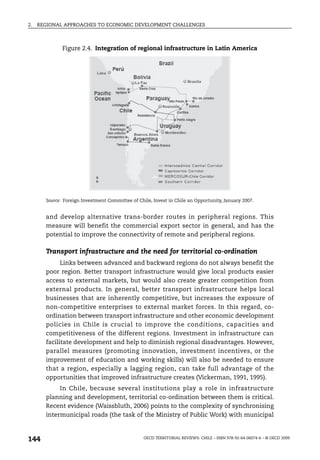
           Paris.
        Rodriguez Pose, A. and R. Crescenzi (2006), “R&D, Spillovers, Innovation Systems and
           the Genesis of Regional Growth in Europe”, ERSA Conference papers, Ersa 06,
           pp. 371, European Regional Science Association.
        Vickerman, R. W. (1991), “Infrastructure and Regional Development”, by R. W. Vickerman
            (eds.), European Research in Regional Science, Vol. 1, Pion, London.
        Vickerman R.W. (1995), “Regional Impacts of Trans-European Networks”, Annals of
            Regional Science 29, pp. 237-254.


OECD TERRITORIAL REVIEWS: CHILE – ISBN 978-92-64-06074-6 – © OECD 2009
                                                                                                   87
1.   REGIONAL DEVELOPMENT IN CHILE: TRENDS, ACHIEVEMENTS AND CHALLENGES


                                        ANNEX 1.A1


                    OECD Regional Typology in Chile

Regional grids
              The OECD has classified regions within each member country. The
        classifications are based on two Territorial Levels (TL). The higher level
        (Territorial Level 2) consists of 335 macro-regions while the lower level
        (Territorial Level 3) is composed of 1 679 micro-regions. This classification –
        which, for European countries, is largely consistent with the Eurostat
        classification – facilitates greater comparability of regions at the same
        territorial level. Indeed, these two levels, which are officially established and
        relatively stable in all member countries, are used by many as a framework for
        implementing regional policies.

OECD regional typology
             The OECD typology classified TL3 regions as predominantly urban,
        predominantly rural and intermediate. This typology, based on the percentage
        of regional population living in rural or urban communities, allows for
        meaningful comparisons among regions of the same type and level. The OECD
        regional typology is based on three criteria. The first identifies rural
        communities (comunas in Chile) according to population density. A community
        is defined as rural if its population density is below 150 inhabitants per square
        kilometre (500 inhabitants for Japan to account for the fact that its national
        population exceeds 300 inhabitants per square kilometre). The second
        criterion classifies regions according to the percentage of population living in
        rural communities. Thus, a TL3 region is classified as:
        ●   Predominantly rural (rural), if more than 50% of its population lives in rural
            communities.
        ●   Predominantly urban (urban), if less than 15% of the population lives in
            rural communities.


88                                         OECD TERRITORIAL REVIEWS: CHILE – ISBN 978-92-64-06074-6 – © OECD 2009
1.   REGIONAL DEVELOPMENT IN CHILE: TRENDS, ACHIEVEMENTS AND CHALLENGES


        ●   Intermediate, if the share of population living in rural communities is
            between 15% and 50%.
                 The third criterion is based on the size of the urban centres. Accordingly:
        ●   A region that would be classified as rural on the basis of the general rule is
            classified as intermediate, if it has an urban centre of more than
            200 000 inhabitants (500 000 for Japan), representing no less than 25% of the
            regional population.
        ●   A region that would be classified as intermediate on the basis of the general
            rule is classified as predominantly urban if it has a urban centre of more
            than 500 000 inhabitants (1 000 000 for Japan), representing no less than
            25% of the regional population.

Application of this typology to Chilean provinces
                 This typology classifies Chilean provinces (equivalent of TL3) as follows:

                  Table 1.A1.1. Chilean provinces classified by the OECD typology
         Provinces                          OECD type           Provinces           OECD type

         IQUIQUE                                PR              BÍO-BÍO                PR
         TAMARUGAL                              PR              ÑUBLE                  PR
         ANTOFAGASTA                            PR              CAUTÍN                 PR
         EL LOA                                 PR              MALLECO                PR
         TOCOPILLA                              PR              LLANQUIHUE             PR
         COPIAPÓ                                PR              CHILOÉ                 PR
         CHAÑARAL                               PR              OSORNO                 IN
         HUASCO                                 PR              PALENA                 PR
         ELQUI                                  PR              COIHAIQUE              PR
         CHOAPA                                 PR              AYSEN                  PR
         LIMARÍ                                 PR              CAPITÁN PRAT           PR
         VALPARAÍSO                             PU              GENERAL CARRERA        PR
         ISLA DE PASCUA                         PR              MAGALLANES             PR
         LOS ANDES                              PR              ANTÁRTICA CHILENA      PR
         PETORCA                                PR              TIERRA DEL FUEGO       PR
         QUILLOTA                               IN              ÚLTIMA ESPERANZA       PR
         SAN ANTONIO                            IN              SANTIAGO               PU
         SAN FELIPE DE                          PR              CORDILLERA             PU
         CACHAPOAL                              PR              CHACABUCO              PR
         CARDENAL CARO                          PR              MAIPO                  PU
         COLCHAGUA                              PR              MELIPILLA              PR
         TALCA                                  IN              TALAGANTE              PU
         CAUQUENES                              PR              VALDIVIA               IN
         CURICÓ                                 PR              RANCO                  PR
         LINARES                                PR              ARICA                  PR
         CONCEPCIÓN                             PU              PARINACOTA             PR
         ARAUCO                                 PR


OECD TERRITORIAL REVIEWS: CHILE – ISBN 978-92-64-06074-6 – © OECD 2009
                                                                                                89
1.   REGIONAL DEVELOPMENT IN CHILE: TRENDS, ACHIEVEMENTS AND CHALLENGES


                                       ANNEX 1.A2


                              Specialisation Index

Specialisation Index
             Definition: the specialisation index is computed according to the Balassa-
        Hoover index, which measures the ratio between the weight of an industry in
        a region and the weight of the same industry in the country:

                                                    Yij Y j
                                           BH i 
                                                    Yi Y

        where Yij is total employment of industry i in region j, Yj is total employment
        in region j of all industries, Yi is the national employment in industry i, and Y
        is the total national employment of all industries. A value of the index above 1
        shows specialisation in an industry and a value below 1 shows lack of
        specialisation.


90                                        OECD TERRITORIAL REVIEWS: CHILE – ISBN 978-92-64-06074-6 – © OECD 2009
ISBN 978-92-64-06074-6
OECD Territorial Reviews: Chile
© OECD 2009


                                  Chapter 2


             Regional Approaches to Economic
                 Development Challenges


                                               91
2.   REGIONAL APPROACHES TO ECONOMIC DEVELOPMENT CHALLENGES


Introduction: The emergence of a new debate on regional policy
            As observed in Chapter 1, the assets of Chile’s regions are very diverse,
       and their potential for growth will largely depend on how public policy is
       adapted to their specific characteristics. At the national level, this requires
       greater emphasis on “unlocking” regions’ potential to contribute more to
       national objectives. This leads in turn to renewed interest in regional policy as
       an integral element of national economic management and not simply as an
       instrument for reducing disparities.
            Chile is becoming interested in a more concerted approach to regional
       policy. In this respect, it is part of a more general trend apparent throughout
       the OECD area. After a long period in which regional policy was marginal, it
       has become a more central element of policy in OECD countries (see Box 2.1).
       The view is that comprehensive regional policies can complement national
       economic and structural policies by helping to generate growth in the regions.
            Up to now, Chile has not had a clearly identifiable regional policy and
       interventions at the regional level have been largely defined from the centre.


            Box 2.1. Towards a comprehensive place-based approach
                           to regional development
            Over the past decade, regional policy has been a subject of debate, formal
          review and/or new legislation in many OECD countries. There is widespread
          evidence of new policy thinking and an identifiable shift in the regional policy
          “paradigm”. In the past, regional policy was used particularly to absorb
          “shocks” (industrial restructuring, rural decline, etc.) and to support
          particular regional economies that had failed to modernise. The new
          paradigm of territorial policy is focused on developing regional potential for
          competitiveness. The precise nature of change is country-specific, but there
          are common features to the new territorial approach to development:
          i) regional competitiveness is strengthened by focusing on growth-oriented
          activities (notably innovation, education and employment). ii) policies are
          context-specific, based on the territory’s particular strengths and challenges;
          iii) use of comprehensive regional economic strategies instead of national
          sectoral instruments: the different aspects that affect the development of a
          territory are considered in an integrated way; iv) different levels of actors
          (national, regional and local) intervene in the policy process.


92                                         OECD TERRITORIAL REVIEWS: CHILE – ISBN 978-92-64-06074-6 – © OECD 2009
2.   REGIONAL APPROACHES TO ECONOMIC DEVELOPMENT CHALLENGES


        This is in line with Chile’s strongly centralised administrative system, which
        leaves little scope for action at the regional level. However, in recent years
        some initiatives and governance reforms suggest a move towards greater
        emphasis on the regional dimension of economic development.
              This chapter looks at the main arguments in favour of introducing or
        reforming regional policies in order to remove the principal challenges to regional
        development identified in Chapter 1. It has seven sections. Section 2.1 examines
        innovation policies. Chile’s innovation system is strongly centred on public R&D,
        which is largely located in the capital, Santiago; this makes it difficult to develop
        producer-centred regional innovation systems in locations far from the capital. It
        is argued that a key issue for Chile is to establish an innovation system that both
        supports action at the regional level and at the same time maximises the
        diffusion of outcomes from the core of the national system in Santiago.
        Section 2.2 focuses on business development in Chile. The government has a
        strong new strategy to support clusters and business development, which needs
        to take better account of regional assets and conditions and the opportunities
        they offer for productive diversification. This applies especially to the recently
        launched regional development agencies. They represent a promising means of
        creating regional frameworks for business development and public/private
        partnerships. However, their productive strategies (“agendas”) still need to
        strengthen their regional orientation in order to respond fully to the needs and
        opportunities of the different regions. Section 2.3 studies human capital and
        education policies and argues that Chile must increase its efforts on education
        and human capital for reasons of both equity and competitiveness. Local
        availability of knowledge and skills and the links of the education and training
        system to the demands of regional labour markets are increasingly important in
        the context of a more regional approach to economic development. At the same
        time, improving access to education of quality for the underprivileged segments
        of population will be crucial for tackling the challenge of income inequalities in
        Chile. This issue relates particularly to improvements in the technical and
        financial resources available to municipalities for carrying out their devolved
        responsibility for public primary and secondary education.
              The need to shift from sectoral policies focused on agricultural subsidies
        towards comprehensive rural development programmes is the focus of
        Section 2.4. Rural development programmes that integrate agricultural and
        non-agricultural policies and strengthen links between rural and urban areas
        would be better adapted to the diverse socio-economic characteristics of rural
        territories. Regional institutions are called to play an active role in rural policies,
        which should be less closely attached to specific sectors and more concerned
        with territorial co-ordination of different actors and policies. Section 2.5 focuses
        on infrastructure investments as a main policy tool for increasing the potential
        competitiveness of the different regions by improving their accessibility. It


OECD TERRITORIAL REVIEWS: CHILE – ISBN 978-92-64-06074-6 – © OECD 2009
                                                                                                  93
2.   REGIONAL APPROACHES TO ECONOMIC DEVELOPMENT CHALLENGES


       argues that the potential of infrastructure policy can only be fully exploited if
       territorial synergies exist with other economic development policies and thus
       ensures that local needs and potentialities are comprehensively addressed.
             This leads to a discussion in Section 2.6 of the importance of strategic
       frameworks for regional policies. Initiatives such as the RDAs or the Chile
       Emprende programme suggest that public policy is evolving towards a more
       territorial orientation. However, in spite of the considerable advances of the
       past years, the agenda for regional economic development is still largely
       decided from the centre. In addition, public investment mechanisms have a
       sectoral logic and represent a specific challenge for co-ordinating actions and
       resources across departments to support regional development objectives.
       National investment in the regions has risen significantly. Yet, the focus
       remains more on national priorities than on regional planning. This has of
       course had the advantage of ensuring strong control over fiscal expenditures.
       However, these mechanisms may fail to respond to specifically regional
       opportunities and to finance territories’ multi-sectoral initiatives. Moving
       towards regionally integrated policies will imply strengthening the
       institutional framework at the regional level.

2.1. The focus on innovation: from a centralised policy focus to
a regional approach
             In the past, OECD industrial policies supported individual firms, strategic
       industries, infant industries, and the attraction of foreign direct investment (FDI).
       From several standpoints, this policy orientation is now problematic. Trade
       regulations and competition policy at the international level constrain a country’s
       ability to provide direct subsidies to firms. Many OECD countries now take a
       strong “hands-off” stance towards what is typically termed industrial policy,
       backed by a liberal approach to economic policy (OECD, 2005a). Increasingly,
       governments are looking to innovation policy, rather than traditional industry
       policy, as a means to support key sectors, key technologies and key production
       hubs, with an added accent on the regional dimension of innovation.
             Pressing issues such as globalisation, a more technology-driven economy,
       ageing of populations, environmental concerns, etc., also push OECD
       governments to change their views on innovation and the systems that manage
       it. As a result, governments are broadening the definition of innovation and the
       objectives of innovation policy, with cluster policy often playing a key role. In
       Chile as well, innovation has become a central concern and is closely linked to
       Chile’s measures to support its key export sectors and industry clusters.
           At national level, Chile has significant strengths on which to build its
       innovation capacity and make innovation policy a more active source of
       economic growth; but the national innovation system also has weaknesses.


94                                         OECD TERRITORIAL REVIEWS: CHILE – ISBN 978-92-64-06074-6 – © OECD 2009
2.   REGIONAL APPROACHES TO ECONOMIC DEVELOPMENT CHALLENGES


        The strengths were highlighted in the recent OECD report on innovation in
        Chile (OECD, 2007a) and broadly correspond to:
        ●   A favourable institutional framework. Major strengths in Chile’s
            environment for innovation include quality and reliability of institutions
            and political stability, strong macroeconomic performance, an open trade
            regime and favourable legislation for FDI.
        ●   A core of competent actors, though still lacking critical mass. Chile has
            now acquired some experience in learning how to increase value added
            through innovation in some resource-based industries, including science-
            based new technology, especially biotechnology. This concerns both the
            development of business competencies and the development of supporting
            institutions, such as Fundación Chile.
             In addition, the report points to opportunities to enhance the innovation
        system, such as: further progress towards becoming a leader in certain industry
        and services sector niches; greater use of new knowledge to increase value
        added in resource-based industries; consolidation of strong clusters to develop
        new innovative services and industrial activities; creation of new opportunities
        to diversify production by building around or creating bridges between poles of
        strength; exploitation of Chile’s environmental advantages to capture a larger
        share of the high-end tourism market. Many of these recommendations refer, in
        practice, to activities that are strongly regionalised in specific parts of the
        country. This points to the argument for a more regional approach to targeting
        innovation policy to support national objectives.

        Regional innovation as a key instrument of national economic policy
             It has been observed that some of the weaknesses of national innovation
        systems in OECD countries, particularly those relating to cluster development
        and network building, could usefully be addressed through a regional
        approach. Evidence from OECD countries suggests that the capacity of
        regions, whether urban or rural, to support processes of learning and
        innovation is a key source of competitive advantage. This finding is
        complemented by academic research identifying the regional level as a key
        source of innovation. In spite of the difficulties that OECD countries
        experience in implementing a cross-disciplinary and multi-level innovation
        policy, there is growing interest – visible in large and small, centralised and
        decentralised countries – in doing so.
             Two specific challenges for implementing a regional innovation approach in
        Chile are: the concentration of most innovation activity around the capital, and
        the reduced role of the private sector in the financing and performance of R&D
        (OECD 2007a). While many key industries are located in specific regions, research
        and development (R&D) spending is concentrated in and around Santiago. OECD


OECD TERRITORIAL REVIEWS: CHILE – ISBN 978-92-64-06074-6 – © OECD 2009
                                                                                                 95
2.   REGIONAL APPROACHES TO ECONOMIC DEVELOPMENT CHALLENGES


       indicators show that Chile’s gross domestic expenditure on R&D (GERD) is low by
       the standards of most OECD countries (see Figure 2.1). A striking feature is the
       dominance of R&D by the public sector. The relatively concentrated pattern of
       publicly funded R&D is an important influence on the ability of regions to develop
       a stronger focus on innovation. Close to 40% of total R&D expenditure is carried
       out by universities, mainly located in Santiago: the two largest Santiago
       universities (the University of Chile, and the Catholic University of Chile) account
       for a large share of university-performed R&D.1 Most private investment is also
       carried out in Santiago,2 while the main industries in the regions perform little
       R&D. Additionally, only a small share of Chilean firms put the development of
       new products and processes at the centre of their business strategy. This is
       probably a result of an economy based on natural resources in which technology
       is imported rather than developed. Finally, the multinational enterprises involved
       in Chile’s main export sectors do not see Chile as a base for R&D and contribute
       relatively little to innovation in comparison to their weight in terms of
       employment and value added: the share of foreign affiliates in business R&D is
       very low, only 3.6% in 2002, considerably behind other Latin American countries
       such as Mexico (32.5%, 2001) and Argentina (23.2), and OECD countries such as
       Ireland (70.3%, 2005), the United Kingdom (38.7%, 2005), Spain (26.3%, 2005) or
       Canada (24.9%, 2004) (UNCTAD, 2005, pp. 127).

        Figure 2.1. R&D Intensity in selected countries, 2004 or latest available year
                                         Business                     Public                     Other*

                   Israel
                Sweden
                Finland
                  Japan
                   Korea
          United States
             Singapore
         Czech Republic
           New Zealand
                 Ireland
                   Brazil
                   Spain
               Portugal
               Hungary
                   Chile
                 Turkey
                 Poland
              Argentina
                Mexico

                            0           1                  2                3                4               5
       * Other national sources and foreign funding.
       Source: OECD, RICYT and CONICYT.


96                                                  OECD TERRITORIAL REVIEWS: CHILE – ISBN 978-92-64-06074-6 – © OECD 2009
2.   REGIONAL APPROACHES TO ECONOMIC DEVELOPMENT CHALLENGES


        Co-ordinating innovation efforts
             Another specific challenge to improve innovation in Chile’s regions is
        related to the co-ordination of: i) the various national agencies offering
        innovation-related programmes; ii) the co-ordination of national agencies
        with research and initiatives carried out by regional universities and research
        centres; and iii) the harmonisation of all these initiatives with the regional
        development strategy of the regional government. Co-ordinating innovation
        policy across departments is a common challenge for governments in OECD
        countries. As governments attempt to respond to greater external and internal
        complexity and dynamism, policy co-ordination becomes the main means of
        achieving greater coherence. Until the recent launching of the national
        innovation strategy, Chile did not have a formal mechanism for defining or


                   Box 2.2. Agencies for innovation at the national level
               The National Innovation Council for Competitiveness (CNIC) is a
            permanent body which counsels the President of the Republic on science,
            technology and innovation policies. It was first established by decree in
            November 2005 and renewed in October 2006 by President Bachelet. Its goal is
            to give advice on the identification, formulation and execution of policies,
            programmes and measures relating to innovation, including fields of science,
            human resource formation, and the development, transfer and diffusion of
            technologies. Among its members are the ministers of Industry, Economy,
            Education, Public Works and Agriculture, the President of Conicyt and the
            Executive Vice-President of Corfo.
               Conicyt, the National Commission for Scientific and Technological
            Research, was created in 1967 as an advisory body to the government. It is the
            main national science and technology (S&T) body and acts as co-ordinator of
            the Chilean S&T community. Its main task is to promote advances in the
            following fields: scientific and technological research; training of human
            resources; development of new areas of knowledge and productive
            innovation. Conicyt is politically overseen by the Ministry of Education but
            has its own budgetary endowment.
               Another initiative is Chile Innovates, managed by the Ministry of Economy,
            with the participation of other institutions, such as Conicyt, Corfo and FIA. Its
            main task is to enhance competitiveness through the promotion of
            technological innovation. It has five areas of work: identification of
            technology opportunities, biotechnology, information and communications
            technologies (ICT), sustainable production, and promotion of quality in the
            production process.
            Source: National Innovation Council; Conicyt; Chile Innovates.


OECD TERRITORIAL REVIEWS: CHILE – ISBN 978-92-64-06074-6 – © OECD 2009
                                                                                                 97
2.   REGIONAL APPROACHES TO ECONOMIC DEVELOPMENT CHALLENGES


                              Box 2.3. The national innovation strategy
       The national innovation strategy sets the main guidelines for promoting innovation and
     competitiveness over the long term. It is an ongoing process that may lead to the
     reorganisation of national institutions. A first volume of the strategy was delivered to the
     President in January 2007. It noted progress made during the past 20 years and drew attention
     to the need to enhance national growth in the long term. In particular, Chile needs to add
     knowledge to production, improve human capital, develop a systemic view and create new
     alliances that combine private entrepreneurial efforts with public participation. Goals to be
     reached by 2020 include:
     ● Increase R&D spending as a percentage of GDP, from a modest 0.68% in 2004 to at least 2.3%
        by 2020.
     ● Invert the relation that currently exists between total public and private spending on R&D,
        by reducing the former from 53 to 32%, and increasing the latter from 37 to nearly 55%.
        By 2021, 50% of resources should come from the private sector and reach 1.24% of GDP
        (versus 0.25% in 2004).
     ● Diversify production by reducing the proportion of the 25 main export products from 76% to
        no more than 50% of total exports.
     ● Improve levels of educational attainment.

       This first volume of the national strategy concludes that to grow steadily Chile needs two
     main axes: strengthening existing and competitive clusters, mainly through knowledge; and
     identifying and strengthening other sectors and activities in order to diversify production.
     Among other changes these would make it possible to approach the situation in OECD
     countries. In order to identify priorities, a study was carried out to create a map of Chile’s most
     promising production areas (already referred to in Chapter 1).
       A second volume of the national innovation strategy was presented in March 2008. This
     document establishes the main guidelines for public action regarding the three main
     components of the national strategy for innovation:
     ● Human capital: To establish a lifelong learning perspective, providing education of quality
        that is accessible to all.
     ● Science, technology and research: To create a platform to strengthen the generation and
        diffusion of scientific knowledge, in line with Chile’s social and productive requirements.
     ● Entrepreneurial innovation: To establish an innovative entrepreneurial system oriented to
        the generation of value added.
       This second volume argues that to move successfully towards a “know-how” economy it is
     necessary to strengthen and make more coherent currently diverse and fragmented
     innovation efforts. At the same time, it recognises the basic role of the state in providing a
     framework and the necessary incentives to involve the private sector as a key actor in the
     innovation process. This report also establishes a roadmap for developing the country’s eight
     main competitive clusters.
     Source: National Innovation Council.


98                                             OECD TERRITORIAL REVIEWS: CHILE – ISBN 978-92-64-06074-6 – © OECD 2009
2.   REGIONAL APPROACHES TO ECONOMIC DEVELOPMENT CHALLENGES


        implementing an explicit innovation strategy. Priorities were defined by a
        combination of state agencies such as Corfo (the Economic Development
        Agency) in the Ministry of Economy, Conicyt (the National Commission for
        Scientific and Technological Research) in the Ministry of Education and FIA
        (the Agrarian Innovation Fund) in the Ministry of Agriculture.
             To deal with these co-ordination challenges and to improve commercial
        outcomes and increase collaboration between the research community and the
        business sector, the National Innovation Council for Competitiveness of Chile
        launched the National Innovation Strategy (Box 2.3). This initiative appears to
        be an excellent step towards co-ordinating efforts and setting guidelines for
        innovation policy. It identifies the main challenges and presents an agenda for
        dealing with them, which involves the country’s principal national institutions.
        The strategy goes beyond innovation, involving aspects related to promoting
        competitiveness over the long term, as is also the case for the roadmap for
        developing more competitive clusters. Although the strategy is focused on
        national issues, it provides the framework for the development of innovation
        and competitiveness policies at the regional level as well.

        Towards more regionally based innovation
             The establishment of a framework to improve co-ordination at the
        national level has paralleled growing interest in more regionally based
        innovation. In 2000, Conicyt launched the regional programme on science and
        technology, which counts, to date, 11 scientific and technological centres in
        different regions of the country (see Table 2.1). The objective of this initiative
        is to stimulate the development of centres of excellence in disciplines or
        specific areas of research that are consistent with regional assets and
        advantages. It seeks to raise the level of research and training in the regions in
        order to reach critical mass. While the initiative is managed by Conicyt, it is a
        joint effort of the national government in conjunction with regional
        governments, universities and the private sector. Apart from its territorial
        approach, this initiative has the advantage of inter-institutional articulation: it
        builds and strengthens regional scientific and technological capacities in
        topics that are relevant to the regions’ economic and social development
        according to the priorities established by the respective regional governments
        and their co-funding institutions (the project partners). These are in line with
        the development strategy of the regional government and with the national
        innovation strategy which sets the main national priorities (Box 2.3). However,
        few projects have been undertaken so far, and they represent a modest share
        of Conicyt’s total budget (2.9% for 2008).
             In addition, the launching of the Competitiveness Innovation Fund of
        Regional Assignment in 2008 appears as a major effort to improve innovation in
        the regions (see Box 2.4). The 2008 budget of the Competitiveness Innovation


OECD TERRITORIAL REVIEWS: CHILE – ISBN 978-92-64-06074-6 – © OECD 2009
                                                                                                 99
2.   REGIONAL APPROACHES TO ECONOMIC DEVELOPMENT CHALLENGES


                        Table 2.1. The regional scientific and technological centres
Name                                    Location        Partners                                      Focus

Centro de Investigaciones del Hombre Arica Parinacota   CONICYT, Arica and Parinacota Regional        Archaeology and anthropology
en el Desierto (CIHDE)                                  Government, Tarapacá University
(Man in the Desert Research Centre)
Centro de Investigación Científico para Antofagasta     CONICYT, Antofagasta Regional                 Mining and biodiversity of the arid,
la Minería (CICITEM)                                    Government, Catholic University of the        semi-arid and hyper-arid area of
(Scientific Research for Mining Centre                  North, and Antofagasta University             the Atacama Desert
Centro Regional de Investigación y    Atacama           CONICYT, Atacama Regional Government,         Sustainable competitiveness in
Desarrollo Sustentable de Atacama                       Atacama University, Corporation for the       the Atacama Region
(CRIDESAT) (Regional Centre of                          Development of the Atacama Region and
Sustainable Research and Development)                   the miners’ trade union of Copiapó
Centro De Estudios Avanzados            Coquimbo        CONICYT, Coquimbo Regional Government, Climate change, hydrology,
en Zonas Aridas (CEAZA)                                 La Serena University, Catholic University biology
(Centre for Advanced Research in Arid                   of the North, Institute of Agricultural
Zones)                                                  Research, INIA, Intihuasi.
Centro Regional de Estudios             Valparaíso      CONICYT, Valparaíso Regional Government, Research on healthful food
en Alimentos Saludables (CREAS)                         Catholic University of Valparaíso, Federico
Regional Centre of Healthful Food                       Santa María Technological University of
                                                        Valparaíso, institute of Agricultural
                                                        Research, INIA La Cruz.
Centro de Investigación de Polímeros    Bío Bío         CONICYT, Bío Bío Regional Government,         Polymer science
Avanzados (CIPA)                                        Concepción University, and Bío Bío
(Centre for Advanced Polymer                            University
Research)
Centro de Genómica Nutricional          Araucanía       CONICYT, Araucanía Regional Government, Agro-aquaculture
Agroacuícola (CGNA)                                     Institute of Agricultural Research, INIA
(Agro-aquaculture Nutritional Genomic                   Carrillanca, Catholic University of Temuco,
Centre)                                                 and La Frontera University
Centro de Ingeniería de la Innovación – Los Ríos        CONICYT, Los Ríos Regional Government,        Technology transfer and
CIN (Centre for Innovation Engineering)                 Centre of Scientific Studies (CECS)           innovation
Consorcio de Investigación en Nutrición, Los Lagos      CONICYT, Los Lagos Regional Government, Development of aquaculture food
Tecnología de los Alimentos y                           Austral University, and Santiago University and its nutritional effects in fish,
Sustentabilidad del Proceso Alimentario                                                             molluscs or crustaceans
en la Acuicultura (CIEN AUSTRAL)
(Group for Research in Nutrition, Food
Technology, and the Feeding Process
in Aquaculture)
Centro de Investigación en              Aysén           Aysén Regional Government, Austral            Research on aquatic eco-systems
Ecosistemas de la Patagonia (CIEP)                      University of Chile, Concepción University,   and sustainable development of
(Patagonia Ecosystems Research                          INIA, Salmon Technological Institute, Ice     productive activities in aquatic
Centre)                                                 Fields Institute, SHOA, Fishery Industry      environments.
                                                        Trade Federation, Salmon Industry
                                                        Association, Coyhaique Tourism
                                                        Association, University of Montana in
                                                        the US, and University of Siena, Italy
Centro de Estudios del Cuaternario de Magallanes        Magallanes and Chilean Antarctic Regional     Multidisciplinary scientific
Fuego-Patagonia y Antártica (CEQUA)                     Government, Magallanes University,            research on the evolution of the
(Centre for Quaternary Period Research                  Chilean Antarctic Institute, and Institute    natural environment
in Tierra del Fuego, Patagonia, and                     of Fishing Development, IFOP.
Antarctica)

Source: Conicyt.


100                                                     OECD TERRITORIAL REVIEWS: CHILE – ISBN 978-92-64-06074-6 – © OECD 2009
2.   REGIONAL APPROACHES TO ECONOMIC DEVELOPMENT CHALLENGES


                Box 2.4. The Competitiveness Innovation Fund of Regional
                                      Assignment
               The Competitiveness Innovation Fund is the instrument that finances the
            implementation of national and regional innovation policies focused on
            strengthening the national innovation system. It obtains its resources from the
            newly established mining royalty. Starting from 2008, 25% of the Fund’s
            resources will be regionally assigned, 60% will go to mining regions, and 40% to
            non-mining regions. The regional government, taking into consideration the
            national innovation strategy, the corresponding regional development strategy,
            the strategic innovation agenda and the plans for improving competitiveness of
            the regional development agencies, will define the use of these resources. The
            projects have to focus on science, applied research, innovative entrepreneurship,
            specialised human resources formation and development, or the transfer and
            diffusion of technology. Finally, the resources must be transferred, through
            agreements, to Corfo, Innova Chile, Conicyt, state universities or those recognised
            by the state, and/or technological scientific centres of excellence. The
            distribution of these resources among the regional governments will be done
            through a resolution of the Sub-secretariat for Regional Development.
            Source: Subdere.


        Fund amount to CLP 80 907 million (more than USD 154.5 million), or close to
        30% of total public investment for innovation in 2008 (see Figure 2.2). Regions
        will participate in assigning 25% of these resources and thus in decisions on


                                Figure 2.2. Public Investment in Innovation
                                       (Millions of Chilean Pesos of each year)

                               FIC (regional assignment)                   FIC              Regular budget
         300 000


         250 000                                                                  240 959

                                       203 783
         200 000

                                                                                  160 052
         150 000
                                       151 024
         100 000


          50 000                                                                  60 680
                                                                         80 907
                                        52 759
                                                                                  20 227
               0
                                         2007                                       2008

        Source: Ministry of Economy of Chile.


OECD TERRITORIAL REVIEWS: CHILE – ISBN 978-92-64-06074-6 – © OECD 2009
                                                                                                             101
2.   REGIONAL APPROACHES TO ECONOMIC DEVELOPMENT CHALLENGES


       the use of public resources for innovation, giving them the opportunity to link
       innovation investment to regional priorities.
            The Competitiveness Innovation Fund of regional assignment is an
       important step towards directing more resources to the different regions of
       Chile. Yet, an important challenge will be to merge national and regional
       priorities in implementing projects financed by the Fund in a way that
       benefits both regional and national competitiveness. The programmes have to
       take into consideration the national guidelines set in the innovation strategy,
       and programme execution is supervised by the innovation division of the
       Ministry of Economy. It is worth recalling here that even in decentralised
       countries, support from the centre is essential. This relates to the ambition of
       the programmes, which is probably limited if they focus only on building
       relational assets/social capital among economic actors at local level, and
       involves, in particular, helping regional actors understand and react to global
       challenges and providing innovative solutions to help them gradually
       integrate new approaches into their economic development programmes. The
       case of the French regional innovation strategies is a good example of the
       support the national government can offer in implementing regional
       innovation strategies (see Box 2.5).
           It will be crucial to reach a good balance between the main priorities of
       the national innovation strategy and the regions’ specific conditions,


             Box 2.5. Regional innovation strategies: toolkit for French
                            regional authorities, 2007
            When applying for structural funds, French regions prepare documents on
          their development strategies and forward them to the EU Commission.
          Brussels often considered that such papers lacked coherence and that the
          policy analysis could be more robust. The French government therefore
          decided in 2007 to create a guide that would help regions to assess their
          strengths and weaknesses and would improve the decision-making process.
          The guide was completed in November 2007 after discussion and consultation
          with several pilot regions. It has now been communicated to all regions.
            The guide provides an overview of the main factors determining regional
          growth in modern economies. It describes the overall components of the
          innovation system and indicates a number of regional indicators to calculate
          as well as benchmarks to consider. It provides methodological keys for
          establishing a regional strategy based on the diagnosis. Priorities are selected
          according to a number of criteria. Monitoring of programmes is made
          possible through the use of appropriate indicators and references.
          Source: OECD Territorial Review of Poland (2008).


102                                                 OECD TERRITORIAL REVIEWS: CHILE – ISBN 978-92-64-06074-6 – © OECD 2009
2.   REGIONAL APPROACHES TO ECONOMIC DEVELOPMENT CHALLENGES


        opportunities and needs. Two things will be especially important in reaching
        this balance: on the one hand, regional development and productive agendas
        have to be established on the basis of regional assets, strengths and
        opportunities (see below); on the other, the regional governments and regional
        development agencies need sufficient autonomy to adapt the national
        innovation guidelines to the regional priorities established in the regional
        agendas. Canada’s Atlantic Innovation Fund is a good example of a deliberate
        alignment of actions between departments which sensed that both
        innovation and regional development objectives could be well served by a
        joint cross-departmental approach (Box 2.6).
             The challenge for the regional governments and for national public
        agencies such as Corfo is to show that their recent initiatives at the regional
        level (such as the regional development agencies) can make a strong
        contribution to reaching the goals of the national strategy by developing their
        own regional productive agenda. Some parallels can be seen with the United
        Kingdom, where the 2008 Innovation Nation White Paper sets out a new


                               Box 2.6. Atlantic Innovation Fund
      The Atlantic Innovation Fund (AIF) is a programme designed to make strategic
   investments in research and development initiatives that directly contribute to the
   development of technology-based economic activity in Atlantic Canada. The AIF was
   established in 2001 as an Atlantic Canada Opportunities Agency (ACOA) programme
   with funding of CAD 300 million for five years. It was then renewed for a further five
   years with an additional CAD 300 million. Its objective is to increase the region’s
   capacity to carry out leading-edge R&D and to encourage new, technology-based
   economic activities. It was designed to fill a funding gap in Atlantic Canada that
   prevented institutions and firms from accessing national science and technology
   programming and to act as a catalyst to bring together research institutions and the
   private sector for major investments in research capacity.
      The objectives of the AIF are to:
   ● Increase activity in, and build capacity for, innovation and research and
       development (R&D) that lead to technologies, products, processes or services that
       contribute to economic growth in Atlantic Canada.
   ● Increase the capacity for commercialisation of R&D outputs.

   ● Strengthen the region’s innovation capacity by supporting research, development
       and commercialisation partnerships and alliances among private-sector firms,
       universities, research institutions, and other organisations in the Atlantic system
       of innovation, and increase their critical mass.
   ● Maximise benefits from the national R&D programmes.


OECD TERRITORIAL REVIEWS: CHILE – ISBN 978-92-64-06074-6 – © OECD 2009
                                                                                               103
2.   REGIONAL APPROACHES TO ECONOMIC DEVELOPMENT CHALLENGES


                        Box 2.6. Atlantic Innovation Fund (cont.)
       Eligible projects: The AIF finances R&D and related initiatives in the areas of
     natural and applied sciences, as well as social sciences, humanities, arts and culture,
     where these are explicitly linked to the development and commercialisation of
     technology-based products, processes or services. In order to maximise the economic
     benefits to Atlantic Canada, the AIF favours projects that provide the best opportunity
     for future growth. These are found in sectors in which Atlantic Canada has a
     comparative advantage in emerging knowledge-based clusters. These include
     aquaculture, environmental technologies, information technologies (including
     communications and geomatics), health and medical technologies, ocean
     technologies, and biotechnology. Investments made through the AIF focus on, but are
     not restricted to, these growth sectors. The AIF also encourages the development of
     technologies that allow resource sectors such as oil and gas, agriculture and agri-food,
     fisheries, forestry and mining to maintain and improve their competitive positions.
       Eligible recipients: The AIF entertains proposals from commercial and non-
     commercial entities such as universities, colleges, research institutions and private-
     sector firms. Federal departments, including federal research laboratories and
     institutes, and provincial government departments are not eligible. Nevertheless,
     they may be active participants in, and may contribute funding to, AIF projects.
       Financial assistance: Contributions are determined on the basis of what is required
     to allow a project to proceed. Project proponents are encouraged to lever financing
     from other sources. One way to do so is to leverage financing from national
     programmes such as the Canada Foundation for Innovation, the national granting
     councils and the National Research Council’s Industrial Research Assistance
     Programme. Contributions under the AIF to private-sector projects involving the
     commercialisation of a technology, product, process or service are repayable based on
     the commercial success of the project. Contributions to non-commercial
     organisations are normally not repayable.
       Results to date: Under the first five competitive rounds of the AIF programme,
     626 project proposals were received. Of these, 192 were approved, and up to
     CAD 521 million in AIF assistance was committed towards projects valued at
     CAD 1.2 billion. For every CAD of AIF funding for approved projects, project
     proponents are expected to leverage another 1.33 CAD from other public or
     private sources.
       From 2001 to 2004, Statistics Canada reported that R&D performed by the
     private sector increased by 20% in Atlantic Canada, while only increasing
     nationally by 1%. ACOA’s AIF is considered by experts as a key source of this
     growth in private-sector R&D activity. The AIF has proven to be a strong catalyst
     for encouraging partnerships among businesses and the research community,
     including higher education institutions.
     Source: ACOA.


104                                           OECD TERRITORIAL REVIEWS: CHILE – ISBN 978-92-64-06074-6 – © OECD 2009
2.   REGIONAL APPROACHES TO ECONOMIC DEVELOPMENT CHALLENGES


        framework for innovation policy that includes “place innovation” largely
        because the regions (regional development agencies and some cities) have
        proven that they are able to deliver innovation policy that complements
        national policies (OECD 2008b).
             The benefits of a regional innovation system are particularly clear in
        Chile, where policy making remains relatively centralised and policy
        formulation is distant from recipients.3 The advantages include the help such
        policies can give governments for diagnosing regional economic strengths and
        opportunities, clarify market linkages among economic actors, dialogue with
        “systems” of public and private actors, and focus public resources on key
        sectors or projects. This more regionalised system would need further
        involvement of the business sector and other non-public stakeholders, not
        only in setting regional priorities for innovation but also in supporting an
        innovation system currently strongly focused on public resources.

2.2. Co-ordinating productive development4 in the regions
             The traditional concentration of productive activity in a few sectors and
        regions has led to a debate in Chile about the advantages of a bottom-up,
        regionally based method for better targeting regional needs and opportunities.
        Currently, clusters are established in few sectors and focus more on national
        strategies than on regional opportunities. This can be an obstacle for further
        productive diversification and thus for taking further advantage of the
        different possibilities offered by Chile’s regions. To address this challenge,
        regional development agencies have been created as the framework for
        transferring responsibilities for productive development to the regions. Yet,
        there are concerns about whether these agencies will take a mainly regional or
        a national perspective when designing regional agendas and about the nature
        of the clusters to be developed.
             In the OECD area, the new regional policy paradigm calls for capitalising
        on local assets, which are often based on the region’s accumulated skills and
        practices. Developing strategies that will have an impact on a given region’s
        competitiveness requires identifying the sources or potential sources of the
        region’s competitive advantage. In OECD countries, the targeting of cluster
        policies may be top-down (based on national policy), bottom-up (regionally
        driven) or a combination of the two. Top-down selection can provide a
        framework for generating coherence and synergies among the different
        policies supporting innovation nationwide. In some cases, national
        programmes provide only a general setting and rely on regions to identify
        target clusters in their jurisdictions as a way to detect and develop regional
        potential. Table 2.2 shows the main advantages associated with both
        approaches to cluster selection.


OECD TERRITORIAL REVIEWS: CHILE – ISBN 978-92-64-06074-6 – © OECD 2009
                                                                                               105
2.   REGIONAL APPROACHES TO ECONOMIC DEVELOPMENT CHALLENGES


           Table 2.2. Advantages of top-down and bottom-up selection of clusters
        Identification of
                             Main advantages
        clusters

        National top-down    ● Policy coherence of the project with other strategic national policies (like S&T policy).
                             ● Possibility to select several sectors with synergies among them.
                             ● Option of targeting leading regions that significantly benefit the national economy or
                               targeting lagging regions to overcome imbalances in performance across regions.
                             ● May prevent wasteful competition among regions that results in an overall welfare loss for
                               the country.
                             ● Co-ordination at the central level can serve to increase an initiative’s potential effectiveness.

        Regional bottom-up   ● Regional   authorities may have more information and contacts than a central government
                               with respect to target needs.
                             ● A territorial analysis may help to find untapped regional resources that would not be
                               identified by national statistical methods.
                             ● Regions are better able to identify possible linkages among actors in the clusters or barriers
                               to cluster development.
                             ● They may benefit more directly from the economic activity generated by successful clusters
                               and have more chances to involve different actors in the strategy.
       Source: OECD 2007b, adapted.


            Because both selection processes have strengths and weaknesses, the
       articulation across levels of government often implies a shared responsibility
       between national and regional levels as a way to enjoy both the advantages of
       a national framework to support the general strategy and the ability to identify
       and mobilise local advantages embedded in the territory. Box 2.7 gives
       examples of this sharing of responsibilities for cluster selection.
            As mentioned, in Chile, the emphasis on clusters is mainly a result of the
       country’s economic structure, which is unusually concentrated around a
       limited number of industries (mostly exploitation of natural resources). The
       strategy for cluster selection has thus been top-down and focused on leading
       sectors. However, two new trends have emerged over the last couple of years:
       ●   Identifying further possibilities for diversification. As discussed in Chapter 1,
           there is some agreement that Chile should not rely exclusively on the sectors
           that have driven growth so far, but must use these as a basis for developing
           new sectors and activities.
       ●   More active regional participation. The emergence of Chile’s regional
           development agencies and experience in other countries suggest that
           cluster policy can bring into play active participation by regional actors in
           both the public and private sectors (Di Meglio, 2008).
            Within this context, the national innovation strategy, launched by the
       National Innovation Council, recognised that to grow steadily Chile needs a
       strategy based on two main axes: strengthening existing clusters mainly in
       natural resources (in which Chile is competitive today); and, on the basis of its
       acquired advantages, identifying and strengthening other sectors and


106                                                      OECD TERRITORIAL REVIEWS: CHILE – ISBN 978-92-64-06074-6 – © OECD 2009
2.   REGIONAL APPROACHES TO ECONOMIC DEVELOPMENT CHALLENGES


                 Box 2.7. Collaborative mechanisms for selecting cluster
                                targets in OECD countries
               A national policy for targeting clusters could rely on a different level of
            government (or on decentralised central government agents), or could share
            responsibility for the selection and funding of recipients. In Sweden the
            national government has asked regional governments to adopt regional
            growth plans that make explicit which areas of regional specialisation are
            most important for the region’s economic development. Because the regions
            have better information on the regional economic situation, they can help the
            national level identify potential targets for their programmes. A similar
            strategy is used in Germany by the GA networking initiative. The Länder
            identify the most prominent networks as part of their regional strategy for
            funding under the GA programme. The Japanese Industrial Cluster
            programme relies on the national ministry’s regional officers, in consultation
            with local and prefectural authorities, to identify the most promising projects
            for consideration. The Czech Klastry programme is administered by the
            national agency CzechInvest but has as an explicit goal to build regional
            capacity for supporting clusters. The regions are involved in the process of
            identifying and understanding their clusters, which are mainly composed of
            domestic SMEs. One of the main goals is to identify and support new sectors
            and sub-sectors with the potential and the will to improve their
            competitiveness. Several initiatives to engage regional actors (cluster
            facilitator training, support for cluster initiatives, incentive to incorporate at
            least one university) are an important feature of this programme.
            Source: OECD 2007b.


        activities in order to diversify the economy. To this end, the National
        Innovation Council carried out a study in 2007 to create a map of the most
        promising productive sectors for the next decade. The basic criterion was the
        interface between the potential of various sectors for global trade and the
        domestic effort required to develop them. So far eight clusters have been
        prioritised and policy instruments to promote their development have been
        designed by the government. They are: outsourcing; fish farming; tourism;
        copper mining and sub-products; pork and chicken farming; processed food
        for human consumption; primary fruit industry; and financial services. Most
        of these sectors are already mature, linked mainly to natural resources, which
        already have clear advantages.
             This approach has much potential. The map of promising clusters made
        it possible to identify existing strengths, challenges and obstacles for these
        production areas to grow and to develop further. Several recommendations


OECD TERRITORIAL REVIEWS: CHILE – ISBN 978-92-64-06074-6 – © OECD 2009
                                                                                                 107
2.   REGIONAL APPROACHES TO ECONOMIC DEVELOPMENT CHALLENGES


       were made for the development of each cluster and an implementation
       roadmap is being designed for each. Various horizontal needs were also
       perceived in the areas of human capital, R&D, access to international markets,
       a legal framework adapted to the clusters’ needs, and clarification of
       environmental regulations and infrastructure, among others. However, more
       can be done to fully exploit regional productive advantages:
       ●   It would be important to identify further possibilities for diversification and
           for adding value to currently developed sectors in order to transform static
           economic advantages into dynamic ones. With the exception of offshoring,
           the selected sectors are based in developed areas mainly linked to the
           primary sector. As discussed in Chapter 1, if the region’s productive base is
           insufficiently diversified or if it depends too heavily on key large firms,
           there is a risk of vulnerability. Diversification will be important to protect
           Chile from fluctuations in global demand and world commodity prices.
           Similar challenges have been faced by other countries with a strong
           resource base, such as Norway (see Box 2.8).
       ●   A regional bottom-up diagnosis may help to find untapped regional
           resources for diversifying the economy. It would also make it possible to
           take account of territorial spillovers among sectors and territorial
           dynamics. The cluster research carried out by the Innovation Council


                   Box 2.8. The challenge of diversification in Norway
             In Norway, the discovery and extraction of oil and gas, including the
           development of related industrial activities in engineering and services have
           strongly affected the economy and have had a profound impact on the
           country’s innovation and R&D system. Today, Norway has an economic
           structure that is still heavily dependent on natural resources, but efforts have
           been made to diversify the productive structure and to structure the
           economy in a more knowledge-intensive direction. A key strategic task for
           Norway has been to prepare for “life after oil”. On the one hand, government
           research and innovation policy, building on dynamic entrepreneurship in
           certain fields, has been promoting the development of new industries. On the
           other, demand from the oil and gas sector for specialised goods and services
           has been seen as an opportunity for knowledge-intensive/value added
           businesses. In this regard, in the early development of the petroleum sector
           (before 1993), Norway required foreign investors to invest in R&D and thus to
           reinforce local technological learning. The challenge now is to ensure that
           this learning experience can benefit other sectors that can play a vital role in
           compensating for the future decline in oil-related activities.
           Source: OECD Reviews of Innovation Policy, Norway (2008).


108                                                 OECD TERRITORIAL REVIEWS: CHILE – ISBN 978-92-64-06074-6 – © OECD 2009
2.   REGIONAL APPROACHES TO ECONOMIC DEVELOPMENT CHALLENGES


            mostly had a top-down sectoral orientation and gave too little consideration
            to place-based spillovers and interactions. It identified potential national
            strengths and the feasibility of growth of exports. This perspective is useful
            for building clusters involving dynamic export-oriented industries in which
            Chile has clear comparative strength. Nevertheless, it lacks a regional
            approach and thus information about the accumulated skills, practices and
            assets embedded in the different territories as potential source of
            competitive advantage. A place-based orientation would allow Chile to seek
            out new potential sources of growth. The setting up of the RDAs is creating
            the means of transferring responsibility for the selection of the productive
            agenda to the regions.

        Chile’s regional development agencies
             Over the last years, Chile has developed a complex productive
        development structure, with a wide range of programmes carried out by
        different national public agencies such as the Chilean Development
        Corporation (Corfo), the Chilean Export Development Agency (ProChile), the
        Technical Co-operation Service (Sercotec) or the Agricultural Development
        Institute (Indap) either from their national headquarters or through their
        regional offices, but always in line with the national programmes and
        guidelines.
              Between 2006 and 2007 the Chilean government established regional
        development agencies, in order to move towards an integrated approach to
        regional productive development. Fifteen RDAs have been established, one in
        each region. The process was directed by the Chilean Economic Development
        Agency, Corfo, and was co-financed by the Inter-American Development Bank
        (IDB). One of the main roles of the RDAs is to develop bottom-up regional
        agendas for productive development based on regional assets, strengths and
        opportunities. In this process, the region and the various regional actors –
        public and private sectors, universities, civil society – becomes responsible for
        a long-term strategic view of the region’s productive development. At the
        same time, the agencies become the institutional framework to co-ordinate at
        the regional level the wide range of programmes and agencies dealing with
        productive development, which often have overlapping objectives. Finally, the
        agencies aim to encourage public-private support for micro, small and
        medium-sized enterprises (MSMEs) by co-ordinating the efforts of actors and
        the instruments that can help to enhance the competitiveness of MSMEs
        (Box 2.9 describes the agencies’ specific objectives).The process has generated
        high expectations, because the agencies will be the channel for transferring
        responsibility for productive development to the regions and will play a key
        role in Chile’s decentralisation process.


OECD TERRITORIAL REVIEWS: CHILE – ISBN 978-92-64-06074-6 – © OECD 2009
                                                                                               109
2.   REGIONAL APPROACHES TO ECONOMIC DEVELOPMENT CHALLENGES


              Box 2.9. Specific objectives of the regional development
                                  agencies in Chile
            According to Corfo, the strategic objectives of the RDAs are:
          1. To develop local skills and networks of knowledge for competitiveness.
             The agencies are meant to find and to bring together the region’s best skills
             in order to form highly qualified networks.
          2. To build, validate and promote regional agendas for productive
             development. The agencies’ task is to build and to validate a regional
             agenda for productive development based on local vocations and
             opportunities. This agenda should reflect the regional government’s
             development strategy. Likewise, RDAs are responsible for establishing a
             monitoring system for the agenda, with periodical public accounting.
          3. To facilitate the co-ordination of different productive programmes,
             initiatives and policies, either private or public. One of the main purposes
             of the RDAs is to stimulate agreements and commitments by public and
             private actors concerning initiatives related to improving regional
             economic competitive skills, strengthening productive clusters and other
             production-related issues.
          4. To strengthen the competitiveness of MSMEs. The agencies will work to
             co-ordinate and link local actors and production support from public
             agencies to meet the competitive needs of regional MSMEs.
          5. To provide information and advice to regional actors about productive/
             business opportunities in the region, and about entities that support the
             territory’s productive development. To do so, the agency finances and
             operates an information service with access to accurate data.
          6. To favour a suitable environment for business. To fulfil this role, agencies
             can seek expert management advice. At the same time, they can act as
             advisers to the regional government for the co-ordination of investments
             for the region’s productive development.
          7. To develop intra-regional as well as international co-operation with
             other agencies.
          Source: Corfo.


            Regional development agencies are common in OECD countries. Overall,
       they can be described as agencies that co-ordinate and drive economic
       development in a given geographical area and despite a great diversity in the
       details of their organisation and objectives, they generally share certain
       principal features and functions (Table 2.3).


110                                         OECD TERRITORIAL REVIEWS: CHILE – ISBN 978-92-64-06074-6 – © OECD 2009
2.   REGIONAL APPROACHES TO ECONOMIC DEVELOPMENT CHALLENGES


             Table 2.3. Key functions of development agencies in OECD countries

        Development strategy             Both general and sector-specific for national authorities or for regional government,
                                         including task of managing stakeholder consultation process.
        Responding to market failures    Related to specific economic actors or sectors or a general mandate to intervene in
                                         areas where market failures have been identified, usually on the basis of RDA action
                                         on economic intelligence gathering.
        Business support infrastructure Including incubators and other real estate for start-ups and new businesses.
        Business support services        Provision of advisory services, often as delivery agents for national or regional
                                         business support programmes (e.g. mentoring programmes, one-stop shops for
                                         entrepreneurs, etc.).
        Innovation awareness             Acting as liaison between local firms and the research community to help diffuse
        (technology transfer and         new technology or acting on behalf of national technology transfer bodies.
        diffusion)
        Financial services for SMEs      Providing loans or grants to small firms, usually as delivery agents for national
                                         programmes.
        Attracting foreign investors     Engaging in marketing of the region, leading international outreach activities (trade
                                         fairs, etc.), preparing dossiers for potential investors.
        Enterprise clubs and clusters    Animating clusters and providing support to build networking within clusters.


              Like most regional development agencies in Europe, Chile’s RDAs are
        structured as public or quasi-public bodies whose functioning and
        composition have close links with the private sector. They depend on the
        Chilean Economic Development Agency, Corfo. Yet, each agency is led by the
        region’s intendant and is staffed by representatives of the region’s public and
        private sectors. The agencies’ Regional Strategic Councils have, at a minimum,
        nine representatives: four from deconcentrated national public bodies (the
        intendant and representatives of Corfo, Sercotec, and the regional
        representative of the Ministry of Economy), three from the regional private
        sector, and two from the regional public sector. The RDAs also have an
        executive director and support staff. In OECD countries even in publicly
        funded agencies, emphasis is often placed on their private-sector attributes
        (such as a private-sector style of management and approach, self-financing
        via user fees, joint ventures and public-private partnerships). This shows that
        these agencies are not simply offshoots of line ministries and that their
        functioning and approach are more akin to that of the private sector. As such,
        t h e g ove r n a n c e s t r u c t u re o f R DA s g e n e ral ly i nvo l ve s s i g n if i c a n t
        representation of the private sector and other non-governmental actors. In
        general, RDAs are expected to play a key role in improving relations between
        enterprises of all sizes and the public sector.
             In addition to the national resources originally transferred to the
        agencies, Corfo transferred in 2007 the resources of several programmes5 to
        the RDAs. During 2008, additional resources for productive development will
        also be transferred to the RDAs to finance initiatives of specific public-private
        programmes for improved competitiveness (PMCs) based on the agencies’


OECD TERRITORIAL REVIEWS: CHILE – ISBN 978-92-64-06074-6 – © OECD 2009
                                                                                                                                 111
2.   REGIONAL APPROACHES TO ECONOMIC DEVELOPMENT CHALLENGES


       regional agendas: the 2008 Chilean budgetary law indicated that at least 10%
       of the resources of national public agencies involved in productive
       development (Corfo, Sercotec, SAG, Indap, Fosis, Conadi, Sence and ProChile)
       should be directed to finance initiatives from the PMCs of the regional
       agencies. However these initiatives will receive additional support through
       agreements between the RDAs and private companies and research institutes.
       Finally, as of 2008, the National Fund for Regional Development (FNDR), the
       main national source of public investment for the territories,may finance
       initiatives emanating from RDAs (see Box 2.10). This shows the Chilean
       government’s commitment to the RDAs as the institution for ensuring
       productive development in the regions. The aim is to co-ordinate the funding
       and activities of the deconcentrated public agencies involved through the
       RDAs. This will help to co-ordinate the diverse, and until now fragmented,
       sectoral initiatives in a common and coherent framework driven by the RDAs.


                     Box 2.10. Chilean RDAs’ budget for productive
                                   development 2008
          ● Budget for RDAs’ operations: USD 13 million (57% more than the preceding
            year).
          ● Resources to carry out the initiatives defined in the regional PMC:
            USD 67 million from the public agencies budget (Corfo, Sercotec, SAG,
            Indap, Fosis, Conadi, Sence y ProChile) (10% of their budget has to go to
            finance PMCs initiatives).
          ● The regional government through the FNDR can also finance productive
            development initiatives. These initiatives would not need to pass the
            social analysis of Mideplan.


            This financing system is not very different from the one used in most
       RDAs in OECD countries. Their financing comes mainly from public sources,
       with the expectation that a successful agency will raise some revenue through
       user fees and that some funding from the private sector will come either as
       general support or through co-financing of specific projects or programmes.
       Some have an equity structure, with government bodies as majority
       shareholders, while others operate through direct grants from one or a
       combination of government sources. A review of development agencies across
       Europe shows a diversity of funding arrangements (though the EU stands out
       as principal funder of many, particularly in central and Eastern Europe). An
       important point made by the European Commission in its study of the
       functioning of such agencies is that the medium- to long-term nature of these


112                                        OECD TERRITORIAL REVIEWS: CHILE – ISBN 978-92-64-06074-6 – © OECD 2009
2.   REGIONAL APPROACHES TO ECONOMIC DEVELOPMENT CHALLENGES


        agencies’ objectives implies that the funding must be predictable over a
        relatively long period.
             However, the number of employees currently working for the RDAs in
        Chile, contrast with the much higher figures observed in the RDA’s of some
        OECD countries (Table 2.4). As noted, the Strategic Board of the Chilean RDA’s
        is composed of a group of at least 9 people plus a team of technical support
        staff. The support staff has only 5 people per agency: an executive director,
        three professionals/ analysts, and an assistant. An increased group of
        professionals working for the RDAs will be necessary in the future in order to
        comply in an efficient manner with the different objectives of this new
        regional body.

          Table 2.4. Funding for regional development agencies, selected examples
                                                          Employees         Annual budget, EUR millions

         One Northeast (United Kingdom)                     250                       400
         SPRI – Basque Country (Spain)                       92                         53
         Midi-Pyrénées Expansion (France)                    27                        3.1
         ASNM Nordmilano (Milan)                             30                          9
         NOM (The Netherlands)                               50                         13
         Barcelona ACTIVA (Spain)                            80                         16


        Need to move to more regionally oriented agendas
              Regional development agendas are meant to plan strategic regional
        priorities based on regional strengths. During 2007 the Chilean agencies
        prepared their strategic development agendas, in which they identified
        regional opportunities, challenges for regional competitiveness, and plans to
        address and overcome these challenges. The role of these agendas is to define
        a set of productive axes for the region and serve as a basis for developing
        programmes for improved competitiveness (PMCs). By the beginning of 2008
        each RDA had a productive development agenda which defines the priorities
        of its region for the short and medium term, which has been validated by the
        private sector, the public services and the regional community. The PMCs will
        identify a strategy and actions to improve the competitiveness of a subset of
        the prioritised clusters defined in the strategic development agenda. For
        prioritising the PMC the following criteria are to be taken into account:
        number and nature of the actors; competitive capacity of the area and its link
        with the export area; potential for clustering within the territorial productive
        chain; and sustainability of the business in the market. The PMCs will be
        implemented through a public-private partnership as defined in Figure 2.3.
        This represents a clear step towards integrating territorial spillovers and
        place-based dynamics in an integrated strategy for productive development.


OECD TERRITORIAL REVIEWS: CHILE – ISBN 978-92-64-06074-6 – © OECD 2009
                                                                                                          113
2.   REGIONAL APPROACHES TO ECONOMIC DEVELOPMENT CHALLENGES


                               Figure 2.3. Regional strategic agendas and PMC


                                                                      AGENDA


                                                   Agreements with
                                                    national public
                                                       services


                                        PMC                            PMC                             PMC


               Private participation
             (firms and institutions)
                  trough joining
                   agreements


                                    Enterprises
                                of the given cluster


       Source: Corfo.


             Once the RDAs are fully operational, one of their boards’ responsibilities
       is likely to be the selection of the set of productive axes to be prioritised in the
       region on the basis of the following criteria:
       i)      Clear expression of regional productive vocation.
       ii)     Clear expression of the willingness of a relevant group of entrepreneurs
               from MSMEs to work together and in co-ordination with the main public
               and research institutions in the region.
       iii) Confirmation that the activity is viable from the financial and socio-
            environmental standpoints.
       iv) Participation of a sizeable number of smaller companies.
            At the same time, the RDAs’ activities will include actions related to the
       business environment, as well as cluster development per se. They will finance
       technical assistance and consulting services in areas such as cluster
       governance, management, and administration; training and business advisory
       services; technology support services; and marketing, market exploration, and
       exports. In addition, the PMCs will attract and co-ordinate finance and


114                                                       OECD TERRITORIAL REVIEWS: CHILE – ISBN 978-92-64-06074-6 – © OECD 2009
2.   REGIONAL APPROACHES TO ECONOMIC DEVELOPMENT CHALLENGES


        programmes from other ministries and agencies. As of 2008 the regulations
        governing the FNDR have been adapted to allow it to finance initiatives
        emanating from RDAs.
             At present, progress made in terms of the development agendas is
        irregular, with some promising initiatives. As Table 2.5 shows, the first
        regional agendas, launched at the beginning of 2008, include some innovative
        or value-added areas. This is the case for higher education, S&T and the

                    Table 2.5. Targeted areas of the regional development agendas
         Regional
                         Prioritised area                                           Selected PMC (up to June 2008)
         agency

        Arica-parinacota High-technology agriculture; tourism; platform for
                         International trade services.
        Tarapacá         Tourism; mining cluster (linked to SMEs); aquaculture; Tourism; mining; aquaculture.
                         agriculture.
        Antofagasta      Advanced mining services; small-scale mining;              Aquaculture and fishing; small-scale
                         aquaculture; tourism linked to fishing; biofuel; higher    mining.
                         education.
        Atacama          Agriculture; aquaculture and fishing; tourism; mining.     Agriculture (grape); aquaculture and
                                                                                    fishing; specialised tourism; mining.
        Coquimbo         Agriculture (grape and derivative products); mining        Agriculture (grape and derivative
                         (small and medium-sized); tourism (astronomy); water       products); mining (small and medium-
                         resources; aquaculture and fishing; social services and    sized); tourism (astronomy); aquaculture/
                         higher education.                                          fishing (abalone; seaweed).
        Valparaíso       Processed food; tourism; knowledge nexus; trade            Primary fruit industry; specialised
                         logistics; craft fishing; mining.                          tourism; higher education.
        Metropolitana    Specialised tourism; food industry; agro-industry;       Specialised tourism (Maipo route);
                         primary fruit and vegetable industry; supply of services offshoring; business tourism.
                         for the mining industry; trade and services; offshoring.
        O’Higgins        Forestry and agriculture; tourism.                         Wine industry; fruit industry; tourism.
        Maule            Livestock; forestry; tourism; wine; fruits.                Tourism; wine; fruit.
        Bío-Bío          Food products; tourism; fishing; forestry;                 Food products; higher education (S&T);
                         metalworking; petrochemical and plastics; higher           tourism.
                         education (S&T); transport; energy.
        Araucanía        Forestry industry (furniture); agro-industry; livestock;   Agro-industry; fruit industry; tourism.
                         fruit industry; tourism; aquaculture and fishing.
        Los Ríos         Specialised tourism; forestry products; dairy products; Knowledge and cultural nexus; dairy
                         high-quality meat; craft fishing, processed products;   products; high-quality meat; specialised
                         agro-industry.                                          tourism; agro-industry.
        Los Lagos        Livestock (cattle; sheep); aquaculture (salmon); and       Integrated tourism; dairy products; cattle
                         fishing; forestry; horticulture; fruit trees; flowers;     meat.
                         tourism.
        Aysén            Tourism; aquaculture and fishing; livestock.               Tourism; aquaculture and fishing;
                                                                                    livestock.
        Magallanes       Tourism; livestock (cattle; sheep); aquaculture and       Specialised tourism; livestock (sheep);
                         fishing; forestry; horticulture; mining, energy; maritime maritime logistic services.
                         logistic services.

        Source: Corfo.


OECD TERRITORIAL REVIEWS: CHILE – ISBN 978-92-64-06074-6 – © OECD 2009
                                                                                                                                 115
2.   REGIONAL APPROACHES TO ECONOMIC DEVELOPMENT CHALLENGES


       establishment of a platform for international trade services. Some currently
       underdeveloped areas with much potential (e.g. specialised tourism) are also
       included. At the same time, some agendas seem to pay particular attention to
       synergies among the prioritised productive axes. However, progress by the
       regional agencies towards fulfilling their objectives is still very dependent on
       the commitment of the region’s intendant. Additionally, in most cases the
       agendas have a cluster orientation which broadly reflects the study of the
       most promising sectors of production nationwide and the eight clusters
       prioritised in the national innovation strategy (Box 1.3). The agendas and
       PMCs selected so far are largely restricted to the sectors prioritised nationally
       (mainly mining, agriculture, fishing and primary fruit industry). These are
       mostly developed sectors linked to natural resources, which already have a
       clear impact in regions. While it is logical to take these sectors into account,
       one of the main values of the RDAs should be to plan development based on
       more diversified or value-added regional vocations and opportunities.
            Qualified regional based strategic agendas will require an enlarged team
       of professionals working for the RDAs, with the capacity to make an in depth
       analysis of the different regional vocations and opportunities. It would also
       require a gradual evolution towards more territorially oriented RDA’s.
       Likewise, there will be a need to further link the strategic agenda developed by
       the RDA’s with the regional investment process. Currently the different public
       actors that intervene in the investment process are not required to consider
       the prioritised productive areas set in the regional agendas of the RDAs.
            The challenge for policy makers is to balance support for key sectors with an
       approach that allows flexibility across regions. The articulation of the regional
       agendas with the national priorities is obviously important. But the mapping of
       key areas for regional development would be improved by searching for specific
       regional vocations that could be new sources of growth. If a more regionally
       focused orientation is followed, the process of setting the regional productive
       agenda and mobilising support for PMCs could be a very valuable exercise for the
       regions as well as for the central level. Drawing on regional knowledge and
       motivation is crucial, if a regional orientation to economic development is to be
       meaningful in Chile. This can also help to inform national policy making: the
       regions, with better information on the regional economic situation, would help
       the national level identify potential targets for programmes.

       Improving co-ordination
           If the RDAs are to play a stronger role as a catalyst of economic
       development at the regional level, they will need to strengthen links and
       improve co-ordination with the regional government. As of January 2007,
       responsibility for regional planning was transferred from the regional offices
       of the Ministry of Planning (Mideplan) to the regional government,


116                                       OECD TERRITORIAL REVIEWS: CHILE – ISBN 978-92-64-06074-6 – © OECD 2009
2.   REGIONAL APPROACHES TO ECONOMIC DEVELOPMENT CHALLENGES


        establishing the “third division” of the regional government. In this regard, it
        has been suggested that the RDAs will duplicate, when they do not diminish,
        the role of the regional council in regional development.6 Special care should
        therefore be taken to clarify the roles, responsibilities and interaction
        mechanisms of these two regional institutions, including an effort to
        strengthen links between the regional development agenda of the RDAs and
        the regional development strategy of the regional government.
             The RDAs have started to improve regional co-ordination, a process that
        should go further. They are starting to develop agreements between public and
        private actors for initiatives directly related to business opportunities indicated
        in the regional development agendas, and the agendas are expected to
        encourage dialogue and consultation among the principal public and private
        actors. The fact that from 2008 at least 10% of the resources of national public
        agencies involved in productive development should finance initiatives from
        the PMCs of the RDAs should ensure negotiation and closer co-ordination.
        Finally, special care should be taken to link the representatives of the private
        sector in the strategic council of the RDA and the regional MSME community.
        This includes selecting qualified representatives from regional MSMEs and
        encouraging them to have regular contacts with the entrepreneurial
        community.

        Micro, small and medium-sized enterprises
             Internationally, SMEs are a key target for cluster and innovation policies
        and more generally for regional development policies. Although SMEs are a
        main source of national growth and job creation and key players in regional
        development, they appear to be under-represented relative to their contribution
        to national and regional economies. Chile is not an exception to this
        international trend.
             A particular challenge for Chile’s regional economic policy is to involve
        micro, small and medium-sized enterprises, which play a crucial role in
        Chile’s economy. They account for more than 99% of firms and are responsible
        for more than 75% of jobs, yet they produce only 21% of national sales and only
        4% of national exports (Table 2.6). Because productivity per employee in
        MSMEs is much lower than in bigger companies, their capacity to compete in
        national and international markets is limited.
             The lack of skills and insufficient access to financial services or to
        innovation, among other factors (see Box 2.11) make it difficult for these firms
        to cope with the challenges of global competitiveness. These challenges are
        also common in OECD countries. The cluster approach has often focused on
        small firms because of the obstacles they typically face to grow and the clear
        scope for policy intervention. On the demand side, MSMEs need assistance in


OECD TERRITORIAL REVIEWS: CHILE – ISBN 978-92-64-06074-6 – © OECD 2009
                                                                                               117
2.   REGIONAL APPROACHES TO ECONOMIC DEVELOPMENT CHALLENGES


                                         Table 2.6. Data on MSMEs in Chile
                                                                                   Size of firms
        Type of                   % of        Economic weight   Share in total                         % of
                                                                                  (in number of
        enterprise1           enterprises1      (% of sales)1 exportations (%)1                      employees2
                                                                                    workers)2

        Micro                     85.3               3.2                              1-10               47.4
                                                                      1.3
        Small                     12.3               9.2                              11- 50             16.5
        Medium                     1.7               8.4              2.6            51- 199             12.4
        Big                        0.8             79.2              96.1         More than 200          23.7
        Total                     100               100              100                –                 100

       Note: Percentages do not take into account businesses not assigned to any particular size category.
       1. Source: SII and Aduanas. There is no unique definition of SMEs in Chile. SII defines micro
          enterprises as those with annual sales below 2 400 Unidades de Fomento (UF), small enterprises as
          those with annual sales between 2 400-25 000 UFs, and medium-sized enterprises as those with
          annual sales between 25 000 and 100 000 UFs. The UF is an indexed unit of account. The exchange
          rate between the UF and the Chilean peso is constantly adjusted to inflation so that the value of the
          UF remains. In May 2008, one UF was the equivalent of around CLP 20 000.
       2. Source: CASEN 2003. The Casen survey defines the size of businesses in terms of number of
          workers.


                            Box 2.11. Main problems of MSME in Chile
              ● Weak labour and managerial skills and insufficient technical training for
                 employees, especially in ICT.
              ● Inadequate regulation.

              ● Lack of access to basic scientific, technological and entrepreneurial
                 information crucial for their competitiveness (especially for small
                 businesses in remote areas).
              ● Limited access to credit.

              ● Limited quality and product differentiation.

              ● Weak export promotion strategies for products and image.

              ● Limited supply of infrastructure for product and process standardisation
                 and technology development.
              ● Problems of co-ordination and co-operation for launching clusters and
                 production chains in regions.
              ● Limited environmental responsibility.

              ● High proportion of Informal MSMEs.

              Source: Alburquerque (2007).


       formulating their needs. Their managers are often unaware of new
       technology, do not recognise the potential for improvements, or lack the
       financial, organisational and managerial capabilities to implement new
       technology. On the supply side, technology providers generally do not tailor


118                                                   OECD TERRITORIAL REVIEWS: CHILE – ISBN 978-92-64-06074-6 – © OECD 2009
2.   REGIONAL APPROACHES TO ECONOMIC DEVELOPMENT CHALLENGES


        their products to local firms. The costs of reaching small firms with relevant
        information are quite high, as are the costs of tailoring equipment to their
        needs. Because technology markets suffer from problems of information
        asymmetry, transaction costs and a lack of scale economies, policy
        intervention is warranted (OECD, 2007b).
             One main horizontal challenge for the MSME in Chile is their very limited
        capability to innovate. Most MSMEs are not part of innovation-oriented
        networks, yet many of those that would have incentives to develop linkages
        with other firms and knowledge institutions face several difficulties. The lack
        of trust in potential partners undermines the establishment of basic co-
        operative networks. This socio-cultural feature will only change slowly, but
        successful experience in balancing competition and co-operation can help to
        build trust. It would be useful to find ways to spread information about
        positive experiences in sectors with successful forms of collective action
        (OECD, 2007a). In the OECD area, for example, technology advice and transfer
        as well as the provision of non-financial services are used to tackle these
        problems. Advice on marketing, logistics, exports, accounting, etc., are often
        supplied by sector-oriented centres. There have also been some initiatives for
        using large firms to develop an innovative environment that can help to
        support local small firms with innovative ideas.7

        A regional phenomenon requiring regional solutions
             Chile’s regions differ in terms of the creation and failure of small
        businesses (Crespi, 2003). Innovation and business support, services and
        training for MSMEs should be context-specific, taking into account both
        specific economic processes and the territorial background. Until very
        recently, national programmes supporting MSMEs in Chile were implemented
        with a national focus and did not take the regional dynamics of MSMEs into
        account. However, both government and business associations, such as the
        RDAs and the Chile Emprende programme, have started to take action to tackle
        problems facing MSMEs from a territorial perspective. The Chile Emprende
        programme is a very promising initiative that offers an integrated territorial
        approach to the promotion and development of MSMEs. It involves co-ordination
        of different public institutions, public-private partnerships, and a territorial
        view of MSME support (see Box 2.12).
             The RDAs can also help to strengthen the competitiveness of MSMEs at the
        regional level by involving them in regional productive planning. These
        agencies are to play a special role in upgrading the capacities of MSMEs and
        thus their productivity. Taking regional vocations into account and offering
        MSMEs better access to skills, innovation and technology will add value to
        currently developed economic sectors in the regions and help to diversify the
        productive base. In this regard, attention should be paid to ensure that RDAs are


OECD TERRITORIAL REVIEWS: CHILE – ISBN 978-92-64-06074-6 – © OECD 2009
                                                                                               119
2.   REGIONAL APPROACHES TO ECONOMIC DEVELOPMENT CHALLENGES


                                    Box 2.12. Chile Emprende
            Chile Emprende was launched in 2005, based on the earlier Emprende Chile
          (2001-04). Its main objective is to promote micro and small enterprises (MSEs)
          in specific territories through public-private partnerships involving the
          collaboration of various institutions in charge of development. The goal is to
          improve working conditions and wages of MSE workers and to develop the
          economy and competitiveness of Chile’s regions through enhanced sales,
          economic diversification and consolidation of MSEs. It also aims to develop
          an institutional orientation favourable to public-private collaboration.
            The initiative concerns 27 territories defined on the basis of their
          geographic, social, cultural and productive characteristics. Each territory is
          composed of one and frequently several comunas. The national directorate is
          headed by Sercotec with participation of several public agencies: Indap, Fosis,
          Sence, the Ministry of Economy and Subdere. There is also a presidential
          assessment commission with the participation of several ministries. Within
          each region there is a regional branch headed by the intendant which is
          composed of regional public, private and academic institutions related to
          MSEs which decides the strategic orientation of the programme in each
          region, and offers resources and facilities for its development. Finally, at the
          territory level, a public-private council co-ordinates and integrates the
          various activities. It is formed by representatives of municipalities and public
          and private agencies. Its work can be carried out by a manager with support
          from thematic working groups.
            The programme was set up at the national level and some sectoral
          resources have therefore been allocated to the initiative. Additional resources
          are made available by the different public agencies (Corfo, Sercotec, Indap),
          municipalities, private investors and other participants in the territorial plan.
            In each territory the public and private actors construct a territorial
          economic development plan as a shared agreement for the future of the
          region with goals, concrete actions to be carried out, resource commitments
          and evaluation criteria. A large number of initiatives have been established,
          including: support for diversifying primary sector economy; assistance to
          access to export channels; diversification of tourism circuits; establishment
          of links among agriculture, fishery, handicraft and tourism; and networks
          conducive to the diffusion of innovations.
            Chile Emprende opens the way to integrated place-based policies that go far
          beyond the traditional sectoral orientation. It brings together the efforts and
          views of different ministries, public agencies and private actors in specific
          territories. At the same time it has a commitment to MSEs, as a basis for
          improving regional development and social welfare.
          Source: Chile Emprende.


120                                         OECD TERRITORIAL REVIEWS: CHILE – ISBN 978-92-64-06074-6 – © OECD 2009
2.   REGIONAL APPROACHES TO ECONOMIC DEVELOPMENT CHALLENGES


        not dominated by the interests of large firms. Additionally, MSMEs are expected
        to find in the RDAs a good platform for articulating and setting out their
        particular requirements, for instance for their infrastructure requirements.
        Recent research (Alburquerque, 2004) points out that the provision of
        infrastructure in Chile is mostly determined top-down and by the presence of
        big firms and strategic economic activities. This situation is likely to complicate
        the link between the different local productive systems and among them and
        the main centres of economic activity and trade corridors. The RDAs should
        help overcome such obstacles to the competitiveness of MSMEs.
                Finally, provincial offices for business development have been set up in
        underperforming locations, as a way to offer targeted support to local
        entrepreneurs and to trigger bottom-up processes of economic development.
        The provincial offices are also devoted to offer a single access point to public
        support for productive development. The initiative is still small in scope, but it
        o f f e r s a n i n t e re s t i n g a p p ro a ch t o d ev e l o p i n g l o c a l p o t e n t i a l f o r
        competitiveness in locations affected by specific contextual challenges
        (see Box 2.13).


                  Box 2.13. Provincial Offices for Economic Development
               The Sub-secretariat for Regional Development of Chile (Subdere) launched
            between 2006 and 2007 three provincial offices for productive development in
            the provinces of Arauco (within the region of Bio Bio), Chiloé (Los Lagos
            Region) and San Antonio (Valparaíso Region). This is part of an effort to
            promote business development in particularly vulnerable locations, such as
            isolated zones or locations with high unemployment. These offices aim to:
            give specialised support to small and medium entrepreneurs; favour changes
            in the local conditions and context in order to generate a more competitive
            local framework; enhance the development of local productive systems;
            create a unified framework for accessing public support for business
            development and innovation and finance; and develop provincial
            development agendas. This initiative offers a better opportunity to conduct a
            process of endogenous economic development in underdeveloped locations
            and give them better opportunities to access the market in a better
            competitive position. It will be a way to tackle territorial disparities through
            bottom-up processes of local economic development.
            Source: Subdere.


             Overall, in spite of these promising programmes, there is still a need to
        co-ordinate efficiently the various initiatives and funds in support of MSMEs
        in an integrated spatial framework. Furthermore, additional research on each


OECD TERRITORIAL REVIEWS: CHILE – ISBN 978-92-64-06074-6 – © OECD 2009
                                                                                                                      121
2.   REGIONAL APPROACHES TO ECONOMIC DEVELOPMENT CHALLENGES


       region of the country is needed to identify the “territorial business network”:
       the links and interactions among SMEs and between them and service
       suppliers (input providers, companies selling their goods or services). The
       limits of these networks will often not be administrative (commune, province,
       region) but economic and productive. Identification of these territorial
       productive systems is necessary to know SMEs’ requirements (in productive,
       human capital and innovation terms) and to offer them adequate and efficient
       support (Alburquerque, 2007).
            In this context, regional higher education and vocational training
       institutions are increasingly called upon to participate in public-private
       partnerships and to provide SMEs with human capital upgrading, technology,
       and business services and support. Human capital is a main target for regional
       development in the OECD area and, as mentioned, one of the main goals of
       public action in Chile’s national strategy for innovation.

2.3. Education and human capital as a priority target
            Two of the main challenges pointed out in Chapter 1, competitiveness
       and income inequalities, have their roots in education and human capital.
       They also have a particular link with territorial issues. Investment in
       education and human capital can help create the basic conditions for
       innovation and assimilation of change, especially in less advantaged regions.
       International comparisons confirm that education plays a crucial role in
       fostering labour productivity and economic growth. Access to education and
       training adapted to regional assets and requirements is therefore a key
       element of regional competitiveness. In order to compete in the global
       knowledge economy, countries need more and more to invest in human
       capital at the national and regional levels. On the other hand, as pointed out
       in Chapter 1, income inequality in Chile is linked to inequality in access to
       quality education. This issue directly affects municipalities (which are in
       charge of public primary and secondary education): the current system tends
       to concentrate pupils from disadvantaged socio-economic backgrounds in
       public classrooms while not making available (until very recently) the
       financial or technical instruments needed to integrate them successfully.

       Human capital and territorial competitiveness
            In Chile, higher education centres of excellence are concentrated in few
       core cities, especially in Santiago, a situation that hinders regional
       development. There are some centres of excellence in regions that offer
       outstanding programmes of study related to regional economic assets. This is
       the case of the Universidad Austral in Valdivia, which is well known for its
       degree in forestry engineering and for its research related to the Chilean


122                                     OECD TERRITORIAL REVIEWS: CHILE – ISBN 978-92-64-06074-6 – © OECD 2009
2.   REGIONAL APPROACHES TO ECONOMIC DEVELOPMENT CHALLENGES


        native forest (a key regional asset). This is also the case of the Universidad de
        Concepción and its biotechnology centre, with qualified research in
        aquaculture, biofuels, phytochemistry, biotechnology applied to forestry
        resources and environmental microbiology. However, most opportunities for
        quality education are in Santiago. In 2006, close to half of student enrolments
        in higher education institutions were in the Metropolitan Region of Santiago.
        The development of a critical mass of professionals and researchers in regions
        is crucial for territorial development. It is also important for creating regional
        capacities and competences; this is a crucial element in the process of
        decentralisation (Waissbluth, 2006).
              The presence of research institutions in the regions is not enough; there
        is a need for qualified research and education with a regional focus. Moving
        towards more regionally based education will be critical in Chile, both to
        develop knowledge-intensive jobs and to allow graduates to find local
        employment and remain in their home region. Traditionally, in Chile, as in
        most OECD countries, research and higher education institutions (RHEIs)
        emphasised the pursuit of knowledge based on national aims with little
        regard for the local context. A move towards more indigenous development,
        which emphasises regional skill formation, entrepreneurship and innovation,
        has helped to change this (OECD 2007e). Higher education with a regional
        focus can help to improve human capital and labour stability in the region by
        educating a wider range of individuals, ensuring that they are employable
        when they leave education, helping local employers by responding to new
        skills requirements, ensuring that employees go on learning by supporting
        continuous professional development, and helping attract talent from outside
        (see Box 2.14).

        Going beyond education and research
              Universities and research institutions in Chile have started to play an
        active role in regional development initiatives, a process that should go
        further. Currently universities participate in initiatives to promote innovation
        (for instance as partners in the regional scientific and technological centres),
        in business development programmes (collaborating with Chile Emprende
        regional programmes or participating in strategic councils of regional
        development agencies). However, these efforts are still limited. To play a
        regional role and contribute to regional competitiveness, RHEIs in Chile must
        expand their activity beyond education and research.
            Universities are now expected to participate in public-private
        partnerships and contribute to regional development. They can be involved in
        specific actions such as: knowledge creation through research and technology
        transfer; knowledge transfer through education and human resource
        development; contribution to a region’s comparative advantage in knowledge-


OECD TERRITORIAL REVIEWS: CHILE – ISBN 978-92-64-06074-6 – © OECD 2009
                                                                                               123
2.   REGIONAL APPROACHES TO ECONOMIC DEVELOPMENT CHALLENGES


           Box 2.14. The New University for Regional Innovation (NURI)
                                   in Korea
            The National New University for Regional Innovation (NURI) was founded
          by the central government to enhance regional innovation and to ensure
          balanced national development outside the Seoul metropolitan area. The
          NURI project aims to develop curricula in terms of specialised areas which
          are closely aligned to characteristics of the regional economy. Learning
          programmes reflect regional issues and seek creative solutions over the
          medium to long term rather than seeking simply to meet the short-term need
          to train students to fill known skills gaps.
            The Ministry of Education and Human Resource Development is providing
          USD 13 billion in grants to selected higher education institutions during a five-
          year period (2004-08). The NURI project has 109 participating higher education
          institutions which are implementing more than 130 programmes aligned on
          the characteristics of the regional economy. As part of the NURI project
          regional innovation systems have been established across the country.
            The objective of the NURI project is to help local higher education
          institutions: to attract and retain talent in the regions; to improve
          educational conditions and develop workforce education and development
          programmes to help students acquire occupational skills; to build productive
          partnerships with local authorities, research institutions, business and
          industry; to provide skilled workers and advanced technologies to the
          industrial clusters in the regions; to play a leadership role in developing and
          maintaining effective regional innovation systems.
          Source: OECD 2007e.


       based industries and to its human capital base; helping to generate new
       businesses. Finally, RHEIs can also play a key role in bringing global players to
       a local setting in order to attract inward investment. The University Jaume I in
       Valencia, Spain, helped to transform the traditional SME-based ceramic tile
       industry into a global leader, and the University of Sunderland in the United
       Kingdom participated in an alliance that helped to make Nissan’s new car
       plant the most productive in Europe (OECD, 2007e).
            Regional higher education and vocational training institutions are
       increasingly called upon to link with SMEs to provide human capital
       upgrading and both technology and business services and support. In Chile,
       the issue is complicated by the need to extend services over a large area and
       to ensure that SMEs in more remote regions are able to access key services.
       Because market mechanisms are unlikely to provide effective and affordable


124                                         OECD TERRITORIAL REVIEWS: CHILE – ISBN 978-92-64-06074-6 – © OECD 2009
2.   REGIONAL APPROACHES TO ECONOMIC DEVELOPMENT CHALLENGES


        support, there is a clear role for public policy. At the same time, local SMEs do
        not always find it easy to co-operate with large RHEIs or to engage in the wider
        research issues raised in universities. Creating access points can enable this
        process. Case studies illustrate how this is done in the Knowledge House in
        England’s northeast and at Georgia Tech (see Box 2.15).


                    Box 2.15. Knowledge House in England’s northeast
                                    and Georgia Tech
               Established in 1995, Knowledge House is a joint effort of the five
            universities in north-eastern England (Durham, Newcastle, Northumbria,
            Sunderland and Teesside) and the Open University in the North through the
            universities’ regional association, Unis4NE. It helps companies access
            university skills, expertise and specialist resources. It offers expert solutions
            for developing ideas and solving problems through collaboration,
            consultancy, training and research. Knowledge House has a central
            headquarters and staff distributed at the partner sites. The network and its
            operations are supported by a web-based enquiry handling/project
            management and client relationship management system. Knowledge House
            receives over 1 000 enquiries from client companies and delivers around
            200 client contracts a year. Business growth averages 25%. The cumulative
            economic impact of Knowledge House activity has been estimated at in
            excess of GBP 35 million (a six-fold return on the investment). In contrast to
            networks providing only signposting services, Knowledge House offers a
            cradle-to-grave service, stretching from the receipt and circulation of
            enquiries through project management and delivery to post-completion
            evaluation. It is also playing its part in the integration and consolidation of
            business support services in the northeast through formal agreements and
            joint appointments with other, non-university business support agencies
            such as the Business Links service and the Regional Development Agency.
               Started in the 1940s, Georgia Tech’s Economic Development Institute (EDI)
            is one of the strongest university-based economic development programmes
            in the United States. EDI serves businesses with a staff of more than
            100 professionals and 13 regional offices located throughout the state. Most
            staff in the regional offices holds engineering degrees have worked in the
            private sector and live in the communities they serve. EDI provides a
            comprehensive set of services designed to help Georgia companies become
            more productive and competitive. It provides technology-driven solutions in
            quality and international standards, energy and environmental management,


OECD TERRITORIAL REVIEWS: CHILE – ISBN 978-92-64-06074-6 – © OECD 2009
                                                                                                125
2.   REGIONAL APPROACHES TO ECONOMIC DEVELOPMENT CHALLENGES


                    Box 2.15. Knowledge House in England’s northeast
                                 and Georgia Tech (cont.)
          lean enterprise transformation, information technology, government
          contracting, trade adjustment assistance, and marketing and new product
          development. Its service portfolio includes workshops and seminars, short
          courses, certifications, information dissemination and extension services. In
          the future, EDI aims to focus more on product development, marketing and
          attracting financing. After the initial period, firms are charged fees for services.
          In 2004, EDI served 1 889 customers through projects, technical assistance,
          counselling sessions and information requests. Companies assisted by the
          Procurement Assistance Centre gained contracts worth USD 500 million; EDI
          helped attract or retain USD 112.5 million in investment and created or saved
          450 jobs; 11 778 jobs were created or saved in companies. Firms pay for an
          increasing portion of EDI services, about one-third of the total cost, with the
          federal and state governments sharing the remaining two-thirds. Georgia Tech
          is a member of the Manufacturing Extension Partnership (MEP), a national
          network of technical assistance centres that help small- and mid-sized
          manufacturers. MEP is the largest federal sponsor for EDI.
          Source: Innovation Associates Inc. (2005); OECD (2007e).


            Finally, this expanded role calls for upgrading higher education staff and
       ensuring quality tertiary education at the regional level. Within the OECD
       area, measures have typically included: incentives for continuous learning;
       appropriate provisions and incentives for production of high-quality, relevant
       applied research; enhanced exchange with foreign universities, education
       institutions and business; internal quality assurance mechanisms combined
       with external validation; adequate follow-up procedures; increased international
       comparability of the education system.

       The role of vocational training
            Chile’s insufficient post-secondary technical training and deficiencies in the
       training of technical instructors are problems that must be faced (OECD, 2004). In
       Chile enrolments in technical training at the post-secondary level have declined
       progressively to reach 36.1% of total post-secondary level enrolments in 2005.
       This runs counter to trends in most OECD countries, where an average of almost
       50% of enrolments are in vocational centres. In Chile, the absence of relevant
       vocational education and training (VET) policies has affected programme quality
       and their low social standing has also contributed to the decline in enrolments.
       Additionally, the need for self-financing has severely affected these institutions,
       which receive students with limited economic resources and must offer costly
       industry-related programmes. This has led to the spread of cheap, low-quality


126                                                 OECD TERRITORIAL REVIEWS: CHILE – ISBN 978-92-64-06074-6 – © OECD 2009
2.   REGIONAL APPROACHES TO ECONOMIC DEVELOPMENT CHALLENGES


        programmes associated mainly with the services sector. The training of
        professional-technical teachers is also inadequate.
              The Government of Chile, concerned with the lack of links between the
        different sub-systems involved in technical education, labour training and adult
        education, implemented in 2002 a lifelong learning and training programme,
        Chile Califica (Chile qualifies) which seeks to articulate the supply of technical and
        vocational training with the productive needs of the country (see Box 2.16).


                                              Box 2.16. Chile Califica
               This programme aims to overcome a number of failures in the traditional
            system of education in Chile with a special focus on technical and vocational
            training and working adults. The target beneficiaries are the poorest members of
            the population, who need to upgrade their basic education or vocational skills to
            gain access to better employment opportunities. Chile Califica also targets young
            adults. This programme proposes:
            ● To improve job training and job-related skills for poorly educated workers and
               to offer opportunities to upgrade their studies and training.
            ● To improve the quality and integration of technical training at every level and
               extend technical training at the post-secondary level.
            ● To enhance regional networks between firms, technical education and
               training institutions.
            ● To develop a comprehensive lifelong learning and training system that offers
               people lifelong opportunities to acquire the labour competencies and
               technical training necessary to access, remain in, re-enter and develop in the
               labour market, incorporating new skills and receiving social and professional
               recognition.
            ● To set the foundation for a national system of skills standards to facilitate
               workforce development, employment and productivity.
               This programme was launched jointly by the Chilean Ministries of Economy,
            Education and Labour, but it is implemented at the regional level. Chile Califica
            has promoted networking between technical training and the regional labour
            market. These networks are intended to help educational institutions,
            enterprises and workers develop a lifelong learning and training process based
            on regionally prioritised projects. Chile Califica’s main challenge consists of
            developing a set of instruments to provide flexible training and competence
            certification paths that are accessible and useful, especially to the poorest
            members of the population, as a way to improve their participation and mobility
            within the workforce.
            Source: Chile Califica Programme.


OECD TERRITORIAL REVIEWS: CHILE – ISBN 978-92-64-06074-6 – © OECD 2009
                                                                                                 127
2.   REGIONAL APPROACHES TO ECONOMIC DEVELOPMENT CHALLENGES


            In OECD countries, human capital policies have increasingly shifted
       towards a broad concept of education linked to the labour market in a lifelong
       learning framework. This requires well-organised pathways between
       education and work. The growing importance of knowledge and information
       for competitiveness in general and in the labour market in particular gives
       increased significance to lifelong learning. A lifelong learning framework
       comprises the demand for and the supply of learning opportunities as part of
       a connected system of all types of formal and informal learning. The prospects
       for smooth transitions between the education system and the labour market
       are better when programmes of learning are designed within a lifelong
       perspective and there are effective connections to post-school destinations,
       whether work or further study. Within this context, enhancing the status of
       VET and upgrading its quality becomes crucial. Removing academic obstacles
       to entrance to general upper secondary education and allowing access to
       tertiary education from vocational programmes, as Sweden and Norway have
       done, would be a good way to increase the attractiveness of the vocational
       option in Chile. This, along with improvements in the quality of training
       programmes throughout the country may help to engage students who dislike
       academic learning and provide them with practical and profitable labour
       market skills.

       Towards quality education accessible to all
            In Chile, evidence provided by the national System for Measuring
       Educational Quality (SIMCE) during the 1990s revealed that the education
       system is based on a socially stratified structure, with performance highly
       dependent on the socio-economic conditions of the student’s family. The
       social stratification problem is particularly clear in primary and secondary
       education where students from disadvantaged socio-economic backgrounds
       are over-represented in the municipal school network, creating a financial and
       technical challenge for these schools and for the municipal administration.8
       Improving access to education of high quality has become one of the priorities
       of the current government.

       The difficult role of municipal education
            The decentralisation process initiated in the early 1980s transferred the
       administration of public schools to municipal governments. At the same time
       it opened the way to private-sector participation as a provider of publicly
       financed education. Since then, the municipalities have been the main agents
       for delivering primary and secondary school publicly funded services.
           A public voucher system is the main instrument for financing primary
       and secondary education. Parents receive vouchers from the government for
       each school-aged child, which they can use at the school of their choice. There


128                                     OECD TERRITORIAL REVIEWS: CHILE – ISBN 978-92-64-06074-6 – © OECD 2009
2.   REGIONAL APPROACHES TO ECONOMIC DEVELOPMENT CHALLENGES


        are three categories of schools: municipal, subsidised private and fully private.
        Only the first two types of schools are entitled to receive voucher payments.
        The government transfers the per-student subsidy directly to the private
        subsidised school or to the municipality in which the public school is located.
        Through the voucher scheme, public and private subsidised schools compete
        for students as a way to enhance efficiency in service delivery. However,
        empirical evidence suggests that the impact of competition on school
        performance in Chile has been limited. Moreover, it points to increased social
        segmentation of the school system, with overconcentration of children from
        social disadvantaged backgrounds in municipal public schools (OECD 2007c;
        OECD, 2004).
             As a result, municipalities face several interrelated limitations affecting
        their management of the devolved responsibility for education:
        ●   School financing: Vouchers are clearly not sufficient to finance primary and
            secondary education. Municipalities therefore have to supplement the
            national voucher with local resources. Larger and wealthier municipalities
            have the resources to have a well-qualified staff, while smaller and poorer
            municipalities, with fewer pupils and vouchers, find it more difficult to
            finance public education and manage and meet technical needs of the
            school system. A municipality’s wealth does not necessarily guarantee good
            performance, of course, but lack of resources makes management of
            education very difficult. The subsidised private schools can rely on both
            state funding and fees from parents. There are thus both intermunicipal
            and intramunicipal disparities. This inequality affects the availability of
            financial resources and thus the capacity to develop educational and
            technical skills.
        ●   Students selection: Along with the dynamics of demand involved in school
            selection (the principle of choice), private subsidised schools are allowed to
            select students (testing their skills/knowledge, applying high fees, among
            others). In general private schools tend to avoid students with learning or
            behavioural problems, thus reinforcing the over-representation of students
            from disadvantaged socio-economic backgrounds in municipal schools.
        ●   Management restrictions: A number of important decisions regarding
            human resources in municipal schools are subject to the national Ministry
            of Education under the Teacher’s Statute. These include regulations on
            teacher’s contracts and remuneration. By contrast, private schools are
            allowed to hire and dismiss teachers directly and to determine their
            compensations as long as they respect the (relatively lax) labour code.
             The combination of these factors and the joint impact of family
        preferences in choosing schools and the shared funding scheme has led to an
        increased socio-economic stratification of schools, leaving municipalities with


OECD TERRITORIAL REVIEWS: CHILE – ISBN 978-92-64-06074-6 – © OECD 2009
                                                                                               129
2.   REGIONAL APPROACHES TO ECONOMIC DEVELOPMENT CHALLENGES


       the difficult task of serving the most disadvantaged children with fewer
       human and financial resources than subsidised and private schools (World
       Bank, 2007).
            However, there is no evidence suggesting that municipal management of
       education leads to worse performance: SIMCE results reveals that when socio-
       economically homogeneous groups are compared, differences in learning
       performance among schools with different administrative systems (municipal
       and private-subsidised) are minimal and do not always favour private
       education. Yet, even if the administrative system (municipal, private-
       subsidised) is not the reason for performance outcomes, close to 70% of
       primary and secondary students belonging to the poorest income quintile
       attend municipal schools (Casen, 2006), creating a highly stratified,
       inequitable structure which weakens municipal education. The trend towards
       concentration has strengthened over time: while in 1987, 29% of children from
       the wealthiest quintile attended municipal schools, in 2000 only 11% did. This
       move away from municipal schools has even affected middle-income sectors
       (the fourth and third quintiles): in 1987, 54% of their children attended
       municipal schools, while in 2000 just 38% did.
            Therefore, the challenge is twofold: to make available specific tools for
       overcoming municipal financial and performance gaps and to increase the
       impact of policies aimed at expanding access for the poorer groups and
       improving their performance. This administrative, financial and equity
       challenge has recently been addressed by several government reforms. Among
       these, President Bachelet announced in May 2008 an increase of 15% in the
       education subsidy for urban schools and of 25% for rural schools. Additionally,
       the recent approval of the Preferential Scholar Subsidy aims to improve equity
       of access to education by increasing the financial and technical resources for
       the most vulnerable students and improving the planning of education
       management.

       Targeting public investments in education to the poorest sectors
       of the population
             Chile has deep socio-economic inequalities, which appear largely linked to
       education. Yet, until very recently, the per-student subsidy was disassociated
       from students’ socio-economic background. In an effort to tackle this issue, the
       bill creating the Preferential Scholar Subsidy (Subvención Preferencial) was
       approved in January 2008. It introduces a differentiated voucher scheme for pre-
       primary, primary and lower-secondary education that enables an increase of
       funding for schools hosting students from socially disadvantaged backgrounds
       (see Box 2.17).9 This targeted increase in funding is added to the general
       increase approved in May 2008. Municipalities will benefit the most from the


130                                      OECD TERRITORIAL REVIEWS: CHILE – ISBN 978-92-64-06074-6 – © OECD 2009
2.   REGIONAL APPROACHES TO ECONOMIC DEVELOPMENT CHALLENGES


                                Box 2.17. Preferential Scholar Subsidy
               The main objective of the preferential scholar subsidy is to help correct the
            inequality of access to education due to socio-economic background.
               This is an additional subsidy added to the regular subsidy and involves
            financially and technically strengthening the school and the school operator.
            This new subsidy is divided into two kinds of grants: one per number of
            disadvantaged students (preferential scholars receive an additional 50%
            voucher), and one delivered to schools in which socially disadvantaged
            students are overrepresented. To receive the subsidy, the school operator
            (municipality or private operator) engages in an agreement with the Ministry
            of Education, through which it commits to developing a plan to improve
            education (plan de mejoramiento educativo), with a strategy to be implemented
            in the following four-year period. The plan is to be agreed upon between the
            operator and the school and approved by the Ministry of Education. To design
            the plan, the operator can draw on specialised staff of the Ministry of
            Education and on external experts. Eligible schools will be classified into
            three groups based on their performance. This classification will affect their
            degree of autonomy to manage resources, the commitment that the school
            needs to make, and the support and supervision offered by the Ministry of
            Education. Schools receiving this subsidy will not be allowed to select
            students in pre-primary and primary education. Finally, the new subsidy is
            accompanied by stronger supervision, linking the delivery of resources to
            reaching specific educational goals annually. Thus, for the first time school
            operators are accountable for the results achieved with the public subsidy.
            Schools’ outcomes will be made public and will serve both as an incentive
            and as a performance indicator.
               The reform of the financing system was based on evidence provided by
            SIMCE which revealed that, under comparable conditions, students from the
            poorest families obtain lower results and that schools with a high proportion
            of socially disadvantaged students had poorer learning outcomes. Some
            700 000 pupils are expected to benefit during the first four years of
            application of the law.
            Source: Ministry of Education.


        new preferential subsidy, since students from disadvantaged backgrounds are
        overrepresented in the public schools they operate.
            The preferential scholar subsidy is a clear step towards addressing the
        problem of social inequalities in access to quality primary and secondary
        education, and, in addition, towards tackling the challenge of income
        inequalities. It gives municipalities more instruments, assessment and
        financial resources to improve education. It makes available not only


OECD TERRITORIAL REVIEWS: CHILE – ISBN 978-92-64-06074-6 – © OECD 2009
                                                                                               131
2.   REGIONAL APPROACHES TO ECONOMIC DEVELOPMENT CHALLENGES


       resources but also helps in designing plans to enhance performance. However,
       it is important to ensure that the additional resources allocated to
       municipalities through the differentiated voucher scheme do not replace
       locally raised funds, leaving overall spending unaltered. To prevent this from
       happening, a matching-grant mechanism could be considered in parallel with
       the introduction of differentiated vouchers (OECD, 2007c). At the same time,
       the performance of the new system and its effects on educational outcomes
       should be monitored and adjustments made, where necessary, to improve its
       efficiency. Once the new system is fully implemented and the initial results
       assessed, the possibility of extending the differentiated voucher to upper-
       secondary education should be considered.
             In addition, it will be important to grant municipal schools greater
       managerial autonomy. Under the current Teachers’ Statute, personnel and
       financial issues (wages, hiring, dismissing of personnel) are regulated on a
       centralised, nationwide basis. Owing to various restrictions on management,
       it is difficult for schools to use their main inputs to improve performance,
       which is at odds with the spirit of the voucher system. Moreover, as
       municipalities are the main operators, it would be helpful for the Ministry of
       Education to give an active role to the Chilean Association of Municipalities in
       negotiations relating to public primary and secondary education.
            While the preferential subsidy opens the way to improvements in access
       and performance in primary and secondary education, there remain
       substantial quality and equity challenges for making pre-primary and higher
       education accessible to the lowest income quintiles. The OECD Review of
       National Policies for Education in Chile and the OECD Economic Survey of Chile
       (OECD, 2004; 2007c) emphasise the need to remove barriers to pre-primary and
       tertiary education for vulnerable social groups. For pre-primary education, an
       extension of public provision is often constrained by the budgetary effort
       required. This is the case even in the wealthiest OECD countries. Yet, the
       evidence suggests that pre-primary education is crucial to women’s
       participation in the labour market. For higher education, although there has
       been an important increase in enrolment rates and in the number of
       scholarships, there is room for raising government spending from a level that
       is currently well below the OECD average and below that of comparator
       countries in Latin America. For instance, the Excellence Scholarships (Beca de
       Excelencia), which are currently granted to the top 5% of performers in upper-
       secondary education who belong to the first four income quintiles and have
       attended municipal or subsidised private schools, could be further extended.

       Reaching rural and isolated localities
            Mechanisms to avoid exclusion would also need to include mechanisms
       for reaching acceptable minimum standards throughout the country: poorer


132                                      OECD TERRITORIAL REVIEWS: CHILE – ISBN 978-92-64-06074-6 – © OECD 2009
2.   REGIONAL APPROACHES TO ECONOMIC DEVELOPMENT CHALLENGES


        and isolated localities and rural areas generally have less access to quality
        education. Moreover, the share of students who drop out before secondary
        school is significantly higher in rural areas. As mentioned, the general
        increases in the education vouchers approved in May 2008 discriminate
        positively in favour of schools in rural areas. Additionally, the Preferential
        Scholar Subsidy recognises the specificity of rural areas and will provide rural
        schools special support in designing and implementing the educative
        improvement plan. Further mechanisms applied in OECD countries to
        promote more equitable access in remote or marginal areas include:
        ●   Expanding distance learning using the advantages of information
            technologies.
        ●   Regional learning centres to cover education needs in targeted areas of the
            country.
        ●   A second chance for those who lack basic education and skills through
            literacy training, primary and secondary education, work-based
            programmes and arrangements to recognise informal learning.
        ●   Programmes for re-qualification that take account of the characteristics of
            regional labour markets and of demand for different occupations and
            qualifications, to bridge the gap between education and the labour market.
             Instrument such as adult training and vocational education should also
        be considered in order to improve human capital, job prospects and the
        competitiveness of the different regions and the country as a whole.
        Adaptation of these policies to regional economic characteristics would
        strengthen the process of regional economic development.

2.4. From agriculture to rural development
             The agricultural sector, in conjunction with related downstream
        activities, has played a key role in Chile’s economic success. As pointed out in
        Chapter 1, agriculture is a key sector in Chile’s economy, especially in some
        regions. However, incomes have grown somewhat more slowly for agricultural
        households than for non-agricultural households. At the same time, poverty
        rates are higher among agriculture-dependent families than among non-
        agricultural households (OECD, 2008c).
             Multi-activity offers an opportunity for agriculture workers. Non-
        agricultural activities, basically in manufacturing and the services sector, offer
        an alternative or complementary source of rural income. Diversification of
        activity reduces rural inhabitants’ vulnerability to declines in agricultural
        prices and the impact of climatic shocks. Close to half of rural households in
        Chile (49%) are employed in non-agricultural activities.


OECD TERRITORIAL REVIEWS: CHILE – ISBN 978-92-64-06074-6 – © OECD 2009
                                                                                               133
2.   REGIONAL APPROACHES TO ECONOMIC DEVELOPMENT CHALLENGES


            In Chile rural development is widely identified with agricultural
       promotion. Rural development programmes are focused on agricultural
       development in poorer areas. The Ministry of Agriculture is responsible for the
       design, implementation and management of national policies related to
       agriculture, livestock, forestry, food and rural development. Yet, there are
       neither national nor regional rural development strategies but several
       programmes largely focused on agricultural promotion.10
             Agricultural policies have a crucial role to play in the economy of the
       country and particularly in the economy of some regions. Their effect will be
       greater if they are part of a multi-sectoral perspective. Agricultural policies are
       likely to be better targeted if they are framed in an economy-wide context,
       closely linked to: active labour market policies with improvements in workers’
       skills, the creation of new market opportunities, improvements in education,
       alternative uses of land (both within and outside agriculture), protection of the
       environment, improvement of the quality of life, and the provision of services
       and infrastructure, among others (OECD, 2006b). This would require measures
       to improve the co-ordination of sectoral institutions and policies at the central
       and regional government level.
            National institutions dealing with rural development would need to
       evolve from a narrow focus on agriculture towards a broad concept of rural
       development. This will be in line with the rural development strategies
       introduced by several OECD governments, which increasingly seek to identify
       and exploit the varied development potential of rural areas. This perspective
       privileges places over sectors and strategic investments to promote regional
       competitiveness over subsidies (see Box 1.4).

       Diversifying activities
            Rural development goes beyond agriculture. Opportunities for rural
       development depend both on linkages with urban centres and on linkages
       between agriculture and other sectors. Rural areas need to develop
       manufacturing and services sectors as complements to existing agriculture
       activity. The development of rural/urban linkages is essential for diversifying
       the economic base of rural areas.
            Certain emerging sectors offer rural regions excellent investment
       opportunities. Renewable energy, which is for the most part rural, could mean
       higher prices for producers, land rents for wind and solar facilities, jobs in
       construction, operations and maintenance, and a future for young people in
       rural areas (see Box 2.18). Tourism represents another significant alternative
       for some regions. Given Chile’s rich rural heritage, there are many unexploited
       opportunities in the tourism sector and potential sources of growth through
       exploitation of the rich natural resources of rural regions. Investment in


134                                       OECD TERRITORIAL REVIEWS: CHILE – ISBN 978-92-64-06074-6 – © OECD 2009
2.   REGIONAL APPROACHES TO ECONOMIC DEVELOPMENT CHALLENGES


                             Box 2.18. Renewable Energy in Germany
               The village of Jühnde, Germany in combination with the Interdisciplinary
            Centre for Sustainable Development (IZNE) is currently becoming the first
            bio-energy model village in Germany. This involves the generation of energy
            from domestic energy sources such as wood, straw, liquid manure, energy
            crops and other biomass which are particularly abundant in rural
            communities. The advantage to using biomass is advantageous in its storage
            ability and constant availability. The project instigated by IZNE choose
            Jühnde for its large number of farms while the ten full-time agricultural
            businesses in the area supply liquid manure and garden waste for the biogas
            plant. The project has already involved the population of Jühnde in the
            planning process and has motivated the population to become involved in
            the implementation of the project. The primary aim of the project is to
            implement the use of a sustainable, renewable energy source and
            demonstrate that through the participation of the local rural population, it is
            possible to supply energy to an entire village through renewable raw material
            located within the rural region.
               In Germany, renewable energy sources account for 170 000 in jobs,
            16 billion EUR in revenue, and 4.1 billion EUR in exports. The greatest growth
            in renewable energy is coming from wind and biomass generation. In 2003,
            8% of arable land was used to cultivate renewable raw materials. In 2005,
            bioenergy made the largest contribution of all renewable energy sources to
            final energy consumption in Germany while biogas electricity generation,
            and biofuel sales doubled during this year.
            Source: OECD (2006), Rural Policy Review, Germany.


        promoting rural amenities has created tourism attractions in several OECD
        regions which generate new income opportunities for the local population
        (see Box 2.19). In all these cases, local involvement and entrepreneurship are
        important to ensure that the area produces value added for itself.
             Business and financial services are essential to stimulate rural job
        creation and reinvigorate the rural economy. The evidence from rural areas
        in both OECD and non-member countries shows that regional development
        agencies, banks and other financial institutions can play a key role not only
        as providers of credit but also as advisers, sources of seed capital, trainers,
        evaluators, etc. The knowledge, expertise and resources of these institutions
        can substantially increase the effectiveness of local partnerships and the
        feasibility and success of rural development projects. Moreover, a deep and
        broad-based rural financial system can address rural poverty by improving
        the access of poorer households to financing and can boost growth by


OECD TERRITORIAL REVIEWS: CHILE – ISBN 978-92-64-06074-6 – © OECD 2009
                                                                                               135
2.   REGIONAL APPROACHES TO ECONOMIC DEVELOPMENT CHALLENGES


                        Box 2.19. Rural tourism in OECD countries
            Many successful rural regions have been able to draw on public or quasi public
          goods such as a clean environment, attractive landscapes and cultural heritage
          (including food). Rural areas have a range of natural and cultural assets that can
          be harnessed for economic development. Their increasing value is related to
          improved transport links that make recreation in rural regions increasingly
          feasible as well as offering more affordable residential locations. But most of all,
          it has to do with both a growing demand for rural areas on the part of urban
          dwellers and a local capacity to co ordinate economic actors to supply and
          promote local collective goods.
            Relying not exclusively but largely on its rural amenities, the Italian province
          of Siena has been able to improve its position relative to other Italian provinces
          in terms of per capita income through an effective policy to promote local
          products (nearly 70% of Siena’s farms produce at least one certified product)
          which has also induced impressive employment creation (OECD Territorial
          Review of Siena, 2002). Siena is far from an isolated case: Tiroler Oberland
          (Austria), Mugla (Turkey) and Tasman (New Zealand) are regions that thrive on
          the tourism industry. Regions such as Engadina Bassa (Switzerland), Alpes de
          Haute Provence (France) or Dare County (United States) also attract workers,
          enterprises and retirees.
            Rural tourism in Spain is growing faster than tourism overall; it accounts for
          almost 6% of all national guests and 1% of foreign guests. Typical houses in small
          rural villages are offered to urban tourists through the Internet, tourist guides or
          travel agencies as an attractive alternative to traditional hotels and an
          interesting opportunity for additional income for rural inhabitants. This
          emerging phenomenon has enabled the development of associated tourism
          services in and around rural villages. The system has been supported by a steady
          process of public and private investment in improving the quality, services and
          infrastructure of rural locations and rural houses.
            The Cheese Route Bregenzerwald, Vorlarberg, Austria. This was a strategic
          project for the LEADER II programme in Austria’s westernmost province. The aim
          was to build on a well-established local product – cheese – in ways that ensured
          the livelihood of the rural population, reduced commuting and helped to create
          new jobs in tourism and trade. The concept involved multiple and multi-sectoral
          beneficiaries, a strong public-private partnership and co-operation between
          different sectors, including agriculture, dairies, accommodation providers,
          alpine pasture managers, trade and commerce. It has led to innovative products
          (such as Käsezwickel, Käseträger and Käse&Design) and the establishment of a
          new high-quality regional “brand”. It has helped to maintain traditional alpine
          farming and the quality of the cultural landscape.
          Source: OECD (2006), The New Rural Paradigm, adapted.


136                                             OECD TERRITORIAL REVIEWS: CHILE – ISBN 978-92-64-06074-6 – © OECD 2009
2.   REGIONAL APPROACHES TO ECONOMIC DEVELOPMENT CHALLENGES


        ensuring that rural enterprises are positioned to participate in new markets
        and opportunities.
             The potential prosperity of increasingly diversified rural regions will be
        determined by drivers such as human capital, entrepreneurship, innovation,
        renewable energy, technology, creative industries and competitive farming.
        However, the path for diversifying activities depends largely on the capacities,
        attributes and attractiveness of the rural locality – education and skills,
        infrastructure, and availability of services, among others. The dynamics of
        non-agricultural activities are mostly determined by demand originating
        outside the rural sector (Reardon et al., 2001). Therefore, the rural locality’s
        assets and its links with urban centres are basic.

        The role of public policies to promote rural development
             Public investment can play an important role in improving the conditions
        and capacities of rural localities. Public investment in innovation plays a basic
        role in the development of rural and sparsely populated areas if it is adapted
        to the characteristics of these areas. Traditionally, theories of innovation focus
        on innovation within firms, high-technology products and R&D activities
        mostly carried out by experts in urban areas. However, as revealed in the
        proceedings of the 2006 OECD Rural Conference in Edinburgh, innovation can
        also involve investing in the local capacity to assimilate knowledge spillovers
        (see Box 2.20). This links directly to the significance of investing in education
        and human capital in rural areas. Isolated localities and rural areas in Chile
        generally have less access to quality education. The recent education reforms
        recognise the specificity of rural areas, and this is a good step forward. Further
        measures could include: improvements in the work training programmes,
        improvements to bridge education and local labour markets, regional
        learning centres to cover education needs in targeted areas of the country,
        among others.
              Finally, improved transport networks can play an important role in easing
        the burden of remoteness and lack of accessibility of Chile’s rural areas.
        Regional development strategies and the spatial distribution of transport and
        ICT services affect accessibility, which in turn affects regional competitiveness.
        Improving the connectivity of rural regions to other regions in the national
        territory as well as improving connectivity in peripheral border rural regions to
        neighbouring countries is essential to developing the economy of rural
        regions. Investment in infrastructure concession projects tends to concentrate
        in urban core areas, especially around the metropolitan region. Public-private
        partnerships in which the risk is shared between the government and the
        private sector, such as the build-operate-transfer concession (BOT), may be a
        way to increase transport networks in rural areas (OECD, 2008c).


OECD TERRITORIAL REVIEWS: CHILE – ISBN 978-92-64-06074-6 – © OECD 2009
                                                                                               137
2.   REGIONAL APPROACHES TO ECONOMIC DEVELOPMENT CHALLENGES


                              Box 2.20. Innovation in rural areas
            To take informed, strategic decisions regarding regional investments in
          rural areas the following distinctions must be made:
          ● First, innovation is not just about new products, it is also about processes
             and thus about doing old things in a new way. In rural contexts, this can
             mean opportunities to carry out traditional activities, such as farming or
             tourism, in a more productive way thanks to technology.
          ● Second, innovation is about the way governments act and interact with
             other sectors and players. Institutional innovation is a key issue in rural
             development. Innovative governance tools can be key drivers worth
             investing in to develop these areas.
          ● Third, even when talking about production of technology, there should be
             a clear distinction between emerging and mature technologies. Analysis of
             patent applications shows that while urban areas have a competitive
             advantage in producing emerging technologies because of thicker markets
             and knowledge spillovers, rural regions can compete by improving mature
             technologies. There are several examples of world-class innovative rural
             SMEs in mature technology sectors in Finland and Canada. A critical part
             of the process is the combination of internal and external competences
             and knowledge.
          ● Finally, a distinction should be made between the production and the
             assimilation of innovation. There is strong evidence that while R&D
             investment has become a paradigm of innovation for some regions,
             investment in education and training is more important in many rural
             areas. Rural development can often be triggered more effectively by
             investing in the local capacity to assimilate knowledge spillovers than by
             investing in knowledge production. To increase the chances of generating
             R&D, creating innovation through R&D and assimilating innovation it is
             wise to invest first in human capital (Rodriguez-Pose and Crescenzi, 2006).
          Source: Proceedings of the 2006 OECD Rural Conference in Edinburgh.


            However, improving the transport networks can also increase the
       exposure of non-competitive firms or areas to external market forces.
       Therefore, it is necessary to connect and co-ordinate transport to overall
       policies to improve the assets and capacities of rural areas and enhance
       their competitiveness. The potential of infrastructure policy will only be
       fully exploited if territorial synerg ies exist with other economic
       development policies.


138                                             OECD TERRITORIAL REVIEWS: CHILE – ISBN 978-92-64-06074-6 – © OECD 2009
2.   REGIONAL APPROACHES TO ECONOMIC DEVELOPMENT CHALLENGES


        Towards a broad territorial approach to rural policies
             In order to stress the necessary links between rural development and
        broad local economic development it is important to consider the regional
        dimension of rural development policies and programmes. A territorial
        approach can adapt to the multidimensionality of rural territories and take
        specific local characteristics into account while integrating the diverse
        productive aspects and processes that affect the development of a rural
        community. At the same time, a place-based perspective enables
        strengthening the links between rural and urban areas, based on a recognition
        that a great deal of opportunity for rural economic activity depends on links
        with urban centres (FAO, 2004).
             A broad concept of rural policy would require co-ordination among the
        various sectoral policies affecting rural areas at regional and local levels. It
        would also require co-operation and co-ordination among local actors –
        farmers, private firms, investors, education and research institution and
        different levels of government. This co-operation has positive externalities
        both for agriculture and non-agriculture sectors of the rural economy and has
        been a basis of some successful programmes implemented in OECD countries
        such as the EU’s Leader+ (see Box 2.21). The LEADER program shows that the
        territorial dimension of rural development can go beyond administrative
        boundaries, involving for instance a micro-region or a group of municipalities
        sharing common socio-economic characteristics.
              In Chile, the Ministry of Agriculture has implemented a Strategy for
        Territorial Economic Development (Estrategia de Desarrollo Económico Territorial –
        EDT) for 2006-10 (see Box 2.22). This is a good step towards introducing a place-
        based perspective on rural development. It involves the co-ordination of several
        state agencies belonging to different national ministries and clearly facilitates
        institutional co-ordination. It offers a way to implement policies for territories
        with similar socio-economic characteristics which are not restricted by
        administrative boundaries. However, several recommendations may be made in
        line with the new paradigm of rural development described above:
        ●   The criteria for selecting the comunas for the different territories were
            mainly based on the share of rural population and the poverty rate of the
            different municipalities. Other socio-economic criteria could have been
            taken into account, among them the economic structure of the comunas.
        ●   Participation of regional actors: In some of the EDT’s territorial agendas
            analysed, the regional management team in charge of the diagnosis and the
            selection of the strategy was composed only of representatives of public
            institutions of the central government; it did not include representatives of
            the regional government or municipalities involved. Additionally, in most
            cases, neither RDA representatives nor representatives of the private sector


OECD TERRITORIAL REVIEWS: CHILE – ISBN 978-92-64-06074-6 – © OECD 2009
                                                                                               139
2.   REGIONAL APPROACHES TO ECONOMIC DEVELOPMENT CHALLENGES


                             Box 2.21. The LEADER+ Programme
            The LEADER Programme of the European Union aims to bring an
          integrative approach to rural development. It attempts to use subsidies to
          encourage public-private and inter-governmental co-operation in a particular
          geographic area encompassing many municipalities through innovative
          multi-sectoral projects. It has gone through three stages, LEADER I which
          started in 1991, LEADER II which was carried out from 1994 to 1999, and the
          current LEADER+, from 2000 to 2006 and from 2007 to 2013.
            Three main elements characterise the implementation of the programme:
          i) inter-municipal co-operation: programmes are carried out in territories
          comprising several municipalities, with similar socio-economic characteristics
          but sometimes belonging to different regions; ii) an integrated multi-sectoral
          strategy relying on an endogenous approach and innovative actions; and iii) a
          local action group (LAG) which manages the programme which is
          characterised by decentralised financing, co-operation and partnerships
          between public and private stakeholders.
            The governance of the LEADER programme consists of a complex multi-tier
          administrative scheme. The European Commission elaborates the regulatory
          framework and provides most of the public financial resources. National and
          regional administrations establish subsidiary application norms and
          contribute with a smaller share of the financial resources. Finally, the local
          action groups, formed by public and private stakeholders, define the strategy
          and manage the subsidised projects. The LAGs play a key role as the
          “crossroads” of the complex system of vertical and horizontal relationships.
          Their functions, which are outlined in the collective agreement undertaken
          by the central and regional administrations, can be summarised as follows:
          managing the programme and its funds; developing local development plans;
          handling the final beneficiaries’ requests and carrying out the payments to
          them; and analysing, selecting, and following up the projects. The LAGs are
          held accountable for the efficiency of the results achieved in each specific
          zone and have often had a positive influence on local governance dynamics.
          Source: OECD (2006), The New Rural Paradigm.


          participated. In many cases, as a second step, once the agenda and strategy
          were developed, the EDT’s regional team organised participative workshops
          to validate them. This procedure does not seem to take sufficient account of
          the regional and economic aspects that are basic to a rural territorial
          programme. Co-ordination should be improved by engaging qualified
          representatives of the regional government, the municipalities and the
          RDAs and by establishing close contact with representatives of the main
          agriculture and non-agriculture economic sectors of the territory.


140                                             OECD TERRITORIAL REVIEWS: CHILE – ISBN 978-92-64-06074-6 – © OECD 2009
2.   REGIONAL APPROACHES TO ECONOMIC DEVELOPMENT CHALLENGES


        ●   Agriculture bias: Even if some non-agriculture activities are considered in
            some strategies (mainly rural tourism and environmental issues), many
            take a narrow view of rural development. Off-farm activities or productive
            promotion of rural areas could be further developed.


                   Box 2.22. Strategy for Territorial Economic Development
                             of the Ministry of Agriculture of Chile
                  The Strategy for Territorial Economic Development is one the priority lines
            of action of the Ministry of Agriculture. The main goal is to contribute to the
            process of economic development of several rural territories with high
            poverty rates through place-based development. It has three main objectives:
            i)      To improve the integration of activities and resources of each service
                    delivery agency within the Ministry of Agriculture in order to contribute
                    to the development of the selected territories.
            ii)     To improve the utilisation of geographical information in the allocation
                    and distribution of public resources in the selected territories.
            iii) To strengthen the capacity of the Ministry of Agriculture and its service
                    delivery agencies to apply a territorial approach and to introduce new
                    management procedures.
                  The strategy is carried out in micro-regions formed by several municipalities
            with similar rural conditions and poverty rates. The regional teams consist of
            the regional representative of the Ministry of Agriculture and the regional
            heads of the main national agencies related to agricultural issues (Indap,
            SAG, CONAF, INIA). During 2007 they developed the first territorial agenda
            with a diagnosis of the current status of the region and a proposal for a
            strategy to be implemented in order to develop the regional agriculture
            system. This initiative belongs to the Management Improvement Programme
            of the Ministry of Agriculture.
            Source: Ministry of Agriculture of Chile.


             In sum, the Ministry of Agriculture’s Strategy for Territorial Economic
        Development is a good first step towards co-ordination of rural development
        with a territorial approach. However, further work is needed to integrate other
        local public and private actors. Co-ordination of the EDT team, the regional
        government, the RDAs and programmes such as Chile Emprende is crucial.
        Moving towards a broader concept of rural development should include
        further consideration of non-agricultural aspects, access to innovation,
        education and infrastructure in rural areas, and rural-urban links, among
        others. Initiatives and programmes like the EDT or the RDAs represent an
        opportunity to identify prospects for economic diversification in the different


OECD TERRITORIAL REVIEWS: CHILE – ISBN 978-92-64-06074-6 – © OECD 2009
                                                                                                  141
2.   REGIONAL APPROACHES TO ECONOMIC DEVELOPMENT CHALLENGES


       rural territories and to integrate the different rural development axes
       (agricultural and non-agricultural) in a coherent way. Regional agendas could
       usefully view rural development in a broader perspective by including a wider
       variety of productive opportunities.

2.5. Towards comprehensive territorial infrastructure planning
            Chile’s challenging geographical and topographical position raises a
       number of challenges for developing and managing the country’s internal
       connectivity. Development of infrastructure networks has always been
       considered essential for regional economic development. However the
       effectiveness of such networks calls for the co-ordination of infrastructure
       policies with parallel measures to improve regional conditions, performance
       and attractiveness (promoting innovation, improvement of education and
       working skills, among others) and thus for an integrated policy to reduce
       distances between backward localities and the main knowledge and economic
       centres and to improve regional economic performance.
            Under Chile’s concession programme, the transport infrastructure
       network was substantially improved; however the needs of peripheral regions
       have yet to be met. In 1993, Chile started an innovative concession programme
       based on public-private partnerships focused on a number of highway
       network development projects. These were mainly through build-operate-
       transfer (BOT) arrangements whereby a concessionaire finances, builds and
       operates the infrastructure facility. In exchange, tolls are collected for a fixed
       length of time, and the infrastructure facility reverts to the government when
       the concession contract expires. Most contracts include minimum revenue
       assurance by the government in the event that toll proceeds fall short of the
       agreed amount. The country’s road network has been substantially improved
       since the beginning of this programme. However, as observed in Chapter 1,
       mo st inve stments remain co ncentrat ed around Sant iago, so t hat
       infrastructure needs in the peripheral regions have not been met.
            In Chile, as in many OECD countries, there is a trade-off between
       improving the competitiveness of the most dynamic regions and improving
       the accessibility of lagging areas which needs to be addressed in order to avoid
       deepening interregional disparities (see Box 2.23). Connectivity with
       peripheral areas of Chile needs to be improved, but care must be taken not to
       focus solely on inter-city linkages. Improving the connectivity of the
       peripheral and remote regions of the country is a key to raising local
       productivity. At the same time, as mentioned above, connections between
       urban centres and rural areas are crucial to greater rural development.
       Incentives and alternative mechanisms should therefore be explored to
       attract infrastructure investments in remote and peripheral regions.


142                                       OECD TERRITORIAL REVIEWS: CHILE – ISBN 978-92-64-06074-6 – © OECD 2009
2.   REGIONAL APPROACHES TO ECONOMIC DEVELOPMENT CHALLENGES


                                 Box 2.23. Trans-European networks
               The development of Trans-European networks (TENs) (mainly information
            and communication, transport and energy networks) across the European
            Union had two principal aims:
            1. Strengthening the international competitiveness of the European
               Union’s economy: The development of TENs was to provide facilities and
               cost savings for businesses and encourage private investment, making it
               possible to exploit fully the opportunities opened up by the single market.
            2. Increase the potential competitiveness of peripheral regions by
               improving their accessibility: This was meant to promote inter-regional
               integration and cohesiveness.
               Nevertheless, the practical results of the infrastructure investment policy
            and specifically of the TENs over the Union’s territory may have contributed
            to increasing regional disparities, by strengthening European central regions
            and large metropolitan areas to the detriment of the periphery and small and
            medium-sized towns. In this regard it was suggested (Amin and Tomaney,
            1995) that in the EU’s infrastructure policy measures for promoting growth
            and productivity have been inherently biased towards places where demand
            is greatest, where there is already strong growth, and therefore where traffic
            flows are already substantial, that is, towards the core regions.


             Concession programmes based on shared public-private risk should be
        used for projects with high social returns, such as those to extend the
        infrastructure network in peripheral areas. When private returns are high,
        the infrastructure project can be carried out privately, without government
        guarantees. In general, government guarantees should be given if there is a
        discrepancy between social and private returns associated with projects that
        are not profitable (OECD, 2005c).
             There is a need to further develop infrastructure networks with border
        countries. The Regional Infrastructure Integration in South America (IIRSA)
        initiative promotes a network of transport corridors – road and rail
        infrastructure as well as rivers – across Chilean border regions (Figure 2.4).
        This programme, operating from 2000, involves Chile and several other Latin
        American countries. In addition, it will facilitate the use of Chilean ports for
        the growing exports of other Latin American countries to Asia. Thus far the
        bigger crossing point “el paso de los Libertadores” (connecting Santiago and
        Valparaíso with the city of Mendoza in Argentina) receives near 60% of the
        goods entering and leaving the country and suffers from frequent closing
        times and delays during adverse weather conditions. Further initiatives and
        co-operation efforts are needed to reduce congestion in this crossing point


OECD TERRITORIAL REVIEWS: CHILE – ISBN 978-92-64-06074-6 – © OECD 2009
                                                                                               143
2.   REGIONAL APPROACHES TO ECONOMIC DEVELOPMENT CHALLENGES


              Figure 2.4. Integration of regional infrastructure in Latin America


       Source: Foreign Investment Committee of Chile, Invest in Chile an Opportunity, January 2007.


       and develop alternative trans-border routes in peripheral regions. This
       measure will benefit the commercial export sector in general, and has the
       potential to improve the connectivity of remote and peripheral regions.

       Transport infrastructure and the need for territorial co-ordination
             Links between advanced and backward regions do not always benefit the
       poor region. Better transport infrastructure would give local products easier
       access to external markets, but would also create greater competition from
       external products. In general, better transport infrastructure helps local
       businesses that are inherently competitive, but increases the exposure of
       non-competitive enterprises to external market forces. In this regard, co-
       ordination between transport infrastructure and other economic development
       policies in Chile is crucial to improve the conditions, capacities and
       competitiveness of the different regions. Investment in infrastructure can
       facilitate development and help to diminish regional disadvantages. However,
       parallel measures (promoting innovation, investment incentives, or the
       improvement of education and working skills) will also be needed to ensure
       that a region, especially a lagging region, can take full advantage of the
       opportunities that improved infrastructure creates (Vickerman, 1991, 1995).
            In Chile, because several institutions play a role in infrastructure
       planning and development, territorial co-ordination between them is critical.
       Recent evidence (Waissbluth, 2006) points to the complexity of synchronising
       intermunicipal roads (the task of the Ministry of Public Work) with municipal


144                                               OECD TERRITORIAL REVIEWS: CHILE – ISBN 978-92-64-06074-6 – © OECD 2009
2.   REGIONAL APPROACHES TO ECONOMIC DEVELOPMENT CHALLENGES


        streets (the responsibility of the government’s Housing and Urbanisation
        Service – SERVIU). The example of Prince Edward Island in Canada shows how
        agreement between the central government and a sub-national government
        can lead to territorial co-ordination of several infrastructure projects and
        funds (see Box 2.24). In Chile, recent initiatives towards inter-ministerial


    Box 2.24. Prince Edward Island’s Umbrella Governance Framework
                            for Infrastructure
      In 2005, the Government of Canada announced that it would provide provinces and
   territories with infrastructure funding in an amount equivalent to the national excise
   tax on gasoline. The Gas Tax Fund (GTF) is provided to each province and territory for at
   least five years for the purpose of supporting environmentally sustainable municipal
   infrastructure, such as projects that improve the quality of the environment and
   contribute to reduced greenhouse gas emissions, cleaner water or cleaner air.
      Recognising that infrastructure initiatives are best implemented on a province-
   by-province basis to address the varying needs and realities of their communities,
   the Government of Canada proceeded in 2005 to sign bilateral agreements with each
   of the provinces regarding the GTF.
      Given that the national government had already in place several other infrastructure-
   related funding programmes, the Province of Prince Edward Island and the Government
   of Canada proceeded with a bilateral five-year agreement in April 2005 that seeks to
   provide governance over four major national infrastructure funds:
   ● The GTF.

   ● The Canada Strategic Infrastructure Fund funds projects of major federal and
       regional significance in areas that are vital to sustaining economic growth and
       enhancing quality of life. This fund involves equal investments by the
       Government of Canada and the Government of Prince Edward Island.
   ● The Municipal Rural Infrastructure Fund supports smaller-scale municipal
       infrastructures such as water and wastewater treatment, or cultural and
       recreation projects, for smaller and First Nations communities. This fund
       involves equal investments by federal, provincial and municipal governments.
   ● The Public Transit Fund supports investments in public transit infrastructure in
       cities and communities; it is funded 100% by the federal government.
      Under this agreement, federal, provincial and municipal leaders are mandated to
   plan and implement infrastructure projects delivered through these four national
   infrastructure-related funding programmes. The UGF is not an agreement with
   funding attached; it is an agreement existing solely to outline the governance
   approach. Having one governing body for development and for the separate
   initiatives was seen as a mechanism for providing a more co-ordinated delivery of
   infrastructure projects.


OECD TERRITORIAL REVIEWS: CHILE – ISBN 978-92-64-06074-6 – © OECD 2009
                                                                                               145
2.   REGIONAL APPROACHES TO ECONOMIC DEVELOPMENT CHALLENGES


              Box 2.24. Prince Edward Island’s Umbrella Governance
                        Framework for Infrastructure (cont.)
            While Infrastructure Canada is the national department responsible for all four
          of the funding programmes, Atlantic Canada Opportunities Agency (ACOA) was
          directly involved in the development and preparation of the Umbrella Governance
          Framework (UGF) at the request of the province. The UGF also established a
          Partnership Implementation Committee. The agreement identifies the specific
          members of the committee, as opposed to having each level of government
          appoint their respective member(s). In the UGF, the Committee consists of the
          Prince Edward Island’s Deputy Minister of Intergovernmental Affairs, the Deputy
          Minister of Community and Cultural Affairs, ACOA’s Vice-President of Prince
          Edward Island and Tourism, and a senior official from Infrastructure Canada. This
          prescribed approach ensures a consistent senior-level engagement around the
          table from all parties. The creation of this committee demonstrates a keen interest
          among all parties for building a structure for long-term partnership and
          collaboration with respect to infrastructure.
          Source: ACOA Canada.


       agreements such as the Infrastructure for Competitiveness plan suggest some
       progress (Box 2.25). Yet, the top-down method adopted and the macro-
       regional framework used may have missed some important information
       regarding projects to be implemented in the region. Including regional and
       local institutions (local and regional governments and RDAs) in such
       initiatives is important in order to improve the information available on regional
       requirements and to make local actors embrace and feel part of the project.


             Box 2.25. Chile’s Infrastructure for Competitiveness plan
            In 2006 the Government of Chile announced Infrastructure for
          Competitiveness 2007-10, which entailed a USD 115 million increase in
          public spending on infrastructure in 2007. The initiative is a public-private
          partnership with tax incentives to stimulate private investment in public
          roads. The main objective of this strategy, which is directed by the Ministry of
          Public Works, is to encourage territorial productivity. This plan is based on
          the research carried out by the National Innovation Council, which defined
          four different macro-regions and identified the economic sectors and
          clusters with the greatest growth potential and the infrastructure
          requirements necessary for their development. For instance, for the Austral
          macro-region (Including regions X, XI, and XII, and the new region of Los


146                                          OECD TERRITORIAL REVIEWS: CHILE – ISBN 978-92-64-06074-6 – © OECD 2009
2.   REGIONAL APPROACHES TO ECONOMIC DEVELOPMENT CHALLENGES


            Box 2.25. Chile’s Infrastructure for Competitiveness plan (cont.)
            Ríos), the study linked the requirements of the salmon and trout cluster and
            the development of a tourism corridor. The plan includes improvements to
            the harbour infrastructure and to the fleet, as well as the development of new
            maritime routes and tourism corridors (including some cross-country routes
            with Argentina).
               The initiative matches infrastructure investments to requirements for
            promoting territorial productivity. It focuses resources on planned and
            targeted projects and achieving synergies through co-ordination of the
            different investment initiatives. At the same time it implies opportunities for
            regions far from the centre, such as Aysén or Magallanes, to improve their
            connectivity. Finally, the programme includes trans-border infrastructure
            projects, not only to improve connections between Chile and Argentina, but
            also to merge the advantages of bordering regions. This initiative could be an
            example for other border areas.


        Urban transport planning
             An adequate territorial planning process is necessary in order to obtain
        the maximum benefits from infrastructure investment. Urban planning is a
        significant challenge in big cities like metropolitan Santiago, where the
        fragmentation of the functional city into different comunas (greater Santiago
        encompasses 35 communes of the metropolitan region) undermines the
        spatial co-ordination of responsibility for urban transport. The routes of city
        buses cross several comunas and there is no single municipal administration to
        co-ordinate and manage urban transport in a global and comprehensive way.
        The national Ministry of Transport deals with Santiago’s urban transport
        system. The recent problems faced in the transition from a non-integrated
        public system operated by microentrepreneurs to the current integrated
        public transport system serving the metropolitan region of Santiago, Plan
        Transantiago (see Box 2.26), reveals the need to:
        ●   Define a functional spatial planning system at city scale (for greater Santiago).
        ●   For infrastructure planning, provision and enforcement, find the right balance
            between what should be done at the local level (of each comuna within greater
            Santiago), and what is best undertaken at the regional and national levels.
        ●   Discuss the establishment of a single local/regional authority able to deal with
            challenges affecting big urban conurbations formed by several comunas. Such
            an authority would have better information, planning and negotiation capacity
            to deal with the complex challenges and requirements of greater Santiago
            (urban transport, among others).


OECD TERRITORIAL REVIEWS: CHILE – ISBN 978-92-64-06074-6 – © OECD 2009
                                                                                                147
2.   REGIONAL APPROACHES TO ECONOMIC DEVELOPMENT CHALLENGES


                             Box 2.26. The Transantiago Plan
            The Transantiago Plan was designed to modernise Santiago’s public
          transport services. It involved a complete restructuring of the city’s bus
          routes, dividing them into axis and feeder services and the introduction of
          new international-standard buses to increase travellers’ safety and comfort
          and offer better working conditions for bus drivers. The new transport
          network has been designed to reduce the length of the average route, cut
          substantially the number of buses (replacing the many competing private
          operators that previously offered uncoordinated bus routes and services), and
          improve connections between subway, buses and suburban trains. All of this
          should considerably reduce traffic congestion and air pollution in the city;
          since buses account for close to 40% of all particle contamination in Santiago,
          the upgrading of the bus fleet will help to improve air quality significantly. At
          the same time the system seeks to rationalise and integrate urban bus routes
          with existing metro services under a single electronic payment system using
          smart cards.
            However the system had a difficult start in early 2007, and the transition to
          the new system has presented a number of challenges:
          ● The new integrated axes leave some zones in several Santiago’s suburbs
            previously covered by private operators without public transport.
          ● The passenger flows of the traditional operators were underestimated, so that
            the new system was unable to meet all of the demand for urban transport.
          ● Lack of enough information regarding changes in payment systems caused
            problems, especially during the first months while clients became
            accustomed to the new smartcard ticketing system.
          ● Traditional and informal bus operators resisted the corporatisation of bus
            services.


            The example of infrastructure clearly demonstrates the need for
       partnership and collaboration among different levels of government (multi-
       level governance arrangements) and among different policies that affect the
       territories. This calls for moving towards building long-term governance
       structures to carry out regional policies. In Chile this will require raising
       regional governments’ ability to be an active player in the discussion, planning
       and co-ordination of regional development policies.

2.6. Regional economic objectives and public investment
mechanisms
            In Chile line ministries and public agencies have traditionally formulated
       policies top-down. This has started to change in the past few years, and the


148                                         OECD TERRITORIAL REVIEWS: CHILE – ISBN 978-92-64-06074-6 – © OECD 2009
2.   REGIONAL APPROACHES TO ECONOMIC DEVELOPMENT CHALLENGES


        government has made efforts to include regional content in some support
        programmes and to create institutional incentives to enhance a place-based
        approach to economic development. Initiatives with a regional component
        include Corfo’s Integrated Territorial Programmes (PTI), the Innova Bío-Bío
        programme and Chile Emprende. There have also been initiatives designed to
        improve access to finance for MSMEs through Banco Estado and the Small
        Business Guarantee Fund (Fondo de Garantía para Pequeños Empresarios – Fogape).
        These programmes are available nationwide but are expected to have the
        greatest impact in non-core regions. At the national level, the Territorial
        Management Programme (GT) was included as one of the basic areas of the
        national Management Improvement Programme (PMG)11 (see Box 2.27); this
        shows the priority the national government gives to incorporating a
        comprehensive territorial perspective in the different public services delivered
        by national institutions.


                         Box 2.27. Territorial Management Programme
               The main objective of the GT is to promote synergies and convergence
            among initiatives developed by various public institutions (including
            regional governments and deconcentrated public agencies) operating in the
            regions. This scheme offers a clear institutional incentive to the different
            public actors in the region (intendant, regional government, provincial
            governors, Seremis, and directors of public services) to plan their activities
            and formulate their policy proposals in an integrated way, taking into
            account complementarities with other sectors in the territory. Each public
            institution is to develop its annual programme of work on this basis. To
            comply with the plan, the targeted institution has to design a document
            which covers four steps: diagnose the current situation and the needed
            improvements; design a programme of work; monitor the execution of the
            programme of work; evaluate and propose improvements. This instrument
            seeks to support the regionalisation and decentralisation process by
            strengthening the capacities of the regional government and improving the
            co-ordination mechanisms. Subdere is the institution responsible for the
            process nationally, and regional governments are in charge of co-ordinating
            the system in the regions.
            Source: Subdere.


             Subdere’s support for regional development and decentralisation and
        Corfo’s programme-based initiatives to develop regionalised policy
        instruments suggest a change in approach. The regional development
        agencies are a clear expression of the desire to plan and co-ordinate


OECD TERRITORIAL REVIEWS: CHILE – ISBN 978-92-64-06074-6 – © OECD 2009
                                                                                               149
2.   REGIONAL APPROACHES TO ECONOMIC DEVELOPMENT CHALLENGES


       productive development in the different regions. At the same time, Corfo’s
       Integrated Territorial Programme (PTI) is another example of recent cross-
       sectoral initiatives to improve co-ordination at the regional level. It aims to
       foster regional competitiveness by improving co-ordination of the different
       actors and policies in the targeted territories. These regional initiatives have
       involved co-operation between Corfo and different ministries, such as the
       M inistry of Pu blic Wo rks , on ove rall strategy and on programm e
       implementation. The programme beneficiaries may be public or private
       entities linked to the territory. Currently there are 18 PTIs in operation; among
       them are the strengthening of the salmon cluster in southern Chile,
       developing tourism infrastructure in the port area of Valparaíso, and
       promoting sustainable tourism in Magallanes (Box 2.28).


                       Box 2.28. PTI: The salmon and wine clusters
            The salmon cluster is in the southern regions of Los Lagos and Aysén. The
          main goals of this initiative are: to focus public resources on the critical
          aspects of the salmon value chain; to detect the key areas for R&D
          investment; to develop cluster networks; to launch public-private
          co-ordination and co-operation arrangements among the main actors
          operating in the salmon cluster: industrial managers, workers associations,
          producers, suppliers. This public-private programme promotes research
          and innovation as part of an overall effort to improve the quality and
          efficiency of production.
            The goal of the wine cluster in el Maule region is to foster regional
          development and productivity and improve the cluster’s competitive position
          in the national and international market through a co-operative and
          multidisciplinary R&D endeavour (firms, universities, R&D institutions) that
          maximises the use of available resources to: conduct applied research in
          viticulture and oenology; collect and disseminate technical and economic
          information; and develop patentable technological products specific to the
          wine industry, among others.
            Other opportunities being promoted in particular regions are sustainable
          regional tourism, traditional culture, mining cluster, metalworking, and the
          fruit industry.
          Source: Corfo.


            However, as noted in previous sections, most efforts seem to be
       constrained by an agenda largely designed at the central level, with
       insufficient consideration and participation of regional institutions. A
       strengthened institutional framework at the regional level is needed to give


150                                       OECD TERRITORIAL REVIEWS: CHILE – ISBN 978-92-64-06074-6 – © OECD 2009
2.   REGIONAL APPROACHES TO ECONOMIC DEVELOPMENT CHALLENGES


        coherence to public support for economic development. The large number of
        programmes dealing with economic development run by different ministries
        and agencies lack an institutional setting for reaching stable co-ordination
        agreements and achieving territorial synergies. Moreover, initiatives that
        attempt to exploit the benefits of a territorial orientation still face institutional
        obstacles, which are reinforced by the sectoral orientation of the National
        Investment System which makes it difficult to finance regional multi-sectoral
        initiatives.

        Regionally decided investments: the FNDR
              Regional governments do not have an independent budget for carrying out
        regional investment. Investment going to the regions follows two main channels:
        sectoral investments by the line ministries and regionally defined investments
        (IDR), with regional governments intervening in the distribution process. Four
        sources of investment have traditionally been considered IDR in Chile: i) the
        FNDR; ii) the Local Assignment of Regional Investment Programme (IRAL); iii) the
        Regional Assignment of Sectoral Investment (ISAR); and iv) programming
        agreements. These four types of regionally defined investments come from
        central government resources and are managed, to some extent, by regional
        governments. National ministries control the specific orientation and technical
        aspects while regional governments are involved in decisions regarding how to
        distribute and where to locate these resources. The FNDR represents the main
        source of regionally defined investment. It represented 65% of IDR in 2006 and its
        weight has tended to increase (see Box 2.29).
             According to data from Mideplan, the share of central government public
        investment set aside for regionally decided investment (IDR) increased during
        the 1990s to a peak of 33% in 2001 (Table 2.7). Since then, it has gradually
        declined. In 2006, the IDR accounted for 24% of central government
        investment. In terms of municipal investment plus IDR, investment regionally
        or municipally defined represents 30.5% of total public investment in Chile.
        Thus, a significant share of the national investment is defined on a sectoral
        base, without the participation of the regional or municipal governments.
        Nonetheless, in the last ten years regionally defined investment funds have
        more than doubled, largely owing to a rise in the FNDR.

        Regional distribution of the FNDR
             From a social perspective, some backward regions seems to be
        underfinanced by the FNDR. The FNDR has traditionally sought to compensate
        for regions’ socio-economic and geographical disadvantages. Regional funds
        are allocated annually according to a formula that distributes 90% of the
        resources according to socio-economic criteria.12 Within this 90%, different
        poverty variables account for 55% of the distribution. Additionally, the size of the


OECD TERRITORIAL REVIEWS: CHILE – ISBN 978-92-64-06074-6 – © OECD 2009
                                                                                                151
2.   REGIONAL APPROACHES TO ECONOMIC DEVELOPMENT CHALLENGES


                                                Box 2.29. The FNDR
                The FNDR (Fondo Nacional de Desarrollo Regional) is the main direct
             mechanism for distributing resources to municipalities, territories and
             regions. Since 1975, the FNDR has functioned as a public investment
             programme for compensating disadvantaged territories and for targeted
             infrastructure financing. Funds are distributed to the regions, which channel
             them to the municipalities to finance local investment needs in a broad range
             of fields, including education, health, sanitation, roads, electric power, rural
             telephone service, embankments, and fisheries. Funds are allocated among
             regions according to socio-economic criteria and particular territorial
             handicaps, following a formula that includes several socio-economic
             indicators (population in poverty conditions and indigence in absolute and
             relative terms) as well as regional indicators (such as size of the region or
             differences in the cost of paving and construction). The nation’s annual
             budget law establishes the objectives and regional distribution of each FNDR
             budgetary allocation. The regional governments determine the concrete
             projects to be financed. There are two different forms of FNDR: “FNDR of free
             disposition”, which relies on the regional government to select the projects,
             and “Provisiones”, which give regional governments less control over the
             project and over the territory within the region to which these investments
             will be allocated. The government’s funds have been supplemented by a
             series of loans from the Inter-American Development Bank (IDB), the World
             Bank and the German Bank.
             Source: Subdere.


                                            Table 2.7. Public investment
                                                   Millions of current CLP

                                1996        2000        2001        2002        2003         2004        2005         2006

Central Government
Investment                     943 391    1 057 762   1 121 875   1 252 397   1 341 788   1 476 290    1 743 698   1 811 947
     IDR (m. of pesos)         195 381     343 209     368 669     382 812     357 465      347 683     378 700      435 860
     IDR %                       20.7%       32.4%       32.9%       30.6%       26.6%        23.6%       21.7%       24.1%
     Sectorial Investment %      79.3%       67.6%       67.1%       69.4%       73.4%        76.4%       78.3%       75.9%
Municipal investment           100 593     157 417     128 973     152 892     154 921      215 193     165 732      167 801
Total public Investment       1 043 984   1 215 179   1 250 848   1 405 289   1 496 709   1 691 483    1 909 430   1 979 748
     IDR+ Municipal
     Investment %                28.4%       41.2%       39.8%       38.1%       34.2%        33.3%       28.5%       30.5%

Source: Mideplan.


152                                                     OECD TERRITORIAL REVIEWS: CHILE – ISBN 978-92-64-06074-6 – © OECD 2009
2.   REGIONAL APPROACHES TO ECONOMIC DEVELOPMENT CHALLENGES


        region accounts for 30%. The result reveals a paradox: as shown in Figure 2.5:
        certain regions with high poverty rates (Región del Maule, la Araucanía, or Bío-Bío),
        are among the least favoured in terms of FNDR per capita, while others (Aysén,
        Magallanes, Antofagasta), are highly favoured. A similar result is obtained for
        GDP per capita (Figure 2.6).13 This situation seems to be the result of a size-
        related bias in the FNDR formula: some of the regions with the highest poverty
        rates are among the smaller ones (Bio-Bío, Araucanía, Maule and Valparaíso),
        while other more developed regions (Antofagasta, Magallanes) are among the
        biggest (see Table 2.8).

                                        Figure 2.5. FNDR and the poverty rate
         Total poverty rate by region (2006)*
            25
                      Bio-Bío and
                       Araucanía
            20
                                      Maule
                                                 Coquimbo
            15                              Tarapacá
                       Valparaíso
                                     Los Lagos
            10       Metropolitana     O'Higgins            Atacama
                                                                                                           Aysén
                                                      Antofagasta
                                                                                             Magallanes
             5


             0
                 0                   25 000            50 000            75 000            100 000             125 000
                                                                           FNDR per capita by region in pesos (2006)**

        Source: * Mideplan based on Casen survey (preliminary data); **Mideplan CLP at current prices.


                                         Figure 2.6. FNDR and GDP per capita
         GDP per capita in thousands of pesos (2006)*
         8 000

         7 000                                        Antofagasta

         6 000
                                                                                              Magallanes
         5 000

         4 000                             Tarapacá
                          Metropolitana                                                                    Aysén
                     Valparaíso Bío-Bío                     Atacama
         3 000
                                      O'Higgins
                             Maule       Los Lagos
         2 000
                       Araucanía          Coquimbo
         1 000

             0
                 0                   25 000            50 000            75 000            100 000             125 000
                                                                           FNDR per capita by region in pesos (2006)**

        Source: * Central Bank of Chile in CLP at constant prices (2003); **Mideplan CLP at current prices.


OECD TERRITORIAL REVIEWS: CHILE – ISBN 978-92-64-06074-6 – © OECD 2009
                                                                                                                         153
2.   REGIONAL APPROACHES TO ECONOMIC DEVELOPMENT CHALLENGES


                               Table 2.8. Regional allocation of the FNDR
                                                Poverty        Gdp per capita      Population           FNDR
                               Area
                                                (2006)*          (2006)**          (2007)***       per Capita****

        ANTOFAGASTA          126 049.1            7.3          7 155 228.9          554 773            41 582
        MAGALLANES1          116 437.4            6.3          5 731 344.8          157 032            95 926
        AISÉN                108 494.4            9.2          3 697 634.7          101 523          122 368
        ATACAMA                75 176.2          10.5          3 550 205.0          274 436            48 395
        LOS LAGOS              67 013.0           14           2 239 785.5        1 180 168            26 932
        TARAPACÁ               59 099.0          14.5          4 175 753.2          481 729            29 112
        COQUIMBO               40 579.9          15.9          1 906 385.6          687 659            34 970
        BÍO-BÍO                37 068.7         20.7           2 757 047.1        1 996 099            16 625
        ARAUCANÍA              31 842.3         20.1           1 469 182.7          945 544            18 869
        MAULE                  30 296.1         17.7           2 136 343.1          983 396            21 175
        VALPARAÍSO             16 396.1          15.3          2 766 232.5        1 701 293            11 244
        O’HIGGINS              16 387.0          10.6          2 593 662.5          857 677            22 665
        METROPOLITANA          15 403.2          11.4          3 740 934.6        6 676 745             6 392

       1. Regional area does not consider the Chilean Antarctic territory.
       Source: *Mideplan; ** Central Bank of Chile In CLP at constant prices (2003); ***INE; ****Mideplan.


            Geographic extension is not an effective criterion for distributing funds
       among the different regions. The especially high values of the FNDR per capita
       in regions such as Magallanes and Aysén, are partly explained by their small
       populations14 and special needs due to their particularly difficult geographical
       location.15 The investment per capita needed to deal with the particular
       infrastructure needs of these regions will logically be high. Yet, the size of the
       regional territory is not the best criterion to use to calculate the investment
       needed. At the same time, this indicator works against certain “small” regions
       with significant socio-economic disadvantages. An in-depth analysis is
       needed to choose a group of variables which, taking into account the special
       characteristics of sparsely populated regions in a difficult geographical
       location (with high per capita cost of any investment), does not prejudice
       backward regions because of their smaller size.
            The efficiency-enhancing criterion accounts for 5% of the regional
       distribution formula. It would be useful to undertake an in-depth analysis to
       determine if this variable is currently acting as a driver to encourage regional
       good practices and if regional governments perceive this incentive to be strong
       enough to encourage efficiency-driven investments.

       From sectoral subsidies to integrated grants
            A gradual transition from sectoral subsidies to integrated grants can pay
       off. As mentioned at the beginning of this chapter, the new paradigm for
       regional development policy currently applied in most OECD countries has
       shifted from subsidies to integrated development projects to mobilise


154                                                  OECD TERRITORIAL REVIEWS: CHILE – ISBN 978-92-64-06074-6 – © OECD 2009
2.   REGIONAL APPROACHES TO ECONOMIC DEVELOPMENT CHALLENGES


        underutilised regional resources. These projects are territorial rather than
        sectoral. They extend beyond the administrative limits of the municipality
        and frequently involve a group of localities with common characteristics or
        the whole region. Different levels of government are involved and sub-
        national public and private actors play a role in the design and management
        of the project.
             Subdere has been closely involved in trying to move FNDR from a
        compensatory fund focused on infrastructure provision towards a territorial
        development fund with more comprehensive goals (Subdere, 2006). Despite some
        improvements, this shift has not yet been achieved. The FNDR can finance
        productive development in a broad sense, but this still only represents 3% of the
        FNDR allocated in 2006. Most FNDR resources remain committed to covering
        basic municipal infrastructure gaps in a broad range of fields, including transport,
        education, health, or electrification (see Figure 2.7). From 2008, initiatives
        included in the development agendas of the RDAs can apply for financing by the
        FNDR. This promises to give a greater role to productive development initiatives
        to promote endogenous growth. Yet, for this to happen, special attention should
        be paid both to developing strategic agendas and PMCs based on regional
        vocations and opportunities, and to strengthening the links and co-ordination
        between the RDAs and the regional government.

                           Figure 2.7. FNDR resources assigned by sector 2006

                    Others, 12%

                     Productive
               development, 3%                                               Transport 2, 26%
                         Urban
               development, 3%
               Public safety, 5%

                    Sewage, 5%


              Electrification, 6%
                                                                             Education1
                                                                             infrastructure, 25%
                          Health1
             infrastructure, 15%


        1. Primarily public building ad IT infrastructure.
        2. Mostly urban and regional roads.
        Source: Subdere.


              Most of the projects submitted to the FNDR still have a municipal basis.
        In 2007, 83% of the FNDR funds went to municipal projects, 4% to provincial
        initiatives, while 12% of the total financed regional proposals. It is possible for


OECD TERRITORIAL REVIEWS: CHILE – ISBN 978-92-64-06074-6 – © OECD 2009
                                                                                                   155
2.   REGIONAL APPROACHES TO ECONOMIC DEVELOPMENT CHALLENGES


       the FNDR to cover investment projects involving more than one municipality
       (with common problems, opportunities or demands) but this is hampered by
       the lack of legal status of associations of municipalities. A project covering
       several municipalities can be presented and administered by a single
       municipality (for the group), but this is extremely unlikely. In this regard, a
       municipal reform under way has among its main targets to give legal
       personality to associations of municipalities and to offer them support. This is
       likely to help enable the creation of associations of groups of localities with
       common characteristics and the presentation of multi-municipal investment
       initiatives.
            Finally, regional governments (and the deconcentrated public agencies)
       are allowed to present multi-municipal or regional initiatives to the FNDR, but,
       as the data show, the FNDR mainly finances individual municipal projects.
       This demonstrates the traditional lack of regional planning attributions of
       regional governments. The recent devolution of the responsibility for regional
       planning from the Ministry of Planning to the regional governments and the
       establishment of a specific regional planning division to manage it, is a
       promising initiative. However, it would need to be complemented by parallel
       measures to strengthen the capacity of the regional governments to arbitrate
       in the co-ordination and planning of comprehensive regional initiatives (to be
       discussed in more detail in Chapter 3).

       The National Investment System
             The National Investment System (SNI) establishes the norms and
       procedures that govern the Chilean public investment process (including
       those of the FNDR). In this regard, it determines the involvement of different
       levels of government in the design and management of initiatives to be
       presented for FNDR funding and the allocation of investments among regions.
       The objective is to improve the quality of public investment and increase the
       country’s net efficiency. The SNI is headed by Mideplan and by the Ministry of
       Finance (through its budgetary arm, Dipres). The Ministry of Finance
       determines the budgetary framework, establishes the capacity of expenditure
       of each institution and assigns resources to the investment entities. To assign
       resources to a project, Dipres must verify that the project has been approved
       by Mideplan’s technical and economic analysis: since 1988, all investment
       initiatives proposed by public agencies (including those financed by the FNDR)
       are subject to an ex ante evaluation carried out by Mideplan to guarantee the
       socio-economic merit of the different initiatives to be financed by the SNI
       (Box 2.30).
           Even if national and regional sectoral coherence is considered in the
       technical and economic analysis of Mideplan, each project is examined
       individually. This works against a more in-depth consideration of the


156                                      OECD TERRITORIAL REVIEWS: CHILE – ISBN 978-92-64-06074-6 – © OECD 2009
2.   REGIONAL APPROACHES TO ECONOMIC DEVELOPMENT CHALLENGES


              Box 2.30. The technical and economic analysis of Mideplan
               This process is administered by Mideplan through its central unit and
            regional offices (Serplacs). The evaluation aims to ensure the socio-economic
            value of all investment initiatives. A standard methodology is applied to
            analyse the costs and benefits (in financial and social terms) of individual
            projects and their technical feasibility. At the same time, some horizontal
            criteria are now integrated in the evaluation process:
            1. National and regional coherence: The individual initiative should be
               articulated with the strategic orientation of the sector and with the
               national and regional interventions.
            2. Citizen participation: Mideplan has started to incorporate citizen
               participation in certain investment initiatives.
            3. Gender equity: This is to be applied in investment initiatives in which the
               main subject is affected by a gender criterion.
            4. Environment impact: Investment initiatives that are expected to generate
               environment effects are obliged to undergo an environmental impact
               assessment.
            Source: Mideplan.


        territorial synergies of complementary interventions in a region. Mideplan’s
        Technical and Economic Analysis is a useful framework for offering a
        minimum standard for crucial horizontal aspects such as gender equity,
        environmental impact or citizen participation in which nationwide coherence
        offers a clear social benefit. However, when analysing the costs and benefits of
        investment initiatives (in financial and social terms) a comprehensive regional
        perspective should be taken into account.
             The FNDR investment process starts with the general guidance offered by
        the intendant in the regional development plan. The different requesting
        entities (municipalities, provinces, regions, the regional development
        agencies – from 2008 – and deconcentrated public agencies) submit their
        proposals to the intendant who selects a first portfolio. The following step is
        the evaluation and technical approval of the individual initiatives by the
        regional Serplac/Mideplan. When the initiatives receive a favourable technical
        recommendation, a third selection process starts in the regional government
        which decides which initiatives will be forwarded to the National Budgetary
        Secretary (Dipres). When deciding on this group of initiatives, the regional
        government has to take national priorities and guidelines into consideration.
        The FNDR has to follow the broad sectoral lines earmarked as national
        priorities. Dipres can validate or comment on the initiatives before sending


OECD TERRITORIAL REVIEWS: CHILE – ISBN 978-92-64-06074-6 – © OECD 2009
                                                                                               157
2.   REGIONAL APPROACHES TO ECONOMIC DEVELOPMENT CHALLENGES


       them back to the regional government. To conclude the process, the regional
       government sends the resolution on the assignment of funds through the
       national budgetary process which ends with ratification of the national
       budgetary law. This process is summarised in Annex 2.A1.

       Benefits/challenges of the National Investment System
            Several factors play a role in the results and improvements that can be
       achieved through public investments: the precision, flexibility and speed with
       which they react to investment needs, the institutions and actors that play a
       role in their allocation, and territorial co-ordination among these actors and
       among the initiatives to be financed in the regions. In Chile, most of these
       factors depend on the National Investment System (SNI).
             This system ensures strong control over fiscal expenditures, with a focus
       on efficient use of public resources for investment. It has made possible a
       fiscal surplus and a strong framework to avoid corruption. At the same time,
       investment initiatives undergo a rigorous process of social, financial and
       technical evaluation by Mideplan to select the initiatives considered most
       valuable for society as a whole. All this gives national coherence to the
       investment process. However, the system faces certain challenges, especially
       regarding the lack of an integrated approach to regional investments. Funds,
       including those from the FNDR, are allocated across sectors. There have been
       initiatives to promote integrated planning in the national investment process
       (e.g. the preliminary draft on regional investment, the ARI; see Box 2.31).
       Subdere has also been involved in trying to move FNDR towards becoming a
       more integrated territorial development fund. Yet, as long as investment for
       the regions is designed and carried out within a sectoral approach there will
       be an obstacle to the development of integrated programmes.
            The process lacks flexibility to adapt to specific territorial circumstances,
       making it difficult to achieve regional synergies. From the municipal point of
       view, requests for funds have to pass through a complex set of filters in which
       regional governments, the Ministry of Planning, and finally the Ministry of
       Finance intervene. Though this can give coherence to the investment process,
       the process lacks the flexibility and speed needed to meet certain municipal
       demands for investment in basic services. From the regional perspective,
       financial requests come mainly from municipalities, and regionally defined
       investment (IDR) is largely the sum of local demands adapted to national
       guidelines. An overall view of regional needs and opportunities is lacking.
       Because requests for funding go through ex ante analysis on a project-by-
       project basis, it is very difficult to achieve synergies between investment
       projects. The steps in the approval process for funding of initiatives and the
       various actors with a say in the process leave regional authorities, and
       especially regional councils, with only a secondary role.


158                                       OECD TERRITORIAL REVIEWS: CHILE – ISBN 978-92-64-06074-6 – © OECD 2009
2.   REGIONAL APPROACHES TO ECONOMIC DEVELOPMENT CHALLENGES


                 Box 2.31. Preliminary draft on regional investment, ARI
                           (Anteproyecto Regional de Inversiones)
               Since November 2005 the preliminary draft on regional investment (ARI) is
            recognised by law as the necessary first step in the budgetary process at the
            regional level. The preliminary draft is designed with the participation of the
            main public actors in the regions in order to estimate the different regional
            investment proposals and identify the projects and the analyses to be carried
            out and their expected costs. The ARI has to be considered as a basis for the
            formulation of the budgets of regional governments and of the different line
            ministries. Potential divergences in ARI content have to be resolved in
            discussions among these actors. Through this process a mechanism for co-
            ordinating public investments in the region is promoted. Once the annual
            budgetary law is approved, the ARI becomes the public programme for
            regional investment (Propir). Within a period of 60 days, line ministries have
            to inform the regional governments about the precise investment
            programmes to be carried out in their region.
               Recent evaluations (Valenzuela, 2006) found mixed results for the
            implementation of the ARI: the quality of co-ordination has varied among
            regions; the power of the intendant to negotiate is limited and linked to his
            personality and political influence; Dipres has the final word, and its
            decisions regarding investments in the regions follow national/sectoral
            guidelines. Nevertheless, the elaboration of the ARI offers a valuable exercise
            in co-ordination, discussion and sharing of the different investment
            intentions in the region.
            Source: Subdere.


             There is no necessary link between regional and municipal strategies and
        regional investment. Neither the intendant nor the different actors that
        operate in the investment process are required to follow the guidelines
        established in the municipal or regional development strategies. Moreover,
        there is no requirement to take into account the guidelines of the regional
        agendas or the PMCs of the RDAs regarding productive investment. This
        creates a disincentive for regional and municipal planning.
             OECD experience suggests the importance of moving away from sectoral
        subsidies towards integrated place-based development projects in order to
        mobilise under-utilised regional resources. In Chile this would require
        adapting the national investment system to a territorial logic that makes it
        possible to finance integrated, multisectoral projects. Initiatives from sub-
        national governments that seek to take a regional approach are hampered by
        the sectoral orientation of the financial system. Initiatives with a territorial
        orientation such as Chile Emprende depend on national public agencies’


OECD TERRITORIAL REVIEWS: CHILE – ISBN 978-92-64-06074-6 – © OECD 2009
                                                                                               159
2.   REGIONAL APPROACHES TO ECONOMIC DEVELOPMENT CHALLENGES


       voluntary agreements. The move towards funding initiatives included in the
       regional development agendas of the RDAs through the FNDR is a step
       forward. However additional measures are needed. In this regard, regional
       governments’ role in planning the development strategies should be
       strengthened and further taken into account as a framework to guide the
       investment planning process from an integrated approach. This will probably
       require strengthening the capacities and role of the regional government.

Conclusion
            This chapter looks at the main arguments in favour of introducing or
       reforming regional policies in Chile. In particular, it shows how moving
       towards a comprehensive regional approach to development can help to
       achieve regional and national goals.
            In Chile, economic development strategies are mostly decided from the
       centre and are focused on a few sectors mainly based on natural resources.
       Innovation, R&D and the leading higher education institutions are
       concentrated in the capital, Santiago. Chile should seek to establish an
       innovation system that both supports action at the regional level and
       maximises the diffusion of outcomes from the core of the national system in
       Santiago to the regions. Chile must also seek to increase access to quality
       education and vocational training throughout its territory and to the
       underprivileged segments of population in order to improve the conditions
       and potentialities of its different regions. This will require improving the
       technical and financial resources available to municipalities (which are in
       charge of public primary and secondary education). At the same time,
       strengthening the links between the regional labour market and higher
       education and training centres would help close the gap between education
       and employment portfolios and give graduates a better chance to find local
       employment and remain in their home region. All this favours a regional
       approach to education: human capital policies have to be sensitive to the
       characteristics of the regional labour markets and the regional productive
       environment.
            Beyond making innovation, education or productive development more
       accessible to the regions, there is an additional challenge related to the
       coherent co-ordination and integration of the different policies and
       programmes. This chapter argues that the territorial approach to development
       offers several advantages. In the case of productive development, regionally
       driven productive agendas are likely to have advantages for targeting regional
       needs and opportunities and for creating new prospects for the diversification
       of production. This would help transform static regional economic advantages
       into dynamic ones. The advantages of an integrated perspective are also


160                                     OECD TERRITORIAL REVIEWS: CHILE – ISBN 978-92-64-06074-6 – © OECD 2009
2.   REGIONAL APPROACHES TO ECONOMIC DEVELOPMENT CHALLENGES


        observed in the case of transport infrastructure policy; as pointed out, its
        potential will only be fully exploited if territorial synergies exist with other
        economic development policies. Finally, a comprehensive rural strategy (with
        agricultural and non-agricultural elements and the integration of rural-urban
        links) would allow for a policy framework adapted to the diverse socio-
        economic and productive aspects and processes that affect the development
        of a rural community.
             Aware of these challenges, Chile has made some progress towards a
        territorial approach to regional development. Some institutional initiatives
        (the RDAs), programmes (such as the Regional Scientific and Technological
        Centres, the Strategy for Territorial Economic Development of the Ministry of
        Agriculture, Chile Emprende or Chile Califica), and governance reforms have gone
        in this direction. Yet efforts to exploit the benefits of a regional approach face
        institutional obstacles. First, the agenda for regional development remains
        largely designed at the national level, with insufficient participation by
        regional governments and institutions in its design and co-ordination. This
        constrains the ability to find potential regional productive opportunities based
        on accumulated place-based assets. Second, the financial system, which is
        driven by the National Investment System, has a sectoral logic that hinders it
        from financing comprehensive initiatives. Third, the reforms and moves
        towards a territorial approach collide with the lack of an institutional
        framework at the regional level able to co-ordinate on a regular basis the
        different policies, instruments and actors involved in economic development.
            All these issues affect the capacity to provide a coherent framework for
        generating regional synergies among the various policies and programmes for
        regional development, and consequently affect the productivity and
        competitiveness potential of the different regions, and of the country as a
        whole.
             Moving towards an integrated territorial development approach would
        require changes in the governance system in order to strengthen the
        institutional framework at the regional level. In Chile this will involve
        increasing the capacities and attributions of regional governments so that
        they can become active players in the discussion, planning and co-ordination
        of regional development policies. Within this framework, a decentralisation
        debate has emerged in Chile. The governance and institutional implications of
        this debate are discussed in Chapter 3.


OECD TERRITORIAL REVIEWS: CHILE – ISBN 978-92-64-06074-6 – © OECD 2009
                                                                                               161
2.   REGIONAL APPROACHES TO ECONOMIC DEVELOPMENT CHALLENGES


       Notes
         1. Yet, noteworthy research is carried out in some universities in other regions, such
            as the Catholic University of the North, the Austral University of Chile and the
            University of Concepcion.
         2. Data on private investment in R&D from 2002 show that close to three-quarters of
            R&D spending was carried out by firms in the metropolitan area of Santiago
            (OECD, 2007a).
         3. These advantages are recognised by Chile’s central government in the National
            Innovation Strategy (Volume II, pp. 25-27).
         4. Productive development policies can be broadly defined as policies that aim to
            strengthen the structure of production of a given national or regional economy.
         5. At present, the programmes whose resources have been transferred are: Programa
            de Desarrollo de Proveedores; Proyectos Asociativos de Fomento, Programas de
            Fomento a la Calidad and Programas de Preinversión en Áreas de Manejo.
         6. Some regional actors consider the regional planning division of the regional
            government as the only legitimate regional body for dealing with regional
            development issues, particularly now that a reform is under way to elect the
            regional council directly through democratic elections. This comment was often
            made by regional actors to the OECD review team during missions to Chile.
         7. See the example of the Oulu Growth Agreement and cluster development in
            Finland (OECD, 2005b).
         8. A comparison of the SIMCE results reveals that under comparable conditions,
            students from socially or economically vulnerable backgrounds have poorer
            results. The difficulties associated with their education process make it more
            expensive (Ministry of Education, 2008).
         9. Eligible students will be identified on the basis of household participation in Chile
            Solidario, a well-functioning conditional, means-tested income transfer
            programme to fight extreme poverty; additional information available from the
            Ficha de Protección Social (the instrument used by the authorities to measure the
            socio-economic characteristics of the population); and the income classification
            system used by FONASA (the public health insurance provider).
        10. These programmes are mainly implemented by the Institute for Agricultural
            Development (Indap) with a series of subsidies to improve the agricultural
            productivity of specific poor areas, and by the National Corporation for Indigenous
            Development (Conadi) via land purchases for indigenous people. Combined resources
            from Indap and Conadi account for 15% of budgetary transfers to agriculture.
        11. The PMG is a management control system for ensuring the efficient allocation and
            use of public resources in the Chilean public administration. The government
            adopted the concept of results-based budgeting and gives a performance bonus to
            public institutions based on the fulfilment of several performance indicators. GT
            is one of the horizontal areas of the PMG framework.
        12. Plus 5% for efficiency criteria, and 5% for disaster expenses.
        13. Even if it is not a variable in the distribution formula, it is a valuable indicator of
            the development of the region.
        14. Close to 100 000 inhabitants in Aysén, and 150 000 in Magallanes.
        15. In the southernmost part of the country, and outside continental Chile.


162                                           OECD TERRITORIAL REVIEWS: CHILE – ISBN 978-92-64-06074-6 – © OECD 2009
2.   REGIONAL APPROACHES TO ECONOMIC DEVELOPMENT CHALLENGES


        Bibliography
        Alburquerque, F. (2007) “Fomento Productivo Territorial e Innovación Empresarial en
           Chile”, Chile Emprende, Sercotec, 2007, Santiago.
        Alburquerque, F. (2004) “Desarrollo Económico local y descentralización en América
           Latina”, Revista de la cepal 82, April 2004, Santiago de Chile.
        Crespi, G. (2007), “SME en Chile: nace, crece y muere”, Fundes, October 2003.
        Di Meglio, R. (2008), “Las agencias regionales de Desarrollo Productivo: el caso
           Chileno”, Available online: www.redelaldia.org/IMG/pdf/AgenciasRdM.pdf.
        FAO (2004), “Follow- Up to the World Food Summit and World Food Summit: Five Years
           Later – Regional Dimension”, Final document presented at the 28th FAO Regional
           Conference for Latin America and the Caribbean, Guatemala City, Guatemala,
           26 to 30 April 2004.
        OECD (2004), “OECD Reviews of National Policies for Education, Chile”, OECD
           Publishing, Paris.
        OECD (2005a), “Governance of Innovation Systems”, OECD Publishing, Paris.
        OECD (2005b), “OECD Territorial Reviews, Finland”, OECD Publishing, Paris.
        OECD (2005c), “OECD Economic Surveys, Chile 2005”, OECD Publishing, Paris.
        OECD (2006a), “Education at a Glance”, OECD Publishing, Paris.
        OECD (2006b), “The New Rural Paradigm: Policies and Governance”, OECD Publishing,
           Paris.
        OECD (2006c), “Investment Priorities for Rural Development, proceedings of the 2006
           OECD Rural Conference”, Edinburgh, Scotland – October 19-20, 2006.
        OECD (2007a), “Review of Chile’s Innovation Policy”, OECD Publishing, Paris.
        OECD (2007b), “Competitive Regional Clusters, National Policy Approaches”, OECD
           Publishing, Paris.
        OECD (2007c), “OECD Economic Surveys, Chile 2007”, OECD Publishing, Paris.
        OECD (2007d), “Education and No More Failures: Ten Steps to Equity in Education”,
           OECD Publishing, Paris.
        OECD (2007e), Higher Education and Regions: Globally Competitive, Locally Engaged,
           OECD, Paris.
        OECD (2007f), “Key EDU Messages and Policy orientations”, OECD Publishing, Paris.
        OECD (2008a), “OECD Territorial Review of Poland”, OECD Publishing, Paris.
        OECD (2008b), “OECD Reviews of Regional Innovation: North of England, United
           Kingdom”, OECD Publishing, Paris.
        OECD (2008c), “Public-Private Partnerships: in Pursue of Risk Sharing and Value for
           Money”, OECD Publishing, Paris.
        Ministerio de Educación de Chile (2008), “Subvención escolar preferencial nuevas
           oportunidades para que todos aprendan”, Nuestros Temas, No. 29, 2008.
        Perry, B., S. Marvin and T. May (2003), “Making Science History: The Regionalisation of
            Science Policy?”, Final report to ESRC Science in Society Programme.


OECD TERRITORIAL REVIEWS: CHILE – ISBN 978-92-64-06074-6 – © OECD 2009
                                                                                                  163
2.   REGIONAL APPROACHES TO ECONOMIC DEVELOPMENT CHALLENGES


       Reardon, T., J. Berdegué and G. Escobar. (2001), “Rural Nonfarm Employment and
          Incomes in Latin America: Overview and Policy Implications”. World Development
          29(3): pp. 395-409.
       Rodriguez Pose, A. and R. Crescenzi (2006), “R&D, Spillovers, Innovation Systems and
          the Genesis of Regional Growth in Europe”, ERSA conference papers, Ersa06,
          pp. 371, European Regional Science Association.
       Servilab (2005), “Evolución, Lecciones y Desafíos de las Políticas de Desarrollo regional/
          Territorial en Chile”, Informe de Consultaría para el BID.
       Silva, I. and C. Sandoval, “Desarrollo económico y fomento productivo: la experiencia
           chilena”, ECLAC, Chile, 2005.
       Subdere (2006), “Memoria de la descentralización 2000-2006”, Ministerio del Interior.
          Subsecretaría de Desarrollo Regional y administrativo, Santiago, 2006.
       UNCTAD (2005), “World Investment Report 2005; Transnational Corporations and the
         Internationalisation of R&D”, United Nations Conference on Trade and
         Development, New York and Geneva.
       Vickerman, R. W. (1991), “Infrastructure and Regional Development”, by R. W.
          Vickerman (eds.), European Research in Regional Science, Vol. 1, Pion, London.
       Vickerman R.W. (1995), “Regional Impacts of Trans-European Networks”, Annals of
           Regional Science 29, pp. 237-254.
       World Bank (2004), “Rural Infrastructure in Chile: Enhancing Efficiency and
         Sustainability”, The World Bank, Washington, DC.
       World Bank (2007), “Chile Institutional Design for an Effective Education Quality
         Assurance”, Washington, August 2007.
       Waissbluth, M. (2006), “La reforma del Estado en Chile 1990- 2005 de la Confrontación
          al consenso”, Boletín Electrónico del ESADE, Barcelona, March 2006.


164                                          OECD TERRITORIAL REVIEWS: CHILE – ISBN 978-92-64-06074-6 – © OECD 2009
2.   REGIONAL APPROACHES TO ECONOMIC DEVELOPMENT CHALLENGES


                                                               ANNEX 2.A1


                                                     The FNDR Process
        The FNDR Process


                    Subnational Level                           Deconcentrated Level                                 Central

                                                                     Intendant
                                                  Guidance: General axes regional investment plan


                           Municipalities                                     Deconcentrated public services

                                                      Provincial Governors


                                                                  Intendant
                                                          Project portfolio selection


                                                                                                   Mideplan (SNI)/ Serplac
                                                                                                 Technic/ Economic Analysis


                                              Intendant/ Regional Council
                                         Application for budgetary assignation
                                       Preliminary draft of the budgetary project


                                                                                                DIPRES (Ministry of Finance)
                                                                                                 Validation or Observations


                                                            Regional Government
                                                     Resolution for budgetary assignation


                                                                                                     Contraloría/ Subdere


                                                           Regional Government
                                                            (Bidding Process)


                                                                                                  Dipres, Tesorería, Subdere


                                                              Money Transfer

        Source: Subdere.


OECD TERRITORIAL REVIEWS: CHILE – ISBN 978-92-64-06074-6 – © OECD 2009
                                                                                                                               165
ISBN 978-92-64-06074-6
OECD Territorial Reviews: Chile
© OECD 2009


                                  Chapter 3


           Institutional Reform:
Improving the Effectiveness of Policy Delivery


                                                 167
3.   INSTITUTIONAL REFORM: IMPROVING THE EFFECTIVENESS OF POLICY DELIVERY


Introduction
             The characteristics, assets and economic performance of Chile’s regions
        are particularly diverse, and their potential for growth will largely depend on
        how public policies are adapted to their diversity and integrate their different
        synerg ies, attributes and assets. Enhancing the productivity and
        competitiveness of specific regions and sectors requires agile, responsive
        institutional arrangements that can make targeted efforts to improve the
        quality of specific public investments and services. This chapter considers the
        multi-level governance system required to support a better match between
        public policies and territorial needs in the search for better regional
        performance. The first part of the chapter (Section 3.1) looks at how fiscal and
        administrative limitations on sub-national governments may undermine the
        feasibility of moving towards a territorial approach to economic development.
        This possibility has led to a debate in Chile regarding the use of decentralisation
        to improve regional performance and competitiveness. Section 3.2 discusses
        some issues that could make a difference to the effectiveness of Chile’s
        governance reforms. Efficient decentralisation reform will require a clear
        definition of the roles of the different actors and instruments for achieving co-
        operation and co-ordination among them. In addition, national institutions
        will need to have confidence in the soundness of the reform and in the
        competence of regional institutions. Capacity building and the use of
        performance indicators could help in this respect. Strengthened multi-level
        co-ordination and co-operation arrangements and bottom-up participative
        mechanisms will be also needed to manage co-operation and co-ordination
        among the different actors. All these elements appear to be crucial for
        strengthening the legitimacy, coherence and effectiveness of the reform
        process. The section concludes that the creation of a governance structure
        capable of context-sensitive responses requires strengthening the reforms
        undertaken by the current government and developing a solid and enhanced
        governance structure at sub-national level.

3.1. A centralised system engaged in a reform debate
              Chile is a unitary state with a fairly centralised structure: from the
        capital, Santiago, the central government exercises control over Chile’s
        territories. Chile is currently divided into 15 regions, which are further divided
        into 52 provinces and 345 municipalities (comunas). Each level has its own


168                                        OECD TERRITORIAL REVIEWS: CHILE – ISBN 978-92-64-06074-6 – © OECD 2009
3.    INSTITUTIONAL REFORM: IMPROVING THE EFFECTIVENESS OF POLICY DELIVERY


        governance structure. The regional level has two categories of actors:
        deconcentrated and decentralised. The former are representatives of the
        national government and include: an intendant (the direct representative of
        the President of the Republic in each of the regions), ministerial regional
        secretaries (SEREMIS), and regional representatives of the national public
        agencies (Corfo, Indap, Fosis, among others) involved in delivering key public
        services. The decentralised regional government (GORE) consists of the
        intendant and the regional council. The intendant heads the regional council,
        acting both as the main representative of the central government and as co-
        ordinator of regional policies. Members of the regional council are elected
        indirectly by the municipal councilmen of the provinces, although there is a
        reform under way to elect them directly. The composition, organisation and
        functions of the different levels of governments are summarised in Table 1.1.
             Two-thirds of OECD countries are considered unitary states. Yet, the
        administrative structure of OECD countries is far from homogeneous; there
        are different degrees of allocation of responsibilities to sub-national
        administrative tiers so that they range from unitary to regionalised to federal
        countries (Table 3.1). What defines both federal and regionalised countries is
        the existence of a regional, directly elected tier of government with
        constitutional status and wide-ranging autonomy and legislative powers
        relative to the administrative territory. What distinguishes federal states is the
        co-existence of sovereignties: the regional tier exists in its own right and
        cannot be abolished or restructured by the federal government (OECD, 2001).

                        Table 3.1. The administrative structure of OECD countries
         State structure   Total Country

         Federal            8        Australia, Austria, Belgium, Canada, Germany, Mexico, Switzerland, United States.
         Regionalised       2        Italy, Spain.
         Unitary           20        Czech Republic, Denmark, Finland, France, Greece, Hungary, Iceland, Ireland, Japan, Korea,
                                     Luxembourg, Netherlands, New Zealand, Norway, Poland, Portugal,
                                     Slovak Republic, Sweden, Turkey, United Kingdom.


              Centralisation has traditionally been associated in Chile with economic
        efficiency and political stability. However, administrative and fiscal limitations
        on regional and municipal governments may be undermining their ability to
        carry out some of their responsibilities efficiently, thereby creating a failure to
        take advantage of specific regional and local opportunities. This has led to a
        debate in Chile regarding the changes that can be made in the governance
        structure to improve the performance of sub-national governments.


OECD TERRITORIAL REVIEWS: CHILE – ISBN 978-92-64-06074-6 – © OECD 2009
                                                                                                                                  169
3.   INSTITUTIONAL REFORM: IMPROVING THE EFFECTIVENESS OF POLICY DELIVERY


        Administrative and financial challenges for sub-national governments
        Administrative challenges
             Within the current centralised system, the main regional public actors
        remain largely bound by national guidelines. The head of the regional
        government, the intendant, is named by the President. The intendant’s main
        role as head of the regional government is to work to develop the region. Yet,
        as the president’s representative, he is also responsible for implementing
        national policies and guidelines. Decisions regarding the official designation
        or removal of intendants are political in nature and this sometimes affects
        how they manage their region. The problem of divided loyalty (to the central
        state and to the region) also exists among deconcentrated public servants in
        the regions: even if they are called to assist the intendant in all matters of
        preparation, execution and co-ordination of policies within their purview, they
        mainly follow the guidelines of their respective national agency.
             Co-ordination of the different actors and policies in the regional
        government is a main challenge for the system. The regional government still
        does not have enough institutional strength to manage and co-ordinate a
        common strategy for the region that draws the various agencies and actors
        together. For example, intendants sometimes learn about projects to be
        carried out by a national agency in their region only when these are about to
        be implemented. This situation affects the capacity to provide a coherent
        framework for formulating regional policies.
             In recent years Chile has undertaken several reforms and has made
        progress towards a more territorial approach to economic development
        through a number of programmes and initiatives. However, these attempts are
        hampered by the lack of an institutional framework at the regional level for co-
        ordinating territorial policies, by insufficient participation by regional actors,
        and by the tight framework established by national guidelines. Most of the
        programmes designed to promote economic development in the regions are
        designed at the national level, with insufficient participation by the regional
        g overnm ents and ins titutions in their des ign and co-ordination.
        Furthermore, some initiatives with a regional orientation such as the
        regional development agencies (RDAs) still appear fairly constrained by the
        national productive agenda.
             The role of the regional government should be further strengthened. On
        the one hand, regional management should be more clearly distinguished
        from national representation. There is also a need to strengthen the links
        between and co-ordination of the deconcentrated national agencies and the
        regional government in order to develop harmonised regional agendas. Multi-
        level governance arrangements would be crucial in these efforts (see the
        discussion in the following sections).


170                                        OECD TERRITORIAL REVIEWS: CHILE – ISBN 978-92-64-06074-6 – © OECD 2009
3.    INSTITUTIONAL REFORM: IMPROVING THE EFFECTIVENESS OF POLICY DELIVERY


        Financial challenges
             Sub-national governments in Chile depend largely on central government
        transfers for their budgets as they have few autonomous sources of revenue.
        Municipalities are the only sub-national unit with the ability to collect
        revenues from taxes. Sub-national revenues in Chile account for only 8.1% of
        total government revenues and sub-national expenditures amount to 13.2%,1
        very low figures in comparison to OECD countries where, on average, one-
        third of public expenditures and one-quarter of public revenues occur at the
        sub-national level. Only Greece and Luxembourg have less sub-national fiscal
        autonomy than Chile (see Figure 3.1).

                      Figure 3.1. Fiscal decentralisation OECD countries and Chile
          Share of sub-national government in general government revenues and expenditure,
                                                20051

         Revenues 2
           70

            60

                                                                                                    CAN
            50
                                                                               JPN
            40                                                                         USA
                                                                         DEU         NZL ESP        DNK
            30
                                                           AUT     FIN
                                                 CZE                                     KOR
            20                                           4 ITA
                                                     NOR
                                              FRA              BEL
            10                      PRT                GBR     NLD
                            LUX     Chile
                           GRC
             0
                 0           10             20            30              40             50    60           70
                                                                                                     Spending 3
        1. Or latest year available: 2003 for Canada and New Zealand, 2004 for Japan and Korea.
        2. Excluding transfers received from other levels of government.
        3. Excluding transfers paid to other levels of government. Figures for Chile are estimations based on
           IMF, Government Finance Statistic Yearbook.
        4. The share of sub-national revenues is expressed as a percentage of total government mainland
           revenues.
        Source: OECD National Accounts database; Statistics Norway; Statistics Canada; US Bureau of
        Economic Analysis; Chile: IMF, Government Finance Statistic Yearbook.


             Municipal government budgets depend largely on resources from
        national transfers (especially for education and primary health care, their
        main devolved responsibilities) and on inter-municipal transfers from a
        municipal equalisation system, the Inter-municipal Common Fund (FCM)
        (see Box 3.1). Locally collected taxes represent on average only 36.9% of total
        municipal revenues (only 17.5% if national transfers for municipal education
        and basic health are included) (Table 3.2).2


OECD TERRITORIAL REVIEWS: CHILE – ISBN 978-92-64-06074-6 – © OECD 2009
                                                                                                                  171
3.   INSTITUTIONAL REFORM: IMPROVING THE EFFECTIVENESS OF POLICY DELIVERY


                             Box 3.1. The Inter-municipal Common Fund
                                       (Fondo Común Municipal)
                How the money is collected: Municipalities contribute a fixed share of the
           revenues collected from the main taxes: 60% of the property tax (65% in the
           four richer municipalities), 62.5% of the motor vehicle tax, 50% of the tax for
           vehicle transfers, and 100% of traffic fines. The four municipalities with the
           bigger income also contribute between 55 and 65% of the revenues from fees
           for commercial licences. The national government’s contribution to the fund
           is fixed annually. In 2006 it only accounted for 1.5% of the FCM.
                How the money is distributed: In 2008 a law defining new criteria was
           approved. The distribution is as follows: i) 25% is equally divided among the
           communes; ii) 10% is given in proportion to the poor population of the
           commune, weighted as a share of the country’s population; iii) 30% goes in
           direct proportion to the land or properties exempted from territorial taxes;
           and iv) 35% goes to the municipalities with the smallest municipal
           permanent income per habitant (mostly municipal taxes).
           Source: OECD based on information provided from Subdere and Asociación Chilena de
           Municipalidades.


                          Table 3.2. Main sources of municipal revenues (2006)
                                                      Percentage

                                                                                 Share including national transfers
        Source                                               Share
                                                                                     to health and education

        Autonomous revenues – municipal taxes                  36.9                              17.5
           Business tax                                       (15.8)                             (7.5)
           Property tax                                       (15.9)                             (7.5)
        Municipal rights, traffic tickets, etc.                16.9                                 8
        Inter-municipal transfers: FCM                         38.6                              18.3
        External transfers                                      7.6                               3.6
        National transfers to education and health                –                              52.6
        municipal system
        Total                                                   100                               100

        Source: National System of Municipal Indicators (SINIM) based on BEP.


             Small and poor municipalities with few sources of local revenue are very
        dependent on the FCM. According to the National System of Municipal
        Indicators (SNIM), only 48 municipalities (out of a total of 345) receive more
        than 50% of their budget from their own permanent or long-term resources. By
        contrast 147 receive 20% or less from their own resources (i.e. 80% comes from
        national transfers and the FCM). Additionally, an important share of
        municipal revenues (15.9%) comes from the property tax, but the high


172                                                  OECD TERRITORIAL REVIEWS: CHILE – ISBN 978-92-64-06074-6 – © OECD 2009
3.   INSTITUTIONAL REFORM: IMPROVING THE EFFECTIVENESS OF POLICY DELIVERY


        percentage of exempt (low-income) properties3 in the poorest comunas means
        low permanent revenues for these localities.
             The FCM acts as a municipal redistribution fund to compensate for the
        wide disparities among Chilean municipalities. Its main objective is to ensure
        that all of the country’s municipalities can fulfil their objectives and function
        adequately. This fund also compensates municipalities for the land or
        properties exempted from the property tax (as the exemption significantly
        lowers municipal revenues, especially those of poorest localities). Yet some
        observers suggest that the resulting transfers are still insufficient to cover
        their operating costs adequately (Zegras and Gakenheimer, 2000).
             Sub-national governments in Chile (both municipalities and regional
        governments) have additional limitations on their access to resources. They
        cannot request private credits or negotiate loans from international
        organisations (even if loans from international organisations negotiated by
        the central government are used in regions/localities). Moreover, sub-national
        governments do not have the right to introduce additional taxes. This creates
        a high degree of sub-national dependence on external transfers and thus
        budgetary uncertainty because the amounts received vary from year to year.
             These financial limitations undermine the ability of municipal
        governments to carry out their devolved responsibilities efficiently. Ideally, the
        assignment of responsibilities to municipalities should be accompanied by a
        concomitant allocation of the resources, competences and organisational
        flexibility needed to carry them out efficiently. One of the main goals of the
        proposed municipal reform (discussed below) addresses this important issue.
             Poorer municipalities have neither the resources nor the incentives to
        invest in local economic development initiatives. Only the richer localities can
        afford to use their autonomous resources in this way. Most of the locally
        available resources of the poorest localities go to municipal education and
        health systems to complement transfers from the national level,4 leaving few
        resources available for additional investment measures. A system of incentives
        (linked to the FCM) or a special development fund might be considered to
        encourage investments in local economic development initiatives and promote
        endogenous growth in underperforming municipalities.
              The resources of regional governments largely come from transfers from
        the central government (see Box 3.2). One of the regional government’s main
        roles is to oversee annually determined national transfers for regionally
        decided investments (mainly the FNDR), most of which finance local
        initiatives. As pointed out in Chapter 2, while the regional government is an
        actor in the assignment process, allocation of the resources is regulated by the
        national budget law. The budget of the regional governments is largely
        financed by sectorally driven national grants, and this tends to inhibit the


OECD TERRITORIAL REVIEWS: CHILE – ISBN 978-92-64-06074-6 – © OECD 2009
                                                                                                173
3.   INSTITUTIONAL REFORM: IMPROVING THE EFFECTIVENESS OF POLICY DELIVERY


                        Box 3.2. Regional government resources
            ● Transfers from the central government (FNDR).

            ● Taxes, special regional rights and fees collected and distributed by
              central government agencies and directed to the regions, among them:
              ❖ Mining patents: 50% of the income from mining patents is added to the
                share of the FNDR of the region to which the patent is assigned.
              ❖ Tax on gambling casinos: 50% of the revenue from this tax goes to the
                region in which the casino is located (to finance development of public
                works). The other 50% goes to the comuna.
              ❖ Revenue from the sale of public physical properties: 65% goes to the
                budget of the regional government in which the property is located.


        presentation and financing of territorial investment initiatives. Additionally,
        the framework of the National Investment System makes it difficult to move
        towards a multi-annual budgeting/planning framework for implementing
        local/regional policy. A gradual shift towards more comprehensive regional
        investments would require adapting the investment process to a territorial
        logic and to a multi-annual budgeting planning framework. Moreover it would
        require evolving towards a solid regional governance structure able to create a
        coherent framework for economic development.
             The fiscal and administrative limitations on regional and municipal
        governments described above may undermine the feasibility of a territorial
        approach to economic development. The question in Chile seems to be how to
        secure an efficient allocation of responsibilities and resources to the sub-
        national governments that allows place-based policies to improve the
        competitiveness potential of the different regions, without compromising the
        institutional and financial stability reached in recent years. It is in this context
        that the debate on decentralisation has emerged in Chile.

        The decentralisation debate
             Historically, the Chilean deconcentration and decentralisation process has
        been guided more by efforts to improve the central state’s control over the regions
        than by an attempt to transfer responsibilities to the regions and municipalities.
        During the last 30 years the process mainly involved deconcentration of functions
        to territorial units, yet several responsibilities, particularly primary and
        secondary education and basic health, were devolved to municipal governments:
        ●   Between 1974 and 1976, some steps towards deconcentration were taken:
            division of the country into regions, provinces and municipalities, all of


174                                         OECD TERRITORIAL REVIEWS: CHILE – ISBN 978-92-64-06074-6 – © OECD 2009
3.   INSTITUTIONAL REFORM: IMPROVING THE EFFECTIVENESS OF POLICY DELIVERY


            them headed by a person appointed by the junta militar; transfer of certain
            responsibilities to the municipal level, especially for public education and
            health. Yet the main objective of the territorial administration was to
            maintain tight control over the territories. The intendants came from the
            military and had few links to the regions to which they were appointed.
        ●   With the arrival of democracy in 1992, municipal governments became
            democratic: mayors and councillors were elected democratically. In 1993, a
            constitutional law created the regional governments. The intendant was
            still appointed by the president, but a regional council with members
            elected by municipal councilmen of the provinces was created to supervise
            the intendant.
             During recent years, however, efforts have been made to further
        decentralise in order to improve the efficiency of public management. This is
        part of a worldwide devolutionary trend. Most OECD countries have
        introduced significant decentralisation measures since the 1970s. As of the
        early 1980s, Spain moved towards strong regional autonomy; Italy gave new
        responsibilities to regions, including some legal powers; France launched two
        decentralisation “acts”, the second of which entailed a change in the
        constitution; the United Kingdom strongly modified its institutional
        organisation by devolving an important level of autonomy to the “nations”
        that are members of the Kingdom, especially to Scotland (see Box 3.3); Sweden


                  Box 3.3. Decentralisation in the United Kingdom
      Government in the United Kingdom is centralised but the past decade has seen
   significant devolution of decision making. Directly elected assemblies have been set
   up in Scotland, Wales and Northern Ireland, and London now has its own assembly
   and mayor. Changes in the eight regions of England outside of London (each with
   populations of about five million) have been more complex and more pragmatic, but
   demonstrate strong recognition of the importance of regional development.
   Institutions differ from one region to the next, and the number of administrative
   levels is not the same in urban and rural areas. Thus, the “nations” under the
   responsibility of the government at Westminster have elected regional structures:
   Scotland, Wales (no legislative powers) and Northern Ireland. This level of
   government is not elected in the regions of England itself, however, where there
   seems to be little demand for greater regional democracy: in a recent referendum, a
   proposal to introduce an elected regional assembly for the North-East (Newcastle
   region) was overwhelmingly defeated.
      A hybrid structure has evolved, based initially on three organisations in each region:
   ● A government regional office (GO), headed by a senior civil servant from the
       central government.


OECD TERRITORIAL REVIEWS: CHILE – ISBN 978-92-64-06074-6 – © OECD 2009
                                                                                                175
3.   INSTITUTIONAL REFORM: IMPROVING THE EFFECTIVENESS OF POLICY DELIVERY


             Box 3.3. Decentralisation in the United Kingdom (cont.)
     ● A Regional Development Agency (RDA), set up and funded by the central government
       and overseen by a board of directors from the region led by the private sector.
     ● A Regional Assembly, comprising about 100 nominees from local government,
       academic institutions, business and voluntary organisations. These have proven
       unwieldy, however, and current proposals include smaller regional boards
       representing major interest groups.
       Meanwhile, the government developed the concept of regional strategies, setting out
     key aims and investment plans for the economy, spatial planning and public
     investment in housing. Leadership of these has been spread across the RDAs, GOs and
     regional assemblies, and their integration and compatibility have met with mixed
     success. A government objective to reduce disparities in regional rates of economic
     growth has also had mixed success, in part owing to the exceptional economic
     performance of London and the south-east region. In 2007 the government began a new
     “sub-national review”, building on this experience. It aimed to clarify roles and to
     support policy making at the most effective spatial scale to enable regions and localities
     to reach their full potential.
       New reforms were initiated in 2007 under four main headings: empowering local
     authorities to promote economic development and neighbourhood renewal;
     supporting local authorities to work together at sub-regional scale; strengthening the
     regional level; and reforming central government’s relations with regions and localities.
       These reforms are intended to simplify and clarify and to recognise the principle of
     subsidiarity in decision making. In practice, the key regional functions for economic,
     spatial and housing strategies will now be brought together under the RDAs, suitably
     reconfigured. One major success of the RDAs has been the introduction of “single pot”
     funding by the central government, by combining the financial contributions of several
     central departments and allowing RDAs wide discretion in how the total is used to meet
     regional priorities.
       A further important innovation at regional and local levels has been the introduction
     of local area agreements. These are negotiated between regional government offices
     and local partnerships led by municipalities, and provide financial allocations to meet
     agreed objectives within locally initiated strategies. They combine output targets that
     reflect both national and local priorities.
     Source: UK Commission for Rural Communities.


         established in 1999 four pilot regions based on “old” county councils or on
         federations of municipalities. Fiscal decentralisation in OECD countries has
         risen over time: from 1995 to 2005, most OECD countries increased both sub-
         national revenues and expenditures or at least sub-national expenditures
         (see Figure 3.2). During the same period, Chile’s fiscal decentralisation


176                                                 OECD TERRITORIAL REVIEWS: CHILE – ISBN 978-92-64-06074-6 – © OECD 2009
3.   INSTITUTIONAL REFORM: IMPROVING THE EFFECTIVENESS OF POLICY DELIVERY


         Figure 3.2. Changes in the share of sub-national government contributions
             in total public revenues and spending in OECD countries and Chile
                                  In percentage points, between 19951 and 20052

         Revenues 3
           20

                                                                                                      ESP
             15

             10
                                                                                   ITA
              5
                                                             UKM
                                                                      BEL           DNK
                                                     NZL       USA       Chile 5
              0                                PRT
                          JPN            LUX             GRC FRA          CAN       FIN
                                                                GER                        CZE
             -5                                          AUT

             -10
                           NLD        NOR 6
                                                                   KOR
             -15
                   -10           -5                  0                5                   10     15           20
                                                                                                       Spending 4
        1.   Or earliest year available: 1996 for Japan, 1999 for Portugal, 2000 for Greece and Hungary.
        2.   Or latest year available: 2003 for Canada and New Zealand, 2004 for Japan.
        3.   Excluding transfers received from other levels of government.
        4.   Excluding transfers paid to other levels of government.
        5.   Figures for Chile are estimations based on IMF, Government Finance Statistic Yearbook.
        6.   The share of sub-national revenues is expressed as a percentage of total government mainland
             revenues.
        Source: OECD National Accounts database; Statistics Norway; Statistics Canada; US Bureau of
        Economic Analysis; Chile: IMF, Government Finance Statistic Yearbook.


        increased by 1.1 percentage points on the revenues side, and 5.3 percentage
        points on the expenditure side, showing a slightly rise in expenditures, which
        was unaccompanied by a parallel raise in revenues.
              Chile’s current government has set high priority on decentralisation with
        the aim of providing sub-national governments with the tools, capacities and
        legitimacy to improve their autonomy and performance. Reforms under way
        to this end (see Box 3.4) include election of the regional council directly
        instead of indirectly by the municipal councilmen of the provinces, which will
        create a democratically elected body for managing regional development.
        Also, responsibility for regional planning has been transferred from the
        National Planning Ministry (Mideplan) to the regional governments, and a new
        regional planning division (the third division of the regional government) has
        been established to manage it (see Box 3.5). These changes are expected to
        increase institutional legitimacy and may help bring citizens and regional
        authorities closer together. However, in spite of the decentralisation efforts,
        progress is still modest and the territorial agenda remains still largely
        controlled from the centre.


OECD TERRITORIAL REVIEWS: CHILE – ISBN 978-92-64-06074-6 – © OECD 2009
                                                                                                                    177
3.   INSTITUTIONAL REFORM: IMPROVING THE EFFECTIVENESS OF POLICY DELIVERY


                Box 3.4. Recent developments and prospects of the Chilean
                                 decentralisation process
       Recent decentralisation reforms are part of a general strategy to be implemented from 2007
     to 2010, which has five main axes:
     1. Municipal reform. It comprises the reform (under way) of the organic constitutional law of
        municipalities (LOCMUN) with three main objectives: i) to modernise municipal
        organisation, liberalising the administration of human resources at municipal level and
        improving the skills of municipal staff; ii) to make the organisation of municipalities more
        adaptable: among other measures, giving legal personality to associations of municipalities
        and offering them support; iii) to give more autonomy and further responsibilities to
        municipalities: modifications to improve municipal fiscal revenues, and a redesign of the
        FCM, among other measures.
     2. Democratisation of regional councils. A reform that is under way will allow direct election
        of regional councillors and thus create a more democratic body with closer ties to citizens.
        This reform was approved by the chamber of deputies in January 2008 and is following the
        legal procedure for approval by the Senate.
     3. Devolution of responsibilities to regional and municipal governments. As of January 2007,
        regional planning responsibilities were transferred from Mideplan to the regional
        government, establishing the third division of the regional government. Further
        responsibilities for training and tourism are to be devolved in the near future. Additionally, a
        reform under way will transfer certain functions to the regional governments: development
        of the regional zoning plan; design of regional productive development policies (innovation,
        business competitiveness and capacity building, among others); proposal of programmes for
        social risk sectors. Finally the implementation of some social programmes has been
        transferred to the municipal governments, e.g. Programa Puente, Programa Vínculos.
     4. Creation of two new regions. In December 2006, the Chilean congress passed a law creating
        two new regions: Los Ríos (formed by the province of Valdivia, previously part of the region
        of Los Lagos, and now the XIV region) and Arica y Parinacota (on the northern border with
        Peru, formerly part of the region of Tarapacá and now the XV region). These regions were
        added to the previous 13 regions. The new regions became operative in October 2007. The
        main objective of the change in the political division of the country (which had not been
        modified since the creation of the regions in 1974) was to set up a new public framework for
        the new regional institutional model. The new regions begin with greater autonomy;
        regional planning has already been transferred to them and is executed through the new
        regional planning division of the regional government. Finally, the new regions emerged to
        satisfy local demands for more representation in the Senate and better administration of
        public funds.
     5. Improve the skills and institutional capabilities of sub-national governments. This will be
        done through processes of accreditation, incentives and continuous learning. The objective
        is to strengthen the management capacity of sub-national governments.
     Source: Subdere.


178                                             OECD TERRITORIAL REVIEWS: CHILE – ISBN 978-92-64-06074-6 – © OECD 2009
3.   INSTITUTIONAL REFORM: IMPROVING THE EFFECTIVENESS OF POLICY DELIVERY


                   Box 3.5. The third division of the regional government
               A process of transferring the responsibility of regional planning from the
            regional offices of Mideplan (Serplac) to regional governments started in 2007,
            and a specific division devoted to managing regional planning was created
            within regional governments. This process required the regional governments
            to satisfy three prerequisites. The first was a document specifying the
            responsibilities to be transferred, why this would be beneficial to the region,
            the human resources needed, and the different steps involved. This document
            required approval by the regional council. The second was to set up an
            institutional development plan in which the regional government established
            the vision, strategic plan, human resource policies and administrative
            procedures of the new division. This strategic plan has to be approved by each
            intendant following a participatory process involving various stakeholders.
            The third document was the work plan for the next two years. It had to be
            approved by the planning ministry (Mideplan). All regions (at different stages)
            carried out the procedure. Subdere led the process and allocated the financial
            resources. At the same time, in conjunction with Mideplan, Subdere carried
            out a training programme in regional development management for the staff
            of the new regional branches. The transfer process continues in 2008.


        The main targets of Chile’s decentralisation process
             There are several reasons for the current reforms. Special emphasis was
        placed on improving democracy and participation through decentralisation, but
        there were also references to economic development and public management.
        Subdere’s “El Chile Descentralizado Que Queremos” (Ministerio del Interior, 2001,
        pp. 25) described the general objective of decentralisation in Chile as “to
        contribute to the development of the country, by promoting institutional
        reforms to recognise the right of regional and local citizens and institutions to
        decide and plan their territorial affairs, especially those concerning economic,
        social and cultural development”. More recently, regional competitiveness has
        emerged as one of the main purposes of the proposed decentralisation
        reforms. The overarching goal is better distribution of opportunities around
        the country and greater equality. In this regard, the government’s
        decentralisation reforms have three principal objectives: stronger democracy
        and greater participation, more efficient public management and improved
        regional competitiveness.

        Stronger democracy and greater participation
            One of the main goals of Chile’s decentralisation policy is to bring the
        public decision-making process closer to citizens. With the arrival of


OECD TERRITORIAL REVIEWS: CHILE – ISBN 978-92-64-06074-6 – © OECD 2009
                                                                                                179
3.   INSTITUTIONAL REFORM: IMPROVING THE EFFECTIVENESS OF POLICY DELIVERY


        democracy in Chile, decentralisation was seen as a way to extend democracy
        to the different territories, giving citizens a more active role in civic affairs.
        Most empirical evidence and OECD countries’ experience (OECD, 2008a)
        demonstrate that under certain circumstances (see Box 3.6) decentralisation
        may enable citizens to hold local public officials accountable through the use
        of elections, collective action and other democratic means. At the same time,
        social participation and the interaction of public, private and social groups will
        help the local government plan and implement public services more
        effectively by improving information transfer, trust building, negotiation and
        deliberation and by reducing intra-territorial tensions. All these link
        democratic decentralisation to more effective administration.

        More efficient public management
              Devolution will make it possible to adapt public policies more closely to
        regions’ specific needs and to respond better to local demands. In this way,
        decentralisation can help the public administration become more efficient.
        Sub-national governments have an advantage over central governments in
        terms of making use of local knowledge in local decision making and problem
        solving. However, the relationship between decentralisation and administrative
        efficiency in Chile, as in most OECD countries, is complex. First, it is important
        to consider the nature of the specific collective goods and services. For some it
        may make sense for the municipal or the regional government to take
        increased responsibility for reasons of proximity or local knowledge, while
        for others it may be the central governments that for reasons of scale or
        capacity are in the best position to provide them efficiently. Second, the
        achievement of administrative efficiency through decentralisation reforms
        is likely to depend on the institutional capacity of the decentralised units to
        act autonomously. Third, as already observed, efficient public management
        in a decentralised context requires consistency between the devolved
        responsibility and the financial and administrative means to carry out that
        responsibility. Finally, most responsibilities and services require the
        intervention and co-ordination of the different levels of government, which
        in turn require multi-level governance arrangements. These key issues are
        examined below.

        Economic efficiency: improved regional competitiveness
             Decentralisation is usually seen as a means to improve regions’
        development, innovation and business creation. Devolved institutional
        management can be better matched with the opportunities offered by the
        different territories and make it easier to respond in a timely, flexible and
        differentiated manner to their requirements and economic opportunities. In
        Chile, this perception is combined with concern among some public actors


180                                        OECD TERRITORIAL REVIEWS: CHILE – ISBN 978-92-64-06074-6 – © OECD 2009
3.   INSTITUTIONAL REFORM: IMPROVING THE EFFECTIVENESS OF POLICY DELIVERY


                  Box 3.6. Decentralisation, democracy and participation
         In spite of the mixed evidence, most empirical studies that rely on observations over time
   find a positive correlation between decentralisation and government responsiveness
   (Faguet, 2004; Bossert et al., 2003; Fisman and Gatti, 2002; Shah, 1998). However,
   decentralisation does not always further democracy even when local leaders are
   democratically elected: in societies with severe political and economic inequalities,
   decentralisation may exacerbate these inequalities if the reforms result in less effective
   constraints on local oligarchies (Bardhan and Mookherjee, 2000; Platteau, 2004; Larson, 2003).
   Some specific factors and conditions may help make the relationship between
   decentralisation and democracy stronger: i) democratic local elections; ii) popular
   participation and forums for inclusive decision making; and iii) transparent decision making.
   i)      Democratic local elections: Several authors have pointed to the importance of
           competitive and contestable local elections as an institutional mechanism to counter
           corruption and prevent the capture of local politics by elites (Ribot, 2002; Blair, 2000,
           Agrawal and Ribot, 1999; Crook and Manor, 1998; and Fisman and Gatti, 2002). Moreover,
           the rules of the democratic process and proximity to the local citizenry can produce
           strong incentives for local politicians to respond to local concerns, needs and
           preferences.
   ii)     Popular participation and access to forums for inclusive decision making: Other
           researchers have focused on the demand side of democracy and argued that downward
           accountability is helped by a strong and well-organised civil society (Grindle, 2007;
           Cabrero, 2007; Putnam, 1993; Bowles and Gintis, 2002, Andersson and van Laerhoven,
           2007). Organised citizen groups (NGOs, unions, associations of small and medium-sized
           entrepreneurs, among others) should be in a position to engage in partnerships with
           government and to monitor local officials and hold them accountable. This places
           agency in the citizens and their ability to organise and interact with the formal political
           structure, but it calls for legal dispositions that give a role to these associations (regional
           development agencies or municipal councils for instance) in the development of the
           territory. This perspective seems particularly important in Latin America, with its strong
           corporatist traditions, powerful executives, and historically stronger upward, rather
           than downward, accountability mechanisms. The existence of a participatory decision-
           making forum can make a big difference for strengthening democracy at the local level.
           The main purpose of such forums is to open up the decision-making process in the sub-
           national government administration by inviting a broader range of stakeholders to take
           part, including some social or economic groups that are normally not represented.
   iii)    Transparent decision making: For downward accountability to be possible, the local
           decision-making process needs to be open and transparent. Ways of promoting
           transparency include publishing information about decisions, actions and results of
           publicly funded activities. Another is the organisation of open town hall meetings where
           citizens have a chance to ask their elected officials questions about what the local
           government has done or plans to do about issues of concern to citizens.


OECD TERRITORIAL REVIEWS: CHILE – ISBN 978-92-64-06074-6 – © OECD 2009
                                                                                                         181
3.   INSTITUTIONAL REFORM: IMPROVING THE EFFECTIVENESS OF POLICY DELIVERY


        that further decentralisation may entail a risk for the country’s current
        economic and fiscal stability (mainly because of the lack of capacities of sub-
        national units; the main arguments of the opponents of decentralisation in
        Chile are provided in next section).
             The literature and case studies abound with arguments for and against
        decentralisation as a means of promoting economic growth, as shown in
        Box 3.7 and as illustrated in Annex 3.A1. In spite of the empirical ambiguity,
        existing research suggests that decentralisation outcomes are driven by a
        number of interacting contextual factors: supportive local networks, national
        and sub-national institutional frameworks, governance arrangements, and
        types of decentralisation, among others (see Annex 3.A2). The importance of
        each will vary according to the particular context. Yet, governance systems
        with institutions of high quality and legitimate sub-national governments will


                   Box 3.7. Decentralisation and economic growth
            Opposing theoretical views have provoked a great deal of interest in the
          links between decentralisation and economic performance. However, the
          many empirical studies conducted over the past two decades have not
          significantly reduced the uncertainties associated with decentralisation and
          its economic impacts. Economists who favour decentralisation often assume
          that it leads to better resource allocation and a more productive, and possibly
          smaller, public sector (Oates, 1972, 1999; Shah, 1998). Their logic is that locally
          determined policies are better able to take account of local conditions for the
          provision of public goods, such as infrastructure, health and education.
          Others assume that decentralisation will produce healthy competition
          among different levels of government, which in turn will promote lower tax
          rates and the efficient delivery of public goods and services (Brennan and
          Buchanan, 1980). Yet others have argued that decentralisation may also give
          local governments incentives to innovate in the production and supply of
          public goods and services (Vasquez and McNab, 2003, cited in Thornton, 2007).
            Some theories point out that the arguments that link decentralisation and
          economic growth are often based on the assumption that the decentralised
          units have sufficient institutional skills to carry out the delegated
          responsibilities, but that this is not always the case. These theories do not
          reject the potential benefits of decentralisation, but focus on the capacities of
          sub-national governments to execute the devolved responsibilities. In this
          regard, some research reveals the potential reinforcement of territorial
          disparities as a result of decentralisation owing to pre-existing inequalities,
          especially when decentralisation is not accompanied by allocation of funds
          and institutional and technical support to match the new responsibilities
          (Rodriguez-Pose and Gill, 2004).


182                                          OECD TERRITORIAL REVIEWS: CHILE – ISBN 978-92-64-06074-6 – © OECD 2009
3.   INSTITUTIONAL REFORM: IMPROVING THE EFFECTIVENESS OF POLICY DELIVERY


                   Box 3.7. Decentralisation and economic growth (cont.)
               Economists who are more sceptical about the economic benefits of
            decentralisation argue that it creates many difficulties for managing
            macroeconomic policy, especially in terms of ensuring fiscal co-ordination
            and implementing stabilisation policies (e.g. Prud’homme, 1995; Tanzi, 1996).
            More specifically, several studies question the desirability of transferring
            responsibility for revenue and expenditure functions to local levels because a
            tax assigned to local governments might be more efficiently managed
            centrally. A second worry is that sub-national governments would have an
            incentive to spend excessively on public consumption rather than on public
            investment, which would lead to suboptimal levels of expenditure.


        be in a good position to improve administrative and economic efficiency
        through decentralisation.
              The challenge for central governments seeking to improve decentralisation
        outcomes is to work towards achieving a governance structure capable of
        context-sensitive interventions that respond to local particularities in terms
        of strengths, weaknesses, opportunities and problems. As mentioned, some
        measures taken by the Chilean government go in this direction, such as the
        devolution of responsibilities for regional planning to the regional governments
        and the democratic election of the regional council. However, there is a need to go
        further in developing an adequate governance framework capable of overcoming
        the current fiscal and administrative limitations on sub-national governments
        underlined above. The next section reviews areas that could make a difference in
        the effectiveness of the decentralisation reforms in Chile, within the context of a
        shift towards a territorial approach to development.

3.2. Making decentralisation reforms work
             While there is no ideal degree of decentralisation, ways to make it work
        in establishing a territorial approach to development can be recommended.
        Experience shows that decentralisation has to be tailored to a country’s
        institutional history, structure and culture. With a focus on Chile’s specific
        governance characteristics and political context, several issues might be
        addressed to ensure the efficiency of the current decentralisation reforms in
        improving public support to regional development:
        ●   The scope for reform and implementation. Identification of the constraints,
            the feasibility and scope of decentralisation is a key to success.
        ●   A judicious reallocation of responsibilities. Targets in terms of the reallocation
            of responsibilities must be well defined as must the means for reaching them.


OECD TERRITORIAL REVIEWS: CHILE – ISBN 978-92-64-06074-6 – © OECD 2009
                                                                                                 183
3.   INSTITUTIONAL REFORM: IMPROVING THE EFFECTIVENESS OF POLICY DELIVERY


        ●   Arrangements for co-ordination. Regionally based policies require a certain
            degree of decentralisation, which also requires developing a solid
            institutional framework for co-ordination and specific arrangements
            among the various sectoral actors and the different levels of government.
        ●   Capacity building at sub-national level. Sub-national skills and
            institutional strengths are crucial to guarantee that decentralised units will
            have the capacity to act autonomously and efficiently.
        ●   Citizen participation: There is strong evidence that the extent to which
            decentralisation will improve public service outcomes depends on the
            creation of institutions for participation and accountability.

        The scope for reform and implementation
               The political economy of reform is essential to the viability of the reform.
        It is important to identify and react to the challenges policy makers encounter
        when designing and implementing reforms. One common reason for the lack
        of success is insufficient attention to the groups that resist change, the
        reasons for their resistance, and the mechanisms for managing and reducing
        or removing this resistance. As a first condition of any political reform, it is
        necessary to see clearly both the resistance to and the support for the reform.
        Once this is established, the path of the reform can be set, the role of the
        different actors can be defined, and the arrangements among them and their
        responsibilities under the new governance framework can be established.

        Resistance to change in Chile
            Chile’s proposed decentralisation reforms have received mixed reactions
        from actors within the society. Even within the central government there is a
        broad spectrum of opinions regarding the decentralisation process.
        Decentralisation sceptics rely on four main arguments:
        ●   Sub-national actors’ lack of capacity to handle the new governance
            responsibilities. Because of Chile’s long history of centralisation, sub-
            national officials tend to have less formal education and training than their
            national counterparts. At the same time, regional and municipal
            governments might lack the institutional capacities to deal with public
            policies as efficiently as their national counterparts. For this reason, some
            critics argue that sub-national units would lack the capabilities to assume
            further responsibilities.
        ●   Threats to fiscal discipline. Opponents to the reform argue that
            decentralisation may destabilise Chile’s public finance system by effectively
            relaxing the principles of fiscal discipline. These principles, the argument
            goes, can only be preserved if the central government, and the Ministry of
            Finance in particular, retains full control over the country’s public finances.


184                                         OECD TERRITORIAL REVIEWS: CHILE – ISBN 978-92-64-06074-6 – © OECD 2009
3.   INSTITUTIONAL REFORM: IMPROVING THE EFFECTIVENESS OF POLICY DELIVERY


            This position is based on the view that if sub-national governments are
            allowed to define some of their tax rates in order to finance locally provided
            public services, they may impose inefficient tax rates that result in
            underfinancing public investments. Along the same lines, if they are
            allowed to take out loans to finance public investments, they might default
            on their loan payments, with implications for a balanced national budget at
            the aggregate level. These fears, have taken proposals for fiscal
            decentralisation off the current policy agenda of the central government.
        ●   Jeopardy of economic growth. Related to the two former assumptions there
            is some concern among some central government officials that any change
            to the current system, which has brought about considerable economic
            growth and political stability, would put these achievements at risk.
            Advocates of this position often refer to the inferior economic and political
            performance of neighbouring countries that have pursued more aggressive
            decentralisation reforms and use this as evidence in support of their
            argument that Chile ought to stick to its centralised model of public policy.
            Such an argument fails, however, to consider the possibility that the current
            system underperforms in terms of efficient and effective responses to local
            needs, concerns and opportunities.
        ●   Insufficient local democracy. Some opponents of decentralisation fear that
            further devolution to sub-national governments could leave local public
            affairs in the hands of local and regional oligarchies. If political and
            economic elites control the decision making, decentralisation might
            exacerbate existing asymmetries in both politics and economics. Such an
            outcome would be bad for democracy and equality, two of the central
            government’s priority policy objectives. While there is some evidence that
            local elites continue to exert some influence over local political affairs in
            some Chilean localities, there is no proof that this has had an effect on
            equality and even less on democracy at the local level. On the contrary,
            a 2004 survey (Mas Voces, 2005) found that municipal governments
            represent one of the three main organisations (after the family and
            neighbourhood organisations) to which Chileans turn for help in solving the
            problems that they are most concerned about. This high level of perceived
            legitimacy of the local government bodes well for downward accountability
            in Chile.
             Some local government representatives have also expressed concerns
        about the likely effects of decentralisation. In particular, they may fear that
        the reforms are likely to lead to more responsibilities at local levels without
        the necessary funds and decision-making power to handle these new
        governance responsibilities. An unfunded mandate, they argue, may further
        complicate local government affairs.


OECD TERRITORIAL REVIEWS: CHILE – ISBN 978-92-64-06074-6 – © OECD 2009
                                                                                                185
3.   INSTITUTIONAL REFORM: IMPROVING THE EFFECTIVENESS OF POLICY DELIVERY


             The expression of these opinions about decentralisation is not a sign of
        the weakness of the Chilean policy reform process. On the contrary, the
        ongoing debate is healthy because the resistance forces reformers to make a
        clear and convincing case for reform. It also challenges the reformers to take
        on the arguments against decentralisation reforms and demonstrate how the
        government proposes to avoid the potential risks associated with it.

        Initiating the reform
             Resistance to change makes it crucial to identify tools for removing
        barriers. Every reform or transition process has inherent obstacles. Resistance
        comes particularly from fears about unexpected outcomes. Other possible
        obstacles are linked to resistance to the engagement of new stakeholders in
        decision making and in defining strategies. Reform is also resisted by social
        groups or administrative officials that fear the loss of acquired rights. The
        evidence from some OECD countries reveals several means of facilitating
        reforms. These were outlined at the Global Forum on Governance held in Rio de
        Janeiro in October 2007 (OECD, 2008b) and may provide a useful reference for
        Chile (see Box 3.8).
             In Chile, the main resistance to giving more relevance to sub-national
        actors seems to be a fear of jeopardising the macroeconomic stability achieved
        during the last decades. This requires an effort to better communicate the
        expected outcomes of the move towards place-based policies, with special
        emphasis on the potential medium- and long-term efficiency gains to be
        obtained from this reform in terms of the productivity and competitiveness
        potential of the different regions and of the country as a whole. In particular,
        there is a need to show that the benefits of reform outweigh its costs and that
        the results, in terms of growth and welfare, are greater than under the previous
        policy. This requires assessing the impact of the “new” regional policy.

        A judicious reallocation of responsibilities
        Establishing the roles
             The responsibilities of the different levels of government must be clearly
        presented. In Chile, the laws that define the responsibilities of regional and
        local governments are the organic constitutional law of municipalities
        (LOCMUN) and the organic constitutional law of regional government and
        administration (LOCGAR), respectively. They establish the main functions of
        regional and local governments (see Table 1.1 in Chapter 1). Yet, as of now, as
        in many OECD countries, concurrent responsibilities across Chile’s different
        levels of government create ambiguity. This is the case, among others, of the
        responsibility for productive development. Even if this is an area for which
        both municipalities and regions have delegated responsibilities, national


186                                       OECD TERRITORIAL REVIEWS: CHILE – ISBN 978-92-64-06074-6 – © OECD 2009
3.   INSTITUTIONAL REFORM: IMPROVING THE EFFECTIVENESS OF POLICY DELIVERY


          Box 3.8. Measures used in OECD countries to enable reforms
      Building positive expectations for the outcomes of decentralisation reforms among
   different national and sub-national stakeholders is both a challenge and an
   opportunity. It is essential to communicate the objectives and expected outcomes of
   the reform process in a clear manner, with special emphasis on the search for
   efficiency, and to allow the different stakeholders to participate. For example, the speed
   of the Danish reform of local government depended on the ability to convince different
   stakeholders that changes would improve service quality.
      Building trust and co-operation among levels of government is important for
   effective multi-level governance, as is identifying with whom or where final decision-
   making power lies. Building trust is fundamental when wishing to move past the status
   quo during transitional periods. One means to accomplish this is to discuss and work
   out among the different actors a set of rules and agreements regarding the path of
   change. This national political consensus was crucial during the transition to
   democracy in Spain: an extended dialogue was promoted among the different political
   parties and between the central government and the regions (all of them with different
   positions on decentralisation) about the objectives and scope of the process.
   Additionally, a line of responsibility among the different levels of government was
   included in the 1978 constitution which identifies where final decision-making power
   rests. The constitution was elaborated by representatives of the main political parties.
   It received popular legitimacy through a referendum in which citizens gave it their
   strong support. Co-operation can also be important for balancing outcomes for reform
   “winners” and “losers”. When shifting from the old to the new fiscal equalisation
   system, Switzerland established a temporary cohesion fund so that no poor canton
   would be a net loser in the first years of the change. Additionally, wealthy cantons,
   which bore the costs of the new equalisation system, were compensated by increased
   spending power (a shift from earmarked to general-purpose non-earmarked grants).
      Capacity building. Investing in capacity building can assuage the fears of national
   officials about sub-national governments’ lack of skills and experience to execute the
   devolved responsibilities or to participate in multi-level government agreements. As
   capacity building requires a certain amount of “learning by doing” it may be that sub-
   national governments need to have responsibilities transferred to them in order to
   undergo this learning process.
      Performance measurement can also play an important role in a decentralisation
   environment. Indicator systems can reduce information asymmetries between central
   and sub-central actors, help the central government transfer knowledge across sub-
   central authorities, contribute to monitoring a decentralisation process, reveal sub-
   national capacities, and encourage performance improvements at sub-central level. In
   addition, they can provide information for assessing the progress and impact of
   decentralisation and other reforms.
   Source: OECD (2008b).


OECD TERRITORIAL REVIEWS: CHILE – ISBN 978-92-64-06074-6 – © OECD 2009
                                                                                                187
3.   INSTITUTIONAL REFORM: IMPROVING THE EFFECTIVENESS OF POLICY DELIVERY


        ministries and national public agencies also play a key role. This makes it
        especially important to define clearly the role and responsibilities of each level
        of government: vaguely defined coexisting mandates may compromise the
        implementation of key services.
             To reach a national agreement regarding the scope of decentralisation
        will be crucial. Targets in terms of the reallocation of responsibilities must be
        clear as must the path and means to reach them. This requires a clear
        presentation of the responsibilities of the different levels of government. At
        the same time, to ensure service delivery, decentralisation should be
        implemented along with administrative and financial arrangements that
        enable the execution of the devolved competences.

        Establishing a governance structure adapted to place-based policies
             As noted, the reforms and moves towards a territorial approach in Chile
        suffer from the administrative and financial limitations on sub-national
        governments. A main challenge is to develop a governance structure capable of
        context-sensitive interventions that respond to local particularities in terms of
        strengths, opportunities and challenges. OECD countries have made a wide
        variety of decentralisation choices and have adopted different institutional
        arrangements to govern the relationships between levels of government. The
        administrative structure in different countries is the result of their specific
        history and the institutional arrangements adopted with a view to efficient
        public management, yet the degree of autonomy transferred to sub-national
        entities normally requires a balance between at least two forces:
        ●   Proximity helps to understand and adapt the response to specific local
            demands/opportunities. This pleads for giving powers of decision to lower
            levels of government, which are closer to citizens.
        ●   Retaining control at the central level helps to reach national goals and
            ensure territorial coherence.
              The balance struck between these opposing forces depends on the nature
        of each service and the specific characteristics of each country. It is not always
        easy to find a good balance. This is very evident in Chile, where recent
        decisions to delegate regional responsibilities to regional bodies have been
        affected by the control that national units still exercise with a view to national
        efficiency and coherence. In spite of notable differences in their governance
        structures, most OECD countries try to combine the aims of achieving national
        policy goals and of ensuring national coherence with sufficient autonomy for
        sub-national units so that regions can improve their competitiveness. In this
        regard, a common element is the re-emergence of a territorial policy
        approach. Countries have recognised both the need for comprehensive
        regional approaches in order to generate growth and competitiveness in their


188                                        OECD TERRITORIAL REVIEWS: CHILE – ISBN 978-92-64-06074-6 – © OECD 2009
3.   INSTITUTIONAL REFORM: IMPROVING THE EFFECTIVENESS OF POLICY DELIVERY


        regions and the crucial interdependencies between regional development and
        national growth and cohesion (OECD, 2007a).
             Regional competitiveness requires context-sensitive responses which in
        turn require a certain degree of decentralisation. Regionalisation of national
        policies is not enough; some decentralisation is also necessary. Specific place-
        based strategies can exploit local opportunities in a way that is consistent with
        the strengths and weaknesses of regions. In some countries, the centralisation
        of regional policy or hierarchical control over its implementation is considered
        a good way to ensure consistency but it risks losing sight of regional and local
        strengths and opportunities. As underlined in Chapter 2, this is the case in
        Chile, where, despite recent progress, the agenda for territorial development,
        largely designed at the national level, undermines the capacity to further
        exploit regional opportunities. The search for regional competitiveness must
        be supported by the identification of regional opportunities to be exploited.
        For this, the role of the regional government in Chile should be further
        strengthened.

        Strengthening the regional institutional framework
             Moving towards an integrated territorial approach in Chile will require
        evolving towards a solid and enhanced governance structure at the regional
        level that is able to generate a coherent framework for economic development.
        This presents several challenges. On the one hand, the role of the regional
        development strategies of the regional government, as a guiding framework
        for investments in the regions, should be reinforced. Regional governments
        are responsible for designing regional development strategies and
        establishing the main socio-economic guidelines for regional development for
        a period of six to ten years. Yet in terms of investments, neither the intendant
        nor the different public actors that present initiatives, or that intervene in the
        investment process, are required to follow the guidelines set in the regional
        development strategies or in the regional agendas of the RDAs. This creates a
        disincentive for regional planning. Additionally, as observed in Chapter 2, the
        agenda for regional economic development remains largely determined by the
        national agenda. The articulation of regional strategies with national
        guidelines and priorities is obviously important. But the mapping of key areas
        for regional development would be improved by seeking specifically regional
        vocations and regional synergies. Institutionally reinforced regional
        development strategies, linked to the national investment process, would be
        necessary to give the regional government and the new planning division the
        opportunity to play a greater role in guiding regional development in a
        comprehensive way. This would require adapting the investment process to a
        territorial logic that makes it possible to finance integrated, multi-sectoral
        initiatives and to a multi-annual budgeting/planning framework for


OECD TERRITORIAL REVIEWS: CHILE – ISBN 978-92-64-06074-6 – © OECD 2009
                                                                                                189
3.   INSTITUTIONAL REFORM: IMPROVING THE EFFECTIVENESS OF POLICY DELIVERY


        implementing local/regional policy. A multi-annual budget would allow for
        better management of investment projects. It would also help policy makers
        to see more clearly the longer-term consequences of their spending decisions.
              There is a need to increase the institutional support to regional
        governments and to give them greater powers so that they can become active
        players in the discussion, planning and co-ordination of regional development
        policies. In recent years a special effort has been made to devolve
        responsibilities to regional governments (including for regional planning).
        However, in any decentralisation process, the assignment of new
        responsibilities requires new governance arrangements and an appropriate
        allocation of responsibilities and the legal mandate to carry them out. In this
        regard, national institutions and agencies, especially the regional
        representatives of national public services and line ministries, should reinforce
        their links and co-ordination with regional governments. Institutionalised
        channels of communication should be strengthened. This will be crucial for
        giving regional governments the elements and capacity to carry out their
        enlarged mandate (especially their responsibilities for regional planning)
        efficiently. At the same time, there is a need for greater co-ordination between
        the regional bodies dealing with territorial issues, mainly the regional
        government and the regional development agencies. Attention should be paid
        to clarifying the responsibilities and strengthening the interaction mechanisms
        of these two institutions. These developments call for greater trust on the part
        of the national institutions in the competences of regional institutions. It also
        calls for greater co-operation between levels of government. Contracts, co-
        ordination agreements and other mechanisms, such as capacity building and
        performance indicators, could help in this process by raising regional
        governments’ capacities and strengthening the legitimacy, coherence and
        effectiveness of the reform.
             Within this context the central government has a key role to play: greater
        decentralisation does not mean that the central government should leave sub-
        national governments alone. Central governments need to set the general
        legal framework to enable virtuous relations, vertically among the different
        levels of governments and horizontally among the different national sectoral
        policies and among the different regions or municipalities. This legal
        framework should target inter-regional disparities and should regulate fair
        and effective fiscal relations among the different levels of government. Central
        governments may help local governments carry out their new mandates by
        offering technical support, co-ordinating the creation of economies of scale in
        the production of some local public goods and services, and perhaps most
        importantly in monitoring and evaluating the performance of sub-national
        governments. A functional combination of the strengths of both national and
        sub-national structures calls for multi-level governance arrangements.


190                                       OECD TERRITORIAL REVIEWS: CHILE – ISBN 978-92-64-06074-6 – © OECD 2009
3.   INSTITUTIONAL REFORM: IMPROVING THE EFFECTIVENESS OF POLICY DELIVERY


        Co-ordination arrangements
             Moving towards a comprehensive approach to regional development in
        Chile will require developing a regulatory framework able to co-ordinate, on a
        continuing basis, the efforts of the different actors and instruments involved
        in economic development. As noted, a certain degree of decentralisation is
        necessary, but decentralisation in itself does not ensure co-ordination and
        policy coherence: several decentralised countries have severe co-ordination
        problems at the regional level, with different regional secretaries and
        programmes working with central agencies in an uncoordinated fashion
        without a common integrated strategy.
             There is a need for effective multi-level governance arrangements. A
        crucial and not always easy task when implementing integrated policies is to
        arrange good co-ordination and achieve coherence among the different levels of
        government and among the different actors operating in the territory. As
        mentioned, even in centralised countries many services require the
        intervention of different levels of government (national, regional and local).
        Interdependencies between levels of government also exist because individual
        public actions at one level of government affect other levels of government.
        Finally, the assignment of responsibilities to different levels of government also
        requires multi-level governance arrangements for co-operation. However,
        efforts to co-ordinate vertical ministerial organisations can sometimes face
        resistance because they threaten sectoral interests and sectoral budget lines.
        This could lead vertically organised ministries and secretaries to resist inter-
        sectoral place-based approaches. Different measures and mechanisms can be
        applied to promote co-ordination.

        Co-ordination from the centre
             More efforts are needed in Chile to strengthen the territorial orientation
        of central government programmes. In addition to better co-ordination among
        levels of government and to greater involvement of sub-national governments
        in regional planning, it will be important for central policies on regional
        development to have a territorial dimension. As noted in Chapter 2, there have
        been a number of agreements to finance comprehensive economic
        development initiatives with resources and support from several public
        agencies (e.g. Chile Emprende), but these have been mostly ad hoc efforts. At
        least three key conditions for promoting integrated territorial approaches to
        regional policy at the central government level should be considered:
        ●   A territorial development approach that promotes place-based rather than
            one-size-fits-all policies at the central level should have high visibility/
            priority on the political agenda.


OECD TERRITORIAL REVIEWS: CHILE – ISBN 978-92-64-06074-6 – © OECD 2009
                                                                                                191
3.   INSTITUTIONAL REFORM: IMPROVING THE EFFECTIVENESS OF POLICY DELIVERY


        ●   Efficient administrative and fiscal mechanisms for inter-ministerial co-
            ordination require procedures for financing multi-sectoral investments as
            well as further encouragement of collaborative mechanisms among
            different ministries and public agencies.
        ●   The involvement of local actors (including local and regional governments
            or regional development agencies) in the design and co-ordination of
            national initiatives to be carried out in the regions would improve
            information on regional requirements and regional synergies and help to
            see how the initiative fits with other projects being carried out in the
            territory.
              Collaboration between ministries and public agencies should be
        strengthened, as should the role of the Sub-secretariat for Regional and
        Administrative Development (Subdere) as “arbiter” to facilitate and foster
        integrated place-based approaches. In Chile, Subdere is the national unit in
        charge of promoting regional development. It is under the Ministry of the
        Interior and has a great degree of autonomy to deal directly with different
        ministries on issues under its responsibility. Subdere focuses its activities on
        four main areas: i) administration of public investment programmes
        (especially regional allocation and oversight of resources linked to the FNDR
        and the Municipal Common Fund (FCM); ii) design of decentralisation policies;
        iii) analysis, monitoring and evaluation of the decentralisation process and
        regional performance; and iv) support for institutional strengthening at the
        sub-national level. Subdere also supports initiatives to incorporate a regional
        vision in the activities of other central government institutions. However, it is
        currently very difficult for Subdere, in practice, to act as the national co-
        ordination unit. On the one hand, as pointed out in Chapter 2, public
        investment going to the regions is regulated by the National Investment
        System and is delivered on a sectoral basis. On the other, different initiatives
        proposed by national ministries and public agencies normally follow a top-
        down approach, sometimes without enough consultation and co-ordination
        with Subdere.
             Co-ordination and arbitration on regional development policy at the
        central level is a challenge throughout OECD countries, but some options have
        emerged. The spectrum of instruments ranges from bodies charged with co-
        ordinating the activities of sectoral ministries, to ministries with broad
        responsibilities and powers that encompass traditionally separate sectors
        (see Box 3.9).

        The contractual approach
             OECD countries use contracts as a useful way to improve the efficiency of
        relations between levels of government, in contexts where public policies are


192                                       OECD TERRITORIAL REVIEWS: CHILE – ISBN 978-92-64-06074-6 – © OECD 2009
3.   INSTITUTIONAL REFORM: IMPROVING THE EFFECTIVENESS OF POLICY DELIVERY


              Box 3.9. Co-ordination of regional policy in OECD countries:
                                    various models
               In OECD countries there are several different models for improving the co-
            ordination of territorial policies at the national level. The simplest and most
            common instrument is co-ordination through inter-ministerial committees
            and commissions. Some co-ordinating structures are relatively informal,
            others are more structured. Austria, for example, has developed an informal
            approach that emphasises consensus building among ministries, while
            Switzerland uses a more formal approach in which ministries dealing with
            territorial development issues have to convene regularly in an inter-
            ministerial body.
               Several countries augment cross-sectoral co-ordination mechanisms
            through special units or agencies that provide planning and advisory support
            to help ensure policy coherence across sectors. In Norway, the Regional
            Development Unit of the Ministry of Local Government and Regional
            Development has responsibility for co-ordinating the regional dimension of
            policies of other government departments, principally through inter-
            ministerial groups. In the United Kingdom, the Regional Co-ordination Unit
            – currently in the Office of the Deputy Prime Minister – was set up to
            implement cross-cutting initiatives and to advise departments. In Japan, the
            National and Regional Planning Bureau in the Ministry of Land Infrastructure
            and Transport has developed a new view of territorial/regional policy and
            provided a network for local authorities as well as other local actors. In
            France, the DIACT (Délégation interministerielle à l’amenagement et la
            compétititvité des territories) is an inter-ministerial body directly linked to
            the Office of the Prime Minister (it co-ordinates national territorial policy and
            handles planning contracts and the European structural funds) and receives
            information from the different ministries regarding their regional priorities
            and the strategic objectives identified by the regional prefects.
               These co-ordination bodies also function as the interface with regional
            governments in the area of economic development – allocating funding,
            setting the guidelines for drawing up regional strategies, advising on and
            authorising the strategies, and ensuring value for money.
            Source: OECD (2005), Building Competitive Regions.


        co-produced by different levels of government. A contract is any arrangement
        that reorganises the rights and duties of the different levels of government
        other than by way of the Constitution. The contract establishes the set of norms
        and “rules of the game” by which the parties commit themselves to follow a
        mutually agreed mechanism (OECD, 2007a). These arrangements offer several


OECD TERRITORIAL REVIEWS: CHILE – ISBN 978-92-64-06074-6 – © OECD 2009
                                                                                                193
3.   INSTITUTIONAL REFORM: IMPROVING THE EFFECTIVENESS OF POLICY DELIVERY


        advantages for regional development policies: they allow for customised
        management of interdependencies; they are useful tools for dialogue that can
        be used for clarifying responsibilities and making mutual commitments
        explicit; they open possibilities for judicial enforcement; and they can be used
        as learning mechanisms. Contracts are used both in unitary and federal states.
        In some unitary states, contracts are often used in the framework of
        decentralisation as a way to complement (or implement) the constitutional
        delegation of authority. Yet, to enter into a contract the parties need to have
        certain level of autonomy.
             Contracts are tools that can be used to explore new governance
        mechanisms, to transmit skills and to clarify responsibilities among the
        different levels of government. In some cases, successful contracting
        arrangements can lead to constitutional reforms if both parties have clarified or
        discovered a good assignment of responsibilities and good co-ordination rules
        between them. Alternatively, a successful contract between levels of
        government can lead to its replication in similar relationships between other
        parties or between the same parties but on another topic. Because of their
        capacity to be adapted to specific contexts and promote shared objectives and
        references (especially when accompanied by indicator systems) contracts might
        be considered a possible tool for reforming traditional practices in the
        governance of public policies in Chile, in particular for regional development.
        They would solve various kinds of issues: a framework for multi-level
        co-ordination, a tool for learning and capacity building, identification of
        relevant projects for competitiveness at the regional level, territorial
        customisation of competitiveness policy.
              In Chile, programming agreements (acuerdos de programación) are a main
        tool for co-ordinating regional and sectoral priorities through multi-level
        agreements (see Box 3.10). A main advantage is that these investment
        initiatives allow multi-year budgeting. At the same time, they allow the
        regional government to take an important role in the design of these projects
        (integrating them in the framework of the regional development strategy).
        However, to date, the use of programming agreements has been mainly
        restricted to large infrastructure initiatives. Moreover, a common complaint is
        that the initiative and leading role in these agreements come largely from the
        line ministries, which use the system to carry out projects that would have
        been implemented anyway, with the added advantage that under this scheme
        the expenses are shared. As a result, the projects mostly reflect the priorities
        of the line ministries (Ministerio del Interior, 2001). An enforced and clarified
        role for regional governments and more institutionalised co-ordination
        between them, the line ministries and public agencies would be necessary to
        move the programming agreement format beyond large infrastructure
        initiatives to other areas, projects or parties. Within this expanded contract


194                                       OECD TERRITORIAL REVIEWS: CHILE – ISBN 978-92-64-06074-6 – © OECD 2009
3.   INSTITUTIONAL REFORM: IMPROVING THE EFFECTIVENESS OF POLICY DELIVERY


                          Box 3.10. Programming agreements in Chile
               A programming agreement is a formal agreement between one or more
            regional governments and one or more ministries, detailing measures and
            procedures to be undertaken in projects of common interest over a specified
            period of time. These agreements can also integrate other public or private
            national, regional or local institutions. It allows for carrying out multi-
            annual projects of one to five years. For the resources to be made available
            the agreements have to respect the following stages: i) formulation of the
            Idea: to identify projects that address regional problems effectively in the
            context of the region’s development strategy; ii) the signing of a protocol of
            purpose which initiates negotiations with the ministries; iii) deciding on
            projects and programmes: project decision making, pre-investment studies
            if they do not exist, technical units for the investigation’s monitoring and
            results; iv) drafting the programming agreement: defining rights and
            responsibilities of the parties involved; and v) presentation of the
            agreement to the Regional Council, its approval and signing. Projects are
            carried out using the resources of both line ministries and regional
            governments (FNDR resources). On average, regional governments
            contribute 33% of the resources and line ministries make up the remaining
            66%. The bulk of the projects are carried out with three line ministries:
            public works, housing and health. They are mostly designed to implement
            large Infrastructure projects.
            Source: Subdere.


        setting a shared assessment could be established in order to disseminate the
        “lessons learned”.

        Local government co-ordination in metropolitan areas
             Co-ordination is essential to efficient service provision in any
        metropolitan area. This is a common challenge in most OECD countries, both
        because several public institutions are involved in the regulation, provision
        and oversight of public services, and because functional metropolitan areas
        normally integrate several municipalities. In Chile, as noted in Chapter 2,
        urban planning is a significant challenge, particularly in Valparaíso,
        Concepción and in metropolitan Santiago, where the fragmentation of the
        functional city into different municipalities affects the overall co-ordination
        and management of urban public services, such as public transport. Greater
        Santiago is composed of 35 autonomous municipalities. There is no single
        municipal authority with jurisdiction over the entire city. The provision of
        local public services is normally a task for national institutions: national


OECD TERRITORIAL REVIEWS: CHILE – ISBN 978-92-64-06074-6 – © OECD 2009
                                                                                                195
3.   INSTITUTIONAL REFORM: IMPROVING THE EFFECTIVENESS OF POLICY DELIVERY


        ministries (for instance, the Ministry of Transport deals with Santiago’s urban
        transport system), regional directorships of national ministries (e.g. the
        Housing and Urban Development Department – SERVIU), or public agencies
        (e.g. the National Commission for Environment – CONAMA). Additionally, each
        municipality has exclusive responsibility for enforcing all measures regarding
        transport, for implementing provisions regarding construction and city
        planning, and for the planning and urban regulation of the municipality.
        Municipalities also share responsibilities for social housing. Within this
        disaggregated context, the areas of responsibility of the different authorities
        are not clearly defined (Dockemdorff, Rodríguez and Winchester, 2000). It is
        thus essential to establish the role and line of responsibilities of each
        institution.
             A co-ordinated local governance structure is required in big cities like
        Santiago. This is especially necessary for ensuring that different sectoral
        policies implemented in the metropolitan area are correctly integrated;
        different municipal areas (e.g. housing, land use planning and economic
        development) are connected to the urban economy and require cross-sectoral
        coherence. In parallel, co-ordination of the delivery of public services across
        several municipalities within a metropolitan area (for instance, public
        transport) also calls for establishing a metropolitan governance system.
             It would be good to start discussions on the establishment of a local
        planning institution able to deal with the challenges affecting big urban
        conurbations formed by several municipalities. Such an authority would have
        better information and the capacity to deal with the complex challenges of
        delivering public services in the greater Santiago area. OECD countries use
        different institutional designs to improve co-ordination in the delivery of
        public services in urban areas in which the functional area is larger than the
        administrative boundaries (see Box 3.11).
              In Chile, as a result of the establishment of the integrated public transport
        system for the city of Santiago, Transantiago (see Chapter 2), attempts were
        made to establish a metropolitan co-ordination unit: the “co-ordinación general
        del transporte de Santiago” and the “directorio de transporte de Santiago”. However
        these institutions were formed almost exclusively with central government
        institutions (different ministries and under-ministries), without any
        representation of local government on the institution’s board. At the same
        time these units had only a consultative role. Several cities in OECD countries
        opt for a single metropolitan institution or authority to co-ordinate the main
        urban issues, such as urban transport. Representatives of the main local
        parties give this authority better information, planning and negotiation
        capacity. The regional transport authorities of Chicago and Frankfurt offer
        useful examples (see Box 3.12).


196                                        OECD TERRITORIAL REVIEWS: CHILE – ISBN 978-92-64-06074-6 – © OECD 2009
3.   INSTITUTIONAL REFORM: IMPROVING THE EFFECTIVENESS OF POLICY DELIVERY


             Box 3.11. Types of metropolitan governance in OECD countries
                  Many cities have placed greater emphasis on voluntary instruments for co-
            ordination and co-operation. The discussion of how to manage metropolitan
            areas better revolves principally around a spectrum of models that range
            from relatively “heavy” to relatively “light” in terms of the scope of the
            reform they imply.
            i)      At the relatively heavy end are functional models whereby governance
                    structures are reshaped to fit or to approximate the functional economic
                    area of the metropolitan area. Examples include the creation of a
                    metropolitan government and the amalgamation of municipalities.
            ii)     At mid-position are a wide range of co-operative arrangements through
                    inter-municipal joint authorities, most often on a voluntary basis, such
                    as sectoral or multi-sectoral agencies whose main functions generally
                    include transport, urban planning or economic development
                    (sometimes on ad hoc basis).
            iii)    At the light end are informal co-ordination bodies such as platforms,
                    associations or strategic planning partnerships, often relying on existing
                    networks of relevant actors, without necessarily following the logic of
                    territorial boundaries.
            Source: OECD (2006).


              Finally, the specific structure and the mandate of a urban planning
        institution for Santiago (either a global urban planning unit or a specific
        transport authority) would be key factors in its success. An efficient urban
        co-ordination unit would need to have the necessary authority (established
        either through a specific contract or by law) that would clearly define its
        tasks, responsibilities, mandate and mode of interaction with the different
        sectoral institutions, the regional government and individual municipalities.
        In addition, such a unit should represent the main public parties but it
        should also be able to carry out its tasks efficiently. The large number of
        municipalities that comprise greater Santiago and the variety of public
        actors involved in the delivery of urban public services in Chile makes this a
        challenge. To tackle this challenge, some transport planning institutions
        established in OECD co untries have decided to reduce the d irect
        representation of municipal public officials on the institution’s board and
        appoint professionals with expertise in areas relevant to the institution’s
        role. The Vancouver transport authority offers an example (see Box 3.13).


OECD TERRITORIAL REVIEWS: CHILE – ISBN 978-92-64-06074-6 – © OECD 2009
                                                                                                 197
3.   INSTITUTIONAL REFORM: IMPROVING THE EFFECTIVENESS OF POLICY DELIVERY


                  Box 3.12. Transport authorities in Chicago and Frankfurt
       The Regional Transportation Authority (RTA) operates as the second-largest public
     transportation system in North America, providing financial oversight and regional
     planning for the three public transit operators in north-eastern Illinois: the Chicago Transit
     Authority (CTA), Metra commuter rail and Pace suburban bus. Created in 1974 as a special-
     purpose unit of local government and a municipal corporation of the state of Illinois, it
     provides more than 2 million rides daily and oversees assets valued at more than USD
     27 billion. The origins of RTA can be traced to 1974, when residents of six counties in north-
     eastern Illinois – Cook, DuPage, Kane, Lake, McHenry and Will – approved its creation in
     a referendum.
       In terms of governance, the RTA’s Board of Directors provides oversight responsibility and
     approves an annual budget and two-year financial plan. The 16-member RTA Board consists
     of 15 directors who are appointed from within the six-county region: five directors by the
     Mayor of the City of Chicago; four directors by the suburban members of the Cook County
     Board; one director by the President of the Cook County Board (from Suburban Cook County);
     and one director each from DuPage, Kane, Lake, McHenry and Will counties, who are
     appointed by the chair of their respective county board. The chair, its 16th member, is
     elected by at least 12 of the 16 appointed members. The RTA Board is required annually to
     review and approve a five-year capital plan, which is a blueprint for the capital activities to
     be funded by the RTA and executed by the CTA, Metra and Pace. The levels of service, fares
     and operational policies are left to the discretion of the respective boards of the CTA, Metra
     and Pace. Currently the RTA conducts regional mobility analysis, enforces paratransit
     guidelines, researches intelligent transportation systems (ITS), and administers a regional
     discounted fare programme for senior citizens and the disabled.
       The Frankfurt Rhein Main transport authority (RMV) organises public transport in the area
     of Rhein Main, which comprises two-thirds of the state of Hessen. RMV also co-ordinates the
     regional public transport system in close co-operation with the local transport
     organisations. Decisions about transport facilities and tariffs are made at the political level,
     and the RMV and the local transport organisations implement these decisions. Transport
     enterprises such as the national railways or bus enterprises are answerable to the RMV
     through performance contracts. The 130 enterprises within the territory of the RMV are
     allowed independence in carrying out their contracts and achieving the required
     performance levels. Although the RMV does not have its own rail network or materials, it
     can plan for the construction of new rail networks, stations and material. One of the
     priorities when the RMV was first created in 1995 was to harmonise about 100 tariff systems
     that existed in the area it covered. It created one universal tariff and a single ticket that can
     be used on all the means of public transport, no matter how many transfers are made. The
     price is set depending on the number of tariff areas crossed. Every December, the schedules
     of regional transport in the RMV area are adjusted. The RMV informs the public about any
     changes in the 14 local transport systems and the one regional transport system.
     Source: OECD Territorial Reviews, Cape Town, South Africa (2008).


198                                                  OECD TERRITORIAL REVIEWS: CHILE – ISBN 978-92-64-06074-6 – © OECD 2009
3.   INSTITUTIONAL REFORM: IMPROVING THE EFFECTIVENESS OF POLICY DELIVERY


                 Box 3.13. Transport authorities: Vancouver’s TransLink
      TransLink is the organisation responsible for the regional transport network of Metro
   Vancouver in British Columbia, Canada, including public transport and major roads and
   bridges. TransLink was created in 1998 (then called the Greater Vancouver Transportation
   Authority, or GVTA) and fully implemented in April 1999 by the Government of British
   Columbia to replace BC Transit in the Greater Vancouver Regional District (now Metro
   Vancouver) and assume many transport responsibilities previously held by the provincial
   government. TransLink is responsible for various modes of transport such as bus, rail and
   ferry services in the Metro Vancouver region, covering 21 municipalities (2 077 square
   kilometres) and serving more than 2 million people. Some of its operations extend into the
   Fraser Valley Regional District (FVRD). On 29 November 2007, the province of British
   Columbia approved legislation changing the governance structure and name of the
   organisation. With the new governance model, TransLink will be looking to expand its
   services beyond Metro Vancouver, potentially reaching as far north as Pemberton and as
   far east as Hope, based on municipal agreements. This is to meet the transport needs of
   the rapidly growing population of Metro Vancouver and its surrounding region.
      In place of elected officials, the TransLink Board is now comprised of 11 appointed
   professionals, with expertise in areas relevant to the management of TransLink, such as
   finance, transport and labour relations. The Board is appointed by the Council of Mayors
   and is responsible for hiring and monitoring the performance of the CEO, and providing
   oversight of TransLink’s strategic planning. The Council of Mayors is composed of the
   mayors of the 21 municipalities within Metro Vancouver. Under the previous structure,
   fewer than half of the municipalities of the GVRD were represented on the TransLink. In
   addition, an independent Regional Transportation Board has been nominated to deal with
   fare increases above inflation, TransLink’s plans for annual satisfaction surveys, its
   customer complaint process and any proposed sale of major assets. Most importantly, the
   Commissioner reports to the Council of Mayors on TransLink’s performance. Under the
   previous revenue scheme, TransLink relied heavily on property taxes for funding. The new
   legislation leaves TransLink with its previous major funding sources (transit fares,
   property taxes and a share of the provincial tax on gasoline sold in the Metro Vancouver
   area), which fund the billion-dollar operation and the CAD 4 billion capital plan. In
   addition, TransLink will also continue to benefit from Federal Gas Tax Fund. The parking
   stall tax, worth approximately CAD 18 million annually, has been replaced with an equal
   amount of property tax.
      The new legislation gives TransLink access to an additional three cents of gas revenues
   in Metro Vancouver (worth approximately CAD 66 million) if, by the end of the new ten-
   year strategic plan, TransLink can demonstrate that it can raise CAD 130 million from
   regional sources such as increases in property tax, transit fares and advertising revenues.
   A new source of funding is revenues from property development near rapid-transit
   stations, illustrating TransLink’s new role as a real estate development body.
   Source: Vancouver’s Translink website.


OECD TERRITORIAL REVIEWS: CHILE – ISBN 978-92-64-06074-6 – © OECD 2009
                                                                                                199
3.   INSTITUTIONAL REFORM: IMPROVING THE EFFECTIVENESS OF POLICY DELIVERY


        Capacity building and reform at sub-national level
              In Chile, there is a widespread perception that the current levels of
        governance capacity in local governments – both municipal and regional
        governments – are insufficient for performing their mandated tasks in a
        satisfactory manner. Sub-national government staff generally tend to have
        less formal training than civil servants at the central level. Lack of capacity in
        Chile’s sub-national governments is linked to the relatively limited financial
        resources of most regional and municipal governments for hiring qualified
        staff. Central government agencies offer much higher wages and are thus able
        to attract the most highly trained personnel (Valenzuela, 2006).
              Sub-national governments have advantages in terms of making use of
        local knowledge, but the lack of human and institutional capacities can affect
        their performance. Local knowledge, strong political incentives to respond to
        local needs, and citizens’ ease of access to local officials all give sub-national
        governments advantages for developing the institutional capacities needed
        for local governance. Nevertheless, to reap the benefits of decentralisation it is
        necessary to enforce the capacity of sub-national actors.
              Investing in capacity building can facilitate the implementation of
        decentralisation reforms in Chile and help to dispel one of the main fears of
        opponents to these reforms. Some programmes have sought to improve the
        skills of local and regional public officials in order to prepare them to carry out
        their devolved responsibilities efficiently. This is the case of Subdere’s
        Governance Improvement Programme (Programa de Mejoramiento de la Gestión
        de Subdere), which seeks to strengthen territorial development processes by
        providing technical and administrative support to local actors who are
        receiving an expanded public policy mandate as a result of decentralisation.
        Regional governments are the main target group. Subdere staff interacts with
        the regional government staff to document and assess practices and
        procedures in each of the 15 regional governments. The participatory
        monitoring and evaluation system identifies limitations and potential
        opportunities for augmenting capacities and addressing shortcomings
        through a process of progressive administrative adjustments and training. An
        attractive feature of the programme is that it has shifted the focus from the
        central government’s pure control function to a focus more in line with its
        facilitative role in an increasingly decentralised context.
             This is in line with reforms implemented in the OECD area, where
        capacity building is a responsibility that normally involves sub-national
        governments and other actors: sub-national governments are called upon to
        help recognise needs and design the necessary programmes. Involvement of
        regional academic institutions and NGOs in these programmes is frequent and
        could be an interesting option for capacity-building programmes in Chile.


200                                        OECD TERRITORIAL REVIEWS: CHILE – ISBN 978-92-64-06074-6 – © OECD 2009
3.   INSTITUTIONAL REFORM: IMPROVING THE EFFECTIVENESS OF POLICY DELIVERY


        Another specific measure to improve public officials’ capacities in OECD
        countries is promotion of staff mobility both nationally, between central and
        local governments, and between the public and private sectors. This allows
        sharing expertise and best practices and focusing employee development on
        strategic needs (see the example of Interchange Canada in Box 3.14).
             In Chile, the lack of flexibility to adapt the organisational structure of
        municipalities to local characteristics and demands has also hindered
        capacity building at the local level. As of now, several measures related to
        human resource management at the municipal level, such as the composition
        of the technical and professional staff or the maximum share of municipal
        resources devoted to hiring municipal staff, remain fixed and tied by national
        organic laws. The municipal reform under way is intended to give
        municipalities more responsibility and flexibility in the administration of
        human resources. It also aims to make performance incentives part of the
        remuneration of local officials. At the same time the reform is intended to
        offer municipalities further support and to improve municipal fiscal revenues,
        among other measures. This would be a necessary step in giving localities
        greater autonomy to adapt their organisational characteristics to their
        particular needs and create an institutional framework more favourable to
        improving the capacities of local governments.

        Learning by doing
             In centralised countries like Chile, constraining the political mandate of
        sub-national units can stifle local possibilities and motivation to acquire new
        skills. Reformers seeking to improve public-sector performance by
        decentralising governance responsibilities face a dilemma. While the
        devolution of political autonomy to local governments seems necessary to
        start a process of progressive capacity building, such devolution may seem
        risky if the local governance actors do not appear capable of performing the
        tasks asked of them. The solution is often a very limited transfer of political
        autonomy and resources combined with a more “generous” transfer of
        responsibilities. The problem is that, as noted above, a process that limits the
        resources and tools to carry out devolved responsibilities will restrict the
        capacity to execute these responsibilities efficiently.
            Capacity building requires learning by doing. Moreover, observations
        from OECD countries reveal that apart from mechanisms to strengthen
        performance and improve local officials’ skills, building capacity clearly
        benefits from the progressive involvement of sub-national governments in
        public affairs (see the example of Sweden in Box 3.15). Most countries have
        implemented this learning by doing framework gradually, by offering
        technical assistance and capacity building parallel to a progressive transfer of
        responsibilities. The use of performance indicators is a useful way to be aware


OECD TERRITORIAL REVIEWS: CHILE – ISBN 978-92-64-06074-6 – © OECD 2009
                                                                                                201
3.   INSTITUTIONAL REFORM: IMPROVING THE EFFECTIVENESS OF POLICY DELIVERY


                                Box 3.14. Interchange Canada
            Interchange Canada is a national programme that involves the temporary
          assignment of employees from one sector to another, including the federal
          public service, other levels of government, private-sector organisations,
          academic institutions and non-profit organisations. These assignments serve
          to strengthen policies, programmes and services, share expertise and best
          practices, and encourage employee development in line with strategic
          organisational needs.
            Interchange Canada encourages employee assignments between the
          federal public service and organisations in other sectors both within Canada
          and internationally. By taking assignments in a new sector, employees
          develop personally and professionally and their organisations benefit from
          new skills, knowledge and approaches. Interchange Canada has the following
          characteristics:
          ● Employees are sponsored by their organisation. During the assignment,
             they work on site with the host organisation but remain employees of the
             sponsoring organisation. At the end of the assignment, they are expected
             to return to their sponsor. An assignment can be for a period of up to three
             years.
          ● Employees maintain their current pay and benefits, and the sponsoring
             organisation continues to pay the participant’s salary and benefits.
             Normally, the host organisation reimburses the sponsor for these costs.
          ● The host pays for initial interview expenses as well as job-related travel
             and training during the assignment.
            Possible conflict of interest situations are examined. Participating
          organisations are responsible for ensuring that there is no possible conflict of
          interest or that the risk is not significant.
            Interchange Canada is open to employees in all groups and at all levels of
          the federal public service and to employees in business, other levels of
          government, Crown corporations, unions, academic institutions and non-
          profit organisations both within Canada and internationally.
            Executives participating in the programme promote linkages between the
          federal government and organisations in the private sector or other levels of
          government, both within Canada and internationally. Because these leaders
          influence an organisation at its highest levels, the knowledge, innovation and
          cultural changes that result from their assignments are long-term and can
          help enhance stakeholder relationships.
          Source: ACOA; the Canada Public Service Agency; the Public Service Commission Advisory
          Council of Canada.


202                                           OECD TERRITORIAL REVIEWS: CHILE – ISBN 978-92-64-06074-6 – © OECD 2009
3.   INSTITUTIONAL REFORM: IMPROVING THE EFFECTIVENESS OF POLICY DELIVERY


        of institutional capacities and requirements and to monitor the process
        (OECD, 2008b). The central government can adopt different general strategies
        for transferring responsibilities in areas for which sub-national units have
        limited management capacity. Either it can transfer policy domains
        immediately to the sub-national authority and co-operate (on the basis of a
        contract) to train and co-manage the delegated policy. Or, before delegating
        wide policy areas to a weak sub-national government, it can narrow the scope
        of delegation on the basis of a relatively detailed contract, the performance of
        which can be the basis of further delegation (OECD, 2007a).

        Matching devolved responsibilities and capabilities
             A specific point to keep in mind is that capacities may be unequally
        distributed across the country’s different territories. Some regions or localities
        may find it more difficult than others, in human and institutional terms, to
        cope with devolved responsibilities. In general terms, most developed
        localities will be better able to adapt and benefit from further devolution,
        while the least developed localities with weaker institutions and fewer
        financial and human resources for carrying out the enlarged mandate, may
        find implementation more difficult (Rodriguez Pose and Gill, 2004). This is an
        important challenge in countries with marked territorial inequalities such as
        Chile. Actions to provide less developed areas with appropriate means,
        capacities and resources to execute an enlarged mandate will be crucial.
             The perception of unequal capacities to carry out an extended mandate
        has led some OECD countries to implement asymmetrical decentralisation,
        with some localities in a transition period while they acquire the human,
        social and institutional capacities to cope with the new responsibilities.
        Decentralised functions and responsibilities should be commensurate with
        the capacities of each sub-national unit and may be increased as capacities
        become stronger. Asymmetric decentralisation in OECD countries has led to
        some interesting experiences (see Sweden’s experience, described in
        Box 3.15). This strategy could benefit countries with important territorial
        disparities (like Chile), with responsibilities devolved gradually to
        municipalities/regions with a minimum level of capacity. It could be piloted in
        one region and gradually introduced elsewhere if the experience proves
        successful. In Chile, the reform of the organic constitutional law of regional
        government and administration (LOCGAR) which is under way proposes to
        differentiate among “exclusive functions” and “transferable functions” of
        regional governments. This reform will allow a transfer of responsibilities to a
        single region or to a group of regions, as the result of specific requests by
        either the regional government or a national ministry.


OECD TERRITORIAL REVIEWS: CHILE – ISBN 978-92-64-06074-6 – © OECD 2009
                                                                                                203
3.   INSTITUTIONAL REFORM: IMPROVING THE EFFECTIVENESS OF POLICY DELIVERY


                Box 3.15. Asymmetrical decentralisation in Sweden
            While homogeneous decentralisation processes facilitate management of
          the whole system thanks to the application of the same set of rules and may
          reinforce national cohesion, they may also be unable to adapt to different
          territorial contexts. Therefore, in view of their political and cultural
          characteristics or important differences in their ability to deliver and finance
          services, local or regional governments may usefully be given different
          responsibilities for transitory periods. Sweden has used asymmetrical
          decentralisation to promote pilot experiences in particular regions. The
          results of experimental regionalisation policies in the regions of Västra
          Götland (three counties including the City of Göteborg) and Skåne (two
          counties) since 1997 have been positive and led to the creation of regional
          councils. These councils are in charge not only of traditional county council
          tasks such as health care but also of the regional and economic development
          programmes normally dealt with by the County Administrative Board. Later,
          a new regional division of responsibilities was introduced: two regions with
          directly elected political bodies (Skåne and Västra Götaland), one region with
          an indirectly elected regional council (Kalmar) and one region in which a
          municipality assumes regional functions (Gotland). The regions have taken
          over certain tasks from the state, including responsibility for regional
          development, support of businesses and decisions on investment in regional
          infrastructure. The preliminary assessment of this decentralisation
          experience by the Council of Europe in its local and regional report on
          Sweden, adopted in June 2005, stresses the fact that “the region has
          experienced an economic growth and capacity to administer a variety of
          development programmes, from transport to health care, that would not
          have happened if the trial had not taken place”.


        The use of incentives
             Incentives that are tied to performance are an instrument for improving
        capacities at sub-national level. In order to raise the performance of sub-
        national units, countries can attach explicit rewards and sanctions to
        indicators tied to specific performance objectives. Such incentives are usually
        of two kinds: financial and administrative. Financial incentives refer to the
        availability of funds based on performance. Administrative incentives are
        changes to rules and regulations that affect regional or local actors, such as a
        relaxation (or tightening) of budgetary rules, decreased (or increased)
        oversight, etc. In Chile, the Management Improvement Programme (PMG)
        offers public institutions a performance bonus (a financial incentive) based on
        the fulfilment of several performance indicators. Another example may be the


204                                        OECD TERRITORIAL REVIEWS: CHILE – ISBN 978-92-64-06074-6 – © OECD 2009
3.   INSTITUTIONAL REFORM: IMPROVING THE EFFECTIVENESS OF POLICY DELIVERY


        preferential scholar subsidy implemented by the Ministry of Education
        from 2008. This reform involves the gradual transfer of resources and
        management responsibilities to municipalities (as school operators)
        conditional on results and the acquisition of capacity (see the section on
        education in Chapter 2 for more details).

        Performance indicators
             In combination with incentive mechanisms, performance indicators can
        contribute to capacity building. Indicators can be used both to measure and to
        monitor the performance of the regional economy or to monitor and manage
        the performance of regional policy actors. Multi-level governance can benefit
        from the use of indicators. Indicators can reduce information asymmetries
        between levels of government and are a way to share good practices, help the
        central government transfer knowledge across sub-national authorities, and
        encourage better performance. The use of performance indicators may
        improve policy performance in several fields (OECD, 2008c):
        ●   Select policy strategies: Information can reveal the strengths and
            weaknesses of a regional economy and thus increase the likelihood that
            policy objectives will be met.
        ●   Monitor policy implementation: Once specific policies are implemented,
            information from indicators can monitor input utilisation and the
            achievement of milestones.
        ●   Increase accountability: Information systems can enhance accountability
            by offering information about the characteristics and results of what has
            been done.
        ●   Create knowledge and improve policy choices: Comparative performance
            data may generate an implicit incentive by encouraging stakeholders to
            improve their performance and efficiency and to search for better
            strategies.
        ●   Create a common framework for dialogue, by sharing common references
            and objectives and contributing to a common learning process.
              The effective implementation of performance indicators poses some
        challenges. Information does not automatically improve policy performance.
        It is important to select appropriate indicators and to validate and distribute
        the information. At the same time, the capacity to use the information in an
        effective and timely way has to be developed. Finally, weak local capacities can
        limit the benefits of performance measurement and reduce the usefulness of
        the system. This makes stakeholder training and the acquisition of the
        necessary technologies at the local level especially important.


OECD TERRITORIAL REVIEWS: CHILE – ISBN 978-92-64-06074-6 – © OECD 2009
                                                                                                205
3.   INSTITUTIONAL REFORM: IMPROVING THE EFFECTIVENESS OF POLICY DELIVERY


              Box 3.16. Main performance indicator initiatives in Chile
            The Management Improvement Programme (PMG) is a system for
          ensuring the efficient allocation and use of public resources in the public
          administration. The government adopted the concept of results-based
          budgeting and gives a performance bonus to public institutions based on the
          fulfilment of several performance indicators. A horizontal area under the
          PMG is the Electronic Government System which is aimed at contributing to
          the use of information and communication technologies through the
          following actions: improve and simplify the information and services offered
          by the state to the public; improve and simplify institutional support
          processes; and promote the creation of technological channels that enable
          enhanced transparency and community participation.
            Subdere developed the Municipal Services Accreditation System together
          with the Chilean Association of Municipalities and Chile Calidad (the National
          Centre for Productivity and Quality). The system consists of a set of processes
          and methods to support, guide and encourage municipalities to initiate and
          remain on a continuous course of performance improvement. The certification
          process is a multi-step process that starts when a municipality enrols
          voluntarily in the programme. While the main goal of this voluntary
          monitoring and evaluation programme is to certify governance processes that
          meet high standards of quality control, it also provides essential decision
          support to municipal actors in charge of public service provision.
            The SINIM, the National System of Municipal Indicators, provides over
          150 standardised indicators for each of the municipalities of the country. This
          initiative of Subdere provides information that is easily accessible to the
          general public through its website (www.sinim.cl/). The data make it possible
          to compare the characteristics and performance of all Chilean municipalities,
          and allow the different stakeholder to take informed decisions. The system
          offers information from 2001 onward.
          Source: Subdere.


              Chile has implemented several performance management programmes
        based on indicators, such as the Management Improvement Programme and
        the Municipal Services Accreditation System. Subdere has also developed an
        Internet platform with a complete system of municipal indicators, the SNIM
        (see Box 3.16). Most performance indicator initiatives are designed top-down.
        However Subdere developed the Municipal Services Accreditation System
        together with the Chilean Association of Municipalities, in an effort to take
        advantage of local knowledge to build the performance indicators. Such
        intergovernmental participatory assessment could be extended to other
        initiatives. The central authorities are well positioned to gather information


206                                        OECD TERRITORIAL REVIEWS: CHILE – ISBN 978-92-64-06074-6 – © OECD 2009
3.   INSTITUTIONAL REFORM: IMPROVING THE EFFECTIVENESS OF POLICY DELIVERY


        from many sources and facilitate its sharing among central and sub-central
        authorities. However, an exclusively top-down approach to indicator selection
        may fail to reflect regional and local needs and challenges. Moreover, a
        strategy imposed by the centre in the absence of consultation may undermine
        sub-national actors’ engagement and participation in the process. All of this
        suggests that intergovernmental collaboration can be a good way to increase
        the usefulness of indicator systems (OECD, 2008c). Participatory vertical and
        horizontal arrangements can help make the system more effective.

        Enhancing participation
             In Chile, as in many countries, decentralisation is largely seen as a way to
        enable participation: it can enable the citizenry to be in a position to engage in
        partnerships with government and to monitor and hold local officials
        accountable. In fact, the empirical evidence reviewed above indicates that
        participation can also be a tool for making decentralisation reforms work.
        Governance systems with high quality institutions for downward
        accountability and legitimate sub-national governments would be well placed
        to improve administrative and economic efficiency through decentralisation.
        Research has shown that effective public service delivery by local
        governments depends on the degree to which they involve a variety of local
        groups and individual citizens in political decision making, establish
        transparent administrative processes, and are downwardly accountable and
        responsive to broad local concerns of service users (Blair, 2000; Crook and
        Manor, 1998; de Oliveira, 2002; Ribot, 2002; Singleton, 1998). In this regard,
        OECD country experience shows that greater openness and participation in
        policy making and service delivery can have several economic and political
        advantages (OECD, 2008a):
        ●   Better economic outcomes: Making policy in a more inclusive way can
            contribute to better use of public funds by planning and implementing
            policy options on the basis of more comprehensive knowledge from various
            stakeholders (public, private, civil society). The co-operation, co-ordination
            and involvement of the different actors in diverse instances (RDAs,
            coalitions, participative councils) are an important aspect of the policy
            process. Additionally, as noted in Chapter 2, active participation by regional
            actors (local/regional governments, SMEs, universities, among others) may
            help to reveal untapped regional resources that would not be identified by
            traditional top-down approaches. This, in turn, would be important to
            identify further possibilities for diversification.
        ●   Innovative solutions: Engagement of the private sector and civil society
            (including universities, community-based organisations and citizens in
            general) is well known to be a driver of innovation in the public and
            private sectors.


OECD TERRITORIAL REVIEWS: CHILE – ISBN 978-92-64-06074-6 – © OECD 2009
                                                                                                207
3.   INSTITUTIONAL REFORM: IMPROVING THE EFFECTIVENESS OF POLICY DELIVERY


        ●   Increased legitimacy, trust in the reforms: Open and participative policy
            making can reinforce credibility and legitimacy. Including different sectors
            of society in the policy process can help them to understand the reforms,
            increase social ownership of the process, and remove the barriers to reform.
             Therefore, open and inclusive policy making (including the public and
        private sectors, universities, community-based organisations and citizens in
        general) contributes to better economic and political outcomes. Efforts to
        strengthen democracy and the effectiveness of public services are mutually
        reinforcing. By bringing policy decisions closer to citizens, decentralisation
        can facilitate this process. However, there are various barriers to participation
        in local government decision making.

        Main barriers to participation and inclusiveness
             Participation and accountability are not likely to result automatically from
        decentralisation, and even when they do they may face a number of obstacles.
        The notion that decentralisation somehow leads to increased participation is
        often taken at face value: if governments are brought closer to the people, they
        will seek citizens’ input when making decisions. Yet, in societies with
        significant inequalities, inclusive local institutions for civic participation are
        unlikely to emerge as a natural consequence of decentralisation.
             In Chile, there are some initiatives under way to strengthen citizen
        participation but even when participative forums exist, they may still not
        reach most of the citizenry. The administrative organisation of municipalities
        includes an economic and social council to represent the different social
        groups and community-based organisations. The municipal government law
        requires the preparation of the community development plans (PLADECO)
        that include public participation. The programme for municipal strengthening
        also encompasses several participation mechanisms, including personal
        interviews with stakeholders and community focus groups. Additionally,
        some public programmes and initiatives, such as the Rural Infrastructure for
        Territorial Development (Box 1.2), take participation and empowerment of
        local stakeholders as a basic characteristic. Yet, these initiatives have still not
        reached most of the citizenry. A recent survey of a sample of 7 200 local
        residents in Chilean municipalities (Más Voces, 2005) indicates that only 8% of
        respondents had been invited to express their opinions on municipal decision
        making. In addition, only 16% were aware of the existence of the Municipal
        Council for Social and Economic Affairs. This survey showed that citizen
        participation at the regional level is even more limited. Finally, 57% of those
        surveyed said that the same group of (privileged) people is always invited to
        participate by the government.


208                                        OECD TERRITORIAL REVIEWS: CHILE – ISBN 978-92-64-06074-6 – © OECD 2009
3.   INSTITUTIONAL REFORM: IMPROVING THE EFFECTIVENESS OF POLICY DELIVERY


             This trend corresponds to OECD country experience that even when
        participative forums exist, some sectors of society may be left out for
        socioeconomic, ethnic, cultural or gender reasons. Even when inclusive
        forums for participation (local councils for instance) are established, large
        social inequalities or the marginalisation of certain groups mean that the
        opinions of such groups will not be heard. Lack of interest in public policies
        among those who can but do not wish to participate in public matters is
        another barrier to participation in OECD countries. Local citizens may not
        wish to participate if they believe that their voice will have little influence on
        the final decision or if they have the perception that public authorities are
        distant from citizens’ concerns. In societies where time is a limited resource,
        people will not engage in participative activities if they feel that this will not
        change their life. Lack of confidence in public authorities normally
        accentuates this attitude. In Chile, 72% of respondents in the Mas Voces
        survey (2005) considered that the best way to solve local problems is to have a
        “good contact” in public institutions. Only 32% believed that a simple citizen
        can influence the decisions taken by the government.

        Measures to improve participation
             Inclusive participation in decision making may require additional
        measures to reach out to different social groups. Inclusive participation requires
        something more than more tools for the organisations or citizens that already
        have access to decision makers. Experience in OECD countries demonstrates
        that obtaining a broader range of social views requires efforts to ensure socio-
        economic and cultural inclusion. The use of trusted intermediaries or local
        organisations that have strong support among the non-engaged can help
        involve target groups that may distrust external actors. This would be especially
        useful for working with immigrants or native populations. In such cases, use of
        multilingual documents/information would also be helpful.
             Incentives from the central government and from the local electorate are
        important to motivate local governments to favour participation initiatives.
        The choice to adopt an inclusive decision-making strategy depends to a
        significant degree on the institutional incentives of local politicians, which
        often depend on the demands made on local politicians by local actors and
        community-based organisations (their electorate) and by the representatives
        of the central government. In Chile, initiatives such as the Innovation and
        Citizenry Award programme offer an incentive to participatory problem-
        solving initiatives in the public realm, and an interesting way to exchange
        information and good practices in local public affairs (see Box 3.17).
            The presence of a wide range of community-based groups appears to be
        an important element for citizen participation. In Chile, according to the Mas
        Voces survey (2005), 18% of respondents said they had joined forces with other


OECD TERRITORIAL REVIEWS: CHILE – ISBN 978-92-64-06074-6 – © OECD 2009
                                                                                                209
3.   INSTITUTIONAL REFORM: IMPROVING THE EFFECTIVENESS OF POLICY DELIVERY


            Box 3.17. The Innovation and Citizenry Award programme
            The Innovation and Citizenry Award programme organises an annual
          competition for prizes in innovative approaches to participatory provision of
          public goods and services in Chile (www.premioinnovacion.cl). The programme
          is the product of a partnership between several civil society organisations,
          including Universidad de Los Lagos, la Corporación Innovación y Ciudadanía
          and the Ford Foundation. The goal of the award programme is to give public
          recognition to self-organised and participatory problem-solving initiatives in
          the public realm, and to document and learn from these experiences so that
          they can benefit other actors struggling with similar problems in different
          locations. Since its inception in 2000, the programme has been known to
          serve as an important forum for exchange, learning and debate about new
          ideas in local public affairs in Chile. In 2006, the programme received more
          than 1 500 applications from local initiatives throughout the country. Out of
          these, the ten most innovative approaches were awarded a grant of
          USD 5 000 and another ten were given an honorary mention. Two municipal
          governments and one regional government were awarded the prize. Apart
          from stimulating local organisations and governments to develop new,
          innovative approaches to effective problem solving in public affairs, the
          programme serves a very important function of social learning that benefits
          all actors involved in public affairs, not just those who win the prizes. Other
          actors interested in public policy are able to learn about the winning
          initiatives by reading about them in a variety of forums, including a
          publication that documents the experience of all annual awardees, the
          programme website, as well as an appealing magazine.


        local residents to try to influence governmental decision making, and 45% of
        this group reported that their efforts had received a positive response. These
        findings, which are consistent with social capital research, support the notion
        that membership in formal and informal groups and networks has a positive
        effect on democratic development. It also suggests that there are still some
        barriers to citizen engagement in such groups in Chile. Experience in OECD
        countries has shown that strengthening transparency and openness in public
        processes can help rebuild local actors’ confidence in overall government and
        in the participative process. This, in turn, enables citizens to become more
        engaged in participative processes. However, participation does not mean
        including everyone every time. Broad public participation may not always be
        productive. Excessive participation generates fatigue and a sense of time
        wasted, particularly if there are opportunity costs, such as participating at the
        expense of working time. Participation has to have a concrete goal and the
        chance to influence the lives of those who participate.


210                                        OECD TERRITORIAL REVIEWS: CHILE – ISBN 978-92-64-06074-6 – © OECD 2009
3.   INSTITUTIONAL REFORM: IMPROVING THE EFFECTIVENESS OF POLICY DELIVERY


        E-Government
             E-government and ICT have become major tools to help OECD public
        administrations improve their relations with stakeholders and their
        effectiveness. E-government provides online access to information and gives
        citizens access to government services. It allows the sharing of information
        and creates new channels for citizen engagement in the policy process
        (OECD, 2007c). Since the 1990s, a number of initiatives to develop e-
        government have been undertaken in Chile (see Box 3.18). However, as noted
        in Chapter 1, interregional disparities in access to the Internet are still high
        and represent a challenge that must be faced to spread the use of this tool to
        the inhabitants of the less developed regions and rural localities.


                                    Box 3.18. E-government in Chile
               In 2000 a Public Sector Reform and Modernisation Project (Proyecto de
            Reforma y Modernizacion del Estado – PRYME) was established by the General
            Presidential Secretariat Ministry with the aim of enhancing the co-ordination
            of all aspects of e-government within the government. This project suggested
            reforming the entire contracting and public procurement system, using the
            Internet to introduce a fully online system. Within this framework,
            Chilecompra was established with the goal to provide an innovative tool to
            connect public buyers with providers through the Internet. Its objective is to
            guarantee high levels of transparency, efficiency and use of technologies in
            the public procurement market to the benefit of businessmen, public
            agencies and citizens. It helps government agencies be more accessible,
            efficient and transparent in their relationships with the citizenry, thanks to
            the creation of the www.chilecompra.cl platform.


        Participation of the private sector and universities
             The specific knowledge and the involvement of private-sector and civil
        institutions (such as universities and research centres) can be essential for
        regional development policy. Private-sector participation and public-private
        co-operation can play an important role: the co-operation, co-ordination and
        involvement of the different actors in diverse bodies (RDAs, coalitions,
        participative councils) can help make better use of public funds by planning
        and implementing policy options on the basis of the more comprehensive
        knowledge of a variety of stakeholders. In Chile, the participation of micro,
        small and medium-sized enterprises (MSMES) is crucial as they account for
        more than 75% of jobs and face particular difficulties for coping with the
        challenges of global competitiveness. The RDAs can serve as a mechanism for
        involving MSMEs in regional productive planning. When MSMEs are


OECD TERRITORIAL REVIEWS: CHILE – ISBN 978-92-64-06074-6 – © OECD 2009
                                                                                                211
3.   INSTITUTIONAL REFORM: IMPROVING THE EFFECTIVENESS OF POLICY DELIVERY


        represented in the governing structures they can orient the action of these
        agencies towards their specific requirements. Chile Emprende (see Chapter 2)
        also represents an initiative for integrating the private sector and research
        institutions in the management of an economic development programme. In
        each region a regional branch, headed by the intendant, is composed of
        regional public, private and academic institutions.
              Finally, universities and research institutions in Chile have started to play
        an active role in regional development initiatives, a process that should go
        further. Currently universities participate in initiatives to promote innovation
        (for instance as project partners in the regional scientific and technological
        centres) and in business development programmes (collaborating with Chile
        Emprende regional programmes or participating in strategic councils of
        regional development agencies). However these efforts are still limited in
        scope. To play a regional role and contribute to regional competitiveness,
        these institutions must extend their activities beyond education and research.

Conclusion
             Regional competitiveness requires context-sensitive responses which in
        turn require a certain degree of decentralisation. Chapters 1 and 2 argue that
        enhancing regional productivity and competitiveness in Chile will require a
        shift towards regional policies capable of adapting to the different assets,
        strengths and potentialities of specific locations. Chapter 3 has focused on
        showing the governance challenges for implementing a territorial approach to
        development in the Chilean context.
             Chile has a long tradition of centralism, and its administrative system
        has long been associated with economic efficiency and political stability.
        Today, however, the role of decentralisation is being debated, with a focus on
        improving regional performance and competitiveness. The current
        government has set high priority on decentralisation with the aim of
        providing sub-national governments with the tools, capacities and legitimacy
        to improve their autonomy and performance. Among the main reforms
        carried out in the latest period is the direct election of the regional council,
        creating a democratically elected body for managing regional development.
        Additionally, responsibility for regional planning has been transferred to the
        recently created regional planning division of the regional government. A
        municipal reform is also to be undertaken to modernise municipal
        organisation and to give more autonomy and further responsibilities to
        municipalities.
           However, in spite of these efforts, progress remains modest. The strict
        administrative framework of the central state places financial and
        administrative limitations on Chile’s regional and municipal governments


212                                        OECD TERRITORIAL REVIEWS: CHILE – ISBN 978-92-64-06074-6 – © OECD 2009
3.   INSTITUTIONAL REFORM: IMPROVING THE EFFECTIVENESS OF POLICY DELIVERY


        which may undermine their ability to carry out some of their responsibilities
        efficiently and thus fail to take advantage of specific regional and local
        opportunities. At the same time the benefits of initiatives such as the regional
        development agencies, or the delegation of the reg ional planning
        responsibility, are limited by an economic agenda largely designed at the
        national level and by the lack of an institutional framework at the regional
        level capable of co-ordinating the different policies, instruments and actors
        involved in economic development.
             Chile still requires at the sub-national level a stronger institutional
        framework able to bring together and co-ordinate the different local players
        and the various programmes and instruments designed to promote territorial
        development. At the local level, most municipalities currently have neither
        the resources nor the incentive to invest in local economic development
        initiatives. Incentives are needed to strengthen both the capacities and
        resources of municipalities (especially those of the least developed) to engage
        in local economic development. Additionally, a co-ordinated local governance
        structure will be needed, especially in big cities like Santiago, in order to
        improve the harmonisation of different sectoral policies in the metropolitan
        area (e.g. housing, land use planning and economic development) and to
        improve co-ordination in the delivery of key public services (especially public
        transport) across several municipalities within a functional city. On the other
        hand, the strengthening of regional governance will also involve several
        challenges. Territorial development strategies should be strengthened to
        create a closer link between regional planning and investment portfolios. This
        will give the regional government and the new planning division the
        opportunity to play a stronger role in guiding an integrated approach to
        regional development. However, it will also be necessary to give greater
        powers to the regional government to allow it to be active in the discussion,
        planning and co-ordination of regional development policies. National
        institutions and agencies should strengthen their links and co-ordination
        with the regional government in order to ensure that they have the capacity to
        carry out efficiently the delegated responsibility of regional planning.
             Matching the newly delegated responsibilities with technical and
        administrative support and with institutional legitimacy for the actors
        receiving an expanded public policy mandate will be crucial. In any
        decentralisation process, the assignment of new responsibilities should be
        accompanied by a concomitant allocation of the competences and resources
        necessary to carry them out. This will require greater trust on the part of
        national institutions in the competences of sub-national institutions. It will
        also require greater co-operation between levels of government. Multi-level
        governance and co-ordination arrangements, mechanisms to promote
        capacity building and institutions for participation and accountability could


OECD TERRITORIAL REVIEWS: CHILE – ISBN 978-92-64-06074-6 – © OECD 2009
                                                                                                213
3.   INSTITUTIONAL REFORM: IMPROVING THE EFFECTIVENESS OF POLICY DELIVERY


        help by raising regional governments’ capacities and strengthening the
        legitimacy, coherence and effectiveness of the reform.
             In addition to better co-ordination among levels of government and
        greater involvement of sub-national governments in regional planning, it is
        important for central policies for regional development to have a territorial
        dimension. Central government agencies have a key role to play in promoting
        place-based rather than one-size-fits-all policies, strengthening collaboration
        among ministries and public agencies, and including local and regional
        institutions in the design and co-ordination of national initiatives.
             This review suggests that moving towards a territorial approach to
        development in Chile will require further progress towards decentralisation.
        However, decentralisation on its own will not necessarily lead to efficient and
        integrated place-based policies. The key issue is likely to be the development
        of a governance structure that fosters collaborative context-sensitive
        interventions which respond to local particularities in terms of strengths,
        opportunities and challenges. It will require greater co-operation between
        levels of government and also greater involvement of sub-national
        governments in co-ordinating, designing and managing their development.
        However, decentralisation does not mean that the central government should
        leave sub-national governments alone. The central government has a key role
        to play in setting the general legal framework to enable virtuous relations,
        both vertically among the different levels of governments and horizontally
        among the different national sectoral policies and among the different regions
        or municipalities.


        Notes
         1. Figure based on IMF’s Government Finance Statistic Yearbook, excluding grants from
            other levels of government.
         2. The provision of primary and secondary education and primary health are
            competences transferred to the local level and are financed on a per pupil/per
            patient subsidy by the central government. This grant is complemented by the
            municipality’s own resources, and with funds from the FNDR. Yet, national
            transfers to education subsidise both public education and private subsidised
            schools. As regards the former, the per student transfer is delivered to
            municipalities. In the case of the latter, the subsidy is run by the private sector.
            Therefore, this transfer is only partially managed by municipalities.
         3. A national law determines a minimum property value threshold. Under this limit
            properties are exempted of the municipal property tax.
         4. As mentioned, current expenditure on municipal education is financed with
            national subsidies, combined with the municipality’s own resources (national
            grants are not sufficient to finance municipal education). In addition, in small
            municipalities student enrolment is low and so is the (per pupil) national subsidy.


214                                          OECD TERRITORIAL REVIEWS: CHILE – ISBN 978-92-64-06074-6 – © OECD 2009
3.   INSTITUTIONAL REFORM: IMPROVING THE EFFECTIVENESS OF POLICY DELIVERY


        Bibliography
        Agrawal, A. and J.C. Ribot (1999), “Accountability in Decentralization: A Framework
           with South Asian and African Cases”, J. of Developing Areas, 33 (4), pp. 473-502.
        Agrawal, A. and E. Ostrom (2001), “Collective Action, Property Rights, and
           Decentralization in Resource Use in Indian and Nepal”, Politics and Society, Vol. 29 (4)
           (December), pp. 85-514.
        Akai, N and M. Sakata (2002), “Fiscal decentralization contributes to economic growth:
           Evidence from state-level cross section data for the United States”, Journal of Urban
           Economics, Vol. 52, pp. 93-108.
        Amin, A. and J. Tomaney (1995), “The Challenge of Cohesion”, In A. Amin and
          J. Tomaney (eds.), Behind the Myth of European Union: Prospects for Cohesion,
          Routledge London, N.Y.
        Andersson, K. and C. Gibson (2007), “Decentralized Governance and Environmental
           Change: Local Institutional Moderation of Deforestation in Bolivia”, Journal of Policy
           Analysis and Management, Vol. 26, No. 1, pp. 99-123.
        Andersson, K. and F. van Laerhoven (2007), “From Cacique to Facilitator: Institutional
           Incentives for Participatory Municipal Governance in Latin America”, Comparative
           Political Studies, Vol. 40, No. 9, pp. 1085-1111, 2007.
        Angell, A., P. Lowden and R. Thorp (2001), “Decentralizing development: The political
           economy of institutional change in Colombia and Chile”, Oxford, U.K.: Oxford
           University Press.
        Bardhan, P. K. and D. Mookherjee (2000), “Capture and Governance at Local and
           National Levels”, American Economic Review, Vol. 90, No. 2, pp. 135-39.
        Bensión, A. (2005), “Las reformas del Estado en Chile a partir de la década del noventa
           y sus lecciones”, Inter-American Development Bank.
        Blair, H. (2000), “Participation and Accountability at the Periphery: Democratic Local
            Governance in Six Countries”, World Development, Vol. 28, pp. 21-39.
        Bossert et al. (2003), “Decentralization and equity of resource allocation: evidence from
           Colombia and Chile”, Bulletin of the World Health Organization 2003, Vol. 81, No. 2,
           pp. 95-100.
        Bowles, Samuel and Herbert Gintis (2002), “Social Capital and Community
           Governance”, Economic Journal, Vol. 112 (2002), pp. 419-36.
        Brennan, G. and J. Buchanan (1980), “The Power to Tax: Analytical Foundations of a
           Fiscal Constitution”, Cambridge Univ. Press, Cambridge.
        Cabrero, E. (2007), “Government Decentralization and Decentralized Governnace in
           Latin America”, In S. Cheema and D. Rondinelli (Eds), Decentralization Governance:
           Emerging Concepts and Practices, Washington DC, Brookings Institution Press.
        Chhatre, A. and V. Saberwal (2006), “Democratizing Nature: Politics, Conservation and
           Development in India”, Oxford University Press, New Delhi, India.
        Crook, R. C. and J. Manor (1998), “Democracy and Decentralization in South East Asia
           and West Africa: Participation, Accountability, and Performance”, Cambridge, MA:
           Cambridge University Press.
        Crucq, P. and H-J. Hemminga (2007), “Decentralization and Economic Growth per
           capita in Europe”, Groningen University, Working Paper, EC 178.


OECD TERRITORIAL REVIEWS: CHILE – ISBN 978-92-64-06074-6 – © OECD 2009
                                                                                                      215
3.   INSTITUTIONAL REFORM: IMPROVING THE EFFECTIVENESS OF POLICY DELIVERY


        de Oliveira, J. A. P. (2002), “Implementing environmental policies in developing
           countries through decentralization: the case of protected areas in Bahia, Brazil”,
           World Development, Vol. 30(10), pp. 1713-1736.
        Dockendorff, E., A. Rodríguez and L. Winchester (2000), “Santiago de Chile:
           Metropolization, Globalization and Inequity”, Environment and Urbanization,
           Vol. 12, No. 1, pp. 71-83.
        Davoodi, H. and H. Zou (1998), “Fiscal decentralization and economic growth: A cross-
           country study”, Journal of Urban Economics, Vol. 43, pp. 244-257.
        Evans A. and N. Manning (2004), “Administrative Decentralisation: A review of staffing
           practices during decentralization in eight countries”, Draft paper prepared for the
           World Bank.
        Faguet, J-P. (2004), “Does decentralization increase government responsiveness to local
           needs? Evidence from Bolivia”, Journal of Public Economics, Vol. 88(3), pp. 867-893.
        Fisman, Raymond and Roberta Gatti (2002), “Decentralization and Corruption:
           Evidence across Countries.”, Journal of Public Economics, Vol. 83, No. 3 (2002),
           pp. 325-45.
        Fiszbein, A. (1997), “The Emergence of Local Capacity: Lessons from Colombia. World
            Development”, Vol. 25, pp. 1029-43.
        Gibson, C. and F. Lehoucq (2003), “The Local Politics of Decentralized Environmental
           Policy in Guatemala”, Journal of Environment and Development, Vol. 12 (1), pp. 28-49.
        Grindle, M.S. and M.E. Hildebrand (1995), “Building sustainable capacity in the public
            sector: what can be done?”, Public Administration and Development, Vol. 15, pp. 441-463.
        Grindle, M S. (2007), “Going Local: Decentralization, Democratization, and the Promise
            of Good Governance”, Princeton, N.J., Princeton University Press.
        Hunter, Jeff and Anwar Shah (1998), “Applying a Simple Measure of Good Governance
           to the Debate of Fiscal Decentralization”, World Bank: Policy Research, Working
           Paper 1894, March.
        Iimi, A. (2005), “Decentralization and economic growth revisited: An empirical note”,
            Journal of Urban Economics, Vol. 57, pp. 449-461.
        Larson, A.M. (2003), “Decentralisation and forest management in Latin America:
           towards a working model”, Public Administration and Development, Vol. 23 (3),
           pp. 211-226.
        Lin, J.Y. and Z. Liu (2000), “Fiscal decentralization and economic growth in China”,
            Economic Development and Cultural Change, Vol. 49(1), pp. 1-21.
        Litvack, J., J. Ahmad and R. Bird, “Rethinking Decentralization in Developing
            Countries”, Washington, D.C.: World Bank, 1998.
        Más Voces para el Fortalecimiento de la Democracia (2005), Resultados encuesta
           participación ciudadana en políticas públicas, June 2005.
        Ministerio del Interior (2001), “El Chile Descentralizado Que Queremos”, Subsecretaría
           de Desarrollo Regional, June 2001, Chile.
        Oates, W.E. (1972), “Fiscal Federalism”, New York: Harcourt Brace and Jovanovich.
        Oates, W. E. (1999), “An Essay on Fiscal Federalism. J. of Economic Literature”, Vol. 37
           (3), pp. 1120-49.


216                                            OECD TERRITORIAL REVIEWS: CHILE – ISBN 978-92-64-06074-6 – © OECD 2009
3.   INSTITUTIONAL REFORM: IMPROVING THE EFFECTIVENESS OF POLICY DELIVERY


        OECD (2001), “Devolution and Globalisation; Implications for Local Decision Makers”,
           OECD Publishing, Paris.
        OECD (2005), “Building Competitive Regions”, OECD Publishing, Paris.
        OECD (2006), “Competitive Cities in the Global Economy”, OECD Publishing, Paris.
        OECD (2007a), “Linking Regions and Central Governments; Contracts for regional
           development”, OECD Publishing, Paris.
        OECD (2007b), “Strategic Assessment of Regional Policy: an issues paper”, OECD
           Publishing, Paris.
        OECD (2007c), “E-Government as a tool for Transformation”, 35th Session of the Public
           Governance Committee, OECD, Paris.
        OECD (2008a), “Citizens at the Centre: Public Engagement for Better Policy and
           Services” (forthcoming), OECD Publishing, Paris.
        OECD (2008b), “Summary of the Global Forum on Governance”, Rio de Janeiro, Brazil,
           22-23 October, 2007, Modernising government: strategies and tools for change, OECD,
           Paris.
        OECD (2008c), “Linking regions and central governments: Indicators for performance-
           based regional development policy”, OECD Publishing, Paris.
        Pacheco, P. (2000), “Avances y desafios en la descentralizacio de la gestion de los
           recursos forestales en Bolivia”, Santa Cruz de la Sierra, Bolivia: Center for
           International Forestry Research and Proyecto de Manejo Forestal Sostenible
           (BOLFOR).
        Platteau, J.-P. (2004), “Monitoring Elite Capture in Community-Driven Development”,
            Development and Change, Vol. 35 (2), pp. 223-46.
        Putnam, Robert, R. Leonardi, and R. Nanetti (1993), “Making Democracy Work: Civic
           Traditions in Modern Italy”, Princeton, NJ: Princeton University Press, 1993.
        Prud’homme, Remy (1995), “The Dangers of Decentralization”, The World Bank
           Research Observer, 1995.
        Ribot, J. C. (2002), “Democratic Decentralization of Natural Resources: Institutionalizing
           Popular Participation”, Washington, D.C.: World Resources Institute, 2002.
        Rodríguez-Pose A and N. Gill (2004), “Is there a global link between regional disparities
           and devolution?”, Environment and Planning A 36(12), pp. 2097-2117.
        Rodríguez-Pose et al. (2007), “Fiscal decentralisation, efficiency, and growth”, Working
           Papers 2007-11, Instituto Madrileño de Estudios Avanzados (IMDEA) Ciencias
           Sociales.
        Shah, A. (1998), “Balance, accountability, and responsiveness: lessons about
           decentralization”, Washington, DC: World Bank, Operations Evaluation Dept.,
           Country and Regional Evaluation Division.
        Shah, A. (2004), “Fiscal Decentralization in Developing and Transition Economies:
           Progress, Problems, and the Promise”, World Bank Policy Research Working Paper
           No. 3282, April 21, 2004.
        Sharma, C. K. (2006), “Decentralization Dilemma: Measuring the Degree and
           Evaluating the Outcomes”, The Indian Journal of Political Science, Vol. 67, No. 1,
           pp. 49-64.


OECD TERRITORIAL REVIEWS: CHILE – ISBN 978-92-64-06074-6 – © OECD 2009
                                                                                                     217
3.   INSTITUTIONAL REFORM: IMPROVING THE EFFECTIVENESS OF POLICY DELIVERY


        Singleton, S. (1998), “Constructing cooperation: evolution of institutions of
           comanagement”, University of Michigan Press.
        Stansel, D. (2005), “Local decentralization and local economic growth: A cross-
           sectional examination of US metropolitan areas”, Journal of Urban Economics,
           Vol. 57, pp. 55-72.
        Subdere (2006), “Memoria de la descentralización 2000-2006”, 2006.
        Tanzi, V. (1996), “Fiscal Federalism and Decentralization: A Review of Some Efficiency
           and Macroeconomic Aspects”, Annual Bank Conference on Development
           Economics 1995, The World Bank, Washington D.C., pp. 295-316.
        Thiessen, U. (2003), “Fiscal decentralisation and economic growth in high-income
           OECD countries”, Fiscal Studies, Vol. 24, pp. 237-74.
        Thornton, J. (2007), “Fiscal decentralization and economic growth reconsidered”,
           Journal of Urban Economics, Vol. 61 (2007), pp. 64-70.
        Valenzuela, J. P. (2006), “Análisis prospectivo de las capacidades institucionales y de
            gestión de los gobiernos subnacionales en Chile”, IADB, Washington.
        Waissbluth, M. (2006), “La Reforma del Estado en Chile 1990-2005, de la Confrontación
           al Consenso”, Boletin Electrónico de ESADE, Barcelona, March 2006.
        Woller, G.M. and K. Phillips (1998), “Fiscal decentralization and LDC growth: An
           empirical investigation”, Journal of Development Studies, Vol. 34(4), pp. 138-148.
        World Bank (2005), “World Development Report 2006: Equity and Development”,
          Washington DC: World Bank Group.
        World Bank (2006), “Chile Towards Equality of Opportunity, 2006-2010”, Policy Notes,
           July 12, 2006.
        Xie, D., H. Zou and H. Davoodi (1999), “Fiscal decentralization and economic growth in
            the United States”, Journal of Urban Economics, Vol. 45, pp. 228-239.
        Yilmaz, S. (1999), “The impact of fiscal decentralization on macroeconomic
           performance, Proceedings”, National Tax Association, pp. 251-260.
        Zegras, C. and R. Gakenheimer (2000), “Urban Growth Management for Mobility: The
           Case of the Santiago, Chile Metropolitan Region”, Report prepared for the Lincoln
           Institute of Land Policy and the MIT Cooperative Mobility Program.
        Zhang, T. and H. Zou (1998), “Fiscal decentralization, public spending, and economic
           growth in China”, Journal of Public Economics, Vol. 67, pp. 221-240.


218                                          OECD TERRITORIAL REVIEWS: CHILE – ISBN 978-92-64-06074-6 – © OECD 2009
3.   INSTITUTIONAL REFORM: IMPROVING THE EFFECTIVENESS OF POLICY DELIVERY


                                                          ANNEX 3.A1


              Empirical results on correlations between
               decentralisation and economic growth

Effect*       Explanations                                                               Author (year)        Data         Sample

– (nonsign)   Low capacity of local government, local expenditures are not             Davoodi and Zou    1970-1989    World (n = 46)
              growth-oriented, many counteracting forces.                              (1998)
+ (nonsign)   Household mobility and spillover effects mediate decentralisation        Crucq and          1978-2002    EU (n = 14)
              effect.                                                                  Hemming (2007)
+             When local governments compete citizens win. A better match              Stansel (2005)     1960-1990    United States
              between local needs and policy responses makes citizens and                                              (n = 314)
              businesses more productive.
– (nonsign)   Economic impact in cross-national studies loses significance when        Thornton (2007)    1980-2000    OECD (n = 19)
+ (nonsign)   decentralisation is measured as the sub-national mandate to raise
              revenue.
+             Fiscal decentralisation decreases the public sector’s share in the  Yilmaz (1999)           1971-1990    World (n = 46)
              economy and this stimulates economic growth (significance in effect
              depends on whether country is unitary or federal and how
              decentralisation is measured).
+             The effect of fiscal decentralisation is significant when controlling for Akai and Sakata   1992-1996    United States
              historical, cultural and institutional variation. Only sub-national       (2002)
              studies can control for such factors.
+             Decentralisation produces more accountability of public sector.          Hunter and Shah    1980-1993?   World (n = 80)
              Correlation is significant but no regression statistics are available.   (1998)
+             Fiscal decentralisation in China increased efficiency of resource        Lin and Liu        1970-1993    China (n = 28)
              allocation by strengthening local incentives for local problem           (2000)
              solving.
–             Provincial spending failed to deliver fast economic growth because       Zhang and Zou      1980-1992    China (n = 30)
              projects financed by the central government are more crucial to          (1998)
              growth.
– (nonsign)   The effects of decentralisation are more likely to be detected at the    Woller and         1974-1991    World (n = 23)
+ (nonsign)   local level rather than in national growth rates.                        Phillips (1998)
– (nonsign)   No discernible and consistent effect of fiscal decentralisation on Xie et al. (1999)        1949-1991    United States
+ (nonsign)   economic growth when controlling for energy, investments, labour,
              income inequality and inflation.
Curvilinear   Positive effect when decentralisation is increasing from low to  Thiessen (2003)            1973-1998    OECD countries
              medium levels, but negative when increasing from medium to high.


OECD TERRITORIAL REVIEWS: CHILE – ISBN 978-92-64-06074-6 – © OECD 2009
                                                                                                                                 219
3.    INSTITUTIONAL REFORM: IMPROVING THE EFFECTIVENESS OF POLICY DELIVERY


Effect*       Explanations                                                        Author (year)        Data            Sample

+             The positive effect of decentralisation depends on political     Iimi (2005)        1997-2001        World (n = 51)
              freedom (interaction effect).
–/+           Lower levels of economic growth in countries where devolution    Rodrígez-Pose,     1985-2002        Germany, India,
              has been driven by the central government; greater growth in     Tijmstra and                        Mexico, Spain
              cases where regions have been the main drivers (Spain).          Bwire (2007)                        and the United
                                                                                                                   States
–/+ Regional Decentralisation in a context of liberalisation may lead to an    Rodriguez-Pose     1980-1998        Mexico, Brazil,
Disparities increase in interregional disparities, with concentration of       and Gill (2004)                     India, United
             economic growth in dynamic regions.                                                                   States, Spain,
                                                                                                                   China

* Positive or negative correlation between decentralisation and economic growth. “Nonsign” means that the analysis
  did not find a statistically significant effect of decentralisation


220                                                         OECD TERRITORIAL REVIEWS: CHILE – ISBN 978-92-64-06074-6 – © OECD 2009
3.   INSTITUTIONAL REFORM: IMPROVING THE EFFECTIVENESS OF POLICY DELIVERY


                                                          ANNEX 3.A2


                  Contextual factors explaining variation
                       in decentralisation outcomes

Intervening factor                        Examples                                                      Studies

Characteristics of national regime that   Degree of economic development, democracy,                    Litvack et al., 1998; Parker et al., 2000
decentralises                             government structure. At what stage of development is
                                          the country, and how decentralised is the pre-reform
                                          structure?
Policy mix: Type of decentralisation      What is the extent of the decentralisation? Which             Agrawal and Ostrom, 2001
considered                                authority, resources and responsibilities have been
                                          transferred, and to whom?
Central government monitoring and         Training events, technical support, unannounced visits,       Gibson and Lehoucq, 2003
support                                   accounting.
Supportive local networks                 Are there local organisations that support problem            Chhatre and Saberwal, 2006; Shah, 2004
                                          solving?
Institutional, technical and              Extent to which local government has well-trained             Fiszbein, 1997; Pacheco, 2000 ; Angell
administrative capacities                 personnel, is able to organise and unite local actors.        et al., 2001
Institutions for participation and        The existence of participatory decision making forums,        Ribot, 2002; Crook and Manor, 1998; Blair,
accountability                            ombudsman, public record keeping.                             2000
Local organisational culture and          Local individuals gather and unite local people around        Hildebrand and Grindle, 1995;
leadership                                a common cause.                                               Grindle, 2007
Financial resources                       Sufficient resources to fund most critical activities.        Cohen and Peterson, 1996
Other public policies: External           Macroeconomic and monetary policies may overpower Andersson and Gibson, 2007
conditions                                the effects of the decentralisation reform.
Governance outcome measures               The governance outcomes may be evaluated with                 Sharma, 2006; Akai and Sakata, 2002
                                          different criteria and must be defined in light of specific
                                          policy objectives. The empirical relationships will differ
                                          depending on the outcome measures used (i.e. tax
                                          revenue raising, social spending, administrative
                                          efficiency, GDP/capita, etc.).
Nature of the goods and services          Some goods and services may be more amenable to          World Bank, 2005
                                          decentralisation than others. Technical support services
                                          for agricultural extension are quite different from
                                          primary education, health care, and tax collection.


OECD TERRITORIAL REVIEWS: CHILE – ISBN 978-92-64-06074-6 – © OECD 2009
                                                                                                                                              221
OECD PUBLISHING, 2, rue André-Pascal, 75775 PARIS CEDEX 16
                     PRINTED IN FRANCE
  (04 2009 09 1 P) ISBN 978-92-64-06074-6 – No. 56757 2009

Territorial Review Chile (Jun09) - OECD

  • 1.
  • 2.
    ORGANISATION FOR ECONOMICCO-OPERATION AND DEVELOPMENT The OECD is a unique forum where the governments of 30 democracies work together to address the economic, social and environmental challenges of globalisation. The OECD is also at the forefront of efforts to understand and to help governments respond to new developments and concerns, such as corporate governance, the information economy and the challenges of an ageing population. The Organisation provides a setting where governments can compare policy experiences, seek answers to common problems, identify good practice and work to co-ordinate domestic and international policies. The OECD member countries are: Australia, Austria, Belgium, Canada, the Czech Republic, Denmark, Finland, France, Germany, Greece, Hungary, Iceland, Ireland, Italy, Japan, Korea, Luxembourg, Mexico, the Netherlands, New Zealand, Norway, Poland, Portugal, the Slovak Republic, Spain, Sweden, Switzerland, Turkey, the United Kingdom and the United States. The Commission of the European Communities takes part in the work of the OECD. OECD Publishing disseminates widely the results of the Organisation’s statistics gathering and research on economic, social and environmental issues, as well as the conventions, guidelines and standards agreed by its members. This work is published on the responsibility of the Secretary-General of the OECD. The opinions expressed and arguments employed herein do not necessarily reflect the official views of the Organisation or of the governments of its member countries. Corrigenda to OECD publications may be found on line at: www.oecd.org/publishing/corrigenda. © OECD 2009 You can copy, download or print OECD content for your own use, and you can include excerpts from OECD publications, databases and multimedia products in your own documents, presentations, blogs, websites and teaching materials, provided that suitable acknowledgment of OECD as source and copyright owner is given. All requests for public or commercial use and translation rights should be submitted to rights@oecd.org. Requests for permission to photocopy portions of this material for public or commercial use shall be addressed directly to the Copyright Clearance Center (CCC) at info@copyright.com or the Centre français d'exploitation du droit de copie (CFC) at contact@cfcopies.com.
  • 3.
    FOREWORD Foreword A t the beginning of this new millennium, regional economies are confronting momentous changes. The globalisation of trade and economic activity is increasingly testing their ability to adapt and maintain their competitive edge. There is a tendency for income and performance gaps to widen between and within regions, and the cost of maintaining social cohesion is increasing. On the other hand rapid technological change and greater use of knowledge are offering new opportunities for local and regional development but demand further investment from enterprises, reorganisation of labour and production, more advanced skills and environmental improvements. Amid this change and turbulence, regions continue to follow very different paths. Some regions are doing well and are driving growth. Others are less successful at capturing trade and additional economic activities. Many territories with poor links to the sources of growth and prosperity, are finding it difficult to keep up with the general trend. At the same time central governments are no longer the sole provider of territorial policy. The vertical distribution of power between the different tiers of government needs to be reassessed as well as the decentralisation of resources and competences in order to better respond to the different opportunities and demands of the different regions and improve policy efficiency. In that context public authorities need to weigh up current challenges, evaluate the strategies pursued in recent years and define new options. Responding to a need to study and spread innovative territorial development strategies and governance in a more systematic way, in 1999 the OECD created the Territorial Development Policy Committee (TDPC) as a unique forum for international exchange and debate. The TDPC has developed a number of activities, among which are a series of national reviews. These studies, such as this one, follow a standard methodology and a common conceptual framework, allowing countries to share their experiences and disseminate information on good practices. This series is intended to produce a synthesis that will formulate and diffuse horizontal policy recommendations. OECD TERRITORIAL REVIEWS: CHILE – ISBN 978-92-64-06074-6 – © OECD 2009 3
  • 4.
    ACKNOWLEDGEMENTS Acknowledgements T he OECD would like to thank the Chilean authorities at the national and sub-national levels for their co-operation and support during the reviewing process. The OECD expresses its special gratitude to the Sub-secretariat for Regional Development of Chile (Subdere) local counterpart in the reviewing process. The valuable support received from the Chilean Economic Development Agency (CORFO) and from the Inter-American Development Bank (IDB) is also gratefully acknowledge. Special thanks are given to Ms. Claudia Serrano, Undersecretary of Regional Development during the process of elaboration of this review, Mr. Carlos Alvarez, Executive Vice-President of the Chilean Economic Development Agency, CORFO, Ms. Ignacia Fernández, Ms. María Angélica Ropert, Ms. Paula Pacheco, Mr. Osvaldo Henriquez, Mr. Jaime Fierro and to all the staff of Subdere that collaborated in the process of the review. The OECD would also like to thank to the authorities of the regions of Coquimbo and Valparaíso, and to the more than 100 actors from the public and private sectors, international organisations, civil society and academia that participated in several meetings for their cooperation and support. Peer Reviewer Countries (Canada and the United Kingdom) were represented by Mr. Paul Le Blanc, Executive Vice-President of the Atlantic Canada Opportunities Agency (ACOA) and Mr. Graham Garbutt, Chief Executive Commission for Rural Communities, UK, who provided substantial support and collaboration in all the review process. Significant contributions were also received from Mr. Krister Andersson, Professor at the University of Colorado at Boulder, United States. This review was written and co-ordinated by Mr. Carlos Icaza Lara, under the direction of Mr. Mario Pezzini, Deputy Director of Public Governance and Territorial Development and Mr. Roberto Villarreal (first draft). Substantial contributions were provided by Mr. Enrique Garcilazo, and Mr. Andrew Davies. Additional contributions were provided by Ms. Claire Charbit, Ms. Dorothee Allain Dupre, Ms. Lee Mizell, Mr. Martin Forst and Ms. Maria Varinia Michalun. Ms. Doranne Lecercle edited the final manuscript and Ms. Sophia Katsira and Ms. Jeanette Duboys prepared the Review for publication. 4 OECD TERRITORIAL REVIEWS: CHILE – ISBN 978-92-64-06074-6 – © OECD 2009
  • 5.
    ACKNOWLEDGEMENTS Country Profile of Chile ● Area (sq Kilometers): 756 946 ● Population: 16.6 million people (2007 official estimate). ● Form of state: unitary republic with a presidential regime and a democratic, multiparty political system. ● Political system: The Chilean State is split into three independent branches: the Executive, headed by the President of the Republic; the Judicial, with its highest tribunal, the Supreme Court; and the Legislative, which has a Chamber of Deputies (or House of Representatives) and a Senate. The President is directly elected to one four-year term. Economic Trends (2006) ● GDP (at current prices and current exchange rate; USD billion): 145.8. ● GDP per Head (USD at PPP): 13 042. ● Unemployment rate (% of labour force): 7.7%. ● Trade in goods and services (as a percentage of GDP): 64.46%. Public Finance (2006) ● General Government Budget Balance (% of GDP): 7.9. ● General Government Revenue (% of GDP): 27.9. ● General Government Expenditure (% of GDP): 20.0. Living Standards (2006) ● Life expectancy at Birth: 78.4. ● Income Inequality (Gini Coefficient): 54. ● Poverty incidence (national poverty line): 13.7. Territorial and Institutional Framework of Chile ● Chile has a three-tier government system: 15 regions; 52 provinces; and 345 municipalities. ● Administrative authority at regional level is directed by an intendant (Intendente) as a head of the regional executive appointed by the President, and a regional council (consejo regional) indirectly elected by municipal councilmen. Each province is headed by a Governor, appointed by the President and directly reporting to the regional Intendant. Municipalities are governed by a mayor (alcalde), who heads the local administration, and a municipal council (concejo municipal), with decision- making, regulatory and supervisory functions. Both the mayor and the council are directly elected by citizens for four-year terms. OECD TERRITORIAL REVIEWS: CHILE – ISBN 978-92-64-06074-6 – © OECD 2009 5
  • 6.
    ACKNOWLEDGEMENTS Chile’s Regions N° Region Capital city I Tarapacá Iquique II Antofagasta Antofagasta III Atacama Copiapo IV Coquimbo La Serena V Valparaíso Valparaíso RM Metropolitan Region Santiago VI O’Higgins Rancagua VII Maule Talca VIII Bío-Bío Concepción IX Araucanía Temuco X Los Lagos Puerto Montt XI Aysén del General Carlos Ibáñez del Campo Coyhaique XII Magallanes y la Antártica Chilena Punta Arenas XIV Los Ríos Valdivia XV Arica-Parinacota Arica 6 OECD TERRITORIAL REVIEWS: CHILE – ISBN 978-92-64-06074-6 – © OECD 2009
  • 7.
    TABLE OF CONTENTS Table of Contents List of Acronyms and Abbreviations . . . . . . . . . . . . . . . . . . . . . . . . . . . . . . . 13 Assessment and Recommendations . . . . . . . . . . . . . . . . . . . . . . . . . . . . . . . 17 Chapter 1. Regional Development in Chile: Trends, Achievements and Challenges . . . . . . . . . . . . . . . . . . . . . . . . . . . . . . . . . . . . . . . . 39 1.1. Major macroeconomic trends . . . . . . . . . . . . . . . . . . . . . . . . . . . . . . 40 Assessing the macroeconomic environment . . . . . . . . . . . . . . . . . 40 Challenges . . . . . . . . . . . . . . . . . . . . . . . . . . . . . . . . . . . . . . . . . . . . . . 42 1.2. Regional dimension . . . . . . . . . . . . . . . . . . . . . . . . . . . . . . . . . . . . . . 45 Territorial units – Chile’s administrative system . . . . . . . . . . . . . . 46 Measuring economic performance in the regions . . . . . . . . . . . . . 47 1.3. Assets in Chilean regions. . . . . . . . . . . . . . . . . . . . . . . . . . . . . . . . . . 58 Population, settlement and geography . . . . . . . . . . . . . . . . . . . . . . 58 Natural resources . . . . . . . . . . . . . . . . . . . . . . . . . . . . . . . . . . . . . . . . 63 Human capital . . . . . . . . . . . . . . . . . . . . . . . . . . . . . . . . . . . . . . . . . . . 66 Infrastructure. . . . . . . . . . . . . . . . . . . . . . . . . . . . . . . . . . . . . . . . . . . . 69 Access to basic services . . . . . . . . . . . . . . . . . . . . . . . . . . . . . . . . . . . 73 Industrial clusters and areas of specialisation . . . . . . . . . . . . . . . . 74 1.4. Specific challenges of urban and rural regions. . . . . . . . . . . . . . . . 79 Rural regions . . . . . . . . . . . . . . . . . . . . . . . . . . . . . . . . . . . . . . . . . . . . 79 Urban metropolis . . . . . . . . . . . . . . . . . . . . . . . . . . . . . . . . . . . . . . . . 82 Conclusion. . . . . . . . . . . . . . . . . . . . . . . . . . . . . . . . . . . . . . . . . . . . . . . . . . 85 Notes . . . . . . . . . . . . . . . . . . . . . . . . . . . . . . . . . . . . . . . . . . . . . . . . . . . . . . 86 Bibliography . . . . . . . . . . . . . . . . . . . . . . . . . . . . . . . . . . . . . . . . . . . . . . . . 87 Annex 1.A1. OECD Regional Typology in Chile . . . . . . . . . . . . . . . . . . . . 88 Annex 1.A2. Specialisation Index . . . . . . . . . . . . . . . . . . . . . . . . . . . . . . . 90 Chapter 2. Regional Approaches to Economic Development Challenges . . 91 Introduction: The emergence of a new debate on regional policy . . . 92 2.1. The focus on innovation: from a centralised policy focus to a regional approach . . . . . . . . . . . . . . . . . . . . . . . . . . . . . . . . . . . . 94 Regional innovation as a key instrument of national economic policy. . . . . . . . . . . . . . . . . . . . . . . . . . . . . . . . . . . . . . . . . . . . . . . . . . . 95 OECD TERRITORIAL REVIEWS: CHILE – ISBN 978-92-64-06074-6 – © OECD 2009 7
  • 8.
    TABLE OF CONTENTS 2.2. Co-ordinating productive development in the regions . . . . . . . . . 105 Chile’s regional development agencies . . . . . . . . . . . . . . . . . . . . . . 109 Micro, small and medium-sized enterprises . . . . . . . . . . . . . . . . . 117 2.3. Education and human capital as a priority target . . . . . . . . . . . . . 122 Human capital and territorial competitiveness . . . . . . . . . . . . . . . 122 Towards quality education accessible to all . . . . . . . . . . . . . . . . . . 128 2.4. From agriculture to rural development . . . . . . . . . . . . . . . . . . . . . . 133 Diversifying activities . . . . . . . . . . . . . . . . . . . . . . . . . . . . . . . . . . . . . 134 The role of public policies to promote rural development . . . . . . 137 Towards a broad territorial approach to rural policies . . . . . . . . . 139 2.5. Towards comprehensive territorial infrastructure planning . . . . 142 Transport infrastructure and the need for territorial co-ordination 144 Urban transport planning . . . . . . . . . . . . . . . . . . . . . . . . . . . . . . . . . 147 2.6. Regional economic objectives and public investment mechanisms 148 Regionally decided investments: the FNDR . . . . . . . . . . . . . . . . . . 151 Regional distribution of the FNDR . . . . . . . . . . . . . . . . . . . . . . . . . . 151 From sectoral subsidies to integrated grants . . . . . . . . . . . . . . . . . 154 The National Investment System . . . . . . . . . . . . . . . . . . . . . . . . . . . 156 Benefits/challenges of the National Investment System . . . . . . . 158 Conclusion. . . . . . . . . . . . . . . . . . . . . . . . . . . . . . . . . . . . . . . . . . . . . . . . . . 160 Notes . . . . . . . . . . . . . . . . . . . . . . . . . . . . . . . . . . . . . . . . . . . . . . . . . . . . . . 162 Bibliography . . . . . . . . . . . . . . . . . . . . . . . . . . . . . . . . . . . . . . . . . . . . . . . . 163 Annex 2.A1. The FNDR Process . . . . . . . . . . . . . . . . . . . . . . . . . . . . . . . . . 165 Chapter 3. Institutional Reform: Improving the Effectiveness of Policy Delivery . . . . . . . . . . . . . . . . . . . . . . . . . . . . . . . . . . . . . . 167 Introduction . . . . . . . . . . . . . . . . . . . . . . . . . . . . . . . . . . . . . . . . . . . . . . . . 168 3.1. A centralised system engaged in a reform debate . . . . . . . . . . . . . 168 Administrative and financial challenges for sub-national governments . . . . . . . . . . . . . . . . . . . . . . . . . . . . . . . . . . . . . . . . . . . . 170 The decentralisation debate . . . . . . . . . . . . . . . . . . . . . . . . . . . . . . . 174 3.2. Making decentralisation reforms work . . . . . . . . . . . . . . . . . . . . . . 183 The scope for reform and implementation . . . . . . . . . . . . . . . . . . . 184 A judicious reallocation of responsibilities . . . . . . . . . . . . . . . . . . . 186 Co-ordination arrangements . . . . . . . . . . . . . . . . . . . . . . . . . . . . . . . 191 Capacity building and reform at sub-national level . . . . . . . . . . . 200 Enhancing participation. . . . . . . . . . . . . . . . . . . . . . . . . . . . . . . . . . . 207 Conclusion. . . . . . . . . . . . . . . . . . . . . . . . . . . . . . . . . . . . . . . . . . . . . . . . . . 212 Notes . . . . . . . . . . . . . . . . . . . . . . . . . . . . . . . . . . . . . . . . . . . . . . . . . . . . . . 214 Bibliography . . . . . . . . . . . . . . . . . . . . . . . . . . . . . . . . . . . . . . . . . . . . . . . . 215 8 OECD TERRITORIAL REVIEWS: CHILE – ISBN 978-92-64-06074-6 – © OECD 2009
  • 9.
    TABLE OF CONTENTS Annex 3.A1. Empirical results on correlations between decentralisation and economic growth. . . . . . . . . . . . . . . 219 Annex 3.A2. Contextual factors explaining variation in decentralisation outcomes . . . . . . . . . . . . . . . . . . . . . . . . . 221 Boxes 1.1. Native forests and economic sustainability in Chile . . . . . . . . . . . . 65 1.2. Rural Infrastructure for Territorial Development . . . . . . . . . . . . . . . 74 1.3. Identifying competitive clusters in Chile . . . . . . . . . . . . . . . . . . . . . . . . . 75 1.4. The OECD Rural Paradigm . . . . . . . . . . . . . . . . . . . . . . . . . . . . . . . . . . 81 2.1. Towards a comprehensive place-based approach to regional development . . . . . . . . . . . . . . . . . . . . . . . . . . . . . . . . . . . . . . . . . . . . . 92 2.2. Agencies for innovation at the national level . . . . . . . . . . . . . . . . . . 97 2.3. The national innovation strategy. . . . . . . . . . . . . . . . . . . . . . . . . . . . . . . . 98 2.4. The Competitiveness Innovation Fund of Regional Assignment . . . . 101 2.5. Regional innovation strategies: toolkit for French regional authorities, 2007 . . . . . . . . . . . . . . . . . . . . . . . . . . . . . . . . . . . . . . . . . . 102 2.6. Atlantic Innovation Fund . . . . . . . . . . . . . . . . . . . . . . . . . . . . . . . . . . . 103 2.7. Collaborative mechanisms for selecting cluster targets in OECD countries . . . . . . . . . . . . . . . . . . . . . . . . . . . . . . . . . . . . . . . . . 107 2.8. The challenge of diversification in Norway. . . . . . . . . . . . . . . . . . . . 108 2.9. Specific objectives of the regional development agencies in Chile. . . 110 2.10. Chilean RDAs’ budget for productive development 2008 . . . . . . . . 112 2.11. Main problems of MSME in Chile . . . . . . . . . . . . . . . . . . . . . . . . . . . . 118 2.12. Chile Emprende . . . . . . . . . . . . . . . . . . . . . . . . . . . . . . . . . . . . . . . . . . . 120 2.13. Provincial Offices for Economic Development . . . . . . . . . . . . . . . . . 121 2.14. The New University for Regional Innovation (NURI) in Korea . . . . 124 2.15. Knowledge House in England’s northeast and Georgia Tech . . . . 125 2.16. Chile Califica. . . . . . . . . . . . . . . . . . . . . . . . . . . . . . . . . . . . . . . . . . . . . . . 127 2.17. Preferential Scholar Subsidy . . . . . . . . . . . . . . . . . . . . . . . . . . . . . . . . 131 2.18. Renewable Energy in Germany . . . . . . . . . . . . . . . . . . . . . . . . . . . . . . 135 2.19. Rural tourism in OECD countries . . . . . . . . . . . . . . . . . . . . . . . . . . . . 136 2.20. Innovation in rural areas . . . . . . . . . . . . . . . . . . . . . . . . . . . . . . . . . . . 138 2.21. The LEADER+ Programme . . . . . . . . . . . . . . . . . . . . . . . . . . . . . . . . . . 140 2.22. Strategy for Territorial Economic Development of the Ministry of Agriculture of Chile. . . . . . . . . . . . . . . . . . . . . . . . . . . . . . . . . . . . . . 141 2.23. Trans-European networks . . . . . . . . . . . . . . . . . . . . . . . . . . . . . . . . . . 143 2.24. Prince Edward Island’s Umbrella Governance Framework for Infrastructure . . . . . . . . . . . . . . . . . . . . . . . . . . . . . . . . . . . . . . . . . . 145 2.25. Chile’s Infrastructure for Competitiveness plan. . . . . . . . . . . . . . . . 146 2.26. The Transantiago Plan . . . . . . . . . . . . . . . . . . . . . . . . . . . . . . . . . . . . . 148 2.27. Territorial Management Programme . . . . . . . . . . . . . . . . . . . . . . . . . 149 OECD TERRITORIAL REVIEWS: CHILE – ISBN 978-92-64-06074-6 – © OECD 2009 9
  • 10.
    TABLE OF CONTENTS 2.28. PTI: The salmon and wine clusters . . . . . . . . . . . . . . . . . . . . . . . . . . . 150 2.29. The FNDR . . . . . . . . . . . . . . . . . . . . . . . . . . . . . . . . . . . . . . . . . . . . . . . . 152 2.30. The technical and economic analysis of Mideplan . . . . . . . . . . . . . 157 2.31. Preliminary draft on regional investment, ARI (Anteproyecto Regional de Inversiones) . . . . . . . . . . . . . . . . . . . . . . . . . . 159 3.1. The Inter-municipal Common Fund (Fondo Común Municipal) . . . . 172 3.2. Regional government resources . . . . . . . . . . . . . . . . . . . . . . . . . . . . . 174 3.3. Decentralisation in the United Kingdom . . . . . . . . . . . . . . . . . . . . . . 175 3.4. Recent developments and prospects of the Chilean decentralisation process . . . . . . . . . . . . . . . . . . . . . . . . . . . . . . . . . . . . . . . 178 3.5. The third division of the regional government . . . . . . . . . . . . . . . . . . 179 3.6. Decentralisation, democracy and participation . . . . . . . . . . . . . . . . . . . 181 3.7. Decentralisation and economic growth . . . . . . . . . . . . . . . . . . . . . . . 182 3.8. Measures used in OECD countries to enable reforms . . . . . . . . . . . . . . 187 3.9. Co-ordination of regional policy in OECD countries: various models 193 3.10. Programming agreements in Chile . . . . . . . . . . . . . . . . . . . . . . . . . . . 195 3.11. Types of metropolitan governance in OECD countries . . . . . . . . . . . . . 197 3.12. Transport authorities in Chicago and Frankfurt . . . . . . . . . . . . . . . . . 198 3.13. Transport authorities: Vancouver’s TransLink . . . . . . . . . . . . . . . . . 199 3.14. Interchange Canada . . . . . . . . . . . . . . . . . . . . . . . . . . . . . . . . . . . . . . . 202 3.15. Asymmetrical decentralisation in Sweden . . . . . . . . . . . . . . . . . . . . 204 3.16. Main performance indicator initiatives in Chile. . . . . . . . . . . . . . . . 206 3.17. The Innovation and Citizenry Award programme . . . . . . . . . . . . . . 210 3.18. E-government in Chile . . . . . . . . . . . . . . . . . . . . . . . . . . . . . . . . . . . . . 211 Tables Country Profile of Chile . . . . . . . . . . . . . . . . . . . . . . . . . . . . . . . . . . . . . . . . . . . . . . . 5 Chile’s Regions . . . . . . . . . . . . . . . . . . . . . . . . . . . . . . . . . . . . . . . . . . . . . . . . . . 6 1.1. Chile’s territorial units, governance and main functions at sub-national level . . . . . . . . . . . . . . . . . . . . . . . . . . . . . . . . . . . . . . . . . . . . . 47 1.2. GDP by selected sectors/region 2005. . . . . . . . . . . . . . . . . . . . . . . . . . 48 1.3. Regional Data and Indicators. . . . . . . . . . . . . . . . . . . . . . . . . . . . . . . . 49 1.4. Quintile distribution GDP per capita PPP OECD TL2 regions, 2004 . . . 52 1.5. Natural assets of regions . . . . . . . . . . . . . . . . . . . . . . . . . . . . . . . . . . . 66 1.6. Distances and estimated journey time to Santiago from the main cities in the north and the south. . . . . . . . . . . . . . . . . . . . . . . . . . . . . 70 1.7. Location of transport infrastructure under concession projects 1993-2006 . . . . . . . . . . . . . . . . . . . . . . . . . . . . . . . . . . . . . . . . . 70 1.8. Access to basic services in rural and urban households . . . . . . . . . 73 1.9. Specialisation Index, 2003 . . . . . . . . . . . . . . . . . . . . . . . . . . . . . . . . . . 76 1.10. Main social indicators in polarised comunas within Santiago metropolitan area, 2006 . . . . . . . . . . . . . . . . . . . . . . . . . . . . . . . . . . . . 83 10 OECD TERRITORIAL REVIEWS: CHILE – ISBN 978-92-64-06074-6 – © OECD 2009
  • 11.
    TABLE OF CONTENTS 1.A1.1. Chilean provinces classified by the OECD typology . . . . . . . . . . . . 89 2.1. The regional scientific and technological centres . . . . . . . . . . . . . . . . . 100 2.2. Advantages of top-down and bottom-up selection of clusters. . . . 106 2.3. Key functions of development agencies in OECD countries . . . . . . 111 2.4. Funding for regional development agencies, selected examples . . . 113 2.5. Targeted areas of the regional development agendas . . . . . . . . . . . 115 2.6. Data on MSMEs in Chile . . . . . . . . . . . . . . . . . . . . . . . . . . . . . . . . . . . . 118 2.7. Public investment . . . . . . . . . . . . . . . . . . . . . . . . . . . . . . . . . . . . . . . . . 152 2.8. Regional allocation of the FNDR . . . . . . . . . . . . . . . . . . . . . . . . . . . . . 154 3.1. The administrative structure of OECD countries . . . . . . . . . . . . . . . 169 3.2. Main sources of municipal revenues (2006). . . . . . . . . . . . . . . . . . . . 172 Figures 1.1. Growth in GDP per capita (1980 = 100) at 2000 PPP, 1980-2003 . . . . 41 1.2. Labour productivity, Chile and the OECD area, 1986-2003 . . . . . . . 43 1.3. PISA survey science scale, 2005 . . . . . . . . . . . . . . . . . . . . . . . . . . . . . . 44 1.4. Tertiary educational attainments, 2005 or latest available year . . 44 1.5. Gini coefficient of income inequalities in Chile and selected OECD countries, 2004 or latest available year . . . . . . . . . . . . . . . . . . 45 1.6. Poverty rate by region, 2006 . . . . . . . . . . . . . . . . . . . . . . . . . . . . . . . . . 50 1.7. Initial GDP per capita PPP and average annual growth rates . . . . . 51 1.8. Shares of GDP and GDP per capita growth and variation, 1990-2004 and 1995-2004 . . . . . . . . . . . . . . . . . . . . . . . . . . . . . . . . . . . 53 1.9. Gini index of inequality and coefficient of variation in GDP per capita across TL2 regions within each country, 2004 . . . . . . . . 54 1.10. Disparities in GDP per capita among Chilean regions, 1990-2004 . . . . 54 1.11. National GDP per capita growth and changes in regional disparities in GDP per capita across OECD TL2 regions within each country, 1995-2004 . . . . . . . . . . . . . . . . . . . . . . . . . . . . . . . . . . . . 55 1.12. GDP per capita in PPP and regional disparities across TL2 regions within each country, 2004 or latest available year . . . 56 1.13. GDP per capita in PPP and regional disparities between TL3 regions, 2004 . . . . . . . . . . . . . . . . . . . . . . . . . . . . . . . . . . . . . . . . . . 56 1.14. Gini index of inequality of GDP per worker across TL2 regions within each country, 2004 or latest available year . . . . . . . . . . . . . . 57 1.15. Regional disparities in GDP per capita, productivity, household income, tertiary education and unemployment relative to the national average (Chile = 1), 2004 . . . . . . . . . . . . . . . . . . . . . . 58 1.16. Index of geographic concentration of total population (TL2 regions). 59 1.17. Urban and rural population in Chilean regions . . . . . . . . . . . . . . . . 60 1.18. Distribution of total population in urban, intermediate and rural regions (TL3) . . . . . . . . . . . . . . . . . . . . . . . . . . . . . . . . . . . . . 61 OECD TERRITORIAL REVIEWS: CHILE – ISBN 978-92-64-06074-6 – © OECD 2009 11
  • 12.
    TABLE OF CONTENTS 1.19. Youth and elderly dependency ratios in Chilean regions . . . . . . . . 62 1.20. Concentration index for Chilean regions, 2006 . . . . . . . . . . . . . . . . . 62 1.21. Population growth and performance of Chilean regions, 1990-2004 . 63 1.22. Internal migration rates . . . . . . . . . . . . . . . . . . . . . . . . . . . . . . . . . . . . 64 1.23. Share of total population enrolled in primary, secondary and tertiary education, 2006 . . . . . . . . . . . . . . . . . . . . . . . . . . . . . . . . 67 1.24. Average Simce score by school socio-economic group 2006. . . . . . 68 1.25. Regional higher education enrolment . . . . . . . . . . . . . . . . . . . . . . . . 68 1.26. Fixed phone lines per 100 inhabitants, Chile and selected OECD countries (2006) . . . . . . . . . . . . . . . . . . . . . . . . . . . . . . . . . . . . . . 71 1.27. Households with Internet access, Chile and selected OECD countries (2006) . . . . . . . . . . . . . . . . . . . . . . . . . . . . . . . . . . . . . . 72 1.28. Interregional disparities in Internet access . . . . . . . . . . . . . . . . . . . . 72 1.29. Specialisation Index and increase in GDP per capita, 1990-2003 . . 78 1.30. Share of agriculture in regional GDP, 2003 . . . . . . . . . . . . . . . . . . . . 79 1.31. Disparities in metropolitan Santiago, 2006 . . . . . . . . . . . . . . . . . . . . 83 2.1. R&D Intensity in selected countries, 2004 or latest available year . . . 96 2.2. Public Investment in Innovation . . . . . . . . . . . . . . . . . . . . . . . . . . . . 101 2.3. Regional strategic agendas and PMC . . . . . . . . . . . . . . . . . . . . . . . . . 114 2.4. Integration of regional infrastructure in Latin America . . . . . . . . . 144 2.5. FNDR and the poverty rate. . . . . . . . . . . . . . . . . . . . . . . . . . . . . . . . . . 153 2.6. FNDR and GDP per capita . . . . . . . . . . . . . . . . . . . . . . . . . . . . . . . . . . . 153 2.7. FNDR resources assigned by sector 2006 . . . . . . . . . . . . . . . . . . . . . . 155 2.A1.1. The FNDR Process . . . . . . . . . . . . . . . . . . . . . . . . . . . . . . . . . . . . . . . . . 165 3.1. Fiscal decentralisation OECD countries and Chile . . . . . . . . . . . . . . 171 3.2. Changes in the share of sub-national government contributions in total public revenues and spending in OECD countries and Chile . . . . . . . . . . . . . . . . . . . . . . . . . . . . . . . . . . . . . . . . . . . . . . . . . 177 12 OECD TERRITORIAL REVIEWS: CHILE – ISBN 978-92-64-06074-6 – © OECD 2009
  • 13.
    LIST OF ACRONYMSAND ABBREVIATIONS List of Acronyms and Abbreviations ACOA Atlantic Canada Opportunities Agency ARI Preliminary draft on regional investment BOT Build-operate-transfer concession CAD Canadian Dollar CASEN National Household Survey CLP Chilean peso CONAF National Forest Corporation CNE National Commission for Energy CNIC The National Innovation Council for Competitiveness CO Carbon Monoxide CONICYT National Commission for Scientific and Technological Research CORFO Chilean Economic Development Agency CONADI Corporation for Indigenous Development CORE Regional Council DIPRES National Budgetary Secretary EDT Strategy for Territorial Economic Development of the Ministry of Agriculture EU European Union FAO Food and Agriculture Organisation of the United Nations FCM Inter-municipal Common Fund FDI Foreign Direct Investment FIA Agrarian Innovation Fund FIC Innovation for Competitiveness Fund FNDR National Fund for Regional Development FOSIS Social and Solidarity Investment Fund GDP Gross Domestic Product GERD Gross Domestic Expenditure on Research and Development GORE Regional Government GT Territorial Management Programme IDB Inter-American Development Bank ICT Information and Communications Technologies IDR Regionally defined investments IFOP Institute for Fishing Development IMF International Monetary Fund OECD TERRITORIAL REVIEWS: CHILE – ISBN 978-92-64-06074-6 – © OECD 2009 13
  • 14.
    LIST OF ACRONYMSAND ABBREVIATIONS INE National Statistics Institute INIA National Institute of Agricultural Research INDAP Agricultural Development Institute IT Information technology Km. Kilometres Mat. Mathematics MIDEPLAN Ministry of Planning and Cooperation MINVU Ministry of Housing and Urban Planning MSME Micro, small and medium-sized enterprises Mw Megawatt NGO Non Governmental Organisation ODEPA Office of Agricultural Policies and Studies OECD Organisation for Economic Cooperation and Development pc Per capita PISA OECD Programme for International Student Assessment PM2.5 Particle Pollution (Particles less than 2.5 micrometers in diameter) PM10 Particle Pollution (Particles less than 10 micrometers in diameter) PMC Program for improved competitiveness PMG Management Improvement Programme PPP Purchasing Power Parity PROCHILE Chilean Export Development Agency PROPIR Public programme for regional investment PTI Corfo’s Integrated Territorial Program R&D Research and Development RDA Regional Development Agency RHEIs Research and higher education institutions S&T Science and Technology SENCE National Service of Training and Employment SERCOTEC Technical Cooperation Service SEREMI Ministerial Regional Secretariats SERPLAC Regional offices of Mideplan SERVIU Urban and Housing Service SHOA Hydrography and Oceanography Service of the Chilean Navy SII Internal Revenue Service RICYT Network on Science and Technology Indicators (Ibero-American and Inter-American) SAG Agriculture and Livestock Service SIMCE System for Measuring Educational Quality SENCE National Training and Employment Service SMEs Small and medium-sized enterprises SINIM National System of Municipal Indicators SNI National Investment System 14 OECD TERRITORIAL REVIEWS: CHILE – ISBN 978-92-64-06074-6 – © OECD 2009
  • 15.
    LIST OF ACRONYMSAND ABBREVIATIONS SUBDERE Sub-secretariat for Regional and Administrative Development of Chile SUBTEL Sub-secretariat of Telecommunications TFP Total factor productivity TL2 Territorial Level 2 TL3 Territorial Level 3 UF Chilean Unit of Account UNCTAD United Nations Conference on Trade and Development USD United States Dollar VET Vocational Education and training OECD TERRITORIAL REVIEWS: CHILE – ISBN 978-92-64-06074-6 – © OECD 2009 15
  • 17.
    ISBN 978-92-64-06074-6 OECD Territorial Reviews: Chile © OECD 2009 Assessment and Recommendations Chile has achieved strong economic growth and institutional stability During the past two decades Chile’s GDP per capita has risen strongly. Between 1988 and 1997, Chile grew at an average annual rate of 7.9%. In 1998 growth slowed to 3.2% and in 1999 the economy contracted (–0.8%). Then, from 2000 to 2003, growth returned, and in 2004 and 2005, real GDP rose sharply by 6.2 and 6.3%, respectively. Macroeconomic stability has been a key factor of growth. Balanced fiscal accounts have been complemented by low inflation, an open trade regime and favourable legislation for foreign direct investment (FDI). The opening of the economy has centred mainly on resource-based sectors, primarily copper mining and sub-products and the agro-food sector. A series of trade reforms along with favourable international conditions, such as high copper prices, raised the ratio of exports to imports to GDP from 45.7% in 1976- 84 to 60.3% in 1995-2002. At the same time, the strength and reliability of Chile’s institutions have also had a favourable effect on growth. The quality of institutions and the stability of Chile’s regulatory framework are comparable to those of OECD countries. As a result of this situation, Chile has been among the most successful countries in reducing poverty levels worldwide: in 1990 almost 40% of Chilean population lived in poverty; in 2006 the poverty rate was 13.7%. Yet, as in other countries, the Chilean economic outlook changed with the world economic crisis, emphasising the importance of maximising the impact of public investment in productivity growth The overall Chilean economic outlook changed drastically during the last quarter of 2008 with the world economic crisis. The exchange rate has depreciated significantly in nominal terms. Growth and domestic demand decelerated significantly. Meanwhile, during the first months of 2009, Chile faced a sharp terms of trade shock, reflected by a severe drop in international copper prices, which fell to an averaged USD 1.50 a pound after reaching nearly USD 4 in the first half of 2008. Nevertheless, the structural surplus and the stabilisation funds 17
  • 18.
    ASSESSMENT AND RECOMMENDATIONS accumulated during the “prosperous” years, are now available for judicious use. In this regard, in response to the crisis, the government announced a USD 4 billion (2.8% of GDP) fiscal stimulus package in January 2009, boosting public investment programmes and transfers. This stimulus package includes among others, investments in infrastructure, small enterprise development, and subsidies to low income households. As in other countries, regional policies could offer an important tool for the allocation of public investment for maximum long- term impact in terms of productivity growth. Regional performance varies widely, revealing underutilised regional potential The current economic crisis highlights the importance of a long term strategy to boost productivity growth nation-wide to complement and deepen the gains arising from sound economic management. Challenges in terms of labour productivity and human capital show the country’s potential for further growth. In contrast to income levels, the productivity gap between Chile and the OECD average has widened in recent years. Moreover, Chile’s R&D intensity, tertiary education rates and PISA results are very low in comparison with OECD countries, revealing clear room for improvement. Chile’s lack of productive diversification makes the economy vulnerable and also creates risk. Finally, the outstanding reduction in poverty levels has not been accompanied by a reduction in income inequalities: despite positive changes between 2003 and 2006, Chile still remains among the countries with the highest income inequalities in the region. These challenges have a clear spatial dimension. Performance varies markedly among Chilean regions. Regional disparities are substantially higher than in most OECD countries and are closely associated with large disparities in labour productivity. Regional inequality in GDP per capita declined from 1998 to 2004, but a longer time period (1990-2004) reveals significant variability, with upward and downward movements in the Gini coefficient of interregional disparities, mainly caused by marked fluctuations in growth in the northern mining-intensive regions of Antofagasta and Atacama. Territorial inequalities are also severe in access to education, in research and innovation, and in poverty levels. The pattern of regional disparities has three main characteristics: i) a wide gap between the mining-intensive regions of the North, such as Antofagasta and Tarapaca, and the Metropolitan Region of Santiago on the one hand, and the agriculture-intensive regions such as La Araucania, Coquimbo and Maule, on the other; ii) the concentration of business activity, firms and workforce in the capital, Santiago, which has 40% of the population, is responsible for 47% of GDP and records the county’s highest labour force participation rate; and iii) lack of growth in key regions: in 18 OECD TERRITORIAL REVIEWS: CHILE – ISBN 978-92-64-06074-6 – © OECD 2009
  • 19.
    ASSESSMENT AND RECOMMENDATIONS spite of the country’s overall strong economic growth, four regions – Atacama, Valparaíso, the Metropolitan Region of Santiago and Magallanes – which represent half of the population and include the Metropolitan Region and the third most populated region, Valparaíso, recorded slower annual average growth rates from 1995 to 2004 than the average OECD TL2 regions. The characteristics and assets of the regional economies are particularly varied but Chile remains highly concentrated The structure, characteristics and assets of Chile’s regional economies are particularly varied. Chile is over 4 300 km long and has an average width of close to 180 km. It has a wide range of soil types, climatic and environmental conditions, ranging from deserts in the north to lakes, fjords and glaciers in the south. Mining is the dominant sector in the north. In the Metropolitan Region of Santiago, industry and financial services prevail. Agriculture, forestry and fishing are the dominant sectors in the country’s centre and south. However, in demographic and economic terms, Chile remains very concentrated: Santiago has most of the political, economic and intellectual capital and nearly half of the population. The economy depends on a few sectors, largely located in a small number of regions, which receive much of the private and public investment. This reinforces economic concentration and causes regional imbalances to persist and amplify. Mining (23% of GDP in 2006) and financial services (14% of GDP) are largely located in Antofagasta and the Metropolitan Region, respectively. Antofagasta alone accounts for close to 50% of the GDP from the mining sector; including Tarapaca and Atacama, the two other main northern mining regions, raises the share to 75%. Likewise, the Metropolitan Region accounts for nearly 77% of GDP from financial services. Economic concentration on the resource-based sectors puts pressure on natural resources Chile’s economy is highly specialised in commodities and this puts pressure on natural resources and raises environmental concerns. Intensive agriculture in the centre and south and deforestation and salmon platforms in the south lead to soil erosion, loss of native forests, a rise in the presence of pesticides and fertilisers in rivers, and contamination of water due to the salmon industry. In the north, intensive copper production results in emissions of arsenic and carbon monoxide into the air and water around the mines. The concentration of population and industrial activity around Santiago, one of the world’s most polluted cities, creates its own environmental problems. OECD TERRITORIAL REVIEWS: CHILE – ISBN 978-92-64-06074-6 – © OECD 2009 19
  • 20.
    ASSESSMENT AND RECOMMENDATIONS Natural resources are one of Chile’s important economic assets, but to avoid over-exploitation of non – renewable resources, a transition towards a sustainable development model should be a priority. Several potential measures are: ● Improve the sustainable management of natural resources. In particular, sustainable use of Chilean forests would be important both to conserve the country’s rich biological diversity and to ensure economic sustainability and diversity, especially in the southern regions. ● Examine alternative energy sources, such as wind, hydro, solar and biomass. Chile has enormous potential in terms of alternative energy sources which have just started to be exploited. ● Reinforce public control of the sustainability of economic activities, as well as control of industries and vehicles emissions. ● Diversify the economy towards non – resource based activities. Diversifying Chile’s productive base is as important as adding value to existing sectors. Regional policies should not only promote growth in areas in which economies of agglomeration are present, they should also encourage all regions to use their assets to reach their growth potential. In this respect Chile could benefit from greater economic and geographical diversification while continuing to add value to established sectors to make them more competitive. Chile’s lack of economic diversification and over-dependency on commodity goods makes the economy vulnerable to sudden changes in international commodity prices and secular shifts in demand, and may constrain its long-term growth potential. OECD countries are generally much less dependent than Chile on natural resources. Diversification induces regions to mobilise their resources instead of depending on top-down development strategies. At the same time, Chilean regions need to transform static into dynamic advantages by producing more complex and higher value added goods in their sectors of specialisation. Science, technology and innovation policy can play a key role, first by exploring new products in emerging sectors and second by making existing ones more productive and efficient. Furthermore as Chile develops higher skills and technology in resource-based sectors it can transfer knowledge and productivity gains to other sectors. Given its production of primary goods, Chile’s manufacturing potential is clear, although the sector’s potential for developing higher value added goods has not been fully exploited. Few regions are specialised in manufacturing and those that are moderately specialised, such as Bio-Bio or Valparaíso, have 20 OECD TERRITORIAL REVIEWS: CHILE – ISBN 978-92-64-06074-6 – © OECD 2009
  • 21.
    ASSESSMENT AND RECOMMENDATIONS recorded low growth rates. Technological upgrading of traditional industries for an innovation-led growth can be a spur for these regions as well as others, such as the northern regions in which manufacturing is underdeveloped. The mining industry should be the nexus of a broad set of diversified and interrelated services and manufacturing activities. Improvements in productivity and diversification of the productive base require context-specific territorial policies Improving productivity will require context-specific territorial policies. Chilean regions would benefit particularly from policies aimed at boosting productivity, such as those targeted at innovation and entrepreneurship and at improving education and training. These areas have a strong regional dimension given the heterogeneity of Chilean territories, as growth opportunities are tied to local conditions and resources are often underutilised. At the same time, diversifying regional economic structures would also require regionally driven strategies, capable of mobilising regional resources and taking advantage of the different possibilities offered by Chile’s regions. This suggests the need for tailored place-based policies that can make targeted efforts to improve the quality of public investments and services to the regions. Boosting regional growth through context-specific territorial policies will not only benefit national growth but also territorial cohesion, an important element of a sustainable open economy. The concentration of Chile’s innovation system in and around Santiago slows the development of regional innovative systems, but progress is being made to promote regional innovation initiatives At present, Chile’s innovation system is concentrated in the capital to the detriment of regional innovative systems. Chile needs to move to a system that promotes regional-level innovation while maximising the diffusion of outcomes from the Santiago region. A specific challenge for developing a regional approach is the fact that innovation investment focuses strongly on public R&D, which tends to be carried out in the capital. On average, close to 40% of total R&D expenditure is carried out by universities, mainly located in Santiago: the two largest – the University of Chile and the Catholic University of Chile – account for a large share of university-performed R&D. Most private investment also goes to Santiago. The main regional industries perform little R&D. OECD TERRITORIAL REVIEWS: CHILE – ISBN 978-92-64-06074-6 – © OECD 2009 21
  • 22.
    ASSESSMENT AND RECOMMENDATIONS In 2000, Conicyt launched 11 scientific and technological centres in various regions of the country to stimulate the development of centres of excellence in disciplines or specific areas of research that are consistent with regional assets and advantages. The initiative is managed by Conicyt, in a joint effort involving regional governments, universities and the private sector. Apart from its territorial focus, these initiatives have the clear advantage of inter- institutional articulation and the involvement of regional universities and the regional government in regionally driven innovation initiatives. However, these initiatives still represent a modest share of the public innovation budget. It is recommended to extend such initiatives and to allocate more resources to them. Regional scientific centres could be launched in areas with enormous potential, such as alternative energy sources or biotechnology. It will be crucial to give regional institutions and regional universities a role in the selection of targeted areas and in project implementation. From 2008, regions participate in the assigning of 25% of the resources of the recently launched Competitiveness Innovation Fund. This fund allocates resources from the newly established mining royalty to improve the innovative capabilities of the different regions and represents a very promising initiative. The regional government, taking into consideration the national innovation strategy, will define the use of these resources in projects related to science, applied research, innovative entrepreneurship, human resources, or the transfer and diffusion of technology. A main challenge will be to reach a fair balance between the main priorities of the national innovation strategy and the regions’ specific conditions, opportunities and strengths. Support from the centre is essential and involves, in particular, helping regional actors understand and react to global challenges, and providing innovative solutions to help them gradually integrate new approaches into their economic development programmes. However, regional governments and regional institutions need to have sufficient autonomy to adapt national innovation guidelines to the regional priorities. Development of clusters has paid little attention to bottom-up definition of regional potential, thus undermining productive diversification The government of Chile, through the National Innovation Council, has launched a new national strategy for developing more competitive clusters based on the view that to grow steadily Chile requires a strategy with two main axes: strengthening existing and competitive clusters, mainly through knowledge; and on the basis of their strengths, identifying and strengthening other sectors and activities in order to diversify production. In 2007 the National Innovation Council carried out a study to identify the country’s most 22 OECD TERRITORIAL REVIEWS: CHILE – ISBN 978-92-64-06074-6 – © OECD 2009
  • 23.
    ASSESSMENT AND RECOMMENDATIONS promising productive sectors in the next decade. The eight clusters selected so far are mainly in mature sectors linked to natural resources: mining in the north and agriculture and fishing in the south, in addition to financial services in Santiago. In defining the clusters, there was little bottom-up input. This can be an obstacle to further productive diversification and to taking full advantage of the regions’ diverse potential. Regional bottom-up diagnosis can help to find untapped regional resources for diversifying the economy. It would also make it possible to take account of territorial spillovers among sectors and regional dynamics. Regional development agencies have been established as a key initiative to tackle this challenge Between 2006 and 2007 the Chilean government established regional development agencies (RDAs) as a means of transferring responsibilities for productive development to the regions. RDAs are meant to further the move towards an integrated approach to regional development. Through the agencies, coalitions of public and private actors design the region’s productive agenda on the basis of the region’s strengths and challenges. They also seek to increase the participation of micro, small and medium-sized companies. In 2007 the agencies prepared strategic development agendas in which they defined a set of regional productive priorities. The agenda serves as a basis for developing programmes to improve competitiveness (PMCs) and for defining a strategy and concrete actions to increase the competitiveness of a subset of the region’s priority clusters. It opens the way to place-based analysis in order to find untapped regional resources and thus diversify the economy. It can also take account of territorial spillovers among sectors and place-based dynamics. Finally, the agencies are to have an important role in co-ordinating and linking support for business development from Chile’s public agencies. From 2008 at least 10% of the resources of national public agencies involved in productive development are to finance the RDAs’ PMCs, a clear indication of the Chilean government’s commitment to the RDAs. Yet, there is a need to better articulate regional and national perspectives. RDAs should strengthen their regional perspective At present, progress in implementing the RDAs’ regional agendas is irregular, with some promising initiatives. The first strategic agendas, launched at the beginning of 2008, include some innovative or value-added areas. However, OECD TERRITORIAL REVIEWS: CHILE – ISBN 978-92-64-06074-6 – © OECD 2009 23
  • 24.
    ASSESSMENT AND RECOMMENDATIONS the current agendas and PMCs largely concern the priority sectors set by the National Innovation Council (mainly mining, agriculture, fishing and primary fruit industry). While it is logical to take national priorities and strong productive sectors into account, one of the main values of the RDAs should be to set agendas based on specific regional vocations and opportunities for expanding the regional productive base. This will be crucial both for diversifying the regions’ economic base and for adding value to existing sectors. The challenge for policy makers is to balance support for key sectors with an approach that allows greater flexibility across regions. To improve the effectiveness of regional development agencies as the framework to promote regionally based productive development, the following challenges need to be tackled: ● The regional vocation of the RDAs should be gradually reinforced in parallel with an institutional strengthening of the RDAs’ strategic boards. Currently the RDAs’ progress towards meeting their objectives is very dependent on the commitment of the region’s intendant (head of the regional government appointed by the president who also acts as the head of the RDAs). ● An enlarged team of professionals with the capacity to make an in-depth analysis of the different regional vocations and opportunities is required. Each regional development agency has a very reduced team of technical staff: five people per agency including an executive director. OECD RDAs’ with similar ambitions normally have a larger group of employees. ● The responsibilities of the RDAs should be further clarified and their interaction with the regional government reinforced. Co-ordination mechanisms between the RDAs, the national public agencies and the regional government will be crucial for integrating the diverse and so far fragmented regional development initiatives in a common and coherent framework. ● There will be a need to further link the strategic agenda developed by the RDAs with the regional investment process. Currently the different public actors that intervene in the investment process are not required to consider the prioritised productive areas set in the strategic agendas of the RDAs. To enhance the productivity of Chile’s national and regional economies, the competitiveness and participation of micro, small and medium-sized enterprises must increase As in many OECD countries, improving the productivity and competitiveness of micro, small and medium-sized enterprises (MSMEs) is a key challenge. These companies account for more than 99% of firms and are responsible for 24 OECD TERRITORIAL REVIEWS: CHILE – ISBN 978-92-64-06074-6 – © OECD 2009
  • 25.
    ASSESSMENT AND RECOMMENDATIONS more than 75% of the country’s jobs, yet they produce only 21% of national sales and only 4% of national exports. A lack of skills and insufficient access to financial services or to innovation, among other factors, make it difficult for these firms to cope with the challenges of global competitiveness. The productivity gap of these firms clearly affects Chile’s capacity to reach its growth potential. Taking regional vocations into account and offering MSMEs better access to skills, innovation and technology will help to improve the quality and value added of their products. They will also need a better institutional framework of public support at the regional level. The RDAs and programmes like Chile Emprende aim especially at improving the competitiveness of these enterprises. The Chile Emprende programme is a very interesting initiative that offers an integrated territorial approach to the promotion and development of MSMEs. It brings together the efforts and views of different ministries, public agencies and private actors in specific territories, opening the way to integrated place-based policies that go far beyond the traditional sectoral orientation. The RDAs can also help to strengthen the competitiveness of MSMEs at the regional level by involving them in regional productive planning. MSMEs are expected to find in the RDAs a good platform for articulating and setting out their particular requirements. However, special attention should be paid to ensure that RDAs do not become dominated by the interests of large firms. Education and the improvement of human capital must be a priority for reasons of competitiveness and equity Human capital development is crucial for improving the productivity of Chilean regions and for catching up with OECD countries. Efforts have been made, but higher educational attainments and better quality education still remain key national and regional priorities. Tertiary attainment rates and public investment in tertiary education are very low when compared to OECD countries: the share of the population with tertiary attainment was only 13% in 2004 (the OECD average was 26% in 2005). At the same time there are great territorial disparities with most high-quality tertiary education opportunities concentrated in Santiago (in 2006, 48% of student enrolments in higher education institutions were in the Metropolitan Region) and a few core cities. Regions with high poverty levels have especially low tertiary educational attainment rates. Chile must seek to spread access to quality education, research and vocational training opportunities to the different regions and to the underprivileged segments of the population in order to improve conditions in its different territories and develop their potential. OECD TERRITORIAL REVIEWS: CHILE – ISBN 978-92-64-06074-6 – © OECD 2009 25
  • 26.
    ASSESSMENT AND RECOMMENDATIONS Traditionally, in Chile, as in most OECD countries, research and higher education institutions (RHEIs) emphasise the pursuit of knowledge based on national goals with little regard for local frameworks. Given the diversity of Chile’s regional assets and characteristics, strengthening the links between the regional labour market and higher education and training programmes would help to close the gap between education and employment portfolios and give graduates a better chance to find local employment and remain in their home region. By meeting specific skills requirements it would also help local employers. Achieving this goal will require: i) education and human capital policies that are sensitive to the characteristics of the regional environment; ii) greater participation of education institutions in regional development matters; and iii) stronger collaboration and links among higher education institutions, research and innovation centres, regional and local authorities, local businesses, and regional development agencies. The goal is to raise the quality and relevance of education, research and training, making them more relevant to the economic needs and potential of each region. Improving access to quality education for underprivileged segments of the population will be crucial for tackling the challenge of income inequalities in Chile. It will require in particular increases in the technical and financial resources available to municipalities for carrying out their devolved responsibilities for public primary and secondary education, since municipal schools manage close to 70% of the socio-economically underprivileged students. The recently approved preferential scholar subsidy represents a promising step by targeting educational subsidies to the poorest population and tying the delivery of funds to the development of a quality improvement plan and to performance. These measures would need to be accompanied by support to raise the capacities of teachers and the quality of programmes, along with further efforts to remove barriers to pre-primary and tertiary education for vulnerable social groups as a way to reach minimum standards throughout the country. The agricultural sector plays a key role in Chile’s economy, but to improve the prospects of rural areas a shift towards a multi-sectoral place-based approach of rural development is needed There is a need to shift from sectoral policies focused on agricultural subsidies towards comprehensive rural development programmes. The agricultural sector is a significant contributor to regional output in various Chilean regions: in O’Higgins, Maule and Araucanía the share of the agriculture sector in total regional GDP exceeds 15%; in Coquimbo and Los Lagos is close to 10%. However, most agricultural regions lag behind in economic growth and 26 OECD TERRITORIAL REVIEWS: CHILE – ISBN 978-92-64-06074-6 – © OECD 2009
  • 27.
    ASSESSMENT AND RECOMMENDATIONS development. In addition, small-scale farmers have seen little change in their farm incomes, with most of their gains coming from off-farm opportunities. Close to half of rural households in Chile are employed in non-agricultural activities, basically in manufacturing and the services sector, which offer an alternative or complementary source of income. Yet, national policies remain focused on agricultural promotion and there is as yet no national rural development strategy in Chile. The development of such a strategy with a comprehensive territorial focus is highly recommended. OECD governments are increasingly recognising the need to shift from traditional rural sectoral policies toward s comprehensive place-based approaches to rural development. Rural place-based programmes that consider agricultural and non-agricultural policies and the links between rural and urban areas would be better adapted to the diverse socio-economic characteristics and productive processes that affect the development of Chile’s rural territories. Within these programmes, regional institutions (regional governments, RDAs) are called to play an active role: they are in the best position to plan a comprehensive approach to rural development and to make it part of their development strategies and agendas. Several off-farm activities offer rural areas significant opportunities. Renewable energy could mean higher prices for producers, land rents for wind and solar facilities, jobs in construction, operations and maintenance, among others. Tourism represents another attractive alternative: given Chile’s rich and diverse environmental attractiveness and rural heritage, tourism offers many unexploited opportunities. However, the diversification of activities depends largely on the capacities and attributes of the rural locality. These capacities are largely determined by drivers such as human capital, entrepreneurship, innovation, and availability of services and infrastructure. Improving the level of human capital in rural areas is crucial to enhancing their capacity to innovate – and to assimilate innovation – and to ensure that capital investment does not leak out of the region. In addition, local involvement and entrepreneurship will be important to ensure that the area produces value added for itself. Infrastructure has been much improved, but further improvements are needed to connect peripheral regions and rural areas Chile’s challenging geographical and topographical situation presents a number of challenges fo r developing and manag ing the national infrastructure system and providing access to transport infrastructure, communications and basic services, especially in remote and peripheral regions. Under Chile’s concession programme, which started in 1993, the OECD TERRITORIAL REVIEWS: CHILE – ISBN 978-92-64-06074-6 – © OECD 2009 27
  • 28.
    ASSESSMENT AND RECOMMENDATIONS transport infrastructure network was substantially improved; however the needs of peripheral regions and rural areas have yet to be met. Connectivity with peripheral areas and remote regions needs to be improved, but care must be taken not to focus solely on inter-city linkages: connections between urban centres and rural areas are crucial for greater development of rural regions. Concession programmes based on shared public-private risk might be used for projects with high social returns, such as those to extend the infrastructure network in peripheral areas. Interregional disparities in access to telecommunications also remain significant: while more than 30% of households in the Metropolitan Region or in the mining region of Antofagasta have Internet access, only close to 10% of households do so in Maule and Araucanía (agriculture-intensive regions) and in the far south reg ion of Aysén. These ineq ualities in access to communication broadly correspond to disparities in GDP per capita. Improving access to telecommunications represents a potential source of growth and should be favoured. The potential of transport infrastructure will only be fully exploited if co-ordination and territorial synergies exist; this will require governance arrangements and greater involvement of sub-national actors Co-ordination of the different institutions dealing with transport infrastructure in Chile and of infrastructure and other economic development policies is crucial. Because several institutions play a role in infrastructure planning and development, territorial co-ordination is essential. There is also a need for synergies between transport infrastructure and other policies with an impact on regional development. Investment in infrastructure can facilitate development and help to diminish regional disadvantages, yet parallel measures (promoting innovation, investment incentives, and improvement of education and work skills) are also needed to ensure that a region, especially a backward one, takes full advantage of the opportunities that improved connectivity creates. In Chile, some initiatives towards inter- ministerial agreements such as the Infrastructure for Competitiveness plan suggest some progress. However, such initiatives tend to take a top-down approach and thus fail to exploit basic information regarding local opportunities and regional assets. Greater involvement of regional and local institutions (local and regional governments and RDAs) in these initiatives will be important to improve the information available about regional needs and to make local actors embrace the project and feel part of it. The need for greater collaboration by different levels of government and for harmonisation of 28 OECD TERRITORIAL REVIEWS: CHILE – ISBN 978-92-64-06074-6 – © OECD 2009
  • 29.
    ASSESSMENT AND RECOMMENDATIONS policies with a territorial impact calls for moving towards long-term governance structures for planning and co-ordinating regional policies. Metropolitan governance remains a challenge in big cities like Santiago A co-ordinated local governance structure is required in metropolitan areas like greater Santiago where the fragmentation of the urban territory into different comunas (municipalities) affects the overall co-ordination and management of urban public services. Greater Santiago is composed of 35 autonomous municipalities, and there is no single authority with jurisdiction over the entire city. The provision of local public services is normally the task of national institutions: national ministries (for instance, the Ministry of Transport deals with Santiago’s urban transport system), regional directorships of national ministries or public agencies. Additionally, each comuna has exclusive responsibility for enforcing measures regarding transport, for implementing provisions regarding construction and city planning, and for planning and urban regulations. Finally, comunas also share responsibilities for social housing. In this context, it is essential to establish more clearly the role and responsibilities of the different authorities. In addition, metropolitan areas require a governance system which takes into account the position and knowledge of local actors. This is especially necessary for ensuring co-ordination in the delivery of key public services (especially public transport) across several municipalities of the functional metropolitan area, and for ensuring that sectoral policies are correctly integrated. Areas such as housing, land use planning and economic development need to be connected to the urban economy and require cross- sectoral coherence. Chile increasingly includes the regional perspective in its agenda Chile, historically a strongly centralised country, is increasingly including the regional development perspective on its agenda. Chile is moving towards a territorial development perspective as a way to adapt public policies to the characteristics and assets of the different regions. Up to now, Chile has not had a clearly identifiable regional policy and interventions at the regional level have been largely defined from the centre. However, in recent years some initiatives and governance reforms suggest a move towards greater emphasis on the regional dimension of economic development. Some institutional OECD TERRITORIAL REVIEWS: CHILE – ISBN 978-92-64-06074-6 – © OECD 2009 29
  • 30.
    ASSESSMENT AND RECOMMENDATIONS initiatives (the RDAs) and programmes (such as Chile Emprende, or Chile Califica) have gone in this direction. The government has also made decentralisation a priority Moving towards an integrated territorial development approach in Chile will require changes in order to establish a governance structure capable of context-sensitive interventions. Under the current system, the head of the regional government, the intendant, is appointed from the centre, and presides over an indirectly elected regional council. Regional actors and policies remain largely controlled from Santiago. Yet, during the last years, the government of Chile has set high priority on decentralisation with the aim of providing sub-national governments with the tools, capacities and legitimacy to improve their autonomy and performance. To this end, several reforms are under way, including a reform to elect the regional council directly. This will create a democratically elected body for managing regional development. Additionally, responsibility for regional planning has been transferred from the national planning ministry to regional governments, and a new regional planning division has been established to manage it. On the municipal side a reform is under way to modernise municipal organisation and to give more autonomy and further responsibilities to municipalities. However, administrative and financial limitations on sub-national governments and an agenda still largely determined by national guidelines undermine these decentralisation reforms. There are institutional obstacles to a territorial approach: investment in the regions follows a sectoral logic Sectorally driven national grants are the main source of investment in the regions, a fact that hinders the development and financing of territorial initiatives. The norms and procedures that govern the Chilean public investment process are regulated by the National Investment System which also establishes the capacity of expenditure of each Chilean institution. Regional governments do not have an independent budget for carrying out regional investments. However they guide the allocation of resources from the annually determined regionally defined investments (24% of total public investments in 2006): different requesting entities (municipalities, provinces, regions, RDAs – from 2008 – and deconcentrated national public services) submit proposals to the intendant who selects a portfolio of projects for 30 OECD TERRITORIAL REVIEWS: CHILE – ISBN 978-92-64-06074-6 – © OECD 2009
  • 31.
    ASSESSMENT AND RECOMMENDATIONS submission to the National Investment System. However, the analysis and selection of the projects to be included in the regional portfolio (in which the Planning Ministry intervenes) largely take place on a project-by-project basis and so lack an overall territorial articulation. At the same time, the current system makes it difficult to move towards a multi-annual budgeting planning framework. A gradual transition from sectoral subsidies to integrated territorial grants can pay off. Regional policy, in OECD countries, has increasingly shifted from sectoral subsidies to comprehensive regional policies directed to mobilise underutilised regional resources. The Sub-secretariat for Regional and Administrative Development of Chile, Subdere, has been closely involved in trying to move the main national source of investment in the regions, the National Fund for Regional Development (FNDR) from being a compensatory fund focused on infrastructure provision towards a territorial development fund with more comprehensive goals. This is not yet the case. Most of the projects submitted to the FNDR have a municipal basis and mainly seek to finance basic infrastructure and services requested by municipalities rather than integrated regional projects. The launching of the RDAs, which can present initiatives to the FNDR, promises to give a greater role to economic development initiatives for promoting endogenous growth. This will require attention both to the regional focus of the RDAs’ proposals and to strengthening co-ordination between the RDAs and the regional government. At the same time, a shift towards more comprehensive regional investments would require further measures to adapt the investment process to a territorial logic that makes it possible to finance integrated, multi-sectoral initiatives and to a multi-annual budgeting planning framework. A territorial approach to development requires reinforcing the role of regional governments in defining a regionally based agenda Moving towards an integrated territorial approach in Chile will require evolving towards a solid regional governance structure that is able to create a coherent framework for economic development. In Chile this will involve increasing institutional support to regional governments to give them enforcement powers, legitimacy and further capacity to arbitrate in the discussion, planning and co-ordination of comprehensive regional development policies. Recent decentralisation reforms devolved regional planning responsibilities to regional governments. However, regional governments still do not have enough institutional strength to manage and co-ordinate a common strategy for the region that draws together the various agencies and actors operating in the region. The various public actors that OECD TERRITORIAL REVIEWS: CHILE – ISBN 978-92-64-06074-6 – © OECD 2009 31
  • 32.
    ASSESSMENT AND RECOMMENDATIONS intervene in the regional investment process are not required to follow the guidelines set in the regional development strategies or in the strategic agendas of the RDAs. Moreover, information does not circulate well between national agencies and regional governments: regional governments sometimes learn about projects to be carried out by a national public agency in their region only when the projects have already been planned and are about to be implemented. All this affects the capacity to provide a coherent framework for formulating regional policies and creates a disincentive for regional planning. National institutions and agencies, especially the regional representatives of national public services and the representative of line ministries in the regions (SEREMI), should reinforce their links, co-ordination and co-operation with regional governments. Institutionalised channels of collaboration should be enforced by law as a way to give regional governments a real capacity to lead the process of regional planning. There is also a need for greater co-ordination between the regional bodies dealing with economic development issues, mainly the RDAs and the planning division of the regional government. Attention should be paid to clarifying the roles and strengthening the interaction mechanisms of these two recently established institutions. Institutionally reinforced regional development strategies, linked to the national investment process, would give the regional government and the new planning division the opportunity to play a greater role in guiding overall regional development. At the same time, it is necessary to ensure the quality of regional development strategies. Currently, their quality is variable and some regional plans do not provide a qualified analysis and definition of the strategic objectives and guidelines for regional economic development. Subdere has been carrying out training programmes with a view to improving the capacity and performance of the regional governments. Collaboration should continue in order to ensure that the regional governments and especially the new planning division have the elements and capacity to carry out their mandate efficiently. The role of the regional intendant has to be more clearly defined and the territorial focus of the regional council further strengthened The role of the intendant should be better defined. Intendants are the representative of the president and the main authority of the central government in the region, but, at the same time, they preside over the regional council, the unit in charge of regional planning. As head of the regional government, intendants work to develop the region, but as the president’s 32 OECD TERRITORIAL REVIEWS: CHILE – ISBN 978-92-64-06074-6 – © OECD 2009
  • 33.
    ASSESSMENT AND RECOMMENDATIONS representative, they are also responsible for implementing national policies and guidelines. This coexisting mandate generates a problem of divided loyalty (to the central state and to the region) which can undermine the process of building place-based agendas. The reform under way to elect regional councillors through regional elections and the establishment from 2008 of a regional planning division are steps towards building a more regionally oriented body in charge of regional planning. These efforts should gradually go further in order to reinforce the role and position of the regional council as a more autonomous regional unit. Decentralisation requires a clear presentation of the roles of the different actors Decentralisation in Chile will require establishing a national consensus regarding the objectives and scope of the process and the role and means at the disposal of the different actors. Targets in terms of the reallocation of responsibilities must be clear as must the path and means to reach them. In Chile, two organic laws define the main functions and responsibilities of regional and local governments. Yet, as of now, as in most OECD countries, concurrent responsibilities across different levels of governments, along with various overlapping functions, generate ambiguity. This makes it crucial to clearly define the roles, responsibilities and interactions of and between the different actors: vaguely defined or coexisting mandates may compromise the implementation of key services. Finally, to ensure service delivery, the devolution of responsibilities should be accompanied by a concomitant allocation of the resources, competences and organisational flexibility needed to carry them out efficiently. A territorial approach will require strengthening multi-level governance arrangements Moving towards comprehensive place-based approaches in Chile will require developing governance arrangements among the different levels of government and among the different actors operating in the territory. Because they can be adapted to specific contexts and promote shared objectives and references (especially when accompanied by indicator systems) contracts might be considered a tool for reforming traditional practices in the governance of public policies in Chile, in particular for regional development. Programming agreements (acuerdos de programación) are in place and involve multi-level agreements between one or more regional governments and one or more ministries, public or private agencies, to implement certain projects. OECD TERRITORIAL REVIEWS: CHILE – ISBN 978-92-64-06074-6 – © OECD 2009 33
  • 34.
    ASSESSMENT AND RECOMMENDATIONS Programming agreements are an important tool for co-ordinating regional and sectoral priorities. An additional advantage is that investment initiatives under these agreements allow for multi-year budgeting. Yet, to date, the use of programming agreements has mainly been restricted to big infrastructure initiatives; in addition, the leading role in these agreements is currently mostly played by the line ministries. A stronger and clarified role for regional governments and more institutionalised co-ordination between them, the line ministries and public agencies would be necessary to move the programming agreement format beyond big infrastructure initiatives to other areas, projects or parties, and to give a greater role to the regional government in their design and co-ordination. Co-ordination at the national level is also required In addition to greater involvement of sub-national governments in regional planning, it is important for central policies on regional development to have a territorial dimension. While there have been some valuable agreements to finance comprehensive place-based initiatives (e.g. Chile Emprende) with resources and support from several public agencies, these have been mostly ad hoc efforts. To promote integrated territorial approaches to regional policy, the central government level should consider the following: i) at the central level place-based rather than one-size-fits-all policies should have high priority on the political agenda; ii) efficient administrative and fiscal mechanisms for inter-ministerial co-ordination require procedures for financing multi-sectoral investments as well as collaborative mechanisms among ministries and public agencies; iii) involvement of local actors (including local and regional governments or RDAs) in the design and co- ordination of national initiatives to be carried out in the regions can improve information on regional requirements and regional synergies and help to see how the initiative fits with other projects being carried out in the territory. The role of the Sub-secretariat for Regional and Administrative Development (Subdere) as “arbiter” to facilitate and foster integral place-based approaches should be strengthened. Subdere is the national unit in charge of promoting regional development under the Ministry of the Interior and has a high degree of autonomy in dealing with different ministries on issues under its responsibility. Subdere supports initiatives that incorporate a regional vision in the activities of other central government institutions. However, it is currently very difficult for Subdere, in practice, to act as the national co- ordination unit. On the one hand, national investment funds are regulated by the National Investment System and are largely delivered on a sectoral basis. On the other, initiatives proposed by national ministries and public agencies normally follow a top-down approach, sometimes with insufficient 34 OECD TERRITORIAL REVIEWS: CHILE – ISBN 978-92-64-06074-6 – © OECD 2009
  • 35.
    ASSESSMENT AND RECOMMENDATIONS consultation and co-ordination with Subdere. Institutionalised channels of communication between line ministries and Subdere should be strengthened. At municipal level, assignment of responsibilities should go along with a coherent allocation of resources and competence to carry them out Important responsibilities have been transferred to Chilean municipalities but these have, on average, few resources and insufficient technical capacity to execute them efficiently, a situation that is especially problematic for less developed localities. Municipalities have few autonomous sources of revenue: sub-national revenues account for only 8.1% of total government revenues, a very low figure in comparison to OECD countries. They depend essentially on central government transfers and on an inter-municipal equalisation system, the Inter-municipal Common Fund (FCM), to carry out their principal devolved responsibilities, mainly primary and secondary education and basic health. Because the national transfers for education and health are insufficient to cover the provision of these services, municipalities must complement national grants with own resources. Small and less developed localities with small tax bases find this difficult to do, and the FCM’s compensatory mechanism has proven insufficient. The recently approved preferential scholar subsidy will provide an additional source of revenue and technical support for municipalities. However, beyond that, Chile should undertake an in-depth evaluation of the resources and support required to provide less developed municipalities with enough technical support and economic resources to implement these basic public services efficiently. The municipal reform under way is a necessary step in adapting municipal structure, capacities and resources to municipal responsibilities The reform of the organic constitutional law of municipalities which is under way is a necessary step in adapting municipalities’ organisational structure, capacities and resources to local characteristics and demands. It proposes several measures for creating an institutional framework more in keeping with the responsibilities of local governments. They include: i) improving municipalities’ fiscal revenues and redesigning the FCM to improve its redistributive impact; ii) giving more flexibility to municipalities to adapt their organisational structure to their particular characteristics and to manage their staff (currently these functions are defined in national laws); iii) making performance incentives part of the remuneration of local officials and offering OECD TERRITORIAL REVIEWS: CHILE – ISBN 978-92-64-06074-6 – © OECD 2009 35
  • 36.
    ASSESSMENT AND RECOMMENDATIONS municipalities further capacity building; and iv) giving associations of municipalities the status of legal person, a crucial and necessary step for promoting associations of municipalities and backing the requests for investment from coalitions of municipalities. The underlying logic is that the assignment of responsibilities to municipalities has to be accompanied by a coherent allocation of resources, competences and organisational flexibility to carry them out efficiently. To increase the municipal tax base, the municipal property tax exemption could be modified. At present, the exemption concerns an important share of the property of less developed municipalities, thereby undermining their capacity to tax (close to one-third of municipalities’ revenues come from the property tax). Currently the FCM compensates municipalities for exempted land or property but the compensation is said to be insufficient. Changes could be implemented in order to apply the tax exemption only to low-income properties belonging to households under the poverty level (currently exempted properties may be secondary residences) and to further compensate municipalities for the fiscal shortfall due to the exemption (the source of the exemption is a national law aimed at social compensation, yet the poorest municipalities bear the burden of this measure). An incentive to promote local economic development could be added to the Inter-municipal Common Fund Currently less advantaged municipalities have neither the resources nor the incentive to invest in local economic development initiatives. Only richer localities can afford to use their autonomous resources in this way. Most of the locally available resources of the poorest localities go to municipal education and health systems to complement transfers from the national level, leaving few resources available for additional investment. In this regard, the FCM does not offer any incentive to encourage efficient public management in municipalities. Part of the fund could be gradually shifted from unconditional subsidies to conditional transfers to support local investment initiatives (for instance, fostering innovation and competitiveness, business development, or promotion of MSMEs) to promote endogenous growth of under-performing municipalities. Such a measure should be accompanied by at least temporary support to municipalities for designing such initiatives. Finally, it would be important to ensure that the additional resources for promoting endogenous growth allocated to municipalities through this incentive scheme do not replace funds for social equalisation purposes, thereby leaving overall spending unaltered: poorest municipalities are very dependent on this fund to carry out their primary activities (such as provision of public education). To 36 OECD TERRITORIAL REVIEWS: CHILE – ISBN 978-92-64-06074-6 – © OECD 2009
  • 37.
    ASSESSMENT AND RECOMMENDATIONS avoid this, the national government’s contribution to the FCM (only 4% of total FCM resources in 2007) could rise in the same proportion as the economic development incentive. Efforts have been made in capacity building and performance measurement and should be strengthened and go further Investing in capacity building and measurement of performance will be crucial to the implementation of decentralisation reforms in Chile in order to dispel one of the fears of opponents to these reforms (lack of sub-national officials’ capacity to carry out a broader mandate). Chile is implementing some programmes that aim to improve the skills of local and regional public officials in order to prepare them to carry out their devolved responsibilities efficiently. This is the case of Subdere’s Governance Improvement Programme (Program de Mejoramiento de la Gestión de Subdere). Chile has also implemented several performance management programmes based on indicators, such as the Management Improvement Programme and the Municipal Services Accreditation System. The success of these measures in improving sub- national governance performance is likely to depend on several parallel factors: i) the existence of efficient multi-level governance arrangements for co-operation and co-ordination; ii) the release of regulatory constraints that impede the adaptation of municipalities’ organisational structure to local requirements; iii) the gradual implementation of a learning-by-doing framework by offering technical assistance and capacity building along with the progressive transfer of responsibilities; and iv) the participation of sub- national governments and institutions in the assessment of the most important skills and training programmes needed. Within the decentralisation context the central government has an important role to play Finally, greater decentralisation does not mean that the central government should leave sub-national governments alone. Central governments need to set the general legal framework to enable virtuous relations, vertically among the different levels of governments and horizontally among the different national sectoral policies and among the different regions or municipalities. In Chile, the central government can help sub-national governments carry out their new mandates by offering technical support and training, and especially by monitoring and evaluating their performance. OECD TERRITORIAL REVIEWS: CHILE – ISBN 978-92-64-06074-6 – © OECD 2009 37
  • 38.
    ASSESSMENT AND RECOMMENDATIONS Tosum up Chile, traditionally an extremely centralised country, has made stronger territorial policy and greater decentralistion a priority as a way to adapt public policies to the characteristics and assets of its diverse territories and to unleash their potential. At present, progress remains irregular. Attention to national policy goals should be combined with greater involvement of regional actors in designing a territorial agenda based on particular regional strengths and opportunities as a way to improve their competitiveness. Measures such as the launching of the RDAs or the devolution of responsibility for regional planning to regional governments are a step forward. However these efforts should gradually be extended in order to reinforce the institutional setting of the regional governments to make them more independent and capable regional bodies. The devolution of responsibilities to sub-national governments should be accompanied by the resources and competences necessary to execute them efficiently. All this will imply building trust and increasing co-operation among levels of government. Co-ordination arrangements and other mechanisms, such as capacity building, performance indicators, or institutions for participation and accountability, could help by raising sub-national governments’ capacities and strengthening the legitimacy, coherence and effectiveness of the reform. 38 OECD TERRITORIAL REVIEWS: CHILE – ISBN 978-92-64-06074-6 – © OECD 2009
  • 39.
    ISBN 978-92-64-06074-6 OECD TerritorialReviews: Chile © OECD 2009 Chapter 1 Regional Development in Chile: Trends, Achievements and Challenges 39
  • 40.
    1. REGIONAL DEVELOPMENT IN CHILE: TRENDS, ACHIEVEMENTS AND CHALLENGES c hile’s macroeconomy has been well managed, but the government is looking to enhance performance in a number of key areas, especially productivity, innovation, human capital and economic diversification. Furthermore, Chile’s economy depends on a few resource-based sectors located in a small number of regions which receive much of the private and public investment. This reinforces economic concentration and causes regional imbalances to persist and even amplify. In this respect Chile could benefit from deepening economic diversification while continuing to add value to established sectors. It needs to seek out growth potential in its regions by identifying and developing the accumulated skills, practices and assets of different territories as potential sources of competitive advantage. All this calls for moving towards tailored place-based policies, in order to better adjust public management to the different opportunities, strengths and needs of the country’s diverse territories. 1.1. Major macroeconomic trends At the national level, Chile’s economy has been buoyant over the last two decades, with sound management of public finances. Macroeconomics and fiscal stability have been key drivers of growth in Chile’s open resource-based economy. While necessary, these conditions are not sufficient to sustain positive growth rates in the medium and long term. In fact growth rates have recently slowed, mainly owing to lags in productivity, human capital, innovation and lack of economic diversification. Improvements in these areas represent potential sources of growth and a means of accelerating the catching-up process. Assessing the macroeconomic environment During the past two decades Chile has experienced strong GDP per capita growth rates. Growth was particularly buoyant between 1988 and 1997, with annual average rates of 7.9%. In 1998 growth rates slowed to 3.2% and in 1999 the economy contracted (–0.8%). From 2000 to 2003, growth rebounded but remained more varied than in the decade to 1997. Then, in 2004 and 2005, real GDP rose sharply by 6.2 and 6.3%, respectively. This pattern contrasts with the performance of most Latin American economies, which experienced stagnation and macroeconomic disarray in the aftermath of the debt crisis of the 1980s. Chile not only outperformed its neighbouring countries but also the majority of OECD countries (Figure 1.1). 40 OECD TERRITORIAL REVIEWS: CHILE – ISBN 978-92-64-06074-6 – © OECD 2009
  • 41.
    1. REGIONAL DEVELOPMENT IN CHILE: TRENDS, ACHIEVEMENTS AND CHALLENGES Figure 1.1. Growth in GDP per capita (1980 = 100) at 2000 PPP, 1980-2003 Chile OECD Korea Argentina, Brazil and Mexico Growth in GDP per capita (1980 = 100) 400 350 300 250 200 150 100 50 0 1980 1982 1984 1986 1988 1990 1992 1994 1996 1998 2000 2002 Source: OECD (2005). Although Chile is closing the gap in GDP per capita levels with advanced OECD countries, the process is far from finished. In 1995 GDP per capita in Chile was recorded at USD 7 600 in PPP terms, approximately 37.7% of the OECD average. In 2006, GDP per capita stood at USD 13 000 in PPP terms, reducing the per capita GDP gap to 41.6% of the OECD average. Despite these positive developments, Chile’s GDP per capita is still significantly below the OECD average, suggesting that the catching-up process is far from completed. Chile’s economy needs to be further spurred in order to maintain positive growth rates in the medium and long term. Macroeconomic stability has been a key factor of growth. Macroeconomic stability was reinforced by the adoption in 2001 of a structural fiscal rule which forces the government to maintain a structural surplus equivalent to 1% of GDP (relaxed in 2008 to a structural surplus of 0.5% of GDP). Balanced fiscal accounts have been complemented by low inflation, an open trade regime and favourable legislation for foreign direct investment (FDI). This stability and openness reduces uncertainty, increases business confidence and helps attract investment. The opening of the economy has centred primarily on resource-based sectors. Chile’s resource-based economy has undergone a profound policy shift from import substitution to exports. A series of trade reforms along with favourable international conditions, such as high copper prices, raised the ratio of exports to imports to GDP from 45.7% in 1976-84 to 60.3% in 1995-2002. The opening of trade-related productive activity gave rise to new industries based on primary goods such as the agro-food sector. OECD TERRITORIAL REVIEWS: CHILE – ISBN 978-92-64-06074-6 – © OECD 2009 41
  • 42.
    1. REGIONAL DEVELOPMENT IN CHILE: TRENDS, ACHIEVEMENTS AND CHALLENGES Institutions in Chile have been strong and reliable with favourable effects on growth. The quality of institutions and the stability of Chile’s regulatory framework are comparable to those of OECD countries.1 National regulations in Chile focus on full disclosure of public information and sanctions of irregularities, thereby encouraging good governance practices with a view to strengthening the country’s democratic system. The stability of the national regulations applied to foreign investment is internationally recognised. This stable regulatory framework and solid macroeconomic management have helped to create the conditions for growth. The overall Chilean economic outlook shifted drastically during the last quarter of 2008 with the world economic crisis. The exchange rate has depreciated significantly in nominal terms. Growth and domestic demand decelerated significantly. Meanwhile, during the first months of 2009, Chile faced a sharp terms of trade shock, reflected by a severe drop in international copper prices, which fell to an averaged USD 1.50 a pound after reaching nearly USD 4 in the first half of 2008. Nevertheless, the structural surplus and the stabilisation funds accumulated during the “prosperous” years, are now available for judicious use. In this regard, in response to the crisis, the government announced a USD 4 billion (2.8% of GDP) fiscal stimulus package in January 2009, boosting public investment programmes and transfers. This stimulus package includes among others, investments in infrastructure, small enterprise development, and subsidies to low income households. As in other countries, regional policies could offer an important tool for the allocation of public investment for maximum long- term impact in terms of productivity growth. Challenges Productivity and innovation The productivity gap has widened in recent years. Chile’s productivity remains low by OECD country standards. Total factors productivity (TFP), the efficiency with which inputs are combined to produce outputs, is estimated to have accounted for about one-third of GDP growth in the 1990s (OECD, 2005). This suggests that there is room to lift GDP growth further by some combination of faster growth in the quantity and quality of labour inputs, physical capital accumulation, and more efficient ways of using inputs, which can be achieved through technological deepening (i.e. innovation). Furthermore, in contrast to income levels, the productivity gap between Chile and the OECD average has widened in recent years (Figure 1.2). Innovative practices and production methods should be further pursued. At 0.68% (2004), Chile’s total R&D intensity (the ratio of gross expenditure on research and development [GERD] to GDP) is less than one-third of the OECD average of 2.25% (2003). Furthermore innovation in Chile is primarily financed 42 OECD TERRITORIAL REVIEWS: CHILE – ISBN 978-92-64-06074-6 – © OECD 2009
  • 43.
    1. REGIONAL DEVELOPMENT IN CHILE: TRENDS, ACHIEVEMENTS AND CHALLENGES Figure 1.2. Labour productivity, Chile and the OECD area, 1986-2003 Chile OECD Labour productivity (GDP per employee in manufacturing, 1986 = 100) 180 170 160 150 140 130 120 110 100 90 80 1986 1988 1990 1992 1994 1996 1998 2000 2002 Source: Central Bank of Chile, World Bank, OECD Productivity database (December 2004), OECD STAN database and OECD calculations (OECD 2005). by the public sector whereas in OECD countries, it is largely financed by the private sector. Given Chile’s current comparative advantages in natural resources, it should move from static to dynamic advantages by adding products with higher value added to the export base and promoting innovative practices and production methods for current goods and services. Economic diversification Chile’s lack of economic diversification entails risk. The share of intra- industry trade, a highly dynamic segment of international trade, is very low in Chile, much lower than in comparable Latin American countries. Chile’s export base lacks diversification and mainly specialises in commodity goods, especially copper. This renders the economy vulnerable to sudden changes in international commodity prices and secular shifts in the demand for commodities. In addition, the limited product variety discourages innovative activity, an additional source of growth potential in the medium and long term. Human capital, education, poverty and income inequalities Improving Chile’s human capital encourages growth in the medium and long term. Chile’s population aged 25-64 had, on average, less than ten years of schooling in 2002, compared to the OECD average of nearly 12. In addition, the quality of education is also below OECD standards according to PISA international standardised tests (Figure 1.3). Simulations by the OECD have estimated that an increase in secondary school enrolments to the level of New Zealand’s would raise Chile’s growth rate by 0.8 percentage point a year (OECD, 2005), whereas an increase in education performance to the level OECD TERRITORIAL REVIEWS: CHILE – ISBN 978-92-64-06074-6 – © OECD 2009 43
  • 44.
    1. REGIONAL DEVELOPMENT IN CHILE: TRENDS, ACHIEVEMENTS AND CHALLENGES Figure 1.3. PISA survey science scale, 2005 600 550 OECD Average 500 450 400 350 300 Au blic C a land w Ja da a n Ne Aus land er li a i t e G e Kor s Cz d K rm ea h gd y pu m lg ia Ir i u m n d e y De ol a n nm n d i te Fr a ar k St e S es rw n Po It a y r tu l y ee l Is c e Ur C h i l ug le Tu y A r ex e y ge ico Co Br a a lo z il a e Gr g a nd a e c in a n ua in bi d nc S w g ar No pai Ze pa Hu e l a n P de ra Be s tr Re o M rk at th tr a na m nt la n Fi Ne Un Un of Korea (a top performer) would raise Chile’s annual growth rate by 1.5 percentage point (OECD, 2005a). Tertiary education rates also remain below the OECD average (Figure 1.4). Figure 1.4. Tertiary educational attainments, 2005 or latest available year1 40 30 OECD average 20 10 0 r tu c i te Jap a d an F i tes nm d No ar k st y Ko i a Ne Belg e a er m i te S w nds ng n Ir e o m Ne S nd Z e in Fr nd rm e Gr n y Au ce ng a Po ar y M nd h Ch o p e It a l Br l y il ga Po ub l i d Au r wa Hu s t r i Ge anc az R e il De lan K i de ic l w pa t h iu ee r ra na a la a la a ex d la d e al St n Ca ec Un Cz Un 1. Data for Chile and Brazil are 2004 Although sustained economic growth in Chile has reduced overall poverty rates, income disparities remain strong. In spite of the noteworthy reduction in poverty levels – the poverty rate has declined from almost 40% in 1990 to 13.7% in 2006 – income inequalities remain significant. The bottom decile of households accounts for 1.2% of income and the top decile for 38.6%. 44 OECD TERRITORIAL REVIEWS: CHILE – ISBN 978-92-64-06074-6 – © OECD 2009
  • 45.
    1. REGIONAL DEVELOPMENT IN CHILE: TRENDS, ACHIEVEMENTS AND CHALLENGES Despite positive changes that have taken place between 2003 and 2006, Chile still remains among the region’s most inequitable countries. This represents a significant gap with respect to OECD countries (Figure 1.5). Improving access to quality education for the underprivileged segments of the population is a key condition for dealing with Chile’s social inequality. Figure 1.5. Gini coefficient of income inequalities in Chile and selected OECD countries, 2004 or latest available year1 60 50 40 30 20 10 0 d y ria a da ce nd nd n ly m d es o il e an re ai an an ic It a do at an na la la st Ch sp ex Ko rm nl al St Po Ir e ng Au Fr Ca M Ze Fi Ge d Ki i te w d Ne Un i te Un 1. 1997 for France, 1998 for New Zealand, 1998 for Korea, 1999 for the United Kingdom, 2000 for Austria, Canada, Finland, Germany, Spain and the United States, 2002 for Poland, 2003 for Chile and 2004 for Mexico. Source: The World Bank, World Development Indicators. Enhancing innovation, human capital development and economic diversification are a key to raising national productivity levels and ensuring growth over the medium and long term. Improvements in these areas should have a strong regional dimension, given the heterogeneity of Chile’s regions: growth opportunities are tied to local conditions, and resources in many regions remain underutilised. Boosting growth in all regions will not only benefit national growth rates, but also social cohesion, an important aspect of a sustainable open economy. 1.2. Regional dimension Regional performance varies significantly among Chilean regions, and improvements in productivity and growth at the national level will depend on the effectiveness with which regions utilise their assets to develop their growth potential. This involves, in particular, adapting regional policies to regional assets and gradually integrating regional approaches in economic development programmes. OECD TERRITORIAL REVIEWS: CHILE – ISBN 978-92-64-06074-6 – © OECD 2009 45
  • 46.
    1. REGIONAL DEVELOPMENT IN CHILE: TRENDS, ACHIEVEMENTS AND CHALLENGES Territorial units – Chile’s administrative system Chile is a centralised unitary state. At the sub-national level there are t h re e m a i n t e r r i t o r i a l u n i t s , e a ch w i t h d i f f e re n t a d m i n i s t ra t ive responsibilities: 15 regions, 52 provinces and 345 municipalities (comunas).2 Yet, under the tight administrative, fiscal and regulatory framework of the central state, the main sub-national actors remain largely controlled by national guidelines (this issue is examined in Chapter 3). The composition, organisation and function of the different regional, provincial and local governments are summarised in Table 1.1. This territorial review focuses on 13 regions for which data are available (the regions of Los Ríos [previously part of the region of Los Lagos] and Arica y Parinacota [on the northern border with Peru, formerly part of the region of Tarapacá] were added to the previously existing 13 regions in 2007). Measuring economic performance in the regions The geographical structure, characteristics and assets of Chile’s regional economies are particularly diverse. However, Chile’s economy depends on a few sectors. In the north mining is the dominant sector. In the metropolitan region, industry and financial services prevail. Finally, agriculture, forestry and fishing are the leading sectors in the centre and south of the country. Indeed, sectors are largely located in a small number of regions, which receive much of the private and public investment. Mining (23% of GDP in 2006) and financial services (14% of GDP) are largely located in Antofagasta and the Metropolitan Region, respectively. Antofagasta alone accounts for close to 50% of the GDP from the mining sector (year 2005); when including Tarapaca and Atacama, the two other main northern mining regions, the share increases to close to 75%. Likewise, the Metropolitan Region accounts for nearly 77% of GDP from financial services (see Table 1.2). Mining-intensive regions and the capital region (Región Metropolitana referred to as the Metropolitan Region of Santiago, RM) display the highest GDP per capita among Chilean regions. The highest GDP per capital levels are recorded in the northern regions of Antofagasta (USD 20 411 in 2004 PPP) and Tarapacá (USD 10 443), which have intensive mining, along with the sparsely populated southern region of Magallanes (USD 11 543) and the Metropolitan Region (USD 10 111). Their GDP per capita levels are up to five times higher than in La Araucania (USD 3 951) and Coquimbo (USD 4 887) (Table 1.3). The Metropolitan Region of Santiago, home to 40% of Chile’s population, has the highest labour force participation and household income. This densely populated Region attracts a considerable share of business activity and labour demand mainly owing to the benefits of agglomeration. People want to live where firms – and therefore job opportunities – are concentrated. For their part, 46 OECD TERRITORIAL REVIEWS: CHILE – ISBN 978-92-64-06074-6 – © OECD 2009
  • 47.
    1. REGIONAL DEVELOPMENT IN CHILE: TRENDS, ACHIEVEMENTS AND CHALLENGES Table 1.1. Chile’s territorial units, governance and main functions at sub-national level Regions (15) a) The government of the region – national government line ● Intendant (intendente): The direct representative of the President of the Republic in each of the regions. The intendant is named by the president of the Republic and is maintained in the office at the discretion of the president. The intendant directs the government of the region according to the guidelines given directly by the president. b) The regional government (GORE) – territorially decentralised line ● Intendant (intendente): Acts as the executive head of the regional government and presides the Regional Council. ● Regional Council (CORE): Supervises the intendant’s duties. A reform is under way to elect regional councillors directly through a democratic election. Main functions of the regional government: ● Design programmes and policies for regional development and productivity. ● Approve the regional development plan. ● Define and take investment decisions regarding use of resources from regionally defined public investments, especially from the National Fund for Regional Development (FNDR). ● Advise municipalities. ● Build and administer the paving of sidewalks and roads in rural areas. ● Carry out various tasks related to land management, human settlements and infrastructure equipment. c) Other organs of the public administration in the region ● Ministerial regional secretaries (SEREMIS): National ministries’ regional representatives who co- ordinate the public services under their responsibility. The Regional Planning Secretariat (SERPLAC) is a key institution in the investment process. Provinces (52) ● Governor (Gobernador): Appointed by the President. He is the territorial deconcentrated authority of the intendant in the territory of the province. ● Provincial Economic Council: Headed by the governor, acts as an advisory institution to the provincial governor. Main functions: Supervise public services provided in the province. Maintain public order and citizens’ safety. Municipalities (345) ● Mayor (Alcalde): Highest authority in a municipality; chair of the municipal council. ● Municipal council: advises, regulates and supervises the mayor’s performance. It is in charge of Public corporations, ensuring the effective participation of the local community. with both legal ● Economic and social council: It is an entity of the municipality composed of representatives of civil personality and organisations of the comuna, aimed at ensuring their participation. private assets, whose Both the mayor and the council are chosen through popular elections every four years. end is to satisfy the Main functions: needs of the local Exclusive functions: To develop, approve and modify the communal zoning plan (Plan Regulador community Comunal); to promote local development; to enforce all measures regarding transport; to implement provisions regarding construction and the planning and urban regulation of the commune. Shared faculties (implemented either directly or in conjunction with other levels of government): public health, primary and secondary education, culture, work training and economic development, tourism, traffic regulations, social housing development and sanitary infrastructure, citizen safety. Special attributions to carry out its functions: Collect fees for municipal services, concessions or licences; enforce taxes on activities or goods with a clear local identity to be used for communal development; award grants to public or private non-profit organisations; acquire or transfer moveable properties or real estate. Source: Subdere. OECD TERRITORIAL REVIEWS: CHILE – ISBN 978-92-64-06074-6 – © OECD 2009 47
  • 48.
    1. REGIONAL DEVELOPMENT IN CHILE: TRENDS, ACHIEVEMENTS AND CHALLENGES Table 1.2. GDP by selected sectors/region 20051, 2 Transport Finnancial Manufac- Retail Agriculture Region Mining communi- Construction Fishing services turing trade3 forestry cation Tarapacá 15.7 1.2 1.6 5.2 3.1 2.3 0.6 7.6 Antofagasta 50.8 1.9 1.8 2.7 3.8 10.1 0.1 2.0 Atacama 8.6 1.0 0.3 1.1 1.1 1.6 1.8 2.8 Coquimbo 4.7 1.2 0.8 2.2 2.3 3.4 4.8 2.4 Valparaíso 5.3 5.2 13.2 5.4 10.6 9.2 10.4 0.7 Metropolitan 5.5 76.8 45.2 64.4 52.2 42.9 13.0 0.0 O’Higgins 5.4 1.6 3.0 4.9 3.4 5.6 21.0 0.0 Maule 0.3 1.6 4.6 2.0 4.0 4.2 15.4 0.1 Biobío 0.6 4.5 20.3 4.6 8.5 11.1 15.1 20.6 Araucanía 0.1 1.4 2.2 2.2 2.4 3.4 7.0 0.0 Los Lagos 0.2 2.8 3.5 4.0 5.8 4.5 10.5 48.2 Aisén 0.6 0.2 0.2 0.3 0.6 0.6 0.3 10.5 Magallanes 2.1 0.5 3.3 1.0 2.1 0.9 0.2 5.2 Total 100 100 100 100 100 100 100 100 Share of national GDP (2005) 16.6 15.1 15.8 9.5 8.8 6.5 3.4 1.0 Share of national GDP (2006) 23.4 14.0 14.0 8.8 7.8 6.5 2.9 1.0 1. Regional GDP data by sector are expressed in constant 2003 prices; national GDP data by sector are expressed in nominal prices. 2. Data are preliminary figures published by the Central Bank of Chile with the exception of share of national GDP 2005. 3. Retail trade includes restaurants and hotels. Source: OECD calculations using data from the Central Bank of Chile. firms want to locate where demand – and therefore population – is large. In the Metropolitan Region demand factors accommodate a larger share of the working age population than the rest of Chilean regions, with the country’s highest labour force participation rate (81% for males, 56% for females), and the second highest employment rate (59%) and employment to population ratio (40%). In addition, owing to the increasing returns to scale and externalities associated with economies of agglomeration, firms in Santiago are more productive and can offer higher wages, which translates into higher household incomes (29% higher than the national average) (Table 1.3). High regional disparities in poverty rates reveal a concentration of poverty in agriculture-intensive regions (Figure 1.6). The four Chilean regions with the highest poverty rates are Araucania, Maule and Coquimbo, all agriculture-intensive regions; and Bio-Bio, a region with manufacturing and environmental problems (OECD, 2005a). Araucanía, the region with the 48 OECD TERRITORIAL REVIEWS: CHILE – ISBN 978-92-64-06074-6 – © OECD 2009
  • 49.
    Table 1.3. RegionalData and Indicators 2007 or latest year available Economic Population Household income5 Labour Market6 Employment by sector7 GDP GDP Competi- % in Emp/pop- Unem- Participa- Participa- Agricul- Population % Poverty Employ- Construc- per capita per worker tive index urban Average ulation ployment tion rate tion rate ture, Mining Industry Services (thousands)3 rate ment rate tion PPP1 PPP1 20032 areas4 ratio rate (male) (female) fishing I. Tarapacá 10 443 15 639 242 481.7 94 91.2 14.5 0.57 0.39 8.5 0.43 0.25 8.79 2.59 12.31 7.52 68.79 1. II. Antofagasta 20 411 30 325 353 554.8 98 118.3 7.3 0.55 0.37 7.9 0.72 0.50 3.10 8.33 13.24 16.54 58.80 III. Atacama 9 189 14 069 232 274.4 91 105.7 10.5 0.58 0.38 9.6 0.74 0.49 12.23 11.07 5.21 16.90 54.60 IV. Coquimbo 4 887 7 499 272 687.7 78 76.7 15.9 0.54 0.35 7.0 0.79 0.41 21.04 6.08 7.29 8.74 56.84 V. Valparaíso 7 524 11 313 270 1 701.3 92 81.9 15.3 0.56 0.37 8.7 0.77 0.49 10.59 1.86 8.35 6.28 72.92 RM Metropolitan 10 111 14 947 362 6 676.7 97 128.9 10.6 0.59 0.40 7.8 0.81 0.56 2.87 0.36 15.41 8.79 72.57 VI. O’Higgins 7 311 11 071 226 857.7 70 76.9 11.4 0.54 0.36 5.4 0.80 0.45 33.46 2.77 8.84 7.68 47.25 VII. Maule 5 365 8 109 211 983.4 66 70.0 17.7 0.55 0.37 7.1 0.79 0.46 32.70 0.78 10.06 6.77 49.68 VIII. Bío-Bío 6 846 10 287 273 1 996.1 82 73.9 20.1 0.52 0.35 10.1 0.72 0.42 15.22 0.51 14.97 6.47 62.82 IX. Araucanía 3 951 6 109 189 945.5 68 69.9 20.7 0.56 0.36 7.7 0.77 0.42 29.52 0.04 10.32 8.96 51.16 X. Los Lagos 5 977 9 094 279 1 180.2 68 81.9 14 0.57 0.38 5.6 0.54 0.32 23.93 0.05 15.83 5.68 54.51 OECD TERRITORIAL REVIEWS: CHILE – ISBN 978-92-64-06074-6 – © OECD 2009 XI. Aysén 8 294 12 501 246 101.5 80 88.9 9.2 0.66 0.44 5.4 0.70 0.49 15.02 1.93 13.75 10.00 59.30 XII. Magallanes 11 543 16 778 350 157.0 93 109.2 6.3 0.57 0.40 4.2 0.68 0.52 10.97 4.94 8.18 10.67 65.24 1. OECD calculations based on data from the Central bank of Chile. Data for 2004 expressed in 1996 USD Constant PPP. 2. The competitive index is elaborated by the Sub-secretariat for Regional Development taking into account 65 different variables from seven strategic regional competitive areas: economic results; business structure; education, working and social indicators; infrastructure; natural resources; local and regional institutional performance; and innovation. 3. Data for 2007; Source: The National Institute of Chile (INE). 4. Source: INE based on the 2002 population census. 5. Source: MIDEPLAN based on the 2006 National Household Survey (CASEN). 6. OECD calculations based on data from INE for 2006. 7. Source: INE based on data for October-December 2007. The services sector includes: electricity gas and water, business activities, transport storage and communication, financial services, personal and social services. 49 REGIONAL DEVELOPMENT IN CHILE: TRENDS, ACHIEVEMENTS AND CHALLENGES
  • 50.
    1. REGIONAL DEVELOPMENT IN CHILE: TRENDS, ACHIEVEMENTS AND CHALLENGES Figure 1.6. Poverty rate by region, 2006 25 20 15 Chile: 13.7% 10 5 0 s a n a ) s os á so bo le o a M am in ní ne ac st Bí sé au ag ai im (R gg ca ga o- ap la Ay M ar ac sL qu al au Bí fa Hi an r lp At Ta ag to Co O’ Ar Lo Va li t An M po ro et M Source: Casen Survey (2006). highest poverty rate (20.7% of the population) and lowest per capita GDP is also home to the indigenous ethnic group Mapuche. As expected, poverty rates and per capita incomes are inversely related. Approximately half of the Chilean population lives in regions that are growing more slowly than the average OECD TL2 region. Four regions – Atacama, Valparaíso, Metropolitan Region and Magallanes – recorded slower annual average growth rates during 1995-2004 than the average OECD TL2 region (third quadrant in Figure 1.7). Although small in number, these regions are home to 53% of the national population3 and 55% of the labour force. Therefore Chile’s catching-up process needs to include a larger portion of the population. At the same time, more than half of the Chilean population lives in regions that fall in the bottom quintile of the OECD GDP per capita distribution. Only four regions (Antofagasta, Tarapacá, the Metropolitan Region and Magallanes) have per capita incomes above the bottom quintile. Antofagasta’s USD 20 411 approximates OECD standards, but remains below the OECD average in TL2 regions (USD 21 306). Furthermore in nine out of the 13 regions, which are again home to close to 53% of the population as well as to 50% of the labour force, per capita income levels fall in the bottom quintile of the OECD TL2 distribution (Table 1.4). Convergence is not occurring uniformly across the national territory and is far from achieved. Although growth rates in northern regions are higher, they fluctuate more, owing to the volatility of the mining sector. For instance, the mining sector accounted for 17% of the national GDP in 2005, and rose to 23% in 2006 50 OECD TERRITORIAL REVIEWS: CHILE – ISBN 978-92-64-06074-6 – © OECD 2009
  • 51.
    1. REGIONAL DEVELOPMENT IN CHILE: TRENDS, ACHIEVEMENTS AND CHALLENGES Figure 1.7. Initial GDP per capita PPP1 and average annual growth rates OECD and Chile TL2 Regions, 1995-2004 OECD TL2 regions Chilean regions Initial per capita GDP in PPP District of Columbia 80 000 I II 60 000 40 000 Northwest Territories and Nunavut Southern and Berlin Eastern 20 000 Tarapacá Antofagasta Ankara Magall. B.Bio. Border, Midlands III Aysen and Western Balikesir Coqu. IV 0 Atac. Valp. RM Arauc. Maule O’Hig. Los Lagos -3.0 -2.0 -1.0 0 1.0 2.0 3.0 4.0 5.0 6.0 7.0 Average annual per capita growth rates 1995-2004, % 1. GDP per capita is expressed in 1996 prices for comparability with Chilean GDP data. Source: own calculations based on OECD Regional Database. mainly due to the rise of copper prices in the international market (see Table 1.2). Antofagasta and Atacama displayed the highest growth but also the highest standard deviation in GDP per capita over the period 1990-2004 (Figure 1.8). As a result of the lack of diversity of their productive base, mainly driven by the copper sector (close to 60% of the regional GDP of Antofagasta and 40% in Atacama are from the mining sector) these regions are very vulnerable to external shocks resulting from volatility in commodity prices and in demand. The catching-up process is not occurring uniformly, causing periodic imbalances and polarisation among regions. Territorial inequalities in GDP per capita are substantially higher in Chile (Figure 1.9) than in most OECD countries according to the Gini index (0.25) and the weighted coefficient of variation (0.30). Although inequality has declined over 1998-2004, a longer time period (1990-2004) reveals significant upward and downward movements in the Gini coefficient (Figure 1.10) and a declining trend in the weighted coefficient of variation. The Gini coefficient assigns equal weight to all regions and is therefore particularly sensitive to marked fluctuations in the growth patterns of the northern mining-intensive regions of Atacama and Antofagasta. In contrast the weighted coefficient is more stable owing to the weight of the Metropolitan Region of Santiago and gives a relatively stable growth pattern. OECD TERRITORIAL REVIEWS: CHILE – ISBN 978-92-64-06074-6 – © OECD 2009 51
  • 52.
    1. REGIONAL DEVELOPMENT IN CHILE: TRENDS, ACHIEVEMENTS AND CHALLENGES Table 1.4. Quintile distribution GDP per capita PPP OECD TL2 regions, 2004 Number of regions in Top quintile Bottom quintile Total 1 2 3 4 5 United States 38 11 2 0 0 51 Ireland 1 1 0 0 0 2 Finland 2 0 3 0 0 5 Australia 3 3 2 0 0 8 Austria 3 4 2 0 0 9 Belgium 1 1 1 0 0 3 Denmark 1 1 1 0 0 3 Canada 3 5 4 0 0 12 Netherlands 1 3 0 0 0 4 Italy 4 8 2 7 0 21 United Kingdom 2 7 3 0 0 12 Korea 1 0 1 5 0 7 Norway 1 0 4 2 0 7 Germany 2 4 5 5 0 16 Czech Republic 1 0 0 7 0 8 Sweden 1 5 2 0 0 8 France 1 1 20 0 0 22 Japan 0 4 5 1 0 10 Spain 0 6 7 6 0 19 Slovak Republic 0 1 0 2 1 4 Greece 0 1 1 2 0 4 Portugal 0 1 1 5 0 7 Hungary 0 1 0 6 0 7 Chile 0 0 1 3 9 13 Mexico 0 0 1 7 24 32 Poland 0 0 0 9 7 16 Turkey 0 0 0 1 25 26 Iceland n.a. n.a. n.a. n.a. n.a. n.a. New Zealand n.a. n.a. n.a. n.a. n.a. n.a. Switzerland n.a. n.a. n.a. n.a. n.a. n.a. n.a.: not available. Source: OECD Regional Database; Chile: INE and Casen Survey. Territorial disparities are associated with the convergence process. Territorial inequalities are particularly marked in converging countries with low per capita incomes. In such countries, agglomeration economies occur in specific regions bringing benefits to these places as increasing returns to scale, lower transport costs, forward and backward linkages and positive externalities that operate as drivers of the national economy. These benefits translate into positive national growth rates, especially – as in the case of 52 OECD TERRITORIAL REVIEWS: CHILE – ISBN 978-92-64-06074-6 – © OECD 2009
  • 53.
    1. REGIONAL DEVELOPMENT IN CHILE: TRENDS, ACHIEVEMENTS AND CHALLENGES Figure 1.8. Shares of GDP and GDP per capita growth and variation, 1990-2004 and 1995-2004 % GDP shares 1990 Growth GDP per capita 1990-2004 Growth GDP per capita 1995-2004 16 47.7% 14 12 10 8 6 4 2 0 bo an a s ío so s a a le n os á ní in ne am ac st sé -B au aí li t im ag gg ca ga la ap Ay ío ar ac M po sL qu al au Hi fa lB ar lp At de el ro ag to Co O' Ar eT Lo Va Id de et de eM An XI de La de Id M VI de de II III de VI Id VI de IV X V XI II IX % Growth GDP per capita 1990-2004 Standard deviation GDP per capita growth 14 12 10 8 6 4 2 0 -2 -4 -6 -8 -10 bo an a s ío so s a a le n os á ní in ne am ac st sé -B au aí li t im ag gg ca ga la ap Ay ío ar ac M po sL qu al au Hi fa lB ar lp At de el ro ag to Co O' Ar eT Lo Va Id de et de eM An XI de La de Id M VI de de II III de VI Id VI de IV X V XI II IX Source: OECD calculations based on data from the Central Bank of Chile. Santiago – when the region represents a large share of the national economy. In this case, national growth rates are positively associated with increases in disparities (Figure 1.11). OECD TERRITORIAL REVIEWS: CHILE – ISBN 978-92-64-06074-6 – © OECD 2009 53
  • 54.
    1. REGIONAL DEVELOPMENT IN CHILE: TRENDS, ACHIEVEMENTS AND CHALLENGES Figure 1.9. Gini index of inequality and coefficient of variation in GDP per capita across TL2 regions within each country, 2004 % Gini coefficient 2004 Weighted coeficient of variation 2004 50 45 40 35 30 25 20 15 10 5 0 M lic Ir e l i c Re ium h Ch o pu e n d nm y rm k 2 6 C an ny er a Gr g e ce Un F t a l y d nd r tu s rw l Ko a y Au rea Po r i a d Sp d ng n st m N e S w li a er n Ja ds Fr n ce No ga av ad Po a te Ge ar De g ar R e il K i ai Hu l a n n th ede pa ic Au do ee an b b ra n a a i t e inl a la st ex pu I la ak elg St B ec i te CD ov Cz Un Sl OE Source: OECD database and OECD calculations based on data from the Central Bank of Chile. Figure 1.10. Disparities in GDP per capita among Chilean regions, 1990-2004 Gini coefficient Weighted coefficient of variation 0.28 0.600 0.27 0.500 0.26 0.400 0.25 0.300 0.24 0.200 0.23 0.100 0.22 0 1990 1991 1992 1993 1994 1995 1996 1997 1998 1999 2000 2001 2002 2003 2004 Source: OECD calculations based on data from the Central Bank of Chile. As countries develop higher per capita income territorial disparities might balance out. Economies of agglomeration may eventually suffer from congestion costs and oversupply of labour in the medium and longer term. As a result, other regions in the territory converge and therefore reduce territorial imbalances. Figures 1.12 and 1.13 show that the most advanced economies tend to have lower interregional disparities. Regional policies should not only promote growth in 54 OECD TERRITORIAL REVIEWS: CHILE – ISBN 978-92-64-06074-6 – © OECD 2009
  • 55.
    1. REGIONAL DEVELOPMENT IN CHILE: TRENDS, ACHIEVEMENTS AND CHALLENGES Figure 1.11. National GDP per capita growth and changes in regional disparities in GDP per capita across OECD TL2 regions within each country, 1995-2004 GDPpc Fitted values Growth GDP per capita 0.06 0.05 0.04 0.03 0.02 0.01 -0.05 0 0.05 0.10 0.15 Growth Gini coefficient Growth GDP per capita 0.06 0.05 0.04 0.03 0.02 0.01 -0.05 0 0.05 0.10 0.15 0.20 Growth weighted coefficient of variation Source: OECD calculations using the OECD Regional Database. areas in which economies of agglomeration are present, but they should also incite all regions to reach their growth potential. Chilean regions have so far not fully utilised their assets and reached their potential for growth. Chile’s regional disparities in labour productivity are very high in comparison to OECD countries (Figure 1.14). Disparities in GDP per capita are often associated with marked disparities in factors affecting regional growth. The OECD has identified a series of factors that are relevant for regional growth; they are both exogenous (i.e. demography, natural resources, connectivity) and endogenous (productivity, labour force, human capital, OECD TERRITORIAL REVIEWS: CHILE – ISBN 978-92-64-06074-6 – © OECD 2009 55
  • 56.
    1. REGIONAL DEVELOPMENT IN CHILE: TRENDS, ACHIEVEMENTS AND CHALLENGES Figure 1.12. GDP per capita in PPP and regional disparities across TL2 regions within each country, 2004 or latest available year GDPpc Gini coefficient of territorial disparities 0.40 50 000 0.35 45 000 40 000 0.30 35 000 0.25 30 000 0.20 25 000 0.15 20 000 15 000 0.10 10 000 0.05 5 000 0 0 ey 1 a k un i c Po blic St y Ir e t e s C a and a st n A u li a Ne en tr i a er r k d inl s ng d B e dom Fr um Ja ce n rm ly Sp y Gr a in C z P Ko e ec o rea ov H ub l l pu y M and C o Tu hile p a d a S w ad i te F and an c Re g ar Au ede K i an pa ic Re g Ge It a th ma i t e or w an ee ra h r tu a rk ex i D s n l l lg l Un N Un Sl 1. Data for 2001. Source: OECD database and OECD calculations based on data from the Central Bank of Chile. Figure 1.13. GDP per capita in PPP and regional disparities between TL31 regions, 2004 GDPpc Gini coefficient of territorial disparities 0.30 50 000 45 000 0.25 40 000 35 000 0.20 30 000 0.15 25 000 20 000 0.10 15 000 10 000 0.05 5 000 0 0 Ir e e s 1 A u li a 1 Ch o 1 1 a k un i c Po blic St y C a and Au ed a s t en Ne n ia er r k d inl s ng d B e dom Fr um Ja ce n 26 rm ly er y Sp e Gr a in C z P Ko e ec o rea ov H ub l l pu y ex d p a il e d wa S w ad i te F and av an c Re g ar K i an pa ag M lan Re g De s tr CD Ge It a th ma ic an ee at h r tu ra i n l lg i t e N or l Un Un Sl OE 1. GDP data for Mexico, Chile, Australia and the United States are only available for TL2 regions. Source: OECD database and OECD calculations based on data from the Central Bank of Chile. 56 OECD TERRITORIAL REVIEWS: CHILE – ISBN 978-92-64-06074-6 – © OECD 2009
  • 57.
    1. REGIONAL DEVELOPMENT IN CHILE: TRENDS, ACHIEVEMENTS AND CHALLENGES Figure 1.14. Gini index of inequality of GDP per worker across TL2 regions within each country, 2004 or latest available year Chile 0.24 Mexico 0.24 Turkey1 0.23 Canada 0.17 Ireland 0.16 Slovak Republic 0.12 Greece 0.12 Portugal 0.12 Hungary 0.12 Belgium 0.11 OECD26 average 0.10 Poland 0.10 Germany 0.09 Czech Republic 0.09 Austria 0.09 Norway 0.07 Denmark 0.07 Australia 0.07 Korea 0.07 Japan 0.06 Italy 0.06 United Kingdom 0.06 Sweden 0.06 Finland 0.05 Spain 0.04 France 0.04 Netherlands 0.04 0 0.05 0.10 0.15 0.20 0.25 0.30 1. Labour productivity data for Turkey for 2000 using employment in the place of residence. Source: OECD database and OECD calculations based on data from the Central Bank of Chile and INE. innovation capacity, among others) (OECD, 2007a). Indeed, the large disparities in Chile’s GDP per capita are associated with large disparities in labour productivity, a key factor in growth. Chile’s marked regional disparities show that lagging regions have lower productivity levels, lower tertiary education enrolment rates – with the exception of Bio-Bio and Coquimbo – and lower household income levels than the national average (Figure 1.15). This implies that lagging regions are underutilising their resources and could particularly benefit from policies aimed at boosting productivity, such as those targeted at improving education and training. Such policies can not only encourage innovation activity in these regions but also increase their capacity to absorb innovation. In addition, improvements in human capital and innovation will lessen the risk of capital leaking out of the regions. OECD TERRITORIAL REVIEWS: CHILE – ISBN 978-92-64-06074-6 – © OECD 2009 57
  • 58.
    1. REGIONAL DEVELOPMENT IN CHILE: TRENDS, ACHIEVEMENTS AND CHALLENGES Figure 1.15. Regional disparities in GDP per capita, productivity, household income, tertiary education and unemployment relative to the national average (Chile = 1), 2004 Tertiary edu. enrolment of working age pop. Productivity GDP per capita Unemployment rate Household income 3.00 2.50 2.00 1.50 1.00 0.50 0 le os ío n a an á a bo s so s a am ac sé au ní in ne st -B ag li t aí im ap Ay gg ca ga M ío la ac po ar sL qu al ar au lB fa Hi At de el lp ro ag eT Lo to Co O' Ar Id de Va et de XI An eM Id VI de de M La de II de III VI de Id X VI de IV V XI II IX Source: Central Bank of Chile, CASEN Survey 2006, Chilean Ministry of Education 2006, INE Chile. 1.3. Assets in Chilean regions Regional performance varies significantly among OECD regions as a result of differences in the endowment of a fixed number of exogenous and endogenous assets. A region’s growth potential largely depends, in addition to its endowments, on the efficiency with which the region can mobilise its assets and resources for productive activities. Population, settlement and geography Chile’s geographical structure is both an asset and a challenge. Chile is over 4 300 km long with an average width of close to 180 km. This creates a challenge for developing and managing connections among individuals, firms and regions throughout the country. Moreover, international connectivity is essential to innovation and economic growth and represents a challenge for countries and regions that are at a distance from major markets. Nevertheless, Chile’s remoteness can also be viewed as an asset, especially in a turbulent region where macroeconomic stability and resilience can attract foreign capital and business activity from neighbouring countries that also experience poor international connectivity. Although Chile’s population is more concentrated than that of OECD countries, there has been a trend toward deconcentration during the past 58 OECD TERRITORIAL REVIEWS: CHILE – ISBN 978-92-64-06074-6 – © OECD 2009
  • 59.
    1. REGIONAL DEVELOPMENT IN CHILE: TRENDS, ACHIEVEMENTS AND CHALLENGES 20 years. With nearly half of the Chilean population living in the Metropolitan region of Santiago and almost 60% in Santiago and Bio-Bio, demographic concentration in Chile is almost twice the OECD average. However, the past 20 years have seen a slight move towards deconcentration of the population and a decline in the geographic index of concentration of 3 percentage points (Figure 1.16). Figure 1.16. Index of geographic concentration of total population (TL2 regions) 1985 2006 Iceland 61 Chile 61 Sweden 52 Canada 49 Australia 47 United States 44 Finland 42 Mexico 41 Korea 40 Spain 38 Norway 37 Portugal 37 Japan 35 New Zealand 34 Greece 33 OECD average 32 United Kingdom 32 Denmark 27 Turkey 27 France 27 Germany 24 Austria 23 Belgium 23 Netherlands 22 Switzerland 22 Ireland 21 Hungary 21 Italy 20 Czech Republic 17 Poland 16 Slovak Republic 11 0 20 40 60 80 Index of geographic concentration of population (TL2) Source: OECD Regional Database. Settlement in Chile is characterised by an urban-rural divide. The share of the urban population4 nationwide has been increasing and accounted for 86.6% of the total population in 2002. However, while regions such as Antofagasta, the Metropolitan Region or Tarapacá concentrate close to 95% of their inhabitants in urban areas, Maule, Araucanía, Los Lagos and O’Higgins have nearly 30% of their inhabitants in rural localities (Figure 1.17). OECD TERRITORIAL REVIEWS: CHILE – ISBN 978-92-64-06074-6 – © OECD 2009 59
  • 60.
    1. REGIONAL DEVELOPMENT IN CHILE: TRENDS, ACHIEVEMENTS AND CHALLENGES Figure 1.17. Urban and rural population in Chilean regions Urban Rural 100 80 60 40 20 0 o á a a bo so an s le a os n s Bí am in ní ne ac st sé au aí ag li t im gg ca ga o- ap la Ay M ar ac po sL qu Bí al au fa Hi r lp At Ta ro ag to Co O' Ar Lo Va et An M M Source: INE based on the Population Census 2002. The OECD’s regional typology also finds evidence of an urban-rural divide in Chile. The OECD’s regional typology applied to the provinces of Chile (see Annex 1.A1) reveals that 50% of Chileans live in predominantly urban TL3 regions (provinces in Chile),5 42% in predominantly rural regions and only 8% in intermediate regions. The share of the population living in intermediate regions is the smallest compared to the OECD average (Figure 1.18). Dependency ratios are much higher for the youth than for the elderly in Chile. The ageing of population represents a challenge for OECD countries as a whole, and in particular for predominantly rural and intermediate regions as a result of patterns of migration towards urban centres. Evidence of this challenge is obtained by higher elderly dependency ratios in OECD rural and intermediate regions than in urban ones (OECD, 2007b). This challenge is not present in Chilean regions: dependency ratios in the highly agricultural regions of Maule, La Araucaina, Los Lagos and Coquimbo are not significantly higher than in other regions. Instead the main challenge is high youth dependency ratios which are only slightly lower in the urban areas of Santiago and Valparaíso and in Magallanes (Figure 1.19). The large share of the youth population is an important asset in Chilean regions. According to the concentration index, the youth population is more concentrated than both the elderly and the total population in most Chilean regions (10 out of the 15) (Figure 1.20). This means that the young are more 60 OECD TERRITORIAL REVIEWS: CHILE – ISBN 978-92-64-06074-6 – © OECD 2009
  • 61.
    1. REGIONAL DEVELOPMENT IN CHILE: TRENDS, ACHIEVEMENTS AND CHALLENGES Figure 1.18. Distribution of total population in urban, intermediate and rural regions (TL3) Urban Intermediate Rural Netherlands Belgium United Kingdom Japan Australia United States Italy Canada Korea Chile Portugal Germany OECD total New Zealand Mexico Switzerland Greece Spain Denmark France Ireland Finland Austria Poland Sweden Turkey Hungary Norway Czech Republic Slovak Republic Iceland 0 50 100 % Source: OECD Regional Database. concentrated in cities and urban centres and represent an important productive factor for growth as they enter the workforce and engage in productive activities. Population growth is an important component of regional growth, and this is the case in almost all Chilean regions.6 Except in Atacama and Maule, population growth is highly correlated to the growth of regional GDP (Figure 1.21). Tarapacá experienced the largest increase in population growth, followed by Coquimbo and Antofagasta. These three regions displayed the third, fourth and the largest increases in GDP shares, respectively, in Chile. Likewise Magallanes and Bio-Bio experienced the largest population decline and as a result the weakest economic performance during 1990-2004. OECD TERRITORIAL REVIEWS: CHILE – ISBN 978-92-64-06074-6 – © OECD 2009 61
  • 62.
    1. REGIONAL DEVELOPMENT IN CHILE: TRENDS, ACHIEVEMENTS AND CHALLENGES Figure 1.19. Youth and elderly dependency ratios in Chilean regions Elderly DP Youth DP Atacama Aysén Tarapacá Araucanía Antofagasta Coquimbo Los Lagos Arica y Parinacota O'Higgins Los Rios Maule Bío-Bío Metropolitan Valparaíso Magallanes OECD 0 0.1 0.2 0.3 0.4 0.5 Source: OECD Regional Database and OECD calculations based on data from INE. Figure 1.20. Concentration index for Chilean regions, 2006 Total population Elderly Pop Youth Pop Tarapacá Antofagasta Atacama Coquimbo Valparaíso O'Higgins Maule Bío-Bío Araucanía Los Lagos Aysén Magallanes Metropolitan Los Rios Arica y Parinacota 0 20 40 60 80 100 % Source: OECD calculations based on data from INE. Migration flows in Chile display a south to north pattern although there are significant variations. According to the 2002 National Population Census, the Metropolitan Region, Valparaíso and Bio-Bio attracted the largest number of immigrants (400 058) but also experienced the largest emigration (an 62 OECD TERRITORIAL REVIEWS: CHILE – ISBN 978-92-64-06074-6 – © OECD 2009
  • 63.
    1. REGIONAL DEVELOPMENT IN CHILE: TRENDS, ACHIEVEMENTS AND CHALLENGES Figure 1.21. Population growth and performance of Chilean regions, 1990-2004 Increase in GDP share Population growth XII de Magallanes VIII del Bío-Bío V de Valparaíso IX de La Araucanía VI de O'Higgins Metropolitan VII del Maule X de Los Lagos XI de Aysén IV de Coquimbo I de Tarapacá III de Atacama II de Antofagasta -3 -2 -1 0 1 2 3 % Source: Central bank of Chile and INE. outflow of 409 840). This pattern has not changed significantly over the past ten years. Net migration from 1997 to 2002 reveals an increase in the populations in northern regions (Tarapacá and Antofagasta), Los Lagos, and regions adjacent to Santiago (Valparaíso, O’Higgins and Coquimbo). In contrast, regions with a negative net balance are located in the south of Chile (with the exception of Los Lagos) and in Atacama (Figure 1.22). Natural resources Chile’s current economic strategy is based on raw material exports, puts pressure on natural resources and raises concerns for the environment. The state of the environment has worsened over the past years, owing mainly to Chile’s economic reliance on intensive exploitation of natural resources. The growing pressure of agriculture in the centre and south, as well as deforestation and salmon platforms in the south raise environmental concerns: soil erosion, loss of native forests, growth in the presence of pesticides and fertilisers in rivers, and contamination of water due to the salmon industry. In the mining sector in the north, intensive copper production has an impact on water and air pollution, owing to emissions of arsenic and carbon monoxide into the air and water around the mines. Environmental problems are also linked to population growth and over-concentration of population and industrial activity around the metropolitan region. Air pollution has increased severely, especially in Santiago, one of the world’s most polluted cities. OECD TERRITORIAL REVIEWS: CHILE – ISBN 978-92-64-06074-6 – © OECD 2009 63
  • 64.
    1. REGIONAL DEVELOPMENT IN CHILE: TRENDS, ACHIEVEMENTS AND CHALLENGES Figure 1.22. Internal migration rates Source: Celade, based on the Population Census 2002. Chile’s forestry sector is of considerable economic importance. Yet unsustainable use of forests has a negative impact on economic sustainability. Forestry is the country’s second largest export sector after copper, accounting for 13% of exports in 2005. Nearly half of the sector’s exports are in the form of pulp and paper. Forestry is also a major employer, particularly in the south of the country. However, deforestation and the conversion of native forests to plantations has increased rapidly in recent years, raising concerns about the trade-off between growth and objectives such as protecting the country’s rich ecosystem and biodiversity and the long-term sustainability of local economies especially in the southern regions. Sustainable use of Chilean forests would be important both to conserve the country’s rich biological diversity and to ensure the economic sustainability and diversity of its regions (see Box 1.1). The recent approval of the national law for native forest protection represents a step forward towards sustainable management of natural resources. 64 OECD TERRITORIAL REVIEWS: CHILE – ISBN 978-92-64-06074-6 – © OECD 2009
  • 65.
    1. REGIONAL DEVELOPMENT IN CHILE: TRENDS, ACHIEVEMENTS AND CHALLENGES Box 1.1. Native forests and economic sustainability in Chile Research by the Austral University of Valdivia reveals the importance of native forest conservation for economic sustainability in the south of Chile. The native forest supports fundamental ecological functions, which provide a range of ecosystem services and goods such as conservation of biological diversity, better water retention, maintenance of soil fertility, supply of water for human consumption, and provision of nature-based tourism opportunities, among others. Native forests play a key role in storing and gradually releasing water, which is the basis for important economic activities in the south of the country, including agriculture, salmon farming, sports fishing and tourism. The presence of native forests in watersheds is particularly crucial for maintaining summer streamflows and the associated dissolved oxygen in fjords and estuaries above the critical values required for salmon production. Mismanagement of the sector in the past degraded native forests, decreasing water availability in forest regions. This had a negative impact on rural communities and put added stress on the problems of poverty and emigration in these areas. Source: Lara et al. (2003). Natural resources are an important asset, but to avoid over-exploitation of non – renewable resources a transition towards a sustainable development models should be a priority. Several potential measures are: ● Improve the sustainable management of natural resources. ● Reinforce public control of the sustainability of economic activities. ● Diversify the economy towards non – resource based activities. ● Further examine alternative energy sources, such as wind, hydro, solar, biomass, hybrid and small-scale natural gas systems. Given the current over-exploitation of resources, Chile’s energy dependency, and the environmental problems associated with traditional sources of energy, Chile is well positioned to rely more on research on and use of renewable energy. Chile’s growing reliance on energy imports has generated problems with the energy supply. In April 2004, Argentina began restricting natural gas exports to Chile, with cuts reaching nearly 50% of contracted volumes on some days. According to the National Commission for Energy (CNE), Chile had an installed power-generating capacity of 12 658 Mw at the end of 2006. Hydroelectric energy accounted for 38% of the country’s generating capacity, thermal plants for 61.8% and wind power only for 0.2%. Other sources, such as geothermal or solar energy, have enormous potential. Individual photovoltaic (solar) panels have been installed to supply energy to OECD TERRITORIAL REVIEWS: CHILE – ISBN 978-92-64-06074-6 – © OECD 2009 65
  • 66.
    1. REGIONAL DEVELOPMENT IN CHILE: TRENDS, ACHIEVEMENTS AND CHALLENGES rural households and schools in the north. However, the north of Chile has an enormous potential which has just started to be exploited in this area, as it receives a high amount of solar radiation (see Table 1.5). Table 1.5. Natural assets of regions Metropolitan Antofagasta Magallanes Coquimbo Los Lagos Valparaíso Araucanía O’Higgins Tarapacá Atacama Bío-Bío Maule Aysén Total % of territory covered by forest 0.6 0 0 0.1 10 6.3 13.5 26 47.3 40.4 57.1 45 20.7 20.6 % continental water 0.1 0.1 0.1 0.1 0.3 0.2 0.5 0.9 1.3 1.7 4.9 3.7 2.5 1.6 Solar radiation (Kcal/ M2/day) 4 554 4 828 4 346 4 258 3 520 3 570 3 676 3 672 3 475 3 076 2 626 2 603 2 107 – Detected locations with geotermic potential 23 13 7 2 3 7 2 9 10 13 25 6 – – Source: Conaf and CNE. Human capital Human capital development is essential for boosting the catching-up process. Human capital is necessary to sustain high levels of growth in the medium and long term. Recent estimates suggest that an additional year of schooling raises GDP per capita in OECD countries by over 5% (Bassanini and Scarpetta, 2002a; Cohen and Soto 2007; de la Fuente and Domenech, 2006; OECD, 2003b). The benefits of better skills include less risk of unemployment and higher future earnings potential. Educational attainment is an important hedge against the risk of unemployment, as individuals with no secondary educational attainment have an estimated unemployment rate penalty of 5 percentage points (OECD PISA). Disparities in tertiary enrolment rates in Chilean regions are larger than in primary and secondary enrolments. Valparaíso, the Metropolitan Region, Bio-Bio, Tarapacá and Antofagasta display significantly higher enrolment rates in tertiary education. In contrast, regions with very high poverty levels – Araucania, Maule, and Atacama, along with Aysén and O’Higgins – lag in tertiary educational enrolment (Figure 1.23). Improving access to quality education would have an effect on inequality. Overall income and territorial inequalities are closely tied to inequalities in access to education. Those in the top quintile of income earners have close to five more years of education than those in the bottom quintile.7 At the same time, standardised tests of education performance (SIMCE8 results for primary and secondary education) reveal that students from the poorest families perform worse than those from families with higher incomes (Figure 1.24). 66 OECD TERRITORIAL REVIEWS: CHILE – ISBN 978-92-64-06074-6 – © OECD 2009
  • 67.
    1. REGIONAL DEVELOPMENT IN CHILE: TRENDS, ACHIEVEMENTS AND CHALLENGES Figure 1.23. Share of total population enrolled in primary, secondary and tertiary education, 2006 Primary Secondary Tertiary % 16 15 14 13 12 11 10 9 8 7 6 5 4 3 2 1 0 a a a os á n s le ío bo so ) s M ní in am ne ac st sé au -B ag aí im (R gg ca ga ap la Ay M ío ar ac sL qu al au fa Hi an ar lB lp At de el ag to Co O' Ar eT Lo Va li t Id de de An eM XI po de La Id de VI de de II III de ro VI Id VI de IV X V et XI II IX M Source: Ministerio de Educación de Chile. Close to 70% of the poorest students attend municipal schools and challenge the capacity of municipalities to provide adequate primary and secondary education, one of their main devolved responsibilities. Moreover reasonably qualified students from low- and middle-income backgrounds who could be successful in university have restricted access to higher education because of financial barriers to entry (OECD, 2004). Higher education centres of excellence are concentrated in few main cities, especially in Santiago. In 2006, 48% of student enrolments in higher education institutions were in the Metropolitan Region (see Figure 1.25). There are centres of excellence in some regions, but most of the high-quality tertiary education opportunities are concentrated in the capital city. In spite of the recent favourable trend in rising educational attainments, improving the quality of education remains a key national and regional priority. The low quality of education evidenced by Chile’s poor performance in standardised tests such as PISA (Figure 1.3) reveals significant gaps in this area. Extending and improving centres of excellence with a regional focus can help improve enrolments, quality of education and labour stability in the regions. Improving the quality and national recognition of regional tertiary education centres could improve enrolment rates and help attract talent from outside. At the same time developing education centres with a regional focus – specialised in subjects related to regional assets and regional economic specialisation – would improve employment opportunities and help local OECD TERRITORIAL REVIEWS: CHILE – ISBN 978-92-64-06074-6 – © OECD 2009 67
  • 68.
    1. REGIONAL DEVELOPMENT IN CHILE: TRENDS, ACHIEVEMENTS AND CHALLENGES Figure 1.24. Average Simce score by school socio-economic group1 2006 Fourth grade Second year of high school 350 300 250 200 150 100 50 0 Low Medium-low Medium Medium-high High 1. Socio-economically homogeneous groups of schools are based on three variables: parents’ educational level, family income and school vulnerability index. Source: Simce 2006. Figure 1.25. Regional higher education enrolment Share of national population (2007) Tertiary education enrolment (2006) 50 40 30 20 10 0 á a a bo so an s le o a os n s am in ní ne ac st Bí sé au aí ag li t im gg ca ga o- ap la Ay M ar ac po sL qu al au Bi fa Hi r lp At Ta ro ag to Co O' Ar Lo Va et An M M Source: INE; Ministerio de Educación. employers by responding to skills requirements. This will improve the balance between labour market supply and demand and allow more local graduates to find local employment and remain in their home region. Improving education, skills and human capital policies can boost labour productivity and innovation. Regions with low levels of education face difficulties for improving labour productivity and for initiating and 68 OECD TERRITORIAL REVIEWS: CHILE – ISBN 978-92-64-06074-6 – © OECD 2009
  • 69.
    1. REGIONAL DEVELOPMENT IN CHILE: TRENDS, ACHIEVEMENTS AND CHALLENGES stimulating innovation. Improvements in human capital and innovation can help attract capital investments and economic activity to regions and lead to higher living standards in the medium and long run. Skills formation should be stressed at all levels, rather than simply at the high end of skills. Furthermore, given the large number of small and medium-sized enterprises (SMEs) in Chile, vocational training and on-the-job training can be effective ways to improve skills in firms. Human capital policies are examined further in Chapter 2. Infrastructure Chile’s unusual geography – its length exceeds its average width by a factor of more than 20 – presents a number of challenges for developing and managing the national infrastructure system and providing access to communications and basic services especially in remote and peripheral regions. The physical separation of knowledge producers from users and the distance to major markets and centres of knowledge are major difficulties for these regions, raising concerns about their capacity to reach their growth potential and their capacity to innovate. In addition it raises issues relating to social cohesion, public service delivery and sustainable growth in the medium and long term. Transport and connectivity In general, for a given distance, the better the infrastructure is, the lower the average transport costs and the better the market accessibility. Therefore, investments in transport infrastructure between dispersed regions reduce the distance between lagging regions and the main knowledge and economic centres. This facilitates the creation of trade corridors and the productivity and profitability of firms in remote areas. In addition, transport infrastructure enhances labour mobility, firm relocation, access to public services and the educational opportunities that are only present in few central regions. The country’s geographical and topological characteristics represent a significant challenge. The country’s length creates problems of communication, especially for cities in the extreme north and south (see Table 1.6). At the same time, the territory between the regions of Los Lagos and Magallanes is characterised by insular fragmentation and ice fields, meaning that there is no land connection to “continental Chile”. In this regard, a main concern is to connect the southern zone and the different islands with the rest of the country. At present, this is only possible by air, sea or in some cases, through Argentina. In the extreme north, there is also a problem of accessibility owing to a lack of infrastructure in the mountainous area. OECD TERRITORIAL REVIEWS: CHILE – ISBN 978-92-64-06074-6 – © OECD 2009 69
  • 70.
    1. REGIONAL DEVELOPMENT IN CHILE: TRENDS, ACHIEVEMENTS AND CHALLENGES Table 1.6. Distances and estimated journey time to Santiago from the main cities in the north and the south To Santiago Distance in Km By air1 By road2 Arica 2 062 2.40 h 29 h Antofagasta 1 319 2.00 h 19 h Concepción 519 1.10 h 6.5 h Puerto Montt 1 016 1.45 h 13 h Punta Arenas3 3 090 3.20 h – 1. Estimated time based on the Lanchile timetable. 2. Estimated time based on Turbus passenger transport company timetable. 3. Punta Arenas has no land connection to continental Chile. Distance in km to Santiago is expressed as land connection through Argentina. Expanding and maintaining a high-quality road network has been a key objective in Chile. Yet, additional means of transport are needed. The road network is the principal means of transport in Chile. Route 5, the only road that links Chile from north to south, concentrates most of the transport of goods. Accidents or repair work are not unusual, causing problems and delays. Alternative means of transport, such as railway or sea freight, are underutilised and represent a potential way to improve transport services. While the current concession scheme successfully developed infrastructure in the core regions around Santiago, the needs of peripheral regions have yet to be met. About one-third (32%) of all transport concession projects are located in the Metropolitan Region or Valparaíso. Furthermore, 19% of other interregional roads cross the Metropolitan Region. This represents close to 70% of the total investment in transport infrastructure under the concession projects. The current concession scheme reinforces the trend towards economic concentration in the core regions, especially around Santiago (Table 1.7). Table 1.7. Location of transport infrastructure under concession projects 1993-2006 Investment KM Km % Investment % (USD Millions) Central Zone (RM and Region V) 806.9 32.2 3 057.5 51.6 Other interregional roads crossing the RM 483.3 19.3 1 081.8 18.2 Region IV 228.6 9.1 265.0 4.5 Regions VII, VIII, IX and X 986.8 39.4 1 526.7 25.7 Total 2 505.6 100 5 931.0 100 Source: Ministerio de Obras Públicas de Chile. 70 OECD TERRITORIAL REVIEWS: CHILE – ISBN 978-92-64-06074-6 – © OECD 2009
  • 71.
    1. REGIONAL DEVELOPMENT IN CHILE: TRENDS, ACHIEVEMENTS AND CHALLENGES Access to communications technology Communications infrastructure in Chile has improved greatly during the past decades, but interregional disparities in access to telecommunications remain significant. In 2006, Chile had an average of 20 fixed phone lines per 100 inhabitants (a figure similar to OECD countries such as Mexico or the Slovak Republic but lower than the OECD area average of 35.6). Yet, the number of fixed phones per 100 inhabitants in the Metropolitan Region or in Antofagasta was double that of the regions of Maule, Bio-Bio or la Araucanía (Figure 1.26). On the other hand, 22% of Chilean households had Internet access in 2006, a figure comparable to OECD countries such as Greece (but considerably lower than the OECD Median of 58%). However, only 8% of households in Maule and 10% in Aysén had Internet access, compared to 37% in Antofagasta and 31% in the Metropolitan Region (Figure 1.27). Figure 1.26. Fixed phone lines per 100 inhabitants, Chile and selected OECD countries (2006)1 40 Total OECD1 30 Total Chile Slovak Republic1 20 Mexico 1 10 0 á a a bo so an s le o a os n s am in ní ne ac st Bí sé au aí ag li t im gg ca ga o- ap la Ay M ar ac po sL qu al au Bí fa Hi r lp At Ta ro ag to Co O' Ar Lo Va et An M M 1. 2005 data for OECD; 2004 for the Slovak Republic. Source: Subtel 2006 and OECD Telecommunications database Improving access to telecommunications represents a potential source of growth especially in regions with low connectivity. Interregional disparities in access to telecommunications are closely correlated with economic disparities in GDP per capita (Figure 1.28). Efforts to further improve access to telecommunications in the Chilean educational system should be enhanced to dampen the effects of the digital divide. The government is currently implementing a three-year plan to: i) install new computers in schools to reduce the ratio of students to OECD TERRITORIAL REVIEWS: CHILE – ISBN 978-92-64-06074-6 – © OECD 2009 71
  • 72.
    1. REGIONAL DEVELOPMENT IN CHILE: TRENDS, ACHIEVEMENTS AND CHALLENGES Figure 1.27. Households with Internet access, Chile and selected OECD countries (2006) % OECD Median 50 40 Hungary 30 Slovak Republic Greece 20 Total Chile 10 0 á a a bo so an s le o a os n s am in ní ne ac st Bí sé au aí ag li t im gg ca ga o- ap la Ay M ar ac po sL qu al au Bí fa Hi r lp At Ta ro ag to Co O' Ar Lo Va et An M M Source: Subtel 2006 and OECD Country statistical profiles 2008. Figure 1.28. Interregional disparities in Internet access Regional GDP per capita 2005 (Chile = 100) % of Chilean households with internet access (2006) % 250 40 200 30 150 20 100 10 50 0 0 a s á an n a so o s os le bo ía il e in ne am ac st Bí sé au ca aí ag li t im Ch gg ga o- ap la Ay au IM ar ac po sL qu al Bí fa Hi ar lp Ar At XI ro ag VI to Co O’ IT Lo II Va et III VI IX An IM VI IV X M V XI II Source: Central Bank of Chile; Subtel. computers from 30 to ten; ii) increase the use of computers and projectors in classrooms as a teaching tool; and iii) provide schools with broadband Internet connections with an average connection speed of two megabytes per second.9 However, efforts to dampen the effects of the digital divide in education 72 OECD TERRITORIAL REVIEWS: CHILE – ISBN 978-92-64-06074-6 – © OECD 2009
  • 73.
    1. REGIONAL DEVELOPMENT IN CHILE: TRENDS, ACHIEVEMENTS AND CHALLENGES should continue, as Chile still lags considerably in this area: on average there are 30 students per computer (in comparison to 10 in Spain) and only 60% of schools with access to the Internet have a broadband connection. Access to basic services The gap between urban and rural areas in the provision of basic services remains significant. Chile has been very successful in providing infrastructure services such as drinking water, sanitation and electricity. Nonetheless, as shown in Table 1.8 there are significant differences in service provision between urban and rural areas. Interregional disparities among urban areas are not substantial but are considerable in rural areas. Rural localities in Araucanía and Bio-Bio are particularly deficient in services provision, while rural areas in northern regions require improvements in their access to water (Table 1.8). In spite of the advances in expanding rural infrastructure services, further improvements are needed to enhance the efficiency and impact of services in remote and isolated rural areas of Chile. Initiatives like the Rural Infrastructure for Territorial Development Project (Box 1.2) go in this direction. Table 1.8. Access to basic services in rural and urban households Water1 % Sanitation2 % Electricity % Urban Rural Urban Rural Urban Rural Tarapacá 98.8 79.4 94.9 43.2 98.7 89.1 Antofagasta 97.9 78.7 96.4 54.3 99.6 80.9 Atacama 99.1 73.1 98.6 46.6 99.2 92.2 Coquimbo 99.4 71.9 95.7 39.9 99.6 90.2 Valparaíso 99.1 93.4 95.8 61 99.4 99.7 Metropolitan 99.5 94.7 96.1 64.9 99.8 99.0 O'Higgins 99.3 90.9 91.7 46.5 99.5 97.7 Maule 99.6 83.9 93.4 42.3 99.8 97.5 Bío-Bío 99.3 81.8 91.9 39.4 99.5 93.9 Araucanía 99.8 65.9 93 20 99.3 87.1 Los Lagos 99.1 82.4 89.9 41.4 99.4 88.7 Aysén 99.2 81.7 96.3 50.9 99.9 82.3 Magallanes 99.6 80 99 68.4 99.9 77.8 Total 99.5 82.3 94.8 41.1 99.7 93.3 1. Coverage include houses with indoor connection. 2. Include houses connected to improved facilities: sewic and septic systems. Source: Mideplan based on Casen Survey 2003. OECD TERRITORIAL REVIEWS: CHILE – ISBN 978-92-64-06074-6 – © OECD 2009 73
  • 74.
    1. REGIONAL DEVELOPMENT IN CHILE: TRENDS, ACHIEVEMENTS AND CHALLENGES Box 1.2. Rural Infrastructure for Territorial Development The Government of Chile (acting through Subdere) established this initiative in 2005 with financing and technical assistance from the World Bank. The main objective is to improve access to basic infrastructure (roads, electricity, water supply, sanitation and telecommunications) in rural areas through selected investments in 25 areas of five regions (Coquimbo, Maule, Bio-Bio, Araucania and Los Lagos). A basic element of the project strategy is the elaboration of comprehensive territorial development plans (Planes Marco de Desarrollo Territorial, PMDT). In these plans, local stakeholders assess the productive potential of their territories (e.g. agriculture, tourism) and prioritise individual rural infrastructure investments. Plans must be approved by the Regional Councils (COREs) to ensure consistency with the territorial planning policies defined and implemented at the regional level and to empower regional governments. This project makes empowerment of local stakeholders a basic characteristic: the decentralisation of decision- making is seen as a means of boosting ownership and adapting investment to meet local needs. At the same time, it introduces a territorial approach with a focus on cohesive communities that cross administrative boundaries. Source: Subdere. Industrial clusters and areas of specialisation Regions are endowed with a distinct set of assets. Some assets, such as the region’s geographic location, availability of natural resources or demography, cannot be changed or can only be changed in the long run, while others, such as infrastructure, human and social capital, innovative capacity and labour market conditions, are resources that may be used more efficiently to generate higher levels of growth. Regions can specialise in economic activities for which they enjoy comparative advantages, which are determined by the complex interaction of natural endowments (e.g. oil, mining, etc.) and endogenous assets (e.g. infrastructure, technology or skills). Regions may also gain from diversifying their productive base. Firms cluster close to other firms owing to the benefits of knowledge spillovers, forward and backward linkages, and proximity to suppliers and clients, thereby enhancing innovative activity and productivity in the region where they are located. These benefits may occur when firms from the same industry locate close to each other (specialisation) and also when firms from different industries locate in a common space (diversification). The former favours intra-industry transmission of knowledge and inter-firm competition, which leads to efficiency gains, and the latter facilitates the transfer of ideas among sectors 74 OECD TERRITORIAL REVIEWS: CHILE – ISBN 978-92-64-06074-6 – © OECD 2009
  • 75.
    1. REGIONAL DEVELOPMENT IN CHILE: TRENDS, ACHIEVEMENTS AND CHALLENGES through formal and informal interaction which also leads to efficiency gains and to a larger portfolio of goods and services. In Chile competitive clusters favour a few regions, most of which are in resource-based sectors. The main clusters of competitive potential identified in Chile are: outsourcing, fish farming, tourism, copper mining and sub- products, pork and chicken farming, processed food for human consumption, primary fruit industry, and financial services (see Box 1.3). Most of these sectors are already mature and the clusters naturally occur in the regions with abundant natural assets: mining in the north and agriculture and fishing in the south, in addition to financial services in Santiago (see the specialisation index in Table 1.9). The current strategy ignores the potentialities of other Chilean regions; in addition these clusters do not require a highly skilled Box 1.3. Identifying competitive clusters in Chile Chile’s National Innovation Council carried out a study to identify the main clusters with competitive potential. The report prioritised eight clusters (outsourcing, fish farming, tourism, copper mining and sub-products, pork and chicken farming, processed food for human consumption, primary fruit industry, and financial services) using a three-step methodology: Step 1: Identify an initial (long) list of 70 potential sectors through workshops, consultations with national experts, research in relevant literature and benchmarking methods. Step 2: Narrow the list to 31 sectors, subjecting them to four basic criteria: ● Possibility of consolidating various opportunities. ● Current and expected size of the sectors. ● Compatibility with current or potential competitive advantages in the Chilean economy. ● The possibility that this sector could be considered a cross-platform that supports other sectors rather than an individual sector (i.e. human resources or energy). Step 3: Narrow the list to 8 sectors using an analysis based on four variables: ● Define a starting point – the current importance of each sector in total GDP. ● Measure the growth potential of each sector – how much each sector could contribute to GDP over the next 10 years. ● Efforts required to increase GDP on the basis of geographic location, existence of natural resources, human capital, attracting investment, access to technology, infrastructure and logistics, association and/or connection, environmental sustainability, sustainability of advantages and regulatory framework. ● The necessary intervention by the state to capture the potential of the sector. OECD TERRITORIAL REVIEWS: CHILE – ISBN 978-92-64-06074-6 – © OECD 2009 75
  • 76.
    1. REGIONAL DEVELOPMENT IN CHILE: TRENDS, ACHIEVEMENTS AND CHALLENGES Box 1.3. Identifying competitive clusters in Chile (cont.) In spite of the efforts made to identify competitive clusters, the report and the list of clusters have several limitations: ● A “low effort” criterion hinders growth in the medium and long term. A vigorous economy is based on a highly skilled labour force and innovative activity. Both require investment in human capital and in research and development. The low effort criterion overlooks the potential returns from these investments in the medium and long term. ● The study did not take account of spillovers among industries and or place-based dynamics. The unit of analysis in the selection process treated sectors as isolated units. There was no consideration of technological spillovers between industries, forward and backward linkages, interaction between industries and the regulatory framework, institutional specificities and other actors in regions. ● The eight clusters do not diversify the productive base. Most of the chosen sectors are mature resource-based sectors that do not require or encourage further development of a skilled labour force or innovative activity. ● There is little attention to a bottom-up approach to identifying possible competitive clusters. Local authorities and stakeholder possess valuable information at the local level that can help identify local resources and opportunities for growth in the region. Their knowledge and their input are essential for successfully mobilising these local assets into growth opportunities. Table 1.9. Specialisation Index,1 2003 Agricul- Electricity, Transport, Retail Public Construc- Finacial Housing Personal Regions ture Fishing Mining Manuf. gas, communi- trade, rest. adminis- tion services property services forestry water cations and hotels tration Tarapacá 0.21 1.14 2.65 0.81 0.51 1.27 1.63 0.80 0.33 0.68 0.67 1.56 Antofagasta 0.01 0.25 7.53 0.24 1.50 1.03 0.18 0.40 0.20 0.42 0.45 0.46 Atacama 0.97 1.88 4.68 0.16 2.34 0.96 0.64 0.51 0.34 0.96 0.70 0.84 Coquimbo 2.03 1.54 2.78 0.46 0.74 1.23 0.57 0.64 0.57 1.12 1.06 0.87 Valparaíso 1.29 0.10 0.44 1.29 1.27 1.07 0.63 1.78 0.46 1.05 1.06 1.57 Metropolitan 0.30 0.00 0.13 1.00 0.50 0.85 1.35 1.13 1.61 1.10 1.11 0.89 O'Higgins 4.69 0.02 1.28 0.97 1.07 1.88 0.59 0.47 0.32 0.82 0.61 0.59 Maule 3.59 0.13 0.01 1.25 3.72 0.87 0.74 0.75 0.47 0.87 0.94 0.87 Bío-Bío 1.39 1.43 0.02 1.84 1.95 0.97 0.71 0.80 0.54 0.98 1.06 0.87 Araucanía 3.25 0.03 0.01 0.60 0.66 1.42 0.88 0.78 0.56 1.52 1.55 1.60 Los Lagos 2.20 11.36 0.01 0.86 1.05 1.12 0.67 0.88 0.41 1.13 1.00 1.02 Aysén 0.80 16.00 0.17 0.22 0.69 1.67 0.41 0.93 0.42 0.77 1.08 3.81 Magallanes 0.33 5.58 1.12 1.01 0.67 1.13 0.69 1.18 0.43 0.88 0.77 3.30 1. See definition in Annex 1.A2. Source: OECD calculations based on GDP data by sector in constant terms (2003) of the Central Bank of Chile. 76 OECD TERRITORIAL REVIEWS: CHILE – ISBN 978-92-64-06074-6 – © OECD 2009
  • 77.
    1. REGIONAL DEVELOPMENT IN CHILE: TRENDS, ACHIEVEMENTS AND CHALLENGES labour force and so reduce workers’ incentives to upgrade their skills and knowledge. Finally, the clusters do not mobilise local resources and assets. All these elements are key factors for enhancing growth in the medium and long term. Chile’s lack of diversification and dependence on natural resources may constrain its growth potential in the long term: OECD countries are on average much less dependent than Chile on natural resources. Diversifying Chile’s productive base is as important as adding value to existing sectors. Diversification induces regions to mobilise their resources instead of depending on top-down development strategies, while adding value to existing sectors calls for higher skills and innovative activity that can increase productivity. Science, technology and innovation policy plays a key role in both cases, first by exploring new products in emerging sectors and second by making existing ones more productive and efficient. Furthermore as Chile develops higher skills and technology in resource-based sectors it can transfer the knowledge and productivity gains to other sectors. Regions with sectors of competitive advantage need to transform static advantages into dynamic ones. The sectors of mining, retail trade, agriculture and fishing and financial activities are concentrated in very few regions (Table 1.9 and Figure 1.29). These regions presently depend on the static advantages of these sectors but will need to transform these into dynamic advantages by producing more complex and higher value added goods in their sectors of specialisation. In addition, diversifying their production base will help them cope with global shocks and fluctuations in prices and in demand. International evidence points to a positive link between product diversity in export goods and growth as new products and services often exploit untapped resources and potentialities of countries and regions. More developed countries have in fact proven successful in transforming production of simple goods to production of more complex and higher value-added goods in the production chain. Chilean regions have not fully used the potentialities of the manufacturing sector to develop higher value added goods. The manufacturing sector has many linkages with other sectors of the economy. It transforms outputs from other sectors into higher value added goods and produces capital goods and inputs for other industries. Furthermore it can transfer new technologies to the economy and increase the efficiency of other industries through their use of technology and skilled labour. Given its significant production of primary goods, Chile’s manufacturing potential is clear. However, no regions are highly specialised in manufacturing and those that are moderately specialised, such as Bio-Bio, Valparaíso and Maule, have recorded low growth rates. This sector represents an unexploited area for these three regions as well as for other regions. OECD TERRITORIAL REVIEWS: CHILE – ISBN 978-92-64-06074-6 – © OECD 2009 77
  • 78.
    1. REGIONAL DEVELOPMENT IN CHILE: TRENDS, ACHIEVEMENTS AND CHALLENGES Figure 1.29. Specialisation Index and increase in GDP per capita, 1990-2003 Agriculture and fishing Manufacturing GDP PC growth (1990-2003), % GDP PC growth (1990-2003), % 6 6 Atacama 5 5 Antofagasta Tarapacá Los Lagos Maule 4 Aysén 4 Coquimbo Maule Tarapacá 3 Los Lagos 3 O'Higgins Metropolitan Valparaíso Araucanía O'Higgins Metropolitan Valparaíso Bío-Bío 2 2 Bío-Bío Magallanes 1 1 0 1.0 2.0 3.0 4.0 5.0 0 0.5 1.0 1.5 2.0 Specialisation index (2003) Specialisation index (2003) Mining Financial services GDP PC growth (1990-2003), % GDP PC growth (1990-2003), % 6 6 Atacama 5 5 4 Tarapacá 4 Coquimbo Antofagasta Metropolitan 3 O'Higgins 3 Valparaíso Bío-Bío Valparaíso Metropolitan 2 2 Magallanes 1 1 0 2.0 4.0 6.0 8.0 0 0.5 1.0 1.5 2.0 Specialisation index (2003) Specialisation index (2003) Construction Retail trade, restaurants, hotels GDP PC growth (1990-2003), % GDP PC growth (1990-2003), % 6 6 Atacama 5 5 Antofagasta Maule Tarapacá Maule 4 Tarapacá 4 Los Lagos Los Lagos Coquimbo 3 3 Araucanía Valparaíso Bío-Bío Valparaíso Bío-Bío 2 Metropolitan Metropolitan O'Higgins 2 1 1 0 0 1.0 2.0 3.0 4.0 0 0.5 1.0 1.5 2.0 Specialisation index (2003) Specialisation index (2003) Note: The bubble size corresponds to size of the sector in terms of GDP in 1990. Source: OECD calculations based on data from the Central Bank of Chile 78 OECD TERRITORIAL REVIEWS: CHILE – ISBN 978-92-64-06074-6 – © OECD 2009
  • 79.
    1. REGIONAL DEVELOPMENT IN CHILE: TRENDS, ACHIEVEMENTS AND CHALLENGES 1.4. Specific challenges of urban and rural regions Regional development strategies should induce regions to reach their growth potential by mobilising their assets. Rural and urban Chilean regions face challenges common to all urban and rural OECD regions. A key priority is to capitalise on the current favourable external conditions and transform these static advantages into dynamic ones in lagging areas such as in education, labour productivity, economic diversification and innovation. Rural regions Challenges common to all OECD rural regions include remoteness from large markets and global hubs, out-migration of population to urban centres, lack of critical mass for economies of scale, changing trade patterns for commodities, difficulty in attracting foreign investment, poor delivery of public services and lack of economic diversification. Chilean rural regions are not immune to these challenges; in fact remoteness, connectivity and diversifying the economy are a central concern not only of rural regions but of all Chilean regions. Chile’s geographic characteristics augment some of these challenges, but also offer sources of potential growth if assets in rural regions are efficiently mobilised. The agriculture sector is a significant contributor to regional output in various Chilean regions. It adds significant value to regional GDP through the production of primary commodities and processed products such as wine and fruits. In O’Higgins, Maule and Araucanía the share of the agriculture sector in total regional GDP exceeds 15% (Figure 1.30) and in Coquimbo and Los Lagos Figure 1.30. Share of agriculture in regional GDP, 2003 % 25 20 15 10 5 0 á a a bo so an s le o a os n s am in ní ne ac st Bí sé au ag ai li t im gg ca ga o- ap la Ay M ar ac po sL qu al au Bí fa Hi r lp At Ta ro ag to Co O' Ar Lo Va et An M M Source: ODEPA- Central Bank of Chile, 2007; OECD calculations (OECD, 2008). OECD TERRITORIAL REVIEWS: CHILE – ISBN 978-92-64-06074-6 – © OECD 2009 79
  • 80.
    1. REGIONAL DEVELOPMENT IN CHILE: TRENDS, ACHIEVEMENTS AND CHALLENGES its share is approximately 10%. Yet, there are differences among regions in terms of the competitiveness of farm enterprises. On average, in the central regions in which fruits and wine production are located, farms with access to irrigation, capital and modern inputs have developed links to agribusiness and become modern companies. Other regions with more traditional, semi- subsistence farmers operating on a small scale, without access to modern techniques, have fallen behind and generate low incomes (OECD, 2008). However, on average, the incomes of non-agricultural households are higher than those of agricultural households and have increased more rapidly. Moreover, the incidence of poverty among agriculture-dependent households is higher than among non-agricultural households (20.7% versus 14.6% in 2003). Salaried-workers families (around two-thirds of agriculture- dependent families in Chile) are the most affected, with a higher incidence of poverty than self-employed farm households. The income of this second group has improved, mainly owing to higher off-farm incomes, in contrast to farm incomes which show little change. Having diversified income reduces substantially the probability of self- employed farm families of being poor (OECD, 2008). Rural areas are not simply the agriculture sector and development strategies for rural areas therefore go beyond investments in agriculture. The emergence of important non-farm activities in rural areas offers Chilean regions opportunities and challenges. Opportunities depend both on linkages with urban centres and on linkages between agriculture and other sectors. Rural areas need to develop manufacturing and services sectors as complements to existing agriculture activity, especially by promoting higher value-added agriculture-related goods. Diversification in rural areas reduces their vulnerability to fluctuations in agricultural prices and climatic shocks. However, the access to non-agricultural employment in rural areas depends largely on the capacities, attributes and attractiveness of the rural locality, such as education and skills, infrastructure and availability of services, among others. Rural OECD regions have long recognised the new rural paradigm and the need for policies adequate to meeting these challenges (Box 1.4). Improving the level of human capital in rural Chile is a key to enhancing their capacity to innovate – and to assimilate innovation. In addition it reduces the risk of capital leaking out of rural regions, when infrastructure projects lessen the burden of remoteness and accessibility of rural regions. Enhancing education in rural regions will not only promote participation of workers in the formal economy, but it will also facilitate the diversification of the rural productivity base and add more value to existing goods and services. The future prosperity of rural regions will be thus determined by key drivers such as human capital, entrepreneurship, innovation and competitive farming. 80 OECD TERRITORIAL REVIEWS: CHILE – ISBN 978-92-64-06074-6 – © OECD 2009
  • 81.
    1. REGIONAL DEVELOPMENT IN CHILE: TRENDS, ACHIEVEMENTS AND CHALLENGES Box 1.4. The OECD Rural Paradigm Policy makers are increasingly recognising the need to upgrade traditional rural sectoral policies and, in some cases, replace them by more appropriate instruments. Particular concerns are raised by the modest positive impact that agricultural subsidies have on general economic performance even in the most farming-dependent communities. Indeed, with farm families relying increasingly on off-farm employment, the economic success of rural communities will depend on the development of new economic drivers. In this context, OECD governments are showing increasing interest in a more place-based approach to rural policy which emphasises investments rather than subsidies and is able to integrate different sectoral policies and improve the coherence and effectiveness of public expenditure in rural areas. Evidence obtained through a series of OECD territorial reviews at the national level and a number of case studies of policy strategies in rural regions suggests that the shift in policy towards a “new rural paradigm” concerns both changes in the policy focus and adjustments to the governance structure, most notably: ● A shift from an approach based on subsidising declining sectors to one based on strategic investments to develop the area’s most productive activities. ● A focus on local specificities as a means of generating new competitive advantages, such as amenities (environmental or cultural) or local products (traditional or labelled). ● More attention to quasi-public goods or “framework conditions” which support enterprises indirectly. ● A shift from a sectoral to a territorial policy approach, including attempts to integrate the various sectoral policies at regional and local levels and to improve the co-ordination of sectoral policies at the central government level. ● Decentralisation of policy administration and, within limits, of policy design to the corresponding levels. ● Increased use of partnerships between public, private and voluntary sectors in the development and implementation of local and regional policies. This new rural paradigm requires important changes in how policies are conceived and implemented in order to include a cross-cutting and multi-level governance approach. Traditional hierarchical administrative structures are likely to be inadequate to administer these policies effectively and adjustments are thus needed along three key governance dimensions: horizontally at both the central and the local levels and vertically across levels of government. Source: OECD (2006b). OECD TERRITORIAL REVIEWS: CHILE – ISBN 978-92-64-06074-6 – © OECD 2009 81
  • 82.
    1. REGIONAL DEVELOPMENT IN CHILE: TRENDS, ACHIEVEMENTS AND CHALLENGES Urban metropolis Chile is highly urbanised, with around 83% of the population living in localities of more than 5 000 inhabitants. There are three metropolitan areas with at least 800 000 inhabitants: Valparaíso, Conception and Santiago. The main metropolitan nucleus is Santiago, which is home to 40% of the Chilean population and produces almost half of the national product. Like many metropolitan areas Santiago is often considered Chile’s engine of growth, owing to benefits associated with economies of agglomeration. The fact that Santiago grew on average more slowly than all OECD TL2 regions during 1995-2004 reflects a general trend in a significant number of OECD metropolitan regions: an eventual slowdown in growth rates due to dynamics associated with diseconomies of scale. In addition to revitalising growth, Santiago faces challenges raised by increasing levels of spatial inequality and has failed to achieve acceptable standards of environmental quality. Santiago should produce higher value added goods and services. During 1995-2004, Santiago grew annually, on average, by 1.92%, somewhat more slowly than OECD TL2 regions (1.96%). Economic activity is concentrated in Santiago (48% of national GDP) owing to benefits associated with economies of agglomeration (e.g. increasing returns to scale, forward and backward linkages among firms, and labour market pooling). This virtuous cycle is weakened when congestion costs, oversupply of labour and diseconomies of scale are present in the development cycle. Given that economic activity in goods and services that have higher value added and are based on information technology tend to concentrate in large internationally well-connected capital cities, this represents a potential for boosting the competitiveness of Santiago. Higher value added goods and services should go beyond financial activities. Resilient and stable macroeconomic conditions in a turbulent region point to Santiago as a potential financial and banking centre in Latin America with a comparative advantage in providing financial services to multinational firms in the southern hemisphere and connecting Latin American financial markets to global markets in Europe, Asia and North America. In addition to attracting foreign capital, Santiago can further develop complementary segments in value added sectors and progressively upgrade towards activities with higher technology content such as chemicals, pharmaceuticals, medical and electrical devices. Although positive developments in this direction are already under way, Santiago’s area of specialisation should not be confined to financial services but should also diversify to these complementary sectors. The high degree of inequality within Santiago, Valparaíso or Concepcion is of particular concern given the large social costs it induces. Greater Santiago encompasses 35 comunas which are highly polarised in terms of poverty rates (Figure 1.31). This inequality is also present in household incomes and levels 82 OECD TERRITORIAL REVIEWS: CHILE – ISBN 978-92-64-06074-6 – © OECD 2009
  • 83.
    1. REGIONAL DEVELOPMENT IN CHILE: TRENDS, ACHIEVEMENTS AND CHALLENGES Figure 1.31. Disparities in metropolitan Santiago, 2006 Source: Subdere based on Casen Survey 2006. of education: Santiago’s richest comuna has an average household income eight times higher than the poorest as well as higher levels of education. In addition richer municipalities have better education coverage (especially in pre-primary and higher education) and better results on basic education performance tests (Table 1.10). An ethical concern in its own right, high levels Table 1.10. Main social indicators in polarised comunas within Santiago metropolitan area, 2006 Average Years of Preschool Higher % of poor Simce average household education head education education households Result in mat.3 income1 of family coverage2 Coverage4 La Pintana 403 495 14.3 7.9 44.6 233 11.5 Padre Hurtado 427 462 16.8 8.4 39.9 230 24.3 San Bernardo 478 831 17.2 9.1 43 246 35.4 Providencia 1 625 851 2 14.4 83.2 319 69.3 Las Condes 2 045 533 2.8 15 56 314 77.0 Vitacura 3 120 749 5 16.1 59.8 325 80.1 1. In Chilean Pesos. 2. Mideplan's calculations over population less than six years. 3. Average Simce score in the 2006 test of mathematics for second year of high school. 4. Mideplan's calculations over population 18-24 years. Source: Casen Survey and Simce 2006. OECD TERRITORIAL REVIEWS: CHILE – ISBN 978-92-64-06074-6 – © OECD 2009 83
  • 84.
    1. REGIONAL DEVELOPMENT IN CHILE: TRENDS, ACHIEVEMENTS AND CHALLENGES of inequality and spatial polarisation within the metropolitan area also challenge social cohesion and social stability and raise concerns about the provision of basic public services such as water, sanitation, health and education. In spite of recent positive developments in education policy aimed at reducing inequalities in access to education, these efforts should increase. Spatial inequalities are particularly linked to education. It is a challenge for poorer municipalities to provide adequate primary and secondary education. Their schools have a larger share of students from disadvantaged socio- economic backgrounds10 and they generally lack the necessary human and financial resources. This contributes to the present gap between poorer and richer municipalities (Table 1.10) in primary and secondary education. Inequalities are also present in access to preschool and higher education. Pre- primary education plays an important role in promoting the participation of women in the labour force, while access to tertiary education is a pre- condition for good employment opportunities. The education challenge has recently been addressed by several government reforms to improve access by the underprivileged segments of population to quality education. For example, President Bachelet announced in May 2008 an increase of 15% in the education subsidy for urban schools and of 25% for rural schools. Additionally, the recent approval of the preferential scholar subsidy increases the financial and technical resources available for educating the most vulnerable students. During the past years access to housing has increased considerably, especially for the poorest segments of the population, but quality deficiencies remain. Recent initiatives to improve access to housing have reduced the housing deficit during the past decade by more than 50%. However, the Ministry of Housing and Urban Planning estimates that some 670 000 units still need upgrading (e.g. materials, sanitation, etc.) and that some 500 000 units are overcrowded.11 Additionally, new housing developments are located far from city centres owing to rising land prices. A further reduction in the housing deficit involves better co-ordination of the various policy makers in charge of urban planning, transport, public works and the environment, at the central government level, as well as between them and the regions and municipalities. Improving access to services, such as medical facilities, education and public transport, together with urban amenities and better recreational areas outside the housing estates is important to raise living standards outside the city centre. Recent measures to improve the quality of housing and to reduce urban segregation include an increase in the value of the housing subsidy (by 20% per unit in real terms in 2006), improvements in public transport and utility services, especially water and sanitation (OECD, 2007c). 84 OECD TERRITORIAL REVIEWS: CHILE – ISBN 978-92-64-06074-6 – © OECD 2009
  • 85.
    1. REGIONAL DEVELOPMENT IN CHILE: TRENDS, ACHIEVEMENTS AND CHALLENGES Pollution remains a serious concern for Santiago’s sustainable development. As the country’s most urbanised, industrialised and populated city, Santiago faces a problem that is typical of large urban areas, namely environmental pollution. Santiago’s severe environmental problems are due mainly to industrial and transport emissions, made worse by its site: a valley surrounded by the Andes and Cordillera de la Costa mountain ranges, with little wind and rain to disperse emissions. The 6 million inhabitants of the Santiago agglomeration are exposed to high levels of air pollution (air pollution levels in Santiago are similar to those of Mexico City and twice as bad as those of Los Angeles), resulting in respiratory diseases and premature deaths. The World Health Organisation ranks Santiago among the world’s most polluted cities. Pollution is further exacerbated in the colder months between April and September by the natural phenomenon of thermal inversion. In the winter, concentrations of most pollutants (particularly PM10, PM2.5 and CO) reach their highest levels (OECD 2005b). Conclusion Chile’s macroeconomic management has been strong. Nevertheless, there are a number of areas – mainly productivity, innovation and human capital – in which the government is looking to enhance performance. These areas have a clear spatial dimension. The performance of Chilean regions varies significantly. Regional disparities in GDP per capita are very high in comparison to those of OECD countries, and are especially associated with large disparities in labour productivity. This implies that lagging regions underutilise their resources and are far from their production possibility frontier. Development polices should not only be geared to improving human capital, high-quality research and innovation in metropolitan Santiago, but should also be pursued in all Chilean regions in which growth opportunities can be exploited. Many Chilean regions have assets and resources that are currently underutilised. Furthermore, the current competitive cluster policy largely favours a small number of regions and sectors which therefore receive much of the private and public investment. These unbalanced growth patterns parallel interregional disparities in access to basic public services, transport and communications infrastructure. Within this context, the process of globalisation will not only represent an opportunity to trigger growth opportunities for some Chilean regions, it will represent a danger for those that are unable to reap the benefits of globalisation. This implies that a significant share of the Chilean population will be unable to benefit from these opportunities. This has led to a stronger focus on unlocking the potential for development, with an emphasis on regions’ competitiveness and comparative OECD TERRITORIAL REVIEWS: CHILE – ISBN 978-92-64-06074-6 – © OECD 2009 85
  • 86.
    1. REGIONAL DEVELOPMENT IN CHILE: TRENDS, ACHIEVEMENTS AND CHALLENGES advantages. Therefore, diversifying Chile’s productive base by mobilising local resources and assets is as important as adding value to existing sectors. Science, technology and innovation will play a key role if high growth rates are to remain competitive in the medium and long term, enabling regions to develop new products in emerging sectors and become more productive and efficient in their current sectors. Although innovation will play a key role for metropolitan Santiago, improving innovation in other Chilean regions will raise their capacity to absorb technology as well as to produce higher value added goods. Moreover, human capital is essential for innovation and ultimately for regional productivity levels which lead to higher levels of output per capita and ultimately to higher national growth rates. Finally, an improved infrastructure network throughout all the regions will facilitate this task. Enhancing the productivity and competitiveness of regions and sectors requires agile, place-based policies that can make targeted efforts to improve the quality of public investments and services to the regions. Within this context, regional policy is seen as the way to “unlock” the potential of regions. The potential for regional growth will largely depend on how public policies adapt to the specific characteristics of the regions and how they integrate their different synergies, attributes and assets. This will be the subject of Chapter 2. Notes 1. The World Bank’s Worldwide Governance Indicators 2006 showed values similar to those of the United States, France or Spain. These indicators measure control of corruption, effectiveness of governance, political stability, regulatory quality, rule of law, and accountability. 2. Municipalities are broadly referred to as comunas in Chile. Both terms are very similar in practical terms. Municipalities are public corporations, with both legal personality and private assets, and their role is to satisfy the needs of the local community. Comunas are managed by municipalities, and a municipality may administer a group of comunas. In Chile there are currently 346 comunas and 345 municipalities. 3. In 2007. 4. In Chile, urban localities are considered to be those inhabited by over 2 000 persons or by between 1 001 and 2 000 persons when 50% or more of the economically active population is engaged in secondary or tertiary activities. As a special case, tourism and recreation centres which have at least 250 clustered dwellings but fail to meet the required population standard may be classified as urban. 5. The OECD has classified its TL3 regions as predominantly urban, predominantly rural and intermediate. This territorial level (equivalent to provinces in Chile) has been chosen in order to compare the degree of rurality of Chilean and OECD regions (see OECD regional typology in Annex 1.Ax). 6. For further information on GDP decomposition see OECD (2009). 86 OECD TERRITORIAL REVIEWS: CHILE – ISBN 978-92-64-06074-6 – © OECD 2009
  • 87.
    1. REGIONAL DEVELOPMENT IN CHILE: TRENDS, ACHIEVEMENTS AND CHALLENGES 7. Casen Survey 2006. 8. The SIMCE test consists of an annual national examination of student performance in 4th, 8th and 10th grades. Testing started in 1987. 9. Enlaces, the government agency in charge of this programme, is assessing the technological requirements of the more than 9 000 public schools in Chile. 10. SIMCE results revealed that under equal conditions, students from the poorest families obtain lower results; at the same time, schools with a high proportion of socially disadvantaged students obtain lower learning outcomes. 11. 2004 data. Bibliography Amin, A. and J. Tomaney (1995), “The Challenge of Cohesion”; In A. Amin and J. Tomaney (eds.), Behind the Myth of European Union: Prospects for Cohesion, London, N.Y., Routledge. Lara, A., et al. (2003), “Componentes científicos clave para una política nacional sobre usos, servicios y conservación de los bosques nativos Chilenos”, Universidad Austral de Chile, Valdivia, Chile. OECD (2005a), “OECD Economic Surveys, Chile”, OECD Publishing, Paris. OECD (2005b), “Environmental Performance Reviews: Chile”, OECD Publishing, Paris. OECD (2006a), “Competitive Cities in the Global economy”, OECD Publishing, Paris. OECD (2006b), “The New Rural Paradigm: Policies and Governance”, OECD Publishing, Paris. OECD (2007a), “The Sources of Economic Growth in OECD Regions”, OECD Publishing, Paris. OECD (2007b) “Regions at a Glance 2007”, OECD Publishing, Paris. OECD (2007c), “OECD Economic Surveys, Chile”, OECD Publishing, Paris. OECD (2008), “Review of Agricultural Policies in Chile”, OECD Publishing, Paris. OECD (2009), “How Regions Grow: Trends and Analysis” (forthcoming) OECD Publishing, Paris. Rodriguez Pose, A. and R. Crescenzi (2006), “R&D, Spillovers, Innovation Systems and the Genesis of Regional Growth in Europe”, ERSA Conference papers, Ersa 06, pp. 371, European Regional Science Association. Vickerman, R. W. (1991), “Infrastructure and Regional Development”, by R. W. Vickerman (eds.), European Research in Regional Science, Vol. 1, Pion, London. Vickerman R.W. (1995), “Regional Impacts of Trans-European Networks”, Annals of Regional Science 29, pp. 237-254. OECD TERRITORIAL REVIEWS: CHILE – ISBN 978-92-64-06074-6 – © OECD 2009 87
  • 88.
    1. REGIONAL DEVELOPMENT IN CHILE: TRENDS, ACHIEVEMENTS AND CHALLENGES ANNEX 1.A1 OECD Regional Typology in Chile Regional grids The OECD has classified regions within each member country. The classifications are based on two Territorial Levels (TL). The higher level (Territorial Level 2) consists of 335 macro-regions while the lower level (Territorial Level 3) is composed of 1 679 micro-regions. This classification – which, for European countries, is largely consistent with the Eurostat classification – facilitates greater comparability of regions at the same territorial level. Indeed, these two levels, which are officially established and relatively stable in all member countries, are used by many as a framework for implementing regional policies. OECD regional typology The OECD typology classified TL3 regions as predominantly urban, predominantly rural and intermediate. This typology, based on the percentage of regional population living in rural or urban communities, allows for meaningful comparisons among regions of the same type and level. The OECD regional typology is based on three criteria. The first identifies rural communities (comunas in Chile) according to population density. A community is defined as rural if its population density is below 150 inhabitants per square kilometre (500 inhabitants for Japan to account for the fact that its national population exceeds 300 inhabitants per square kilometre). The second criterion classifies regions according to the percentage of population living in rural communities. Thus, a TL3 region is classified as: ● Predominantly rural (rural), if more than 50% of its population lives in rural communities. ● Predominantly urban (urban), if less than 15% of the population lives in rural communities. 88 OECD TERRITORIAL REVIEWS: CHILE – ISBN 978-92-64-06074-6 – © OECD 2009
  • 89.
    1. REGIONAL DEVELOPMENT IN CHILE: TRENDS, ACHIEVEMENTS AND CHALLENGES ● Intermediate, if the share of population living in rural communities is between 15% and 50%. The third criterion is based on the size of the urban centres. Accordingly: ● A region that would be classified as rural on the basis of the general rule is classified as intermediate, if it has an urban centre of more than 200 000 inhabitants (500 000 for Japan), representing no less than 25% of the regional population. ● A region that would be classified as intermediate on the basis of the general rule is classified as predominantly urban if it has a urban centre of more than 500 000 inhabitants (1 000 000 for Japan), representing no less than 25% of the regional population. Application of this typology to Chilean provinces This typology classifies Chilean provinces (equivalent of TL3) as follows: Table 1.A1.1. Chilean provinces classified by the OECD typology Provinces OECD type Provinces OECD type IQUIQUE PR BÍO-BÍO PR TAMARUGAL PR ÑUBLE PR ANTOFAGASTA PR CAUTÍN PR EL LOA PR MALLECO PR TOCOPILLA PR LLANQUIHUE PR COPIAPÓ PR CHILOÉ PR CHAÑARAL PR OSORNO IN HUASCO PR PALENA PR ELQUI PR COIHAIQUE PR CHOAPA PR AYSEN PR LIMARÍ PR CAPITÁN PRAT PR VALPARAÍSO PU GENERAL CARRERA PR ISLA DE PASCUA PR MAGALLANES PR LOS ANDES PR ANTÁRTICA CHILENA PR PETORCA PR TIERRA DEL FUEGO PR QUILLOTA IN ÚLTIMA ESPERANZA PR SAN ANTONIO IN SANTIAGO PU SAN FELIPE DE PR CORDILLERA PU CACHAPOAL PR CHACABUCO PR CARDENAL CARO PR MAIPO PU COLCHAGUA PR MELIPILLA PR TALCA IN TALAGANTE PU CAUQUENES PR VALDIVIA IN CURICÓ PR RANCO PR LINARES PR ARICA PR CONCEPCIÓN PU PARINACOTA PR ARAUCO PR OECD TERRITORIAL REVIEWS: CHILE – ISBN 978-92-64-06074-6 – © OECD 2009 89
  • 90.
    1. REGIONAL DEVELOPMENT IN CHILE: TRENDS, ACHIEVEMENTS AND CHALLENGES ANNEX 1.A2 Specialisation Index Specialisation Index Definition: the specialisation index is computed according to the Balassa- Hoover index, which measures the ratio between the weight of an industry in a region and the weight of the same industry in the country: Yij Y j BH i  Yi Y where Yij is total employment of industry i in region j, Yj is total employment in region j of all industries, Yi is the national employment in industry i, and Y is the total national employment of all industries. A value of the index above 1 shows specialisation in an industry and a value below 1 shows lack of specialisation. 90 OECD TERRITORIAL REVIEWS: CHILE – ISBN 978-92-64-06074-6 – © OECD 2009
  • 91.
    ISBN 978-92-64-06074-6 OECD TerritorialReviews: Chile © OECD 2009 Chapter 2 Regional Approaches to Economic Development Challenges 91
  • 92.
    2. REGIONAL APPROACHES TO ECONOMIC DEVELOPMENT CHALLENGES Introduction: The emergence of a new debate on regional policy As observed in Chapter 1, the assets of Chile’s regions are very diverse, and their potential for growth will largely depend on how public policy is adapted to their specific characteristics. At the national level, this requires greater emphasis on “unlocking” regions’ potential to contribute more to national objectives. This leads in turn to renewed interest in regional policy as an integral element of national economic management and not simply as an instrument for reducing disparities. Chile is becoming interested in a more concerted approach to regional policy. In this respect, it is part of a more general trend apparent throughout the OECD area. After a long period in which regional policy was marginal, it has become a more central element of policy in OECD countries (see Box 2.1). The view is that comprehensive regional policies can complement national economic and structural policies by helping to generate growth in the regions. Up to now, Chile has not had a clearly identifiable regional policy and interventions at the regional level have been largely defined from the centre. Box 2.1. Towards a comprehensive place-based approach to regional development Over the past decade, regional policy has been a subject of debate, formal review and/or new legislation in many OECD countries. There is widespread evidence of new policy thinking and an identifiable shift in the regional policy “paradigm”. In the past, regional policy was used particularly to absorb “shocks” (industrial restructuring, rural decline, etc.) and to support particular regional economies that had failed to modernise. The new paradigm of territorial policy is focused on developing regional potential for competitiveness. The precise nature of change is country-specific, but there are common features to the new territorial approach to development: i) regional competitiveness is strengthened by focusing on growth-oriented activities (notably innovation, education and employment). ii) policies are context-specific, based on the territory’s particular strengths and challenges; iii) use of comprehensive regional economic strategies instead of national sectoral instruments: the different aspects that affect the development of a territory are considered in an integrated way; iv) different levels of actors (national, regional and local) intervene in the policy process. 92 OECD TERRITORIAL REVIEWS: CHILE – ISBN 978-92-64-06074-6 – © OECD 2009
  • 93.
    2. REGIONAL APPROACHES TO ECONOMIC DEVELOPMENT CHALLENGES This is in line with Chile’s strongly centralised administrative system, which leaves little scope for action at the regional level. However, in recent years some initiatives and governance reforms suggest a move towards greater emphasis on the regional dimension of economic development. This chapter looks at the main arguments in favour of introducing or reforming regional policies in order to remove the principal challenges to regional development identified in Chapter 1. It has seven sections. Section 2.1 examines innovation policies. Chile’s innovation system is strongly centred on public R&D, which is largely located in the capital, Santiago; this makes it difficult to develop producer-centred regional innovation systems in locations far from the capital. It is argued that a key issue for Chile is to establish an innovation system that both supports action at the regional level and at the same time maximises the diffusion of outcomes from the core of the national system in Santiago. Section 2.2 focuses on business development in Chile. The government has a strong new strategy to support clusters and business development, which needs to take better account of regional assets and conditions and the opportunities they offer for productive diversification. This applies especially to the recently launched regional development agencies. They represent a promising means of creating regional frameworks for business development and public/private partnerships. However, their productive strategies (“agendas”) still need to strengthen their regional orientation in order to respond fully to the needs and opportunities of the different regions. Section 2.3 studies human capital and education policies and argues that Chile must increase its efforts on education and human capital for reasons of both equity and competitiveness. Local availability of knowledge and skills and the links of the education and training system to the demands of regional labour markets are increasingly important in the context of a more regional approach to economic development. At the same time, improving access to education of quality for the underprivileged segments of population will be crucial for tackling the challenge of income inequalities in Chile. This issue relates particularly to improvements in the technical and financial resources available to municipalities for carrying out their devolved responsibility for public primary and secondary education. The need to shift from sectoral policies focused on agricultural subsidies towards comprehensive rural development programmes is the focus of Section 2.4. Rural development programmes that integrate agricultural and non-agricultural policies and strengthen links between rural and urban areas would be better adapted to the diverse socio-economic characteristics of rural territories. Regional institutions are called to play an active role in rural policies, which should be less closely attached to specific sectors and more concerned with territorial co-ordination of different actors and policies. Section 2.5 focuses on infrastructure investments as a main policy tool for increasing the potential competitiveness of the different regions by improving their accessibility. It OECD TERRITORIAL REVIEWS: CHILE – ISBN 978-92-64-06074-6 – © OECD 2009 93
  • 94.
    2. REGIONAL APPROACHES TO ECONOMIC DEVELOPMENT CHALLENGES argues that the potential of infrastructure policy can only be fully exploited if territorial synergies exist with other economic development policies and thus ensures that local needs and potentialities are comprehensively addressed. This leads to a discussion in Section 2.6 of the importance of strategic frameworks for regional policies. Initiatives such as the RDAs or the Chile Emprende programme suggest that public policy is evolving towards a more territorial orientation. However, in spite of the considerable advances of the past years, the agenda for regional economic development is still largely decided from the centre. In addition, public investment mechanisms have a sectoral logic and represent a specific challenge for co-ordinating actions and resources across departments to support regional development objectives. National investment in the regions has risen significantly. Yet, the focus remains more on national priorities than on regional planning. This has of course had the advantage of ensuring strong control over fiscal expenditures. However, these mechanisms may fail to respond to specifically regional opportunities and to finance territories’ multi-sectoral initiatives. Moving towards regionally integrated policies will imply strengthening the institutional framework at the regional level. 2.1. The focus on innovation: from a centralised policy focus to a regional approach In the past, OECD industrial policies supported individual firms, strategic industries, infant industries, and the attraction of foreign direct investment (FDI). From several standpoints, this policy orientation is now problematic. Trade regulations and competition policy at the international level constrain a country’s ability to provide direct subsidies to firms. Many OECD countries now take a strong “hands-off” stance towards what is typically termed industrial policy, backed by a liberal approach to economic policy (OECD, 2005a). Increasingly, governments are looking to innovation policy, rather than traditional industry policy, as a means to support key sectors, key technologies and key production hubs, with an added accent on the regional dimension of innovation. Pressing issues such as globalisation, a more technology-driven economy, ageing of populations, environmental concerns, etc., also push OECD governments to change their views on innovation and the systems that manage it. As a result, governments are broadening the definition of innovation and the objectives of innovation policy, with cluster policy often playing a key role. In Chile as well, innovation has become a central concern and is closely linked to Chile’s measures to support its key export sectors and industry clusters. At national level, Chile has significant strengths on which to build its innovation capacity and make innovation policy a more active source of economic growth; but the national innovation system also has weaknesses. 94 OECD TERRITORIAL REVIEWS: CHILE – ISBN 978-92-64-06074-6 – © OECD 2009
  • 95.
    2. REGIONAL APPROACHES TO ECONOMIC DEVELOPMENT CHALLENGES The strengths were highlighted in the recent OECD report on innovation in Chile (OECD, 2007a) and broadly correspond to: ● A favourable institutional framework. Major strengths in Chile’s environment for innovation include quality and reliability of institutions and political stability, strong macroeconomic performance, an open trade regime and favourable legislation for FDI. ● A core of competent actors, though still lacking critical mass. Chile has now acquired some experience in learning how to increase value added through innovation in some resource-based industries, including science- based new technology, especially biotechnology. This concerns both the development of business competencies and the development of supporting institutions, such as Fundación Chile. In addition, the report points to opportunities to enhance the innovation system, such as: further progress towards becoming a leader in certain industry and services sector niches; greater use of new knowledge to increase value added in resource-based industries; consolidation of strong clusters to develop new innovative services and industrial activities; creation of new opportunities to diversify production by building around or creating bridges between poles of strength; exploitation of Chile’s environmental advantages to capture a larger share of the high-end tourism market. Many of these recommendations refer, in practice, to activities that are strongly regionalised in specific parts of the country. This points to the argument for a more regional approach to targeting innovation policy to support national objectives. Regional innovation as a key instrument of national economic policy It has been observed that some of the weaknesses of national innovation systems in OECD countries, particularly those relating to cluster development and network building, could usefully be addressed through a regional approach. Evidence from OECD countries suggests that the capacity of regions, whether urban or rural, to support processes of learning and innovation is a key source of competitive advantage. This finding is complemented by academic research identifying the regional level as a key source of innovation. In spite of the difficulties that OECD countries experience in implementing a cross-disciplinary and multi-level innovation policy, there is growing interest – visible in large and small, centralised and decentralised countries – in doing so. Two specific challenges for implementing a regional innovation approach in Chile are: the concentration of most innovation activity around the capital, and the reduced role of the private sector in the financing and performance of R&D (OECD 2007a). While many key industries are located in specific regions, research and development (R&D) spending is concentrated in and around Santiago. OECD OECD TERRITORIAL REVIEWS: CHILE – ISBN 978-92-64-06074-6 – © OECD 2009 95
  • 96.
    2. REGIONAL APPROACHES TO ECONOMIC DEVELOPMENT CHALLENGES indicators show that Chile’s gross domestic expenditure on R&D (GERD) is low by the standards of most OECD countries (see Figure 2.1). A striking feature is the dominance of R&D by the public sector. The relatively concentrated pattern of publicly funded R&D is an important influence on the ability of regions to develop a stronger focus on innovation. Close to 40% of total R&D expenditure is carried out by universities, mainly located in Santiago: the two largest Santiago universities (the University of Chile, and the Catholic University of Chile) account for a large share of university-performed R&D.1 Most private investment is also carried out in Santiago,2 while the main industries in the regions perform little R&D. Additionally, only a small share of Chilean firms put the development of new products and processes at the centre of their business strategy. This is probably a result of an economy based on natural resources in which technology is imported rather than developed. Finally, the multinational enterprises involved in Chile’s main export sectors do not see Chile as a base for R&D and contribute relatively little to innovation in comparison to their weight in terms of employment and value added: the share of foreign affiliates in business R&D is very low, only 3.6% in 2002, considerably behind other Latin American countries such as Mexico (32.5%, 2001) and Argentina (23.2), and OECD countries such as Ireland (70.3%, 2005), the United Kingdom (38.7%, 2005), Spain (26.3%, 2005) or Canada (24.9%, 2004) (UNCTAD, 2005, pp. 127). Figure 2.1. R&D Intensity in selected countries, 2004 or latest available year Business Public Other* Israel Sweden Finland Japan Korea United States Singapore Czech Republic New Zealand Ireland Brazil Spain Portugal Hungary Chile Turkey Poland Argentina Mexico 0 1 2 3 4 5 * Other national sources and foreign funding. Source: OECD, RICYT and CONICYT. 96 OECD TERRITORIAL REVIEWS: CHILE – ISBN 978-92-64-06074-6 – © OECD 2009
  • 97.
    2. REGIONAL APPROACHES TO ECONOMIC DEVELOPMENT CHALLENGES Co-ordinating innovation efforts Another specific challenge to improve innovation in Chile’s regions is related to the co-ordination of: i) the various national agencies offering innovation-related programmes; ii) the co-ordination of national agencies with research and initiatives carried out by regional universities and research centres; and iii) the harmonisation of all these initiatives with the regional development strategy of the regional government. Co-ordinating innovation policy across departments is a common challenge for governments in OECD countries. As governments attempt to respond to greater external and internal complexity and dynamism, policy co-ordination becomes the main means of achieving greater coherence. Until the recent launching of the national innovation strategy, Chile did not have a formal mechanism for defining or Box 2.2. Agencies for innovation at the national level The National Innovation Council for Competitiveness (CNIC) is a permanent body which counsels the President of the Republic on science, technology and innovation policies. It was first established by decree in November 2005 and renewed in October 2006 by President Bachelet. Its goal is to give advice on the identification, formulation and execution of policies, programmes and measures relating to innovation, including fields of science, human resource formation, and the development, transfer and diffusion of technologies. Among its members are the ministers of Industry, Economy, Education, Public Works and Agriculture, the President of Conicyt and the Executive Vice-President of Corfo. Conicyt, the National Commission for Scientific and Technological Research, was created in 1967 as an advisory body to the government. It is the main national science and technology (S&T) body and acts as co-ordinator of the Chilean S&T community. Its main task is to promote advances in the following fields: scientific and technological research; training of human resources; development of new areas of knowledge and productive innovation. Conicyt is politically overseen by the Ministry of Education but has its own budgetary endowment. Another initiative is Chile Innovates, managed by the Ministry of Economy, with the participation of other institutions, such as Conicyt, Corfo and FIA. Its main task is to enhance competitiveness through the promotion of technological innovation. It has five areas of work: identification of technology opportunities, biotechnology, information and communications technologies (ICT), sustainable production, and promotion of quality in the production process. Source: National Innovation Council; Conicyt; Chile Innovates. OECD TERRITORIAL REVIEWS: CHILE – ISBN 978-92-64-06074-6 – © OECD 2009 97
  • 98.
    2. REGIONAL APPROACHES TO ECONOMIC DEVELOPMENT CHALLENGES Box 2.3. The national innovation strategy The national innovation strategy sets the main guidelines for promoting innovation and competitiveness over the long term. It is an ongoing process that may lead to the reorganisation of national institutions. A first volume of the strategy was delivered to the President in January 2007. It noted progress made during the past 20 years and drew attention to the need to enhance national growth in the long term. In particular, Chile needs to add knowledge to production, improve human capital, develop a systemic view and create new alliances that combine private entrepreneurial efforts with public participation. Goals to be reached by 2020 include: ● Increase R&D spending as a percentage of GDP, from a modest 0.68% in 2004 to at least 2.3% by 2020. ● Invert the relation that currently exists between total public and private spending on R&D, by reducing the former from 53 to 32%, and increasing the latter from 37 to nearly 55%. By 2021, 50% of resources should come from the private sector and reach 1.24% of GDP (versus 0.25% in 2004). ● Diversify production by reducing the proportion of the 25 main export products from 76% to no more than 50% of total exports. ● Improve levels of educational attainment. This first volume of the national strategy concludes that to grow steadily Chile needs two main axes: strengthening existing and competitive clusters, mainly through knowledge; and identifying and strengthening other sectors and activities in order to diversify production. Among other changes these would make it possible to approach the situation in OECD countries. In order to identify priorities, a study was carried out to create a map of Chile’s most promising production areas (already referred to in Chapter 1). A second volume of the national innovation strategy was presented in March 2008. This document establishes the main guidelines for public action regarding the three main components of the national strategy for innovation: ● Human capital: To establish a lifelong learning perspective, providing education of quality that is accessible to all. ● Science, technology and research: To create a platform to strengthen the generation and diffusion of scientific knowledge, in line with Chile’s social and productive requirements. ● Entrepreneurial innovation: To establish an innovative entrepreneurial system oriented to the generation of value added. This second volume argues that to move successfully towards a “know-how” economy it is necessary to strengthen and make more coherent currently diverse and fragmented innovation efforts. At the same time, it recognises the basic role of the state in providing a framework and the necessary incentives to involve the private sector as a key actor in the innovation process. This report also establishes a roadmap for developing the country’s eight main competitive clusters. Source: National Innovation Council. 98 OECD TERRITORIAL REVIEWS: CHILE – ISBN 978-92-64-06074-6 – © OECD 2009
  • 99.
    2. REGIONAL APPROACHES TO ECONOMIC DEVELOPMENT CHALLENGES implementing an explicit innovation strategy. Priorities were defined by a combination of state agencies such as Corfo (the Economic Development Agency) in the Ministry of Economy, Conicyt (the National Commission for Scientific and Technological Research) in the Ministry of Education and FIA (the Agrarian Innovation Fund) in the Ministry of Agriculture. To deal with these co-ordination challenges and to improve commercial outcomes and increase collaboration between the research community and the business sector, the National Innovation Council for Competitiveness of Chile launched the National Innovation Strategy (Box 2.3). This initiative appears to be an excellent step towards co-ordinating efforts and setting guidelines for innovation policy. It identifies the main challenges and presents an agenda for dealing with them, which involves the country’s principal national institutions. The strategy goes beyond innovation, involving aspects related to promoting competitiveness over the long term, as is also the case for the roadmap for developing more competitive clusters. Although the strategy is focused on national issues, it provides the framework for the development of innovation and competitiveness policies at the regional level as well. Towards more regionally based innovation The establishment of a framework to improve co-ordination at the national level has paralleled growing interest in more regionally based innovation. In 2000, Conicyt launched the regional programme on science and technology, which counts, to date, 11 scientific and technological centres in different regions of the country (see Table 2.1). The objective of this initiative is to stimulate the development of centres of excellence in disciplines or specific areas of research that are consistent with regional assets and advantages. It seeks to raise the level of research and training in the regions in order to reach critical mass. While the initiative is managed by Conicyt, it is a joint effort of the national government in conjunction with regional governments, universities and the private sector. Apart from its territorial approach, this initiative has the advantage of inter-institutional articulation: it builds and strengthens regional scientific and technological capacities in topics that are relevant to the regions’ economic and social development according to the priorities established by the respective regional governments and their co-funding institutions (the project partners). These are in line with the development strategy of the regional government and with the national innovation strategy which sets the main national priorities (Box 2.3). However, few projects have been undertaken so far, and they represent a modest share of Conicyt’s total budget (2.9% for 2008). In addition, the launching of the Competitiveness Innovation Fund of Regional Assignment in 2008 appears as a major effort to improve innovation in the regions (see Box 2.4). The 2008 budget of the Competitiveness Innovation OECD TERRITORIAL REVIEWS: CHILE – ISBN 978-92-64-06074-6 – © OECD 2009 99
  • 100.
    2. REGIONAL APPROACHES TO ECONOMIC DEVELOPMENT CHALLENGES Table 2.1. The regional scientific and technological centres Name Location Partners Focus Centro de Investigaciones del Hombre Arica Parinacota CONICYT, Arica and Parinacota Regional Archaeology and anthropology en el Desierto (CIHDE) Government, Tarapacá University (Man in the Desert Research Centre) Centro de Investigación Científico para Antofagasta CONICYT, Antofagasta Regional Mining and biodiversity of the arid, la Minería (CICITEM) Government, Catholic University of the semi-arid and hyper-arid area of (Scientific Research for Mining Centre North, and Antofagasta University the Atacama Desert Centro Regional de Investigación y Atacama CONICYT, Atacama Regional Government, Sustainable competitiveness in Desarrollo Sustentable de Atacama Atacama University, Corporation for the the Atacama Region (CRIDESAT) (Regional Centre of Development of the Atacama Region and Sustainable Research and Development) the miners’ trade union of Copiapó Centro De Estudios Avanzados Coquimbo CONICYT, Coquimbo Regional Government, Climate change, hydrology, en Zonas Aridas (CEAZA) La Serena University, Catholic University biology (Centre for Advanced Research in Arid of the North, Institute of Agricultural Zones) Research, INIA, Intihuasi. Centro Regional de Estudios Valparaíso CONICYT, Valparaíso Regional Government, Research on healthful food en Alimentos Saludables (CREAS) Catholic University of Valparaíso, Federico Regional Centre of Healthful Food Santa María Technological University of Valparaíso, institute of Agricultural Research, INIA La Cruz. Centro de Investigación de Polímeros Bío Bío CONICYT, Bío Bío Regional Government, Polymer science Avanzados (CIPA) Concepción University, and Bío Bío (Centre for Advanced Polymer University Research) Centro de Genómica Nutricional Araucanía CONICYT, Araucanía Regional Government, Agro-aquaculture Agroacuícola (CGNA) Institute of Agricultural Research, INIA (Agro-aquaculture Nutritional Genomic Carrillanca, Catholic University of Temuco, Centre) and La Frontera University Centro de Ingeniería de la Innovación – Los Ríos CONICYT, Los Ríos Regional Government, Technology transfer and CIN (Centre for Innovation Engineering) Centre of Scientific Studies (CECS) innovation Consorcio de Investigación en Nutrición, Los Lagos CONICYT, Los Lagos Regional Government, Development of aquaculture food Tecnología de los Alimentos y Austral University, and Santiago University and its nutritional effects in fish, Sustentabilidad del Proceso Alimentario molluscs or crustaceans en la Acuicultura (CIEN AUSTRAL) (Group for Research in Nutrition, Food Technology, and the Feeding Process in Aquaculture) Centro de Investigación en Aysén Aysén Regional Government, Austral Research on aquatic eco-systems Ecosistemas de la Patagonia (CIEP) University of Chile, Concepción University, and sustainable development of (Patagonia Ecosystems Research INIA, Salmon Technological Institute, Ice productive activities in aquatic Centre) Fields Institute, SHOA, Fishery Industry environments. Trade Federation, Salmon Industry Association, Coyhaique Tourism Association, University of Montana in the US, and University of Siena, Italy Centro de Estudios del Cuaternario de Magallanes Magallanes and Chilean Antarctic Regional Multidisciplinary scientific Fuego-Patagonia y Antártica (CEQUA) Government, Magallanes University, research on the evolution of the (Centre for Quaternary Period Research Chilean Antarctic Institute, and Institute natural environment in Tierra del Fuego, Patagonia, and of Fishing Development, IFOP. Antarctica) Source: Conicyt. 100 OECD TERRITORIAL REVIEWS: CHILE – ISBN 978-92-64-06074-6 – © OECD 2009
  • 101.
    2. REGIONAL APPROACHES TO ECONOMIC DEVELOPMENT CHALLENGES Box 2.4. The Competitiveness Innovation Fund of Regional Assignment The Competitiveness Innovation Fund is the instrument that finances the implementation of national and regional innovation policies focused on strengthening the national innovation system. It obtains its resources from the newly established mining royalty. Starting from 2008, 25% of the Fund’s resources will be regionally assigned, 60% will go to mining regions, and 40% to non-mining regions. The regional government, taking into consideration the national innovation strategy, the corresponding regional development strategy, the strategic innovation agenda and the plans for improving competitiveness of the regional development agencies, will define the use of these resources. The projects have to focus on science, applied research, innovative entrepreneurship, specialised human resources formation and development, or the transfer and diffusion of technology. Finally, the resources must be transferred, through agreements, to Corfo, Innova Chile, Conicyt, state universities or those recognised by the state, and/or technological scientific centres of excellence. The distribution of these resources among the regional governments will be done through a resolution of the Sub-secretariat for Regional Development. Source: Subdere. Fund amount to CLP 80 907 million (more than USD 154.5 million), or close to 30% of total public investment for innovation in 2008 (see Figure 2.2). Regions will participate in assigning 25% of these resources and thus in decisions on Figure 2.2. Public Investment in Innovation (Millions of Chilean Pesos of each year) FIC (regional assignment) FIC Regular budget 300 000 250 000 240 959 203 783 200 000 160 052 150 000 151 024 100 000 50 000 60 680 80 907 52 759 20 227 0 2007 2008 Source: Ministry of Economy of Chile. OECD TERRITORIAL REVIEWS: CHILE – ISBN 978-92-64-06074-6 – © OECD 2009 101
  • 102.
    2. REGIONAL APPROACHES TO ECONOMIC DEVELOPMENT CHALLENGES the use of public resources for innovation, giving them the opportunity to link innovation investment to regional priorities. The Competitiveness Innovation Fund of regional assignment is an important step towards directing more resources to the different regions of Chile. Yet, an important challenge will be to merge national and regional priorities in implementing projects financed by the Fund in a way that benefits both regional and national competitiveness. The programmes have to take into consideration the national guidelines set in the innovation strategy, and programme execution is supervised by the innovation division of the Ministry of Economy. It is worth recalling here that even in decentralised countries, support from the centre is essential. This relates to the ambition of the programmes, which is probably limited if they focus only on building relational assets/social capital among economic actors at local level, and involves, in particular, helping regional actors understand and react to global challenges and providing innovative solutions to help them gradually integrate new approaches into their economic development programmes. The case of the French regional innovation strategies is a good example of the support the national government can offer in implementing regional innovation strategies (see Box 2.5). It will be crucial to reach a good balance between the main priorities of the national innovation strategy and the regions’ specific conditions, Box 2.5. Regional innovation strategies: toolkit for French regional authorities, 2007 When applying for structural funds, French regions prepare documents on their development strategies and forward them to the EU Commission. Brussels often considered that such papers lacked coherence and that the policy analysis could be more robust. The French government therefore decided in 2007 to create a guide that would help regions to assess their strengths and weaknesses and would improve the decision-making process. The guide was completed in November 2007 after discussion and consultation with several pilot regions. It has now been communicated to all regions. The guide provides an overview of the main factors determining regional growth in modern economies. It describes the overall components of the innovation system and indicates a number of regional indicators to calculate as well as benchmarks to consider. It provides methodological keys for establishing a regional strategy based on the diagnosis. Priorities are selected according to a number of criteria. Monitoring of programmes is made possible through the use of appropriate indicators and references. Source: OECD Territorial Review of Poland (2008). 102 OECD TERRITORIAL REVIEWS: CHILE – ISBN 978-92-64-06074-6 – © OECD 2009
  • 103.
    2. REGIONAL APPROACHES TO ECONOMIC DEVELOPMENT CHALLENGES opportunities and needs. Two things will be especially important in reaching this balance: on the one hand, regional development and productive agendas have to be established on the basis of regional assets, strengths and opportunities (see below); on the other, the regional governments and regional development agencies need sufficient autonomy to adapt the national innovation guidelines to the regional priorities established in the regional agendas. Canada’s Atlantic Innovation Fund is a good example of a deliberate alignment of actions between departments which sensed that both innovation and regional development objectives could be well served by a joint cross-departmental approach (Box 2.6). The challenge for the regional governments and for national public agencies such as Corfo is to show that their recent initiatives at the regional level (such as the regional development agencies) can make a strong contribution to reaching the goals of the national strategy by developing their own regional productive agenda. Some parallels can be seen with the United Kingdom, where the 2008 Innovation Nation White Paper sets out a new Box 2.6. Atlantic Innovation Fund The Atlantic Innovation Fund (AIF) is a programme designed to make strategic investments in research and development initiatives that directly contribute to the development of technology-based economic activity in Atlantic Canada. The AIF was established in 2001 as an Atlantic Canada Opportunities Agency (ACOA) programme with funding of CAD 300 million for five years. It was then renewed for a further five years with an additional CAD 300 million. Its objective is to increase the region’s capacity to carry out leading-edge R&D and to encourage new, technology-based economic activities. It was designed to fill a funding gap in Atlantic Canada that prevented institutions and firms from accessing national science and technology programming and to act as a catalyst to bring together research institutions and the private sector for major investments in research capacity. The objectives of the AIF are to: ● Increase activity in, and build capacity for, innovation and research and development (R&D) that lead to technologies, products, processes or services that contribute to economic growth in Atlantic Canada. ● Increase the capacity for commercialisation of R&D outputs. ● Strengthen the region’s innovation capacity by supporting research, development and commercialisation partnerships and alliances among private-sector firms, universities, research institutions, and other organisations in the Atlantic system of innovation, and increase their critical mass. ● Maximise benefits from the national R&D programmes. OECD TERRITORIAL REVIEWS: CHILE – ISBN 978-92-64-06074-6 – © OECD 2009 103
  • 104.
    2. REGIONAL APPROACHES TO ECONOMIC DEVELOPMENT CHALLENGES Box 2.6. Atlantic Innovation Fund (cont.) Eligible projects: The AIF finances R&D and related initiatives in the areas of natural and applied sciences, as well as social sciences, humanities, arts and culture, where these are explicitly linked to the development and commercialisation of technology-based products, processes or services. In order to maximise the economic benefits to Atlantic Canada, the AIF favours projects that provide the best opportunity for future growth. These are found in sectors in which Atlantic Canada has a comparative advantage in emerging knowledge-based clusters. These include aquaculture, environmental technologies, information technologies (including communications and geomatics), health and medical technologies, ocean technologies, and biotechnology. Investments made through the AIF focus on, but are not restricted to, these growth sectors. The AIF also encourages the development of technologies that allow resource sectors such as oil and gas, agriculture and agri-food, fisheries, forestry and mining to maintain and improve their competitive positions. Eligible recipients: The AIF entertains proposals from commercial and non- commercial entities such as universities, colleges, research institutions and private- sector firms. Federal departments, including federal research laboratories and institutes, and provincial government departments are not eligible. Nevertheless, they may be active participants in, and may contribute funding to, AIF projects. Financial assistance: Contributions are determined on the basis of what is required to allow a project to proceed. Project proponents are encouraged to lever financing from other sources. One way to do so is to leverage financing from national programmes such as the Canada Foundation for Innovation, the national granting councils and the National Research Council’s Industrial Research Assistance Programme. Contributions under the AIF to private-sector projects involving the commercialisation of a technology, product, process or service are repayable based on the commercial success of the project. Contributions to non-commercial organisations are normally not repayable. Results to date: Under the first five competitive rounds of the AIF programme, 626 project proposals were received. Of these, 192 were approved, and up to CAD 521 million in AIF assistance was committed towards projects valued at CAD 1.2 billion. For every CAD of AIF funding for approved projects, project proponents are expected to leverage another 1.33 CAD from other public or private sources. From 2001 to 2004, Statistics Canada reported that R&D performed by the private sector increased by 20% in Atlantic Canada, while only increasing nationally by 1%. ACOA’s AIF is considered by experts as a key source of this growth in private-sector R&D activity. The AIF has proven to be a strong catalyst for encouraging partnerships among businesses and the research community, including higher education institutions. Source: ACOA. 104 OECD TERRITORIAL REVIEWS: CHILE – ISBN 978-92-64-06074-6 – © OECD 2009
  • 105.
    2. REGIONAL APPROACHES TO ECONOMIC DEVELOPMENT CHALLENGES framework for innovation policy that includes “place innovation” largely because the regions (regional development agencies and some cities) have proven that they are able to deliver innovation policy that complements national policies (OECD 2008b). The benefits of a regional innovation system are particularly clear in Chile, where policy making remains relatively centralised and policy formulation is distant from recipients.3 The advantages include the help such policies can give governments for diagnosing regional economic strengths and opportunities, clarify market linkages among economic actors, dialogue with “systems” of public and private actors, and focus public resources on key sectors or projects. This more regionalised system would need further involvement of the business sector and other non-public stakeholders, not only in setting regional priorities for innovation but also in supporting an innovation system currently strongly focused on public resources. 2.2. Co-ordinating productive development4 in the regions The traditional concentration of productive activity in a few sectors and regions has led to a debate in Chile about the advantages of a bottom-up, regionally based method for better targeting regional needs and opportunities. Currently, clusters are established in few sectors and focus more on national strategies than on regional opportunities. This can be an obstacle for further productive diversification and thus for taking further advantage of the different possibilities offered by Chile’s regions. To address this challenge, regional development agencies have been created as the framework for transferring responsibilities for productive development to the regions. Yet, there are concerns about whether these agencies will take a mainly regional or a national perspective when designing regional agendas and about the nature of the clusters to be developed. In the OECD area, the new regional policy paradigm calls for capitalising on local assets, which are often based on the region’s accumulated skills and practices. Developing strategies that will have an impact on a given region’s competitiveness requires identifying the sources or potential sources of the region’s competitive advantage. In OECD countries, the targeting of cluster policies may be top-down (based on national policy), bottom-up (regionally driven) or a combination of the two. Top-down selection can provide a framework for generating coherence and synergies among the different policies supporting innovation nationwide. In some cases, national programmes provide only a general setting and rely on regions to identify target clusters in their jurisdictions as a way to detect and develop regional potential. Table 2.2 shows the main advantages associated with both approaches to cluster selection. OECD TERRITORIAL REVIEWS: CHILE – ISBN 978-92-64-06074-6 – © OECD 2009 105
  • 106.
    2. REGIONAL APPROACHES TO ECONOMIC DEVELOPMENT CHALLENGES Table 2.2. Advantages of top-down and bottom-up selection of clusters Identification of Main advantages clusters National top-down ● Policy coherence of the project with other strategic national policies (like S&T policy). ● Possibility to select several sectors with synergies among them. ● Option of targeting leading regions that significantly benefit the national economy or targeting lagging regions to overcome imbalances in performance across regions. ● May prevent wasteful competition among regions that results in an overall welfare loss for the country. ● Co-ordination at the central level can serve to increase an initiative’s potential effectiveness. Regional bottom-up ● Regional authorities may have more information and contacts than a central government with respect to target needs. ● A territorial analysis may help to find untapped regional resources that would not be identified by national statistical methods. ● Regions are better able to identify possible linkages among actors in the clusters or barriers to cluster development. ● They may benefit more directly from the economic activity generated by successful clusters and have more chances to involve different actors in the strategy. Source: OECD 2007b, adapted. Because both selection processes have strengths and weaknesses, the articulation across levels of government often implies a shared responsibility between national and regional levels as a way to enjoy both the advantages of a national framework to support the general strategy and the ability to identify and mobilise local advantages embedded in the territory. Box 2.7 gives examples of this sharing of responsibilities for cluster selection. As mentioned, in Chile, the emphasis on clusters is mainly a result of the country’s economic structure, which is unusually concentrated around a limited number of industries (mostly exploitation of natural resources). The strategy for cluster selection has thus been top-down and focused on leading sectors. However, two new trends have emerged over the last couple of years: ● Identifying further possibilities for diversification. As discussed in Chapter 1, there is some agreement that Chile should not rely exclusively on the sectors that have driven growth so far, but must use these as a basis for developing new sectors and activities. ● More active regional participation. The emergence of Chile’s regional development agencies and experience in other countries suggest that cluster policy can bring into play active participation by regional actors in both the public and private sectors (Di Meglio, 2008). Within this context, the national innovation strategy, launched by the National Innovation Council, recognised that to grow steadily Chile needs a strategy based on two main axes: strengthening existing clusters mainly in natural resources (in which Chile is competitive today); and, on the basis of its acquired advantages, identifying and strengthening other sectors and 106 OECD TERRITORIAL REVIEWS: CHILE – ISBN 978-92-64-06074-6 – © OECD 2009
  • 107.
    2. REGIONAL APPROACHES TO ECONOMIC DEVELOPMENT CHALLENGES Box 2.7. Collaborative mechanisms for selecting cluster targets in OECD countries A national policy for targeting clusters could rely on a different level of government (or on decentralised central government agents), or could share responsibility for the selection and funding of recipients. In Sweden the national government has asked regional governments to adopt regional growth plans that make explicit which areas of regional specialisation are most important for the region’s economic development. Because the regions have better information on the regional economic situation, they can help the national level identify potential targets for their programmes. A similar strategy is used in Germany by the GA networking initiative. The Länder identify the most prominent networks as part of their regional strategy for funding under the GA programme. The Japanese Industrial Cluster programme relies on the national ministry’s regional officers, in consultation with local and prefectural authorities, to identify the most promising projects for consideration. The Czech Klastry programme is administered by the national agency CzechInvest but has as an explicit goal to build regional capacity for supporting clusters. The regions are involved in the process of identifying and understanding their clusters, which are mainly composed of domestic SMEs. One of the main goals is to identify and support new sectors and sub-sectors with the potential and the will to improve their competitiveness. Several initiatives to engage regional actors (cluster facilitator training, support for cluster initiatives, incentive to incorporate at least one university) are an important feature of this programme. Source: OECD 2007b. activities in order to diversify the economy. To this end, the National Innovation Council carried out a study in 2007 to create a map of the most promising productive sectors for the next decade. The basic criterion was the interface between the potential of various sectors for global trade and the domestic effort required to develop them. So far eight clusters have been prioritised and policy instruments to promote their development have been designed by the government. They are: outsourcing; fish farming; tourism; copper mining and sub-products; pork and chicken farming; processed food for human consumption; primary fruit industry; and financial services. Most of these sectors are already mature, linked mainly to natural resources, which already have clear advantages. This approach has much potential. The map of promising clusters made it possible to identify existing strengths, challenges and obstacles for these production areas to grow and to develop further. Several recommendations OECD TERRITORIAL REVIEWS: CHILE – ISBN 978-92-64-06074-6 – © OECD 2009 107
  • 108.
    2. REGIONAL APPROACHES TO ECONOMIC DEVELOPMENT CHALLENGES were made for the development of each cluster and an implementation roadmap is being designed for each. Various horizontal needs were also perceived in the areas of human capital, R&D, access to international markets, a legal framework adapted to the clusters’ needs, and clarification of environmental regulations and infrastructure, among others. However, more can be done to fully exploit regional productive advantages: ● It would be important to identify further possibilities for diversification and for adding value to currently developed sectors in order to transform static economic advantages into dynamic ones. With the exception of offshoring, the selected sectors are based in developed areas mainly linked to the primary sector. As discussed in Chapter 1, if the region’s productive base is insufficiently diversified or if it depends too heavily on key large firms, there is a risk of vulnerability. Diversification will be important to protect Chile from fluctuations in global demand and world commodity prices. Similar challenges have been faced by other countries with a strong resource base, such as Norway (see Box 2.8). ● A regional bottom-up diagnosis may help to find untapped regional resources for diversifying the economy. It would also make it possible to take account of territorial spillovers among sectors and territorial dynamics. The cluster research carried out by the Innovation Council Box 2.8. The challenge of diversification in Norway In Norway, the discovery and extraction of oil and gas, including the development of related industrial activities in engineering and services have strongly affected the economy and have had a profound impact on the country’s innovation and R&D system. Today, Norway has an economic structure that is still heavily dependent on natural resources, but efforts have been made to diversify the productive structure and to structure the economy in a more knowledge-intensive direction. A key strategic task for Norway has been to prepare for “life after oil”. On the one hand, government research and innovation policy, building on dynamic entrepreneurship in certain fields, has been promoting the development of new industries. On the other, demand from the oil and gas sector for specialised goods and services has been seen as an opportunity for knowledge-intensive/value added businesses. In this regard, in the early development of the petroleum sector (before 1993), Norway required foreign investors to invest in R&D and thus to reinforce local technological learning. The challenge now is to ensure that this learning experience can benefit other sectors that can play a vital role in compensating for the future decline in oil-related activities. Source: OECD Reviews of Innovation Policy, Norway (2008). 108 OECD TERRITORIAL REVIEWS: CHILE – ISBN 978-92-64-06074-6 – © OECD 2009
  • 109.
    2. REGIONAL APPROACHES TO ECONOMIC DEVELOPMENT CHALLENGES mostly had a top-down sectoral orientation and gave too little consideration to place-based spillovers and interactions. It identified potential national strengths and the feasibility of growth of exports. This perspective is useful for building clusters involving dynamic export-oriented industries in which Chile has clear comparative strength. Nevertheless, it lacks a regional approach and thus information about the accumulated skills, practices and assets embedded in the different territories as potential source of competitive advantage. A place-based orientation would allow Chile to seek out new potential sources of growth. The setting up of the RDAs is creating the means of transferring responsibility for the selection of the productive agenda to the regions. Chile’s regional development agencies Over the last years, Chile has developed a complex productive development structure, with a wide range of programmes carried out by different national public agencies such as the Chilean Development Corporation (Corfo), the Chilean Export Development Agency (ProChile), the Technical Co-operation Service (Sercotec) or the Agricultural Development Institute (Indap) either from their national headquarters or through their regional offices, but always in line with the national programmes and guidelines. Between 2006 and 2007 the Chilean government established regional development agencies, in order to move towards an integrated approach to regional productive development. Fifteen RDAs have been established, one in each region. The process was directed by the Chilean Economic Development Agency, Corfo, and was co-financed by the Inter-American Development Bank (IDB). One of the main roles of the RDAs is to develop bottom-up regional agendas for productive development based on regional assets, strengths and opportunities. In this process, the region and the various regional actors – public and private sectors, universities, civil society – becomes responsible for a long-term strategic view of the region’s productive development. At the same time, the agencies become the institutional framework to co-ordinate at the regional level the wide range of programmes and agencies dealing with productive development, which often have overlapping objectives. Finally, the agencies aim to encourage public-private support for micro, small and medium-sized enterprises (MSMEs) by co-ordinating the efforts of actors and the instruments that can help to enhance the competitiveness of MSMEs (Box 2.9 describes the agencies’ specific objectives).The process has generated high expectations, because the agencies will be the channel for transferring responsibility for productive development to the regions and will play a key role in Chile’s decentralisation process. OECD TERRITORIAL REVIEWS: CHILE – ISBN 978-92-64-06074-6 – © OECD 2009 109
  • 110.
    2. REGIONAL APPROACHES TO ECONOMIC DEVELOPMENT CHALLENGES Box 2.9. Specific objectives of the regional development agencies in Chile According to Corfo, the strategic objectives of the RDAs are: 1. To develop local skills and networks of knowledge for competitiveness. The agencies are meant to find and to bring together the region’s best skills in order to form highly qualified networks. 2. To build, validate and promote regional agendas for productive development. The agencies’ task is to build and to validate a regional agenda for productive development based on local vocations and opportunities. This agenda should reflect the regional government’s development strategy. Likewise, RDAs are responsible for establishing a monitoring system for the agenda, with periodical public accounting. 3. To facilitate the co-ordination of different productive programmes, initiatives and policies, either private or public. One of the main purposes of the RDAs is to stimulate agreements and commitments by public and private actors concerning initiatives related to improving regional economic competitive skills, strengthening productive clusters and other production-related issues. 4. To strengthen the competitiveness of MSMEs. The agencies will work to co-ordinate and link local actors and production support from public agencies to meet the competitive needs of regional MSMEs. 5. To provide information and advice to regional actors about productive/ business opportunities in the region, and about entities that support the territory’s productive development. To do so, the agency finances and operates an information service with access to accurate data. 6. To favour a suitable environment for business. To fulfil this role, agencies can seek expert management advice. At the same time, they can act as advisers to the regional government for the co-ordination of investments for the region’s productive development. 7. To develop intra-regional as well as international co-operation with other agencies. Source: Corfo. Regional development agencies are common in OECD countries. Overall, they can be described as agencies that co-ordinate and drive economic development in a given geographical area and despite a great diversity in the details of their organisation and objectives, they generally share certain principal features and functions (Table 2.3). 110 OECD TERRITORIAL REVIEWS: CHILE – ISBN 978-92-64-06074-6 – © OECD 2009
  • 111.
    2. REGIONAL APPROACHES TO ECONOMIC DEVELOPMENT CHALLENGES Table 2.3. Key functions of development agencies in OECD countries Development strategy Both general and sector-specific for national authorities or for regional government, including task of managing stakeholder consultation process. Responding to market failures Related to specific economic actors or sectors or a general mandate to intervene in areas where market failures have been identified, usually on the basis of RDA action on economic intelligence gathering. Business support infrastructure Including incubators and other real estate for start-ups and new businesses. Business support services Provision of advisory services, often as delivery agents for national or regional business support programmes (e.g. mentoring programmes, one-stop shops for entrepreneurs, etc.). Innovation awareness Acting as liaison between local firms and the research community to help diffuse (technology transfer and new technology or acting on behalf of national technology transfer bodies. diffusion) Financial services for SMEs Providing loans or grants to small firms, usually as delivery agents for national programmes. Attracting foreign investors Engaging in marketing of the region, leading international outreach activities (trade fairs, etc.), preparing dossiers for potential investors. Enterprise clubs and clusters Animating clusters and providing support to build networking within clusters. Like most regional development agencies in Europe, Chile’s RDAs are structured as public or quasi-public bodies whose functioning and composition have close links with the private sector. They depend on the Chilean Economic Development Agency, Corfo. Yet, each agency is led by the region’s intendant and is staffed by representatives of the region’s public and private sectors. The agencies’ Regional Strategic Councils have, at a minimum, nine representatives: four from deconcentrated national public bodies (the intendant and representatives of Corfo, Sercotec, and the regional representative of the Ministry of Economy), three from the regional private sector, and two from the regional public sector. The RDAs also have an executive director and support staff. In OECD countries even in publicly funded agencies, emphasis is often placed on their private-sector attributes (such as a private-sector style of management and approach, self-financing via user fees, joint ventures and public-private partnerships). This shows that these agencies are not simply offshoots of line ministries and that their functioning and approach are more akin to that of the private sector. As such, t h e g ove r n a n c e s t r u c t u re o f R DA s g e n e ral ly i nvo l ve s s i g n if i c a n t representation of the private sector and other non-governmental actors. In general, RDAs are expected to play a key role in improving relations between enterprises of all sizes and the public sector. In addition to the national resources originally transferred to the agencies, Corfo transferred in 2007 the resources of several programmes5 to the RDAs. During 2008, additional resources for productive development will also be transferred to the RDAs to finance initiatives of specific public-private programmes for improved competitiveness (PMCs) based on the agencies’ OECD TERRITORIAL REVIEWS: CHILE – ISBN 978-92-64-06074-6 – © OECD 2009 111
  • 112.
    2. REGIONAL APPROACHES TO ECONOMIC DEVELOPMENT CHALLENGES regional agendas: the 2008 Chilean budgetary law indicated that at least 10% of the resources of national public agencies involved in productive development (Corfo, Sercotec, SAG, Indap, Fosis, Conadi, Sence and ProChile) should be directed to finance initiatives from the PMCs of the regional agencies. However these initiatives will receive additional support through agreements between the RDAs and private companies and research institutes. Finally, as of 2008, the National Fund for Regional Development (FNDR), the main national source of public investment for the territories,may finance initiatives emanating from RDAs (see Box 2.10). This shows the Chilean government’s commitment to the RDAs as the institution for ensuring productive development in the regions. The aim is to co-ordinate the funding and activities of the deconcentrated public agencies involved through the RDAs. This will help to co-ordinate the diverse, and until now fragmented, sectoral initiatives in a common and coherent framework driven by the RDAs. Box 2.10. Chilean RDAs’ budget for productive development 2008 ● Budget for RDAs’ operations: USD 13 million (57% more than the preceding year). ● Resources to carry out the initiatives defined in the regional PMC: USD 67 million from the public agencies budget (Corfo, Sercotec, SAG, Indap, Fosis, Conadi, Sence y ProChile) (10% of their budget has to go to finance PMCs initiatives). ● The regional government through the FNDR can also finance productive development initiatives. These initiatives would not need to pass the social analysis of Mideplan. This financing system is not very different from the one used in most RDAs in OECD countries. Their financing comes mainly from public sources, with the expectation that a successful agency will raise some revenue through user fees and that some funding from the private sector will come either as general support or through co-financing of specific projects or programmes. Some have an equity structure, with government bodies as majority shareholders, while others operate through direct grants from one or a combination of government sources. A review of development agencies across Europe shows a diversity of funding arrangements (though the EU stands out as principal funder of many, particularly in central and Eastern Europe). An important point made by the European Commission in its study of the functioning of such agencies is that the medium- to long-term nature of these 112 OECD TERRITORIAL REVIEWS: CHILE – ISBN 978-92-64-06074-6 – © OECD 2009
  • 113.
    2. REGIONAL APPROACHES TO ECONOMIC DEVELOPMENT CHALLENGES agencies’ objectives implies that the funding must be predictable over a relatively long period. However, the number of employees currently working for the RDAs in Chile, contrast with the much higher figures observed in the RDA’s of some OECD countries (Table 2.4). As noted, the Strategic Board of the Chilean RDA’s is composed of a group of at least 9 people plus a team of technical support staff. The support staff has only 5 people per agency: an executive director, three professionals/ analysts, and an assistant. An increased group of professionals working for the RDAs will be necessary in the future in order to comply in an efficient manner with the different objectives of this new regional body. Table 2.4. Funding for regional development agencies, selected examples Employees Annual budget, EUR millions One Northeast (United Kingdom) 250 400 SPRI – Basque Country (Spain) 92 53 Midi-Pyrénées Expansion (France) 27 3.1 ASNM Nordmilano (Milan) 30 9 NOM (The Netherlands) 50 13 Barcelona ACTIVA (Spain) 80 16 Need to move to more regionally oriented agendas Regional development agendas are meant to plan strategic regional priorities based on regional strengths. During 2007 the Chilean agencies prepared their strategic development agendas, in which they identified regional opportunities, challenges for regional competitiveness, and plans to address and overcome these challenges. The role of these agendas is to define a set of productive axes for the region and serve as a basis for developing programmes for improved competitiveness (PMCs). By the beginning of 2008 each RDA had a productive development agenda which defines the priorities of its region for the short and medium term, which has been validated by the private sector, the public services and the regional community. The PMCs will identify a strategy and actions to improve the competitiveness of a subset of the prioritised clusters defined in the strategic development agenda. For prioritising the PMC the following criteria are to be taken into account: number and nature of the actors; competitive capacity of the area and its link with the export area; potential for clustering within the territorial productive chain; and sustainability of the business in the market. The PMCs will be implemented through a public-private partnership as defined in Figure 2.3. This represents a clear step towards integrating territorial spillovers and place-based dynamics in an integrated strategy for productive development. OECD TERRITORIAL REVIEWS: CHILE – ISBN 978-92-64-06074-6 – © OECD 2009 113
  • 114.
    2. REGIONAL APPROACHES TO ECONOMIC DEVELOPMENT CHALLENGES Figure 2.3. Regional strategic agendas and PMC AGENDA Agreements with national public services PMC PMC PMC Private participation (firms and institutions) trough joining agreements Enterprises of the given cluster Source: Corfo. Once the RDAs are fully operational, one of their boards’ responsibilities is likely to be the selection of the set of productive axes to be prioritised in the region on the basis of the following criteria: i) Clear expression of regional productive vocation. ii) Clear expression of the willingness of a relevant group of entrepreneurs from MSMEs to work together and in co-ordination with the main public and research institutions in the region. iii) Confirmation that the activity is viable from the financial and socio- environmental standpoints. iv) Participation of a sizeable number of smaller companies. At the same time, the RDAs’ activities will include actions related to the business environment, as well as cluster development per se. They will finance technical assistance and consulting services in areas such as cluster governance, management, and administration; training and business advisory services; technology support services; and marketing, market exploration, and exports. In addition, the PMCs will attract and co-ordinate finance and 114 OECD TERRITORIAL REVIEWS: CHILE – ISBN 978-92-64-06074-6 – © OECD 2009
  • 115.
    2. REGIONAL APPROACHES TO ECONOMIC DEVELOPMENT CHALLENGES programmes from other ministries and agencies. As of 2008 the regulations governing the FNDR have been adapted to allow it to finance initiatives emanating from RDAs. At present, progress made in terms of the development agendas is irregular, with some promising initiatives. As Table 2.5 shows, the first regional agendas, launched at the beginning of 2008, include some innovative or value-added areas. This is the case for higher education, S&T and the Table 2.5. Targeted areas of the regional development agendas Regional Prioritised area Selected PMC (up to June 2008) agency Arica-parinacota High-technology agriculture; tourism; platform for International trade services. Tarapacá Tourism; mining cluster (linked to SMEs); aquaculture; Tourism; mining; aquaculture. agriculture. Antofagasta Advanced mining services; small-scale mining; Aquaculture and fishing; small-scale aquaculture; tourism linked to fishing; biofuel; higher mining. education. Atacama Agriculture; aquaculture and fishing; tourism; mining. Agriculture (grape); aquaculture and fishing; specialised tourism; mining. Coquimbo Agriculture (grape and derivative products); mining Agriculture (grape and derivative (small and medium-sized); tourism (astronomy); water products); mining (small and medium- resources; aquaculture and fishing; social services and sized); tourism (astronomy); aquaculture/ higher education. fishing (abalone; seaweed). Valparaíso Processed food; tourism; knowledge nexus; trade Primary fruit industry; specialised logistics; craft fishing; mining. tourism; higher education. Metropolitana Specialised tourism; food industry; agro-industry; Specialised tourism (Maipo route); primary fruit and vegetable industry; supply of services offshoring; business tourism. for the mining industry; trade and services; offshoring. O’Higgins Forestry and agriculture; tourism. Wine industry; fruit industry; tourism. Maule Livestock; forestry; tourism; wine; fruits. Tourism; wine; fruit. Bío-Bío Food products; tourism; fishing; forestry; Food products; higher education (S&T); metalworking; petrochemical and plastics; higher tourism. education (S&T); transport; energy. Araucanía Forestry industry (furniture); agro-industry; livestock; Agro-industry; fruit industry; tourism. fruit industry; tourism; aquaculture and fishing. Los Ríos Specialised tourism; forestry products; dairy products; Knowledge and cultural nexus; dairy high-quality meat; craft fishing, processed products; products; high-quality meat; specialised agro-industry. tourism; agro-industry. Los Lagos Livestock (cattle; sheep); aquaculture (salmon); and Integrated tourism; dairy products; cattle fishing; forestry; horticulture; fruit trees; flowers; meat. tourism. Aysén Tourism; aquaculture and fishing; livestock. Tourism; aquaculture and fishing; livestock. Magallanes Tourism; livestock (cattle; sheep); aquaculture and Specialised tourism; livestock (sheep); fishing; forestry; horticulture; mining, energy; maritime maritime logistic services. logistic services. Source: Corfo. OECD TERRITORIAL REVIEWS: CHILE – ISBN 978-92-64-06074-6 – © OECD 2009 115
  • 116.
    2. REGIONAL APPROACHES TO ECONOMIC DEVELOPMENT CHALLENGES establishment of a platform for international trade services. Some currently underdeveloped areas with much potential (e.g. specialised tourism) are also included. At the same time, some agendas seem to pay particular attention to synergies among the prioritised productive axes. However, progress by the regional agencies towards fulfilling their objectives is still very dependent on the commitment of the region’s intendant. Additionally, in most cases the agendas have a cluster orientation which broadly reflects the study of the most promising sectors of production nationwide and the eight clusters prioritised in the national innovation strategy (Box 1.3). The agendas and PMCs selected so far are largely restricted to the sectors prioritised nationally (mainly mining, agriculture, fishing and primary fruit industry). These are mostly developed sectors linked to natural resources, which already have a clear impact in regions. While it is logical to take these sectors into account, one of the main values of the RDAs should be to plan development based on more diversified or value-added regional vocations and opportunities. Qualified regional based strategic agendas will require an enlarged team of professionals working for the RDAs, with the capacity to make an in depth analysis of the different regional vocations and opportunities. It would also require a gradual evolution towards more territorially oriented RDA’s. Likewise, there will be a need to further link the strategic agenda developed by the RDA’s with the regional investment process. Currently the different public actors that intervene in the investment process are not required to consider the prioritised productive areas set in the regional agendas of the RDAs. The challenge for policy makers is to balance support for key sectors with an approach that allows flexibility across regions. The articulation of the regional agendas with the national priorities is obviously important. But the mapping of key areas for regional development would be improved by searching for specific regional vocations that could be new sources of growth. If a more regionally focused orientation is followed, the process of setting the regional productive agenda and mobilising support for PMCs could be a very valuable exercise for the regions as well as for the central level. Drawing on regional knowledge and motivation is crucial, if a regional orientation to economic development is to be meaningful in Chile. This can also help to inform national policy making: the regions, with better information on the regional economic situation, would help the national level identify potential targets for programmes. Improving co-ordination If the RDAs are to play a stronger role as a catalyst of economic development at the regional level, they will need to strengthen links and improve co-ordination with the regional government. As of January 2007, responsibility for regional planning was transferred from the regional offices of the Ministry of Planning (Mideplan) to the regional government, 116 OECD TERRITORIAL REVIEWS: CHILE – ISBN 978-92-64-06074-6 – © OECD 2009
  • 117.
    2. REGIONAL APPROACHES TO ECONOMIC DEVELOPMENT CHALLENGES establishing the “third division” of the regional government. In this regard, it has been suggested that the RDAs will duplicate, when they do not diminish, the role of the regional council in regional development.6 Special care should therefore be taken to clarify the roles, responsibilities and interaction mechanisms of these two regional institutions, including an effort to strengthen links between the regional development agenda of the RDAs and the regional development strategy of the regional government. The RDAs have started to improve regional co-ordination, a process that should go further. They are starting to develop agreements between public and private actors for initiatives directly related to business opportunities indicated in the regional development agendas, and the agendas are expected to encourage dialogue and consultation among the principal public and private actors. The fact that from 2008 at least 10% of the resources of national public agencies involved in productive development should finance initiatives from the PMCs of the RDAs should ensure negotiation and closer co-ordination. Finally, special care should be taken to link the representatives of the private sector in the strategic council of the RDA and the regional MSME community. This includes selecting qualified representatives from regional MSMEs and encouraging them to have regular contacts with the entrepreneurial community. Micro, small and medium-sized enterprises Internationally, SMEs are a key target for cluster and innovation policies and more generally for regional development policies. Although SMEs are a main source of national growth and job creation and key players in regional development, they appear to be under-represented relative to their contribution to national and regional economies. Chile is not an exception to this international trend. A particular challenge for Chile’s regional economic policy is to involve micro, small and medium-sized enterprises, which play a crucial role in Chile’s economy. They account for more than 99% of firms and are responsible for more than 75% of jobs, yet they produce only 21% of national sales and only 4% of national exports (Table 2.6). Because productivity per employee in MSMEs is much lower than in bigger companies, their capacity to compete in national and international markets is limited. The lack of skills and insufficient access to financial services or to innovation, among other factors (see Box 2.11) make it difficult for these firms to cope with the challenges of global competitiveness. These challenges are also common in OECD countries. The cluster approach has often focused on small firms because of the obstacles they typically face to grow and the clear scope for policy intervention. On the demand side, MSMEs need assistance in OECD TERRITORIAL REVIEWS: CHILE – ISBN 978-92-64-06074-6 – © OECD 2009 117
  • 118.
    2. REGIONAL APPROACHES TO ECONOMIC DEVELOPMENT CHALLENGES Table 2.6. Data on MSMEs in Chile Size of firms Type of % of Economic weight Share in total % of (in number of enterprise1 enterprises1 (% of sales)1 exportations (%)1 employees2 workers)2 Micro 85.3 3.2 1-10 47.4 1.3 Small 12.3 9.2 11- 50 16.5 Medium 1.7 8.4 2.6 51- 199 12.4 Big 0.8 79.2 96.1 More than 200 23.7 Total 100 100 100 – 100 Note: Percentages do not take into account businesses not assigned to any particular size category. 1. Source: SII and Aduanas. There is no unique definition of SMEs in Chile. SII defines micro enterprises as those with annual sales below 2 400 Unidades de Fomento (UF), small enterprises as those with annual sales between 2 400-25 000 UFs, and medium-sized enterprises as those with annual sales between 25 000 and 100 000 UFs. The UF is an indexed unit of account. The exchange rate between the UF and the Chilean peso is constantly adjusted to inflation so that the value of the UF remains. In May 2008, one UF was the equivalent of around CLP 20 000. 2. Source: CASEN 2003. The Casen survey defines the size of businesses in terms of number of workers. Box 2.11. Main problems of MSME in Chile ● Weak labour and managerial skills and insufficient technical training for employees, especially in ICT. ● Inadequate regulation. ● Lack of access to basic scientific, technological and entrepreneurial information crucial for their competitiveness (especially for small businesses in remote areas). ● Limited access to credit. ● Limited quality and product differentiation. ● Weak export promotion strategies for products and image. ● Limited supply of infrastructure for product and process standardisation and technology development. ● Problems of co-ordination and co-operation for launching clusters and production chains in regions. ● Limited environmental responsibility. ● High proportion of Informal MSMEs. Source: Alburquerque (2007). formulating their needs. Their managers are often unaware of new technology, do not recognise the potential for improvements, or lack the financial, organisational and managerial capabilities to implement new technology. On the supply side, technology providers generally do not tailor 118 OECD TERRITORIAL REVIEWS: CHILE – ISBN 978-92-64-06074-6 – © OECD 2009
  • 119.
    2. REGIONAL APPROACHES TO ECONOMIC DEVELOPMENT CHALLENGES their products to local firms. The costs of reaching small firms with relevant information are quite high, as are the costs of tailoring equipment to their needs. Because technology markets suffer from problems of information asymmetry, transaction costs and a lack of scale economies, policy intervention is warranted (OECD, 2007b). One main horizontal challenge for the MSME in Chile is their very limited capability to innovate. Most MSMEs are not part of innovation-oriented networks, yet many of those that would have incentives to develop linkages with other firms and knowledge institutions face several difficulties. The lack of trust in potential partners undermines the establishment of basic co- operative networks. This socio-cultural feature will only change slowly, but successful experience in balancing competition and co-operation can help to build trust. It would be useful to find ways to spread information about positive experiences in sectors with successful forms of collective action (OECD, 2007a). In the OECD area, for example, technology advice and transfer as well as the provision of non-financial services are used to tackle these problems. Advice on marketing, logistics, exports, accounting, etc., are often supplied by sector-oriented centres. There have also been some initiatives for using large firms to develop an innovative environment that can help to support local small firms with innovative ideas.7 A regional phenomenon requiring regional solutions Chile’s regions differ in terms of the creation and failure of small businesses (Crespi, 2003). Innovation and business support, services and training for MSMEs should be context-specific, taking into account both specific economic processes and the territorial background. Until very recently, national programmes supporting MSMEs in Chile were implemented with a national focus and did not take the regional dynamics of MSMEs into account. However, both government and business associations, such as the RDAs and the Chile Emprende programme, have started to take action to tackle problems facing MSMEs from a territorial perspective. The Chile Emprende programme is a very promising initiative that offers an integrated territorial approach to the promotion and development of MSMEs. It involves co-ordination of different public institutions, public-private partnerships, and a territorial view of MSME support (see Box 2.12). The RDAs can also help to strengthen the competitiveness of MSMEs at the regional level by involving them in regional productive planning. These agencies are to play a special role in upgrading the capacities of MSMEs and thus their productivity. Taking regional vocations into account and offering MSMEs better access to skills, innovation and technology will add value to currently developed economic sectors in the regions and help to diversify the productive base. In this regard, attention should be paid to ensure that RDAs are OECD TERRITORIAL REVIEWS: CHILE – ISBN 978-92-64-06074-6 – © OECD 2009 119
  • 120.
    2. REGIONAL APPROACHES TO ECONOMIC DEVELOPMENT CHALLENGES Box 2.12. Chile Emprende Chile Emprende was launched in 2005, based on the earlier Emprende Chile (2001-04). Its main objective is to promote micro and small enterprises (MSEs) in specific territories through public-private partnerships involving the collaboration of various institutions in charge of development. The goal is to improve working conditions and wages of MSE workers and to develop the economy and competitiveness of Chile’s regions through enhanced sales, economic diversification and consolidation of MSEs. It also aims to develop an institutional orientation favourable to public-private collaboration. The initiative concerns 27 territories defined on the basis of their geographic, social, cultural and productive characteristics. Each territory is composed of one and frequently several comunas. The national directorate is headed by Sercotec with participation of several public agencies: Indap, Fosis, Sence, the Ministry of Economy and Subdere. There is also a presidential assessment commission with the participation of several ministries. Within each region there is a regional branch headed by the intendant which is composed of regional public, private and academic institutions related to MSEs which decides the strategic orientation of the programme in each region, and offers resources and facilities for its development. Finally, at the territory level, a public-private council co-ordinates and integrates the various activities. It is formed by representatives of municipalities and public and private agencies. Its work can be carried out by a manager with support from thematic working groups. The programme was set up at the national level and some sectoral resources have therefore been allocated to the initiative. Additional resources are made available by the different public agencies (Corfo, Sercotec, Indap), municipalities, private investors and other participants in the territorial plan. In each territory the public and private actors construct a territorial economic development plan as a shared agreement for the future of the region with goals, concrete actions to be carried out, resource commitments and evaluation criteria. A large number of initiatives have been established, including: support for diversifying primary sector economy; assistance to access to export channels; diversification of tourism circuits; establishment of links among agriculture, fishery, handicraft and tourism; and networks conducive to the diffusion of innovations. Chile Emprende opens the way to integrated place-based policies that go far beyond the traditional sectoral orientation. It brings together the efforts and views of different ministries, public agencies and private actors in specific territories. At the same time it has a commitment to MSEs, as a basis for improving regional development and social welfare. Source: Chile Emprende. 120 OECD TERRITORIAL REVIEWS: CHILE – ISBN 978-92-64-06074-6 – © OECD 2009
  • 121.
    2. REGIONAL APPROACHES TO ECONOMIC DEVELOPMENT CHALLENGES not dominated by the interests of large firms. Additionally, MSMEs are expected to find in the RDAs a good platform for articulating and setting out their particular requirements, for instance for their infrastructure requirements. Recent research (Alburquerque, 2004) points out that the provision of infrastructure in Chile is mostly determined top-down and by the presence of big firms and strategic economic activities. This situation is likely to complicate the link between the different local productive systems and among them and the main centres of economic activity and trade corridors. The RDAs should help overcome such obstacles to the competitiveness of MSMEs. Finally, provincial offices for business development have been set up in underperforming locations, as a way to offer targeted support to local entrepreneurs and to trigger bottom-up processes of economic development. The provincial offices are also devoted to offer a single access point to public support for productive development. The initiative is still small in scope, but it o f f e r s a n i n t e re s t i n g a p p ro a ch t o d ev e l o p i n g l o c a l p o t e n t i a l f o r competitiveness in locations affected by specific contextual challenges (see Box 2.13). Box 2.13. Provincial Offices for Economic Development The Sub-secretariat for Regional Development of Chile (Subdere) launched between 2006 and 2007 three provincial offices for productive development in the provinces of Arauco (within the region of Bio Bio), Chiloé (Los Lagos Region) and San Antonio (Valparaíso Region). This is part of an effort to promote business development in particularly vulnerable locations, such as isolated zones or locations with high unemployment. These offices aim to: give specialised support to small and medium entrepreneurs; favour changes in the local conditions and context in order to generate a more competitive local framework; enhance the development of local productive systems; create a unified framework for accessing public support for business development and innovation and finance; and develop provincial development agendas. This initiative offers a better opportunity to conduct a process of endogenous economic development in underdeveloped locations and give them better opportunities to access the market in a better competitive position. It will be a way to tackle territorial disparities through bottom-up processes of local economic development. Source: Subdere. Overall, in spite of these promising programmes, there is still a need to co-ordinate efficiently the various initiatives and funds in support of MSMEs in an integrated spatial framework. Furthermore, additional research on each OECD TERRITORIAL REVIEWS: CHILE – ISBN 978-92-64-06074-6 – © OECD 2009 121
  • 122.
    2. REGIONAL APPROACHES TO ECONOMIC DEVELOPMENT CHALLENGES region of the country is needed to identify the “territorial business network”: the links and interactions among SMEs and between them and service suppliers (input providers, companies selling their goods or services). The limits of these networks will often not be administrative (commune, province, region) but economic and productive. Identification of these territorial productive systems is necessary to know SMEs’ requirements (in productive, human capital and innovation terms) and to offer them adequate and efficient support (Alburquerque, 2007). In this context, regional higher education and vocational training institutions are increasingly called upon to participate in public-private partnerships and to provide SMEs with human capital upgrading, technology, and business services and support. Human capital is a main target for regional development in the OECD area and, as mentioned, one of the main goals of public action in Chile’s national strategy for innovation. 2.3. Education and human capital as a priority target Two of the main challenges pointed out in Chapter 1, competitiveness and income inequalities, have their roots in education and human capital. They also have a particular link with territorial issues. Investment in education and human capital can help create the basic conditions for innovation and assimilation of change, especially in less advantaged regions. International comparisons confirm that education plays a crucial role in fostering labour productivity and economic growth. Access to education and training adapted to regional assets and requirements is therefore a key element of regional competitiveness. In order to compete in the global knowledge economy, countries need more and more to invest in human capital at the national and regional levels. On the other hand, as pointed out in Chapter 1, income inequality in Chile is linked to inequality in access to quality education. This issue directly affects municipalities (which are in charge of public primary and secondary education): the current system tends to concentrate pupils from disadvantaged socio-economic backgrounds in public classrooms while not making available (until very recently) the financial or technical instruments needed to integrate them successfully. Human capital and territorial competitiveness In Chile, higher education centres of excellence are concentrated in few core cities, especially in Santiago, a situation that hinders regional development. There are some centres of excellence in regions that offer outstanding programmes of study related to regional economic assets. This is the case of the Universidad Austral in Valdivia, which is well known for its degree in forestry engineering and for its research related to the Chilean 122 OECD TERRITORIAL REVIEWS: CHILE – ISBN 978-92-64-06074-6 – © OECD 2009
  • 123.
    2. REGIONAL APPROACHES TO ECONOMIC DEVELOPMENT CHALLENGES native forest (a key regional asset). This is also the case of the Universidad de Concepción and its biotechnology centre, with qualified research in aquaculture, biofuels, phytochemistry, biotechnology applied to forestry resources and environmental microbiology. However, most opportunities for quality education are in Santiago. In 2006, close to half of student enrolments in higher education institutions were in the Metropolitan Region of Santiago. The development of a critical mass of professionals and researchers in regions is crucial for territorial development. It is also important for creating regional capacities and competences; this is a crucial element in the process of decentralisation (Waissbluth, 2006). The presence of research institutions in the regions is not enough; there is a need for qualified research and education with a regional focus. Moving towards more regionally based education will be critical in Chile, both to develop knowledge-intensive jobs and to allow graduates to find local employment and remain in their home region. Traditionally, in Chile, as in most OECD countries, research and higher education institutions (RHEIs) emphasised the pursuit of knowledge based on national aims with little regard for the local context. A move towards more indigenous development, which emphasises regional skill formation, entrepreneurship and innovation, has helped to change this (OECD 2007e). Higher education with a regional focus can help to improve human capital and labour stability in the region by educating a wider range of individuals, ensuring that they are employable when they leave education, helping local employers by responding to new skills requirements, ensuring that employees go on learning by supporting continuous professional development, and helping attract talent from outside (see Box 2.14). Going beyond education and research Universities and research institutions in Chile have started to play an active role in regional development initiatives, a process that should go further. Currently universities participate in initiatives to promote innovation (for instance as partners in the regional scientific and technological centres), in business development programmes (collaborating with Chile Emprende regional programmes or participating in strategic councils of regional development agencies). However, these efforts are still limited. To play a regional role and contribute to regional competitiveness, RHEIs in Chile must expand their activity beyond education and research. Universities are now expected to participate in public-private partnerships and contribute to regional development. They can be involved in specific actions such as: knowledge creation through research and technology transfer; knowledge transfer through education and human resource development; contribution to a region’s comparative advantage in knowledge- OECD TERRITORIAL REVIEWS: CHILE – ISBN 978-92-64-06074-6 – © OECD 2009 123
  • 124.
    2. REGIONAL APPROACHES TO ECONOMIC DEVELOPMENT CHALLENGES Box 2.14. The New University for Regional Innovation (NURI) in Korea The National New University for Regional Innovation (NURI) was founded by the central government to enhance regional innovation and to ensure balanced national development outside the Seoul metropolitan area. The NURI project aims to develop curricula in terms of specialised areas which are closely aligned to characteristics of the regional economy. Learning programmes reflect regional issues and seek creative solutions over the medium to long term rather than seeking simply to meet the short-term need to train students to fill known skills gaps. The Ministry of Education and Human Resource Development is providing USD 13 billion in grants to selected higher education institutions during a five- year period (2004-08). The NURI project has 109 participating higher education institutions which are implementing more than 130 programmes aligned on the characteristics of the regional economy. As part of the NURI project regional innovation systems have been established across the country. The objective of the NURI project is to help local higher education institutions: to attract and retain talent in the regions; to improve educational conditions and develop workforce education and development programmes to help students acquire occupational skills; to build productive partnerships with local authorities, research institutions, business and industry; to provide skilled workers and advanced technologies to the industrial clusters in the regions; to play a leadership role in developing and maintaining effective regional innovation systems. Source: OECD 2007e. based industries and to its human capital base; helping to generate new businesses. Finally, RHEIs can also play a key role in bringing global players to a local setting in order to attract inward investment. The University Jaume I in Valencia, Spain, helped to transform the traditional SME-based ceramic tile industry into a global leader, and the University of Sunderland in the United Kingdom participated in an alliance that helped to make Nissan’s new car plant the most productive in Europe (OECD, 2007e). Regional higher education and vocational training institutions are increasingly called upon to link with SMEs to provide human capital upgrading and both technology and business services and support. In Chile, the issue is complicated by the need to extend services over a large area and to ensure that SMEs in more remote regions are able to access key services. Because market mechanisms are unlikely to provide effective and affordable 124 OECD TERRITORIAL REVIEWS: CHILE – ISBN 978-92-64-06074-6 – © OECD 2009
  • 125.
    2. REGIONAL APPROACHES TO ECONOMIC DEVELOPMENT CHALLENGES support, there is a clear role for public policy. At the same time, local SMEs do not always find it easy to co-operate with large RHEIs or to engage in the wider research issues raised in universities. Creating access points can enable this process. Case studies illustrate how this is done in the Knowledge House in England’s northeast and at Georgia Tech (see Box 2.15). Box 2.15. Knowledge House in England’s northeast and Georgia Tech Established in 1995, Knowledge House is a joint effort of the five universities in north-eastern England (Durham, Newcastle, Northumbria, Sunderland and Teesside) and the Open University in the North through the universities’ regional association, Unis4NE. It helps companies access university skills, expertise and specialist resources. It offers expert solutions for developing ideas and solving problems through collaboration, consultancy, training and research. Knowledge House has a central headquarters and staff distributed at the partner sites. The network and its operations are supported by a web-based enquiry handling/project management and client relationship management system. Knowledge House receives over 1 000 enquiries from client companies and delivers around 200 client contracts a year. Business growth averages 25%. The cumulative economic impact of Knowledge House activity has been estimated at in excess of GBP 35 million (a six-fold return on the investment). In contrast to networks providing only signposting services, Knowledge House offers a cradle-to-grave service, stretching from the receipt and circulation of enquiries through project management and delivery to post-completion evaluation. It is also playing its part in the integration and consolidation of business support services in the northeast through formal agreements and joint appointments with other, non-university business support agencies such as the Business Links service and the Regional Development Agency. Started in the 1940s, Georgia Tech’s Economic Development Institute (EDI) is one of the strongest university-based economic development programmes in the United States. EDI serves businesses with a staff of more than 100 professionals and 13 regional offices located throughout the state. Most staff in the regional offices holds engineering degrees have worked in the private sector and live in the communities they serve. EDI provides a comprehensive set of services designed to help Georgia companies become more productive and competitive. It provides technology-driven solutions in quality and international standards, energy and environmental management, OECD TERRITORIAL REVIEWS: CHILE – ISBN 978-92-64-06074-6 – © OECD 2009 125
  • 126.
    2. REGIONAL APPROACHES TO ECONOMIC DEVELOPMENT CHALLENGES Box 2.15. Knowledge House in England’s northeast and Georgia Tech (cont.) lean enterprise transformation, information technology, government contracting, trade adjustment assistance, and marketing and new product development. Its service portfolio includes workshops and seminars, short courses, certifications, information dissemination and extension services. In the future, EDI aims to focus more on product development, marketing and attracting financing. After the initial period, firms are charged fees for services. In 2004, EDI served 1 889 customers through projects, technical assistance, counselling sessions and information requests. Companies assisted by the Procurement Assistance Centre gained contracts worth USD 500 million; EDI helped attract or retain USD 112.5 million in investment and created or saved 450 jobs; 11 778 jobs were created or saved in companies. Firms pay for an increasing portion of EDI services, about one-third of the total cost, with the federal and state governments sharing the remaining two-thirds. Georgia Tech is a member of the Manufacturing Extension Partnership (MEP), a national network of technical assistance centres that help small- and mid-sized manufacturers. MEP is the largest federal sponsor for EDI. Source: Innovation Associates Inc. (2005); OECD (2007e). Finally, this expanded role calls for upgrading higher education staff and ensuring quality tertiary education at the regional level. Within the OECD area, measures have typically included: incentives for continuous learning; appropriate provisions and incentives for production of high-quality, relevant applied research; enhanced exchange with foreign universities, education institutions and business; internal quality assurance mechanisms combined with external validation; adequate follow-up procedures; increased international comparability of the education system. The role of vocational training Chile’s insufficient post-secondary technical training and deficiencies in the training of technical instructors are problems that must be faced (OECD, 2004). In Chile enrolments in technical training at the post-secondary level have declined progressively to reach 36.1% of total post-secondary level enrolments in 2005. This runs counter to trends in most OECD countries, where an average of almost 50% of enrolments are in vocational centres. In Chile, the absence of relevant vocational education and training (VET) policies has affected programme quality and their low social standing has also contributed to the decline in enrolments. Additionally, the need for self-financing has severely affected these institutions, which receive students with limited economic resources and must offer costly industry-related programmes. This has led to the spread of cheap, low-quality 126 OECD TERRITORIAL REVIEWS: CHILE – ISBN 978-92-64-06074-6 – © OECD 2009
  • 127.
    2. REGIONAL APPROACHES TO ECONOMIC DEVELOPMENT CHALLENGES programmes associated mainly with the services sector. The training of professional-technical teachers is also inadequate. The Government of Chile, concerned with the lack of links between the different sub-systems involved in technical education, labour training and adult education, implemented in 2002 a lifelong learning and training programme, Chile Califica (Chile qualifies) which seeks to articulate the supply of technical and vocational training with the productive needs of the country (see Box 2.16). Box 2.16. Chile Califica This programme aims to overcome a number of failures in the traditional system of education in Chile with a special focus on technical and vocational training and working adults. The target beneficiaries are the poorest members of the population, who need to upgrade their basic education or vocational skills to gain access to better employment opportunities. Chile Califica also targets young adults. This programme proposes: ● To improve job training and job-related skills for poorly educated workers and to offer opportunities to upgrade their studies and training. ● To improve the quality and integration of technical training at every level and extend technical training at the post-secondary level. ● To enhance regional networks between firms, technical education and training institutions. ● To develop a comprehensive lifelong learning and training system that offers people lifelong opportunities to acquire the labour competencies and technical training necessary to access, remain in, re-enter and develop in the labour market, incorporating new skills and receiving social and professional recognition. ● To set the foundation for a national system of skills standards to facilitate workforce development, employment and productivity. This programme was launched jointly by the Chilean Ministries of Economy, Education and Labour, but it is implemented at the regional level. Chile Califica has promoted networking between technical training and the regional labour market. These networks are intended to help educational institutions, enterprises and workers develop a lifelong learning and training process based on regionally prioritised projects. Chile Califica’s main challenge consists of developing a set of instruments to provide flexible training and competence certification paths that are accessible and useful, especially to the poorest members of the population, as a way to improve their participation and mobility within the workforce. Source: Chile Califica Programme. OECD TERRITORIAL REVIEWS: CHILE – ISBN 978-92-64-06074-6 – © OECD 2009 127
  • 128.
    2. REGIONAL APPROACHES TO ECONOMIC DEVELOPMENT CHALLENGES In OECD countries, human capital policies have increasingly shifted towards a broad concept of education linked to the labour market in a lifelong learning framework. This requires well-organised pathways between education and work. The growing importance of knowledge and information for competitiveness in general and in the labour market in particular gives increased significance to lifelong learning. A lifelong learning framework comprises the demand for and the supply of learning opportunities as part of a connected system of all types of formal and informal learning. The prospects for smooth transitions between the education system and the labour market are better when programmes of learning are designed within a lifelong perspective and there are effective connections to post-school destinations, whether work or further study. Within this context, enhancing the status of VET and upgrading its quality becomes crucial. Removing academic obstacles to entrance to general upper secondary education and allowing access to tertiary education from vocational programmes, as Sweden and Norway have done, would be a good way to increase the attractiveness of the vocational option in Chile. This, along with improvements in the quality of training programmes throughout the country may help to engage students who dislike academic learning and provide them with practical and profitable labour market skills. Towards quality education accessible to all In Chile, evidence provided by the national System for Measuring Educational Quality (SIMCE) during the 1990s revealed that the education system is based on a socially stratified structure, with performance highly dependent on the socio-economic conditions of the student’s family. The social stratification problem is particularly clear in primary and secondary education where students from disadvantaged socio-economic backgrounds are over-represented in the municipal school network, creating a financial and technical challenge for these schools and for the municipal administration.8 Improving access to education of high quality has become one of the priorities of the current government. The difficult role of municipal education The decentralisation process initiated in the early 1980s transferred the administration of public schools to municipal governments. At the same time it opened the way to private-sector participation as a provider of publicly financed education. Since then, the municipalities have been the main agents for delivering primary and secondary school publicly funded services. A public voucher system is the main instrument for financing primary and secondary education. Parents receive vouchers from the government for each school-aged child, which they can use at the school of their choice. There 128 OECD TERRITORIAL REVIEWS: CHILE – ISBN 978-92-64-06074-6 – © OECD 2009
  • 129.
    2. REGIONAL APPROACHES TO ECONOMIC DEVELOPMENT CHALLENGES are three categories of schools: municipal, subsidised private and fully private. Only the first two types of schools are entitled to receive voucher payments. The government transfers the per-student subsidy directly to the private subsidised school or to the municipality in which the public school is located. Through the voucher scheme, public and private subsidised schools compete for students as a way to enhance efficiency in service delivery. However, empirical evidence suggests that the impact of competition on school performance in Chile has been limited. Moreover, it points to increased social segmentation of the school system, with overconcentration of children from social disadvantaged backgrounds in municipal public schools (OECD 2007c; OECD, 2004). As a result, municipalities face several interrelated limitations affecting their management of the devolved responsibility for education: ● School financing: Vouchers are clearly not sufficient to finance primary and secondary education. Municipalities therefore have to supplement the national voucher with local resources. Larger and wealthier municipalities have the resources to have a well-qualified staff, while smaller and poorer municipalities, with fewer pupils and vouchers, find it more difficult to finance public education and manage and meet technical needs of the school system. A municipality’s wealth does not necessarily guarantee good performance, of course, but lack of resources makes management of education very difficult. The subsidised private schools can rely on both state funding and fees from parents. There are thus both intermunicipal and intramunicipal disparities. This inequality affects the availability of financial resources and thus the capacity to develop educational and technical skills. ● Students selection: Along with the dynamics of demand involved in school selection (the principle of choice), private subsidised schools are allowed to select students (testing their skills/knowledge, applying high fees, among others). In general private schools tend to avoid students with learning or behavioural problems, thus reinforcing the over-representation of students from disadvantaged socio-economic backgrounds in municipal schools. ● Management restrictions: A number of important decisions regarding human resources in municipal schools are subject to the national Ministry of Education under the Teacher’s Statute. These include regulations on teacher’s contracts and remuneration. By contrast, private schools are allowed to hire and dismiss teachers directly and to determine their compensations as long as they respect the (relatively lax) labour code. The combination of these factors and the joint impact of family preferences in choosing schools and the shared funding scheme has led to an increased socio-economic stratification of schools, leaving municipalities with OECD TERRITORIAL REVIEWS: CHILE – ISBN 978-92-64-06074-6 – © OECD 2009 129
  • 130.
    2. REGIONAL APPROACHES TO ECONOMIC DEVELOPMENT CHALLENGES the difficult task of serving the most disadvantaged children with fewer human and financial resources than subsidised and private schools (World Bank, 2007). However, there is no evidence suggesting that municipal management of education leads to worse performance: SIMCE results reveals that when socio- economically homogeneous groups are compared, differences in learning performance among schools with different administrative systems (municipal and private-subsidised) are minimal and do not always favour private education. Yet, even if the administrative system (municipal, private- subsidised) is not the reason for performance outcomes, close to 70% of primary and secondary students belonging to the poorest income quintile attend municipal schools (Casen, 2006), creating a highly stratified, inequitable structure which weakens municipal education. The trend towards concentration has strengthened over time: while in 1987, 29% of children from the wealthiest quintile attended municipal schools, in 2000 only 11% did. This move away from municipal schools has even affected middle-income sectors (the fourth and third quintiles): in 1987, 54% of their children attended municipal schools, while in 2000 just 38% did. Therefore, the challenge is twofold: to make available specific tools for overcoming municipal financial and performance gaps and to increase the impact of policies aimed at expanding access for the poorer groups and improving their performance. This administrative, financial and equity challenge has recently been addressed by several government reforms. Among these, President Bachelet announced in May 2008 an increase of 15% in the education subsidy for urban schools and of 25% for rural schools. Additionally, the recent approval of the Preferential Scholar Subsidy aims to improve equity of access to education by increasing the financial and technical resources for the most vulnerable students and improving the planning of education management. Targeting public investments in education to the poorest sectors of the population Chile has deep socio-economic inequalities, which appear largely linked to education. Yet, until very recently, the per-student subsidy was disassociated from students’ socio-economic background. In an effort to tackle this issue, the bill creating the Preferential Scholar Subsidy (Subvención Preferencial) was approved in January 2008. It introduces a differentiated voucher scheme for pre- primary, primary and lower-secondary education that enables an increase of funding for schools hosting students from socially disadvantaged backgrounds (see Box 2.17).9 This targeted increase in funding is added to the general increase approved in May 2008. Municipalities will benefit the most from the 130 OECD TERRITORIAL REVIEWS: CHILE – ISBN 978-92-64-06074-6 – © OECD 2009
  • 131.
    2. REGIONAL APPROACHES TO ECONOMIC DEVELOPMENT CHALLENGES Box 2.17. Preferential Scholar Subsidy The main objective of the preferential scholar subsidy is to help correct the inequality of access to education due to socio-economic background. This is an additional subsidy added to the regular subsidy and involves financially and technically strengthening the school and the school operator. This new subsidy is divided into two kinds of grants: one per number of disadvantaged students (preferential scholars receive an additional 50% voucher), and one delivered to schools in which socially disadvantaged students are overrepresented. To receive the subsidy, the school operator (municipality or private operator) engages in an agreement with the Ministry of Education, through which it commits to developing a plan to improve education (plan de mejoramiento educativo), with a strategy to be implemented in the following four-year period. The plan is to be agreed upon between the operator and the school and approved by the Ministry of Education. To design the plan, the operator can draw on specialised staff of the Ministry of Education and on external experts. Eligible schools will be classified into three groups based on their performance. This classification will affect their degree of autonomy to manage resources, the commitment that the school needs to make, and the support and supervision offered by the Ministry of Education. Schools receiving this subsidy will not be allowed to select students in pre-primary and primary education. Finally, the new subsidy is accompanied by stronger supervision, linking the delivery of resources to reaching specific educational goals annually. Thus, for the first time school operators are accountable for the results achieved with the public subsidy. Schools’ outcomes will be made public and will serve both as an incentive and as a performance indicator. The reform of the financing system was based on evidence provided by SIMCE which revealed that, under comparable conditions, students from the poorest families obtain lower results and that schools with a high proportion of socially disadvantaged students had poorer learning outcomes. Some 700 000 pupils are expected to benefit during the first four years of application of the law. Source: Ministry of Education. new preferential subsidy, since students from disadvantaged backgrounds are overrepresented in the public schools they operate. The preferential scholar subsidy is a clear step towards addressing the problem of social inequalities in access to quality primary and secondary education, and, in addition, towards tackling the challenge of income inequalities. It gives municipalities more instruments, assessment and financial resources to improve education. It makes available not only OECD TERRITORIAL REVIEWS: CHILE – ISBN 978-92-64-06074-6 – © OECD 2009 131
  • 132.
    2. REGIONAL APPROACHES TO ECONOMIC DEVELOPMENT CHALLENGES resources but also helps in designing plans to enhance performance. However, it is important to ensure that the additional resources allocated to municipalities through the differentiated voucher scheme do not replace locally raised funds, leaving overall spending unaltered. To prevent this from happening, a matching-grant mechanism could be considered in parallel with the introduction of differentiated vouchers (OECD, 2007c). At the same time, the performance of the new system and its effects on educational outcomes should be monitored and adjustments made, where necessary, to improve its efficiency. Once the new system is fully implemented and the initial results assessed, the possibility of extending the differentiated voucher to upper- secondary education should be considered. In addition, it will be important to grant municipal schools greater managerial autonomy. Under the current Teachers’ Statute, personnel and financial issues (wages, hiring, dismissing of personnel) are regulated on a centralised, nationwide basis. Owing to various restrictions on management, it is difficult for schools to use their main inputs to improve performance, which is at odds with the spirit of the voucher system. Moreover, as municipalities are the main operators, it would be helpful for the Ministry of Education to give an active role to the Chilean Association of Municipalities in negotiations relating to public primary and secondary education. While the preferential subsidy opens the way to improvements in access and performance in primary and secondary education, there remain substantial quality and equity challenges for making pre-primary and higher education accessible to the lowest income quintiles. The OECD Review of National Policies for Education in Chile and the OECD Economic Survey of Chile (OECD, 2004; 2007c) emphasise the need to remove barriers to pre-primary and tertiary education for vulnerable social groups. For pre-primary education, an extension of public provision is often constrained by the budgetary effort required. This is the case even in the wealthiest OECD countries. Yet, the evidence suggests that pre-primary education is crucial to women’s participation in the labour market. For higher education, although there has been an important increase in enrolment rates and in the number of scholarships, there is room for raising government spending from a level that is currently well below the OECD average and below that of comparator countries in Latin America. For instance, the Excellence Scholarships (Beca de Excelencia), which are currently granted to the top 5% of performers in upper- secondary education who belong to the first four income quintiles and have attended municipal or subsidised private schools, could be further extended. Reaching rural and isolated localities Mechanisms to avoid exclusion would also need to include mechanisms for reaching acceptable minimum standards throughout the country: poorer 132 OECD TERRITORIAL REVIEWS: CHILE – ISBN 978-92-64-06074-6 – © OECD 2009
  • 133.
    2. REGIONAL APPROACHES TO ECONOMIC DEVELOPMENT CHALLENGES and isolated localities and rural areas generally have less access to quality education. Moreover, the share of students who drop out before secondary school is significantly higher in rural areas. As mentioned, the general increases in the education vouchers approved in May 2008 discriminate positively in favour of schools in rural areas. Additionally, the Preferential Scholar Subsidy recognises the specificity of rural areas and will provide rural schools special support in designing and implementing the educative improvement plan. Further mechanisms applied in OECD countries to promote more equitable access in remote or marginal areas include: ● Expanding distance learning using the advantages of information technologies. ● Regional learning centres to cover education needs in targeted areas of the country. ● A second chance for those who lack basic education and skills through literacy training, primary and secondary education, work-based programmes and arrangements to recognise informal learning. ● Programmes for re-qualification that take account of the characteristics of regional labour markets and of demand for different occupations and qualifications, to bridge the gap between education and the labour market. Instrument such as adult training and vocational education should also be considered in order to improve human capital, job prospects and the competitiveness of the different regions and the country as a whole. Adaptation of these policies to regional economic characteristics would strengthen the process of regional economic development. 2.4. From agriculture to rural development The agricultural sector, in conjunction with related downstream activities, has played a key role in Chile’s economic success. As pointed out in Chapter 1, agriculture is a key sector in Chile’s economy, especially in some regions. However, incomes have grown somewhat more slowly for agricultural households than for non-agricultural households. At the same time, poverty rates are higher among agriculture-dependent families than among non- agricultural households (OECD, 2008c). Multi-activity offers an opportunity for agriculture workers. Non- agricultural activities, basically in manufacturing and the services sector, offer an alternative or complementary source of rural income. Diversification of activity reduces rural inhabitants’ vulnerability to declines in agricultural prices and the impact of climatic shocks. Close to half of rural households in Chile (49%) are employed in non-agricultural activities. OECD TERRITORIAL REVIEWS: CHILE – ISBN 978-92-64-06074-6 – © OECD 2009 133
  • 134.
    2. REGIONAL APPROACHES TO ECONOMIC DEVELOPMENT CHALLENGES In Chile rural development is widely identified with agricultural promotion. Rural development programmes are focused on agricultural development in poorer areas. The Ministry of Agriculture is responsible for the design, implementation and management of national policies related to agriculture, livestock, forestry, food and rural development. Yet, there are neither national nor regional rural development strategies but several programmes largely focused on agricultural promotion.10 Agricultural policies have a crucial role to play in the economy of the country and particularly in the economy of some regions. Their effect will be greater if they are part of a multi-sectoral perspective. Agricultural policies are likely to be better targeted if they are framed in an economy-wide context, closely linked to: active labour market policies with improvements in workers’ skills, the creation of new market opportunities, improvements in education, alternative uses of land (both within and outside agriculture), protection of the environment, improvement of the quality of life, and the provision of services and infrastructure, among others (OECD, 2006b). This would require measures to improve the co-ordination of sectoral institutions and policies at the central and regional government level. National institutions dealing with rural development would need to evolve from a narrow focus on agriculture towards a broad concept of rural development. This will be in line with the rural development strategies introduced by several OECD governments, which increasingly seek to identify and exploit the varied development potential of rural areas. This perspective privileges places over sectors and strategic investments to promote regional competitiveness over subsidies (see Box 1.4). Diversifying activities Rural development goes beyond agriculture. Opportunities for rural development depend both on linkages with urban centres and on linkages between agriculture and other sectors. Rural areas need to develop manufacturing and services sectors as complements to existing agriculture activity. The development of rural/urban linkages is essential for diversifying the economic base of rural areas. Certain emerging sectors offer rural regions excellent investment opportunities. Renewable energy, which is for the most part rural, could mean higher prices for producers, land rents for wind and solar facilities, jobs in construction, operations and maintenance, and a future for young people in rural areas (see Box 2.18). Tourism represents another significant alternative for some regions. Given Chile’s rich rural heritage, there are many unexploited opportunities in the tourism sector and potential sources of growth through exploitation of the rich natural resources of rural regions. Investment in 134 OECD TERRITORIAL REVIEWS: CHILE – ISBN 978-92-64-06074-6 – © OECD 2009
  • 135.
    2. REGIONAL APPROACHES TO ECONOMIC DEVELOPMENT CHALLENGES Box 2.18. Renewable Energy in Germany The village of Jühnde, Germany in combination with the Interdisciplinary Centre for Sustainable Development (IZNE) is currently becoming the first bio-energy model village in Germany. This involves the generation of energy from domestic energy sources such as wood, straw, liquid manure, energy crops and other biomass which are particularly abundant in rural communities. The advantage to using biomass is advantageous in its storage ability and constant availability. The project instigated by IZNE choose Jühnde for its large number of farms while the ten full-time agricultural businesses in the area supply liquid manure and garden waste for the biogas plant. The project has already involved the population of Jühnde in the planning process and has motivated the population to become involved in the implementation of the project. The primary aim of the project is to implement the use of a sustainable, renewable energy source and demonstrate that through the participation of the local rural population, it is possible to supply energy to an entire village through renewable raw material located within the rural region. In Germany, renewable energy sources account for 170 000 in jobs, 16 billion EUR in revenue, and 4.1 billion EUR in exports. The greatest growth in renewable energy is coming from wind and biomass generation. In 2003, 8% of arable land was used to cultivate renewable raw materials. In 2005, bioenergy made the largest contribution of all renewable energy sources to final energy consumption in Germany while biogas electricity generation, and biofuel sales doubled during this year. Source: OECD (2006), Rural Policy Review, Germany. promoting rural amenities has created tourism attractions in several OECD regions which generate new income opportunities for the local population (see Box 2.19). In all these cases, local involvement and entrepreneurship are important to ensure that the area produces value added for itself. Business and financial services are essential to stimulate rural job creation and reinvigorate the rural economy. The evidence from rural areas in both OECD and non-member countries shows that regional development agencies, banks and other financial institutions can play a key role not only as providers of credit but also as advisers, sources of seed capital, trainers, evaluators, etc. The knowledge, expertise and resources of these institutions can substantially increase the effectiveness of local partnerships and the feasibility and success of rural development projects. Moreover, a deep and broad-based rural financial system can address rural poverty by improving the access of poorer households to financing and can boost growth by OECD TERRITORIAL REVIEWS: CHILE – ISBN 978-92-64-06074-6 – © OECD 2009 135
  • 136.
    2. REGIONAL APPROACHES TO ECONOMIC DEVELOPMENT CHALLENGES Box 2.19. Rural tourism in OECD countries Many successful rural regions have been able to draw on public or quasi public goods such as a clean environment, attractive landscapes and cultural heritage (including food). Rural areas have a range of natural and cultural assets that can be harnessed for economic development. Their increasing value is related to improved transport links that make recreation in rural regions increasingly feasible as well as offering more affordable residential locations. But most of all, it has to do with both a growing demand for rural areas on the part of urban dwellers and a local capacity to co ordinate economic actors to supply and promote local collective goods. Relying not exclusively but largely on its rural amenities, the Italian province of Siena has been able to improve its position relative to other Italian provinces in terms of per capita income through an effective policy to promote local products (nearly 70% of Siena’s farms produce at least one certified product) which has also induced impressive employment creation (OECD Territorial Review of Siena, 2002). Siena is far from an isolated case: Tiroler Oberland (Austria), Mugla (Turkey) and Tasman (New Zealand) are regions that thrive on the tourism industry. Regions such as Engadina Bassa (Switzerland), Alpes de Haute Provence (France) or Dare County (United States) also attract workers, enterprises and retirees. Rural tourism in Spain is growing faster than tourism overall; it accounts for almost 6% of all national guests and 1% of foreign guests. Typical houses in small rural villages are offered to urban tourists through the Internet, tourist guides or travel agencies as an attractive alternative to traditional hotels and an interesting opportunity for additional income for rural inhabitants. This emerging phenomenon has enabled the development of associated tourism services in and around rural villages. The system has been supported by a steady process of public and private investment in improving the quality, services and infrastructure of rural locations and rural houses. The Cheese Route Bregenzerwald, Vorlarberg, Austria. This was a strategic project for the LEADER II programme in Austria’s westernmost province. The aim was to build on a well-established local product – cheese – in ways that ensured the livelihood of the rural population, reduced commuting and helped to create new jobs in tourism and trade. The concept involved multiple and multi-sectoral beneficiaries, a strong public-private partnership and co-operation between different sectors, including agriculture, dairies, accommodation providers, alpine pasture managers, trade and commerce. It has led to innovative products (such as Käsezwickel, Käseträger and Käse&Design) and the establishment of a new high-quality regional “brand”. It has helped to maintain traditional alpine farming and the quality of the cultural landscape. Source: OECD (2006), The New Rural Paradigm, adapted. 136 OECD TERRITORIAL REVIEWS: CHILE – ISBN 978-92-64-06074-6 – © OECD 2009
  • 137.
    2. REGIONAL APPROACHES TO ECONOMIC DEVELOPMENT CHALLENGES ensuring that rural enterprises are positioned to participate in new markets and opportunities. The potential prosperity of increasingly diversified rural regions will be determined by drivers such as human capital, entrepreneurship, innovation, renewable energy, technology, creative industries and competitive farming. However, the path for diversifying activities depends largely on the capacities, attributes and attractiveness of the rural locality – education and skills, infrastructure, and availability of services, among others. The dynamics of non-agricultural activities are mostly determined by demand originating outside the rural sector (Reardon et al., 2001). Therefore, the rural locality’s assets and its links with urban centres are basic. The role of public policies to promote rural development Public investment can play an important role in improving the conditions and capacities of rural localities. Public investment in innovation plays a basic role in the development of rural and sparsely populated areas if it is adapted to the characteristics of these areas. Traditionally, theories of innovation focus on innovation within firms, high-technology products and R&D activities mostly carried out by experts in urban areas. However, as revealed in the proceedings of the 2006 OECD Rural Conference in Edinburgh, innovation can also involve investing in the local capacity to assimilate knowledge spillovers (see Box 2.20). This links directly to the significance of investing in education and human capital in rural areas. Isolated localities and rural areas in Chile generally have less access to quality education. The recent education reforms recognise the specificity of rural areas, and this is a good step forward. Further measures could include: improvements in the work training programmes, improvements to bridge education and local labour markets, regional learning centres to cover education needs in targeted areas of the country, among others. Finally, improved transport networks can play an important role in easing the burden of remoteness and lack of accessibility of Chile’s rural areas. Regional development strategies and the spatial distribution of transport and ICT services affect accessibility, which in turn affects regional competitiveness. Improving the connectivity of rural regions to other regions in the national territory as well as improving connectivity in peripheral border rural regions to neighbouring countries is essential to developing the economy of rural regions. Investment in infrastructure concession projects tends to concentrate in urban core areas, especially around the metropolitan region. Public-private partnerships in which the risk is shared between the government and the private sector, such as the build-operate-transfer concession (BOT), may be a way to increase transport networks in rural areas (OECD, 2008c). OECD TERRITORIAL REVIEWS: CHILE – ISBN 978-92-64-06074-6 – © OECD 2009 137
  • 138.
    2. REGIONAL APPROACHES TO ECONOMIC DEVELOPMENT CHALLENGES Box 2.20. Innovation in rural areas To take informed, strategic decisions regarding regional investments in rural areas the following distinctions must be made: ● First, innovation is not just about new products, it is also about processes and thus about doing old things in a new way. In rural contexts, this can mean opportunities to carry out traditional activities, such as farming or tourism, in a more productive way thanks to technology. ● Second, innovation is about the way governments act and interact with other sectors and players. Institutional innovation is a key issue in rural development. Innovative governance tools can be key drivers worth investing in to develop these areas. ● Third, even when talking about production of technology, there should be a clear distinction between emerging and mature technologies. Analysis of patent applications shows that while urban areas have a competitive advantage in producing emerging technologies because of thicker markets and knowledge spillovers, rural regions can compete by improving mature technologies. There are several examples of world-class innovative rural SMEs in mature technology sectors in Finland and Canada. A critical part of the process is the combination of internal and external competences and knowledge. ● Finally, a distinction should be made between the production and the assimilation of innovation. There is strong evidence that while R&D investment has become a paradigm of innovation for some regions, investment in education and training is more important in many rural areas. Rural development can often be triggered more effectively by investing in the local capacity to assimilate knowledge spillovers than by investing in knowledge production. To increase the chances of generating R&D, creating innovation through R&D and assimilating innovation it is wise to invest first in human capital (Rodriguez-Pose and Crescenzi, 2006). Source: Proceedings of the 2006 OECD Rural Conference in Edinburgh. However, improving the transport networks can also increase the exposure of non-competitive firms or areas to external market forces. Therefore, it is necessary to connect and co-ordinate transport to overall policies to improve the assets and capacities of rural areas and enhance their competitiveness. The potential of infrastructure policy will only be fully exploited if territorial synerg ies exist with other economic development policies. 138 OECD TERRITORIAL REVIEWS: CHILE – ISBN 978-92-64-06074-6 – © OECD 2009
  • 139.
    2. REGIONAL APPROACHES TO ECONOMIC DEVELOPMENT CHALLENGES Towards a broad territorial approach to rural policies In order to stress the necessary links between rural development and broad local economic development it is important to consider the regional dimension of rural development policies and programmes. A territorial approach can adapt to the multidimensionality of rural territories and take specific local characteristics into account while integrating the diverse productive aspects and processes that affect the development of a rural community. At the same time, a place-based perspective enables strengthening the links between rural and urban areas, based on a recognition that a great deal of opportunity for rural economic activity depends on links with urban centres (FAO, 2004). A broad concept of rural policy would require co-ordination among the various sectoral policies affecting rural areas at regional and local levels. It would also require co-operation and co-ordination among local actors – farmers, private firms, investors, education and research institution and different levels of government. This co-operation has positive externalities both for agriculture and non-agriculture sectors of the rural economy and has been a basis of some successful programmes implemented in OECD countries such as the EU’s Leader+ (see Box 2.21). The LEADER program shows that the territorial dimension of rural development can go beyond administrative boundaries, involving for instance a micro-region or a group of municipalities sharing common socio-economic characteristics. In Chile, the Ministry of Agriculture has implemented a Strategy for Territorial Economic Development (Estrategia de Desarrollo Económico Territorial – EDT) for 2006-10 (see Box 2.22). This is a good step towards introducing a place- based perspective on rural development. It involves the co-ordination of several state agencies belonging to different national ministries and clearly facilitates institutional co-ordination. It offers a way to implement policies for territories with similar socio-economic characteristics which are not restricted by administrative boundaries. However, several recommendations may be made in line with the new paradigm of rural development described above: ● The criteria for selecting the comunas for the different territories were mainly based on the share of rural population and the poverty rate of the different municipalities. Other socio-economic criteria could have been taken into account, among them the economic structure of the comunas. ● Participation of regional actors: In some of the EDT’s territorial agendas analysed, the regional management team in charge of the diagnosis and the selection of the strategy was composed only of representatives of public institutions of the central government; it did not include representatives of the regional government or municipalities involved. Additionally, in most cases, neither RDA representatives nor representatives of the private sector OECD TERRITORIAL REVIEWS: CHILE – ISBN 978-92-64-06074-6 – © OECD 2009 139
  • 140.
    2. REGIONAL APPROACHES TO ECONOMIC DEVELOPMENT CHALLENGES Box 2.21. The LEADER+ Programme The LEADER Programme of the European Union aims to bring an integrative approach to rural development. It attempts to use subsidies to encourage public-private and inter-governmental co-operation in a particular geographic area encompassing many municipalities through innovative multi-sectoral projects. It has gone through three stages, LEADER I which started in 1991, LEADER II which was carried out from 1994 to 1999, and the current LEADER+, from 2000 to 2006 and from 2007 to 2013. Three main elements characterise the implementation of the programme: i) inter-municipal co-operation: programmes are carried out in territories comprising several municipalities, with similar socio-economic characteristics but sometimes belonging to different regions; ii) an integrated multi-sectoral strategy relying on an endogenous approach and innovative actions; and iii) a local action group (LAG) which manages the programme which is characterised by decentralised financing, co-operation and partnerships between public and private stakeholders. The governance of the LEADER programme consists of a complex multi-tier administrative scheme. The European Commission elaborates the regulatory framework and provides most of the public financial resources. National and regional administrations establish subsidiary application norms and contribute with a smaller share of the financial resources. Finally, the local action groups, formed by public and private stakeholders, define the strategy and manage the subsidised projects. The LAGs play a key role as the “crossroads” of the complex system of vertical and horizontal relationships. Their functions, which are outlined in the collective agreement undertaken by the central and regional administrations, can be summarised as follows: managing the programme and its funds; developing local development plans; handling the final beneficiaries’ requests and carrying out the payments to them; and analysing, selecting, and following up the projects. The LAGs are held accountable for the efficiency of the results achieved in each specific zone and have often had a positive influence on local governance dynamics. Source: OECD (2006), The New Rural Paradigm. participated. In many cases, as a second step, once the agenda and strategy were developed, the EDT’s regional team organised participative workshops to validate them. This procedure does not seem to take sufficient account of the regional and economic aspects that are basic to a rural territorial programme. Co-ordination should be improved by engaging qualified representatives of the regional government, the municipalities and the RDAs and by establishing close contact with representatives of the main agriculture and non-agriculture economic sectors of the territory. 140 OECD TERRITORIAL REVIEWS: CHILE – ISBN 978-92-64-06074-6 – © OECD 2009
  • 141.
    2. REGIONAL APPROACHES TO ECONOMIC DEVELOPMENT CHALLENGES ● Agriculture bias: Even if some non-agriculture activities are considered in some strategies (mainly rural tourism and environmental issues), many take a narrow view of rural development. Off-farm activities or productive promotion of rural areas could be further developed. Box 2.22. Strategy for Territorial Economic Development of the Ministry of Agriculture of Chile The Strategy for Territorial Economic Development is one the priority lines of action of the Ministry of Agriculture. The main goal is to contribute to the process of economic development of several rural territories with high poverty rates through place-based development. It has three main objectives: i) To improve the integration of activities and resources of each service delivery agency within the Ministry of Agriculture in order to contribute to the development of the selected territories. ii) To improve the utilisation of geographical information in the allocation and distribution of public resources in the selected territories. iii) To strengthen the capacity of the Ministry of Agriculture and its service delivery agencies to apply a territorial approach and to introduce new management procedures. The strategy is carried out in micro-regions formed by several municipalities with similar rural conditions and poverty rates. The regional teams consist of the regional representative of the Ministry of Agriculture and the regional heads of the main national agencies related to agricultural issues (Indap, SAG, CONAF, INIA). During 2007 they developed the first territorial agenda with a diagnosis of the current status of the region and a proposal for a strategy to be implemented in order to develop the regional agriculture system. This initiative belongs to the Management Improvement Programme of the Ministry of Agriculture. Source: Ministry of Agriculture of Chile. In sum, the Ministry of Agriculture’s Strategy for Territorial Economic Development is a good first step towards co-ordination of rural development with a territorial approach. However, further work is needed to integrate other local public and private actors. Co-ordination of the EDT team, the regional government, the RDAs and programmes such as Chile Emprende is crucial. Moving towards a broader concept of rural development should include further consideration of non-agricultural aspects, access to innovation, education and infrastructure in rural areas, and rural-urban links, among others. Initiatives and programmes like the EDT or the RDAs represent an opportunity to identify prospects for economic diversification in the different OECD TERRITORIAL REVIEWS: CHILE – ISBN 978-92-64-06074-6 – © OECD 2009 141
  • 142.
    2. REGIONAL APPROACHES TO ECONOMIC DEVELOPMENT CHALLENGES rural territories and to integrate the different rural development axes (agricultural and non-agricultural) in a coherent way. Regional agendas could usefully view rural development in a broader perspective by including a wider variety of productive opportunities. 2.5. Towards comprehensive territorial infrastructure planning Chile’s challenging geographical and topographical position raises a number of challenges for developing and managing the country’s internal connectivity. Development of infrastructure networks has always been considered essential for regional economic development. However the effectiveness of such networks calls for the co-ordination of infrastructure policies with parallel measures to improve regional conditions, performance and attractiveness (promoting innovation, improvement of education and working skills, among others) and thus for an integrated policy to reduce distances between backward localities and the main knowledge and economic centres and to improve regional economic performance. Under Chile’s concession programme, the transport infrastructure network was substantially improved; however the needs of peripheral regions have yet to be met. In 1993, Chile started an innovative concession programme based on public-private partnerships focused on a number of highway network development projects. These were mainly through build-operate- transfer (BOT) arrangements whereby a concessionaire finances, builds and operates the infrastructure facility. In exchange, tolls are collected for a fixed length of time, and the infrastructure facility reverts to the government when the concession contract expires. Most contracts include minimum revenue assurance by the government in the event that toll proceeds fall short of the agreed amount. The country’s road network has been substantially improved since the beginning of this programme. However, as observed in Chapter 1, mo st inve stments remain co ncentrat ed around Sant iago, so t hat infrastructure needs in the peripheral regions have not been met. In Chile, as in many OECD countries, there is a trade-off between improving the competitiveness of the most dynamic regions and improving the accessibility of lagging areas which needs to be addressed in order to avoid deepening interregional disparities (see Box 2.23). Connectivity with peripheral areas of Chile needs to be improved, but care must be taken not to focus solely on inter-city linkages. Improving the connectivity of the peripheral and remote regions of the country is a key to raising local productivity. At the same time, as mentioned above, connections between urban centres and rural areas are crucial to greater rural development. Incentives and alternative mechanisms should therefore be explored to attract infrastructure investments in remote and peripheral regions. 142 OECD TERRITORIAL REVIEWS: CHILE – ISBN 978-92-64-06074-6 – © OECD 2009
  • 143.
    2. REGIONAL APPROACHES TO ECONOMIC DEVELOPMENT CHALLENGES Box 2.23. Trans-European networks The development of Trans-European networks (TENs) (mainly information and communication, transport and energy networks) across the European Union had two principal aims: 1. Strengthening the international competitiveness of the European Union’s economy: The development of TENs was to provide facilities and cost savings for businesses and encourage private investment, making it possible to exploit fully the opportunities opened up by the single market. 2. Increase the potential competitiveness of peripheral regions by improving their accessibility: This was meant to promote inter-regional integration and cohesiveness. Nevertheless, the practical results of the infrastructure investment policy and specifically of the TENs over the Union’s territory may have contributed to increasing regional disparities, by strengthening European central regions and large metropolitan areas to the detriment of the periphery and small and medium-sized towns. In this regard it was suggested (Amin and Tomaney, 1995) that in the EU’s infrastructure policy measures for promoting growth and productivity have been inherently biased towards places where demand is greatest, where there is already strong growth, and therefore where traffic flows are already substantial, that is, towards the core regions. Concession programmes based on shared public-private risk should be used for projects with high social returns, such as those to extend the infrastructure network in peripheral areas. When private returns are high, the infrastructure project can be carried out privately, without government guarantees. In general, government guarantees should be given if there is a discrepancy between social and private returns associated with projects that are not profitable (OECD, 2005c). There is a need to further develop infrastructure networks with border countries. The Regional Infrastructure Integration in South America (IIRSA) initiative promotes a network of transport corridors – road and rail infrastructure as well as rivers – across Chilean border regions (Figure 2.4). This programme, operating from 2000, involves Chile and several other Latin American countries. In addition, it will facilitate the use of Chilean ports for the growing exports of other Latin American countries to Asia. Thus far the bigger crossing point “el paso de los Libertadores” (connecting Santiago and Valparaíso with the city of Mendoza in Argentina) receives near 60% of the goods entering and leaving the country and suffers from frequent closing times and delays during adverse weather conditions. Further initiatives and co-operation efforts are needed to reduce congestion in this crossing point OECD TERRITORIAL REVIEWS: CHILE – ISBN 978-92-64-06074-6 – © OECD 2009 143
  • 144.
    2. REGIONAL APPROACHES TO ECONOMIC DEVELOPMENT CHALLENGES Figure 2.4. Integration of regional infrastructure in Latin America Source: Foreign Investment Committee of Chile, Invest in Chile an Opportunity, January 2007. and develop alternative trans-border routes in peripheral regions. This measure will benefit the commercial export sector in general, and has the potential to improve the connectivity of remote and peripheral regions. Transport infrastructure and the need for territorial co-ordination Links between advanced and backward regions do not always benefit the poor region. Better transport infrastructure would give local products easier access to external markets, but would also create greater competition from external products. In general, better transport infrastructure helps local businesses that are inherently competitive, but increases the exposure of non-competitive enterprises to external market forces. In this regard, co- ordination between transport infrastructure and other economic development policies in Chile is crucial to improve the conditions, capacities and competitiveness of the different regions. Investment in infrastructure can facilitate development and help to diminish regional disadvantages. However, parallel measures (promoting innovation, investment incentives, or the improvement of education and working skills) will also be needed to ensure that a region, especially a lagging region, can take full advantage of the opportunities that improved infrastructure creates (Vickerman, 1991, 1995). In Chile, because several institutions play a role in infrastructure planning and development, territorial co-ordination between them is critical. Recent evidence (Waissbluth, 2006) points to the complexity of synchronising intermunicipal roads (the task of the Ministry of Public Work) with municipal 144 OECD TERRITORIAL REVIEWS: CHILE – ISBN 978-92-64-06074-6 – © OECD 2009
  • 145.
    2. REGIONAL APPROACHES TO ECONOMIC DEVELOPMENT CHALLENGES streets (the responsibility of the government’s Housing and Urbanisation Service – SERVIU). The example of Prince Edward Island in Canada shows how agreement between the central government and a sub-national government can lead to territorial co-ordination of several infrastructure projects and funds (see Box 2.24). In Chile, recent initiatives towards inter-ministerial Box 2.24. Prince Edward Island’s Umbrella Governance Framework for Infrastructure In 2005, the Government of Canada announced that it would provide provinces and territories with infrastructure funding in an amount equivalent to the national excise tax on gasoline. The Gas Tax Fund (GTF) is provided to each province and territory for at least five years for the purpose of supporting environmentally sustainable municipal infrastructure, such as projects that improve the quality of the environment and contribute to reduced greenhouse gas emissions, cleaner water or cleaner air. Recognising that infrastructure initiatives are best implemented on a province- by-province basis to address the varying needs and realities of their communities, the Government of Canada proceeded in 2005 to sign bilateral agreements with each of the provinces regarding the GTF. Given that the national government had already in place several other infrastructure- related funding programmes, the Province of Prince Edward Island and the Government of Canada proceeded with a bilateral five-year agreement in April 2005 that seeks to provide governance over four major national infrastructure funds: ● The GTF. ● The Canada Strategic Infrastructure Fund funds projects of major federal and regional significance in areas that are vital to sustaining economic growth and enhancing quality of life. This fund involves equal investments by the Government of Canada and the Government of Prince Edward Island. ● The Municipal Rural Infrastructure Fund supports smaller-scale municipal infrastructures such as water and wastewater treatment, or cultural and recreation projects, for smaller and First Nations communities. This fund involves equal investments by federal, provincial and municipal governments. ● The Public Transit Fund supports investments in public transit infrastructure in cities and communities; it is funded 100% by the federal government. Under this agreement, federal, provincial and municipal leaders are mandated to plan and implement infrastructure projects delivered through these four national infrastructure-related funding programmes. The UGF is not an agreement with funding attached; it is an agreement existing solely to outline the governance approach. Having one governing body for development and for the separate initiatives was seen as a mechanism for providing a more co-ordinated delivery of infrastructure projects. OECD TERRITORIAL REVIEWS: CHILE – ISBN 978-92-64-06074-6 – © OECD 2009 145
  • 146.
    2. REGIONAL APPROACHES TO ECONOMIC DEVELOPMENT CHALLENGES Box 2.24. Prince Edward Island’s Umbrella Governance Framework for Infrastructure (cont.) While Infrastructure Canada is the national department responsible for all four of the funding programmes, Atlantic Canada Opportunities Agency (ACOA) was directly involved in the development and preparation of the Umbrella Governance Framework (UGF) at the request of the province. The UGF also established a Partnership Implementation Committee. The agreement identifies the specific members of the committee, as opposed to having each level of government appoint their respective member(s). In the UGF, the Committee consists of the Prince Edward Island’s Deputy Minister of Intergovernmental Affairs, the Deputy Minister of Community and Cultural Affairs, ACOA’s Vice-President of Prince Edward Island and Tourism, and a senior official from Infrastructure Canada. This prescribed approach ensures a consistent senior-level engagement around the table from all parties. The creation of this committee demonstrates a keen interest among all parties for building a structure for long-term partnership and collaboration with respect to infrastructure. Source: ACOA Canada. agreements such as the Infrastructure for Competitiveness plan suggest some progress (Box 2.25). Yet, the top-down method adopted and the macro- regional framework used may have missed some important information regarding projects to be implemented in the region. Including regional and local institutions (local and regional governments and RDAs) in such initiatives is important in order to improve the information available on regional requirements and to make local actors embrace and feel part of the project. Box 2.25. Chile’s Infrastructure for Competitiveness plan In 2006 the Government of Chile announced Infrastructure for Competitiveness 2007-10, which entailed a USD 115 million increase in public spending on infrastructure in 2007. The initiative is a public-private partnership with tax incentives to stimulate private investment in public roads. The main objective of this strategy, which is directed by the Ministry of Public Works, is to encourage territorial productivity. This plan is based on the research carried out by the National Innovation Council, which defined four different macro-regions and identified the economic sectors and clusters with the greatest growth potential and the infrastructure requirements necessary for their development. For instance, for the Austral macro-region (Including regions X, XI, and XII, and the new region of Los 146 OECD TERRITORIAL REVIEWS: CHILE – ISBN 978-92-64-06074-6 – © OECD 2009
  • 147.
    2. REGIONAL APPROACHES TO ECONOMIC DEVELOPMENT CHALLENGES Box 2.25. Chile’s Infrastructure for Competitiveness plan (cont.) Ríos), the study linked the requirements of the salmon and trout cluster and the development of a tourism corridor. The plan includes improvements to the harbour infrastructure and to the fleet, as well as the development of new maritime routes and tourism corridors (including some cross-country routes with Argentina). The initiative matches infrastructure investments to requirements for promoting territorial productivity. It focuses resources on planned and targeted projects and achieving synergies through co-ordination of the different investment initiatives. At the same time it implies opportunities for regions far from the centre, such as Aysén or Magallanes, to improve their connectivity. Finally, the programme includes trans-border infrastructure projects, not only to improve connections between Chile and Argentina, but also to merge the advantages of bordering regions. This initiative could be an example for other border areas. Urban transport planning An adequate territorial planning process is necessary in order to obtain the maximum benefits from infrastructure investment. Urban planning is a significant challenge in big cities like metropolitan Santiago, where the fragmentation of the functional city into different comunas (greater Santiago encompasses 35 communes of the metropolitan region) undermines the spatial co-ordination of responsibility for urban transport. The routes of city buses cross several comunas and there is no single municipal administration to co-ordinate and manage urban transport in a global and comprehensive way. The national Ministry of Transport deals with Santiago’s urban transport system. The recent problems faced in the transition from a non-integrated public system operated by microentrepreneurs to the current integrated public transport system serving the metropolitan region of Santiago, Plan Transantiago (see Box 2.26), reveals the need to: ● Define a functional spatial planning system at city scale (for greater Santiago). ● For infrastructure planning, provision and enforcement, find the right balance between what should be done at the local level (of each comuna within greater Santiago), and what is best undertaken at the regional and national levels. ● Discuss the establishment of a single local/regional authority able to deal with challenges affecting big urban conurbations formed by several comunas. Such an authority would have better information, planning and negotiation capacity to deal with the complex challenges and requirements of greater Santiago (urban transport, among others). OECD TERRITORIAL REVIEWS: CHILE – ISBN 978-92-64-06074-6 – © OECD 2009 147
  • 148.
    2. REGIONAL APPROACHES TO ECONOMIC DEVELOPMENT CHALLENGES Box 2.26. The Transantiago Plan The Transantiago Plan was designed to modernise Santiago’s public transport services. It involved a complete restructuring of the city’s bus routes, dividing them into axis and feeder services and the introduction of new international-standard buses to increase travellers’ safety and comfort and offer better working conditions for bus drivers. The new transport network has been designed to reduce the length of the average route, cut substantially the number of buses (replacing the many competing private operators that previously offered uncoordinated bus routes and services), and improve connections between subway, buses and suburban trains. All of this should considerably reduce traffic congestion and air pollution in the city; since buses account for close to 40% of all particle contamination in Santiago, the upgrading of the bus fleet will help to improve air quality significantly. At the same time the system seeks to rationalise and integrate urban bus routes with existing metro services under a single electronic payment system using smart cards. However the system had a difficult start in early 2007, and the transition to the new system has presented a number of challenges: ● The new integrated axes leave some zones in several Santiago’s suburbs previously covered by private operators without public transport. ● The passenger flows of the traditional operators were underestimated, so that the new system was unable to meet all of the demand for urban transport. ● Lack of enough information regarding changes in payment systems caused problems, especially during the first months while clients became accustomed to the new smartcard ticketing system. ● Traditional and informal bus operators resisted the corporatisation of bus services. The example of infrastructure clearly demonstrates the need for partnership and collaboration among different levels of government (multi- level governance arrangements) and among different policies that affect the territories. This calls for moving towards building long-term governance structures to carry out regional policies. In Chile this will require raising regional governments’ ability to be an active player in the discussion, planning and co-ordination of regional development policies. 2.6. Regional economic objectives and public investment mechanisms In Chile line ministries and public agencies have traditionally formulated policies top-down. This has started to change in the past few years, and the 148 OECD TERRITORIAL REVIEWS: CHILE – ISBN 978-92-64-06074-6 – © OECD 2009
  • 149.
    2. REGIONAL APPROACHES TO ECONOMIC DEVELOPMENT CHALLENGES government has made efforts to include regional content in some support programmes and to create institutional incentives to enhance a place-based approach to economic development. Initiatives with a regional component include Corfo’s Integrated Territorial Programmes (PTI), the Innova Bío-Bío programme and Chile Emprende. There have also been initiatives designed to improve access to finance for MSMEs through Banco Estado and the Small Business Guarantee Fund (Fondo de Garantía para Pequeños Empresarios – Fogape). These programmes are available nationwide but are expected to have the greatest impact in non-core regions. At the national level, the Territorial Management Programme (GT) was included as one of the basic areas of the national Management Improvement Programme (PMG)11 (see Box 2.27); this shows the priority the national government gives to incorporating a comprehensive territorial perspective in the different public services delivered by national institutions. Box 2.27. Territorial Management Programme The main objective of the GT is to promote synergies and convergence among initiatives developed by various public institutions (including regional governments and deconcentrated public agencies) operating in the regions. This scheme offers a clear institutional incentive to the different public actors in the region (intendant, regional government, provincial governors, Seremis, and directors of public services) to plan their activities and formulate their policy proposals in an integrated way, taking into account complementarities with other sectors in the territory. Each public institution is to develop its annual programme of work on this basis. To comply with the plan, the targeted institution has to design a document which covers four steps: diagnose the current situation and the needed improvements; design a programme of work; monitor the execution of the programme of work; evaluate and propose improvements. This instrument seeks to support the regionalisation and decentralisation process by strengthening the capacities of the regional government and improving the co-ordination mechanisms. Subdere is the institution responsible for the process nationally, and regional governments are in charge of co-ordinating the system in the regions. Source: Subdere. Subdere’s support for regional development and decentralisation and Corfo’s programme-based initiatives to develop regionalised policy instruments suggest a change in approach. The regional development agencies are a clear expression of the desire to plan and co-ordinate OECD TERRITORIAL REVIEWS: CHILE – ISBN 978-92-64-06074-6 – © OECD 2009 149
  • 150.
    2. REGIONAL APPROACHES TO ECONOMIC DEVELOPMENT CHALLENGES productive development in the different regions. At the same time, Corfo’s Integrated Territorial Programme (PTI) is another example of recent cross- sectoral initiatives to improve co-ordination at the regional level. It aims to foster regional competitiveness by improving co-ordination of the different actors and policies in the targeted territories. These regional initiatives have involved co-operation between Corfo and different ministries, such as the M inistry of Pu blic Wo rks , on ove rall strategy and on programm e implementation. The programme beneficiaries may be public or private entities linked to the territory. Currently there are 18 PTIs in operation; among them are the strengthening of the salmon cluster in southern Chile, developing tourism infrastructure in the port area of Valparaíso, and promoting sustainable tourism in Magallanes (Box 2.28). Box 2.28. PTI: The salmon and wine clusters The salmon cluster is in the southern regions of Los Lagos and Aysén. The main goals of this initiative are: to focus public resources on the critical aspects of the salmon value chain; to detect the key areas for R&D investment; to develop cluster networks; to launch public-private co-ordination and co-operation arrangements among the main actors operating in the salmon cluster: industrial managers, workers associations, producers, suppliers. This public-private programme promotes research and innovation as part of an overall effort to improve the quality and efficiency of production. The goal of the wine cluster in el Maule region is to foster regional development and productivity and improve the cluster’s competitive position in the national and international market through a co-operative and multidisciplinary R&D endeavour (firms, universities, R&D institutions) that maximises the use of available resources to: conduct applied research in viticulture and oenology; collect and disseminate technical and economic information; and develop patentable technological products specific to the wine industry, among others. Other opportunities being promoted in particular regions are sustainable regional tourism, traditional culture, mining cluster, metalworking, and the fruit industry. Source: Corfo. However, as noted in previous sections, most efforts seem to be constrained by an agenda largely designed at the central level, with insufficient consideration and participation of regional institutions. A strengthened institutional framework at the regional level is needed to give 150 OECD TERRITORIAL REVIEWS: CHILE – ISBN 978-92-64-06074-6 – © OECD 2009
  • 151.
    2. REGIONAL APPROACHES TO ECONOMIC DEVELOPMENT CHALLENGES coherence to public support for economic development. The large number of programmes dealing with economic development run by different ministries and agencies lack an institutional setting for reaching stable co-ordination agreements and achieving territorial synergies. Moreover, initiatives that attempt to exploit the benefits of a territorial orientation still face institutional obstacles, which are reinforced by the sectoral orientation of the National Investment System which makes it difficult to finance regional multi-sectoral initiatives. Regionally decided investments: the FNDR Regional governments do not have an independent budget for carrying out regional investment. Investment going to the regions follows two main channels: sectoral investments by the line ministries and regionally defined investments (IDR), with regional governments intervening in the distribution process. Four sources of investment have traditionally been considered IDR in Chile: i) the FNDR; ii) the Local Assignment of Regional Investment Programme (IRAL); iii) the Regional Assignment of Sectoral Investment (ISAR); and iv) programming agreements. These four types of regionally defined investments come from central government resources and are managed, to some extent, by regional governments. National ministries control the specific orientation and technical aspects while regional governments are involved in decisions regarding how to distribute and where to locate these resources. The FNDR represents the main source of regionally defined investment. It represented 65% of IDR in 2006 and its weight has tended to increase (see Box 2.29). According to data from Mideplan, the share of central government public investment set aside for regionally decided investment (IDR) increased during the 1990s to a peak of 33% in 2001 (Table 2.7). Since then, it has gradually declined. In 2006, the IDR accounted for 24% of central government investment. In terms of municipal investment plus IDR, investment regionally or municipally defined represents 30.5% of total public investment in Chile. Thus, a significant share of the national investment is defined on a sectoral base, without the participation of the regional or municipal governments. Nonetheless, in the last ten years regionally defined investment funds have more than doubled, largely owing to a rise in the FNDR. Regional distribution of the FNDR From a social perspective, some backward regions seems to be underfinanced by the FNDR. The FNDR has traditionally sought to compensate for regions’ socio-economic and geographical disadvantages. Regional funds are allocated annually according to a formula that distributes 90% of the resources according to socio-economic criteria.12 Within this 90%, different poverty variables account for 55% of the distribution. Additionally, the size of the OECD TERRITORIAL REVIEWS: CHILE – ISBN 978-92-64-06074-6 – © OECD 2009 151
  • 152.
    2. REGIONAL APPROACHES TO ECONOMIC DEVELOPMENT CHALLENGES Box 2.29. The FNDR The FNDR (Fondo Nacional de Desarrollo Regional) is the main direct mechanism for distributing resources to municipalities, territories and regions. Since 1975, the FNDR has functioned as a public investment programme for compensating disadvantaged territories and for targeted infrastructure financing. Funds are distributed to the regions, which channel them to the municipalities to finance local investment needs in a broad range of fields, including education, health, sanitation, roads, electric power, rural telephone service, embankments, and fisheries. Funds are allocated among regions according to socio-economic criteria and particular territorial handicaps, following a formula that includes several socio-economic indicators (population in poverty conditions and indigence in absolute and relative terms) as well as regional indicators (such as size of the region or differences in the cost of paving and construction). The nation’s annual budget law establishes the objectives and regional distribution of each FNDR budgetary allocation. The regional governments determine the concrete projects to be financed. There are two different forms of FNDR: “FNDR of free disposition”, which relies on the regional government to select the projects, and “Provisiones”, which give regional governments less control over the project and over the territory within the region to which these investments will be allocated. The government’s funds have been supplemented by a series of loans from the Inter-American Development Bank (IDB), the World Bank and the German Bank. Source: Subdere. Table 2.7. Public investment Millions of current CLP 1996 2000 2001 2002 2003 2004 2005 2006 Central Government Investment 943 391 1 057 762 1 121 875 1 252 397 1 341 788 1 476 290 1 743 698 1 811 947 IDR (m. of pesos) 195 381 343 209 368 669 382 812 357 465 347 683 378 700 435 860 IDR % 20.7% 32.4% 32.9% 30.6% 26.6% 23.6% 21.7% 24.1% Sectorial Investment % 79.3% 67.6% 67.1% 69.4% 73.4% 76.4% 78.3% 75.9% Municipal investment 100 593 157 417 128 973 152 892 154 921 215 193 165 732 167 801 Total public Investment 1 043 984 1 215 179 1 250 848 1 405 289 1 496 709 1 691 483 1 909 430 1 979 748 IDR+ Municipal Investment % 28.4% 41.2% 39.8% 38.1% 34.2% 33.3% 28.5% 30.5% Source: Mideplan. 152 OECD TERRITORIAL REVIEWS: CHILE – ISBN 978-92-64-06074-6 – © OECD 2009
  • 153.
    2. REGIONAL APPROACHES TO ECONOMIC DEVELOPMENT CHALLENGES region accounts for 30%. The result reveals a paradox: as shown in Figure 2.5: certain regions with high poverty rates (Región del Maule, la Araucanía, or Bío-Bío), are among the least favoured in terms of FNDR per capita, while others (Aysén, Magallanes, Antofagasta), are highly favoured. A similar result is obtained for GDP per capita (Figure 2.6).13 This situation seems to be the result of a size- related bias in the FNDR formula: some of the regions with the highest poverty rates are among the smaller ones (Bio-Bío, Araucanía, Maule and Valparaíso), while other more developed regions (Antofagasta, Magallanes) are among the biggest (see Table 2.8). Figure 2.5. FNDR and the poverty rate Total poverty rate by region (2006)* 25 Bio-Bío and Araucanía 20 Maule Coquimbo 15 Tarapacá Valparaíso Los Lagos 10 Metropolitana O'Higgins Atacama Aysén Antofagasta Magallanes 5 0 0 25 000 50 000 75 000 100 000 125 000 FNDR per capita by region in pesos (2006)** Source: * Mideplan based on Casen survey (preliminary data); **Mideplan CLP at current prices. Figure 2.6. FNDR and GDP per capita GDP per capita in thousands of pesos (2006)* 8 000 7 000 Antofagasta 6 000 Magallanes 5 000 4 000 Tarapacá Metropolitana Aysén Valparaíso Bío-Bío Atacama 3 000 O'Higgins Maule Los Lagos 2 000 Araucanía Coquimbo 1 000 0 0 25 000 50 000 75 000 100 000 125 000 FNDR per capita by region in pesos (2006)** Source: * Central Bank of Chile in CLP at constant prices (2003); **Mideplan CLP at current prices. OECD TERRITORIAL REVIEWS: CHILE – ISBN 978-92-64-06074-6 – © OECD 2009 153
  • 154.
    2. REGIONAL APPROACHES TO ECONOMIC DEVELOPMENT CHALLENGES Table 2.8. Regional allocation of the FNDR Poverty Gdp per capita Population FNDR Area (2006)* (2006)** (2007)*** per Capita**** ANTOFAGASTA 126 049.1 7.3 7 155 228.9 554 773 41 582 MAGALLANES1 116 437.4 6.3 5 731 344.8 157 032 95 926 AISÉN 108 494.4 9.2 3 697 634.7 101 523 122 368 ATACAMA 75 176.2 10.5 3 550 205.0 274 436 48 395 LOS LAGOS 67 013.0 14 2 239 785.5 1 180 168 26 932 TARAPACÁ 59 099.0 14.5 4 175 753.2 481 729 29 112 COQUIMBO 40 579.9 15.9 1 906 385.6 687 659 34 970 BÍO-BÍO 37 068.7 20.7 2 757 047.1 1 996 099 16 625 ARAUCANÍA 31 842.3 20.1 1 469 182.7 945 544 18 869 MAULE 30 296.1 17.7 2 136 343.1 983 396 21 175 VALPARAÍSO 16 396.1 15.3 2 766 232.5 1 701 293 11 244 O’HIGGINS 16 387.0 10.6 2 593 662.5 857 677 22 665 METROPOLITANA 15 403.2 11.4 3 740 934.6 6 676 745 6 392 1. Regional area does not consider the Chilean Antarctic territory. Source: *Mideplan; ** Central Bank of Chile In CLP at constant prices (2003); ***INE; ****Mideplan. Geographic extension is not an effective criterion for distributing funds among the different regions. The especially high values of the FNDR per capita in regions such as Magallanes and Aysén, are partly explained by their small populations14 and special needs due to their particularly difficult geographical location.15 The investment per capita needed to deal with the particular infrastructure needs of these regions will logically be high. Yet, the size of the regional territory is not the best criterion to use to calculate the investment needed. At the same time, this indicator works against certain “small” regions with significant socio-economic disadvantages. An in-depth analysis is needed to choose a group of variables which, taking into account the special characteristics of sparsely populated regions in a difficult geographical location (with high per capita cost of any investment), does not prejudice backward regions because of their smaller size. The efficiency-enhancing criterion accounts for 5% of the regional distribution formula. It would be useful to undertake an in-depth analysis to determine if this variable is currently acting as a driver to encourage regional good practices and if regional governments perceive this incentive to be strong enough to encourage efficiency-driven investments. From sectoral subsidies to integrated grants A gradual transition from sectoral subsidies to integrated grants can pay off. As mentioned at the beginning of this chapter, the new paradigm for regional development policy currently applied in most OECD countries has shifted from subsidies to integrated development projects to mobilise 154 OECD TERRITORIAL REVIEWS: CHILE – ISBN 978-92-64-06074-6 – © OECD 2009
  • 155.
    2. REGIONAL APPROACHES TO ECONOMIC DEVELOPMENT CHALLENGES underutilised regional resources. These projects are territorial rather than sectoral. They extend beyond the administrative limits of the municipality and frequently involve a group of localities with common characteristics or the whole region. Different levels of government are involved and sub- national public and private actors play a role in the design and management of the project. Subdere has been closely involved in trying to move FNDR from a compensatory fund focused on infrastructure provision towards a territorial development fund with more comprehensive goals (Subdere, 2006). Despite some improvements, this shift has not yet been achieved. The FNDR can finance productive development in a broad sense, but this still only represents 3% of the FNDR allocated in 2006. Most FNDR resources remain committed to covering basic municipal infrastructure gaps in a broad range of fields, including transport, education, health, or electrification (see Figure 2.7). From 2008, initiatives included in the development agendas of the RDAs can apply for financing by the FNDR. This promises to give a greater role to productive development initiatives to promote endogenous growth. Yet, for this to happen, special attention should be paid both to developing strategic agendas and PMCs based on regional vocations and opportunities, and to strengthening the links and co-ordination between the RDAs and the regional government. Figure 2.7. FNDR resources assigned by sector 2006 Others, 12% Productive development, 3% Transport 2, 26% Urban development, 3% Public safety, 5% Sewage, 5% Electrification, 6% Education1 infrastructure, 25% Health1 infrastructure, 15% 1. Primarily public building ad IT infrastructure. 2. Mostly urban and regional roads. Source: Subdere. Most of the projects submitted to the FNDR still have a municipal basis. In 2007, 83% of the FNDR funds went to municipal projects, 4% to provincial initiatives, while 12% of the total financed regional proposals. It is possible for OECD TERRITORIAL REVIEWS: CHILE – ISBN 978-92-64-06074-6 – © OECD 2009 155
  • 156.
    2. REGIONAL APPROACHES TO ECONOMIC DEVELOPMENT CHALLENGES the FNDR to cover investment projects involving more than one municipality (with common problems, opportunities or demands) but this is hampered by the lack of legal status of associations of municipalities. A project covering several municipalities can be presented and administered by a single municipality (for the group), but this is extremely unlikely. In this regard, a municipal reform under way has among its main targets to give legal personality to associations of municipalities and to offer them support. This is likely to help enable the creation of associations of groups of localities with common characteristics and the presentation of multi-municipal investment initiatives. Finally, regional governments (and the deconcentrated public agencies) are allowed to present multi-municipal or regional initiatives to the FNDR, but, as the data show, the FNDR mainly finances individual municipal projects. This demonstrates the traditional lack of regional planning attributions of regional governments. The recent devolution of the responsibility for regional planning from the Ministry of Planning to the regional governments and the establishment of a specific regional planning division to manage it, is a promising initiative. However, it would need to be complemented by parallel measures to strengthen the capacity of the regional governments to arbitrate in the co-ordination and planning of comprehensive regional initiatives (to be discussed in more detail in Chapter 3). The National Investment System The National Investment System (SNI) establishes the norms and procedures that govern the Chilean public investment process (including those of the FNDR). In this regard, it determines the involvement of different levels of government in the design and management of initiatives to be presented for FNDR funding and the allocation of investments among regions. The objective is to improve the quality of public investment and increase the country’s net efficiency. The SNI is headed by Mideplan and by the Ministry of Finance (through its budgetary arm, Dipres). The Ministry of Finance determines the budgetary framework, establishes the capacity of expenditure of each institution and assigns resources to the investment entities. To assign resources to a project, Dipres must verify that the project has been approved by Mideplan’s technical and economic analysis: since 1988, all investment initiatives proposed by public agencies (including those financed by the FNDR) are subject to an ex ante evaluation carried out by Mideplan to guarantee the socio-economic merit of the different initiatives to be financed by the SNI (Box 2.30). Even if national and regional sectoral coherence is considered in the technical and economic analysis of Mideplan, each project is examined individually. This works against a more in-depth consideration of the 156 OECD TERRITORIAL REVIEWS: CHILE – ISBN 978-92-64-06074-6 – © OECD 2009
  • 157.
    2. REGIONAL APPROACHES TO ECONOMIC DEVELOPMENT CHALLENGES Box 2.30. The technical and economic analysis of Mideplan This process is administered by Mideplan through its central unit and regional offices (Serplacs). The evaluation aims to ensure the socio-economic value of all investment initiatives. A standard methodology is applied to analyse the costs and benefits (in financial and social terms) of individual projects and their technical feasibility. At the same time, some horizontal criteria are now integrated in the evaluation process: 1. National and regional coherence: The individual initiative should be articulated with the strategic orientation of the sector and with the national and regional interventions. 2. Citizen participation: Mideplan has started to incorporate citizen participation in certain investment initiatives. 3. Gender equity: This is to be applied in investment initiatives in which the main subject is affected by a gender criterion. 4. Environment impact: Investment initiatives that are expected to generate environment effects are obliged to undergo an environmental impact assessment. Source: Mideplan. territorial synergies of complementary interventions in a region. Mideplan’s Technical and Economic Analysis is a useful framework for offering a minimum standard for crucial horizontal aspects such as gender equity, environmental impact or citizen participation in which nationwide coherence offers a clear social benefit. However, when analysing the costs and benefits of investment initiatives (in financial and social terms) a comprehensive regional perspective should be taken into account. The FNDR investment process starts with the general guidance offered by the intendant in the regional development plan. The different requesting entities (municipalities, provinces, regions, the regional development agencies – from 2008 – and deconcentrated public agencies) submit their proposals to the intendant who selects a first portfolio. The following step is the evaluation and technical approval of the individual initiatives by the regional Serplac/Mideplan. When the initiatives receive a favourable technical recommendation, a third selection process starts in the regional government which decides which initiatives will be forwarded to the National Budgetary Secretary (Dipres). When deciding on this group of initiatives, the regional government has to take national priorities and guidelines into consideration. The FNDR has to follow the broad sectoral lines earmarked as national priorities. Dipres can validate or comment on the initiatives before sending OECD TERRITORIAL REVIEWS: CHILE – ISBN 978-92-64-06074-6 – © OECD 2009 157
  • 158.
    2. REGIONAL APPROACHES TO ECONOMIC DEVELOPMENT CHALLENGES them back to the regional government. To conclude the process, the regional government sends the resolution on the assignment of funds through the national budgetary process which ends with ratification of the national budgetary law. This process is summarised in Annex 2.A1. Benefits/challenges of the National Investment System Several factors play a role in the results and improvements that can be achieved through public investments: the precision, flexibility and speed with which they react to investment needs, the institutions and actors that play a role in their allocation, and territorial co-ordination among these actors and among the initiatives to be financed in the regions. In Chile, most of these factors depend on the National Investment System (SNI). This system ensures strong control over fiscal expenditures, with a focus on efficient use of public resources for investment. It has made possible a fiscal surplus and a strong framework to avoid corruption. At the same time, investment initiatives undergo a rigorous process of social, financial and technical evaluation by Mideplan to select the initiatives considered most valuable for society as a whole. All this gives national coherence to the investment process. However, the system faces certain challenges, especially regarding the lack of an integrated approach to regional investments. Funds, including those from the FNDR, are allocated across sectors. There have been initiatives to promote integrated planning in the national investment process (e.g. the preliminary draft on regional investment, the ARI; see Box 2.31). Subdere has also been involved in trying to move FNDR towards becoming a more integrated territorial development fund. Yet, as long as investment for the regions is designed and carried out within a sectoral approach there will be an obstacle to the development of integrated programmes. The process lacks flexibility to adapt to specific territorial circumstances, making it difficult to achieve regional synergies. From the municipal point of view, requests for funds have to pass through a complex set of filters in which regional governments, the Ministry of Planning, and finally the Ministry of Finance intervene. Though this can give coherence to the investment process, the process lacks the flexibility and speed needed to meet certain municipal demands for investment in basic services. From the regional perspective, financial requests come mainly from municipalities, and regionally defined investment (IDR) is largely the sum of local demands adapted to national guidelines. An overall view of regional needs and opportunities is lacking. Because requests for funding go through ex ante analysis on a project-by- project basis, it is very difficult to achieve synergies between investment projects. The steps in the approval process for funding of initiatives and the various actors with a say in the process leave regional authorities, and especially regional councils, with only a secondary role. 158 OECD TERRITORIAL REVIEWS: CHILE – ISBN 978-92-64-06074-6 – © OECD 2009
  • 159.
    2. REGIONAL APPROACHES TO ECONOMIC DEVELOPMENT CHALLENGES Box 2.31. Preliminary draft on regional investment, ARI (Anteproyecto Regional de Inversiones) Since November 2005 the preliminary draft on regional investment (ARI) is recognised by law as the necessary first step in the budgetary process at the regional level. The preliminary draft is designed with the participation of the main public actors in the regions in order to estimate the different regional investment proposals and identify the projects and the analyses to be carried out and their expected costs. The ARI has to be considered as a basis for the formulation of the budgets of regional governments and of the different line ministries. Potential divergences in ARI content have to be resolved in discussions among these actors. Through this process a mechanism for co- ordinating public investments in the region is promoted. Once the annual budgetary law is approved, the ARI becomes the public programme for regional investment (Propir). Within a period of 60 days, line ministries have to inform the regional governments about the precise investment programmes to be carried out in their region. Recent evaluations (Valenzuela, 2006) found mixed results for the implementation of the ARI: the quality of co-ordination has varied among regions; the power of the intendant to negotiate is limited and linked to his personality and political influence; Dipres has the final word, and its decisions regarding investments in the regions follow national/sectoral guidelines. Nevertheless, the elaboration of the ARI offers a valuable exercise in co-ordination, discussion and sharing of the different investment intentions in the region. Source: Subdere. There is no necessary link between regional and municipal strategies and regional investment. Neither the intendant nor the different actors that operate in the investment process are required to follow the guidelines established in the municipal or regional development strategies. Moreover, there is no requirement to take into account the guidelines of the regional agendas or the PMCs of the RDAs regarding productive investment. This creates a disincentive for regional and municipal planning. OECD experience suggests the importance of moving away from sectoral subsidies towards integrated place-based development projects in order to mobilise under-utilised regional resources. In Chile this would require adapting the national investment system to a territorial logic that makes it possible to finance integrated, multisectoral projects. Initiatives from sub- national governments that seek to take a regional approach are hampered by the sectoral orientation of the financial system. Initiatives with a territorial orientation such as Chile Emprende depend on national public agencies’ OECD TERRITORIAL REVIEWS: CHILE – ISBN 978-92-64-06074-6 – © OECD 2009 159
  • 160.
    2. REGIONAL APPROACHES TO ECONOMIC DEVELOPMENT CHALLENGES voluntary agreements. The move towards funding initiatives included in the regional development agendas of the RDAs through the FNDR is a step forward. However additional measures are needed. In this regard, regional governments’ role in planning the development strategies should be strengthened and further taken into account as a framework to guide the investment planning process from an integrated approach. This will probably require strengthening the capacities and role of the regional government. Conclusion This chapter looks at the main arguments in favour of introducing or reforming regional policies in Chile. In particular, it shows how moving towards a comprehensive regional approach to development can help to achieve regional and national goals. In Chile, economic development strategies are mostly decided from the centre and are focused on a few sectors mainly based on natural resources. Innovation, R&D and the leading higher education institutions are concentrated in the capital, Santiago. Chile should seek to establish an innovation system that both supports action at the regional level and maximises the diffusion of outcomes from the core of the national system in Santiago to the regions. Chile must also seek to increase access to quality education and vocational training throughout its territory and to the underprivileged segments of population in order to improve the conditions and potentialities of its different regions. This will require improving the technical and financial resources available to municipalities (which are in charge of public primary and secondary education). At the same time, strengthening the links between the regional labour market and higher education and training centres would help close the gap between education and employment portfolios and give graduates a better chance to find local employment and remain in their home region. All this favours a regional approach to education: human capital policies have to be sensitive to the characteristics of the regional labour markets and the regional productive environment. Beyond making innovation, education or productive development more accessible to the regions, there is an additional challenge related to the coherent co-ordination and integration of the different policies and programmes. This chapter argues that the territorial approach to development offers several advantages. In the case of productive development, regionally driven productive agendas are likely to have advantages for targeting regional needs and opportunities and for creating new prospects for the diversification of production. This would help transform static regional economic advantages into dynamic ones. The advantages of an integrated perspective are also 160 OECD TERRITORIAL REVIEWS: CHILE – ISBN 978-92-64-06074-6 – © OECD 2009
  • 161.
    2. REGIONAL APPROACHES TO ECONOMIC DEVELOPMENT CHALLENGES observed in the case of transport infrastructure policy; as pointed out, its potential will only be fully exploited if territorial synergies exist with other economic development policies. Finally, a comprehensive rural strategy (with agricultural and non-agricultural elements and the integration of rural-urban links) would allow for a policy framework adapted to the diverse socio- economic and productive aspects and processes that affect the development of a rural community. Aware of these challenges, Chile has made some progress towards a territorial approach to regional development. Some institutional initiatives (the RDAs), programmes (such as the Regional Scientific and Technological Centres, the Strategy for Territorial Economic Development of the Ministry of Agriculture, Chile Emprende or Chile Califica), and governance reforms have gone in this direction. Yet efforts to exploit the benefits of a regional approach face institutional obstacles. First, the agenda for regional development remains largely designed at the national level, with insufficient participation by regional governments and institutions in its design and co-ordination. This constrains the ability to find potential regional productive opportunities based on accumulated place-based assets. Second, the financial system, which is driven by the National Investment System, has a sectoral logic that hinders it from financing comprehensive initiatives. Third, the reforms and moves towards a territorial approach collide with the lack of an institutional framework at the regional level able to co-ordinate on a regular basis the different policies, instruments and actors involved in economic development. All these issues affect the capacity to provide a coherent framework for generating regional synergies among the various policies and programmes for regional development, and consequently affect the productivity and competitiveness potential of the different regions, and of the country as a whole. Moving towards an integrated territorial development approach would require changes in the governance system in order to strengthen the institutional framework at the regional level. In Chile this will involve increasing the capacities and attributions of regional governments so that they can become active players in the discussion, planning and co-ordination of regional development policies. Within this framework, a decentralisation debate has emerged in Chile. The governance and institutional implications of this debate are discussed in Chapter 3. OECD TERRITORIAL REVIEWS: CHILE – ISBN 978-92-64-06074-6 – © OECD 2009 161
  • 162.
    2. REGIONAL APPROACHES TO ECONOMIC DEVELOPMENT CHALLENGES Notes 1. Yet, noteworthy research is carried out in some universities in other regions, such as the Catholic University of the North, the Austral University of Chile and the University of Concepcion. 2. Data on private investment in R&D from 2002 show that close to three-quarters of R&D spending was carried out by firms in the metropolitan area of Santiago (OECD, 2007a). 3. These advantages are recognised by Chile’s central government in the National Innovation Strategy (Volume II, pp. 25-27). 4. Productive development policies can be broadly defined as policies that aim to strengthen the structure of production of a given national or regional economy. 5. At present, the programmes whose resources have been transferred are: Programa de Desarrollo de Proveedores; Proyectos Asociativos de Fomento, Programas de Fomento a la Calidad and Programas de Preinversión en Áreas de Manejo. 6. Some regional actors consider the regional planning division of the regional government as the only legitimate regional body for dealing with regional development issues, particularly now that a reform is under way to elect the regional council directly through democratic elections. This comment was often made by regional actors to the OECD review team during missions to Chile. 7. See the example of the Oulu Growth Agreement and cluster development in Finland (OECD, 2005b). 8. A comparison of the SIMCE results reveals that under comparable conditions, students from socially or economically vulnerable backgrounds have poorer results. The difficulties associated with their education process make it more expensive (Ministry of Education, 2008). 9. Eligible students will be identified on the basis of household participation in Chile Solidario, a well-functioning conditional, means-tested income transfer programme to fight extreme poverty; additional information available from the Ficha de Protección Social (the instrument used by the authorities to measure the socio-economic characteristics of the population); and the income classification system used by FONASA (the public health insurance provider). 10. These programmes are mainly implemented by the Institute for Agricultural Development (Indap) with a series of subsidies to improve the agricultural productivity of specific poor areas, and by the National Corporation for Indigenous Development (Conadi) via land purchases for indigenous people. Combined resources from Indap and Conadi account for 15% of budgetary transfers to agriculture. 11. The PMG is a management control system for ensuring the efficient allocation and use of public resources in the Chilean public administration. The government adopted the concept of results-based budgeting and gives a performance bonus to public institutions based on the fulfilment of several performance indicators. GT is one of the horizontal areas of the PMG framework. 12. Plus 5% for efficiency criteria, and 5% for disaster expenses. 13. Even if it is not a variable in the distribution formula, it is a valuable indicator of the development of the region. 14. Close to 100 000 inhabitants in Aysén, and 150 000 in Magallanes. 15. In the southernmost part of the country, and outside continental Chile. 162 OECD TERRITORIAL REVIEWS: CHILE – ISBN 978-92-64-06074-6 – © OECD 2009
  • 163.
    2. REGIONAL APPROACHES TO ECONOMIC DEVELOPMENT CHALLENGES Bibliography Alburquerque, F. (2007) “Fomento Productivo Territorial e Innovación Empresarial en Chile”, Chile Emprende, Sercotec, 2007, Santiago. Alburquerque, F. (2004) “Desarrollo Económico local y descentralización en América Latina”, Revista de la cepal 82, April 2004, Santiago de Chile. Crespi, G. (2007), “SME en Chile: nace, crece y muere”, Fundes, October 2003. Di Meglio, R. (2008), “Las agencias regionales de Desarrollo Productivo: el caso Chileno”, Available online: www.redelaldia.org/IMG/pdf/AgenciasRdM.pdf. FAO (2004), “Follow- Up to the World Food Summit and World Food Summit: Five Years Later – Regional Dimension”, Final document presented at the 28th FAO Regional Conference for Latin America and the Caribbean, Guatemala City, Guatemala, 26 to 30 April 2004. OECD (2004), “OECD Reviews of National Policies for Education, Chile”, OECD Publishing, Paris. OECD (2005a), “Governance of Innovation Systems”, OECD Publishing, Paris. OECD (2005b), “OECD Territorial Reviews, Finland”, OECD Publishing, Paris. OECD (2005c), “OECD Economic Surveys, Chile 2005”, OECD Publishing, Paris. OECD (2006a), “Education at a Glance”, OECD Publishing, Paris. OECD (2006b), “The New Rural Paradigm: Policies and Governance”, OECD Publishing, Paris. OECD (2006c), “Investment Priorities for Rural Development, proceedings of the 2006 OECD Rural Conference”, Edinburgh, Scotland – October 19-20, 2006. OECD (2007a), “Review of Chile’s Innovation Policy”, OECD Publishing, Paris. OECD (2007b), “Competitive Regional Clusters, National Policy Approaches”, OECD Publishing, Paris. OECD (2007c), “OECD Economic Surveys, Chile 2007”, OECD Publishing, Paris. OECD (2007d), “Education and No More Failures: Ten Steps to Equity in Education”, OECD Publishing, Paris. OECD (2007e), Higher Education and Regions: Globally Competitive, Locally Engaged, OECD, Paris. OECD (2007f), “Key EDU Messages and Policy orientations”, OECD Publishing, Paris. OECD (2008a), “OECD Territorial Review of Poland”, OECD Publishing, Paris. OECD (2008b), “OECD Reviews of Regional Innovation: North of England, United Kingdom”, OECD Publishing, Paris. OECD (2008c), “Public-Private Partnerships: in Pursue of Risk Sharing and Value for Money”, OECD Publishing, Paris. Ministerio de Educación de Chile (2008), “Subvención escolar preferencial nuevas oportunidades para que todos aprendan”, Nuestros Temas, No. 29, 2008. Perry, B., S. Marvin and T. May (2003), “Making Science History: The Regionalisation of Science Policy?”, Final report to ESRC Science in Society Programme. OECD TERRITORIAL REVIEWS: CHILE – ISBN 978-92-64-06074-6 – © OECD 2009 163
  • 164.
    2. REGIONAL APPROACHES TO ECONOMIC DEVELOPMENT CHALLENGES Reardon, T., J. Berdegué and G. Escobar. (2001), “Rural Nonfarm Employment and Incomes in Latin America: Overview and Policy Implications”. World Development 29(3): pp. 395-409. Rodriguez Pose, A. and R. Crescenzi (2006), “R&D, Spillovers, Innovation Systems and the Genesis of Regional Growth in Europe”, ERSA conference papers, Ersa06, pp. 371, European Regional Science Association. Servilab (2005), “Evolución, Lecciones y Desafíos de las Políticas de Desarrollo regional/ Territorial en Chile”, Informe de Consultaría para el BID. Silva, I. and C. Sandoval, “Desarrollo económico y fomento productivo: la experiencia chilena”, ECLAC, Chile, 2005. Subdere (2006), “Memoria de la descentralización 2000-2006”, Ministerio del Interior. Subsecretaría de Desarrollo Regional y administrativo, Santiago, 2006. UNCTAD (2005), “World Investment Report 2005; Transnational Corporations and the Internationalisation of R&D”, United Nations Conference on Trade and Development, New York and Geneva. Vickerman, R. W. (1991), “Infrastructure and Regional Development”, by R. W. Vickerman (eds.), European Research in Regional Science, Vol. 1, Pion, London. Vickerman R.W. (1995), “Regional Impacts of Trans-European Networks”, Annals of Regional Science 29, pp. 237-254. World Bank (2004), “Rural Infrastructure in Chile: Enhancing Efficiency and Sustainability”, The World Bank, Washington, DC. World Bank (2007), “Chile Institutional Design for an Effective Education Quality Assurance”, Washington, August 2007. Waissbluth, M. (2006), “La reforma del Estado en Chile 1990- 2005 de la Confrontación al consenso”, Boletín Electrónico del ESADE, Barcelona, March 2006. 164 OECD TERRITORIAL REVIEWS: CHILE – ISBN 978-92-64-06074-6 – © OECD 2009
  • 165.
    2. REGIONAL APPROACHES TO ECONOMIC DEVELOPMENT CHALLENGES ANNEX 2.A1 The FNDR Process The FNDR Process Subnational Level Deconcentrated Level Central Intendant Guidance: General axes regional investment plan Municipalities Deconcentrated public services Provincial Governors Intendant Project portfolio selection Mideplan (SNI)/ Serplac Technic/ Economic Analysis Intendant/ Regional Council Application for budgetary assignation Preliminary draft of the budgetary project DIPRES (Ministry of Finance) Validation or Observations Regional Government Resolution for budgetary assignation Contraloría/ Subdere Regional Government (Bidding Process) Dipres, Tesorería, Subdere Money Transfer Source: Subdere. OECD TERRITORIAL REVIEWS: CHILE – ISBN 978-92-64-06074-6 – © OECD 2009 165
  • 167.
    ISBN 978-92-64-06074-6 OECD TerritorialReviews: Chile © OECD 2009 Chapter 3 Institutional Reform: Improving the Effectiveness of Policy Delivery 167
  • 168.
    3. INSTITUTIONAL REFORM: IMPROVING THE EFFECTIVENESS OF POLICY DELIVERY Introduction The characteristics, assets and economic performance of Chile’s regions are particularly diverse, and their potential for growth will largely depend on how public policies are adapted to their diversity and integrate their different synerg ies, attributes and assets. Enhancing the productivity and competitiveness of specific regions and sectors requires agile, responsive institutional arrangements that can make targeted efforts to improve the quality of specific public investments and services. This chapter considers the multi-level governance system required to support a better match between public policies and territorial needs in the search for better regional performance. The first part of the chapter (Section 3.1) looks at how fiscal and administrative limitations on sub-national governments may undermine the feasibility of moving towards a territorial approach to economic development. This possibility has led to a debate in Chile regarding the use of decentralisation to improve regional performance and competitiveness. Section 3.2 discusses some issues that could make a difference to the effectiveness of Chile’s governance reforms. Efficient decentralisation reform will require a clear definition of the roles of the different actors and instruments for achieving co- operation and co-ordination among them. In addition, national institutions will need to have confidence in the soundness of the reform and in the competence of regional institutions. Capacity building and the use of performance indicators could help in this respect. Strengthened multi-level co-ordination and co-operation arrangements and bottom-up participative mechanisms will be also needed to manage co-operation and co-ordination among the different actors. All these elements appear to be crucial for strengthening the legitimacy, coherence and effectiveness of the reform process. The section concludes that the creation of a governance structure capable of context-sensitive responses requires strengthening the reforms undertaken by the current government and developing a solid and enhanced governance structure at sub-national level. 3.1. A centralised system engaged in a reform debate Chile is a unitary state with a fairly centralised structure: from the capital, Santiago, the central government exercises control over Chile’s territories. Chile is currently divided into 15 regions, which are further divided into 52 provinces and 345 municipalities (comunas). Each level has its own 168 OECD TERRITORIAL REVIEWS: CHILE – ISBN 978-92-64-06074-6 – © OECD 2009
  • 169.
    3. INSTITUTIONAL REFORM: IMPROVING THE EFFECTIVENESS OF POLICY DELIVERY governance structure. The regional level has two categories of actors: deconcentrated and decentralised. The former are representatives of the national government and include: an intendant (the direct representative of the President of the Republic in each of the regions), ministerial regional secretaries (SEREMIS), and regional representatives of the national public agencies (Corfo, Indap, Fosis, among others) involved in delivering key public services. The decentralised regional government (GORE) consists of the intendant and the regional council. The intendant heads the regional council, acting both as the main representative of the central government and as co- ordinator of regional policies. Members of the regional council are elected indirectly by the municipal councilmen of the provinces, although there is a reform under way to elect them directly. The composition, organisation and functions of the different levels of governments are summarised in Table 1.1. Two-thirds of OECD countries are considered unitary states. Yet, the administrative structure of OECD countries is far from homogeneous; there are different degrees of allocation of responsibilities to sub-national administrative tiers so that they range from unitary to regionalised to federal countries (Table 3.1). What defines both federal and regionalised countries is the existence of a regional, directly elected tier of government with constitutional status and wide-ranging autonomy and legislative powers relative to the administrative territory. What distinguishes federal states is the co-existence of sovereignties: the regional tier exists in its own right and cannot be abolished or restructured by the federal government (OECD, 2001). Table 3.1. The administrative structure of OECD countries State structure Total Country Federal 8 Australia, Austria, Belgium, Canada, Germany, Mexico, Switzerland, United States. Regionalised 2 Italy, Spain. Unitary 20 Czech Republic, Denmark, Finland, France, Greece, Hungary, Iceland, Ireland, Japan, Korea, Luxembourg, Netherlands, New Zealand, Norway, Poland, Portugal, Slovak Republic, Sweden, Turkey, United Kingdom. Centralisation has traditionally been associated in Chile with economic efficiency and political stability. However, administrative and fiscal limitations on regional and municipal governments may be undermining their ability to carry out some of their responsibilities efficiently, thereby creating a failure to take advantage of specific regional and local opportunities. This has led to a debate in Chile regarding the changes that can be made in the governance structure to improve the performance of sub-national governments. OECD TERRITORIAL REVIEWS: CHILE – ISBN 978-92-64-06074-6 – © OECD 2009 169
  • 170.
    3. INSTITUTIONAL REFORM: IMPROVING THE EFFECTIVENESS OF POLICY DELIVERY Administrative and financial challenges for sub-national governments Administrative challenges Within the current centralised system, the main regional public actors remain largely bound by national guidelines. The head of the regional government, the intendant, is named by the President. The intendant’s main role as head of the regional government is to work to develop the region. Yet, as the president’s representative, he is also responsible for implementing national policies and guidelines. Decisions regarding the official designation or removal of intendants are political in nature and this sometimes affects how they manage their region. The problem of divided loyalty (to the central state and to the region) also exists among deconcentrated public servants in the regions: even if they are called to assist the intendant in all matters of preparation, execution and co-ordination of policies within their purview, they mainly follow the guidelines of their respective national agency. Co-ordination of the different actors and policies in the regional government is a main challenge for the system. The regional government still does not have enough institutional strength to manage and co-ordinate a common strategy for the region that draws the various agencies and actors together. For example, intendants sometimes learn about projects to be carried out by a national agency in their region only when these are about to be implemented. This situation affects the capacity to provide a coherent framework for formulating regional policies. In recent years Chile has undertaken several reforms and has made progress towards a more territorial approach to economic development through a number of programmes and initiatives. However, these attempts are hampered by the lack of an institutional framework at the regional level for co- ordinating territorial policies, by insufficient participation by regional actors, and by the tight framework established by national guidelines. Most of the programmes designed to promote economic development in the regions are designed at the national level, with insufficient participation by the regional g overnm ents and ins titutions in their des ign and co-ordination. Furthermore, some initiatives with a regional orientation such as the regional development agencies (RDAs) still appear fairly constrained by the national productive agenda. The role of the regional government should be further strengthened. On the one hand, regional management should be more clearly distinguished from national representation. There is also a need to strengthen the links between and co-ordination of the deconcentrated national agencies and the regional government in order to develop harmonised regional agendas. Multi- level governance arrangements would be crucial in these efforts (see the discussion in the following sections). 170 OECD TERRITORIAL REVIEWS: CHILE – ISBN 978-92-64-06074-6 – © OECD 2009
  • 171.
    3. INSTITUTIONAL REFORM: IMPROVING THE EFFECTIVENESS OF POLICY DELIVERY Financial challenges Sub-national governments in Chile depend largely on central government transfers for their budgets as they have few autonomous sources of revenue. Municipalities are the only sub-national unit with the ability to collect revenues from taxes. Sub-national revenues in Chile account for only 8.1% of total government revenues and sub-national expenditures amount to 13.2%,1 very low figures in comparison to OECD countries where, on average, one- third of public expenditures and one-quarter of public revenues occur at the sub-national level. Only Greece and Luxembourg have less sub-national fiscal autonomy than Chile (see Figure 3.1). Figure 3.1. Fiscal decentralisation OECD countries and Chile Share of sub-national government in general government revenues and expenditure, 20051 Revenues 2 70 60 CAN 50 JPN 40 USA DEU NZL ESP DNK 30 AUT FIN CZE KOR 20 4 ITA NOR FRA BEL 10 PRT GBR NLD LUX Chile GRC 0 0 10 20 30 40 50 60 70 Spending 3 1. Or latest year available: 2003 for Canada and New Zealand, 2004 for Japan and Korea. 2. Excluding transfers received from other levels of government. 3. Excluding transfers paid to other levels of government. Figures for Chile are estimations based on IMF, Government Finance Statistic Yearbook. 4. The share of sub-national revenues is expressed as a percentage of total government mainland revenues. Source: OECD National Accounts database; Statistics Norway; Statistics Canada; US Bureau of Economic Analysis; Chile: IMF, Government Finance Statistic Yearbook. Municipal government budgets depend largely on resources from national transfers (especially for education and primary health care, their main devolved responsibilities) and on inter-municipal transfers from a municipal equalisation system, the Inter-municipal Common Fund (FCM) (see Box 3.1). Locally collected taxes represent on average only 36.9% of total municipal revenues (only 17.5% if national transfers for municipal education and basic health are included) (Table 3.2).2 OECD TERRITORIAL REVIEWS: CHILE – ISBN 978-92-64-06074-6 – © OECD 2009 171
  • 172.
    3. INSTITUTIONAL REFORM: IMPROVING THE EFFECTIVENESS OF POLICY DELIVERY Box 3.1. The Inter-municipal Common Fund (Fondo Común Municipal) How the money is collected: Municipalities contribute a fixed share of the revenues collected from the main taxes: 60% of the property tax (65% in the four richer municipalities), 62.5% of the motor vehicle tax, 50% of the tax for vehicle transfers, and 100% of traffic fines. The four municipalities with the bigger income also contribute between 55 and 65% of the revenues from fees for commercial licences. The national government’s contribution to the fund is fixed annually. In 2006 it only accounted for 1.5% of the FCM. How the money is distributed: In 2008 a law defining new criteria was approved. The distribution is as follows: i) 25% is equally divided among the communes; ii) 10% is given in proportion to the poor population of the commune, weighted as a share of the country’s population; iii) 30% goes in direct proportion to the land or properties exempted from territorial taxes; and iv) 35% goes to the municipalities with the smallest municipal permanent income per habitant (mostly municipal taxes). Source: OECD based on information provided from Subdere and Asociación Chilena de Municipalidades. Table 3.2. Main sources of municipal revenues (2006) Percentage Share including national transfers Source Share to health and education Autonomous revenues – municipal taxes 36.9 17.5 Business tax (15.8) (7.5) Property tax (15.9) (7.5) Municipal rights, traffic tickets, etc. 16.9 8 Inter-municipal transfers: FCM 38.6 18.3 External transfers 7.6 3.6 National transfers to education and health – 52.6 municipal system Total 100 100 Source: National System of Municipal Indicators (SINIM) based on BEP. Small and poor municipalities with few sources of local revenue are very dependent on the FCM. According to the National System of Municipal Indicators (SNIM), only 48 municipalities (out of a total of 345) receive more than 50% of their budget from their own permanent or long-term resources. By contrast 147 receive 20% or less from their own resources (i.e. 80% comes from national transfers and the FCM). Additionally, an important share of municipal revenues (15.9%) comes from the property tax, but the high 172 OECD TERRITORIAL REVIEWS: CHILE – ISBN 978-92-64-06074-6 – © OECD 2009
  • 173.
    3. INSTITUTIONAL REFORM: IMPROVING THE EFFECTIVENESS OF POLICY DELIVERY percentage of exempt (low-income) properties3 in the poorest comunas means low permanent revenues for these localities. The FCM acts as a municipal redistribution fund to compensate for the wide disparities among Chilean municipalities. Its main objective is to ensure that all of the country’s municipalities can fulfil their objectives and function adequately. This fund also compensates municipalities for the land or properties exempted from the property tax (as the exemption significantly lowers municipal revenues, especially those of poorest localities). Yet some observers suggest that the resulting transfers are still insufficient to cover their operating costs adequately (Zegras and Gakenheimer, 2000). Sub-national governments in Chile (both municipalities and regional governments) have additional limitations on their access to resources. They cannot request private credits or negotiate loans from international organisations (even if loans from international organisations negotiated by the central government are used in regions/localities). Moreover, sub-national governments do not have the right to introduce additional taxes. This creates a high degree of sub-national dependence on external transfers and thus budgetary uncertainty because the amounts received vary from year to year. These financial limitations undermine the ability of municipal governments to carry out their devolved responsibilities efficiently. Ideally, the assignment of responsibilities to municipalities should be accompanied by a concomitant allocation of the resources, competences and organisational flexibility needed to carry them out efficiently. One of the main goals of the proposed municipal reform (discussed below) addresses this important issue. Poorer municipalities have neither the resources nor the incentives to invest in local economic development initiatives. Only the richer localities can afford to use their autonomous resources in this way. Most of the locally available resources of the poorest localities go to municipal education and health systems to complement transfers from the national level,4 leaving few resources available for additional investment measures. A system of incentives (linked to the FCM) or a special development fund might be considered to encourage investments in local economic development initiatives and promote endogenous growth in underperforming municipalities. The resources of regional governments largely come from transfers from the central government (see Box 3.2). One of the regional government’s main roles is to oversee annually determined national transfers for regionally decided investments (mainly the FNDR), most of which finance local initiatives. As pointed out in Chapter 2, while the regional government is an actor in the assignment process, allocation of the resources is regulated by the national budget law. The budget of the regional governments is largely financed by sectorally driven national grants, and this tends to inhibit the OECD TERRITORIAL REVIEWS: CHILE – ISBN 978-92-64-06074-6 – © OECD 2009 173
  • 174.
    3. INSTITUTIONAL REFORM: IMPROVING THE EFFECTIVENESS OF POLICY DELIVERY Box 3.2. Regional government resources ● Transfers from the central government (FNDR). ● Taxes, special regional rights and fees collected and distributed by central government agencies and directed to the regions, among them: ❖ Mining patents: 50% of the income from mining patents is added to the share of the FNDR of the region to which the patent is assigned. ❖ Tax on gambling casinos: 50% of the revenue from this tax goes to the region in which the casino is located (to finance development of public works). The other 50% goes to the comuna. ❖ Revenue from the sale of public physical properties: 65% goes to the budget of the regional government in which the property is located. presentation and financing of territorial investment initiatives. Additionally, the framework of the National Investment System makes it difficult to move towards a multi-annual budgeting/planning framework for implementing local/regional policy. A gradual shift towards more comprehensive regional investments would require adapting the investment process to a territorial logic and to a multi-annual budgeting planning framework. Moreover it would require evolving towards a solid regional governance structure able to create a coherent framework for economic development. The fiscal and administrative limitations on regional and municipal governments described above may undermine the feasibility of a territorial approach to economic development. The question in Chile seems to be how to secure an efficient allocation of responsibilities and resources to the sub- national governments that allows place-based policies to improve the competitiveness potential of the different regions, without compromising the institutional and financial stability reached in recent years. It is in this context that the debate on decentralisation has emerged in Chile. The decentralisation debate Historically, the Chilean deconcentration and decentralisation process has been guided more by efforts to improve the central state’s control over the regions than by an attempt to transfer responsibilities to the regions and municipalities. During the last 30 years the process mainly involved deconcentration of functions to territorial units, yet several responsibilities, particularly primary and secondary education and basic health, were devolved to municipal governments: ● Between 1974 and 1976, some steps towards deconcentration were taken: division of the country into regions, provinces and municipalities, all of 174 OECD TERRITORIAL REVIEWS: CHILE – ISBN 978-92-64-06074-6 – © OECD 2009
  • 175.
    3. INSTITUTIONAL REFORM: IMPROVING THE EFFECTIVENESS OF POLICY DELIVERY them headed by a person appointed by the junta militar; transfer of certain responsibilities to the municipal level, especially for public education and health. Yet the main objective of the territorial administration was to maintain tight control over the territories. The intendants came from the military and had few links to the regions to which they were appointed. ● With the arrival of democracy in 1992, municipal governments became democratic: mayors and councillors were elected democratically. In 1993, a constitutional law created the regional governments. The intendant was still appointed by the president, but a regional council with members elected by municipal councilmen of the provinces was created to supervise the intendant. During recent years, however, efforts have been made to further decentralise in order to improve the efficiency of public management. This is part of a worldwide devolutionary trend. Most OECD countries have introduced significant decentralisation measures since the 1970s. As of the early 1980s, Spain moved towards strong regional autonomy; Italy gave new responsibilities to regions, including some legal powers; France launched two decentralisation “acts”, the second of which entailed a change in the constitution; the United Kingdom strongly modified its institutional organisation by devolving an important level of autonomy to the “nations” that are members of the Kingdom, especially to Scotland (see Box 3.3); Sweden Box 3.3. Decentralisation in the United Kingdom Government in the United Kingdom is centralised but the past decade has seen significant devolution of decision making. Directly elected assemblies have been set up in Scotland, Wales and Northern Ireland, and London now has its own assembly and mayor. Changes in the eight regions of England outside of London (each with populations of about five million) have been more complex and more pragmatic, but demonstrate strong recognition of the importance of regional development. Institutions differ from one region to the next, and the number of administrative levels is not the same in urban and rural areas. Thus, the “nations” under the responsibility of the government at Westminster have elected regional structures: Scotland, Wales (no legislative powers) and Northern Ireland. This level of government is not elected in the regions of England itself, however, where there seems to be little demand for greater regional democracy: in a recent referendum, a proposal to introduce an elected regional assembly for the North-East (Newcastle region) was overwhelmingly defeated. A hybrid structure has evolved, based initially on three organisations in each region: ● A government regional office (GO), headed by a senior civil servant from the central government. OECD TERRITORIAL REVIEWS: CHILE – ISBN 978-92-64-06074-6 – © OECD 2009 175
  • 176.
    3. INSTITUTIONAL REFORM: IMPROVING THE EFFECTIVENESS OF POLICY DELIVERY Box 3.3. Decentralisation in the United Kingdom (cont.) ● A Regional Development Agency (RDA), set up and funded by the central government and overseen by a board of directors from the region led by the private sector. ● A Regional Assembly, comprising about 100 nominees from local government, academic institutions, business and voluntary organisations. These have proven unwieldy, however, and current proposals include smaller regional boards representing major interest groups. Meanwhile, the government developed the concept of regional strategies, setting out key aims and investment plans for the economy, spatial planning and public investment in housing. Leadership of these has been spread across the RDAs, GOs and regional assemblies, and their integration and compatibility have met with mixed success. A government objective to reduce disparities in regional rates of economic growth has also had mixed success, in part owing to the exceptional economic performance of London and the south-east region. In 2007 the government began a new “sub-national review”, building on this experience. It aimed to clarify roles and to support policy making at the most effective spatial scale to enable regions and localities to reach their full potential. New reforms were initiated in 2007 under four main headings: empowering local authorities to promote economic development and neighbourhood renewal; supporting local authorities to work together at sub-regional scale; strengthening the regional level; and reforming central government’s relations with regions and localities. These reforms are intended to simplify and clarify and to recognise the principle of subsidiarity in decision making. In practice, the key regional functions for economic, spatial and housing strategies will now be brought together under the RDAs, suitably reconfigured. One major success of the RDAs has been the introduction of “single pot” funding by the central government, by combining the financial contributions of several central departments and allowing RDAs wide discretion in how the total is used to meet regional priorities. A further important innovation at regional and local levels has been the introduction of local area agreements. These are negotiated between regional government offices and local partnerships led by municipalities, and provide financial allocations to meet agreed objectives within locally initiated strategies. They combine output targets that reflect both national and local priorities. Source: UK Commission for Rural Communities. established in 1999 four pilot regions based on “old” county councils or on federations of municipalities. Fiscal decentralisation in OECD countries has risen over time: from 1995 to 2005, most OECD countries increased both sub- national revenues and expenditures or at least sub-national expenditures (see Figure 3.2). During the same period, Chile’s fiscal decentralisation 176 OECD TERRITORIAL REVIEWS: CHILE – ISBN 978-92-64-06074-6 – © OECD 2009
  • 177.
    3. INSTITUTIONAL REFORM: IMPROVING THE EFFECTIVENESS OF POLICY DELIVERY Figure 3.2. Changes in the share of sub-national government contributions in total public revenues and spending in OECD countries and Chile In percentage points, between 19951 and 20052 Revenues 3 20 ESP 15 10 ITA 5 UKM BEL DNK NZL USA Chile 5 0 PRT JPN LUX GRC FRA CAN FIN GER CZE -5 AUT -10 NLD NOR 6 KOR -15 -10 -5 0 5 10 15 20 Spending 4 1. Or earliest year available: 1996 for Japan, 1999 for Portugal, 2000 for Greece and Hungary. 2. Or latest year available: 2003 for Canada and New Zealand, 2004 for Japan. 3. Excluding transfers received from other levels of government. 4. Excluding transfers paid to other levels of government. 5. Figures for Chile are estimations based on IMF, Government Finance Statistic Yearbook. 6. The share of sub-national revenues is expressed as a percentage of total government mainland revenues. Source: OECD National Accounts database; Statistics Norway; Statistics Canada; US Bureau of Economic Analysis; Chile: IMF, Government Finance Statistic Yearbook. increased by 1.1 percentage points on the revenues side, and 5.3 percentage points on the expenditure side, showing a slightly rise in expenditures, which was unaccompanied by a parallel raise in revenues. Chile’s current government has set high priority on decentralisation with the aim of providing sub-national governments with the tools, capacities and legitimacy to improve their autonomy and performance. Reforms under way to this end (see Box 3.4) include election of the regional council directly instead of indirectly by the municipal councilmen of the provinces, which will create a democratically elected body for managing regional development. Also, responsibility for regional planning has been transferred from the National Planning Ministry (Mideplan) to the regional governments, and a new regional planning division (the third division of the regional government) has been established to manage it (see Box 3.5). These changes are expected to increase institutional legitimacy and may help bring citizens and regional authorities closer together. However, in spite of the decentralisation efforts, progress is still modest and the territorial agenda remains still largely controlled from the centre. OECD TERRITORIAL REVIEWS: CHILE – ISBN 978-92-64-06074-6 – © OECD 2009 177
  • 178.
    3. INSTITUTIONAL REFORM: IMPROVING THE EFFECTIVENESS OF POLICY DELIVERY Box 3.4. Recent developments and prospects of the Chilean decentralisation process Recent decentralisation reforms are part of a general strategy to be implemented from 2007 to 2010, which has five main axes: 1. Municipal reform. It comprises the reform (under way) of the organic constitutional law of municipalities (LOCMUN) with three main objectives: i) to modernise municipal organisation, liberalising the administration of human resources at municipal level and improving the skills of municipal staff; ii) to make the organisation of municipalities more adaptable: among other measures, giving legal personality to associations of municipalities and offering them support; iii) to give more autonomy and further responsibilities to municipalities: modifications to improve municipal fiscal revenues, and a redesign of the FCM, among other measures. 2. Democratisation of regional councils. A reform that is under way will allow direct election of regional councillors and thus create a more democratic body with closer ties to citizens. This reform was approved by the chamber of deputies in January 2008 and is following the legal procedure for approval by the Senate. 3. Devolution of responsibilities to regional and municipal governments. As of January 2007, regional planning responsibilities were transferred from Mideplan to the regional government, establishing the third division of the regional government. Further responsibilities for training and tourism are to be devolved in the near future. Additionally, a reform under way will transfer certain functions to the regional governments: development of the regional zoning plan; design of regional productive development policies (innovation, business competitiveness and capacity building, among others); proposal of programmes for social risk sectors. Finally the implementation of some social programmes has been transferred to the municipal governments, e.g. Programa Puente, Programa Vínculos. 4. Creation of two new regions. In December 2006, the Chilean congress passed a law creating two new regions: Los Ríos (formed by the province of Valdivia, previously part of the region of Los Lagos, and now the XIV region) and Arica y Parinacota (on the northern border with Peru, formerly part of the region of Tarapacá and now the XV region). These regions were added to the previous 13 regions. The new regions became operative in October 2007. The main objective of the change in the political division of the country (which had not been modified since the creation of the regions in 1974) was to set up a new public framework for the new regional institutional model. The new regions begin with greater autonomy; regional planning has already been transferred to them and is executed through the new regional planning division of the regional government. Finally, the new regions emerged to satisfy local demands for more representation in the Senate and better administration of public funds. 5. Improve the skills and institutional capabilities of sub-national governments. This will be done through processes of accreditation, incentives and continuous learning. The objective is to strengthen the management capacity of sub-national governments. Source: Subdere. 178 OECD TERRITORIAL REVIEWS: CHILE – ISBN 978-92-64-06074-6 – © OECD 2009
  • 179.
    3. INSTITUTIONAL REFORM: IMPROVING THE EFFECTIVENESS OF POLICY DELIVERY Box 3.5. The third division of the regional government A process of transferring the responsibility of regional planning from the regional offices of Mideplan (Serplac) to regional governments started in 2007, and a specific division devoted to managing regional planning was created within regional governments. This process required the regional governments to satisfy three prerequisites. The first was a document specifying the responsibilities to be transferred, why this would be beneficial to the region, the human resources needed, and the different steps involved. This document required approval by the regional council. The second was to set up an institutional development plan in which the regional government established the vision, strategic plan, human resource policies and administrative procedures of the new division. This strategic plan has to be approved by each intendant following a participatory process involving various stakeholders. The third document was the work plan for the next two years. It had to be approved by the planning ministry (Mideplan). All regions (at different stages) carried out the procedure. Subdere led the process and allocated the financial resources. At the same time, in conjunction with Mideplan, Subdere carried out a training programme in regional development management for the staff of the new regional branches. The transfer process continues in 2008. The main targets of Chile’s decentralisation process There are several reasons for the current reforms. Special emphasis was placed on improving democracy and participation through decentralisation, but there were also references to economic development and public management. Subdere’s “El Chile Descentralizado Que Queremos” (Ministerio del Interior, 2001, pp. 25) described the general objective of decentralisation in Chile as “to contribute to the development of the country, by promoting institutional reforms to recognise the right of regional and local citizens and institutions to decide and plan their territorial affairs, especially those concerning economic, social and cultural development”. More recently, regional competitiveness has emerged as one of the main purposes of the proposed decentralisation reforms. The overarching goal is better distribution of opportunities around the country and greater equality. In this regard, the government’s decentralisation reforms have three principal objectives: stronger democracy and greater participation, more efficient public management and improved regional competitiveness. Stronger democracy and greater participation One of the main goals of Chile’s decentralisation policy is to bring the public decision-making process closer to citizens. With the arrival of OECD TERRITORIAL REVIEWS: CHILE – ISBN 978-92-64-06074-6 – © OECD 2009 179
  • 180.
    3. INSTITUTIONAL REFORM: IMPROVING THE EFFECTIVENESS OF POLICY DELIVERY democracy in Chile, decentralisation was seen as a way to extend democracy to the different territories, giving citizens a more active role in civic affairs. Most empirical evidence and OECD countries’ experience (OECD, 2008a) demonstrate that under certain circumstances (see Box 3.6) decentralisation may enable citizens to hold local public officials accountable through the use of elections, collective action and other democratic means. At the same time, social participation and the interaction of public, private and social groups will help the local government plan and implement public services more effectively by improving information transfer, trust building, negotiation and deliberation and by reducing intra-territorial tensions. All these link democratic decentralisation to more effective administration. More efficient public management Devolution will make it possible to adapt public policies more closely to regions’ specific needs and to respond better to local demands. In this way, decentralisation can help the public administration become more efficient. Sub-national governments have an advantage over central governments in terms of making use of local knowledge in local decision making and problem solving. However, the relationship between decentralisation and administrative efficiency in Chile, as in most OECD countries, is complex. First, it is important to consider the nature of the specific collective goods and services. For some it may make sense for the municipal or the regional government to take increased responsibility for reasons of proximity or local knowledge, while for others it may be the central governments that for reasons of scale or capacity are in the best position to provide them efficiently. Second, the achievement of administrative efficiency through decentralisation reforms is likely to depend on the institutional capacity of the decentralised units to act autonomously. Third, as already observed, efficient public management in a decentralised context requires consistency between the devolved responsibility and the financial and administrative means to carry out that responsibility. Finally, most responsibilities and services require the intervention and co-ordination of the different levels of government, which in turn require multi-level governance arrangements. These key issues are examined below. Economic efficiency: improved regional competitiveness Decentralisation is usually seen as a means to improve regions’ development, innovation and business creation. Devolved institutional management can be better matched with the opportunities offered by the different territories and make it easier to respond in a timely, flexible and differentiated manner to their requirements and economic opportunities. In Chile, this perception is combined with concern among some public actors 180 OECD TERRITORIAL REVIEWS: CHILE – ISBN 978-92-64-06074-6 – © OECD 2009
  • 181.
    3. INSTITUTIONAL REFORM: IMPROVING THE EFFECTIVENESS OF POLICY DELIVERY Box 3.6. Decentralisation, democracy and participation In spite of the mixed evidence, most empirical studies that rely on observations over time find a positive correlation between decentralisation and government responsiveness (Faguet, 2004; Bossert et al., 2003; Fisman and Gatti, 2002; Shah, 1998). However, decentralisation does not always further democracy even when local leaders are democratically elected: in societies with severe political and economic inequalities, decentralisation may exacerbate these inequalities if the reforms result in less effective constraints on local oligarchies (Bardhan and Mookherjee, 2000; Platteau, 2004; Larson, 2003). Some specific factors and conditions may help make the relationship between decentralisation and democracy stronger: i) democratic local elections; ii) popular participation and forums for inclusive decision making; and iii) transparent decision making. i) Democratic local elections: Several authors have pointed to the importance of competitive and contestable local elections as an institutional mechanism to counter corruption and prevent the capture of local politics by elites (Ribot, 2002; Blair, 2000, Agrawal and Ribot, 1999; Crook and Manor, 1998; and Fisman and Gatti, 2002). Moreover, the rules of the democratic process and proximity to the local citizenry can produce strong incentives for local politicians to respond to local concerns, needs and preferences. ii) Popular participation and access to forums for inclusive decision making: Other researchers have focused on the demand side of democracy and argued that downward accountability is helped by a strong and well-organised civil society (Grindle, 2007; Cabrero, 2007; Putnam, 1993; Bowles and Gintis, 2002, Andersson and van Laerhoven, 2007). Organised citizen groups (NGOs, unions, associations of small and medium-sized entrepreneurs, among others) should be in a position to engage in partnerships with government and to monitor local officials and hold them accountable. This places agency in the citizens and their ability to organise and interact with the formal political structure, but it calls for legal dispositions that give a role to these associations (regional development agencies or municipal councils for instance) in the development of the territory. This perspective seems particularly important in Latin America, with its strong corporatist traditions, powerful executives, and historically stronger upward, rather than downward, accountability mechanisms. The existence of a participatory decision- making forum can make a big difference for strengthening democracy at the local level. The main purpose of such forums is to open up the decision-making process in the sub- national government administration by inviting a broader range of stakeholders to take part, including some social or economic groups that are normally not represented. iii) Transparent decision making: For downward accountability to be possible, the local decision-making process needs to be open and transparent. Ways of promoting transparency include publishing information about decisions, actions and results of publicly funded activities. Another is the organisation of open town hall meetings where citizens have a chance to ask their elected officials questions about what the local government has done or plans to do about issues of concern to citizens. OECD TERRITORIAL REVIEWS: CHILE – ISBN 978-92-64-06074-6 – © OECD 2009 181
  • 182.
    3. INSTITUTIONAL REFORM: IMPROVING THE EFFECTIVENESS OF POLICY DELIVERY that further decentralisation may entail a risk for the country’s current economic and fiscal stability (mainly because of the lack of capacities of sub- national units; the main arguments of the opponents of decentralisation in Chile are provided in next section). The literature and case studies abound with arguments for and against decentralisation as a means of promoting economic growth, as shown in Box 3.7 and as illustrated in Annex 3.A1. In spite of the empirical ambiguity, existing research suggests that decentralisation outcomes are driven by a number of interacting contextual factors: supportive local networks, national and sub-national institutional frameworks, governance arrangements, and types of decentralisation, among others (see Annex 3.A2). The importance of each will vary according to the particular context. Yet, governance systems with institutions of high quality and legitimate sub-national governments will Box 3.7. Decentralisation and economic growth Opposing theoretical views have provoked a great deal of interest in the links between decentralisation and economic performance. However, the many empirical studies conducted over the past two decades have not significantly reduced the uncertainties associated with decentralisation and its economic impacts. Economists who favour decentralisation often assume that it leads to better resource allocation and a more productive, and possibly smaller, public sector (Oates, 1972, 1999; Shah, 1998). Their logic is that locally determined policies are better able to take account of local conditions for the provision of public goods, such as infrastructure, health and education. Others assume that decentralisation will produce healthy competition among different levels of government, which in turn will promote lower tax rates and the efficient delivery of public goods and services (Brennan and Buchanan, 1980). Yet others have argued that decentralisation may also give local governments incentives to innovate in the production and supply of public goods and services (Vasquez and McNab, 2003, cited in Thornton, 2007). Some theories point out that the arguments that link decentralisation and economic growth are often based on the assumption that the decentralised units have sufficient institutional skills to carry out the delegated responsibilities, but that this is not always the case. These theories do not reject the potential benefits of decentralisation, but focus on the capacities of sub-national governments to execute the devolved responsibilities. In this regard, some research reveals the potential reinforcement of territorial disparities as a result of decentralisation owing to pre-existing inequalities, especially when decentralisation is not accompanied by allocation of funds and institutional and technical support to match the new responsibilities (Rodriguez-Pose and Gill, 2004). 182 OECD TERRITORIAL REVIEWS: CHILE – ISBN 978-92-64-06074-6 – © OECD 2009
  • 183.
    3. INSTITUTIONAL REFORM: IMPROVING THE EFFECTIVENESS OF POLICY DELIVERY Box 3.7. Decentralisation and economic growth (cont.) Economists who are more sceptical about the economic benefits of decentralisation argue that it creates many difficulties for managing macroeconomic policy, especially in terms of ensuring fiscal co-ordination and implementing stabilisation policies (e.g. Prud’homme, 1995; Tanzi, 1996). More specifically, several studies question the desirability of transferring responsibility for revenue and expenditure functions to local levels because a tax assigned to local governments might be more efficiently managed centrally. A second worry is that sub-national governments would have an incentive to spend excessively on public consumption rather than on public investment, which would lead to suboptimal levels of expenditure. be in a good position to improve administrative and economic efficiency through decentralisation. The challenge for central governments seeking to improve decentralisation outcomes is to work towards achieving a governance structure capable of context-sensitive interventions that respond to local particularities in terms of strengths, weaknesses, opportunities and problems. As mentioned, some measures taken by the Chilean government go in this direction, such as the devolution of responsibilities for regional planning to the regional governments and the democratic election of the regional council. However, there is a need to go further in developing an adequate governance framework capable of overcoming the current fiscal and administrative limitations on sub-national governments underlined above. The next section reviews areas that could make a difference in the effectiveness of the decentralisation reforms in Chile, within the context of a shift towards a territorial approach to development. 3.2. Making decentralisation reforms work While there is no ideal degree of decentralisation, ways to make it work in establishing a territorial approach to development can be recommended. Experience shows that decentralisation has to be tailored to a country’s institutional history, structure and culture. With a focus on Chile’s specific governance characteristics and political context, several issues might be addressed to ensure the efficiency of the current decentralisation reforms in improving public support to regional development: ● The scope for reform and implementation. Identification of the constraints, the feasibility and scope of decentralisation is a key to success. ● A judicious reallocation of responsibilities. Targets in terms of the reallocation of responsibilities must be well defined as must the means for reaching them. OECD TERRITORIAL REVIEWS: CHILE – ISBN 978-92-64-06074-6 – © OECD 2009 183
  • 184.
    3. INSTITUTIONAL REFORM: IMPROVING THE EFFECTIVENESS OF POLICY DELIVERY ● Arrangements for co-ordination. Regionally based policies require a certain degree of decentralisation, which also requires developing a solid institutional framework for co-ordination and specific arrangements among the various sectoral actors and the different levels of government. ● Capacity building at sub-national level. Sub-national skills and institutional strengths are crucial to guarantee that decentralised units will have the capacity to act autonomously and efficiently. ● Citizen participation: There is strong evidence that the extent to which decentralisation will improve public service outcomes depends on the creation of institutions for participation and accountability. The scope for reform and implementation The political economy of reform is essential to the viability of the reform. It is important to identify and react to the challenges policy makers encounter when designing and implementing reforms. One common reason for the lack of success is insufficient attention to the groups that resist change, the reasons for their resistance, and the mechanisms for managing and reducing or removing this resistance. As a first condition of any political reform, it is necessary to see clearly both the resistance to and the support for the reform. Once this is established, the path of the reform can be set, the role of the different actors can be defined, and the arrangements among them and their responsibilities under the new governance framework can be established. Resistance to change in Chile Chile’s proposed decentralisation reforms have received mixed reactions from actors within the society. Even within the central government there is a broad spectrum of opinions regarding the decentralisation process. Decentralisation sceptics rely on four main arguments: ● Sub-national actors’ lack of capacity to handle the new governance responsibilities. Because of Chile’s long history of centralisation, sub- national officials tend to have less formal education and training than their national counterparts. At the same time, regional and municipal governments might lack the institutional capacities to deal with public policies as efficiently as their national counterparts. For this reason, some critics argue that sub-national units would lack the capabilities to assume further responsibilities. ● Threats to fiscal discipline. Opponents to the reform argue that decentralisation may destabilise Chile’s public finance system by effectively relaxing the principles of fiscal discipline. These principles, the argument goes, can only be preserved if the central government, and the Ministry of Finance in particular, retains full control over the country’s public finances. 184 OECD TERRITORIAL REVIEWS: CHILE – ISBN 978-92-64-06074-6 – © OECD 2009
  • 185.
    3. INSTITUTIONAL REFORM: IMPROVING THE EFFECTIVENESS OF POLICY DELIVERY This position is based on the view that if sub-national governments are allowed to define some of their tax rates in order to finance locally provided public services, they may impose inefficient tax rates that result in underfinancing public investments. Along the same lines, if they are allowed to take out loans to finance public investments, they might default on their loan payments, with implications for a balanced national budget at the aggregate level. These fears, have taken proposals for fiscal decentralisation off the current policy agenda of the central government. ● Jeopardy of economic growth. Related to the two former assumptions there is some concern among some central government officials that any change to the current system, which has brought about considerable economic growth and political stability, would put these achievements at risk. Advocates of this position often refer to the inferior economic and political performance of neighbouring countries that have pursued more aggressive decentralisation reforms and use this as evidence in support of their argument that Chile ought to stick to its centralised model of public policy. Such an argument fails, however, to consider the possibility that the current system underperforms in terms of efficient and effective responses to local needs, concerns and opportunities. ● Insufficient local democracy. Some opponents of decentralisation fear that further devolution to sub-national governments could leave local public affairs in the hands of local and regional oligarchies. If political and economic elites control the decision making, decentralisation might exacerbate existing asymmetries in both politics and economics. Such an outcome would be bad for democracy and equality, two of the central government’s priority policy objectives. While there is some evidence that local elites continue to exert some influence over local political affairs in some Chilean localities, there is no proof that this has had an effect on equality and even less on democracy at the local level. On the contrary, a 2004 survey (Mas Voces, 2005) found that municipal governments represent one of the three main organisations (after the family and neighbourhood organisations) to which Chileans turn for help in solving the problems that they are most concerned about. This high level of perceived legitimacy of the local government bodes well for downward accountability in Chile. Some local government representatives have also expressed concerns about the likely effects of decentralisation. In particular, they may fear that the reforms are likely to lead to more responsibilities at local levels without the necessary funds and decision-making power to handle these new governance responsibilities. An unfunded mandate, they argue, may further complicate local government affairs. OECD TERRITORIAL REVIEWS: CHILE – ISBN 978-92-64-06074-6 – © OECD 2009 185
  • 186.
    3. INSTITUTIONAL REFORM: IMPROVING THE EFFECTIVENESS OF POLICY DELIVERY The expression of these opinions about decentralisation is not a sign of the weakness of the Chilean policy reform process. On the contrary, the ongoing debate is healthy because the resistance forces reformers to make a clear and convincing case for reform. It also challenges the reformers to take on the arguments against decentralisation reforms and demonstrate how the government proposes to avoid the potential risks associated with it. Initiating the reform Resistance to change makes it crucial to identify tools for removing barriers. Every reform or transition process has inherent obstacles. Resistance comes particularly from fears about unexpected outcomes. Other possible obstacles are linked to resistance to the engagement of new stakeholders in decision making and in defining strategies. Reform is also resisted by social groups or administrative officials that fear the loss of acquired rights. The evidence from some OECD countries reveals several means of facilitating reforms. These were outlined at the Global Forum on Governance held in Rio de Janeiro in October 2007 (OECD, 2008b) and may provide a useful reference for Chile (see Box 3.8). In Chile, the main resistance to giving more relevance to sub-national actors seems to be a fear of jeopardising the macroeconomic stability achieved during the last decades. This requires an effort to better communicate the expected outcomes of the move towards place-based policies, with special emphasis on the potential medium- and long-term efficiency gains to be obtained from this reform in terms of the productivity and competitiveness potential of the different regions and of the country as a whole. In particular, there is a need to show that the benefits of reform outweigh its costs and that the results, in terms of growth and welfare, are greater than under the previous policy. This requires assessing the impact of the “new” regional policy. A judicious reallocation of responsibilities Establishing the roles The responsibilities of the different levels of government must be clearly presented. In Chile, the laws that define the responsibilities of regional and local governments are the organic constitutional law of municipalities (LOCMUN) and the organic constitutional law of regional government and administration (LOCGAR), respectively. They establish the main functions of regional and local governments (see Table 1.1 in Chapter 1). Yet, as of now, as in many OECD countries, concurrent responsibilities across Chile’s different levels of government create ambiguity. This is the case, among others, of the responsibility for productive development. Even if this is an area for which both municipalities and regions have delegated responsibilities, national 186 OECD TERRITORIAL REVIEWS: CHILE – ISBN 978-92-64-06074-6 – © OECD 2009
  • 187.
    3. INSTITUTIONAL REFORM: IMPROVING THE EFFECTIVENESS OF POLICY DELIVERY Box 3.8. Measures used in OECD countries to enable reforms Building positive expectations for the outcomes of decentralisation reforms among different national and sub-national stakeholders is both a challenge and an opportunity. It is essential to communicate the objectives and expected outcomes of the reform process in a clear manner, with special emphasis on the search for efficiency, and to allow the different stakeholders to participate. For example, the speed of the Danish reform of local government depended on the ability to convince different stakeholders that changes would improve service quality. Building trust and co-operation among levels of government is important for effective multi-level governance, as is identifying with whom or where final decision- making power lies. Building trust is fundamental when wishing to move past the status quo during transitional periods. One means to accomplish this is to discuss and work out among the different actors a set of rules and agreements regarding the path of change. This national political consensus was crucial during the transition to democracy in Spain: an extended dialogue was promoted among the different political parties and between the central government and the regions (all of them with different positions on decentralisation) about the objectives and scope of the process. Additionally, a line of responsibility among the different levels of government was included in the 1978 constitution which identifies where final decision-making power rests. The constitution was elaborated by representatives of the main political parties. It received popular legitimacy through a referendum in which citizens gave it their strong support. Co-operation can also be important for balancing outcomes for reform “winners” and “losers”. When shifting from the old to the new fiscal equalisation system, Switzerland established a temporary cohesion fund so that no poor canton would be a net loser in the first years of the change. Additionally, wealthy cantons, which bore the costs of the new equalisation system, were compensated by increased spending power (a shift from earmarked to general-purpose non-earmarked grants). Capacity building. Investing in capacity building can assuage the fears of national officials about sub-national governments’ lack of skills and experience to execute the devolved responsibilities or to participate in multi-level government agreements. As capacity building requires a certain amount of “learning by doing” it may be that sub- national governments need to have responsibilities transferred to them in order to undergo this learning process. Performance measurement can also play an important role in a decentralisation environment. Indicator systems can reduce information asymmetries between central and sub-central actors, help the central government transfer knowledge across sub- central authorities, contribute to monitoring a decentralisation process, reveal sub- national capacities, and encourage performance improvements at sub-central level. In addition, they can provide information for assessing the progress and impact of decentralisation and other reforms. Source: OECD (2008b). OECD TERRITORIAL REVIEWS: CHILE – ISBN 978-92-64-06074-6 – © OECD 2009 187
  • 188.
    3. INSTITUTIONAL REFORM: IMPROVING THE EFFECTIVENESS OF POLICY DELIVERY ministries and national public agencies also play a key role. This makes it especially important to define clearly the role and responsibilities of each level of government: vaguely defined coexisting mandates may compromise the implementation of key services. To reach a national agreement regarding the scope of decentralisation will be crucial. Targets in terms of the reallocation of responsibilities must be clear as must the path and means to reach them. This requires a clear presentation of the responsibilities of the different levels of government. At the same time, to ensure service delivery, decentralisation should be implemented along with administrative and financial arrangements that enable the execution of the devolved competences. Establishing a governance structure adapted to place-based policies As noted, the reforms and moves towards a territorial approach in Chile suffer from the administrative and financial limitations on sub-national governments. A main challenge is to develop a governance structure capable of context-sensitive interventions that respond to local particularities in terms of strengths, opportunities and challenges. OECD countries have made a wide variety of decentralisation choices and have adopted different institutional arrangements to govern the relationships between levels of government. The administrative structure in different countries is the result of their specific history and the institutional arrangements adopted with a view to efficient public management, yet the degree of autonomy transferred to sub-national entities normally requires a balance between at least two forces: ● Proximity helps to understand and adapt the response to specific local demands/opportunities. This pleads for giving powers of decision to lower levels of government, which are closer to citizens. ● Retaining control at the central level helps to reach national goals and ensure territorial coherence. The balance struck between these opposing forces depends on the nature of each service and the specific characteristics of each country. It is not always easy to find a good balance. This is very evident in Chile, where recent decisions to delegate regional responsibilities to regional bodies have been affected by the control that national units still exercise with a view to national efficiency and coherence. In spite of notable differences in their governance structures, most OECD countries try to combine the aims of achieving national policy goals and of ensuring national coherence with sufficient autonomy for sub-national units so that regions can improve their competitiveness. In this regard, a common element is the re-emergence of a territorial policy approach. Countries have recognised both the need for comprehensive regional approaches in order to generate growth and competitiveness in their 188 OECD TERRITORIAL REVIEWS: CHILE – ISBN 978-92-64-06074-6 – © OECD 2009
  • 189.
    3. INSTITUTIONAL REFORM: IMPROVING THE EFFECTIVENESS OF POLICY DELIVERY regions and the crucial interdependencies between regional development and national growth and cohesion (OECD, 2007a). Regional competitiveness requires context-sensitive responses which in turn require a certain degree of decentralisation. Regionalisation of national policies is not enough; some decentralisation is also necessary. Specific place- based strategies can exploit local opportunities in a way that is consistent with the strengths and weaknesses of regions. In some countries, the centralisation of regional policy or hierarchical control over its implementation is considered a good way to ensure consistency but it risks losing sight of regional and local strengths and opportunities. As underlined in Chapter 2, this is the case in Chile, where, despite recent progress, the agenda for territorial development, largely designed at the national level, undermines the capacity to further exploit regional opportunities. The search for regional competitiveness must be supported by the identification of regional opportunities to be exploited. For this, the role of the regional government in Chile should be further strengthened. Strengthening the regional institutional framework Moving towards an integrated territorial approach in Chile will require evolving towards a solid and enhanced governance structure at the regional level that is able to generate a coherent framework for economic development. This presents several challenges. On the one hand, the role of the regional development strategies of the regional government, as a guiding framework for investments in the regions, should be reinforced. Regional governments are responsible for designing regional development strategies and establishing the main socio-economic guidelines for regional development for a period of six to ten years. Yet in terms of investments, neither the intendant nor the different public actors that present initiatives, or that intervene in the investment process, are required to follow the guidelines set in the regional development strategies or in the regional agendas of the RDAs. This creates a disincentive for regional planning. Additionally, as observed in Chapter 2, the agenda for regional economic development remains largely determined by the national agenda. The articulation of regional strategies with national guidelines and priorities is obviously important. But the mapping of key areas for regional development would be improved by seeking specifically regional vocations and regional synergies. Institutionally reinforced regional development strategies, linked to the national investment process, would be necessary to give the regional government and the new planning division the opportunity to play a greater role in guiding regional development in a comprehensive way. This would require adapting the investment process to a territorial logic that makes it possible to finance integrated, multi-sectoral initiatives and to a multi-annual budgeting/planning framework for OECD TERRITORIAL REVIEWS: CHILE – ISBN 978-92-64-06074-6 – © OECD 2009 189
  • 190.
    3. INSTITUTIONAL REFORM: IMPROVING THE EFFECTIVENESS OF POLICY DELIVERY implementing local/regional policy. A multi-annual budget would allow for better management of investment projects. It would also help policy makers to see more clearly the longer-term consequences of their spending decisions. There is a need to increase the institutional support to regional governments and to give them greater powers so that they can become active players in the discussion, planning and co-ordination of regional development policies. In recent years a special effort has been made to devolve responsibilities to regional governments (including for regional planning). However, in any decentralisation process, the assignment of new responsibilities requires new governance arrangements and an appropriate allocation of responsibilities and the legal mandate to carry them out. In this regard, national institutions and agencies, especially the regional representatives of national public services and line ministries, should reinforce their links and co-ordination with regional governments. Institutionalised channels of communication should be strengthened. This will be crucial for giving regional governments the elements and capacity to carry out their enlarged mandate (especially their responsibilities for regional planning) efficiently. At the same time, there is a need for greater co-ordination between the regional bodies dealing with territorial issues, mainly the regional government and the regional development agencies. Attention should be paid to clarifying the responsibilities and strengthening the interaction mechanisms of these two institutions. These developments call for greater trust on the part of the national institutions in the competences of regional institutions. It also calls for greater co-operation between levels of government. Contracts, co- ordination agreements and other mechanisms, such as capacity building and performance indicators, could help in this process by raising regional governments’ capacities and strengthening the legitimacy, coherence and effectiveness of the reform. Within this context the central government has a key role to play: greater decentralisation does not mean that the central government should leave sub- national governments alone. Central governments need to set the general legal framework to enable virtuous relations, vertically among the different levels of governments and horizontally among the different national sectoral policies and among the different regions or municipalities. This legal framework should target inter-regional disparities and should regulate fair and effective fiscal relations among the different levels of government. Central governments may help local governments carry out their new mandates by offering technical support, co-ordinating the creation of economies of scale in the production of some local public goods and services, and perhaps most importantly in monitoring and evaluating the performance of sub-national governments. A functional combination of the strengths of both national and sub-national structures calls for multi-level governance arrangements. 190 OECD TERRITORIAL REVIEWS: CHILE – ISBN 978-92-64-06074-6 – © OECD 2009
  • 191.
    3. INSTITUTIONAL REFORM: IMPROVING THE EFFECTIVENESS OF POLICY DELIVERY Co-ordination arrangements Moving towards a comprehensive approach to regional development in Chile will require developing a regulatory framework able to co-ordinate, on a continuing basis, the efforts of the different actors and instruments involved in economic development. As noted, a certain degree of decentralisation is necessary, but decentralisation in itself does not ensure co-ordination and policy coherence: several decentralised countries have severe co-ordination problems at the regional level, with different regional secretaries and programmes working with central agencies in an uncoordinated fashion without a common integrated strategy. There is a need for effective multi-level governance arrangements. A crucial and not always easy task when implementing integrated policies is to arrange good co-ordination and achieve coherence among the different levels of government and among the different actors operating in the territory. As mentioned, even in centralised countries many services require the intervention of different levels of government (national, regional and local). Interdependencies between levels of government also exist because individual public actions at one level of government affect other levels of government. Finally, the assignment of responsibilities to different levels of government also requires multi-level governance arrangements for co-operation. However, efforts to co-ordinate vertical ministerial organisations can sometimes face resistance because they threaten sectoral interests and sectoral budget lines. This could lead vertically organised ministries and secretaries to resist inter- sectoral place-based approaches. Different measures and mechanisms can be applied to promote co-ordination. Co-ordination from the centre More efforts are needed in Chile to strengthen the territorial orientation of central government programmes. In addition to better co-ordination among levels of government and to greater involvement of sub-national governments in regional planning, it will be important for central policies on regional development to have a territorial dimension. As noted in Chapter 2, there have been a number of agreements to finance comprehensive economic development initiatives with resources and support from several public agencies (e.g. Chile Emprende), but these have been mostly ad hoc efforts. At least three key conditions for promoting integrated territorial approaches to regional policy at the central government level should be considered: ● A territorial development approach that promotes place-based rather than one-size-fits-all policies at the central level should have high visibility/ priority on the political agenda. OECD TERRITORIAL REVIEWS: CHILE – ISBN 978-92-64-06074-6 – © OECD 2009 191
  • 192.
    3. INSTITUTIONAL REFORM: IMPROVING THE EFFECTIVENESS OF POLICY DELIVERY ● Efficient administrative and fiscal mechanisms for inter-ministerial co- ordination require procedures for financing multi-sectoral investments as well as further encouragement of collaborative mechanisms among different ministries and public agencies. ● The involvement of local actors (including local and regional governments or regional development agencies) in the design and co-ordination of national initiatives to be carried out in the regions would improve information on regional requirements and regional synergies and help to see how the initiative fits with other projects being carried out in the territory. Collaboration between ministries and public agencies should be strengthened, as should the role of the Sub-secretariat for Regional and Administrative Development (Subdere) as “arbiter” to facilitate and foster integrated place-based approaches. In Chile, Subdere is the national unit in charge of promoting regional development. It is under the Ministry of the Interior and has a great degree of autonomy to deal directly with different ministries on issues under its responsibility. Subdere focuses its activities on four main areas: i) administration of public investment programmes (especially regional allocation and oversight of resources linked to the FNDR and the Municipal Common Fund (FCM); ii) design of decentralisation policies; iii) analysis, monitoring and evaluation of the decentralisation process and regional performance; and iv) support for institutional strengthening at the sub-national level. Subdere also supports initiatives to incorporate a regional vision in the activities of other central government institutions. However, it is currently very difficult for Subdere, in practice, to act as the national co- ordination unit. On the one hand, as pointed out in Chapter 2, public investment going to the regions is regulated by the National Investment System and is delivered on a sectoral basis. On the other, different initiatives proposed by national ministries and public agencies normally follow a top- down approach, sometimes without enough consultation and co-ordination with Subdere. Co-ordination and arbitration on regional development policy at the central level is a challenge throughout OECD countries, but some options have emerged. The spectrum of instruments ranges from bodies charged with co- ordinating the activities of sectoral ministries, to ministries with broad responsibilities and powers that encompass traditionally separate sectors (see Box 3.9). The contractual approach OECD countries use contracts as a useful way to improve the efficiency of relations between levels of government, in contexts where public policies are 192 OECD TERRITORIAL REVIEWS: CHILE – ISBN 978-92-64-06074-6 – © OECD 2009
  • 193.
    3. INSTITUTIONAL REFORM: IMPROVING THE EFFECTIVENESS OF POLICY DELIVERY Box 3.9. Co-ordination of regional policy in OECD countries: various models In OECD countries there are several different models for improving the co- ordination of territorial policies at the national level. The simplest and most common instrument is co-ordination through inter-ministerial committees and commissions. Some co-ordinating structures are relatively informal, others are more structured. Austria, for example, has developed an informal approach that emphasises consensus building among ministries, while Switzerland uses a more formal approach in which ministries dealing with territorial development issues have to convene regularly in an inter- ministerial body. Several countries augment cross-sectoral co-ordination mechanisms through special units or agencies that provide planning and advisory support to help ensure policy coherence across sectors. In Norway, the Regional Development Unit of the Ministry of Local Government and Regional Development has responsibility for co-ordinating the regional dimension of policies of other government departments, principally through inter- ministerial groups. In the United Kingdom, the Regional Co-ordination Unit – currently in the Office of the Deputy Prime Minister – was set up to implement cross-cutting initiatives and to advise departments. In Japan, the National and Regional Planning Bureau in the Ministry of Land Infrastructure and Transport has developed a new view of territorial/regional policy and provided a network for local authorities as well as other local actors. In France, the DIACT (Délégation interministerielle à l’amenagement et la compétititvité des territories) is an inter-ministerial body directly linked to the Office of the Prime Minister (it co-ordinates national territorial policy and handles planning contracts and the European structural funds) and receives information from the different ministries regarding their regional priorities and the strategic objectives identified by the regional prefects. These co-ordination bodies also function as the interface with regional governments in the area of economic development – allocating funding, setting the guidelines for drawing up regional strategies, advising on and authorising the strategies, and ensuring value for money. Source: OECD (2005), Building Competitive Regions. co-produced by different levels of government. A contract is any arrangement that reorganises the rights and duties of the different levels of government other than by way of the Constitution. The contract establishes the set of norms and “rules of the game” by which the parties commit themselves to follow a mutually agreed mechanism (OECD, 2007a). These arrangements offer several OECD TERRITORIAL REVIEWS: CHILE – ISBN 978-92-64-06074-6 – © OECD 2009 193
  • 194.
    3. INSTITUTIONAL REFORM: IMPROVING THE EFFECTIVENESS OF POLICY DELIVERY advantages for regional development policies: they allow for customised management of interdependencies; they are useful tools for dialogue that can be used for clarifying responsibilities and making mutual commitments explicit; they open possibilities for judicial enforcement; and they can be used as learning mechanisms. Contracts are used both in unitary and federal states. In some unitary states, contracts are often used in the framework of decentralisation as a way to complement (or implement) the constitutional delegation of authority. Yet, to enter into a contract the parties need to have certain level of autonomy. Contracts are tools that can be used to explore new governance mechanisms, to transmit skills and to clarify responsibilities among the different levels of government. In some cases, successful contracting arrangements can lead to constitutional reforms if both parties have clarified or discovered a good assignment of responsibilities and good co-ordination rules between them. Alternatively, a successful contract between levels of government can lead to its replication in similar relationships between other parties or between the same parties but on another topic. Because of their capacity to be adapted to specific contexts and promote shared objectives and references (especially when accompanied by indicator systems) contracts might be considered a possible tool for reforming traditional practices in the governance of public policies in Chile, in particular for regional development. They would solve various kinds of issues: a framework for multi-level co-ordination, a tool for learning and capacity building, identification of relevant projects for competitiveness at the regional level, territorial customisation of competitiveness policy. In Chile, programming agreements (acuerdos de programación) are a main tool for co-ordinating regional and sectoral priorities through multi-level agreements (see Box 3.10). A main advantage is that these investment initiatives allow multi-year budgeting. At the same time, they allow the regional government to take an important role in the design of these projects (integrating them in the framework of the regional development strategy). However, to date, the use of programming agreements has been mainly restricted to large infrastructure initiatives. Moreover, a common complaint is that the initiative and leading role in these agreements come largely from the line ministries, which use the system to carry out projects that would have been implemented anyway, with the added advantage that under this scheme the expenses are shared. As a result, the projects mostly reflect the priorities of the line ministries (Ministerio del Interior, 2001). An enforced and clarified role for regional governments and more institutionalised co-ordination between them, the line ministries and public agencies would be necessary to move the programming agreement format beyond large infrastructure initiatives to other areas, projects or parties. Within this expanded contract 194 OECD TERRITORIAL REVIEWS: CHILE – ISBN 978-92-64-06074-6 – © OECD 2009
  • 195.
    3. INSTITUTIONAL REFORM: IMPROVING THE EFFECTIVENESS OF POLICY DELIVERY Box 3.10. Programming agreements in Chile A programming agreement is a formal agreement between one or more regional governments and one or more ministries, detailing measures and procedures to be undertaken in projects of common interest over a specified period of time. These agreements can also integrate other public or private national, regional or local institutions. It allows for carrying out multi- annual projects of one to five years. For the resources to be made available the agreements have to respect the following stages: i) formulation of the Idea: to identify projects that address regional problems effectively in the context of the region’s development strategy; ii) the signing of a protocol of purpose which initiates negotiations with the ministries; iii) deciding on projects and programmes: project decision making, pre-investment studies if they do not exist, technical units for the investigation’s monitoring and results; iv) drafting the programming agreement: defining rights and responsibilities of the parties involved; and v) presentation of the agreement to the Regional Council, its approval and signing. Projects are carried out using the resources of both line ministries and regional governments (FNDR resources). On average, regional governments contribute 33% of the resources and line ministries make up the remaining 66%. The bulk of the projects are carried out with three line ministries: public works, housing and health. They are mostly designed to implement large Infrastructure projects. Source: Subdere. setting a shared assessment could be established in order to disseminate the “lessons learned”. Local government co-ordination in metropolitan areas Co-ordination is essential to efficient service provision in any metropolitan area. This is a common challenge in most OECD countries, both because several public institutions are involved in the regulation, provision and oversight of public services, and because functional metropolitan areas normally integrate several municipalities. In Chile, as noted in Chapter 2, urban planning is a significant challenge, particularly in Valparaíso, Concepción and in metropolitan Santiago, where the fragmentation of the functional city into different municipalities affects the overall co-ordination and management of urban public services, such as public transport. Greater Santiago is composed of 35 autonomous municipalities. There is no single municipal authority with jurisdiction over the entire city. The provision of local public services is normally a task for national institutions: national OECD TERRITORIAL REVIEWS: CHILE – ISBN 978-92-64-06074-6 – © OECD 2009 195
  • 196.
    3. INSTITUTIONAL REFORM: IMPROVING THE EFFECTIVENESS OF POLICY DELIVERY ministries (for instance, the Ministry of Transport deals with Santiago’s urban transport system), regional directorships of national ministries (e.g. the Housing and Urban Development Department – SERVIU), or public agencies (e.g. the National Commission for Environment – CONAMA). Additionally, each municipality has exclusive responsibility for enforcing all measures regarding transport, for implementing provisions regarding construction and city planning, and for the planning and urban regulation of the municipality. Municipalities also share responsibilities for social housing. Within this disaggregated context, the areas of responsibility of the different authorities are not clearly defined (Dockemdorff, Rodríguez and Winchester, 2000). It is thus essential to establish the role and line of responsibilities of each institution. A co-ordinated local governance structure is required in big cities like Santiago. This is especially necessary for ensuring that different sectoral policies implemented in the metropolitan area are correctly integrated; different municipal areas (e.g. housing, land use planning and economic development) are connected to the urban economy and require cross-sectoral coherence. In parallel, co-ordination of the delivery of public services across several municipalities within a metropolitan area (for instance, public transport) also calls for establishing a metropolitan governance system. It would be good to start discussions on the establishment of a local planning institution able to deal with the challenges affecting big urban conurbations formed by several municipalities. Such an authority would have better information and the capacity to deal with the complex challenges of delivering public services in the greater Santiago area. OECD countries use different institutional designs to improve co-ordination in the delivery of public services in urban areas in which the functional area is larger than the administrative boundaries (see Box 3.11). In Chile, as a result of the establishment of the integrated public transport system for the city of Santiago, Transantiago (see Chapter 2), attempts were made to establish a metropolitan co-ordination unit: the “co-ordinación general del transporte de Santiago” and the “directorio de transporte de Santiago”. However these institutions were formed almost exclusively with central government institutions (different ministries and under-ministries), without any representation of local government on the institution’s board. At the same time these units had only a consultative role. Several cities in OECD countries opt for a single metropolitan institution or authority to co-ordinate the main urban issues, such as urban transport. Representatives of the main local parties give this authority better information, planning and negotiation capacity. The regional transport authorities of Chicago and Frankfurt offer useful examples (see Box 3.12). 196 OECD TERRITORIAL REVIEWS: CHILE – ISBN 978-92-64-06074-6 – © OECD 2009
  • 197.
    3. INSTITUTIONAL REFORM: IMPROVING THE EFFECTIVENESS OF POLICY DELIVERY Box 3.11. Types of metropolitan governance in OECD countries Many cities have placed greater emphasis on voluntary instruments for co- ordination and co-operation. The discussion of how to manage metropolitan areas better revolves principally around a spectrum of models that range from relatively “heavy” to relatively “light” in terms of the scope of the reform they imply. i) At the relatively heavy end are functional models whereby governance structures are reshaped to fit or to approximate the functional economic area of the metropolitan area. Examples include the creation of a metropolitan government and the amalgamation of municipalities. ii) At mid-position are a wide range of co-operative arrangements through inter-municipal joint authorities, most often on a voluntary basis, such as sectoral or multi-sectoral agencies whose main functions generally include transport, urban planning or economic development (sometimes on ad hoc basis). iii) At the light end are informal co-ordination bodies such as platforms, associations or strategic planning partnerships, often relying on existing networks of relevant actors, without necessarily following the logic of territorial boundaries. Source: OECD (2006). Finally, the specific structure and the mandate of a urban planning institution for Santiago (either a global urban planning unit or a specific transport authority) would be key factors in its success. An efficient urban co-ordination unit would need to have the necessary authority (established either through a specific contract or by law) that would clearly define its tasks, responsibilities, mandate and mode of interaction with the different sectoral institutions, the regional government and individual municipalities. In addition, such a unit should represent the main public parties but it should also be able to carry out its tasks efficiently. The large number of municipalities that comprise greater Santiago and the variety of public actors involved in the delivery of urban public services in Chile makes this a challenge. To tackle this challenge, some transport planning institutions established in OECD co untries have decided to reduce the d irect representation of municipal public officials on the institution’s board and appoint professionals with expertise in areas relevant to the institution’s role. The Vancouver transport authority offers an example (see Box 3.13). OECD TERRITORIAL REVIEWS: CHILE – ISBN 978-92-64-06074-6 – © OECD 2009 197
  • 198.
    3. INSTITUTIONAL REFORM: IMPROVING THE EFFECTIVENESS OF POLICY DELIVERY Box 3.12. Transport authorities in Chicago and Frankfurt The Regional Transportation Authority (RTA) operates as the second-largest public transportation system in North America, providing financial oversight and regional planning for the three public transit operators in north-eastern Illinois: the Chicago Transit Authority (CTA), Metra commuter rail and Pace suburban bus. Created in 1974 as a special- purpose unit of local government and a municipal corporation of the state of Illinois, it provides more than 2 million rides daily and oversees assets valued at more than USD 27 billion. The origins of RTA can be traced to 1974, when residents of six counties in north- eastern Illinois – Cook, DuPage, Kane, Lake, McHenry and Will – approved its creation in a referendum. In terms of governance, the RTA’s Board of Directors provides oversight responsibility and approves an annual budget and two-year financial plan. The 16-member RTA Board consists of 15 directors who are appointed from within the six-county region: five directors by the Mayor of the City of Chicago; four directors by the suburban members of the Cook County Board; one director by the President of the Cook County Board (from Suburban Cook County); and one director each from DuPage, Kane, Lake, McHenry and Will counties, who are appointed by the chair of their respective county board. The chair, its 16th member, is elected by at least 12 of the 16 appointed members. The RTA Board is required annually to review and approve a five-year capital plan, which is a blueprint for the capital activities to be funded by the RTA and executed by the CTA, Metra and Pace. The levels of service, fares and operational policies are left to the discretion of the respective boards of the CTA, Metra and Pace. Currently the RTA conducts regional mobility analysis, enforces paratransit guidelines, researches intelligent transportation systems (ITS), and administers a regional discounted fare programme for senior citizens and the disabled. The Frankfurt Rhein Main transport authority (RMV) organises public transport in the area of Rhein Main, which comprises two-thirds of the state of Hessen. RMV also co-ordinates the regional public transport system in close co-operation with the local transport organisations. Decisions about transport facilities and tariffs are made at the political level, and the RMV and the local transport organisations implement these decisions. Transport enterprises such as the national railways or bus enterprises are answerable to the RMV through performance contracts. The 130 enterprises within the territory of the RMV are allowed independence in carrying out their contracts and achieving the required performance levels. Although the RMV does not have its own rail network or materials, it can plan for the construction of new rail networks, stations and material. One of the priorities when the RMV was first created in 1995 was to harmonise about 100 tariff systems that existed in the area it covered. It created one universal tariff and a single ticket that can be used on all the means of public transport, no matter how many transfers are made. The price is set depending on the number of tariff areas crossed. Every December, the schedules of regional transport in the RMV area are adjusted. The RMV informs the public about any changes in the 14 local transport systems and the one regional transport system. Source: OECD Territorial Reviews, Cape Town, South Africa (2008). 198 OECD TERRITORIAL REVIEWS: CHILE – ISBN 978-92-64-06074-6 – © OECD 2009
  • 199.
    3. INSTITUTIONAL REFORM: IMPROVING THE EFFECTIVENESS OF POLICY DELIVERY Box 3.13. Transport authorities: Vancouver’s TransLink TransLink is the organisation responsible for the regional transport network of Metro Vancouver in British Columbia, Canada, including public transport and major roads and bridges. TransLink was created in 1998 (then called the Greater Vancouver Transportation Authority, or GVTA) and fully implemented in April 1999 by the Government of British Columbia to replace BC Transit in the Greater Vancouver Regional District (now Metro Vancouver) and assume many transport responsibilities previously held by the provincial government. TransLink is responsible for various modes of transport such as bus, rail and ferry services in the Metro Vancouver region, covering 21 municipalities (2 077 square kilometres) and serving more than 2 million people. Some of its operations extend into the Fraser Valley Regional District (FVRD). On 29 November 2007, the province of British Columbia approved legislation changing the governance structure and name of the organisation. With the new governance model, TransLink will be looking to expand its services beyond Metro Vancouver, potentially reaching as far north as Pemberton and as far east as Hope, based on municipal agreements. This is to meet the transport needs of the rapidly growing population of Metro Vancouver and its surrounding region. In place of elected officials, the TransLink Board is now comprised of 11 appointed professionals, with expertise in areas relevant to the management of TransLink, such as finance, transport and labour relations. The Board is appointed by the Council of Mayors and is responsible for hiring and monitoring the performance of the CEO, and providing oversight of TransLink’s strategic planning. The Council of Mayors is composed of the mayors of the 21 municipalities within Metro Vancouver. Under the previous structure, fewer than half of the municipalities of the GVRD were represented on the TransLink. In addition, an independent Regional Transportation Board has been nominated to deal with fare increases above inflation, TransLink’s plans for annual satisfaction surveys, its customer complaint process and any proposed sale of major assets. Most importantly, the Commissioner reports to the Council of Mayors on TransLink’s performance. Under the previous revenue scheme, TransLink relied heavily on property taxes for funding. The new legislation leaves TransLink with its previous major funding sources (transit fares, property taxes and a share of the provincial tax on gasoline sold in the Metro Vancouver area), which fund the billion-dollar operation and the CAD 4 billion capital plan. In addition, TransLink will also continue to benefit from Federal Gas Tax Fund. The parking stall tax, worth approximately CAD 18 million annually, has been replaced with an equal amount of property tax. The new legislation gives TransLink access to an additional three cents of gas revenues in Metro Vancouver (worth approximately CAD 66 million) if, by the end of the new ten- year strategic plan, TransLink can demonstrate that it can raise CAD 130 million from regional sources such as increases in property tax, transit fares and advertising revenues. A new source of funding is revenues from property development near rapid-transit stations, illustrating TransLink’s new role as a real estate development body. Source: Vancouver’s Translink website. OECD TERRITORIAL REVIEWS: CHILE – ISBN 978-92-64-06074-6 – © OECD 2009 199
  • 200.
    3. INSTITUTIONAL REFORM: IMPROVING THE EFFECTIVENESS OF POLICY DELIVERY Capacity building and reform at sub-national level In Chile, there is a widespread perception that the current levels of governance capacity in local governments – both municipal and regional governments – are insufficient for performing their mandated tasks in a satisfactory manner. Sub-national government staff generally tend to have less formal training than civil servants at the central level. Lack of capacity in Chile’s sub-national governments is linked to the relatively limited financial resources of most regional and municipal governments for hiring qualified staff. Central government agencies offer much higher wages and are thus able to attract the most highly trained personnel (Valenzuela, 2006). Sub-national governments have advantages in terms of making use of local knowledge, but the lack of human and institutional capacities can affect their performance. Local knowledge, strong political incentives to respond to local needs, and citizens’ ease of access to local officials all give sub-national governments advantages for developing the institutional capacities needed for local governance. Nevertheless, to reap the benefits of decentralisation it is necessary to enforce the capacity of sub-national actors. Investing in capacity building can facilitate the implementation of decentralisation reforms in Chile and help to dispel one of the main fears of opponents to these reforms. Some programmes have sought to improve the skills of local and regional public officials in order to prepare them to carry out their devolved responsibilities efficiently. This is the case of Subdere’s Governance Improvement Programme (Programa de Mejoramiento de la Gestión de Subdere), which seeks to strengthen territorial development processes by providing technical and administrative support to local actors who are receiving an expanded public policy mandate as a result of decentralisation. Regional governments are the main target group. Subdere staff interacts with the regional government staff to document and assess practices and procedures in each of the 15 regional governments. The participatory monitoring and evaluation system identifies limitations and potential opportunities for augmenting capacities and addressing shortcomings through a process of progressive administrative adjustments and training. An attractive feature of the programme is that it has shifted the focus from the central government’s pure control function to a focus more in line with its facilitative role in an increasingly decentralised context. This is in line with reforms implemented in the OECD area, where capacity building is a responsibility that normally involves sub-national governments and other actors: sub-national governments are called upon to help recognise needs and design the necessary programmes. Involvement of regional academic institutions and NGOs in these programmes is frequent and could be an interesting option for capacity-building programmes in Chile. 200 OECD TERRITORIAL REVIEWS: CHILE – ISBN 978-92-64-06074-6 – © OECD 2009
  • 201.
    3. INSTITUTIONAL REFORM: IMPROVING THE EFFECTIVENESS OF POLICY DELIVERY Another specific measure to improve public officials’ capacities in OECD countries is promotion of staff mobility both nationally, between central and local governments, and between the public and private sectors. This allows sharing expertise and best practices and focusing employee development on strategic needs (see the example of Interchange Canada in Box 3.14). In Chile, the lack of flexibility to adapt the organisational structure of municipalities to local characteristics and demands has also hindered capacity building at the local level. As of now, several measures related to human resource management at the municipal level, such as the composition of the technical and professional staff or the maximum share of municipal resources devoted to hiring municipal staff, remain fixed and tied by national organic laws. The municipal reform under way is intended to give municipalities more responsibility and flexibility in the administration of human resources. It also aims to make performance incentives part of the remuneration of local officials. At the same time the reform is intended to offer municipalities further support and to improve municipal fiscal revenues, among other measures. This would be a necessary step in giving localities greater autonomy to adapt their organisational characteristics to their particular needs and create an institutional framework more favourable to improving the capacities of local governments. Learning by doing In centralised countries like Chile, constraining the political mandate of sub-national units can stifle local possibilities and motivation to acquire new skills. Reformers seeking to improve public-sector performance by decentralising governance responsibilities face a dilemma. While the devolution of political autonomy to local governments seems necessary to start a process of progressive capacity building, such devolution may seem risky if the local governance actors do not appear capable of performing the tasks asked of them. The solution is often a very limited transfer of political autonomy and resources combined with a more “generous” transfer of responsibilities. The problem is that, as noted above, a process that limits the resources and tools to carry out devolved responsibilities will restrict the capacity to execute these responsibilities efficiently. Capacity building requires learning by doing. Moreover, observations from OECD countries reveal that apart from mechanisms to strengthen performance and improve local officials’ skills, building capacity clearly benefits from the progressive involvement of sub-national governments in public affairs (see the example of Sweden in Box 3.15). Most countries have implemented this learning by doing framework gradually, by offering technical assistance and capacity building parallel to a progressive transfer of responsibilities. The use of performance indicators is a useful way to be aware OECD TERRITORIAL REVIEWS: CHILE – ISBN 978-92-64-06074-6 – © OECD 2009 201
  • 202.
    3. INSTITUTIONAL REFORM: IMPROVING THE EFFECTIVENESS OF POLICY DELIVERY Box 3.14. Interchange Canada Interchange Canada is a national programme that involves the temporary assignment of employees from one sector to another, including the federal public service, other levels of government, private-sector organisations, academic institutions and non-profit organisations. These assignments serve to strengthen policies, programmes and services, share expertise and best practices, and encourage employee development in line with strategic organisational needs. Interchange Canada encourages employee assignments between the federal public service and organisations in other sectors both within Canada and internationally. By taking assignments in a new sector, employees develop personally and professionally and their organisations benefit from new skills, knowledge and approaches. Interchange Canada has the following characteristics: ● Employees are sponsored by their organisation. During the assignment, they work on site with the host organisation but remain employees of the sponsoring organisation. At the end of the assignment, they are expected to return to their sponsor. An assignment can be for a period of up to three years. ● Employees maintain their current pay and benefits, and the sponsoring organisation continues to pay the participant’s salary and benefits. Normally, the host organisation reimburses the sponsor for these costs. ● The host pays for initial interview expenses as well as job-related travel and training during the assignment. Possible conflict of interest situations are examined. Participating organisations are responsible for ensuring that there is no possible conflict of interest or that the risk is not significant. Interchange Canada is open to employees in all groups and at all levels of the federal public service and to employees in business, other levels of government, Crown corporations, unions, academic institutions and non- profit organisations both within Canada and internationally. Executives participating in the programme promote linkages between the federal government and organisations in the private sector or other levels of government, both within Canada and internationally. Because these leaders influence an organisation at its highest levels, the knowledge, innovation and cultural changes that result from their assignments are long-term and can help enhance stakeholder relationships. Source: ACOA; the Canada Public Service Agency; the Public Service Commission Advisory Council of Canada. 202 OECD TERRITORIAL REVIEWS: CHILE – ISBN 978-92-64-06074-6 – © OECD 2009
  • 203.
    3. INSTITUTIONAL REFORM: IMPROVING THE EFFECTIVENESS OF POLICY DELIVERY of institutional capacities and requirements and to monitor the process (OECD, 2008b). The central government can adopt different general strategies for transferring responsibilities in areas for which sub-national units have limited management capacity. Either it can transfer policy domains immediately to the sub-national authority and co-operate (on the basis of a contract) to train and co-manage the delegated policy. Or, before delegating wide policy areas to a weak sub-national government, it can narrow the scope of delegation on the basis of a relatively detailed contract, the performance of which can be the basis of further delegation (OECD, 2007a). Matching devolved responsibilities and capabilities A specific point to keep in mind is that capacities may be unequally distributed across the country’s different territories. Some regions or localities may find it more difficult than others, in human and institutional terms, to cope with devolved responsibilities. In general terms, most developed localities will be better able to adapt and benefit from further devolution, while the least developed localities with weaker institutions and fewer financial and human resources for carrying out the enlarged mandate, may find implementation more difficult (Rodriguez Pose and Gill, 2004). This is an important challenge in countries with marked territorial inequalities such as Chile. Actions to provide less developed areas with appropriate means, capacities and resources to execute an enlarged mandate will be crucial. The perception of unequal capacities to carry out an extended mandate has led some OECD countries to implement asymmetrical decentralisation, with some localities in a transition period while they acquire the human, social and institutional capacities to cope with the new responsibilities. Decentralised functions and responsibilities should be commensurate with the capacities of each sub-national unit and may be increased as capacities become stronger. Asymmetric decentralisation in OECD countries has led to some interesting experiences (see Sweden’s experience, described in Box 3.15). This strategy could benefit countries with important territorial disparities (like Chile), with responsibilities devolved gradually to municipalities/regions with a minimum level of capacity. It could be piloted in one region and gradually introduced elsewhere if the experience proves successful. In Chile, the reform of the organic constitutional law of regional government and administration (LOCGAR) which is under way proposes to differentiate among “exclusive functions” and “transferable functions” of regional governments. This reform will allow a transfer of responsibilities to a single region or to a group of regions, as the result of specific requests by either the regional government or a national ministry. OECD TERRITORIAL REVIEWS: CHILE – ISBN 978-92-64-06074-6 – © OECD 2009 203
  • 204.
    3. INSTITUTIONAL REFORM: IMPROVING THE EFFECTIVENESS OF POLICY DELIVERY Box 3.15. Asymmetrical decentralisation in Sweden While homogeneous decentralisation processes facilitate management of the whole system thanks to the application of the same set of rules and may reinforce national cohesion, they may also be unable to adapt to different territorial contexts. Therefore, in view of their political and cultural characteristics or important differences in their ability to deliver and finance services, local or regional governments may usefully be given different responsibilities for transitory periods. Sweden has used asymmetrical decentralisation to promote pilot experiences in particular regions. The results of experimental regionalisation policies in the regions of Västra Götland (three counties including the City of Göteborg) and Skåne (two counties) since 1997 have been positive and led to the creation of regional councils. These councils are in charge not only of traditional county council tasks such as health care but also of the regional and economic development programmes normally dealt with by the County Administrative Board. Later, a new regional division of responsibilities was introduced: two regions with directly elected political bodies (Skåne and Västra Götaland), one region with an indirectly elected regional council (Kalmar) and one region in which a municipality assumes regional functions (Gotland). The regions have taken over certain tasks from the state, including responsibility for regional development, support of businesses and decisions on investment in regional infrastructure. The preliminary assessment of this decentralisation experience by the Council of Europe in its local and regional report on Sweden, adopted in June 2005, stresses the fact that “the region has experienced an economic growth and capacity to administer a variety of development programmes, from transport to health care, that would not have happened if the trial had not taken place”. The use of incentives Incentives that are tied to performance are an instrument for improving capacities at sub-national level. In order to raise the performance of sub- national units, countries can attach explicit rewards and sanctions to indicators tied to specific performance objectives. Such incentives are usually of two kinds: financial and administrative. Financial incentives refer to the availability of funds based on performance. Administrative incentives are changes to rules and regulations that affect regional or local actors, such as a relaxation (or tightening) of budgetary rules, decreased (or increased) oversight, etc. In Chile, the Management Improvement Programme (PMG) offers public institutions a performance bonus (a financial incentive) based on the fulfilment of several performance indicators. Another example may be the 204 OECD TERRITORIAL REVIEWS: CHILE – ISBN 978-92-64-06074-6 – © OECD 2009
  • 205.
    3. INSTITUTIONAL REFORM: IMPROVING THE EFFECTIVENESS OF POLICY DELIVERY preferential scholar subsidy implemented by the Ministry of Education from 2008. This reform involves the gradual transfer of resources and management responsibilities to municipalities (as school operators) conditional on results and the acquisition of capacity (see the section on education in Chapter 2 for more details). Performance indicators In combination with incentive mechanisms, performance indicators can contribute to capacity building. Indicators can be used both to measure and to monitor the performance of the regional economy or to monitor and manage the performance of regional policy actors. Multi-level governance can benefit from the use of indicators. Indicators can reduce information asymmetries between levels of government and are a way to share good practices, help the central government transfer knowledge across sub-national authorities, and encourage better performance. The use of performance indicators may improve policy performance in several fields (OECD, 2008c): ● Select policy strategies: Information can reveal the strengths and weaknesses of a regional economy and thus increase the likelihood that policy objectives will be met. ● Monitor policy implementation: Once specific policies are implemented, information from indicators can monitor input utilisation and the achievement of milestones. ● Increase accountability: Information systems can enhance accountability by offering information about the characteristics and results of what has been done. ● Create knowledge and improve policy choices: Comparative performance data may generate an implicit incentive by encouraging stakeholders to improve their performance and efficiency and to search for better strategies. ● Create a common framework for dialogue, by sharing common references and objectives and contributing to a common learning process. The effective implementation of performance indicators poses some challenges. Information does not automatically improve policy performance. It is important to select appropriate indicators and to validate and distribute the information. At the same time, the capacity to use the information in an effective and timely way has to be developed. Finally, weak local capacities can limit the benefits of performance measurement and reduce the usefulness of the system. This makes stakeholder training and the acquisition of the necessary technologies at the local level especially important. OECD TERRITORIAL REVIEWS: CHILE – ISBN 978-92-64-06074-6 – © OECD 2009 205
  • 206.
    3. INSTITUTIONAL REFORM: IMPROVING THE EFFECTIVENESS OF POLICY DELIVERY Box 3.16. Main performance indicator initiatives in Chile The Management Improvement Programme (PMG) is a system for ensuring the efficient allocation and use of public resources in the public administration. The government adopted the concept of results-based budgeting and gives a performance bonus to public institutions based on the fulfilment of several performance indicators. A horizontal area under the PMG is the Electronic Government System which is aimed at contributing to the use of information and communication technologies through the following actions: improve and simplify the information and services offered by the state to the public; improve and simplify institutional support processes; and promote the creation of technological channels that enable enhanced transparency and community participation. Subdere developed the Municipal Services Accreditation System together with the Chilean Association of Municipalities and Chile Calidad (the National Centre for Productivity and Quality). The system consists of a set of processes and methods to support, guide and encourage municipalities to initiate and remain on a continuous course of performance improvement. The certification process is a multi-step process that starts when a municipality enrols voluntarily in the programme. While the main goal of this voluntary monitoring and evaluation programme is to certify governance processes that meet high standards of quality control, it also provides essential decision support to municipal actors in charge of public service provision. The SINIM, the National System of Municipal Indicators, provides over 150 standardised indicators for each of the municipalities of the country. This initiative of Subdere provides information that is easily accessible to the general public through its website (www.sinim.cl/). The data make it possible to compare the characteristics and performance of all Chilean municipalities, and allow the different stakeholder to take informed decisions. The system offers information from 2001 onward. Source: Subdere. Chile has implemented several performance management programmes based on indicators, such as the Management Improvement Programme and the Municipal Services Accreditation System. Subdere has also developed an Internet platform with a complete system of municipal indicators, the SNIM (see Box 3.16). Most performance indicator initiatives are designed top-down. However Subdere developed the Municipal Services Accreditation System together with the Chilean Association of Municipalities, in an effort to take advantage of local knowledge to build the performance indicators. Such intergovernmental participatory assessment could be extended to other initiatives. The central authorities are well positioned to gather information 206 OECD TERRITORIAL REVIEWS: CHILE – ISBN 978-92-64-06074-6 – © OECD 2009
  • 207.
    3. INSTITUTIONAL REFORM: IMPROVING THE EFFECTIVENESS OF POLICY DELIVERY from many sources and facilitate its sharing among central and sub-central authorities. However, an exclusively top-down approach to indicator selection may fail to reflect regional and local needs and challenges. Moreover, a strategy imposed by the centre in the absence of consultation may undermine sub-national actors’ engagement and participation in the process. All of this suggests that intergovernmental collaboration can be a good way to increase the usefulness of indicator systems (OECD, 2008c). Participatory vertical and horizontal arrangements can help make the system more effective. Enhancing participation In Chile, as in many countries, decentralisation is largely seen as a way to enable participation: it can enable the citizenry to be in a position to engage in partnerships with government and to monitor and hold local officials accountable. In fact, the empirical evidence reviewed above indicates that participation can also be a tool for making decentralisation reforms work. Governance systems with high quality institutions for downward accountability and legitimate sub-national governments would be well placed to improve administrative and economic efficiency through decentralisation. Research has shown that effective public service delivery by local governments depends on the degree to which they involve a variety of local groups and individual citizens in political decision making, establish transparent administrative processes, and are downwardly accountable and responsive to broad local concerns of service users (Blair, 2000; Crook and Manor, 1998; de Oliveira, 2002; Ribot, 2002; Singleton, 1998). In this regard, OECD country experience shows that greater openness and participation in policy making and service delivery can have several economic and political advantages (OECD, 2008a): ● Better economic outcomes: Making policy in a more inclusive way can contribute to better use of public funds by planning and implementing policy options on the basis of more comprehensive knowledge from various stakeholders (public, private, civil society). The co-operation, co-ordination and involvement of the different actors in diverse instances (RDAs, coalitions, participative councils) are an important aspect of the policy process. Additionally, as noted in Chapter 2, active participation by regional actors (local/regional governments, SMEs, universities, among others) may help to reveal untapped regional resources that would not be identified by traditional top-down approaches. This, in turn, would be important to identify further possibilities for diversification. ● Innovative solutions: Engagement of the private sector and civil society (including universities, community-based organisations and citizens in general) is well known to be a driver of innovation in the public and private sectors. OECD TERRITORIAL REVIEWS: CHILE – ISBN 978-92-64-06074-6 – © OECD 2009 207
  • 208.
    3. INSTITUTIONAL REFORM: IMPROVING THE EFFECTIVENESS OF POLICY DELIVERY ● Increased legitimacy, trust in the reforms: Open and participative policy making can reinforce credibility and legitimacy. Including different sectors of society in the policy process can help them to understand the reforms, increase social ownership of the process, and remove the barriers to reform. Therefore, open and inclusive policy making (including the public and private sectors, universities, community-based organisations and citizens in general) contributes to better economic and political outcomes. Efforts to strengthen democracy and the effectiveness of public services are mutually reinforcing. By bringing policy decisions closer to citizens, decentralisation can facilitate this process. However, there are various barriers to participation in local government decision making. Main barriers to participation and inclusiveness Participation and accountability are not likely to result automatically from decentralisation, and even when they do they may face a number of obstacles. The notion that decentralisation somehow leads to increased participation is often taken at face value: if governments are brought closer to the people, they will seek citizens’ input when making decisions. Yet, in societies with significant inequalities, inclusive local institutions for civic participation are unlikely to emerge as a natural consequence of decentralisation. In Chile, there are some initiatives under way to strengthen citizen participation but even when participative forums exist, they may still not reach most of the citizenry. The administrative organisation of municipalities includes an economic and social council to represent the different social groups and community-based organisations. The municipal government law requires the preparation of the community development plans (PLADECO) that include public participation. The programme for municipal strengthening also encompasses several participation mechanisms, including personal interviews with stakeholders and community focus groups. Additionally, some public programmes and initiatives, such as the Rural Infrastructure for Territorial Development (Box 1.2), take participation and empowerment of local stakeholders as a basic characteristic. Yet, these initiatives have still not reached most of the citizenry. A recent survey of a sample of 7 200 local residents in Chilean municipalities (Más Voces, 2005) indicates that only 8% of respondents had been invited to express their opinions on municipal decision making. In addition, only 16% were aware of the existence of the Municipal Council for Social and Economic Affairs. This survey showed that citizen participation at the regional level is even more limited. Finally, 57% of those surveyed said that the same group of (privileged) people is always invited to participate by the government. 208 OECD TERRITORIAL REVIEWS: CHILE – ISBN 978-92-64-06074-6 – © OECD 2009
  • 209.
    3. INSTITUTIONAL REFORM: IMPROVING THE EFFECTIVENESS OF POLICY DELIVERY This trend corresponds to OECD country experience that even when participative forums exist, some sectors of society may be left out for socioeconomic, ethnic, cultural or gender reasons. Even when inclusive forums for participation (local councils for instance) are established, large social inequalities or the marginalisation of certain groups mean that the opinions of such groups will not be heard. Lack of interest in public policies among those who can but do not wish to participate in public matters is another barrier to participation in OECD countries. Local citizens may not wish to participate if they believe that their voice will have little influence on the final decision or if they have the perception that public authorities are distant from citizens’ concerns. In societies where time is a limited resource, people will not engage in participative activities if they feel that this will not change their life. Lack of confidence in public authorities normally accentuates this attitude. In Chile, 72% of respondents in the Mas Voces survey (2005) considered that the best way to solve local problems is to have a “good contact” in public institutions. Only 32% believed that a simple citizen can influence the decisions taken by the government. Measures to improve participation Inclusive participation in decision making may require additional measures to reach out to different social groups. Inclusive participation requires something more than more tools for the organisations or citizens that already have access to decision makers. Experience in OECD countries demonstrates that obtaining a broader range of social views requires efforts to ensure socio- economic and cultural inclusion. The use of trusted intermediaries or local organisations that have strong support among the non-engaged can help involve target groups that may distrust external actors. This would be especially useful for working with immigrants or native populations. In such cases, use of multilingual documents/information would also be helpful. Incentives from the central government and from the local electorate are important to motivate local governments to favour participation initiatives. The choice to adopt an inclusive decision-making strategy depends to a significant degree on the institutional incentives of local politicians, which often depend on the demands made on local politicians by local actors and community-based organisations (their electorate) and by the representatives of the central government. In Chile, initiatives such as the Innovation and Citizenry Award programme offer an incentive to participatory problem- solving initiatives in the public realm, and an interesting way to exchange information and good practices in local public affairs (see Box 3.17). The presence of a wide range of community-based groups appears to be an important element for citizen participation. In Chile, according to the Mas Voces survey (2005), 18% of respondents said they had joined forces with other OECD TERRITORIAL REVIEWS: CHILE – ISBN 978-92-64-06074-6 – © OECD 2009 209
  • 210.
    3. INSTITUTIONAL REFORM: IMPROVING THE EFFECTIVENESS OF POLICY DELIVERY Box 3.17. The Innovation and Citizenry Award programme The Innovation and Citizenry Award programme organises an annual competition for prizes in innovative approaches to participatory provision of public goods and services in Chile (www.premioinnovacion.cl). The programme is the product of a partnership between several civil society organisations, including Universidad de Los Lagos, la Corporación Innovación y Ciudadanía and the Ford Foundation. The goal of the award programme is to give public recognition to self-organised and participatory problem-solving initiatives in the public realm, and to document and learn from these experiences so that they can benefit other actors struggling with similar problems in different locations. Since its inception in 2000, the programme has been known to serve as an important forum for exchange, learning and debate about new ideas in local public affairs in Chile. In 2006, the programme received more than 1 500 applications from local initiatives throughout the country. Out of these, the ten most innovative approaches were awarded a grant of USD 5 000 and another ten were given an honorary mention. Two municipal governments and one regional government were awarded the prize. Apart from stimulating local organisations and governments to develop new, innovative approaches to effective problem solving in public affairs, the programme serves a very important function of social learning that benefits all actors involved in public affairs, not just those who win the prizes. Other actors interested in public policy are able to learn about the winning initiatives by reading about them in a variety of forums, including a publication that documents the experience of all annual awardees, the programme website, as well as an appealing magazine. local residents to try to influence governmental decision making, and 45% of this group reported that their efforts had received a positive response. These findings, which are consistent with social capital research, support the notion that membership in formal and informal groups and networks has a positive effect on democratic development. It also suggests that there are still some barriers to citizen engagement in such groups in Chile. Experience in OECD countries has shown that strengthening transparency and openness in public processes can help rebuild local actors’ confidence in overall government and in the participative process. This, in turn, enables citizens to become more engaged in participative processes. However, participation does not mean including everyone every time. Broad public participation may not always be productive. Excessive participation generates fatigue and a sense of time wasted, particularly if there are opportunity costs, such as participating at the expense of working time. Participation has to have a concrete goal and the chance to influence the lives of those who participate. 210 OECD TERRITORIAL REVIEWS: CHILE – ISBN 978-92-64-06074-6 – © OECD 2009
  • 211.
    3. INSTITUTIONAL REFORM: IMPROVING THE EFFECTIVENESS OF POLICY DELIVERY E-Government E-government and ICT have become major tools to help OECD public administrations improve their relations with stakeholders and their effectiveness. E-government provides online access to information and gives citizens access to government services. It allows the sharing of information and creates new channels for citizen engagement in the policy process (OECD, 2007c). Since the 1990s, a number of initiatives to develop e- government have been undertaken in Chile (see Box 3.18). However, as noted in Chapter 1, interregional disparities in access to the Internet are still high and represent a challenge that must be faced to spread the use of this tool to the inhabitants of the less developed regions and rural localities. Box 3.18. E-government in Chile In 2000 a Public Sector Reform and Modernisation Project (Proyecto de Reforma y Modernizacion del Estado – PRYME) was established by the General Presidential Secretariat Ministry with the aim of enhancing the co-ordination of all aspects of e-government within the government. This project suggested reforming the entire contracting and public procurement system, using the Internet to introduce a fully online system. Within this framework, Chilecompra was established with the goal to provide an innovative tool to connect public buyers with providers through the Internet. Its objective is to guarantee high levels of transparency, efficiency and use of technologies in the public procurement market to the benefit of businessmen, public agencies and citizens. It helps government agencies be more accessible, efficient and transparent in their relationships with the citizenry, thanks to the creation of the www.chilecompra.cl platform. Participation of the private sector and universities The specific knowledge and the involvement of private-sector and civil institutions (such as universities and research centres) can be essential for regional development policy. Private-sector participation and public-private co-operation can play an important role: the co-operation, co-ordination and involvement of the different actors in diverse bodies (RDAs, coalitions, participative councils) can help make better use of public funds by planning and implementing policy options on the basis of the more comprehensive knowledge of a variety of stakeholders. In Chile, the participation of micro, small and medium-sized enterprises (MSMES) is crucial as they account for more than 75% of jobs and face particular difficulties for coping with the challenges of global competitiveness. The RDAs can serve as a mechanism for involving MSMEs in regional productive planning. When MSMEs are OECD TERRITORIAL REVIEWS: CHILE – ISBN 978-92-64-06074-6 – © OECD 2009 211
  • 212.
    3. INSTITUTIONAL REFORM: IMPROVING THE EFFECTIVENESS OF POLICY DELIVERY represented in the governing structures they can orient the action of these agencies towards their specific requirements. Chile Emprende (see Chapter 2) also represents an initiative for integrating the private sector and research institutions in the management of an economic development programme. In each region a regional branch, headed by the intendant, is composed of regional public, private and academic institutions. Finally, universities and research institutions in Chile have started to play an active role in regional development initiatives, a process that should go further. Currently universities participate in initiatives to promote innovation (for instance as project partners in the regional scientific and technological centres) and in business development programmes (collaborating with Chile Emprende regional programmes or participating in strategic councils of regional development agencies). However these efforts are still limited in scope. To play a regional role and contribute to regional competitiveness, these institutions must extend their activities beyond education and research. Conclusion Regional competitiveness requires context-sensitive responses which in turn require a certain degree of decentralisation. Chapters 1 and 2 argue that enhancing regional productivity and competitiveness in Chile will require a shift towards regional policies capable of adapting to the different assets, strengths and potentialities of specific locations. Chapter 3 has focused on showing the governance challenges for implementing a territorial approach to development in the Chilean context. Chile has a long tradition of centralism, and its administrative system has long been associated with economic efficiency and political stability. Today, however, the role of decentralisation is being debated, with a focus on improving regional performance and competitiveness. The current government has set high priority on decentralisation with the aim of providing sub-national governments with the tools, capacities and legitimacy to improve their autonomy and performance. Among the main reforms carried out in the latest period is the direct election of the regional council, creating a democratically elected body for managing regional development. Additionally, responsibility for regional planning has been transferred to the recently created regional planning division of the regional government. A municipal reform is also to be undertaken to modernise municipal organisation and to give more autonomy and further responsibilities to municipalities. However, in spite of these efforts, progress remains modest. The strict administrative framework of the central state places financial and administrative limitations on Chile’s regional and municipal governments 212 OECD TERRITORIAL REVIEWS: CHILE – ISBN 978-92-64-06074-6 – © OECD 2009
  • 213.
    3. INSTITUTIONAL REFORM: IMPROVING THE EFFECTIVENESS OF POLICY DELIVERY which may undermine their ability to carry out some of their responsibilities efficiently and thus fail to take advantage of specific regional and local opportunities. At the same time the benefits of initiatives such as the regional development agencies, or the delegation of the reg ional planning responsibility, are limited by an economic agenda largely designed at the national level and by the lack of an institutional framework at the regional level capable of co-ordinating the different policies, instruments and actors involved in economic development. Chile still requires at the sub-national level a stronger institutional framework able to bring together and co-ordinate the different local players and the various programmes and instruments designed to promote territorial development. At the local level, most municipalities currently have neither the resources nor the incentive to invest in local economic development initiatives. Incentives are needed to strengthen both the capacities and resources of municipalities (especially those of the least developed) to engage in local economic development. Additionally, a co-ordinated local governance structure will be needed, especially in big cities like Santiago, in order to improve the harmonisation of different sectoral policies in the metropolitan area (e.g. housing, land use planning and economic development) and to improve co-ordination in the delivery of key public services (especially public transport) across several municipalities within a functional city. On the other hand, the strengthening of regional governance will also involve several challenges. Territorial development strategies should be strengthened to create a closer link between regional planning and investment portfolios. This will give the regional government and the new planning division the opportunity to play a stronger role in guiding an integrated approach to regional development. However, it will also be necessary to give greater powers to the regional government to allow it to be active in the discussion, planning and co-ordination of regional development policies. National institutions and agencies should strengthen their links and co-ordination with the regional government in order to ensure that they have the capacity to carry out efficiently the delegated responsibility of regional planning. Matching the newly delegated responsibilities with technical and administrative support and with institutional legitimacy for the actors receiving an expanded public policy mandate will be crucial. In any decentralisation process, the assignment of new responsibilities should be accompanied by a concomitant allocation of the competences and resources necessary to carry them out. This will require greater trust on the part of national institutions in the competences of sub-national institutions. It will also require greater co-operation between levels of government. Multi-level governance and co-ordination arrangements, mechanisms to promote capacity building and institutions for participation and accountability could OECD TERRITORIAL REVIEWS: CHILE – ISBN 978-92-64-06074-6 – © OECD 2009 213
  • 214.
    3. INSTITUTIONAL REFORM: IMPROVING THE EFFECTIVENESS OF POLICY DELIVERY help by raising regional governments’ capacities and strengthening the legitimacy, coherence and effectiveness of the reform. In addition to better co-ordination among levels of government and greater involvement of sub-national governments in regional planning, it is important for central policies for regional development to have a territorial dimension. Central government agencies have a key role to play in promoting place-based rather than one-size-fits-all policies, strengthening collaboration among ministries and public agencies, and including local and regional institutions in the design and co-ordination of national initiatives. This review suggests that moving towards a territorial approach to development in Chile will require further progress towards decentralisation. However, decentralisation on its own will not necessarily lead to efficient and integrated place-based policies. The key issue is likely to be the development of a governance structure that fosters collaborative context-sensitive interventions which respond to local particularities in terms of strengths, opportunities and challenges. It will require greater co-operation between levels of government and also greater involvement of sub-national governments in co-ordinating, designing and managing their development. However, decentralisation does not mean that the central government should leave sub-national governments alone. The central government has a key role to play in setting the general legal framework to enable virtuous relations, both vertically among the different levels of governments and horizontally among the different national sectoral policies and among the different regions or municipalities. Notes 1. Figure based on IMF’s Government Finance Statistic Yearbook, excluding grants from other levels of government. 2. The provision of primary and secondary education and primary health are competences transferred to the local level and are financed on a per pupil/per patient subsidy by the central government. This grant is complemented by the municipality’s own resources, and with funds from the FNDR. Yet, national transfers to education subsidise both public education and private subsidised schools. As regards the former, the per student transfer is delivered to municipalities. In the case of the latter, the subsidy is run by the private sector. Therefore, this transfer is only partially managed by municipalities. 3. A national law determines a minimum property value threshold. Under this limit properties are exempted of the municipal property tax. 4. As mentioned, current expenditure on municipal education is financed with national subsidies, combined with the municipality’s own resources (national grants are not sufficient to finance municipal education). In addition, in small municipalities student enrolment is low and so is the (per pupil) national subsidy. 214 OECD TERRITORIAL REVIEWS: CHILE – ISBN 978-92-64-06074-6 – © OECD 2009
  • 215.
    3. INSTITUTIONAL REFORM: IMPROVING THE EFFECTIVENESS OF POLICY DELIVERY Bibliography Agrawal, A. and J.C. Ribot (1999), “Accountability in Decentralization: A Framework with South Asian and African Cases”, J. of Developing Areas, 33 (4), pp. 473-502. Agrawal, A. and E. Ostrom (2001), “Collective Action, Property Rights, and Decentralization in Resource Use in Indian and Nepal”, Politics and Society, Vol. 29 (4) (December), pp. 85-514. Akai, N and M. Sakata (2002), “Fiscal decentralization contributes to economic growth: Evidence from state-level cross section data for the United States”, Journal of Urban Economics, Vol. 52, pp. 93-108. Amin, A. and J. Tomaney (1995), “The Challenge of Cohesion”, In A. Amin and J. Tomaney (eds.), Behind the Myth of European Union: Prospects for Cohesion, Routledge London, N.Y. Andersson, K. and C. Gibson (2007), “Decentralized Governance and Environmental Change: Local Institutional Moderation of Deforestation in Bolivia”, Journal of Policy Analysis and Management, Vol. 26, No. 1, pp. 99-123. Andersson, K. and F. van Laerhoven (2007), “From Cacique to Facilitator: Institutional Incentives for Participatory Municipal Governance in Latin America”, Comparative Political Studies, Vol. 40, No. 9, pp. 1085-1111, 2007. Angell, A., P. Lowden and R. Thorp (2001), “Decentralizing development: The political economy of institutional change in Colombia and Chile”, Oxford, U.K.: Oxford University Press. Bardhan, P. K. and D. Mookherjee (2000), “Capture and Governance at Local and National Levels”, American Economic Review, Vol. 90, No. 2, pp. 135-39. Bensión, A. (2005), “Las reformas del Estado en Chile a partir de la década del noventa y sus lecciones”, Inter-American Development Bank. Blair, H. (2000), “Participation and Accountability at the Periphery: Democratic Local Governance in Six Countries”, World Development, Vol. 28, pp. 21-39. Bossert et al. (2003), “Decentralization and equity of resource allocation: evidence from Colombia and Chile”, Bulletin of the World Health Organization 2003, Vol. 81, No. 2, pp. 95-100. Bowles, Samuel and Herbert Gintis (2002), “Social Capital and Community Governance”, Economic Journal, Vol. 112 (2002), pp. 419-36. Brennan, G. and J. Buchanan (1980), “The Power to Tax: Analytical Foundations of a Fiscal Constitution”, Cambridge Univ. Press, Cambridge. Cabrero, E. (2007), “Government Decentralization and Decentralized Governnace in Latin America”, In S. Cheema and D. Rondinelli (Eds), Decentralization Governance: Emerging Concepts and Practices, Washington DC, Brookings Institution Press. Chhatre, A. and V. Saberwal (2006), “Democratizing Nature: Politics, Conservation and Development in India”, Oxford University Press, New Delhi, India. Crook, R. C. and J. Manor (1998), “Democracy and Decentralization in South East Asia and West Africa: Participation, Accountability, and Performance”, Cambridge, MA: Cambridge University Press. Crucq, P. and H-J. Hemminga (2007), “Decentralization and Economic Growth per capita in Europe”, Groningen University, Working Paper, EC 178. OECD TERRITORIAL REVIEWS: CHILE – ISBN 978-92-64-06074-6 – © OECD 2009 215
  • 216.
    3. INSTITUTIONAL REFORM: IMPROVING THE EFFECTIVENESS OF POLICY DELIVERY de Oliveira, J. A. P. (2002), “Implementing environmental policies in developing countries through decentralization: the case of protected areas in Bahia, Brazil”, World Development, Vol. 30(10), pp. 1713-1736. Dockendorff, E., A. Rodríguez and L. Winchester (2000), “Santiago de Chile: Metropolization, Globalization and Inequity”, Environment and Urbanization, Vol. 12, No. 1, pp. 71-83. Davoodi, H. and H. Zou (1998), “Fiscal decentralization and economic growth: A cross- country study”, Journal of Urban Economics, Vol. 43, pp. 244-257. Evans A. and N. Manning (2004), “Administrative Decentralisation: A review of staffing practices during decentralization in eight countries”, Draft paper prepared for the World Bank. Faguet, J-P. (2004), “Does decentralization increase government responsiveness to local needs? Evidence from Bolivia”, Journal of Public Economics, Vol. 88(3), pp. 867-893. Fisman, Raymond and Roberta Gatti (2002), “Decentralization and Corruption: Evidence across Countries.”, Journal of Public Economics, Vol. 83, No. 3 (2002), pp. 325-45. Fiszbein, A. (1997), “The Emergence of Local Capacity: Lessons from Colombia. World Development”, Vol. 25, pp. 1029-43. Gibson, C. and F. Lehoucq (2003), “The Local Politics of Decentralized Environmental Policy in Guatemala”, Journal of Environment and Development, Vol. 12 (1), pp. 28-49. Grindle, M.S. and M.E. Hildebrand (1995), “Building sustainable capacity in the public sector: what can be done?”, Public Administration and Development, Vol. 15, pp. 441-463. Grindle, M S. (2007), “Going Local: Decentralization, Democratization, and the Promise of Good Governance”, Princeton, N.J., Princeton University Press. Hunter, Jeff and Anwar Shah (1998), “Applying a Simple Measure of Good Governance to the Debate of Fiscal Decentralization”, World Bank: Policy Research, Working Paper 1894, March. Iimi, A. (2005), “Decentralization and economic growth revisited: An empirical note”, Journal of Urban Economics, Vol. 57, pp. 449-461. Larson, A.M. (2003), “Decentralisation and forest management in Latin America: towards a working model”, Public Administration and Development, Vol. 23 (3), pp. 211-226. Lin, J.Y. and Z. Liu (2000), “Fiscal decentralization and economic growth in China”, Economic Development and Cultural Change, Vol. 49(1), pp. 1-21. Litvack, J., J. Ahmad and R. Bird, “Rethinking Decentralization in Developing Countries”, Washington, D.C.: World Bank, 1998. Más Voces para el Fortalecimiento de la Democracia (2005), Resultados encuesta participación ciudadana en políticas públicas, June 2005. Ministerio del Interior (2001), “El Chile Descentralizado Que Queremos”, Subsecretaría de Desarrollo Regional, June 2001, Chile. Oates, W.E. (1972), “Fiscal Federalism”, New York: Harcourt Brace and Jovanovich. Oates, W. E. (1999), “An Essay on Fiscal Federalism. J. of Economic Literature”, Vol. 37 (3), pp. 1120-49. 216 OECD TERRITORIAL REVIEWS: CHILE – ISBN 978-92-64-06074-6 – © OECD 2009
  • 217.
    3. INSTITUTIONAL REFORM: IMPROVING THE EFFECTIVENESS OF POLICY DELIVERY OECD (2001), “Devolution and Globalisation; Implications for Local Decision Makers”, OECD Publishing, Paris. OECD (2005), “Building Competitive Regions”, OECD Publishing, Paris. OECD (2006), “Competitive Cities in the Global Economy”, OECD Publishing, Paris. OECD (2007a), “Linking Regions and Central Governments; Contracts for regional development”, OECD Publishing, Paris. OECD (2007b), “Strategic Assessment of Regional Policy: an issues paper”, OECD Publishing, Paris. OECD (2007c), “E-Government as a tool for Transformation”, 35th Session of the Public Governance Committee, OECD, Paris. OECD (2008a), “Citizens at the Centre: Public Engagement for Better Policy and Services” (forthcoming), OECD Publishing, Paris. OECD (2008b), “Summary of the Global Forum on Governance”, Rio de Janeiro, Brazil, 22-23 October, 2007, Modernising government: strategies and tools for change, OECD, Paris. OECD (2008c), “Linking regions and central governments: Indicators for performance- based regional development policy”, OECD Publishing, Paris. Pacheco, P. (2000), “Avances y desafios en la descentralizacio de la gestion de los recursos forestales en Bolivia”, Santa Cruz de la Sierra, Bolivia: Center for International Forestry Research and Proyecto de Manejo Forestal Sostenible (BOLFOR). Platteau, J.-P. (2004), “Monitoring Elite Capture in Community-Driven Development”, Development and Change, Vol. 35 (2), pp. 223-46. Putnam, Robert, R. Leonardi, and R. Nanetti (1993), “Making Democracy Work: Civic Traditions in Modern Italy”, Princeton, NJ: Princeton University Press, 1993. Prud’homme, Remy (1995), “The Dangers of Decentralization”, The World Bank Research Observer, 1995. Ribot, J. C. (2002), “Democratic Decentralization of Natural Resources: Institutionalizing Popular Participation”, Washington, D.C.: World Resources Institute, 2002. Rodríguez-Pose A and N. Gill (2004), “Is there a global link between regional disparities and devolution?”, Environment and Planning A 36(12), pp. 2097-2117. Rodríguez-Pose et al. (2007), “Fiscal decentralisation, efficiency, and growth”, Working Papers 2007-11, Instituto Madrileño de Estudios Avanzados (IMDEA) Ciencias Sociales. Shah, A. (1998), “Balance, accountability, and responsiveness: lessons about decentralization”, Washington, DC: World Bank, Operations Evaluation Dept., Country and Regional Evaluation Division. Shah, A. (2004), “Fiscal Decentralization in Developing and Transition Economies: Progress, Problems, and the Promise”, World Bank Policy Research Working Paper No. 3282, April 21, 2004. Sharma, C. K. (2006), “Decentralization Dilemma: Measuring the Degree and Evaluating the Outcomes”, The Indian Journal of Political Science, Vol. 67, No. 1, pp. 49-64. OECD TERRITORIAL REVIEWS: CHILE – ISBN 978-92-64-06074-6 – © OECD 2009 217
  • 218.
    3. INSTITUTIONAL REFORM: IMPROVING THE EFFECTIVENESS OF POLICY DELIVERY Singleton, S. (1998), “Constructing cooperation: evolution of institutions of comanagement”, University of Michigan Press. Stansel, D. (2005), “Local decentralization and local economic growth: A cross- sectional examination of US metropolitan areas”, Journal of Urban Economics, Vol. 57, pp. 55-72. Subdere (2006), “Memoria de la descentralización 2000-2006”, 2006. Tanzi, V. (1996), “Fiscal Federalism and Decentralization: A Review of Some Efficiency and Macroeconomic Aspects”, Annual Bank Conference on Development Economics 1995, The World Bank, Washington D.C., pp. 295-316. Thiessen, U. (2003), “Fiscal decentralisation and economic growth in high-income OECD countries”, Fiscal Studies, Vol. 24, pp. 237-74. Thornton, J. (2007), “Fiscal decentralization and economic growth reconsidered”, Journal of Urban Economics, Vol. 61 (2007), pp. 64-70. Valenzuela, J. P. (2006), “Análisis prospectivo de las capacidades institucionales y de gestión de los gobiernos subnacionales en Chile”, IADB, Washington. Waissbluth, M. (2006), “La Reforma del Estado en Chile 1990-2005, de la Confrontación al Consenso”, Boletin Electrónico de ESADE, Barcelona, March 2006. Woller, G.M. and K. Phillips (1998), “Fiscal decentralization and LDC growth: An empirical investigation”, Journal of Development Studies, Vol. 34(4), pp. 138-148. World Bank (2005), “World Development Report 2006: Equity and Development”, Washington DC: World Bank Group. World Bank (2006), “Chile Towards Equality of Opportunity, 2006-2010”, Policy Notes, July 12, 2006. Xie, D., H. Zou and H. Davoodi (1999), “Fiscal decentralization and economic growth in the United States”, Journal of Urban Economics, Vol. 45, pp. 228-239. Yilmaz, S. (1999), “The impact of fiscal decentralization on macroeconomic performance, Proceedings”, National Tax Association, pp. 251-260. Zegras, C. and R. Gakenheimer (2000), “Urban Growth Management for Mobility: The Case of the Santiago, Chile Metropolitan Region”, Report prepared for the Lincoln Institute of Land Policy and the MIT Cooperative Mobility Program. Zhang, T. and H. Zou (1998), “Fiscal decentralization, public spending, and economic growth in China”, Journal of Public Economics, Vol. 67, pp. 221-240. 218 OECD TERRITORIAL REVIEWS: CHILE – ISBN 978-92-64-06074-6 – © OECD 2009
  • 219.
    3. INSTITUTIONAL REFORM: IMPROVING THE EFFECTIVENESS OF POLICY DELIVERY ANNEX 3.A1 Empirical results on correlations between decentralisation and economic growth Effect* Explanations Author (year) Data Sample – (nonsign) Low capacity of local government, local expenditures are not Davoodi and Zou 1970-1989 World (n = 46) growth-oriented, many counteracting forces. (1998) + (nonsign) Household mobility and spillover effects mediate decentralisation Crucq and 1978-2002 EU (n = 14) effect. Hemming (2007) + When local governments compete citizens win. A better match Stansel (2005) 1960-1990 United States between local needs and policy responses makes citizens and (n = 314) businesses more productive. – (nonsign) Economic impact in cross-national studies loses significance when Thornton (2007) 1980-2000 OECD (n = 19) + (nonsign) decentralisation is measured as the sub-national mandate to raise revenue. + Fiscal decentralisation decreases the public sector’s share in the Yilmaz (1999) 1971-1990 World (n = 46) economy and this stimulates economic growth (significance in effect depends on whether country is unitary or federal and how decentralisation is measured). + The effect of fiscal decentralisation is significant when controlling for Akai and Sakata 1992-1996 United States historical, cultural and institutional variation. Only sub-national (2002) studies can control for such factors. + Decentralisation produces more accountability of public sector. Hunter and Shah 1980-1993? World (n = 80) Correlation is significant but no regression statistics are available. (1998) + Fiscal decentralisation in China increased efficiency of resource Lin and Liu 1970-1993 China (n = 28) allocation by strengthening local incentives for local problem (2000) solving. – Provincial spending failed to deliver fast economic growth because Zhang and Zou 1980-1992 China (n = 30) projects financed by the central government are more crucial to (1998) growth. – (nonsign) The effects of decentralisation are more likely to be detected at the Woller and 1974-1991 World (n = 23) + (nonsign) local level rather than in national growth rates. Phillips (1998) – (nonsign) No discernible and consistent effect of fiscal decentralisation on Xie et al. (1999) 1949-1991 United States + (nonsign) economic growth when controlling for energy, investments, labour, income inequality and inflation. Curvilinear Positive effect when decentralisation is increasing from low to Thiessen (2003) 1973-1998 OECD countries medium levels, but negative when increasing from medium to high. OECD TERRITORIAL REVIEWS: CHILE – ISBN 978-92-64-06074-6 – © OECD 2009 219
  • 220.
    3. INSTITUTIONAL REFORM: IMPROVING THE EFFECTIVENESS OF POLICY DELIVERY Effect* Explanations Author (year) Data Sample + The positive effect of decentralisation depends on political Iimi (2005) 1997-2001 World (n = 51) freedom (interaction effect). –/+ Lower levels of economic growth in countries where devolution Rodrígez-Pose, 1985-2002 Germany, India, has been driven by the central government; greater growth in Tijmstra and Mexico, Spain cases where regions have been the main drivers (Spain). Bwire (2007) and the United States –/+ Regional Decentralisation in a context of liberalisation may lead to an Rodriguez-Pose 1980-1998 Mexico, Brazil, Disparities increase in interregional disparities, with concentration of and Gill (2004) India, United economic growth in dynamic regions. States, Spain, China * Positive or negative correlation between decentralisation and economic growth. “Nonsign” means that the analysis did not find a statistically significant effect of decentralisation 220 OECD TERRITORIAL REVIEWS: CHILE – ISBN 978-92-64-06074-6 – © OECD 2009
  • 221.
    3. INSTITUTIONAL REFORM: IMPROVING THE EFFECTIVENESS OF POLICY DELIVERY ANNEX 3.A2 Contextual factors explaining variation in decentralisation outcomes Intervening factor Examples Studies Characteristics of national regime that Degree of economic development, democracy, Litvack et al., 1998; Parker et al., 2000 decentralises government structure. At what stage of development is the country, and how decentralised is the pre-reform structure? Policy mix: Type of decentralisation What is the extent of the decentralisation? Which Agrawal and Ostrom, 2001 considered authority, resources and responsibilities have been transferred, and to whom? Central government monitoring and Training events, technical support, unannounced visits, Gibson and Lehoucq, 2003 support accounting. Supportive local networks Are there local organisations that support problem Chhatre and Saberwal, 2006; Shah, 2004 solving? Institutional, technical and Extent to which local government has well-trained Fiszbein, 1997; Pacheco, 2000 ; Angell administrative capacities personnel, is able to organise and unite local actors. et al., 2001 Institutions for participation and The existence of participatory decision making forums, Ribot, 2002; Crook and Manor, 1998; Blair, accountability ombudsman, public record keeping. 2000 Local organisational culture and Local individuals gather and unite local people around Hildebrand and Grindle, 1995; leadership a common cause. Grindle, 2007 Financial resources Sufficient resources to fund most critical activities. Cohen and Peterson, 1996 Other public policies: External Macroeconomic and monetary policies may overpower Andersson and Gibson, 2007 conditions the effects of the decentralisation reform. Governance outcome measures The governance outcomes may be evaluated with Sharma, 2006; Akai and Sakata, 2002 different criteria and must be defined in light of specific policy objectives. The empirical relationships will differ depending on the outcome measures used (i.e. tax revenue raising, social spending, administrative efficiency, GDP/capita, etc.). Nature of the goods and services Some goods and services may be more amenable to World Bank, 2005 decentralisation than others. Technical support services for agricultural extension are quite different from primary education, health care, and tax collection. OECD TERRITORIAL REVIEWS: CHILE – ISBN 978-92-64-06074-6 – © OECD 2009 221
  • 222.
    OECD PUBLISHING, 2,rue André-Pascal, 75775 PARIS CEDEX 16 PRINTED IN FRANCE (04 2009 09 1 P) ISBN 978-92-64-06074-6 – No. 56757 2009