Your own 8% Solution Resource Website is erp.cincom.com/PURL
Steps
can take to join the elite 8% of companies achieving
sustained growth.
A Cincom Manufacturing Transformation Guidebook
Your own 8% Solution Resource Website is erp.cincom.com/PURL
T H E N E X T A S C E N T
REALITY
1
Most companies fall short of their peak.
Of 1,780 Fortune 1000-sized companies researched, only
143 achieved top and bottom line growth consistently
over 12 or more years.* That’s just 8%!
Transformational growth and operational efficiency
are a challenge to the aspirations of all senior managers.
This is especially true of companies manufacturing
advanced, highly engineered products where complexity
is a way of life.
But 8% do it. Why not you?
*Conference Executive Board: Achieving Intelligent Growth, 2010
2
8 8%
WHO IS
THE
3
Hint: They’re not who you think they are.
It’s common to think that the companies that are able to
achieve sustainable growth are the companies that have
breakthrough product innovations time and again. That’s
not always the case. Many companies are able to create
and maintain growth by excelling and innovating in their
core management disciplines. In fact, focusing on core
disciplines could be the less risky of the two strategies.
Product innovation will always depend on the fickle
consumer’s adoption. Continually striving for excellence
enables you to maximize your potential every day. When
you do have a breakthrough product innovation you’ll
be even farther ahead.
Studying this Elite 8%, we’ve identified four areas where
they have created advantages not related to product
innovation. These areas are ones that any company can
emulate and implement every day.
1. Operational management
2. Cost and capital management
3. Customer experience
4. Revenue growth processes
4
$$$$
5
Not just another management guide
This is a guide to help you achieve the highest performance
goals in your industry. Your responses will take you along a
path that is unique for your company. For additional copies
of this guide, go to http://erp.cincom.com/guide.
The freedom to prosper
After you have completed this management guide we
would welcome the opportunity to assist you in achieving
your greatest aspirations. Contact Lou Washington directly
at lwashington@cincom.com or (513) 612-2218.
6
NTIAL?
IMPROVEMENT
ROOM
FOR
?
7
The transformation begins.
If you’re not achieving consistent growth, you are not
alone. 92% of companies have struggled, especially
recently. This last recession has left behind consumption
levels that make selling complex products a challenge
for even the best performers.
Now is the time for you and your team to transform your
company into the top 8%. One based on achieving the
kind of operational efficiency you are truly, capable of
achieving; not held back by what appear to be
insurmountable challenges.
A Transformation Process focuses every person in every
department on meeting customer expectations coupled
with company-wide efficiency and effectiveness.
8
BUILDING STORYLINES
9
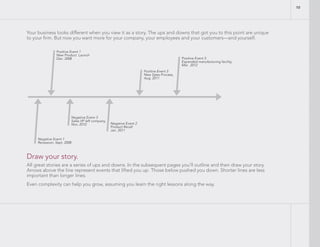
Your business looks different when you view it as a story. The ups and downs that got you to this point are unique
to your firm. But now you want more for your company, your employees and your customers—and yourself.
Draw your story.
All great stories are a series of ups and downs. In the subsequent pages you’ll outline and then draw your story.
Arrows above the line represent events that lifted you up. Those below pushed you down. Shorter lines are less
important than longer lines.
Even complexity can help you grow, assuming you learn the right lessons along the way.
Positive Event 1
New Product Launch
Dec. 2008
Negative Event 1
Recession, Sept. 2008
Negative Event 3
Sales VP left company,
Nov. 2010 Negative Event 2
Product Recall
Jan. 2011
Positive Event 3
New Sales Process,
Aug. 2011
Positive Event 3
Expanded manufacturing facility,
Mar. 2012
10
WHAT’S GONE RIGHT?
List the 5 positive events that have been most instrumental in achieving consistent
success and the date it began impacting your company. For example, Apple
introduced the first iPad in April 2010. Most companies would consider this a
successful event.
List them in order of most important to less important and note the date as
accurately as possible.
1. _____________________________________________ Date ___________
2. __________________________________________ Date ___________
3. _______________________________________ Date ___________
4. ____________________________________ Date ___________
5. _________________________________ Date ___________
11
WHAT’S GONE WRONG?
List 5 negative events that have been most detrimental to consistent success and
the date it began impacting your company. For instance, many companies would
list the last recession as beginning in September of 2008, while some companies
felt the affects much earlier in December of 2007.
List them in order of most important to less important and note the date as
accurately as possible.
1. _____________________________________________ Date ___________
2. __________________________________________ Date ___________
3. _______________________________________ Date ___________
4. ____________________________________ Date ___________
5. _________________________________ Date ___________
12
YOUR STORYLINE
Draw your story below.
Use the events from pages 6 and 7 to draw your story. Use the associated line segment
length and years to draw your story. Positive events should extend above the line,
negative events below.
Use resources on a special website listed on front cover.
13
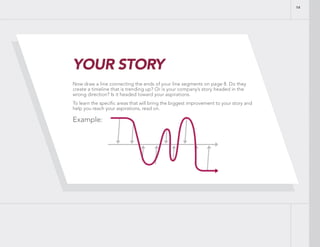
YOUR STORY
Now draw a line connecting the ends of your line segments on page 8. Do they
create a timeline that is trending up? Or is your company’s story headed in the
wrong direction? Is it headed toward your aspirations.
To learn the specific areas that will bring the biggest improvement to your story and
help you reach your aspirations, read on.
Example:
14
REACHING YOUR
ASPIRATIONS
On the next four pages rate how much you agree with the presented statements
on a scale of 1-5. A 5 represents “strongly agree,” 1 “ strongly disagree. Give
neutral statements a score of 3.
Go with your gut; don’t agonize over the details. It shouldn’t take more that 10
minutes to answer. At the bottom of each page add up your total score.
15
RATE YOUR OPERATIONAL
SKILLS AND PROCESSES
___ We are innovation leaders.
___ We are a lean manufacturing business.
___ Within our industry we are the easiest company to do business with.
___ Leading companies in our industry follow the same best practices.
___ We can provide accurate quotes faster than any competitor.
___ We have each year’s operating budget in place on or before the start of fiscal year
___ Our business systems enable us to successfully operate lean manufacturing processes.
___ We never overinvest in G&A areas central to growth and achieving a competitive edge.
___ Avoiding risk is more important than capitalizing on market advantage
___ We have effective processes to root out inefficiencies and redundancies across functional lines.
___ The finance department makes final decisions on annual budgeting.
TOTAL ___
16
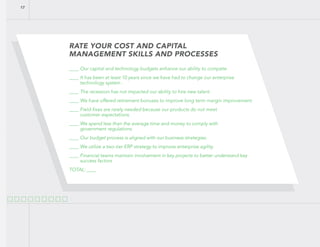
RATE YOUR COST AND CAPITAL
MANAGEMENT SKILLS AND PROCESSES
____ Our capital and technology budgets enhance our ability to compete.
____ It has been at least 10 years since we have had to change our enterprise
technology system .
____ The recession has not impacted our ability to hire new talent .
____ We have offered retirement bonuses to improve long term margin improvement.
____ Field-fixes are rarely needed because our products do not meet
customer expectations.
____ We spend less than the average time and money to comply with
government regulations.
____ Our budget process is aligned with our business strategies.
____ We utilize a two-tier ERP strategy to improve enterprise agility.
____ Financial teams maintain involvement in key projects to better understand key
success factors
TOTAL: ____
17
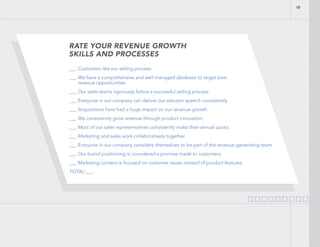
RATE YOUR REVENUE GROWTH
SKILLS AND PROCESSES
___ Customers like our selling process.
___ We have a comprehensive and well managed database to target best
revenue opportunities.
___ Our sales teams rigorously follow a successful selling process.
___ Everyone in our company can deliver our elevator speech consistently.
___ Acquisitions have had a huge impact on our revenue growth.
___ We consistently grow revenue through product innovation.
___ Most of our sales representatives consistently make their annual quota.
___ Marketing and sales work collaboratively together.
___ Everyone in our company considers themselves to be part of the revenue-generating team.
___ Our brand positioning is considered a promise made to customers.
___ Marketing content is focused on customer issues instead of product features.
TOTAL: ___
18
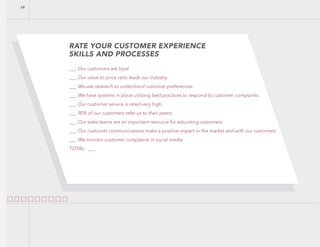
RATE YOUR CUSTOMER EXPERIENCE
SKILLS AND PROCESSES
___ Our customers are loyal.
___ Our value to price ratio leads our industry.
___ We use research to understand customer preferences.
___ We have systems in place utilizing best practices to respond to customer complaints.
___ Our customer service is rated very high.
___ 90% of our customers refer us to their peers.
___ Our sales teams are an important resource for educating customers.
___ Our customer communications make a positive impact in the market and with our customers.
___ We monitor customer complaints in social media.
TOTAL: ___
19
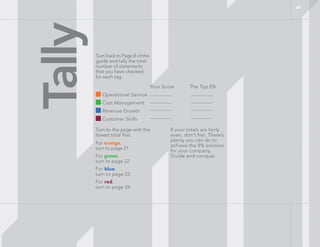
Your Score The Top 8%
Operational Service
Cost Management
Revenue Growth
Customer Skills
Turn back to Page 8 of this
guide and tally the total
number of statements
that you have checked
for each tag.Tally
Turn to the page with the
lowest total first.
For orange,
turn to page 21
For green,
turn to page 22
For blue,
turn to page 23
For red,
turn to page 24
If your totals are fairly
even, don’t fret. There’s
plenty you can do to
achieve the 8% solution
for your company.
Divide and conquer.
20
21
OPERATIONAL SKILLS AND PROCESSES
Completely understanding your processes and how they impact risk
and revenue enables your to make bold decisions to create growth.
Tata Steel
Up until a little more than a decade ago, Tata Steel was anything but an innovative company.
If they were known for anything, it was secure employment. Being an established steel
company their processes were less than modern and their workforce huge. They also
tended to be continuously looking inward. But realizing that organic demand for steel
in India would be slow, they knew they had to change to be competitive in the global
marketplace. In the late 1990’s they began a major effort to re-engineer the company.
The result was that they transformed from a non-descript national steel supplier into a
globally competitive, low-cost manufacturer of steel. Tata has used the financial strength
and low cost operations in found during the re-engineering process to move successfully
onto the global stage.
Checklist
1. __ Build “customer-first mentality” in every department in your company.
2. __ Target precise market segments and learn their issues so your operations can
be developed around customer needs.
3. __ Be part of all significant marketplace conversations.
4. __ Be the easiest company with which to do business.
5. __ Reduce internal barriers to consistent profitable growth.
6. __ Align your business systems and technologies around efficiently serving customers.
7. __ Monitor monthly every factor impacting success and communicate results
throughout the business.
COST AND CAPITAL MANAGEMENT
SKILLS AND PROCESSES
Growth companies continuously manage operating cost structures,
avoiding “cost reduction emergencies” during downturns.
BASF
BASF has achieved growth across a broad range of industries by clearly defining its
capabilities, targets, and goals. BASF states that ‘we earn a premium on our cost of capi-
tal,’ ‘we help our customers to be more successful,’ ‘we form the best team in the in-
dustry.’ This focus has enabled them to carefully consider and align all of their
processes, from manufacturing to waste management, creating efficient products and
processes. The result is that BASF can quickly identify existing or potential areas of in-
efficiency. It has led to the creation of integrated and co-located production sites of
chemicals that use the same basic materials. The result is superior material flow, improved
resource allocation and lower costs.
Checklist
1. __ Identify areas of where costs overlap and could be combined.
2. __ Make sure that your enterprise system is up to speed to help you identify areas
of inefficiency.
3. __ Look for process improvements that can provide annual margin improvement
instead of onetime actions such as early retirement. Bonuses. You can’t cut your
way to the top.
4. __ Make sure that your personnel and enterprise systems are up-to-speed with the
latest compliance regulations. .
5. __ Create a budget process that aligns with your business strategies.
6. __ While enterprise systems are great, make sure that your local operations have the
tools they need to maintain agility. Consider a two-tier ERP strategy to improve
capabilities in this arena.
7. __ Create cross-functional teams (including finance )on key projects to ensure that
critical success factors are understood and met.
22
REVENUE GROWTH SKILLS
AND PROCESSES
Streamlining the sales process and everything it touches is critical to suc-
cess. Additionally, look for existing revenue streams yet untapped.
Rolls-Royce
Roll-Royce is a name known globally for quality, both in the air and on the ground. What
many don’t realize however is how Rolls-Royce has been a leading business innovator in
an area outside of what many people think of as their products. Rolls-Royce still develops,
manufactures and sells engines, but how the customer pays has changed dramatically to a
service model. Instead of purchasing a Rolls-Royce “engines,” airlines now buy “power by
the hour.” In fact, today more than 50% of Rolls-Royce revenues and 70% of its profits
come from the TotalCare service business model.
Checklist
1. __ Make sure that your selling process reflects how your customers actually want to buy.
2. __ Leverage your big data to create a comprehensive database and target your
best revenue opportunities.
3. __ Create a system to monitor, evaluate and improve your selling process.
4. __ Create an elevator speech that everyone can deliver consistently.
5. __ Carefully evaluate Acquisitions to determine what impact they will really have
on revenue growth and how to bring everyone up to speed quickly.
6. __ Create an efficient sales training program that scales to maximize feet on the street..
7. __ Look for opportunities to enable marketing and sales to meet and work collabora-
tively.
8. __ Deliver a top-down mandate to emphasize the importance that everyone in the
company considers themselves part of the revenue-generating team.
9. __ Make sure that your brand promise is a promise to customers.
10. __ Create marketing content focused on customer issues, not product features.
23
24
CUSTOMER EXPERIENCE SKILLS
AND PROCESSES
How you sell can be as important as what you sell.
Bharti Enterprises – Airtel
There are few areas more challenging from a technological and cost standpoint than
telecommunications in countries such as India and Africa. There is a dire need for services,
yet consumers are necessarily extremely price conscious. Bharti came up with a unique
plan when they realized that to sell at the lowest price in the world they’d have to have the
lowest cost in the world. The things that Bharti believe they do better than anyone else
revolve around customers, brand and people management. They shifted activities not in
that core strength to specialist firms in long-term partnership arrangements. This new
low cost business model has enabled them to ‘bring the benefits of mobile telephony
to millions and millions of lower middle class and poor consumers around the world
and a business culture in line with their brand strategy.
Checklist
1. __ Build “customer-first mentality” in every department in your company.
2. __ Target precise market segments and learn their issues so your operations can
be developed around customer needs.
3. __ Be part of all significant marketplace conversations.
4. __ Be the easiest company with which to do business.
5. __ Reduce internal barriers to consistent profitable growth.
6. __ Align your business systems and technologies around efficiently serving customers.
7. __ Monitor monthly every factor impacting success and communicate results
throughout the business.
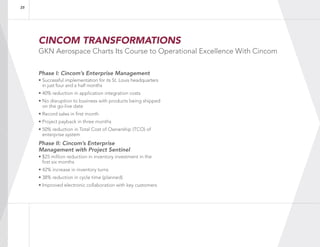
CINCOM TRANSFORMATIONS
GKN Aerospace Charts Its Course to Operational Excellence With Cincom
Phase I: Cincom’s Enterprise Management
• Successful implementation for its St. Louis headquarters
in just four and a half months
• 40% reduction in application integration costs
• No disruption to business with products being shipped
on the go-live date
• Record sales in first month
• Project payback in three months
• 50% reduction in Total Cost of Ownership (TCO) of
enterprise system
Phase II: Cincom’s Enterprise
Management with Project Sentinel
• $25 million reduction in inventory investment in the
first six months
• 42% increase in inventory turns
• 38% reduction in cycle time (planned)
• Improved electronic collaboration with key customers
25
Serving the needs of
complex manufacturers.
For 43 years, Cincom Systems has been helping discrete
manufacturers like you to achieve transformational
success. Our understanding of the issues facing discrete
manufacturers is so deep, in fact, that Microsoft
has recently designated Cincom as one of 15 Global
Independent Software Vendor Partners and the only
one serving complex manufacturing.
26
Pulling Ahead
After you have completed this management guide we
would welcome the opportunity to assist you in achieving
your greatest aspirations. Contact Lou Washington
directly at lwashington@cincom.com or (513) 612-2218.
THE POWER OF
TRANSFORMATION
Cincom, the Quadrant Logo, and Simplification Through Innovation are registered trademarks of Cincom Systems, Inc. All other trademarks belong to their respective companies.

© 2012 Cincom Systems, Inc.
FORM CMUS1204047 09/13
Printed in U.S.A. All Rights Reserved
World Headquarters • Cincinnati, OH USA
US 1-800-2CINCOM (1-800-224-6266) • International 1-513-612-2769
Fax 1-513-612-2000 • E-mail info@cincom.com • www.cincom.com

The 8% Workbook

  • 1.
    Your own 8%Solution Resource Website is erp.cincom.com/PURL Steps can take to join the elite 8% of companies achieving sustained growth. A Cincom Manufacturing Transformation Guidebook Your own 8% Solution Resource Website is erp.cincom.com/PURL T H E N E X T A S C E N T
  • 2.
  • 3.
    Most companies fallshort of their peak. Of 1,780 Fortune 1000-sized companies researched, only 143 achieved top and bottom line growth consistently over 12 or more years.* That’s just 8%! Transformational growth and operational efficiency are a challenge to the aspirations of all senior managers. This is especially true of companies manufacturing advanced, highly engineered products where complexity is a way of life. But 8% do it. Why not you? *Conference Executive Board: Achieving Intelligent Growth, 2010 2
  • 4.
  • 5.
    Hint: They’re notwho you think they are. It’s common to think that the companies that are able to achieve sustainable growth are the companies that have breakthrough product innovations time and again. That’s not always the case. Many companies are able to create and maintain growth by excelling and innovating in their core management disciplines. In fact, focusing on core disciplines could be the less risky of the two strategies. Product innovation will always depend on the fickle consumer’s adoption. Continually striving for excellence enables you to maximize your potential every day. When you do have a breakthrough product innovation you’ll be even farther ahead. Studying this Elite 8%, we’ve identified four areas where they have created advantages not related to product innovation. These areas are ones that any company can emulate and implement every day. 1. Operational management 2. Cost and capital management 3. Customer experience 4. Revenue growth processes 4
  • 6.
  • 7.
    Not just anothermanagement guide This is a guide to help you achieve the highest performance goals in your industry. Your responses will take you along a path that is unique for your company. For additional copies of this guide, go to http://erp.cincom.com/guide. The freedom to prosper After you have completed this management guide we would welcome the opportunity to assist you in achieving your greatest aspirations. Contact Lou Washington directly at lwashington@cincom.com or (513) 612-2218. 6
  • 8.
  • 9.
    The transformation begins. Ifyou’re not achieving consistent growth, you are not alone. 92% of companies have struggled, especially recently. This last recession has left behind consumption levels that make selling complex products a challenge for even the best performers. Now is the time for you and your team to transform your company into the top 8%. One based on achieving the kind of operational efficiency you are truly, capable of achieving; not held back by what appear to be insurmountable challenges. A Transformation Process focuses every person in every department on meeting customer expectations coupled with company-wide efficiency and effectiveness. 8
  • 10.
  • 11.
    Your business looksdifferent when you view it as a story. The ups and downs that got you to this point are unique to your firm. But now you want more for your company, your employees and your customers—and yourself. Draw your story. All great stories are a series of ups and downs. In the subsequent pages you’ll outline and then draw your story. Arrows above the line represent events that lifted you up. Those below pushed you down. Shorter lines are less important than longer lines. Even complexity can help you grow, assuming you learn the right lessons along the way. Positive Event 1 New Product Launch Dec. 2008 Negative Event 1 Recession, Sept. 2008 Negative Event 3 Sales VP left company, Nov. 2010 Negative Event 2 Product Recall Jan. 2011 Positive Event 3 New Sales Process, Aug. 2011 Positive Event 3 Expanded manufacturing facility, Mar. 2012 10
  • 12.
    WHAT’S GONE RIGHT? Listthe 5 positive events that have been most instrumental in achieving consistent success and the date it began impacting your company. For example, Apple introduced the first iPad in April 2010. Most companies would consider this a successful event. List them in order of most important to less important and note the date as accurately as possible. 1. _____________________________________________ Date ___________ 2. __________________________________________ Date ___________ 3. _______________________________________ Date ___________ 4. ____________________________________ Date ___________ 5. _________________________________ Date ___________ 11
  • 13.
    WHAT’S GONE WRONG? List5 negative events that have been most detrimental to consistent success and the date it began impacting your company. For instance, many companies would list the last recession as beginning in September of 2008, while some companies felt the affects much earlier in December of 2007. List them in order of most important to less important and note the date as accurately as possible. 1. _____________________________________________ Date ___________ 2. __________________________________________ Date ___________ 3. _______________________________________ Date ___________ 4. ____________________________________ Date ___________ 5. _________________________________ Date ___________ 12
  • 14.
    YOUR STORYLINE Draw yourstory below. Use the events from pages 6 and 7 to draw your story. Use the associated line segment length and years to draw your story. Positive events should extend above the line, negative events below. Use resources on a special website listed on front cover. 13
  • 15.
    YOUR STORY Now drawa line connecting the ends of your line segments on page 8. Do they create a timeline that is trending up? Or is your company’s story headed in the wrong direction? Is it headed toward your aspirations. To learn the specific areas that will bring the biggest improvement to your story and help you reach your aspirations, read on. Example: 14
  • 16.
    REACHING YOUR ASPIRATIONS On thenext four pages rate how much you agree with the presented statements on a scale of 1-5. A 5 represents “strongly agree,” 1 “ strongly disagree. Give neutral statements a score of 3. Go with your gut; don’t agonize over the details. It shouldn’t take more that 10 minutes to answer. At the bottom of each page add up your total score. 15
  • 17.
    RATE YOUR OPERATIONAL SKILLSAND PROCESSES ___ We are innovation leaders. ___ We are a lean manufacturing business. ___ Within our industry we are the easiest company to do business with. ___ Leading companies in our industry follow the same best practices. ___ We can provide accurate quotes faster than any competitor. ___ We have each year’s operating budget in place on or before the start of fiscal year ___ Our business systems enable us to successfully operate lean manufacturing processes. ___ We never overinvest in G&A areas central to growth and achieving a competitive edge. ___ Avoiding risk is more important than capitalizing on market advantage ___ We have effective processes to root out inefficiencies and redundancies across functional lines. ___ The finance department makes final decisions on annual budgeting. TOTAL ___ 16
  • 18.
    RATE YOUR COSTAND CAPITAL MANAGEMENT SKILLS AND PROCESSES ____ Our capital and technology budgets enhance our ability to compete. ____ It has been at least 10 years since we have had to change our enterprise technology system . ____ The recession has not impacted our ability to hire new talent . ____ We have offered retirement bonuses to improve long term margin improvement. ____ Field-fixes are rarely needed because our products do not meet customer expectations. ____ We spend less than the average time and money to comply with government regulations. ____ Our budget process is aligned with our business strategies. ____ We utilize a two-tier ERP strategy to improve enterprise agility. ____ Financial teams maintain involvement in key projects to better understand key success factors TOTAL: ____ 17
  • 19.
    RATE YOUR REVENUEGROWTH SKILLS AND PROCESSES ___ Customers like our selling process. ___ We have a comprehensive and well managed database to target best revenue opportunities. ___ Our sales teams rigorously follow a successful selling process. ___ Everyone in our company can deliver our elevator speech consistently. ___ Acquisitions have had a huge impact on our revenue growth. ___ We consistently grow revenue through product innovation. ___ Most of our sales representatives consistently make their annual quota. ___ Marketing and sales work collaboratively together. ___ Everyone in our company considers themselves to be part of the revenue-generating team. ___ Our brand positioning is considered a promise made to customers. ___ Marketing content is focused on customer issues instead of product features. TOTAL: ___ 18
  • 20.
    RATE YOUR CUSTOMEREXPERIENCE SKILLS AND PROCESSES ___ Our customers are loyal. ___ Our value to price ratio leads our industry. ___ We use research to understand customer preferences. ___ We have systems in place utilizing best practices to respond to customer complaints. ___ Our customer service is rated very high. ___ 90% of our customers refer us to their peers. ___ Our sales teams are an important resource for educating customers. ___ Our customer communications make a positive impact in the market and with our customers. ___ We monitor customer complaints in social media. TOTAL: ___ 19
  • 21.
    Your Score TheTop 8% Operational Service Cost Management Revenue Growth Customer Skills Turn back to Page 8 of this guide and tally the total number of statements that you have checked for each tag.Tally Turn to the page with the lowest total first. For orange, turn to page 21 For green, turn to page 22 For blue, turn to page 23 For red, turn to page 24 If your totals are fairly even, don’t fret. There’s plenty you can do to achieve the 8% solution for your company. Divide and conquer. 20
  • 22.
    21 OPERATIONAL SKILLS ANDPROCESSES Completely understanding your processes and how they impact risk and revenue enables your to make bold decisions to create growth. Tata Steel Up until a little more than a decade ago, Tata Steel was anything but an innovative company. If they were known for anything, it was secure employment. Being an established steel company their processes were less than modern and their workforce huge. They also tended to be continuously looking inward. But realizing that organic demand for steel in India would be slow, they knew they had to change to be competitive in the global marketplace. In the late 1990’s they began a major effort to re-engineer the company. The result was that they transformed from a non-descript national steel supplier into a globally competitive, low-cost manufacturer of steel. Tata has used the financial strength and low cost operations in found during the re-engineering process to move successfully onto the global stage. Checklist 1. __ Build “customer-first mentality” in every department in your company. 2. __ Target precise market segments and learn their issues so your operations can be developed around customer needs. 3. __ Be part of all significant marketplace conversations. 4. __ Be the easiest company with which to do business. 5. __ Reduce internal barriers to consistent profitable growth. 6. __ Align your business systems and technologies around efficiently serving customers. 7. __ Monitor monthly every factor impacting success and communicate results throughout the business.
  • 23.
    COST AND CAPITALMANAGEMENT SKILLS AND PROCESSES Growth companies continuously manage operating cost structures, avoiding “cost reduction emergencies” during downturns. BASF BASF has achieved growth across a broad range of industries by clearly defining its capabilities, targets, and goals. BASF states that ‘we earn a premium on our cost of capi- tal,’ ‘we help our customers to be more successful,’ ‘we form the best team in the in- dustry.’ This focus has enabled them to carefully consider and align all of their processes, from manufacturing to waste management, creating efficient products and processes. The result is that BASF can quickly identify existing or potential areas of in- efficiency. It has led to the creation of integrated and co-located production sites of chemicals that use the same basic materials. The result is superior material flow, improved resource allocation and lower costs. Checklist 1. __ Identify areas of where costs overlap and could be combined. 2. __ Make sure that your enterprise system is up to speed to help you identify areas of inefficiency. 3. __ Look for process improvements that can provide annual margin improvement instead of onetime actions such as early retirement. Bonuses. You can’t cut your way to the top. 4. __ Make sure that your personnel and enterprise systems are up-to-speed with the latest compliance regulations. . 5. __ Create a budget process that aligns with your business strategies. 6. __ While enterprise systems are great, make sure that your local operations have the tools they need to maintain agility. Consider a two-tier ERP strategy to improve capabilities in this arena. 7. __ Create cross-functional teams (including finance )on key projects to ensure that critical success factors are understood and met. 22
  • 24.
    REVENUE GROWTH SKILLS ANDPROCESSES Streamlining the sales process and everything it touches is critical to suc- cess. Additionally, look for existing revenue streams yet untapped. Rolls-Royce Roll-Royce is a name known globally for quality, both in the air and on the ground. What many don’t realize however is how Rolls-Royce has been a leading business innovator in an area outside of what many people think of as their products. Rolls-Royce still develops, manufactures and sells engines, but how the customer pays has changed dramatically to a service model. Instead of purchasing a Rolls-Royce “engines,” airlines now buy “power by the hour.” In fact, today more than 50% of Rolls-Royce revenues and 70% of its profits come from the TotalCare service business model. Checklist 1. __ Make sure that your selling process reflects how your customers actually want to buy. 2. __ Leverage your big data to create a comprehensive database and target your best revenue opportunities. 3. __ Create a system to monitor, evaluate and improve your selling process. 4. __ Create an elevator speech that everyone can deliver consistently. 5. __ Carefully evaluate Acquisitions to determine what impact they will really have on revenue growth and how to bring everyone up to speed quickly. 6. __ Create an efficient sales training program that scales to maximize feet on the street.. 7. __ Look for opportunities to enable marketing and sales to meet and work collabora- tively. 8. __ Deliver a top-down mandate to emphasize the importance that everyone in the company considers themselves part of the revenue-generating team. 9. __ Make sure that your brand promise is a promise to customers. 10. __ Create marketing content focused on customer issues, not product features. 23
  • 25.
    24 CUSTOMER EXPERIENCE SKILLS ANDPROCESSES How you sell can be as important as what you sell. Bharti Enterprises – Airtel There are few areas more challenging from a technological and cost standpoint than telecommunications in countries such as India and Africa. There is a dire need for services, yet consumers are necessarily extremely price conscious. Bharti came up with a unique plan when they realized that to sell at the lowest price in the world they’d have to have the lowest cost in the world. The things that Bharti believe they do better than anyone else revolve around customers, brand and people management. They shifted activities not in that core strength to specialist firms in long-term partnership arrangements. This new low cost business model has enabled them to ‘bring the benefits of mobile telephony to millions and millions of lower middle class and poor consumers around the world and a business culture in line with their brand strategy. Checklist 1. __ Build “customer-first mentality” in every department in your company. 2. __ Target precise market segments and learn their issues so your operations can be developed around customer needs. 3. __ Be part of all significant marketplace conversations. 4. __ Be the easiest company with which to do business. 5. __ Reduce internal barriers to consistent profitable growth. 6. __ Align your business systems and technologies around efficiently serving customers. 7. __ Monitor monthly every factor impacting success and communicate results throughout the business.
  • 26.
    CINCOM TRANSFORMATIONS GKN AerospaceCharts Its Course to Operational Excellence With Cincom Phase I: Cincom’s Enterprise Management • Successful implementation for its St. Louis headquarters in just four and a half months • 40% reduction in application integration costs • No disruption to business with products being shipped on the go-live date • Record sales in first month • Project payback in three months • 50% reduction in Total Cost of Ownership (TCO) of enterprise system Phase II: Cincom’s Enterprise Management with Project Sentinel • $25 million reduction in inventory investment in the first six months • 42% increase in inventory turns • 38% reduction in cycle time (planned) • Improved electronic collaboration with key customers 25
  • 27.
    Serving the needsof complex manufacturers. For 43 years, Cincom Systems has been helping discrete manufacturers like you to achieve transformational success. Our understanding of the issues facing discrete manufacturers is so deep, in fact, that Microsoft has recently designated Cincom as one of 15 Global Independent Software Vendor Partners and the only one serving complex manufacturing. 26
  • 28.
    Pulling Ahead After youhave completed this management guide we would welcome the opportunity to assist you in achieving your greatest aspirations. Contact Lou Washington directly at lwashington@cincom.com or (513) 612-2218. THE POWER OF TRANSFORMATION Cincom, the Quadrant Logo, and Simplification Through Innovation are registered trademarks of Cincom Systems, Inc. All other trademarks belong to their respective companies. © 2012 Cincom Systems, Inc. FORM CMUS1204047 09/13 Printed in U.S.A. All Rights Reserved World Headquarters • Cincinnati, OH USA US 1-800-2CINCOM (1-800-224-6266) • International 1-513-612-2769 Fax 1-513-612-2000 • E-mail info@cincom.com • www.cincom.com