SAEV MobilityTIC Case Competition – November 18, 2017
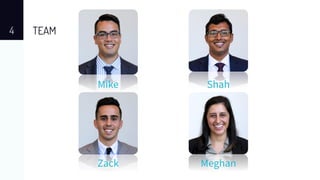
TEAM
Mike
4
Zack
Shah
Meghan
Agenda
1. Executive Summary
Situation
Solution
2. Target Market
3. Strategy
4. Financials
5. Next Steps
Risks
Implementation
5
Summary Target Market Strategy Financials Next Steps
$300 BillionAnnual Commuting loss
77% of emissions are commuting
Source: Inrix Research Reports, Environmental Protection Agency
$50-250M per mile
US Public Transit Infrastructure Costs*
*Buses $13.5M
Source: Environmental Protection Agency
$500B Parking$73B Wasted looking for parking
Source: Inrix Research, Victoria Transport Policy Institute
$212B AnnuallyAmount Road Crashes cost US
Autonomous Vehicles could reduce by
90%
Source: McKinsey
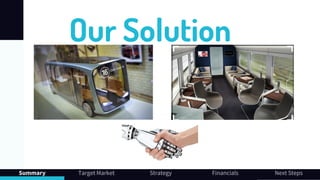
Our Solution
Summary Target Market Strategy Financials Next Steps
Shared
Autonomous
Electric Vehicles“SAEV Mobility”
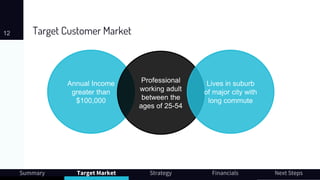
Target Customer Market12
Summary Target Market Strategy Financials Next Steps
Annual Income
greater than
$100,000
Professional
working adult
between the
ages of 25-54
Lives in suburb
of major city with
long commute
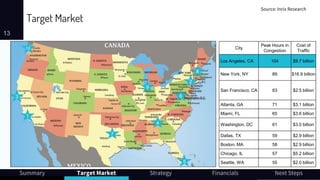
Target Market
13
Summary Target Market Strategy Financials Next Steps
1
6
2
9
3
4
5
7
8
10 City
Peak Hours in
Congestion
Cost of
Traffic
Los Angeles, CA 104 $9.7 billion
New York, NY 89 $16.9 billion
San Francisco, CA 83 $2.5 billion
Atlanta, GA 71 $3.1 billion
Miami, FL 65 $3.6 billion
Washington, DC 61 $3.0 billion
Dallas, TX 59 $2.9 billion
Boston, MA 58 $2.9 billion
Chicago, IL 57 $5.2 billion
Seattle, WA 55 $2.0 billion
Source: Inrix Research
Willingness to Pay14
Summary Target Market Strategy Financials Next Steps
▹$520 – Vehicle Use
▹$290 – Time Value [1]
▹$190 – Wear and Tear [2]
▹$200 – Parking
▹$150 – Gas
$1,350
Source: Journal of Public Economics, AAA
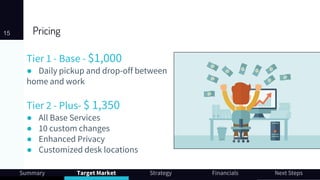
Pricing
Tier 1 - Base - $1,000
● Daily pickup and drop-off between
home and work
Tier 2 - Plus- $ 1,350
● All Base Services
● 10 custom changes
● Enhanced Privacy
● Customized desk locations
15
Summary Target Market Strategy Financials Next Steps
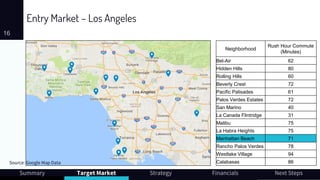
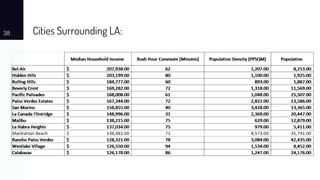
Entry Market – Los Angeles
16
Summary Target Market Strategy Financials Next Steps
Neighborhood
Rush Hour Commute
(Minutes)
Bel-Air 62
Hidden Hills 80
Rolling Hills 60
Beverly Crest 72
Pacific Palisades 61
Palos Verdes Estates 72
San Marino 40
La Canada Flintridge 31
Malibu 75
La Habra Heights 75
Manhattan Beach 71
Rancho Palos Verdes 78
Westlake Village 94
Calabasas 86Source: Google Map Data
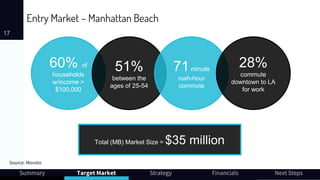
Entry Market – Manhattan Beach
17
Summary Target Market Strategy Financials Next Steps
60% of
households
w/income >
$100,000
51%
between the
ages of 25-54
71minute
rush-hour
commute
28%
commute
downtown to LA
for work
Total (MB) Market Size = $35 million
Source: Movoto
Marketing Strategy
Partnerships
Starbucks
Fitbit
Digital Marketing
Creating Memorable Experience
18
Summary Target Market Strategy Financials Next Steps
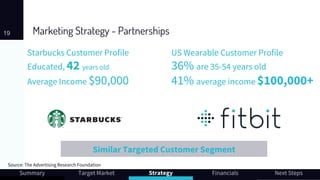
Marketing Strategy - Partnerships
Starbucks Customer Profile
Educated, 42 years old
Average Income $90,000
19
Summary Target Market Strategy Financials Next Steps
Similar Targeted Customer Segment
Source: The Advertising Research Foundation
US Wearable Customer Profile
36% are 35-54 years old
41% average income $100,000+
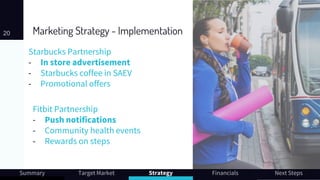
Marketing Strategy - Implementation
Starbucks Partnership
- In store advertisement
- Starbucks coffee in SAEV
- Promotional offers
20
Summary Target Market Strategy Financials Next Steps
Fitbit Partnership
- Push notifications
- Community health events
- Rewards on steps
Differentiators
Productivity
Community
Personalization
21
Summary Target Market Strategy Financials Next Steps
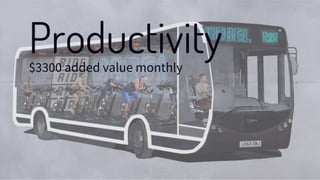
Productivity$3300 added value monthly
SAEV CommunityNetwork with like-minded professionals
PersonalizationFacial recognition and customized interactions
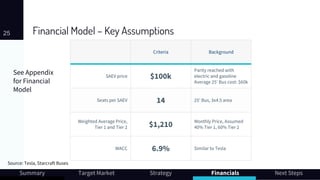
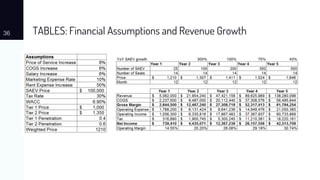
Financial Model – Key Assumptions25
Summary Target Market Strategy Financials Next Steps
Criteria Background
SAEV price $100k
Parity reached with
electric and gasoline
Average 25’ Bus cost: $60k
Seats per SAEV 14 25’ Bus, 3x4.5 area
Weighted Average Price,
Tier 1 and Tier 2 $1,210
Monthly Price, Assumed
40% Tier 1, 60% Tier 2
WACC 6.9% Similar to Tesla
See Appendix
for Financial
Model
Source: Tesla, Starcraft Buses
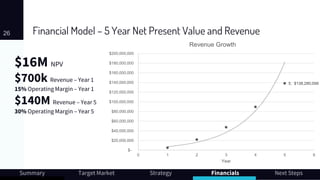
Financial Model – 5 Year Net Present Value and Revenue26
Summary Target Market Strategy Financials Next Steps
$16M NPV
$700k Revenue – Year 1
15% Operating Margin – Year 1
$140M Revenue – Year 5
30% Operating Margin – Year 5
5, $138,280,098
$-
$20,000,000
$40,000,000
$60,000,000
$80,000,000
$100,000,000
$120,000,000
$140,000,000
$160,000,000
$180,000,000
$200,000,000
0 1 2 3 4 5 6
Year
Revenue Growth
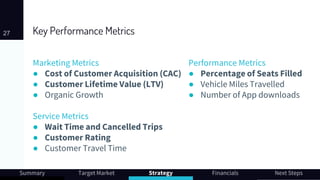
Key Performance Metrics
Marketing Metrics
● Cost of Customer Acquisition (CAC)
● Customer Lifetime Value (LTV)
● Organic Growth
Service Metrics
● Wait Time and Cancelled Trips
● Customer Rating
● Customer Travel Time
27
Summary Target Market Strategy Financials Next Steps
Performance Metrics
● Percentage of Seats Filled
● Vehicle Miles Travelled
● Number of App downloads
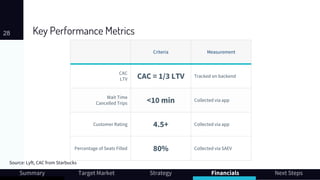
Key Performance Metrics28
Summary Target Market Strategy Financials Next Steps
Criteria Measurement
CAC
LTV CAC = 1/3 LTV Tracked on backend
Wait Time
Cancelled Trips <10 min Collected via app
Customer Rating 4.5+ Collected via app
Percentage of Seats Filled 80% Collected via SAEV
Source: Lyft, CAC from Starbucks
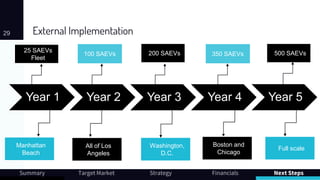
External Implementation29
Summary Target Market Strategy Financials Next Steps
Year 1 Year 2 Year 3 Year 4 Year 5
Manhattan
Beach
100 SAEVs 350 SAEVs
All of Los
Angeles
Washington,
D.C.
Boston and
Chicago
Full scale
25 SAEVs
Fleet
200 SAEVs 500 SAEVs
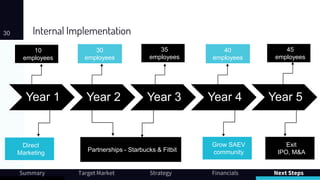
Internal Implementation30
Summary Target Market Strategy Financials Next Steps
Year 1 Year 2 Year 3 Year 4 Year 5
Direct
Marketing
30
employees
40
employees
Partnerships - Starbucks & Fitbit
Grow SAEV
community
Exit
IPO, M&A
10
employees
35
employees
45
employees
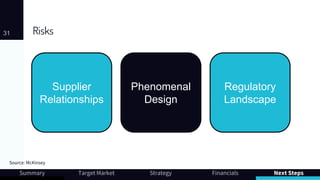
Risks31
Summary Target Market Strategy Financials Next Steps
Supplier
Relationships
Phenomenal
Design
Regulatory
Landscape
Source: McKinsey
Solution32
Summary Target Market Strategy Financials Next Steps
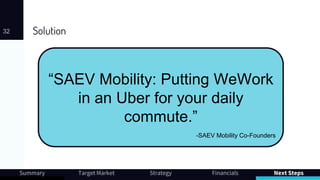
“SAEV Mobility: Putting WeWork
in an Uber for your daily
commute.”
-SAEV Mobility Co-Founders
Questions
34
APPENDICES
35
TABLES: Financial Assumptions and Revenue Growth36
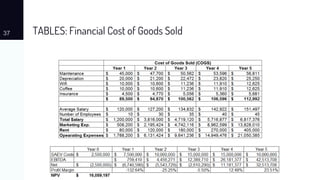
TABLES: Financial Cost of Goods Sold37
Cities Surrounding LA:38
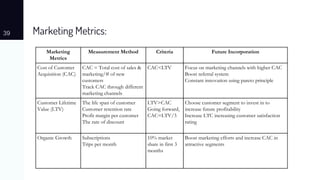
Marketing Metrics:39
Marketing
Metrics
Measurement Method Criteria Future Incorporation
Cost of Customer
Acquisition (CAC)
CAC = Total cost of sales &
marketing/# of new
customers
Track CAC through different
marketing channels
CAC<LTV Focus on marketing channels with higher CAC
Boost referral system
Constant innovation using pareto principle
Customer Lifetime
Value (LTV)
The life span of customer
Customer retention rate
Profit margin per customer
The rate of discount
LTV>CAC
Going forward,
CAC=LTV/3
Choose customer segment to invest in to
increase future profitability
Increase LTC increasing customer satisfaction
rating
Organic Growth Subscriptions
Trips per month
10% market
share in first 3
months
Boost marketing efforts and increase CAC in
attractive segments
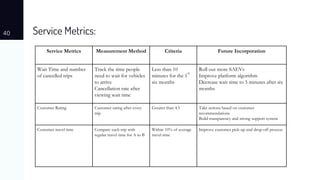
Service Metrics:40
Service Metrics Measurement Method Criteria Future Incorporation
Wait Time and number
of cancelled trips
Track the time people
need to wait for vehicles
to arrive
Cancellation rate after
viewing wait time
Less than 10
minutes for the 1
st
six months
Roll out more SAEVs
Improve platform algorithm
Decrease wait time to 5 minutes after six
months
Customer Rating Customer rating after every
trip
Greater than 4.5 Take actions based on customer
recommendations
Build transparency and strong support system
Customer travel time Compare each trip with
regular travel time for A to B
Within 10% of average
travel time
Improve customer pick-up and drop-off process
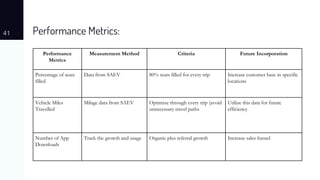
Performance Metrics:41
Performance
Metrics
Measurement Method Criteria Future Incorporation
Percentage of seats
filled
Data from SAEV 80% seats filled for every trip Increase customer base in specific
locations
Vehicle Miles
Travelled
Milage data from SAEV Optimize through every trip (avoid
unnecessary travel paths
Utilize this data for future
efficiency
Number of App
Downloads
Track the growth and usage Organic plus referral growth Increase sales funnel

Tepper Tech Innovation - Case Competition

  • 1.
    SAEV MobilityTIC CaseCompetition – November 18, 2017
  • 4.
  • 5.
    Agenda 1. Executive Summary Situation Solution 2.Target Market 3. Strategy 4. Financials 5. Next Steps Risks Implementation 5 Summary Target Market Strategy Financials Next Steps
  • 6.
    $300 BillionAnnual Commutingloss 77% of emissions are commuting Source: Inrix Research Reports, Environmental Protection Agency
  • 7.
    $50-250M per mile USPublic Transit Infrastructure Costs* *Buses $13.5M Source: Environmental Protection Agency
  • 8.
    $500B Parking$73B Wastedlooking for parking Source: Inrix Research, Victoria Transport Policy Institute
  • 9.
    $212B AnnuallyAmount RoadCrashes cost US Autonomous Vehicles could reduce by 90% Source: McKinsey
  • 10.
    Our Solution Summary TargetMarket Strategy Financials Next Steps
  • 11.
  • 12.
    Target Customer Market12 SummaryTarget Market Strategy Financials Next Steps Annual Income greater than $100,000 Professional working adult between the ages of 25-54 Lives in suburb of major city with long commute
  • 13.
    Target Market 13 Summary TargetMarket Strategy Financials Next Steps 1 6 2 9 3 4 5 7 8 10 City Peak Hours in Congestion Cost of Traffic Los Angeles, CA 104 $9.7 billion New York, NY 89 $16.9 billion San Francisco, CA 83 $2.5 billion Atlanta, GA 71 $3.1 billion Miami, FL 65 $3.6 billion Washington, DC 61 $3.0 billion Dallas, TX 59 $2.9 billion Boston, MA 58 $2.9 billion Chicago, IL 57 $5.2 billion Seattle, WA 55 $2.0 billion Source: Inrix Research
  • 14.
    Willingness to Pay14 SummaryTarget Market Strategy Financials Next Steps ▹$520 – Vehicle Use ▹$290 – Time Value [1] ▹$190 – Wear and Tear [2] ▹$200 – Parking ▹$150 – Gas $1,350 Source: Journal of Public Economics, AAA
  • 15.
    Pricing Tier 1 -Base - $1,000 ● Daily pickup and drop-off between home and work Tier 2 - Plus- $ 1,350 ● All Base Services ● 10 custom changes ● Enhanced Privacy ● Customized desk locations 15 Summary Target Market Strategy Financials Next Steps
  • 16.
    Entry Market –Los Angeles 16 Summary Target Market Strategy Financials Next Steps Neighborhood Rush Hour Commute (Minutes) Bel-Air 62 Hidden Hills 80 Rolling Hills 60 Beverly Crest 72 Pacific Palisades 61 Palos Verdes Estates 72 San Marino 40 La Canada Flintridge 31 Malibu 75 La Habra Heights 75 Manhattan Beach 71 Rancho Palos Verdes 78 Westlake Village 94 Calabasas 86Source: Google Map Data
  • 17.
    Entry Market –Manhattan Beach 17 Summary Target Market Strategy Financials Next Steps 60% of households w/income > $100,000 51% between the ages of 25-54 71minute rush-hour commute 28% commute downtown to LA for work Total (MB) Market Size = $35 million Source: Movoto
  • 18.
    Marketing Strategy Partnerships Starbucks Fitbit Digital Marketing CreatingMemorable Experience 18 Summary Target Market Strategy Financials Next Steps
  • 19.
    Marketing Strategy -Partnerships Starbucks Customer Profile Educated, 42 years old Average Income $90,000 19 Summary Target Market Strategy Financials Next Steps Similar Targeted Customer Segment Source: The Advertising Research Foundation US Wearable Customer Profile 36% are 35-54 years old 41% average income $100,000+
  • 20.
    Marketing Strategy -Implementation Starbucks Partnership - In store advertisement - Starbucks coffee in SAEV - Promotional offers 20 Summary Target Market Strategy Financials Next Steps Fitbit Partnership - Push notifications - Community health events - Rewards on steps
  • 21.
  • 22.
  • 23.
    SAEV CommunityNetwork withlike-minded professionals
  • 24.
  • 25.
    Financial Model –Key Assumptions25 Summary Target Market Strategy Financials Next Steps Criteria Background SAEV price $100k Parity reached with electric and gasoline Average 25’ Bus cost: $60k Seats per SAEV 14 25’ Bus, 3x4.5 area Weighted Average Price, Tier 1 and Tier 2 $1,210 Monthly Price, Assumed 40% Tier 1, 60% Tier 2 WACC 6.9% Similar to Tesla See Appendix for Financial Model Source: Tesla, Starcraft Buses
  • 26.
    Financial Model –5 Year Net Present Value and Revenue26 Summary Target Market Strategy Financials Next Steps $16M NPV $700k Revenue – Year 1 15% Operating Margin – Year 1 $140M Revenue – Year 5 30% Operating Margin – Year 5 5, $138,280,098 $- $20,000,000 $40,000,000 $60,000,000 $80,000,000 $100,000,000 $120,000,000 $140,000,000 $160,000,000 $180,000,000 $200,000,000 0 1 2 3 4 5 6 Year Revenue Growth
  • 27.
    Key Performance Metrics MarketingMetrics ● Cost of Customer Acquisition (CAC) ● Customer Lifetime Value (LTV) ● Organic Growth Service Metrics ● Wait Time and Cancelled Trips ● Customer Rating ● Customer Travel Time 27 Summary Target Market Strategy Financials Next Steps Performance Metrics ● Percentage of Seats Filled ● Vehicle Miles Travelled ● Number of App downloads
  • 28.
    Key Performance Metrics28 SummaryTarget Market Strategy Financials Next Steps Criteria Measurement CAC LTV CAC = 1/3 LTV Tracked on backend Wait Time Cancelled Trips <10 min Collected via app Customer Rating 4.5+ Collected via app Percentage of Seats Filled 80% Collected via SAEV Source: Lyft, CAC from Starbucks
  • 29.
    External Implementation29 Summary TargetMarket Strategy Financials Next Steps Year 1 Year 2 Year 3 Year 4 Year 5 Manhattan Beach 100 SAEVs 350 SAEVs All of Los Angeles Washington, D.C. Boston and Chicago Full scale 25 SAEVs Fleet 200 SAEVs 500 SAEVs
  • 30.
    Internal Implementation30 Summary TargetMarket Strategy Financials Next Steps Year 1 Year 2 Year 3 Year 4 Year 5 Direct Marketing 30 employees 40 employees Partnerships - Starbucks & Fitbit Grow SAEV community Exit IPO, M&A 10 employees 35 employees 45 employees
  • 31.
    Risks31 Summary Target MarketStrategy Financials Next Steps Supplier Relationships Phenomenal Design Regulatory Landscape Source: McKinsey
  • 32.
    Solution32 Summary Target MarketStrategy Financials Next Steps “SAEV Mobility: Putting WeWork in an Uber for your daily commute.” -SAEV Mobility Co-Founders
  • 34.
  • 35.
  • 36.
    TABLES: Financial Assumptionsand Revenue Growth36
  • 37.
    TABLES: Financial Costof Goods Sold37
  • 38.
  • 39.
    Marketing Metrics:39 Marketing Metrics Measurement MethodCriteria Future Incorporation Cost of Customer Acquisition (CAC) CAC = Total cost of sales & marketing/# of new customers Track CAC through different marketing channels CAC<LTV Focus on marketing channels with higher CAC Boost referral system Constant innovation using pareto principle Customer Lifetime Value (LTV) The life span of customer Customer retention rate Profit margin per customer The rate of discount LTV>CAC Going forward, CAC=LTV/3 Choose customer segment to invest in to increase future profitability Increase LTC increasing customer satisfaction rating Organic Growth Subscriptions Trips per month 10% market share in first 3 months Boost marketing efforts and increase CAC in attractive segments
  • 40.
    Service Metrics:40 Service MetricsMeasurement Method Criteria Future Incorporation Wait Time and number of cancelled trips Track the time people need to wait for vehicles to arrive Cancellation rate after viewing wait time Less than 10 minutes for the 1 st six months Roll out more SAEVs Improve platform algorithm Decrease wait time to 5 minutes after six months Customer Rating Customer rating after every trip Greater than 4.5 Take actions based on customer recommendations Build transparency and strong support system Customer travel time Compare each trip with regular travel time for A to B Within 10% of average travel time Improve customer pick-up and drop-off process
  • 41.
    Performance Metrics:41 Performance Metrics Measurement MethodCriteria Future Incorporation Percentage of seats filled Data from SAEV 80% seats filled for every trip Increase customer base in specific locations Vehicle Miles Travelled Milage data from SAEV Optimize through every trip (avoid unnecessary travel paths Utilize this data for future efficiency Number of App Downloads Track the growth and usage Organic plus referral growth Increase sales funnel