Little Tree: Resilience and
Independence
By: Gary E. Miller Jr.
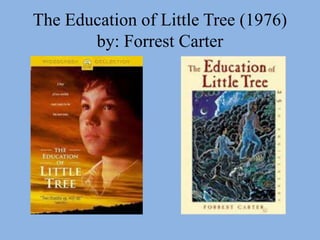
The Education of Little Tree (1976)
by: Forrest Carter
Meet the Author
• Many suggest that Asa
Earl Carter is the true
author of the book
• Also author of The
Rebel Outlaw: Josey
Wales which became a
Clint Eastwood movie
• Speech writer for
George C. Wallace
• May have been a
former Ku Klux Klan
member
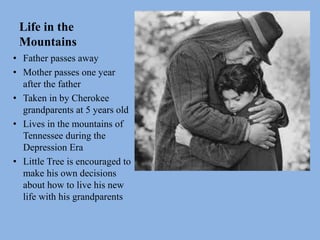
Life in the
Mountains
• Father passes away
• Mother passes one year
after the father
• Taken in by Cherokee
grandparents at 5 years old
• Lives in the mountains of
Tennessee during the
Depression Era
• Little Tree is encouraged to
make his own decisions
about how to live his new
life with his grandparents
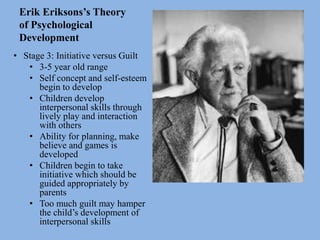
Erik Eriksons’s Theory
of Psychological
Development
• Stage 3: Initiative versus Guilt
• 3-5 year old range
• Self concept and self-esteem
begin to develop
• Children develop
interpersonal skills through
lively play and interaction
with others
• Ability for planning, make
believe and games is
developed
• Children begin to take
initiative which should be
guided appropriately by
parents
• Too much guilt may hamper
the child’s development of
interpersonal skills
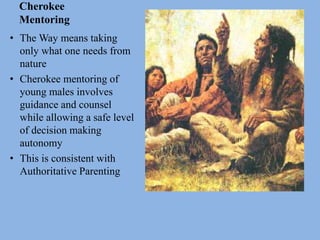
Cherokee
Mentoring
• The Way means taking
only what one needs from
nature
• Cherokee mentoring of
young males involves
guidance and counsel
while allowing a safe level
of decision making
autonomy
• This is consistent with
Authoritative Parenting
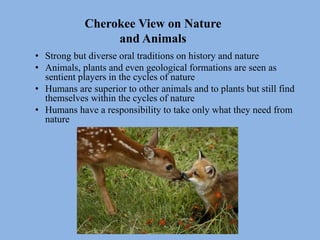
Cherokee View on Nature
and Animals
• Strong but diverse oral traditions on history and nature
• Animals, plants and even geological formations are seen as
sentient players in the cycles of nature
• Humans are superior to other animals and to plants but still find
themselves within the cycles of nature
• Humans have a responsibility to take only what they need from
nature
Learning the
Trade
• Granpa shows Little
Tree his whiskey
still
• Little Tree takes
pride in his new
trade
• Little Tree barely
escapes the law
• Little Tree is praised
for being better than
Granpa himself
Erik Eriksons’s Theory
of Psychological
Development
• Stage 4: Industry versus
Inferiority
• 5-12 year old range
• Children begin reading,
writing and arithmetic
• Peer groups become more
important source of self-
esteem
• Child seeks approval by
achieving competencies
valued by society
• If initiative is not encouraged
then the child may develop a
sense of inferiority
Learning to be
Weary
• First encounter with an ‘appeal
to character’ when Little Tree
naively trusts a Christian man
during a trade
• Loses his money and the calf
he purchases dies on the trail
home
• Little Tree decides not to trade
with Christians anymore
• Granma corrects Little Tree to
be more careful about what
strangers say to compel one to
make a purchase
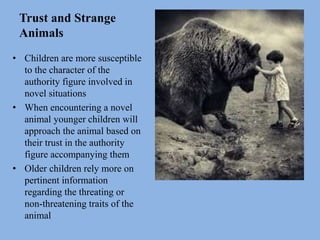
Trust and Strange
Animals
• Children are more susceptible
to the character of the
authority figure involved in
novel situations
• When encountering a novel
animal younger children will
approach the animal based on
their trust in the authority
figure accompanying them
• Older children rely more on
pertinent information
regarding the threating or
non-threatening traits of the
animal
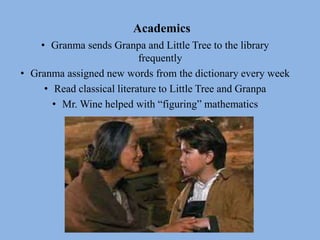
Academics
• Granma sends Granpa and Little Tree to the library
frequently
• Granma assigned new words from the dictionary every week
• Read classical literature to Little Tree and Granpa
• Mr. Wine helped with “figuring” mathematics
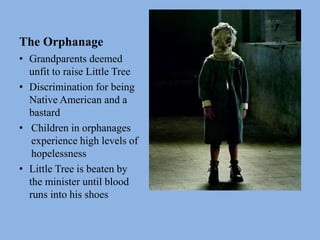
The Orphanage
• Grandparents deemed
unfit to raise Little Tree
• Discrimination for being
Native American and a
bastard
• Children in orphanages
experience high levels of
hopelessness
• Little Tree is beaten by
the minister until blood
runs into his shoes
Resiliency
• The mental, physical, emotional
and behavioral ability to face and
cope with adversity, adapt to
change, recover, learn and grow
from setbacks (US Army)
• Granpa said “no matter what
happens, if you can stay on your
feet you’ll probably be OK.”
• Little Tree remained standing
through the lashing by the
minister
• A study in Israel demonstrated
that after implementation of
resiliency training children were
able to cope better with PTSD
effects from rocket attacks
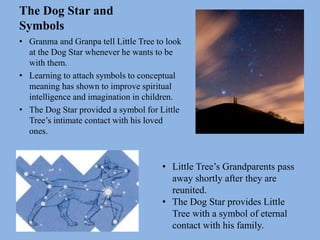
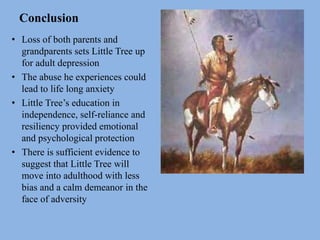
The Dog Star and
Symbols
• Granma and Granpa tell Little Tree to look
at the Dog Star whenever he wants to be
with them.
• Learning to attach symbols to conceptual
meaning has shown to improve spiritual
intelligence and imagination in children.
• The Dog Star provided a symbol for Little
Tree’s intimate contact with his loved
ones.
• Little Tree’s Grandparents pass
away shortly after they are
reunited.
• The Dog Star provides Little
Tree with a symbol of eternal
contact with his family.
Conclusion
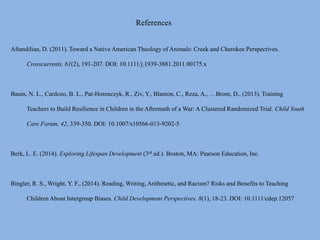
• Loss of both parents and
grandparents sets Little Tree up
for adult depression
• The abuse he experiences could
lead to life long anxiety
• Little Tree’s education in
independence, self-reliance and
resiliency provided emotional
and psychological protection
• There is sufficient evidence to
suggest that Little Tree will
move into adulthood with less
bias and a calm demeanor in the
face of adversity
References
Aftandilian, D. (2011). Toward a Native American Theology of Animals: Creek and Cherokee Perspectives.
Crosscurrents, 61(2), 191-207. DOI: 10.1111/j.1939-3881.2011.00175.x
Baum, N. L., Cardozo, B. L., Pat-Horenczyk, R., Ziv, Y., Blanton, C., Reza, A., …Brom, D., (2013). Training
Teachers to Build Resilience in Children in the Aftermath of a War: A Clustered Randomized Trial. Child Youth
Care Forum, 42, 339-350. DOI: 10.1007/s10566-013-9202-5
Berk, L. E. (2014). Exploring Lifespan Development (3rd ed.). Boston, MA: Pearson Education, Inc.
Bingler, R. S., Wright, Y. F., (2014). Reading, Writing, Arithmetic, and Racism? Risks and Benefits to Teaching
Children About Intergroup Biases. Child Development Perspectives, 8(1), 18-23. DOI: 10.1111/cdep.12057
References (cont’d)
Boseovski, J. J., Thurman, S. L. (2014). Evaluating and Approaching a Strange Animal: Children’s Trust in Informant
Testimony. Child Development, 85(2), 824-834. DOI: 10.1111/cdev.12156
Carter, F. (2008). The Education of Little Tree. Albuquerque, New Mexico: University of New Mexico Press.
Coffino, B. (2009). The Role of Childhood Parent Figure Loss in the Etiology of Adult
Depression: Findings from a Prospective Longitudinal Study. Attachment and Human Development, 11(5),
445-470. DOI: 10.1080/14616730903135993
Costello, K., Hodson, G. (2014). Explaining Dehumanization Among Children: The Interspecies Model of Prejudice.
British Journal of Social Psychology, 53(1), 175-197. DOI: 10.1111/bjso.12016
References (cont’d)
Dunifon, R. (2013). The Influence of Grandparents on the Lives of Children and Adolescents. Child
Development Perspectives, 7(1), 55–60. DOI: 10.1111/cdep.12016
Flander, B. G., Mateskovic, D., Tuscic, S. J. (2013). The Consequences Of Child Abuse. Pediatrics Today, 9(1),
24-35. DOI: 10.5457/p2005-114.58
Lowe, J. (2005). Being Influenced: A Cherokee Way of Mentoring. Journal of Cultural Diversity, 12(2), 37-49.
Moriarty, M. W. (2009). Evaluating Children’s Use of Symbol in Some Recent Research. International Journal
of Children’s Spirituality, 14(1), 47-61. DOI: 10.1080/13644360802658750

Little Tree

  • 1.
    Little Tree: Resilienceand Independence By: Gary E. Miller Jr.
  • 2.
    The Education ofLittle Tree (1976) by: Forrest Carter
  • 3.
    Meet the Author •Many suggest that Asa Earl Carter is the true author of the book • Also author of The Rebel Outlaw: Josey Wales which became a Clint Eastwood movie • Speech writer for George C. Wallace • May have been a former Ku Klux Klan member
  • 4.
    Life in the Mountains •Father passes away • Mother passes one year after the father • Taken in by Cherokee grandparents at 5 years old • Lives in the mountains of Tennessee during the Depression Era • Little Tree is encouraged to make his own decisions about how to live his new life with his grandparents
  • 5.
    Erik Eriksons’s Theory ofPsychological Development • Stage 3: Initiative versus Guilt • 3-5 year old range • Self concept and self-esteem begin to develop • Children develop interpersonal skills through lively play and interaction with others • Ability for planning, make believe and games is developed • Children begin to take initiative which should be guided appropriately by parents • Too much guilt may hamper the child’s development of interpersonal skills
  • 6.
    Cherokee Mentoring • The Waymeans taking only what one needs from nature • Cherokee mentoring of young males involves guidance and counsel while allowing a safe level of decision making autonomy • This is consistent with Authoritative Parenting
  • 7.
    Cherokee View onNature and Animals • Strong but diverse oral traditions on history and nature • Animals, plants and even geological formations are seen as sentient players in the cycles of nature • Humans are superior to other animals and to plants but still find themselves within the cycles of nature • Humans have a responsibility to take only what they need from nature
  • 8.
    Learning the Trade • Granpashows Little Tree his whiskey still • Little Tree takes pride in his new trade • Little Tree barely escapes the law • Little Tree is praised for being better than Granpa himself
  • 9.
    Erik Eriksons’s Theory ofPsychological Development • Stage 4: Industry versus Inferiority • 5-12 year old range • Children begin reading, writing and arithmetic • Peer groups become more important source of self- esteem • Child seeks approval by achieving competencies valued by society • If initiative is not encouraged then the child may develop a sense of inferiority
  • 10.
    Learning to be Weary •First encounter with an ‘appeal to character’ when Little Tree naively trusts a Christian man during a trade • Loses his money and the calf he purchases dies on the trail home • Little Tree decides not to trade with Christians anymore • Granma corrects Little Tree to be more careful about what strangers say to compel one to make a purchase
  • 11.
    Trust and Strange Animals •Children are more susceptible to the character of the authority figure involved in novel situations • When encountering a novel animal younger children will approach the animal based on their trust in the authority figure accompanying them • Older children rely more on pertinent information regarding the threating or non-threatening traits of the animal
  • 12.
    Academics • Granma sendsGranpa and Little Tree to the library frequently • Granma assigned new words from the dictionary every week • Read classical literature to Little Tree and Granpa • Mr. Wine helped with “figuring” mathematics
  • 13.
    The Orphanage • Grandparentsdeemed unfit to raise Little Tree • Discrimination for being Native American and a bastard • Children in orphanages experience high levels of hopelessness • Little Tree is beaten by the minister until blood runs into his shoes
  • 14.
    Resiliency • The mental,physical, emotional and behavioral ability to face and cope with adversity, adapt to change, recover, learn and grow from setbacks (US Army) • Granpa said “no matter what happens, if you can stay on your feet you’ll probably be OK.” • Little Tree remained standing through the lashing by the minister • A study in Israel demonstrated that after implementation of resiliency training children were able to cope better with PTSD effects from rocket attacks
  • 15.
    The Dog Starand Symbols • Granma and Granpa tell Little Tree to look at the Dog Star whenever he wants to be with them. • Learning to attach symbols to conceptual meaning has shown to improve spiritual intelligence and imagination in children. • The Dog Star provided a symbol for Little Tree’s intimate contact with his loved ones. • Little Tree’s Grandparents pass away shortly after they are reunited. • The Dog Star provides Little Tree with a symbol of eternal contact with his family.
  • 16.
    Conclusion • Loss ofboth parents and grandparents sets Little Tree up for adult depression • The abuse he experiences could lead to life long anxiety • Little Tree’s education in independence, self-reliance and resiliency provided emotional and psychological protection • There is sufficient evidence to suggest that Little Tree will move into adulthood with less bias and a calm demeanor in the face of adversity
  • 17.
    References Aftandilian, D. (2011).Toward a Native American Theology of Animals: Creek and Cherokee Perspectives. Crosscurrents, 61(2), 191-207. DOI: 10.1111/j.1939-3881.2011.00175.x Baum, N. L., Cardozo, B. L., Pat-Horenczyk, R., Ziv, Y., Blanton, C., Reza, A., …Brom, D., (2013). Training Teachers to Build Resilience in Children in the Aftermath of a War: A Clustered Randomized Trial. Child Youth Care Forum, 42, 339-350. DOI: 10.1007/s10566-013-9202-5 Berk, L. E. (2014). Exploring Lifespan Development (3rd ed.). Boston, MA: Pearson Education, Inc. Bingler, R. S., Wright, Y. F., (2014). Reading, Writing, Arithmetic, and Racism? Risks and Benefits to Teaching Children About Intergroup Biases. Child Development Perspectives, 8(1), 18-23. DOI: 10.1111/cdep.12057
  • 18.
    References (cont’d) Boseovski, J.J., Thurman, S. L. (2014). Evaluating and Approaching a Strange Animal: Children’s Trust in Informant Testimony. Child Development, 85(2), 824-834. DOI: 10.1111/cdev.12156 Carter, F. (2008). The Education of Little Tree. Albuquerque, New Mexico: University of New Mexico Press. Coffino, B. (2009). The Role of Childhood Parent Figure Loss in the Etiology of Adult Depression: Findings from a Prospective Longitudinal Study. Attachment and Human Development, 11(5), 445-470. DOI: 10.1080/14616730903135993 Costello, K., Hodson, G. (2014). Explaining Dehumanization Among Children: The Interspecies Model of Prejudice. British Journal of Social Psychology, 53(1), 175-197. DOI: 10.1111/bjso.12016
  • 19.
    References (cont’d) Dunifon, R.(2013). The Influence of Grandparents on the Lives of Children and Adolescents. Child Development Perspectives, 7(1), 55–60. DOI: 10.1111/cdep.12016 Flander, B. G., Mateskovic, D., Tuscic, S. J. (2013). The Consequences Of Child Abuse. Pediatrics Today, 9(1), 24-35. DOI: 10.5457/p2005-114.58 Lowe, J. (2005). Being Influenced: A Cherokee Way of Mentoring. Journal of Cultural Diversity, 12(2), 37-49. Moriarty, M. W. (2009). Evaluating Children’s Use of Symbol in Some Recent Research. International Journal of Children’s Spirituality, 14(1), 47-61. DOI: 10.1080/13644360802658750