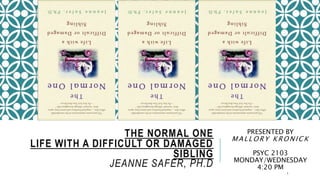
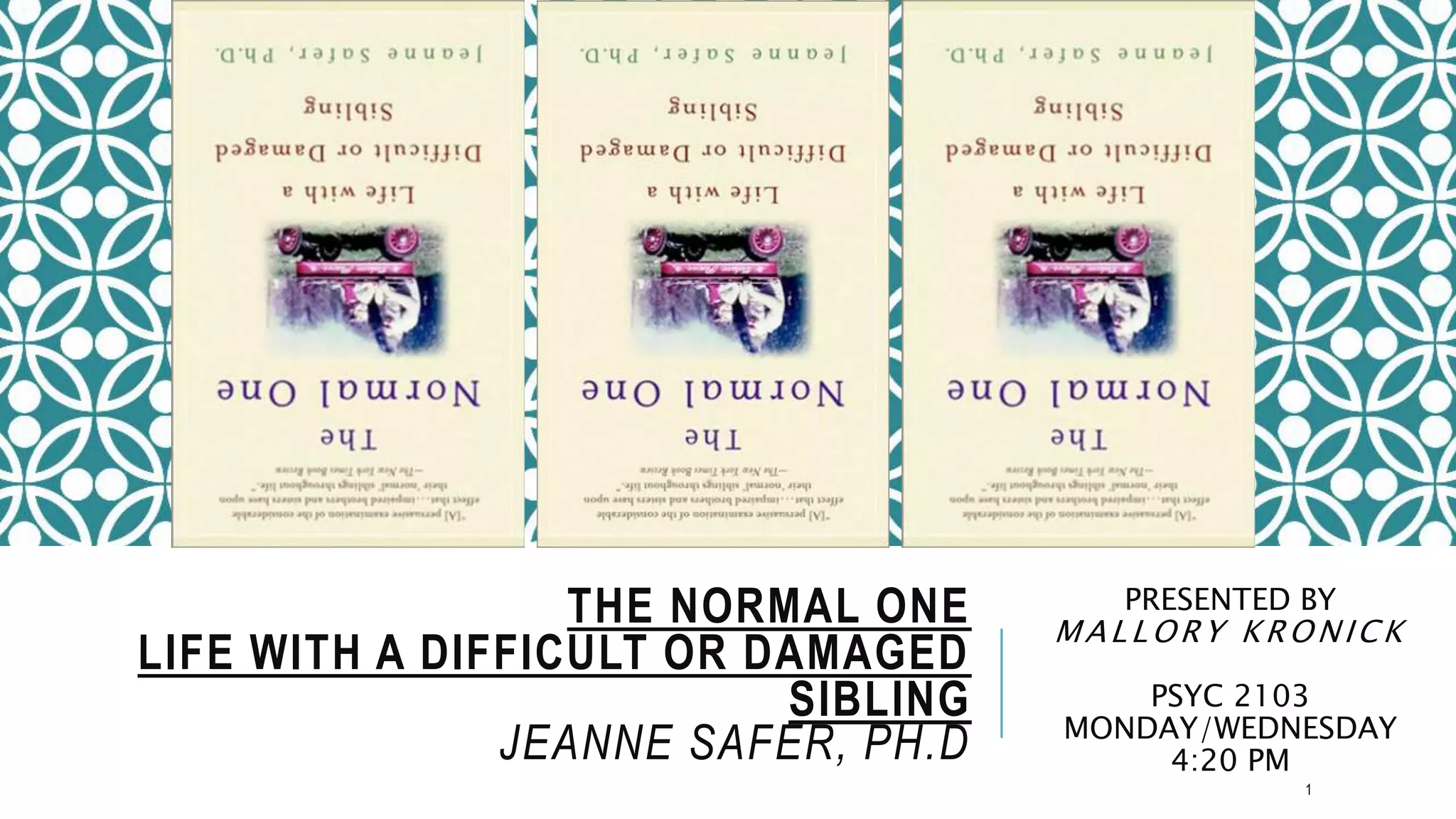
THE NORMAL ONE 
LIFE WITH A DIFFICULT OR DAMAGED 
SIBLING 
JEANNE SAFER, PH.D 
PRESENTED BY 
MAL LORY KRONICK 
PSYC 2103 
MONDAY/WEDNESDAY 
4:20 PM 
1
2 
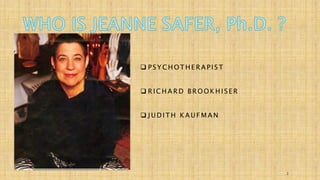
 P SYCHOTHERAP I ST 
 RICHARD BROOKHI S ER 
 JUDITH KAUFMAN
ADDITIONAL BOOKS 
WRITTEN BY JEANNE 
SAFER, PH.D. 
T O P I C S O F H E R 
B O O K S 
 DIFFICULT/DAMAGED 
3 
SIBLINGS 
 FORGIVENESS 
 PARENTING CHOICES 
 DEALING WITH DEATH
I traveled around a great deal…I would have 
stopped, 
but I was pursued by something. It always 
came upon me 
unawares…Then all at once my sister 
touched my 
shoulder. I turn around and look into her 
eyes. Oh Laura, 
Laura, I tried to leave you behind me, but I 
am more faithful than I intended to be! 4
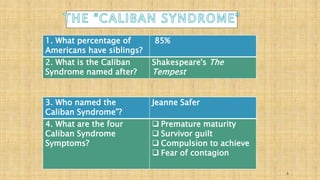
1. What percentage of 
Americans have siblings? 
85% 
2. What is the Caliban 
Syndrome named after? 
Shakespeare's The 
Tempest 
3. Who named the 
Caliban Syndrome”? 
Jeanne Safer 
4. What are the four 
Caliban Syndrome 
Symptoms? 
 Premature maturity 
 Survivor guilt 
 Compulsion to achieve 
 Fear of contagion 
5
6 
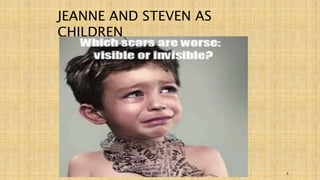
JEANNE AND STEVEN AS 
CHILDREN
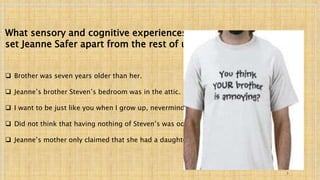
What sensory and cognitive experiences 
set Jeanne Safer apart from the rest of us? 
 Brother was seven years older than her. 
 Jeanne’s brother Steven’s bedroom was in the attic. 
 I want to be just like you when I grow up, nevermind. 
 Did not think that having nothing of Steven’s was odd. 
 Jeanne’s mother only claimed that she had a daughter. 
7
WHAT MADE JEANNE’S 
BROTHER DIFFERENT 
FROM HER? 
8 
S T E V E N W A S A : 
 P R O B L E M C H I L D A T S C H O O L 
 O V E R W E I G H T 
 H A D T R O U B L E E X P R E S S I N G 
E M O T I O N S 
 D E V E L O P E D D I A B E T E S 
 T A L E N T E D W I T H M U S I C , A N D 
R E L A T I O N S H I P S O U T S I D E O F T H E 
H O M E 
 D I D N O T C O M P L E T E C O L L E G E
WHAT DEVELOPMENT DID JEANNE 
EXPERIENCE BECAUSE OF HER 
BROTHER? (COGNITIVE, PHYSICAL, 
EMOTIONAL, SOCIAL, ETC.) 
 Premature maturity 
 Survivor guilt 
 Compulsion to achieve 
 Fear of contagion 
9
PROVIDE A DESCRIPTION OF THE JEANNE’S 
DEVELOPMENT 
She grew up being positive 
for other people, but hard on 
herself. (COMPULSION TO 
ACHIEVE) 
DREAMED OF BEING A 
PYSCHOTHERAPIST AS A 
CHILD (PRE MATURE 
MATURITY) 
STEVEN FAILED BECAUSE OF HER 
(GUILT) 
DID NOT WANT HER OWN 
CHILDREN BC OF HER BROTHER. 
(FEAR OF CONTAGION) 
10
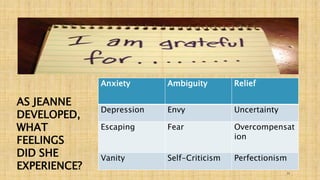
Anxiety Ambiguity Relief 
Depression Envy Uncertainty 
Escaping Fear Overcompensat 
ion 
Vanity Self-Criticism Perfectionism 
11 
AS JEANNE 
DEVELOPED, 
WHAT 
FEELINGS 
DID SHE 
EXPERIENCE?
What research supports your theory on the 
developmental changes experienced by Jeanne Safer, 
and her brother Steven in your book? 
• Study was called Differential Associations Between Domains of Sibling Conflict and Adolescent 
12 
Emotional Adjustment 
• Treatment about parental differential treatment versus issues regarding personal 
space 
• If a personal domain conflict happened, then depression and anxiety was an issue 
stronger than parental differential treatment. 
• Steven and Jeanne did not bond or communicate as they should have. 
• Steven had too much alone time, and alone space. 
• It was not just the parenting that caused Steven to have significant issues, but also 
the space.
Personal Items Brought Tears to Adult Jeanne Safer 
13 
as an Adult 
• Jeanne and Steven went to close up their parents home when they passed 
away. 
• Steven did not want anything, but some items from a family trip. 
• Jeanne explained that Steven still has the furniture from the room in the attic 
he had as a child. 
• She wept, as an adult still about the way that Steven was treated.
Do you agree or disagree with the disturbed development of both 
Jeanne and Steven? 
14 
• Steven’s leg had to be amputated, which offered 
estrangement (Separation) and disengagement 
(Freeing) 
• The relationship was not improved, but instead it 
offered her and Steven Compassion.
Prevalence and predictors of risky and 
heavy alcohol consumption among adult 
siblings of childhood cancer survivors 
• The study provided proof that self 
sabotage and guilt are presented when a 
normal sibling acknowledges the 
damaged siblings issues. 
• The acknowledgement of the guilt led to 
heavier drinking in the siblings of the 
survivor, versus the cancer survivor 
themselves. 
15 
• Although, Jeanne did not turn to 
drinking like the case study she never 
felt happy or joyful about her 
accomplishments because of the guilt. 
• As she got older, she was able to 
acknowledge and release her Survivors 
Guilt. 
Even a few glasses of wine or cocktails 
a week may increase risk of recurrence 
for breast cancer survivors, 
researchers found. 
By CRYSTAL PHEND 
MedPage Today Staff Writer
16 
Jeanne Safer explains that recognizing 
Caliban allows the symptoms to 
diminish… 
• You allow children to be children, and nothing more. 
• Self-blame becomes gratitude. 
• Trying to earn your parents approval from your success is 
less important than relaxing. 
• Fear becomes acknowledgement, and it does not rule your 
life.
What is the most probable outcome for this person? 
17 
“When you fully acknowledge Caliban, 
you are no longer the normal one, the 
person who either repudiates or 
identifies with your damaged sibling 
more than you know; you are 
yourself.”
18 
References 
Lown, E. K. (2013). Prevalence and Predictors of Risky and Heavy Alcohol Consumption Among Adult Siblings 
of Childhood Cancer Survivors. Psycho-Oncology, 22(5), 1134-1143. 
Campione-Barr, N. (2013). Differential Associations Between Domains of Sibling Conflict and Adolescent 
Emotional Adjustment. Child Development, 84(3), 938-954. 
Writer, C. (2009, December 12). Even Moderate Drinking Can Boost Chance of Breast Cancer Recurrence. 
Retrieved November 30, 2014, from 
http://abcnews.go.com/Health/OnCallPlusBreastCancerNews/moderate-drinking-linked-breast-cancer- 
recurrence/story?id=9306082 
Beck, A. (2012, December 2). Emotional Sibling Abuse PSA. Retrieved November 30, 2014, from 
https://www.youtube.com/watch?v=gbVijxXE-To 
Safer, J. (2014, January 1). Welcome, readers and others who want to explore provocative ideas that are 
rarely discussed but that have profound effects on our lives. Retrieved November 30, 2014, from 
http://www.jeannesaferphd.com/

The normal one power point

  • 1.
    THE NORMAL ONE LIFE WITH A DIFFICULT OR DAMAGED SIBLING JEANNE SAFER, PH.D PRESENTED BY MAL LORY KRONICK PSYC 2103 MONDAY/WEDNESDAY 4:20 PM 1
  • 2.
    2  PSYCHOTHERAP I ST  RICHARD BROOKHI S ER  JUDITH KAUFMAN
  • 3.
    ADDITIONAL BOOKS WRITTENBY JEANNE SAFER, PH.D. T O P I C S O F H E R B O O K S  DIFFICULT/DAMAGED 3 SIBLINGS  FORGIVENESS  PARENTING CHOICES  DEALING WITH DEATH
  • 4.
    I traveled arounda great deal…I would have stopped, but I was pursued by something. It always came upon me unawares…Then all at once my sister touched my shoulder. I turn around and look into her eyes. Oh Laura, Laura, I tried to leave you behind me, but I am more faithful than I intended to be! 4
  • 5.
    1. What percentageof Americans have siblings? 85% 2. What is the Caliban Syndrome named after? Shakespeare's The Tempest 3. Who named the Caliban Syndrome”? Jeanne Safer 4. What are the four Caliban Syndrome Symptoms?  Premature maturity  Survivor guilt  Compulsion to achieve  Fear of contagion 5
  • 6.
    6 JEANNE ANDSTEVEN AS CHILDREN
  • 7.
    What sensory andcognitive experiences set Jeanne Safer apart from the rest of us?  Brother was seven years older than her.  Jeanne’s brother Steven’s bedroom was in the attic.  I want to be just like you when I grow up, nevermind.  Did not think that having nothing of Steven’s was odd.  Jeanne’s mother only claimed that she had a daughter. 7
  • 8.
    WHAT MADE JEANNE’S BROTHER DIFFERENT FROM HER? 8 S T E V E N W A S A :  P R O B L E M C H I L D A T S C H O O L  O V E R W E I G H T  H A D T R O U B L E E X P R E S S I N G E M O T I O N S  D E V E L O P E D D I A B E T E S  T A L E N T E D W I T H M U S I C , A N D R E L A T I O N S H I P S O U T S I D E O F T H E H O M E  D I D N O T C O M P L E T E C O L L E G E
  • 9.
    WHAT DEVELOPMENT DIDJEANNE EXPERIENCE BECAUSE OF HER BROTHER? (COGNITIVE, PHYSICAL, EMOTIONAL, SOCIAL, ETC.)  Premature maturity  Survivor guilt  Compulsion to achieve  Fear of contagion 9
  • 10.
    PROVIDE A DESCRIPTIONOF THE JEANNE’S DEVELOPMENT She grew up being positive for other people, but hard on herself. (COMPULSION TO ACHIEVE) DREAMED OF BEING A PYSCHOTHERAPIST AS A CHILD (PRE MATURE MATURITY) STEVEN FAILED BECAUSE OF HER (GUILT) DID NOT WANT HER OWN CHILDREN BC OF HER BROTHER. (FEAR OF CONTAGION) 10
  • 11.
    Anxiety Ambiguity Relief Depression Envy Uncertainty Escaping Fear Overcompensat ion Vanity Self-Criticism Perfectionism 11 AS JEANNE DEVELOPED, WHAT FEELINGS DID SHE EXPERIENCE?
  • 12.
    What research supportsyour theory on the developmental changes experienced by Jeanne Safer, and her brother Steven in your book? • Study was called Differential Associations Between Domains of Sibling Conflict and Adolescent 12 Emotional Adjustment • Treatment about parental differential treatment versus issues regarding personal space • If a personal domain conflict happened, then depression and anxiety was an issue stronger than parental differential treatment. • Steven and Jeanne did not bond or communicate as they should have. • Steven had too much alone time, and alone space. • It was not just the parenting that caused Steven to have significant issues, but also the space.
  • 13.
    Personal Items BroughtTears to Adult Jeanne Safer 13 as an Adult • Jeanne and Steven went to close up their parents home when they passed away. • Steven did not want anything, but some items from a family trip. • Jeanne explained that Steven still has the furniture from the room in the attic he had as a child. • She wept, as an adult still about the way that Steven was treated.
  • 14.
    Do you agreeor disagree with the disturbed development of both Jeanne and Steven? 14 • Steven’s leg had to be amputated, which offered estrangement (Separation) and disengagement (Freeing) • The relationship was not improved, but instead it offered her and Steven Compassion.
  • 15.
    Prevalence and predictorsof risky and heavy alcohol consumption among adult siblings of childhood cancer survivors • The study provided proof that self sabotage and guilt are presented when a normal sibling acknowledges the damaged siblings issues. • The acknowledgement of the guilt led to heavier drinking in the siblings of the survivor, versus the cancer survivor themselves. 15 • Although, Jeanne did not turn to drinking like the case study she never felt happy or joyful about her accomplishments because of the guilt. • As she got older, she was able to acknowledge and release her Survivors Guilt. Even a few glasses of wine or cocktails a week may increase risk of recurrence for breast cancer survivors, researchers found. By CRYSTAL PHEND MedPage Today Staff Writer
  • 16.
    16 Jeanne Saferexplains that recognizing Caliban allows the symptoms to diminish… • You allow children to be children, and nothing more. • Self-blame becomes gratitude. • Trying to earn your parents approval from your success is less important than relaxing. • Fear becomes acknowledgement, and it does not rule your life.
  • 17.
    What is themost probable outcome for this person? 17 “When you fully acknowledge Caliban, you are no longer the normal one, the person who either repudiates or identifies with your damaged sibling more than you know; you are yourself.”
  • 18.
    18 References Lown,E. K. (2013). Prevalence and Predictors of Risky and Heavy Alcohol Consumption Among Adult Siblings of Childhood Cancer Survivors. Psycho-Oncology, 22(5), 1134-1143. Campione-Barr, N. (2013). Differential Associations Between Domains of Sibling Conflict and Adolescent Emotional Adjustment. Child Development, 84(3), 938-954. Writer, C. (2009, December 12). Even Moderate Drinking Can Boost Chance of Breast Cancer Recurrence. Retrieved November 30, 2014, from http://abcnews.go.com/Health/OnCallPlusBreastCancerNews/moderate-drinking-linked-breast-cancer- recurrence/story?id=9306082 Beck, A. (2012, December 2). Emotional Sibling Abuse PSA. Retrieved November 30, 2014, from https://www.youtube.com/watch?v=gbVijxXE-To Safer, J. (2014, January 1). Welcome, readers and others who want to explore provocative ideas that are rarely discussed but that have profound effects on our lives. Retrieved November 30, 2014, from http://www.jeannesaferphd.com/

Editor's Notes

  • #8 Jeanne kept journals, and wrote books. She did not include her brother in these. As Jeanne grew older, so did her Mom. Her Mom got alzeimers, and one time when Jeanne’s brother went to visit the Mom, he found out that he was never listed as a son. Growing up, the Safer’s lived in their grandparents home. The grandparents stayed on the main level, and Safer stayed downstairs with her parents. Her brother however, lived in the Attic, two floors away from them. She lived fearful that if she even gained a pound that she would be exiled from her family. Although she claimed that she did not have any eating disorder.
  • #11 Jeanne is a psychotherapist who tries to understand her own and patients childhoods.
  • #12 Safer was not aware that she had depression/anxiety. She loved school, and she got along with adults better than kids. She was not popular.