Welcome back to my
Classroom
I am Muhamed Aashique
Your Lecturer
Today, we are going to learn
Verbs in tenses
VERB
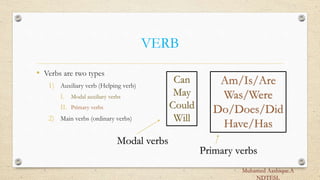
• Verbs are two types
1) Auxiliary verb (Helping verb)
I. Modal auxiliary verbs
II. Primary verbs
2) Main verbs (ordinary verbs)
Can
May
Could
Will
Am/Is/Are
Was/Were
Do/Does/Did
Have/Has
Modal verbs
Primary verbs
Muhamed Aashique.A
NDTESL
MODAL AUXILIARY VERB
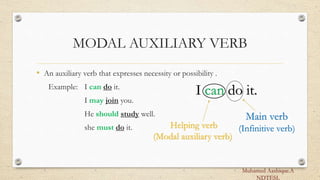
• An auxiliary verb that expresses necessity or possibility .
Example: I can do it.
I may join you.
He should study well.
she must do it.
I can do it.
Main verb
(Infinitive verb)
Helping verb
(Modal auxiliary verb)
Muhamed Aashique.A
NDTESL
PRIMARY VERB
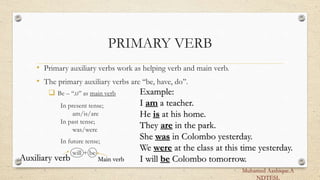
• Primary auxiliary verbs work as helping verb and main verb.
• The primary auxiliary verbs are ‘‘be, have, do’’.
 Be – ‘‘,U’’ as main verb
In present tense;
am/is/are
In past tense;
was/were
In future tense;
will + be
Example:
I am a teacher.
He is at his home.
They are in the park.
She was in Colombo yesterday.
We were at the class at this time yesterday.
I will be Colombo tomorrow.
Auxiliary verb Main verb
Muhamed Aashique.A
NDTESL
PRIMARY VERB
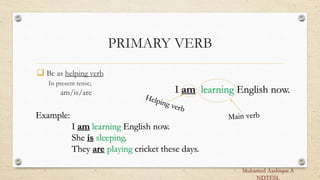
 Be as helping verb
In present tense;
am/is/are
Example:
I am learning English now.
She is sleeping.
They are playing cricket these days.
I am learning English now.
Muhamed Aashique.A
NDTESL
PRIMARY VERB
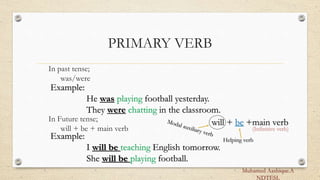
In past tense;
was/were
In Future tense;
will + be + main verb
Example:
He was playing football yesterday.
They were chatting in the classroom.
Example:
I will be teaching English tomorrow.
She will be playing football.
will + be +main verb
Helping verb
(Infinitive verb)
Muhamed Aashique.A
NDTESL
PRIMARY VERB
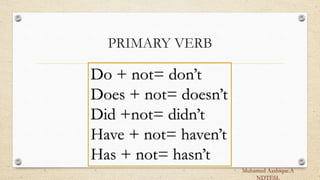
Do + not= don’t
Does + not= doesn’t
Did +not= didn’t
Have + not= haven’t
Has + not= hasn’t
Muhamed Aashique.A
NDTESL
DO/DOES
 As we looked through above, every primary verb work as helping verb/
verbs and a main verb in a sentence.
Do as a main verb
In present tense;
do/does
For singular subject, we use ‘‘does’’.
For plural subject, we use ‘‘do’’.
Example:
I do my works myself.
He goes to school everyday.
She wakes up early morning 5’o clock.
They go to Colombo every weekends.
Muhamed Aashique.A
NDTESL
DO/DOES
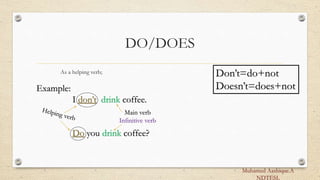
As a helping verb; Don’t=do+not
Doesn’t=does+not
Example:
I don’t drink coffee.
Do you drink coffee?
Main verb
Infinitive verb
Muhamed Aashique.A
NDTESL
DO/DOES
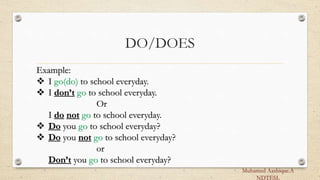
Example:
 I go(do) to school everyday.
 I don’t go to school everyday.
Or
I do not go to school everyday.
 Do you go to school everyday?
 Do you not go to school everyday?
or
Don’t you go to school everyday?
Muhamed Aashique.A
NDTESL
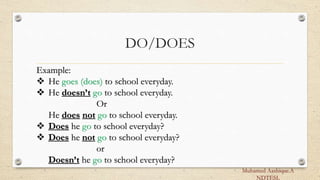
DO/DOES
Example:
 He goes (does) to school everyday.
 He doesn’t go to school everyday.
Or
He does not go to school everyday.
 Does he go to school everyday?
 Does he not go to school everyday?
or
Doesn’t he go to school everyday?
Muhamed Aashique.A
NDTESL
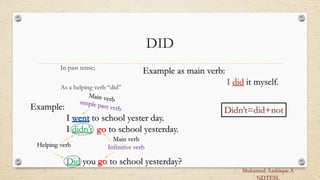
DID
In past tense;
As a helping verb ‘‘did’’
Example as main verb:
I did it myself.
Example:
I went to school yester day.
I didn’t go to school yesterday.
Didn’t=did+not
Helping verb
Main verb
Infinitive verb
Did you go to school yesterday?
went
go
go
Muhamed Aashique.A
NDTESL
DID
Muhamed Aashique.A
NDTESL
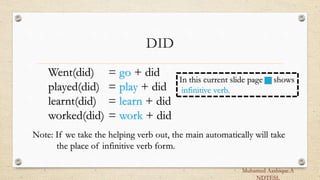
Went(did) = go + did
played(did) = play + did
learnt(did) = learn + did
worked(did) = work + did
Note: If we take the helping verb out, the main automatically will take
the place of infinitive verb form.
In this current slide page shows
infinitive verb.
DID
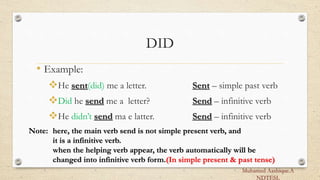
• Example:
He sent(did) me a letter. Sent – simple past verb
Did he send me a letter? Send – infinitive verb
He didn’t send ma e latter. Send – infinitive verb
Note: here, the main verb send is not simple present verb, and
it is a infinitive verb.
when the helping verb appear, the verb automatically will be
changed into infinitive verb form.(In simple present & past tense)
Muhamed Aashique.A
NDTESL
HAVE
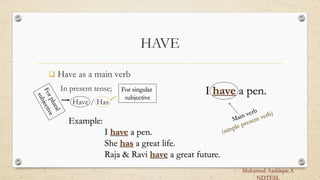
 Have as a main verb
In present tense;
Have / Has
For singular
subjective
Example:
I have a pen.
She has a great life.
Raja & Ravi have a great future.
I have a pen.
Muhamed Aashique.A
NDTESL
HAVE
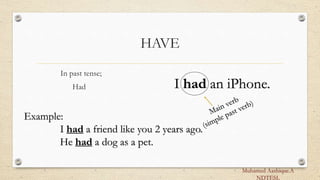
In past tense;
Had I had an iPhone.
Example:
I had a friend like you 2 years ago.
He had a dog as a pet.
Muhamed Aashique.A
NDTESL
HAVE
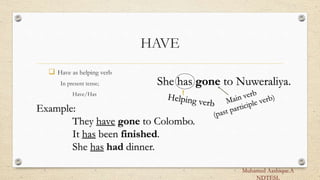
 Have as helping verb
In present tense;
Have/Has
Example:
They have gone to Colombo.
It has been finished.
She has had dinner.
She has gone to Nuweraliya.
Muhamed Aashique.A
NDTESL
HAVE
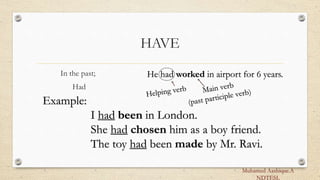
In the past;
Had
Example:
I had been in London.
She had chosen him as a boy friend.
The toy had been made by Mr. Ravi.
He had worked in airport for 6 years.
Muhamed Aashique.A
NDTESL
MAIN VERB
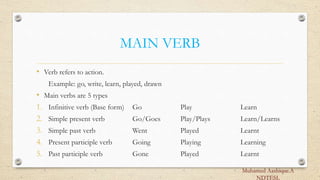
• Verb refers to action.
Example: go, write, learn, played, drawn
• Main verbs are 5 types
1. Infinitive verb (Base form) Go Play Learn
2. Simple present verb Go/Goes Play/Plays Learn/Learns
3. Simple past verb Went Played Learnt
4. Present participle verb Going Playing Learning
5. Past participle verb Gone Played Learnt
Muhamed Aashique.A
NDTESL
MAIN VERB
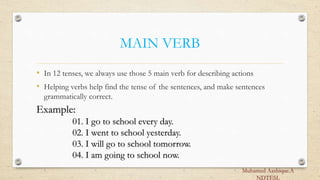
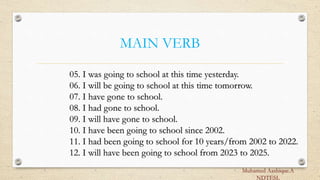
• In 12 tenses, we always use those 5 main verb for describing actions
• Helping verbs help find the tense of the sentences, and make sentences
grammatically correct.
Muhamed Aashique.A
NDTESL
Example:
01. I go to school every day.
02. I went to school yesterday.
03. I will go to school tomorrow.
04. I am going to school now.
MAIN VERB
05. I was going to school at this time yesterday.
06. I will be going to school at this time tomorrow.
07. I have gone to school.
08. I had gone to school.
09. I will have gone to school.
10. I have been going to school since 2002.
11. I had been going to school for 10 years/from 2002 to 2022.
12. I will have been going to school from 2023 to 2025.
Muhamed Aashique.A
NDTESL
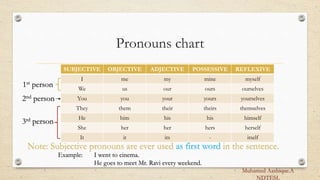
Pronouns chart
SUBJECTIVE OBJECTIVE ADJECTIVE POSSESSIVE REFLEXIVE
I me my mine myself
We us our ours ourselves
You you your yours yourselves
They them their theirs themselves
He him his his himself
She her her hers herself
It it its - itself
1st person
2nd person
3rd person
Note: Subjective pronouns are ever used as first word in the sentence.
Example: I went to cinema.
He goes to meet Mr. Ravi every weekend.
Muhamed Aashique.A
NDTESL
Tenses-Verb.pptx

Tenses-Verb.pptx

  • 1.
    Welcome back tomy Classroom I am Muhamed Aashique Your Lecturer Today, we are going to learn Verbs in tenses
  • 2.
    VERB • Verbs aretwo types 1) Auxiliary verb (Helping verb) I. Modal auxiliary verbs II. Primary verbs 2) Main verbs (ordinary verbs) Can May Could Will Am/Is/Are Was/Were Do/Does/Did Have/Has Modal verbs Primary verbs Muhamed Aashique.A NDTESL
  • 3.
    MODAL AUXILIARY VERB •An auxiliary verb that expresses necessity or possibility . Example: I can do it. I may join you. He should study well. she must do it. I can do it. Main verb (Infinitive verb) Helping verb (Modal auxiliary verb) Muhamed Aashique.A NDTESL
  • 4.
    PRIMARY VERB • Primaryauxiliary verbs work as helping verb and main verb. • The primary auxiliary verbs are ‘‘be, have, do’’.  Be – ‘‘,U’’ as main verb In present tense; am/is/are In past tense; was/were In future tense; will + be Example: I am a teacher. He is at his home. They are in the park. She was in Colombo yesterday. We were at the class at this time yesterday. I will be Colombo tomorrow. Auxiliary verb Main verb Muhamed Aashique.A NDTESL
  • 5.
    PRIMARY VERB  Beas helping verb In present tense; am/is/are Example: I am learning English now. She is sleeping. They are playing cricket these days. I am learning English now. Muhamed Aashique.A NDTESL
  • 6.
    PRIMARY VERB In pasttense; was/were In Future tense; will + be + main verb Example: He was playing football yesterday. They were chatting in the classroom. Example: I will be teaching English tomorrow. She will be playing football. will + be +main verb Helping verb (Infinitive verb) Muhamed Aashique.A NDTESL
  • 7.
    PRIMARY VERB Do +not= don’t Does + not= doesn’t Did +not= didn’t Have + not= haven’t Has + not= hasn’t Muhamed Aashique.A NDTESL
  • 8.
    DO/DOES  As welooked through above, every primary verb work as helping verb/ verbs and a main verb in a sentence. Do as a main verb In present tense; do/does For singular subject, we use ‘‘does’’. For plural subject, we use ‘‘do’’. Example: I do my works myself. He goes to school everyday. She wakes up early morning 5’o clock. They go to Colombo every weekends. Muhamed Aashique.A NDTESL
  • 9.
    DO/DOES As a helpingverb; Don’t=do+not Doesn’t=does+not Example: I don’t drink coffee. Do you drink coffee? Main verb Infinitive verb Muhamed Aashique.A NDTESL
  • 10.
    DO/DOES Example:  I go(do)to school everyday.  I don’t go to school everyday. Or I do not go to school everyday.  Do you go to school everyday?  Do you not go to school everyday? or Don’t you go to school everyday? Muhamed Aashique.A NDTESL
  • 11.
    DO/DOES Example:  He goes(does) to school everyday.  He doesn’t go to school everyday. Or He does not go to school everyday.  Does he go to school everyday?  Does he not go to school everyday? or Doesn’t he go to school everyday? Muhamed Aashique.A NDTESL
  • 12.
    DID In past tense; Asa helping verb ‘‘did’’ Example as main verb: I did it myself. Example: I went to school yester day. I didn’t go to school yesterday. Didn’t=did+not Helping verb Main verb Infinitive verb Did you go to school yesterday? went go go Muhamed Aashique.A NDTESL
  • 13.
    DID Muhamed Aashique.A NDTESL Went(did) =go + did played(did) = play + did learnt(did) = learn + did worked(did) = work + did Note: If we take the helping verb out, the main automatically will take the place of infinitive verb form. In this current slide page shows infinitive verb.
  • 14.
    DID • Example: He sent(did)me a letter. Sent – simple past verb Did he send me a letter? Send – infinitive verb He didn’t send ma e latter. Send – infinitive verb Note: here, the main verb send is not simple present verb, and it is a infinitive verb. when the helping verb appear, the verb automatically will be changed into infinitive verb form.(In simple present & past tense) Muhamed Aashique.A NDTESL
  • 15.
    HAVE  Have asa main verb In present tense; Have / Has For singular subjective Example: I have a pen. She has a great life. Raja & Ravi have a great future. I have a pen. Muhamed Aashique.A NDTESL
  • 16.
    HAVE In past tense; HadI had an iPhone. Example: I had a friend like you 2 years ago. He had a dog as a pet. Muhamed Aashique.A NDTESL
  • 17.
    HAVE  Have ashelping verb In present tense; Have/Has Example: They have gone to Colombo. It has been finished. She has had dinner. She has gone to Nuweraliya. Muhamed Aashique.A NDTESL
  • 18.
    HAVE In the past; Had Example: Ihad been in London. She had chosen him as a boy friend. The toy had been made by Mr. Ravi. He had worked in airport for 6 years. Muhamed Aashique.A NDTESL
  • 19.
    MAIN VERB • Verbrefers to action. Example: go, write, learn, played, drawn • Main verbs are 5 types 1. Infinitive verb (Base form) Go Play Learn 2. Simple present verb Go/Goes Play/Plays Learn/Learns 3. Simple past verb Went Played Learnt 4. Present participle verb Going Playing Learning 5. Past participle verb Gone Played Learnt Muhamed Aashique.A NDTESL
  • 20.
    MAIN VERB • In12 tenses, we always use those 5 main verb for describing actions • Helping verbs help find the tense of the sentences, and make sentences grammatically correct. Muhamed Aashique.A NDTESL Example: 01. I go to school every day. 02. I went to school yesterday. 03. I will go to school tomorrow. 04. I am going to school now.
  • 21.
    MAIN VERB 05. Iwas going to school at this time yesterday. 06. I will be going to school at this time tomorrow. 07. I have gone to school. 08. I had gone to school. 09. I will have gone to school. 10. I have been going to school since 2002. 11. I had been going to school for 10 years/from 2002 to 2022. 12. I will have been going to school from 2023 to 2025. Muhamed Aashique.A NDTESL
  • 22.
    Pronouns chart SUBJECTIVE OBJECTIVEADJECTIVE POSSESSIVE REFLEXIVE I me my mine myself We us our ours ourselves You you your yours yourselves They them their theirs themselves He him his his himself She her her hers herself It it its - itself 1st person 2nd person 3rd person Note: Subjective pronouns are ever used as first word in the sentence. Example: I went to cinema. He goes to meet Mr. Ravi every weekend. Muhamed Aashique.A NDTESL