Tennis
Tennis Terminologies
• ACE – A ball that is served so well the opponent
cannot touch it with their racquet.
• AD/ Advantage. It is the point scored after
Deuce. If the serving side scores, it is Ad-in. If
the receiving side scores, it is Ad-out.
• ALL – An even score. 30-30 is, for
example, 30-all. 3-3 would be 3-all.
Tennis Terminologies
• ALLEY – The area between the singles and
doubles sideline on each side of the court. (The
singles court is made wider for doubles play by
the addition of the alley.)
• APPROACH – The shot hit by a player just
before coming to the net.
• BACKCOURT – The area around the
baseline.
Tennis Terminologies
• BACKHAND – The stroke used to return balls
hit to the left side of a right-handed player (or to
the right side of a left-handed player).
Backhands are hit either one handed or two-
handed.
• BASELINE – The court’s back line that runs
parallel to the net and perpendicular to the
sidelines.
• DEUCE – A score of 40-all, or 40-40. (This
means the score is tied and each side
has won at least three points.)
Tennis Terminologies
• DEUCE COURT – The right side of the court, so
called because on a deuce score, the ball is
served there.
• DOUBLE FAULT – The failure of both service
attempts. On a double fault, the server loses the
point.
• DOUBLES – A match with four players,
two on each team.
Tennis Terminologies
• DROP SHOT – A softly hit ball with lots of
backspin that lands near the net after crossing it.
• FAULT – A served ball that does not land in the
proper service box..
• FOOT FAULT – A fault called against the server
for stepping on or over the baseline with
either foot during delivery of the serve.
Tennis Terminologies
• FOREHAND – The stroke used to return balls hit to the
right side of a right-handed player (or to the left side of a
left-handed player). Forehands are commonly hit one-
handed.
• GAME – The part of a set that is completed when one
player or side either wins four points and is at least two
points ahead of his or her opponent, or who wins
two points in a row after deuce.
• GROUND STROKE – A stroke made after the ball
has bounced; either a forehand or backhand.
Tennis Terminologies
• HALF-VOLLEY – The stroke made by hitting a
ball immediately after is has touched the ground,
usually implies hitting the ball low on the short
hop.
• LET – A point played over because of
interference. Also, a serve that hits the top
of the net but is otherwise good, in which
case the serve is taken again.
Tennis Terminologies
• LOB – A stroke that lifts the ball high in the air,
usually over the head of the opponent at the net.
• MATCH – The overall contest, usually decided
by the best two-out-of-three sets.
• NO-ADVANATAGE – A system of scoring a
game in which the first player to win four
points wins the game. If the score reaches
3-all, the next point decides the game.
Tennis Terminologies
• SERVER – The player who serves.
• SERVICE BREAK – A game won by the
player/team receiving serve.
• SET – A scoring unit awarded to a player who or
team that has won: (a) 6 or more games and has
a two- game lead; or (b) 6 games and the
tiebreak game when played at 6-all.
Tennis Terminologies
• SLICE – A shot that imparts backspin on the ball
by hitting the ball with a high-to-low motion.
• SMASH – A hard overhead shot.
• SPIN – The rotation of the ball. (i.e., “topsin” or
“backspin”)
• STROKE – The act of striking the ball
with the racquet.
Tennis Terminologies
• TIEBREAK – A system in traditional tennis used
to decide a set when the score is tied, 6-all.
• TOPSPIN – Forward rotation of the ball caused
by hitting from low to high.
• VOLLEY – During play, a stroke made by hitting
the ball before it has touched the ground.
Tennis
• A game played on a rectangular court by
two players or two pairs of players
equipped with rackets, in which a ball is
driven back and forth over a low net that
divides the court in half.
The Court
The Court
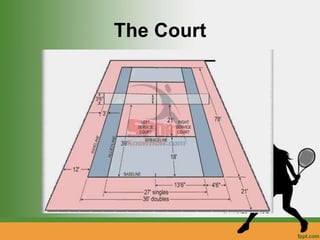
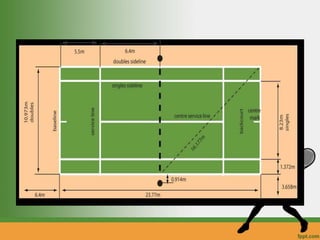
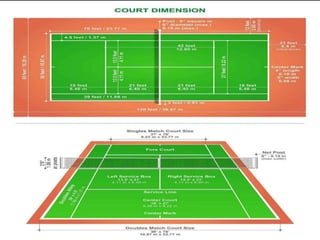
• The court shall be a rectangle, 78 feet
(23.77 m) long
• for singles matches, 27 feet (8.23 m) wide.
• For doubles matches, the court shall be 36
feet (10.97 m) wide.
The Court
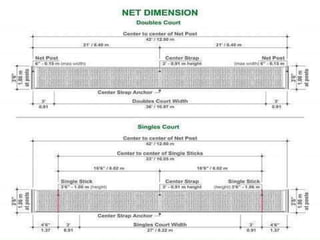
• The court shall be divided across the middle by
a net suspended by a cord or metal cable
• which shall pass over or be attached to two net
posts at a height of 3 ½ feet (1.07 m).
• The net shall be fully extended so that it
completely fills the space between the two
net posts
• must be of sufficiently small mesh to
ensure that a ball cannot pass through it.
The Court
• The height of the net shall be 3 feet (0.914 m) at
the centre, where it shall be held down tightly by
a strap.
• A band shall cover the cord or metal cable and
the top of the net.
• The strap and band shall be completely
white.
• The maximum diameter of the cord or
metal cable shall be 1/3 inch (0.8 cm).
The Court
• The maximum width of the strap shall be 2
inches (5 cm).
• The band shall be between 2 inches (5 cm) and
2½ inches (6.35 cm) deep on each side.
• For doubles matches, the centres of the net
posts shall be 3 feet (0.914 m) outside the
doubles court on each side.
• For singles matches, if a singles net is
used, the centres of the net posts shall
be 3 feet (0.914 m) outside the singles
court on each side.
The Court
• If a doubles net is used, then the net shall be
supported, at a height of 3½ feet (1.07 m), by
two singles sticks, the centres of which shall be
3 feet (0.914 m) outside the singles court on
each side.
• The net posts shall not be more than 6 inches
(15 cm) square or 6 inches (15 cm) in
diameter.
• The singles sticks shall not be more than 3
inches (7.5 cm) square or 3 inches
(7.5cm) in diameter.
The Court
• The net posts and singles sticks shall not be
more than 1 inch (2.5 cm) above the top of the
net cord.
• The lines at the ends of the court are called
baselines.
• The lines at the sides of the court are called
sidelines.
• Two lines shall be drawn between the singles
sidelines, 21 feet (6.40 m) from each side
of the net, parallel with the net.
The Court
• These lines are called the service lines.
• On each side of the net,
• the area between the service line and the net
shall be divided into two equal parts, the service
courts, by the centre service line.
• The centre service line shall be drawn
parallel with the singles sidelines and
half-way between them.
The Court
• Each baseline shall be divided in half by a centre mark, 4
inches (10 cm) in length, which shall be drawn inside the
court and parallel with the singles sidelines.
• The centre serviceline and centre mark shall be 2 inches
(5 cm) wide.
• The other lines of the court shall be between 1 inch (2.5
cm) and 2 inches (5 cm) wide, except that the baselines
may be up to 4 inches (10 cm) wide.
• All court measurements shall be made to the
outside of the lines and all lines of the court shall
be of the same colour clearly contrasting with
the colour of the surface.
PERMANENT FIXTURES
• The permanent fixtures of the court include:
• The backstops and
• The sidestops,
• The spectators, the stands and seats for spectators, all
other fixtures around and above the court, the chair
umpire, line umpires, net umpire and ball persons when
in their recognised positions.
• In a singles match played with a doubles net and
singles sticks, the net posts and the part of the net
outside the singles sticks are permanent fixtures
and are not considered as net posts or part of the net.
The Ball
• The ball shall have a uniform outer surface
consisting of a fabric cover except for the stage
3 (Red) foam ball. if there are any seams they
shall be stitchless.
• The event organisers must announce in
advance of the event:
• The number of balls for play (2, 3, 4 or 6).
• The ball change policy, if any.
The Ball
• Ball changes
• After an agreed odd number of games
• first ball change in the match shall take place
two games earlier than for the rest of the match,
to make 4 allowance for the warm-up.
• A tie-break game counts as one game for the
ball change.
The Ball
• Ball changes
• A ball change shall not take place at the
beginning of a tie-break game. In this
case, the ball change shall be delayed
until the beginning of the second game of
the next set;
• At the beginning of a set
• If a ball gets broken during play, the
point shall be replayed.
SCORE IN A GAME
• A standard game is scored as follows with the server’s
score being called first:
• No point - “Love”
• First point - “15”
• Second point - “30”
• Third point - “40”
• Fourth point - “Game”
• except that if each player/team has won three
points, the score is “Deuce”.
• After “Deuce”, the score is “Advantage” for the
player/team who wins the next point.
• A player/team needs to win two consecutive points
immediately after “Deuce” to win the “Game”.
SCORE IN A GAME
• Tie-break game
• During a tie-break game, points are scored
“Zero”, “1”, “2”, “3”, etc.
• The first player/team to win seven points wins
the “Game” and “Set”, provided there is a margin
of two points over the opponent(s).
• If necessary, the tie-break game shall
continue until this margin is achieved.
SCORE IN A GAME
• Tie-break game
• The player whose turn it is to serve shall serve
the first point of the tie-break game.
• The following two points shall be served by the
opponent(s).
• After this, each player/team shall serve
alternately for two consecutive points until
the end of the tie-break game.
SCORE IN A SET
• The two main methods are:
• The “Advantage Set”
• The “Tie-break Set”
• Either method may be used provided that the
one to be used is announced in advance of the
event.
• If the “Tie-break Set” 6 method is to be
used, it must also be announced whether
the final set will be played as a “Tie-break
Set” or an “Advantage Set”.
SCORE IN A SET
• “Advantage Set”
• The first player/team to win six games wins that
“Set”, provided there is a margin of two games
over the opponent(s). If necessary, the set shall
continue until this margin is achieved.
• “Tie-break Set”
• The first player/team to win six games wins
that “Set”, provided there is a margin of two
games over the opponent(s).
• If the score reaches six games all, a tie-break
game shall be played.
SCORE IN A MATCH
• A match can be played to the best of 3
sets (a player/team needs to win 2 sets to
win the match)
• Or a match can be the best of 5 sets (a
player/team needs to win 3 sets to win the
match).
SERVER AND RECEIVER
• The players/teams shall stand on opposite
sides of the net.
• The server is the player who puts the ball
into play for the first point.
• The receiver is the player who is ready to
return the ball served by the server.
CHOICE OF ENDS AND
SERVICE
• The choice of ends and the choice to be server or
receiver in the first game shall be decided by toss before
the warm-up starts.
• The player/team who wins the toss may choose:
• To be server or receiver in the first game of the match, in
which case the opponent(s) shall choose the end of the
court for the first game of the match; or
• The end of the court for the first game of the
match, in which case the opponent(s) shall choose
to be server or receiver for the first game of the
match; or
• To require the opponent(s) to make one of the above
choices.
CHANGE OF ENDS
• The players shall change ends at the end of the
first, third and every subsequent odd game of
each set.
• The players shall also change ends at the end of
each set unless the total number of games in
that set is even, in which case the players
change ends at the end of the first game
of the next set.
• During a tie-break game, players shall
change ends after every six points.
Playing Rules
• BALL IN PLAY
• Unless a fault or a let is called, the ball is in play
from the moment the server hits the ball, and
remains in play until the point is decided.
• BALL TOUCHES A LINE
• If a ball touches a line, it is regarded as
Touching the court bounded by that line.
Playing Rules
• BALL TOUCHES A PERMANENT FIXTURE
• If the ball in play touches a permanent fixture
after it has hit the correct court, the player who
hit the ball wins the point.
• If the ball in play touches a permanent fixture
before it hits the ground, the player who
hit the ball loses the point.
Playing Rules
• ORDER OF SERVICE
• At the end of each standard game, the receiver shall become the
server and the server shall become the receiver for the next game.
• In doubles, the team due to serve in the first game of each set shall
decide which player shall serve for that game.
• Similarly, before the second game starts, their opponents shall
decide which player shall serve for that game.
• The partner of the player who served in the first game shall
serve in the third game
• The partner of the player who served in the second game
shall serve in the fourth game.
• This rotation shall continue until the end of the set.
Playing Rules
• THE SERVICE
• Immediately before starting the service motion, the
server shall stand at rest with both feet behind the
baseline and within the imaginary extensions of the
centre mark and the sideline.
• The server shall then release the ball by hand in any
direction and hit the ball with the racket before the
ball hits the ground.
• The service motion is completed at the moment
that the player’s racket hits or misses the ball.
• A player who is able to use only one arm may
use the racket for the release of the ball.
Playing Rules
• SERVING
• When serving in a standard game, the server shall stand
behind alternate halves of the court, starting from the
right half of the court in every game.
• In a tie-break game, the service shall be served from
behind alternate halves of the court, with the first served
from the right half of the court.
• The service shall pass over the net and hit the
service court diagonally opposite, before the
receiver returns it.
Playing Rules
• FOOT FAULT
• During the service motion, the server shall not:
• Change position by walking or running, although slight
movements of the feet are permitted; or
• Touch the baseline or the court with either foot; or
• Touch the area outside the imaginary extension of the
sideline with either foot; or
• Touch the imaginary extension of the centre mark
with either foot.
Playing Rules
• SERVICE FAULT
• The service is a fault if:
• The server breaks Rules the service, serving or foot fault
• The server misses the ball when trying to hit it; or
• The ball served touches a permanent fixture, singles
stick or net post before it hits the ground; or
• The ball served touches the server or server’s
partner, or anything the server or server’s partner
is wearing or carrying.
Playing Rules
• SECOND SERVICE
• If the first service is a fault, the server shall serve
again without delay from behind the same half of
the court from which that fault was served,
unless the service was from the wrong half.
Playing Rules
• WHEN TO SERVE AND RECEIVE
• The server shall not serve until the receiver is ready.
• However, the receiver shall play to the reasonable pace
of the server and shall be ready to receive within a
reasonable time of the server being ready.
• A receiver who attempts to return the service shall be
considered as being ready.
• If it is demonstrated that the receiver is not ready,
the service cannot be called a fault.
Playing Rules
• THE LET DURING A SERVICE
• The ball served touches the net, strap or band,
and is otherwise good; or, after touching the net,
strap or band, touches the receiver or the
receiver’s partner or anything they wear or carry
before hitting the ground; or
• The ball is served when the receiver is not
ready.
Playing Rules
• THE LET
• In all cases when a let is called, except when a
service let is called on a second service, the
whole point shall be replayed.
Playing Rules
• PLAYER LOSES POINT
• The player serves two consecutive faults; or
• The player does not return the ball in play before it
bounces twice consecutively; or
• or c. The player returns the ball in play so that it hits the
ground, or before it bounces, an object, outside the
correct court; or
• The player returns the ball in play so that, before
it bounces, it hits a permanent fixture; or
• The receiver returns the service before it bounces;
or
Playing Rules
• PLAYER LOSES POINT
• The player deliberately carries or catches the ball in play
on the racket or deliberately touches it with the racket
more than once; or
• The player or the racket, whether in the player’s hand or
not, or anything which the player is wearing or carrying
touches the net, net posts/singles sticks, cord or
metal cable, strap or band, or the opponent’s
court at any time while the ball is in play; or
• The player hits the ball before it has passed the
net; or
Playing Rules
• PLAYER LOSES POINT
• The ball in play touches the player or anything that the
player is wearing or carrying, except the racket; or
• The ball in play touches the racket when the player is not
holding it; or
• The player deliberately and materially changes the
shape of the racket when the ball is in play; or
• In doubles, both players touch the ball when
returning it.
Playing Rules
• A GOOD RETURN
• The ball touches the net, net posts/singles sticks, cord or
metal cable, strap or band, provided that it passes over
any of them and hits the ground within the correct court;
except as provided in Rule ‘permanent fixture’ and
‘player losses point’.
• After the ball in play has hit the ground within the
correct court and has spun or been blown back
over the net, the player reaches over the net and
plays the ball into the correct court, provided that
the player does not break Rule “player losses point”
Playing Rules
• A GOOD RETURN
• The ball is returned outside the net posts, either above
or below the level of the top of the net, even though it
touches the net posts, provided that it hits the ground in
the correct court; except as provided in Rules 2 and 24
(d)
• The ball passes under the net cord between the
singles stick and the adjacent net post without
touching either net, net cord or net post and hits
the ground in the correct court, or
Playing Rules
• A GOOD RETURN
• The player’s racket passes over the net after
hitting the ball on the player’s own side of the
net and the ball hits the ground in the correct
court; or
• The player hits the ball in play, which hits
another ball lying in the correct court.
Playing Rules
• HINDRANCE
• If a player is hindered in playing the point by a deliberate
act of the opponent(s), the player shall win the point.
• However, the point shall be replayed if a player is
hindered in playing the point by either an unintentional
act of the opponent(s), or something outside the player’s
own control (not including a permanent fixture).
Playing Rules
• CORRECTING ERRORS
• During a standard game or a tie-break game, if a
player serves from the wrong half of the court,
this should be corrected as soon as the error is
discovered and the server shall serve from the
correct half of the court according to the score. A
fault that was served before the error was
discovered shall stand.
Playing Rules
• CORRECTING ERRORS
• During a standard game or a tie-break game, if
the players are at the wrong ends of the court,
the error should be corrected as soon as it is
discovered and the server shall serve from the
correct end of the court according to the score.
Playing Rules
• CORRECTING ERRORS
• If a player serves out of turn during a standard
game, the player who was originally due to
serve shall serve as soon as the error is
discovered.
• However, if a game is completed before
the error is discovered the order of service
shall remain as altered.
Playing Rules
• CORRECTING ERRORS
• In this case, any ball change to be made after an
agreed number of games should be made one
game later than originally scheduled.
• A fault that was served by the opponents(s)
before the error was discovered shall not stand.
• In doubles, if the partners of one team
serve out of turn, a fault that was served
before the error was discovered shall stand.
Playing Rules
• CORRECTING ERRORS
• If a player serves out of turn during a tie-break game and
the error is discovered after an even number of points
have been played, the error is corrected immediately.
• If the error is discovered after an odd number of points
have been played, the order of service shall remain as
altered.
• A fault that was served by the opponent(s) before the
error was discovered shall not stand.
• In doubles, if the partners of one team serve out of turn,
a fault that was served before the error was
discovered shall stand.
Playing Rules
• CORRECTING ERRORS
• During a standard game or a tie-break game in doubles,
if there is an error in the order of receiving, this shall
remain as altered until the end of the game in which the
error is discovered. For the next game in which they are
the receivers in that set, the partners shall then resume
the original order of receiving.
• If in error a tie-break game is started at 6 games
all, when it was previously agreed that the set
would be an “Advantage set”.
Playing Rules
• CORRECTING ERRORS
• If in error a tie-break game is started at 6 games all,
when it was previously agreed that the set would be an
“Advantage set”, the error shall be corrected immediately
if only one point has been played.
• If the error is discovered after the second point is in play,
the set will continue as a “Tie-break set”.
Playing Rules
• CORRECTING ERRORS
• If in error a standard game is started at 6 games all,
when it was previously agreed that the set would be a
“Tie-break set”, the error shall be corrected immediately
if only one point has been played.
• If the error is discovered after the second point is in play,
the set will continue as an “Advantage set” until
the score reaches 8 games all (or a higher even
number), when a tie-break game shall be played.
Playing Rules
• CORRECTING ERRORS
• If in error an “Advantage set” or “Tie-break set” is started,
when it was previously agreed that the final set would be
a match tie-break, the error shall be corrected
immediately if only one point has been played.
• If the error is discovered after the second point is in play,
the set will continue either until a player or team
wins three games (and therefore the set) or until
the score reaches 2 games all, when a match
tie-break shall be played.
• However, if the error is discovered after the
second point of the fifth game has started, the set will
continue as a “Tie-break set”.
Playing Rules
• CONTINUOUS PLAY
• Between points, a maximum of twenty-five (25) seconds
is allowed.
• When the players change ends at the end of a game, a
maximum of ninety (90) seconds are allowed.
• However, after the first game of each set and during a
tie-break game, play shall be continuous and the
players shall change ends without a rest.
Playing Rules
• CONTINUOUS PLAY
• At the end of each set there shall be a set break of a
maximum of one hundred and twenty (120) seconds.
• If, for reasons outside the player’s control, clothing,
footwear or necessary equipment (excluding the racket)
is broken or needs to be replaced, the player may be
allowed reasonable extra time to rectify the
problem.
Playing Rules
• CONTINUOUS PLAY
• No extra time shall be given to allow a player to recover
condition. However, a player suffering from a treatable
medical condition may be allowed one medical time-out
of three minutes for the treatment of that medical
condition.
• A limited number of toilet/change of attire breaks
may also be allowed, if this is announced in
advance of the event.
• Event organisers may allow a rest period of a
maximum of ten (10) minutes if this is announced in
advance of the event.
Playing Rules
• CONTINUOUS PLAY
• This rest period can be taken after the 3rd set in a best
of 5 sets match, or after the 2nd set in a best of 3 sets
match.
• The warm-up time shall be a maximum of five (5)
minutes, unless otherwise decided by the event
organisers.
ROLE OF COURT OFFICIALS
• The referee is the final authority on all questions
of tennis law and the referee’s decision is final.
• In matches where a chair umpire is assigned,
the chair umpire is the final authority on all
questions of fact during the match.
ROLE OF COURT OFFICIALS
• The players have the right to call the referee to
court if they disagree with a chair umpire’s
interpretation of tennis law.
• In matches where line umpires and net umpires
are assigned, they make all calls (including foot-
fault calls) relating to that line or net.
ROLE OF COURT OFFICIALS
• The chair umpire has the right to overrule a line
umpire or a net umpire if the chair umpire is sure
that a clear mistake has been made.
• The chair umpire is responsible for calling any
line (including foot-faults) or net where no line
umpire or net umpire is assigned.
ROLE OF COURT OFFICIALS
• A line umpire who cannot make a call shall
signal this immediately to the chair umpire who
shall make a decision.
• If the line umpire can not make a call, or if there
is no line umpire, and the chair umpire can not
make a decision on a question of fact, the point
shall be replayed.
ROLE OF COURT OFFICIALS
• In team events where the referee is sitting
on-court, the referee is also the final
authority on questions of fact.
• Play may be stopped or suspended at any
time the chair umpire decides it is
necessary or appropriate.
ROLE OF COURT OFFICIALS
• The referee may also stop or suspend play in
the case of darkness, weather or adverse court
conditions.
• When play is suspended for darkness, this
should be done at the end of a set, or after an
even number of games have been played in the
set in progress.
• After a suspension in play, the score and
position of players on-court in the match
shall stand when the match resumes.
ROLE OF COURT OFFICIALS
• The chair umpire or referee shall make
decisions regarding continuous play and
coaching in respect of any Code of Conduct that
is approved and in operation.
Types of Service In Tennis
• Flat Serve
• Slice Serve
• Kick Serve
• Underhand Serve
Types of Service In Tennis
• Flat Serve
• The flat serve is a powerful serve with no spin. To
complete it, swing your racket directly through the ball,
with your shoulder angled in the direction you want the
ball to go. This is often used for a first serve.,
• Slice Serve
• This technique gives the ball a sideways spin by
brushing the racket across the right side of the
ball (or the left, for left-handed players). This will
cause the ball to curve and dip as it flies, then
bounce sideways out of the court. Even if your
opponent hits it, they will have to run out of position to do
so.
Types of Service In Tennis
• Kick Serve
• A good kick serve requires you to toss the ball
high and generate some topspin when you hit it.
This will make it bounce up hard when it hits the
court, potentially into the body of the receiving
player. The traditional kick serve has been
around for over 100years, while a variation
called the American Twist which adds extra
sidespin is more recent.
Types of Service In Tennis
• Underhand Serve
• Unlike other serves which involve swinging your
racket down from above, the underhand serve
requires that you drop the ball and swing up at it
from below. It’s uncommon, but perfectly legal,
and may be a good way to surprise your
opponent. However, you don't want to use
it every time-the motion of the ball IS easy
and predictable it you re expecting it.

Tennis rules and techniques with information

  • 1.
  • 2.
    Tennis Terminologies • ACE– A ball that is served so well the opponent cannot touch it with their racquet. • AD/ Advantage. It is the point scored after Deuce. If the serving side scores, it is Ad-in. If the receiving side scores, it is Ad-out. • ALL – An even score. 30-30 is, for example, 30-all. 3-3 would be 3-all.
  • 3.
    Tennis Terminologies • ALLEY– The area between the singles and doubles sideline on each side of the court. (The singles court is made wider for doubles play by the addition of the alley.) • APPROACH – The shot hit by a player just before coming to the net. • BACKCOURT – The area around the baseline.
  • 4.
    Tennis Terminologies • BACKHAND– The stroke used to return balls hit to the left side of a right-handed player (or to the right side of a left-handed player). Backhands are hit either one handed or two- handed. • BASELINE – The court’s back line that runs parallel to the net and perpendicular to the sidelines. • DEUCE – A score of 40-all, or 40-40. (This means the score is tied and each side has won at least three points.)
  • 5.
    Tennis Terminologies • DEUCECOURT – The right side of the court, so called because on a deuce score, the ball is served there. • DOUBLE FAULT – The failure of both service attempts. On a double fault, the server loses the point. • DOUBLES – A match with four players, two on each team.
  • 6.
    Tennis Terminologies • DROPSHOT – A softly hit ball with lots of backspin that lands near the net after crossing it. • FAULT – A served ball that does not land in the proper service box.. • FOOT FAULT – A fault called against the server for stepping on or over the baseline with either foot during delivery of the serve.
  • 7.
    Tennis Terminologies • FOREHAND– The stroke used to return balls hit to the right side of a right-handed player (or to the left side of a left-handed player). Forehands are commonly hit one- handed. • GAME – The part of a set that is completed when one player or side either wins four points and is at least two points ahead of his or her opponent, or who wins two points in a row after deuce. • GROUND STROKE – A stroke made after the ball has bounced; either a forehand or backhand.
  • 8.
    Tennis Terminologies • HALF-VOLLEY– The stroke made by hitting a ball immediately after is has touched the ground, usually implies hitting the ball low on the short hop. • LET – A point played over because of interference. Also, a serve that hits the top of the net but is otherwise good, in which case the serve is taken again.
  • 9.
    Tennis Terminologies • LOB– A stroke that lifts the ball high in the air, usually over the head of the opponent at the net. • MATCH – The overall contest, usually decided by the best two-out-of-three sets. • NO-ADVANATAGE – A system of scoring a game in which the first player to win four points wins the game. If the score reaches 3-all, the next point decides the game.
  • 10.
    Tennis Terminologies • SERVER– The player who serves. • SERVICE BREAK – A game won by the player/team receiving serve. • SET – A scoring unit awarded to a player who or team that has won: (a) 6 or more games and has a two- game lead; or (b) 6 games and the tiebreak game when played at 6-all.
  • 11.
    Tennis Terminologies • SLICE– A shot that imparts backspin on the ball by hitting the ball with a high-to-low motion. • SMASH – A hard overhead shot. • SPIN – The rotation of the ball. (i.e., “topsin” or “backspin”) • STROKE – The act of striking the ball with the racquet.
  • 12.
    Tennis Terminologies • TIEBREAK– A system in traditional tennis used to decide a set when the score is tied, 6-all. • TOPSPIN – Forward rotation of the ball caused by hitting from low to high. • VOLLEY – During play, a stroke made by hitting the ball before it has touched the ground.
  • 13.
    Tennis • A gameplayed on a rectangular court by two players or two pairs of players equipped with rackets, in which a ball is driven back and forth over a low net that divides the court in half.
  • 14.
  • 15.
    The Court • Thecourt shall be a rectangle, 78 feet (23.77 m) long • for singles matches, 27 feet (8.23 m) wide. • For doubles matches, the court shall be 36 feet (10.97 m) wide.
  • 17.
    The Court • Thecourt shall be divided across the middle by a net suspended by a cord or metal cable • which shall pass over or be attached to two net posts at a height of 3 ½ feet (1.07 m). • The net shall be fully extended so that it completely fills the space between the two net posts • must be of sufficiently small mesh to ensure that a ball cannot pass through it.
  • 19.
    The Court • Theheight of the net shall be 3 feet (0.914 m) at the centre, where it shall be held down tightly by a strap. • A band shall cover the cord or metal cable and the top of the net. • The strap and band shall be completely white. • The maximum diameter of the cord or metal cable shall be 1/3 inch (0.8 cm).
  • 20.
    The Court • Themaximum width of the strap shall be 2 inches (5 cm). • The band shall be between 2 inches (5 cm) and 2½ inches (6.35 cm) deep on each side. • For doubles matches, the centres of the net posts shall be 3 feet (0.914 m) outside the doubles court on each side. • For singles matches, if a singles net is used, the centres of the net posts shall be 3 feet (0.914 m) outside the singles court on each side.
  • 21.
    The Court • Ifa doubles net is used, then the net shall be supported, at a height of 3½ feet (1.07 m), by two singles sticks, the centres of which shall be 3 feet (0.914 m) outside the singles court on each side. • The net posts shall not be more than 6 inches (15 cm) square or 6 inches (15 cm) in diameter. • The singles sticks shall not be more than 3 inches (7.5 cm) square or 3 inches (7.5cm) in diameter.
  • 22.
    The Court • Thenet posts and singles sticks shall not be more than 1 inch (2.5 cm) above the top of the net cord. • The lines at the ends of the court are called baselines. • The lines at the sides of the court are called sidelines. • Two lines shall be drawn between the singles sidelines, 21 feet (6.40 m) from each side of the net, parallel with the net.
  • 23.
    The Court • Theselines are called the service lines. • On each side of the net, • the area between the service line and the net shall be divided into two equal parts, the service courts, by the centre service line. • The centre service line shall be drawn parallel with the singles sidelines and half-way between them.
  • 24.
    The Court • Eachbaseline shall be divided in half by a centre mark, 4 inches (10 cm) in length, which shall be drawn inside the court and parallel with the singles sidelines. • The centre serviceline and centre mark shall be 2 inches (5 cm) wide. • The other lines of the court shall be between 1 inch (2.5 cm) and 2 inches (5 cm) wide, except that the baselines may be up to 4 inches (10 cm) wide. • All court measurements shall be made to the outside of the lines and all lines of the court shall be of the same colour clearly contrasting with the colour of the surface.
  • 26.
    PERMANENT FIXTURES • Thepermanent fixtures of the court include: • The backstops and • The sidestops, • The spectators, the stands and seats for spectators, all other fixtures around and above the court, the chair umpire, line umpires, net umpire and ball persons when in their recognised positions. • In a singles match played with a doubles net and singles sticks, the net posts and the part of the net outside the singles sticks are permanent fixtures and are not considered as net posts or part of the net.
  • 27.
    The Ball • Theball shall have a uniform outer surface consisting of a fabric cover except for the stage 3 (Red) foam ball. if there are any seams they shall be stitchless. • The event organisers must announce in advance of the event: • The number of balls for play (2, 3, 4 or 6). • The ball change policy, if any.
  • 28.
    The Ball • Ballchanges • After an agreed odd number of games • first ball change in the match shall take place two games earlier than for the rest of the match, to make 4 allowance for the warm-up. • A tie-break game counts as one game for the ball change.
  • 29.
    The Ball • Ballchanges • A ball change shall not take place at the beginning of a tie-break game. In this case, the ball change shall be delayed until the beginning of the second game of the next set; • At the beginning of a set • If a ball gets broken during play, the point shall be replayed.
  • 30.
    SCORE IN AGAME • A standard game is scored as follows with the server’s score being called first: • No point - “Love” • First point - “15” • Second point - “30” • Third point - “40” • Fourth point - “Game” • except that if each player/team has won three points, the score is “Deuce”. • After “Deuce”, the score is “Advantage” for the player/team who wins the next point. • A player/team needs to win two consecutive points immediately after “Deuce” to win the “Game”.
  • 31.
    SCORE IN AGAME • Tie-break game • During a tie-break game, points are scored “Zero”, “1”, “2”, “3”, etc. • The first player/team to win seven points wins the “Game” and “Set”, provided there is a margin of two points over the opponent(s). • If necessary, the tie-break game shall continue until this margin is achieved.
  • 32.
    SCORE IN AGAME • Tie-break game • The player whose turn it is to serve shall serve the first point of the tie-break game. • The following two points shall be served by the opponent(s). • After this, each player/team shall serve alternately for two consecutive points until the end of the tie-break game.
  • 33.
    SCORE IN ASET • The two main methods are: • The “Advantage Set” • The “Tie-break Set” • Either method may be used provided that the one to be used is announced in advance of the event. • If the “Tie-break Set” 6 method is to be used, it must also be announced whether the final set will be played as a “Tie-break Set” or an “Advantage Set”.
  • 34.
    SCORE IN ASET • “Advantage Set” • The first player/team to win six games wins that “Set”, provided there is a margin of two games over the opponent(s). If necessary, the set shall continue until this margin is achieved. • “Tie-break Set” • The first player/team to win six games wins that “Set”, provided there is a margin of two games over the opponent(s). • If the score reaches six games all, a tie-break game shall be played.
  • 35.
    SCORE IN AMATCH • A match can be played to the best of 3 sets (a player/team needs to win 2 sets to win the match) • Or a match can be the best of 5 sets (a player/team needs to win 3 sets to win the match).
  • 36.
    SERVER AND RECEIVER •The players/teams shall stand on opposite sides of the net. • The server is the player who puts the ball into play for the first point. • The receiver is the player who is ready to return the ball served by the server.
  • 37.
    CHOICE OF ENDSAND SERVICE • The choice of ends and the choice to be server or receiver in the first game shall be decided by toss before the warm-up starts. • The player/team who wins the toss may choose: • To be server or receiver in the first game of the match, in which case the opponent(s) shall choose the end of the court for the first game of the match; or • The end of the court for the first game of the match, in which case the opponent(s) shall choose to be server or receiver for the first game of the match; or • To require the opponent(s) to make one of the above choices.
  • 38.
    CHANGE OF ENDS •The players shall change ends at the end of the first, third and every subsequent odd game of each set. • The players shall also change ends at the end of each set unless the total number of games in that set is even, in which case the players change ends at the end of the first game of the next set. • During a tie-break game, players shall change ends after every six points.
  • 39.
    Playing Rules • BALLIN PLAY • Unless a fault or a let is called, the ball is in play from the moment the server hits the ball, and remains in play until the point is decided. • BALL TOUCHES A LINE • If a ball touches a line, it is regarded as Touching the court bounded by that line.
  • 40.
    Playing Rules • BALLTOUCHES A PERMANENT FIXTURE • If the ball in play touches a permanent fixture after it has hit the correct court, the player who hit the ball wins the point. • If the ball in play touches a permanent fixture before it hits the ground, the player who hit the ball loses the point.
  • 41.
    Playing Rules • ORDEROF SERVICE • At the end of each standard game, the receiver shall become the server and the server shall become the receiver for the next game. • In doubles, the team due to serve in the first game of each set shall decide which player shall serve for that game. • Similarly, before the second game starts, their opponents shall decide which player shall serve for that game. • The partner of the player who served in the first game shall serve in the third game • The partner of the player who served in the second game shall serve in the fourth game. • This rotation shall continue until the end of the set.
  • 42.
    Playing Rules • THESERVICE • Immediately before starting the service motion, the server shall stand at rest with both feet behind the baseline and within the imaginary extensions of the centre mark and the sideline. • The server shall then release the ball by hand in any direction and hit the ball with the racket before the ball hits the ground. • The service motion is completed at the moment that the player’s racket hits or misses the ball. • A player who is able to use only one arm may use the racket for the release of the ball.
  • 43.
    Playing Rules • SERVING •When serving in a standard game, the server shall stand behind alternate halves of the court, starting from the right half of the court in every game. • In a tie-break game, the service shall be served from behind alternate halves of the court, with the first served from the right half of the court. • The service shall pass over the net and hit the service court diagonally opposite, before the receiver returns it.
  • 44.
    Playing Rules • FOOTFAULT • During the service motion, the server shall not: • Change position by walking or running, although slight movements of the feet are permitted; or • Touch the baseline or the court with either foot; or • Touch the area outside the imaginary extension of the sideline with either foot; or • Touch the imaginary extension of the centre mark with either foot.
  • 45.
    Playing Rules • SERVICEFAULT • The service is a fault if: • The server breaks Rules the service, serving or foot fault • The server misses the ball when trying to hit it; or • The ball served touches a permanent fixture, singles stick or net post before it hits the ground; or • The ball served touches the server or server’s partner, or anything the server or server’s partner is wearing or carrying.
  • 46.
    Playing Rules • SECONDSERVICE • If the first service is a fault, the server shall serve again without delay from behind the same half of the court from which that fault was served, unless the service was from the wrong half.
  • 47.
    Playing Rules • WHENTO SERVE AND RECEIVE • The server shall not serve until the receiver is ready. • However, the receiver shall play to the reasonable pace of the server and shall be ready to receive within a reasonable time of the server being ready. • A receiver who attempts to return the service shall be considered as being ready. • If it is demonstrated that the receiver is not ready, the service cannot be called a fault.
  • 48.
    Playing Rules • THELET DURING A SERVICE • The ball served touches the net, strap or band, and is otherwise good; or, after touching the net, strap or band, touches the receiver or the receiver’s partner or anything they wear or carry before hitting the ground; or • The ball is served when the receiver is not ready.
  • 49.
    Playing Rules • THELET • In all cases when a let is called, except when a service let is called on a second service, the whole point shall be replayed.
  • 50.
    Playing Rules • PLAYERLOSES POINT • The player serves two consecutive faults; or • The player does not return the ball in play before it bounces twice consecutively; or • or c. The player returns the ball in play so that it hits the ground, or before it bounces, an object, outside the correct court; or • The player returns the ball in play so that, before it bounces, it hits a permanent fixture; or • The receiver returns the service before it bounces; or
  • 51.
    Playing Rules • PLAYERLOSES POINT • The player deliberately carries or catches the ball in play on the racket or deliberately touches it with the racket more than once; or • The player or the racket, whether in the player’s hand or not, or anything which the player is wearing or carrying touches the net, net posts/singles sticks, cord or metal cable, strap or band, or the opponent’s court at any time while the ball is in play; or • The player hits the ball before it has passed the net; or
  • 52.
    Playing Rules • PLAYERLOSES POINT • The ball in play touches the player or anything that the player is wearing or carrying, except the racket; or • The ball in play touches the racket when the player is not holding it; or • The player deliberately and materially changes the shape of the racket when the ball is in play; or • In doubles, both players touch the ball when returning it.
  • 53.
    Playing Rules • AGOOD RETURN • The ball touches the net, net posts/singles sticks, cord or metal cable, strap or band, provided that it passes over any of them and hits the ground within the correct court; except as provided in Rule ‘permanent fixture’ and ‘player losses point’. • After the ball in play has hit the ground within the correct court and has spun or been blown back over the net, the player reaches over the net and plays the ball into the correct court, provided that the player does not break Rule “player losses point”
  • 54.
    Playing Rules • AGOOD RETURN • The ball is returned outside the net posts, either above or below the level of the top of the net, even though it touches the net posts, provided that it hits the ground in the correct court; except as provided in Rules 2 and 24 (d) • The ball passes under the net cord between the singles stick and the adjacent net post without touching either net, net cord or net post and hits the ground in the correct court, or
  • 55.
    Playing Rules • AGOOD RETURN • The player’s racket passes over the net after hitting the ball on the player’s own side of the net and the ball hits the ground in the correct court; or • The player hits the ball in play, which hits another ball lying in the correct court.
  • 56.
    Playing Rules • HINDRANCE •If a player is hindered in playing the point by a deliberate act of the opponent(s), the player shall win the point. • However, the point shall be replayed if a player is hindered in playing the point by either an unintentional act of the opponent(s), or something outside the player’s own control (not including a permanent fixture).
  • 57.
    Playing Rules • CORRECTINGERRORS • During a standard game or a tie-break game, if a player serves from the wrong half of the court, this should be corrected as soon as the error is discovered and the server shall serve from the correct half of the court according to the score. A fault that was served before the error was discovered shall stand.
  • 58.
    Playing Rules • CORRECTINGERRORS • During a standard game or a tie-break game, if the players are at the wrong ends of the court, the error should be corrected as soon as it is discovered and the server shall serve from the correct end of the court according to the score.
  • 59.
    Playing Rules • CORRECTINGERRORS • If a player serves out of turn during a standard game, the player who was originally due to serve shall serve as soon as the error is discovered. • However, if a game is completed before the error is discovered the order of service shall remain as altered.
  • 60.
    Playing Rules • CORRECTINGERRORS • In this case, any ball change to be made after an agreed number of games should be made one game later than originally scheduled. • A fault that was served by the opponents(s) before the error was discovered shall not stand. • In doubles, if the partners of one team serve out of turn, a fault that was served before the error was discovered shall stand.
  • 61.
    Playing Rules • CORRECTINGERRORS • If a player serves out of turn during a tie-break game and the error is discovered after an even number of points have been played, the error is corrected immediately. • If the error is discovered after an odd number of points have been played, the order of service shall remain as altered. • A fault that was served by the opponent(s) before the error was discovered shall not stand. • In doubles, if the partners of one team serve out of turn, a fault that was served before the error was discovered shall stand.
  • 62.
    Playing Rules • CORRECTINGERRORS • During a standard game or a tie-break game in doubles, if there is an error in the order of receiving, this shall remain as altered until the end of the game in which the error is discovered. For the next game in which they are the receivers in that set, the partners shall then resume the original order of receiving. • If in error a tie-break game is started at 6 games all, when it was previously agreed that the set would be an “Advantage set”.
  • 63.
    Playing Rules • CORRECTINGERRORS • If in error a tie-break game is started at 6 games all, when it was previously agreed that the set would be an “Advantage set”, the error shall be corrected immediately if only one point has been played. • If the error is discovered after the second point is in play, the set will continue as a “Tie-break set”.
  • 64.
    Playing Rules • CORRECTINGERRORS • If in error a standard game is started at 6 games all, when it was previously agreed that the set would be a “Tie-break set”, the error shall be corrected immediately if only one point has been played. • If the error is discovered after the second point is in play, the set will continue as an “Advantage set” until the score reaches 8 games all (or a higher even number), when a tie-break game shall be played.
  • 65.
    Playing Rules • CORRECTINGERRORS • If in error an “Advantage set” or “Tie-break set” is started, when it was previously agreed that the final set would be a match tie-break, the error shall be corrected immediately if only one point has been played. • If the error is discovered after the second point is in play, the set will continue either until a player or team wins three games (and therefore the set) or until the score reaches 2 games all, when a match tie-break shall be played. • However, if the error is discovered after the second point of the fifth game has started, the set will continue as a “Tie-break set”.
  • 66.
    Playing Rules • CONTINUOUSPLAY • Between points, a maximum of twenty-five (25) seconds is allowed. • When the players change ends at the end of a game, a maximum of ninety (90) seconds are allowed. • However, after the first game of each set and during a tie-break game, play shall be continuous and the players shall change ends without a rest.
  • 67.
    Playing Rules • CONTINUOUSPLAY • At the end of each set there shall be a set break of a maximum of one hundred and twenty (120) seconds. • If, for reasons outside the player’s control, clothing, footwear or necessary equipment (excluding the racket) is broken or needs to be replaced, the player may be allowed reasonable extra time to rectify the problem.
  • 68.
    Playing Rules • CONTINUOUSPLAY • No extra time shall be given to allow a player to recover condition. However, a player suffering from a treatable medical condition may be allowed one medical time-out of three minutes for the treatment of that medical condition. • A limited number of toilet/change of attire breaks may also be allowed, if this is announced in advance of the event. • Event organisers may allow a rest period of a maximum of ten (10) minutes if this is announced in advance of the event.
  • 69.
    Playing Rules • CONTINUOUSPLAY • This rest period can be taken after the 3rd set in a best of 5 sets match, or after the 2nd set in a best of 3 sets match. • The warm-up time shall be a maximum of five (5) minutes, unless otherwise decided by the event organisers.
  • 70.
    ROLE OF COURTOFFICIALS • The referee is the final authority on all questions of tennis law and the referee’s decision is final. • In matches where a chair umpire is assigned, the chair umpire is the final authority on all questions of fact during the match.
  • 71.
    ROLE OF COURTOFFICIALS • The players have the right to call the referee to court if they disagree with a chair umpire’s interpretation of tennis law. • In matches where line umpires and net umpires are assigned, they make all calls (including foot- fault calls) relating to that line or net.
  • 72.
    ROLE OF COURTOFFICIALS • The chair umpire has the right to overrule a line umpire or a net umpire if the chair umpire is sure that a clear mistake has been made. • The chair umpire is responsible for calling any line (including foot-faults) or net where no line umpire or net umpire is assigned.
  • 73.
    ROLE OF COURTOFFICIALS • A line umpire who cannot make a call shall signal this immediately to the chair umpire who shall make a decision. • If the line umpire can not make a call, or if there is no line umpire, and the chair umpire can not make a decision on a question of fact, the point shall be replayed.
  • 74.
    ROLE OF COURTOFFICIALS • In team events where the referee is sitting on-court, the referee is also the final authority on questions of fact. • Play may be stopped or suspended at any time the chair umpire decides it is necessary or appropriate.
  • 75.
    ROLE OF COURTOFFICIALS • The referee may also stop or suspend play in the case of darkness, weather or adverse court conditions. • When play is suspended for darkness, this should be done at the end of a set, or after an even number of games have been played in the set in progress. • After a suspension in play, the score and position of players on-court in the match shall stand when the match resumes.
  • 76.
    ROLE OF COURTOFFICIALS • The chair umpire or referee shall make decisions regarding continuous play and coaching in respect of any Code of Conduct that is approved and in operation.
  • 77.
    Types of ServiceIn Tennis • Flat Serve • Slice Serve • Kick Serve • Underhand Serve
  • 78.
    Types of ServiceIn Tennis • Flat Serve • The flat serve is a powerful serve with no spin. To complete it, swing your racket directly through the ball, with your shoulder angled in the direction you want the ball to go. This is often used for a first serve., • Slice Serve • This technique gives the ball a sideways spin by brushing the racket across the right side of the ball (or the left, for left-handed players). This will cause the ball to curve and dip as it flies, then bounce sideways out of the court. Even if your opponent hits it, they will have to run out of position to do so.
  • 79.
    Types of ServiceIn Tennis • Kick Serve • A good kick serve requires you to toss the ball high and generate some topspin when you hit it. This will make it bounce up hard when it hits the court, potentially into the body of the receiving player. The traditional kick serve has been around for over 100years, while a variation called the American Twist which adds extra sidespin is more recent.
  • 80.
    Types of ServiceIn Tennis • Underhand Serve • Unlike other serves which involve swinging your racket down from above, the underhand serve requires that you drop the ball and swing up at it from below. It’s uncommon, but perfectly legal, and may be a good way to surprise your opponent. However, you don't want to use it every time-the motion of the ball IS easy and predictable it you re expecting it.