Tennis rules and techniques

         Kieran Fung
Rules 1-3
• Rule 1. Opponents stand on opposite sides of the court. The player who
  delivers the ball to start the point is called the server. The player who
  stands opposite and cross-court from the server is the receiver.
• Rule 2. The right to serve, receive, choose your side, or give the opponent
  these choices is decided by a toss of a coin or racquet. If the choice of
  service or receiver is chosen, the opponent chooses which side to start.
• Rule 3. The server shall stand behind the baseline on the deuce court
  within the boundaries of the singles court when playing singles and within
  the doubles sideline when playing doubles. All even points are played
  from the deuce court and odd number points played from the advantage
  court. The server shall not serve until the receiver is ready. Serves are
  made from the deuce court to the opponents service box on the deuce
  court. Advantage court to advantage box. If the server misses his target
  twice, he loses the point. If the ball hits the net and goes in the correct
  service box, another serve is granted. If the server steps on the baseline
  before contact is made, the serve is deemed a fault.
Rules 4-6
•   Rule 4. The receiver is deemed ready if an attempt is made to return the server's
    ball. The receiver can stand where he likes but must let the ball bounce in the
    service box. If the ball does not land in the service box, it is deemed a fault and a
    second serve is given. If the ball is hit by either opponent before the ball bounces,
    the server wins the point.
•   Rule 5. The server always calls his score first. If the server wins the first point, he
    gets a score of 15. Scoring is done like a clock. See example below. Love means
    zero in tennis. The second point is called 30. The third point is called 45 (now-a-
    days known as 40) and game is won when the score goes back to love. If the score
    is 40-40, also known as deuce, one side must win by two points. Advantage-
    In means if the server wins the next point, he wins the game.Advantage-
    Out means the receiver has a chance to win the game on the next point.
•   Rule 6. After the game, the opponents serve. Games equal 1. The first to win 6
    games, by two, wins the set. The first to win 2 sets wins the match. If the score is
    6-6, a tie-breaker is played. This is scored by one's. The first team to score 7 points
    winning by two wins the set. The tiebreaker continues until one side wins by two.
    Hence, Game-Set-Match.
Rules 7-10
• Rule 7. If the ball goes into the net, or outside the boundaries of the
  court, the player who hit that ball loses the point. If the ball hits the
  net during the point and goes into the opponents court, the ball is
  in play. A player loses the point if he touches the net, drops his
  racquet while hitting the ball, bounces the ball over the net, hits a
  part of the surroundings such as the roof, or a tree, the ball touches
  him or his partner, he deliberately tries to distract the opponent.
• Rule 8. A let is called during the point if a ball rolls on the court or
  there is a distraction from someone besides the players on the
  court.
• Rule 9. A ball that lands on the line is good.
• Rule 10. If players serve out of turn or serve to the wrong person or
  court, the point or game will stand and order will be resumed
  following the point or game.
The court
Forehand
•   The forehand is struck from the dominant side of the body by swinging the
    racquet in the direction of where the player wants to place the shot. It is called
    a forehand because the racquet is held in such a way that if one were to strike
    the ball without the racquet, it would hit the palm of your hand. This is the
    opposite side from a backhand. It is considered the easiest shot to master,
    perhaps because it is the most natural stroke. Beginners and advanced players
    often have better forehands than any other shots and use it as a weapon.
Backhand
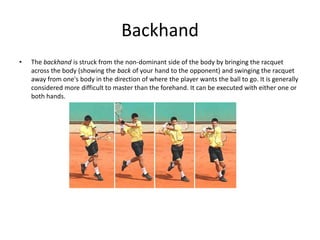
•   The backhand is struck from the non-dominant side of the body by bringing the racquet
    across the body (showing the back of your hand to the opponent) and swinging the racquet
    away from one's body in the direction of where the player wants the ball to go. It is generally
    considered more difficult to master than the forehand. It can be executed with either one or
    both hands.
serve
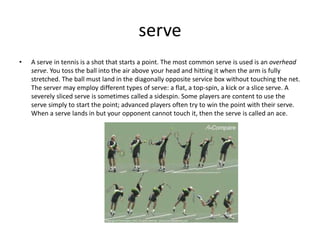
•   A serve in tennis is a shot that starts a point. The most common serve is used is an overhead
    serve. You toss the ball into the air above your head and hitting it when the arm is fully
    stretched. The ball must land in the diagonally opposite service box without touching the net.
    The server may employ different types of serve: a flat, a top-spin, a kick or a slice serve. A
    severely sliced serve is sometimes called a sidespin. Some players are content to use the
    serve simply to start the point; advanced players often try to win the point with their serve.
    When a serve lands in but your opponent cannot touch it, then the serve is called an ace.
volleys
•   A volley is made in the air before the ball bounces, generally near the net or inside of the
    service line. It is usually made with a stiff-wristed "punching" motion to hit the ball into an
    open area of the opponent's court. The half volley is made by hitting the ball on the rise just
    after it has bounced, once again generally in the vicinity of the net.

Tennis rules and techniques

  • 1.
    Tennis rules andtechniques Kieran Fung
  • 2.
    Rules 1-3 • Rule1. Opponents stand on opposite sides of the court. The player who delivers the ball to start the point is called the server. The player who stands opposite and cross-court from the server is the receiver. • Rule 2. The right to serve, receive, choose your side, or give the opponent these choices is decided by a toss of a coin or racquet. If the choice of service or receiver is chosen, the opponent chooses which side to start. • Rule 3. The server shall stand behind the baseline on the deuce court within the boundaries of the singles court when playing singles and within the doubles sideline when playing doubles. All even points are played from the deuce court and odd number points played from the advantage court. The server shall not serve until the receiver is ready. Serves are made from the deuce court to the opponents service box on the deuce court. Advantage court to advantage box. If the server misses his target twice, he loses the point. If the ball hits the net and goes in the correct service box, another serve is granted. If the server steps on the baseline before contact is made, the serve is deemed a fault.
  • 3.
    Rules 4-6 • Rule 4. The receiver is deemed ready if an attempt is made to return the server's ball. The receiver can stand where he likes but must let the ball bounce in the service box. If the ball does not land in the service box, it is deemed a fault and a second serve is given. If the ball is hit by either opponent before the ball bounces, the server wins the point. • Rule 5. The server always calls his score first. If the server wins the first point, he gets a score of 15. Scoring is done like a clock. See example below. Love means zero in tennis. The second point is called 30. The third point is called 45 (now-a- days known as 40) and game is won when the score goes back to love. If the score is 40-40, also known as deuce, one side must win by two points. Advantage- In means if the server wins the next point, he wins the game.Advantage- Out means the receiver has a chance to win the game on the next point. • Rule 6. After the game, the opponents serve. Games equal 1. The first to win 6 games, by two, wins the set. The first to win 2 sets wins the match. If the score is 6-6, a tie-breaker is played. This is scored by one's. The first team to score 7 points winning by two wins the set. The tiebreaker continues until one side wins by two. Hence, Game-Set-Match.
  • 4.
    Rules 7-10 • Rule7. If the ball goes into the net, or outside the boundaries of the court, the player who hit that ball loses the point. If the ball hits the net during the point and goes into the opponents court, the ball is in play. A player loses the point if he touches the net, drops his racquet while hitting the ball, bounces the ball over the net, hits a part of the surroundings such as the roof, or a tree, the ball touches him or his partner, he deliberately tries to distract the opponent. • Rule 8. A let is called during the point if a ball rolls on the court or there is a distraction from someone besides the players on the court. • Rule 9. A ball that lands on the line is good. • Rule 10. If players serve out of turn or serve to the wrong person or court, the point or game will stand and order will be resumed following the point or game.
  • 5.
  • 6.
    Forehand • The forehand is struck from the dominant side of the body by swinging the racquet in the direction of where the player wants to place the shot. It is called a forehand because the racquet is held in such a way that if one were to strike the ball without the racquet, it would hit the palm of your hand. This is the opposite side from a backhand. It is considered the easiest shot to master, perhaps because it is the most natural stroke. Beginners and advanced players often have better forehands than any other shots and use it as a weapon.
  • 7.
    Backhand • The backhand is struck from the non-dominant side of the body by bringing the racquet across the body (showing the back of your hand to the opponent) and swinging the racquet away from one's body in the direction of where the player wants the ball to go. It is generally considered more difficult to master than the forehand. It can be executed with either one or both hands.
  • 8.
    serve • A serve in tennis is a shot that starts a point. The most common serve is used is an overhead serve. You toss the ball into the air above your head and hitting it when the arm is fully stretched. The ball must land in the diagonally opposite service box without touching the net. The server may employ different types of serve: a flat, a top-spin, a kick or a slice serve. A severely sliced serve is sometimes called a sidespin. Some players are content to use the serve simply to start the point; advanced players often try to win the point with their serve. When a serve lands in but your opponent cannot touch it, then the serve is called an ace.
  • 9.
    volleys • A volley is made in the air before the ball bounces, generally near the net or inside of the service line. It is usually made with a stiff-wristed "punching" motion to hit the ball into an open area of the opponent's court. The half volley is made by hitting the ball on the rise just after it has bounced, once again generally in the vicinity of the net.