10 Reasons
why you should prefer
PostgreSQL to MySQL
Anand Chitipothu
Who am I?
Anand Chitipothu
Independent Software Consultant & Trainer
Ex. Internet Archivist
MySQL or PostgreSQL?
The world's most popular
open source database
The world's most advanced
open source database
Quick Comparison
MySQL
MyISAM
MySQL
InnoDB
PostgreSQL
Transactions No Yes Yes
Foreign Key
Constraints
No Yes Yes
Locking Table Row/MVCC Row/MVCC
Who Uses MySQL?
● Facebook
● FriendFeed
● Quora
● Flickr
● Second Life
Who Uses PostgreSQL
● Skype
● Heroku
● Instagram
● Disqus
● Yahoo!
● NASA
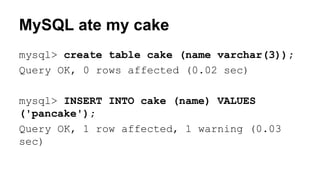
MySQL ate my cake
mysql> CREATE TABLE cake (name VARCHAR(3));
Query OK, 0 rows affected (0.02 sec)
mysql> INSERT INTO cake (name) VALUES
('pancake');
Query OK, 1 row affected, 1 warning (0.03 sec)
MySQL ate my cake
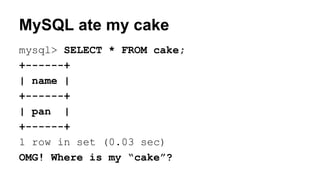
MySQL ate my cake
mysql> SELECT * FROM cake;
+------+
| name |
+------+
| pan |
+------+
1 row in set (0.03 sec)
OMG! Where is my “cake”?
PostgreSQL?
testdb=# CREATE TABLE cake (name VARCHAR(3));
CREATE TABLE
testdb=# INSERT INTO cake (name)
VALUES ('pancake');
ERROR: value too long for type character
varying(3)
Ever Seen This?
CREATE TABLE users (
id integer auto_increment,
username varchar(40),
password varchar(8)
);
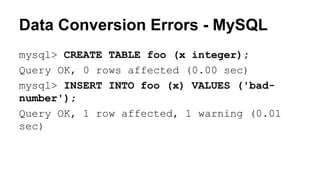
Data Conversion Errors - MySQL
mysql> CREATE TABLE test (x INTEGER);
Query OK, 0 rows affected (0.00 sec)
mysql> INSERT INTO test (x)
VALUES ('bad-number');
Query OK, 1 row affected, 1 warning (0.01 sec)
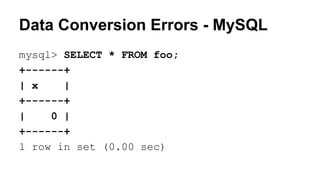
Data Conversion Errors - MySQL
mysql> SELECT * FROM foo;
+------+
| x |
+------+
| 0 |
+------+
1 row in set (0.00 sec)
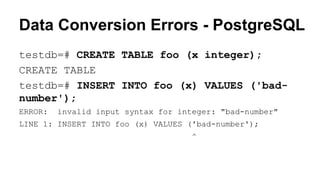
Data Conversion Errors - PostgreSQL
testdb=# CREATE TABLE test (x integer);
CREATE TABLE
testdb=# INSERT INTO test (x) VALUES ('bad-
number');
ERROR: invalid input syntax for integer: "bad-number"
LINE 1: INSERT INTO foo (x) VALUES ('bad-number');
^
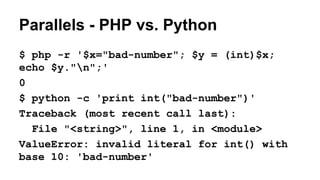
Parallels - PHP vs. Python
$ php -r '$x = "bad-number";
$y = (int)$x;
echo $y."n";'
0
Parallels - PHP vs. Python
$ python -c 'print int("bad-number")'
Traceback (most recent call last):
File "<string>", line 1, in <module>
ValueError: invalid literal for int()
with base 10: 'bad-number'
File Layout
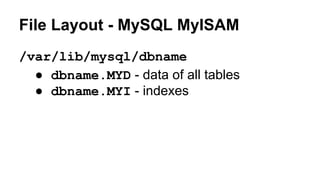
File Layout - MySQL MyISAM
/var/lib/mysql/dbname
● dbname.MYD - data of all tables
● dbname.MYI - indexes
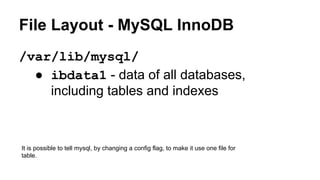
File Layout - MySQL InnoDB
/var/lib/mysql/
● ibdata1 - data of all databases, including
tables and indexes
It is possible to tell mysql, by changing a config flag, to make it use one file for
table.
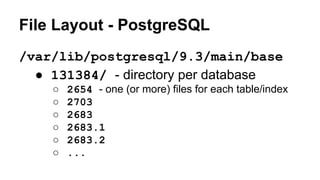
/var/lib/postgresql/9.3/main/base
● 131384/ - directory per database
○ 2654 - one (or more) files for each table/index
○ 2703
○ 2683
○ 2683.1
○ 2683.2
○ ...
File Layout - PostgreSQL
Database Maintenance
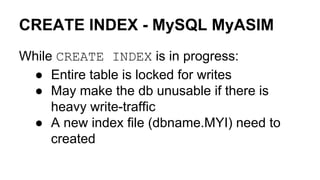
CREATE INDEX - MySQL MyISAM
While CREATE INDEX is in progress:
● Entire table is locked for writes
● A new index file (dbname.MYI) need to
created
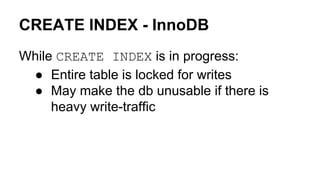
CREATE INDEX - InnoDB
● Entire table rebuilt to create an index.
● Seems to have improved in recent versions
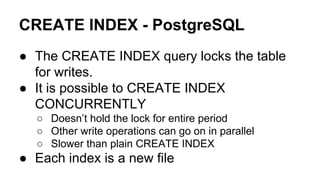
CREATE INDEX - PostgreSQL
● CREATE INDEX
○ locks the table for writes
● CREATE INDEX CONCURRENTLY
○ Doesn’t hold the lock for entire period
○ Slower than plain CREATE INDEX
● Each index is a new file
Takes long time as it needs to rewrite:
● the index file (dbname.MYI) for MyISAM
● the ibdata1 file for InnoDB
DROP INDEX - MySQL
DROP INDEX - PostgreSQL
● Almost instantaneous
● Just need to delete the files corresponding to
that index
ADDING NEW COLUMN - MySQL
Entire table data needs to be rewritten.
ADDING NEW COLUMN - PostgreSQL
Almost instantaneous if the new column has a
default value.
Connection Model
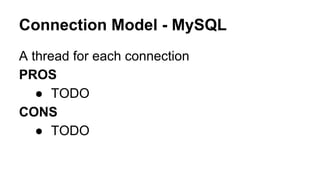
Connection Model - MySQL
A thread for each connection
PROS
● Very easy to create a new conn
CONS
● Difficult to scale on multi-core systems
● difficult monitor threads
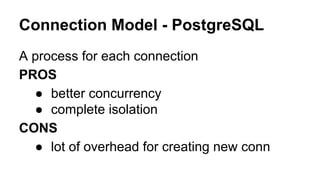
Connection Model - PostgreSQL
A process for each connection
PROS
● better concurrency
● complete isolation
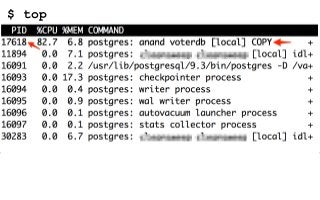
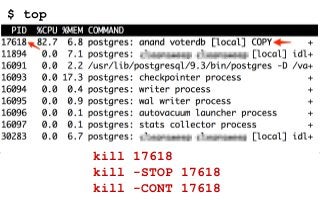
● plays nicely with UNIX tools (ps, top, kill)
CONS
● lot of overhead for creating new conn
$ top
$ top
kill 17618
kill -STOP 17618
kill -CONT 17618
Query Planning
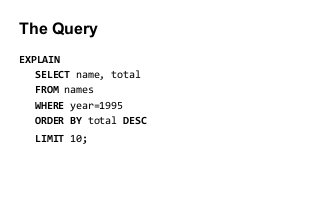
EXPLAIN
SELECT name, total
FROM names
WHERE year=1995
ORDER BY total DESC
LIMIT 10;
The Query
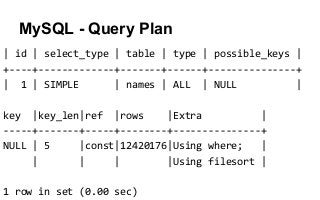
MySQL - Query Plan
| id | select_type | table | type | possible_keys |
+----+-------------+-------+------+---------------+
| 1 | SIMPLE | names | ALL | NULL |
key |key_len|ref |rows |Extra |
-----+-------+-----+--------+---------------+
NULL | 5 |const|12420176|Using where; |
| | | |Using filesort |
1 row in set (0.00 sec)
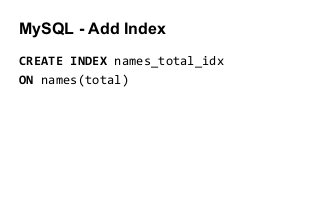
MySQL - Add Index
CREATE INDEX names_total_idx
ON names(total)
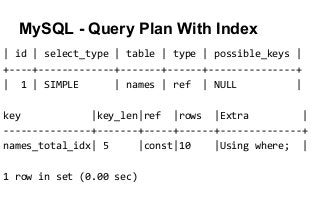
MySQL - Query Plan With Index
| id | select_type | table | type | possible_keys |
+----+-------------+-------+------+---------------+
| 1 | SIMPLE | names | ref | NULL |
key |key_len|ref |rows |Extra |
---------------+-------+-----+------+--------------+
names_total_idx| 5 |const|10 |Using where; |
1 row in set (0.00 sec)
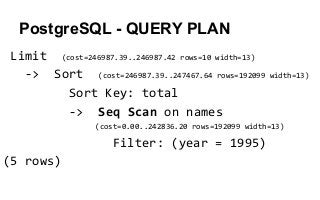
Limit (cost=246987.39..246987.42 rows=10 width=13)
-> Sort (cost=246987.39..247467.64 rows=192099 width=13)
Sort Key: total
-> Seq Scan on names
(cost=0.00..242836.20 rows=192099 width=13)
Filter: (year = 1995)
(5 rows)
PostgreSQL - QUERY PLAN
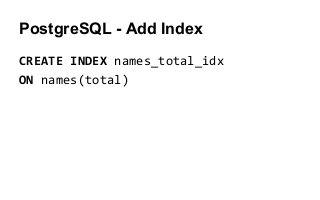
CREATE INDEX names_total_idx
ON names(total)
PostgreSQL - Add Index
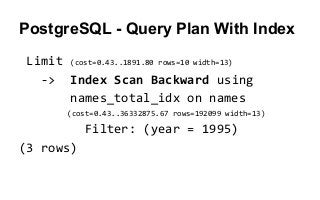
Limit (cost=0.43..1891.80 rows=10 width=13)
-> Index Scan Backward using
names_total_idx on names
(cost=0.43..36332875.67 rows=192099 width=13)
Filter: (year = 1995)
(3 rows)
PostgreSQL - Query Plan With Index
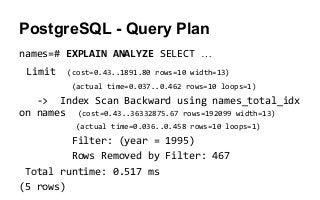
PostgreSQL - Query Plan
names=# EXPLAIN ANALYZE SELECT …
Limit (cost=0.43..1891.80 rows=10 width=13)
(actual time=0.037..0.462 rows=10 loops=1)
-> Index Scan Backward using names_total_idx
on names (cost=0.43..36332875.67 rows=192099 width=13)
(actual time=0.036..0.458 rows=10 loops=1)
Filter: (year = 1995)
Rows Removed by Filter: 467
Total runtime: 0.517 ms
(5 rows)
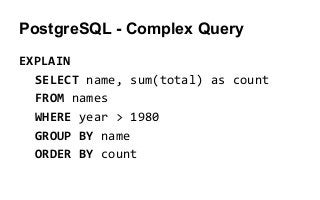
PostgreSQL - Complex Query
EXPLAIN
SELECT name, sum(total) as count
FROM names
WHERE year > 1980
GROUP BY name
ORDER BY count
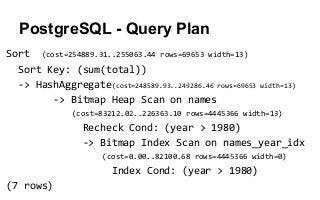
PostgreSQL - Query Plan
Sort (cost=254889.31..255063.44 rows=69653 width=13)
Sort Key: (sum(total))
-> HashAggregate(cost=248589.93..249286.46 rows=69653 width=13)
-> Bitmap Heap Scan on names
(cost=83212.02..226363.10 rows=4445366 width=13)
Recheck Cond: (year > 1980)
-> Bitmap Index Scan on names_year_idx
(cost=0.00..82100.68 rows=4445366 width=0)
Index Cond: (year > 1980)
(7 rows)
Replication
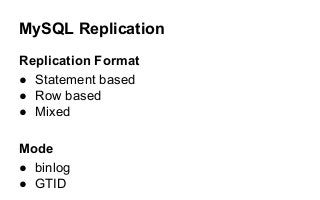
MySQL Replication
Replication Format
● Statement based
● Row based
● Mixed
Mode
● binlog
● GTID
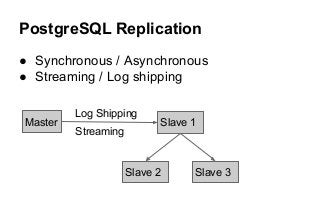
PostgreSQL Replication
● Synchronous / Asynchronous
● Streaming / Log shipping
Master Slave 1
Log Shipping
Streaming
Slave 2 Slave 3
Data Recovery
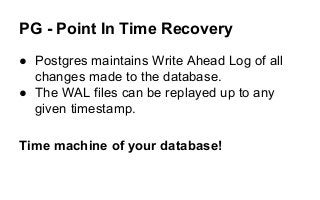
PG - Point In Time Recovery
● Postgres maintains Write Ahead Log of all
changes made to the database.
● The WAL files can be replayed up to any
given timestamp.
Time machine of your database!
Other Interesting
Features of PostgreSQL
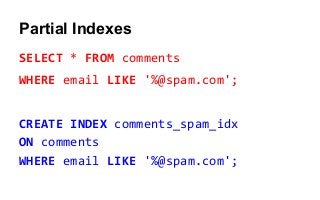
Partial Indexes
SELECT * FROM comments
WHERE email LIKE '%@spam.com';
CREATE INDEX comments_spam_idx
ON comments
WHERE email LIKE '%@spam.com';
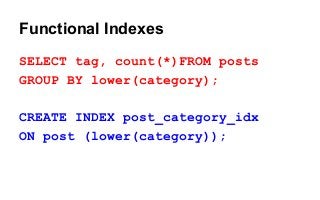
Functional Indexes
SELECT tag, count(*)FROM posts
GROUP BY lower(category);
CREATE INDEX post_category_idx
ON post (lower(category));
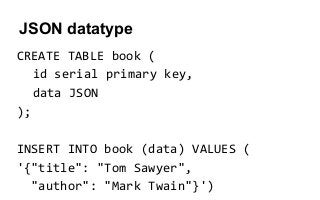
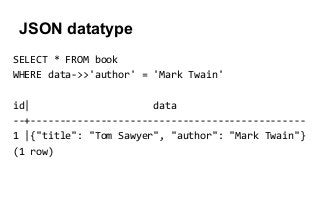
JSON datatype
CREATE TABLE book (
id serial primary key,
data JSON
);
INSERT INTO book (data) VALUES (
'{"title": "Tom Sawyer",
"author": "Mark Twain"}')
JSON datatype
SELECT * FROM book
WHERE data->>'author' = 'Mark Twain'
id| data
--+-----------------------------------------------
1 |{"title": "Tom Sawyer", "author": "Mark Twain"}
(1 row)
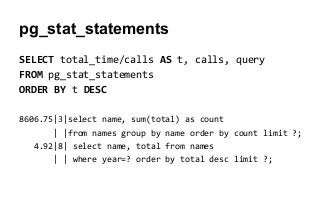
SELECT total_time/calls AS t, calls, query
FROM pg_stat_statements
ORDER BY t DESC
8606.75|3|select name, sum(total) as count
| |from names group by name order by count limit ?;
4.92|8| select name, total from names
| | where year=? order by total desc limit ?;
pg_stat_statements
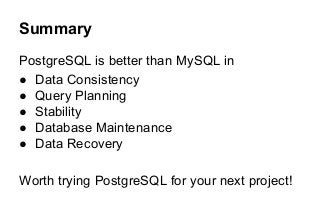
Summary
PostgreSQL is better than MySQL in
● Data Consistency
● Query Planning
● Stability
● Database Maintenance
● Data Recovery
Worth trying PostgreSQL for your next project!
Credits
PostgreSQL Logo - By Jeff MacDonald
http://pgfoundry.org/docman/?group_id=1000089
Thanks!
Anand Chitipothu
@anandology

Ten Reasons Why You Should Prefer PostgreSQL to MySQL

  • 1.
    10 Reasons why youshould prefer PostgreSQL to MySQL Anand Chitipothu
  • 2.
    Who am I? AnandChitipothu Independent Software Consultant & Trainer Ex. Internet Archivist
  • 3.
    MySQL or PostgreSQL? Theworld's most popular open source database The world's most advanced open source database
  • 4.
    Quick Comparison MySQL MyISAM MySQL InnoDB PostgreSQL Transactions NoYes Yes Foreign Key Constraints No Yes Yes Locking Table Row/MVCC Row/MVCC
  • 5.
    Who Uses MySQL? ●Facebook ● FriendFeed ● Quora ● Flickr ● Second Life
  • 6.
    Who Uses PostgreSQL ●Skype ● Heroku ● Instagram ● Disqus ● Yahoo! ● NASA
  • 7.
  • 8.
    mysql> CREATE TABLEcake (name VARCHAR(3)); Query OK, 0 rows affected (0.02 sec) mysql> INSERT INTO cake (name) VALUES ('pancake'); Query OK, 1 row affected, 1 warning (0.03 sec) MySQL ate my cake
  • 9.
    MySQL ate mycake mysql> SELECT * FROM cake; +------+ | name | +------+ | pan | +------+ 1 row in set (0.03 sec) OMG! Where is my “cake”?
  • 10.
    PostgreSQL? testdb=# CREATE TABLEcake (name VARCHAR(3)); CREATE TABLE testdb=# INSERT INTO cake (name) VALUES ('pancake'); ERROR: value too long for type character varying(3)
  • 11.
    Ever Seen This? CREATETABLE users ( id integer auto_increment, username varchar(40), password varchar(8) );
  • 12.
    Data Conversion Errors- MySQL mysql> CREATE TABLE test (x INTEGER); Query OK, 0 rows affected (0.00 sec) mysql> INSERT INTO test (x) VALUES ('bad-number'); Query OK, 1 row affected, 1 warning (0.01 sec)
  • 13.
    Data Conversion Errors- MySQL mysql> SELECT * FROM foo; +------+ | x | +------+ | 0 | +------+ 1 row in set (0.00 sec)
  • 14.
    Data Conversion Errors- PostgreSQL testdb=# CREATE TABLE test (x integer); CREATE TABLE testdb=# INSERT INTO test (x) VALUES ('bad- number'); ERROR: invalid input syntax for integer: "bad-number" LINE 1: INSERT INTO foo (x) VALUES ('bad-number'); ^
  • 15.
    Parallels - PHPvs. Python $ php -r '$x = "bad-number"; $y = (int)$x; echo $y."n";' 0
  • 16.
    Parallels - PHPvs. Python $ python -c 'print int("bad-number")' Traceback (most recent call last): File "<string>", line 1, in <module> ValueError: invalid literal for int() with base 10: 'bad-number'
  • 17.
  • 18.
    File Layout -MySQL MyISAM /var/lib/mysql/dbname ● dbname.MYD - data of all tables ● dbname.MYI - indexes
  • 19.
    File Layout -MySQL InnoDB /var/lib/mysql/ ● ibdata1 - data of all databases, including tables and indexes It is possible to tell mysql, by changing a config flag, to make it use one file for table.
  • 20.
    /var/lib/postgresql/9.3/main/base ● 131384/ -directory per database ○ 2654 - one (or more) files for each table/index ○ 2703 ○ 2683 ○ 2683.1 ○ 2683.2 ○ ... File Layout - PostgreSQL
  • 21.
  • 22.
    CREATE INDEX -MySQL MyISAM While CREATE INDEX is in progress: ● Entire table is locked for writes ● A new index file (dbname.MYI) need to created
  • 23.
    CREATE INDEX -InnoDB ● Entire table rebuilt to create an index. ● Seems to have improved in recent versions
  • 24.
    CREATE INDEX -PostgreSQL ● CREATE INDEX ○ locks the table for writes ● CREATE INDEX CONCURRENTLY ○ Doesn’t hold the lock for entire period ○ Slower than plain CREATE INDEX ● Each index is a new file
  • 25.
    Takes long timeas it needs to rewrite: ● the index file (dbname.MYI) for MyISAM ● the ibdata1 file for InnoDB DROP INDEX - MySQL
  • 26.
    DROP INDEX -PostgreSQL ● Almost instantaneous ● Just need to delete the files corresponding to that index
  • 27.
    ADDING NEW COLUMN- MySQL Entire table data needs to be rewritten.
  • 28.
    ADDING NEW COLUMN- PostgreSQL Almost instantaneous if the new column has a default value.
  • 29.
  • 30.
    Connection Model -MySQL A thread for each connection PROS ● Very easy to create a new conn CONS ● Difficult to scale on multi-core systems ● difficult monitor threads
  • 31.
    Connection Model -PostgreSQL A process for each connection PROS ● better concurrency ● complete isolation ● plays nicely with UNIX tools (ps, top, kill) CONS ● lot of overhead for creating new conn
  • 32.
  • 33.
    $ top kill 17618 kill-STOP 17618 kill -CONT 17618
  • 34.
  • 35.
    EXPLAIN SELECT name, total FROMnames WHERE year=1995 ORDER BY total DESC LIMIT 10; The Query
  • 36.
    MySQL - QueryPlan | id | select_type | table | type | possible_keys | +----+-------------+-------+------+---------------+ | 1 | SIMPLE | names | ALL | NULL | key |key_len|ref |rows |Extra | -----+-------+-----+--------+---------------+ NULL | 5 |const|12420176|Using where; | | | | |Using filesort | 1 row in set (0.00 sec)
  • 37.
    MySQL - AddIndex CREATE INDEX names_total_idx ON names(total)
  • 38.
    MySQL - QueryPlan With Index | id | select_type | table | type | possible_keys | +----+-------------+-------+------+---------------+ | 1 | SIMPLE | names | ref | NULL | key |key_len|ref |rows |Extra | ---------------+-------+-----+------+--------------+ names_total_idx| 5 |const|10 |Using where; | 1 row in set (0.00 sec)
  • 39.
    Limit (cost=246987.39..246987.42 rows=10width=13) -> Sort (cost=246987.39..247467.64 rows=192099 width=13) Sort Key: total -> Seq Scan on names (cost=0.00..242836.20 rows=192099 width=13) Filter: (year = 1995) (5 rows) PostgreSQL - QUERY PLAN
  • 40.
    CREATE INDEX names_total_idx ONnames(total) PostgreSQL - Add Index
  • 41.
    Limit (cost=0.43..1891.80 rows=10width=13) -> Index Scan Backward using names_total_idx on names (cost=0.43..36332875.67 rows=192099 width=13) Filter: (year = 1995) (3 rows) PostgreSQL - Query Plan With Index
  • 42.
    PostgreSQL - QueryPlan names=# EXPLAIN ANALYZE SELECT … Limit (cost=0.43..1891.80 rows=10 width=13) (actual time=0.037..0.462 rows=10 loops=1) -> Index Scan Backward using names_total_idx on names (cost=0.43..36332875.67 rows=192099 width=13) (actual time=0.036..0.458 rows=10 loops=1) Filter: (year = 1995) Rows Removed by Filter: 467 Total runtime: 0.517 ms (5 rows)
  • 43.
    PostgreSQL - ComplexQuery EXPLAIN SELECT name, sum(total) as count FROM names WHERE year > 1980 GROUP BY name ORDER BY count
  • 44.
    PostgreSQL - QueryPlan Sort (cost=254889.31..255063.44 rows=69653 width=13) Sort Key: (sum(total)) -> HashAggregate(cost=248589.93..249286.46 rows=69653 width=13) -> Bitmap Heap Scan on names (cost=83212.02..226363.10 rows=4445366 width=13) Recheck Cond: (year > 1980) -> Bitmap Index Scan on names_year_idx (cost=0.00..82100.68 rows=4445366 width=0) Index Cond: (year > 1980) (7 rows)
  • 45.
  • 46.
    MySQL Replication Replication Format ●Statement based ● Row based ● Mixed Mode ● binlog ● GTID
  • 47.
    PostgreSQL Replication ● Synchronous/ Asynchronous ● Streaming / Log shipping Master Slave 1 Log Shipping Streaming Slave 2 Slave 3
  • 48.
  • 49.
    PG - PointIn Time Recovery ● Postgres maintains Write Ahead Log of all changes made to the database. ● The WAL files can be replayed up to any given timestamp. Time machine of your database!
  • 50.
  • 51.
    Partial Indexes SELECT *FROM comments WHERE email LIKE '%@spam.com'; CREATE INDEX comments_spam_idx ON comments WHERE email LIKE '%@spam.com';
  • 52.
    Functional Indexes SELECT tag,count(*)FROM posts GROUP BY lower(category); CREATE INDEX post_category_idx ON post (lower(category));
  • 53.
    JSON datatype CREATE TABLEbook ( id serial primary key, data JSON ); INSERT INTO book (data) VALUES ( '{"title": "Tom Sawyer", "author": "Mark Twain"}')
  • 54.
    JSON datatype SELECT *FROM book WHERE data->>'author' = 'Mark Twain' id| data --+----------------------------------------------- 1 |{"title": "Tom Sawyer", "author": "Mark Twain"} (1 row)
  • 55.
    SELECT total_time/calls ASt, calls, query FROM pg_stat_statements ORDER BY t DESC 8606.75|3|select name, sum(total) as count | |from names group by name order by count limit ?; 4.92|8| select name, total from names | | where year=? order by total desc limit ?; pg_stat_statements
  • 56.
    Summary PostgreSQL is betterthan MySQL in ● Data Consistency ● Query Planning ● Stability ● Database Maintenance ● Data Recovery Worth trying PostgreSQL for your next project!
  • 57.
    Credits PostgreSQL Logo -By Jeff MacDonald http://pgfoundry.org/docman/?group_id=1000089
  • 58.