THE TEMPLE OF
THE SACRED
TOOTH RELIC
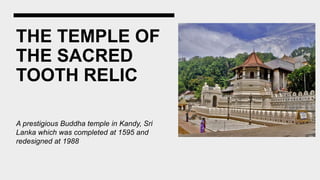
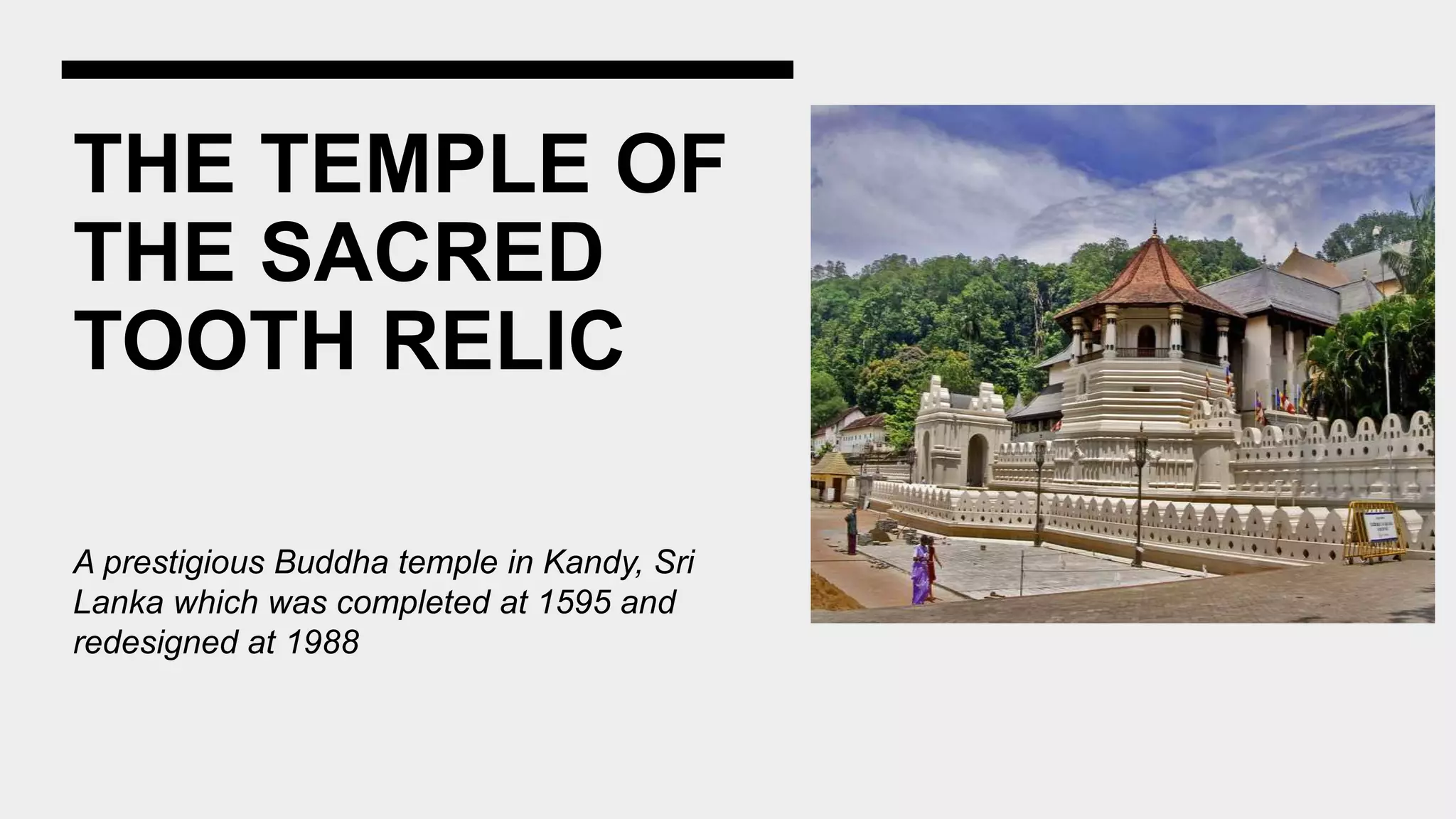
A prestigious Buddha temple in Kandy, Sri
Lanka which was completed at 1595 and
redesigned at 1988
CONTENTS
1. History
2.Attacks on the buildings
3.Architechture
4.Associated buildingas
and structures
General information about
the temple
Temple of the Sacred Tooth Relic; commonly known as the ශ්රී දළදා
මාළිගාව (Glorious Tooth Temple), is a Buddhist temple in Kandy, Sri Lanka. It is
located in the royal palace complex of the former kingdom of Kandy, which houses
the relic of tooth of Buddha. Since ancient times, the relic has played an important
role in local politics because it is believed that whoever holds the relic holds the
governance of the country. The relic was historically held by Sinhalese kings. The
temple of the tooth is a World Heritage Sites. Mainly due to the temple and the relic.
Bhikkus of the two particular chapters, the Malwathu chapters Asgiri chapters
conduct daily worship in the inner chamber of the temple. Rituals are performed
three times daily: at dawn, at noon, and in the evenings. On Wednesdays, there is a
symbolic bathing of the relic with a herbal preparation made from scented water and
fragrant flowers called Nanumura Mangallaya; this holy water is believed to contain
healing powers and is distributed to those present.
Attacks on the building
The temple was attacked in1989 by the militant organisation Janatha Vimukthi Perumuna (JVP), it
had the intention of capturing the relic and in1998 by the militant organisation Liberation of the
Tamil Tigers Eelam (LTTE), this attack damaged the front side of the royal palace.
Architechture
The brick wall which runs along the moat and the Bogambara, lake is known as
water waves wall. Holes in this wall are built to light coconut oil lamps. The main
entrance gate which lies over the moat is called Mahawahalkada. At the foot
of Mahawahalkada steps, there is a Sandakada pahana (moonstone) which is
carved in Kandyan architectural style. Mahawahalkada was totally destroyed in a
1998 bomb blast and rebuilt afterward along with Sandakada
pahana other carvings. Elephants are depicted in stone on either side of the
entrance. A Makara Torana and two guardian stones are placed on top of the
staircase. TheHewisi drummers' chamber is situated in front of the main shrine.
The two storeys of the main shrine are known as "Palle malaya" (lower floor) and
"Udu malaya" (upper floor) or "Weda hitina maligawa". The doors of the Weda
Hitana Maligawa are Ivory Carvings. The actual chamber in which the tooth relic
is kept is known as the "Handun kunama".
Associated
buildings and
structures
Subtopic: Royal Palace
The royal palace is situated to the north of the
temple. John Pybus, who was on an embassy in 1762,
gives a detailed description on the royal palace.
Vikramabahu III of Gampola(r. 1356-1374) and Sena
Samantha Wickramabahu (r. 1469-1511) built royal
palaces on this site. Vimaladharmasurya I of kandy
undertook various decorations to the palace. The Dutch
orientalist Phillipus Balbadeus visited the palace with
General Gerald Pietersz Hulfz in 1656. The royal
residence was known as "Maha Wasala" in Sinhalese
starting in the Polonnaruwa period. The royal palace is
also known as "Maligawa" (Palace). There were
three Wahalkadas and an 8 feet (2.4 m) high wall used
as main entrances. The section of the palace facing the
Natha devale is said to be the oldest. During the
beginning of the British period, it was used by
government agent Sir John D'Oyly, 1st Baronet, of
Kandy, The successors of D'Oyly have continued to use
it as their official residence. Today it is preserved as an
archeological museum. Ulpen Ge and Queens Palace
Subtopic:
Audience hall
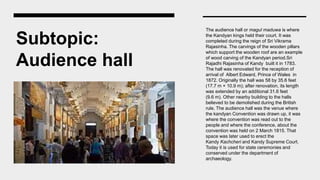
The audience hall or magul maduwa is where
the Kandyan kings held their court. It was
completed during the reign of Sri Vikrama
Rajasinha. The carvings of the wooden pillars
which support the wooden roof are an example
of wood carving of the Kandyan period.Sri
Rajadhi Rajasinha of Kandy built it in 1783.
The hall was renovated for the reception of
arrival of Albert Edward, Prince of Wales in
1872. Originally the hall was 58 by 35.6 feet
(17.7 m × 10.9 m); after renovation, its length
was extended by an additional 31.6 feet
(9.6 m). Other nearby building to the halls
believed to be demolished during the British
rule. The audience hall was the venue where
the kandyan Convention was drawn up, it was
where the convention was read out to the
people and where the conference, about the
convention was held on 2 March 1815. That
space was later used to erect the
Kandy Kachcheri and Kandy Supreme Court.
Today it is used for state ceremonies and
conserved under the department of
archaeology.
Thank you
Project
done by
hacker
Copied
by others

temple of tooth kandy

  • 1.
    THE TEMPLE OF THESACRED TOOTH RELIC A prestigious Buddha temple in Kandy, Sri Lanka which was completed at 1595 and redesigned at 1988
  • 2.
    CONTENTS 1. History 2.Attacks onthe buildings 3.Architechture 4.Associated buildingas and structures
  • 3.
    General information about thetemple Temple of the Sacred Tooth Relic; commonly known as the ශ්රී දළදා මාළිගාව (Glorious Tooth Temple), is a Buddhist temple in Kandy, Sri Lanka. It is located in the royal palace complex of the former kingdom of Kandy, which houses the relic of tooth of Buddha. Since ancient times, the relic has played an important role in local politics because it is believed that whoever holds the relic holds the governance of the country. The relic was historically held by Sinhalese kings. The temple of the tooth is a World Heritage Sites. Mainly due to the temple and the relic. Bhikkus of the two particular chapters, the Malwathu chapters Asgiri chapters conduct daily worship in the inner chamber of the temple. Rituals are performed three times daily: at dawn, at noon, and in the evenings. On Wednesdays, there is a symbolic bathing of the relic with a herbal preparation made from scented water and fragrant flowers called Nanumura Mangallaya; this holy water is believed to contain healing powers and is distributed to those present.
  • 4.
    Attacks on thebuilding The temple was attacked in1989 by the militant organisation Janatha Vimukthi Perumuna (JVP), it had the intention of capturing the relic and in1998 by the militant organisation Liberation of the Tamil Tigers Eelam (LTTE), this attack damaged the front side of the royal palace.
  • 5.
    Architechture The brick wallwhich runs along the moat and the Bogambara, lake is known as water waves wall. Holes in this wall are built to light coconut oil lamps. The main entrance gate which lies over the moat is called Mahawahalkada. At the foot of Mahawahalkada steps, there is a Sandakada pahana (moonstone) which is carved in Kandyan architectural style. Mahawahalkada was totally destroyed in a 1998 bomb blast and rebuilt afterward along with Sandakada pahana other carvings. Elephants are depicted in stone on either side of the entrance. A Makara Torana and two guardian stones are placed on top of the staircase. TheHewisi drummers' chamber is situated in front of the main shrine. The two storeys of the main shrine are known as "Palle malaya" (lower floor) and "Udu malaya" (upper floor) or "Weda hitina maligawa". The doors of the Weda Hitana Maligawa are Ivory Carvings. The actual chamber in which the tooth relic is kept is known as the "Handun kunama".
  • 6.
    Associated buildings and structures Subtopic: RoyalPalace The royal palace is situated to the north of the temple. John Pybus, who was on an embassy in 1762, gives a detailed description on the royal palace. Vikramabahu III of Gampola(r. 1356-1374) and Sena Samantha Wickramabahu (r. 1469-1511) built royal palaces on this site. Vimaladharmasurya I of kandy undertook various decorations to the palace. The Dutch orientalist Phillipus Balbadeus visited the palace with General Gerald Pietersz Hulfz in 1656. The royal residence was known as "Maha Wasala" in Sinhalese starting in the Polonnaruwa period. The royal palace is also known as "Maligawa" (Palace). There were three Wahalkadas and an 8 feet (2.4 m) high wall used as main entrances. The section of the palace facing the Natha devale is said to be the oldest. During the beginning of the British period, it was used by government agent Sir John D'Oyly, 1st Baronet, of Kandy, The successors of D'Oyly have continued to use it as their official residence. Today it is preserved as an archeological museum. Ulpen Ge and Queens Palace
  • 7.
    Subtopic: Audience hall The audiencehall or magul maduwa is where the Kandyan kings held their court. It was completed during the reign of Sri Vikrama Rajasinha. The carvings of the wooden pillars which support the wooden roof are an example of wood carving of the Kandyan period.Sri Rajadhi Rajasinha of Kandy built it in 1783. The hall was renovated for the reception of arrival of Albert Edward, Prince of Wales in 1872. Originally the hall was 58 by 35.6 feet (17.7 m × 10.9 m); after renovation, its length was extended by an additional 31.6 feet (9.6 m). Other nearby building to the halls believed to be demolished during the British rule. The audience hall was the venue where the kandyan Convention was drawn up, it was where the convention was read out to the people and where the conference, about the convention was held on 2 March 1815. That space was later used to erect the Kandy Kachcheri and Kandy Supreme Court. Today it is used for state ceremonies and conserved under the department of archaeology.
  • 8.