
Sri Lanka
Country Report
Dr. Preshila Samaraweera
Dr. Pamila Adikari
Mr. Kamal Samarasinghe
May You Live Long
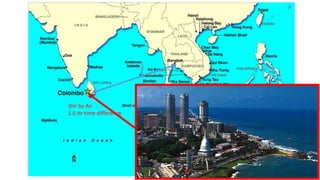
3Hr by Air
1.5 Hr time difference
Geography
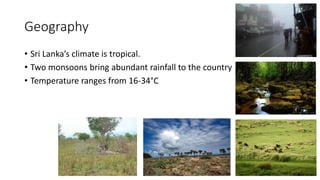
• Sri Lanka’s climate is tropical.
• Two monsoons bring abundant rainfall to the country
• Temperature ranges from 16-34°C
Demography
• Population 21 million
• Urban population – 15%
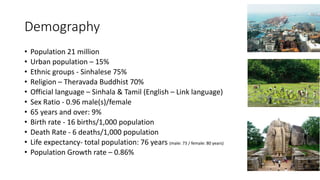
• Ethnic groups - Sinhalese 75%
• Religion – Theravada Buddhist 70%
• Official language – Sinhala & Tamil (English – Link language)
• Sex Ratio - 0.96 male(s)/female
• 65 years and over: 9%
• Birth rate - 16 births/1,000 population
• Death Rate - 6 deaths/1,000 population
• Life expectancy- total population: 76 years (male: 73 / female: 80 years)
• Population Growth rate – 0.86%
Demography
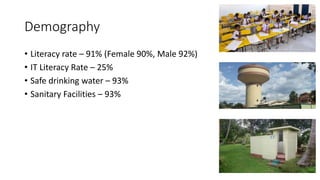
• Literacy rate – 91% (Female 90%, Male 92%)
• IT Literacy Rate – 25%
• Safe drinking water – 93%
• Sanitary Facilities – 93%
Economy of Sri Lanka
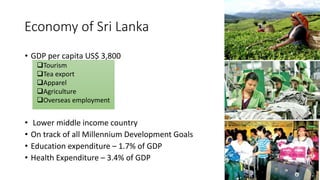
• GDP per capita US$ 3,800
Tourism
Tea export
Apparel
Agriculture
Overseas employment
• Lower middle income country
• On track of all Millennium Development Goals
• Education expenditure – 1.7% of GDP
• Health Expenditure – 3.4% of GDP
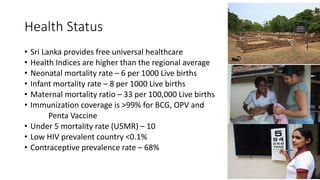
Health Status
• Sri Lanka provides free universal healthcare
• Health Indices are higher than the regional average
• Neonatal mortality rate – 6 per 1000 Live births
• Infant mortality rate – 8 per 1000 Live births
• Maternal mortality ratio – 33 per 100,000 Live births
• Immunization coverage is >99% for BCG, OPV and
Penta Vaccine
• Under 5 mortality rate (U5MR) – 10
• Low HIV prevalent country <0.1%
• Contraceptive prevalence rate – 68%
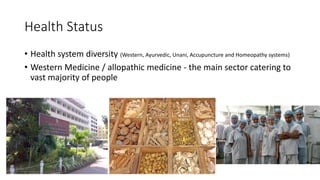
Health Status
• Health system diversity (Western, Ayurvedic, Unani, Accupuncture and Homeopathy systems)
• Western Medicine / allopathic medicine - the main sector catering to
vast majority of people
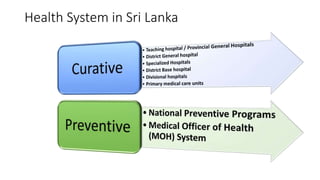
Health System in Sri Lanka
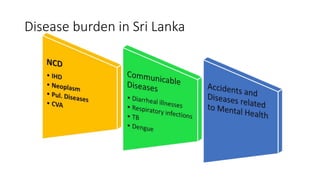
Disease burden in Sri Lanka
Health System Challenges
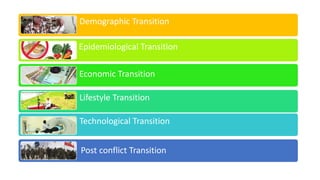
Demographic Transition
Lifestyle Transition
Technological Transition
Epidemiological Transition
Economic Transition
Post conflict Transition
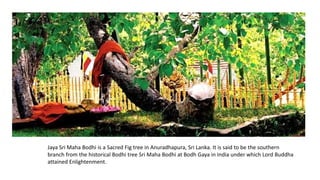
Jaya Sri Maha Bodhi is a Sacred Fig tree in Anuradhapura, Sri Lanka. It is said to be the southern
branch from the historical Bodhi tree Sri Maha Bodhi at Bodh Gaya in India under which Lord Buddha
attained Enlightenment.
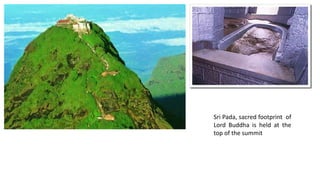
Sri Pada, sacred footprint of
Lord Buddha is held at the
top of the summit
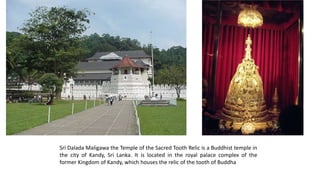
Sri Dalada Maligawa the Temple of the Sacred Tooth Relic is a Buddhist temple in
the city of Kandy, Sri Lanka. It is located in the royal palace complex of the
former Kingdom of Kandy, which houses the relic of the tooth of Buddha
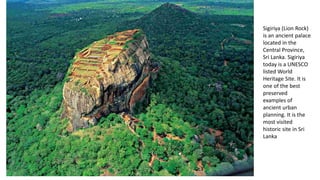
Sigiriya (Lion Rock)
is an ancient palace
located in the
Central Province,
Sri Lanka. Sigiriya
today is a UNESCO
listed World
Heritage Site. It is
one of the best
preserved
examples of
ancient urban
planning. It is the
most visited
historic site in Sri
Lanka
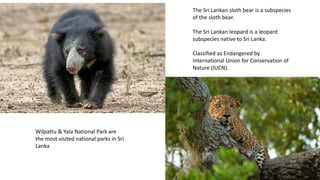
The Sri Lankan sloth bear is a subspecies
of the sloth bear.
The Sri Lankan leopard is a leopard
subspecies native to Sri Lanka.
Classified as Endangered by
International Union for Conservation of
Nature (IUCN).
Wilpattu & Yala National Park are
the most visited national parks in Sri
Lanka
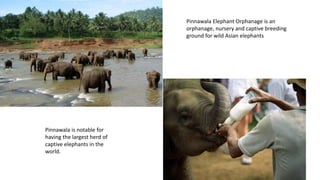
Pinnawala Elephant Orphanage is an
orphanage, nursery and captive breeding
ground for wild Asian elephants
Pinnawala is notable for
having the largest herd of
captive elephants in the
world.
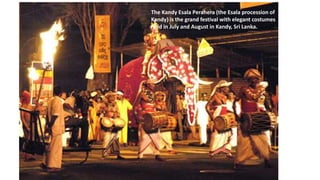
The Kandy Esala Perahera (the Esala procession of
Kandy) is the grand festival with elegant costumes
held in July and August in Kandy, Sri Lanka.
Thank You!
ස්තූතියි
(Sthoothyi)

Sri lanka

  • 1.
    Sri Lanka Country Report Dr.Preshila Samaraweera Dr. Pamila Adikari Mr. Kamal Samarasinghe
  • 2.
  • 3.
    3Hr by Air 1.5Hr time difference
  • 5.
    Geography • Sri Lanka’sclimate is tropical. • Two monsoons bring abundant rainfall to the country • Temperature ranges from 16-34°C
  • 6.
    Demography • Population 21million • Urban population – 15% • Ethnic groups - Sinhalese 75% • Religion – Theravada Buddhist 70% • Official language – Sinhala & Tamil (English – Link language) • Sex Ratio - 0.96 male(s)/female • 65 years and over: 9% • Birth rate - 16 births/1,000 population • Death Rate - 6 deaths/1,000 population • Life expectancy- total population: 76 years (male: 73 / female: 80 years) • Population Growth rate – 0.86%
  • 7.
    Demography • Literacy rate– 91% (Female 90%, Male 92%) • IT Literacy Rate – 25% • Safe drinking water – 93% • Sanitary Facilities – 93%
  • 8.
    Economy of SriLanka • GDP per capita US$ 3,800 Tourism Tea export Apparel Agriculture Overseas employment • Lower middle income country • On track of all Millennium Development Goals • Education expenditure – 1.7% of GDP • Health Expenditure – 3.4% of GDP
  • 9.
    Health Status • SriLanka provides free universal healthcare • Health Indices are higher than the regional average • Neonatal mortality rate – 6 per 1000 Live births • Infant mortality rate – 8 per 1000 Live births • Maternal mortality ratio – 33 per 100,000 Live births • Immunization coverage is >99% for BCG, OPV and Penta Vaccine • Under 5 mortality rate (U5MR) – 10 • Low HIV prevalent country <0.1% • Contraceptive prevalence rate – 68%
  • 10.
    Health Status • Healthsystem diversity (Western, Ayurvedic, Unani, Accupuncture and Homeopathy systems) • Western Medicine / allopathic medicine - the main sector catering to vast majority of people
  • 11.
  • 12.
  • 13.
  • 14.
    Demographic Transition Lifestyle Transition TechnologicalTransition Epidemiological Transition Economic Transition Post conflict Transition
  • 15.
    Jaya Sri MahaBodhi is a Sacred Fig tree in Anuradhapura, Sri Lanka. It is said to be the southern branch from the historical Bodhi tree Sri Maha Bodhi at Bodh Gaya in India under which Lord Buddha attained Enlightenment.
  • 16.
    Sri Pada, sacredfootprint of Lord Buddha is held at the top of the summit
  • 17.
    Sri Dalada Maligawathe Temple of the Sacred Tooth Relic is a Buddhist temple in the city of Kandy, Sri Lanka. It is located in the royal palace complex of the former Kingdom of Kandy, which houses the relic of the tooth of Buddha
  • 19.
    Sigiriya (Lion Rock) isan ancient palace located in the Central Province, Sri Lanka. Sigiriya today is a UNESCO listed World Heritage Site. It is one of the best preserved examples of ancient urban planning. It is the most visited historic site in Sri Lanka
  • 20.
    The Sri Lankansloth bear is a subspecies of the sloth bear. The Sri Lankan leopard is a leopard subspecies native to Sri Lanka. Classified as Endangered by International Union for Conservation of Nature (IUCN). Wilpattu & Yala National Park are the most visited national parks in Sri Lanka
  • 21.
    Pinnawala Elephant Orphanageis an orphanage, nursery and captive breeding ground for wild Asian elephants Pinnawala is notable for having the largest herd of captive elephants in the world.
  • 22.
    The Kandy EsalaPerahera (the Esala procession of Kandy) is the grand festival with elegant costumes held in July and August in Kandy, Sri Lanka.
  • 26.

Editor's Notes

  • #3 Let me welcome u
  • #4  Famously known as Pearl of Indian Ocean Near equator South to India
  • #9 Our country holds a unique position in asia as one of the developing nations to provide universal health, free education, strong gender equality, better opportunity for social mobility
  • #11 Health system in SL is enriched by a mix of Western, Ayurvedic, Unani, Accupuncture and Homeopathy system
  • #12 National Preventive programmes for endemic diseases operated through centrally with the technical expertise MOH system is the fundamental unit which given the success to health system giving a door to door health services
  • #13 Disease burden has shifted rapidly towards NCD including mental diseases accidents and injuries
  • #15 Economic Developing country---Middle Income Country Therefore Foreign aid redused Lifestyle Tr= Active Lifestyle- Sedentary Life style (Machine use, Transport) Technological Tr= Rapidly evolving technology is expensive, Diverse development fields Therefore health is only one aspect of it Post-conflict Tr= Migration and diseases, Disable, Mental trauma,
  • #24 Wind surfing, White water rafting
  • #26 World champs 1996