Tempered Radicals: the outsiders
within
Dr. Cathy Rozel Farnworth
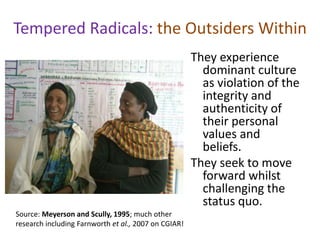
Tempered Radicals: the Outsiders Within
They experience
dominant culture
as violation of the
integrity and
authenticity of
their personal
values and
beliefs.
They seek to move
forward whilst
challenging the
status quo.
Source: Meyerson and Scully, 1995; much other
research including Farnworth et al., 2007 on CGIAR!
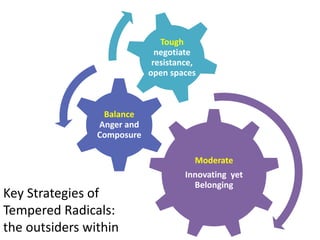
Moderate
Innovating yet
Belonging
Balance
Anger and
Composure
Tough
negotiate
resistance,
open spaces
Key Strategies of
Tempered Radicals:
the outsiders within
Research Questions
1. Is the concept of ‘tempered radicals’ useful
to an understanding of the strategies
innovators develop to secure their goals?
2. If so, are there gender differences in the
nuancing of these strategies?
3. How can research organizations, rural
advisory services, and other stakeholders,
support tempered radicals?
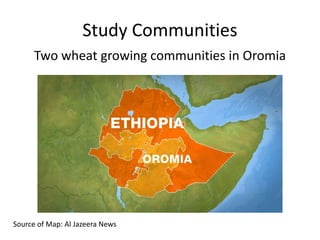
Study Communities
Two wheat growing communities in Oromia
Source of Map: Al Jazeera News
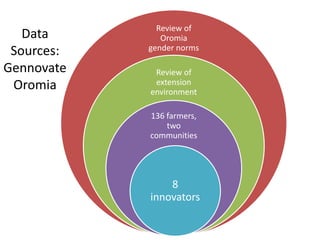
Data
Sources:
Gennovate
Oromia
Review of
Oromia
gender norms
Review of
extension
environment
136 farmers,
two
communities
8
innovators
Daniel Aysha Ibrahim
Mimi
Yonas
Soloman
MarthaHannah
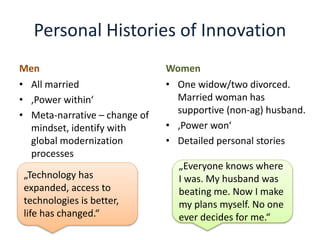
Personal Histories of Innovation
Men
• All married
• ‚Power within‘
• Meta-narrative – change of
mindset, identify with
global modernization
processes
Women
• One widow/two divorced.
Married woman has
supportive (non-ag) husband.
• ‚Power won‘
• Detailed personal stories
„Technology has
expanded, access to
technologies is better,
life has changed.“
„Everyone knows where
I was. My husband was
beating me. Now I make
my plans myself. No one
ever decides for me.“
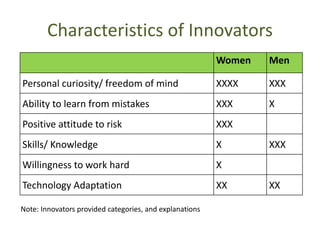
Characteristics of Innovators
Women Men
Personal curiosity/ freedom of mind XXXX XXX
Ability to learn from mistakes XXX X
Positive attitude to risk XXX
Skills/ Knowledge X XXX
Willingness to work hard X
Technology Adaptation XX XX
Note: Innovators provided categories, and explanations
Men Women
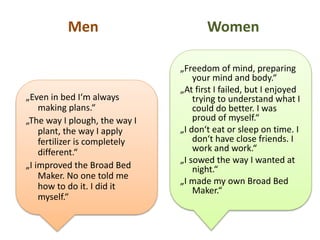
„Even in bed I‘m always
making plans.“
„The way I plough, the way I
plant, the way I apply
fertilizer is completely
different.“
„I improved the Broad Bed
Maker. No one told me
how to do it. I did it
myself.“
„Freedom of mind, preparing
your mind and body.“
„At first I failed, but I enjoyed
trying to understand what I
could do better. I was
proud of myself.“
„I don‘t eat or sleep on time. I
don‘t have close friends. I
work and work.“
„I sowed the way I wanted at
night.“
„I made my own Broad Bed
Maker.“
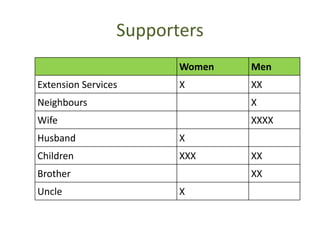
Supporters
Women Men
Extension Services X XX
Neighbours X
Wife XXXX
Husband X
Children XXX XX
Brother XX
Uncle X
Men Women
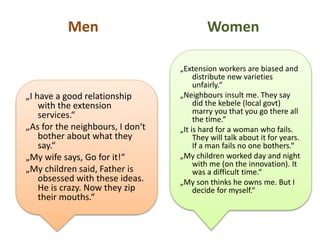
„I have a good relationship
with the extension
services.“
„As for the neighbours, I don‘t
bother about what they
say.“
„My wife says, Go for it!“
„My children said, Father is
obsessed with these ideas.
He is crazy. Now they zip
their mouths.“
„Extension workers are biased and
distribute new varieties
unfairly.“
„Neighbours insult me. They say
did the kebele (local govt)
marry you that you go there all
the time.“
„It is hard for a woman who fails.
They will talk about it for years.
If a man fails no one bothers.“
„My children worked day and night
with me (on the innovation). It
was a difficult time.“
„My son thinks he owns me. But I
decide for myself.“
Moderate
Innovating yet
Belonging
Balance
Anger and
Composure
Tough
negotiate
resistance,
open spaces
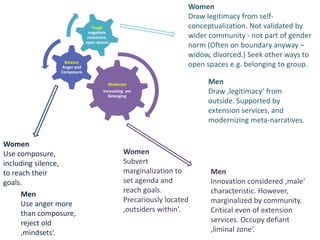
Women
Draw legitimacy from self-
conceptualization. Not validated by
wider community - not part of gender
norm (Often on boundary anyway –
widow, divorced.) Seek other ways to
open spaces e.g. belonging to group.
Men
Draw ‚legitimacy‘ from
outside. Supported by
extension services, and
modernizing meta-narratives.
Women
Use composure,
including silence,
to reach their
goals.
Men
Use anger more
than composure,
reject old
‚mindsets‘.
Women
Subvert
marginalization to
set agenda and
reach goals.
Precariously located
‚outsiders within‘.
Men
Innovation considered ‚male‘
characteristic. However,
marginalized by community.
Critical even of extension
services. Occupy defiant
‚liminal zone‘.
Create discomfort – expose deep norms
A Reminder: the Research Questions
1. Is the concept of ‘tempered radicals’ useful
to developing an understanding of the
strategies innovators develop to secure their
goals?
2. If so, are there gender differences in the
nuancing of these strategies?
3. How can research organizations, rural
advisory services, and other stakeholders,
support tempered radicals?
More research.
Develop partnerships with women and men,
community, local and higher level institutions, to
expand the realm of ‚legitimate behaviour‘ in
relation to innovation.
Specific strategies to support innovative women-
headed households.
Consider use of community dialogues and
household methodologies.
What can we do?
GENDER AND AGRICULTURAL
INNOVATION IN OROMIA REGION,
ETHIOPIA
Cathy Rozel Farnworth, Diana E. López, Lone B. Badstue,
Mahelet Hailemariam, Bekele G. Abeyo
Submitted to Gender, Technology and Development

Tempered radicals: the outsiders within

  • 1.
    Tempered Radicals: theoutsiders within Dr. Cathy Rozel Farnworth
  • 2.
    Tempered Radicals: theOutsiders Within They experience dominant culture as violation of the integrity and authenticity of their personal values and beliefs. They seek to move forward whilst challenging the status quo. Source: Meyerson and Scully, 1995; much other research including Farnworth et al., 2007 on CGIAR!
  • 3.
    Moderate Innovating yet Belonging Balance Anger and Composure Tough negotiate resistance, openspaces Key Strategies of Tempered Radicals: the outsiders within
  • 4.
    Research Questions 1. Isthe concept of ‘tempered radicals’ useful to an understanding of the strategies innovators develop to secure their goals? 2. If so, are there gender differences in the nuancing of these strategies? 3. How can research organizations, rural advisory services, and other stakeholders, support tempered radicals?
  • 5.
    Study Communities Two wheatgrowing communities in Oromia Source of Map: Al Jazeera News
  • 6.
    Data Sources: Gennovate Oromia Review of Oromia gender norms Reviewof extension environment 136 farmers, two communities 8 innovators
  • 7.
  • 8.
    Personal Histories ofInnovation Men • All married • ‚Power within‘ • Meta-narrative – change of mindset, identify with global modernization processes Women • One widow/two divorced. Married woman has supportive (non-ag) husband. • ‚Power won‘ • Detailed personal stories „Technology has expanded, access to technologies is better, life has changed.“ „Everyone knows where I was. My husband was beating me. Now I make my plans myself. No one ever decides for me.“
  • 9.
    Characteristics of Innovators WomenMen Personal curiosity/ freedom of mind XXXX XXX Ability to learn from mistakes XXX X Positive attitude to risk XXX Skills/ Knowledge X XXX Willingness to work hard X Technology Adaptation XX XX Note: Innovators provided categories, and explanations
  • 10.
    Men Women „Even inbed I‘m always making plans.“ „The way I plough, the way I plant, the way I apply fertilizer is completely different.“ „I improved the Broad Bed Maker. No one told me how to do it. I did it myself.“ „Freedom of mind, preparing your mind and body.“ „At first I failed, but I enjoyed trying to understand what I could do better. I was proud of myself.“ „I don‘t eat or sleep on time. I don‘t have close friends. I work and work.“ „I sowed the way I wanted at night.“ „I made my own Broad Bed Maker.“
  • 11.
    Supporters Women Men Extension ServicesX XX Neighbours X Wife XXXX Husband X Children XXX XX Brother XX Uncle X
  • 12.
    Men Women „I havea good relationship with the extension services.“ „As for the neighbours, I don‘t bother about what they say.“ „My wife says, Go for it!“ „My children said, Father is obsessed with these ideas. He is crazy. Now they zip their mouths.“ „Extension workers are biased and distribute new varieties unfairly.“ „Neighbours insult me. They say did the kebele (local govt) marry you that you go there all the time.“ „It is hard for a woman who fails. They will talk about it for years. If a man fails no one bothers.“ „My children worked day and night with me (on the innovation). It was a difficult time.“ „My son thinks he owns me. But I decide for myself.“
  • 13.
    Moderate Innovating yet Belonging Balance Anger and Composure Tough negotiate resistance, openspaces Women Draw legitimacy from self- conceptualization. Not validated by wider community - not part of gender norm (Often on boundary anyway – widow, divorced.) Seek other ways to open spaces e.g. belonging to group. Men Draw ‚legitimacy‘ from outside. Supported by extension services, and modernizing meta-narratives. Women Use composure, including silence, to reach their goals. Men Use anger more than composure, reject old ‚mindsets‘. Women Subvert marginalization to set agenda and reach goals. Precariously located ‚outsiders within‘. Men Innovation considered ‚male‘ characteristic. However, marginalized by community. Critical even of extension services. Occupy defiant ‚liminal zone‘.
  • 14.
    Create discomfort –expose deep norms
  • 15.
    A Reminder: theResearch Questions 1. Is the concept of ‘tempered radicals’ useful to developing an understanding of the strategies innovators develop to secure their goals? 2. If so, are there gender differences in the nuancing of these strategies? 3. How can research organizations, rural advisory services, and other stakeholders, support tempered radicals?
  • 16.
    More research. Develop partnershipswith women and men, community, local and higher level institutions, to expand the realm of ‚legitimate behaviour‘ in relation to innovation. Specific strategies to support innovative women- headed households. Consider use of community dialogues and household methodologies. What can we do?
  • 17.
    GENDER AND AGRICULTURAL INNOVATIONIN OROMIA REGION, ETHIOPIA Cathy Rozel Farnworth, Diana E. López, Lone B. Badstue, Mahelet Hailemariam, Bekele G. Abeyo Submitted to Gender, Technology and Development

Editor's Notes

  • #3 Meyerson, D. and M. Scully.1995. 'Tempered Radicalism and the Politics of Ambivalence and Change.' Organization Science 6:5. September-October pp 585-600. Farnworth, C. R., Jiggins, J. and Gurung, B. 2007. My Practice is My Strategy: how personal values survive in organizations. Organizations and People.Association of Management Education and Development.https://www.researchgate.net/publication/313505018_My_Practice_is_My_Strategy_values_in_organizations_ORGANIZATIONS_PEOPLE_NOVEMBER_2007_VOL_14_NO_4
  • #4 Moderate Tempered Radicals negotiate between norm and sanction. They cannot risk being thrown out/ being ostracised, but want to do things differently/ live different kind of life through innovation. What strategies do they have to be ‚outsiders within‘. Tough Tempered radicals are resilient, persistent. They negotiate resistance to open spaces for innovation in the face of powers (social norms, direct hostility) trying to force compliance. Balance Tempered radicals have a temper. Temper is a motive force for change. It is an expression of agency. They want things to be difference. But they have to balance anger with composure to retain their status of outsiders within.
  • #5 Focus on individuals rather than on processes and systems. Process /systems can obscure workings of gender and individual agency, and degree to which individuals benefit, or are harmed, by innovations. Visible structures: households, organisations Deep structures: underlying values, assumptions, ideologies – which justify how societies are organized, resources distributed. Whilst underlying norms influence individuals, individuals also play with norms to reach their goals …
  • #6 Research conducted under GENNOVATE in 2016 in eight communities in Ethiopia. Two in Oromia.
  • #7 Framing of the research Develop understanding of Oromia gender norms (literature review, community profiles) Review extension environment Literature review (including of innovation platforms), FGDs, Community Profiles GENNOVATE Research into interactions between low and middle income farmers in the two study communities, and the extension services. Explored how the extension services support innovative practices and with whom. Equal numbers of women and men respondents. Broad understanding of innovation in the two study sites. Innovation Trajectory Interviews Close focus on eight innovators, four in each community, two men and two women per community. Build history of their innovation practice, and how they innovate. Small number of interviewees – typical of research into tempered radicals.
  • #10 The things that make innovators different, and ‚outsiders‘
  • #12 The things that help innovators stay within. Sources of support.
  • #13 Supporters and opposers. Women typically only have children (adult/older).
  • #16 Valuable gendered lens for capturing and analyzing how innovators ‘do things differently’. Exposes deep cultural norms around gender and innovation. Shows how innovators work at a deep level to challenge these norms whilst trying to stay part of their society. Women and men have similar strategies but the penalties for failure are much higher for women. Women also work with almost no support, and certainly almost no support from extension services. Women innovators typically ‘on the margins’ anyway (FHH in many cases). This builds on wider research which shows that single women are often very innovative. They can express their agency, but have few resources with which to innovate.