Webinars on
Women’s Collective Action (WCA) in
      Agricultural Markets
      Webinar 3: Synthesis of Findings
        Second Phase of Research

               Facilitated by
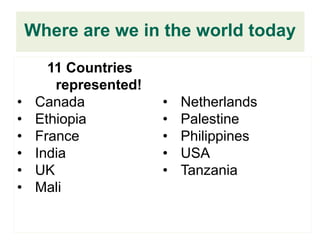
Where are we in the world today

       11 Countries
        represented!
•    Canada            •   Netherlands
•    Ethiopia          •   Palestine
•    France            •   Philippines
•    India             •   USA
•    UK                •   Tanzania
•    Mali
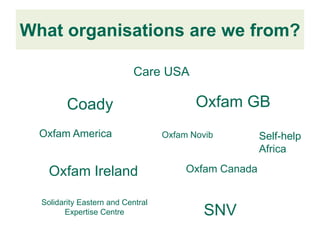
What organisations are we from?

                            Care USA

         Coady                            Oxfam GB
  Oxfam America                    Oxfam Novib         Self-help
                                                       Africa

    Oxfam Ireland                       Oxfam Canada


  Solidarity Eastern and Central
        Expertise Centre                    SNV
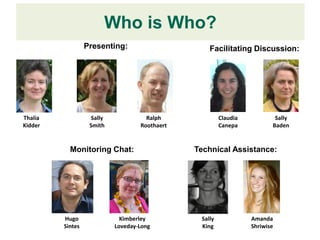
Who is Who?
                  Presenting:                       Facilitating Discussion:


Thalia              Sally             Ralph              Claudia           Sally
Kidder             Smith            Roothaert            Canepa           Baden


           Monitoring Chat:                     Technical Assistance:


         Hugo                 Kimberley          Sally             Amanda
         Sintes             Loveday-Long         King              Shriwise
Agenda for today
• Presentation of findings
    Thalia Kidder, Oxfam GB
• Comments on implications
    Sally Smith, Independent Researcher
    Ralph Roothaert, Oxfam GB
• Discussion in plenary
    • Research findings
    • Implications
• Next steps...
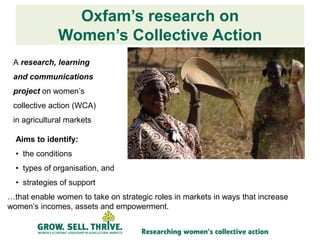
Oxfam’s research on
              Women’s Collective Action
 A research, learning
 and communications
 project on women’s
 collective action (WCA)
 in agricultural markets

  Aims to identify:
  • the conditions
  • types of organisation, and
  • strategies of support

…that enable women to take on strategic roles in markets in ways that increase
women’s incomes, assets and empowerment.
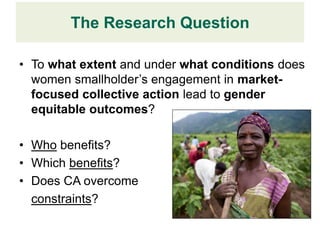
The Research Question

• To what extent and under what conditions does
  women smallholder’s engagement in market-
  focused collective action lead to gender
  equitable outcomes?

• Who benefits?
• Which benefits?
• Does CA overcome
  constraints?
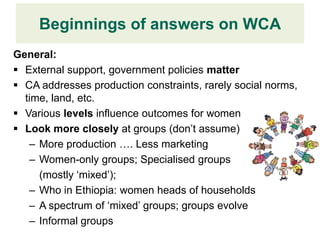
Beginnings of answers on WCA
                Design Finding
General:
 External support, government policies matter
 CA addresses production constraints, rarely social norms,
  time, land, etc.
 Various levels influence outcomes for women
 Look more closely at groups (don’t assume)
   – More production …. Less marketing
   – Women-only groups; Specialised groups
     (mostly ‘mixed’);
   – Who in Ethiopia: women heads of households
   – A spectrum of ‘mixed’ groups; groups evolve
   – Informal groups
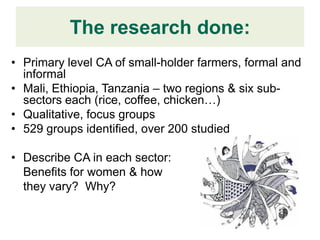
The research done:
• Primary level CA of small-holder farmers, formal and
  informal
• Mali, Ethiopia, Tanzania – two regions & six sub-
  sectors each (rice, coffee, chicken…)
• Qualitative, focus groups
• 529 groups identified, over 200 studied

• Describe CA in each sector:
  Benefits for women & how
  they vary? Why?
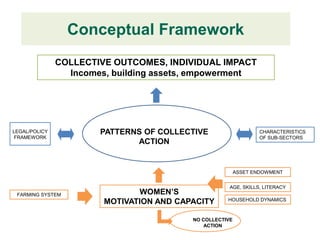
Conceptual Framework
               COLLECTIVE OUTCOMES, INDIVIDUAL IMPACT
                 Incomes, building assets, empowerment


LEGAL/POLICY           PATTERNS OF COLLECTIVE                    CHARACTERISTICS
FRAMEWORK                                                        OF SUB-SECTORS
                              ACTION


                                                          ASSET ENDOWMENT


                                                      AGE, SKILLS, LITERACY
 FARMING SYSTEM                WOMEN’S
                                                     HOUSEHOLD DYNAMICS
                        MOTIVATION AND CAPACITY

                                          NO COLLECTIVE
                                              ACTION
Findings
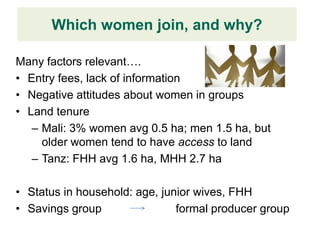
Which women join, and why?
           Design Finding
Many factors relevant….
• Entry fees, lack of information
• Negative attitudes about women in groups
• Land tenure
   – Mali: 3% women avg 0.5 ha; men 1.5 ha, but
     older women tend to have access to land
   – Tanz: FHH avg 1.6 ha, MHH 2.7 ha

• Status in household: age, junior wives, FHH
• Savings group                formal producer group
Gendered patterns of CA
• Government role:
   – Promoting support for women farmers; coop laws
• External support:
   • Widespread, dominant feature
• Functions: multi-functional, more production
• Women’s Participation – a spectrum
   – Women’s groups with token men
   – Membership doesn’t equate with leadership
• Formal linked to informal
   – Informal labour-sharing, savings groups
• Evolution of groups
Benefits for Women?
• Common benefits for women
  – Social support, income, inputs-training-savings, labour

• Women-only groups
  – Social cohesion, skills, leadership, family responsibility

• Specialised organisations
  – More economic benefits, less leadership and voice?

• Mixed groups
  – Tanz: overcoming ‘husbands’ restrictions’
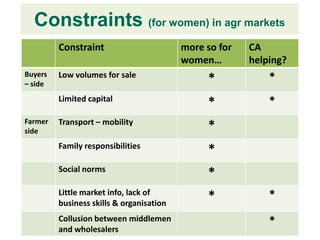
Constraints (for women) in agr markets
        Design Finding
         Constraint                       more so for   CA
                                          women…        helping?
Buyers   Low volumes for sale
– side                                         *            *
         Limited capital                                    *
                                               *
Farmer   Transport – mobility
side                                           *
         Family responsibilities
                                               *
         Social norms
                                               *
         Little market info, lack of                        *
         business skills & organisation
                                               *
         Collusion between middlemen                        *
         and wholesalers
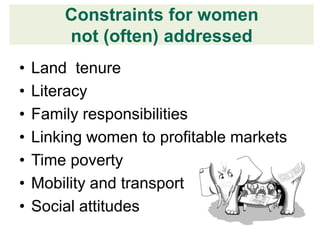
Constraints for women
        not (often) addressed
•   Land tenure
•   Literacy
•   Family responsibilities
•   Linking women to profitable markets
•   Time poverty
•   Mobility and transport
•   Social attitudes
Thank you!

1) Any questions for clarification
  purposes?

2) What findings did you find the most
  interesting or surprising, and why?


  Please submit via ‘chat’ box (moderators tab)
Commentators

• Sally Smith
  Independent Consultant

• Ralph Roothaert
 Tanzania Agricultural Scale Up
  Programme Coordinator
Implications: Sally Smith
• Important addition to knowledge base on CA in agriculture -
   – Shows complexity; contrasts with way (women’s) CA is usually
     portrayed;
   – Important implications for key development actors and initiatives,
     e.g. CAADP, AGRA, Making Markets Work for the Poor
• Raises ‘why’ questions for investigation in Phase 3-
   – Shea in Mali – specialised, high value but dominated by women,
     why?
   – access to land – how and why here not elsewhere?
   – Explore ‘exceptions’, especially those with positive outcomes for
     women
• Marketing function important –linked to greater economic
  benefits.
   – what brings groups to marketing function? sub-sector needs,
     policy environment, donor support, etc.
   – Is this function is transferable (e.g. From rice in Mali to staple
     crops elsewhere)
• Mixed and women-only groups
   – Is extending functions of women’s groups feasible/desirable to get more economic
     benefits?
   – Is enhancing position of women in mixed groups more effective long term (to address
     structural causes of gender inequality)?
• Critical to know disabling factors and how they are overcome in
  different socio-cultural contexts
   – E.g., What hinders WCA in sectors traditionally under women’s control and how have
     these constraints been overcome for ‘exceptions’?
   – How did men’s attitudes to WCA change in Mali? WCA may not be the best tool –
     what other strategies have worked (e.g. labour-saving technology, gender
     sensitisation, etc.)?
• Indications of strong influence of governance structures and
  group dynamics
   – How do leadership, mission and values of groups affect outcomes?
   – What’s the role of linked organisations in these dynamics (e.g. second tier CA,
     buyers, NGOs)
• Indications of changes in intra-household gender relations where
  women are contributing to household income.
   – how and when does this occur (e.g. only where groups have marketing function?)
   – what does it mean in terms of women’s empowerment?
Implications: Ralph Roothaert
           Overview
Implications for Oxfam’s agriculture programme
• External influences on WCA across countries:
   – Cultural
   – Government
   – NGOs
• Importance of other movements
• Degree of formality of groups
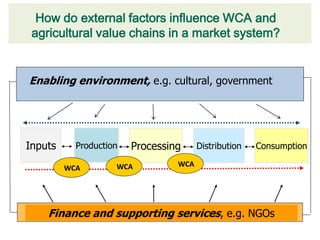
How do external factors influence WCA and
 agricultural value chains in a market system?


Enabling environment, e.g. cultural, government


Inputs     Production   Processing     Distribution   Consumption

                    WCA          WCA
         WCA


    Finance and supporting services, e.g. NGOs
Importance of other initiatives and
            movements to reach scale

• Many NGOs or government programmes promote group
  formation; difficult to reach scale of WCA without them.
   – Farmer and gender networks
   – Women empowerment
• Programmes need to ‘piggy back’ on existing positive
  internal or external movements that affect women
  organisations in agriculture
   – Good leadership
   – Role models
Degree of formality of groups

• The definition of formal and informal groups or CA is
  very difficult and tends to be blur.
   – E.g. Formal groups in Tanzania have informal
       components of saving groups
• It is more difficult to identify or access informal groups
  in the field because of their informal nature. Proper
  assessment of informal groups needs more time from
  researchers.
• In Mali, formal groups trigger informal groups
  upstream (towards production). This could be a lead
  towards identifying more informal groups elsewhere.
To wrap up
• Programmatic value chain approaches need to focus on
  enabling environment. The research has provided
  important lessons on cultural institutions from which
  contextual guidelines can be formed on group formation.
• We should link our approaches of facilitating WCA with
  dynamic movements that happen regardless
• Lessons on informal WCA are very diverse. We need
  more research to draw general conclusions or link
  findings to conditions.
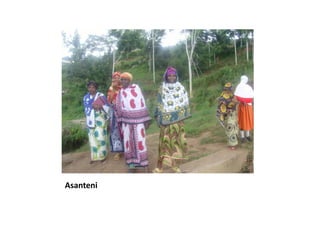
Asanteni
Q&A


• Answers to questions seeking
  clarification on research process or
  findings
Let’s discuss!


• Your views
  on what you
  found most
  interesting or
  surprising…
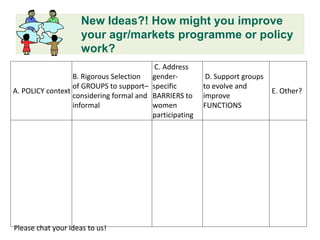
New Ideas?! How might you improve
                     your agr/markets programme or policy
                     work?
                                         C. Address
                  B. Rigorous Selection  gender-          D. Support groups
                  of GROUPS to support– specific         to evolve and
A. POLICY context                                                             E. Other?
                  considering formal and BARRIERS to     improve
                  informal               women           FUNCTIONS
                                         participating


Please chat your ideas to us!
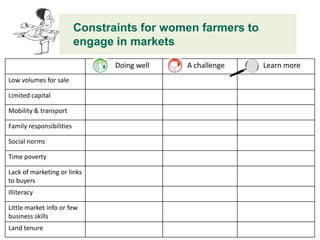
Constraints for women farmers to
                          engage in markets
                                 Doing well   A challenge    Learn more
Low volumes for sale

Limited capital

Mobility & transport

Family responsibilities

Social norms

Time poverty

Lack of marketing or links
to buyers
Illiteracy

Little market info or few
business skills
Land tenure
Highlights of discussion
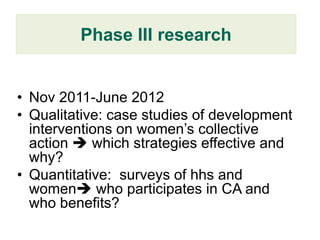
Phase III research


• Nov 2011-June 2012
• Qualitative: case studies of development
  interventions on women’s collective
  action  which strategies effective and
  why?
• Quantitative: surveys of hhs and
  women who participates in CA and
  who benefits?
Upcoming WCA webinars
• Three more webinars coming next
  year:
  – January: Innovative types of groups that
    enable greater inclusion by women (Coady)
  – February/March: Women producers,
    collective enterprises & Fair Trade (WIEGO)
  – May: Evolution of groups (Care/Coady)
  Co- organised by:
Thank you!


                    Visit us at
   http://womenscollectiveaction.com/Webinars
for a summary of this webinar and information on
               upcoming webinars!

Wca webinar 3 presentation final-external

  • 1.
    Webinars on Women’s CollectiveAction (WCA) in Agricultural Markets Webinar 3: Synthesis of Findings Second Phase of Research Facilitated by
  • 2.
    Where are wein the world today 11 Countries represented! • Canada • Netherlands • Ethiopia • Palestine • France • Philippines • India • USA • UK • Tanzania • Mali
  • 3.
    What organisations arewe from? Care USA Coady Oxfam GB Oxfam America Oxfam Novib Self-help Africa Oxfam Ireland Oxfam Canada Solidarity Eastern and Central Expertise Centre SNV
  • 4.
    Who is Who? Presenting: Facilitating Discussion: Thalia Sally Ralph Claudia Sally Kidder Smith Roothaert Canepa Baden Monitoring Chat: Technical Assistance: Hugo Kimberley Sally Amanda Sintes Loveday-Long King Shriwise
  • 5.
    Agenda for today •Presentation of findings Thalia Kidder, Oxfam GB • Comments on implications Sally Smith, Independent Researcher Ralph Roothaert, Oxfam GB • Discussion in plenary • Research findings • Implications • Next steps...
  • 6.
    Oxfam’s research on Women’s Collective Action A research, learning and communications project on women’s collective action (WCA) in agricultural markets Aims to identify: • the conditions • types of organisation, and • strategies of support …that enable women to take on strategic roles in markets in ways that increase women’s incomes, assets and empowerment.

  • 7.
    The Research Question •To what extent and under what conditions does women smallholder’s engagement in market- focused collective action lead to gender equitable outcomes? • Who benefits? • Which benefits? • Does CA overcome constraints?
  • 8.
    Beginnings of answerson WCA Design Finding General:  External support, government policies matter  CA addresses production constraints, rarely social norms, time, land, etc.  Various levels influence outcomes for women  Look more closely at groups (don’t assume) – More production …. Less marketing – Women-only groups; Specialised groups (mostly ‘mixed’); – Who in Ethiopia: women heads of households – A spectrum of ‘mixed’ groups; groups evolve – Informal groups
  • 9.
    The research done: •Primary level CA of small-holder farmers, formal and informal • Mali, Ethiopia, Tanzania – two regions & six sub- sectors each (rice, coffee, chicken…) • Qualitative, focus groups • 529 groups identified, over 200 studied • Describe CA in each sector: Benefits for women & how they vary? Why?
  • 10.
    Conceptual Framework COLLECTIVE OUTCOMES, INDIVIDUAL IMPACT Incomes, building assets, empowerment LEGAL/POLICY PATTERNS OF COLLECTIVE CHARACTERISTICS FRAMEWORK OF SUB-SECTORS ACTION ASSET ENDOWMENT AGE, SKILLS, LITERACY FARMING SYSTEM WOMEN’S HOUSEHOLD DYNAMICS MOTIVATION AND CAPACITY NO COLLECTIVE ACTION
  • 11.
  • 12.
    Which women join,and why? Design Finding Many factors relevant…. • Entry fees, lack of information • Negative attitudes about women in groups • Land tenure – Mali: 3% women avg 0.5 ha; men 1.5 ha, but older women tend to have access to land – Tanz: FHH avg 1.6 ha, MHH 2.7 ha • Status in household: age, junior wives, FHH • Savings group formal producer group
  • 13.
    Gendered patterns ofCA • Government role: – Promoting support for women farmers; coop laws • External support: • Widespread, dominant feature • Functions: multi-functional, more production • Women’s Participation – a spectrum – Women’s groups with token men – Membership doesn’t equate with leadership • Formal linked to informal – Informal labour-sharing, savings groups • Evolution of groups
  • 14.
    Benefits for Women? •Common benefits for women – Social support, income, inputs-training-savings, labour • Women-only groups – Social cohesion, skills, leadership, family responsibility • Specialised organisations – More economic benefits, less leadership and voice? • Mixed groups – Tanz: overcoming ‘husbands’ restrictions’
  • 15.
    Constraints (for women)in agr markets Design Finding Constraint more so for CA women… helping? Buyers Low volumes for sale – side * * Limited capital * * Farmer Transport – mobility side * Family responsibilities * Social norms * Little market info, lack of * business skills & organisation * Collusion between middlemen * and wholesalers
  • 16.
    Constraints for women not (often) addressed • Land tenure • Literacy • Family responsibilities • Linking women to profitable markets • Time poverty • Mobility and transport • Social attitudes
  • 17.
    Thank you! 1) Anyquestions for clarification purposes? 2) What findings did you find the most interesting or surprising, and why? Please submit via ‘chat’ box (moderators tab)
  • 18.
    Commentators • Sally Smith Independent Consultant • Ralph Roothaert Tanzania Agricultural Scale Up Programme Coordinator
  • 19.
    Implications: Sally Smith •Important addition to knowledge base on CA in agriculture - – Shows complexity; contrasts with way (women’s) CA is usually portrayed; – Important implications for key development actors and initiatives, e.g. CAADP, AGRA, Making Markets Work for the Poor • Raises ‘why’ questions for investigation in Phase 3- – Shea in Mali – specialised, high value but dominated by women, why? – access to land – how and why here not elsewhere? – Explore ‘exceptions’, especially those with positive outcomes for women • Marketing function important –linked to greater economic benefits. – what brings groups to marketing function? sub-sector needs, policy environment, donor support, etc. – Is this function is transferable (e.g. From rice in Mali to staple crops elsewhere)
  • 20.
    • Mixed andwomen-only groups – Is extending functions of women’s groups feasible/desirable to get more economic benefits? – Is enhancing position of women in mixed groups more effective long term (to address structural causes of gender inequality)? • Critical to know disabling factors and how they are overcome in different socio-cultural contexts – E.g., What hinders WCA in sectors traditionally under women’s control and how have these constraints been overcome for ‘exceptions’? – How did men’s attitudes to WCA change in Mali? WCA may not be the best tool – what other strategies have worked (e.g. labour-saving technology, gender sensitisation, etc.)? • Indications of strong influence of governance structures and group dynamics – How do leadership, mission and values of groups affect outcomes? – What’s the role of linked organisations in these dynamics (e.g. second tier CA, buyers, NGOs) • Indications of changes in intra-household gender relations where women are contributing to household income. – how and when does this occur (e.g. only where groups have marketing function?) – what does it mean in terms of women’s empowerment?
  • 21.
    Implications: Ralph Roothaert Overview Implications for Oxfam’s agriculture programme • External influences on WCA across countries: – Cultural – Government – NGOs • Importance of other movements • Degree of formality of groups
  • 22.
    How do externalfactors influence WCA and agricultural value chains in a market system? Enabling environment, e.g. cultural, government Inputs Production Processing Distribution Consumption WCA WCA WCA Finance and supporting services, e.g. NGOs
  • 23.
    Importance of otherinitiatives and movements to reach scale • Many NGOs or government programmes promote group formation; difficult to reach scale of WCA without them. – Farmer and gender networks – Women empowerment • Programmes need to ‘piggy back’ on existing positive internal or external movements that affect women organisations in agriculture – Good leadership – Role models
  • 24.
    Degree of formalityof groups • The definition of formal and informal groups or CA is very difficult and tends to be blur. – E.g. Formal groups in Tanzania have informal components of saving groups • It is more difficult to identify or access informal groups in the field because of their informal nature. Proper assessment of informal groups needs more time from researchers. • In Mali, formal groups trigger informal groups upstream (towards production). This could be a lead towards identifying more informal groups elsewhere.
  • 25.
    To wrap up •Programmatic value chain approaches need to focus on enabling environment. The research has provided important lessons on cultural institutions from which contextual guidelines can be formed on group formation. • We should link our approaches of facilitating WCA with dynamic movements that happen regardless • Lessons on informal WCA are very diverse. We need more research to draw general conclusions or link findings to conditions.
  • 26.
  • 27.
    Q&A • Answers toquestions seeking clarification on research process or findings
  • 28.
    Let’s discuss! • Yourviews on what you found most interesting or surprising…
  • 29.
    New Ideas?! Howmight you improve your agr/markets programme or policy work? C. Address B. Rigorous Selection gender- D. Support groups of GROUPS to support– specific to evolve and A. POLICY context E. Other? considering formal and BARRIERS to improve informal women FUNCTIONS participating Please chat your ideas to us!
  • 30.
    Constraints for womenfarmers to engage in markets Doing well A challenge Learn more Low volumes for sale Limited capital Mobility & transport Family responsibilities Social norms Time poverty Lack of marketing or links to buyers Illiteracy Little market info or few business skills Land tenure
  • 31.
  • 32.
    Phase III research •Nov 2011-June 2012 • Qualitative: case studies of development interventions on women’s collective action  which strategies effective and why? • Quantitative: surveys of hhs and women who participates in CA and who benefits?
  • 33.
    Upcoming WCA webinars •Three more webinars coming next year: – January: Innovative types of groups that enable greater inclusion by women (Coady) – February/March: Women producers, collective enterprises & Fair Trade (WIEGO) – May: Evolution of groups (Care/Coady) Co- organised by:
  • 34.
    Thank you! Visit us at http://womenscollectiveaction.com/Webinars for a summary of this webinar and information on upcoming webinars!