Millennials: Talking ‘bout their generation.
Teh Millennials.   Who they are, what they’re like, how to manage them.
Oh Noes! Spelling Fail!
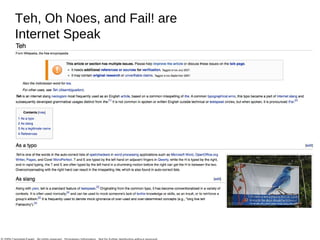
Teh, Oh Noes, and Fail! are  Internet Speak
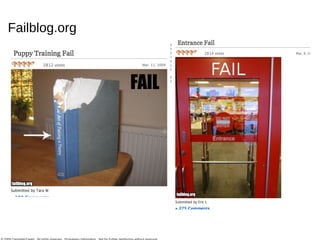
Failblog.org
So who are these millennials, anyway?
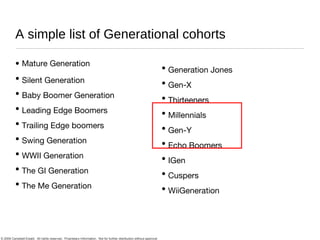
A simple list of Generational cohorts Mature Generation Silent Generation Baby Boomer Generation Leading Edge Boomers Trailing Edge boomers Swing Generation WWII Generation The GI Generation The Me Generation Generation Jones Gen-X Thirteeners Millennials Gen-Y Echo Boomers IGen Cuspers WiiGeneration
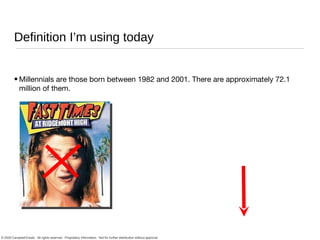
Definition I’m using today Millennials are those born between 1982 and 2001. There are approximately 72.1 million of them.
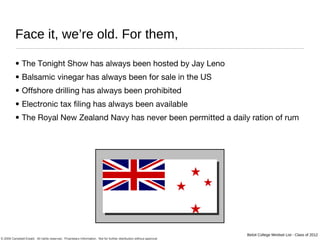
Face it, we’re old. For them, The Tonight Show has always been hosted by Jay Leno Balsamic vinegar has always been for sale in the US Offshore drilling has always been prohibited Electronic tax filing has always been available The Royal New Zealand Navy has never been permitted a daily ration of rum Beloit College Mindset List - Class of 2012
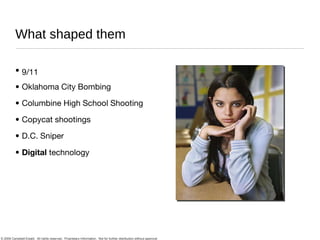
What shaped them 9/11 Oklahoma City Bombing Columbine High School Shooting Copycat shootings D.C. Sniper Digital  technology
Parent Advocacy In the decades right before and after the Millennium,  Americans moved the spotlight onto kids and their families Protective parents tried to ensure that their children would grow up safely and be treated well This generation actually likes their parents, somewhat of a departure from previous generations When young people were asked whom they admired, ‘Mom and Dad’ were named most often © 2009 Campbell-Ewald.  All rights reserved.  Proprietary Information.  Not for further distribution without approval .
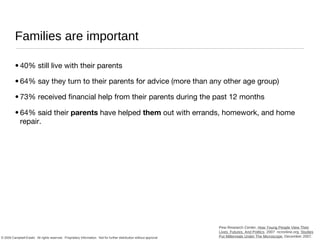
Families are important 40% still live with their parents 64% say they turn to their parents for advice (more than any other age group) 73% received financial help from their parents during the past 12 months 64% said their  parents  have helped  them  out with errands, homework, and home repair. Pew Research Center,  How Young People View Their Lives, Futures, And Politics , 2007  ncronline.org,  Studies Put Millennials Under The Microscope , December 2007.
The result has included helicopter parents Who make frequent phone calls and send emails to school administrators regarding their children’s grades and academic progress; they attend job fairs, help write college admissions essays and sit in on campus interviews.  (Not to mention moving them to campus, shopping at Target to decorate their rooms, or calling boot camp) They negotiate salaries and vacation time with HR managers
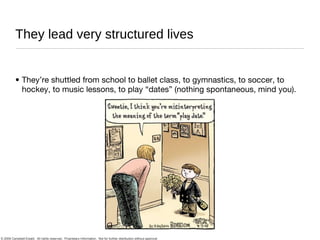
They lead very structured lives They’re shuttled from school to ballet class, to gymnastics, to soccer, to hockey, to music lessons, to play “dates” (nothing spontaneous, mind you).
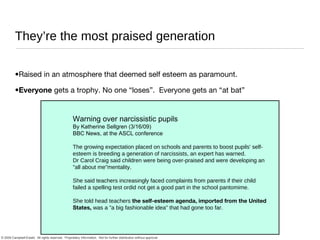
They’re the most praised generation Raised in an atmosphere that deemed self esteem as paramount. Everyone  gets a trophy. No one “loses”.  Everyone gets an “at bat” Warning over narcissistic pupils By Katherine Sellgren (3/16/09) BBC News, at the ASCL conference The growing expectation placed on schools and parents to boost pupils' self-esteem is breeding a generation of narcissists, an expert has warned. Dr Carol Craig said children were being over-praised and were developing an "all about me"mentality. She said teachers increasingly faced complaints from parents if their child failed a spelling test ordid not get a good part in the school pantomime. She told head teachers  the self-esteem agenda, imported from the United States,  was a "a big fashionable idea" that had gone too far.
The expectation continues into college “ I tell my class that if they just do what they’re supposed to do, and meet the standard requirements, that they will earn a C.  That is the default grade. They see the default grade as an A” Professor Marshall Grossman,  The University of Maryland, 2/17/2009
Yet, they’re extraordinarily accomplished. “ What kind of kid doesn’t get into Harvard? Well, there was the charming boy I interviewed with 1560 SATs. He did cancer research in the summer; played two instruments in three orchestras; and composed his own music. He redid the computer system for his student paper, loved to cook and was writing his own cookbook.” “ There was the girl who, during summer vacation, left her house before 7 each morning to make a two-hour train ride to a major university, where she worked all day doing cutting-edge research for NASA on weightlessness in mice.” “ These kids who don’t get into Harvard spend summers on schooners in Chesapeake Bay studying marine biology, building homes for the poor in Central America, touring Europe with all-star orchestras.” Source: Michael Winerip,  The New York Times  April 29, 2007 © 2009 Campbell-Ewald.  All rights reserved.  Proprietary Information.  Not for further distribution without approval .
They want to achieve quickly Think they’re only one step away from fame - particularly on the internet: (Think Tila Tequila) Live in very speeded up, always on, instant answer world.
But are taking longer to graduate from college Don’t seem in a hurry to begin careers Don’t want to “get on with their lives” independently
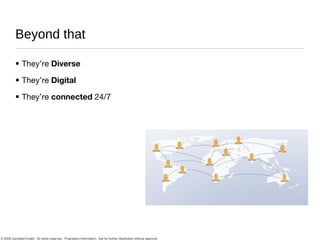
Beyond that They’re  Diverse They’re  Digital They’re  connected  24/7
Diversity in fact and attitudes
 
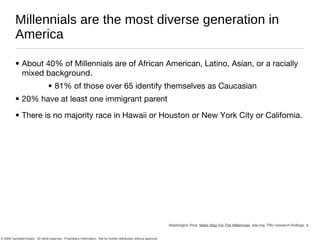
Millennials are the most diverse generation in America About 40% of Millennials are of African American, Latino, Asian, or a racially mixed background. 81% of those over 65 identify themselves as Caucasian 20% have at least one immigrant parent There is no majority race in Hawaii or Houston or New York City or California.   Washington Post,  Make Way For The Millennials , yda.org, TRU research findings, IL
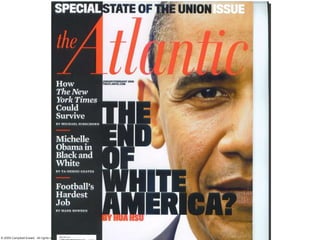
“Have I read The Great Gatsby?  I am  the Great Gatsby” - Sean “Puffy” Combs “You’re not really considered hip or “you’ve made it’ if you’re rolling with the same people.”  - Nelly. “Pop culture today rallies around an ethic of multicultural inclusion that seems to value every identity - except whiteness”.  - Hua Hsu,  The Atlantic We share a diverse culture
Black or African American is not a monolithic culture. Yankelovich has identified 11 distinct segments within black America “Connected black teens” - tech savvy, optimistic, less familiar with the overt bigotry of the past. 68% use the internet (vs 70% of the general population) There’s an even split on which moniker is preferred: 42% favor “black”, 44% favor “African-American.”
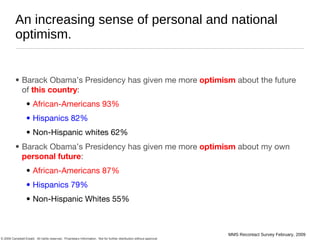
An increasing sense of personal and national optimism. Barack Obama’s Presidency has given me more  optimism  about the future of  this country : African-Americans 93% Hispanics 82% Non-Hispanic whites 62% Barack Obama’s Presidency has given me more  optimism  about my own  personal future : African-Americans 87% Hispanics 79% Non-Hispanic Whites 55% MMS Recontact Survey February, 2009
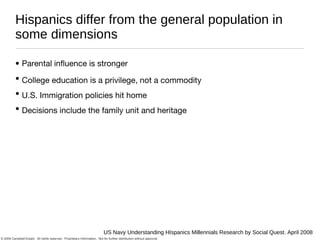
Hispanics share many characteristics with general population Highly involved parents Career-minded Technologically-minded Multi-tasker On-line US Navy Understanding HIspanics Millennials Research by Social Quest. April 2008
Hispanics differ from the general population in some dimensions Parental influence is stronger College education is a privilege, not a commodity U.S. Immigration policies hit home Decisions include the family unit and heritage US Navy Understanding HIspanics Millennials Research by Social Quest. April 2008
Net Result: A fusion lifestyle for all
Millennials base friendship on interests, not race. Closest Facebook friend may be from China
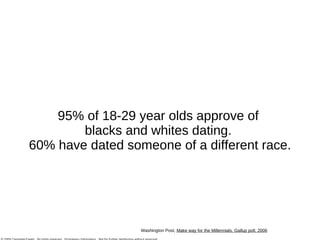
95% of 18-29 year olds approve of  blacks and whites dating.  60% have dated someone of a different race. Washington Post,  Make way for the Millennials, Gallup poll, 2006
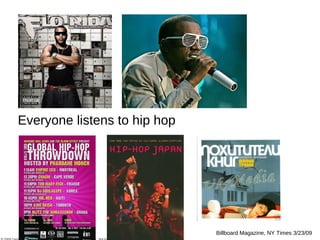
Everyone listens to hip hop Billboard Magazine, NY Times 3/23/09
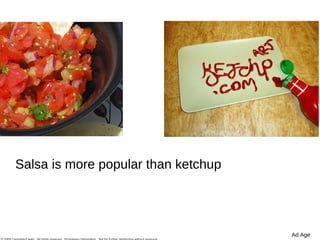
Salsa is more popular than ketchup Ad Age
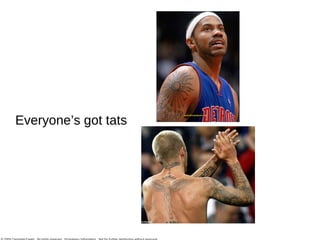
Everyone’s got tats
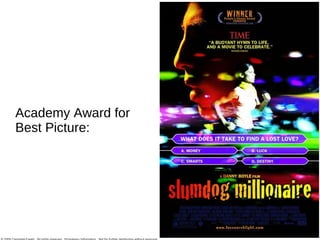
Academy Award for  Best Picture:
Perhaps most importantly, they’re the first internet generation.
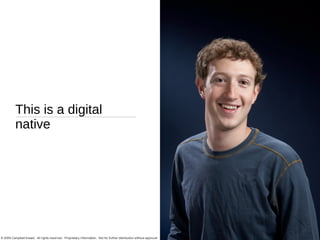
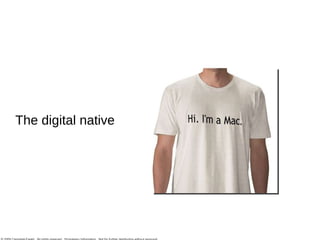
This is a digital native
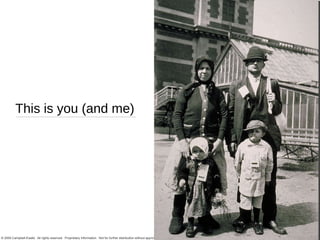
This is you (and me)
What does an immigrant do? Sticks his toes in the culture.  You learn the culture  from the outside in,  but still retain large elements of your heritage: (like confusion over “summer camp”.  You prefer face to face and  telephone communication, relatively strict guarding of online privacy The vast majority of online adults use email and search engines They research and gather information Older generations do not typically engage with the internet past e-commerce Less than one-fifth  of online adults older than Gen-X use Social Networks. Generations Online  www.pewinternet.org
The digital native
The Digital Native grew up digital Today’s 18-year old: Was 1 year old when the CD-ROM was invented Was 5 when the internet entered almost every home Was 10 years old when Windows 98 was launched Was 13 when PlayStation 2, Gamecube, and Xbox were released. Gets an incorrect grade when identifying a typewriter as a “keyboard” on an I.Q. test. seattlepi.com  Millennials Thrive on Choice
90% of Americans between the ages 12-24 are online. -  Generations Online in 2009,  Pew Internet & American Life Project  January 2009
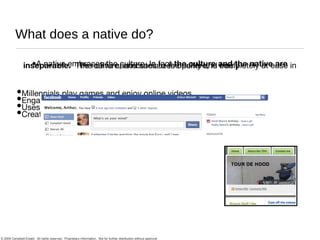
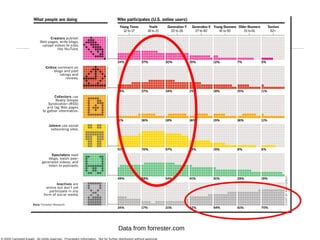
What does a native do? A native embraces the culture. In fact  the culture and the native are inseparable.   The native contributes to the culture, is completely at ease in the culture, and socializes openly and freely Millennials play games and enjoy online videos Engage in passive and active social media Uses Web 2.0 tools Creates Social Network profiles, writes blogs, etc.
Data from forrester.com
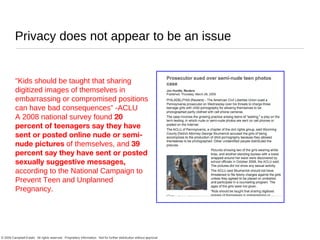
Privacy does not appear to be an issue "Kids should be taught that sharing digitized images of themselves in embarrassing or compromised positions can have bad consequences” -ACLU A 2008 national survey found  20 percent of teenagers say they have sent or posted online nude or semi-nude pictures  of themselves, and  39 percent say they have sent or posted sexually suggestive messages,  according to the National Campaign to Prevent Teen and Unplanned Pregnancy.
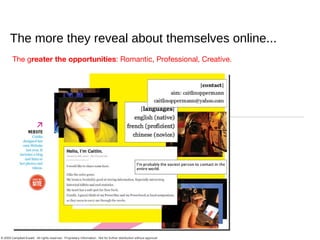
The more they reveal about themselves online... The g reater the opportunities : Romantic, Professional, Creative.
Adults don’t get kids They have no sense of shame. They have no sense of privacy.  They are show-offs, fame whores, pornographic little loons who post their diaries, their phone numbers, their stupid poetry - for God’s sake, their dirty photos! — online. They have virtual friends instead of real ones. They  talk illiterate instant messages. They are interested only in attention—and yet they have zero attention span, flitting like hummingbirds from one  virtual stage to another. Adult POV Source : NewYork magazine 2007
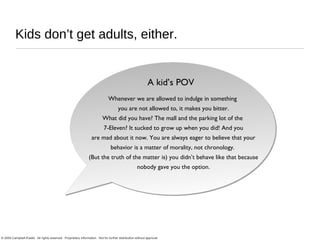
Kids don’t get adults, either. Whenever we are allowed to indulge in something  you are not allowed to, it makes you bitter. What did you have? The mall and the parking lot of the  7-Eleven? It sucked to grow up when you did! And you are mad about it now. You are always eager to believe that your behavior is a matter of morality, not chronology.  (But the truth of the matter is) you didn’t behave like that because nobody gave you the option. A kid’s POV
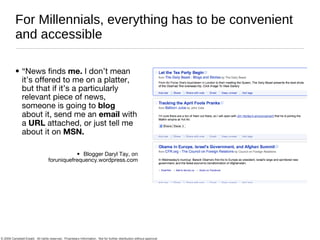
For Millennials, everything has to be convenient and accessible “News finds  me.  I don’t mean it’s offered to me on a platter, but that if it’s a particularly relevant piece of news, someone is going to  blog  about it, send me an  email  with a  URL  attached, or just tell me about it on  MSN. Blogger Daryl Tay, on foruniquefrequency.wordpress.com
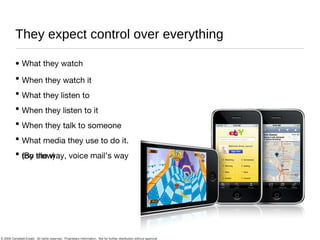
They expect control over everything What they watch When they watch it What they listen to When they listen to it When they talk to someone What media they use to do it. (By the way, voice mail’s way too slow)
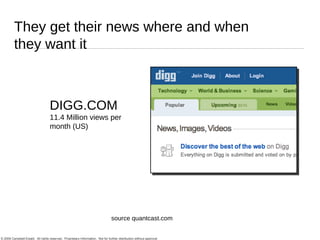
They get their news where and when they want it DIGG.COM 11.4 Million views per month (US) source quantcast.com
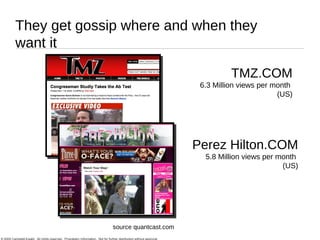
TMZ.COM 6.3 Million views per month  (US) source quantcast.com Perez Hilton.COM 5.8 Million views per month  (US) They get gossip where and when they want it
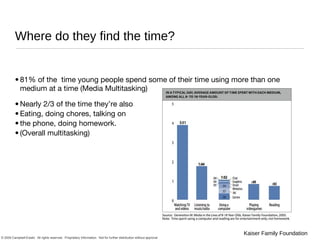
Where do they find the time? 81% of the  time young people spend some of their time using more than one medium at a time (Media Multitasking) Nearly 2/3 of the time they’re also Eating, doing chores, talking on the phone, doing homework.  (Overall multitasking) Kaiser Family Foundation
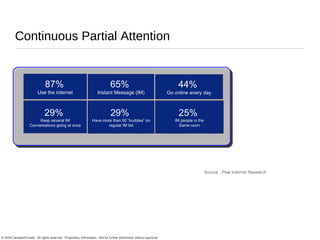
Continuous Partial Attention Source : Pew Internet Research 87%   Use the internet 65%  Instant Message (IM) 44%  Go online every day 29%   Keep several IM Conversations going at once 29%  Have more than 50 “buddies” on regular IM list 25%  IM people in the Same room
CPA in Action: While you’re doing your  homework , you’re  listening  to music on your iPod,  texting  two people at once, with the  tv  on in the background (a rerun, since you only have to pay half attention to it),  posting  on a friend’s  facebook  page,  twittering  your  followers  about an upcoming concert, and  talking  to your dorm mate who’s sitting on the bed next to you doing the same thing.
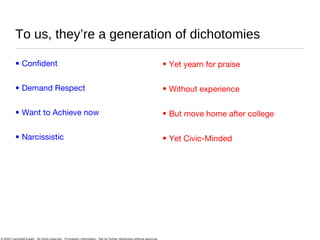
To us, they’re a generation of dichotomies Confident Demand Respect Want to Achieve now Narcissistic Yet yearn for praise Without experience But move home after college Yet Civic-Minded
Even X-ers are confused. “ Teenagers scare the living shit out of me” -My Chemical Romance

Teh Millennials Part I

  • 1.
  • 2.
    Teh Millennials. Who they are, what they’re like, how to manage them.
  • 3.
  • 4.
    Teh, Oh Noes,and Fail! are Internet Speak
  • 5.
  • 6.
    So who arethese millennials, anyway?
  • 7.
    A simple listof Generational cohorts Mature Generation Silent Generation Baby Boomer Generation Leading Edge Boomers Trailing Edge boomers Swing Generation WWII Generation The GI Generation The Me Generation Generation Jones Gen-X Thirteeners Millennials Gen-Y Echo Boomers IGen Cuspers WiiGeneration
  • 8.
    Definition I’m usingtoday Millennials are those born between 1982 and 2001. There are approximately 72.1 million of them.
  • 9.
    Face it, we’reold. For them, The Tonight Show has always been hosted by Jay Leno Balsamic vinegar has always been for sale in the US Offshore drilling has always been prohibited Electronic tax filing has always been available The Royal New Zealand Navy has never been permitted a daily ration of rum Beloit College Mindset List - Class of 2012
  • 10.
    What shaped them9/11 Oklahoma City Bombing Columbine High School Shooting Copycat shootings D.C. Sniper Digital technology
  • 11.
    Parent Advocacy Inthe decades right before and after the Millennium, Americans moved the spotlight onto kids and their families Protective parents tried to ensure that their children would grow up safely and be treated well This generation actually likes their parents, somewhat of a departure from previous generations When young people were asked whom they admired, ‘Mom and Dad’ were named most often © 2009 Campbell-Ewald. All rights reserved. Proprietary Information. Not for further distribution without approval .
  • 12.
    Families are important40% still live with their parents 64% say they turn to their parents for advice (more than any other age group) 73% received financial help from their parents during the past 12 months 64% said their parents have helped them out with errands, homework, and home repair. Pew Research Center, How Young People View Their Lives, Futures, And Politics , 2007 ncronline.org, Studies Put Millennials Under The Microscope , December 2007.
  • 13.
    The result hasincluded helicopter parents Who make frequent phone calls and send emails to school administrators regarding their children’s grades and academic progress; they attend job fairs, help write college admissions essays and sit in on campus interviews. (Not to mention moving them to campus, shopping at Target to decorate their rooms, or calling boot camp) They negotiate salaries and vacation time with HR managers
  • 14.
    They lead verystructured lives They’re shuttled from school to ballet class, to gymnastics, to soccer, to hockey, to music lessons, to play “dates” (nothing spontaneous, mind you).
  • 15.
    They’re the mostpraised generation Raised in an atmosphere that deemed self esteem as paramount. Everyone gets a trophy. No one “loses”. Everyone gets an “at bat” Warning over narcissistic pupils By Katherine Sellgren (3/16/09) BBC News, at the ASCL conference The growing expectation placed on schools and parents to boost pupils' self-esteem is breeding a generation of narcissists, an expert has warned. Dr Carol Craig said children were being over-praised and were developing an "all about me"mentality. She said teachers increasingly faced complaints from parents if their child failed a spelling test ordid not get a good part in the school pantomime. She told head teachers the self-esteem agenda, imported from the United States, was a "a big fashionable idea" that had gone too far.
  • 16.
    The expectation continuesinto college “ I tell my class that if they just do what they’re supposed to do, and meet the standard requirements, that they will earn a C. That is the default grade. They see the default grade as an A” Professor Marshall Grossman, The University of Maryland, 2/17/2009
  • 17.
    Yet, they’re extraordinarilyaccomplished. “ What kind of kid doesn’t get into Harvard? Well, there was the charming boy I interviewed with 1560 SATs. He did cancer research in the summer; played two instruments in three orchestras; and composed his own music. He redid the computer system for his student paper, loved to cook and was writing his own cookbook.” “ There was the girl who, during summer vacation, left her house before 7 each morning to make a two-hour train ride to a major university, where she worked all day doing cutting-edge research for NASA on weightlessness in mice.” “ These kids who don’t get into Harvard spend summers on schooners in Chesapeake Bay studying marine biology, building homes for the poor in Central America, touring Europe with all-star orchestras.” Source: Michael Winerip, The New York Times April 29, 2007 © 2009 Campbell-Ewald. All rights reserved. Proprietary Information. Not for further distribution without approval .
  • 18.
    They want toachieve quickly Think they’re only one step away from fame - particularly on the internet: (Think Tila Tequila) Live in very speeded up, always on, instant answer world.
  • 19.
    But are takinglonger to graduate from college Don’t seem in a hurry to begin careers Don’t want to “get on with their lives” independently
  • 20.
    Beyond that They’re Diverse They’re Digital They’re connected 24/7
  • 21.
    Diversity in factand attitudes
  • 22.
  • 23.
    Millennials are themost diverse generation in America About 40% of Millennials are of African American, Latino, Asian, or a racially mixed background. 81% of those over 65 identify themselves as Caucasian 20% have at least one immigrant parent There is no majority race in Hawaii or Houston or New York City or California. Washington Post, Make Way For The Millennials , yda.org, TRU research findings, IL
  • 24.
    “Have I readThe Great Gatsby? I am the Great Gatsby” - Sean “Puffy” Combs “You’re not really considered hip or “you’ve made it’ if you’re rolling with the same people.” - Nelly. “Pop culture today rallies around an ethic of multicultural inclusion that seems to value every identity - except whiteness”. - Hua Hsu, The Atlantic We share a diverse culture
  • 25.
    Black or AfricanAmerican is not a monolithic culture. Yankelovich has identified 11 distinct segments within black America “Connected black teens” - tech savvy, optimistic, less familiar with the overt bigotry of the past. 68% use the internet (vs 70% of the general population) There’s an even split on which moniker is preferred: 42% favor “black”, 44% favor “African-American.”
  • 26.
    An increasing senseof personal and national optimism. Barack Obama’s Presidency has given me more optimism about the future of this country : African-Americans 93% Hispanics 82% Non-Hispanic whites 62% Barack Obama’s Presidency has given me more optimism about my own personal future : African-Americans 87% Hispanics 79% Non-Hispanic Whites 55% MMS Recontact Survey February, 2009
  • 27.
    Hispanics share manycharacteristics with general population Highly involved parents Career-minded Technologically-minded Multi-tasker On-line US Navy Understanding HIspanics Millennials Research by Social Quest. April 2008
  • 28.
    Hispanics differ fromthe general population in some dimensions Parental influence is stronger College education is a privilege, not a commodity U.S. Immigration policies hit home Decisions include the family unit and heritage US Navy Understanding HIspanics Millennials Research by Social Quest. April 2008
  • 29.
    Net Result: Afusion lifestyle for all
  • 30.
    Millennials base friendshipon interests, not race. Closest Facebook friend may be from China
  • 31.
    95% of 18-29year olds approve of blacks and whites dating. 60% have dated someone of a different race. Washington Post, Make way for the Millennials, Gallup poll, 2006
  • 32.
    Everyone listens tohip hop Billboard Magazine, NY Times 3/23/09
  • 33.
    Salsa is morepopular than ketchup Ad Age
  • 34.
  • 35.
    Academy Award for Best Picture:
  • 36.
    Perhaps most importantly,they’re the first internet generation.
  • 37.
    This is adigital native
  • 38.
    This is you(and me)
  • 39.
    What does animmigrant do? Sticks his toes in the culture. You learn the culture from the outside in, but still retain large elements of your heritage: (like confusion over “summer camp”. You prefer face to face and telephone communication, relatively strict guarding of online privacy The vast majority of online adults use email and search engines They research and gather information Older generations do not typically engage with the internet past e-commerce Less than one-fifth of online adults older than Gen-X use Social Networks. Generations Online www.pewinternet.org
  • 40.
  • 41.
    The Digital Nativegrew up digital Today’s 18-year old: Was 1 year old when the CD-ROM was invented Was 5 when the internet entered almost every home Was 10 years old when Windows 98 was launched Was 13 when PlayStation 2, Gamecube, and Xbox were released. Gets an incorrect grade when identifying a typewriter as a “keyboard” on an I.Q. test. seattlepi.com Millennials Thrive on Choice
  • 42.
    90% of Americansbetween the ages 12-24 are online. - Generations Online in 2009, Pew Internet & American Life Project January 2009
  • 43.
    What does anative do? A native embraces the culture. In fact the culture and the native are inseparable. The native contributes to the culture, is completely at ease in the culture, and socializes openly and freely Millennials play games and enjoy online videos Engage in passive and active social media Uses Web 2.0 tools Creates Social Network profiles, writes blogs, etc.
  • 44.
  • 45.
    Privacy does notappear to be an issue "Kids should be taught that sharing digitized images of themselves in embarrassing or compromised positions can have bad consequences” -ACLU A 2008 national survey found 20 percent of teenagers say they have sent or posted online nude or semi-nude pictures of themselves, and 39 percent say they have sent or posted sexually suggestive messages, according to the National Campaign to Prevent Teen and Unplanned Pregnancy.
  • 46.
    The more theyreveal about themselves online... The g reater the opportunities : Romantic, Professional, Creative.
  • 47.
    Adults don’t getkids They have no sense of shame. They have no sense of privacy. They are show-offs, fame whores, pornographic little loons who post their diaries, their phone numbers, their stupid poetry - for God’s sake, their dirty photos! — online. They have virtual friends instead of real ones. They talk illiterate instant messages. They are interested only in attention—and yet they have zero attention span, flitting like hummingbirds from one virtual stage to another. Adult POV Source : NewYork magazine 2007
  • 48.
    Kids don’t getadults, either. Whenever we are allowed to indulge in something you are not allowed to, it makes you bitter. What did you have? The mall and the parking lot of the 7-Eleven? It sucked to grow up when you did! And you are mad about it now. You are always eager to believe that your behavior is a matter of morality, not chronology. (But the truth of the matter is) you didn’t behave like that because nobody gave you the option. A kid’s POV
  • 49.
    For Millennials, everythinghas to be convenient and accessible “News finds me. I don’t mean it’s offered to me on a platter, but that if it’s a particularly relevant piece of news, someone is going to blog about it, send me an email with a URL attached, or just tell me about it on MSN. Blogger Daryl Tay, on foruniquefrequency.wordpress.com
  • 50.
    They expect controlover everything What they watch When they watch it What they listen to When they listen to it When they talk to someone What media they use to do it. (By the way, voice mail’s way too slow)
  • 51.
    They get theirnews where and when they want it DIGG.COM 11.4 Million views per month (US) source quantcast.com
  • 52.
    TMZ.COM 6.3 Millionviews per month (US) source quantcast.com Perez Hilton.COM 5.8 Million views per month (US) They get gossip where and when they want it
  • 53.
    Where do theyfind the time? 81% of the time young people spend some of their time using more than one medium at a time (Media Multitasking) Nearly 2/3 of the time they’re also Eating, doing chores, talking on the phone, doing homework. (Overall multitasking) Kaiser Family Foundation
  • 54.
    Continuous Partial AttentionSource : Pew Internet Research 87% Use the internet 65% Instant Message (IM) 44% Go online every day 29% Keep several IM Conversations going at once 29% Have more than 50 “buddies” on regular IM list 25% IM people in the Same room
  • 55.
    CPA in Action:While you’re doing your homework , you’re listening to music on your iPod, texting two people at once, with the tv on in the background (a rerun, since you only have to pay half attention to it), posting on a friend’s facebook page, twittering your followers about an upcoming concert, and talking to your dorm mate who’s sitting on the bed next to you doing the same thing.
  • 56.
    To us, they’rea generation of dichotomies Confident Demand Respect Want to Achieve now Narcissistic Yet yearn for praise Without experience But move home after college Yet Civic-Minded
  • 57.
    Even X-ers areconfused. “ Teenagers scare the living shit out of me” -My Chemical Romance