Payment	
  Industry	
  Trends	
  for	
  
2016	
  
2015	
  was	
  a	
  historical	
  year	
  within	
  the	
  payments	
  industry	
  that	
  
held	
  numerous	
  events,	
  which	
  transformed	
  the	
  future	
  of	
  
payments.	
  	
  
Between	
  the	
  EMV	
  liability	
  shiD,	
  data	
  breach	
  protecEon,	
  mobile	
  
payments,	
  and	
  the	
  growth	
  of	
  mobile	
  wallets,	
  there	
  were	
  many	
  
significant	
  changes	
  that	
  took	
  place.	
  
The	
  payments	
  industry	
  is	
  evolving	
  rapidly	
  and	
  will	
  certainly	
  
conEnue	
  to	
  do	
  so	
  throughout	
  2016	
  as	
  well.	
  As	
  2016	
  
transpires,	
  here	
  are	
  some	
  of	
  the	
  top	
  trends	
  predicted	
  to	
  
make	
  an	
  impact	
  this	
  year:	
  
ConEnuaEon	
  of	
  EMV	
  
ImplementaEon	
  
October	
  1st	
  marked	
  the	
  start	
  of	
  the	
  
EMV	
  liability	
  shiD	
  in	
  the	
  United	
  States	
  
and	
  altered	
  the	
  regulaEons	
  in	
  regards	
  to	
  
card-­‐present	
  credit	
  card	
  fraud.	


With	
  EMV	
  now	
  in	
  full	
  swing,	
  this	
  form	
  of	
  
technology	
  will	
  be	
  a	
  great	
  soluEon	
  to	
  
shield	
  both	
  the	
  merchant	
  and	
  consumer	
  
against	
  possible	
  counterfeit	
  fraudulent	
  
transacEons.	


EMV	
  integraEon	
  will	
  take	
  Eme,	
  and	
  most	
  merchants	
  sEll	
  have	
  
yet	
  to	
  upgrade	
  their	
  terminals	
  to	
  EMV-­‐capable	
  products	
  despite	
  
the	
  mandated	
  liability	
  shiD.	
  
A	
  study	
  done	
  by	
  The	
  Strawhecker	
  Group	
  found	
  that	
  only	
  27	
  
percent	
  of	
  merchants	
  within	
  the	
  U.S.	
  were	
  EMV-­‐ready	
  as	
  of	
  
October	
  1st.	
  	
  
The	
  main	
  barriers	
  that	
  prevented	
  merchants	
  from	
  becoming	
  
EMV	
  compliant	
  in	
  Eme	
  for	
  the	
  liability	
  shiD	
  were	
  due	
  to	
  price	
  
and	
  lack	
  of	
  Eme	
  to	
  research	
  EMV	
  and	
  the	
  compaEble	
  
soluEons.	
  	
  
Likewise,	
  although	
  merchants	
  are	
  now	
  fully	
  responsible	
  for	
  
any	
  incidents	
  of	
  counterfeit	
  fraud,	
  many	
  are	
  sEll	
  not	
  
concerned	
  about	
  upgrading	
  their	
  terminals	
  right	
  away.	
  	
  
Several	
  merchants	
  may	
  not	
  upgrade	
  their	
  terminals	
  unEl	
  it	
  
comes	
  closer	
  to	
  the	
  Eme	
  when	
  they	
  need	
  to	
  renew	
  or	
  purchase	
  
new	
  terminals.	
  At	
  this	
  Eme,	
  merchants	
  may	
  feel	
  it	
  more	
  
worthwhile	
  to	
  go	
  ahead	
  and	
  invest	
  in	
  an	
  EMV	
  terminal	
  so	
  their	
  
business	
  stays	
  up-­‐to-­‐date	
  with	
  modern	
  security	
  and	
  technology.	


2016	
  will	
  be	
  a	
  prime	
  year	
  where	
  many	
  merchants	
  will	
  make	
  the	
  
switch	
  to	
  EMV	
  technology	
  as	
  it	
  becomes	
  more	
  widespread	
  and	
  
prevalent.	
  	
  
Increase	
  of	
  Mobile	
  
Wallets	
  
With	
  the	
  rise	
  of	
  mobile	
  payment	
  
acceptance,	
  consumers	
  are	
  now	
  
beginning	
  to	
  uElize	
  their	
  smartphones	
  
to	
  make	
  purchases.	
  	
  
Mobile	
  wallets	
  are	
  one	
  alternaEve	
  
payment	
  opEon	
  that	
  has	
  become	
  
increasingly	
  popular	
  amongst	
  
consumers.	
  
A	
  study	
  done	
  by	
  eMarketer	
  found	
  that	
  mobile	
  payment	
  
transacEons	
  are	
  forecasted	
  to	
  grow	
  210%	
  during	
  2016.	
  	
  
In	
  2014,	
  Apple	
  introduced	
  Apple	
  Pay	
  as	
  the	
  first	
  mainstream	
  
mobile	
  wallet	
  that	
  provided	
  a	
  safe	
  and	
  fast	
  alternaEve	
  for	
  
payments.	
  By	
  the	
  end	
  of	
  2015,	
  all	
  of	
  the	
  major	
  smartphone	
  
manufacturers	
  had	
  developed	
  a	
  mobile	
  wallet	
  –	
  including	
  
Android	
  Pay	
  and	
  Samsung	
  Pay	
  in	
  addiEon	
  to	
  Apple	
  Pay.	
  	
  
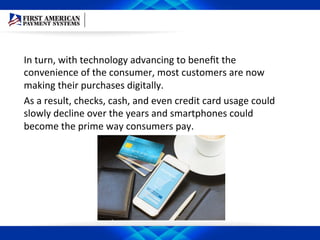
In	
  turn,	
  with	
  technology	
  advancing	
  to	
  benefit	
  the	
  
convenience	
  of	
  the	
  consumer,	
  most	
  customers	
  are	
  now	
  
making	
  their	
  purchases	
  digitally.	
  	
  
As	
  a	
  result,	
  checks,	
  cash,	
  and	
  even	
  credit	
  card	
  usage	
  could	
  
slowly	
  decline	
  over	
  the	
  years	
  and	
  smartphones	
  could	
  
become	
  the	
  prime	
  way	
  consumers	
  pay.	
  	
  
Growth	
  of	
  NFC	
  	
  
As	
  mobile	
  wallets	
  have	
  expanded	
  
recently,	
  so	
  has	
  the	
  need	
  for	
  Near-­‐Field	
  
CommunicaEon	
  (NFC).	
  	
  
NFC	
  is	
  a	
  method	
  of	
  contactless	
  
communicaEon	
  and	
  data	
  exchange	
  
between	
  electronic	
  devices,	
  like	
  
smartphones,	
  to	
  other	
  devices	
  like	
  
credit	
  card	
  terminals.	
  	
  
NFC	
  is	
  not	
  only	
  a	
  valuable	
  soluEon	
  for	
  consumers,	
  but	
  for	
  
businesses	
  as	
  well,	
  and	
  has	
  already	
  begun	
  emerging	
  at	
  in-­‐store	
  
counters,	
  vending	
  machines,	
  and	
  EckeEng	
  booths.	


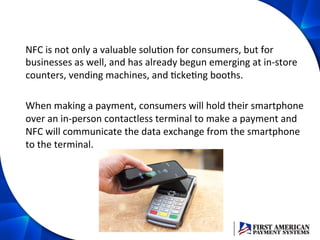
When	
  making	
  a	
  payment,	
  consumers	
  will	
  hold	
  their	
  smartphone	
  
over	
  an	
  in-­‐person	
  contactless	
  terminal	
  to	
  make	
  a	
  payment	
  and	
  
NFC	
  will	
  communicate	
  the	
  data	
  exchange	
  from	
  the	
  smartphone	
  
to	
  the	
  terminal.	
  
NFC’s	
  vast	
  list	
  of	
  where	
  and	
  when	
  it	
  can	
  be	
  used	
  is	
  highly	
  
appealing	
  and	
  is	
  addiEonally	
  being	
  coupled	
  with	
  EMV	
  
terminals,	
  making	
  it	
  even	
  more	
  accessible.	
  	
  
NFC	
  is	
  unquesEonably	
  evolving	
  the	
  way	
  consumers	
  acEvate	
  
and	
  pay	
  for	
  transacEons	
  and	
  2016	
  will	
  be	
  a	
  big	
  year	
  for	
  NFC	
  
popularity.	
  
Emergence	
  of	
  Blockchain	
  
Technology	
  	
  
Blockchain	
  technology	
  is	
  predicted	
  to	
  
break	
  out	
  in	
  the	
  payment	
  industry	
  
during	
  2016.	
  	
  
Blockchain	
  is	
  a	
  type	
  of	
  database	
  on	
  
which	
  bitcoin	
  is	
  based	
  off,	
  where	
  every	
  
bitcoin	
  transacEon	
  is	
  documented.	
  	
  
It	
  is	
  comprised	
  of	
  a	
  vast	
  series	
  of	
  data	
  blocks,	
  where	
  one	
  or	
  
mulEple	
  transacEons	
  are	
  combined,	
  encrypted,	
  and	
  stored	
  in	
  a	
  
secure	
  way.	
  	
  
With	
  blockchain,	
  transacEons	
  are	
  processed	
  quicker	
  and	
  are	
  
cost-­‐effecEve.	
  	
  
It	
  is	
  safe	
  to	
  say	
  that	
  2016	
  is	
  foreseen	
  to	
  be	
  an	
  evenaul	
  year,	
  
as	
  new	
  trends	
  emerge	
  and	
  recent	
  trends	
  conEnue	
  to	
  grow.	
  	
  
EMV	
  will	
  conEnue	
  to	
  be	
  implemented	
  within	
  businesses	
  and	
  
many	
  merchants	
  will	
  begin	
  to	
  upgrade	
  their	
  soluEons	
  to	
  
become	
  EMV	
  capable.	
  	
  
Mobile	
  wallets	
  will	
  addiEonally	
  expand	
  and	
  become	
  more	
  
prominent	
  within	
  digital	
  payments	
  and	
  the	
  need	
  for	
  NFC	
  
technology	
  will	
  also	
  become	
  more	
  prevalent.	
  	
  
Blockchain	
  technology,	
  a	
  newer	
  trend,	
  is	
  expected	
  to	
  make	
  
an	
  impact	
  during	
  the	
  New	
  Year	
  as	
  well.	
  
Here’s	
  to	
  2016	
  and	
  the	
  future	
  of	
  payments!	


Contact	
  First	
  American	
  Payment	
  Systems	
  to	
  integrate	
  payment	
  
processing	
  today.	


Payment Industry Trends for 2016

  • 1.
  • 2.
    2015  was  a  historical  year  within  the  payments  industry  that   held  numerous  events,  which  transformed  the  future  of   payments.     Between  the  EMV  liability  shiD,  data  breach  protecEon,  mobile   payments,  and  the  growth  of  mobile  wallets,  there  were  many   significant  changes  that  took  place.  
  • 3.
    The  payments  industry  is  evolving  rapidly  and  will  certainly   conEnue  to  do  so  throughout  2016  as  well.  As  2016   transpires,  here  are  some  of  the  top  trends  predicted  to   make  an  impact  this  year:  
  • 4.
    ConEnuaEon  of  EMV   ImplementaEon   October  1st  marked  the  start  of  the   EMV  liability  shiD  in  the  United  States   and  altered  the  regulaEons  in  regards  to   card-­‐present  credit  card  fraud.       With  EMV  now  in  full  swing,  this  form  of   technology  will  be  a  great  soluEon  to   shield  both  the  merchant  and  consumer   against  possible  counterfeit  fraudulent   transacEons.        
  • 5.
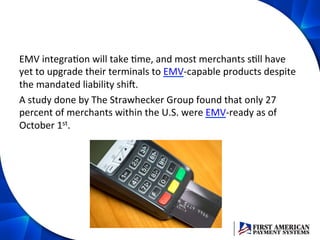
    EMV  integraEon  will  take  Eme,  and  most  merchants  sEll  have   yet  to  upgrade  their  terminals  to  EMV-­‐capable  products  despite   the  mandated  liability  shiD.   A  study  done  by  The  Strawhecker  Group  found  that  only  27   percent  of  merchants  within  the  U.S.  were  EMV-­‐ready  as  of   October  1st.    
  • 6.
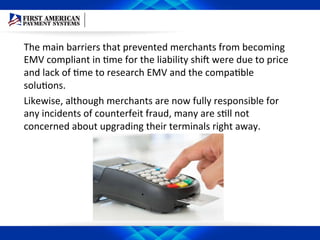
    The  main  barriers  that  prevented  merchants  from  becoming   EMV  compliant  in  Eme  for  the  liability  shiD  were  due  to  price   and  lack  of  Eme  to  research  EMV  and  the  compaEble   soluEons.     Likewise,  although  merchants  are  now  fully  responsible  for   any  incidents  of  counterfeit  fraud,  many  are  sEll  not   concerned  about  upgrading  their  terminals  right  away.    
  • 7.
    Several  merchants  may  not  upgrade  their  terminals  unEl  it   comes  closer  to  the  Eme  when  they  need  to  renew  or  purchase   new  terminals.  At  this  Eme,  merchants  may  feel  it  more   worthwhile  to  go  ahead  and  invest  in  an  EMV  terminal  so  their   business  stays  up-­‐to-­‐date  with  modern  security  and  technology.       2016  will  be  a  prime  year  where  many  merchants  will  make  the   switch  to  EMV  technology  as  it  becomes  more  widespread  and   prevalent.    
  • 8.
    Increase  of  Mobile   Wallets   With  the  rise  of  mobile  payment   acceptance,  consumers  are  now   beginning  to  uElize  their  smartphones   to  make  purchases.     Mobile  wallets  are  one  alternaEve   payment  opEon  that  has  become   increasingly  popular  amongst   consumers.  
  • 9.
    A  study  done  by  eMarketer  found  that  mobile  payment   transacEons  are  forecasted  to  grow  210%  during  2016.    
  • 10.
    In  2014,  Apple  introduced  Apple  Pay  as  the  first  mainstream   mobile  wallet  that  provided  a  safe  and  fast  alternaEve  for   payments.  By  the  end  of  2015,  all  of  the  major  smartphone   manufacturers  had  developed  a  mobile  wallet  –  including   Android  Pay  and  Samsung  Pay  in  addiEon  to  Apple  Pay.    
  • 11.
    In  turn,  with  technology  advancing  to  benefit  the   convenience  of  the  consumer,  most  customers  are  now   making  their  purchases  digitally.     As  a  result,  checks,  cash,  and  even  credit  card  usage  could   slowly  decline  over  the  years  and  smartphones  could   become  the  prime  way  consumers  pay.    
  • 12.
    Growth  of  NFC     As  mobile  wallets  have  expanded   recently,  so  has  the  need  for  Near-­‐Field   CommunicaEon  (NFC).     NFC  is  a  method  of  contactless   communicaEon  and  data  exchange   between  electronic  devices,  like   smartphones,  to  other  devices  like   credit  card  terminals.    
  • 13.
    NFC  is  not  only  a  valuable  soluEon  for  consumers,  but  for   businesses  as  well,  and  has  already  begun  emerging  at  in-­‐store   counters,  vending  machines,  and  EckeEng  booths.       When  making  a  payment,  consumers  will  hold  their  smartphone   over  an  in-­‐person  contactless  terminal  to  make  a  payment  and   NFC  will  communicate  the  data  exchange  from  the  smartphone   to  the  terminal.  
  • 14.
    NFC’s  vast  list  of  where  and  when  it  can  be  used  is  highly   appealing  and  is  addiEonally  being  coupled  with  EMV   terminals,  making  it  even  more  accessible.     NFC  is  unquesEonably  evolving  the  way  consumers  acEvate   and  pay  for  transacEons  and  2016  will  be  a  big  year  for  NFC   popularity.  
  • 15.
    Emergence  of  Blockchain   Technology     Blockchain  technology  is  predicted  to   break  out  in  the  payment  industry   during  2016.     Blockchain  is  a  type  of  database  on   which  bitcoin  is  based  off,  where  every   bitcoin  transacEon  is  documented.    
  • 16.
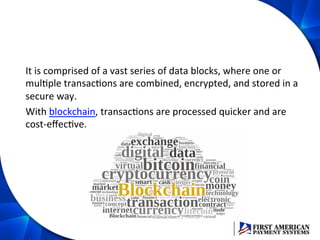
    It  is  comprised  of  a  vast  series  of  data  blocks,  where  one  or   mulEple  transacEons  are  combined,  encrypted,  and  stored  in  a   secure  way.     With  blockchain,  transacEons  are  processed  quicker  and  are   cost-­‐effecEve.    
  • 17.
    It  is  safe  to  say  that  2016  is  foreseen  to  be  an  evenaul  year,   as  new  trends  emerge  and  recent  trends  conEnue  to  grow.     EMV  will  conEnue  to  be  implemented  within  businesses  and   many  merchants  will  begin  to  upgrade  their  soluEons  to   become  EMV  capable.     Mobile  wallets  will  addiEonally  expand  and  become  more   prominent  within  digital  payments  and  the  need  for  NFC   technology  will  also  become  more  prevalent.     Blockchain  technology,  a  newer  trend,  is  expected  to  make   an  impact  during  the  New  Year  as  well.  
  • 18.
    Here’s  to  2016  and  the  future  of  payments!     Contact  First  American  Payment  Systems  to  integrate  payment   processing  today.