Stephanie Anderson
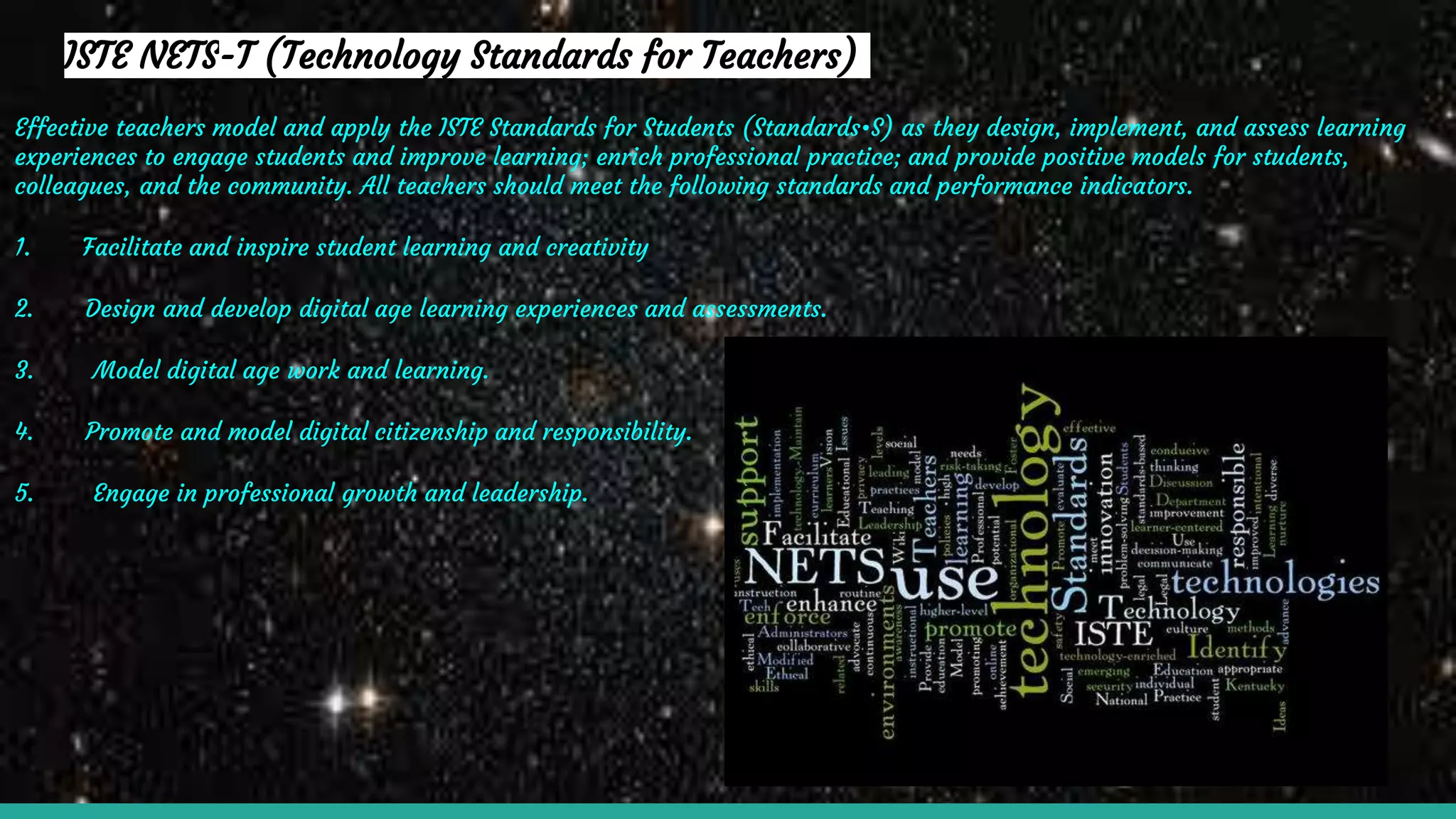
ISTE NETS-T (Technology Standards for Teachers)
Effective teachers model and apply the ISTE Standards for Students (Standards•S) as they design, implement, and assess learning
experiences to engage students and improve learning; enrich professional practice; and provide positive models for students,
colleagues, and the community. All teachers should meet the following standards and performance indicators.
1. Facilitate and inspire student learning and creativity
2. Design and develop digital age learning experiences and assessments.
3. Model digital age work and learning.
4. Promote and model digital citizenship and responsibility.
5. Engage in professional growth and leadership.
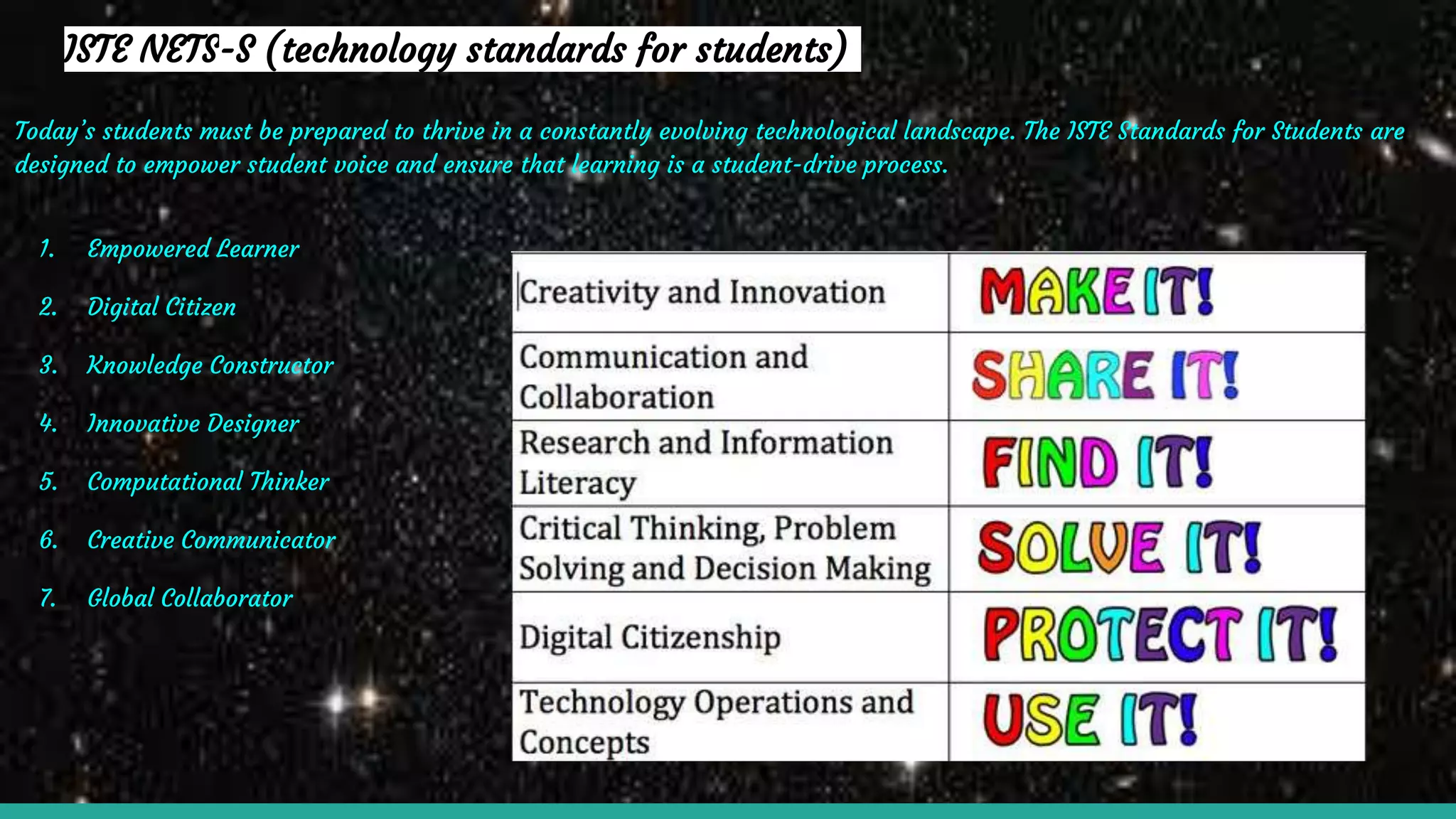
ISTE NETS-S (technology standards for students)
Today’s students must be prepared to thrive in a constantly evolving technological landscape. The ISTE Standards for Students are
designed to empower student voice and ensure that learning is a student-drive process.
1. Empowered Learner
2. Digital Citizen
3. Knowledge Constructor
4. Innovative Designer
5. Computational Thinker
6. Creative Communicator
7. Global Collaborator
NC Essential Standards - Information & Technology Skills
These standards are critical building blocks for the education of our students. ITES represent the "must have" information and technology skills and knowledge
that each student must have in order to achieve success at the next level. The standards are designed to be delivered by classroom teachers in all curricular
areas and grade levels. As the ITES are taught throughout all classrooms and across all curricular areas, it is essential that classroom teachers collaborate
with media coordinators and technology facilitators in delivering this instruction. Media coordinators and technology facilitators should be active participants
in grade level and/or curricular area planning groups as these teams analyze student data, identify learning goals, plan and deliver instruction, and assess
student progress.
Standards and Clarifying Objectives are in the format:
AA = Two-digit alphabetic code for K-12 Essential Standard
B = Grade Level (HS = 9-12)
C = Objective number
SI: Sources of Information
IN: Informational Text
TT: Technology as a Tool
RP: Research Process
SE: Safety and Ethical Issues
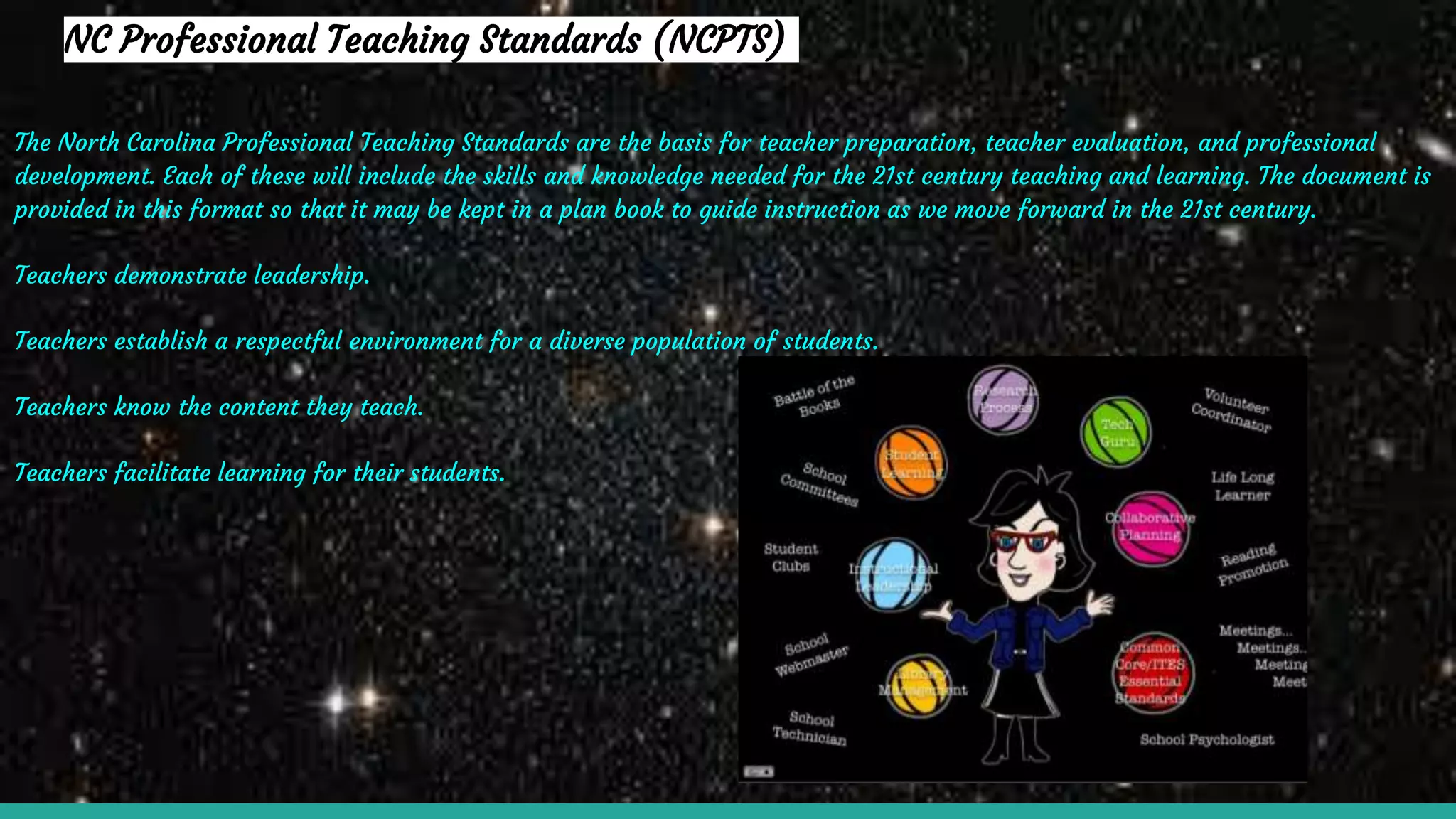
NC Professional Teaching Standards (NCPTS)
The North Carolina Professional Teaching Standards are the basis for teacher preparation, teacher evaluation, and professional
development. Each of these will include the skills and knowledge needed for the 21st century teaching and learning. The document is
provided in this format so that it may be kept in a plan book to guide instruction as we move forward in the 21st century.
Teachers demonstrate leadership.
Teachers establish a respectful environment for a diverse population of students.
Teachers know the content they teach.
Teachers facilitate learning for their students.
inTASC Standards
The Learner and the Learning
Standard #1 Learner Development
Standard #2 Learning Differences
Standard #3 Learning Environments
Content Knowledge
Standard #4 Content Knowledge
Standard #5 Application of Content
Instructional Practice
Standard #6 Assessment
Standard #7 Planning for Instruction
Standard #8 Instructional Strategies
Professional Responsibility
CAEP Standards (Council for the Accreditation of Educator Preparation)
Standard 1. Content and Pedagogical Knowledge
Standard 2. Clinical Partnerships and Practice
Standard 3. Candidate Quality, Recruitment, and Selectivity
Standard 4. Program Impact
Standard 5. Provider Quality Assurance and Continuous Improvement

Technology standards

  • 1.
  • 2.
    ISTE NETS-T (TechnologyStandards for Teachers) Effective teachers model and apply the ISTE Standards for Students (Standards•S) as they design, implement, and assess learning experiences to engage students and improve learning; enrich professional practice; and provide positive models for students, colleagues, and the community. All teachers should meet the following standards and performance indicators. 1. Facilitate and inspire student learning and creativity 2. Design and develop digital age learning experiences and assessments. 3. Model digital age work and learning. 4. Promote and model digital citizenship and responsibility. 5. Engage in professional growth and leadership.
  • 3.
    ISTE NETS-S (technologystandards for students) Today’s students must be prepared to thrive in a constantly evolving technological landscape. The ISTE Standards for Students are designed to empower student voice and ensure that learning is a student-drive process. 1. Empowered Learner 2. Digital Citizen 3. Knowledge Constructor 4. Innovative Designer 5. Computational Thinker 6. Creative Communicator 7. Global Collaborator
  • 4.
    NC Essential Standards- Information & Technology Skills These standards are critical building blocks for the education of our students. ITES represent the "must have" information and technology skills and knowledge that each student must have in order to achieve success at the next level. The standards are designed to be delivered by classroom teachers in all curricular areas and grade levels. As the ITES are taught throughout all classrooms and across all curricular areas, it is essential that classroom teachers collaborate with media coordinators and technology facilitators in delivering this instruction. Media coordinators and technology facilitators should be active participants in grade level and/or curricular area planning groups as these teams analyze student data, identify learning goals, plan and deliver instruction, and assess student progress. Standards and Clarifying Objectives are in the format: AA = Two-digit alphabetic code for K-12 Essential Standard B = Grade Level (HS = 9-12) C = Objective number SI: Sources of Information IN: Informational Text TT: Technology as a Tool RP: Research Process SE: Safety and Ethical Issues
  • 5.
    NC Professional TeachingStandards (NCPTS) The North Carolina Professional Teaching Standards are the basis for teacher preparation, teacher evaluation, and professional development. Each of these will include the skills and knowledge needed for the 21st century teaching and learning. The document is provided in this format so that it may be kept in a plan book to guide instruction as we move forward in the 21st century. Teachers demonstrate leadership. Teachers establish a respectful environment for a diverse population of students. Teachers know the content they teach. Teachers facilitate learning for their students.
  • 6.
    inTASC Standards The Learnerand the Learning Standard #1 Learner Development Standard #2 Learning Differences Standard #3 Learning Environments Content Knowledge Standard #4 Content Knowledge Standard #5 Application of Content Instructional Practice Standard #6 Assessment Standard #7 Planning for Instruction Standard #8 Instructional Strategies Professional Responsibility
  • 7.
    CAEP Standards (Councilfor the Accreditation of Educator Preparation) Standard 1. Content and Pedagogical Knowledge Standard 2. Clinical Partnerships and Practice Standard 3. Candidate Quality, Recruitment, and Selectivity Standard 4. Program Impact Standard 5. Provider Quality Assurance and Continuous Improvement

Editor's Notes

  • #3 Effective teachers model and apply the ISTE Standards for Students (Standards•S) as they design, implement, and assess learning experiences to engage students and improve learning; enrich professional practice; and provide positive models for students, colleagues, and the community. All teachers should meet the following standards and performance indicators. 1. Facilitate and inspire student learning and creativity. a. Teachers use their knowledge of subject matter, teaching and learning, and technology to facilitate experiences that advance student learning, creativity, and innovation in both face-to-face and virtual environments. 2. Design and develop digital age learning experiences and assessments. a. Teachers design, develop, and evaluate authentic learning experiences and assessments incorporating contemporary tools and resources to maximize content learning in context and to develop the knowledge, skills, and attitudes identified in the Standards•S. 3. Model digital age work and learning. a. Teachers exhibit knowledge, skills, and work processes representative of an innovative professional in a global and digital society 4. Promote and model digital citizenship and responsibility. a. Teachers understand local and global societal issues and responsibilities in an evolving digital culture and exhibit legal and ethical behavior in their professional practices. 5. Engage in professional growth and leadership. a. Teachers continuously improve their professional practice, model lifelong learning, and exhibit leadership in their school and professional community by promoting and demonstrating the effective use of digital tools and resources.
  • #4 Today’s students must be prepared to thrive in a constantly evolving technological landscape. The ISTE Standards for Students are designed to empower student voice and ensure that learning is a student-driven process. All students should meet the following standards and performance indicators. 1. Empowered Learner a. Students leverage technology to take an active role in choosing, achieving and demonstrating competency in their learning goals, informed by the learning sciences. 2. Digital Citizen a. Students recognize the rights, responsibilities and opportunities of living, learning and working in an interconnected digital world, and they act and model in ways that are safe, legal and ethical. 3. Knowledge Constructor a. Students critically curate a variety of resources using digital tools to construct knowledge, produced creative artifacts and make meaningful learning experiences for themselves and others. 4. Innovative Designer a. Students use a variety of technologies within a design process to identify and solve problems by creating new, useful or imaginative solutions. 5. Computational Thinker a. Students develop and employ strategies for understanding and solving problems in ways that leverage the power of technological methods to develop and test solutions. 6. Creative Communicator a. Students communicate clearly and express themselves creatively for a variety of purposes using the platforms, tools, styles, formats and digital media appropriate to their goals. 7. Global Collaborator a. Students use digital tools to broaden their perspectives and enrich their learning by collaborating with others and working effectively in teams locally and globally.
  • #5 These standards are critical building blocks for the education of our students. ITES represent the "must have" information and technology skills and knowledge that each student must have in order to achieve success at the next level. The standards are designed to be delivered by classroom teachers in all curricular areas and grade levels. As the ITES are taught throughout all classrooms and across all curricular areas, it is essential that classroom teachers collaborate with media coordinators and technology facilitators in delivering this instruction. Media coordinators and technology facilitators should be active participants in grade level and/or curricular area planning groups as these teams analyze student data, identify learning goals, plan and deliver instruction, and assess student progress. Standards and Clarifying Objectives are in the format: AA = Two-digit alphabetic code for K-12 Essential Standard B = Grade Level (HS = 9-12) C = Objective number SI: Sources of Information IN: Informational Text TT: Technology as a Tool RP: Research Process SE: Safety and Ethical Issues The website http://www.ncpublicschools.org/docs/dtl/standards/ites/grade-k.pdf explains it in more detail and gives you the clarifying objectives for each.
  • #6 NCPTS.I - Teachers demonstrate leadership. NCPTS.I.a - Teachers lead in their classrooms. NCPTS.I.b - Teachers demonstrate leadership in the school. NCPTS.I.c - Teachers lead the teaching profession. NCPTS.I.d - Teachers advocate for schools and students. NCPTS.I.e - Teachers demonstrate high ethical standards. NCPTS.II - Teachers establish a respectful environment for a diverse population of students. NCPTS.II.a - Teachers provide an environment in which each child has a positive, nurturing relationship with caring adults. NCPTS.II.b - Teachers embrace diversity in the school community and in the world. NCPTS.II.c - Teachers treat students as individuals. NCPTS.II.d - Teachers adapt their teaching for the benefit of students with special needs. NCPTS.II.e - Teachers work collaboratively with the families and significant adults in the lives of their students. NCPTS.III - Teachers know the content they teach. NCPTS.III.a - Teachers align their instruction with the North Carolina Standard Course of Study. NCPTS.III.b - Teachers know the content appropriate to their teaching specialty. NCPTS.III.c - Teachers recognize the interconnectedness of content areas/disciplines. NCPTS.III.d - Teachers make instruction relevant to students. NCPTS.IV - Teachers facilitate learning for their students. NCPTS.IV.a - Teachers know the ways in which learning takes place, and they know the appropriate levels of intellectual, physical, social, and emotional development of their students. NCPTS.IV.b - Teachers plan instruction appropriate for their students. NCPTS.IV.c - Teachers use a variety of instructional methods. NCPTS.IV.d - Teachers integrate and utilize technology in their instruction. NCPTS.IV.e - Teachers help students develop critical-thinking and problem-solving skills. NCPTS.IV.f - Teachers help students work in teams and develop leadership qualities. NCPTS.IV.g - Teachers communicate effectively. NCPTS.IV.h - Teachers use a variety of methods to assess what each student has learned.
  • #7 Standard #1: Learner Development. The teacher understands how learners grow and develop, recognizing that patterns of learning and development vary individually within and across the cognitive, linguistic, social, emotional, and physical areas, and designs and implements developmentally appropriate and challenging learning experiences. Standard #2: Learning Differences. The teacher uses understanding of individual differences and diverse cultures and communities to ensure inclusive learning environments that enable each learner to meet high standards. Standard #3: Learning Environments. The teacher works with others to create environments that support individual and collaborative learning, and that encourage positive social interaction, active engagement in learning, and self motivation. Standard #4: Content Knowledge. The teacher understands the central concepts, tools of inquiry, and structures of the discipline(s) he or she teaches and creates learning experiences that make the discipline accessible and meaningful for learners to assure mastery of the content. Standard #5: Application of Content. The teacher understands how to connect concepts and use differing perspectives to engage learners in critical thinking, creativity, and collaborative problem solving related to authentic local and global issues. Standard #6: Assessment. The teacher understands and uses multiple methods of assessment to engage learners in their own growth, to monitor learner progress, and to guide the teacher’s and learner’s decision making. Standard #7: Planning for Instruction. The teacher plans instruction that supports every student in meeting rigorous learning goals by drawing upon knowledge of content areas, curriculum, cross-disciplinary skills, and pedagogy, as well as knowledge of learners and the community context. Standard #8: Instructional Strategies. The teacher understands and uses a variety of instructional strategies to encourage learners to develop deep understanding of content areas and their connections, and to build skills to apply knowledge in meaningful ways. Standard #9: Professional Learning and Ethical Practice. The teacher engages in ongoing professional learning and uses evidence to continually evaluate his/her practice, particularly the effects of his/her choices and actions on others (learners, families, other professionals, and the community), and adapts practice to meet the needs of each learner. Standard #10: Leadership and Collaboration. The teacher seeks appropriate leadership roles and opportunities to take responsibility for student learning, to collaborate with learners, families, colleagues, other school professionals, and community members to ensure learner growth, and to advance the profession.
  • #8 Standard 1. Content and Pedagogical Knowledge The provider ensures that candidates develop a deep understanding of the critical concepts and principles of their discipline and, by completion, are able to use discipline-specific practices flexibly to advance the learning of all students toward attainment of college- and career-readiness standards. Standard 2. Clinical Partnerships and Practice The provider ensures that effective partnerships and high-quality clinical practice are central to preparation so that candidates develop the knowledge,skills, and professional dispositions necessary to demonstrate positive impact on all P-12 students’ learning and development. Standard 3. Candidate Quality, Recruitment, and Selectivity The provider demonstrates that the quality of candidates is a continuing and purposeful part of its responsibility from recruitment, at admission, through the progression of courses and clinical experiences, and to decisions that completers are prepared to teach effectively and are recommended for certification. The provider demonstrates that development of candidate quality is the goal of educator preparation in all phases of the program. This process is ultimately determined by a program’s meeting of Standard 4. Standard 4. Program Impact The provider demonstrates the impact of its completers on P-12 student learning and development, classroom instruction, and schools, and the satisfaction of its completers with the relevance and effectiveness of their preparation. Standard 5. Provider Quality Assurance and Continuous Improvement The provider maintains a quality assurance system comprised of valid data from multiple measures, including evidence of candidates’ and completers’ positive impact on P-12 student learning and development. The provider supports continuous improvement that is sustained and evidence-based, and that evaluates the effectiveness of its completers. The provider uses the results of inquiry and data collection to establish priorities, enhance program elements and capacity, and test innovations to improve completers’ impact on P-12 student learning and development. The following website goes into more details: http://caepnet.org/~/media/Files/caep/standards/caep-standards-one-pager-061716.pdf?la=en