PARLE PRODUCTS
INTRODUCTION
• Largest Manufacturer’s of Biscuits & Confectionaries almost 80years.
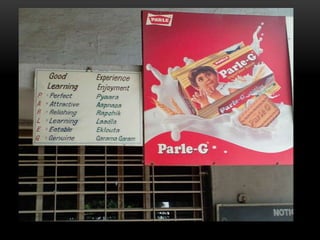
• Parle itself symbolizes quality, nutrition & great taste.
• Most of Parle product are Market Leaders.
• Available Everywhere.
• Beacon of faith & trust for the consumers.
• Great strength is extremely widespread distribution network.
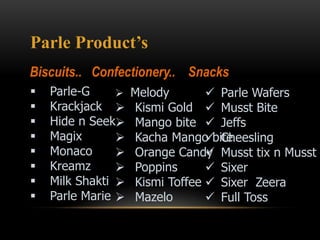
Parle Product’s
Biscuits.. Confectionery.. Snacks
 Parle-G
 Krackjack
 Hide n Seek
 Magix
 Monaco
 Kreamz
 Milk Shakti
 Parle Marie
 Melody
 Kismi Gold
 Mango bite
 Kacha Mango bite
 Orange Candy
 Poppins
 Kismi Toffee
 Mazelo
 Parle Wafers
 Musst Bite
 Jeffs
 Cheesling
 Musst tix n Musst
 Sixer
 Sixer Zeera
 Full Toss
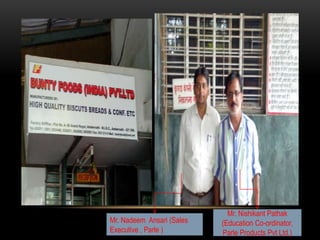
Mr. Nishikant Pathak
(Education Co-ordinator,
Parle Products Pvt Ltd.)
Mr. Nadeem Ansari (Sales
Executive , Parle )
• Skim Milk Powder
• Leaving Agents
• Salt
• Emulsifiers
• SMBS
• Flavors
• Citric Acid
• Wheat Flour (Maida)
• Fat (RBD Palm Oil)]
• Sugar
• Invert Sugar Syrup
• Water
INGREDIENTS
Major Minor
• Maida– Soft wheat flour is required, as it gives more tender biscuit than hard
wheat flour.
• RBD Palm oil–
 Helps in reducing toughness of dough,
 Provide sensory (moistness, shortness, crispness & crunchiness)
 Protects Flavor
• Sugar– Quantity and Crystal Size of Sugar has big influence on biscuit texture
and dimension. Improves the flavor and makes biscuit hard
• Invert Sugar Syrup– Helps to give color, flavor & decrease crystallization.
• Water– One of important ingredient used in almost all processes.
• Skim Milk Powder– To subtle the flavor and textural improvements and to aid
surface colouring.
• Leaving Agents
 Ammonia Bi-Carbonate
 Sodium Bi-Carbonate
 Salt
 Emulsifiers
Lecithin or Finamul
 Sodium Meta Bi-Sulphate (SMBS)
 Flavors
 Citric Acid
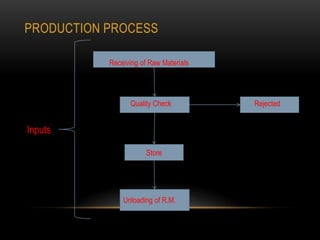
PRODUCTION PROCESS
Store
Receiving of Raw Materials
Quality Check Rejected
Unloading of R.M.
Inputs
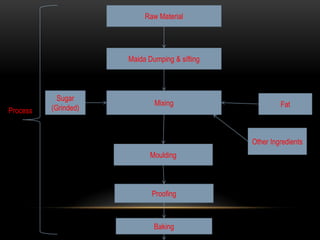
Raw Material
Maida Dumping & sifting
Mixing Fat
Sugar
(Grinded)
Other Ingredients
Moulding
Proofing
Baking
Process
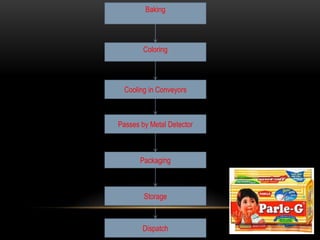
Cooling in Conveyors
Passes by Metal Detector
Packaging
Storage
Dispatch
Baking
Coloring
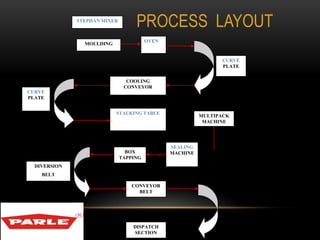
STEPHAN MIXER
MOULDING
OVEN
COOLING
CONVEYOR
STALKING TABLE
CURVE
PLATE
CURVE
PLATE
MULTIPACK
MACHINE
SEALING
MACHINEBOX
TAPPING
DIVERSION
BELT
CONVEYOR
BELT
DISPATCH
SECTION
PROCESS LAYOUT
PROCESSES
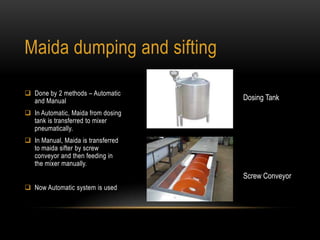
Maida dumping and sifting
 Done by 2 methods – Automatic
and Manual
 In Automatic, Maida from dosing
tank is transferred to mixer
pneumatically.
 In Manual, Maida is transferred
to maida sifter by screw
conveyor and then feeding in
the mixer manually.
 Now Automatic system is used
Screw Conveyor
Dosing Tank
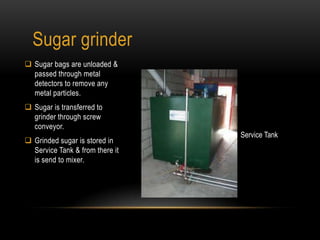
Sugar grinder
 Sugar bags are unloaded &
passed through metal
detectors to remove any
metal particles.
 Sugar is transferred to
grinder through screw
conveyor.
 Grinded sugar is stored in
Service Tank & from there it
is send to mixer.
Service Tank
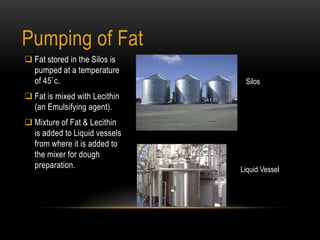
Pumping of Fat
 Fat stored in the Silos is
pumped at a temperature
of 45`c.
 Fat is mixed with Lecithin
(an Emulsifying agent).
 Mixture of Fat & Lecithin
is added to Liquid vessels
from where it is added to
the mixer for dough
preparation.
Silos
Liquid Vessel
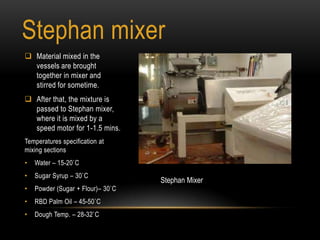
Stephan mixer
 Material mixed in the
vessels are brought
together in mixer and
stirred for sometime.
 After that, the mixture is
passed to Stephan mixer,
where it is mixed by a
speed motor for 1-1.5 mins.
Temperatures specification at
mixing sections
• Water – 15-20`C
• Sugar Syrup – 30`C
• Powder (Sugar + Flour)– 30`C
• RBD Palm Oil – 45-50`C
• Dough Temp. – 28-32`C
Stephan Mixer
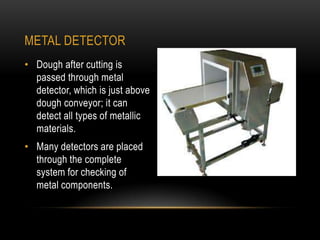
METAL DETECTOR
• Dough after cutting is
passed through metal
detector, which is just above
dough conveyor; it can
detect all types of metallic
materials.
• Many detectors are placed
through the complete
system for checking of
metal components.
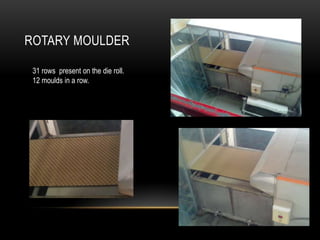
ROTARY MOULDER
31 rows present on the die roll.
12 moulds in a row.
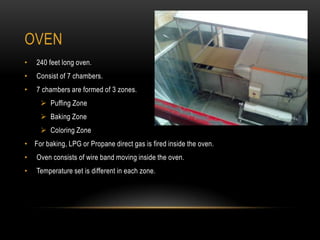
OVEN
• 240 feet long oven.
• Consist of 7 chambers.
• 7 chambers are formed of 3 zones.
 Puffing Zone
 Baking Zone
 Coloring Zone
• For baking, LPG or Propane direct gas is fired inside the oven.
• Oven consists of wire band moving inside the oven.
• Temperature set is different in each zone.
• Puffing zone (Zone 1 to 3 )
The leavening agents act a major role in this zone. Steam and volatile
gases do rise & increase the volume of the biscuit. This gives a porous
texture by the formation of puffs in the biscuit.
• Baking zone (Zone 4 & 5 )
This is the zone where the biscuits actually get baked. The temperature
of this zone is between 220-320`C. the moisture get evaporated in this
zone and biscuit get baked from inside.
• Coloring zone (Zone 7 & 8 )
This is the zone where the color of the biscuit is attained. The
temperature of this reaction is less than that of the baking zone.
The graph of temperature inside the oven is parabolic i.e. in initial zone temp. is
less, then in middle zone temp. goes to the peak point and in the last zone temp.
reduces again.
Time required to pass through oven is approximately 3mins.
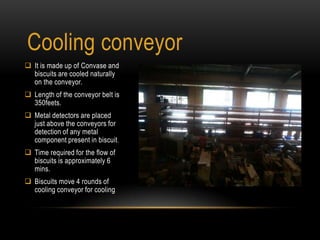
Cooling conveyor
 It is made up of Convase and
biscuits are cooled naturally
on the conveyor.
 Length of the conveyor belt is
350feets.
 Metal detectors are placed
just above the conveyors for
detection of any metal
component present in biscuit.
 Time required for the flow of
biscuits is approximately 6
mins.
 Biscuits move 4 rounds of
cooling conveyor for cooling
PACKAGING
Packaging consist of three sections
1. Stacking of Biscuits
2. Packaging
3. Dispatch
STACKING
• Aligns the biscuits in rows and these rows of biscuits move with
stacker table belt.
• A brush roll is fitted just above the stacker belt to control the
movement of biscuits.
• Operator at he stacker checks the biscuit quality and rejects the
defective.
• These biscuits are sent to packaging machine manually.
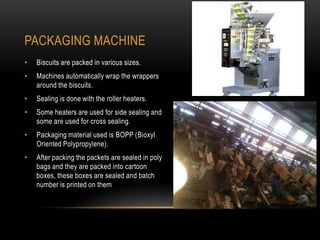
PACKAGING MACHINE
• Biscuits are packed in various sizes.
• Machines automatically wrap the wrappers
around the biscuits.
• Sealing is done with the roller heaters.
• Some heaters are used for side sealing and
some are used for cross sealing.
• Packaging material used is BOPP (Bioxyl
Oriented Polypropylene).
• After packing the packets are sealed in poly
bags and they are packed into cartoon
boxes, these boxes are sealed and batch
number is printed on them
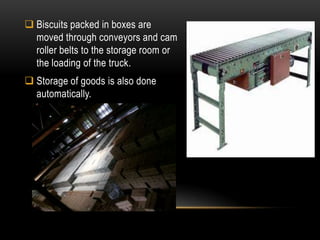
 Biscuits packed in boxes are
moved through conveyors and cam
roller belts to the storage room or
the loading of the truck.
 Storage of goods is also done
automatically.
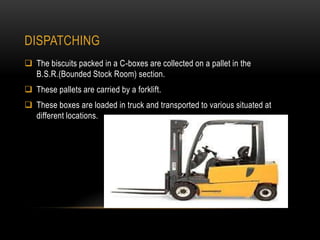
DISPATCHING
 The biscuits packed in a C-boxes are collected on a pallet in the
B.S.R.(Bounded Stock Room) section.
 These pallets are carried by a forklift.
 These boxes are loaded in truck and transported to various situated at
different locations.
• In case of poor finishing or broken or burned out
biscuits, it is kept aside in a different container.
• These biscuits are crushed to powder form again
and are used again.
• 5% of crushed biscuits is used in the new
mixture of biscuits.
• No Wastages.
CAPACITY UTILIZATION
• Capacity : 3000 tonnes of Biscuits/month
100 tonnes of Biscuits/day
• Capacity Utilization of 85% Approximately
Technology management  - parle products

Technology management - parle products

  • 1.
  • 2.
    INTRODUCTION • Largest Manufacturer’sof Biscuits & Confectionaries almost 80years. • Parle itself symbolizes quality, nutrition & great taste. • Most of Parle product are Market Leaders. • Available Everywhere. • Beacon of faith & trust for the consumers. • Great strength is extremely widespread distribution network.
  • 3.
    Parle Product’s Biscuits.. Confectionery..Snacks  Parle-G  Krackjack  Hide n Seek  Magix  Monaco  Kreamz  Milk Shakti  Parle Marie  Melody  Kismi Gold  Mango bite  Kacha Mango bite  Orange Candy  Poppins  Kismi Toffee  Mazelo  Parle Wafers  Musst Bite  Jeffs  Cheesling  Musst tix n Musst  Sixer  Sixer Zeera  Full Toss
  • 4.
    Mr. Nishikant Pathak (EducationCo-ordinator, Parle Products Pvt Ltd.) Mr. Nadeem Ansari (Sales Executive , Parle )
  • 5.
    • Skim MilkPowder • Leaving Agents • Salt • Emulsifiers • SMBS • Flavors • Citric Acid • Wheat Flour (Maida) • Fat (RBD Palm Oil)] • Sugar • Invert Sugar Syrup • Water INGREDIENTS Major Minor
  • 6.
    • Maida– Softwheat flour is required, as it gives more tender biscuit than hard wheat flour. • RBD Palm oil–  Helps in reducing toughness of dough,  Provide sensory (moistness, shortness, crispness & crunchiness)  Protects Flavor • Sugar– Quantity and Crystal Size of Sugar has big influence on biscuit texture and dimension. Improves the flavor and makes biscuit hard • Invert Sugar Syrup– Helps to give color, flavor & decrease crystallization. • Water– One of important ingredient used in almost all processes.
  • 7.
    • Skim MilkPowder– To subtle the flavor and textural improvements and to aid surface colouring. • Leaving Agents  Ammonia Bi-Carbonate  Sodium Bi-Carbonate  Salt  Emulsifiers Lecithin or Finamul  Sodium Meta Bi-Sulphate (SMBS)  Flavors  Citric Acid
  • 8.
    PRODUCTION PROCESS Store Receiving ofRaw Materials Quality Check Rejected Unloading of R.M. Inputs
  • 9.
    Raw Material Maida Dumping& sifting Mixing Fat Sugar (Grinded) Other Ingredients Moulding Proofing Baking Process
  • 10.
    Cooling in Conveyors Passesby Metal Detector Packaging Storage Dispatch Baking Coloring
  • 11.
  • 12.
  • 13.
    Maida dumping andsifting  Done by 2 methods – Automatic and Manual  In Automatic, Maida from dosing tank is transferred to mixer pneumatically.  In Manual, Maida is transferred to maida sifter by screw conveyor and then feeding in the mixer manually.  Now Automatic system is used Screw Conveyor Dosing Tank
  • 14.
    Sugar grinder  Sugarbags are unloaded & passed through metal detectors to remove any metal particles.  Sugar is transferred to grinder through screw conveyor.  Grinded sugar is stored in Service Tank & from there it is send to mixer. Service Tank
  • 15.
    Pumping of Fat Fat stored in the Silos is pumped at a temperature of 45`c.  Fat is mixed with Lecithin (an Emulsifying agent).  Mixture of Fat & Lecithin is added to Liquid vessels from where it is added to the mixer for dough preparation. Silos Liquid Vessel
  • 16.
    Stephan mixer  Materialmixed in the vessels are brought together in mixer and stirred for sometime.  After that, the mixture is passed to Stephan mixer, where it is mixed by a speed motor for 1-1.5 mins. Temperatures specification at mixing sections • Water – 15-20`C • Sugar Syrup – 30`C • Powder (Sugar + Flour)– 30`C • RBD Palm Oil – 45-50`C • Dough Temp. – 28-32`C Stephan Mixer
  • 17.
    METAL DETECTOR • Doughafter cutting is passed through metal detector, which is just above dough conveyor; it can detect all types of metallic materials. • Many detectors are placed through the complete system for checking of metal components.
  • 18.
    ROTARY MOULDER 31 rowspresent on the die roll. 12 moulds in a row.
  • 19.
    OVEN • 240 feetlong oven. • Consist of 7 chambers. • 7 chambers are formed of 3 zones.  Puffing Zone  Baking Zone  Coloring Zone • For baking, LPG or Propane direct gas is fired inside the oven. • Oven consists of wire band moving inside the oven. • Temperature set is different in each zone.
  • 20.
    • Puffing zone(Zone 1 to 3 ) The leavening agents act a major role in this zone. Steam and volatile gases do rise & increase the volume of the biscuit. This gives a porous texture by the formation of puffs in the biscuit. • Baking zone (Zone 4 & 5 ) This is the zone where the biscuits actually get baked. The temperature of this zone is between 220-320`C. the moisture get evaporated in this zone and biscuit get baked from inside. • Coloring zone (Zone 7 & 8 ) This is the zone where the color of the biscuit is attained. The temperature of this reaction is less than that of the baking zone. The graph of temperature inside the oven is parabolic i.e. in initial zone temp. is less, then in middle zone temp. goes to the peak point and in the last zone temp. reduces again. Time required to pass through oven is approximately 3mins.
  • 21.
    Cooling conveyor  Itis made up of Convase and biscuits are cooled naturally on the conveyor.  Length of the conveyor belt is 350feets.  Metal detectors are placed just above the conveyors for detection of any metal component present in biscuit.  Time required for the flow of biscuits is approximately 6 mins.  Biscuits move 4 rounds of cooling conveyor for cooling
  • 22.
  • 23.
    Packaging consist ofthree sections 1. Stacking of Biscuits 2. Packaging 3. Dispatch
  • 24.
    STACKING • Aligns thebiscuits in rows and these rows of biscuits move with stacker table belt. • A brush roll is fitted just above the stacker belt to control the movement of biscuits. • Operator at he stacker checks the biscuit quality and rejects the defective. • These biscuits are sent to packaging machine manually.
  • 25.
    PACKAGING MACHINE • Biscuitsare packed in various sizes. • Machines automatically wrap the wrappers around the biscuits. • Sealing is done with the roller heaters. • Some heaters are used for side sealing and some are used for cross sealing. • Packaging material used is BOPP (Bioxyl Oriented Polypropylene). • After packing the packets are sealed in poly bags and they are packed into cartoon boxes, these boxes are sealed and batch number is printed on them
  • 26.
     Biscuits packedin boxes are moved through conveyors and cam roller belts to the storage room or the loading of the truck.  Storage of goods is also done automatically.
  • 27.
    DISPATCHING  The biscuitspacked in a C-boxes are collected on a pallet in the B.S.R.(Bounded Stock Room) section.  These pallets are carried by a forklift.  These boxes are loaded in truck and transported to various situated at different locations.
  • 28.
    • In caseof poor finishing or broken or burned out biscuits, it is kept aside in a different container. • These biscuits are crushed to powder form again and are used again. • 5% of crushed biscuits is used in the new mixture of biscuits. • No Wastages.
  • 29.
    CAPACITY UTILIZATION • Capacity: 3000 tonnes of Biscuits/month 100 tonnes of Biscuits/day • Capacity Utilization of 85% Approximately